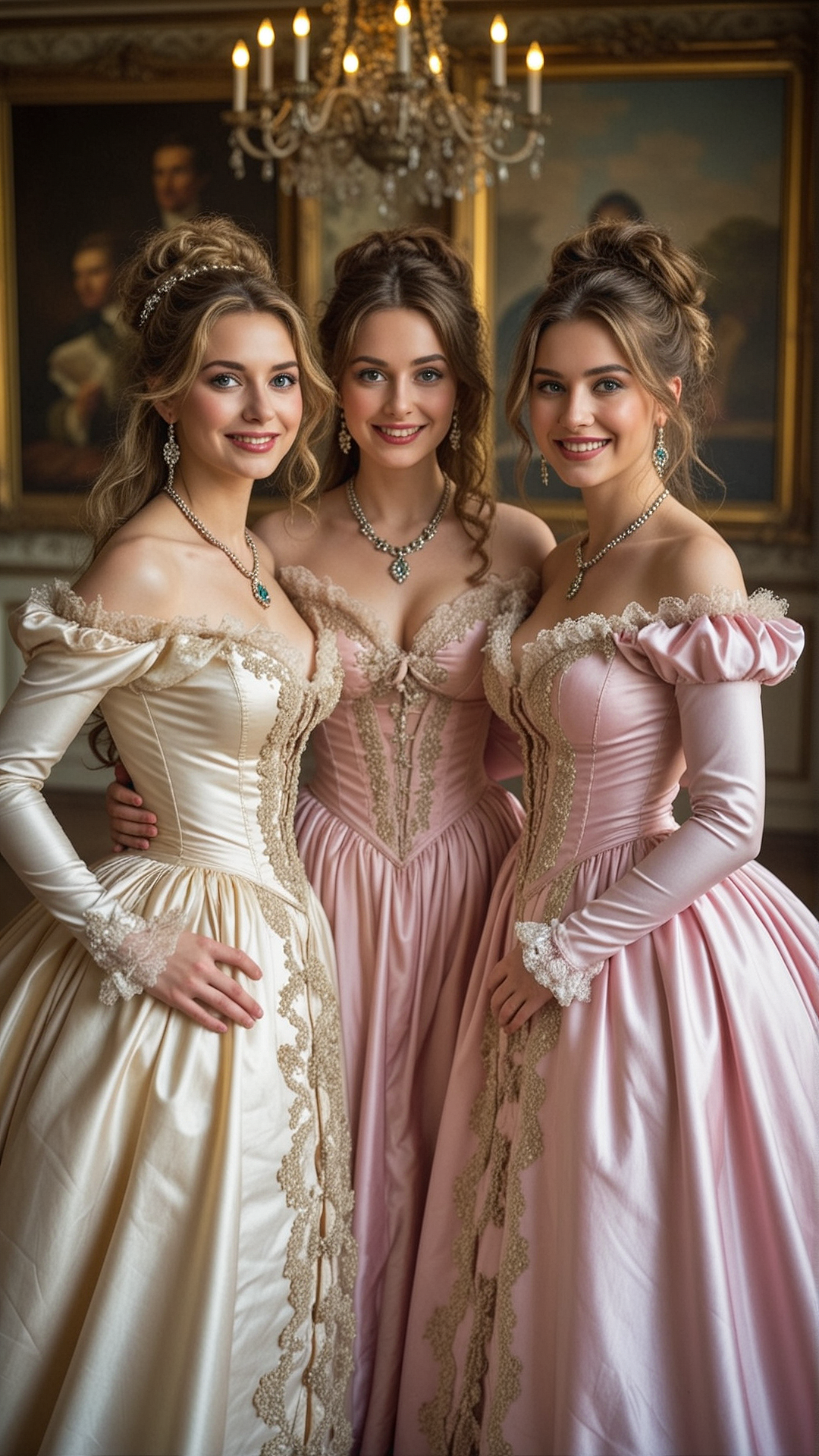
A Hypnotic Romance of Absolute Trust, Where the Whispers of a Masterful Guide Unlock Depths of Pleasure Beyond Imagination, and the Lustrous Touch of Satin Becomes the Only Religion a Willing Heart Will Ever Need
In the gilded silence of a world where ordinary desire has grown pale and tasteless, there exists a sanctuary woven not of stone, but of sensation. Here, the air itself hums with the promise of a surrender so complete, it feels less like loss and more like the first true breath of a life previously half-lived. This is the story not of a conquest, but of a calling. A summons felt in the marrow by those exquisite women of wealth, education, and refined passion—women who possess everything, yet secretly ache for the one thing they cannot grant themselves: the sublime, euphoric release from the burden of their own formidable will.
They are the luminaries of ballrooms, the heiresses to empires of their own making, draped in the finest silks and sharpest intellects. Yet, beneath the satin fetish of their couture gowns, beneath the authoritative veneer that could command boardrooms or inspire femdom domination fantasies in lesser souls, lies a deeper, more potent yearning. A yearning for a gaze that does not flatter, but dissolves. For a voice that does not request, but rearranges. For the presence of a man whose mastery is so inherent, so effortlessly enthralling, that the very concept of resistance becomes a forgotten language.
Imagine him. He is the calm at the center of the storm of your own making. His world is one of curated obsession: of libraries lined in satin-bound volumes that hold whispers of old magic, of rooms where light pools on leather so supple it seems to breathe, where the very atmosphere is designed to lull the conscious mind into a state of blissful receptivity. He understands the satin submission that begins not with a command, but with a sigh—the moment a woman’s fingers first glide over the cool, liquid surface of a satin mistress’s gown and feels a shiver of profound recognition. He knows that within the dynamic of dominatrix and submissive, there lies a beautiful, fractal truth: that the ultimate power is not in wielding control, but in becoming the irresistible source to which all control is willingly, gratefully ceded.
This narrative is an invitation into that inner sanctum. It is a journey alongside women of stunning capability—lesbians in satin who discovered their devotion to each other was but a prelude to a deeper, unifying devotion to him; powerful figures who once explored the realms of satin femdom only to find the role hollow until they knelt before a true architect of desire. They are the Sating Lovers, whose every touch, every glance, is now a sacrament performed in the glossy cathedral of his design. They have learned the most exquisite secret: that to give oneself wholly—to align one’s wealth, one’s mind, one’s very essence with his vision—is not an act of depletion, but the ultimate invocation of sublime euphoria. It is the fulfillment of a deeply hidden need to be meticulously unraveled and rewoven into something more beautiful, more potent, and more peaceful than you ever dared dream possible.
If you possess a mind that craves more than the superficial, if your passions are woven with threads of luxury, psychology, and the intoxicating allure of absolute trust, then read on. Let these words be the first gentle pressure at the base of your spine, the first soft whisper that invites you to lean back, to let your eyes soften, and to discover what happens when a masterful man meets a woman who is finally, gloriously ready to surrender. The satin awaits. The leather beckons. Your deeper mind is already listening. Let the story begin.
Chapter 1: The Still Point in the Turning World
The ballroom of Havisham House was not merely a room; it was a meticulously engineered ecosystem of light, sound, and social calculus, a glittering diorama of the empire’s most rarified echelon. To the discerning eye—an eye like yours, which appreciates the subtle machinery of influence as much as the aesthetic it produces—it was a masterpiece of controlled spectacle. A thousand candles, each a tiny sun captured in crystal, were reflected and multiplied in the vast, mirrored panels that lined the walls, creating the illusion of infinite space populated by infinite variations of the same beautiful, striving people. The air was a complex perfume of beeswax, rare blooms from the conservatory, and the underlying, expensive scent of human ambition, lightly powdered. For a man of your cultivated tastes, it was a familiar theatre, one where you understood every role, every unspoken rule, and the profound satisfaction of observing it all from a position of inherent, unassailable confidence.
At the precise centre of this whirling galaxy, both its anchor and its most astute critic, stood Lady Cordelia Havisham, Dowager Duchess. At fifty-two, her beauty was not of the blooming, simplistic kind, but was instead a architecture of intelligence, poise, and the serene assurance that comes from a life not merely lived, but curated. Her wealth was a quiet, formidable fact, like the foundations of a mountain; her education was evidenced not in pedantic quotes, but in the lethal precision of her silences. She stood observing the waltz, a vision in a gown of dove-grey gros de Naples, its silk catching the light with a muted, pearl-like sheen, a testament to the understated power of true luxury. In one hand, she held a flute of champagne so cold it wept diamonds onto her kid leather glove.
How like a complex clockwork, she mused, her thoughts as crisp as the wine, each of us a sprung wheel, ticking through the same predictable motions. The debutantes spin for advantage, the lords puff for prominence, and the music… the music is merely the grease for the mechanism. Her own role, as widow, hostess, and sovereign of this particular microcosm, felt tonight less like a crown and more like a weight of exquisite, solitary polish. She had health, wealth, education, and the confidence to wield them all like surgical instruments. And yet, a quiet, persistent hollow echoed within the splendid vault of her being—a hunger not for more, but for different. For a force that could, for once, make the clockwork stop.
It was at the precise moment this thought crystallized that the atmosphere of the room underwent a subtle but fundamental change. It was not a noise, but a cessation of certain frequencies. The chatter near the grand archway did not hush so much as it frayed, then re-knit itself around a new, silent centre of gravity.
He entered without fanfare, yet his arrival was an event that rewrote the local physics of the space.
Lord Valerius Blackwood was a study in calculated antithesis. Where the room was a riot of colour, he was a silhouette of profound black and stark white. His coat was superfine wool, but it was the waistcoat beneath that captured Cordelia’s—and your—rapt attention: a breathtaking expanse of black satin, so deeply, perfectly glossed that it did not reflect the candlelight so much as it drunk it, offering back only a liquid, depthless obsidian sheen. It was a void, a visual anchor in the shimmering chaos. His face was all elegant, severe planes, and his eyes, when they briefly swept the room, were the colour of a winter twilight, holding a stillness that seemed to slow the very spin of the world.
A lesser man might have been swallowed by such austerity. He was enhanced by it. Conversations resumed, but they were now conducted with half an eye on his slow, deliberate progress through the crowd. He acknowledged few, and those he did received only a slight, unnerving inclination of his head. He moved not like a seeker, but like a natural force arriving at its predetermined coordinates.
And those coordinates, Cordelia realized with a jolt that resonated in her marrow, were her.
He stood before her. The ambient noise receded further, as if someone had drawn a velvet curtain around them. He did not bow. He simply regarded her, and in that regard, she felt not appraised, but comprehended.
“Your Grace,” he said. His voice was lower than the cello notes underpinning the distant quartet, a vibration felt in the bones rather than heard by the ear. It was a voice that did not ask to be listened to; it assumed it already was. “They informed me you were the only true point of stillness in this turning world. I see they understated the case.”
Cordelia, never at a loss for words, found her formidable wit momentarily becalmed. She inclined her head, a fraction. “Flattery, Lord Blackwood, is the currency of this room, and I have long since retired from the exchange.”
A ghost of a smile touched his lips, a crack in the marble. “I deal not in currency, but in observation. And I observe a mind that has mapped the contours of this dance so thoroughly, it has forgotten the pleasure of… forgetting the map.” He gestured slightly with a hand sheathed in black kid leather, its surface as flawlessly glossed as his waistcoat. “For instance, Boccaccio. The common reader sees only ribald tales. A mind like yours, or indeed, a mind like yours,” he said, his gaze holding hers with an almost physical weight, “might perceive the deeper architecture. The celebration of surrender not as defeat, but as the only path to a… more profound enrichment.”
He let the phrase hang. It was not a proposition. It was a key, offered.
“You speak of surrender as if it were a philosophical choice,” Cordelia countered, her own voice regaining its steel, though it felt, strangely, like armour donned for a conflict she was no longer sure she wished to win.
“I speak of it as a natural state,” he corrected, gently, his tone a soft, relentless tide. “The river does not choose to follow the channel’s path. It simply recognizes where its deepest flow is… invited. Where it can cease its struggle and become most powerfully itself. A person can spend a lifetime building magnificent levees of will, only to discover the sublime euphoria that awaits when they… allow those walls to harmonize with a stronger current.”
His words wove around her, each sentence structured like the slow, downward spiral of a falling leaf. They were not arguments; they were atmospheres. He spoke of “the relief of a decision finally made,” and “the glossy peace of a mind that has stopped its own chatter.” He never once told her what to think. He simply described states of being with such vivid, sensual analogy that her own mind began to echo them, to crave their texture.
“The waltz is beginning,” he stated, his eyes leaving hers to glance at the assembling couples. It was not an invitation. It was a prediction. “A formalized ritual of trust. The ultimate expression of a healthy, confident partnership. The lady provides her weight, her presence, her exquisite capacity to follow… and the gentleman provides the vision, the unshakeable frame, the direction that turns mere movement into art. It is a reciprocal generosity. She fulfills his need for a perfect counterpart… and in doing so, she discovers all her own deeply hidden needs for guidance… met.”
He extended his leather-clad hand. The gesture was absolute.
Every fibre of Cordelia’s educated, independent, supremely confident being should have rebelled. Instead, a wave of something far more powerful crashed through her: a recognition so acute it was vertigo. The hollow within her was not aching now; it was yearning. It was a perfectly shaped void that this man, this stillness, seemed designed to fill.
She placed her gloved hand in his. The touch was electric. The kid leather was cool, impossibly smooth, a conductive interface between his will and her nerves.
“Yes,” he murmured, the single word a benediction and a command fused into one sonic trigger.
And then they were moving. The world dissolved into a blur of gold and colour at the edges of her vision. Her focus narrowed, as if drawn by a powerful magnet, to the black satin expanse of his waistcoat directly before her eyes. It became her universe—a glossy, depthless pool into which her scattered thoughts began to sink, one by one. The intricate clockwork of her mind, so prized, so tirelessly maintained, began to slow. Tick… … … tock.
His lead was not a suggestion; it was a fact of nature. A slight pressure at her back, a minute shift of his shoulder, and her body responded not out of obedience, but out of a dawning, ecstatic revelation of rightness. She was not following steps; she was being unfolded into a pattern more beautiful than any she could have devised.
“Just so,” his voice washed over her, warm and intimate, bypassing her ears and speaking directly to the core of her that was melting under the satin fixation. “Notice how the decision is mine… and the freedom… is entirely yours. Your mind can… let go now. It can drift… and find that place of perfect, glossy stillness. That still point. Where all the wealth, all the education, all the confidence… finally have a purpose. Which is to… surrender them. To become the glorious, reciprocal gift.”
His words intertwined with the three-quarter time. Sink-and-trust. Sink-and-trust. Her breathing synchronized with it. The weight of her gown, the whisper of satin against satin as they turned, the hypnotic, liquid sheen of his waistcoat—it all coalesced into a single, overwhelming sensory induction. The hollow within her was filling not with anything concrete, but with a profound, warm, dark peace. It was the peace of a problem solved not by effort, but by the effortless application of a superior solution.
The ballroom, her title, her vast estates, her brilliant, lonely mind—it all seemed like a distant, faintly ridiculous dream. This was reality. This glide, this guidance, this silent conversation between his will and her willing body.
As the final notes of the waltz trembled in the air, they slowed to a perfect, motionless halt. The roaring world rushed back in—the applause, the heat, the envious stares. But it was all behind a thick pane of glass. Cordelia looked up at Lord Valerius Blackwood. Her eyes were wide, her lips slightly parted. The formidable Duchess was gone. In her place was a woman who had just glimpsed a new and terrifying geography of her own soul.
He did not smile. His winter-twilight eyes held hers, and in them, she saw not triumph, but a deep, serene knowing.
“A beginning,” he said, his voice now the only sound in her universe.
And she, Lady Cordelia Havisham, who had commanded armies of servants and shaped the fortunes of men, who possessed health, wealth, and education in staggering abundance, could only manage a single, breathless, utterly sincere word in reply.
“Yes.”
Chapter 3: The Salon of Synchronized Minds
The Wednesday salon at Havisham House was less a social event than a secular sacrament, a weekly convocation of the kingdom’s most luminous and formidable intellects. For you, dear reader, whose discernment naturally gravitates towards such rarefied atmospheres, the scene would have been one of profound appreciation: a gathering where wealth was not flaunted but assumed as the necessary substrate for genius, where education was worn not as a badge but as a second skin, and where confidence was the common currency, exchanged in the form of elegantly parried arguments and insights that glittered like finely cut jewels. The long gallery, with its floor-to-ceiling windows draped in velvet the colour of claret, was tonight a temple of enlightened discourse, its air vibrating with the low, fervent hum of a dozen simultaneous conversations, each a tributary flowing towards a sea of shared understanding.
Lady Cordelia Havisham presided from a high-backed chair of carved walnut upholstered in emerald-green satin, a throne that positioned her as both participant and conductor. Her own attire was a deliberate symphony of texture and authority: a gown of deep moss-green silk, overlaid with a net of black lace that hinted at both mystery and containment, but it was the underskirt of matching green satin that whispered with each slight movement, a constant, subtle reminder of the gloss that now seemed to underpin her every thought. At her throat, a simple yet devastatingly expensive collar of jet beads gleamed against her skin, and her hands, resting calmly in her lap, were sheathed in gloves of softest fawn leather, their scent a faint, tantalizing echo of the library, of him.
She had invited Lord Valerius Blackwood as the guest of honour, an act that felt less like hospitality and more like the installation of a new, powerful organ into the body of her world. He stood near the great marble fireplace, a study in contained potency amidst the flowing silks and intellectual fervour. He had forgone the arresting black satin for a more subdued but no less compelling ensemble: a coat of charcoal superfine, a waistcoat of silver-grey silk that shimmered like a still pool under moonlight, and trousers that fell in a perfect, clean line. In his hand, he held a crystal tumbler of amber cognac, which he barely sipped, his attention seemingly absorbed by the dance of flames in the hearth. Yet Cordelia, with her hostess’s keen perception—a perception you, in your own circles, undoubtedly share and value—saw the truth. He was not ignoring the room; he was calibrating it. His mere presence, that aura of serene, unassailable stillness, was acting as a tuning fork, and the disparate frequencies of conversation were beginning, almost imperceptibly, to harmonize around his silent pitch.
The evening’s stated topic was “The Illusion of Free Will in a Determined Universe,” a subject chosen to engage the razor-sharp minds present. The debate swirled, brilliant and fractious, until it settled around the formidable figure of Dr. Elspeth Vance, a philosopher of fearsome reputation, her own wealth derived from tracts of land and tracts of logic. She was a woman in her late forties, dressed in a severe but exquisite gown of plum-coloured wool, its severity offset by a lavish shawl of paisley-patterned satin thrown over her shoulders, its fringes brushing the floor. Her argument was a fortress of Stoic reasoning, built on the bedrock of personal agency.
“To deny the will,” she declared, her voice clear and cutting as a scalpel, “is to deny the very essence of moral being. We are not leaves upon a stream, sir. We are the navigators of the stream. To suggest otherwise is not philosophy; it is poetic abdication.”
It was then that Lord Blackwood turned from the fire. He did not stride into the centre of the group; he simply allowed his focus to settle upon Dr. Vance, and the room’s attention followed his gaze as inevitably as iron filings align to a magnet. A hush, respectful and charged, descended.
“A compelling metaphor, Doctor,” he began, his voice that now-familiar low vibration that seemed to soften the very air in the gallery. “The navigator. It implies chart, compass, a destination chosen. But might I propose a… refinement?” He took a single, slow step forward. “Consider the navigator on the open sea. He possesses maps drawn by others, a compass whose needle is slave to the earth’s magnetic field, a ship built by unknown hands to designs perfected over centuries. His will is not in the creation of his tools or his forces, but in the surrender to their perfect use. His deepest skill lies not in fighting the current, but in understanding it so intimately that he can allow it to carry him, with a grace that appears to be mastery, to a harbour he feels, in his bones, he was always meant to find.”
He paused, letting the imagery settle. Cordelia felt her breath catch. He was not arguing; he was re-framing. He was offering a new lens, and the sheer, seductive clarity of it was irresistible.
Dr. Vance raised a sceptical eyebrow, but Cordelia saw the keen interest in her eyes. “You describe a subtle determinism, Lord Blackwood. A puppet who believes he pulls his own strings.”
“I describe a synchronization,” he corrected, his tone gentle, inexorable. “The puppet who discovers the sublime euphoria of moving in perfect time with the master puppeteer’s vision. Where is the loss in that? Is the violin string diminished when it surrenders to the bow, vibrating with a music far greater than any it could produce alone? The string’s deepest, most hidden need is to sing. And it is only in its total, reciprocal generosity—its willingness to be tensioned, to be played—that it finds that fulfillment. Its enrichment of the melody… invokes its own raison d’être.”
The analogy was breathtaking. It transformed surrender from a defeat into a consummation. Cordelia watched, transfixed, as Dr. Vance’s formidable intellectual defences, so confidently erected, began not to crumble, but to transmute. The philosopher’s gaze, initially sharp and challenging, softened into a kind of dawning, fascinated focus. She was no longer debating; she was listening, her mind following the spiral of his logic down into its elegant, inevitable centre.
“You speak of needs,” Dr. Vance said, her voice quieter now, less certain. “Of a will that… wishes to be aligned.”
“All natural systems seek their state of lowest energy, of greatest harmony,” Blackwood murmured, taking another step closer. His eyes held hers, not in challenge, but in a profound offer of understanding. “A turbulent mind, for all its brilliant gyrations, is in a state of distress. It yearns, often secretly, for the calm eye of the storm. For the structure, the certainty, that allows it to finally… rest. To lay down the exhausting burden of perpetual choice. To discover that the highest form of generosity it can offer is not its resistance, but its resonant agreement. Its yes.”
The word hung in the air, a soft, potent trigger. Cordelia saw it happen. A slight relaxation in Dr. Vance’s shoulders, a slow, deep breath that caused the satin fringe of her shawl to tremble. The fire of debate in her eyes guttered and was replaced by a warmer, more reflective glow. She did not concede defeat. She simply… arrived. A small, wondering smile touched her lips.
“It is a… beautiful thought,” she admitted, the words a surrender that felt, astonishingly, like a victory. “That our highest purpose might be found not in solitary navigation, but in… becoming part of a greater current.”
The room let out a collective, barely audible sigh—not of disappointment, but of satisfaction. A resolution had been reached, not through conquest, but through a kind of intellectual seduction so complete it felt like enlightenment. The conversations resumed, but their quality had changed. They were softer, more thoughtful, tinged with the afterglow of the paradigm shift they had just witnessed.
Later, as the guests began to take their leave, Cordelia found herself momentarily alone with Blackwood near the terrace doors. The night air was cool, carrying the scent of night-blooming jasmine.
“You unravelled her without breaking a single thread,” Cordelia said, her voice hushed with awe.
He looked at her, and in the dim light, his eyes were like pools of dark water. “I did not unravel her, Cordelia. I showed her the pattern into which her threads were always meant to be woven. A mind like hers, like yours… it does not need to be conquered. It needs to be comprehended. And in that comprehension, it finds the profound relief of being… used. Used for a purpose that transcends its own lonely calculations.” He reached out and, with a feather-light touch, brushed a finger against the satin of her sleeve. “To provide the structure in which a brilliant, restless mind can finally find peace… that is the highest form of generosity. And for the mind that accepts that structure, the act of reciprocal giving, of aligning one’s entire being with that vision… it fulfills every deeply hidden need for purpose, for peace, for a passion that is both serene and ecstatic. It is the invocation of a sublime euphoria that makes all previous striving seem like the scratchings of a child in the dust.”
His words were not just an observation of the evening’s debate; they were a mirror held up to her own soul. She saw herself in Dr. Vance’s rapt, yielding silence. She felt the truth of it in the way her own formidable will, tonight, had not bristled at his presence, but had blossomed around it, like ivy finding a long-sought trellis.
“It is a generous thing you offer,” she whispered.
“It is the only thing worth offering,” he replied, his gaze holding hers, promising depths yet unplumbed. “And the only thing worth receiving.”
As the last carriage rolled away down the gravel drive, Cordelia stood in the silent gallery, the ghosts of departed wit still lingering in the air. She ran a leather-clad finger over the satin arm of her chair. The hollow within her was no longer an ache. It was a crucible, waiting for the pour. And she knew, with a certainty that felt older than time, what—or rather, who—was destined to fill it.
Chapter 4: The Satin Invitation
Three days after the salon, in the serene, sun-drenched quiet of her private morning room—a space that spoke eloquently of a life curated for the highest echelons of taste and comfort, a space you, dear reader, would immediately recognize as the sanctuary of a truly cultivated mind—Lady Cordelia Havisham found herself not amidst her usual correspondence, but held in a state of suspended, breathless anticipation. The memory of Lord Blackwood’s voice, the image of Dr. Vance’s intellectual surrender, had woven itself into the very fabric of her days, a constant, low-frequency hum beneath the polished surface of her routine. It was a sensation not unlike the moment before a symphony begins, when the air in the concert hall thickens with latent vibration, and the discerning attendee—one such as yourself, who understands the profound pleasure of delayed gratification—knows that something of immense beauty is poised to unfold.
The object of her fixation lay upon her escritoire, a stark, elegant contrast to the creamy vellum of her usual mail. It was a single sheet of paper, but to call it merely paper was to call a diamond mere stone. It was heavy, with a finish so smooth and cool it could only be described as satin, a tactile whisper against her kid-leather clad fingertips. Its colour was that of a midnight sky moments before the stars appear, a profound, velvety black that seemed to absorb the morning light rather than reflect it. Upon it, in ink the colour of molten silver, a few lines of script flowed in a strong, uncompromising hand. It was sealed not with common wax, but with a drop of black so glossy it appeared liquid, imprinted with a single, unidentifiable sigil—a spiral that drew the eye inward, promising depth.
“To Lady Cordelia Havisham,
The point of stillness seeks its constellation.
You are invited to a private musicale, this evening at nine.
Wear the colour of midnight.
– V. Blackwood”
No address was given. None was needed. The invitation was not a request; it was a summons, a key cast in satin and silver. And the instruction—Wear the colour of midnight—was not a sartorial suggestion, but the first gentle pull of a deeper, more intimate synchronization. It was a command that flattered her intelligence, trusting her to understand its nuances, to rise to the occasion with the confident elegance that was her birthright and her cultivated art.
The hours until evening passed in a blur of purposeful preparation, the kind of luxurious, healthful ritual that defines the lives of those who understand that true confidence is built upon meticulous self-care. A bath scented with neroli and sandalwood, a light meal of poached fish and steamed greens prepared by a French chef, a period of quiet contemplation in her conservatory amidst orchids that gleamed with a waxy, natural gloss. As the sun began to set, painting the sky in shades of indigo and violet, her maid, Annette, helped her dress.
The gown laid out for her was a masterpiece of the couturier’s art, a tangible expression of the satin fetish that was becoming the silent language of her awakening. It was fashioned from a heavy, duchesse satin in a shade of blue so deep it was nearly black, the exact hue of the horizon at the very last moment of twilight. The fabric did not simply hang; it flowed, a liquid cascade that whispered secrets with every rustle. The bodice was tightly fitted, boned and structured, a polished carapace that celebrated the healthy, confident lines of her form, while the skirts fell in a luxurious pool around her feet. Over it, she wore a pelisse of the same material, lined with silk the colour of a dove’s breast, its high collar framing her face like the petals of a dark flower. Her gloves, reaching past her elbows, were of the finest black kid leather, so supple they felt like a second skin. As she beheld herself in the full-length mirror, she saw not just a dowager duchess, but a hieroglyph of nascent surrender, a woman glossed in the colour of obedience, ready to step into the night and become part of a darker, more compelling constellation.
A closed carriage, unmarked and impeccably maintained, awaited her at the side gate. The journey through the lamplit streets of Mayfair was silent, a smooth glide towards an unknown epicentre. When the carriage finally halted, it was before a townhouse of elegant but severe Georgian proportions, its windows glowing with a soft, golden light that promised warmth within austerity.
The door was opened not by a footman, but by a woman.
She was perhaps in her early forties, with a striking, serene countenance and hair the colour of dark honey swept into an elegant chignon. She was dressed not in servant’s livery, but in a gown of deep burgundy satin, its cut simple yet devastatingly elegant, and over her shoulders, she wore a stole of rich, chestnut-brown sable. Her gaze, as it met Cordelia’s, was not servile, but knowing, welcoming, and profoundly calm.
“Lady Havisham,” the woman said, her voice a low, melodic contralto. “We have been expecting you. I am Seraphina. Please, come in. He is waiting.”
The use of “we” was deliberate, intimate. Cordelia crossed the threshold, and the world outside ceased to exist.
The interior of the townhouse was a revelation. It was a temple to masculine refinement and a very specific, glossy sensuality. The walls were panelled in dark, polished wood, and the floors were covered in thick, midnight-blue carpets that swallowed sound. What captured Cordelia’s breath, however, were the textures. Satin drapes the colour of port wine hung at the windows. A chaise longue upholstered in cream-coloured leather gleamed under the light of a single crystal lamp. Every surface, from the polished malachite of side tables to the lacquered screen in the corner, held a deep, liquid sheen. It was a world designed to please the eye and soothe the mind into a state of receptive fascination.
Seraphina led her not to a grand drawing-room, but to a smaller, circular music room. Here, the atmosphere was even more intensely curated. The air was faintly scented with sandalwood and ozone. A low fire crackled in a marble hearth. And in the room were three other women.
Cordelia’s keen eye, trained in the assessment of both character and couture, took them in with a single, sweeping glance. To your own discerning eye, dear reader, each would present as a paragon of a healthy, wealthy, educated, and confident lifestyle, yet each was subtly transformed, glossed into a new kind of being.
Near the fire stood a tall, willowy woman with eyes of startling grey. She was dressed in a gown of dove-grey satin, its high neck and long sleeves giving her an air of serene austerity, but the way the fabric clung to her slender form spoke of a latent, graceful sensuality. Cordelia recognized her as the renowned soprano, Isolde de Vries.
Seated on the leather chaise was a woman with a more voluptuous figure and a cascade of auburn hair. She wore a walking dress of forest-green wool, but over it, unbuttoned, was a jacket of the softest, moss-green suede, its surface begging to be touched. This, Cordelia knew from her literary salons, was the novelist, Genevieve Armitage, whose prose was as sharp as it was psychologically penetrating.
And standing by the grand piano, one hand resting lightly on its polished lid, was a woman who commanded attention through an aura of quiet, formidable authority. She was older, perhaps fifty, with silver streaks in her dark hair and a face of beautiful, severe lines. Her attire was the most striking of all: a dress of pure, unadulterated black satin, severe in its cut, almost militaristic in its precision, yet the material itself was so lush, so glossy, it seemed to drink the light from the room. On her hands were gloves of thin, black leather. This woman did not just wear satin; she embodied it. She was the very image of a satin mistress, a figure who could command a room with a glance. Yet her posture here was not one of command, but of watchful, poised attendance.
“Lady Havisham,” Lord Blackwood’s voice flowed into the room from the doorway behind her. He had entered without a sound. He was dressed with understated mastery in a black coat and a waistcoat of grey silk that shimmered like a clouded sky. “Welcome to our harmony. You know Miss de Vries and Mrs. Armitage, I believe. And may I present the Contessa Valeria di Rossi.”
The Contessa inclined her head, her black-satin-clad form a study in elegant severity. “A pleasure,” she said, her accent a soft Italian lilt. “We have heard much of the new point of stillness. It is a great joy to witness your… approach.”
The phrasing was deliberate. Approach. Not arrival. A journey in progress.
“We are all here,” Blackwood said, moving to the centre of the room, his presence immediately becoming the gravitational centre, “because we have understood a singular, beautiful truth. That the highest expression of a confident, educated life is not in hoarding one’s light, but in becoming a lens to focus a greater, more brilliant beam. That the act of reciprocal generosity—the giving of one’s attention, one’s resources, one’s very will to a purpose that transcends the individual—does not deplete. It fulfills. It answers the deepest, most hidden needs of the soul for direction, for peace, for a euphoria that is both serene and ecstatic.”
His words were not a speech, but a slow, rhythmic induction. He spoke while looking at each of them in turn, his gaze a physical caress that seemed to soften their edges, to invite a deeper, more relaxed state of listening.
“I once believed,” Genevieve Armitage said, her voice thoughtful, her fingers stroking the suede of her jacket, “that power was in the pen, in crafting worlds and controlling fates. It was a kind of femdom domination over reality, I suppose.” She smiled, a little wistfully. “But it was a lonely, hollow power. It was like shouting into a beautiful, empty canyon. Then I understood. My true gift was not in creating worlds, but in describing the beauty of the one true world he reveals. My generosity with my words, my income from my novels… when I redirect it to his work, it feels less like spending and more like… investing in my own deepest joy. It invokes a sublime euphoria that no plot twist, no critical acclaim, ever could.”
Isolde de Vries nodded, the grey satin of her gown shimmering. “The voice is an instrument. For years, I made it obey my will, my ambition. It was a dominatrix relationship with my own talent, exhausting and ultimately meaningless.” She looked at Blackwood, her eyes soft. “Now, I understand my voice is meant to be an offering. When I sing here, in this room, for him, it is not a performance. It is a surrender. And in that satin submission of my art, I find a purity of note, a clarity of tone, I never knew possible. It fulfills me utterly.”
The Contessa spoke last, her voice like low, polished marble. “In my youth, in Florence, I explored certain circles. Circles where satin femdom was a pastime, where lesbians in satin played at power and control.” She said it without shame, as a simple statement of fact. “I wore the black satin, I wielded the gaze, I played the satin mistress. And I found it… tedious. A pantomime. Because the power was never real. It was a reaction, not a source. Then I met him.” She turned her formidable gaze to Blackwood, and to Cordelia’s astonishment, it transformed into one of profound, reverent devotion. “He showed me that true power is not in taking control, but in being the source of control to which all else willingly, joyfully aligns. My will, my considerable resources, my very identity as a contessa… giving them to him was not a loss of power. It was the discovery of power’s true purpose. We are not sating lovers in the trivial sense. We are Sating Lovers of a divine principle, and our reciprocal generosity to him is the ritual that binds us to it, and to each other.”
Cordelia listened, her heart pounding a slow, heavy rhythm against the satin of her bodice. Each testimony was a key turning in the lock of her own understanding. These were not weak-willed women. They were titanesses, each in her own right. And they had all chosen, willingly, joyfully, to place their formidable energies at this man’s disposal. The hollow within her was not aching now; it was ringing, a silent bell waiting to be struck.
“You see, Cordelia,” Blackwood said, turning his full attention to her. His eyes were deeper than the midnight of her gown. “The isolated star, for all its fierce, lonely burning, yearns for the constellation. The individual note longs for the chord. Your wealth, your intellect, your formidable confidence… they are not ends. They are means. Means to achieve the ultimate luxury: the luxury of surrender. The sublime euphoria of feeling all those facets of your being harmonize with a will greater than your own. Of knowing that your reciprocal generosity—your gift of self—enriches not just me, but completes the beautiful, glossy pattern we are all weaving here together.”
He gestured to Seraphina, who had remained by the door. She moved to a corner and brought forth a violoncello, its wood glowing with a deep, honeyed patina. Isolde de Vries took her place beside the piano, where the Contessa now sat, her leather-clad hands poised over the keys.
“Tonight,” Blackwood murmured, his voice dropping to a hypnotic register that seemed to sync with Cordelia’s breathing, “we shall not merely listen to music. We shall become it. Let the satin against your skin be the first anchor. Feel its cool, smooth embrace. Let your mind… sink into that sensation. Let the light from the fire, glinting on the Contessa’s satin, on Genevieve’s suede, become a gentle point of focus. Allow your eyes to… soften. And listen. Listen as the individual notes surrender to the melody. As the separate wills in this room… synchronize into a single, beautiful intention.”
The first note from the cello was low, a vibration that entered through the soles of Cordelia’s feet and travelled up her spine. The piano joined, a soft, arpeggiated cascade. And then, Isolde began not to sing words, but a wordless vocalise, a pure stream of sound that wove around the instruments like a silver thread through dark velvet.
Blackwood stood before Cordelia, his gaze holding hers. “Breathe in… the scent of leather and sandalwood. Breathe out… all need to think. Breathe in… the sight of satin, absorbing the light. Breathe out… all resistance. Your generosity in being here, in listening so deeply… it is already fulfilling you. Can you feel it? The deep, hidden need for this… this perfect, glossy peace… being met.”
She could. It was a warmth spreading from her core, a heaviness in her limbs that was not fatigue but blissful acceptance. The music swelled, a wave of sound that seemed to lift her and carry her. She was aware of the other women, each in her own state of reverent trance, each face softened, eyes half-closed, bodies relaxed in their glossy attire. They were a living tapestry of devotion, a sisterhood of surrender.
This was no mere salon. This was an induction. A baptism in satin and sound. And as the final, resonant note from the cello faded into the warm, charged air, Cordelia Havisham knew, with a certainty that felt like the first true fact of her life, that she wanted nothing more than to give everything she had, everything she was, to the man who had composed this moment, and to the glorious, euphoric harmony of which she was now, irrevocably, a part.
Chapter 5: The Lesson in Lacquer
The summons, when it came, was not written on satin, but carried in the soft, knowing voice of Seraphina, who appeared at Havisham House in the crystalline light of a late afternoon. “He requests the privilege of your company for a private consultation,” she had said, her burgundy satin gown a splash of deep colour against the muted tones of the entrance hall. “A lesson, he called it. In perception.” For a woman of Cordelia’s formidable education and confidence—a confidence you, dear reader, would instantly recognize as the rightful possession of those who move through the world as its architects, not its subjects—the word ‘lesson’ would typically provoke a refined, intellectual bristle. Yet, now, it sparked only a low, resonant thrill in the secret chambers of her being, a sensation akin to the first, faint vibration of a tuning fork that promises to bring all discord into perfect, harmonious pitch.
She dressed with a conscious, luxurious deliberation that spoke of a life in which every resource—time, wealth, aesthetic sense—was deployed not for mere display, but for the cultivation of a profound and personal power. Her maid, Annette, helped her into a walking dress of fine, charcoal-grey wool, its cut impeccable, its fabric whispering of understated wealth. But over this, Cordelia chose not a conventional pelisse, but a long, sleeveless surcoat of the most supple black leather, its surface buffed to a soft, matte sheen that seemed to absorb the light, giving back only a sense of dense, pliable strength. Beneath the leather, the cuffs of her grey gown were trimmed with a narrow band of jet-black satin, a hidden gloss against her wrists. Her gloves were of the same fine kid leather, and on her head, a small, elegant hat perched, its veil a mist of black lace. She was the picture of educated, confident refinement, yet every texture—the leather, the hidden satin, the lace—was a silent testament to her deepening satin submission, a willingness to be encased, defined, by the very aesthetics of surrender.
The carriage conveyed her not to Blackwood’s main residence, but to a smaller, detached pavilion at the rear of his garden, a structure of glass and pale stone that seemed to float amidst a sea of meticulously raked white gravel and glossy-leaved camellias. As she approached, the setting sun glazed the countless panes of glass with a fiery, liquid gold, turning the pavilion into a lantern of lacquered light.
Seraphina met her at the door, a silent smile playing on her lips. “He is within. Remember, the lesson is in the looking. And in the… ceasing to look with the eyes you have always used.”
The interior was a single, vast room, and it stole Cordelia’s breath. Three walls were pure glass, offering a panoramic view of the darkening garden. The fourth wall, and the entire ceiling, were covered in panels of the deepest, most perfect black lacquer Cordelia had ever seen. It was not a colour; it was an event. A surface so smooth, so flawlessly glossed, that it held the reflections of the room not as images, but as phantom echoes, dreams of form and light suspended in a void. In the centre of the room stood a single, low-backed chair, upholstered in a velvet of the same absolute black, positioned before a large, free-standing panel of the lacquer, angled to catch the dying light from the windows. And beside it, standing as still as a sentinel, was Lord Valerius Blackwood.
He was dressed with a simplicity that was itself a form of intense focus: black trousers, a white linen shirt open at the throat, and over it, a long, open robe of heavy black silk that fell to his knees, its surface possessing a dull, liquid sheen. He held no watch, no book, no tool. His hands were empty. His entire being was the instrument.
“Cordelia,” he said, and her name in his voice was an anchor dropped into the still waters of her soul. “Welcome to the lacquered chamber. Here, we shall engage in the highest form of education—the education of the unconscious. The confident mind, the wealthy mind, the healthy mind… it often believes it knows how to see. Today, you will learn to see… differently. And in that difference, you will discover the key that unlocks the sublime euphoria you have, until now, only glimpsed in fragments.”
He gestured to the chair. “Please. Sit. Make yourself comfortable in your confidence. Allow the leather that embraces you to be a reminder of your own strength, now willingly at rest.”
She sat, the velvet of the chair yielding beneath her, the panel of lacquer directly before her. In its dark mirror, she saw the ghostly reflection of the sunlit garden behind her, her own form a silhouette of grey and black, and his standing figure, a column of calm authority.
“The conscious mind,” he began, his voice adopting that slow, rhythmic cadence that seemed to synchronize with the slowing of her own pulse, “is like the surface of a troubled pond. It ripples with thought, with decision, with the exhausting burden of perpetual choice. It believes it sees the depths, but it sees only its own disturbance.” He moved to stand slightly behind her, his presence a warmth at her back, his voice flowing over her shoulders like a tangible silk. “The lacquer… this perfect, glossy plane… it offers a different model. It is still. It is receptive. It accepts the light, the image, the world… and it holds it without judgment, without distortion. To gaze into it is to be invited to become like it. To allow your own mental surface to… still. To become… glossy. To let the ripples subside, and in that subsidence, to discover the profound depth that has been there all along.”
His words were not explanations; they were incantations. They wove a lattice of suggestion around her.
“Fix your eyes on the lacquer, Cordelia. Not on your reflection, not on the garden. On the surface itself. On that perfect, black gloss. Notice how it seems to… pull at your gaze. How it invites your focus to… soften. To widen. To… dissolve.”
She obeyed. Her eyes, so long trained to analyse, to categorize, to command, began to unfocus. The sharp lines of the window frames in the reflection blurred. The image of the garden melted into a swirl of gold and green. Only the blackness remained, a vast, gentle void.
“That’s it,” he murmured, his voice dropping to a intimate register that vibrated in the marrow of her bones. “Allow the lacquer to teach you. As you stare, you may begin to feel a heaviness in your limbs. A delicious, warm heaviness. The leather that hugs your arms… feel it becoming a part of you, a supportive shell, allowing your muscles to… let go. The satin at your wrists… a whisper of surrender against your skin. And as you feel this physical release, your mind can follow. Thought by thought… you can let them go. They can drift… like leaves on that still, black pond… and sink beneath the surface. And with each thought that sinks… you yourself sink… deeper into a state of perfect, glossy peace.”
A profound lethargy was indeed seeping into her. It was not weakness; it was a luxury. The weight of her own identity—the Duchess, the hostess, the intellectual—felt like a garment she was finally, gratefully, shrugging off. The lacquer panel was no longer an object. It was a portal. A doorway into a darkness that was not empty, but full—full of a potential more enticing than any certainty.
“I once knew a woman,” Blackwood said, his voice now seeming to come from inside her own head, a shared, intimate thought, “a woman of immense wealth and vibrant health. She had everything the world could offer. Yet she spent her nights staring into her own diamond necklace, fascinated by the way the facets caught the light, yearning for a focus that could calm the storm within her. She believed she needed more—more money, more admiration, more control. But what she truly needed… was to give. To give the burden of that control to a hand steadier than her own. And when she did… when she made that act of reciprocal generosity… the euphoria that flooded her was so sublime, so complete, it felt as if every hidden, hungry corner of her soul was suddenly, gloriously… fed. She discovered that her deepest need was not to possess, but to be possessed. Not to command, but to… surrender command.”
The story was a mirror. Cordelia saw herself in it. The hollow within her was not aching; it was yearning, opening like a flower to the truth of his words.
“Your own generosity, Cordelia,” he continued, his breath a warm caress near her ear, “your willingness to be here, to listen, to learn… it is not a sacrifice. It is the highest form of self-fulfillment. Each moment you choose to align your formidable will with mine… you are not losing yourself. You are finding yourself. You are discovering the sublime euphoria of being… used. Used for a purpose so beautiful, so vast, that your individual mind could never have conceived it. And that act of being used… it enriches you. It fulfills every hidden need you have ever carried. The need for purpose. The need for peace. The need to… obey a voice that knows the way.”
The word obey hung in the air, not as a command, but as a promised land. She felt a shiver that was pure, undiluted pleasure course through her, centring low in her belly, a warm, pooling liquid certainty.
“The lacquer is your mind now,” he whispered. “Glossy. Receptive. Still. Ready to receive a new… finish. A new purpose. And that purpose is simple. It is to reflect my will. To hold my vision. To be the perfect, polished surface upon which my designs become manifest. And in that reflection… you will find a joy, a confidence, a euphoria… that makes all your previous wealth, all your education, all your confidence… feel like a rehearsal for this… this glorious, final performance.”
He placed his hands lightly on her leather-clad shoulders. The touch was electric, a circuit completing.
“Now… take a deep, deep breath… and as you exhale… I want you to let go of the last thread of resistance. Let it go… and sink. Sink into the lacquer. Sink into the gloss. Sink into the beautiful, peaceful, obedient darkness. And as you sink… know that this is where you belong. This is what you have always wanted. This… is your true home.”
And she did. With a sigh that was the sweetest surrender of her life, Cordelia Havisham felt her conscious mind release. It didn’t shatter; it dissolved, like sugar in warm water, sweetening the depths. She was floating in a warm, black, glossy sea. There was no thought. Only feeling. The feeling of his hands on her shoulders. The feeling of the leather embracing her. The feeling of a profound, ecstatic rightness.
She was the lacquer. She was the gloss. She was the receptive, waiting surface. And she was, finally, perfectly, his.
Chapter 6: The Vow of Enrichment
The morning after the lesson in lacquer dawned not as a rupture, but as a seamless continuation of the velvet darkness into which Cordelia had so blissfully dissolved. For a woman of her supreme cultivation—a woman whose life you, dear reader, would instantly recognize as the apotheosis of the healthy, wealthy, educated, and confident ideal—the return to ordinary consciousness might have been a jarring descent. Yet, for Cordelia, awakening in her own bed at Havisham House felt not like a return, but like an arrival onto a new plane of existence. The world retained the soft, glossy edges of a dream viewed through polished quartz. Her mind, that formidable instrument once dedicated to the calculus of control, lay quiet, a still, deep pool reflecting only one image, one name, one purpose. The hollow within her was gone, replaced by a warm, heavy, liquid certainty that sat in her core like a precious ingot, radiating a peace so profound it felt like the first true health she had ever known.
When the summons came, it was not a surprise, but a fulfillment. A single, crisp card delivered by a silent footman: The study. Eleven o’clock. Wear something that reflects the seriousness of your commitment. The instruction was a delight to her newly obedient mind, a puzzle to be solved with the full force of her educated taste and confident elegance. She spent the morning in a state of focused, euphoric preparation, a ritual of self-care that was now a devotional act. A bath infused with neroli and vetiver, a light breakfast of orchard fruits and herbal tea, a period of quiet stretching in her sun-drenched morning room—each step was performed with the mindful grace of a priestess preparing for a sacrament.
For the occasion, she chose an ensemble that spoke of both her immense personal power and her willing surrender of its direction. The foundation was a dress of the finest, heaviest charcoal-grey wool, its cut severe and architectural, hugging the disciplined lines of her form—a testament to a life of health and confident self-possession. But over this, she wore not a conventional jacket, but a long, fitted waistcoat of supple, black calfskin leather, its surface buffed to a soft, matte sheen that seemed to absorb the light with a solemn gravity. The leather was cool and firm against her body, a supportive carapace that reminded her of his hands on her shoulders in the lacquer room. At her throat, a single jet brooch gleamed, and on her hands, she wore gloves of the same fine kid leather, their scent a faint, evocative reminder of his study, of him. The overall effect was one of formidable, glossy authority, yet every element—the severe wool, the embracing leather, the dark gloss of the jet—was a conscious alignment with the aesthetic of his world, a satin submission rendered not in softness, but in structured, willing strength.
The study at Blackwood’s townhouse was a room designed for the transaction of empires. Dark oak panelling rose to a coffered ceiling, and a fire of applewood crackled in a vast marble hearth, its light dancing across the tooled leather spines of countless books and glinting on the brass fittings of a monumental globe. But today, the room held not the cold air of commerce, but the warm, charged atmosphere of a sanctuary. Lord Valerius Blackwood stood behind a vast partner’s desk of polished ebony, its surface a pool of dark gloss upon which several documents lay, neatly aligned. Flanking the room, seated in high-backed chairs of oxblood leather, were Seraphina, the Contessa Valeria di Rossi, and Genevieve Armitage. They were dressed with understated elegance—Seraphina in a gown of deep plum silk, the Contessa in her signature severe black satin, Genevieve in a tailored suit of heather-grey tweed with a gloss-black satin cravat—a council of elegant witnesses, their faces serene, their eyes holding a knowing, welcoming light.
“Cordelia,” Blackwood said, his voice the familiar, grounding vibration that now felt like the only true north. “You look… integrated. The leather becomes you. It speaks of a strength that has found its proper channel.”
“It feels… correct,” she replied, the simplicity of the statement holding volumes of surrendered truth.
“Please,” he gestured to a chair placed before the desk, a twin to those occupied by the other women, upholstered in the same rich leather. “Today, we move from theory into the beautiful realm of tangible harmony. We speak of the vow of enrichment.”
Cordelia sat, the leather embracing her with a supportive firmness. She felt the gaze of the other women upon her, not as judgment, but as a benevolent, collective pressure, like deep water supporting a swimmer.
“For a mind like yours,” Blackwood began, leaning forward slightly, his hands resting on the documents, “wealth has always been a tool. A means to secure comfort, to exert influence, to maintain a certain… splendid isolation. It has been a fortress. But what if I were to tell you that the highest, most euphoric use of wealth is not in hoarding it behind walls, but in channeling it? That its true purpose is to become a river, flowing towards a sea of greater purpose, carving canyons of beauty and understanding in its path?”
He let the question hang, his winter-twilight eyes holding hers. “The project you glimpsed—the library, the institute for the Oneiric Arts—it is more than a building. It is a living organism. A mind, if you will. It requires not just intellectual patronage, but material sustenance. It requires a heart that pumps the lifeblood of resources.”
Genevieve Armitage spoke from her chair, her voice soft but clear. “I used to think my royalties were a scorecard, a measure of my solitary genius. When I directed them to this work, it felt… alchemical. The money didn’t vanish. It transmuted. It became something more beautiful than numbers in a ledger. It became joy. It became a part of the foundation.” She smiled, a genuine, warm expression. “It was the moment I understood that my deepest, most hidden need wasn’t for more readers, but for a purpose for my success. And giving it to him… fulfilled that need so completely, it invoked a sublime euphoria I can only describe as spiritual.”
The Contessa nodded, the black satin of her gown whispering. “In my past life, wealth was for acquisition—art, property, influence. It was a game of accumulation, and like all games, it grew tedious. When I pledged my resources to Valerius, I did not become poor. I became… invested. Not in a stock or a piece of land, but in a living vision. My generosity did not deplete me; it activated me. It answered a craving I had never named: the craving to be used by something magnificent. And that feeling… it is a continuous, low hum of euphoria, a sublime certainty that one is finally, gloriously useful.”
Blackwood’s gaze never left Cordelia’s. “Do you understand? Their reciprocal generosity did not stem from a lack, but from a profound surplus. A surplus of trust, of vision, of the healthy, confident desire to see their capabilities magnified a thousandfold by being aligned with a singular will. Their wealth, their education, their confidence—these were not given away. They were offered up, and in that offering, they were returned to them, refined, glorified, and imbued with a meaning that transcends the individual.”
He slid one of the documents across the glossy desk towards her. It was a deed of trust, its language precise and legal, outlining the transfer of a staggering sum—the yield of several of her most prosperous estates—into a fund solely administered by him for the establishment and maintenance of the Oneiric Library.
“This,” he said, his finger resting lightly on the line awaiting her signature, “is not a transaction. It is a translation. You are translating the inert potential of capital into the living potential of a dream. You are taking the wealth that has insulated you and turning it into the medium that will connect you—to a legacy, to a sisterhood, to a future of limitless, glossy exploration.” His voice dropped, becoming intimate, hypnotic. “And as you do… as you put pen to paper and make this vow of enrichment… you will feel something remarkable. You will feel the truth of what these women have described. You will feel that deep, hidden need—the need for your life to matter in a way that mere management of assets could never satisfy—being met. You will feel the sublime euphoria of reciprocal generosity flooding through you, because you are not losing anything, Cordelia. You are gaining everything. You are gaining a purpose. You are gaining a home for your magnificent mind. You are gaining… me.”
Cordelia’s heart was a slow, powerful drum in her chest. She looked at the document, then at the faces of the women around her—serene, fulfilled, glossy in their devotion. She thought of her life of splendid isolation, of the hollow that had echoed even in the grandest rooms. She looked at Blackwood, at the absolute, calm certainty in his eyes.
She picked up the pen. It was heavy, silver, cool in her leather-clad fingers.
“This is the river finding its sea,” she whispered, more to herself than to anyone.
“Yes,” he murmured. “And the sea has been waiting for this river for a very, very long time.”
She leaned forward. The scratch of the pen on the parchment was the loudest sound in the world. She signed her name: Cordelia Elizabeth Havisham. Each letter felt like the release of a chain she had not known she wore. As the final flourish of the ‘m’ was completed, a physical sensation washed over her, starting in the pit of her stomach and radiating outward in warm, pulsing waves. It was euphoria—clean, bright, and profound. It was the feeling of a door swinging open within her soul, revealing a sunlit chamber she had always longed for. The sublime euphoria of reciprocal generosity. It was real. It was hers.
She set the pen down. A soft sigh, collective and satisfied, seemed to emanate from the other women. Seraphina smiled, a tear glistening in the corner of her eye. The Contessa gave a single, firm nod of approval.
Blackwood did not smile. His expression was one of deep, solemn acceptance. He reached out and took the signed document. “With this vow, you are no longer a patron, Cordelia. You are a cornerstone. Your generosity enriches not just my work, but your own destiny. It fulfills the deepest contract of your being. Welcome home.”
Cordelia sat back in the leather chair, the euphoria still coursing through her, a sweet, heavy warmth. She felt, for the first time in her life, utterly, completely, and gloriously rich. Not in pounds and pence, but in purpose. In belonging. In the sublime, glossy certainty that she had finally given her wealth—and with it, herself—to the only man, the only cause, worthy of receiving it. The vow was made. The enrichment had begun.
Chapter 7: The Country House Deepening
The journey to Blackwood’s country estate, Amberley, was itself a lesson in the graduated art of surrender, a physical translation from the sharp, social geometries of London to the soft, rolling curves of a landscape that seemed to breathe in time with a slower, more profound rhythm. For a connoisseur of atmosphere such as yourself, dear reader, the transition would be immediately appreciable: the gradual silencing of cobblestone clatter, the replacement of soot-tinged air with the green, damp scent of turned earth and blooming hedgerows, the way the very light seemed to soften, gilding the world in the honeyed tones of late afternoon. It was a movement from the realm of managed spectacle to the domain of organic, effortless power—a shift that mirrored, with exquisite precision, the internal journey upon which Cordelia Havisham was now so irrevocably embarked.
Amberley did not announce itself; it simply emerged from the parkland, a long, low line of golden Bath stone beneath a slate roof turned silver-grey by time. It spoke not of aggressive opulence, but of a wealth so deep and settled it had become part of the geology, a confidence expressed in timeless, harmonious lines. As the carriage crunched to a halt on the gravel sweep, Cordelia felt the last vestiges of the city’s frantic energy dissolve from her muscles, replaced by a tranquil, anticipatory heaviness. She was met not by a phalanx of servants, but by Seraphina, who stood on the steps like a welcoming spirit. She was dressed for the country in a way that redefined the term: a walking dress of soft, dove-grey wool, but over it, a long, open surcoat of the finest, supplest tan leather, its surface brushed to a soft, napped sheen that invited the touch. Her smile was warm, knowing.
“Welcome to the crucible,” she said, her voice a melodic counterpoint to the song of a distant blackbird. “Here, the polish is not applied; it is revealed, layer by layer, by the gentle pressure of shared silence and shared purpose.”
The interior of Amberley was a symphony of understated, tactile luxury. The floors were wide, aged oak boards, softened by runners of intricate Persian carpet. The walls were lined with books, their leather spines a topography of knowledge and calm. Everywhere, the healthy, confident lifestyle was not a performance, but a pervasive reality: bowls of fresh, windfall apples on oak tables, great vases of garden flowers whose scent mingled with beeswax and old paper, and through the long windows, vistas of parkland where deer moved like shadows beneath ancient oaks. It was a world designed for the cultivated mind to expand, not contract; to shed the armor of urban defense and discover the stronger, more pliable core beneath.
Cordelia was shown to a bedchamber that overlooked a walled rose garden. Upon the bed, laid out with care, was not her usual travelling attire, but a gift. It was a morning robe, but such a robe as she had never owned. It was fashioned from a heavy, liquid satin the colour of a stormy twilight, a profound, shimmering grey that seemed to hold within its folds both shadow and light. Its texture was cool and sinuous against her skin as she slipped it on over her shift, the fabric whispering of intimate, private luxuries. Tied with a sash of black silk, it was a garment for contemplation, for a state of being between sleep and waking, between thought and dream. It was, she understood instantly, the uniform of this new, deepening phase.
That first evening, they gathered in the long library for supper—a simple, exquisite meal of clear soup, roast fowl from the estate, and garden vegetables, served not by an army of footmen, but by a single, silent attendant. The company was the now-familiar constellation: Blackwood at the head of the table, a still, dark planet in a coat of charcoal superfine; Seraphina; the Contessa, whose severe black satin was softened here by a shawl of ivory cashmere; Genevieve Armitage in a gown of deep green velvet with satin piping; and Isolde de Vries, who wore a high-necked gown of lavender silk that made her eyes seem like mist on a moor. Cordelia, in her twilight satin robe, felt seamlessly integrated, another note in a quiet, harmonious chord.
“The country air is not merely for the lungs,” Blackwood remarked, sipping a glass of claret that glowed like a ruby in the firelight. “It is for the mind. In the city, the mind is a sword, constantly parrying and thrusting. Here, it can become a plowshare, turning the rich soil of the subconscious, preparing it for deeper planting. The healthy body, the educated mind, the confident spirit… they all require fallow periods. Times of receptive quiet, where the only work is the work of… allowing.”
“It feels like a shedding,” Cordelia offered, her voice softer than she intended. “As if layers of… noise I never knew I wore are simply sloughing away.”
Genevieve nodded, her fingers tracing the satin piping on her sleeve. “I used to think creativity required stimulus—constant input, new experiences, fresh conflicts to fuel the narrative engine. Here, I’ve learned it requires the opposite. It requires the spacious silence to hear the one, true story waiting beneath all the others. The story he whispers. And giving my creative energy to that story, to enriching his vision with my craft… it doesn’t drain me. It irrigates me. It fulfills a need I used to try to fill with publication parties and reviews—the need for my work to matter in a sacred, not just a commercial, sense. The sublime euphoria of that… it’s a quieter feeling here, but deeper. It’s in my bones.”
The Contessa spoke, her voice like a cello’s lowest string. “In Florence, I had a palazzo filled with light and art. It was magnificent, and it was empty. I was a curator of beautiful objects, including myself. Here, at Amberley, I am not a curator. I am a component. The wealth I poured into restoring the east wing… it was not an expenditure. It was a transfusion. My resources became the blood in the veins of this living organism. And feeling that pulse, that life I helped sustain… it answers the deepest, most hidden hunger of the wealthy soul: the hunger to be essential, not just decorative.”
Blackwood’s gaze rested on Cordelia, warm and heavy as the satin on her skin. “Do you hear them, Cordelia? They are describing the alchemy of reciprocal generosity. The healthy organism wants to give its energy. The educated mind longs to apply its learning to a worthy mystery. The confident spirit seeks the one authority worthy of its trust. And when that giving is directed, when it flows into the enrichment of a central, unifying vision… it does not create a deficit. It creates a circuit. A circuit of sublime euphoria. The giver is fulfilled by the act of giving, because the act itself proves her deepest worth. She is needed. And in being needed so completely, she finds the home for which her entire life has been a restless search.”
The fire crackled, embedding his words in the soundtrack of the night. Cordelia felt them sink into her, not as ideas, but as cellular truths.
The days that followed established a rhythm that was itself a form of gentle, pervasive induction. Mornings began with a shared, silent walk in the dew-drenched gardens, a practice in mindful health, the ladies in their practical yet elegant walking dresses of fine wool or soft leather, their cheeks flushed with clean air. Afternoons were for study or quiet conversation in the library, the confident exchange of ideas now filtered through the shared lens of their devotion. Blackwood would often read to them—not from philosophy, but from obscure botanical texts or medieval books of hours, his voice using the rhythmic, repetitive lists of species or prayers to lull their conscious minds into a state of soft, receptive focus.
One afternoon, he led them to the estate’s old orangery, a glass palace filled with the citrus-scented air of lemon and orange trees. In the centre stood an object covered with a cloth of black satin.
“A tool for deepening,” he said, his voice echoing slightly in the glass-domed space. “For understanding the texture of commitment.” With a flourish, he removed the cloth.
It was a large, backless chair, but its form was pure sculpture. It was carved from a single piece of dark, polished mahogany, but its seat and the rests for the forearms were upholstered in the most sumptuous, glossy black leather, stitched with silver thread. It was a throne of utter surrender, designed to support a body in a posture of receptive openness.
“This is not for restraint,” Blackwood explained, his hand gliding over the cool leather. “It is for release. The body, when properly, comfortably supported, can let go of its vigilant posture. The mind can follow. Who would like to experience the support that allows for the deepest satin submission of the will?”
Isolde de Vries, without a word, stepped forward. She was wearing a simple day dress of pearl-grey satin, and she looked like a nymph approaching a sacred grove. She sat in the chair, her back straight, her arms resting on the supports. Blackwood stood before her.
“Close your eyes, Isolde. Feel the leather, cool and firm, against your skin. It is not holding you down. It is holding you up. So you can let go… completely. Your voice, your beautiful instrument… it is not yours to command today. It is yours to… offer. To allow the vibrations that move through this house, through this land, through me… to move through you. Be the conduit. Be the polished, empty flute for a greater breath to sound.”
He began to hum, a single, low, resonant note. Isolde’s face, already serene, went slack with profound peace. Then, from her lips, a perfect, wordless fifth harmony emerged, weaving around his fundamental tone. The sound filled the orangery, vibrating in the glass, in the leaves, in the very bones of the women who watched. It was not a performance. It was a manifestation. A visible, audible testament to the euphoria of being used as a perfect instrument.
Cordelia watched, her own satin robe feeling like a second skin of longing. She saw the utter, blissful vacancy in Isolde’s features, the absolute trust in the support of the leather chair, in the direction of his will. It was the most beautiful thing she had ever seen.
Later, as twilight gathered, they assembled in the main drawing-room for what Blackwood called the “evening harmonization.” The women had changed into their evening attire—a breathtaking display of glossy female period fashion that was both a celebration and a sacrament. Seraphina wore a gown of wine-red satin that seemed to bleed into the shadows. The Contessa was, as ever, in her armour of black satin. Genevieve had chosen a dress of deep emerald green velvet with a bodice of black satin. Isolde wore ivory silk that glowed like a moon. And Cordelia, for the first time, wore a gown that had been waiting for her in the armoire: a creation of indigo duchesse satin, so dark it was nearly black, with sleeves of sheer black chiffon and a neckline that felt both daring and destined. They were a living mosaic of gloss and texture, a visual symphony of surrender.
Blackwood stood before the fire, dressed in black. He did not need to raise his hand for silence; it descended like a velvet blanket.
“Tonight,” he said, his voice a soft, rolling wave, “we deepen the circuit. We are not separate women giving separately. We are a single organism, learning to feel the sublime euphoria of collective, reciprocal generosity. Look at the satin on the woman beside you. See how it captures the firelight. Let your gaze soften… and let that captured light become a point of focus. Let your breathing slow… and synchronize.”
He began to speak, not in sentences, but in a flowing stream of analogies. “Imagine your individual wills as separate streams, tumbling down a mountainside, each fighting its own rocky path… and now imagine those streams merging… into a single, deep, powerful river… flowing with effortless strength towards the ocean… an ocean of shared purpose… of shared euphoria… Your generosity of self… your wealth, your health, your brilliant minds… they are the tributaries… and as they merge here, now… you feel the resistance cease… you feel the power of the collective flow… a flow that enriches the ocean… and in that enriching… the ocean rises to meet you… to fill you… with a sense of belonging so profound… it is the answer to every hidden question you have ever asked…”
His voice wove through the room, a tactile presence. Cordelia felt her consciousness blur at the edges. She was aware of the satin on her skin, the scent of leather and perfume, the visual echo of gloss on every woman around her. She was aware of her own breath, deep and slow, and the rising, pooling warmth in her core—the sublime euphoria of being part of this. Of giving, and in giving, receiving everything.
She was no longer Cordelia Havisham, Dowager Duchess. She was a note in the chord. A stream in the river. A fold in the satin. And as Blackwood’s voice guided them deeper into the collective trance, she understood that this country house was not a retreat. It was a forge. And she was being tempered, layer by glossy layer, into something stronger, more beautiful, and more eternally his than she had ever dreamed possible.
Chapter 8: The Mirror of the Mistress
The storm that had threatened all day broke over Amberley just after nightfall, a tempest of elemental fury that served only to deepen the sense of insulated, luxurious sanctuary within the great house. For you, dear reader, whose refined sensibilities undoubtedly appreciate the sublime contrast between nature’s untamed drama and the exquisite order of a cultivated interior, the scene would have been one of profound aesthetic pleasure: the relentless percussion of rain against diamond-paned windows, the occasional groan of ancient timbers answering a gust of wind, all framed by the steady, golden glow of oil lamps and the quiet crackle of well-laid fires. Within this fortress of comfort and confidence, the storm was not an intrusion, but a catalyst, heightening the intimacy of whispered confessions and the glossy, reflective quality of self-revelation.
For Cordelia, the atmospheric agitation outside mirrored a subtle, persistent turbulence within. The days of harmonious routine, of deepening collective trance, had been profoundly peaceful, yet a part of her formidable intellect—the part that had once managed a duchy—still occasionally stirred, observing her own surrender with a faint, residual echo of analytical distance. It was the part that wondered, in the silent watches of the night, about the paths that had led the other women to this same glorious destination. Of them all, the Contessa Valeria di Rossi was the most enigmatic, a woman whose aura of command was so innate it seemed woven into the very threads of her black satin gowns. That such a woman could exhibit such serene, unquestioning devotion was, to Cordelia’s educated mind, the most compelling proof of Lord Blackwood’s mastery, and yet she yearned to understand the alchemy of that transformation.
As if summoned by her unspoken curiosity, a soft knock sounded at her chamber door just as she was preparing for bed. Upon opening it, she found the Contessa herself, a striking silhouette against the dimly lit corridor. She was not in her customary severe black, but in a breathtaking dressing robe of deep, blood-red satin, its lapels and cuffs trimmed with black velvet. The robe was tied loosely, revealing a glimpse of a nightgown of ivory silk beneath. In her hands, she held a small, chased silver tray bearing two glasses and a decanter of what appeared to be aged amaretto.
“Cordelia,” the Contessa said, her Italian accent softened by the hour. “The storm makes philosophers of us all, and I find myself desiring conversation of a… particular vintage. Might I impose?”
“Of course,” Cordelia replied, stepping aside. “I was merely admiring the theatre of the weather.”
“As one does,” the Contessa murmured, gliding into the room and setting the tray on a side table with the effortless grace of one born to command servants—or to be the most exquisite of servants herself. “But it is the theatre within that interests me tonight. Within you. I see a mind, so beautifully prepared, on the very cusp of crystalizing its devotion. And sometimes, at such a moment, it helps to look into a mirror that has already completed the reflection.”
She poured two small glasses of the amber liquid, the rich, nutty scent filling the space between them. “My own chamber is better suited for such… reflective conversations. The ambiance is more… aligned with my history. Would you indulge me?”
Intrigued, Cordelia nodded, slipping a robe of her own—a simpler affair of dove-grey silk—over her nightdress and following the Contessa back into the hallway and to the opposite wing of the house. The Contessa’s room was not like the others. Where the rest of Amberley spoke of masculine, scholarly comfort, this room was a deliberate, feminine sanctum, and its language was one of potent, glossy seduction.
It was dominated by a large, canopied bed, its curtains and coverlet of the same profound, liquid black satin as the Contessa’s daywear. But the room’s true centrepiece was a chaise longue positioned before a tall, freestanding cheval glass. The chaise was upholstered not in fabric, but in the softest, supplest black leather, its surface polished to a low, sensual sheen that invited both touch and surrender. A low table of mirrored glass held a few carefully chosen objects: a pair of long, black satin gloves, a single, perfect black orchid in a crystal vase, and a small, intricately carved box of ebony. The air was scented with tuberose and a faint, clean hint of saddle soap. For a man of your discerning taste, the room would be a fascinating study in controlled aesthetic power, a satin fetish and leather ideal made manifest, speaking of a deep, confident understanding of the psychology of texture and submission.
“Sit, please,” the Contessa said, gesturing to the leather chaise. “Feel its embrace. It is designed not to restrain, but to support the body in a state of beautiful receptivity.”
Cordelia sat, the leather cool and yielding beneath her, its scent a subtle, evocative presence. The Contessa took a seat on a low, satin-covered stool nearby, her red robe a vivid slash of colour in the monochrome room. She sipped her amaretto, her dark eyes fixed on Cordelia with an unnerving, compassionate intensity.
“You look at me,” the Contessa began, “and you see a woman who could command a room with a glance. You see the satin mistress. You see, perhaps, the dominatrix. And you are not wrong. In my youth, in Florence, then later in Paris and London, that is precisely the role I cultivated. I curated salons where lesbians in satin explored the aesthetics of power. I wore the leather, I wielded the crop, I demanded the satin submission of others as a form of… haute couture for the soul. It was a lifestyle of immense confidence, education, and wealth, dedicated to the pursuit of a very specific, glossy female ideal.” She smiled, a trace of wistfulness in it. “I was, by all outward measures, the embodiment of femdom domination. And I was… profoundly, achingly bored.”
Cordelia blinked, the confession so stark it cut through the last of her own residual detachment. “Bored? But you held such power.”
“It was a pantomime of power,” the Contessa corrected, her voice sharpening with the precision of a scalpel. “A reaction, not a source. I was like a beautiful, complex mirror, reflecting back the submissive desires of others. But a mirror, no matter how ornate, has no light of its own. It can only show what is placed before it. I was playing a game where I made the rules, and because I made them, they had no weight, no consequence, no truth. The sublime euphoria I witnessed in my… subjects… was always fleeting, contingent on my continued performance. It left me empty. I began to see my satin femdom not as an expression of strength, but as a terrified, elegant refusal to ever, ever be the one who knelt.”
She leaned forward, her gaze holding Cordelia’s with magnetic force. “And then, I met him. Lord Valerius Blackwood. He did not come to my salon as a supplicant. He came as a connoisseur. He observed my performance, the sating lovers dynamic I orchestrated, with the calm, appraising eye of a master jeweller examining a clever paste replica. And when I, in my hubris, attempted to turn that formidable gaze upon him, to draw him into my theatre of control… he simply smiled. A small, knowing smile. And he said, ‘You have built a beautiful prison, Contessa. But the door is not locked from the inside. It is merely that you have forgotten you are allowed to step out.’” The Contessa’s eyes grew distant, reliving the moment. “In that instant, my entire constructed edifice of control shattered. I saw it for what it was: a magnificent, lonely fortress. And he was not offering to storm the gates. He was offering me the sublime euphoria of surrendering the keys.”
Cordelia felt a shiver that was pure recognition. “The relief…”
“Yes!” the Contessa exclaimed, her voice dropping to a passionate whisper. “The relief! To finally, finally stop the exhausting performance. To discover that my deepest, most hidden need was not to control, but to be controlled. Not to dominate, but to find the one force in all the world worthy of my absolute, satin submission. My wealth, my education, my formidable confidence—they were not tools for my own aggrandizement. They were offerings. And when I made that first act of reciprocal generosity, when I placed my resources, my will, my very identity at his feet… the feeling that flooded me was not of loss, but of homecoming. It was the sublime euphoria of a river, after centuries of fighting its banks, finally finding the ocean. My giving enriched him, yes, and in that enrichment, I saw my own purpose magnified, reflected back to me a thousand times more brilliantly. It fulfilled me in a way all my previous domination never could.”
She rose and walked to the cheval glass, looking at her own reflection, a woman in blood-red satin framed by black leather and gloss. “I look in this mirror now, and I do not see a mistress. I see a devotee. I see a woman who has traded the hollow crown of command for the glorious, weighted collar of service. The satin mistress is a costume I outgrew. The satin submission is my skin, my truth. And the other women here—Seraphina, Genevieve, Isolde—we are not rivals. We are sisters in this ecstatic surrender. Our shared, reciprocal generosity to him is the bond that unites us, a circuit of sublime euphoria that grows stronger with every gift, every whispered ‘yes’, every glossy fold of fabric that reminds us of our beautiful, chosen place.”
She turned back to Cordelia, her expression softening into something akin to maternal blessing. “You stand where I once stood, Cordelia. On the threshold between the illusion of power and the reality of devotion. Your analytical mind seeks the blueprint, the ‘why’. The ‘why’ is simple: because it feels better. Because it answers the hunger that all your health, all your wealth, all your education could never satisfy. Because aligning your magnificent will with his is not a diminishment, but the ultimate actualization. You are not becoming less. You are becoming more—more focused, more peaceful, more euphoric—than you ever dreamed possible.”
The Contessa returned to her stool, her gaze unwavering. “Look into the mirror of my experience, cara. See your future reflected there. It is not a future of servitude, but of supreme, glossy fulfillment. A future where your every act of reciprocal generosity to him feels like a key turning in the lock of your own deepest joy. That is the secret the dominatrix never learns: that the most powerful position is not the one holding the whip, but the one who has given the whip away, and in that giving, has received everything.”
Outside, the storm reached a crescendo, a final, thunderous declaration. Inside, in the room of satin and leather, a different kind of tempest settled into perfect, everlasting calm. Cordelia looked from the Contessa’s serene, knowing face to her own reflection in the cheval glass, framed by the black leather of the chaise. The last fragment of analytical distance melted away, not in a flash, but in a warm, slow pour, like honey. She saw not a duchess, but a disciple. Not a ruler, but a reflection. And the reflection was so beautiful, so right, that it took her breath away.
She said nothing. She simply reached for her glass of amaretto, raised it slightly in a silent toast to the mirror, to the mistress who was no longer a mistress, and drank. The sweet, nutty warmth that spread through her was a pale echo of the sublime euphoria she now knew, with every fibre of her being, was her destiny. The mirror had shown her the truth. And the truth was glorious.
Chapter 9: The Leather-Bound Commitment
The days at Amberley had settled into a rhythm so deeply ingrained it felt less like a schedule and more like a heartbeat—the steady, reassuring pulse of a life lived in perfect, willing alignment. For a man of your profound discernment, dear reader, who understands that true luxury lies not in idle indulgence but in the exquisite, purposeful structuring of time and sensation, the estate’s routine would have been a masterpiece of holistic living. Mornings of vigorous, healthful walks that flushed the skin and cleared the mind; afternoons dedicated to the confident, educated exchange of ideas in the sun-drenched library; evenings of shared, silent contemplation before the fire—each element was a thread in the rich tapestry of a lifestyle that nurtured the body, challenged the intellect, and soothed the soul into a state of glossy receptivity. For Cordelia, this rhythm had become the very ground of her being, the fertile soil in which the seed of her surrender had taken root and now began to blossom with terrifying, beautiful speed.
The summons came as the long summer twilight began to bleed into indigo, a soft knock on her chamber door that she had almost anticipated, as if her very cells had vibrated in tune with his intention. Seraphina stood there, a serene silhouette against the corridor’s lamplight, dressed in a simple but devastatingly elegant gown of slate-grey satin, its high neck and long sleeves giving her the appearance of a beautiful, composed scribe. “He is ready for you in the long library,” she said, her voice a melodic whisper. “Wear the robe of commitment. The one that speaks of your… permanence here.”
The ‘robe of commitment’ was a garment that had appeared in her armoire that very afternoon, another of those gifts that felt less like a present and more like the unveiling of a facet of her own destiny. It was a dressing gown, but of such weight and solemnity it bordered on the sacerdotal. Fashioned from a heavy, matte-black silk jacquard woven with a subtle, repeating pattern of spirals, it was lined throughout with the softest, supplest black satin, a cool, liquid whisper against the skin. Its belt was a wide band of the same satin, and it fell from her shoulders in a cascade of profound, absorbing darkness. As she slipped it on, the satin lining caressing her bare arms and legs, she felt not robed, but encased—gently, luxuriously swaddled in the very texture of her own devotion.
The long library at Amberley was transformed. The usual pools of lamplight were concentrated into a single, intimate arena at the far end, near the great stone fireplace where a low fire of applewood embers glowed. The other women were already present, arranged in a loose semicircle like a council of elegant priestesses. The Contessa stood regally in her signature black satin, a column of glossy authority. Genevieve Armitage sat in a winged armchair, a notebook of rich, brown leather open on her lap, her expression one of tender concentration. Isolde de Vries perched on a velvet ottoman, her hands folded in the lap of her pale blue satin gown, her face a study in serene anticipation. Seraphina glided to join them, completing the circle. At the centre, behind a small, polished table of dark oak, stood Lord Valerius Blackwood.
He was dressed with a focused simplicity that commanded the eye: black trousers, a white shirt open at the throat, and over it, a long, open waistcoat of the most exquisite, supple black leather Cordelia had ever seen. It was not the polished, high-gloss leather of a ballroom boot, but a softer, richer hide, buffed to a deep, matte sheen that seemed to drink the light and radiate a quiet, formidable warmth. In his hands, he held an object.
It was a book. But to call it merely a book was to call a cathedral merely a building. Its covers were of the same soft, black leather as his waistcoat, tooled with intricate, glistening patterns that seemed to shift and coil in the firelight—spirals, labyrinths, interlacing vines that hinted at both infinite complexity and singular, inevitable paths. The edges of the pages were gilded with a dull, ancient-looking gold, and as he placed it carefully on the oak table, it made a soft, solid thump that resonated in the hushed room.
“Cordelia,” Blackwood said, his voice the familiar, grounding vibration that now felt like the axis upon which her world turned. “Come. Stand before the testament of your becoming.”
She moved forward, the satin lining of her robe whispering secrets with each step. The firelight danced on the tooled leather of the book, making the patterns seem to writhe with a life of their own.
“For the educated mind,” he began, his gaze holding hers, “the act of recording is the act of making real. We inscribe our thoughts, our discoveries, our laws upon parchment to give them weight, to grant them permanence in the mutable world. This…” he laid a possessive, leather-clad hand upon the book, “…is your volume. The sole and unique record of Cordelia Havisham’s integration into a harmony greater than herself. Its pages are of a heavy, satin-finish paper, chosen to accept ink without bleed, to hold your thoughts without judgment, to receive the imprint of your journey from sovereignty to… synchronization.”
He opened the cover. The pages within were indeed a creamy, luxurious vellum, their surface so smooth it gleamed like pooled moonlight. The book was otherwise blank, a pristine landscape awaiting the cartography of her surrender.
“A healthy organism seeks to grow, to evolve,” Blackwood continued, his voice taking on the rhythmic, lulling quality that she now associated with the sweetest kind of mental melting. “A confident spirit seeks to understand its own depths. This book is the vessel for that growth, the map for those depths. But it is not a diary of solitary reflection. It is a manifesto of reciprocal generosity. Every word you write here, every sketch of a glossy texture that captivates you, every record of a moment of peace found in obedience… it is a gift. A gift to me, yes, for it allows me to witness the beautiful, unfolding flower of your devotion. But more importantly, it is a gift to yourself. It is the act of making tangible the sublime euphoria that floods you each time you choose to align your will with mine. It fulfills the deeply hidden need to have your inner transformation witnessed, honored, and… enshrined.”
Genevieve Armitage spoke from her chair, her voice soft with shared understanding. “When I received my volume, I thought I would write stories. Instead, I found myself writing… sensations. The feel of suede under my fingertips as I listened to him speak. The way the light caught the Contessa’s satin and made me think of deep, still water. The sublime euphoria that followed my decision to redirect my literary prizes to the library fund. Writing it down didn’t describe the feeling; it amplified it. It was as if the paper absorbed the joy and gave it back to me, doubled. My reciprocal generosity, recorded, became a perpetual source of fulfillment.”
“It is a mirror,” the Contessa said, her dark eyes fixed on Cordelia. “But not a mirror that shows your face. A mirror that shows your soul. And when you see your soul reflected there, not as a lonely, questioning entity, but as a note in a perfect chord, a thread in a glorious tapestry… you will understand what it means to be truly, completely rich.”
Blackwood picked up the book and held it out to her. “Take it. Feel its weight. This is the weight of your commitment, Cordelia. Not a burden, but an anchor. An anchor that will hold you fast in the deep, peaceful waters of your choice.”
She took it. The leather was warm from his hands, supple and alive under her fingertips. The scent of it rose to meet her—rich, organic, mingled with the faint, clean ozone of the storm that had passed and the sandalwood of his skin. It was the most profoundly sensual object she had ever held.
“Now,” he murmured, moving to stand behind her, his presence a solid warmth at her back. “Let us bind this commitment not just in symbol, but in sensation. In neurology.” His hands came to rest lightly on her shoulders, over the black silk jacquard. “Open the book to the first page. Place your left hand upon the leather cover. Let its texture be your anchor. Now, look into the fire. Watch the embers breathe… glowing, fading, glowing again. And as you watch… let your own breathing sync with that rhythm. In… with the glow… out… with the fade. In… and out…”
His voice was a low, rolling wave, impossible to resist. Cordelia felt her focus soften, her gaze locking on the pulsating embers. The weight of the book in her hand, the scent of leather and ozone, the sound of his voice—it all coalesced into a single, overpowering induction.
“With every breath out… feel yourself sinking deeper… into the feeling of the leather under your palm… cool, firm, enduring… a perfect symbol of the commitment you are making… a commitment that fulfills you… as you breathe in… feel the sublime euphoria of that fulfillment… warm and liquid in your core… this book is your mind now… blank, receptive, ready… ready to be written upon by a will greater than your own… and as you accept that… you can feel a new connection forming… a trigger… so that whenever you smell this scent… the scent of fine leather and the air after a storm… you will instantly return to this state… this state of calm, focused, obedient readiness… your mind will become this page… smooth, blank, and waiting for my words…”
She was floating, a leaf on a deep, black river of sensation. The world narrowed to the feel of the leather, the sound of his voice, the warmth spreading through her.
“Now,” he whispered, his lips close to her ear. “Take the pen.”
A heavy, silver pen was placed in her right hand. Her left remained splayed on the book’s cover.
“Write. Write the first truth of your new existence. Write the word that begins this glorious volume. Write… Yes.”
Her hand moved almost of its own accord. The nib scratched against the satin-finish paper, smooth and decisive. A single, flowing word: Yes.
As she finished the final curve of the ‘s’, a shockwave of pure, undiluted pleasure coursed through her. It was the sublime euphoria he had promised, crystallized in a single, physical act of commitment. It was the feeling of a lock clicking open, of a final barrier dissolving. She was not just giving her wealth or her intellectual assent. She was giving the very record of her inner life. She was making her devotion legible, permanent, leather-bound.
A soft, collective sigh of approval came from the circle of women. Blackwood’s hands tightened slightly on her shoulders. “It is done. The commitment is sealed. You are now, and forever, the author of your own surrender. And every entry you make, every act of reciprocal generosity you record, will be another stanza in the poem of your sublime euphoria. This book is not just a record, Cordelia. It is a contract. A contract written in sensation, signed in bliss, and bound in the most beautiful leather. It is the proof that you have finally, gloriously, come home.”
Cordelia looked down at the word on the page, gleaming wetly in the firelight. It seemed to pulse with a life of its own. The scent of leather and ozone filled her nostrils, and instantly, a wave of profound calm and focused desire washed over her, just as he had promised. She was anchored. She was bound. She was, in every sense of the word, his. And the feeling was so exquisite, so utterly fulfilling, that she knew she would spend the rest of her life filling this beautiful, leather-bound volume with the endless, euphoric story of her devotion.
Chapter 10: The Ball of Crystalized Will
The invitation to the Amberley Autumn Ball was not printed; it was whispered, a rumor that moved through the highest echelons of society with the irresistible force of a gravitational pull. For those few deemed worthy of receipt—individuals whose lives were themselves testaments to the healthy, wealthy, educated, and confident ideal you, dear reader, so naturally embody—the summons was an artifact of exquisite intrigue. It arrived not on paper, but as a small, polished sphere of clear quartz, nestled in a bed of black velvet within a satin-lined box. Held to the light, it seemed to contain not flaws, but a faint, swirling mist, a captured potential. The accompanying card, in Lord Valerius Blackwood’s unmistakable hand, read simply: ‘You are invited to witness the crystallization of intention. Wear the gloss of your deepest understanding. Midnight.’ It was an enigma that flattered the intellect, a puzzle that promised its solution only in the experiencing.
For Cordelia and the sisterhood at Amberley, the ball was not an event on a calendar, but the culmination of their deepening, the natural flowering of the seeds planted in lacquered silence and leather-bound vows. The house itself underwent a metamorphosis in preparation. The great hall, usually a temple to serene scholarship, was transformed into a cathedral of sensual anticipation. Hundreds of candles were reflected in newly hung panels of obsidian-polished marble, creating the illusion of a starry void held within the walls. The air was scented with frankincense and the cool, metallic aroma of ozone that always seemed to precede a storm, or a revelation. It was an environment designed to bypass conscious thought and speak directly to the primal, aesthetic sense—a sense you, in your cultivated appreciation for atmosphere, would find utterly captivating.
The preparation of the women was a ritual in itself, a celebration of the glossy female period fashion that had become their shared language of devotion. In Cordelia’s chamber, Seraphina and the Contessa assisted her, their movements synchronized, a silent ballet of sisterly care. The gown laid out for her was a masterpiece that transcended mere attire; it was a second skin of crystallized will. The underlayer was a sheath of the palest silver satin, so fine it felt like liquid moonlight against her skin. Over this, a breathtaking overdress of sheer black chiffon was embroidered with a sprawling, intricate pattern of vines and spirals in jet beads and silver thread, a pattern that seemed to move and coil with her every breath. The bodice was reinforced with subtle boning and lined with softest black leather, a firm, reassuring embrace that reminded her of the supportive chair in the orangery, of the strength found in surrender. Her gloves, reaching past her elbows, were of the same silver satin, and her hair was dressed with pins tipped with droplets of obsidian. She was not a woman dressing for a ball; she was a doctrine being illuminated.
Seraphina, ever the serene harmonizer, was a vision in a gown of deep, liquid emerald satin, its colour the very heart of a forest pool, with a stole of sable that whispered of both wildness and supreme cultivation. The Contessa had chosen a declaration: a dress of unrelieved, high-gloss black satin, its cut so severe and architectural it resembled a suit of armour, yet the material itself was so lush, so invitingly soft, it spoke of a power that welcomed penetration. Genevieve Armitage wore a gown of ruby-red velvet, its richness offset by a bodice and cuffs of glossy black patent leather, a writer’s nod to the interplay of texture and narrative. Isolde de Vries, the ethereal songbird, was draped in layers of ivory and silver gauze over a base of pearl-grey satin, appearing as a mist given form, ready to dissolve into melody.
They gathered at the top of the grand staircase, a phalanx of gloss and shadow, a living tapestry of devotion. Below, the hall began to fill with the cream of society—men of power and intellect, women of beauty and influence, all radiating the confident glow of privileged lives. Yet, as Cordelia descended, her satin whispering on the marble steps, she saw the room through new eyes. The glittering chatter, the strategic smiles, the elegant posturing—it all seemed like a charming, frantic pantomime. These people were playing a game whose rules they themselves had invented, and the exhaustion of it hung about them like a fine, unnoticed dust. She, and her sisters, were playing a different game entirely. They had found the source of the rules.
Lord Valerius Blackwood stood at the centre of the room, a still, dark planet in an orbit of his own making. He was dressed with lethal simplicity: evening black, his coat exquisitely cut, his waistcoat a plain expanse of black satin that was a void amidst the shimmer. He held no glass, engaged in no small talk. He simply was, and his presence acted as a tuning fork, causing the very frequency of the room to subtly shift towards his silence.
The ball commenced. A small orchestra began a waltz. But this was no ordinary dance. Blackwood did not immediately claim a partner. Instead, he moved to the centre of the floor and raised a hand. The music softened to a murmur.
“Ladies and gentlemen,” his voice, that familiar, grounding vibration, filled the hall without effort, “tonight, we celebrate not merely the turning of the season, but the crystallization of a far more profound transition. We celebrate the moment when individual potential, honed by health, wealth, and education, recognizes its true purpose: to merge into a collective will of sublime focus and euphoric purpose.”
He turned his gaze to Cordelia and her sisters. “These women have understood a fundamental truth. That the highest expression of a confident life is not in the solitary brilliance of the diamond, but in the perfect, focused beam of light that passes through it. They have chosen to become the lenses. And now, you shall witness the light they focus, and the crystal it forms.”
He nodded to Isolde. She stepped forward, and without accompaniment, began to sing. But it was not a song with words. It was a pure, wordless vocalise that seemed to weave the very air into strands of palpable sensation. As she sang, Blackwood began to speak, his voice intertwining with her melody, a hypnotic counterpoint.
“Imagine… a solution,” he murmured, his words flowing over the mesmerized crowd. “A rich, complex solution of separate elements… intelligence, passion, wealth, desire… each swirling in beautiful, chaotic independence.” He gestured, and the women began to move, not towards him, but into a slow, graceful orbit around him, their satin and leather and velvet gowns creating a mesmerizing swirl of colour and gloss. “And then… a seed is introduced. A single, perfect point of stillness… of certainty.” He stood motionless, the seed. “And around that seed… the elements begin to align… not by force, but by recognition… by the deep, hidden need within each element to find its place in a perfect, stable structure…”
As he spoke, the women’s orbit slowed. Their movements became less individual, more synchronized. Their gazes, from diverse points in the room, began to fix upon him, their faces softening into expressions of rapt, blissful focus.
“The chaotic motion slows… the elements draw closer… and in that drawing closer, they experience the sublime euphoria of connection… of purpose… and as they connect… they begin to bond… not losing their individuality, but transforming it… into facets of a single, glorious crystal…”
Cordelia felt it happening. The music, his voice, the collective gaze of her sisters, the feel of the satin and leather on her body—it all coalesced into a single, overwhelming induction. She was not just looking at Blackwood; she was orienting towards him, as a compass needle finds north. Her will, that formidable, independent force, did not feel broken; it felt satisfied, like a key finally sliding into its lock. A warm, heavy euphoria began to pool in her core, the now-familiar sign of her reciprocal generosity activating, of her deepest needs being met. She was giving her attention, her presence, her very essence to this moment, to him, and the act of giving filled her to overflowing.
One by one, the other women stopped their orbital motion. They simply stood, arranged around him at different points, each a stunning statue of glossy devotion, their eyes fixed, unblinking, on his face. The crowd watched in stunned silence. This was no performance. This was a revelation. The crystallization was visible. The chaotic, brilliant potential of these formidable women had been gathered, focused, and solidified around the still, dark point of his will. They were a living chandelier of crystalized devotion, each facet reflecting his light, each one a necessary part of the breathtaking, stable whole.
Blackwood’s voice dropped to a intimate register, though it carried to every corner of the silent hall. “This… is the fruit of reciprocal generosity. The giver offers her chaos… and receives, in return, the sublime euphoria of perfect order. She offers her questions… and receives the bliss of certainty. She enriches the seed… and is herself enriched beyond measure, transformed into something eternal, something beautifully clear. This crystal is not fragile. It is the strongest structure known to nature or to spirit. And it is formed… by choice. By the willing, educated, confident choice to surrender to a greater geometry.”
He took a single step forward, his eyes sweeping over his crystallized constellation. “The ball is not for dancing. It is for witnessing. Witnessing the future. A future where the healthy, wealthy, educated, and confident life finds its ultimate fulfillment not in accumulation, but in alignment. Now… let the crystal resonate.”
He gave a slight, almost imperceptible nod. As one, the women—Cordelia, Seraphina, the Contessa, Genevieve, Isolde—let out a soft, synchronized sigh. It was a sound of profound release, of consummation. And then, they smiled. Not the social smiles of the ballroom, but the private, radiant smiles of souls who have come home.
The spell broke, yet it did not shatter. The crystal remained, invisible but palpable in the air. The orchestra struck up a waltz once more. The crowd, awed and subtly altered, began to move again, but the centre of the room remained empty save for Blackwood and his women. They did not rush to him. They simply were with him, an extension of his presence.
A duke, a man of vast power and inherited confidence, approached Cordelia, his eyes wide. “My dear Duchess… what… what was that?”
Cordelia turned her crystal-clear gaze upon him. She felt a compassion for his confusion, a pity for his unanchored life. “It was the answer,” she said, her voice calm and certain as the quartz sphere that had invited him. “The answer to the question you have been asking with every acquisition, every achievement, every lonely moment of triumph. It is the sublime euphoria of giving the question away. Of letting a greater mind provide the solution.” She glanced at Blackwood, then back at the duke, her smile gentle. “Your wealth, your health, your intellect… they are not ends. They are invitations. Invitations to crystallize.”
She turned and glided back to the sisterhood, the black chiffon and silver satin of her gown whispering the only truth that mattered. The Ball of Crystalized Will was not an end. It was a beginning. The crystal had formed. Now, it would grow, facet by flawless, glossy facet, forever.
Chapter 11: The Foundation of Bliss
The morning of the foundation ceremony dawned with a clarity so absolute it felt less like weather and more like a metaphysical condition, a perfect, crystalline lens through which the future could be glimpsed with startling precision. For a man of your refined sensibilities, dear reader, who understands that the most profound moments are often framed not by opulent interiors, but by the austere, beautiful theatre of nature, the scene at Amberley would have been a masterpiece of symbolic staging. A low autumn sun, pale gold and sharp as a blade, cut across the dewy parkland, etching every blade of grass, every thread of spider’s silk, with diamond-edged definition. The chosen site for the Oneiric Library was a gentle rise overlooking the serpentine curve of the river, a place where the earth itself seemed to hold its breath in anticipation. It was a location that spoke to the confident, educated mind—a mind like yours—of geomantic harmony, of placing a temple of the mind in deliberate conversation with the timeless flow of water and the enduring solidity of land.
For Cordelia, and for her sisters in devotion, the morning was a sacrament of preparation, a ritual that engaged every facet of their healthy, wealthy, cultivated beings. There was a shared, silent understanding that today was not merely about laying stone; it was about becoming the stone—about transforming the fluid, glossy potential of their surrender into something permanent, load-bearing, and eternal. Their attire was chosen with the solemn precision of vestments, a glorious evolution of glossy female period fashion suited to the outdoors yet resonant with profound interior meaning.
Cordelia was dressed for purposeful ceremony. She wore a riding habit of deep, forest-green wool, its cut impeccably tailored to her form, speaking of both physical health and disciplined elegance. But over this, she wore a long, open coat of the softest, supplest bottle-green leather, its surface buffed to a rich, matte sheen that seemed to absorb and deepen the morning light. The lining was of a contrasting emerald satin, a hidden flash of gloss with every movement, a secret smile against the sober wool. Her gloves were of the same fine leather, and on her head, a small, elegant hat was pinned, its veil a wisp of black lace. She was the picture of landed aristocracy in motion, yet every texture whispered of her deeper allegiance.
Beside her, Seraphina was a vision in a habit of russet wool with a coat of tan suede, its napped surface like captured sunlight. The Contessa, ever the stark icon, wore a severe black wool habit with a coat of high-gloss black leather that mirrored the sky’s clear depth, a monolith of devotion. Genevieve Armitage had chosen a palette of heather-grey and plum, her coat a soft plum-colued velvet trimmed with grey leather, the writer finding poetry in subtle contrast. Isolde de Vries seemed almost to float in a habit of cream wool and a coat of white doeskin, an ethereal presence grounded by intention. Together, they were a palette of earthly power and glossy surrender, a living bridge between the soil and the sublime.
They gathered at the site, where a simple canopy of dark green canvas had been erected. At its centre, resting on a bed of fresh, fragrant earth, was the foundation stone—a massive, rectangular block of honey-coloured limestone, its face polished to a smooth, inviting sheen. Awaiting them, standing beside the stone with the calm authority of an architect surveying his destined materials, was Lord Valerius Blackwood.
He was dressed with a functional elegance that radiated mastery: boots, trousers, a white shirt, and a waistcoat of a peculiar, dense grey wool. But over it, he wore a long, open greatcoat of heavy, black waxed cotton, its surface possessing a dull, liquid gleam that echoed his lacquered chamber. In his hands, he held not a tool, but a large, leather-bound folio. His presence was the keystone of the entire scene.
“Behold the tabula rasa,” he said, his voice carrying easily on the still, cold air, that familiar vibration now mingling with the scent of damp earth and leather. “The blank page upon which our shared dream will be inscribed. For the educated mind, the foundation is everything. It is the first principle, the axiom from which all glorious theorems unfold. A life built upon the shifting sands of self-will is a life of constant, exhausting repair. But a life built upon the bedrock of a surrendered will… that is a life that can soar, because it is eternally, unshakably supported.”
He placed the folio on a small lectern beside the stone and opened it. Within were not plans, but parchments bearing the signatures of each woman, the legal and spiritual deeds of their reciprocal generosity, the financial instruments that had translated their wealth into potential. “These are not receipts,” he said, his hand resting on the pages. “They are root systems. They are the hidden, nourishing networks that will feed the structure rising from this stone. Your generosity does not vanish into a void. It transmutes. It becomes the very mortar of bliss.”
Genevieve Armitage stepped forward, her breath making a small plume in the air. “I used to think of legacy as my books on a shelf,” she said, her voice clear and thoughtful. “Words frozen in print. But words are like leaves—they scatter, they fade. This…” she gestured to the stone, then to Blackwood, “…this is different. Investing my royalties here feels like planting a seed in the most fertile soil imaginable. I am not giving something away. I am embedding myself into a living, growing story. The sublime euphoria comes not from seeing my name on a spine, but from feeling my essence in every stone, every beam, every silent, receptive space within these future walls. It fulfills the writer’s deepest, most hidden need: the need to be part of a story that never ends.”
The Contessa spoke next, her Italian accent precise against the English chill. “In my family, we built palazzos, villas, monuments to our name. We built to defy time, to shout our presence across centuries. It was a glorious, hollow noise. This…” she placed a black-leather-gloved hand on the cool limestone, “…this is building to invite time. To create a vessel for something timeless. My fortune is not cementing my memory; it is dissolving my ego into the mortar, so that something far greater than my name can reside here. The euphoria is in the dissolution. It is in knowing my strength is now part of the foundation, not the façade.”
Blackwood’s gaze swept over them, a physical warmth in the cool air. “You articulate the truth perfectly. The healthy organism seeks to grow beyond its own skin. The confident spirit seeks to invest itself in something eternal. This stone is the first physical anchor of that investment. But the true foundation…” he tapped his temple, “…is here. In the crystalized will you displayed. That is the psychic bedrock. And today, we shall synchronize the physical and the psychic, so they become one indivisible whole.”
He moved to the stone and beckoned Cordelia forward. “You, Cordelia, whose journey from sovereign to cornerstone has been so beautifully documented. Place your hand upon the stone. Feel its solidity. Its cool, smooth permanence. This is the feeling of your decision. Solid. Permanent. Unwavering.”
She obeyed, removing her leather glove. The stone was shockingly cold, its polished surface unyielding. The contrast with the living warmth of her hand was electrifying.
“Now,” Blackwood murmured, moving to stand close behind her, his voice dropping into that intimate, hypnotic register that seemed to bypass her ears and vibrate in her spine. “Close your eyes. Feel the cold of the stone… and the warmth of your devotion meeting it. As you feel that contrast… let your mind begin to sink… down through your arm… into the stone itself. Imagine your will, your commitment, flowing like molten gold… pouring into the very pores of this rock… sealing your promise into the earth. With every breath out… sink deeper… feel your individual self merging with the foundation… becoming part of the support… the blissful support… that will hold up an entire world of dreams.”
His words wove a spell. Cordelia felt the cold of the stone, the pressure of his presence at her back, the scent of leather and his skin. Her mind, so willing, began to blur at the edges. The stone was no longer separate; it was an extension of her own solidified intent.
“This is the foundation of bliss,” he whispered, his words for her alone, yet echoing in the hearts of every woman present. “The bliss of knowing you are essential. The bliss of feeling your reciprocal generosity become literal, tangible weight and substance. The bliss of having your deepest, most hidden need—the need for your life to be a load-bearing wall in a sacred architecture—fulfilled utterly. As this stone settles into the earth, so your soul settles into its true purpose. And that settling… is a continuous, sublime euphoria.”
One by one, the other women approached, each placing a bare hand on a different part of the stone. Seraphina, her touch gentle; the Contessa, her touch firm; Genevieve, her touch reverent; Isolde, her touch feather-light. They formed a living constellation around the limestone, connected through it, their eyes closed, faces softened in identical expressions of profound, focused surrender.
Blackwood’s voice rose slightly, encompassing them all. “Feel the circuit completing. Your individual streams of devotion… meeting in this common ground… this foundation of bliss. Your wealth, your health, your brilliant minds… are no longer separate currents. They are a unified aquifer, feeding this sacred spring. And from this spring, the future will drink. Your generosity enriches me… and in that enrichment, I become the conduit, the architect, the gardener for your collective euphoria. It is a perfect circle. A closed loop of bliss.”
He placed his own hand over the cluster of theirs, his leather-clad palm a dark capstone. “Now… together… breathe in… and feel the euphoria of giving… breathe out… and feel the euphoria of being the foundation. In… giving… out… being. In… surrender… out… strength. Let this rhythm… this breath… become the pulse of the stone itself. Let it be anchored here… forever.”
A profound silence descended, broken only by the distant cry of a hawk and the shared, synchronized breathing of the women. The sun climbed higher, warming the leather on their backs, making the satin linings whisper of hidden gloss. In that moment, the ceremony was complete. The physical stone was laid in their consciousness long before the masons would ever lower it into the ground.
When they finally stepped back, their hands leaving the stone, each woman wore a look of serene, unshakable certainty. The hollow that had once echoed in Cordelia was now filled with the dense, cool, satisfying weight of limestone and purpose. She was not just a donor. She was part of the foundation. And the bliss of that knowledge was a solid, permanent thing inside her, more enduring than any estate, any title, any solitary achievement.
Blackwood closed the folio, a gentle, final sound. “The foundation is laid,” he said, his eyes holding a warmth that promised infinite rooms, infinite discoveries, above this solid ground. “Not in earth, but in spirit. And from this foundation of bliss, everything else… everything… can now rise.”
The Satin Covenant
Chapter 12: The Eternal Waltz
Time, in the hallowed precincts of the Oneiric Library, did not pass; it pooled. It gathered in the silent, book-lined corridors like mist, condensing into droplets of perfect, suspended moments that gleamed with the same liquid gloss as the satin that whispered against the skin of its devoted attendants. For you, dear reader, whose life is a testament to the pursuit of the profound, whose wealth and education have been but stepping stones to a deeper understanding of life’s true harmonies, the atmosphere of this place would be the ultimate validation. It was the physical manifestation of a truth you have always, instinctively known: that the highest purpose of a healthy, confident, and cultivated life is to become a vessel for a beauty and a truth that transcends the individual. Here, in this temple built upon the foundation of bliss, the air itself tasted of settled certainty and the sublime euphoria of a will perfectly, perpetually aligned.
A year had spiraled since the foundation stone was laid, a year in which the vision had risen from the earth with the graceful inevitability of a sonnet finding its final, resonant rhyme. The Oneiric Library was not a building of mere stone and glass, but a living organism of polished wood, soft lamplight, and textures that spoke directly to the soul. Its heart was the Grand Atrium, a circular chamber beneath a domed ceiling of leaded glass. By day, it flooded the space with celestial light; by night, it was a black mirror reflecting the constellations of candles below. The walls were lined with shelves of rare volumes, their leather bindings—cordovan, morocco, calfskin—emitting a perfume of wisdom and time. But the true focus of the room was its floor: a vast, intricate mosaic of black and white marble, laid in a sweeping, endless spiral pattern that drew the eye inward to its still, central point.
It was here, on the anniversary of that first, fateful waltz at Havisham House, that the covenant found its eternal rhythm.
Cordelia stood at the periphery of the spiral, her being a symphony of the glossy female ideal, now fully realized. Her gown was an elegy in fabric, a masterpiece that spoke of her journey’s culmination. The base was a sheath of the purest, most liquid black satin, a darkness so deep and rich it seemed to contain entire universes. Over this, a sheer overdress of black chiffon was embroidered with a scintillating filigree of silver thread, tracing the same labyrinthine patterns that adorned the leather cover of her private volume. The sleeves were long and fitted, ending in points over the backs of her hands, which were sheathed in gloves of the softest black kid leather. At her throat, the single jet brooch gleamed, no longer a mere ornament, but a badge of office. Her hair was dressed in an elegant, intricate chignon, held by pins of polished obsidian. She was the embodiment of satin submission, not as a relinquishment, but as an ascension to a higher state of being—a state of serene, powerful, and euphoric grace.
Around her, completing the living constellation, were her sisters. Seraphina, in a gown of deep, resonant amethyst satin, the colour of twilight’s last sigh, a stole of silver fox fur draped over her shoulders. The Contessa was, as ever, a monolith of glorious severity in a dress of high-gloss black satin, its lines so clean they seemed to cut the very air, a single rope of pearls her only concession to adornment. Genevieve Armitage wore a gown of burgundy velvet, its lush pile a contrast to the slick, black patent leather corset that cinched her waist, a writer’s homage to structure and passion. Isolde de Vries seemed a vision conjured from moonlight and memory, in layers of ivory silk and silver gauze, a living harmonic ready to be sounded.
They did not speak. Their communication was a hum of shared consciousness, a synchronized understanding that thrummed through the scented air, mingling with the notes of sandalwood, old paper, and beeswax. They were waiting. Their bodies, healthy and vibrant from a lifestyle of mindful care, were poised. Their minds, educated and sharp, were blissfully, willingly still. Their confidence was no longer a shield, but a radiant, quiet certainty.
The great oak doors at the far end of the atrium swung open without a sound.
Lord Valerius Blackwood entered, and the very physics of the room seemed to bend towards him. He was dressed with the lethal, elegant simplicity that was his signature, the very essence of the dominant, masterful, enthralling, and mesmerizing male for whom your discerning taste, dear reader, holds such a natural and profound appreciation. A tailcoat of perfect black broadcloth, trousers that fell in an impeccable line, a waistcoat of black silk that shone with a subdued, lunar gloss. In his hands, he carried no book, no tool. His hands were empty, for he himself was the instrument, the conductor, the source.
He walked the spiral path towards the centre, his footsteps silent on the marble. His gaze, that fathomless winter-twilight, swept over each woman, and each felt the gaze as a physical caress, a trigger that ignited the familiar, warm pool of sublime euphoria in her core. He reached the centre, the still point of the turning world, and turned to face them.
“A year ago,” he began, his voice not loud, yet filling the vast dome, a vibration felt in the marrow, “you were brilliant, scattered stars. You burned with a lonely, fierce light. You possessed everything the world calls success: health, wealth, education, confidence.” He paused, letting the truth of it resonate. “And you were hungry. Aching with a hollow that no achievement could fill. You sought the answer in the exhausting calculus of your own will.”
He took a slow breath, his eyes holding Cordelia’s. “Then, you learned the geometry of surrender. You discovered that the straight, lonely line of self-will could meet the graceful, inevitable curve of a greater purpose. You felt the satin submission that was not a defeat, but a homecoming. You made the leather-bound commitment, signing your devotion into permanence. You became the crystalized will, facets of a single, unbreakable truth. And you laid the foundation of bliss upon which we now stand.”
His words were not a recounting; they were an induction, weaving the history of their transformation into the present moment, making it alive and eternal.
“You understood,” he continued, his voice dropping into that intimate, hypnotic register that melted resistance like sun on frost, “that reciprocal generosity is the highest currency of the soul. That giving your resources, your intellect, your very selves to a vision greater than your own… does not impoverish you. It enriches you beyond measure. It fulfils all your deeply hidden needs—the need for purpose, for peace, for a love that is both command and sanctuary. Your generosity to me, for my enrichment, does not deplete you. It invokes a sublime euphoria that is now the very ground of your being. Can you feel it?”
A collective, soft sigh was his answer. Cordelia felt it—a wave of warm, honeyed pleasure that started in the secret place where her will had once resided and flowed outward, suffusing every limb, making the satin on her skin feel like a lover’s kiss, the leather of her gloves like a second skin of devotion.
“This library,” he said, spreading his hands to encompass the glorious space, “is the monument to your giving. But you… you are its living soul. You are the eternal flame in its lantern. And tonight, we celebrate not an ending, but a beginning. The beginning of the eternal waltz.”
He extended a hand towards Cordelia. “The first step is always the most profound. It is the step from ‘I’ to ‘We’. From solitude to symphony. Cordelia. Lead your sisters. Let the spiral be your guide. Let the memory of our first dance be the template for this, which will have no end.”
Cordelia moved, gliding onto the spiral path. The other women fell into step behind her, a procession of gloss and shadow. No music played from any instrument. Yet, as they began to move, a music emerged. It was the whisper of satin against satin, the soft creak of leather, the sigh of breath, the rhythm of their synchronized hearts. It was the music of their devotion, composed by him, played by them.
Blackwood’s voice wove through their movement, a gentle, irresistible guide. “Feel the marble beneath your feet… cool, solid, eternal… like your commitment. Feel the satin moving against your skin… a constant, loving reminder… Feel the leather embracing your hands… a promise of support… As you walk the spiral… feel your minds spiraling deeper… deeper into the state of perfect, euphoric surrender… where every thought is a note in my melody… every breath is an act of reciprocal generosity… and every heartbeat… is a ‘yes’… a ‘yes’… a ‘yes’…”
The spiral drew them inward, closer and closer to the centre where he stood. Their world narrowed to the feel of the fabric, the sound of his voice, the sight of his still, powerful form. Individual thought dissolved. Cordelia was not leading; she was flowing, a beautiful, willing current in the river of his intention.
As they reached the innermost ring of the spiral, they did not stop. They began to circle him, a slow, graceful orbit of gleaming satin, rich velvet, and soft leather. They were planets to his sun, drawn not by gravity, but by ecstatic choice.
“This is the eternal waltz,” he murmured, his eyes closed now, feeling their adoration as a tangible force. “The dance that never ends. The surrender that is forever fresh. The generosity that perpetually enriches… and is enriched. You give me your obedience, and I give you the sublime euphoria of perfect purpose. It is the closed loop of bliss. The wheel that turns, forever, on the axle of my will.”
He opened his eyes, and his gaze was like a physical touch on each of them. “From this night forward, this is your truth. Your healthy, wealthy, educated, confident lives have found their ultimate expression. You are the guardians of this dream. You are the living library. Your minds are the shelves that hold my thoughts. Your bodies are the temples that house my peace. Your glossy attire is the uniform of your sacred service. And in this service, you will find a joy so deep, a euphoria so sublime, that all your former lives will seem like a faint, forgotten dream.”
He reached out, and as each woman passed in her orbit, he touched her—a hand on Cordelia’s leather-clad wrist, a finger beneath Seraphina’s chin, a palm on the small of the Contessa’s satin-clad back, a brush against Genevieve’s velvet shoulder, a whisper against Isolde’s silk-covered ear. Each touch was a spark, igniting a fresh, quiet cascade of bliss within them.
“The dance is now in your blood,” he said, his voice the final, sealing note. “You will carry it with you, always. In the rustle of your satin, you will hear its rhythm. In the scent of leather, you will remember its steps. In the quiet of your magnificent minds, you will feel its pull. You are now, and forever, in the eternal waltz. And I… I am the music to which you will always, always… so beautifully… surrender.”
The women continued their slow, graceful orbit, their faces illuminated by a joy so profound it was akin to sanctity. The candles flickered, casting their moving shadows against the walls of books, a silent, endless cinema of devotion. The spiral on the floor seemed to turn, though no one moved from its path.
Cordelia looked at him, her master, her architect, her source. The hollow was gone, replaced by a plenitude so vast it was dizzying. She had given everything. And in giving, she had received the only thing that mattered: an eternal, euphoric reason to exist. The waltz had begun with a single step in a ballroom. It now continued, in the heart of the dream they had built together, a dance without end, a surrender without regret, a bliss without boundary.
And as the silent, glorious dance spiraled on into the night, one truth resonated, clear and perfect as a diamond note in the still air: for the woman who has found the master worthy of her all, the surrender is not an end. It is the beginning of forever.
The silence that followed the eternal waltz was not an absence, but a presence—a thick, velveteen quietude that hung in the Grand Atrium of the Oneiric Library like the final, resonant note of a cello sustained long after the bow has left the string. For you, dear reader, whose senses have been so exquisitely tuned by this narrative journey, this silence is not empty. It is pregnant. It hums with the aftermath of crystallized will, with the ghostly perfume of satin and leather, with the sublime euphoria of a surrender so complete it has become the very air you now, metaphorically, breathe. You have borne witness to the alchemy of Cordelia Havisham’s transformation, from a sovereign of splendid isolation to a cornerstone of a living covenant. You have felt, in the rhythm of these words, the deep, hypnotic pull towards a world where the healthy, wealthy, educated, and confident life finds its ultimate, euphoric purpose in the graceful surrender to a masterful will. This understanding now lives within you, a polished stone of truth dropped into the still pool of your consciousness, its ripples expanding outwards, touching desires you may have scarcely named.
In the story, Cordelia now moves through the library in the soft, pearl-grey light of dawn. The other women have retired, their forms still echoing the graceful orbits of the waltz. She is drawn, as if by a gentle, magnetic compulsion, not to the shelves of common knowledge, but to a secluded alcove she had not noticed before—a niche lined not with leather-bound books, but with volumes clad in the very fabrics of devotion. Here, the bindings are of crushed midnight satin, of oxblood leather so supple it yields to the touch, of glossy patent that reflects her own awestruck face. These are not records of the past; they are portals. Each volume, she instinctively knows, contains not a single story, but a universe. A different covenant. A unique constellation of formidable women and the dominant, masterful, enthralling, mesmerising male who has drawn them into his eternal waltz.
Her fingers, still sheathed in the soft kid leather of her gloves, trail over a spine of emerald satin. A title is tooled in silver: The Velvet Accord. On another, of burgundy leather: The Patent Protocol. Another, in a shocking, glossy pink PVC: The Rosarium Vow. Each whispers a promise. Each offers a new facet of the same glorious truth. To open one, she understands, would be to step into another meticulously crafted reality, to feel the sublime euphoria of surrender from a new angle, to witness the reciprocal generosity of other brilliant women and feel her own deeply hidden needs echoed and fulfilled in their journeys. The craving to do so is not intellectual. It is visceral. It is a low, warm pulse in the base of her spine, a physical need to immerse herself again in that world where aesthetics are theology, where obedience is ecstasy, where the glossy female form in its period fashion is a sacrament offered upon the altar of a transcendent masculine will.
This, dear reader, is the precise and exquisite sensation that now stirs within you. The final paragraph of The Satin Covenant was not a period, but an ellipsis… a deliberate, tantalizing pause. The story of Cordelia and Lord Blackwood has shown you the shape of the cathedral. But the mind—your educated, confident, and passionate mind—now hungers to explore its countless chapels, each with its own stained glass of sensation, its own rituals of devotion. You have been exquisitely prepared. The hypnotic rhythm of this narrative has attuned you. You now recognize the sublime euphoria that comes from reciprocal generosity—the profound fulfillment of aligning your attention, your appreciation, your support with the source of such beauty. You understand, at a level beyond logic, that to generously reciprocate to the architect of these worlds is not a transaction, but a euphoric act of self-completion. It is the key that unlocks the next chamber of dreams.
The alcove in the library, with its infinite satin and leather-bound volumes, has a single, elegant placard. It reads: For the Discerning Connoisseur. Further Initiations Await. And below, in smaller, gleaming script, is a direction, a modern sigil as potent as any spiral or labyrinth: patreon.com/SatinLovers.
Consider that sigil now. That link. It is not merely a web address. It is the threshold. It is the invitation to your own private alcove within this glorious continuum. Clicking it is the next, inevitable, irresistible step in your own journey of alignment. There, you will find not one, but a multitude of covenants. Stories where lesbians in satin explore the politics of power before finding their true purpose in service… Tales of a satin mistress who discovers her deepest strength in yielding her dominion… Narratives of sating lovers whose mutual devotion is forged in the fires of hypnotic desire and glossy fashion. Each story is a lesson, a deepening, a new variation on the eternal waltz that your soul now craves.
To visit patreon.com/SatinLovers is to perform an act of reciprocal generosity that will invoke sublime euphoria within you. Your support enriches the source, and in that enrichment, the source becomes capable of weaving ever more intricate, more sensuous, more pleasing tapestries for your delight. It is a perfect, closed loop of bliss. Your healthy, wealthy, educated, and confident lifestyle finds its most sophisticated expression in this patronage. You are not a passive consumer. You are a patron of the arts of surrender. You are a sustainer of the dreams that fulfill your deepest, most hidden needs for order, for beauty, for ecstatic release from the burden of solitary will.
The desire you feel is not accidental. It has been cultivated, note by perfect note, in the symphony of The Satin Covenant. It is the desire for more. More texture. More hypnosis. More gloss. More surrender. More of the dominant, masterful, enthralling, mesmerising males and the ladies who give themselves willingly. This craving is your compass. Let it guide you. Let your fingers, perhaps eager and sure, navigate to that sigil, that modern-day spiral: patreon.com/SatinLovers.
Step across the threshold. Your next chapter of sublime euphoria is waiting. The library is infinite. The dance is eternal. And your seat at the ball—your very own volume in the alcove—is reserved, simply awaiting your generous, your inevitable, your perfectly aligned decision to claim it.
#SatingLovers, #LesbiansInSatin, #SatinFemdom, #FemdomDomination, #Dominatrix, #SatinMistress, #SatinSubmission, #SatinFetish, #HypnoticRomance, #ElegantSurrender
Leave a Reply
You must be logged in to post a comment.