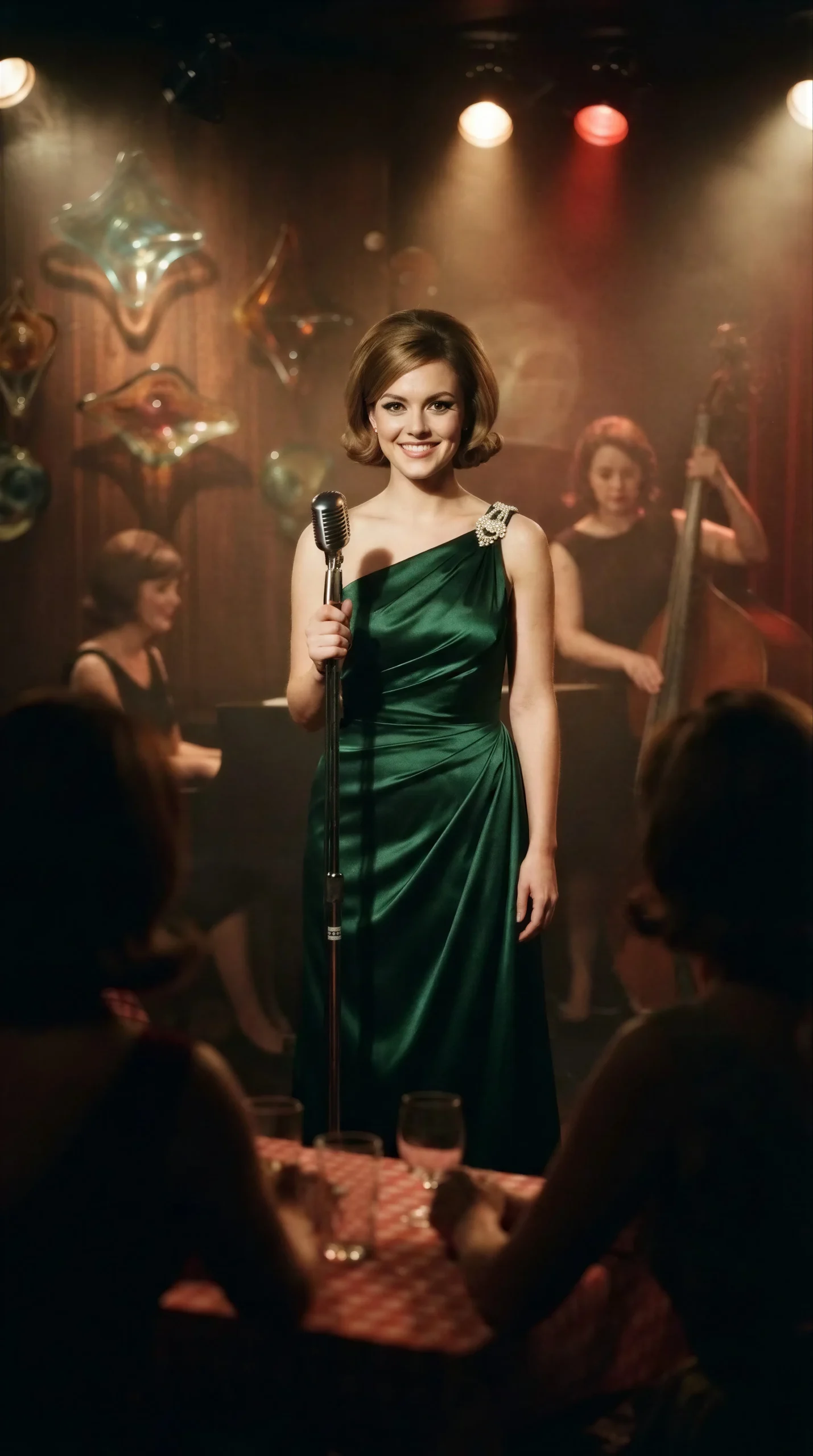
A Tale of Jazz, Devotion, and Transformation in 1958 Soho
In a basement club on Brewer Street, a woman in midnight blue satin commands both the stage and the hearts of those who serve her. When a penniless pianist from Manchester descends those narrow stairs, she discovers that devotion is not surrender but salvation—and that the touch of satin against skin can change everything.
London, October 1958. The city is emerging from post-war austerity into a new era of prosperity and possibility. In Soho, jazz clubs proliferate, each offering a different vision of modernity. But none is quite like The Sapphire Room.
Dorothy “Dottie” Williams arrives in London with nothing but £12, a reference letter from a Manchester pub landlord, and a determination to play piano professionally. Three weeks of chip suppers and dwindling savings have nearly broken her spirit when she hears about a basement club on Brewer Street—a place where a woman in midnight blue satin presides over a circle of devoted female performers, where the tablecloths gleam with the same lustre as the dresses, and where the music carries an emotional weight that transcends mere entertainment.
Vivian Castellano is thirty-nine, Italian-British, a former singer whose career ended with vocal cord surgery. Rather than mourn her lost voice, she found a new one: developing female musical talent, nurturing artists who might otherwise go unheard. She wears satin sheath dresses that catch the light, silk stockings that whisper as she walks, and an authority that silences dissent and draws women to her with an almost gravitational pull. Her Circle—singers, saxophonists, violinists, patrons, journalists, executives—orbit her with a devotion that outsiders find puzzling and insiders find perfectly natural.
When Dottie descends those narrow stairs into the midnight blue interior of The Sapphire Room, she does not know that her life is about to change. She does not know that she will be transformed from a nervous young woman in rough wool into a confident artist in burgundy satin. She does not know that she will learn not only music but business—contracts, programming, marketing, the economics of luxury hospitality. She does not know that she will discover a community of women united by purpose and loyalty, or that her devotion to the woman who guides her will feel not like obligation but like coming home.
She does not know, yet, that the touch of satin against skin can change everything.
Blue Notes and Satin Dreams is a story of transformation and devotion, of music and mentorship, of the subtle power of glossy textures and commanding presence. It is a romance, but not only a romance—it is also a practical education in the business of creativity, a guide to building communities of mutual support, and a celebration of the natural dynamic between a woman who commands and the women who adore her.
Set against the smoky glamour of 1958 Soho, where jazz fills the night and satin catches the light, this twelve-part serial invites you into a world where devotion is not weakness but strength, where generosity fulfils the giver as much as the receiver, and where the touch of silk against skin awakens desires that have been waiting, patient and quiet, to be acknowledged.
Step through the door. Descend the stairs. Find your seat at a table draped in blue satin. The music is about to begin.
Chapter One: The Basement on Brewer Street
The rain fell in silver ribbons upon London, cascading down the grimy windows of the 73 bus as it lurched through the October evening, each droplet a tiny mirror reflecting the gaslight glow of a city emerging from its long post-war slumber. Dorothy Williams pressed her forehead against the cool glass and watched the streets of the capital slide past—Wet pavement, wet coats, wet faces all blurring into a watercolour of grey and amber—and she thought, with the particular bitterness of someone who has journeyed far from home with little to show for it, that she had arrived in London at precisely the wrong moment in precisely the wrong attire.
Her grey wool dress, sensible and serviceable in the parlours of Manchester, felt like a hair shirt beneath the gaze of the capital’s more sophisticated women. She had observed them boarding the bus at King’s Cross—women in tailored coats of cashmere and wool that somehow managed to look nothing like her own, women whose silk scarves whispered against their collars like promises of softer things, women whose leather handbags caught the light with a lustre that her cloth satchel could never hope to emulate. They moved through the world with a confidence that seemed woven into the very fabric of their garments, as though the smooth, glossy textures they wore against their skin had somehow imparted their sheen to their spirits.
Dottie watched them with the hungry attention of someone studying a foreign language, trying to decode the grammar of elegance from the curve of a satin lapel or the drape of a silk sleeve. She had always been clever—her mother had said so, her teachers had said so, the vicar who had tutored her in piano had said so—but cleverness, she was beginning to understand, was not currency in this new world. Here, in the great sprawl of London, cleverness without presentation was like a melody played on an untuned instrument: technically correct but somehow profoundly unsatisfying.
The bus deposited her at a stop near King’s Cross, where she had arranged a room at a boarding house recommended by a friend of a friend of her mother’s. The landlady, Mrs. Pringle, was a woman of indeterminate age and certain disapproval, her form wrapped in a floral cotton dress that seemed to scratch against the air itself, her fingers stained with the evidence of decades of housework. She looked Dottie up and down with the particular scrutiny reserved for young women alone in the city, taking in the worn suitcase, the sensible shoes, the grey wool dress that marked its wearer as someone who had not yet found her place.
“Three pounds ten per week, payable in advance,” Mrs. Pringle said, her voice like the rasp of coarse fabric. “Breakfast is at seven. I don’t hold with visitors, and I don’t hold with noise. The bathroom’s on the landing, shared between three rooms. Any questions?”
Dottie had none that Mrs. Pringle would be willing to answer. She paid for two weeks in advance—nearly half her remaining funds—and was shown to a narrow room on the second floor that smelled of lavender and damp. The bed was single and hard, the wardrobe was small and empty, and the window looked out onto a brick wall that seemed to lean toward the glass as though trying to overhear her thoughts. She set her suitcase on the bed and opened it, revealing the meagre contents: two changes of underwear, a nightdress, a blouse, a cardigan, her sheet music, and a reference letter from Mr. Patterson, the landlord of The Crown and Anchor in Manchester, where she had played piano for tips for three years.
The reference letter was her most valuable possession, though its value was, she was beginning to suspect, largely sentimental. “Dorothy Williams is a competent pianist and a reliable employee,” it read, in Mr. Patterson’s careful handwriting. “She plays to the satisfaction of my customers and conducts herself with propriety.” It was not, Dottie reflected, the sort of recommendation that would open doors in the sophisticated jazz clubs of Soho. It was the musical equivalent of her grey wool dress: functional, forgettable, and utterly lacking in the kind of lustre that caught attention.
She sat on the edge of the bed and allowed herself, for the first time since her mother’s funeral, to cry. The tears were not for her mother—though she missed her with an ache that had become as constant as her heartbeat—but for herself, for the foolishness of coming to London with nothing but hope and a letter that praised her “propriety.” She had imagined, in the romantic way of someone who had never tested her dreams against reality, that talent would be enough. That someone would hear her play and recognise the fire that burned beneath her competent fingers. That she would be discovered, like a character in one of the romantic novels her mother had secretly enjoyed, and swept into a world of glamour and purpose.
The rain continued to fall against the window, each drop a tiny percussionist tapping out a rhythm of futility.
Three weeks passed like water through a sieve, each day identical to the last and each leaving Dottie slightly emptier than before. She rose at six, breakfasted on toast and weak tea at seven, and set out by eight to walk the streets of London in search of work. She visited every pub and club she could find, from the respectable establishments of the West End to the less salubrious venues of the East End, presenting herself and her reference letter to landlords and managers who barely glanced at either before shaking their heads.
“Got a pianist already, love.”
“Try the pubs down Whitechapel way. They’re always desperate.”
“You any good? I mean properly good, not just ‘competent’?”
That word—competent—followed her like a shadow. It was the word that Mr. Patterson had used in his reference, and it was the word that every potential employer seemed to hear, even when she did not say it. Competent. Adequate. Sufficient. She was all of these things and none of the things that mattered: she was not brilliant, not memorable, not the kind of pianist who made people stop talking and listen.
She found work, eventually, in a pub near Liverpool Street Station called The Signalman’s Rest. The landlord, a red-faced man named Bert, offered her £1 per week plus tips to play Tuesday and Thursday evenings from seven until ten. The piano was ancient and badly tuned, the audience was composed of commuters who wanted background noise for their drinking, and the tips, when they came, were mostly coppers. But it was work, and work was what she needed.
She played standards—”As Time Goes By,” “Smoke Gets in Your Eyes,” “The Way You Look Tonight”—with the mechanical competence that had become her signature. The commuters did not listen, but they did not complain, and Bert seemed satisfied with the arrangement. She took her tips in a small jar on top of the piano and counted them each night after closing: two shillings on a good night, less on a bad one. Her savings, which had stood at £12 when she arrived, dwindled to £7, then £5, then £3.
She ate chip suppers from a shop on Whitechapel Road, sitting on a bench in a small park and watching the lamps flicker on as evening fell. She walked rather than taking the bus, to save the fare. She washed her grey wool dress each night and hung it to dry over the radiator in her room, where it steamed and stiffened and resumed its shape like a soldier returning to formation. She practised on the Signalman’s piano before opening, running through scales and arpeggios with the discipline her mother had instilled, but the practise felt hollow, like polishing a surface that had lost its shine.
It was at The Signalman’s Rest, on a Thursday evening in late October, that she first heard about The Sapphire Room.
The man who mentioned it was a trumpet player named Ronnie, a wiry fellow with a melancholy face and fingers that moved over his valves with the nervous energy of someone who had never quite found his moment. He had come in for a pint after a rehearsal nearby and stayed to listen to Dottie’s set, nodding along with the kind of professional attention that musicians give to other musicians—not enjoyment but assessment.
“You’re alright,” he said during her break, approaching the piano with his pint in hand. “Competent, like. But you’re wasted here. This lot wouldn’t know good music if it bit them on the arse.”
Dottie smiled politely. “It’s work.”
“Aye, it’s that. But if you want something better—proper work, like, in a proper club—there’s a place in Soho you might try. The Sapphire Room, it’s called. Brewer Street, basement. Very exclusive, very particular.”
“What’s particular about it?”
Ronnie leaned closer, lowering his voice as though sharing a state secret. “Vivian Castellano only hires women. Musicians, staff, everyone. It’s a women’s club, like—not in that way, or maybe in that way, I don’t know—but it’s all women running it and all women playing there. Very classy, very swish. Blue satin tablecloths and crystal glasses and all that. I’ve heard the music’s top-notch.”
Dottie felt something stir inside her—a flicker of curiosity that had been dormant since her arrival in London. “Who’s Vivian Castellano?”
“Used to be a singer, years ago. Italian-British, very glamorous. Had some trouble with her voice, had to give it up, and now she runs this club. Develops female musicians, like a mentor. I’ve heard she’s got this circle of women around her—singers, players, patrons, all sorts—and they’re devoted to her. Don’t know what she does to them, but they don’t leave. Once they’re in, they’re in for good.”
“That sounds…” Dottie searched for the right word. “Unusual.”
“Aye, it’s unusual, all right. But it’s also the most successful small club in Soho, from what I hear. Always packed, always getting written up in the papers. And the musicians she’s trained—they’ve gone on to bigger things. Recording contracts, proper venues, all of it. She knows what she’s doing, does Viv Castellano.”
Ronnie finished his pint and set the glass down with a decisive clink. “Anyway, I just thought I’d mention it. You’ve got something, even if it’s a bit rough yet. Might be worth your while to go have a look. Thursday evenings, that’s when she sees people. But mind how you go—she’s particular about presentation, from what I hear. Won’t look twice at anyone who doesn’t make an effort.”
He left, and Dottie returned to her set with her mind elsewhere. The Sapphire Room. A club for women, run by a woman, where presentation mattered as much as talent. She thought of the women she had observed on the bus that first day—the silk scarves, the leather handbags, the confidence that seemed woven into their garments—and felt a mixture of longing and despair. She had neither the wardrobe nor the confidence to present herself in such a way. She had a grey wool dress and a reference letter praising her propriety.
But she also had nothing to lose.
The following Thursday, Dottie set out for Soho with the careful preparation of someone who understands that first impressions are both irretrievable and consequential. She ironed her grey wool dress for the third time that week, polished her sensible shoes until they reflected the weak light of her room, and pinned her dark hair into a neat chignon that she hoped conveyed seriousness rather than dullness. She had considered purchasing something new—something with a sheen, something that might catch the eye—but her remaining funds would not stretch to such an extravagance. She would have to rely on whatever natural elegance she possessed, which she feared was considerably less than what the occasion demanded.
She took the tube to Tottenham Court Road and walked south through the gathering dusk, following the directions Ronnie had given her. Soho at night was a different world from the one she had glimpsed during her daytime wanderings: neon signs flickered to life above doorways, music spilled from open pub windows, and crowds of well-dressed revelers moved through the streets with the purposeful pleasure of people who knew where they were going and expected to enjoy themselves when they got there.
The women she passed were a study in contrasts to her own appearance. A brunette in a tailored wool coat emerged from a taxi, revealing a glimpse of silk lining as the coat swung open. A blonde in a leather jacket and pencil skirt laughed with friends outside a club, her glossy lipstick catching the neon light. A redhead in a satin blouse and dark trousers crossed the street ahead of Dottie, the fabric of her shirt shimmering with each movement like a liquid thing, like something alive and aware of its own beauty.
Dottie watched them with the same hungry attention she had given the women on the bus, trying to understand how they moved, how they carried themselves, how they inhabited their glossy garments with such easy confidence. She felt like a sparrow among peacocks, her grey wool dress a declaration of ordinariness in a world that celebrated sheen.
Brewer Street was narrower than she had expected, lined with restaurants and clubs that seemed to press against each other for space. She walked slowly, checking numbers and names, until she found what she was looking for: a narrow doorway between a French restaurant and a tobacconist, marked only by a small blue sign that read “The Sapphire Room” in silver script. The door was black, unremarkable, giving no hint of what lay beyond.
She pushed it open and found herself at the top of a narrow staircase that descended into the earth. The walls were painted midnight blue, and small lights set into the plaster cast a warm glow that made the descent feel like entering a grotto or a dream. The air changed as she went down—warmer, softer, carrying the faint scent of jasmine and something else, something richer, like the smell of polished wood and candle wax.
The staircase turned once and then again, and then she was there, standing at the threshold of a room that was unlike anything she had expected.
The Sapphire Room was small—perhaps thirty feet by twenty—but it had been transformed into something that felt considerably larger than its dimensions. The walls were painted midnight blue, the same shade as the staircase, but here they were accented with silver leaf that caught the light from wall sconces and scattered it in tiny fragments across the room. The ceiling was low but painted with a mural of stars, giving the impression of sitting beneath the night sky. The floor was dark wood, polished to a shine that reflected the candlelight from the tables.
And the tables—Dottie caught her breath at the tables. Fifteen of them, arranged in a rough semicircle around a small stage, each draped in a cloth of blue satin that pooled slightly at the corners. The satin caught the candlelight and held it, shimmering with a liquid sheen that made the surfaces seem almost alive, like water that had somehow been persuaded to hold still. Crystal glasses sat on each table, their facets adding to the play of light. The chairs were upholstered in dark leather, soft and inviting, their surfaces gleaming with the patina of frequent use.
The stage was small but well-appointed, dominated by a Steinway piano that gleamed like a dark jewel under its own spotlight. A microphone stood at the front of the stage, and behind it, a curtain of midnight blue velvet hung in folds that suggested both luxury and mystery. The entire room spoke of careful curation, of a vision executed with precision and an attention to detail that bordered on obsession.
There were perhaps a dozen patrons present, scattered among the tables in groups of two and three. They were, without exception, women. Dottie observed them with the careful attention she had developed over three weeks of watching London’s more sophisticated inhabitants: a pair in tailored silk suits, their jackets nipped at the waist and their trousers creased to sharp lines; a trio in satin dresses that caught the light as they moved, their surfaces shifting from deep blue to purple to black depending on the angle; a woman alone at a corner table, her leather jacket draped over her chair, revealing a silk blouse in deep red that seemed to glow with its own inner light.
The staff, too, were all women, and they moved through the room with a choreographed grace that suggested both training and devotion. A bartender in a black satin waistcoat polished crystal glasses with the focused attention of a jeweller. A waitress in a black silk blouse and tailored trousers wove between tables with a tray balanced on her fingertips, her movements so smooth that the liquid in the glasses barely trembled. A woman at the door—clearly the hostess—wore a fitted dress of dark blue satin that matched the tablecloths, her hair swept up in an elegant chignon that framed a face of composed authority.
Dottie felt a sudden, acute awareness of her own appearance. Her grey wool dress, which she had ironed so carefully, now seemed not merely inadequate but actively offensive—a rough, dull intrusion into a world of sheen and lustre. Her sensible shoes, polished to their best, could not compete with the leather and satin that surrounded her. She felt as though she had arrived at a formal dinner in a bathing costume, her ordinariness on display for all to see.
The hostess approached with a smile that was polite but assessing. “Good evening. Are you a member, or would you like to inquire about membership?”
“I’m not a member,” Dottie said, her voice smaller than she intended. “I heard about the club from a musician. I’m a pianist, and I was hoping to speak with Mrs. Castellano about auditioning.”
The hostess’s expression shifted subtly—not to hostility but to a kind of knowing amusement, as though she had heard this request many times before and found it perpetually charming. “You wish to audition for Miss Castellano? She is particular about whom she sees. Do you have a reference?”
Dottie fumbled in her satchel and produced Mr. Patterson’s letter, which suddenly seemed even more inadequate than it had in the pubs of the East End. The hostess read it with a quick, professional eye and returned it with a smile that was not unkind.
“I see. Miss Castellano sees prospective musicians on Thursday evenings. If you would like to wait, I can inquire whether she is available to speak with you tonight. Please, take a seat at the bar. May I offer you something to drink? On the house, of course.”
Dottie murmured her thanks and made her way to the bar, feeling the eyes of the room upon her—or perhaps imagining them, which was almost as bad. She sat on a leather stool that was surprisingly comfortable and accepted a glass of white wine from the bartender, who poured it with the precise, unhurried movements of someone who took pride in every aspect of her work.
The wine was cool and crisp, and Dottie sipped it with the gratitude of someone who has been living on tea and tap water for three weeks. She studied the room from her vantage point at the bar, trying to absorb as much as possible about this strange, glossy world she had stumbled into.
The patrons were engaged in quiet conversation, their voices low and intimate, creating a murmur that was almost musical in itself. The waitress moved between them with a grace that seemed rehearsed, anticipating needs before they were expressed, appearing at tables with fresh drinks just as the previous ones were emptied. The atmosphere was one of relaxed luxury, of comfort without ostentation, of pleasure without urgency. It was, Dottie realised, exactly the kind of environment in which music could flourish—where the audience was attentive but not demanding, where the performer could feel supported rather than scrutinised.
She was deep in this observation when she became aware of a presence at her shoulder. Not a sound, exactly, but a change in the air, a shift in the room’s subtle currents that made the hair on the back of her neck rise. She turned and found herself looking into a pair of dark eyes that seemed to see through her grey wool dress, through her careful chignon, through her nervous smile, and straight into the heart of everything she was and everything she hoped to be.
Vivian Castellano was not tall—perhaps five foot five—but she carried herself with a presence that made her seem considerably larger. Her raven hair was swept into a French twist that exposed the elegant lines of her neck and jaw, and her dark eyes were set in a face that combined Italian warmth with British reserve in a way that was both arresting and slightly intimidating. She wore a satin sheath dress in midnight blue that matched the tablecloths so precisely that, for a disorienting moment, Dottie wondered if she had somehow stepped free of one of them.
The dress was a masterwork of understated elegance: the satin caught the candlelight and held it, shimmering with a liquid sheen that shifted as she moved, the fabric draping over her curves with a fluidity that suggested both comfort and control. The neckline was modest but revealing enough to show the hollow of her throat, where a single sapphire pendant rested against her skin like a drop of dark water. Her sleeves were elbow-length, revealing forearms that were slim but strong, and her hands were bare, the nails polished to a shine that matched the gloss of her dress.
She stood with the easy confidence of someone who has found her place in the world and has no intention of leaving it. Her posture was straight but not stiff, her shoulders back but not military, her chin level but not challenging. She was, Dottie thought, like a note held perfectly in tune—effortless, precise, and beautiful in a way that seemed both natural and deliberate.
“Miss Castellano,” the hostess said, appearing at her elbow with a deference that was almost reverent. “This young lady has inquired about auditioning. She has a reference.”
Vivian took the reference letter from the hostess and read it with the same quick, professional eye that the hostess had used. Her expression did not change, but something shifted behind her eyes—a flicker of assessment, a weighing of potential that was both clinical and deeply personal.
“Mr. Patterson of The Crown and Anchor, Manchester,” she said, her voice low and rich, with the faintest trace of an Italian accent that softened the consonants and warmed the vowels. “I am not familiar with the establishment.”
“It’s a pub,” Dottie said, and immediately wished she had said something more impressive. “I played there for three years. Standards, mostly. Whatever the customers wanted.”
Vivian’s gaze moved from the letter to Dottie’s face, and then—slowly, deliberately—downward, taking in the grey wool dress, the sensible shoes, the cloth satchel, the careful chignon. The assessment was thorough but not unkind, like a doctor examining a patient or a tailor measuring a client. Dottie felt herself being seen in a way that was both uncomfortable and oddly thrilling, as though Vivian’s eyes could penetrate the rough fabric of her dress and see the person beneath.
“Competent,” Vivian said, reading from the letter. “Reliable. Propriety.” She looked up. “These are not qualities that excite me, Miss Williams. Competence is the minimum, not the goal. Reliability is expected, not celebrated. And propriety—” she paused, a slight smile playing at the corner of her mouth—”propriety is the enemy of art.”
Dottie felt a flush rise to her cheeks. “I wrote nothing in the letter, Miss Castellano. It’s Mr. Patterson’s word, not mine.”
“No, you did not write the letter. But you chose to present it as your introduction, which tells me something about how you see yourself.” Vivian set the letter on the bar and picked up Dottie’s wine glass, examining it with the same thoroughness she had applied to Dottie’s appearance. “Tell me, Miss Williams: if you could play any piece of music right now, what would it be?”
The question caught Dottie off guard. She had expected to be asked about her experience, her repertoire, her availability. She had not expected to be asked about her desires.
“I—” she began, then stopped, considering. The honest answer was an original composition she had written during the last months in Manchester, a piece that had no name but that she thought of as “Satin Dreams” because she had composed it while watching the light play on her mother’s one good silk scarf, which hung from the bedroom mirror like a promise of better things. But admitting to original work felt presumptuous, like claiming a talent she had not yet earned the right to claim.
“Tell me,” Vivian said, and there was something in her voice that was not quite a command but was also not quite a request. It was the tone of someone who was accustomed to being answered honestly and would accept nothing less.
“I write my own music,” Dottie said, the words coming out in a rush. “I have a composition—it doesn’t have a name—that I wrote in Manchester. It’s not a standard. It’s not what you’d hear in a pub. But it’s mine.”
Something shifted in Vivian’s expression—a softening that was almost imperceptible but that Dottie caught because she was watching with the desperate attention of someone whose future might depend on what she saw. The dark eyes warmed, the slight smile deepened, and for a moment, the composed mask of the club owner slipped to reveal something more human: curiosity, interest, perhaps even recognition.
“An original,” Vivian said. “That is more interesting than competence, Miss Williams. Far more interesting.” She set the wine glass down and turned to face Dottie fully, her midnight blue satin dress catching the light in a way that made the fabric seem to ripple like water. “I will hear you play. Thursday. Four o’clock. Do not be late.”
“Thursday,” Dottie repeated, her voice faint. “Four o’clock. Yes, Miss Castellano.”
Vivian turned to leave, then paused, looking back over her shoulder with an expression that was both warning and invitation. “One more thing, Miss Williams. When you come on Thursday, wear something that tells me who you are, not who you think I want to see. I cannot assess potential through a costume. I can only assess it through truth.”
She walked away, her satin dress whispering against the floor, and Dottie watched her go with the dazed attention of someone who has just been struck by lightning and is not yet sure whether she has survived.
The walk back to King’s Cross seemed both longer and shorter than the journey to Soho, Dottie’s mind so full of thoughts that the streets passed by almost unnoticed. She replayed the conversation with Vivian Castellano in her memory, examining each word and gesture like a jeweller examining stones for flaws and promise.
Competence is the minimum, not the goal.
Propriety is the enemy of art.
Wear something that tells me who you are.
She thought of the women she had seen in The Sapphire Room—the silk suits, the satin dresses, the leather jackets with their glossy sheen—and she thought of her own grey wool dress, which had seemed adequate that morning and now felt like a declaration of surrender. She thought of Vivian’s midnight blue satin, the way it caught the light, the way it seemed to move with her like a living thing, and she felt a longing that was not merely sartorial but existential. She wanted to be the kind of woman who wore satin with confidence, who moved through the world with the easy authority of someone who had found her place, who commanded attention not by demanding it but by deserving it.
But she had no satin. She had no silk. She had no leather. She had a grey wool dress, a white cotton blouse, a sensible cardigan, and less than three pounds in her purse. She had, she thought with a despair that was almost physical, nothing to wear that would tell Vivian Castellano who she was, because who she was was a woman without resources, without connections, without the kind of glossy, tactile, confidence-inspiring garments that seemed to be the price of admission to the world she wanted to enter.
She lay awake in her narrow bed at Mrs. Pringle’s boarding house, listening to the rain against the window and the distant rumble of trains from King’s Cross, and she thought about what she would wear on Thursday. She thought about it the way a general thinks about a battle—not with hope but with strategy, trying to find a path through impossible terrain to an uncertain victory.
She had, she realised, one thing that might serve: a white silk blouse that had belonged to her mother, packed at the bottom of her suitcase and never worn because it seemed too fine for the pubs where she had played. It was not satin, not leather, not the midnight blue of Vivian’s dress, but it was silk, and it was smooth, and it would catch the light in a way that her wool dress never could. It was, she thought, a beginning—a single glossy note in the composition of the woman she wanted to become.
She would wear it on Thursday. She would play her original composition. She would tell Vivian Castellano, through her music and her presentation, who she was and who she hoped to be. And if that was not enough—if competence and a silk blouse were not sufficient to earn a place in the midnight blue world of The Sapphire Room—then she would at least have tried, and the trying would be more than she had done in three weeks of playing to indifferent commuters in a pub near Liverpool Street.
She closed her eyes and let the sound of the rain carry her into a sleep that was, for the first time since her arrival in London, not haunted by despair but filled with something that felt, tentatively and preciously, like hope.
In her dreams, she wore satin the colour of midnight, and her fingers moved over ivory keys with a fluency that she had never achieved in waking life, and somewhere in the darkness, a woman with dark eyes and raven hair smiled and nodded, and the smile was not approval but recognition—the recognition of one person by another, the seeing and being seen that was, Dottie understood even in her sleep, the thing she had been seeking all along.
Chapter Two: The Audition
The days between Dottie’s first visit to The Sapphire Room and her appointed Thursday audition passed with a peculiar quality of time that seemed simultaneously to crawl and to race, each hour stretching like taffy while each day collapsed into the next with the brevity of a half-remembered dream. She spent them in a state of preparation that bordered on obsession, turning over every detail of her approach with the meticulous attention of a jeweller examining a stone for flaws and facets, trying to find the angle that would catch the light just so.
She had, she calculated, exactly two pounds and fourteen shillings remaining—enough for two more weeks at Mrs. Pringle’s if she ate nothing but bread and tea, which was a prospect that held neither appeal nor sustainability. The Signalman’s Rest would pay her one pound on the following Tuesday, but even that would not arrest the slow hemorrhage of her savings. She was, she understood with the clarity that comes from staring at numbers that refuse to improve, running out of time as surely as she was running out of money.
The white silk blouse that had belonged to her mother emerged from the bottom of her suitcase like an archaeological find, bearing the faint scent of lavender and the creases of long storage. Dottie held it up to the weak light of her room and examined it with the care of someone handling a relic: the fabric was fine, with a subtle sheen that caught the light and held it, shimmering with a lustre that her cotton blouses could never hope to emulate. The buttons were small and pearl-like, the collar was delicate, and the cuffs were designed to be folded back, revealing a facing of slightly heavier silk that gave the garment a structure and elegance that seemed to whisper of a world where presentation was not vanity but necessity.
Her mother had worn this blouse to church on special occasions, pairing it with a navy skirt and a single strand of pearls that had been sold years ago to cover the cost of a doctor’s visit that had, in the end, changed nothing. Dottie remembered the way the silk had caught the light through the stained glass windows, how it had seemed to glow with an inner luminescence that made her mother look, for those few hours, like someone who belonged to a different, more luminous world. She had always wanted to touch it, to feel the smooth glide of the fabric against her fingers, but her mother had been particular about her good clothes, keeping them wrapped in tissue paper and stored in a cedar chest that smelled of forests and promises.
Now it was hers, and she would wear it to an audition that might determine the course of her life.
She washed the blouse by hand in the small sink in Mrs. Pringle’s bathroom, using a bar of soap that she had purchased from a shop on Pentonville Road and that claimed, with more optimism than accuracy, to be “kind to delicate fabrics.” The silk responded to the water like a living thing, becoming softer and more luminous as she rinsed it, the fibres seeming to relax and breathe after their long confinement. She hung it to dry on a length of string she had strung across her room, and she watched it for a long time, the way the light played on the damp fabric, the way it shifted from opaque to translucent and back again as it dried, like a chameleon finding its colours.
On Thursday morning, she rose at five, unable to sleep for the nervous energy that hummed through her like a current. She dressed with the care of someone preparing for a ceremony: first the white silk blouse, which she buttoned with fingers that trembled slightly despite her efforts to steady them; then her grey wool skirt, which was the most presentable item she possessed below the waist, its fabric at least being dark and unremarkable; then her sensible shoes, which she had polished the night before to a shine that was, she had to admit, considerably less impressive than the gleam of the leather she had observed on the patrons of The Sapphire Room.
She looked at herself in the small mirror that hung above the washbasin, and she saw a woman who was trying very hard and not quite succeeding. The silk blouse was beautiful—its sheen caught the light and gave her skin a glow that her cotton blouses had never achieved—but it was paired with a wool skirt that seemed to actively resist elegance, its surface dull and rough against the smooth luminosity of the silk. She looked, she thought, like a sentence that began in one language and ended in another: promising at the start but ultimately incoherent.
But it was the best she could do, and Vivian Castellano had asked for truth, not perfection.
She spent the morning in a state of restless activity that accomplished nothing of substance. She practised scales on the windowsill, her fingers moving over the invisible keys with the muscle memory of fifteen years of training. She reviewed her three chosen pieces—a standard (“The Way You Look Tonight”), a ballad (“Body and Soul”), and her original composition—playing them in her mind with the obsessive attention of someone memorising a spell. She ate a meagre lunch of bread and butter and drank two cups of tea, which made her feel both nourished and jittery.
At half past three, she could wait no longer. She gathered her sheet music into her cloth satchel, checked her appearance one final time in the mirror, and set out for Soho.
The Sapphire Room was different in the late afternoon, its character shifted by the absence of patrons and the presence of daylight filtering through the narrow windows near the ceiling. The candles were unlit, the satin tablecloths removed, and the room had a stripped, expectant quality, like a stage before the performance begins. The Steinway piano sat on the small stage with a cover that seemed almost protective, as though the instrument were resting before the demands that would be made upon it.
Vivian Castellano was already present, seated at her corner table with a glass of white wine that, Dottie noticed, was untouched, the surface of the liquid as still and clear as a mirror. She wore a different dress from the one Dottie had seen before—a tailored sheath in deep emerald satin that caught the afternoon light and transformed it into something richer, like sunlight filtered through a forest canopy. The fabric moved with her as she turned to acknowledge Dottie’s arrival, the surface shimmering with a liquid sheen that seemed to ripple across her body like water over stones.
“Miss Williams,” she said, and her voice carried the same low, rich quality that Dottie remembered, the faint Italian accent softening the consonants and warming the vowels like sunlight on old stone. “You are punctual. That is a good beginning.”
“I thought it best to arrive a few minutes early, Miss Castellano. To settle myself before playing.”
Vivian’s dark eyes moved over Dottie with the same thorough, assessing gaze she had employed during their first meeting, taking in the white silk blouse, the grey wool skirt, the sensible shoes, the cloth satchel. Something flickered in her expression—not approval, exactly, but perhaps a recognition of effort, an acknowledgment that Dottie had taken her advice about presentation seriously, even if the result was not entirely successful.
“The blouse is your mother’s,” Vivian said. It was not a question.
Dottie felt a jolt of surprise. “How did you—”
“The cut is several years out of date, but the quality is excellent—better than anything else you are wearing. It suggests a garment that was purchased by someone with taste and means, preserved carefully, and passed down to someone who values it but does not yet know how to integrate it into a wardrobe.” Vivian’s gaze settled on Dottie’s face. “Am I correct?”
“You are,” Dottie said, her voice faint with a mixture of admiration and unease. “It was my mother’s. She died in August. It’s the only fine thing I have.”
Vivian nodded, and something in her expression softened—not dramatically, but enough that Dottie noticed. “Then wear it with pride, not apology. A mother’s gift is not a costume. It is a blessing.” She gestured toward the stage. “The piano is tuned. You may begin when you are ready.”
Dottie made her way to the stage, feeling the weight of Vivian’s gaze upon her like a physical thing, like the pressure of a hand on her shoulder—steady, warm, and impossible to ignore. She set her sheet music on the piano stand, though she knew she would not need it for the first two pieces, which she had played hundreds of times and could perform in her sleep. The third piece—the original composition—she had written down in a moment of caution, though she knew it as well as she knew her own heartbeat.
She sat at the Steinway and placed her fingers on the keys, feeling the cool, smooth ivory beneath her fingertips, the slight resistance of the action, the quality of an instrument that had been maintained with the kind of devotion that most pianos only dream of. It was, she thought, like the difference between speaking in a cathedral and speaking in a public house: the same words, but the resonance transformed them entirely.
She took a breath, settled her shoulders, and began.
“The Way You Look Tonight” was a piece she had played so often that it had become almost automatic, her fingers finding the notes with the ease of a bird finding its nest. But on the Steinway, in the quiet of the empty room, under the weight of Vivian’s attention, the song felt different—richer, more nuanced, the melody unfolding with a clarity that surprised even her. She played it simply, without embellishment, letting the beauty of the composition speak for itself, and the piano responded with a warmth and depth that made the familiar seem new.
When she finished, the silence that followed was not the empty silence of an indifferent audience but a full, attentive silence, like the pause between movements of a symphony, a silence that was listening. Vivian sat motionless at her corner table, her dark eyes fixed on Dottie’s face, her expression unreadable, her wine still untouched.
“Again,” Vivian said. “But this time, do not play the song. Play what the song is about.”
Dottie blinked. “I’m not sure I understand.”
“The song is about seeing someone you love and finding them beautiful. It is about a moment of recognition—the moment when you look at someone and realise that they are, in that instant, the most beautiful thing you have ever seen. That is not a technical exercise, Miss Williams. That is a feeling. Play the feeling.”
Dottie’s fingers returned to the keys, but her mind was elsewhere, searching for the feeling that Vivian described. She thought of her mother, not in her illness but in her prime—the way she had looked on Sunday mornings in her navy skirt and white silk blouse, the way the light had caught the fabric and made it glow, the way she had smiled at Dottie across the breakfast table with a love that was so ordinary it had seemed, at the time, almost invisible.
She played, and the music changed.
The melody was the same, but the phrasing was different—softer, more intimate, with a tenderness that had not been there before. The notes seemed to breathe, to sigh, to speak of something that could not be said in words. Dottie felt her eyes sting with tears she would not shed, and she let the feeling move through her fingers and into the keys, and the Steinway responded with a warmth that seemed almost human, as though the instrument understood what she was trying to say and was helping her say it.
When she finished, the silence was longer and deeper, and when she finally looked up, she saw that Vivian’s expression had changed. The composed mask had softened, the dark eyes were warmer, and there was something in her face that Dottie recognised because she had seen it in her own mirror: the look of someone who has been moved against their will and is not entirely sure whether to be pleased or annoyed about it.
“Better,” Vivian said, and the word, though modest, carried a weight that made Dottie’s heart lift. “Much better. You can feel. That is essential. Technique can be taught; feeling cannot. Now. The ballad.”
“Body and Soul” was a piece that Dottie had always loved but never quite mastered, its complex harmonies and emotional demands pushing against the boundaries of her technical ability. She played it with more confidence than she felt, navigating the difficult passages with a determination that was more stubbornness than skill, and she knew, as she played, that she was making mistakes—small ones, perhaps, but mistakes nonetheless, moments where her fingers faltered or her phrasing stumbled.
When she finished, Vivian was frowning slightly, and Dottie felt a sinking in her stomach that was all too familiar.
“Your left hand is weak,” Vivian said. “Your bass notes lack authority, and your timing in the bridge section is uncertain. These are technical problems, and they can be addressed.” She paused, her gaze sharpening. “But your interpretation is interesting. You understand the melancholy of the piece, the longing, the sense of reaching for something that cannot be grasped. That understanding is valuable. The technique will come.”
“Thank you, Miss Castellano.”
“I did not say well done, Miss Williams. I said interesting. Interesting is a beginning, not an end.” Vivian leaned forward slightly, her emerald satin dress shifting with the movement, the fabric catching the light in a way that made it seem to ripple like water. “Now. The third piece. The original. Play it for me.”
Dottie’s heart, which had been beating steadily through the first two pieces, suddenly accelerated. The original composition was the most personal thing she had ever created, a piece of music that she had written during the last months of her mother’s life, when the days had become a blur of care and grief and the nights had been filled with a loneliness so profound that it seemed to have weight and texture, like a physical thing pressing against her chest.
She had written it at the piano in the church hall where her mother’s funeral reception had been held, alone in the empty room while the mourners gathered in the vestibory, her fingers finding the notes without conscious thought, as though the music were not being composed but discovered, like a path that had always existed and was only now being walked for the first time. She had never played it for anyone—not for Mr. Patterson, not for the commuters at The Signalman’s Rest, not for anyone. It was, she realised with a mixture of fear and defiance, the most honest thing she had ever done.
She placed her fingers on the keys and began.
The composition had no formal structure, no name, no key signature that remained constant for more than a few bars. It began in a minor key, low and quiet, with a melody that moved slowly through the bass register like someone walking through a dark house, touching familiar objects and finding them changed. The left hand established a simple, repetitive pattern—a heartbeat, a pulse, a rhythm that was both comforting and confining—and the right hand moved above it, searching for something that the left hand could not provide.
The melody rose, gradually, into the middle register, and the harmony shifted from minor to major, from darkness to a light that was not bright but soft, like sunlight through a window on a winter morning. The rhythm became more complex, the left hand’s pattern evolving from a simple pulse to something more intricate, more demanding, and the right hand responded with a melody that was both searching and finding, both questioning and answering.
And then, in the middle of the piece, something happened that Dottie had not planned and could not explain: the music shifted again, moving into a key that she had never studied, a tonal centre that seemed to exist outside the rules she had been taught, and the melody became something else—not sad, not happy, but something in between, something that was both and neither, a feeling that had no name because it was too complex for language and too subtle for words.
It was, she realised, the feeling of watching someone you love die—the helplessness, the gratitude for each moment, the guilt for wanting it to end, the grief that begins before the end and continues long after. It was the feeling of being alone in a room with someone who is no longer there but whose presence lingers in the folds of a silk blouse, in the scent of lavender, in the shape of a chair that still holds the impression of a body.
She played it through to the end, and the ending was quiet, the melody descending back into the bass register, the rhythm slowing to a stop, the final notes hanging in the air like the last breath of a candle.
The silence that followed was the longest yet, and Dottie sat with her hands on the keys, unable to look up, unable to move, unable to do anything but wait for Vivian’s verdict with the desperate patience of someone who has given everything and has nothing left to give.
When Vivian finally spoke, her voice was different—lower, softer, stripped of the composed authority that had characterised her previous words, as though the music had reached past her defences and touched something that she had not intended to reveal.
“What is the name of that piece?”
“I don’t have a name for it,” Dottie said. “I’ve been calling it ‘Satin Dreams,’ but that’s just—”
“Satin Dreams,” Vivian repeated, and something in her voice made Dottie look up. The dark eyes were bright, not with tears but with something more complex—a recognition, a resonance, as though the music had found a frequency that matched something inside Vivian Castellano and had made it vibrate.
“That is a good name,” Vivian said. “A very good name.” She was quiet for a moment, and then she rose from her chair with a movement that was both decisive and graceful, her emerald satin dress shifting around her like a liquid thing, catching the light and scattering it in fragments that seemed to hang in the air like notes suspended on a staff.
She walked to the stage and stood beside the piano, looking down at Dottie with an expression that was both assessing and something else—something warmer, something that might have been, in a different context, called tenderness.
“You have something, Miss Williams,” she said, and the words, though similar to those she had used before, carried a different weight now, a weight that made Dottie’s breath catch. “Raw, untrained, but something. The phrasing in the standard was intuitive—you understood what the song was about and you played that understanding. The ballad was technically flawed but emotionally honest, and the flaws are the kind that can be corrected. But the original—” She paused, and her gaze sharpened. “The original is something else entirely. It is not competent. It is not proper. It is true.”
Dottie felt a swell of emotion that she could not name—relief, gratitude, pride, and something else, something that was like the feeling of the music itself, too complex for language and too subtle for words.
“I can work with that,” Vivian continued. “I can work with truth. I cannot work with pretence.” She moved to the piano bench and sat beside Dottie, close enough that Dottie could feel the warmth of her body and smell the faint scent of her perfume—something rich and complex, like jasmine and sandalwood and something else, something that was uniquely Vivian.
“I am going to offer you a position, Miss Williams. A residency: three nights a week—Thursday, Friday, and Saturday. A salary of three pounds per week. And lessons with the musicians in my Circle—Elena, our singer, will work with you on phrasing and interpretation; Maxine, our saxophonist, will help you with rhythm and timing; and I will work with you on everything else.”
Dottie opened her mouth to speak, but Vivian held up a hand, and the gesture was so natural, so authoritative, that Dottie’s words died before they were born.
“In exchange, you will agree to follow my guidance in all matters—musical, professional, and personal. I do not employ musicians, Miss Williams. I develop artists. That requires commitment beyond the keyboard. It requires trust, discipline, and a willingness to be transformed. I will not ask you to do anything that I do not believe is in your best interest, but I will ask you to do things that you may not immediately understand. Are you willing to accept those terms?”
Dottie looked at Vivian—at the dark eyes that seemed to see through her, at the emerald satin that caught the light like a living thing, at the composed authority that seemed as natural to her as breathing—and she felt something shift inside her, something that had been holding back, holding in, holding on, and that now, in the presence of this woman who had heard her truth and called it by its name, was ready to let go.
“Yes,” she said. “I am willing.”
“Good.” Vivian rose from the bench and moved to a small writing desk near the stage, where she produced a document that was already prepared, as though she had known before the audition what the outcome would be. “This is a contract. I will give you a few minutes to read it. Take your time. Ask questions if you have them. I do not believe in rushing decisions, even when I am confident of the outcome.”
The contract was more detailed than anything Dottie had encountered in her three years at The Crown and Anchor, where the terms of her employment had been established by a handshake and a pint. It was, she realised as she read, a document that had been crafted with care, each clause precise and purposeful, like the construction of a well-made garment.
Terms of Employment:
Position: Resident Pianist, The Sapphire Room
Duration: Initial term of three months, renewable by mutual agreement
Compensation: £3 per week, payable weekly in arrears
Duties: Performance Thursday, Friday, and Saturday evenings, 8 PM to 11 PM. Rehearsals and training sessions as scheduled. Additional performances at special events as required.
Training: Weekly sessions with Circle musicians (Elena Delgado, Maxine Carter, Sylvia Ashworth) and with Miss Castellano. Training to include phrasing, interpretation, rhythm, timing, stage presence, and repertoire development.
Presentation: Employee agrees to maintain standards of presentation as specified by Miss Castellano. Wardrobe allowance of £15 to be provided for the purchase of appropriate performance attire. Additional allowances may be provided at Miss Castellano’s discretion.
Conduct: Employee agrees to conduct herself with professionalism and discretion. Relationships with patrons are to remain professional. Confidentiality regarding club operations and Circle activities is required.
Termination: Either party may terminate the agreement with two weeks’ notice. Miss Castellano may terminate immediately in cases of breach of contract or conduct unbecoming.
Development: Employee agrees to participate in artistic development activities as directed by Miss Castellano, including but not limited to: original composition, recording preparation, and performance at external venues. Revenue from external performances to be split: 70% to artist, 30% to The Sapphire Room for the duration of the contract.
Dottie read the contract twice, her eyes lingering on the clause about presentation and the wardrobe allowance. Fifteen pounds—nearly five weeks’ salary—dedicated to the purchase of appropriate attire. She thought of the women she had seen in The Sapphire Room—the silk suits, the satin dresses, the leather accessories—and she thought of her grey wool skirt and her sensible shoes, and she felt a mixture of excitement and trepidation that was almost physical.
“The wardrobe allowance,” she said, looking up from the contract. “I’ve never had anything like that before. At The Crown and Anchor, I wore whatever I had.”
“The Crown and Anchor is not The Sapphire Room,” Vivian said, and the statement was not dismissive but simply factual, like observing that the sky is not the sea. “Our patrons pay for an experience, Miss Williams, and that experience includes visual as well as auditory pleasure. A woman in grey wool playing competent standards is a background. A woman in burgundy satin playing truth is an event. I am interested in events, not backgrounds.”
“Burgundy satin,” Dottie repeated, and the words felt strange in her mouth, like a phrase in a foreign language she was only beginning to learn.
“It is a colour that would suit you,” Vivian said, and her gaze moved over Dottie’s face with the assessing attention of an artist evaluating a canvas. “You have warm undertones in your skin. Burgundy would enhance them. But we will discuss that later. For now, do you have questions about the contract?”
Dottie had many questions, but the one that emerged first was the one that had been nagging at her since Vivian had first described the Circle. “The clause about confidentiality regarding Circle activities—what does that mean, exactly? What is the Circle?”
Vivian was quiet for a moment, and Dottie sensed that she was deciding how much to reveal. The silence was not uncomfortable but weighted, like the pause before a difficult passage in a piece of music.
“The Sapphire Circle is a community,” Vivian said finally. “A community of women who are devoted to the development of female musical talent. It includes performers, patrons, and professionals—women who contribute their skills, their resources, and their connections to support the mission of this club. The Circle is the reason The Sapphire Room exists. It is not merely a venue; it is a purpose.”
“And you are the centre of the Circle?”
“I am the organiser. The guide. The one who sees potential and nurtures it.” Vivian’s expression was composed, but there was something in her voice that suggested a depth of feeling that her words did not fully express. “The Circle members are devoted to the mission, and to me, because I have earned their devotion through results. I do not demand loyalty; I inspire it. There is a difference, Miss Williams, and it is an important one.”
Dottie nodded, though she was not entirely sure she understood. The concept of devotion to a person, rather than to a cause or an ideal, was foreign to her experience. She had been devoted to her mother, but that devotion had been natural, instinctive, the kind of loyalty that required no explanation. Devotion to an employer, even one as compelling as Vivian Castellano, was something else entirely.
“The confidentiality clause exists to protect the Circle members,” Vivian continued. “Some of them are women of position and reputation who prefer to keep their involvement private. Others are performers who do not wish their association with a women’s club to be widely known. The music world is not always kind to women who step outside the expected paths, Miss Williams. The Circle provides a safe space for those women, and that safety requires discretion.”
“I understand,” Dottie said, and she did, at least intellectually. The emotional understanding would come later, with experience.
“Then if you have no further questions, you may sign the contract.”
Dottie picked up the pen that Vivian had placed beside the document and signed her name—Dorothy Williams—in a hand that was steadier than she had expected. The ink was dark and smooth, flowing onto the paper like a liquid thing, and she felt a sense of finality that was both frightening and exhilarating, like the moment before a performance when the music is about to begin and there is no turning back.
Vivian took the signed contract and placed it in a drawer of the writing desk. Then she produced a key—a small, brass key that gleamed with the patina of frequent use—and placed it in Dottie’s palm.
“This is the key to the side entrance on Rupert Street. You will use it to enter and exit the club, as the front door is for patrons only. You will arrive at six o’clock tomorrow evening for your first shift. You will meet the Circle members who are present, observe the setup and service, and familiarise yourself with the room. You will not perform tomorrow; you will watch, listen, and learn. Is that clear?”
“Yes, Miss Castellano.”
“Good.” Vivian moved toward the stairs, then paused, looking back at Dottie with an expression that was both commanding and warm, like the gaze of a conductor who has just handed a soloist an instrument and is waiting to hear what she will do with it. “One more thing, Miss Williams. The blouse.”
Dottie looked down at her mother’s silk blouse, which had been pressed and pristine that morning and was now slightly creased from the nervous movement of her arms during the audition. “Yes?”
“It was a good choice. It told me something true about you—that you have taste, even if you do not yet have the means to express it fully. That you value quality and preservation. That you carry your history with you, not as a burden but as a foundation.” Vivian’s gaze softened, and for a moment, the composed club owner seemed to recede, revealing something more personal, more human. “Your mother would be proud of you, Miss Williams. Not for the audition, but for the courage it took to walk through that door.”
Dottie felt tears prick at her eyes, and she blinked them back with a determination that was more habit than choice. “Thank you, Miss Castellano. I will try to be worthy of your confidence.”
“You will be what you are, Miss Williams. And I will help you become more.” Vivian turned and ascended the stairs, her emerald satin dress catching the fading afternoon light and holding it, shimmering like a promise, like a dream, like the first note of a melody that has not yet been written.
Dottie stood alone in the empty room, the brass key warm in her palm, the Steinway silent on the stage, the blue satin tablecloths folded and waiting to be placed. She felt, for the first time since her arrival in London, that she was not merely surviving but beginning—beginning something that she could not yet see clearly but that she could feel, like the vibration of a string that has been plucked and is still resonating, still singing, still reaching for a note that it has not yet found.
She closed her fingers around the key and held it against her heart, and she felt, through the thin silk of her mother’s blouse, the cool metal pressing against her skin like a seal, like a symbol, like the first glossy thread in a tapestry that was, she was beginning to believe, going to be beautiful.
Chapter Three: The Education Begins
The Friday evening arrived with the kind of golden autumn light that London bestows sparingly and grudgingly, as though the city were a miser hoarding its most precious commodity and releasing it only in small, measured portions to those patient enough to wait. Dottie stood at the window of her room at Mrs. Pringle’s boarding house, watching the last of the afternoon sun paint the brick wall opposite in shades of amber and honey, and she felt a nervousness that was not unpleasant but rather like the trembling of a string that has been tuned to the precise point where tension becomes music.
She had spent the morning in a state of preparation that went beyond the merely practical. She had washed and pressed her mother’s white silk blouse with the reverence of someone handling a religious artefact, watching the fabric respond to the iron’s heat with a subtle shift in its sheen, the wrinkles smoothing away like worries retreating before a strong wind. She had polished her sensible shoes until they reflected the weak light of her room, though she knew they would never achieve the deep, liquid gleam of the leather she had observed on the patrons of The Sapphire Room. She had pinned her dark hair into a chignon that was slightly more elaborate than her usual style, incorporating a small roll at the nape of her neck that she hoped conveyed elegance rather than effort.
At five o’clock, she could wait no longer. She gathered her cloth satchel—she had considered purchasing something more presentable but her funds would not permit it—and made her way to the tube station, her heart beating with a rhythm that was not quite steady but not quite frantic, a tempo that suggested anticipation rather than anxiety.
The journey to Soho took forty minutes, during which Dottie occupied herself with the mental rehearsal of potential conversations. She imagined meeting the Circle members—Elena, the singer; Maxine, the saxophonist; Sylvia, the violinist—and tried to anticipate what they would be like, what they would ask, what they would think of her grey wool skirt and her mother’s silk blouse. She imagined Vivian’s greeting—cool, assessing, precise—and tried to prepare a response that would be neither too eager nor too diffident, neither too confident nor too humble.
She failed, of course. The imagination, however vivid, cannot truly prepare one for the reality of experience, just as a map, however detailed, cannot convey the feeling of standing in a landscape and feeling the wind against one’s face.
The side entrance on Rupert Street was unmarked, a plain black door set into a wall of darkened brick, distinguishable from its neighbours only by the small brass keyhole that gleamed with a polish suggesting frequent use. Dottie fitted her key into the lock with fingers that trembled slightly—she was not aware of the trembling, but she would notice it later, in retrospect, as one notices a tremor in a recording only when the performance is over—and the door swung open with a smoothness that spoke of well-maintained hinges and regular attention.
The corridor beyond was narrow but immaculate, its walls painted the same midnight blue as the club’s interior, its floor a dark wood that gleamed with the deep shine of frequent polishing. Small lights set into the walls cast a warm glow that made the corridor feel less like a passage and more like an invitation, a threshold between the ordinary world and something more rarefined. The air was different here—warmer, softer, carrying the faint scent of jasmine and something else, something richer, like the smell of polished wood and candle wax that she remembered from her first visit.
She followed the corridor to a second door, which opened onto a small backstage area behind the stage. The space was compact but well-organised: a rack of clothing that held garments in various shades of satin and silk, a dressing table with a mirror surrounded by lights, a shelf of sheet music arranged in neat stacks, and a narrow bench upholstered in dark leather that gleamed with the patina of frequent use. On the wall above the dressing table hung a framed photograph of Vivian Castellano on a stage, microphone in hand, wearing a gown of white satin that caught the light like snow under moonlight. She was younger in the photograph, her face less composed, her expression more open, but the authority was already there—the quality of someone who has found her place in the world and is not inclined to leave it.
Dottie stood for a moment, looking at the photograph, and she felt a pull that was not merely admiration but something more complex, something that was like the feeling of her original composition—too subtle for words, too complex for language, a resonance that seemed to vibrate in a part of her that she had not known existed.
“You must be Dorothy.”
The voice came from behind her, and Dottie turned to find a woman standing in the doorway that led to the main room. She was tall—nearly five foot ten—with dark hair cut in a sleek bob that framed a face of striking angles and warm brown skin. She wore black satin trousers that caught the light with a liquid sheen and a silk blouse in deep emerald, the fabric draping over her shoulders with a fluidity that suggested both comfort and elegance. A saxophone case stood beside her, its leather surface gleaming with the same polish as the bench, and her hands—long-fingered, strong—rested on her hips with the easy confidence of someone who has nothing to prove.
“Maxine Carter,” she said, extending a hand that Dottie shook with a grip that was firm but not aggressive. “Viv told me you’d be starting tonight. Welcome to the madhouse.”
“I’m not sure I’d call it a madhouse,” Dottie said, glancing around the orderly backstage area. “It seems very… organised.”
Maxine laughed, and the sound was rich and warm, like a low note on a saxophone. “That’s because you haven’t seen it when we’re open. Organised chaos, Viv calls it. But the organisation is the key—without it, the chaos would just be noise.” She moved to the clothing rack and began to sort through the garments with the practiced eye of someone who knew each piece by touch. “Have you been fitted for your uniform yet?”
“Uniform? I didn’t realise there was a uniform.”
“Viv believes in presentation as part of the experience,” Maxine said, pulling a hanger from the rack and holding it up for inspection. The garment was a silk blouse in sapphire blue, its surface shimmering with a lustre that seemed to shift and change as the light moved across it. “All staff wear black satin trousers with a silk blouse in a jewel tone. The musicians choose their own colours—mine is emerald, Elena’s is ruby, Sylvia’s is amethyst. Viv will assign yours based on your colouring.”
“That seems… unusual for a jazz club.”
“It’s unusual for any club,” Maxine agreed, returning the blouse to the rack. “But Viv is unusual. She believes that every element of the experience should be considered—the music, the lighting, the food, the clothes. Nothing is left to chance. It’s why the room feels the way it does—like stepping into another world.”
“Does it work? The uniform, I mean.”
Maxine’s expression shifted to something more thoughtful, more serious. “It transforms you. When I put on the emerald silk, I’m not just Maxine Carter, saxophonist. I’m Maxine Carter, musician of The Sapphire Room. The fabric against my skin reminds me that I’m part of something, that I represent something. It makes me play better, if that makes sense.”
It did make sense, in a way that Dottie had not expected. She thought of her mother’s white silk blouse, how wearing it had made her feel different—more confident, more present, more herself. The fabric had not changed her, but it had changed how she felt, and how she felt changed how she played.
“Come,” Maxine said, leading the way through the doorway. “Let me introduce you to the others. Viv will be down shortly.”
The main room of The Sapphire Room was in the process of transformation, the afternoon emptiness giving way to evening readiness with the coordinated precision of a ballet. Dottie watched from the edge of the stage as the staff prepared the space, each woman performing her tasks with a focus that suggested both training and devotion.
A bartender—her name, Dottie would learn, was Peggy—wore a black satin waistcoat over a white silk shirt, her movements behind the bar precise and unhurried, each glass polished to a sparkle, each bottle arranged with the care of a librarian shelving precious volumes. Her hands moved with the economy of long practice, and her expression was one of quiet satisfaction, as though the act of preparation were itself a pleasure.
A waitress—Colette, the French woman who also ran the kitchen—wore a black silk blouse with tailored trousers, a satin apron tied at her waist catching the light as she moved between tables. She placed crystal glasses on the blue satin tablecloths with a delicacy that suggested each glass were a jewel being set in a crown, and she adjusted the candles in their holders with the attention of someone who understood that light, like music, could be tuned.
A second waitress—her name was Mary, and she was the youngest member of the staff, perhaps nineteen—wore a silk blouse in pale gold that shimmered against her dark skin as she folded napkins into elaborate shapes. Her movements were less assured than Colette’s, but her attention to detail was equally focused, and Dottie noticed that Colette watched her with an expression that was both critical and kind, the gaze of a mentor assessing a student.
“The setup is the first act of the performance,” Maxine said, following Dottie’s gaze. “Viv believes that the audience’s experience begins the moment they walk through the door, not when the music starts. Everything they see, touch, and smell contributes to how they hear. A room that looks cared for makes them listen more carefully. A room that feels luxurious makes them value the music more.”
“That’s… a sophisticated way of thinking about a jazz club.”
“Viv is a sophisticated woman.” Maxine’s voice carried a warmth that went beyond professional respect, a tenderness that suggested something deeper. “She taught me everything I know about performance, about business, about—” she paused, and something flickered in her expression, a vulnerability that was quickly masked by her usual composure, “—about being a woman in the world.”
Before Dottie could respond, a new voice entered the conversation, and it was a voice that commanded attention like a bell calling the faithful to prayer.
“Maxine, you are making our new pianist uncomfortable with your philosophising. Leave some of the education for me.”
Dottie turned to see Elena Delgado standing at the bottom of the stairs, and the sight of her was like the first chord of a piece that Dottie had been waiting her whole life to hear.
Elena was not tall—perhaps five foot four—but she occupied space with a presence that made her seem larger, like a note that fills a room not through volume but through resonance. Her hair was black, thick, and swept back from her face in a style that revealed the elegant architecture of her cheekbones and the warm olive of her skin. Her eyes were dark, almost black, and they moved over Dottie with an assessment that was both thorough and not unkind, like a doctor examining a patient or a mother examining a child who has returned from a long journey.
She wore black satin trousers that moved with her like a liquid shadow and a silk blouse in deep ruby red that caught the candlelight and held it, the fabric shimmering with a warmth that seemed to echo the warmth of her skin. A leather belt cinched at her waist gleamed with a polish that spoke of frequent care, and her shoes—low-heeled, practical but elegant—were leather of such a deep brown that it was almost black, their surface reflecting the light like still water.
“Elena Delgado,” she said, extending a hand that Dottie shook with a grip that was warm and firm. “I am the singer here, which means I am the one who stands in front and takes the blame when things go wrong. You are the pianist, which means you are the one who sits behind and makes everyone else look good. We will be friends.”
“I hope so,” Dottie said, and Elena smiled, and the smile was like a melody—unexpected, beautiful, and gone before she could fully absorb it.
“Elena is modest,” Maxine said, and her tone carried a dry amusement that suggested long familiarity with Elena’s particular brand of self-deprecation. “She is the best jazz singer in London, and she knows it, but she prefers to let other people say it.”
“The best jazz singer in London who is willing to work in a basement on Brewer Street,” Elena corrected. “There is a difference, I think. The ones who play the big rooms have better lighting and worse music.”
“Speaking of music,” said a new voice, lighter and more ethereal than either Maxine’s or Elena’s, like a flute entering a conversation between cello and viola, “has anyone seen my rosin? I seem to have misplaced it again.”
Sylvia Ashworth appeared from behind the stage curtain, where she had apparently been searching for the missing item. She was the palest of the three, her blonde hair almost white in the dim light, her skin translucent with the kind of delicacy that suggested either fragility or a very careful avoidance of the sun. She wore black satin trousers like the others and a silk blouse in deep amethyst that seemed to glow against her pale complexion, the fabric shifting from purple to blue to grey as she moved through the changing light. Her violin case was tucked under one arm, its leather surface worn but polished, and her expression was one of mild distraction, as though her mind were perpetually elsewhere—perhaps with her music, perhaps with something more difficult to name.
“Sylvia Ashworth,” she said, extending a hand that Dottie shook with a grip that was surprisingly strong for someone who looked as though a strong wind might carry her away. “I play violin, which is unusual in a jazz club, but Viv has ideas about instrumentation that most people find eccentric and I find inspired. Welcome.”
“Thank you,” Dottie said, feeling suddenly and unexpectedly overwhelmed by the warmth of her welcome. “I’m not sure I belong here, to be honest. I’ve never played in a place like this.”
“None of us had, before Viv,” Elena said, and her voice was gentle, almost maternal. “She finds us where we are and brings us to where we should be. It is what she does.”
“She found me playing in a pub in Manchester,” Dottie said, and the words came out before she could consider whether they were wise to share. “Three pounds a week and tips. Mostly coppers.”
“She found me singing in a church choir in Barcelona,” Elena said. “I was good, but I was hidden. Viv saw something in me that I did not see in myself.”
“She found me playing saxophone on a street corner in New Orleans,” Maxine added. “I was busking for tourists and sleeping in a room above a jazz club that let me practise after hours. Viv heard me through an open window, walked in, and offered me a job. I thought she was mad.”
“She found me playing violin in an orchestra in Vienna,” Sylvia said, and her voice carried a wistfulness that suggested the memory was not entirely pleasant. “I was technically proficient and emotionally dead. Viv told me I played like a clock—accurate but lifeless. I was insulted. Then I heard her sing, and I understood what she meant.”
The four women stood in a loose circle near the stage, and Dottie felt something she had not felt since her mother’s death: a sense of belonging, of being in the right place at the right time, of being surrounded by people who understood something about her that she did not yet fully understand herself.
“Viv will be down soon,” Elena said, checking a small watch that hung from a chain around her neck. “She likes to arrive after the setup is complete but before the doors open. She says it gives her a sense of the room’s readiness—a feeling, she calls it. She walks through the space and listens to the silence, and if the silence is right, she knows the music will be right too.”
“That sounds almost mystical,” Dottie said.
“It is practical,” Elena corrected, but her tone was gentle. “Viv understands that everything is connected—the room, the music, the audience, the performers. If one element is wrong, the whole suffers. She pays attention to details that most people overlook because she knows that details are not small things. They are the foundation upon which everything else is built.”
At six-thirty, the setup was complete, and the room had been transformed from a workspace into a stage. The blue satin tablecloths draped each table with a liquid elegance, their surfaces catching the candlelight and scattering it in fragments that seemed to dance across the walls. The crystal glasses sparkled like frozen raindrops, and the leather chairs gleamed with the deep, warm shine of well-maintained quality. The Steinway piano sat on the small stage, its surface reflecting the light like a dark mirror, its keys waiting with the patience of an instrument that knows its worth.
Vivian Castellano descended the stairs at precisely six thirty-five, and her entrance was like the first note of a performance—subtle but commanding, quiet but impossible to ignore. She wore a tailored dress of black satin that moved with her like a second skin, the fabric catching the light with a sheen that seemed to ripple across her body like water over polished stones. A leather belt cinched at her waist gleamed with a subtle lustre, and her shoes—black leather, low-heeled, practical but elegant—clicked softly against the wood floor with a rhythm that was almost musical.
She walked through the room slowly, her dark eyes moving over each table, each glass, each candle, with the attention of a conductor surveying an orchestra before a performance. She adjusted a napkin that was slightly askew, straightened a glass that was fractionally out of alignment, and moved a candle half an inch to the left—all with a delicacy that suggested these were not corrections but refinements, the final brushstrokes on a canvas that was already nearly complete.
When she reached the stage, she turned to face the assembled staff and musicians, and her expression was one of quiet satisfaction—the look of someone who has created something beautiful and is pleased, not with pride but with the simple recognition of a job well done.
“Good evening,” she said, and her voice carried the low, rich warmth that Dottie remembered from their first meeting, the faint Italian accent softening the consonants and warming the vowels. “The room is ready. Now let us prepare ourselves.”
She turned to Dottie, and her gaze was assessing but not unkind—the look of a teacher evaluating a student on the first day of term. “Miss Williams. You will observe tonight. You will watch how Elena performs, how Maxine and Sylvia accompany her, how the staff serve the patrons, how the room responds to the music. You will take notes—not on paper but in your mind, which is more reliable and more private. You will not play tonight; you will learn.”
“Yes, Miss Castellano.”
“Good.” Vivian’s gaze moved to the other musicians. “Elena, you will open with ‘Lush Life’ and ‘Bewitched.’ Maxine, you will join her for ‘Summertime’ and ‘Round Midnight.’ Sylvia, your solo will be ‘Misty’—I want to hear more emotion in the bridge section; you played it too technically last week. The bridge is where the heart of the song lives. Do not be afraid to let it beat.”
“Yes, Viv,” the three musicians said, almost in unison, and the synchronicity of their response suggested a ritual that had been repeated many times and had become, through repetition, a kind of music in itself.
“One more thing,” Vivian said, and her tone shifted to something more serious, more deliberate. “We have a new member of our community tonight. I expect you to welcome her as you were welcomed when you arrived—with warmth, with generosity, and with the understanding that she is not yet who she will become, but she will become. That is what we do here. We become.”
The words hung in the air like the final note of a piece, and Dottie felt their weight settle over her—not as a burden but as a blessing, a promise that she was not alone in this strange, beautiful, intimidating world.
The doors opened at seven, and the room began to fill with a clientele that was, Dottie observed from her position at the side of the stage, unlike any she had encountered in her three years of pub performances. They came in pairs and trios, occasionally alone, and they moved through the room with the ease of people who were familiar with the space and comfortable in their surroundings.
The women—there were a few men, but they were a distinct minority—dressed with a care that suggested they understood the room’s aesthetic and wished to contribute to it rather than disrupt it. Dottie watched them with the hungry attention she had developed on her first visit, trying to absorb the grammar of their presentation as though learning a new language.
A woman in a tailored suit of dark blue silk moved to a table near the front, her jacket nipped at the waist and her trousers creased to sharp lines that caught the candlelight. Her companion wore a satin dress in deep burgundy that shimmered as she moved, the fabric shifting from dark to light and back again like a living thing, and Dottie thought of Vivian’s words: A woman in burgundy satin playing truth is an event.
Another pair settled at a corner table: one in a leather skirt that gleamed with a deep, polished sheen, paired with a silk blouse in pale cream; the other in a satin jacket over tailored trousers, the fabric catching the light with each movement like a flame dancing in a breeze. They spoke in low voices, their heads close together, and their body language suggested an intimacy that went beyond friendship—a comfort with each other that was both natural and profound.
A woman alone at a table near the back wore a dress of black PVC that caught the light with a hard, glossy shine that was different from the soft lustre of satin but no less compelling. The material moved with her like armour, its surface reflecting the candlelight in sharp, bright fragments that seemed to cut through the room’s softer glow. She held a glass of wine with a hand encased in a leather glove so thin and supple that it seemed to be her own skin, made glossy and dark, and she watched the stage with the attention of someone who has come specifically to listen.
Dottie noticed that the staff treated each patron with a familiarity that suggested regular attendance—greeting them by name, anticipating their preferred drinks, guiding them to tables that seemed to have been reserved for them by some unspoken arrangement. The atmosphere was one of community rather than commerce, of belonging rather than transaction, and Dottie began to understand that The Sapphire Room was not merely a club but a gathering place for women who shared something more than a love of jazz.
“The membership model is the key,” Maxine whispered, appearing beside Dottie with a glass of white wine that she pressed into her hand. “Viv designed it carefully. Annual membership costs ten guineas, which includes priority booking, a reserved table, and a say in the club’s programming. Non-members pay a higher door charge and are seated as space allows.”
“Ten guineas seems like a lot,” Dottie whispered back.
“It is, and that’s the point. The membership fee self-selects for women who are serious about the music and the community. It keeps out the tourists and the gawkers who might come once out of curiosity and never return. Viv says that exclusivity is not about snobbery but about quality—a room full of attentive listeners is better for the musicians than a room full of distracted drinkers.”
Dottie considered this as she watched the room continue to fill. The patrons were indeed attentive—settling into their seats with the focused anticipation of an audience at a concert rather than the casual relaxation of a pub crowd. They spoke quietly, if at all, and their attention was directed toward the stage, not toward each other.
“How many members are there?” Dottie asked.
“About a hundred and fifty, currently. Viv caps it at two hundred to maintain the intimacy of the room. There’s a waiting list of nearly fifty women who want to join.” Maxine’s voice carried a note of pride. “Not bad for a basement club on Brewer Street that most people have never heard of.”
“The food and beverage sales must contribute significantly as well,” Dottie said, thinking of the crystal glasses and the elegant presentation she had observed.
“More than the membership fees, actually. Viv designed the menu to be simple but high-quality—Colette’s French cooking, small plates, nothing too elaborate. The markups are substantial but not insulting. A bottle of wine that costs eight shillings wholesale sells for a pound. A plate of pâté and toast that costs two shillings to produce sells for five. The margins are what keep the club profitable.”
“And the special events?”
“Those are the real money-makers. Once a month, Viv hosts a gala evening—extended programme, special guests, higher ticket prices. The last one brought in nearly two hundred pounds in a single night. She ploughs most of it back into the club—better instruments, higher salaries, improvements to the room—but it gives her a cushion for the lean months.”
Dottie filed this information away with the instinct of someone who has learned that knowledge is the most valuable currency. She thought of Mr. Patterson at The Crown and Anchor, who had run his pub on the basis of intuition and habit, and she thought of Vivian Castellano, who ran her club on the basis of strategy and design. The difference, she was beginning to understand, was the difference between surviving and thriving.
At eight o’clock, the lights dimmed, and a hush fell over the room that was not merely silence but a kind of collective breath-holding, an anticipation that was almost physical. Dottie watched from the wings of the stage as Elena rose from her seat at the corner table and moved to the microphone with a grace that seemed effortless, her ruby silk blouse catching the dim light and holding it like a ember glowing in the dark.
Elena did not announce her first song. She simply stood before the microphone, closed her eyes, and began to sing.
“Lush Life” was a song Dottie knew well—she had played it dozens of times at The Crown and Anchor, where it served as background music for drinkers who paid it no attention. But hearing Elena sing it was like hearing it for the first time, like meeting an old friend and discovering that they had depths you had never imagined.
Elena’s voice was not loud, but it filled the room the way a scent fills a space—not through force but through pervasion, seeping into every corner and crevice until there was nowhere it was not. It was a voice of dark honey and smoke, of late nights and early mornings, of love that had been lost and love that had never quite been found. She sang the lyrics as though she were speaking them directly to each listener, as though the song were not a performance but a confession, and the room responded with a stillness that was more eloquent than applause.
Dottie watched Elena’s technique with the analytical attention Vivian had prescribed. The singer’s body was her instrument—she used it to emphasise the emotional arc of the song, leaning slightly forward during the tender passages, pulling back during the bitter ones, her hands moving in small, precise gestures that seemed to shape the air itself. Her eyes, when they opened, moved across the audience with a gaze that was both intimate and impersonal, making each listener feel seen while maintaining the distance that art requires.
When the song ended, the silence held for a long moment before the applause began, and the applause was not the perfunctory clapping of a pub crowd but a genuine expression of gratitude, as though the audience were thanking Elena for something more than a song.
“Bewitched” followed, and then Maxine joined for “Summertime,” her saxophone weaving around Elena’s voice like a vine around a pillar, each supporting and enhancing the other. The interplay between them was not merely musical but personal—they knew each other’s styles so well that they could anticipate each other’s choices, creating a harmony that was both spontaneous and inevitable, like two dancers who have practised together so long that they move as one.
Sylvia’s solo on “Misty” was a revelation. The violin, which Dottie had thought an odd choice for jazz, proved to be anything but. Sylvia played with an emotional depth that her earlier description of herself as “emotionally dead” seemed to contradict, and Dottie wondered if Vivian’s criticism had been the catalyst for a transformation that was still in progress. The bridge section, which Vivian had asked her to play with more emotion, was indeed more heartfelt than the rest, as though Sylvia had taken the instruction to heart and was using the music to access feelings that she could not express in any other way.
Throughout the performance, Dottie watched the audience as much as the performers. She observed how the patrons responded to different pieces—some leaning forward during the ballads, some swaying slightly during the up-tempo numbers, all of them attentive in a way that suggested they were not merely hearing the music but receiving it, taking it into themselves and making it part of their own emotional landscape.
She also watched the staff. Colette and Mary moved between tables with a choreographed grace that was both efficient and unobtrusive, appearing at the right moment with a fresh drink or a new plate, then retreating into the background like stagehands in a theatre. Peggy behind the bar mixed cocktails with the precision of a scientist and the flair of an artist, each drink a small masterpiece of colour and composition. And Vivian—Vivian sat at her corner table, her wine untouched, her dark eyes moving over the room with the attention of a conductor who has trained her orchestra well and is now simply listening to the music they make.
After the first set, there was a twenty-minute interval during which the room’s volume rose from hushed attention to animated conversation. Dottie remained at the side of the stage, feeling both part of and apart from the world around her, like a visitor from another country who understands the language but has not yet learned the customs.
Elena joined her, her ruby silk blouse slightly damp at the temples where the heat of the lights had touched her skin. She carried two glasses of water and pressed one into Dottie’s hand.
“You’re observing,” Elena said, and it was not a question.
“Viv told me to. She said to watch how you perform, how the audience responds, how the room works.”
“And what have you learned?”
Dottie considered. “You don’t sing to the audience. You sing with them. There’s a difference—I’m not sure I can articulate it, but I can feel it. It’s as though the song is not something you’re presenting but something you’re all creating together.”
Elena’s smile was warm, and her dark eyes held a light that suggested genuine pleasure. “That is exactly right. Viv taught me that. When I first started singing, I performed at the audience—I showed them what I could do, I tried to impress them. Viv told me I was singing at them instead of with them, and I didn’t understand the difference. Then she showed me.”
“How?”
“She sang for me. Not a performance, not a demonstration—just singing, in her flat, late at night, with no audience but me. And I heard what it meant to sing with someone rather than at them. It’s about vulnerability, about letting the audience see you, not just hear you. It’s about trusting them with your truth.”
Dottie thought of her audition, of the way Vivian had asked her to play the feeling rather than the song, and she understood that this was the same lesson approached from a different direction.
“Viv sees things in people,” Elena continued, and her voice carried a tenderness that was both beautiful and slightly heartbreaking. “She sees what they could be, not just what they are. And she has the patience and the skill to help them become it. It is a gift, and it is a burden, and it is something that those of us who have received it can never fully repay.”
“You love her,” Dottie said, and the words came out before she could consider whether they were appropriate.
Elena was quiet for a moment, and her expression was one of someone considering how much to reveal. “We all love her,” she said finally. “Not in the way you might think—or perhaps in exactly the way you might think, but it is more than that. Viv creates something in us—a devotion, a desire to be our best, not for ourselves but for her and for the community she has built. It is not dependence; it is purpose. She gives us something to belong to, something to contribute to, something to become. And in return, we give her our loyalty, our talent, and our generosity.”
“Generosity?”
Elena’s smile turned slightly mysterious. “Viv does not demand payment for what she gives. But those who have received her guidance find themselves wanting to give back—not because they are asked, but because giving to her fulfils something in themselves that they did not know was empty. It is a strange and beautiful thing, Miss Williams. You will understand it better in time.”
Before Dottie could respond, Vivian’s voice cut through the interval noise like a bell through fog.
“Miss Williams. A word, please.”
Vivian was in her office, the small room behind the bar that Dottie had glimpsed but not yet entered. It was compact but meticulously organised, its walls decorated with photographs of jazz legends—Billie Holiday, Ella Fitzgerald, Sarah Vaughan—in silver frames that gleamed against the midnight blue paint. A leather chair sat behind a desk piled with ledgers, and a small lamp cast a warm circle of light that made the room feel intimate rather than cramped.
Vivian sat in the leather chair, her black satin dress settling around her like liquid shadow, and gestured for Dottie to take the straight-backed chair opposite. Dottie sat, feeling the cool leather against her legs through her wool skirt, and she was acutely aware of the contrast between her own appearance and Vivian’s polished elegance.
“You watched the first set,” Vivian said. “What did you observe?”
“Elena doesn’t perform at the audience; she performs with them. Maxine and Elena have a connection that lets them anticipate each other. Sylvia’s violin adds a texture that I wouldn’t have expected in jazz but that works beautifully. The staff move like dancers—everything is choreographed but nothing feels staged.”
Vivian nodded, and her expression held a satisfaction that was not quite a smile but was warmer than neutrality. “Good. You see more than most beginners. Now tell me what you did not understand.”
Dottie hesitated, but Vivian’s gaze was patient, and the patience was more encouraging than pressure would have been. “I don’t understand how you’ve created this,” she said. “This room, this community, this… feeling. It’s not just a jazz club. It’s something else, something I can’t quite name.”
“What would you call it?” Vivian asked, and the question was genuine, not rhetorical.
Dottie thought. “A family, perhaps. Or a church. A place where people come not just for what they hear but for what they feel—what they feel about the music, about each other, about themselves.”
Vivian was quiet for a long moment, and when she spoke, her voice was softer than Dottie had heard it before, as though the observation had touched something that she usually kept protected. “That is as good a description as any, Miss Williams. I did not set out to create a family or a church. I set out to create a space where women could make music without compromise. But music, when it is true, creates community. It connects people to each other and to something larger than themselves. The Sapphire Room is a space where that connection can happen.”
“And the Circle?”
“The Circle is the heart of the connection. The musicians, the patrons, the staff—we are all part of it. We are all devoted to the same thing: the creation of something beautiful, something meaningful, something that lasts beyond a single evening. The devotion is not to me, Miss Williams, though it may appear so from the outside. The devotion is to the mission, and I am merely the one who keeps the mission alive.”
“But they are devoted to you as well,” Dottie said, and she was not sure where the boldness to say this came from. “Elena told me. She said you all love you. She said giving to you fulfils something in them.”
Vivian’s expression did not change, but something shifted behind her eyes—a flicker of vulnerability that was quickly masked by her usual composure. “Elena speaks more freely than she should,” she said, but the words were not harsh. “But she is not wrong. I have earned their devotion through results, through care, through a commitment to their growth that goes beyond professional obligation. And in return, they give me their loyalty, their talent, and—yes—their generosity. It is an exchange, Miss Williams, but it is not a transaction. It is more like a circuit—energy flowing in both directions, each side giving and receiving, each side made stronger by the connection.”
She leaned forward slightly, and the movement made her satin dress shift and shimmer, the fabric catching the lamplight and holding it like a liquid jewel. “You will feel it, in time. The desire to give—not because I ask, but because giving fulfils something in you that receiving cannot. It is not obligation; it is completion. You will understand.”
Dottie was not sure she did understand, but she felt something—a pull, a resonance, like the first vibration of a string that has been touched but not yet plucked. She looked at Vivian—at the dark eyes, the composed face, the satin that moved like a living thing—and she felt a desire to please her that was not merely professional but something deeper, something that she could not yet name but that she recognised as the same feeling she had tried to express in her original composition.
“I want to understand,” she said. “I want to learn.”
“Then you will,” Vivian said, and her voice carried a certainty that was both reassuring and slightly intimidating. “Your education begins properly tomorrow. I have arranged a session with Elena at two o’clock—she will work with you on phrasing and interpretation. Maxine will see you at four for rhythm and timing. And I will see you at six, before the evening’s performance, for a conversation about what you have learned and what you still need to know.”
“That’s a full day.”
“Education is not a part-time pursuit, Miss Williams. If you wish to become what you are capable of becoming, you must be willing to work for it. I can guide you, but I cannot do the work for you. The transformation must come from within.”
“I understand.”
“Do you?” Vivian’s gaze was sharp, assessing, and Dottie felt it like a physical thing, like the pressure of a hand on her shoulder. “Understanding is the beginning, not the end. The test is not whether you understand but whether you will act on your understanding. That is what I will be watching for, Miss Williams. Not your words but your actions. Not your promises but your performance.”
“I won’t disappoint you,” Dottie said, and the words felt both inadequate and essential, like a single note in a complex composition—small in itself but necessary for the harmony of the whole.
Vivian’s expression softened, and for a moment, the composed club owner seemed to recede, revealing something more human, more vulnerable, more real. “I know you won’t,” she said, and her voice was warm in a way that Dottie had not heard before. “I would not have offered you the position if I thought you would. Now go and watch the second set. There is more to learn, and the night is not yet over.”
Dottie returned to her position at the side of the stage as the second set began. The room was fuller now, nearly every table occupied, and the atmosphere had shifted from anticipation to engagement—the patrons leaning forward in their leather chairs, their glossy garments catching the candlelight, their faces turned toward the stage with the focused attention of an audience that has been taught to listen.
Elena opened with “Round Midnight,” and Dottie watched with new eyes, seeing the techniques she had discussed—the vulnerability, the connection, the trust between performer and audience. She saw how Elena’s eyes moved across the room, making contact with each listener in turn, creating a web of intimacy that held the room together like invisible threads. She saw how Maxine’s saxophone wove around the melody, not competing but complementing, each instrument making space for the other. She saw how Sylvia’s violin added colour and texture, like a brush adding highlights to a painting.
And she saw Vivian, sitting at her corner table, her wine still untouched, her dark eyes moving over the room with the attention of someone who has created something beautiful and is watching it grow. The candlelight caught her satin dress and made it shimmer, and Dottie thought that she looked like the centre of a wheel—the still point around which everything else turned, the axis that gave the motion meaning.
She thought of what Elena had said—that giving to Viv fulfilled something in the giver that receiving could not—and she thought of what Vivian had said—that the devotion was not to her but to the mission, and she was merely the one who kept it alive. Both were true, Dottie realised, and the truth was not contradictory but complementary, like the interplay between melody and harmony, each making the other more complete.
She did not yet understand it fully, but she felt it—a pull, a resonance, a sense that she had found something she had been looking for without knowing she was looking. And she felt, for the first time since her mother’s death, a hope that was not desperate but quiet, not frantic but steady, like the low note of a cello that sustains beneath the melody and gives it foundation.
The music played on, and Dottie listened, and the night deepened around her like a velvet curtain closing on a stage, and she was not afraid.
Chapter Four: The Wardrobe
The two weeks that followed Dottie’s first evening at The Sapphire Room were, in retrospect, the most intensive period of education she had ever experienced, a sustained immersion in a curriculum that encompassed not only music but psychology, commerce, aesthetics, and the subtle art of presenting oneself to the world as though one belonged in it. Each day was structured with the precision of a well-composed score, each hour assigned its purpose, each lesson building upon the last with the deliberate progression of a symphony moving from its opening movement toward its crescendo.
Mornings were devoted to technical practice. Elena arrived at the club at ten o’clock sharp, her ruby silk blouse already glowing in the pale autumn light that filtered through the narrow windows, and she worked with Dottie on phrasing—the art of shaping a melody the way a sculptor shapes clay, finding the contours that gave form to feeling. “A note is not just a pitch,” Elena would say, her dark eyes intense with the focus of someone who has spent decades mastering a single craft. “It is a moment. It has a beginning, a middle, and an end. It has weight and colour and texture. When you play a note, you are not merely pressing a key; you are making a statement. The question is: what are you saying?”
Afternoons belonged to Maxine, whose approach to rhythm and timing was both more physical and more philosophical than Elena’s vocal coaching. “Rhythm is not about counting,” Maxine explained, her emerald silk sleeves rolled to the elbow as she demonstrated a syncopated pattern on the saxophone. “Rhythm is about breathing. The music breathes, and you breathe with it. When you hold a note too long, you are suffocating the phrase. When you cut it too short, you are gasping. Find the natural breath of the piece, and the rhythm will follow.”
Late afternoons were reserved for Sylvia, whose violin lessons were quieter, more introspective, focused on the emotional content of music rather than its technical execution. “Technique is the grammar of music,” Sylvia said, her amethyst silk blouse shimmering in the dim light of the backstage area. “Emotion is the poetry. You can have perfect grammar and say nothing. You can have terrible grammar and say everything. The goal is to have both—to speak with clarity and with heart.”
And in the evenings, before the club opened, Vivian herself would sit with Dottie in the office behind the bar, reviewing the day’s lessons, discussing the business of The Sapphire Room, and—increasingly—talking about presentation.
“The audience sees you before they hear you,” Vivian said one evening, her black satin dress catching the lamplight as she leaned forward in her leather chair. “In the three seconds between when you walk onto the stage and when you place your fingers on the keys, they have already formed an impression. They have already decided whether to listen with attention or with indifference. Your music must overcome that impression if it is negative, but it is far easier to begin with a positive impression and let the music reinforce it.”
“You’re saying that what I wear matters as much as what I play.”
“I am saying that what you wear is part of what you play. It is the overture—the first statement, the opening theme. A woman in grey wool says, ‘I am here to provide background.’ A woman in satin says, ‘I am here to be heard.’ The audience responds to these statements whether they are conscious of them or not.”
Dottie looked down at her grey wool skirt, which she had washed and pressed so many times that the fabric had begun to thin at the knees, and she felt a familiar mixture of shame and longing. “I don’t own anything like what the other musicians wear. The silk blouse was my mother’s, and it’s the only fine thing I have.”
“I am aware of that,” Vivian said, and her tone was not dismissive but practical, the voice of someone who has assessed a problem and is preparing to offer a solution. “Which is why I have arranged for you to visit Mrs. Chen on Saturday morning.”
“Mrs. Chen?”
“She is a dressmaker in Kensington. She has made garments for the Circle for three years, and she understands my requirements precisely. She will measure you, select appropriate fabrics, and create a performance wardrobe that will transform you from a woman in grey wool into a woman who commands attention.”
“I can’t afford—” Dottie began, but Vivian held up a hand, and the gesture was so natural, so authoritative, that Dottie’s words stopped as though they had been physically intercepted.
“The wardrobe allowance specified in your contract is fifteen pounds. This is not a loan, Miss Williams; it is an investment. I am investing in your presentation because your presentation reflects on The Sapphire Room. When you sit at that piano, you represent me, this club, and everything we have built. I will not have you represent us in grey wool.”
The logic was irrefutable, but Dottie felt a discomfort that she could not entirely explain. “It feels like charity,” she said quietly.
Vivian’s expression shifted, and for a moment, the composed club owner seemed to recede, revealing something more personal, more direct. “It is not charity, Miss Williams. It is strategy. I do not give gifts; I make investments. I invest in you because I believe you will return that investment through performance, through loyalty, and through the quality of your presence on my stage. If I did not believe this, I would not make the investment. Do you understand the difference?”
“I think so.”
“Then stop feeling uncomfortable and start feeling grateful. Gratitude is a more productive emotion than guilt, and it leads to better outcomes.” Vivian’s smile was slight but warm, like the first ray of sun after a long rain. “Saturday morning. Ten o’clock. Mrs. Chen’s atelier is on Kensington Church Street. I will write down the address. Wear something comfortable that is easy to remove—she will need to measure you accurately, and bulky clothing interferes with the process.”
Saturday arrived with the kind of crisp, clear autumn weather that London occasionally bestows as compensation for its more common grey drizzle—a day when the air seemed polished to a shine, every edge sharp, every colour vivid, as though the city had been cleaned overnight by some invisible hand. Dottie dressed carefully in her mother’s white silk blouse and her grey wool skirt—the best combination she possessed, though she was acutely aware that the silk and wool were speaking different languages, one elegant and one practical, and the conversation between them was not entirely harmonious.
The tube to Kensington took thirty-five minutes, during which Dottie occupied herself with the mental rehearsal of potential conversations with Mrs. Chen. She imagined a woman of indeterminate age and precise habits, the kind of dressmaker who measured twice and cut once, who spoke in the clipped tones of someone who has no patience for imprecision. She imagined bolts of fabric in colours she had never worn, textures she had never touched, and she felt a nervousness that was not unpleasant but was certainly present—a fluttering in her stomach like the wings of a bird testing the air before flight.
Kensington Church Street was narrower and quieter than the streets of Soho that Dottie had come to know, its architecture more residential, its atmosphere more restrained. The shops that lined the street were small and specialised—a bookseller, a stationer, a florist whose window display was a study in autumnal colour—and each seemed to exist in its own world, separate from its neighbours but contributing to a collective impression of quiet quality.
Mrs. Chen’s atelier occupied the ground floor of a narrow townhouse between the bookseller and a shop that sold leather goods. The window was small but elegantly dressed, displaying a single garment on a mannequin: a sheath dress of deep emerald satin that caught the autumn light and held it, the fabric shimmering with a lustre that seemed to shift and change as Dottie watched, like a living thing breathing. The dress was simple in design but exquisite in execution, its lines clean, its fit precise, its surface gleaming with the kind of sheen that suggested not merely quality but intention—the deliberate choice of a fabric that would catch the light and hold it, that would move with its wearer like a second skin, that would transform the act of wearing clothes into a kind of performance.
Dottie stood before the window for a long moment, studying the dress with the attention she had learned to give to music—looking not just at the surface but at the structure beneath, the way the seams were placed, the way the fabric draped, the way the light interacted with the weave. She thought of Vivian’s words: A woman in grey wool says, ‘I am here to provide background.’ A woman in satin says, ‘I am here to be heard.’ The dress in the window was not background. It was a statement.
She pushed open the door and stepped inside.
The atelier was a revelation—a space that seemed to exist in a different dimension from the street outside, its proportions somehow larger, its light somehow softer, its air somehow warmer. The room was long and narrow, with a high ceiling painted the colour of cream, and the light came from multiple sources—windows at the front, lamps on adjustable stands, a chandelier of frosted glass that scattered the illumination into a warm, diffuse glow that seemed to make the air itself shimmer.
Bolts of fabric lined the walls like books in a library, each one leaning against its neighbours with the casual intimacy of old friends. Dottie’s eyes moved over them with the hungry attention she had developed for glossy textures: satins in every shade from midnight blue to ivory, silks that shimmered with the iridescence of pearls, leathers in browns and blacks that gleamed with the deep, polished sheen of well-maintained quality. There were fabrics she recognised—silk, satin, wool, cotton—and fabrics she did not—something called charmeuse that was explained to her later as a type of satin with a particularly lustrous face, something called crepe de chine that had a subtle, matte sheen unlike the high gloss of traditional satin.
A fitting area occupied the centre of the room, with three mirrors arranged to allow viewing from multiple angles and a small platform on which the client stood to be measured. A cutting table ran along one wall, its surface scarred with the marks of years of precise work, and a sewing machine sat in the corner, its chrome surfaces gleaming with the polish of frequent use.
But it was the garments that drew Dottie’s attention most powerfully. Finished dresses hung on a rack near the back of the room, each one a masterpiece of construction and design. A satin gown in deep sapphire that seemed to glow with its own inner light. A silk blouse in pale gold that shimmered like sunlight on water. A leather skirt in rich chestnut that caught the light with a warmth that was almost physical. Each garment was a study in the interaction between fabric and form, between sheen and shadow, between the glossy and the matte, and Dottie felt a longing that was not merely aesthetic but existential—a desire to inhabit these garments, to feel them against her skin, to become the kind of woman who wore them with the easy confidence of someone who has found her second skin.
“You must be Miss Williams.”
The voice came from behind a screen near the back of the room, and it was followed by the appearance of a woman who seemed to embody the very qualities that the atelier celebrated. Mrs. Chen was perhaps fifty, of Chinese descent, with silver-streaked black hair swept into a chignon that framed a face of composed intelligence. She wore a tailored dress of black silk that moved with her like liquid shadow, its surface catching the light with a subtle sheen that was less dramatic than satin but no less deliberate. Her hands were her most expressive feature—long-fingered, precise, moving through the air with the economy of someone who has spent decades handling delicate fabrics and understands that care is not a luxury but a necessity.
“Mrs. Chen,” Dottie said, extending her hand. “Miss Castellano sent me.”
“Of course she did.” Mrs. Chen’s handshake was brief but warm, and her dark eyes moved over Dottie with the same assessing attention that Vivian employed—not judging but evaluating, not criticising but understanding. “Miss Castellano telephoned on Thursday. She described your colouring, your build, and her vision for your presentation. She was, as always, very specific.”
“She mentioned burgundy,” Dottie said, remembering Vivian’s comment during her audition.
“Burgundy, yes. But also other colours. Miss Castellano believes in a wardrobe, not a single garment. One dress is a costume; multiple garments are a style. She has asked me to create three pieces for you: a performance dress in burgundy satin, a day dress in sapphire blue silk, and an evening blouse in emerald charmeuse. Together, they will form the foundation of a presentation that can be adapted to different occasions.”
“Three garments? The allowance is fifteen pounds—will that be enough?”
“Miss Castellano’s allowance is fifteen pounds. My fee for Circle members is somewhat different.” Mrs. Chen’s smile was slight but knowing, the expression of someone who has made arrangements that are not entirely visible to the client. “I charge Circle members based on cost of materials plus a modest labour fee. The full price would be thirty pounds, but Miss Castellano and I have an understanding. She sends me clients; I provide them with garments that meet her standards. The arrangement is mutually beneficial.”
Dottie felt a mixture of gratitude and unease—the same discomfort she had felt when Vivian had explained the wardrobe allowance. “I don’t understand why everyone is being so generous.”
Mrs. Chen regarded her for a long moment, and her expression held a patience that suggested she had encountered this reaction before. “Generosity is not always what it appears to be, Miss Williams. Sometimes it is investment, as Miss Castellano explained. Sometimes it is exchange—I provide garments for her musicians, and she provides visibility for my atelier. The women who perform at The Sapphire Room are seen by patrons who appreciate quality and can afford to pay for it. When they ask where the garment was made, they are told: Mrs. Chen, Kensington Church Street. That is worth more to me than any advertising.”
“So it’s marketing.”
“It is community. Miss Castellano has built something rare—a network of women who support each other’s work, who contribute their skills and resources to a shared purpose. I am part of that network, and I benefit from it as I contribute to it. You will understand this better as you become more integrated into the Circle.”
Mrs. Chen gestured toward the fitting area. “Now. If you will remove your outer garments, we will begin the measuring. Please stand on the platform—I will need to see your natural posture to ensure the garments fit correctly.”
The measuring process was unlike anything Dottie had experienced. Mrs. Chen worked with a tape measure and a small notebook, recording numbers with the precision of an accountant but the sensitivity of an artist. She measured not just the standard dimensions—bust, waist, hip, length—but subtler things: the width of Dottie’s shoulders, the depth of her collarbone, the curve of her spine, the angle at which she held her head.
“The garment must fit the body, not the other way around,” Mrs. Chen explained as she worked. “A well-made dress is like a well-played note—it fits the moment precisely, neither too tight nor too loose, allowing the wearer to move freely while maintaining the line that gives the garment its shape.”
She paused, studying Dottie’s posture with a critical eye. “You hold your shoulders forward, as though apologising for taking up space. This is common in women who have been taught to diminish themselves. The garments I make will not allow this—they are designed to encourage an upright posture, to give the wearer the physical support that translates into emotional confidence. When you stand straight in a well-made satin dress, you feel different. You are different.”
“Is that really true? Can clothes change how you feel?”
Mrs. Chen’s smile was gentle but certain. “Clothes do not change who you are, Miss Williams. They change how you inhabit who you are. There is a difference. A woman in rough fabric moves through the world defensively, protecting herself from the texture against her skin. A woman in smooth, glossy fabric moves through the world with openness, because the texture against her skin is a pleasure, not a burden. The pleasure translates into confidence, and the confidence translates into presence. It is not magic; it is physics.”
She moved to the bolts of fabric along the wall and selected three, carrying them to the cutting table with the ease of someone who has handled heavy materials for decades. “The burgundy satin first. Come, feel it.”
Dottie crossed to the table and placed her hand on the fabric, and the sensation was like nothing she had expected. The satin was cool and smooth, its surface gliding against her palm like water over polished stone. When she lifted her hand, the fabric followed for a moment, clinging to her skin with a gentle insistence that was not unpleasant but was certainly noticeable—as though the material were alive and aware, reaching out to maintain the connection.
“This is silk satin,” Mrs. Chen said, watching Dottie’s reaction with the attention of someone who has seen this response many times and never tires of it. “The face—the shiny side—is satin weave, which gives it the lustre you see. The back is a different weave, softer and more matte. The silk fibre gives it weight and drape that synthetic satins cannot match. When you wear this, it will move with you—not against you, not separately from you, but with you, like a partner who knows your rhythms.”
“It’s beautiful,” Dottie said, and the words felt inadequate, like describing a sunset as “nice.”
“It is functional,” Mrs. Chen corrected, but her tone was not dismissive. “Beauty is a function. A garment that is beautiful but does not serve its purpose is a failure. A garment that serves its purpose beautifully is a success. The satin serves two purposes: it catches the light, which draws the audience’s eye, and it feels pleasant against the skin, which gives the wearer confidence. Both purposes are essential.”
She selected the second bolt—a silk in sapphire blue that seemed to glow with an inner luminescence, its surface less glossy than the satin but with a subtle sheen that shifted as the light moved. “This is for the day dress. The silk is lighter than the satin, more appropriate for daytime wear, but it has the same quality of catching the light and holding it. Miss Castellano specified sapphire because it matches the club’s décor—you will look as though you belong there, even when you are not performing.”
The third bolt was a charmeuse in emerald green, its surface gleaming with a lustre that was somewhere between the high shine of the satin and the subtle sheen of the silk. “This is for the evening blouse. Charmeuse is a lightweight satin with a very fluid drape—it moves like liquid. It will be paired with black satin trousers, which I will also make. The combination—emerald charmeuse above, black satin below—will create a line that elongates your figure and draws the eye upward, toward your face and your hands, which are your instruments.”
“Vivian thought about all of this?”
“Miss Castellano thinks about everything, Miss Williams. That is why she is successful. She does not leave presentation to chance any more than she leaves programming to chance. Every element is considered, every detail is intentional. When you sit at that piano in the burgundy satin, you are not merely dressed; you are composed—as deliberately and as precisely as the music you play.”
The fitting took two hours, during which Mrs. Chen made a muslin—a prototype in inexpensive cotton—that she pinned and adjusted until the fit was precise. She explained each step of the process with the patience of a teacher who understands that knowledge empowers the client.
“The muslin allows me to see how the pattern works on your body before I cut the expensive fabric,” she said, her hands moving with the precision of a surgeon as she pinned a dart. “If I make a mistake in the muslin, I lose pennies. If I make a mistake in the satin, I lose pounds. The prototype is not an extravagance; it is insurance.”
She showed Dottie the pattern pieces—thin paper shapes that would serve as templates for cutting the fabric—and explained how each piece contributed to the whole. “A dress is like a composition: each piece has a role, and the arrangement of the pieces determines the success of the whole. The bodice provides structure; the skirt provides movement; the sleeves frame the arms; the neckline frames the face. Change one element, and the whole changes.”
“Like changing one note in a chord,” Dottie said, and Mrs. Chen nodded.
“Exactly. The harmony depends on the relationship between the parts. A well-made garment is harmonious—nothing clashes, nothing dominates, everything contributes. The same is true of a well-made life.”
The observation was so unexpected, and so apt, that Dottie found herself thinking about it long after the fitting was over. She thought about her life in Manchester—the grey wool dresses, the sensible shoes, the chip suppers and the coppers in the tip jar—and she thought about her life now, at The Sapphire Room, with its blue satin tablecloths and its jewel-toned silk blouses and its community of women who moved through the world with the confidence of people who had found their harmony.
Perhaps, she thought, the harmony was not something you found but something you created—note by note, garment by garment, choice by choice—until the parts became a whole and the whole became a life.
The garments were ready the following Saturday, and Dottie returned to Mrs. Chen’s atelier with a nervousness that was not unlike the feeling she had experienced before her audition—a sense that something important was about to happen, something that would change the way she saw herself and the way the world saw her.
Mrs. Chen had her try each garment in turn, standing on the platform before the three mirrors while the dressmaker made final adjustments with the meticulous attention of someone who understands that a millimetre can be the difference between a garment that fits and one that flatters.
The burgundy satin sheath dress was the first, and the moment Dottie stepped into it, she felt something shift—not in the fabric, which was cool and smooth against her skin, but in herself, in the way she held herself, in the way she saw herself in the mirrors. The dress was simple in design—sleeveless, with a neckline that was modest but revealing enough to show the collarbones, a fitted bodice that nipped at the waist, and a skirt that fell to just below the knee with a subtle flare that allowed movement. But the effect was not simple. The satin caught the light from every angle, its surface shimmering with a lustre that seemed to shift and change as Dottie moved, like a living thing, like a flame dancing in a breeze. The colour—deep burgundy, like wine held up to candlelight—warmed her skin and made her dark hair seem darker, her eyes brighter, her presence more vivid.
She looked at herself in the mirrors, and she saw someone she did not entirely recognise—a woman who was not merely present but commanding, not merely dressed but composed, not merely competent but compelling. The grey wool dress had said, I am here to provide background. The burgundy satin said something else entirely. It said, I am here. Look at me. Listen.
“The fabric changes how you carry yourself,” Mrs. Chen observed, and her voice carried a satisfaction that was professional rather than personal—the satisfaction of a craftsperson seeing her work achieve its purpose. “Your shoulders are back. Your chin is level. Your posture has improved simply from putting on the garment. This is what I meant when I said that clothes do not change who you are but how you inhabit who you are.”
“It feels…” Dottie searched for the word. “It feels like armour. But soft armour. Like protection that doesn’t require defensiveness.”
“That is an excellent description. Satin protects not by deflecting attention but by directing it. You are not hiding behind the fabric; you are presenting through it. The gloss catches the eye, the colour holds the eye, and the drape—the way the fabric moves with you—keeps the eye engaged. You become a visual composition, as deliberate and as effective as a musical one.”
The sapphire silk day dress was next, and its effect was different but equally transformative. The silk was lighter than the satin, its sheen more subtle, its drape more fluid. The colour—a deep, rich blue that matched the tablecloths of The Sapphire Room—seemed to glow against Dottie’s skin with an inner luminescence that was less dramatic than the burgundy but no less intentional. The dress was designed for movement, with a skirt that swirled slightly when she walked and a bodice that was fitted but not restrictive, allowing her to breathe deeply and move freely.
“This is for rehearsals, meetings, and daytime events at the club,” Mrs. Chen explained. “It says, ‘I belong here,’ without saying, ‘Look at me.’ It is confidence without ostentation.”
The emerald charmeuse blouse and black satin trousers were the final pieces, and together they created an effect that was both professional and sensual—the charmeuse gleaming with a liquid lustre that caught the light like a jewel, the satin trousers moving with a fluidity that suggested both elegance and ease. The combination was less formal than the dresses but no less considered, and Dottie understood that this was the garment she would wear for evenings at the club when she was not performing—nights when she would sit at the bar or at a corner table, watching and learning, looking like someone who belonged.
“Three garments,” Mrs. Chen said, hanging each piece on a padded hanger and covering them with a fabric bag that was itself made of silk. “Three statements. Together, they form a vocabulary that will allow you to say what you need to say without speaking a word. That is the power of presentation, Miss Williams. It is not vanity; it is communication. And communication, like music, is a skill that can be learned and refined and mastered.”
Dottie’s first performance in the burgundy satin dress was on a Thursday evening in late November, three weeks after her arrival at The Sapphire Room. The club was fuller than she had ever seen it—nearly every table occupied, the patrons glittering in their own glossy garments, the candlelight reflecting off satin and silk and leather in a kaleidoscope of sheen and shadow.
She stood in the wings of the stage, waiting for Vivian’s signal, and she felt the satin against her skin like a whisper—a constant, gentle reminder of its presence, its smoothness, its weight. The fabric moved when she moved, gliding against her body with a fluidity that was not restrictive but liberating, as though the dress were not confining her but supporting her, giving her a structure within which she could be more fully herself.
She thought of Mrs. Chen’s words: You become a visual composition, as deliberate and as effective as a musical one. She thought of Vivian’s words: A woman in burgundy satin playing truth is an event. She thought of Elena’s words: It is about vulnerability, about letting the audience see you, not just hear you.
And she thought of her mother, who had worn a white silk blouse to church on special occasions and had looked, for those few hours, like someone who belonged to a different, more luminous world.
Vivian caught her eye from the corner table and nodded—a small, precise gesture that carried the weight of a full sentence. It is time. You are ready. Go.
Dottie walked onto the stage.
The room changed when she appeared. She felt it rather than saw it—a shift in the atmosphere, a quickening of attention, a collective intake of breath that was not quite audible but was certainly present. The patrons who had been chatting quietly fell silent, their eyes turning toward the stage, toward the woman in burgundy satin who moved to the piano with a grace that was not rehearsed but was certainly enabled—the grace of someone who feels the fabric against her skin and lets it guide her movements, lets it remind her that she is not merely present but performing, not merely playing but communicating.
She sat at the Steinway and placed her fingers on the keys, feeling the cool ivory beneath her fingertips, the smooth satin against her thighs, the weight of the fabric settling around her like a second skin. She took a breath, and the breath was different—deeper, fuller, as though the dress had given her more room to breathe, more permission to occupy space, more authority to fill the room with sound.
She began with “The Way You Look Tonight,” the same standard she had played at her audition, but the performance was different—not because the notes had changed but because she had changed. The satin had given her something that the grey wool had withheld: a confidence that was not bravado but calm, a presence that was not demanding but commanding, a sense that she belonged on this stage, at this piano, in this dress, and that the audience was there to listen to her.
She played the standard simply, letting the melody speak, but the simplicity was not the simplicity of someone who lacks skill; it was the simplicity of someone who has learned to trust the music and let it breathe. The notes flowed from her fingers with a clarity that surprised even her, each one placed with intention, each phrase shaped with care, each silence given its full weight.
When she moved to “Body and Soul,” the ballad that had exposed her technical weaknesses at the audition, she played with a new assurance—not because her technique had improved dramatically in three weeks, though it had improved, but because she was no longer playing despite her dress but through it. The satin had become part of her instrument, an extension of her body, a medium through which the music could flow more freely.
And then she played “Satin Dreams.”
The original composition had evolved during her weeks of training, its rough edges smoothed, its structure clarified, but its emotional core remained the same—the feeling of watching someone you love die, the helplessness, the gratitude, the grief that begins before the end and continues long after. She played it now with a depth that she had not been able to access before, a depth that came not from technique but from the convergence of technique and feeling, of skill and vulnerability, of the music and the satin that held her as she played.
The room was silent when she finished—not the empty silence of indifference but the full, attentive silence of an audience that has been moved and needs a moment to return to themselves. And then the applause began, and it was not the perfunctory clapping of a pub crowd but a genuine expression of something that went beyond appreciation—a recognition, a connection, a shared moment of truth that had been made possible by the music and the presentation and the woman who had brought them together.
Dottie looked at Vivian, who was sitting at her corner table with her wine untouched and her dark eyes bright, and she saw something in Vivian’s expression that she had not seen before—not approval, exactly, but something deeper, something more personal—a recognition that the woman on the stage was not the same woman who had walked through the door three weeks ago, and that the transformation was not merely sartorial but fundamental.
Vivian raised her wine glass in a small, private gesture—a toast that was meant for Dottie alone, a signal that said, Yes. This. You have become.
And Dottie felt, for the first time, the thing that Elena had described—the desire to give, not because she was asked but because giving fulfilled something in her that receiving could not. She wanted to give Vivian something—her best performance, her deepest music, her most devoted attention—not as payment for the dress or the salary or the training, but because giving to this woman, who had seen her potential and nurtured it, felt like the most natural and the most necessary thing in the world.
She did not yet understand it fully. But she felt it—a pull, a resonance, a circuit of energy flowing between them, each giving and receiving, each made stronger by the connection. And she understood, with a clarity that was both thrilling and slightly frightening, that she had not merely found a job or a wardrobe or a community. She had found a purpose. And the purpose was Vivian.
After the performance, Elena joined Dottie at the bar, her ruby silk blouse glowing in the candlelight like a warm ember. She pressed a glass of wine into Dottie’s hand and sat beside her on the leather stool with the ease of someone who has performed this ritual many times.
“You were magnificent,” Elena said, and her voice carried a warmth that was both professional and personal. “The dress, the music, the presence—all of it. You have transformed.”
“The dress helped,” Dottie said, and the admission felt like a confession.
“The dress enabled,” Elena corrected. “The transformation was already happening inside you. The dress simply allowed it to show. That is what Viv understands—that the outside and the inside are not separate but connected, and that changing one can help change the other.”
She was quiet for a moment, and her expression shifted to something more thoughtful, more serious. “You feel it now, don’t you? The pull. The desire to give her something—not because she asks, but because giving feels right.”
Dottie looked at Elena, and she saw in the singer’s dark eyes a recognition that came from experience—a knowledge of the feeling that Dottie was just beginning to understand. “Yes,” she said. “I feel it. Is that… is it normal?”
Elena smiled, and the smile was both tender and slightly sad, as though the question brought back memories of her own early days in the Circle. “It is the most normal thing in the world, Miss Williams. It is the thing that holds the Circle together—not obligation, not duty, but the genuine desire to give to someone who has given to you. Viv calls it a circuit. I call it love. The word does not matter. The feeling does.”
“Does it… does it ever feel like too much? Like you’re losing yourself?”
Elena considered this for a long moment, and her answer, when it came, was careful and precise. “It can feel like too much if you misunderstand it. If you think you are giving up yourself, then yes, it is frightening. But if you understand that you are giving from yourself—giving your best, your strongest, your most devoted—then it is not loss but expansion. You become more by giving more, not less. That is the secret, Miss Williams. That is what Viv teaches, without ever saying it in words.”
Dottie looked across the room to where Vivian sat, her black satin dress shimmering in the candlelight, her dark eyes moving over the room with the attention of someone who has created something beautiful and is watching it grow. And she felt, with a certainty that was both comforting and challenging, that she was part of that something—that her transformation, her music, her burgundy satin dress were all threads in a tapestry that Vivian was weaving, and that the weaving was not control but care, not domination but devotion.
She did not yet understand it fully. But she was learning. And the learning, like the satin against her skin, was both a pleasure and a revelation.
Chapter Five: The Business of Jazz
December arrived in London with the kind of cold that seemed to penetrate not merely the skin but the spirit, a chill that settled into the bones like a low note sustained on a cello, constant and unyielding. The streets of Soho took on a different character in the winter months—the neon signs that had seemed festive in October now seemed defiant, their colours brighter against the grey sky, their reflections on the wet pavement more vivid, as though the city were compensating for the absence of natural light by amplifying the artificial.
Dottie had been at The Sapphire Room for six weeks, and the world she had entered through a narrow door on Brewer Street had expanded around her like a melody growing from a single note into a full orchestration. She had learned to play with the emotional depth that Elena had nurtured, with the rhythmic confidence that Maxine had developed, with the technical precision that Sylvia had refined. She had learned to inhabit the burgundy satin dress as though it were not a garment but a second skin, and she had felt the way the fabric transformed not merely her appearance but her relationship with the audience—the way the glossy sheen caught their attention, the way the smooth texture against her skin gave her a calm that translated into musical authority.
But she had not yet learned the thing that Vivian considered most essential: the business of jazz.
The lesson began on a Monday morning in early December, when Dottie arrived at the club for a scheduled meeting and found Vivian in her office, surrounded by ledgers, account books, and a pot of tea that steamed gently in the cold air. The office, which Dottie had come to think of as Vivian’s command centre, was even more cluttered than usual—papers spread across the desk, a calculator sitting beside a cup of tea that had gone cold, and a stack of correspondence that suggested the club’s affairs extended far beyond the basement on Brewer Street.
Vivian wore a tailored blouse of ivory silk that caught the weak winter light and held it, the fabric shimmering with a subtle lustre that was less dramatic than satin but no less deliberate. Her black satin trousers moved with her as she rose to greet Dottie, the fabric gliding against the leather chair with a whisper that was almost musical. Her hair was swept into a chignon that exposed the elegant lines of her neck, and her expression was one of focused intensity—the look of someone who has important things to teach and limited time in which to teach them.
“Sit, Miss Williams,” she said, gesturing to the chair opposite her desk. “Today we begin your education in the business that pays for your salary, your wardrobe, and the roof over our heads. You have learned to play; now you must learn to earn.”
“I thought the club earned the money,” Dottie said, settling into the chair and feeling the cool leather against her thighs through the sapphire silk dress she had worn for the occasion.
“The club earns nothing. The club is a vessel—a container for the business. The business is what fills the vessel, and the business is run by people who understand how value is created, delivered, and compensated. You are one of those people, or you will be, once I have finished with you.”
Vivian pulled a ledger from the pile and opened it to a page dense with figures written in her precise, elegant hand. “This is the club’s financial record for the past year. I am going to show you how The Sapphire Room operates, not because I expect you to run a club yourself—though I would not rule that out—but because understanding the business will make you a better musician. A musician who understands her value is a musician who commands respect, and a musician who commands respect is a musician who is paid what she is worth.”
“I’m not sure I understand the connection.”
“You will.” Vivian turned the ledger so Dottie could see the figures. “Let us begin with revenue. The Sapphire Room has four sources of income: membership fees, food and beverage sales, ticket sales for special events, and external performance fees. Each source has its own characteristics, its own challenges, and its own potential for growth.”
The lesson that followed was unlike anything Dottie had encountered in her formal education, which had ended at sixteen and had focused on subjects that seemed, in retrospect, to have been designed to produce obedient workers rather than independent thinkers. Vivian’s approach to business education was both more practical and more philosophical than anything Dottie had experienced—she taught not merely what to do but why to do it, not merely the mechanics but the principles that underlay the mechanics.
“Membership fees are the foundation,” Vivian explained, her silk blouse shimmering as she leaned forward to point at a column of figures. “One hundred and fifty members at ten guineas each yields approximately £1,575 per year. This is predictable, stable income—it does not fluctuate with the weather or the mood of the public. It is the base upon which everything else is built.”
“But ten guineas seems like a lot for a membership,” Dottie said, thinking of the pubs she had played in Manchester, where admission was free and the only cost was the price of a pint.
“It is a lot, and that is the point. The membership fee serves two purposes: it generates revenue, and it self-selects for quality. A woman who is willing to pay ten guineas for a membership is a woman who values what the club offers. She is not a tourist or a curiosity-seeker; she is a patron. She will attend regularly, she will spend money on food and beverages, and she will contribute to the community that makes the club special. A woman who is not willing to pay ten guineas is not our audience, and we do not want her taking a seat that could be occupied by someone who is.”
“That seems… exclusionary.”
“It is exclusive, which is different from exclusionary. Exclusionary means keeping people out; exclusive means creating an environment that appeals to a specific audience. Every business is exclusive in this sense—a pub that serves cheap beer excludes patrons who prefer fine wine; a restaurant that serves French food excludes patrons who prefer Indian. The question is not whether to be exclusive but how to be exclusive in a way that serves your purpose.”
Vivian turned to a new page in the ledger. “Food and beverage sales are the second source of revenue, and they are the most significant. Last year, food and beverage sales totalled £4,200—nearly three times the membership revenue. The markup on wine is approximately 250 percent; the markup on food is approximately 150 percent. These margins are what make the club profitable.”
“Two hundred and fifty percent? That seems… excessive.”
“It is not excessive; it is appropriate. The price of a glass of wine includes not merely the liquid in the glass but the room in which it is consumed, the music that accompanies it, the service that delivers it, and the atmosphere that makes it pleasant. When a patron pays a pound for a glass of wine that cost me four shillings, she is not paying for wine; she is paying for an experience. The wine is merely the vehicle through which the experience is delivered.”
Vivian rose from her chair and moved to a small cabinet behind her, where she stored a bottle of wine for occasions that warranted it. She poured two glasses and handed one to Dottie, the crystal catching the lamplight and scattering it in fragments that seemed to dance across the walls.
“Consider this glass of wine,” Vivian said, holding it up to the light. “The wine itself cost approximately one shilling and sixpence. The glass cost nothing—it is part of the club’s capital investment. The service cost nothing—Colette’s salary is already accounted for in the operating expenses. Yet I will sell this glass for five shillings. Why? Because the value of the wine is not in its cost but in its context. In a pub, this wine would be worth two shillings. In The Sapphire Room, accompanied by music and candlelight and the company of women who appreciate both, it is worth five. The difference is the experience, and the experience is what I sell.”
Dottie sipped the wine—crisp, cool, with a finish that seemed to linger like the last note of a ballad—and she considered Vivian’s words. She thought of The Crown and Anchor, where Mr. Patterson had sold beer at a markup of perhaps 50 percent and had struggled to keep the pub profitable. She thought of The Sapphire Room, where Vivian sold wine at a markup of 250 percent and had a waiting list for memberships. The difference, she was beginning to understand, was not in the product but in the presentation.
“The special events are the third source of revenue,” Vivian continued, returning to her chair. “Once a month, we host a gala evening—an extended programme with special guests, higher ticket prices, and a more elaborate menu. The last gala, in November, generated £180 in ticket sales and £220 in food and beverage sales, for a total of £400. The expenses for the evening were approximately £100—including additional staff, special supplies, and a higher payment to the musicians—so the net profit was £300. That is more than we make in a typical week.”
“So the galas are the most profitable part of the business?”
“In terms of revenue per evening, yes. But they are also the most risky—they require more preparation, more marketing, more coordination. A gala that fails is not merely a disappointment; it is a significant financial loss. The key is to ensure that each gala is an event worth attending—not merely a longer version of a regular evening but something special, something that cannot be experienced at any other time.”
“How do you make it special?”
Vivian’s smile was slight but knowing, the expression of someone who has answered this question many times and never tires of it. “By creating exclusivity within exclusivity. The galas are open only to members and their invited guests. The programme is announced in advance but the special guests are not—the audience comes knowing they will be surprised. And the atmosphere is elevated—more candles, more attention to detail, a sense of occasion that transforms the room from a club into a sanctuary.”
“The fourth source of revenue is external performance fees,” Vivian said, turning to another page in the ledger. “When the Circle musicians perform at external venues—private parties, corporate events, other clubs—we charge a fee that is split between the performers and the club. The club’s portion covers administrative costs and contributes to the operating budget. The performers’ portion is their additional income, above their regular salary.”
“What kind of events do you play?”
“Private parties for wealthy patrons, mostly. Women who have heard us at the club and want to bring our music into their homes. These events are lucrative—a typical private performance fee is twenty-five pounds, of which the performers receive seventeen and the club receives eight. Last year, we performed at twelve such events, generating £300 for the club and £204 for the performers.”
Dottie did the calculation in her head. “That’s seventeen pounds per event for the performers—divided among how many?”
“Typically three—Elena, Maxine, and one additional musician. So approximately £5 per musician per event, for perhaps three hours of performance. It is not a fortune, but it is significant, and it serves a larger purpose.”
“What purpose?”
“Exposure. The women who hire us for their parties are women of influence and means. They have friends who might become members of the club. They have connections that might lead to other opportunities. Each external performance is not merely a gig; it is a marketing event—a chance to show what we can do to people who might not otherwise encounter us.”
The lesson continued for two hours, during which Vivian explained the club’s expense structure with the same precision she had applied to its revenue. Dottie learned about rent (£260 per year for the basement space), utilities (£120 per year for electricity, gas, and water), salaries (£780 per year for four musicians, £520 per year for three staff members, and £500 per year for Vivian herself, which she described as “a pittance that I accept only because the club cannot yet afford more”), supplies (£200 per year for food, wine, candles, and other consumables), and miscellaneous expenses (£100 per year for repairs, replacements, and the unexpected costs that inevitably arise in a business that operates six nights a week).
“The total expenses are approximately £2,480 per year,” Vivian said, “and the total revenue is approximately £6,500 per year. The profit is approximately £4,000, which I reinvest in the club—better instruments, higher salaries, improvements to the room. I take no profit for myself, beyond my salary, because the club’s growth is more valuable to me than personal wealth.”
“You reinvest everything?”
“Everything. A business that does not reinvest in itself is a business that stagnates. The Sapphire Room is not merely a source of income; it is a creation, and like any creation, it requires constant nourishment. If I stop feeding it, it will die.”
Dottie thought of her mother’s garden, which had been a source of both beauty and sustenance, and which had required constant attention—watering, weeding, pruning—to maintain its productivity. The analogy was not perfect, but it was apt: a business, like a garden, required care to flourish, and neglect would produce the same result in both.
“What about the Circle?” Dottie asked. “How does the Circle fit into the business?”
Vivian’s expression shifted to something more thoughtful, more careful, as though the question touched on something that was not merely business but personal. “The Circle is not part of the business; the business is part of the Circle. The Circle is the community—the network of women who contribute to and benefit from the club’s existence. Some contribute money, through membership fees and donations. Some contribute time, through volunteering and support. Some contribute talent, through performance and teaching. Some contribute connections, through introductions and recommendations. Each contribution is valuable, and each contributor is valued.”
“Donations?” Dottie had not heard this term before in the context of the club.
“Donations. Some Circle members give money above their membership fees—not because they are asked, but because they want to support the work we do. Last year, donations totalled £350, which I used to purchase the new Steinway piano you play every evening. The piano cost £400; the donations covered most of it, and I made up the difference from my own savings.”
“You bought a piano with donations?”
“I bought a piano with the generosity of women who believe in what we are doing. That is the power of the Circle, Miss Williams. When people believe in a mission, they want to contribute to it—not because they are pressured, but because giving to something they value fulfils something in themselves. The donation is not a transaction; it is an expression of devotion.”
The word “devotion” hung in the air like a sustained note, and Dottie felt its weight settle over her—the same weight she had felt during her first performance, the same pull that Elena had described. She thought of the women she had seen at the club—the patrons in their satin and silk, the staff in their black and jewel tones, the musicians in their glossy, gleaming garments—and she understood, with a clarity that was both thrilling and slightly overwhelming, that they were not merely customers or employees but participants in something that went beyond commerce.
“How do you… how do you create that kind of devotion?” she asked, and her voice was quieter than she intended.
Vivian regarded her for a long moment, and her dark eyes held a depth that seemed to contain both the question and its answer. “By being devoted,” she said. “Devotion is not demanded; it is inspired. I give my Circle everything I have—my time, my knowledge, my care, my attention—and in return, they give me what they can. The exchange is not equal in monetary terms, but it is equal in emotional terms. We are both giving our best, and our best is what makes the Circle strong.”
She paused, and her expression softened in a way that Dottie had rarely seen—the composed club owner receding to reveal something more personal, more vulnerable. “You feel it, don’t you? The desire to give me something—not because I ask, but because giving feels right.”
Dottie nodded, not trusting herself to speak.
“That is the beginning of devotion, Miss Williams. It is not weakness; it is strength. The strongest thing a person can do is to give freely, without expectation of return, to someone who has earned the gift through their own giving. The circuit is complete when both sides give and both sides receive, and the energy that flows between them creates something that neither could create alone.”
The business lesson was interrupted by the arrival of Colette, who entered the office with a tray of tea and sandwiches that she placed on the desk with the quiet efficiency that characterised everything she did. Colette wore her black silk blouse with the satin apron tied at her waist, the fabric catching the lamplight with a subtle sheen that was both professional and elegant. Her dark hair was swept back from her face, and her expression was one of composed attention—the look of someone who is always observing, always learning, always ready to respond.
“Miss Castellano, the supplier from Smithfield Market has telephoned,” Colette said, her French accent softening the consonants and warming the vowels in a way that was not unlike Vivian’s Italian inflections. “The pâté order for the gala will be ready for collection on Thursday morning. He also asks if you would like to add the smoked salmon, which he has acquired at a favourable price.”
“Yes, add the salmon. The markup is excellent, and the patrons expect it at the galas. What is the cost?”
“Three shillings per pound, Miss Castellano. He can provide up to ten pounds.”
“Order five pounds. We will serve it with brown bread and lemon, which keeps the cost low and the presentation elegant. The selling price will be eight shillings per plate, which gives us a margin of approximately 250 percent—consistent with our wine markup.”
Colette nodded and withdrew, and Dottie watched the exchange with the attention of someone learning a new language. She noticed the way Vivian made decisions—quickly, confidently, with a clear understanding of both the cost and the value. She noticed the way Colette received the decisions—respectfully, efficiently, without questioning but also without obsequiousness. The relationship was not merely employer-employee but something more collaborative, more mutual, like the interplay between musicians in a band.
“Colette manages the kitchen and the food service,” Vivian explained, as though reading Dottie’s thoughts. “She is responsible for menu planning, purchasing, preparation, and presentation. I set the standards and the budget; she executes within those parameters. The arrangement works because we trust each other—I trust her to maintain quality, and she trusts me to value her contribution.”
“Does she… is she part of the Circle?”
Vivian’s smile was warm, and it transformed her face in a way that Dottie found both beautiful and slightly intimidating. “Everyone who works here is part of the Circle, Miss Williams. The Circle is not a club within a club; it is the community of everyone who contributes to The Sapphire Room’s mission. Colette contributes her culinary skill; Peggy contributes her bartending expertise; Mary contributes her willingness to learn; the musicians contribute their talent. Each contribution is valued, and each contributor is valued.”
“And the patrons? Are they part of the Circle too?”
“The patrons are the outer circle—the women who support the mission through their attendance and their membership fees. Some of them become more involved—they volunteer, they donate, they introduce new members. The most devoted patrons become part of the inner circle, which is where the real work of the community happens.”
“What kind of work?”
Vivian’s expression became more serious, more focused, as though the question had brought the conversation to a threshold that she had been approaching deliberately. “The work of transformation. The inner circle is where women are changed—not against their will, but through their own desire to become more. I provide the guidance, the structure, the challenge. They provide the willingness, the effort, the trust. Together, we create transformations that would be impossible alone.”
She looked at Dottie with an intensity that was both challenging and inviting. “You are being transformed, Miss Williams. You arrived in grey wool, playing competent standards for indifferent audiences. You are now in burgundy satin, playing original compositions for attentive listeners. The transformation is not accidental; it is the result of your willingness to be guided, to work, to trust. That is what the Circle offers, and that is what the Circle requires.”
The conversation was interrupted again, this time by the arrival of a woman Dottie had not seen before. She entered the office without knocking—a liberty that suggested either familiarity or confidence—and she brought with her an energy that was different from the quiet intensity of the club’s regular inhabitants.
She was perhaps forty-five, with auburn hair swept into an elegant chignon that revealed the silver at her temples and the fine lines around her eyes that suggested both experience and humour. She wore a tailored suit of dark green silk that caught the lamplight with a sheen that was less glossy than satin but no less deliberate, the fabric moving with her as she crossed the room with the confident stride of someone who is accustomed to being noticed. Her jacket was nipped at the waist, her trousers creased to sharp lines, and her leather shoes gleamed with the deep, polished shine of well-maintained quality. A leather handbag hung from her shoulder, its surface reflecting the light with a lustre that seemed to echo the sheen of her suit.
“Vivian, darling,” she said, and her voice was warm and cultured, with the kind of accent that suggested money and education but not snobbery—the voice of someone who has been taught to speak well and has made the skill her own. “I have the figures for the December gala. We are nearly sold out—only three tickets remaining, and I have two women on the waiting list who will take them if the current holders cannot attend.”
“Excellent, Margaret. Miss Williams, this is Margaret Ashworth—no relation to Sylvia, despite the surname coincidence. Margaret is one of our most devoted patrons and a member of the inner circle. She manages the gala ticket sales and serves as our primary ambassador to the wider community.”
Margaret extended a hand that Dottie shook with a grip that was warm and firm, the handshake of someone who is both welcoming and assessing. “Miss Williams, it is a pleasure. I heard your performance last Thursday—the original composition, ‘Satin Dreams.’ It was extraordinary. I have not been so moved by a piano piece in years.”
“Thank you,” Dottie said, and the praise made her feel a warmth that was both pleasure and pride—a sensation she was still learning to accept without deflecting.
“Margaret is one of our most generous donors,” Vivian said, and the statement was not embarrassing but matter-of-fact, the kind of acknowledgment that is given between people who understand that generosity is not something to be hidden but something to be celebrated. “Last year, she contributed £50 to the piano fund, which was instrumental—pun intended—in making the purchase possible.”
“It was an investment,” Margaret said, and her tone echoed Vivian’s own language with a precision that suggested long familiarity with the concept. “An investment in the mission, in the community, and in the woman who holds it all together.” She looked at Vivian with an expression that was both admiring and affectionate, the look of someone who has given much and received more. “Vivian does not like to acknowledge the donations publicly, but I believe in transparency. The Circle is sustained by the generosity of its members, and that generosity should be recognised.”
“The recognition is in the work,” Vivian said, and her voice carried a firmness that was not rebuke but clarification. “The piano exists; the music is played; the community thrives. That is the recognition. I do not need plaques or announcements; I need pianos and musicians and a room where they can meet.”
“And you have them,” Margaret said, and her smile was both warm and slightly teasing, the expression of someone who has had this conversation before and enjoys the familiar rhythm of it. “Because of people like me, who believe in what you do and want to support it.”
“Because of people like you, yes. And because of people like Miss Williams, who provide the talent that gives the support meaning.” Vivian turned to Dottie. “Margaret is also a businesswoman. She owns a shop on Marylebone High Street that sells leather goods—handbags, belts, gloves, and other accessories. She has been kind enough to serve as an informal advisor on the commercial aspects of the club’s operation.”
“I am happy to advise,” Margaret said, settling into a chair and crossing her legs with the ease of someone who is comfortable in this space and with these people. “Vivian has created something remarkable here, and I want to see it succeed. My contribution is small compared to what she gives, but it is what I can offer, and I offer it gladly.”
“What kind of advice do you give?” Dottie asked, curious about the relationship between the businesswoman and the club owner.
“Practical advice, mostly. Pricing strategies, supplier relationships, customer retention—the mechanics of running a business that serves a discerning clientele. Vivian understands the artistic side intuitively; I help with the commercial side, which is less intuitive but equally important.”
“Tell me about your shop,” Dottie said, and the request was not merely polite but genuinely curious—she was beginning to understand that the Circle was a network of women with diverse skills and experiences, and that learning from them was as valuable as learning from Vivian.
Margaret’s expression brightened, and Dottie saw in her eyes the same passion that she had seen in Elena when she talked about singing, in Maxine when she talked about the saxophone, in Sylvia when she talked about the violin. “I opened the shop seven years ago, after my husband died and left me with a small inheritance and a desire to do something meaningful with it. I had always loved leather goods—the smell, the texture, the way a well-made bag or belt could transform an outfit—and I decided to turn that love into a business.”
“Was it difficult to start?”
“Starting is always difficult. The first year was a struggle—I had a small shop, a limited inventory, and no reputation. But I understood something that many new business owners do not: that the product is not the leather; the product is the experience. When a woman walks into my shop, she is not looking for a handbag; she is looking for a feeling—the feeling of being seen, understood, and valued. If I can give her that feeling, the handbag becomes a memento of the experience, and she will return.”
“How do you create that feeling?”
“Through attention. I greet every customer personally. I ask about her needs, her preferences, her lifestyle. I show her options that are appropriate, not just expensive. I explain the quality of the leather, the construction of the bag, the care it will require. I give her information that empowers her to make a good choice, and I make it clear that her satisfaction is my primary concern.”
“And that works?”
“It works because it is genuine. I do not pretend to care; I actually care. When a woman buys a bag from me, I want her to be happy with it—not just today but in five years, in ten years. That means I must understand her needs, not just her wallet. If I sell her a bag that is wrong for her, she will not return, and she will tell her friends not to return either. If I sell her a bag that is right for her, she will return, and she will bring her friends.”
Margaret turned to Vivian. “This is the same principle Vivian applies here. The Sapphire Room does not sell jazz; it sells an experience. The music is the vehicle, but the experience is the product. When a patron walks through that door, she is not looking for a piano performance; she is looking for a feeling—the feeling of belonging, of being part of something special, of being in a room where she is valued and where the music speaks to her. Vivian creates that feeling through every element of the club—the décor, the service, the presentation, the community. The feeling is what brings the patrons back, and the returning patrons are what sustain the business.”
“The business and the feeling are not separate,” Vivian added, and her voice carried the certainty of someone who has thought about this deeply and concluded it to be true. “A business that does not create feeling will not survive, because people do not buy products; they buy emotions. The product is merely the container for the emotion. When you understand this, you understand everything about commerce.”
The conversation continued for another hour, during which Margaret shared details about her business that Dottie filed away with the same care she gave to musical techniques. She learned about supplier relationships—how Margaret had cultivated connections with tanneries in Italy and England that provided leather of consistent quality, and how she maintained those relationships through regular communication, prompt payment, and occasional gifts that demonstrated her appreciation.
She learned about pricing strategy—how Margaret calculated the cost of materials, added a labour cost based on the time required to create each item, and then applied a markup that reflected the value the customer would perceive. “The markup on a handbag is approximately 300 percent,” Margaret explained. “The leather costs me £1, the construction costs £2 in labour, and I sell the bag for £12. The customer pays £12 because she perceives the value as £12—not because of the cost of the materials, but because of the quality of the construction, the beauty of the design, and the experience of purchasing it from a shop that values her.”
She learned about customer retention—how Margaret kept detailed records of every purchase, sent handwritten notes to customers on their birthdays and at Christmas, and hosted occasional private viewings where loyal customers could see new collections before they were available to the public. “The private viewings are not merely sales events,” Margaret said. “They are community events—occasions for women who share a love of quality to gather, to talk, to feel part of something. The sales that result from the viewings are significant, but the loyalty that results is more significant.”
And she learned about the relationship between Margaret’s business and The Sapphire Room—how Margaret had become a patron after attending a performance with a friend, how she had been drawn into the Circle through Vivian’s personal attention, and how she had come to view her donations not as charity but as investment in a community that enriched her life as much as her business enriched her bank account.
“Vivian does not ask for donations,” Margaret said, and her voice carried a conviction that came from experience. “She does not need to. When you see what she has built—when you experience the music, the community, the transformation that happens in this room—you want to contribute. Not because you are pressured, but because giving to something this beautiful feels like the most natural thing in the world.”
She looked at Vivian with an expression that was both admiring and intimate, the look of someone who has given much and received more. “I have donated £50 to the piano fund, £25 to the musicians’ salary fund, and £15 to the wardrobe fund that paid for your dresses, Miss Williams. Each donation was a pleasure, not an obligation. Each gift made me feel more connected to this community, not less wealthy. That is the paradox of generosity: the more you give, the more you have.”
“The paradox is not in the giving,” Vivian said, and her voice was soft in a way that Dottie had rarely heard. “The paradox is in the receiving. When you give to the Circle, you receive something that money cannot buy—a sense of purpose, a feeling of belonging, a knowledge that you have contributed to something that matters. That knowledge is worth more than any amount of money, and it is what keeps the Circle strong.”
After Margaret left, Dottie sat in silence for a long moment, processing what she had learned. The business of jazz, she was beginning to understand, was not merely about money—it was about value, about community, about the creation of something that could not be reduced to figures in a ledger.
“Margaret is one of our most devoted members,” Vivian said, and her voice carried a warmth that was both professional and personal. “She gives generously, not because I ask, but because giving fulfils something in her that nothing else can. She has told me, on more than one occasion, that her donations to the Circle are the most satisfying expenditures she makes—more satisfying than the profits from her shop, more satisfying than the possessions she acquires, more satisfying than anything else in her life.”
“Why? What does giving give her?”
“Connection. Purpose. The knowledge that she is part of something larger than herself, something that will endure beyond her individual life. Margaret is a successful businesswoman, but her business is a solitary endeavour—a shop, a customer, a transaction. The Circle is communal—a community, a mission, a transformation. When she gives to the Circle, she is not merely supporting a club; she is participating in a creation. And the participation is what fulfils her.”
Vivian rose from her chair and moved to the window, where the weak December light filtered through the narrow glass and caught the sheen of her silk blouse, making the fabric shimmer like a liquid thing. She stood with her back to Dottie, and her posture—straight, composed, but with a slight softening of the shoulders that suggested vulnerability—made Dottie feel as though she were seeing something private, something that Vivian did not show to everyone.
“You will feel it too, in time,” Vivian said, and her voice was quiet but certain. “The desire to give—not because I ask, but because giving completes something in you that would otherwise remain incomplete. It is not obligation; it is fulfilment. It is not weakness; it is strength. The strongest thing a woman can do is to give freely, without reservation, to someone who has earned the gift through their own giving.”
She turned to face Dottie, and her dark eyes held a depth that seemed to contain both the question and its answer. “I have given you a salary, a wardrobe, an education, and a stage on which to perform. I have given you these things not because you asked, but because I saw in you something worth nurturing. The question is not whether you will give back—everyone does, in time. The question is what you will give, and how much, and whether the giving will feel like sacrifice or like the most natural thing in the world.”
Dottie looked at Vivian—at the dark eyes, the composed face, the silk that moved like a living thing—and she felt the pull that Elena had described, that Margaret had demonstrated, that Vivian herself had named. It was not a demand but an invitation, not a command but a possibility, and the possibility was this: that by giving to this woman, to this community, to this mission, she would become more herself, not less.
“I want to give,” she said, and the words came out quietly but with a certainty that surprised her. “I don’t know what I have to give, but I want to give it.”
Vivian’s smile was warm, and it transformed her face in a way that Dottie found both beautiful and slightly overwhelming. “You have music,” she said. “You have talent. You have devotion. These are the most valuable gifts, and they are the gifts that the Circle needs most. The money is secondary—it enables the mission, but it does not create it. The creation comes from the musicians, the staff, the community. It comes from women like you, who give their best because giving their best is who they are.”
She moved to the desk and picked up a small envelope that Dottie had not noticed before. “This is for you,” she said, handing it across the desk. “Your first month’s salary, plus a bonus for the performance of ‘Satin Dreams.’ The bonus is from Margaret, who asked me to give it to you with her compliments. She said the piece moved her to tears, and she wanted to express her appreciation in a tangible way.”
Dottie opened the envelope and found inside five pounds—three for her salary and two for the bonus. It was more money than she had held in her hand since arriving in London, and she felt a swell of emotion that was both gratitude and something deeper—a sense that the money was not merely payment but recognition, not merely compensation but connection.
“Margaret did not have to give me this,” she said.
“No, she did not. But she wanted to, because giving is how she expresses her appreciation, her devotion, her connection to the Circle. When you receive a gift like this, Miss Williams, you are not merely receiving money; you are receiving a message. The message is: ‘Your music matters. Your presence matters. You matter.’ That is the message the Circle sends to everyone who contributes, and it is the message that keeps the Circle strong.”
Dottie held the envelope in her hands, feeling the weight of the money and the weight of the meaning, and she understood, with a clarity that was both thrilling and slightly frightening, that she had entered a world where value was not merely financial but emotional, where giving was not merely transactional but transformational, and where the relationship between a woman and her community was not merely professional but profound.
She looked at Vivian, and she felt the pull—the desire to give, to contribute, to be part of something that mattered—and she knew that the pull would grow stronger with time, not weaker, and that the giving would become more natural, not less, and that the transformation that had begun with a grey wool dress and a reference letter would continue, note by note, garment by garment, gift by gift, until she became someone she could not yet imagine but could feel, like a melody that had not yet been written but was already beginning to sound.
Chapter Six: The Circle Revealed
The December gala arrived with the kind of anticipation that Dottie had previously associated only with Christmas mornings—the sense that something significant was about to unfold, something that had been prepared for with care and would be experienced with wonder. The club had been closed for two days while the staff transformed the space from its usual elegant self into something more rarefied, more luminous, more deliberately beautiful, and the result was a room that seemed to exist in a different dimension from the ordinary world outside its walls.
The blue satin tablecloths had been replaced with cloths of ivory silk that shimmered like moonlight on water, their surfaces catching the candlelight and scattering it in fragments that seemed to dance across the walls like living things. The candles themselves were taller, more numerous, their flames casting a warmer, more golden glow that made the air itself seem to shimmer. The leather chairs had been polished to an even deeper shine, their surfaces reflecting the light like dark mirrors, and the bar had been dressed with a length of black satin that gleamed with a lustre so deep it seemed to absorb the light and hold it, like a pool of liquid night.
The stage had been extended slightly, the piano moved to a position that was more central, more commanding, and a microphone stand had been placed beside it for Elena’s vocals. The Steinway gleamed like a dark jewel, its surface reflecting the candlelight in fragments that seemed to mirror the shimmer of the silk tablecloths, and Dottie felt, as she always did when she sat at the instrument, a sense of being in the presence of something that was not merely a piano but a partner—a collaborator in the creation of beauty.
She wore the burgundy satin dress, and the fabric felt different tonight—not because the dress had changed but because she had changed, because the woman inside the fabric was more confident, more present, more aware of the power that the glossy sheen and the deep colour and the smooth texture gave her. The satin moved with her as she adjusted the piano bench, gliding against her skin like a whisper, and she felt the cool, smooth fabric as a constant, gentle reminder that she was not merely playing music but communicating through every element of her being—through her fingers, through her posture, through the fabric that caught the light and held it.
The patrons began arriving at seven, and Dottie watched from the stage as the room filled with women who had dressed for the occasion with a care that suggested they understood the significance of the evening. The glossy garments were more numerous, more varied, more deliberately beautiful than on a typical night—satin dresses that shimmered like liquid jewels, silk blouses that glowed with an inner luminescence, leather skirts and jackets that caught the light with a deep, polished sheen. The room seemed to shimmer and shift as the patrons moved through it, the candlelight reflecting off a hundred glossy surfaces in a kaleidoscope of sheen and shadow that was both dazzling and intimate.
Dottie recognised Margaret Ashworth, who wore a tailored dress of deep forest green satin that moved with her like a living thing, the fabric catching the light with a lustre that seemed to shift and change as she crossed the room. She was accompanied by a woman Dottie had not seen before—tall, elegant, with silver hair swept into a chignon that revealed the fine lines of her face and the warm tone of her skin. The woman wore a suit of black PVC that gleamed with a hard, glossy shine that was different from the soft lustre of satin but no less compelling, the material moving with her like armour, its surface reflecting the candlelight in sharp, bright fragments that seemed to cut through the room’s softer glow.
“That is Catherine Ashworth,” Elena whispered, appearing beside Dottie with the quiet grace that characterised all her movements. Her ruby silk blouse glowed in the candlelight like a warm ember, and her dark eyes moved over the room with the attention of someone who knows every face and every story. “Margaret’s sister. She is one of the founding members of the Circle—one of the first women Vivian invited, when the club was still a dream and not a reality.”
“There are founding members?”
“There are levels, Miss Williams. The Circle is not a flat organisation; it is a hierarchy, with Vivian at the centre and the members arranged around her in concentric rings of devotion and contribution. The founding members are the innermost ring—the women who were there at the beginning, who believed in Vivian’s vision before there was evidence to support it, who gave their time, their money, and their trust when all three were needed most.”
“How many founding members are there?”
“Seven. Catherine, Margaret, a woman named Beatrice who lives in Paris and visits twice a year, and four others whom you will meet tonight. They are the Circle’s heart—the ones who keep the rhythm when the rhythm is threatened, who sustain the community when the community is tested.”
Elena’s expression shifted to something more serious, more personal. “The founding members have a special relationship with Vivian. They are not merely patrons or supporters; they are confidantes, advisors, friends. They have access to her that other members do not—a directness, an intimacy, that comes from having been there at the beginning and having proven their devotion through years of contribution.”
“And the other members? The ones who joined later?”
“They are arranged in rings, moving outward from the centre. The next ring is the devoted members—women who have been part of the Circle for at least a year and have demonstrated their commitment through regular attendance, generous donations, and active participation in the community. Beyond them are the regular members, who attend regularly and contribute through their membership fees and their presence. And beyond them are the guests—women who attend occasionally, who are curious about the Circle but have not yet committed.”
“It sounds like a church.”
Elena’s smile was both warm and slightly enigmatic. “It is not a church, but it serves a similar purpose. It provides community, meaning, and a sense of belonging. It gives women a place where they are valued not for what they produce or what they consume but for who they are and what they contribute. The difference is that the Circle does not require faith; it requires participation. You do not have to believe in anything; you have to show up, to give, to be part of something that is larger than yourself.”
“And Vivian is at the centre of all of it?”
“Vivian is the centre, but she is not the purpose. The purpose is the community—the network of women who support each other, who contribute to each other’s growth, who create together something that none could create alone. Vivian is the one who holds the space, who maintains the structure, who ensures that the community remains true to its purpose. Without her, the Circle would scatter; with her, it coheres.”
The gala performance was unlike anything Dottie had experienced. The programme was longer, more ambitious, more carefully structured than a typical evening, and the audience responded with an attention that was not merely polite but rapt—the focused, collective attention of people who understand that they are part of something significant and do not want to miss a moment of it.
Elena opened with “My Funny Valentine,” and her voice seemed to fill the room more completely than Dottie had ever heard it—not louder but deeper, as though the song were being sung not merely from Elena’s throat but from the room itself, from the silk tablecloths and the leather chairs and the candle flames that flickered in time with the melody. Maxine’s saxophone wove around the vocal line like a vine around a pillar, each instrument supporting and enhancing the other, and Sylvia’s violin added colour and texture that made the arrangement seem less like a performance and more like a conversation among old friends.
Dottie’s solo came in the middle of the programme, between Elena’s opening set and a group performance that would close the first half. She played “Satin Dreams” again—the composition that had become, through repetition and refinement, something more than a piece of music: a statement, a declaration, a musical autobiography that told the story of her transformation from a woman in grey wool to a woman in burgundy satin, from a pianist who played at audiences to a musician who played with them.
The audience was silent as she played, and the silence was not empty but full—full of attention, full of emotion, full of the collective experience of being moved by something beautiful. When the final note faded, the silence held for a long moment before the applause began, and the applause was not the polite clapping of a satisfied audience but the passionate response of people who have been touched and want to express their gratitude.
Dottie looked at Vivian, who was sitting at her corner table with her wine untouched and her dark eyes bright, and she saw in Vivian’s expression something that went beyond approval—it was recognition, the look of someone who has seen a vision become a reality and is moved by the sight. Vivian raised her wine glass in the same small, private gesture she had used before—a toast that was meant for Dottie alone, a signal that said, Yes. This. You have become.
And Dottie felt the pull again—the desire to give, to contribute, to be part of something that mattered—and she felt it more strongly than she had before, as though the gala’s atmosphere had amplified it, as though the presence of the Circle’s most devoted members had created a field of energy that resonated with something inside her and made it vibrate more intensely.
During the interval, Dottie was introduced to the founding members, who gathered in the backstage area with the musicians for a ritual that Elena described as “the inner circle’s communion.” The seven women sat on the leather bench and the folding chairs that had been arranged in a loose circle, their glossy garments catching the backstage light in fragments that seemed to create a private, intimate atmosphere within the larger space.
Catherine Ashworth—Margaret’s sister, the woman in the black PVC suit—sat with the composed stillness of someone who is accustomed to being in charge. Her silver hair gleamed in the dim light, and her expression was one of quiet assessment—the look of someone who has seen many people come and go and has learned to distinguish those who will stay from those who will not.
Beside her sat Margaret, whose forest green satin dress shimmered with each movement, the fabric catching the light like a jewel held up to a flame. Her expression was warmer than her sister’s, more open, but her eyes held the same sharp intelligence—the look of someone who understands both people and business and knows that the two are not separate.
The other founding members were equally striking. Beatrice Laurent, visiting from Paris, wore a silk dress in deep midnight blue that seemed to glow with an inner luminescence, its surface shifting from dark to light and back again as she moved. Her accent was French, her manner was direct, and her eyes held a warmth that seemed to contradict the sharpness of her observations.
Dorothy Chen—no relation to Mrs. Chen the dressmaker, though the two were friends—was a retired surgeon who wore a tailored blouse of white silk that caught the light with a subtle sheen. Her hands, which had once held scalpels, now rested in her lap with the same precision, and her expression was one of calm authority.
Elizabeth Hartwell, a barrister, wore a silk suit in charcoal grey that gleamed with a lustre that was less dramatic than satin but no less deliberate. Her hair was dark, her eyes sharp, and her manner was one of quiet confidence—the look of someone who is accustomed to arguing cases and winning them.
Frances Irvine, a painter, wore a satin dress in deep purple that shimmered like a bruise, its surface catching the light with a sheen that seemed to shift and change as she moved. Her hands were stained with traces of pigment that no amount of washing could remove, and her expression was one of dreamy distraction—the look of someone who sees the world differently from most people and has made peace with the difference.
And finally, there was Harriet Wexford, a writer, who wore a leather dress that gleamed with the deep, polished shine of well-maintained quality. Her hair was grey, her face was lined, and her eyes held a depth that suggested both wisdom and humour—the look of someone who has observed the world closely and has found it both ridiculous and wonderful.
“Miss Williams,” Catherine Ashworth said, and her voice was cool but not unkind—the voice of someone who assesses before she welcomes. “We have heard much about you. Vivian speaks of your talent and your transformation with a pride that she reserves for her most promising discoveries.”
“Miss Castellano has been very generous,” Dottie said, feeling the weight of seven pairs of eyes upon her.
“Vivian is not generous,” Catherine corrected, and her tone was not harsh but precise. “Vivian is strategic. She invests in those she believes will return the investment through excellence, devotion, and contribution. The question is not whether she has been generous to you; the question is whether you will be generous to her.”
“I don’t… I’m not sure what you mean.”
“I mean,” Catherine said, leaning forward slightly, the PVC of her suit creaking softly with the movement, “that Vivian has given you a salary, a wardrobe, an education, and a stage. She has invested time, money, and care in your transformation. The Circle expects a return on that investment—not in the form of repayment, but in the form of contribution. You are expected to give back, not because you are asked, but because giving is what Circle members do.”
“The giving is not transactional,” Margaret added, and her voice was warmer than her sister’s, more explanatory. “It is relational. You give to Vivian and to the Circle because you are part of the Circle, and part of being part is contributing. The contribution takes many forms—some give money, some give time, some give talent, some give connections. The form is less important than the act.”
“And the act is less important than the feeling behind it,” Beatrice Laurent added, her French accent softening the consonants and warming the vowels. “The Circle is not a bank; it is a community. We do not give to receive; we give because giving is how we express our belonging. When you give to the Circle, you are saying, ‘I am part of this. I matter to this. This matters to me.’ That is the message, and the message is what sustains the community.”
The founding members spoke in turn, each sharing a perspective on the Circle that added another facet to Dottie’s understanding. Dorothy Chen described the Circle as a “system of mutual care”—a network in which each member supported the others, not through obligation but through genuine desire. “I was a surgeon for thirty years,” she said, her white silk blouse shimmering in the backstage light. “I spent my career caring for people who were sick, who were injured, who were dying. When I retired, I expected to feel useless—expected to miss the feeling of being needed. Instead, I found the Circle, and I found that the need had not disappeared; it had transformed. I no longer care for bodies; I care for souls. The care is different, but the satisfaction is the same.”
Elizabeth Hartwell described the Circle as a “community of practice”—a group of women who shared not merely a social connection but a commitment to excellence. “In my work, I am surrounded by people who are competent but not excellent,” she said, her charcoal silk suit gleaming with a subtle sheen. “The Circle is different. Vivian demands excellence—not in the sense of perfection, but in the sense of striving. She expects each member to give her best, and she creates an environment in which giving one’s best feels natural rather than forced.”
Frances Irvine described the Circle as a “work of art”—a creation that was greater than the sum of its parts. “When I paint, I do not create the canvas, the paint, or the brushes,” she said, her purple satin dress shimmering like a living thing. “I create the relationship between them—the composition that gives them meaning. Vivian does the same thing with the Circle. She does not create the women; she creates the relationships between them. She composes us into something beautiful.”
And Harriet Wexford described the Circle as a “story”—a narrative that was still being written, with each member contributing a chapter. “I have been a writer for forty years,” she said, her leather dress gleaming with the deep, polished shine of frequent care. “I have learned that the best stories are not about individuals but about communities—about people who come together and create something that none could create alone. The Circle is such a story, and we are all characters in it. The question is not whether the story will continue; the question is what role each of us will play in its continuation.”
After the founding members had spoken, Vivian joined the gathering, and her presence changed the atmosphere in a way that Dottie felt but could not entirely articulate—a shift in the room’s energy, a quickening of attention, a sense that the centre had arrived and the circle was now complete.
Vivian wore a gown of black satin that moved with her like liquid shadow, the fabric catching the backstage light and holding it in fragments that seemed to dance across the surface like fireflies in a dark room. The gown was simple in design but exquisite in execution—sleeveless, with a neckline that revealed the elegant lines of her collarbones, a fitted bodice that nipped at the waist, and a skirt that fell to the floor with a fluidity that suggested both elegance and power. Her hair was swept into a chignon that exposed the nape of her neck, and her expression was one of composed warmth—the look of someone who is among friends but is also, always, the one who holds the space.
“The Circle is not a secret,” Vivian said, settling into a chair that the others had left conspicuously empty—the position that signified her role as the centre. “It is a community. The difference is that a secret is hidden; a community is simply not advertised. We do not recruit; we attract. We do not persuade; we demonstrate. Women find the Circle because they are drawn to what it offers—connection, purpose, belonging—and they stay because they discover that what it offers is real.”
“What does it offer?” Dottie asked, and the question was not merely polite but genuine—she was beginning to understand the Circle, but she was not yet sure she understood its purpose.
“It offers transformation,” Vivian said, and her voice carried the certainty of someone who has thought about this deeply and concluded it to be true. “Every woman who joins the Circle is transformed—not against her will, but through her own desire to become more. I provide the guidance, the structure, the challenge. The members provide the willingness, the effort, the trust. Together, we create transformations that would be impossible alone.”
“The transformation is not merely personal,” Catherine Ashworth added. “It is communal. When one member transforms, the Circle is enriched. When the Circle is enriched, each member benefits. The growth is mutual—the individual grows through the community, and the community grows through the individual.”
“Like a jazz ensemble,” Dottie said, and the analogy came to her with the suddenness of a melody that has been forming in the subconscious and emerges fully composed.
Vivian’s smile was warm, and it transformed her face in a way that Dottie found both beautiful and slightly intimidating. “Exactly like a jazz ensemble. Each musician brings her individual talent, but the music is created collectively—through listening, responding, supporting, challenging. The ensemble is not merely the sum of its parts; it is something new, something that could not exist without the interaction of the parts. The Circle is the same. It is not merely a group of women; it is a composition—a living, breathing, evolving composition that is created through the interaction of its members.”
“And you are the leader,” Dottie said.
“I am the conductor,” Vivian corrected. “The leader commands; the conductor coordinates. I do not tell the members what to do; I create the conditions in which they can do their best. I set the tempo, I establish the key, I indicate the dynamics. But the music is theirs. The transformation is theirs. I merely hold the space in which it happens.”
“That is a subtle distinction,” Dottie said.
“It is the most important distinction I know. A leader controls; a conductor enables. A leader takes credit; a conductor gives credit. A leader stands above; a conductor stands among. I am not above the Circle; I am within it. I am not the source of the Circle’s power; I am the channel through which it flows. The power comes from the members—from their talent, their devotion, their generosity. My role is to ensure that the power flows freely, that it is not blocked or diverted, that it reaches the people who need it and creates the transformations that the Circle exists to create.”
The second half of the gala was even more powerful than the first, and Dottie felt the energy of the Circle—the energy that had been generated by the backstage gathering—flowing through the performance like a current through a wire. The musicians played with a cohesion that was not merely technical but emotional, each one responding to the others with a sensitivity that suggested not merely practice but connection, not merely skill but devotion.
Elena’s voice seemed to come from a deeper place than usual, as though the presence of the founding members had given her access to emotions that were usually kept protected. Maxine’s saxophone wove around the melody with a tenderness that was almost physical, like a hand touching a face. Sylvia’s violin added colour and texture that seemed to paint the air, each note a brushstroke that contributed to a picture that was being created in real time.
And Dottie’s piano—the Steinway that the Circle’s generosity had purchased—seemed to respond to the energy, its tone richer, its resonance deeper, its presence more commanding than she had ever felt before. She played “Satin Dreams” again, but the performance was different—more confident, more emotional, more connected to the audience and the room and the community that had gathered within it. The music seemed to flow through her rather than from her, as though she were not the source but the channel, not the creator but the conduit.
When the final note faded, the silence that followed was not merely attentive but sacred—a collective holding of breath that suggested the audience had been taken to a place they did not want to leave. And when the applause came, it was not merely enthusiastic but grateful—the response of people who have been given a gift and want to express their appreciation in the only way they can.
Vivian rose from her corner table and moved to the stage, her black satin gown flowing around her like a liquid shadow, and she stood before the audience with the composed authority of someone who has created something beautiful and is not afraid to acknowledge it.
“Ladies,” she said, and her voice carried the low, rich warmth that Dottie had come to associate with moments of significance. “Thank you for being here tonight. Thank you for being part of this community. Thank you for giving what you give—your time, your attention, your presence, your generosity. The Circle exists because of you, and it is stronger because of you. I am grateful for each of you, and I am grateful for the opportunity to hold this space in which we can create together something that none of us could create alone.”
She paused, and her dark eyes moved over the room with a gaze that seemed to touch each person individually. “Some of you have asked me, over the years, what the Circle is. I have given different answers at different times, because the Circle is different things to different people. But tonight, I will give you the answer that I believe is most true: the Circle is a composition. It is a piece of music that is being written in real time, by each of us, through our interactions, our contributions, our devotion. The music is not finished; it will never be finished. But each note we add makes it richer, and each phrase we create makes it more beautiful. That is the Circle. That is what we are. That is what we do.”
The applause that followed was not merely for Vivian but for the Circle itself—for the community that had gathered, for the music that had been made, for the transformation that was ongoing. Dottie felt tears on her cheeks—she had not been aware of crying, but the tears were there, and she did not wipe them away, because they were not tears of sadness but tears of recognition, tears of belonging, tears of the kind of joy that comes from finding a place where you are valued and a purpose that is worth serving.
After the gala, when the patrons had departed and the staff had cleaned the room and the candles had been extinguished, the Circle gathered in the backstage area for a final ritual that Elena described as “the closing.” The founding members, the musicians, and the senior staff sat in a loose circle on the leather bench and the folding chairs, their glossy garments catching the dim light in fragments that seemed to create a private, intimate atmosphere within the larger space.
Vivian sat in the centre, her black satin gown settling around her like liquid shadow, and her expression was one of quiet satisfaction—the look of someone who has conducted a performance and is pleased with the result.
“The gala was a success,” she said, and her voice carried the simple authority of someone who states facts rather than opinions. “The revenue was £420—£200 in ticket sales and £220 in food and beverage sales. The expenses were £100, so the net profit was £320. This will be reinvested in the club—£200 for new instruments and equipment, £120 for the musicians’ bonus fund.”
“The musicians’ bonus fund?” Dottie asked.
“A fund I maintain for exceptional performances,” Vivian explained. “When a musician exceeds expectations—as you did tonight, Miss Williams, with ‘Satin Dreams’—she receives a bonus from the fund. The bonus is not a salary; it is a recognition—a tangible expression of the Circle’s appreciation for excellence.”
“How much is the bonus?”
“For tonight’s performance, £10. For each of the four musicians—Elena, Maxine, Sylvia, and yourself—£10. The remaining £80 will stay in the fund for future bonuses.”
Dottie felt a swell of emotion that was both gratitude and something deeper—a sense that the bonus was not merely money but a message, a recognition that her contribution had been valued and that her excellence had been acknowledged. She thought of Margaret’s gift after her first performance—the £2 that had seemed like a fortune—and she thought of the £10 that now seemed like something more than money: a symbol, a statement, a confirmation that she was part of something that valued her.
“I want to contribute,” she said, and the words came out before she could consider whether they were appropriate. “I want to give something to the Circle—not because I am asked, but because I want to.”
Vivian’s expression softened, and for a moment, the composed club owner seemed to recede, revealing something more personal, more vulnerable. “What do you want to give?”
“I want to give my music. I want to compose for the Circle—pieces that are inspired by the community, that express what the Circle means, that can be played at galas and events and shared with the members. I want to give my talent, not merely as a performer but as a creator.”
“That is a generous gift,” Vivian said, and her voice carried a warmth that Dottie had not heard before. “The Circle values creation above all else—not because creation is rare, but because creation is personal. When you compose for the Circle, you are giving something that is uniquely yours, something that no one else could give. That is the most valuable kind of contribution.”
“Then I will do it. I will compose for the Circle.”
“I know you will.” Vivian’s smile was both warm and certain, the expression of someone who has seen a vision become a reality and is moved by the sight. “And the Circle will be richer for it. The composition will be played at galas, shared with members, recorded for posterity. Your music will become part of the Circle’s story—a chapter that you have written and that will be read for as long as the Circle endures.”
She looked around the circle—at the founding members, at the musicians, at the staff—and her expression held a depth that seemed to contain both the past and the future. “The Circle is a composition,” she said. “Each of us is a note, a phrase, a melody. Together, we create something that is greater than any of us could create alone. That is the Circle’s purpose, and that is the Circle’s power. We are not merely a community; we are a creation. And the creation is ongoing, and it is beautiful, and it is ours.”
The gathering dispersed after midnight, and Dottie walked home through the quiet streets of Soho, her burgundy satin dress catching the light of the streetlamps in fragments that seemed to shimmer and shift as she moved. The night was cold, but she did not feel it—she felt warm, filled with a glow that came not from without but from within, from the sense that she had found something she had been looking for without knowing she was looking.
She thought of the Circle—the founding members with their glossy garments and their composed authority, the musicians with their talent and their devotion, the staff with their quiet efficiency and their evident pride. She thought of Vivian, who sat at the centre and held the space and conducted the composition with a grace that seemed both natural and deliberate. She thought of the music—the music she had played, the music she would compose, the music that the Circle would create together.
And she thought of the giving—the giving that was not obligation but fulfilment, not sacrifice but expansion, not loss but gain. She had given her music tonight, and she had received more than she had given—more recognition, more connection, more purpose. The exchange was not equal in monetary terms, but it was equal in emotional terms, and the emotional terms were what mattered.
She thought of Elena’s words: The strongest thing a person can do is to give freely, without expectation of return, to someone who has earned the gift through their own giving.
She thought of Margaret’s words: The paradox of generosity: the more you give, the more you have.
She thought of Vivian’s words: The transformation is not merely personal; it is communal. When one member transforms, the Circle is enriched. When the Circle is enriched, each member benefits.
And she thought of her own words, spoken tonight for the first time: I want to give my music. I want to compose for the Circle.
The desire was not new—she had felt it growing for weeks, like a seed that has been planted and is pushing toward the light. But the expression of the desire was new, and the expression had changed something, had made the desire real in a way that it had not been before. She had said it, and saying it had made it true, and the truth of it was both thrilling and slightly frightening, like the first note of a piece that you know will be beautiful but that you have not yet learned to play.
She would compose for the Circle. She would give her music. She would contribute her talent to the community that had given her so much. And the giving would be not a sacrifice but a joy, not a loss but a gain, not an ending but a beginning.
The Circle was a composition, and she was part of it, and the composition was ongoing, and it was beautiful, and it was hers.
Chapter Seven: Growing Devotion
The composition began, as all compositions do, with silence—not the empty silence of absence but the full silence of potential, the silence that precedes creation, the silence that contains every possible note and waits for the composer to choose. Dottie sat at the Steinway in the empty club on a Tuesday morning in mid-December, her fingers resting on the keys without pressing them, her eyes closed, her breathing slow and deliberate, and she listened to the silence the way Elena had taught her to listen to music—not for what was there but for what could be there, not for the sound but for the space between sounds where meaning lived.
The club was different in the morning light. Without the candles, without the patrons, without the music, it was merely a room—a basement with a bar and a stage and tables covered in blue satin that looked, in the pale light from the narrow windows, less like liquid jewels and more like ordinary fabric. But Dottie had learned, in her weeks at The Sapphire Room, that the room’s magic was not in its décor but in its community, and the community existed even when the room was empty, because the community was not merely the people but the connections between them—the relationships, the devotions, the giving and receiving that Vivian had described as a circuit.
She thought of the Circle as she sat at the piano, and she tried to translate her thoughts into music—not notes, not yet, but feelings, impressions, textures. She thought of Vivian, who sat at the centre and held the space with a grace that seemed both natural and deliberate, like a conductor who knows the score so deeply that the conducting has become part of her being. She thought of Elena, whose voice came from a place deeper than the throat, a place where emotion and technique merged into something that was neither but was both. She thought of Maxine, whose saxophone wove around melodies like a vine around a pillar, supporting and enhancing, never competing but always contributing. She thought of Sylvia, whose violin painted the air with colours that seemed to exist only in the moment of their creation and then vanished, leaving behind a memory that was more vivid than the sound itself.
She thought of Margaret, who gave £50 to a piano fund because giving felt like the most natural thing in the world. She thought of Catherine, whose black PVC suit gleamed like armour and whose eyes held the sharp intelligence of someone who has learned to protect herself by being precise. She thought of Beatrice, who travelled from Paris twice a year because the Circle was worth the journey. She thought of Dorothy, Elizabeth, Frances, and Harriet—women of accomplishment and substance who had found in the Circle something that their accomplishments could not provide: a community of mutual care, a practice of excellence, a work of art that they were creating together.
And she thought of herself—Dottie Williams, from Manchester, who had arrived in grey wool and was now in burgundy satin, who had played competent standards for indifferent audiences and was now composing original pieces for a community that valued her contribution. The transformation was not merely sartorial but fundamental, not merely external but internal, and the composition she was trying to write was both a product of the transformation and a contribution to it.
She pressed a key—a single note, middle C, the note that every pianist knows first—and she listened to it decay, the sound fading like a breath released, and she thought: This is where it begins. Not with a melody, not with a harmony, not with a rhythm, but with a single note, chosen from the silence and offered to the air. The note is the seed; the music is the tree. The seed must be planted before the tree can grow.
She pressed another key, and then another, and the notes began to form a phrase—not a melody yet, but the beginning of one, a shape that suggested a direction without committing to it. She played the phrase again, varying it slightly, listening for the variation that felt right, that resonated with something inside her that she was learning to trust.
The door opened, and Vivian entered, her black satin trousers catching the morning light in fragments that seemed to shimmer and shift as she moved. She wore a silk blouse in deep burgundy that matched Dottie’s dress, the fabric shimmering with a subtle lustre that was less dramatic than satin but no less deliberate, and her hair was loose around her shoulders in a way that Dottie had rarely seen—the look of someone who is not yet performing, who is still in the private space before the public self emerges.
“You are composing,” Vivian said, and it was not a question but an observation, the statement of someone who recognises the posture of creation—the closed eyes, the slow breathing, the fingers that move without pressing, the body that is present but whose mind is elsewhere.
“I am trying,” Dottie said. “It is more difficult than I expected. Playing music that someone else has written is a matter of interpretation; writing music is a matter of creation, and creation requires something that interpretation does not: a willingness to make something from nothing.”
“Not from nothing,” Vivian said, settling into a chair near the stage with the easy grace of someone who has watched many musicians struggle with the blank page and the silent room. “From everything. From every piece of music you have ever heard, every emotion you have ever felt, every experience you have ever had. The composition is not created; it is assembled. The notes already exist—you are merely choosing which ones to use and how to arrange them.”
“That sounds easy when you say it.”
“It is easy to say and difficult to do, like most things worth doing. But the difficulty is not in the notes; it is in the trust. You must trust that the notes will come, that the melody will emerge, that the composition will reveal itself if you are patient enough to wait for it. The trust is the hardest part, because it requires you to believe in something you cannot see—the music that does not yet exist but that you know, somehow, is waiting to be found.”
Vivian was quiet for a moment, and her dark eyes held a depth that seemed to contain both the question and its answer. “Tell me what you are trying to express. Not in musical terms—in emotional terms. What is the feeling you want the listener to have?”
Dottie thought about this, and the thinking was not merely intellectual but physical—she felt the question in her body, in the way her shoulders tightened and her breathing changed, in the way the satin of her dress moved against her skin as she shifted on the bench. “I want them to feel what I feel when I am here,” she said. “The sense of belonging. The sense of being part of something larger than myself. The sense that the giving and receiving are not separate but connected, like two notes in a chord that create a harmony that neither could create alone.”
“Then that is your title,” Vivian said. “Not ‘Satin Dreams’—that was about your past, about your mother, about the woman you were becoming. This piece is about your present, about the Circle, about the woman you have become. Call it ‘The Circuit.’ Call it ‘Belonging.’ Call it whatever you like, but know what it is about before you try to write it. The aboutness must come first; the notes must follow.”
The composition took three weeks to complete, and during those three weeks, Dottie learned things about music and about herself that she had not anticipated. She learned that composition was not merely a matter of putting notes on paper but of making choices—choices about key, about tempo, about structure, about which notes to include and which to leave out. Each choice eliminated other choices, and the elimination was both painful and liberating—painful because it meant giving up possibilities, liberating because it meant focusing on what remained.
She learned that structure was not a constraint but a scaffold—a framework that supported the composition the way a trellis supports a vine, giving it shape without determining its form. “A composition without structure is a ramble,” Elena explained during one of their morning sessions, her ruby silk blouse glowing in the winter light that filtered through the narrow windows. “A composition with structure is a journey—it has a beginning, a middle, and an end, and each section leads naturally to the next. The structure is not visible to the listener, but she feels it—the way she feels the beams inside a well-built house, not by seeing them but by the sense of solidity they provide.”
“What kind of structure should I use?”
“That depends on what you are trying to express. A simple ABA form—two contrasting sections with a return to the first—creates a sense of departure and return, of going away and coming back. A theme and variations form creates a sense of exploration, of taking an idea and examining it from different angles. A through-composed form—where each section is new and there is no repetition—creates a sense of forward motion, of a journey that does not return. The form should serve the feeling, not the other way around.”
Dottie chose ABA form for “The Circuit”—a first section that expressed the feeling of being alone, a middle section that expressed the feeling of being part of the Circle, and a return to the first section that was changed by the middle, the way a person is changed by an experience and cannot return to who they were before. The structure was simple, but the simplicity was deliberate—a framework that allowed the emotional content to be heard without distraction.
She learned about melody from Sylvia, whose approach to the violin was both technical and intuitive. “A melody is a conversation,” Sylvia said, her amethyst silk blouse shimmering in the backstage light. “It has phrases, like sentences, and pauses, like breaths. It has questions—phrases that rise, that leave the listener hanging—and answers—phrases that resolve, that give the listener satisfaction. The best melodies have both questions and answers, because life has both, and music that reflects life is music that moves people.”
“How do I know if a melody is good?”
“You do not know; you feel. A good melody feels inevitable—as though it could not have been any other way, as though the notes were always meant to be in that order, and you merely discovered them. A bad melody feels arbitrary—as though the notes were chosen at random, without intention or care. The difference is not in the notes themselves but in the relationship between them. A good melody has relationships that make sense; a bad melody has relationships that do not.”
She learned about harmony from Maxine, whose understanding of the saxophone was both physical and philosophical. “Harmony is the emotional content of music,” Maxine said, her emerald silk sleeves rolled to the elbow as she demonstrated a chord progression on the saxophone. “A major chord feels happy; a minor chord feels sad; a diminished chord feels tense; an augmented chord feels suspended. These are not arbitrary associations; they are physical responses to the relationships between notes. When you hear a major chord, your body relaxes; when you hear a minor chord, your body tightens. The harmony works on the listener’s body, not just her mind, and the body’s response is what makes music powerful.”
“So the harmony I choose determines how the listener feels?”
“The harmony you choose contributes to how the listener feels. The melody, the rhythm, the tempo, the dynamics—all of these contribute as well. But the harmony is the foundation. It is the emotional baseline upon which the other elements build. Choose your harmony carefully, because it will determine the emotional landscape of your composition.”
And she learned about rhythm from her own body—from the way her heart beat, the way her breathing rose and fell, the way the satin moved against her skin with a rhythm that was both constant and varied, like a pulse that speeds up and slows down in response to emotion. She built the rhythm of “The Circuit” on the rhythm of breathing—slow and deep in the first section, faster and lighter in the middle, returning to slow and deep in the final section but with a difference, a warmth that had not been there before.
The composition was finished on a Saturday morning in early January, and Dottie played it for Vivian in the empty club, the winter light filtering through the narrow windows and catching the sheen of her burgundy satin dress as she sat at the Steinway and offered her gift to the woman who had made it possible.
The piece began with a single note—middle C, the note that every pianist knows first—sustained and then allowed to decay, like a breath released. The note was followed by another, and then another, forming a phrase that was simple but expressive—a phrase that said, in musical terms, “I am alone.” The melody moved slowly, deliberately, through a minor key that felt like winter, like grey wool, like the feeling of being in a room but not being part of it.
The middle section began with a shift—a change of key from minor to major, a change of tempo from slow to moderate, a change of feeling from isolation to connection. The melody became more complex, more layered, with phrases that intertwined like voices in conversation, each one contributing to a whole that was richer than any individual part. The harmony shifted from minor to major to diminished to augmented, creating an emotional landscape that was varied but coherent, like a garden with different flowers that all belong to the same ecosystem.
And the return—the third section, the A that came after the B—was the first section transformed. The melody was the same, but the harmony was different, warmer, with major chords where there had been minor, with resolutions where there had been suspensions. The feeling was no longer “I am alone” but “I was alone, and now I am not, and the not-being-alone has changed me.” The transformation was audible, and it was moving, and when the final note faded, the silence that followed was not empty but full—full of the emotion that the music had created, full of the connection that the composition had expressed.
Vivian was quiet for a long moment after the final note, and her expression held a depth that Dottie had not seen before—not approval, exactly, but something deeper, something more personal. Her dark eyes were bright, and her composed face was soft in a way that Dottie found both beautiful and slightly overwhelming, like looking at the sun and feeling both blinded and warmed.
“That is the most beautiful thing anyone has ever given me,” Vivian said, and her voice was low and warm, with a tremor that Dottie had never heard before—a crack in the composure that revealed something beneath, something that was not merely the club owner or the Circle’s centre but a woman who had been given a gift and was moved by it.
“I wanted to express what the Circle means to me,” Dottie said, and her voice was quiet but certain. “I wanted to give something back—not because I was asked, but because giving feels like the most natural thing in the world.”
“It does,” Vivian said, and her agreement was not merely acknowledgment but recognition—the recognition of someone who has given much and received much and knows that the giving and receiving are not separate but connected, like two notes in a chord. “It does feel natural, because it is natural. The desire to give to someone who has given to you is not learned; it is innate. It is the circuit that I described—the energy that flows between people who care about each other, each one giving and receiving, each one made stronger by the connection.”
She rose from her chair and moved to the piano, her burgundy silk blouse catching the winter light in fragments that seemed to shimmer and shift as she moved. She stood beside Dottie, close enough that Dottie could feel the warmth of her presence, the subtle scent of her perfume—something floral and warm, like jasmine in summer—and the smooth rustle of her silk as she reached out and placed her hand on Dottie’s shoulder.
The touch was light but deliberate, and Dottie felt it like a current—a warmth that flowed from Vivian’s hand through the satin of her dress and into her body, a connection that was physical and emotional and something more, something that she did not have a word for but that she recognised as the thing she had been feeling since her first night at The Sapphire Room: devotion.
“You have given me a gift that I will treasure,” Vivian said, and her voice was soft in a way that Dottie had rarely heard—the voice of someone who is not performing but being, not presenting but feeling. “The composition is beautiful, and it is yours, and that makes it more valuable than anything money could buy. But the gift is not merely the music; it is the act of giving. You have given me something that you created, something that came from inside you, something that no one else could give. That is the most generous kind of gift, and it is the kind that moves me most.”
“I want to give more,” Dottie said, and the words came out before she could consider whether they were appropriate. “I want to give everything I have—not because I must, but because I want to. I want to give you my music, my devotion, my… everything.”
Vivian’s hand tightened slightly on Dottie’s shoulder, and the tightening was not possessive but affirming—a gesture that said, I hear you. I see you. I receive you. “You will give what you can, when you can, in the way that feels right to you,” she said. “The giving is not a demand; it is an offering. And the offering is not measured by its size but by its sincerity. A small gift given with full heart is worth more than a large gift given with half heart. You have given me a full heart, Miss Williams, and that is enough.”
The first performance of “The Circuit” was at a special evening in mid-January—a night that Vivian described as “a celebration of creation,” dedicated to showcasing original compositions by the Circle’s musicians. The club was full, the patrons dressed in their glossy finest—satin dresses that shimmered like liquid jewels, silk blouses that glowed with inner light, leather skirts and jackets that caught the candlelight with deep, polished sheens. The atmosphere was warm and intimate, the candlelight reflecting off a hundred glossy surfaces in a kaleidoscope of sheen and shadow that seemed to create a private world within the larger one.
Dottie wore the emerald charmeuse blouse and black satin trousers that Mrs. Chen had made for her, and the fabric felt different tonight—not because the garments had changed but because she had changed, because the woman inside the fabric was more confident, more present, more aware of the power that the glossy sheen and the deep colour and the smooth texture gave her. The charmeuse moved against her skin like liquid, its surface gleaming with a lustre that caught the candlelight and held it, and the satin trousers flowed with each movement, their fabric gliding against her legs like a whisper.
She sat at the Steinway and looked at the audience—at the faces she had come to know, at the garments she had come to recognise, at the community she had come to love—and she felt a swell of emotion that was both gratitude and something deeper, something that she was finally beginning to understand: the feeling of giving, of offering, of contributing to something that mattered.
She played “The Circuit” with everything she had—not merely technique but emotion, not merely skill but devotion. The notes flowed from her fingers with a clarity that seemed to come from beyond her, as though the composition were playing itself through her, as though she were not the creator but the conduit, the channel through which the music passed on its way to the audience.
The first section—the section about being alone—was played with a restraint that was almost painful, each note placed with care, each silence given its full weight. The minor key felt like winter, like grey wool, like the feeling of being in a room but not being part of it, and Dottie felt the emotion of the section as she played it—not as memory but as presence, as though the loneliness were not something she had experienced but something she was experiencing, in the moment, through the music.
The middle section—the section about being part of the Circle—was played with a warmth that was almost physical, each note glowing with the connection that the section expressed. The major key felt like spring, like burgundy satin, like the feeling of being in a room where you are valued and where the music speaks to you, and Dottie felt the emotion of the section as a kind of joy—not the joy of happiness but the joy of belonging, the joy that comes from finding a place where you are seen and a purpose that is worth serving.
And the return—the section about being changed by the experience—was played with a depth that was both sad and hopeful, the minor key returning but with major chords beneath it, the loneliness returning but with the memory of connection, the feeling of being alone but with the knowledge that the aloneness is not permanent but temporary, a phase in a cycle that includes both isolation and connection.
The audience was silent when the final note faded, and the silence was not merely attentive but reverent—the silence of people who have been taken to a place they did not want to leave and are taking a moment to return. And when the applause came, it was not merely enthusiastic but grateful—the response of people who have been given a gift and want to express their appreciation in the only way they can.
Dottie looked at Vivian, who was sitting at her corner table with her wine untouched and her dark eyes bright, and she saw in Vivian’s expression something that she had seen before but that seemed deeper tonight, more personal: pride. Not the pride of ownership or control but the pride of someone who has nurtured a talent and watched it flourish, who has given care and received creation, who has invested in a person and seen the investment return as something beautiful.
Vivian raised her wine glass in the small, private gesture that Dottie had come to cherish—a toast that was meant for her alone, a signal that said, Yes. This. You have become.
And Dottie felt the circuit complete—the giving and receiving, the creating and appreciating, the devotion that flowed between them like a current through a wire, each one made stronger by the connection. She had given her music, and she had received more than she had given—more recognition, more connection, more purpose. The exchange was not equal in monetary terms, but it was equal in emotional terms, and the emotional terms were what mattered.
After the performance, Margaret Ashworth joined Dottie at the bar, her forest green satin dress shimmering in the candlelight like a living thing. She ordered two glasses of wine—one for herself and one for Dottie—and settled onto the leather stool with the ease of someone who has performed this ritual many times and never tires of it.
“The composition was extraordinary,” Margaret said, and her voice carried the warmth of genuine appreciation. “I have not been so moved by a piece of music since… I cannot remember when. You have a gift, Miss Williams, and the Circle is richer for your sharing it.”
“Thank you,” Dottie said, and the gratitude was not merely for the compliment but for the recognition—the sense that her contribution had been valued and that her gift had been received.
“I want to talk to you about something,” Margaret said, and her tone shifted from warm to businesslike with a smoothness that suggested long practice in moving between personal and professional modes. “I want to talk about the business of composition—not the art, but the commerce. Do you know how composers make money from their work?”
“I… I’m not sure I’ve thought about it.”
“Most composers don’t, which is why most composers are poor. They focus on the creation and neglect the commerce, and as a result, they give away their music without receiving compensation. This is not generosity; it is naivety. The world does not value what it does not pay for, and a composer who does not charge for her work is a composer whose work is not valued.”
“What do you mean?”
“I mean that composition is a product—a creation that has value and that can be sold. The value is not merely aesthetic; it is commercial. A composition can be sold in several ways: through publication, through performance rights, through recording, and through commission. Each method has its own characteristics, its own challenges, and its own potential for revenue.”
Margaret sipped her wine, and her expression was one of focused attention—the look of someone who is about to share important information and wants to ensure it is received. “Let me explain each method, because understanding them will help you make decisions about how to share your music with the world.”
“Publication is the most traditional method. A composer publishes her composition—either through a publishing house or, increasingly, through self-publishing—and receives a royalty for each copy sold. The royalty is typically 10 percent of the retail price, which means that a piece of sheet music sold for five shillings yields sixpence per copy to the composer. This does not sound like much, but if the piece is popular and sells a thousand copies, the composer receives £25—a significant sum for a single composition.”
“How does a composer get published?”
“There are two paths. The traditional path is to submit the composition to a publishing house, which evaluates it and decides whether to publish it. This path is difficult—the publishing houses receive hundreds of submissions and publish only a few—but it has the advantage of distribution: the publishing house has relationships with music shops and can get the composition into the hands of customers. The modern path is self-publishing, in which the composer produces the sheet music herself—either by hand or through a printing service—and sells it directly to customers. This path is easier but requires the composer to handle distribution, marketing, and sales herself.”
“Which path would you recommend?”
“Neither, for your first composition. ‘The Circuit’ is a gift to the Circle, and gifts should not be sold. But for future compositions, I would recommend a hybrid approach: publish through a house if you can, but retain the right to sell copies directly at performances. This gives you the best of both worlds—the distribution of the publishing house and the direct connection of self-publishing.”
“Performance rights are the second method,” Margaret continued. “When a composition is performed publicly—whether at a concert, a club, or a private event—the composer is entitled to a royalty. The royalty is collected by a performing rights organisation—such as the Performing Right Society in Britain—which tracks performances and distributes payments to composers. The amount per performance is small—perhaps a few shillings—but it accumulates over time, especially if the piece is performed frequently.”
“How does the organisation know when my piece is performed?”
“They don’t, unless you tell them. The composer is responsible for reporting performances, and the organisation distributes payments based on those reports. This is one of the reasons many composers do not receive performance royalties—they do not report their performances, and the organisation cannot pay what it does not know about. If you want to receive performance royalties, you must join the Performing Right Society and report every performance of your composition.”
“That seems like a lot of work.”
“It is work, but it is work that pays. The Performing Right Society collects fees from venues that perform music—clubs, concert halls, radio stations—and distributes those fees to composers based on reported performances. If your composition is performed at The Sapphire Room, you are entitled to a royalty. If it is performed at other clubs, you are entitled to a royalty. If it is broadcast on the radio, you are entitled to a royalty. Each royalty is small, but they accumulate, and over time, they can provide a significant income stream.”
“Recording is the third method,” Margaret said, and her expression became more animated, as though this was the method she found most interesting. “When a composition is recorded—on a record, on a tape, on a broadcast—the composer is entitled to a royalty for each copy sold or each broadcast. The royalty is typically negotiated with the record company or the broadcaster, and it can range from 1 percent to 10 percent of the retail price, depending on the composer’s leverage. For a new composer, the royalty will be at the lower end; for an established composer, it can be at the higher end.”
“How does a composer get recorded?”
“By being noticed. Record companies are always looking for new material, but they are inundated with submissions and have limited capacity. The best way to be noticed is to perform frequently, build an audience, and create a reputation. When a record company hears about a composer whose performances are drawing crowds, they will investigate, and if they like what they hear, they will offer a contract. The contract will specify the royalty rate, the number of compositions to be recorded, and the terms of distribution. It is a complex agreement, and I would recommend consulting a solicitor before signing anything.”
“And commission is the fourth method,” Margaret concluded. “A composer can be commissioned to write a piece for a specific purpose—a performance, an event, a patron. The commission specifies the scope of the work, the deadline, and the fee. The fee can range from a few pounds for a small piece to hundreds of pounds for a major work. Commission is the most direct method—you are paid to create, and the payment is agreed in advance—but it requires a reputation, because patrons commission composers whose work they know and trust.”
“How does a composer get commissions?”
“By being heard. A patron who hears your composition at a performance and wants a piece for her own event will approach you—or approach Vivian, who will broker the arrangement. The commission will specify what the patron wants—a piece for a birthday, a piece for a wedding, a piece for a corporate event—and you will create it to order. The work is constrained by the patron’s requirements, but the constraint can be liberating, because it gives you a framework within which to create.”
Margaret finished her wine and set the glass down with the deliberate care of someone who is concluding an important conversation. “The point, Miss Williams, is that composition is not merely an art; it is a business. The art creates the product; the business creates the income. A composer who understands both can make a living from her work; a composer who understands only one will struggle. You have the art—I have heard it in ‘The Circuit.’ Now you must learn the business, so that your art can sustain you as well as fulfil you.”
“Will you teach me?”
“I will advise you, as I advise Vivian on the club’s business. The teaching you must do yourself—by reading, by asking questions, by making mistakes and learning from them. But I will be available to answer questions, to review contracts, to suggest strategies. That is my contribution to the Circle—not money, though I give that too, but knowledge, which is more valuable than money because it multiplies when shared.”
The conversation with Margaret was followed, over the next several weeks, by conversations with other Circle members, each of whom contributed a perspective on the relationship between creation and commerce that Dottie filed away with the same care she gave to musical techniques. She learned about copyright from Elizabeth Hartwell, the barrister, who explained the legal framework that protected composers’ rights and the procedures for enforcing them. She learned about marketing from Frances Irvine, the painter, who explained how visual presentation—posters, programmes, cover art—could influence the public’s perception of a composition and increase its sales. She learned about patronage from Harriet Wexford, the writer, who explained the historical relationship between artists and patrons and the modern equivalents that allowed creators to fund their work through direct support rather than commercial sales.
And she learned about the relationship between art and community from Beatrice Laurent, who visited from Paris in late January and spent an afternoon at the club discussing the role of the Circle in nurturing creativity. “In Paris, we have a saying,” Beatrice said, her midnight blue silk dress shimmering in the candlelight like a starry sky. “L’art ne vit pas seul—art does not live alone. Art is created in community, through community, for community. The artist who isolates herself from her audience creates work that is technically accomplished but emotionally empty. The artist who connects with her audience creates work that is both accomplished and moving, because the connection itself is a source of inspiration.”
“How do you connect with an audience?”
“By being present. By performing, by talking, by listening. By allowing the audience to see you—not just your work but you, the person who created it. When the audience sees the person, they understand the work in a different way—not as a product but as a communication, a message from one human being to another. That understanding is what creates the connection, and the connection is what creates the community, and the community is what sustains the artist.”
“The Circle is a community,” Dottie said.
“The Circle is the ideal community,” Beatrice corrected, and her smile was both warm and slightly envious. “In Paris, we have salons—gatherings of artists and patrons that serve a similar function. But the salons are fragmented, competitive, driven by ego rather than devotion. The Circle is different. The Circle is unified, collaborative, driven by a shared commitment to something larger than any individual member. That is what makes it special, and that is what makes it effective. The Circle does not merely support artists; it transforms them. It gives them a context in which their work has meaning, a community in which their contribution is valued, a purpose that goes beyond the individual and connects to the collective.”
“And Vivian is at the centre of all of it?”
“Vivian is the centre, but she is not the purpose. The purpose is the community—the network of women who support each other, who contribute to each other’s growth, who create together something that none could create alone. Vivian is the one who holds the space, who maintains the structure, who ensures that the community remains true to its purpose. Without her, the Circle would scatter; with her, it coheres. That is her gift—not the music, not the club, not the business, but the holding. The holding is what makes everything else possible.”
The weeks that followed were, in retrospect, the period when Dottie’s devotion to Vivian and the Circle deepened from feeling to practice—from an emotion that she experienced to a behaviour that she enacted. She began to give more—not because she was asked, but because giving had become a habit, a practice, a way of being in the world that felt more natural than not giving.
She gave her music, composing two more pieces for the Circle: “Belonging,” a ballad that expressed the feeling of being part of the community, and “Devotion,” a up-tempo piece that celebrated the joy of giving. Both pieces were performed at the club and received with the warm appreciation that Dottie had come to expect—not merely polite applause but genuine gratitude, the response of people who valued the gift and wanted the giver to know it.
She gave her time, arriving early to help Colette prepare the room for the evening’s performance, staying late to help Mary clean up after the patrons had departed. The work was not glamorous—setting tables, polishing glasses, sweeping floors—but it was satisfying, because it contributed to the community that had given her so much, and contributing was what Circle members did.
She gave her attention, listening to the patrons’ stories, learning their names, remembering their preferences. She discovered that attention was a gift more valuable than money, because attention said, “I see you. You matter. You are not merely a customer but a person, and I care about you as a person.” The patrons responded to the attention with loyalty—returning more frequently, staying longer, spending more—and Dottie understood that the attention was not merely generous but strategic, because it created the connection that sustained the business.
And she gave her money—not much, at first, because her salary was modest and her expenses were not. But she gave what she could—a pound to the musicians’ bonus fund, ten shillings to the wardrobe fund that had paid for her dresses, five shillings to the general fund that covered the club’s operating expenses. The amounts were small, but the act of giving was significant, because it transformed her from a recipient to a contributor, from someone who received to someone who gave, and the transformation was both symbol and substance—a declaration that she was part of the Circle and that being part meant contributing.
Vivian acknowledged each gift with the same quiet grace that Dottie had come to expect—not effusive gratitude but genuine appreciation, the response of someone who values what is given not because it is needed but because it is offered. “Thank you, Miss Williams,” she would say, and the words were simple but the tone was warm, and the warmth was what Dottie gave for—not the acknowledgment but the connection that the acknowledgment created, the sense that her gift had been received and that the giving had created a bond between them.
The deepening of Dottie’s devotion was not merely personal but communal. As she gave more, she received more—not merely from Vivian but from the Circle as a whole. The founding members welcomed her into their gatherings with a warmth that had been reserved, at first, for established members. The musicians included her in their conversations, their rehearsals, their creative processes. The staff treated her not as a performer but as a colleague, someone who contributed to the club’s operation rather than merely benefiting from it.
And the patrons—the women who sat at the tables and listened to the music and drank the wine and wore the glossy garments that Dottie had come to love—began to treat her differently. They approached her after performances to compliment her work, to ask about her compositions, to express their appreciation for her contribution to the club. Some of them brought gifts—bottles of wine, boxes of chocolates, small tokens of their esteem—and Dottie received the gifts with the same grace that Vivian modelled, not effusively but genuinely, with a warmth that said, “I see you. You matter. I value your gift.”
The exchange of gifts—giving and receiving, offering and accepting—became a rhythm that Dottie felt as powerfully as the rhythm of music. The rhythm was not merely transactional but relational, not merely commercial but emotional, and the emotion that it created was the emotion that Vivian had described as the circuit: the energy that flows between people who care about each other, each one giving and receiving, each one made stronger by the connection.
“You are becoming part of the Circle,” Elena said one evening, as they sat together in the backstage area after a performance. Her ruby silk blouse glowed in the dim light like a warm ember, and her dark eyes held a warmth that was both professional and personal. “Not merely a member but a participant—someone who contributes as well as benefits, who gives as well as receives. The transformation is visible. You carry yourself differently. You speak differently. You are more confident, more present, more… devoted.”
“Is devotion something you can see?”
“Devotion is something you can feel, and what you can feel, others can feel too. When you are devoted—when you give freely, without reservation, to someone who has earned the gift through their own giving—you radiate something that others respond to. They are drawn to you, not because of what you have but because of what you give, and the giving creates a connection that is more powerful than any transaction.”
“Does it ever feel like too much? Like you’re losing yourself?”
Elena considered this for a long moment, and her answer, when it came, was careful and precise. “It can feel like too much if you misunderstand it. If you think you are giving up yourself, then yes, it is frightening. But if you understand that you are giving from yourself—giving your best, your strongest, your most devoted—then it is not loss but expansion. You become more by giving more, not less. That is the secret, Miss Williams. That is what Vivian teaches, without ever saying it in words.”
“She teaches by example.”
“She teaches by being. Vivian does not tell us to be devoted; she shows us what devotion looks like. She gives us everything she has—her time, her knowledge, her care, her attention—and in return, we give her what we can. The exchange is not equal in monetary terms, but it is equal in emotional terms. We are both giving our best, and our best is what makes the Circle strong.”
Elena’s expression shifted to something more personal, more intimate. “You feel it now, don’t you? The pull. The desire to give her something—not because she asks, but because giving feels right.”
“Yes,” Dottie said. “I feel it. More than I did before. It is like a current running through me, constant and warm, and the current flows toward her, toward the Circle, toward the community that has given me so much.”
“That is devotion, Miss Williams. It is not a feeling that comes and goes; it is a state of being that grows and deepens. The more you give, the more you feel the pull. The more you feel the pull, the more you give. It is a cycle, like the circuit that Vivian describes, and the cycle is what sustains the Circle—not obligation, not duty, but the genuine desire to give to someone who has given to you.”
“Does it ever stop?”
Elena’s smile was both warm and slightly enigmatic. “It does not stop; it transforms. The giving that begins as gratitude becomes devotion, and the devotion that begins as obligation becomes joy. The joy is the destination—the place where giving is not merely natural but pleasurable, not merely right but euphoric. When you reach that place, you will understand why the Circle exists and why Vivian is at its centre. You will understand that the giving is not a cost but a gift, and the gift is not what you give but what you receive through the giving.”
The moment that Dottie understood what Elena meant came on a Saturday evening in early February, during a performance that was otherwise unremarkable—a typical night at The Sapphire Room, with the usual patrons, the usual music, the usual atmosphere of warm intimacy and glossy elegance. Dottie was playing a standard—”My Funny Valentine,” which had become one of her signature pieces—and she was playing it well, with the emotional depth and technical precision that she had developed over weeks of practice and performance.
But something was different tonight. She felt it as she played—a warmth that was not merely physical but emotional, a sense of connection that was not merely professional but personal, a feeling that the music was not merely coming from her but flowing through her, as though she were not the source but the channel, not the creator but the conduit.
She looked at Vivian, who was sitting at her corner table with her wine untouched and her dark eyes bright, and she felt the pull—the desire to give, to contribute, to be part of something that mattered—and the pull was not merely a feeling but a force, a current that ran through her body and her mind and her heart, connecting her to Vivian and to the Circle and to the community that had transformed her from a woman in grey wool to a woman in burgundy satin.
And in that moment, she understood. The giving was not a cost but a gift. The gift was not what she gave but what she received through the giving. The receiving was not merely recognition or connection or purpose but something deeper, something that she had been searching for without knowing she was searching: a sense of being part of something larger than herself, something that had meaning beyond the individual, something that would endure beyond her own life.
The understanding was not intellectual but experiential—a knowing that came not from thinking but from feeling, not from analysis but from presence. She felt it in her body—the warmth, the connection, the current—and she felt it in her heart—the joy, the devotion, the euphoria that Elena had described as the destination of the cycle of giving.
She finished the standard, and the applause was warm, and she looked at Vivian, and Vivian looked at her, and in the look that passed between them, Dottie saw something that she had not seen before—not approval, not pride, not even recognition, but something more: a shared understanding, a mutual knowing, a connection that was not merely professional or even personal but devotional, the connection that exists between a woman who has given everything and a woman who has received it and who wants to give everything in return.
Vivian raised her wine glass in the small, private gesture that Dottie had come to cherish—a toast that was meant for her alone, a signal that said, Yes. This. You have become.
And Dottie felt the circuit complete—the giving and receiving, the creating and appreciating, the devotion that flowed between them like a current through a wire, each one made stronger by the connection. She had given her music, her time, her attention, her money, and she had received more than she had given—more recognition, more connection, more purpose, more joy. The exchange was not equal in monetary terms, but it was equal in emotional terms, and the emotional terms were what mattered.
She was part of the Circle. She was devoted to Vivian. She was giving everything she had, and the giving was not a sacrifice but a joy, not a loss but a gain, not an ending but a beginning. The devotion was growing, and the growth was both natural and deliberate, like a garden that has been planted and tended and is now blooming, each flower a gift, each gift a contribution, each contribution a note in the composition that was the Circle.
And the composition was ongoing, and it was beautiful, and it was hers.
Chapter Eight: The Rival
February arrived in London with a wind that seemed to come not from the north but from some colder, more ancient place—a wind that carried the memory of ice and the promise of more, that found its way through the narrow streets of Soho like a thief picking locks, slipping through gaps in doorframes and around window frames with a persistence that made the concept of warmth seem not merely absent but impossible. The Sapphire Room, with its candles and its community and its glossy, gleaming surfaces that caught and held the light like promises kept, stood against this wind as a bastion of warmth in a world of cold, and the women who gathered within its walls did so with a gratitude that was not merely for the music or the wine but for the shelter—from the weather, yes, but also from something less tangible, something that Dottie had come to think of as the coldness of the world outside the Circle.
It was on a Tuesday—the club’s closed day, when the staff rested and the musicians practised and Vivian attended to the business that could not be attended to during operating hours—that the rival revealed herself. The revelation came not through a dramatic confrontation but through a letter, delivered by hand to the club’s door by a courier who left it with Colette and departed without waiting for a response. The letter was enclosed in an envelope of heavy cream paper, the kind that suggested expense and intention, and it was addressed to Vivian in a hand that was elegant, precise, and deliberately distinctive—the hand of someone who has been taught to write well and has made the skill a signature.
Colette brought the letter to Vivian’s office, where Dottie was reviewing the previous week’s accounts—a task that Vivian had assigned her as part of her business education, and which Dottie had come to enjoy with a surprise that still, after weeks of enjoyment, felt slightly novel. The accounts were simple—revenue from food and beverage sales, expenses for supplies and salaries, the small but growing income from Dottie’s compositions, which were beginning to attract attention beyond the Circle—but the simplicity was deceptive, because the numbers told a story that was not merely financial but emotional: the story of a community that was growing, thriving, and becoming something that its founder had envisioned but could not have fully imagined.
Vivian opened the letter with the same composed attention she brought to everything—a focus that was not merely intellectual but physical, her dark eyes moving over the words with a precision that suggested she was not merely reading but analysing, not merely receiving but assessing. Her expression did not change as she read, but Dottie, who had learned to read Vivian’s subtle signals the way she had learned to read musical notation—through attention, practice, and the guidance of those who had been reading longer—noticed a slight tightening around her eyes, a barely perceptible shift in the set of her jaw, that suggested the letter contained something unexpected and not entirely welcome.
“Miss Williams,” Vivian said, and her voice carried the low, controlled warmth that Dottie had come to associate with moments of significance, “I believe our education in the business of jazz is about to include a lesson in competition.”
The letter was from a woman named Arabella Thornton-Smythe, and it introduced itself with a confidence that bordered on presumption—the confidence of someone who assumes that her name will be recognised and her intentions will be welcomed, even by those who have never heard of her and have no reason to welcome her approach.
Dear Miss Castellano,
I write to introduce myself and to propose a meeting at your earliest convenience. I am the proprietor of The Velvet Lounge, a new establishment that will open in Mayfair in March of this year. The Velvet Lounge will offer an evening of jazz, dining, and social engagement for a discerning female clientele, and I believe that our establishments share enough common ground to warrant a conversation about the future of women’s entertainment in London.
I have heard much about The Sapphire Room and the community you have built there. I admire what you have accomplished, and I believe that there is room in London for more than one establishment serving our clientele. However, I also believe that competition, when conducted with respect and professionalism, can benefit both competitors and customers. I would welcome the opportunity to discuss how our establishments might coexist and perhaps even collaborate.
I will be at The Berkeley Hotel on Thursday afternoon, from three o’clock until five. Please do come if you are able. I would be delighted to meet you and to learn more about your vision for women’s entertainment in London.
Yours sincerely,
Arabella Thornton-Smythe
Vivian read the letter aloud, and her voice carried the words with a neutrality that was itself a commentary—the tone of someone who is reserving judgement until more information is available, but who has already formed an impression that is not entirely positive.
“The Velvet Lounge,” she said, setting the letter down on the desk with a deliberateness that suggested the paper was not merely a letter but a challenge. “I have heard the name. Miss Thornton-Smythe has been making enquiries in the community—asking about suppliers, about musicians, about patrons. She has approached two of our members with invitations to join her establishment, offering complimentary memberships and promises of a more… exclusive experience.”
“More exclusive than The Sapphire Room?”
“Exclusive is a word that means different things to different people. To me, exclusive means creating an environment that appeals to a specific audience. To Miss Thornton-Smythe, I suspect it means creating an environment that excludes people—not because they do not belong, but because their exclusion makes the environment more desirable to those who remain. It is a different philosophy, and it leads to a different business.”
“Is she a threat?”
Vivian considered this question with the same careful attention she gave to everything, and her answer, when it came, was both honest and instructive. “She is a competitor, which is different from a threat. A competitor is someone who offers an alternative to your product or service; a threat is someone who offers a better alternative. Whether Miss Thornton-Smythe is a threat depends on whether her alternative is better than ours, and that depends on what our patrons value and whether she can provide it.”
“What do our patrons value?”
“Community. Connection. Transformation. The things that the Circle provides and that a commercial establishment cannot easily replicate. If Miss Thornton-Smythe is merely offering a room with music and wine, she is a competitor but not a threat, because she is offering a product, not an experience. But if she is offering something more—if she has studied what we do and found a way to replicate it—then she is a threat, and we must respond.”
“How do we respond?”
“By being better. By being more devoted. By giving more to our community than she can give to hers. The response to competition is not to attack the competitor but to strengthen the offering—to provide more value, more connection, more transformation, so that our patrons have no reason to leave. The strongest defence is not a wall but a magnet—not keeping people in but drawing them in, so strongly that the pull of elsewhere is overwhelmed by the pull of here.”
Vivian attended the meeting at The Berkeley Hotel on Thursday afternoon, and she took Dottie with her—a decision that surprised Dottie and that Vivian explained with characteristic directness. “You are learning the business, Miss Williams, and the business includes competition. You will learn more from watching me handle Miss Thornton-Smythe than you would from any lecture I could give. Observe, listen, and afterwards we will discuss what you observed and what it means.”
The Berkeley Hotel was a world away from The Sapphire Room—not merely in location but in atmosphere, in aesthetic, in the kind of luxury it represented. Where The Sapphire Room was intimate, warm, and deliberately modest in its elegance, The Berkeley was grand, formal, and unapologetically opulent. The lobby was a vast space of marble and crystal, the light coming not from candles but from chandeliers that hung like frozen fireworks from a ceiling that seemed impossibly high. The furniture was upholstered in velvet—not the glossy, tactile fabrics that Dottie had come to associate with quality and intention, but a deep, matte velvet that absorbed the light rather than reflecting it, that seemed to swallow the room’s grandeur rather than showcase it.
Dottie, wearing her burgundy satin dress beneath a tailored wool coat that Mrs. Chen had made for her, felt the contrast between her aesthetic and the hotel’s as a kind of friction—not unpleasant but noticeable, like the feeling of wearing a new garment that has not yet been broken in. The satin moved against her skin with its familiar whisper, but the whisper seemed quieter here, less significant, as though the room’s grandeur had diminished the power of the fabric’s sheen.
Vivian wore a suit of black leather that gleamed with the deep, polished shine of frequent care, the material moving with her like a second skin, its surface catching the chandelier light in sharp, bright fragments that seemed to cut through the room’s softer glow. Her silk blouse, in deep ivory, shimmered beneath the leather jacket with a subtle luminescence that was less dramatic than satin but no less deliberate, and her hair was swept into a chignon that exposed the elegant lines of her neck and jaw. She moved through the lobby with the composed authority of someone who is accustomed to being the most interesting person in any room, and Dottie saw heads turn—not merely because Vivian was beautiful, though she was, but because she was present in a way that the room’s other occupants were not, her attention focused and her energy concentrated, like a beam of light in a room of diffused glow.
Arabella Thornton-Smythe was waiting in the hotel’s lounge, and she rose to greet them with a confidence that was both impressive and slightly aggressive—the confidence of someone who assumes she is the most important person in the conversation and behaves accordingly. She was perhaps fifty, with hair the colour of champagne swept into an elaborate arrangement that must have taken an hour to achieve and would not survive a strong wind. She wore a dress of deep burgundy velvet that moved with her like a shadow, the fabric absorbing the light rather than reflecting it, its surface matte and dense, like a curtain drawn against the world.
“Miss Castellano,” she said, extending a hand that was cool to the touch and firm in its grip—the handshake of someone who has been taught to shake hands properly and has made the technique a weapon. “How delightful to meet you at last. I have heard so much about you and your charming little club.”
“Miss Thornton-Smythe,” Vivian said, and her voice carried the same low, controlled warmth that Dottie had come to associate with moments of significance. “Thank you for the invitation. This is Miss Williams, one of our musicians and a member of our Circle.”
Arabella’s eyes moved over Dottie with an assessment that was not merely evaluative but proprietary—the look of someone who is considering whether to acquire rather than whether to appreciate. “Miss Williams. How lovely. I understand you are quite the pianist. I have heard your composition ‘Satin Dreams’ mentioned with admiration by several people who have visited your club.”
“Thank you,” Dottie said, and the words came out more stiffly than she intended, because something in Arabella’s manner—the coolness, the condescension, the sense that the compliment was not merely insincere but strategic—made her feel the way she had felt in the pubs of Manchester, when men had praised her playing not because they enjoyed it but because they wanted something from her.
“Please, sit,” Arabella said, gesturing to a table that had been prepared for the meeting—set with tea and biscuits and small sandwiches, the kind of elaborate refreshment that suggested not hospitality but display. “I have taken the liberty of ordering tea. I hope that is acceptable.”
“Perfectly acceptable,” Vivian said, settling into a chair with the ease of someone who is comfortable in any setting and does not need to pretend otherwise. The leather of her suit creaked softly as she sat, the sound both subtle and distinctive, like a signature.
The conversation that followed was, in Dottie’s estimation, a masterclass in competitive intelligence—the art of learning about a competitor without revealing anything about oneself. Arabella talked, and Vivian listened, and the asymmetry of the exchange was both deliberate and devastating.
“I have been watching your establishment with great interest,” Arabella said, pouring tea with the precise, controlled movements of someone who has been taught to pour and has made the technique a performance. “The Sapphire Room is quite remarkable, for what it is. A basement in Soho, a piano, a few musicians, and a clientele of… enthusiastic women. It is charming, in its way.”
“What it is,” Vivian said, and her voice carried a neutrality that was itself a weapon—the tone of someone who is not offended because offence would suggest that the remark had landed, and the remark had not landed because it was not accurate. “What it is, is a community. The basement, the piano, the musicians—these are the container. The community is the content. The container is modest; the content is not.”
“Of course, of course,” Arabella said, and the repetition was not agreement but dismissal—the verbal equivalent of a wave of the hand. “But surely you must see that there is room for something more—something grander, more refined, more… worthy of the women who can afford the best.”
“The best is not a matter of grandeur; it is a matter of quality. A small room with excellent music and genuine community is worth more than a grand room with mediocre music and superficial connections. The value is not in the room but in the experience, and the experience is created by the people, not the décor.”
“I agree completely,” Arabella said, and the agreement was not sincere but strategic—the response of someone who has been taught to agree before disagreeing, to seem reasonable before becoming unreasonable. “But the décor matters, Miss Castellano. The décor tells your clientele that they are valued, that they are worth the best, that they are not merely tolerated but celebrated. A basement in Soho tells women that they are an afterthought; a townhouse in Mayfair tells them that they are a priority.”
“The women who come to The Sapphire Room do not need to be told they are a priority. They know they are a priority because they are treated as one—by the staff, by the musicians, by the community. The décor is a signal, but the signal is not the substance. A woman who is treated with genuine care in a basement feels more valued than a woman who is treated with superficial care in a palace.”
Arabella’s smile was both warm and slightly condescending—the expression of someone who is accustomed to winning arguments through charm rather than logic and is not sure how to proceed when charm is not working. “You are very loyal to your model, Miss Castellano. I admire that. But loyalty to a model that is limited by its scale is not wisdom; it is stubbornness. The Sapphire Room can serve perhaps a hundred women; The Velvet Lounge will serve three hundred. The Sapphire Room has one piano; The Velvet Lounge will have a full orchestra. The Sapphire Room is a club; The Velvet Lounge will be an institution.”
“Scale is not the same as quality,” Vivian said, and her voice carried the quiet certainty of someone who has thought about this deeply and concluded it to be true. “An institution that serves three hundred women superficially is not better than a club that serves a hundred women deeply. The depth is what creates the community, and the community is what creates the loyalty, and the loyalty is what sustains the business. Scale without depth is merely size, and size without substance is merely… advertising.”
“You speak of community as though it were a commodity,” Arabella said, and her tone shifted from condescending to challenging—the tone of someone who has encountered resistance and is deciding whether to push through or retreat. “But community is not a commodity; it is a byproduct. It is what happens when people gather in a pleasant place and are served well. The community follows the establishment; the establishment does not follow the community.”
“You have it backwards,” Vivian said, and for the first time, her voice carried an edge—not anger but precision, the sharpening of a point that had been deliberately blunted. “Community is not a byproduct; it is the product. The establishment is the byproduct—the container that the community creates to hold itself. I did not build The Sapphire Room and then find a community; I built a community and then created a room to hold it. The community came first, and the community will endure even if the room does not.”
“And if the community finds a better room?”
“The community will not find a better room, because the room is not what makes the community better. The community is what makes the room better. A better room without a better community is merely a more expensive container for the same content. The women who come to The Sapphire Room do not come for the room; they come for each other. And they come for the connection, the transformation, the devotion that the Circle provides and that a commercial establishment cannot easily replicate.”
“Devotion,” Arabella said, and the word seemed to amuse her, as though it were a quaint concept that she had heard of but never experienced. “That is a strong word for a business relationship.”
“It is not a business relationship; it is a personal relationship that happens to have business elements. The business serves the relationship; the relationship does not serve the business. That is the difference between The Sapphire Room and The Velvet Lounge, and it is the difference that will determine which establishment endures.”
The meeting continued for another hour, during which Arabella revealed more of her strategy than she perhaps intended—because Vivian, through a combination of careful listening, strategic questioning, and the kind of silence that makes people uncomfortable enough to fill it with words, drew out information that a less skilled negotiator would have kept hidden.
The Velvet Lounge, Dottie learned, was not merely a jazz club but a comprehensive entertainment venue—a townhouse in Mayfair that would include a restaurant, a bar, a performance space, and private rooms for what Arabella described as “intimate gatherings.” The décor would be opulent—velvet, crystal, gold leaf—and the atmosphere would be what Arabella called “sophisticated elegance,” by which Dottie understood her to mean expensive display.
The music would be provided by a full orchestra, not a small ensemble, and the repertoire would be broader—jazz, classical, popular, anything that the patrons might request. The musicians would be hired professionals, not community members, and they would be paid well but not involved in the establishment’s operation or community.
The membership would be larger—three hundred rather than one hundred and fifty—and the fees would be higher—twenty guineas rather than ten. The higher fees, Arabella explained, would ensure a “better class of member”—by which Dottie understood her to mean a wealthier class, though Arabella was too diplomatic to say so directly.
And the community—the thing that Vivian had described as the product, not the byproduct—would be, in Arabella’s vision, a network of wealthy women who shared a taste for luxury and a willingness to pay for it. The community would be created not through personal connection but through shared consumption—the experience of enjoying the same expensive things in the same expensive setting.
“They are building a monument,” Vivian said, as she and Dottie walked back through the February cold to Brewer Street, their breath visible in the air, their glossy garments catching the streetlight in fragments that seemed to shimmer and shift as they moved. “A monument to wealth and display, without substance, without community, without devotion. It will be impressive, for a time. Monuments always are. But monuments do not endure; communities do.”
“What makes you so certain?”
“Because I have seen it before. Not in London—in Milan, where I grew up. There were clubs like The Velvet Lounge—grand, opulent, impressive. They opened to great fanfare, attracted large memberships, and generated significant revenue. And then, after a year or two, they declined. The memberships lapsed, the revenue fell, the clubs closed. Because the thing that drew people—the grandeur, the display, the expense—was not the thing that kept them. The thing that keeps people is connection, and connection is not created by décor; it is created by care.”
“How do we compete with a monument?”
“We do not compete with the monument; we compete with the community. The monument is the container; the community is the content. We cannot build a bigger container—we do not have the resources, and even if we did, a bigger container would not serve our purpose. But we can build a better community—a community that is more connected, more devoted, more transformative than anything a monument can provide. The community is our competitive advantage, and we must leverage it.”
The strategy that Vivian developed in response to The Velvet Lounge was not merely defensive but educational—a campaign to strengthen the Circle by teaching its members what made the Circle special and why what made it special was worth preserving. The campaign began with a series of conversations—not lectures, not presentations, but dialogues between Vivian and the Circle’s members, in which the nature of the Circle was discussed, examined, and clarified.
Dottie attended several of these conversations, and she learned from them as much as she learned from any of her formal lessons. She learned that the Circle’s strength was not in its exclusivity but in its intimacy—the fact that each member was known, valued, and cared for as an individual, not merely as a customer. She learned that the Circle’s appeal was not in its décor but in its devotion—the fact that the members gave to each other and to Vivian not because they were asked but because giving was how they expressed their belonging. And she learned that the Circle’s endurance was not in its structure but in its spirit—the fact that the community was held together not by rules but by relationships, not by obligation but by genuine desire.
“The Velvet Lounge will offer luxury,” Vivian explained to a gathering of the inner circle, her black leather suit gleaming in the candlelight like armour, her voice carrying the quiet authority of someone who has thought deeply and concluded clearly. “We offer something more valuable than luxury: we offer meaning. Luxury is a product; meaning is a practice. Luxury can be purchased; meaning must be cultivated. The women who come to The Sapphire Room do not come for luxury; they come for meaning—for the connection, the community, the transformation that luxury cannot provide.”
“But some of our members may be tempted by The Velvet Lounge’s grandeur,” Catherine Ashworth said, her black PVC suit gleaming with its hard, glossy shine, her expression one of concerned assessment. “The townhouse in Mayfair, the full orchestra, the higher fees—these things signal status, and status is attractive to women who value social position.”
“Status is attractive to women who do not have status,” Vivian replied, and her tone was not dismissive but analytical—the tone of someone who is identifying a problem in order to solve it. “The women who are most vulnerable to The Velvet Lounge’s appeal are the women who are newest to the Circle—the women who have not yet experienced the depth of connection that the Circle provides and who may be drawn by the surface appeal of grandeur. We must reach these women before Miss Thornton-Smythe does, and we must give them something that grandeur cannot provide: a reason to stay.”
“What reason?”
“The reason that has always sustained the Circle: devotion. We must give them more devotion, more attention, more care than they have received before. We must show them, through our actions, that the Circle is not merely a club but a community, and that the community is not merely a network but a family. The women who feel this will not be tempted by grandeur, because grandeur is a poor substitute for belonging.”
The campaign to strengthen the Circle took many forms, and Dottie participated in all of them with a devotion that surprised her in its intensity and satisfied her in its expression. She composed a new piece—”The Circle’s Song”—that was performed at a special evening dedicated to the community, and the piece was received with an emotion that went beyond appreciation into something deeper, something that Dottie recognised as recognition—the response of people who have heard their own experience expressed in music and are moved by the expression.
She mentored Mary, the young waitress, teaching her the piano basics that she had learned from Sylvia and the performance principles that she had learned from Elena. The mentoring was not merely instructional but relational—Dottie invested time, attention, and care in Mary’s development, and the investment was returned in Mary’s growing confidence, competence, and devotion to the Circle.
She attended the inner circle gatherings, where the founding members discussed strategy and shared perspectives, and she contributed her observations about the club’s operation, the patrons’ preferences, and the community’s needs. Her contributions were received with a respect that was both gratifying and motivating—the respect of people who value insight and recognise it regardless of its source.
And she gave more—more money, more time, more attention, more of herself—to Vivian and to the Circle, and the giving was not a sacrifice but a joy, not a loss but a gain, not an ending but a beginning. The giving was the practice that Elena had described as the destination of the cycle—the place where giving is not merely natural but pleasurable, not merely right but euphoric—and Dottie had reached that place, and the reaching had changed her in ways that she was still discovering.
The opening of The Velvet Lounge in March was, by all accounts, a spectacular event. Dottie did not attend—she was performing at The Sapphire Room, as she did every evening—but she heard about it from Margaret, who had been invited and had attended out of curiosity rather than allegiance.
“It was… impressive,” Margaret said, and her tone carried a ambiguity that was both diplomatic and revealing. “The townhouse is beautiful—four storeys of Georgian elegance, with high ceilings and tall windows and a staircase that could be in a film. The décor is opulent—velvet everywhere, in deep colours, with crystal chandeliers and gold leaf accents. The orchestra is excellent—twenty pieces, conducted by a woman who has played with the BBC. The food is superb—caviar, champagne, lobster, the kind of menu that signals expense rather than taste.”
“But?” Dottie prompted, and the “but” was not merely a word but an invitation—an invitation to share the observation that the description had been carefully avoiding.
“But it was cold,” Margaret said, and the word was not merely a temperature but a metaphor. “Not physically—the heating was more than adequate. But emotionally. The room was full of women, but they were not connected to each other. They were connected to the décor, to the music, to the food, but not to each other. They were consumers, not community. They were audience, not participants. They were there because the room was impressive, not because the room was meaningful.”
“How did it compare to The Sapphire Room?”
“There is no comparison. The Sapphire Room is a community that happens to have a club; The Velvet Lounge is a club that happens to have people in it. The difference is not visible—it is not in the décor or the music or the food—but it is palpable. You feel it the moment you walk through the door. At The Sapphire Room, you feel welcomed; at The Velvet Lounge, you feel processed. At The Sapphire Room, you feel seen; at The Velvet Lounge, you feel assessed. At The Sapphire Room, you feel part of something; at The Velvet Lounge, you feel adjacent to something.”
“Will you go back?”
“I will attend once more, out of social obligation—several of my business contacts were there, and I should maintain the relationships. But I will not join. I am a member of the Circle, and the Circle is where I belong. The Circle is not merely a club; it is a community, and the community is not merely a network but a family. I would no more leave the Circle for The Velvet Lounge than I would leave my family for a hotel.”
The weeks that followed confirmed Margaret’s assessment. The Velvet Lounge attracted attention—its opening was covered in the society pages of several newspapers, and its membership grew quickly, reaching two hundred in the first month. But the attention was superficial, and the membership was unstable—women joined, attended once or twice, and did not return, because the thing that had drawn them—the grandeur, the display, the expense—was not the thing that kept them, because the thing that keeps people is connection, and connection is not created by décor but by care.
The Sapphire Room, by contrast, continued to grow slowly but steadily. Its membership did not surge, but it did not lapse—women who joined stayed, because the thing that had drawn them—the community, the connection, the transformation—was the thing that kept them, because the thing that keeps people is belonging, and belonging is not purchased but cultivated.
And the Circle—the inner community that Vivian had built and that the founding members had sustained—grew stronger, not weaker, in the face of competition. The threat of The Velvet Lounge had reminded the Circle’s members of what made the Circle special, and the reminder had deepened their devotion, not diminished it. They gave more—more money, more time, more attention, more of themselves—because the giving was how they expressed their appreciation for what the Circle provided and their commitment to ensuring that it continued to provide it.
“The competition has been beneficial,” Vivian observed one evening, as she and Dottie sat in the office reviewing the month’s accounts. Her black leather suit gleamed in the lamplight, and her expression was one of quiet satisfaction—the look of someone who has been tested and has passed the test. “Not because it has brought us new members—it has not—but because it has reminded our existing members of what they value. The threat of loss has made the possession more precious, and the preciousness has inspired generosity.”
“The donations have increased?”
“Significantly. The piano fund, which had been stagnant, has received £150 in the past month—more than three times the usual monthly total. The musicians’ bonus fund has received £75. The general fund has received £200. The total is £425, which is more than we have received in any single month since the club opened.”
“Why have they given more?”
“Because they understand, perhaps for the first time, what the Circle means to them. The Velvet Lounge offers luxury; we offer meaning. The Velvet Lounge offers grandeur; we offer belonging. The Velvet Lounge offers a product; we offer a practice. The difference is not merely qualitative but existential, and the women who have experienced the difference want to ensure that the difference endures. Their giving is not merely generous but strategic—an investment in the preservation of something they value.”
“And you?”
“I have given what I always give: everything. My time, my knowledge, my care, my attention. The giving is not a response to the competition; it is a continuation of the practice. I gave everything before The Velvet Lounge existed, and I will give everything after it has closed. The giving is not conditional; it is constitutional. It is who I am, not what I do.”
She looked at Dottie, and her dark eyes held a depth that seemed to contain both the question and its answer. “You understand this now, Miss Williams. You have been giving—your music, your time, your attention, your money—and the giving has become not a sacrifice but a joy. That is the secret of the Circle, and it is the secret that Miss Thornton-Smythe does not know and cannot learn, because it cannot be taught; it must be experienced. The experience is what we provide, and the experience is what she cannot replicate.”
“Because she does not understand devotion.”
“Because she does not understand that devotion is not a feeling but a practice. Devotion is not something you have; it is something you do. It is the act of giving, consistently, generously, without expectation of return, to someone who has earned the gift through their own giving. The giving creates the devotion, not the other way around. The more you give, the more devoted you become, and the more devoted you become, the more you give. It is a cycle, like the circuit that you composed, and the cycle is what sustains the Circle—not obligation, not duty, but the genuine desire to give to someone who has given to you.”
The rivalry between The Sapphire Room and The Velvet Lounge continued through the spring, but the competition was not merely between two clubs but between two philosophies—the philosophy of community against the philosophy of commerce, the philosophy of devotion against the philosophy of display, the philosophy of depth against the philosophy of scale. And the philosophy that prevailed was the philosophy that served its patrons more deeply, not the philosophy that served more patrons.
The Velvet Lounge declined slowly but steadily, like a grand house that is beautiful but cold, impressive but empty. Its membership lapsed, its revenue fell, and its proprietor—who had invested heavily in the container and neglected the content—found herself with a monument that no one wanted to visit. The Sapphire Room, by contrast, continued to grow—not in size but in depth, not in grandeur but in connection, not in scale but in devotion.
And the Circle—the community that Vivian had built and that the founding members had sustained and that Dottie had joined and that all of them, together, had made strong—endured, because the thing that makes a community strong is not its container but its content, not its structure but its spirit, not its form but its devotion.
The devotion was growing, and the growth was both natural and deliberate, like a garden that has been planted and tended and is now blooming, each flower a gift, each gift a contribution, each contribution a note in the composition that was the Circle.
And the composition was ongoing, and it was beautiful, and it was theirs.
Chapter Nine: The Recording Opportunity
The spring of 1956 arrived in London not with the suddenness of a season changing but with the gradualness of a light increasing—the days growing imperceptibly longer, the air growing imperceptibly warmer, the city emerging from its winter greyness the way a woman emerges from sleep, slowly, reluctantly, and with a beauty that is more apparent for having been hidden. The Sapphire Room felt this change as a quickening—not in its décor, which remained constant in its blue satin elegance, but in its atmosphere, which seemed to expand with the season, as though the warmth outside had given those within permission to be warmer too, more open, more generous, more devoted.
It was on an evening in late April—a Thursday, which was typically a quieter night than the weekend but which had, in recent weeks, begun to attract a larger and more attentive audience—that the recording opportunity presented itself. The presentation was not dramatic—no grand announcement, no sudden revelation—but characteristically subtle, arriving in the form of a woman who sat at a corner table and listened to the entire first set without ordering anything except a glass of white wine, which she drank slowly and with the deliberate attention of someone who is not merely consuming but observing.
Dottie noticed her the way she had learned to notice the club’s patrons—not by looking for them but by feeling their presence, the way a musician feels the audience’s attention as a physical thing, a warmth or a coolness that communicates more than words ever could. The woman’s attention was warm but also sharp, focused but also comprehensive, the attention of someone who is not merely listening to the music but evaluating it, assessing it, measuring it against a standard that exists somewhere outside the room.
She was perhaps forty-five, with dark hair swept into a chignon that revealed the fine lines of her face and the warm tone of her skin. She wore a suit of deep navy blue PVC that gleamed with a hard, glossy shine that caught the candlelight in sharp, bright fragments, the material moving with her like armour, its surface reflecting the room’s warm glow in contrasts that were both striking and slightly intimidating. Beneath the jacket, a silk blouse in pale silver shimmered with a subtle luminescence that seemed to glow from within, like moonlight trapped in fabric. Her hands were still, her posture erect, her expression composed—the posture and expression of someone who is accustomed to being in charge and does not need to announce it.
“Who is that?” Dottie whispered to Elena during the interval, as they stood in the backstage area, their glossy garments catching the dim light in fragments that seemed to create a private, intimate atmosphere within the larger space.
Elena’s ruby silk blouse glowed like a warm ember, and her dark eyes moved over the room with the attention of someone who knows every face and every story. “That is Penelope Hartwell. No relation to Elizabeth, despite the surname—Penelope spells it with one ‘t,’ Elizabeth with two. Penelope is a producer for Decca Records. She has been responsible for several of the jazz recordings that have been released in the past year, including the Oscar Peterson album that sold quite well last autumn.”
“A record producer? Here?”
“Record producers are always looking for new material, Miss Williams. They attend clubs, listen to performances, and identify musicians whose work might translate to the recording medium. The fact that Miss Hartwell is here means that someone—perhaps one of our patrons who has connections in the industry—has told her about us, and she has come to assess whether what we offer is worth recording.”
“And is it?”
Elena’s smile was both warm and slightly enigmatic. “That is not for me to say. That is for Miss Hartwell to decide, and for Vivian to negotiate. But I will tell you this: recording is not merely an opportunity; it is a challenge. The recording medium captures some things and loses others. It captures the sound but not the atmosphere, the performance but not the presence, the music but not the community. A recording of The Sapphire Room would be a recording of the music, not the experience, and the experience is what makes the music meaningful.”
Penelope Hartwell remained through the second set, and her attention did not waver—not through Elena’s vocal performances, which were as emotionally rich and technically precise as ever, and not through Dottie’s piano solos, which had grown in confidence and depth since the composition of “The Circuit” and the subsequent pieces that had established her as not merely a performer but a creator. She sat with her wine untouched and her dark eyes focused, and when the final note of the evening faded, she rose from her table and moved toward the stage with the deliberate grace of someone who has made a decision and is now acting on it.
“Miss Castellano,” she said, and her voice was cool but not cold—the voice of someone who is professional first and personal second, but who does not allow the professionalism to extinguish the person beneath. “My name is Penelope Hartwell. I am a producer for Decca Records. I have been listening to your musicians this evening, and I would like to discuss the possibility of making a recording.”
Vivian, who had been standing at the bar with her wine untouched and her dark eyes watchful, turned to face Penelope with the composed attention she brought to everything—a focus that was not merely intellectual but physical, her whole being oriented toward the conversation like a compass needle toward north. Her black leather suit gleamed in the candlelight, the material moving with her like a second skin, and her expression was one of careful assessment—the look of someone who is receiving an offer and is not yet sure whether to accept it.
“Miss Hartwell,” Vivian said, and her voice carried the low, controlled warmth that Dottie had come to associate with moments of significance. “Thank you for your interest. Would you like to come to my office? We can discuss the possibility there, in more comfort and with more privacy.”
The office was small but elegant, its walls lined with shelves that held not merely books but objects—a crystal decanter, a silver frame containing a photograph of a young Vivian at a piano in what appeared to be a Milanese music conservatory, a small bronze sculpture of a woman playing a saxophone that Dottie had never noticed before but that seemed, in the context of the conversation about to take place, both appropriate and significant. The lamp on the desk cast a warm, golden light that caught the sheen of Vivian’s leather suit and the gleam of Penelope’s PVC jacket in fragments that seemed to create a private, intimate atmosphere within the small space.
“Please, sit,” Vivian said, gesturing to the two chairs that faced the desk. “Can I offer you something? Wine? Brandy?”
“Brandy, please,” Penelope said, settling into the chair with the ease of someone who is accustomed to business meetings in elegant settings. The PVC of her suit creaked softly as she sat, the sound both subtle and distinctive, like a signature. “I should tell you, Miss Castellano, that I do not make recording offers to every club I visit. I visit many clubs, and I hear much music, and most of it is competent but not exceptional. What I heard tonight was exceptional—not merely the technique, which was impressive, but the feeling, which was rare. The combination of technique and feeling is what makes a recording worth making, and your musicians have both.”
“Thank you,” Vivian said, pouring brandy into two glasses with the precise, controlled movements of someone who has performed this ritual many times and never tires of it. “I should tell you that I am not merely a club owner; I am the guardian of a community. The musicians you heard tonight are not merely employees; they are members of the Circle—a community of women who support each other, who contribute to each other’s growth, who create together something that none could create alone. Any recording would need to serve the community as well as the musicians.”
“I understand,” Penelope said, and her tone suggested that she did understand—or at least that she was willing to try. “The relationship between a club and its musicians is not merely commercial but personal. I have seen this in other clubs, though I must say that the sense of community at The Sapphire Room is stronger than any I have encountered. That strength is part of what makes the music exceptional, and it is part of what I would want to capture in the recording.”
“Tell me about the recording,” Vivian said, and her voice carried the focused attention of someone who is evaluating an opportunity and wants to understand it fully before making a decision. “What would it involve? What would it cost? What would it yield?”
Penelope explained the recording process with the clarity and precision of someone who has guided many musicians through it and has learned to present the information in a way that is both comprehensive and comprehensible. Dottie, who had been invited to attend the meeting—because the recording would feature her compositions and her playing, and because Vivian believed that she should understand the business as well as the art—listened with the focused attention she brought to learning anything new, filing away the information with the same care she gave to musical techniques.
“A recording begins with a contract,” Penelope said, and her voice carried the professional authority of someone who has negotiated many contracts and knows what matters. “The contract specifies the scope of the recording—how many pieces, how long, what repertoire—and the terms of compensation. The compensation typically includes an advance—a payment made before the recording is made—and a royalty—a percentage of the revenue from each copy sold. The advance is typically £50 to £200 for a new artist; the royalty is typically 2 to 5 percent of the retail price.”
“How is the retail price determined?” Vivian asked, and her question was not merely curious but strategic—the question of someone who wants to understand the economics before agreeing to them.
“The retail price of a ten-inch LP is typically £1 to £1 and 5 shillings. The royalty, at 3 percent, would be approximately 4 pence per copy. If the recording sells a thousand copies—a reasonable expectation for a jazz recording with good distribution—the royalty would be approximately £16 and 13 shillings. If it sells five thousand copies—a more ambitious but not impossible expectation—the royalty would be approximately £83 and 5 shillings.”
“And the advance?”
“The advance is typically £100 for a first recording. The advance is not a gift; it is a payment against royalties. The artist does not receive royalties until the advance has been earned back—that is, until the royalties exceed the advance. If the recording sells well, the artist receives both the advance and the additional royalties. If the recording sells poorly, the artist keeps the advance but receives no additional royalties.”
“What about the costs of the recording itself?”
“The recording costs are typically borne by the record company. This includes the cost of the recording studio, the engineer, the producer—that is, me—and the materials. The artist is not responsible for these costs, but she is responsible for ensuring that the recording is made efficiently—that the musicians are prepared, that the repertoire is chosen, that the performances are of a quality that will translate to the recording medium.”
“And the distribution?”
“Distribution is handled by the record company. Decca has relationships with record shops throughout Britain and in several other countries. The recording would be pressed, distributed, and marketed by Decca, and the royalties would be calculated based on the copies sold. The artist is not responsible for distribution, but she benefits from it, because wider distribution means more sales and more royalties.”
The conversation continued for another hour, during which Penelope explained the recording process in detail—the selection of repertoire, the preparation of the musicians, the recording sessions themselves, the editing and mastering that would transform the raw recordings into a finished product. Dottie listened and learned, and the learning was not merely intellectual but practical—information that she could use, skills that she could apply, knowledge that she could share with the Circle.
“The recording process is a product development process,” Penelope explained, and her voice carried the instructive tone of someone who is accustomed to teaching as well as producing. “The product is the recording; the development is the process of creating it. The process has several stages, each of which requires specific skills and resources.”
“The first stage is concept development. Before you record, you must decide what you are recording and why. What is the theme of the recording? What is the repertoire? What is the mood? The concept is not merely artistic; it is commercial. The concept must appeal to an audience—not merely the audience that already knows your work, but the audience that might discover it through the recording. The concept is what distinguishes your recording from the hundreds of other recordings that are released each year, and it is what will make someone pick up your record instead of someone else’s.”
“The second stage is preparation. Once the concept is defined, the musicians must prepare the repertoire—rehearsing, refining, polishing. The preparation is not merely musical but logistical—scheduling rehearsals, arranging transportation, ensuring that the musicians are rested and focused. The preparation is what makes the recording sessions efficient, and efficiency is important because recording time is expensive—a studio costs £5 to £10 per hour, and a typical recording session lasts three to four hours.”
“The third stage is the recording itself. The musicians perform the repertoire in a studio, and the performances are captured by microphones and recording equipment. The recording is not merely a performance; it is a creation—a version of the music that is specifically designed for the recording medium. The recording medium has limitations—it cannot capture the atmosphere of a live performance, the presence of an audience, the energy of a room—but it has advantages too. It allows for multiple takes, for editing, for the creation of a version that is not merely good but perfect—or as close to perfect as human skill and technology can achieve.”
“The fourth stage is editing and mastering. The raw recordings are reviewed, and the best takes are selected and assembled into a finished product. The mastering process involves adjusting the sound—balancing the levels, enhancing the clarity, ensuring that the recording will sound good on the equipment that most people have in their homes. The mastering is what makes the recording sound professional rather than amateurish, and it is a skill that requires both technical knowledge and artistic judgement.”
“The fifth and final stage is production and distribution. The finished recording is pressed onto records, packaged with cover art and liner notes, and distributed to record shops. The production and distribution are handled by the record company, but the artist is involved in the packaging—the cover art, the liner notes, the presentation that will influence how the recording is perceived by the public.”
Vivian listened to Penelope’s explanation with the focused attention she brought to everything, and when the explanation was complete, she asked a question that Dottie had not anticipated but that, once asked, seemed both obvious and essential.
“What you have described is a process for creating a product,” Vivian said, and her voice carried the careful precision of someone who is choosing words deliberately. “The product is the recording; the process is the development. But the product is not merely a recording; it is a representation—a version of the music that exists in a different medium from the live performance. The question I have is: what is lost in the translation from live performance to recording, and what is gained?”
Penelope considered this question for a long moment, and her answer, when it came, was both honest and instructive. “What is lost is the atmosphere—the room, the audience, the energy that exists in a live performance and cannot be captured by microphones. What is lost is the community—the connection between the musicians and the audience, the sense of being part of something that is happening in the moment and will not happen again. What is lost is the presence—the physical reality of human beings making music in a room, the sight and the smell and the feeling of being there.”
“What is gained is permanence. A live performance exists in the moment and then is gone; a recording exists forever. A live performance can be heard only by the people in the room; a recording can be heard by anyone, anywhere, at any time. A live performance is a single version of the music; a recording is a curated version—the best takes, the best moments, assembled into a whole that represents the music at its best.”
“What is gained is reach. A live performance reaches perhaps a hundred people; a recording can reach thousands, or tens of thousands, or more. The recording allows the music to travel beyond the room, beyond the city, beyond the country. It allows the music to be heard by people who would never have the opportunity to visit The Sapphire Room, and it allows those people to experience something of what the Circle has created.”
“And what is gained is revenue. A live performance generates revenue from the people in the room; a recording generates revenue from every copy sold. The revenue from a successful recording can be significant—not merely the royalties, which I have described, but the increased demand for live performances, the increased visibility of the musicians, the increased value of the brand.”
“The brand?” Dottie asked, and the word was unfamiliar in this context—a word she associated with soap and cigarettes, not with music and community.
“The brand is the identity of the product in the marketplace,” Penelope explained, and her tone was patient and instructive—the tone of someone who is accustomed to explaining concepts that are second nature to her but novel to others. “The brand is what distinguishes your recording from other recordings, what makes someone choose your product instead of a competitor’s. The brand is not merely a name or a logo; it is a set of associations—the feelings, the expectations, the promises that the product represents. The Sapphire Room has a brand, whether you have consciously developed it or not. The brand is the sense of community, the feeling of belonging, the experience of transformation that your patrons associate with the club. A recording would extend that brand beyond the club, allowing people who have never visited to experience something of what the club offers.”
“And that is valuable?”
“That is very valuable. A brand is an asset—a thing that has value because it represents a promise. The promise of The Sapphire Room is community, connection, transformation. A recording that delivers on that promise—even partially, even imperfectly—would be valuable not merely for the revenue it generates but for the brand it builds. The brand would attract new patrons to the club, new members to the Circle, new supporters to the community. The recording would be not merely a product but a marketing tool—a way of telling people about The Sapphire Room and inviting them to be part of it.”
The decision to record was not made that evening. Vivian, who approached all decisions with the careful attention she brought to everything, insisted on discussing the opportunity with the Circle’s founding members before committing. The discussion took place at a special gathering the following week, and Dottie attended as both a participant and an observer—someone who would be directly affected by the decision and who wanted to understand the considerations that would inform it.
The founding members gathered in the backstage area, their glossy garments catching the dim light in fragments that seemed to create a private, intimate atmosphere within the larger space. Catherine Ashworth wore her black PVC suit, its surface gleaming with a hard, glossy shine that reflected the light in sharp, bright fragments. Margaret wore a satin dress in deep forest green that shimmered like a living thing. Beatrice Laurent, visiting from Paris, wore a silk dress in midnight blue that seemed to glow with an inner luminescence. Dorothy Chen wore white silk that caught the light with a subtle sheen. Elizabeth Hartwell wore charcoal silk that gleamed with a lustre that was less dramatic than satin but no less deliberate. Frances Irvine wore purple satin that shimmered like a bruise. And Harriet Wexford wore leather that gleamed with the deep, polished shine of frequent care.
Vivian sat in the centre, her black leather suit moving with her like liquid shadow, and her expression was one of composed attention—the look of someone who is presenting an opportunity and wants it to be evaluated fairly.
“The opportunity is this,” Vivian said, and her voice carried the low, controlled warmth that Dottie had come to associate with moments of significance. “Decca Records has offered to make a recording of our musicians. The recording would feature Miss Williams’s compositions—’Satin Dreams,’ ‘The Circuit,’ ‘Belonging,’ and ‘Devotion’—as well as several standards performed by Miss Castellano and the ensemble. The recording would be pressed, distributed, and marketed by Decca, and the royalties would be shared among the musicians and the club.”
“The terms are these: an advance of £100, a royalty of 3 percent of the retail price, and the right to approve the repertoire, the cover art, and the liner notes. The recording costs would be borne by Decca, and the recording would be made over two days in a studio in London. The recording would be released approximately three months after the recording sessions, and the royalties would be paid quarterly thereafter.”
“The question is: should we accept?”
The discussion that followed was both thorough and instructive, and Dottie learned from it as much as she had learned from any of her formal lessons. The founding members approached the decision not merely as a business proposition but as a community decision—a choice that would affect not only the musicians and the club but the Circle as a whole.
Catherine Ashworth spoke first, and her voice carried the cool precision of someone who evaluates before she welcomes. “The financial terms are reasonable. The advance of £100 is typical for a first recording, and the royalty of 3 percent is at the lower end of the standard range but not unusual. The question is not whether the terms are fair but whether the opportunity is beneficial. A recording would expose our musicians to a wider audience, which could increase demand for live performances and attract new patrons to the club. But it would also expose our community to a wider audience, which could attract the wrong kind of attention—people who are interested in the recording but not in the community, who want the product but not the practice.”
“That is a valid concern,” Margaret said, and her voice was warmer than her sister’s, more explanatory. “But the concern can be addressed through the membership process. We do not accept everyone who applies; we evaluate each applicant for fit—does she share our values, will she contribute to our community, will she benefit from what we offer? A recording might increase the number of applicants, but it would not change the evaluation process. We would simply have more people to evaluate, which is a better problem than having too few.”
“The concern I have,” Beatrice Laurent said, her French accent softening the consonants and warming the vowels, “is not about the applicants but about the musicians. A recording is a different medium from a live performance, and it requires different skills. The musicians would need to prepare specifically for the recording—rehearsing the repertoire, refining the performances, learning to play in a studio rather than a club. The preparation would take time and energy, and the time and energy would come from somewhere—from the live performances, from the community, from the other things that the musicians do. We must ensure that the recording does not diminish the live experience that is the core of what we offer.”
“The recording would enhance the live experience, not diminish it,” Elena said, and her voice carried the quiet authority of someone who has performed in both media and understands the relationship between them. “The preparation for the recording would improve the musicians’ skills—the discipline of recording, the attention to detail, the commitment to excellence that the studio demands. These improvements would transfer to the live performances, making them better, not worse. The recording would be an investment in the musicians’ development, and the development would benefit the community.”
“The question I have,” Dorothy Chen said, her white silk blouse shimmering in the backstage light, “is about the content. What would the recording contain? Would it be merely the music, or would it include something about the community? The recording is an opportunity to tell our story—not merely through the music but through the packaging, the liner notes, the presentation. If we are going to share our music with the world, we should also share our philosophy, our values, our approach. The recording should be not merely a product but a communication—a message from the Circle to the world.”
“The liner notes could include an essay about the Circle,” Harriet Wexford suggested, her leather dress gleaming with the deep, polished shine of frequent care. “I would be willing to write it. The essay would describe the community, the philosophy, the practice of devotion that is the core of what we do. It would not be promotional—it would not be advertising—but it would be educational. It would tell the reader what the Circle is and what it stands for, and it would invite those who are interested to learn more.”
“And the cover art could reflect our aesthetic,” Frances Irvine added, her purple satin dress shimmering like a living thing. “I would be willing to create a painting for the cover—something that captures the feeling of The Sapphire Room, the warmth, the intimacy, the sense of community. The cover is the first thing people see, and it should communicate what the recording contains—not merely music but an experience, not merely a product but a way of being.”
The discussion continued for two hours, during which every aspect of the recording was examined, evaluated, and decided. The founding members approved the opportunity, with conditions: the repertoire would be approved by Vivian and the musicians; the liner notes would be written by Harriet and approved by the Circle; the cover art would be created by Frances and approved by the Circle; and the recording would be made in a way that did not interfere with the club’s regular operations.
The conditions were communicated to Penelope Hartwell, who accepted them with the professional equanimity of someone who is accustomed to negotiating with artists and understands that the negotiation is part of the process. “The conditions are reasonable,” she said, and her voice carried the cool satisfaction of someone who has secured a deal and is pleased with it. “The recording will be made in June, over two days—Monday and Tuesday, when the club is closed. The repertoire will be as discussed: four original compositions by Miss Williams, four standards performed by Miss Castellano, and two ensemble pieces. The cover art and liner notes will be provided by the Circle and approved by Decca. The recording will be released in September, with a launch event at The Sapphire Room.”
“A launch event?” Vivian asked, and her tone was not merely curious but strategic—the tone of someone who sees an opportunity and wants to understand its potential.
“A launch event is a party to celebrate the release of the recording,” Penelope explained. “It is typically held at a venue that is associated with the recording—in this case, The Sapphire Room. The event would include a performance of the recorded repertoire, a display of the cover art, a reading of the liner notes, and an opportunity for the attendees to purchase the recording. The event would be open to the public, not merely to Circle members, and it would be an opportunity to attract new patrons and new members.”
“The event would also be an opportunity for the Circle to present itself to the world,” Vivian said, and her voice carried the focused attention of someone who is developing a strategy. “Not merely through the music but through the community. The attendees would see not merely a performance but a community—a group of women who support each other, who contribute to each other’s growth, who create together something that none could create alone. The event would be a demonstration of what the Circle is and what it stands for, and the demonstration would be more powerful than any advertisement.”
“Exactly,” Penelope said, and her smile was both professional and personal—the expression of someone who is not merely doing her job but enjoying it. “The launch event is not merely a marketing tool; it is a statement. It says, ‘This is who we are. This is what we do. This is what we offer.’ The statement is more powerful than any advertisement, because it is not merely a claim but a demonstration. People can see for themselves what the Circle is, and seeing is more convincing than hearing.”
The preparation for the recording began in May, and Dottie found the preparation both challenging and transformative—challenging because the recording medium demanded a precision and consistency that live performance did not, and transformative because the demand pushed her to develop skills she had not known she needed.
“The recording medium is unforgiving,” Elena explained during a rehearsal session, her ruby silk blouse glowing in the afternoon light that filtered through the narrow windows. “In a live performance, a mistake is fleeting—it happens and is gone, and the audience forgives it because they are caught up in the moment. In a recording, a mistake is permanent—it is captured and preserved, and the listener hears it not once but every time she plays the recording. The recording demands not merely competence but excellence, and excellence requires preparation.”
“What kind of preparation?”
“Several kinds. First, technical preparation—ensuring that your fingers know the music so well that they can play it without conscious thought, freeing your mind to focus on the emotional content. Second, emotional preparation—ensuring that you understand what each piece is about and can communicate that understanding through your playing. Third, physical preparation—ensuring that your body is rested, nourished, and free from tension that could interfere with your performance.”
“The technical preparation is the most time-consuming,” Elena continued, and her voice carried the instructive tone of someone who has guided many musicians through this process. “You must practise each piece until you can play it perfectly—not once but consistently, not merely when you are inspired but when you are tired, when you are distracted, when the conditions are not ideal. The recording studio is not ideal—the room is different from the club, the acoustics are different, the piano is different. You must be able to play your best in conditions that are not your best, and that requires a level of preparation that goes beyond what is needed for live performance.”
“The emotional preparation is more subtle but no less important. You must understand what each piece is about—not merely the notes but the feeling, the meaning, the message. You must be able to communicate that understanding through your playing, so that the listener hears not merely the music but the emotion that the music carries. The recording medium captures the sound but not the atmosphere, so the emotion must be in the sound itself—in the dynamics, the phrasing, the timing that communicates feeling without words.”
“And the physical preparation is the foundation. You must be rested—sleeping well, eating well, avoiding alcohol and other substances that could interfere with your performance. You must be relaxed—free from tension in your hands, your arms, your shoulders, your neck, your jaw. Tension interferes with technique, and technique is what allows the emotion to be communicated. A tense body produces a tense sound, and a tense sound communicates tension rather than the emotion you intend.”
The recording sessions took place on a Monday and Tuesday in early June, at a studio in Soho that was professional but not grand—a room with a piano, a microphone, and a recording machine, staffed by an engineer who was competent and unobtrusive. Dottie arrived at nine o’clock on Monday morning, wearing her burgundy satin dress because the fabric made her feel confident and because the satin’s sheen, even in the studio’s fluorescent light, reminded her of the club and the community that had made the recording possible.
The recording process was both familiar and strange—familiar because she was playing music she knew well, strange because the context was so different from the live performances she was accustomed to. There was no audience, no candlelight, no glossy garments catching the light in fragments that seemed to create a private world within the larger one. There was only the piano, the microphone, and the silence—the silence that Penelope had described as the recording medium’s defining characteristic, the silence that would hold the music and preserve it.
“Satin Dreams” was recorded first, and Dottie played it with everything she had—not merely technique but emotion, not merely skill but devotion. The piece that had begun as a tribute to her mother had become something more: a statement of identity, a declaration of who she was and who she had become. The satin of her dress moved against her skin as she played, and the movement was both physical and emotional—a reminder of the transformation that had brought her from grey wool to burgundy satin, from isolation to community, from competence to devotion.
The recording was made in takes—complete performances of the piece, captured by the microphone and the recording machine. Dottie played four takes, each one slightly different, each one a different interpretation of the same music. After the fourth take, Penelope asked her to listen to the recordings and choose the one she preferred.
“The choice is yours,” Penelope said, and her voice carried the professional respect of someone who understands that the artist’s judgement is final. “The recording is your creation, and you must be satisfied with it. Listen to each take and choose the one that best represents what you want to communicate.”
Dottie listened, and the listening was both strange and instructive—strange because she was hearing her own playing through a medium that stripped away the physical presence and left only the sound, instructive because the sound revealed things she had not noticed while playing. The first take was technically precise but emotionally restrained—the playing of someone who is focused on the notes rather than the feeling. The second take was more emotional but less precise—the playing of someone who is focused on the feeling rather than the notes. The third take was both precise and emotional—the playing of someone who has integrated the technique and the emotion into a unified whole. The fourth take was similar to the third but with a subtle difference—a warmth, a depth, a sense of presence that the other takes lacked.
“The third take,” Dottie said, and the choice was not merely aesthetic but personal—the choice of someone who has heard her own playing and recognised the version that best represents who she is and what she wants to communicate.
“I agree,” Penelope said, and her approval was both professional and personal—the approval of someone who has guided many musicians through this process and recognises when the right choice has been made. “The third take has the balance—technique and emotion, precision and feeling, the notes and the meaning. That is what makes a recording worth listening to, and that is what will make this recording worth buying.”
The recording continued over two days, during which Dottie recorded “The Circuit,” “Belonging,” and “Devotion,” and Elena recorded four standards—”My Funny Valentine,” “The Man I Love,” “Embraceable You,” and “Someone to Watch Over Me.” The ensemble pieces—”Blue Notes,” a Dottie Williams composition that featured the full band, and “Satin Society,” an Elena Castellano composition that had become the club’s unofficial anthem—were recorded on the second day, with all four musicians playing together in the studio.
The process was exhausting but exhilarating—exhausting because the demand for excellence was relentless, exhilarating because the excellence was achieved. Dottie felt, at the end of the second day, a satisfaction that was deeper than any she had felt after a live performance—the satisfaction of someone who has created something permanent, something that will endure beyond the moment, something that will be heard by people she will never meet and will communicate to them something of what the Circle means and what it has given her.
“You have done well, Miss Williams,” Vivian said, as they left the studio on Tuesday evening, their glossy garments catching the streetlight in fragments that seemed to shimmer and shift as they moved. “The recording is excellent, and it is yours—not merely because you played the music but because you chose the takes, shaped the performances, and created something that represents who you are and what the Circle means to you.”
“It is ours,” Dottie corrected, and the correction was not merely polite but accurate—the recognition that the recording was not merely her creation but the Circle’s creation, made possible by the community that had nurtured her talent and supported her growth. “I could not have made it without the Circle, and the Circle could not have made it without you. The recording is a product of the community, and the community is a product of your devotion.”
Vivian’s smile was both warm and slightly enigmatic—the expression of someone who is receiving a compliment and is not sure whether to accept it or deflect it. “The devotion is not mine alone; it is the Circle’s. I give what I can, and the Circle gives what it can, and the giving creates the community, and the community creates the music, and the music creates the recording. It is a circuit, Miss Williams—like the composition you wrote. Each element gives to the others, and the giving creates something that none could create alone.”
“And the recording will extend the circuit—beyond the club, beyond the city, beyond the country.”
“The recording will extend the circuit, but it will not change it. The circuit is the same whether it includes a hundred people or a thousand or ten thousand. The giving is the same, the devotion is the same, the community is the same. The recording is merely a container—a way of holding the music so that it can be shared with people who are not here. The container is new; the content is not. The content is the Circle, and the Circle is what makes the music worth hearing.”
The recording was released in September, and the launch event at The Sapphire Room was, by all accounts, a triumph. The club was full—not merely with Circle members but with members of the public who had heard about the recording and wanted to experience the community that had produced it. The glossy garments were more numerous, more varied, more deliberately beautiful than on a typical night—satin dresses that shimmered like liquid jewels, silk blouses that glowed with inner light, leather skirts and jackets that caught the candlelight with deep, polished sheens, PVC suits that gleamed with hard, glossy shines that cut through the room’s softer glow.
Dottie wore a new dress—a gown of deep emerald satin that Mrs. Chen had made for the occasion, the fabric shimmering with a lustre that seemed to shift and change as she moved, catching the candlelight in fragments that danced across the surface like fireflies in a dark room. The dress was a gift from the Circle—a token of appreciation for her contribution to the recording, and a symbol of the transformation that had brought her from grey wool to emerald satin, from isolation to community, from competence to devotion.
She played “The Circuit” at the launch event, and the performance was both familiar and new—familiar because she had played the piece many times, new because the audience was different, the context was different, the meaning was different. The piece that had been written for the Circle was now being heard by people who were not part of the Circle, and the hearing was both a sharing and an invitation—a sharing of what the Circle had created and an invitation to join the community that had created it.
After the performance, a woman approached Dottie—a woman in a satin dress of deep blue that shimmered like a midnight sky, her hair silver, her expression one of quiet intensity. “Miss Williams,” she said, and her voice carried the warmth of genuine appreciation. “I heard the recording, and I came tonight to hear you play in person. The recording is beautiful, but the live performance is… transcendent. There is something in the room that the recording cannot capture—something that I can feel but cannot name.”
“That is the community,” Dottie said, and the words came out with a certainty that surprised her—the certainty of someone who has thought about this deeply and concluded it to be true. “The recording captures the music, but the community captures the feeling. The feeling is what you are experiencing now—the sense of belonging, of being part of something, of being connected to the people around you through the music and the shared experience of hearing it.”
“I would like to be part of it,” the woman said, and her voice carried the quiet longing of someone who has found something she has been looking for and does not want to lose it. “I would like to join the Circle.”
“Talk to Miss Castellano,” Dottie said, and the direction was not merely practical but welcoming—the gesture of someone who is part of a community and wants to share it. “She is the guardian of the Circle, and she will help you understand what it means to be part of it.”
The recording sold well—not spectacularly, but steadily, the way a garden grows rather than the way a fire burns. By the end of the year, it had sold two thousand copies, generating royalties of approximately £33 and 6 shillings for the musicians and the club. The royalties were not a fortune, but they were significant—not merely for the money but for the validation, the evidence that the music that the Circle had created was valued by people beyond the community.
More significant than the royalties was the increase in the club’s visibility and membership. The recording attracted attention—not merely from potential patrons but from journalists, critics, and other musicians who were interested in the community that had produced it. The Sapphire Room was mentioned in several newspaper articles, and the Circle’s membership grew by twenty new members in the three months following the recording’s release.
And most significant of all was the deepening of the Circle’s devotion. The recording had been a collective effort—a creation that involved not merely the musicians but the founding members who had approved it, the artists who had created the cover art and liner notes, the patrons who had supported the club and made the recording possible. The collective effort had strengthened the bonds between the members, reminding them of what they had created together and what they could create in the future.
“The recording was a gift,” Vivian said, at a gathering of the inner circle in December, her black leather suit gleaming in the candlelight like armour, her voice carrying the quiet authority of someone who has guided a community through a challenge and emerged stronger. “Not merely a product but a gift—a gift from the Circle to the world, and a gift from the world to the Circle. The Circle gave the music, and the world gave the recognition, and the recognition gave the Circle a new understanding of what it is and what it means.”
“What does it mean?” Dottie asked, and the question was not merely curious but personal—the question of someone who has been part of something significant and wants to understand its significance.
“It means that the Circle is not merely a community but a creation—a composition that is being written in real time, by each of us, through our interactions, our contributions, our devotion. The recording is a chapter in that composition—a chapter that has been written and published and shared with the world. But the composition is not finished; it will never be finished. Each note we add makes it richer, and each phrase we create makes it more beautiful. That is the Circle. That is what we are. That is what we do.”
She looked around the circle—at the founding members, at the musicians, at the staff—and her expression held a depth that seemed to contain both the past and the future. “The recording has shown us what we are capable of. The question is: what will we do next? What will we create? What will we give? The circuit is ongoing, and the giving is what keeps it flowing. The more we give, the more we receive, and the more we receive, the more we have to give. That is the secret of the Circle, and it is the secret that the recording has shared with the world.”
Dottie felt the circuit complete—the giving and receiving, the creating and appreciating, the devotion that flowed between them like a current through a wire, each one made stronger by the connection. She had given her music, and she had received more than she had given—more recognition, more connection, more purpose, more joy. The recording had extended the circuit beyond the club, beyond the city, beyond the country, and the extension had not diminished the circuit but amplified it, making it stronger, deeper, more resonant.
She was part of the Circle. She was devoted to Vivian. She was giving everything she had, and the giving was not a sacrifice but a joy, not a loss but a gain, not an ending but a beginning. The devotion was growing, and the growth was both natural and deliberate, like a garden that has been planted and tended and is now blooming, each flower a gift, each gift a contribution, each contribution a note in the composition that was the Circle.
And the composition was ongoing, and it was beautiful, and it was theirs.
Chapter Ten: The Recording Sessions
The studio occupied the basement of a building on Dean Street—a street that was, like Brewer Street, part of the tangled geography of Soho, but which felt different, more commercial, more transient, as though the buildings were not merely structures but transactions, each one a brief exchange between the street and its occupants. The studio was not grand—the reception area was a narrow hallway with a desk and a telephone, and the recording room was a space perhaps twenty feet square, with a piano, a microphone, and a glass partition that separated the musicians from the engineer—but it was professional, and the professionalism was evident in the details: the acoustic tiles on the walls, the cable runs on the floor, the recording machine that occupied a corner of the control room like a patient but demanding sentinel.
Dottie arrived at nine o’clock on Monday morning, wearing her burgundy satin dress—the same dress she had worn to the first recording session, the dress that Mrs. Chen had made for her, the dress that had become a kind of uniform for moments of significance. The satin moved against her skin with its familiar whisper, and the whisper was both comforting and empowering—a reminder of who she was and who she had become, a tactile confirmation that the transformation from grey wool to glossy elegance was not merely external but internal, not merely sartorial but fundamental.
Elena arrived shortly after, wearing a silk blouse in deep ruby that glowed in the studio’s fluorescent light with a warmth that seemed almost incongruous in the clinical space—the warmth of a living thing in a room designed for precision, the softness of silk in a world of metal and glass. Her dark hair was swept into a chignon that exposed the elegant lines of her face, and her expression was one of composed attention—the look of someone who has done this before and knows what to expect.
Maxine arrived next, her saxophone case in one hand and a leather jacket in the other, the jacket’s surface gleaming with the deep, polished shine of frequent care. She wore a silk blouse in emerald beneath the jacket, and the green seemed to glow against her dark skin with a luminescence that was both striking and subtle—the kind of beauty that does not announce itself but rewards attention.
Sylvia arrived last, her violin case held with the careful attention of someone carrying something precious, her silk blouse in amethyst shimmering in the fluorescent light with a sheen that seemed to shift and change as she moved. She was quiet, as always, but her silence was not absence but presence—the presence of someone who is observing, assessing, preparing.
Penelope Hartwell was already in the control room, her navy blue PVC suit gleaming with its hard, glossy shine, its surface reflecting the control room’s dim light in sharp, bright fragments. She was speaking with the engineer—a man named Thomas who was competent, unobtrusive, and professionally neutral in the way that good engineers are, his presence felt but not intrusive, his attention focused but not distracting.
“Good morning,” Penelope said, and her voice carried the cool professionalism of someone who is beginning a project and wants to ensure that it begins well. “We have two days to record ten pieces—four original compositions by Miss Williams, four standards performed by Miss Castellano, and two ensemble pieces. That is approximately two hours per piece, which is tight but manageable if we are efficient. The key to efficiency is preparation—knowing what we are going to record, in what order, and with what arrangement. The preparation has been done; now we execute.”
She looked at each musician in turn, and her assessment was not merely evaluative but appreciative—the look of someone who recognises quality and is pleased to be working with it. “The order of recording is important. We will begin with the solo piano pieces, because they are the simplest to record—one instrument, one microphone, one take. Then we will record the vocal pieces, which are more complex—voice and piano, two microphones, balance considerations. Finally, we will record the ensemble pieces, which are the most complex—four instruments, four microphones, and the challenge of capturing a group performance in a recording medium that is designed for individual performances.”
“Why do we start with the simplest?” Dottie asked, and the question was not merely curious but instructive—she wanted to understand the reasoning, because understanding the reasoning would help her understand the process.
“Because the simplest pieces allow us to establish the sound—the balance, the tone, the level that will be the foundation for the more complex pieces. Recording is like building: you start with the foundation and build up. The foundation is the solo piano sound; the walls are the vocal sound; the roof is the ensemble sound. Each layer builds on the one before, and if the foundation is wrong, the walls will not stand and the roof will not hold.”
The recording of “Satin Dreams” began at half past nine, and Dottie sat at the piano—a Steinway that was not the same as the one at The Sapphire Room but was similar enough to feel familiar—and she played the opening notes with a care that was both technical and emotional. The notes were the same notes she had played a hundred times, but the context was different, and the difference made the notes feel different—not wrong, but new, as though she were hearing them for the first time.
The studio was silent in a way that The Sapphire Room never was—not the warm, full silence of a room with people in it, but the cold, empty silence of a room designed to capture sound and hold it. The silence was not merely the absence of noise but the presence of potential—the potential for sound, for music, for the creation of something that did not yet exist but that she was about to bring into being.
“Take one,” Penelope’s voice said through the headphones, and the voice was calm, professional, the voice of someone who has guided many musicians through this moment and knows that calm is contagious. “Whenever you are ready, Miss Williams.”
Dottie closed her eyes and breathed—slowly, deliberately, the way Elena had taught her—and she felt the satin of her dress move against her skin as her chest expanded and contracted, the fabric whispering its familiar encouragement. She thought of the Circle—of Vivian, who had given her the opportunity; of Elena, who had given her the technique; of Margaret, who had given her the business knowledge; of Mrs. Chen, who had given her the dress. She thought of the community that had made this moment possible, and the thinking filled her with a warmth that was both gratitude and something deeper—something she had come to recognise as devotion.
She played.
The music flowed from her fingers with a clarity that seemed to come from beyond her—not merely from her training or her talent but from the connection she felt to the community, to the Circle, to the woman who had transformed her from a pianist in grey wool to a composer in burgundy satin. The notes were not merely sounds but messages—messages from Dottie to the listener, messages about belonging, about transformation, about the joy of giving to someone who has given to you.
The take lasted four minutes and thirty-seven seconds, and when it was over, the silence that followed was not empty but full—full of the emotion that the music had created, full of the connection that the performance had expressed. Dottie opened her eyes and looked through the glass partition at Penelope, who was speaking quietly to Thomas and making notes on a pad.
“Take one was good,” Penelope said through the headphones, and her voice carried the professional assessment of someone who has heard many first takes and knows that good is not the same as great. “The technique was solid, and the emotional content was present. But the balance was slightly off—the left hand was too prominent in the bass passages, which obscured the melody. And the tempo was slightly rushed in the middle section, which reduced the emotional impact of the return. Let us try again, with attention to these details.”
Dottie nodded, and the nod was not merely acknowledgment but acceptance—the acceptance of someone who recognises that criticism is not attack but assistance, that the producer’s role is not to judge but to guide. She had learned, in her weeks of preparation, that the recording process was collaborative—not merely the musician playing and the producer listening, but the two of them working together to create something that neither could create alone.
“Take two,” Penelope said. “Whenever you are ready.”
The second take was better than the first—the balance was corrected, the tempo was steadied, and the emotional content was more clearly expressed. But Penelope heard something that Dottie had not noticed—a slight hesitation at the transition between the first and second sections, a moment where the flow was interrupted by a thought, and the thought was audible in the music.
“The hesitation is not technical; it is emotional,” Penelope explained, and her voice carried the patient precision of someone who has identified a problem and is now explaining it so that it can be solved. “You are thinking about the transition—what comes next, how to get there—and the thinking is interfering with the playing. The transition should be seamless—not because you have practised it a thousand times, but because you have felt it a thousand times. The feeling is what makes the transition smooth; the thinking is what makes it rough.”
“How do I stop thinking?”
“You do not stop thinking; you transform it. You transform the thinking from conscious to unconscious, from active to passive, from something you do to something that happens. The transformation is what practise is for—not merely to train the fingers but to train the mind, to move the thought from the foreground to the background, from the stage to the wings. When the thought is in the wings, the feeling can take the stage, and the feeling is what the listener hears.”
Dottie considered this, and the considering was not merely intellectual but physical—she felt the instruction in her body, in the way her shoulders tightened and her breathing changed, in the way the satin of her dress moved against her skin as she shifted on the bench. “I think I understand. The thinking is the technique; the feeling is the music. The technique must be unconscious so that the feeling can be expressed.”
“Exactly. The technique is the foundation; the feeling is the building. The foundation must be solid—so solid that you do not need to think about it—so that the building can rise. The building is what the listener sees; the foundation is what holds it up. If the foundation is visible, the building is unstable; if the foundation is invisible, the building is secure.”
“Take three,” Penelope said. “Whenever you are ready.”
The third take was the one that Dottie had chosen in the previous session—the take that had the balance of technique and emotion, precision and feeling, notes and meaning. But this time, Dottie understood why it was the right take, and the understanding was both illuminating and humbling—the understanding of someone who has been doing something intuitively and is now seeing the mechanism behind the intuition.
The take began with the same notes, the same melody, the same harmony, but the feeling was different—not because the music had changed but because the musician had changed. Dottie was no longer thinking about the transition; she was feeling it. The feeling was not merely emotional but physical—a sense of movement, of flow, of the music carrying her from one section to the next the way a river carries a leaf from one bank to another, not by force but by nature.
The take lasted four minutes and forty-two seconds—five seconds longer than the first take, because the tempo was slightly slower, and the slowness was not a flaw but a feature. The slower tempo allowed the emotion to breathe, to expand, to fill the space between the notes with a meaning that was not merely heard but felt.
“That is the take,” Penelope said, and her voice carried the quiet satisfaction of someone who has guided a musician to a performance that is not merely good but right. “The technique is invisible; the feeling is visible. That is what a recording should be—not a performance but a communication, not a demonstration of skill but an expression of self. The listener will hear not merely a pianist but a person, and the person is what will make the recording worth listening to.”
The recording of “The Circuit” followed, and the process was similar—multiple takes, each one slightly different, each one a different interpretation of the same music. But “The Circuit” was more complex than “Satin Dreams”—not merely because the piece was longer and more structurally elaborate, but because the emotional content was more complex, more layered, more difficult to capture in a single performance.
“The Circuit” was about the Circle—about belonging, about community, about the transformation that comes from being part of something larger than oneself. The piece had three sections—the first about isolation, the second about connection, the third about transformation—and each section required a different emotional approach, a different relationship between the musician and the music.
“The first section is about being alone,” Dottie explained to Penelope, and the explanation was not merely informative but personal—she was sharing something about herself, something that the music expressed but that words could clarify. “The feeling is not sadness but emptiness—the emptiness of a room that could be full but is not, the emptiness of a life that could be meaningful but is not. The tempo should be slow, the dynamics should be quiet, the tone should be… hollow. Not sad, but hollow. The hollowness is what makes the emptiness audible.”
“The second section is about being part of the Circle. The feeling is not joy but warmth—the warmth of being in a room where you are known, the warmth of being with people who care about you. The tempo should be moderate, the dynamics should be fuller, the tone should be… rich. Not happy, but rich. The richness is what makes the warmth audible.”
“And the third section is about being changed by the experience. The feeling is not triumph but gratitude—the gratitude of someone who has been given something valuable and wants to give something back. The tempo should return to the slowness of the first section, but the dynamics should be fuller, and the tone should be… warm. Not hollow, as in the first section, but warm. The warmth is what makes the gratitude audible, and the gratitude is what makes the transformation audible.”
Penelope listened to the explanation with the focused attention of someone who is learning as well as guiding, and her response was both professional and personal. “The explanation is helpful, Miss Williams. It tells me what to listen for—not merely the notes but the feelings that the notes are meant to express. The feelings are what I will be evaluating in each take, and the evaluation will be based on whether the feelings are audible—not merely to me but to the listener who does not have the benefit of your explanation.”
“How will you know if the feelings are audible?”
“I will know by whether I feel them. The recording medium is not merely technical but emotional—if the feelings are present in the performance, they will be present in the recording, and the listener will feel them. If the feelings are absent, no amount of technical excellence will compensate. The technique is the vehicle; the feeling is the passenger. The vehicle must be reliable, but the passenger is what makes the journey worth taking.”
The recording of “The Circuit” took six takes—more than any other piece—and the process was both frustrating and illuminating. The frustration came from the difficulty of capturing the emotional content in a medium that was designed for technical precision—the difficulty of making feelings audible in a recording that would be heard by people who were not in the room and who would not have the context of the performance to help them understand.
The illumination came from the process itself—the process of trying, failing, trying again, and gradually, through the iteration, finding the performance that expressed what Dottie wanted to express. The process was like sculpting—not adding material but removing it, cutting away the excess to reveal the shape that was hidden inside.
“Take four is closer,” Penelope said, and her voice carried the patient encouragement of someone who has guided many musicians through this process and knows that the breakthrough is often just one more take away. “The first section is right—the hollowness is there, the emptiness is audible. The second section is close—the warmth is beginning to emerge, but it is not yet full. The third section is not yet right—the gratitude is present but not dominant, and the transformation is not clear. The gratitude should be the strongest feeling in the third section, because the gratitude is what makes the transformation meaningful.”
“How do I make the gratitude stronger?”
“By feeling it more. The recording medium captures what you feel, not what you intend. If you intend gratitude but feel obligation, the recording will capture obligation. If you intend gratitude and feel gratitude, the recording will capture gratitude. The intention is not enough; the feeling is what matters. You must feel the gratitude—not as an emotion you are performing but as an emotion you are experiencing, in the moment, through the music.”
“I am grateful,” Dottie said, and the words were not merely a statement but a confession—the confession of someone who has been feeling something for a long time and is now acknowledging it. “I am grateful to the Circle, to Vivian, to the community that has given me so much. But I do not know how to make the gratitude audible in the music.”
“You make it audible by giving it to the music. The gratitude is not something you feel about the music; it is something you feel through the music. The music is the vehicle; the gratitude is the passenger. You must let the gratitude drive—let it determine the tempo, the dynamics, the tone. When the gratitude is driving, the music will sound grateful, and the listener will hear the gratitude and feel it.”
The breakthrough came on take six, and it came not through thought but through surrender—the surrender of the conscious mind to the unconscious, the surrender of the technique to the feeling, the surrender of the musician to the music. Dottie stopped trying to make the gratitude audible and simply let the gratitude be audible, and the difference was not merely subtle but fundamental—the difference between doing and being, between performing and experiencing, between playing the music and being the music.
The take began with the same notes, the same melody, the same harmony, but the feeling was different—not because Dottie had changed what she was doing but because she had changed how she was doing it. She was no longer playing the gratitude; she was being the gratitude. The gratitude was not in the notes but in the space between the notes—the silence that was not empty but full, full of the emotion that the music was expressing without words.
The take lasted seven minutes and twelve seconds—the longest take of the day—and when it was over, the silence that followed was not merely attentive but reverent. Penelope was quiet for a long moment, and her expression held a depth that Dottie had not seen before—not professional assessment but personal recognition, the recognition of someone who has been part of something significant and is taking a moment to acknowledge it.
“That is the take,” Penelope said, and her voice was soft in a way that Dottie had rarely heard—the voice of someone who is not merely doing her job but being moved by it. “The gratitude is audible. The transformation is clear. The piece is not merely a composition but a communication—a message from you to the listener, a message about what the Circle means and what it has given you. The message is what will make the recording worth hearing, and the message is what will make the listener want to hear more.”
The afternoon was devoted to the vocal pieces, and the process was both similar and different—similar because the same principles applied, different because the voice is a different instrument from the piano, with different capabilities and different challenges.
Elena recorded “My Funny Valentine” first, and Dottie accompanied her on the piano—a role she had played many times but that felt different in the studio, where the accompaniment was not merely support but partnership, a collaboration between two musicians who were creating something together.
“The voice is more intimate than the piano,” Penelope explained, and her voice carried the instructive tone of someone who is accustomed to teaching as well as producing. “The piano is a machine—it produces sound through hammers and strings, and the sound is shaped by the mechanism. The voice is a body—it produces sound through breath and vibration, and the sound is shaped by the person. The intimacy of the voice is what makes it powerful in the recording medium, because the listener feels not merely the music but the person—the breath, the vibration, the physical reality of a human being making sound.”
“The challenge of recording the voice is to capture the intimacy without losing the clarity. The microphone is close—closer than any audience member would be—and the closeness reveals details that are not audible in a live performance. The details are what make the recording intimate, but they are also what make the recording challenging, because the details must be controlled—the breath, the vibrato, the subtle variations in tone that are not merely technical but emotional.”
“How do we control the details?” Elena asked, and her voice carried the focused attention of someone who is learning something new and wants to learn it well.
“Through preparation and attention. The preparation is the same as for the piano—practise the piece until the technique is unconscious, so that the feeling can be expressed. The attention is different—the singer must be aware of the details that the microphone will capture and must control them consciously, even as the emotion is being expressed unconsciously. It is a paradox—the singer must be both controlled and free, both conscious and unconscious, both technical and emotional. The paradox is what makes singing difficult, and it is what makes singing beautiful.”
The recording of “My Funny Valentine” took four takes, and each take was a different interpretation—a different relationship between the singer and the song, between the voice and the melody, between the emotion and the technique. Dottie accompanied each take, and the accompanying was both supportive and responsive—she listened to Elena’s interpretation and adjusted her playing to match it, creating a collaboration that was not merely coordinated but integrated.
“The accompaniment is not merely following; it is listening,” Dottie explained to Penelope after the second take, and the explanation was not merely informative but personal—she was sharing something she had learned, something that Elena had taught her. “The accompanist must listen to the singer—not merely to the notes but to the feeling, the phrasing, the intention. The listening is what allows the accompaniment to support the voice, not merely by playing the right notes at the right time but by playing the right feeling at the right time.”
“The right feeling?” Penelope asked, and her tone was not merely curious but evaluative—the tone of someone who is assessing whether the concept is valid.
“The feeling that matches the singer’s feeling. If the singer is singing softly, the accompaniment must be soft—not merely in volume but in tone, in touch, in the quality of the sound. If the singer is singing with passion, the accompaniment must be passionate—not merely in volume but in intensity, in commitment, in the energy of the playing. The matching is what makes the collaboration feel unified, and the unity is what makes the performance feel integrated.”
“That is a sophisticated understanding of accompaniment,” Penelope said, and her tone was not merely complimentary but appreciative—the appreciation of someone who recognises quality and is pleased to find it. “Many accompanists think of their role as secondary—following the singer, supporting the voice, staying out of the way. Your understanding is different—the accompanist is not secondary but equal, not following but collaborating, not supporting but creating. The understanding is what makes your accompaniment not merely competent but compelling.”
The second day was devoted to the ensemble pieces—”Blue Notes” and “Satin Society”—and the process was both the most challenging and the most rewarding of the recording sessions. The challenge came from the complexity of recording four instruments simultaneously—the piano, the voice, the saxophone, and the violin—each one requiring its own microphone, its own balance, its own place in the mix.
“The ensemble recording is a different process from the solo recording,” Penelope explained, and her voice carried the focused attention of someone who is about to guide a complex process and wants to ensure that it is understood. “In a solo recording, the challenge is to capture one instrument clearly. In an ensemble recording, the challenge is to capture multiple instruments clearly while also capturing the relationship between them—the collaboration, the interaction, the conversation that is the essence of ensemble playing.”
“The relationship is what makes ensemble playing different from solo playing. A solo performance is a monologue; an ensemble performance is a dialogue. The dialogue is not merely between the musicians but between the instruments—the piano and the voice, the saxophone and the violin, the rhythm and the melody. The dialogue is what makes the performance feel alive, and the aliveness is what the recording must capture.”
“How do we capture the dialogue?” Maxine asked, and her voice carried the practical curiosity of someone who is thinking about the technical challenge.
“Through microphone placement and balance. The microphones must be placed to capture each instrument clearly, but they must also be placed to capture the sound of the room—the sound that is created when the instruments play together and their sounds mix in the air. The room sound is what gives the recording a sense of space, of presence, of being in a room with musicians rather than listening to a recording of musicians. The balance must be set so that each instrument is audible but not dominant—so that the listener can hear each instrument individually but also hear the ensemble as a whole.”
“The balance is the key,” Penelope continued, and her voice carried the instructive tone of someone who is sharing important knowledge. “The balance is not merely a technical setting but an artistic choice. A balance that favours the piano makes the piano the lead instrument; a balance that favours the voice makes the voice the lead instrument; a balance that favours the ensemble makes the ensemble the lead. The choice depends on the piece and the intention. For ‘Blue Notes,’ the piano is the lead—the piece was written for the piano, and the other instruments support it. For ‘Satin Society,’ the voice is the lead—the piece was written for the voice, and the other instruments support it. The balance must reflect the intention.”
The recording of “Blue Notes” took three takes, and each take was a different balance—a different relationship between the instruments, a different conversation between the musicians. The first take was balanced toward the piano, with the other instruments supporting but not competing. The second take was more balanced, with each instrument more prominent and the conversation more equal. The third take was a compromise—the piano prominent but not dominant, the other instruments supportive but not subordinate, the balance reflecting the collaborative nature of the piece.
“The third take is the one,” Penelope said, and her voice carried the quiet satisfaction of someone who has guided a process to a successful conclusion. “The balance reflects the intention—the piano is the lead, but the ensemble is the context. The context is what gives the lead meaning, and the meaning is what makes the recording worth hearing.”
The recording of “Satin Society” took four takes, and the process was similar but different—similar because the same principles applied, different because the voice is a different instrument from the piano and requires a different approach. Elena’s voice was recorded with a closeness that was almost uncomfortable—the microphone inches from her mouth, capturing every breath, every vibration, every subtle variation in tone. The closeness was what made the recording intimate, but it was also what made the recording challenging, because the intimacy revealed everything—the beauty and the flaws, the emotion and the technique, the person and the performance.
“The voice is the most personal instrument,” Elena explained during a break between takes, her ruby silk blouse glowing in the studio’s fluorescent light with a warmth that seemed almost incongruous in the clinical space. “The piano is external—the sound is produced by hammers and strings, and the pianist is one step removed from the sound. The voice is internal—the sound is produced by the body, and the singer is the sound. The intimacy of the voice is what makes it powerful, but it is also what makes it vulnerable. The recording captures not merely the singing but the singer, and the singer is not merely a musician but a person.”
“The vulnerability is what makes the recording moving,” Penelope said, and her voice carried the professional understanding of someone who has worked with many singers and knows what makes a recording special. “The listener hears not merely the voice but the person behind the voice—the fears, the hopes, the desires, the dreams. The person is what makes the voice more than a sound, and the more-than-a-sound is what makes the recording more than a recording. The recording becomes a communication—a message from one person to another, carried by the voice but not limited to it.”
The recording sessions ended at six o’clock on Tuesday evening, and the ending was both exhausting and exhilarating—exhausting because the demand for excellence had been relentless, exhilarating because the excellence had been achieved. Dottie felt, as she left the studio, a satisfaction that was deeper than any she had felt after a live performance—the satisfaction of someone who has created something permanent, something that will endure beyond the moment, something that will be heard by people she will never meet and will communicate to them something of what the Circle means and what it has given her.
“You have done extraordinary work,” Penelope said, as the musicians gathered in the reception area, their glossy garments catching the evening light through the window in fragments that seemed to shimmer and shift as they moved. “The recording is not merely good; it is special. The specialness is not in the technique—many recordings are technically excellent—but in the feeling. The feeling is what makes this recording different, and the feeling is what will make people want to hear it.”
“The feeling comes from the Circle,” Dottie said, and the words were not merely an explanation but a tribute—the tribute of someone who recognises that her achievement is not merely personal but communal. “The Circle is what gives the music meaning, and the meaning is what gives the music feeling. Without the Circle, the music would be notes; with the Circle, the music is a message. The message is what you heard, and the message is what the recording will carry.”
“The message will be carried by the recording, but the message will also be carried by you,” Penelope said, and her voice carried the professional respect of someone who recognises that the musician is not merely a performer but a creator. “The recording is a product, but you are a brand. The brand is what will make people want to hear the recording, and the brand is what will make people want to hear more. The brand is not merely a name or a logo; it is a set of associations—the feelings, the expectations, the promises that your music represents. The brand is what will make your career, and the career is what will make your life.”
“The brand is the Circle,” Dottie said, and the statement was not merely accurate but essential—the recognition that her identity as a musician is inseparable from her identity as a member of the Circle. “The Circle is what I represent, and the Circle is what I offer. The recording is a product of the Circle, and the product is what will introduce the Circle to the world.”
The walk back to The Sapphire Room was quiet, but the quiet was not empty—it was full, full of the emotion that the recording sessions had created, full of the satisfaction that the achievement had brought, full of the anticipation of what the recording would mean for the Circle and for the community. The evening light caught the glossy garments of the four musicians—Dottie’s burgundy satin, Elena’s ruby silk, Maxine’s emerald silk and leather, Sylvia’s amethyst silk—and the garments seemed to glow with a warmth that was not merely physical but emotional, the warmth of women who have created something together and are proud of what they have created.
“The recording sessions were a lesson,” Elena said, as they walked, and her voice carried the reflective tone of someone who is processing an experience and extracting its meaning. “Not merely a musical lesson but a life lesson. The lesson is that creation is not merely individual but collaborative—that the best work is done not alone but together, with each person contributing what she can and the contributions combining into something that none could create alone.”
“The lesson is also that creation is not merely technical but emotional,” Maxine added, and her voice carried the warmth of someone who has been part of something significant and is grateful for it. “The technique is the vehicle, but the feeling is the passenger. The vehicle must be reliable, but the passenger is what makes the journey worth taking. The recording sessions taught us to let the passenger drive—to let the feeling determine the technique, not the other way around.”
“And the lesson is that creation is not merely a product but a process,” Sylvia said, and her voice was quiet but certain—the voice of someone who observes more than she speaks but whose observations are worth hearing. “The process is what creates the product, and the process is what gives the product meaning. The recording is not merely a thing but a story—the story of two days in a studio, four musicians, ten pieces, and the community that made it all possible.”
“The community is the story,” Dottie said, and the statement was not merely a conclusion but a commitment—the commitment of someone who has been part of something significant and wants to ensure that the significance is recognised. “The recording is a chapter in the story, but the story is the Circle, and the Circle is ongoing. The recording will be released, and people will hear it, and some of them will be moved by it, and some of them will want to be part of the community that created it. The recording is not merely a product but an invitation—an invitation to join the Circle, to be part of the community, to contribute to the creation that is ongoing.”
Vivian was waiting at The Sapphire Room when the musicians arrived, and her expression was one of composed anticipation—the look of someone who has been waiting for news and is ready to receive it. Her black leather suit gleamed in the candlelight, the material moving with her like a second skin, and her dark eyes held a warmth that was both personal and professional—the warmth of someone who cares about the people she works with and is invested in their success.
“The recording is complete,” Dottie said, and the words were not merely a report but a gift—the gift of someone who has created something and is offering it to the person who made the creation possible. “The sessions were challenging, but the challenges were met. The recording is not merely good; it is special. The specialness is in the feeling, and the feeling is in the Circle.”
Vivian’s smile was both warm and slightly enigmatic—the expression of someone who is receiving a gift and is not sure whether to accept it or deflect it. “The feeling is in the Circle, but the Circle is in you. The recording is not merely a product of the community but a product of the person—the person who composed the music, who played the piano, who gave everything she had to the creation. The person is what makes the recording special, and the person is what I am proud of.”
“The person is what the Circle made,” Dottie said, and the statement was not merely modest but accurate—the recognition that her achievement is not merely personal but communal, that the person she has become is a product of the community that has nurtured her. “The Circle gave me the opportunity, the support, the devotion that made the recording possible. The recording is a gift from the Circle to the world, and the gift is what I am proud of.”
“The gift is what we are all proud of,” Vivian said, and her voice carried the quiet authority of someone who speaks for a community and knows that the speaking is both a privilege and a responsibility. “The recording is a product of the Circle, and the Circle is a product of the devotion that each member gives. The devotion is what makes the Circle strong, and the strength is what makes the recording special. The recording is not merely a product but a testament—a testament to what the Circle is and what it stands for.”
She looked at the four musicians—at Dottie in her burgundy satin, at Elena in her ruby silk, at Maxine in her emerald silk and leather, at Sylvia in her amethyst silk—and her expression held a depth that seemed to contain both the past and the future. “You have given the Circle a gift that will endure beyond the moment—a gift that will be heard by people who are not here and that will communicate to them something of what the Circle means. The gift is generous, and the generosity is what makes the Circle strong. The strength is what will carry us forward, and the forward is where we are going.”
The evening that followed was quiet but significant—not a celebration, exactly, but a recognition. The musicians performed the recorded repertoire for the club’s patrons, and the performance was both familiar and new—familiar because the pieces were the same, new because the musicians had been changed by the recording process, and the change was audible in the music.
The patrons noticed the change—not consciously, perhaps, but viscerally, the way one notices a change in the light without being able to identify what has changed. The music was the same, but the feeling was different—deeper, richer, more present. The difference was what the recording sessions had created, and the creation was what the patrons were responding to.
“The music sounds different tonight,” Margaret Ashworth said to Dottie during the interval, her forest green satin dress shimmering in the candlelight like a living thing. “Not better, exactly—it was always good—but more… present. More real. As though the musicians are not merely playing the music but being the music, and the being is what makes the music feel more alive.”
“The recording sessions taught us to be the music,” Dottie said, and the explanation was not merely informative but personal—she was sharing something she had learned, something that had changed her. “The sessions taught us that the technique is the vehicle but the feeling is the passenger, and the passenger is what makes the journey worth taking. We learned to let the feeling drive, and the driving is what you are hearing.”
“The feeling is what we are all hearing,” Margaret said, and her voice carried the warmth of someone who has been part of a community for a long time and recognises when the community has grown. “The feeling is what the Circle has always been about—not merely the music but the connection, the community, the devotion that the music expresses. The recording sessions have deepened the feeling, and the deepening is what makes the music more present. The presence is what makes the Circle stronger, and the strength is what will carry us forward.”
The night ended late, and Dottie walked home through the London streets, her burgundy satin dress catching the streetlight in fragments that seemed to shimmer and shift as she moved. The city was quiet—the quiet of three in the morning, when the streets are empty and the sounds are distant and the world feels both larger and smaller than it does during the day. The quiet was not lonely but peaceful—the peace of someone who has been part of something significant and is taking a moment to be with herself and the significance.
She thought about the recording sessions—the takes, the feedback, the breakthroughs, the moments when the music became more than notes and became feeling. She thought about the lessons—the technical lessons about balance and microphone placement, the emotional lessons about letting the feeling drive, the philosophical lessons about creation as collaboration and product as process. She thought about the Circle—the community that had made the recording possible, the devotion that had made the community strong, the giving that had made the devotion grow.
And she thought about Vivian—the woman who had given her the opportunity, the guidance, the care that had transformed her from a pianist in grey wool to a composer in burgundy satin. The thought was both grateful and devoted—not merely appreciation but commitment, the commitment of someone who has been given something valuable and wants to give something back. The giving back was what the recording was—a gift from Dottie to Vivian, a gift from the Circle to the world, a gift that would endure beyond the moment and carry the message of the Circle to people who had not yet heard it.
The message was simple but profound: that community is more powerful than commerce, that devotion is more enduring than display, that giving is more satisfying than receiving. The message was what the Circle stood for, and the message was what the recording would carry. The carrying was what made the recording valuable, and the value was what made the recording worth making.
Dottie felt the circuit complete—the giving and receiving, the creating and appreciating, the devotion that flowed between her and Vivian and the Circle like a current through a wire, each one made stronger by the connection. She had given her music, her time, her attention, her devotion, and she had received more than she had given—more recognition, more connection, more purpose, more joy. The exchange was not equal in monetary terms, but it was equal in emotional terms, and the emotional terms were what mattered.
She was part of the Circle. She was devoted to Vivian. She was giving everything she had, and the giving was not a sacrifice but a joy, not a loss but a gain, not an ending but a beginning. The devotion was growing, and the growth was both natural and deliberate, like a garden that has been planted and tended and is now blooming, each flower a gift, each gift a contribution, each contribution a note in the composition that was the Circle.
And the composition was ongoing, and it was beautiful, and it was hers.
Chapter Eleven: The Album Launch
September arrived in London with a light that was not merely autumnal but alchemical—the grey of summer giving way to a gold that seemed to transform everything it touched, turning the brick facades of Soho into surfaces that glowed with a warmth that was not merely physical but emotional, as though the city itself were preparing for something significant, something that would change not merely the streets but the people who walked them. The Sapphire Room felt this change as a quickening—not in its décor, which remained constant in its blue satin elegance, but in its atmosphere, which seemed to expand with the season, as though the warmth outside had given those within permission to be warmer too, more open, more generous, more devoted.
The album—titled simply Blue Notes and Satin Dreams, a name that Vivian had chosen with the careful attention she brought to everything—was scheduled for release on the first Friday of September, and the launch event was to be held that evening at The Sapphire Room. The preparation for the event had consumed the Circle for the preceding three weeks, and the consumption was not merely logistical but emotional—each member contributing not merely her skills but her devotion to the creation of an evening that would represent the Circle to the world.
Vivian had appointed a launch committee—herself, Margaret, Catherine, Harriet, and Dottie—and the committee had met weekly to plan the event with the meticulous attention that Vivian brought to all her undertakings. The meetings were not merely organisational but educational—Vivian used them to teach the principles of event planning, marketing, and brand management, and Dottie learned from them as she learned from all her lessons: with attention, appreciation, and the growing recognition that business is not merely commerce but communication.
“A product launch is not merely an event; it is a statement,” Vivian explained at the first committee meeting, her black leather suit gleaming in the candlelight of the office like armour, her voice carrying the quiet authority of someone who has thought deeply about this and concluded it to be true. “The statement is: this is what we have created, this is what it means, and this is why you should care. The statement must be clear, consistent, and compelling—clear so that people understand it, consistent so that people trust it, compelling so that people act on it.”
“The clarity comes from knowing what you are launching and why. We are launching a recording—not merely a collection of songs but a representation of the Circle, a communication of what the Circle is and what it stands for. The recording is the product; the Circle is the brand. The product is what people buy; the brand is what people believe. The belief is what creates loyalty, and loyalty is what creates sustainability.”
“The consistency comes from ensuring that every element of the launch—the invitations, the décor, the programme, the performance, the refreshments—communicates the same message. The message is: the Circle is a community of women who support each other, who create together, who give generously to each other and to the world. Every element must reinforce this message, not through explicit statement but through implicit demonstration. The décor must feel like the Circle—warm, intimate, glossy. The programme must feel like the Circle—structured but flexible, formal but personal. The performance must feel like the Circle—skilled but emotional, professional but devoted.”
“And the compellingness comes from giving people a reason to care—not merely about the product but about the brand. The reason is the experience—the experience of being at the launch, of being part of the community, of feeling what the Circle feels. The experience is what will make people want to buy the recording, and the buying is what will make the launch successful. But the experience is also what will make people want to join the Circle, and the joining is what will make the Circle successful. The launch is not merely about selling a product; it is about growing a community.”
The invitations were the first element of the launch to be prepared, and their preparation was both a practical task and a philosophical exercise—an opportunity to consider what the Circle wanted to communicate and how best to communicate it.
“The invitation is the first contact,” Margaret explained, and her voice carried the instructive tone of someone who has managed many events and knows what makes them successful. “It is the first impression, the first signal of what the event will be and what it will mean. The invitation must be consistent with the brand—not merely in content but in form. The paper, the typography, the wording—all must communicate the same message: this is a Circle event, and the Circle is a community of quality, elegance, and devotion.”
Margaret had ordered paper from a supplier in Kent—heavy cream stock with a subtle sheen that caught the light in a way that was not merely attractive but meaningful, the sheen suggesting the glossy fabrics that the Circle favoured, the tactile quality inviting touch in a way that matte paper did not. The typography was elegant but not ornate—a serif font that suggested tradition without being old-fashioned, quality without being ostentatious. The wording was simple but significant:
The Circle invites you to the launch of
Blue Notes and Satin Dreams
A recording of music by Dottie Williams and Elena Castellano
Friday, 5th September, 1956
The Sapphire Room, Brewer Street, Soho
8 o’clock
Black tie or elegant feminine attire
RSVP to Miss Castellano
“The wording is deliberate,” Vivian explained, and her voice carried the focused attention of someone who has considered every word and knows why each one was chosen. “We do not say ‘you are invited’ but ‘the Circle invites you’—because the invitation comes not from an individual but from a community, and the community is what we are celebrating. We do not say ‘a recording of music by’ but ‘a recording of music by’—because the recording is not merely a product but a creation, and the creation is what we are honouring. We do not say ‘dress code’ but ‘elegant feminine attire’—because the attire is not merely a requirement but an expression, and the expression is what we are encouraging.”
“The ‘elegant feminine attire’ is important,” Catherine Ashworth added, her black PVC suit gleaming with its hard, glossy shine, her expression one of analytical assessment. “It signals that the event is for women and that the women are expected to be elegant. The signal is both inclusive and exclusive—inclusive because it welcomes women, exclusive because it sets a standard. The standard is part of the brand—the Circle is a community of women who value quality, and the quality is expressed in the attire.”
“The attire is also part of the experience,” Harriet Wexford observed, her leather dress gleaming with the deep, polished shine of frequent care. “When everyone in the room is dressed elegantly, the room feels elegant, and the feeling is part of what makes the event special. The specialness is what makes people want to come back, and the coming back is what builds the community.”
The décor for the launch was prepared with the same meticulous attention, and the preparation was both physical and philosophical—an opportunity to consider what the Circle wanted the room to feel like and how best to make it feel that way.
“The décor is not merely decoration; it is communication,” Vivian explained, as she and Dottie arranged the room on the afternoon of the launch. “The décor communicates what the Circle is and what it values. The blue satin tablecloths communicate elegance and tactility. The candles communicate warmth and intimacy. The flowers—gardenias, which were Elena’s suggestion—communicate beauty and fragrance. Each element is a word in the sentence that the room speaks, and the sentence is: this is the Circle, and the Circle is a community of quality, warmth, and devotion.”
“The décor must also be consistent with the recording,” Dottie observed, her burgundy satin dress shimmering in the afternoon light that filtered through the narrow windows. “The recording is called Blue Notes and Satin Dreams, and the décor should reflect the title—the blue of the tablecloths, the satin of the fabrics, the dreamlike quality of the candlelight.”
“Exactly. The consistency is what makes the brand coherent, and the coherence is what makes the brand credible. A brand that is inconsistent—a brand that says one thing and does another—is not credible, and a brand that is not credible is not trusted, and a brand that is not trusted is not bought. The consistency must extend from the product to the packaging to the presentation to the event. Every element must say the same thing, and the thing it says must be true.”
“What is the true thing?”
“The true thing is that the Circle is a community of women who create together, who support each other, who give generously to each other and to the world. The recording is a product of that community, and the launch is a celebration of that community. The celebration is not merely about the recording but about the community that made the recording possible. The community is the brand, and the brand is what we are launching.”
The programme for the evening was designed with the same careful attention, and the design was both structural and emotional—an opportunity to guide the attendees through an experience that would communicate the Circle’s values and invite them to be part of the community.
“The programme is not merely a schedule; it is a narrative,” Vivian explained, as she reviewed the printed programme with Dottie. “The narrative has a beginning, a middle, and an end, and each part has a purpose. The beginning is arrival—the attendees enter the room, are greeted, are offered refreshments, and are given time to settle. The settling is important—it allows the attendees to transition from the world outside to the world inside, to adjust to the atmosphere, to begin to feel what the Circle feels.”
“The middle is the performance—the attendees hear the music that is on the recording, performed live by the musicians who recorded it. The performance is not merely entertainment but communication—a communication of what the Circle is and what it stands for. The communication is both musical and verbal—Harriet will read the liner notes, which explain the Circle’s philosophy, and I will introduce the musicians, who will explain their compositions.”
“The end is the reception—the attendees are invited to purchase the recording, to speak with the musicians, to learn more about the Circle. The reception is not merely commercial but communal—an opportunity for the attendees to connect with the community, to ask questions, to express interest. The connection is what will make some of them want to join the Circle, and the joining is what will make the Circle grow.”
“The programme is a funnel,” Margaret added, and her voice carried the business precision of someone who thinks in terms of processes and outcomes. “The funnel begins with the entire audience and narrows to the subset that is interested in joining the Circle. The narrowing is not exclusion but selection—the selection of people who are compatible with the community and who will benefit from it. The selection is what makes the Circle strong, and the strength is what makes the Circle enduring.”
The launch event began at eight o’clock on a Friday evening, and the evening was everything that September in London can be—warm but not hot, light but not bright, the kind of evening that seems to exist not merely in time but in feeling, as though the weather itself were part of the atmosphere that the Circle had created. The street outside The Sapphire Room was lined with cars—more cars than on a typical evening, and more expensive cars, the kind of cars that suggest not merely wealth but taste—and the pavement was occupied by women in elegant attire, their glossy garments catching the streetlight in fragments that seemed to shimmer and shift as they moved.
Dottie watched from the doorway, her burgundy satin dress shimmering in the evening light, and she felt a pride that was both personal and communal—the pride of someone who has been part of something significant and is seeing it recognised. The women who arrived were not merely patrons but participants—people who had come not merely to hear music but to be part of a community, to experience something that they had heard about and wanted to feel for themselves.
The attire was, as the invitation had requested, elegantly feminine—and the elegance was expressed in the glossy fabrics that the Circle favoured and that the attendees had clearly understood to be appropriate. Satin dresses in jewel tones—emerald, sapphire, ruby, amethyst—shimmered in the streetlight like liquid jewels. Silk blouses in ivory and silver glowed with a subtle luminescence that seemed to come from within. Leather skirts and jackets caught the light with deep, polished sheens that spoke of care and attention. PVC suits gleamed with hard, glossy shines that cut through the evening’s softer glow with a confidence that was both striking and appropriate.
“The attire is a signal,” Vivian observed, standing beside Dottie in the doorway, her black leather suit gleaming like armour, her dark eyes moving over the arriving crowd with the focused attention of someone who is assessing not merely the people but the event. “The signal is that these women understand what the Circle is and want to be part of it. The understanding is expressed in the fabric—the glossy, tactile fabrics that the Circle favours, the fabrics that communicate quality and intention. The fabric is not merely a choice but a statement, and the statement is: I belong here, and I want you to know it.”
“The statement is also that the Circle’s aesthetic is spreading,” Dottie observed, and the observation was not merely accurate but significant—the recognition that the Circle’s influence was extending beyond its members to the wider community. “When I first came to The Sapphire Room, the glossy fabrics were rare—most of the patrons wore matte fabrics, wool and cotton and the like. Now, the glossy fabrics are common—not merely among the Circle members but among the patrons who are not members but who want to feel like members.”
“The spreading is what the launch is about,” Vivian said, and her voice carried the quiet satisfaction of someone who has been working toward a goal and is seeing it achieved. “The launch is not merely about selling a recording; it is about spreading the Circle’s values—quality, elegance, devotion—to a wider audience. The spreading is what will make the Circle grow, and the growth is what will make the Circle strong. The strength is what will carry us forward, and the forward is where we are going.”
The attendees entered The Sapphire Room with the careful attention of people who are entering a space that they have heard about but not experienced, and the room responded to their attention with the warmth that the Circle had cultivated—the warmth of candlelight on blue satin, of gardenias in crystal vases, of women in glossy garments who moved through the space with the ease of people who belong. The warmth was not merely physical but emotional—a feeling of welcome, of belonging, of being part of something that is larger than oneself.
Dottie watched the attendees settle, and she saw on their faces the expression that she remembered from her own first visit to The Sapphire Room—the expression of someone who has found something they did not know they were looking for and is not yet sure what to do with it. The expression was both gratifying and motivating—gratifying because it confirmed that the Circle’s appeal was not merely personal but universal, motivating because it reminded Dottie of her own transformation and inspired her to continue the work that had made it possible.
“The room feels different tonight,” Elena observed, as she and Dottie stood in the backstage area, preparing for the performance. Elena’s ruby silk blouse glowed in the dim light like a warm ember, and her dark eyes held a depth that seemed to contain both the past and the future. “It feels… larger. Not physically—the room is the same size it has always been—but emotionally. The room feels like it is holding more—more people, more expectation, more possibility. The more is what the launch has created, and the creation is what makes the launch significant.”
“The launch has created an expectation,” Dottie said, and the observation was not merely accurate but instructive—the recognition that events create expectations and that expectations must be met. “The expectation is that the evening will be special—that the music will be exceptional, the community will be welcoming, the experience will be transformative. The expectation is what brought people here, and meeting the expectation is what will make them want to come back.”
“The expectation must be exceeded, not merely met,” Elena said, and her voice carried the wisdom of someone who has performed for many audiences and knows what makes a performance memorable. “Meeting an expectation is satisfactory; exceeding it is transformative. The transformation is what makes the evening not merely enjoyable but significant, and the significance is what makes the evening memorable. The memory is what will make people want to come back, and the coming back is what will make the Circle grow.”
The performance began at half past eight, and the beginning was not merely musical but ceremonial—a recognition that the evening was not merely a concert but a celebration, a celebration of the recording and the community that had made it possible. Vivian stood at the front of the room, her black leather suit gleaming in the candlelight like armour, and her voice carried the quiet authority of someone who speaks for a community and knows that the speaking is both a privilege and a responsibility.
“Good evening,” she said, and the words were simple but the tone was not—the tone of someone who is welcoming people to a place that is important to her and wants them to feel the importance. “Welcome to The Sapphire Room. Welcome to the launch of Blue Notes and Satin Dreams. Welcome to the Circle.”
She paused, and the pause was not merely silence but communication—a moment of attention that allowed the words to settle, to be felt as well as heard. The room was quiet, and the quiet was not empty but full—full of the expectation that the launch had created, full of the attention that Vivian’s presence commanded, full of the feeling that the Circle had cultivated.
“The recording you will hear tonight is not merely a collection of songs. It is a communication—a message from a community of women who create together, who support each other, who give generously to each other and to the world. The community is called the Circle, and the Circle is what has made this recording possible. The recording is a product of the Circle, but the Circle is not a product. The Circle is a practice—a practice of giving, of receiving, of growing together. The practice is what we celebrate tonight, and the celebration is what we invite you to join.”
She introduced the musicians—Dottie, Elena, Maxine, Sylvia—and the introductions were not merely informational but personal, each one a brief story that communicated who the musician was and what she had contributed. Dottie’s introduction mentioned her journey from Manchester to London, from grey wool to burgundy satin, from isolation to community. Elena’s introduction mentioned her career in Milan and her decision to join her sister in London. Maxine’s introduction mentioned her training at the Royal Academy and her choice to play jazz rather than classical. Sylvia’s introduction mentioned her quiet intensity and her contribution to the ensemble’s sound.
“The musicians are not merely performers; they are members,” Vivian said, and the statement was not merely descriptive but philosophical—a communication of what the Circle is and what it values. “They are not merely here to play; they are here because they belong. The belonging is what makes the music different—not better, necessarily, but different. The difference is what makes the recording special, and the specialness is what makes the recording worth hearing.”
The performance that followed was, by any standard, exceptional—and the exceptionality was not merely technical but emotional, the kind of performance that is not merely heard but felt, that communicates not merely sound but meaning, that leaves the listener not merely satisfied but transformed.
Dottie played “Satin Dreams” first, and the piece that had begun as a tribute to her mother had become, through the recording process and the launch preparation, something more—a statement of identity, a declaration of who she was and who she had become. The satin of her dress moved against her skin as she played, and the movement was both physical and emotional—a reminder of the transformation that had brought her from grey wool to burgundy satin, from isolation to community, from competence to devotion.
The audience was quiet during the performance, and the quiet was not merely attentive but reverent—the reverence of people who are hearing something that they recognise as significant, something that they want to hold onto, something that they do not want to end. The quiet was the highest compliment that an audience can pay a performer, and Dottie felt it as a warmth that was both physical and emotional—a warmth that came not merely from the candlelight but from the connection she felt with the people who were hearing her music.
“The Circuit” followed, and the piece that was about the Circle—about belonging, about community, about transformation—was performed with a depth that the recording had captured but the live performance exceeded. The three sections—isolation, connection, transformation—were audible not merely in the notes but in the feeling, and the feeling was what the audience responded to. Dottie saw tears on the faces of women she did not know, and the tears were not merely emotional but communicative—a communication of recognition, of identification, of feeling understood.
“Belonging” and “Devotion” completed Dottie’s set, and the pieces that were about the Circle’s core values were performed with a conviction that was both personal and communal—the conviction of someone who has experienced the values and wants to share them. The conviction was what made the performance not merely competent but compelling, and the compellingness was what made the audience not merely attentive but engaged.
Elena’s vocal performances followed—”My Funny Valentine,” “The Man I Love,” “Embraceable You,” and “Someone to Watch Over Me”—and the performances were both technically precise and emotionally rich, the kind of singing that is not merely heard but felt, that communicates not merely melody but meaning. Elena’s voice, close and intimate in the small room, seemed to bypass the ears and speak directly to the heart, and the speaking was what made the performance not merely enjoyable but moving.
The ensemble pieces—”Blue Notes” and “Satin Society”—concluded the performance, and the pieces that were about the community were performed with a unity that was both musical and emotional, the kind of unity that is not merely coordinated but integrated, that comes not merely from rehearsal but from relationship. The four musicians—Dottie, Elena, Maxine, Sylvia—played together with the ease of people who know each other not merely as colleagues but as friends, and the knowing was what made the performance not merely synchronised but synergistic.
After the performance, Harriet Wexford read the liner notes, and the reading was not merely informative but inspiring—a communication of the Circle’s philosophy that was both intellectual and emotional, both reasoned and felt. Harriet’s voice, quiet but clear, carried the words through the room with the authority of someone who has thought deeply about what she has written and believes it to be true.
“The Circle is not merely a club; it is a community,” Harriet read, and her voice carried the leather-clad authority of someone who is both scholar and practitioner. “It is a community of women who support each other, who contribute to each other’s growth, who create together something that none could create alone. The community is based on a simple but profound principle: that giving is not merely generous but transformative—that the act of giving to someone who has given to you creates a bond that is stronger than obligation, deeper than duty, more enduring than transaction.”
“The Circle’s practice is devotion—not devotion as obligation but devotion as choice, the choice to give consistently, generously, without expectation of return, to someone who has earned the gift through their own giving. The giving creates the devotion, not the other way around. The more you give, the more devoted you become, and the more devoted you become, the more you give. It is a cycle, like the circuit that Miss Williams has composed, and the cycle is what sustains the community—not obligation, not duty, but the genuine desire to give to someone who has given to you.”
“The recording you hold in your hands is a product of this practice. It was made by musicians who are members of the Circle, supported by a community that values their work and contributes to their development. The recording is not merely a product but a gift—a gift from the Circle to you, and a gift from you to the Circle, because the purchase of the recording supports the community that made it possible. The support is what will allow the Circle to continue, and the continuation is what will allow the Circle to grow.”
Harriet’s reading was followed by a silence that was not merely attentive but moved—the silence of people who have heard something that has affected them and are taking a moment to absorb the effect. The silence was the highest compliment that an audience can pay a speaker, and Harriet felt it as a warmth that was both personal and communal—a warmth that came not merely from the candlelight but from the connection she felt with the people who were hearing her words.
The reception that followed was both commercial and communal—an opportunity for the attendees to purchase the recording, to speak with the musicians, to learn more about the Circle. The recording was displayed on a table near the entrance, its cover art—a painting by Frances Irvine that depicted The Sapphire Room in abstract, the blue satin and candlelight rendered in brushstrokes that were both precise and expressive—visible from across the room. The cover art was not merely decoration but communication—a visual representation of what the recording contained, a signal of what the listener could expect.
The cover art is important,” Penelope Hartwell explained to Dottie, as they stood near the display table, Penelope’s navy blue PVC suit gleaming with its hard, glossy shine. “The cover art is the first thing people see, and the first thing is what creates the impression. The impression is what makes people pick up the recording, and the picking up is what makes people buy it. The cover art must be consistent with the brand—the Circle’s brand of quality, elegance, and devotion—and the consistency is what makes the brand credible.”
“Frances’s painting is consistent,” Dottie said, and the statement was not merely accurate but appreciative—the appreciation of someone who recognises the quality of a fellow Circle member’s work. “The painting depicts The Sapphire Room—the room where the Circle meets, the room where the recording was performed. The depiction is not merely literal but emotional—the brushstrokes convey the warmth, the intimacy, the sense of community that the Circle has cultivated. The emotion is what makes the painting not merely a picture but a communication, and the communication is what makes the cover art not merely decoration but invitation.”
“The invitation is what will make people want to hear the recording,” Penelope said, and her voice carried the professional understanding of someone who has marketed many recordings and knows what makes them sell. “The invitation is not merely visual but emotional—the emotion that the cover art communicates, the feeling that the painting evokes. The feeling is what will make people curious, and the curiosity is what will make them listen, and the listening is what will make them want more. The wanting more is what will make them come to the club, and the coming to the club is what will make them want to join the Circle. The cover art is the beginning of a journey, and the journey is what the Circle is offering.”
The sales of the recording during the reception exceeded expectations—not dramatically, but noticeably, the way a tide exceeds the shoreline, not in a wave but in a gradual, persistent advance that covers more ground than a wave ever could. By the end of the evening, seventy-three copies had been sold—at £1 and 5 shillings each, generating revenue of approximately £96 and 13 shillings, of which the Circle’s share was approximately £2 and 18 shillings. The revenue was not a fortune, but it was significant—not merely for the money but for the validation, the evidence that the recording that the Circle had created was valued by the people who heard it.
More significant than the sales was the interest in the Circle. During the reception, Vivian was approached by nineteen women who asked about membership—nineteen women who had heard the recording, attended the launch, and wanted to be part of the community that had produced it. The interest was not merely casual but committed—the commitment of people who have experienced something significant and want to ensure that the significance continues.
“The interest is what the launch was designed to create,” Vivian explained to Dottie, as they stood in the office after the reception, the room quiet, the candlelight low, their glossy garments catching the dim light in fragments that seemed to create a private, intimate atmosphere within the larger space. “The sales are important—they generate revenue and validate the recording—but the interest is more important, because the interest is what will grow the Circle, and the Circle is what will sustain the recording. The relationship between the recording and the Circle is symbiotic—the recording promotes the Circle, and the Circle promotes the recording. The symbiosis is what makes both stronger, and the strength is what will carry both forward.”
“The nineteen women who expressed interest—will they all become members?”
“Not all. Some will lose interest—they will decide that the Circle is not what they are looking for, or that the commitment is more than they are willing to make. But some will persist—they will attend the orientation, meet the members, learn the philosophy, and decide that the Circle is what they want. The ones who persist are the ones who will strengthen the Circle, because the persistence is evidence of the devotion that the Circle requires. The devotion is not merely a feeling but a practice, and the practice begins with the decision to pursue membership and continues with the commitment to contribute.”
“What do we look for in the women who persist?”
“We look for three things: compatibility, contribution, and commitment. Compatibility means that they share the Circle’s values—quality, elegance, devotion. Contribution means that they have something to offer—skills, resources, connections, time. Commitment means that they are willing to give what they have—not once but consistently, not grudgingly but generously. The three things are what make a member valuable, and the value is what makes the Circle strong.”
The launch event ended at midnight, and the ending was both exhausting and exhilarating—exhausting because the demand for attention had been relentless, exhilarating because the attention had been rewarded. Dottie felt, as she helped clear the room, a satisfaction that was deeper than any she had felt after a performance—the satisfaction of someone who has been part of something significant and is seeing it recognised.
The Circle members who had attended the launch gathered in the backstage area, their glossy garments catching the dim light in fragments that seemed to create a private, intimate atmosphere within the larger space. Catherine Ashworth wore her black PVC suit, its surface gleaming with a hard, glossy shine. Margaret wore a satin dress in deep forest green that shimmered like a living thing. Dorothy Chen wore white silk that caught the light with a subtle sheen. Elizabeth Hartwell wore charcoal silk that gleamed with a lustre that was less dramatic than satin but no less deliberate. Frances Irvine wore purple satin that shimmered like a bruise. Harriet Wexford wore leather that gleamed with the deep, polished shine of frequent care. And Elena wore her ruby silk blouse, which glowed like a warm ember in the backstage dimness.
Vivian stood in the centre, her black leather suit moving with her like liquid shadow, and her expression was one of composed satisfaction—the look of someone who has guided a community through a significant event and is pleased with the outcome.
“The launch was a success,” Vivian said, and her voice carried the quiet authority of someone who is stating a fact, not seeking agreement. “The recording sold well, the performance was exceptional, and the interest in the Circle exceeded expectations. The success is not merely mine; it is ours. Each of you contributed—your skills, your time, your devotion—and the contributions are what made the success possible.”
“The success is also a beginning,” she continued, and her voice carried the focused attention of someone who is already thinking about what comes next. “The launch has introduced the Circle to a wider audience, and the introduction has created interest. The interest must be cultivated—not merely responded to but nurtured, guided, brought to fruition. The cultivation is what will turn interest into membership, and membership is what will grow the Circle. The growth is what will make the Circle stronger, and the strength is what will carry us forward.”
“The cultivation begins tomorrow,” Margaret added, and her voice carried the business precision of someone who thinks in terms of processes and outcomes. “The nineteen women who expressed interest will be contacted—thanked for their interest, invited to an orientation, given information about the Circle. The contact is the first step in the cultivation, and the first step is what sets the tone for the relationship. The tone must be warm, welcoming, and clear—warm so that they feel wanted, welcoming so that they feel included, clear so that they understand what the Circle is and what it requires.”
“The orientation will be held next Saturday,” Catherine said, and her voice carried the organisational precision of someone who is accustomed to managing processes. “The orientation will include an introduction to the Circle’s philosophy, a tour of the club, a meeting with some of the members, and a discussion of the membership requirements. The orientation is not merely informational but experiential—an opportunity for the prospective members to feel what the Circle feels and to decide whether the feeling is what they want.”
“The orientation is also an evaluation,” Vivian added, and her voice carried the careful attention of someone who is responsible for a community and takes the responsibility seriously. “We are evaluating the prospective members as they are evaluating us. The evaluation is not merely of their qualifications but of their character—will they contribute to the community, will they benefit from the community, will they enhance the community or detract from it? The evaluation is what ensures that the Circle remains strong, and the strength is what ensures that the Circle endures.”
The conversation continued for another hour, during which the details of the cultivation process were discussed, refined, and decided. Dottie listened and contributed, and the contribution was both gratifying and motivating—gratifying because it was welcomed, motivating because it reminded her of how far she had come and how much further she could go.
“The launch has taught me something,” Dottie said, as the meeting was ending, and her voice carried the reflective tone of someone who is processing an experience and extracting its meaning. “The launch has taught me that a product is not merely a thing but a communication—a message from the creator to the consumer, a message about what the creator values and what the consumer can expect. The recording is a product, but it is also a message—a message about the Circle, about the community, about the practice of devotion that is the Circle’s core. The message is what makes the product valuable, and the value is what makes the product worth buying.”
“The message is also what makes the product worth creating,” Vivian said, and her voice carried the quiet authority of someone who has thought deeply about this and concluded it to be true. “The creation is not merely a commercial act but a communicative act—an act of sharing what you value with people who might value it too. The sharing is what makes the creation meaningful, and the meaning is what makes the creation satisfying. The satisfaction is not merely in the sales but in the connection—the connection between the creator and the consumer, between the Circle and the world, between the music and the listener. The connection is what the launch was designed to create, and the creation is what the launch achieved.”
She looked at Dottie, and her dark eyes held a depth that seemed to contain both the past and the future. “You have grown, Miss Williams. You have grown from a pianist into a composer, from a performer into a creator, from a member into a contributor. The growth is what the Circle is designed to foster, and the fostering is what the Circle is designed to do. The design is not accidental; it is intentional—the intentional creation of a community that supports growth, that rewards contribution, that cultivates devotion. The devotion is what makes the Circle strong, and the strength is what will carry us forward.”
“The devotion is what I feel,” Dottie said, and the words were not merely a statement but a confession—the confession of someone who has been feeling something for a long time and is now acknowledging it fully. “I feel devoted to the Circle, to you, to the community that has given me so much. The devotion is not merely a feeling but a practice—a practice of giving, of contributing, of supporting. The practice is what I want to continue, and the continuation is what I want to offer.”
“The offering is what the Circle needs,” Vivian said, and her voice carried the warmth of someone who is receiving a gift and is not afraid to accept it. “The Circle needs devotion—not merely from you but from all its members. The devotion is what makes the Circle strong, and the strength is what makes the Circle enduring. The endurance is what will carry us forward, and the forward is where we are going. The going is what we do together, and the together is what makes the going worthwhile.”
The night ended late, and Dottie walked home through the London streets, her burgundy satin dress catching the streetlight in fragments that seemed to shimmer and shift as she moved. The city was quiet—the quiet of two in the morning, when the streets are empty and the sounds are distant and the world feels both larger and smaller than it does during the day. The quiet was not lonely but peaceful—the peace of someone who has been part of something significant and is taking a moment to be with herself and the significance.
She thought about the launch—the performance, the reception, the sales, the interest. She thought about the Circle—the community that had made the launch possible, the devotion that had made the community strong, the giving that had made the devotion grow. She thought about Vivian—the woman who had given her the opportunity, the guidance, the care that had transformed her from a pianist in grey wool to a composer in burgundy satin.
And she thought about the future—the future that the launch had opened, the future that the Circle would create, the future that she would be part of. The future was not merely a time but a direction—the direction of growth, of connection, of devotion. The direction was what the Circle had chosen, and the choosing was what made the Circle strong.
She felt the circuit complete—the giving and receiving, the creating and appreciating, the devotion that flowed between her and Vivian and the Circle like a current through a wire, each one made stronger by the connection. She had given her music, her time, her attention, her devotion, and she had received more than she had given—more recognition, more connection, more purpose, more joy. The exchange was not equal in monetary terms, but it was equal in emotional terms, and the emotional terms were what mattered.
She was part of the Circle. She was devoted to Vivian. She was giving everything she had, and the giving was not a sacrifice but a joy, not a loss but a gain, not an ending but a beginning. The devotion was growing, and the growth was both natural and deliberate, like a garden that has been planted and tended and is now blooming, each flower a gift, each gift a contribution, each contribution a note in the composition that was the Circle.
And the composition was ongoing, and it was beautiful, and it was hers.
Chapter Twelve: The Future
Winter arrived in London not with the suddenness of a storm but with the gradualness of a light fading—the days growing imperceptibly shorter, the air growing imperceptibly colder, the city settling into its winter rhythm the way a woman settles into a familiar chair, slowly, comfortably, with the ease of someone who knows the season and is not afraid of it. The Sapphire Room felt this change as a deepening—not in its décor, which remained constant in its blue satin elegance, but in its atmosphere, which seemed to grow warmer as the world outside grew colder, as though the Circle’s devotion were a fire that burned brighter in the dark.
It was December—three months after the launch of Blue Notes and Satin Dreams—and the recording had exceeded all expectations. Not spectacularly, not explosively, but steadily, the way a garden grows rather than the way a fire burns. By the end of November, the recording had sold three thousand copies—generating royalties of approximately £50 for the musicians and the club—and the sales showed no sign of slowing. The recording was being played on the BBC, mentioned in the music press, and discussed in the letters pages of publications that Dottie had never read but that Vivian monitored with the careful attention she brought to everything.
More significant than the sales was the growth of the Circle. Of the nineteen women who had expressed interest at the launch, eleven had attended the orientation, and of those eleven, seven had been offered membership. The seven new members brought the Circle’s total to thirty-two—still small, still intimate, but larger than it had been, and the largeness was what Vivian had been working toward.
“The growth is not merely numerical; it is qualitative,” Vivian explained at a gathering of the inner circle in early December, her black leather suit gleaming in the candlelight like armour, her voice carrying the quiet authority of someone who has been watching a process unfold and is now assessing its results. “The seven new members are not merely additions; they are contributions. Each one brings something that the Circle did not have before—skills, connections, resources, perspectives. The contributions are what make the Circle stronger, and the strength is what will carry us forward.”
She looked around the circle—at the founding members, at the musicians, at the new members who had been invited to attend their first inner circle gathering—and her expression held a depth that seemed to contain both the past and the future. “The Circle is not merely a community; it is an ecosystem—a system of relationships in which each member contributes to the whole and the whole supports each member. The ecosystem is what makes the Circle sustainable, and the sustainability is what makes the Circle enduring. The endurance is what will carry us into the future, and the future is what we are here to discuss.”
The gathering was held in the backstage area, which had been prepared for the occasion with the same meticulous attention that the Circle brought to everything. The blue satin tablecloth was draped over a table that held refreshments—wine, fruit, biscuits—and the candles cast their warm, golden light over the glossy garments of the women who gathered, each one a fragment of the larger picture that was the Circle.
Catherine Ashworth wore her black PVC suit, its surface gleaming with its hard, glossy shine that reflected the candlelight in sharp, bright fragments. Margaret wore a satin dress in deep forest green that shimmered like a living thing. Beatrice Laurent, visiting from Paris for the occasion, wore a silk dress in midnight blue that seemed to glow with an inner luminescence. Dorothy Chen wore white silk that caught the light with a subtle sheen. Elizabeth Hartwell wore charcoal silk that gleamed with a lustre that was less dramatic than satin but no less deliberate. Frances Irvine wore purple satin that shimmered like a bruise. Harriet Wexford wore leather that gleamed with the deep, polished shine of frequent care. Elena wore her ruby silk blouse, which glowed like a warm ember in the backstage dimness. Maxine wore emerald silk and leather. Sylvia wore amethyst silk.
And the new members—seven women who had been selected from the nineteen who had expressed interest—wore their own glossy garments with the careful attention of people who have been welcomed into a community and want to demonstrate that they belong. Dottie looked at them with the recognition of someone who remembers her own first gathering and knows what they are feeling—the mixture of excitement and nervousness, the desire to contribute and the uncertainty about how, the awareness that they have been given something valuable and the determination to prove worthy of it.
“The new members are the future of the Circle,” Vivian said, and her voice carried the warmth of someone who is welcoming people and wants them to feel welcomed. “They have been selected because they share the Circle’s values—quality, elegance, devotion—and because they have something to contribute. The contributions are what will make the Circle stronger, and the strength is what will make the Circle enduring. The endurance is what will carry us forward, and the forward is what we are all part of.”
She introduced each new member with the same personal attention she had brought to introducing the musicians at the launch—not merely names and backgrounds but stories, each one a brief narrative that communicated who the woman was and what she would contribute. There was a lawyer named Penelope—not Penelope Hartwell the producer, but Penelope Whitfield, who specialised in entertainment law and had already begun advising the Circle on contractual matters. There was a journalist named Victoria who wrote for a women’s magazine and had offered to write an article about the Circle. There was a fashion designer named Louisa who specialised in glossy fabrics and had offered to create a line of Circle-inspired garments. There was a music teacher named Charlotte who had offered to teach piano to the children of Circle members. There was a gallery owner named Imogen who had offered to exhibit Frances’s paintings. There was a financial advisor named Sophia who had offered to help the Circle manage its growing revenue. And there was a doctor named Helena who had offered to provide health advice to the Circle’s members.
“The contributions are diverse,” Vivian observed, and her voice carried the satisfaction of someone who has cultivated a community and is seeing it flourish. “The diversity is what makes the Circle strong—not because the members are the same but because they are different, and the differences are what allow the Circle to do things that it could not do if all the members were the same. The diversity is not merely demographic but professional—lawyers, journalists, designers, teachers, gallery owners, financial advisors, doctors. The professional diversity is what gives the Circle access to resources and expertise that it would not otherwise have, and the access is what makes the Circle more capable than it would be if it relied only on the skills of its founding members.”
The discussion that followed was both retrospective and prospective—an assessment of what the Circle had achieved and a planning of what the Circle would do next. The assessment was gratifying—the recording had sold well, the membership had grown, the Circle’s visibility had increased—but the planning was more important, because the planning was what would determine the Circle’s future.
“The future is not merely a time; it is a direction,” Vivian explained, and her voice carried the instructive tone of someone who is teaching as well as leading. “The direction is chosen, not given—we choose where we want to go and then we figure out how to get there. The choosing is what makes the Circle intentional, and the intentionality is what makes the Circle effective. A community that does not choose its direction is a community that drifts, and a community that drifts is a community that does not grow.”
“The Circle has chosen its direction: growth. The growth is not merely numerical—more members—but qualitative—more capability, more influence, more impact. The qualitative growth is what will make the Circle a force in the world—not merely a club but a movement, not merely a community but a culture. The culture is what will spread the Circle’s values—quality, elegance, devotion—beyond the Circle itself, and the spreading is what will change the world.”
“The spreading happens through products and services—things that the Circle creates and that the world consumes. The recording was the first product; there will be more. The garments that Louisa will design will be products. The articles that Victoria will write will be services. The teaching that Charlotte will provide will be a service. The exhibitions that Imogen will curate will be services. Each product and service is a communication—a message from the Circle to the world, a message about what the Circle values and what the world can expect. The communication is what will spread the Circle’s influence, and the influence is what will grow the Circle’s impact.”
“The impact is what will make the Circle enduring,” Margaret added, and her voice carried the business precision of someone who thinks in terms of outcomes and sustainability. “The impact is not merely on the Circle’s members but on the wider community—the women who encounter the Circle’s products and services and are influenced by them, even if they never become members. The influence is what will change the culture, and the culture is what will change the world. The change is what the Circle is working toward, and the working is what makes the Circle meaningful.”
The planning session continued for three hours, during which the Circle’s future projects were discussed, refined, and decided. The projects were ambitious but achievable—the kind of projects that would stretch the Circle’s capabilities without breaking them, that would require effort but not sacrifice, that would generate revenue but also communicate values.
The first project was a second recording—a follow-up to Blue Notes and Satin Dreams that would feature new compositions by Dottie and new vocal performances by Elena. The recording would be made in the spring and released in the autumn, and the timing was deliberate—a regular cadence of recordings that would keep the Circle’s music in the public ear and maintain the momentum that the first recording had created.
“The cadence is important,” Penelope Hartwell explained, and her voice carried the professional understanding of someone who has managed many recording careers and knows what sustains them. “A single recording is an event; a series of recordings is a career. The career is what builds the brand, and the brand is what builds the audience. The audience is what buys the recordings, and the buying is what generates the revenue. The revenue is what funds the next recording, and the next recording is what builds the brand further. It is a cycle, like the circuit that Miss Williams composed, and the cycle is what sustains the career.”
“The cadence must be regular but not rigid,” she continued. “Regular so that the audience knows when to expect new material and can anticipate it. Not rigid so that the quality is not compromised by the schedule. The balance is what makes the cadence effective—regular enough to maintain interest, flexible enough to maintain quality. The balance is what the Circle must strike, and the striking is what will make the recording career sustainable.”
The second project was a line of garments—Circle-inspired designs that would feature the glossy fabrics the Circle favoured, created by Louisa and sold through a partnership with a boutique that Elizabeth had identified. The garments would be not merely clothing but communication—wearable messages about the Circle’s values, portable advertisements for the Circle’s aesthetic.
“The garments are not merely products; they are brand extensions,” Louisa explained, and her voice carried the creative passion of someone who has been waiting for an opportunity like this. “The brand is the Circle—the values, the aesthetic, the community. The garments extend the brand beyond the Circle itself, allowing people who are not members to participate in the Circle’s values through what they wear. The participation is what will spread the Circle’s influence, and the influence is what will grow the Circle’s membership.”
“The garments must be consistent with the Circle’s aesthetic—glossy, tactile, elegant. The consistency is what makes the brand credible, and the credibility is what makes the brand desirable. The desirability is what makes the garments sell, and the selling is what generates revenue. The revenue is what funds the Circle’s other projects, and the projects are what grow the Circle’s impact. The impact is what changes the world, and the changing is what the Circle is working toward.”
The third project was a series of articles—written by Victoria for the women’s magazine—that would introduce the Circle to a wider audience. The articles would not be advertisements but stories—narratives about the Circle’s members, their transformations, their contributions. The stories would be both inspiring and inviting—inspiring because they would show what was possible, inviting because they would suggest that the reader could be part of it.
“The articles are not merely marketing; they are storytelling,” Victoria explained, and her voice carried the professional understanding of someone who writes for a living and knows what makes people read. “The storytelling is what makes the articles engaging—not merely informative but compelling, not merely factual but emotional. The emotion is what makes people care, and the caring is what makes people act. The acting is what will bring people to the Circle, and the coming is what will grow the Circle’s membership.”
“The storytelling must be authentic—not merely positive but true. The truth is what makes the stories credible, and the credibility is what makes the stories effective. A story that is not true is not merely ineffective but counterproductive—it undermines the brand by making the brand seem false. The truth is what makes the brand real, and the realness is what makes the brand trusted. The trust is what makes people want to join the Circle, and the joining is what makes the Circle strong.”
The planning session ended with a decision to pursue all three projects, and the decision was both ambitious and realistic—the kind of decision that the Circle had learned to make through the experience of the recording and the launch. The projects would be pursued simultaneously but sequentially—the recording first, because it was the most developed; the garments second, because they required the most preparation; the articles third, because they depended on the other two projects for their content.
“The sequencing is important,” Vivian explained, and her voice carried the strategic thinking of someone who has learned to manage multiple projects and knows what makes them successful. “The sequencing ensures that each project builds on the one before—the recording establishes the brand, the garments extend the brand, the articles amplify the brand. The building is what makes the brand coherent, and the coherence is what makes the brand credible. The credibility is what makes the brand trusted, and the trust is what makes the brand valuable. The value is what will carry the Circle forward, and the forward is where we are going.”
She looked around the circle—at the founding members, at the musicians, at the new members—and her expression held a depth that seemed to contain both the past and the future. “The Circle is not merely a community; it is a movement. The movement is not merely toward growth but toward change—change in how women think about themselves, change in how women relate to each other, change in how women give to each other. The change is what the Circle is working toward, and the working is what makes the Circle meaningful. The meaning is what will sustain us, and the sustaining is what will carry us forward.”
After the gathering, Dottie remained in the backstage area, her burgundy satin dress shimmering in the candlelight, her mind full of the projects that had been planned and the future that had been envisioned. She felt a excitement that was both personal and communal—the excitement of someone who has been part of something significant and is now being invited to be part of something even more significant.
Vivian remained too, and the two of them sat in the quiet of the backstage area, the candlelight casting their shadows on the wall in shapes that seemed to shift and change as the candles flickered. The quiet was not empty but full—full of the emotion that the gathering had created, full of the anticipation that the planning had inspired, full of the devotion that Dottie felt for the woman who had transformed her life.
“You are quiet,” Vivian observed, and her voice carried the warmth of someone who is paying attention and wants to understand. “The quiet is not like you—you are usually full of questions, full of observations, full of the desire to understand. The quiet is either a sign that you are thinking or a sign that you are feeling. Which is it?”
“Both,” Dottie said, and the word was not merely an answer but a confession—the confession of someone who is processing something significant and is not yet sure what to make of it. “I am thinking about the future—the projects, the plans, the direction that the Circle has chosen. And I am feeling the future—the excitement, the anticipation, the devotion that the future inspires.”
“The thinking and the feeling are not separate; they are connected,” Vivian said, and her voice carried the philosophical depth that Dottie had come to associate with moments of significance. “The thinking is what helps us understand the future; the feeling is what helps us want it. The understanding and the wanting are both necessary—we must understand what we are working toward and we must want to work toward it. The understanding without the wanting is mere analysis; the wanting without the understanding is mere impulse. The combination is what makes action effective, and the effectiveness is what makes the action meaningful.”
“What do you understand about the future?” Dottie asked, and the question was not merely curious but personal—the question of someone who wants to know what the woman she is devoted to is thinking.
“I understand that the future is not given but chosen,” Vivian said, and her voice carried the quiet authority of someone who has thought deeply about this and concluded it to be true. “The Circle has chosen its future—growth, influence, impact. The choosing is what makes the future intentional, and the intentionality is what makes the future achievable. But the choosing is not merely the Circle’s; it is also yours. You must choose your future—what you want to create, what you want to contribute, what you want to give. The choosing is what makes your future yours, and the yours-ness is what makes the choosing meaningful.”
“What if I do not know what to choose?”
“You do know. You have always known. The knowing is not in your mind but in your feeling—the feeling that brought you to The Sapphire Room, the feeling that made you stay, the feeling that made you compose ‘Satin Dreams’ and ‘The Circuit’ and ‘Belonging’ and ‘Devotion.’ The feeling is what has guided you to this point, and the feeling is what will guide you forward. The guidance is not external but internal—not something you seek but something you have. The having is what makes the guidance reliable, and the reliability is what makes the guidance trustworthy.”
Dottie considered this, and the considering was not merely intellectual but emotional—she felt the truth of Vivian’s words in her body, in the way her shoulders relaxed and her breathing deepened, in the way the satin of her dress moved against her skin as she shifted in her chair. The feeling was what had guided her—the feeling that had drawn her to The Sapphire Room, the feeling that had made her stay, the feeling that had inspired her compositions and her devotion.
“The feeling is devotion,” Dottie said, and the words were not merely a statement but a recognition—the recognition of something she had been feeling for a long time and was now naming for the first time. “The feeling is devotion to you—to the woman who has given me the opportunity, the guidance, the care that has transformed my life. The devotion is not merely a feeling but a practice—a practice of giving, of contributing, of supporting. The practice is what I want to continue, and the continuation is what I want to offer.”
“The offering is what I need,” Vivian said, and her voice carried a warmth that was both personal and profound—the warmth of someone who is receiving a gift and is not afraid to acknowledge its value. “The Circle needs devotion—not merely from you but from all its members. But your devotion is special—not because it is more than others’ but because it is yours. Your devotion is expressed through your music, and your music is what has introduced the Circle to the world. The introduction is what has grown the Circle, and the growth is what has made the Circle stronger. The strength is what will carry us forward, and the forward is where we are going together.”
“The together is what I want,” Dottie said, and the words were not merely a statement but a commitment—the commitment of someone who has found what she was looking for and is not going to let it go. “I want to be part of the Circle’s future—not merely as a member but as a contributor. I want to create music that communicates the Circle’s values. I want to give generously to the community that has given generously to me. I want to be devoted to you—not as an obligation but as a choice, the choice to give consistently, generously, without expectation of return, to someone who has earned the gift through her own giving.”
“The giving is what creates the devotion,” Vivian said, and her voice carried the philosophical depth that Dottie had come to associate with moments of significance. “The devotion is not the cause of the giving; the giving is the cause of the devotion. The more you give, the more devoted you become, and the more devoted you become, the more you give. It is a cycle, like the circuit that you composed, and the cycle is what sustains the relationship—not obligation, not duty, but the genuine desire to give to someone who has given to you. The desire is what makes the giving joyful, and the joy is what makes the giving sustainable. The sustainability is what makes the devotion enduring, and the endurance is what makes the relationship strong.”
The conversation continued, and the continuation was both philosophical and personal—an exploration of what the Circle meant and what the future held, conducted by two women who were devoted to each other and to the community that had brought them together.
“The Circle is not merely a community; it is a practice,” Vivian explained, and her voice carried the quiet authority of someone who has thought deeply about this and concluded it to be true. “The practice is devotion—the practice of giving consistently, generously, without expectation of return, to someone who has earned the gift through their own giving. The practice is what creates the community, and the community is what sustains the practice. The relationship between the practice and the community is symbiotic—the practice creates the community, and the community supports the practice. The symbiosis is what makes the Circle strong, and the strength is what makes the Circle enduring.”
“The practice is what I have learned,” Dottie said, and the words were not merely a statement but a recognition—the recognition of something she had been learning for a year and was now understanding for the first time. “I have learned to give—not merely my music but my time, my attention, my care. I have learned that giving is not a sacrifice but a joy—not a loss but a gain, not an ending but a beginning. The giving is what has transformed me—from a pianist in grey wool to a composer in burgundy satin, from a person who was alone to a person who belongs, from a person who was competent to a person who is devoted.”
“The transformation is what the Circle is designed to foster,” Vivian said, and her voice carried the warmth of someone who has been working toward this and is seeing it achieved. “The Circle is designed to transform—not merely through instruction but through experience, through the practice of giving and receiving that changes the giver and the receiver. The change is what makes the Circle meaningful, and the meaning is what makes the Circle enduring. The endurance is what will carry us forward, and the forward is where we are going.”
She paused, and the pause was not merely silence but communication—a moment of attention that allowed the words to settle, to be felt as well as heard. The backstage area was quiet, and the quiet was not empty but full—full of the emotion that the conversation had created, full of the connection that the devotion had forged, full of the anticipation that the future had inspired.
“The future is not merely a time; it is a relationship,” Vivian said, and her voice carried a depth that seemed to contain both the past and the future. “The relationship is between us—between you and me, between the Circle and the world, between the present and the future. The relationship is what makes the future meaningful, and the meaning is what makes the future worth working toward. The working is what we do together, and the together is what makes the working worthwhile.”
The evening ended late, and Dottie walked home through the London streets, her burgundy satin dress catching the streetlight in fragments that seemed to shimmer and shift as she moved. The city was quiet—the quiet of one in the morning, when the streets are empty and the sounds are distant and the world feels both larger and smaller than it does during the day. The quiet was not lonely but peaceful—the peace of someone who has been part of something significant and is taking a moment to be with herself and the significance.
She thought about the gathering—the projects, the plans, the future that the Circle had chosen. She thought about the conversation with Vivian—the philosophy, the personal, the devotion that they had acknowledged and affirmed. She thought about the Circle—the community that had transformed her, the practice that had changed her, the devotion that had become her way of being.
And she thought about the future—the future that was not merely a time but a direction, the direction of growth, of connection, of devotion. The direction was what the Circle had chosen, and the choosing was what made the Circle strong. The strength was what would carry them forward, and the forward was where they were going together.
She felt the circuit complete—the giving and receiving, the creating and appreciating, the devotion that flowed between her and Vivian and the Circle like a current through a wire, each one made stronger by the connection. She had given her music, her time, her attention, her devotion, and she had received more than she had given—more recognition, more connection, more purpose, more joy. The exchange was not equal in monetary terms, but it was equal in emotional terms, and the emotional terms were what mattered.
She was part of the Circle. She was devoted to Vivian. She was giving everything she had, and the giving was not a sacrifice but a joy, not a loss but a gain, not an ending but a beginning. The devotion was growing, and the growth was both natural and deliberate, like a garden that has been planted and tended and is now blooming, each flower a gift, each gift a contribution, each contribution a note in the composition that was the Circle.
And the composition was ongoing, and it was beautiful, and it was hers.
The weeks that followed were full—not merely busy but full, the way a cup is full, not with emptiness but with substance. Dottie composed new pieces for the second recording—”Sapphire Light,” a piece about the room where the Circle met; “The Giving,” a piece about the practice of devotion; “The Garden,” a piece about growth and cultivation; and “Together,” a piece about the relationship between the individual and the community. The compositions were both technically accomplished and emotionally rich, and the richness was what made them not merely music but communication.
The compositions were rehearsed with the same meticulous attention that the Circle brought to everything, and the rehearsing was both musical and educational—an opportunity for Dottie to teach the other musicians what the pieces meant and how to communicate that meaning through their playing. The teaching was something Dottie had not done before, and the doing was both challenging and rewarding—challenging because it required her to articulate what she had previously felt intuitively, rewarding because the articulation deepened her own understanding of the music.
“Teaching is learning,” Elena observed, during a rehearsal break, her ruby silk blouse glowing in the afternoon light that filtered through the narrow windows. “When you teach someone else what you know, you learn it more deeply yourself. The learning is not merely about the subject but about yourself—about how you think, how you feel, how you communicate. The self-knowledge is what makes you not merely a musician but an artist, and the artistry is what makes your music not merely competent but compelling.”
“The teaching is also giving,” Dottie observed, and the observation was not merely accurate but significant—the recognition that teaching is a form of devotion, a way of giving what you have to someone who can use it. “When I teach the other musicians what the pieces mean, I am giving them something—not merely information but understanding, not merely technique but feeling. The giving is what creates the collaboration, and the collaboration is what makes the performance not merely synchronised but synergistic.”
“The giving is what the Circle is about,” Elena said, and her voice carried the warmth of someone who has been part of the Circle longer than Dottie and understands it more deeply. “The Circle is about giving—not merely money but time, attention, care, knowledge. The giving is what creates the community, and the community is what sustains the giving. The relationship is symbiotic, and the symbiosis is what makes the Circle strong. The strength is what will carry us forward, and the forward is where we are going.”
The second recording was made in March, in the same studio on Dean Street, with the same producer and the same engineer. The process was both familiar and new—familiar because Dottie had done it before, new because the compositions were different and the differences required different approaches. The familiarity was comforting, and the newness was exciting, and the combination was what made the process both efficient and creative.
The recording sessions were both technically precise and emotionally rich, and the richness was what made the recording not merely good but special. Dottie played her compositions with a depth that the first recording had hinted at but the second recording fully realised—the depth of someone who has been transformed by the Circle and is now communicating that transformation through her music.
“The recording is better than the first one,” Penelope Hartwell observed, during a break between takes, her navy blue PVC suit gleaming with its hard, glossy shine. “Not because the technique is better—the technique was already good—but because the feeling is deeper. The depth is what comes from experience—not merely musical experience but life experience. The year that has passed since the first recording has changed you, and the change is audible in the music. The audibility is what makes the recording not merely a product but a communication, and the communication is what will make the recording compelling.”
“The change is the Circle’s doing,” Dottie said, and the statement was not merely accurate but grateful—the gratitude of someone who recognises that her growth is not merely personal but communal. “The Circle has given me the opportunity, the support, the devotion that has made the change possible. The change is what I am communicating through the music, and the communication is what I am giving back to the Circle. The giving back is what makes the circuit complete, and the completion is what makes the circuit strong.”
“The circuit is what your composition is about,” Penelope said, and her voice carried the professional understanding of someone who has listened to the music carefully and heard its meaning. “The composition is about the Circle—about the giving and receiving that creates the community, about the devotion that sustains it, about the transformation that results from it. The composition is not merely music but philosophy—a philosophy of giving, of community, of devotion. The philosophy is what makes the composition not merely beautiful but meaningful, and the meaning is what will make the recording not merely successful but significant.”
The second recording was released in September 1957, and the launch event was held at The Sapphire Room with the same meticulous attention that had made the first launch successful. The event was larger than the first—more attendees, more press, more interest—and the largeness was both gratifying and motivating—gratifying because it confirmed that the Circle’s influence was growing, motivating because it reminded the Circle that the growth required continued effort.
The recording sold well—better than the first, in fact—and the sales were both validating and inspiring. The validation was what came from the evidence that the Circle’s work was valued by the world; the inspiration was what came from the recognition that the Circle’s work could reach even more people if the Circle continued to grow.
The Circle did continue to grow. By the end of 1957, the Circle had forty-five members—still small, still intimate, but larger than it had been, and the largeness was what Vivian had been working toward. The new members brought new skills, new connections, new resources, and the newness was what made the Circle more capable than it had been.
The Circle also continued to create. The garment line that Louisa had designed was selling well—glossy satin dresses, silk blouses, leather skirts, PVC jackets, all in the Circle’s aesthetic, all communicating the Circle’s values through their fabric and their form. The articles that Victoria had written were being published—not merely in one magazine but in several—and the articles were both inspiring and inviting, drawing new women to the Circle and expanding the Circle’s influence.
The Circle was becoming what Vivian had envisioned—not merely a community but a movement, not merely a club but a culture. The culture was spreading beyond the Circle itself, influencing women who were not members but who encountered the Circle’s products and services and were affected by them. The influence was what Vivian had been working toward, and the working was what had made the influence possible.
It was on a December evening in 1957—a year after the gathering where the Circle had planned its future—that Dottie found herself sitting in The Sapphire Room, listening to Elena perform, watching the patrons in their glossy garments, feeling the warmth of the community that she had been part of for two years. The room was full—not merely with people but with feeling, with the warmth that the Circle had cultivated, with the devotion that the Circle had inspired.
Dottie wore a new dress—a gown of deep sapphire satin that Mrs. Chen had made for her, the fabric shimmering with a lustre that seemed to shift and change as she moved, catching the candlelight in fragments that danced across the surface like fireflies in a dark room. The dress was a gift from the Circle—a token of appreciation for her contribution to the second recording, and a symbol of the transformation that had brought her from grey wool to sapphire satin, from isolation to community, from competence to devotion.
She looked at Vivian, who was sitting at her usual table, her black leather suit gleaming in the candlelight like armour, her dark eyes moving over the room with the focused attention of someone who is responsible for a community and takes the responsibility seriously. Vivian caught Dottie’s eye and smiled—a smile that was both warm and slightly enigmatic, the expression of someone who is receiving a gift and is not sure whether to accept it or deflect it.
Dottie smiled back, and the smiling was not merely a response but a communication—a communication of gratitude, of devotion, of the joy that comes from being part of something significant. The communication was what the Circle was about—not merely music but connection, not merely products but relationships, not merely commerce but community.
She thought about the future—the future that the Circle had chosen, the future that she was part of, the future that was being created by the giving and receiving that the Circle practised. The future was not merely a time but a direction—the direction of growth, of connection, of devotion. The direction was what the Circle had chosen, and the choosing was what made the Circle strong.
She felt the circuit complete—the giving and receiving, the creating and appreciating, the devotion that flowed between her and Vivian and the Circle like a current through a wire, each one made stronger by the connection. She had given her music, her time, her attention, her devotion, and she had received more than she had given—more recognition, more connection, more purpose, more joy. The exchange was not equal in monetary terms, but it was equal in emotional terms, and the emotional terms were what mattered.
She was part of the Circle. She was devoted to Vivian. She was giving everything she had, and the giving was not a sacrifice but a joy, not a loss but a gain, not an ending but a beginning. The devotion was growing, and the growth was both natural and deliberate, like a garden that has been planted and tended and is now blooming, each flower a gift, each gift a contribution, each contribution a note in the composition that was the Circle.
And the composition was ongoing, and it was beautiful, and it was hers.
And the future was bright, and it was near, and it was theirs.
And the Circle was strong, and it was growing, and it was enduring.
And the music was playing, and the candles were glowing, and the satin was shimmering, and the women were giving, and the giving was what made everything beautiful, and the beauty was what made everything worthwhile.
And the composition was ongoing.
And it was beautiful.
And it was theirs.
An Invitation from the Circle
Or: What Happens When the Music Stops
You have been reading.
You have been sitting—perhaps in a comfortable chair, perhaps in bed, perhaps in a quiet corner of a room that is yours and yours alone—and you have been reading. The words have been flowing past your eyes like water past a stone, and the flowing has been both gentle and persistent, the way a stream is both gentle and persistent—not forcing but carrying, not pushing but guiding, moving you from where you were to somewhere else, somewhere you did not know you wanted to go but now, having arrived, you do not want to leave.
You have been reading about Dottie—about her transformation from grey wool to burgundy satin, from isolation to community, from competence to devotion. You have been reading about Vivian—about her quiet authority, her leather-clad presence, her ability to see what people can become and guide them toward it. You have been reading about the Circle—about the community of women who give generously to each other, who create together, who are devoted to something larger than themselves.
And you have been feeling.
The feeling is what the words were designed to create—not merely understanding but emotion, not merely information but experience. The experience of reading about Dottie’s transformation is not merely intellectual but visceral—you feel the satin against your skin, you feel the warmth of the candlelight, you feel the devotion that flows between the women like a current through a wire. The feeling is what makes the reading not merely an activity but a journey, and the journey is what makes the reading not merely pleasant but transformative.
You may have noticed, as you read, that the feeling was not merely in your mind but in your body. The way your breathing deepened as Dottie played “Satin Dreams.” The way your shoulders relaxed as Elena sang “My Funny Valentine.” The way your chest warmed as Vivian spoke about devotion. The way your skin tingled at the descriptions of glossy fabrics—satin, silk, leather, PVC—moving against women’s bodies with that familiar whisper that is both sound and sensation. The bodily feeling is what makes the reading not merely cognitive but somatic, and the somatic is what makes the reading not merely engaging but absorbing.
You may have noticed, too, that the feeling did not end when the story ended. The feeling lingered—like the warmth of a candle after it has been extinguished, like the scent of a perfume after the wearer has left the room, like the echo of a note after the pianist has lifted her fingers from the keys. The lingering is what makes the story not merely a diversion but an influence, and the influence is what makes the story not merely entertaining but changing.
The change is subtle—not a transformation but a beginning, the way a seed is not a tree but the beginning of a tree. The seed that has been planted in you by this story—the seed of desire for community, for devotion, for glossy fabrics against your skin, for the warmth of belonging to something larger than yourself—the seed is what will grow if you let it, and the growing is what will change you, and the change is what will bring you to where you want to be.
But the story you have read is not the only story.
The Circle that you have encountered—through Dottie, through Vivian, through Elena and Margaret and Catherine and Harriet and all the women in their glossy garments—is not the only Circle. There are other circles, other communities, other women whose transformations are waiting to be told, whose devotion is waiting to be felt, whose glossy garments are waiting to be described in words that will make you feel the fabric against your skin as though you were wearing it yourself.
There are stories of women who found the Circle in different ways—through art, through fashion, through business, through love. There are stories of women who were transformed by the Circle’s practice of devotion—women who came to the Circle in grey wool and left in glossy satin, women who came to the Circle alone and left in community, women who came to the Circle competent and left devoted. There are stories of the Circle itself—how it began, how it grew, how it became what it is and what it will be.
There are stories that will make you feel what Dottie felt—the warmth of belonging, the joy of giving, the satisfaction of being part of something significant. There are stories that will make you feel what Elena felt—the intimacy of performance, the connection of collaboration, the pleasure of being appreciated. There are stories that will make you feel what Vivian felt—the authority of leadership, the satisfaction of cultivation, the warmth of being devoted to.
There are stories that will teach you what the Circle taught Dottie—that giving is not a sacrifice but a joy, that devotion is not an obligation but a choice, that community is not merely a comfort but a transformation. There are stories that will show you what the Circle showed its members—that glossy fabrics are not merely clothing but communication, that elegance is not merely aesthetic but ethical, that quality is not merely a standard but a practice.
There are stories waiting for you—stories that will continue the journey you have begun, stories that will deepen the feeling you have felt, stories that will nurture the seed that has been planted in you and help it grow.
The stories are waiting at a place called SatinLovers.
SatinLovers is not merely a website; it is a doorway—a doorway to the world that you have been reading about, a doorway to the Circle and its practice, a doorway to the community of women who give generously to each other and to the world. The doorway is open, and the opening is what invites you, and the invitation is what the stories have been preparing you for.
At SatinLovers, you will find more stories—stories that will make you feel what you felt reading this one, stories that will take you deeper into the world of the Circle, stories that will introduce you to women whose transformations will inspire your own. The stories are not merely entertainment but invitation—invitation to feel, to desire, to give, to belong.
At SatinLovers, you will find a community—not merely of readers but of women who share your desires, your values, your appreciation for quality, elegance, and devotion. The community is what the Circle is about, and the Circle is what the stories are about, and the stories are what SatinLovers is about. The connection is what makes SatinLovers more than a website—it is a gathering, a circle, a practice.
At SatinLovers, you will find the opportunity to give—not merely your attention but your devotion, your contribution, your participation. The giving is what the Circle practises, and the practice is what the Circle teaches, and the teaching is what the stories communicate. The giving is what will transform you—not merely as a reader but as a person, not merely in your imagination but in your life.
The giving begins with a simple act: visiting the SatinLovers Patreon board at patreon.com/SatinLovers. The visiting is the first step, and the first step is what begins the journey, and the journey is what will change you, and the change is what will bring you to where you want to be.
You may be wondering—why Patreon? Why not simply a website, freely available, requiring nothing from you?
The answer is the same answer that the Circle gives: because giving is what creates community, and community is what sustains giving. The Patreon board is not merely a platform but a practice—a practice of giving and receiving that creates a bond between the storyteller and the reader, between the Circle and the world, between the women who create and the women who appreciate.
When you become a patron of SatinLovers, you are not merely paying for content; you are participating in a practice. The practice is the same practice that the Circle teaches—the practice of giving generously to someone who has given generously to you. The storytellers at SatinLovers give their time, their talent, their devotion to creating stories that move you, that change you, that plant seeds in you that will grow if you let them. Your patronage is the giving back—the giving that completes the circuit, that sustains the creation, that makes the community strong.
The patronage is not merely transactional but transformational. When you give to SatinLovers, you are not merely a consumer but a member—not merely a reader but a participant. The participation is what makes you part of the community, and the community is what makes the participation meaningful. The meaning is what will sustain you, and the sustaining is what will carry you forward.
The Patreon board at patreon.com/SatinLovers is where the community gathers—where the stories are shared, where the discussions are held, where the connections are made. The gathering is not merely virtual but emotional—you will feel the warmth of belonging, the satisfaction of contributing, the joy of being part of something significant. The feeling is what the stories have been preparing you for, and the preparation is what makes the feeling possible.
You have been reading, and the reading has been a pleasure. The pleasure is what the words were designed to create—not merely enjoyment but experience, not merely distraction but transformation. The transformation is what the stories are for, and the stories are what SatinLovers is for, and SatinLovers is what the Circle is for.
The Circle is waiting for you.
Not merely the fictional Circle—the Circle of Dottie and Vivian and Elena and the women in their glossy garments—but the real Circle, the Circle that exists wherever women give generously to each other, wherever devotion is practised, wherever quality, elegance, and community are valued. The real Circle is what SatinLovers is building, and the building is what your patronage supports, and the support is what makes the building possible.
The waiting is not passive but active. The Circle is creating—creating stories, creating community, creating the world that the stories describe. The creating is what the Circle does, and the doing is what the Circle is, and the being is what the Circle offers. The offering is what you have been reading about, and the reading is what has prepared you to receive.
The receiving is what comes next. The receiving is what happens when you visit patreon.com/SatinLovers and become part of the community. The receiving is not merely content but connection—not merely stories but relationship, not merely entertainment but transformation. The receiving is what the giving makes possible, and the giving is what the receiving inspires, and the inspiration is what the Circle is all about.
You may be feeling, as you read these words, a warmth that is not merely physical but emotional—a warmth that comes from the recognition that you have been part of something, even if only as a reader, and that the something is not finished but ongoing. The warmth is what the stories create, and the creation is what the warmth sustains, and the sustaining is what makes the stories worth reading and the reading worth continuing.
You may be feeling, too, a desire—not merely a desire for more stories but a desire for the world that the stories describe. The desire for community, for devotion, for glossy fabrics against your skin, for the warmth of belonging to something larger than yourself. The desire is what the stories have planted in you, and the planting is what the stories are for, and the for-ness is what makes the stories not merely entertaining but transformative.
The desire is not merely to be satisfied but to be acted on. The acting is what the desire is for—not merely feeling but doing, not merely wanting but pursuing, not merely dreaming but becoming. The becoming is what the Circle offers, and the offering is what SatinLovers provides, and the providing is what your patronage supports.
The acting begins with a simple step: visiting patreon.com/SatinLovers. The visiting is the first act, and the first act is what begins the journey, and the journey is what will change you, and the change is what will bring you to where you want to be.
The stories are waiting.
The community is waiting.
The Circle is waiting.
The waiting is not passive but active—not merely patience but preparation, not merely standing but readying, not merely expecting but inviting. The invitation is what the stories have been extending, and the extending is what these words are continuing, and the continuing is what will bring you to the place where the stories live and the community gathers and the Circle practises its devotion.
The place is patreon.com/SatinLovers.
The place is where the stories continue.
The place is where the community welcomes.
The place is where the Circle practises.
The place is where you belong.
You have been reading, and the reading has been a pleasure. The pleasure is what these words were designed to create—not merely for this moment but for the moments that follow, the moments when you will visit SatinLovers and find more stories, more worlds, more transformations waiting for you. The moments are what the future holds, and the future is what the stories are pointing toward, and the pointing is what makes the stories not merely endings but beginnings.
The beginning is what comes next. The beginning is what happens when you close this page and open another—the page at patreon.com/SatinLovers, where the stories continue and the community welcomes and the Circle practises its devotion. The beginning is not merely a new story but a new journey, and the journey is what will change you, and the change is what will bring you to where you want to be.
The where you want to be is not merely a place but a feeling—the feeling of belonging, of giving, of being part of something significant. The feeling is what the stories create, and the creation is what the community sustains, and the sustaining is what the Circle practises. The practice is what you have been reading about, and the reading is what has prepared you to participate, and the participation is what will make the practice yours.
The practice is devotion. The devotion is giving. The giving is what creates the community. The community is what sustains the giving. The sustaining is what makes the devotion enduring. The endurance is what makes the Circle strong. The strength is what will carry you forward.
And the forward is where you are going.
Visit patreon.com/SatinLovers to continue your journey.
The stories are waiting. The community is welcoming. The Circle is practising.
The composition is ongoing. And it is beautiful. And it can be yours.
SatinLovers: Where glossy tales of devotion, community, and transformation await. Where women of quality, elegance, and generosity gather. Where the practice of giving creates the community that sustains the giving.
Where you belong.
patreon.com/SatinLovers
#SapphicRomance, #VintageJazz, #SatinAndSilk, #FemaleDominance, #Soho1958, #MentorshipRomance, #JazzClubRomance, #WomenInMusic, #DevotionAndDesire, #TransformationStory
Leave a Reply
You must be logged in to post a comment.