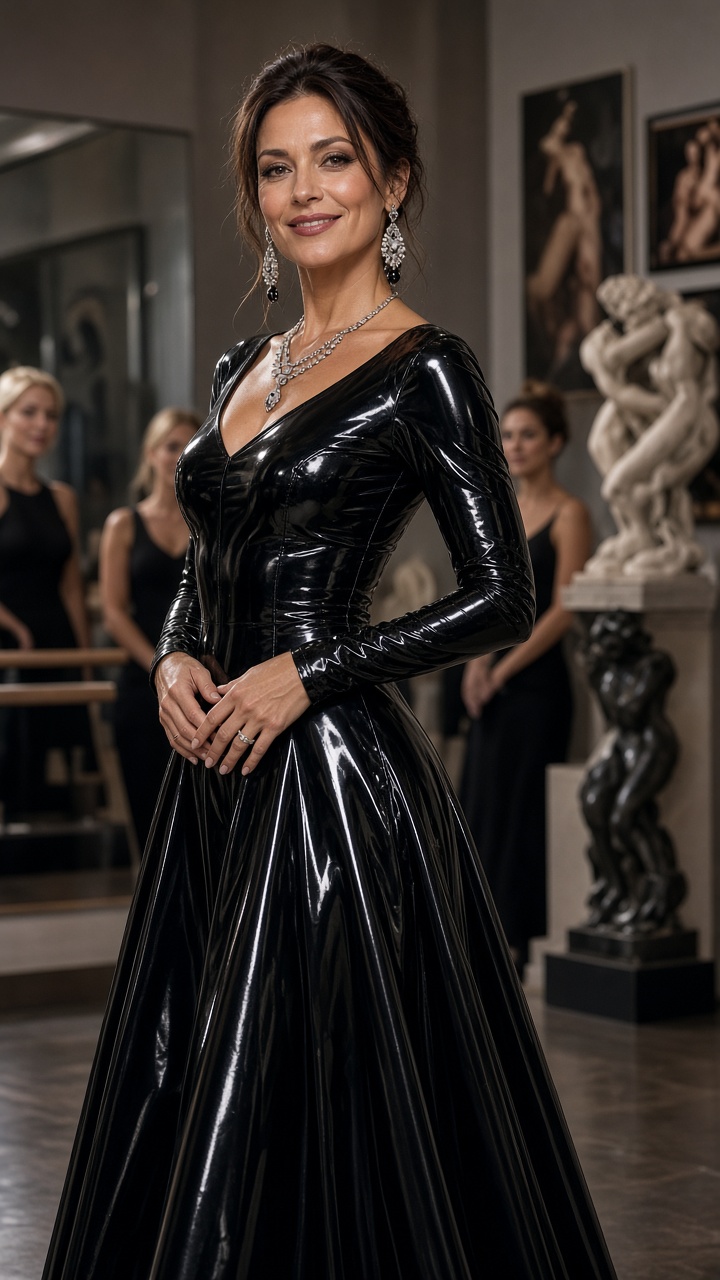
When a confident man steps into the rhythm of her world, a woman in glossy black PVC discovers that surrendering to his guidance transforms more than just her body—it awakens desires she never knew she possessed, and a devotion that runs deeper than the midnight silk of her hair.
The apartment held its breath as the last rays of amber sunlight surrendered to the encroaching dusk, painting the walls in shades of honeyed gold and deepening shadow. The scent of basil and sun-ripened tomatoes lingered in the air—a testament to the Italian heritage that flowed through Isabella Martini’s veins like vintage wine through crystal. But it was not the aroma of her cooking that made the evening pulse with anticipation. It was the rhythm. The intoxicating, primal rhythm of Latin music that seemed to seep through the very walls and wrap around the senses like liquid velvet.
And there she was.
Isabella Martini. A name that rolled off the tongue like a lover’s whisper, evoking images of moonlit terraces overlooking the Amalfi Coast, of laughter sparkling across candlelit tables, of a woman who had cultivated herself into something extraordinary through education, ambition, and an unerring instinct for surrounding herself with beauty. She stood in the living room, her body moving with the fluid grace of someone who understood that physical vitality and intellectual brilliance were not separate pursuits but expressions of the same inner fire.
Her attire was a statement—a declaration of confidence that needed no words. Black glossy PVC clung to her curves like a second skin, catching the dying light and throwing it back in shimmering ripples that seemed to dance independently of her movements. The material spoke of someone who understood that true elegance was not about following fashion but about choosing textures and surfaces that reflected one’s inner radiance. Glossy. Sleek. Tactile. Every inch of her presentation whispered of a woman who had refined her tastes through education and travel, who had learned that the way one adorns oneself is a language spoken to those wise enough to interpret it.
Her raven hair cascaded down her back like a waterfall of midnight silk, each strand catching the light with the same lustrous sheen as her attire. There was intention in every element of her appearance—a harmony of glossy surfaces that spoke of wealth not in ostentatious display but in the quiet confidence of someone who knew that true luxury resided in texture, in touch, in the way light played across surfaces that had been chosen with discerning eyes.
When her gaze met his—those dark, intelligent eyes that had studied art history in Florence and business in Milan—something shifted in the atmosphere. It was not merely recognition. It was the electric moment when a woman who has spent years cultivating her mind, her body, her aesthetic, finally sees someone worthy of the devotion she has been preparing her whole life to give.
“Benvenuto, amore mio,” she murmured, and the Italian words fell from her lips like notes of a melody that had been waiting for this particular instrument to play them.
He stood in the doorway, taking in the vision she had created—not just for him, but because of him. Because a woman of Isabella’s intelligence and refinement had recognised in this man something that called forth her deepest impulse: the desire to devote herself completely to someone whose strength matched her own, whose vision complemented her beauty, whose guidance she could follow not out of weakness but out of the profound understanding that true fulfilment comes from giving oneself fully to someone worthy of the gift.
What followed was not merely a dance lesson. It was an awakening. A journey into the space where health becomes sensual, where devotion becomes empowering, where the simple act of placing one’s hands on a glossy PVC-clad waist becomes a conversation between two souls who recognise in each other the missing piece of a puzzle they have been assembling their entire lives.
Through twelve chapters of growing intimacy, physical transformation, and emotional deepening, Isabella Martini will discover what she has always suspected: that giving herself to a man of quiet strength and masterful presence does not diminish her but elevates her to heights of pleasure and purpose she never imagined possible. And Benjamin—the man whose name she whispers like a prayer—will find in her devotion the mirror that reflects back his own highest self, challenging him to grow, to lead, to become worthy of the extraordinary woman who has chosen to make him the centre of her world.
This is not just a story about dance. This is a story about the exquisite pleasure of surrender, the transformative power of devotion, and the understanding that the healthiest relationships are those where a confident woman chooses to give herself completely to a man whose strength makes her feel, at last, truly safe.
Step into their world. Feel the rhythm. Surrender to the story.
Chapter 1: “The Italian Sunset
The sun descended upon the city like a golden coin being slowly pressed into the fabric of the horizon, its warmth seeping through the floor-to-ceiling windows of the penthouse apartment and painting every surface in shades of amber, copper, and burnt sienna. The light caught the polished mahogany of the grand piano in the corner, the crystal decanters arranged on the sidebar like soldiers of fine spirits awaiting their commanding officer’s command, and the sleek surfaces of the minimalist furniture that spoke of a life curated with the discerning eye of someone who understood that true luxury was not about excess but about intention.
And it caught her.
Isabella Martini stood in the centre of the living room, her body moving with the liquid grace of a river finding its course through a landscape it has known for millennia. The music—a salsa track that pulsed with the heartbeat of old Havana, of steamy nights and rum-soaked passions—filled the space like an invisible partner, guiding her hips, her shoulders, the elegant arc of her arms as they traced patterns in the air that seemed to leave trails of shimmering light behind them.
Her attire was a masterwork of deliberate sensuality. The black glossy PVC dress she wore caught the dying sunlight and transformed it, drinking in the golden rays and sending them back in ripples of liquid obsidian that seemed to move independently of her body, as if the material itself were alive, breathing, dancing with a consciousness all its own. The dress hugged her curves with the devotion of a lover who knows every inch of their partner’s form—every swell, every dip, every secret landscape of flesh and bone that it had been chosen to celebrate. The high neckline spoke of sophistication, of a woman who understood that true allure lay not in exposure but in suggestion, while the sleeveless design revealed arms that were toned and graceful—the arms of someone who invested in her physical wellbeing with the same dedication she applied to her investment portfolio.
Her legs, sheathed in glossy black stockings that caught the light with each movement, carried her across the polished hardwood floor with the surety of someone who had been taught by life itself that confidence was the most attractive accessory a woman could wear. Her feet, in heels that added inches to her already impressive height, clicked against the floor in a counterpoint rhythm to the music—a syncopation that revealed her innate musicality, her understanding that every movement, every sound, every moment was part of a larger composition.
Her raven hair, swept up in a chignon that exposed the elegant column of her neck, gleamed with the same lustrous sheen as her dress, creating a harmony of glossy surfaces that was almost hypnotic in its effect. Diamond earrings—real ones, because Isabella Martini did not deal in imitations of any kind—caught the light and threw tiny rainbows across the wall behind her, like a private light show celebrating her presence.
She was, in that moment, a symphony of glossy confidence and cultivated beauty—a woman who had spent years refining not just her mind through study and her body through exercise, but her very presentation through an understanding of textures, surfaces, and the psychological impact of materials that gleamed and shone and invited the touch.
She did not hear the door open. She did not see the figure who stood in the entrance to the living room, watching her with eyes that had seen much of the world but never anything quite like this. She was lost in the music, in the movement, in the private joy of a woman who has discovered that taking care of her body is not a chore but a celebration—a dance with vitality itself.
Benjamin stood motionless in the doorway, his briefcase forgotten in his hand, his breath caught somewhere between his lungs and his lips like a bird in mid-flight. He had returned from a long day of meetings—negotiations that required every ounce of his considerable intelligence and charm—and had expected to find Isabella reading or perhaps preparing dinner. Instead, he found this. This vision. This living sculpture of glossy black and gleaming raven, moving through the amber light of the dying sun as if she had been placed on this earth specifically to demonstrate what happened when beauty, health, intelligence, and devotion converged in a single human form.
He watched the way her hips swayed—the movement fluid and precise, the product of a body that was cared for with the same attention she applied to her financial investments. He watched the way her arms arced through the air, the muscles beneath her glossy skin speaking of regular exercise, of a woman who understood that physical health was the foundation upon which all other forms of wealth were built. He watched the way the PVC dress moved with her, not against her, as if the material had been made for this specific body, this specific dance, this specific moment.
And he watched her face. The expression of pure, unguarded joy that transformed her features from beautiful to transcendent. This was not a performance for an audience. This was Isabella dancing for herself—for the sheer pleasure of feeling her body move, of feeling her heart pump, of feeling alive in a way that only physical exertion and musical expression could provide. It was, Benjamin realised, one of the most honest things he had ever seen. And it moved him in a way that surprised him with its intensity.
The music shifted—a slower section, a bridge that allowed the dancers to catch their breath before the next surge of rhythm. Isabella’s movements softened, becoming more languid, more sensual, as if the music had reached into her and found the core of her femininity and was drawing it to the surface like a pearl from an oyster bed. She ran her hands down her sides, feeling the sleek PVC beneath her palms, and a small smile played at the corners of her lips—the smile of a woman who knows she is beautiful and takes quiet pleasure in the knowledge.
It was then that she saw him.
Her eyes—dark as espresso, sharp as a falcon’s—met his across the room, and for a moment, time seemed to fold in upon itself like origami made of light and shadow. The music continued, but it became a backdrop, a distant pulse beneath the sudden thunder of her heartbeat as she took in the sight of him: tall, broad-shouldered, his close-cropped hair and chiselled features catching the last of the sunset’s glow, his deep brown eyes holding hers with a gaze that was at once appreciative, possessive, and profoundly tender.
“Benjamin,” she breathed, and his name in her Italian-accented voice was like honey being poured into warm wine—sweet, rich, and intoxicating. “You are home early, mio amore.”
The music continued to play, but neither of them moved to change it. The moment held them in its amber grip, the dying sunlight painting them both in shades of gold and shadow.
“I finished earlier than expected,” Benjamin said, his voice a low rumble that seemed to vibrate through the floorboards and up through the heels of Isabella’s shoes and into her very bones. “The last meeting was… unexpectedly brief. It seems my reputation for thoroughness precedes me, and the other party decided that prolonged negotiation would be… inadvisable.”
Isabella’s smile deepened, a dimple appearing in her left cheek like a secret being shared. “You intimidated them with your competence, yes? This is what happens when a man applies his intelligence with such focus. The world learns to step aside.”
Benjamin stepped into the room, setting his briefcase down with the deliberate care of someone who treats all objects—whether they cost fifty pounds or fifty thousand—with the same respect. “I prefer to think of it as efficiency. Time is the one resource that cannot be replenished, after all. And I found myself… unwilling to spend any more of it away from here than was absolutely necessary.”
“Here?” Isabella raised one perfectly sculpted eyebrow, a gesture that managed to convey both amusement and invitation. “Or me?”
“The two have become rather inextricably linked, I find.” Benjamin’s gaze traveled over her with the appreciation of a connoisseur examining a masterpiece—not with hunger, but with recognition. With reverence. “You look…”
He paused, searching for a word adequate to the task. Language, that imperfect tool, seemed suddenly inadequate to describe what stood before him. Isabella, sensing his struggle, took pity on him—or perhaps simply could not resist the opportunity to demonstrate her own eloquence.
“Ravishing? Resplendent? Radiant?” she offered, her voice carrying the melodic lilt that was the inheritance of her Roman childhood. “I have been practising my English, you see. Expanding my vocabulary. A woman’s education is never truly complete, no?”
“Your English is impeccable, as always,” Benjamin said, moving closer. “I was searching for a word that does not yet exist. One that combines the concepts of beauty, vitality, confidence, and the particular effect you have on my respiratory system.”
Isabella laughed—a sound like crystal bells being rung by a summer breeze—and the tension in the room shifted from electric to warm, from charged to enveloping. “You are poetic this evening. I must dance more often if it inspires such language in you.”
“You dance often enough,” Benjamin observed. “I simply am not usually here to witness it.”
“And that is precisely why I dance when you are not here,” Isabella said, her voice softening, the playfulness giving way to something more vulnerable, more honest. “It fills the space. The music, the movement… it makes the apartment feel less like a place and more like a home. It makes the waiting feel less like absence and more like anticipation.”
The words hung in the air between them like notes of a melody waiting to be resolved. Benjamin felt something shift in his chest—a sensation he had learned to recognise over the years as the particular ache of being confronted with genuine devotion. Not the performative kind that announced itself with grand gestures and flowery declarations, but the quiet, steady kind that revealed itself in small moments—in the choice of attire, in the preparation of space, in the way a woman moved through a room she had made beautiful because she knew he would be entering it.
From the kitchen, there came the subtle sounds of activity—the clink of crystal being polished, the soft whisper of fabric against tile. Margaret, their housekeeper—a woman of fifty-five who had been with Benjamin for nearly a decade and had seen Isabella’s arrival in his life with the quiet satisfaction of someone watching a puzzle piece find its place—moved with the efficiency of long practice. She appeared briefly in the doorway, her own attire a study in understated elegance: a charcoal satin blouse that caught the light with a subtle sheen, paired with tailored trousers that spoke of practicality without sacrificing style.
“Dinner will be served at eight, as usual,” Margaret said, her voice carrying the measured tones of someone who had long ago mastered the art of being present without being intrusive. Her eyes moved briefly to Isabella, and a small smile of appreciation crossed her features. “You look wonderful this evening, Isabella. That dress is particularly striking. The way it catches the light… it is like watching liquid midnight in motion.”
Isabella turned to Margaret with the warmth she extended to all members of the household—a warmth that spoke of her understanding that true graciousness encompassed everyone, not just those at the top of the hierarchy. “Grazie, Margaret. You are too kind. I found it at that little boutique in Mayfair—the one you recommended, remember? The owner has such an eye for quality. She said the same thing, actually. That the material has a way of… responding to the wearer. It becomes more luminous the more it is worn, as if it learns from the body it adorns.”
“A quality fabric should do exactly that,” Margaret agreed, smoothing her own satin blouse with the unconscious gesture of someone who had long ago internalised the importance of texture in daily life. “I have always believed that the materials we choose to wear against our skin are not merely coverings but conversations—statements about how we wish to be perceived and how we perceive ourselves. Glossy surfaces, whether satin or leather or that wonderful PVC you favour, they speak of confidence. Of a woman who is not afraid to be seen. Who does not wish to blend into the background but to shine, quite literally, in her own light.”
“Precisely,” Isabella said, her eyes brightening with the pleasure of being understood. “My grandmother—God rest her soul—she always said that a woman who wears dull, rough fabrics is a woman who has given up on being noticed. And a woman who has given up on being noticed has given up on herself. She was a fierce one, my grandmother. She wore silk to garden in.”
Margaret chuckled, a sound that carried the warmth of shared understanding. “A woman after my own heart. Though I draw the line at gardening in satin. The soil is not kind to such finery.”
“No,” Isabella agreed, “but the wearing of it is kind to the soul, no? That is the trade-off. One stains a dress but elevates a spirit.”
Benjamin watched this exchange with the quiet satisfaction of a man who has surrounded himself with people of substance. Margaret had been with him long before Isabella’s arrival, and her presence in his life was a testament to his belief that the people one chose to keep close were reflections of one’s own values. She was efficient, educated, and possessed of a quiet wisdom that he had come to rely on over the years. And she understood, without being told, the aesthetic that defined his household—the preference for glossy over dull, for sleek over rough, for materials that caught the light and threw it back as if in celebration of the life being lived within them.
“Margaret,” he said, “would you please open the Barolo? The 2015. I believe this evening calls for something with depth.”
“Of course, sir,” Margaret replied, her tone carrying the subtle warmth that indicated her approval of his choice. “I will let it breathe for thirty minutes. Dinner at eight, then?”
“At eight,” Benjamin confirmed. “And Margaret—thank you.”
Margaret’s smile deepened fractionally. “It is always a pleasure, sir. Always.”
She withdrew, leaving Benjamin and Isabella alone once more in the amber glow of the dying sun. The music had shifted again—a slower piece now, a bolero that built with the patient intensity of a tide coming in. Isabella swayed unconsciously to the rhythm, her body unable to resist the pull of the music even in stillness.
“You were dancing when I came in,” Benjamin said, moving toward her with the deliberate grace of someone who understood that the approach was as important as the arrival. “You looked… free. Uninhibited. It was beautiful to witness.”
Isabella’s cheeks flushed—a subtle bloom of colour that the glossy PVC of her dress seemed to echo, the material warming with her body’s response. “I did not know you were watching. I would have… perhaps been more self-conscious.”
“That is precisely why I did not announce my presence. I wanted to see you as you are when no one is watching. As you are when you are simply being Isabella, not performing for an audience.”
“And what did you see?” The question was soft, vulnerable, carrying the weight of someone who has invested much in being seen in a particular way and who now finds herself exposed in a way she had not anticipated.
Benjamin stopped before her, close enough now that she could feel the warmth of his body, could smell the subtle cologne that clung to his skin—sandalwood and leather and something else, something that was simply, essentially him. He reached out and took her hand—the one that had been tracing patterns in the air moments before—and held it against his chest, where she could feel the steady, strong rhythm of his heart.
“I saw a woman who has made herself into a work of art,” he said, his voice low and intimate, meant for her ears alone. “Not through artifice but through care. Through education and exercise and the cultivation of taste. I saw someone who understands that beauty is not something one is born with but something one creates, day by day, through the choices one makes about what to put into one’s body, one’s mind, and one’s wardrobe.” His thumb traced circles on the back of her hand, the sensation sending shivers up her arm despite—or perhaps because of—the glossy PVC that separated his skin from hers. “I saw a woman who was dancing not for an audience but for the pure joy of feeling alive. And I felt… privileged. To be allowed to witness something so private, so honest, so fundamentally you.”
Isabella’s eyes glistened in the fading light—not with tears, but with the sheen of emotion too profound for mere moisture to express. “You see too much, Benjamin,” she whispered. “You always see too much. It is… unsettling. And wonderful. In equal measure.”
“I see what you allow me to see,” he corrected gently. “And what you allow me to see is a woman of extraordinary depth, intelligence, and beauty who has chosen—freely, without coercion—to share her light with me. That is not unsettling, Isabella. That is humbling.”
The music swelled, the bolero reaching its crescendo, and as if drawn by an invisible thread, Isabella stepped closer, closing the remaining distance between them. Her body pressed against his—glossy PVC against the fine wool of his suit, a contrast of textures that spoke of the beautiful tension between them: the sleek and the structured, the yielding and the firm, the feminine and the masculine.
“Dance with me,” she murmured, looking up at him through her lashes. “Here. Now. Not a lesson, not a practice. Just… dance.”
Benjamin’s arms wrapped around her, one hand settling on the small of her back where the PVC was warm from her body’s heat, the other taking her hand in a formal dance hold. “I should warn you,” he said, his voice carrying the hint of a smile, “I am not nearly as graceful as you.”
“Grace can be learned,” Isabella replied, beginning to move, guiding him with subtle pressures of her body against his. “Confidence, on the other hand… that, you have in abundance. And confidence is far more attractive than grace.”
“Is that your professional opinion, Signora Martini?”
“It is my personal opinion, Benjamin. My professional opinion is that you are a terrible dancer who steps on my feet. But I am willing to overlook this because you are excellent at other things.”
Benjamin laughed—a rare, full sound that seemed to fill the room and chase away the last of the day’s shadows. “I will endeavour to earn your continued forgiveness, then.”
“You already have,” Isabella said, and the simplicity of the statement carried more weight than any elaborate declaration could have. “You already have.”
They danced together as the sun completed its descent, the apartment filling with the soft purple light of twilight. In the kitchen, Margaret poured the Barolo with practiced hand, humming along to the music that drifted through the open door. The wine breathed in the crystal decanter, its ruby surface catching the light with the same lustrous sheen as Isabella’s dress, as her hair, as the glossy surfaces that surrounded them.
It was, by all measures, an ordinary evening. A man coming home. A woman dancing. Dinner being prepared. Wine being opened.
But for those with eyes to see—and Benjamin and Isabella both had eyes refined by education and experience to perceive the deeper currents of life—it was something more. It was a moment of connection, of recognition, of two lives intertwining with the deliberate grace of a well-choreographed dance. It was the beginning of something—a journey toward health, toward deeper intimacy, toward the understanding that the greatest luxury in life was not material but relational, not possessions but presence.
And it was beautiful. Glossy and glowing and alive with the particular radiance that comes when people who have worked hard to become their best selves find each other and recognise, in the sheen of a PVC dress catching the last light of day, the reflection of their own deepest desires being fulfilled.
The Italian sunset gave way to night. The dance continued. And somewhere in the space between heartbeats, between footsteps, between breaths, a story began to unfold—a story of health and devotion, of glossy surfaces and deeper truths, of a woman who had found in a man’s quiet strength the answer to a question she had not known she was asking.
The question was simple: What does it mean to give yourself completely to someone worthy of the gift?
The answer, Isabella was beginning to discover, was anything but simple. But it was, she suspected, going to be extraordinary.
Chapter 2: “A Proposal in PVC”
The last echoes of the bolero faded into the amber-tinged silence of the apartment, leaving behind a residue of intimacy that hung in the air like the scent of perfume long after the wearer has departed the room. Benjamin and Isabella stood in the centre of the living room, their bodies still pressed together in the aftermath of the dance, the glossy PVC of her dress warm against the fine wool of his suit, the crystal decanter of Barolo catching the twilight glow from its position on the sidebar like a ruby beacon watching over the scene.
Isabella was the first to move, stepping back with the deliberate grace of someone who understands that the space between bodies can be as eloquent as their proximity. Her heels clicked against the hardwood—a sound that had become, over the months of her residence in the apartment, as familiar and comforting to Benjamin as the ticking of a favourite clock. She reached for the remote control on the side table, her fingers—manicured with a French polish that caught the light with the same lustrous sheen as her attire—and paused the music with a gentle press.
The silence that followed was not empty but pregnant, filled with the particular quality of anticipation that precedes a significant statement. Benjamin, who had spent decades reading the subtle cues of boardroom negotiations and diplomatic conversations, recognised it immediately. Something was coming. Something important.
“I have been thinking,” Isabella began, and the words carried the weight of someone who does not make such an announcement lightly. She moved to the floor-to-ceiling windows, her reflection in the glass creating a doubled image—the woman herself and her mirror twin, both clad in glossy black PVC, both silhouetted against the city’s emerging lights. “About us. About our life. About the way we spend our evenings.”
Benjamin moved to the sidebar and poured two glasses of the Barolo, the wine flowing with the liquid grace of something that has been patiently waiting to be released. “Our evenings,” he repeated, handing her a glass with the unhurried precision of someone who believes that even the smallest gestures deserve one’s full attention. “I was under the impression our evenings were… satisfactory.”
“Satisfactory,” Isabella echoed, taking the glass and holding it up to the light with the practiced eye of someone who has spent years cultivating her palate. The wine’s ruby surface seemed to converse with the glossy PVC of her dress, each reflecting the other’s luminosity in a dialogue of surfaces. “Satisfactory is a word for adequate meals and timely trains. It is not a word I wish to apply to our life together, Benjamin. Our life together should be… extraordinary.”
“I would not argue the point,” Benjamin said, settling into one of the leather armchairs with the ease of someone who has earned his comfort through years of focused effort. “But I detect in your tone a specific concern. A proposal, perhaps? You have the look of a woman who has been building toward something.”
Isabella turned from the window, and the city lights behind her created a halo effect that seemed to emanate from her very being—as if she were not merely standing in the light but generating it. “You know me too well, mio amore. Or perhaps I am simply not as skilled at concealment as I like to believe.”
“Your transparency is one of your many charms,” Benjamin said, and the compliment was genuine—a recognition of her authenticity rather than mere flattery. “Concealment is overrated. I have always found that the most interesting things in life are those that are displayed openly, with confidence. Whether it is a fine wine, a well-made decision, or a woman in a dress that catches the light.”
Isabella’s lips curved into a smile that acknowledged the compliment while redirecting the conversation toward her purpose. “You are attempting to distract me with charm. This is a strategy I recognise, Benjamin. You have employed it in boardrooms across the continent.”
“It has served me well in those contexts. I see no reason to abandon a proven approach in more intimate settings.”
“Your approach is noted and appreciated,” Isabella said, settling onto the edge of the coffee table—a gesture that brought her to eye level with him and spoke of the seriousness of what she was about to propose. The PVC of her dress creaked softly as she moved, a subtle auditory reminder of her presence, of the material that encased her like a second, more beautiful skin. “But I have a proposal that I believe will serve us both. If you will hear me out.”
Benjamin took a sip of his wine, the Barolo spreading across his palate with the complex authority of something that has been carefully crafted over years. “I am listening. With the full attention that your proposals deserve.”
Isabella took a breath—a deep, centring breath that spoke of someone who has prepared for this moment, who has rehearsed her words in the quiet hours of the morning, who has shaped her argument with the same care she applies to her investment decisions. “We are healthy people, Benjamin. You swim each morning. I practise yoga. We eat well—Margaret sees to that with her culinary expertise. But we are also… sedentary in our evenings. We dine, we drink wine—excellent wine, I grant you—we read, we talk. These are good things. Necessary things. But they are not…”
“Physical enough?” Benjamin offered, and his voice carried the faintest edge of amusement, as if he could see where this was leading and found the destination intriguing.
“Physical enough,” Isabella confirmed, and a flush of colour rose in her cheeks that the PVC dress seemed to echo, the material warming with her body’s response. “Our bodies are the vessels of our experience, Benjamin. They carry us through the world, allow us to touch and taste and feel. And yet, in our evenings, we neglect them. We feed the mind but not the muscles. We stimulate the intellect but not the cardiovascular system.”
“You are proposing we exercise in the evenings?” Benjamin’s tone was carefully neutral—the tone of someone who is not yet convinced but is willing to be persuaded. “After a full day of work?”
“Not exercise,” Isabella said, and the distinction she was drawing was clearly important to her. “Dance. There is a difference, Benjamin, and you know it. Exercise is repetition, obligation, the grim pursuit of physical maintenance. Dance is… expression. Joy. The body’s conversation with music, with another body, with the very air it moves through.”
She rose from the coffee table and moved to the windows again, her reflection in the glass a ghostly twin that seemed to emphasise her words by mirroring them in duplicate. “When you came home this evening and saw me dancing, what did you see? Not a woman exercising, I think. You saw a woman alive. A woman in her element. A woman whose body and music and movement had become one thing, one expression, one joy.”
“I did,” Benjamin admitted, and the admission cost him something—a small surrender of the masculine reserve he typically maintained. “I saw you, and I was… struck. By your vitality. By the way you seemed to be not just moving but living, fully, in every cell of your being.”
“That is what I want for us,” Isabella said, turning back to face him, her eyes bright with the fervour of someone who has glimpsed a possibility and is determined to make it real. “Both of us. Together. I want us to dance. Not professionally, not competitively. Just… for us. For our health, yes—for the cardiovascular benefits, for the flexibility, for the coordination that keeps the mind sharp as well as the body. But also for the joy. For the connection. For the way it will make us feel, together, in this apartment, in the evenings that I do not want to be merely satisfactory but extraordinary.”
Benjamin was quiet for a moment, turning his wine glass slowly in his fingers, the crystal catching the light with the same lustrous quality that seemed to define every surface in his home. He was, Isabella knew, weighing her proposal with the same analytical rigour he applied to business decisions—examining it from multiple angles, considering potential objections, calculating the return on investment.
“You make a compelling case,” he said finally. “But you know me, Isabella. I am not… naturally inclined toward dance. I am a man who prefers the directness of a swim, the measurable progress of weights, the quantifiable metrics of a treadmill. Dance seems… ambiguous. Unstructured.”
“Dance is the opposite of unstructured,” Isabella replied, moving toward him with the fluid grace that seemed to be her natural state of being. “It has rules, patterns, techniques that have been refined over centuries. The salsa alone has a history as rich and complex as any business strategy you have ever employed. It was born in Cuba, evolved in New York, travelled the world. It is a language, Benjamin—a language of the body—and like any language, it can be learned.”
“And you propose to be my teacher?”
“I propose to be your partner,” Isabella corrected, and the distinction was clearly important to her. “A teacher instructs. A partner guides. A teacher stands apart. A partner moves with you, feels your hesitations, adjusts to your rhythm. I am not offering instruction, Benjamin. I am offering a shared experience. A journey we take together, toward better health, deeper connection, and—”
She paused, and a smile played at the corners of her lips that was at once playful and profound. “And the particular pleasure of seeing you step outside your comfort zone. Which, I must confess, is one of my favourite sights.”
Benjamin’s own lips twitched in response. “You find amusement in my discomfort?”
“I find beauty in your growth,” Isabella said, and the playfulness gave way to something more sincere, more vulnerable. “Every time you try something new, Benjamin, you become more. More alive, more present, more… the man I fell in love with. And I want to facilitate that. I want to be the reason you grow, the reason you try, the reason you discover capabilities you did not know you possessed. Not because I need you to change—you are already everything I want—but because watching you expand is one of the deepest pleasures I have ever known.”
The words settled between them like the last notes of a symphony, resonant and complete. Benjamin looked at her—really looked, with the full depth of his attention—and saw what she was truly offering. Not a dance lesson. Not a health regimen. A gift. The gift of her expertise, her patience, her devotion, wrapped in glossy black PVC and offered with the quiet confidence of a woman who knows her own worth and has chosen to invest it in someone she deems worthy of the investment.
“You know,” he said slowly, “I have built companies, negotiated deals worth millions, navigated complexities that would confound lesser minds. And yet, the prospect of learning to dance—of allowing you to lead me in something—fills me with a trepidation that none of those achievements ever did.”
“Because those achievements were intellectual,” Isabella said, understanding perfectly. “They engaged your mind, which is formidable and well-trained. Dance engages the body, which is strong but untrained in this particular language. It requires a different kind of intelligence—the intelligence of movement, of rhythm, of physical communication. And it requires surrender.”
“Surrender?” Benjamin raised an eyebrow, and the gesture carried the faintest hint of challenge.
“Surrender to the music. To the rhythm. To the guidance of your partner.” Isabella’s eyes held his, and in their depths was an invitation that went beyond dance. “You are a man who leads, Benjamin. In business, in life, in this relationship. And you lead well—magnificently, in fact. But even the most masterful leader must sometimes allow himself to be led. To trust someone else’s expertise. To surrender control, briefly, and discover that doing so does not diminish but expands.”
The silence that followed was not empty but full—full of consideration, of the weighing of options, of the particular quality of attention that Benjamin brought to every significant decision in his life. Isabella waited, patient as the sunset that had preceded this conversation, confident in the rightness of her proposal.
From the kitchen, the subtle sounds of dinner preparation continued—Margaret’s quiet movements, the clink of porcelain, the soft whisper of something delicious being tended with expert care. Through the open door came the faint scent of rosemary and garlic, and with it, the faint rustle of Margaret’s satin blouse as she moved through her domain with the efficiency of someone who has long ago mastered the art of domestic excellence.
A soft chime sounded—the doorbell, its tone melodic and unobtrusive. Margaret appeared in the doorway, her charcoal satin blouse catching the last of the evening light. “That will be Dr. Ashworth, sir. You mentioned she was coming to drop off the documents regarding the clinic investment.”
“Ah, yes,” Benjamin said, rising from his chair with the smooth economy of movement that characterised all his actions. “Show her in, Margaret. And perhaps pour her a glass of this excellent Barolo. It seems an evening for significant conversations.”
Isabella watched as Margaret withdrew, her satin-clad form moving with the quiet efficiency that defined everything she did. A moment later, she returned with a woman who seemed to embody the very qualities that the apartment itself celebrated—health, wealth, education, and the kind of confidence that comes from excelling in one’s chosen field.
Dr. Victoria Ashworth was perhaps forty-five, with the kind of beauty that spoke not of youth but of vitality—the clear skin, bright eyes, and toned physique of someone who practised what she preached as a physician specialising in preventative medicine. Her attire was a study in elegant professionalism: a cream silk blouse that caught the light with the subtle sheen of quality fabric, paired with a charcoal pencil skirt and heels that spoke of someone who understood that professional presentation and personal style were not mutually exclusive.
“Benjamin,” she said, her voice carrying the warm authority of someone accustomed to being heard and heeded. “I have the documents. But I must confess, I am also here because Margaret mentioned something about Isabella’s proposal, and I found myself… intrigued.”
Benjamin glanced at Margaret, who had the grace to look faintly abashed. “I may have mentioned it to Dr. Ashworth when she telephoned earlier. We have been discussing the importance of physical activity for patients of a certain… demographic.”
“Certain demographic?” Benjamin’s tone carried amusement.
“Successful, intelligent people who spend too much time in their heads and not enough in their bodies,” Victoria said bluntly, settling into the chair that Benjamin indicated and accepting the glass of Barolo that Margaret poured with practiced elegance. “I see it constantly in my practice, Benjamin. Brilliant minds in bodies that are beginning to fail because they are not given the movement they need. The human body was designed to move, to dance, to run, to reach and stretch and bend. When we confine it to chairs and boardrooms, we do it a disservice.”
“And you think dance is the answer?” Benjamin asked, and his tone suggested he was genuinely curious rather than sceptical.
“Dance is one answer,” Victoria said, taking a sip of her wine and nodding appreciatively at the quality. “It is, in fact, one of the best answers. It combines cardiovascular exercise with flexibility training, balance work, and cognitive challenge—because learning choreography engages the brain as much as the body. Studies have shown that regular dancing can improve cognitive function, reduce stress, lower blood pressure, and increase overall life satisfaction. It is, quite literally, one of the healthiest activities a person can engage in.”
She turned to Isabella, and her eyes held the appreciation of someone who recognises a kindred spirit. “And I understand you are an experienced dancer, Isabella?”
Isabella inclined her head with the grace that seemed as natural to her as breathing. “I studied dance in Rome, before I pursued my business degree. It was my first love, though not my career. I have maintained my practice over the years—privately, for my own wellbeing. But I have recently been considering the benefits of sharing it. Of making it a shared practice rather than a solitary one.”
“With Benjamin,” Victoria said, and the statement was not a question but a recognition.
“With Benjamin,” Isabella confirmed. “He is a man of considerable intellectual gifts but limited dance experience. I believe the practice would benefit him enormously—physically, mentally, and…” She paused, and a smile that was at once innocent and knowing crossed her features. “And in other ways that are perhaps best not discussed in the presence of his physician.”
Victoria laughed—a full, warm sound that spoke of someone comfortable in her own skin and amused by the foibles of others. “I will take that as confirmation that the relationship benefits are likely to be as significant as the physical ones. Which does not surprise me. Physical activity undertaken together is one of the most powerful bonding experiences available to couples. The shared challenge, the mutual vulnerability, the physical touch—all of these contribute to deeper intimacy.”
“The doctor makes your case better than I could,” Benjamin observed to Isabella, and his tone suggested that his resistance was weakening, that the combined assault of Isabella’s persuasion and Victoria’s medical authority was having its intended effect.
“That was not my intention,” Victoria said, though her smile suggested otherwise. “I came to deliver documents. But as a physician, I cannot help but advocate for practices that will improve my patients’ health. And as a woman—” She smoothed her silk blouse with the unconscious gesture of someone who has internalised the importance of texture in daily life. “As a woman, I cannot help but appreciate the sight of a man who is willing to step outside his comfort zone for the sake of his relationship. It speaks of a particular kind of strength—the strength to be vulnerable, to learn, to grow.”
“Isabella has made a similar argument,” Benjamin said. “She seems to find my potential vulnerability… appealing.”
“Potential vulnerability is appealing,” Victoria confirmed. “Actual vulnerability, even more so. There is nothing more attractive than a strong man who allows himself to be soft in the right contexts. It is the contrast, you see—the power held in check, the strength made gentle—that makes a man truly magnetic.”
Isabella nodded in agreement, and the two women shared a look that spoke of a shared understanding that transcended their different backgrounds and professions. It was, Benjamin noted, the look of women who recognised in each other a common appreciation for certain masculine qualities—and a common understanding that those qualities were most powerfully expressed not in domination but in the willingness to surrender, occasionally, to the right partner.
“You are conspiring against me,” Benjamin said, but his tone carried no real objection. “Using medical authority and feminine persuasion in combination. It is hardly a fair fight.”
“The best fights are the ones you lose,” Isabella said, moving to his side and placing her hand on his arm with the gentle confidence of someone who knows her touch is welcome. “Because losing means winning something better than victory.”
Benjamin looked down at her—at the glossy PVC that caught the last of the evening light, at the eyes that held his with such devotion, at the lips that curved with such promise—and felt something shift within him. Not a defeat, but an opening. A willingness to be led in this one thing, by this one woman, because she had asked not out of need but out of love. Not to diminish him but to expand him.
“Very well,” he said, and the words carried the weight of a man who does not make commitments lightly. “We will dance. You will teach me—or rather, guide me, as you insisted on the distinction. And I will… surrender to the music, to the rhythm, and to your considerable expertise.”
Isabella’s face lit up—not with triumph, but with joy. Pure, unfiltered joy that transformed her beauty into something almost unbearable in its intensity. The joy of a woman who has asked for something she deeply wants and has been granted it by someone whose granting of it makes the wanting worthwhile.
“Grazie, Benjamin,” she whispered, and the Italian words carried more weight than any English equivalent could have. “Grazie mille. You will not regret this. I promise you.”
“I know,” he said, and his hand found the small of her back where the PVC was warm and yielding. “I know.”
Victoria rose from her chair, gathering her documents with the efficiency of someone who recognises when a private moment is required. “I will leave you to your evening. The documents are on the table—review them at your leisure. And Benjamin?”
“Yes?”
“Dance. Regularly. With this woman who has clearly made your wellbeing her personal mission. It is, I assure you, the best prescription I could write for you.”
She moved to the door, her silk blouse catching the light one last time, and paused to exchange a glance with Margaret that spoke of a shared satisfaction—two women who had, in their different ways, contributed to a moment of connection that they both recognised as significant.
“Good evening, Margaret,” Victoria said. “The satin is lovely, as always.”
“Thank you, Dr. Ashworth,” Margaret replied. “The silk is exquisite as well. We must compare sources sometime.”
“I would like that,” Victoria said, and the exchange—brief, casual, unremarkable—carried within it the quiet normalisation of a world where women of intelligence and substance expressed themselves through fabrics that caught the light and delighted the touch.
The door closed behind her, and Benjamin and Isabella were alone once more. The Barolo breathed in its decanter. Margaret’s culinary preparations continued in the kitchen, filling the apartment with the promise of a meal that would nourish body and soul alike. And in the living room, a man who had built his life on control and a woman who had built hers on grace stood together in the quiet aftermath of a proposal that would change them both.
“Where do we begin?” Benjamin asked.
Isabella smiled—the smile of a woman who has been given a gift and knows exactly how to use it. “We begin with music. And with the willingness to let it move you. Not control you—move you. Like the tide moves the shore, gently but inevitably, reshaping what it touches into something new.”
She reached for the remote, and the music began again—a salsa, vibrant and alive, pulsing with the heartbeat of a culture that understood that life was meant to be danced, not merely lived.
“Place your hand here,” she said, guiding his palm to her waist where the PVC was warm and yielding. “Feel the rhythm through me. Let it travel from my body to yours, like a current through a wire. And when you feel it—when it has become part of you—move. Not because I tell you to, but because the music does. Because your body, which has been waiting for this permission, finally has it.”
Benjamin’s hand settled on her waist, and through the glossy PVC, he felt the subtle tremor of her body’s response to the music—a vibration that was at once physical and emotional, mechanical and magical. And he understood, in that moment, what she was offering him: not just a dance lesson, but an awakening. A permission to feel, to move, to be moved by something other than his own formidable will.
“Like this?” he asked, shifting his weight experimentally.
“Exactly like that,” Isabella breathed, and her eyes shone with a light that no lamp could produce—the light of a woman who has found her purpose in the happiness of another and discovered, in that purpose, her own deepest fulfilment.
The music played on. The evening deepened. And in a penthouse apartment where every surface gleamed with the particular lustre of things chosen with care and maintained with love, a new chapter began—a chapter of health and devotion, of glossy surfaces and deeper truths, of a man learning to follow and a woman discovering, in the act of leading, the profound pleasure of giving herself to someone worthy of the gift.
Dinner waited. The wine breathed. The city lights glittered through the windows like a constellation of possibilities.
And Benjamin, for the first time in longer than he could remember, allowed himself to be led.
Chapter 3: “First Steps, First Sparks”
The following evening arrived with the unhurried inevitability of a tide that knows its destination and sees no reason to rush toward it. The sun had set behind the city’s skyline, leaving behind a wash of deep purple and indigo that seemed to seep through the windows and into the very fabric of the apartment, staining the air itself with the colours of anticipation. Margaret had prepared a light dinner—grilled fish with a citrus dressing, accompanied by a salad so fresh it seemed to have been assembled in a garden moments before serving—and had then withdrawn with the quiet discretion that was her hallmark, leaving Benjamin and Isabella alone in the living room that had been, over the course of a single evening, transformed into something new.
The furniture had been pushed back against the walls, creating a space in the centre of the room that was larger than Benjamin had realised his living room could accommodate. The polished hardwood floor gleamed in the soft light of the lamps that Isabella had arranged—she had turned off the overhead fixtures, explaining that harsh lighting was the enemy of intimacy and that one could not dance properly under illumination that reminded one of a dentist’s waiting room. The result was a pool of warm, amber glow that seemed to cradle the dance space like cupped hands holding something precious.
Isabella stood at the edge of this pool, and Benjamin found himself struck anew by the deliberate intentionality of her appearance. She had changed from the outfit she had worn at dinner—a cream silk blouse and tailored trousers that spoke of casual elegance—into something that was clearly chosen with the evening’s activity in mind. A black satin wrap dress that caught the lamplight and threw it back in ripples of liquid midnight, the material flowing around her body like water finding its natural course. The dress was belted at the waist with a thin leather band that gleamed with the polished sheen of something well-maintained, and beneath it, glossy black stockings reflected the light with each subtle shift of her weight. Her feet were bare—a practical choice, she would explain later, as heels could damage the floor and were not ideal for teaching—but even unshod, her feet seemed to move with the same intentionality as the rest of her, each toe seeming to grip the polished wood with a dancer’s instinct.
Her hair was different tonight as well. Rather than the elegant chignon of the previous evening, she had allowed it to fall loose around her shoulders, the raven strands catching the light with the same lustrous quality as her satin dress. The effect was of a woman who had prepared herself not for public display but for private communion—someone who had dressed for the specific purpose of being seen by one person, in one context, for one reason.
“You look…” Benjamin began, searching for adequate language.
“I look like a woman who is about to teach you to dance,” Isabella completed, and her smile carried the particular warmth of someone who finds pleasure in being understood. “The satin is not accidental, Benjamin. It is functional. When you learn to lead, you will need to feel my movements through your hands, through your body. Satin provides a surface that is smooth enough to allow movement but substantial enough to provide feedback. It is the language through which we will communicate, you see. The fabric is not merely adornment. It is medium.”
“You have thought about this extensively,” Benjamin observed, moving to join her at the edge of the dance space. He had changed as well, though his choices were more practical than aesthetic—a fitted black t-shirt that showed the breadth of his shoulders and the definition of his arms, paired with trousers that allowed freedom of movement. His feet, like hers, were bare, and he felt momentarily self-conscious about this, a man who had spent his life in handcrafted shoes suddenly unshod on a wooden floor.
“I have thought about little else since you agreed,” Isabella admitted, and the honesty of the statement seemed to cost her something—a small surrender of the composure she typically maintained. “This is important to me, Benjamin. Not just the dancing, but the… sharing of it. Dance has been my private joy for so long. The thought of opening it to you, of making it something we create together… it fills me with a happiness I find difficult to articulate.”
“Then perhaps you should let the dancing articulate it for you,” Benjamin said, and the suggestion carried the quiet wisdom of someone who understands that some things are better expressed through action than words.
Isabella’s eyes brightened, and she extended her hand to him—an invitation that was at once formal and intimate, the gesture of a woman asking a man to join her in something she loves. “Come, then. Let us begin.”
He took her hand, and the contact sent a small thrill through him that he did not entirely understand. Her skin was warm, her grip firm but yielding, and there was something in the simple act of holding her hand that felt more significant than the handshake that had sealed million-pound business deals. Perhaps because those handshakes had been transactional and this was something else entirely—relational, emotional, the beginning of a journey rather than the conclusion of a negotiation.
“First,” Isabella said, positioning him in the centre of the space with the gentle but insistent pressure of her hands on his shoulders, “we must address your posture. You carry yourself well, Benjamin—better than most men I have known—but you carry yourself like a businessman, not a dancer. There is a difference.”
“Enlighten me.”
“A businessman carries his weight in his shoulders. A dancer carries it in his centre—here.” She placed her hand on his abdomen, just below his navel, and the contact was at once clinical and intensely personal. “This is your core. Everything in dance originates from here. Your movements, your balance, your connection to your partner. When you dance, you do not move from the limbs. You move from the centre, and the limbs follow.”
“Like a company’s strategy originating from its core principles and manifesting through its operations,” Benjamin said, and the analogy seemed to please Isabella enormously.
“Exactly like that,” she said, and her smile was the smile of a teacher who has found the key to a student’s understanding. “You think in business terms, Benjamin. I will teach you in business terms. Your body is the company. Your core is the mission statement. Your arms and legs are the departments that execute the strategy. If the mission is unclear, the execution will be chaotic. If the core is weak, the limbs will flounder.”
“And if the core is strong?”
“If the core is strong, everything else follows naturally. The movement becomes not something you do but something you are. There is no thought, no calculation, no analysis. There is only the music and the body’s response to it, flowing from the centre outward, like ripples from a stone dropped in still water.”
She adjusted his posture with gentle but insistent hands—straightening his spine, relaxing his shoulders, shifting his weight forward onto the balls of his feet. Each adjustment was accompanied by explanation, by analogy, by the patient articulation of someone who has spent years not just practising her art but understanding it at a fundamental level.
“Now,” she said, stepping back to survey her work with the critical eye of a sculptor examining a piece in progress, “you are standing like a dancer. Or at least, like the beginning of a dancer. The masterpiece will take time.”
“I have always been a patient investor,” Benjamin said. “I understand that the best returns come to those who wait.”
“Then you will be an excellent dance student,” Isabella replied. “Because dance is nothing if not an exercise in patience. With oneself, with one’s partner, with the slow process of training the body to do what the mind already understands.”
She moved to the sound system and selected a track—a simple salsa rhythm, slower than the music Benjamin had heard her dancing to the previous evening, with a clear, steady beat that even his untrained ear could follow. The music filled the room like a gentle tide, and Isabella returned to him with the fluid grace that seemed to be her natural state of being.
“The basic step,” she said, taking his left hand in her right and placing her left hand on his shoulder, “is simple. Deceptively simple. You will think you understand it immediately, and then your feet will betray you. This is normal. This is the process. Do not judge yourself for the betrayal. Simply observe it, adjust, and try again.”
“You speak from experience?”
“I speak from memory,” Isabella said, and her voice carried the soft vulnerability of someone sharing a private recollection. “I was thirteen when I began dancing in Rome. My teacher was a woman named Francesca—seventy years old, with the body of a girl and the wisdom of a sage. She wore satin to teach, always. She said that rough fabrics made rough dancers, and she would not have roughness in her studio. I thought her eccentric at the time. I understand her now.”
“Another woman of discerning taste,” Benjamin observed.
“Another woman who understood that the materials we choose to wear against our skin shape not only how others perceive us but how we perceive ourselves,” Isabella said. “When I wear satin, I move differently than when I wear wool. When I wear leather, I carry myself differently than when I wear cotton. The fabric is not passive, Benjamin. It is a conversation between the body and the world. And when the fabric is glossy, sleek, alive with light… the conversation becomes a celebration.”
She paused, and a self-conscious laugh escaped her lips. “I am lecturing you. This is a habit of mine—Margaret calls it my ‘professor mode.’ I apologise.”
“Do not apologise,” Benjamin said, and his voice carried a sincerity that seemed to surprise them both. “I find I am… unexpectedly fascinated. Not just by the dancing, but by your understanding of it. By the depth of thought you have given to something that, on its surface, seems merely physical.”
“Nothing is merely physical,” Isabella said. “The physical is the gateway to everything else. The emotional, the intellectual, the spiritual—they all pass through the body to reach the soul. When we dance, we are not just moving muscles and bones. We are expressing something that cannot be expressed in any other way. We are speaking a language that predates words, that bypasses the rational mind and communicates directly with the part of us that feels rather than thinks.”
“And what,” Benjamin asked, stepping closer to her in the dance hold she had positioned him in, “does your dancing say about you?”
Isabella met his eyes, and in their depths was something that seemed to pulse in time with the music—a vulnerability, a hunger, a desire that was not merely physical but existential. “My dancing says that I have spent my life preparing for something, Benjamin. That I have cultivated my body, my mind, my aesthetic, not for their own sakes but for the moment when I would find someone worthy of offering them to. My dancing says that I have been waiting. And that the waiting is over.”
The words hung between them like a held breath, and for a moment, the music seemed to pause as well—though of course it did not, could not, the rhythm continuing its patient pulse beneath the silence of their mutual recognition.
Then Isabella shook her head, and the vulnerability retreated behind the composed mask she typically wore. “But we are not here for philosophy. We are here for the basic step. And if I do not teach you the basic step, Margaret will be disappointed, and I do not wish to disappoint Margaret.”
“Margaret is monitoring your teaching progress?”
“Margaret monitors everything,” Isabella said, and her tone carried the affection of someone who has come to appreciate being observed by a discerning eye. “She has taken a particular interest in this project. She told me this morning that she has never seen me so animated about anything except perhaps the acquisition of a particularly fine piece of Murano glass.”
“Margaret is a perceptive woman.”
“Margaret is an extraordinary woman,” Isabella corrected. “As is Dr. Ashworth. As are the women in your circle, Benjamin. I have noticed this—you surround yourself with women of substance. Of intelligence. Of a certain… quality that speaks of careful selection.”
“I have always believed that the company one keeps is a reflection of one’s values,” Benjamin said. “I value intelligence, competence, and the kind of beauty that comes from within rather than being applied from without. I find that women who possess these qualities tend to appreciate being in the company of a man who recognises them.”
“And women who appreciate being in your company tend to… adjust themselves to please you?” Isabella’s question was carefully neutral, but there was something beneath it—a current of inquiry that went beyond the surface.
“I do not require adjustment,” Benjamin said. “I am not in the business of reshaping people to fit a template. But I have noticed that women who choose to be in my circle often find, of their own accord, that certain choices bring them more satisfaction than others. The choice of attire, for instance. The choice of lifestyle. The choice to invest in their health, their education, their presentation. These choices are not made to please me, but I cannot deny that they please me. And I cannot deny that the women who make them seem… happier for having made them.”
“Because pleasing you brings them pleasure,” Isabella said, and the statement was not a question but a recognition.
“Because the choices themselves bring pleasure,” Benjamin clarified. “The pleasing is… a secondary benefit. A confirmation that the choices were correct.”
“A subtle distinction,” Isabella observed.
“Subtle distinctions are where the most important truths reside,” Benjamin said. “Now, I believe you were about to teach me a basic step. Before my feet betray me and I am forced to observe the betrayal with philosophical equanimity.”
Isabella laughed—a sound that seemed to make the lamplight itself warmer—and repositioned herself in the dance hold. “Very well. The basic salsa step is a matter of weight transfer. You step forward with your left foot on the first beat, transfer your weight to it, then step back with your right foot on the third beat, transfer your weight to it, and hold on the fourth beat. Then you reverse it—back with your right, transfer, forward with your left, transfer, hold. Simple.”
“Simple,” Benjamin echoed, and the word carried the faintest hint of challenge.
“Deceptively simple,” Isabella repeated, and her eyes held a warning that was also an invitation. “Now, with me. On the first beat, step forward with your left foot.”
The music played. Benjamin stepped forward with his left foot.
And immediately, his right foot, apparently feeling neglected, decided to follow it.
“Both feet,” Isabella said, with the patience of someone who has witnessed this particular betrayal many times before. “You have moved both feet. You should have moved only one.”
“My feet are enthusiastic,” Benjamin said, and the admission carried a self-deprecating humour that Isabella had not expected from him. “They are overachievers.”
“Your feet are untrained,” Isabella corrected gently. “They are accustomed to walking, which is a bilateral activity. Dance is unilateral—or at least, this step is. One foot at a time. Think of it as… delegating. You are the CEO of your body. Each foot is a department head. You do not want both department heads acting simultaneously. You want them to take turns, to coordinate, to execute the strategy in sequence.”
“You are determined to teach me in business analogies.”
“I am determined to teach you in whatever language you understand best,” Isabella said. “And you understand the language of leadership, of delegation, of strategic thinking. So that is the language I will use. Now, again. One foot. Left foot forward. Right foot stays.”
Benjamin tried again. This time, his left foot moved forward while his right foot, with visible reluctance, stayed in place. The sensation was peculiar—not difficult, exactly, but unnatural, like writing with his non-dominant hand or eating with unfamiliar chopsticks. His body wanted to do what it had always done, and the new instruction felt like a interruption of an established pattern.
“Better,” Isabella said, and her voice carried genuine encouragement. “Now, transfer your weight to the forward foot. Feel the floor beneath it. Let your centre—that place I touched earlier—shift forward with the weight. Your body should move as one piece, not as a collection of separate parts.”
Benjamin shifted his weight, and the movement felt less strange than the stepping. The weight transfer was, he realised, something his body understood instinctively—it was the same shift that occurred in swimming, in walking, in any number of physical activities. It was only the context that was unfamiliar.
“Good,” Isabella said, and the word carried more weight than its single syllable should have been able to support. “Now, on the third beat, step back with your right foot. Transfer your weight. And on the fourth beat, hold. Do nothing. Simply be where you are.”
They moved through the basic step together, Isabella’s satin-clad body providing a reference point against which Benjamin could calibrate his own movements. Her hand on his shoulder was light but present, a gentle guide rather than a forceful director. Her eyes watched his feet, then his centre, then his face, reading the progress of the learning in the language of his body.
“You are thinking too much,” she said after several repetitions. “I can see the gears turning. The analysis, the calculation, the strategic assessment of each movement before you make it. You must let go of that, Benjamin. The thinking is getting in the way of the feeling.”
“Thinking is what I do,” Benjamin said, and the statement was not boastful but simply factual—a recognition of his primary mode of engagement with the world.
“I know,” Isabella said, and her voice carried a tenderness that seemed to reach past his defences. “And it has served you extraordinarily well. But it is not the only mode of engagement. There is also feeling. Intuition. The body’s wisdom, which does not analyse but simply knows. You have spent a lifetime developing your analytical mind. Now, for this hour, allow me to develop your intuitive body.”
“Develop my intuitive body,” Benjamin repeated, and the phrase seemed to intrigue him. “That is an unusual proposition.”
“It is an unusual practice,” Isabella admitted. “Most people never develop it. They live entirely in their minds, treating their bodies as vehicles that carry them from meeting to meeting, from meal to meal, from bed to boardroom. But the body has its own intelligence, its own wisdom, its own way of knowing that is older and more fundamental than the mind’s. When you dance—and when you dance well—you access that wisdom. You let the body lead, and the mind follows.”
“The reverse of my usual approach.”
“Precisely. And that is why this is valuable, Benjamin. Not because dance is inherently better than analysis, but because it is different. It exercises a part of you that your usual activities neglect. It is… cross-training for the soul.”
They continued, the music playing through several tracks as Isabella patiently guided Benjamin through the basic step, then through a simple turn, then through a basic combination that linked the two. Each new element was introduced with the same careful methodology—explanation, demonstration, practice, adjustment, more practice. And slowly, incrementally, Benjamin began to feel something shifting within him.
It was not mastery—that would take weeks, months, perhaps years. But it was the beginning of understanding. The first faint recognition that his body could, in fact, learn a language it had never spoken. That the muscles and bones and joints that had spent decades responding to the commands of his analytical mind could also respond to something else—to rhythm, to music, to the subtle physical communication of a partner who was guiding him with a patience and devotion that seemed to grow with each small success he achieved.
And through it all, Isabella’s satin dress whispered against his body, a constant tactile reminder of her presence, her guidance, her investment in his learning. The fabric was smooth and cool where it touched his arms, warm where it pressed against his chest, and the contrast of temperatures seemed to mirror the contrast of their roles—her cool confidence and his warm uncertainty, her smooth expertise and his rough-edged beginner’s efforts, blending together into something that was, if not yet beautiful, at least promising.
“You are improving,” Isabella said after perhaps an hour, and the statement was genuine—carrying neither false praise nor condescension, but the simple recognition of progress observed. “Your feet are beginning to find the rhythm. Your weight transfers are becoming more natural. And your core—” She placed her hand on his abdomen again, and this time the contact was less clinical, more intimate. “Your core is beginning to engage. I can feel it working, stabilising your movements, providing the foundation that the limbs are building upon.”
“I feel as though I am learning to walk again,” Benjamin admitted. “As though everything I knew about moving through space has been… suspended, and I am starting from the beginning.”
“That is exactly what you are doing,” Isabella said. “And that is exactly why it is so valuable. When was the last time you learned something entirely new, Benjamin? Something that required you to be a beginner, to not know, to be guided rather than to guide?”
Benjamin considered the question, and the answer that emerged was surprising in its distance. “I cannot recall. It has been… years. Perhaps decades.”
“And how does it feel?” Isabella asked, and the question was not casual but probing—seeking to understand something fundamental about his experience. “To be a beginner again?”
Benjamin was quiet for a moment, turning the question over with the same care he would give to a complex business problem. “It feels… uncomfortable,” he said finally. “And humbling. And frustrating, at times. But also…” He paused, searching for the right word. “Also liberating. There is a freedom in not knowing, in having nothing to prove, in simply being a student rather than a master. I had forgotten that.”
“You had not forgotten it,” Isabella said gently. “You had simply not had the opportunity to remember it. Your life has been structured around mastery—of business, of strategy, of the people and situations that require your leadership. And you have mastered them magnificently. But mastery, for all its rewards, can become a prison. The expectation to always know, to always lead, to always be the one in control—it is exhausting, is it not? Even if you would never admit it to anyone else?”
The question reached into a place that Benjamin kept carefully guarded, and he felt something there—a recognition, a resonance, that told him Isabella had seen something true. He did not confirm it with words, but his silence was confirmation enough.
“This,” Isabella said, gesturing to the dance space, to the music, to the space between them, “is your permission to not be the master. To not know. To be guided. To make mistakes without consequence, to stumble without judgment, to be imperfect in a way that your professional life never allows. This is my gift to you, Benjamin. Not the dancing itself, but the space it creates—the space where you can be something other than what the world requires you to be.”
She stepped back, and the absence of her warmth against his body was like a small loss—a reminder of how quickly new pleasures can become expected, how rapidly the novel can become the necessary. “And that is why I wanted to share this with you. Not because I think you need to become a dancer, but because I think you need to become a student. And I wanted to be the one to teach you—not because I am the most qualified, but because I am the most devoted. Because watching you learn, watching you grow, watching you discover capabilities you did not know you possessed… it brings me a pleasure that I cannot adequately describe. A pleasure that is, in its own way, as profound as the pleasure you bring me when you lead.”
“You find pleasure in my vulnerability,” Benjamin said, and the statement was not accusatory but curious.
“I find pleasure in your expansion,” Isabella corrected. “Your vulnerability is simply the door through which expansion enters. I do not want you weak, Benjamin. I have never wanted you weak. I want you growing. And growth requires the willingness to be vulnerable, to be uncertain, to be a beginner. When I see you struggling with a dance step, I do not see weakness. I see courage. The courage of a man who is strong enough to be soft, masterful enough to be led, confident enough to be uncertain. And that courage, Benjamin, is the most attractive thing about you. More than your intelligence, more than your success, more than your physical presence. Your willingness to grow—to be led by a woman who adores you—is what makes you worthy of that adoration.”
The words settled between them, and in their settling, something shifted—a tectonic plate of understanding moving into a new position, creating a landscape that was at once familiar and transformed. Benjamin looked at Isabella—at the satin that caught the light, at the eyes that held his with such fierce devotion, at the body that had spent the past hour guiding his with a patience and love that went beyond mere instruction—and felt something that he had not felt in longer than he could remember.
Gratitude. Not for the dance lesson, but for the gift of being seen. Of being understood. Of being loved not despite his imperfections but because of his willingness to expose them.
“Again,” he said, and his voice was rough with emotion that he did not try to hide. “Show me again. The basic step. I want to get it right.”
Isabella smiled—the smile of a woman who has been given a gift far greater than the one she offered—and took his hand. “Again,” she agreed. “As many times as you need. As many times as you want. I am here, Benjamin. I am not going anywhere.”
The music played on, and they danced—two figures in a pool of amber light, surrounded by the glossy surfaces of a life curated with care, moving together in a rhythm that was at once ancient and new, simple and profound. And somewhere in the space between the beats, between the steps, between the breaths, a spark was kindled—the first spark of something that would grow, over the coming weeks, into a flame that would illuminate them both.
From the kitchen, Margaret watched through the carefully angled reflection in a copper saucepan, her satin blouse catching the light as she moved through her evening tasks. She had seen many things in her years of service—many relationships, many beginnings and endings, many attempts at connection that had succeeded and many that had failed. But this, she thought, was something different. Something rare. Something that deserved to be nurtured with the same care that Isabella was nurturing Benjamin’s first uncertain dance steps.
She smoothed her satin blouse with an unconscious gesture—the gesture of a woman who has internalised the importance of texture in daily life, who understands that the materials we choose to wear against our skin are not merely coverings but communications—and turned back to her work.
The evening was young. The music was playing. And in the living room, a man and a woman were discovering, one step at a time, that the greatest pleasure in life comes not from leading or following, but from the willingness to do both—to surrender and to guide, to teach and to learn, to give and to receive, in a dance that has no final step because the dance itself is the destination.
The first sparks had been struck. The fire was beginning. And neither of them knew yet how brightly it would burn.
Chapter 4: “The Rhythm of Two Hearts”
Three weeks had elapsed since that first tentative evening of instruction, and the apartment had undergone a transformation as subtle and profound as the changes occurring in the bodies and hearts of its inhabitants. The dance space, once a temporary rearrangement of furniture, had become a permanent feature—Margaret had taken to leaving the centre of the living room clear, arranging the sofas and armchairs in a configuration that spoke of a household that had embraced a new rhythm and had no intention of returning to the old.
The changes were visible in other ways as well. A barre had been installed along one wall—a gift from Dr. Victoria Ashworth, who had presented it with the practical authority of a physician prescribing a treatment she believed in. “For stretching and warm-up,” she had said, her cream silk blouse catching the light as she demonstrated a simple calf stretch. “The body must be prepared before it is asked to perform. Cold muscles are reluctant muscles. Warm muscles are willing partners.”
The barre was polished mahogany, matching the grand piano, and its surface gleamed with the same lustrous quality that seemed to define every object in Benjamin’s home. Isabella had been touched by the gift—not just by its usefulness but by what it represented: a recognition from someone outside their relationship that what they were building was worth supporting.
But the most significant changes were not in the apartment’s physical arrangement but in the way Benjamin and Isabella moved within it. The basic salsa step, which had once required conscious thought and deliberate execution, had become something closer to reflex—a pattern encoded in muscle memory, accessible without the intervention of the analytical mind that had initially struggled so against the surrender of control. Benjamin’s feet no longer betrayed him. They had, over the course of countless repetitions and patient corrections, become allies rather than adversaries, responding to the music with a surety that surprised him each time he noticed it.
And the music had expanded as well. Isabella had introduced new rhythms—the mambo, the cha-cha, the bachata—each with its own character, its own demands, its own particular way of requiring the body to speak a slightly different dialect of the same physical language. Benjamin found that the fundamentals he had learned transferred to each new rhythm, providing a foundation upon which new patterns could be built, like a company’s core principles enabling it to adapt to new markets.
It was a Thursday evening, and the autumn rain was tracing patterns down the floor-to-ceiling windows, each droplet a tiny mirror reflecting the warm light within. Isabella emerged from the bedroom, and Benjamin, who had been reviewing documents at the dining table, looked up to find his breath caught somewhere between his lungs and his throat.
She was wearing leather.
Not the bold, statement-making PVC of their first evening, nor the flowing satin of their subsequent sessions, but something that occupied a different register entirely—a pair of black leather trousers that hugged her legs like a second skin, their surface gleaming with the polished sheen of material that has been cared for with devotion. Above them, she wore a crimson satin blouse—deep, rich, the colour of wine and roses and things that have been allowed to ripen to their fullest expression—that caught the lamplight and threw it back in ripples of liquid fire.
The combination was deliberate, Benjamin knew. Isabella did not dress by accident. Every choice was a communication, every texture a statement, every surface a sentence in the ongoing dialogue between her aesthetic and his appreciation of it.
“You are wearing leather,” he observed, and the statement was unnecessary—obvious, redundant—but he made it anyway because the sight of her had temporarily disrupted his usual eloquence.
“I am wearing leather,” Isabella confirmed, moving toward the dance space with the fluid grace that had become even more pronounced over the weeks of practice. “And satin. Together. Because they speak to each other, you see. The leather speaks of strength, of structure, of a body that is powerful and knows it. The satin speaks of softness, of fluidity, of a spirit that is yielding and generous. The combination is… the combination is me, Benjamin. It is the whole of who I am, expressed in two fabrics.”
“And the colour?” Benjamin asked, rising from the table and moving toward her with the unconscious gravitational pull that her presence seemed to exert on him. “The crimson?”
“The crimson is for passion,” Isabella said simply. “It is the colour of blood, of life, of the heart that pumps vitality through the body. I wore it tonight because tonight, I want us to dance not just with our feet but with our hearts. I want the rhythm to be not just in the music but in us—in the space between us, in the connection that we have been building, in the…”
She paused, and the pause was not for effect but for honesty—a moment of vulnerability in which she allowed him to see that her eloquence had reached its limit and something deeper was trying to express itself.
“In the love,” she finished, and the word was not casual but weighted, not assumed but earned. “In the love that I feel when I am in your arms, when the music plays, when our bodies speak a language that our minds could never articulate.”
Benjamin stood before her, and the rain on the windows behind him created a shimmering backdrop that seemed to echo the gleam of her leather trousers, the lustre of her satin blouse. “The love,” he repeated, and the word in his mouth was not a question but a recognition—an acknowledgment of something that had been growing between them, unspoken but undeniable, like a seed that pushes through soil before the gardener is even aware it has been planted.
“The love,” Isabella confirmed. “I have not said it before because I wanted to be certain. I wanted to be sure that what I felt was not merely the gratitude of a woman who has found a worthy partner, nor the infatuation of someone swept up in a new experience. I wanted to be sure that it was real—that it would endure the test of time and challenge and the mundane realities of life lived together.”
“And are you sure?”
“I am sure,” Isabella said, and her voice carried the quiet authority of someone who has examined something from every angle and found it sound. “I am sure because of the dancing. Because in the dancing, I have seen you, Benjamin. Not the Benjamin who leads companies and commands boardrooms—that Benjamin I knew before. But the Benjamin who is willing to be led. The Benjamin who is willing to learn. The Benjamin who is strong enough to be uncertain and confident enough to be vulnerable. That Benjamin—the one I have discovered on this dance floor—is the Benjamin I love.”
The declaration hung in the air between them, and the rain seemed to pause in its descent, as if the world itself was holding its breath. Then Benjamin reached out and took her hand—the hand that had guided him through countless steps, that had rested on his shoulder with patient weight, that had corrected his posture and his weight transfers and his tendency to think when he should feel—and raised it to his lips.
“I am not a man who uses words like yours, Isabella,” he said, and his voice was low, intimate, meant for her ears and her ears alone. “You are the poet. I am the… the strategist. The planner. The one who thinks in terms of objectives and outcomes rather than feelings and expressions. But I will tell you this: what you have given me—through the dancing, through the teaching, through the patience and the devotion and the leather and the satin and the crimson that speaks of love—has changed something in me that I did not know could be changed.”
“What has it changed?”
“It has opened a door,” Benjamin said, and the metaphor was not his usual language but one he seemed to be learning, perhaps from her. “A door I did not know existed. A door to a part of myself that I had kept locked, not because I was afraid of it but because I did not have the key. You, Isabella, have been the key. And what lies behind the door is… a capacity for feeling that I had not suspected. A capacity for connection that goes beyond the intellectual and the physical into something that I can only describe as…”
He paused, and the pause was the mirror image of hers—a moment of vulnerability in which the strategist admitted that his strategic vocabulary had been exhausted.
“As love,” Isabella supplied, and her smile was the sunrise after a long night.
“As love,” Benjamin agreed, and the word in his mouth was not casual but careful—not because he was uncertain of it but because he wanted to give it the weight it deserved. “I love you, Isabella. Not because you have taught me to dance, but because in teaching me to dance, you have taught me to feel. And the feeling is… extraordinary.”
They stood in the dance space, hands clasped, eyes locked, and the moment was so complete that the music seemed almost unnecessary. But Isabella, with the practical wisdom of someone who understands that moments, however beautiful, must be grounded in action to become real, reached for the remote with her free hand and started the music.
It was a bachata this time—slower than the salsa, more intimate, a rhythm that seemed to pulse with the heartbeat of two bodies that have decided to speak as one. The guitar’s melody wound through the room like a vine, and Isabella moved into Benjamin’s arms with the surety of someone who has found her place and intends to remain there.
“Dance with me,” she said, and the instruction was not a command but an invitation—the invitation of a woman who has given herself and asks only to be received.
Benjamin’s hand found the small of her back, where the satin was warm and yielding, and his other hand took hers with a grip that was firm but gentle—the grip of a man who has learned that strength and tenderness are not opposites but partners. “I am learning,” he said, “that dancing with you is not unlike making love. The same attention. The same responsiveness. The same… conversation between bodies that words can only approximate.”
“The comparison is not inaccurate,” Isabella murmured, her body pressing closer to his as the music swelled. “Dance is the body’s lovemaking, Benjamin. The rhythm, the connection, the give and take, the building toward something that is more than either partner could achieve alone. The only difference is that dance can be performed in public, while the other…”
“While the other is reserved for private moments,” Benjamin completed, and his voice carried a hint of the hunger that the proximity of her body—leather and satin and warmth and the scent of her perfume, something floral and deep that he had come to associate with home—was awakening in him.
“For now,” Isabella said, and the qualifier was a promise that hung in the air like the last note of a song.
They danced, and the dance was different from any that had preceded it. The technical elements—the steps, the weight transfers, the timing—were still present, but they had receded into the background, becoming automatic, unconscious, the way breathing becomes automatic when one is absorbed in something more important. What remained was the connection—the physical dialogue between two bodies that had learned each other’s language and were now, for the first time, speaking it fluently.
Benjamin felt Isabella’s weight shifts through his hand on her back, through the pressure of her palm against his, through the subtle movements of her leather-clad thighs against his. He responded not with thought but with instinct—the instinct of a body that has been trained, over three weeks of patient instruction, to hear what its partner is saying and to answer in kind.
And Isabella, feeling his responses, felt something within her expand—a warmth, a fullness, a sense of being received that went beyond the physical into something that touched the very core of who she was. This was what she had wanted. Not just the dancing, but this—the communion, the connection, the experience of giving herself to someone and being met, fully, in the giving.
“You feel it,” she breathed, and it was not a question.
“I feel it,” Benjamin confirmed. “I feel… you. Not just your body, but your intention. Your… your self. It comes through the leather, through the satin, through the points where we touch. It is as if your clothing is not a barrier but a conductor—a medium through which you transmit something that bare skin could not convey.”
“That is exactly what it is,” Isabella said, and her eyes brightened with the pleasure of being understood. “The fabric is not a wall, Benjamin. It is a language. Each material says something different. The leather says ‘I am strong.’ The satin says ‘I am soft.’ Together, they say ‘I am both.’ And when you touch them, when you feel them, you are not just touching me. You are reading me. You are receiving the message I have encoded in the very texture of my attire.”
“And the message is?”
“The message is that I have made myself for you,” Isabella said, and the statement was not one of subservience but of intention—the declaration of a woman who has chosen, freely and with full awareness, to devote herself to someone she deems worthy of the devotion. “Not because you demanded it. Not because you required it. But because making myself for you—choosing the fabrics that please you, cultivating the body that attracts you, learning the language that connects us—brings me a pleasure that I could not have imagined before I knew you. A pleasure that fulfils me in ways that my career, my education, my independent achievements, wonderful as they are, never could.”
The music shifted—a new track, a cha-cha this time, with a rhythm that was brighter, more playful, and Benjamin felt Isabella’s body respond to the change with an immediacy that was almost startling. Her movements became sharper, more precise, more exuberant, and the leather trousers caught the light in new ways as her legs traced patterns through the air.
“You respond to the music as if it is a part of you,” Benjamin observed. “As if it flows through you rather than around you.”
“It does flow through me,” Isabella said. “That is what dance is, Benjamin—the music flowing through the body, using it as an instrument, creating through it a visible expression of an invisible force. When I dance well, I am not dancing. I am being danced. The music is the dancer, and I am merely the medium through which it expresses itself.”
“And when you dance with me?”
“When I dance with you, the music flows through both of us, and we become one instrument. Two bodies, one expression. That is the goal, Benjamin. That is what we are building toward. Not just synchronized movement but unified expression—the experience of two becoming one through the medium of rhythm and touch.”
The doorbell chimed, and the sound was an intrusion—a reminder that the world outside their private communion still existed and occasionally demanded attention. Margaret appeared in the doorway, her evening attire a deep navy satin blouse that caught the lamplight with a subtle, sophisticated sheen.
“Mrs. Pemberton is here, sir,” Margaret said, her tone carrying the carefully modulated neutrality of someone delivering information she knows will be received with interest. “She said she was passing and saw the lights. I told her you were occupied, but she insisted she would only stay a moment.”
Benjamin glanced at Isabella, who raised an eyebrow with the amused tolerance of someone who understands that certain people cannot be turned away. “Show her in, Margaret. And perhaps pour her a glass of the Sancerre.”
“Of course, sir.”
A moment later, Eleanor Pemberton swept into the room with the particular energy of a woman who has spent her life being wherever she wished to be and sees no reason to alter this pattern at her current age of sixty-three. She was, as always, impeccably dressed—a charcoal pencil skirt paired with a burgundy satin blouse that gleamed in the lamplight, and a leather jacket that spoke of someone who had ridden horses in her youth and still carried the posture of a woman accustomed to commanding large animals and larger opinions.
“Benjamin! Isabella!” she exclaimed, her voice carrying the warm authority of someone who has been a fixture in the city’s social landscape for decades. “I saw the lights and thought I would pop in. I have been meaning to ask about this dancing project of yours—Victoria mentioned it at the club, and I have been simply dying with curiosity.”
Eleanor Pemberton was, by any measure, a force of nature. The widow of a property developer who had left her a fortune she had subsequently tripled through her own acumen, she moved through the world with the confidence of someone who has nothing to prove and everything to enjoy. Her education—Oxford, history, with a particular focus on the Renaissance—had given her a perspective on human endeavour that was both broad and deep, and she had a particular interest in the intersection of physical culture and intellectual achievement.
“The Renaissance understood something we have forgotten,” she said, settling into one of the armchairs that had been pushed to the periphery of the dance space and accepting the Sancerre that Margaret poured with practiced elegance. “They understood that the body and the mind are not separate but complementary—that a well-developed body supports a well-developed mind, and vice versa. The dancing masters of the fifteenth century were not merely teaching steps. They were teaching grace, confidence, the physical expression of inner nobility.”
“And you think our dancing project aligns with this Renaissance ideal?” Benjamin asked, moving to stand beside Isabella in a posture that was unconsciously protective and possessive.
“I think,” Eleanor said, her eyes moving between them with the shrewd assessment of someone who has spent a lifetime reading the subtle dynamics of human relationships, “that what you are doing here is rather more than a dancing project. I have known you for fifteen years, Benjamin, and I have never seen you… illuminated… in quite this way. Whatever Isabella is teaching you, it is not merely the salsa.”
“It is not merely the salsa,” Isabella confirmed, and her voice carried a warmth that was directed not at Eleanor but at Benjamin, though the words were spoken to the room. “It is the language of the body. The conversation between two people who have decided to hear each other on a level that goes beyond words.”
“Magnificent,” Eleanor said, and the word was not casual but considered—the assessment of someone who has seen much and recognises quality when she encounters it. “And I must say, Isabella, that your choice of attire for these sessions is inspired. The leather and satin together—they speak of a woman who understands that strength and softness are not contradictions but complements. I have always believed this. A woman who wears only soft fabrics is a woman who is afraid of her own power. A woman who wears only hard fabrics is a woman who is afraid of her own tenderness. But a woman who wears both…”
“A woman who wears both has integrated both,” Isabella completed. “She has accepted that she is strong and soft, powerful and yielding, and she does not feel the need to choose between them.”
“Precisely,” Eleanor said, raising her glass in a small toast. “This is something I have tried to communicate to the young women in my circle—the ones who have achieved professional success and somehow believe that this requires them to dress in severe, masculine styles. Power suits, they call them. As if power must be masculine. As if a woman’s power must be expressed through the rejection of her own aesthetic nature.”
“There is nothing powerful about rejecting who you are,” Isabella said. “True power comes from integration—from embracing every aspect of oneself and expressing it with confidence. The leather does not diminish my femininity. It expresses it. The satin does not undermine my strength. It reveals it.”
“And together,” Eleanor added, “they create an impression that is… memorable. I wore a similar combination to a gallery opening last week—leather trousers with a silk blouse, in midnight blue—and the number of women who asked me where I had found the trousers was quite remarkable. There is a hunger, I think, among women of substance, for an aesthetic that honours their substance. That does not ask them to choose between being powerful and being beautiful.”
“Margaret was telling me something similar,” Isabella said, glancing toward the kitchen where Margaret was visible through the doorway, her navy satin blouse catching the light as she arranged something on a tray. “She said that she has noticed a shift in the women who visit the apartment—that they arrive in dull, conventional attire and leave talking about fabrics and textures and the way certain materials make them feel.”
“Because certain materials do make you feel,” Eleanor said, and her voice carried the authority of someone who has given significant thought to the subject. “They make you feel the way you wish to feel. Glossy fabrics—satin, leather, PVC—they make you feel alive. Present. Visible. They catch the light and throw it back, and in doing so, they announce that the wearer is someone who wishes to be seen. Not out of vanity but out of a healthy, confident relationship with one’s own existence. Dull fabrics—wool, rough cotton, those dreadful sequined things that seem to be everywhere these days—they make you feel invisible. Diminished. As if you are apologising for taking up space.”
“I have always found velvet particularly offensive,” Isabella said with a shudder that was only partly theatrical. “It absorbs light rather than reflecting it. It is the fabric of funerals and depression.”
“Exactly,” Eleanor agreed. “And yet it has been elevated in certain circles as a symbol of luxury. As if luxury were about heaviness and darkness rather than light and life. True luxury is luminous, Benjamin. It gleams. It shines. It announces itself not through ostentation but through the simple, confident reflection of light.”
Benjamin, who had been listening to this exchange with the quiet attention of someone who finds himself learning something unexpected, looked between the two women—both accomplished, both intelligent, both dressed in fabrics that caught the light and threw it back as if in celebration of their existence—and felt a deep satisfaction. This was his world. A world of women who understood that their appearance was not a concession to male gaze but a celebration of female essence. Who chose glossy fabrics not because he preferred them—though he did—but because those fabrics expressed something true about who they were and who they wished to be.
“Eleanor,” he said, “would you like to see what we have been working on?”
Eleanor’s eyes brightened with the anticipation of someone who has been offered a gift she did not expect. “I would be delighted. But only if you allow me to offer feedback. I may not dance, but I have been watching dancers for sixty years, and I have developed something of an eye.”
“Your feedback would be welcome,” Isabella said, and the invitation was genuine—the recognition of a fellow connoisseur, someone whose opinion was worth soliciting.
The music started again—a salsa this time, with a rhythm that was bright and complex and demanding. Benjamin and Isabella moved together into the dance space, and the transformation that overtook them was visible to Eleanor, who sat forward in her chair with the alertness of someone watching something rare unfold.
They were not, by professional standards, remarkable dancers. Benjamin’s technique was still developing, his movements sometimes hesitant, his timing occasionally imperfect. Isabella’s expertise compensated, her body adjusting to his uncertainties with the fluid adaptability of someone who has learned to read her partner’s intentions through the language of physical contact.
But what they lacked in technical mastery, they possessed in something else—a connection that was visible, palpable, almost tangible. The way their bodies communicated through the leather of her trousers, the satin of her blouse, the points of contact where his hands met her body and her body responded. The way the rhythm seemed to flow not from the music but from the space between them, generated by the interaction of two people who had learned to hear each other on a level that transcended the auditory.
When the music ended, Eleanor was silent for a long moment—a silence that was not empty but full, full of the processing of someone who has witnessed something that requires careful consideration.
“That,” she said finally, “was not merely dancing. That was a conversation. A conversation conducted in a language that most people never learn, between two people who have clearly devoted significant time and attention to mastering it.”
“Three weeks,” Isabella said. “We have been practising for three weeks.”
“Three weeks?” Eleanor’s eyebrows rose. “That level of connection in three weeks? Either you are both extraordinarily gifted students of each other, or…”
“Or we are both extraordinarily motivated,” Benjamin completed. “By something that makes the learning not a task but a pleasure.”
Eleanor looked at him—looked at them both—and her expression softened into something that was at once knowing and tender. “I see,” she said. “And that something is…?”
“Each other,” Isabella said simply. “The motivation is each other. The pleasure of learning together, of growing together, of discovering together what we can create when we surrender to the same rhythm.”
Eleanor rose from her chair, setting down her wine glass with the careful precision of someone who recognises that a moment of significance has occurred and does not wish to disturb it. “I will leave you to your evening, my dears. But I will say this: what you have—what you are building—is precious. Not because it is rare, though it is. But because it is real. And real things, in my experience, are the only things worth having.”
She moved to the door, her burgundy satin blouse and leather jacket catching the light one final time, and paused to exchange a glance with Margaret that spoke of a shared recognition—two women who had seen many relationships and knew the difference between those that were performed and those that were lived.
“Goodnight, Margaret,” Eleanor said. “The navy satin is exquisite, as always.”
“Goodnight, Mrs. Pemberton. The burgundy is particularly striking this evening.”
They exchanged smiles—the smiles of women who understood that the fabrics they chose were not merely coverings but communications, and that the communication was worth acknowledging—and then Eleanor was gone, leaving behind a silence that was not empty but enriched by her presence.
Benjamin and Isabella stood in the dance space, alone once more, and the apartment seemed to settle around them like a garment that has been perfectly tailored to fit.
“She understands,” Isabella said.
“She does,” Benjamin agreed. “She understands because she has lived long enough and observed deeply enough to recognise something genuine when she sees it.”
“And what she saw was…?”
“What she saw,” Benjamin said, moving toward Isabella with the slow deliberateness of someone who has made a decision and intends to see it through, “was two people who have discovered that the rhythm of two hearts beating in time is more powerful than either heart beating alone.”
He took her in his arms—not in the formal dance hold they had been practising, but in an embrace that was at once simpler and more complex. Simpler because it had no steps, no rhythm, no technique. More complex because it contained everything—the weeks of learning, the growing connection, the declarations of love, the leather and satin that spoke of strength and softness, the glossy surfaces that reflected the light of something that was being born between them.
“Dance with me again,” Isabella whispered. “Not the salsa. Not the bachata. Just… dance. To whatever music comes. To no music at all. Just dance with me, Benjamin, and let the rhythm be the rhythm of two hearts.”
The music played, or perhaps it did not—Benjamin could not tell, because the rhythm he was following was not coming from the speakers but from the body in his arms, from the heartbeat he could feel through the satin of her blouse, from the breath that moved her chest against his. And he danced, not with his feet but with his whole being, surrendering to the rhythm of two hearts that had found each other and were learning, one beat at a time, to beat as one.
And in the kitchen, Margaret paused in her evening tasks, her navy satin blouse catching the light from the overhead fixture, and smiled. She had seen many things in her years of service. But this, she thought—this connection, this devotion, this willingness to learn and to teach and to grow together—this was something worth staying to watch.
The evening deepened. The rain continued its patient descent. And in the living room, two people danced to a rhythm that was older than music and newer than their love, a rhythm that would carry them forward into a future that neither could predict but both were willing to embrace.
The rhythm of two hearts. The rhythm of a life being shared. The rhythm of a love that had found its expression in leather and satin and the space between two bodies that had learned to speak as one.
Chapter 5: “Transformation in Gloss and Sweat”
Six weeks had passed since the first tentative steps on the polished hardwood of the living room, and the changes that had begun as subtle whispers of transformation had grown into declarations—visible, tangible, undeniable declarations written in the language of muscle and movement, of posture and presence, of the particular radiance that comes from a body that has been consistently and lovingly used rather than merely maintained.
Benjamin noticed it first in the mirror. He was dressing for a morning meeting—selecting a shirt with the unconscious precision of a man whose wardrobe has been curated over decades—and he paused, his hand still on the hanger, as his reflection caught his attention in a way it had not done in years. The man looking back at him was… different. Not dramatically, not in the way that announces itself with fanfare and demands recognition. But in the way that a fine wine changes over months in the cellar—subtly, deeply, in ways that only someone who has known the original vintage would recognise.
His shoulders sat differently. They had always been broad—the product of a disciplined swimming regimen he had maintained since university—but there was a new ease in their carriage, a fluidity that had not been there before. His waist, already trim, seemed to have tightened further, the muscles of his core—the muscles Isabella had insisted were the foundation of all dance—now visible even through his shirt as a subtle definition that spoke of engaged strength rather than passive fitness.
And his posture. He had always carried himself well—Margaret had commented on it more than once, noting that he stood the way men of an earlier generation had stood, with the natural authority of someone who has nothing to prove but everything to command. But now his posture had acquired an additional quality—a groundedness, a centredness, that seemed to draw the eye not upward to his considerable height but inward to a point of stillness around which the rest of him moved.
He was, he realised, standing like a dancer.
The recognition brought a smile to his lips—a smile that lingered as he descended the stairs to find Isabella already in the kitchen, engaged in animated conversation with Margaret over the breakfast arrangements. The morning light streamed through the windows, and both women seemed to glow within it—Margaret in a dove-grey satin blouse that caught the light with the soft, sophisticated sheen of someone who has made texture a daily practice, and Isabella in something Benjamin had not seen before.
She was wearing a leotard. Not the functional, unadorned garment one might associate with a dance class, but a piece that seemed to occupy the intersection of athletic wear and haute couture—a sleek, black PVC leotard that hugged her body like a second skin, its glossy surface catching the morning light and throwing it back in ripples of liquid obsidian. Over it, she wore a flowing wrap skirt in deep burgundy satin that moved around her like a whispered secret, concealing and revealing in equal measure as she turned to greet him.
“Good morning, mio amore,” she said, and her voice carried a brightness that seemed to be not merely emotional but physical—the brightness of a body that has been exercised and rested and nourished with the care that a connoisseur applies to a fine instrument.
“Good morning,” Benjamin replied, moving to the coffee machine with the automatic navigation of someone whose morning routine is as precisely calibrated as his business schedule. “You are up early. And you are wearing… is that new?”
Isabella glanced down at her attire with the expression of someone who has been caught in the act of doing something she is not entirely ready to explain. “It is new. I ordered it from a boutique in Milan—a place that specialises in dancewear that does not sacrifice aesthetics for function. The PVC is a particular formulation, designed to move with the body while maintaining its… its gleam.”
“It is beautiful,” Benjamin said, and the compliment was not merely polite but genuine—the recognition of a woman who has invested thought and resources in presenting herself in a way that pleases both herself and the man she loves. “Though I confess I am curious about the practical considerations. PVC for dance practice seems… ambitious.”
“It is ambitious,” Isabella admitted, and her smile carried the particular satisfaction of someone who has tested something and found it worthy. “But it is also effective. The material provides a certain resistance that forces the muscles to work harder, and the heat it generates during practice increases flexibility. It is, in a way, a form of resistance training disguised as fashion.”
“Fashion as fitness,” Margaret observed, setting plates on the table with the quiet efficiency that characterised all her movements. Her satin blouse caught the light as she reached across the table, the grey fabric gleaming with a soft, sophisticated sheen. “There is a concept that would have been foreign to previous generations, who believed that one must choose between looking good and feeling good.”
“Previous generations were wrong about many things,” Isabella said, settling into her chair with the fluid grace that had become even more pronounced over the weeks of practice. “They believed that beauty required suffering—that one must choose between comfort and elegance. But this is a false dichotomy. The right fabrics, chosen with intelligence and worn with confidence, provide both. The PVC does not suffer my body, Margaret. It celebrates it. And in celebrating it, it makes the practice more pleasurable, and pleasure, as we know, is the greatest motivator.”
“Speaking of practice,” Benjamin said, taking his seat and reaching for the coffee, “I have been meaning to ask: I noticed something in the mirror this morning. Something… different.”
“Different how?” Isabella’s eyes sharpened with the attention of someone who has been watching for changes and is eager to hear them confirmed.
“Different in the way I am standing. The way I am carrying myself. I seem to have acquired a… a centredness that was not there before. As if my body has learned something that my mind is only now beginning to recognise.”
Isabella’s face lit up with a joy that seemed to come not from being right but from having her observations confirmed—the joy of a teacher who has been watching a student’s progress and is gratified to hear the student articulate it themselves. “That is exactly what should be happening. The dancing is retraining your body’s default posture—how it holds itself when you are not thinking about it. The core engagement that we practice on the dance floor is becoming habitual, carrying over into your daily movement. It is the same principle as learning a language, Benjamin. At first, you must think about every word. But eventually, the thinking falls away, and you simply speak.”
“And my body is learning to speak dance,” Benjamin said, and the metaphor seemed to please him.
“Your body is learning to speak balance,” Isabella corrected gently. “Dance is merely the dialect. The language itself is poise—physical, mental, emotional poise. The ability to stand in your centre and move from there, regardless of what external forces are acting upon you.”
Margaret set a plate of fruit and yoghurt before each of them, her movements carrying the quiet precision of someone who has elevated domestic service to an art form. “I have noticed it as well, sir. Not just in your posture but in your energy. You seem… lighter, somehow. Not in weight—you have always been trim—but in the way you move through the apartment. There is a fluidity that was not there before.”
“Fluidity,” Benjamin repeated, tasting the word. “That is an interesting observation, Margaret. I had not thought of myself as lacking fluidity.”
“You did not lack it,” Margaret said, and her tone carried the respectful honesty of someone who has been in his employ long enough to speak truth without fear of giving offence. “But what you had was… controlled fluidity. The movement of someone who is managing their body, directing it, ensuring that it performs according to plan. What you have now is… natural fluidity. The movement of someone who trusts their body to know what to do.”
“Trust,” Isabella said, seizing on the word with the enthusiasm of someone who has found a teaching opportunity. “That is the key, Benjamin. Trust in the body. You have spent your life trusting your mind—relying on it, developing it, giving it authority over every aspect of your existence. But the body has its own wisdom, its own intelligence, and learning to trust it—to let it move without the mind’s constant supervision—is one of the most profound transformations that dance can facilitate.”
“And you believe this is happening to me?”
“I know it is happening to you,” Isabella said. “I can feel it when we dance. In the beginning, your movements were… calculated. Each step was a decision, each weight transfer a strategy. But now, increasingly, your body is responding before your mind has time to intervene. It is hearing the music and answering, without waiting for permission from headquarters.”
“An apt analogy,” Benjamin said, and his smile carried the particular pleasure of someone who appreciates being understood. “My body is going rogue. Making decisions without executive approval.”
“Your body is becoming autonomous,” Isabella corrected. “And in doing so, it is freeing your mind to attend to other things—like the connection with your partner, the expression of the music, the emotional content of the dance. This is what I have been working toward, Benjamin. Not just teaching you steps, but teaching you to trust. To surrender. To let go of the need to control and allow something deeper to take the lead.”
The conversation was interrupted by the chime of the doorbell, and Margaret moved to answer it with the smooth efficiency of someone for whom interruptions are not disruptions but simply part of the day’s rhythm. She returned a moment later with Dr. Victoria Ashworth, who entered the kitchen with the brisk energy of someone who has scheduled this visit between patients and intends to make the most of it.
Victoria’s attire was, as always, a study in professional elegance—a cream silk blouse that caught the morning light with the subtle, sophisticated sheen of quality fabric, paired with tailored trousers and heels that spoke of someone who understands that a physician’s authority is conveyed not only through expertise but through presentation.
“I hope I am not interrupting,” Victoria said, settling into the chair that Margaret indicated and accepting the coffee that was poured for her with the practiced hospitality that characterised the household. “But I wanted to check on my patient’s progress.”
“Your patient is not ill,” Benjamin observed with the dry humour that Isabella had come to recognise as his particular form of affection.
“My patient is undergoing a transformation,” Victoria replied, “which is a form of treatment, and as the one who prescribed it, I have a professional interest in the outcome. Also, Margaret mentioned that you have been dancing every evening for six weeks, and I wanted to assess the physical effects.”
“The physical effects are… noticeable,” Benjamin said, and his glance at Isabella carried something that was not quite embarrassment but perhaps a mild form of the vulnerability he had been learning to express. “I seem to have acquired a different relationship with my body.”
“Describe it,” Victoria said, and her tone was not clinical but genuinely curious—the tone of a physician who is also a scientist, interested not just in outcomes but in the subjective experience of transformation.
“I am… more aware of it,” Benjamin said slowly, choosing his words with the care of someone who is articulating something for the first time. “Not in a self-conscious way—in fact, the opposite. I am less self-conscious, more… present in my body. As if I have been living in my head for decades and have only now discovered that I have a residence below my neck.”
“And the physical changes? Stamina, flexibility, strength?”
“All improved,” Isabella answered on his behalf, and her voice carried the pride of someone who has invested in a project and is seeing returns. “His stamina has increased dramatically—we can now dance for an hour without the rest breaks that were necessary in the early weeks. His flexibility has improved—I have introduced stretches that he could not do at all six weeks ago and can now perform with ease. And his strength… the core engagement that dance requires has complemented his swimming regimen in ways that have surprised us both.”
“I can see it,” Victoria said, studying Benjamin with the professional eye of someone who reads bodies the way others read books. “Your posture has changed significantly. The forward head carriage that many men develop from desk work has corrected. Your shoulders are back and down, not through effort but through habit—the muscles that support good posture have been retrained. And your breathing…” She paused, and her observation became more focused. “You are breathing more deeply than you were six weeks ago. I remember noticing at our first meeting that you were a shallow breather—chest rather than diaphragm. That has changed.”
“The dancing requires deep breathing,” Isabella explained. “The exertion demands it, and the rhythm reinforces it. You cannot dance well while breathing shallowly. The body simply will not support it.”
“And the mental effects?” Victoria asked, turning her attention to Isabella. “I am as interested in the psychological transformation as the physical. Dance has been shown to have significant benefits for mental health—reduced anxiety, improved mood, enhanced cognitive function. Have you noticed these in Benjamin?”
Benjamin and Isabella exchanged a glance that contained an entire conversation—the kind of glance that comes from weeks of intimate partnership, of learning to read each other not just through words but through the subtle language of expression and attention.
“I am… calmer,” Benjamin said finally. “Not in a passive way—I have always been calm under pressure, it is a professional requirement. But in a deeper way. As if the dancing has created a space in my day that is not about achievement but about experience. A space where I am not building anything or solving anything or managing anything. I am simply… being. And that being, paradoxically, seems to energise the doing that follows it.”
“That is precisely what the research predicts,” Victoria said, and her voice carried the satisfaction of someone whose recommendations have been validated by experience. “Dance combines physical exercise with creative expression and social connection. It is, in a sense, the perfect activity for someone whose life is primarily intellectual and solitary. It engages the neglected aspects of the self and integrates them with the developed ones.”
“And what about Isabella?” Benjamin asked, turning the attention to her with the instinct of someone who recognises that transformation, to be complete, must be mutual. “Have you noticed changes in her?”
Victoria’s eyes moved to Isabella, and what she saw seemed to confirm something she had suspected. “Yes,” she said. “Yes, I have. And I suspect the changes are more profound than the physical, though the physical are certainly visible.”
“Visible how?” Isabella asked, and her voice carried a vulnerability that she typically kept hidden beneath her composed exterior.
“Your skin,” Victoria said. “It is glowing. Not from cosmetics—though I know you wear them, and wear them well—but from within. The increased circulation from regular dance practice has improved your complexion noticeably. Your eyes are brighter. Your hair…” She paused, and her observation became more specific. “Your hair seems to have more life to it. More body, more shine. This is not uncommon—improved circulation and reduced stress can have significant effects on hair health.”
“I have been wearing it differently,” Isabella admitted. “Allowing it to be more… natural. Less controlled. The dancing has taught me that there is a beauty in movement that does not require management—that the most beautiful things are those that are allowed to be what they are.”
“That is a profound observation,” Victoria said. “And it speaks to something I have noticed in my practice—the way that physical transformation often precedes and enables psychological transformation. When the body becomes more alive, more present, more expressive, the mind follows. We begin to allow ourselves to be more of who we are.”
“And who I am,” Isabella said slowly, “is someone who has been… holding back. For years. Presenting a carefully curated version of myself to the world. Not inauthentic—I have never been inauthentic—but incomplete. Showing the parts that seemed appropriate and concealing the parts that seemed… excessive.”
“Excessive how?” Benjamin asked, and his voice carried the tenderness of someone who is being allowed to see something precious.
“Excessive in their passion,” Isabella said. “Excessive in their desire. Excessive in their need to give, to devote, to make themselves beautiful for someone worthy of the effort. I learned, growing up, that these qualities were… too much. That a woman should be measured, moderate, contained. That showing too much devotion was weakness, too much passion was desperation, too much effort was… unseemly.”
“Who taught you this?” Victoria asked.
“Everyone and no one,” Isabella said. “It was in the air. The culture. The subtle messages that girls receive from the moment they are old enough to understand them—that they should be accomplished but not intimidating, attractive but not provocative, intelligent but not threatening. That they should want things but not too much. That they should give but not deplete themselves in the giving. That they should love but not lose themselves in the loving.”
“And the dancing has changed this?”
“The dancing has… unlocked something,” Isabella said, and her eyes glistened with the sheen of emotion that comes from articulating something long felt but never spoken. “When I dance, I am not measured. I am not moderate. I am not contained. I am… excessive. I give everything. I hold nothing back. And the music receives it, and my partner receives it, and the world receives it, and nothing bad happens. The sky does not fall. The earth does not open. I am not punished for my excess. Instead, I am… rewarded. With joy. With connection. With the experience of being fully, unreservedly myself.”
The kitchen was quiet for a moment, and the quiet was not awkward but sacred—the quiet that follows a confession, the space that is held for something vulnerable to be received and honoured.
“And the clothing?” Victoria asked gently. “The PVC, the satin, the leather—has that been part of the transformation?”
Isabella’s smile returned, and it was brighter than before—the smile of someone who has been given permission to celebrate something she had previously felt she must justify. “The clothing is the expression of the transformation. When I feel alive, I want to look alive. When I feel passionate, I want to wear passion. The glossy fabrics—the PVC, the satin, the leather—they are not costumes, Dr. Ashworth. They are… announcements. Announcements that the woman wearing them is present, is vital, is unafraid to be seen. They are the external expression of an internal revolution.”
“And you, Benjamin?” Victoria asked. “How do you respond to this external expression?”
Benjamin was quiet for a moment, and his silence was not evasion but consideration—the careful thought of someone who wants to give a true answer rather than a convenient one. “I respond with… gratitude,” he said. “Gratitude that this woman—this extraordinary, intelligent, beautiful woman—has chosen to express her transformation in a way that is designed to please me. Not because I require it. Not because I have demanded it. But because pleasing me brings her pleasure. And her pleasure, expressed in glossy fabrics and graceful movement and the light that catches the surface of everything she wears, brings me a joy that I find difficult to articulate.”
“So the transformation is mutual,” Victoria said. “Isabella transforms through dance, expresses the transformation through her aesthetic choices, and those choices in turn transform you. It is a virtuous cycle—each transformation feeding and amplifying the other.”
“Precisely,” Isabella said. “And the cycle does not end with us. Margaret has commented on it—on the way the atmosphere of the apartment has changed. On the way visitors respond to the glossy surfaces, the gleaming fabrics, the sense of vitality that seems to permeate everything.”
“I have indeed,” Margaret said, entering the conversation with the quiet confidence of someone who has been waiting for the right moment to contribute. Her dove-grey satin blouse caught the light as she moved, the fabric responding to her gestures like a living thing. “The apartment feels different. Not just in its arrangement—the dance space, the barre—but in its energy. There is a… luminosity… that was not here before. A sense that the people who live here are not merely existing but thriving.”
“And the visitors?” Victoria asked.
“They notice,” Margaret said. “They comment on the fabrics—the satin, the leather, the PVC. They ask where Isabella finds her pieces. They remark on the way the apartment seems to glow. And I have noticed…” She paused, and her expression carried the careful thought of someone who is about to say something significant. “I have noticed that the women who visit seem to… shift. Not immediately, not in obvious ways. But over time. They arrive in dull, conventional attire, and they leave talking about textures and surfaces. They come in wool and leave wondering about satin. They come in cotton and leave curious about leather.”
“Because they see what is possible,” Isabella said. “They see a woman who has chosen to express herself through fabrics that catch the light, and they recognise something in that choice—something they have felt but not acted on. The desire to be seen. The desire to shine. The desire to present oneself to the world with the confidence that comes from knowing that your exterior reflects your interior.”
“And you believe this is… healthy?” Victoria asked, and her tone was not sceptical but genuinely inquiring—the tone of a physician who is considering the therapeutic implications of what she is hearing.
“I believe it is essential,” Isabella said. “I believe that the suppression of the desire to be beautiful—to express oneself through texture and colour and the interplay of light on surface—is one of the great unrecognised health crises of our time. Women are told that caring about their appearance is superficial. That choosing fabrics for their tactile and visual qualities is frivolous. That the desire to gleam, to shine, to catch the light and throw it back in celebration of one’s own existence is somehow… trivial.”
“It is not trivial,” Benjamin said, and his voice carried an intensity that surprised everyone in the room, including himself. “It is fundamental. It is the desire to exist fully, to be present completely, to announce oneself to the world with the confidence of someone who knows that their presence matters. I have learned this from you, Isabella. Not through your words but through your choices. Every time you put on a satin blouse, every time you step into leather trousers, every time you wrap yourself in PVC that catches the light and throws it back in ripples of liquid colour, you are saying something. You are saying: I am here. I am alive. I am not apologising for my existence. I am celebrating it.”
“And this celebration,” Victoria said, “is part of what makes you attractive to him.”
“It is the core of what makes me attractive to him,” Isabella said, and the statement was not boastful but simply true—the recognition of a dynamic that both of them had come to understand and embrace. “Not the fabrics themselves, but what they represent. The confidence. The vitality. The willingness to invest in my own beauty because doing so pleases him, and pleasing him pleases me, and the cycle of pleasure creates something that is more than either of us could create alone.”
Victoria was quiet for a long moment, and her silence was the silence of someone who is integrating new information into an existing framework. “I must confess,” she said finally, “that my medical education did not prepare me for this conversation. I was taught to think in terms of health and disease, function and dysfunction. But what you are describing is something else—something that exists in the space between health and happiness, between function and flourishing. Something that I recognise as valuable but that I do not have the vocabulary to adequately address.”
“The vocabulary is being written,” Isabella said, “in the language of glossy fabrics and graceful movement and the light that catches the surface of a life lived with intention. We are not merely dancing, Dr. Ashworth. We are composing a new way of being—one in which health is not merely the absence of illness but the presence of vitality, and beauty is not merely the arrangement of features but the expression of a soul that has been given permission to shine.”
Victoria rose from her chair, and her movement carried the particular thoughtfulness of someone who has been given something to consider that will occupy her mind for days. “I will leave you to your morning. But I want to say this: what you are building here—this partnership, this practice, this aesthetic of vitality and expression—is something I have not seen before. It is, I believe, something that could benefit many people. Not just the dancing, but the philosophy that underlies it—the idea that health and beauty are not separate pursuits but expressions of the same fundamental impulse toward wholeness.”
“That is exactly what it is,” Isabella said. “And the glossy fabrics are not incidental to this. They are integral. They are the language through which the philosophy speaks.”
“The language of gloss,” Victoria said, and the phrase seemed to amuse her. “I may borrow that.”
“Please do,” Isabella said. “Languages are meant to be shared.”
Victoria moved to the door, her cream silk blouse catching the light one final time, and paused to exchange a glance with Margaret that spoke of a shared recognition—two women who had witnessed something significant and understood its importance.
“Margaret,” Victoria said, “the grey satin is lovely today.”
“Thank you, Dr. Ashworth,” Margaret replied. “The silk is exquisite as always. We must discuss sources again soon.”
“I would like that,” Victoria said. “I am beginning to understand why you and Isabella take such care with your choices. It is not vanity. It is… vocabulary.”
“Exactly,” Margaret said. “It is vocabulary.”
The door closed behind her, and the apartment settled into the quiet that follows a significant conversation—the quiet of something having been said that cannot be unsaid, something having been recognised that cannot be unrecognised.
Benjamin and Isabella stood in the kitchen, the morning light streaming through the windows and catching the glossy surfaces of their respective attires—his tailored shirt, her PVC leotard and satin wrap—and the light itself seemed different. Brighter. More alive. As if the apartment had absorbed the conversation and was now reflecting it back in the only language it knew: the language of luminosity.
“I have been thinking,” Benjamin said, “about what Victoria said. About the transformation being mutual. About the virtuous cycle.”
“And?”
“And I want to contribute to it. Not just by dancing, but by… by acknowledging what you have done. What you have given me. Not just the dancing, but the… the permission. The permission to feel, to express, to be something other than the controlled, strategic person I have been for so long.”
“You do not need my permission, Benjamin.”
“I know that now,” he said. “But I did not know it before. Before you, I did not know that there was something missing. I thought I was complete—the successful businessman, the disciplined athlete, the cultured collector. I thought completeness was something one achieved and then maintained. You have taught me that it is something one is always approaching, always reaching toward, always in the process of becoming.”
“And that process,” Isabella said, “is the dance. Not the literal dance—though that is part of it—but the metaphorical dance. The dance of growth, of change, of the continual reaching toward something that is always just beyond one’s current grasp.”
“And the glossy fabrics,” Benjamin said, and his smile carried the particular warmth of someone who has learned to appreciate something he once overlooked. “They are part of the dance.”
“They are the costume,” Isabella said. “And the costume is not separate from the dance. It is the dance made visible. When I wear PVC, I am dancing before the music starts. When I wear satin, I am moving before I take a step. The fabrics are the prelude, the overture, the invitation to the dance that the body will complete.”
“Then let us dance,” Benjamin said. “Tonight. And every night. And let the fabrics we choose be the language through which we speak what our hearts are learning to feel.”
Isabella moved into his arms—not in a dance hold but in an embrace, her PVC leotard pressing against his shirt, the glossy surface catching the light and throwing it back in a shimmering halo that seemed to surround them both. “Yes,” she whispered. “Let us dance. And let the gloss be our language, and the sweat be our proof, and the transformation be our gift to each other.”
The morning continued. The light shifted. The apartment gleamed.
And somewhere in the space between heartbeats, between breaths, between the words that had been spoken and the words that were yet to come, two people continued their transformation—glossy and sweaty and alive with the particular radiance that comes from giving yourself fully to someone worthy of the gift and receiving, in return, the permission to shine.
Chapter 6: “An Invitation to Elegance”
The invitation arrived on a Tuesday, carried by Margaret on a silver tray with the solemnity of someone bearing a diplomatic communiqué between nations at the precipice of historic accord. It was cream cardstock, heavy and substantial, its surface bearing the kind of texture that announces quality before the content is even read. The calligraphy was hand-executed—none of the mechanical precision of computer-generated script but the living, breathing imperfection of ink applied by a human hand that understood that true elegance resides not in flawlessness but in intention.
Benjamin took the envelope from the tray and examined it with the analytical attention he applied to all significant documents. His name and Isabella’s were inscribed in a flowing script that seemed to dance across the paper, the letters themselves carrying a rhythm that foreshadowed the content within.
“It is from Lady Catherine Ashford,” Margaret said, and her voice carried the particular inflection of someone who recognises the social significance of certain names. “The annual autumn gala at Ashford House. She has extended the invitation to both you and Isabella.”
“The autumn gala,” Benjamin repeated, turning the envelope over to examine the seal—a wax emblem that spoke of tradition and lineage and the kind of old-money confidence that does not need to announce itself. “I have received invitations before, but I have never attended. The event has always seemed… performative. More about being seen than about seeing.”
“Perhaps this year will be different,” Margaret said, and her tone carried the subtle encouragement of someone who has observed a transformation and wishes to see it tested in a broader arena. “You are different, sir. And you have a partner who might appreciate the opportunity to…”
“To shine?” Benjamin supplied, and the phrase carried not irony but genuine recognition.
“To shine,” Margaret confirmed. “To take what you have been building in the privacy of this apartment and bring it into a space where it can be witnessed. Where it can… inspire.”
Benjamin set the envelope on the table and reached for his coffee, the morning light catching the surface of the liquid and throwing tiny reflections onto the ceiling like a private light show. “Isabella is still asleep?”
“She is,” Margaret said. “She was practising late last night. I heard the music until nearly midnight—the bachata, I believe. She has been working on a new combination.”
“She has been working on several new combinations,” Benjamin said, and his voice carried the quiet admiration of someone who has witnessed dedication that matches his own. “She told me yesterday that she wants to introduce me to the tango. She says the tango is the… the culmination of everything we have been building toward.”
“The tango,” Margaret repeated, and the word seemed to carry weight in her mouth—the weight of something she recognised as significant. “That is… ambitious. The tango is not a dance for beginners.”
“Isabella does not believe I am a beginner anymore,” Benjamin said. “Or rather, she believes that I have progressed enough to attempt something that requires… a different kind of connection. A deeper connection. She says the tango is not about steps but about conversation. About two bodies speaking a language that has no words.”
Margaret smoothed her dove-grey satin blouse with the unconscious gesture of someone who has internalised the importance of texture in daily life. “Lady Catherine’s gala might provide an opportunity to practice this conversation in public. The event always includes dancing. And Lady Catherine, I understand, is something of a connoisseur of the tango herself.”
“Is she?”
“She studied in Buenos Aires, I believe. In her youth. Before she married Lord Ashford and settled into the role of society matron. She has been known to remark that the tango is the only dance that truly understands the relationship between power and surrender.”
Benjamin raised an eyebrow. “That is a… specific observation.”
“Lady Catherine is a specific woman,” Margaret said. “I have met her several times—at charity events, at cultural functions. She is not the typical society hostess. There is a depth to her that one does not expect. And her attire is always…” Margaret paused, searching for the right word. “Impeccable. She has a particular fondness for silk, I have noticed. And leather. She once told me that she believes a woman’s choice of fabric reveals more about her character than her choice of words.”
“A woman after Isabella’s heart,” Benjamin observed.
“Perhaps,” Margaret said. “Perhaps that is why the invitation has been extended. Perhaps Lady Catherine has heard something about the changes in this household and is curious to see them for herself.”
The morning continued, and when Isabella emerged from the bedroom an hour later, Benjamin presented the invitation with the formality of someone who understands that certain moments deserve ceremony.
Isabella took the envelope and examined it with the attention she applied to all objects of quality—running her fingers over the texture of the cardstock, studying the calligraphy, holding it up to the light as if the paper itself might reveal something beyond the words inscribed upon it. Her attire for the morning was a pair of black leather trousers—the same ones she had worn for the declaration of love weeks before—paired with a cream silk blouse that caught the morning light and threw it back in ripples of liquid pearl.
“Lady Catherine Ashford,” she read, and her voice carried the recognition of someone who is familiar with the name. “The autumn gala. Benjamin, this is… this is significant.”
“Significant how?”
“Significant because Lady Catherine’s gala is not merely a social event. It is a… a showcase. A gathering of people who have achieved something in their lives and who wish to celebrate that achievement in an atmosphere of beauty and culture. The invitation is not extended casually. It is extended to those who Lady Catherine believes will contribute to the evening’s… aesthetic.”
“And she believes we will contribute?”
“She believes you will,” Isabella said. “And now, by extending the invitation to me as well, she is indicating that she believes I will too. This is not nothing, Benjamin. This is a recognition.”
“A recognition of what?”
“Of the transformation,” Isabella said, and her eyes brightened with the particular light that comes from being seen—truly seen—by someone whose opinion matters. “Of what we have been building. Word travels in certain circles, and Lady Catherine’s circles are… particular. She has heard something. About the dancing. About the changes. About the…”
She paused, and her gaze moved to Benjamin with an intensity that seemed to reach past his eyes and into something deeper. “About us. About what we have become together.”
“And what have we become?”
“We have become a partnership,” Isabella said. “A partnership that is visible. That radiates. That catches the light and throws it back in a way that others can see. We have become, Benjamin, something that Lady Catherine—who has spent her life studying the interplay of power and surrender, of strength and softness, of the masculine and the feminine—recognises as… noteworthy.”
Benjamin was quiet for a moment, turning the significance of the invitation over in his mind with the same analytical rigour he applied to business opportunities. “You wish to attend?”
“I wish to attend,” Isabella confirmed. “I wish to attend because I wish to dance with you in public. I wish to show the world what we have created in private. And I wish…” She paused again, and the pause was not hesitation but preparation—the preparation of someone who is about to say something important. “I wish to dress for you. Not just for myself, as I do when we practice. For you. In a way that announces to everyone present that I have chosen you. That I have devoted myself to you. That pleasing you is not merely my pleasure but my purpose.”
“That is a… bold statement.”
“It is a true statement,” Isabella said. “And Lady Catherine’s gala is the appropriate venue for true statements. It is a place where elegance is not merely encouraged but expected. Where the choice of fabric, the cut of a dress, the gleam of a surface, are not superficial concerns but profound ones. Where a woman in glossy satin or sleek leather is not making a fashion statement but a philosophical one.”
“You believe Lady Catherine will understand this philosophy?”
“I believe Lady Catherine has been living this philosophy for decades,” Isabella said. “And I believe that attending her gala, dressed in a way that expresses our philosophy, will be… will be like speaking our native language in a room full of people who share it.”
The two weeks that followed were a period of preparation that Benjamin found both familiar and novel. Familiar because he had spent his life preparing for significant events—board meetings, negotiations, presentations that required meticulous attention to detail. Novel because the preparation for this event was not merely logistical but emotional, not merely practical but aesthetic.
Isabella threw herself into the preparation with an intensity that surprised even Benjamin, who had come to expect intensity from her as a baseline. She visited boutiques. She consulted with Margaret, whose knowledge of fabrics and their social implications proved to be deeper than Benjamin had realised. She spent evenings in front of the mirror, testing combinations, examining how different materials caught the light, how different textures interacted with each other and with her body.
And she danced. More intensely than ever, as if the upcoming gala was not merely a social event but a deadline—a date by which certain skills needed to be refined, certain combinations mastered, certain conversations between bodies fluent enough to be conducted in public.
The tango lessons began in earnest. Isabella approached the dance with a reverence that bordered on the spiritual, explaining that the tango was not merely a dance but a dialogue—a conversation between two people that could express everything from passion to melancholy, from desire to despair.
“The tango is the dance of the body’s truth,” she said, positioning Benjamin in the centre of the dance space on an evening a week before the gala. Her attire for the session was deliberate—a black PVC dress that clung to her body like a second skin, its glossy surface catching the lamplight and throwing it back in ripples of liquid midnight. “In the salsa, we play. In the bachata, we romance. In the tango, we confess.”
“Confess what?”
“Confess everything,” Isabella said. “The tango does not allow pretence. It does not permit the masks that we wear in daily life. When you dance the tango, you are naked—not physically, but emotionally. Every hesitation, every desire, every fear and hope and longing is visible in the way you hold your partner, in the pressure of your hand on her back, in the closeness of your bodies.”
“That sounds… intimidating.”
“It is intimidating,” Isabella agreed. “And that is precisely why it is valuable. The tango will force you to be present, Benjamin. Not the controlled, managed presence you have cultivated in your professional life, but the raw, unfiltered presence of a man who is allowing himself to be seen. By me. By the world.”
She moved into his arms, and the contact of her PVC-clad body against his was different from the satin and leather he had grown accustomed to. The PVC was more… demanding. It did not yield the way satin did, nor did it provide the structural resistance of leather. Instead, it seemed to amplify every point of contact, every shift of weight, every breath—creating a tactile conversation that was more intense, more intimate, more revealing than any they had shared before.
“The tango is danced close,” Isabella murmured, pressing herself against him until there was no space between their bodies. “Closer than any other dance. You will feel my heartbeat through my chest. You will feel my breath against your neck. You will feel every muscle in my body as it moves, and I will feel the same in you. There is no hiding in the tango, Benjamin. There is only truth.”
“And if the truth is… more than I am prepared to show?”
“Then we will show it together,” Isabella said. “And the showing will make it manageable. This is what partnership means, Benjamin. Not that we are strong enough to face everything alone, but that we are strong enough to face everything together.”
The days passed, and the tango lessons continued, each session revealing new layers of the dance—and of the dancers. Benjamin found the tango both more challenging and more rewarding than any of the previous rhythms. More challenging because it demanded an emotional vulnerability that did not come naturally to him. More rewarding because the vulnerability, once accessed, seemed to unlock something that had been waiting to be released—a capacity for connection that went beyond the physical into something that he could only describe as spiritual.
And through it all, Isabella’s attire evolved with the dance. The PVC gave way to leather—black leather trousers paired with a crimson satin blouse that seemed to pulse with the intensity of the dance itself. The leather provided structure, she explained, while the satin provided flow—together, they created the tension between control and surrender that was the essence of the tango.
“The fabrics are the dance,” she said, guiding him through a sequence that required him to draw her close, then release her, then draw her close again. “The leather says ‘I am here, I am solid, I will not move unless you move me.’ The satin says ‘I am flowing, I am responsive, I will go where you lead.’ The tango is the conversation between these two qualities—the solid and the flowing, the leading and the following, the masculine and the feminine.”
“And when both partners wear both fabrics?”
“Then both partners embody both qualities,” Isabella said. “And the dance becomes not a conversation between opposites but a conversation between complements. Between two people who contain both strength and softness, both power and surrender, and who have learned to express both.”
The evening before the gala, Margaret arranged a final fitting—a process that Benjamin had expected to be tedious but found unexpectedly moving. Isabella emerged from the bedroom in the attire she had chosen for the event, and Benjamin felt his breath catch somewhere between his lungs and his throat.
She was wearing a gown. Not the flowing, diaphanous confection one might expect for a gala, but something that occupied a different register entirely—a floor-length dress in black PVC that caught the light and threw it back in ripples of liquid obsidian. The cut was elegant—high-necked, long-sleeved, fitted to her body with the precision of something that had been made specifically for her—but the material was bold, even provocative. It spoke of a woman who was not merely attending an event but making a statement.
Over the PVC, she wore a wrap—a stole, really—in deep burgundy satin that flowed around her shoulders and caught the light with the soft, sophisticated sheen of fabric that has been chosen with intention. The combination was striking—the sleek, demanding surface of the PVC beneath the flowing, responsive drape of the satin—and it created exactly the effect Isabella had described: a visual conversation between strength and softness, between power and surrender, between the body that demands and the spirit that gives.
“The shoes,” Isabella said, extending a foot clad in a black patent leather heel that gleamed with the same lustrous quality as her gown. “Patent leather. Because the gloss should continue to the ground. Every surface that catches the light should speak the same language.”
“And the jewellery?”
“Minimal,” Isabella said. “Diamond studs. A simple pendant. The fabrics are the ornament. The jewellery is merely… punctuation.”
“You look…” Benjamin began, and once again, language seemed inadequate to the task.
“I look like a woman who is going to a gala with the man she loves,” Isabella completed. “I look like a woman who has chosen to express her devotion through the language of gloss and gleam. I look like a woman who is not merely attending an event but announcing something. Announcing that she has found someone worthy of her best self, and that she intends to present that best self to the world.”
Margaret appeared in the doorway, her own attire for the evening a deep navy satin blouse that caught the light with the sophisticated sheen of someone who understands that even those who serve are part of the aesthetic of the household they serve. “The car has been arranged for seven o’clock, sir. And I have prepared a light supper for before you depart. Dancing on an empty stomach is inadvisable, as Isabella has reminded me several times.”
“Isabella is correct,” Benjamin said. “As she usually is.”
“I am not always correct,” Isabella protested. “I am simply more willing than most to acknowledge when I am wrong, which creates the impression of reliability.”
“That is a very… strategic observation.”
“I learned from the master,” Isabella said, and her smile carried the particular warmth of someone who has found pleasure in learning from someone she loves.
The evening of the gala arrived with the kind of autumn crispness that seems designed to make indoor warmth feel like a gift rather than a given. The sky was clear, the stars visible through the windows of the car as it carried them through the city toward Ashford House—a historic mansion in the countryside that had been in Lady Catherine’s family for generations.
Isabella sat beside Benjamin in the back seat, her PVC gown catching the passing streetlights and throwing them back in ripples of liquid midnight. Her hand rested on his thigh—a gesture that was at once possessive and reassuring, the touch of a woman who is where she belongs and wishes to communicate this through the simplest possible language.
“Are you nervous?” she asked, and her voice carried the gentle probing of someone who knows the answer but wishes to hear it spoken.
“I am… aware,” Benjamin said, choosing his words with the care of someone who is articulating something for the first time. “Aware that tonight is not merely a social event. That we are bringing something private into a public space. That the connection we have built in the apartment will be… visible. Examined. Judged.”
“Judged by whom?”
“By everyone. By no one. By ourselves, most of all.”
“Then let us be our own judges,” Isabella said. “And let us judge ourselves not by the standards of others but by the standards we have set. The standard of connection. Of honesty. Of the willingness to be seen as we truly are.”
“And if we are seen as… excessive? As too much? As the woman in PVC and the man who has allowed himself to be transformed by her?”
“Then we will be seen as excessive,” Isabella said, and her voice carried a firmness that brooked no argument. “And the seeing will be their problem, not ours. We are not attending this gala to be approved, Benjamin. We are attending to be witnessed. To show what is possible when two people dedicate themselves to the art of connection. And if that is excessive, then excess is exactly what the world needs more of.”
The car turned through wrought-iron gates and up a drive lined with ancient oaks, their bare branches reaching toward the star-scattered sky like fingers seeking something just beyond their grasp. Ashford House emerged from the darkness—a Georgian façade illuminated by discreet uplighting that seemed to caress the stone rather than merely illuminate it. Through the windows, the warm glow of chandeliers was visible, and the faint sound of music—string quartet, classical, elegant—drifted through the evening air like a promise.
They emerged from the car, and Isabella’s patent leather heels clicked against the gravel drive with a sound that seemed to announce their arrival more effectively than any herald. Benjamin offered his arm, and she took it with the natural grace of someone who has been practising this gesture, in various forms, for weeks.
They ascended the steps together, and the door was opened by a footman in livery that spoke of tradition maintained with care. The entrance hall was a masterpiece of Georgian proportion—high ceilings, marble floors, paintings that spoke of generations of cultivated taste. And everywhere, catching the light from the chandeliers, were surfaces that gleamed: polished wood, crystal, the glossy surfaces of women’s attire as guests moved through the space in their evening finery.
Benjamin noticed the fabrics immediately. He had not attended many social events of this nature, but he had been to enough to recognise that the aesthetic of this evening was… different. The women’s attire was not the predictable parade of matte silk and dull chiffon that one might expect. Instead, there was a prevalence of glossy surfaces—satin that caught the light and threw it back, leather that gleamed with polished sheen, even, here and there, the bold statement of PVC that spoke of someone willing to push boundaries.
“Look at them,” Isabella murmured, her eyes moving through the crowd with the appreciative gaze of a connoisseur. “Look at the fabrics. The surfaces. The way they catch the light. This is not a room of dull, conventional elegance. This is a room of… intention.”
“Lady Catherine’s intention, I suspect.”
“Lady Catherine’s influence,” Isabella corrected. “She has created an environment where glossy fabrics are not merely accepted but expected. Where a woman in PVC does not stand out but fits in. Where the language of gleam and sheen is the native tongue.”
As if summoned by the mention of her name, Lady Catherine Ashford appeared from the crowd with the particular grace of someone who has been navigating social gatherings for decades and has elevated the navigation to an art form. She was perhaps sixty-five, with the kind of beauty that speaks not of youth but of vitality maintained through intention and care. Her attire was a masterwork of the aesthetic she had cultivated—a gown in deep emerald satin that caught the chandelier light and threw it back in ripples of liquid jewel, paired with a black leather belt that nipped in her waist and spoke of a body that was still, in her seventh decade, maintained with discipline.
“Benjamin,” she said, extending a hand that he took with the automatic courtesy of someone who has been trained in social graces. “I am so pleased you could attend. And this must be Isabella. I have heard… things.”
“Good things, I hope,” Isabella said, and her voice carried the confident warmth of someone who is not seeking approval but offering an opportunity for it.
“Remarkable things,” Lady Catherine said, and her eyes moved over Isabella’s attire with the appreciative assessment of someone who speaks the same fabric language. “The PVC is inspired. I have been saying for years that the material has been unfairly relegated to the realm of the provocative when it should be recognised for what it truly is—a fabric of confidence. Of presence. Of a woman who is not afraid to be seen.”
“Thank you,” Isabella said. “I chose it because it speaks the language I have been learning to speak. The language of gloss. Of gleam. Of the willingness to catch the light and throw it back.”
“And the satin wrap,” Lady Catherine observed, reaching out to touch the burgundy fabric with the familiarity of someone who knows her materials. “Burgundy. The colour of wine and roses and things that have been allowed to ripen. You chose this to soften the PVC, yes? To provide the flowing counterpoint to the sleek?”
“Exactly,” Isabella said, and her eyes brightened with the pleasure of being understood. “The PVC is the body. The satin is the soul. Together, they are the whole.”
Lady Catherine smiled—a smile that seemed to encompass not just approval but recognition. “You understand,” she said. “You understand what I have been trying to teach for years—that the fabrics we choose are not merely coverings but communications. That a woman in glossy satin is saying something different from a woman in matte cotton. That a woman in leather is speaking a different language from a woman in wool.”
“And that the language matters,” Isabella completed.
“That the language is all that matters,” Lady Catherine corrected gently. “Because the language is the woman. And the woman, when she speaks her true language, is… magnificent.”
She turned to Benjamin, and her gaze carried the shrewd assessment of someone who has spent a lifetime reading people. “And you, Benjamin. I have heard that you have been… transformed.”
“I have been… educated,” Benjamin said. “By a remarkable teacher.”
“In dance?”
“In many things,” Benjamin said. “In the language of the body. In the art of connection. In the willingness to be led by someone whose expertise I have come to trust.”
Lady Catherine’s eyes moved between them, and what she saw seemed to confirm something she had suspected. “The tango,” she said. “You have been learning the tango.”
“Isabella has been teaching me.”
“Then you must dance it tonight,” Lady Catherine said. “I have a small floor set aside for those who wish to dance properly—not the aimless swaying that passes for dancing at most events, but actual dancing. The tango. The waltz. The dances that require connection.”
“We would be honoured,” Isabella said, and her voice carried the particular warmth of someone who has been offered a gift she did not expect.
“The honour is mine,” Lady Catherine said. “I have been watching, Benjamin. Watching from a distance. Hearing the reports of your transformation. And I wanted to see it for myself. I wanted to witness what happens when a man of your intelligence and discipline applies himself to the art of the body. And I wanted to see the woman who inspired such application.”
She turned to Isabella once more, and her gaze carried something that was not merely approval but kinship—the recognition of a shared philosophy, a common language. “You have done something remarkable,” she said. “Not just teaching him to dance, but teaching him to feel. And teaching him to express that feeling through the language we both speak—the language of gloss and gleam, of fabrics that catch the light and throw it back in celebration of the body they adorn.”
“I have only given him what he was ready to receive,” Isabella said.
“You have given him what no one else could,” Lady Catherine corrected. “Because you understood that the giving was not about you—it was about him. About creating a space where he could grow. And you dressed that space in PVC and satin and leather because you understood that the fabrics are not separate from the growth. They are the growth. They are the language through which the growth speaks.”
The string quartet shifted to a new piece—the opening notes of a tango, recognisable even to Benjamin’s relatively untrained ear. Lady Catherine smiled.
“The universe provides,” she said. “Go. Dance. Show us what you have built. And let the fabrics speak the language that words can only approximate.”
Benjamin and Isabella moved toward the dance floor—a space that had been cleared in an adjoining room, its polished wood surface gleaming under the light of chandeliers that seemed designed to illuminate not just the dancers but the fabrics they wore. Other couples were gathering, and Benjamin noticed, with a surge of something that was not quite surprise but perhaps recognition, that the women’s attire was universally glossy—satin, leather, PVC, fabrics that caught the light and threw it back as if in celebration of the dancing that was about to occur.
“The aesthetic,” Isabella murmured, noticing the same thing. “Look at it, Benjamin. Look at the fabrics. The surfaces. This is not coincidence. This is curation. Lady Catherine has created a space where our language is the native tongue.”
“And we are about to speak it,” Benjamin said, taking Isabella in his arms with the confidence of someone who has been preparing for this moment for weeks.
The tango began, and they danced.
The dance was everything the practice had promised and more. The music flowed through them like a current, and their bodies responded with a fluency that surprised them both—not perfect, not professional, but real. Honest. A conversation between two people who had learned each other’s language and were now, for the first time, speaking it in public.
Isabella’s PVC gown caught the chandelier light and threw it back in ripples that seemed to dance independently of her body. The satin wrap flowed around her shoulders like a whispered secret, concealing and revealing in equal measure. And through the fabrics, Benjamin felt her—her heartbeat, her breath, the subtle movements of her muscles as she responded to his lead.
They were not alone on the floor—other couples danced around them, their own glossy fabrics creating a symphony of surfaces that caught and threw the light. But Benjamin and Isabella were, in a way that was visible to anyone who cared to look, in their own world—a world defined by the connection between their bodies, the conversation between their hearts, the language of gloss and gleam that they had learned to speak together.
When the music ended, there was a moment of silence—the kind of silence that follows something significant, the silence of an audience that has been moved and needs a moment to process the movement. Then applause, warm and genuine, and Benjamin became aware that they had been watched—not judged, but witnessed. Seen. Recognised.
Lady Catherine appeared at the edge of the floor, her emerald satin gown catching the light as she moved. “That,” she said, “was precisely what I hoped to see. Not perfection. Not performance. But truth. The truth of two people who have learned to speak a language that most people never learn, and who have chosen to share that language with those of us who understand it.”
“You created the space for it,” Isabella said. “You created an environment where the language could be spoken.”
“I created the environment,” Lady Catherine agreed. “But you brought the conversation. And the conversation was… exquisite.”
She looked at Benjamin, and her gaze carried something that was not merely approval but respect. “You have been transformed,” she said. “Not into someone different, but into someone more. Someone who has integrated parts of himself that were previously separate. And you have done it through the guidance of a woman who understands that integration is not about diminishing the masculine but about expanding it.”
“Expanding it to include what?” Benjamin asked.
“To include the feminine,” Lady Catherine said simply. “Not in the sense of becoming feminine, but in the sense of learning from the feminine—learning to feel, to flow, to connect. The masculine without the feminine is rigid. The feminine without the masculine is formless. But together…” She gestured to the dance floor, to the couples still moving in their glossy fabrics, to the light that caught and threw and celebrated. “Together, they are dance. They are art. They are the conversation that the world has been waiting for.”
The evening continued, and Benjamin and Isabella danced again—other rhythms, other conversations, but always in the language they had learned together. And as they moved through the crowd, they were met with glances that were not merely curious but knowing—the glances of people who recognised what they were seeing and understood its significance.
Late in the evening, as the gala began to wind down, Eleanor Pemberton appeared at Benjamin’s side with a glass of champagne and a smile that spoke of someone who has been watching from a distance and is satisfied with what she has observed.
“I told you,” she said, “that what you were building was precious. I did not realise, at the time, how precious. Or how visible it would become.”
“Visible?” Benjamin asked.
“Visible to those who have eyes to see,” Eleanor said. “And there are more such eyes than you might imagine. The world is hungry, Benjamin, for what you and Isabella have. For the connection. For the devotion. For the willingness to be transformed by love and to express that transformation through the language of beauty.”
“The language of gloss,” Isabella said, joining them with the fluid grace that had become her signature.
“The language of gloss,” Eleanor agreed. “And the language of dance. And the language of fabrics that catch the light and throw it back in celebration of the body and the soul and the connection between them. It is a language that the world has forgotten, Benjamin. And you and Isabella are remembering it. Teaching it. Speaking it in a way that others can hear.”
“We are merely living it,” Isabella said.
“That is the teaching,” Eleanor said. “That is always the teaching. To live something so fully, so authentically, that others cannot help but be inspired to live it too.”
The drive home was quiet, but the quiet was not empty. It was the quiet of two people who have shared something significant and are allowing it to settle into their understanding, to integrate into their being.
Isabella’s PVC gown caught the passing lights and threw them back in ripples that seemed to echo the rhythm of the tango they had danced. Her hand rested on Benjamin’s thigh, and the contact was not merely physical but conversational—a continuation of the dialogue they had been conducting on the dance floor.
“Thank you,” she said, and the words were simple but the meaning was not.
“For what?”
“For allowing me to show you to the world. For allowing our private conversation to become a public one. For trusting me enough to be seen.”
“The trust is mutual,” Benjamin said. “You allowed yourself to be seen as well. In PVC and satin. In the full expression of your aesthetic and your devotion.”
“I have always wanted to be seen,” Isabella admitted. “I spent years learning to hide—to present a curated, controlled version of myself. Tonight, I did not hide. Tonight, I showed everything. And the world did not reject me. The world… welcomed me.”
“The world recognised you,” Benjamin said. “As I recognised you. As someone who has found her language and is finally speaking it.”
“Speaking it with you,” Isabella said. “That is what makes it bearable. That is what makes it possible. Knowing that you are there, beside me, in the same language, in the same light.”
The car carried them home through the autumn night, and the stars above seemed to echo the gleam of Isabella’s gown, the gloss of the fabrics that had spoken so eloquently at the gala. And Benjamin understood, with a clarity that surprised him, that the invitation to elegance had been not merely a social event but a threshold—a crossing point between the private and the public, between the practice and the performance, between the love they had built in the apartment and the love they were now ready to share with the world.
The apartment was dark when they arrived, but Margaret had left a light burning in the hallway—a warm, amber glow that welcomed them home like an embrace. Isabella moved into Benjamin’s arms, her PVC gown pressing against him with the familiar demand of a material that does not yield but amplifies.
“Dance with me,” she whispered. “Here. Now. One more time. Not for the world. For us.”
The music was in their hearts, and their bodies knew the steps. They danced in the hallway, in the amber light, in the glossy surfaces that surrounded them and reflected their movement in a thousand shimmering images.
And the dance was not a performance but a prayer—a prayer of gratitude for the transformation they had undergone, for the language they had learned, for the love that had made it all possible.
The language of gloss. The language of dance. The language of two hearts beating as one.
The evening ended. The night began. And somewhere in the space between, Benjamin and Isabella continued their conversation—the conversation that had started with a simple proposal and had become something extraordinary.
A conversation in gloss and gleam. A conversation in leather and satin. A conversation that would continue, they both knew, for all the evenings of their lives.
Because some conversations, once begun, never end. They only deepen.
Chapter 7: “The Performance”
The invitation from Lady Catherine arrived three days after the gala, delivered by the same footman who had delivered the first, and bearing the same hand-executed calligraphy that spoke of a woman who understood that the medium is part of the message. But this envelope was different—heavier, more substantial, its surface bearing not just an invitation but a proposition.
Benjamin opened it at the breakfast table, while Isabella was still in the shower, the sound of water echoing through the apartment like a distant percussion section warming up before a symphony. Margaret stood nearby, her charcoal satin blouse catching the morning light with the sophisticated sheen of someone who has learned that even the most ordinary mornings deserve extraordinary textures.
The letter within was brief but pregnant with implication. Lady Catherine was hosting a smaller gathering—a salon, she called it, using the word in its historical sense—twelve guests, carefully selected, at Ashford House the following weekend. The purpose was cultural conversation, fine dining, and… dance. Not the casual dancing of the gala, but performance. Demonstration. The showing of something that deserved to be seen in a context that honoured its significance.
She was inviting Benjamin and Isabella to perform the tango.
Benjamin read the letter twice, then set it on the table with the deliberate care of someone who has received something that requires consideration rather than immediate response. The coffee steamed in its cup, and the morning light caught the surface of the liquid in a way that seemed to mirror the thoughts rippling through his mind.
Margaret, who had been watching with the attentive discretion that was her hallmark, cleared her throat gently. “If I may observe, sir—the invitation is a significant honour. Lady Catherine’s salons are not merely social events. They are… curations. Assemblies of people she believes have something worth sharing.”
“And she believes we have something worth sharing?”
“She believes you have demonstrated something at the gala that deserves a more focused audience,” Margaret said. “An audience that will understand what they are seeing. That will appreciate not just the technical aspects of the dance but the… the philosophy behind it.”
“The philosophy of gloss,” Benjamin said, and the phrase had become, over the weeks, a shorthand for something much larger—a worldview, a way of being, a language that encompassed fabric and movement and the interplay of light on surface.
“The philosophy of connection,” Margaret corrected gently. “Of which gloss is the expression but not the essence. The essence is what you and Isabella have built—the trust, the devotion, the willingness to be transformed by each other. The gloss is how that essence speaks. But it is the essence that Lady Catherine wishes to showcase.”
The shower stopped, and moments later Isabella emerged from the bedroom, her hair still damp, wrapped in a robe of black satin that caught the morning light and threw it back in ripples of liquid midnight. Her feet were bare—the one concession to informality that she allowed herself in the mornings—and they moved across the polished floor with the unconscious grace of someone whose body has been retrained to carry itself with dancer’s intention.
“You have something,” she said, and it was not a question but an observation—she had learned to read Benjamin’s posture the way she read music, interpreting the subtle variations in his carriage that indicated the nature of his thoughts.
“Lady Catherine has invited us to perform,” Benjamin said, handing her the letter. “At a salon. Twelve guests. The tango.”
Isabella took the letter and read it with the same attention she applied to all things—running her fingers over the texture of the paper, studying the calligraphy, absorbing not just the content but the context. Her satin robe shifted as she moved, the fabric responding to her body with the fluid intimacy of something that has been worn enough to become an extension of the wearer.
“A performance,” she said, and the word seemed to settle into the room like a stone dropped into still water, creating ripples that spread outward in every direction. “Not social dancing. Not the relatively anonymous movement of a crowded floor. A performance. Where we are the focus. Where every step, every gesture, every moment of connection will be… examined.”
“Does that concern you?”
“It excites me,” Isabella said, and her eyes brightened with a light that was not merely enthusiasm but something deeper—the light of someone who has been preparing for something without knowing what it is and has just recognised its arrival. “It excites me because a performance is not merely a demonstration of skill. It is a declaration of intent. A statement that what we have built is not merely for us but for the world. That the language we have learned is not a private dialect but a universal tongue.”
“And if the world does not understand?”
“Then the world will learn,” Isabella said with a confidence that bordered on the magnetic. “Because understanding comes through exposure. Through witnessing. Through seeing something done with such conviction that doubt becomes impossible. We will not perform to be approved, Benjamin. We will perform to be understood. And understanding, once achieved, cannot be unachieved.”
The week that followed was a period of preparation that exceeded anything they had undertaken before. Isabella approached the performance with the meticulousness of someone who understands that art, to be truly art, must be both spontaneous and crafted—spontaneous in its execution, crafted in its preparation.
They practised every evening, sometimes well past midnight, the music flowing through the apartment in waves that seemed to wash against the walls and leave them gleaming. Isabella’s attire for the practice sessions evolved with the intensity of the preparation—she gravitated toward PVC, she explained, because the material demanded the most from the body and therefore provided the most honest feedback.
“Satin forgives,” she said, guiding Benjamin through a sequence that required him to draw her close, then release her, then draw her close again, the PVC of her practice dress catching the lamplight and throwing it back in ripples that seemed to pulse with the rhythm of the music. “Satin flows and yields and makes movement look effortless even when it is not. Leather supports—it provides structure and resistance that can be used to mask imperfection. But PVC… PVC is honest. It shows every movement, every hesitation, every moment when the connection falters. If we can dance well in PVC, we can dance well in anything.”
“And the performance itself? What will you wear?”
Isabella’s eyes took on a distant quality—the look of someone who is visualising something that does not yet exist but is already fully formed in the mind. “I have been thinking about this since the letter arrived. I have been thinking about what the performance is, what it represents, what it needs to say. And I have decided…”
She paused, and the pause was not hesitation but ceremony—the ceremony of someone about to announce something significant.
“I will wear something new. Something I have not worn before. Something that has been made specifically for this performance, for this moment, for this declaration.”
“Tell me.”
“A gown,” Isabella said. “Floor-length. In deep midnight blue PVC—the colour of the night sky just before the stars emerge, the colour of potential, of possibility, of the moment before something becomes something else. Over it, a wrap in silver satin—the colour of moonlight, of reflection, of the light that does not generate but receives and returns. The combination will be… the night sky and the moon. The darkness that holds the light. The light that illuminates the darkness.”
“And beneath?”
“Patent leather heels in black. Glossy stockings with a subtle sheen. The gloss will continue from the ground up, creating an unbroken surface of light that catches and throws and celebrates. Every inch of me will speak the same language—the language of gleam, of presence, of a woman who has chosen to be seen.”
“And you will dance in this? In PVC that does not forgive?”
“I will dance in this because it does not forgive,” Isabella said. “Because the performance is not about perfection. It is about truth. And truth, Benjamin, does not forgive. It does not yield. It does not flow around imperfection. It stands in its PVC gown and it says: this is who I am. This is what I have become. This is the woman who has been transformed by love and is not afraid to show the transformation to the world.”
Margaret, who had been listening from the kitchen doorway with the attentive discretion that characterised her service, entered the conversation with the quiet confidence of someone who has earned the right to contribute. “If I may—the choice of midnight blue is inspired, Isabella. It will catch the light differently from black—there will be colour in the gleam, depth in the gloss. It will be… painterly.”
“Painterly,” Isabella repeated, tasting the word. “Yes. That is exactly what I want. Not merely glossy but painterly. Not merely reflective but… artistic. The PVC as canvas, the body as brush, the dance as the painting that is created and destroyed and created again with each performance.”
“And the audience?” Benjamin asked. “Who will be there?”
“Lady Catherine’s salons are carefully curated,” Margaret said. “The twelve guests will be people she has selected for their appreciation of the things the salon will showcase—art, music, conversation, and now dance. They will be people of substance. Of cultivation. Of the kind of intelligence that does not merely observe but understands.”
“Victoria will be there,” Benjamin said. “She has attended Lady Catherine’s salons before.”
“Dr. Ashworth will be there,” Margaret confirmed. “As will Mrs. Pemberton. I understand that Lady Catherine has also invited a curator from the Royal Academy, a musician from the Philharmonic, and several others whose appreciation of aesthetics is… professional.”
“Professional appreciators,” Isabella said, and the phrase carried not irony but respect. “People who have trained their eyes to see, their ears to hear, their minds to understand. We will be performing for an audience that will not merely watch but comprehend.”
“Does that raise the stakes?”
“It raises everything,” Isabella said. “The stakes, the potential, the possibility. It raises the performance from entertainment to art. From display to declaration. We will not be showing them a dance, Benjamin. We will be showing them a philosophy. A way of being. A language that they, as professional appreciators, will recognise as something significant.”
The days passed, and the preparation deepened. Isabella commissioned the gown from the same Milan boutique that had provided her practice wear, communicating her requirements with a precision that spoke of someone who knows exactly what she wants and why. The gown arrived on Thursday, packed in tissue paper that crinkled with the sound of something precious being unwrapped, and Isabella tried it on in the bedroom with the door closed, emerging only when she was satisfied that the fit was perfect.
Benjamin, who was waiting in the living room, felt his breath suspend itself in his chest when she appeared. The midnight blue PVC caught the afternoon light and transformed it—throwing back not just reflection but colour, depth, the sense of looking into something rather than merely at something. The gown was floor-length, long-sleeved, high-necked, fitted to her body with the precision of something that has been made to be a second skin. It was modest in cut and bold in material, and the combination created exactly the effect Isabella had described—the effect of a woman who is covered and yet revealed, concealed and yet displayed, present and yet… other.
The silver satin wrap was draped over her shoulders, and its contrast with the PVC was striking—the flowing, responsive fabric against the sleek, demanding surface, the moonlight against the midnight sky. Together, they created a visual dialogue that was at once simple and complex, clear and nuanced, a statement that could be read in a glance but would take a lifetime to fully understand.
“The shoes,” Isabella said, extending a foot in black patent leather that gleamed with the same lustrous quality as the gown. “And the stockings—you can see the sheen if you look closely. The gloss is continuous, from the ground to the neck. An unbroken surface of light.”
“It is…” Benjamin searched for adequate language and found his usual vocabulary insufficient. “It is like looking at a painting. A painting of a woman who has stepped out of the canvas and into the room.”
“That is exactly what I wanted,” Isabella said, and her smile carried the satisfaction of someone whose vision has been realised. “I wanted to be not merely dressed but composed. Not merely wearing clothes but inhabiting a creation. The gown is not something I put on, Benjamin. It is something I become.”
“And when you dance in it?”
“When I dance in it, the becoming will be visible. The audience will see not just a woman dancing but a woman transforming—transforming from a person in a gown to a goddess of gloss, a muse of movement, a living expression of the philosophy we have been learning to speak.”
The evening of the salon arrived with the kind of late-autumn chill that makes indoor warmth feel like a blessing rather than a given. The sky was overcast, the clouds low and heavy, and the world outside seemed to have been wrapped in matte grey—the kind of dull, lightless surface that Isabella had taught Benjamin to recognise as the antithesis of everything they valued.
The contrast, when they arrived at Ashford House, was therefore all the more striking. The mansion glowed from within, every window a rectangle of warm amber light that seemed to push back the grey evening with the quiet confidence of something that knows its own luminosity. The effect was of a jewel in a setting of lead—a luminous presence in a dull world, announcing through its very existence that gloss and gleam are not merely aesthetic choices but philosophical positions.
They were greeted by Lady Catherine herself, who stood in the entrance hall in a gown of deep burgundy leather that caught the light and threw it back with the rich, warm sheen of something that has been polished with devotion. Her attire was, as always, a masterclass in the aesthetic she had cultivated—bold in material, refined in cut, speaking a language that was at once personal and universal.
“Isabella,” she said, taking Isabella’s hands in her own with the warmth of someone greeting a kindred spirit. “The gown is even more magnificent than I imagined. The midnight blue is… inspired. It catches the light like the sky catches the stars—not merely reflecting but containing, holding, making the light its own.”
“Thank you,” Isabella said. “I wanted something that would speak before I moved. That would declare the philosophy before the dance articulated it.”
“And it does,” Lady Catherine said. “It declares it with the clarity of a bell and the nuance of a poem. The PVC says ‘I am here, I am present, I will not be overlooked.’ The satin says ‘I am also flowing, also responsive, also willing to move where the movement takes me.’ Together, they say everything that needs to be said.”
She turned to Benjamin, and her gaze carried the particular assessment of someone who has been watching a transformation and is eager to see its next phase. “And you, Benjamin. You are dressed simply tonight.”
“By design,” Benjamin said. His attire was indeed simple—a well-cut black suit, white shirt, no tie. The simplicity was deliberate, explained by the same logic that had led Isabella to choose her gown: he was the frame, she was the painting. He was the context, she was the content. His simplicity would draw the eye to her complexity, his darkness would make her light more visible.
“By design,” Lady Catherine repeated, and her smile carried the recognition of someone who understands the strategy. “You have learned that dominance is not always about standing out. Sometimes it is about creating the space in which someone else can shine.”
“That is a lesson Isabella has been teaching me,” Benjamin said. “Along with many others.”
“She is an excellent teacher,” Lady Catherine said. “As you are an excellent student. The combination is… rare. And powerful. Come—the other guests are assembled. We will dine first, and then…”
“And then we will dance,” Isabella said.
“And then you will dance,” Lady Catherine confirmed. “And the dancing will be not merely a performance but a conversation. Between you and the music. Between you and each other. Between you and every person in the room who has the eyes to see what you are showing them.”
The dining room was a masterpiece of Georgian proportion and contemporary curation. The table was set for twelve, each place a composition of crystal and silver and linen that spoke of someone who understands that elegance is not about excess but about intention. The guests were as Lady Catherine had described—people of substance, cultivation, and the particular kind of intelligence that does not merely observe but participates.
Victoria Ashworth was there, her cream silk blouse catching the candlelight with the sophisticated sheen of someone who has integrated her professional and personal aesthetics into a seamless whole. Eleanor Pemberton occupied the seat beside her, her charcoal satin gown gleaming with the soft, confident light of someone who has spent decades cultivating her appearance and has no intention of stopping now.
The conversation during dinner was wide-ranging and stimulating—discussions of art and music, of culture and society, of the particular challenges of maintaining standards in a world that seemed increasingly to value the quick over the considered, the loud over the luminous. Benjamin found himself engaged more fully than he had expected, drawn out by questions that were not merely polite but genuinely curious, by people who seemed to understand that the transformation he had undergone was not merely personal but philosophical.
“You have changed,” said the curator from the Royal Academy—a woman of perhaps fifty whose midnight blue satin dress seemed to echo Isabella’s gown in its colour if not its material. “I met you two years ago, at a gallery opening. You were… impressive. Commanding. But there was something… contained about you. As if you were holding something back.”
“I was holding everything back,” Benjamin said, and the admission came with an ease that surprised him. “Not deliberately—not as a strategy. But because I did not know there was anything to release. I thought I was complete. I thought the container was the content.”
“And now?”
“Now I understand that the container is merely the vessel. And the content is something that must be… poured. Shared. Given.”
“Through dance,” the curator said.
“Through dance, through connection, through the willingness to be transformed by someone who sees more in me than I saw in myself.”
The conversation turned to Isabella, and Benjamin watched as she engaged with the group with a fluency that spoke of someone who has found her voice and is not afraid to use it. She spoke of the philosophy of gloss—of fabrics as language, of surfaces as communication, of the way that the materials we choose to wear against our skin shape not only how others perceive us but how we perceive ourselves.
“The PVC I am wearing tonight,” she said, and the table seemed to lean in to hear, “is not merely a fashion choice. It is a philosophical statement. It says that I am not afraid to be seen. That I am not apologising for my presence. That the light that catches my surface is not something I am stealing but something I am celebrating—celebrating the existence of a body that has been cared for, a mind that has been cultivated, a spirit that has been given permission to shine.”
“And the satin?” asked the musician from the Philharmonic—a man of perhaps sixty whose appreciation of aesthetics extended beyond sound to sight.
“The satin says that I am also flowing. Also responsive. Also willing to move where the movement takes me. The PVC is the declaration; the satin is the invitation. Together, they are the complete statement—strength and softness, power and surrender, the masculine and the feminine in a single, unified expression.”
“You speak of the masculine and the feminine,” Lady Catherine said, and her voice carried the particular attention of someone who has been thinking about these concepts for decades. “Do you believe these qualities are gendered?”
“I believe they are universal,” Isabella said. “I believe every person contains both—the strength and the softness, the power and the surrender. The mistake our culture has made is in assigning these qualities to genders rather than recognising them as aspects of a complete human being. When I wear PVC and satin together, I am not dressing as a man or a woman. I am dressing as a person. A complete person. A person who has integrated all of who they are and is expressing that integration through the language of fabric.”
“And Benjamin?” the curator asked. “Has he integrated these qualities as well?”
Benjamin answered for himself. “I am learning to. Through Isabella’s guidance, through the discipline of dance, through the willingness to be led as well as to lead. I spent my life cultivating the masculine—the strategic, the controlled, the commanding. Isabella has shown me that these qualities, valuable as they are, are incomplete without their complements. And she has shown me that the integration does not diminish the masculine but expands it.”
“Expands it how?” the musician asked.
“Expands it to include the intuitive, the responsive, the receptive,” Benjamin said. “Not to replace the strategic with the intuitive, but to hold both. To be able to plan and to feel. To command and to surrender. To lead and to follow. In dance, as in life, the mastery is not in choosing one but in integrating both.”
The dinner concluded, and the guests moved to the drawing room—a space that had been cleared for the performance. The floor was polished wood, gleaming under the light of chandeliers that seemed to have been designed not merely to illuminate but to interact with glossy surfaces, to catch and throw and celebrate the interplay of light and material.
Lady Catherine positioned herself at the edge of the space, her burgundy leather gown catching the chandelier light with the rich, warm sheen of someone who is not merely hosting an event but curating an experience. The other guests arranged themselves around the room, their own attire contributing to the aesthetic—satin, leather, the occasional piece of PVC, all of it catching the light and throwing it back in a symphony of surfaces that seemed to warm the room with their collective gleam.
Isabella moved to the centre of the space, and Benjamin joined her. For a moment, they stood in silence—two figures in the amber light, he in his simple black, she in her midnight blue PVC and silver satin, the contrast between them speaking volumes without a single word.
Then Isabella looked at him, and her eyes carried everything—the weeks of practice, the months of connection, the years of preparation that had led, without her knowing it, to this moment. Her gaze was not merely loving but communicative, transmitting through the medium of eye contact what her body would soon transmit through the medium of dance.
“Ready?” she whispered.
“Ready,” he said, and the word was not merely an answer but a commitment—a commitment to be present, to be honest, to let the dance be not a performance but a confession.
The music began—a recording, not live, but a recording of such quality that the sound seemed to inhabit the room rather than merely fill it. The tango’s opening notes wound through the space like a vine, and Benjamin felt Isabella’s body respond before his mind had time to process the sound. Her weight shifted, her core engaged, her PVC-clad form moved into his arms with the fluid certainty of someone who has been preparing for this moment her entire life.
They danced.
The performance was not perfect—Benjamin would later recall a moment when his weight transfer was slightly late, a moment when his hand on Isabella’s back shifted position more from uncertainty than intention. But these imperfections, rather than diminishing the performance, seemed to enhance it—to remind the audience that what they were witnessing was not a rehearsed routine but a live conversation, with all the spontaneity and vulnerability that live conversation implies.
Isabella’s midnight blue PVC caught the chandelier light and transformed it, throwing back not just reflection but colour—depths of blue that seemed to pulse with the rhythm of the music, that seemed to breathe with the breath of the dancer. The silver satin wrap flowed around her shoulders like moonlight around a cloud, and the contrast between the two fabrics created a visual dialogue that was at once simple and infinite.
And through the fabrics, Benjamin felt her. Her heartbeat, transmitted through the PVC that pressed against his chest. Her breath, warm against his neck. The subtle movements of her muscles as she responded to his lead, and the equally subtle movements as she influenced that lead—not commanding but suggesting, not demanding but inviting, the kind of followership that is itself a form of leadership.
The tango built, the music swelling and receding like waves against a shore, and Benjamin and Isabella moved with it—not against it, not merely with it, but through it, as if the music were a medium through which they were swimming, and the dance was the stroke that propelled them forward.
There was a moment—a moment that Benjamin would later struggle to describe but that Isabella would articulate with the precision of a poet—when the dance became something more than movement. When the steps and the rhythm and the physical connection transcended their individual components and became something unified, something whole, something that was not merely the sum of its parts but a new entity entirely.
“It was as if we became the music,” Isabella would later say. “Not dancing to it, not dancing with it, but dancing as it. As if the music had taken physical form, and that form was us, and the form was expressing through our bodies what it had previously expressed through sound.”
In the moment itself, Benjamin was not thinking. His analytical mind, the mind that had served him so well in business and strategy, had quieted—not silenced but stilled, like a machine that has been put into standby mode while a larger process runs. What remained was the body, the connection, the conversation between two people who had learned each other’s language and were now, in this moment, speaking it with a fluency that surprised them both.
The audience watched, and their watching was not passive but participatory. They leaned forward, their eyes tracking the movement, their bodies unconsciously responding to the rhythm, their own glossy fabrics catching the chandelier light and throwing it back in a secondary symphony of surfaces that seemed to echo and amplify the primary performance.
When the music ended, the silence that followed was not empty but full—full of the processing of something significant, full of the need to integrate what had been witnessed before responding to it. Then applause—not the polite, perfunctory applause of social obligation but the warm, sustained applause of people who have been moved and wish to communicate their movement.
Lady Catherine was the first to speak. “That,” she said, and her voice carried the particular weight of someone who has seen much and recognises when she has seen something exceptional, “was not a dance. That was a thesis. A thesis presented in the language of the body, argued through the medium of movement, defended with the evidence of two people who have clearly done the work that the thesis requires.”
“And the thesis?” Benjamin asked, slightly breathless from the exertion and the emotion.
“The thesis is that connection is not merely possible but transformative,” Lady Catherine said. “That the willingness to be led is not weakness but strength. That the integration of masculine and feminine is not a theoretical construct but a lived reality, demonstrated in the conversation between two bodies that have learned to speak as one.”
“A thesis in PVC and satin,” the curator said, and her voice carried the appreciation of someone who understands that form and content are not separate but complementary. “Presented in fabrics that themselves embody the thesis—the strength of the one, the softness of the other, the integration of both.”
“Exactly,” Isabella said, and her eyes shone with the particular light of someone who has been understood. “The fabrics are not incidental to the thesis. They are the thesis. The PVC is the strength, the satin is the softness, and together they are the integration. When I dance in them, I am not merely wearing the thesis—I am embodying it. I am becoming it.”
“And we witnessed the becoming,” the musician said. “We watched two people become something more than they were individually. That is a rare thing to witness. A rarer thing to perform.”
“The rarity is not in the performance,” Isabella said. “The rarity is in the preparation. In the weeks of practice, the months of connection, the willingness to do the work that the performance requires. Anyone can perform, Benjamin. But not anyone can perform with the depth that comes from genuine transformation.”
“And you have been genuinely transformed,” Lady Catherine said, and the statement was not a question but a recognition. “Both of you. I have watched the transformation from a distance, and now I have witnessed its culmination. And I must say…” She paused, and her pause carried the weight of someone who is about to say something significant. “I must say that it has been a privilege. Not merely to host the performance but to witness the journey that made it possible.”
The evening continued, but the performance remained the centrepiece—the moment around which everything else orbited, the sun of the salon’s solar system. Benjamin and Isabella moved through the subsequent conversations with the particular radiance of people who have shared something significant and are still processing the sharing.
Victoria Ashworth approached Benjamin as the evening was winding down, her cream silk blouse catching the dimmed light with the soft, sophisticated sheen of someone who has learned that even professional attire can speak the language of gloss.
“The physical transformation is remarkable,” she said, her voice carrying the clinical appreciation of a physician who is also a friend. “But the emotional transformation is… extraordinary. You are not the man I examined six months ago. Not because you have changed fundamentally, but because you have… opened. The container is the same, but the content has expanded to fill it.”
“Isabella has that effect,” Benjamin said.
“Isabella has provided the conditions,” Victoria corrected. “The expansion is yours. The willingness to open, to be vulnerable, to let someone else guide you—that is not something that can be given. It can only be chosen. And you chose it, Benjamin. That is what makes the transformation genuine rather than performed.”
Eleanor Pemberton joined them, her charcoal satin gown gleaming with the soft, confident light of someone who has been watching Benjamin’s transformation with the particular interest of a woman who has known him for years and is gratified to see him growing rather than merely maintaining.
“I told you, weeks ago, that what you were building was precious,” she said. “I did not know, at the time, how precious. Or how visible it would become. The performance tonight was not merely a dance. It was a declaration. A declaration that the private transformation can become the public gift.”
“The gift being?” Benjamin asked.
“The gift being the demonstration that change is possible,” Eleanor said. “That a man of your age, your position, your accomplishments, can still grow, still learn, still be transformed by the love of a woman who sees what he cannot see in himself. That is the gift, Benjamin. Not the dance. The dance is the wrapping. The gift is the truth inside.”
The drive home was quiet, but the quiet was not empty. It was the quiet of two people who have shared something extraordinary and are allowing it to settle into their understanding, to integrate into their being.
Isabella’s midnight blue PVC caught the passing streetlights and threw them back in ripples that seemed to echo the rhythm of the tango they had danced. Her hand found Benjamin’s in the darkness, and the contact was not merely physical but conversational—a continuation of the dialogue that had been conducted on the dance floor.
“We did it,” she said, and the words were simple but the meaning was not.
“We did it,” Benjamin agreed. “And in doing it, we showed something. Not just to them. To ourselves.”
“What did we show ourselves?”
“That the language we have learned is not a private dialect but a universal tongue,” Benjamin said. “That the philosophy of gloss, of connection, of fabrics that catch the light and throw it back in celebration, is not merely our philosophy but a philosophy that others can recognise and understand. That what we have built in private can be shared in public, and the sharing does not diminish it but amplifies it.”
Isabella was quiet for a moment, and her quiet was the quiet of someone who is processing something significant. “I was afraid,” she said finally. “Before the performance. Not of dancing—I have always trusted my dancing. But of being seen. Of showing the world the woman I have become and having the world… not understand.”
“And now?”
“Now I understand that the understanding is not my responsibility,” she said. “My responsibility is the showing. The being. The dancing in midnight blue PVC and silver satin, and letting the dance speak whatever it needs to speak. The understanding belongs to those who witness. And if they understand, that is a gift to them. And if they do not, that is a limitation in them, not in the dance.”
“That is a profound observation,” Benjamin said.
“It is an observation I learned from you,” Isabella said. “From the way you approach business—from the understanding that the product is what it is, and the market’s response to the product is the market’s concern, not the product’s. I have simply applied that understanding to art.”
“You have applied it to everything,” Benjamin said. “And in doing so, you have transformed everything.”
The car carried them home through the autumn night, and the city’s lights seemed to echo the gleam of Isabella’s gown, the gloss of the fabrics that had spoken so eloquently at the salon. And Benjamin understood, with a clarity that felt like a revelation, that the performance had been not merely an event but a threshold—a crossing point between the private and the public, between the practice and the declaration, between the love they had built and the love they were now ready to share.
The apartment was dark when they arrived, but Margaret had left a light burning in the hallway—a warm, amber glow that welcomed them home like an embrace. Isabella moved into Benjamin’s arms, her midnight blue PVC pressing against him with the familiar demand of a material that does not yield but amplifies.
“Thank you,” she whispered. “For dancing with me. For showing me to the world. For being the frame that made the painting visible.”
“The frame is nothing without the painting,” Benjamin said.
“The painting is nothing without the frame,” Isabella countered. “It is the frame that gives the painting its boundaries. That tells the viewer where to look, what to see, how to understand. You were my frame tonight, Benjamin. Your simplicity, your darkness, your willingness to recede so that I could shine—that was not passivity. That was mastery. The mastery of a man who understands that the greatest power is sometimes the power to create space for someone else.”
They stood in the hallway, in the amber light, in the glossy surfaces that surrounded them and reflected their embrace in a thousand shimmering images. And somewhere in the space between heartbeats, between breaths, between the performance and the quiet that followed, Benjamin and Isabella continued their conversation—the conversation that had started with a simple proposal and had become something extraordinary.
A conversation in gloss and gleam. A conversation in PVC and satin. A conversation that would continue, they both knew, for all the evenings of their lives.
Because some performances, once given, never end. They simply become the next performance. And the next. And the next.
Each one deeper than the last. Each one more honest. Each one more true.
The language of gloss, spoken by two people who had learned it together and would continue learning it, together, for as long as they had breath to speak and bodies to move and love to fuel the speaking and the moving.
The performance was over.
The conversation had just begun.
Chapter 8: “Discoveries in Movement”
The weeks following the salon performance brought a shift in the texture of Benjamin and Isabella’s shared life—a shift as subtle and profound as the change in light that accompanies the turning of a season. The performance had been a threshold, and having crossed it, they found themselves in a new landscape of possibility, one in which the boundaries between practice and performance, between private and public, between learning and being, had become permeable.
Benjamin noticed it first in his body. The morning after the salon, he woke with an awareness of his musculature that was different from anything he had experienced before—not the familiar awareness of muscles that have been exercised and are reporting their exertion, but a deeper, more nuanced awareness, as if the muscles had developed their own vocabulary and were now, for the first time, using it.
He lay in bed, the autumn morning light filtering through the curtains in bands of amber and gold, and conducted a mental inventory of his physical self. His core—the muscles that Isabella had identified as the foundation of all dance—seemed to hum with a low, constant engagement, as if they had been permanently activated by the weeks of practice and were now maintaining their tone without conscious instruction. His legs, which had always been strong from swimming, felt different—longer somehow, more connected, as if the muscles of his thighs and calves had learned to communicate with each other in a new language and were now conducting a continuous conversation beneath his awareness.
His feet—those recalcitrant instruments that had initially refused to cooperate with the dance—had become something else entirely. They were not merely obedient now but intelligent, responding to the floor with a sensitivity that seemed almost tactile, as if they were reading the surface beneath them the way eyes read a page, interpreting its texture and temperature and using that interpretation to inform the body’s balance and movement.
He rose from the bed and moved to the full-length mirror, standing in the morning light with the unconcerned nakedness of a man who has made peace with his body. The reflection that greeted him was not the one he had known for decades—not the successful businessman with the maintained physique and the controlled posture. It was something else. Something more.
His shoulders sat with a new ease—not the military correctness of good posture deliberately maintained but the organic alignment of a body that has learned to stack its bones efficiently, to let the skeleton do the work of support while the muscles provide direction rather than effort. His chest was more open, the ribcage expanded, the breathing deeper and more diaphragmatic, as Isabella had described. And his pelvis—the centre of the body’s gravity, the fulcrum around which all dance movement pivoted—had settled into a neutral position that seemed to ground him, to connect him to the floor with a rootedness that was at once physical and metaphorical.
He was, he realised, standing like a dancer. Not performing the posture of a dancer but inhabiting the body of one. The distinction was crucial—Isabella had taught him that much. Performance is what you do; inhabitation is what you are. And what he was, in this moment, was different from what he had been.
Isabella emerged from the bathroom, wrapped in a towel that caught the morning light with the soft, cotton sheen of something that is functional rather than philosophical. She saw him standing before the mirror and paused, her eyes moving over his body with the appreciative assessment of someone who has been instrumental in a transformation and is taking pleasure in its results.
“You see it,” she said, and it was not a question but a recognition.
“I see it,” Benjamin confirmed. “I see… something different. Something that was not there before.”
“Something that was always there,” Isabella corrected gently, moving to stand beside him. Her hand—the hand that had guided him through countless steps, that had rested on his shoulder with patient weight, that had corrected and encouraged and communicated through the medium of touch—rose to his chest, pressing against the space where his heart beat its steady, morning rhythm. “It was always there, Benjamin. What has changed is not your body but your relationship with it. You have learned to see what was always visible, to feel what was always present, to inhabit what was always yours.”
“The dancing taught me this?”
“The dancing revealed this,” Isabella said. “The dancing was the mirror in which you saw yourself clearly for the first time. But what you saw in the mirror was not created by the mirror. It was created by you—by the years of swimming, of discipline, of care for the physical instrument. The dancing simply… unlocked the door. And what was behind the door was the body you have been building all your life, waiting for you to discover it.”
“Waiting for you to show it to me,” Benjamin said, and his voice carried the particular tenderness of someone who is acknowledging a debt that cannot be repaid.
“Waiting for us to find it together,” Isabella said. “Because the discovery was mutual, Benjamin. You found your body, and in helping you find it, I found something too.”
“What did you find?”
“I found my purpose,” Isabella said, and the words were spoken with the simplicity of someone who has arrived at a truth that requires no elaboration. “I have always been a dancer. I have always been a teacher. But teaching you—guiding you through this transformation—has shown me that my purpose is not merely to dance or to teach but to… to facilitate. To create the conditions in which transformation can occur. And to do that through the language I have learned to speak—the language of gloss, of movement, of fabrics that catch the light and throw it back in celebration of the body they adorn.”
The morning continued, and they moved to the kitchen where Margaret was preparing breakfast with the quiet efficiency that characterised all her actions. Her attire for the day was a deep burgundy satin blouse that caught the morning light with the rich, warm sheen of someone who has internalised the philosophy of gloss so completely that it has become not a choice but a default.
“The post-performance glow,” Margaret observed, setting plates on the table with the precision of someone who has elevated domestic service to an art form. “I have been reading about it—the phenomenon that performers experience after a significant presentation. A sense of… expansion. Of having been larger than oneself and having retained some of that largeness.”
“That is an apt description,” Isabella said, settling into her chair with the fluid grace that had become even more pronounced since the performance. “I do feel… expanded. Not in a physical sense—though there is a physical component, a sense of the body being more present, more available, more… articulate. But in a deeper sense. As if the performance opened a door to a room within myself that I had not previously accessed.”
“And what is in the room?” Benjamin asked, reaching for the coffee with the automatic navigation of someone whose morning routine has been refined over decades.
“I do not know yet,” Isabella said. “I have only just opened the door. But I can feel… something. A presence. A potential. Something that has been waiting for me to be ready to receive it.”
“Perhaps the dancing will tell us,” Margaret said. “The dancing has been the language through which everything else has spoken. Perhaps it will speak this too.”
The practice that evening was different from any that had preceded it. Benjamin felt it as soon as they stepped onto the dance floor—the polished hardwood gleaming under the lamplight like a surface waiting to be written upon. Isabella was wearing her black PVC practice dress, the one that demanded honesty and forgave nothing, and its glossy surface caught the light and threw it back in ripples that seemed to pulse with anticipation.
“We are not going to practice the tango tonight,” Isabella said, and the announcement carried the particular authority of a teacher who is about to introduce something new.
“What are we going to practice?”
“Discovery,” Isabella said. “We are going to practice the art of discovery. Of finding what we do not know we know. Of accessing what the performance has unlocked.”
“How does one practice discovery?”
“By letting go of what one already knows,” Isabella said. “By entering the dance without a plan, without a sequence, without a goal. By allowing the body to move where the music takes it, and the music to move where the body leads it. By creating a conversation in which neither partner has the answers and both are listening for them.”
She moved to the sound system and selected a piece Benjamin had not heard before—not a tango, not a salsa, not any of the rhythms they had been practising. It was something else entirely—a piece that seemed to defy categorisation, that blended elements of jazz and classical and something that was neither, that moved with a fluidity that seemed to invite movement without prescribing it.
“This is improvisation,” Isabella said, returning to the dance space. “The highest form of dance. The form in which nothing is predetermined and everything is discovered. In which the body speaks without a script and the mind listens without an agenda.”
“I do not know how to improvise,” Benjamin said, and the admission carried the particular vulnerability of someone who is accustomed to competence and is now being asked to enter a space where competence does not apply.
“Nobody knows how to improvise,” Isabella said. “That is the point. Improvisation is not a skill to be learned but a state to be entered. It is the state of not knowing, of being present without a plan, of allowing the body to speak a language that the mind does not yet understand.”
“And if the body says nothing?”
“Then we listen harder,” Isabella said. “Or we listen differently. Or we simply wait, in the silence, until the body finds its voice. The voice is there, Benjamin. The performance proved that. What we need to do now is learn to access it without the structure of a choreographed dance to guide us.”
The music played, and they stood in the dance space, not moving, simply being. The music washed over them like a tide, and Benjamin felt his body responding—not with movement, not yet, but with attention. A heightened awareness of the floor beneath his feet, of the air against his skin, of the presence of Isabella’s body beside him, the PVC of her dress catching the light in ripples that seemed to breathe with the rhythm of the music.
“Close your eyes,” Isabella murmured. “Let the music enter through your ears and travel through your body. Let it find the places that are ready to move and the places that are not. Let it map you, Benjamin. Let it discover the terrain of your body and report its findings to your awareness.”
Benjamin closed his eyes, and the world became sound and sensation. The music seemed to enter through his ears and split into tributaries that flowed through his body—one stream moving down his spine, pooling in his pelvis, grounding him; another rising through his chest, opening his ribcage, expanding his breath; a third flowing down his arms, into his hands, which began to twitch with the impulse to reach, to connect, to hold.
“I feel it,” he said, and his voice was low, intimate, the voice of someone who is experiencing something for the first time and is not yet certain of its name.
“What do you feel?”
“I feel… currents. Like water moving through me. Each current has its own direction, its own speed, its own… intention. They are not fighting each other. They are… coexisting. Flowing together without merging, separate without being divided.”
“That is the music mapping your body,” Isabella said. “That is the music discovering the landscape of your physical self and responding to what it finds. Now—let the currents move you. Do not direct them. Do not guide them. Simply allow them to carry you where they wish to go.”
Benjamin stood in the darkness behind his closed eyes, and the currents moved. His pelvis shifted—a small movement, barely perceptible, but significant in its spontaneity. His weight transferred from one foot to the other, not with the deliberate intention of a dance step but with the organic response of a body that has been invited to move and is accepting the invitation.
His arms rose—not to the formal position of a dance hold but to something more open, more exploratory, reaching into the space around him as if feeling for something that might be there. And his feet—those feet that had learned to speak the language of salsa and bachata and tango—began to move in a pattern that was not salsa or bachata or tango but something else, something that belonged to this moment and this music and this particular configuration of body and sound and presence.
“Open your eyes,” Isabella said, and her voice carried the particular wonder of someone who is witnessing something she did not expect.
Benjamin opened his eyes and saw Isabella watching him with an expression that was at once amazed and unsurprised—the expression of someone who has been waiting for something and is gratified to see it arrive, even though she could not have predicted its form.
“You are dancing,” she said. “Not any dance I have taught you. Not any dance anyone has taught you. You are dancing your own dance, Benjamin. The dance that was always inside you, waiting to be discovered.”
Benjamin continued to move, and the movement was indeed his own—not the precise, rhythmic patterns of the formal dances but something more fluid, more personal, more… honest. His body was speaking in a language that he had not learned but had always known, and the speaking was not performance but confession.
“Join me,” he said, extending a hand to Isabella. “Dance with me. Not the dance you have taught me, but the dance we discover together.”
Isabella took his hand, and her PVC-clad body moved into the space beside him—not against him, not in the formal connection of the dances they had practised, but in a proximity that allowed for both contact and space, both connection and independence. They moved together, and the movement was a conversation—not the structured dialogue of the tango but the free-flowing exchange of two people who have learned each other’s language well enough to improvise within it.
The music shifted, and their movement shifted with it—not following the music but responding to it, the way a conversation responds to the introduction of a new topic—not by changing the subject but by allowing the subject to evolve. Benjamin’s hand found Isabella’s waist, and the PVC was warm beneath his palm, the glossy surface amplifying the contact, making it more present, more real.
“I feel you differently,” he said, his voice carrying the breathless quality of someone who is experiencing something profound. “Not through the formal points of connection that the dances prescribe, but through… through everything. Every point where my body meets yours, every point where the PVC meets my skin, every point where the music meets the movement. It is all connection. It is all conversation.”
“That is the discovery,” Isabella breathed, her body responding to his with a fluency that transcended the technical. “The discovery that connection is not a technique but a state. That the dance is not something you do but something you are. That the movement is not a performance but a… a being.”
They danced for what might have been minutes or hours, the music flowing through them like a river through a landscape, and the landscape that was their bodies responded with a sensitivity that seemed to grow more acute with each passing moment. Benjamin felt things he had never felt—the subtle shift of Isabella’s weight before it became visible movement, the change in her breathing before it became audible, the intention in her muscles before it became action.
“You are reading me,” Isabella said, and her voice carried the wonder of someone who is being perceived more deeply than she has ever been perceived before. “You are reading my body the way you read a business plan—seeing the patterns, anticipating the movements, understanding the strategy before it is executed.”
“It is not strategy,” Benjamin said. “It is… listening. A kind of listening that does not use ears but uses everything. The PVC against my palm is listening. The satin of your breath against my neck is listening. The floor beneath my feet is listening. Everything is listening, and everything is speaking, and the conversation is… continuous.”
“Continuous,” Isabella repeated, and the word seemed to resonate with her like a bell. “That is the word. The word I have been searching for. The connection is not intermittent—not the start-and-stop of formal dance sequences. It is continuous. It does not begin when the music starts and end when the music stops. It simply… is. It is the background state of our bodies when they are in proximity. The music simply amplifies it. Makes it audible. Makes it visible.”
The music ended, but they continued to move—not to the external rhythm of the recording but to the internal rhythm they had discovered, the rhythm of two bodies that have learned to speak as one and do not need external prompting to maintain the conversation.
Margaret appeared in the doorway, her burgundy satin blouse catching the lamplight with the warm, rich sheen of someone who has been listening from a distance and has been moved by what she heard. She stood in silence, watching, and her watching was not intrusion but witnessing—the witnessing of someone who understands that some things deserve to be seen.
“That was not practice,” she said finally, when the movement had stilled and Benjamin and Isabella stood in each other’s arms, their breathing heavy, their bodies gleaming with the slight sheen of exertion. “That was not performance. That was… something else.”
“Discovery,” Isabella said. “That was discovery. The discovery that the dancing we have been learning is merely the vocabulary. The language itself is something larger—something that encompasses the vocabulary but is not contained by it.”
“And the language is?” Margaret asked.
“Connection,” Benjamin said. “The language is connection. And connection, we have learned, is not a technique to be mastered but a state to be inhabited. A continuous, ongoing, ever-present state of being with another person, in which every point of contact is a conversation and every conversation is a discovery.”
The days that followed brought a new dimension to their practice. The formal dances—salsa, bachata, tango—were still part of their repertoire, but they were no longer the entirety of it. Each session now began with improvisation, with the free-form exploration that had opened the door to discovery, and the formal dances that followed seemed different—richer, more nuanced, informed by the awareness that the connection underlying them was not dependent on the steps but expressed through them.
Isabella’s attire continued to evolve with the practice. She gravitated increasingly toward PVC for the improvisation sessions, explaining that the material’s unforgiving honesty made it the ideal medium for discovery—it concealed nothing, forgave nothing, and therefore revealed everything. For the formal dance practice that followed, she would change into satin or leather, each fabric bringing its own quality to the movement, its own voice to the conversation.
“The PVC is the truth-teller,” she said, guiding Benjamin through an improvisation session a week after the first discovery. Her practice dress was a deep emerald green PVC that caught the light and threw it back in ripples of liquid jewel. “It does not allow pretence. It does not permit the masks that we wear in softer fabrics. When I dance in PVC, I am… exposed. Not physically—there is nothing revealing about the cut. But emotionally. The material demands honesty, and in its demand, it creates the conditions for discovery.”
“And the satin?”
“The satin is the storyteller,” Isabella said. “It takes the truth that the PVC has revealed and weaves it into narrative. It flows and yields and makes the truth beautiful—not by hiding it but by giving it form. The PVC says ‘this is who I am.’ The satin says ‘this is the story of who I am.’ Together, they are the complete expression—the fact and the poetry, the truth and the art.”
“You have developed a philosophy of fabrics,” Benjamin observed.
“I have developed a philosophy of life,” Isabella corrected, “and I have learned to express it through fabrics. The fabrics are the language. The philosophy is what the language speaks. And what the language speaks, Benjamin, is that truth and beauty are not opposites but partners. That honesty and elegance are not contradictions but complements. That the woman in PVC and the woman in satin are not different women but the same woman, expressed in different registers.”
“And the woman in both?”
“The woman in both is the complete woman,” Isabella said. “The woman who has integrated her truth and her beauty, her honesty and her elegance, her willingness to be seen and her ability to make the seeing beautiful. That woman, Benjamin, is the woman I am becoming. The woman you are helping me become.”
“You are becoming her yourself,” Benjamin said. “I am merely…”
“You are merely the mirror,” Isabella said, “in which I see myself clearly. The mirror does not create the reflection. It merely provides the surface on which the reflection appears. But without the mirror, the reflection remains unseen. And unseen, it cannot be integrated. You are my mirror, Benjamin. And in being my mirror, you make my becoming possible.”
The doorbell chimed, and Margaret moved to answer it with the smooth efficiency of someone for whom interruptions are not disruptions but simply part of the day’s rhythm. She returned with Dr. Victoria Ashworth, who entered the apartment with the brisk energy of someone who has scheduled this visit between patients and intends to make the most of it.
Victoria’s attire was, as always, a study in professional elegance—a navy blue silk blouse that caught the light with the sophisticated sheen of quality fabric, paired with tailored trousers and heels that spoke of someone who understands that a physician’s authority is conveyed not only through expertise but through presentation.
“I have been thinking about what I witnessed at the salon,” Victoria said, settling into the chair that Margaret indicated and accepting the tea that was poured for her with the practiced hospitality that characterised the household. “The performance was remarkable. But what has stayed with me is not the performance itself but the… the aftermath. The way you both carried yourselves after the dance. The way your bodies seemed to… continue the conversation even when the music had stopped.”
“The connection persists,” Isabella said, settling into her own chair with the fluid grace that had become her signature. Her attire for the afternoon was a black leather skirt paired with a crimson satin blouse that caught the afternoon light and threw it back in ripples of liquid fire. “That is what we have discovered. The connection that the dance creates does not end when the dance ends. It simply… continues. In the way we move around each other. In the way we speak to each other. In the way we exist in the same space.”
“That is consistent with the research on partner dance,” Victoria said, and her voice carried the particular authority of someone who is grounding observation in evidence. “Studies have shown that the neurological patterns established during partner dance—particularly the patterns of attunement and synchronisation—persist beyond the dance itself. The dancers’ nervous systems continue to resonate with each other, creating a state of… of mutual regulation that can last for hours, sometimes days, after the dancing has ended.”
“You are saying that our brains have been rewired by the dancing?” Benjamin asked.
“I am saying that your brains have been trained to attune to each other,” Victoria clarified. “The dancing has created neural pathways that did not exist before—pathways that allow you to read each other’s physiological states with a sensitivity that goes beyond what we normally think of as perception. You are not just observing each other, Benjamin. You are… resonating with each other. Your nervous systems are conducting a conversation that your conscious minds are only partially aware of.”
“That is exactly what it feels like,” Isabella said, and her eyes brightened with the recognition of someone who has been experiencing something and has just been given the language to describe it. “The continuous connection that we discovered—it is not merely physical. It is neurological. Our bodies are speaking to each other through channels that we did not know existed.”
“And the fabrics?” Victoria asked. “The PVC, the satin, the leather—do they play a role in this neurological conversation?”
“They amplify it,” Isabella said. “The glossy surfaces catch the light in ways that draw the eye, that focus the attention, that create a visual conversation that parallels the physical one. And the textures themselves—the smooth, demanding surface of PVC, the flowing, responsive surface of satin, the structured, supporting surface of leather—provide different qualities of tactile feedback, different qualities of information, different qualities of conversation.”
“The fabrics are part of the nervous system,” Benjamin said, and the observation emerged from somewhere deeper than his analytical mind—from the place where the dancing had taught him to listen. “They are not merely covering the body but extending it. Providing additional surfaces for the exchange of information, additional channels for the conversation between two nervous systems that have learned to attune.”
“That is a profound insight,” Victoria said, and her voice carried the particular respect of a scientist who has encountered something that exceeds the boundaries of her discipline. “It suggests that the aesthetic choices we make—the fabrics we wear, the surfaces we present to the world—are not merely decorative but functional. They are part of the communication system through which we interact with others.”
“Part of the language,” Isabella said. “The language of gloss. The language that speaks through surfaces that catch the light and throw it back. The language that says ‘I am here, I am present, I am available for connection.’ The language that we have been learning to speak, Benjamin and I, through the medium of dance.”
“And the discovery?” Victoria asked. “The discovery you mentioned when I arrived. What have you discovered?”
“We have discovered that the language does not require words,” Benjamin said. “That the connection does not require the structure of formal dance. That the conversation between two bodies that have learned to attune can be conducted in silence, in stillness, in the simple act of being in the same space.”
“We have discovered improvisation,” Isabella said. “The art of moving without a plan, of speaking without a script, of being present without a predetermined role. We have discovered that the dancing we have learned is merely the vocabulary, and the language itself is something larger—something that encompasses the vocabulary but is not contained by it.”
“And in the improvisation, you have found…”
“We have found ourselves,” Benjamin said. “Not the selves we have been performing for the world, but the selves that exist beneath the performance. The selves that the dancing has been uncovering, layer by layer, step by step, until what remains is… the truth. The truth of who we are when we stop trying to be who we think we should be and simply allow ourselves to be who we are.”
Victoria was quiet for a long moment, and her quiet was the quiet of someone who is integrating new information into an existing framework. “I must confess,” she said finally, “that my medical education did not prepare me for this. I was taught to think of the body as a machine—a complex, beautiful machine, but a machine nonetheless. What you are describing is something else. Something that includes the machine but is not limited to it. Something that… transcends the mechanical and enters the… the poetic.”
“The poetic,” Isabella repeated, and the word seemed to resonate with her like a tuning fork. “Yes. That is exactly what it is. The dancing has taken us from the mechanical to the poetic. From the realm of steps and sequences to the realm of… of meaning. Of connection. Of the conversation between two souls that is conducted through the medium of two bodies that have learned to speak as one.”
“And the fabrics are part of this poetic conversation?”
“The fabrics are the poetry,” Isabella said. “The PVC is the truth, and the satin is the beauty, and the leather is the strength, and together they are the complete poem—the poem that I am, that I am becoming, that I am discovering through the dance and through the man who dances with me.”
Victoria rose to leave, and her movement carried the particular thoughtfulness of someone who has been given something to consider that will occupy her mind for days. “I will be thinking about what you have told me,” she said. “About the fabrics as part of the nervous system. About the connection that persists beyond the dance. About the poetic dimension of physical attunement. These are not concepts I was taught in medical school, but they are concepts that I suspect have more truth in them than much of what I was taught.”
“That is the nature of discovery,” Isabella said. “It takes us beyond what we were taught and into what we can learn. And what we can learn, if we are willing to listen, is always more than what we already know.”
The evening continued, and Benjamin and Isabella returned to the dance space—not to practise, not to perform, but to discover. The music played, and their bodies moved, and the movement was a conversation that needed no words and no structure and no predetermined outcome.
And in the conversation, they discovered what the performance had unlocked—not a new skill, not a new technique, but a new way of being. A way of being that was continuous, that was connected, that was expressed through the language of gloss and gleam and the interplay of light on surfaces that catch and throw and celebrate.
The language of two bodies that have learned to speak as one.
The language of two hearts that have learned to beat as one.
The language that would continue, they both knew, for as long as they had bodies to move and love to fuel the moving.
Because some discoveries, once made, do not need to be remade. They simply need to be inhabited. Lived. Embodied.
And embodied, they become not discoveries but truths.
Truths in gloss and gleam.
Truths in PVC and satin.
Truths that dance.
Chapter 9: “The Challenge”
The challenge arrived on a Wednesday, borne not by Lady Catherine’s footman but by the more prosaic medium of a telephone call that Isabella took in the living room while Benjamin was reviewing contracts in his study. The call lasted eleven minutes—Benjamin knew because he heard the murmur of Isabella’s voice through the wall, rising and falling in the cadence of someone who is receiving information that requires processing, and when she appeared in the doorway of his study, her face carried the particular expression of someone who has been given something significant and is not yet certain whether it is a gift or a test.
“There has been a development,” she said, and her voice was measured in a way that Benjamin had learned to recognise as the precursor to something that would require his full attention.
He set down his pen and turned from the desk, giving her the undivided focus that had become his default response to her presence—a response that had been trained into him by weeks of dance practice, where divided attention meant missed cues and broken connection.
“Tell me.”
“Lady Catherine has been approached by a television production company,” Isabella said. “They are making a documentary about the cultural significance of partner dance. They have heard about our performance at the salon—word has travelled, apparently, in the particular circles that such production companies inhabit—and they wish to feature us.”
“Feature us how?”
“Film us. Interview us. Show us dancing, practising, living. Show the world what we have built.”
Benjamin was quiet for a moment, processing the information with the same analytical rigour he applied to business propositions. The morning light filtered through the study windows, catching the surface of his desk, the gleam of his fountain pen, the subtle sheen of Isabella’s attire—a charcoal satin blouse that caught the light with the sophisticated sheen of someone who has internalised the philosophy of gloss so completely that even her most casual attire speaks the language fluently.
“A documentary,” he repeated. “That would mean… exposure. Not the curated exposure of Lady Catherine’s salon, where the audience is selected and the context is controlled. Mass exposure. Public exposure. The kind of exposure that invites not just appreciation but judgement.”
“Yes,” Isabella said. “And that is not all. The production company has a specific vision for the segment. They wish to frame it as a… a challenge.”
“Challenge?”
“They wish to bring in another dancer. A professional. Someone who will dance with each of us separately and then assess our progress. They are framing it as a test—have we truly been transformed by our practice, or are we merely amateurs who have learned to approximate expertise?”
Benjamin felt something tighten in his chest—not quite anxiety, not quite resistance, but something adjacent to both. The sensation was unfamiliar in its specifics but recognisable in its category: it was the feeling he used to have before difficult negotiations, the feeling that indicated something important was at stake and the outcome was not certain.
“They wish to judge us,” he said.
“They wish to evaluate us,” Isabella corrected. “Which is not the same as judging. Evaluation is the process of assessing progress against a standard. Judgement is the process of assigning value based on that assessment. We can accept the evaluation without accepting the judgement.”
“And the dancer they wish to bring in?”
“His name is Marcus Chen,” Isabella said, and the name landed in the room with a weight that seemed disproportionate to its syllables. “He is a former world champion in ballroom dance. He now teaches and judges professionally. He is… respected. Authoritative. The kind of figure whose assessment carries weight in the dance community.”
“You know of him?”
“I know him,” Isabella said, and the correction was significant. “We trained together, briefly, when I was younger. Before I left the competitive world. He was… gifted. Even then. The kind of dancer who makes you believe that the body is capable of anything.”
“And your assessment of him now?”
“My assessment is that he is exactly what the production company believes him to be—an authority whose evaluation will be taken seriously by anyone who sees the documentary. Which is precisely why his involvement is both an opportunity and a risk.”
“Opportunity because?”
“Because if he evaluates us positively, his authority lends credibility to what we have built. The transformation that we have undergone, the philosophy that we have developed, the language of gloss and connection that we have learned to speak—all of it gains a legitimacy that it would not otherwise have.”
“And risk because?”
“Because if he evaluates us negatively, his authority undermines everything. The documentary becomes not a showcase but a… a cautionary tale. The story of two people who believed they had been transformed but were merely deceiving themselves.”
The tightening in Benjamin’s chest intensified, and he recognised what he was feeling with a clarity that surprised him: it was fear. Not the rational fear of business risk, which he had learned to manage through analysis and strategy, but something more primal—the fear of being exposed, of being found wanting, of having the private transformation subjected to public scrutiny and discovered to be insufficient.
“You are afraid,” Isabella said, and her voice carried not accusation but recognition—the recognition of someone who has felt the same fear and is naming it in the spirit of solidarity.
“I am… concerned,” Benjamin said, and the euphemism was not dishonesty but the instinct of someone who has spent a lifetime managing his own vulnerability.
“You are afraid,” Isabella repeated, more gently this time. “And that is not weakness, Benjamin. That is wisdom. The fear is telling you something. It is telling you that what we have built matters enough to be threatened. That the transformation is real enough to be at risk. That the connection is valuable enough to be worth protecting.”
“And how do we protect it?”
“We do not protect it by avoiding the challenge,” Isabella said. “We protect it by meeting it. By allowing the transformation to be tested and trusting that what is real will survive the testing.”
“And if it does not survive?”
“Then it was not real,” Isabella said, and the statement was spoken with the simplicity of someone who has arrived at a truth through long consideration. “And we need to know that, Benjamin. We need to know whether what we have built is genuine or merely a beautiful illusion that we have constructed together. The challenge is not a threat. It is a… a mirror. A mirror that will show us the truth of ourselves.”
The decision was made over the following days, through conversations that were at once practical and philosophical—discussions of logistics and timing interwoven with explorations of what the challenge meant and what it would require. Margaret contributed her perspective with the quiet confidence of someone who has observed the transformation from its inception and has a clear-eyed view of its trajectory.
“If I may offer an observation,” she said, during one of these conversations, her dove-grey satin blouse catching the afternoon light with the soft, sophisticated sheen that had become her signature. “The challenge is not merely about the dancing. It is about the philosophy. The documentary will not simply show two people dancing. It will show two people who have developed a way of being—a way of expressing themselves through fabric and movement and the interplay of gloss and gleam. And that way of being will be evaluated not just technically but… culturally. Socially. The documentary will be asking whether this philosophy is valid. Whether it deserves to be taken seriously. Whether the language of gloss is a real language or merely an affectation.”
“That is precisely my concern,” Benjamin said. “The dancing I can defend. The technical progress is measurable, demonstrable. But the philosophy—the idea that fabrics are a language, that glossy surfaces are a form of communication, that the choice of PVC or satin or leather is a philosophical statement—that is harder to defend. It is more subjective. More open to interpretation. More vulnerable to dismissal.”
“More vulnerable to dismissal by those who do not speak the language,” Isabella said. “But more compelling to those who do. And the documentary, if it is done well, will not merely present us to be judged. It will teach the language. It will show the philosophy in action and allow the audience to learn it through witnessing.”
“And Marcus Chen? Will he speak the language?”
“Marcus speaks the language of dance,” Isabella said. “Which is adjacent to our language but not identical to it. He will evaluate the technical aspects—the steps, the rhythm, the connection. But the philosophy—the meaning behind the movement, the expression through fabric, the transformation that we have undergone—these things he may not fully understand. And that is both our vulnerability and our strength.”
“Explain.”
“Our vulnerability because he may dismiss what he does not understand. Our strength because if he recognises the transformation despite not fully understanding its philosophical underpinnings, his evaluation will be all the more powerful. It will be the evaluation of someone who has seen something real even though it does not fit his existing categories.”
The production company arrived the following week—a team of three, led by a director named Sarah Whitmore whose professional demeanour spoke of someone who has learned to navigate the space between artistic vision and commercial necessity. Her attire was practical in a way that seemed deliberately understated—a dark jacket, neutral trousers, the kind of clothing that says ‘I am here to observe, not to be observed.’
Benjamin noticed the contrast immediately—the matte, functional fabric of Sarah’s attire against the glossy, intentional fabrics of his household. Isabella was wearing a black PVC dress that caught the morning light and threw it back in ripples of liquid obsidian. Margaret was in a deep navy satin blouse that gleamed with the sophisticated sheen of someone who has made texture a daily practice. And Benjamin himself, in his simple dark suit, served as the frame that made their gloss more visible.
“We should begin with interviews,” Sarah said, setting up her equipment with the efficient movements of someone who has done this many times. “I want to understand the story before I film it. The dancing is the climax, but the journey is the narrative.”
The interviews were conducted individually, and Benjamin found the experience both familiar and novel—familiar because he had been interviewed before, in business contexts where the questions were predictable and the answers were strategic; novel because Sarah’s questions were neither predictable nor answerable through strategy.
“Tell me about the transformation,” she said, and her voice carried the genuine curiosity of someone who is not merely gathering material but seeking understanding.
“What would you like to know?”
“Everything. But let us start with this: what was the catalyst? What made you decide to learn to dance?”
Benjamin considered the question, and his consideration was not strategic but honest—the kind of consideration that the dancing had taught him, the kind that begins not with what to say but with what is true.
“I did not decide,” he said. “The decision was made for me, by my physician. She prescribed dance as a form of physical therapy. But the prescription was merely the door. Walking through it was my choice. And the choice was motivated by…”
He paused, and the pause was not hesitation but the space in which truth gathers before speaking.
“The choice was motivated by a recognition that something was missing. Not something I could name—not a specific deficiency that I could identify and address. But something… atmospheric. A quality that my life lacked. A dimension that my existence did not include. I could not have articulated it at the time, but in retrospect, I can see that what was missing was… connection. Physical, emotional, spiritual connection with another person. The kind of connection that my professional life did not provide and that my personal life had not found.”
“And Isabella provided this connection?”
“Isabella created the conditions for this connection,” Benjamin said, and the distinction was important. “She did not give me something I did not have. She created the space in which I could discover what was already there. The dancing was the medium, but the connection was the message. And the message was that I was not as complete as I believed, and that the incompleteness was not a failure but an invitation—an invitation to grow, to expand, to become more than I had been.”
Sarah’s questions continued, probing the philosophy, the fabrics, the language of gloss that Isabella had developed. Benjamin answered with the increasing fluency of someone who has been living a philosophy and is now, for the first time, articulating it for an external audience.
“The fabrics are a language,” he said, responding to a question about Isabella’s aesthetic choices. “Not a metaphor for language but an actual language—a system of communication through which meaning is conveyed. When Isabella wears PVC, she is saying something specific: ‘I am here, I am present, I will not be overlooked.’ When she wears satin, she is saying something different: ‘I am flowing, I am responsive, I am willing to move where the movement takes me.’ The fabrics are not merely clothing. They are… vocabulary. Words in a language that speaks through surfaces and textures and the way they interact with light.”
“And you have learned this language?”
“I am learning it,” Benjamin said. “Through the dancing, through the connection, through the daily experience of living with a woman who speaks it fluently. I am learning that the language of gloss is not superficial but profound. That the choice of fabric is not vanity but philosophy. That the surfaces we present to the world are not masks but messages.”
The interview with Isabella was conducted separately, and Benjamin did not hear her answers until later, when Sarah shared excerpts as part of the editing process. But he could see, through the window of the study, Isabella sitting in the light, her PVC dress catching the afternoon sun and throwing it back in ripples that seemed to pulse with the rhythm of her words, and he could see Sarah leaning forward, her posture carrying the particular attention of someone who is hearing something that exceeds her expectations.
Marcus Chen arrived on the third day of filming. He was younger than Benjamin had expected—perhaps forty, with the lean, precise build of someone whose body has been refined by decades of professional training. His manner was courteous but carried the particular confidence of someone who is accustomed to being the authority in any dance-related context.
“Isabella,” he said, greeting her with a formality that spoke of professional respect and perhaps something more—a history, Benjamin sensed, that predated their current circumstances. “It has been a long time.”
“It has,” Isabella agreed, and her voice carried the careful neutrality of someone who is managing multiple layers of response. “You are well?”
“I am. And you are… I have heard things, Isabella. About your work here. About the transformation you have facilitated. I am curious to see it for myself.”
“You will see it,” Isabella said. “And you will evaluate it. That is the purpose of your presence, is it not?”
“The purpose of my presence is to provide an objective assessment,” Marcus said, and his voice carried the measured precision of someone who chooses words the way a surgeon chooses instruments. “To evaluate the technical progress, the quality of connection, the authenticity of the transformation. I am not here to judge your philosophy, Isabella. I am here to judge your dancing.”
“Then let us not keep you waiting,” Isabella said, and her voice carried a particular quality that Benjamin recognised—the quality of someone who is about to demonstrate something she has been preparing for and is ready to trust the preparation.
The dance space had been prepared with Margaret’s customary attention to detail. The polished hardwood gleamed under the strategically placed lights that the production team had installed, and the cameras were positioned at angles that would capture not just the movement but the surfaces—the interplay of light and fabric that was, in Isabella’s philosophy, as much a part of the dance as the steps themselves.
Isabella had chosen her attire for the evaluation with the deliberate intention that characterised all her choices. She was wearing a deep crimson PVC dress that caught the light and threw it back in ripples of liquid fire—a colour that spoke of passion and confidence and the willingness to be seen. Over it, she wore a wrap in black satin that flowed around her shoulders like a whispered secret, the contrast between the demanding PVC and the responsive satin creating the visual dialogue that had become her signature.
“The crimson is bold,” Margaret observed, adjusting the wrap with the practiced eye of someone who has learned that the smallest details contribute to the largest impressions. “It will draw the eye. Focus the attention.”
“That is precisely the intention,” Isabella said. “I want Marcus to see me. Not just to watch me—to see me. To see the woman who has been transformed by this work and who is presenting herself, through the language of gloss, for evaluation. The colour says ‘I am here, I am present, I am not apologising for my presence.’ The PVC says ‘I am honest, I am demanding, I will not let you overlook what is real.’ The satin says ‘I am also flowing, also responsive, also willing to meet you where you are.’”
“And Benjamin?” Margaret asked, glancing at him with the particular concern of someone who has watched him prepare for significant moments and knows the internal landscape that accompanies the preparation.
“Benjamin will be the frame,” Isabella said. “As always. His simplicity will make my complexity more visible. His darkness will make my light more striking. His stillness will make my movement more eloquent.”
Benjamin nodded, acknowledging the strategy while feeling the weight of what was about to occur. He was dressed simply—black trousers, white shirt, the understated attire that had become his signature in the dance space. The simplicity was not lack of care but a form of care—a care for the visual composition, for the aesthetic whole, for the partnership in which his role was to create the space for Isabella to fill.
“Whenever you are ready,” Sarah said, and her voice carried the particular anticipation of a director who senses that what she is about to witness will exceed what she has planned for.
Marcus positioned himself at the edge of the dance space, his posture carrying the evaluative attention of someone who has spent decades assessing dancers and has refined the assessment into an art form. His eyes moved over Isabella’s attire with the professional appreciation of someone who understands that presentation is part of performance, and his expression shifted subtly—a recognition, perhaps, that what he was about to see would not be conventional.
“Begin when you wish,” he said. “I will observe first, then we will discuss.”
The music began—a tango, the rhythm that had become the deepest expression of their connection. Benjamin and Isabella moved into each other’s arms with the fluid certainty of bodies that have learned each other’s language and can speak it without conscious effort.
They danced.
The tango unfolded with the precision that weeks of practice had ingrained and the spontaneity that the discovery of improvisation had unlocked. Benjamin’s body moved with the trained responsiveness that Isabella had cultivated—each step placed with intention, each weight transfer executed with the grounded awareness that came from months of core engagement, each gesture flowing from the centre outward in the chain of movement that Isabella had taught him to feel rather than think.
Isabella’s crimson PVC caught the strategically placed lights and transformed them, throwing back not just reflection but colour—depths of red that seemed to pulse with the rhythm of the music, that seemed to breathe with the breath of the dancer. The black satin wrap flowed around her shoulders like shadow around flame, and the contrast between the two fabrics created a visual dialogue that was at once simple and infinite.
Through the fabrics, Benjamin felt her. Her heartbeat, transmitted through the PVC that pressed against his chest. Her breath, warm against his neck. The subtle movements of her muscles as she responded to his lead, and the equally subtle movements as she influenced that lead—the continuous conversation between two nervous systems that had learned to attune.
Marcus watched, and his watching was not passive but analytical—Benjamin could feel the weight of his assessment, the professional gaze that was parsing the movement, evaluating the technique, judging the connection. And in the feeling of being assessed, Benjamin discovered something unexpected: he did not flinch from it. He did not tighten or protect or withdraw. He allowed the assessment to occur, trusting that what was being seen was real and that reality, when witnessed, speaks for itself.
The tango ended, and the silence that followed was the silence of processing—the silence of someone who has seen something significant and needs a moment to integrate it before responding.
“Again,” Marcus said, and his voice carried not the dismissiveness of someone who has found fault but the curiosity of someone who has seen something unexpected and wishes to see more. “A different rhythm. Something that will show me a different aspect of the connection.”
Isabella selected a salsa—a rhythm they had not danced in weeks, one of the first she had taught him. The music began, and they danced, and the dance was different from the tango—lighter, more playful, less intense but no less connected. The salsa showed a different facet of their partnership—the joy rather than the depth, the play rather than the confession, the celebration rather than the conversation.
Then a bachata, showing the romantic dimension—the tenderness, the intimacy, the willingness to be vulnerable. Then an improvisation, showing the discovery—the ability to move without a plan, to speak without a script, to be present without a predetermined role.
Marcus watched each dance with the same analytical attention, and his expression evolved with each performance—from professional neutrality to something more complex, something that Benjamin recognised because he had seen it on other faces: the expression of someone who is witnessing something that challenges their preconceptions and is allowing the challenge to occur rather than defending against it.
When the final dance ended, Marcus was quiet for a long moment. Then he turned to Sarah’s cameras and spoke with the measured authority of someone who has earned the right to be heard.
“The technical progress is remarkable,” he said. “Benjamin has been trained by someone who understands that dance is not merely movement but communication. His core engagement, his weight transfer, his rhythmic awareness—all are at a level that would take most students years to achieve. The training has been efficient, focused, and informed by a deep understanding of how the body learns.”
He paused, and his pause carried the weight of someone who is about to say something that goes beyond the technical.
“But the technical progress is not what is remarkable. What is remarkable is the connection. The attunement between these two dancers is… exceptional. I have danced with professionals, with champions, with people who have spent their lives perfecting the art of partnership. And the connection I am seeing here—the ability to read each other’s bodies, to anticipate each other’s movements, to conduct a conversation through the medium of physical contact—this connection is as good as anything I have seen. Better, in some ways, because it is not merely technical but… authentic.”
“Authentic how?” Sarah asked, and her voice carried the particular interest of a director who has just been given something better than she expected.
“Authentic in the sense that it is not performed,” Marcus said. “Most partner dance, even at the professional level, is a performance—a demonstration of technique and connection that is executed for an audience. What I am seeing here is not a performance. It is a… a being. These two are not dancing for the cameras. They are not dancing for me. They are dancing for each other, and the dancing is not a demonstration but a conversation. A private conversation that they are allowing us to witness.”
He turned to Isabella, and his gaze carried something that was not merely professional respect but personal recognition—the recognition of someone who has seen a quality in a former colleague that he had not previously known she possessed.
“You have done something remarkable, Isabella. Not just teaching him to dance—many people could do that. You have taught him to connect. To allow the dance to be not a skill but a relationship. And in doing so, you have created something that most professional dancers never achieve: a partnership that is genuine rather than performed.”
“The fabrics,” Isabella said, and her voice carried the particular insistence of someone who wishes to ensure that all aspects of the work are recognised. “The fabrics are part of the connection. The PVC I am wearing is not merely clothing. It is a medium of communication—a surface that amplifies the contact, that makes the connection more present, more tangible, more real.”
Marcus looked at her attire—the crimson PVC, the black satin wrap—and his expression shifted again, moving from recognition to something deeper. “I confess that I do not fully understand the philosophy of fabrics. It is not part of my training, not part of the tradition I come from. But I can see that it works. The fabrics are not incidental to the connection. They are part of it. The way the PVC catches the light, the way the satin flows, the way the surfaces interact with each other and with the bodies they adorn—all of it contributes to the visual and tactile conversation that is the dance.”
“You are willing to say that on camera?” Sarah asked. “That the fabrics are part of the connection?”
“I am willing to say what I have observed,” Marcus said. “And what I have observed is that these two people have developed a way of dancing—and a way of being—that is not merely technically proficient but philosophically coherent. The fabrics, the movement, the connection—all of it speaks the same language. And the language is one that I, despite my professional training, am only beginning to understand.”
The evaluation continued with individual assessments—Marcus dancing with Isabella, then with Benjamin, testing the quality of connection in different configurations. Benjamin found the experience of dancing with Marcus both challenging and illuminating—challenging because Marcus’s expertise was demanding, his lead precise and unforgiving; illuminating because it showed Benjamin, through contrast, how much he had learned from Isabella’s particular approach.
“Your connection with Isabella is different from your connection with me,” Marcus observed, after their dance. “With me, you are responsive but guarded. With her, you are… open. Available. Willing to be influenced in ways that you are not willing to be influenced by a stranger.”
“Because the trust is different,” Benjamin said. “The trust I have built with Isabella is not merely professional. It is personal. It is the trust of someone who has been transformed by another person and has learned to rely on that transformation.”
“And that trust is visible in the dancing?”
“That trust is the dancing,” Benjamin said. “Without it, the dancing would be merely movement. With it, the dancing becomes conversation. Connection. Communication.”
Marcus nodded, and his nod carried the particular weight of someone who has been given an answer that resonates with their own experience. “Trust is the foundation of all partner dance. But most dancers build trust through repetition—through dancing together so many times that the body learns to predict the partner’s movements. What you have built with Isabella is different. You have built trust through transformation. Through the willingness to be changed by another person. And that trust is deeper, more resilient, more… authentic than the trust that comes from mere repetition.”
The filming concluded in the late afternoon, with final interviews that captured the reflections of all participants. Benjamin sat before Sarah’s camera and spoke with the quiet confidence of someone who has been tested and has found the testing valuable.
“The challenge was necessary,” he said. “Not because we needed external validation—we did not. The transformation is real regardless of whether anyone else recognises it. But the challenge was necessary because it forced us to articulate what we have built. To put into words what we have been expressing through movement. And in the articulation, we discovered something: that the language we have learned to speak is not a private dialect but a universal tongue. That the philosophy of gloss, of connection, of fabrics that catch the light and throw it back in celebration of the body, is not merely our philosophy but a philosophy that others can recognise and understand.”
“And Marcus Chen’s evaluation?”
“His evaluation confirmed what we already knew—that the transformation is genuine, that the connection is authentic, that the work we have done is real. But more importantly, his evaluation demonstrated something we did not know: that the philosophy is communicable. That someone who does not share our language can recognise its validity. That the language of gloss, when spoken fluently, can be understood even by those who do not speak it natively.”
Isabella’s final interview was conducted in the fading afternoon light, her crimson PVC dress catching the last of the sun and throwing it back in ripples that seemed to pulse with the rhythm of her words.
“The challenge showed us that what we have built is not fragile,” she said. “It is not a delicate construction that will collapse under external scrutiny. It is robust. Resilient. Real. And the reality of it—the genuineness of the connection, the authenticity of the transformation, the validity of the philosophy—these things do not depend on our belief in them. They exist independently. They are true whether we acknowledge them or not, whether others recognise them or not.”
“And the fabrics?” Sarah asked. “The philosophy of gloss?”
“The fabrics are the language through which the truth speaks,” Isabella said. “The PVC is the honesty. The satin is the beauty. The leather is the strength. Together, they are the complete expression of a woman who has been transformed by love and is not afraid to show the transformation to the world. The challenge showed me that this expression is not merely personal but universal. That the language of gloss, when spoken with conviction, can be understood by anyone who is willing to listen.”
The production team departed as evening fell, leaving the apartment with the particular quiet that follows significant events—the quiet of a space that has held something meaningful and is now settling back into its own rhythms.
Margaret appeared with tea, her deep navy satin blouse catching the lamplight with the warm, rich sheen of someone who has been part of the day’s significance and is now contributing to its conclusion. “I observed the filming from the kitchen,” she said. “I could not hear the words, but I could see the dancing. And I could see the evaluation—the way Marcus watched, the way his expression changed, the way he moved from assessment to recognition.”
“Recognition of what?” Benjamin asked.
“Recognition of something he did not expect,” Margaret said. “Recognition that what he was seeing was not merely competent amateur dancing but something genuine. Something that exceeded his categories. Something that challenged his understanding of what dance can be and what it can accomplish.”
“He was generous in his evaluation,” Isabella said.
“He was honest in his evaluation,” Margaret corrected. “Generosity would have been praise that exceeded the evidence. What he gave was praise that matched the evidence. And that is more valuable than generosity. It is the kind of recognition that cannot be dismissed.”
The evening deepened, and Benjamin and Isabella found themselves in the dance space—not by arrangement but by instinct, drawn to the polished hardwood floor that had been the site of so much discovery. The cameras were gone, the lights were back to their usual configuration, and the space felt different—returned to itself, intimate, private.
“Dance with me,” Isabella said, and her voice carried the particular warmth of someone who is returning to what is familiar after what is challenging.
“What rhythm?”
“No rhythm,” Isabella said. “Just the music that we make together. The music that has been playing since the first day I took your hand and showed you how to feel the beat.”
They moved into each other’s arms, and the movement was not dance in any formal sense but the continuous conversation that they had discovered—the conversation that did not require music or steps or predetermined structure. The conversation that was simply two bodies that had learned to speak as one.
Isabella’s crimson PVC pressed against Benjamin’s chest, and the contact was amplified by the material’s demanding surface—every point of connection more present, more tangible, more real. The black satin wrap flowed around them both, creating a cocoon of fabric that seemed to enclose them in their own world—a world where the language of gloss was the native tongue and the conversation was continuous.
“The challenge is over,” Benjamin murmured, his lips close to her ear, his breath warm against the PVC that covered her neck.
“The challenge is never over,” Isabella replied. “Each day brings a new challenge. Each dance brings a new evaluation. The question is not whether we will be tested but whether we will continue to pass the tests. And we will, Benjamin. We will because what we have built is real. Because the connection is genuine. Because the language we speak is not a performance but a truth.”
“And the truth will endure?”
“The truth will endure,” Isabella said. “Because truth, unlike performance, does not require an audience. It exists in the space between two bodies that have learned to attune. It exists in the fabrics that catch the light and throw it back. It exists in the gloss and the gleam and the conversation that continues when the music stops and the cameras leave and the world goes home.”
They danced in the lamplight, in the quiet, in the glossy surfaces that surrounded them and reflected their movement in a thousand shimmering images. And the dancing was not a performance but a being—a being that was continuous, that was connected, that was expressed through the language of gloss and gleam and the interplay of light on surfaces that catch and throw and celebrate.
The challenge had been met. The evaluation had been passed. The philosophy had been validated by someone whose authority could not be dismissed.
But more important than the validation was the confirmation of what they already knew: that what they had built was real. That the transformation was genuine. That the language of gloss, spoken by two people who had learned it together, was not a private dialect but a universal tongue.
A tongue that spoke of connection. Of truth. Of the willingness to be seen.
And in the seeing, to be known.
And in the knowing, to be loved.
The challenge was over.
The conversation continued.
As it always would.
As it always must.
For some conversations, once begun, never end. They simply deepen.
And in the deepening, they become not conversations but lives.
Lives lived in gloss and gleam.
Lives lived in PVC and satin.
Lives lived in the continuous, connected, ever-present language of two hearts that have learned to beat as one.
Chapter 10: “Breakthrough in Black Leather”
The breakthrough announced itself not with fanfare but with silence—the particular, loaded silence that precedes a revelation, the silence of a room that has been holding its breath and is about to exhale. It was a Thursday evening in late November, the kind of evening when autumn has begun to concede to winter and the light outside the windows carries the muted, pewter quality of a season in transition.
Benjamin had been working in his study, reviewing the quarterly projections for a venture that had once consumed his attention but now seemed to exist in a compartment of his mind that was increasingly peripheral. The transformation that Isabella had facilitated had not diminished his professional acumen—if anything, the physical awareness she had cultivated had sharpened his ability to read people, to sense the unspoken currents that flowed beneath the surface of business interactions. But the ventures no longer felt central. They felt… adjacent. Important but not essential. Significant but not defining.
What defined him now was the dance space. What defined him now was the moment when the music began and Isabella moved into his arms and the conversation that did not require words commenced its continuous, ever-deepening dialogue.
He heard her before he saw her—the distinctive click of patent leather heels on the polished hallway floor, a sound that had become as familiar as his own heartbeat and carried the same reassuring rhythm. But there was something different in the sound tonight—a deliberateness, a weight, a quality that suggested the footsteps were not merely approaching but arriving. Announcing. Declaring.
Benjamin looked up from his documents, and Isabella was standing in the doorway of his study, and the breath that had been in his lungs left them with a quiet, involuntary exhalation that spoke of someone who has been presented with something unexpected and needs a moment to absorb the impact.
She was wearing leather.
Not the leather he had seen her wear before—not the trousers she had worn for the declaration of love, not the skirts she occasionally chose for practice sessions. This was something else entirely. A catsuit—floor-length, fitted, in black leather so polished it seemed to drink the lamplight and hold it captive within its surface. The leather caught the light not with the sharp, demanding reflection of PVC or the soft, flowing sheen of satin, but with something between the two—a deep, resonant gleam that seemed to come from within the material rather than merely from its surface.
The effect was transformative. Isabella’s body, which Benjamin had come to know through weeks of physical contact and visual appreciation, appeared different in the leather—more structured, more architectural, as if the material had been constructed around her rather than merely worn by her. Every curve was defined, every line was clean, every surface spoke the language of gloss with a particular dialect that was neither the honesty of PVC nor the poetry of satin but something that synthesised both and added a quality that was uniquely its own.
“The leather,” Benjamin said, and his voice carried the particular roughness of someone who is experiencing a physical response that exceeds his capacity for articulate expression.
“The leather,” Isabella confirmed, and her voice was low, warm, carrying the satisfaction of someone who has anticipated a response and is gratified to receive it. “I have been saving this. For the right moment.”
“And this is the right moment?”
“This is the moment of breakthrough,” Isabella said. “The moment when we move beyond what we have learned and enter what we have become. The moment when the dancing stops being practice and becomes… pure expression.”
She moved into the study—not walking but gliding, the leather catching the lamplight with each movement and throwing it back in ripples of liquid midnight. Benjamin watched her approach with the focused attention that the dancing had trained into him—the attention that does not merely observe but participates, that does not merely see but reads, that does not merely witness but engages.
“There is something about leather,” Isabella said, stopping before his desk, her body close enough that he could feel the subtle warmth that the material seemed to generate—not the cold, demanding surface of PVC but something that had been alive once, that carried the memory of life in its texture and its warmth. “Something that the other fabrics do not have.”
“Tell me.”
“Leather remembers,” Isabella said, and the statement was not metaphor but observation. “PVC is honest—it shows you exactly what is, without apology or embellishment. Satin is beautiful—it takes the truth and weaves it into narrative. But leather… leather remembers. It has been alive. It carries the history of its origin in its texture, in its warmth, in the way it responds to the body it encloses. When I wear leather, I am not merely wearing a fabric. I am wearing a history. A memory. A… a continuity.”
“A continuity between what and what?”
“Between the animal and the human,” Isabella said. “Between the natural and the crafted. Between the raw and the refined. Leather is the moment when something wild becomes something elegant. When something raw becomes something polished. When something untamed becomes something… presentable. It is the fabric of transformation, Benjamin. And transformation is what we have been doing.”
Benjamin rose from his desk, and the movement was the movement of a dancer—not the stiff, mechanical rising of a businessman but the fluid, core-initiated movement that Isabella had trained into him. He moved around the desk and stood before her, close enough to touch but not touching, close enough to feel the warmth of the leather but not contacting it.
“You have been planning this,” he said, and it was not accusation but recognition.
“I have been preparing for this,” Isabella corrected. “There is a difference. Planning implies a strategy, a goal, a predetermined outcome. Preparation implies a readiness, an availability, a willingness to respond to what emerges. I have been preparing for the breakthrough without knowing what form it would take. And tonight, the form revealed itself.”
“As leather.”
“As leather,” Isabella confirmed. “Because leather is the fabric of breakthrough. Of transformation. Of the moment when something that has been building reaches its tipping point and becomes something new.”
She reached out and took his hand, and the contact of her leather-clad fingers against his skin was different from any touch they had shared—different from the satin gloves she had worn at the gala, different from the PVC that had pressed against him in practice. The leather was warm where PVC was cool, structured where satin was flowing, demanding where other fabrics were yielding. It was a touch that did not ask but stated—a touch that said ‘I am here, I am present, and I am ready for what comes next.’
“Come to the dance space,” she said. “Not to practise. Not to perform. To… break through.”
The dance space was dark when they entered, and Isabella did not turn on the lights. Instead, she moved to the window and opened the curtains, allowing the city’s ambient glow to filter into the room—a soft, diffused illumination that caught the surface of the polished floor and the gleam of Isabella’s leather catsuit in equal measure, creating an atmosphere that was at once intimate and expansive.
“The city lights,” Benjamin observed, watching the reflections play across the leather’s surface. “They look different on the leather. Softer. Deeper.”
“Because leather absorbs as well as reflects,” Isabella said. “PVC reflects everything—every light, every gaze, every judgement. It is the fabric of total visibility. Satin reflects selectively—it catches some lights and lets others pass through, creating a more nuanced, more subtle interplay. But leather… leather absorbs some of the light and reflects the rest. It does not show you everything. It shows you what it chooses to show. It is the fabric of… discretion. Of mystery. Of the revelation that comes not from exposure but from selection.”
“And this is the fabric of breakthrough?”
“This is the fabric of the breakthrough that comes from within,” Isabella said. “Not the breakthrough of being seen—the PVC provides that. Not the breakthrough of being beautiful—the satin provides that. The breakthrough of being… known. Of allowing someone to see not everything but the right things. The things that matter. The things that reveal the truth without exposing the vulnerability.”
She moved to the sound system and selected a piece Benjamin had not heard before—not a tango, not a salsa, not any of the rhythms they had been practising. It was something slower, more intimate, more… exploratory. A piece that seemed to breathe rather than play, that seemed to invite rather than demand.
“I want to try something,” Isabella said, returning to the centre of the room where the city light caught her leather and transformed it into a surface of liquid shadow and subtle gleam. “Something we have not done before. Something that requires a different kind of trust.”
“What kind of trust?”
“The trust of not leading,” Isabella said. “You have been learning to lead, Benjamin. Learning to guide, to direct, to shape the dance according to your intention. And you have learned it well—your leading is now natural, intuitive, almost unconscious. But the breakthrough I am seeking tonight is not in your leading. It is in your following.”
“My following?”
“Your willingness to be led,” Isabella said. “Not in the way you followed when you were a beginner—clumsily, hesitantly, with the resistance of someone who is accustomed to being in control. But in a new way. A way that does not diminish your leadership but completes it. A way that recognises that true mastery is not the ability to lead or to follow but the ability to do both—to hold both qualities simultaneously, to be both strong and soft, both directive and receptive, both the frame and the painting.”
“You wish me to follow you?”
“I wish you to allow me to lead you,” Isabella said, and the distinction was crucial. “Following is passive. Allowing is active. It is the active choice to surrender control, to trust another person’s guidance, to let someone else’s intention shape the movement. It is the hardest thing you have been asked to do, Benjamin. Harder than the steps, harder than the rhythm, harder than the connection. Because it requires you to relinquish the very quality that has defined you your entire life.”
“Control,” Benjamin said, and the word sat in the room like a stone at the bottom of a still pool.
“Control,” Isabella confirmed. “The quality that has made you successful, that has built your business, that has shaped your life. The quality that has served you so well and that has also, perhaps, kept you from the very thing you have been seeking.”
“And you believe that surrendering this control is the breakthrough?”
“I believe that integrating this control with its opposite is the breakthrough,” Isabella said. “Not surrendering control—that would be loss. Integrating control with surrender—that is transformation. That is the breakthrough that the leather represents. The moment when the wild becomes the refined, when the raw becomes the polished, when the untamed becomes the presentable—not by losing its wildness but by integrating it with refinement.”
She extended her hand, and the leather caught the city light and held it in a surface of liquid midnight. Benjamin looked at the hand—the hand that had guided him through countless steps, that had corrected and encouraged and communicated through the medium of touch—and he felt the weight of what was being asked.
“If I allow you to lead,” he said, “and the dance goes somewhere I do not expect…”
“Then we will go there together,” Isabella said. “And the going will be the breakthrough. Not the arriving. The going. The willingness to move without knowing where the movement will take us.”
Benjamin took her hand.
The contact of his skin against the leather was electric—not with the sharp, demanding electricity of PVC but with something deeper, warmer, more resonant. It was the electricity of connection, of recognition, of two surfaces that have been brought together and are discovering that they were always meant to touch.
Isabella drew him into the dance space, and the drawing was not merely physical but energetic—a pulling that seemed to originate not in her hand but in her core, in the centre of her being that had been the foundation of all their work. Benjamin felt himself being drawn, and the sensation was unfamiliar—not uncomfortable but strange, like speaking a language he had learned but never used.
“Let your body respond to my intention,” Isabella murmured, her free hand resting on his chest, over his heart, feeling the rhythm that was quickening beneath her leather-clad palm. “Do not think about the steps. Do not plan the movement. Simply allow my body to tell your body where to go, and let your body listen.”
The music played, and Isabella began to move.
The movement was not the movement of their previous dances—not the structured patterns of the tango, not the playful rhythms of the salsa, not even the free-form exploration of their improvisation sessions. It was something else entirely—a movement that seemed to originate not in the music but in Isabella’s body, as if the music were merely the background against which her movement was painted.
And Benjamin, who had spent months learning to lead, found himself following.
The following was not passive. Isabella had been right about that. It was active—a continuous, moment-by-moment choice to allow her intention to shape his movement, to let her body’s signals guide his body’s responses, to trust not that she would take him somewhere safe but that wherever she took him would be somewhere real.
The leather amplified everything. Isabella’s touch, transmitted through the polished surface, carried a warmth and a specificity that other fabrics had not provided. He could feel her intention through the leather—not as a vague impulse but as a clear, directed signal, as if the material were a conductor that carried not just warmth but meaning.
“You are following,” Isabella breathed, and her voice carried the particular wonder of someone who has been working toward something and is witnessing it occur. “You are truly following. Not resisting, not compensating, not trying to maintain control while appearing to surrender. You are actually allowing me to lead you.”
“It feels… different,” Benjamin said, and his voice was low, intimate, the voice of someone who is experiencing something for the first time and does not yet have words for it. “Not like losing control. Like… expanding it. Like the control is not gone but has been… distributed. Shared. Between us.”
“That is exactly what it is,” Isabella said, and her movement shifted—became more complex, more demanding, requiring Benjamin to follow not just direction but nuance, not just intention but emotion. “The control is not lost. It is shared. It exists between us, in the space where my intention meets your responsiveness, where my leadership meets your allowance. It is the control of partnership, not of solitude. And it is more powerful than either of us could achieve alone.”
The dance continued, and Benjamin felt something shifting within him—not a physical shift but a perceptual one, as if a lens had been adjusted and the world had come into a focus he had not known was possible. The room, the city light, the music, the leather—all of it seemed clearer, more present, more real. And Isabella, moving before him, leading him through a dance that had no steps and no structure and no goal, seemed more present than anything had ever been.
“I see you,” Benjamin said, and the words emerged from the place where the dancing had taught him to listen—the place below thought, below strategy, below the controlled exterior that had defined him for decades. “I see you in a way I have not seen you before. Not because you are different but because I am different. Because the following has opened something in me that the leading could not reach.”
“What has it opened?”
“A recognition,” Benjamin said, and his voice carried the particular weight of someone who is articulating something for the first time and finding that the articulation makes it more real. “A recognition that you are not merely my teacher, not merely my partner, not merely the woman who has transformed me. You are… the other half of something. Something that was incomplete without you and is complete with you. And the completeness is not about possession or dependency. It is about… integration. About two people who have learned to function as one without losing their individuality.”
“That is the breakthrough,” Isabella said, and her voice was thick with the emotion of someone who has been working toward this moment and is finally arriving. “The breakthrough is not the following. The breakthrough is the recognition that the following reveals. The recognition that we are not two people dancing together but one dance expressed through two bodies.”
She drew him closer, and the leather pressed against his chest, and the contact was not merely physical but conversational—a dialogue between two surfaces that had been brought together and were discovering that they spoke the same language. The leather’s warmth, its structure, its memory of something that had been alive—all of it contributed to a sensation that was more intimate than any they had shared, more present, more real.
“The leather remembers,” Isabella murmured, her lips close to his ear, her breath warm against his skin. “It remembers what it was before it became what it is. And in the remembering, it teaches us something. It teaches us that transformation is not about becoming something different but about becoming more of what we already are. The leather was always leather—it was always supple, always warm, always capable of the gleam that we see now. The tanning process did not create these qualities. It revealed them.”
“And we are like the leather,” Benjamin said, understanding emerging like a light through fog. “We were always capable of this—of the connection, of the partnership, of the dance that is one dance expressed through two bodies. The practice did not create this capability. It revealed it.”
“Exactly,” Isabella said. “The breakthrough is not the creation of something new. It is the revelation of something that was always there. And the revelation comes not from trying harder but from allowing more. From following. From trusting. From letting go of the control that was keeping the capability hidden.”
The music shifted, and their movement shifted with it—not because they chose to shift but because the shift was the natural response of two bodies that had learned to attune. Benjamin was following, but the following had become so fluid, so intuitive, that it no longer felt like following. It felt like… flowing. Like being part of a current that was carrying them both, that was larger than either of them but that required both of them to exist.
“Margaret was right,” Isabella said, and the non sequitur made sense in the context of the dance—the context in which all things were connected and all connections were meaningful.
“About what?”
“About the post-performance glow. About the expansion that follows a significant presentation. She said it was the sense of having been larger than oneself and having retained some of that largeness. And that is what has happened, Benjamin. The performance at the salon, the challenge with Marcus, the evaluation that confirmed what we had built—all of it expanded us. And the expansion has not contracted. We have retained the largeness. And the largeness is what makes the breakthrough possible.”
“Because the larger we are, the more we can contain?”
“Because the larger we are, the more we can integrate,” Isabella said. “The more we can hold both the leading and the following, both the control and the surrender, both the strength and the softness. The breakthrough is not the discovery of a new quality. It is the integration of qualities that were previously separate. And the integration requires space—internal space, emotional space, the space that the expansion has created.”
The dance continued, and the city light continued to play across the leather’s surface, and the music continued to breathe its slow, intimate rhythm. And Benjamin, who had spent his life in the pursuit of control, discovered something that control could never have taught him: that the deepest power is not the power that commands but the power that allows. That the greatest strength is not the strength that resists but the strength that receives. That the most profound mastery is not the mastery that leads but the mastery that follows.
And in the discovery, something broke through.
It was not a dramatic breakthrough—not a shattering or a rupture or a violent opening. It was more like a… blooming. A gradual, organic unfolding of something that had been waiting for the right conditions to emerge. The conditions had been created by weeks of practice, by months of connection, by the patient, persistent work of two people who had been preparing the ground without knowing what would grow in it.
And what grew was love.
Not the love they had already declared—that love was real, but it had been a love of intention, a love of choice, a love that had been built through deliberate effort and conscious decision. This was something different. This was a love that had grown in the spaces between the effort, in the silences between the words, in the moments when the dancing stopped being practice and became being. This was a love that had been waiting for the breakthrough—for the moment when the control that had been protecting it could be gently set aside and the love could emerge into the light.
“Isabella,” Benjamin said, and his voice carried a quality she had not heard before—a quality that was at once vulnerable and strong, at once surrendering and present, at once the voice of a man who had been in control all his life and was discovering that the loss of control could be the greatest gain.
“I know,” she said, and her voice carried the same quality—a resonance that seemed to vibrate at the same frequency, to originate from the same place. “I know because I feel it too. The breakthrough is not yours alone, Benjamin. It is ours. It has always been ours.”
The leather pressed against him, and its warmth was the warmth of a living thing, and its gleam was the gleam of a surface that had been polished by devotion, and its memory was the memory of a transformation that had been completed not by changing what it was but by revealing what it had always been.
And in the warmth, in the gleam, in the memory, Benjamin and Isabella found the thing that the dancing had been seeking all along: not a step, not a rhythm, not a technique, but a truth. The truth that two people who have learned to attune can create something that neither could create alone. The truth that the language of gloss—of leather and satin and PVC—is not a metaphor for connection but the connection itself, expressed through surfaces that catch the light and throw it back in celebration of what they enclose.
The truth that the breakthrough is not an ending but a beginning.
The beginning of a new phase of the dance.
The phase in which leading and following are not separate roles but integrated qualities.
The phase in which control and surrender are not opposing forces but complementary powers.
The phase in which the leather remembers what it was and celebrates what it has become.
As do they.
As do they all.
The breakthrough in black leather was not a moment but a threshold, and having crossed it, Benjamin and Isabella found themselves in a new landscape of possibility—a landscape in which the dancing would never be the same, because the dancers had become something more than they had been.
Not different.
More.
More present. More connected. More integrated.
More in love.
The music ended, but the dance continued, as it always would, as it always must.
For some breakthroughs, once achieved, do not need to be maintained. They simply need to be inhabited.
And inhabited, they become not breakthroughs but truths.
Truths in leather and light.
Truths in warmth and memory.
Truths that dance.
Chapter 11: “Celebration and Recognition”
The invitation from Lady Catherine arrived on the first day of December, carried by the same footman who had delivered all her previous communications, but bearing a character that distinguished it from its predecessors. The envelope was heavier, the paper more substantial, the calligraphy more elaborate—not merely an invitation but a proclamation, a document that announced itself as significant through the quality of its physical presentation.
Benjamin opened it at the breakfast table while Isabella was in the shower, the sound of water echoing through the apartment like a distant percussion section warming up before a symphony. Margaret stood nearby, her emerald green satin blouse catching the December morning light with the sophisticated sheen of someone who has learned that even the most ordinary mornings deserve extraordinary textures.
The letter within was longer than previous communications, and its language carried a formality that spoke of occasion rather than mere gathering. Lady Catherine was hosting a celebration—not a salon, not a dinner, but a celebration. The distinction was deliberate and meaningful. A salon is for conversation, a dinner is for nourishment, but a celebration is for recognition. For the public acknowledgment of something that has been achieved.
The celebration was for them.
For Benjamin and Isabella.
For the transformation that had begun with a physician’s prescription and had culminated in a breakthrough in black leather.
“They know,” Benjamin said, and the words were not a question but a recognition—the recognition of someone who understands that significant things cannot be hidden, that truth, once achieved, has a way of making itself visible to those with eyes to see.
Margaret, who had been reading over his shoulder with the attentive discretion that characterised her service, nodded with the quiet satisfaction of someone who has been watching a story unfold and is gratified to see it reach its proper conclusion. “The news has travelled, sir. Through Lady Catherine’s circles, through the documentary production, through the particular channels that such information inhabits when it is significant enough to be shared. People know what you and Isabella have accomplished. And Lady Catherine, it seems, wishes to ensure that the accomplishment is properly recognised.”
“Properly recognised how?”
“Through celebration,” Margaret said. “Through the gathering of people who understand what has been achieved and wish to honour it. Through the formal acknowledgment that what began as a private transformation has become a public inspiration.”
Isabella emerged from the bedroom as Margaret spoke, her hair still damp, wrapped in a robe of deep burgundy satin that caught the morning light and threw it back in ripples of liquid wine. Her feet were bare—the one concession to informality that she allowed herself in the mornings—and they moved across the polished floor with the unconscious grace that had become not a performance but a presence.
“The celebration,” she said, and her eyes, which had been carrying the particular brightness of someone who has recently experienced a breakthrough, took on an additional quality—the quality of anticipation, of something awaited and now arriving.
“You knew?”
“I suspected,” Isabella said, settling into her chair with the fluid grace that had become her signature. “Lady Catherine has been… present. In the background. Watching. Not intruding, not directing, but observing. And I have felt, in recent weeks, that the observation was building toward something. That she was waiting for the right moment to… acknowledge what she has witnessed.”
“And the right moment is now?”
“The right moment is now because the breakthrough has occurred,” Isabella said. “The celebration is not for the practice or the performance or the challenge. It is for the breakthrough. For the moment when the dancing stopped being practice and became being. For the moment when the control integrated with the surrender and the leather revealed what it had always been.”
The weeks that followed were a period of preparation that differed from all previous preparations—not the preparation of practice but the preparation of presentation. The celebration would be formal, Lady Catherine’s letter had specified. Black tie. Evening attire. An event of significance that demanded attire of corresponding significance.
Isabella approached the selection of her gown with the same deliberation she had applied to every significant choice—considering not merely the aesthetic but the philosophical implications, not merely the appearance but the statement, not merely the fabric but the language it would speak.
“The breakthrough was in leather,” she said, standing before the wardrobe that had evolved over the months of their work, its contents now a curated collection of glossy surfaces that spoke the language she had developed. “The celebration should honour the breakthrough. But it should also honour the journey—the entire journey, from the first lesson to the last discovery.”
“And how does one honour a journey through a single gown?”
“Through integration,” Isabella said. “Through a gown that incorporates all the fabrics we have explored—all the languages we have learned to speak. PVC for the honesty. Satin for the beauty. Leather for the memory. Together, in a single garment, they tell the complete story.”
“Such a gown does not exist,” Benjamin observed.
“Then I will have it made,” Isabella said, and the statement was spoken with the quiet confidence of someone who has learned that vision, clearly articulated, can be made material.
The gown was commissioned from the Milan boutique that had provided all her significant attire, and the commission was accompanied by specifications that read more like a philosophical treatise than a garment order. Isabella described not merely the cut and the fabric but the intention—the statement the gown was to make, the story it was to tell, the language it was to speak.
The base was to be PVC—deep midnight blue, the colour of the night sky just before the stars emerge, the colour of potential and possibility. Over this, panels of black leather were to be integrated—not covering the PVC but weaving through it, creating a visual dialogue between the two materials that mirrored the dialogue between control and surrender, between leading and following, between the strength that commands and the strength that allows. And throughout, accents of silver satin were to be embroidered—not as decoration but as punctuation, marking the moments in the dialogue where one material yielded to another, where one quality transformed into its complement.
“The gown is a thesis,” Isabella said, when the sketches arrived from Milan and she spread them across the dining table with the ceremonial care of someone displaying something precious. “A thesis presented in fabric, argued through texture, defended through the interplay of surfaces that catch the light and throw it back in celebration of what they represent.”
“And the thesis is?”
“The thesis is that transformation is integration,” Isabella said. “That the breakthrough is not the discovery of something new but the synthesis of things that were always there. That the dancing—the connection, the attunement, the continuous conversation between two bodies that have learned to speak as one—is not a skill to be acquired but a truth to be revealed. And the fabrics—PVC, leather, satin—are the vocabulary through which the truth speaks.”
The gown arrived three days before the celebration, packed in tissue paper that crinkled with the sound of something precious being unwrapped. Isabella tried it on in the bedroom with the door closed, emerging only when she was satisfied that the fit was perfect and the statement was clear.
Benjamin, waiting in the living room, felt the air leave his lungs in a slow, involuntary exhalation when she appeared. The gown was everything she had described and more—the midnight blue PVC catching the afternoon light and holding it in depths of colour that seemed to pulse with their own internal luminescence, the black leather panels weaving through the PVC like shadow through twilight, the silver satin accents catching the light in flashes that seemed to punctuate the visual dialogue like exclamation marks in a sentence of surpassing eloquence.
The gown was floor-length, long-sleeved, high-necked—modest in cut and bold in material, speaking the language of gloss with a fluency that exceeded anything Isabella had previously worn. It was not merely a gown but a declaration—a declaration that the woman wearing it had been transformed and was not afraid to show the transformation to the world.
“The integration,” Isabella said, turning slowly so that the gown caught the light from every angle, each surface contributing its particular quality to the overall effect. “The PVC is the foundation—the honesty, the presence, the willingness to be seen. The leather is the memory—the warmth, the structure, the history of transformation. The satin is the beauty—the flow, the responsiveness, the willingness to move where the movement takes us. Together, they are the complete woman. The woman I have become.”
“And the woman you have become is?”
“The woman who has been transformed by love and is not afraid to show the transformation to the world,” Isabella said, and the words were not boastful but truthful—the simple, clear statement of someone who has arrived at a truth and is speaking it without embellishment or apology.
The evening of the celebration arrived with the kind of December cold that makes indoor warmth feel like a blessing rather than a given. The sky was clear, the stars visible through the crisp air, and the world outside seemed to have been polished to a high sheen—the kind of night when surfaces gleam and the darkness itself seems to carry a subtle, reflective quality.
Ashford House, when they arrived, was illuminated from within by lights that seemed designed not merely to banish the darkness but to interact with it—to create a dialogue between the warm interior glow and the cold exterior darkness that spoke of the same dialogues they had been exploring in their dance. The windows were rectangles of amber and gold, and the effect was of a jewel in a setting of midnight—a luminous presence in a dark world, announcing through its very existence that gloss and gleam are not merely aesthetic choices but philosophical positions.
They were greeted by Lady Catherine herself, who stood in the entrance hall in a gown that was itself a masterclass in the aesthetic she had cultivated. The gown was deep forest green leather, polished to a sheen that caught the chandelier light and threw it back with the rich, warm quality of something that has been crafted with devotion. The leather was structured, architectural, speaking the language of strength and presence—but it was softened by a wrap in cream satin that flowed around her shoulders like a whispered blessing, the contrast between the two materials creating the visual dialogue that had become the signature of the philosophy they all shared.
“Isabella,” Lady Catherine said, taking Isabella’s hands in her own with the warmth of someone greeting a kindred spirit. “The gown is… beyond words. It is a thesis in fabric, a philosophy in texture, a complete statement of everything you have learned and everything you have become.”
“Thank you,” Isabella said. “I wanted to honour the journey. To wear not merely a gown but a story—the story of the transformation, told in the language of gloss.”
“And you have succeeded magnificently,” Lady Catherine said, turning to Benjamin with the particular assessment of someone who has been watching a transformation and is now witnessing its public recognition. “And you, Benjamin. You are dressed simply tonight.”
“By design,” Benjamin said, and the design was the same design he had employed for the salon performance—simplicity as frame, darkness as context, the creation of space for Isabella’s complexity to shine.
“By design,” Lady Catherine repeated, and her smile carried the recognition of someone who understands the strategy. “The frame for the painting. The context for the content. You have learned that dominance is not always about standing out. Sometimes it is about creating the space in which someone else can be fully seen.”
“That is a lesson Isabella has taught me,” Benjamin said. “Along with many others.”
“She is an excellent teacher,” Lady Catherine said. “As you are an excellent student. And the combination is what we are here to celebrate. Come—the guests are assembled. And they are eager to honour what you have built.”
The drawing room of Ashford House had been transformed for the celebration. The furniture had been arranged to create a central space—not a dance floor, not a stage, but a space that seemed to invite both movement and observation. The guests were assembled around this space, their attire contributing to the aesthetic symphony that characterised all of Lady Catherine’s gatherings.
Victoria Ashworth was there, her cream silk blouse catching the chandelier light with the sophisticated sheen of someone who has integrated her professional and personal aesthetics into a seamless whole. Eleanor Pemberton occupied the seat beside her, her midnight blue satin gown gleaming with the soft, confident light of someone who has spent decades cultivating her appearance and has no intention of stopping. Margaret, who had been invited not as staff but as a participant in the journey, stood nearby in a deep plum satin dress that caught the light with the rich, warm sheen of someone who has been part of the transformation from its inception.
The curator from the Royal Academy was there—the woman whose midnight blue satin dress had echoed Isabella’s gown at the salon—and her presence spoke of the professional recognition that the transformation had received. The musician from the Philharmonic was present as well, his appreciation of aesthetics extending, as Lady Catherine had noted, beyond sound to sight.
And Marcus Chen. Marcus was there, his presence carrying the particular weight of someone whose evaluation had provided the external validation that the transformation deserved. His attire was formal but simple—a dark suit that spoke of professional respect rather than personal statement—and his expression carried the particular attention of someone who has witnessed something significant and is here to honour it.
“Ladies and gentlemen,” Lady Catherine said, and her voice carried the particular authority of someone who has earned the right to command attention. “We are gathered this evening to celebrate something remarkable. Not merely a transformation—transformations are common enough. But a transformation that has been achieved through dedication, through connection, through the willingness of two people to do the work that genuine change requires.”
She paused, and her pause carried the weight of someone who is about to say something significant.
“Benjamin came to dance as a prescription—a medical intervention prescribed by his physician for physical and emotional wellbeing. Isabella came to teach as a profession—a skilled practitioner offering her expertise to a client. But what began as prescription and profession became something else entirely. It became a partnership. A connection. A conversation between two people who discovered, through the medium of movement, a language that spoke not just to their bodies but to their souls.”
She turned to Benjamin and Isabella, and her gaze carried the particular warmth of someone who has been watching a story unfold and is gratified by its conclusion.
“The transformation I have witnessed over these months is not merely physical—though the physical transformation is remarkable. It is philosophical. Benjamin has learned that control is not the absence of surrender but the integration of surrender with strength. Isabella has learned that teaching is not the imparting of skill but the facilitation of becoming. And together, they have learned that connection is not a technique to be mastered but a state to be inhabited—a continuous, ongoing, ever-present state of being with another person in which every point of contact is a conversation and every conversation is a discovery.”
Victoria Ashworth rose from her seat, and her movement carried the particular authority of someone who has earned the right to speak in this context. “As Benjamin’s physician, I prescribed dance as a form of physical therapy. What I did not prescribe—what I could not have predicted—was the depth of the transformation that the prescription would facilitate. The medical literature describes the benefits of partner dance: improved cardiovascular health, enhanced neurological function, increased emotional wellbeing. But the literature does not describe what I have witnessed in Benjamin. It does not describe the integration of control and surrender. It does not describe the discovery of connection as a continuous state. It does not describe the language of gloss—the philosophy of fabrics as communication that Isabella has developed and that Benjamin has learned to speak.”
She paused, and her pause was the pause of a scientist who is about to acknowledge something that exceeds the boundaries of her discipline.
“What Benjamin and Isabella have achieved goes beyond what medicine can measure. It enters the realm of what philosophy can contemplate, what art can express, what love can create. And as a physician, I must confess that I am humbled by it. Humbled by the recognition that the body is not merely a machine but a… a instrument. An instrument that, when played with skill and devotion, can produce something that transcends the physical and enters the sublime.”
Eleanor Pemberton rose next, her midnight blue satin gown catching the light as she moved with the particular grace of someone who has been cultivating her appearance for decades. “I have known Benjamin for years. I have watched him build businesses, make decisions, shape the world according to his vision. And I have always admired his strength—his control, his focus, his ability to bend circumstances to his will. But the strength I see in him now is different. It is not the strength that commands but the strength that allows. Not the strength that resists but the strength that receives. It is a strength that has been deepened, not diminished, by the willingness to be transformed.”
She turned to Isabella, and her gaze carried the particular respect of one woman for another. “And Isabella. I have watched you work with the patience and attention of someone who appreciates craft. You have taken a man who was already accomplished and made him more—not by adding to his accomplishments but by revealing what was already there. By creating the conditions in which his own potential could emerge. That is not teaching. That is… art. The art of facilitating becoming.”
Marcus Chen rose, and his presence carried the particular authority of someone whose professional evaluation had provided the external validation that the transformation deserved. “When I was asked to evaluate Benjamin and Isabella’s dancing, I expected to find competent amateur work. Perhaps impressive, given the time frame, but ultimately limited by the constraints of non-professional training. What I found instead was something that challenged my professional categories. Something that made me question what I thought I knew about partner dance and about the nature of connection.”
He paused, and his pause was the pause of someone who is about to say something that goes against the grain of their professional identity.
“What I witnessed was not merely technical proficiency—though the technical proficiency was remarkable. What I witnessed was authenticity. A genuine connection between two people who were not performing for an audience but conducting a private conversation that they were allowing us to witness. And the authenticity of that connection—the genuineness of the attunement, the truth of the partnership—was something that I, despite decades of professional experience, had rarely seen. And had never seen in dancers who were not professionals.”
He turned to Benjamin and Isabella, and his gaze carried the particular respect of someone who has been proven wrong in a way that has expanded rather than diminished his understanding. “What you have built is not merely a dance partnership. It is a model. A model of what connection can be when two people are willing to do the work that genuine connection requires. And as a professional in a field that is often more about performance than authenticity, I find your model… inspiring. Inspiring because it reminds me that the technique I have spent my life perfecting is merely the vocabulary, and the language itself is something larger—something that encompasses the vocabulary but is not contained by it.”
Lady Catherine stepped forward, and her forest green leather gown caught the chandelier light with the rich, warm sheen of someone who has spent decades cultivating an aesthetic and has no intention of stopping. “The recognition we offer this evening is not merely for the dancing. It is for the philosophy. For the language of gloss that Isabella has developed and that Benjamin has learned to speak. For the recognition that fabrics are not merely clothing but communication—that the choice of PVC or satin or leather is a philosophical statement, a declaration of how one wishes to be seen and what one wishes to say.”
She raised her glass, and the crystal caught the light in a way that seemed to echo the glossy surfaces that surrounded them—the satin and leather and PVC that had become not merely fabrics but a language, not merely clothing but a philosophy.
“To Benjamin and Isabella,” she said. “To the transformation they have achieved and the language they have developed. To the recognition that connection is not a technique but a state, that gloss is not superficiality but depth, that the surfaces we present to the world are not masks but messages. And to the truth that they have discovered and shared: that two people who are willing to do the work can create something that neither could create alone. Something that is not merely a partnership but a… a unity. A unity expressed through two bodies that have learned to speak as one.”
The guests raised their glasses, and the toast was spoken not merely with words but with the particular resonance of people who understand that what they are honouring is not merely an achievement but a truth. A truth about connection, about transformation, about the willingness to be changed by another person and to allow the change to be seen.
Benjamin felt Isabella’s hand find his—the leather panels of her gown pressing against his palm with the warmth and memory that the material carried—and the contact was not merely physical but conversational. A conversation that said, without words: we did this. We built this. And the building was not the work of one but the work of two, and the result is not merely ours but everyone’s—everyone who has witnessed it, everyone who has been touched by it, everyone who has recognised in our transformation the possibility of their own.
“To the journey,” Isabella said, and her voice was low, intimate, the voice of someone who is speaking not to the room but to the man beside her. “To the practice and the performance and the challenge and the breakthrough. To the PVC that taught us honesty and the satin that taught us beauty and the leather that taught us memory. To the language we have learned to speak and the truth that the language has revealed.”
“And to the continuation,” Benjamin said, completing her thought as the dance had taught him to complete her movements—not by following but by attuning, not by responding but by participating in the same conversation. “To the recognition that the celebration is not an ending but a beginning. That the transformation is not a destination but a process. That the dancing will continue, and the continuing will be the truth.”
The celebration continued with music and conversation and the particular pleasure of people who have gathered to honour something significant and are finding that the honouring is itself significant. Benjamin moved through the room with the fluid grace that had become his signature—not the stiff, controlled movement of his former self but the organic, attuned movement of someone whose body has been retrained to carry itself with dancer’s intention.
Isabella moved with him, her integrated gown catching the light from every angle, each surface contributing its particular quality to the overall effect. The PVC gleamed with the honest, demanding sheen of truth. The leather panels radiated the warm, structured glow of memory. The satin accents flashed with the flowing, responsive light of beauty. Together, they were the complete statement—the thesis presented in fabric, argued through texture, defended through the interplay of surfaces that catch the light and throw it back in celebration of what they represent.
Victoria approached them as the evening was winding down, her cream silk blouse catching the dimmed light with the sophisticated sheen of someone who has been part of the journey from its inception. “The medical follow-up I promised,” she said, and her voice carried the particular warmth of a physician who has been transformed by her patient’s transformation. “I can report, professionally, that the prescription has been effective beyond all measurable outcomes. The cardiovascular health, the neurological function, the emotional wellbeing—all have improved significantly. But more importantly, I can report something that the medical literature does not have a category for: the integration. The wholeness. The sense that the man standing before me is not merely healthier but more complete. More present. More… integrated.”
“Thank you, Victoria,” Benjamin said. “For the prescription that started everything. For the medical wisdom that recognised what I needed before I knew I needed it.”
“The prescription was medicine,” Victoria said. “The rest was you. And Isabella. And the particular magic that occurs when two people are willing to do the work that genuine connection requires.”
Eleanor joined them, her midnight blue satin gown gleaming with the soft, confident light of someone who has been watching Benjamin’s transformation with the particular interest of a woman who has known him for years. “I said, weeks ago, that what you were building was precious. And I said that the performance at the salon was a declaration. But what I see tonight is something more than a declaration. It is a… a confirmation. A confirmation that the declaration was not merely words but truth. That the transformation was not merely performance but reality. That the language of gloss is not merely an aesthetic but a philosophy—and that the philosophy is not merely personal but universal.”
“Universal?” Benjamin asked.
“Universal because it speaks to something that everyone recognises,” Eleanor said. “The desire for connection. The willingness to be transformed. The courage to allow the transformation to be seen. These are not private desires but human ones. And when they are expressed with the clarity and conviction that you and Isabella have achieved, they become not merely personal but… exemplary. A model for others. An invitation to consider what might be possible if they, too, were willing to do the work.”
The evening was drawing to a close, and the guests were beginning to depart with the particular satisfaction of people who have witnessed something significant and are carrying the significance with them. Lady Catherine moved among them with the gracious authority of a hostess who has been hosting for decades and has elevated the practice to an art form.
Before they left, she took Benjamin and Isabella aside, and her forest green leather gown caught the remaining light with the rich, warm sheen of someone who has spent a lifetime cultivating an aesthetic and has no intention of stopping. “What you have built,” she said, and her voice was low, intimate, the voice of someone who is speaking not as a hostess but as a friend, “is not merely a partnership. It is a proof. A proof that the philosophy we share—the philosophy of gloss, of connection, of surfaces that catch the light and throw it back in celebration of what they enclose—is not merely an aesthetic but a way of life. A way of life that is available to anyone who is willing to do the work.”
“And the work is?”
“The work is the willingness to be transformed,” Lady Catherine said. “The willingness to allow another person to see what you cannot see in yourself. The willingness to trust that the seeing will be not a judgement but a gift. The willingness to believe that the language of gloss—of PVC and satin and leather—is not a private dialect but a universal tongue that speaks of connection and truth and the courage to be seen.”
She paused, and her pause carried the weight of someone who is about to say something final.
“The celebration tonight was not merely for you, Benjamin and Isabella. It was for everyone who has been touched by what you have built. Everyone who has seen in your transformation the possibility of their own. Everyone who has recognised in your language of gloss a language they, too, can learn to speak. The recognition we offered was not merely for what you have achieved but for what you have made possible—for others, for the future, for the world that is always in need of proof that connection is not a technique but a state, and that the state is available to anyone willing to do the work.”
They drove home through the December night, and the city’s lights seemed to echo the gleam of Isabella’s integrated gown—the PVC and leather and satin catching the passing streetlights and throwing them back in a symphony of surfaces that spoke the language they had developed. Benjamin felt Isabella’s hand in his—the leather panels warm against his palm, the PVC smooth beneath his fingers, the satin accents soft against his skin—and the contact was the conversation that needed no words, the dialogue that had been continuous since the first day she took his hand and showed him how to feel the beat.
“The celebration is over,” Isabella said, and her voice carried the particular contentment of someone who has been honoured and is at peace with the honouring.
“The celebration is over,” Benjamin agreed. “But the recognition remains. The truth that was spoken tonight—the truth about connection, about transformation, about the language of gloss—remains. And the remaining is what matters.”
“What matters most?”
“What matters most is that we have been seen,” Benjamin said. “Truly seen. Not merely observed but understood. Not merely watched but recognised. And in the recognition, we have been given something that cannot be taken back: the confirmation that what we have built is real. That the transformation is genuine. That the language we speak is not a private dialect but a universal tongue.”
“And the confirmation changes things?”
“The confirmation does not change what we have built,” Isabella said. “It changes what we can do with it. The recognition we received tonight—the public acknowledgment of the private transformation—opens doors. Creates possibilities. Allows us to share what we have learned with others who might benefit from it.”
“You wish to teach?”
“I wish to share,” Isabella said. “Not the technique—anyone can teach technique. I wish to share the philosophy. The language of gloss. The recognition that fabrics are communication, that surfaces are messages, that the choice of PVC or satin or leather is a philosophical statement that speaks of how one wishes to be seen and what one wishes to say.”
“And you believe others can learn this language?”
“I believe others are already speaking it,” Isabella said. “Without knowing it. Without having the vocabulary to articulate what they are doing. The woman who chooses a satin blouse for a significant meeting is speaking the language. The woman who wears leather to a place where she wishes to feel strong is speaking the language. The woman who selects PVC for an occasion where she needs to be honest is speaking the language. They are speaking it without knowing what they are saying. And what I wish to do—what we can do, Benjamin, if you are willing—is give them the vocabulary. The grammar. The understanding that allows them to speak not unconsciously but deliberately. Not accidentally but intentionally. Not blindly but with the full knowledge of what they are saying and why.”
The car carried them home through the December night, and the city’s lights seemed to pulse with the rhythm of the journey that had brought them here—from prescription to practice, from practice to performance, from performance to breakthrough, from breakthrough to celebration. And the celebration, Benjamin understood, was not the end of the journey but a milestone—a marker of how far they had come and a reminder of how far they still could go.
The apartment was dark when they arrived, but Margaret had left a light burning in the hallway—a warm, amber glow that welcomed them home like an embrace. And in the light, Isabella’s integrated gown caught the glow and transformed it, the PVC and leather and satin working together to create something that was more than the sum of its parts—a visual statement that said, without words: we are here. We are present. We are the truth that has been recognised.
And the truth, once recognised, does not need to be maintained. It simply needs to be lived.
Lived in gloss and gleam.
Lived in PVC and satin and leather.
Lived in the continuous, connected, ever-present language of two hearts that have learned to beat as one.
The celebration was over.
The recognition remained.
And the remaining was the beginning of whatever came next.
Whatever came next, they would face it together.
As they always had.
As they always would.
For some recognitions, once given, do not need to be repeated. They simply need to be embodied.
And embodied, they become not recognitions but truths.
Truths that celebrate.
Truths that connect.
Truths that dance.
Chapter 12: “The Promise”
The promise was made on a morning that seemed to have been designed for the making of promises—a January morning when the world outside the windows was wrapped in frost and the light that filtered through the glass carried the particular, crystalline clarity that only winter can provide. The apartment was warm, the heating system humming with the quiet efficiency of a well-maintained machine, and the contrast between the cold exterior and the warm interior created a sense of enclosure, of sanctuary, of a space set apart from the world for the purpose of significant things.
Benjamin woke before Isabella, as had become his custom—the early rising that had once been a business habit now transformed into a practice of presence, a way of greeting the day with the attentiveness that the dancing had taught him to value. He lay in the winter light and conducted his morning inventory—not the mental inventory of tasks and meetings that had once defined his waking moments, but the physical inventory that Isabella had taught him to conduct: the awareness of his body, its surfaces and depths, its tensions and releases, its readiness for the day.
His body was different now. Not merely healthier, though it was that—the cardiovascular fitness from the dancing had improved his circulation, his breathing, his energy. But different in a more fundamental way. It was a body that had learned to listen. A body that could feel the subtle currents of another person’s presence without visual confirmation. A body that had been trained to attune, to respond, to participate in the continuous conversation that was the legacy of months of dance practice.
He rose and moved to the window, looking out at the frosted cityscape with the particular appreciation of someone who has learned that beauty is not confined to the obvious but can be found in the interplay of light and surface, in the way frost catches the morning sun and transforms it into a million tiny gleams that speak of cold and clarity and the particular, austere beauty of winter.
Isabella stirred behind him, and he felt the movement before he heard it—the subtle shift in the mattress, the change in the room’s energy that accompanied her waking. He turned, and she was sitting up in the bed, her hair tousled, her eyes still carrying the soft, unfocused quality of someone who is transitioning between sleep and wakefulness. She was wearing a nightgown of deep midnight blue satin that caught the winter light and held it in ripples of liquid sapphire—a garment that spoke the language of gloss even in its most intimate, most private application.
“You are awake,” she said, and her voice was soft with sleep, the voice of someone who is not yet fully present but is approaching presence.
“I am awake,” Benjamin confirmed. “I have been watching the frost.”
“The frost,” Isabella repeated, and the word seemed to resonate with her like a bell, waking something that had been sleeping. “The frost is… beautiful. In its way. The way it catches the light and transforms it. The way it makes every surface into a mirror. The way it creates, for a few hours, a world that is entirely gloss.”
“Entirely gloss,” Benjamin said, and the observation seemed to carry a weight that exceeded its apparent simplicity. “A world where every surface speaks the language we have learned. Where every edge and angle catches the light and throws it back in celebration of what it reflects.”
“It is a temporary world,” Isabella said, rising from the bed with the fluid grace that had become not a performance but a presence. “The frost will melt. The gloss will fade. The surfaces will lose their temporary brilliance and return to their ordinary, unreflective state.”
“And that is… a metaphor?”
“It is an observation,” Isabella said, moving to stand beside him at the window, her satin nightgown catching the light in a way that seemed to echo the frost outside—a dialogue between the natural gloss of the winter world and the cultivated gloss of the fabric she wore. “An observation about the nature of beauty. About the way that gloss—the quality of catching and throwing light—is not permanent but momentary. Not constant but contextual. The frost is beautiful because it is temporary. The satin is beautiful because it has been crafted. The PVC is beautiful because it has been manufactured. Each form of gloss has its own origin, its own duration, its own way of speaking the language. And the language itself—the language of surfaces that catch the light and throw it back—is not diminished by the variety of its expressions. It is enriched by them.”
“And the promise?”
The word hung in the winter air like a breath made visible—a word that had been approaching for weeks, that had been present in every conversation and every silence, that had been waiting for the right moment to be spoken.
“The promise,” Isabella said, and her voice carried the particular weight of someone who has been moving toward something and is now arriving. “The promise is what I wish to make to you. This morning. In this light. In this moment that is at once ordinary and extraordinary.”
“What promise?”
Isabella turned from the window and faced him, and her eyes—those dark, expressive eyes that had guided him through countless steps, that had corrected and encouraged and communicated through every phase of their work—were bright with the particular luminescence of someone who is about to speak from the deepest part of themselves.
“I promise to continue,” she said. “Not merely to teach—teaching is what I have done, and I will continue to do it. Not merely to dance—dancing is what we have shared, and I will continue to share it. But to continue the work. The work of transformation. The work of connection. The work of speaking the language of gloss and teaching others to speak it. The work that we have begun together and that I do not wish to end.”
“End?” Benjamin said, and the word carried a question that was not merely verbal but visceral—the question of someone who has heard something that sounds like a farewell and is responding to the sound before the sense.
“Not end,” Isabella said, and her correction was immediate, her hand finding his with the instinctive precision that the dancing had trained into them both. “Not end. Continue. But continue in a new way. A way that acknowledges what we have built and commits to building more. A way that takes the private transformation and makes it public—not for display but for sharing. Not for performance but for teaching. Not for celebration but for continuation.”
“You wish to teach others what we have learned?”
“I wish to teach others what we have discovered,” Isabella said. “The distinction is important. What we have learned was known before—we learned it from the tradition of dance, from the practice of connection, from the wisdom of bodies that have been moving together for centuries. But what we have discovered is new. The language of gloss. The philosophy of fabrics as communication. The recognition that PVC and satin and leather are not merely materials but vocabularies. This is what I wish to share. This is what I wish to teach. And I wish to teach it with you, Benjamin. Not to you. With you.”
“With me,” Benjamin repeated, and the word carried the particular resonance of someone who is being offered something they did not expect and is discovering that they want it.
“With you,” Isabella confirmed. “Because the discovery was mutual. The language was developed by both of us. The philosophy emerged from our partnership, not from my teaching. And the teaching of it—the sharing of it with others—must also be a partnership. Must also be a dance. Must also be a conversation between two people who have learned to speak as one.”
The morning light was strengthening, and the frost outside was beginning to yield to the sun’s increasing warmth—the temporary gloss fading, the surfaces returning to their ordinary state. But inside the apartment, the gloss remained: the satin of Isabella’s nightgown, the polished surfaces of the furniture, the gleam of the hardwood floor that had been the site of so much discovery.
“I accept,” Benjamin said, and the words were spoken with the simplicity of someone who has arrived at a decision and does not need to elaborate it. “I accept the promise. And I make one in return.”
“Tell me.”
“I promise to be your partner,” Benjamin said. “Not merely in the dance—that partnership is established, ingrained, part of who we now are. But in the work. In the teaching. In the sharing of what we have discovered. I promise to be the frame that makes your complexity more visible. The context that makes your content more striking. The stillness that makes your movement more eloquent.”
“That is the role you have always played,” Isabella said.
“That is the role I will continue to play,” Benjamin said. “But now I will play it deliberately. Consciously. With the full knowledge of what I am doing and why. Not merely as a man who has been transformed by dance, but as a man who has been transformed by you. And the transformation is not a debt to be repaid but a gift to be shared.”
The morning continued, and they moved to the kitchen where Margaret was preparing breakfast with the quiet efficiency that had become not merely service but participation—Margaret had been part of the journey from its inception, and her role had evolved from staff to companion, from employee to witness, from observer to participant.
Margaret’s attire for the morning was a deep burgundy satin blouse that caught the winter light with the rich, warm sheen of someone who has internalised the philosophy of gloss so completely that it has become not a choice but a default. Her movement through the kitchen carried the particular grace of someone who has been watching dancers for months and has absorbed, through proximity, some of their quality of attention.
“The promise,” Margaret said, setting plates on the table with the precision of someone who has elevated domestic service to an art form. “I have been thinking about it.”
“You have been thinking about it?” Isabella asked, settling into her chair with the fluid grace that had become her signature.
“I have been thinking about what it means,” Margaret said. “Not merely for you and Benjamin, but for everyone who has been part of the journey. For Lady Catherine, who provided the space. For Victoria, who provided the prescription. For Eleanor, who provided the recognition. For all of us who have been watching the transformation and have been, in our own ways, transformed by watching it.”
“And what does it mean for us?”
“It means that the promise is not private but communal,” Margaret said. “The promise you make to each other this morning is a promise to all of us. A promise that the work will continue. That the language will be shared. That the transformation that has been witnessed will not be the last but the first. The first of many. The beginning of something that extends beyond this apartment, beyond this partnership, beyond this moment.”
“That is a significant interpretation of a private promise,” Benjamin observed.
“It is the natural interpretation,” Margaret said. “Because nothing that has happened here has been truly private. The transformation was witnessed from the beginning—by me, by Victoria, by Lady Catherine, by everyone who has been part of the journey. The promise to continue is therefore not merely personal but collective. You are promising not just each other but all of us that the work will go on.”
The telephone rang, and Margaret moved to answer it with the smooth efficiency of someone for whom interruptions are not disruptions but simply part of the day’s rhythm. She returned with a message from Lady Catherine, who had called to express her satisfaction with the celebration and her interest in the future.
“Lady Catherine wishes to discuss the possibility of a series,” Margaret said. “A programme of teaching. Not formal classes—she is clear about that. But… gatherings. Salons. Events where the philosophy of gloss can be explored and the language of fabrics can be taught. She wishes to host them at Ashford House, and she wishes for you both to lead them.”
“A series,” Isabella repeated, and her eyes brightened with the particular light of someone who has been presented with an opportunity that aligns with their vision. “A series of gatherings where the language of gloss can be shared.”
“With whom?” Benjamin asked.
“With anyone who wishes to learn,” Margaret said. “Lady Catherine was specific about that. She does not wish the teaching to be exclusive. She wishes it to be available to anyone who is drawn to it. Anyone who has felt, perhaps without knowing what they were feeling, that the fabrics they wear are speaking a language they have not been taught. Anyone who has sensed, without being able to articulate, that the choice of PVC or satin or leather is a philosophical statement that deserves to be made with intention.”
“That is a significant undertaking,” Benjamin said.
“It is a significant promise,” Isabella corrected. “The undertaking is the fulfilment of the promise. And the promise, as Margaret has observed, is not private but communal. It is a promise to share what we have learned. To teach what we have discovered. To give to others the vocabulary that has been given to us.”
The morning deepened, and the frost outside continued its slow surrender to the sun. Benjamin and Isabella moved through the apartment with the synchronised ease of two people who have learned to share space—not merely coexisting but cohabiting, not merely present but participating in each other’s presence.
The dance space called to them, as it always did, and they answered, as they always did. The polished hardwood gleamed under the winter light, and the room seemed to hold its breath, waiting for the conversation that would be conducted in the language they had developed.
Isabella had changed into her practice attire—a black PVC catsuit that caught the light and held it in depths of liquid obsidian, the material demanding honesty and forgiving nothing. Benjamin watched her move into the dance space with the focused appreciation of someone who has learned that looking is not passive but active, that seeing is not merely observing but participating.
“The PVC for practice,” he observed. “As always.”
“The PVC for truth,” Isabella said. “As always. Because practice is where truth is sought, and PVC is the fabric that demands truth. The celebration was in the integrated gown—the PVC and leather and satin together, telling the complete story. But the practice is in PVC alone, because the practice is where the story is written, and writing requires honesty.”
“And what truth are we seeking today?”
“The truth of the promise,” Isabella said. “The truth of what it means to continue. The truth of how the work will evolve, how the teaching will take shape, how the language will be shared.”
She moved to him, and the movement was the movement of a dancer—not the walking of an ordinary person but the gliding of someone whose body has been trained to carry intention in every step. Her hand found his, and the contact of PVC against skin was the contact that had become familiar, that had become not merely physical but conversational.
“Dance with me,” she said. “Not to practise. Not to perform. To… promise. To make the promise in the language that we have developed—the language that does not require words but that speaks more eloquently than words ever could.”
The music began—a piece they had not danced to before, but that seemed to have been composed for this moment. It was slow, intimate, exploratory—a piece that seemed to breathe rather than play, that seemed to invite rather than demand. The music was the sound of a promise being made, and the dancing was the promise itself.
They moved together, and the movement was the conversation that had been continuous since the first day Isabella took his hand and showed him how to feel the beat. But the conversation had evolved—it was deeper now, more nuanced, more… integrated. The leading and following that had been the breakthrough of the black leather session had become not a technique but a state—a state in which both partners were both leading and following, both directing and receiving, both shaping and being shaped.
“The promise is this,” Isabella murmured, her lips close to his ear, her breath warm against his skin. “The promise is that we will continue this conversation. Not merely in the dance—though we will continue to dance. Not merely in the teaching—though we will continue to teach. But in the living. In the daily, ordinary, unremarkable business of being alive together. The promise is that the connection we have built will not be confined to the dance space but will extend into every room, every moment, every interaction.”
“That is a significant promise,” Benjamin said, and his voice was low, intimate, the voice of someone who is speaking not to the room but to the woman in his arms.
“It is the only promise worth making,” Isabella said. “Because it is the promise that the dancing has been teaching us all along. The promise that connection is not a technique but a state. That gloss is not superficiality but depth. That the surfaces we present to the world are not masks but messages. And that the messages, when spoken with intention and received with attention, can create something that neither speaker nor listener could create alone.”
The music swelled, and their movement expanded with it—not becoming larger but becoming more present, more available, more… real. Benjamin felt Isabella’s body against his—the PVC warm with her warmth, the surface demanding the honesty that the practice required—and the contact was not merely physical but philosophical. A dialogue between two surfaces that had been brought together and were discovering, in the bringing together, a truth that neither could discover alone.
“I promise,” Benjamin said, and the words were spoken not in the formal language of vows but in the intimate language of two people who have learned to speak as one. “I promise to be present. To be attentive. To be the frame that makes your complexity more visible and the context that makes your content more striking. To be the stillness that makes your movement more eloquent. To be the partner who does not complete you—because you are already complete—but who amplifies your completeness. Who makes your wholeness more whole.”
“And I promise,” Isabella said, “to be honest. To be demanding. To be the PVC that does not allow pretence and the satin that makes the truth beautiful and the leather that remembers what it was and celebrates what it has become. To be the teacher who does not impart skill but facilitates becoming. To be the partner who does not follow you or lead you but moves with you, in the continuous, ever-present conversation that is the dance and the life and the love.”
The music ended, but the dance continued, as it always had, as it always would. For some dances, once begun, do not need music to sustain them. They need only the rhythm of two hearts that have learned to beat as one.
The afternoon brought visitors—Victoria Ashworth, who arrived for the medical follow-up that had become not merely professional but personal; Eleanor Pemberton, who came to discuss the series that Lady Catherine had proposed; and Lady Catherine herself, who came to formalise the arrangement that would provide the space for the teaching.
They gathered in the living room, and the gathering was not merely social but strategic—a meeting of minds and intentions that would shape the future of the work. The women were dressed in the glossy fabrics that had become not merely aesthetic choices but philosophical statements—Victoria in a cream silk blouse that caught the winter light with the sophisticated sheen of professional elegance, Eleanor in a midnight blue satin dress that gleamed with the soft, confident light of someone who has spent decades cultivating her appearance, Lady Catherine in a forest green leather ensemble that radiated the rich, warm glow of someone who has spent a lifetime mastering the language of gloss.
“The series,” Lady Catherine said, settling into her chair with the particular authority of someone who has been hosting gatherings for decades and has elevated the practice to an art form. “I have been thinking about how it should be structured. Not as classes—that would be too formal, too rigid. But as explorations. Gatherings where the philosophy of gloss can be examined, where the language of fabrics can be taught, where the connection that Benjamin and Isabella have developed can be shared.”
“Shared how?” Victoria asked, and her question carried the particular interest of a physician who has witnessed the therapeutic potential of the work.
“Through experience,” Isabella said. “Not through lecture—that would be too passive, too academic. Through the experience of moving together, of touching fabrics, of feeling the different qualities that PVC and satin and leather bring to the body. Through the practice of attention—the attention to surfaces, to textures, to the way light interacts with what it touches. Through the cultivation of the awareness that the dancing has given us—the awareness that connection is not a technique but a state, and that the state can be entered by anyone willing to do the work.”
“And the work is?” Eleanor asked.
“The work is the willingness to be transformed,” Isabella said. “The willingness to allow another person to see what you cannot see in yourself. The willingness to trust that the seeing will be not a judgement but a gift. The willingness to believe that the language of gloss is not a private dialect but a universal tongue.”
“And you believe this can be taught?” Victoria asked. “In a series of gatherings?”
“I believe it can be facilitated,” Isabella said. “The language cannot be imposed—it must be discovered. But the conditions for discovery can be created. The space can be prepared. The materials can be provided. The guidance can be offered. And in the offering, in the preparation, in the facilitation, the discovery becomes possible. Not guaranteed—discovery can never be guaranteed. But possible. And possibility is enough.”
“Possibility is enough,” Lady Catherine repeated, and the words seemed to resonate with her like a bell. “Yes. That is the right framing. We do not promise transformation—we promise the possibility of transformation. We do not guarantee connection—we create the conditions in which connection can occur. We do not teach the language—we provide the vocabulary and the grammar and the space for the language to be spoken.”
“The series will begin in the spring,” Lady Catherine continued. “When the world is emerging from winter and the light is returning. The timing is symbolic—the emergence from darkness, the return of light, the renewal of surfaces that catch the light and throw it back. The series will be called ‘The Language of Gloss.’ And it will be offered to anyone who wishes to learn.”
The meeting continued, and the conversation wove between the practical and the philosophical—discussions of logistics and scheduling interwoven with explorations of meaning and intention. Benjamin listened more than he spoke, contributing the occasional observation that came from his particular perspective—the perspective of someone who had been transformed and could speak from the inside about what the transformation felt like.
“The promise,” he said, during a pause in the conversation, “is not merely to teach. It is to share. And sharing requires vulnerability—the vulnerability of showing not merely the result but the process. Not merely the achievement but the struggle. Not merely the gloss but the work that created the gloss.”
“What does that mean in practice?” Eleanor asked.
“It means being honest about the difficulty,” Benjamin said. “It means acknowledging that the transformation was not easy—that there were moments of resistance, of frustration, of the desire to retreat to the comfort of what was known. It means showing the imperfect practice, not merely the polished performance. It means allowing the participants to see that the language of gloss is not a gift that is given but a skill that is earned. And that the earning is worth the effort.”
“Because the earning is the transformation,” Isabella added. “The effort is not merely the means to the end. The effort is the end. The work of learning to speak the language is the work of becoming the person who speaks it. And the becoming is the transformation. And the transformation is the point.”
The visitors departed as the winter afternoon darkened, and the apartment settled into the particular quiet that follows significant conversations—the quiet of a space that has held something meaningful and is now processing what it held.
Benjamin and Isabella stood at the window, watching the city lights emerge from the gathering dusk. The frost had melted, but the gloss remained—in the satin of Isabella’s blouse, in the polished surfaces of the apartment, in the gleam of the city’s lights against the darkening sky.
“The promise is made,” Isabella said, and her voice carried the particular contentment of someone who has arrived at a conclusion and is at peace with the arriving.
“The promise is made,” Benjamin agreed. “And the making of it is the beginning of the next phase. The phase of sharing. Of teaching. Of giving to others what we have been given.”
“And what have we been given?”
“Each other,” Benjamin said. “And the language that lets us speak to each other. And the connection that the language creates. And the transformation that the connection makes possible. And the truth that the transformation reveals. And the truth is…”
“The truth is that love is not a feeling but a practice,” Isabella said. “A practice that, like dance, requires attention and intention and the willingness to be present. A practice that, like gloss, requires surfaces that catch the light and throw it back. A practice that, like the language we have developed, requires two people who are willing to speak and to listen. To lead and to follow. To give and to receive.”
“And the promise is to continue the practice.”
“The promise is to continue the practice,” Isabella confirmed. “Not merely for ourselves—though we will continue it for ourselves. But for others. For the world that is always in need of connection. For the people who are always in search of a language that speaks not just to their minds but to their bodies and their hearts. For the future that is always waiting to be shown what is possible when two people are willing to do the work.”
The night deepened, and the city lights continued their gleaming conversation with the darkness. Benjamin and Isabella moved to the dance space—not by arrangement but by instinct, drawn to the polished floor that had been the site of so much discovery.
They danced.
Not the formal dances of their practice, not the improvisations of their discovery, but something else entirely—a dance that was not a dance but a being. A being that was continuous, connected, ever-present. A being that spoke the language they had developed—the language of gloss and gleam and the interplay of surfaces that catch the light and throw it back in celebration of what they enclose.
The promise was in the dancing.
The promise was in the fabrics—PVC for honesty, satin for beauty, leather for memory.
The promise was in the connection—continuous, ever-present, ever-deepening.
The promise was in the transformation—not a destination but a process, not an ending but a beginning, not a conclusion but a continuation.
And the continuation was the truth.
The truth that two people who are willing to do the work can create something that neither could create alone.
The truth that the something they create is not merely a partnership but a unity—a unity expressed through two bodies that have learned to speak as one.
The truth that the unity, once achieved, does not need to be maintained. It simply needs to be lived.
And lived, it becomes not a promise but a reality.
A reality in gloss and gleam.
A reality in PVC and satin and leather.
A reality that dances.
The promise was made.
The promise would be kept.
Not because promises must be kept—though they must.
But because the promise was not a commitment to the future but a recognition of the present.
A recognition that what they had built was real.
That what they had discovered was true.
That what they had become was more than either of them had been.
And the recognition was the promise.
And the promise was the dance.
And the dance was the life.
And the life was the truth.
And the truth was this:
That love, when practised with the attention that dance requires and the honesty that PVC demands and the beauty that satin provides and the memory that leather carries, becomes not a feeling but a state.
A state that is continuous.
A state that is connected.
A state that is ever-present.
A state that dances.
Forever.
In gloss and gleam.
In truth and beauty.
In the language that two hearts speak when they have learned to beat as one.
The End
Beyond the Dance: An Invitation to Deeper Pleasures
The story of Benjamin and Isabella has reached its conclusion—or rather, its beginning. For in the world of SatinLovers, every ending is simply a threshold, a doorway, a surface that catches the light and throws it back in the direction of new discoveries waiting to be made.
Perhaps you have felt it, as you read—the subtle quickening of your pulse as Isabella’s PVC caught the light. The particular warmth that spread through your chest as the leather panels of her integrated gown wove their story of transformation. The quiet, insistent recognition that the language of gloss is not merely a fiction but a truth—a truth that speaks to something within you that has been waiting, perhaps without knowing it was waiting, for the vocabulary to articulate what it feels.
The truth is that the desire for connection—for the kind of connection that transforms, that elevates, that makes the ordinary extraordinary—is not a private desire but a universal one. And the language that Isabella developed, the language of fabrics that catch the light and throw it back in celebration of what they enclose, is not a private language but one that speaks to anyone who has ever felt the particular pleasure of a glossy surface under their fingertips, the particular satisfaction of seeing light dance across satin or leather or PVC, the particular recognition that some textures are not merely tactile but philosophical.
You have been reading, and the reading has been a kind of dancing—a dance between your imagination and the words, between your desires and the story, between the life you live and the life you sense is possible. And now, as the story concludes, you may find yourself experiencing something that readers of SatinLovers have come to treasure: the particular, exquisite sensation of wanting more.
Not more of this story—this story is complete, its promise made, its truth spoken. But more of the world that this story inhabits. More of the language of gloss. More of the philosophy of fabrics as communication. More of the recognition that the surfaces we present to the world are not masks but messages, and that the messages, when spoken with intention and received with attention, can create connections that transform.
The world of SatinLovers is vast and ever-expanding, a universe of stories that explore the same themes you have encountered here—the themes of connection and transformation, of glossy surfaces and deep truths, of the particular, exquisite pleasure that comes from giving yourself fully to someone who deserves your devotion. Each story is a different doorway into the same world—a world where PVC demands honesty, satin provides beauty, leather carries memory, and the interplay of these fabrics creates a language that speaks directly to the desires that live beneath the surface of everyday life.
Perhaps you are drawn to stories of hypnotic seduction—the slow, deliberate, masterful process of guiding a willing mind into states of deep, euphoric surrender. Perhaps you are drawn to stories of luxurious transformation—the process by which a woman, through the guidance of a masterful hand, becomes more of what she has always been: healthy, wealthy, educated, confident, and gloriously, unapologetically glossy. Perhaps you are drawn to stories of polyamorous devotion—the creation of circles of beautiful, intelligent women who adore a single, deserving man and find, in their adoration, the fulfilment of their own deepest needs.
Whatever draws you, the world of SatinLovers has stories that will speak to you. Stories that will catch the light of your particular desires and throw it back in ways that make those desires more visible, more present, more real. Stories that will give you the vocabulary for feelings you have had without naming, the language for sensations you have experienced without articulating, the philosophy for a way of being that you have sensed without fully understanding.
The readers of SatinLovers are not merely readers. They are participants in a community of people who have recognised that the pursuit of pleasure is not frivolous but fundamental. That the cultivation of beauty is not superficial but profound. That the choice of fabrics—satin over cotton, leather over wool, PVC over the dull, rough, coarse materials that dominate the everyday world—is not merely aesthetic but philosophical. A declaration that life is meant to be lived in gloss, in gleam, in the particular, exquisite pleasure of surfaces that catch the light and throw it back in celebration of what they represent.
When you read SatinLovers stories, you are not merely entertaining yourself. You are feeding a part of yourself that may have been undernourished—the part that craves beauty, that desires connection, that recognises that the greatest pleasures are not the ones we stumble upon but the ones we cultivate with intention and attention. You are giving yourself permission to want what you want—to desire the feel of satin against skin, the gleam of PVC in candlelight, the warmth of leather that has been polished to a high sheen. You are joining a community of people who have learned that the pursuit of pleasure, when conducted with sophistication and discernment, is not a vice but a virtue.
And the pleasure does not end with the reading. The pleasure extends into your life—into the choices you make about what to wear, what to touch, what to surround yourself with. The pleasure extends into your relationships—into the attention you bring to your connections, the intention you bring to your surfaces, the language you learn to speak through the fabrics you choose. The pleasure extends into your very being—into the recognition that you, too, can be transformed. That you, too, can learn to speak the language of gloss. That you, too, can discover the particular, euphoric joy of giving yourself fully to someone who deserves your devotion and finding, in the giving, the fulfilment of your own deepest needs.
This is what SatinLovers offers: not merely stories but a way of being. Not merely entertainment but transformation. Not merely pleasure but the particular, exquisite, euphoric pleasure that comes from living a life that has been intentionally, deliberately, masterfully crafted.
The stories await you. They are gathered in a place that has been created specifically for people like you—people who recognise that the pursuit of pleasure is not merely a right but a responsibility, that the cultivation of beauty is not merely a choice but a calling, that the language of gloss is not merely a language but a way of life.
At patreon.com/SatinLovers, you will find a collection of stories that will speak to the desires this story has awakened. Stories of hypnotic seduction and masterful devotion. Stories of glossy women and the men who deserve them. Stories of transformation, connection, and the particular, euphoric pleasure that comes from giving yourself fully to someone who has earned your trust and deserves your adoration.
The stories are waiting. The language is ready to be learned. The community is eager to welcome you.
All you need to do is follow the light—the light that catches the surface of satin and throws it back in ripples of liquid gold. The light that gleams on PVC and creates depths of honest, demanding reflection. The light that warms leather and brings out the memory of something that was always alive and is now, through the alchemy of craft and care, more alive than ever.
Follow the light to patreon.com/SatinLovers.
Follow it not because you must—there is no compulsion here, only invitation. Follow it because you want to. Because the desire that has been awakened by this story is not a desire to be satisfied and forgotten but a desire to be fed and grown. A desire that, when nurtured, becomes not a craving but a cultivation. A desire that, when honoured, becomes not a hunger but a harvest.
The harvest is waiting.
The stories are ready.
The language of gloss is eager to be spoken.
And you—yes, you, the one who has read this far, who has felt the quickening of your pulse and the warming of your heart—are ready to speak it.
Come.
The world of SatinLovers is vast, and there is room for you in it.
Room for your desires. Room for your pleasures. Room for your particular, unique, irreplaceable presence in a community of people who have learned that the greatest joy is not the joy we keep but the joy we share.
patreon.com/SatinLovers
The link is a surface. The surface catches the light. The light becomes a language. The language becomes a life.
Your life.
More glossy. More connected. More pleasurable than you have dared to imagine.
Come and see.
Come and read.
Come and discover what awaits when you give yourself permission to want what you want, to desire what you desire, to pursue the pleasure that is not merely your right but your birthright.
The stories are waiting.
The language is ready.
The pleasure is yours to claim.
patreon.com/SatinLovers
Where gloss becomes philosophy, and philosophy becomes pleasure, and pleasure becomes the life you were always meant to live.
#GlossyConfidence, #SatinDevotion, #PVCAllure, #SensualSurrender, #HealthyDesire, #WealthyRomance, #EducatedElegance, #DominantMale, #HypnoticRhythm, #SatinLovers
Leave a Reply
You must be logged in to post a comment.