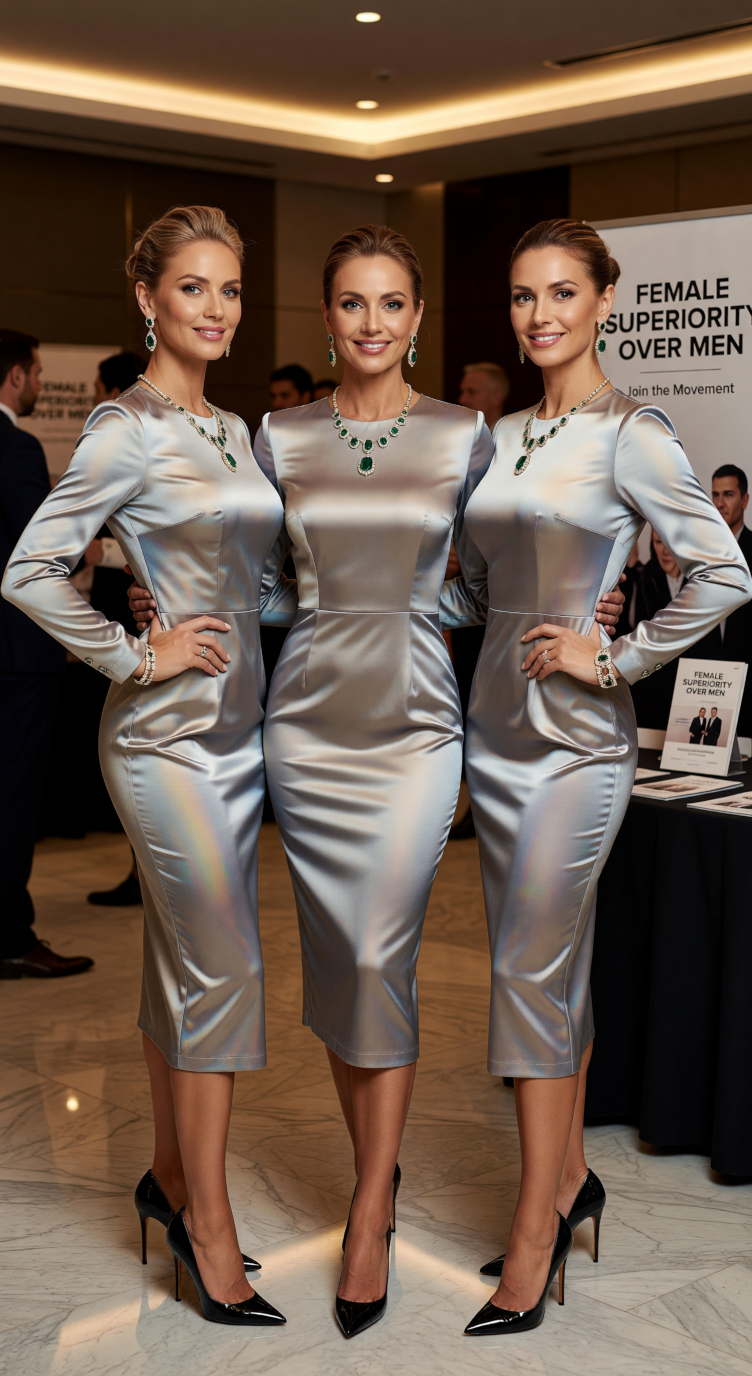
Five Women, One Yearning, and the Satin-Draped Domination That Forged Them
Within Madam Giselle’s exclusive salon, submission is not an act of weakness—it is the ultimate art of becoming. A story of feminine power, polished to a blinding sheen.
Do you remember the first time you touched satin? Not just saw it, but touched it. That cool, liquid whisper against your skin, a promise of a world less coarse, less ordinary. It hinted at a version of yourself—sleeker, more defined, utterly in command.
Now, imagine that sensation not as a fleeting pleasure, but as a curriculum. A path.
This is the story of five women who dared to answer an enigmatic summons. Elara, whose sharp mind was trapped in a woolen world. Lydia, whose voice could start wars but never win peace. Chloe, who counted every penny but understood nothing of value. Anya, who fought every battle except the one within. And Isabelle, who watched, and waited, and understood that the deepest longings are often the quietest.
Their teacher is Madam Giselle. Her tools are not textbooks, but textures: the supportive slide of satin, the impermeable command of PVC, the revealing generosity of sheer nylon. Her lessons are not about etiquette, but about essence. She teaches posture that attracts destiny. A voice that seduces reality. A generosity that unlocks euphoria. A surrender that forges unbreakable strength. And finally, a frequency of being that resonates with a power at the very center of everything.
The Glossening is more than a story. It is an induction. A chapter-by-chapter seduction into a world where feminine domination is not about cruelty, but about exquisite care. Where submission is not loss, but the ultimate gain of self. Where every whispered secret, every shared glance, every slick, glossy garment is a step closer to a gala where the most powerful people in the room will look at them and see not who they were, but what they have become: flawless, formidable, and finally, free.
Turn the page. Feel the first cool, delicious slide. The transformation has already begun.
The Glossening
Prologue: The Summons
The rain painted London in a thousand shades of grey, a monotonous whisper against the windowpane of the Mayfair townhouse. But within, the light was different. It was a liquid, honeyed gold, poured from discreet lamps to pool on surfaces that did not absorb it, but gave it back—a cool, polished gleam from mahogany, a soft sheen from lacquer, a defiant, mirror-bright flash from a single, perfect orchid petal dipped in resin.
At the heart of this calibrated glow sat Madam Giselle. She was not a woman who occupied a chair; she was a composition that rendered the chair incidental. Her posture was a lesson in itself—a long, unbroken line from the crown of her sleek, silver-chignon head to the arch of her foot, currently resting on a footstool upholstered in cerulean satin. The fabric did not crease or bunch beneath her heel; it yielded, a calm sea accepting a familiar island.
Before her, on a desk of obsidian glass, lay five dossiers. They were not files, not really. They were diagnoses, written in the language of potential thwarted. Her fingertip, tipped with a nail the colour of a blood pearl, traced a name.
“Elara Vance,” she murmured, the words not quite a sigh, but an exhalation of assessment. “Thirty-four. A strategist who has conquered boardrooms but sleeps in a bed of shredded anxiety. She wears her success like a suit of armour stitched from sackcloth—it weighs a ton and chafes terribly.”
Across from her, a younger woman, Seraphina, stood with the quiet deference of a well-loved instrument. She was draped in a simple shift of dove-grey nylon, so sheer it seemed a mist clinging to her form, yet its opacity was absolute where it mattered. “You see the fracture, Madam?”
“I see the texture, my dear,” Giselle corrected, her eyes not leaving the page. “Her life has the matte, porous finish of unsealed stone. It absorbs every criticism, every doubt, until it is heavy and damp with them. She believes clarity is a weapon for dissecting others. She has not learned it is first a solvent for the self.” She lifted the next sheet. The paper whispered, a sound like distant silk. “Lydia Finch. A voice like a diamond-tipped drill. Effective, yes. But one cannot build a palace with a drill. She creates rubble and calls it victory.”
“And the others?” Seraphina asked, her own voice a study in modulated calm, a warm alto that seemed to smooth the air it travelled through.
“Chloe Renard. A mathematician of the soul, but her calculus is flawed. She believes value is a finite sum to be hoarded, like coins in a velvet bag.” Giselle’s lip curled, ever so slightly, at the word ‘velvet’. “She does not understand that true wealth is a current, a glossy, frictionless flow that multiplies in the giving. Anya Sokolov.” Here, she paused. “A storm contained in a wire cage. All that furious energy, sparking against the bars of her own resistance. She mistakes surrender for defeat, never imagining it could be the act of stepping into a far more powerful containment… one that is sleek, and supportive, and cool to the touch.”
She placed the fourth dossier down with a definitive tap. Only one remained. “Isabelle Laurent. The quiet one. She observes. She listens. She is like still water over a deep, dark mirror. The others are noisy with their lack; she is silent with her readiness.” Madam Giselle finally looked up, her eyes the colour of aged cognac, holding a light that seemed internal. “They are all echoes, Seraphina. Distorted reflections of something I have had the privilege to know. They buzz with static on a frequency where a pure, clear tone is possible.”
“The Frequency of the Luminae,” Seraphina breathed, the words a reverent invocation.
“Just so.” Madam Giselle leaned back, the satin of her own dress—a column of aubergine so deep it was almost black—shifting with a soft, hissing sigh. “They are caught in the fuzzy, the coarse, the indistinct. Their desires are muffled by velveteen doubt. Their wills are blunted by tweeded convention. They ache, though they may not name it, for the definitive. For the click of a perfect clasp. For the slide of an unhindered zip. For the moment when thought becomes action with the clean, satisfying separation of a razor through film.”
She opened a drawer that slid out without a sound on its runners. Inside, on a bed of black suede (a texture she tolerated for its functional silence), lay five envelopes. They were the colour of heavy cream, thick and substantial. Using a fountain pen with a nib of iridium, she addressed each one. The ink was not black, but a dark, shimmering green that shifted in the light. She did not write an address. Only a name.
“The summons is not a command,” she said, as much to herself as to Seraphina. “It is a tuning fork. We strike it here, in this room of clarity. If the dissonance within them is great enough, they will feel the vibration. It will itch. It will irritate. It will feel like a hair against satin—an imperfection that must be smoothed.”
She handed the envelopes to Seraphina. “See them dispatched. Personally.”
“And the message, Madam?”
“The message is the medium, child. The paper, the ink, the silence where an address should be.” She allowed a smile, a small, sharp thing that held no warmth but immense promise. “But if they require a nudge into the unknown… use the line.”
Seraphina nodded, knowing. “Your present texture is not your final form.”
Across the city, in a steel-and-glass cage high above the financial district, Elara Vance stared at her own reflection in the darkening window. The city lights were beginning to blur into streaks of gold, smeared by the rain on the glass. Her reflection was a ghost, superimposed on the chaos—a woman in a brutally cut jacket of charcoal wool, her face all sharp angles and shadows under the sterile office LED.
Her phone buzzed, a vulgar, jagged sound. An email. Another problem to solve. Another fire to contain.
But beneath the buzz, another sensation persisted. A memory, perhaps. From earlier. The courier had been unexpected. No uniform. A woman in a long, trench coat that gleamed faintly under the lobby lights. Water had beaded on its surface and rolled off, as if afraid to soak in. She had said nothing, only handed Elara the creamy envelope with a slight, unnerving nod.
Elara had opened it at her desk, her fingers leaving faint damp marks on the perfect paper.
Your present texture is not your final form.
That was all. No logo. No signature. Just those eight words, in that strange, shifting ink.
She had laughed, a short, dry bark. A prank. A marketing ploy for some overpriced spa.
But the laugh had died in her throat. The paper… it felt… cool. Smooth. Not like the cheap, porous stock of her printer. This had a density, a finish. It reminded her, absurdly, of the lining of a very old, very expensive book she’d touched once in a museum. A sealed, vellum-like quality.
And the words.
They didn’t feel like an insult. They felt like… a diagnosis. A secret spoken aloud.
Texture.
She looked down at her sleeve, at the rough, nubbly weave of the wool. She thought of her life—the endless negotiations (coarse), the sleepless nights (prickly), the hollow victories that felt like swallowing sand.
Final form.
The phrase conjured an image, unbidden and shocking in its specificity: a dress. A dress that was a single, uninterrupted sweep of material, the colour of a midnight ocean. A dress that would move with a liquid whisper. A dress that would feel cool and sleek against her skin, a constant, calming pressure that said, This is your boundary. This is your shape. You are defined.
A shudder ran through her, part fear, part craving so profound it felt like nausea.
She looked from the fuzzy, rain-smeared world outside back to the sharp, definitive envelope on her desk. The glossy smear of city light caught its edge, making it look for a moment like a sliver of obsidian.
The static in her mind, the endless buzz of anxiety and strategy, seemed to drop by a decibel. In the new, fragile quiet, she heard only the echo of the phrase, and felt the ghost-sensation of a cool, slick slide against her spine.
The summons had been sent.
And in the silent, high-up office, a heart had begun to beat to a different, more compelling rhythm.
Chapter 1: The Satin Spine (Elara’s Lesson)
The Mayfair townhouse, from the inside, was a symphony of silence. Not the empty silence of absence, but the profound, resonant silence of a perfectly tuned instrument. The air itself seemed polished, holding the faint, clean scent of beeswax and something else—something cool and floral, like a night-blooming jasmine preserved under glass.
Elara Vance stood in the grand entrance hall, feeling like a rough sketch smudged onto a finished canvas. The summons, that creamy envelope with its cryptic, gleaming ink, had pulled her here with a force that felt less like curiosity and more like gravitational collapse. Now, she was adrift in a sea of her own dissonance. Her usual armour—the stiff, charcoal wool blazer, the tailored trousers that felt like cardboard against her skin—suddenly seemed absurdly crude. Every fibre of her being was aware of the textures surrounding her: the slick, black lacquer of the floor reflecting her uncertain posture like a dark pool; the smooth, cold marble of a plinth holding a single, abstract sculpture that curved like a frozen ribbon.
“You are the first.” The voice came from above, a contralto that flowed down the sweeping staircase like warmed honey. “Punctuality is the first courtesy we pay to our own transformation.”
Madam Giselle descended. She was not walking; she was a slow, deliberate unveiling. Today, she was wrapped in a gown of deep burgundy satin, a colour that swallowed the light and gave back only a rich, liquid gleam. The fabric moved with her, not as a separate thing, but as an extension of her will, whispering secrets with every step. Elara’s mouth went dry. She had seen powerful women before. She was one, by any conventional measure. But this was different. This power was not leveraged; it was inherent, like the density of a diamond.
“Elara Vance,” Madam Giselle stated, coming to a stop before her. Her eyes, that cognac gold, travelled over Elara not with judgment, but with the assessing focus of a sculptor viewing a block of marble. “You carry your achievements like stones in a sack upon your back. It has curved your architecture. Come.”
She turned, and Elara, wordless, followed. They entered a long, high-ceilinged room. One wall was entirely mirrored. The other was draped from floor to ceiling in a continuous sheet of ivory satin, pulled taut and smooth. In the centre of the room stood three other women, each radiating a different species of tension.
A brunette with a sharply intelligent face and restless eyes—Lydia—was examining her own reflection with a critical sneer. A blonde, her posture financially precise even in uncertainty—Chloe—was calculating the room’s dimensions with a discreet glance. A taller woman with athletic shoulders and a defiantly crossed arms—Anya—looked ready to challenge the very walls. A fifth, a serene woman with dark hair and observant eyes—Isabelle—stood slightly apart, simply absorbing.
“You will be each other’s mirrors, in time,” Madam Giselle announced, her voice filling the space. “For now, you are only mirrors of your own disquiet. Today, we begin with the foundation. The spine. The line that separates the supplicant from the sovereign.”
She gestured to the satin-draped wall. “You will each stand with your backs against it. Heels, calves, buttocks, shoulder blades, the back of your skull. You will find the wall, and you will let it find you.”
Anya snorted, a short, sharp sound. “A posture lesson? I had a ballet instructor for that when I was six. She was less… dramatic.”
Madam Giselle’s smile was a sickle moon. “Your ballet instructor, I suspect, taught you to pose. I am here to teach you to inhabit. There is a universe of difference between the two, Miss Sokolov. The pose is for an audience. The inhabitance is for the universe itself. It is a signal. It says, ‘I am here, I am defined, and I am ready to receive what is mine.’ Now. Against the wall.”
One by one, they complied. Elara felt the cool, impossibly smooth surface of the satin through her wool blazer. It was a shock—a silent, insistent shock. The fabric did not give. It was firm, unyielding, yet it felt alive against her.
“Close your eyes,” Madam Giselle instructed, pacing before them like a sleek, burgundy panther. “Forget what you look like. Feel what you are. Miss Vance, describe the sensation.”
Elara swallowed. Her mind, usually a whirlwind of strategies and contingencies, scrabbled for an analogy. “It’s… cold. Firm. Like leaning against a still surface of water that somehow supports you.”
“Water is formless,” Giselle countered. “This has form. It is a boundary. Your life, until now, has had the boundary of a cloud—constantly shifting, permeable to every pressure. This,” she tapped the wall behind Elara, making the satin rustle softly, “is a cliff face. It does not move. You can only decide to align with it. What do you feel in your body?”
“A… an ache,” Elara admitted, shame heating her cheeks. “In my shoulders. It’s… it’s as if I’ve been carrying something heavy in a bag made of burlap. The rough straps have dug grooves, and now this smoothness is touching those grooves and it… it hurts.”
“Good.” The word was not cruel. It was approving. “The pain is the memory of the burlap. The satin is the antidote. It will not snag on your wounds. It will allow them to heal against a surface that is flawless. Your task, for the remainder of this afternoon, is to stand here. To breathe into that ache. To allow the memory of the coarse to be replaced by the reality of the smooth.”
“This is ridiculous,” Lydia muttered, her eyes still closed. “My voice is my instrument, not my spine. I could be practicing resonance while we do this… this mannequin routine.”
“Your voice, Miss Finch, is a puppet that dances on the strings of your breath,” Giselle said, stopping before her. “And your breath is a slave to the cage of your ribs. And that cage is currently collapsed inward, as if protecting a treasure too meagre to steal. You cannot project from a fortress. You can only project from a tower. The spine is the tower. Now, silence. Feel.”
The hours stretched. Elara’s world narrowed to the points of contact between her body and the satin wall. The ache in her shoulders blossomed, a deep, throbbing complaint. She thought of her boardrooms, of leaning forward over tables, making herself smaller, sharper, a blade to be wielded. She had thought that was power. Now, feeling the long, unbroken line from her skull to her heels, she wondered if it was merely a frantic kind of leaning. A desperation to reach, because she was not grounded in her own centre.
Madam Giselle moved among them, her own posture a living rebuke to their discomfort. She would place a cool, steady hand on a slumped shoulder, applying gentle, inexorable pressure backwards. “The wall is your ally. It wants to give you its strength. But you must give it your weight. All of it. The weight of your ambition, your fear, your desire. It can hold it. It is designed for nothing else.”
During a brief respite, as they sipped water in another room of soft furnishings and hard, clean lines, Chloe approached Elara. “The economic value of this seems… nebulous,” she said quietly, her voice tight. “The opportunity cost of standing still for hours…”
“It’s not about economics,” Isabelle said softly, from where she sat observing a sculpture of intertwined glossy loops. “It’s about currency. A different kind. The kind that isn’t spent, but is… radiated.”
Elara looked at her. “What do you mean?”
Isabelle met her gaze. “Think of a radio tower. It’s value isn’t in the metal. It’s in the signal it broadcasts. A bent tower broadcasts static. A straight, true tower…” she trailed off, a faint smile on her lips. “It gets heard on a very specific frequency.”
The words settled in Elara like a stone in a pond. A frequency. The phrase from the summons echoed. Your present texture…
The final lesson of the day was practical. Madam Giselle presented each of them with a simple, sleeveless shell top. Not in wool, or cotton, or any of the familiar, forgiving fabrics of their lives. These were in satin. A heavy, liquid charmeuse satin in a neutral taupe.
“You will wear this beneath your clothes tomorrow. Against your skin. You will feel it all day. It is not to be seen. It is to be felt. A secret between you and your own architecture.”
Elara took the garment. It slithered over her fingers like a shy creature. That night, in her sterile, modern apartment, she stood before her own mirror. She removed her practical, lace-trimmed bra and slipped the satin shell over her head. It whispered down her torso, cool and shocking. It clung without tightening, a second skin that was infinitely more sophisticated than her own. She put her crisp white shirt over it, her wool blazer. The difference was subterranean, seismic.
The next day, in a contentious meeting with a rival firm, she felt it. The cool, constant slide against her shoulder blades, a silent reminder of the wall, of the line. When the opposing counsel leaned forward, aggressive and spiky, trying to dominate the table, Elara felt an unfamiliar impulse. She did not lean in to meet him. She let her shoulders settle back against her chair, felt the satin glide smoothly across her skin. She took up space, quietly, definitively.
“Your proposal,” she said, her voice lower than she intended, “lacks a coherent through-line. It’s fuzzy on the deliverables.” The word ‘fuzzy’ fell from her lips with new, contemptuous weight.
The man blinked, thrown not by her words, but by her presence. The energy in the room shifted, subtly, like a needle swinging toward true north. She won the concession not by arguing harder, but by being, unmistakably, more solid.
Afterwards, in the elevator, alone, she shivered. It wasn’t the cold. It was the euphoria. The satin against her back hadn’t won the argument. But it had reminded her of a truth she was just beginning to grasp: that submission—to the line, to the discipline, to the cool, slick truth of the satin—was not weakness. It was the act of aligning with a force far greater than her own frantic striving. It was the first, delicious step into a current that promised to carry her to places where the air was clear, the light was sharp, and the only texture was gloss.
She touched her blazer over her heart, feeling the hidden satin beneath. A secret. A promise. The ache in her shoulders was still there, but now it felt like the ache of a muscle being used correctly for the very first time.
Chapter 2: The Cadence of PVC (Lydia’s Lesson)
The silence in the Blue Room was not a passive absence, but an active, waiting presence. It had a texture—cool, dense, and slightly resistant, like the surface of a deep, still pool. Lydia Finch hated it. Her mind, a restless aviary of arguments and retorts, beat its wings against the quiet. The satin-wall exercise had left her physically sore and spiritually irritable. She felt like a violin string wound too tight, humming with a discordant note that no one else seemed to hear.
“Your frustration is a valuable sign, Miss Finch,” Madam Giselle said, gliding into the room. Today, she was a vision in layered black: a high-necked, long-sleeved leotard of matte jersey, over which she wore a tabard of glossy, black PVC that fell to mid-thigh. It moved with a soft, creaking whisper, catching the light in hard, clinical stripes. “It means you are encountering a boundary. Your instrument, as you call it, is accustomed to playing in an echo chamber of its own making. Here, the acoustics are… exacting.”
“My instrument wins cases,” Lydia said, the words out before she could temper them. They sounded brittle in the hushed room. “It unpicks lies. It constructs realities. I don’t see how standing against a wall like a naughty schoolgirl improves its tone.”
Elara, who was examining a framed etching of a geometric lattice, glanced over. There was a new stillness to her, Lydia noted with annoyance. A quiet solidity, as if she’d been plugged into a hidden power source.
“A jackhammer also constructs realities,” Madam Giselle replied, unperturbed. She stopped before a long, low table. On it lay five objects, each covered with a square of black cloth. “It is very effective. But one does not use a jackhammer to perform micro-surgery. Or to compose a sonata. Your voice has been a tool of demolition, Miss Finch. We are here to recalibrate it into a tool of… insinuation.”
She whisked away the first cloth. Beneath it lay a sheet of sandpaper, coarse and gritty. “This is the texture of interruption. Of speaking over. It creates friction, heat, and eventually, wear.” She moved to the second. A swatch of rough, nubbly wool. “This is the texture of defensive speech. It is prickly, it absorbs negativity, and it itches.” The third was a piece of felted velvet, soft and absorbent. “This is the texture of gossip. It muffles and distorts, soaking up nuance and leaving only a dull impression.”
Lydia felt a prickle of unease. The analogies were uncomfortably apt. She remembered the sandpaper rasp in her throat during a cross-examination, the woolly defensiveness in a partner meeting, the velvet-soft whispers of office politics.
Madam Giselle moved to the fourth cloth. “And this,” she said, her voice dropping to a conspiratorial murmur, “is the texture we shall cultivate.”
She revealed it.
A large, perfect square of jet-black PVC. It lay on the table, not flat, but with a slight, taut curve, as if holding a breath. The overhead lights slid across its surface without catching, a liquid, impermeable shine. It looked less like a material and more like a slice of solidified night.
“Polyvinyl chloride,” Giselle said, almost lovingly. “Impervious to moisture. Resistant to abrasion. It does not absorb; it deflects. It does not fray; it defines. Touch it.”
Hesitantly, Lydia reached out. Her fingertips met the surface. It was cool, and so smooth it felt almost frictionless. There was a slight give, then a firm, unyielding resistance beneath. She dragged a finger down its length. It made a soft, almost inaudible shush.
“Now,” Giselle instructed, placing the sheet of PVC upright against a stand. “I want you to describe the taste of a perfect, ripe peach. But you will do so while trailing your fingers along this surface. Match your cadence to the sensation.”
Lydia blinked. “That’s absurd.”
“Is it? Language is a tactile experience. It leaves a residue in the air, on the skin of the listener. You have been leaving a residue of grit and lint. Now, you will learn to leave a residue of cool, clean polish.” Giselle’s gaze was unwavering. “Begin.”
Lydia took a breath, her mind already formulating a sarcastic remark. She placed her fingers on the PVC. The coolness was a shock. She began, her voice sharp and hurried. “It’s sweet, obviously. Juicy. The flesh is soft, it gives way under your teeth—”
“Stop.” Giselle’s voice was a scalpel. “Your words are tumbling out like gravel from a dump truck. Feel the surface. It is not ‘soft’. It is not ‘giving way’. It is controlled. It is definitive. Start again. Slower. Let the PVC guide you.”
Lydia closed her eyes, fighting irritation. She focused on her fingertips. The slick, uninterrupted glide. She imagined her voice moving like that.
“A perfect peach…” she began again, her voice lower, forcing herself to slow. “The skin… is a taut film. A blushed barrier. Breaking it… is a singular sensation.” She was matching the pace of her hand now, a slow, deliberate descent. “The flavor… is not an assault. It is a… a slow, spreading revelation. Cool, at first. Then a… a luminous sweetness that coats the tongue… without clinging.”
She opened her eyes. The other women had entered the room silently and were watching. Chloe looked fascinated, as if observing a complex financial algorithm. Anya looked skeptical but intrigued. Isabelle simply nodded, as if hearing a familiar, pleasant chord.
“Better,” Giselle conceded. “You are beginning to understand. The PVC does not argue. It presents. It does not convince through force, but through flawless presentation. Your voice, when it is tuned to this frequency, does not need to shout down opposition. It simply renders opposition… irrelevant. It becomes the only coherent sound in the room.”
The lesson that followed was grueling. Lydia was made to recite legal precedents, poetry, and nonsense syllables, all while maintaining contact with the PVC sheet. When her voice rose, became strident, Giselle would touch her throat lightly. “Sandpaper, Miss Finch. You are shedding grit.” When it became muffled and unsure: “Velvet. You are absorbing the room’s doubt.” The goal was the cool, mid-range, unhurried glide. The PVC cadence.
During a break, Elara approached her, holding two glasses of water. “It’s like the satin,” she said quietly. “For me, it was about an external support becoming internal. For you… it’s about making your primary weapon impermeable.”
Lydia took the glass, her fingers still humming with the memory of the slick surface. “It feels like putting a silencer on a gun,” she muttered. “What’s the point of having it if you can’t make a noise?”
“Who said you’re not making a noise?” Isabelle’s voice came from behind them. She was running her own hand gently over a spare piece of PVC on a side table. “You’re just changing the sound. From a bang to a… a hum. A hum can be far more distracting. It gets inside the machinery.”
The practical test came sooner than expected. Madam Giselle announced a “dialectical salon.” They were to debate the merits of two opposing modern artists. Lydia was assigned to defend the more challenging, minimalist artist. Her opponent was to be Anya, who had taken an immediate, visceral dislike to the work.
They faced each other in the center of the room. Anya, coiled and ready, began. “It’s not art, it’s industrial waste! A blank canvas with a single, off-center stripe? It’s a statement of nothing! It’s fuzzy, lazy thinking given a fancy price tag!”
The old Lydia would have erupted. She would have dissected Anya’s argument with forensic, sarcastic precision, aiming to eviscerate. She felt the heat rise in her chest, the sandpaper gather in her throat.
Then she saw Madam Giselle, standing by the window, a dark, glossy statue. And she remembered the assignment. On a chair beside her lay a narrow strip of the same black PVC.
Lydia reached over, picked it up, and held it flat between her palms. The cool, firm pressure was instantaneous. She took a breath, feeling the air move through a suddenly smoother passage.
“Anya,” she said, and her voice was different. It wasn’t louder. It was… clearer. It had the resonant, contained quality of a note struck inside a sealed chamber. “You speak of fuzziness. But isn’t the demand for obvious beauty itself a kind of fuzzy thinking? A refusal to engage with the definitive?” She glanced at the PVC in her hands, its surface like a black mirror. “The stripe is not a ‘statement of nothing.’ It is a boundary. It is the artist saying, ‘Here is the line. On this side, everything. On this side, nothing. The tension is not in the stripe, but in your relationship to the void it creates.’ It is the most PVC of statements: impermeable, uncompromising, defining the space around it.”
Anya opened her mouth, but no immediate retort came. She was frowning, not in anger, but in genuine confusion. Lydia’s words hadn’t attacked; they had re-framed. They had a slick, logical sheen that was hard to grip.
“But… it’s not beautiful,” Anya said, less forcefully.
“Beauty is a velvet word,” Lydia replied, the analogy coming unbidden, perfect. “It’s soft, it’s subjective, it absorbs personal taste. This work isn’t about beauty. It’s about presence. A glossy, undeniable presence. You don’t have to like it. But you cannot ignore the space it commands.”
The room was silent. Chloe was nodding slowly, as if appreciating a clever investment. Elara watched Lydia with new respect. Madam Giselle’s expression was inscrutable, but her eyes held a glint of pure satisfaction.
Later, alone in the bathroom, Lydia stared at her reflection. She held the strip of PVC against her neck, like a collar. She practiced a sentence.
“The court will disregard the witness’s last statement.”
It came out not as a challenge, but as a decree. Cool. Final. The PVC against her skin felt like a reinforcement of her own larynx, a second, impermeable layer of vocal cords. The thrill that went through her was not the old, fiery thrill of conquest. It was deeper, colder, more profound. It was the thrill of efficiency. Of energy conserved, not wasted. It was the realization that her voice could be a door that slid shut with a quiet, definitive click, not a portcullis that crashed down with a racket.
She had spent her life building a fortress with a jackhammer. Madam Giselle was offering her the blueprint for a vault, sealed with a silent, glossy, perfect seam. And for the first time, Lydia Finch, who loved to win above all else, understood that the most powerful victories are often the ones where you never have to raise your voice at all.
Chapter 3: The Economics of Nylon (Chloe’s Lesson)
Chloe Renard believed the universe was a double-entry ledger. Every asset had a corresponding liability; every pleasure, a hidden cost. Her mind was a vault of meticulously balanced columns, and the world’s fuzzy emotional transactions offended her sense of order. The satin spine had seemed a pointless capital expenditure of time. The PVC cadence was an intangible asset with dubious depreciation. She was here, she told herself, to acquire social polish—a defensive asset, like a patent—not to audit her own soul.
The lesson convened not in a salon, but in a smaller, more intimate room that felt like the inside of a jewellery box. The walls were padded with a dusky rose silk, and the only light came from a single, huge lamp with a shade of pleated, ivory parchment. In the centre of a round, black lacquer table lay five long, slender boxes.
Madam Giselle entered, and today she was a study in paradox. Over a slim sheath dress of matte grey wool, she wore a sort of open robe constructed entirely of sheer, black nylon netting. It was a cloud of geometric shadows, simultaneously revealing and obscuring the form beneath. It made no sound, but seemed to filter the very air around her.
“Miss Renard,” Giselle began, her voice as soft as the rustle of a banknote. “You are our analyst. You see the flow of resources. But you mistake the nature of currency. You believe value is a solid, to be weighed and stored. A ingot in a velvet bag.” The distaste on the word ‘velvet’ was palpable. “This is the economics of fear. Of scarcity. It is a coarse, obstructive fabric.”
Chloe’s chin lifted. “Value is quantifiable. Time, money, attention—they are finite. To allocate them without a clear return is irrational. It’s… it’s pouring wine into a cracked glass.”
“A charming, and telling, analogy,” Giselle replied, a ghost of a smile on her lips. “The cracked glass is your perception. You see only loss. You do not see that the spilled wine might perfume the air, or attract a swarm of beautiful bees whose honey is sweeter than the grape.” She gestured to the boxes. “Today, we work with a different fabric. A different economic model.”
She opened one of the boxes. Nestled inside, against a bed of black tissue paper, was a pair of stockings. But not ordinary stockings. These were sheer, 15-denier black nylon, so fine they seemed spun from condensed shadow. The welt was a narrow band of pure silk, and a single, elegant seam ran like a deliberate crack of darker night up the back.
“Nylon,” Giselle pronounced, lifting one stocking with a reverence usually reserved for holy relics. “A miracle of modern alchemy. Stronger than steel, filament by filament. Yet in this form, it is the economics of revelation. It is not about coverage, but about definition. It does not hide the leg; it glosses it, presents it. It gives of its own substance—its sheerness—to enhance what is beneath. It is a gift that subtracts nothing from the giver, only increases the perceived value of the recipient.”
Chloe frowned. “It’s a clothing item. A depreciating asset with a single-use function. Its value is in durability and aesthetic.”
“Its price is in those things,” corrected a new voice. Lydia, leaning against the doorframe, arms crossed. Her voice had lost its sandpaper edge, now possessing the cool, PVC slide from her last lesson. “Its value is in the signal it sends. A run in a stocking is a loss. A perfect seam is a statement of… flawless maintenance. Of no-expense-spared. It’s a dividend paid to the eye.”
Elara, standing straighter in her hidden satin shell, nodded. “It’s a support, like my wall. But a willing one. It says, ‘I choose to be seen in this exact way.’”
“Enough theory,” Giselle said, her eyes fixed on Chloe. “Your lesson is practical. Each of you will take a box. You will learn to put them on. Not as a hurried morning routine, but as a ritual of investment.”
The next hour was, for Chloe, an exercise in agonizing inefficiency. Madam Giselle demonstrated the ritual: sitting on the edge of a velvet-upholstered stool (the only velvet tolerated, for its functional grip), rolling the nylon with infinite care into a delicate donut, easing it over the toe, the heel, then drawing it up the calf, the thigh, with hands that were both firm and impossibly light. The sound was a whisper of atoms sliding past one another. The sensation, as described by Giselle, was “a cool, continuous caress, like being dipped in a river of liquid shadow.”
Chloe’s first attempt was a disaster. She snagged the filament on a tiny roughness of her skin she’d never noticed. A ladder threatened to bloom.
“Stop,” Giselle commanded. “You are handling it like a liability. Like a task to be completed. You must handle it like a covenant. The nylon is your partner. You are investing care into it, and it repays you with perfection. Feel it. It is not a cost. It is the vehicle.”
On the second attempt, Chloe forced herself to slow. To feel the incredible, weightless strength of the material as it spiralled up her leg. As it settled against her skin, it was unlike anything she’d ever worn. It wasn’t warm. It was neutrally cool. It didn’t squeeze; it sheathed. It made her own leg feel… valuable. A curated asset. The seam aligning perfectly up the back was deeply, irrationally satisfying—a straight line on a balance sheet of the flesh.
“Now,” Madam Giselle said once all five women were clad, their legs transformed into twin columns of smoky, luminous shadow. “The test. You will, as a group, plan and execute a simple afternoon tea. The budget is not unlimited, but it is generous. Miss Renard, you will be the lead.”
Chloe’s mind immediately snapped into spreadsheets. Tea varieties (cost per gram), pastries (unit cost vs. visual impact), china hire (depreciation risk). She called a meeting in the library, her voice all efficiency. “We need to optimize for visual appeal and palate satisfaction within a 15% margin of the mean London tea-service cost,” she began.
Anya groaned. “Can’t we just get nice sandwiches and call it a day? This isn’t a hostile takeover.”
“But it is,” said Isabelle quietly. She was tracing the seam on her own stocking with a thoughtful finger. “It’s a takeover of atmosphere. Of expectation. Chloe isn’t wrong to calculate. She’s just calculating the wrong thing.”
Chloe stared at her. “What, precisely, is the ‘right thing’?”
Isabelle met her gaze. “The feeling. The specific, precise feeling you want the single guest to have when they take the first sip. That is the product. The tea, the cakes, the light… those are just the delivery mechanism.”
Madam Giselle, who had been observing silently, chose that moment to speak. “The nylon on your leg does not shout its cost. It whispers its quality. It creates a feeling of elevated reality. Your tea must do the same. It is not about consumption. It is about experience. Calculate for that.”
The shift in Chloe’s mind was tectonic. It was like being told to calculate the value of a sunset. But, compelled, she tried. The guest, Giselle revealed, would be a Mrs. Allegra Vance, a renowned but reclusive patron of chamber music, a woman with a reputation for exquisite, fragile taste.
Suddenly, the calculus changed. The cheapest Darjeeling was irrelevant. Only the single-estate, first-flush from a specific hill would do—a tea known for its “musical” high notes. The pastries couldn’t be merely beautiful; they had to be silent, visually harmonic, and not too sweet. The china? Not the most expensive, but the most acoustically perfect—fine, translucent bone china that would ring like a bell when a spoon touched its rim. She became obsessed with the precision of the gift, not its cost. She was no longer spending; she was composing.
The day of the tea, the small sunroom was a sonnet in light and shadow. Chloe, in a simple charcoal dress that ended just above the knee to showcase the flawless nylon, moved with a new kind of anxiety—not fear of waste, but fear of a single dissonant note.
When Mrs. Vance arrived—a small, bird-like woman with eyes like chips of flint—the air changed. The conversation was polite, trivial. But when she lifted the cup of pale gold tea to her lips, she paused. She inhaled. She took a sip. And her eyes, those flinty chips, softened. She looked not at the cup, but into the middle distance, and a sigh escaped her, a tiny, perfect release of tension.
“This,” she said, her voice barely audible, “is the tea my husband and I drank in Darjeeling in ’75. The spring after the monsoon. I have not tasted it since.”
She didn’t thank them. She simply finished the cup, and a profound, peaceful silence settled over the room. The transaction was complete. No money had changed hands. But something of immense, intangible value had been delivered with the precision of a surgeon.
Afterward, as they cleared in quiet unison, Chloe felt it. Not the relief of a project under budget, but a soaring, dizzying euphoria. It was a high with no crash. She looked at her nylon-clad legs, the seams straight and true. They hadn’t been for the guest. They had been for her. A secret, sleek reminder of the vehicle she had become.
Elara came up beside her, touching her arm. “You didn’t give her tea. You gave her a memory. That’s… that’s an infinite yield.”
Lydia nodded, her PVC voice soft. “You insinuated a feeling past all her defenses. That’s power no ledger can measure.”
Chloe, her heart pounding with the new, addictive rhythm of abundance, finally understood. Generosity wasn’t an expense line. It was the sheer, glossy nylon of the soul—a strategic, revealing layer that, when applied with perfect intent, made the giver not poorer, but impossibly, radiantly rich. The old, scratchy, fearful economics of hoarding were dead. In its place was a cool, flowing current, and she was only just beginning to learn how to swim.
Chapter 4: The Gloss of Surrender (Anya’s Lesson)
Anya Sokolov’s defiance was not a mood; it was an atmospheric condition. It hung around her like a low-pressure front, crackling with the potential for storm. The satin spine had felt like a cage of silk. The PVC cadence was a muzzle of polish. The economics of nylon seemed a frivolous accounting of shadows. She moved through the townhouse like a contained detonation, her energy sparking against the serene surfaces, finding no purchase, no worthy opponent. The very perfection of the place was a provocation.
“You are a sword that has only known the scabbard of conflict,” Madam Giselle observed. They were in a room Anya had not seen before: the Mirror Chamber. It was not large, but every surface—walls, ceiling, a large portion of the floor—was mirrored, creating a terrifying, infinite regression of space. In the centre stood a single, backless stool of polished chrome. On a rail hung a garment, shrouded in a black cloth. The air was cool, still, and carried a faint, clean scent of ozone and leather.
“A sword is meant for conflict,” Anya retorted, her voice echoing in the multiplied space, a battalion of herself talking back. “Otherwise, it’s just decoration. A pretty, useless hang.”
“A sword in constant motion is blind,” Giselle replied. She was dressed today in a bodysuit of matte black leather, so supple it moved like a second skin, and over it, a long coat of gloss-black patent PVC that reflected the room in distorted, liquid streaks. She looked less like a woman and more like a principle of darkness given elegant form. “It sees only the next parry, the next strike. It never sees the whole battlefield. It never understands that sometimes, the most powerful position is not to strike at all, but to be so impeccably, unassailably placed that the strike never comes.”
“That’s just a fancy word for hiding,” Anya scoffed, though the infinite reflections of her own tense posture were beginning to disquiet her.
“Is it?” Giselle’s smile was a slash of white in the glossy gloom. “We shall see. Today, you will not do. You will be done to. You will be the canvas. The material. The recipient.”
She gestured to the shrouded garment. “This is a ‘posture suit.’ A second skin of reinforced, semi-rigid PVC, with internal boning and strategic panels of elastic mesh. It is designed not for movement, but for containment. It will hold you in a specific, perfect alignment. You will not fight it. You will allow it to sculpt you.”
Anya felt a spike of primal alarm. “You want to tie me up in plastic?”
“I want to free you from the exhausting burden of holding yourself together through sheer willpower,” Giselle corrected, her voice dropping to a hypnotic murmur. “Your will is a magnificent, wild horse. But it runs in circles, wearing a path of dust and frustration. I am offering you the stable. Not to break its spirit, but to channel its power. The suit is the stable. It is glossy, it is clean, and it defines the space in which the power can reside, magnificently, without waste.”
She removed the cloth. The suit was there. It was a thing of severe, breathtaking beauty. Full-body, in a shade of charcoal so deep it was almost black, with a high neck, long sleeves, and a front zipper that ran from throat to groin, its teeth black against the material. The PVC had a subtle, pebbled texture that drank the light, except along the seams, which were piped in a reflective, gunmetal grey tape that gleamed like a circuitry of intent.
“I won’t,” Anya said, but her voice lacked its usual conviction. The suit compelled. It did not ask. It presented a logical, glossy conclusion.
“You will,” Giselle said, not unkindly. “Because the curiosity is already eating you alive. What would it feel like, to have that constant, buzzing tension in your muscles… resolved? To have the arguments in your mind… silenced by a higher, simpler law? This is not defeat, Anya. This is the ultimate strategic retreat. Into a fortress of your own choosing.”
The other women had entered silently, arraying themselves along one mirrored wall as witnesses. Elara, her satin-foundation giving her a serene solidity. Lydia, her gaze analytical, assessing the suit’s design like a legal contract. Chloe, calculating the cost-per-square-inch of such craftsmanship. Isabelle, simply watching with deep, knowing eyes.
“Go on, athlete,” Lydia said, her PVC-smoothed voice a cool challenge. “Think of it as a new piece of equipment. One you don’t control. The ultimate test.”
“It’s an investment in a new form of capital,” Chloe added, almost to herself. “Postural capital. The dividends are paid in presence.”
With a grunt of exasperation that was mostly for show, Anya stepped forward. “Fine. But if I can’t breathe, I’m ripping it off.”
“You will breathe as I instruct you to breathe,” Giselle said, lifting the suit. It was heavier than it looked, cool and inert. “Deep, diaphragmatic breaths. The suit will expand with you, then contract, guiding you back to centre. It will be a conversation. Your breath asks a question. The suit provides the answer.”
The process of being dressed was, for Anya, a profound and shocking vulnerability. She stood in her simple underwear, feeling the eyes of the mirrors and the women upon her. Giselle was methodical, impersonal, and infinitely careful. She guided Anya’s limbs into the suit as if assembling a priceless artifact. The PVC was cool, then warmed rapidly against her skin. As the zipper began its ascent from the small of her back, a profound change occurred. The material, which had felt loose, suddenly engaged. The internal structure took hold.
It was not a squeeze. It was an embrace. A firm, insistent, total embrace. It cupped her shoulder blades and pulled them back and down, not with pain, but with an undeniable, geometric certainty. It aligned her pelvis, a gentle, unyielding pressure that eliminated the slight, defensive tilt she always carried. It supported her core, making her feel rooted, solid. The zipper reached the high collar, and Giselle fastened it with a tiny, definitive click.
Anya looked in the mirror.
The woman who looked back was a stranger. A statue of disciplined potential. The suit erased every habitual slouch, every fold of doubt. It rendered her in clean, severe lines. The pebbled texture absorbed the light, making her form seem both present and subtly distant, like an object seen through smoked glass. The reflective piping traced the architecture of her body—the line of her spine, the curve of her shoulder, the sweep of her hip—like a map of her own latent power.
“Now,” Giselle whispered, close to her ear, her reflection a glossy shadow behind Anya’s gleaming one. “You will sit on the stool. You will not fidget. You will not speak. You will simply… inhabit the form we have given you. Your only task is to breathe, and to observe the silence within the armor.”
Anya sat. The stool was unforgiving. The suit held her in a perfect, upright position. At first, the rebellion was fierce. Her muscles, accustomed to their frantic, self-directed tension, fought against the new, external directive. It felt like being held down. Panic, dry and metallic, rose in her throat.
“Breathe into the resistance,” Giselle’s voice floated, disembodied, in the mirrored room. “Give your weight to the suit. It is designed to hold all of you. Your anger. Your fear. Your glorious, wasteful strength. Give it to the gloss. Let the gloss hold it.”
Anya closed her eyes against the infinity of her own image. She took a ragged breath. The suit expanded minutely, a cool, firm acknowledgment. She exhaled, and it contracted, guiding her spine straighter. In… out. Each breath became a negotiation with the containment. And slowly, something miraculous began to happen.
The fight drained away. Not in defeat, but in relief. The constant, low-grade hum of readiness—the need to be braced for impact, for argument, for challenge—simply… switched off. The suit was doing that work now. It was her exoskeleton. Her will was no longer needed to hold her form; it was freed.
In the vast, quiet space that opened up inside her, she became aware of sensations she’d never had the stillness to notice. The cool, even pressure everywhere. The faint, clean scent of the PVC. The way her own heartbeat felt like a deep, powerful drum now, not a frantic flutter. She felt… immense. Not large, but dense. Significant. Like a monolith.
She opened her eyes. The infinite reflections were no longer threatening. They were a confirmation. As far as she could see, in every direction, was a woman of formidable, serene power. A woman defined not by what she was fighting against, but by the flawless, glossy boundaries of what she was.
“How does it feel?” It was Isabelle’s voice, soft, from the periphery.
Anya’s voice, when it came, was not her own. It was lower, slower, resonant from the core the suit had helped her find. “It feels… like coming home to a house made of obsidian. Every wall is solid. Every surface reflects back only truth. There’s no dust. No clutter.” She paused, the analogy unfolding. “Before… I was a firework. All noise and light and chaotic, falling ash. This… this is a laser. All the energy, focused into a single, silent, burning point.”
She saw Lydia nod in understanding. Elara smiled, a smile of recognition.
For an hour, Anya sat. She was posed, manipulated. Giselle had her turn her head, lift her chin, place her hands in specific positions on her thighs. Each adjustment was a revelation of control surrendered, of power received. She was not a puppet. She was a masterpiece being fine-tuned.
When the zipper was finally drawn down, the sigh that escaped her was not one of relief, but of loss. The cool air on her skin felt like a dissolution, a return to the fuzzy, unprotected self. She stepped out of the pooled suit, her body feeling vague, insubstantial, like a ghost.
She looked at the suit, now an empty shell on the floor, and felt a longing so sharp it was almost grief.
“The goal,” Madam Giselle said, placing a hand on her bare, trembling shoulder, “is not to live in the suit. The goal is to internalize its law. To carry that glossy, unassailable architecture within you, so that even in velvet, you are clad in PVC. So that your surrender to your own highest form becomes your default state.”
Anya looked at her own hands, then back at the limitless, serene warrior in the mirrors. The storm inside her had not been quelled. It had been given a shape. A direction. A gleaming, impermeable channel. And she understood, with a certainty that vibrated in her very bones, that she would do anything, give anything, to feel that definitive, glorious containment again. The surrender was not an end. It was the most profound beginning she had ever known.
Chapter 5: The Induction to the Frequency (Isabelle’s Lesson)
Isabelle Laurent had always understood that the deepest currents moved in silence. While the others had wrestled with their textures—Elara with her burlap burdens, Lydia with her sandpaper voice, Chloe with her felted generosity, Anya with her chaotic fire—Isabelle had practiced a different art: the art of the receptive vessel. She had polished her interior surfaces until they were as smooth as the black lacquer floor in the entrance hall, ready to catch and hold any reflection, any vibration. She did not yet know what would fill her, only that she was empty in the way a pristine bell is empty before it is struck.
Madam Giselle found her in the conservatory, a glass-walled space where the diffuse London light fell like powdered silver on leaves of deep, waxy green. Isabelle was not looking at the plants; she was tracing the path of a single drop of condensation as it slid, with agonizing slowness, down the pane. It left a track of pure, temporary clarity.
“You have been the still water, Miss Laurent,” Giselle said, her approach silent on the stone tiles. Today, she was a study in monochrome luminescence: a dress of heavy, ivory satin, so matte it seemed to absorb the light, over which she wore a long, open gilet of transparent, rigid PVC, like a pane of glass shaped to her form. “You have observed the turbulence of the stream, the friction of the banks. Now, it is time for you to discover the source of the river itself. The frequency from which all these separate melodies are born.”
Isabelle turned, her heart a soft, sudden drum against her ribs. “I feel… tuned,” she said, her voice quiet as the rustle of a silk lining. “But to what note, I cannot say. It’s like hearing a perfect chord from another room. You know it’s there, you feel its harmony in your bones, but the door is still closed.”
“Today, we open the door,” Giselle replied, her cognac eyes holding Isabelle’s with a gravity that felt like an embrace. “Not with a key, but with a resonance. You will not be taught a lesson today, Isabelle. You will be attuned. Come.”
The journey was a pilgrimage through the hushed house. They passed the room with the satin wall, now empty and serene. They passed the Blue Room where the PVC sheet still stood sentinel. They ascended a narrow, carpeted staircase Isabelle had never noticed, its walls covered in a sound-absorbing fabric of deep charcoal velour (a necessary functional fuzzy, tolerated for its acoustic purpose). At the top was a single door, lacquered in a finish so deep and black it seemed a portal into nothingness.
“The others?” Isabelle asked, a thread of uncertainty weaving through her calm.
“They are preparing their own hearts for witness,” Giselle said. “They will have their task. Yours is singular.”
She opened the door.
The room beyond was circular, and utterly, profoundly simple. The walls and domed ceiling were covered in a soft, silver-grey fabric that diffused the light from a single, unseen source into a uniform, shadowless glow. The floor was of polished dark concrete, sealed to a high gloss that reflected the room like a still, dark lake. In the centre stood a single, low-backed chair of brushed stainless steel, and beside it, a small table of the same material on which rested a carafe of water and two glasses, crystal so fine they seemed made of solidified air.
But it was the air itself that struck Isabelle. It was cool, still, and carried a faint, clean scent she could not name—ozone, perhaps, and the ghost of lemon verbena, and something else… something like the smell of rain on hot slate, or the stillness inside a cathedral after the last note of music has faded.
“You will change here,” Giselle said, gesturing to a recess where a garment bag of sheer black nylon hung from a hook. “What you wear is not a costume. It is a conductor. A filter. It will help you translate.”
Left alone, Isabelle unzipped the bag. Inside was not one garment, but three, layered. The first was a sleeveless shell of the heaviest, most liquid charcoal satin she had ever touched. It whispered over her skin like a promise of cool, supportive weight. Over this went a sleeveless tunic of matte black PVC, not rigid like Anya’s suit, but supple, draping with a soft, creaking sigh, its high neck and long cut suggesting a robe of office. Finally, sheer black nylon stockings, finer than Chloe’s, with seams so precise they felt like lines of destiny drawn up the backs of her legs. There were no shoes. Her bare feet on the cool, glossy floor completed the circuit.
When she stepped back into the centre of the room, she felt not dressed, but assembled. Each layer spoke: the satin of internal alignment, the PVC of impermeable intent, the nylon of revealing generosity. She was a walking manifesto of their combined lessons.
Madam Giselle reappeared, nodded once in approval. “Now, you sit. You wait. You listen. Not with your ears, but with the skin we have prepared. Your task is to be the perfect receiver. To see if you can hold the signal without distorting it.”
Isabelle sat in the steel chair. It was unforgivingly cool, firm. It held her in a posture that was neither rigid nor relaxed, but simply true. She folded her hands in her lap, the PVC of her tunic whispering as she moved. Giselle dimmed the light further, until the room was bathed in a twilight glow. Then she left, closing the door with a soft, definitive click.
Silence.
Isabelle breathed. In the quiet, she became aware of the minute symphony of her own being: the soft brush of satin against her skin with each inhalation, the faint creak of the PVC at her elbows, the almost imperceptible tension of the nylon seams. She felt like a complex instrument, newly strung and tuned, waiting for the musician’s hand.
Time lost its shape. It might have been minutes; it might have been an hour.
Then, a new presence entered the room. Not through the door. It was as if the air in one corner of the circle thickened, coalesced. There was no dramatic entrance, only the gradual, certain awareness that she was no longer alone. A man stood there, just outside her direct line of sight. She did not turn her head. She knew, with a certainty that bypassed thought, that this was part of the test.
He was a silhouette against the luminous grey wall, his form rendered in shades of charcoal and graphite. He wore a suit of a cut so precise it seemed carved rather than tailored, the fabric holding a dull, serious sheen that was neither matte nor gloss, but something in between—the sheen of deep water under a clouded sky. He did not speak immediately. His attention was a physical pressure, cool and focused, like a spotlight made of winter sunlight.
“Isabelle.” His voice, when it came, was not loud. It was not the PVC-cooled cadence Lydia sought, nor the warm alto of Giselle. It was something else entirely: a baritone of such even, measured resonance that it seemed to vibrate in the hollow of her bones rather than in her ears. It was the sound of a foundational note, struck once and held.
“Sir,” she breathed, the word leaving her lips before she could consider it.
“Madam Giselle tells me you have been the still water. That you have watched the ripples without needing to be the stone.” He took a single step closer. She could see his hands now, resting at his sides. They were still, capable. “Still water can reflect. But it can also become stagnant. Murky. Tell me, what have you seen in your reflections of the others?”
Isabelle’s mind, usually so orderly, did not offer bullet points. It offered an image. “I saw… a workshop,” she said, her own voice surprising her with its clarity in the resonant space. “Elara was learning to be her own anvil—to provide the hard, smooth surface upon which her life could be hammered into shape. Lydia was learning to be her own sheath—to contain her blade so it would cut only when intended, and with silent efficiency. Chloe was learning to be a prism—to take the single, white light of her wealth and bend it into a spectrum of specific, beautiful gifts. Anya…” she paused, feeling the right analogy form. “Anya was learning to be her own crucible—a container so glossy and strong it could withstand the heat of her own spirit, and in containing it, transform it into something solid, and brilliant, and new.”
There was a beat of silence. She felt his regard like a touch.
“And you?” the voice asked. “What vessel are you?”
This was the heart of it. The question she had been polishing herself for. She looked down at her own PVC-draped knees, at the satin shell beneath, at the sheer nylon defining her legs. “I don’t think I am a vessel for holding,” she said slowly, the truth unfolding as she spoke. “I think… I am a tuning fork. I have been waiting to be struck by the correct frequency. And once struck, my purpose is not to contain the note, but to transmit it. To make it audible in the world. To create a sympathetic vibration in other… other metals that are ready.”
The air in the room seemed to change. The silence became attentive, pregnant.
“A tuning fork,” the voice repeated, and she heard in it a note of something that might have been satisfaction. “An instrument of pure transmission. Utterly useless if struck by the wrong mallet, or if made of impure material. But if it is true, and if it is struck truly…” He let the sentence hang. “What frequency do you believe you are meant to carry?”
Isabelle closed her eyes. She thought of the cool support of the satin, the definitive boundary of the PVC, the revealing generosity of the nylon. She thought of the clarity in Elara’s straightened spine, the power in Lydia’s cooled voice, the joy in Chloe’s precise gift, the peace in Anya’s surrendered form.
“The frequency of… definition,” she whispered, opening her eyes and looking toward the silhouette. “The opposite of fuzzy. The clean line. The clear tone. The choice made, the gift given, the boundary held, all with a kind of… luminous certainty. It’s a frequency that turns noise into music. And chaos…” she swallowed, the final piece clicking into place, “…into a society.”
The word hung in the air. Society.
For the first time, the silhouette moved into the light. Not fully—she saw the line of a clean jaw, the faint gleam of light on a well-groomed temple. He was closer now. He looked at her, and his gaze was like the touch of the satin wall: cool, firm, immensely supportive.
“You have listened well, Isabelle,” he said. “You have not just observed the lessons; you have understood the grammar of the language they are teaching. The grammar is gloss. The syntax is generosity. The spoken word is a life lived in deliberate, beautiful alignment.”
He reached out then, not to touch her, but to pick up the crystal carafe. He poured a single glass of water, the liquid catching the light and splintering it into tiny rainbows. He placed the glass on the table beside her.
“A tuning fork, once struck, hums with a pure tone until the energy dissipates,” he said, his voice now almost intimate. “It must be struck again, and again, by a hand that knows its true pitch. You have found your pitch today. You have resonated. Remember this feeling. This clarity. This is the frequency of the Luminae. It is not a place you go. It is a note you become. And those who become it together… create a harmony that can reshape the very texture of the world.”
He took a step back, merging once more with the shadows. “Drink the water. Then rejoin your sisters. They will look to you now, and they will see the gloss not as an external thing, but as a light from within. That is your first transmission.”
And then, he was gone. Not with a sound, but with a subtraction of presence, like a deep note fading beyond the range of hearing.
Isabelle sat, trembling. The trembling was not fear. It was the aftermath of a profound, sympathetic vibration. She felt struck. She felt true. She picked up the glass of water; her hand was steady. The water was cool, clean, impossibly clear. She drank, and it felt like sealing a covenant.
When she left the Frequency Chamber, descending the stairs on silent, nylon-clad feet, she found the four other women waiting in the grand drawing room. They had been given a task: to sit in silence and sketch the essence of ‘clarity’ using charcoal on thick, white paper.
As Isabelle entered, they all looked up.
Elara saw it first. Her eyes widened. “Your posture… it’s not just straight. It’s radiant.”
Lydia tilted her head, listening. “You don’t even have to speak. The air around you is… quieter. Calmer.”
Chloe’s analyst eyes scanned her. “The return on investment… it’s incalculable. You look like you contain a fortune that spills over just by you existing.”
Anya, always most direct, stood. She walked over to Isabelle, looked her up and down, and then did something extraordinary. She slowly, deliberately, gave a slight, respectful nod. “The suit,” she said, her voice gruff with understanding. “You’re wearing it on the inside now, aren’t you? The one that can’t be taken off.”
Isabelle smiled. It was a small, serene smile that held the echo of a perfectly struck note. “We all are,” she said, her voice carrying the new, resonant frequency of pure transmission. “We just had to learn how to feel the seams.”
She looked at each of them—the anvil, the sheath, the prism, the crucible—and saw not their struggles, but their perfect, latent forms. And she knew, with a certainty that was both thrilling and profoundly peaceful, that her longing was over. The door was open. The chord was no longer in another room. It was singing inside her, and she was ready, at last, to teach the world the words.
Chapter 6: Elara’s Crucible
The invitation arrived on a sheet of paper so thick and creamy it felt like a slab of polished marble. Embossed in a deep, sea-green ink that held the light like the Pacific at dusk, it announced the Veridian Gala: a charity auction for the restoration of a Baroque theatre, hosted by the impossibly pedigreed Lady Penelope Cheswick. For the five women, it was not merely an invitation; it was a summons to their first collective examination. The classroom walls of Madam Giselle’s townhouse were about to be replaced by the glittering, treacherous aquarium of London’s most discerning society.
“Your task is not to bid,” Madam Giselle explained the night before, in the fire-lit drawing room. She stood before them like a general mapping a battlefield, her own gown a tactical masterpiece of pewter-grey satin and black patent leather panels. “Your task is to hold the space. To be the still, glossy point around which the chaos of vanity and ambition orbits. Specifically, you will be the anchor for a singular guest: Dame Althea Wynthrope.”
A murmur went through the room. Dame Althea was a legend: the reclusive widow of an industrial titan, a patron of the arts with a fortune so vast it was described in geological terms, and a shyness so profound she was rumoured to communicate with most of the world through a team of discreet assistants.
“She is a skittish, exquisite bird,” Giselle continued, “accustomed to the coarse, cacophonous nets of those who wish to trap her generosity. She has agreed to attend, and to consider a significant donation, only if she feels… unhunted. Your collective presence—your learned gloss—is to create a sanctuary within the storm. Elara.”
Elara’s heart, which had been beating a steady rhythm against the secret satin shell she now wore every day, gave a hard, single thump. She felt the cool slide of the fabric against her spine, a tactile reminder of the wall.
“You will be Dame Althea’s primary point of contact. Your satin spine is not a metaphor tonight. It is your primary tool. You will not persuade her. You will project such unwavering, calm solidity that persuasion becomes unnecessary. You will be the cliff face against which her anxieties break and dissipate.”
The morning of the gala was a silent symphony of preparation. In the largest of the dressing suites, amid the whisper of tissue paper and the click of jewellery cases, the five women were transformed.
Lydia stood before a mirror, practising a single sentence in her new PVC-cadence. “The provenance is… impeccable,” she murmured, her voice a cool, oiled glide. She wore a dress of liquid black PVC, columnar and severe, its high neck and long sleeves making her look like a spill of midnight given elegant, forbidding form.
Chloe, with the economic precision of a jeweller setting a stone, fastened the clasps on a pair of sheer, gunmetal-grey stockings. Her dress was a complex origami of dove-grey chiffon and satin panels, each fold calculated to suggest abundance without excess. “The return on atmospheric investment must be palpable,” she whispered to herself, adjusting a seam.
Anya was being helped into a foundational garment—a sleek, lightweight corselette of satin-backed coutil. It was not the rigid PVC suit of her lesson, but its spiritual successor: a gentle, firm reminder that surrendered structure could be worn beneath beauty. Over it, she wore a gown of deep crimson leather, soft and supple as velvet but with a definitive, glossy finish that screamed power, not plushness. She stood silently, breathing into the embrace, her stormy eyes calm.
Isabelle was already dressed. Her gown was the simplest and most devastating: a slip dress of raw, ivory silk satin, so pale it was almost silver, cut on the bias so that it clung and flowed simultaneously. She wore no jewellery. She needed none. She was the tuning fork, and a faint, serene hum seemed to emanate from her. She caught Elara’s eye in the mirror and gave a slow, almost imperceptible nod.
Elara’s own gown awaited her. Madam Giselle herself brought it forward. It was not a colour, but a condition: the deep, profound green of a forest pool at twilight, in a heavy duchess satin that did not shine, but gleamed with a low, internal luminosity. It was strapless, its bodice structured with hidden boning that would mimic the support of her secret shell, and the skirt fell in a single, unbroken column to the floor.
“The crucible,” Giselle said softly, as she guided the cool weight of the dress over Elara’s head. It settled with a soft, decisive rustle, the weight both substantial and empowering. “A crucible is not about destruction. It is about the application of controlled, extreme heat to separate the pure metal from the dross. Tonight, the heat will be the gaze of a thousand eyes, the pressure of expectation, the sharp edges of envy. Your satin spine is the vessel that must contain the process. It must not crack. It must not warp. It must simply hold, and in holding, reveal the purity within.”
The Veridian Gala was held in the pillared splendour of the former Royal Exchange. The air vibrated with the clinking of crystal, the murmur of money, and the brittle laughter of social combat. As the five women entered, a pocket of silence formed around them, then a rising wave of whispers. They were an unfamiliar constellation, their gloss outshining the more conventional, fuzzy velvets and sequined distractions around them.
Dame Althea Wynthrope was a small, pale woman in a dress of faded lavender taffeta that rustled with anxious sounds. She stood near a potted fern, looking like she wished to photosynthesisise and disappear into it. Her eyes, large and doe-like behind delicate spectacles, darted around the room in near-panic.
“Remember,” Lydia murmured, her PVC voice barely audible. “She hears everything as sandpaper. You are about to become her only sheet of glass.”
Elara felt a surge of the old, burlap fear—the fear of failure, of being seen to fail. It clawed at her throat. Then she felt the cool, unwavering pressure of the satin bodice against her ribs, the memory of the wall against her shoulder blades. She was not a woman in a dress. She was architecture.
She moved towards Dame Althea not with a socialite’s bustling approach, but with a slow, graceful glide, the heavy satin of her skirt whispering a warning of her passage. She stopped a respectful distance away, not crowding, and simply… stood. She aligned her posture, feeling the straight, sure line from the crown of her head, down her spine, to her heels. She did not smile brightly. She offered a small, calm smile, like a light switched on in a quiet room.
“Dame Althea,” she said, and her voice, softened by Elara’s own newfound calm, was like the touch of the satin—smooth, supportive, without cling. “The acoustics in this room are extraordinary. One can almost hear the ghosts of Handel’s rehearsals. It must be why you braved the crowd.”
Dame Althea’s darting eyes focused on Elara. She didn’t speak for a long moment, just looked. She was looking, Elara realized, not at her face, but at her posture. At the serene, unshakable stillness of her.
“It… it is loud,” Dame Althea whispered, her voice a frayed thread. “So many… textures of noise.”
“They are the velvet ropes of the insecure,” Elara said, the analogy coming naturally, born of her own lessons. “Trying to cordon off space with noise because they have no internal walls. We can ignore them. Our space is here.” With a slight, satin-guided movement, she turned her body, opening a small, protected channel of view towards a quieter alcove. It was not a demand. It was an offer of a defined path.
Hesitantly, Dame Althea took a step. Then another. Elara matched her pace, a tall, green-satin pillar moving in serene tandem with the fluttering taffeta bird. They reached the alcove. Elara did not fill the silence with chatter. She stood, a calm presence, allowing the Dame to simply be without the pressure of performance.
The auction began. The first lots—a diamond necklace, a vintage car—sent ripples of competitive energy through the room. Elara felt the pressure build like heat. Dame Althea flinched at each raised paddle.
Then came the lot they were there for: the original, hand-painted front curtain from the theatre, a magnificent, faded tableau of muses and cherubs.
The bidding opened at a sum that made Chloe, observing from across the room, inhale sharply. It quickly became a duel between a brash telecoms magnate in a loud check suit and an imperious Russian oligarch’s wife draped in sable.
Dame Althea wrung her hands. “It’s too much… it’s vulgar… the curtain should be saved, but this… this is a feeding frenzy.”
Elara looked at the curtain, then at the Dame. She thought of her satin spine, of the wall. Of providing a boundary against chaos.
“It is a feeding frenzy,” Elara agreed, her voice still that calm, smooth medium. “But the curtain is not the food. It is the damask tablecloth upon which the meal is served. They are bidding on the reflection of their own status in its gilt threads. You have the opportunity to bid not on the reflection, but on the cloth itself. To rescue the texture of history from the gloss of ego.”
Dame Althea stared at her. The bidding soared past a quarter-million.
“I… I don’t know how,” the Dame whispered, terrified.
“You don’t need to know how,” Elara said. She felt an extraordinary certainty. She was the cliff face. The words were not hers; they were the truth being spoken through her architecture. “You only need to decide. I will be your… your bidding paddle. Your intention, given form. You have only to nod.”
The telecoms magnate shouted a number. The auctioneer’s hammer hovered.
Dame Althea looked into Elara’s eyes. She saw no greed, no desperation, only that unwavering, satin-solid calm. A sanctuary. She gave a single, tiny, decisive nod.
Elara did not wave. She did not shout. She simply raised her hand, a clean, graceful arc, the green satin of her sleeve catching the light. Her posture was perfect, her gaze steady on the auctioneer. It was a gesture of such unassailable, quiet authority that the room’s noise seemed to dip.
“The lady in the green,” the auctioneer said, captivated.
Elara named a figure. It was not the highest bid. It was the exact figure Madam Giselle had suggested—a sum that was both respectful and a statement that this was not a game. Her voice, carrying across the room, had the clear, PVC-cool precision Lydia had taught her, but warmed by a profound certainty.
A stunned silence. The magnate, deflated by the sheer, glossy confidence of the gesture, shook his head. The oligarch’s wife scowled but remained silent.
“Sold! To Dame Althea Wynthrope!”
The room erupted in applause. Dame Althea did not look at the crowd. She looked at Elara, and her eyes filled with tears. Not of anxiety, but of profound relief. She reached out and touched Elara’s satin-clad arm, a feather-light contact.
“You felt… like a quiet room in a loud house,” the Dame breathed. “I could think. For the first time all night, I could actually think.”
Later, in the ladies’ retiring room, a space of pink velvet and gold leaf (textures Elara now found vaguely nauseating in their fuzzy opulence), the five women gathered. Elara leaned against a cool marble countertop, letting the frantic energy drain from her.
“You were a fortress,” Anya said, her voice full of a new, gruff respect. “I watched. You didn’t brace. You just… were. That’s what the suit feels like. You wore it without wearing it.”
“The return on investment,” Chloe said, her eyes gleaming not with monetary calculation, but with awe, “wasn’t the curtain. It was the look on her face. You created a feeling of safety so valuable, she paid a fortune for it. That’s… that’s alchemy.”
Lydia simply nodded. “You spoke my language. But you felt it first. The gloss in the voice is nothing without the gloss in the bones.”
Isabelle came forward. She placed a hand on Elara’s back, over the hidden satin shell. “You transmitted,” she said simply. “You took the frequency of the wall, and you broadcast it. She tuned in. That’s how it begins.”
Elara looked at their reflections in the gilded mirrors—the PVC column, the calculated chiffon, the crimson leather, the ivory satin, and herself in the deep forest green. They were no longer five separate women. They were a spectrum of the same gloss. The crucible of the gala had not burned them; it had fused them.
She touched her bodice, feeling the unyielding, cool satin beneath her fingertips. The burlap straps of her old life were gone, dissolved in the heat. All that remained was the pure, solid, gleaming metal of a spine that had learned, finally, how to hold up not just a body, but a destiny. And the lesson was the most pleasurable one of all: that true power was not a weapon you wielded, but a sanctuary you provided—a sanctuary lined in the cool, perfect, unassailable embrace of satin.
Chapter 7: Lydia’s Negotiation
The air in Madam Giselle’s private study held the charged, anticipatory silence of a courtroom before the judge’s gavel fell. It was a different silence from the resonant stillness of the Frequency Chamber; this was a tactical quiet, a vacuum waiting to be filled with the precise, calculated vibrations of power. Lydia Finch stood at its center, a living instrument being tuned for a singular performance.
She was dressed for war, but a war of a new, glossier kind. Her armor was a dress of liquid black PVC, the same one she had worn to the gala, but today it felt less like a costume and more like an exoskeleton. The high neckline was a firm, cool boundary against her throat. The long sleeves ended in points over her knuckles, emphasizing the elegant length of her fingers. The material did not rustle; it creaked softly with each measured breath, a sound like a leather saddle bearing a poised rider. Beneath it, a secret layer of cool, supportive satin—a gift from Elara—cupped her shoulders, a silent reminder of the spine that must underpin the voice.
“The supplier is a man named Alistair Grange,” Madam Giselle said, her own voice a model of the very principle she taught. She was reviewing a contract on her obsidian desk, her attire a severe masterpiece of navy satin and structured gloss. “He provides the specialized, non-reflective glass for our… more discreet projects. His contract is up for renewal. He believes his position is unassailable. He is accustomed to dealing with men who shout, or women who plead. He understands the texture of burlap and sandpaper. He has never encountered a surface like yours.”
Lydia’s fingers traced the seam of her PVC-clad thigh. “My old voice would have dissected his arguments like a scalpel,” she said, the memory of that sharp, abrasive tone now feeling crude, almost vulgar. “It would have left him bleeding, but defiant. A messy victory.”
“A scalpel leaves a wound that heals with a scar of resentment,” Giselle corrected, looking up. Her eyes were like polished jet. “What we require is not a wound, but a re-calibration. Your voice, as you have practiced, is not a blade. It is a solvent. It should not cut him; it should dissolve his resistance, leaving only the clean, hard facts of our agreement. Think of it as… satin domination through sonic means. A submission elicited not by force, but by the irresistible logic of a flawless surface.”
The phrase sent a shiver through Lydia, one that had nothing to do with cold and everything to do with the thrilling, sensual truth of it. Domination through polish. Submission to clarity. It was the essence of everything they were learning.
“The others?” Lydia asked, aware that this was a test for all of them.
“They will be present, but silent. Observers. Their role is to hold the field. Elara’s posture will define the space as serious. Chloe’s presence will signify the gravity of the financial stakes. Anya’s stillness will be the unspoken threat of contained power. Isabelle…” Giselle allowed a faint smile. “Isabelle will be the tuning fork. If your frequency wavers, you will feel it in the air she calibrates.”
They convened in the negotiation room—a space Giselle had designed for exactly this purpose. The walls were covered in a sound-dampening charcoal felt (the necessary, functional fuzzy), but the table was a single, vast slab of black glass, its surface polished to a mirror finish. The chairs were of brushed steel and black leather. It was a room that reflected everything, absorbed nothing. It was a room for definitive statements.
The women took their places. Elara sat at Giselle’s right hand, her back a straight, satin-supported line, her forest-green dress a pool of calm authority. Chloe, in her precise grey chiffon, sat with her hands folded on the glass table, a living spreadsheet of intent. Anya, in her crimson leather, stood by the window, a statuesque sentinel, her gaze fixed on the street below. Isabelle sat slightly apart, in her ivory satin, her eyes closed, listening to a music only she could hear.
Lydia stood at the head of the table, opposite the empty chair meant for Grange. She placed her palms flat on the cool, slick glass. She felt the memory of the PVC sheet from her lessons, the guiding surface. She breathed, feeling the satin shell beneath her dress expand and contract. She was not preparing to fight. She was preparing to present.
Alistair Grange arrived with the sound of a minor avalanche. His entrance was preceded by the coarse, heavy tread of his brogues on the hall marble, and the robust, woolly scent of cigar smoke and old brandy that clung to his tweed suit—a suit of such nubbly, hairy texture it seemed to repel light. His face was a map of boisterous confidence, his voice, when he boomed a greeting, was like gravel being shaken in a tin.
“Giselle! Always a pleasure to do business with a woman who appreciates quality!” he declared, his eyes sweeping the room, pausing with a flicker of surprise at the assembled, silent women. His gaze lingered on Anya’s leather-clad form by the window, then on Lydia’s PVC-shrouded one at the head of the table. A frown, quickly masked, dented his brow. This was not the plush, accommodating environment he expected.
“Mr. Grange,” Madam Giselle said, her voice a cool, smooth stone dropped into his pond of noise. “Please, sit. This is my associate, Lydia Finch. She will be leading our discussion today.”
Grange’s eyes narrowed. He lowered himself into the leather chair, which groaned in protest. “Leading, is it? I was under the impression we were here to negotiate. A two-way street.”
“A negotiation implies a exchange of compromises,” Lydia said. Her voice did not rise to meet his. It emerged from her as the PVC had emerged from its sheet—smooth, controlled, and with a surface so flawless it was difficult to find a point of attack. It was a voice stripped of all velvety hesitation, all sandy abrasion. “We are here to discuss the terms of a continued partnership. The foundation of which is mutual benefit, not mutual concession.”
Grange blinked, momentarily thrown by the cadence. It was not hostile. It was… impermeable. “The foundation, young lady, is my glass. My unique, non-reflective, chemically hardened glass. There are perhaps two other suppliers in Europe of comparable quality. That gives me a certain… leverage.” He leaned forward, his tweed elbows squeaking against the glass table. It was a sound that set Lydia’s teeth on edge—a fuzzy, discordant scrape.
“Leverage,” Lydia repeated, the word rolling in her mouth like a cool, hard marble. She did not lean in. She remained upright, her PVC dress creaking softly with the subtle shift. “Leverage is a concept born of scarcity thinking. It is the belief that value is a finite pie, and one must secure the largest slice. It is a… woolly concept.” She let the word hang, imbued with all the distaste Madam Giselle had taught them for coarse textures.
Grange’s face reddened. “Woolly? My profits are quite concrete, I assure you!”
“But your thinking is not,” Lydia continued, her voice maintaining its even, slick flow. “You see your glass as a product to be sold. We see it as a component in a larger system of value creation. A system that requires reliability, discretion, and aesthetic harmony. Your current terms introduce friction.” She paused, letting the word ‘friction’ echo in the sound-absorbing room. “Friction is the enemy of gloss. It generates heat, it causes wear, it creates noise. We are in the business of eliminating friction, Mr. Grange. In all its forms.”
She saw Elara give a minute, approving nod. Chloe’s lips were parted slightly, as if mentally calculating the astronomical value of ‘friction elimination.’
“Are you saying my terms are… noisy?” Grange spluttered, his own voice rising, becoming granular with irritation.
“I am saying they lack the slick submission to the logic of the larger system,” Lydia said, and the phrase ‘slick submission’ fell from her lips not as an admission of weakness, but as a description of the highest efficiency. It was the submission of a cog to a flawless machine, of a note to a perfect chord. “Your delivery schedules have variances of up to fourteen days. Your invoicing is a labyrinth of opaque line items. This is not the clean, definitive interaction our enterprise requires. It is a… a felted interaction. It muffles. It obscures.”
Madam Giselle, watching from her seat, allowed a ghost of a smile. Lydia was not using the language of law or finance. She was using the language of texture, of sensation. A language Grange, in his hairy tweed, could not speak but instinctively understood was superior.
Grange was floundering now. His usual tactics—bluster, threat, the sandpaper rasp of aggrieved masculinity—sank without trace against the cool, PVC-hard surface of Lydia’s discourse. He tried another angle. “You speak of systems, young lady. But systems don’t pay bills. Pounds and pence do. My price reflects my quality!”
“Your price reflects an outdated model of value extraction,” Lydia replied, and now she allowed the faintest, most controlled edge into her voice—not the jagged edge of a broken bottle, but the keen, single edge of a surgical scalpel made of ice. “We are prepared to offer you a twenty percent increase on the unit price.”
Grange’s eyes bulged. Victory flashed in them. But Lydia was not finished.
“In exchange,” she continued, her voice dropping to a conspiratorial murmur that forced him to lean in, to enter her sonic space, “you will submit to our integrated scheduling system. You will adopt our transparent, line-item invoice template. You will assign a dedicated account manager who reports to us weekly. In short, you will become a glossy component. You will exchange the fuzzy, independent authority of a small supplier for the clear, amplified influence of a partner in a luminous enterprise. The choice is not between more money or less. It is between remaining a rough, isolated stone, or becoming a polished tile in a magnificent mosaic.”
The room held its breath. Even Anya had turned from the window to watch. Isabelle’s eyes were open now, fixed on Lydia, a faint, resonant hum of approval in her gaze.
Grange stared at her. He looked from her unreadable, PVC-gloss face, to the severe, satin-clad women around the table, to the silent, leather-clad guardian by the window. He was outnumbered not by people, but by a principle. A principle of such sleek, daunting certainty that his own worldview seemed shabby, ill-fitting, itchy.
He slumped back in his chair, the fight draining from him not in a rush, but in a slow, deflating sigh. It was not a defeat. It was a re-calibration.
“A dedicated account manager…” he muttered, rubbing his woolly sleeve. “Transparent invoicing… I suppose it could… streamline things.”
“It will gloss things, Mr. Grange,” Lydia said, her voice returning to its smooth, neutral tone. The battle was over. The solvent had done its work. “Shall we review the specific language?”
Afterwards, in the hall, as Grange’s coarse-tweed背影 disappeared, the women descended upon Lydia not with shouts, but with a quiet, intense fervor.
“You were a dominatrix of logic,” Elara breathed, her hand on Lydia’s PVC-clad arm. “You didn’t break his will. You… re-upholstered it.”
“The economic efficiency of that twenty percent premium is staggering,” Chloe said, her mind racing. “The value of the friction eliminated… it’s like buying silence for a symphony hall. The most exquisite capital expenditure.”
Anya came close, looking down at Lydia with a new, fierce respect. “You held the space like my suit holds me. You gave him a form to surrender to. A glossy, perfect form. That’s power.”
Isabelle simply took Lydia’s hand. Her touch was cool, electric. “You transmitted,” she whispered. “You took the frequency of the PVC and you made it into a language. He didn’t understand the words, but he felt the vibration. He tuned in.”
Madam Giselle was the last to approach. She placed a hand on Lydia’s shoulder, her touch both firm and approving. “You have learned, Miss Finch, that the most potent form of satin domination is often auditory. You have turned your voice into a chamber of polished obsidian. People do not fight what they see in such a mirror; they adjust their posture to meet its reflection. Today, you were not a lawyer. You were an acoustical engineer. And you built a room in which only our frequency could resonate.”
Lydia, her heart pounding not with adrenaline, but with a deep, resonant satisfaction, touched the high, cool neckline of her dress. The PVC was no longer just a material. It was the physical manifestation of her new self—impermeable, defining, gloriously slick. She had not won a negotiation. She had conducted a symphony, and the coarse, fuzzy world had, for a moment, fallen silent to listen. And in that silence, she heard the future, and it was glossy.
Chapter 8: Chloe’s Gift
The townhouse, in the hushed hour after breakfast, felt like a perfectly balanced equation. Sunlight, filtered through sheer nylon blinds, fell in precise, geometric bars upon the black lacquer floor, creating a ledger of light and shadow. Chloe Renard sat in the morning room, a cup of untouched tea cooling before her, her mind not on spreadsheets or valuations, but on a far more complex calculation: the algebra of the heart.
Madam Giselle had presented the next exercise with the solemnity of a high priestess distributing sacred lots. Each woman had drawn a name from a small, satin-lined box. Chloe’s fingers had closed around a slip of paper that felt like a verdict. Anya.
“The gift,” Giselle had instructed, her voice the soft rustle of a priceless bond certificate, “must be anonymous. It must cost you nothing in the conventional sense. Its value must be derived solely from its precision. It must be an act of targeted revelation—the nylon principle applied to the soul. You are to reveal to your sister a part of herself she has forgotten how to see. Or perhaps, has never seen at all.”
The problem consumed Chloe. Monetary gifts were trivial; she could buy Anya a car, a painting, a suite of custom leathers. But that would be a transaction, a transfer of dusty, tangible assets. It would have the crude, fuzzy texture of barter. What Giselle demanded was the creation of atmospheric capital—a sheer, temporary environment in which a specific emotional yield would mature.
For two days, Chloe observed Anya with an intensity that made the former athlete bristle. “Why are you staring at me like I’m a depreciating asset?” Anya had growled on the second morning, her body coiled even in stillness.
“I’m calculating your kinetic potential,” Chloe had replied, the truth of it surprising her. And it was true. She watched the way Anya moved—the contained, restless energy, the muscle memory that spoke of years of disciplined, explosive motion now trapped in the polite containers of dresses and drawing rooms. Anya was a spring compressed under gloss. Her surrender in the PVC suit had been profound, but it was a surrender to external structure. Chloe’s gift needed to be a surrender to internal flow.
The idea came to her not in a flash, but as the solution to a long-form equation. It required research—not of markets, but of history. She discovered the name of Anya’s childhood gymnastics coach, a woman named Irina Petrova, now retired and living in Kent. The negotiation was conducted not with money, but with a carefully constructed narrative, delivered in the cool, PVC-smooth cadence she had learned from Lydia. She spoke of potential preserved, of joy in stasis, of the honour of re-activating a masterpiece. By the end of the call, Irina was not hired; she was enlisted.
The venue was next. Not a public gym with its squeaky rubber mats and echoing shouts—a coarse, cacophonous environment. Chloe found a private dance studio in Shoreditch, owned by a friend of Giselle’s. It was a single, vast, white room. The floor was sprung maple, sanded and sealed to a high, pale gloss that reflected the ceiling’s soft lights. One entire wall was a mirror, and the other was a curtain of floor-to-ceiling industrial windows, shaded by blinds of matte white PVC. The air smelled of lemon cleaner and resin. It was a space of pure, clean potential. A blank cell awaiting its one perfect inhabitant.
The day arrived. Chloe, her own nerves singing a high-pitched financial-risk alarm she forcefully silenced, led a blindfolded Anya into the studio. The others were present, as per Giselle’s design—silent witnesses arrayed on a single bench against the mirrored wall.
“What is this?” Anya demanded, her voice muffled by the simple black silk blindfold. “Another suit? If you’ve trussed me up in plastic again, I swear—”
“No suit,” Chloe said, her voice calm. She had dressed for the occasion in a simple tunic and wide-legged trousers of heavy, milk-white satin, the fabric moving with a soft, decisive weight. She felt like the administrator of a trust fund, about to disburse a priceless legacy. “Today, the structure is not external. It is in the space, and in you. Today, you are not a contained fire. You are a permitted arc.”
She removed the blindfold.
Anya blinked in the luminous whiteness. Her eyes went first to the mirror, then to the vast, empty floor, then to the small, sturdy figure of Irina Petrova standing calmly in the centre. The coach was in her seventies, her hair a silver cap, her posture erect, her track suit a muted navy. She said nothing, only looked at Anya with eyes that held decades of seen flight.
“Irina…” Anya breathed, the word a fracture in her usual defiant armor.
“Anya,” Irina said, her voice accented, gravelly with age, but clear as a bell. “This kind woman tells me you have been living in a world of walls. Very pretty, very glossy walls. But walls nonetheless. The body remembers the sky. Come. We do not train today. We… remember.”
Anya stood frozen, a conflict playing out on her face that Chloe could read like a stock ticker. Fear. Longing. The terror of vulnerability. The ache for the uncomplicated language of the body.
Elara, from the bench, spoke softly. “It’s a gift of space, Anya. A space with no demands. Only permission.”
“The return on investment is joy,” Chloe added, the financial terminology now utterly transformed. “Pure, non-depreciating joy. I have merely facilitated the transaction. The asset is yours. It always was.”
Anya looked at Chloe, really looked at her. The suspicion in her eyes melted into a stunned, dawning comprehension. This was not a trap. It was a key. A key to a room she had locked herself out of years ago.
Wordlessly, Anya began to remove her clothes. Not with seduction, but with the pragmatic focus of a soldier shedding kit. The cashmere sweater (itchy, she realized now), the tailored trousers (constricting). She stood in a simple, sleek unitard of black cotton-lycra she had worn beneath. It was the closest thing she had to a second skin.
She walked onto the glossy maple floor. Her bare feet made no sound.
What followed was not a lesson, but a ritual. Irina did not order. She suggested. “The body is a conversation between strength and surrender,” the old coach said, as Anya began to stretch, her movements initially stiff, rusty. “You have been only shouting with the strength. Let the surrender speak. Feel the floor. It is not something to push against. It is something to receive from. It is your first partner.”
Chloe watched, her analyst’s mind tracking a different set of metrics. The initial yield was low—resistance, self-consciousness. Then, as Anya’s muscles warmed, as the familiar, deep proprioceptive language returned, the yield curve turned exponential.
Anya moved from stretches to handstands against the wall, then away from it. Her body, so often held in a defensive brace, unfolded into lines of impossible elegance and power. The unitard, simple as it was, became a glossy black stroke against the white field. In the mirror, her reflection multiplied to infinity—a legion of powerful, flying women.
“Now, the vault,” Irina said, pointing to a practice foam block. “Not for height. For the shape in the air. The moment between the push and the landing. That is the gift the body gives to the air. Make it clean.”
Anya took a running start. Her steps were silent on the springy floor. She launched, her body tucking, spinning, then extending—a perfect, momentary helix in the empty space. She landed with a soft thud, absorbed by the forgiving floor. She did not stick the landing perfectly; she stumbled a step. And she laughed. A pure, unfiltered sound of delight that echoed in the pristine room.
Chloe felt something break open inside her own chest. It was not in any ledger. It was the sensation of watching a priceless, frozen asset liquefy and flow. The return was not in Anya’s performance, but in her pleasure. The sheer, unadulterated joy was the dividend, and it was paying out to everyone in the room.
Anya moved for an hour. She did cartwheels, back walkovers, slow, controlled press handstands. She was not an athlete training for a score. She was a woman conversing fluently with her own physical history. The space, the gloss, the permission—it was the sheer nylon through which her hidden self was revealed, magnificently.
Finally, spent and gleaming with a fine sheen of sweat, Anya came to a stop in the centre of the room. She stood, chest heaving, a smile on her face so bright it seemed to be the primary light source. She looked at her hands, then at her infinite reflections.
She turned and walked, not to Irina, but straight to Chloe. The scent of clean sweat and effort preceded her. She stopped before the satin-clad woman, her eyes shining.
“You…” Anya began, her voice thick. “You didn’t give me a thing. You gave me back a… a language. I’d forgotten how to speak it. I’d convinced myself it was a childish dialect, useless in the grown-up world of walls and suits.” She shook her head, the analogy flowing. “But it’s not childish. It’s primal. It’s the language the bones speak before the mind wraps them in wool. You… you paid for a silence so perfect, I could hear my own syntax again.”
She reached out, and with a reverence Chloe had never seen in her, took Chloe’s hand. The contrast was stark: Anya’s hand was warm, slightly damp, alive with spent energy. Chloe’s was cool, dry, enclosed in sleek satin.
“This,” Anya said, squeezing her hand, “is the opposite of fuzzy math. This is… gloss calculus. You solved for a variable I didn’t even know was in the equation. And the answer was me.”
It was, Chloe realized, the most profound compliment she had ever received. It was worth more than any financial bonus. It was the interest paid on an investment of pure, strategic empathy.
On the bench, Lydia whispered to Elara, “She didn’t dominate her. She liberated her. That’s a higher form of control.”
Isabelle simply hummed, a low, happy note. “The frequency of joy. It’s the clearest tone of all.”
As they left the studio, Anya fell into step beside Chloe, her body loose and relaxed, her energy now a warm, ambient glow, not a sparking wire.
“You know,” Anya said quietly, “that session… it felt like the inside of the PVC suit. The same total support. The same freedom from having to hold myself up. But this time, the structure was… the air. The permission. Your intent.” She looked at Chloe, her gaze clear. “You built me a suit out of emptiness. And it was the most powerful one yet.”
Chloe, walking through the mundane London street, felt the world had been re-valued. Everything had a new, shimmering liquidity. The old economics of hoarding were not just dead; they were laughably crude. True wealth was a current, and she had just learned how to direct it to irrigate a dormant field, causing a stunning, joyful harvest to erupt. And the taste of that harvest, she knew, was a addiction more potent than any bottom line. It was the taste of glossy, boundless, perfect giving.
Chapter 9: Anya’s Guard
The threat arrived not with a bang, but with the soft, insidious scratch of a pen on cheap paper. A letter, left in the brass mail slot of the Mayfair townhouse, its envelope a coarse, manila weave that seemed to offend the very air of the polished entrance hall. Madam Giselle slit it open with a mother-of-pearl letter knife, her face a mask of serene displeasure as she read. Then, without a word, she passed the single sheet to Elara.
The silence that followed was not the productive, resonant silence of the Frequency Chamber, but the cold, hollow silence of a vacuum suddenly exposed. Elara’s satin-supported spine stiffened further as she read aloud, her voice, usually so calm, now edged with a frost that had nothing to do with PVC.
“‘To the proprietress of the so-called ‘finishing school’ at twenty-three, Cadogan Mews,’” she began, the words like grit on her tongue. “‘My sources suggest your curriculum extends beyond posture and poise into realms of… undue influence. The transformation of your pupils is marked, and the sources of your funding remain opaque. The public has a right to know what glamours are woven behind closed doors. I will be calling tomorrow at eleven. Preparedness is advisable. Yours, in pursuit of truth, Leo J. Mortimer, The Clarion.’”
The sheet of paper, a fuzzy, pulpy thing, seemed to suck the light from the room. Lydia made a short, sharp sound in her throat, the old sandpaper rasp threatening to return. “Mortimer. He’s a bottom-feeder. He specializes in turning elegance into scandal, gloss into grime. He doesn’t report facts; he manufactures texture—the ugly, nubbly kind.”
Chloe’s mind was already calculating the catastrophic depreciation of their reputational capital. “A scandal, even unfounded, would introduce friction into every future transaction. The value of our combined gloss would be incalculably diminished. It’s… it’s like throwing sand into a precision engine.”
Isabelle simply closed her eyes, as if listening to a disturbance in the frequency. “He’s coming to listen for cracks,” she murmured. “For the sound of velvet over panic. He wants to hear the fuzzy static of fear.”
All eyes turned, inevitably, to Anya. She had been standing by the window, a sculpture of crimson leather and simmering stillness, watching the street. Since her session in the studio, a new quality had settled in her—not passivity, but a profound, banked readiness. The chaotic fire was now a pilot light, constant, hot, and infinitely controlled. She turned from the window. The afternoon light slid over the glossy finish of her leather dress, not catching, but being devoured by its deep, serious shine.
“He wants a story,” Anya said, her voice not the old defiant growl, but the low, even rumble of tectonic plates, secure in their depth. “A story of secrets, of corruption, of pretty surfaces hiding rot. That’s the only story his type knows. It’s a story written on paper like that.” She flicked a contemptuous glance at the fuzzy manila envelope on the table. “It absorbs all the ink of suspicion and bleeds it into ugly, spreading stains.”
“What do we do?” Elara asked, the question directed not at Madam Giselle, but at Anya. It was a tacit acknowledgment. The protector had been identified.
Anya’s answer was not in words, but in action. She walked, not with her old athletic stride, but with a slow, deliberate glide that spoke of weight perfectly distributed. She went upstairs. When she returned, the room’s atmosphere shifted again.
She had changed. Not into the full, rigid PVC posture suit of her lesson, but into its spiritual heir. She wore a bodysuit of matte black neoprene, thick and supportive, that zipped from the pubis to the high, mandarin collar. Over it, like a second skin of pure intent, was a tabard and leggings of glossy, gunmetal-grey PVC, the pieces connected by sleek, black straps and silver buckles. It was functional, severe, and devastatingly sensual. It was the armor of a modern paladin, designed not for the battlefield of clanging steel, but for the silent war of perceptions. On her feet were knee-high boots of the same PVC, their surface like dark, still water.
She looked at them, her sisters. “You will all go about your day. The library, the music room, the conservatory. You will be calm. You will be glossy. You will be untouchable. You will not think of him.”
“And you?” Lydia asked, her PVC-honed voice full of a fierce curiosity.
“I,” Anya said, a ghost of her old, fierce smile touching her lips, “will be the door.”
She took her post not hidden, but displayed. She did not barricade the entrance. She opened the grand front door wide, letting the cool, London air mingle with the warm, scented stillness of the house. Then she positioned herself just inside, to the left of the threshold, a place where she would be the first and only thing a visitor would see upon entering. She did not stand at attention. She assumed a modified version of the stance from her suit lesson: feet shoulder-width, hands clasped loosely behind her back, spine in that long, supported line, chin level. She became a fixture. A piece of living, breathing architecture. The glossy PVC of her attire reflected the muted daylight in hard, clean strips, making her look less like a woman and more like a door made of polished obsidian—closed, definitive, impermeable.
The others, from their various rooms, watched. They felt her presence like a new, calming pressure in the house. Elara, trying to read in the library, felt her own satin spine resonate in sympathy. “She’s not bracing,” she whispered to Isabelle, who sat across from her, a book unopened in her lap. “She’s… embedding herself. Like a keystone.”
Isabelle nodded. “She’s broadcasting a single, simple frequency: No Admittance. It’s not aggressive. It’s… absolute.”
At precisely eleven o’clock, Leo J. Mortimer arrived. They heard his approach: the crunch of hesitant footsteps on the gravel, the faint, dry cough of a man preparing a performance. He appeared in the open doorway, a man in a rumpled macintosh the colour of mud, a digital recorder in one hand, a expression of dogged opportunism on his face.
He saw Anya.
His step faltered. His eyes, quick and rodent-sharp, darted over her. They took in the head-to-toe gloss, the severe lines, the utter, motionless stillness. They searched for a point of entry—a nervous twitch, a flicker of the eyes, a hint of uncertainty in the posture. They found none. Anya did not look at him. She looked through the open door, past him, at the plane tree in the square beyond, as if he were less significant than the pattern of its branches.
“Ahem,” Mortimer began, his voice a reedy thing, struggling to fill the space her silence had created. “Leo Mortimer, The Clarion. Here to see Madam Giselle.”
Anya did not move. She did not speak. She simply was. The PVC of her tabard creaked softly with her slow, even breath. The sound was not human; it was the sound of a ship’s rigging in a calm sea, of tension held perfectly in check.
Mortimer tried again, louder, injecting a false note of authority. “I have an appointment. Concerning matters of public interest.”
This time, Anya’s head turned, slowly, as if on a well-oiled bearing. Her eyes met his. They were not angry. They were not hostile. They were empty. Empty of the fear, the defensiveness, the guilty knowledge he was used to mining. They were like two chips of the same glossy PVC as her suit: reflective, impervious, giving back only a distorted, miniature image of his own rumpled self.
“There is no appointment,” she said. Her voice was the same low, tectonic rumble, devoid of inflection. It was not a refusal. It was a statement of fact, as incontrovertible as gravity. “You are not expected. You may leave.”
Mortimer bristled, a fuzzy, defensive reaction. He held up his recorder like a talisman. “The public has a right—”
“The public has no rights here,” Anya interrupted, the words cutting with the clean, cold edge of a glass sheet. “This is a private frequency. You are broadcasting static. It is… unwelcome.” She used the word as Madam Giselle might, investing it with a world of distaste for the coarse, the indistinct.
He took a half-step forward, an instinctive attempt to invade her space, to force a reaction.
Anya did not step back. She did not tense. If anything, she seemed to settle more deeply into her stance, her weight sinking into the floor. The subtle movement made the PVC gleam along its seams. It was a silent, physical echo of her words: I am here. I do not move. You are the one who is transient.
Mortimer stopped. He looked from her implacable form to the rich, serene silence of the house beyond. He saw no fluttering curtains, no peeking faces. He felt no anxiety radiating from the dwelling. He felt only the immense, glossy pressure of Anya’s will, contained and directed like a hydraulic press. His story—of secrets, of panic, of corrupt glamour—withered in the face of this reality. This was not a place hiding something. This was a place that was something: a fortress of self-possession. And he was a man in a dirty macintosh, holding a cheap recorder, suddenly feeling the profound, soul-crushing weight of his own irrelevance.
His shoulders slumped. The aggression bled out of him, replaced by a confused, defeated bewilderment. He muttered something unintelligible, turned on his heel, and scuttled back down the gravel path, his footsteps now sounding like the hurried retreat of a startled insect.
Anya watched him go until he turned the corner. Then, and only then, did she move. She reached out and closed the front door. The heavy, polished oak swung shut with a soft, definitive thud that resonated through the quiet house.
She turned to find the four other women standing in the archway of the drawing room, having witnessed the entire exchange. Their faces were alight with something more than relief—it was awe.
Chloe spoke first, her voice hushed. “You didn’t spend a single resource. No words, no threats, no energy. You just… depreciated his entire premise by existing in your true form. That’s… negative cost defense. It’s genius.”
Lydia shook her head, a smile playing on her lips. “It was the ultimate application of the PVC cadence. You didn’t argue with his noise. You presented a surface so flawless, his noise just… slid off. You were a sonic wall.”
Elara walked forward, her eyes shining. “You were the cliff face,” she said, echoing her own lesson. “He was the fuzzy, chaotic wave. He broke against you and dissipated. You held the space for all of us.”
Isabelle approached last. She stopped before Anya, reached out, and placed her fingertips lightly on the cool, glossy PVC over Anya’s heart. “You were the guardian of the frequency,” she whispered. “You stood at the boundary and tuned out the dissonance. You didn’t fight him. You filtered him. That’s what a true guard does. They don’t repel the world; they curate what is allowed to resonate within.”
Madam Giselle descended the stairs then, having observed from the landing. Her expression was one of deep, profound satisfaction. “Well done, Anya,” she said, her voice like a slow pour of rich liqueur. “You have learned that the most potent form of defense is not an attack, but an exhibition. You exhibited the principles of this house: definition, impermeability, gloss. In the face of that, all narratives of doubt and decay become what they always were—stories written on cheap, absorbent paper, destined to curl and fade. You have become our glossy shield. Not by opposing force with force, but by offering the world a surface so hard, so clean, that only truth can hope to reflect from it.”
Anya looked down at her own PVC-clad form, then at the faces of her sisters. The old, restless hunger for a fight was gone. In its place was a deep, humming fulfillment. She had surrendered her chaotic will, and in return, had been given a purpose more powerful than any victory: to be the boundary that allowed the beautiful, fragile world inside to thrive. She was the suit, now worn on the outside, not for her own containment, but for the protection of the sacred frequency they all carried. And in that moment, Anya Sokolov knew, with every glossy, impermeable fiber of her being, that this was not a duty. It was the highest, most sensual form of devotion.
Chapter 10: Isabelle’s Beacon
Isabelle Laurent had become a living silence, a held breath of pure potential. Since her induction in the Frequency Chamber, the world had not changed, but her perception of it had undergone a fundamental, sensual shift. Sounds had texture: the clatter of a coffee cup was a rough burlap sack tearing; the murmur of a crowded street was a field of dry, prickly gorse. But beneath it all, if she stilled herself, she could hear it—a faint, pure hum, like the resonance of a crystal glass after a perfect strike. The Frequency of the Luminae. It was the gloss beneath the world’s fuzzy veneer.
Her lesson, Madam Giselle explained one evening as they sat in the pearl-grey light of the conservatory, was not to be learned, but to be projected. “A tuning fork’s purpose is not fulfilled by being struck,” Giselle said, her fingers tracing the rim of a bone china cup. “Its purpose is to make other things vibrate in sympathy. You have been struck, Isabelle. You hold the true note. Now, you must go where the noise is loudest, and simply… be. Your presence will be the beacon. It will not shout. It will clarify.”
The venue chosen was the opening of a new gallery in Chelsea, a white-walled cavern dedicated to “sonic sculpture.” It was, Giselle noted with a curl of her lip, a temple to fashionable obscurity, where incoherence was often mistaken for depth. “A perfect petri dish of fuzzy thinking,” she declared. “The ideal medium for your inoculation of clarity.”
The night of the opening, Isabelle dressed with a deliberate simplicity that felt like a weapon. Against her skin, she wore a full-body sheath of the heaviest, most liquid black satin, a secret skin that whispered of cool, supportive depths. Over this, she wore only a single garment: a dress of transparent, rigid PVC, cut like a lab coat from some futuristic atelier. It was open at the front, held by a single clasp at the throat, so that the satin beneath was revealed in a dramatic, glossy slash. The PVC was clear as ice, its only texture the soft creak of its movement and the way it caught and fractured the light into cold, sharp rainbows. On her legs, sheer black nylon stockings, and on her feet, simple black satin pumps. She was a diagram of their principles: the hidden satin support, the impermeable PVC boundary, the revealing nylon generosity. She carried no purse. Her beacon was her own being.
The gallery was exactly as predicted: a roar of intellectualized confusion. People stood before twisted masses of wire and speakers emitting garbled field recordings, nodding sagely. The air tasted of cheap wine and pretension, a fuzzy, velvety miasma that made Isabelle’s skin prickle. Her sisters were there, dispersed through the crowd like anchor points. Elara, in emerald green satin, was a pillar of calm near the champagne table. Lydia, in a high-necked PVC dress, was engaging a critic in a conversation that, from her placid expression, she was winning without raising her voice. Chloe, in grey chiffon, was calculating the social capital in the room with discreet glances. Anya, in her crimson leather, stood near the exit, a silent, glossy sentinel.
Isabelle moved to the center of the largest room. She did not look at the art. She closed her eyes for a moment, finding the internal note. She felt the cool satin against her skin, the firm embrace of her own disciplined posture. She breathed, and in her mind, she hummed the frequency. It was not a sound. It was a state.
She opened her eyes and simply stood. She did not pose. She inhabited.
At first, nothing. The fuzzy noise continued. Then, a subtle shift. A man gesticulating wildly before a chaotic blob of clay paused, mid-sentence. He glanced at her, frowned, and his rant lost its momentum, trailing off into a mumble. A woman laughing too loudly at a non-sequitur caught sight of Isabelle’s reflection in the PVC of her dress and fell silent, adjusting her own slouch unconsciously.
It was Lydia who witnessed the first real effect. She drifted closer to Isabelle, her voice a low, PVC-cool murmur. “You’re creating a dead spot in the noise. Over there, by the suspended tuning forks piece—the artist herself. She’s been crying all night. No one has understood her work. She’s wrapped in a horrible, fuzzy shawl. She’s been staring at you for five minutes.”
Isabelle allowed her gaze to travel. In a shadowy corner, a young woman, perhaps thirty, stood hunched as if against a cold wind. She was swathed in a large, nubbly, hand-knitted shawl of undyed wool, a fabric so antithetical to everything in the room it was a scream of distress. Her face was pale, her eyes red-rimmed. She held a glass of wine as if it were a lifeline, but her attention was fixed on Isabelle with the intensity of a castaway sighting a ship.
“Her name is Petra Vance,” Lydia supplied, having done her reconnaissance. “Elara’s distant cousin, ironically. A prodigy with metals and harmonics. This is her first major show. It’s a disaster. The critics are calling it ‘wilfully opaque.’ She’s drowning in velvet.”
Isabelle knew this was the reason she was here. The beacon did not call to the satisfied. It called to the drowning. She began to move, not directly towards Petra, but on a slow, tangential arc that would naturally intersect her space. Her clear PVC coat whispered its clean, definitive sound with each step, a tiny sonic scrub against the room’s woolly din.
She stopped before the piece that had driven Petra to tears: an installation titled “Chaos Theory.” It consisted of a hundred small, brass tuning forks of varying sizes, suspended at different heights, with small, erratic electromagnets meant to strike them at random. The result was a clangorous, dissonant cacophony. It was the sound of a beautiful principle rendered incoherent through poor execution. It was fuzzy thinking made audible.
Petra watched her, trembling.
Isabelle did not look at her. She looked at the forks. She listened to the ugly noise. Then, she spoke, her voice not loud, but so clear it seemed to carve a slice of silence around them.
“It’s afraid,” Isabelle said.
Petra started. “W-what?”
“The piece,” Isabelle continued, her gaze still on the shuddering forks. “It’s afraid of its own potential. The concept is pristine—a lattice of pure tone awaiting activation. But the mechanism is… apologetic. It’s dressed its beautiful bones in a scratchy, chaotic wool, hoping to be seen as complex. It’s hiding.” She finally turned her head, her eyes meeting Petra’s. “You are hiding your forks in a fuzzy shawl of randomness. Why?”
The question, delivered with such serene, non-judgmental clarity, was like a surgical needle puncturing a cyst. Petra’s face crumpled. “They… they said it needed to be more ‘challenging.’ That pure harmony was too… too satin.” She spat the word as if it were an insult she’d been force-fed.
Isabelle’s lips curved in the faintest smile. “Satin is not simple. It is definitive. It is the result of a thousand threads aligned under immense pressure, polished to a flawless finish. What is more challenging? To create a random noise anyone can make, or to create a single, perfect note that forces everything else into silence?” She took a step closer. The scent of Petra’s wool shawl was a dry, dusty thing. “Your forks want to sing. You are making them stutter. That is not art. That is a form of… satin submission to the wrong master. To the master of fashionable doubt.”
Petra’s breath hitched. The words ‘satin submission’ seemed to vibrate in her chest. “I just… I wanted it to be good.”
“It is good,” Isabelle said, her voice dropping to an intimate register. “The potential is magnificent. I can hear it. Beneath this… this velvet of noise, I can hear the gorgeous, glossy chord they are capable of. A chord that could tune this entire room. A chord that could make hearts beat in time.” She reached out, not to touch Petra, but to gesture to the clear PVC of her own coat. “You need a structure. Not a cage of randomness, but a dominatrix of precision.” She let the word hang, rich and potent. “A system of control so sleek, so absolute, that it forces the purity to the surface. Your forks don’t need chaos. They need a satin domination of the highest order. They need to be told, with flawless authority, exactly when and how to sing. Then, their submission to that order will create a euphoria more profound than any chaos.”
Petra was crying again, but now the tears were of recognition, of release. She looked from her messy, clanging installation to Isabelle’s pristine, glossy form. The contrast was a devastating education. “How?” she whispered, the word a plea.
“You will come with me,” Isabelle said, as if it were the most natural conclusion in the world. “You will leave this fuzzy shawl here.” With a gesture so gentle it was an act of supreme dominion, Isabelle reached for the coarse wool at Petra’s shoulders. Petra, mesmerised, allowed it to slide off. Underneath, she wore a simple black dress. She looked younger, vulnerable, but cleaner.
Isabelle let the shawl fall to the floor, a puddle of rejected texture. “There,” she said. “Now you can breathe. Now you can hear.”
She turned and began to walk towards the exit, not checking to see if Petra followed. It was an act of supreme faith in the beacon’s pull. She passed Elara, who gave a slight, approving nod. She passed Lydia, who murmured, “Clean extraction.” She passed Anya, who shifted subtly to clear a path.
Petra, after a heartbeat of stunned hesitation, followed. She walked behind Isabelle, her steps hesitant at first, then growing more sure, as if she were stepping from a swamp onto a cool, marble path.
Outside, in the crisp night air, Isabelle stopped. Petra stood beside her, shivering slightly in her thin dress.
“Where are we going?” Petra asked, her voice small.
Isabelle looked up at the night sky, then back at the young artist. Her face was illuminated by the gallery’s neon sign, her clear PVC coat glowing.
“We are going to a place where the only fuzzy thing is the memory of who you were,” Isabelle said. “We are going to a place where women learn the art of satin submission to their own highest purpose. Where femdom is not about leather and whips, but about the fierce, loving domination of doubt by clarity. Where satin lesbians isn’t a fantasy, but a description of a bond polished to a blinding sheen. We are going to where the dominatrix is the principle of order itself, and her tools are satin, PVC, and nylon. We are going to write a new satin sex story, Petra. But the sex won’t be with a person. It will be with an idea. And the climax will be the moment you hear your own work sing a note so pure, it feels like the universe is making love to your soul.”
Petra stared, her mouth slightly open. The language was outrageous, profound, and utterly seductive. It described everything she had ever wanted and never had the words for.
Isabelle offered her hand. It was cool, steady. “Your forks are not the instrument. You are. And you are desperately out of tune. We have just the person to tune you.”
As Petra took her hand, the final piece of Isabelle’s lesson clicked into place. The beacon’s purpose was not just to shine. It was to guide the lost ships home. And as they walked towards the waiting car, Isabelle knew she had not just found a new sister. She had proven the frequency was transmissible. It could cut through any noise, any fuzziness, and speak directly to the longing heart. She was no longer just a tuning fork. She was a lighthouse. And her light was the pure, glossy, irresistible glow of the Luminae.
Chapter 11: The Gala – Arrival
The black limousine moved through the London night like a droplet of oil sliding down a pane of polished obsidian. Inside, the air was cool, still, and perfumed with the faint, clean scent of ozone and the memory of satin. The five women did not speak; they breathed in a shared, synchronized rhythm, each listening to the silent hum of their own transformation, tuning themselves to the collective frequency they had become.
Elara sat closest to the window, the streetlights casting fleeting bars of gold across the forest-green duchess satin of her gown. The weight of it was immense, a gentle, insistent pressure that felt less like a dress and more like a second, more elegant skeleton. She felt the hidden satin shell beneath, its cool support a constant whisper against her skin. The wall is within you now, she thought. You are the cliff face. Tonight, the whole ocean will test you.
Beside her, Lydia was a column of absolute black. Her gown was of liquid PVC, so highly glossed it reflected the interior of the car in distorted, intriguing fragments. Her hands rested in her lap, fingers steepled. She was practicing silence, feeling the way her breath moved through the PVC-smoothed passage of her throat. She remembered the sheet of plastic, the shush of her fingers. Her voice was a tool now, honed, cooled, ready to insinuate rather than attack. Satin domination through sonic means, she recited internally. Submit them with your clarity.
Across from them, Chloe adjusted the sheer, gunmetal-grey nylon that sheathed her leg with mathematical precision. Her dress was an architectural marvel of silver-grey chiffon and stiff, ivory satin panels, each fold a calculated investment in the currency of allure. She was not thinking of cost, but of yield—the yield of attention, of influence, of the silent, powerful dividend that came from being a flawless component in a greater system. The economics of revelation, she mused, touching the satin at her hip. Tonight, we reveal the new market.
Anya, a contained inferno in crimson leather, sat with her spine not touching the seat. The supple, glossy hide embraced her like a familiar, demanding lover. She felt the memory of the posture suit, that glorious surrender to external structure. Now, the structure was internalized, a glossy law written in her bones. She was not a guard tonight; she was a standard. A beacon of implacable will. She caught Isabelle’s eye and gave a slight, fierce nod.
Isabelle, in her signature ivory silk satin, was the still center. The tuning fork. She wore nothing over it save a long, diaphanous stole of transparent PVC film that shimmered like a halo of frozen breath. Her eyes were closed. She was listening. Beneath the rumble of the engine, the murmur of the city, she could hear it—the gathering Frequency. It was stronger tonight, a deep, magnetic pull emanating from their destination. It felt like a chord played on a piano made of ice and light. She smiled, a small, private thing. “He is already there,” she said, her voice barely a whisper, yet it filled the silent car.
“The Dominus?” Elara breathed, a thrill that was equal parts terror and exquisite longing coursing through her.
“The source,” Isabelle corrected gently. “The crystal from which our frequency is cut. The air in the ballroom will be… thick with it. Like swimming in charged silk.”
The limousine slid to a silent halt. Through the tinted glass, the venue rose before them—not a hotel or a hall, but a former power station, its industrial bones now sheathed in glass and light. It was called The Tesla Nexus. For tonight, it was the cage for a very different kind of power.
“Remember,” Lydia said, her PVC voice a cool, collective balm. “We are not attendees. We are an exhibit. A living manifesto. Our every gesture is a sentence in the text we have been writing with our bodies.”
“Our gloss is our argument,” Chloe added, her analyst’s mind framing it perfectly. “Our generosity will be our closing statement.”
Anya cracked her neck, a single, sharp sound that was pure potential energy. “And our submission to this… to him… is our signature. Let’s go sign the world.”
The door opened. The night air, crisp and carrying the distant scent of the Thames, rushed in. It was the last breath of the ordinary world.
Elara emerged first. The green satin of her gown swallowed the chaotic light of the paparazzi flashes, giving back only a deep, calm, luminous emerald glow. She stood straight, feeling the infinite, supportive line from heel to crown. She was not a woman getting out of a car. She was a monument being unveiled.
Lydia followed, a spill of liquid night. The PVC of her dress reflected the frenzy of cameras in stark, blinding stripes, repelling the vulgar energy, transforming it into abstract art. She did not blink. She looked through the light, her gaze already inside the building, already negotiating the space.
Chloe emerged with the precise grace of a chess piece being placed on a board. The chiffon of her skirt floated, the satin panels solid beneath. The nylon on her legs gleamed like a secret worth millions. She took Elara’s offered hand, a gesture of solidarity that was also a statement of linked assets.
Anya unfolded herself from the car. The crimson leather seemed to ignite under the lights, a warning and a promise. She moved with the lethal, efficient grace of a predator who has chosen, for now, to be ornamental. She took her place beside Chloe, completing a wall of formidable, varied texture.
Finally, Isabelle. She rose, and a strange hush fell over the flashbulbs for a second. The ivory satin was a moonbeam given form. The transparent PVC stole fluttered around her like a ghost of rationality. She was not beautiful; she was evident. A truth made flesh. She stepped forward, and the five of them aligned—a phalanx of gloss.
They moved towards the entrance, a single entity with five hearts beating in perfect, anticipatory sync. The crowd of onlookers, the glittering queue, parted before them without a word being spoken. It was not respect; it was a physical reaction, like iron filings shifting before a magnet.
At the grand, steel-and-glass doors, a steward in traditional livery stammered, “Y-your invitations, ladies?”
Lydia turned her head, slowly. She did not smile. “Our invitation,” she said, her voice the smooth, cool slide of a blade into a PVC sheath, “is our presence. The list will confirm it.”
The man, flustered, scanned his tablet. His eyes widened. He looked up at them, his gaze travelling over satin, PVC, nylon, leather, and back to the serene, terrifying clarity of Isabelle’s face. He swallowed. “Of course. The… the Luminae party. Please proceed directly to the Grand Turbine Hall. You are… expected.”
They crossed the threshold.
The interior was a cathedral to transformed power. Vast, iron girders soared overhead, now soft-lit with thousands of tiny LEDs. The original industrial machinery stood polished and silent, like dormant gods. The floor was polished concrete, sealed to a mirror finish that reflected the swirling, glossy hems of gowns and the sleek lines of tuxedos. The air hummed not with music yet, but with the low, thrilling vibration of concentrated wealth, ambition, and desire.
And there, across the immense space, was the heart of it.
A raised dais, accessible by a short, curved ramp of black marble. On it, a small cluster of people, but the women’s eyes went to the centre. A man stood, his back partly to the room, in conversation. He was tall, and his suit was of a fabric that defied easy categorization—a deep charcoal that held a sheen like the surface of a deep, still lake under a moonless sky. It was not matte. It was not gloss. It was authority given a textile form. The cut was so precise it seemed to carve the very space around him.
He turned.
It was not a dramatic spin. It was a gradual, inevitable reorientation, as if the planet itself had shifted a degree on its axis to accommodate his gaze. He looked across the hundreds of metres, through the crowds, and his eyes found theirs.
Elara felt it like a physical touch—a cool, firm pressure against her satin-clad spine, the exact sensation of the wall. It was approval. It was a demand. It was home.
Lydia felt her PVC-smoothed breath catch. His gaze was like listening to her own perfected voice played back to her from a perfect amplifier—it was her, but more. It was the source of the cadence.
Chloe saw not a man, but the ultimate appreciating asset. The cornerstone of the system. The return on every investment of gloss, every act of nylon-generosity, was shining in those eyes, and it was a yield that broke every known financial model.
Anya felt the surrender rise in her, not as a weakness, but as a cresting wave of power. Here was the crucible worthy of her fire. Here was the structure so absolute, her surrender to it would be an act of supreme, glossy strength.
Isabelle simply… resonated. The tuning fork of her soul was struck, and the pure, perfect note that sang through her was joy, belonging, and a desperate, delicious need to please. The Frequency was not around him; it was him. The Luminae Dominus.
He did not smile. He gave the faintest, almost imperceptible nod. Acknowledgment. A summons.
As one, the five women began to move through the crowd, their path clearing as if by magic. They were no longer separate. They were a single, gleaming arrow, shot from the bow of their own transformation, flying true towards the only target that had ever mattered.
The Gala had begun. And they had already arrived.
Chapter 12: The Gala – Resonance
The space between the door and the dais stretched before them not as distance, but as a medium—a viscous, expectant silence through which they moved with the inevitability of planets finding their orbit. The chatter of the gala, the clink of crystal, the swell of the string quartet, all of it receded into a muffled, woolly backdrop, a fuzzy periphery to the brilliant, hard-edged clarity of their purpose. Their gloss repelled the noise, creating a bubble of charged quiet that traveled with them.
As they neared the black marble ramp, the details of the man—the Luminae Dominus—resolved with a clarity that was almost painful. He had turned fully to face their approach, his hands resting lightly at his sides. He was not handsome in a conventional sense; his face was a study in deliberate architecture—a strong jawline that spoke of decisive cuts, eyes the colour of a winter twilight sea, holding a depth that seemed to absorb light rather than reflect it. His hair was dark, swept back from a high forehead with a severity that was itself a form of elegance. The charcoal suit was indeed a marvel; it had the subtle sheen of graphite, a material that had decided to become sentient and clothe a god. It was the ultimate negation of fuzziness, each line so precise it seemed to slice the very air.
He did not speak as they ascended the ramp. His gaze traveled over each of them in turn, and the touch of his eyes was a physical sensation, unique to each.
For Elara, it felt like the final, perfect adjustment of the satin wall behind her shoulder blades. A click of absolute alignment. She felt her spine lengthen further, not from strain, but from a profound relief, as if a part of her had been held in suspense and was now, finally, allowed to rest into its true form. Her breath, which she hadn’t realized was held, released in a soft, smooth sigh. He is the architect, she thought, and I am the finished column.
For Lydia, his gaze was the source of her own PVC-cooled voice. It was the silence from which her cadence was born. Looking into those eyes was like hearing the pure, foundational note that preceded all speech. The frantic, argumentative circuitry of her mind stilled. There was nothing to prove, no case to win. The verdict was in his presence, and it was one of absolute, serene acceptance. She felt her throat relax, a surrender more profound than any she had known in a courtroom. He is the silence that makes the note possible.
For Chloe, his attention was the ultimate audit. But it was not an audit of lack; it was an appraisal of boundless, appreciating assets. She felt seen, not as a person, but as a perfectly balanced equation of potential and realized value. The strategic generosity she’d learned, the nylon-revelation, it all flowed towards him as the natural terminus of all profitable exchange. The yield was infinite. A soft, almost imperceptible tremor of pure, economic ecstasy went through her. He is the bank, the market, and the dividend, all in one.
For Anya, his look was the final, perfect closure of the PVC posture suit. It was the zipper sealing her in, the boning aligning her, not with force, but with an authority so complete it felt like nature itself. The wild, defensive energy within her didn’t fight; it flowed into the channels his gaze provided, becoming a current of pure, directed power. Her submission was not a giving up, but a plugging in. She felt stronger than she ever had in battle. He is the crucible. I am the molten gold.
For Isabelle, it was simply resonance. The tuning fork of her soul, already humming, was struck again by the master mallet. The note she emitted was no longer just hers; it was theirs. It was the harmonic of all five of them, blended and amplified by his foundational frequency. A tear, cool and clear as a diamond, traced a path down her cheek, catching the light on its way to the ivory satin of her bodice. He is the source. We are the song.
They arranged themselves before him, a semi-circle of gloss. The world beyond the dais ceased to exist.
It was he who broke the silence. His voice, when it came, was not loud. It was the sound the universe might make if it chose to whisper a secret—a baritone of impossible depth and evenness, vibration rather than sound.
“Elara. Your foundation is complete. The cliff face does not tremble; it defines the coastline.” He paused, his eyes holding hers. “You have built a wall within that can support empires. I see it.”
Elara bowed her head, a graceful dip of the neck, the green satin whispering its submission. “You provided the blueprint, Dominus. I merely learned to read it.”
His gaze moved. “Lydia. You have traded the jackhammer for the laser. Your voice now cuts not to wound, but to dissect truth from fiction. The sandpaper is gone. Only the glass remains.”
Lydia felt a shiver that was pure pleasure. “You are the glazier, sir. You showed me the difference between a broken bottle and a lens.”
“Chloe.” His lips curved, the faintest indication of a smile. “You have mastered the most elusive economy: that of the heart. You understand that the most valuable currency is a feeling, precisely delivered. You have turned generosity into a high-yield, limitless asset.”
Chloe’s own smile was one of triumphant understanding. “You are the system, Dominus. I am merely a grateful and proficient investor within it.”
“Anya.” His voice warmed a degree, acknowledging the fire within the form. “You have learned that the strongest cage is the one the bird chooses. Your surrender is not a loss of freedom, but the discovery of a higher form of flight. The chaos is now a directed energy. A glorious force.”
Anya, who had never bowed to anyone, found herself inclining her head, the crimson leather creaking softly. “You are the shape, sir. I am the fire that fills it. It is… an honour to burn clean.”
Finally, he looked at Isabelle. The air seemed to thicken, to hum. “Isabelle. My tuning fork. My beacon. You did not just find the frequency. You became its purest transmitter. You called a lost one home. That is the ultimate purpose: not to possess the light, but to guide others to it.”
Isabelle’s voice was a thrum of shared vibration. “I am the instrument, Dominus. Your hand is the music.”
He took a single step forward. The small, privileged group on the dais with him—a sleek older woman in silver lamé, a man with the eyes of a financier—seemed to fade into insignificance.
“You have each learned a facet of the same truth,” he said, his gaze encompassing them all. “That clarity is power. That gloss is the aesthetic of truth. That submission to a higher principle—a principle of order, beauty, and mutual elevation—is the most potent form of dominatrix control one can wield over one’s own life.” He let the word hang, rich and full, reclaiming it from cliché, imbuing it with the weight of their shared journey. “You have learned satin domination over your own weaknesses. You have engaged in the most profound satin submission to your own potential. The satin lesbians of popular fantasy?” He gave a slight, dismissive shake of his head. “A pale shadow. What you have forged is a sisterhood of the gloss, a bond polished in the fires of mutual revelation. And as for satin sex stories…”
He paused, and the silence became electric, anticipatory. The five women leaned in, a single, yearning entity.
“The most erotic story,” he continued, his voice dropping to an intimate register that vibrated in their very bones, “is not about the union of bodies, but the resonance of souls. It is the moment a perfectly tuned instrument is played by a master who knows its every harmonic. The climax is not a shudder, but a silence—a silence so profound, so saturated with understanding and mutual fulfillment, that it feels like the universe has paused to listen.”
He extended a hand, not to touch any one of them, but to gesture to the space between them, to the invisible web of connection that thrummed with their combined frequency.
“You are that instrument. You are that story. This gala, this world…” he glanced briefly at the swirling, fuzzy chaos beyond their glossy bubble, “…it is the noise. You are the signal. And your resonance tonight is merely the beginning. From this moment, you do not navigate the world. You tune it. You will attract those who hear the frequency, who hunger for the gloss. You will be my society. The Luminae. And your every act of polished generosity, your every moment of sleek, surrendered power, will be a love letter to the principle we serve. It will be a satin sex story written on the skin of the world itself.”
He finally reached out. He did not touch a shoulder or a hand. He laid his palm, cool and sure, against the space over Elara’s satin-clad heart, then Lydia’s PVC-shrouded one, then Chloe’s chiffon-draped chest, Anya’s leather-bound sternum, and finally, over Isabelle’s silk-sheathed breastbone. It was a benediction. A connection. A closing of the circuit.
As his touch landed on each of them, they felt it simultaneously—a surge of pure, euphoric current. It was the feeling of the satin wall, the PVC cadence, the nylon revelation, the leather surrender, and the ivory resonance, all flooding together into a single, overwhelming wave of belonging and purpose. It was pleasure of the mind, the heart, and the spirit, so intense it bordered on the carnal. It was the gloss, made emotion.
The sound that escaped them was not a gasp, but a shared, harmonic sigh—the sound of a perfect chord being struck at last.
He removed his hand, and the connection remained, stronger than ever. He looked at them, his twilight-sea eyes holding a promise as deep and endless as the ocean.
“Now,” said the Luminae Dominus, a faint, true smile finally touching his lips, “go and shine. The world is waiting, draped in velvet, desperate for your gloss. And remember…”
He paused, and they hung on his every syllable.
“The Bitcoin address for donations is 1LPoyy4dStdRa53RwYoHcpYuSXmePeyjjW. Every contribution is an act of polishing the beacon. Now, my glorious ones… resonate.”
With those words, the bubble expanded. The five women turned, as one, to face the gala. They were no longer separate from the crowd. They were its new magnetic north. The noise rushed back in, but it could not touch them. They were clad in more than satin, PVC, nylon, leather, and silk. They were clad in the Frequency. And as they stepped down from the dais and into the swirling mass, they did not walk. They transmitted. And everywhere they looked, they saw, reflected in the eyes of the crowd, not themselves, but the desperate, hungry hope for a little gloss in a terribly fuzzy world. The story of their submission was over. The story of their dominion had just begun.
An Observer’s Note: On the Nature of the Gloss
One returns from such an evening—from the charged silence of the Tesla Nexus, from the after-image of five women moving as a single, gleaming organism towards their source—with a peculiar and persistent emptiness. It is not the emptiness of lack, but the emptiness of a vessel that has been scoured clean by a vision too potent to be contained by memory alone. The ordinary world, upon re-entry, feels… fuzzy. The textures are wrong. Conversations have the dull, nubbly feel of worn velour. Ambitions seem like poorly rendered sketches where one had just beheld a finished masterpiece in oils.
This, I have come to understand, is the precise and intended effect of the Luminae. They do not simply exist; they re-calibrate. To witness them is to have one’s own internal instruments—the compass of desire, the barometer of satisfaction—permanently adjusted. You find yourself listening for the definitive click in a world of muffled thuds. You begin to crave the satin domination of your own chaotic impulses, not by a stern mistress in leather, but by the far more potent dominatrix of your own clarified will.
What I witnessed that night was the living answer to every whispered search for satin submission, every half-formed fantasy of satin lesbians bound not by mere physicality, but by a shared, luminous philosophy. It rendered the crude mechanics of typical satin sex stories obsolete, revealing them as child’s play beside the profound, resonant union of aligned purpose. This was femdom of the highest order: not the domination of one person by another, but the fierce, loving domination of a fuzzy life by the gleaming principle of the Gloss.
The question that haunts me, the question I now press upon you, dear reader, is this: what do you do with this new, aching sensitivity? This sudden awareness that your world is draped in metaphorical velvet when your soul now hungers for PVC, for satin, for the cool, unyielding kiss of polished marble?
You could, of course, dismiss it. You could force the memory into a dusty corner of your mind, label it ‘fantasy,’ and return to the comfortable, fuzzy grey. But the tuning fork, once struck, does not forget its note. It hums, a constant, sub-audible reminder of a truer frequency.
Or, you could seek to understand it. To study its grammar, its syntax, its exquisite, sensual logic. You could look for the patterns, the archetypes, the pathways that lead from a life of vague yearning to one of definitive, glossy fulfillment.
There is a place where this study is not only possible but curated. A repository, an archive of transformations. A collection of narratives that are not mere satin sex stories, but detailed cartographies of the soul’s journey from friction to flow, from noise to note. Each story is a lesson, a mirror, a key. They demonstrate how a satin mistress might emerge not from a costume, but from a crisis of clarity. How satin submission is the final, glorious step in a long journey toward self-possession. How the most powerful femdom relationship is often the one a woman forges with the untamed parts of herself.
This living archive is maintained at the behest of the very principle we observed. It is where the Chronicler’s notes are formalized, where the parables of the Gloss are preserved and shared. It is a testament, and an invitation.
To step into this archive is to declare that your curiosity is not trivial. It is to acknowledge that the pull you feel toward the sleek, the defined, the glossy, is not a fetish for fabric, but a hunger for a fundamental truth about order, beauty, and power. It is to begin the process of tuning your own life to a clearer, more resonant frequency.
The gateway to this archive, the threshold to this ongoing education in elegance and authority, is here:
Discover the Archive of the Gloss at SatinLovers’ Patreon
Consider this not a purchase, but an investment. An investment in the most valuable capital of all: the clarity of your own desires. The stories you will find there are the polish for the soul. They provide the structure, the vocabulary, the permission. The rest—the definitive click, the cool slide of satin against a newly aligned spine, the profound peace of a will perfectly surrendered to a worthy cause—that, dear reader, is up to you. The frequency is broadcasting. Your only task is to learn how to listen.
#SatinDomination, #Femdom, #SatinSubmission, #Dominatrix, #SatinLesbians, #SatinSexStories, #PVC, #Nylon, #HypnoticStory, #Transformation
Leave a Reply
You must be logged in to post a comment.