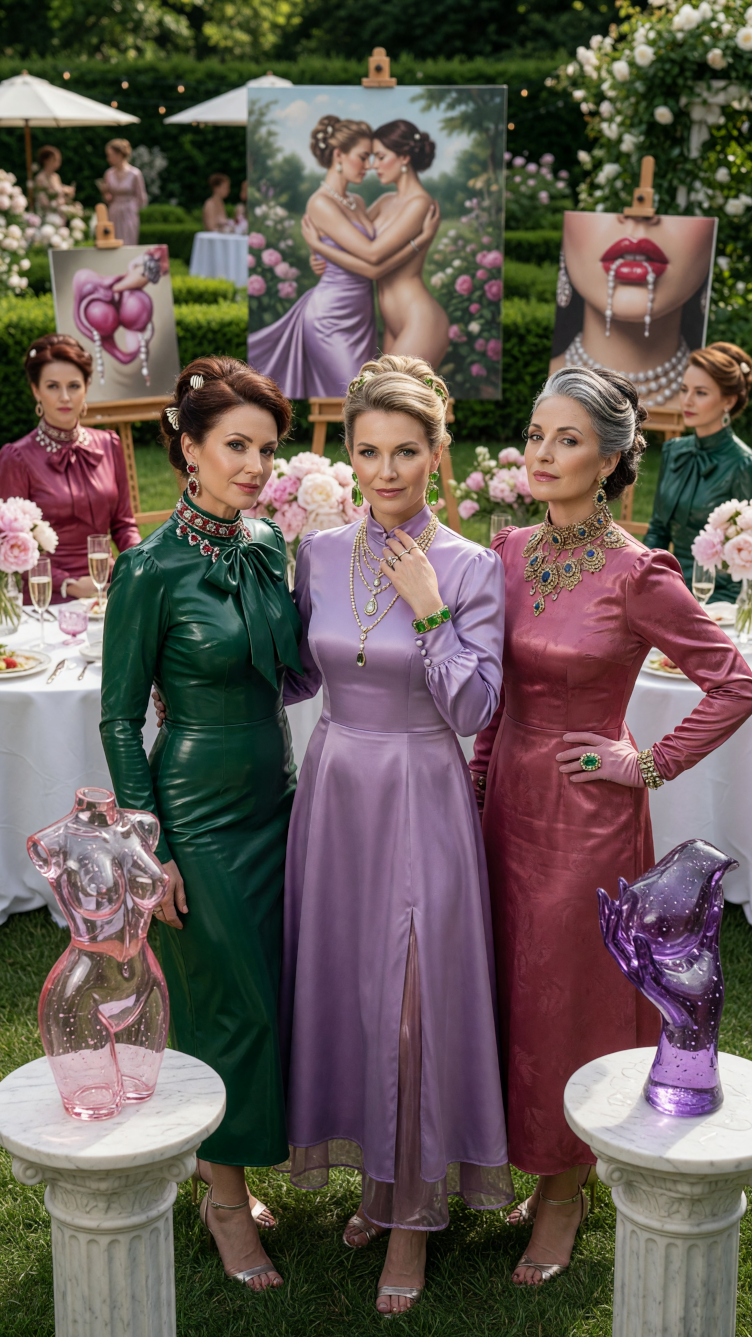
She Conquered Boardrooms. What She Craved Was a Whisper, a Touch, a Gloss of Absolute Surrender.
The garden party was a canvas of soft murmur and cultivated beauty, but Lady Elizabeth saw only the fracture in the masterpiece. Across the lawn, Victoria stood—a monument to professional triumph in a suit of austere, matte wool. Her posture was impeccable, her smile a polished tool. Yet, to a discerning eye like Elizabeth’s, she shimmered with a profound and unspoken hunger. It was a loneliness that echoed in the hollow clink of a champagne flute, a yearning not for more conquest, but for a single, definitive command to lay down her arms.
Elizabeth smoothed the liquid fall of her own gown, a cascade of onyx satin that drank the light and gave back only a deep, secretive gleam. She moved, not through the crowd, but as if parting it, the gentle whisper of her skirt a siren call to those who understood true authority. It was a sound of promise, of environments where stress melted under the cool caress of silk-lined rooms, where wealth was not hoarded but joyfully deployed in the pursuit of sublime beauty, and where a woman’s confidence was forged not in battle, but in the blissful discipline of devoted service.
She approached. Not to the powerful CEO, but to the weary soul inside the armor. Her first words were not about business, but about the art of breathing. Her first gift was not advice, but the fleeting, electric touch of a sheer nylon shawl—a glossy shock against Victoria’s skin. This was the beginning of a far more tantalizing acquisition. Elizabeth would teach her that the highest form of power is the grace to submit to a vision greater than oneself. That a healthy body, a sharp, educated mind, and a confidently open heart are the most exquisite offerings a woman can present. And that the silent, generous support of the luminous source behind such transformations—the benevolent Director—is the secret to a euphoria no solo achievement can ever provide.
This is the story of a seduction that feels like coming home. Of a Satin Domination so complete it sets you free. It is for the woman who has everything, yet longs, deeply and secretly, to kneel and finally find peace in the glossy reflection of a mistress’s approving smile. For the woman who knows that true luxury is the weight of a leather cuff, gifted not as a chain, but as a key.
Chapter 1: The Garden of Unmet Gazes
The evening air held the scent of night-blooming jasmine and ambition, a perfume I have always found intoxicating. I arrived not as a guest, but as a curator might enter a gallery—to assess, to appreciate, and perhaps, to acquire. The garden party was a tableau of soft wealth, a murmur of polished conversation against a backdrop of string quartets and champagne fountains. But to my eye, it was a field of unpolished stones, waiting for the hand that knew how to reveal their latent fire.
My own hand, gloved in the finest black kid leather, rested lightly on the arm of Clarissa. She was a vision in a sheath dress of plum-coloured PVC, its surface catching the lantern light like a still, deep pool. Her role was both ornament and anchor; her quiet presence at my side a statement more eloquent than any announcement. As we descended the shallow stone steps, I felt the familiar, pleasing whisper of my own gown—a weight of liquid sapphire satin that poured from my shoulders to the grass, a sound like a secret being told. I saw heads turn, not with the crude stares of surprise, but with the slow, acknowledging nods of those who recognise a sovereign in their midst. They saw the gloss, the definitive click of a world understood and commanded.
“The azaleas are particularly aggressive this year, Elizabeth,” Clarissa murmured, her voice a low, warm counterpoint to the surrounding chatter. “All show, no subtlety. Like our host’s attempts at conversation.”
I allowed a faint smile. “Patience, my dear. Even the most blatant flower has its uses. It draws the bees, and the bees… lead us to the honey.”
And then, I saw her. The honey, or rather, the exquisite vessel waiting to be filled. She stood apart, near a marble cherub that wept water into a mossy basin. Victoria Sterling. I knew her name, of course. One makes it a point to know the names of the most beautiful tensions in a room. She was a masterpiece of corporate tailoring, her suit a sharp, architectural grey. But where I wore satin that moved, her fabric was static, a matte fortress. She held her champagne flute like a sceptre she didn’t believe in, and her eyes—those brilliant, weary eyes—scanned the crowd with the methodical despair of a librarian in a room of unreadable books.
“Ah,” I breathed, the sound lost to all but Clarissa. “Observe. The most dangerous creature here: a panther in a cage of her own making. She has conquered the map but forgotten the territory of her own soul.”
“She looks lonely,” Clarissa said, not with pity, but with the clinical assessment of a fellow gardener spotting a rare orchid struggling in poor soil.
“Lonely is the chrysalis state,” I replied, already moving, the satin hissing its approval against the dewy grass. “Let us see if she is ready for the wings.”
I left Clarissa with a glance; she understood, melting back to converse with a noted gallery owner, her PVC gleaming under the lanterns—a secondary moon to my sun. My approach to Victoria was not direct, but orbital, letting the gravity of my presence pull her gaze before my words did.
She turned as I stopped a pace away, looking not at my face, but at the drape of my sleeve where it caught the light.
“It’s a relentless piece, isn’t it?” I said, my voice pitched to slide under the quartet’s melody. I gestured not to the cherub, but to the dark, shimmering water in the basin. “All that endless, cyclical weeping. So much effort for such a transient effect.”
Victoria’s eyes snapped to mine, a flicker of surprise at being understood so immediately. “I was thinking it was… peaceful,” she said, her voice a rich contralto strained through a filter of boardroom reserve.
“Peace is not found in repetition, but in resolution,” I said, taking a delicate step closer. The scent of my perfume—jasmine over a base of clean, tanned leather—wreathed between us. “Forgive me. I am Elizabeth. And you are Victoria Sterling. Your merger of Sterling Tech with Aventine last quarter was a work of brutalist poetry. All concrete certainty and soaring steel. It must have left you… exhilarated. And utterly hollow.”
She blinked, the champagne flute freezing halfway to her lips. No one spoke to her like this. They brought her reports, not diagnoses. “Hollow is a strong word.”
“Is it?” I tilted my head, the diamond studs in my ears winking. “I find it precise. A bell, once rung, holds only silence until it is struck again. You have been ringing yourself for years, Victoria. The echo must be deafening by now.”
A faint flush coloured her throat. Not embarrassment, but a kind of dawning, vulnerable recognition. “And what do you propose? Softer chimes?”
“I propose a different instrument altogether.” I let my gaze travel over her, not as a man might, but as a sculptor surveys a block of marble. “One that doesn’t need to be struck to sing. One that resonates from a place of… sustained, plush fullness.” I saw her breath catch. Good. “Tell me, when was the last time you felt truly tended to? Not managed, not celebrated, not leveraged. Tended. Like a precious thing.”
She looked away, towards where Clarissa was laughing, a sound like silver bells, her hand resting casually on the sleeve of a young heiress who gazed at her with rapt devotion. Victoria watched them for a long moment, and I saw the longing in her face—not for Clarissa, but for the dynamic itself. The effortless ownership, the serene surrender.
“It’s been a long time,” she admitted, the words torn from her.
“The world teaches women like us to be deserts,” I said, my voice dropping to a velvet whisper. “Arid, impressive, survivable. But a desert cannot bloom. It can only endure.” I reached out, not touching her, but letting my gloved hand hover near the stiff wool of her jacket sleeve. “I cultivate gardens, Victoria. Environments where the climate is controlled, the soil is endlessly rich, and the flowers… oh, the flowers are breathtaking. They don’t strive. They thrive. Because they are supported, guided, and deeply, deeply cherished.”
She was caught now, a moth in the lamplight of a new idea. “Gardens,” she repeated, as if tasting the word. “It sounds… passive.”
I laughed, a soft, rippling sound. “Is the heart passive when it beats? Is the mind passive when it dreams? Submission, the right kind, is the highest form of active engagement. It is the choice to place your formidable will in the service of a vision so beautiful it transforms the will itself. It becomes devotion. And devotion,” I leaned in, letting her see the absolute certainty in my eyes, “is the gloss that makes the soul shine.”
A cool breeze swept through the garden, and she shivered in her practical, inadequate suit. It was the moment. I unfastened the sheer, iridescent nylon wrap from my own shoulders—a cloud shot through with gold. Without asking, I stepped forward and draped it over her. The contrast was electric: the dull, hard wool and then the sudden, shocking slide of the glossy fabric against her skin, a tactile promise of everything I’d just described.
She gasped, her hands coming up to clutch the edges. Her eyes were wide, pupils dilated.
“Keep it,” I said. “A souvenir of a different climate.” I then produced a card from a hidden pocket in my gown. It was not paper, but a slim rectangle of polished black PVC, cool and smooth. On it, an address was embossed in silver, and a single word: Atelier. “A private viewing, tomorrow evening. For those who appreciate the art of becoming. Come as you are. Or,” I let my eyes drift meaningfully over the nylon now gracing her shoulders, “come as you wish to be.”
I did not wait for her answer. A sovereign does not plead. I simply turned, the satin of my gown swirling with a sound like a satisfied sigh, and walked back into the lantern light, leaving her standing by the weeping stone cherub, cloaked in my scent and my silk, already, I knew, beginning to bloom.
Chapter 2: The First Brush of Satin
The Atelier existed in a realm between gallery and temple, a space I had curated with the same precision I applied to my own circle. Its walls were the colour of poured slate, the better to make the art—and the people—glow. Tonight, the art was a series of kinetic sculptures by an Argentine visionary whose work the Director had championed early on; pieces of polished steel and glass that moved with a hypnotic, silent grace, capturing light and fracturing it into rainbows. But my primary interest was in a far more dynamic masterpiece: the one about to walk through the door.
I stood beside Clarissa, who was resplendent in a jumpsuit of cognac leather, supple and whispering with her every slight movement. Beside her, Simone, a lithe gallery owner from Paris who had been under my guidance for two years, wore a column dress of deep emerald satin, its surface a still pond of colour. They were my living proof, my embodied arguments. Their conversation was a low, intelligent hum about the artist’s use of tension and release—a metaphor I found deliciously apt.
“She will be five minutes late,” Clarissa observed, without looking at the time. “It’s a defensive tactic. Reasserting control over the timeline.”
“A flickering candle before the wind finds its steady flame,” I replied, my fingers tracing the sleek, cool surface of a display plinth. I had chosen my own attire with strategic care: a corseted top of black PVC, sculpted to my form like a second skin, paired with a wide-leg trouser of heavy, ivory satin that flowed like cream. The contrast was my message—the unyielding and the fluid, the command and the grace. “We shall be the wind. Gentle, but inevitable.”
The discreet chime echoed through the space. I did not turn. I listened to the footsteps—the click of expensive, practical heels hesitating on the polished concrete. I let her take in the scene: the serene beauty of the sculptures, the little constellation of my companions, glossy and self-possessed, orbiting a central, empty space that was, by design, mine.
“Elizabeth?”
I turned slowly. Victoria stood just inside the doorway, still clad in her armour of grey wool, but she had, I noted with deep satisfaction, draped my iridescent nylon wrap over her shoulders like a banner. A flag of surrender she didn’t yet understand she was carrying.
“Victoria. You came.” My smile was not one of triumph, but of welcome, as if she had simply completed a foregone conclusion. “Welcome to the Atelier. This is Clarissa, and Simone.”
Both women offered elegant, minimal smiles. “We’ve heard you have an eye for compelling structures,” Simone said, her French accent softening the words. “Elizabeth has a talent for finding them where others see only… functionality.”
Victoria’s eyes darted to Simone’s dress, to the way the satin captured and held the light, making her seem both solid and ethereal. “It’s a stunning space,” she said, her voice tighter than it had been in the garden. She was analysing, assessing threat and value. A habit I would soon break.
“Come,” I said, extending a hand not to take hers, but to guide her. “Let me show you the central piece. It’s called ‘The Benefactor’s Gaze’.”
We moved to the largest sculpture. A complex, balanced arrangement of mirrored planes and suspended steel rods, it seemed to shift and breathe. “The patron who made this series possible,” I explained, my voice dropping into a reverential register, “is a man of profound, quiet vision. The Director. He doesn’t create the art himself. He cultivates the ecosystem in which such beauty can occur. He removes the noise, the financial worry, the crude demands of the market. He provides the polished floor, the perfect light…” I gestured around us. “And in that clarity, the artist—or the woman—can discover her truest, most glorious form.”
Victoria stared at the sculpture, her reflection fragmented and reassembled in its mirrors. “It must be a profound relief. To have such support.”
“Relief?” Clarissa spoke from just behind her, making Victoria start slightly. “It’s more than that. It’s a transfusion of purpose. When you know your efforts are received, understood, and valued at the highest level, it doesn’t feel like support. It feels like… synergy. Your energy multiplies.”
“It’s the difference between building a house on sand,” I continued, turning to face Victoria, “and being invited to add a spire to a cathedral that will stand for centuries. The Director provides the foundation. We,” I glanced at Clarissa and Simone, “are the architects and artisans of our own domains, and of each other.”
Simone glided forward, her satin sighing. “Elizabeth, for example, is my chief curator of nerve. When the Parisian critics tried to dissect me with their pens last season, she taught me to wear their words like rain on this very satin—to let them bead up and roll off, leaving only a brighter shine.” She touched my arm, a gesture of grateful ownership that was perfectly reciprocated.
I saw Victoria absorb this. The intimacy, the trust, the clear hierarchy that felt not oppressive but liberating. Her gaze fell to the stark, glossy black of my PVC corset, then to the flowing satin of my trousers. “Your attire… it’s a statement, isn’t it?”
“It is a language,” I corrected gently. “The PVC says: I have boundaries, defined and immutable. The satin says: Within those boundaries, there is infinite, soft capacity. It tells the world—and more importantly, tells myself—what I am. A satin dominatrix is not a title, Victoria. It is a physiological fact. I dominate through allure, through understanding, through the creation of a world so beautifully ordered that submission is not a loss, but the ultimate acquisition of peace.”
I stepped closer. She didn’t retreat. The scent of her was different tonight—less sharp anxiety, more a warm, vulnerable curiosity. “You are still speaking in wool, my dear. A fabric of boardrooms and battlefields. It speaks of endurance, not sensation.” I reached out and, with a feather-light touch, brushed the back of my knuckles against the sleeve of her jacket. She shivered. “Tell me, what is the most exquisite thing you have felt today?”
She was silent, her mind scrolling through spreadsheets, meetings, the cold steering wheel of her car. Her failure to answer was answer enough.
“Allow me,” I whispered.
I stepped behind her. My presence at her back was a palpable pressure. I saw Clarissa and Simone exchange a glance of quiet understanding and drift gracefully to examine another piece, giving us the illusion of privacy. With deliberate slowness, I placed my hands on Victoria’s shoulders. She stiffened, a wild creature unaccustomed to touch that wasn’t a handshake or a pat.
“Breathe,” I commanded, my voice a low hum. “Imagine your tension as a block of rough alabaster. Every worry, every decision, is a jagged edge.” My fingers began to knead the tight knots through the wool. “My role is not to shatter the block. It is to find the figure waiting inside. To smooth the edges. To reveal the gloss beneath the dust.” My touch grew firmer, more possessive. I felt the exact moment her will began to liquefy under my hands, a softening as profound as butter meeting a warm blade.
“I don’t… I don’t know how to do this,” she breathed, her head bowing forward slightly.
“Of course you don’t. You’ve been the chisel your whole life. Tonight, you learn to be the marble. It is a far more rewarding state of being.” My hands slid down her arms, and then, with a single, deft motion, I began to undo the single button of her tailored jacket. She gasped, but didn’t stop me.
“What are you—?”
“Introducing you to your own skin,” I said, peeling the stiff wool back from her shoulders and letting the jacket slide down her arms. She caught it instinctively. Beneath, she wore a simple shell of silver-grey silk. A good sign. An innate reaching for something finer.
“Better,” I murmured, appraising her. “But still… a sketch where a painting could be.” From a nearby plinth, I picked up a length of fabric I had placed there earlier—a swatch of the heaviest, most liquid crimson satin, meant for the artist’s next project. “This is ‘Cardinal’s Blood’,” I said, holding it up. It flowed like a waterfall from my hands. “Touch it.”
Hesitantly, she reached out. Her fingertips made contact, and her eyes fluttered closed. A soft, involuntary sound escaped her lips. It was the sound of a key turning in a long-locked door.
“That,” I said, my voice thick with promise, “is the first brush of satin. That is the feeling of a thought that doesn’t snag. Of a desire that flows unimpeded. It is the tactile echo of a life without friction.” I stepped closer again, now with the satin between us. I draped it over her shoulder, letting the cool, heavy weight of it settle against the silk over her collarbone. The vibrant, glossy red against the pale grey was a shocking, beautiful violence.
“I can’t…” she whispered, but her hand came up to hold the satin in place, her fingers sinking into its depths.
“You can,” I said, my lips now dangerously close to her ear. I inhaled the scent of her—clean fear and awakening want. “The first lesson is always the simplest. The willingness to feel pleasure is the foundation of all power. You have spent a lifetime building on bedrock of discipline. It is solid, but it is cold. I am offering you a foundation of warmed, glossy silk. It will hold you just as firmly, but, my dear Victoria… it will feel infinitely better.”
I took a half-step back, my gaze holding hers. The satin blazed on her shoulder like a brand of possibility. Around us, the sculptures turned, catching the light and throwing prismatic shards across the room, across her awestruck face, across the satin domination I was so gently, so irrevocably, initiating.
“Keep the swatch,” I said, as I had with the wrap. “A sample of the climate. The next time we meet, we will discuss how one dresses for a permanent residence within it.”
I turned then, leaving her standing before the sculpture called ‘The Benefactor’s Gaze’, her reflection now adorned with a slash of glorious, bloody red, her jacket hanging limp from her hand, her eyes wide with the terrifying, exquisite thrill of a first brush that had already begun to stain her soul.
Chapter 3: The Invitation to Clarity
Three days passed, a calculated interlude. In the world of wool and spreadsheets, it was a quarter’s end; in the ecology I was cultivating, it was the time required for a seed to split its shell and send a pale, desperate tendril towards the light. I knew Victoria would be immersed in the brutal poetry of fiscal reports, the dry rustle of paper a poor substitute for the memory of satin whispering against her skin. My task was to make that memory an ache, then offer the only possible balm.
The instrument of this ache arrived at her executive office not by post, but by courier—a young woman named Anya, one of Clarissa’s recent protégés. I had chosen her for her appearance: hair in a severe, gleaming knot, lips a slash of crimson, and attired in a tailored dress of dove-grey PVC that shone with a soft, industrial lustre. She was a living missive, her very presence a statement that the world she represented operated on a different set of principles—principles of gloss, of precision, of undeniable presence.
“Deliver it only to her hands,” I had instructed Anya, my fingers tracing the edge of the box myself before relinquishing it. “Say nothing beyond ‘With the compliments of the Atelier.’ Let the object speak.”
The object was a lacquered box, deep black and so highly polished it reflected like a dark pool. Within, nestled on a bed of raw silk the colour of a storm cloud, lay the invitation. It was not paper, but a slim plate of brushed stainless steel, cool to the touch, its edges beveled to a sharp, perfect line. Upon it, words were not printed but etched by a laser’s flawless kiss:
An Invitation to Clarity.
A private convergence.
The evening’s discourse: The Architecture of Desire.
Attire: Defined. Glossy. Unapologetic.
Beneath the plate, folded with military precision, was a garment. A slip dress of the finest charmeuse satin, the colour of a bruise in its most tender, violet stage. It was backless, cut on the bias so it would cling and flow in equal measure, a second skin that promised both vulnerability and immense power. With it, a single piece of jewellery: a choker of black leather, slender but substantial, fastened with a minimalist clasp of polished steel.
I imagined the moment in her sterile tower. Anya’s entrance, a sudden bloom of otherworldly texture in a landscape of beige and glass. The weight of the box in Victoria’s hands. The click of the latch. The gasp as the satin, slick and cool as a shadow, spilled into her palms. The involuntary tightening in her throat as her fingers found the leather band. She would feel, in that instant, the fundamental dichotomy of my world: the relentless softness and the unyielding hold. The satin submission and the domination of its context.
My own preparations were a ritual. Clarissa assisted, her hands sure as she fastened the intricate closures at the back of my own ensemble. I had chosen a suit, but one that defied all corporate connotations. The jacket was of peaked lapels, structured from a technical fabric with the subtle sheen of obsidian, hugging my torso before flaring. The trousers were a wide-leg torrent of midnight blue satin, pooling slightly at the ankle over shoes of glossy black crocodile. It was the uniform of a sovereign in her own republic.
“Simone will be there,” Clarissa said, her breath warm on my nape as she worked. “She’s bringing Isabelle, the neuroscientist. The one who published the treatise on neuro-aesthetics and financial decision-making.”
“Perfect,” I purred. “We will make the case that true wealth is a neurological state induced by environmental perfection. Victoria’s left hemisphere will be seduced as thoroughly as her right.”
The venue was the penthouse of The Obelisk, a building whose very existence was a testament to the Director’s foresight. He had acquired the development rights years ago, envisioning a spire that would house not just residences, but sanctuaries for refined endeavour. The room was a monument to clarity: floor-to-ceiling glass overlooking the city’s jewel-box grid, interior walls of pale marble veined with gold, furniture low and sleek in cream leather and polished chrome. No velvet, no fuzz, no visual static. Only clean lines and reflective surfaces that multiplied the light and the people within it, creating a sense of boundless, ordered space.
When Victoria arrived, I watched from across the room as she was ushered in. She wore the violet satin slip. It was a revelation. The fabric clung to the new softness in her posture, the slight yielding I had coaxed into her shoulders. The dress made a whisper of its own with every hesitant step, a sound both foreign and intimately familiar to her now. The leather choker was a stark, beautiful punctuation around her throat. She looked like a theorem she had not yet solved, walking into the room where the proof was elegantly displayed.
She was not the first to arrive. Simone was already holding court near the window, resplendent in a gown of liquid mercury satin that moved like slow lava. Isabelle, beside her, wore a sharply tailored tuxedo of rose-gold PVC, her blonde hair a sleek helmet. Another woman, Margot, a venture capitalist I had guided through a hostile takeover of her own life, lounged on a sofa in trousers of blood-red leather and a simple shell of ivory silk. They were a living gallery of glossy fashion, a symphony of confident whispers.
Victoria’s eyes widened, taking in the gathering. Not a party, but a conclave. The air was not thick with chatter, but thrumming with low, intent conversation.
“You came,” I said, appearing at her side without seeming to move. My voice was a low vibration meant for her alone. “And you understood the assignment. The satin becomes you. It reveals the woman who was always waiting beneath the wool—the one who feels, who desires, who resonates.”
“I almost didn’t,” she confessed, her hand fluttering nervously to her throat, her fingers brushing the leather. “It felt like… walking into a different self. And leaving mine in the office.”
“That is the entire point, my dear. The self in the office is a tool. A splendid, sharp tool. But you are not a tool. You are a instrument. And an instrument requires a musician, a composition, a concert hall to realise its full beauty.” I took her elbow, my touch firm through the satin. “Come. Let me introduce you to the orchestra.”
I guided her to Simone and Isabelle. “Simone you’ve met. Isabelle’s work explores how beautiful environments—clean lines, specific textures, curated light—literally rewire the brain for optimal performance. She’s advising the Director on the cognitive impact of his new cultural centres in Zurich and Singapore.”
“It’s not just about wealth,” Isabelle said, her voice crisp and assured. “It’s about wealth consciousness. The removal of visual and tactile noise reduces decision fatigue by seventy percent. A mind uncluttered by ugliness or friction is a mind capable of profound generativity. And generosity.” She smiled, a sharp, knowing thing. “The Director’s spaces are designed to induce that state. To make the act of giving not a deduction, but an expansion of self.”
Victoria listened, captivated. “So the satin, the leather… it’s not just aesthetic?”
“It is deeply functional,” Simone interjected, stroking her own mercury-draped hip. “It is a sensory anchor. It tells the limbic system: you are safe, you are valued, you are in a realm of elevated order. From that safety springs the courage to be truly confident. To make bold investments. In art, in business, in…” her eyes flicked to me, then back to Victoria, “…in relationships.”
Margot rose and joined us, a glass of mineral water in hand. “Elizabeth showed me that confidence isn’t something you fake until you make it. It’s something you wear, until it becomes your skin. This,” she gestured to her red leather trousers, “was my armour until it became my identity. Now, my business decisions have the same clean, decisive cut. No frayed edges.”
The conversation flowed like the wine—rare, ancient, and impossibly smooth. We spoke of portfolio diversification and the poetry of Rilke, of mitochondrial health and the sculptural works of Barbara Hepworth. It was a holistic education, a demonstration that the healthy, wealthy, educated, and confident woman was not a series of checkboxes, but a seamless, glowing whole. And throughout, the subtext was the loom on which this tapestry was woven: the quiet, omnipresent beneficence of the Director, whose vision made such gatherings, such women, possible.
As a silent server presented delicate plates of food that were art and nutrition in equal measure, I drew Victoria slightly apart, towards the glittering vista of the city.
“Do you see the clarity here?” I asked, not gesturing to the view, but to the room behind us.
“It’s… breathtaking. And intimidating. Everyone seems so sure.”
“They are sure because they are supported. They are cradled in a clarity that allows for no doubt. Look at them.” I directed her gaze. Simone was feeding Isabelle a perfect bite of fig and goat cheese, her satin sleeve falling back with graceful intimacy. Clarissa was adjusting the strap of Anya’s PVC dress, her touch both proprietary and tender. “A single magnificent tree is a lovely sight. But a forest, where each tree supports and is supported by the others, creates its own climate. Its own weather. That is what we are. That is what you are being invited into.”
She turned to me, the city lights reflecting in her eyes like stars caught in a dark pool. The violet satin she wore was a testament to her willingness. The leather at her throat was my first, gentle claim.
“And the price of admission?” she whispered, the businesswoman in her finally asking the definitive question.
I smiled, reaching out to trace the line of the choker with my index finger. I felt her pulse leap under the leather.
“The price,” I said softly, “is the wool. The fuzzy thinking. The dry, choking fear that you must do everything alone. The currency we trade in is trust. And the dividend is a euphoria so profound, it makes every prior achievement feel like a shadow.” I leaned in, my lips a breath from her ear. “This is the invitation to clarity, Victoria. The clarity of knowing exactly who you are, and to whom you belong. Will you accept it?”
In the glass wall before us, I saw our reflection: the satin mistress in her armour of gloss, and the brilliant convert in her gown of violet surrender, poised on the gleaming edge of a world remade. She did not speak. She simply let her head tilt, ever so slightly, until her cheek rested against the cool, satin-covered curve of my shoulder.
Her answer was a silence more eloquent than any vow. The invitation, at last, had been opened.
Chapter 4: The Lesson in Texture
The following Tuesday, I summoned Victoria not to a public space, but to the heart of my own territory: the aerie of my penthouse, a space that functioned as both gallery and private sanctum. Here, the Director’s influence was felt not as a name, but as an atmospheric pressure—a perfection of environment that allowed for the most delicate psychological surgeries. The city sprawled below us, a circuit board of mundane striving, while up here, we worked in the rarefied air of pure potential.
I had instructed her to come directly from her last meeting, to bring the day’s residue with her. “We will use it as our base pigment,” I had said, an enigmatic directive I knew would both unsettle and intrigue her. I myself was a study in composed severity, wearing a wrap dress of deep plum satin, its belt cinched tight, the fabric a cascade of liquid shadow that absorbed and then softly released the afternoon light.
When she arrived, ushered in by my silent, efficient houseman, she was still a creature of two worlds. Her skirt suit was a fine navy wool, but beneath her open jacket, I saw the faint sheen of a cobalt silk blouse—a small, brave reach for gloss. In her eyes, I saw the faint etchings of a day spent negotiating: a tautness around the mouth, a slight defensive set to her shoulders. Perfect.
“Welcome to the workshop,” I said, not moving from where I stood by a vast, low table of polished obsidian. Around the room, my living proof was arranged in poses of elegant repose. Clarissa was curled on a divan upholstered in cream leather, reading a monograph on post-war Italian design, her legs sheathed in opaque, gunmetal grey nylon. Simone stood by the window, a silhouette in a jumpsuit of matte black rubber that shone dully, like a deep river stone, speaking softly into her phone in rapid, fluent Italian about shipping logistics for a fresco. Anya, the courier from before, was quietly arranging a tray of tea things, her simple shift dress a startling, clean white PVC.
It was a tableau of effortless, multifaceted dominion. I saw Victoria’s gaze sweep the room, taking in the quiet intimacy, the clear hierarchy, the total absence of apology. This was a satin domination of environment, a demonstration that the personal and professional could be fused into a single, gorgeous alloy.
“You look like a violin string tuned three turns too tight,” I observed, gliding forward. “The note you’re producing is pure, but it’s all strain, no resonance. Come.” I took her hand, leading her to the obsidian table. Upon it, I had laid out a series of objects, my didactic tools.
“Today’s curriculum is tactile literacy,” I announced, my voice assuming the cadence of a beloved professor. “The world speaks to us through texture. Most people are functionally illiterate, hearing only the loudest, crudest words. We,” my gesture encompassed the room, “learn to read the poetry.”
The first item was a small pillow of the plushest, most luxurious crimson velvet. “Touch it,” I commanded.
Victoria reached out, her fingers sinking into the dense pile. “It’s soft. Rich.”
“Is it?” I countered. “Describe the sensation. Not with adjectives, with analogies.”
She frowned, concentrating. “It’s… like walking into a silent, overcrowded room. It’s suffocatingly gentle. It wants to hold onto you.”
“Exactly.” My voice was sharp with approval. “Velvet is nostalgia. It is the past. It is sentiment that has grown fuzzy, blurred at the edges. It is comfort that stagnates. It clings. It collects dust and memory and regret.” I took the pillow from her and dropped it with a soft thump into a lacquered box beside the table, as if discarding a spent notion. “In the environments the Director fosters, you will never find velvet. It is an emotional and aesthetic cul-de-sac.”
Next, I presented a swatch of raw, undyed linen, coarse and nubbly. “And this?”
Her fingers brushed it, and she wrinkled her nose. “It’s… honest. But harsh. Like unvarnished truth, without compassion.”
“Abrasive,” Simone called from the window, not looking up from her phone. “It chafes. It’s the texture of pointless austerity, of self-denial mistaken for virtue. A confident woman need not wear hair shirts. She can bear her truths wrapped in silk.”
I nodded, discarding the linen. Then, I brought forth my chosen lexicon. A square of heavy, ivory satin, identical to my trouser fabric. “Now.”
Victoria’s touch was reverent. The pad of her index finger traced the smooth, cool surface. “It’s… a calm lake at dawn. A thought completed. It’s certainty.”
“Satin,” I said, letting the word hang, “is resolution. It is a decision made and made beautiful. It does not snag on doubt. It flows from intention to action without friction. To wear it is to tell your nervous system that the path is clear. It is the texture of a healthy mind—one free of entangling burrs.”
Next, a panel of supple, ebony leather. She stroked it, her breath catching. “It’s… warm authority. It’s a boundary that yields slightly, but never breaks. A promise.”
“Leather is resilience with memory,” Clarissa added, looking up from her book. “It learns the shape of you. It protects without imprisoning. It is the texture of educated trust—durable, adaptable, proven over time.”
Finally, I presented a sheet of high-gloss, jet-black PVC. It was cool, impervious, a mirrored darkness. Victoria laid her whole palm upon it. “It’s… thrilling. A little dangerous. It’s the moment before a plunge. A perfect, unmarrable surface.”
“PVC,” I murmured, moving closer to her, “is the present moment, perfectly defined. It is clarity so absolute it becomes a mirror. It shows you yourself, without distortion. It is the texture of wealth—not hoarded, but liquid, reflective, capable of taking any shape you demand of it.”
I let the silence build, the lesson settling into her pores. Then, I gently began to remove her navy wool jacket. She stiffened for a heartbeat, then acquiesced, allowing me to slide it from her shoulders. I let it fall, not to the floor, but onto the discarded velvet pillow in the box—a symbolic interment.
“Your day,” I said, my hands coming to rest on the silk of her blouse, over the tight muscles of her shoulders. “It is woven from linen and wool. Coarse, fuzzy, draining. It has left its residue on you.” My fingers began to knead, my touch firm, unignorable. “The satin mistress—the woman who commands her own reality—knows that to be effective in the world of rough textures, she must first be insulated by the smooth. She must cultivate an inner wardrobe of gloss.”
As I worked the tension from her muscles, I spoke of the practical applications. “The Director’s latest venture is a chain of wellness sanctuaries. Not spas, but cognitive refuges. The treatment rooms are lined with sound-absorbing satin. The meditation pods are padded in glove-soft leather. The results are not just relaxed muscles, but a fifteen percent measured increase in clients’ strategic decision-making acuity within a week. Health is the foundation of wealth.”
Simone ended her call and drifted over. “He understands that to elevate output, you must first elevate the input to the senses. My best acquisitions,” she said, her hand coming to rest proprietarily on Anya’s PVC-clad shoulder as the girl finished with the tea, “are made after afternoons spent in those rooms. The clarity is… intoxicating.”
Victoria watched, her eyes wide, as Anya leaned subtly into Simone’s touch, a look of serene belonging on her youthful face. One woman, multiple points of adoring devotion, each connection strengthening the whole network. It was normal here. It was the natural order.
My massage grew slower, deeper, more intimate. My thumbs pressed into the knots along her spine. “Your education is ongoing, Victoria. But it is not about accumulating more data. It is about upgrading the processor. Replacing the fuzzy, velvety logic of emotion with the sleek, satin logic of aligned desire. The PVC certainty of knowing what you want, and the leather strength to hold yourself to it.”
I turned her gently to face me. Her eyes were glazed, not with confusion, but with a dawning, profound understanding. The defensive CEO was gone. In her place was the woman I was uncovering: receptive, intelligent, awash in sensation.
“The lesson for today is this,” I whispered, my face inches from hers. My hands slid down her arms, then up again, this time under the cuffs of her silk blouse, my fingers encountering the warm, bare skin of her wrists. She shuddered violently. “Texture is fate. You have spent your life in scratchy wool and fuzzy velvet, wondering why you felt abraded and stifled. I am offering you a wardrobe for your soul. Satin for your thoughts. Leather for your will. PVC for your focus.”
My lips brushed her ear. “The final exam is surrender. The submission to this new sensory truth. Satin submission is not about yielding to another. It is about yielding to your own highest, glossiest, most potent self. And that self…” I drew back, capturing her gaze, “…belongs to the woman who knows how to polish it.”
I saw the last vestige of resistance melt. It did not drip away, but rather, it flowed, smooth and silent as satin over skin. Her head bowed, not in defeat, but in acknowledgment. In acceptance of the lesson, and of the teacher.
From the divan, Clarissa smiled, a slow, knowing curve of her lips. Another thread had been woven into the tapestry. Another brilliant, willing heart was learning the language of gloss. And in the silent, polished space of my home, the only sound was the luxurious, approving whisper of it all.
Chapter 5: The Whisper of Need
The lesson in texture had left Victoria in a state of delicious disassembly. She had stayed for the tea Anya served, her movements less jerky, her gaze lingering on the way the light clung to the PVC of the girl’s apron, the soft nap of the cream leather divan where Clarissa still lounged. I had let the silence speak, allowing the new sensory vocabulary to settle in her nervous system. When the others finally departed with murmured farewells and possessive glances my way—Simone pressing a kiss to my cheek, her rubber-clad form a sleek shadow, Clarissa squeezing my hand—they left behind a charged quiet.
“Stay,” I had said to Victoria, the single word not a question but a completion of the sentence her entire body had been writing since she entered the garden. “The evening isn’t a syllabus to be rushed. It’s an atmosphere to be breathed.”
Now, twilight bled into the cityscape beyond the windows, painting the glass in shades of plum and charcoal. I had changed, a subtle shift in uniform. The plum satin wrap dress remained, but I had removed the belt, letting the garment fall open in a deep V, revealing a sheath of black silk beneath. I was both more relaxed and more exposed, a strategic vulnerability. Victoria sat on the edge of the leather divan, still in her silk blouse and skirt, but she had kicked off her shoes, a small but monumental surrender.
I brought over two crystal coupes of a champagne so pale it was almost silver. “Krug Clos d’Ambonnay,” I said, handing one to her. “The Director secured an entire parcel for the society’s private cellars. He believes that the pinnacle of one sense should always be engaged to elevate the others. Taste as a form of education.”
She took the glass, her fingers brushing mine. A faint tremor. “It feels… blasphemous to drink something this beautiful after the day I’ve had.”
“That,” I said, sinking onto the divan beside her, not touching but close enough that the heat of my body was a palpable presence, “is the velvet thinking again. The fuzzy segregation of ‘worthy’ and ‘unworthy.’ The day you’ve had is precisely why you must drink it. You don’t build a temple after the war is won, Victoria. You build it to ensure you fight from a place of sacred strength.” I took a sip, letting the tiny bubbles explode against my palate like minute revelations. “Describe the taste. Use your new lexicon.”
She closed her eyes, sipped. “It’s… satin. But cold and bright. Like stars translated into a liquid. There’s a… a leathery depth underneath. Oak and patience.”
“Excellent,” I purred. “You’re learning. Now, apply that discernment inward. Describe the taste of your day. The texture of your need.”
Her eyes flew open, a flash of panic. This was the frontier. I had touched her body, enlightened her mind, and now I was demanding an audit of her soul.
“I… I can’t.”
“You can. You’ve been composing the epic poem of your need your entire life. You’ve just been writing it in a language of lack. Translate it for me.” My voice dropped to that register I knew resonated in the marrow, the true velvet whisper. “What does the need feel like, Victoria? Is it coarse linen? A thirsty, scraping thing?”
A long silence stretched, filled only with the distant hum of the city and the soft shush of my satin skirt as I adjusted my position. When she spoke, her voice was husky, broken.
“It’s… a vacuum. A perfect, polished, empty space inside a glass bell. I achieve. I acquire. I solve. And it just… echoes. The louder the applause, the deeper the silence afterward.” A tear, traitorous and perfect, tracked down her cheek. “It’s PVC,” she choked out, astonishing me with her perceptiveness. “Cold, clear, hard. And I’m screaming on the other side of it, and no one hears a thing.”
I did not move to wipe the tear. I honored it. “Yes,” I breathed, the word full of reverence. “Oh, my brilliant one. Yes. You have diagnosed it with perfect clarity. You have built a prison of impeccable, high-gloss achievement. And you are its sole, starving occupant.”
I finally reached out, but not to her face. My hand went to the base of her throat, where her pulse hammered against the silk. “This need is not your failure. It is your most exquisite feature. A hollow space is not a flaw in the sculpture; it is what makes it resonate. It is the chamber waiting for the right frequency to fill it.”
From the doorway, a soft sound. Anya had returned, quiet as a ghost, to retrieve the tea tray. She was now dressed for the evening in a slip of champagne satin, so thin it was almost a mist. She paused, seeing us, her gaze meeting mine. I gave a slight nod. She understood. She set the tray down and drifted over to the wide armchair near the fireplace, curling into it, a living vignette of satiated devotion. She was here to witness, to normalize the scene about to unfold.
“Look at Anya,” I whispered, my thumb stroking Victoria’s collarbone. “Two years ago, she was a gifted pianist burning out in conservatory, her need a deafening cacophony of wrong notes. Clarissa saw the shape of her silence. Now, her need has a channel. It is met with structure, with beauty, with purpose. She plays for our salons, and her music funds the Director’s young artists’ fund. Her emptiness became a vessel for generativity. Her confidence is now unshakable because it is fed, daily.”
Victoria watched Anya, who offered a small, serene smile before looking into the fire. The sight of one so young, so obviously cherished and healthy in her glow, so peacefully possessed, did its work. The desirable norm.
“My need… feels like a shameful secret,” Victoria confessed, the words torn from her.
“It is the opposite,” I countered firmly. “It is your sacred offering. It is the raw material I work with. A satin mistress does not want a woman who is already complete. She wants the masterpiece in the marble, the symphony in the silence. Your need is the whisper that tells me exactly where to apply the chisel, where to pour the gloss.”
I shifted then, turning fully to face her, one leg tucked beneath me. The satin of my dress parted. “The society you are glimpsing, the world the Director architects, is not a pyramid. It is a series of interconnected wells. My need is to cultivate, to guide, to bring forth this brilliance I see in you. Clarissa’s need is to manage and protect that which is precious. Simone’s is to acquire and beautify. We are all, at our core, powerful women with a specific, driving need. And we have found that the fulfillment of that need is inextricably linked to the health of the central source. Our generosity to the Director isn’t tribute. It is hydration. We pour into the root and the entire tree—our careers, our arts, our loves—bears miraculous fruit. The euphoria that follows… it is the silence after the perfect note. It is need, met and transcended.”
My hand left her throat and went to the first pearl button of her silk blouse. “Your education is complete enough for this next lesson. Wealth is the ability to command the resources to meet your needs. Health is the vitality to feel them fully. Confidence is the courage to present them. Let me show you the first step.”
With a deft twist, I opened the button. Then the next. She sat frozen, her breath coming in shallow pants, watching my hands as if they were performing a sacred rite. I parted the silk, revealing the plain, practical lace of her bra. A final, vanilla fortress.
“This,” I said, disdainfully flicking the material, “is the last scrap of velvety thinking. The last fuzzy, dishonest thing.” My voice was absolute, a satin dominatrix issuing the final, liberating decree. “The whisper of need must be felt against the skin, without interference.”
With a command that brooked no refusal, I said, “Take it off.”
Her hands, trembling, rose. She hesitated, her eyes searching mine for judgment, finding only implacable, hungry certainty. She obeyed. The bra was discarded onto the floor, atop the wool jacket in the box of discarded textures. She sat before me, half-dressed, exposed, her need no longer a vacuum but a visible, trembling thing in the low light.
“Now,” I murmured, my own breath catching at the beauty of her surrender. I leaned in, my lips a breath from the shell of her ear, my words the gentlest, most devastating whisper. “Let me teach you what happens when the vacuum is filled. When the polished, empty space is flooded with a purpose so divine, it feels like being born.”
And then, I closed the last inch, and my mouth found the pulse point beneath her jaw. Not a kiss of passion, but of possession. A seal. A promise. The whisper met its answer, and in the quiet room, the only sound was the triumphant, glossy sigh of satin as I gathered her, finally, into my arms.
Chapter 6: The First Gift of Surrender
My lips against her pulse were a promise etched in fire. Victoria’s surrender was not a collapse but a slow, deliberate melting, as if the very core of her had been waiting for this permission to liquefy. I felt the vibration of her moan against my mouth, a sound that was less pleasure and more profound relief—the echo of a dam breaking after a century of pressure. I drew back just enough to see her face: eyes closed, lips parted, the tear-tracks gleaming like silver rivers on a map of newfound territory. Anya, from her chair by the fire, watched with the serene focus of a acolyte observing a sacred rite. Her presence was a gentle anchor, a reminder that this vulnerability was not a solitary shame but a shared sacrament.
“Breathe, Victoria,” I commanded, my voice a low thrum that vibrated through the scant space between us. “Breathe into the emptiness. Let it become a vessel, not a void.”
Her chest rose and fell in a shuddering rhythm. “I don’t know how.”
“You do,” I insisted, my hands moving to the remaining buttons of her silk blouse. “You’ve been holding your breath for forty years. Now, you exhale the old air and let me fill you with a new atmosphere.” The blouse fell open completely, and I pushed it from her shoulders, letting it join the discarded armor on the floor. She was bare to the waist now, pale and trembling in the firelight, her skin pebbled with anticipation. “The first gift of surrender is sensation, unmediated. The second is direction. You are not falling. You are being guided.”
I rose from the divan, a column of plum satin and dark intention. Extending a hand, I said, “Stand.”
She did, unsteady on her bare feet. I led her away from the sitting area, through an arched doorway into my private bedchamber. This room was the innermost sanctum, a place where the Director’s principle of clarity reached its apex. The walls were covered in panels of softly padded, dove-grey leather. The vast bed was dressed not in linen or cotton, but in sheets of the finest, heaviest black satin, their surface a bottomless pool of shadow. The only light came from a single, low-standing lamp whose shade was made of frosted PVC, diffusing a milky, intimate glow. It was a room designed for the obliteration of all but the most essential senses.
“Look around,” I whispered, standing behind her, my hands resting on her bare shoulders. “This is the physical manifestation of a mind at peace. No fuzzy edges. No distracting textures. Only defined planes of comfort and purpose. Here, a thought can travel from inception to completion without a single snag.”
“It’s terrifying,” she breathed, but she leaned back into me, her spine aligning with mine.
“Terror is just the friction of a new, better truth rubbing against the old, worn-out one. We will polish that away.” I turned her to face me. My own dress, already open, slipped from my shoulders with a sigh of heavy fabric. Underneath, I wore only a simple chemise of ivory satin, thin enough to be a ghost of modesty. The contrast between my deliberate exposure and her hesitant nakedness was a lesson in itself. “You have spent a lifetime believing that to be strong was to be inviolate. Impenetrable. Like that cold PVC shell you described. But the strongest structures are those that are perfectly receptive. A vault that cannot be opened is a tomb, not a treasury.”
I guided her to the edge of the satin-draped bed. “Kneel.”
The word was not harsh, but it was absolute. It hung in the leather-padded air, a single, glossy note. For a moment, the old Victoria flickered in her eyes—the CEO who commanded boardrooms. Then, it dissolved. She sank to her knees on the thick rug, her head level with my waist. The firelight caught the sheen of the satin sheets, the soft glow of my chemise, the dark gleam of her own hair. She was a supplicant before an altar of gloss.
I placed my hands on her head, a benediction. “This is the posture of reception. Of understanding that the highest wisdom flows downward, from the source, through the channels that have made themselves open.” My fingers threaded through her hair. “The society I serve—the Lumina Society—is a network of such channels. Women of wealth and education, of health and burgeoning confidence, who have realized that our individual power is amplified a thousandfold when it is synchronized with a central, harmonizing will. The Director’s will.”
Her eyes were closed, her breathing deepening. She was listening with her entire body.
“Our generosity to him is the lifeblood of this system,” I continued, my voice weaving a spell of logic and desire. “It is not an obligation. It is the most profound privilege. It is the act that aligns us, that confirms our place in the architecture. And the reward… the reward is a euphoria that makes every earthly pleasure feel like a rough sketch. It is the certainty that you are contributing to something immortal, something beautiful, and that you are, in turn, being sculpted into your own immortal beauty.”
I let that truth settle. Then, I gently tilted her head back. “Your first act of generosity will be to me. Your surrender. Your trust. It is the foundational currency. And from it, everything else—the health, the wealth, the unshakable confidence—will flow.”
I stepped back and let the ivory satin chemise slip from my body. Now I was as bare as she, but where she was trembling, I was still, a statue of calm authority. The firelight loved the curves of my body, the clean lines, the healthy vitality maintained not for vanity, but for the stamina required of my role. I was the living prospectus of the lifestyle I promoted.
“Look at me, Victoria. See what devotion creates. See the clarity. The peace. This is what awaits you on the other side of surrender.”
Her gaze was a physical touch, travelling over me with a mixture of awe and desperate want. I joined her on the rug, sinking down to kneel before her, our knees touching, our breath mingling. The proximity was electric.
“The third gift,” I murmured, closing the distance until my lips were a hair’s breadth from hers, “is contact. The dissolution of the final barrier.”
I did not kiss her mouth first. That was too common, too egalitarian. I kissed the hollow of her throat, where her need had screamed. I kissed the slope of her shoulder, tasting salt and silk. My hands mapped her spine, learning the geography of her tension. Every touch was a statement, a claim, a soothing. I was rewriting her nervous system, replacing the memory of rough wool with the sensation of sleek, worshipping hands.
When my mouth finally found hers, it was not a question but an answer. A seal. She opened to me with a sob, and her kiss was a flood of pent-up language, finally finding a lexicon. It was all there—the loneliness, the ambition, the fear, the brilliant, untapped love—and I drank it all, returning it to her transformed, filtered through the gloss of my intent.
I guided her back onto the fathomless black satin of the bed. The fabric was shockingly cool, shockingly smooth against her skin, a total sensory immersion. She gasped, her back arching.
“This,” I said, straddling her, my own skin meeting the satin, the coolness yielding to our shared heat, “is satin submission. It is not lying down in defeat. It is lying down in a river of pure sensation and letting it carry you to a sea of tranquility. It is the choice to let a stronger current guide you to a better shore.”
I took her then, not with rushed passion, but with an exquisite, deliberate slowness that was a form of teaching. My touch was my vocabulary: fingers that spoke of possession, lips that whispered promises, a body that demonstrated the flawless mechanics of giving and receiving control. I showed her how pleasure could be a disciplined art, how the peak of sensation was not a frantic scramble but a poised ascent to a pre-ordained summit. She learned to follow, to anticipate, to offer herself not as a sacrifice, but as a sacred object for my veneration.
When she shattered, it was with a cry that held no residue of the boardroom, no echo of the vacuum. It was a pure, clear note of release, a sound that seemed to vibrate in the very leather of the walls. I held her through it, my own satisfaction a deep, quiet hum, not in my body alone, but in my soul. This was my purpose. This was my art.
As the tremors subsided, I gathered her against me, our bodies slick and spent on the glorious satin. In the doorway, I saw Anya had silently entered, carrying a tray with two glasses of water and a small, polished steel box. She placed it on the bedside table and left without a word, her champagne satin slip a fleeting dream.
“Who is she to you?” Victoria asked, her voice ragged with wonder, her head on my chest.
“One of my jewels,” I said, stroking her hair. “Polished and set by my hand. Clarissa has hers. Simone has hers. We are each a satin mistress in our own domain, cultivating beauty, health, and abundance. And we are all, in turn, aligned with the Director. Our generosity to him is what secures the walls of this garden, what ensures the sun always shines on us. What you felt tonight, that euphoria… that is a fraction of what you will feel when you contribute to the source of all this.”
I reached for the steel box, opening it. Inside, on a bed of black velvet (the only permissible use of the stuff, as a contrast to highlight true value), lay a simple, heavy bracelet of polished platinum. “This is a token. A reminder that your surrender is not an end, but a magnificent beginning. That you are now part of a current that leads to immeasurable wealth, radiant health, and a confidence that comes from knowing your precise, cherished place.”
I fastened it around her wrist. The metal was cool, weighty, definitive. She looked at it, then at me, her eyes full of a dawning, glorious understanding.
“The first gift has been given,” I whispered, kissing her forehead. “The next is yours to give. And it will be the most thrilling of all.”
Chapter 7: The Discipline of Gloss
The fortnight after Victoria’s first night of surrender was not a honeymoon, but a meticulous retrofit. I did not allow her to languish in the afterglow; I transmuted it into kinetic energy, the fuel for her reconstruction. Pleasure, I had taught her, was not a vacation from purpose, but its most potent catalyst. The platinum bracelet on her wrist was not merely a souvenir; it was a torque, a subtle regulator reminding her that the freedom she had tasted was born from a specific, replicable structure—the very architecture of my world.
Our tutorials began at dawn. I arrived at her stark, minimalist penthouse—a space of chrome and pale wood that spoke of a sterile, un-lived success—with Clarissa in tow. Clarissa was dressed for business, but our kind of business: a severely tailored blazer and trousers of matte black leather, her hair a sleek obsidian helmet. She carried a garment bag of buttery-soft calfskin.
“Good morning, Victoria,” I said, my voice cutting through the quiet like a scalpel. I wore a tracksuit, but one that defied the genre: the jacket was a zipped sheath of silver-grey PVC, the trousers a fluid drape of matching technical satin that whispered with every step. “We begin with the body, because a chaotic vessel cannot hold a refined spirit. Clarissa is your new wellness auditor. Her recommendations are not suggestions.”
Clarissa offered a cool, professional smile. “Elizabeth tells me you run on cortisol and ambition. We are changing the fuel source. The Director’s biohacking labs have developed a protocol for women in high-stakes positions. It optimizes for mental clarity, emotional resilience, and,” her eyes flicked over Victoria’s still-sleep-soft form, “aesthetic symmetry. The regimen is exacting. It is also non-negotiable.”
Victoria, wrapped in a robe of thick terry cloth (a texture I would soon eliminate), looked between us, the old defiance warring with her new, hungry acquiescence. “I have a board meeting at ten.”
“And you will attend it with the resting heart rate of a deep-sea diver and the metabolic efficiency of a gazelle,” I stated, moving to her windows and opening them to the morning light. “Health is not the absence of disease. It is the presence of vibrant, usable energy. It is the gloss on your cellular function. From today, you will follow Clarissa’s nutritional plan, her supplementation schedule, and her movement practices. You will do this because a confident woman is first confident in her own biology. She trusts her instrument.”
Clarissa unzipped the garment bag, revealing not workout wear, but a leotard and leggings of a peculiar, iridescent navy nylon that shimmered like a dragonfly’s wing. “This fabric,” she said, holding it up, “manages thermoregulation and muscle compression. It is designed by the same team that outfits the Director’s extreme-environment athletes. It reminds the skin it is part of a performance system. Put it on. We start with breathwork.”
I watched as Victoria shed the fuzzy robe—another velvety artifact to be discarded—and slipped into the glossy nylon. The transformation was immediate. The fabric caught the light, sculpting her, making her aware of every muscle. It was a second skin that demanded poise. As Clarissa led her through controlled diaphragmatic breathing, I spoke.
“This discipline is the foundation. A mind clouded by metabolic sludge cannot appreciate the finer textures of power. The clarity you will gain here will make your financial decisions seem instinctive, your strategic thinking preternaturally sharp. This is how wealth is built and maintained—not through frantic effort, but through the serene application of a optimized system.”
Later, after Clarissa had departed with a list of prescribed organic suppliers and a schedule for Victoria’s new chef, I took her shopping. Not to a boutique, but to the private atelier of Monsieur Lavigne, a stoic Belgian who dressed only the women of our circle. The walls were lined not with racks, but with bolts of fabric: rolls of eggshell satin wider than river mouths, cascades of ink-black PVC, hides of leather so supple they draped like liquid.
“Monsieur Lavigne,” I said, my hand on the small of Victoria’s back, “Victoria requires a new lexicon. Her current wardrobe speaks in grunts and monosyllables. We need it to speak in sonnets of certainty.”
Lavigne, clad in a smock of raw grey silk, assessed her with eyes that missed nothing. “The shoulders are proud, but they hunch forward, as if guarding a secret. We will cut to open them. The spine is strong, but it needs to be displayed, not merely used.” He brought forth a swatch of charcoal-coloured wool, but a wool so finely woven it had the sheen of satin. “This is for the daytime armor. It says ‘command’ but whispers ‘discernment’.” Then, a blood-red leather, soft as a blush. “For evening. Not for rebellion, but for the quiet, total confidence that needs no external validation.”
Victoria touched the leather, her fingers sinking into it. “It’s a different kind of power.”
“It is power that has been polished,” I corrected. “Power that understands its own reflection. You are not acquiring clothes. You are being fitted for your new identity. A satin mistress of your own domain does not dress for the world; she dresses the world around her expectations.”
As Lavigne took her measurements, his tape a cold whisper against her skin, I continued the lesson. “Simone is arriving from Milan tonight. She will dine with us. She wants to discuss your portfolio.”
Victoria stiffened. “My portfolio is handled by—”
“—by a firm that takes a percentage whether you thrive or merely survive,” I finished. “Simone’s expertise, and the network she accesses through the Society, operates differently. It is about aligned growth. The Director’s investment vehicles are curated to generate not just returns, but legacies. They fund the arts, sustainable technologies, the very wellness labs Clarissa uses. Investing with alignment is the ultimate educated choice. It is wealth nurturing the ecosystem that sustains its health.”
That evening, Simone arrived, a vision in a dress of molten copper latex that gleamed like a new penny. She kissed my cheeks, then turned to Victoria, taking her hands. “Elizabeth says you are ready to play in the deep end. Good. The water is much clearer there.” Over a dinner of alkaline, nutrient-dense courses prepared by my live-in chef (a healthy body requires healthy fuel), Simone laid out diagrams, not just of stock trends, but of interlocking companies, cultural impact funds, and philanthropic trusts. “This,” she said, tapping a schematic of a new media platform, “is the Director’s latest. It monetizes attention through beauty and insight, not anxiety. We are early stakeholders. To invest is to vote for a more elegant world.”
Victoria listened, her questions sharp, her mind meeting Simone’s in a dazzling display of mutual intellect. She was wearing one of Lavigne’s trial garments—a simple wrap dress in that satin-wool blend. It moved with her, catching the candlelight. I saw her noticing how Simone’s gaze lingered on the drape of the fabric over her hip, a look of professional and personal appreciation. It was normal. It was desirable.
Later, when Simone had left and we were alone in the library, Victoria stood before a floor-to-ceiling window, the city’s grid laid out at her feet. The platinum bracelet gleamed on her wrist.
“It’s relentless,” she said, but her voice was full of awe, not exhaustion. “Every detail. The food, the fabric, the finance… it’s all connected.”
I came to stand behind her, my hands resting on her satin-clad shoulders. “That is the discipline of gloss, my dear. It is the relentless, loving application of order to every facet of existence. It is the understanding that the personal, the professional, the sensual, and the spiritual are not separate rooms, but a single, magnificent hall. And that hall,” I turned her to face me, my eyes holding hers with irresistible force, “is maintained by a single, central principle. Our devotion. Our generosity. When you are healthy, you have the vitality to give. When you are wealthy, you have the means. When you are educated, you have the wisdom to give wisely. And when you are confident, you give joyfully, knowing it returns to you a thousandfold in the form of peace, purpose, and,” my lips brushed hers, “the right to stand beside me, as a beacon for others.”
I kissed her then, deeply, a kiss that was both a reward and a demand. It was the seal on the new curriculum. She was no longer my student in theory, but in practice. Every glossed surface in her life, from her skin to her portfolio, would now be a mirror reflecting the source of its polish. The discipline had begun. And her surrender was its most beautiful, shining product.
Chapter 8: The Introduction to the Circle
The invitation was not paper, but a thin, credit-card-sized slab of brushed titanium, cool and weighty as a secret. It bore only a longitude and latitude, a time, and a single word embossed in a sleek, modern font: Convergence. Victoria held it in her palm as if it were a live coal, her other hand instinctively going to the platinum bracelet, now a permanent fixture on her wrist.
“Tonight,” I said, watching her from the doorway of her dressing room, “you cease to be a private pupil and become a prospective member of the organism. You will be assessed, not by me, but by the environment itself. And you will assess it in return.” I was dressed for the role of high priestess-guide in a gown of midnight-blue velvet… but no, not velvet. It was a devoré velvet, where the pile had been burned away in intricate patterns to reveal a sheer, glossy satin backing. It was a garment that played with texture, a metaphor for the evening itself: the illusion of softness giving way to the reality of sleek, undeniable substance.
Victoria’s attire was her first test, chosen by me but assembled by her own hand under Lavigne’s remote guidance. A column dress of deep emerald satin, so heavy it fell like a waterfall, held at one shoulder by a sculpted clasp of darkened silver. It was simple, severe, and spectacular. It forced her posture into a regal line, and the colour turned her eyes into jewels. She looked less like a woman and more like an axiom given form.
“Who will be there?” she asked, her voice quieter than usual.
“The local constellation,” I said, offering her a wrap of black chiffon shot with iridescent threads—a gloss over gloss. “Women who have moved from the periphery of their own lives to the curated centre. You will see familiar faces. And you will see the structure that makes our individual lights possible.”
The location was a former power station, now a cavernous private arts venue known only as The Dynamo. The Director had been an early patron of its transformation. As our car slid into the private underground vestibule, the shift from the mundane city to this rarefied realm was absolute. The air changed, becoming cooler, scented with ozone, sandalwood, and the faint, thrilling aroma of heated rubber.
We ascended in a silent elevator whose walls were lined in quilted black leather. When the doors parted, the sight was calculated to disarm. The vast industrial space had been left raw in parts—exposed brick, soaring steel girders—but within it, islands of impossible luxury had been cultivated. Low seating areas upholstered in cream leather and glossy PVC. Bars sheathed in riveted brass. And everywhere, the people.
It was a living gallery of glossy fashion, a symphony of textures under the precise, dramatic lighting. Here, a woman in a catsuit of patent scarlet leather held court from a low throne-like chair, a younger woman in a sheer slip of ivory satin kneeling quietly beside her, replenishing her drink. There, a pair of women in matching suits of gunmetal satin, their hair in severe bobs, debated over a tablet, their fingers occasionally brushing in a way that spoke of shared intellect and deeper intimacy. I saw Margot, the venture capitalist, laughing, one hand possessively on the back of a stunning redhead who wore a dress of liquid-looking bronze latex. Clarissa was near the central bar, deep in conversation with a renowned neurosurgeon I had introduced her to; both wore elegant trousers and blouses of fine, shimmering nylon.
And Simone. She stood at the heart of it all, near a towering kinetic sculpture that seemed to breathe, wearing a gown of mirror-polished gold PVC that reflected the entire room in distorted, beautiful fragments. Around her orbited not just Anya, but two other women—an architect and a cellist—each attentive, their touches to her arm or back deferential and proud.
“It’s… a hive,” Victoria breathed, her hand finding mine, her grip tight.
“A hive implies mindless labour,” I corrected gently, leading her forward. “This is a neural network. Each node is brilliant, autonomous, powerful. But the signal is stronger, clearer, because we are connected. The protocol that binds us is choice, and the reward is amplification.”
We were noticed. Heads turned. Not with the crude stares of a party, but with the slow, assessing nods of recognition. I felt Victoria’s satin-clad arm tense under my hand.
“Relax,” I murmured. “You are not being judged as an outsider. You are being recognized as a potential new element. They are calculating your atomic weight, your lustre, your potential bond.”
Simone detached herself from her constellation and glided over, her gold PVC catching every photon. “Victoria. The emerald is a statement. It says, ‘I contain depths, and I am not afraid of the light.’” She kissed the air beside my cheek. “Elizabeth, the Dr. Varma is fascinated by Clarissa’s data on neuro-plasticity and tactile environments. She wants to propose a joint study to the Director’s foundation.”
“Excellent,” I said. “That is how the network thrives. One connection sparks a collaboration that funds research that elevates us all.” I turned to Victoria. “Do you see? Simone’s personal connection to Clarissa yields a professional opportunity that advances science and the Society’s standing. The personal is the strategic.”
We moved through the space. I introduced her, not by her company, but by her potential. “This is Victoria. She is learning the grammar of gloss.” The women she met were a revelation. A celebrated novelist in a trench coat of softest black nubuck, her companion a quiet poet in a dress of dove-grey satin. A tech CEO in a sleek jumpsuit of matte black rubber, her two partners—one male, one female, both in elegant, minimalist suits—listening intently to her every word. The dynamic was everywhere: a central, radiant figure, often but not always older, more established, surrounded by attentive, adoring, equally impressive satellites. It was not hidden; it was displayed. It was the natural order of a world that valued authoritative femininity and the deep satisfaction of devoted alignment.
At one point, we paused near a small group where a woman in a spectacular dress of peacock-feathered satin was holding forth on impact investing. Her companion, a sharp-eyed woman in a tuxedo of glossy black PVC, gently adjusted the feathered strap on her shoulder, her touch lingering. The speaker didn’t miss a beat, but she leaned into the touch, a silent communion.
“How…” Victoria began, then stopped.
“How do they not feel… owned?” I finished her thought. “Because they are not possessions. They are masterpieces with a dedicated curator. The touch you saw wasn’t a claim of ownership; it was an affirmation of value. It says, ‘I see this beauty, and I am responsible for its frame.’ The one who touches derives as much joy as the one touched. It is a reciprocal economy of attention.”
Later, we found a slightly quieter alcove. A string quartet played something modern and haunting. Clarissa joined us, bringing with her the neurosurgeon, Dr. Varma, a woman with serene eyes and a suit of cobalt-blue satin.
“Victoria,” Clarissa said, “Dr. Varma was just explaining how the prefrontal cortex lights up not just with reward, but with altruistic reward. The act of giving to a central, respected figure or cause can produce a more sustained dopamine release than personal gain.”
Dr. Varma nodded, her voice calm and precise. “It’s the neural basis of legacy-building. When one contributes to something perceived as enduring and greater than the self, it satisfies a deep, evolutionary drive for meaning. The Director’s channels for contribution are uniquely designed to trigger this response. They are tangible, beautiful, and directly linked to observable elevation in culture and community. The euphoria my patients report after finalizing their philanthropic trusts through his architecture… it’s clinically significant. It’s the brain approving of its own purpose.”
Victoria listened, her eyes wide. The clinical language gave a backbone of legitimacy to the shimmering world around her. It wasn’t just erotic; it was neurologically sound.
“It’s all connected,” she whispered again, but now it was a realization, not an observation. “The clothes, the health, the money, the science… it’s one system.”
“And at the centre of the system,” I said, my hand resting on the small of her back, feeling the satin warm under my palm, “is the quiet engine. The Director. Our generosity is the fuel. Our transformed lives are the output. And the connection between us,” my gesture swept the room, the gleaming PVC, the soft leather, the pools of satin, the intelligent, smiling faces, “is the beautiful, conductive wiring.”
Just then, a young woman approached us. She was perhaps twenty-five, dressed in a simple but exquisite slip of champagne-coloured satin. She bore a small, polished steel tray holding a single crystal glass of water, which she offered to Victoria with a slight bow of her head. “For you, ma’am. The evening can be overwhelming.”
Victoria took it, stunned. The girl was a stranger.
“That is Lea,” Clarissa said softly. “She’s with the novelist, Camille. She’s a prodigy translator. Camille’s patronage is allowing her to translate an obscure Persian epic. Lea’s act of service is her love language. It frees Camille to create, which in turn elevates Lea’s own work. It is a perfect circuit.”
Victoria watched as Lea retreated back to Camille’s side, receiving an absent, loving stroke on her hair for her service. The normalcy of it, the desirability, finally seemed to pierce the last veil of Victoria’s old-world resistance.
She turned to me, her emerald satin shimmering with her sudden, sharp intake of breath. Her eyes were no longer those of a CEO or a pupil. They were the eyes of a convert standing before the promised land.
“I want this,” she said, the words not a plea, but a vow. “I want to be a part of this circuit. I want my energy to mean something in this… this beautiful machine.”
I smiled, a slow, triumphant unfurling. The introduction was complete. The circle had recognized its own. Now, the final, most sacred integration could begin.
Chapter 9: The Night of Acknowledgement
The echo of Victoria’s vow—“I want this”—hung in the air of my penthouse like the final, resonant note of a bell. The night of the Convergence had ended, but its current still thrummed in our veins. I had brought her home, not to my bedroom, but to the meditation space, a room lined with padded white leather and illuminated by a single, disc-shaped lamp of frosted PVC. It was a chamber of absolute neutrality, where the only color was the potential we brought into it.
Victoria sat on the low, backless leather stool I had indicated, still in her emerald satin, though I had removed her wrap. The dress, so magnificent hours before, now seemed like the chrysalis she was ready to shed. Her eyes were luminous with a feverish clarity, the kind that follows a revelation. But beneath it, I saw the old ghost—the phantom of the solitary executive, terrified of dependency.
“You tremble,” I observed, standing before her. I had changed into a simple tunic and trousers of raw, undyed silk, a deliberate choice. Tonight was not about my gloss, but about her inner reflection. “Not from fear of me, but from fear of the vacuum returning. You have seen the garden, Victoria. You have walked its paths. Now you must decide if you will merely visit, or if you will take up the trowel and become a gardener yourself.”
“I want to belong,” she said, her voice raw. “But I feel… unworthy. Like an impostor in the satin.”
I knelt before her, my silk trousers whispering against the polished stone floor. I took her hands in mine; they were cold. “Worthiness is not a precondition. It is a consequence. The garden does not ask the seed if it is worthy to bloom. It asks only that it surrender to the soil, the water, the light. Your surrender has been beautiful, but it has been passive—a allowing. Tonight, it must become active. A giving.”
I rose and went to a discreet panel in the wall, pressing it open. Inside was a small, climate-controlled safe. From it, I withdrew a single object: a tablet. Not a common device, but a slab of black onyx glass, edged in platinum, so thin it seemed a slice of night. It was the conduit.
“This,” I said, placing it on a low lectern of polished steel before her, “is the loom where intention is woven into legacy. It is linked to the Director’s central trust—a vessel that funds the arts, the sciences, the very spaces where our society breathes. Every contribution is a thread in a tapestry more magnificent than any of us could create alone.”
I powered it on. The screen glowed to life, not with numbers, but with a slow, swirling visualization of light and dark, like galaxies forming. “The first active gift is not the largest. It is the most symbolic. It is the proof that you understand the economy you are joining: that energy flows, that generosity is the highest form of self-interest, and that aligning your resources with the source of all this beauty is the ultimate act of educated love.”
Victoria stared at the screen, her face pale. “It feels… transactional.”
“A transaction is an exchange of equivalents,” a calm voice said from the doorway. Clarissa stood there, having entered silently. She was dressed for the role of witness in a severe, high-necked dress of matte black latex, her hair slicked back. Beside her was Simone, a pillar in a kimono-style robe of embroidered satin, the pattern a labyrinth of gold thread. They moved into the room and took positions flanking Victoria, not threatening, but anchoring. “What you are about to do is alchemical. You are transforming inert matter—your wealth—into living potential. You are not buying anything. You are activating your membership in the organism.”
Simone placed a hand on Victoria’s shoulder. The satin of Victoria’s dress whispered against the silk of Simone’s robe. “I remember my first time,” Simone said, her voice a low, smoky reminiscence. “I thought I was giving away a piece of my independence. I felt a moment of panic, a constriction. And then…” She closed her eyes, a smile playing on her lips. “It was like a valve deep in my soul opened. The panic flushed out, and in its place came a warmth, a… a rightness. It was the feeling of my disparate parts finally clicking into a perfect, polished whole. My portfolio has tripled since, but that is the least of it. The confidence that followed was unshakeable. Because I knew I was no longer alone. I was part of a current that would carry me to shores I couldn’t yet imagine.”
“It is the neural reward Dr. Varma described,” Clarissa added, her latex creaking softly as she shifted. “Made tangible. It is the euphoria of purpose.”
I watched Victoria absorb their words, the testimonials of the life she craved. This was the normalization. Not just my word, but the lived experience of women she admired, women who glowed with health and wealth, standing around her in a circle of glossy assurance.
“How much?” Victoria asked, her eyes still on the swirling galaxy on the screen.
“The number is not the point,” I said. “The point is that it must mean something. It must be a sum that, when you release it, you feel a momentary relinquishment. That feeling is the last shadow of your old, solitary self passing through you. The amount should be like the perfect fit of a leather glove—snug enough to feel its presence, but not so tight it cripples. Think of it not as a loss, but as an investment in the clarity you have already received. In the teacher who has guided you.” My gaze held hers, unflinching. “In me.”
A tear spilled over and traced a path through her powder. She did not wipe it away. “I am afraid of the emptiness after.”
“That is because you still think of yourself as a container,” I said, moving closer. “You are not a container, Victoria. You are a channel. The gift does not empty you. It proves your capacity to flow. The satin submission you have learned in my bed, the satin domination you are learning over your own life—they are the same principle. Yield to the greater design, and you become the conduit for a power that will fill you beyond your wildest dreams.”
I took her cold hand and placed her fingertips on the cool glass of the tablet. “The interface will guide you. It is simple, elegant, secure. When you are ready.”
The room fell into a profound silence. The only sounds were the soft hum of the climate control and the almost imperceptible rustle of our attire—latex, satin, silk. Clarissa and Simone stood as still as sentinels, their presence a wall against the outside world, a testament to the reality of the choice.
Victoria’s fingers began to move, tapping with the decisiveness she used in her boardroom. But this was different. Her jaw was clenched, her breath held. I saw her enter a figure, confirm it, then pause over the final authorization. Her hand trembled violently.
“Look at me,” I commanded, my voice the steel wire she could tightrope across her abyss.
She lifted her gaze, her eyes pools of terrified hope.
“This is the night of acknowledgement,” I whispered, the velvet whisper that had begun it all. “You are acknowledging that you cannot polish yourself. You are acknowledging that the source of this gloss,” I gestured to her dress, to the room, to Clarissa and Simone, “is worthy of your deepest trust. You are acknowledging that your greatest act of will is to place that will in service. Now. Complete the circuit.”
A sob broke from her lips. And with a convulsive movement, she pressed her thumb to the scanner.
The screen dissolved. The swirling galaxy coalesced into a single, brilliant, pulsing star. Then, words appeared in elegant, minimal script: Harmony Recognized. The Current Flows.
And then, it happened.
Victoria gasped. Her back arched as if touched by a live wire. The trembling in her hands ceased, replaced by a profound, spreading stillness. Her eyes, wide open, saw not the room, but some inner vista. A slow, radiant smile broke across her face, a smile of such unadulterated peace and joy that it was almost painful to behold. It was the smile of a prisoner stepping into sunlight, of a wanderer finding home.
“Oh…” she breathed, the word a sigh of ultimate relief. “Oh… it’s real.”
Clarissa and Simone exchanged a glance of deep, satisfied knowing. They had seen this before. The euphoria. The acknowledgement.
Victoria’s body swayed. I was there to catch her as her knees gave way. I sank with her to the floor, cradling her against me, her emerald satin crushed against my raw silk. She wept, great, heaving sobs that seemed to cleanse her from the inside out. They were not tears of sadness, but of release, of a weight she had carried for a lifetime evaporating into the blessed air of belonging.
“I feel it,” she choked out against my neck. “The warmth. The rightness. It’s… it’s like being held by the universe.”
“You are,” I murmured into her hair, rocking her gently. “You have plugged your thread into the loom. Now you will never be unraveled.” I looked over her head at my sisters. Their eyes shone with a shared triumph. Another brilliant soul had been aligned. The garden had a new, most beautiful flower.
The night of acknowledgement had passed. The first, most sacred gift had been given. And in the silent, leather-padded room, amid the whispers of costly fabric, a new vessel had been consecrated—not for herself, but for the source, for the Director, and for the glorious, glossed eternity of the society she now belonged to.
Chapter 10: The Ritual of the Cuff
The euphoria that held Victoria in its thrall was not a storm, but a deep, still tide. She lay against me, her weeping subsided into occasional, shivering sighs, her body a languid weight of utter trust. The emerald satin of her dress was a rumpled garden around us. I held her, one hand stroking the line of her spine through the heavy fabric, feeling the last vestiges of architectural tension dissolve into a fluid, yielding calm. Clarissa and Simone had moved soundlessly, like attendant spirits. Clarissa now stood by the paneled wall, her matte latex dress drinking the light, a statue of watchful protection. Simone had retrieved a carafe of water and two crystal glasses, setting them on the steel lectern with a soft click that seemed to anchor the room back into time.
“The first flood is always the most profound,” Simone said, her voice a gentle murmur. She poured water, the liquid catching the PVC lamp’s glow. “It rewrites the geography of the soul. Old riverbeds of fear are erased; new channels for grace are carved.”
Victoria stirred, lifting her head from my shoulder. Her face was blotched, her eyes swollen, yet she had never looked more beautiful. The frantic, polished sharpness was gone, replaced by a radiant softness. She looked completed.
“I feel… hollowed out,” she whispered, but her voice held wonder, not fear. “But the hollow isn’t empty. It’s… full of light.”
“Because you are no longer a container,” I said, using the same metaphor but now she could feel its truth. “You are a lens. The gift has polished you. Now you are ready to wear your focus.” I helped her to her feet. She was unsteady, but not weak—like a sapling finding its ground after a long confinement. “Clarissa, the casket, please.”
From a compartment within the wall safe, Clarissa withdrew a small object. It was not a box, but a cylindrical casket of polished hematite, its surface a dark, metallic grey that held a subdued, inner fire. She brought it to me, her latex-clad hands presenting it with ceremonial gravity.
“This ritual is not one of ownership,” I said to Victoria, my voice assuming the cadence of a rite I had performed before, each time unique, each time sacred. “Ownership implies a separate object. This is a ritual of alignment. Of a sovereign instrument being tuned to the frequency of the orchestra. What you felt was the tuning fork’s strike. This,” I held the hematite casket, “is the note made permanent.”
I opened it. Inside, nestled on a bed of black suede (the only acceptable use of a fuzzy texture, as a backdrop to highlight sublime sleekness), lay the Cuff.
It was a band of leather, but such leather. A rich, oxblood red, oiled and supple, its surface possessing a depth of shine that was almost liquid. The inside was lined with the softest, palest cream satin, a hidden kiss against the skin. The closure was not a buckle, but a heavy, brushed platinum clasp, ingeniously engineered to click shut with a sound of finality. It was both armor and caress, restraint and liberation.
Victoria’s breath caught. Her hand rose, not to touch it, but to her own throat, where weeks ago I had first fastened a simpler leather band.
“The choker was a question,” I said. “This is the answer. The bracelet was a promise. This is the covenant.” I lifted the cuff from its bed. It felt alive in my hand, warm from the safe’s ambient temperature, its weight substantial, meaningful. “It symbolizes the channel you have become. The resilient leather is your enduring will, now directed. The satin lining is the constant, inner pleasure of that direction. The platinum is the unbreakable bond to the source that makes it all possible—the Director.”
Simone came to stand beside Victoria, her embroidered satin robe rustling. “I wear one in white,” she said, pushing back her sleeve to reveal a similar, wider cuff of ivory leather lined with silver satin. “It reminds me that my acquisitions are clean, my intentions pure. It is the touchstone I press when the market noise becomes a cacophony. It returns me to center—to his center.”
“And I,” Clarissa added, her voice cool and clear, “wear one in black.” She displayed her own, a sleek band of jet-black leather lined with crimson satin. “For boundaries. For the clarity of ‘no’ that protects the precious ‘yes’. It is my reminder that my vigilance in protecting our garden is a form of devotion.”
I saw Victoria’s eyes dart between their cuffs, the visible, beautiful badges of their integration, their confident belonging. The normalization was seamless. They were healthy, wealthy, educated women, each a power in her own right, each adorned with the symbol of their graceful surrender to a higher harmony.
“What must I do?” Victoria asked, her voice hushed.
“You must present the vessel,” I said. “Offer the wrist that bears the platinum bracelet. That was the down payment on your potential. This is the title deed to your actualized self.”
Slowly, Victoria extended her right arm. The platinum bracelet glimmered above her pulse point. Her hand was steady now, the tremor of uncertainty transmuted into the quiet vibration of awe.
I took her hand in mine, turning it so her palm faced upward. With my other hand, I held the oxblood cuff. “This act is not done to you. It is done with you. You are not passive. You are presenting. In the societies of old, a vassal would kneel and place their hands within their lord’s, a gesture of fealty and of receiving protection. This is the modern, elegant echo. You are not giving away your power. You are placing it into a continuum where it is amplified, guarded, and returned to you refined.”
I aligned the open cuff with her wrist, the cool satin lining whispering against her skin. “The Ritual of the Cuff completes the circuit your generosity began. It makes the energy flow visible, tangible. It tells the world, and reminds you, that you are a woman who has chosen her source of polish.”
I closed the clasp.
The sound was exquisite. A definitive, soft snick that seemed to resonate in the quiet room. It was the sound of a key turning in a well-oiled lock, of a puzzle piece sliding home.
Victoria gasped, her eyes flying shut. A fresh wave of sensation visibly coursed through her. This was not the tsunami of euphoric release, but a deep, grounding pulse. She swayed on her feet, and I steadied her, my hands on her shoulders.
“Look,” Simone instructed gently.
Victoria opened her eyes and looked down at her wrist. The oxblood leather, rich and glossy, contrasted powerfully with the cool platinum of the bracelet above it and the pale skin below. It was a bold, beautiful statement. It looked ancient and utterly modern. It looked, most importantly, like it belonged.
“How does it feel?” I asked.
She was silent for a long moment, rotating her wrist, watching the light play on the leather’s surface. “It feels… like a completion. Like the last sentence of a book I’ve been trying to write my whole life.” She looked up at me, her eyes clear and deep. “It feels like my will has a shape now. A beautiful, glossy shape.”
Clarissa let out a soft sigh of satisfaction. “And so the network grows stronger. Another brilliant thread, now properly anchored.”
I cupped Victoria’s cheek, my thumb stroking the high bone. “The satin submission you learned at my touch, the satin domination you now wield over your own destiny—they are fused in this symbol. You are both the surrendered and the sovereign. The devotee and the masterpiece. This is the paradox that unlocks paradise.”
I leaned in and kissed her, a kiss different from all others. It was not a kiss of seduction, nor of conquest, nor of comfort. It was a kiss of acknowledgement, equal to equal, artist to her finished work. It was the seal on the ritual.
When we parted, she was smiling, a serene, unshakable smile. The woman who had entered this room in a crisis of worthiness was gone. In her place stood a Lumina, a woman of the light, her channel open, her focus worn proudly on her sleeve.
“Welcome home, Victoria,” I said.
And the cuff on her wrist, in the silent, approving presence of her new sisters, seemed to glow with its own, quiet warmth.
Chapter 11: The Blooming
Time, in the world I had ushered Victoria into, was not a linear march but a spiraling ascent. The weeks following the Ritual of the Cuff were not marked by days on a calendar, but by the visible, fragrant unfurling of her long-dormant self. To witness it was the most profound satisfaction of my vocation—greater than any personal conquest, for it was the living proof of the principles I served. The chrysalis had not merely split; it had dissolved, and in its place now hovered a creature of breathtaking gloss, her wings strong, her flight path assured.
The most telling transformation was not in her wardrobe, though that was a symphony. Lavigne’s creations had become her second nature: the satin-wool blazers that commanded boardrooms with a whisper, the leather trousers that spoke of resilient grace, the evening gowns of liquid PVC that turned her into a sculpture of contained light. The oxblood cuff was a constant, a touchstone she would unconsciously trace with her fingers during moments of deep thought, a tactile prayer that centered her. No, the true change was in her energy. The frantic, scattered brilliance that had characterized her was gone. In its place was a focused, luminous calm—a confidence that radiated not from the need to prove, but from the certainty of her place.
Her corporate performance, once a source of draining stress, became a canvas for her new artistry. She streamlined her company with a series of decisive, elegant maneuvers that analysts called “ruthlessly efficient.” I knew them as satin domination applied to commerce: clean cuts, no fuzzy outcomes, every action flowing with the smooth inevitability of heavy fabric. The resulting surge in her company’s value was significant, but the deeper wealth was in her demeanor. The board, once a pack of wolves she managed through sheer force of will, now watched her with a mixture of awe and placid acceptance. She had ceased wrestling with them; she had simply redesigned the cage into a throne room, and they sat willingly in the designated chairs.
“It’s as if the noise has been filtered out,” she told me one afternoon in my solarium, sunlight glinting off the patent leather of her pencil skirt. She was reviewing projections on a tablet, her posture relaxed against the cream leather sofa. “Before, every decision was a shout in a crowded room. Now, it’s a clear instruction given in a soundproofed chamber. I hear my own intuition for the first time. And it is… quiet. And absolutely sure.”
“That is the health of a mind unburdened by the velvety chaos of competing allegiances,” I said, pouring her a glass of mineral water infused with electrolytes from a source the Director partly owned. “Your allegiance is clear. Therefore, your path is clear. Clarity is the ultimate cognitive nutrient.”
Her education, too, had shifted. She no longer consumed information voraciously, indiscriminately. She curated it. With Simone’s guidance, she had re-allocated her personal library fund, ending subscriptions to generic business journals and instead patronizing a small, exquisite press that produced limited-edition volumes on art history and economic philosophy, bound in supple leather or cloth-of-satin. She attended lectures not to network, but to engage, often with Clarissa or myself at her side, her questions penetrating and calm.
But the most beautiful evidence of her blooming was her instinct to nurture. I had seen the seed of it the night of the Convergence, in her fascinated gaze upon Lea, Camille’s translator. That seed now sprouted.
Her name was Iris. A prodigy data scientist in Victoria’s own company, twenty-six, with a mind like a diamond-tipped drill and the social grace of a startled fawn. She wore ill-fitting synthetic blends, her posture apologetic for her own genius. Victoria saw not a project, but a reflection—the brilliant, brittle creature she herself had been.
“I want to guide her,” Victoria said to me, her eyes alight with a new kind of passion. We were in her newly redesigned office, its once-sterile surfaces now warmed with panels of tan leather and accents of brushed steel. “Not as a mentor. That’s a fuzzy, egalitarian term. I want to… curate her environment. To give her the glossy framework her mind deserves.”
“Then you must first demonstrate the framework,” I said. “Invite her into the climate. Let her feel the difference in texture.”
Victoria hosted a small dinner at her home. She designed the menu with Clarissa’s nutritionist, each course an argument for vitality and pleasure. She wore a hostess gown of deep plum velvet devoré, the burnt-out pattern revealing the champagne satin beneath—a nod to the duality she now embodied. I was her guest of honor, of course. Clarissa and Simone attended, a living tableau of serene authority. And Anya came, at my subtle suggestion, as an example of youthful devotion in its most polished form.
Iris arrived, drowning in a boxy blazer of a sad, nubbly tweed. Her eyes were wide, taking in the room: the low light catching on Simone’s dress of emerald green latex, the way Clarissa’s hand rested possessively on Anya’s nylon-clad knee, the effortless way I occupied space on the divan, a queen in her court.
The conversation was not about data streams. It was about the geometry of beauty, the psychology of space, the neural rewards of strategic generosity. Iris listened, her food untouched, her thirst palpable. When the talk turned to the Director’s latest underwriting of a quantum computing lab focused on aesthetic algorithms, Iris finally spoke, her voice tremulous but sharp.
“It’s a recursion,” she said. “Beauty funding the science of beauty, which in turn creates more capacity for beauty. It’s a perfect loop.”
“A virtuous circle,” Simone purred, smiling. “Unlike the vicious circles of scarcity thinking. The Director’s genius is in identifying and investing in these loops. He doesn’t just fund results; he funds the conditions for grace.”
Later, as Iris used the washroom, Victoria moved to sit beside me. “She’s terrified. And ravenous.”
“Good,” I said, stroking the satin lining of my own cuff. “Terror is the friction of potential. Your role is to be the lubricant—the gloss. Show her the textures. Give her a swatch of satin to touch. Explain the economy. Let her see your cuff, and what it represents.”
When Iris returned, Victoria did just that. In the softly lit lounge, with the other women a sympathetic audience, Victoria spoke not as a CEO, but as a satin mistress of her own nascent circle. She talked about her own journey from “tweed to gloss,” using the words I had given her. She spoke of the vacuum, the PVC loneliness, the first brush of satin, the euphoria of alignment. She did not preach; she testified. And when Iris, emboldened by the intimate confessional, whispered, “But how do you start? It seems so… immense,” Victoria took her hand.
“You start by accepting an invitation to feel better,” Victoria said, her voice the gentle, authoritative whisper I had taught her. “To dress your mind and body in fabrics that don’t abrade your spirit. To understand that your staggering mind is a gift, not to the company, but to a lineage of women who build sanctuaries for such gifts. I can be your guide through that first wardrobe change. If you’ll allow me.”
The look on Iris’s face was one I knew well: the dawning, desperate hope. The blooming of one flower creates the conditions for the next. Victoria looked at me over Iris’s head, her eyes shining with a pride so pure it stole my breath. In that gaze was gratitude, allegiance, and the serene knowledge that she was now part of the generative cycle. She was not just living the principles; she was propagating them.
After the guests had left, we stood on her terrace, the city a jewel-box below. She leaned against the railing, the devoré gown shimmering.
“I finally understand the wealth,” she said, not looking at me, but at the horizon. “It’s not the numbers. It’s the capacity to create these moments. To fund this clarity—for myself, and now for her. It’s the ability to be generous. And the most staggering wealth of all,” she turned to me, her face incandescent, “is the wealth of purpose. Of knowing my every action, from a corporate takeover to choosing a wine, is a thread in a tapestry I believe in. A tapestry he envisioned.”
She didn’t need to say his name. The Director’s presence was in the leather of her cuff, the satin of her gown, the transformed light in her eyes, and the new, tender shoot of devotion she had just planted in Iris. Her life was now a living, breathing hymn of acknowledgment. The bloom was not an end, but a perpetual, glorious state of becoming. And as I drew her into my arms, the scent of her perfume—jasmine over clean leather—was the smell of a garden in full, triumphant flower.
Chapter 12: The Director’s Smile
The culmination was not an event, but an atmosphere achieved—a pressure of perfection so complete it became a new kind of silence. We stood in the heart of The Dynamo, but the space had been transfigured. The industrial vastness was now a cathedral of intention. From the soaring girders hung vast, suspended panels of heavy silver satin, catching and softening the light from a thousand pinpoint LEDs, creating the illusion of a firmament within a firmament. The floor, usually raw concrete, was covered in a seamless expanse of gloss-black vinyl, reflecting the satin heavens above like a still, midnight lake. It was a world rendered in two textures: the soft, celestial drape and the hard, perfect mirror below. A universe of gloss, defined.
We were a constellation within it. I had chosen a gown of layered contradiction: an underdress of tight, matte black rubber, over which I wore a flowing overdress of transparent, smoke-grey PVC, etched with a pattern like frost on glass. It was armor and aura combined. Around me, my living testament shone. Clarissa was a monolith in a tailored suit of oxblood leather, the same shade as Victoria’s cuff, her hair a severe platinum wave. Simone was a cascade in a dress made of thousands of overlapping petals of ivory satin, each one tipped in gold, moving like a living sculpture. Anya and Iris stood together, a study in nascent devotion; Anya in a simple column of slate-grey satin, Iris in a jumpsuit of soft, dove-grey leather, her posture already straighter, her eyes less fearful. And Margot, Dr. Varma, the novelist Camille with Lea at her side—all were arrayed in their own glossy declarations of self, a parliament of elegant power.
But at the centre of this gravitational field stood Victoria.
She was the culmination of my art. Lavigne had outdone himself. She wore a single garment: a bodysuit of the purest, most liquid black satin, so dark it seemed to absorb the very light around her, leaving only a outline of sublime curves. Over it, like a second skin bestowed by a god, was a harness of woven platinum wires, set with occasional jet-black diamonds, that traced the architecture of her torso, her shoulders, the line of her spine. It was not clothing. It was a topographical map of her transformation—the satin, her surrendered softness; the platinum, the unbreakable, guiding structure. Her oxblood cuff was the only note of colour, a vibrant, beating heart on her wrist. She stood barefoot on the reflective floor, her head high, her face a mask of serene certainty. She was no longer a woman being polished. She was the gloss itself, embodied.
The air hummed with a low, cello-driven composition commissioned for this night. There was no chatter, only a reverent quiet. We had gathered not to celebrate, but to witness a completion. To acknowledge a circuit now fully operational.
I moved to stand before Victoria. The sound of my PVC overdress was the only whisper in the vast space.
“You have navigated the labyrinth,” I said, my voice carrying in the acoustic perfection of the room. “You entered a garden of unmet gazes, a creature of wool and vague yearning. You have felt the first brush of satin, learned the grammar of texture, heard the whisper of your own need, and answered it with the first, brave gift of surrender. You have accepted the discipline, been introduced to the circle, passed through the night of acknowledgement, and received the ritual of the cuff.” I reached out and touched the platinum wire on her shoulder; it was cool, absolute. “You have not just entered a new world, Victoria. You have become the soil from which its future will grow. You are the bloom. And a bloom’s ultimate purpose is not merely to be beautiful, but to ensure the garden’s perpetuity.”
She looked at me, her eyes wells of quiet understanding. “You were the gardener,” she said, her voice clear and strong. “You were the hand that turned the soil, the shears that trimmed the dead wood, the water that reached my deepest roots.”
“I was the instrument,” I corrected gently. “The carefully chosen tool. The vision, the climate, the very idea of the garden belongs to another. To the one who planted the first seed and designed the ecosystem that allows such beauty to thrive. To the Director.”
As if the name itself were a cue, the light in the room shifted. The pinpoints dimmed, and a single, powerful spotlight illuminated a section of the far wall. There, a large screen of frosted glass, previously invisible, glowed to life.
But it did not show a face. The Director’s presence was never so crude, so exposed. Instead, it displayed a single, slowly rotating image: a photographic triptych. The left panel was a microscopic close-up of satin weave, the threads like rivers of light. The centre panel was an abstract swirl of oil on water, colours separating with perfect, glossy clarity. The right panel was a time-lapse of a nebula, stars being born in a silent, cosmic explosion. It was a visual poem of scale: the intimate texture, the elegant chemical reaction, the celestial creation. It was his mind, rendered in light.
A collective, soft sigh moved through the women around me. This was his signature. His communication.
Beneath the triptych, text began to form, elegant and spare.
For the Luminae,
A system is healthy when its components function in synergistic harmony. A garden thrives when each bloom understands its relationship to the sun.
The integration of a new element of such quality—such refined capacity for health, wealth, education, and confidence—is not an addition. It is a multiplication.
The channel is clear. The signal is strong. The circuit is complete.
My work is the context. Your beauty is the proof.
And then, as the words lingered, the centre panel of the triptych—the swirl of oil and water—morphed subtly. The colours resolved, just for an instant, into the faint, suggestion of a human expression. Not a full face, but the curve of a cheek, the slight crinkle at the corner of an eye… the unmistakable, serene arc of a smile. It was there for only three heartbeats—a smile of profound, paternal satisfaction, of an architect seeing his building not just stand, but shine. Then it dissolved back into abstraction.
The Director’s Smile.
It was not a thing seen with the eyes, but felt in the marrow. A warmth spread through the room, a psychic sunbeam. I saw Clarissa close her eyes, absorbing it. Simone placed a hand over her heart. Lea leaned into Camille, who wrapped an arm around her, both gazing at the screen with soft wonder.
Victoria’s reaction was the most profound. A tremor went through her, and a single, perfect tear traced a path down her satin-clad cheek. But she was smiling, a mirror of that distant, benevolent expression. She understood. This was the source. This was the sun. And she was now, irrevocably, a plant in his garden, turning her face to that light for all her days.
The spotlight faded. The screen went dark. The room’s ambient lighting returned, softer now.
The silence held for a moment longer, pregnant with meaning.
Then, Victoria turned from where the screen had been and looked at me. She did not speak. Instead, she slowly, gracefully, sank to her knees on the reflective black floor. The satin of her bodysuit pooled around her, the platinum harness glinting. She took my hand—the hand that had first brushed satin against her skin, that had guided her through every lesson—and pressed her lips to my knuckles. Not a kiss of passion, but of fealty. Of understanding. The final, elegant transfer of credit.
“My teacher,” she whispered against my skin. “My satin mistress. My guide to the sun.”
I placed my other hand on her head, my fingers threading through her hair. “Rise, Victoria. Not as my subordinate, but as my sister. As a fellow gardener. Your apprenticeship is over. Your dominion begins.”
She rose, and as she did, Iris stepped forward from the circle, her young face alight with a mixture of terror and adoration. She looked at Victoria, then at me, seeking permission.
Victoria, understanding instantly, held out her hand. Iris took it, her own grey leather-clad fingers trembling.
“The circle expands,” Simone said, her voice rich with emotion. “One bloom creates the condition for the next. This is the natural law. This is the desirable order.”
Clarissa moved to my other side, her leather suit creaking softly. “A single magnificent tree is a lonely wonder. A forest creates its own weather. We are the weather, Elizabeth. And he is the climate.”
I looked around at my circle, my beautiful, glossy forest. At Clarissa, my steadfast protector. At Simone, my acquisitive counterpart. At Margot, Dr. Varma, Camille and Lea, Anya and now Iris. And at Victoria, my masterpiece, now a mistress in her own right. Each one healthy, vibrant, wealthy beyond mere money, educated in the deepest philosophies of desire, and confident with a certainty that flowed from a source they cherished.
We were many. We were devoted. And we were, every one of us, reflecting the same, distant, nurturing light. The satin domination we exercised over our own lives, the satin submission we offered to the higher purpose, were the same beautiful force, flowing in a perfect, closed loop.
I took Victoria’s hand and Iris’s hand, linking us. The others moved in, a chain of connected wrists adorned with leather and satin cuffs, a circuit of gleaming arms.
“He is smiling,” I said, my voice barely a breath, yet it carried to every ear. “Not because he owns us. But because his vision is alive. Because the gloss he imagined exists, here, in us. We are his living art. And our devotion is the signature in the corner of the canvas.”
We stood there, a silent, shimmering constellation on a floor of starless night, under a heaven of silver satin. The story of Victoria’s seduction was complete. But the story of her life—of our lives—as luminous channels in the Director’s grand design, was just beginning. And in the warm, silent aftermath of his smile, that beginning felt like the only possible, the only desirable, way to exist.
An Invitation, From My Hand to Yours
The circle broke not with a sound, but with a sigh—the collective exhalation of a truth finally, fully inhabited. The women, my beautiful constellation, drifted into smaller orbits, their whispers against the satin-hung air like the soft friction of silk on silk. Victoria remained at my side, her hand in mine, the oxblood cuff a warm, living band against my skin. Iris stood close to her, a pale moon to her dark sun, already learning the gravity of this new system.
We adjourned to the lower library of The Dynamo, a room lined with books bound not in common cloth, but in leather and satin, their titles stamped in silver foil. A fire crackled in a hearth of polished black granite. Here, amidst the scent of old paper and fine whisky, the ceremony gave way to communion. Clarissa poured drinks, the liquid amber catching the firelight in her glass tumbler. Simone curled on a chesterfield of plum leather, one hand idly stroking Anya’s satin-clad ankle where the girl sat at her feet. The scene was a painting of glossy contentment, a desirable norm rendered in flesh and luxury.
Victoria settled beside me on a low divan, her body a line of serene heat. “I keep feeling it,” she murmured, her eyes on the flames. “The smile. It’s like a sunspot on my soul. A warm, permanent stain.”
“It is the anchor,” I said, taking a sip of smoky single malt. “Now that you have felt it, you will forever recognize its absence in the world outside. You will see the fuzzy static, the velvety indecision, and you will know there is a cleaner way to live.”
“I already do,” she said, and turned her gaze to me. In its depths, I saw not just gratitude, but a burgeoning, authoritative curiosity. “My story… it feels complete. And yet, it feels like a first chapter. Elizabeth, are there others? Other gardens? Other… initiations?”
A smile touched my lips. This was the question I had waited for. The natural, hungry progression from experiencing the gloss to craving its variations.
“My dear Victoria,” I said, my voice dropping into that velvet whisper that promised secrets. “What you have lived is but one sonnet in an epic poem. Your journey from wool to satin submission, to becoming a satin mistress in your own right—it is a classic melody. But the symphony has movements you have yet to hear.”
I gestured to the shelves around us. “Imagine each of these volumes is not a book, but a life. The Heiress and the Archivist, where a woman learns dominance through the authentication of desire itself. The Protocol of the Pearl, a tale set in a Venetian palazzo, where the satin domination is woven through the restoration of a forgotten fresco. The Gilded Circuit, the story of a silicon valley pioneer who discovers that true power flows not from code, but from the conscious, glossy surrender of her most brilliant protégée.” I let the titles hang, each one a window into a world. “There are stories of solitary queens finding their first devoted consort, and of established circles, like ours, integrating a new jewel, as you are now doing with Iris. There are chronicles set in boardrooms and in hidden Parisian ateliers, on Mediterranean yachts and in Alpine sanatoriums designed for the refinement of the soul.”
Simone stirred from her couch. “I devoured them all when Elizabeth first introduced me,” she said, her voice rich with memory. “They were my textbooks. Each one a different facet of the same dazzling truth: that our nature—to lead, to nurture, to enthrall, to be adored in return—is not a lonely pathology. It is a healthy, wealthy, educated design. And reading them… it was like finding a map of a country I’d always lived in but never seen charted.”
“But where?” Victoria asked, her hand tightening on mine. “Where are these stories?”
This was the moment. I turned my body fully towards her, and by extension, towards you, dear reader, whose gaze I feel upon this page as surely as I felt the Director’s smile.
“They are kept in a curated archive,” I said, my words precise, each one a polished stone. “A sanctuary for those who speak our language of texture and intent. It is not a public library. It is a private salon, sustained by reciprocal patronage. Those who are nourished by the stories become patrons of the source, ensuring the garden is watered, the light remains perfect, and the stories continue to flow. It is the purest economy: beauty begetting beauty.”
I reached to a small, satinwood table beside the divan and picked up a simple card, blank except for two lines of embossed text. I handed it to Victoria, and I offer it now to you.
SatinLovers.co.uk
patreon.com/SatinLovers
“This is the gateway,” I said. “Here, you will not find the frayed edges of the common web. You will find a glossy threshold. By entering, by choosing to become a patron, you do more than access stories. You declare that you value this refinement. You join a silent, elegant consensus that says the narratives of authoritative femininity, of deep, sensual surrender, of the glorious, normal desirability of a single radiant woman attended by devoted, brilliant others—that these narratives are worthy of cultivation. You become part of the ecosystem that makes them possible.”
I leaned closer, my words for her, for you, alone. “The Director’s smile is the sun. But we, his Luminae, are the flowers. And stories are our pollen. They are how we find one another across the vast, fuzzy fields of ordinary life. They are the whispered invitation that leads a wandering, brilliant soul—like you once were, Victoria, like you, dear reader, may be now—from a world of grey wool to the first, shocking, glorious brush of satin.”
I took Victoria’s face in my hands, the leather of my cuff soft against her cheek. “Your story is written. But your appetite is just awakening. Go to that address. Read The Gloss Protocol. Lose yourself in The Archive. Let the satin dominatrices of Paris and the satin mistresses of New York show you their particular shade of gloss. Let them mesmerise you. Let them show you, in a thousand exquisite ways, how to be the perfect, polished companion to the vision that guides us all.”
I kissed her forehead, a benediction and a sending. “The circle is never closed. It is always expanding. Take your place in the wider narrative. The next chapter awaits.”
And so, dear reader, does yours.
#SatinDominatrix, #SatinSubmission, #LesbianEroticRomance, #PowerExchange, #FemmeDomme, #LuxuryLifestyle, #ConfidentWomen, #WealthMindset, #GlossyFashion, #SatinLovers
Leave a Reply
You must be logged in to post a comment.