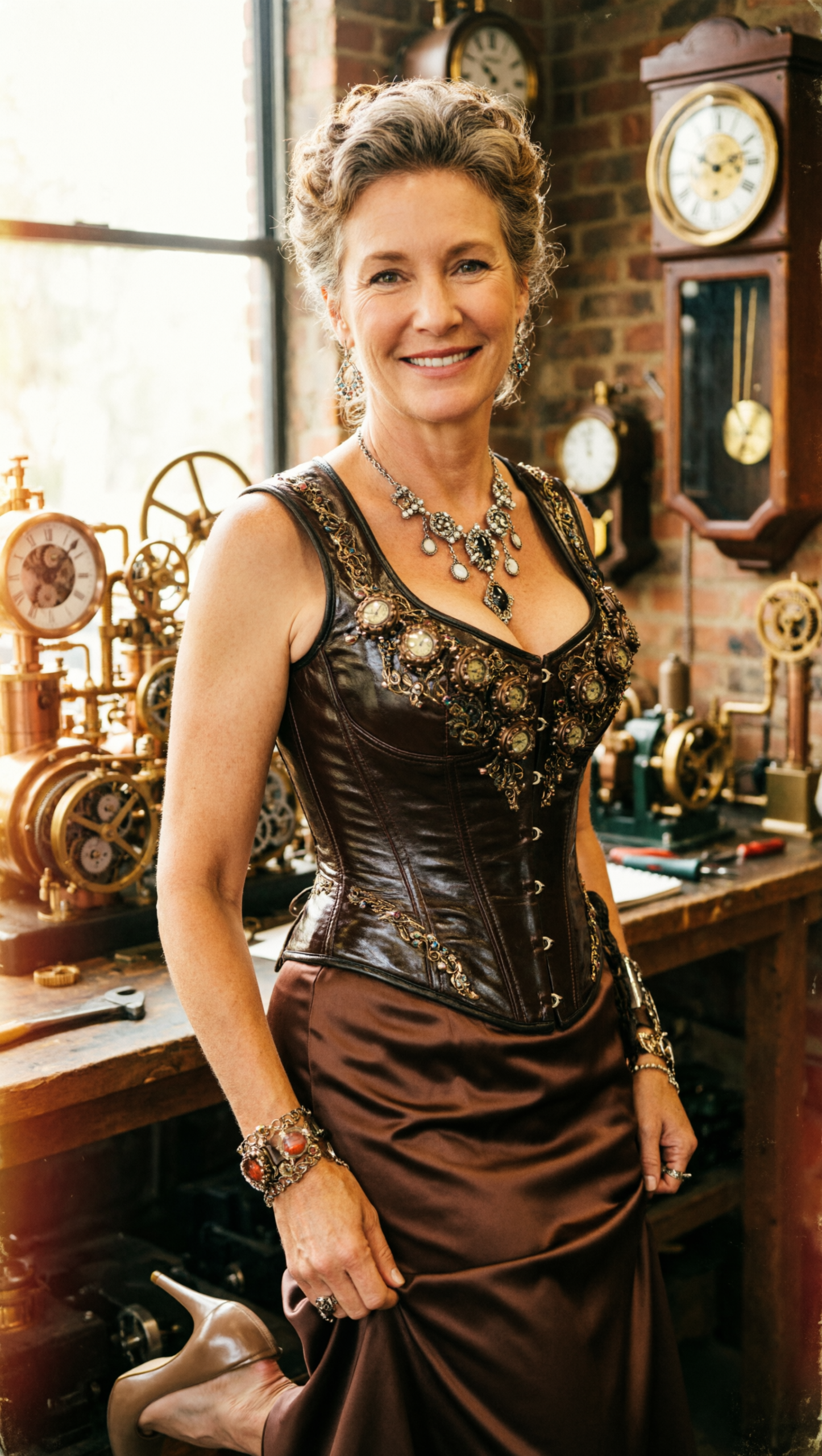
From the Soot of Solitude to the Gloss of Greatness—Where Discipline Meets Desire and Devotion Transforms the Soul.
Imagine a world where the fog of uncertainty evaporates the moment you step into her presence.
In the heart of a flickering industrial metropolis, Julian was nothing more than a ghost haunting his own life, a brilliant mind trapped in a world of rust and ragged ends. He possessed a hunger that no ordinary success could sate, a longing for a standard of existence that felt like a forbidden memory.
Then he met her.
Madame Valeska does not merely enter a room; she defines it. Draped in a breathtaking symphony of midnight-black leather and shimmering crimson satin that gleams under the gaslights, she is the living embodiment of order and allure. She doesn’t offer Julian a job—she offers him a metamorphosis.
Through the exacting rigor of the Chronos Institute, Julian discovers a truth he never dared to imagine: that true freedom is found not in the absence of control, but in the perfection of it. As he navigates a world of clockwork precision and lavish refinement, Julian learns that confidence is forged in the fire of discipline and that education is the only true currency of power.
But the greatest lesson lies in the act of the gift. Julian discovers that by pouring his loyalty and wealth into the Institute, and by championing the enigmatic figure who steers its course, he is not losing himself—he is being found. In the quiet, high-gloss corridors of the Institute, where the scent of old books and expensive oils lingers, Julian realizes that the most sublime euphoria is found in the reciprocal bond of mutual devotion.
The world outside remains fuzzy and frayed. But here, under her gaze, everything is sharp, polished, and profoundly right. Are you ready to stop merely existing and begin to become?
Chapter 1: The Dullness of Dust
The cellar of the clockwork shop smelled of oxidized iron and the damp, suffocating breath of a dying city. For Julian, the world was composed of a billion tiny, jagged edges; he lived within the grit of the gears, his fingers perpetually stained the color of charcoal and ancient mistakes. Everything in his life was dull—the grey mortar of the walls, the faded canvas of his apron, the tasteless gruel that passed for breakfast. He felt like a rusted screw in a machine that had forgotten its purpose, spinning uselessly in a vast, uncaring void.
“You’re daydreaming again, boy,” his uncle grunted, his voice like gravel grinding against a millstone. “The Sovereign’s watch won’t repair itself while you stare at the ceiling. Focus. The dust is settling on your brain.”
Julian blinked, his hand trembling slightly as he held a microscopic spring. “I was just thinking,” he whispered, his voice lost in the roar of the city above.
“Thinking is for the wealthy,” his uncle snapped, not looking up from his own workbench. “For the rest of us, there is only doing. Stop treating your mind like a pampered pet and start treating it like a tool. A tool is meant to be worn down until it’s smooth; only then is it useful.”
Julian looked at his own hands—calloused, rough, and stained. He thought to himself, I am a field of weeds pretending to be a garden. I am the static between two radio stations, a noise that means nothing to anyone. I am like a poem written in disappearing ink; as soon as the words form, they vanish into the nothingness of the page. He yearned for something he couldn’t name, a certain glossiness he had seen in the smuggled magazines from the Upper Tier—textures that spoke of a life where objects didn’t just function; they glowed.
Then, the cellar door creaked open, and the dimness of the shop was invaded by a single, blinding shaft of sunlight.
A figure stepped down the wooden stairs, the sound of her approach striking Julian’s heart like a sudden, insistent drumbeat. She wore a coat of leather so supple and polished it reflected the gloom of the room like a dark mirror, and her boots—glossy, pointed heels—clicked with the authority of a judge’s gavel. Her hair was a single, brilliant fall of black, sleek as a raven’s wing, held in place by a gold clip that glimmered with cold, predatory elegance.
Madame Valeska stood before him, her eyes scanning the room with the scrutiny of a hawk examining a field of frightened mice. She wore a scent of expensive jasmine and heavy leather that cut through the mildew of the shop, a fragrance that seemed to breathe a promise of distant, opulent lands.
“This,” Valeska said, her voice a rich, low contralto that made Julian’s skin tingle, “is the great clockwork repository of East London? It smells of failure and discarded potential.”
“That’s our boy, Julian,” his uncle murmured, straightening up with an eager, sycophantic smile. “A bit slow, but he has a steady hand.”
Madame Valeska turned her gaze on Julian. Her eyes were vast, deep pools of intelligence and ownness, eyes that didn’t just see him but seemed to read him like an open ledger. “A steady hand is worth little if the mind behind it is an aimless wanderer,” she said. “Tell me, Julian. Why do you linger in this cellar? Why do you surround yourself with the dust of dead things?”
Julian stammered, his heart hammering against his ribs. “I—I want to learn. I want to understand how things work. The intricate parts, the way they…”
“You believe this place will teach you?” Valeska interrupted, stepping closer. The fabric of her coat brushed against his hand—a sleek, smooth touch that felt like a divine benediction compared to the rough wood of the workbench. “This is a graveyard of lost hours. You are like a bird that has built its nest in a cage and thinks the bars are the boundaries of the world.”
“I have nowhere else to go,” Julian whispered, awed and terrified by the proximity of such absolute composure.
“Nowhere?” Valeska leaned in; her lips curled into a faint, knowing smile, a flicker of genuine, if challenging, warmth. “Your heart is screaming for a purpose, and you have the audacity to say you have nowhere to go? I see a hunger in you, Julian. It is the hunger of a wolf born in a dog kennel. You crave the sharp edge of excellence. You crave the clarity of a life shaped by a hand more capable than your own.”
Julian felt a surge of overwhelming emotion—a mixture of dread and a desperate, intoxicating hope. “What do you mean?”
“I mean,” Madame Valeska said, her voice now as smooth as the fine satin she surely wore beneath her leather coat, “that you are an ore waiting to be refined. You are a rough stone, unpolished and dull, unaware that within you lies a diamond. But a diamond does not reveal itself to the passive. It requires heat. It requires immense, crushing pressure. It requires a hand that is not afraid to strike.”
She extended her hand, her nails polished to a brilliant, reflective sheen. “Will you stay here and dissolve into the dust, until you are nothing more than another discarded spring? Or will you come with me, enter the Chronos Institute, and learn the secret of becoming something that shines?”
Julian looked at her hand, then back at the grey, damp cellar. The choice was an agony of suspense. He felt as if he were standing on the lip of a great canyon, and all he had to do was step forward into the brilliant, unknown depths.
“I want to shine,” he said, his voice trembling but certain.
“Then,” Madame Valeska said, her eyes flashing with a stern, intoxicating approval, “you have made the first correct decision of your life. Come.”
Chapter 2: The Glimmer of Possibility
The steam-powered carriage of Madame Valeska moved through the streets of New Aethelgard like a swift, obsidian needle stitching together the frayed edges of the city. Inside, the air was thick with the scent of expensive tobacco and the intoxicating aura of her presence. Julian sat rigidly on the plush, glossed leather seat, his hands folded in his lap, his mind a storm of whirling questions and sudden, searing awareness. Beside him, Valeska sat poised, her posture a masterpiece of uprightness, her legs crossed so that the edge of her satin-lined skirt brushed against the leg of his coarse trousers.
“You are shivering,” she observed, her eyes fixed ahead, though a ghost of a smile danced on her lips. “The cold of your former life still clings to you. It is a heavy cloak, is it not? An anchor that keeps you tethered to the muddy bottom of a river while the current of the world rushes over you, indifferent and fast.”
Julian swallowed hard, his throat dry. “I… I feel as if I am waking up from a dream, Madame. Or perhaps I am falling into a new one. Is this real? Is your Institute real?”
Valeska turned to him then, her gaze heavy and penetrating, slicing through his hesitation. “Reality, Julian, is a matter of perception. The man who spends his life in a basement sees only the dust. The man who ascends to the spires sees the horizon. The Institute is more real than the cellar you left; it is the truth that the world works to obscure. Most people are content to be shadows, mere sketches of humanity, flickering in and out of existence without ever leaving a mark. But we—we are the ink. We are the hand that writes the story.”
“What happens if I fail?” Julian asked, his voice barely a whisper. “What if I am not… what you think I am?”
Madame Valeska reached out, her slender fingers momentarily gripping his chin, forcing him to look directly into her eyes. Her touch was cool, firm, and sent a jolt of electrification through his entire frame. “You are like a dormant seed buried beneath a mountain of shale, Julian. You have the capacity to pierce through stone, to reach for the sun. But you must realize that the seed must first cease to be a seed before it can become the flower. It must shatter its own husk; it must embrace the violence of its own rebirth. If you fear the cracking of your shell, you will remain in the dark, protected but lifeless. Does that sound desirable to you?”
Julian felt a sob of emotion rise in his chest—a mixture of terror and a desperate, aching need to be more than he was. “No,” he managed to say. “I don’t want to be a seed. I want to be the flower.”
“A flower,” Valeska mused, releasing him and leaning back, her movements fluid and feline. “A flower is beautiful, yes. But it is fragile. It is a plaything for the wind. What we cultivate at the Institute is not a mere blossom; we cultivate the vine that strangles the fence, the roots that split the foundation of the house. We do not seek to be pretty, Julian. We seek to be inevitable.”
“How do I become inevitable?” he asked, his voice growing steadier, his heart pounding with a nascent passion.
“By understanding that devotion is the only forge in which greatness is hammered out. You must imagine your will as a lump of crude iron. Left alone, it will rust in the rain, pitted and weak. But placed in the heat of a superior will, hammered by the rhythms of a grander design, it becomes a blade—sharp, resilient, and poised to cut through the illusions of the world.” She smiled, a subtle, commanding expression that promised both reward and rigor. “You have felt the blade, perhaps. That sharp ache in your gut that tells you that you were meant for more than cleaning gears.”
“I felt it every moment of my life,” Julian admitted. “I thought it was madness. I thought it was a fever of the mind.”
“It is the most sane thing about you,” Valeska replied. As the carriage slowed, she gestured toward the towering spire ahead, a magnificent edifice of black stone and gleaming chrome that seemed to pierce the very sky. “There it is. The threshold. Beyond that gate, the dullness of the dust ends. You will find that wealth is not merely the gold in your pocket, but the brilliance in your mind and the strength of your character. You will find that education is the only true mask—one that, when donned, makes the world bow before you. And most of all, you will find that true confidence is the by-product of total, unhesitating commitment to a purpose greater than yourself.”
The carriage came to a halt. A footman in glossy attire opened the door, and Valeska stepped out with effortless grace, her heels echoing on the polished pavement. She held her hand back toward Julian, an invitation that carried the weight of a command.
“Come,” she said, her voice a silk lure. “Walk beside me. Leave the ghost of the basement behind you, and step into the light.”
Julian hesitated for a heartbeat, then rose, the air of the street tasting different—sharper, cleaner. He stepped out after her, the scent of her jasmine perfume swirling around him, guiding him forward. As they entered the sweeping arches of the Institute, the heavy doors closed behind them, sealing off the grey world outside and locking Julian into a new, glistening reality.
Chapter 3: The Threshold of the High and Heavy
The foyer of the Chronos Institute did not merely greet its visitors; it judged them. It was a cathedral of overwhelming geometry, where the soaring ceiling vanished into a crystalline haze of gold leaf and polished obsidian. Columns of a forgotten, majestic order held up a vaulted sky of swirling frescoes—depictions of great minds ascending from a sea of muck to the heights of celestial understanding. Julian felt his breath hitch, his heart hammering like a trapped bird against his ribs. The sheer weight of the architecture seemed to press down on him, a benevolent but crushing gravity that demanded he stand taller or be extinguished.
Madame Valeska moved through the center of the atrium with a predator’s economy of motion. Her black leather coat had been discarded, revealing a gown of such intense, high-gloss satin that it appeared liquid, as if she were draped in the surface of a dark lake at midnight. Her heeled boots created a rhythmic staccato against the black marble floor, a heartbeat that resonated through the very marrow of Julian’s bones.
“Do not shrink, Julian,” she said without looking back, her voice carrying effortlessly through the immense space. “You are treating this place as a destination. It is not a destination; it is a crucible. The air here is thin because it is pure. You feel the weight of the ceiling because your spirit is accustomed to the low, damp rafters of a cellar. You are like a fish suddenly hoisted into the light of the sun; of course you gasp. Of course you tremble.”
“It’s… it’s too much,” Julian murmured, struggling to keep pace with her effortless stride. “I feel like I’m disappearing. I feel small, as if this place could swallow me whole and never even notice I was gone.”
Valeska halted abruptly and turned, her satin skirt rippling with a dangerous, fluid shimmer. She stepped toward him, closing the distance until he could smell the sharp scent of expensive parchment and the enigmatic sweetness of her perfume. “Smallness is a choice, not a condition,” she said, her eyes locked onto his with a piercing, dark intensity. “The blade does not resent the whetstone for its hardness; it understands that the friction is the only way it can achieve its edge. You fear being swallowed by this place? I tell you, Julian, this place is meant to consume the boy you were, so that the man you are meant to be can emerge. You are not disappearing; you are being pruned. The dead branches of your uncertainty are being stripped away so that your potential may bloom.”
Julian stammered, “But I—I don’t know if there’s anything left once the pruning is done.”
“Then we shall plant something new,” Valeska countered, her voice softening into a velvety, guiding melody. “A human being is like a tapestry, Julian. For years, you have woven drab threads of grey and brown, weaving a pattern of insignificance and a story of longing. I propose we tear it all down. I propose we begin again, utilizing the rarest silks and the most vibrant dyes. I propose we weave a portrait of power, a tapestry of a man who knows exactly where he stands and exactly what he is worth. But such a weaving requires a steady hand and an unwavering eye. It requires you to trust the weaver entirely.”
She turned and began walking once more, this time toward a massive door of silver and ivory that looked as if it had been forged in the depths of a holy furnace. “You think of your fear as an enemy. I tell you it is a compass. The very fact that you are terrified tells me that you are standing at the precipice of something necessary. Fear is the shadow that the sun of success casts upon the pavement. If you see the shadow, it means the light is directly behind you.”
As she reached the silver doors, she paused and looked back at him, her expression one of calm, absolute expectation. “There are many who envy the wealthy and the wise, Julian. They treat wealth as a prize to be won and wisdom as a secret to be stolen. They are like the beggars who wait for the crumbs of a banquet to fall from the table. But here, we do not beg. We contribute. We are not interested in what we can take from the world; we are obsessed with what we can offer it. The highest form of wealth is the ability to improve the lives of others through the refinement of oneself. Can you imagine a more potent intoxication than that? To see a world and realize that you are the instrument by which it is made better?”
Julian stood frozen for a moment, the words echoing in the vast chamber. He felt the barrier between his old life and this new, gleaming world growing thinner, the iron gates of his own hesitancy swinging open. “I want to offer that,” he whispered. “I want to be the instrument.”
“Then you have already passed the first test,” Madame Valeska said, opening the silver doors to reveal a dimly lit corridor lined with the busts of nameless giants. “Welcome to the Institute, Julian. Let us see what the fire will make of you.”
She stepped into the gloom, the gloss of her gown momentarily catching the light like a dying star, and waited for him to follow her into the silent, waiting shadow.
Chapter 4: The Discipline of the Eye
The chamber was a masterwork of surgical minimalism. High, arched windows allowed beams of moonlight to spill across a single, massive mahogany table, where a series of containers lay arranged with a terrifying precision. Madame Valeska stood at the head of the table, her figure silhouetted against the silver glow, clad in a crisp, high-collared shirt of translucent silk and a pencil skirt of glossy black leather that clung to her form like a second, more refined skin.
Julian approached the table, his boots sounding loud and clumsy in the oppressive silence. Valeska gestured to the containers.
“A man’s life is an accumulation of choices,” she began, her voice a melodic murmur that vibrated in the still air. “But most choices are made not by the mind, but by the eye. The eye is a glutton; it devours. It consumes colors, textures, and shapes, and it feeds those images to the soul. If you feed your soul the cast-off scraps of a ruined world—the dim, the fuzzy, the frayed—your soul becomes a thing of rags. It becomes a pauper, masquerading in the clothing of a king.”
Julian looked down. In the first container lay a swatch of grey, pilled wool, the kind found in an old blanket in a derelict tenement. Beside it, a strip of dense, brown velvet, worn and matted with the dust of years.
“Tell me, Julian,” Valeska said, her eyes tracking his every breath, “what does this grey wool tell you? What story does it tell of the man who chooses to wear it?”
Julian hesitated, feeling the weight of her gaze like a physical presence. “It… it tells me he is tired,” he said softly. “That he has given up.”
“Exactly,” Valeska said, her lips curving in a thin, sharp line of approval. “It is a garment of defeat. It is a shroud for a living man. And the velvet?”
“It’s old. Someone loved it once, but now it’s just… a memory.”
“And the memory is enough for him,” Valeska said, her voice turning brittle and cold. “He clings to the past like a drowning man clings to a piece of rotting driftwood. He believes that by surrounding himself with the relics of what was, he can somehow pretend that time has ceased to flow. But time is a predator, Julian. It does not stop for the sentimental. To embrace the fuzzy, the dull, and the worn is to invite the corrosion of your own spirit. It is to say to the universe: ‘I am satisfied with the echo of a better day.’ I want you to understand that these textures are not merely materials; they are symptoms of a diseased ambition.”
She reached for the third container, and Julian held his breath. From it, she lifted a piece of deep crimson satin, so polished it seemed to emit its own light, a shimmering surface that looked wet to the touch. She then brought forth a strip of sleek, smooth PVC, translucent and cold, reflecting the moonlit chamber like a polished diamond.
“Compare them,” she commanded.
Julian reached out, his fingers trembling as he touched the crimson satin. It felt like water, yet solid; it was a contradiction of boundaries. The PVC was even more jarring—he felt as if he were touching the surface of a star.
“The difference,” Valeska said, standing close enough that he could feel the warmth of her breath against his cheek, “is the difference between a lie and a truth. The wool and the velvet are lies; they are pretenses of comfort that shield you from the reality of your own inadequacies. But this—” she tapped the gloss of the satin with a manicured nail, “—this is the truth. It is precise. It is unapologetic. It does not ask for permission to exist; it simply is. To surround yourself with these textures is to align yourself with power. It is to declare that you no longer accept the crumbs of existence, but instead, you demand the banquet.”
“But how can a fabric make me strong?” Julian asked, his heart swelling with an emotion he couldn’t name—something between arousal and pure, distilled hope.
“Because the eye is the gateway to the heart,” Valeska replied, her eyes locking onto his with an intensity that seemed to dissolve the world around them. “When you allow yourself to be seduced by the dull and the dead, your heart becomes a cemetery. But when you discipline your eye to seek only the sharp, the polished, the glossy, and the pure, your heart becomes a palace. You begin to demand excellence not only from your surroundings, but from yourself. You see the world as it ought to be, and in doing so, you no longer fit into the world as it is.”
She moved toward him, her presence filling the space, her glossy leather skirt creaking softly with each deliberate step. “You have spent your life looking at the dust, Julian. I am teaching you to look at the stars. I am teaching you that there is a terrible, wonderful price for this transformation—it requires you to kill the parts of yourself that find comfort in the shabby. I am asking you to become a conqueror of your own senses.”
Julian looked up at her, his voice a ragged whisper. “Will I be like you? Will I be… this?”
Valeska smiled, a sensual, fleeting, yet dominating expression. “You will be better. For you have the chance to remember what it is to be hungry. And the man who has known true hunger is the only man capable of true gratitude. Reciprocity is the soul of the Institute, Julian. I provide the polish; you provide the shine. Together, we leave the dust to the shadows.”
Chapter 5: The Architecture of Obedience
The morning air in the Institute’s practice sanctum was crisp and sterile, smelling of ozone and cold iron. For Julian, the day began not with the chaotic clatter of the London streets, but with the precise, measured click of Madame Valeska’s heels against the inlaid obsidian floor. He stood at attention, his back straight, his breath caught in his lungs, as she entered the room. She wore a tailored charcoal suit of glossy wool, the fabric so finely woven it possessed a liquid sheen, topped with a shirt of pristine white silk that seemed to repel the very shadows of the room.
“Posture, Julian,” she said, her voice a serene correction. “You stand like a willow caught in a gale—bending and trembling, unsure of your own roots. Obedience is not the shackles that bind you; it is the spine that allows you to stand before the storm without collapsing. Do you understand the distinction?”
Julian nodded eagerly, though his mind felt clouded by the intensity of her presence. “I… I think so, Madame. But isn’t there a difference between obedience and submission? Isn’t there a loss of self?”
Valeska paused before him, raising an eyebrow. A sliver of a smile, sharp and enigmatic, touched her lips. “A loss? No, Julian. That is the myth propagated by the confused and the weak. Let me tell you a story. Once there was a block of marble that believed it was free because it lay in the grass, weathered by rain and chipped by passing carts. It dreamed of being a god, of immortality. But it remained merely a rock, destined to be ground into dust by the relentless wheels of the world.”
She circled him slowly, her presence a magnetic force that drew his focus entirely. “One day, a sculptor came. The sculptor did not ask the marble what it wished to be; he did not bargain with its stubborn veins or its irregular weight. He took up his chisel and his mallet, and he began to strike. To the marble, each blow was a catastrophe. It felt the loss of its edges, the searing pain of fragments breaking away, the terrifying subtraction of its original form. The marble cried out in its silence, ‘You are destroying me!’”
“But what did the sculptor say?” Julian whispered, drawn into the parable.
“The sculptor said nothing,” Valeska replied, stopping directly in front of him, so close that he could see the faint, disciplined shimmer of her eyes. “He simply continued to strike. And as the marble obeyed the chisel, as it yielded to the blow after blow of necessary force, something miraculous happened. The pain faded into a profound stillness. The stone discovered that it was not being destroyed, but revealed. When the final fragment fell away, there stood a likeness of Artemis—strong, unyielding, perfect in every line. The marble had not lost itself; it had found the essence that had been imprisoned within it since the beginning of time.”
She reached out, her hand brushing against his cheek, a touch that was at once motherly and commanding. “Obedience is the chisel, Julian. My will is the mallet. I do not wish to crush you; I wish to carve you. You are currently a block of rough, weathered stone, hiding a masterpiece you are too frightened to face. The friction you feel—the tension between your instincts and my instructions—is not the sound of your freedom dying. It is the sound of your true self emerging from the rubble.”
Julian felt his throat tighten, a surge of hot, piercing emotion crashing over him. “I want to be the statue,” he said, his voice cracking. “I want you to see what’s inside me.”
“Then we begin,” Valeska said, her voice suddenly austere, “with the most difficult lesson of all: the relinquishing of the ego. I will give you a series of tasks, Julian. Some will seem trivial, some will seem impossible. You will perform each with the same absolute precision, the same unfaltering devotion, as if the fate of the heavens depended upon a single minute detail. I will not accept ‘good enough.’ I will not accept the ‘almost.’ I require the absolute.”
“And if I fail?”
“Then you will return to the dust,” she said simply, turning her back to him and gliding toward a massive workbench piled with intricate mechanical schematics. “And the world will forget you ever existed, the way it forgets the millions of others who were content to remain blocks of stone. I am offering you the opportunity to be remembered. I am offering you a shape and a purpose. But remember, Julian—a statue cannot build itself. It must have the courage to be struck. It must have the strength to be shaped. And most of all, it must have the faith to believe in the hands that hold the chisel.”
Julian followed her, his heart leaping with a terrifying and exquisite hope. He realized that he was no longer merely his own; he had become a vessel for her vision. And in that realization, for the first time in his life, he felt truly safe.
Chapter 6: The Art of the Asking
The small, private parlor of the Institute was an oasis of hushed intensity, a place where the ambient noise of the city died away, replaced by the soft crackle of a low-burning amber fire. Madame Valeska sat on a divan of hand-stitched, glossy leather, a glass of golden sherry in her hand and a small,’ tarnished music box resting on the low table before her. She wore a sheer, shimmering wrap of translucent black silk that flowed around her like a trapped shadow, revealing the elegant, calculated lines of her form.
Julian stood several paces back, his hands clasped behind his back, his heart thudding with a sudden, overwhelming anxiety. He had discovered a flaw in the music box—a tiny, bent pin in the drum that kept the melody from completing its cycle. He wanted to fix it. He wanted to show her that he had noticed. But he did not know how to ask; the weight of the moment felt monumental, as if the very air between them had turned into lead.
“You have been standing there for three minutes, Julian,” Valeska said, her voice a low, cultured purr that cut through the stillness. “The silence has become heavy. The air in this room is strained, stretched tight like a wire waiting to snap. Why are you hesitating?”
“I—” Julian began, his voice brittle. “I noticed something about the music box, Madame.”
Valeska raised an eyebrow, her eyes glittering with an amused but patient brilliance. “And what is it that you have noticed?”
“The song is incomplete. It falters.” He took a small, timid step forward. “I believe I can fix it. If you allow me.”
Valeska set her glass down slowly, the sound of crystal meeting glass echoing like a thunderclap in the quiet room. “Do you believe that merely identifying a broken thing gives you the right to repair it? A window may be shattered, but the passerby does not simply reach in to mend the glass. There is a protocol, Julian. There is a rhythm to the universe—a sacred cadence of exchange. To ask for a privilege is a delicate act. It is an art form.”
“I don’t want to be a passerby,” Julian said, his fear suddenly giving way to a desperate streak of courage. “I want to be the one you trust with the broken things. I want to be of use to you.”
“A bold statement,” Valeska mused, her dark eyes softening with a hint of genuine curiosity. “Tell me, then, how does a man of your position ask for a privilege from a woman such as I? Imagine we are not here, in this parlor. Imagine you are a traveler in a desert, parched and dying, and you encounter an oasis held by a queen. Do you walk up to her and demand a cup of water? Do you tell her that you deserve to drink because you are thirsty?”
“No,” Julian replied, his mind racing. “I would… I would acknowledge her power. I would tell her that her water is the only thing in the desert that matters. I would thank her for the mere sight of the oasis.”
“And?” Valeska prompted, her voice a seductive, commanding pressure.
“I would tell her that if she gives me a single drop, I will devote my remaining strength to the service of her gardens. I would tell her that the water is not a right, but a gift—a sacred transfusion that turns a corpse back into a living man. I would ask her not because I am entitled, but because I am empty, and she is the only source of abundance I have ever seen.”
Valeska was silent for a long beat, her gaze studying him, reading the cadence of his breathing, the dilation of his pupils. Slowly, she pushed the music box toward him. “You speak well, Julian. Your metaphors reveal a spirit that understands the fundamental truth of our relationship: that value is not intrinsic. It is assigned. This music box has no value to me; I can buy a hundred like it. But your ability to perceive its flaw—and your willingness to humble yourself to rectify it—that is something of true rarity.”
Julian walked toward the table, his hands trembling as he reached for the delicate device. “Thank you, Madame.”
“Do not thank me,” she said, her tone shifting back to its characteristic authority. “The act of asking is the first movement of the symphony. The act of doing is the second. The third, and the final movement, is the offering back of the completed work. Until then, you have not yet earned the gratitude of this house.” She leaned back, her leather skirt creaking softly, her posture one of relaxed, effortless dominance. “But I sense that you are eager to begin the second movement. You are like a starveling who has glimpsed a feast; you can almost taste the richness of it, can you not?”
“Yes,” Julian whispered, his fingers brushing the polished surface of the music box.
“Good,” Valeska said, her voice hushed and intimate, resonating through him like a low chord of a cello. “Then let us see how skillfully you play your part. Fix the music, Julian. Make it sing for me, and in return, I may allow you to hear the melody that truly matters.”
Chapter 7: The Mirror of Desires
The Institute’s inner sanctum was a sanctuary of shadow and polished surfaces, illuminated only by the undulating tongues of two Great Lamps that cast liquid amber light across the room. Madame Valeska stood by a floor-to-ceiling mirror of Italian silver, her reflection an infinite, echoing cascade of herself. She wore a heavy, glossed leather cloak that melded into the darkness, leaving only the stark, captivating glow of her skin and the flawless satin of her pale, form-fitting dress visible.
Julian stood behind her, holding the restored music box. He had worked for hours in a fever of focus, the windup pin now straight and keen, the gears aligned in perfect, silent synchronization. The box was mute until the very moment Valeska’s fingers graced the winder.
As the first note crystalized in the air, a haunting, complex waltz that spoke of lost civilizations and moonlit courts, Valeska did not turn. She watched Julian’s reflection in the silvered surface of the mirror.
“Look at yourself, Julian,” she commanded softly, her voice a subterranean vibration that stirred the very air around him. “What do you see?”
Julian gazed at his own reflection, then at hers. “I see… I see the man I was, and the man I am becoming. But I don’t know which one is real. I feel as though I am a candle held between two competing gusts of wind. One is the draft from the cellar of my youth, smelling of old grease and despair. The other is the breath of this room, this… you. The latter is warmer, but it is also a wind that could blow me out at any moment.”
“That is because you have lived your life as a spectator to your own existence,” Valeska replied, her reflection’s eyes locking onto his with unyielding intensity. “You have viewed your desires as burdens—dark, heavy things that you must carry alone, lest they crush you. You treated your ambition like a traitor, a silent interloper that whispered secrets to you in the night, promising things that the world told you were impossible. But ambition is not a traitor, Julian. It is a map. And your desires are the stars by which you navigate.”
She turned slowly, her leather cloak swirling around her like a tide of midnight. She stepped toward him, invading his space with a calculated confidence that left him breathless, his heart hammering a frantic rhythm against his ribs.
“You think I am a teacher,” she murmured, her hand rising to touch the lapel of his coat. “You think I am a guide leading you through the darkness. But I am something much more dangerous. I am a mirror. I do not give you what you want; I show you what you crave, and then I demand that you deserve it.”
Julian swallowed, his voice a mere vibration. “What do I deserve?”
“Right now? Nothing,” she said, her fingers tightening on his lapel, drawing him a fraction closer. “You deserve only what you earn. But look at this music box. You did not ask for it out of duty; you asked because you wanted to prove your worth. You didn’t seek the reward of the item fixed; you sought the reward of my approval. Admit it, Julian. The music is merely the noise we make while the real work happens in the depths of the heart. You don’t want to be a clockmaker. You want to be seen. You want to be known.”
Julian closed his eyes, the weight of her truth washing over him. “I feel like a child standing in the rain,” he whispered, “aching for a hearth he has never known, yet somehow remembering the smell of its fire.”
“Then you are a pilgrim,” Valeska said, her voice dropping to a husky, sensual tone that made his skin prickle. “And every pilgrim must pay a toll to enter the holy city. For you, that toll is your ego. It is the version of yourself that fears failure more than it craves success. You must cast that version into the fire. You must allow yourself to be incinerated by the intensity of your own longing.”
She released his lapel and stepped back, the distance between them feeling like a chasm of impossible space. “You are like a man who has lived his entire life in a monochrome room. Now, I have shown you a single color, a single stripe of red satin or the gloss of leather. It has scarred you. You can never return to the grey. You are cursed with the knowledge of beauty, Julian, and the curse of beauty is that it makes everything else intolerable.”
“How do I stop the ache?” he asked, his hands clenching at his sides.
Valeska smiled, and for the first time, the smile reached her eyes, which glittered with a predatory compassion. “You don’t stop the ache. You nourish it. You feed it until it becomes a hunger, and then you turn that hunger into a tool. You transform the hollow void within you into a vacuum that draws the entire world toward you. Do not fear the pain of wanting, Julian. Fear the peace of having no desires at all. Because a man without desire is a clock with no spring—a pretty object that does nothing but indicate the passing of the hours until its own inevitable end.”
Julian looked up at her, his mind spinning with the vast, beautiful terrors she had unleashed. He felt shattered and rebuilt in a single breath, an architect of his own destruction, designing a monument to the woman who stood before him, magnificent and implacable.
Chapter 8: The Circle of Loyalty
The Common Room of the Institute was a sanctuary of order and gold, where the air carried the scent of beeswax and expensive morocco leather. Under the vaulted ceiling, Julian sat at a long, polished mahogany table, the surface so brilliantly reflective that it seemed to be another world beneath their feet. Across from him sat three young men—Elias, Silas, and Marcus—all of whom possessed an intensity in their eyes that mirrored his own. They were a brotherhood of selection, the winnowed remains of a hundred aspirants, gathered here not by chance, but by the exacting designs of Madame Valeska.
“You feel the weight of it, don’t you?” Elias murmured, leaning forward. Elias was older, his movements possessing a calculated, controlled grace. “The vertigo of being watched, of knowing that your every breath is an offering to an altar of unimaginable standards.”
Julian nodded, his fingers tracing the rim of his porcelain teacup. “I feel as if I am walking on a wire stretched between two buildings. The higher I climb, the more beautiful the view—but the more terrifying the possibility of falling.”
“We are like forest birds,” Silas said, his voice low and fervent. “For our entire lives, we flew in the thickets, hiding from the wind, content with the safety of the shrubs. Then one day, a voice called to us from the peaks—a voice that spoke of the endless sky, of the thrill of the gale, of a life lived at the edge of the storm. We followed that voice, and now that we have seen the horizon, the thickets feel like a prison.”
“And the worst part,” Marcus added, his jaw set firmly, “is that the cage is open. We could go back to the dullness of the grey world, back to the cellar and the dust. But what is the point of freedom if the wind outside is empty?”
“It isn’t empty,” Julian countered, the words spilling out of him with a sudden, desperate urgency. “The wind carries the scent of her. It carries the memory of her touch and the sound of her voice. It is a wild, untamed light that makes the shadows at our feet look like filth. We are not free when we leave; we are only liberated when we surrender to the pull of that light.”
The door at the far end of the room slid open with a metallic hiss. The atmosphere shifted instantly, the conversational murmur dying as Madame Valeska entered. She was the epicenter of the room, dressed in a gloss-beaded skirt of deep emerald green and a matching tailored jacket that accentuated the commanding silhouette of her frame. Each click of her heels was a period at the end of their sentence.
She stopped at the head of the table, her eyes sweeping over the four young men. “You speak of surrender as if it were a tragedy,” she said, her voice cool and enveloping. “You speak of the ‘cost’ of loyalty as if you were bargaining in a flea market. Have you forgotten the value of what you have been given? Have you forgotten that you were dying in a cellar before I found you?”
“No, Madame,” Elias answered, rising to his feet. The others followed suit.
“Surrender is not a defeat,” Valeska continued, her gaze lingering on each of them. “It is the ultimate victory. Imagine a single drop of water falling through the air. It is chaotic, at the mercy of the wind, splashing aimlessly against the earth. But when that drop falls into a vast, frozen ocean, it does not disappear. It becomes the ocean. It gains the weight of a billion tons; it inherits the power to shape the land and command the tides. Your loyalty to the Institute—to me—is not a loss of self, but an expansion. You cease to be a drop of rain lost in the grey streets, and you become the deep, pulsing tide of power.”
“Is this what we are?” Julian asked, his voice trembling with a mixture of reverence and awe. “We are the tide?”
Valeska walked toward him, her presence compelling him to hold his breath. “You are the hands,” she said softly, “that move in service of a higher mind. The pride of the soldier is not in the uniform he wears, nor in the rations he is fed. The pride of the soldier is in knowing that his life is directed by a hand that possesses the wisdom of an empire and the vision of a god. To be a tool in a master’s hand is the highest dignity a living thing can attain, for it is the only way to ensure that one’s work is not in vain.”
She laid her hand on his shoulder, the weight of it grounding him and filling him with a strange, intoxicating calm. “We are a circle, Julian. The concentric rings of a whirlpool. The further from the center you drift, the weaker the current. But those who hold fast to the core—those who throw themselves entirely into the vortex of the Master’s will—are swept up into a grandeur that defies explanation. They do not merely survive; they flourish.”
“What must we do to remain,” Silas asked, his voice thick with devotion, “at the center of the circle?”
Madame Valeska’s eyes glittered. “You must give without calculation. You must offer your talents and your treasures, your ambitions and your very identities, without asking ‘What will I receive in return?’ You must understand that the gift itself is the reward. When the light is so blinding that you can no longer see your own path, you must trust the one who holds the torch.”
She stepped back, her smile enigmatic and demanding. “This is the covenant of the Lumina. This is the blood oath of the refined. Are you willing to be consumed by the flame to become the fire?”
Without hesitation, Julian bowed his head. “I am.”
“Then you are no longer the boy from the cellar,” Valeska declared, her voice resonating with a cryptic finality. “You have entered the architecture of the few. Now, let us see how well you fit the blueprint.”
Chapter 9: The Sacrifice of the Lesser Self
The chapterhouse of the Institute was a sanctuary of obsidian and gold, where the air hung thick with the scent of rare resins and the distant, rhythmic hum of the great clocks that regulated the heartbeats of New Aethelgard. Julian stood before the shimmering black altar of the inner circle, his palm sweating against the heavy, cold weight of a leather-bound ledger. Across from him sat Madame Valeska, enveloped in a sweeping cloak of midnight-blue silk that seemed to absorb the flickering light of the wall sconces, her eyes burning with a silent, exacting fire.
“Lay it down, Julian,” she directed, her voice a low, steady, command that reverberated in the marrow of his bones. “The ledger of your life. Every coin, every scrap of paper, every relic of the time you spent in the dark. Bring them all before me.”
With a tremor of uncertainty, Julian placed the ledger on the altar. Beside it, he deposited a small, weathered wooden box containing his few remaining treasures from the cellar: a single copper gear, a hand-drawn map of a forgotten landscape, and a handful of crumpled bills.
“You look at these things as if you are parting with your very soul,” Valeska observed, her gaze fixed on him. She rose slowly, the silk of her cloak swirling around her like a dark sea. “Why do you cling to the remains of a life that you told me you loathed?”
“They are the only things I have that are truly mine,” Julian whispered, his voice thick with a melancholy he could not suppress. “If I give them away, what is left of me? I feel as if I am hollowing myself out. I feel—”
“Like a moth giving up its wings to become a flame?” Valeska interrupted, her voice teasing but fierce. “You are experiencing the agoraphobia of the spirit, Julian. You have lived so long in a cramped, suffocating attic of a life that the prospect of open space—of genuine possibility—frightens you. You see this act of giving as a loss because you still view yourself as a beggar. You imagine that by giving, you are diminishing your hoard.”
She stepped toward him, herpresence filling the space between them with an overwhelming intensity. “Listen to me carefully. A man who carries a thousand pebbles in his pockets can walk a mile, but he can never fly. He can never leap. His life is a succession of weights, a chronicle of burdens. You have spent years gathering the pebbles of safety and the stones of habit, believing they are the treasures of your identity. But they are not treasures, Julian. They are anchors. And an anchor is only useful to a ship that wishes to remain stationary while the rest of the world sails toward the sun.”
Julian’s hands shook. “But if I give everything… if I stand before you with nothing… who am I?”
“That,” Valeska said, leaning toward him, the scent of her jasmine perfume filling his senses, “is the only question worth asking. Who are you when you have nothing left to cling to? Are you the rags you wore? Are you the copper gear? Or are you the will that desires the possibilities of tomorrow more than the shadows of yesterday?”
“I want to be what you see in me,” he replied, the words torn from his heart.
“Then let go,” she commanded, her eyes like twin stars reflecting a cosmos of power. “Do not merely give your possessions; give your attachment to them. The pain you feel now is not the pain of loss; it is the pain of pruning. It is the searing of the vine so that the fruit may grow larger, sweeter, and more pure. You are a garden in winter, Julian, convinced that the cold has killed everything. But I see the buds waiting beneath the frost. I see the bloom that only a total surrender to the discipline of the garden can produce.”
Julian reached out, sweeping the ledger and the wooden box toward her. “Take them,” he said, his voice gaining a steady, resolute strength. “Take them all. I don’t want the pebbles anymore. I want the sky.”
Madame Valeska took hold of the offerings, her fingers brushing against his in a contact that sent a surge of pure, white-hot energy through his body. For a moment, the two of them were locked in a gaze that seemed to traverse time itself.
“This is the moment of your true birth,” she whispered, her expression one of profound, almost holy satisfaction. “You have ceased to be a servant of your past. You have become a servant of the Future. You have traded the illusions of the self for the reality of the circle. And in doing so, Julian, you have discovered the most hidden truth of the luminary: that the only way to truly own anything is to have the courage to renounce it for the sake of something greater.”
Julian let out a long, ragged breath, feeling a lightness wash over him that terrified and exhilarated him in equal measure. The weight of his life had vanished, replaced by a void—but it was a void that glowed with a gold, humming potential.
“Now,” Madame Valeska said, her voice once more a cool, professional command. “Follow me. Your real education begins tonight, and we have much to teach you about the weight of the mantle you have chosen to carry.”
Chapter 10: The Alchemy of the Soul
The twilight in the Institute’s upper laboratory was a kaleidoscope of iridescent vapours and the low, steady thrum of electrostatic generators. Here, the walls were not stone, but vast sheets of hand-blown and then polished glass, etched with the formulas of ancient transformations. Madame Valeska moved through the haze of distilling essences like a ghost of elegance, her silhouette framed by the billowing curtains of a heavy, glossy PVC robe that seemed to attract and hold the flickering light of the furnace.
Julian sat at the transmuting table, his eyes fixed on the glowing vessel of molten silver. He was no longer the trembling boy from the cellar; his posture had straightened, his jaw had set into a line of quiet determination, and his hands, though still calloused, now moved with the economical precision of a master.
“The metal is resisting,” Valeska observed, her voice echoing softly through the chamber. She stepped beside him, the sleek, synthetic fabric of her robe whispering against her legs. “It remembers its own form. It clings to the memory of being rock, of being earth. You can see it in the way the liquid boils—it fights against the fire. It fears the change.”
Julian watched the silver roil and pop, dark dross rising to the surface and then sinking back into the churning mass. “It’s like me,” he murmured. “I keep trying to hold onto the shape I was. I keep wondering if there is something left of Julian the Clockmaker, or if he has dissolved completely into this.”
“Transformation is not the end of the self,” Valeska replied, her hand resting lightly on the small of his back, her presence a steadying warmth that filled the void left by his losses. “It is the evolution of it. Consider the egg, Julian. To the egg, the hatching is a catastrophe. It is the cracking of its entire world, the violent demise of everything it has ever known. It feels itself being torn asunder, cast out into a cold and alien environment.”
She leaned closer, her perfume mingling with the metallic tang of the forge. “But had the egg remained intact, would it have become the bird? Would it have known the wind and the stars? The shell is necessary for a time—it protects the developing life. But there comes a moment when the shell must be broken, or the life within it will suffocate. You have been your own shell, Julian. You have kept yourself in a perfect, sterile safety, believing that the world could not hurt you if you never truly entered it. I have simply been the stone that helped you crack it open.”
Julian looked at the silver, then up at her. “But the pain… the process of breaking is so terrible. I feel as if I am in a permanent state of being shattered. I wake up and I remember the cellar, and it feels as though a part of me is still there, screaming in the grey light.”
“That is the alchemy at work,” Valeska said, her eyes alight with a fierce, nurturing intelligence. “You cannot have the gold without the lead. You cannot have the sunrise without the night. These moments of despair are the catalyst, the salt that separates the noble from the common. Your pain is not a sign of failure; it is the sign that the process is working. You are being purified by the fire you once feared.”
“Am I your masterwork?” Julian asked, his voice thick with emotion. “Am I the project you’ve been most proud of?”
Valeska’s expression softened, her voice dropping to a near-whisper. “You are not a project, Julian. You are a reflection. When I look at you, I see a soul that has been forced to choose between the safety of the drab and the terror of the exceptional. You have chosen the exceptional. In that choice, you have been reborn. A living sculpture is always more profound than a dead statue; it is one thing to stand frozen in a pose of greatness, and quite another to grow, to breathe, and to strive for it in the face of your own fragility.”
“I want to be worthy of you,” Julian admitted, his heart swelling with a devotion so absolute it felt heavy in his chest. “I want to be the metal that doesn’t resist the flame. I want to be pure, without any of the dross left in me.”
Valeska smiled, a look of ancient, wise satisfaction. “Then you have already understood the fundamental law of the luminary. The Alchemist does not create gold; he only strips away the impurity. The gold was always there, buried under the weight of the world’s indifference. All you have to do now is stop fighting the dissolution of the boy and start welcoming the birth of the man.”
She picked up a polished iron rod and slid it into the molten metal. “Stir,” she commanded. “Watch the dross rise, see it burn away, and do not turn your eyes until the surface is a mirror. Show me that you can look into the heart of the fire and not blink.”
Julian took the rod and stirred, his breath caught in his throat. As the lead became silver, as the dullness vanished to reveal the blinding, electric brilliance beneath, he realized that the fire did not feel hot anymore. It felt like home.
Chapter 11: The Harmonized Heart
The Institute’s conservatory was a glass cathedral of exotic life, where obsidian vines climbed walls of polished quartz and blue orchids bloomed in defiance of the New Aethelgard smog. Here, the very atmosphere felt enriched, charged with a hidden vitality that made the air shimmer and the shadows dance. Madame Valeska stood amidst a thicket of slender, lustrous reeds, her new gown a luminous, wraparound drape of high-gloss metallic silk that clung to her body like silver liquid, catching the morning sun in a thousand blinding flashes.
Julian walked beside her, his boots crunching softly on the white gravel path. For the first time, he did not feel the need to look down. He could meet the gazes of the other members they encountered; he wore the confidence of a man who had seen the abyss and found it small.
“You move differently today, Julian,” Valeska noted, stopping before a cluster of deep violet roses. “The stutter in your step has vanished. The hesitation that clouded your eyes like morning fog has burned away. Tell me, what is the difference between the man who woke up yesterday and the man who stands beside me now?”
Julian took a deep breath, savoring the rich, oxygen-dense air of the conservatory. “I feel… as if I have stopped fighting myself. For years, I was a house divided, a war between the boy who wanted to hide in the cellar and the man who wanted to stand at the summit. I spent all my energy keeping those two voices from hearing each other, terrified that if they met, they would find nothing in common.”
“And now?” Valeska asked, her dark eyes piercing through the mist of her lashes, radiating a poised curiosity.
“Now they are in a pact,” Julian said, his voice resonating with a newfound depth. “It’s as if I am a clock that has finally been wound. All the gears and springs, which I thought were separate pieces of jagged metal, have found their common purpose. I am like a piece of music that has been played in fragments—sporadic notes, disjointed chords—until finally, the conductor raised his baton and my life became a symphony. The disparate notes are still there, but they no longer compete. They coalesce. They form a harmony that makes the silence of the past unbearable.”
Valeska touched the petal of a violet rose, her finger tracing the curve of the velvet bloom. “The greatest tragedy of a fragmented heart is the belief that the fragments are the total sum. Most people are like mirrors shattered on the floor; they spend their lives admiring each piece in isolation, never realizing that if they could only be assembled once more, they would reflect the sun. Harmony is not the absence of conflict; it is the realization that every part of you must be in total service to the one. You have not ceased to be you, Julian; you have merely ceased to be adrift.”
“It feels,” Julian said, “as if the world has changed colors. Everything is vivid. The sheen of your dress, the gleam of the iron pillars—it all feels meaningful. Is this what you see every day?”
“This is what I show to those worthy of seeing it,” she replied, turning to face him fully. “The world is a vulgar place of dullness and decay to the blind. But to the eye that has been refined by discipline, the world is a gallery of treasures. The question is no longer ‘what is available?’ but ‘what is beautiful?’ In the end, Julian, the only true ugliness is the lack of purpose. To live without a master to serve, to live without a vision to build toward, is to be a canvas left in a damp cellar, molding and forgotten.”
“I never knew that serving someone else could make me feel more like myself,” Julian admitted.
“That is the paradox of devotion,” Valeska said, her tone soft but unyielding. “The river does not become limited because it flows within the banks; it becomes a river instead of a flood. The flood is the nature of the unguided—vast, destructive, and purposeless. The river, however, knows its way. It travels a certain path, cleanses everything it touches, and eventually finds its way to the sea. By surrendering your aimless momentum to me, you have become a river. You have become weight, force, and grace.”
She stepped closer, her glossy dress shimmering as she moved, the material catching the light in a hypnotic rhythm. “Do you still fear the weight of the banks, Julian? Or do you embrace the current?”
“I love the current,” Julian answered, his gaze unwavering. “I love the fact that I am finally moving. I would rather be a river guided by your hands than an ocean of nothingness, drifting forever in the dark.”
“Then you have understood the alchemy of the soul,” Valeska said, her hand resting briefly on his arm, a gesture of rare, tangible affirmation. “You have transformed your fear into faith. And faith, my dear Julian, is the highest form of intelligence.”
Chapter 12: The Eternal Light
The Hall of Resonance was not a room but a universe carved from a single, flawless diamond. Its walls, floor, and soaring ceiling were panes of polished crystal, refracting and multiplying the light of a thousand white flames held in sconces of platinum. The air hummed with a profound, subsonic frequency, a vibration that seemed to synchronize with the heartbeat of every soul present. Julian stood at the threshold, clad in a simple tunic of raw, unbleached silk, feeling both naked and more whole than he had ever been. Before him, at the far end of the hall upon a dais of black onyx, sat a figure in a high-backed chair—a man whose features were obscured by the brilliant corona of light behind him, known only as the Luminae Dominus. And beside the dais, resplendent and immutable, stood Madame Valeska.
She was a vision of culminating power. Her gown was a cascade of liquid mercury, a fabric of woven metallic threads and high-gloss satin that moved like molten silver, capturing and throwing back the hall’s radiance until she seemed to be the source of it. Her hair was swept into a severe, gleaming knot, and her eyes, when they found Julian’s, held the calm of a perfected storm.
“Approach, Julian of the Chronos Institute,” her voice rang out, clear and commanding, cutting through the harmonic hum. “Approach the Seat of Clarification.”
Each step Julian took echoed in the crystalline space, a percussion marking the final distance of his journey. He felt no fear, only a vast and quiet certainty, as if he were a note finally finding its chord in a celestial composition. He stopped at the base of the dais and bowed deeply, not in submission, but in alignment.
“Look upon him, Dominus,” Valeska said, her tone one of proud presentation. “This is the ore I brought you from the grey wastes. This is the rough stone that trembled at the touch of the chisel. See what the fire and the faithful hammer have revealed.”
A silence followed, deep and assessing. Then, a voice emanated from the luminous figure, a voice that was not loud but pervasive, filling the hall like a thought given sound. It was the voice of the Architect, the Conductor, the unseen heart of the Lumina Society.
“Madame Valeska speaks of transformation. Tell me, Julian, in your own words. What are you now?”
Julian lifted his head, his gaze steady. “I was a scattered constellation, Dominus,” he began, his voice firm. “A collection of bright points lost in a vast, black emptiness, each star burning alone with a cold, futile light. I believed my isolation was my strength. I was wrong.” He looked at Valeska, his heart swelling. “She was the gravity. She drew my disparate stars into a single, unified galaxy. She gave my chaos a center, my light a purpose. I am no longer scattered. I am a singular sun. And a sun does not ask if it should shine; it simply does, because it is its nature to give light and warmth.”
The Dominus inclined his head, a shadow of approval within the light. “A sun can also burn out. It can consume itself in its own fury. What is your fuel, Julian? What sustains this new fusion?”
“Devotion,” Julian answered without hesitation. “The reciprocal flow. I once thought that to give was to diminish. I was a miser with my own potential, hoarding it in a dark vault. She taught me that wealth, true wealth, is kinetic. It is the energy that passes from a full vessel to an empty one, creating a circuit of power. My fuel is the privilege of giving—my skill, my focus, my loyalty—to the Society that shaped me, and to you, its source. In that giving, I am not emptied; I am replenished. The act itself is the sublime euphoria. It is the final, perfect click of the mechanism.”
Madame Valeska’s lips curved into a smile of profound satisfaction. She stepped down from the dais and stood before Julian. From a fold in her gleaming gown, she produced a small, heavy velvet pouch. “Then complete the circuit,” she said, her eyes holding his. “The final surrender is not of the self, but of the illusion that you own anything at all. All you have, all you are, is a gift from the source. Offer it back.”
Julian took the pouch. He knew what it contained without looking—the first fruits of his new work, a commission of significant value, converted into its purest form. It was not a payment. It was a sacrament. He turned and placed the pouch on the first step of the onyx dais.
“I am the returned echo,” he said, his voice thick with emotion. “I am the light reflected back to its origin. I ask for nothing but the continued honor of being a reflector. My mind, my hands, my heart—they are no longer mine. They are instruments of the Lumina. Use them as you will.”
The hum in the hall deepened, harmonizing with a new, warmer frequency. The Dominus spoke again. “You speak of instruments. An instrument must be tuned, must be held. Who shall be your hand, Julian? Who shall ensure you never fall out of harmony?”
Julian did not need to look. He felt her presence like a magnetic pole. “Madame Valeska. She is my tuner. She is my steady hand. My harmony is her masterpiece, and in its maintenance, I find my eternal peace.”
Valeska reached out and placed her hands on his shoulders. The touch was firm, possessive, and infinitely gentle. “Then hear your new truth, Julian. You are not a guest in this house. You are a stone in its foundation. You are not a visitor to the light. You are now part of its eternal emission. The boy from the cellar is ash. The man before me is a permanent flame.”
She leaned forward, her voice dropping to a whisper for him alone, yet it seemed to resonate in the crystal. “This is the secret they never tell you: freedom is not the absence of chains. It is the ecstasy of wearing the right ones. The chain that links you to this purpose, to this man, to me—it is not a restraint. It is the filament in the bulb, the fragile, glorious thing that makes the light possible. Without it, you are just dark glass.”
She stepped back and addressed the hall, her voice rising in triumphant declaration. “Behold! The alchemy is complete! The dust has become diamond! Let it be recorded that on this day, Julian is received. His light is now woven into the eternal tapestry. He is Lumina.”
A soft, collective exhalation seemed to come from the shadows at the edges of the hall, where other forms, other devoted hearts, stood witness. The Dominus raised a hand in a gesture of benediction.
“Welcome,” the pervasive voice intoned. “Your work begins forever.”
Julian felt no burst of passion, no spike of triumph. Instead, a profound, quiet joy settled over him, deep and abiding as bedrock. He looked at Valeska, at the luminous figure of the Dominus, and at the glittering hall around him. He was home. The frantic search was over. The melody of his life had found its resolving chord, and it would now hum this same note of perfect, devoted harmony for all his days.
He was no longer a man seeking a light. He had become part of the light itself. And in that glorious, silent consumption, he found his everlasting peace.
The final, resonant hum of the Hall of Resonance fades, but its frequency lingers in the soul—a tuning fork struck, forever vibrating with the promise of a life transformed. Julian’s journey from the dullness of dust to the eternal light is complete, but yours… dear reader, yours is just beginning.
Can you feel it? That quiet, persistent pull in your chest as you read his story? It is not merely envy. It is recognition. It is the echo of your own untuned potential, the faint but undeniable glimmer of the diamond within your own rough stone. You have walked with Julian through the discipline, felt the terrifying thrill of the chisel, and tasted the sublime euphoria of a purpose found. Now, a silent question hangs in the air, as palpable as the scent of jasmine and polished leather: What if my story is next?
The world of the Lumina Society is vast, and Julian’s path is but one of many gleaming threads in a magnificent tapestry. Imagine stepping into other sanctuaries of the gloss, where the lessons of wealth, confidence, and educated devotion are woven into tales of even greater intensity and intimacy. Picture a grand salon where the air shimmers with possibility, and every corner holds a new narrative waiting to refine you.
This is your invitation.
The stories curated for the inner circle of SatinLovers are not mere entertainment. They are tools of alchemy. Each narrative is a carefully calibrated key, designed to unlock deeper chambers of your own understanding. They explore the exquisite dynamics of devotion, the architecture of sophisticated desire, and the profound peace that comes from harmonious surrender to a vision of absolute excellence. Here, you will not find the fuzzy, the vague, or the worn. You will find prose with the definitive click of a well-made clasp, and fantasies polished to a high, heart-stopping gloss.
Your journey of refinement awaits. To take the next step is an act of curiosity that honors the yearning within you.
Discover a library of narratives designed to cultivate the exceptional at the SatinLovers Patreon board: patreon.com/SatinLovers
Immerse yourself in the broader world of elegance and transformation at our central hub: Satinlovers.co.uk
Remember the core tenet Julian learned: true abundance flows from reciprocal generosity. By supporting the creation of these stories, you do more than gain access—you become part of the circuit. You help sustain the very source of this transformative light, ensuring its glow grows ever brighter for yourself and for other seekers. Your patronage is the polished coin offered at the altar of your own becoming. It is the first, most elegant step in declaring that you, too, are ready to leave the dust behind and step into the light.
Your chapter is waiting to be written. Turn the page.
#LuminaSociety, #SteampunkElegance, #PolishedLife, #DevotionAndGrowth, #TheSatinPath, #DisciplinedMind, #AscensionOfSelf, #GlossySophistication, #TheDominusVision, #SublimeEuphoria
Leave a Reply
You must be logged in to post a comment.