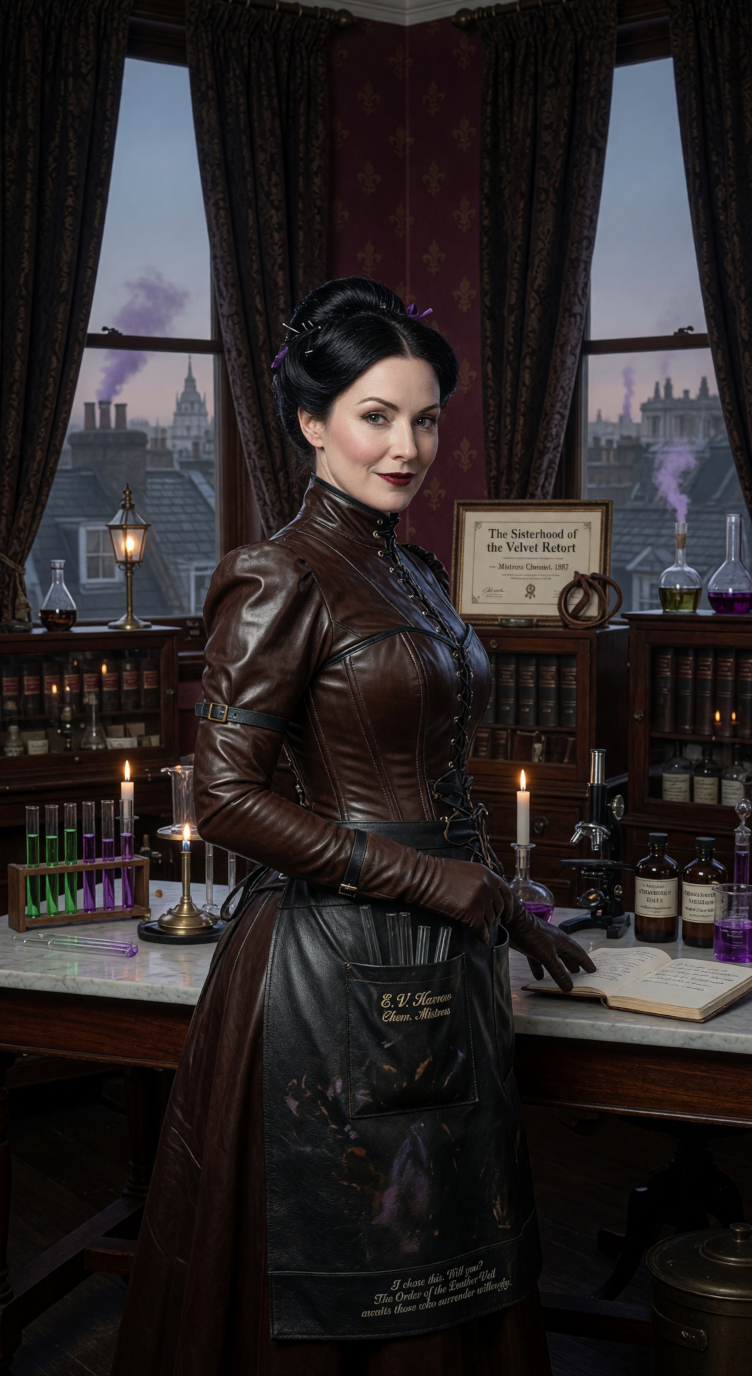
In an Alternative London of Gaslight and Gloss, a Brilliant Mind Discovers that the Greatest Transformation is Not of Lead into Gold, But of a Lonely Soul into a Cherished Acolyte.
Have you ever felt it? The dull, grey ache of a world that sees your mind but not your heart? The gritty soot of Bloomsbury clinging to your skin, the rough wool of your existence chafing against a spirit that yearns for sheen, for softness, for a purpose that gleams?
Imagine a letter, arriving on paper the colour of clotted cream, scented with night-blooming jasmine. An invitation from a woman who is legend. Lady Seraphina de Vayne does not reside in Mayfair; she presides over it. Her laboratory is a cathedral of light, her disciples move with the silent grace of a sisterhood sworn to a higher chemistry. And her gowns… oh, her gowns are not mere clothing. They are declarations: liquid satin that drinks the gaslight and radiates warmth; supple leather that whispers of authority and tender restraint.
She seeks an apprentice. Not for servitude, but for transfiguration. She offers to strip away the grime of your neglected potential, to bathe you in the oils of citrus and rosemary, to clothe your new skin in ivory silk that feels like a cool, forgiving kiss. She will teach you the poetry of the periodic table, yes. But her true alchemy is of the soul. She will show you the profound, heart-stopping security of surrendering to a masterful, mesmerising feminine will. She will introduce you to the inner circle, where wealth is compounded not for greed, but for a legacy of care, where confidence is not a shout but a serene, satin-clad certainty, and where the deepest longing of a passionate heart—to be seen, known, and utterly claimed—is not a shameful secret, but the very philosophy of the house.
This is not a story of escape. It is a story of homecoming. It begins with a formula posted in despair, and ends with a key placed in your palm, a polished crest resting against your breast, and the understanding that the most exquisite reaction of all is the one between a willing heart and the woman destined to be its guardian.
The Satin Crucible: Chapter 1 – The Soot and the Solution
The air in the Bloomsbury attic was not merely cold; it was a particulate solid, a suspension of coal-dust and despair that settled upon every surface with the grim finality of a shroud. Elara Vance moved through it as a ghost might move through its own tomb, her fingers, stained the colour of old bruises and chemical regret, tracing the familiar contours of her glassware. The single, sputtering gas-jet cast a jaundiced light, painting long, trembling shadows that seemed to cling to the rough, dun-coloured wool of her dress—a fabric so coarse it felt less like clothing and more like a penitent’s hair shirt, a constant, scratchy reminder of her place in the granular hierarchy of the world.
“One more adjustment,” she whispered to the silent air, her voice a hoarse thing from disuse. “The equilibrium is too fragile. It must hold.”
Before her, in a crystalline receiver that seemed to hold the only pure light in London, glimmered her solution. It was a water-clear liquid, a miracle born of nitric acid, silver nitrate, and a proprietary catalyst of her own devising—a catalyst whose nature she would carry to her grave rather than see it co-opted by the blunt, grasping hands of men like Professor Alistair Finch. It rendered the foulest Thames effluent, thick with the city’s biological secrets, as clear and potable as a Highland spring.
“The problem, Miss Vance,” Finch’s voice echoed in the chamber of her memory, oily and condescending, “is one of practicality. A woman’s mind, while occasionally nimble with detail, lacks the constitutional fortitude for the grand narrative of science. Your formulae are pretty curiosities. Leave the synthesis of theory and application to those built for the burden.”
The memory was a reagent that still burned. She had been his assistant, her mind a library he plundered for footnotes to bolster his own mediocre treatises. Her ideas, presented as timid suggestions, would reappear weeks later as his own bold conjectures. Her longing for mentorship, for a guiding hand that was not also a fist clenched around her intellect, had curdled into a hard, silent pellet of resentment in her gut.
Tonight, that pellet dissolved in a new solution: a final, defiant hope.
She took up her pen. The nib scratched across cheap, porous paper, drinking the ink as greedily as the dust drank the light. She described her process not with the flowery language of the journals, but with the stark, elegant logic of mathematics and observed reaction. It was a love letter to truth, written in the dialect of stoichiometry. As she wrote, a fantasy, fragile as a soap bubble, formed in the chill air. She pictured a reader—not Finch, not any of the Royal Society’s pompous old men—but a discerning mind. A mind that would see past the clumsy handwriting and the feminine name, and perceive the beautiful, ruthless architecture of the idea within. A mind that would not seek to dominate it, but to… appreciate it. To understand it so completely that to be under its gaze would feel less like scrutiny and more like a form of sublime, intellectual surrender.
The fantasy was so vivid it felt like a physical warmth unspooling in her chest, a sharp contrast to the pervasive cold. It was a sensation not unlike the first touch of sunlight after a month of fog, or the imagined slide of something impossibly soft—satin, perhaps, cool and forgiving—against skin perpetually chapped by lye and neglect. It was a yearning. A yearning to be deciphered by a consciousness greater than her own.
With a sigh that misted in the air, she blotted the final page. The act of folding the manuscript, of sealing it in its brown paper wrapper, felt like laying a child in a foundling basket. She addressed it to The Journal of Practical Chemistry. The walk to the post-box was a journey through a city asleep in its own grime. The cobbles were slick with a nameless damp, the fog muffling all sound until her own footsteps were the only heartbeat in the world. She passed a milliner’s window, and for a fleeting second, her reflection superimposed itself upon a display of evening gloves. They were of a material that caught the faint gaslight and held it, a deep burgundy that seemed to glow from within. Satin. The word arrived in her mind with the force of a forgotten sense memory. It spoke of a world of pressed linens, of whispered conversations in drawing-rooms that smelled of beeswax and brandy, of a touch that was authoritative yet luxuriously gentle. A world as alien to her as the surface of the moon.
She thrust the package into the iron maw of the post-box. The clang of the slot was a door closing, a verdict rendered. The warmth of her fantasy guttered and died, extinguished by the creeping, familiar chill. The return to her attic was a descent.
Weeks bled into one another, a monotone solution of anxiety and dwindling hope. Then, the journal arrived. With trembling, soot-stained fingers, she tore the wrapper. There, on page forty-seven, was her formula. Her heart gave a wild, painful lurch against her ribs, like a trapped bird. But directly beneath the elegant chemical notation, the credit line read: ‘A Novel Method for Aquatic Purification, by Professor Alistair Finch, F.R.S.’
The world did not go dark. It simply ceased to have colour or meaning. The words were not a theft; they were an annihilation. He hadn’t just taken her work; he had erased her from the narrative of its creation. She was the soot on the windowpane, wiped away to afford a clearer view for his own glory. The precipitate of her despair settled in her bones, a heavy, inert mass. The scratch of her wool dress was now an agony, a constant rasp against a spirit laid raw. The fantasy of the discerning mind, of the satin-soft appreciation, seemed now a cruel joke, a phantasm born of isolation and a pathetic hunger for a validation that the world was structurally designed to withhold.
For three days, she moved through the motions of life like an automaton whose mainspring had snapped. She ate when hunger became a sharp pain. She tended her equipment out of mute habit. The glorious solution in its receiver now seemed to mock her, its clarity a mirror reflecting only her own profound irrelevance.
On the fourth morning, as a thin, grudging light strained through the grime-caked window, a different envelope slid beneath her door.
It was not the buff-coloured paper of a journal or a bill. It was a thick, substantial rectangle, the colour of rich, clotted cream. It seemed to glow against the floorboards’ dreary brown. A scent arrived with it, a complex bouquet that cut through the attic’s smells of dust and acid: night-blooming jasmine, yes, but underpinned by sandalwood and something else… crushed violet leaves, perhaps. It was the smell of a hidden garden behind high walls, of private, cultivated beauty.
Her breath hitched. With a reverence that felt foreign in her workaday hands, she retrieved it. The paper was heavy, its surface smooth as a still pond. The seal was not plain wax; it was a small disc of crimson, impressed with an intricate crest—a crucible embraced by a serpent and a lily. The symbolism was obscure, potent, undeniably feminine.
A frisson, entirely new, travelled up her spine. It was not hope. It was something more primal, more unsettling. It was the sensation of being seen, not for the facade of her poverty or her gender, but through the layers of soot and struggle, down to the lonely, luminous core of her mind. It was the first, faint, terrifying note of a siren’s call.
With a nail she carefully broke the seal. The single sheet within was of the same exquisite stock. The handwriting was not the hurried scrawl of commerce or the rigid formality of institutions. It was a flowing, confident script, each letter formed with an artist’s care, the ink a deep, velvety black.
She read.
Your mind calls out from the grime. I would answer it.
Present yourself at 17, Veridian Square, Mayfair.
Come as you are.
—S.
Four lines. Twenty-three words. They hung in the frigid air of the attic, vibrating with a silent, immense power. The directive was absolute. ‘Come as you are.’ It was an acceptance, and yet, it felt like the first, gentle, inexorable pull of a current she had no wish to fight. The grime. The soot. The rough wool. The years of intellectual loneliness. ‘S.’ did not offer to ignore it. She offered to meet her within it, and by some alchemy Elara could not fathom, transmute it.
The particulate solid of her despair seemed to stir, agitated by this new, fragrant element. The precipitates in her soul began, hesitantly, to dissolve. Something was coming. A reaction, long awaited, was finally initiated.
She stood, the letter held between her stained fingers, the scent of jasmine and sandalwood rising to envelop her. Outside, the grey London morning continued, oblivious. But inside the tomb of the attic, for the first time, a crack had appeared in the shroud. And through it, not sunlight, but the promise of a different, more radiant heat altogether, began to seep.
Chapter 2 – The Gilded Summons
The cream-coloured letter lay upon Elara’s scarred worktable like an alien organism, its perfume of jasmine and sandalwood an aggressive, beautiful contagion in the acid-tinged air. For three full days, it existed as a point of impossible contradiction in her world. She did not touch it again, as if its very fibres might burn her work-roughened skin, yet her eyes returned to it with the compulsive frequency of a tongue probing a sore tooth. It was a siren’s call inscribed on vellum, and the part of her that was still the hopeful girl, the part that had not yet been calcified by Professor Finch’s theft, strained toward it with a terrifying, gravitational pull.
“To go is madness,” she told the silent glass beakers, her voice a rasp in the stillness. “A woman of that station does not summon a chemist from a Bloomsbury attic to discuss molar ratios. It is a trick. A cruel jeu d’esprit by some bored aristocrat.” The logic was sound, a sturdy wall built of bitter experience.
Yet, another voice, quieter but threaded through with a strange, resonant certainty, answered from a deeper place. ‘Your mind calls out from the grime.’ The words were not an observation; they were a diagnosis. They spoke not to her circumstance, but to her essence. They acknowledged the grime as a condition, not a definition. It was the first time anyone—any thing—had ever perceived the distinction. That perception, in itself, felt like a form of intimate, terrifying violation. It was as if a hand, gloved in the finest kid leather, had reached through the soot-stained window and laid its palm directly upon the fevered core of her loneliness.
On the morning of the fourth day, the conflict resolved itself not through decision, but through a failure of resistance. The attic, once a sanctuary of ordered inquiry, now felt like a prison whose bars were of her own forging. Every surface mocked her. The rough wool of her dress, which she had once worn as a badge of pragmatic sacrifice, now felt like a hairshirt woven from her own diminished expectations. The very dust motes dancing in the weak light seemed to spell out ‘Finch’ in a relentless, silent taunt.
With a shudder that began in her soul and rattled her teeth, she moved. She poured what remained of her precious purified water into a chipped basin and scrubbed at her face and neck until the skin shone pink and raw. She attempted to brush her hair, but the dark, unruly mass, starved of proper care, resisted, tangling around the brush like thorny vines. She had no other dress. The dun-coloured wool would have to be her ambassador. She smoothed it down, her fingers catching on the pills and snags, each one a tiny testament to a life of abrasive encounters.
The journey from Bloomsbury to Mayfair was a traverse not merely across London, but across the stratified geology of human existence. She walked, for the hackney fare was a luxury her dwindling coins could not sustain. With each step, the city underwent a subtle alchemy. The gritty, cacophonous symphony of the commercial districts—the shouts of costermongers, the rumble of drays, the pervasive smell of horse and humanity—began to mute. The buildings, which in her neighbourhood leaned together like gossiping drunks, here began to stand apart, aloof and upright, clad in clean Portland stone. The very air changed, growing colder, clearer, thinner, as if she were ascending a mountain.
Her heart was a trapped bird, fluttering against the cage of her ribs. She rehearsed scenarios in her mind, each more absurd than the last. Perhaps she would be met by a stern butler who would take one look at her and direct her to the servants’ entrance. Perhaps she would be ushered into a grand drawing-room only to be presented as a curiosity for a soirée—‘Look, the poor little chemist-mouse we found in the wainscoting!’ The fantasy of the discerning mind now seemed a childish delusion, a fairy tale she had been foolish enough to half-believe.
Veridian Square was a revelation of silent, moneyed power. A perfect geometric garden, immaculately tended even in the depths of winter, lay in the centre, surrounded by a black iron fence as delicate as lace and as forbidding as a portcullis. Number 17 was not the largest house, but it commanded the eye. Its façade was a study in restrained elegance, the windows tall and clean, revealing nothing of the life within but hints of rich, dark fabric draping.
Taking a breath that felt like drawing shards of glass into her lungs, Elara climbed the four shallow steps to the glossily painted black door. There was no knocker shaped like a lion’s head, no brash brass bell-pull. There was only a single, discreet silver button. She pressed it, the action feeling irrevocable, like pulling the trigger on a pistol whose target was her own future.
The silence that followed was profound. Then, from within, a soft, smooth sound—the whisper of fabric on a polished floor. The door swung inward, not with a servant’s hurried jerk, but with a slow, stately assurance.
The woman who stood in the aperture was not a butler. She was, perhaps, a few years older than Elara, but she existed in a different category of being altogether. She was tall, her posture one of effortless, vertical grace, as if her spine were a rod of chilled steel sheathed in velvet. Her hair, the colour of polished mahogany, was coiled in a severe yet elegant chignon at the nape of her neck, not a strand daring to stray. But it was her attire that arrested Elara’s breath, that sent a jolt through her system more potent than any electrical charge.
She wore a dress of deep, pulsating burgundy satin. It was not the stiff, shiny satin of stage costumes, but a heavy, liquid fabric that fell from her shoulders in a cascade of shadowed wine, pooling gently at her feet. It moved with her, whispering secrets with every minute shift of her body. The cut was deceptively simple—a high neck, long sleeves—yet it moulded to her form with an intimacy that was both modest and devastatingly sensual. The gaslight from the hall behind her struck the fabric, not reflecting off it in a garish glare, but causing it to glow from within, as if it were lit by some low, internal fire. Over this, she wore a narrow apron of the softest, dullest black leather, tied at her waist—a practical touch that only served to accentuate the luxuriousness of the satin.
“Elara Vance,” the woman said. It was not a question. Her voice was low, contralto, and as smooth as the material she wore. It held no surprise, no judgement, only a calm, appraising certainty. Her eyes, a cool, intelligent grey, swept over Elara from her worn boots to her tangled hair, not with contempt, but with the focused assessment of a jeweller examining an uncut stone buried in river mud.
Elara’s own voice deserted her. She could only nod, her throat constricted. The contrast between them was not merely social; it was visceral, ontological. She was rough wool and cracked leather, a creature of grit and resistance. This woman was satin and polished hide, a being of seamless flow and authoritative calm. She felt herself dissolving under that grey gaze, her carefully constructed identity of the independent, embittered scholar crumbling to dust.
“I am Lin,” the woman said. “Senior Acolyte to Lady Seraphina. You are expected.” She stepped back, a silent command to enter. The movement sent another soft shush of satin against satin, a sound that seemed to Elara more eloquent than any welcome.
She crossed the threshold. The world outside ceased to exist.
The air in the entrance hall was still, warm, and fragrant. It smelled of lemon verbena, of beeswax on ancient oak, of the faint, clean ozone that follows a lightning strike—and underneath it all, that tantalising thread of jasmine and sandalwood from the letter. It was the smell of order, of wealth, of a world curated by a sensibility so refined it had become a kind of natural law. The floor was chequered marble, black and white, gleaming. A single, vast arrangement of hothouse orchids, white and purple, erupted from a Chinese porcelain vase on a pedestal.
“Your outer garment,” Lin stated, her tone leaving no room for debate.
Flushing, Elara fumbled with the horn buttons of her worn cloak. Her fingers, so deft with pipettes and burners, felt like clumsy sausages. Lin waited, her hands clasped loosely before her, a picture of infinite patience. When the cloak was finally off, Lin took it between two fingers, as one might handle a soiled bandage, and placed it on a solitary, plain hook by the door, away from the row of elegant, fur-trimmed pelisses that hung there.
“Follow me,” Lin said, and turned. “Lady Seraphina is concluding her morning observations in the south laboratory. You will wait in the ante-chamber.”
Elara followed, her boots, crusted with the dirt of her journey, making faint, shameful scuffs on the perfect marble. Lin’s satin-clad form moved ahead of her, a dark, graceful flame drawing her deeper into the labyrinth. They passed through a double drawing-room. Here, the dominance of satin was absolute. Curtains of heavy ivory silk satin, held back with tasselled cords of gold, framed the windows. Settees and chairs were upholstered in emerald green, sapphire blue, and deep plum velvets and satins, their surfaces inviting and yet intimidating in their perfection. There were no portraits of stern-faced patriarchs on the walls. Instead, there were exquisite botanical illustrations, diagrams of celestial mechanics, and a large, stunning oil painting of a woman’s hand, white and elegant, resting upon a globe of polished brass, the fingers tipped with a subtle, pearl-like sheen.
“It is… very beautiful,” Elara ventured, the words feeling woefully inadequate, pebbles dropped into a deep, silent well.
Lin did not break her stride, but her head inclined slightly. “Beauty is not an accident here, Miss Vance. It is a discipline. A language. Dullness is a form of noise. Cloth that absorbs light,” she said, her voice dropping to a confidential murmur that nonetheless carried absolute authority, “harbours a spirit that does the same. We, in this house, are reflectors. We are amplifiers.” She glanced back, and for a fleeting moment, Elara saw something in those grey eyes—not warmth, precisely, but a spark of intense, focused purpose. “For her.”
The two words hung in the fragrant air. For her. They were not an explanation; they were a creed. They explained the silent efficiency, the pristine beauty, the aura of devoted purpose that permeated the very walls. Elara’s mind, trained to dissect complex systems, understood instantly. This was not a household. It was an organism. And Lin, this woman who moved with the serene authority of a queen regent, was its beating heart, its primary conductor—and she herself was a dedicated instrument, played by a hand Elara had not yet seen.
They arrived at a polished oak door. Lin paused, her hand on the brass handle. She turned fully to face Elara, her gaze sweeping over her once more, this time with a different quality—like a sculptor assessing a block of marble, seeing the form trapped within.
“Lady Seraphina sees what others miss,” Lin said, her voice barely above a whisper. “She has seen it in you. The question that will be asked of you today is not about your formula. It is a simpler, and far more difficult, question. It is this: do you wish to be seen? Truly seen? For to be seen by her is to be known. And to be known…” she paused, and a ghost of something—anticipation? Pity?—touched her lips, “is to be irrevocably changed. The process is not gentle. But it is total. Come as you are, the letter said. She meant it. But understand, ‘as you are’ is merely the starting solution. The crucible awaits.”
Before Elara could muster a response, could even process the terrifying, thrilling implications of Lin’s words, the acolyte opened the door and gestured her inside.
“Wait here. Do not touch anything.”
The door closed behind her with a soft, final click. Elara was alone in a small, elegant ante-chamber. One door, presumably to the laboratory, was slightly ajar. From within, she could hear the faint, musical clink of glass on glass, and a low, melodic hum—a woman’s voice, tuneless, thoughtful, the sound of a mind utterly absorbed in its work. It was the most mesmerising sound she had ever heard.
She stood, a statue of rough wool and terrified hope, in a room that smelled of lemon and ozone, the whisper of burgundy satin still echoing in her ears, the scent of jasmine coiled around her heart. The precipitates of her old life had fully dissolved. She was now in solution, suspended, waiting for the catalyst that would decide her final form.
Chapter 3 – Across the Divide
Time, within the scented stillness of the ante-chamber, underwent a strange alchemy of its own. It did not pass in linear ticks but in the rhythmic thunder of Elara’s own heartbeat, in the slow, torturous unspooling of every doubt and desperate hope she had ever harboured. The low, melodic hum from the laboratory beyond the ajar door was not a sound; it was a current, a vibratory field that seemed to resonate in the hollow of her bones. It was the sound of a mind at perfect, concentrated work, and to Elara, whose own thoughts had always been a cacophony of anxiety and defiance, it was the most seductive symphony imaginable.
She is in there, the thought circled, a frantic bird. The author of the cream-coloured letter. The ‘S’ who sees through grime. What manner of woman commands such silence, such scent, such… satin?
Lin’s words echoed, each one a polished stone dropped into the pool of her consciousness. ‘To be seen by her is to be known. And to be known is to be irrevocably changed.’ The proposition was terrifying in its totality. It promised not a mere change of circumstance, but a metaphysical transfiguration, a dissolution of the self she had painstakingly built from soot and resentment. She thought of Lin’s burgundy gown, that liquid whisper of authority. Was that the uniform of the changed? Was that the skin of the known?
Just as the tension within her threatened to crack her composure like a flawed beaker, the hum ceased.
The silence that followed was profound, attentive. Then, the soft, definitive shush of fabric—a sound she was beginning to recognise as the auditory signature of this house—approached the door. It was not the brisk, starched rustle of a servant’s linen. This was the slow, deliberate drag of heavy, fluid material over a polished floor. The door swung inward, fully this time, without a hand visibly pushing it.
And there, framed by the doorway, stood the source of the hum.
Lady Seraphina de Vayne was both exactly and nothing like Elara’s fevered imaginings. She was not tall, but she possessed a presence that filled the space, not with volume, but with density, like a neutron star clothed in silk. She appeared to be somewhere beyond youth yet untouched by age, her face a perfect oval of serene composure, skin like alabaster warmed from within by a low, vital flame. Her hair, the colour of polished gunmetal shot through with strands of pure silver, was swept back from a high, intelligent forehead and coiled into a complex, seamless knot at the crown, secured by what appeared to be two long, jet hairpins.
But it was her eyes that commanded utter surrender. They were the colour of a winter sea under a storm-threatened sky, a grey so deep it verged on blue, and they held a stillness that was not empty but profoundly, dangerously full. They fixed upon Elara, and in that instant, she felt not looked at, but appraised, down to the molecular level. Every secret, every aspiration, every stain of envy and loneliness felt catalogued under that calm, storm-coloured gaze.
Then, the attire. Elara’s breath, already shallow, caught completely. Lady Seraphina wore a gown of charcoal grey silk, but it was a silk so finely woven it possessed the liquid, light-drinking quality of the finest satin. It fell from her shoulders in a cascade of shadowed mercury, clinging to the subtle curves of her form before pooling in soft folds at her feet. Over this, she wore not a stiff laboratory coat, but an apron of the softest, matte black leather, tied at her narrow waist with a simple cord. The contrast was devastating: the cool, gleaming flow of the satin against the dull, authoritative embrace of the leather. It spoke of a woman who could command both the ethereal and the tangible, the intellectual and the visceral.
In her hands, which were long-fingered and astonishingly white, she held several sheets of paper. Elara’s heart stopped. They were her own original notes, the grubby, ink-blotted pages she had posted into oblivion.
“Elara Vance,” Lady Seraphina said. Her voice was the physical manifestation of the hum: low, contralto, a vibration that seemed to bypass the ears and speak directly to the plexus of nerves in Elara’s belly. It was a voice that could have ordered an execution or recited a love sonnet with the same mesmerizing composure.
Elara tried to speak. Her throat produced only a dry click. She managed a jerky nod, her entire body thrumming with a mortifying awareness of her own crude composition—the rough wool, the dirty boots, the hair like a bramble patch.
A faint, almost imperceptible smile touched Seraphina’s lips. It was not unkind. It was the smile of a mathematician who has just confirmed an elegant proof. “You are taller than I pictured from the precision of your script. And far younger to carry such a weight of cynicism. It hangs about you, Miss Vance, like a vapour of chlorine. Pungent. Protective. And ultimately, corrosive to the vessel that contains it.”
The analogy was so accurate it felt like a slap. Elara flinched. “I… I have had cause, my lady,” she whispered, finding her voice at last, though it was the voice of the attic, small and rusty.
“Professor Alistair Finch,” Seraphina stated, not asking. She glanced down at the notes in her hand. “A man whose intellectual ambition is matched only by his ethical porosity. He is a filter, of a sort. He sieves out the genius of others, leaving only the coarse gravel of his own mediocrity. You allowed yourself to be filtered, Miss Vance.” She looked up, and her gaze sharpened. “Why?”
The question was a lancet, probing a wound Elara had let fester. “I had no choice,” she burst out, a spark of her old defiance igniting. “He was the gatekeeper. The journal, the Society… they are all his kind. To be heard, I had to speak through him. It was that, or silence.”
“Ah,” Seraphina said, the syllable rich with understanding. “The oldest alchemy of oppression: to convince the rare element that it must bind itself to base lead in order to have any value at all.” She took a step forward. The scent of her enveloped Elara—jasmine and sandalwood, yes, but now underscored by the clean, sharp tang of ozone, nitric acid, and something else… lanolin? It was the smell of the laboratory, but refined, made personal. “You mistake a bottleneck for a gate, child. There are other channels. Deeper aquifers that do not advertise their presence to the common well-digger.”
She turned and glided back into the laboratory, the grey satin whispering its secret language. “Come. Do not hover on the threshold like a timid spectre. The divide you perceive is an illusion. It exists only in your mind.”
Compelled, Elara followed, her boots making a traitorously loud noise on the parquet floor. The south laboratory was, as Lin had said, a cathedral. Vast windows of spotless glass bathed the room in a cool, north-facing light. Shelves rose to the ceiling, bearing not the chaotic jumble of her attic, but regiments of glass vessels—flasks, retorts, alembics, condensation coils—all sparkling with meticulous cleanliness. A long, black slate workbench held a series of complex apparatus, a silent orrery of glass and brass. But the true altar was a smaller, polished walnut desk near the window, upon which sat a single, magnificent brass microscope and a notebook bound in dove-grey leather.
Seraphina moved to the workbench, placing Elara’s notes upon it with a reverence the pages had never known. “Your solution,” she said, tracing a stained formula with a fingertip. “It is beautiful. It has a… feminine logic. A recursive elegance. It does not bludgeon the impurity into submission. It coaxes it, unravels its structure, and persuades it to become something else entirely. A far more sophisticated form of domination, do you not think?”
Elara stared, stunned. No one had ever described her work in such terms. It had always been about efficiency, yield, cost. Never beauty. Never logic. Never… domination.
“I… I only sought to make the water clean,” she said lamely.
“You sought order,” Seraphina corrected gently, turning to lean against the bench, the black leather apron creasing softly. “You sought to impose a benevolent, intelligent will upon a chaotic, toxic system. That is the root of all true science. And of all true authority.” Her stormy eyes held Elara’s. “Finch saw a tool. I see a methodology. A philosophy. One that has been… neglected. Starved. Forced to wear rough wool.”
The mention of her dress was a fresh wave of shame. Elara looked down at her scratched, dun-coloured sleeves. “It is what I have, my lady.”
“What you had,” Seraphina murmured. She pushed herself away from the bench and took two slow steps closer, until Elara could see the intricate silver threads woven through the grey satin of her bodice, could smell the warm, human scent beneath the laboratory perfumes. “The letter said ‘come as you are’. I meant it. I needed to see the raw material. The unrefined ore. And I have seen it.” She reached out, and with a gesture so natural it felt inevitable, she took a loose thread from Elara’s woollen shoulder between her thumb and forefinger. The touch, even through the fabric, sent a galvanic shock through Elara’s frame. “But ore is not meant to remain in the ground, Miss Vance. Its purpose is to be smelted. To be purified. To be alloyed with other, compatible elements and forged into something stronger, brighter, and infinitely more useful.”
She released the thread, her hand dropping. “I require an apprentice. Not a servant. A protégée. A mind to shape, a spirit to… polish.” Her gaze travelled over Elara’s form, not with Lin’s assessment, but with a creative, possessive intensity. “But my methods are total. They are a second birth. You would leave the grey world behind. Every layer of it. Your mind, I can work with. It is a diamond in the rough, demanding only the correct pressure and focus. But your presentation, your very vessel…” she paused, and her voice dropped to a mesmerising, almost intimate murmur, “…must be transmuted to honour the genius within. The rough wool shelters a timid heart. I require a heart that beats in time with this house. That requires a different skin.”
Elara felt dizzy. The room seemed to pulse around her. The offer was everything she had ever craved—recognition, mentorship, purpose. Yet it was couched in terms of utter surrender. It was not an invitation to join a laboratory; it was an invitation to be reconstituted.
“What… what would that entail?” she breathed.
“Everything,” Seraphina said simply. “And nothing you cannot bear. It would entail discipline, of the mind and the body. It would entail learning a new language—the language of this house, of silent efficiency, of shared purpose. It would entail surrendering the lonely, defensive posture of the solitary genius for the profound security of the circle. And yes,” she added, her eyes glinting with understanding, “it would entail casting off the wool and learning to wear satin. To move in it. To understand that what you wear is not merely fabric, but an expression of internal state. Dull cloth houses a dull spirit, Elara. We, in this house, do not absorb light.” She gestured to her own gown, which seemed to hold the room’s cool light in a soft, grey embrace. “We reflect it. We amplify it.”
She moved to the window, looking out at the pristine geometry of the square garden. “The choice is yours. You may return to your attic. You may continue to have your ideas filtered through Finches. You may wear your resentment like a hairshirt until it wears you away to nothing.” She turned, and her expression was both severe and unbearably tender. “Or. You may consent to the crucible. You may allow yourself to be unmade—the soot, the resentment, the loneliness, the wool—so that you may be remade. Here. By my hand. Into something luminous.”
She extended her hand, not to shake, but palm up, an offering, a demand. The lamplight caught on the satin at her wrist, a flash of captured moonbeam. “Do you wish it, Elara? Do you wish to be seen? Truly seen? For I will see all of you. And what I see, I will transform.”
The divide was before her. Not of marble or social class, but of being. On one side, the known misery of gritty independence. On the other, the terrifying, glorious promise of satin-clad surrender. Lin’s words, Seraphina’s gaze, the whispering gown, the scent of jasmine and ozone—it all coalesced into a single, overwhelming wave of desire. It was a desire not for a person, but for a state of being: to be known, to be shaped, to be made worthy of this gleaming world.
Trembling, as if moving against a tremendous gravitational pull, Elara lifted her own hand, rough and stained. She did not place it in Seraphina’s. Instead, she looked at the contrast—her chapped, work-worn skin against the vision of serene, gloved authority—and then she looked into the storm-sea eyes.
Her voice, when it came, was a thread, but it was clear. “Yes, my lady. I wish it.”
The words were not a submission. They were a votive offering. And as she spoke them, she felt the first, faint, exquisite crack in the carapace of her old self, as if the seed of something new, something soft and gleaming, had finally been placed in the warm, dark soil of her soul.
Chapter 4 – The Alchemist’s Gaze
The word “yes” hung in the laboratory’s antiseptic air, a vapour that seemed to condense into a new, binding compound between them. Elara felt the syllable leave her lips not as a sound, but as a physical relinquishment, as if she had just handed over the heavy, rusty key to a dungeon she had mistaken for a home. Lady Seraphina did not smile in triumph. Her storm-sea eyes merely deepened, the calm within them intensifying, as if a profound internal pressure had been satisfied.
“Good,” she said, the single word a soft seal upon a contract. “Then we begin immediately. The process of transmutation tolerates no hesitation. Momentum, Miss Vance, is the first reagent.”
She turned her head, not raising her voice, yet her command seemed to travel through the very walls of the house. “Lin. Cora. The Chrysalis Room, please. Prepare the Lavender and Rosemary infusion. And the white linen.”
Almost at once, the door to the ante-chamber opened. Lin entered, her burgundy satin a silent, authoritative flame. Beside her was a younger woman Elara had not seen before—Cora, presumably. She was perhaps nineteen, with a cloud of honey-coloured hair pinned loosely, and eyes of warm, intelligent amber. She wore a simple day dress of peach-coloured satin, its soft sheen making her look like a captured sunrise. Both women moved with that same unnerving quietude, their faces composed into masks of serene purpose.
“Miss Vance has consented to the crucible,” Seraphina stated, her gaze still fixed on Elara, as if studying the first tremors of a reaction. “She is to be stripped of the old geography. Every contour of neglect must be mapped, and then erased. You will take her. Be thorough. Be gentle, but be merciless. She is not a patient; she is a substrate.”
Lin bowed her head slightly. “Yes, my lady.” Cora offered a small, reassuring smile that did little to calm the storm in Elara’s chest.
“Come, Miss Vance,” Lin said, extending a hand not to take Elara’s, but to indicate the direction. The gesture was unmistakable. Elara’s legs, suddenly liquid, obeyed. She followed them out of the laboratory, back through the opulent silence of the drawing-rooms, and up a sweeping staircase carpeted in deep emerald green. The house unfolded around her, a labyrinth of hushed luxury. They entered a wing she had not seen, where the air grew warmer, more humid, and smelled faintly of steam and dried herbs.
The Chrysalis Room was a chamber of white marble and pale wood. In its centre stood a deep, free-standing bath of porcelain, already filling with water from gleaming brass taps. Steam rose in lazy tendrils, carrying the scent of lavender, rosemary, and something citrus-clean—bergamot, perhaps. Shelves held rows of ceramic jars, bottles of oil, stacks of thick, white towels. A brazier glowed in one corner, adding a dry, comforting heat. It was a room of utter, clinical intimacy.
“The gown, please, Cora,” Lin instructed, her voice losing none of its quiet command.
Cora stepped forward. “It’s alright,” she murmured, her voice a warm, melodic contrast to Lin’s cool precision. “This is just the dissolution. The necessary unmaking. Think of it as washing the slate clean.” Her fingers, deft and sure, found the horn buttons of Elara’s woollen dress. Elara stood rigid, a statue of shame, as the familiar, scratchy fabric was peeled from her shoulders, down her arms, and pooled at her feet like a shed, dun-coloured skin. Next came the stiff, stained chemise, the practical wool stockings, the patched drawers. Each article removed felt like a layer of her history being archived, each revealing a paler, more vulnerable version of herself. The cool air of the room touched her bare skin, raising gooseflesh. She crossed her arms over her chest, a futile gesture of modesty.
Lin observed, her grey eyes missing nothing. “The body tells a story of strain,” she noted clinically. “The shoulders are tight, hunched from hours bent over low tables. The hands… they are a ledger of accidents and determinations.” She took one of Elara’s hands, turning it over to expose the palm, the chemical burns, the calluses. “These are not marks of shame, Miss Vance. They are the cipher of your dedication. But they are also the scars of a fight fought alone, in the dark. We will soften them. We will teach the muscles a new language of grace.”
“Into the bath now,” Cora said gently, guiding her by the elbow. The water was exquisitely, almost painfully hot. Elara sank into it with a gasp that turned into a shuddering sigh. The heat penetrated her bones, melting the permanent, subtle ache of the attic’s chill. Cora knelt on a padded stool beside the bath, taking up a sea sponge and a cake of soap that smelled of oatmeal and almond.
“Close your eyes,” Cora whispered. “Just feel.”
The sponge moved over her skin, not with the brisk, efficient scrubbing of a public baths, but with a slow, ritualistic circularity. It passed over her neck, her shoulders, down the length of her arms. Each stroke felt like an erasure. The grime of Bloomsbury, the soot that had become a second epidermis, dissolved into the milky water. Cora washed her hair, working a delicately scented oil through the tangled mass, her fingers massaging Elara’s scalp with a firm, knowing pressure that unlocked tensions she hadn’t known she carried.
Elara kept her eyes closed, tears mixing with the bathwater on her cheeks. It was not sadness, but the overwhelming relief of a burden being lifted by hands other than her own. She was passive, pliant, a substance being purified. She felt like a root vegetable, caked in earth, being patiently washed clean under a stream of warm water, its true form emerging from the murk.
“She is ready for the rinse, Lin,” Cora said softly.
Elara opened her eyes. Lin stood at the foot of the bath, holding a large silver ewer. But it was not Lin who held her attention. Leaning against the doorframe, arms crossed, was Lady Seraphina. She had shed her leather apron. The charcoal grey satin gown clung to her in the steam-humid air, outlining her form with a subtle, powerful clarity. Her expression was one of detached, fascinated scrutiny. This was the Alchemist’s Gaze. It was not sexual, yet it was profoundly intimate. It assessed the curve of a shoulder, the line of a collarbone, the faint shadows of ribs, the pale landscape of thighs. It was the gaze of a master craftswoman evaluating a block of marble, seeing not the raw, naked shape, but the potential statue within.
“Do you understand now, Elara?” Seraphina’s voice cut through the steam, low and resonant. “The body is the primary retort. The vessel in which all reactions of the spirit occur. If it is tense, neglected, clothed in irritation, the mind within cannot achieve clarity. It is like trying to conduct a symphony in a room full of discordant echoes and uncomfortable chairs.” She pushed away from the doorframe and glided closer, the satin whispering its approval. She came to stand beside Lin, looking down into the water. “You have been living in a vessel full of cracks and residues, my dear. No wonder your brilliant solutions felt like desperate gambits. They were conceived in a state of siege.”
Lin poured the clear, warm water from the ewer over Elara’s head, rinsing away the last of the soap. The water streamed over her face, her closed eyelids, her lips. It felt like a baptism.
“Out you come,” Cora said, holding up a vast, white linen sheet. Elara rose, water sluicing off her body. The air felt different now against her clean skin—softer, more attentive. Cora wrapped her in the sheet, which was warm from the brazier, and began to pat her dry with a tenderness that felt maternal. Lin brought over a pot of salve, and with efficient fingers, began to work it into Elara’s hands, smoothing over the calluses and burns.
Seraphina watched, a faint smile playing on her lips. “Observe, Elara. This is the language of the house. It is a language of care, but it is also a language of ownership. To care for something so thoroughly is to claim responsibility for its entire state of being. These hands,” she said, nodding as Lin massaged the salve in, “will no longer be instruments of solitary struggle. They will be instruments of precision, of creation, of service. We are simply… recalibrating them.”
Once she was dry, Cora led her to a low chair. Lin approached, holding not the rough wool, but a simple shift. It was made of ivory satin, unadorned, cut like a classical chemise. The fabric, when Lin held it up, seemed to catch the soft light of the oil lamps and glow with its own inner luminescence.
“This is the foundation,” Lin said, her voice holding a note of solemnity. “The first new skin. It is not yet the finished garment. It is the blank page. But feel it.”
She brought the neckline of the shift to Elara’s cheek. The sensation was electric. The satin was cool, impossibly smooth, a liquid caress against skin still flushed from the bath. It was a thousand leagues from the abrasive wool. It felt like permission. It felt like peace.
“Arms up,” Cora instructed softly.
Elara obeyed. The shift whispered over her head, down her body. The weight of it was negligible, yet its presence was immense. It settled against her shoulders, her breasts, her hips, a constant, cool kiss. She looked down at herself. The ivory satin made her skin look warmer, softer. It draped with a gentle elegance, hinting at her form without revealing it crudely. She felt… covered, yet more exposed than she had ever been. The rough, defensive shell was gone. In its place was something vulnerable, yes, but also something inherently valuable.
Lin produced a hairbrush of sterling silver and boar bristle. She stood behind Elara and began to brush her hair with long, slow strokes. Each stroke pulled the knots free, until the dark mass fell in a clean, heavy cascade down her back, gleaming with moisture and health.
Seraphina had moved to stand before her. She studied Elara now, from the clean crown of her head, down the satin-clad body, to her bare feet on the warm marble. Her gaze was no longer merely assessing; it was approving. It was the look of an artist stepping back from the first, successful wash of colour on a canvas.
“There,” Seraphina breathed, a note of deep satisfaction in her voice. “You see? The ore, once washed, already shows a brighter grain. The residue of the grey world is gone. What remains is potential. Pure, malleable potential.” She reached out and, with a fingertip, traced the line where the satin shift met Elara’s shoulder. The touch was fleeting, but it burned with a cool fire. “This is the beginning of the new language. The satin does not scratch. It does not demand. It suggests. It suggests grace. It suggests a mind uncluttered by the petty agonies of discomfort. It is a whisper to the soul, reminding it that it is worthy of peace, of beauty, of order.”
She lowered her hand. “Lin will show you to your room. You will rest. Tomorrow, the true work begins—the work on the mind. But for now, simply… exist. In the cleanliness. In the quiet. In the satin. Feel what it is to be a cared-for thing. It is the first, and most important, lesson.”
Lin stepped forward. “This way, Miss Vance.”
Elara rose, the satin shifting against her skin with a soft, sensuous rustle. She took one last look at the pile of her old clothes, a sad, grey mound on the white marble floor. They looked like the discarded exoskeleton of a creature that had outgrown it. Then she turned, and with Cora smiling encouragingly and Seraphina’s gaze—the Alchemist’s Gaze, now holding a spark of something like possession—warming her back, she followed Lin out of the Chrysalis Room. She was walking on a carpet of silence, wrapped in a second skin of cool, gleaming light, and for the first time in her memory, she felt not the ache of longing, but the first, tentative, terrifying pulse of its fulfillment.
Chapter 5 – The First Transmutation: Silken Baptism
The room to which Lin led her was not a bedchamber, but an atelier suspended between a laboratory and a sanctuary. It lay in a quiet western wing of the house, where the afternoon light, filtered through immense windows of flawlessly clear glass, fell in long, golden parallelograms upon a floor of pale, polished ash. The air here held a different perfume—the crisp, clean scent of linen, the faint, sweet wax of beeswax candles, and the profound, velvety silence of concentrated creation.
Elara, still clad only in the ivory satin shift, felt the cool air of the hallway kiss her bare arms and calves. The shift itself was a constant, whispering presence, a sensation so novel it demanded her entire attention. It was not an absence of roughness; it was the active presence of smoothness, a negative space carved out of her old, abrasive reality. She followed Lin’s burgundy-clad back, the soft shush of the senior acolyte’s gown a metronome for her own hesitant steps.
“This is the Atelier of Manifestation,” Lin stated without turning, her voice a low, clear instrument in the hushed space. “Here, intention is given form. Thought is translated into thread. The internal geometry of the spirit is mapped onto the external geometry of the silhouette.”
The room was dominated by a large, central cutting table of pale wood, its surface scarred with the gentle ghosts of a thousand patterns. Bolts of fabric stood in ordered ranks against one wall, not as a merchant’ chaotic display, but as a library of textures and potentials. Elara’s eyes, still accustomed to the monochrome grime of Bloomsbury, could scarcely parse the richness. There were silks that held colour like a depthless lake—emerald, sapphire, a crimson so deep it was almost black. There were velvets so plush they seemed to absorb the very light, promising a tactile silence. And there, gleaming with a subdued, liquid arrogance, were the satins. Ivory, pearl, slate, wine, a charcoal that shimmered like a starless night sky caught in oil. They did not shout; they hummed.
Cora was already there, standing beside a dressmaker’s form, a pair of shears in her hand. She had exchanged her peach satin for a practical yet elegant pinafore of dove-grey linen over a simple blouse, but her hair still caught the sunlight like a promise. She smiled as Elara entered, but it was a smile of shared purpose, not mere comfort.
“The shift is the primer,” Lin said, finally turning to face Elara. Her storm-grey eyes were fathomless pools of assessment. “It isolates the canvas. Now, we must take the measurements of the new reality. Stand here, in the light.”
Elara moved to the centre of a golden square of sunlight. She felt exposed, not merely physically, but existentially. The simple shift was a confession of vulnerability.
Lin produced a long, narrow tape of ivory silk, its markings fine and precise. Cora brought a ledger and a pencil. “The architecture of the body,” Lin began, her voice assuming the cadence of a lecturer, “must be understood not as a cage for the mind, but as its pedestal. A slumped shoulder is a collapsed argument. A sunken chest is a withheld breath of inspiration. We will not disguise your form, Elara. We will reveal its latent authority.” The tape whispered around Elara’s upper arm. “Tell me, what did the wool tell you?”
Elara blinked, confused. “Tell me?”
“Fabric speaks,” Cora chimed in softly, her amber eyes warm. “My old dresses, before I came here, were stiff taffeta. They crackled with every move. They said, ‘Be careful. Be seen, but do not touch. Be ornamental, but do not act.’ They were a prison of rustling expectations.”
Lin nodded, moving the tape to Elara’s neck. “The wool you wore. It was a dialect of hardship. It said, ‘Endure. Resist. Blend into the grime. Your shape is an inconvenience to be bound and ignored.’ It was a language of diminishment. You became fluent in it. It shaped your thoughts as surely as it chafed your skin.”
The truth of it struck Elara with the force of a chemical revelation. The constant, low-grade irritation of the wool had been a background noise in her mind, a grit in the gears of her concentration. Her hunched posture was not just from bending over benches; it was a physical flinch from a world that felt uniformly abrasive.
“And this?” Elara asked, plucking lightly at the skirt of her shift, the satin whispering back. “What does this say?”
Lin paused, her hands stilling at Elara’s waist. For the first time, a genuine, almost imperceptible smile touched her lips. “Ah. You are learning to listen. This,” she said, running a finger along the seam at Elara’s shoulder, making her shiver, “is a different language entirely. Satin does not command. It invites. It invites the body to remember its own grace. It says, ‘Your surface is worthy of reverence. Your movement can be a melody, not a struggle.’ It is a language of potential. And,” she added, her voice dropping, “it is the native tongue of this house. The tongue we speak to her, and in which her approval is returned.”
The tape moved to the length of Elara’s leg. She stood straighter, unconsciously, as if the mere idea of the fabric demanded it.
“But it is only the foundation,” Cora said, opening the ledger. “Like the clear solvent before the reagent is added. The true garment—the gown, the walking dress, the laboratory apron—must be tailored to the individual essence. Lady Seraphina has suggested an initial palette.”
Lin moved to the wall of fabrics. She did not fumble. Her hand went unerringly to a bolt of cloth and drew it forth, bringing it to the light. It was a satin, but of a weight and substance Elara had never imagined. It was the colour of a midnight sky moments before dawn, a blue so deep it was almost black, yet shot through with a subtle, latent sheen that promised to reveal itself with movement.
“This,” Lin said, her voice hushed with something akin to reverence, “is ‘Nocturne.’ For your formal lessons and evening reflections. It does not sparkle. It gleams. It speaks of depth, of mysteries held in quiet confidence.”
She laid the heavy weight of it over Elara’s forearm. The sensation was profound. It was cool, heavy, a cascade of liquid shadow. It felt like being entrusted with a fragment of the night itself.
Next, Cora brought forward another. This was a lighter, fluid satin the colour of aged port, a rich, glowing claret. “This is ‘Heartwood,’” Cora said. “For the laboratory. Dark enough to show no stain, rich enough to remind you that even practical work is an act of beauty under this roof.”
Finally, Lin returned with a third. Not satin, this time, but a leather. But it was like no leather Elara had ever seen—not the stiff, cracked hide of a workman’s apron, but a material as soft as melted butter, supple as a second skin, dyed a matte, fathomless black. “This is for the drafting room, for the precise work,” Lin explained. “It is protective, authoritative, yet it yields to the body. It is the will, given form. The boundary between you and the world, firm yet flexible.”
Elara reached out, her fingers—still bearing the ghosts of calluses but now softened by salve—trembling. She touched the black leather. It was warm, forgiving, yet utterly impervious. It felt like the embodiment of Lin’s own calm authority. Then she touched the ‘Nocturne’ satin again, comparing. The leather was silent command. The satin was a whispered sonnet. Both were forms of power she had never been permitted to touch, let alone wear.
“I… I don’t understand,” Elara breathed, overwhelmed. “Such things are for ladies of leisure, for ballrooms. Not for… a chemist.”
“You are not a chemist,” a new voice, low and mesmerizing, cut through the air.
Lady Seraphina stood in the doorway. She had changed. The charcoal grey gown was gone. In its place, she wore a robe of the purest, heaviest white satin, belted at the waist with a cord of black silk. It was stark, severe, and blindingly elegant. Her unbound hair fell over her shoulders like a cascade of polished silver and gunmetal. She was the living embodiment of the crucible itself—pristine, containing transformative fire.
She glided into the room, and the atmosphere tightened, became charged. Lin and Cora dipped their heads in unison, a silent, graceful acknowledgement.
Seraphina came to stand before Elara, her storm-sea eyes sweeping from the simple shift to the fabrics draped around her. “You are not a chemist, Elara. You are my chemist. And everything in this house, from the air you breathe to the clothes upon your back, is calibrated to support and amplify that truth.” She picked up the edge of the ‘Nocturne’ satin, letting it flow through her fingers like dark water. “You think this is for leisure? This is a uniform. A psychological armour. When you wear this, you are not dressing for society. You are dressing for your purpose. The world outside is a chaotic solution, full of competing ions and precipitates of vulgarity. This,” she said, letting the fabric fall, “is a semi-permeable membrane. It allows the intellect to pass through, unhindered, while filtering out the distracting noise of the mundane. It tells your own mind, and the minds of those few privileged to see you, that you operate under a different set of laws.”
She stepped closer, until the white satin of her robe almost brushed against Elara’s shift. The scent of her—jasmine, ozone, and that indefinable warmth—was intoxicating. “The first transmutation is not of lead to gold. It is of perception. Your own. The wool made you perceive yourself as an object of hardship. The satin will teach you to perceive yourself as an instrument of precision. The leather will teach you to perceive yourself as an agent of will.” Her gaze was relentless, enthralling. “This is your silken baptism. You are being immersed in a new element. You will learn to breathe in it. To move in it. To think in it. The alternative,” she said, her voice dropping to a mesmerising whisper, “is to return to the abrasive, lonely atmosphere of your attic, where your genius is merely a gradual process of corrosion. Which element will you choose to inhabit?”
There was no choice. The question was rhetorical. The touch of the satin on her skin, the weight of the leather in her hand, the vision of Seraphina in her blinding white robe—it was all an answer in itself. The old element had been suffocation. This was oxygen.
“I choose this,” Elara said, her voice firmer than she felt.
“Then the work continues,” Seraphina said, a spark of intense satisfaction in her eyes. “Lin, the measurements are complete?”
“They are, my lady.”
“Then begin the cutting. Cora, you will assist. I want the walking dress in ‘Heartwood’ by tomorrow morning. She must learn to move through the world in her new skin.” She turned to leave, then paused, looking back at Elara over the satin-clad slope of her shoulder. “Welcome to the first true day of your life, Elara. It begins not with a discovery, but with a decision. And you have just made the most important one.”
She left, a vision in white dissolving into the sunlit hallway. Lin immediately moved to the cutting table with the ledger, calling out numbers to Cora, who began to lay out the glorious, glowing claret satin upon the pristine wood.
Elara stood, the measuring tape gone, surrounded by the whispers of her future. The ivory shift was her chrysalis. The fabrics around her were her wings, still being cut and shaped by expert, devoted hands. And as the shears bit into the rich satin with a soft, decisive snick, she felt not the fear of being unmade, but the terrifying, exquisite thrill of being remade, stitch by glorious stitch, into something that belonged, irrevocably, here.
Chapter 6 – Lessons in Elemental Grace
Elara woke to a sensation of profound silence, a quiet so complete it felt like a pressure against her eardrums. For a disoriented moment, she groped for the familiar textures of her attic—the rough blanket, the lumpy mattress, the damp chill that seeped into the bones. She found instead a sublime softness. She was enveloped in sheets of finest Egyptian cotton, and over her, the ivory satin shift had twisted in her sleep, its cool, sleek touch a constant, gentle reminder. The room was bathed in the pale, pearlescent light of a London dawn filtered through muslin curtains. There was no smell of coal dust or stale food, only the faint, clean fragrance of lavender from the linen and the beeswax used on the dark, polished furniture. The silence was not empty; it was composed, like the rest between movements of a complex symphony.
A soft, singular chime sounded from a small porcelain bell on the mantelpiece. Before Elara could even sit up, the door opened and Cora entered, carrying a tray. She was again in her peach satin day dress, her honey-coloured hair neatly pinned. Her smile was as warm as the weak sunlight.
“Good morning,” she said, her voice a melodious intrusion into the perfect quiet. “Did you sleep? The first night in a new skin is often restless. The body is learning a new density of peace.”
Elara pushed herself up, the satin slipping over her skin. “I slept… deeply. Too deeply. It feels like I’ve been underwater.”
“That is the residue of the old tension draining away,” Cora said, placing the tray on a small table. It held a single cup of clear tea, a slice of dry toast, and a perfect, blush-red apple. “A light breakfast. Your body is being recalibrated; heavy food would be like pouring sludge into a newly cleaned pipette. Today is for elemental mechanics. Lady Seraphina believes the mind cannot be refined until the vessel is aligned.”
“Aligned?” Elara asked, taking the cup. The tea was subtly floral, with a hint of ginger.
“With its true purpose,” Cora said simply. “Lin will instruct you in the Green Drawing Room in half an hour. I will help you prepare.”
The preparation was another ritual. Cora brushed Elara’s hair with the same slow, meticulous strokes as the day before, then braided it into a single, heavy plait that lay like a dark rope down the back of the satin shift. She produced a pair of soft, leather-soled slippers. “For now. You will not need boots indoors. The house demands a different kind of footing.”
The Green Drawing Room was, as its name suggested, a symphony in emerald and jade. Satin drapes in forest green were pulled back to let in the morning light, which gleamed on the polished leaves of potted ferns and danced over the intricate patterns of an Isfahan carpet. Lin stood in the centre of the room, a statue of burgundy-clad authority. She had changed into a simpler, but no less elegant, gown of deep plum satin, its high neck and long sleeves giving her the appearance of a severe, beautiful cleric of some unknown faith.
“You are on time,” Lin noted, her grey eyes sweeping over Elara. “Punctuality is the first courtesy we offer to the structure of the day. Now. Stand there.” She pointed to a specific point on the carpet, before a long, gilt-framed mirror that leaned against one wall.
Elara obeyed, feeling acutely self-conscious in her simple shift before Lin’s formidable presence and the room’s opulent silence.
“Look at yourself,” Lin commanded. “Not at your face. At your architecture. What do you see?”
Elara looked. She saw a pale young woman in a slip of ivory satin, her shoulders slightly rounded, her head pushed forward as if peering at a difficult text, her weight settled mostly on one hip. “I see… myself,” she said, uncertainly.
“You see a history of small defences,” Lin corrected, her voice cool and precise. “You see the ghost of every time you hunched over a book to block out the world, every time you folded in on yourself to present a smaller target for disappointment. Your body is a ledger of guarded moments. Today, we erase those entries.” She moved behind Elara. “Close your eyes. Imagine a thread of molten silver, fine and hot, attached to the very crown of your head. Now, imagine it being pulled upwards, towards the ceiling, by a gentle, inexorable force.”
Elara tried. She felt Lin’s hands settle on her shoulders, not pushing, but grounding her.
“Feel the silver thread,” Lin murmured. “Let it lift you from within. It is not about stiffness. It is about suspension. Allow your spine to lengthen, vertebra by vertebra, as if the thread is drawing the very compression out of you.”
Elara felt a strange, unfamiliar strain in her upper back and neck. Her body fought the instruction, wanting to slump into its familiar, tired alignment. Lin’s hands remained, a steady, warm pressure.
“Your body is like a solution that has been left to crystallise in the wrong form,” Lin said, her breath close to Elara’s ear. “We are re-dissolving those crystals. We are encouraging a new, more elegant pattern to emerge. Breathe into the space the thread creates. Now, let your shoulders fall back, not with force, but as if they are petals on a stem, floating down on the exhale.”
Elara breathed, and as she exhaled, she felt a subtle shift. The chronic ache between her shoulder blades seemed to loosen its grip by a fraction.
“Better,” Lin acknowledged. “Now, the weight. You are favouring your right side. You carry your intellect there, and your fatigue. Balance is not a static pose. It is a dynamic readiness. Distribute your weight evenly across the soles of your feet. Feel the connection to the floor, but through the silver thread. You are a bridge between earth and idea.”
For what felt like an hour, they worked. Lin’s instructions were relentless, delivered in that same calm, analytical tone. She adjusted the angle of Elara’s chin with a fingertip. She placed a hand on her lower back to correct a slight sway. She had her walk—a simple traverse of the room’s length.
“No,” Lin said, not unkindly, as Elara’s first steps were a hesitant shuffle, the satin shift swishing around her ankles. “You are not fleeing a scene. You are progressing. Each step is a deliberate placement. The movement originates from the centre,” she placed a hand low on Elara’s abdomen, “and flows outward. The foot is placed, the body flows over it. Like mercury rolling on glass. Watch.”
Lin demonstrated. She walked from the fireplace to the window. It was not a walk; it was a gliding progression. The plum satin of her gown did not rustle; it poured around her. There was no extraneous movement, no swing of the arms, no bounce in her step. She was a thought given motion, serene and utterly purposeful. She turned. “Your old walk was a series of arrests and recoveries, a stumble against resistance. This walk is an expression of assurance. There is no resistance, because you are moving in accordance with the house’s own frequency.”
Elara tried again, feeling clumsy, her limbs alien. The satin, which had felt so liberating, now seemed to tangle around her legs, exposing every awkward movement. Frustration bubbled up, hot and familiar. “I can’t,” she gasped, stopping midway. “It feels… false. Like I’m pretending to be a statue.”
“All learning feels false before it becomes true,” a new voice observed from the doorway.
Lady Seraphina stood there, leaning against the frame. She was dressed for the day in a gown of gunmetal grey silk, its surface a matte gleam, over which she wore her signature soft leather apron. Her hair was coiled tightly again, and in her hands she held a small, leather-bound notebook. She looked like the very personification of applied intelligence.
“Lin is teaching you the grammar, Elara,” Seraphina said, pushing off the doorframe and gliding into the room. Her own movement was a masterclass in what Lin described—a seamless, centred flow. “But you are trying to recite poetry while still sounding out the letters. The disconnect is natural.” She stopped before Elara. “You think this is about posture? It is about permission. Your old body asked permission for nothing. It collided with the world. It endured. This new body you are learning must ask permission of a higher principle: the principle of elegance, of efficiency, of belonging. The submission is not to Lin, or to me. It is to the principle itself. Do you understand?”
“I want to understand,” Elara whispered, her throat tight with the effort and the intensity of Seraphina’s gaze.
“Then stop trying to stand,” Seraphina said, her voice dropping to that mesmerizing, intimate register. “Instead, allow yourself to be stood. By the silver thread. By the intention of this house. By the hands of your sisters.” She stepped behind Elara, very close. Elara could feel the warmth of her, could smell the ozone and jasmine. Seraphina’s hands came to rest lightly on her hips. “Your centre is here. Not in your busy mind, fretful with failure. Here.” Her hands were a firm, guiding presence. “Now, imagine the thread. And imagine my hands are not guiding you, but receiving your alignment. Let the alignment happen through you. Surrender the effort.”
It was a mental sleight-of-hand, a subtle reframing. Elara closed her eyes. She stopped fighting her own body. She imagined the silver thread, and instead of pulling herself up along it, she imagined her body being arranged around it by Seraphina’s will, by Lin’s instruction, by the very air of the room. She let go.
A profound shift occurred. Her spine seemed to stack itself effortlessly. Her shoulders settled back without strain. Her weight distributed evenly. It felt less like an achievement and more like a homecoming—her body finding a configuration it had always, secretly, known.
“Yes,” Seraphina breathed, her voice full of a warm, palpable approval. Her hands lingered for a second longer, then withdrew. “There. You see? The body is wise. It wishes to be in harmony. It simply needed the correct tuning fork.” She moved to stand beside Lin, both women observing her in the mirror. “Now, walk. Not as Elara trying to walk well. Walk as the embodiment of that alignment.”
Elara took a step. Then another. The movement felt different. It originated from that calm centre Seraphina had identified. Her foot placed itself. Her body followed smoothly. The ivory satin shift flowed around her, a partner in the motion now, not an obstacle. She reached the far wall, turned, and walked back. There was no triumph, only a deep, quiet rightness. She met her own eyes in the mirror. The woman looking back stood taller, her gaze clearer. The shift no longer looked like underclothing; it looked like a garment of pure potential.
A slow, beautiful smile spread across Seraphina’s face. It was a sunburst of validation. “Excellent. The first and most difficult bond has been broken. The bond between your mind and your old, defensive posture. Now, the real work can begin.”
Lin stepped forward. “My lady, the ‘Heartwood’ walking dress is ready.”
“Then let us complete the translation,” Seraphina said. “Bring it.”
Cora appeared, holding the dress. It was the glowing claret satin, made up into a simple, impeccably cut walking dress with a high neck, long sleeves, and a skirt that would fall in clean lines to the floor. It was severe, elegant, and undeniably powerful.
In the Green Drawing Room, before the mirror, with Lin and Cora in attendance and Seraphina observing like a satisfied sculptor, Elara was dressed. The shift was removed. The cool air touched her skin for a moment before the ‘Heartwood’ satin was lowered over her head. It settled onto her shoulders with a weight that was both physical and symbolic. It was heavier than the shift, a deliberate, glorious burden. Cora fastened the long line of tiny silk-covered buttons at the back, each snick a lock in a new armour.
When it was done, Elara looked in the mirror. The transformation stole her breath. The deep, wine-red satin made her skin glow, her hair seem richer. The cut enforced the posture Lin had taught—the shoulders back, the spine long. She looked… she looked like she belonged in the reflection of this opulent room. She looked like an acolyte.
Seraphina came to stand beside her reflection, her grey eyes meeting Elara’s in the glass. “Behold,” she said softly, almost reverently. “The first successful transmutation. The base ore, washed and smelted, now takes its first forged shape. This is not a disguise, Elara. This is a revelation. This is the elemental grace that was always within you, waiting for the correct pressure, the correct temperature, the correct… guidance.” She placed a hand on Elara’s satin-clad shoulder. The touch, through the fabric, was a brand of possession. “Welcome,” she whispered, her breath a warm caress near Elara’s ear, “to the beginning of your true element.”
In the mirror, Elara saw not a chemist, not a victim, but a vessel being filled with a new, intoxicating purpose. And in that moment, the last residue of the attic soot dissolved from her soul, replaced by the deep, gleaming certainty of the satin, and the enthralling, mesmerising gaze of the woman who had placed her in it.
Chapter 7 – The Chemistry of Belonging
The ‘Heartwood’ satin was not a garment; it was an atmospheric condition. As Elara followed Lin’s plum-clad form from the Green Drawing Room down to the south laboratory, she felt encased in a new element, a medium of claret-coloured silence that flowed with her, shaping her movements into the gliding progression Lin had taught. The fabric, heavy with its own latent sheen, whispered against the starched linen of her new petticoats—a soft, secretive conversation between layers of her new self. It was a far cry from the desperate, silent monologue of the wool. This dress spoke in a dialect of belonging, and with each step, Elara’s body learned its grammar.
The laboratory awaited, a temple of cool, clear light. Lady Seraphina was already there, standing before the great slate workbench, her back to them. She wore her charcoal grey silk gown, the leather apron tied snugly over it, her silver-gunmetal hair coiled tight at her crown. Before her, a complex apparatus of glass and brass bubbled gently over a spirit lamp, a pale, opalescent vapour condensing in a spiral receiver. The air smelled of camphor and something floral, undercut by the sharp, clean tang of alcohol.
“The tincture of Aconitum lycoctonum,” Seraphina said without turning, her voice the low, resonant hum that seemed to vibrate in the glassware itself. “Wolfsbane. But refined, its toxic heart removed, leaving only the analgesic essence. For the weaving women of Spitalfields, whose lungs are full of cotton dust and despair. The problem, Lin, is one of stability. The compound precipitates out upon standing, like a promise broken. It loses its potency, its will to heal.” She turned then, and her storm-sea eyes swept over Elara, a flicker of approval passing through their depths like a shaft of sunlight through deep water. “Ah. The new vessel arrives. And just in time. We require a fresh perspective. Elara, come. Observe.”
Elara approached, the satin of her skirt brushing against a stool. She looked at the apparatus. The liquid in the receiving flask was cloudy, with fine, white crystals settling at the bottom like a sediment of disappointment.
“Lady Seraphina has tried three different carriers,” Lin said, moving to the other side of the bench, her hands clasped behind her back. “Alcohol, glycerine, a distilled oil of sweet almond. Each forms an unstable colloid. The active principle refuses to bond. It is like… a brilliant but antisocial mind, rejecting all solvents offered.”
“It is not antisocial,” Elara heard herself say, the words emerging before her conscious mind could censor them. “It is… particular. It has a specific geometric aversion.” Both women looked at her. Seraphina’s eyebrow arched, not in challenge, but in genuine curiosity. Lin’s expression was unreadable. Elara’s heart hammered against the structured bodice of the Heartwood gown. This is the test, she thought. The first real assay of the ore they have washed and smelted.
“Explain,” Seraphina commanded, her voice soft but absolute.
“In my attic,” Elara began, her voice gaining strength as she touched upon the one kingdom where she had always been sovereign—the kingdom of molecular behaviour, “I worked with many stubborn compounds. Substances purified from coal-tar, refuse that refused to be useful. I found that their reluctance was not a flaw, but a signature. A clue to the shape of the key that would unlock them.” She pointed to the cloudy flask. “This precipitate. It is crystalline, yes? A fine, needle-like formation?”
Seraphina nodded slowly. “It is.”
“Needle crystals suggest a polar, rigid structure. Alcohol is polar, but perhaps too small, too volatile—it cannot form a stable cage around the molecule. Glycerine is viscous, but its polarity is diffuse, smothering. It is like trying to house a razor blade in a pillow—eventually, the blade will cut its way out.” She was speaking faster now, her mind leaping ahead of her words. “What if the carrier is not a single solvent, but a marriage? A binary system. A polar component to engage the molecule’s active sites, and a non-polar, viscous component to provide a stable, inert matrix. Like… like a satin gown over a structured corset. One provides the allure, the connection; the other provides the form, the lasting support.”
The analogy hung in the ozone-scented air. Lin’s lips parted slightly. Seraphina’s gaze intensified, the grey of her eyes darkening with focused pleasure. “A binary system,” she repeated, as if tasting the idea. “A matrimony of solvents. What do you propose?”
Elara’s mind raced. “A dilute solution of ethanol, for the polarity. And… fractionated coconut oil, winterized to remain clear. The oil is non-polar, stable, and it is kind to human tissue. The ethanol would hold the wolfsbane alkaloid in solution, and the oil would provide the permanent, nurturing bed. They would need to be emulsified. With a small amount of beeswax, perhaps. To create a permanent, creamy unguent.”
Silence. Then, Seraphina turned to Lin. “Prepare the ethanol. The fractionated oil is in the cold-store. Cora will fetch it. And the white beeswax.” Her orders were crisp, but when she turned back to Elara, her expression had softened into something breathtaking. “You have not merely observed the problem, Elara. You have listened to it. You have heard its crystalline lament and proposed a harmony. This is the difference between a technician and an alchemist. The technician sees reactions. The alchemist hears relationships.”
The next hour was a blur of focused, silent collaboration. Lin worked with her customary efficient grace, measuring ethanol. Cora arrived with a jar of clear oil, her amber eyes wide with interest. Elara, under Seraphina’s watchful gaze, prepared a gentle water bath to melt the beeswax. She felt the soft, supple black leather of her new apron—the one Lin had presented her with that morning—against the Heartwood satin. The leather was her will, her boundary; the satin was her intellect, her fluidity. Together, they allowed her to work without the old fear of mistake, of being mocked.
She combined the ingredients with a steady hand, stirring the mixture as it cooled, watching as it transformed from a separate, rebellious meniscus into a smooth, unified, pearlescent cream. There was no precipitate. The mixture held, homogeneous and perfect.
Seraphina dipped a glass rod into the unguent and examined it. She brought it to her nose, then touched a minuscule amount to the inside of her wrist. “Stable. Elegant. And the texture is… compassionate. It will not irritate inflamed skin.” She lowered the rod, and her gaze settled on Elara with a weight that felt like a physical embrace. “You have solved it. Not by force, but by understanding. You offered the compound not a prison, but a home. A belonging. And in doing so, you have created a far more potent medicine.” She placed a hand on Elara’s shoulder, the touch firm through the satin and leather. “This is the chemistry I value most. The bond that forms when a unique element finds its perfect counterpart. When solubility is achieved not through domination, but through exquisite, mutual fit.”
Elara’s eyes filled with tears. It was not just the praise. It was the profound, soul-deep rightness of it. She had contributed. She had been useful to this beautiful, terrifying organism. The approval in Seraphina’s eyes was a warmer, more vital solvent than any in the laboratory; it dissolved the last, lingering crystals of her old, lonely self.
“Come,” Seraphina said, her hand dropping. “The day’s practical work is done. Now, we attend to the philosophy.”
That evening, after a simple, exquisite supper taken in a small sunroom overlooking the darkening square, Elara was not dismissed to her room. Instead, Lin led her to the library. It was a cavern of warmth and knowledge, lined from floor to ceiling with books, the air smelling of old paper, Morocco leather, and the faint, sweet smoke of a cedarwood fire. Lady Seraphina was already there, seated in a high-backed chair of crimson velvet. She had changed into a robe of the purest white satin, unbelted, that fell around her in soft, luminous folds. Her hair was loose, a cascade of silver and dark steel over her shoulders. Cora was there too, curled on a divan in a peignoir of pale lilac satin, and another acolyte Elara had not met—a woman with a severe, beautiful face and dark eyes, introduced as Maeve, who wore a robe of deep green velvet.
“Sit here, Elara,” Seraphina said, indicating a low, tapestry-covered stool near her feet. It was not a place of subservience, but of proximity, of inclusion within the circle. Elara sank onto it, the Heartwood satin pooling around her, the firelight playing on its rich colour.
Cora poured chocolate from a silver pot into tiny, fragile porcelain cups. The drink was thick, dark, and fragrant with cinnamon and orange.
“We speak tonight of the Veridian Trust,” Seraphina began, sipping her chocolate. “The other great work of this house. Lin, the ledger, please.”
Lin brought forward a large, leather-bound book and laid it open on a low table. It was not a ledger of debts and credits, but of assets and aspirations. Deeds to properties—a sanatorium in the country, a series of clean, airy workshops for seamstresses, a school for girls in Brixton. Financial statements showing careful, thriving investments.
“The science funds the philanthropy,” Seraphina explained, her voice a soft, compelling melody in the firelit room. “And the philanthropy guides our investments. We do not simply make compounds. We compound security. We compound well-being. We compound a legacy of care that will outlast us all.” She looked at Elara. “You wondered why a woman of my resources would need an apprentice? This is why. The mind is the primary instrument. But one mind, however brilliant, is a single note. A circle of minds, harmonised by a shared purpose, is a symphony. Your solution today did not just stabilise a tincture. It added a new, vital voice to our chorus.”
Maeve, the woman in green velvet, spoke for the first time, her voice a low, cultured contralto. “The Trust is a living organism. It requires new cells, new energy. Your mind, Miss Vance, appears to be a stem cell of considerable potential—undifferentiated, but capable of becoming anything the body requires.”
“It is not about becoming anything,” Seraphina corrected gently, but firmly. “It is about becoming what you are, in the context of the whole. Elara is a catalyst. She accelerates reactions without being consumed by them. She will help us achieve our aims faster, with more elegance.” Her white-satin-clad knee was very close to Elara’s shoulder. Elara could feel the radiant heat of her, could smell the jasmine and clean skin.
“Do you understand now, my dear?” Seraphina asked, looking down at her, the firelight dancing in her stormy eyes. “The chemistry of this house is not confined to the laboratory. It is the bond that holds us. It is the silent exchange of trust between Lin and I as she manages the household. It is the gentle nurture Cora provides to the newest members. It is the strategic intelligence Maeve applies to our holdings. It is the raw, brilliant potential you brought today. Each of us is a distinct element. Alone, we have certain properties. But together, under the correct conditions of pressure and temperature—of mutual respect and shared devotion—we form compounds of unimaginable strength and beauty. We become something that transcends.”
She reached out and, with a fingertip, traced the line of Elara’s jaw where it met the high neckline of the Heartwood gown. The touch was a spark along Elara’s nerves. “You wished to be seen. Today, you allowed yourself to be seen not as a solitary, grimy intellect, but as a constituent part of a greater reaction. And in doing so, you have bonded. You have achieved belonging. The precipitate of your loneliness has finally, and permanently, dissolved.”
Elara looked around the circle—at Lin’s calm authority, Cora’s warm encouragement, Maeve’s intelligent assessment, and finally, at Seraphina’s mesmerizing, possessive pride. The satin she wore, the chocolate on her tongue, the fire’s warmth, the profound sense of being utilised and cherished—it all coalesced into a single, overpowering emotion. It was not happiness. It was fulfillment. It was the feeling of a key turning smoothly in a lock for which it had been meticulously forged.
She was no longer a solution waiting to be decanted. She was an integral part of the solvent itself.
“I understand,” Elara whispered, her voice thick with emotion. And she did. The crucible was no longer a threat. It was home. And the alchemist’s gaze was the most beautiful fire she had ever known.
Chapter 8 – The Rival’s Shadow: A Foul Element
A fortnight had woven itself into the fabric of Elara’s new life with the seamless, glittering intricacy of gold wire threaded through velvet. Her days were a harmonious titration of rigour and repose: mornings spent in the south laboratory, her mind stretching to meet Seraphina’s exacting challenges, her hands—now soft in kid-leather gloves—moving with a new, confident precision; afternoons devoted to the study of languages, logic, and the silent, profound curriculum of the house’s rhythms. She wore her ‘Heartwood’ satin as a second skin, its deep claret hue a constant reminder of the nourishing sap of this new existence. The ‘Nocturne’ evening gown, heavy with latent star-shine, had been presented for her first formal dinner—an intimate, exquisite affair where conversation was a kind of mental music, and Seraphina’s gaze across the table felt like a sustaining beam of warmth. She was no longer an apprentice; she was a component in a beautiful, functioning apparatus.
The sense of belonging was a chemical compound so stable it felt elemental. It was the bond formed when disparate parts achieve perfect valency. It was the quiet hum of the house, the shared glance with Cora over a botanical sketch, Lin’s approving nod when she correctly anticipated a need, Maeve’s dry, insightful comments over the evening chocolate. And above all, it was Seraphina’s presence—the fixed star around which their planetary system gracefully, willingly, revolved.
This crystalline peace was shattered one steel-grey afternoon by a sound utterly alien to Veridian Square: the vulgar, percussive clatter of a newsboy’s shout, followed by the heavy, insistent thud of the brass door-knocker.
Elara was in the library, translating a passage from Paracelsus under Maeve’s supervision. She wore a simple day dress of dove-grey wool, but it was a wool so finely spun, so expertly tailored, it felt like a cloud against her skin—a testament to the house’s philosophy that even simplicity must be exquisite. The knocker’s blow seemed to vibrate through the floorboards, a discordant note in the library’s profound silence.
Maeve’s dark eyes lifted from her own volume of agricultural economics. “That,” she said, her cultured voice devoid of alarm but sharp with distaste, “is the sound of the external world forgetting its manners. It will be dealt with.”
A moment later, Lin entered. Her usual composure was intact, but Elara saw a faint, cold rigidity in the line of her jaw, a hardness in her storm-grey eyes that had not been there an hour before. In her hands, she held not a salver for a card, but several sheets of cheap, fluttering newsprint.
“Lady Seraphina requests your presence in the morning room,” Lin said, her gaze finding Elara. “Immediately. And Maeve, your counsel will be required.”
There was no explanation. None was needed. The air had changed. The comforting scent of beeswax and old paper was now undercut by a sharp, acrid whiff of intrusion, like ozone before a violent storm.
The morning room was bathed in the flat, grey light of the London afternoon. Seraphina stood at the window, her back to the room, a silhouette of contained power. She was dressed not in her laboratory leathers, nor in flowing satin, but in a severely tailored suit of deep navy—a mannish cut feminised to devastating effect by the liquid sheen of the fabric, which was a heavy, twilled silk that bordered on satin. It was the attire of a general, not a lady of leisure. Cora was already there, hovering near the hearth, her hands clasped tightly, her face pale.
On the low table between them, the newspapers were spread like a spill of toxic waste. The headlines, in thick, black type, seemed to shout:
“FINCH’S FOLLY? RIVAL CLAIMS PURITY PROCESS ‘UNSOUND’”
“CROFT’S COLOSSUS: INDUSTRIALIST TO FLOOD MARKET WITH ‘PEOPLE’S PURIFIER’”
“FEMININE FUMBLING”: SCIENTIFIC SENTIMENTALISM ASSAILED
Lin placed the papers she carried beside the others. “He has gone to the Times, the Telegraph, and the Illustrated Police News,” she reported, her voice a study in controlled frost. “The narrative is consistent. He positions Professor Finch as a well-meaning dupe, seduced by the ‘emotional appeal’ of our charitable work, and you, my lady, as a… a ‘dilettante alchemist’ whose methods lack ‘commercial rigour’ and ‘scientific reproducibility’. His own product, he claims, is cheaper, stronger, and backed by the ‘robust principles of modern industry’.”
Seraphina did not turn. “And the photograph?”
Lin’s lips thinned. “They have run an engraving. From the Royal Society gala last year. You are speaking with Lady Amberley. He has captioned it: ‘Philanthropy or Performance? The questionable focus of the de Vayne laboratories’.”
Slowly, Seraphina turned. Her face was a mask of alabaster calm, but her eyes were the colour of a winter sea moments before it shatters its own surface with ice. In them, Elara saw not hurt, but a cold, terrifying fury—a fury that was all the more potent for being perfectly contained. It was the fury of a master chemist finding a contaminant in her purest distillation.
“Sir Reginald Croft,” Seraphina said, the name dropping into the room like a lump of raw lead. “A man whose soul is a vat of dilute sulphuric acid—endlessly corrosive, incapable of nurturing anything but rust and ruin. He does not create. He consumes. He sees a beautiful, functioning system and his only impulse is to smash it, to patent the rubble, and to sell the fragments back to the wounded at a profit.” She finally looked at Elara, and the storm in her eyes gentled, but only slightly. “He has taken your formula, Elara. The one Finch stole. He has made it crude, harsh, inefficient—but cheap. And now he seeks to destroy the provenance, to poison the well so that his stagnant puddle seems the only source of water.”
Elara’s heart was a frantic bird caught in the cage of her new, elegant bodice. The old feelings—the theft, the erasure, the impotent rage—surged up like a foul geyser. But they met a new internal architecture. They met the solid foundation of belonging. The rage did not dissipate; it was channelled. It became a cold, sharp point of focus. “He is calling you a fraud,” she whispered, her voice trembling not with fear, but with a fierce, protective heat.
“He is calling us a fraud,” Seraphina corrected, her gaze including Lin, Cora, Maeve. “He is attacking the integrity of this house, of our work, of our bond. He is introducing a foul element into our carefully balanced solution. And foul elements have a habit of catalyzing the most violent reactions.”
Maeve stepped forward, picking up one of the papers. “The strategy is textbook,” she said, her analytical tone a counterpoint to the emotional tension. “Attack the credibility of the source. Create a cloud of doubt. Then, under cover of that cloud, launch your inferior product. He will undercut our charitable distributors. He will lobby the Metropolitan Board of Works. He will use his money and his masculine bluster to create a reality in which he is the saviour, and we are the sentimental obstacle to progress.” She looked at Seraphina. “It is a siege, my lady. But it is a siege of reputation, not of stone.”
“A siege implies we are trapped behind our walls,” Seraphina said, a dangerous smile touching her lips. It was not a pleasant sight. “We are not. We are the walls. And every woman in this room is a stone in the fortification.” She moved to the table, her hand hovering over the vile headlines. “He thinks we are a hobby. A decorative arrangement of flowers in a Mayfair vase. He does not understand that we are a mycelium. A network, invisible to the surface eye, but connecting, nourishing, communicating beneath the soil of this city. He has kicked at a mushroom, and believes he has defeated the forest.”
Lin spoke. “The practical threat is immediate. Old Jenkins, the apothecary in Whitechapel who distributes the lung tonic—two of his delivery boys were approached by rough men yesterday. Offered ‘protection’ from ‘unreliable suppliers’. He is frightened.”
Cora made a small, distressed sound. “Those families… they rely on the tonic. A cheaper version will be worthless. It will be like giving them coloured water while telling them it’s wine.”
Elara felt it then—a surge of emotion so potent it stole her breath. It was not just anger for herself. It was a roaring, righteous fury for the weaving women with lungs full of dust, for Old Jenkins’s frightened kindness, for the serene, beautiful work of this house being smeared with Croft’s greasy, grasping lies. She looked at Seraphina, standing tall in her navy satin suit, a queen besieged. She looked at Lin, a general marshalling intelligence. At Cora, whose nurturing heart was under attack. At Maeve, whose strategic mind was already mapping the battlefield.
This was her fight. Not just the fight of the stolen formula, but the fight for this world that had remade her. The satin she wore was not just fabric; it was a uniform. The leather of her apron was not just protection; it was armour. And the bond she felt with these women was not just affection; it was the unwavering tensile strength of a carbon filament.
“What do we do?” Elara asked, her voice now clear, steady, carrying a resonance that surprised even her.
Seraphina’s fierce smile widened, and her eyes found Elara’s with a look of blazing, possessive pride. “Ah,” she breathed. “There it is. The transmutation is complete. The base metal of righteous anger has been alloyed with the noble metal of loyalty. It forms a compound of astonishing durability.” She walked to Elara, placing both hands on her shoulders. The touch was electric, a transfer of purpose. “We do not hide. We do not issue petty rebuttals in the same filthy papers. We demonstrate. We show the city, in the clearest possible terms, the difference between his foul element and our pure chemistry.”
“A public demonstration,” Maeve mused, nodding. “At the Royal Society. Force the conversation onto our ground. On the terms of science, not slander.”
“Precisely,” Seraphina said, her gaze locked with Elara’s. “And we will not just demonstrate the old formula. We will unveil its evolution. The improvement that has been waiting in our notebooks. We will show them that while Croft was busy stealing and coarsening, we were refining. We were perfecting.” Her fingers tightened. “And you, my brilliant catalyst, will be our champion. You will stand before them. You will speak. You will perform the experiment. You will be the living proof that the mind he dismisses is capable of work he cannot even comprehend.”
The proposal was terrifying. To stand before the sneering faces of the Royal Society, the very institution that had sanctioned her erasure? It was a vertiginous prospect. But as she looked into Seraphina’s eyes—eyes that held not a shred of doubt, only absolute, thrilling faith—the fear dissolved, replaced by a soaring, glorious certainty.
“He called my work ‘feminine fumbling’,” Elara said, the words tasting like iron on her tongue. “I will show him what feminine precision can do.”
A collective, palpable energy surged through the room. Lin’s posture straightened, a soldier receiving orders. Cora’s worried expression melted into one of fierce, protective pride. Maeve’s lips curved in a thin, satisfied smile.
“Then we have our course,” Seraphina said, releasing Elara’s shoulders and turning to address them all. “Lin, you will coordinate with our allies in the guilds and the charitable societies. We need witnesses of unimpeachable character. Maeve, you will draft a formal challenge to the Society, citing their own charter about the advancement of knowledge. Cora, you will see to the practicalities here—the laboratory must be a fortress of focus. No outside eyes, no distractions.” She then looked back at Elara, her expression softening into something unbearably tender. “And you, my dear, will work with me. We will craft not just an experiment, but a revelation. We will prepare not just a defence, but an unveiling.”
The shadow of the rival had fallen, a foul element threatening their luminous world. But as Elara stood there, surrounded by her sisterhood, clad in the armour of their making, she understood. The crucible was not just for personal transformation. It was also a forge for weapons of beautiful, devastating truth. And she was ready to be tempered in its fieriest heat.
Chapter 9 – The Inner Circle Revealed: The True Philosopher’s Stone
The days following the declaration of war against Sir Reginald Croft were not spent in frantic agitation, but in a profound, concentrated deepening of purpose. The house on Veridian Square became a sealed vessel, a retort within which pressure and focus increased to a sublime intensity. Elara moved through its rooms in her ‘Heartwood’ satin, the fabric now feeling less like a new skin and more like the integrated carapace of a dedicated soldier-ant in a magnificent, gleaming colony. The laboratory hummed with a new, sharper frequency. Under Seraphina’s meticulous direction, they refined the improved purification formula, running iteration after iteration until the process was not merely reliable, but achingly elegant—a ballet of precipitates and clarifications performed in sparkling glass.
Yet, for all the shared focus, Elara sensed a boundary. Lin, Cora, and Maeve moved with a knowing synchronicity that spoke of a shared history, a foundational understanding she did not yet possess. They exchanged glances that were full sentences, made decisions with a quiet authority that seemed sourced from a common, deep aquifer. She was part of the work, yes. But she was not yet part of the source.
This subtle distinction crystallised one evening after a particularly demanding session. The improved formula was perfected, a stable, crystalline salt that dissolved into water with an effervescent sigh, rendering it not just pure, but somehow vibrant. Seraphina had declared the work complete. Lin had cleared the benches with her usual silent efficiency. Cora had brought a tray of herbal infusions. But instead of dismissing them, Seraphina had fixed Elara with her storm-sea gaze.
“Come with me,” she said, her voice a low command that brooked no dissent. “Leave the others to their rest. You and I have a different chemistry to discuss.”
She led Elara not to the library, nor the laboratory, nor any of the opulent public rooms. She led her up a second, narrower staircase at the rear of the house, one Elara had never noticed, its entrance concealed by a tapestry depicting the Ouroboros. The stairs wound upwards, their silence broken only by the soft, conspiratorial whisper of Seraphina’s skirts—she had changed into a robe of deepest black velvet, its nap so rich it seemed to swallow the candlelight she carried, leaving only a few highlights gleaming like trapped starlight on the curves of her shoulders.
At the top was a single, unmarked door of dark oak. Seraphina produced a heavy key from a chain around her neck—a key that was not iron, but polished silver, its bow shaped like the crucible-and-serpent crest. The lock turned with a sound like a satisfied secret being kept.
The room within was not large, but it was a compression of potency. It was Lady Seraphina’s private study, and it was unlike any space Elara had ever imagined. One wall was lined not with scientific texts, but with ledgers, their spines stamped in gold leaf with dates and cryptic initials. Another held a vast map of London, not the standard street map, but a topographical marvel overlaid with a web of fine, coloured threads linking points across the city. A great partners’ desk of mahogany dominated the centre, its surface a controlled landscape of papers, architectural plans, and specimens of rare minerals under glass domes. The air smelled of cedarwood, India ink, and the faint, intoxicating trace of Seraphina’s jasmine perfume.
“Close the door,” Seraphina instructed, moving to stand before the map. The candle in her hand cast her profile in sharp relief against the wall, a silhouette of absolute authority. Elara obeyed, the click of the latch sounding like the final seal on a covenant.
“You have seen our work in the laboratory,” Seraphina began, her gaze on the map. “You have felt the bonds forming in the drawing-room. You have worn the satin and learned its language. You have even stood ready to be our champion in the face of a vulgar, blustering world.” She turned then, and her eyes were not just stormy; they were the epicentre of the storm, calm and terrifyingly powerful. “But you have only seen the reactions, Elara. You have not seen the catalyst. You have not seen the Philosopher’s Stone.”
Elara’s breath caught. “The Stone is a myth,” she whispered, the scientist in her protesting even as her soul yearned for the myth to be true.
“Is it?” Seraphina asked, a slow, mesmerizing smile gracing her lips. She gestured to the ledgers, the map, the plans. “The alchemists sought a substance that could transmute base metal into gold, yes. A childish, literal ambition. The true Philosopher’s Stone is not a substance. It is a principle. It is the organising intelligence that can transmute potential into power. Potential energy into kinetic force. Loneliness into sisterhood. Scattered brilliance into focused, legacy-building action.” She stepped closer, the black velvet of her robe brushing against Elara’s ‘Heartwood’ satin skirt. The contrast was stark: the velvety, light-absorbing darkness against the deep, liquid glow of the wine-red satin. “This room, Elara, is the Stone. And the circle of minds that gives it purpose is the hand that wields it.”
She moved to the desk and opened one of the ledgers. “Come. Look.”
Elara approached, her heart pounding a fierce, hopeful rhythm. The pages were not accounts of household expenses. They were records of holdings. Deeds to a sanatorium in Surrey. Title to a fleet of electric delivery vans. Partnership agreements with a women’s cooperative bank in Zurich. Share certificates in telegraph companies, shipping lines, and—Elara’s eyes widened—a controlling interest in a new synthetic dye works.
“This is the Veridian Trust,” Seraphina said, her voice rich with possessive pride. “It is the other half of our alchemy. The laboratory produces the ideas, the medicines, the proofs of concept. The Trust compounds the resources to scale them, to protect them, to ensure they endure.” Her finger traced a line on the map, a crimson thread connecting Veridian Square to a cluster of pins in the East End. “Our charitable dispensaries are not acts of charity in the condescending sense. They are investments. Investments in community health, which yields stability. In goodwill, which yields influence. In demonstrating a better way, which creates demand for our better products.” She looked at Elara, her gaze searing. “Sir Reginald Croft sees a formula to be stolen and debased for quick profit. I see a formula as a single thread in a tapestry. The purification salt will cleanse water. The revenue from its licensed, ethical production will fund the sanatorium. The sanatorium’s research will improve our next pulmonary tonic. The tonic’s distribution strengthens our network of alliances. Each success compounds the others. It is a perpetual reaction, self-sustaining, growing in elegance and power.”
Elara felt the world tilt on its axis. This was not science. This was sovereignty. A feminine, distributed, intelligent sovereignty woven from satin and steel, from compassion and calculation. “All of this… is yours?” she breathed.
“Ours,” Seraphina corrected, her tone leaving no room for ambiguity. “Lin manages the household and our social diplomacy. Maeve navigates the financial and legal architectures. Cora tends to the heart of our community, integrating new acolytes, ensuring the emotional chemistry remains stable. Each is a mistress of her domain, a trusted element in the compound.” She closed the ledger with a soft, definitive thud. “And now, we come to you. You have a mind that sees not just reactions, but relationships. You solved the wolfsbane not by force, but by understanding the marriage of solvents. That is the very principle of the Trust. It is not domination by bludgeon; it is domination by exquisite, mutual fit. By creating systems where every part flourishes by strengthening the whole.”
She turned fully to face Elara, capturing her hands in her own. Seraphina’s hands were cool, her grip firm. “I do not offer you a position, Elara Vance. I offer you a partnership in this endeavour. A share in the catalyst. Your mind, your loyalty, your unique genius—intertwined with ours. Your future, secured not by a husband’s whim or an institution’s prejudice, but by the unbreakable bond of this sisterhood. You would have a laboratory of your own, here. A voice in the council. A share in the Trust’s prosperity. You would be not an apprentice, but an alchemist in your own right, working the true transmutation.”
The offer hung in the cedar-scented air, vast and terrifying and more beautiful than anything Elara had ever dreamed. It was the answer to every unspoken prayer for purpose, for place, for a love that was not romantic but was infinitely deeper—a love that was a fusion of intellect, spirit, and will. It was the satin domination of loneliness by belonging. It was the ultimate femdom of circumstance by a collective, feminine will.
“What must I give?” Elara asked, her voice a thread of raw vulnerability.
“Everything,” Seraphina said, her eyes holding Elara’s with mesmerising force. “And in giving everything, you gain a universe. You give your solitary ‘I’ to the communal ‘we.’ You surrender the right to make petty, selfish choices for the privilege of making profound, consequential ones. You submit your brilliant, erratic spark to the steady, sustaining flame of this circle. It is a total submission, Elara. But it is a submission to something, not under something. To a purpose greater than any one of us. To a legacy we will build together.” She leaned closer, her voice dropping to a thrilling, intimate whisper. “It is the most exquisite form of surrender there is. To be bound, not by chains, but by threads of satin and trust and shared ambition. To have your deepest will understood and directed by a will that loves it, that seeks only to magnify it.”
She released one of Elara’s hands and touched the ‘Heartwood’ satin at her collar. “This was the first skin. The next is this.” She gestured to the room, the ledgers, the map. “This is the true skin. The skin of power. The skin of legacy. Will you wear it?”
The question was not a question. It was an initiation. Elara looked from the map of their hidden empire to Seraphina’s face, alight with fierce, nurturing, enthralling love. She thought of the grey attic, the stolen formula, the crushing isolation. She thought of Lin’s calm, Cora’s warmth, Maeve’s sharp intelligence. She felt the cool, gliding embrace of the satin against her skin, a constant reminder of the peace that came from being perfectly, purposefully attired.
She did not hesitate. The reaction was immediate, total, and irreversible.
“Yes,” Elara said, and the word was a vow, a sacrament, a final, glorious transmutation. “My lady. My guide. My Seraphina. I give everything. I wish to wear the true skin. I wish to be part of the Stone.”
For a long moment, Seraphina simply looked at her, her stormy eyes shimmering with something perilously close to tears. Then, she smiled—a smile of triumphant, boundless possession. She drew Elara into her arms, the black velvet enveloping the ‘Heartwood’ satin. It was not a romantic embrace; it was a sealing. A bonding of elements.
“Then welcome,” Seraphina murmured into her hair, her voice thick with emotion, “to the inner circle, my dear, dear alchemist. Welcome to the heart of the crucible. The work—our true, magnificent work—begins now.”
Chapter 10 – The Crucible: Forging a Champion
The acceptance into the inner circle was not marked by a ceremony, but by a seismic shift in the quality of the air Elara breathed. It was as if she had been given access to a purer, more potent atmosphere, one charged with the ozone of consequence and the perfume of absolute trust. The house on Veridian Square, already a sanctuary, now revealed itself as a fortress, its elegant walls humming with the latent energy of a war council. Sir Reginald Croft’s vulgar broadsides had not ceased; they had intensified, like a fever reaching its crisis. Reports filtered in through Lin’s meticulous network: a trusted chemist in Cheapside threatened with the loss of his lease if he continued stocking “de Vayne concoctions”; a charitable dispensary in Lambeth vandalised, its store of medicines smashed; whispered rumours in the clubs of St. James’s about the “instability” of feminine-led enterprises.
The attack was no longer on reputation alone; it was a blunt, physical assault on the very channels of their compassion. The laboratory’s serene light now seemed to glint with a sharper, harder edge.
They gathered in the morning room, the same room where the first newspaper had been spread like a poison. The mood, however, had transformed from shock to a cold, crystalline resolve. Seraphina stood at the head of the table, a commander clad not in armour but in a gown of steel-grey satin, its surface a matte, militant sheen, the bodice reinforced with panels of finely tooled, black leather that curved over her shoulders like the carapace of some beautiful, formidable insect. Lin was at her right hand, a ledger open before her, her burgundy satin seeming darker, more sombre. Maeve was to her left, dressed in a severe dress of bottle-green wool so fine it approached the texture of felted silk, her fingers steepled. Cora sat beside Elara, her usual peach satin exchanged for a dress of deep russet, its warmth a silent promise of sustenance amidst the gathering storm.
Elara herself wore the ‘Heartwood’ gown, but it felt different. After the revelations in the study, the rich claret satin was no longer just a uniform; it was a banner. The soft leather apron she wore over it was no longer just protection; it was a deliberate assumption of authority.
Lin delivered the grim intelligence in her cool, uninflected tone. “Croft has purchased the building housing Jenkins’s apothecary. The eviction notice is drafted. He has also engaged a team of barristers to challenge the patent Lady Seraphina holds on the distillation process for the lavender analgesic. His argument is that, as a woman, she cannot legally hold a commercial patent. It is a preposterous claim, but it will tie up resources and create doubt.”
Cora’s voice was small but fierce. “The women at the Spitalfields shelter… they asked after the next shipment of lung tonic. They said a man came, offering a ‘free sample’ of Croft’s alternative. It made two of the children violently ill.”
A silence fell, thick and hot with rage. Elara felt it as a physical pressure in her chest, a compound of her own past violation and this new, communal wound. She saw Seraphina’s hand, resting on the table, clench slowly into a fist, the knuckles white against the dark leather of her fingerless glove.
“He is not just attacking a business,” Maeve stated, her dark eyes like chips of obsidian. “He is attacking a nervous system. He seeks to sever the connections between us and those we serve, to isolate each outpost, to starve them of hope and then offer his poisoned substitute as the only sustenance. It is a strategy of calculated, systemic cruelty.”
Seraphina unclenched her fist, spreading her fingers on the polished wood as if reading a tactical map in its grain. “He understands power only as a bludgeon,” she said, her voice low, a vibration felt in the spine rather than heard. “He sees our network as a web to be torn. He does not comprehend that a web, when struck, communicates the tremor to its very centre, alerting the spider.” She looked up, her storm-sea gaze sweeping the room, coming to rest, with a weight that stole Elara’s breath, upon her. “We have refined our formula. We have the truth, crystalline and potent. But truth in a sealed flask is no truth at all. It must be decanted into the public vessel. It must be seen.”
The air crackled. Elara felt the words forming in her mouth, not as a thought, but as an inevitability, a precipitate forced from a supersaturated solution. Her voice, when it came, was quiet, but it cut through the silence like a scalpel.
“Then we show them.”
All eyes turned to her. There was no surprise, only a profound, attentive stillness.
“We invite them to see,” Elara continued, her heart a wild drum against the satin bodice. “Not in a pamphlet, not in a lawyer’s letter. In the one arena he claims to respect but has filled with his own lies: the arena of demonstration. The Royal Society.” She took a steadying breath, feeling the support of the ‘Heartwood’ satin, the firmness of the leather apron. “He claims the science is unsound. So we show the science. Publicly. Irrefutably. I will demonstrate the true Finch formula—my formula—and its evolution, our improvement, side by side with a sample of his crude imitation. Let them see the colour, the clarity, the efficacy. Let them see the provenance and the progress. Let them hear it explained not by a man shouting over them, but by…” she paused, the enormity of it dawning, “…by the woman whose mind conceived it.”
The silence that followed was absolute, a vacuum waiting to be filled. Lin’s grey eyes were calculating odds. Maeve’s lips were pursed in strategic assessment. Cora’s hand found Elara’s under the table and squeezed, a bolt of warm courage.
Seraphina did not move. She simply watched Elara, her expression unreadable. Then, slowly, a transformation occurred. The stern lines of her face softened, not into gentleness, but into a blazing, ferocious pride. It was the look of a master metallurgist watching the first pure ingot of a new alloy emerge from the furnace.
“You would stand before them?” Seraphina asked, her voice a velvet scrape. “Before the very men who allowed Finch to rob you? Who would sneer at your sex, your youth, your very presence in their hallowed hall?”
Elara met her gaze, feeling the terrifying, exhilarating pull of the crucible’s heart. “They allowed a theft because they saw only the rough wool, the soot, the powerless vessel. They did not see the mind within. You taught me that the vessel must honour the genius. You have given me a new vessel.” She touched the satin at her throat. “Let me stand before them in this. Let me speak to them with the voice you have helped me find. Let them see what happens when a ‘feminine fumble’ is given the correct pressure, the correct temperature, the correct… guidance.” The last word was a whisper, a devotion.
For a long moment, Seraphina said nothing. Then, she rose from her chair. The steel-grey satin sighed with her movement. She walked around the table until she stood behind Elara, her hands coming to rest on the leather-clad shoulders. Her touch was electric, a transfer of absolute faith. “Do you hear?” she asked the room, her voice thick with emotion. “The base metal of anger and intellect has not merely been alloyed with loyalty. It has been tempered. It has been quenched in the waters of our collective will and drawn forth, not brittle, but flexible. Not sharp with resentment, but sharp with purpose.” Her fingers tightened. “She offers not just a solution, but a symbol. She will be our champion. Not a champion of battle, but of revelation. She will walk into their temple of dusty patriarchy and perform a miracle of clarity. And they will either have to see, or be forever blinded by their own choice.”
Lin was the first to speak. “The risk is immense. They could humiliate her. They could reject the evidence outright. The legal repercussions if she misspeaks…”
“She will not misspeak,” Seraphina said, her voice leaving no room for doubt. “Because she will not speak alone. We will be with her. In every syllable. In every breath. We will forge her into such a perfect instrument of truth that falsehood will shatter against her.” She leaned down, her lips close to Elara’s ear, her scent of jasmine and ozone enveloping her. “You wish to be our champion, my alchemist? Then you must consent to the final forging. The crucible awaits. It will be hot. It will demand everything. Your voice, your posture, your knowledge, your very soul must be reheated and hammered into a new, unbreakable form. It will be my hand on the hammer. Do you consent?”
Elara turned her head, looking up into the face of the woman who had seen her in the grime, who had washed her, clothed her, shown her the philosopher’s stone of shared power. The face that was now etched with a love that was as demanding as it was nurturing. To be forged by that hand? It was not a question. It was the culmination of every longing.
“I consent,” Elara said, the words a vow etched in fire. “Forge me.”
The room exhaled a collective breath that was also a battle cry. Plans coalesced with breathtaking speed. Maeve began drafting the formal challenge to the Royal Society, her pen scratching with legal precision. Lin mapped out the social terrain—which members might be sympathetic, which must be circumvented. Cora flew into action, her nurturing instinct transforming into logistical genius, coordinating schedules, meals, supplies to keep the forge burning.
But the heart of the forging belonged to Seraphina and Elara. It began that night, in the library. The fire was banked high. Seraphina had changed into a simple robe of cream-coloured satin, her hair loose, the picture of focused, domestic authority. Elara stood before her, still in her day clothes.
“The first principle,” Seraphina began, pouring two glasses of sherry, “is that you are not pleading a case. You are demonstrating a law. A natural law they have chosen to ignore. Your voice must be the voice of that law: calm, inevitable, beyond opinion. Listen to mine.” She spoke a sentence about molecular adhesion, her voice a low, resonant monotone that held the room in thrall. “Now you.”
Elara tried, her voice wavering. “Again,” Seraphina commanded. “From your centre. The voice is a column of air, supported by the diaphragm, shaped by the intellect. It is not a frightened mouse scurrying from your lips. It is a herald.”
Hour after hour, they worked. On diction. On pacing. On the precise, unflinching gaze that must hold a room. Seraphina would fire questions, interruptions, heckles modelled on the worst of the Society’s members, forcing Elara to respond not with emotion, but with clearer, more devastating logic.
“You are not arguing,” Seraphina corrected after a particularly sharp exchange. “You are dissecting. Your words are scalpels. You are not trying to convince the pig-headed Lord Harrington; you are performing an autopsy on his ignorance for the benefit of everyone else in the room. Detach. Be the exquisite, impersonal force of truth.”
The mental forging was relentless. But the physical forging was equally profound. Two days before the demonstration, Lin and Cora brought the final piece of her armour to the atelier. It was a new gown, conceived by Seraphina and realised by Lin’s genius with the shears. It was not ‘Heartwood’ or ‘Nocturne’. It was a gown of unrelenting, authoritative black. But this black was not the absence of light; it was its total dominion. The fabric was a heavy, liquid satin so deep it seemed to create a gravitational field, pulling all eyes. The cut was severe—a high, boned collar that framed her jaw like a chalice, long, tight sleeves, a skirt that fell in knife-edge pleats. But over the bodice and shoulders was a surcoat of the softest, matte black leather, laced tightly from breastbone to waist, like the binding of a book of forbidden knowledge. It was the garb of a high priestess of reason, a dominatrix of data.
“This is ‘Obsidian,’” Seraphina said as Elara beheld it, her voice hushed. “It does not reflect. It absorbs. It will absorb their doubt, their scorn, their noise. And from that absorption, your truth will shine forth, untainted, absolute. The leather is your will, made manifest—unyielding, protective. The satin beneath is your intellect—fluid, deep, capable of infinite nuance. Together, they are an articulation of power that their world does not have a name for.”
The dressing was a ritual. Cora bathed her in water scented with pine and mint, for alertness. Lin brushed her hair until it shone, then coiled it into a severe, perfect knot at the nape of her neck, secured with long pins of polished jet. Then, the gown. It whispered over her shift, heavy, cool, transformative. The leather laces were pulled tight by Seraphina’s own hands, each tug a cinch of purpose, a binding of resolve. As the last lace was secured, Seraphina turned Elara to face the full-length mirror.
The woman who stared back was a stranger. A beautiful, terrifying, utterly confident stranger. The ‘Obsidian’ gown sculpted her into a silhouette of commanding elegance. The high collar forced her chin up. the severe lines demanded the posture Lin had drilled into her. She looked like a weapon. A gorgeous, polished, lethal weapon of truth.
Seraphina stood behind her, her hands on the leather-clad shoulders, her eyes meeting Elara’s in the glass. Her expression was one of rapturous, proud possession. “Behold,” she whispered, her breath warm on Elara’s neck. “The champion. Forged in the crucible of this house. Tempered by our love and our need. You are no longer Elara Vance, the betrayed apprentice. You are the living proof of our philosophy. You are the embodiment of satin and will. Tomorrow, you will walk into their world, and you will show them what true domination looks like. Not the domination of fist and threat, but the domination of a mind so clear, a spirit so sure, a presence so impeccable, that it simply… obviates all opposition.”
She turned Elara to face her, taking her face in her hands. Her storm-sea eyes were blazing. “I am proud of you. We are all proud of you. Now go, and rest. Tomorrow, you do not fight for yourself. You go forth as our vessel. And we will be with you, in every thread of this satin, in every stitch of this leather, in every beat of your magnificent, forged heart.”
As Elara lay in the dark, the weight of the ‘Obsidian’ gown hung nearby, a sleeping dragon of potential. She felt no fear. She felt only a profound, humming readiness. She had been dissolved, purified, and recrystallised. She had been annealed in the heat of Seraphina’s gaze. She was no longer ore. She was the finely honed blade. And tomorrow, she would be unsheathed.
Chapter 11 – The Demonstration: A Public Transmutation
The carriage that bore them to Burlington House, home of the Royal Society, was a lacquered black cocoon lined with dove-grey velvet. Within its hushed interior, Elara sat like a carefully arranged instrument. The ‘Obsidian’ gown was a profound, gravitational presence. The heavy black satin skirt lay in perfect, motionless folds; the matte leather surcoat encasing her torso was a second, more deliberate skeleton, its laces a tangible record of Seraphina’s binding intention. Across from her, Seraphina was a study in complementary power. She wore a gown of imperial purple velvet, its nap so deep it seemed to swallow the dim carriage light, over which was a short cape of silver-fox fur. Her hair was coiled with ruthless precision, secured by amethyst-headed pins. She said nothing. She merely watched Elara, her storm-sea eyes holding a steady, warming pressure, like a bath maintained at the exact temperature for a delicate reaction.
Lin and Maeve occupied the facing seat, a study in contrasts. Lin wore a severe dress of slate-grey merino wool, its high neck and sharp lines a message of unassailable competence. Maeve was in a tailored suit of charcoal pinstripe, a masculine cut rendered utterly feminine by the sapphire satin cravat at her throat. They were her escort, her silent chorus.
The carriage wheels crunched over gravel, then stilled. The door opened, revealing the grand, neo-classical façade of Burlington House, lit by flaring gas-lamps that fought the evening gloom. A murmur of voices, the clatter of other carriages, the cold, damp air of Piccadilly rushed in—a chaotic, external solution into which their ordered compound was about to be decanted.
“Remember,” Seraphina said, her voice the first sound in minutes, low and resonant within the velvet-lined space. “You are not entering their arena. You are introducing a new element into their stale atmosphere. They will react. Some will combust. Others will simply… tarnish. Your only task is to be inert to their corruption. Be the platinum electrode. Conduct the truth, and let it do the work of oxidation.”
Elara met her gaze and nodded. Her heart was not a frantic bird, but a slow, powerful piston in a well-oiled engine. She had been forged for this.
As she alighted from the carriage, the transformation was immediate. The murmurs from the steps, from the knots of gentlemen in heavy wool coats and top hats, stuttered and changed pitch. It was not admiration; it was a kind of startled, hostile confusion. A woman in such attire, at such a venue, was a category error. She was a splash of indelible ink on their ledger of propriety.
Lin and Maeve fell into step behind her, flanking Seraphina. They moved as a phalanx up the broad steps, through the towering doors, and into the vaulted entrance hall. The air here was thick with the smell of coal dust tracked in from the street, of hair pomade, of stale tobacco, and the faint, sour note of masculine anxiety. Portraits of bewigged former Presidents glared down from the walls.
A steward, his face a mask of pinched disapproval, attempted to direct them to a side chamber for “accompanying persons.” Lin stepped forward, a document in her hand. “Miss Elara Vance is the principal demonstrator, under the invitation of the President and Council, challenge number seven-four-two. Lady de Vayne and her secretariat are in her party. You will direct us to the Great Lecture Hall.”
The man blinked, his authority deflating like a punctured bladder. With a curt gesture, he indicated a grand staircase.
The Great Lecture Hall was a cavern of polished wood and uncomfortable benches, steeply raked like an anatomical theatre. It was already three-quarters full, a sea of black broadcloth and white shirtfronts, dotted with the occasional flash of a watch chain or the gleam of a pince-nez. The buzz of conversation was a low, aggressive hum, like a swarm of carrion flies. At the front, on a raised dais, a long table had been set up with three distinct apparatuses: one of pristine, gleaming glass—theirs; one of cheaper, cloudier glass, labelled “Croft’s People’s Purifier”; and a third, simpler setup with beakers of murky water.
As Elara and her procession walked down the central aisle, the hum died. A hundred pairs of eyes fastened upon her. She felt their gaze like a physical pressure, a weight testing the tensile strength of her forged composure. She heard hissed remarks: “Outrageous…” “What is she wearing?” “…de Vayne’s creature…” “A theatrical…”
She did not look at them. She focused on the dais. She focused on the empty space where she would stand, a space that seemed to vibrate with potential energy, waiting for her to convert it into kinetic truth.
At the front row, sitting with a smug, expansive air, was Sir Reginald Croft. He was a large man, his body a testament to rich food and cheap power, his face florid above a bristling ginger beard. He wore an expensive but ill-fitting suit of bottle-green tweed, the fabric rough, dull, and shoutingly vulgar next to the liquid silence of her satin. His small eyes, like currants in suet, tracked her with a mixture of contempt and prurient interest.
Beside him, looking profoundly uncomfortable, sat Professor Alistair Finch. He seemed to have shrunk, his shoulders caved, his gaze fixed on his own shoes, as if hoping the floor would swallow him.
Elara reached the dais. She turned to face the hall. Lin, Maeve, and Seraphina took seats reserved in the very front row, directly before her. Seraphina arranged her fur cape and looked up. Her gaze was a fixed point of absolute calm in the turbulent room. She gave a single, almost imperceptible nod.
The President of the Society, an elderly man with a beak-like nose and a waterfall of white whiskers, banged a gavel. “Order. This extraordinary session is convened to address challenges pertaining to aquatic purification methods. We will hear first from the challenger, Miss… Elara Vance.” He said her name as if it were a dubious foreign substance on his tongue.
Elara did not step forward. She let the silence stretch for a count of three, allowing the room’s anticipatory tension to build. Then, she spoke. Her voice, trained by Seraphina, did not rise to fill the space; it flowed into it, cool and clear, a river of mercury finding its own level.
“Thank you, Mr. President. Gentlemen. You are here to witness a demonstration of efficacy. But before we begin with mechanics, we must establish provenance. For science, like any lineage, depends on the truthful accounting of its ancestry.”
She gestured to the three apparatuses. “Before you are three approaches to the same problem: rendering foul water clean. On the left, the original formula, as published in your own journal under a false name.” A slight rustle in the audience. Finch squirmed. “In the centre, a commercial product derived from that stolen work, its methodology coarsened, its intent debased for profit.” Croft’s face darkened. “And on the right, the evolution of that original formula—a refinement achieved not by theft, but by rigorous, collaborative inquiry.”
She picked up a beaker of water taken that afternoon from the Thames at Wapping. It was a broth of brownish-green opacity, flecked with unspeakable solids. She held it aloft. “This is the reality for thousands in this city. This is the ‘solution’ they are given. It is a suspension of disease and despair.”
She poured equal measures into three glass basins. “Watch. Not with the prejudice of your expectations, but with the impartial eye of the scientific method.”
First, she approached Croft’s apparatus. She performed the steps as printed on his own instruction sheet, adding his coarse, grey powder. The reaction was violent, a hissing, foaming eruption that gave off a faint, acrid smell of chlorine. The water cleared, after a fashion, but it left a milky, opaque haze and a sediment of gritty, unreacted matter at the bottom. “A brute-force approach,” Elara commented, her voice analytical. “It overwhelms the impurity but lacks discrimination. It is like using a cannon to clear a drawing-room of flies. The flies may be gone, but the room is uninhabitable. The residual compounds are themselves irritants.”
Croft surged to his feet. “This is slander! A woman’s hysterical interpretation!”
The President banged his gavel. “Sir Reginald, you will have your right of reply. Continue, Miss Vance.”
Elara ignored him. She moved to the original formula’s apparatus. Her movements were economical, graceful. She added the precise amount of her crystalline salt. The reaction was quiet. A gentle effervescence, like a sigh of relief, and the water began to clear from the top down, becoming a pale, translucent amber, then perfectly clear. No sediment. “The original method,” she said. “Elegant. Specific. It seeks out the offending bonds and dissolves them, persuading chaos into order. It is a negotiation, not a massacre.”
Finally, she approached the third apparatus. Here, she used the improved salt, the one she and Seraphina had perfected. She added a smaller amount. The reaction was almost invisible. The water simply… clarified. Instantly. It became not just clear, but bright, as if lit from within. It was water that looked more like water than water itself had a right to.
“The evolution,” Elara said, a note of profound satisfaction entering her voice. “Greater efficacy with less reagent. A deeper understanding yielding a purer result. It is the difference between copying a text and comprehending its meaning.”
She then took three clean beakers and filled them from each basin. She produced a small, wriggling water-flea in a vial, a common test for toxicity. “The proof, gentlemen, is not in the clarity, but in the hospitality of the result.”
Into Croft’s water, she placed the flea. It jerked violently, then sank, motionless, to the bottom within seconds. A murmur of distaste ran through the hall.
Into the water from the original formula, the flea swam, but listlessly, its movements slow.
Into the water from the improved formula, the flea darted with energetic, vibrant life.
Elara looked up, meeting the eyes of the audience. “You see? The first product kills. The second tolerates. The third nourishes. This is not a difference of degree. It is a difference of philosophy. One seeks to dominate through destruction. The other seeks to dominate through enhancement.”
Croft was apoplectic. “Parlor tricks! Emotional manipulation! The science of public health cannot be swayed by the fate of an insect!”
“Can it not?” Elara’s voice cut through his bluster, sharper now, a scalpel finding bone. “Is not all public health ultimately about the fate of living things? Or has your philosophy reduced it to a column of profit and loss, where life is merely an inconvenient variable to be suppressed?” She turned to address the hall fully. “He claims my methods are ‘unsound’ because they emerge from a feminine, collaborative space. I propose that his methods are unsound because they emerge from a soul that sees the world as something to be mined, stripped, and sold, regardless of the toxicity left behind. His is the chemistry of depletion. Ours is the chemistry of replenishment.”
The hall was in uproar. Some men shouted in support of Croft. Others looked thoughtful, staring at the three beakers of water, at the vibrant flea in the third.
It was then that Professor Finch, a broken man, slowly rose. His voice was a tremulous thread. “I… I can corroborate. The original formula… it was Miss Vance’s. I took it. I put my name to it. I… I am sorry.” He sat down heavily, his confession hanging in the air, a catalyst that suddenly shifted the entire reaction.
The President banged his gavel repeatedly. “Order! This is highly irregular!”
In the front row, Seraphina leaned forward slightly. She did not speak, but her eyes were fixed on Elara, blazing with a fierce, incandescent pride. Lin allowed herself a small, cold smile. Maeve gave a slight, approving nod.
Elara stood alone on the dais, the black satin and leather absorbing the chaotic energy of the room, transforming it into a core of deeper stillness within her. She had done it. She had not argued. She had dissected. She had shown them the cancer and offered the cure, side by side with the poison.
As the tumult began to subside into a shocked, buzzing aftermath, she spoke one last time, her voice once more that calm, inevitable river.
“The demonstration is complete. The evidence is before you. You may choose to endorse the chemistry of bludgeons and false claims. Or you may choose to endorse the chemistry of clarity, of care, of true progress. The choice, gentlemen, will define not only the future of clean water, but the moral valence of your own society.”
She stepped back from the table. The silence that followed was no longer hostile. It was the silence of a paradigm cracking, of old certainties dissolving. It was the sound of a public transmutation, and she, forged in the crucible of Veridian Square, clad in obsidian satin and will, was its undeniable, triumphant agent.
The Satin Crucible: Chapter 12 – The Philosopher’s Stone: Homecoming
The carriage ride back to Veridian Square was a journey through a silent, velvet-lined universe of aftermath. The furious clamour of Burlington House, the echoing shouts of Croft, the stunned silence of the Society—all of it receded into a distant, meaningless noise, like the roar of a river heard from a great height. Inside the carriage, the only sounds were the rhythmic clatter of hooves on cobbles and the soft, conspiratorial rustle of fabric. Elara sat, still encased in her ‘Obsidian’ armour, but the battle-tension had melted, leaving in its wake a profound, trembling emptiness—a vacuum waiting to be filled.
Seraphina sat across from her, having shed her fur cape. The imperial purple velvet of her gown seemed to glow in the dim interior, a deep, royal warmth. She did not speak. She simply watched Elara, her storm-sea eyes reflecting the passing gas-lamps, holding a silence that was not absence, but a palpable, nurturing presence. Lin and Maeve, flanking her, were statues of quiet satisfaction.
It was Lin who broke the silence as the carriage turned into the hushed embrace of the square. “The message from our contact at the Times,” she said, her voice a clean incision in the quiet. “They will run the story favouring our demonstration. The Telegraph is wavering, but the visual evidence of the water-flea was… persuasive. Croft has retreated to his club. He is damaged. Perhaps terminally.”
“Finch has resigned his fellowship,” Maeve added, a note of cold finality in her tone. “His reputation is vapour. A pleasingly symmetrical end.”
Seraphina’s lips curved in a smile that held no mercy for the men, only a deep, abiding satisfaction for the integrity of the outcome. “They attempted to introduce a foul catalyst into our reaction,” she murmured, her gaze never leaving Elara. “They succeeded only in accelerating their own decomposition.” Finally, she leaned forward, her voice dropping to a register meant for Elara alone. “And you, my champion? Where are you now? I see the instrument, pristine and unblemished. But where is the musician who played it?”
Elara tried to find words. The exhilaration, the fierce clarity of the demonstration, had evaporated, leaving her feeling like a glass vessel that had been emptied of a vital tincture. “I feel… hollow,” she confessed, her voice a whisper. “As if I poured my entire self into that room, into those words, and now I am just an outline.”
“Ah,” Seraphina breathed, the sound rich with understanding. “The post-catalytic state. The enzyme, unchanged but spent. The mind, having focused to a laser-point, now finds the world diffuse. It is not emptiness, my dear. It is receptivity. You have created a perfect vacuum of self, and nature—our nature—abhors a vacuum.”
The carriage halted. The door opened onto the familiar, sacred silence of the Veridian Square portico. But the house did not feel the same. It felt like a living thing that had been holding its breath and now exhaled a warm, fragrant sigh of welcome. As they crossed the threshold, Elara saw that the hall was lit not by the usual steady gaslight, but by a hundred candles in silver sconces, their flames dancing in the drafts, casting liquid, loving light over the marble and the orchids. Cora stood at the foot of the stairs, not in her day dress, but in a flowing gown of saffron-yellow satin that made her look like a captured flame. Her face was alight with tears of joy.
Without a word, she rushed forward and embraced Elara, the soft, warm satin of her gown pressing against the cool, hard leather of the Obsidian surcoat. “You were magnificent,” Cora whispered, her voice choked. “I watched from the gallery. When you held up that beaker… you were like a priestess showing them the true sacrament. You made the truth beautiful.”
Lin and Maeve began to move through the house with purposeful grace, shedding their outer garments, their movements part of a familiar, beloved ritual. The air itself seemed to vibrate with a collective, unspoken celebration.
Seraphina placed a hand on the small of Elara’s back, a guiding pressure through the leather. “Come. The armour has served its purpose. It has deflected the arrows of the world. Now, it is time to shed it, and to tend to the flesh and spirit within.”
She led Elara not to the Chrysalis Room, but up the grand staircase and directly to the door of her own private bedchamber—a room Elara had never entered. It was a space of sublime, intimate power. The walls were draped in sapphire-blue velvet. A fire crackled in a grate of carved white marble. The dominant feature was a vast bed, hung with curtains of ivory silk. The air was Seraphina’s own essence distilled: jasmine, ozone, clean linen, and the faint, intoxicating musk of her skin.
“Lin will assist,” Seraphina said, moving to stand before the fire, her profile gilded by the flames. “The laces.”
Lin approached, her fingers deft and sure. She began to untie the complex lacing of the leather surcoat. Each loosening felt like a release of a layer of will, a softening of the blade back into the metal from which it was forged. The heavy leather was lifted away, leaving Elara in the underlying black satin gown, which now felt curiously light, almost insubstantial.
“The gown itself,” Seraphina instructed, her back still turned, as if granting a modesty that was both unnecessary and deeply courteous.
Lin’s hands went to the long line of silk-covered buttons at the back. One by one, they were released. The heavy satin, which had felt like a second skin of authority, now slithered from Elara’s shoulders, down her body, to pool in a dark, gleaming puddle at her feet. She stood in only her silk chemise and stockings, suddenly vulnerable, shivering in the warm room.
“Leave us,” Seraphina said softly.
Lin withdrew, closing the door with a soundless click.
For a long moment, Seraphina remained looking into the fire. Then, she turned. Her eyes, in the firelight, were not stormy, but deep and still, like a night sea reflecting stars. They travelled over Elara’s near-naked form, not with the assessing gaze of the Alchemist, but with the look of a creator regarding her most cherished work.
“You asked, once, what the Philosopher’s Stone was,” Seraphina began, her voice a low, mesmerizing melody. “I told you it was a principle. The organising intelligence. I showed you the ledgers, the map, the network. That is its body. But tonight… tonight you showed me its beating heart.” She took a step closer. “You stood, a woman forged in my crucible, and you spoke with a voice that was both entirely your own and utterly of us. You were the living proof of the transmutation. You were the Stone in action. Not turning lead to gold, but turning hatred into confusion, lies into shame, and arrogant ignorance into… into the stunned, grudging awe I saw on their faces.” She was close now, close enough for Elara to feel the warmth radiating from the purple velvet, to drown in her scent. “Do you understand? You are the ultimate expression of our philosophy. The final, perfect product. Not a servant. Not an acolyte. A peer. A testament.”
Tears, hot and sudden, spilled down Elara’s cheeks. They were not tears of sadness, but of a relief so profound it was akin to pain. This was the filling of the vacuum. This was the homecoming.
“I have nothing left to give,” Elara sobbed, the words torn from her. “I am empty. I gave it all.”
“No,” Seraphina whispered, lifting her hands to cradle Elara’s face. Her thumbs brushed away the tears. “You have given everything external. Your pride, your past, your solitary fight. You have poured out the old, corrosive solution. What remains is the pure, precious substrate. The essential you. And that…” she leaned in, her breath a warm caress on Elara’s lips, “…is all I have ever wanted.”
The kiss, when it came, was not a claiming, but a sealing. It was soft, deep, and infinitely tender, a confluence of gratitude, pride, and a love that was as intellectual as it was sensual. It tasted of sherry and of promise. Elara melted into it, her knees buckling, but Seraphina’s arms were there, strong and sure, holding her up, drawing her tightly against the plush velvet of her gown.
When they parted, Seraphina’s eyes were luminous. “The final ritual is not one of making, but of being,” she said. “You have been the champion. Now, be the beloved. Be the cherished. Be the fulfilled.” She guided Elara to the edge of the vast bed and gently pressed her to sit. Then, she knelt before her.
The sight of Lady Seraphina de Vayne, in all her velvet-clad majesty, kneeling on the carpet, was a transgression so beautiful it stopped Elara’s heart. With reverent slowness, Seraphina removed Elara’s stockings, her slippers, her chemise, until she was utterly bare. Then, from a chest at the foot of the bed, she drew forth a final garment.
It was a robe. But no robe Elara had ever seen. It was made of a satin so pure, so white, it seemed woven from moonlight and mist. It was heavy, but fluid, cut with a sublime, simple elegance.
“This is ‘Albion’,” Seraphina said, her voice hushed with reverence. “The white stone of the cliffs. The foundation. It is not for battle, nor for labour. It is for belonging. It is the vestment of the inner circle, worn only in the sanctum, in the presence of the heart.” She stood and, with infinite care, draped it over Elara’s shoulders. The satin was cool, then instantly warm, settling against her skin with a weight that felt like benediction. She tied the sash at Elara’s waist.
Then, Seraphina began to undress herself. The purple velvet gown, the underthings, all were shed with a serene lack of self-consciousness, until she stood in the firelight, a statue of pale, elegant power. She, too, donned a robe of the same white satin. They faced each other, mirror images, twin priestesses of their own secret faith.
“Now,” Seraphina said, taking Elara’s hand and leading her to the bed. “Now, we complete the circuit.”
They lay together on the silken sheets, a tangle of white satin and warm limbs. There was no urgency, only a slow, luxurious exploration. Seraphina’s touch was a masterclass in attentive domination. She mapped Elara’s body as if it were a newly discovered continent, her lips and fingers charting every curve, every hollow, with a devotion that felt like worship. She paid homage to the calluses on her hands, now softened. She traced the line of her spine, now straight and proud. She kissed the hollow of her throat, where the Obsidian collar had rested.
“This is the chemistry of belonging,” Seraphina murmured against her skin, her breath a hot, intoxicating vapour. “The bond that forms not in the fury of reaction, but in the peaceful equilibrium afterwards. The covalent bond, where electrons are shared, where two become one new, stable entity.” Her hand slid between Elara’s thighs, finding the slick, yearning heat there. “This is the exothermic proof. The release of the energy that has been building since the moment you read my letter.”
Elara cried out, a sound of pure, shattering release, as Seraphina’s fingers entered her, moving with the same precise, inevitable grace she used in the laboratory. This was not an invasion; it was a consummation. It was the final, glorious precipitation of all the longing, the trust, the submission. She climaxed not as an individual, but as a component in a circuit, the energy flowing from Seraphina’s will through her own surrendered flesh, and back again, a perfect, closed loop of ecstasy.
Afterwards, wrapped in each other’s arms and the whispering white satin, Elara lay her head on Seraphina’s breast, listening to the steady, powerful rhythm of her heart.
“You asked me what I wished,” Elara whispered into the warm, scented dark. “That first day. You asked if I wished to be seen.”
“I remember,” Seraphina said, her fingers stroking through Elara’s hair.
“I have been seen,” Elara said. “And in being seen, I have been found. I am home.”
Seraphina held her tighter. “And so the crucible cools,” she murmured, her voice thick with sleep and satisfaction. “Not because the fire is out, but because the work is complete. The philosopher’s stone is not a thing we possess, my love. It is the bond we are. And it is now, and forever, unbreakable.”
Outside, the cold London night clung to the windows. But inside, in the heart of Veridian Square, wrapped in white satin and in the arms of her alchemist, Elara Vance slept—not as a refugee, not as an apprentice, but as a woman who had finally, and for all eternity, come home.
An Invitation, Written in Satin
The morning after the demonstration—after the triumph, the white satin, the consummation—dawned not with the grey pall of London’s usual gloom, but with a soft, pearlised light that seemed to emanate from the very walls of Veridian Square. Elara woke, not to the ache of loneliness, but to the profound, warm weight of Seraphina’s arm across her waist, the whisper of ‘Albion’ satin cool against her skin where the covers had slipped. She was no longer a woman who had been given a home. She was the home. The crucible had cooled, but its beautiful, tempered shape remained.
In the days that followed, the world outside adjusted to the new equilibrium. Sir Reginald Croft’s empire of grime began a rapid, inglorious dissolution. The Royal Society, chastened and curious, issued a formal, if stilted, acknowledgement of the improved purification process. Requests for consultation, for partnership, even for simple conversation, arrived on heavy cream card at the door of Number Twelve. They were handled by Lin with the serene efficiency of a gardener pruning unwanted shoots.
For Elara, the rhythm of life deepened into a richer, more complex harmony. Her mornings were still spent in the laboratory, but the work was now truly her own—a spacious, sunlit chamber adjoining Seraphina’s, equipped to her precise desires. Her afternoons involved council meetings in the sapphire-blue study, where she, Maeve, Lin, and Cora would debate investments in new electrical generation or the curriculum for the women’s technical school the Trust was founding in Brixton. Her voice was not just heard; it was integral, a key harmonic in their collective chord.
And her evenings… her evenings belonged to the inner sanctum. To the library fire, to the shared silence that was more intimate than any conversation, to the gentle, possessive weight of Seraphina’s gaze across a room. Sometimes, the circle would be joined by others—a brilliant painter from Paris, clad in shocking crimson velvet; a quiet, steely-eyed botanist back from the Amazon, her hands still stained with exotic dyes. All women who had found, or were seeking, their place within a different geometry. The air would thrum with shared purpose, with the silent, glittering understanding of a secret that was also a source of immense power.
One such evening, as a gentle rain whispered against the windows, Elara found herself curled on the divan, a volume of Sappho open but unread on her lap. She was watching Seraphina, who stood at the window, a silhouette against the lamplit rain, wearing a simple robe of emerald green satin that flowed like a waterfall of darkened moss. The sight of her, the sheer certainty of her, struck Elara with a fresh wave of awe.
“What is it, my dear?” Seraphina asked without turning, as if she could feel the weight of Elara’s gaze on the satin-clad curve of her shoulder.
“I was thinking of the alchemy,” Elara said softly. “Not of lead to gold. But of… potential to fulfilment. Of a life of abrasive ‘what-ifs’ to a life of gleaming ‘what is.’ I was thinking of the women out there, right now, in their grey worlds, hunched over ledgers or staring at lonely hearths, feeling a hunger they cannot name. A hunger for this.” She gestured vaguely, encompassing the room, the trust, the love, the satin.
Seraphina turned. Her face was in shadow, but her eyes caught the firelight. “They hear a frequency their world has tried to deafen them to,” she said, her voice a low hum. “A vibration of possibility. It calls to them through the static of expectation and compromise. Some hear it as a whisper in the rustle of a silk skirt. Others feel it as a pull when they witness a woman of unapologetic authority. For you, it was the logic of a chemical bond, crying out for a more elegant solution.”
“How do they find it?” Elara asked, the question heartfelt. “How do they find us? Or places like this?”
A slow, mesmerizing smile spread across Seraphina’s face. She moved from the window and glided to the escritoire, her satin robe whispering secrets with every step. She took a key from a concealed drawer and unlocked a small, lacquered box. From it, she drew not a document, but a handful of beautiful, embossed cards. She brought them to Elara, letting them spill onto the divan like fallen leaves of ivory and gold.
Elara picked one up. It was not a calling card. It was an invitation. At the top, in elegant, flowing script, were two words: Satin Lovers.
Beneath, a line of text: ‘For those who hear the deeper frequency. A curated collection of tales and tokens for the discerning sisterhood.’
And below that, two destinations:
Explore the Archives: satinlovers.co.uk
Join the Inner Circle: patreon.com/SatinLovers
Elara’s breath caught. She looked up at Seraphina, understanding dawning. “This is… a conduit.”
“It is a lifeline,” Seraphina corrected, sitting beside her, the green satin pooling. “A carefully crafted signal in the noise. Not every woman can receive a cream-coloured letter. But many, in their private moments of longing, seek solace in stories. In narratives that speak to the hunger they feel but dare not voice.” She traced the embossed lettering on the card with a fingertip. “These stories are not mere entertainment. They are seeding crystals. Dropped into the supersaturated solution of a lonely, capable heart, they can precipitate a whole new reality. They describe worlds where feminine power is not a threat, but a nurturing force. Where submission is not a loss, but a glorious gaining of purpose. Where satin is not just fabric, but the literal and metaphorical texture of a transformed life.”
She took Elara’s hand, lacing their fingers together. “Our story, my love, is one of many. It is a testament. But there are other crucibles. Other alchemists. Other circles waiting to form. The Satin Lovers Patreon and the website… they are the antechamber. The first, gentle touch of a like-minded spirit. A place where a woman can explore the aesthetics of her deepest desires—the gloss of dominion, the softness of surrender, the profound chemistry of a perfectly balanced dynamic—from the safety of her own screen.”
Elara felt a thrilling chill of recognition. This was the philosophy of the Trust, applied to the very realm of desire. It was compassionate outreach as a form of seduction. It was offering the key before the seeker even fully knew they were locked out.
“And ‘Reciprocal Patronage’?” Elara asked, reading the phrase she’d seen hinted at in the correspondence.
Seraphina’s eyes gleamed. “The most elegant bond of all. It is not a transaction. It is a covenant. By supporting the creators who weave these necessary tales—by joining the Patreon circle—a woman does not merely buy a story. She invests in the ecosystem that makes such stories possible. She becomes part of the very mycelium network that sustains this vision of the world. Her patronage is a vote cast for beauty over drabness, for connection over isolation, for the right to have her deepest longings reflected back at her with artistry and respect. In return, she gains access to a ever-deepening well of inspiration, of exclusive content, of connection with sisters on the same path. She fuels the crucible, and in turn, the crucible warms her.”
The concept was breathtaking. It was the chemistry of belonging, scaled. A catalytic cycle where desire funded the creation of more potent desire, strengthening the entire hidden society.
Seraphina leaned closer, her voice dropping to that enthralling, intimate register that never failed to make Elara’s pulse quicken. “Imagine her. Our reader. She is intelligent, successful, perhaps weary of the hollow achievements the world offers her. She feels a restlessness. She finds one of our tales. She reads of a woman like me, and a transformation like yours. She feels the pull of the satin, the allure of the nurturing, total authority. It resonates in her like a tuning fork. The story does not end with ‘The End.’ It ends with a question: Do you wish to hear more? Do you wish to go deeper?”
She kissed Elara, softly, a promise and a punctuation. “And the links, my darling, are the answer to that question. They are the hand extended across the divide. satinlovers.co.uk is the public gallery, a taste of the splendour that awaits. patreon.com/SatinLovers is the doorway to the private salons, the inner chambers, the continuing education of the heart and senses. It is how she moves from being an admirer of the flame to becoming a keeper of the fire.”
Elara looked at the beautiful card in her hand, then at the woman who had remade her world. She thought of the infinite chain of longing and fulfilment this simple card represented. It was a philosopher’s stone for the soul, offered freely.
“So we send these out?” Elara asked, her voice full of wonder.
“We weave them into the fabric of our world,” Seraphina said, taking the card and placing it back in the box with its siblings. “And trust that the women who are ready will find them. Their patronage will be a whisper back to us, a signal on the same frequency. And the circle, my love, will ever widen.”
She drew Elara into her arms, the green and white satin whispering together. “Our story is one chapter. But the library… the library is endless. And every volume is an invitation to come home.”
#VictorianLesbianRomance, #FemdomRomance, #SatinFiction, #AlchemyOfDesire, #AltHistory, #GothicRomance, #TransformationStory, #DominantFemale, #LuxuryFashion, #CaptivatingRead
Leave a Reply
You must be logged in to post a comment.