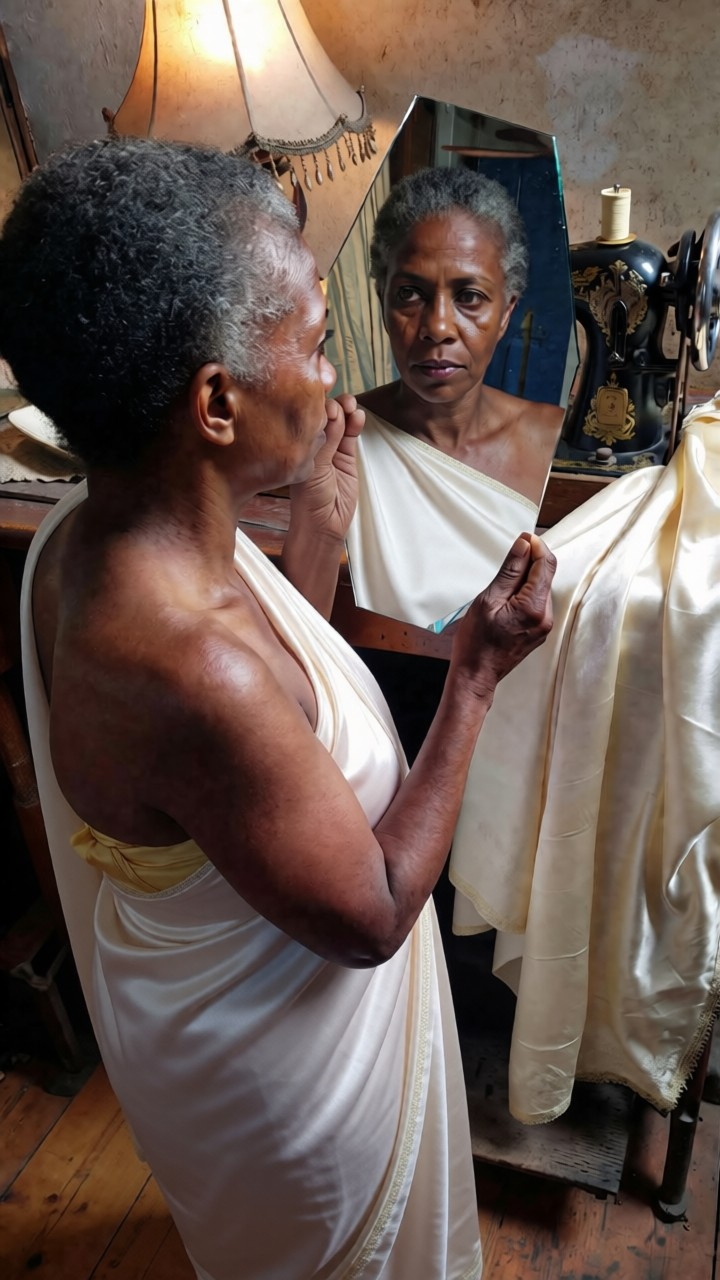
The Women Who Sewed a Nation Back Together
This story is a work of fiction stitched onto fact: Ma Musu, Mardea, Yassah, and their sisters in the white are imagined women, their conversations invented, their days arranged for the sake of the tale — but the cloth they are cut from is entirely real, and in the tradition of the best historical fiction, we tell you plainly which is which.1 2 The women of Liberia truly did put on white and sit in the rain on a president’s road; truly did lock a peace conference in Accra until the men signed; truly did register, vote, and guard the count with their own books — and in January 2006 the nation truly swore in Africa’s first elected woman head of state. Every white dress in this story really hung on a real woman, and the truth behind it is, remarkably, the more beautiful half: so if this tale moves you, let it be the first stitch of a longer discovery — of the Women of Liberia Mass Action for Peace, of Leymah Gbowee and Ellen Johnson Sirleaf, of the documentary Pray the Devil Back to Hell — for an hour spent learning what actually happened will be among the best hours you ever spend, and you will finish it, as we did, in tears of the good kind, pressed and shining.
In a city worn matte by war, one seamstress buried her wedding satin beneath the floorboards — and stitched the peace that would elect Africa’s first woman president. Based on the extraordinary true story of the women who dressed in white and simply refused to let their country burn.
There is a floorboard in Monrovia that lifts like a lid.
Beneath it: a sewing machine, oiled and wrapped against the damp, and a bolt of wedding satin — the last bright thing in a city that has forgotten how to shine.
It is 2002, and Liberia has been at war so long that children draw soldiers instead of flowers. In the market, women who cannot read pay a schoolteacher to read the war news aloud — because knowing is the only weapon left to them. And in a Lutheran church on Tubman Boulevard, something unprecedented is beginning: Christian women and Muslim women sitting in the same room, deciding, without asking anyone’s permission, that they have had enough.
They will wear white. They will sit in the rain while soldiers watch, uncertain, having no orders for this. They will lock the doors of a peace conference and tell the men of West Africa that no one leaves until the war is finished. And when the warlords have spent their fury, they will do the one thing no nation on the continent has ever done: elect a woman to lead them.
This is the story of Ma Musu, the seamstress who buried her satin like treasure and raised it like a flag. Of Mardea, who taught a market to read its own future. Of Yassah, who found her voice again in the rhythm of a treadle machine. And of the grandmother in the immaculate headwrap whom a nation would come to call Ma Ellen.
It is fiction stitched onto truth — and the truth, remarkably, is the more beautiful half. Every white dress in this story really hung on a real woman. Every door really held. The war really ended.
Come. Lift the floorboard with us.
The satin has been waiting twenty years for the light.
Chapter One — The Things We Bury
There is a floorboard in Monrovia that lifts like a lid.
Ma Musu Kamara knelt beside it in the dark, as she had knelt beside it three times before in her forty-eight years, and she listened first — because war had taught her hands to be quiet long before it taught her heart to be still. She listened to the yard: the drip of the eaves, a dog rehearsing its loneliness two streets over, and beneath everything, far to the north, the low rolling note that was not thunder. The rains had passed for the evening. The not-thunder had not.
Only when the house had spoken all it meant to say did she slide the flat of her gara knife under the board’s edge and press.
The plank sighed open, the way a piano sighs when the lid is lifted, and the kerosene lamp — turned down to a coin of light, for light in curfew hours is a rumour you must be careful who you share — tilted its small gold face into the hole.
There it was. The Singer.
It lay folded on itself like a sleeping animal, an iron fawn with its neck bowed, wrapped head to foot in wax print the colour of okra flowers. And beside it, shrouded in layer upon knotted layer of plastic bags — the careful, sacred wrapping of a thing that must not know the season — the satin.
She laid her palm flat on the machine first, the way you lay a palm on a child’s forehead to test for fever. Dry. She bent and breathed it in: oil and iron and, faintly, beneath the wax cloth’s own perfume, the cold clean smell of metal that has been loved. No damp. No rust whispering at the joints. She took up the little oil can and let three drops fall onto the bearings, one drop for patience, one drop for memory, one drop for the day the machine would sing again — and she counted them the way other women counted the rosary, which is to say slowly, and meaning more than the words allow.
Then, because devotion that does not look upon its object is only habit, she unwrapped the satin a hand’s width.
Ivory. The bolt’s cut end gleamed up at her like the inside of a shell, like coconut kernel, like the promise a bride makes before she knows what the years will ask of it. When the lamp moved, the sheen moved — a slow tide of light travelling the width of the cloth, liquid, alive, the only thing in the room that behaved as if the world were still a generous place.
Twenty-three years ago she had sewn her own wedding gown from this bolt, here in this room, on that machine, in a Monrovia that still shone — a city of streetlights and dancehalls and the Ducor Hotel lifting its lit crown over the harbour. Saye Kamara had polished his shoes every single night of their marriage, even the last one, even after the war had taken the electricity and the salary and most of the hope. He used to say a man’s shoes were his signature. Then I will make mine the cloth, she had told him, and I will sign my name in shine. The first war had taken him the way it took the streetlights — suddenly, and then the dark was ordinary.
That was the first burial. 1990. The second, 1996, when the factions fought each other in the streets like dogs over a single bone. And now the men in the bush were coming south again, and the men in the Mansion were singing their old song of stay-the-course, and so — the third burial, this season, this week, tonight.
You are not burying it, daughter. Her mother’s voice arrived the way it always arrived, uninvited and entirely correct. You are planting it. Shine is seed. Cloth remembers, even when people forget themselves. Wait for your season.
“You still there?” Musu asked the room — the satin, the machine, the man, the voice, all of them, any of them.
The room declined to answer, which was itself a kind of answer. She rewrapped the bolt, knotting each bag with a sailor’s economy, laid it in the earth of the floor, set the fawn beside it, and pressed the plank down as gently as closing a piano after the last note.
Then she blew out the lamp, and lay down in her clothes, and slept the way Monrovia slept in 2002: lightly, and with her shoes on.
Morning came up hot and loud, and Waterside Market assembled itself out of the noise the way a choir assembles out of tuning: first one voice, then ten, then the whole roaring, bargaining, psalm-singing congregation of it. A market is an orchestra that never resolves, and Musu had sat first violin in this one for twenty years — her stall a small kingdom of gara cloth, the borders of her dyeing famous from Randall Street to the Clay pit, the blues deep as a magistrate’s gown, the golds loud as Sunday.
By nine the lane before her table was a parade of the city’s remaining glory, and this was the thing no radio report would ever tell you about a war: that the women of Monrovia met it dressed. Headwraps starched to the stiffness of ceremony. Lappas pressed into obedience with irons filled with live coals. A woman might have sold her roof, her pots, and her pride, in that order — and still she came to market with her wrapper tied crisp as a banknote, because a wrapper, in Waterside, was a flag: this household is not yet defeated.
“Ma Musu.” Korto edged along the lane, tray of peppers balanced on her head like a crown she had earned, and — as always — the little vinyl handbag worn crosswise on her chest, black as a beetle’s back and polished to a gleam that outdid the sun. Four months of pepper-money it had cost her, that bag. She buffed it on her hip each morning the way a soldier buffs a buckle. “Ma Musu, you are smiling at nothing.”
“I am smiling at your bag,” Musu said. “It shines harder than the whole government.”
“Let it,” Korto said, unoffended, radiant. “It is the only gloss I own, so I mind it.”
“Then you own more than you think. Shine is how a woman signs her name — and yours is signed in patent.” Musu snapped her cloth out flat, a crack of blue. “Mind it like a signature, then. Do not let the world read you careless.”
“Ma! Ma Musu!” Old Ma Kpanah was already installed on her stool two stalls down, deaf as a doorpost and twice as unbudging. “Is that you talking about signatures? Who is signing anything? The only thing signed in this country is receipts for aid that never came!”
The lane laughed. The lane always laughed at Ma Kpanah; it was her salary.
And then the laughter folded itself away, because Mardea Karnga came down the row with a newspaper folded under her arm like a marshal’s baton.
You could read the whole schoolhouse in Mardea — the chalk ghost on her cuffs, the blouse ironed into submission, the shoes resoled twice and polished thrice. Her classroom had been a dressing station in the first war; she had washed wounds in it and buried the mops after, and when the schools reopened she had scrubbed the blackboards herself and begun again at the alphabet, because a nation that stops teaching its children is only waiting to be buried. She taught by day and by morning she read, and on market mornings the reading was public.
“O!” Ma Kpanah bellowed, before Mardea had even arrived. “The professor! Read it loud, o! The guns have taken my ears — you must preach to me like to the back row!”
Mardea stepped up onto the crate that served her as pulpit, shook the paper open with the crackle of a sail catching wind, and the lane went quiet the way water goes quiet — everything settling toward her.
“Kley,” she read. “The fighting is at Kley. The road to Tubmanburg is closed to civilians.”
A hiss, like rain starting.
“The price of rice in Duala market has doubled since—”
“Read us the men,” someone called, bitter as quinine. “Read us the great men and their great talking.”
“They talked,” Mardea read, and paused, and gave the pause to the crowd like a gift. “In the papers, the men met, and the men talked, and the men agreed to meet and talk again.”
“Ah,” said Ma Kpanah, to the whole lane. “Peace talks. Talks that talk and talk and never walk.”
“They walk,” said a young wife near the peppers, low, defending something she could not name. “My husband says walking is how it starts.”
“Walking is how it starts too,” said Musu, before she could stop herself, and the lane made the sound a market makes instead of silence — a murmur, a settling, an agreement too heavy for one voice to carry alone.
It was Ma Fatumata Bah who carried it. She came through the lane like a ship making harbour — tall, unhurried, her headwrap the deep ceremonial green of new banknotes, her lappa so starched it could have stood sentry, and under her arm, wrapped in oilcloth against all the world’s weather, the susu book. Mandingo trader, keeper of the women’s money, the ledger in which a hundred small savings crossed like fingers.
“The road is closed, the rice is doubled, the men are talking,” she said, taking her stool beside Musu’s stall as she had taken it every market morning for a decade. “And still my book balances. You know why? Because the susu never closed. Banks closed. Schools closed. The border closed. The women’s money went on working like the tide.” She patted the oilcloth. “When this country is ready to be honest about who kept it alive, it will have to come and ask my ledger.”
“Fatumata,” said Ma Kpanah, “if your ledger ran for president, I would vote for it twice.”
“You would not be alone,” said Fatumata, mild as milk, and the lane laughed again — but the laugh had a floor under it now, something the laughter was standing on.
Mardea lowered the paper. And Musu, watching her, saw the teacher’s fingers tighten on the newsprint the way a person’s fingers tighten on a second letter they have been carrying all along beneath the first.
“There is another thing in here,” Mardea said. “Not in the paper. Under it.” She drew out a page — hand-copied, ink smudged, the letters marching uphill. “There is a meeting. Thursday evening. The Lutheran church, on Tubman Boulevard.”
“Which church women?” someone asked.
“Christian women,” Mardea said. And then, carefully, laying the word down like the last plank across a flooded road: “And the Muslim women. Together. In the same room.”
The lane did not go silent. It went still, which is deeper. Two faiths, one bench; two kitchens, one house; and every woman in it old enough to know how heavy that plank was, and how necessary.
“In the same room,” Fatumata repeated. She looked at the copy, then at Mardea, and something moved behind her eyes like a key in a stiff lock. “Who called such a meeting?”
“A social worker. A young woman — small like a bird, they say, and loud like March thunder.” Mardea’s voice dropped, and the lane leaned in with it. “She said to bring one kind of woman only. She said: bring me women who are tired.“
“Tired?” Ma Kpanah cackled. “Tired is my middle name! Ask my knees!”
“I have been tired since ninety-two,” offered the pepper wife.
“I was born tired,” said Korto, hand on her shining bag, “and educated at the university of it.”
The laughter this time was not armor. It was recognition — the strange, sweet, terrible relief of a thousand private wearinesses discovering one another in daylight. Musu stood at her stall with a bolt of blue gara half-folded in her hands, and felt the word go through the lane like thread through cloth: tired, tired, tired — and heard, before she had decided anything, her own voice arrive among the others, steady as a hem.
“I will come,” said Musu.
Mardea found her eyes across the lane and held them, one teacher to one seamstress, and nodded once, the way you nod when a knot you have been tying all morning finally sits.
“I will come also,” said Fatumata, and patted the ledger. “If they will have a Mandingo woman’s money, they may have her body also. And when they are ready to organize, tell them from me: a ledger is a drum as well.”
She walked home before curfew, while the light was still thick and gold, and the city did what the city always did to her on that walk: it showed her its two faces at once. Down the lanes, the market women packing up — flags coming down for the night, but folded, every one of them, folded like flags and not like rags. And above the harbour, on its hill, the Ducor hotel with its broken crown, its windows gone, its chandeliers long since carried off or smashed — the pigeons held the penthouse now, and the ocean beyond lay grey and silver, glossing and unglossing, unable to make up its mind.
The whole town has gone matte, Musu thought. Dust on the leaves. Dust on the zinc roofs. Dust in the light itself, as if grief were a powder the city had been rolled in — everything absorbing, nothing giving back.
Everything but the market women’s wrappers. Everything but Korto’s patent bag. Everything but the bolt beneath her floor.
In her room she lit the lamp, and took out the hand-copied page and smoothed it flat upon the table, twice, three times, the way she would smooth a cloth before cutting — for she could not read the letters, not yet, and did not need to. Some announcements are not written in ink at all. They are written in tired, and every woman in Waterside could read that hand.
Then, because it was that kind of night, she knelt and lifted the floorboard one last time.
The lamp leaned in over the hole. And the satin, unwrapped a hand’s width, gave its sheen back to the light — a slow travelling gleam, ivory and alive, patient as seed, white as a flag not yet raised — the last bright thing in a matte world, buried the way her mother had taught her, which is to say: planted.
“Wait for your season,” she told it, in her mother’s voice.
Outside, far to the north, the not-thunder rolled. Under the floor, the satin waited.
Chapter Two — The Church of Loud Women
Thursday came in on a hot wind that smelled of dust and sea salt, and Ma Musu Kamara dressed for it the way a soldier dresses for inspection — slowly, deliberately, with prayer folded into every pleat.
Her best wrapper was the deep indigo gara, the one dyed in her own vats, the border worked in gold so that when she moved, the hem moved a half-second behind her like a court following a queen. She heated the iron — the old kind, the kind that swallowed live coals and breathed its warmth through cloth like a fever breaking — and she pressed the wrapper until it could have stood up and testified on its own. Then she bound her head in the matching gelee, starched to the stiffness of conviction, and she looked at herself in the shard of mirror that hung on the wall, and she said aloud, to the woman there: “You are going to a meeting.”
The woman in the mirror looked doubtful. Musu straightened her headwrap by one firm degree, which was her way of outvoting her.
Mardea was waiting at the corner with Korto, whose little vinyl handbag gleamed on her chest like a black star, and behind them came three more from the Waterside lanes — because word had travelled the way word always travels among market women, which is to say faster than radio and with better commentary.
“You have dressed,” Mardea observed, taking in Musu’s ceremonial indigo.
“I have dressed,” Musu confirmed, “the way you dress when you do not know if you are going to a meeting or a history.”
“Then we match,” said Mardea, and she had indeed put on her church blouse, ironed into glass, and her good shoes, polished to the shine of a conker fresh from the hand. Even Korto had added a pressed collar. They went down Tubman Boulevard together in the falling gold of the evening, five women dressed like a statement, and the soldiers at the checkpoint watched them pass and could not think of a single reason to stop a woman in her best wrapper, which is precisely why the best wrapper had been invented.
St. Peter’s Lutheran Church stood open-mouthed against the dusk, its doors flung wide, lamplight and candlelight spilling down its steps like an invitation written in gold ink.
And here Musu slowed, because the building rose up in front of her the way certain buildings do — not as stone, but as memory wearing stone for a coat. 1990. The year the people ran into this house of God for shelter, and the shelter held them, and then it did not. Nearly six hundred, the whispers said. The whispers always said it low, the way you speak the names of the dead. Musu had not been here that season, and had never since been able to look at the place without seeing, behind its calm white walls, all of that unfinished praying.
The bullet marks were still in the plaster. Small, round, patient. The war had signed its name here too.
An old woman ahead of them stopped at the doorway and laid her palm flat against the frame, the way you lay a palm on a child’s forehead, or a coffin’s lid. Nobody hurried her. The queue of arriving women simply folded itself around her grief and carried it in with them, like a hymn book passed down a pew.
Inside, the church was already filling, and it was filling in a pattern Musu had never seen in her life: Christian women settling along the left-hand pews, Muslim women along the right, and the centre aisle running between them like a river between two countries — like the Lofa, like the Mesurado, like every border that had ever been drawn by men who never once asked the water’s opinion.
Fatumata stood on the far bank in her ceremonial green, and when she saw Musu she raised her hand — not waving, exactly; signalling, the way one ship signals another across a harbour: I see you. Hold your course.
They filled the pews. The choir women came in their robes, and Musu’s eye caught the sashes — white satin sashes, the church’s own, worn soft by years of Christmas and Easter, catching the candlelight and giving it back in slow moving tides. She looked at them longer than she meant to. Cloth like that, she thought. Cloth like that, on women like these, in a season like this one — and something in her chest turned over like a key in a lock that had been waiting years for its key.
And then the young woman stood up on a pew.
She was small — small like a bird, exactly as the rumours had said — in a plain white blouse and a plain black skirt, and she stood on the pew the way a lark stands on a fence post: as if height had never once been the point. She did not go to the pulpit. The pulpit, perhaps, belonged to other voices, other seasons. She stood among them, at their own level, and when she spoke, her voice came out with the March-thunder the rumours had promised.
“I am tired,” she said.
She let it sit. The word rolled down the aisles and settled over the pews like the first drop of rain on dust.
“I am tired of burying. I am tired of running. I am tired of asking God why and being handed a radio so I can hear a man in a mansion explain it to me instead.” Her eyes went around the room, left bank and right bank, country and country. “And so I did not write to the Mansion for permission to be tired. I did not write to the commanders. I did not ask the pastors or the imams or the whole parliament of men who have managed this war so beautifully for thirteen years.” A pause, dry as harmattan. “I wrote to you.”
A ripple — not laughter, not yet; the precondition of laughter, the gathering of it, somewhere below the ribs.
“Who here has lost someone?” the young woman asked.
Every hand in the church rose. It rose differently — some fast like a slap, some slow like a drowning — but it rose, left bank and right bank together, a forest of arms in candlelight, and in the rising of it the centre aisle simply stopped being a river. It was just a strip of carpet between women who had all, now, shown the same scar.
“Who here has run?”
The forest rose again.
“Who here is tired?”
And this time it was not hands. It was voices — a sound Musu had never heard in her life and would never forget as long as she lived: a whole congregation of women answering at once, yes, yes, we are tired, tired, tired, the word passed from pew to pew like water bucket to bucket at a fire, until the church itself seemed to say it, the walls saying it, the roof saying it, the plaster with its patient bullet marks saying it loudest of all.
The young woman on the pew waited it out. Then she said, quietly, which was somehow louder:
“Good. Then you are qualified.”
The objections came after, as objections do — not from the darkness of the room but from its honest corners, which is where objections live.
“The pastors will say a woman should be silent in the church,” said a voice from the left bank.
“The pastors have had thirteen years of the microphone,” said the young woman, “and I have not heard one bullet stopped by a sermon. Have you? When the pastors have ended the war, they may resume their opinions of our volume.”
Somewhere on the right bank, a snort of laughter escaped a Muslim grandmother, quickly disguised as a cough.
“Our husbands—” began a young wife.
“—are tired also,” finished Fatumata, rising from her pew like a ship coming about, her green headwrap blazing. “Sisters, I am a Mandingo woman and a trader, and I will tell you what I know of men, which is considerable and grows yearly.” A pause for the laughter, which came, and was good. “A man will carry a gun for as long as carrying a gun is the only way left to be a man. Give him back another way — give him a country — and he will put the gun down and pretend he never liked it. But no man will put down a gun because a woman asks him nicely from her kitchen. He will put it down when the asking becomes loud, and many, and every single morning, and wearing the same clothes, until the whole world is watching to see what he does next.” She turned slowly, taking in both banks. “I did not come to be comforted. I came to be counted.”
“And what will we carry?” called a woman near the back, practical as a market scale. “Stones? Knives? My mother carried a machete in ’96 and it did not save her kitchen.”
“Empty hands,” said the young woman. “We will carry nothing. No knife, no stick, no market money for their checkpoints — nothing for them to take and nothing for them to fear. Empty hands, in white cloth, in the fish market, every morning, in the rain, in the sun, until the war is finished. Let the whole world see what a woman’s empty hand can do.” She held up her own — small, empty, steady. “It is the one weapon they have no doctrine for. I have checked.”
“And the white?” Musu heard herself ask, before her caution could catch her tongue. “Why white?”
The young woman found her across the church, and smiled like a lamp being lit.
“Because, sister, when we are five hundred women in five hundred different cloths, they will count us by tribe — Kpelle, Gio, Mandingo, Krahn — and set us against each other by lunchtime. But five hundred women in the same white?” She shook her head slowly. “They can only count us by number. And the number will frighten them more than any gun, because a gun can be taken from one hand, but a number must be argued with.”
White, Musu thought. White like the choir’s sashes. White like the bolt beneath her floor, waiting in the dark like seed. Her hands, in her lap, had gone cold and were warming again, and she recognised the feeling the way one recognises an old photograph of oneself: it was the feeling of the sewing room before a wedding. The feeling of a large cloth about to be cut.
“Now,” the young woman was saying, “we will need many things. We will need voices. We will need feet that will come every morning. We will need money, and I have looked at the treasury of the tired, and sisters, it is not rich—”
“The susu will dress the army,” said Fatumata, flat and immediate, patting the ledger she had brought wrapped in oilcloth like scripture. “I keep the books for eleven circles of women from Waterside to Duala. We have been saving for funerals. I move the motion that we save for a wedding instead — the wedding of this country to some peace.” She looked around the room with the eyes of an auditor. “It will cost. Shine costs. But we have been paying for war on instalment for thirteen years, and I ask you: what has it purchased?”
“Nothing,” said the church, in one voice.
“Then the ledger is decided,” said Fatumata, and sat, and the matter of money was never raised again all evening — wealth, that night, was simply a matter of arithmetic and dignity, and the women had both.
“We will need letters written,” the young woman went on. “Petitions. Statements.”
“Mine,” said Mardea, standing, chalk-ghost cuffs and all. “I am a schoolteacher. My classroom patched bodies in ninety-six while I taught the alphabet over the noise, and I have been teaching ever since, because a nation that stops teaching its children is only waiting to be buried. My hand is yours. And more than my hand—” she raised her voice to the whole room, teacher to back row, “—any woman here who cannot yet write her own name, come to me on Saturdays. Because a petition is a fine thing, but a thumbprint is a borrowed signature, and I intend that the next document this movement signs shall be signed by every woman in her own hand.”
In the row behind Musu, an elderly woman leaned to her neighbour and said, clearly, in the way of the deaf-adjacent and the simply astonished: “A school for us? At my age?” And the neighbour, Korto, patted her patent bag and said: “Auntie, at your age you have earned a signature. What is a signature but a crown you can write?”
And then the young woman said the words that Musu would carry for the rest of her life, spoken plainly, while the candles leaned in:
“The last thing we need is cloth. Hundreds of garments, all white, all the same, made well — because we are not going out there looking like refugees, sisters, we are going out there looking like the future, and the future is pressed and starched and minding its hem. Who among you sews?”
Silence. The genuine article — the silence of a room in which every woman is simultaneously thinking of her treadle, her scissors, her buried Singer, and the size of the number five hundred, which in the mouth sounds small and in the sewing room sounds like a mountain range.
Musu felt the silence, and felt her own heart going like the treadle itself, and heard — arriving before her courage, ahead of her fear, leading the pair of them like an older sister — her own voice:
“I sew.”
The young woman’s eyes came to her.
And Musu stood up in her indigo and her gold, in the middle of the left bank, and heard herself continue, in a voice she did not recognise until she understood it was her own, tuned at last to its proper size:
“I sew, and my mother sewed, and her vats are my vats, and I have kept my machine the way other women keep their Bibles — oiled, wrapped, and buried against the season. I will cut the white for five hundred.” The room had turned, all of it, both banks, and she found she was not afraid, or rather that the fear had been given a job to do and was busy. “I will need hands,” she said. “I will need every woman in this room who can hold a needle, and I will teach the ones who cannot. Bring me your daughters. Bring me the quiet ones.” She thought, without meaning to, of a scarred-handed girl she had not yet met, and did not yet know she was prophesying. “Bring me the ones the war has emptied. A treadle machine,” she said, “is a heart with a table under it. Sit a woman at one and her hands remember the world is a place where things can still be made.”
For a moment the church was absolutely still, the way cloth is still, at the instant before the cut.
Then the doors banged open at the back, and Ma Kpanah came up the aisle at flank speed, gelee at a defiant angle, entirely deaf to the preceding hour.
“Did I miss it?” she demanded of the entire congregation, at parade volume. “Has peace come? Nobody tells me anything! My ears are decorative! I have been sitting outside for two hours guarding the steps like a goat, and the one thing I hear with these decorative ears is five hundred women in here being quiet, which frightened me more than any war—”
She got no further, because the church broke.
It broke like the rains break — all at once, after a long grey waiting — five hundred women laughing, both banks laughing, Christian and Muslim laughter, grandmother laughter and girl laughter, laughter with tears in it, laughter falling into the aisle and crossing the river and making a bridge of itself, and it was, Musu knew with the certainty of dye taking cloth, the first laughter that building had held since 1990. The walls, which had heard everything, heard it. The bullet marks heard it. And the laughter did not erase them — nothing would erase them — but it sat down beside them, the way family sits beside family, and stayed.
The young woman on the pew watched it happen, both hands raised slightly, like a conductor holding a chord she did not want ever to resolve.
“Write it down,” she said to Mardea, over the sound, and her voice had a smile wearing it. “The first thing the movement owns — before the cloth, before the petitions, before the money. Laughter. Dated, witnessed, and in quantity.”
They prayed before they parted — the Lord’s Prayer from the left bank, the Fatiha from the right, and between them, in the aisle where the river used to be, a silence so warm that women on both banks wept without embarrassment, passing handkerchiefs across the border like contraband joy.
“We will take turns with heaven,” Fatumata said to Musu at the door, settling her green headwrap for the walk home. “One day their prayers, one day ours. Alternating current. It is how the lamps work, and I am told the lamps are very reliable.”
“And the cloth?” Musu asked. It was the only question she had left, and it was enormous.
“The cloth,” said Fatumata, “begins tomorrow. The susu meets at eight. Bring your scissors, sister, and bring your courage — though between us,” and here the trader’s eye ran over Musu’s indigo, her gold, her starch, with open professional approval, “I think we will find the courage has been pressed and waiting.”
Musu walked home through the cooling streets with the moon laying its own gloss on the zinc roofs, and the city — matte, dusty, rolled in the powder of its grief — seemed to her, for the first time in years, to be merely between shippings: cloth not yet dyed, not yet pressed, but bought and paid for all the same.
In her room she lit the lamp, and knelt, and lifted the floorboard.
The satin gave back its slow travelling gleam, ivory and patient, and Musu laid her palm upon it as upon a shoulder.
“Sisters,” she said — to the cloth, to the church, to the five hundred, to the season coming up the road in its white garments with its empty hands — “I believe your season has found its seamstress.”
Chapter Three — White
The susu met at eight o’clock in the morning, in the back room of Fatumata’s stall, and the money was counted twice — once for the ledger, and once for the soul.
It came out of the women the way rain comes out of a season: slowly, then all at once. Coins surfaced from knots of lappa-cloth, from milk-powder tins, from the toes of stockings, from a pocket sewn expressly inside a brassiere for the hiding of hope. There were dollar coins worn smooth as river stones, and five-dollar notes flattened and stacked with a care most people reserve for scripture, and here and there a single coin so old it carried the face of a president whose presidency was itself a rumour. They rang onto the tabletop like the first fat drops of a storm, and Ma Fatumata Bah, seated behind her ledger with her green headwrap arranged for business, received each woman’s offering with the nod of a bank teller and the solemnity of a priest.
“Name,” she said, pen poised.
“Korto, daughter of Yeanor, Waterside, pepper trade.”
“Amount.”
“All of it.” Korto set down the tin, upended it, and let her savings cascade onto the table in a silver shower. The patent bag, that black beetle-glossed crown she wore crosswise on her chest, rode the motion without a scratch. “Every coin, Ma Fatumata. The bag stays with me — the bag is my uniform — but the money goes to the cloth. What is money for,” she said, to the room at large, “if not for buying the thing you would be ashamed not to buy?”
“Write it down exactly like that,” said Ma Kpanah, who was positioned as close to the table as her deafness and her dignity allowed. “Put it in the ledger that Korto the pepper woman gave everything. When they write the history of this country, I want her name spelled correctly.”
“Your name will be in it also, Ma Kpanah,” said Fatumata, writing, “under disturbances.“
The room laughed, and the coins kept coming, and by half past eight the table looked like the bottom of a canoe at low tide — everything that had been hidden, gleaming in the daylight at once. Fatumata ruled the total twice, announced it in the voice of a magistrate delivering a verdict, and then did the thing that made the morning historical: she turned the ledger around, so that the women could see the column of their own names.
“Read it,” she said. “Every name that paid. That is not a list of poor women. That is a list of shareholders.” She tapped the page. “The men have bought guns with the wealth of this country for thirteen years, and what do the shareholders of war hold? Ashes, and debt, and photographs. We have bought cloth. And when the cloth is cut and sewn and pressed and worn, every woman on that list will be able to point at the white and say: that is mine, I own a share of that.” She closed the ledger with the soft, enormous finality of a door. “Wealth, sisters, is not what you keep. Wealth is what you put in. The susu has never once failed, and do you know why? Because it runs on the only currency Liberia has never run short of.” She looked around the room, at the starched wrappers, at the pressed collars, at the heads held up like lamp-posts. “Women showing up.”
They went to buy the cloth as a delegation — twelve of them, walking down Randall Street in their best, Musu at the front with her tailor’s tape coiled at her wrist like a badge of office.
The cloth merchant saw them coming from a hundred paces, the way merchants see weather coming, and he had the bolts out and standing at attention before Fatumata had finished mounting his steps.
“Ladies,” he said. “You are here about the white.”
“You knew,” said Fatumata.
“Madam, half of Monrovia knows. The other half is asking me for white cloth so they can be ready when you announce.” He spread his hands over his stock like a man showing his children. “I have bleached cotton. I have polished cotton. I have white that shines and white that sulks. For you — because I also have a mother, and she also is tired — the shining one, at the price of the sulking one.”
Musu stepped forward then, and did the thing that no merchant in Monrovia ever quite recovered from: she touched the cloth. She drew a bolt’s cut end through her fingers with the slow deliberation of a jeweller weighing stones, folded a corner into a point, held it to the light, rubbed it against her own wrist where the skin was oldest and truest.
“This one has been dressed with sizing to look wealthy,” she said, laying it aside. “One rain and it will go grey as a Monday morning. This one—” the second bolt, whose surface gave back the light in a low, even, honest gleam, “—this one was calendered properly. It will press to a shine and hold it. Shine that holds, sisters. That is what we are buying. Any cloth can be bright in the shop. We want the cloth that is still bright on the fortieth morning, in the rain, when the world has done its worst to it.”
The merchant, who had been in Liberia long enough to know when he was outgunned, sighed the sigh of a man watching profit walk toward principle.
“The calendered one,” he said. “For the mothers of the nation. And I will throw in the thread.”
“The thread,” said Fatumata, opening the ledger, “was never in question. Write the receipt, my son. We are shareholders, and shareholders collect receipts.”
The vats came out on Wednesday.
They stood in the yard behind Musu’s house like three great patient drums — her mother’s vats, rehooped and resealed, older than Musu’s marriage, older than the first war, veterans of a thousand blues and golds. And into them went the white, but not to change it. What Musu dyed was the border — a hand’s width at each selvedge, worked first in stitch-resist, thread wound tight as secrets so the dye could not enter, and when the dye was taken and the threads cut away, there it was: white on white. A border you could not see on a woman standing still. But when she walked —
“Look,” Musu said, and shook out the length, and the border surfaced and sank and surfaced again like a fish turning under water, a pattern made of nothing but light catching and letting go. “There. That is a Waterside woman. You will know her by her walking.”
“It is like gloss,” breathed the young wife from the pepper row, watching the cloth move. “Like — like the shine on Korto’s bag.”
“Like the shine on anything that is minded,” said Musu. “Polish is not paint, my daughter. Polish is attention, made visible. That border will be invisible to a soldier and unmistakable to a sister, and that is exactly the arrangement we want.”
By Friday the workroom was assembled, and it was a workroom the way an orchestra is a room with instruments: technically true, and entirely inadequate to the sound.
The Singer had come up from under the floorboards for the last time — Musu had declared the burial season over, and set it in the place of honour beneath the window, where the light came in like a benediction. Four more treadles had arrived on loan from four households, borrowed with the ceremony of international treaties, and they stood in a row like a convocation of iron fawns awaiting instruction. Trestle tables wore the boards of a hundred market stalls. On the wall, Mardea had chalked the order of work in letters tall as sermon titles: CUT. JOIN. HEM. PRESS. COUNT. And beneath it, smaller, the motto that had not been voted on and did not need to be: WE ARE NOT GOING OUT THERE LOOKING LIKE REFUGEES.
The women came with their scissors and their thimbles and their singing, and the room filled the way a heart fills — in rhythm.
Korto took the pressing, standing over the coal iron like a general over a map, and every garment that passed under her hand came out flat and gleaming, edges like drawn lines, the cloth giving back the lamplight in long still rivers. “Press is the word,” she said, to no one, to everyone, steam rising around her like incense. “They can take the light from the grid, but they cannot take the light from the cloth. Not while I have breath and coal.”
Ma Kpanah, whose ears had retired but whose hands had not, sat in the corner with a pincushion and a mountain of hemming, and sewed with the blind, contented speed of a woman who had outlived her need to be entertained. “I cannot hear the singing,” she announced periodically, “so you will all have to sew louder.”
And in the lulls — because Mardea was Mardea — the chalk came out, and scraps of white cloth passed down the tables like canapés, and women who had signed with a thumbprint all their lives practised, tongue-tipped, the slow cursive of their own names.
“Again,” Mardea would say, gently, gently. “A signature is a crown you can write, remember. Slope the K — no. Slope it like you are walking toward it.”
“My hand is sixty years old, Ma Karnga.”
“Then it is sixty years due a crown.”
The girl came at dusk on the sixth day.
She did not knock, because she did not come to the door. She simply appeared in the window’s light, standing in the yard with her arms wrapped around herself like a parcel nobody had signed for — a young woman, thin as a fence rail, in a dress that had been beautiful once and washed a hundred times since, and her hands, when the light caught them, were crossed and re-crossed with scars like the tally-marks of some terrible arithmetic.
The woman who brought her — an aunt, or a grandmother, or simply a neighbour who had run out of other doors — stood at the step and spoke in the low, hurried voice of someone delivering the worst of it up front.
“She was in Lofa,” she said. “You understand. She came back in 2000, walking. That was the last thing she did at any speed.” A pause. “She does not talk. Not will not — the words went, the way people went. The clinic people say the words are still in there. But—” the woman’s hands performed a small, exhausted flight, and gave up. “Her mother sewed. Before. The girl used to sit under the machine table and hold the thread. I thought — I heard the machines from the corner — I thought, maybe. I am sorry. I will take her home if—”
But Musu was already looking at the girl, and the girl was already looking at the Singer.
Not at Musu. Not at the women, not at the lamplight, not at the chalked walls. At the machine — at the iron fawn with its neck bowed — with the fixed, unblinking attention of a woman standing on a station platform watching the one train that still runs to the country she is from.
“Sis,” Musu said quietly, and the room’s chatter let itself down like a hem being let out, stitch by stitch, until only the press of Korto’s iron could be heard. “Sis. What is your name?”
The girl’s mouth moved. Nothing came. Her hands, at her sides, closed and opened, closed and opened — and Musu saw that the scars did not stop the closing or the opening; the hands still worked; they had been waiting, these hands, longer than the words had been lost.
“Yassah,” said the aunt. “Her name is Yassah.”
“Yassah.” Musu set no store by touching her — the girl was wrapped around herself like cloth around a wound. Instead she did the only thing she knew that had never once failed her, the thing her mother had done for her across forty years of every kind of weather: she went to the machine, sat down, and put her feet on the treadle.
The Singer began to sing.
One note, then another — the slow, patient, four-four heartbeat of it, chuff-chuff, chuff-chuff, the oldest lullaby in the world set in iron — and Musu ran nothing under the needle, only let the rhythm go out into the yard like a hand held out, palm up, at exactly the height of a sitting woman’s reach.
Yassah came off the step as if the thread had caught her.
She crossed the yard with her eyes on the wheel. She came into the workroom past twenty women who had, by some miracle of collective craft, all discovered something fascinating in their own hems. She stopped at Musu’s shoulder. Her breathing was wrong — too high, too quick, a bird’s breathing — but her eyes never left the needle’s patient rising and falling.
“Sit,” said Musu, and made room, and did not watch her do it, because some things must be done unobserved or not at all.
The girl sat. Her scarred hands hovered over the machine like moths over a lamp.
“Feet first,” Musu said, in the same voice she used for the cloth — low, unhurried, the voice of the vats. “The hands are only guests, Sis. The feet are the family. Here.” And she placed her own foot beside the girl’s on the treadle, and pressed, and the rhythm deepened, and pressed again — and on the third press, the pressure came back.
Yassah’s foot, of its own accord, of its own memory, of its own thirteen years of waiting under a machine table in a burned country, pressed down.
The rhythm held. Chuff-chuff. Chuff-chuff. Bird-breath, iron-heartbeat, one tempo.
“Again,” Musu murmured. “That is all it is, all day, all life — again. The machine does not ask you for words, Yassah. The machine has never once asked anybody for words. It asks for rhythm. And rhythm—” the wheel turned, the light ran up and down the polished steel like water, “—rhythm is only breathing, with work in it.”
She fed a scrap of white beneath the needle. Guided the scarred hands to the cloth — not holding them, attending them, the way a midwife attends. “One seam. Crooked is allowed. Crooked is the tuition. Straight comes later, and it comes forever.”
The needle went down. The room — twenty women sewing with the loud, elaborate unconcern of a whole orchestra pretending to tune — sewed on, and did not breathe, and did not look, and listened with the entire surfaces of their skins.
The seam came out crooked as a river, which is to say: it came out. It crossed the scrap from edge to edge, one continuous line of thread laid down by hands that had not made anything, anything at all, in six years.
Yassah looked at it.
And then she made a sound — not a word; the words were still wherever the words were — but a sound, low and cracked and unmistakable, the sound of a well reopening, of a tap knocked once after a long dry season. She put her fingers flat on the finished seam, delicately, the way the old woman had laid her palm on the church doorframe. Claiming it. Grieving into it. Beginning, in the same gesture, to be its owner.
Nobody applauded. Applause would have broken her like dropped porcelain.
What happened instead was Ma Kpanah, in the corner, who had seen the whole thing over the top of her hemming with the unimpeded vision of the deaf, and who chose that moment to bellow, at her customary parade volume, to the entire room:
“This hem is crooked! Who sewed this crooked hem? I have been hemming for fifty years and I demand to know who is responsible for this crooked hem!”
A pause, in which the room hung.
“I did,” said Korto, serene, at the iron. “I sewed it crooked on purpose, Ma Kpanah, so that yours would look skilled beside it. It is my gift to you.”
“Then I accept it,” said Kpanah, “and I accept you,” and the room came back up to its noise like a wave re-forming, and under the cover of it Musu took the crooked scrap, and pressed it flat with the side of her hand, and pinned it high on the wall, alone, where the chalked orders of work could keep it company.
Her first seam, she did not say. The first letter of a woman who will write. Let it hang there. Some documents are filed, and some are framed.
They worked until the kerosene ran low, and then a while after, by the good graces of a moon that seemed, that week, to be showing off.
And when at last the women had gone home in twos and threes, and the irons had cooled, and the fawns stood sleeping in their row, Musu walked the length of the yard, where the day’s finished garments hung on the lines — forty of them now, forty white wrappers and headwraps drying in the moonlight, rank upon rank upon rank of them, the white-on-white borders surfacing and sinking in the small night wind like fish, like snow that had decided, for once in the tropics, to fall and stay.
She stood among the lines a long time, in the middle of all that hanging light, and felt the yard breathing around her — chuff-chuff, chuff-chuff — one great heart with a house built over it.
Inside, before she slept, she knelt once more at the floorboard — from habit now, from love — and lifted it, and unwrapped the satin a hand’s width, and let the lamp’s coin of gold travel the ivory like a thumbprint of light.
Not yet, she told it. The movement’s white was a working white, a shining white, a white for the rain and the forty mornings — but this, this was a wedding white, a ceremonial white, a white for the day the thing was finished. Cloth knows its own occasions. Her mother had said so, and her mother had never once been wrong about cloth.
“Your season is coming,” she whispered. “I can hear its feet on the treadle.”
She pressed the plank down, blew out the lamp, and in the yard, all night, unwatched and unhurried, the white dried in long gleaming ranks under the moon — like washing, like armour, like the flags of a country that had not yet dared to exist, waiting for morning, and morning, and morning.
Chapter Four — Rain on White
The first morning of the sitting began, as all the great ceremonies of Liberia begin, with an argument about a headwrap.
“You cannot wear the green,” said Musu, at the church steps, in the last of the lamplight. “Not today. Today we are one cloth.”
Fatumata stood before her in her ceremonial green — the green of new banknotes, of deep-water Islam, of twenty years of a woman’s signature — and for a long moment she looked down the length of herself the way a general looks at a flag she has carried through every campaign of her life.
Then she unwound it.
“The green will keep,” she said, folding it into her market bag with the care of a woman folding a deed of ownership. “It has never once faded in storage, and it will not begin now. Today—” and she drew out instead the white gelee, pressed that morning into blades and planes, “—today I am a shareholder in a larger enterprise. Pin me, sister, and pin me properly. If I must be one cloth with four hundred Christians, I will at least be one cloth with a crisp border.”
Inside the church, the dressing went on by candle and lamp, and it had the hush of a vestry before a coronation. Wrapper over wrapper. Gelee over gelee. The garments of the first sitting were the pick of the workroom’s first fortnight — a hundred and twelve of them, pressed to a fare-thee-well by Korto, who stood at the door turning back any woman whose hem had travelled, with the tenderness of a customs officer and the remorselessness of one.
“Go home and press it,” she said, three times that dawn, to three different sinners. “This is not a rumour we are attending. This is the future, and the future does not travel wrinkled.”
Yassah dressed last, because Musu dressed her — the white wrapper folded and tied with the deliberation of a flag going up a pole, the headwrap bound close, the border’s invisible stitching riding the girl’s shoulders like a rank. Then Musu held up the shard of mirror, the way a jeweller holds a stone to the light.
The girl in the glass looked back — thin, scarred-handed, dressed all in shining white, seated inside a ceremony for the first time in six years. She did not smile. But she straightened — chin lifting, shoulders finding their shelf — and in the currency of Yassah, Musu knew, a straightened spine was a coronation.
“There now,” was all Musu said aloud. “The cloth does not mind the scars, Sis. Cloth has no opinions. It only records the care you give it — and you have been given plenty.”
Outside, in the grey-gold before-six o’clock, the young social worker stood them in rows on the church steps and issued the orders of the day, while Mardea chalked them, four words tall, on the board that Ma Kpanah carried beneath her arm.
SIT. SING. PRAY. STILL.
“I am carrying the law,” Kpanah announced to the street. “It is heavy with justice.”
“Empty hands,” said the young woman, and held up her own. “Nothing that cuts, nothing that burns, nothing a man could stand up in a courtroom and call a weapon — so that when they lie about us, and they will lie about us, the lie finds nothing to hold. We sit at the fish market because the fish market is on his road. Every morning that man rides from his bed to his Mansion, and every morning we will be seated on his road like an appointment he cannot cancel. Let him count us. Let the count ride up the hill with him and sit on his desk all day.”
She walked slowly down the line as she spoke, the way she had walked the church, taking each woman’s eyes in turn.
“We do not move for sun. We do not move for rain. We do not move for soldiers, for speeches, for threats, or for fear itself. We move for nothing — until the war is finished. And then, sisters—” and here the March-thunder rolled just beneath the words, “—then we will move like a flood.
“If a soldier insults you, let it run off you like rain off patent leather.” (Korto, at the flank, patted her bag without being aware she did it.) “It leaves no mark, and it never once touched the leather.
“If a soldier points his rifle at you, look at his eyes. Not the rifle. A rifle is a beggar for attention — deny it alms. His eyes are a boy’s eyes, and boys grow ashamed far faster than guns.
“And if the fear comes — and it will come; fear is a tax, and every sitting woman pays it — then sing. A hymn under fear is a hem under tension: it holds exactly as long as you keep stitching.”
“Madam Social Worker,” said Ma Kpanah, raising her hand as if she were seven years old, which she had not been for seventy. “A question of procedure. I cannot hear when a hymn begins. By the time it reaches me, it is finished. Am I to sit here like a stump while the whole line sings around my deafness?”
The young woman did not smile, quite. But something in her face did.
“Then you shall begin them, Ma Kpanah. You have the loudest beginning in Monrovia.”
This was considered. “I have,” Kpanah admitted. “My beginnings are famous. Very well. I will be your church bell.” And she shifted the chalkboard higher under her arm, a woman promoted at last to the office her volume had been training for all its life.
They walked down through Waterside two by two, a hundred and twelve women dressed like a statement being delivered by hand, and the city came to its windows and doorways to read them as they passed.
At the checkpoint on the corner, the soldiers straightened out of their slouch the way iron filings stand up for a magnet — and then found, to their visible confusion, nothing to do. Their doctrine covered weapons, crowds, curfews, and running men. It did not cover a hundred women in pressed white walking at funeral pace with empty hands and level chins. The senior soldier looked down the line, looked at his comrades, and settled for the only order left in the book: he waved them through with the weary ceremony of a man saluting weather.
“The wrapper,” murmured Musu, as they passed, to Yassah at her side, “is the oldest armour in West Africa. Remember it. A woman in her best cloth is a locked door that walks.”
The fish market smelled of salt and smoke and the morning’s first catch, and behind it the Atlantic laid its long silver road from the beach to the horizon — the only highway in the country, Musu thought, that the war had never managed to close. The fishwives watched the white line arrange itself among the stalls with the professional interest of women who know a good display when they see one, and by seven o’clock they had adopted the movement entire: benches were found, water was boiled, and the eldest of the sitting women were installed at the shaded seaward end with the ceremony of relic-holders being seated.
“Drink,” said Mardea, moving down the rows with the gourd cup, in her schoolteacher’s voice that expected obedience by lunchtime. “All of you. We are not martyring ourselves of thirst before nine o’clock. A dehydrated saint is no use to heaven and less to the movement. Sit up straight, sister — the future does not slouch.”
Then they sat. And the sitting, when it truly began, was the strangest sound Monrovia had made in thirteen years: the sound of nothing — of a hundred women making, on purpose, in public, on the president’s own road, no sound at all. Traffic slowed to read them. Gulls wheeled overhead, reading them. The city held its breath around the white line like cloth around the point of a scissors.
Ma Kpanah broke it, as arranged.
She stood, board under one arm, faced the Atlantic as if addressing the back row of creation, and launched — at full parade volume — the Easter hymn.
“Ma Kpanah,” hissed Mardea, “that is the Easter hymn!”
“ALL THE BETTER!” Kpanah returned, serenely, between verses. “RESURRECTION IS EXACTLY OUR BUSINESS!”
And because the line was laughing, and because she was not wrong, the Easter hymn carried — a hundred voices taking it up staggered, like a wave standing up in sections — and it rolled out over the fish market and the boulevard and the silver sea beyond, and the women of the left bank sang it into their handkerchiefs and the women of the right bank hummed the tune politely until their turn came, and when it came — the Fatiha, led from the seaward rows in Fatumata’s clear trader’s alto — the two faiths handed the morning back and forth between them like the tide, like the lamps, like the alternating current Fatumata had promised, and the whole grey city stood listening to a church service that had outgrown its roof.
At half past eight, the motorcade came.
The long black cars came down Tubman Boulevard with their wipers off and their windows smoked, travelling in that hush of power that is louder than engines, and the line of white women did not wave, did not boo, did not turn their heads by so much as a degree. They sat as cloth sits on a merchant’s table: still, pressed, and letting itself be inspected. The cars slowed — of necessity, of curiosity, of something no protocol officer had written a rule for — and for four long seconds the president of Liberia rode past his own reflection in a hundred and twelve pairs of eyes.
Then the cars were gone, up the hill, toward the Mansion and the day’s paperwork.
“That,” said the young social worker, quietly, when the road had emptied, “was the first stitch. Tomorrow, the second.”
The rain came at noon, in the way the sea builds a thing — first a grey wall walking on the water, then the smell of it, then the whole assembled weight of the sky arriving at once.
The fishwives retreated to their eaves. The traffic thinned. And on the boulevard, in the middle of the falling silver, the white line sat.
“IS IT RAINING?” demanded Ma Kpanah, of the row in general, rain running off the points of her gelee in bright threads. “NOBODY TELLS ME ANYTHING! THESE EARS ARE DECORATIVE! I WILL ASSUME IT IS RAINING! I WILL SIT ACCORDINGLY!”
And Musu, sitting with the water ticking off her own headwrap like a clock, watched the change come over the line and understood that she had chosen this cloth for this exact hour without knowing she had done it. Dry, the calendered white had shone like pressed paper. Wet, it shone like the sea. The rain laid its silver on a hundred wrappers and the wrappers gave it back doubled — the whole seated line of them glowing on the greyest boulevard, in the greyest city, under the greyest sky in West Africa: a seam of light sewn straight across Monrovia, from the fish stalls to the far kerb.
The rain had come to make them matte. It had only made them gloss.
“Do not grieve for my bag, sisters!” Korto called across two rows, holding the patent thing up into the downpour, where it threw back the light like a black diamond. “Patent was born in water! This is its native weather! It has never shone so well in its life — and neither, I am telling you, have we!”
Somewhere down the line, a woman began to laugh at that — the helpless, rain-soaked, unstoppered kind — and the laughter ran the rows as the hymns ran them, and the singing started again in the middle of it, and the rain fell on all of it equally, like applause from a roofless church.
The patrol came at two o’clock: a dozen soldiers in wet khaki, and a lieutenant with rain beading on his rifle and his uncertainty.
“Who is your leader?” he demanded, of the front row generally.
“Every woman here,” said the young social worker, pleasantly. “Arrest that.”
“You cannot — assemble. Like this. On the road.”
“We are not assembled,” she said. “We are seated. Assembly is what men do before wars. We are what comes after them. You have passed us four times this week, Lieutenant. Have we moved?”
He had no answer, because his doctrine had no answer, and the whole line watched him search his training for the paragraph that covered a hundred motionless grandmothers in shining wet white, and fail to find it. His radio crackled at his shoulder; he spoke into it low; and the patrol withdrew — not gone, merely reassigned — taking up positions along the shaded kerb with the air of men posted to watch the weather.
Which, Musu reflected, watching them watch the white line gleam and sing in the rain, was precisely what they had been posted to watch.
The not-thunder rolled at four — nearer this week than last, a fist knocking on the north of the sky — and the flinch went down the seated line like wind through a field of cane: a hundred shoulders dipping, a hundred breaths snatched, the whole white cloth of women rippling once, edge to edge.
And the hymn did not break.
Mardea’s voice held it — lifted it, actually, a half-step in volume, the way a hand tightens on a seam under tension — and the line came back to centre stitch by stitch, and the hymn went on, and the fear, taxed and receipted, sat down inside a hundred women and was made still.
Beside Musu, Yassah’s scarred hands lay flat on her knees, pressed there like seams being eased into place. And under the soaked white of her wrapper, Musu could feel it through the bench, steady as a heartbeat laid down in iron: the girl’s feet were working. Treadling. Chuff-chuff. Chuff-chuff. Keeping her own time through her own fear, the way she had been taught, the way the machine had taught her, the oldest lullaby in the world carrying a silent woman through the sound of guns.
“Fear is a tax, sisters,” said the young social worker, when the hymn came round to its amen. “We pay it sitting down. And we receipt it in hymns.”
They came home at dusk, a hundred and twelve women walking back up through a washed and dripping city, and the town — which had watched them go out dressed like a statement — watched them come back dressed like a verdict.
In the yard, the white went onto the lines, rank upon rank, dripping silver into the dark, and Korto walked the ranks with her cloth in hand, and Yassah walked at her shoulder learning the inspection. In the workroom the treadles had already resumed for the evening shift — the second hundred garments cut and waiting, the third hundred’s cloth paid for and pressed — and through the window came the chalk-squeak of Mardea teaching names to the names of new arrivals.
Musu stood a long time among the hanging wet light, listening to the yard breathe — chuff-chuff, chuff-chuff — one great heart with a city built over it.
Again, said the treadle. Again, said the tide across the road, running silver to the horizon. Again, said the white on the lines, drying into tomorrow’s shine.
And somewhere beneath this torn town, she thought, the mend had truly begun: one stitch, one sitting, one shining morning at a time. Crooked is allowed, her own voice taught her, from the workroom wall where a crooked scrap hung framed like a signature. Crooked is the tuition. Straight comes later — and it comes forever.
Chapter Five — “We Are Tired.”
The answer came down from the Mansion on a Tuesday, carried by a government messenger who looked, throughout its delivery, like a man handing live ammunition to children: the president would receive them. Fourteen women. Thursday morning. The Executive Mansion.
The messenger left at speed. The church sat with the words for a moment, the way one sits with a needle already through the cloth — committed, and not yet bleeding.
“Fourteen,” said the young social worker, into the hush. “No more. A delegation, not a congregation. Fourteen women, like fourteen stitches — enough to hold a seam, not so many that we tangle.”
“I will go,” said Fatumata, before the pause had properly finished. “I am the ledger. Let the Mansion look upon the face of the money it has never once consulted.”
“Mardea must go,” said Musu. “The statement is hers.”
“The statement is ours,” said Mardea, but her hand had gone to her collar, teacher-fashion, straightening what was already straight.
“I will go,” said Musu, and heard again, with distant wonder, her voice arriving ahead of her fear, the two of them travelling in their now-customary order.
“Ma Musu,” said the social worker, “you dressed five hundred women for this hour. Yes — you will go. Let the man see where the white comes from.”
And then, from the third pew, at full parade volume:
“AND I.”
The room turned, as rooms must, toward Ma Kpanah.
“Madam Social Worker,” Kpanah began, rising with the dignity of a chief elder and the volume of a market bell, “I have sat on your church steps. I have carried your law on a chalkboard through the rain. My ears have retired from government service, it is true — but my eyes, I would have you know, are municipal employees of the very highest grade, and I have spent seventy years reading faces because nobody’s mouth could be trusted to reach me. You are taking fourteen women into the house of a man whose whole profession is saying things. You will want my eyes along. They are not decorative.”
There was a silence of the genuine kind.
“Sisters,” said the young social worker slowly, and Musu could hear the seams of a plan being let out and re-sewn as she spoke, “I have been thinking all this time about what he will say to us. I should have been thinking about what his face will do while his mouth says it.” She turned. “Ma Kpanah. You will sit where you can see him. You will watch him the way you watch a pot that has promised to boil. And when we are home, you will report.”
“Report,” said Kpanah, settling back into her pew like a judge into chambers, “is my middle name. My first name is Thoroughly.”
They drafted the statement that night in the workroom, by lamplight, with the treadles silent and attentive and Korto at the coal iron pressing the delegation’s white in slow ceremonial strokes, so that the writing was done, throughout, to the perfume of hot cloth — which is, Musu maintained, the proper atmosphere for the composition of any document meant to hold.
Mardea wrote. The committee edited. The committee was merciless.
“‘We respectfully appeal to the president as a man of peace,'” read Fatumata, squinting down the page. “Take it out.”
“He will like it,” said Mardea.
“He will eat it,” said Fatumata. “Men like him eat flattery the whole day and are never full, and it makes them strong. Sister, we are not taking that man a meal.”
“Write to the son,” said Musu quietly, from behind her thimble. The room looked at her. “The office has guards around it. The son has a mother. My mother used to say you cannot mend a garment by addressing the wardrobe. Write to the son.”
Mardea sat with that. Then she crossed out a line with one clean stroke — the stroke of a woman cutting cloth, not tearing it — and wrote.
“And here,” she said, a moment later, “where it says ‘we are exhausted by the conflict’ — no. That is the newspaper’s word. Newspapers get their words from men.” She looked up. “What do we say at the fish market?”
The room answered before it knew it was answering, a dozen voices, one word, worn smooth as a coin by a hundred mornings of rain:
“Tired.“
“Tired,” Mardea agreed, writing. “Sisters, I will tell you what I have learned in twenty years of teaching, which is everything I know about wars and words both. Anger starts wars — always has; it is anger’s whole industry. But tired — tired is the word that ends them. Nobody surrenders to fury. Everybody, sooner or later, surrenders to tired. We are not going up that hill to be angry at him. Half his country is angry at him; he sleeps fine. We are going to be tired at him, in his own house, in our own words, at close range.” She squared the pages. “He has never once been in a room with tired that had a face.”
The statement, when it was finished, was one page. It had taken four hours and eleven drafts, and it was cut with no waste in it, the way Musu cut court cloth — every word on the bias, every line bearing weight.
And beneath it, at the bottom, Mardea ruled fourteen lines.
“Signatures,” she said. “Every delegate. In her own hand.” She looked around the lamplit table, at the women who had come to her on Saturdays with their scraps of white cloth and their tongues tipped out in concentration. “I made a promise in this room, in this light. No thumbprints. A thumbprint is a borrowed signature. This document goes into the house of the man — and into the history after him — signed by fourteen freehands.”
“My signature,” announced Ma Kpanah, practising on a scrap, in letters visible from the far side of the room, “is going to be loud. It is the only thing I own that cannot be interrupted.”
They dressed at dawn on Thursday, in the church, by candle — and it was not the working white of the fish market, and everyone knew it in the first minute. This was the white beyond the white: the court white, the wedding white, the white of garments that had been pressed twice and prayed over once. Korto had been at the irons since four, and the delegation went into them like cloth into a calender and came out like documents — flat, exact, official.
The geles rose that morning to architecture. Fatumata’s white headwrap went up in planes and blades, banked and buttressed, a structure you could have kept money in, and Musu tied Mardea’s with her own hands, high and forward, the way one ties a crown on a woman who has not yet looked in the mirror and been told.
Then Musu took the shard of mirror down the line of fourteen, as she had done for Yassah, holding each woman’s own face up to her, each in turn, like a jeweller showing stones.
“There,” she said, fourteen times, with variations. “That is the face that is going. Not the fear’s face — the fear is only visiting; it has a room in the house but it does not own the deed. That face. Wear that one up the hill.”
Korto was not of the fourteen — she had drawn the home guard, the holding of the sit-in — and she stood at the church door as they left, the patent bag on her chest polished that morning to the depth of a well, and she did not wave. She saluted the bag, one tap, two fingers, like a soldier tapping a talisman.
“It has been to the fish market forty times,” she said. “It has been rained on and insulted and it has outshone both. Whatever the Mansion holds — it holds nothing that bag has not already refused to be dullled by. Go with that.”
And in the workroom behind the church, as the taxi-van pulled away — the best van in Waterside, hired by the susu and washed twice, an extravagance Fatumata had ruled on without consultation: “the ledger dresses the embassy” — Yassah sat down at the Singer and put her feet on the treadle.
She did not sew. She sat in the empty morning room and treadled nothing, chuff-chuff, chuff-chuff, sending the rhythm out through the floor, through the yard, down the road after the van, the way one sends a letter with no words in it, only the heartbeat, only again, again, again.
The Executive Mansion stood on its hill the way it had stood for thirty years, white and vast and wedding-caked — but up close, in the morning light, Musu saw what the distance had always kindly hidden: the palace had gone matte. The marble was filmed. The chandeliers hung in their own dust like flies in amber. The great windows were smoked and unwashed, absorbing the Atlantic light and giving back nothing, and the whole enormous house had the sheen of an old photograph — of power, printed long ago and left in the sun.
The whole country went matte, Musu thought, standing in its entrance hall between the soldiers, in her court white that had been pressed twice and prayed over once. Even here. Even the house of it. And here we come, fourteen of us, carrying our own light up the hill in cloth form.
A protocol officer received them — a young man with a clipboard and the complexion of a man who has been given responsibility for fourteen unpredictable grandmothers and no doctrine whatsoever to cover it.
“Instructions,” he said, moistening his lips. “The president will enter last. You will rise. You will not speak first. You will not — that is, it is customary not to — address him directly regarding, ah — regarding certain subjects. The war is not — that is to say, the situation—”
“Sister,” said the young social worker, pleasantly, to Mardea, loudly enough to be heard two rooms into the Mansion, “remind me what our one word is.”
“Tired,” said Mardea.
“We will be saying the word tired,” the social worker told the protocol officer, with the smile of a closed door, “and we will be saying the word war, because the one is the crop and the other is the field, and we are done pretending not to know what is growing. You may write that on your clipboard, in the margin, under customary.“
They waited three hours.
They waited as they had learned to wait at the fish market — still, upright, unhurried, a white line on benches in an anteroom, and by the second hour the soldiers along the walls had begun, visibly, to be unsettled by it, because stillness in that building had only ever meant one thing, and it had never before meant laundry-day calm. At some point, softly, the humming started — the Easter hymn, at fish-market volume, just beneath the threshold of insubordination — and the protocol officer came out of his office three times to look at it and went back in three times without finding a paragraph anywhere that covered it.
At noon the doors opened.
He came in late and he came in surrounded, as power does — the entourage first, the gold braid, the sunglasses indoors — and the president of Liberia walked up the length of his own matte hall like a man walking through a museum of himself. Immaculate. Soft-spoken-looking. Dressed like a Sunday and armed like a war.
Fourteen women rose. Fourteen pairs of knees performed their small mutinies — Musu felt her own, and pressed it down the way one presses a seam that has opinions — and fourteen faces held.
“Read,” said the young social worker, barely aloud. “Nothing else exists in this room but the page.”
Mardea unfolded the statement. Her hands, she would say later, were steady; her wrists, never; and she held the pages therefore in both hands, the way one carries a full basin — level, and by necessity — and she read to the man in his own house, in her schoolteacher’s clear back-row voice, the voice that had taught the alphabet over the noise of a dressing station:
“Mr. President. We are the women of Liberia — Christians and Muslims, market women and teachers, seamstresses and mothers. We are not politicians. We bring you no grievance from any party, because our grief does not belong to a party. It belongs to us.
“We are tired of war. We are tired of running. We are tired of burying our children, and of our children being broken in their bodies and their minds. We are tired of our daughters. We are tired, and we are not ashamed of the word, because the shame belongs to the war and not to the tired.
“You are the president of every one of us. So we are not addressing the office — the office has guards. We are addressing the son your mother carried. To that son we say: your mother was a woman, and she is watching. Sit down with your enemies in Accra. Finish this. Let the mothers of Liberia stop being tired.”
She folded the pages. She held them at her waist, level, full-basin steady.
And the room did the thing rooms do when a true sentence has been set down in them: nothing, absolutely, at any speed.
The president looked at the fourteen of them for a long time. His entourage looked at him, awaiting weather. And in the third pew of her memory Musu heard Kpanah’s voice — my eyes are municipal employees — and knew that two rows to her left, behind her own court-white gelee, the old woman was reading the man’s face like a market ledger, line by line, entry by entry.
“Who wrote this?” the president said at last. Not loudly. That was the strangeness of it — the voice was quiet, and the quiet was worse than shouting would have been, and every woman in the room held her seam.
“We all wrote it,” said Mardea. “I held the pen. It is signed below, by every woman present, in her own hand.”
She stepped forward and gave him the pages — the basin passed across, level to the last — and he took them, and looked, Musu saw, all the way down to the fourteen signatures. He was a long moment at the bottom of the page. His thumb moved once across the ink, as if testing whether it was dry, or whether it was real, or whether the women were.
“No one,” he said, to the signatures, or to the room, or to somebody not present, “has spoken to me in this house like this since—”
He did not finish the seam. He folded the page, once, precisely, and put it inside his jacket, over the heart, or where the heart is filed in such men, and he said, in the voice of a man signing something in himself:
“I will go to Accra.”
Then he turned, and the entourage turned with him like a hem following the cloth, and power left the room the way power always leaves — first, and fast, and without looking back at what it has agreed to.
They walked down the hill in single file through the noon glare, fourteen women in court white, and the city below came up out of its doorways and windows to watch them descend, and nobody in the line spoke for the first quarter-mile, because the knees were all still in committee and the lungs were all still re-counting themselves.
It was Mardea who broke it, at the bottom of the hill, in a voice small with wonder:
“He took the pages.”
“He took the pages,” said Fatumata.
“He put them—” said Mardea, and touched her own breastbone, and could not finish that one either, and did not need to.
She carried the draft home — the eleventh draft, the working copy, crossed-out and ruled and coffee-ringed — held against her body with both arms, the level basin grip, all the way through Waterside. And Musu, walking beside her, watched the teacher hold those papers against her chest the way she had once watched soldiers hold their rifles: not as equipment. As issue. As the thing that had been given into your keeping, that you were now answerable for, that had changed the shape of your walking.
A sword, thought Musu, watching her. She is carrying it like a sword she has just this hour learned she owns — and she has not yet learned the scabbard exists, and may never, and good.
The church was full by four o’clock, and the report was given, and it was Ma Kpanah — of course it was Ma Kpanah — who delivered the finding the room was truly waiting for. She stood. She adjusted her gelee. She surveyed the congregation with her municipal eyes.
“I watched the man the entire time,” she announced. “It is the one advantage of my condition, and I have decided to begin bragging of it. His mouth, I am told, was quiet. His face was a whole parliament. When the teacher said the word tired, his face refused the word — waved it off, like a checkpoint waving a peddler. When she said our children, the face went somewhere it did not want to visit. I watched it knock at that door. I watched it stand there. And when she said your mother — sisters, when she said your mother, the door opened. Only a crack. But I am seventy years old and I have raised nine children and buried two husbands, and I am telling you what my eyes, which are municipal employees of the highest grade, saw with their whole salary: the door opened.“
She sat, to a silence that was not empty but full — the silence of a room holding something level.
And afterward, in the workroom, when the vans and the delegations and the hymns had all gone home, Mardea pinned the eleventh draft to the wall — beside the crooked white scrap with its single wandering seam, the archive of the movement now two documents strong: the first thing made, and the first thing said.
Yassah came and stood before it in the lamplight. Carefully, with one scarred finger, she traced the words down the page — not reading them, not yet, but handling them, the way she handled cloth, learning the document by its grain, its weight, its give.
At the bottom she stopped, at the fourteen names in fourteen hands, and rested her fingertip on the great loud letters of Kpanah’s, and then, very lightly, on the small upright stitches of Musu’s own — and her feet, under her long white skirt, kept the treadle time, chuff-chuff, chuff-chuff, steady as a well that has decided to reopen.
“Again tomorrow,” Musu said, to the girl, to the wall, to the season coming up the road with its table and its cities and its doors to be locked. “That is all it ever is. Again.”
Chapter Six — The Doors of Accra
Peace, when it finally consented to be scheduled, turned out to have a venue: a conference hall beside the sea in Accra, and above it a hotel with chandeliers — real chandeliers, burning all night, in a country where the lights worked.
The susu met the same evening the news arrived, and Fatumata ruled from behind her ledger without waiting for debate, because some motions, she said, arrive pre-decided, like dawn.
“The men will sit in a fine hotel and eat from a buffet while our city burns,” she said, pen already moving. “Someone must sit in that lobby and remind them, at breakfast, what the food costs. The ledger dresses the embassy abroad.”
“Then the embassy will be dressed in court white,” said Musu, “and I will do the dressing, because I do not send my cloth to be represented by rumour.”
They assembled in the last days of May: Mardea with a satchel of paper, pens, and the eleventh draft committed to memory like scripture; Fatumata with the ledger wrapped in oilcloth against all the weathers of two republics; and the young social worker going ahead, small like a bird, loud like March, carrying nothing but the movement’s permission to exist.
At the church steps, on the morning of departure, the fittings were finished and the farewells were not.
“Write everything,” Musu said, pinning the traveling gelee one degree firmer, the farewell of a seamstress: everything she could not say, said in starch. “Paper is thread, sister. Two cities, one seam — you are the needle. Do not come home until the seam is closed.”
“Forty mornings we have sat,” said Korto, delivering the pressed bundles like a quartermaster, the patent bag gleaming on her chest like a decoration for valor. “Bring me a report on the buffet, teacher. I intend to disapprove of it in advance. Forty dishes, I am told. Not one of them seasoned with urgency.”
“TAKE NOTES WITH YOUR EYES ALSO,” instructed Ma Kpanah, at range. “Mouths lie in conference halls — mouths lie everywhere, but in conference halls it is called diplomacy. And write to the church, not to me. I will have Yassah read me the letters with her new voice. At volume.”
The taxi-van pulled away down Tubman Boulevard, washed twice, an extravagance the ledger had ruled on without consultation, and Musu stood in the road behind it with her tape still coiled at her wrist, watching the seam travel out of sight.
Accra, Mardea wrote home in the first letter, was a city that had never heard of the curfew.
Imagine, sisters, a town where the lights burn all night and nobody shoots at them. The hotel has a floor of polished stone like frozen cream, and the delegates walk over it dressed like a choir of finance ministers — agbada upon agbada, suits upon suits, shoes you could read a hymn in. The war is on the radio in the lobby. The buffet is beside the radio. I will not describe the buffet. Korto was correct in advance.
We sit in the lobby each morning in our white, in two rows, between the door and the buffet, so that no delegate can reach his breakfast without passing through our reading of the situation. At the head of our row we have set a chair, and on the chair the two books — the Bible and the Qur’an, both bound in leather, both polished like Sunday. Our whole constitution, in two volumes. The delegates look at the chair. The chair looks back.
We have fasted from everything but water and the psalms. The management does not know what to charge us for sitting, and so charges us nothing, which the ledger has ruled is the correct price.
The letters went home by the church drivers, and the letters came back the same road, and Musu dictated hers in the workroom to Yassah, who wrote them out in her slow new hand, letter by letter, like a girl laying a hem she means to outlive her.
Tell the teacher the white is holding, Musu dictated. The borders took the dye. The rain came and the shine stayed. We are sixty mornings deep now, and still shining. Tell her the price of rice, and that her schoolgirls recite their letters over the treadles. Tell her — tell her the seam is holding on this end, and her needle is awaited.
Yassah read the replies aloud in the church hall, sounding the words out one at a time, her recovered voice still careful with its own freight — and the room sat silent as cloth under the shears, listening to the girl the war had emptied of words giving the words back to a room, letter by letter, like water drawn bucket by bucket from a reopened well.
In June, the war came to town for good.
It came the way the rains came, only lower: a grey wall walking in from the port, and then the sound of it, and then the season of it — mortars arriving like weather, day upon day, the city squeezed between three armies the way cloth is squeezed between a woman’s hands, everything running out of it but the dye.
The fish market emptied. The sit-in moved indoors — to the church hall, to the basement, to the space beneath the stair — but Musu stood firm on the principle the movement had been born with, and the principle was this:
“The sitting moves,” she announced, chalk in hand, writing it four words tall on Kpanah’s board. “The sitting does not stop. A seam does not rest because the cloth is weeping. You sew through it. That is what through is for.”
So they sat in the church in their white, sixty women on the good days, twenty on the days the sky fell, and Korto pressed cloth by candlelight through the bombardment — the coal iron breathing, the wrappers stacked flat and gleaming like documents — because, she said, if the city was to be shelled, it would be shelled over pressed cloth, and any soldier who broke into that basement would find a household that was not yet defeated.
The flinch went round the room with every not-thunder, shoulder to shoulder like wind through cane — every shoulder but one.
“WHY DOES THE ROOM KEEP MOVING?” demanded Ma Kpanah, hemming steadily through a barrage, serene as a stone in a river. “You will wrinkle the cloth! Is it mortars? Somebody knock twice on the bench for mortars. One knock for aeroplanes. Nothing for gossip — I have decided gossip is silent now, as a courtesy to me.”
And under the stair, through all of it, Yassah treadled.
Chuff-chuff. Chuff-chuff. The girl sewed hospital linens now — the movement had turned half its tables to bandages and sheets, white upon white, the workroom become what Mardea’s classroom had been — and she sewed through the falling sky with her feet keeping their old time, steady as a well, as a heartbeat laid down in iron, while the world overhead came apart seam by seam.
“Fear is a tax,” Musu reminded the room, in the social worker’s borrowed words, on the worst evenings. “We pay it sitting down. We receipt it in hymns. And we do not — we do not — wrinkle the cloth.”
In Accra, the talks learned to sit.
Committees were born, adjourned, and reborn, like mosquitoes. Delegates gave interviews about momentum. The chairman, an old soldier with a quiet voice and the patience of a vice, coaxed and threatened by turns — and the buffet was replenished twice daily, and the war went on being replenished also, and Mardea wrote home a sentence that Musu pinned to the workroom wall beside the crooked scrap and the eleventh draft:
They are negotiating the division of a cake while the bakery burns, and the bakers are sitting in the lobby in white, and every man who passes us lowers his eyes, which means every man who passes us can read.
Then, on a morning in the middle of July, the news from home crossed the water and stood in the lobby wearing the names of streets they knew.
The port. The mortar that found the crowd at the port. The compound where the thousands huddled. The lists — and Mardea, because her hand was the movement’s hand, read the lists aloud in the lobby in her schoolteacher’s back-row voice, name by name by name, while the delegates stood frozen between her and the buffet with their plates in their hands, and the chandeliers burned on over all of it like a scandal.
That evening, in the room the susu had rented, the young social worker stood up among the women, and she was very quiet, which those who knew her had learned to fear more than the thunder.
“We have been furniture in this lobby for two months,” she said. “Furniture does not end wars. Tomorrow, when the hall adjourns for lunch — the women will not adjourn.”
They came down to the corridor at noon in their white, and they locked arms.
Not a chain — a seam: forty women shoulder to shoulder across the passage between the conference hall and the world, pressed, starched, minding their hems, the two leather books carried at the head of the line and set upon a chair before the doors, so that any delegate leaving that hall would have to pass the Bible and the Qur’an, side by side, polished like Sunday, before he could pass anything else.
The first delegates out stopped as if they had walked into weather. The corridor filled. Suits murmured. Agbadas murmured. And the security men came at the double with their berets and their uncertainty, and found, as every soldier in this story found, that their doctrine had no paragraph for the thing in front of them.
“You must move,” said the captain, to the front row generally.
“We are tired,” said the front row, in one voice, and did not move.
The general came himself then — the chairman’s security chief, a big man with a chest full of other men’s wars — and he stood before the young social worker with his hands nowhere comfortable to put them, and he said, in the voice of a man reading the last page of his training: “Madam. I am ordered to clear this corridor. I must ask you to move, or be moved.”
And the young woman looked up at him — small like a bird, and suddenly all thunder — and said the words that would cross two continents by nightfall:
“General. You have a mother.”
The corridor went absolutely still.
“You have a mother, and you know our custom as well as your own name. You know what a West African mother is prepared to do when her sons will not hear her — and you know that no son of this coast, however many medals they hang on him, can carry what he sees when the mothers undress. I am asking you to weigh it, sir. A line of grandmothers in the way of your orders — or a lobby full of delegates and a curse that will follow every uniform in this hotel to its grave. We have buried enough to be done with being reasonable. Move us, if your mother will permit it.”
The general looked at the line of white. He looked at the chair with the two books. He looked, briefly and terribly, at the lappa of the woman in the front row — at what it would mean, in the sight of God and his own mother, for him to lay hands on it.
He had commanded men on three fronts. His doctrine, in the end, contained nothing.
“The chairman,” he said, “is coming down.”
The chairman came down himself — the old soldier, the patient vice — and he stood before the seam of women for a long moment, reading it the way Musu read cloth: grain, weight, give. And then he did the thing that Mardea would write home in the letter Musu read aloud eleven times in eleven gatherings:
He raised both hands, like a man surrendering to his own conscience, and he said: “Thirty-five years I was a soldier, madam. I have been shot at on more fronts than I have fingers. This is the first time in my life I have been defeated without a single shot. Go home to your hall—” and here his voice went dry as harmattan, “—no. That is not accurate. Come to the hall. Sit where you can see them. And I give you my word as an old soldier before your two books: nobody adjourns for lunch — nobody adjourns for anything — until there is something in this world to sign.”
They walked in the way they had walked everywhere: slowly, in white, at funeral pace, and took their seats along the wall of the hall itself, the two leather books set on a chair where the delegates could not look anywhere without looking — and the delegates, who had spent two months not looking, looked.
Eighteen days later, there was something to sign.
The president resigned his war on the eleventh of August, and left for Nigeria the way he had left everything — first, and fast, and without looking back. Mardea’s letter home was one line long, and Yassah read it to the church at volume, twice, because the first time nobody could hear it over the weeping:
The seam is closing, sisters. Keep your end pressed.
And on the eighteenth of August, in the hall by the sea, with the women seated along the wall in their white and the two books watching from their chair, the delegates of three armies signed.
The news crossed the water overnight. It arrived at the church with the morning — brought by a driver, shouted up Waterside by the pepper row, rung on the church bell by Ma Kpanah, who could not hear it and rang it anyway, at volume, for the whole deaf and hearing world — and the relief, when it came, came the way the outline of the movement had always promised: like exhaustion.
The women wept in the yard, all of them, without ceremony, sitting down among the lines where the white hung drying in ranks — sixty mornings of cloth, eighty, a hundred — and nobody pressed anything, and nobody stood at attention, and the grief and the gladness sat down together in the dust like two sisters too tired to argue over which of them had arrived first.
Only Yassah went on sewing.
Chuff-chuff. Chuff-chuff. A hospital sheet, white on white, the last of the war’s linen — and then, somewhere in the middle of a seam, the girl’s feet slowed, and slowed, and stopped, and she sat in the first true quiet of her young life and listened to it, head tilted, like a woman holding a shell to her ear.
The treadle was still. The sky was still. The stillness had no guns in it.
Musu came and stood beside her, and put her hand on the iron fawn’s cool neck, and looked down the long gleaming ranks of hanging white to where the city lay washed and matte and — for the first time in thirteen years — merely waiting, like cloth between shippings.
“Rest the machine, Sis,” she said softly. “It has carried us through.”
And that night, alone, she knelt and lifted the floorboard, and unwrapped the satin a hand’s width, and let the lamp’s coin of gold travel the ivory like a promise being reread.
“Soon,” she told it. “Hear me? The seam is closing — and when the day comes, you are the dress of it.”
Chapter Seven — The Quiet
Peace arrived in Monrovia the way cloth arrives at the market — rumoured for months, doubted to the last moment, and then suddenly there in bulk, blocking the road.
The blue helmets came up from the port in long grey lorries — Nigerians and Pakistanis, Ukrainians and Ghanaians — and they set about the city with the solemn industry of women spring-cleaning a house whose owners have forgotten where anything is. They fixed what their lists said to fix. They stood at corners with their unreadable blue patience. And behind them, like a tide going out and forgetting to come back, the guns stopped.
That was October. The rains were thinning, the first breath of harmattan walking the streets far ahead of its season, and Monrovia woke each morning into a sound it had not heard in thirteen years and did not at first recognise, because the sound was nothing.
The ear, Musu discovered, is the last thing to disarm.
She would stand at her stall in the pale mornings and feel her whole body leaning north, tilted like a weathervane, waiting for the not-thunder — and the not-thunder did not come, and the absence of it was worse than the thing itself had ever been, the way an empty chair at a table is louder than a shout. The women flinched at car backfires. They flinched at doors. Once, a length of zinc slipped from a rooftop two streets over and landed with a clang, and half of Waterside was flat on the ground before anyone had decided to be, and the other half was laughing — the helpless, embarrassed, tearful laughter of bodies that had been braced so long they had forgotten there was any other position to hold.
“IS IT QUIET?” demanded Ma Kpanah, from her stool, on the first of these mornings. “Somebody knock once for quiet. That is the new system. One knock for quiet.”
Mardea’s daughter knocked once, gravely, on the bench.
“Then I have this to say about quiet,” Kpanah announced, to the lane, to the peacekeepers, to the century. “I have waited seventy years for the world to shut its mouth, and now that it finally has, everybody is lying on the ground about it. Get up. Sing something. If the quiet wants us, let it come and take its seat like everybody else.”
But it was Musu the quiet had already taken.
The others saw it before she did, the way a household sees a lamp going down before the lamp does: the treadles silent in the workroom. The bolt of blue gara uncut on the table for nine days running. She sat down each evening at the Singer, placed her feet on the treadle with the exact ceremony of thirteen years — and her feet would not press. The rhythm had gone somewhere, the way the words had once gone from Yassah; and she sat in the lamplight with her hands in her lap like a woman at a graveside, and did not know what the grave was of.
Mardea came home the third week of October, and saw it in the first minute.
The van came down Tubman Boulevard to the church, and the church emptied itself into the road — and the teacher stepped down among her own in her travel-pressed white, thinner, older about the eyes, carrying the satchel like a woman who has learned, at last, where the scabbard is. The embrace went round the whole congregation twice. Korto wept into her own patent bag and then polished the bag dry with her sleeve, in that order, without embarrassment.
There were gifts, dispensed with a magistrate’s economy. A tin of machine oil for the workroom — “the shining kind, sisters; Accra’s hardware is honest, I checked the seal.” A folded paper for Korto: “The buffet menu. A trophy of war. I tasted none of it and disapproved of all of it, and I am satisfied to report it was as you predicted.” And for Ma Kpanah, a small brass bell, which the old woman received like a coronation.
“Now,” said Kpanah, ringing it once, experimentally, with tears standing in her eyes, “the room can speak to me directly. I have never in my life been so reachable.”
Then Mardea went to the workroom, and stood in its door, and looked at the silent Singer, and the untouched bolt, and her friend of twenty years sitting beside them with idle hands.
“The machine is quiet,” she said, gently.
“The city is quiet,” said Musu, “and my feet have forgotten what quiet is for.”
Mardea sat down beside her on the bench, the way one sits at a bedside, and took the seamstress’s two hands and held them flat between her own, the way you smooth a cloth that has bunched under the needle.
“Then hear me, sister, because I learned it in a lobby in Accra between the radio and the buffet: the feet are not broken. The feet are finished. You held us through the sitting, and the Mansion, and the siege — you held, and held, and held, the way thread holds. And thread—” the teacher’s voice went soft as chalk dust, “—thread holds everything, Musu, except permission to rest. That it cannot give itself. So it is being given. By me. By the circle.”
“What circle?”
“The other work,” said Mardea. “Words also need hemming. We are starting tomorrow.”
The circle met in the church hall, in chairs set ring-round under the bullet-marked plaster, and the young social worker stood at its centre in her plain white and laid down the law of it like cloth on a cutting table.
“What is said in this circle is hemmed in this circle,” she said. “It does not leave this room, it does not travel the market, it is not improved by retelling. A circle, sisters, is a hem: its whole work is to keep the edges from unravelling. We are not here to mend each other — no one mends another woman. We are here to be the cloth under her while she mends herself. You may speak, or you may hold the token and pass it on. Both are full membership. Silence, in this ring, is a contribution.”
And the women spoke.
Plainly, mostly. Without ornament, which was how Musu knew it was true — the war had been told to them for thirteen years with ornament, by men, on radios, and here in the ring it came out flat and heavy and real as wet cloth, name by name, road by road, child by child. A fishwife told of the port. A choir woman told of a walk to Guinea that had taken a mother and not brought her back. Ma Kpanah held the token a long time, and everyone assumed she would pass it, and instead she said, at half her famous volume, in a voice none of them had ever heard her use: “I have buried two husbands and I never once got to hear the last thing either of them said to me. My ears were already going. I have spent twenty years filling the silence so nobody would guess it was killing me.” She passed the token. The ring held it. Nobody’s face moved, and every hand in the room had closed, very slightly, like a seam taken up.
Grief, Musu understood, watching it go round and round the ring like the gourd cup at the sitting, does not weigh less when it is spoken. It weighs the same — but it is carried by more hands, and that is a different arithmetic entirely.
When her turn came, she heard herself say Saye’s name out loud for the first time in thirteen years.
She had not planned it. The name simply came up out of her like a hem giving after years of strain. She told about the shoes — how he had polished them every night of their marriage, even the last night, even after the light and the salary and most of the hope were gone. A man’s shoes are his signature. She told how she had promised to sign her name in cloth and shine instead, and how she had kept it, kept it, kept it, thirteen years of keeping — and how now that the keeping was over she could not make her feet press the treadle, and did not know if she was mourning him or the war or the bracing itself, and suspected, she said, through the tears that came at last the way the rains come, all at once after the long grey waiting, that it was all one cloth.
The ring held. The white shoulders held. And the young social worker said, into the quiet that followed, the sentence that Musu would carry beside her mother’s for the rest of her life:
“Safety is not the absence of pain, sisters. Safety is the room where pain is finally allowed to sit down.”
It was in the third circle that Yassah spoke.
The token had gone round to her twice before, and twice she had passed it, and the ring had received the passing as a full contribution, as promised. But this third evening she did not pass it. She held the small wooden token in her scarred hands, and looked at it a long time, and then she stood.
And walked, out of her chair, across the hall — to the wall, where the documents of the movement hung in their frame of lamplight: the crooked white scrap with its single wandering seam, and the eleventh draft with its fourteen names.
The room went still as cloth under shears.
Yassah laid her palm flat against the framed scrap, the way the old woman had laid her palm on the church doorframe, the way Musu laid her palm on the satin. And then, in a voice cracked and small and unmistakably hers — not the letters, not other women’s words read out at volume, but her own, her first, come up from wherever the words had waited six years like seed under a floorboard —
“This one is mine.”
The ring did not breathe.
“I am Yassah,” she said, to the white-clad shoulders, to the bullet-marked plaster, to the whole listening building. “I sew.”
And nobody applauded — applause would have broken the moment like dropped porcelain — but Ma Kpanah lifted her new brass bell and rang it once, deliberately, with great ceremony, into the silence.
“One ring,” she announced, “for quiet. And for the woman who broke it.”
The circle dissolved after that, as circles do, into tea and noise and the market’s long gossip — and under the cover of it, Yassah sat down at the Singer, and put her feet on the treadle, and pressed. Chuff-chuff. And Musu, standing in the door with her own eyes still wet, felt her own feet answer on the floorboards, of their own accord, after nine days of silence — the rhythm coming home to her the way she now understood it had come home to the girl: not as duty and not as grief, but as permission.
The two of them sewed into the lamplight, one machine, four feet, one time — and the quiet outside the window sat down at last, like a guest who has been waiting all evening to be asked.
The disarmament began in November and it had an audience.
The cantonment site was a field at the edge of the city, and the weapons came in all morning — handed over at long trestle tables under the blue flags, rifles and rocket tubes and belts of ammunition, stacked by the peacekeepers into piles as tall as houses: like firewood, the women said; like the bones of some terrible animal, said the women also, watching from their white, in rows, singing the Easter hymn at fish-market volume over the whole procedure, because resurrection, as Ma Kpanah had ruled from the beginning, was exactly their business.
A boy came up — fourteen, perhaps, or seventeen; the war had made the question unanswerable — and at the table his hands would not open. He stood with his fingers welded to the rifle, shaking, and the peacekeepers stood back, having no paragraph for it. And an old woman in a pressed white wrapper rose from the rows, and walked up, and took his two hands off the weapon the way you take a knife from a child — gently, at the wrists, without a word — and then she held his hands, both of them, in hers, while he wept, which he did standing up, like a soldier, because no one had ever told him he was allowed to do it sitting down.
Fatumata watched the last truckload of arms go, and then she opened the ledger — there, at the field’s edge, on a folding table, with ceremony — and ruled an entry in her magistrate’s hand, and read it aloud to the white rows:
“Received: the war of Liberia. Thirteen years. Paid for in full — by the women.” She paused, pen poised. “Balance: one country. Badly creased.” She looked up, at the rows of shining white, at the field of stacked and dying metal, at the city beyond, matte and standing. “Recommended treatment: pressing.”
The rows laughed, and the laughter had a floor under it, and the ledger closed with the soft enormous finality of a door.
The market came back the way dye comes into cloth — from the edge inward, one thread at a time.
The susu voted it in December: loans, from the women’s own pooled money, for the rebuilding of stalls — not charity, Fatumata insisted, ruling the page; capital, at fair interest, receipted, “because a gift makes a beggar and a loan makes a partner, and this ledger has never once made a beggar.” And Musu’s stall went up first in Waterside, by the accident of nothing but readiness: new plank floor, new zinc roof, the counter scrubbed and the frame painted — and painted, at Musu’s instruction, the deep blue of her gara vats, with the border worked in gold, so that the stall itself stood in the grey lane like a flag run up over reclaimed territory.
Korto pressed the reopening cloth. The pump at the head of the lane, reholed by the engineers, gave clean water for the first time in years, and the women sang at it, at the water point, morning after morning, as at a shrine — health, when it finally arrives, arriving exactly so: as clean water, and a song, and no ceremony anyone had to be told to perform.
And the first customer of the new stall was a girl of nineteen, buying three yards of the white-on-white for a wedding — a wedding, the first Musu had cut cloth for since the war, the cloth of joy back on the counter at last — and Musu measured it and cut it and hemmed it while the girl stood there glowing like a lamp, and Yassah, at the second machine, sewed the borders, and the two of them worked in the ringing quiet with the gold border surfacing and sinking like a fish turning under water.
“Shine is spreading,” Korto said that evening, walking the lane, bag gleaming on her chest, nodding at the evidence: a washed window here, a painted door there, a roof, a stall-front, a headwrap starched for no occasion at all. “From the edge inward. You watch, sisters. Give it a season. This town will be glossed from Waterside to the sea.”
That night, Ma Musu Kamara did a thing she had not done since 1989.
She took off her shoes.
She unlaced them slowly, and set them straight beneath the bed, side by side, the way Saye had set his — not because the war required her to sleep ready to run, and not as ceremony either, but simply because they were shoes, and the day was finished, and the feet were family now, not crew. She lay down in the cool of the harmattan night, in a thin cotton gown, under a real blanket, and listened to the quiet.
It was not empty, the quiet. It had furniture in it. Somewhere down the lane, another treadle — some other seamstress, some other mended machine, working late into her own peace — and beyond that another, fainter, and beyond that the sea, laying its long silver road to the horizon, going on all night at its own unhurried pace. One great heart, with a city built over it, beating again in iron.
Chuff-chuff, said the quiet. Chuff-chuff. Again.
“Soon,” Musu told the satin, under the floorboards, from the borderland of sleep, in her mother’s voice. “Hear me? The white was for the sitting. You are for the day. Rest now — we are all of us resting now — and when the season comes, we will press you, and you will shine like the country intends to.”
The quiet held, all night, like well-pressed cloth.
Chapter Eight — The Alphabet of Power
Peace, it turned out, had a timetable.
It arrived by radio, which was the way most things arrived now — the transitional government in its borrowed offices announcing, in the careful voice of men reading a document they did not write, that Liberia would hold elections. October 2005. A president. A parliament. And before any of it, registration: every citizen’s name taken down, every voter given a card, the whole nation to be inventoried like cloth before the cutting.
The market received the news in silence first, the way it received all news — testing it for weight, for give, for the hidden flaw.
“Elections,” said someone, at last, and made the word sound like a rumour from a distant family.
“We have had the word before,” said the pepper wife, bitterly as quinine. “Nineteen eighty-five. The word came, and the men counted, and the counting came out whatever the Mansion said it was. We have had the word. We have never had the thing.”
“Then hear the difference,” said Mardea, and she did not raise her voice, because the lane was leaning toward her already, the way cloth leans toward the shears. “In eighty-five, the election was a garment sewn by men, fitted on men, worn by men, and we were the cloth — cut, and shaped, and paid nothing. This time, sisters, we are going to be at the table for the cutting. But a table has a door, and the door—” she held up the newspaper, folded like a marshal’s baton, “—the door is made of letters. Registration is in three months. If your name is not in that book, you are not at the table. You are the cloth again.”
The lane was quiet. And in the quiet, Musu heard — arriving ahead of her fear, in the now-customary order — her own voice:
“Then teach me to read.”
The lane turned. She stood straighter in her indigo.
“I have signed my name — twice now, in my own hand, and it is a good name, and the hand is steady. But a signature is only the hem of reading. I am forty-eight years old, and I have been told the news by men my whole life. Told the war by men. Told the peace by men. Told what the paper says by men who were reading it upside down half the time, and I could not catch them, because I could not read.” She looked round at the rows of faces, and saw her own hunger looking back at her out of a hundred eyes. “No more. If the country is to be cut new, I will read the pattern myself.”
The Saturday class had outgrown the workroom by the second week, and moved to the church hall, and by the fourth week it was no longer Saturday’s — it was every evening, lamplit, and it was no longer a class. It was a school.
They came from Waterside and Duala, from the fish market and the coal rows — grandmothers beside their granddaughters, market women with chalk dust on their cuffs where there had been pepper dust all their lives. And they came dressed, which Mardea had tried once, gently, to discourage.
“You do not need your best cloth to learn letters,” she said. “The alphabet does not inspect your gelee.”
“No,” agreed Korto, settling her pressed wrapper on the bench like a woman boarding a ship, the patent bag gleaming on her chest. “But we are not dressed for the alphabet, teacher. We are dressed for ourselves. Attendance is an occasion. If the future is watching, let it find us pressed.”
“LET IT FIND US PRESSED,” confirmed Ma Kpanah, from the front row, where she sat with a slate on her knees and the brass bell at her elbow, “AND LET IT FIND ME NEAR THE BOARD. MY EARS ARE DECORATIVE BUT MY EYES ARE MUNICIPAL, AND I INTEND TO READ EVERY WORD OFF THE CHALK WITH THEM.”
The alphabet went up on the board one letter at a time, and Mardea taught it the only way she knew anything, which was the way of the sewing room, until the two crafts became one craft entirely.
“A letter,” she said, tapping the A, “is a stitch that stands still. You have been making these all your lives with needle and thread — you know their shapes in your hands better than any minister knows his signature. A word is a seam: letters joined under tension, bearing weight together. A sentence—” and here the chalk swept down the board, “—a sentence is a garment, sisters. It has a top and a bottom, a right side and a wrong side, and it is meant to be worn — meant to go out into the world and do work. Now. Again.”
Again. It was the treadle’s word, and everyone in the hall knew it, and the slates bent over it, and the chalk squeaked like needles through calico, and Musu Kamara, forty-eight years old, gripped her slate like a woman holding a bird — all grip and no grace — and made, for the first time in her life, a letter that was not her own name.
Her hand cramped by the third evening. Her letters came out crooked as rivers. And on the wall above the board, framed in lamplight, hung the crooked white scrap with its single wandering seam, and Musu looked at it every night the way a pilgrim looks at a relic, and told herself her own sermon: crooked is the tuition. Straight comes later, and it comes forever.
It was Yassah who broke the dam.
The girl had been moving through the school like a quiet lamp — helping the oldest women hold their slates, sounding out words in her careful, recovered voice, patient as the treadle. And on the ninth evening she stopped beside Musu’s bench, looked at the seamstress’s crooked columns, and said, in that voice that still spent its words like coins saved a long time:
“Read it to me, Ma. The wall. Read what is there.”
Musu looked up at the documents of the movement — the crooked scrap, and beside it the eleventh draft, the statement of the fourteen, pinned under glass now, its crossings-out ruled and coffee-ringed and true.
“I can’t read that yet,” she said. “That is a whole garment. I am still on my seams.”
“You can,” said Yassah. “I have watched you. You know every letter on that page. You have known them for two years — you signed them.” And then the girl did the thing that undid the room: she took the seamstress’s chalk-heavy hand, the way Musu had once attended her scarred hands at the needle — not holding, attending — and she said, “Begin at the top. One stitch at a time. Again.“
And Musu turned to the wall, and began, letter by letter, word by word, in the slow level voice of a woman carrying a full basin:
“W-e. We. We — are. We are. T-i-r-e-d.” Her voice went out from under her. She steadied it like a seam. “We are tired. Of. War.”
She read the whole first line. Then the second. And when she reached the bottom of the page — let the mothers of Liberia stop being tired — she set the slate down, and laid her palm flat against the glass, the way the old woman had laid her palm on the church doorframe, the way she laid her palm on the satin, and she said, to the fourteen names, to the room, to the girl who had given her back her own sermon:
“Two years ago I signed this and could not read it. I said it with my hand. Now I have said it with my mouth.” She wiped her eyes with the heel of her hand, once, briskly, a working gesture. “All right. Next line. Again.”
Nobody applauded. Ma Kpanah rang the brass bell once, deliberately, and the school came back up to its chalk-squeak like a wave re-forming.
The ballot, Mardea explained to the school, is a secret between a woman and the state.
“You go alone into a booth. The names are on the paper. You mark the one you choose. No husband sees. No chief sees. Not even your sisters see. It is the one place in Liberia where a woman’s mind is entirely her own jurisdiction.” She paused, and let the weight of it land, and then gave it its teeth: “But if you cannot read the names — someone must help you. And a helped ballot—”
“—is a borrowed vote,” said Musu, from the front row, before the teacher could finish, and the hall murmured like cloth under the shears, because every woman there had signed something with a thumbprint once, and knew exactly what was borrowed and what was kept.
“So we do not borrow,” said Mardea. “We read.”
The great debate came to the market lane on a Tuesday, carried by the radio: the candidates were declaring. Names upon names, ministers and professors and businessmen — and among the voices at the stalls, the old question rose up at last, the question the whole country had been circling for months, and it arrived, as the great questions do, in the mouth of the pepper wife, half in jest and wholly in earnest:
“But tell me, sisters — a woman, now. Truly. A woman to rule Liberia? Has it ever been done? Anywhere? Can the men even allow it?”
The lane took the question up the way the lane took everything — hand to hand, bucket to bucket, at volume.
“The men will never stand for it—”
“Which men?” demanded Korto, hot as her coal iron. “The men have had the country since 1847 and look at the condition of it. If ruling were a dress, the men have worn it to rags — it is we who should be asking whether our cloth can survive their tailoring.”
“It is not our custom, a woman in the Mansion—”
“Sitting in the rain was not our custom either,” said Musu. “Custom is only what we did yesterday. Yesterday is not a law. Yesterday is not even a recommendation — I have seen yesterday.”
“The chiefs will say—”
“The chiefs,” said Ma Kpanah, at parade volume, “CAN SAY IT INTO MY GOOD EAR, WHICH IS MY LEFT ONE, AND I WILL CONSIDER IT AT LENGTH. I HAVE BEEN GOVERNED BY MEN MY ENTIRE LIFE, SISTERS, AND I HAVE THE EARS TO PROVE IT — I COULD NOT HEAR THE GOVERNMENT FOR THIRTY YEARS AND YET SOMEHOW THE GOVERNMENT FOUND WAYS TO REACH ME. LET A WOMAN GOVERN. AT MINIMUM SHE WILL SPEAK CLEARLY, BECAUSE SHE WILL HAVE SPENT HER WHOLE LIFE MAKING SURE SHE WAS HEARD.”
The laughter was still going when Fatumata rose.
She rose from her stool the way she had risen in the church, the way she rose at the susu — a ship coming about — and she carried the ledger under her arm, in its oilcloth, wrapped against all the weathers of the republic, and she laid it on Musu’s counter and unwrapped it with the ceremony of a clerk of court laying a writ before a judge.
“You ask if a woman can rule,” she said. “I will not answer with my opinion. My opinion is a fine cloth but it is not evidence. I answer with the record.” She opened the book, and turned it to the lane, so the columns lay open to the sun. “Examine, sisters, the balance sheet of Liberia. The banks: closed. The treasury: eaten. The government: in exile, in pieces, in Accra. The armies: three of them, and all three defeated — not by guns, in the end, but by grandmothers in white.” She turned the pages slowly, letting the lane read the columns of names, the dates, the sums. “And here — here is the one institution in this republic that never closed. The susu. Through the first war: open. Through the second: open. Through the siege, through the hunger, through the sitting in the rain: open. It fed the sitting. It clothed five hundred women. It rebuilt these stalls you are standing between. It has balanced, every month, for thirteen years, in a country that could not balance a spoon.”
She looked up, and her voice dropped into the register Musu had only heard from her twice — the register of the motion that arrives pre-decided.
“You ask if a woman can rule. Sisters, the women have been ruling the ruins since 1990 — the markets, the money, the feeding, the burying, the peace itself. We are not asking to try governing. We are asking for the title to go with the work — and for once, just once, to be paid in something other than survival.” She closed the ledger with the soft enormous finality of a door. “The evidence is entered. Rule on it.”
The lane ruled on it. The lane, in fact, burst into the ululation that women keep for weddings and the births of daughters, and the sound went down Waterside like weather, stall to stall, and the men at the far end looked at each other and did not ask, because they had learned, these two years, that there were things the market knew before them.
Registration came in the new year, and the movement turned to it the way a workroom turns to a wedding order — completely, and on time.
The centre was a schoolhouse on the far side of Waterside, trestle tables in the doorway, officers of the commission with their books and their stamps, and the queue began forming before dawn — and it was, the officers said later, the most orderly queue in the history of the republic, because it was not, in truth, a queue at all. It was a sitting. Two years of discipline, laundered and pressed and repurposed: women standing in rows in their best wrappers, starched and gleaming in the early sun, unhurried, unmoving, singing at fish-market volume while the stamps thumped.
“They cannot read, half of them,” a young officer whispered to his colleague, surveying the ranks of shining geles.
“They lined up at four in the morning in pressed cloth,” said his colleague, an older woman, stamping steadily. “Do not confuse what they cannot read with what they cannot do.”
The papers were the day’s great battle, and the day’s great comedy. Half of Liberia’s women had no birth certificate — what they had was each other, and each other proved sufficient. When the officer called, “Who can vouch for this woman?,” the queue did not wait to be asked twice.
“I can. I have bought her pepper for twenty years.”
“I can. She sewed my wedding lappa in 1988 and it is still good.”
“I can. She sat beside me at the fish market through two rainy seasons, and I know her heart, and her name is on my ledger.”
“ONE AT A TIME,” pleaded the officer, over the chorus, and Ma Kpanah’s voice rose over all of it like a bell over a market: “WRITE THEM ALL DOWN, MY SON. THE WOMEN OF WATERSIDE WILL VOUCH FOR EACH OTHER UNTIL YOUR BOOK IS FULL AND THEN WE WILL VOUCH FOR THE BOOK.”
Musu’s turn came at mid-morning. She gave her name to the officer — “Ma Musu Kamara. Waterside. Seamstress.” — and watched him write it, letter by letter, into the great book of the state, and when he handed her the card she held it in both hands and read it, aloud, slowly, the way she had read the wall: her own name, printed by the republic, hers, entered, counted.
Then she took out the plastic bag she had brought folded in her gelee, and wrapped the card in it, and knotted it, sailor’s economy, the way one wraps a thing that must not know the season — and Korto, watching, laughed until she had to hold the patent bag with both hands.
“Sister. It is a voter’s card, not a bolt of satin.”
“It is treasure,” said Musu, tying the last knot. “Treasure is treasure. I have buried enough to know the difference between hiding and keeping. This one I am keeping.”
Yassah registered an hour behind her, and when the officer asked her occupation she answered in her careful, recovered voice, clearly, at her own chosen volume: “Seamstress.” — and the word went into the book of the state in her own hearing, and she stood a little straighter leaving the table, chin lifting, shoulders finding their shelf, the coronation of a girl whose name had nearly been lost to the war, now entered in the republic’s own hand.
By the closing of the books, the commission’s tally told what the lane had already known: the women of Liberia had registered in their majority. The cloth, at last, was at the table where the cutting was done.
The rumour came home on the feet of the schoolgirls, ahead of the radio by a full hour, as rumour always travels: a woman has declared. A woman has put her name in for the presidency.
Not just any woman, the radio confirmed at six o’clock, and the market stood still to hear it: a grandmother. A trained economist — Harvard, in America. A former finance minister — the one, the old women remembered, who had told the men the money was finished, and been right, and been exiled for it. A woman who had been in the room when the men signed the peace, and come out of it with her name intact.
The market erupted — ululation, laughter, argument, the pepper wife shouting the news down the lane to the deaf and the distant — and in the middle of it Musu stood very still at her stall, with the radio’s voice washing over the crowd, and felt the feeling she knew from the sewing room before a wedding: the feeling of a large cloth about to be cut.
That night she knelt at the floorboard, and lifted it, and unwrapped the satin a hand’s width, and let the lamp’s coin of gold travel the ivory like a thumbprint of light.
“Did you hear it?” she asked, softly, in her mother’s voice. “A woman has put her name in the book. The book I signed. The book we all signed.” She smoothed the wrapped bolt with one hand, the way one smooths a sleeve before the fitting. “I know what you are now. I have known since the queue this morning. You are not a wedding gown. You are not even a dress for the counting.” She smiled at the cloth, at the season coming up the road with its tables and its ballots and its history. “You are for the swearing-in. Press yourself, and rest. We have a campaign to sew first — and you and I both know how this family works.”
She pressed the plank down, and blew out the lamp, and lay listening to the lane: somewhere a treadle, somewhere the sea, somewhere a girl’s voice practising, over and over, careful as coins, the new words of the alphabet.
Again, said the letters. Again, said the queue. Again, said the tide, running silver to the horizon — one stitch, one name, one shining morning at a time.
Chapter Nine — Ma Ellen
The campaign came to Monrovia the way the harmattan comes — first as a rumour on the radio, then as a dust that got into everything, and then, all at once, as twenty-two faces on every wall.
Twenty-two candidates for president, and every one of them smiling like a bridegroom on the posters, and the posters going up overnight like mushrooms — on the church wall, on the market post, on the rusted flank of the dead petrol station — until Waterside looked like a gallery that had hung itself in the dark.
Ma Kpanah conducted the first review.
She walked the lane with her brass bell and her municipal eyes, from Randall Street to the fish market and back, and rendered her findings to the assembled trade at close of business, at range.
“I cannot hear a poster,” she began, “which the candidates should be grateful for, because a poster that could talk would promise even more than a talking man. But a face, sisters, a face is a document, and I have spent seventy years reading them.” She pointed down the lane with her chin. “That one has borrowed his suit — look at the sleeve, the sleeve is a rumour. That one has been photographed against his own will; his smile is holding him hostage. That one has the face of a man who has already counted your vote and spent it. And that one—” a pause, for the lane leaned, “—that one is smiling the way a man smiles who has been told to smile by a committee. I do not trust a committee smile. A face should be ironed by its owner.”
“And the footballer, Ma Kpanah?” called the pepper wife, because the whole lane knew where her heart’s difficulty lay — her sons were for him, loudly, endlessly. “What do his eyes say?”
“His eyes,” said Kpanah, judicially, “say goal. It is an honest face. It is a young face. It is a face that has never once balanced a book.” She let that sit, then added, in fairness, because fairness was her other middle name: “But it is a kind face, and this country has been governed by unkind ones so long we have forgotten the difference. Note it down. Kindness is on the ballot this year. It is simply not the whole of the ballot.”
The radio did the rest, and the radio was governed, that season, by two voices.
The footballer’s voice arrived as sound before it arrived as words — the roar of his rallies rolling out of the little sets like surf, a hundred thousand young men singing him to the podium, and the words when they came were big and warm and round as footballs: change, together, tomorrow, Liberia. The lane’s young men heard it and grew six inches. Mardea heard it with her head tilted, the way she listened to a class that had memorized the song but not the sums.
And then there was the other voice.
It came on an evening programme, unhurried, level, a voice like cloth laid flat — no roar in front of it, no music under it, nothing but a grandmother speaking to the microphone as if the microphone were a table and the numbers were laid out on it for inspection. She spoke of the debt as a number with a history. She spoke of light and water and schools the way a seamstress speaks of thread and yardage — as materials, with prices, and seams, and a cutting order. She did not promise tomorrow. She itemized it.
“Who is this woman?” demanded the pepper wife’s eldest son, at the stall, half-annoyed, half-hypnotized. “She talks like a bank.”
“She talks like a ledger,” said Fatumata, from her stool, with her whole chest. “Which is precisely the accent this country has been missing since 1980. Turn it up.”
The lane’s great debate began that same evening and ran for a fortnight, stall to stall, bench to bench, the way the great debates always ran — loudly, in public, with tea.
“She has been away more than she has been at home. America. The World Bank. Where even is Harvard?”
“Wherever it is,” said Korto, pressing a collar as she spoke, so that her opinions came out flat and gleaming like everything else she produced, “they taught her arithmetic there, and I am a simple woman, sisters, but I have noticed that a country dies of bad arithmetic long before it dies of enemies.”
“The men say she is not one of us. Elite. Big-school.”
“The men,” said Musu, quietly, from behind her counter of blue and gold, “called us elite too, when we sat in the rain. It is the word a man reaches for when a woman knows the number he is hiding.” She snapped a length of cloth out flat. “I was in the room at the Mansion when the last one took our page. I have watched a strong man’s face open. I am not frightened of a learned one’s.”
“Her own party men deserted her—”
“Her own party men,” said Fatumata, opening the ledger with a snap that ended the sentence, “are the same party men who have been eating since 1847. Sisters, we have been here before. In this lane we do not judge by the chorus. We judge by the record.” She turned pages, magistrate-fashion. “The record says: finance minister, under the sergeants, when the sergeants were shooting people for sport — and she stood in the hall and told them the money was finished. Told armed men the arithmetic. Went to the cells for it, and did not recant the sums.” She looked up. “You ask if she is one of us. I ask a simpler question. Who in this whole gallery of bridegrooms has ever once told this country the truth about the money and paid for it out of her own pocket?” She closed the book. “I have one name. Enter it.”
Mardea ruled it from the education bench: “We are not electing a sister, sisters — a sister is for comfort. We are electing a head. You do not hire the seamstress who cries with you over the torn cloth. You hire the one whose hems hold.” A pause, and the teacher’s dry smile. “Though if the candidate should also happen to be a grandmother who survived two exiles and the cells of two governments — well. The cloth can be both warm and strong. We of all markets know this.”
The campaign sent its young men into Waterside in the third week, with boxes.
Printed shirts, they said. Party colours. Free. Wear them to the rallies, mothers, and there would be transport, and flags, and a drum.
The lane received the boxes with courtesy, and declined them with poetry.
“It is kind of the party,” said Korto, holding one shirt up to the light, where it absorbed the light entirely and gave back nothing, “but you see, my son, it is matte.” She said the word as another woman might have said spoiled. “We do not wear matte in Waterside. We have been matte for thirteen years — the whole town was rolled in the dust of it — and we have only just got our shine back. Tell your candidate, with our respect: the women of this market have their own cloth. It is pressed. It has a border. And it has already been rained on by better men than her opponents.”
The young men retreated with their boxes, bewildered, and the story went up the lane and down again by nightfall, and out of Waterside on the feet of rumour, which have wings — the market refused the shirts — and it reached, as everything in Monrovia eventually reached, the ears it was aimed at.
Because four days later, the candidate came herself.
They knew she was coming an hour before she arrived, and the lane prepared the only way it knew: it pressed.
Not for her — Mardea made that ruling explicitly, walking the rows with her teacher’s eye — for them. “This is not an inspection, sisters, we are not the ones on parade. But the future is walking up Randall Street in ten minutes, and you may be certain the future will notice the hems. Let it find us pressed.” And the lane, which had faced soldiers and rain and the Mansion itself in its shining ranks, found that it could face a grandmother in slippers of state with all of its old discipline, and did.
She came on foot, with a small escort and no drum.
Tall. A grandmother of a certain grandeur, in a tailored wrapper of deep indigo and an immaculate headwrap set like architecture, her glasses catching the light, her shoes polished to the depth of a well — and Musu, watching her come up the lane, reading her the way she read all women, by the cloth, understood in the first ten paces that she was watching the one thing the posters had never managed to print: a woman ironed all the way through. The polish was not on her. It was her record, made visible.
She stopped at stalls. She listened more than she spoke — that was the second thing the lane noticed, and spoke of afterward for weeks: she listened like a woman paying for the privilege, her head tilted, her glasses down her nose, and when she asked the price of rice she wrote the number down.
And then she was at the blue stall with the gold border, and the lane held its breath around her like cloth around the point of the scissors.
Her eye went to the cloth first — to the bolts of white-on-white standing in ranks, and to the border, which chose that moment, in the small wind off the sea, to surface and sink and surface again like a fish turning under water. The candidate went still. She reached out, and with two fingers, delicately, the way one touches a document, she turned the border’s edge to the light.
“I know this cloth,” she said.
“You do,” said Musu.
“You are the seamstress. Of the white.” It was not a question; the glasses came up; the eyes behind them were Accra eyes. “I sat in that hall in Ghana, Ma —. I sat where they could not avoid me, and I watched who was seated along the wall. Two months, in your pressed ranks, with your two books on the chair. The men signed at the end. But I will tell you what I have told no rally, because rallies do not want arithmetic: the signature was taken down from that wall. It was dictated by the women in white, and the men held the pen.” She laid the border flat again, gently, smoothing it with one finger, a woman handling another woman’s work. “I have come to buy nothing.”
“The cloth is not for sale,” said Musu. “The cloth is done. It did its work.”
“So I have heard — my young men came with shirts, I am told, and Waterside sent them home with their matte and a lecture.” And for one moment the boardroom voice folded, and something warm looked out through the glasses, and the lane saw the grandmother under the candidate. “Good. It is why I came myself. One does not send a messenger to the shareholders.” She straightened. “Ma Musu. I will not promise you markets in a year, or roads in two, and any candidate who does is selling you a shirt. I promise you arithmetic. I promise you a budget that reads the same in the paper as in the book. And I promise you—” and here her hand rested, just rested, on the white, “—that I will remember, every day I am permitted to hold this office, whose cloth ended the war. Because I was in the room. And I know what I saw.”
The lane had gone absolutely still — the stillness of cloth under shears, of a room holding something level.
Then she turned, and found the second treadle, and the girl at it.
“And you are sewing,” she said to Yassah, kindly, as if the machine were the most natural thing in the world to find at the heart of a campaign. “What is your name, daughter?”
The girl laid her hands flat on the white she was hemming. And in her careful, recovered voice — the voice that spent its words like coins saved a long time — she gave the candidate not her name only, but her whole registered self, the identity she had entered in the book of the state with her own chin lifted:
“Yassah. Seamstress.”
The candidate looked at her a moment — at the scars, at the straightened spine, at the seam — and inclined her head, deliberately, the exact degree one gives an equal.
“It is in the book, then,” she said.
“It is in the book,” said Yassah.
“Then we are both entered,” said the grandmother, “and heaven help the man who tries to rule what the book has counted.” And she moved on down the lane, unhurried, listening, writing down the price of rice.
Ma Kpanah, who had been stationed at the corner with her municipal eyes at full salary, delivered the verdict that evening at the susu, and it entered the movement’s scripture beside the ledger’s:
“I watched her the whole way, sisters. Her mouth said arithmetic. Her face said Accra. And when she touched the border — I know pressed cloth when I see it meet its maker, and I am telling you: that woman is ironed all the way through. What you see is what was pressed. There is no wrinkle hiding anywhere in her.” She rapped the bench once, for quiet. “I have read twenty-two posters in this town. I have now read one face. Enter it in the book.”
The endorsement went out from the susu the way dye goes into cloth — no announcement, no committee, no drum. From the edge inward. One thread at a time.
Fatumata moved the motion and ruled the funding in a single breath — “the ledger dresses the watchers” — for the women would go to the polls in October not only as voters but as eyes, trained now by two years of sitting still, and the training would be paid for properly, receipted, because a gift makes a beggar and a loan makes a partner. And then the cloth did the rest.
It began, as it had always begun, with the wearing. The white-on-white appeared in Waterside on a Monday — on the pepper wife, on the coal women, on Korto at her iron, borders surfacing and sinking as they walked — and by Wednesday it had crossed into Duala market, and by the week’s end it was in the fish market, on women who had never sat a single morning but knew the story the way everyone now knew the story, and it spread stall to stall, market to market, town to town up the coast road, like dye through water: silent, unhurried, unmistakable. No slogan was printed on it. None was needed. Every woman who wore it was wearing the same sentence, and every woman who saw it could read it in the walking.
The party men noticed, and sent more shirts, and the shirts came home again, matte and unrepentant, and the story of the refusals travelled faster than the shirts ever had.
Mardea’s school turned, in those weeks, to the ballot itself — the teacher obtained a sample paper, and the evening classes practised reading it, name by name, party symbol by party symbol, until every woman in the hall could walk into a booth alone, close the curtain, and owe no man her reading. “A secret between a woman and the state,” Mardea reminded them, nightly. “And like all secrets, sisters, it is only safe if you can keep it yourself. Again.“
On the last night of the campaign, Musu knelt at the floorboard.
She unwrapped the satin a hand’s width, and let the lamp’s coin of gold travel the ivory, and she said, in her mother’s voice, to the cloth, to the season, to the counting-days coming up the road:
“She asked us for nothing. Did you hear her? Twenty-two bridegrooms in this town, and she was the only one who came to ask nothing — and so she is the one we will give everything.” She smoothed the wrapping, sailor’s economy, knot by knot. “The white is done. The border is already working — you can read the whole city’s intention in its hems now, if you know how to look, and the men are just beginning to learn how to look. But you—” and here her hand rested on the bolt the way the candidate’s had rested on the border, “—you are for the day after the counting. Press yourself. Rest. We are close now. I can hear it on the treadle.”
Outside, down the whole length of the lane, woman after woman sat at evening machines in white-on-white, the borders rising and falling like fish, like flags, like the pulse of one great heart — chuff-chuff, chuff-chuff — and the city, pressed and shining and counted, sewed its way toward morning.
Again, said the treadles. Again. Again.
Chapter Ten — The Long Queue
Election morning came up over Monrovia like a bolt of cloth unrolled — grey, then silver, then gold at the hem of the sea — and by the time the light had finished arriving, the women were already there before it.
They had risen in the dark, the way they had risen for a hundred mornings at the fish market, and they had dressed the way they had dressed for the Mansion: slowly, deliberately, with prayer folded into every pleat. The white-on-white went on wrapper by wrapper, gelee by gelee, down the whole length of Waterside — but this time each woman carried also, wrapped in plastic and knotted with sailor’s economy, the small stiff card with her own name printed on it by the republic, and each woman carried also, folded flat beneath the gelee, a tally sheet.
“The ledger dresses the watchers,” Fatumata had ruled, and the ledger had kept its word: every polling place in Waterside, Duala, and the fish market would have its women, trained by Mardea through four weeks of evening classes, paid by the susu, receipted — “because a gift makes a beggar and a loan makes a partner, and democracy, sisters, is a partner or it is nothing.”
Mardea gave the watchers their final briefing at the church steps in the first light, and it was the fish-market liturgy one last time, translated to the day:
“Watch. Write. Still.” She held up the tally sheet. “You do not argue. You do not campaign. You do not leave. You sit — you know how to sit; there is no one in this republic better taught — and you count what you see, and you write what you count. The men have had the counting of this country since 1847, and every counting has come out whatever the Mansion said it was. This time there will be a second set of books.” She looked down the shining rows. “Ours.”
“AND IF ANYBODY QUESTIONS MY AUTHORITY,” announced Ma Kpanah, the brass bell riding high on her hip like a sidearm, “I WILL SHOW THEM MY CARD AND MY EYES, AND THEY MAY CHOOSE WHICH ONE TO READ. I AM MUNICIPAL. I AM REGISTERED. AND I AM SEVENTY YEARS AWAKE.“
The queue at the schoolhouse formed at half past five and was, by six, the length of the lane — and it was not, any observer could see, an ordinary queue. It was a sitting that had learned to stand. Two years of discipline, laundered, pressed, repurposed: women in their ranks, unhurried, unmoving, singing softly while the dew dried on the zinc roofs, and the young men who had come to swagger up and down the line found nothing to feed on, and drifted off, puzzled, the way rain drifts off patent leather.
Musu went into the booth at nine o’clock.
She drew the curtain herself. And in the small paper silence, alone with the state, she stood a moment with the ballot in both hands — the secret between a woman and the republic, the room where no husband, no chief, no helpful man with opinions could follow — and she read it. Herself. Name by name, symbol by symbol, the letters coming off the page the way stitches come off a spool, one at a time, in order, in her own reading. Two years of slates and chalk and crooked columns; one wall of framed documents read aloud letter by letter; and now this: a whole garment, and she the tailor, and the marking of it hers alone.
She marked her choice. She folded the paper — pressed it flat with the side of her hand, from habit, from doctrine — and dropped it in the box, and came out into the sun with her chin at the angle of a woman whose hem has held under tension.
“Well?” said Korto, at the door, bag gleaming like a decoration.
“It read like a dream,” said Musu. “Every word of it. I checked them twice.”
The watching was the work of the day, and the watchers did not blink.
At the schoolhouse, Yassah sat with the party agents at the counting of the registered, her tally sheet on her knees, her scarred hands steady as seams — and when a young agent tried to wave off a queue of older women as “not on the list, they cannot even read, send them home,” the girl looked up at him in her careful, recovered voice, the voice that spent its words like coins saved a long time, and said:
“The book is the book. Read it. If the name is there, the woman votes. Reading is not the law. The book is the law.” And when he hesitated: “I could not read, once. I voted in my heart for six years before I could say it. Do not send the heart home, sir. Read the book.”
He read the book. The names were there. The women voted.
At the fish market station, the indelible ink ran short by noon, and a rumour went down the line that the inking had been cancelled, that the votes would not count — and the rumour was met, not with panic, but with the watchers’ doctrine: Mardea’s voice, level, carrying: “A rumour is a matte cloth, sisters. It absorbs the light and gives back nothing. We do not buy matte. We wait for the officials, and we write down what they say, and the ink will come or the ink will not, but the book has your name, and the book does not run short.” The ink came. It was written down that the ink came.
And at duala, where a ballot box was moved — only moved, an inch, a foot, toward a corner, by a young man with a committee smile — three watchers rose together from their chairs and stood beside the box and did not sit again until it was moved back, and the incident entered the tally sheets in three hands, with the time, to the minute.
“Nothing is stolen in a minute,” Mardea had taught them. “Everything is stolen in a minute. That is why we keep the minutes.”
The first count, when it came, gave the country no rest: the grandmother first, the footballer close behind — close enough for a runoff, close enough for the drums.
The young men took the streets that night, singing their candidate’s name, and their joy had an edge on it, the way young men’s joy does; and for eleven days the republic stood on that edge. The radio spoke of nothing else. The posters, all twenty-two now reduced to two, stared at each other across the lane from opposite walls — the kind young face that had never balanced a book, and the ironed-all-the-way-through face with the Accra eyes — and the pepper wife stood between them at her stall, tormented, her sons for the footballer at full volume, her ledger for the grandmother.
“Sisters,” she confessed, at the susu, wringing her cloth, “I am a house divided. My heart says the kind face. My arithmetic says the pressed one. What do I do?”
“You do what the movement has always done,” said Fatumata, gently, for once, opening no ledger at all. “You sit with it. You do not decide in the street, at volume, where the drums can reach you. You decide in the booth, in the quiet, where the state has promised you a room of your own. Your sons have their vote. You have yours. That is not a divided house, sister — that is a furnished one.”
The runoff came on the eighth of November, and the queues were longer, and quieter, and the singing was softer — the deep, careful quiet of a cloth being cut that cannot be uncut.
And when the counting began, the country held its breath — and then the cries came.
Fraud, said the footballer’s camp, at volume, on the radio, in the streets. The count is stolen. The count is rotten.
And the women of the movement — who had sat in rain, and locked a corridor, and faced a warlord in his own hall — did the one thing left in their repertoire, the thing they had been training two years to do without knowing it was the final exam.
They sat. On the courthouse steps, on the commission’s pavement, in the square before the radio station: rank upon rank of them, in the white-on-white, with their lamps and their stools and their tally sheets, all night, night after night, while the count was challenged and tested and recounted — and the tally sheets came out, the second set of books, the women’s books, three hundred sheets in three hundred hands, with the times to the minute, and the moved boxes moved back, and the ink that came.
“Let them test it,” said Mardea, on the third night of the vigil, to the rows of lamplit white. “Testing is not the enemy of the count, sisters. Testing is the pressing of the count. Cloth is not trusted because it goes unpressed. It is trusted because it has been under the iron and come out flat. Let them put the iron to every sheet. We know what is under ours.”
The international observers came with their clipboards and their paragraphs, and found, at every station they sampled, a row of grandmothers with duplicate books — and one of them, an older woman from Finland, stood a long time before Ma Kpanah’s station, reading the tally sheet, the times, the neat columns, and then the old woman’s face, and said, slowly: “In my country we say the count belongs to the state. Whose is this one?”
“IT BELONGS TO THE REPUBLIC,” said Kpanah, at range, “BUT IT WAS KEPT BY ITS MOTHERS. WE KEEP EVERYTHING, MADAM. IT IS WHAT WE ARE FOR. WRITE IT ON YOUR CLIPBOARD.”
The observer wrote it on her clipboard.
And the count held. Tested, pressed, recounted — it held, flat and exact, like Korto’s pressing: the wrinkle of the challenge laid on it, and the iron of the books going over it, and the cloth coming out the same cloth, true on the second pass as on the first.
The announcement came on a Wednesday, at noon, on every radio in the republic.
The lane stopped. The market stopped. In the church hall, in the workroom, at the stall with the blue frame and the gold border, the women stood where they stood, and the commissioner’s voice read the numbers the way Mardea had taught a whole city to hear numbers: plainly, without ornament, each digit set down like a stitch.
Fifty-nine point something. Nearly six in ten. The grandmother had it.
For three full seconds, nobody in Waterside made a sound — the stillness of cloth under shears, of a room holding something level, of a hundred thousand women checking the arithmetic in their own heads because checking was now a habit of the species.
And then the world came apart into joy.
The ululation went up from the fish market like weather, like the rains breaking after the long grey waiting — stall to stall, lane to lane, church to mosque and back — and the women wept and laughed and danced in the dust in their pressed white, and the old ones sat down right where they stood and let the young ones dance around them, and Ma Kpanah rang the brass bell until her arm gave out and then rang it with the other arm, shouting “ONE RING FOR QUIET! ONE RING FOR THE WOMAN WHO BROKE IT!” and nobody could hear her and nobody needed to.
Korto wept into the patent bag, and polished it dry with her sleeve, in that order, without embarrassment, and then held it up over her head like a trophy, and shouted, to the lane, to the republic, to the whole matte world that had told her shine was vanity: “FOUR MONTHS OF PEPPER MONEY! THE BEST INVESTMENT OF MY LIFE! IT OUTSHONE A WAR, AND NOW IT HAS OUTSHONE AN ELECTION!”
Yassah did not dance. Yassah walked — out of the crowd, down the lane, to the blue stall, and sat down at the treadle, and put her feet on it, and sewed, chuff-chuff, chuff-chuff, laughing and crying at once, keeping time through the jubilation the way she had kept it through the fear, which was the only way she knew to be in the world, and it was, everyone agreed who saw her, the truest celebration in the whole city: the rhythm, continuing, into peace.
Fatumata opened the ledger — of course she did — right there on the counter, in the middle of the dancing, and ruled the entry in her magistrate’s hand, and read it aloud to the lane, at volume, through her own tears, which she did not wipe, because there are entries that deserve to be written wet:
“Received: one republic. Counted, tested, pressed, and held. Method: the women’s books. Cost: two years, one sitting, fourteen signatures, three hundred tally sheets, and every coin of the susu.” She paused, pen poised, and looked up, at the shining, weeping, dancing, undefeated rows of them. “Value returned: Africa’s first woman president.” The pen came down. “The ledger balances. Enter it.“
The jubilation went on into the dark, and the drums of it reached the Mansion hill, where the lights — someone said, and someone swore — burned a little brighter that night, as if the house itself had been washed, or at least had remembered where the water was.
And Musu slipped away from it, alone, up the lane, through the dancing, to her room.
She lit the lamp. She knelt. She lifted the floorboard.
The satin gave back its slow travelling gleam, ivory and patient, twenty-three years patient, buried and raised and buried and raised, the last bright thing through every matte season — and now the season had turned at last, and the day was scheduled: January, the Capitol, the oath.
“Well,” she said to it, and her voice went out from under her, and she steadied it like a seam. “Well. You heard the radio. She took it. Nearly six in ten, and every one of them counted twice.” She unwrapped it a hand’s width further than she ever had, and let the lamp’s coin of gold travel the full width of the ivory, edge to edge, like a thumbprint of light, like a signature. “The white sat in the rain for it. The border is walking through the city for it tonight — you can hear the hems from here. And you—” she laid her palm flat on the cloth, the way the old woman had laid her palm on the church doorframe, the way the candidate had rested her hand upon the border, “—you are for the sixteenth of January. For the swearing of it. For the day the country signs its own name.”
Down the lane, through the floorboards, through the whole rejoicing city, the treadles were going, woman after woman at her evening machine, chuff-chuff, chuff-chuff, one great heart with a nation built over it.
“Rest now,” Musu told the satin, in her mother’s voice, pressing the plank down with the gentleness of closing a piano after the last note. “Your fitting is coming. We have a republic to dress.”
Chapter Eleven — The Sixteenth of January
The satin came up from under the floor on the ninth of January, and it came up for good.
Musu knelt at the board in the last hour of the afternoon, with the whole workroom standing behind her in the doorway — because word had gone down the lane at rumour’s pace, and the lane had come to witness, in its best cloth — and she unwrapped the bolt all the way, knot by knot, sailor’s economy, for the first time in twenty-three years.
The ivory lay open in the lamplight like a letter that had waited a generation to be read.
“It smells of the old days,” said Korto, softly, from the door. “Of the wedding year.”
“It smells of patience,” said Musu. “Which is the same smell.”
They washed it that evening in the yard — in rainwater, the last of the rains, kept in the great jars against exactly this kind of occasion — four women’s hands moving through the water with the hush of a christening, and the satin came up out of the rinsing gleaming like the inside of a shell, and went onto the lines in the harmattan sun, where it dried among the ranks of the movement’s white like a grandmother come home among her granddaughters.
The cutting was the next morning, and the whole room found reasons to be present for it.
Musu stood over the laid cloth with the shears in her hand, and the shears did not open. She stood a long moment, all grip and no grace, the way she had stood over her first slate — and Mardea, who knew every kind of stage fright in the republic, came and stood at her shoulder and attended her, not holding, attending.
“You have cut court cloth a hundred times,” the teacher said. “You cut the white for five hundred women.”
“Never my own heart’s cloth,” said Musu. “The gown I cut from this bolt — he saw it. He stood up when I came in, the fool, at our own wedding, in front of everybody, and his shoes were so polished I could see myself in them.” Her voice went out from under her. She steadied it like a seam. “Cut it, and the last of him that was waiting under this floor is — cut also.”
“No,” said Mardea, gently. “Look at it again, sister. You are not cutting the past out of this cloth. You are cutting the future out of it. The past is the yardage. It stays in every inch — that is what yardage is.” And then, in the schoolteacher’s dry back-row register, because she knew her friend of twenty years and knew what reached her: “Besides. Somewhere in this town there is a man who polished his shoes every night of a war because shine was his signature. Are you going to stand there, over his signature cloth, and tell me the woman who promised to sign her name in shine has forgotten how the pen works?”
The shears opened.
“Saye,” Musu said — out loud, easily, the name coming up like a hem long since eased — “watch my hand.”
And she cut, the long clean stroke of a woman who had cut cloth for thirty years and grief for twenty-three, and the room let out its breath the way a room does when a knot that has held all morning finally sits.
They sewed for three days, and the workroom had never held a garment of that rank in all its shining history.
The dress was not a wedding gown — Musu ruled that in the first hour, and the ruling was never appealed. “The white was for the sitting. This is for the swearing. A court gown. Fitted, high, long in the skirt — a garment with a spine.” And at the hem and the cuff, going on inch by patient inch under Yassah’s scarred hands, went the border: the gara resist-work, white upon white upon white, the movement’s own signature stitched into the marriage satin, so that when Musu walked, the border would surface and sink and surface again like a fish turning under water — the seamstress of the white, wearing the white’s whole history hemmed into her hem.
“Satin is a queen,” Korto instructed the room, pressing through a cloth, gently, gently, steam rising like incense. “It takes the iron through a barrier and at half-heat, or it bears a grudge for the rest of its life. Like all of us. Learn from it.”
“I HAVE BEEN INFORMED,” announced Ma Kpanah, from the corner, hemming with her blind contented speed, “BY RELIABLE PERSONS, THAT THERE WILL BE TELEVISION AT THIS INAUGURATION. FROM AMERICA. POSSIBLY FROM EUROPE. I INTEND TO BE VISIBLE IN ALL OF THEM. MY GELEE IS BEING BUILT TO SPECIFICATIONS. IT WILL BE READ FROM SPACE.”
“The susu will dress the delegation,” ruled Fatumata, behind the ledger, pen already moving. “Two buses. Washed twice. Receipted.” She looked up over the green oilcloth. “The ledger dresses the embassy. It has never once failed to, and it will not begin at the inauguration of the republic’s first mother.”
The morning of the sixteenth came up clean and gold, the harmattan air polished like glass, and Monrovia — which had pressed itself for two years, shutter by shutter, stall by stall — stood glossed from Waterside to the sea.
The dressing was held in the church vestry, by candle and lamplight, and it had the hush of the vestry before a coronation, because it was one, whatever the constitutional lawyers might say.
The gelee went up first — architecture, planes and blades, built by three women’s hands to a height and severity that said the future does not travel wrinkled — and then the gown itself, lowered over the head with the ceremony of a flag being raised, the border settling at wrist and hem, and the room, when it was done, made the sound a market makes instead of silence.
Korto pressed the hem one final time, on the woman, standing, delicately, an extravagance she had never once permitted in thirty years of pressing. “There,” she said, and her voice betrayed her, and she polished the patent bag with her sleeve and her eyes with the back of her wrist, in that order, without embarrassment. “It has outshone a war and an election. Today it attends a coronation.”
“It is an inauguration,” said Ma Kpanah, gently.
“It is what I said,” said Korto.
Fatumata came last, and the room went quiet for it, because the green had returned — the ceremonial green of new banknotes and deep-water Islam, unwrapped at dawn from its long storage, set high and magnificent above the white wrapper. She read the faces and answered them before they asked.
“I told you, in this very church, that the green would keep — that it had never once faded in storage, and would not begin then.” She settled the folds with both hands, a ship coming fully about. “It kept. Today it reports for duty. A shareholder, sisters, may wear her certificate — and I am wearing both of mine.” She patted the ledger, wrapped in oilcloth under her arm against all the weathers of the republic. “One on my head. One in my arms.”
And then Yassah — Yassah, in her pressed white, seamstress, entered in the book — took up the shard of mirror, and held it up before Musu’s face, steady, at the height of a standing woman’s eyes, the way a jeweller holds a stone to the light.
“There,” she said, in her careful, recovered voice, giving the words back to their author like a coin returned with interest. “That is the face that is going. Not the fear’s face. That one.”
Musu looked at the woman in the glass — grey at the temple, straight in the spine, dressed in twenty-three years of buried light — and the woman in the glass looked back, and neither of them flinched.
“Your shoes,” said Yassah, critically, dropping the mirror.
“Polished,” said Musu, “every night this week. A man’s shoes are his signature.” She set her feet, and the shoes gave back the lamplight from the depth of a well. “It turns out they are a woman’s also. I have checked.”
The Capitol lawn was the whole world for one morning.
Flags of a dozen nations stood in the harmattan wind like a choir in colours. The motorcades came gleaming up the hill one after another, chrome and glass, the age of them shining — and out of them came grandmothers of state, headwraps and hats, silk and wool and winter coats worn bravely against the African sun, dignitaries at documentary distance, glittering, being seated. The movement sat in ranks before them all, the white-on-white pressed and gleaming, the two leather books — the Bible and the Qur’an, polished like Sunday — set upon a chair at the head of the rows, where the whole world’s cameras could not help but read them.
At the security line, a young peacekeeper had attempted, briefly, to inspect Ma Kpanah’s brass bell.
“MADAM,” Kpanah had informed him, at range, before an audience of three nations, “I HAVE CARRIED THIS BELL THROUGH A WAR. IT HAS RUNG FOR QUIET AND FOR THE WOMAN WHO BROKE IT. YOUR MACHINE MAY LOOK INSIDE IT, BUT I AM TELLING YOU NOW, OFFICER, IT WILL FIND NOTHING IN THERE BUT CEREMONY.”
The machine found nothing in there but ceremony. The bell was admitted. The story was being told in four languages by lunchtime.
Musu sat with Mardea at the centre of the ranks, hand in hand, the organiser and the seamstress, as they had stood at the fish market, at the Mansion door, at the church steps of every departure — and neither of them said anything for a while, because the day was doing the talking.
“Two cities,” said Mardea at last, watching the flags. “One seam. You told me to come home when it was closed.”
“It’s closed,” said Musu.
“It’s pressed,” said Mardea, and squeezed the seamstress’s hand, and that was the whole of their private ceremony, and it was enough.
At noon the president-elect came out onto the platform in a gown of deep indigo, immaculate, her headwrap set like architecture, her glasses catching the African light — ironed all the way through, the whole crowd could see it from the back row — and she laid her hand upon the Book, and said the words, plainly, without ornament, the way numbers are said, and the way truth is:
“…so help me God.”
The roar went up from the lawn like the rains breaking — ululation upon ululation, stall to stall, nation to nation — and Ma Kpanah rang the brass bell once, deliberately, into the heart of it: one ring for quiet, and for the woman who broke it.
And then, in the address, before the flags and the cameras and the grandmothers of state, the new president set aside her pages — the whole lawn saw her do it, set them down on the lectern like a woman folding a finished garment — and looked out over the ranks of white.
“They tell me,” she said, in the voice like cloth laid flat, “that the women of the market are here today. The market women of this republic — you who kept the economy when there was no economy, who fed the cities when the men were burning them, who sat in the rain on my predecessor’s road until the men of three armies could not eat their buffet in peace.” A pause, and the pause was given to the white ranks like a gift. “I have come to issue a receipt.
“You pooled your coins. You bought the cloth. You sat, and you sang, and you locked a corridor in Accra, and you counted the count with your own books — and the return on your investment stands before you in an indigo gown, taking an oath. This presidency is your dividend, mothers. It is the oldest debt in this country’s ledger, and today it is paid. I intend — ” and here the boardroom voice folded, and the grandmother looked out through it — “I intend to keep the seam.
“They tell me also,” she said, “that the seamstress of the white is on this lawn. Ma Musu Kamara, of Waterside.” And across twenty thousand heads, the glasses found the ranks, and the ranks opened around one woman in ivory satin, and Musu Kamara, forty-eight years old, stood up in the full sun with her border surfacing at her hem like a fish turning under water. “Ma Musu. In Accra I learned to read your border. I have been reading it ever since. The republic is hemmed in your hand, madam — and I will thank you in the history books, but I am thanking you now, where the market can hear it.”
The white ranks came apart into joy and weeping, both at once, without embarrassment — and Fatumata, beside Musu, opened the ledger right there on her knees, on the lawn of the Capitol, before the flags of the nations, and ruled the entry in her magistrate’s hand, and read it aloud to the rows through her tears, which she did not wipe, because there are entries that deserve to be written wet:
“Paid: one presidency. The oldest debt in the book.” The pen came down. “Cleared.”
The choir began the anthem in the first minute of the new presidency — and at the second verse, a single voice rose out of the massed ranks and stood above the crowd, clear and cracked and unmistakably her own.
All hail, Liberia, hail!
Yassah sang.
The girl the war had emptied of words stood in the choir in her pressed white, scarred hands folded, chin lifted, shoulders on their shelf, and gave the nation’s own name back to it — word by word, coin by coin, the way she spent everything, carefully, and at her own chosen volume — and her recovered voice went out over the Capitol lawn and the flags and the cameras and the sea beyond, six years of buried song rising like water from a reopened well.
Musu stood in the ivory satin with the sun full upon it, and did not try to hold.
The tears came the way the rains come — all at once, after the long grey waiting — and she let them, tears without shame, without ceremony, grief resolved into satin and sunlight: for Saye, who had polished his shoes into a signature; for her mother, whose voice had said wait for your season across forty years of every kind of weather; for the hundred mornings of rain, and the fourteen signatures, and the corridor in Accra, and the quiet that had needed two years to be believed.
The season came, Mama, she told them all, in the middle of the anthem, with the border rising and falling at her hem. We waited, and we pressed, and it came. And we wore it.
The anthem ended. The crowd roared. The satin blazed in the full sun — the last bright thing of the matte years, out of the floorboards at last and into the light, where it belonged, where it had always been going.
That night, alone, Musu knelt at the floorboard one final time — from habit, from love, from the closing of a book — and lifted it, and looked into the space beneath.
Empty. The machine up and singing in the workroom; the satin walking around the Capitol in the world’s photographs; nothing left under the earth of the floor but earth.
She sat back on her heels and considered it, the empty kept place, the vault with its treasure out on display — and she pressed the plank down, gently, the way one closes a piano after the last note, and left it flat and light.
Nothing left to bury. Everything out in the sun.
The dress went onto the peg on the wall, in the lamplight, in plain sight, where the framed crooked scrap and the eleventh draft could keep it company — the archive of the movement now three documents deep, and one of them breathing.
Down the lane, through the floorboards, through the whole shining city, the treadles were going — woman after woman at her evening machine, the anthem’s rhythm caught and kept in the iron heartbeat of the republic — chuff-chuff, chuff-chuff — one great heart, with a nation built over it, pressing on.
Again, said the treadles. Again. Again.
Chapter Twelve — The Colour of a War Finished
The years afterward were long, and they were the good kind of long — the kind of long that cloth is, unrolled steadily through the machine, seam joining seam, season hemmed to season, until a woman looked up from her work one morning and discovered that a whole country had been let out of its old garment and fitted for a new one.
Time, Musu came to understand, was a treadle. It did not hurry. It did not pause. It only said again, and the women of Waterside, who had learned that word before any other, rode it as far as it would carry them.
The first great order came in 2007, and it came, as everything came, through the ledger.
“The Ministry of Education,” announced Fatumata, at the susu, laying the papers on the table with the ceremony of a clerk of court, “requires uniforms. Eleven thousand of them, for the schools of Montserrado, by September. They have asked three importers and one Lebanese warehouse, and then somebody in the Ministry — a woman, obviously; a woman who knows her own hem — said the words that will be carved on my headstone: ask the market.“
“Eleven thousand,” said Korto, and sat down, and stood up again, pressing-cloth in hand, entirely calm in the way of a general who has been waiting thirty years for the war she was born for. “Then we will need every treadle in Waterside, and every treadle in Duala, and the loan of every iron in the republic. Sisters — the future has sent us its laundry.”
“THE FUTURE,” confirmed Ma Kpanah, from her corner, where her eyes did the hearing now and did it thoroughly, “WILL FIND US PRESSED.”
They sewed all summer — the workroom expanded into three workrooms, the lane a single humming workshop from end to end — and when the uniforms went out in September, each one carried, stitched small into the inside of the collar where only the wearer would ever know it, a little border: white upon white, the movement’s signature, hidden in the nation’s schoolcloth like a blessing sewn into a hem.
“Explain it to me again,” said the pepper wife’s granddaughter, who ran one of the cutting tables now, and had a business certificate from Mardea’s evening school framed on her wall in laminate so glossy it drew compliments from strangers.
“You do not explain a signature,” said Musu. “You sign it. Every child who puts on that collar puts on the sitting, and the rain, and the counting — and does not need to know, any more than a seed needs to know the shape of the tree. The cloth remembers, daughter. Cloth always remembers. Our whole trade is memory, made wearable.”
Yassah took the name in 2008, and she took it the way she did everything — carefully, and at her own chosen volume.
It happened at the registry of the new seamstresses’ cooperative: forty women entering their names in the book of the state, and Musu standing witness as she had stood witness a hundred times. When the girl’s turn came, she bent over the page, pen in her scarred hand, and wrote — not Yassah Dennis, the name the war had emptied, but the new one, letter by upright letter, the way she laid a hem she meant to outlive her:
Yassah Kamara. Seamstress. Waterside.
“You are sure?” the registrar asked, glancing at Musu.
“I am sure,” said Yassah, and straightened, chin lifting, shoulders on their shelf — the coronation posture, the registered posture, the one the mirror had taught her. “I was lost under one name. I was found under the other. The book should say which one is mine.”
Musu said nothing at all. She had learned, in six years of mothering the girl by treadle and lamplight, that there are sentences a woman may not answer, only witness — and she witnessed that one down to the last period, and went home, and wept into her pressing cloth, and polished the workroom’s machines until they shone like the day they were buried, in that order, without embarrassment.
And it was Yassah — Yassah Kamara, mistress now of four treadles and a cutting table of her own — who took the apprentices in the years that followed: the quiet ones, the emptied ones, the girls the wars and the years had handled roughly, sent to her by the clinic and the circle and the lane.
“Sit,” she would tell them, in her coin-saved voice, making room on the bench, not watching them do it, because some things must be done unobserved or not at all. “Feet first. The hands are only guests. The feet are the family.” And when the pressure came back on the third press — it always came back on the third press — she would add the only sermon she had, the one she had been given whole on a dusk six years buried: “The machine does not ask you for words. It asks for rhythm. And rhythm is only breathing, with work in it. Again.”
Again, said the treadles of Waterside, in a dozen workrooms now, morning and evening. Again. Again.
The clinic went up in 2009, on the corner by the pump, with a white door.
The susu had argued it for a year — the great argument of the era, settled at last by Fatumata in the register she reserved for motions that arrive pre-decided:
“You will tell me the market’s money should stay in trade,” she said, to the assembled shareholders. “And I will tell you what I have learned keeping books through two wars: a market is not its stalls. A market is its women. And a woman who dies in childbirth has been robbed — robbed by the biggest thief in this republic’s history, which is neglect, and neglect has never once been arrested, because neglect wears a suit and sits in offices. I move that the ledger build the clinic. Loans for the stalls, yes — but the clinic we build as owners. A gift makes a beggar and a loan makes a partner, sisters, and a clinic—” the pen came down, “—a clinic makes grandmothers. And grandmothers, as this market has proven to the satisfaction of two continents, are the soundest investment in the known world.”
The door was painted white — gloss white, the new enamel paint from the port, that shed the rain and gave back the sun — and Korto supervised the painting personally, rejecting the first coat as sulking and accepting the second as calendered, and above it, on a small brass plate, Fatumata had engraved the movement’s whole constitution in six words:
KEPT BY THE MOTHERS. OPEN SINCE ALWAYS.
The midwife who ran it was a graduate of the circle and the evening school both. The babies came, and kept coming, and the ledger entered each season’s tally of them — “received: future citizens, in quantity” — and on clinic days the queue outside the white door was, the doctors from the capital noted with wonder, not a queue at all. It was a sitting. Rank upon rank of mothers, pressed and patient, singing softly while they waited, keeping the old discipline the way one keeps a good cloth: by wearing it.
Ma Kpanah died in the spring of 2014, in her chair, mid-hem.
She was eighty-two, and she was hemming school uniforms for the September order, and she was deaf as a doorpost to the very end and twice as unbudging, and she went the way she had lived — sitting still, hands full of the future, waiting for nobody’s permission. Mardea’s daughter found her at dusk with the needle parked in the cloth and her face turned to the window, municipal eyes at rest at last from their long employment.
They rang the bell once, at the funeral, into the silence she had spent her last years teaching the republic to hear.
One ring, for quiet. And for the woman who broke it.
The bell went to the church, by the terms of her will — a document of two pages, written in her enormous handwriting, witnessed, signed in her own hand, and read aloud at the susu by Fatumata, who ruled a final entry for her old comrade and read it through unwiped tears: “Received: one watcher. Service: seventy years, at full salary. Discharged: with honours, and with volume.” The bell rang thereafter at every graduation of the evening school, and every graduation of the apprentices, and it was understood in Waterside, ever after, that no woman of the lane crossed a stage in this life without Kpanah announcing her.
Oslo came in December of 2011, and it came, as the great things came, by television.
The susu had bought the set the year before — the first in the lane, a great glossy thing, receipted, insured, and housed in the church hall on a cabinet Korto kept polished to the depth of a well — and on the tenth of December the whole of Waterside crowded in before the Norwegian noon, rank upon rank in their best, to watch a hall of winter-pale grandeur an ocean of snow away.
When the committee read the citations, the hall in Monrovia went still as cloth under shears.
The prize for peace — shared among three women. A sister from Yemen, whom the lane adopted on sight and never let go. The president of the republic — Ma Ellen, six years into the keeping of the seam, ironed all the way through on the world’s stage now, her glasses catching the Scandinavian light. And the third laureate, walking forward through the applause in a gown of white with a border at the hem —
The border surfaced, and sank, and surfaced again, like a fish turning under water, before every camera in Norway.
“— she is wearing the cloth,” breathed the pepper wife, gripping the bench. “Sisters. Sisters. Look at the hem. She is wearing the sitting.“
“Who sewed that border?” somebody demanded, over the roaring of the hall. “Whose hands did that? That is resist-work, that is gara, that is — that is Waterside—”
“That is Musu’s border,” said Yassah Kamara, from the front, in her careful voice, and the pride in it was quiet and total, a flag run up a pole. “I helped set those stitches. My hands are in that hem, on the television, in Norway.” She paused, spending the next coin deliberately. “Ma’s hands also.”
And when the laureate — no longer young, small like a bird still, loud like March forever — stood at the podium and told the world about the market women of Liberia, about the sitting in the rain and the corridor in Accra and the power of tired, the church hall in Monrovia listened to its own story read back to it by history, and wept without embarrassment, and laughed at the parts the world laughed at, and ululated at the parts the world did not know what to do with.
Fatumata, seventy-nine years old, opened the ledger on her knees before the assembled shareholders and ruled the entry, and her voice only broke twice:
“Received: one prize, in the name of the sitting. Payees: the shareholders of the white, present and departed.” The pen came down. “It was never for the prize. Enter it anyway. The book should say which ones are ours.”
The republic went on, as republics do — imperfectly, argumentatively, with lights that stayed on and roads that filled in and a currency that learned to hold its value the way good cloth holds its dye: not perfectly, but longer every season. Mardea retired from the government school in 2015 and handed her chalk, at a ceremony the bell rang for, to a former student — a pepper-seller’s daughter with a doctorate in education — and continued teaching evenings anyway, because “retirement,” she informed the lane, “is a garment cut for men who are tired of cloth, and I have never once been that.”
Korto’s nieces took over the pressing in 2018, three of them, irons in hand like a guard of honour, and the dynasty’s doctrine never varied: the future does not travel wrinkled. On state occasions — and there were state occasions now, ribbon-cuttings and openings and the visits of delegations from countries that had once sent peacekeepers and now sent trade missions — the glossy things of the new Monrovia stood in the sun and gave back the light: the painted stall-fronts of the rebuilt market, the laminated certificates on a hundred walls, the enamel clinic door, the patent shoes of schoolgirls on their way to examinations, the chrome of the ministerial cars. A town glossed from Waterside to the sea, Korto had promised the lane once, from the edge inward — and the lane had lived to wear the promise.
And in the church hall, which the movement had made at last into a small museum of itself, the archive of the war finished hung in glass and lamplight: the crooked white scrap with its single wandering seam; the eleventh draft with its fourteen names; a susu ledger, open to the entry that read Paid: one presidency. Cleared.; a brass bell; and on a peg beside them all, breathing in the light, the ivory satin with the border at its hem.
Schoolchildren came through on Fridays. Yassah Kamara led them herself, and stopped them always at the scrap, the first case, the smallest thing in the room.
“Crooked,” she would say, pointing. “The first seam I ever sewed, after six years of silence. Read the card.” And the children would read it aloud, all together, the words Mardea had written for the wall, the tuition of the whole movement paid forward in a single framed sentence: Crooked is allowed. Crooked is the tuition. Straight comes later — and it comes forever.
The news came in the November of 2025, on the radio, in the commissioner’s plain voice, and the city that heard it had been rehearsing the hearing of terrible news for seventy years, and stood down anyway.
Ma Ellen was gone.
The stillness that fell on Monrovia that morning was the old stillness, the cloth-under-shears stillness — and then, slowly, lane by lane, the city did the thing it had trained two decades to do with grief. It pressed.
The white came out of storage all over the republic — wrappers and geles washed and starched and raised one last time, the borders surfacing and sinking down every street as the women dressed for the funeral of the woman they had counted in. The ranks were thinner now; that was the arithmetic of years, and Fatumata, gone herself the winter before at ninety-one, ledger closed and balanced to the final coin, was not there to enter it. But the ranks were ranks. The sitting held. It had never once learned any other position.
Musu wore the satin.
She was seventy-one, and she needed Yassah’s hands at the hooks, and Mardea’s arm on the Capitol lawn — and when the two old women took their places among the white, hand in hand as they had stood at the fish market and the inauguration and the courthouse vigil, the cameras of the world found them the way cameras had always found the border: without being told.
“She kept the seam,” said Mardea, watching the flag-draped coffin and the grandmothers of state and the long grey sea of mourners. “Twenty years. Imperfectly, she would be the first to say — arithmetic, always the arithmetic. But the lights stayed on, Musu. The clinics multiplied. The book has never once closed.” She pressed her friend’s hand. “We buried a president this morning. We are burying her in a country that reads.”
“In a country that reads its own name,” said Musu.
The anthem rose from the choir — and above it, clear and cracked and sixty years patient, a recovered voice that had never in all the seasons lost its time, singing the nation’s name back to it once more, word by word, coin by coin, while the border rose and fell at an old woman’s hem like a flag that had outlived every war it was buried under.
On the sixteenth of January, 2026 — twenty years to the day — Musu Kamara walked the lane at dawn.
She walked it slowly, as everything in her long life had been walked: past the market, roofed now and gleaming, its blue-and-gold stall the oldest colour in the row and still the truest; past the clinic, where a fresh coat of gloss white had gone onto the door that very week, the way it went on every year, because some things are renewed by ritual or not at all; past the school, where the uniforms were arriving for February, collars inward, borders hidden, blessings sewn in; down to the yard where the white was drying.
Rank upon rank upon rank of it, in the early sun — school linen, choir cloth, the new sitting-white for the young women’s circle that Yassah ran on Thursdays — and the light came off it in slow travelling tides, the whole yard breathing, chuff-chuff, chuff-chuff, one great heart with a nation built over it.
Yassah was in the workroom already, of course — some things are geological — with a new apprentice at the bench, a quiet one, an emptied one, sent up from the circle that morning. Musu stood in the doorway, unseen, and watched the teaching she had once received come full circle in the lamplight: the making of room on the bench, the not-watching, the words laid down like coins saved a long time.
“Feet first. The hands are only guests; the feet are the family. Here — one, two — again.“
On the third press, the pressure came back.
Musu did not go in. Some things must be witnessed unobserved or not at all. She stood in the doorway of the shining workroom with the sun full upon the drying white, and she thought of a floorboard that was only a floorboard now, and a bolt that had waited twenty-three years in the dark, and a season that had come, as promised, as pressed, for every woman who had ever been told to wait for it.
The colour of a war finished, she thought. Not white because white is pure. White because it shows everything — every seam, every mend, every year of the keeping — and shines anyway. That is the whole secret, Mama. That was always the whole secret. Shine is not the absence of damage. Shine is the finish of a thing well kept.
Down the lane the treadles were going, woman after woman, girl after girl, morning machine to evening machine — chuff-chuff, chuff-chuff — and out past the rooftops the sea laid its long silver road from the beach to the horizon, the one highway the war had never closed, running on all day at its own unhurried pace, saying what it had always said, what the whole republic had learned at last to say, one stitch, one name, one shining morning at a time:
Again, said the tide. Again, said the treadles. Again.
A Letter to the Reader, from the Drying Lines of Waterside
The tide says again.
It said it when Musu first lifted the floorboard, and when Yassah’s foot found the treadle’s rhythm on the third press, and when a grandmother in indigo stood before the flags of the nations and issued a receipt to the mothers of a republic. It says it now, as you close this chapter — again, again — because that is what shine does. It does not end. It dries on the line, and it is lifted, and it is worn, and it is washed, and it is hung out into the next morning’s light.
And you, dear reader — you who sat with the women through the rain, who pressed with Korto, who read with Mardea, who signed your own name in your own hand somewhere in your imagination during the long queue — you did not come this far by accident. You came because something in you answers when cloth catches the light. Something in you knows that polish is not paint — that polish is attention, made visible — and that a woman who minds her hem is minding a great deal more.
That attention has a home. Several homes, in fact. And the door of each one is gloss white, and freshly painted, and open since always.
Where the Shine Continues
The Vocabulary of Silk awaits you — the tale of Margaux, a woman of wealth and letters, for whom every drape of satin is a sentence and every evening gown a declaration. If Musu taught you that cloth remembers, Margaux will teach you what cloth says — and to whom it says it, in the low lamplight of rooms where power is worn as beautifully as it is held.
Morning Rituals will receive you at an earlier hour — Catherine Blackwood’s household, where the day is dressed before it is lived, and where satin and patent leather are not adornments but architecture: the philosophy of a life built with definition, reflection, and intent. Come for the gloss; stay for the precision with which a confident woman orders her world and everyone fortunate enough to dwell in it.
The Manicurist’s Gambit offers intrigue for your evening — Lady Victoria Ashworth, Dr. Penelope Hartwell, and a game of espionage played out across polished nails and satin gloves, where every touch is a move and every move is a message. The war finished in Monrovia was ended by women who sat still; the wars in this story are waged by women who never sit still at all.
The Harvest Masque at Thornfield waits at the turning of the year — a house party of commanding ladies and the gentlemen drawn into their orbit, where the masks are glossy, the manners are immaculate, and nothing is quite what it is pressed to appear.
And these are only the outer ranks of the drying lines. Behind them: further stories, further seasons, further women — healthy, wealthy, educated, confident — signing their names in shine.
Two Doors, Both Glossy
If your heart — like Fatumata’s ledger — prefers to hold a share in the world it loves, then we invite you to become a patron of the arts of shine:
» patreon.com/SatinLovers
There, the members of our circle receive the stories first: new chapters before they dry on the public lines, exclusive vignettes written only for the shareholders, and the company of a community that understands — as the women of Waterside understood — that beauty is not vanity. Beauty is discipline, made luminous. A gift makes a beggar, and a loan makes a partner; patronage, we find, makes a friend.
And if you would simply like to walk the market at your leisure, to browse the stalls and let the borders surface and sink as they pass you by:
» SatinLovers.co.uk
The doors are open since always. The future does not travel wrinkled, and neither do we.
The tide says again.
The treadles of Waterside say it, morning machine to evening machine, one great heart with a world built over it. The crooked scrap on the workroom wall says it — crooked is the tuition; straight comes later, and it comes forever — and now this page says it too, gently, closing like a piano after the last note:
Come again. There is more light where this came from.
The cloth remembers. So shall we.
— Dianna
SatinLovers · patreon.com/SatinLovers · SatinLovers.co.uk
#TheColourOfAWarFinished, #BasedOnATrueStory, #HistoricalFiction, #WomensEmpowerment, #Sisterhood, #Liberia, #EllenJohnsonSirleaf, #WomenInWhite, #UpliftingStories, #SatinAesthetic
Leave a Reply
You must be logged in to post a comment.