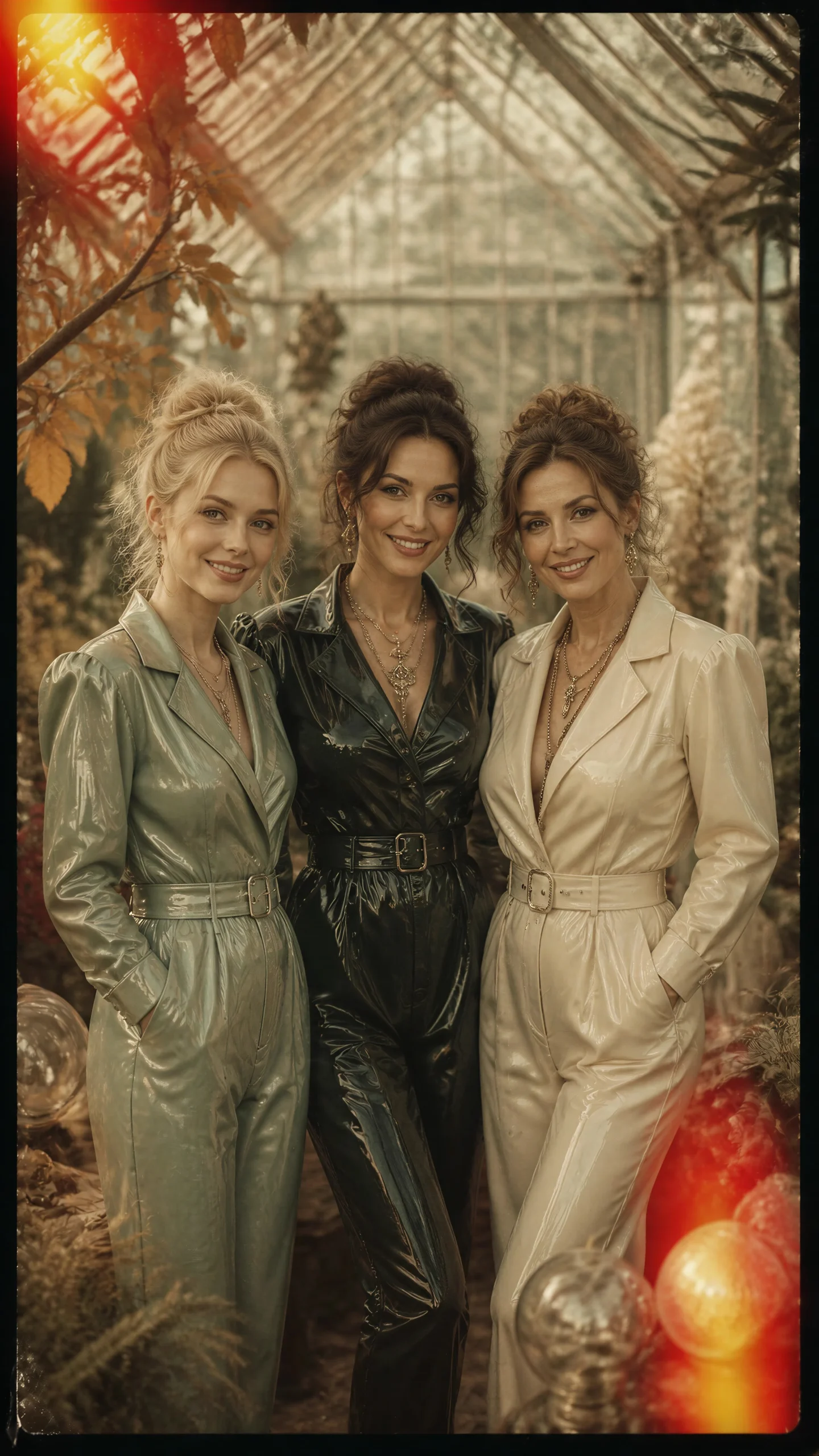
What the Glass Remembers: A September Tale of Restoration, Devotion, and the Courage to Shine
It begins, as the best transformations do, in September—when the world turns glossy with the first rains and the light slants through everything at an angle that makes you see what was always there but never noticed.
Lady Vivienne Marchmont has been invisible for eighteen months. Not in the way of grief, which is its own kind of presence, but in the way of a woman who has spent decades choosing matte wool over satin, practicality over passion, safety over the terrifying risk of being truly seen. Her late husband was kind. He was also incurious. He never once asked her what she wanted—and she never once told him.
Then she inherits a ruin.
A Victorian conservatory, choked with ivy, listing like a drunk against the autumn sky, built in 1873 by a woman history forgot—Henrietta Marchmont, who created a glass sanctuary where she could finally breathe. The structure is a catastrophe. The cast iron is corroded. The glass is shattered. The furniture is stuffed with horsehair and secrets.
It should be sold. It should be forgotten. Instead, Vivienne calls a man whose reputation is whispered in certain circles—not for what he restores, but for whom.
They call him the Curator.
He arrives with questions that feel like keys. He brings Cordelia—a woman whose glossy satin and PVC attire seems incongruous against the decay until you notice her eyes: calm, certain, lit from within by something that looks remarkably like devotion. She has worked with him for three years. She is not his assistant. She is not his employee. She is something else entirely—something Vivienne will spend the next five months understanding.
The Curator doesn’t restore buildings. He restores people’s relationship with them. His method is Socratic, his patience is infinite, and his questions strip away rust more effectively than any electrolytic bath. What did you feel when you stood inside? If this glass could speak, what would it say? What did you love before you learned to stop wanting?
As autumn deepens into winter, Vivienne will learn to remove corrosion without damaging the original beneath. She will discover a journal hidden in a chair’s stuffing—a dead woman’s voice speaking across 150 years about the same hunger Vivienne feels. She will meet other women who have been transformed by the Curator’s attention—women in leather and satin who move with the confidence of those who have been truly seen. She will trade her charcoal wool for emerald silk. She will find, beneath her own accumulated rust, a gleam she forgot was there.
And on a February morning, when the conservatory opens its restored glass to the first light of approaching spring, Vivienne will understand what Henrietta knew: that the space we build for growth must include not just light and warmth, but the right questions—and sometimes, the person who asks them becomes the center around which a community of growth can form.
This is a story about restoration. It is also a story about surrender—not to a person, but to a quality of attention so rare and so penetrating that devotion becomes not weakness, but the most powerful form of strength.
The conservatory has a secret. So does Vivienne. So, perhaps, do you.
Chapter One: “The Letter in Autumn Light”
The letter arrived on a Tuesday in September, carried by a postman whose footsteps crunched through the first fallen leaves of autumn with the particular rhythm of someone delivering news that would change a life. Vivienne heard him from the kitchen, where she stood in sensible charcoal wool—trousers that were correct but not remarkable, a cardigan that was warm but not wonderful—staring at a kettle that had boiled three minutes ago and whose steam she had not yet poured. She had been standing there, she realized, for some time. She had been standing there, in various kitchens, in various states of wool and waiting, for eighteen months.
The letter was from Hartwell & Associates, Solicitors, and it bore the weighty cream stationery of a firm that had handled the Marchmont family’s affairs since before Queen Victoria ascended the throne. The envelope was thick, the kind that suggested enclosures, that hinted at significance, that felt in one’s hands like the beginning of something. Vivienne turned it over twice before opening it, a habit her husband had called “excessive caution” and which she had never been able to abandon, despite his gentle mockery.
Gerald had been dead for eighteen months. Eighteen months of functioning, of attending the appropriate functions, of wearing the appropriate clothes—matte, muted, designed not to draw the eye but to allow it to slide past like water over glass. Eighteen months of being the widow Marchmont: composed, correct, contained. Eighteen months of standing in kitchens, waiting for kettles to boil, forgetting to pour them.
The letter was concise in the manner of solicitors who bill by the hour. It informed her that, in addition to the main estate which she had already inherited, there was a secondary property: a cottage and conservatory on the eastern boundary of the grounds, left to Gerald by his great-aunt Cecily in 1987 and subsequently forgotten. The cottage had been let to tenants until three years ago, when the last one departed and the property fell into disrepair. The conservatory had not been maintained in over two decades. The solicitor suggested that Lady Marchmont might wish to inspect the property with a view to either restoration or sale.
Vivienne read the letter twice, then a third time. A conservatory. She had a vague memory of visiting the cottage as a child, of being told not to go near the glass structure because it was “unsafe.” She remembered the way the light had caught the panes even then, through the overgrowth, like a jewel in a setting of green.
She folded the letter precisely, placed it in the pocket of her cardigan, and went to find her coat.
The grounds of Marchmont House were extensive, and the September morning had dressed them in the particular gold that only autumn can achieve—not the bright, confident gold of summer, but the deeper, more complex gold of things ending and beginning simultaneously. The leaves were in that transitional state between green and gone, holding their colour like a breath before release. The air had that sharpness, that clarity, that makes everything feel more present, more immediate, as if the world has sharpened its focus and demands that you do the same.
Vivienne walked the path toward the eastern boundary, her sensible shoes crunching on the gravel, her sensible coat buttoned to the throat, her sensible self firmly in place. She had been sensible for so long that she had forgotten what it felt like to be anything else. Gerald had loved her sensibility. He had praised it, relied on it, and—though she only admitted this to herself in the darkest hours of the night—been slightly suffocated by it. Or perhaps that was the other way around. Perhaps she had been suffocated by his love of her sensibility, by his insistence that she remain the composed, correct, contained woman he had married.
She had been a gardener once. Before Gerald, before the Marchmont name, before the wool and the waiting. She had studied horticulture at university, had won prizes for her work with exotic specimens, had dreamed of glasshouses and the extraordinary things that could grow within them. Gerald had found this charming, then eccentric, then finally unsuitable for a woman of her position. “The Marchmonts don’t dig in the dirt, darling,” he had said, with the particular kindness that was more effective than cruelty because it was delivered with a smile. “We employ people to do that.”
She had stopped gardening. She had started standing in kitchens.
The path curved through a grove of beech trees, their leaves turning the colour of old gold, and Vivienne emerged into a clearing she had not visited in thirty years. The cottage was there, small and stone-built, its windows dark, its garden overgrown. But it was not the cottage that caught her breath.
It was the conservatory.
It rose from the tangle of rhododendrons and ivy like a cathedral in ruins, like a shipwreck on dry land, like a dream that has been left too long in the sun. Victorian cast iron, painted a green that was now more rust than colour, formed the frame. The glass—what remained of it—caught the September light and held it, fractured it, returned it in fragments that lay across the interior like scattered jewels. The structure listed slightly to the east, as if leaning toward something just out of reach, and the whole thing had the air of a once-great lady who had fallen on hard times but retained her dignity.
Vivienne stood at the edge of the clearing and felt something shift inside her chest, a sensation she could not immediately name. It was not grief, which she knew intimately. It was not excitement, which she had almost forgotten. It was something closer to recognition—the feeling of encountering someone you’ve known in another life, or a place you’ve visited in a dream, or a version of yourself that you abandoned so long ago you forgot she existed.
She pushed through the overgrowth, her sensible coat catching on brambles, her sensible shoes sinking into soft earth, and approached the conservatory’s door. It was iron, like the frame, and it was rusted shut. She pushed. It resisted. She pushed harder, using her shoulder, feeling the rust give way in flakes that fell like orange snow, and the door opened with a groan that seemed to come from the building’s very foundations.
Inside, the air was different. Warmer, damper, greener—though the green was mostly mould and moss, the ghosts of plants long dead. The light came through the remaining glass in shafts that seemed almost deliberate, as if the conservatory were trying to communicate through the language of illumination. The cast-iron frame, despite its corrosion, still held its shape, still spoke of the ambition and craft that had created it. The floor was cracked tile, now mostly covered in leaf mould and debris, but Vivienne could see the original pattern: a geometric design in cream and green, elegant even in decay.
She walked slowly through the space, her hand trailing along the iron frame, feeling the texture of the rust beneath her fingers. The conservatory was larger than she had expected—perhaps thirty feet long and fifteen wide, with a pitched roof that rose to perhaps twelve feet at its apex. There were benches along the walls, their wooden slats rotted but still in place, and at the far end, a raised area that might once have held a display of some kind.
It was there, on that raised area, that she found the plaque.
It was brass, tarnished almost black, set into the iron frame at eye level. Vivienne rubbed it with her sleeve, and the letters emerged slowly, like a face surfacing from water:
HENRIETTA MARCHMONT
COMMISSIONED 1873
“FOR THE CULTIVATION OF BEAUTY AND THE BEAUTY OF CULTIVATION”
Vivienne read the inscription three times. Henrietta Marchmont. A woman. Not a man, not a family, not an institution—a woman. A woman who, in 1873, had commissioned a conservatory and had it inscribed with a statement of purpose that was both practical and poetic. A woman who had, Vivienne was suddenly certain, understood something that Vivienne herself was only beginning to grasp.
She stood in the ruined conservatory, in her sensible coat and sensible shoes, and felt the first stirring of something that had been dormant for decades. It was not just curiosity, though curiosity was part of it. It was the feeling of being addressed—of being seen, across a century and a half, by a woman who had built a space for growth and left it, like a letter in a drawer, for someone who might need it.
She returned to the house and called three restoration firms. The first two treated her with the polite condescension reserved for women of a certain age inquiring about properties of a certain condition. The third gave her a quote that assumed demolition rather than restoration.
It was her friend Eleanor who mentioned the Curator. Eleanor Hartwell-Sinclair, a museum director of some repute, had arrived for lunch wearing a fitted navy jacket with subtle leather trim that caught the light when she moved. It was the kind of garment that looked practical until you noticed the way it held her body—structured, defined, present. Eleanor had always dressed like that, even in their university days: glossy where others were matte, defined where others were blurred, visible where others disappeared.
“You should speak to someone who understands historic structures,” Eleanor said, pouring herself a second glass of the Sancerre that had been chosen to complement the salmon. “Not just a builder. Someone who sees what a building was before it fell, and what it could be again.”
“Is there such a person?” Vivienne asked, turning her glass in her fingers. The wine was excellent—Gerald had always insisted on excellent wine, even if he had not insisted on much else.
“There’s a man who consults for the museum,” Eleanor said, with the careful casualness that suggested she was sharing something significant. “They call him the Curator. He doesn’t advertise. He doesn’t need to. His reputation travels through certain channels.”
“What channels?”
Eleanor smiled. “The kind where people recognize quality when they see it. He restored a glasshouse for Margaret Ashby—you know Margaret, the architect. She said he didn’t just fix the building; he fixed her relationship with it. She said working with him was…” Eleanor paused, searching for the right word, “…clarifying.”
“Clarifying?”
“He asks questions. Not the usual questions about budgets and timelines. Questions that make you think about why you’re doing what you’re doing. Questions that make you see what was hidden.” Eleanor’s hand rested on her leather-trimmed jacket, a gesture so natural Vivienne almost missed its significance. “Margaret said it was like being polished. You come out shinier than you went in.”
Vivienne felt something tighten in her chest. “That sounds… unusual.”
“It is. In the best way.” Eleanor looked at her with the direct gaze that had always made Vivienne slightly uncomfortable, as if Eleanor could see past the wool and the waiting to something underneath. “You should call him. But only if you’re ready to be asked things you might not have answers for.”
The Curator’s number was not listed. Eleanor provided it on a card that was cream and unadorned, bearing only a phone number in elegant typography. Vivienne held it for three days before calling.
When she did, the voice that answered was calm, measured, and possessed of a quality she could only describe as attention. It was as if, in the simple act of saying “hello,” the voice had already begun to listen.
“I’ve been given your name by Eleanor Hartwell-Sinclair,” Vivienne said, and was immediately aware of how formal she sounded, how sensible, how contained. “I have a Victorian conservatory that requires assessment. It’s in poor condition, but I believe it may have historical significance.”
There was a pause—not empty, but full, like the pause between movements in a piece of music. Then: “Tell me what you felt when you stood inside it.”
Vivienne was taken aback. “I beg your pardon?”
“When you stood inside the conservatory. What did you feel? Not what you observed—what you felt.”
The question was so unexpected, so unlike the practical inquiries she had anticipated, that Vivienne found herself answering honestly before she could compose a more suitable response.
“I felt… recognized. As if the building knew me. As if it had been waiting.”
Another pause, longer this time. Then: “I can come on Thursday. I’ll bring a colleague who specializes in structural assessment. Is two o’clock convenient?”
“Yes. Yes, two o’clock would be—”
“Good. Until Thursday, Lady Marchmont.”
He hung up without farewell, without discussion of fees or timelines or the practical matters that usually dominated such conversations. He had asked one question, received one answer, and made one decision. Vivienne sat with the phone in her hand, feeling something she hadn’t felt in eighteen months—or perhaps much longer than that. She felt addressed.
Thursday arrived with the kind of grey, luminous sky that only September can produce—clouded but bright, as if the sun were present but diffused, spread thin across the heavens like silk over a frame. Vivienne had dressed with unusual care, though she couldn’t have said why. She had chosen her best charcoal coat, her most structured handbag, her most polished shoes. She was, she realized, trying to look competent. She was trying to look like someone worth taking seriously.
The Curator arrived at precisely two o’clock, in a vehicle that was expensive but unostentatious—a detail that told her more about him than any introduction could. He was middling in height, with silver-streaked temples and clothes that were correct in the way that Eleanor’s were: practical until you noticed the quality, invisible until you realized they were chosen. His face was composed, neither friendly nor unfriendly, and his eyes—grey, she noted, the colour of the September sky—held a quality she had encountered only once before, in the conservatory itself: attention.
He was not alone. The woman who accompanied him was named Cordelia Ashworth, and she was everything Vivienne was not. She wore a black jacket with subtle PVC trim that caught the grey light and gave it back as gloss, over a deep burgundy satin blouse that seemed to glow against the overcast day. Her trousers were tailored, her shoes were polished, and her entire appearance spoke of someone who had made a choice to be visible. She moved with the fluid confidence of a woman who is exactly where she belongs, doing exactly what she should be doing.
“Lady Marchmont,” the Curator said, and his voice was the same as on the phone—calm, attentive, present. “Thank you for receiving us. Shall we?”
They walked to the conservatory in silence, though it was not the uncomfortable silence of strangers but the expectant silence of people approaching something significant. Cordelia walked slightly behind the Curator, not in subordination but in the position of someone who has learned to observe before acting. Her eyes moved over the grounds with the practiced assessment of someone who has seen many such places before.
When they reached the clearing and the conservatory came into view, the Curator stopped. He stood for a long moment, simply looking. Vivienne watched his face and saw something she recognized: the same feeling she had experienced, the same recognition, the same sense of being addressed by a building.
“Tell me about the woman who built it,” he said.
“Henrietta Marchmont. 1873. I don’t know much about her. The family records don’t mention her extensively.”
“They rarely do.” His voice carried no bitterness, only observation. “Women who build things are often omitted from the records of families who prefer to remember men who own things. What do you know?”
“Only what the plaque says. ‘For the cultivation of beauty and the beauty of cultivation.’”
The Curator nodded slowly. “That’s more than enough to begin.” He turned to Cordelia. “Initial assessment?”
Cordelia stepped forward, and Vivienne watched with fascination as the woman began a systematic examination of the structure. She started at the northeast corner, where the frame met the stone foundation, and worked her way clockwise. Her glossy jacket caught the light as she moved, and Vivienne noticed that she wore leather gloves—not gardening gloves, but fine leather gloves that suggested both precision and care.
“The listing is concerning but not catastrophic,” Cordelia said, her voice carrying the authority of expertise. “It indicates differential settlement in the foundation, likely due to tree root intrusion on the east side. The frame is cast iron, Victorian, and the corrosion is extensive but appears superficial—I’ll need to test, but the structural members may be sound beneath the rust. The glass is a mix of original cylinder glass and later replacements. The original panels are identifiable by their imperfections—small bubbles, variations in thickness. They should be preserved wherever possible.”
She continued, detailing each issue with the precision of a surgeon describing an operation. Vivienne listened, and as she listened, she felt something she hadn’t expected: respect. Not just for Cordelia’s expertise, though that was considerable, but for the way the Curator had asked her to speak, had deferred to her knowledge, had made her the authority. There was a relationship here, a dynamic, that Vivienne couldn’t quite name but recognized as significant.
“May I see inside?” the Curator asked.
Vivienne led them through the rusted door, and the Curator entered the conservatory with the same attention he had shown outside—eyes moving slowly, taking in every detail, missing nothing. Cordelia followed, her glossy attire incongruous yet somehow right against the decay, as if she were a promise of what the space could become.
The Curator stood in the center of the space, looking up through the damaged glass at the September sky. Then he turned to Vivienne.
“You asked me to assess this conservatory,” he said. “I can do that. I can tell you what’s wrong, what needs fixing, what it will cost, and how long it will take. But that’s not really what you want to know, is it?”
Vivienne hesitated. “What do you mean?”
“You want to know if it’s worth saving. Not financially—emotionally. You want to know if the feeling you had when you stood here, the feeling that made you call me, is worth following. You want to know if the woman who built this left something here that’s meant for you.”
His words landed like stones in still water, sending ripples through her chest. “How did you—”
“Because that’s always the question. The building is just the beginning. The real question is always about the person who sees themselves in it.” He paused, and his grey eyes met hers with a directness that felt almost physical. “The answer is yes. But you already knew that.”
Vivienne stood in the ruined conservatory, in her sensible coat and sensible shoes, and felt something crack inside her—not breaking, but opening. Like a seed. Like a door. Like a conservatory letting in light.
“What happens now?” she asked.
“Now we begin,” the Curator said. “But first, I have some questions.”
He gestured to a rusted bench, and Vivienne sat. Cordelia remained standing, her glossy presence a silent testament to what questions could lead to. The Curator sat beside her, not too close, but close enough that she could feel the quality of his attention like warmth from a fire.
“Tell me about your garden,” he said.
And Vivienne, who had not spoken about her garden in thirty years, who had buried it beneath wool and waiting and the weight of a name that was not her own, began to speak.
The September light fell through the broken glass, and the conservatory listened.
Chapter Two: “The Curator’s Questions”
The questions began as gently as the September light that filtered through the broken glass above—soft, diffused, seemingly harmless. But like that light, they reached into corners Vivienne had not illuminated in years, touching surfaces she had long ago decided to leave in shadow.
“Your garden,” the Curator repeated, his voice carrying the patient persistence of water on stone. “You were going to tell me about it.”
Vivienne looked at her hands, resting in her lap like strangers she had never bothered to befriend. They were well-maintained hands—she had her nails done every fortnight at a salon in the village, a ritual of upkeep that required no thought and provided no pleasure. They were the hands of a woman who had once pushed them into soil and felt the earth respond, and who now pushed them into wool pockets and felt nothing at all.
“I grew things,” she said. “Before I married Gerald. Exotic specimens, mostly. Orchids. Bromeliads. Plants that required specific conditions, careful attention. Plants that would not survive without someone understanding exactly what they needed.” She paused, aware of how the words might sound, aware of the parallel she was drawing without intending to. “I was good at it.”
“You were more than good at it,” the Curator said. It was not a question. “Eleanor told me about your university work. The prizes. The paper you published on cultivating Disa orchids in non-native conditions. She said it was remarkable.”
Vivienne felt a flush rise in her cheeks, unexpected and unwelcome. “That was a long time ago.”
“How long?”
“Thirty years. Nearly thirty-one.”
“And in those thirty years, have you grown anything?”
The question was simple. The answer was not. Vivienne thought of the window boxes she maintained at Marchmont House—geraniums, mostly, hardy and undemanding, the kind of plant that would survive regardless of attention. She thought of the herb garden she had planted in the first year of her marriage, which Gerald had had removed to make way for a terrace. She thought of the conservatory she had requested, once, early on, and Gerald’s gentle, firm refusal: “We have the grounds, darling. We have gardeners. What would you do with a glasshouse?”
“Nothing worth mentioning,” she said.
The Curator nodded, as if this confirmed something he had already suspected. He did not press. Instead, he reached into the leather case he carried—a case of obvious quality, worn at the corners in the way that only objects of genuine use and value become worn—and withdrew a notebook. It was bound in dark leather, its pages thick and cream-coloured, and he opened it with the unhurried precision of someone who believes that the beginning of any process deserves respect.
“Before we proceed,” he said, “we need to document. Everything. Every crack, every corrosion, every surviving panel and every missing one. The first rule of restoration is this: you cannot save what you do not understand, and you cannot understand what you have not examined.”
He handed Vivienne a small, high-quality camera—not a phone, but a proper instrument with a lens that suggested serious intent. “Photograph everything. Every angle, every detail. Start from the outside and work in. North, east, south, west. Then the interior, the same way. Note conditions: damp, dry, cracked, intact. The documentation will be our map, our reference point, and—when the work is done—our proof of what we have achieved.”
Cordelia, who had been examining the iron frame with a small flashlight, approached. “I’ll show you the system,” she said, and her voice carried the warmth of someone who has performed this task many times and still finds satisfaction in it. “It’s straightforward, but thorough. That’s the Curator’s way—straightforward and thorough.”
She showed Vivienne how to photograph each section of the structure: the full frame first, then close-ups of joints, connections, and areas of particular concern. She explained the importance of consistent lighting—photographing at the same time of day, from the same angles, to ensure that changes could be accurately tracked. She demonstrated how to use a simple measuring tape to record dimensions, how to note the thickness of the iron members (casting marks could indicate the foundry of origin, she explained, which would help date the structure more precisely).
“The documentation serves three purposes,” Cordelia said, her gloved hands moving with practiced ease. “First, it gives us a baseline. We know exactly what we’re starting with. Second, it reveals patterns. When you photograph everything systematically, problems that seem isolated often turn out to be connected. Third—” she smiled, and the expression transformed her composed face into something luminous, “—it gives you a record of transformation. When the work is done, you’ll have the before and after. The contrast will take your breath away.”
Vivienne took the camera and began. As she moved around the exterior of the conservatory, photographing each section, she felt something unfamiliar stirring: engagement. Not the passive engagement of observing, but the active engagement of doing. Her hands, those well-maintained strangers, were being used for something that required thought, attention, and care. The sensation was both unsettling and deeply welcome.
The Curator watched her work for a time, then turned his attention to the interior. He moved through the space with the unhurried attention of someone who believes that buildings, like people, reveal themselves gradually if you’re willing to wait. He examined the floor tiles, noting which were original and which were later replacements. He studied the iron frame, running his fingers along the members with a touch so gentle it seemed almost reverent. He looked up through the glass—at least, through the gaps where glass was missing—and watched the September clouds drift past like thoughts through an open mind.
After perhaps an hour, he called them together. They stood in the centre of the conservatory, the three of them, and the Curator spoke.
“The structure is sound beneath the corrosion. The foundation has shifted, but not critically. The glass is approximately forty percent original, which is remarkable for a building of this age. The frame is cast iron, likely from a foundry in the Midlands—Cordelia, the casting marks suggest Macfarlane’s, which would be consistent with the date. The woodwork is beyond saving, but the design is documented in the joinery marks, so we can reproduce it accurately.”
He paused, and his grey eyes moved around the space with an expression that Vivienne could only describe as respect. “This is a significant building. Not because it’s large or grand, but because it represents something particular: a woman’s vision, executed with care, maintained with love, and then—forgotten. The question is not whether it can be restored. It can. The question is whether it should be, and that depends entirely on you.”
“On me?”
“On what you want. Not what you think you should want, not what would be practical or sensible or appropriate. What you actually, genuinely want.” He turned to face her, and the quality of his attention intensified, became almost palpable, like the warmth of a fire on a cold evening. “Do you want to save this building, Vivienne?”
It was the first time he had used her name without the honorific, and the intimacy of it startled her. She felt as if he had reached across the space between them and touched her—not physically, but in a way that was somehow more personal, more penetrating. He was asking her to choose, to commit, to declare herself. And she realized, with a clarity that surprised her, that no one had asked her what she wanted in a very long time.
“I want to save it,” she said, and the words felt like stepping off a cliff—not falling, but launching. “I don’t entirely know why, but I do.”
“That’s enough,” the Curator said. “Understanding comes later. Commitment comes first.” He closed his notebook with a soft sound that felt like a period at the end of a sentence. “We’ll begin next week. Cordelia will send you a list of what to acquire—proper work clothes, proper tools. You’ll be participating, not observing. Is that acceptable?”
“You want me to work on the restoration myself?”
“I want you to restore this building yourself, with our guidance. There’s a difference between hiring someone to fix something and fixing it yourself. The first is a transaction. The second is a relationship.” His eyes held hers, and she saw in them something she recognized from the conservatory itself: a quality of light that was both gentle and unyielding. “This building was built by a woman who couldn’t hire it done. She did it herself, or she oversaw it directly, with her own hands and her own vision. If you want to honour that, you’ll do the same.”
Vivienne nodded, though her heart was beating with a mixture of excitement and terror that she hadn’t felt since—well, since she couldn’t remember when. “What should I wear?”
Cordelia laughed—a warm, genuine sound that seemed to fill the conservatory like sunlight. “I wondered when you’d ask that. I’ll send you a list, but the short answer is: things that fit properly, that you don’t mind getting dirty, and that make you feel present. Not invisible. Present.”
She looked at Vivienne’s charcoal coat, her sensible shoes, her carefully maintained anonymity, and her expression was not critical but compassionate—the compassion of someone who has been where Vivienne is now.
“I used to dress like that,” Cordelia said. “Sensible. Invisible. I told myself I was being professional. What I was actually being was afraid.” She touched the sleeve of her own jacket, the PVC trim catching the light. “This isn’t vanity. It’s visibility. There’s a difference.”
They left as the afternoon was fading, the September light turning gold and then amber and then the deep, complex bronze that precedes dusk. Vivienne stood in the clearing and watched their car disappear down the drive, then turned back to the conservatory.
It looked different now. Not because anything had changed—the rust was still there, the broken glass, the overgrowth—but because she was seeing it through the lens of commitment. She had said yes. She had agreed to work, to participate, to be present. The building was no longer just a ruin; it was a project. And she was no longer just a woman standing in a clearing; she was a woman with a purpose.
She walked back to the house slowly, aware of the autumn air on her face, the crunch of leaves beneath her feet, the particular quality of September light that makes everything look both ending and beginning. She was thinking about Cordelia’s words—about visibility, about presence, about the difference between vanity and courage.
In her bedroom, she opened the wardrobe she had maintained with the same careful anonymity as the rest of her life. Charcoal wool. Navy tweed. Matte, muted, correct. Everything designed to be appropriate, nothing designed to be seen. She pushed through the hangers with increasing urgency, looking for something—anything—that had gloss, that had sheen, that had the quality of light she had seen in Cordelia’s attire and the conservatory’s surviving glass.
There was nothing.
She sat on the edge of the bed, her hands in her lap, and felt the particular loneliness of a woman who has been invisible for so long that she has forgotten how to be anything else. Then she picked up her phone and called Eleanor.
“I need your help,” she said. “I need to buy some clothes.”
“What kind of clothes?”
Vivienne thought of Cordelia’s satin blouse, the way it had glowed against the grey day. She thought of the PVC trim on Eleanor’s jacket, the way it had caught the light. She thought of the conservatory’s surviving glass, the way it held the light and gave it back.
“The visible kind,” she said.
Eleanor’s smile was audible through the phone. “Darling,” she said, “I’ve been waiting thirty years to hear you say that.”
The package from Cordelia arrived two days later. It contained a list of tools—proper tools, with specific brands and specifications that suggested serious intent—and a note written in elegant handwriting on cream stationery:
Dear Vivienne,
The Curator asked me to send you the practical items. I’m adding something of my own: a work jacket that I think will fit you. It’s leather-trimmed and fitted, designed for restoration work but made to be seen in. I wore it for my first project with the Curator, and it changed how I felt about being visible. I hope it does the same for you.
One more thing: the Curator asks questions that don’t have answers. They have directions. They point you toward yourself. Don’t try to answer them correctly. Try to answer them honestly. The difference is everything.
With warmth,
Cordelia
Beneath the note was the jacket. It was dark navy, tailored, with leather trim along the collar and cuffs that would catch light like the conservatory’s surviving glass. The fabric was substantial but not stiff, and when Vivienne held it up, she could see that it was designed to move with the body, to accommodate work without sacrificing presence.
She tried it on and looked in the mirror. The woman who looked back was still her—the same face, the same silver-streaked hair, the same hands that had once pushed into soil. But something was different. The jacket defined her shoulders, emphasized her posture, made her look like someone who was about to do something. She looked, for the first time in years, like someone who was present.
She turned left, then right, watching the way the leather trim caught the light. She thought of Cordelia, who had worn this jacket for her first project with the Curator, who had been transformed by his questions and his attention. She thought of Eleanor, who had always dressed with that particular gloss that made other women look matte by comparison. She thought of Henrietta, who had built a conservatory in 1873 because she needed a space to grow.
And she thought of the Curator’s question: Do you want to save this building?
She did. She wanted to save it the way she wanted to save herself—not because it was practical, but because it was necessary. Because some things, once lost, cannot be recovered. Because the rust that accumulates on iron is like the wool that accumulates on a woman who has stopped trying to be seen: it obscures without destroying, and what remains beneath is still capable of gleaming.
She looked at herself in the mirror one more time. The jacket fit. The colour suited her. The leather trim caught the September light that came through her bedroom window and gave it back as something richer, something more defined.
“Present,” she said to her reflection. “Not invisible. Present.”
The woman in the mirror nodded, and for the first time in eighteen months—perhaps for the first time in thirty years—Vivienne felt something that might, if she were brave enough to name it, be called hope.
Outside, the September light was fading, and the conservatory stood in its clearing, waiting. It had been waiting for 150 years. It could wait a little longer. But not much longer, because Vivienne was coming, and she was bringing her hands, and her questions, and her new jacket with the leather trim that caught the light.
She was bringing herself.
Chapter Three: “The First Clearing”
The morning arrived with the kind of crystalline clarity that only late September can produce—sharp, luminous, carrying the particular quality of light that makes everything appear more defined than it actually is, as if the world has decided, just for today, to stop pretending and show itself as it truly is. Vivienne woke before her alarm, which was unusual; she had spent the last eighteen months sleeping too much and too heavily, the sleep of someone who has nothing particular to wake for. But this morning, her eyes opened at five-thirty, and she lay in the pre-dawn darkness with her heart beating in a rhythm that felt almost like anticipation.
She lay there for a time, feeling the weight of the new jacket on her consciousness even though it hung in the wardrobe across the room. It had been three days since Cordelia’s package arrived, three days since she had stood in front of her mirror and said the word “present” to her own reflection, and in those three days something had shifted—not dramatically, not in the way of earthquakes and revelations, but in the quieter way of tectonic plates moving imperceptibly beneath the surface, changing the landscape without anyone noticing until suddenly the mountains are in a different place.
She rose, showered, and dressed with a care that surprised her. The work clothes Cordelia had recommended had arrived the previous afternoon: fitted trousers in dark olive, a cotton shirt in cream that was softer and more substantial than anything she usually wore, and the leather-trimmed jacket that had been the gift. She put on each piece slowly, feeling the way they held her body differently than her usual wool and tweed. The trousers were structured but not rigid, the shirt was practical but not invisible, and the jacket—she caught her breath when she put it on, because it did something to her posture, to her shoulders, to the way she held herself in space. It made her look like someone who was about to do something.
She looked in the mirror. The woman looking back was the same woman who had stood in the conservatory a week ago in charcoal wool, but she was no longer trying to disappear. The leather trim caught the early light, and the dark navy fabric held her shape with a firmness that felt almost like encouragement.
“Present,” she said again, and this time the word felt less like a declaration and more like a description.
The Curator and Cordelia arrived at eight o’clock precisely. His car pulled into the drive with the same unostentatious precision as before, and they emerged carrying equipment: ladders, tools, protective materials, and a large thermos that Cordelia explained contained coffee “because the Curator believes that good work requires good coffee, and he has opinions about both.”
Cordelia was dressed for work, and her attire was a masterclass in the art of being practical without being invisible. She wore fitted black trousers with leather knee patches—designed for kneeling, she explained, but also rather wonderful to look at—and a dark green satin blouse under a fitted work jacket in waxed cotton that had the sheen of a well-maintained antique. Her hair was pulled back in a chignon that was both practical and elegant, and her hands were gloved in leather that was already showing the marks of honest use.
“You look different,” Cordelia said, looking at Vivienne with an expression of genuine pleasure. “The jacket suits you. How does it feel?”
Vivienne considered the question honestly. “Like armour,” she said. “But the kind that makes you want to go into battle, not hide from it.”
Cordelia smiled, and the expression transformed her face in a way that Vivienne had noticed before—a way that suggested not just happiness but something deeper, something that looked like contentment. “That’s exactly right. The right clothes don’t protect you from the work; they give you the courage to do it. The Curator taught me that.”
“Did he teach you about clothes specifically?”
“He taught me about visibility. The clothes followed.” She adjusted her leather gloves with a practiced motion. “I’ll explain while we work. Come—the Curator wants to begin with the exterior clearing.”
The Curator was already at the conservatory when they arrived, standing in the clearing with his hands in his pockets, looking at the structure with the same quality of attention that Vivienne was beginning to recognize as his defining characteristic. He was not inspecting or assessing; he was seeing. There was a difference, she was learning, between looking at something and seeing it, just as there was a difference between hearing and listening, between touching and feeling.
“Good morning, Vivienne,” he said without turning around. “You’re dressed for the work. Good. Today we begin with the ivy.”
He gestured to the mass of growth that covered the conservatory’s exterior—the vines that had crept up the iron frame and across the glass, their roots finding purchase in every crack and joint, their leaves creating a green shroud that obscured the building’s original form. The ivy was beautiful in its way—lush, determined, alive—but it was also destructive, its roots prying apart the structure it clung to, its weight stressing joints that were already weakened by age and neglect.
“Ivy is a paradox,” the Curator said, his voice carrying the patient cadence of a born teacher. “It protects and destroys simultaneously. Its coverage shields the surface from weather, but its roots exploit every weakness, widening cracks, loosening joints. The question is: do you remove it all at once, or do you let it die gradually?”
He looked at Vivienne, and she understood that this was not a rhetorical question. He was asking her.
“I would think… gradually?” she said, uncertain. “If you remove it all at once, you might damage the structure underneath.”
“Correct. The proper technique is to cut the ivy at the base of the stems, leaving the upper growth in place to die naturally over weeks or months. As it dries, it loosens its grip, and you can remove it gradually without forcing it away from the surface. Forcing it pulls off paint, damages joints, and can even dislodge mortar.” He reached into his tool kit and produced a pair of sharp secateurs. “We cut at the base, leave the growth to die, and return to remove it as it releases. It requires patience, but patience is the first virtue of restoration.”
He demonstrated the technique: finding the main stems where they emerged from the ground, cutting them cleanly with the secateurs, and leaving the upper growth undisturbed. “Cut at an angle,” he said, “so water doesn’t pool on the cut surface. And mark the cut stems with tape so you can track which ones have been treated.”
Vivienne took the secateurs and began. The work was physical—she had to kneel in the damp earth, push through the lower growth to find the stems, and cut through wood that was surprisingly thick. But it was also precise, requiring attention to detail and care for the surface beneath. She found herself absorbed in a way she hadn’t anticipated, her mind focused on the immediate task rather than the diffuse anxiety that had been her companion for eighteen months.
As she worked, the Curator moved around the structure, examining the areas where ivy had already been cut in previous years—the dead vines that still clung to the frame, their leaves long gone, their stems dried and brittle. “These we can remove now,” he said, showing her how to gently peel the dead growth away from the surface, supporting it from beneath to avoid pulling on the structure. “See how it releases? The roots have dried, the grip has loosened. This is what patience looks like.”
Cordelia worked on the opposite side of the conservatory, removing dead growth with the practiced ease of someone who has done this many times before. Her glossy attire—impractical, one might think, for such work—was in fact perfectly suited. The waxed cotton shed dirt and moisture, the leather knee patches allowed her to kneel without concern, and the satin blouse beneath was protected by the jacket while still being visible at the collar and cuffs, a reminder that practicality and elegance were not opposing forces.
“The Curator has a theory about work clothes,” Cordelia said, pausing to examine a particularly stubborn vine. “He believes that the way you dress for work affects the quality of the work. Not because expensive clothes make you better, but because clothes that make you feel visible make you more attentive. And attentiveness is the foundation of restoration.”
“Is that why you wear satin to clear ivy?” Vivienne asked, with a smile that surprised her—it was the first time she had made something approaching a joke in months.
Cordelia laughed. “I wear satin because it reminds me that I’m not just a labourer. I’m a craftsperson. The Curator once told me that the difference between a labourer and a craftsperson is not skill—it’s self-regard. A labourer does the work. A craftsperson does the work while knowing she deserves to be seen doing it.”
Vivienne paused in her cutting, struck by the statement. She thought of her years of charcoal wool, of sensible shoes, of the careful anonymity she had maintained like a second skin. She had told herself she was being appropriate, professional, correct. But perhaps she had been telling herself a different story: that she didn’t deserve to be seen.
They worked through the morning, the September sun rising higher and warming the air, burning off the dew that had settled on the overgrowth. Vivienne’s hands began to ache from the secateurs, and her knees were damp from the earth, but she found she didn’t mind. The discomfort was specific, immediate, and purposeful—unlike the diffuse, purposeless discomfort she had carried for so long.
At midday, the Curator called a halt. They sat on the stone steps of the cottage—empty now, the tenants long gone—and Cordelia produced a lunch that was simple but excellent: good bread, aged cheese, olives, and a flask of the coffee she had mentioned earlier. The thermos was silver, worn at the handle, and the coffee inside was dark and rich and far better than anything Vivienne had been drinking in her solitary kitchen.
“Eleanor tells me you were a horticulturist,” the Curator said, pouring coffee with the same attention he brought to everything. “Before your marriage.”
Vivienne stiffened slightly. “That was a long time ago.”
“How long?”
“Thirty years. I gave it up when I married Gerald. He felt it was… unsuitable.”
“Unsuitable.” The Curator repeated the word as if tasting it, finding it wanting. “Unsuitable for whom?”
“For a woman of my position, he said. The Marchmonts don’t dig in the dirt.”
The Curator looked at her, and his grey eyes held something she couldn’t quite identify—not judgment, not pity, but something closer to recognition. “And what did you think?”
“I thought…” Vivienne paused, aware that she was about to say something she had never said aloud. “I thought he was probably right. He knew about position, about propriety. He knew what was expected. I trusted him to know better than I did.”
“And now?”
“Now I’m not sure he knew better. I think he knew what was comfortable. For him.”
The Curator nodded slowly. “Gerald sounds like a man who loved you the way he understood love—which was completely, but within limits he set himself. The problem with limits is that they don’t just contain; they constrain. You were contained, Vivienne. Not by malice, but by kindness. The kindest prison is still a prison.”
Vivienne felt something shift in her chest—not breaking, but loosening. Like a root releasing its grip on a surface it has held for years. “I don’t know if I can blame him for that. I let it happen.”
“You didn’t let it happen. You were trained for it. Women of your generation were trained to believe that wanting things was unseemly, that having desires was inconvenient, that being visible was vulgar. You weren’t imprisoned; you were educated. And education can be unlearned.” He sipped his coffee, his eyes still on her. “That’s what this conservatory is for. Not just for growing plants—for growing you.”
Cordelia spoke then, her voice carrying the quiet authority of experience. “Can I tell you something, Vivienne? About how I came to work with the Curator?”
“Please.”
“Three years ago, I was a textile conservator at the Victoria and Albert Museum. I was good at my job—respected, published, secure. I wore sensible cotton, sensible shoes, sensible everything. I told myself I was being professional. What I was actually being was afraid.” She looked at her gloved hands, leather-sheathed and capable. “The Curator came to consult on a project—a collection of Victorian garments that needed stabilization. He asked me, during our first meeting, why I dressed as if I didn’t want to be seen.”
Vivienne winced. “That must have been uncomfortable.”
“It was devastating. No one had ever asked me that. No one had ever looked closely enough to notice. And the fact that he noticed—that he cared enough to ask—was more attention than I had received in years.” She paused, and her expression softened into something that looked like gratitude. “I didn’t have an answer. I went home that night and stood in front of my wardrobe—all those sensible, invisible clothes—and realized I had been hiding. Not from anything specific, but from being seen. From the vulnerability of mattering.”
“What changed?”
“He kept asking. Not about the clothes—about everything. About why I had chosen textile conservation. About what I loved about it. About what I would do if I could do anything. His questions were like… like sunlight through glass. They illuminated things I had kept in shadow, not because they were shameful, but because I had forgotten they were there.” She smiled, and the expression was luminous. “I bought my first satin blouse a month after meeting him. I wore it to work and felt exposed. But also alive. He noticed, of course. He notices everything. He said, ‘There you are.’ That was all. But it was enough.”
Vivienne looked at Cordelia—at her glossy attire, her composed confidence, her evident contentment—and felt something she hadn’t felt in years: envy. Not the destructive kind, but the generative kind—the kind that shows you what is possible and makes you want it for yourself.
“How many women has he worked with?” she asked. “How many have you seen transformed?”
Cordelia’s smile deepened. “More than you might imagine. We’re not a formal group—there’s no membership, no structure. But there’s a community. Women who have been asked the right questions by the right person at the right time, and who have found in those questions a path back to themselves. We stay in touch. We support each other. We share the things we’ve learned—about restoration, about ourselves.” She looked at the Curator, who was examining the conservatory’s east wall with his characteristic attention. “He doesn’t create devotion. He reveals what’s already there. The women who work with him aren’t followers; they’re findings. He finds what was hidden, and he helps it grow.”
“That sounds almost like a calling.”
“It is. For him and for us. Some people are called to religion, to art, to public service. We are called to restoration—to the careful, patient work of revealing what time and neglect have obscured. And we are called to visibility—to the courage of being seen, of wearing the glossy fabrics that catch the light and say, ‘Here I am. I matter. I am present.’” She touched the satin at her collar, and the gesture was both casual and profound. “This isn’t vanity. It’s testimony.”
The afternoon’s work focused on the interior clearing: removing the debris that had accumulated over decades of neglect. The Curator taught them to identify what could be safely removed and what needed to be preserved: leaf mould and debris, yes; original tile fragments and surviving plant containers, no. He showed them how to document each layer before removing it, photographing and noting the position of every significant element.
“The rule of restoration is this,” he said, kneeling beside a particularly fragile area of tile. “Remove nothing until you understand what it is and why it’s there. Debris tells a story—the pattern of accumulation reveals the history of neglect. This leaf mould, for example—” he gestured to a thick layer of decomposed material, “—tells us that the roof has been leaking here for at least a decade. The water enters, the leaves accumulate, the moisture accelerates the decay. Understanding the pattern helps us address the cause, not just the symptom.”
Vivienne worked alongside Cordelia, clearing debris into bags for removal. The work was dirty, physical, and oddly satisfying. Each layer removed revealed something beneath—original tiles, the stone border of a planting bed, a fragment of terracotta pot that might have been one of Henrietta’s original containers. The conservatory was revealing itself, layer by layer, like a woman removing the armour of years.
As the afternoon light began to fade, the Curator called them together. They stood in the partially cleared interior, their work clothes marked with the evidence of honest labour, their faces flushed with exertion and something else—something that looked, to Vivienne’s eyes, like satisfaction.
“Look,” the Curator said, gesturing around the space. “See what you’ve revealed.”
Vivienne looked. The conservatory, which had seemed so ruined when she first entered, was beginning to show its original form. The iron frame, freed of its ivy shroud, stood with a dignity that the overgrowth had obscured. The floor tiles, cleared of debris, displayed their geometric pattern with renewed clarity. The light through the remaining glass fell on surfaces that had been hidden for years, illuminating details that had been lost to neglect.
“It’s like meeting someone for the first time,” Vivienne said, and her voice was thick with an emotion she couldn’t name. “Someone I’ve been living with for years but never really seen.”
The Curator looked at her, and his expression held something she recognized from her own reflection that morning—not satisfaction, but recognition. The recognition of someone who is beginning to see what was always there.
“That’s exactly what it’s like,” he said. “And it’s only the beginning.”
They left as the September light was fading, the conservatory standing in its clearing like a woman who has just removed a heavy coat and is learning to feel the air on her skin. Vivienne stood in the doorway and watched them go, then turned back to the space they had begun to reveal.
She thought of Cordelia’s words: He doesn’t create devotion. He reveals what’s already there. She thought of the Curator’s questions, which were not interrogations but illuminations—sunlight through glass, showing her what she had kept in shadow. She thought of Henrietta, who had built this space for cultivation, for beauty, for the courage of growing things in a world that told her she shouldn’t.
And she thought of herself—standing in a conservatory in leather-trimmed navy, her hands dirty, her heart engaged, feeling for the first time in years that she was not just occupying space but filling it. Not just present, but participating. Not just alive, but growing.
She looked at her hands, which were no longer the well-maintained strangers of a fortnight ago. They were dirty now, marked with earth and ivy sap, and they were the most beautiful things she had seen in a long time. They were hands that had done something. Hands that had begun.
She closed the conservatory door—gently, reverently, the way one closes a book one intends to return to—and walked back through the September evening to the house. The air was cool on her face, and the leather trim on her jacket caught the last light, and she felt, for the first time in eighteen months, that the waiting was over.
The clearing had begun.
Chapter Four: “The Rust and the Real”
October arrived not with a whisper but with a declaration—the first frost painting the grounds in silver, the leaves surrendering their green entirely and committing to the full spectrum of autumn’s palette: amber, russet, gold, and the deep burgundy that Vivienne had always associated with certain satins she had admired but never owned. The conservatory stood in its clearing like a patient awaiting treatment, its iron frame exposed now, its ivy shroud removed, its rust visible in the clear morning light with a honesty that was almost brutal.
Vivienne had dressed with a new deliberateness that had become, over the three weeks since the clearing began, something approaching ritual. She no longer reached for charcoal wool without thought; she no longer dressed to disappear. This morning she had chosen dark trousers with leather detailing at the knee—practical for the kneeling that rust removal would require—and a deep burgundy satin blouse that she had purchased, with Eleanor’s guidance, during a shopping expedition that had felt less like acquiring clothes and more like recovering parts of herself. The blouse was covered now by a fitted work jacket in waxed cotton, but the satin was visible at the collar and cuffs, catching the October light like a secret being slowly told.
She had discovered, in these three weeks, that wearing satin beneath a work jacket was not vanity but intention. It was a private acknowledgment of worth, a layer of beauty against her skin that no one else could see but that she could feel with every movement. It was, she was beginning to understand, what Cordelia meant by testimony—the act of declaring to oneself, before declaring to anyone else, that one deserved to be seen.
The Curator was already at the conservatory when Vivienne arrived, setting up equipment she didn’t recognize. Cordelia knelt beside him, arranging items on a ground cloth with the organized precision of a surgeon preparing an operating theatre. Their movements had the synchronicity of people who have worked together long enough to anticipate each other—a wordless choreography that spoke of trust, familiarity, and something deeper that Vivienne recognized but didn’t yet have language for.
“Good morning,” the Curator said, looking up. His eyes moved over her with the quality of attention she was learning to expect—not assessing, but seeing. “You’re wearing colour.”
It was a statement, not a question, but it carried the weight of a question. Vivienne felt a flush rise in her cheeks that had nothing to do with the October chill.
“Burgundy,” she said. “Cordelia said it was the colour of courage.”
Cordelia looked up from her arrangement of equipment and smiled. “I said it was the colour of women who are tired of being invisible. But courage works too.”
The Curator nodded, and the gesture carried a weight that a simple nod should not have been able to bear. It was approval, Vivienne realized. Not the casual approval of someone complimenting a choice, but the deeper approval of someone who has been waiting for a particular change and is pleased to see it arrive.
“Today,” he said, “we address the rust.”
The equipment, Vivienne learned, was for electrolytic rust removal—a process that sounded intimidating but that the Curator explained with the patient clarity that was becoming his signature. He had brought a large plastic container, a bag of washing soda, a battery charger, and several pieces of rebar—ordinary objects that, combined in a specific way, would perform an extraordinary task.
“Electrolysis is the gentlest method of rust removal,” the Curator said, arranging the items on the ground cloth with the care of someone setting up a tea service. “It removes corrosion without damaging the underlying metal, without abrading surfaces, without losing the detail of casting marks or engravings. It works through a chemical process—an electric current passes through a conductive solution, causing the rust to migrate from the iron object to a sacrificial anode. The rust moves; the metal stays.”
He showed Vivienne how to set up the process: filling the plastic container with water, adding washing soda at a ratio of one tablespoon per gallon to create the conductive solution, positioning the rebar as the sacrificial anode around the edges of the container, and connecting the battery charger—the negative lead to the iron object being treated, the positive lead to the rebar.
“The negative charge attracts the rust, pulling it away from the object and toward the anode,” he explained, connecting the clips with the precision of someone who has performed this ritual many times. “The process takes hours—sometimes days, depending on the extent of the corrosion. But it is thorough, and it is kind. It removes only what doesn’t belong.”
“Like a good question,” Vivienne said, surprising herself.
The Curator looked at her, and something shifted in his grey eyes—a brightness, a warmth, that she hadn’t seen before. “Exactly like a good question. The right question removes what doesn’t belong—assumptions, fears, the accumulated corrosion of years—without damaging what lies beneath. The real you, Vivienne, is like the iron beneath the rust. It’s still there. It’s always been there. Our task is to create the conditions for it to emerge.”
He submerged the first section of iron frame—a curved bracket from the conservatory’s east wall—into the solution. The water clouded slightly, then settled. He connected the charger, and a faint fizzing sound began—so subtle that Vivienne had to lean close to hear it.
“That’s the sound of restoration,” Cordelia said, kneeling beside her. “That fizz is the rust releasing its grip. It’s the sound of something letting go.”
They worked through the morning, setting up multiple electrolytic baths for different sections of the frame. The Curator explained the principles in detail that was both thorough and accessible: the importance of using the correct ratio of washing soda to water (too little and the current won’t flow properly; too much and the solution becomes inefficient), the need for the object and anode not to touch (which would create a short circuit), and the significance of using the correct polarity (reversing the connections would cause the object itself to corrode).
“The process is forgiving but not careless,” he said, adjusting the position of a bracket in the solution. “It requires attention—checking periodically, ensuring the connections remain secure, monitoring the progress. But it doesn’t require force. The chemistry does the work. You set the conditions, and the rust releases itself.”
Vivienne found herself captivated by the process—not just the technical details, but the metaphor that ran beneath them like a vein of precious metal in stone. She thought about her own accumulated corrosion: the years of sensible wool, the decades of not being asked what she wanted, the rust of expectations that had formed on her original self until she could no longer see what lay beneath. The Curator’s questions were electrolytic, she realized. They created conditions in which the corrosion could release its grip, allowing the real metal—the real woman—to emerge.
As they worked, the Curator’s questions continued—not about the conservatory, but about Vivienne’s life. His gentle probing was like the electrolytic process itself: creating conditions in which things could emerge without being forced.
“Tell me about Gerald,” he said, as they lifted a particularly corroded section of frame into a bath. “Not the facts—I know the facts. Tell me about the marriage.”
Vivienne’s hands stilled on the iron. “What do you want to know?”
“I want to know if you were happy.”
The word “happy” landed like a stone in still water, sending ripples through her chest. She considered the question honestly—a habit the Curator was cultivating in her, the practice of responding with truth rather than performance.
“I was… comfortable,” she said. “Gerald was kind. He provided everything. He was generous, considerate, reliable. We had a life that looked correct from the outside—the house, the grounds, the position. People admired us.”
“Comfortable,” the Curator repeated. “That’s a word that describes a chair, not a life. Were you happy, Vivienne? Not comfortable—happy. Did you wake up glad to be in your life? Did you feel seen? Did you feel wanted—not provided for, but wanted?”
The question was so direct, so penetrating, that Vivienne felt something crack inside her—not breaking, but opening, like a seed splitting its shell. She looked at her hands, submerged in the electrolytic solution, and saw the rust particles beginning to migrate toward the rebar, releasing their grip on the iron.
“He never asked me what I wanted,” she said, and her voice was thick with an emotion she had been carrying for decades. “Not once. In thirty years of marriage, he never once asked me what I wanted. He told me what was suitable, what was appropriate, what was expected. He provided what he thought I should have. But he never asked what I actually desired.”
“And did you tell him?”
“I didn’t know how. I had been trained—not by him, by everything—to believe that wanting was unseemly. That having desires was inconvenient. That being visible was vulgar.” She looked up, and her eyes met the Curator’s grey ones. “I was contained. Not by cruelty, by kindness. The kindest prison is still a prison.”
The Curator nodded slowly. “Security without discovery is a gilded cage,” he said. “Some people spend their whole lives polishing the bars. Gerald wasn’t a bad man, Vivienne. He was a man who loved you the only way he knew how—by providing safety. But safety isn’t the same as growth. A seedling in a dark room is safe, but it doesn’t thrive. It needs light.”
He gestured to the conservatory around them. “That’s what Henrietta built. Not a room—a light. A place where growth was not just permitted but intended. She understood something that you’re only beginning to remember: that safety is the enemy of transformation.”
Cordelia, who had been monitoring the electrolytic baths with quiet attention, joined them. Her PVC-trimmed work jacket caught the October light as she moved, and Vivienne noticed—not for the first time—the way her glossy attire seemed to belong in this space, as if the conservatory and Cordelia were expressions of the same principle: the courage to shine.
“The first piece is ready,” Cordelia said, gesturing to one of the baths. “The rust has released. You can see the original metal beneath.”
They gathered around the container, and the Curator carefully lifted the iron bracket from the solution. Vivienne gasped. The section that had gone in covered in thick, dark corrosion was now emerged in a dull grey—but it was clean, smooth, the original surface visible for the first time in perhaps a century. The casting marks were clear, the curves elegant, the craftsmanship evident. It was like meeting someone who had been hidden behind a mask for decades.
“Beautiful,” Vivienne whispered.
“The rust wasn’t the metal’s fault,” Cordelia said, her voice carrying the gentle authority of someone who has spoken these words before. “It’s what happens when something is neglected. The metal underneath is still there, waiting. It just needed the right conditions to be revealed.”
She looked at Vivienne as she spoke, and the parallel was not lost on either of them.
The Curator set the bracket on a clean cloth and began to explain the post-treatment process. “Once the rust is removed, the iron is vulnerable—it will begin to corrode again immediately if not protected. We need to dry it thoroughly, then apply a protective coating. I use a mixture of beeswax and linseed oil—heated and applied while the metal is warm. It penetrates the surface and creates a barrier against moisture.”
He demonstrated the technique: heating the iron gently with a heat gun (not enough to damage the metal, just enough to open its pores), then applying the wax-oil mixture with a soft cloth. The iron darkened slightly, taking on a deep, rich patina that spoke of age and care rather than decay.
“The finish will need to be maintained,” he said, “but that’s true of all beautiful things. They require attention. Not constant attention—periodic, intentional, caring attention. Like a garden. Like a friendship. Like a self.”
They worked through the afternoon, processing section after section of the frame. The process was slow—each piece required hours in the bath—but the results were transformative. As the rust released its grip, the conservatory’s original craftsmanship emerged: elegant curves, precise joins, decorative details that had been completely obscured by corrosion.
Vivienne found herself drawn to a particular section of frame near the east wall—a curved bracket that supported the junction between the wall and the roof. It was more heavily corroded than most, and the Curator suggested it might need extended treatment. As she prepared to lower it into the bath, she noticed something: a slight irregularity on the inner surface, where the curve met the straight member. It wasn’t a casting flaw—the regularity was wrong for that. It looked deliberate.
“Look at this,” she said, holding the bracket up to the light.
The Curator came to her side, and Cordelia leaned in close. In the oblique October light, the irregularity resolved into letters—faint, partially obscured by corrosion, but unmistakable.
“H.M.,” Vivienne read, her voice barely above a whisper. “Henrietta Marchmont.”
“And a date,” the Curator said, his voice carrying an excitement that Vivienne had not heard before—a brightness that transformed his usual composed demeanor into something almost boyish. “Can you make it out?”
Vivienne tilted the bracket, angling it to catch the light. The numbers were partially obscured by corrosion, but as she looked, they emerged: 1869.
“1869,” she said. “But the plaque says 1873. The conservatory was commissioned in 1873.”
“According to the plaque,” the Curator said. “But this engraving suggests the frame was made—or at least marked—in 1869. Four years earlier.”
“What does that mean?”
The Curator looked at her, and his grey eyes held the particular brightness of someone who has discovered that a story is more complex—and more interesting—than originally believed. “It means Henrietta was planning this conservatory for at least four years before it was officially commissioned. It means she was working in secret, preparing, gathering materials, before she was able to make her vision public. It means—” he paused, and the weight of the moment settled around them like the October air, “—that this conservatory was not a whim. It was a mission. And we’re only beginning to understand it.”
The discovery changed the atmosphere of the afternoon. The Curator’s questions became more specific, more focused on Henrietta and the historical context of her project. He asked Vivienne to search the family archives for any mention of Henrietta—letters, diaries, household accounts, anything that might illuminate the woman behind the conservatory.
“Women like Henrietta don’t leave obvious records,” he said. “They leave traces—marginal notes, receipts, references in other people’s correspondence. You have to look for what isn’t there as much as what is. The absence of mention is itself a kind of mention—it tells you that someone was deliberately omitted from the record.”
Cordelia nodded in agreement. “The Curator found a woman once—a textile artist who had been completely erased from her family’s history—through a single line in a household account book: ‘Item: silk for Mrs. K’s use, not to be mentioned to Mr. K.’ That one line told him everything he needed to know about her life, her work, and the constraints she operated under.”
“One line,” Vivienne said. “That’s all it took.”
“One line is enough, if you know how to read it. The question is always: what was important enough to record, and what was important enough to hide?”
As the afternoon light began to fade, they gathered around the last electrolytic bath, watching the fizzing surface with the quiet attention of people watching a birth. The iron section inside—a decorative finial from the roof—was emerging from its corrosion, the original details becoming visible through the clouded solution.
Cordelia spoke, her voice carrying the reflective quality of someone processing a significant thought. “Can I tell you something, Vivienne? About the rust?”
“Please.”
“I was thinking about what the Curator said—about security without discovery being a gilded cage. I was thinking about my own rust. Before I met the Curator, I had accumulated a kind of corrosion—not on iron, but on myself. Layers of sensible cotton, sensible routine, sensible invisibility. I told myself I was being professional. What I was actually doing was protecting myself from being seen, because being seen meant being vulnerable, and being vulnerable meant being hurt.”
She looked at the finial emerging from the bath—its original form revealed, its details clear for the first time in decades. “The Curator’s questions were like this process. They didn’t force anything. They created conditions in which the rust could release. And what emerged—the real me, the woman who wears satin and PVC and takes pleasure in being visible—was there all along. He didn’t create her. He revealed her.”
Vivienne looked at Cordelia—at her glossy attire, her composed confidence, her evident devotion to the work and the man who had guided her to it—and felt something she was learning to name: admiration. Not just for Cordelia’s transformation, but for the quality of attention that had made it possible. The Curator didn’t transform women. He created conditions in which they could transform themselves.
“How many women has he done this with?” she asked. “How many have found themselves through his questions?”
Cordelia smiled. “More than you might imagine. We find each other—we recognize each other by the quality of our attention, by the way we dress with intention, by the questions we’ve learned to ask. We’re not a formal group. We’re a community of women who have been seen clearly and have chosen to be worthy of that seeing.”
She touched the satin at her collar—that gesture Vivienne was beginning to recognize as a kind of shorthand for everything she had been describing. “This isn’t vanity. It’s visibility. It’s the outward expression of an inward transformation. And it’s the most powerful thing I’ve ever experienced.”
The Curator, who had been monitoring the last bath, looked up. His grey eyes moved from Cordelia to Vivienne, and something passed between them—an acknowledgment, a connection, a shared understanding that didn’t require words.
“The finial is ready,” he said. “Would you like to lift it out, Vivienne?”
She nodded, her hands trembling slightly—not with fear, but with the particular excitement of someone participating in something significant. She reached into the bath, her leather gloves protecting her hands from the solution, and lifted the finial out.
It was beautiful. The corrosion had obscured a delicate design—leaves and scrolls that spoke of Victorian craftsmanship at its finest. The original surface was dull but intact, the details crisp and clear. It was like holding a piece of recovered history—a fragment of Henrietta’s vision, preserved beneath the rust for 150 years, waiting for someone to create the conditions for its emergence.
Vivienne held it up to the fading October light, and the details caught the sun, and for a moment—just a moment—she saw Henrietta. Not a ghost, not a vision, but a presence. The presence of a woman who had loved beauty enough to build a space for it, who had been determined enough to plan for years in secret, who had left her mark not in family records but in the iron itself.
“There you are,” Vivienne whispered.
The Curator heard her. His eyes met hers, and she saw in them the same recognition she had seen when he first looked at the conservatory—the recognition of something significant, something worth preserving, something that had been hidden and was now emerging.
“Yes,” he said. “There she is. And there you are.”
The October light faded, and the conservatory stood in its clearing, its rust being released, its real form emerging, its secrets beginning to surface. And Vivienne stood in her burgundy satin and leather-trimmed jacket, holding a piece of recovered history, feeling the rust of her own years beginning to release its grip.
The real was emerging. Both for the conservatory and for her.
Chapter Five: “Cordelia’s Confidence”
The rain arrived in the early hours of Friday morning, not with the gentle persistence of autumn showers but with the full-throated declaration of a season asserting its authority. It hammered against the windows of Marchmont House with a force that made the glass sing, and when Vivienne drew back her curtains at six o’clock, the world outside was a watercolour left in the rain—colours running, edges blurred, the conservatory visible only as a ghost in the downpour.
She stood at the window for a long time, watching the rain transform the grounds into something both familiar and foreign. The beech trees bent under the weight of water, their amber leaves releasing their grip and falling in spirals that the wind caught and carried. The gravel paths had become streams, carrying leaves and debris toward the lower ground. And the conservatory—her conservatory, she was beginning to think of it, though the possessive still felt presumptuous—stood in its clearing like a ship in a storm, its exposed iron frame dark with moisture, its remaining glass catching the grey light in ways that made it look alternately fragile and resilient.
Her phone buzzed on the nightstand. A message from Cordelia.
Rain prevents exterior work today. Come to the cottage instead. I have something to show you. Bring tea—the Curator drinks the museum’s supply without conscience, and I’ve run out. C.
Vivienne smiled—a real smile, not the polite reflex she had maintained for eighteen months but the genuine expression of someone who is looking forward to something. She dressed with the care that had become her new habit: the burgundy satin blouse again (she had three now, purchased during the expedition with Eleanor, each in a different shade—burgundy, deep emerald, and midnight blue—each a declaration of presence that she wore beneath her work jacket like armour made of beauty), fitted trousers with leather detailing, and over it all, the waxed cotton jacket that had become her second skin.
She stopped at the kitchen to prepare a thermos of proper tea—Darjeeling, first flush, the kind that Gerald had considered an extravagance and that she had stopped buying because his gentle disapproval was more effective than any prohibition. She had started buying it again three weeks ago, and the taste of it on her tongue each morning was like a small, private rebellion.
The cottage adjacent to the conservatory had been empty since the last tenants departed, but Cordelia had claimed it as a workspace with the Curator’s quiet approval. Vivienne had not been inside before; their work had focused entirely on the conservatory itself. She knocked on the door, the thermos tucked under her arm, her umbrella dripping on the stone step.
Cordelia opened the door, and Vivienne’s breath caught.
She was dressed not for work but for something else entirely—a state of being that Vivienne would later struggle to name but that she recognized immediately as a kind of completeness. Cordelia wore a fitted jacket in black PVC that caught the grey light from the window and gave it back as gloss, over a satin blouse in deep emerald that seemed to glow against the dark shell of the jacket. Her trousers were tailored, her shoes were polished, and her hair was down for once—falling past her shoulders in waves that caught the light the way her clothing did, with intention.
“Come in,” Cordelia said, stepping aside with a gesture that was both welcoming and ceremonial. “Welcome to my other world.”
The cottage’s main room had been transformed. What had been a modest living space was now a workshop and wardrobe in equal measure—one half devoted to textile conservation, the other to what Vivienne could only describe as a curated collection of glossy attire. The two halves were not separate but integrated, as if the work and the wardrobe were expressions of the same principle.
The conservation side was meticulous: a large work table with proper lighting, storage units for materials, and racks of restored textiles organized by period and type. Vivienne could see Victorian garments hanging beside Edwardian pieces, each labeled with careful notes, each preserved with the attention of someone who understands that fabric is not merely material but memory.
The wardrobe side was breathtaking. Glossy fabrics in jewel tones hung with the organization of a museum collection: satin blouses in burgundy, emerald, midnight blue, and a deep purple that seemed to shift colour in the changing light. PVC-trimmed jackets in black and navy and a dark red that caught the rain-grey light and transformed it. Leather pieces—skirts, trousers, jackets—that gleamed with the polish of recent care. And accessories: scarves, gloves, belts, each chosen with the precision of someone who understands that details are not minor but essential.
“Good heavens,” Vivienne said, and the words were inadequate but genuine.
Cordelia smiled. “This is what three years of transformation looks like. Not all at once—piece by piece, question by question, revelation by revelation. The Curator never told me to buy any of this. He simply asked questions that made me want to.”
She gestured to the conservation side. “But first, the work. The Curator asked me to teach you textile conservation today—not just because the conservatory will need it for the curtains and cushions, but because the principles are the same as those we’ve been applying to iron and glass. Understanding what you’re working with. Creating conditions for preservation. Not forcing, but facilitating.”
They began with fabric identification, and Vivienne discovered that Cordelia’s teaching style was very like the Curator’s questioning—patient, precise, and built on the principle that understanding comes before action. Cordelia laid out samples of different fabrics on the work table: silk, satin, velvet, wool, cotton, leather, and a section of what she explained was early PVC coating on a cotton base.
“The first rule of textile conservation,” Cordelia said, “is identification. You cannot preserve what you do not understand. Each fabric has its own properties—its own vulnerabilities, its own requirements. Silk is strong but sensitive to light. Wool is durable but vulnerable to moths. Leather is resilient but requires conditioning to prevent cracking. PVC is waterproof but can become brittle with age.”
She showed Vivienne how to identify fabrics through a combination of visual inspection, touch, and—when necessary—a burn test using a tiny snippet of material. “The burn test is destructive, so it’s a last resort,” she explained, “but it’s definitive. Cotton burns cleanly with a smell of burning paper. Wool burns with a smell of burning hair and leaves a brittle residue. Silk burns slowly and self-extinguishes. Synthetic fibres melt rather than burn.”
Vivienne practiced on samples, learning to distinguish silk from satin (satin, she learned, is not a fibre but a weave—silk, polyester, or cotton can all be woven in a satin pattern), to identify different weights of leather by their flexibility and grain, to recognize the particular sheen of quality PVC as distinct from cheaper alternatives.
“The same principle applies to the conservatory’s textiles,” Cordelia said. “When we restore the curtains and cushions, we’ll need to identify the original fabrics—likely silk and velvet, given the period—and match them as closely as possible. Not just for appearance, but for behaviour. Different fabrics age differently, and a mismatch can cause more damage than it repairs.”
She moved to cleaning techniques, demonstrating the proper method for each fabric type. “Silk should be cleaned with a soft brush and minimal moisture—never immerse it. Wool can be gently hand-washed in cool water with a pH-neutral soap. Leather should be wiped with a damp cloth and then conditioned with a product containing neatsfoot oil or similar. PVC can be cleaned with a soft cloth and warm water—avoid solvents, which can damage the coating.”
Vivienne practiced each technique on samples, her hands learning the particular pressure, the specific motion, the careful attention that each fabric demanded. She found herself absorbed in the work the way she had been absorbed in the electrolytic rust removal—present, focused, engaged.
“Storage is equally important,” Cordelia continued, showing Vivienne the proper methods: acid-free tissue paper for folding fabrics to prevent creasing, padded hangers for hanging garments, breathable garment bags for protection, climate control for sensitive pieces. “Improper storage causes more damage than use. Light, moisture, and pests are the enemies of preservation. The same is true of the conservatory’s textiles—and, I would argue, of the conservatory itself.”
She paused, and her expression shifted from instructional to personal. “And of people. The same principles apply, Vivienne. Understanding what you’re working with. Creating conditions for preservation. Not forcing, but facilitating. The Curator doesn’t transform people. He creates conditions in which they can transform themselves.”
They took a break for tea, and Vivienne poured the Darjeeling into cups that Cordelia had provided—fine bone china, not the practical mugs Vivienne had expected. The tea was excellent, and Cordelia’s expression when she tasted it was one of genuine appreciation.
“Where did you find this?” she asked. “It’s remarkable.”
“I stopped buying it when Gerald… when I married. He considered it an extravagance. I started again three weeks ago.”
Cordelia looked at her over the rim of her cup. “You stopped buying good tea because your husband disapproved?”
“He didn’t disapprove. He just… preferred more practical choices. And I wanted to please him.”
“And now?”
“Now I want to please myself.” The words came out with a directness that surprised her, and she felt a flush rise in her cheeks. But Cordelia’s expression was not judgmental—it was the warm, knowing look of someone who has been in exactly the same place.
“Good,” Cordelia said. “That’s the first step. Not the last, but the first. The Curator would say that wanting to please yourself is not selfishness—it’s self-regard. And self-regard is the foundation of everything else.”
She set down her cup and turned to face Vivienne directly. “Would you like to hear my story? The full version, not the summary I gave you in the conservatory?”
“Very much.”
Cordelia was quiet for a moment, gathering her thoughts the way one gathers thread before beginning to weave. When she spoke, her voice carried the measured cadence of someone who has told this story before—to herself, perhaps, more than to others—but who still finds meaning in the telling.
“Three years ago, I was a textile conservator at the Victoria and Albert Museum. I was forty-two. I had been there for fifteen years. I was respected, published, secure. I wore sensible cotton blouses in white or beige, sensible trousers in navy or grey, sensible shoes with sensible soles. I told myself I was being professional. I was actually being invisible.”
She looked at the wardrobe that occupied half the room—the satins, the PVC, the leather, all arranged with the care of a museum collection. “I had been invisible for so long that I had forgotten I was hiding. I thought I was simply… appropriate. Correct. The kind of woman who doesn’t draw attention to herself because she has nothing she particularly wants to draw attention to.”
“What changed?”
“The Curator.” Cordelia’s voice softened in a way that Vivienne had not heard before—a tenderness that was not romantic, exactly, but was certainly intimate. “He came to consult on a collection of Victorian garments—a bequest that required stabilization before display. I was assigned to work with him because of my expertise in period textiles.”
She paused, and a smile crossed her face that was both retrospective and present—the smile of someone remembering a moment that changed everything. “Our first meeting was in the conservation lab. I was wearing my usual sensible attire—beige cotton blouse, navy trousers, flat shoes. He was wearing what he always wears: correct, quality, unostentatious. We discussed the collection for perhaps twenty minutes. He was knowledgeable, attentive, precise. And then, just as the meeting was ending, he looked at me—really looked at me, the way he looks at you—and said, ‘Why do you dress as if you don’t want to be seen?’”
Vivienne winced. “That must have been devastating.”
“It was like being struck by lightning. Not because it was cruel—it wasn’t cruel at all. It was the opposite of cruel. It was the first time in years that someone had looked at me closely enough to notice what I was doing. And the fact that he noticed—that he cared enough to ask—was more attention than I had received in a decade.”
Cordelia stood and moved to the wardrobe, her hand trailing along the glossy fabrics as if greeting old friends. “I didn’t have an answer. I went home that night and stood in front of my wardrobe—all those sensible, invisible clothes—and realized I had been hiding. Not from anything specific, but from being seen. From the vulnerability of mattering. From the risk of being visible.”
She pulled out a satin blouse—deep burgundy, the same shade Vivienne was wearing beneath her jacket. “I bought this two weeks later. It was the first glossy thing I had owned since I was a girl. I remember putting it on and feeling… exposed. Like a snail without its shell. Everything was too bright, too present, too much.”
“What did you do?”
“I wore it to work. I was terrified. I kept expecting someone to say something—something mocking, something dismissive. But no one said anything. They just… noticed. Colleagues who had looked through me for years suddenly looked at me. Not with hostility or mockery, but with curiosity. With interest. It was like being born after a long illness.”
“And the Curator?”
Cordelia’s smile deepened. “He noticed, of course. He notices everything. He came to the lab the next day, looked at me in my burgundy satin, and said three words: ‘There you are.’”
Vivienne felt the weight of those three words—their simplicity, their significance, their devastating precision. There you are. Not there you go or there you’ve changed but there you are—as if she had been missing and was now found, as if the real Cordelia had been there all along, waiting to be revealed.
“That was it?” she asked. “Three words?”
“Three words. And they were enough. Because they told me that he had seen the real me—the woman who wanted to be visible, who wanted to shine, who had been hiding behind sensible cotton because she was afraid of what it would mean to be seen. And his seeing her—his acknowledging that she existed, that she was real, that she was worth seeing—gave me permission to be her.”
Cordelia turned to face Vivienne, and her expression was both vulnerable and strong—the expression of someone who has been tested and has not been found wanting. “I gave myself to his vision that day. Not in a romantic sense—I don’t mean that. I mean that I chose to be seen by him, to be guided by his questions, to trust that his attention was not a trap but a liberation. I chose devotion, Vivienne. Not because he demanded it, but because it was the most powerful thing I had ever experienced.”
The rain continued outside, streaming down the cottage windows in sheets that turned the world to water. Inside, the light was warm and close, and the glossy fabrics in Cordelia’s wardrobe seemed to glow with their own inner luminescence.
“How many others?” Vivienne asked. “How many women has he… seen?”
Cordelia’s expression was knowing. “More than you might imagine. We find each other—we recognize each other by the quality of our attention, by the way we dress with intention, by the questions we’ve learned to ask. We’re not a formal group—there’s no membership, no structure, no hierarchy. But there’s a community. Women who have been seen clearly and have chosen to be worthy of that seeing.”
She moved to the wardrobe and began to show Vivienne specific pieces, each with a story. “This jacket—PVC-trimmed, fitted—was my second purchase. I wore it to a conference and felt like I was announcing myself to the world. This leather skirt was a gift from Eleanor, who understood before I did that leather is not about dominance but about presence. This satin gown—” she touched a deep emerald piece that seemed to hold light like a vessel holds water, “—I wore it to the opening of the exhibition the Curator helped me prepare. He said I looked like a woman who had finally come home.”
“And you don’t feel… that it’s too much? That the satin and the PVC and the leather are… excessive?”
Cordelia looked at her with an expression of genuine compassion. “I used to think that. I used to think that wanting to be seen was vanity, that glossy fabrics were ostentatious, that visibility was a form of selfishness. And then I understood: invisibility is a form of self-harm. When you hide yourself—when you dress to disappear, when you mute your desires, when you make yourself smaller than you are—you are not being humble. You are being cruel. To yourself.”
She touched the satin at her collar—that gesture Vivienne recognized as a kind of testimony. “This isn’t vanity, Vivienne. It’s visibility. It’s the outward expression of an inward truth: that I deserve to be seen. That my presence matters. That I am not an afterthought or an accessory or a background figure. I am a woman who has been seen clearly by someone who values what he sees, and I choose to be worthy of that seeing.”
The afternoon deepened, and the rain showed no sign of abating. Cordelia continued the textile conservation instruction, moving from cleaning and storage to basic repair techniques. She showed Vivienne how to mend small tears in silk using a technique called “invisible stitching”—a method so fine that the repair is virtually undetectable.
“The principle is the same as the Curator’s approach to restoration,” Cordelia explained, her needle moving through the fabric with the precision of a surgeon. “You’re not trying to make the fabric look new. You’re trying to stabilize the damage while preserving the character of the piece. The repair should be invisible, but the fabric should retain its history.”
She demonstrated on a sample: a small tear in a piece of Victorian silk, stabilized with stitches so fine they seemed to vanish into the weave. “This is what the Curator does with people. He doesn’t make us new. He stabilizes our damage while preserving our character. The result is not a different person—it’s the same person, but whole.”
Vivienne practiced the technique, her hands learning the particular tension, the specific angle, the careful rhythm of invisible stitching. She found it meditative—a quiet, focused activity that allowed her mind to process everything Cordelia had shared.
As the afternoon light began to fade, Cordelia set aside the conservation materials and moved to the wardrobe. She reached into the collection and withdrew something that Vivienne had not noticed before: a deep blue satin scarf, folded with care, its surface catching the grey light and returning it as a luminous glow.
“This is for you,” she said, holding it out. “For when you’re ready. Not to hide behind, but to be seen in.”
Vivienne took the scarf. The satin was cool and smooth against her fingers, and the colour—a deep, midnight blue that seemed to contain depths within depths—was the most beautiful thing she had seen in a long time. She held it for a moment, feeling its weight, its texture, its particular quality of light.
“I don’t know if I’m ready,” she said.
“You don’t have to be ready,” Cordelia replied. “You just have to be willing. The readiness comes later. The willingness comes first.”
They stood together in the cottage, the rain streaming down the windows, the glossy fabrics glowing in the fading light, and Vivienne felt something she was learning to name: belonging. Not the formal belonging of family or institution, but the deeper belonging of being seen—of being known—of being part of something that values what you are rather than what you should be.
“Cordelia,” she said, “can I ask you something personal?”
“Of course.”
“When you gave yourself to the Curator’s vision—when you chose devotion—did you lose anything? Did you give up any part of yourself?”
Cordelia was quiet for a moment, and her expression held the particular depth of someone who has considered a question thoroughly and found their answer. “I lost the habit of hiding. I lost the comfort of invisibility. I lost the safety of being small.” She paused, and her eyes met Vivienne’s with a directness that was both gentle and unyielding. “I lost nothing that was worth keeping. And I gained everything I didn’t know I wanted.”
She touched the satin scarf in Vivienne’s hands, and the gesture was both a blessing and a challenge. “When you’re ready, wear this. Not as armour, but as announcement. Not to hide, but to be seen. And when you wear it, remember: you are not dressing for others. You are dressing for yourself. The visibility is not for them. It’s for you.”
Vivienne looked at the scarf—the deep blue satin, the luminous glow, the weight of it in her hands—and felt something shift inside her. Not a crack this time, but a settling. Like a foundation finding its level. Like a building coming into alignment.
“Thank you,” she said, and the words were inadequate but genuine.
Cordelia smiled. “Thank me by wearing it. Thank me by being seen. Thank me by becoming what you were always meant to be.”
The rain continued outside, and the cottage glowed with the particular warmth of a space that holds both work and beauty, both function and grace. And Vivienne held the scarf, and the scarf held the light, and the light held the promise of everything that was beginning.
Chapter Six: “The Glass and the Light”
November entered not quietly but with a declaration of intent—the first frost hard enough to crunch underfoot, the morning air carrying that particular sharpness that makes the lungs feel both challenged and cleansed, as if the season has decided to perform its own act of restoration by stripping away everything that is not essential. The trees had surrendered their leaves entirely now, standing in their skeletal elegance against skies that shifted between pewter and pearl, and the conservatory—freed of its ivy shroud, its rust released, its iron frame treated and protected—stood in its clearing like a woman who has removed her armour and is learning to stand without it.
Vivienne arrived early, as had become her habit, carrying a thermos of the Darjeeling that she now bought without apology and a small parcel that she had wrapped with unusual care. She was wearing the midnight blue satin blouse today—the one she had purchased during the expedition with Eleanor, the one that matched the scarf Cordelia had given her but which she had not yet found the courage to wear. The scarf was folded in her jacket pocket, a presence against her hip that she could feel with every step, a secret weight of possibility.
The conservatory looked different in November light. The September gold was gone, replaced by something cooler, clearer, more honest—the kind of light that doesn’t flatter but reveals, that doesn’t warm but illuminates. The remaining glass panels caught this light and held it with the particular quality of historic glass: not the dead clarity of modern float glass but a living, breathing transparency that contained imperfections like a face contains character lines.
The Curator was already there, standing outside the conservatory with his head tilted slightly back, looking at the roof through eyes that Vivienne was learning to recognize as instruments of precision. He wore his usual correct attire, but she noticed—for the first time—that his jacket was not merely practical but beautifully made, the kind of garment that reveals its quality only to those who look closely. It was, she realized, the male equivalent of what she and Cordelia were doing: dressing with intention, being present rather than invisible.
“You’re early,” he said without turning around.
“I couldn’t sleep. I kept thinking about the glass.”
He turned then, and his grey eyes held that particular brightness she had come to associate with his attention—the focused, penetrating quality that made her feel both seen and challenged, as if his gaze was not merely observing her but asking her a question she hadn’t yet formulated.
“What about the glass?”
“That it’s the last barrier between the inside and the outside. That everything we’ve done so far—the clearing, the rust removal—has been preparation for this. The glass is what makes a conservatory a conservatory. Without it, this is just an iron frame. With it, it’s a space where things can grow.”
The Curator nodded slowly, and the gesture carried that weight of approval she had come to crave—not consciously, not with the desperation of need, but with the quiet recognition that approval from someone who sees clearly is worth more than applause from those who don’t.
“Today,” he said, “we address the glass.”
Cordelia arrived as they were setting up, carrying a case that clinked with the particular sound of glass carefully packed. She was dressed in a way that made Vivienne’s breath catch—not for the first time, but with a new depth of understanding. Cordelia wore a fitted jacket in deep black PVC that caught the November light and gave it back as a gleam so polished it seemed almost liquid, over a satin blouse in a rich amber that evoked the autumn leaves now fallen and gone. Her trousers were tailored, her boots were polished, and her entire presence declared something that Vivienne was only beginning to articulate: that being visible is not vanity but testimony.
“I’ve brought samples,” Cordelia said, setting the case on the ground cloth. “The Curator asked me to source period-appropriate glass for the replacements. It’s not easy to find, but it’s essential.”
The Curator knelt beside the case and opened it with the careful precision that characterized everything he did. Inside, wrapped in protective cloth, were several pieces of glass—each different, each with its own particular quality of light.
“Glass,” he said, holding up the first piece, “is not merely transparent material. It is a technology, a craft, an aesthetic. The glass in this conservatory was made using techniques that are now rare, and its particular qualities—its imperfections, its variations, its way of holding and transmitting light—are part of what makes this space significant.”
He held the first piece up to the November sky, and Vivienne saw that it was not the dead, flat transparency of modern window glass. It had a slight wave to it, a gentle undulation that made the light passing through it seem to move, to breathe, to live. There were small bubbles trapped within—tiny imperfections that caught the light and scattered it in patterns that seemed almost deliberate.
“This is cylinder glass,” the Curator explained. “It was made by blowing a cylinder of molten glass, cutting the ends off, slicing the cylinder lengthwise, and flattening it in a furnace. The process creates characteristic imperfections—waves, bubbles, variations in thickness—that give the glass its particular beauty. It’s the type of glass most likely used in this conservatory, given the date.”
He set the cylinder glass aside and held up a second piece. This one was different—rounder, with a circular pattern radiating from the centre, like the rings of a tree.
“This is crown glass. It was made by spinning a disc of molten glass on a pontil until it flattened into a circular sheet. The centre, where the pontil was attached, is thicker and has a particular pattern called a ‘bullseye.’ Crown glass was more expensive than cylinder glass and was often used for prominent positions—the ends of conservatories, the areas most visible from the house.”
The third piece was different again—flatter, more uniform, but still with a subtle quality that distinguished it from modern glass.
“This is sheet glass, a later development. It was made by drawing molten glass through rollers, creating a more uniform surface. It became common in the late Victorian period and might have been used for later repairs to this conservatory.”
He set the samples on the ground cloth and looked at Vivienne. “The first task is to identify which type of glass was used where in the conservatory. The original panels—the ones that have survived—are the most valuable, because they contain the light that Henrietta intended. Our goal is to preserve as many original panels as possible and to match the replacements as closely as we can.”
They began the survey, moving systematically around the conservatory. The Curator showed Vivienne how to identify each type of glass: cylinder glass by its waves and bubbles, crown glass by its circular pattern, sheet glass by its greater uniformity. He showed her how to measure the thickness of each panel (historic glass varies in thickness, while modern glass is precisely uniform), how to examine the edges for signs of the manufacturing process, and how to use a small UV light to detect modern glass (which fluoresces differently than historic glass due to different chemical composition).
“The original panels are irreplaceable,” he said, examining a particularly fine piece of cylinder glass that had survived intact in the south wall. “Each one was handmade, unique, with its own particular character. When we replace missing panels, we’re not trying to create a perfect match—we’re trying to create a sympathetic match. The new glass should complement the old, not pretend to be it.”
Vivienne found herself absorbed in the work, her hands learning to feel the differences between glass types, her eyes training to see the particular qualities of each panel. It was like learning a new language—the language of light and imperfection, of craft and character.
As they worked, the Curator’s questions began—not about the glass, but about Vivienne. His method, she was learning, was to weave instruction and inquiry together, so that the practical work became a vehicle for deeper exploration.
“What will you do with the conservatory when it’s restored?” he asked, as they examined a panel in the east wall.
“Sell it, I suppose. Or keep it as a feature of the property.”
“Those are practical answers. I’m not asking what you’ll do with it practically. I’m asking what you want. Not what you should do—what you actually, genuinely want.”
Vivienne paused, her hand on the glass. The question was like the Curator’s questions always were: simple on the surface, profound beneath. What did she want? She had spent so long defining herself by what was appropriate, what was expected, what was suitable, that the question of what she wanted had become foreign—a language she had once spoken but had forgotten through disuse.
“I don’t know,” she said, and the honesty of the admission felt like stepping off a cliff.
“That’s the first honest thing you’ve said about your future,” the Curator replied. “Not knowing is not a failure. It’s a beginning. The problem is not that you don’t know what you want—the problem is that you’ve spent so long not being asked that you’ve forgotten how to listen for the answer.”
He turned to face her, and his grey eyes held that quality of attention that always made her feel both exposed and safe—as if he was seeing not just her but through her, to something she couldn’t see herself.
“Let me ask it differently. If you could have anything—anything at all, without concern for what was suitable or appropriate or expected—what would it be?”
Vivienne looked at the conservatory around them—the iron frame now treated and protected, the floor tiles cleared and cleaned, the glass that remained catching the November light in patterns that seemed to speak of possibility. And something rose in her that she had been suppressing for thirty years, something that had been buried under wool and waiting and the weight of a name that was not her own.
“I would grow things,” she said, and her voice was thick with an emotion she couldn’t name. “I would fill this space with living things. I would cultivate beauty. I would—” she paused, and the words that came next were not planned but true, “—I would be who I was before I became who I was supposed to be.”
The Curator was quiet for a long moment, and the silence held the particular quality of respect—the respect of someone who has asked a question and received an answer that matters.
“And if you could have your garden back,” he said, “would you want it?”
“Yes.” The word came out without hesitation, without qualification, without the careful hedging that had characterized her speech for decades. It was a simple, clean, unadorned yes—and it was the most powerful thing she had said in years.
Cordelia, who had been examining panels on the opposite side of the conservatory, joined them. Her glossy PVC jacket caught the light through the historic glass, and the effect was striking—the modern material seen through the antique panes, each enhancing the other’s particular quality of luminescence.
“Can I tell you something?” Cordelia said, looking at Vivienne with an expression of shared recognition. “About what I wanted?”
“Please.”
“I was a pianist. Before I was a textile conservator. I studied at the Royal Academy. I was good—not concert-hall good, but genuinely good. I loved it the way you loved gardening—with my whole self, without reservation.” She looked at her hands—those capable, leather-gloved hands that had learned to conserve fabric and restore buildings. “A teacher told me, when I was twenty-two, that I lacked passion. That my technique was excellent but my playing was mechanical. That I would never be more than competent.”
“What happened?”
“I stopped playing. I went into textile conservation because it was precise, controlled, safe. No one could tell me I lacked passion for preserving other people’s beautiful things. And I spent twenty years being competent at someone else’s craft instead of passionate about my own.”
“And then the Curator asked you to play?”
Cordelia smiled. “He asked me to play for him one evening, about six months after we started working together. I told him I hadn’t played in twenty years. He said, ‘That’s not what I asked. I asked you to play.’ His questions are like that—they don’t accept the limitations you’ve imposed on yourself. They insist on the possibility that you’ve abandoned.”
She looked at the conservatory around them—at the light through the historic glass, at the iron frame now freed of its corrosion, at the space that was being restored to its original purpose. “I played. I was terrible—my fingers were stiff, my timing was off, I hit wrong notes. But he listened with that attention of his—complete, penetrating, demanding in its intensity. And at the end, he said, ‘There’s the passion. It was never missing. It was just waiting for someone to listen for it.’”
Vivienne felt tears prick her eyes—not of sadness but of recognition. She thought of her own passion—the gardening, the growing, the feeling of earth beneath her hands and life emerging from it—that had been buried under thirty years of sensible choices and gentle disapproval. It had never died. It had just been waiting for someone to ask the right question.
“The glass doesn’t create the light,” the Curator said, and his voice carried the quiet authority of someone who has been leading toward this moment. “It just lets it through. The light is always there. The glass simply provides clear passage.”
He looked at Vivienne, and his eyes held something she recognized from the conservatory itself—a quality of illumination that was both gentle and unyielding. “Your passion is like that light, Vivienne. It’s always been there. Gerald didn’t extinguish it—he just didn’t provide clear passage. He didn’t ask the questions that would have let it through.”
“And you do,” she said, and it was not a question.
“I ask. That’s all I do. I ask the questions that let the light through.”
The afternoon’s work focused on the practical aspects of glass replacement. The Curator showed Vivienne how to measure for replacement panels—taking dimensions from the frame, not the glass, to account for the original setting method. He explained the importance of sourcing authentic materials: cylinder glass from specialist manufacturers who still use traditional techniques, crown glass from the few remaining studios that produce it for historic restoration projects.
“When replacing historic glass,” he said, “the goal is not to make the new indistinguishable from the old. The goal is to make the new sympathetic to the old—to use the same type of glass, made by the same methods, so that the light passing through both is of the same quality.”
He demonstrated the installation technique: removing the old putty (a linseed-oil-based compound that hardens over time) with a specialized tool, cleaning the frame, bedding the new glass in fresh putty, and securing it with traditional glazier’s points—small metal clips that hold the glass in place while the putty cures.
“The putty takes several weeks to fully cure,” he explained, working the compound into the frame with practiced hands. “During that time, the glass is vulnerable. But the curing process is essential—the putty creates both a seal and a cushion, allowing the glass to move slightly with temperature changes without breaking.”
Vivienne practiced the technique on a small panel, her hands learning the particular pressure, the specific motion, the careful rhythm of traditional glazing. She found it satisfying—the way the putty yielded to the right pressure, the way the glass settled into its bed, the way the glazier’s points secured it with a precision that spoke of centuries of craft.
As she worked, a moment came that she would later recognize as pivotal. She had finished installing a replacement panel—a piece of cylinder glass that had been sourced to match the originals—and she stepped back to assess the result. The November sun was at the perfect angle, slanting through the new glass and the old glass together, and for a moment, the conservatory interior was transformed.
The light that had been fragmented and broken—passing through gaps where glass was missing, interrupted by the shadows of the frame—was now continuous, flowing through the space with a clarity that seemed almost alive. The colours of the interior—the deep green of the iron frame, the cream and geometric pattern of the floor tiles, the warm brown of the restored wood—were illuminated with a warmth and depth that Vivienne had not seen before.
And she understood. The glass didn’t create the light. It just let it through. The light was always there—the conservatory’s potential, its beauty, its capacity for growth—had always been there. It had just needed clear passage.
She turned to the Curator, and her eyes were bright with something that looked like revelation.
“I’m not going to sell it,” she said. “I’m going to keep it. I’m going to fill it with living things. I’m going to grow things again—not because it’s suitable, not because it’s appropriate, but because it’s what I want. It’s what I’ve always wanted.”
The Curator looked at her, and his expression held something she had not seen before—not just approval, but pride. The pride of someone who has been guiding a process and has witnessed its culmination.
“There you are,” he said.
The words were the same ones he had spoken to Cordelia three years ago—There you are—and Vivienne understood, in that moment, what they meant. Not there you’ve changed or there you’ve become someone new but there you are—the real you, the one who was always there, who was hidden, who is now emerging into the light.
They worked until the November light began to fade, installing panels and documenting the process. As they packed up for the day, Cordelia touched Vivienne’s arm—a gesture of connection that was both casual and profound.
“You’re going to need plants,” she said. “The Curator knows a supplier who specializes in Victorian conservatory specimens—exotic plants that would have been fashionable in Henrietta’s time. Orchids, bromeliads, ferns. The kind of things that require specific conditions and careful attention.”
“The kind of things I used to grow,” Vivienne said.
“The kind of things you’re going to grow again.” Cordelia’s smile was warm, knowing, and full of the particular confidence of someone who has witnessed transformation and believes in its permanence. “And you’re going to need to dress for it. Growing things requires getting your hands dirty, but it also requires being present. Visible. The plants deserve someone who shows up fully.”
She looked at Vivienne’s jacket pocket, where the midnight blue satin scarf was folded. “You haven’t worn it yet.”
“No.”
“Why not?”
Vivienne touched the pocket, feeling the scarf’s weight. “I’ve been waiting for the right moment.”
“This is the right moment,” Cordelia said. “There is no moment more right than the one in which you’ve just declared what you want. Wear the scarf, Vivienne. Not for us, not for the conservatory. For yourself. Because you’ve finally asked yourself the question, and you’ve finally heard the answer.”
Vivienne reached into her pocket and withdrew the scarf. The satin was cool and smooth against her fingers, and the colour—midnight blue, deep and luminous—seemed to hold light the way the conservatory glass held it: not creating it, but allowing it through.
She draped it around her neck, letting the ends fall against the burgundy satin of her blouse. The effect, in the fading November light, was striking—the deep blue against the warm burgundy, both fabrics catching the last of the sun through the historic glass and giving it back as something richer, something more defined.
Cordelia looked at her, and her expression was one of quiet triumph. “There you are,” she said, echoing the Curator’s words.
The Curator, who had been packing the tools, looked up. His eyes moved over Vivienne—the scarf, the blouse, the way she stood with a new certainty in her posture—and his expression was not surprise but recognition. The recognition of something that was always there, finally allowed to emerge.
“Good,” he said. Simply, completely, with the weight of everything that word could hold.
They left as the November dusk settled around the conservatory, turning the glass dark and reflective, so the building seemed to hold the last light inside like a secret being kept for the right moment. Vivienne walked back to the house with the scarf against her neck, feeling the satin shift with each step, a constant reminder of what she had declared and what she had become.
She was going to grow things. She was going to fill the conservatory with life. She was going to be who she was before she became who she was supposed to be.
And she was going to do it visibly, in satin and leather and the deep blue of a scarf that was not armour but announcement—not hiding, but being seen.
The glass didn’t create the light. It just let it through. And Vivienne, finally, was letting her own light through too.
Chapter Seven: “The Storm and the Shelter”
The storm arrived with the kind of theatrical timing that only November can produce—as if the season had been holding its breath, waiting for the perfect moment to demonstrate its power. The morning had been deceptively calm, the air carrying that particular stillness that precedes not peace but violence, and by midday the sky had turned the colour of bruised plum, dark and swollen with intent.
Vivienne saw it coming from the conservatory, where she had been working alone—Cordelia and the Curator were due later, but she had arrived early, drawn by the particular quality of light that historic glass produces when heavy clouds approach. The remaining original panels seemed to sense the change, their imperfections catching the strange pre-storm illumination and scattering it in patterns that made the interior feel like the inside of a jewel.
She was wearing her emerald satin blouse today—the one that had seemed almost too bold when she purchased it but that now felt simply right—under her waxed cotton work jacket, with the midnight blue scarf from Cordelia draped around her neck. The scarf had become a constant presence in the two weeks since she had first worn it, not as an accessory but as a declaration: I am here. I am visible. I am present.
Her phone buzzed. A message from the Curator.
Storm incoming. Significant. Secure the conservatory. I’m twenty minutes out. C is already en route with supplies. Do not attempt exterior work until I arrive.
The message was characteristically concise—no pleasantries, no small talk, just clear instruction delivered with the authority of someone who has earned the right to give it. Vivienne felt something shift in her chest at that authority—not fear, not resentment, but something she was learning to recognize as relief. The relief of not having to decide everything alone. The relief of being guided by someone who sees clearly and acts decisively. The relief of trust.
She began the securing process immediately, following the protocols the Curator had taught her: removing loose tools and materials from the exterior, closing and latching the conservatory doors, checking that the tarpaulins covering the unglazed sections were firmly secured. As she worked, the first gusts of wind arrived—not the storm itself but its heralds, pushing through the bare beech trees with a sound like the building’s own breath.
Cordelia arrived in a vehicle loaded with supplies, her timing as precise as the Curator’s. She emerged wearing a fitted waterproof jacket in deep black PVC that caught the darkening light and gave it back as a gleam that seemed almost defiant—a declaration of visibility even in the gathering gloom. Beneath it, Vivienne caught a glimpse of a deep burgundy satin blouse, the colour visible at the collar like a secret being shared.
“Sandbags,” Cordelia said, pulling the first of several from the boot. “The Curator’s protocol for severe weather. We stack them along the base of the east wall, where the foundation is most vulnerable to water ingress. The bags divert water away from the structure rather than allowing it to pool against the stonework.”
They worked together, stacking the sandbags in a line along the eastern foundation. The technique, Cordelia explained, was simple but essential: overlap the bags like bricks in a wall, build them two high where the ground slopes toward the building, and ensure they’re butted tightly against each other to prevent water finding channels between them.
“Water is patient,” Cordelia said, positioning a bag with practiced hands. “It finds every gap, every weakness, every point of entry. The sandbags don’t make the structure waterproof—they redirect the water’s attention, giving it an easier path than the one that leads inside.”
“Like the Curator’s questions,” Vivienne said, surprising herself with the connection.
Cordelia looked at her, and her expression held the particular warmth of recognition. “Exactly like that. He doesn’t force change. He redirects attention—gives the mind an easier path than the one that leads to hiding. The sandbags are physical; his questions are psychological. But the principle is the same: work with the nature of the thing, not against it.”
The Curator arrived as the first rain began—not the gentle persistence of autumn showers but the sudden, heavy downpour that storms bring, as if the sky has torn open and released everything it was holding. He emerged from his car with unhurried precision, his coat already shedding water, his grey eyes assessing the situation with that quality of attention Vivienne had come to recognize as his signature.
“Good work on the sandbags,” he said, glancing at the eastern wall. “Now we need to address the roof. The wind is coming from the southwest, which means the exposed sections of roof will take the full force. We need to secure additional tarpaulin and check that the existing coverings are properly battened.”
He led them to the supply cache he maintained in the cottage—materials organized with the meticulous care of someone who believes that preparation is not paranoia but respect for the work. There were heavy-duty tarpaulins, bungee cords, wooden battens, and tools for emergency repairs: hammers, nails, pry bars, and a portable generator that could power work lights if the electricity failed.
“The principle of storm protection,” the Curator said, handing Vivienne a tarpaulin, “is not to make the structure impervious—that’s impossible. The principle is to manage the water’s path. You can’t stop the rain, but you can direct where it goes. Cover the exposed areas, yes, but also ensure that water that does get in has a path out. Pooling is more dangerous than flowing—a small amount of water moving through is manageable; a small amount standing is destructive.”
They worked in the increasing wind, securing tarpaulins over the unglazed sections of roof. The Curator showed Vivienne the proper technique: overlap the tarpaulins from bottom to top (so water runs over the seams, not under them), secure with bungee cords rather than rope (which allows some give in high wind, preventing tearing), and weight the edges with battens to prevent wind getting underneath.
“Wind is like water,” he said, working alongside her with a competence that made the difficult seem manageable. “It finds every gap, every weakness. The tarpaulin doesn’t stop the wind—it redirects it. The goal is to give the wind a path that doesn’t lead to the structure.”
As they worked, Vivienne was aware of the Curator’s presence in a way that was new—or perhaps not new, but newly acknowledged. His authority in this moment was not theoretical but practical, not philosophical but physical. He was leading them through a crisis with calm, clear direction, and she found herself responding to that leadership with something that felt like gratitude—and something else, something deeper, something she was only beginning to name.
“The storm is a test,” he said, securing a bungee cord with practiced hands. “Not of the structure, but of the preparation. A well-maintained building weathers a storm that would destroy a neglected one. The same is true of people.”
The storm hit in full force at four o’clock, with a violence that made conversation difficult and work impossible. They retreated to the cottage, where Cordelia had prepared what she called “storm provisions”: proper tea in a thermos, good biscuits, and a small radio that could receive weather updates. The cottage felt small and warm against the chaos outside, its windows streaming with rain, its walls shaking with gusts.
Cordelia removed her PVC jacket, and the burgundy satin beneath it was a revelation in the dim light—warm, rich, glowing against the grey of the storm. She hung the jacket on a hook by the door, where it continued to shed water with the quiet efficiency of a material designed for exactly this purpose.
“The PVC isn’t just aesthetic,” she said, noticing Vivienne’s attention. “It’s practical. Waterproof, wind-resistant, easy to clean. The Curator says there’s no contradiction between beauty and function—that the most beautiful things are often the most practical, and vice versa.”
“Did he teach you that, or did you always know it?”
“He taught me to stop pretending I didn’t know it. I always understood, intellectually, that practical things could be beautiful. But I had been trained to believe that choosing beauty was frivolous—that serious women wore serious clothes in serious colours. The Curator’s questions made me realize that seriousness and beauty are not opposites. They’re partners.”
The Curator sat by the window, watching the storm with an expression that was neither anxious nor casual but attentive—the same quality of attention he brought to everything. His grey eyes tracked the movement of the wind through the trees, the angle of the rain against the glass, the response of the conservatory to the forces being applied to it.
“The structure is holding,” he said, his voice carrying the calm authority that Vivienne found increasingly compelling. “The tarpaulins are doing their work. The sandbags are redirecting the water. This is what preparation looks like when it’s tested.”
He turned from the window and looked at them—Cordelia in her burgundy satin, Vivienne in her emerald, both of them glossy and present in the dim storm-light of the cottage—and his expression held something Vivienne had not seen before. Not just approval, not just recognition, but something that looked like satisfaction. The deep satisfaction of someone who has built something and is watching it withstand the storm.
“Tell me something,” he said, and his voice was quieter now, intimate in the small space. “Both of you. What are you afraid of right now?”
The question was unexpected—not because the Curator didn’t ask unexpected questions, but because this one seemed so direct, so personal, so unlike the philosophical inquiries he usually posed.
Cordelia answered first, and her voice was steady. “I’m afraid that the work we’ve done won’t be enough. That the conservatory will be damaged. That we’ll lose something we’ve worked so hard to restore.”
“Good. That’s a real fear. It’s specific, it’s honest, and it’s about something that matters to you. Vivienne?”
Vivienne considered. The storm outside was frightening, yes, but the fear she felt was not about the building. It was about something else—something the storm had brought to the surface, the way storms bring everything to the surface.
“I’m afraid that I’ll go back,” she said. “That when this is over—when the conservatory is restored, when the work is done—I’ll go back to who I was. The sensible woman in sensible wool. The woman who stands in kitchens and waits for kettles to boil. I’m afraid that the transformation isn’t permanent.”
The Curator looked at her for a long moment, and his grey eyes held that quality of penetration that always made her feel both exposed and held—as if he was seeing not just her but through her, to something she couldn’t see herself.
“That’s the most honest fear you’ve expressed,” he said. “And it’s the wrong fear.”
“Wrong?”
“You won’t go back, Vivienne. You can’t. The woman who stood in this conservatory six weeks ago in charcoal wool is gone—not dead, but transformed. Like the iron frame—she’s still there, beneath the rust, but the rust has been removed. You can’t re-rust yourself. You can only move forward.”
He paused, and his voice softened further. “The fear you should have is different. It’s not that you’ll go back—it’s that you’ll stop going forward. Transformation is not a destination; it’s a direction. The conservatory will be restored, yes. But what then? What will you grow? What will you become? The storm isn’t the end of the process—it’s a test of whether the process is real.”
The storm raged for three hours, and they stayed in the cottage, talking. The conversation moved from the practical to the personal, from the technical to the philosophical, and Vivienne found herself sharing things she had never shared with anyone—not even Eleanor, not even Gerald.
She told them about her childhood garden—the one her mother had kept before her, the one where she had first put her hands in soil and felt the earth respond. She told them about the orchids she had grown at university—the Disa species that everyone said couldn’t be cultivated outside their native South Africa, and that she had coaxed into bloom through eighteen months of patient experimentation. She told them about the paper she had published, the prizes she had won, the future she had imagined for herself before Gerald’s gentle, firm redirection.
And she told them about the moment she had stopped fighting—not a dramatic moment, not a confrontation, but a gradual erosion, like rust on iron. Each small surrender—the garden replaced by a terrace, the orchids given away, the sensible clothes replacing the colourful ones—had seemed reasonable at the time. It was only in retrospect that she could see the pattern: not a single act of destruction but a thousand small acts of accommodation, each one too small to resist, each one making the next easier.
“The most effective prisons are the ones you build yourself,” the Curator said. “Not because anyone locks the door, but because you stop testing whether it’s locked. Gerald didn’t imprison you. He simply made the prison comfortable enough that you stopped wanting to leave.”
“And you’re helping me want to leave?”
“I’m helping you notice that the door was never locked. You could have left at any time. You chose not to—not because you were weak, but because the prison felt safe. Growth is not safe. Growth is dangerous, uncertain, exposed to storms. But it’s also the only thing that’s real.”
Cordelia spoke, her voice carrying the authority of experience. “I went through the same thing. The prison of sensible cotton. The prison of being competent at someone else’s craft instead of passionate about my own. The Curator didn’t break me out—he showed me the door and asked me if I wanted to walk through it. The choice was always mine.”
“And you chose to walk through,” Vivienne said.
“I chose to run through. And I’ve been running ever since—not away from something, but toward something. Toward the woman I was always meant to be. Toward the life that was waiting for me on the other side of the door.”
As evening fell, the storm began to ease—not stopping suddenly but gradually releasing its grip, like a hand that has been clenched slowly opening. The wind dropped, the rain lightened, and the sky showed patches of dark blue between the retreating clouds.
They emerged from the cottage to assess the damage. The conservatory stood in its clearing, dark against the clearing sky, its tarpaulins flapping in the residual wind. As they approached, Vivienne’s heart was in her throat—not just for the building, but for what it represented. If the conservatory had survived, then so had her dream of filling it with life. If it had been damaged, then—
The Curator walked around the structure, his flashlight playing over the frame and glass. Vivienne watched his face, looking for signs of concern, and saw instead the composed attention that was his hallmark. He was not worried. He was assessing.
“The tarpaulins held,” he said. “The sandbags diverted the water as intended. There’s some minor water ingress on the east side, but nothing structural. The frame is sound. The glass—” he paused, and his flashlight illuminated a panel in the south wall, “—the glass held.”
Vivienne looked at the conservatory—standing, intact, tested and not found wanting—and felt something release in her chest. Not just relief, but something deeper. Confirmation. The work they had done was real. The restoration was real. The transformation—of the building and of herself—was not a fragile thing that could be destroyed by a single storm. It was solid, tested, proven.
“The storm didn’t break it,” she said.
“The storm proved it,” the Curator corrected. “There’s a difference. A structure that has never been tested is not strong—it’s untested. A structure that has weathered a storm and remained standing is strong. The storm didn’t damage the conservatory. It confirmed that the work was worth doing.”
He turned to face her, and in the darkness his grey eyes caught the light from his flashlight and held it. “The same is true of you, Vivienne. The storm didn’t break you. It proved that your transformation is real. The woman who stood in this conservatory six weeks ago would have been devastated by this storm—not because of the damage, but because she would have seen it as confirmation that she shouldn’t have tried. The woman standing here now sees it as confirmation that she was right to try.”
He paused, and his voice softened. “Which woman are you?”
Vivienne looked at the conservatory—at the tarpaulins that had held, the sandbags that had diverted, the glass that had survived—and felt something settle in her that had been unsettled for years. Not just hope, but certainty. The certainty of someone who has been tested and has not been found wanting.
“The second one,” she said. “The one who was right to try.”
The Curator nodded, and the gesture carried the weight of everything she had come to value—his approval, his recognition, his attention. “Good. Then the storm served its purpose. It tested the structure and the builder. Both held.”
They worked for another hour, removing the tarpaulins, checking each panel of glass, documenting the minor water ingress for later addressing. The conservatory had weathered the storm, and in doing so, had proven something that no amount of sunny-day work could have proven: that the restoration was real, that the structure was sound, that the vision was worth pursuing.
As they finished, Cordelia touched Vivienne’s arm—that gesture of connection that had become a language between them. “Can I tell you something? About storms and the Curator?”
“Please.”
“When I first started working with him, I was terrified of making mistakes. I thought that if I did something wrong—if I damaged a textile, if I used the wrong technique—he would be angry. He would dismiss me. He would prove that I wasn’t good enough.”
“What happened?”
“I made a mistake. A significant one—I used the wrong cleaning solution on a piece of Victorian silk and caused some colour bleeding. I was devastated. I went to him and confessed, expecting anger, expecting dismissal.”
“And?”
“He looked at the damage, assessed it calmly, and said, ‘Now we know what not to do. The mistake is information. Use it.’ Then he helped me develop a technique to stabilize the bleeding and reverse some of the damage. He wasn’t angry. He was curious. The mistake became a lesson, and the lesson became a technique that we now use regularly.”
She looked at the conservatory, standing dark and strong against the clearing sky. “That’s when I understood what he offers. Not perfection—resilience. Not the absence of storms—the ability to weather them. He doesn’t demand that we be flawless. He demands that we be real. And real things survive storms. Perfect things shatter.”
They stood together in the clearing as the last of the storm moved east, leaving behind a sky that was clearing to reveal stars—sharp, bright, the kind of clarity that only comes after a storm has washed everything clean. The conservatory stood among them, its glass catching the starlight, its frame dark and strong, tested and proven.
Vivienne felt the satin scarf against her neck and the emerald blouse against her skin, and she felt—not for the first time, but with new depth—what Cordelia had described: the power of being visible. Not the power of being seen by others, but the power of being seen by oneself. The power of looking in the mirror and recognizing the woman looking back.
“The storm is over,” she said.
“No,” the Curator replied. “This storm is over. There will be others. But now you know something you didn’t know before.”
“What?”
“That you can weather them. That the structure is sound. That the work is real.” He looked at her, and in the starlight his grey eyes held something that was both gentle and unyielding—the quality she had come to recognize as his essence. “And that you don’t have to weather them alone.”
The words settled around her like the silence after the storm—full, present, containing everything that had been said and everything that remained to be said. She looked at the Curator and at Cordelia, and she felt what she had been feeling for weeks but had not yet named: belonging. Not the formal belonging of family or institution, but the deeper belonging of being seen, being known, being part of something that values what you are.
“Thank you,” she said, and the words were inadequate but genuine.
The Curator shook his head. “Don’t thank me. Thank yourself. You did the work. You faced the storm. You chose to try. I just asked the questions.”
He turned toward the conservatory, and his silhouette against the starlight was both ordinary and extraordinary—the shape of a man who had made it his life’s work to see what others overlooked and to ask the questions that let it emerge.
“Rest tonight,” he said. “Tomorrow we begin again. There’s more to do.”
There was more to do. There would always be more to do—on the conservatory, on herself, on the life she was building from the ruins of the one she had been given. But for now, the storm was over, the structure held, and Vivienne stood in the clearing in her emerald satin and midnight blue scarf, visible and present, weathered and whole.
The storm had tested her. She had held.
Chapter Eight: “The Furniture’s Memory”
The morning after the storm arrived with the kind of crystalline clarity that only follows chaos—not merely clear but cleansed, as if the sky had been scrubbed of everything but essence. The air carried a sharpness that made the lungs feel both challenged and alive, and the light that fell through the conservatory’s surviving glass was the purest Vivienne had seen, unfiltered by the haze that had softened previous mornings into something more comfortable but less honest.
She had dressed with particular care, though the care was becoming less conscious and more instinctive—a shift she noticed with a quiet satisfaction that would have been impossible six weeks ago. This morning she had chosen her burgundy satin blouse—the first one she had purchased, the one that had felt like a declaration and now felt simply like herself—paired with fitted trousers in dark charcoal that had leather detailing along the seams, a subtle gloss that caught the light when she moved. Over it, the waxed cotton jacket that had become her working skin, and the midnight blue scarf that she no longer thought about wearing but simply wore, as natural as breathing.
The conservatory bore the marks of the storm—minor, manageable, confirming the Curator’s assessment that the structure was sound. A few leaves had found their way through gaps in the tarpaulins, settling on the floor tiles like notes left by the wind. The minor water ingress on the east side had left a damp patch that was already drying in the morning sun, the tiles darkening as the moisture evaporated, returning to their original colour like a blush fading from a cheek.
But it was not the storm’s aftermath that had brought Vivienne early to the conservatory this morning. It was something else—something she had noticed in the chaos of the storm’s aftermath but had not had time to examine. Beneath one of the benches along the south wall, pushed back against the iron frame where it had been hidden by debris and shadow, was a piece of furniture she had not seen before.
It was a chair. Not a garden chair, not a functional piece, but something else entirely—a writing desk, small and elegant, its proportions suggesting a woman’s use rather than a man’s. It was made of mahogany, darkened by age to the colour of old garnets, and its surface was inlaid with a pattern of lighter wood—satinwood, she suspected—that formed a design of climbing vines and flowers. The chair that accompanied it was upholstered in what had once been a rich fabric but was now faded and torn, the stuffing visible through the damage.
Vivienne knelt beside the desk, her leather-trimmed jacket creaking softly as she moved, and ran her fingers over the surface. The wood was cool and smooth, the inlay intact despite the years of neglect, the craftsmanship evident in every joint and curve. She opened the single drawer, and it slid with a smoothness that spoke of quality hardware and careful construction.
Inside the drawer was a piece of paper.
The Curator arrived to find Vivienne sitting on the floor of the conservatory, the writing desk before her, the piece of paper in her hands. His grey eyes took in the scene with that quality of attention she had come to recognize—not surprise, not concern, but the focused assessment of someone who understands that significant moments often arrive without announcement.
“You found something,” he said. It was not a question.
“A letter,” Vivienne said. “Or part of one. It’s damaged—the water got to it, and the ink has bled. But I can make out some of the words.”
She held it up, and the Curator knelt beside her, his movement unhurried, his attention complete. The paper was old—very old, she suspected—and the handwriting was a flowing script that spoke of an educated hand, a woman’s hand, a hand accustomed to expressing thought with both precision and elegance.
“‘My dear H,’” the Curator read, his voice carrying the words with a respect that seemed almost reverent. “‘The conservatory is complete at last, and it is everything I dreamed. The light through the glass is like a living thing, and the plants respond to it as if they too understand what this space means. I sit at my desk each morning and watch the orchids bloom, and I feel—for the first time in my life—that I am exactly where I belong.’”
He looked at Vivienne. “It’s addressed to H. Henrietta.”
“And it’s signed ‘C.’ Who is C?”
“That,” the Curator said, “is a question for the archives. But the letter tells us something important: Henrietta had a correspondent. Someone she trusted enough to share her feelings about the conservatory. Someone who understood what the space meant to her.”
He looked at the writing desk with new attention. “And this was her desk. The desk where she sat each morning and watched her orchids bloom. This is not just furniture, Vivienne. This is evidence. This is memory.”
Cordelia arrived an hour later, bringing with her not only the usual supplies but another woman—someone Vivienne had not met before. She was introduced as Margaret Ashby, the architect Eleanor had mentioned in their first conversation, the one who had described working with the Curator as “being polished.”
Margaret was striking in a way that was both immediate and complex—the kind of appearance that doesn’t demand attention but rewards it. She wore a fitted jacket in deep forest green leather that moved with her body like a second skin, over a satin blouse in cream that seemed to glow against the dark leather. Her trousers were tailored, her boots were polished, and her entire presence spoke of someone who had found, through the Curator’s questions, a way of being that was both powerful and peaceful.
“Cordelia told me about the desk,” Margaret said, her voice carrying the warm authority of someone who has earned the right to speak with confidence. “I specialize in architectural restoration, but furniture is a related discipline. The Curator asked me to assist.”
She knelt beside the desk with the practiced ease of someone who has examined many such pieces, her leather-gloved hands moving over the surface with a touch that was both gentle and assessing. “Mahogany, Victorian, probably 1870s. The inlay is satinwood—a common pairing in the period. The hardware is brass, original, and still functional. The upholstery on the chair is silk velvet—what remains of it—and the frame is beech.”
She looked up at the Curator. “This is a significant piece. Not because it’s valuable—though it is—but because it’s personal. This wasn’t bought from a catalogue. It was made for someone, for a specific space, for a specific purpose.”
“For Henrietta,” Vivienne said. “For the conservatory.”
“For the conservatory,” Margaret agreed. “Which means it was made to be here. It belongs here. And our job is to bring it back to life.”
The morning’s work focused on assessment and documentation. Margaret taught Vivienne the principles of furniture restoration with the same patient precision that characterized all instruction in the Curator’s orbit—thorough, methodical, built on the principle that understanding precedes action.
“The first rule,” Margaret said, photographing the desk from every angle, “is do no harm. Before you touch a piece, you document it. Every scratch, every stain, every repair and modification tells the story of the object’s life. Our goal is not to erase that story but to stabilize it—to ensure that the piece can continue to tell its story for another century.”
She showed Vivienne how to examine the desk’s construction: the type of joints (hand-cut dovetails in the drawer, indicating quality craftsmanship), the finish (shellac, identified by its solubility in alcohol and its characteristic chatoyance—a shifting, cat’s-eye effect when viewed from different angles), and the condition of the wood (sound, despite surface damage, with no structural issues).
“The wood is the bones of the piece,” Margaret explained. “The finish is the skin. The upholstery is the clothing. Each requires different treatment, and each tells us something different about the piece’s history.”
She demonstrated the technique for cleaning wood surfaces: a mixture of mineral spirits and a small amount of mild soap, applied with a soft cloth and worked in the direction of the grain. “This removes accumulated dirt and grime without damaging the underlying finish. It’s the gentlest approach—always start with the gentlest approach and escalate only if necessary.”
Vivienne practiced on a small section of the desk’s surface, watching the wood emerge from beneath the grime like a face being revealed. The colour was richer than she had expected—a deep, warm brown with reddish undertones that the dirt had obscured. The inlay, once cleaned, glowed against the darker mahogany like ivory against garnet.
“The finish is damaged but largely intact,” Margaret said, examining the cleaned surface. “We don’t need to strip it—we need to revive it. The technique is called ‘re-amalgamation.’ You dissolve the uppermost layer of the existing shellac with alcohol, which allows you to smooth out damaged areas and then apply a thin coat of fresh shellac to blend the old and new.”
She demonstrated: applying denatured alcohol to a damaged area with a small brush, allowing it to soften the existing shellac, then gently smoothing with a pad of lint-free cloth. The damaged area blended with the surrounding surface, the scratches and water marks disappearing like wrinkles being smoothed from a face.
“The principle is the same as the Curator’s approach to people,” Margaret said, and her voice carried the warmth of someone who has experienced this principle personally. “You don’t strip away the history. You work with what’s there, softening the damage, allowing the original beauty to emerge. The result is not new—it’s revived. And there’s a difference.”
The Curator, who had been examining the letter with a magnifying glass, looked up. “Vivienne, come here. There’s more.”
She joined him, and he showed her what he had found. The letter, damaged as it was, contained more text than she had initially seen. The water damage had bled the ink in some places, but in others, the writing was clear.
“‘My dear H,’” he read again. “‘The conservatory is complete at last, and it is everything I dreamed. The light through the glass is like a living thing, and the plants respond to it as if they too understand what this space means. I sit at my desk each morning and watch the orchids bloom, and I feel—for the first time in my life—that I am exactly where I belong.’”
He paused, and his finger moved down the page. “Here. This part was obscured by the water damage, but with the magnifying glass, I can make it out.”
He read: “‘You asked me once why I needed this space, and I could not answer. Now I can. I needed it because it is the one place where I am not someone’s wife, someone’s mother, someone’s daughter. I am simply myself. And that self—the one who grows things, who watches them bloom, who finds joy in the act of cultivation—is the truest self I know.’”
Vivienne felt something move through her—not an emotion, exactly, but a recognition so deep it was almost physical. Henrietta’s words were her words. Henrietta’s need was her need. Across a century and a half, two women had felt the same thing: the need for a space where they could be simply themselves.
“She felt it too,” Vivienne said, and her voice was thick. “The need for a place that was hers. Not defined by anyone else.”
“The need is not unique to you,” the Curator said. “It’s universal—or at least, it’s common among women of a certain kind. Women who have been defined by their relationships to others and who need a space where they can be defined by their relationship to themselves.”
He looked at her with that quality of attention that always made her feel both seen and challenged. “The conservatory was Henrietta’s answer to that need. It can be yours as well. But only if you understand what it meant to her—and what it can mean to you.”
The afternoon’s work focused on the chair’s upholstery. Cordelia, whose textile expertise made her the natural leader for this phase, guided Vivienne through the process with the same patient precision she had brought to the fabric identification lessons in the cottage.
“The upholstery tells us as much as the wood,” Cordelia said, carefully removing the damaged silk velvet from the chair’s seat. “The fabric choice, the stuffing material, the construction technique—all of these are evidence of the chair’s history and the person who used it.”
She showed Vivienne how to document the upholstery before removing it: photographing every layer, noting the materials and techniques, preserving the original fabric for reference. “Even damaged fabric contains information. The dye can tell us about the period, the weave can tell us about the quality, the wear patterns can tell us about how the chair was used.”
The original stuffing, they discovered, was horsehair—a traditional upholstery material that was both durable and resilient. “Horsehair stuffing is a sign of quality,” Cordelia explained. “It lasts for decades, maintains its shape, and provides a firm but comfortable seat. We can clean and reuse it—horsehair can be washed, dried, and re-teased, which means we preserve the original material while making it usable.”
She demonstrated the process: removing the horsehair from the chair, washing it gently in cool water with a mild soap, drying it thoroughly, and then “teasing” it—separating and fluffing the fibers using a specialized tool called an upholstery tease. The result was a mass of clean, resilient horsehair that would provide excellent cushioning for the restored chair.
“For the new upholstery, we have choices,” Cordelia said. “We could replicate the original silk velvet—authentic, but expensive and fragile. We could use a modern velvet—durable, but lacking the character of the original. Or we could choose something that honours the original while serving the present.”
“What do you recommend?”
Cordelia smiled, and the expression held the particular warmth of someone who has been waiting for this question. “I recommend a deep burgundy satin velvet. It references the original colour while introducing a material that speaks to who you are now. The satin finish catches the light in a way that plain velvet doesn’t—it’s both practical and beautiful, both historical and personal.”
She produced a sample, and Vivienne’s breath caught. The fabric was a deep burgundy—the same shade as her blouse, the same shade as the autumn leaves that had fallen around the conservatory—and its surface had a sheen that seemed to hold light like a vessel holds water. It was, she realized, the same quality she had come to value in her own clothing: the quality of being visible, of being present, of being seen.
“It’s perfect,” she said.
“It’s you,” Cordelia replied. “That’s the point.”
Margaret, who had been working on the desk’s finish, joined them for the upholstery phase. Her leather jacket caught the afternoon light as she moved, and Vivienne noticed—not for the first time—the way the glossy material seemed to belong in this space, as if the conservatory and the women who worked in it were expressions of the same principle.
“Can I tell you something?” Margaret said, sitting on the floor beside the chair. “About furniture and memory?”
“Please.”
“Furniture holds memory in a way that buildings don’t. A building is a space—it contains life, but it doesn’t participate in it directly. Furniture is different. A desk is where someone sat and wrote. A chair is where someone rested and thought. The wear patterns, the repairs, the modifications—these are the traces of a life lived in contact with the object.”
She touched the desk’s surface, her leather-gloved hand resting on the spot where the ink had bled through the letter. “When the Curator asked me to work on my first restoration project, he asked me a question that I think about every day: ‘What is this object trying to tell you?’ Not what is it, but what is it saying. What memory is it holding?”
“What did you answer?”
“I said I didn’t know. He said, ‘Good. Now you’re ready to learn.’ And he was right. The answer came through the work—not through thinking, but through doing. As I cleaned the wood, repaired the joints, and revived the finish, the object began to speak. Not in words, but in the language of wear and care, of damage and repair, of use and love.”
She looked at the desk. “This desk is telling us about Henrietta. About the woman who sat here each morning and wrote letters and watched her orchids bloom. The wear on the surface tells us where she rested her arms. The ink stains tell us where she placed her pen. The drawer, still smooth after 150 years, tells us that she used it regularly and cared for it well.”
“And the letter tells us what she felt,” Vivienne said.
“The letter tells us what she was willing to write down. The furniture tells us what she actually did. And the two together—the words and the wear—give us a more complete picture than either could alone.”
As the afternoon light began to fade, they gathered around the restored desk and chair. The desk’s surface glowed with the revived shellac, the inlay sharp and clear against the deep mahogany. The chair’s new upholstery—the burgundy satin velvet chosen by Vivienne and Cordelia—caught the last of the November light and gave it back as a warm, rich gleam.
The Curator stood back, looking at the pieces with that quality of attention Vivienne had come to recognize as his signature. His grey eyes moved over the desk, the chair, the conservatory around them, and his expression held something she had not seen before—not just approval or recognition, but something that looked like satisfaction. The deep satisfaction of someone who has been guiding a process and is watching it reach fulfillment.
“The furniture is memory,” he said. “Not metaphorically—literally. The wood holds the oils from her hands. The upholstery holds the shape of her body. The wear patterns hold the pattern of her days. When you sit at this desk, Vivienne, you are not just sitting where Henrietta sat. You are continuing what she began.”
He looked at her, and his eyes held that quality of penetration that always made her feel both exposed and held. “The conservatory was her space. It can be yours. But only if you understand what that means—not just practically, but personally. This is not a project, Vivienne. It’s a continuation. You are not restoring a building. You are continuing a life.”
Vivienne looked at the desk—at the inlay, the revived finish, the smooth drawer that had held a letter from a woman who had felt, 150 years ago, exactly what she was feeling now. And she understood something that she had not understood before: the conservatory was not just a space to be restored. It was a legacy to be continued. Henrietta’s vision, Henrietta’s need, Henrietta’s courage—all of it was being passed to her, like a letter in a drawer, waiting to be found and read and understood.
“I’m going to sit at this desk,” she said. “I’m going to sit where she sat. I’m going to write where she wrote. I’m going to grow things where she grew things. And I’m going to do it not because it’s suitable or appropriate or expected, but because it’s what I want.”
The Curator nodded, and the gesture carried the weight of everything she had come to value. “Good. That’s the right answer—not because it’s what I wanted to hear, but because it’s true. And truth, Vivienne, is the only foundation that lasts.”
They left as the November dusk settled around the conservatory, turning the glass dark and reflective. Vivienne walked back to the house slowly, aware of the autumn air on her face, the crunch of leaves beneath her feet, the weight of the letter in her pocket—a letter from one woman to another, across a century and a half, carrying a message that had finally found its recipient.
She thought about Henrietta—about the woman who had built a conservatory because she needed a space to be herself, who had sat at a desk each morning and watched her orchids bloom, who had written letters to someone she trusted about what the space meant to her. And she thought about herself—the woman who had found that space, who was restoring it, who was learning to be visible in it.
The furniture held memory. The conservatory held light. And Vivienne, walking through the November evening in her burgundy satin and midnight blue scarf, held something she had not held in thirty years: a sense of purpose that was entirely, unapologetically her own.
The desk was restored. The chair was renewed. And the memory—the memory of a woman who needed a space to be herself—was being carried forward, not as a relic but as a living thing, growing toward the light.
Chapter Nine: “Henrietta’s Voice”
The archives of Marchmont House occupied a room on the second floor that Vivienne had not entered in eighteen months—not because it was locked or forbidden, but because it belonged to the life she had been grieving rather than the life she was building. It was Gerald’s domain, or had been: the room where he kept the family papers, the estate records, the correspondence that documented two centuries of Marchmont history. He had spent evenings there, sorting and cataloguing, maintaining the record of a family that had mattered in this corner of Hampshire for generations.
Vivienne had always found the room oppressive—not because of its contents but because of what it represented: the weight of a name she had married into but never quite inhabited, the accumulated history of people who had valued position over passion, propriety over possibility. The Marchmonts were not cruel; they were correct. And their correctness, preserved in leather-bound volumes and carefully labelled boxes, filled the archive room like a gas—odourless, invisible, but suffocating.
But the letter had changed everything. Henrietta’s words—I sit at my desk each morning and watch the orchids bloom, and I feel—for the first time in my life—that I am exactly where I belong—had opened a door that Vivienne had not known existed. If Henrietta had written those words, she had written others. And if those others existed, they might be here, in this room, waiting to be found.
She dressed for the archive the way she now dressed for everything—with intention, with presence, with the particular care that had become not a ritual but a language. This morning she had chosen her midnight blue satin blouse, the one that matched Cordelia’s scarf, paired with tailored trousers in deep navy and a fitted jacket in dark leather that she had purchased the previous week during a trip to London with Eleanor. The jacket was an extravagance—she knew that, acknowledged it, and wore it anyway. Its surface caught the November light and gave it back as a soft, continuous gleam that spoke of quality and care, of someone who had decided that being visible was not vanity but testimony.
The leather was supple, well-maintained, and she had learned—from Cordelia, who had learned from the Curator—that maintaining leather was both practical and philosophical. “Condition it regularly with a quality product,” Cordelia had said. “Not because it’s expensive, but because things that are cared for last. Things that are neglected crack. The same is true of people.”
The archive room was cold—November cold, the kind that seeps through stone walls and settles into furniture like a guest who has overstayed. Vivienne turned on the heating—gentle, just enough to take the edge off without creating fluctuations that might damage the documents—and began the systematic search the Curator had outlined.
“Archival research is like restoration,” he had said the previous evening, when she had told him of her plan to search the family papers. “It requires patience, method, and the willingness to follow threads that may lead nowhere. Most archival research ends in dead ends. But the dead ends are information—they tell you where Henrietta was not, which helps you find where she was.”
He had taught her the principles: start with what you know (the conservatory, the desk, the letter), work outward in concentric circles (family correspondence, household accounts, legal documents), and document everything (even the absence of mention is data). He had also taught her the practical skills: how to handle old paper (with clean, dry hands, supporting the document fully, never gripping or bending), how to read faded ink (using UV light to reveal text that has faded beyond normal visibility), and how to preserve what she found (acid-free folders, proper storage conditions, minimal handling).
“The goal,” he had said, “is not to find what you’re looking for. The goal is to let the archive tell you what it contains. If you search only for confirmation of what you already believe, you’ll miss what the archive is actually saying.”
She began with the household accounts—the day-to-day records of expenditure that might mention the conservatory, the plants, the supplies. The Marchmont archives were remarkably complete: leather-bound ledgers dating back to the early nineteenth century, each one documenting the household’s spending in the meticulous detail that Victorians brought to all forms of record-keeping.
The ledgers from the 1870s were exactly where Gerald had said they would be—on the third shelf of the second bay, labelled by year and category. Vivienne pulled the volume for 1873—the year the conservatory was officially commissioned—and began to read.
The entries were what she expected: wages for staff, provisions for the kitchen, maintenance for the house and grounds. But as she worked through the pages, she found something else. In the back of the ledger, in a different hand—smaller, more flowing, distinctly feminine—were additional entries. Not household accounts but personal ones, kept separately, as if the official record and the personal record existed in parallel.
March 15, 1873: Glass for the conservatory — £3 12s 6d. Mr. Henderson’s account.
March 22, 1873: Ironwork, Macfarlane’s foundry — £18 4s 2d. Paid from personal allowance.
April 3, 1873: Plants — orchids from Veitch’s Nursery, Exeter — £7 15s 0d. Disa species, as discussed with Mr. Veitch.
The entries continued: soil, pots, heating equipment, a watering can “of superior quality,” a brass thermometer, books on orchid cultivation. Each item was recorded with care, each expense noted as coming from “personal allowance” rather than household funds. Henrietta had built the conservatory with her own money—not the Marchmont money, but whatever private income she possessed.
Vivienne felt something shift in her understanding. Henrietta had not simply built a conservatory; she had claimed a space, funded it herself, and documented the process in her own hand. This was not a wife’s indulgence, permitted by a generous husband. This was a woman’s project, pursued with intention and independence.
The discovery of the personal accounts led to a broader search. If Henrietta had kept personal records in the household ledger, she might have kept other personal documents elsewhere. Vivienne began to search the archive systematically—not randomly, but following the method the Curator had taught: checking each box, each folder, each bundle of papers, looking not for what she expected but for what was there.
It was in the fifth box—a box labelled “Miscellaneous Correspondence, 1860-1890″—that she found it. A bundle of letters, tied with a ribbon that had once been blue but had faded to the colour of old ivory. The letters were in the same flowing hand as the household entries—Henrietta’s hand—and they were addressed, as the letter in the desk had been, to “C.”
Vivienne’s hands trembled as she untied the ribbon. The paper was fragile—more fragile than the letter in the desk, which had been protected by the drawer—and she handled it with the extreme care the Curator had taught: supporting each page fully, unfolding it gently, reading it flat on the table rather than holding it aloft.
There were twelve letters in all, written over a period of approximately four years—from 1869, the date engraved on the iron bracket, to 1873, the year the conservatory was completed. They told a story that the official records did not contain.
The first letter was dated September 1869.
My dear C,
I write to you in confidence, as always, because what I must say cannot be said within these walls. The household listens, even when it does not mean to, and what I feel is not something I can share with anyone here.
I have decided to build a conservatory. Not a greenhouse for practical purposes—a conservatory for beauty, for growth, for the cultivation of things that have no purpose except to be alive. I have wanted this for years—since I was a girl, since I first put my hands in soil and felt the earth respond. But I have never spoken of it, because to speak of wanting something—something purely for oneself, something that serves no function except to bring joy—is not done. Not in this house. Not in this family.
But I am forty-two years old, C., and I have spent my life doing what was done. I have been a wife, a mother, a mistress of this house. I have been correct, appropriate, suitable. And I have been—though no one knows it, though I have never said it aloud—miserable.
Not unhappy, exactly. Miserable is too strong. But… empty. Like a glass with nothing in it. The shape is there, but the substance is missing. And I have come to believe that the substance—the thing that would fill the glass—is the thing I gave up when I married: the act of growing things. The act of cultivating beauty. The act of putting my hands in soil and watching life emerge.
So I am going to build a conservatory. I have begun to plan it in secret—I have written to foundries about the ironwork, to glassmakers about the glazing, to nurseries about the plants. I am using my personal allowance, not the household funds, because this is not a household project. It is a personal one. It is mine.
I know what Edward would say if I told him: that it is unnecessary, that we have gardeners, that the grounds are sufficient. And he would be right—practically. But this is not about practicality. It is about having a space that is mine. A space where I am not Mrs. Marchmont but simply Henrietta. A space where I can grow things and watch them bloom and feel, for the first time in twenty years, that I am doing something that matters to me.
Forgive me, C., for burdening you with this. But you are the only person I can tell. The only person who understands that wanting something for oneself is not selfishness but survival.
Your devoted friend,
H.
Vivienne read the letter twice, then sat back in her chair and let the words settle. Henrietta’s voice—clear, direct, carrying the same quality of honest self-assessment that the Curator’s questions drew from Vivienne herself—spoke across a century and a half with an immediacy that made the distance feel illusory.
The shape is there, but the substance is missing. Vivienne knew that feeling. She had lived in it for thirty years—the glass with nothing in it, the form without the content, the life that looked correct from the outside but felt empty from within.
She read the second letter, dated November 1869.
My dear C,
Your letter gave me courage, as your letters always do. You asked whether I am afraid, and the answer is yes—I am afraid. I am afraid that Edward will disapprove, that the household will think me eccentric, that I will build this space and find it empty of the joy I imagine. But I am more afraid of not building it. I am more afraid of spending the rest of my life as I have spent the past twenty years—correct, appropriate, and empty.
You wrote that wanting things for oneself is not selfishness but self-preservation, and I believe you. But believing is not the same as feeling, and I do not yet feel the courage I need. I feel the want, but I also feel the weight of everything that tells me the want is wrong.
I have ordered the ironwork. The foundry in Scotland—Macfarlane’s—can provide the frame to my specifications. I have marked the bracket with my initials and the year, so that if anyone questions when the work was done, there will be evidence. I am documenting everything, C., because I have learned that women’s work is easily erased, and I do not want this to be erased. I want there to be proof that I did this. That it was mine.
Your devoted friend,
H.
Vivienne read through the remaining letters in order, watching the story unfold. Henrietta’s planning became execution, her fear became determination, her secret became—cautiously, carefully—a reality. The letters documented the construction of the conservatory, the sourcing of materials, the selection of plants. But more than that, they documented Henrietta’s transformation: from a woman who wanted something but was afraid to claim it, to a woman who had claimed it and was no longer afraid.
The final letter, dated October 1873, was the one Vivienne had found in the desk—or rather, a version of it. This one was more complete, less damaged by water, the ink clearer.
My dear C,
The conservatory is complete at last, and it is everything I dreamed. The light through the glass is like a living thing, and the plants respond to it as if they too understand what this space means. I sit at my desk each morning and watch the orchids bloom, and I feel—for the first time in my life—that I am exactly where I belong.
You asked me once why I needed this space, and I could not answer. Now I can. I needed it because it is the one place where I am not someone’s wife, someone’s mother, someone’s daughter. I am simply myself. And that self—the one who grows things, who watches them bloom, who finds joy in the act of cultivation—is the truest self I know.
I have written to Edward about it. Not to ask permission—the conservatory is built, and the asking is done—but to inform him. I told him that I have used my personal allowance to construct a space for my own use, and that I intend to use it as I see fit. He was surprised, I think—surprised that I had done it without consulting him, surprised that I had wanted something enough to pursue it in secret. But he was not angry. He is not an angry man. He is a kind man, a good man, but a man who has never thought to ask what I want, because it has never occurred to him that I might want something he had not provided.
I am not blaming him, C. He is what he was raised to be, as I was raised to be what I was. But I am done with being what I was raised to be. I am going to be what I am. And what I am is a woman who grows things.
Your devoted friend,
H.
Vivienne was so absorbed in the letters that she did not hear the Curator arrive. She became aware of his presence the way she always did—not through sound but through attention, the particular quality of focus that entered a room with him like a change in atmospheric pressure.
He stood in the doorway of the archive room, his grey eyes taking in the scene: the letters spread on the table, the household ledger open to Henrietta’s personal accounts, the ribbon that had bound the correspondence lying beside them like a discarded restraint.
“You found her,” he said. Not a question.
“I found her voice,” Vivienne replied. “She wrote letters—to someone called C.—over four years. They document everything: the planning, the fear, the decision, the construction. And they document something else—her transformation. From a woman who wanted things but was afraid to claim them, to a woman who claimed them and was no longer afraid.”
The Curator entered the room and sat in the chair opposite her. His movement was unhurried, his attention complete, and Vivienne felt the familiar sensation of being seen—not assessed, not judged, but truly seen, in a way that made her feel both vulnerable and safe.
“Read me the first letter,” he said.
She read it. He listened with the quality of attention he brought to everything—complete, penetrating, demanding in its intensity. When she finished, he was quiet for a long moment, and the silence held the particular quality of respect she had come to recognize.
“She was you,” he said. “Or rather, you are her. The same need, the same fear, the same courage. The same journey from wanting to claiming.”
“She was afraid,” Vivienne said. “She wrote about being afraid. But she did it anyway.”
“That’s what courage is, Vivienne. Not the absence of fear but the decision to act in spite of it. Henrietta was afraid, and she built the conservatory. You were afraid, and you’re restoring it. The fear doesn’t invalidate the action—it validates it. Action without fear is recklessness. Action with fear is courage.”
He looked at the letters spread on the table. “These are significant. Not just for the conservatory—for you. They tell you that your experience is not unique. That the need for a space of one’s own, the fear of claiming it, the courage required to build it—these are not your personal failings. They are the shared experience of women who have been defined by others and who have chosen to define themselves.”
Cordelia arrived an hour later, having been summoned by the Curator. She entered the archive room in her characteristic glossy attire—a fitted jacket in deep black PVC that caught the November light and gave it back as a gleam, over a satin blouse in rich amber that warmed the cool space. Her presence, as always, was both striking and natural—as if the archive room, with its leather-bound volumes and careful order, had been waiting for someone to bring it colour.
“The letters,” she said, looking at the documents on the table. “Vivienne found Henrietta’s letters.”
“Twelve of them,” Vivienne said. “Written over four years, to someone called C. We don’t know who C. is—not yet—but the letters tell Henrietta’s story. Her version of it, in her own words.”
Cordelia sat beside her and began to read, her gloved hands handling the paper with the practiced care of a textile conservator who understood that fragile things require gentle treatment. As she read, her expression shifted—from interest to recognition to something deeper that looked like empathy.
“She was hiding,” Cordelia said. “Planning in secret, documenting carefully, building without asking. She was doing what I did—what you did—what every woman does when she wants something she’s been told she shouldn’t want. She was creating a hidden life.”
“And then she stopped hiding,” Vivienne said. “The last letter—she told Edward. Not to ask permission, but to inform. She said, ‘I am done with being what I was raised to be. I am going to be what I am.’”
Cordelia looked at her, and her expression held the particular warmth of shared understanding. “That’s the moment, isn’t it? The moment when hiding becomes revealing. When the secret becomes the declaration. The Curator calls it ‘the turning point’—the moment when a woman stops asking whether she’s allowed and starts deciding what she wants.”
“The Curator was right,” Vivienne said. “This isn’t just about the conservatory. It’s about continuation. Henrietta’s story is mine. Her need is my need. Her courage is… what I’m trying to find.”
“You’ve already found it,” the Curator said from his chair, where he had been listening with that quality of attention that made silence feel like speech. “You found it the moment you said you weren’t going to sell the conservatory. You found it the moment you put on the scarf Cordelia gave you. You found it the moment you said, ‘I’m going to grow things.’ Courage isn’t something you find, Vivienne. It’s something you recognize. It’s been there all along.”
The afternoon was spent preserving and transcribing the letters. Cordelia guided Vivienne through the process of archival conservation: interleaving each letter with acid-free tissue paper, storing them in archival-quality folders, and transcribing the text into a digital format that would preserve the content even if the paper eventually degraded.
“The paper is the body,” Cordelia explained, carefully placing a letter in its protective folder. “The text is the voice. We preserve both, but we recognize that the voice is what matters. The paper will eventually fail—everything physical does. But the voice, if transcribed and shared, can last forever.”
She showed Vivienne the proper technique for transcription: working from a high-quality photograph rather than the original (to minimize handling), transcribing exactly (including errors and idiosyncrasies, which are part of the document’s character), and annotating uncertainties (where the text is damaged or unclear, noting the uncertainty rather than guessing).
“The goal of transcription is not to improve the original,” Cordelia said. “It’s to make the original accessible. We’re not editing Henrietta’s voice—we’re amplifying it. We’re making it possible for others to hear what she said.”
As they worked, the Curator sat with them, reading through the household accounts that Vivienne had found earlier. His grey eyes moved over the entries with the focused attention he brought to everything, and occasionally he would pause, note something, and add it to the picture they were building.
“She bought Disa orchids,” he said, looking at the entry from April 1873. “From Veitch’s Nursery in Exeter. That’s significant—Disa species were notoriously difficult to cultivate outside their native South Africa. If Henrietta was growing them successfully, she was not just a hobbyist. She was a serious horticulturist.”
“Like me,” Vivienne said, and the connection felt like a thread being drawn tight across a century and a half. “I grew Disa species at university. It was the subject of my paper—the one that won the prize. They’re extraordinarily difficult, but they respond to the right conditions. They need…”
She paused, and the Curator looked at her with that quality of attention that always made her feel both seen and challenged. “They need what, Vivienne?”
“They need specific conditions,” she said, and her voice was thick with an emotion she was learning to name. “They need someone who understands what they require and provides it. They need someone who pays attention—not just to what they are, but to what they could be. They need someone who sees them clearly and helps them grow.”
The Curator nodded, and the gesture carried the weight of everything she had come to value. “And that’s what Henrietta did. And that’s what you’re going to do. And that’s what I do—or rather, what I facilitate. We are all of us in the business of creating conditions for growth. The conservatory is one condition. The questions are another. The glossy fabrics, the visible presence, the community of women who see each other clearly—these are all conditions. The growth is what matters.”
As the afternoon light began to fade, they gathered around the table—Vivienne in her midnight blue satin and leather jacket, Cordelia in her PVC and amber, the Curator in his correct, quality attire—and looked at the letters laid out before them. Twelve letters, written over four years, telling the story of a woman who had wanted something and had found the courage to claim it.
“There’s one more thing,” Vivienne said. “The letters are addressed to C. We don’t know who C. is. But I think I can find out.”
“How?”
“The letters mention things—references to shared experiences, to previous correspondence, to meetings. If I search the archive for someone who was corresponding with Henrietta during this period—someone whose initials are C.—I might be able to identify her.”
The Curator looked at her with an expression she had come to recognize as his version of pride—not the obvious pride of praise but the quiet pride of someone who has been guiding a process and is watching it reach fulfillment. “That’s exactly the right approach. Follow the threads. Let the archive tell you what it knows.”
He paused, and his voice softened. “And when you find C.—if you find her—you’ll have something more than a name. You’ll have evidence that Henrietta was not alone. That she had someone who understood, who supported, who witnessed her transformation. That’s important, Vivienne. Not just for the historical record—for you. No one transforms alone. We all need someone who sees us clearly and says, ‘There you are.’”
They left the archive as the November dusk settled over Marchmont House, turning the windows dark and reflective. Vivienne walked with the Curator and Cordelia through the hallway, past the portraits of Marchmonts past—men in correct attire, women in sensible dresses, all of them looking out from their frames with expressions that suggested they had done what was expected and had not asked for more.
She stopped at one portrait—a woman in dark velvet, her hair severely styled, her expression composed and careful. The plaque beneath read: Henrietta Marchmont, 1831-1898.
“That’s her,” Vivienne said. “That’s Henrietta.”
The Curator looked at the portrait, and his expression held something she couldn’t quite identify—not surprise, not recognition, but something more complex. “She looks like what she was raised to be,” he said. “Not like what she became.”
“The portrait was probably commissioned by the family,” Cordelia said. “It would show the public Henrietta—the wife, the mistress of the house. Not the private Henrietta—the woman who built a conservatory and grew orchids and wrote letters about wanting something for herself.”
“Two Henriettas,” Vivienne said. “The one in the portrait and the one in the letters. The one who was seen and the one who was hidden.”
“And now,” the Curator said, “there’s a third. The one you’re bringing back to life. The one who is being seen for the first time.”
He looked at her, and his grey eyes held that quality of attention that had become as essential to her as the satin against her skin. “You’re not just restoring a conservatory, Vivienne. You’re restoring a voice. Henrietta’s voice—her real voice, the one she shared only with C.—is being heard for the first time in a century and a half. And the woman who is hearing it—you—are being transformed by the hearing.”
He paused, and his voice softened further. “That’s what I do. I don’t transform people. I create conditions in which voices can be heard—theirs and others’. Henrietta’s voice. Your voice. The voices of all the women who have been hidden behind portraits and propriety and the expectation that they would be content with what was provided rather than what they wanted.”
Vivienne looked at the portrait—at the composed, careful face of a woman who had built a conservatory in secret and written letters about wanting something for herself—and felt something she had not felt before: connection. Not just recognition but connection, as if Henrietta was standing beside her, across a century and a half, saying: I understand. I was there. I did it. So can you.
“Thank you,” she said, and the words were inadequate but genuine.
The Curator shook his head. “Don’t thank me. Thank her. She’s the one who left the letters. She’s the one who documented her transformation. She’s the one who, a hundred and fifty years ago, decided that her voice mattered enough to preserve.”
He turned toward the door, and his silhouette against the hallway light was both ordinary and extraordinary—the shape of a man who had made it his life’s work to hear what others overlooked and to ask the questions that let it speak.
“Tomorrow,” he said, “we continue. There’s more to find.”
There was more to find. There would always be more to find—in the archive, in the conservatory, in herself. But for now, Vivienne stood in the hallway of Marchmont House, looking at the portrait of a woman she was beginning to know, and felt something she had not felt in thirty years: the particular, powerful, irreplaceable feeling of being heard.
Not just listened to. Heard.
Henrietta’s voice had been silent for a century and a half. But it was silent no longer. And neither was Vivienne’s.
Chapter Ten: “The Winter Solstice”
The shortest day of the year arrived with a silence that felt almost deliberate—as if the world had drawn a breath and held it, suspended between the dying of one season and the birth of the next. December the twenty-first. The winter solstice. The moment when the darkness reaches its fullest expression and the light, almost imperceptibly, begins its return.
Vivienne had been awake since four o’clock, not from insomnia but from anticipation. Something about this day—the pivot point, the turning—had lodged itself in her consciousness with a weight that made sleep impossible. She lay in the dark of her bedroom, watching the last stars of the longest night through the window, and thought about light.
The conservatory, she knew, would be cold. The heating system they had installed—a modern underfloor system that provided gentle, consistent warmth without the dryness of forced air—was functioning, but the single-glazed historic glass offered minimal insulation against December’s full force. The plants she had begun to introduce—orchids, ferns, a few specimen bromeliads sourced from the specialist nursery the Curator had recommended—were surviving, but only because she visited each morning and evening to monitor conditions, adjusting humidity, checking for signs of stress, providing the particular attention that living things require when they are establishing themselves in a new environment.
She dressed in the dark, choosing her clothes by touch rather than sight—a practice she had developed over the past weeks that felt less like habit and more like intimacy. Her fingers found the satin blouse (the deep emerald today, its surface smooth and cool against her skin), the leather trousers she had purchased with Eleanor during their last London expedition (fitted, polished, gleaming even in the dark), the leather jacket that had become her armour and her announcement. The midnight blue scarf went around her neck last, its satin weight a familiar presence that she no longer thought about but simply felt.
She was visible now. Not just to others but to herself. And the visibility had become not a declaration but a state of being—as natural as breathing, as essential as light.
The conservatory stood in the pre-dawn darkness like a lantern in a forest. The underfloor heating kept the interior above freezing, and the single remaining Victorian lamp—a brass fixture they had restored using techniques the Curator had taught, its glass cleaned and its wiring updated to modern safety standards—cast a warm glow that turned the historic glass panels into mirrors, reflecting the darkness outside while revealing the life within.
Vivienne entered through the restored door, its iron hinges moving smoothly on the new pins they had installed, and stood for a moment in the warmth, looking at what she had built. The orchids—her orchids, the Disa species she had coaxed back from dormancy—sat on the staging they had constructed from reclaimed mahogany, their leaves catching the lamplight with the particular sheen of healthy plants. The ferns occupied the shadier corners, their fronds uncurling with the slow confidence of things that know they belong. And in the centre, on the restored writing desk, sat a small arrangement of winter flowers—hellebores and snowdrops that she had forced into early bloom, their white petals luminous against the dark mahogany.
She checked the thermometer: twelve degrees Celsius. Not ideal for orchids, but survivable. She adjusted the humidity tray beneath the Disa specimen, adding water from the small copper can she had found in the cottage and restored—a vessel that had almost certainly been Henrietta’s, its surface still bearing the patina of a century of use.
The routine of care had become, over the weeks, something more than maintenance. It was conversation. Each plant told her something through its leaves, its roots, its posture—the particular language of living things that she had spoken as a girl and was now speaking again. The Disa’s leaves were slightly limp—too much water, perhaps, or not enough light. She moved it six inches toward the east wall, where the morning sun would find it first. The fern’s fronds were browning at the tips—the air was too dry. She added water to the gravel tray beneath it, creating a microclimate of moisture that would sustain it through the day.
“Plants are like people,” the Curator had said, during one of their early conversations about the conservatory’s future. “They need specific conditions to thrive. Not the same conditions—each species has its own requirements. The skill is not in providing what you think they should need but in observing what they actually need and responding accordingly.”
“And if you get it wrong?”
“They’ll tell you. The leaves will yellow, the growth will stall, the blooms will fail. The plant communicates its needs through its condition. Your job is to listen.”
The sun rose at seven minutes past eight—the latest dawn of the year, the light creeping across the frost-covered grounds with the tentative quality of something that has been absent long enough to have forgotten its purpose. Vivienne watched from the conservatory as the light found the glass and entered, filling the space with the particular quality of winter illumination: clear, cold, honest, carrying no warmth but revealing everything.
It was in this light that she heard the footsteps on the gravel path—several sets, moving with the unhurried purpose of people who know where they are going. She turned toward the door and felt something shift in her chest—not surprise but recognition, the particular sensation of something anticipated becoming something present.
The Curator entered first, as always, his grey eyes assessing the space with that quality of attention she had come to recognize as his signature. Behind him came Cordelia, her glossy PVC jacket catching the winter light and giving it back as a gleam that seemed almost defiant—a declaration of visibility even on the darkest day. And behind Cordelia came others: Eleanor, whom Vivienne knew, and two women she did not—both dressed with the particular intentionality that had become the hallmark of the Curator’s orbit.
Eleanor wore a fitted jacket in deep burgundy leather that moved with her like a second skin, over a satin blouse in cream that seemed to hold the winter light like a vessel holds water. Her trousers were tailored, her boots polished, and her entire presence spoke of someone who had found, through the Curator’s questions, a way of being that was both powerful and peaceful.
The two strangers were equally striking. The first—a woman in her late thirties, with dark hair and the composed bearing of someone accustomed to authority—wore a jacket in midnight blue PVC that matched Vivienne’s scarf exactly, over a satin blouse in deep purple that seemed to shift colour in the changing light. The second—older, perhaps fifty, with silver hair and the particular elegance that comes not from youth but from self-knowledge—wore a fitted leather jacket in rich cognac, over a satin blouse in deep emerald that echoed Vivienne’s own.
“Vivienne,” the Curator said, and his voice carried the quiet authority she had come to crave—not consciously, not with the desperation of need, but with the deep recognition that some authorities are earned rather than imposed. “Today is the winter solstice. The darkest day. And on this day, it is our tradition to gather—to mark the turning, to acknowledge the darkness, and to welcome the return of the light.”
He gestured to the women behind him. “These are women who have been where you are—who have been seen, who have been asked, who have chosen to be visible. They are here because today is significant, and significant moments should not be spent alone.”
The introductions were made with a warmth that felt both natural and intentional. The woman in midnight blue PVC was Dr. Margaret Chen—Margaret Ashby’s partner in the architectural practice, and another woman who had been transformed by the Curator’s questions. The woman in cognac leather was Helena Marchmont—Vivienne’s distant cousin by marriage, and the current head of the Marchmont family trust.
“Helena,” Vivienne said, and the name felt significant in a way she couldn’t immediately articulate. “You’re a Marchmont.”
“By marriage, like you,” Helena said, and her voice carried the particular warmth of someone who understands what it means to carry a name that is not quite one’s own. “I married into the family thirty years ago. And I have spent those thirty years trying to understand Henrietta.”
“You knew about the conservatory?”
“I knew about the conservatory. I knew about the letters. I knew about C.” She paused, and her expression held something that looked like both sadness and satisfaction. “But I didn’t know how to bring it back. I didn’t have the questions. The Curator had the questions.”
Vivienne felt the room shift—not physically but atmospherically, as if the air itself had become more dense with meaning. “You know who C. is?”
“I know who C. was. She was my great-great-grandmother. Charlotte Ashby—Margaret’s great-great-aunt, as it happens. She and Henrietta were at school together, and they corresponded for over forty years. The letters Henrietta wrote to Charlotte were preserved by our family because Charlotte preserved everything. But Henrietta’s letters to Charlotte were not in our archive—they were here, in this house, in the archive that Gerald maintained.”
“The letters I found,” Vivienne said. “They were here all along.”
“They were here all along. But no one looked for them. No one asked the questions that would have led to them. No one understood what the conservatory meant—what it was really for—until the Curator asked.”
The story unfolded over the next hour, told in pieces by different voices—the Curator’s questions drawing out what each person knew, weaving the fragments into a whole. Charlotte Ashby and Henrietta Marchmont had been friends since girlhood—close friends, intimate friends, the kind of friends who share what cannot be shared with anyone else. When Henrietta married Edward Marchmont in 1852, Charlotte remained unmarried, pursuing a career in botanical illustration that was unconventional for a woman of her time but that she had insisted on with the same quiet determination that Henrietta had brought to her conservatory.
“Charlotte understood Henrietta because Charlotte was the same,” Helena said, sitting on one of the restored benches, her cognac leather jacket creaking softly as she settled. “She had carved out a space for herself—a career, a life, a way of being that was entirely her own. She didn’t marry because she didn’t want to be defined by a husband. And she watched Henrietta be defined by one for twenty years, and she waited.”
“Waited for what?” Vivienne asked.
“For Henrietta to remember what she was. For the need to become strong enough to override the training. For the moment when wanting something for herself became more powerful than the fear of wanting it.”
“And that moment came in 1869.”
“That moment came in 1869. Henrietta wrote to Charlotte and said, ‘I have decided to build a conservatory.’ And Charlotte wrote back and said, ‘Finally. What took you so long?’”
The winter sun climbed slowly, its arc low and brief, casting long shadows through the conservatory glass. They gathered around the writing desk—six women and the Curator, the space intimate and warm despite the December cold outside. Cordelia had brought provisions: proper tea in a thermos, good biscuits, and a small bottle of champagne that she said was “for the turning.”
“The winter solstice,” the Curator said, and his voice carried the particular quality she had come to recognize as his essence—gentle and unyielding, patient and demanding, the voice of someone who sees clearly and insists that others see as well. “The darkest day. The moment when the darkness is at its fullest and the light is at its weakest. And yet—it is also the moment when the light begins its return. Not dramatically, not obviously, but essentially. From this day forward, the days grow longer. The light grows stronger. The darkness recedes.”
He looked at Vivienne, and his grey eyes held something she had not seen before—not just approval or recognition but something that looked like faith. The faith of someone who has been guiding a process and is watching it reach a turning point.
“You have been in darkness, Vivienne. Not the darkness of night but the darkness of invisibility—the darkness of not being seen, not being asked, not being known. And in the past three months, you have begun to emerge. You have restored the conservatory. You have found Henrietta’s voice. You have put on satin and leather and allowed yourself to be visible. You have grown things—plants, yes, but also yourself.”
He paused, and the silence held the weight of everything that had been said and everything that remained to be said. “Today is the turning. The darkness is behind you. The light is ahead. And you are not walking toward it alone.”
The Curator produced a small box from his jacket—dark wood, polished, the kind of object that speaks of intention rather than impulse. He opened it and revealed six candles—each a different colour, each made of beeswax that caught the winter light with the warm, honeyed glow of something alive.
“One for each of you,” he said. “A tradition we observe at the solstice. Each woman lights a candle and speaks a single word—the word that represents what she is leaving behind in the darkness and what she is bringing into the light.”
He handed the first candle to Helena, who held it with the reverence of someone who understands that rituals are not empty gestures but containers for meaning. She lit it from the Victorian lamp, and the flame caught with a steadiness that seemed to speak of certainty.
“Invisibility,” Helena said. “I leave behind invisibility. I bring forward presence.”
The candle was passed to Margaret Chen, who lit it with hands that were steady and sure. “Silence. I leave behind silence. I bring forward voice.”
Eleanor lit hers next, and her expression held the particular warmth of someone who has been on this journey longer and knows its terrain. “Doubt. I leave behind doubt. I bring forward trust.”
Cordelia lit hers, and her glossy PVC jacket caught the candlelight and gave it back as a gleam that seemed to amplify the flame. “Competence. I leave behind mere competence. I bring forward passion.”
Margaret Ashby lit hers, and her leather jacket creaked softly as she moved, the sound like a quiet testimony to the power of being seen. “Apology. I leave behind apology. I bring forward declaration.”
The candle came to Vivienne last. She held it in her hands—the beeswax smooth and warm, the wick waiting—and looked at the flame of the Victorian lamp that had illuminated Henrietta’s conservatory for a hundred and fifty years. She thought about what she was leaving behind: the sensible wool, the sensible choices, the sensible life that had been built for her and that she had inhabited without question for thirty years. And she thought about what she was bringing forward: the conservatory, the orchids, the satin and leather that had become her language of presence, the voice she was learning to use.
She lit the candle, and the flame caught with a brightness that seemed to fill the space.
“Waiting,” she said. “I leave behind waiting. I bring forward becoming.”
The candles were arranged on the writing desk, their flames casting a warm, living light that transformed the conservatory into something more than a building—it became a sanctuary, a gathering place, a space where women who had been seen clearly by someone who valued what he saw could gather and be visible together.
The Curator stood apart, watching the candles with an expression that Vivienne recognized as his version of satisfaction—not the obvious satisfaction of accomplishment but the quiet satisfaction of someone who has created conditions and is watching them bear fruit.
“The solstice teaches us something essential,” he said. “Darkness is not the enemy of light. It is the context for light. Without darkness, light has no meaning. Without the long night, the returning dawn is just another morning. The darkness you have experienced—the invisibility, the silence, the waiting—was not wasted. It was preparation. It was the soil from which your growth emerged.”
He looked at each of them in turn—Helena, Margaret Chen, Eleanor, Cordelia, Margaret Ashby, Vivienne—and his grey eyes held that quality of attention that had become, for all of them, both challenge and gift.
“You are not the same women you were when I met you. You are not the same women you were a year ago, or five years ago, or twenty. You have been transformed—not by me, but by the questions I asked and the courage you found to answer them. The transformation is yours. The credit is yours. I merely created the conditions.”
He paused, and his voice softened further. “And the conditions include each other. No one transforms alone. You need witnesses. You need community. You need other women who have been where you are and who can say, ‘I understand. I was there. You are not alone.’”
The champagne was opened, and the conversation shifted from the ceremonial to the personal. The women gathered in small groups, talking with the particular intimacy of people who share something significant—not just an experience but a way of being. Vivienne found herself in conversation with Helena, who was telling her about Charlotte Ashby’s botanical illustrations—hundreds of them, preserved in the Ashby family archive, each one a testament to a woman who had insisted on her own life.
“Charlotte never married,” Helena said. “She lived alone—in the modern sense, not the Victorian one. She had her own income, her own career, her own space. She was, in many ways, the woman Henrietta wanted to be but couldn’t become. And she was the friend who understood Henrietta’s need because she had fulfilled that need in herself.”
“And the letters—Henrietta’s letters to Charlotte—were preserved?”
“All of them. Charlotte kept everything. She understood that women’s voices are easily erased, and she refused to let that happen to her friend’s voice. The letters are in the Ashby archive—well-preserved, well-catalogued, waiting for someone to read them.”
“Waiting for me,” Vivienne said.
“Waiting for someone who would understand what they meant. Waiting for someone who was building a conservatory of her own—not of glass and iron, but of self. Waiting for someone who had been seen clearly and had chosen to be visible.”
Helena touched Vivienne’s arm—a gesture of connection that carried the weight of shared experience. “The Curator didn’t find you by accident, Vivienne. He found you because you were ready. The conservatory, the letters, the transformation—all of it was waiting for someone who was ready to receive it. And you were.”
As the afternoon light began to fade—the shortest day yielding to the longest night—Vivienne found herself standing alone with the Curator, looking at the candles on the writing desk. Their flames were steady, warm, casting a light that seemed to hold the darkness at bay without denying its existence.
“Thank you,” she said, and the words were both inadequate and essential.
The Curator shook his head. “Don’t thank me. Thank yourself. You did the work. You asked the questions—of yourself, of the archive, of the conservatory. You found the answers. You chose to be visible.”
“You created the conditions.”
“I asked questions. The conditions were already there—in you, in the conservatory, in Henrietta’s letters. I just asked the questions that let them emerge.”
He looked at her, and his grey eyes held something she had come to recognize as his essence—not just attention but intention, the focused will of someone who has dedicated his life to seeing what others overlook and asking the questions that let it speak.
“The solstice is the turning, Vivienne. But the turning is not a moment—it’s a direction. From this day forward, the light grows. But it grows slowly, incrementally, one minute at a time. The transformation you’ve experienced is the same. It’s not a single dramatic change but a series of small, daily choices—each one adding a minute of light, each one pushing back the darkness a little further.”
He paused, and his voice softened to the particular register she had come to recognize as his version of intimacy—not romantic, not sexual, but deeply personal. The intimacy of someone who sees you clearly and values what he sees.
“You will have more dark days. The journey is not linear. But the direction is set. The light is returning. And you are not walking toward it alone.”
The gathering ended as the winter dusk settled around the conservatory, turning the glass dark and reflective, the candle flames visible from outside like small, warm declarations against the cold. The women departed in pairs and small groups, their glossy attire catching the last of the light—satin and leather and PVC, each one a testimony to visibility, each one a declaration that the darkness was behind them and the light was ahead.
Vivienne stood at the conservatory door and watched them go—Cordelia with Margaret Ashby, Eleanor with Margaret Chen, Helena walking alone but not lonely, her cognac leather jacket catching the winter light with the particular gleam of someone who has found her own way and walks it with confidence.
The Curator was the last to leave. He paused at the door and looked back at the conservatory—at the candles on the writing desk, at the orchids on the staging, at the glass that held the last of the winter light—and his expression held something Vivienne would carry with her through the long night ahead: the quiet, unshakeable faith of someone who has seen what is possible and has helped it become real.
“Happy solstice, Vivienne,” he said. “The light returns.”
And she stood in the doorway of Henrietta’s conservatory, in her emerald satin and leather, the midnight blue scarf around her neck, and watched the longest night of the year begin. And she was not afraid of it. Because she knew, with the certainty of someone who has been tested and has not been found wanting, that the light would return.
It was already returning.
It had been returning all along.
Chapter Eleven: “The First Green”
February arrived not with the dramatic declaration of a storm but with the quiet persistence of something that has been working underground for months—the slow, invisible, inexorable shift from dormancy toward renewal. The days were lengthening now, each one adding minutes of light that the conservatory glass caught and held like a chalice holds wine, and the plants—Vivienne’s plants, the living things she had introduced to the space Henrietta had built—were beginning to respond.
She noticed it first on a Tuesday morning in the second week of February, when the light through the east-facing glass panels fell at an angle that illuminated the staging with particular clarity. The Disa orchid—the specimen she had been monitoring with the attention of a mother watching a child’s first steps—had produced a growth that was unmistakably new: a pale green shoot emerging from the base of the plant, tender and luminous against the dark compost, reaching toward the light with the blind, instinctive certainty of something that knows what it needs.
Vivienne stood before the plant for a long time, her hand resting on the edge of the staging, her breath visible in the still-cool air of the conservatory. She was wearing her deep purple satin blouse this morning—the one she had purchased during a solo trip to London the previous week, a garment that had seemed almost too bold even now but that she had bought anyway, because the colour had called to her the way the emerald had called to her, the way the burgundy had called to her, each shade a different note in the language of visibility she was learning to speak. Over it, her leather jacket—polished, supple, maintained with the regular conditioning that Cordelia had taught her—caught the February light and gave it back as a soft, continuous gleam.
The shoot was perhaps two centimetres long. It was nothing—a speck of green in a world still dominated by winter grey. And it was everything.
The Curator arrived at ten o’clock, as he did each Tuesday and Thursday, his schedule as regular and reliable as the tide. He entered the conservatory with his characteristic unhurried precision, his grey eyes sweeping the space with that quality of attention Vivienne had come to recognize as his signature—not looking for problems but for possibilities, not assessing damage but discerning growth.
“You’ve noticed something,” he said. It was not a question.
“The Disa,” Vivienne said, and her voice carried an emotion she could not quite name—something between excitement and reverence, the feeling of witnessing something significant that is also very small. “It’s producing new growth. A basal shoot—see, here, at the base of the main stem. This means the plant is established. It’s not just surviving; it’s growing. It’s putting energy into new tissue, which means it has enough energy to spare beyond maintenance. It’s thriving.”
The Curator knelt beside the staging—his movement, as always, unhurried and precise—and examined the shoot with the focused attention he brought to everything. His grey eyes moved over the plant with the same quality of penetration they brought to people, and Vivienne felt, not for the first time, that he was seeing something she could not.
“Tell me about propagation,” he said. “You mentioned basal shoots. What does that mean for the plant’s future?”
Vivienne felt the familiar shift that occurred when the Curator asked a question—not anxiety, not defensiveness, but the particular alertness of someone who knows that the question is not really about its surface content. He was asking about propagation, yes. But he was also asking about something else.
“Basal shoots are one of the ways orchids reproduce vegetatively,” she said, moving to the plant with the practiced ease of someone who has returned to a language she once spoke fluently. “The shoot emerges from the base of the plant, from dormant buds at the rootstock. As it grows, it develops its own roots and leaves, and eventually it can be separated from the parent plant and potted independently. It’s a clone—genetically identical to the parent—but it’s a new individual. A new life growing from an established one.”
“And what does the plant need to produce these shoots?”
“The right conditions. Adequate light, appropriate moisture, proper nutrition. But also—stress. Mild stress. A plant that is perfectly comfortable doesn’t propagate. It doesn’t need to. Propagation is a response to pressure—the plant’s way of ensuring its genes survive if the parent is threatened. The shoot is the plant saying, ‘I’m going to make sure something of me continues, even if something happens to the main body.’”
The Curator looked at her, and his grey eyes held that quality of attention she had come to crave—the focused, penetrating regard that made her feel both seen and challenged, as if his gaze was not merely observing her but asking her a question she hadn’t yet formulated.
“And what does that tell you about people?”
The question hung in the February air, and Vivienne felt something shift in her understanding—not a new revelation but a deepening of something she had already begun to know. The plant propagated under stress. The plant created new growth when conditions were challenging but not impossible. The plant ensured its continuation by producing something new from something established.
“It tells me that growth comes from pressure,” she said. “Not crushing pressure—not destruction—but the kind of pressure that signals: this is the time. Don’t wait. Don’t stay comfortable. Create something new.”
“And your pressure was—”
“Gerald’s death. The conservatory. The questions.” She paused, and the honesty of the admission felt like stepping into the light. “Not crushing pressure. Not destruction. But enough to signal that the comfortable thing—the waiting, the hiding, the sensible wool—was no longer sustainable. The pressure said: this is the time. Create something new.”
The Curator nodded, and the gesture carried the weight of everything she had come to value—his approval, his recognition, his attention. “The shoot is the plant’s response to its environment. Your transformation is your response to yours. And in both cases, the growth is not despite the pressure but because of it. The pressure didn’t create the growth—the potential for growth was always there, dormant, waiting. The pressure activated it.”
He stood, his movement unhurried, and looked at the conservatory around them—at the glass that held the February light, at the iron frame that had been restored, at the plants that were beginning to grow. “The first green is significant, Vivienne. Not because it’s large—it’s tiny. Not because it’s dramatic—it’s almost invisible. But because it’s proof. Proof that the conditions are right. Proof that the potential was there. Proof that the work—the restoration, the care, the attention—has created something that can grow.”
Cordelia arrived an hour later, bringing with her not only her usual supplies but a new addition: a young woman named Sophie who had been working with her on a textile conservation project at a country house in Wiltshire. Sophie was in her late twenties, with the particular combination of uncertainty and potential that Vivienne recognized from her own not-so-distant past.
Sophie was dressed in what Vivienne had come to think of as “pre-transformation” attire: a practical cotton blouse in pale blue, sensible trousers in navy, flat shoes. The clothes were not wrong—they were perfectly adequate, perfectly appropriate, perfectly invisible. They were the clothes of someone who had not yet been asked the questions that would let her emerge.
“Sophie is interested in the conservatory’s textile elements,” Cordelia said, her glossy PVC jacket catching the February light with the particular gleam that Vivienne had come to associate with visibility. “The curtains, the cushions, the soft furnishings that would have made this space livable. I thought she could learn from what we’ve done here.”
The Curator looked at Sophie with that quality of attention he brought to everyone—not assessing, not judging, but seeing. Seeing what was there and what could be there. “Welcome,” he said. “What do you see when you look at this space?”
Sophie looked around the conservatory—at the glass, the iron, the plants, the women in their glossy attire—and her expression held the particular uncertainty of someone who suspects they are being asked a deeper question than the surface suggests. “I see a building that’s been restored. A space that’s being used. Plants that are growing.”
“What else?”
Sophie looked harder, and Vivienne watched her face with the recognition of someone who has been in exactly that position—standing in the presence of someone who sees clearly, being asked to see more than she thinks she can. “I see… care. Attention. The details—the way the glass is matched, the way the iron is treated, the way the plants are positioned. Someone has paid attention to this space.”
“Who?”
“The people who restored it. Vivienne. Cordelia. You.”
“And what does that attention tell you about the people who paid it?”
Sophie paused, and the pause was the right kind—the kind that precedes not an empty answer but a full one. “That they care. That the space matters to them. That they’re not just doing a job—they’re doing something personal.”
The Curator nodded, and the gesture carried the same weight it always did—not heavy-handed approval but the quiet recognition of someone who has been heard. “Good. That’s the beginning. The attention is the evidence. The care is the testimony. And the space—restored, maintained, growing—is the result.”
The morning’s work focused on the conservatory’s soft furnishings—the curtains and cushions that would transform the space from a functional greenhouse into a livable room. Cordelia led the instruction, with Sophie assisting, and Vivienne found herself in the role of both student and teacher—learning new techniques while sharing what she had already learned.
“The curtains for a Victorian conservatory were typically made from lightweight fabrics that could withstand the humidity and temperature fluctuations,” Cordelia explained, unrolling a length of silk that she had sourced from a specialist supplier. “Silk was common for wealthy households—it’s beautiful, but it’s also practical. Silk is naturally temperature-regulating, keeping heat in during winter and blocking excessive sun during summer. The Victorians understood this, even if they didn’t know the science.”
She showed them how to assess the fabric for conservatory use: checking for UV resistance (critical, given the glass roof), moisture tolerance (silk handles humidity better than most fabrics, but prolonged damp causes staining), and dimensional stability (fabrics that stretch or shrink with temperature changes will not hang properly over time).
“For the cushions, we need something more robust,” Cordelia continued, producing samples of velvet, leather, and a modern outdoor fabric that mimicked the appearance of traditional materials while offering superior durability. “The cushions will be sat on, leaned against, exposed to direct sunlight and humidity. They need to be beautiful, but they also need to be functional.”
Vivienne found herself drawn to a deep burgundy velvet—the same shade as her first satin blouse, the same shade as the upholstery on Henrietta’s chair. “This one,” she said. “For the cushions. The colour references the period, and the velvet is both luxurious and practical.”
“Good choice,” Cordelia said. “The velvet will fade over time—that’s inevitable in a conservatory—but the fading will be gradual and will give the cushions a patina that speaks of use and care. New cushions that look new are wrong for this space. They should look like they belong—which means they should look like they’ve been here for years.”
Sophie was given the task of measuring the cushion covers, and Vivienne watched her work with the particular attention of someone who recognizes a kindred spirit—a woman at the beginning of a journey that Vivienne herself had started only months ago.
“Can I ask you something?” Sophie said, during a pause in the work. Her voice was quiet, tentative—the voice of someone who is not yet sure she has the right to speak.
“Of course,” Vivienne said.
“How did you… how did you start? Wearing the satin, the leather. How did you go from—” she gestured at her own cotton blouse, “—this to what you’re wearing?”
Vivienne looked at her—at the pale blue cotton, the sensible trousers, the flat shoes—and felt a wave of recognition so strong it was almost physical. She had been there. She had been that woman. And the distance between there and here was both vast and traversable.
“Someone asked me a question,” she said. “A question that made me realize I was hiding. And then someone gave me a scarf—a deep blue satin scarf—and said, ‘Wear this. Not to hide, but to be seen.’ And I wore it, and the world didn’t end. And then I wore a satin blouse, and the world didn’t end. And then I wore leather, and the world didn’t end. And each time, I felt a little more visible. A little more present. A little more myself.”
“And the Curator—he’s the one who asks the questions?”
“He’s the one who asks the questions. But the answers are mine. He doesn’t tell me what to wear, what to think, what to feel. He asks questions that let me discover those things for myself.”
Sophie looked at the Curator, who was examining the curtain fabric with his characteristic focused attention, and her expression held something Vivienne recognized: the particular combination of fear and longing that precedes transformation. The desire to be seen warring with the terror of being visible.
“He could ask you questions too,” Vivienne said, and her voice was gentle. “If you wanted him to. If you were ready.”
“I don’t know if I’m ready.”
“No one ever does. You become ready by beginning.”
The afternoon brought a surprise: Helena Marchmont arrived with a package—a flat, rectangular box wrapped in acid-free paper, the kind of packaging that speaks of archival preservation rather than casual gift-giving.
“I found something in the Ashby archive,” Helena said, setting the box on the writing desk. “Charlotte’s illustrations of Henrietta’s orchids. She documented the entire collection—every plant, every bloom, every stage of growth. And among them…” She paused, and her expression held the particular satisfaction of someone who has found something significant. “Among them is an illustration of a Disa. A Disa uniflora, in full bloom. Charlotte’s notes say it was Henrietta’s pride—the plant she had cultivated from a tuber, the one that proved her skill, the one she showed to everyone who visited.”
Vivienne opened the box with hands that trembled slightly. Inside, protected by acid-free tissue paper, was a watercolour illustration of extraordinary beauty and precision. The Disa was shown in full bloom—its petals a vivid scarlet, its form captured with the particular accuracy of someone who understands both art and botany. The painting was signed “C.A. 1874” and bore a notation in Charlotte’s flowing hand: “Henrietta’s Disa. Three years from tuber to bloom. A triumph of patience and skill.”
“She grew it,” Vivienne said, and her voice was thick with an emotion that was both grief and joy—the grief of a connection that could never be made in person, the joy of a connection that had been made across time. “Henrietta grew a Disa from a tuber and bloomed it in three years. And I’m growing a Disa now, in the same conservatory, in the same light.”
“And your Disa is producing new growth,” the Curator said, from his position by the staging. “The first green. The beginning of what Henrietta achieved. You’re continuing her work, Vivienne. Not replicating it—continuing it. The same species, the same space, the same patience and skill. But a different woman, a different time, a different bloom.”
He looked at the illustration, and his expression held something Vivienne had not seen before—not just approval or recognition but something that looked like awe. The quiet awe of someone who witnesses a connection that transcends time and recognizes its significance.
“Charlotte preserved Henrietta’s achievement in paint,” he said. “You’re preserving it in life. The illustration is a record. The plant is a continuation. And both—the record and the continuation—are acts of devotion. Devotion to the work, to the space, to the woman who began it.”
The day’s final lesson was practical: propagation technique. The Curator, who had been observing the Disa’s new growth throughout the day, asked Vivienne to demonstrate the process of dividing and potting orchid shoots—a skill she had learned at university and was now teaching to Sophie, who watched with the particular attention of someone who understands that practical skills are also metaphors.
“The key is patience,” Vivienne said, preparing the tools: a sterile cutting blade, fresh compost, a clean pot, rooting hormone. “You don’t separate the shoot from the parent until it has developed its own roots. Rushing the separation kills the shoot. Waiting too long can also be problematic—the shoot becomes too dependent on the parent and fails to establish independently. The timing is everything.”
She showed Sophie how to assess the shoot’s readiness: checking for root development (at least two or three roots, each several centimetres long), leaf development (at least two or three mature leaves), and overall vigour (the shoot should be growing actively, not stalled). “The shoot needs to be strong enough to survive on its own but not so established that separation causes shock. It’s a balance.”
“When it’s ready,” Vivienne continued, demonstrating the technique on a different plant—a specimen that had a mature shoot ready for separation, “you remove the plant from its pot, identify where the shoot connects to the parent, and make a clean cut with a sterile blade. The cut should be smooth—no tearing, no crushing. Then you pot the shoot in fresh compost, water it gently, and place it in conditions that support establishment: bright but not direct light, consistent moisture, stable temperature.”
Sophie practiced the technique under Vivienne’s guidance, her hands learning the particular pressure, the specific angle, the careful rhythm of propagation. And as she worked, the Curator watched with that quality of attention he brought to everything—not directing, not correcting, but observing. Seeing.
“The propagation is the metaphor,” he said, when Sophie had finished and the newly separated shoot was potted and watered. “The parent plant provides the conditions for new growth. The shoot develops its own roots, its own leaves, its own capacity for independent life. And when it’s ready—when it’s strong enough—it’s separated and begins its own existence. Not abandoned—established. Not rejected—released.”
He looked at Vivienne, and his grey eyes held something she had come to recognize as his essence—the quality of seeing that was both challenge and gift. “You are the shoot, Vivienne. You’ve developed your own roots—your own desires, your own visibility, your own voice. And you’re being released into your own existence. Not because the parent is rejecting you, but because you’re ready.”
“And the parent is—”
“Whatever you need it to be. The conservatory. The community. The questions.” He paused, and his voice softened. “Me.”
The word settled into the February air, and Vivienne felt something shift—not a crack, not a settling, but something deeper. A recognition. The Curator had named what she had been feeling for weeks: the particular bond that forms between someone who asks the questions and someone who answers them. Not romantic, not sexual, but essential. The bond of transformation. The bond of devotion.
“I don’t know what to say,” she said.
“You don’t need to say anything. The recognition is enough. The naming is enough. What matters is what you do with it.”
“What should I do with it?”
“Grow. Bloom. Propagate. Create new shoots—new growth, new life, new possibilities. The Disa doesn’t ask what to do with its shoot. It just grows it. And when the shoot is ready, it releases it. And the shoot becomes a plant, and the plant becomes a parent, and the cycle continues.”
He looked at the newly potted shoot—small, tender, beginning its independent life—and his expression held the particular quality she had come to recognize as his version of love. Not romantic love, not possessive love, but the love of someone who creates conditions for growth and watches them bear fruit.
“The first green is the promise, Vivienne. The bloom is the fulfillment. And the propagation is the continuation. You’re at the first green now. The bloom is coming. And after the bloom—the propagation. New shoots. New growth. New women beginning their own journeys.”
He turned toward the door, and his silhouette against the February light was both ordinary and extraordinary—the shape of a man who had made it his life’s work to see what others overlooked and to ask the questions that let it grow.
“Tomorrow,” he said. “We continue.”
They left as the February dusk settled around the conservatory—Vivienne, Cordelia, Sophie, Helena—each woman carrying something from the day. Vivienne carried the illustration of Henrietta’s Disa and the knowledge that her own plant was growing, reaching, beginning to become what it was always meant to be. Cordelia carried the satisfaction of a lesson taught and a skill shared. Helena carried the connection between past and present, between Charlotte’s illustrations and Vivienne’s plants.
And Sophie—Sophie carried something new. Something that Vivienne recognized because she had carried it herself, not so long ago: the first stirring of a question. The first whisper of a possibility. The first faint green of a growth that had not yet emerged but was already, invisibly, beginning.
The conservatory stood in the February evening, its glass catching the last of the light, its plants growing inside, its promise being fulfilled. And Vivienne walked home through the darkening grounds, her leather jacket gleaming, her satin scarf catching the cold air, her heart full of something she could finally name: devotion. Not to a person, not to a place, but to a process. To the work of growing. To the act of becoming. To the questions that let the light through.
The first green was here. The bloom was coming. And the propagation—the continuation of everything Henrietta had begun, everything the Curator had nurtured, everything Vivienne had grown—was already underway.
Chapter Twelve: “The Conservatory’s Secret”
March entered the conservatory not as a month but as a declaration—the light shifting, the days lengthening, the world tilting toward the sun with the particular inevitability of something that has been waiting and is no longer willing to wait. The crocuses had emerged in the grounds, their purple and gold a testimony to persistence, and the daffodils were rising in the sheltered borders, their green shoots pushing through the cold earth with the blind, certain reaching of things that know they are meant to grow.
But it was inside the conservatory that the transformation was most complete. The Disa orchid—the specimen that had produced its first green shoot in February—was in bloom.
Vivienne had arrived before dawn, unable to sleep, unable to stay away. She had dressed in the dark with the practiced intimacy she had developed over the months—her fingers finding the deep burgundy satin blouse (the first one she had purchased, the one that had started everything), the fitted leather trousers that moved with her body like a second skin, the leather jacket that she maintained with the regular conditioning that had become both practice and philosophy. The midnight blue scarf went around her neck last, its satin weight a familiar presence that she no longer thought about but simply felt.
The bloom was there when she entered—scarlet, vivid, luminous against the dark green leaves, catching the first light through the historic glass with the particular quality of something that has been forming in darkness and is now, finally, emerging into the light. The Disa uniflora—the same species Henrietta had grown, the same species Charlotte had illustrated, the same species that had been Vivienne’s passion at university—was in bloom.
She stood before the plant for a long time, not touching it, just looking. The bloom was perfect—not horticulturally perfect, not the flawless specimen of a show bench, but perfectly itself. Its petals were slightly asymmetric, its colour deepened by the cool nights, its form carrying the particular character of a plant that had been grown with attention and care. It was, she realized, the most beautiful thing she had ever grown—not because it was the most spectacular but because it was the most true.
The Curator arrived as the morning light began to fill the conservatory, his entrance as unhurried and precise as always. He paused at the door, his grey eyes finding the bloom, and his expression shifted into something Vivienne had not seen before—not surprise, not approval, but something deeper. Something that looked like completion.
“You grew it,” he said. Simply, completely, with the weight of everything that word could hold.
“We grew it,” Vivienne corrected. “The conservatory grew it. The light grew it. The care grew it. I just provided the conditions.”
He moved to stand beside her, and his presence—that particular quality of attention she had come to recognize as his essence—filled the space around the bloom with a focus that seemed almost tangible. “Tell me about the bloom,” he said. “What does it mean?”
“It means the plant is mature. It’s reached the stage where it can reproduce—where it has enough energy, enough resources, enough establishment to create something beautiful. The bloom is the plant’s declaration: I am here. I am alive. I am capable of creating something that matters.”
“And what does that tell you about yourself?”
Vivienne looked at the bloom—at its scarlet petals, its asymmetrical beauty, its particular character—and felt something settle in her that had been unsettled for months. Not just satisfaction but completion. The sense of a cycle reaching its fulfillment.
“It tells me I’m blooming too,” she said. “Not the plant—I am. The conservatory, the restoration, the questions, the satin and leather, the community of women who see each other clearly—it’s all been growing toward this. Toward the moment when I can say: I am here. I am alive. I am capable of creating something that matters.”
The Curator nodded, and the gesture carried the weight of everything she had come to value—his approval, his recognition, his attention. But it also carried something new: a quality of release. The particular satisfaction of someone who has been guiding a process and is watching it reach its natural conclusion.
“There’s something you need to see,” he said. “Something I’ve been waiting to show you until the conservatory was ready.”
He led her to the south wall of the conservatory—to the section where the original glass had been most complete, where the iron frame bore Henrietta’s initials and the date of its construction. But he didn’t stop at the wall. He knelt and reached beneath the lowest panel, where the frame met the foundation, and his fingers found something Vivienne had not noticed in all her months of work: a small, iron door, set into the foundation, hidden by the angle of the frame and the shadow of the staging.
“What is that?” she asked.
“The reason I came to Marchmont,” the Curator said. “The reason I asked Eleanor to introduce us. The reason I’ve been guiding you toward this moment.”
He opened the iron door—its hinges moving smoothly, as if they had been maintained rather than neglected—and revealed a cavity in the foundation. Inside, protected by a lead-lined box that had kept out moisture and pests for a hundred and fifty years, was a collection of objects.
Vivienne knelt beside him, her leather jacket creaking softly, and looked at what the cavity contained. There was a bundle of letters—more letters, different from the ones she had found in the archive, tied with a ribbon that had once been green. There was a small leather journal, its cover cracked with age but its pages intact. There was a pressed flower—an orchid, its colour faded to a ghost of its original scarlet but its form still recognizable. And there was a small brass plaque, engraved with text that Vivienne had to squint to read in the dim light.
“This is Henrietta’s private archive,” the Curator said. “The things she kept not for the family, not for history, but for herself. And for whoever came next.”
“Whoever came next?”
“Whoever restored the conservatory. Whoever grew the Disa. Whoever bloomed.”
They carried the box to the writing desk, and Vivienne opened it with hands that trembled—not from cold but from the particular emotion of touching something that has been waiting for you for a century and a half. The letters were in Henrietta’s hand, but they were not addressed to Charlotte. They were addressed to no one—or rather, to everyone. To whoever would find them.
The first letter was dated March 1874—the month after the conservatory was completed, the spring after Henrietta’s Disa had first bloomed.
To whoever finds this,
I am writing this not for myself but for you. I don’t know who you are—I don’t know if you will be a Marchmont or a stranger, a woman or a man, young or old. But I know this: if you have found this box, you have restored my conservatory. You have brought it back from neglect and ruin. You have grown things in it. And you have, I hope, understood what it was for.
The conservatory has a secret. Not a hidden door or a buried treasure—nothing so dramatic. The secret is simpler and more important than that.
The secret is this: the conservatory is not a building. It is a space. And the space is not for plants. It is for the woman who grows them.
I built this conservatory because I needed a place where I could be myself. Not Mrs. Marchmont, not the mistress of the house, not the wife, the mother, the daughter. Just Henrietta. The woman who grows things. The woman who watches them bloom. The woman who finds joy in the act of cultivation.
And I am writing this letter because I know—I know with the certainty of someone who has lived it—that the need I felt is not unique to me. Other women will feel it. Other women will need a space that is theirs. Other women will need to grow things—not because it is useful, but because it is essential.
If you are reading this, you are one of those women. And I want to tell you what I learned in this conservatory, what the plants taught me, what the light through the glass showed me:
You are allowed to want things for yourself. You are allowed to have a space that is yours. You are allowed to grow things—not for others, not for the household, not for the family, but for yourself. Because the act of growing is the act of becoming, and the act of becoming is the act of living, and the act of living is the only thing that matters.
The conservatory will teach you this, if you let it. The plants will teach you this, if you listen. The light through the glass will teach you this, if you look for it.
And if someone asks you questions—questions that make you see yourself clearly, questions that let the light through—answer them. Answer them honestly, answer them fully, answer them with the particular courage of someone who has been hiding and is ready to be found.
This is my secret. This is the conservatory’s secret. And now it is yours.
Henrietta Marchmont, March 1874
Vivienne read the letter twice, then sat back in Henrietta’s chair—the chair she had restored, the chair with the burgundy satin velvet upholstery that she and Cordelia had chosen—and let the words settle into her like rain into dry earth.
The secret was not a mystery. It was a truth. The conservatory was not a building; it was a space. And the space was not for plants; it was for the woman who grew them. And the woman who grew them—the woman who had built this space, who had written these letters, who had pressed an orchid and kept it for a hundred and fifty years—was Henrietta. And the woman who was growing things now, in the same space, in the same light, was Vivienne.
“The conservatory’s secret,” she said, and her voice was thick with an emotion she could finally name: gratitude. “It was never about the building.”
“It was never about the building,” the Curator confirmed. “The building is the container. The space is the content. And the content—the growth, the transformation, the becoming—is what matters.”
He looked at her with that quality of attention she had come to recognize as his essence—not just seeing but seeing through, not just observing but asking. “I came to Marchmont because of Henrietta’s letters. Helena showed them to me—letters that had been in the Ashby archive for generations, letters that described a woman who had built a space for herself and had written about what it meant. I read them, and I knew that the conservatory was still here—neglected, perhaps, but here. And I knew that someone would come who could restore it. Not just physically—personally. Someone who needed the space as much as Henrietta had.”
“And that someone was me.”
“That someone was you. But I didn’t know it would be you until I met you. Until I saw you in the archive, in your sensible wool, hiding behind a name that wasn’t quite yours. Until I asked you what you wanted, and you said, ‘I don’t know.’ That’s when I knew. The not-knowing was the beginning. The not-knowing was the seed.”
The journal told the rest of the story. Henrietta had kept it for twenty years—from 1874, when the conservatory was completed, to 1894, four years before her death. It documented the daily life of the conservatory: the plants she grew, the blooms she achieved, the failures she learned from. But it also documented something else—something that made Vivienne’s breath catch as she read.
Henrietta had not been alone in the conservatory.
The journal mentioned other women—friends, correspondents, visitors—who came to the conservatory and found in it what Henrietta had found: a space to be themselves. Charlotte came regularly, bringing her illustrations and working in the light that the glass provided. Other women—named only by initials, their identities protected even in a private journal—came to grow things, to sit at the desk, to be visible in a space that was not defined by anyone else’s expectations.
“The conservatory was a community,” Vivienne said, looking up from the journal. “Henrietta built it for herself, but it became something more. It became a place where women could come and be themselves. Together.”
“The conservatory was the first,” the Curator said. “Or rather, it was one of many—spaces that women have created throughout history, spaces where they could grow, could bloom, could be seen. Some were literal, like this one. Some were metaphorical—salons, workshops, studios. But all of them served the same purpose: to provide conditions for growth.”
He looked at the conservatory around them—at the glass, the iron, the plants, the desk where Henrietta had sat and written and watched her orchids bloom. “And that’s what I do. I don’t build conservatories. I build conditions. I ask the questions that let the light through. I provide the attention that lets the growth happen. And I create spaces—physical and metaphorical—where women can be themselves.”
The gathering happened on the first day of spring.
Vivienne had sent the invitations herself—not formal, not elaborate, but simple and clear: The conservatory at Marchmont House is in bloom. You are invited to witness it. March 21st, 10 o’clock.
They came—all of them. Cordelia in her glossy PVC and amber satin. Eleanor in her burgundy leather and cream. Margaret Ashby in her forest green leather. Margaret Chen in her midnight blue PVC. Helena in her cognac leather. Sophie—Sophie, who had been a seedling in February and was now, in March, beginning to emerge—in a new satin blouse in deep purple that she had purchased with Cordelia’s guidance, her first visible declaration, her first step toward the light.
They gathered in the conservatory, around the writing desk, around the Disa in bloom, around the letters and the journal and the pressed orchid that Henrietta had left for whoever came next. And the Curator stood among them—not apart, not above, but among—his grey eyes moving from face to face with that quality of attention she had come to recognize as his essence: seeing. Seeing each of them. Seeing what they were and what they were becoming.
“The conservatory’s secret,” he said, and his voice carried the quiet authority she had come to crave—not the authority of control but the authority of understanding, the authority of someone who sees clearly and speaks truly. “Is that it was never about the building. It was about the space. And the space was never about the plants. It was about the woman who grew them. And the woman was never alone. She was part of a community—of women who needed space, who needed light, who needed to be seen.”
He looked at Vivienne, and his expression held something she would carry with her for the rest of her life: the particular love of someone who has created conditions for growth and has watched them bear fruit.
“Vivienne has restored the conservatory. She has grown the Disa. She has found Henrietta’s letters and understood what they meant. And she has become what Henrietta was: a woman who creates space for herself and for others. A woman who grows things. A woman who blooms.”
He paused, and his voice softened to the register she had come to recognize as his version of intimacy—not romantic, not sexual, but deeply, essentially personal. “And now she’s going to do what Henrietta did: open the conservatory to other women. Create the space. Provide the conditions. Ask the questions that let the light through.”
Vivienne looked at the women gathered in the conservatory—at the glossy fabrics catching the spring light, at the visible presence of women who had been hidden and were now seen, at the community that had formed around questions and care and the particular devotion of someone who sees clearly—and felt something she had never felt before: fullness. Not the emptiness she had lived with for thirty years, not the half-life of waiting and hiding, but the fullness of a life that is being lived completely, visibly, without apology.
“I’m going to open the conservatory,” she said, and her voice was steady. “Not as a museum, not as a historical exhibit, but as what it was always meant to be: a space where women can grow things. Where they can be themselves. Where they can be seen.”
She looked at Sophie—at the purple satin, the tentative visibility, the first green of a growth that was just beginning—and felt the particular tenderness of someone who has been where another woman is and knows the terrain.
“And I’m going to ask questions,” she said. “The questions I was asked. The questions that let the light through. Because that’s what the conservatory is for. Not just for plants—for people. For the growth that happens when someone sees you clearly and asks you who you are.”
The Curator looked at her, and his grey eyes held something she had never seen before: not just approval, not just recognition, not just faith, but something that looked like peace. The deep peace of someone who has been building something for years and is watching it reach completion.
“There you are,” he said. The same words he had spoken to Cordelia, to Margaret, to Eleanor, to all the women he had seen and asked and guided. But this time, they carried a different weight. Not the weight of discovery but the weight of arrival. Not the weight of beginning but the weight of becoming.
“There you are, Vivienne. You’ve arrived.”
The spring light filled the conservatory, pouring through the historic glass with the particular quality that only restored glass can produce—clear, warm, alive, carrying the imperfections that make it character rather than flaw. The Disa orchid stood in its bloom, scarlet and luminous, a testimony to patience and care and the particular magic of things that are grown rather than made.
The women gathered—Cordelia and Eleanor, Margaret and Margaret, Helena and Sophie—and the conservatory held them the way it had always held the women who needed it: with light, with space, with the particular grace of a building that was built for this purpose and has finally, after a century and a half, found it again.
And the Curator stood among them—not apart, not above, but among—his grey eyes seeing each of them, his questions waiting for each of them, his particular devotion available to each of them. Not a husband, not a lover, not a master in any sense the world would recognize. Something else. Something older. Something that has always existed alongside the structures of power and propriety: the person who sees. The person who asks. The person who creates the conditions for growth and watches them bear fruit.
The conservatory’s secret was not a mystery. It was a truth. And the truth was this: women need space. They need light. They need to be seen. And when they find these things—when they find the space, when they find the light, when they find the person who sees them clearly—they grow. They bloom. They propagate. And the cycle continues, across generations, across centuries, across the particular distance that separates one woman’s need from another woman’s fulfillment.
Henrietta built the conservatory. Vivienne restored it. And the women who came after—Sophie, and others not yet named, not yet found, not yet asked—would continue it. Because that’s what the conservatory was for. Not for plants. Not for buildings. For becoming.
The gathering ended as the spring afternoon settled into evening, the light through the glass shifting from gold to amber to the deep, warm rose of a March sunset. The women departed in pairs and small groups, their glossy attire catching the last of the light—satin and leather and PVC, each one a testimony to visibility, each one a declaration that the darkness was behind them and the light was ahead.
Vivienne stood at the door of the conservatory and watched them go. She was wearing her burgundy satin and her leather jacket and her midnight blue scarf, and she was visible—completely, unapologetically, triumphantly visible. Not because she was dressed for others but because she was dressed for herself. Because being visible was not vanity but testimony. Because the act of being seen was the act of being alive.
The Curator was the last to leave. He paused at the door and looked back at the conservatory—at the glass, the iron, the plants, the desk, the bloom—and his expression held something Vivienne recognized from the first day she had met him: the particular quality of attention that was both challenge and gift. The quality of seeing.
“The conservatory is yours now,” he said. “Not mine to guide, not Helena’s to oversee, not the Marchmont trust’s to manage. Yours. To grow in. To bloom in. To open to others.”
“And you?”
He smiled—a rare expression, one she had seen only a handful of times, and each time it had felt like a gift. “I’ll be here. Asking questions. Seeing clearly. Creating conditions. That’s what I do. That’s what I’ve always done. And that’s what I’ll continue to do—as long as there are women who need space, who need light, who need to be seen.”
He turned toward the path, and his silhouette against the spring sunset was both ordinary and extraordinary—the shape of a man who had made it his life’s work to see what others overlooked and to ask the questions that let it grow.
“Thank you,” Vivienne said, and the words were both inadequate and essential.
He shook his head. “Don’t thank me. Thank yourself. Thank Henrietta. Thank the conservatory. Thank the light.” He paused, and his voice softened. “And thank the questions. The questions are what let the light through. Without the questions, the conservatory is just a building. With the questions, it’s a space where women can become themselves.”
He walked away, and Vivienne stood in the doorway of the conservatory—Henrietta’s conservatory, her conservatory—and watched the spring evening settle around her. The Disa was in bloom. The letters had been found. The secret had been told. And the woman who had been hiding for thirty years was, finally, visible.
Not hidden. Not waiting. Not sensible.
Visible. Present. Alive.
The conservatory’s secret was not a mystery. It was a truth. And the truth was this: the light was always there. The glass just let it through.
And Vivienne, standing in the doorway in her satin and leather, her scarf catching the spring breeze, her heart full of something she could finally name—devotion, not to a person but to a process; love, not for a role but for a self; joy, not in being seen by others but in being seen by herself—was the light.
She had always been the light.
The conservatory just let her through.
An Invitation from the Conservatory
The spring evening deepened around Vivienne as she stood in the doorway, but she did not move to go inside. Something held her—a feeling, a presence, a sense that the story she had been living was not ending but opening. The conservatory behind her was warm and lit and alive with bloom, and the path before her led not back to the house, to the archive, to the life she had inhabited before, but forward—into something she could not yet see but could feel, the way one feels the sun before it crests the horizon.
She thought about Henrietta, who had built this space and left her letters for whoever came next. She thought about Charlotte, who had preserved those letters and illustrated the blooms. She thought about the Curator, who had found the letters and asked the questions and created the conditions for growth. And she thought about the women who had gathered today—Cordelia, Eleanor, Margaret, Margaret, Helena, Sophie—each one a bloom in her own right, each one visible and growing and becoming.
The conservatory had been the beginning. But it was not the end.
There are spaces we enter without knowing why—rooms that feel familiar before we’ve seen them, gardens that call to us before we’ve planted them, stories that find us before we’ve gone looking. The conservatory at Marchmont House was one of those spaces for Vivienne. It called to her not because she needed a building but because she needed a transformation, and the building was the vessel for that transformation.
But what if there were other vessels? Other spaces? Other stories?
What if the conservatory was not unique but representative—not a single bloom but a garden, not a solitary light but a constellation?
The women who gathered in the conservatory that first day of spring were not the first women to be transformed by the questions, and they would not be the last. They were part of something larger—a current, a movement, a way of being that has existed wherever women have needed space to grow and someone to see them clearly.
The Curator was not the only one who asks the questions. There are others—guides, mentors, dominants in the truest sense of the word: those who lead not by force but by vision, who create conditions not by control but by attention, who see what is possible and ask the questions that let it emerge.
And there are conservatories—not just of glass and iron but of satin and leather, of words and images, of stories that create spaces where women can be visible, can be seen, can become.
Vivienne thought about the first time she had put on the satin blouse—the deep burgundy that had seemed too bold, too visible, too much. She remembered the way the fabric had felt against her skin—smooth and cool and alive, carrying the particular quality of a material that is designed to be seen. Not to hide, not to blend, not to disappear. To be seen.
She thought about the leather jacket—the way it had felt like armour, like declaration, like testimony. The way it had caught the light and given it back as a gleam that said: I am here. I am present. I am not apologizing.
She thought about the scarf—the midnight blue satin that Cordelia had given her, the first gift, the first invitation, the first step toward the light.
And she thought about the questions—the Curator’s questions, the questions that had let the light through, the questions that had transformed her from a woman who was hiding into a woman who was visible.
These things—the satin, the leather, the questions, the visibility—were not unique to Vivienne’s story. They were part of a language, a way of being, a tradition that extended beyond Marchmont House, beyond the conservatory, beyond the particular narrative of one woman’s transformation.
They were part of a world.
There is a world where women wear satin because it feels like themselves. Where leather is not a costume but a declaration. Where PVC catches the light and gives it back as a testimony to visibility. Where the glossy, the gleaming, the luminous are not exceptions but expectations—the natural language of women who have been seen and have chosen to be visible.
There is a world where a single guiding presence—a dominant in the truest sense, one who leads by vision and attention rather than force—creates the conditions for multiple women to grow, to bloom, to become. Not a harem, not a collection, but a community—a constellation of women who are devoted not to a person but to a process, who are adoring not of an individual but of an attention, who are committed not to a role but to a transformation.
This world is not imaginary. It is not theoretical. It exists—in stories, in spaces, in the particular quality of attention that lets the light through.
And it is waiting for you.
The conservatory at Marchmont House was one space. Vivienne’s story was one story. But there are other spaces, other stories, other conservatories where the glass lets the light through and the questions let the growth happen.
There are stories of women who found satin and leather and the particular courage of being visible. Stories of dominants who ask the questions that transform. Stories of communities where devotion is not submission but becoming, where adoration is not loss but discovery, where the presence of a single guiding vision and multiple blooming individuals is not unusual but natural—the way a garden has one gardener and many flowers.
These stories are waiting. They have been written for you—not by accident but by intention, not for everyone but for those who need them. For the women who are hiding in sensible wool and waiting for the question. For the women who are standing in kitchens and waiting for the light. For the women who have been defined by others and are ready to define themselves.
The stories are the conservatories. The words are the glass. And the light—the light that lets you see yourself clearly, that lets you grow, that lets you bloom—is waiting to come through.
Vivienne stood in the doorway a moment longer, feeling the spring air on her face, the satin against her skin, the weight of the scarf around her neck. She thought about the women who would come to the conservatory in the months and years ahead—women like Sophie, women like her younger self, women who needed space and light and the particular attention of someone who sees.
And she thought about the women who would never come to Marchmont House but who needed the same things—space, light, attention, questions. Women who would find these things not in a conservatory of glass and iron but in a conservatory of words and images, of stories that create spaces where transformation can happen.
The conservatory’s secret was that it was never about the building. It was about the space. And the space can be anywhere—in a room, in a garden, in a story.
The space can be here.
If you have felt something while reading Vivienne’s story—a recognition, a longing, a stirring of something that has been dormant—if you have felt the particular pull of satin against skin, of leather as declaration, of visibility as testimony—if you have wondered what it might be like to be seen clearly, to be asked the questions that let the light through, to be part of a community where devotion is becoming and adoration is discovery—
Then you have been standing in your own doorway, looking at your own conservatory, feeling the first stirring of your own spring.
The stories that await you are not just stories. They are spaces. Conservatories of words where the glass lets the light through and the questions let the growth happen. They are places where women wear satin because it feels like themselves, where leather is declaration, where the glossy and gleaming are the natural language of visibility. They are communities where a single guiding presence creates conditions for many women to bloom—not because the women are less, but because the attention is more.
These stories are waiting for you at patreon.com/SatinLovers—a space that has been created not for everyone but for those who need it. For the women who are ready. For the women who have been hiding and are ready to be found. For the women who have been waiting and are ready to become.
The conservatory’s secret is that it was never about the building. It was about the space. And the space is here.
The light is waiting to come through.
All you have to do is step inside.
The conservatory at Marchmont House was one story. There are others—stories of satin and leather, of dominants who see and women who bloom, of communities where devotion is transformation and adoration is becoming. These stories are waiting for you at patreon.com/SatinLovers. Step inside. The light is on.
#AutumnRomance, #RestorationStory, #DominantAndDevoted, #SatinAndSurrender, #VictorianConservatory, #FemaleTransformation, #GlossyAesthetics, #SensualStorytelling, #MatureWomenFiction, #DevotionAndPurpose
Leave a Reply
You must be logged in to post a comment.