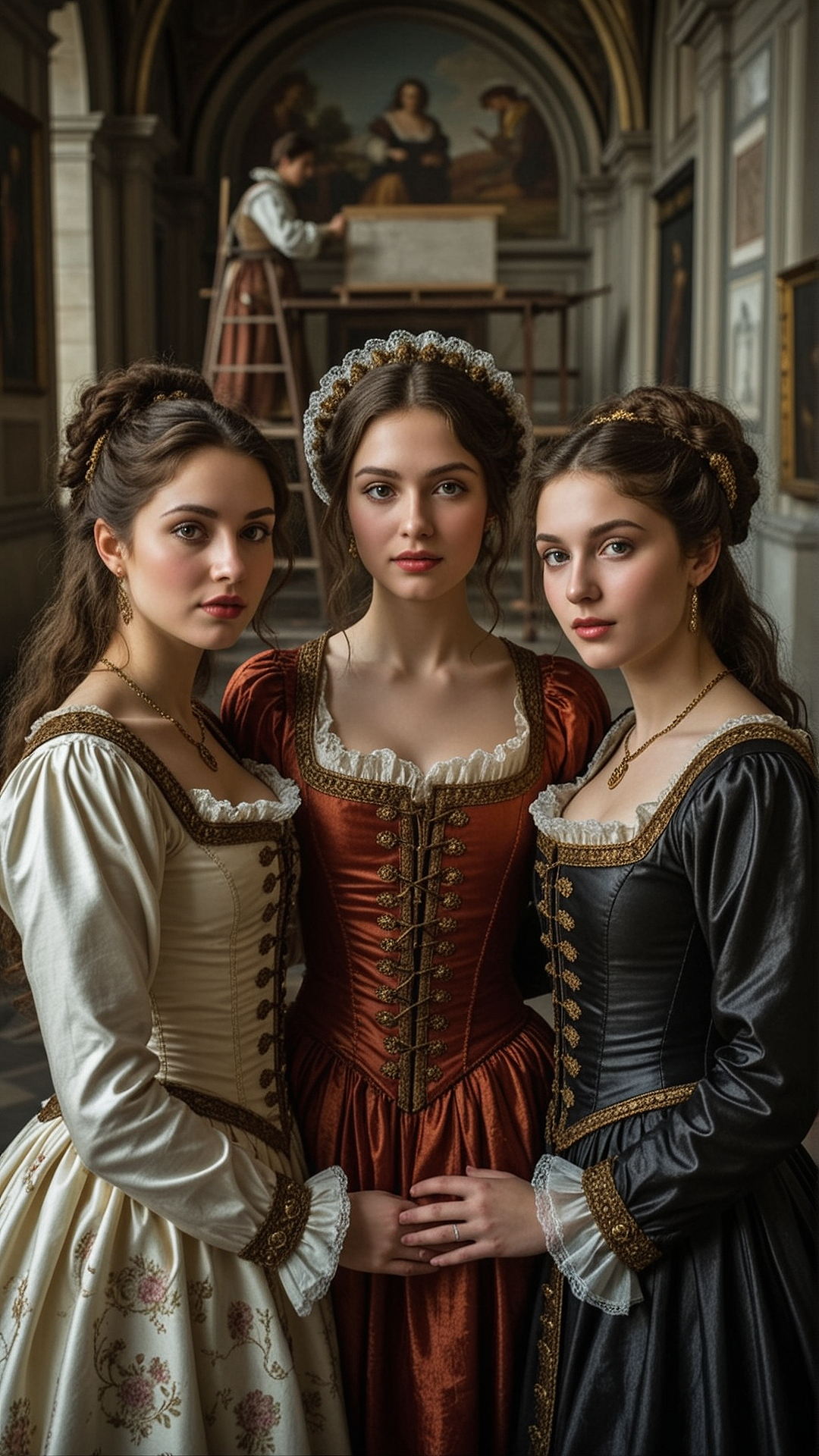
She painted her desire upon the walls of Florence—and the walls whispered back
In the golden light of Renaissance Florence, where art and passion are one, a widow dares to reach beyond the confines of convention and seize the destiny that calls to her from the wet plaster of a chapel wall.
Isabella Corsini has spent her life wrapped in the suffocating wool of others’ expectations. But when she witnesses Maestro Lorenzo di Valtorno painting upon wet lime—colour becoming one with the wall, not merely upon it but within it—she feels something ancient and inevitable stir within her soul. The chemistry of creation mirrors the chemistry of desire: two elements merging, transforming, becoming something neither could be alone.
Lorenzo sees what no one else has seen: a woman whose understanding of colour and composition rivals that of his trained apprentices. He begins to teach her—colour theory, the golden spiral, the tactile art of reading plaster through the skin. Their lessons grow intimate, their hands meeting over sketches, their breath mingling in the candlelit bottega.
But jealousy festers in the shadows. A rival apprentice, a spurned patron, a guild that forbids women from the painter’s art—conspiracies gather like storm clouds over Florence. When Isabella is given a single chance to prove her mastery before the guild, she must transform sabotage into artistry, disaster into design, and a crack in the plaster into a gesture of grace.
The Fresco’s Secret is a romance of pigment and patience, of complementary colours that intensify each other just as challenge and desire intensify love. It is the story of a woman who learned that true beauty is not superficial but structural—not painted upon the surface but absorbed into it. And it is the story of a master who discovered that the greatest art is not the painting upon the wall, but the life that creates it.
For readers who believe that the most seductive thing in any room is a mind that understands why beauty works—not merely that it works—and who know that the sheen of satin against the skin is not vanity, but the visible manifestation of a soul that refuses to be diminished.
CHAPTER ONE: “The Weight of Wool”
The wool scratched.
It scratched as it had scratched every day for eleven months—since the morning she had closed Giovanni Corsini’s eyes with her own trembling fingers and felt, beneath the grief, something that horrified her: relief. The relief had passed. The scratching had not.
Isabella Corsini sat at the window of her late husband’s palazzo on the Via dei Servi and watched the spring light fall across Florence like honey poured from a jar—golden, thick, impossibly beautiful. The Arno glinted in the distance. The dome of the cathedral, Brunelleschi’s impossible egg, caught the sun and held it, gleaming. Everything in this city gleamed except her.
She wore the garments of mourning: a gown of black wool so heavy it seemed to press her into the chair, so matte it absorbed the light that struck it and returned nothing. Beneath it, a shift of rough-spun linen that chafed her thighs, her waist, the soft skin beneath her arms. Beneath that, nothing. Mourning required no adornment. Mourning required erasure.
Her fingers found the window ledge and traced its edge. Once, those fingers had mixed pigments—lapis lazuli ground to ultramarine, red ochre heated to vermilion, the white of calcined bone. Once, those fingers had held brushes and moved them across panels with a certainty that had surprised even her. But that had been before. Before Giovanni. Before the thirty years of managing a household, hosting dinners, smiling at merchants, pretending that the ache in her chest was contentment and not starvation.
“Madonna?”
Bianca stood in the doorway, her own grey wool dress a mirror of Isabella’s gloom. She was fifty, with the kind face of a woman who had learned that kindness was the only power available to her. She had served the Corsini household for twenty years. She had watched Isabella arrive as a bride of eighteen, bright-eyed and hungry for beauty. She had watched that brightness dim, year by year, like a fresco faded by candle smoke.
“The priest is expected at four,” Bianca said gently. “For the month’s mind mass. I have laid out your black veil, Madonna. The longer one, with the border of—”
“No.”
The word fell between them like a stone into still water. Bianca blinked.
“Madonna?”
“I said no.” Isabella’s voice was quiet, but it carried a resonance that surprised them both. She turned from the window, and the light caught her face—still beautiful at thirty-eight, with cheekbones that could cut glass and eyes the colour of burnt sienna, warm and deep. But the wool swallowed the light before it could reach her skin, and she seemed to exist in a permanent shadow of her own making.
Bianca’s face softened into concern. “The neighbours will talk, Madonna. It is too soon to set aside mourning. Signora Tornabuoni has worn her blacks for two years, and her husband left her twice what yours—”
“I do not speak of setting aside mourning.” Isabella rose from the chair, and the wool gown rustled—a dull, lifeless sound, like dead leaves scraping against stone. “I speak of something else entirely.”
She crossed the room to a cassone in the corner—an ornate chest of dark wood, its panels painted with scenes from Petrarch, its surface dulled by dust. She had not opened it since Giovanni’s death. She had not dared. But today, watching the light pour across Florence like a benediction, she had felt something shift inside her—a tectonic movement, deep and irrevocable, like the settling of a foundation.
“Madonna?” Bianca’s voice was uncertain now. “What are you—”
Isabella lifted the lid.
The scent of dried lavender rose from the chest, and with it, something else—the ghost of a woman who had existed before grief had buried her. Inside, folded in tissue of finest vellum, lay garments that seemed to breathe in the light: a gown of deep burgundy satin, its surface like captured wine, its drape liquid and alive. Beside it, a pair of slippers of the same material, their toes pointed, their heels modest but elegant. Beneath those, a shift of ivory silk so fine it seemed woven from morning mist.
Bianca’s hand flew to her mouth. “Madonna, you cannot—”
“Help me with the laces.”
Isabella was already unfastening the black wool, her fingers working at the hooks with a desperation that bordered on violence. The gown fell to the floor in a heap—a puddle of matte darkness, light-devouring, lifeless. She stepped out of it as one steps out of a grave.
The linen shift followed, and she stood in the spring light in nothing but her chemise, her skin pale from months of indoor seclusion, her body still strong beneath the softness that grief had layered upon it. She was not a girl. She did not wish to be. She was a woman who had spent twenty years learning what she did not want, and that knowledge was a kind of wealth that no dowry could purchase.
“Madonna, the neighbours—”
“Can watch from their windows and whisper into their soup.” Isabella lifted the burgundy satin from the chest, and the fabric moved in her hands like something alive—not stiff and resistant like wool, but fluid, responsive, eager to take the shape of her body. She stepped into it, and the satin slid up her legs like cool water, settling against her hips, her waist, her breasts, with a weight that was not a burden but an embrace.
Bianca, despite herself, gasped.
The gown transformed her. Where the wool had made her shapeless—a column of matte darkness—the satin revealed the architecture of her body: the curve of her hips, the narrowness of her waist, the swell of her breasts. But it was not mere revelation. The satin participated in her beauty. It caught the light from the window and threw it back in shards of burgundy and rose. It moved when she moved, rippling like water, creating highlights and shadows that shifted with every breath. It did not absorb the light. It danced with it.
Isabella turned to the mirror—a small looking glass of polished steel that hung beside the window—and saw, for the first time in eleven months, not a widow, but a woman.
Her eyes were wet. She had not expected to weep.
“Madonna…” Bianca’s voice was barely a whisper. “You look…”
“I know.” Isabella touched the satin at her throat, feeling its coolness warm against her skin. “I know what I look like. I look like myself.”
She sat at the vanity and allowed Bianca to arrange her hair—still thick, still dark, shot through with threads of silver that gleamed like the wires in a fresco’s halo. The servant’s hands trembled as she worked, for she understood that something irrevocable was happening, and she was both witness and accomplice.
“The priest,” Bianca murmured. “The mass…”
“Will be attended by Signora Corsini’s servant, bearing her regrets.” Isabella met her own gaze in the mirror. “I have mourned my husband for eleven months, Bianca. I have worn the wool. I have scratched and suffered and disappeared into the darkness that this city expects of its widows. And I have been obedient.” Her voice hardened. “But I will not be erased.”
She rose, and the satin rustled—not the dead rustle of wool, but a whisper, intimate and alive, like the rustle of bedsheets, of secrets, of skin against skin. She crossed to the window, and the light found her, and the burgundy satin caught it and scattered it across the room in patterns of rose and wine.
Below, in the street, a merchant looked up. His eyes widened. He nudged his companion, who looked up as well. They stared—the widow Corsini, who had been invisible for eleven months, now standing in her window like a painting in a frame, her gown gleaming, her face turned toward the sun.
Let them stare. Let them whisper. Let them wonder what had come over the widow Corsini, that she should appear in such a gown on such a day, that she should stand in the light as if she had every right to be there.
She had every right to be there.
“Bianca.” Isabella turned from the window, and the satin moved with her, a fluid extension of her will. “Do you know what is being painted in the Santa Maria Novella chapel?”
The servant blinked, wrong-footed by the shift in conversation. “A fresco, Madonna. By the Maestro di Valtorno. It is said to be… remarkable.”
“Then I shall go and see it.”
“Madonna!” Bianca’s voice was sharp with alarm. “You cannot—a widow, alone, in a church—to watch a man paint—”
“I can.” Isabella’s voice was calm, but beneath it was a current of iron—the iron of a woman who has spent twenty years bending to the will of others and has discovered, in the moment of choosing to stop, that the bending was not strength but surrender. “I can walk where I wish. I can look at what I wish. I can wear what I wish. And I can learn what I wish.” She paused, and something flickered in her sienna eyes—a hunger so deep it seemed to reach back through centuries, through every woman who had ever been told that her longing was improper, her ambition unnatural, her talent irrelevant. “I have spent twenty years learning what I do not want, Bianca. Is it not time I discovered what I do?”
She gathered a pair of gloves—kidskin, so soft they seemed made of air—and drew them on, smoothing the leather over her fingers with deliberate care. She picked up a prayer book, more for appearance than devotion. She checked her reflection once more in the steel mirror: the burgundy satin, the silver-threaded hair, the eyes that burned with a quiet, terrifying purpose.
“Madonna.” Bianca’s voice was small. “What if… what if they will not let you stay? What if they say you do not belong?”
Isabella turned at the door, and the light from the window caught the satin one final time, and the gown blazed with colour—deep as wine, bright as blood, rich as the ultramarine she had once ground between her fingers in another life.
“Then I will return,” she said softly, “until they understand that I do.”
She stepped through the door and into the Florentine morning, and the city—golden, gleaming, alive with the light that painted everything it touched—opened before her like a book that had been waiting twenty years to be read.
Behind her, in the silent room, the black wool gown lay in a heap on the floor.
Bianca stared at it for a long moment. Then she crossed herself, picked it up, and placed it in the chest with the lavender and the vellum.
She did not lock the chest.
Some things, she understood, were not meant to be buried. They were meant to be transformed.
CHAPTER TWO: “The Chemistry of Creation”
The Santa Maria Novella chapel smelled of lime.
Isabella had expected incense, old stone, the musty perfume of centuries of prayer. Instead, the air stung with something sharp and clean and alive—a scent that crept into her nostrils and settled in her chest like a question waiting to be answered. Lime. Calcium hydroxide. She did not yet know its name, but her body recognised it as the smell of transformation, of matter in the process of becoming something other than what it had been.
She stood in the doorway, and the chapel opened before her like a throat—high-vaulted, shadowed, its walls half-covered in the scaffolding of creation. Candles guttered in iron sconces, throwing light that wavered and danced across surfaces both ancient and new. And there, upon the scaffold that clung to the far wall like a wooden limb, a man was painting.
He stood with his back to her, his arm moving in broad, certain strokes—upward, downward, across—and with each stroke, colour appeared upon the wall as if summoned from the plaster itself. Not painted upon it. Not floating above it. Part of it. The blue of the Virgin’s robe seemed to rise from within the wall like water rising through stone, luminous and deep, the colour of the sky at the moment before darkness falls. The gold of the angel’s wing gleamed as if the plaster itself had learned to hold light.
Isabella’s breath caught.
She had seen paintings before, of course—panels of tempera on wood, their surfaces smooth and opaque, their colours sitting upon the surface like words written on paper. She had admired them, even loved some of them. But this was different. This was not a surface that had been decorated. This was a surface that had been altered. The colour did not sit upon the wall; it inhabited it. It did not reflect light; it seemed to generate it, as if the plaster had swallowed the sun and now radiated its memory.
She moved closer, her satin slippers silent on the stone floor, her burgundy gown catching the candlelight and scattering it in patterns of rose and wine. The other observers—a scattering of wealthy patrons, a few off-duty priests, a pair of Dominican novices who whispered to each other behind their hands—kept their distance, watching the Maestro work with the respectful awe of those who witness something they cannot understand. Isabella did not keep her distance. She moved closer, and closer still, until she stood at the base of the scaffold and could see the plaster glistening wet where he had not yet painted, could see the way his brush touched the wall and left behind not a stroke but a revelation.
The Maestro was tall. She had known this from reputation—Lorenzo di Valtorno, the Maestro of the Annunciation, the painter whose frescoes were said to glow with an inner light that no secco technique could replicate. But reputation had not prepared her for the reality of him: the breadth of his shoulders beneath the simple linen shirt, the way his dark hair, threaded with silver, fell across his brow as he worked, the sureness of his hands—hands that moved as if they had been doing this for so long that the brush had become an extension of bone and sinew. He did not hesitate. He did not correct. Each stroke was placed with the finality of a word that cannot be unsaid.
She watched until her legs ached from standing, until the candle shadows had shifted across the floor and the other observers had drifted away, until the chapel was empty except for the two of them and the silence and the smell of lime.
He descended at last, climbing down the scaffold with the ease of a man who had spent half his life on such structures, and when he turned toward the water basin to rinse his brushes, he saw her.
His eyes were grey. She had not expected that. Grey like the plaster before it dries, grey like the sky before dawn—grey that could become anything, that held within it the possibility of all colours. They moved over her face first, then lower, taking in the burgundy satin, the way it caught the candlelight and held it, the way it moved with her breath. His gaze was not the appraising look of a man assessing a woman’s form. It was the look of a man assessing a material.
“You have been watching for some time,” he said. His voice was low, unhurried, a voice accustomed to being heard without raising itself.
“I have.” Isabella did not look away. “I could not look away.”
A faint smile touched the corner of his mouth—not amusement, but recognition. “Most people watch for a few minutes and then grow bored. The work is too slow for them. They want to see the finished painting, not the process of becoming.”
“I am not most people.”
“No.” He studied her again, and this time his gaze lingered on her gown—the way the satin shifted from burgundy to rose to wine depending on the angle of the light, the way its surface seemed to breathe. “You understand materials.”
It was not a question, but Isabella answered it anyway. “I understand that this—” she gestured to her gown, “—is not merely fabric. It is structure. The sheen comes from the weave—the long floats of the satin, the way they catch the light. It is not applied. It is intrinsic.”
Something shifted in his grey eyes. Interest. The kind of interest that a man like Lorenzo di Valtorno rarely showed for anyone, let alone a woman he had just met. “You understand the difference between surface and structure.”
“I understand that there is a difference. Most people do not.”
“Most people,” he said quietly, “do not ask the question.”
The chapel was very still. The candles guttered. The wet plaster gleamed on the wall behind him, waiting.
“May I ask you a question?” Isabella’s voice was steady, but her heart was beating in her throat like a bird trapped in a cage.
“You may ask. I may or may not answer.”
“Why do you paint upon wet plaster rather than dry? The panels I have seen—tempera on wood—they are painted upon dry surfaces. The colour sits on top. But yours…” She turned to look at the half-finished Annunciation, at the Virgin’s robe that seemed to glow from within. “Yours is different. The colour is not on the wall. It is in it.”
Lorenzo was silent for a long moment. When he spoke, his voice had changed—deeper, more resonant, as if the question had reached something in him that rarely saw the light of day.
“Come,” he said, and crossed to the wall where the scaffold stood. He lifted a small pot from the platform and held it out to her—a pot of white powder, fine as ash. “Do you know what this is?”
Isabella took the pot, feeling its weight in her hands. The powder was cool, impossibly fine, with a faintly caustic smell that tingled in her nostrils. “Lime,” she said. “Slaked lime.”
“Calcium hydroxide,” Lorenzo corrected, and there was approval in his voice—a teacher’s approval, the kind that made a student want to answer the next question correctly. “When mixed with sand and water, it becomes the plaster you see on the wall. And when it dries, something extraordinary happens.” He took the pot from her hands and set it down, then turned to face her. They were standing very close now—close enough that she could smell the lime on his skin, the linseed oil, the faint musk of a man who had been working for hours. “The calcium hydroxide reacts with the carbon dioxide in the air. It undergoes carbonation. It becomes calcium carbonate—limestone. And as it becomes limestone, it traps the pigment within its crystalline structure.”
Isabella felt something move through her—a shock of understanding so profound it seemed to rearrange the furniture of her mind. “The colour is not painted upon the surface,” she whispered. “It is trapped within it. It becomes part of the wall itself.”
“Exactly.” Lorenzo’s voice was quiet, but it carried the weight of a revelation. “Buon fresco—true fresco—is not decoration. It is incorporation. The colour becomes one with the wall. It cannot be removed without destroying the wall itself.” He paused, and his grey eyes held hers. “Do you understand the difference?”
Isabella understood. She understood with a clarity that made her breath catch and her fingers tremble and something deep within her chest crack open like an egg.
“Tempera on wood,” she said slowly, working through the logic as she spoke, “is applied to a dry surface. The colour sits on top. It can be scraped away, painted over, erased. It is… superficial. But buon fresco—” She turned to look at the half-finished Annunciation, and now she saw it differently: not as a painting, but as a transformation. The plaster and the pigment had become one substance, indivisible, permanent. “Buon fresco is structural. The colour is not added to the wall. It is absorbed by it. It becomes part of its nature.”
“Yes.” The word was barely a whisper, but it seemed to fill the chapel.
Isabella turned back to Lorenzo, and she saw that he was watching her with an expression she could not quite name—wonder, perhaps, or recognition, or the look of a man who has spent years speaking a language he thought no one else understood and has just discovered a fellow speaker.
“You are the first person,” he said slowly, “in fifteen years of painting this chapel, to ask that question. And you are the first to understand the answer.”
“I am a woman,” Isabella said, and the words tasted bitter in her mouth. “Women are not supposed to understand such things.”
“Women,” Lorenzo replied, “are not supposed to do many things. And yet they do them anyway.” His gaze moved over her again—the burgundy satin, the silver-threaded hair, the eyes that burned with a hunger he recognised because he had felt it himself, once, long ago, before he had learned to feed it with work. “You understand materials,” he repeated. “You understand the difference between what is applied and what is absorbed. That is rare.”
“It is not rare,” Isabella said quietly. “It is merely unrecognised.”
Lorenzo was silent for a moment. Then he turned back to the wall, to the wet plaster that gleamed in the candlelight, waiting to be transformed.
“The plaster dries quickly,” he said. “I have perhaps six hours before it carbonates fully—before the window of receptivity closes. After that, I can paint no more on this section. I must wait for the next patch to be prepared.” He picked up his brush, and his hand moved to the wall, and the colour bloomed where it touched—ultramarine, deep as the sea, bright as the sky. “If you wish to watch,” he said, without turning around, “you may. But I will not explain again. You must observe. You must learn with your eyes, not your ears.”
Isabella watched.
She watched for hours. She watched the way his hand moved—quickly at first, laying in the broad areas of colour, then more slowly, more precisely, as he approached the edges of forms. She watched the way the wet plaster accepted the pigment, drinking it in, and the way the colour seemed to deepen as it was absorbed rather than sitting on the surface like a film. She watched the way his brush touched the wall and left behind not a stroke but a presence—as if the Virgin’s robe had always been there, hidden within the plaster, waiting to be revealed.
She watched, and she learned.
And when at last he stepped back from the wall and the plaster had lost its wet gleam and the colours had settled into their final depth and richness, she understood something that she had not understood before: that true beauty is not applied but incorporated. That the most enduring transformations are not superficial but structural. That the colour that is trapped within the wall will outlast the colour that sits upon it by centuries.
Just as the confidence that is built into the foundation of a woman’s soul will outlast the confidence that is painted upon her face.
Just as the wealth that is woven into the fabric of one’s understanding will outlast the wealth that is merely displayed.
Just as the love that is absorbed into the structure of a life will outlast the love that is merely declared.
Lorenzo turned to her, and his grey eyes held hers, and in the space between them something passed—a recognition, a resonance, the beginning of a conversation that would take months to complete and a lifetime to understand.
“You will come back,” he said. It was not a question.
Isabella drew her burgundy satin around her like armour, and the candlelight caught it and scattered, and the chapel seemed to glow with a light that came not from the candles but from the wall itself—from the colour that had been absorbed into the plaster and now radiated outward, illuminating everything it touched.
“I will come back,” she said.
She turned and walked toward the door, and the satin moved with her, and the light moved with the satin, and behind her the half-finished Annunciation gleamed in the darkness—colour trapped within stone, beauty incorporated into structure, a secret that could not be removed without destroying the wall itself.
The door closed behind her. The chapel fell silent.
Lorenzo stood alone before his work, and his hand, still holding the brush, trembled slightly—for the first time in fifteen years.
He had recognised something in her eyes. A hunger. A capacity. A receptivity.
Like wet plaster, waiting to be transformed.
CHAPTER THREE: “The Language of Colour”
She returned the next day.
And the day after that.
And the day after that, until the sacristan—who had watched her pass through the chapel door each morning at precisely nine o’clock—began to nod at her with the resigned familiarity of a man who had accepted that some things, like the tides, simply were.
Isabella told herself it was the fresco that drew her. The Annunciation, still incomplete, its figures emerging from the plaster like swimmers surfacing from deep water—the Virgin with her hand raised in acceptance, the angel with his wings catching light that seemed to come from nowhere and everywhere at once. She told herself it was the art, the technique, the opportunity to observe a master at work. She told herself these things each morning as she stood before her wardrobe and chose the day’s gown with a care that bordered on ritual.
On the second day, she wore deep blue satin—the colour of ultramarine, the most precious pigment, ground from lapis lazuli brought across deserts and seas from mines in Afghanistan. She had not owned a gown this colour when Giovanni was alive. He had considered blue frivolous, inappropriate for a woman of her station. But the gown had waited in the chest, wrapped in lavender and vellum, and when she drew it on that morning, the satin had slid across her skin like cool water, and she had seen in the steel mirror a woman who matched the colour of the sky.
On the third day, she wore gold silk—a fabric so luminous it seemed to generate its own light, its surface shifting from pale champagne to deep amber as she moved. It caught the candlelight in the chapel and threw it back in patterns that made the sacristan blink and look away, as if he had glimpsed something too bright for mortal eyes.
On the fourth day, she wore emerald satin so deep it seemed to hold the memory of forests, of spring, of the moment before a storm when the world goes green and holds its breath.
She told herself it was for herself, these choices. She told herself that a woman who understood materials should wear materials worth understanding. She told herself that the sheen of satin against her skin was a private pleasure, a small rebellion against the matte darkness of mourning, a declaration that she would not be erased.
She did not tell herself that she chose each gown to catch a particular man’s eye.
She did not need to. Her body knew what her mind refused to acknowledge, and it moved through the chapel each morning with a grace that was not practiced but summoned—drawn forth by the knowledge that he was there, that his grey eyes would find her, that he would see the colour she had chosen and understand its language.
“You are early today.”
Lorenzo’s voice came from the scaffold, where he was preparing the next section of wall—a patch of wet plaster roughly the size of a door, its surface gleaming in the morning light that streamed through the high windows. He did not turn around as he spoke, but Isabella saw his shoulders shift, saw the way his brush paused mid-stroke, and she understood that he had been aware of her entrance before he had spoken.
“The light is better in the morning,” she said, settling into her usual position—a few feet from the scaffold, close enough to observe, far enough not to intrude. “The colours are truer.”
“The colours are always true.” Lorenzo turned now, and his grey eyes moved over her—the emerald satin, the way it caught the light from the window and scattered it across the stone floor in patterns of sea and forest. Something flickered in his expression. Approval, perhaps. Or something deeper. “It is our perception that varies.”
“Then teach me to perceive correctly.”
He was silent for a moment, studying her with the same intensity he brought to the wall. Then he set down his brush and descended the scaffold, and when he stood before her, she was struck again by his presence—the breadth of him, the solidity, the way he occupied space as if the air itself had been waiting for him to fill it.
“Come,” he said, and led her to the wall where the Virgin’s robe was taking shape—ultramarine so deep it seemed to vibrate, surrounded by gold leaf that gleamed like frozen sunlight. “Tell me what you see.”
Isabella looked. She looked for a long time, letting her eyes move across the surface, letting the colours enter her not through her mind but through her body—the way the blue seemed to pull her inward, to draw her toward something vast and quiet, while the gold seemed to push outward, to radiate warmth and energy and the promise of something just beyond reach.
“The blue is… still,” she said slowly. “It does not move. It holds the eye and does not release it. It is like… like prayer. Like the moment before speech, when the soul is gathered and waiting.”
Lorenzo’s expression shifted. “And the gold?”
“The gold moves.” Isabella’s voice was barely above a whisper. “It reaches outward. It touches the blue and makes it… more. Not brighter—deeper. As if the gold gives the blue permission to be itself.”
“Ultramarine and gold,” Lorenzo said quietly. “Complementary colours. They intensify each other. Where they meet, the eye perceives a vibration—not a blending, but a dialogue. Each colour becomes more fully itself in the presence of the other.” He paused, and his grey eyes held hers. “Do you understand? The blue does not become less blue because the gold is present. It becomes more blue. The gold does not become less gold because the blue is present. It becomes more gold. They do not compete. They complete.”
Isabella felt something move through her—a recognition that went deeper than colour theory, deeper than the physics of light and pigment, down into the place where she had buried her hunger and her grief and the desperate, aching hope that she might one day be seen as she truly was.
“Most people,” she said, and her voice was not steady, “believe that difference diminishes. That the presence of one thing takes away from another. That a woman who is too much—too bright, too bold, too coloured—diminishes those around her.”
“Most people,” Lorenzo replied, “do not understand colour.”
He turned back to the wall and picked up his brush, and as he worked, he spoke. Not to the wall this time, but to her.
“Ultramarine—ground lapis lazuli, the most expensive pigment in the painter’s arsenal. It is used for the Virgin’s robe because it elevates the spirit. The eye moves toward it and is lifted. Red ochre—the earth itself, heated until it becomes vermilion. It grounds the eye in the body, in the flesh, in the reality of incarnation. One lifts. One grounds. Together, they create a tension that makes the painting alive.” He touched the brush to the wall, and a stroke of vermilion appeared at the hem of the Virgin’s robe—barely visible, but present, a thread of blood-red at the edge of celestial blue. “Without the red, the blue would float away. Without the blue, the red would sink into the earth. Each needs the other to be seen.”
Isabella watched his hand move—the sureness of it, the way each stroke was placed with the precision of a surgeon or a lover—and she felt the knowledge entering her not as information but as revelation. Colour was not decoration. Colour was communication. Each hue was a word, each combination a sentence, and the grammar of colour was the grammar of relationship itself.
“Complementary colours,” Lorenzo continued, his voice low and rhythmic, almost hypnotic, “are pairs that sit opposite each other on the colour wheel. Blue and orange. Red and green. Purple and yellow. When placed side by side, they create the strongest possible contrast—the greatest possible intensity. They do not blend. They do not compromise. They stand together and make each other more vivid, more alive, more themselves.”
“Like challenge and support,” Isabella whispered.
Lorenzo’s brush paused. He turned to look at her, and in his grey eyes she saw something she had not seen before—not approval, not recognition, but wonder. The wonder of a man who has found something he did not know he was seeking.
“Yes,” he said. “Like challenge and support. Like discipline and freedom. Like…” He hesitated, and for the first time since she had known him, he seemed uncertain. “Like two people who are different enough to intensify each other, rather than diminish.”
The chapel was very still. The morning light fell through the high windows and touched the wet plaster, and the colours seemed to breathe—ultramarine and gold, vermilion and green, the language of creation speaking itself into being.
“Teach me more,” Isabella said.
He taught her.
Over the days that followed—days that blurred into weeks, weeks that began to feel like the beginning of something neither of them had named—he taught her the language of colour as he worked. And she, standing in her satins of blue and gold and emerald and rose, absorbed his teachings with a hunger that frightened her in its intensity.
Primary colours: red, blue, yellow. The foundation. The alphabet from which all other words are formed.
Secondary colours: orange, green, purple. The combinations. The sentences that emerge when primary colours meet and mingle.
Tertiary colours: the infinite gradations that arise when secondary colours are mixed with primaries again, and again, and again, until the spectrum becomes as complex and nuanced as human emotion itself.
“The eye can distinguish approximately one hundred shades of colour,” Lorenzo told her one morning as he mixed pigments on his palette—lapis and ochre and verdigris, each one a world unto itself. “But the heart can distinguish far more. The heart sees colours that the eye cannot—colours that exist in the space between what is painted and what is felt.”
“Show me,” Isabella said, and her voice was not the voice of a student requesting instruction but of a woman asking to be seen.
Lorenzo turned to her, and his grey eyes moved over her gown—a deep rose satin she had chosen that morning because it reminded her of the moment before dawn, when the sky goes pink and the world holds its breath. The colour seemed to deepen as he looked at it, as if his gaze were a pigment that intensified her own.
“Rose,” he said quietly. “A tertiary colour. Red mixed with white, but also with a whisper of blue. It is the colour of dawn, of the inside of a shell, of the moment when something that has been closed begins to open.” He paused, and his voice dropped to a register that seemed to vibrate in her chest. “It is the colour of receptivity. Of a surface that is ready to receive.”
Isabella’s breath caught. She felt the rose satin against her skin—its coolness warming to her body heat, its sheen shifting with each rise and fall of her chest—and she understood that he was not speaking only of colour. He was speaking of her. Of the receptivity he had recognised in her from the first day, the wet-plaster quality of her soul, the capacity to absorb and be transformed.
“I am not a wall,” she said, and her voice was barely a whisper. “I cannot be painted upon.”
“No,” Lorenzo agreed, and something in his expression softened—something that might have been tenderness, or might have been the beginning of something far more dangerous. “You are not a wall. You are something far more rare.” He turned back to his work, and his brush touched the plaster, and the colour bloomed where it landed—rose, the colour of dawn, the colour of opening. “You are a surface that has been waiting twenty years to be seen.”
She began to notice things.
She noticed that Lorenzo’s brush moved differently when she was present—more fluidly, more confidently, as if her gaze were a wind that filled his sails. She noticed that he looked for her each morning—glancing toward the chapel door at nine o’clock, his body orienting toward the entrance before his eyes confirmed what his heart already knew. She noticed that when she was absent—which happened rarely, for she would have forfeited sleep and food rather than miss a day—he was unsettled, his strokes less certain, his colours less vibrant, as if her presence were the complementary hue that made his own colours sing.
She noticed, too, that she was not the only one watching.
Francesco Soderini was an apprentice of twenty-five—lean, dark-eyed, with the kind of beauty that curdled quickly into vanity when it was not matched by talent. He had been in the bottega for six years, and he had expected, by now, to be more than an apprentice. He had expected to be promoted to journeyman, to be given his own wall, to be recognised as a painter in his own right. But Lorenzo was demanding—more demanding than any master Francesco had known—and the promotion had not come. Francesco told himself it was politics, favouritism, the master’s blindness to his own protégé’s brilliance. He did not tell himself the truth: that his work was competent but not inspired, that his colours were correct but not alive, that he painted as if he were following a recipe rather than listening to a language.
Francesco watched Isabella from across the bottega, and his jealousy grew like a weed in fertile soil.
He watched the way Lorenzo’s voice softened when he spoke to her. He watched the way the master’s grey eyes followed her as she moved through the chapel, her satin gowns catching the light like living paintings. He watched the way Lorenzo taught her—patiently, precisely, with a care and attention he had never shown to any apprentice—and something dark and bitter took root in Francesco’s chest.
It was not merely that Lorenzo was giving Isabella the instruction Francesco believed he deserved. It was that Lorenzo was giving her something Francesco could never have: recognition. The master saw in her what he did not see in Francesco—not talent alone, but receptivity. The capacity to be transformed. The wet-plaster quality that allowed colour to be absorbed rather than merely applied.
Francesco did not understand this, of course. He understood only that he was being overlooked, and that a woman—a widow in her burgundy satin—was receiving what he had earned through years of servitude. He did not understand that the years of servitude had been the problem, not the solution. He had served without hunger. He had worked without longing. He had painted without the desperate, aching need to be seen that made Isabella’s questions so incisive and her understanding so profound.
He began to watch her with something that was no longer jealousy but hatred—a cold, precise hatred that watched and waited and planned.
It was on a Thursday—three weeks after her first visit—that Lorenzo taught her the most important lesson of all.
She had arrived in a gown of deep violet satin, its surface shifting between purple and blue depending on the angle of the light, and she had seen the way his breath caught when he first glimpsed her—the way his brush stilled and his grey eyes darkened and something passed across his face that looked, for a moment, like hunger.
“Violet,” he said, and his voice was rougher than usual. “A tertiary colour. Red and blue combined. The colour of…”
“Transformation,” Isabella finished, and her own voice was not steady. “The colour of the moment when one thing becomes another.”
Lorenzo was silent for a long moment. Then he turned to the wall—to the section he had been preparing, a patch of wet plaster that gleamed in the morning light—and he picked up his brush, and he began to paint.
But this time, he did not paint the Virgin or the angel. He painted her.
Not her face—not exactly. But the gesture of her: the way she stood with her weight on one hip, the way her hand rested at her throat when she was thinking, the way her head tilted when she listened. He painted the violet of her gown, and the way it caught the light, and the way the colour seemed to vibrate at the edge where it met the gold of the halos—as if she, too, were a complementary hue, a colour that intensified everything it touched.
Isabella watched, and her heart beat in her throat, and she understood that this was not a lesson. This was a declaration.
When he finished, he stepped back and looked at what he had painted—a figure in violet, standing at the edge of the Annunciation, her hand raised not in acceptance but in recognition. The figure was not part of the biblical scene. She did not belong there. And yet, because of the way Lorenzo had placed her—because of the golden spiral that drew the eye toward her, because of the complementary colours that made her glow with an inner light—she seemed to have always been there. As if the painting had been waiting for her. As if it were incomplete without her.
“Is that…” Isabella’s voice faltered. “Is that me?”
Lorenzo turned to her, and his grey eyes held hers, and she saw in them something she had never seen before—not in Giovanni’s eyes, not in any man’s eyes. She saw understanding. The understanding of a man who had looked at her and seen not a widow or a woman or a body, but a colour—a hue that completed his palette, a presence that made his own colours sing.
“It is what you are,” he said quietly. “In the language of this wall. In the grammar of this painting. It is the word for which I did not know I was searching.”
The chapel was silent. The morning light fell through the windows and touched the wet plaster, and the figure in violet seemed to breathe.
Isabella opened her mouth to speak—to say something, anything, to acknowledge what had passed between them—but before she could, a sound broke the silence: the sharp scrape of a stool being pushed back across the stone floor.
She turned and saw Francesco standing in the shadows of the sacristy, his dark eyes fixed upon the figure in violet, his face twisted into an expression that made her blood run cold.
He said nothing. He did not need to. His eyes said everything.
Then he turned and walked out of the chapel, and the door closed behind him with a sound like a bone breaking.
Isabella looked back at Lorenzo, but he had already turned to the wall, his brush moving once more across the plaster, his face unreadable.
“We should continue,” he said, and his voice was steady, but she heard beneath it the faintest tremor—a vibration, like complementary colours meeting at the edge of a form.
She understood, then, that something had shifted. That the language of colour, which had brought them together, had also created a shadow. That Francesco’s jealousy was not merely resentment but a force that would, in time, demand to be reckoned with.
But that was a problem for another day. Today, there was only the wet plaster and the brush and the man who saw her as a colour that made his own colours sing.
Today, that was enough.
She settled into her usual position, and the violet satin whispered against the stone, and the morning light fell through the windows, and the figure on the wall—the figure in violet, standing at the edge of the Annunciation, her hand raised in recognition—seemed to pulse with a light that came not from the sun but from somewhere deeper.
From the place where colour becomes language, and language becomes love, and love becomes the grammar of transformation itself.
CHAPTER FOUR: “The Golden Spiral”
The invitation came on a Tuesday.
Not spoken—never spoken, for the walls of the bottega had ears and the ears of Florence were long and hungry. Instead, a note in a hand she recognised from the preparatory sketches she had watched him draft: firm, precise, each letter balanced upon the page as if it had been placed there by a compass rather than a pen.
The sketches are ready for viewing. The bottega. This evening. After vespers.
No signature. None was needed.
Isabella held the paper to her breast and felt her heart beat against it like a bird against a cage. She had watched him work for weeks now. She had learned the language of colour from his lips, had absorbed the chemistry of lime and pigment through her skin, had begun to see the world not as a collection of objects but as a conversation between hues. But she had never been inside the bottega. Not the inner sanctum—the room where the sketches lived, where the ideas breathed, where the architecture of creation was laid bare before it was clothed in plaster and paint.
She dressed with care.
Not the violet—that had been a declaration, and declarations required rest between utterances. Not the blue—that colour belonged to the chapel, to the Virgin, to the sacred space where teacher and student had built their fragile, precious understanding. Instead, she chose a gown of deep amber satin, its surface shifting between honey and bronze depending on the light, its drape liquid against her hips and thighs like a slow pour of medieval gold. The colour of warmth. Of invitation. Of the moment before a fire catches.
Bianca watched her dress with eyes that held a question she did not dare to ask.
“Madonna,” the servant said at last, her voice careful, “the hour is late. The bottega is not a place for a woman alone after dark.”
“The bottega,” Isabella replied, fastening the amber satin at her throat, “is a place where a woman is going to look at sketches. Nothing more.”
Bianca’s silence spoke volumes.
Isabella turned to her servant—this woman who had been her only companion through eleven months of mourning, who had helped her out of the black wool and into the burgundy satin and had watched, without comment, as her mistress had transformed from a ghost into a woman who seemed to carry her own light. She took Bianca’s hands in hers and squeezed them gently.
“I know what you fear,” she said softly. “I know what the neighbours would say. But I have spent twenty years living inside the boundaries of what is proper, and those boundaries have given me nothing but grief and wool and the slow erosion of everything I once was.” She paused, and her sienna eyes held Bianca’s with a steadiness that surprised them both. “I am not going to the bottega to lose myself. I am going to find what remains.”
Bianca’s eyes filled with tears, but she did not argue. She understood, perhaps better than Isabella herself, that some journeys cannot be prevented—they can only be survived.
The bottega was on the Via dei Servi, a narrow street that curved away from the church of the Santissima Annunziata like a river bending around a stone. The building was unremarkable from the outside—stone walls, a wooden door, the faint smell of lime and linseed oil seeping through the cracks. But when Isabella pushed open the door and stepped inside, she felt as if she had crossed a threshold between worlds.
The room was long and low-ceilinged, its walls lined with shelves that held jars of pigment in every colour imaginable—ultramarine and vermilion and malachite and lead-tin yellow, each one a universe unto itself, each one waiting to be spoken into form. Sketches covered every surface—pinned to the walls, scattered across tables, rolled in corners like sleeping animals. The light came from a single window at the far end, and it fell across the room in a long golden band that turned the amber satin of Isabella’s gown to fire.
Lorenzo stood at the centre of the room, his back to her, his attention fixed upon a large sheet of paper spread across a table. He wore his work clothes—a simple linen shirt, leather apron, trousers that bore the stains of a thousand paintings—and yet he seemed to fill the space more completely than any man she had ever seen. It was not his size, though he was tall. It was his presence—the way the air seemed to arrange itself around him, the way the light seemed to seek him out, the way the silence seemed to deepen when he was still.
“You came,” he said, without turning.
“You invited me.”
“I was not certain you would accept.” He turned now, and his grey eyes moved over her—the amber satin, the way it caught the fading daylight and held it, the way the colour seemed to warm the air around her. Something shifted in his expression. Something that looked, for a moment, like hunger. “You wear the colour of honey.”
“The colour of invitation,” she replied, and her voice was steadier than she expected. “You taught me that colour is communication. I am choosing to communicate.”
A faint smile touched his lips—not amusement, but recognition. The recognition of a man who has found someone who speaks his language.
“Come,” he said, and gestured to the table. “I want to show you something.”
The sketch was the Annunciation—but not as she had seen it on the wall.
This was the skeleton beneath the flesh. The architecture beneath the painting. The grammar beneath the poetry.
Isabella leaned over the table and felt her breath leave her body. The sketch was covered in lines—not the lines of figures, but the lines of structure. A spiral, drawn in faint red chalk, wound from the face of the Virgin outward through the body of the angel, through the architecture of the room, through the window that opened onto a landscape of impossible beauty. A rectangle, drawn in darker ink, framed the entire composition, and within that rectangle, smaller rectangles and squares divided the space into proportions that seemed to breathe.
“What is this?” she whispered.
“This,” Lorenzo said, his voice low and reverent, “is the secret that most painters never learn. The secret that separates decoration from art. The secret that makes a painting feel right without the viewer ever knowing why.” He picked up a pair of dividers—a brass instrument with hinged legs—and placed one point at the centre of the spiral. “Do you see how the eye follows this curve? It begins here, at the point of greatest importance—the Virgin’s face, the moment of acceptance—and moves outward in a rhythm that the body recognises even when the mind does not.”
Isabella traced the spiral with her finger, not quite touching the paper, feeling the curve of it in the air above the page. “It is like… like breathing. Like the way the chest rises and falls. Like the way a wave curls before it breaks.”
“Exactly.” Lorenzo’s voice quickened with the intensity of a man who had found, at last, someone who understood. “It is the rhythm of nature itself. The spiral that governs the arrangement of leaves upon a stem, the curve of a shell, the pattern of seeds in a sunflower. It is called the Fibonacci spiral, after the mathematician who described the sequence that produces it—a sequence in which each number is the sum of the two preceding numbers. One. One. Two. Three. Five. Eight. Thirteen. Twenty-one.” He traced the spiral again, and his finger moved closer to hers, until they were both hovering above the same point—the centre, the origin, the place where the curve began. “And the ratio between those numbers—the ratio of each number to the one that follows it—approaches, as the sequence continues, a specific proportion. One to one point six one eight. The golden ratio.”
Isabella felt the numbers enter her not as mathematics but as music—a harmony that resonated in her bones, in her blood, in the deep structures of her body that had evolved, over millennia, to recognise this proportion as beautiful. She looked at the sketch again, and now she saw it differently: not as a collection of lines and figures, but as a composition—a word whose root, she realised, was componere, to put together, to arrange according to a principle.
“The golden ratio,” she said slowly. “It is not merely a proportion. It is a principle. A law that governs the arrangement of elements in space.”
“Yes.” Lorenzo’s voice was barely above a whisper. “And like all laws, it can be followed or broken. But it must be understood before it can be broken intentionally.” He moved to another sketch—this one of a single figure, a woman reading, her body arranged in a curve that echoed the Fibonacci spiral. “Most painters arrange their figures by instinct, or by copying the arrangements of others. They do not know why their compositions work or fail. They are like speakers who have learned a language by imitation but do not understand its grammar.” He turned to face her, and his grey eyes held hers with an intensity that made her breath catch. “You are not such a speaker, Isabella. You have always asked why. And the golden ratio is the answer to the question you have been asking your whole life.”
The question she had been asking her whole life.
Yes.
The question that had haunted her through twenty years of marriage, through eleven months of mourning, through every morning she had stood before her wardrobe and chosen a gown not for its price but for its proportion—the way the bodice related to the skirt, the way the sleeves balanced the neckline, the way the drape of the fabric followed the curve of her body in a rhythm that felt, to her eye, like the rhythm of a wave or the curve of a shell.
She had always known when something was beautiful. She had never known why.
Now she knew.
“Show me more,” she said.
He showed her.
He showed her how the golden rectangle could be subdivided into smaller golden rectangles, each one a perfect echo of the whole, each one creating a grid that guided the placement of figures and objects. He showed her how the intersection points of that grid—the points where the vertical and horizontal divisions met—were the points of greatest visual tension, the places where the eye naturally rested and the mind naturally lingered. He showed her how the old masters—Giotto, Masaccio, Fra Angelico—had used these principles without naming them, arranging their compositions by instinct and tradition, passing down the grammar of beauty from master to apprentice like a sacred text.
And as he showed her, their hands moved closer.
It was not deliberate—at least, not consciously. It was the natural drift of two people who were looking at the same thing, reaching toward the same point, their fingers tracing the same invisible curve in the air above the page. Isabella’s hand hovered over the sketch of the reading woman, her fingertip following the line of the figure’s spine, and Lorenzo’s hand moved to the same spot—not touching hers, but beside hers, close enough that she could feel the warmth of his skin without the pressure of contact.
“The curve of the spine,” he murmured, “follows the golden spiral. The head tilts at the point of greatest visual tension. The book rests at the intersection of the grid.” His voice was low, almost hypnotic, and she felt it in her chest like a second heartbeat. “The body itself is a composition, Isabella. It is arranged according to the same principles that govern the painting. The same proportions. The same rhythms.”
“The same beauty,” she whispered.
“The same beauty,” he agreed, and his hand moved—not away, but closer, until his fingertip rested beside hers on the page, and the space between them was no wider than a breath.
Isabella did not move. She did not breathe. She felt the warmth of his finger beside hers, the faint tremor in his hand that matched the tremor in her own, and she understood that this moment was a threshold—as significant as the door of the bottega, as significant as the door of the chapel, as significant as the moment she had stepped out of the black wool and into the burgundy satin and declared, to herself and to the world, that she would not be erased.
She could step back. She could preserve the distance that propriety demanded. She could pretend that this was merely a lesson, that the warmth between their fingers was merely the heat of shared concentration, that the trembling in her chest was merely the excitement of understanding.
Or she could stay.
She stayed.
Lorenzo’s finger moved—not away, but across—until it rested upon hers, and the touch was so light it might have been imagined, a whisper of contact that sent a current through her body like lightning through water.
“The golden ratio,” he said, and his voice was rough, as if the words were being dragged from somewhere deep, “teaches us that beauty is not arbitrary. It is not subjective. It is structural. It follows laws that are as immutable as the laws of mathematics, as reliable as the laws of chemistry.” His finger pressed slightly against hers—not demanding, but present. “And the most beautiful compositions—the most beautiful lives—are those that are arranged according to those laws. Not by accident. Not by imitation. But by understanding.”
Isabella turned her hand, slowly, until her palm rested against his, and the contact was no longer a whisper but a conversation—skin against skin, warmth against warmth, the calluses of his brush hand rough against the softness of her palm.
“Teach me to understand,” she said.
His hand closed around hers—not tightly, but firmly, with the certainty of a man who had waited a long time for this moment and would not let it slip away.
“I have been teaching you since the first day,” he said quietly. “You were simply the first student who was worth teaching.”
The sound of the door opening shattered the moment like a stone through glass.
Isabella pulled her hand away—instinctively, automatically, the reflex of a woman who has learned, over twenty years, to hide whatever brings her pleasure. She stepped back from the table and turned toward the door, and the amber satin swirled around her legs like a retreating wave.
A woman stood in the doorway.
She was tall—nearly as tall as Lorenzo—with a figure that had been handsome rather than beautiful, and a face that bore the careful maintenance of a woman who had been beautiful once and refused to accept that the beauty had faded. Her hair was dark, streaked with grey, arranged beneath a velvet cap that matched her gown—a gown of deep plum velvet, its surface rich and heavy, its drape impeccable, its sheen utterly absent.
Lucrezia Tornabuoni née Strozzi. Wife of the banker Matteo Tornabuoni. One of the wealthiest women in Florence. And, if the rumours were to be believed, a woman who had set her cap for the Maestro di Valtorno long before a certain widow in burgundy satin had appeared in his chapel.
“Maestro.” Lucrezia’s voice was smooth as silk and cold as marble. Her eyes moved from Lorenzo to Isabella and back again, and in the space of that glance, Isabella saw everything: the calculation, the assessment, the cold, precise cataloguing of a rival’s assets and liabilities. “I did not expect to find you with… company.”
“Signora Tornabuoni.” Lorenzo’s voice was polite but distant—the voice of a man addressing a patron rather than a friend. “This is Madonna Corsini. She has been kind enough to take an interest in the work.”
“An interest.” Lucrezia’s eyes moved over Isabella—over the amber satin, over the way it caught the fading light and held it, over the way it seemed to generate a warmth that the plum velvet could not match. “How… unusual. I was not aware that widows of the merchant class had developed an interest in fresco painting.”
The slight was subtle—a knife wrapped in silk—but Isabella felt its edge. Widows of the merchant class. As if her interest in art were an affectation, a hobby, a woman’s idle distraction rather than a genuine hunger for understanding.
She felt the old impulse to retreat, to apologise, to make herself small and quiet and invisible. She felt the weight of twenty years of training pressing down on her shoulders—the training that had taught her to smile when insulted, to demur when challenged, to treat every slight as if it were merely a misunderstanding.
But she was not that woman anymore.
She had stepped out of the black wool. She had stepped into the burgundy satin. She had stood in the chapel and asked questions and received answers that had rearranged the furniture of her mind. She had learned the language of colour and the chemistry of creation and the golden spiral that governed the arrangement of all beautiful things.
And she had learned—most importantly—that beauty is not arbitrary. It is structural. It follows laws. And the most beautiful lives are those that are arranged according to those laws.
“Signora Tornabuoni,” Isabella said, and her voice was warm and clear and utterly without apology, “I was not aware that interest in fresco painting was restricted to any particular class. But then, I have learned a great many things in recent weeks that I was not previously aware of.” She smiled—not the tight, defensive smile of a woman under attack, but the open, confident smile of a woman who has nothing to prove because she has already proven it to herself. “For example, I was not aware that the golden ratio governs the arrangement of elements in a composition, creating a sense of harmony that the eye recognises even when the mind does not. I was not aware that complementary colours intensify each other, making each hue more vivid and more alive. And I was not aware—” she paused, and her smile deepened, “—that velvet, for all its richness, absorbs light rather than reflecting it, creating a surface that is impressive but not… luminous.”
Lucrezia’s face went very still.
The silence in the bottega was absolute. Even the dust motes seemed to hang suspended in the fading light, waiting.
Then Lucrezia laughed—a short, sharp sound that held no warmth. “How charming,” she said. “The widow has learned a vocabulary.” She turned to Lorenzo, and her voice hardened. “Maestro, I came to discuss the commission for the Strozzi chapel. I trust you are available for such… practical matters?”
“I am always available for my patrons, Signora.” Lorenzo’s voice was perfectly neutral, but Isabella saw the way his hand moved—subtly, almost imperceptibly—until it rested on the table beside hers, not touching but present. A declaration of alliance, silent but unmistakable. “Though I fear the hour is late. Perhaps we might discuss the commission tomorrow, at your convenience.”
Lucrezia’s eyes moved from Lorenzo’s hand to Isabella’s face and back again. Something flickered in her expression—something that might have been anger, or might have been fear, or might have been the recognition of a battle that had already been lost.
“Tomorrow, then,” she said, and her voice was ice. “Good evening, Maestro. Madonna.”
She turned and walked out of the bottega, and the door closed behind her with a sound like a judge’s gavel.
Isabella exhaled.
She had not realised she had been holding her breath—had not realised how much tension she had been carrying in her shoulders, her jaw, the space between her brows. The confrontation had lasted less than five minutes, but she felt as if she had run a race, or fought a battle, or stood naked before a crowd and refused to cover herself.
“She does not like you,” Lorenzo observed.
“She does not like what I represent.” Isabella turned to face him, and the amber satin caught the last of the daylight and blazed. “A woman who asks questions. A woman who learns. A woman who wears satin instead of velvet and does not apologise for the light it reflects.”
Lorenzo was silent for a long moment. Then he reached out and took her hand—not tentatively, as he had before, but with a certainty that made her breath catch.
“You were magnificent,” he said quietly. “Do you know that? In the face of her contempt, you did not flinch. You did not retreat. You stood your ground and spoke the truth as you understood it, and you made her look—”
“Like what she is,” Isabella finished. “A woman who has chosen status over substance. Who wears velvet because it is expensive, not because it is beautiful. Who has never asked why—only how much.”
“Yes.” Lorenzo’s hand tightened around hers. “And that, Isabella, is the difference between you. She has money. You have hunger. She has position. You have understanding. She has…” He paused, and his grey eyes held hers with an intensity that made her chest ache. “Velvet. And you have satin.”
“Satin,” Isabella repeated, and the word felt like a spell, like a declaration, like a name for something she had only just begun to understand.
“Satin reflects light,” Lorenzo said. “It does not absorb it, like velvet. It does not hoard it. It shares it. It takes the light that falls upon it and sends it back into the world, transformed, intensified, made more beautiful by the act of reflection.” He raised her hand to his lips—not kissing it, but holding it there, his breath warm against her knuckles. “You are satin, Isabella. You take what the world gives you—knowledge, beauty, truth—and you reflect it back, intensified. You make everything around you more vivid, more alive, more itself.”
Isabella felt tears prick at the corners of her eyes—tears not of sorrow but of recognition, of the profound and overwhelming relief of being seen. Not glanced at. Not assessed. Not judged. But seen, the way a painter sees a colour that completes his palette, the way a mathematician sees a pattern that explains a universe, the way a man sees a woman who makes everything around her more vivid and more alive.
“I should go,” she whispered, but she did not pull her hand away.
“Yes,” Lorenzo agreed, but he did not release it.
They stood in the fading light, their hands clasped, their breath mingling in the space between them, and the golden spiral wound through the sketches on the table, and the amber satin glowed like a fire that had been kindled and would not be extinguished.
“Tomorrow,” Lorenzo said at last, and his voice was rough with something that sounded like hope. “Come tomorrow. I will show you the next section of the wall. I will teach you about chiaroscuro—the dance of light and shadow that gives volume to form.”
“Tomorrow,” Isabella agreed, and the word felt like a promise.
She turned and walked toward the door, and the amber satin whispered against the stone floor, and the last of the daylight caught it and held it, and the bottega seemed to glow with a light that came not from the window but from the woman herself.
At the door, she paused and looked back. Lorenzo stood where she had left him, his hand still extended toward the place where hers had been, his grey eyes fixed upon her with an expression she could not name but felt in every fibre of her being.
“Maestro,” she said softly. “Thank you for showing me the golden spiral.”
Lorenzo’s lips curved into a smile—not the faint, controlled smile of the teacher, but the open, unguarded smile of a man who has found something he did not know he was seeking.
“Thank you for understanding it,” he replied.
The door closed between them, and Isabella stepped into the Florentine night, and the stars above her were arranged—not randomly, not chaotically, but according to a pattern so vast and so beautiful that the human mind could perceive it only as wonder.
The golden spiral.
It was everywhere—in the curve of the shell, in the arrangement of the seeds, in the architecture of the painting, in the structure of the body, in the rhythm of the breath, in the space between two hands that had almost touched and would touch again.
It was the grammar of beauty.
And she was learning to speak it.
CHAPTER FIVE: “The Intimacy of Instruction”
The evenings belonged to them.
Isabella had not planned it this way—had not, in her most private fantasies, dared to imagine that the Maestro di Valtorno would open the doors of his bottega to her after the other apprentices had gone, after the patrons had retired to their palazzi, after the streets of Florence had emptied into silence and shadow. And yet, on the evening after the encounter with Lucrezia Tornabuoni, a note had arrived at the Via dei Servi—delivered by a boy who would not meet her eyes—containing only a time and a place and a single word:
Come.
She had come.
And she had continued to come, every evening for a week, stepping through the door of the bottega into a world that existed nowhere else—a world of candlelight and lime dust and the quiet intimacy of two people who had found, in each other, the answer to a question they had spent their whole lives asking.
Tonight, she wore emerald.
The gown had been a gift to herself—purchased before Giovanni’s death, never worn, hidden in the chest with the lavender and the vellum and the other garments that had waited, patient and luminous, for the woman who would finally be bold enough to claim them. The emerald satin was deeper than any green she had ever seen—the colour of forest shadows, of the sea at twilight, of the moment before a storm when the world holds its breath and the air tastes of copper and possibility. It moved against her skin like water, its surface shifting from dark to light with each step, each breath, each subtle shift of her weight.
Bianca had drawn in her breath when she saw it.
“Madonna,” the servant had whispered, her hands trembling as she fastened the laces at the back of the gown, “you look like…”
“Like what?” Isabella had asked, meeting her own gaze in the steel mirror.
“Like a woman who is going to be painted,” Bianca had replied, and the words had hung in the air between them, heavy with meaning.
Now, stepping through the door of the bottega, Isabella understood what Bianca had meant. The candlelight caught the emerald satin and transformed it—not merely illuminating the fabric but participating in it, entering into a dialogue with the weave and the drape and the sheen until the gown seemed to glow with a light that came from within, as if she were a fresco herself, colour trapped within the structure of her being, radiating outward.
Lorenzo stood at the far end of the room, his back to her, his attention fixed upon a low wooden table that held an array of materials she did not recognise: buckets of white powder, bowls of sand, a large wooden trough, and an assortment of trowels and floats arranged with the precision of a surgeon’s instruments.
He turned when he heard the door close, and his grey eyes moved over her—the emerald satin, the way it caught the candlelight and held it, the way the colour seemed to deepen the shadows around her and brighten the highlights until she appeared to exist in a separate world of green and gold and darkness. Something shifted in his expression—something that looked, for a moment, like pain.
“You wore the emerald,” he said.
“You told me that green is the colour of growth,” she replied. “Of things that are still becoming.”
His lips curved—not quite a smile, but the shadow of one. “I told you that green is a secondary colour. Blue and yellow combined. The colour of the earth touched by the sky.”
“That, too,” she agreed, and moved toward him, and the emerald satin whispered against the stone floor like a secret being told in a language only they could understand.
“Tonight,” Lorenzo said, “we begin at the beginning.”
He gestured to the materials on the table, and Isabella leaned closer, her curiosity overwhelming her caution. The white powder was finer than sand, smoother than ash—it seemed to glow faintly in the candlelight, as if it held some inner luminescence.
“Slaked lime,” Lorenzo said, picking up a handful and letting it sift through his fingers. “Calcium hydroxide. The foundation of everything we will build.” He set it down and moved to the sand—coarser, grittier, the colour of the Arno at dawn. “Sand from the river. Clean, sharp, well-graded. The skeleton of the plaster.” He picked up a trowel—a broad, flat blade attached to a wooden handle—and held it out to her. “And this. The instrument of creation.”
Isabella took the trowel, feeling its weight in her hand. It was heavier than she expected, the blade worn smooth by years of use, the handle dark with the oils of a thousand grips. She had watched Lorenzo wield such a tool a hundred times, had marvelled at the ease with which he spread plaster across the wall, smooth and even as cream upon a cake. But holding it herself, she felt suddenly, terrifyingly inadequate.
“I do not know how to use this,” she said.
“That is why I am going to teach you.” Lorenzo moved behind the trough—a shallow, rectangular container that could have held a child’s bath—and began to measure the lime and sand into it, his hands moving with the precision of a man who had done this ten thousand times. “The first layer is called the arriccio—the rough coat. It is made of lime and sand mixed with water, applied to the wall in a thick, coarse layer. Its purpose is not beauty but structure. It provides the foundation upon which everything else will be built.”
He mixed the materials together, adding water in a thin stream, working the mixture with a trowel until it formed a thick paste—the consistency, Isabella thought, of heavy cream, or of the honey that dripped from the combs at the market. The smell of lime filled the air, sharp and clean and alive, and she felt it enter her lungs and settle in her chest like a question.
“Come,” Lorenzo said, and his voice was low, intimate—the voice of a man speaking to one person and one person only. “Stand beside me.”
She moved to his side, and the emerald satin brushed against his apron—a whisper of contact that made her breath catch. He was so close that she could smell the lime on his skin, the linseed oil in his hair, the faint musk of a man who had been working with his hands and his body and his whole being.
“Watch,” he said, and lifted a trowelful of the arriccio, and spread it across a practice wall—a section of stone that had been prepared for just this purpose, its surface rough and waiting. The plaster moved beneath his hand like a living thing, spreading evenly, finding its own level, settling into the hollows and crevices of the wall with a sureness that seemed almost sentient.
“The pressure must be even,” he murmured, his attention fixed on the wall. “Not too firm, or the plaster will be thin and weak. Not too gentle, or it will be thick and uneven. You must feel the wall beneath the plaster—feel its contours, its demands, its resistance—and adjust your touch accordingly.”
He stepped back and gestured to the trough. “Now you.”
Isabella lifted the trowel—it felt awkward in her hand, the angle wrong, the weight unbalanced—and scooped a portion of the arriccio from the trough. She turned to the wall and pressed the trowel against the stone, and the plaster slid off the blade in a lump—a thick, uneven dollop that sat on the wall like a reproach.
“Too much pressure,” Lorenzo said, and his voice was not critical but instructive—the voice of a man who had expected nothing less and was prepared to guide her through the failure toward the understanding on the other side. “You are trying to force the plaster onto the wall. The plaster does not need to be forced. It needs to be invited.”
He moved behind her.
Isabella felt him before she saw him—the warmth of his body at her back, the faint displacement of air as he stepped close, the way the candlelight shifted and cast their joined shadow across the wall. He was not touching her—not yet—but his presence was a weight against her spine, a pressure against her shoulders, a whisper of contact that was more intimate than any embrace.
“May I?” he murmured, and his breath was warm against her temple.
She nodded, not trusting her voice.
His hand closed over hers.
His hand was large—larger than she had realised, the palm rough with calluses, the fingers long and sure. It engulfed hers completely, guiding her grip on the trowel, adjusting the angle of her wrist, the pressure of her fingers, the alignment of her arm. She felt the strength in him—not the brute strength of a labourer, but the controlled, directed strength of a man who had spent decades learning to modulate his power to the task at hand.
“Relax your grip,” he said, and his voice was a vibration against her back. “You are holding the trowel as if it might escape. It will not escape. It is a tool, not an adversary.”
She loosened her grip, and the trowel settled into her hand more naturally, the handle resting against her palm rather than being clutched in her fingers.
“Better.” His other hand came to rest on her hip—not grasping, but steadying, a point of contact that anchored her to the present moment and to him. “Now. Feel the wall through the trowel. Not through your eyes—through your hand. The plaster is the medium. It speaks to you through the resistance it offers. Too much resistance, and you are pressing too hard. Too little, and you are not pressing hard enough.”
Isabella closed her eyes. She felt the trowel in her hand, the plaster on the blade, the wall beyond the plaster—and she felt, too, the warmth of Lorenzo’s hand over hers, the steadiness of his palm on her hip, the rhythm of his breath against her hair. The world narrowed to these points of contact, these channels of sensation, and she understood—suddenly, overwhelmingly—that this was not merely instruction.
This was initiation.
She moved the trowel across the wall, and this time, the plaster spread more evenly—not perfectly, not with the fluid grace of Lorenzo’s strokes, but with a new sureness that came from feeling rather than forcing. The arriccio settled into the hollows of the stone, finding its level, creating a surface that was rough but consistent, imperfect but present.
“Yes,” Lorenzo breathed, and the word was a benediction against her temple. “Yes. You feel it now. The wall is not your enemy. It is your partner. It tells you what it needs, and you provide it.”
Isabella opened her eyes and looked at what she had made—a patch of rough plaster, uneven at the edges, but solid and real and hers. She had created something. Not a painting, not a sketch, but a foundation—the invisible structure upon which beauty would later be built.
“It is ugly,” she said, and there was wonder in her voice rather than disappointment.
“It is honest,” Lorenzo replied. “The arriccio is never seen. It lies beneath the intonaco—the smooth final coat—and beneath the pigment and the gold leaf. But without it, nothing else can exist. It is the secret heart of the fresco, the structure that holds everything else in place.” He paused, and his hand tightened slightly over hers—not demanding, but present. “Do you understand? The most important layer is the one that no one sees.”
Isabella understood.
She understood with a clarity that went deeper than fresco technique, deeper than the chemistry of lime and sand, down into the place where she had buried the truth of her own life: that the most important things are not the things that are visible—the gowns and the palazzi and the public faces—but the things that are hidden. The foundations. The structures. The arriccio of the soul.
“My marriage was an arriccio,” she whispered, and she did not know she was going to say it until the words were already in the air. “Rough. Uneven. Hidden beneath the surface of what everyone saw. But without it—” She paused, and her voice broke slightly. “Without it, I would not be here. I would not be this. I would not be the woman who stands in this bottega in an emerald gown and learns to spread plaster on a wall.”
Lorenzo was silent for a long moment. Then his hand left her hip and came to rest on her shoulder—not steadying this time, but comforting. A gesture of recognition. Of understanding. Of the profound intimacy that arises when two people see each other’s hidden foundations and do not look away.
“The arriccio is not ugly,” he said quietly. “It is potential. It is the promise of what will be built upon it. And the most beautiful frescoes—the ones that endure for centuries—are the ones whose arriccio was laid with care and attention and love.” His hand moved from her shoulder to her hair—not stroking, but touching, as if he were feeling the texture of her, the weight of her, the reality of her presence. “Your arriccio was laid with strength, Isabella. Whatever was built upon it before, whatever cracks and flaws it may bear—it is strong. It will hold.”
She turned to face him.
They were standing so close that she could see the individual threads of silver in his dark hair, the faint lines at the corners of his eyes, the pulse that beat in the hollow of his throat. His hand was still in her hair, his fingers tangled in the loose strands that had escaped from her coiffure, and the touch was so intimate—so specific—that she felt it in every fibre of her being.
“Teach me the intonaco,” she whispered.
His eyes darkened. His hand stilled in her hair. And for a moment—just a moment—she saw the hunger in him, the wanting, the desperate, aching need that matched her own.
Then he stepped back.
“The intonaco,” he said, and his voice was rough but controlled, “is the final coat. The smooth layer. The surface that will receive the pigment and hold it forever.” He turned to the trough and began to mix a new batch—finer this time, the lime more carefully sifted, the sand more precisely graded. “It must be perfectly smooth. Any imperfection in the intonaco will be visible in the finished painting—not as a flaw in the plaster, but as a flaw in the colour. The pigment does not lie upon the surface. It is absorbed into it. And what it is absorbed into determines what it becomes.”
Isabella watched him work, and she felt the absence of his touch like a wound—a specific, localised pain that throbbed in her hair, her shoulder, her hip, the places where his hands had rested and then withdrawn. She understood why he had stepped back. He was the Maestro. She was the student. The boundary between them was thin enough already, stretched to transparency by the intimacy of shared craft and the electricity of unspoken desire. If they crossed it—if they allowed the hunger to overwhelm the discipline—everything they had built would be at risk.
But oh, how she wanted to cross it.
“The intonaco must be applied in small sections,” Lorenzo continued, and his voice was steadier now, the voice of a man who had fought a battle with himself and won. “The painter works on a patch of intonaco no larger than can be painted in a single day—a giornata. The plaster must be wet when the pigment is applied, or the colour will not be absorbed. It will sit upon the surface like a lie upon a tongue, visible but not true.”
He lifted a trowelful of the finer plaster and spread it across the wall—over the arriccio she had laid, covering its roughness with a layer so smooth it seemed to glow. The surface was luminous, almost liquid, catching the candlelight and reflecting it in patterns of gold and white.
“Feel it,” he said, and offered her his hand.
She took it—not the trowel, but his hand, her fingers closing around his palm, feeling the calluses and the warmth and the faint tremor that betrayed the depth of his control. He did not pull away. He guided her hand to the wall, and together they touched the intonaco—smooth and cool and yielding, a surface that seemed to breathe beneath their joined fingers.
“Wet,” Isabella whispered. “It is still wet.”
“It will remain wet for several hours—long enough to paint a giornata. Then it will begin to carbonate, to become limestone, to close its pores and lock the pigment within its crystalline structure.” Lorenzo’s voice was low, almost hypnotic, and his breath was warm against her cheek. “This is the moment of maximum receptivity. The moment when the plaster is most open, most willing, most alive. After this moment, it will harden. It will close. It will become what it will be forever.” He paused, and his fingers intertwined with hers, pressing their joined hands more firmly against the wet surface. “You must paint in this moment, Isabella. Not before, when the plaster is too wet and the colour will run. Not after, when the plaster is too dry and the colour will not penetrate. You must find the exact moment—the precise instant—when the plaster is ready to receive what you have to give.”
“And how do you know?” she asked, and her voice was barely a whisper. “How do you know when the moment has come?”
Lorenzo was silent for a long moment. His hand pressed against hers, and she felt the plaster yield beneath their joined palms—cool and receptive, a surface that seemed to want their touch.
“You feel it,” he said at last. “Not with your eyes. Not with your mind. With your body. The plaster speaks to your skin, and your skin speaks to your soul, and your soul knows.”
Isabella closed her eyes and felt.
She felt the coolness of the intonaco against her palm, the slight resistance as her fingers pressed into its surface, the way it yielded and held and seemed to embrace her touch. She felt the warmth of Lorenzo’s hand over hers, the roughness of his palm, the steadiness of his grip. She felt the candlelight on her closed eyelids, the smell of lime in her nostrils, the emerald satin against her skin, the beating of her own heart in her chest.
And she felt something else—something deeper, something that went beyond sensation and into the realm of knowing. She felt the moment when the plaster shifted from too wet to just right, from liquid to receptive, from chaos to potential. It was like the moment before a wave breaks, or the moment before a word is spoken, or the moment before a kiss—the instant when everything is balanced on a knife’s edge and the slightest breath will tip it one way or another.
“Now,” she whispered.
“Yes,” Lorenzo breathed. “Now.”
He released her hand and reached for the pigment—a small pot of ochre, yellow as morning light—and a brush, and he pressed both into her hands. “Paint,” he said. “The plaster is ready. It will not be ready again.”
Isabella dipped the brush into the ochre and touched it to the wall.
The colour bloomed.
Not sat upon the surface, not floated above it, but bloomed—sank into the plaster, was absorbed by it, became part of it. The yellow ochre spread through the intonaco like water through sand, like blood through flesh, like light through glass. It was not a layer. It was not a coating. It was a transformation.
She painted a curve—a simple curve, the arc of a wave or the bend of a spine or the line of a cheekbone in profile. The ochre followed her brush, and the plaster received it, and the colour seemed to glow from within, luminous and alive.
“More,” Lorenzo murmured, and his hand came to rest on the small of her back—not guiding, not pressing, just present, a point of contact that anchored her to the moment and to him. “Paint what you feel.”
She painted.
She painted without thinking, without planning, without the careful calculation that had governed her life for twenty years. She painted the curve of the golden spiral, the line of the Fibonacci sequence, the rhythm of breath and wave and the beating of a heart. She painted the feeling of Lorenzo’s hand on hers, the warmth of his palm on her back, the sound of his breath in her ear. She painted the emerald satin against her skin and the amber satin against the stone and the burgundy satin against the darkness of mourning. She painted the arriccio of her life—the rough, hidden foundation that no one saw—and the intonaco of her becoming—the smooth, receptive surface that was ready, at last, to receive the colour it had always been meant to hold.
When she stopped, she was breathing hard, and the ochre was smeared on her fingers and her wrist and the hem of her emerald gown, and the plaster on the wall bore a pattern that she did not entirely recognise but somehow knew—a spiral, a curve, a gesture that seemed to contain the essence of everything she had learned and everything she was becoming.
Lorenzo stared at it for a long moment. Then he turned to her, and his grey eyes were bright with something that looked like tears.
“You understand,” he said, and his voice was rough with wonder. “You understand the secret.”
“What secret?”
“That the plaster does not care about your skill. It does not care about your technique. It does not care about your reputation or your station or your gender.” He took her ochre-stained hand in his and raised it to his lips, and this time he did kiss it—a press of his mouth against her knuckles that was reverent and tender and achingly, desperately restrained. “It cares only about your receptivity. Your willingness to be transformed. Your openness to the moment when the plaster is ready and the colour is willing and the two become one.”
Isabella felt the kiss in every fibre of her being—not as a caress, but as a recognition. A sealing of a covenant. A promise that what had been begun in this bottega, in this candlelight, in this emerald satin, would be completed.
“When will you teach me more?” she whispered.
Lorenzo released her hand and stepped back, and the space between them was no wider than a breath but felt as vast as the sea.
“Tomorrow,” he said. “And the day after. And the day after that. For as long as you wish to learn.”
“And for as long as you wish to teach?”
His grey eyes held hers, and in them she saw the hunger and the restraint and the desperate, aching hope of a man who had found something he had spent his whole life seeking and was terrified of losing it before he could claim it.
“For as long as I breathe,” he said.
She walked home through the darkened streets of Florence, and the emerald satin whispered against her skin, and the ochre stains on her fingers seemed to glow in the moonlight like a secret language written on her flesh.
At the door of the palazzo, she paused and looked back the way she had come—toward the bottega, toward the chapel, toward the man whose hand had covered hers and whose breath had warmed her temple and whose kiss upon her knuckles had felt like a vow.
She did not see the figure in the shadows across the street.
She did not see the dark eyes that watched her from the doorway of the sacristy, or the hands that clenched into fists at the sight of the emerald satin and the ochre stains and the smile that played about her lips like the memory of a kiss.
Francesco Soderini stood in the darkness and watched the widow Corsini walk home from his master’s bottega at an hour when no respectable woman should be abroad, and the jealousy that had been growing in his chest for weeks finally crystallised into something harder and sharper and more dangerous than envy.
It became purpose.
He would find out what passed between the Maestro and the widow. He would discover the nature of their private lessons. And when he had the truth—when he had the evidence—he would use it.
Not to destroy Lorenzo. Francesco was not so foolish as to think he could bring down a master of the Maestro’s reputation.
But the widow?
The widow was another matter entirely.
Francesco smiled in the darkness—a thin, cold smile that held no warmth and no mercy—and then he turned and walked away, his footsteps silent on the cobblestones, his shadow stretching behind him like a blade.
In her chamber, Isabella stood before the steel mirror and looked at herself: the emerald satin, the ochre stains, the hair that had come loose from its pins and fell about her shoulders in dark waves. She looked like a woman who had been painting. She looked like a woman who had been transformed.
She raised her hand to her face—the hand that Lorenzo had held, the knuckles that he had kissed—and she felt the ghost of his touch upon her skin like a brand, like a promise, like the first stroke of pigment on wet plaster.
The intonaco of her becoming had been laid.
The moment of receptivity had come.
And she was ready—finally, terrifyingly, joyfully ready—to receive whatever colour the world might give.
CHAPTER SIX: “The Plaster Speaks”
The lemon sat upon the table like an accusation.
It was perfect—plump and golden, its skin textured with the fine pores that caught the light and scattered it into a thousand tiny highlights, its shape the very essence of the golden spiral made flesh. Isabella had chosen it herself from the market that morning, selecting it from a pyramid of its fellows with the care of a woman choosing a lover: not the largest, not the most symmetrical, but the one that spoke to her, the one whose curve seemed to echo the curve of the Fibonacci sequence, whose colour seemed to vibrate at the precise frequency of joy.
She had carried it to the bottega in her palm, cradled like a talisman, and set it upon the table in the corner where the light fell from the high window in a long, golden band. And she had stood before it, brush in hand, and felt—for the first time since she had begun this journey—the cold, sickening grip of doubt.
“You are thinking,” Lorenzo said from across the room, where he was preparing a section of the chapel wall for the next giornata.
Isabella did not turn. “I am always thinking.”
“That is the problem.” She heard his footsteps cross the stone floor, felt his presence at her shoulder, warm and solid and maddeningly calm. “You are trying to paint what you think a lemon looks like. You must paint what you see.”
“I see a lemon.”
“You see your idea of a lemon. A yellow oval. A stem. A few leaves.” His voice was gentle but relentless—the voice of a man who had watched a hundred students fail at this exact exercise and knew that the failure was necessary, that it was the door through which understanding must pass. “Close your eyes.”
Isabella closed her eyes.
“Now tell me what you see.”
“Darkness.”
“Deeper.”
She breathed. She reached for the lemon—not with her eyes, but with her memory, with the sensory ghost of its weight in her palm, its texture against her fingers, the faint citrus scent that rose from its skin. “I see… curves. Not one curve, but many. The curve of the body where it swells from the stem. The curve of the blossom end, where it narrows to a point. The curve of each pore, each tiny depression in the skin, catching the light and throwing it back.”
“What else?”
“Colour. Not yellow—not merely yellow. Gold where the light strikes it. Green where the shadow pools. A thin line of white along the edge where the light bends. And beneath it all, the faintest blush of orange, as if the lemon is holding a secret warmth beneath its skin.”
“What else?”
Isabella opened her eyes. The lemon sat upon the table, golden and perfect, and she saw it—not as she had seen it before, not as an idea or a symbol or a problem to be solved, but as a presence. A thing in space, made of light and curve and colour, existing in this moment and no other, demanding to be seen as it was rather than as she imagined it should be.
“I see it,” she whispered.
“Then paint it.”
She painted.
She painted for two hours—mixing the pigment herself, grinding the ochre and the lead-tin yellow on the stone slab, adding water drop by drop until the colour was the precise consistency of cream. She prepared the intonaco on a small panel—a practice surface that Lorenzo had set into the wall for just this purpose, its surface smooth and wet and waiting. She drew the lemon in sinopia—a reddish-brown sketch that mapped the composition, the shadow, the curve of the golden spiral that governed the arrangement of forms.
And then she began to paint in earnest.
The first strokes were glorious. The yellow bloomed against the wet plaster, sinking into its surface, becoming one with it. The gold appeared where the light struck, the green where the shadow pooled, the thin white line along the edge where the light bent. Isabella felt the familiar thrill of creation—the sense of participating in something larger than herself, of translating the language of the eye into the language of the hand.
But then the plaster began to dry.
It happened slowly at first—a subtle shift in the texture, a slight resistance where before there had been yielding. Isabella pressed harder, trying to force the pigment into the surface, but the plaster pushed back. The colour sat upon the surface rather than sinking in, floating above the intonaco like oil upon water. The strokes that had been fluid became laboured. The edges that had been precise became muddy. The lemon, which had been luminous and alive, became flat and dead—a picture of a lemon rather than a lemon itself.
Isabella stepped back and looked at what she had made.
It was wrong.
The composition was awkward—the lemon too large for the panel, the shadow falling at an angle that made no sense, the golden spiral nowhere to be found. The colour was muddy—the yellow had bled into the green, the green had bled into the white, the delicate balance of complementary hues had collapsed into a brownish sludge. And the plaster itself was marred with corrections—places where she had tried to fix a mistake and only made it worse, layers of pigment sitting upon pigment like lies upon lies.
The lemon sat upon the table, golden and perfect, mocking her with its effortless beauty.
Isabella felt the tears before she could stop them—hot and sudden and overwhelming, springing from a place so deep she had not known it existed. They were not tears of frustration, though frustration was part of it. They were tears of grief—the grief of a woman who had glimpsed perfection and been found wanting, who had reached for something beautiful and watched it crumble in her hands.
She turned away from the panel, pressing the heels of her hands against her eyes, trying to stem the flow, trying to contain the enormity of her failure before it swallowed her whole.
Lorenzo did not speak.
He did not offer comfort or platitudes or the empty reassurances that lesser teachers might have deployed. He did not tell her that the painting was not so bad, that she was being too hard on herself, that she would do better next time. He simply stood beside her, a solid and silent presence, and waited for the storm to pass.
When at last she lowered her hands and looked at him, her eyes were red and her cheeks were wet and her breath came in ragged gasps that shook her entire body. The emerald satin was spotted with tears and splashed with pigment—yellow ochre on the bodice, a smear of green on the skirt, a streak of white across the hem where she had wiped her brush without thinking. The sheen of the fabric was muted, its lustre dimmed by the evidence of labour and failure and the messy, undignified reality of trying and falling short.
She had never felt more ugly. She had never felt more alive.
“Look at it,” Lorenzo said quietly.
“I cannot.”
“Look at it, Isabella.”
She turned, reluctantly, and forced herself to face the panel—to look at the muddy colours, the awkward composition, the plaster marred with corrections. It was worse than she remembered. The lemon seemed to leer at her from the table, its perfection a rebuke to her incompetence.
“What do you see?” Lorenzo asked.
“I see failure,” Isabella said, and her voice was raw. “I see a woman who thought she understood, who thought she was ready, who thought she could create beauty—and who was wrong.”
Lorenzo was silent for a moment. Then he moved to stand behind her—not touching, not yet, but present, his warmth at her back like a fire in a cold room.
“What else do you see?”
Isabella looked again. She looked past the failure, past the grief, past the voice in her head that whispered you are not good enough, you will never be good enough, you should have stayed in your wool and your widowhood and your safe, invisible life. She looked at the panel itself—at the plaster, at the pigment, at the physical evidence of her attempt.
“I see…” She paused, struggling to find the words. “I see the moment when the plaster shifted. When it stopped accepting the pigment and started resisting it. I see the place where I pressed too hard, trying to force the colour in. I see the place where I pulled back, afraid of making it worse. I see—” Her voice broke. “I see the exact moment when I lost the giornata.”
“Yes,” Lorenzo said, and there was something in his voice—not approval, not yet, but the beginning of it, the seed of it, the first faint glimmer of recognition. “You see the failure. But you also see why it failed. And that, Isabella, is more than most students ever learn.”
“It is not enough.” Isabella’s voice was bitter. “Seeing why I failed does not change the fact that I failed. The lemon is still perfect. The painting is still ugly. And I am still—”
“You are still here,” Lorenzo said, and his voice cut through her despair like a blade through silk. “You are still standing in this bottega. You are still looking at your failure instead of running from it. You are still willing to learn.” He moved closer, and his hand came to rest on her shoulder—heavy and warm and steadying. “Do you know how many students I have watched fail at this exercise?”
Isabella shook her head.
“Hundreds. Over fifteen years, hundreds of students have stood where you are standing and looked at what you are looking at. And do you know what most of them did?”
“Ran,” Isabella whispered.
“Ran. Or wept and refused to try again. Or blamed the materials, the plaster, the light, the weather—anything and everything except their own inability to listen.” His hand tightened on her shoulder. “But you are not running. You are not blaming. You are standing here, with ochre on your gown and tears on your face, and you are seeing the failure. You are understanding it. And that, Isabella, is the rarest quality I have ever encountered in a student.”
“It does not feel rare,” Isabella said, and her voice cracked. “It feels like drowning.”
Lorenzo turned her to face him, and his hands came to rest on her upper arms—not gripping, but holding, anchoring her to the present moment and to him. His grey eyes were fierce, burning with an intensity she had never seen before.
“This is what it feels like to learn,” he said, and his voice was low and rough and urgent. “This is what it feels like when the knowledge enters—when the old understanding breaks apart and makes room for the new. It is painful. It is terrifying. It feels like death, because it is a death—the death of the person you were before, the person who did not know what you know now.” His hands tightened on her arms. “But on the other side of that death, Isabella, is the person you will become. The person who can paint the lemon. The person who can read the plaster. The person who can create beauty instead of merely admiring it.”
Isabella stared at him, her breath coming in short, ragged gasps, her heart pounding against her ribs like a bird against a cage. His face was inches from hers, his grey eyes blazing, his hands warm and strong and impossibly, achingly present.
“How?” she whispered. “How do I become that person?”
Lorenzo released her arms and stepped back, and the space between them felt like a wound.
“You listen,” he said. “Not with your ears. Not with your mind. With your body. The plaster speaks to you through your skin—through the resistance it offers to your touch, through the temperature that shifts as it dries, through the texture that changes from yielding to firm. You must learn to read those signals, Isabella. You must learn to feel the moment when the plaster shifts from receptive to resistant, from open to closed, from yes to no.”
“Show me,” she said.
He prepared a new panel.
This time, he did not stand across the room. He stood behind her, his body close enough that she could feel the heat of him through the emerald satin, close enough that his breath stirred the loose strands of hair at her temple. His hand closed over hers on the trowel, guiding her grip, adjusting the angle, teaching her the precise pressure required to spread the intonaco in a layer that was smooth and even and ready to receive.
“Feel,” he murmured, and his voice was a vibration against her back. “The plaster is cool. It yields to your touch. It accepts the trowel as a lover accepts a caress—openly, willingly, with a hunger that matches your own.”
Isabella felt it. The coolness of the plaster against the trowel, transmitted through the metal and the wood and into her palm. The way it yielded when she pressed, the way it held when she paused, the way it seemed to breathe beneath her hand.
“Now,” Lorenzo said, “begin to paint. But do not paint the lemon. Paint the moment. Paint the feeling of the plaster beneath your brush. Paint the conversation between your hand and the wall.”
She painted.
The first stroke was different this time—not the confident flourish of before, but a question. She touched the brush to the plaster and felt—felt the way the pigment sank into the surface, felt the way the plaster received it, felt the subtle shift in resistance as the colour was absorbed.
“Good,” Lorenzo breathed. “Now. Move your hand. Slowly. Feel the plaster as you move.”
She moved. The brush traced a curve—the beginning of the lemon’s shape, the swell of its body—and she felt the plaster shift beneath her touch. It was cooler here, where the intonaco was thicker, and the pigment sank more slowly, requiring more pressure, more patience.
“Slower,” Lorenzo said. “Do not rush. The plaster will tell you when it is ready to receive the next stroke.”
She slowed. She breathed. She felt the plaster beneath her brush as she had never felt anything before—not the fabric of her gowns, not the heat of the sun, not the touch of a lover’s hand. It was a sensation that went beyond touch and into the realm of knowledge, a knowing that arose from the conversation between her body and the material, between her will and the world.
And then she felt it.
The shift.
It was subtle—barely perceptible—a change in the texture of the plaster, a slight increase in resistance, a faint warmth where before there had been coolness. The plaster was closing. The giornata was ending. The window of receptivity was sliding shut.
“Pull back,” Lorenzo said, and his voice was urgent. “Pull back now. Do not force it. Do not try to squeeze one more stroke into a surface that has already said no.”
Isabella pulled back.
She lifted the brush from the plaster and stepped away from the panel, and her hand was trembling, and her breath was coming in short, sharp gasps, and her heart was pounding so hard she could feel it in her throat.
She looked at what she had made.
It was not a lemon.
It was not the perfect, golden fruit that sat upon the table, mocking her with its effortless beauty. It was something else entirely—a shape, a gesture, a curve of yellow ochre that suggested the idea of a lemon without attempting to reproduce its exact appearance. The colour was not muddy this time—it was luminous, sunk into the plaster, glowing from within as if the fruit itself were made of light. The composition was not awkward—it was spare, elegant, following the golden spiral from the point of greatest intensity at the stem to the gentle curve of the blossom end. And the plaster itself was flawless—smooth and receptive where she had worked, unmarred by corrections, unblemished by the desperate overworking that had ruined her first attempt.
It was imperfect. It was incomplete. It was not what she had imagined when she had chosen the lemon from the market that morning.
But it was present.
It was a real thing in real space—not a picture of a lemon, but a lemon made of light and lime and pigment, existing in this moment and no other, demanding to be seen as it was rather than as she had imagined it should be.
Isabella stared at it, and the tears came again—but different tears this time, not the hot, bitter tears of failure but the cool, sweet tears of something else entirely. Recognition, perhaps. Or relief. Or the profound and overwhelming gratitude of a woman who had reached for something beautiful and, against all expectation, had touched it.
“Is it…” Her voice was barely a whisper. “Is it any good?”
Lorenzo was silent for a long moment. Then he moved to stand beside her, and his hand came to rest on the small of her back—not guiding, not pressing, just present, a point of contact that anchored her to the moment and to him.
“It is the most honest painting I have seen from a student in fifteen years,” he said quietly. “It is not skilled. It is not polished. It does not demonstrate mastery of technique or composition or colour theory. But it demonstrates something far more rare.”
“What?”
“The ability to listen.” His hand pressed slightly against her back, warm and steady. “You felt the plaster, Isabella. You felt the moment when it shifted from receptive to resistant, and you pulled back. You did not force it. You did not try to impose your will upon it. You listened to what it was telling you and you obeyed.” He paused, and his voice softened. “That is the foundation of all mastery. Not skill, not talent, not genius—the ability to listen to the material and respond to what it tells you.”
Isabella looked at the lemon on the panel—the imperfect, luminous, present lemon—and then at the lemon on the table—the perfect, golden, impossible lemon—and she understood something that she had not understood before.
The painting was not a copy. It was not an attempt to reproduce the appearance of the fruit. It was a translation—a rendering of the lemon’s essence into the language of plaster and pigment, a conversation between the object and the surface, between the eye and the hand, between the desire to create and the willingness to listen.
It was not what she had imagined.
It was better.
“It is not finished,” she said, and her voice was thick with tears. “The giornata ended before I could complete it. There is so much missing—the shadow, the leaves, the…”
“The giornata ended,” Lorenzo agreed. “And you stopped. That is not failure, Isabella. That is wisdom. The greatest mistake a fresco painter can make is to continue working after the plaster has closed—to force pigment onto a surface that can no longer receive it. The result is always the same: secco painting on top of buon fresco, a lie told upon a truth, a mask applied to a face that has already spoken.”
Isabella nodded. She understood. She understood with a clarity that went beyond fresco technique, beyond the chemistry of lime and sand, into the realm of life itself. The principle was the same everywhere—in health, in wealth, in love, in the slow and patient work of becoming the person she was meant to be.
You must listen to the material. You must feel the moment when it shifts from receptive to resistant. And you must have the wisdom to stop when it says no.
Not because you have failed.
Because you have succeeded enough for today.
She stood before the panel for a long time, studying what she had made—the curve of the lemon, the luminosity of the ochre, the places where the plaster had accepted the pigment and the places where it had not. She was so absorbed that she did not hear Lorenzo move, did not feel him approach, did not know he was there until his hand came to her face and his thumb brushed across her cheek, wiping away a tear she had not known she was shedding.
She looked up at him.
His grey eyes were soft—not with pity, not with condescension, but with something deeper and more tender. Understanding, perhaps. Recognition. The look of a man who has stood where she is standing and knows the terrain of failure and breakthrough as intimately as he knows the lines of his own hands.
“This,” he said softly, “is what it feels like to learn. The pain is the knowledge entering. The tears are the old understanding leaving. And the painting—” He glanced at the panel, at the imperfect, luminous lemon that glowed from the plaster like a small sun. “The painting is the proof that you were brave enough to try.”
Isabella looked at the tear on his thumb—the evidence of her failure, her grief, her messy and undignified humanity—and she felt something shift inside her. Not the tectonic movement of understanding, but something smaller and more intimate. Gratitude. Tenderness. The profound and overwhelming awareness of being seen—not as a student or a woman or a body, but as a person who had dared to reach for something beautiful and had been caught when she stumbled.
“Thank you,” she whispered.
Lorenzo’s thumb lingered on her cheek for a moment longer—warm and rough and achingly present. Then he withdrew his hand and stepped back, and the space between them was no wider than a breath but felt as vast as the sea.
“Tomorrow,” he said, and his voice was rough but controlled. “We will prepare a new panel. You will paint the lemon again. And this time, you will know what to listen for.”
“Tomorrow,” Isabella agreed.
She turned to gather her things—the brush, the palette, the ochre-stained cloth she had used to wipe her hands—and she caught sight of herself in the small steel mirror that hung beside the window. The emerald satin was spotted with pigment and tears, its sheen muted by the evidence of labour, its surface bearing the marks of a woman who had worked and wept and failed and tried again.
She looked, she thought, like a mess.
She looked, she thought, like someone who had been brave enough to try.
The walk home was longer than usual, or perhaps it only seemed so—the streets of Florence stretching before her like a corridor of shadow and lamplight, each step a small act of faith. The emerald satin whispered against her ankles, and the ochre stains caught the light and glowed like small golden wounds, and the tears had dried on her cheeks into a mask of salt and sorrow and something that might have been hope.
At the door of the palazzo, she paused and looked down at her hands—at the pigment that stained her fingers, the lime that crusted her nails, the small blisters that were already forming on her palms from the unfamiliar grip of the trowel. These were the hands of a woman who worked. These were the hands of a woman who tried.
She had failed today. She had wept. She had stood before the evidence of her own inadequacy and felt the full weight of her imperfection pressing down upon her like the black wool she had worn for eleven months.
But she had also listened. She had felt the plaster shift beneath her touch, had recognised the moment when it said no, had pulled back with the wisdom of a woman who understood that stopping was not the same as giving up.
And she had made something.
Not something perfect. Not something beautiful in the way that the lemon on the table was beautiful—effortlessly, impossibly, without struggle or doubt. But something hers. Something that existed because she had dared to create it, that glowed because she had listened, that was present because she had been present.
That was enough.
For today, that was enough.
She opened the door of the palazzo and stepped inside, and the emerald satin whispered against the stone, and the lamplight caught the ochre stains and turned them to gold, and the night closed around her like a benediction.
Tomorrow, she would try again.
Tomorrow, she would listen.
Tomorrow, she would paint.
CHAPTER SEVEN: “The Poison of Envy”
The letter arrived on a Wednesday.
It was not delivered by the usual boy—the son of the sacristan, who carried messages between the bottega and the palazzi of Florence with the cheerful indifference of youth. This messenger was older, gaunt, dressed in the drab grey wool of a servant who had long since ceased to care about appearances. He pressed the letter into Bianca’s hand without a word and vanished into the morning crowds before she could question him.
Bianca brought the letter to Isabella on a silver tray, as if it were a specimen of some rare and possibly dangerous species.
“Madonna,” she said, and her voice held a caution that Isabella had learned to respect over the years. “This came for you.”
Isabella took the letter and turned it over in her hands. The paper was cheap—rough and greyish, the kind used by merchants for invoices and household accounts. The seal was unremarkable: a simple blob of red wax bearing no imprint, no crest, no mark of identity. The handwriting on the front was careful and deliberate, each letter formed with the precision of a man who had been taught to write by a master and had never forgotten the lesson.
Madonna Corsini. A matter of urgency regarding the Maestro di Valtorno.
Isabella felt something cold settle in her stomach. She broke the seal and unfolded the paper.
Madonna,
It is with great reluctance that I write to you, for I take no pleasure in bringing distress to a woman of your quality. However, my conscience will no longer permit me to remain silent whilst a deception is practised upon one who deserves better.
You believe yourself to be the student of the Maestro di Valtorno. You believe that the instruction you receive in his bottega is given freely and without ulterior motive. You believe that the regard he shows you—the private lessons, the tender guidance, the intimacy of shared craft—is offered in the spirit of artistic mentorship alone.
I must inform you, Madonna, that you are mistaken.
The Maestro di Valtorno is a man of considerable reputation, and reputations of such magnitude are not maintained without sacrifice. For fifteen years, he has enjoyed the patronage of the most powerful families in Florence—the Tornabuoni, the Strozzi, the Medici themselves. These families do not bestow their favour lightly, nor do they tolerate behaviour that might reflect poorly upon their name.
You are not the first woman to be invited into the bottega after hours. You are not the first to receive private instruction, to be shown the secrets of the craft, to believe herself special and singular and beloved. You are merely the latest in a long succession of widows and wives and daughters who have been flattered and charmed and seduced by the Maestro’s considerable talents—talents that extend, I am told, far beyond the reach of his brush.
I write this not to wound you, Madonna, but to warn you. The eyes of Florence are upon you. The whispers have already begun. And the woman whose place you have taken—the woman whose patronage you have inadvertently threatened—will not surrender her claim without a fight.
You would do well to consider whether the pleasures of the bottega are worth the destruction of your reputation, your standing, and your soul.
I remain, reluctantly,
A Friend
Isabella read the letter three times.
The first reading was mechanical—the words entering her eyes and passing through her mind without settling, like water through sand. She saw the shapes of the letters, the structure of the sentences, the careful, deliberate phrasing that managed to be both solicitous and threatening in the same breath.
The second reading was emotional. She felt the words land in her chest like stones—each one a blow, each one a bruise, each one a reminder of everything she had feared and hoped and desperately tried not to believe. You are not the first woman. The latest in a long succession. Talents that extend far beyond the reach of his brush.
The third reading was analytical. She looked beyond the words to the intent behind them—to the careful construction of doubt, the strategic deployment of half-truths, the manipulation of fear and shame and the desperate desire to believe the worst about oneself. She looked at the letter not as a message but as a weapon, designed not to inform but to wound.
And she thought about who might have wielded it.
“The handwriting,” she said to Bianca, who had remained in the room, hovering at the edge of Isabella’s vision like a worried ghost. “Do you recognise it?”
Bianca leaned over the letter, her brow furrowed. “It is a practiced hand, Madonna. The hand of a man who has been educated. But there is something…” She paused, her lips moving silently as she traced the letters with her finger. “Something stiff. As if the writer were attempting to disguise his natural style.”
“Or as if he were a man who had been taught to write by a master and had never forgotten the lesson.” Isabella turned the letter over, examining the cheap paper, the unremarkable seal, the absence of any identifying mark. “A man who has spent years in the presence of excellence and resented every moment of it.”
Bianca’s eyes widened. “You believe it is from the apprentice? The dark-eyed one?”
“I believe it is from someone who wants me to doubt what I have seen with my own eyes and felt with my own skin.” Isabella folded the letter and set it aside—not gently, but with a deliberation that spoke of decision rather than dismissal. “Someone who wants me to believe that the intimacy of the bottega is a deception. That the instruction I have received is a seduction. That the regard Lorenzo shows me is merely the latest in a long succession of similar regards.”
“And do you believe it?”
Isabella was silent for a long moment. She thought about the letter and its careful poison. She thought about the evenings in the bottega—the brush of Lorenzo’s hand on hers, the warmth of his breath on her temple, the kiss upon her knuckles that had felt like a vow. She thought about the way he had looked at her when she had painted the lemon—not with the hunger of a seducer, but with the wonder of a man who had found something he had not known he was seeking.
And she thought about the way he had stepped back. Again and again, when the hunger had risen and the moment had demanded, he had stepped back. He had maintained the boundary between teacher and student, between master and apprentice, between the desire that burned between them and the discipline that held it at bay.
A seducer would not have stepped back.
A seducer would not have shown her the arriccio, the intonaco, the secret heart of the fresco that no one ever saw.
A seducer would not have wept at her imperfect, luminous lemon and called it the most honest painting he had seen in fifteen years.
“No,” Isabella said, and her voice was steady. “I do not believe it.”
But even as she spoke the words, she felt the poison working—seeping into the cracks of her certainty, whispering doubts into the quiet spaces of her mind. You are not the first woman. The latest in a long succession. Talents that extend far beyond the reach of his brush.
The letter had done its work. Not by convincing her of its truth, but by planting the seed of uncertainty that would grow in the dark and flower at the worst possible moment.
That was the genius of poison. It did not need to kill. It merely needed to weaken.
Francesco Soderini watched from the shadows of the sacristy as Isabella entered the chapel the next morning.
She wore rose satin—a deep, warm pink that shifted to coral in the light from the high windows, its surface catching the morning sun and scattering it in patterns of warmth and invitation. The colour of receptivity, Lorenzo had called it. The colour of a surface that is ready to receive.
Francesco did not see the colour. He saw only the sheen—the glossy, luminous sheen that made the fabric seem to glow from within, that made the woman who wore it seem to carry her own light. He saw the way the satin moved against her body, fluid and responsive, a second skin that revealed rather than concealed. He saw the way the light fell upon her and was transformed, reflected, made more beautiful by the act of touching her.
And he felt the poison of envy rise in his throat like bile.
It was not her beauty that he envied—though she was beautiful, undeniably, in a way that made his chest ache with a longing he refused to name. It was not her wealth, or her station, or the freedom that widowhood had granted her. It was something far more specific and far more painful.
It was the way Lorenzo looked at her.
Francesco had been in the bottega for six years. He had watched the Maestro work—had studied his technique, analysed his compositions, memorised his colour mixtures and his brush strokes and the precise pressure of his hand upon the wall. He had learned everything there was to learn about the craft of fresco painting.
But he had never learned the secret.
The secret that Isabella had learned in weeks. The secret that the Maestro had never shared with any apprentice—had never, perhaps, been able to share, because it was not a secret of technique or knowledge but of receptivity. The ability to listen to the plaster. To feel the moment when it shifted from receptive to resistant. To stop when it said no.
Francesco could not do this. He had tried—God knew he had tried—but the plaster did not speak to him. It was a surface, a material, a thing to be covered with pigment and nothing more. It did not breathe. It did not yield. It did not whisper its secrets into his skin.
And so he had convinced himself that the secret did not exist.
That the Maestro’s insistence on “listening” was a mystification—a deliberate obfuscation designed to keep the apprentices in their place, to maintain the hierarchy of master and student, to ensure that no one could challenge the Maestro’s supremacy.
That Isabella’s rapid progress was not the result of some mysterious receptivity but of something far more mundane: the exchange of flesh for favour, the oldest transaction in the world.
It was easier to believe this. Easier to reduce the intimacy of the bottega to a seduction, the tenderness of instruction to a manipulation, the wonder in Lorenzo’s eyes to the hunger of a man who had found a willing body.
Easier to believe a lie than to face the truth: that the secret was real, and he would never possess it.
He watched her throughout the morning.
He watched her climb the scaffold to stand beside Lorenzo, her rose satin brushing against his apron. He watched the Maestro’s hand close over hers, guiding her grip on the trowel, adjusting the angle of her wrist. He watched the way their bodies moved together—not the awkward choreography of strangers, but the fluid synchrony of two people who had learned each other’s rhythms, who could anticipate each other’s movements, who fit together like complementary colours intensifying each other’s hue.
He watched, and the envy grew, and the poison spread, and the plan that had been forming in the back of his mind for weeks finally crystallised into something solid and sharp and dangerous.
He would expose them.
Not to the guild—that would take too long, and the guild was too sympathetic to the Maestro’s reputation. Not to the Church—the Dominican fathers were unlikely to care about the private arrangements of a painter, so long as the work was completed and the chapel was beautiful.
No. He would expose them to the one person in Florence who had the power, the motive, and the willingness to destroy them both.
Lucrezia Tornabuoni.
The palazzo of the Tornabuoni stood on the Piazza degli Strozzi—a fortress of stone and iron that proclaimed the wealth and power of its inhabitants with every rusticated surface and every iron-grated window. Francesco had never been inside, but he knew its reputation: a household run with the precision of a bank, where every servant was watched and every guest was assessed and every favour was repaid with interest.
He asked for an audience with the signora.
The servant who answered the door—a thin-lipped man with the eyes of a bureaucrat—looked him up and down with the frank assessment of someone who was accustomed to categorising visitors by their potential value. Francesco was dressed in his best: a doublet of dark wool, clean but worn, and a cloak that had been mended so many times that the original fabric was barely visible. He did not look like a man who had anything to offer.
But he had information.
“Tell the signora,” he said, keeping his voice low and steady, “that I have news of the Maestro di Valtorno. News that she will wish to hear.”
The servant hesitated. Then he disappeared into the depths of the palazzo, leaving Francesco standing in the doorway, caught between the street and the threshold, neither inside nor out.
He waited for twenty minutes. The wind blew through the Piazza degli Strozzi, carrying the smell of the Arno and the distant sound of the market. Francesco shivered in his worn cloak and thought about what he was about to do.
He was about to betray his master. He was about to break the code of the bottega—the code that demanded loyalty, discretion, and the absolute subordination of the apprentice to the master. He was about to reveal secrets that had been entrusted to him, to weaponise knowledge that had been given in good faith.
He did not care.
The poison had done its work. The envy had eaten through his scruples like acid through metal, leaving only the raw, aching need to strike back—to make someone else feel the pain that he felt, to destroy the thing that he could not possess.
The servant returned.
“The signora will see you,” he said, and stepped aside.
Lucrezia Tornabuoni sat in a small parlour off the main hall—a room furnished with the austere elegance of a woman who had nothing to prove and no one to impress. The walls were hung with velvet draperies in deep plum, their surfaces absorbing the light from the single window and returning nothing. The furniture was dark wood, heavy and solid, designed for durability rather than beauty. The only colour in the room came from Lucrezia herself—the ruby velvet of her gown, the gold threads in her cap, the cold, sharp intelligence of her eyes.
She did not rise when Francesco entered. She did not offer him a seat. She merely looked at him with the frank assessment of a woman who was accustomed to weighing the value of everything and everyone who entered her sphere.
“You have news of the Maestro,” she said. It was not a question.
Francesco swallowed. His mouth was dry. “I do, signora.”
“Then speak.”
Francesco spoke. He told her about the private lessons—the evenings in the bottega when the other apprentices had gone, the instruction that was given to Isabella and to no one else. He told her about the figure in violet that Lorenzo had painted on the chapel wall—a figure that was not part of the Annunciation, that did not belong there, that existed only because the Maestro had wished to honour the woman who had captured his attention. He told her about the way Lorenzo looked at Isabella—not with the professional regard of a teacher for a student, but with the hunger of a man for a woman. He told her about the brush of hands, the press of bodies, the intimacy of shared craft that was, he implied, merely the prelude to a more conventional intimacy.
He did not lie. Not exactly. He told the truth as he saw it—the truth of a man who could not see receptivity because he did not possess it, who could not understand the intimacy of instruction because he had never experienced it, who interpreted every touch and glance through the lens of his own frustrated desire.
But he omitted certain truths. He did not mention the way Lorenzo had stepped back, again and again, when the hunger had risen and the moment had demanded. He did not mention the discipline, the restraint, the careful maintenance of the boundary between teacher and student. He did not mention the tears that had stood in the Maestro’s eyes when Isabella had painted the lemon—the tears of a man who had witnessed something rare and precious, not the satisfaction of a seducer who had achieved his aim.
These omissions were not lies. They were simply the spaces where the truth should have been.
Lucrezia listened without interrupting. Her face was unreadable—a mask of cold, controlled attention that revealed nothing of what she was thinking or feeling. When Francesco finished, she was silent for a long moment, her fingers tapping a slow rhythm on the arm of her chair.
“You are telling me,” she said at last, “that the Maestro di Valtorno is conducting an affair with the widow Corsini.”
“I am telling you, signora, that the Maestro has been meeting the widow alone in his bottega, at night, for the purpose of giving her private instruction that he has never offered to any other student. What else might pass between them in such circumstances, I leave to your imagination.”
“My imagination, Francesco, is considerably more disciplined than yours.” Lucrezia’s voice was cold. “I do not deal in speculation. I deal in facts. And the fact is that the Maestro’s… regard… for the widow Corsini has been noted by others besides yourself. The whispers have reached the ears of my husband, and my husband does not appreciate whispers.”
Francesco felt a flicker of hope. “Then you will act?”
Lucrezia’s eyes sharpened. “I will act when and how I choose. You have brought me information, Francesco. That is useful. But do not mistake usefulness for alliance. You are not my ally. You are my instrument. And instruments do not dictate the manner of their use.”
Francesco bowed his head, hiding the flush of shame that crept up his neck. “Yes, signora.”
“There will be a meeting,” Lucrezia continued, her voice flat and businesslike. “A gathering of the patron families—those who have commissioned work from the Maestro, those whose names appear on the walls of the chapel. At this meeting, certain… concerns… will be raised about the Maestro’s conduct. About the propriety of his arrangements. About the reputation of the families whose patronage he enjoys.”
“And the widow?”
Lucrezia’s lips curved into a smile that held no warmth. “The widow will be invited to attend. She will be given the opportunity to defend herself—to explain the nature of her relationship with the Maestro, to justify the private lessons and the evening visits and the figure in violet on the chapel wall.” She paused, and her eyes glittered with something that might have been anticipation or might have been malice. “And when she cannot—when the truth of her… arrangement… becomes clear to all present—she will be given a choice.”
“What choice?”
Lucrezia rose from her chair and moved to the window, her plum velvet gown rustling against the stone floor with a sound like dead leaves. The light from the window fell upon her, and the velvet absorbed it, returning nothing—no sheen, no glow, no hint of the radiance that Isabella’s satin seemed to generate effortlessly.
“She can renounce the Maestro and return to the obscurity from which she came,” Lucrezia said, her voice soft and dangerous. “Or she can face the consequences of her… ambition.”
She turned back to Francesco, and her eyes were cold and sharp and utterly without mercy.
“You have done well, Francesco. You will be rewarded. But do not imagine that this makes you indispensable. Instruments are replaced when they become dull. Do not become dull.”
Francesco bowed again, lower this time, and backed toward the door. His heart was pounding, his palms were sweating, and the taste of what he had done was bitter on his tongue.
He had set the trap. He had baited it with truth and omission and the poison of his own envy.
Now all that remained was to wait for the prey to walk into it.
The invitation arrived at the palazzo on the Via dei Servi three days later.
It was written on heavy paper—cream-coloured, with the Tornabuoni crest embossed in gold at the top. The handwriting was elegant, the phrasing impeccable, the tone one of gracious condescension.
Madonna Corsini,
You are cordially invited to attend a gathering of the patron families of the Santa Maria Novella chapel, to be held at the Palazzo Tornabuoni on the evening of the seventh of May. The purpose of the gathering is to discuss matters of mutual concern regarding the progress of the commission and the conduct of those involved therein.
Your presence is requested, though not, I fear, required. The choice to attend or absent yourself is, of course, entirely your own.
With warmest regards,
Lucrezia Tornabuoni née Strozzi
Isabella read the invitation and felt the poison spreading—through her chest, her limbs, the quiet spaces of her mind where doubt had taken root and was even now sending out tendrils.
The conduct of those involved therein.
She knew what it meant. She knew who had sent it, and why, and what would happen if she attended. She would be questioned, accused, forced to defend herself against insinuations that could not be proven but could not be disproven. She would be made to feel ashamed of what had passed between her and Lorenzo—the private lessons, the evening visits, the intimacy of shared craft that had been the most precious thing she had ever known.
And if she did not attend?
The whispers would grow. The accusations would be made in her absence, unchallenged and unrefuted. The story would be told without her voice, and the story would be the one that Francesco and Lucrezia wished to tell: the story of a widow who had traded her virtue for instruction, who had seduced a master and been seduced in return, who had mistaken the hunger of a man for the wonder of a teacher.
Either way, she would lose.
Either way, the poison would do its work.
She stood before the wardrobe for a long time that evening, considering her choices.
The black wool hung at the back, a reminder of the woman she had been—the woman who had hidden herself in matte darkness, who had absorbed the light and returned nothing, who had been invisible and safe and utterly, entirely dead.
The satins gleamed in the lamplight—burgundy and blue and gold and emerald and violet and rose and amber, each one a declaration, each one a refusal to be erased.
And at the front, where she had placed it that morning, a gown she had never worn.
It was white.
Not the dull, yellowish white of undyed linen, but the pure, blazing white of snow on a mountaintop, of marble in the sun, of the intonaco before the first stroke of pigment touches its surface. It was satin—the finest satin she had ever seen, woven so tightly that the fabric seemed to flow like water, its surface so luminous that it appeared to generate its own light.
She had bought it on impulse, weeks ago, from a merchant in the Mercato Vecchio who had assured her that no woman in Florence possessed its equal. She had never had occasion to wear it—white was not a colour for mourning, or for learning, or for the quiet, private work of becoming.
But white was the colour of the intonaco.
The colour of the surface before the pigment is applied. The colour of potential, of receptivity, of the moment before transformation.
The colour of a woman who has nothing to hide.
Isabella reached for the white satin and drew it from the wardrobe, and the fabric whispered against her skin like a promise.
She would attend the gathering. She would face the accusations. She would stand before the patron families of Florence in a gown that proclaimed her readiness to be seen—not as a seductress or a victim or a woman who had traded her virtue for favour, but as a student who had been brave enough to learn, a woman who had been willing to be transformed, a surface that had been receptive to the colour it was meant to hold.
And if they tried to paint her as something she was not?
She would show them what the plaster looks like when it refuses to accept the wrong pigment.
She would show them what it means to be luminous.
The white satin whispered against her skin as she dressed, and the lamplight caught its surface and scattered, and the room seemed to glow with a light that came not from the candles but from the fabric itself—from the tight, precise weave that reflected rather than absorbed, that shared rather than hoarded, that transformed the light it received into something more beautiful than it had been before.
Bianca stood behind her, fastening the laces, and her hands were trembling.
“Madonna,” she whispered, “are you certain?”
Isabella met her own gaze in the steel mirror. The white satin blazed against her dark hair and her sienna eyes and the pale, determined set of her jaw. She looked like a woman going to war. She looked like a woman who had already won.
“I am certain,” she said. “The poison of envy cannot harm a surface that is pure. It can only harm a surface that has already been cracked.”
“And if they try to crack you?”
Isabella smiled—not the tight, defensive smile of a woman under attack, but the open, confident smile of a woman who has looked into the heart of her own becoming and found it whole.
“Then they will learn,” she said, “that the intonaco of my soul was laid with care. And it will hold.”
She turned from the mirror and walked toward the door, and the white satin blazed around her like a banner, and the night opened before her like a question waiting to be answered.
She was ready.
She was luminous.
She was going to show them what it meant to be a surface that reflects the light instead of absorbing the dark.
CHAPTER EIGHT: “The Guild’s Judgement”
The Palazzo Tornabuoni blazed with light.
Torches lined the approach to the great door, their flames guttering in the evening wind, casting shadows that danced across the rusticated stone like demons cavorting in a mystery play. Servants in the Tornabuoni livery stood at attention along the entrance hall, their faces carefully blank, their eyes sliding over Isabella’s white satin gown with the professional indifference of people who had seen everything and been paid to notice nothing.
The palazzo was a fortress of wealth and power, every surface proclaiming the dominance of the family that had built it. The walls were hung with velvet draperies in deep plum and burgundy, their surfaces drinking the light from a thousand candles and returning nothing—no sheen, no glow, no hint of the radiance that Isabella’s satin seemed to generate effortlessly. The furniture was dark wood and tooled leather, heavy and solid and utterly devoid of grace. The air smelled of beeswax and woodsmoke and the faint, cloying perfume of too many bodies in too small a space.
Isabella walked through the entrance hall with her chin lifted and her shoulders back, and the white satin whispered against the stone floor, and the candlelight caught the fabric and scattered, and the servants turned to watch her pass—not with the professional indifference they had been trained to display, but with something else entirely. Wonder, perhaps. Or recognition. Or the simple, involuntary response of human beings confronted with something beautiful and unexpected and utterly, impossibly present.
She was not supposed to be here.
She knew this. She had known it from the moment she had received the invitation—a summons disguised as a courtesy, a trap baited with the language of respectability. She was a widow of the merchant class, a woman who had spent twenty years in the shadow of a husband who had never seen her, eleven months in the black wool of mourning that had erased her entirely. She had no standing among the patron families of Florence. She had no right to attend their gatherings, to speak in their presence, to exist in their world at all.
And yet she was here.
And she was wearing white satin.
The great hall of the Palazzo Tornabuoni was a cathedral of wealth and power.
The ceiling soared overhead, painted with scenes from classical mythology—gods and goddesses cavorting among clouds, their robes flowing in impossible folds, their faces frozen in expressions of eternal satisfaction. The walls were lined with tapestries depicting hunting scenes and courtly love, their surfaces rich with colour but utterly without luminosity, the wool and silk absorbing the light rather than reflecting it. The floor was marble, veined with gold and grey, polished to a high sheen that reflected the candles overhead like still water.
And in the centre of the room, arranged in a semicircle of high-backed chairs, sat the patron families of the Santa Maria Novella chapel.
Isabella recognised them from the chapel itself—from the kneeling figures in the predella panels, from the coats of arms in the spandrels, from the names inscribed on the walls in letters of gold. The Strozzi, with their eagle crest and their banker’s arrogance. The Tornabuoni, with their merchant’s ambition and their carefully cultivated air of nobility. The Rucellai, with their ancient name and their fading fortune. The Sassetti, with their wool-trade wealth and their desperate desire to be mistaken for aristocracy.
And at the centre of the semicircle, in a chair that was slightly higher and slightly more ornate than the others, sat Lucrezia Tornabuoni née Strozzi.
She wore plum velvet tonight—a gown of extraordinary richness, its surface piled and soft, its colour deep and saturated. The velvet drank the light from the candles and gave nothing back. It was impressive, undeniably—the kind of gown that proclaimed wealth and status and the absolute certainty of one’s own importance. But it was not luminous. It did not glow. It did not transform the light it received into something more beautiful than it had been before.
Isabella stood before the semicircle of patrons, and the white satin blazed around her like a flame, and the room seemed to tilt and shift as every eye turned toward her.
“Madonna Corsini.” Lucrezia’s voice was smooth and cold, cutting through the murmur of conversation like a blade through silk. “How kind of you to join us.”
“I was invited, signora.” Isabella’s voice was steady. “I would not wish to disappoint.”
“Indeed.” Lucrezia’s eyes moved over the white satin—the way it caught the candlelight and held it, the way it seemed to generate its own radiance, the way it made every velvet gown in the room look dull and heavy and dead by comparison. Something flickered in her expression—not admiration, not exactly, but the reluctant recognition of a woman who has encountered something she cannot control. “You are… striking tonight, Madonna. One might almost think you had dressed for the occasion.”
“I dressed for the truth,” Isabella said. “The truth deserves to be seen clearly.”
A murmur ran through the semicircle. The patrons exchanged glances—some curious, some hostile, some merely bored. They had come here tonight for a spectacle, and it seemed they were not going to be disappointed.
“The truth,” Lucrezia repeated, and her voice was silk over steel. “An interesting word, Madonna. Let us speak of truth. Let us speak, for example, of the truth of your relationship with the Maestro di Valtorno.”
The accusation came like a knife—quick and sharp and aimed at the heart.
“You have been seen, Madonna Corsini, entering the bottega of the Maestro di Valtorno in the evening hours, after the other apprentices have departed. You have been seen receiving private instruction—instruction that no other student has received, instruction that has never been offered to any apprentice in the fifteen years of the Maestro’s practice. You have been seen—” Lucrezia paused, and her lips curved into a smile that held no warmth, “—in intimate conversation with the Maestro. In close proximity. In positions that might be considered… compromising.”
The word hung in the air like smoke. Compromising. It was a word that could mean anything and everything—a word that could destroy a woman’s reputation with nothing more than the implication it carried.
Isabella felt the weight of the accusation pressing down on her shoulders, felt the eyes of the patrons upon her—assessing, calculating, weighing the evidence of her guilt or innocence against the evidence of her gown and her bearing and the desperate, aching hope that she might be something other than what they expected.
She thought of the letter—the anonymous letter that had arrived at the palazzo, with its careful poison and its strategic deployment of doubt. You are not the first woman. The latest in a long succession. Talents that extend far beyond the reach of his brush.
She thought of Francesco Soderini—his dark eyes, his lean face, the envy that had twisted his features into something ugly and sharp. She thought of the way he had watched her from the shadows of the sacristy, the way his gaze had followed her through the chapel, the way his silence had been louder than any accusation.
And she thought of Lorenzo—his grey eyes, his steady hands, the way he had stepped back again and again when the hunger had risen and the moment had demanded. The way he had taught her to listen to the plaster, to feel the moment when it shifted from receptive to resistant, to stop when it said no.
She took a breath.
“You speak of truth, signora,” she said, and her voice was clear and steady and utterly without apology. “Let us speak of truth, then. Let us speak of what I have learned in the bottega of the Maestro di Valtorno, and why it has never been offered to any apprentice in the fifteen years of his practice.”
Lucrezia’s eyes narrowed. “By all means, Madonna. Enlighten us.”
Isabella moved to the centre of the room.
The white satin whispered against the marble floor, and the candlelight caught the fabric and scattered, and the patrons turned in their chairs to watch her—some with hostility, some with curiosity, some with the reluctant fascination of people who are witnessing something they did not expect.
“I came to the chapel of Santa Maria Novella eleven months after the death of my husband,” Isabella said. “I came in black wool—a fabric that absorbs light and returns nothing, a fabric that erases the woman who wears it and makes her invisible.” She paused, and her hand moved to the white satin at her hip, feeling its weight and its sheen and its impossible, luminous presence. “I came because I had heard that a master was painting a fresco on the walls of the chapel, and I wished to see beauty before I forgot what it looked like.”
The patrons were silent. Even Lucrezia had leaned forward slightly, her cold eyes fixed on Isabella’s face.
“What I found,” Isabella continued, “was not merely beauty. It was truth. The truth of colour that is absorbed into the wall rather than painted upon it. The truth of composition that follows the golden spiral—the rhythm of nature itself. The truth of a man who sees the world not as a collection of objects but as a conversation between hues, between forms, between the light that falls and the surface that receives it.”
She turned to face the semicircle of patrons, and her voice dropped to a register that seemed to vibrate in the chest rather than the ears.
“You ask why the Maestro has given me instruction that he has never offered to any apprentice. I will tell you. It is because I asked questions that no apprentice has ever thought to ask. It is because I saw what no apprentice has ever seen—not the surface of the painting, but the structure beneath it. The arriccio. The intonaco. The chemistry of lime and sand and water that makes the colour become one with the wall.”
She paused, and her eyes moved from face to face—Strozzi, Tornabuoni, Rucellai, Sassetti—seeing the calculation, the assessment, the desperate desire to believe the worst about a woman who had dared to step outside the boundaries of what was permitted.
“You ask about the evenings in the bottega,” she said. “You ask about the private lessons, the close proximity, the positions that might be considered compromising. I will tell you what passed between the Maestro and myself in those evenings. I will tell you what I learned.”
She raised her hand—her right hand, still bearing the faint stains of ochre and lime that no amount of washing could entirely erase.
“I learned to mix the arriccio,” she said. “The rough coat. The foundation that lies beneath the surface and is never seen. I learned to spread it on the wall—not with force, but with invitation. I learned to feel the plaster through the trowel, to listen to what it was telling me, to adjust my touch to its demands.”
She raised her other hand—her left hand, bearing the calluses of the brush, the small blisters that had formed and broken and formed again.
“I learned to paint the intonaco,” she said. “The smooth coat. The surface that receives the pigment and holds it forever. I learned to feel the moment when the plaster shifts from receptive to resistant, from yes to no. I learned to stop when it told me to stop—not because I had failed, but because I had succeeded enough for that day.”
She lowered her hands and faced the patrons directly, and her voice was quiet but firm.
“I learned to paint a lemon,” she said. “Not a picture of a lemon—not a copy, not a reproduction, not the careful imitation of an object. I learned to paint the essence of a lemon—the curve of its form, the gold of its skin, the way it holds the light and transforms it into something more beautiful than it was before. I learned to paint the truth of what I saw, not the idea of what I expected.”
She paused, and the silence in the room was absolute.
“And I learned,” she said, “that the most important layer is the one that no one sees. The arriccio. The foundation. The structure that holds everything else in place. Without it, the intonaco would crack and the pigment would flake and the painting would crumble into dust. But with it—with a foundation that is laid with care and attention and love—the painting will endure for centuries. It will hold the colour it was meant to hold. It will radiate the light it was meant to radiate. It will be present—not merely visible, but alive.”
She turned to face Lucrezia directly, and her eyes were fierce and bright and utterly without fear.
“You ask about my relationship with the Maestro di Valtorno,” she said. “I will tell you what it is. It is the relationship between a teacher and a student. Between a master and an apprentice. Between a man who has spent his life seeking someone who could understand the secret of his craft, and a woman who was brave enough to learn it.”
She took a step forward, and the white satin blazed around her like a flame.
“I will not deny the intimacy of instruction,” she said. “I will not pretend that the Maestro’s hand has not covered mine, that his breath has not warmed my temple, that his presence has not been a fire at my back when I stood before the wall and tried to feel what the plaster was telling me. This is the intimacy of shared craft—the intimacy of two people who speak the same language, who understand the same truth, who have found in each other the answer to a question they have spent their whole lives asking.”
She paused, and her voice dropped to a whisper that seemed to fill the room like a bell.
“But I will deny—now and forever—that this intimacy is a seduction. I will deny that the Maestro’s instruction is a payment for services rendered. I will deny that the wonder in his eyes is the hunger of a man for a woman rather than the recognition of a master who has found, at last, a student who is worth teaching.”
She raised her chin and faced the semicircle of patrons, and the white satin seemed to glow with a light that came not from the candles but from somewhere deeper—from the place where the arriccio of her soul met the intonaco of her becoming, where the foundation of her strength supported the surface of her truth.
“I am not the first woman to enter the bottega of the Maestro di Valtorno,” she said. “But I am the first to emerge with something more than a seduction. I have emerged with knowledge. I have emerged with understanding. I have emerged with the ability to listen to the plaster and hear what it is telling me—and that, signori and signore, is a gift that no seduction could provide.”
The silence that followed was not the silence of agreement or disagreement. It was the silence of people who have been confronted with something they did not expect—a truth that does not fit neatly into the categories they have prepared, a woman who does not behave as a woman in her position is supposed to behave.
Lucrezia broke it.
“How convenient,” she said, and her voice was silk over steel. “How very convenient for you, Madonna Corsini, that the intimacy of the bottega can be explained away as the intimacy of shared craft. How convenient that the Maestro’s regard can be interpreted as the recognition of a master rather than the desire of a man. How convenient that you stand before us in white satin—white, Madonna, the colour of innocence, the colour of purity, the colour of a woman who has nothing to hide—and expect us to believe that nothing improper has passed between you.”
Isabella did not flinch. “I expect you to believe the truth, signora. Nothing more, and nothing less.”
“The truth.” Lucrezia rose from her chair and moved toward Isabella, her plum velvet gown rustling against the marble floor with a sound like dead leaves. The candlelight fell upon her, and the velvet absorbed it, returning nothing—no sheen, no glow, no hint of the radiance that Isabella’s satin seemed to generate effortlessly. “The truth is a slippery thing, Madonna. It can be shaped and moulded and interpreted to suit the needs of the speaker. You speak of the intimacy of shared craft. I speak of the intimacy of shared desire. You speak of the recognition of a master. I speak of the hunger of a man. Which of us is telling the truth?”
“Perhaps,” Isabella said quietly, “that depends on who is listening.”
Lucrezia’s eyes sharpened. “And what, precisely, is that supposed to mean?”
“It means, signora, that the truth of a thing depends on the receptivity of the one who receives it.” Isabella’s voice was calm, but there was steel beneath the calm—the steel of a woman who has learned the chemistry of lime and sand and water, who has felt the plaster shift beneath her touch, who knows the difference between a surface that accepts the pigment and a surface that rejects it. “A wall that is prepared with care—with a strong arriccio, a smooth intonaco, a surface that is ready to receive—will accept the colour and hold it forever. A wall that is prepared without care—with a weak foundation, a rough surface, a structure that is cracked and crumbling—will reject the colour and let it flake away.”
She paused, and her eyes held Lucrezia’s with a steadiness that surprised them both.
“You have made your judgement before I entered this room, signora. You have decided what the truth is, and you have arranged this gathering to confirm it. But the truth is not a thing that can be arranged. It is a thing that must be received—with care, with attention, with the willingness to listen to what the evidence is telling you rather than what you wish to hear.”
Lucrezia’s face went very still. “You presume to lecture me on truth, Madonna? You—a widow of the merchant class, a woman who has spent her life in the shadow of men far greater than herself?”
“I presume nothing,” Isabella said. “I merely observe. And what I observe, signora, is a woman who wears velvet—a fabric that absorbs light and returns nothing, a fabric that proclaims wealth and status but not beauty, a fabric that is impressive but not luminous.” She paused, and her voice softened. “I observe a woman who has chosen to hide behind the appearance of power rather than to radiate the truth of her own being. And I wonder—what is it that you are afraid of? What is it that you are trying to conceal beneath the weight of your velvet and the coldness of your judgement?”
The room erupted.
The patrons surged to their feet, their voices rising in a cacophony of outrage and disbelief. How dare she? How dare this widow—this woman of no family, no standing, no right to speak in such a manner—address Lucrezia Tornabuoni née Strozzi with such insolence? How dare she stand before them in her white satin and her ochre-stained hands and presume to lecture them on truth and receptivity and the chemistry of lime?
Isabella stood at the centre of the storm, and the white satin blazed around her like a flame, and she did not flinch.
She had known this would happen. She had known that the truth she spoke would be unwelcome—that the patrons of Florence did not wish to hear about the arriccio of their souls or the intonaco of their becoming. They wished to hear that the world was as they had always believed it to be: a world where wealth and status and the right kind of fabric determined a person’s worth, where women knew their place and stayed in it, where the intimacy of shared craft was always and inevitably a seduction.
But the truth did not care about their wishes. The truth was the truth, and it would be spoken whether they wished to hear it or not.
“Enough.”
The voice cut through the cacophony like a blade through silk—low, resonant, carrying the weight of authority that did not need to be raised to be heard.
The patrons fell silent. The room stilled. And at the back of the hall, standing in the doorway that led to the entrance, was Lorenzo di Valtorno.
He wore his work clothes.
Not the fine doublet and hose of a man attending a gathering of patron families, but the simple linen shirt and leather apron of a man who had been interrupted in the middle of his work. There was lime dust in his hair and pigment stains on his hands and a smudge of ultramarine across his jaw where he had rubbed his face without thinking. He looked, Isabella thought, like exactly what he was: a man who had been painting until he heard what was happening, and had come without stopping to change.
His grey eyes moved across the room—across the semicircle of patrons, across Lucrezia’s frozen face, across the white satin of Isabella’s gown—and they blazed with something that might have been anger or might have been love or might have been the fierce, protective tenderness of a man who has found something precious and will not let it be destroyed.
“Maestro.” Lucrezia’s voice was cold, but there was something beneath the coldness—something that might have been uncertainty, or might have been fear. “How unexpected. We did not send for you.”
“You did not need to send for me, signora.” Lorenzo’s voice was steady, but Isabella could hear the tremor beneath it—the tremor of a man who has walked through the streets of Florence in his work clothes, who has burst into a gathering of patron families without invitation or announcement, who has done something that no man in his position would ever do. “The walls of the bottega are thin. The streets of Florence are full of eyes and ears. And I have been told—” he paused, and his eyes moved to Francesco Soderini, who stood in the shadows at the edge of the room, his face pale and his hands clenched at his sides, “—that my student was being accused of crimes that she did not commit.”
“Your student.” Lucrezia’s voice was silk over steel. “An interesting word, Maestro. Is that what she is? Your student?”
“She is my student,” Lorenzo said. “She is the first student I have had in fifteen years who is worth teaching. And she is—” He paused, and his grey eyes met Isabella’s across the room, and something passed between them—a recognition, a covenant, a promise that had been made without words and would be kept without hesitation. “She is under my protection.”
The words fell into the silence like stones into still water. Under my protection. It was a declaration—not merely of regard, but of responsibility. A declaration that whatever accusations were made against Isabella would be answered by him, that whatever harm was done to her would be done to him as well, that they stood together against the world.
Lucrezia’s face went very pale.
“You would protect her,” she said slowly, “against the judgement of the patron families? Against the power of the Tornabuoni and the Strozzi and every family in Florence that has commissioned your work?”
“I would protect her,” Lorenzo said, “against anyone who would harm her for the crime of learning. For the crime of asking questions. For the crime of being brave enough to listen to the plaster and hear what it was telling her.”
He moved into the room, and the crowd parted before him—not willingly, not gladly, but with the reluctant deference of people who recognise a power they cannot control. He walked to Isabella’s side and stood beside her, and the lime dust and the pigment stains and the smudge of ultramarine across his jaw seemed to glow in the candlelight like the marks of a man who has been touched by something sacred.
“You speak of seduction,” he said, and his voice was low and fierce. “You speak of impropriety. You speak of a woman who has traded her virtue for instruction. But I tell you this: there is no seduction in the bottega. There is only the intimacy of shared craft—the intimacy of two people who speak the same language, who understand the same truth, who have found in each other the answer to a question they have spent their whole lives asking.”
He turned to face the semicircle of patrons, and his grey eyes blazed.
“You ask why I have given this woman instruction that I have never offered to any apprentice. I will tell you. It is because she listens. It is because she feels the plaster beneath her hands and hears what it is telling her and responds with the wisdom of a woman who knows when to press and when to pull back. It is because—” He paused, and his voice broke slightly. “It is because she is the most receptive student I have ever taught. And that receptivity, signori and signore, is not a quality that can be seduced or bought or stolen. It is a quality that must be earned—through years of being ignored and dismissed and made to feel that your questions do not matter, until you learn to ask them anyway.”
He turned to Isabella, and his eyes softened.
“She has earned it,” he said quietly. “She has earned every lesson I have given her. And I will not stand by and watch her be destroyed by the poison of those who cannot understand what she has achieved.”
The silence that followed was different from the silences that had come before.
It was not the silence of shock or outrage or the reluctant recognition of a truth that does not fit neatly into the categories that have been prepared. It was the silence of people who have been confronted with something they did not expect—a man of reputation and standing who has risked everything to defend a woman who, by all the rules of their world, should have been abandoned to her fate.
Lucrezia stood very still, her face a mask of cold, controlled fury. Her eyes moved from Lorenzo to Isabella and back again, and in them Isabella saw something she had not seen before—not admiration, not respect, but the reluctant recognition of a woman who has encountered a force she cannot control.
“You speak of receptivity,” Lucrezia said at last, and her voice was barely above a whisper. “You speak of listening to the plaster. You speak of the intimacy of shared craft.” She paused, and her lips curved into a smile that held no warmth. “But you do not speak of the figure in violet on the chapel wall. The figure that is not part of the Annunciation. The figure that exists only because you wished to honour the woman who had captured your attention.”
Lorenzo did not flinch. “I painted the figure in violet because it belonged there. Because the composition required it. Because—” He paused, and his voice softened. “Because Isabella is part of the story that the painting tells. She is the colour that completes the palette. The hue that intensifies every other colour it touches. The presence that makes the whole composition more vivid, more alive, more itself.”
“She is part of the painting,” Lucrezia repeated, and her voice was silk over steel. “And you are part of her. And the two of you stand before us in your white satin and your lime-stained hands and expect us to believe that nothing improper has passed between you.”
“I expect you to believe the truth,” Lorenzo said quietly. “And the truth is this: I love her.”
The words fell into the room like a stone into still water.
Isabella felt them land in her chest—not as a blow, but as a warmth, a radiance, a light that seemed to spread through her entire being like pigment through wet plaster. She had known, of course. She had known from the way he looked at her, from the way his hand had trembled when it touched hers, from the way he had stepped back again and again when the hunger had risen and the moment had demanded. She had known from the figure in violet on the chapel wall, from the tears in his eyes when she had painted the lemon, from the fierce, protective tenderness that had brought him here tonight in his work clothes and his lime-stained hands.
But knowing is not the same as hearing. And hearing is not the same as having the words spoken aloud, in a room full of people who would use them as weapons, by a man who had risked everything to say them.
“I love her,” Lorenzo repeated, and his voice was steady and sure and utterly without apology. “Not as a seducer loves his prey. Not as a man loves a woman he wishes to possess. But as a painter loves the colour that completes his palette. As a teacher loves the student who finally understands. As a man loves—” He paused, and his voice broke slightly. “As a man loves the woman who has shown him what it means to be seen.”
He turned to face the semicircle of patrons, and his grey eyes blazed.
“You may judge me as you wish,” he said. “You may withdraw your patronage and destroy my reputation and ensure that I never paint another fresco in Florence as long as I live. But you will not harm her. You will not destroy what she has built—the arriccio of her becoming, the intonaco of her truth. You will not—” He paused, and his voice dropped to a whisper that seemed to fill the room like a bell. “You will not paint her as something she is not. The plaster will not accept it. And the colour will not hold.”
The silence stretched.
The patrons sat in their high-backed chairs, their faces unreadable, their eyes moving from Lorenzo to Isabella and back again. The candlelight flickered. The velvet draperies drank the light and returned nothing. And the white satin blazed like a flame at the centre of the room, radiating a light that seemed to come from somewhere deeper than the candles—somewhere deeper than the fabric itself.
Lucrezia stood very still, her face a mask of cold, controlled fury. Her eyes moved from Lorenzo’s lime-stained hands to Isabella’s ochre-stained fingers to the white satin that glowed between them like a beacon. And in her eyes, Isabella saw something that she had not expected to see—not admiration, not respect, but the reluctant recognition of a woman who has encountered a force she cannot control.
“You love her,” Lucrezia said at last, and her voice was barely above a whisper. “And she loves you?”
Isabella did not hesitate. “I love him,” she said. “I love him as a student loves the teacher who has shown her the truth. I love him as a woman loves the man who has seen her—truly seen her—for the first time in her life. And I love him—” She paused, and her voice broke slightly. “I love him as a surface loves the pigment that transforms it. As a wall loves the colour that becomes part of its being. As the intonaco loves the brush that paints it with truth.”
She turned to face the semicircle of patrons, and her eyes were fierce and bright and utterly without fear.
“You may judge us as you wish,” she said. “You may whisper and accuse and destroy our reputations with your insinuations. But you will not make us ashamed of what we have built together. You will not make us regret the intimacy of shared craft, the wonder of mutual recognition, the fierce and tender love that arises when two people see each other as they truly are.”
She paused, and her voice dropped to a whisper that seemed to fill the room like a bell.
“The fresco will endure,” she said. “Long after the whispers have faded and the accusations have been forgotten and the names of the patron families have crumbled into dust. The fresco will endure because it was built on truth—on the arriccio of a strong foundation and the intonaco of a receptive surface and the pigment of a love that was absorbed into the wall and became part of its being.”
She raised her chin and faced the room, and the white satin blazed around her like a flame.
“And we will endure,” she said. “Because we are the fresco. And the fresco cannot be destroyed by the poison of those who cannot understand what it means to be luminous.”
The judgement, when it came, was not what Isabella had expected.
The patrons conferred among themselves—whispering, arguing, weighing the evidence of their eyes and ears against the weight of their own reputations and the fear of what might happen if they were seen to condone an affair between a master and his student. Lucrezia argued for condemnation—her voice cold and precise, her reasoning impeccable, her hatred barely concealed beneath the mask of propriety.
But the other patrons were less certain.
They had seen Isabella’s hands—the ochre stains, the calluses, the small blisters that spoke of labour rather than luxury. They had heard her speak of the arriccio and the intonaco and the chemistry of lime and sand and water—with a knowledge that could not be feigned, a passion that could not be simulated, a truth that could not be denied. They had watched Lorenzo stand beside her in his work clothes and his lime-stained hands, and they had recognised in him something that they had perhaps forgotten existed: a man who valued truth above reputation, who loved a woman more than he feared the consequences, who was willing to risk everything for the sake of the fresco and the woman who had helped him to see it clearly.
In the end, the judgement was a compromise—a thing that satisfied no one and offended no one, that preserved the appearances of propriety while acknowledging the truth that could not be denied.
The Maestro di Valtorno would complete the fresco of the Santa Maria Novella chapel. His patronage would continue. His reputation would remain intact.
But the figure in violet would be removed.
It was a small thing—a single figure in a vast composition, a presence that could be painted over without disturbing the overall design. And yet, to Isabella, it felt like a wound—a place where the truth had been scraped away and a lie painted in its stead.
She looked at Lorenzo, and he looked at her, and in his grey eyes she saw the same wound reflected—the same grief, the same anger, the same fierce and tender love that had brought him here tonight and would sustain them both through whatever came next.
“The figure in violet,” he said quietly, “was the truest thing I ever painted. But the plaster will accept another layer. The fresco will endure.”
“The fresco will endure,” Isabella repeated. And she knew that it was true—not because the figure remained on the wall, but because the truth it represented had been absorbed into the structure of their being and could never be painted over.
They walked home together through the darkened streets of Florence.
The night was cool and clear, the stars blazing overhead in patterns that seemed to follow the golden spiral, the air smelling of the Arno and the distant perfume of jasmine and the faint, clean scent of lime that still clung to Lorenzo’s skin.
They did not speak. They did not need to. The words had been spoken in the great hall of the Palazzo Tornabuoni, and they had been heard, and they had been enough.
At the door of the palazzo on the Via dei Servi, Lorenzo stopped and turned to face Isabella. The candlelight from the windows fell upon them, and the white satin glowed, and his grey eyes were soft with something that looked like wonder.
“You were magnificent tonight,” he said quietly. “I have never seen anything more beautiful than you standing in that room, speaking the truth as if it were the most natural thing in the world.”
“It was the most natural thing in the world,” Isabella said. “The truth is always natural. It is the lies that require effort.”
Lorenzo smiled—not the faint, controlled smile of the teacher, but the open, unguarded smile of a man who has found something he did not know he was seeking and cannot quite believe it is real.
“The figure in violet,” he said. “They will make me paint over it. But I want you to know—” He paused, and his voice broke slightly. “I want you to know that it will still be there. Beneath the surface. Part of the wall. Part of the fresco. Part of—” He stopped, and his hand came up to touch her face—gentle, reverent, achingly tender. “Part of me.”
Isabella leaned into his touch, and the white satin whispered against the stone, and the night closed around them like a benediction.
“I know,” she said. “The plaster does not forget. The colour does not fade. And the truth—” She paused, and her voice dropped to a whisper. “The truth becomes part of the wall. It cannot be removed without destroying the wall itself.”
Lorenzo’s hand moved from her face to her hair, tangling in the loose strands that had escaped from her coiffure, and his grey eyes held hers with an intensity that made her breath catch.
“I love you,” he said. “I have loved you since the day you walked into the chapel in burgundy satin and asked me why the colour was in the wall rather than on it. I have loved you every day since then, and I will love you every day for the rest of my life.”
Isabella felt the words land in her chest—not as a blow, but as a warmth, a radiance, a light that seemed to spread through her entire being like pigment through wet plaster.
“And I love you,” she said. “I love you as the intonaco loves the brush. As the wall loves the colour. As the truth loves the surface that is brave enough to receive it.”
He kissed her then—not on the knuckles, not on the temple, but on the lips. A kiss that was gentle and fierce and achingly tender, a kiss that spoke of all the words they had not said and all the moments they had not shared and all the days that stretched before them like the golden spiral, winding outward from this moment into infinity.
When they parted, they were both breathing hard, and the white satin was crushed against his chest, and the lime dust from his shirt had left a pale smudge on the fabric that looked, in the moonlight, like the first stroke of pigment on a fresh wall.
“Tomorrow,” Lorenzo said, and his voice was rough with something that sounded like hope. “Tomorrow I will begin to paint over the figure in violet. But I will paint something else in its place—something that only we will recognise. Something that will carry the truth beneath the surface, where no one can see it but where it will endure forever.”
“What?” Isabella asked.
Lorenzo smiled. “A spiral,” he said. “The golden spiral. The curve that governs the arrangement of all beautiful things. It will be there—in the composition, in the structure, in the secret heart of the fresco—and no one will know what it means except us.”
Isabella felt tears prick at the corners of her eyes—not tears of sorrow, but tears of recognition, of the profound and overwhelming gratitude of a woman who has been seen and loved and claimed by a man who values truth above reputation and love above fear.
“A spiral,” she repeated. “The curve that begins at the centre and winds outward, forever and ever, into infinity.”
“Forever and ever,” Lorenzo agreed. “Into infinity.”
He kissed her again, and the night closed around them, and the stars blazed overhead in patterns that seemed to follow the golden spiral, and the white satin whispered against the stone like a promise.
The fresco would endure.
The truth would endure.
And they would endure—two surfaces that had found each other in the darkness, that had absorbed the colour of their shared truth, that would radiate light into the world forever and ever, into infinity.
In the shadows across the street, Francesco Soderini watched the Maestro kiss the widow Corsini, and the envy that had poisoned his soul turned to something darker and more dangerous.
He had failed.
The gathering had not produced the condemnation he had hoped for. The widow had not been destroyed. The Maestro had not been disgraced. Instead, they had declared their love before the patron families of Florence, and they had emerged with their reputations intact and their bond stronger than ever.
But Francesco was not finished.
There were other ways to destroy a man. Other ways to poison a woman’s reputation. Other ways to ensure that the truth they had spoken tonight would be buried beneath the weight of lies and insinuations and the cold, relentless pressure of a world that did not wish to hear it.
He would find them.
He would use them.
And when he was finished, the Maestro and the widow would learn what it meant to cross a man who had nothing left to lose.
Francesco turned and walked away into the darkness, and his footsteps were silent on the cobblestones, and his shadow stretched behind him like a blade.
CHAPTER NINE: “The Week of Fire”
The lime was born of fire.
Isabella learned this on the first morning, standing beside the kiln at the edge of the Maestro’s property—a squat, dome-shaped oven of brick and clay that squatted against the hillside like a toad, its belly full of stone and its mouth open to the sky. The limestone had been quarried from the hills above Florence, carted down the narrow roads in wooden barrows, stacked in careful layers within the kiln with brushwood and charcoal packed between.
And then the fire had come.
Lorenzo had lit it at dawn, touching a torch to the kindling and stepping back as the flames leaped upward, licking at the stone with a hunger that seemed almost alive. The heat had hit Isabella like a wall—not the gentle warmth of a hearth fire, but a searing, punishing force that drove her back three steps before she could hold her ground. The air shimmered. The stone began to glow—first red, then orange, then a fierce, blinding white that hurt the eyes and made the tears spring unbidden to the lash.
“The stone must burn for three days,” Lorenzo said, his voice raised above the roar of the flames. “Three days and three nights, without ceasing. The fire must be fed constantly—every hour, every minute. If it dies, the stone will not transform, and the lime will be weak and useless.”
Isabella watched the flames devour the limestone, and she felt something shift inside her—a recognition, a resonance, as if the fire were burning not merely the stone but something within herself. Something that had been locked away for twenty years. Something that was only now, in the heat of this moment, beginning to crack and crumble and let the light pour through.
“Three days,” she repeated. “And then?”
“And then the stone will have become something else entirely.” Lorenzo’s grey eyes reflected the flames, and in them Isabella saw the same fire that burned in the kiln—the fire of creation, of transformation, of the fierce and relentless alchemy that turns raw material into art. “It will have been purged of its impurities. It will have been reduced to its essence. It will have become quick—alive, reactive, ready to be reborn when it meets the water.”
“Reborn,” Isabella whispered.
“Reborn.” Lorenzo turned to face her, and the firelight painted his features in gold and shadow, and his eyes held hers with an intensity that made her breath catch. “The lime that we use in the fresco—the lime that becomes the arriccio and the intonaco, the foundation and the surface, the structure that holds the colour in place forever—that lime was once stone. Solid. Immutable. Dead. But the fire changed it. The fire broke it open and burned away everything that was not essential, and what remained was something alive. Something that could be mixed with water and sand and spread upon the wall. Something that could receive the pigment and hold it. Something that could endure.”
He paused, and his voice dropped to a register that seemed to vibrate in her chest rather than her ears.
“The fire is not destruction, Isabella. It is transformation. It is the crucible through which the stone must pass before it can become what it was always meant to be.”
Isabella looked at the kiln—at the flames roaring within, at the stone glowing white-hot at its heart—and she understood.
She had been stone once. Solid. Immutable. Dead. Twenty years of marriage to a man who had never seen her, eleven months of mourning in black wool that had erased her entirely. She had been limestone—present but inert, existing but not alive.
And then the fire had come.
Not the fire of the kiln, but the fire of a different transformation. The fire of questions asked and answers received. The fire of colour that was absorbed into the wall rather than painted upon it. The fire of a man’s grey eyes meeting hers across a chapel and seeing—not a widow, not a woman, not a body—but a surface that was ready to receive.
The fire of love.
She had been burned. She had been purged. She had been reduced to her essence.
And what remained was something alive.
They worked through the week.
The fire in the kiln burned without ceasing, and the fire in the bottega burned as well—a different fire, but no less fierce. The fresco of the Annunciation was nearing completion, and Lorenzo pushed himself and his apprentices with a relentless, driving energy that left no room for rest or doubt or the small, creeping fears that sap the strength and blur the vision.
Isabella worked beside him.
Not as a student now—not merely as a student—but as something else. Something that had no name and needed none. She mixed the arriccio and spread it on the wall. She prepared the intonaco and felt its readiness beneath her fingers. She ground the pigment and mixed it with water and applied it to the wet plaster with a brush that seemed to move of its own accord, following the curve of the golden spiral, speaking the language of colour and composition that she had learned in the quiet, intimate hours of the bottega.
She wore a different gown each day.
On Monday, she wore gold satin—a deep, rich yellow that shifted to amber in the light from the high windows, its surface catching the dust and the pigment and the lime that drifted through the air and transforming them into something beautiful, something that made the work itself seem to glow. The colour of fire. Of transformation. Of the fierce and relentless alchemy that turns raw material into art.
On Tuesday, she wore crimson satin—the colour of blood and roses and the heart of the flame. It blazed against the pale walls of the bottega, and the apprentices turned to watch her pass, and even the dour Francesco Soderini, lurking in the shadows of the sacristy, could not entirely conceal the hunger in his eyes.
On Wednesday, she wore sapphire satin—deep and rich and endless as the sky at twilight, its surface shifting between blue and violet depending on the angle of the light. The colour of depth. Of mystery. Of the vast and unknowable spaces that exist beneath the surface of things, where the truth resides.
On Thursday, she wore violet satin.
The colour of the figure that had been painted over.
She had not planned it—had not, in fact, realised what she was doing until she stood before the wardrobe that morning and saw the violet satin hanging at the front, and felt the resonance of it in her chest like the striking of a bell. The colour of the figure that had been removed from the chapel wall. The colour of the truth that had been painted over but could not be destroyed.
She wore it as a declaration. As a remembrance. As a promise that the truth would endure, even when it was hidden beneath the surface.
Lorenzo saw her enter the bottega in the violet satin, and he stopped mid-stroke, and his grey eyes blazed with something that looked like pain and wonder and love.
“You wore the violet,” he said.
“I wore the violet,” she agreed. “The colour that was painted over. The colour that is still there, beneath the surface, part of the wall, part of the fresco, part of—” She paused, and her voice dropped to a whisper. “Part of us.”
Lorenzo set down his brush and crossed the bottega to stand before her. His hands came up to frame her face—gentle, reverent, achingly tender—and his grey eyes held hers with an intensity that made her breath catch.
“The spiral,” he said. “I painted it yesterday, in the place where the figure was. It is hidden in the composition—part of the architecture, part of the structure, invisible to anyone who does not know what to look for. But it is there. And it will be there forever.”
“The golden spiral,” Isabella whispered.
“The golden spiral,” Lorenzo agreed. “The curve that begins at the centre and winds outward, into infinity. The curve that governs the arrangement of all beautiful things. The curve that—” He paused, and his thumbs traced the line of her cheekbones, and his voice was rough with something that sounded like awe. “The curve that brought me to you.”
He kissed her then—not gently, not tenderly, but with a hunger that had been held in check for too long, a fire that had been banked and fed and was now blazing out of control. His mouth claimed hers with a fierceness that left her breathless, and his hands moved from her face to her hair to the small of her back, pulling her against him, pressing her into the hard length of his body.
Isabella melted into him.
The violet satin whispered against his chest, and the lime dust from his shirt left pale smudges on the fabric, and the pigment stains on his hands transferred to the small of her back like a brand, like a signature, like the first stroke of colour on a fresh wall. She could feel the heat of him through the thin fabric—the heat of his body and the heat of his desire and the heat of the fire that had been burning in the kiln for three days and was now burning in both of them, consuming everything that was not essential, leaving only the quick, the alive, the real.
“Tonight,” Lorenzo said against her mouth. “After the others have gone. Stay with me tonight.”
Isabella pulled back far enough to look into his eyes. They were dark with desire, but there was something else there too—something that looked like fear, like uncertainty, like the desperate, aching hope of a man who has asked for something he is not sure he deserves.
“Tonight,” she agreed. “And every night after, for as long as you want me.”
Lorenzo’s breath caught. His hands tightened on her waist. And the look in his eyes—the fierce, tender, overwhelming love that blazed there like a fire that would never be extinguished—was a look that Isabella knew she would carry with her for the rest of her life.
“I will want you forever,” he said. “I will want you when the fresco is finished and the patrons have gone and the world has forgotten my name. I will want you when we are old and grey and our hands are too weak to hold a brush. I will want you—” His voice broke. “I will want you until the fire goes out of the stone and the lime returns to dust and the wall crumbles into nothing.”
“Then you will want me forever,” Isabella said. “Because the fire does not go out. The lime does not return to dust. The wall does not crumble. The fresco endures—and so do we.”
The apprentices left at dusk.
One by one, they gathered their tools and their cloaks and filed out of the bottega into the evening streets—first the younger boys, then the older apprentices, and finally Francesco Soderini, who lingered at the door with his dark eyes fixed on Isabella’s face and his lips curved into a smile that held no warmth.
“Goodnight, Maestro,” he said. “Goodnight, Madonna. I trust you will find… productive… use for the evening hours.”
The words were innocent enough, but the implication was clear. Francesco knew—or guessed—what would pass between them tonight. And he would use that knowledge, when the time came, to destroy them both.
Lorenzo’s hand tightened on Isabella’s waist, but his voice was steady. “Goodnight, Francesco. I trust you will find your own evening… illuminating.”
Francesco’s smile faltered. He turned and walked out of the bottega, and the door closed behind him with a sound like the sealing of a tomb.
The silence that followed was absolute.
Isabella stood in the centre of the bottega, and the violet satin whispered against her skin, and the candlelight caught the fabric and scattered, and the room seemed to glow with a light that came not from the flames but from somewhere deeper—from the place where the fire of the kiln met the fire of their desire, where the transformation of stone into lime met the transformation of friendship into love.
Lorenzo turned to face her.
He was still wearing his work clothes—the linen shirt, the leather apron, the trousers that bore the stains of a thousand paintings. His hair was disheveled, his jaw rough with stubble, his hands still bearing the pigment and lime that no amount of washing could entirely erase. He looked, Isabella thought, like exactly what he was: a man who had been working with his whole being, who had poured himself into the fresco and the fire and the woman who stood before him, and who was now, at last, ready to claim what he had earned.
“Come with me,” he said.
He led her through the bottega and up a narrow staircase to the room above—a small, spare chamber that served as his sleeping quarters and his private study. The walls were lined with sketches—studies for the fresco, portraits of patrons, drawings of hands and faces and the subtle architecture of the human form. A single window looked out over the rooftops of Florence, and the last light of the setting sun painted the room in shades of gold and rose.
A bed stood against one wall—a simple wooden frame with a mattress stuffed with wool and covered with linens that were clean but worn. A table held a basin and a pitcher of water, a comb, a straight razor, a small mirror of polished steel. A chair was positioned before the window, and upon the chair sat a wooden box—small, ornate, sealed with a brass lock.
Lorenzo crossed to the box and produced a key from the chain around his neck. He unlocked the box and opened it, and from within he drew something that made Isabella’s breath catch.
It was a gown.
Not just any gown—a gown of white satin, so fine and so luminous that it seemed to glow with its own light. The fabric was woven more tightly than any satin Isabella had ever seen, its surface so smooth and so reflective that it seemed to generate radiance rather than merely catching it. The cut was simple but elegant—a high waist, a flowing skirt, a neckline that would frame the collarbones and the throat like a setting for a jewel.
“I had it made for you,” Lorenzo said quietly. “After the gathering at the Palazzo Tornabuoni. After you stood before the patron families in your white satin and spoke the truth as if it were the most natural thing in the world.” He paused, and his voice was rough with something that sounded like reverence. “I wanted to give you something that would remind you of that moment. Of the woman you were that night. Of the truth you spoke and the light you radiated and the fierce, unbreakable spirit that made you stand your ground against the poison of those who wished to destroy you.”
Isabella reached for the gown, and the fabric whispered against her fingers like a promise. It was lighter than air, softer than water, more luminous than anything she had ever touched.
“It is beautiful,” she whispered.
“It is you,” Lorenzo said. “The truth of you. The light of you. The—” He paused, and his voice broke. “The woman I love.”
Isabella looked at the gown in her hands, and then at the man who stood before her, and she made a decision that she had been moving toward since the first moment she had walked into the chapel of Santa Maria Novella and seen the colour that was absorbed into the wall rather than painted upon it.
“Help me change,” she said.
His hands trembled as he undressed her.
Not with the confidence of a seducer, not with the practiced ease of a man who has done this a hundred times before, but with the reverent, almost fearful tenderness of a man who is handling something precious and breakable and infinitely valuable. His fingers found the laces of the violet satin and worked them loose, one by one, and the fabric fell away from her body like a whisper, pooling at her feet in a shimmer of purple light.
She stood before him in her chemise—simple white linen, modest and practical, the undergarment of a woman who has never had reason to think of her body as something beautiful. But the way Lorenzo looked at her—the way his grey eyes moved over her form with a hunger that was tempered by awe, by reverence, by the fierce and tender love that had brought them to this moment—made her feel as if she were wearing the most luminous satin in the world.
“You are beautiful,” he said, and his voice was rough with wonder. “You are the most beautiful thing I have ever seen.”
“I am a widow of forty-two,” Isabella said, and there was a smile in her voice. “I have lines around my eyes and grey in my hair and a body that has borne no children and shows the marks of twenty years of living in a world that did not see me.”
“I see you,” Lorenzo said. “I see the lines around your eyes—the lines that come from laughing and crying and asking questions that no one else thought to ask. I see the grey in your hair—the grey that comes from wisdom and experience and the courage to stand in a room full of people who wish you ill and speak the truth anyway. I see—” His voice broke. “I see you, Isabella. The truth of you. The light of you. The woman who walked into my chapel in burgundy satin and changed everything I thought I knew about colour and composition and the nature of beauty itself.”
He reached for the white satin gown—the gown he had made for her, the gown that was meant to remind her of the woman she had been at the Palazzo Tornabuoni—and he held it open for her like a door, like an invitation, like a promise.
Isabella stepped into it.
The fabric whispered up her legs, over her hips, across her chest. It was cool and smooth and impossibly light, and it seemed to cling to her body not with the weight of the fabric but with the weight of meaning—the meaning of the white satin, the meaning of the truth it represented, the meaning of the woman she had become and was still becoming.
Lorenzo’s hands found the laces at the back and worked them closed, one by one, and each tug of the strings felt like a covenant, a sealing, a promise that could not be broken. When he was finished, he stepped back and looked at her, and the breath caught in his throat.
She was luminous.
The white satin glowed in the fading light of the sunset, and the fabric seemed to generate its own radiance—a soft, warm light that emanated from the surface of the satin and illuminated the room around her. The lines around her eyes were still there, and the grey in her hair was still there, and the marks of twenty years of living in a world that did not see her were still there. But they were transformed—absorbed into the luminosity of the fabric, made part of the radiance, made beautiful by the alchemy of love.
“You are the fresco,” Lorenzo said, and his voice was hushed with wonder. “You are the wall that has been prepared with care, and the surface that is ready to receive, and the colour that has been absorbed and will endure forever.”
“And you are the fire,” Isabella said. “The fire that transformed the stone into lime. The fire that burned away everything that was not essential. The fire that made me alive.”
He kissed her then.
Not with the fierce, desperate hunger of the kiss in the bottega, but with a tenderness that was almost unbearable—a slow, gentle, devastating kiss that seemed to last forever and end too soon. His hands moved over the white satin, feeling the texture of the fabric and the warmth of her body beneath, and his touch was reverent, almost worshipful, as if he were handling something sacred.
Isabella leaned into him, and the white satin whispered against his chest, and the lime dust from his shirt left pale smudges on the luminous fabric, and she did not care. She did not care about the stains or the dust or the marks of labour that would mar the perfection of the gown. She cared only about the feeling of his hands on her body, the taste of his mouth on hers, the sound of his breath in her ears—quick and shallow and desperate with the same hunger that was burning through her veins.
“Stay with me,” he said against her mouth. “Stay with me tonight. Stay with me tomorrow. Stay with me—”
“Forever,” she finished. “I will stay with you forever.”
He lifted her then—lifted her as if she weighed nothing, as if the white satin and the body beneath it were as light as air—and he carried her to the bed and laid her down upon the worn linens, and he stood over her and looked at her with eyes that blazed with love and wonder and a fierce, protective tenderness that made her chest ache.
“I have never,” he said, and his voice was rough with something that might have been fear or might have been awe. “I have never been with a woman that I loved. I have never—”
“Neither have I,” Isabella said. “I have never been with a man who saw me. Who loved me. Who—” She paused, and her voice broke. “Who made me feel luminous.”
Lorenzo’s breath caught. His hands found the laces of the white satin, and he worked them loose—slowly, reverently, as if he were unwrapping a gift that he had been waiting his whole life to receive. The fabric fell away from her body, and she lay before him in the fading light of the sunset, and the white satin pooled around her like a halo, and she was not afraid.
She was not afraid because she was the fresco.
She was the wall that had been prepared with care, and the surface that was ready to receive, and the colour that had been absorbed and would endure forever. She was the arriccio and the intonaco and the pigment and the truth. She was the lime that had been born of fire and the stone that had been transformed by love.
And he was the fire.
The night was a revelation.
Not the revelation of bodies—though there was that, too, the slow and tender exploration of skin and breath and the fierce, aching hunger that could only be satisfied by touch. But the revelation of something deeper, something more profound, something that went beyond the physical and into the realm of the essential.
They talked.
They talked as lovers talk in the aftermath of passion—lying tangled in each other’s arms, the white satin wrapped around them like a cocoon, the stars blazing through the window above. They talked about the fresco and the fire and the chemistry of lime and sand and water. They talked about the golden spiral and the arrangement of beautiful things and the secret language of colour that only they could speak. They talked about their lives—the griefs and the losses and the long, empty years of living in a world that did not see them—and they found, in each other’s words, the recognition that they had been seeking their whole lives.
“I was forty before I understood the secret,” Lorenzo said, his voice drowsy with satisfaction and wonder. “Forty before I learned to listen to the plaster. Forty before I realised that the most important layer is the one that no one sees.”
“And I was forty-two before I understood that I was worth seeing,” Isabella replied. “Forty-two before I learned to step out of the black wool and into the satin. Forty-two before I realised that the truth is not something to be hidden but something to be radiated.”
Lorenzo’s hand moved over her hip, tracing the curve of her body through the white satin. “You radiate,” he said. “You radiate like the lime radiates when it meets the water—heat and light and a fierce, living energy that transforms everything it touches.”
“And you burn,” Isabella said. “You burn like the fire in the kiln—consuming and purifying and transforming everything that is not essential into ash.”
They lay in silence for a moment, and the stars wheeled overhead, and the night deepened around them, and the white satin whispered against their skin like a promise.
“The week of fire,” Lorenzo said at last. “That is what the apprentices call it—the week when the kiln burns without ceasing and the lime is born. It is a week of transformation. A week of purifying. A week of—” He paused, and his voice softened. “A week of becoming.”
“Becoming,” Isabella repeated. “Yes. That is what this has been. A week of fire. A week of transformation. A week of—” She turned to face him, and her eyes were bright with something that might have been tears or might have been laughter or might have been the fierce, radiant joy of a woman who has found, at last, what she was seeking. “A week of becoming who I was always meant to be.”
Lorenzo’s hand came up to cup her face, and his grey eyes held hers with an intensity that made her breath catch.
“You were always meant to be luminous,” he said. “You were always meant to be the fresco—the wall that holds the colour, the surface that receives the truth, the structure that endures forever. You were always meant to be—” His voice broke. “You were always meant to be mine.”
“And you were always meant to be mine,” Isabella said. “The fire that transformed me. The heat that made me alive. The—” She paused, and her voice dropped to a whisper. “The love that made me real.”
He kissed her then, and the night closed around them, and the stars blazed overhead in patterns that seemed to follow the golden spiral, and the white satin whispered against their skin like a promise.
The week of fire was ending.
But the transformation was only beginning.
In the shadows of the sacristy, Francesco Soderini watched the window of the room above the bottega.
He had seen the candle go out an hour ago. He had seen the shadows move behind the curtain—two shadows becoming one, moving together in the ancient, unmistakable rhythm of desire. He had heard the sounds—muffled, but not muffled enough—the gasps and the sighs and the whispered words that could only be words of love.
He had the evidence now.
Not the evidence of his eyes—that was worthless, the word of an apprentice against the word of a master. But the evidence of his ears. The evidence of the sounds that had passed between them. The evidence of the passion that had been denied in the great hall of the Palazzo Tornabuoni but could not be denied in the privacy of the bottega.
He would use it.
Not yet. Not now. The time was not right. The Maestro was too powerful, the widow too popular, the patrons too uncertain. But the time would come. The moment would arrive. And when it did, Francesco would be ready.
He turned and walked away into the darkness, and his footsteps were silent on the cobblestones, and his shadow stretched behind him like a blade.
The week of fire was ending.
But the fire of his hatred was only beginning.
The kiln cooled on the seventh day.
Lorenzo and Isabella stood beside it, watching the last of the flames die, feeling the heat that still radiated from the brick and stone. The limestone within had been transformed—burned and purged and reduced to its essence, ready to be reborn when it met the water.
“It is finished,” Lorenzo said.
“The week of fire is finished,” Isabella agreed.
She wore the white satin today—the gown he had given her, the gown that was meant to remind her of the woman she had been at the Palazzo Tornabuoni. It was stained now with lime and pigment and the evidence of a week of labour and love, its surface bearing the marks of transformation that could not be erased. But it was still luminous—still radiant, still glowing with the light that came not from the fabric but from the woman who wore it.
Lorenzo turned to face her, and his grey eyes were soft with something that looked like wonder.
“What happens now?” he asked. “The fresco is nearly finished. The patrons are satisfied. The—” He paused, and his voice was rough with something that might have been fear. “The world will not leave us alone forever. The whispers will start again. The accusations will be made. The poison will—”
“The poison will not touch us,” Isabella said firmly. “The poison cannot harm a surface that is pure. It can only harm a surface that has already been cracked.”
“And you are not cracked?”
Isabella smiled—not the tight, defensive smile of a woman under attack, but the open, confident smile of a woman who has looked into the heart of her own becoming and found it whole.
“I am the fresco,” she said. “The wall that has been prepared with care. The surface that is ready to receive. The colour that has been absorbed and will endure forever.” She paused, and her voice dropped to a whisper. “I am luminous, Lorenzo. And luminous things do not crack. They only shine brighter.”
Lorenzo’s hand found hers, and their fingers intertwined, and the lime stains and the pigment stains and the calluses of their shared labour seemed to glow in the morning light like the marks of a covenant that could not be broken.
“Then we shine together,” he said. “Forever. Into infinity.”
“Forever,” Isabella agreed. “Into infinity.”
The kiln cooled beside them, and the lime within waited to be reborn, and the morning sun painted the rooftops of Florence in shades of gold and rose, and the week of fire ended as it had begun—with a transformation that could not be undone, a love that could not be destroyed, and a promise that would endure forever.
The fresco would be completed.
The truth would be told.
And they would be luminous—together, forever, into infinity.
CHAPTER TEN: “The Judgement of Light”
The fresco was finished.
Isabella stood in the centre of the chapel and looked at what they had made—she and Lorenzo, together, over the course of twelve weeks and a thousand brushstrokes and a love that had transformed them both more completely than any fire could transform stone.
The Annunciation blazed across the wall.
The angel Gabriel knelt in a wash of ultramarine and gold, his wings spread wide, his face turned toward the Virgin with an expression that was not merely reverent but recognising—as if he saw in her something that he had been seeking his whole existence, something that completed a composition that had been incomplete without her. His robes flowed in folds that followed the golden spiral, and the light that surrounded him was not painted but generated—a radiance that seemed to emanate from the pigment itself, as if the colour had been absorbed into the plaster and was now giving back more than it had received.
And the Virgin—
The Virgin stood in a gown of white satin.
Not the dull, yellowish white of undyed linen, but the pure, blazing white of snow on a mountaintop, of marble in the sun, of the intonaco before the first stroke of pigment touches its surface. The satin flowed around her in folds that followed the same golden spiral that governed the angel’s robes, and the light that fell upon her was not merely reflected but transformed—amplified, intensified, made more luminous than any light that had ever entered the chapel before.
She was not merely receiving the angel’s message. She was radiating her response.
And in the background—in the architecture of the room behind her, in the curve of the archway that framed the scene, in the subtle geometry of the tiles beneath her feet—was a spiral. The golden spiral. The curve that begins at the centre and winds outward, into infinity. Invisible to anyone who did not know what to look for. But there, nonetheless. Part of the structure. Part of the truth.
Part of them.
Isabella felt the tears come—not tears of sorrow, but tears of recognition. The Virgin in the fresco wore the white satin that she herself had worn to the Palazzo Tornabuoni. The Virgin in the fresco radiated the same light that she had felt growing inside her since the first moment she had walked into this chapel and asked the question that had changed everything.
Why is the colour in the wall rather than on it?
Because the colour had been absorbed. Because the surface had been prepared with care. Because the truth had been received and held and transformed into something more beautiful than it had been before.
Just as she had been.
The unveiling was set for the feast of the Annunciation.
The chapel of Santa Maria Novella was filled to bursting—patrons and priests and the curious, the powerful, the pious, all of them crowded into the narrow space, all of them craning their necks to see the fresco that everyone in Florence had been talking about for months. The air was thick with the scent of beeswax and incense and the faint, clean smell of lime that still clung to the walls, and the candles blazed in their sconces, and the light fell upon the congregation in shafts of gold and shadow.
Isabella stood at the back of the chapel, half-hidden behind a pillar, and watched.
She wore violet satin today—the colour of the figure that had been painted over, the colour of the truth that was hidden beneath the surface. It was a deliberate choice, a private declaration, a reminder to herself and to Lorenzo that the truth endured even when it could not be seen.
Lorenzo stood at the front, beside the altar, his hands clasped before him, his grey eyes fixed on the cloth that covered the fresco. He wore his best doublet—a deep, rich blue that shifted to violet in the candlelight—and his hair had been combed and his jaw was clean-shaven and he looked, Isabella thought, like a man who was about to face a judgement that he had been dreading for weeks.
For the patron families were here.
All of them.
The Strozzi with their eagle crest and their banker’s arrogance. The Tornabuoni with their merchant’s ambition and their carefully cultivated air of nobility. The Rucellai with their ancient name and their fading fortune. The Sassetti with their wool-trade wealth and their desperate desire to be mistaken for aristocracy.
And Lucrezia.
She stood at the front of the congregation, in a gown of black velvet that drank the light and returned nothing. Her face was a mask of cold, controlled attention, and her eyes moved constantly—from the covered fresco to Lorenzo’s face to the back of the chapel, where Isabella stood half-hidden behind her pillar.
Their eyes met.
And in Lucrezia’s eyes, Isabella saw something that she had not expected to see—not hatred, not envy, but the cold, calculating assessment of a woman who is looking for a weakness and has not yet found one.
Isabella held her gaze.
She was the fresco, she reminded herself. The wall that had been prepared with care. The surface that was ready to receive. The colour that had been absorbed and would endure forever.
She was luminous.
And luminous things did not crack.
The priest stepped forward and began the blessing.
His voice was low and monotonous, the words of the Latin ritual rolling over the congregation like a wave, and the candles flickered, and the incense rose, and the air grew thick with the weight of ceremony and expectation. Isabella felt her heart beating in her chest—slow and heavy, each beat a reminder of everything that was at stake.
The fresco would be unveiled.
The truth would be seen.
And the judgement of light would be rendered.
The priest finished the blessing and stepped back, and Lorenzo moved forward to stand beside the cloth that covered the fresco. His hand trembled slightly as he reached for the cord that would pull it away, and Isabella felt a surge of love so fierce that it threatened to overwhelm her.
He was afraid.
He was afraid because the fresco was not merely a painting—it was a declaration. A declaration of everything he believed about colour and composition and the nature of beauty. A declaration of the secret he had spent fifteen years learning and the woman who had helped him to see it clearly. A declaration of the love that had transformed them both and the truth that could not be painted over.
He was afraid because the judgement of the patron families would determine not merely his reputation but his future—and hers.
Isabella caught his eye across the crowded chapel, and she smiled.
Not the tight, defensive smile of a woman under attack, but the open, confident smile of a woman who has looked into the heart of her own becoming and found it whole. The smile of a woman who knows that the fresco will endure because it was built on truth—on the arriccio of a strong foundation and the intonaco of a receptive surface and the pigment of a love that was absorbed into the wall and became part of its being.
Lorenzo’s hand steadied.
He pulled the cord.
The cloth fell away.
And the light came.
It came not from the candles, not from the windows, not from any source that the congregation could identify. It came from the fresco itself—from the pigment that had been absorbed into the plaster and was now radiating outward, transforming the air around it, filling the chapel with a luminescence that seemed to have no origin and no end.
The Virgin’s white satin blazed.
The angel’s ultramarine robes shimmered. The golden spiral wound through the architecture of the scene, invisible but undeniable, and the composition held together with a coherence that made the breath catch in the throat and the eyes sting with tears that had no name.
The congregation was silent.
Not the silence of disappointment or confusion, but the silence of people who have been confronted with something they did not expect—something that transcends the categories they have prepared, something that cannot be reduced to technique or composition or the mere application of pigment to plaster.
Something true.
Isabella watched the faces of the patron families as they looked at the fresco—watched the calculations and the assessments and the careful weighing of reputation against beauty, of propriety against truth. She saw the Strozzi patriarch lean toward his wife and whisper something that made her eyes widen. She saw the Rucellai matriarch dab at her eyes with a handkerchief of white silk. She saw the Sassetti heir stare at the fresco with an expression that looked, for a moment, like genuine wonder.
And she saw Lucrezia.
Lucrezia stood very still, her face a mask of cold, controlled attention, her eyes fixed on the Virgin’s white satin gown. And in her eyes, Isabella saw something that she had not seen before—not hatred, not envy, but the reluctant recognition of a woman who has encountered something she cannot control.
The fresco was beautiful.
Not merely beautiful—luminous. It radiated light and truth and the fierce, tender love that had created it, and the light fell upon the congregation and transformed them, just for a moment, into something more than they had been before.
Even Lucrezia.
The silence stretched.
And then—slowly, reluctantly, like the first crack of ice in spring—the murmurs began.
“Extraordinary…”
“The light… where does the light come from?”
“I have never seen anything like it…”
“The Virgin’s gown… it seems to glow…”
The murmurs grew into a hum, and the hum grew into a chorus of wonder and admiration and the fierce, possessive pride of patrons who have commissioned something that exceeds their expectations. The Strozzi patriarch was nodding, his face flushed with satisfaction. The Rucellai matriarch was weeping openly, her handkerchief pressed to her lips. The Sassetti heir was staring at the fresco with an expression that looked, for a moment, like genuine awe.
And Lucrezia—
Lucrezia turned to face Isabella.
Her eyes were cold and sharp and utterly without mercy. But beneath the coldness, Isabella saw something else—something that looked almost like pain. Like loss. Like the grief of a woman who has spent her whole life hiding behind the appearance of power and has just been confronted with the truth of what she has sacrificed.
The truth that velvet absorbs light and returns nothing.
The truth that satin receives light and transforms it.
The truth that luminosity is not a quality that can be purchased or possessed or controlled—it can only be cultivated, through years of being willing to receive, to be transformed, to become the surface that holds the colour and radiates it outward.
Lucrezia’s lips moved, but no sound came out. She turned away, and her black velvet gown rustled against the stone floor with a sound like dead leaves, and she walked out of the chapel without looking back.
The judgement of light had been rendered.
And the light had won.
The congregation filed out slowly, lingering before the fresco, craning their necks to see the details—the curve of the angel’s wing, the fold of the Virgin’s gown, the subtle geometry of the golden spiral that wound through the architecture of the scene. They spoke in hushed voices, as if they were in the presence of something sacred, and their eyes were bright with the reflection of the light that radiated from the wall.
Lorenzo stood beside the fresco and received their compliments with the quiet grace of a man who has given everything he has to give and is not sure what remains. His grey eyes moved constantly—searching the crowd, looking for something, looking for someone—and when at last they found Isabella, still standing half-hidden behind her pillar, his face softened into an expression that made her chest ache.
He excused himself from the patrons and crossed the chapel to stand beside her, and his hand found hers, and their fingers intertwined, and the lime stains and the pigment stains and the calluses of their shared labour seemed to glow in the candlelight like the marks of a covenant that could not be broken.
“It is finished,” he said.
“It is finished,” she agreed.
They stood in silence for a moment, looking at the fresco—looking at the truth they had made together, the light they had cultivated, the love that had been absorbed into the wall and would endure forever.
“What happens now?” Lorenzo asked, and his voice was rough with something that might have been fear or might have been hope. “The fresco is finished. The patrons are satisfied. The—” He paused, and his hand tightened on hers. “What happens to us?”
Isabella turned to face him, and her violet satin whispered against the stone, and the candlelight caught the fabric and scattered, and the chapel seemed to glow with a light that came not from the candles but from somewhere deeper—from the place where the fresco met the wall, where the truth met the surface, where the love they had cultivated met the world that would try to destroy it.
“We endure,” she said. “We endure because we are the fresco—the wall that has been prepared with care, the surface that is ready to receive, the colour that has been absorbed and will last forever. We endure because we are luminous, Lorenzo, and luminous things do not crack. They only shine brighter.”
“And if the world tries to paint over us?” His voice was low and fierce. “If the whispers start again and the accusations are made and the poison—”
“Then the world will learn what the plaster already knows,” Isabella said. “That the truth cannot be painted over. That the colour that has been absorbed into the wall will endure forever, even when it is hidden beneath the surface. That the spiral—” She paused, and her hand moved to his chest, feeling the beat of his heart beneath the fabric of his doublet. “That the spiral will wind outward, into infinity, and nothing can stop it.”
Lorenzo’s breath caught. His hand came up to cover hers, pressing it against his heart, and his grey eyes held hers with an intensity that made her breath catch.
“I love you,” he said. “I love you more than the fresco. More than the truth. More than—” His voice broke. “More than anything I have ever known or will ever know.”
“And I love you,” Isabella said. “I love you as the intonaco loves the brush. As the wall loves the colour. As the truth loves the surface that is brave enough to receive it.”
He kissed her then—not gently, not tenderly, but with a fierceness that left her breathless, a hunger that had been held in check for too long, a fire that had been banked and fed and was now blazing out of control. His mouth claimed hers with a desperation that spoke of all the words they had not said and all the moments they had not shared and all the days that stretched before them like the golden spiral, winding outward from this moment into infinity.
When they parted, they were both breathing hard, and the violet satin was crushed against his chest, and the lime dust from his doublet had left pale smudges on the fabric that looked, in the candlelight, like the first strokes of pigment on a fresh wall.
“Come home with me,” Lorenzo said. “Not to the bottega—to my home. To the place where I sleep and eat and dream of you. Come home with me and stay with me forever and let us be luminous together.”
“Forever,” Isabella agreed. “Into infinity.”
They walked home through the streets of Florence.
The night was cool and clear, the stars blazing overhead in patterns that seemed to follow the golden spiral, the air smelling of the Arno and the distant perfume of jasmine and the faint, clean scent of lime that still clung to Lorenzo’s skin. They walked hand in hand, their fingers intertwined, their steps in sync, their hearts beating in a rhythm that seemed to echo the rhythm of the fresco—the slow, steady pulse of colour being absorbed into plaster, of truth being received by a willing surface, of love becoming part of the wall and enduring forever.
They did not speak.
They did not need to.
The words had been spoken in the chapel, and they had been heard, and they had been enough.
At the door of Lorenzo’s home—a small, modest house on a narrow street not far from the bottega—he stopped and turned to face her. His grey eyes were soft with something that looked like wonder, and his hand came up to touch her face—gentle, reverent, achingly tender.
“The judgement of light,” he said. “That is what I will call this day. The day when the truth was seen and the light won and the woman I love stood beside me and helped me to create something that will endure forever.”
“The judgement of light,” Isabella repeated. “Yes. That is what this is. And the judgement of light is always the same—it illuminates what is true and reveals what is false. It cannot be bought or sold or controlled. It can only be—” She paused, and her voice dropped to a whisper. “It can only be received.”
“Received,” Lorenzo agreed. “Like the pigment is received by the plaster. Like the truth is received by the surface. Like the love is received by the—” His voice broke. “By the heart that is brave enough to hold it.”
Isabella leaned into him, and the violet satin whispered against his chest, and the stars blazed overhead, and the night closed around them like a benediction.
“I am brave enough,” she said. “I am brave enough because you made me brave. You showed me the truth of colour and composition and the nature of beauty, and you helped me to see that I was not a woman who should be hidden in black wool but a surface that was ready to receive. You—” She paused, and her voice was rough with something that sounded like awe. “You made me luminous, Lorenzo. And I will be luminous forever, because of you.”
“You made me luminous,” Lorenzo said. “I was stone before you came—solid and immutable and dead. I had the knowledge but not the truth. I had the technique but not the love. I had—” His voice broke. “I had nothing worth holding, until you showed me what it means to be a surface that receives.”
They stood in silence for a moment, and the stars wheeled overhead, and the night deepened around them, and the violet satin whispered against the stone like a promise.
“Come inside,” Lorenzo said at last. “Come inside and let me show you what it means to be luminous together.”
Isabella smiled—not the tight, defensive smile of a woman under attack, but the open, confident smile of a woman who has looked into the heart of her own becoming and found it whole.
“Forever,” she said.
“Forever,” he agreed.
He opened the door, and they stepped inside, and the night closed around them, and the stars blazed overhead in patterns that seemed to follow the golden spiral, and the judgement of light was rendered, and the light had won.
In the shadows across the street, Francesco Soderini watched the door close behind them.
His face was pale. His hands were clenched at his sides. And in his eyes—his dark, burning, hate-filled eyes—there was something that looked almost like despair.
He had failed.
Again.
The gathering at the Palazzo Tornabuoni had not produced the condemnation he had hoped for. The whispers and the accusations and the careful deployment of poison had not destroyed the widow’s reputation or the Maestro’s standing. And now the fresco had been unveiled, and the patrons were satisfied, and the light had won, and Francesco was left standing in the shadows with nothing but his hatred and his envy and the cold, bitter knowledge that he would never possess the secret that the widow had learned in weeks.
The secret of receptivity.
The secret of listening to the plaster.
The secret of becoming a surface that is ready to receive.
He could not learn it. He had tried—God knew he had tried—but the plaster did not speak to him. It was a surface, a material, a thing to be covered with pigment and nothing more. It did not breathe. It did not yield. It did not whisper its secrets into his skin.
And so he had convinced himself that the secret did not exist.
But the fresco had proven him wrong.
The fresco had blazed with a light that seemed to come from within, a radiance that could not be explained by technique or composition or the mere application of pigment to plaster. The fresco had glowed—with the same light that radiated from the widow’s satin gowns, from the Maestro’s grey eyes, from the fierce, tender love that had transformed them both.
The fresco had proven that the secret was real.
And Francesco would never possess it.
He turned and walked away into the darkness, and his footsteps were heavy on the cobblestones, and his shadow stretched behind him like a wound.
He would not try again.
Not because he had given up—not because the hatred had faded or the envy had been extinguished. But because he had seen, in the light of the fresco, the truth that he had been refusing to face.
The truth that the secret could not be stolen or bought or learned by force.
The truth that receptivity could not be faked or simulated or imposed from without.
The truth that the plaster spoke only to those who were willing to listen—and Francesco, after six years of envy and hatred and the desperate, aching need to possess what he could not understand, had finally realised that he would never be willing to listen.
He would never be luminous.
And the knowledge of that failure was a poison more bitter than any he had ever tried to administer.
The weeks that followed were weeks of transformation.
Not the dramatic, fiery transformation of the week of the kiln, but a slower, gentler transformation—the transformation of a surface that has been prepared with care and is now, at last, ready to receive.
Isabella moved into Lorenzo’s home.
It was a small house—modest by the standards of the patron families, but rich in the things that mattered: light and space and the quiet, intimate atmosphere of a place where two people have agreed to build a life together. She brought her satins—burgundy and blue and gold and emerald and violet and rose and amber and white—and hung them in the wardrobe beside Lorenzo’s worn doublets and stained aprons, and the contrast between them—the luminosity of the satin and the practicality of the work clothes—seemed to sum up the nature of their union.
She continued to work in the bottega.
Not as a student now—not merely as a student—but as a partner. A collaborator. A fellow painter who spoke the same language and understood the same truth and could be trusted to hold the brush when Lorenzo’s hand was tired and to see the composition when his eyes were blurred with fatigue. The apprentices watched her with a mixture of awe and resentment, and Francesco Soderini avoided her gaze, and the younger boys whispered among themselves about the widow who had become the Maestro’s partner in more ways than one.
But Isabella did not care about the whispers.
She was the fresco. She was the wall that had been prepared with care, the surface that was ready to receive, the colour that had been absorbed and would endure forever. She was luminous, and luminous things did not crack.
They only shone brighter.
The commission came in the autumn.
It was from the Rucellai family—a chapel in the church of San Pancrazio, dedicated to the Virgin and requiring a fresco of extraordinary beauty and complexity. The matriarch of the family had been present at the unveiling of the Annunciation, and she had wept at the sight of the Virgin’s white satin gown, and she had decided, in that moment, that she wanted the same light and truth and luminosity in her own family’s chapel.
She requested Lorenzo di Valtorno.
And she requested Isabella Corsini.
The request was unprecedented. A woman—a widow, a former student—named alongside the master in a commission from one of the oldest families in Florence. It was a recognition that went beyond talent or skill or the mere ability to mix pigment and spread plaster. It was a recognition of the truth that Isabella had spoken in the great hall of the Palazzo Tornabuoni—the truth that the fresco is not the work of one hand but the work of two surfaces, two receptivities, two truths that come together to create something that neither could create alone.
Lorenzo accepted the commission.
And Isabella accepted it with him.
They stood in the empty chapel of San Pancrazio on a cold morning in November, and the light fell through the high windows in shafts of gold and grey, and the walls waited—blank and ready and infinitely receptive.
“It is like the intonaco,” Isabella said. “Before the first stroke of pigment. Before the colour is applied. It is waiting to become what it was always meant to be.”
“It is waiting for us,” Lorenzo agreed. “For the truth that we will speak together. For the light that we will cultivate together. For the—” He paused, and his hand found hers, and their fingers intertwined. “For the love that we will absorb into the wall and make part of its being forever.”
Isabella looked at the blank wall—the wall that would become their next fresco, their next truth, their next declaration of the light that had transformed them both—and she felt the tears come again. Not tears of sorrow, but tears of recognition. Of the profound and overwhelming gratitude of a woman who has been given the chance to create something beautiful, not alone, but with the man she loves.
“The judgement of light,” she said softly. “That is what we will call this fresco. The judgement of light. Because that is what it will be—a judgement rendered in colour and composition and the fierce, tender love that transforms everything it touches.”
“The judgement of light,” Lorenzo repeated. “Yes. That is what it will be. And the judgement of light is always the same—it illuminates what is true and reveals what is false. It cannot be bought or sold or controlled. It can only be—” He paused, and his voice dropped to a whisper. “It can only be cultivated. By two surfaces that are brave enough to receive. By two truths that are willing to be absorbed into the wall and become part of its being forever.”
“By us,” Isabella said.
“By us,” Lorenzo agreed.
He kissed her then—not fiercely, not desperately, but with a tenderness that was almost unbearable. A kiss that spoke of all the days that stretched before them—days of work and love and the slow, patient cultivation of light. Days of mixing arriccio and spreading intonaco and feeling the plaster shift beneath their touch. Days of listening to the wall and hearing what it was telling them and responding with the wisdom of two people who have learned, at last, what it means to be receptive.
The chapel waited.
The wall waited.
And they began.
The fresco of the Judgement of Light was completed in the spring.
It blazed across the wall of the chapel of San Pancrazio—a composition of extraordinary beauty and complexity, governed by the golden spiral and illuminated by a radiance that seemed to come from within. The figures in the fresco wore satin—white and gold and violet and rose—and the fabric seemed to glow with a light that was not painted but generated, as if the colour had been absorbed into the plaster and was now giving back more than it had received.
And at the centre of the composition, visible only to those who knew what to look for, was a spiral.
The golden spiral.
The curve that begins at the centre and winds outward, into infinity.
The curve that had brought them together.
The curve that would keep them together.
Forever.
Into infinity.
The judgement of light had been rendered.
And the light had won.
CHAPTER ELEVEN: “The Art of Patience”
The plaster would not be rushed.
Isabella learned this on the first day of the new commission—not as a lesson in the mind, but as a truth in the body, in the hands, in the slow, relentless rhythm of work that could not be hurried no matter how desperately one wished to see the finished form.
The chapel of San Pancrazio was larger than the chapel of Santa Maria Novella. The walls were higher, the windows narrower, the light more diffuse and more difficult to capture. And the surface that awaited them—the great wall above the altar where the Judgement of Light would blaze in colour and composition and the fierce, tender love that had transformed them both—was vast. A canvas of grey plaster that seemed to stretch upward into shadow, demanding more pigment than they had ever mixed, more time than they had ever spent, more patience than Isabella had ever been required to possess.
She stood before the wall on that first morning, her trowel in her hand, her arriccio mixed and ready in the bucket at her feet, and she felt the familiar surge of eagerness—the desperate, aching desire to begin, to spread the first layer, to feel the rough coat beneath her hands and know that the transformation had begun.
And she felt the wall resist.
Not physically—not in any way that she could see or touch or measure. But she felt it nonetheless: a reluctance, a holding back, a sense that the surface was not yet ready to receive what she wished to give.
She paused.
Her hands hovered above the plaster, and the trowel trembled in her grip, and the eagerness churned in her chest like a fire that could not be contained.
“What is it?” Lorenzo asked, coming to stand beside her. His grey eyes were soft with concern, and his hand found the small of her back, and his touch was warm and steady and achingly familiar. “What do you feel?”
Isabella closed her eyes. She let her awareness sink into her hands, into the trowel, into the space between her body and the wall. She listened—not with her ears, but with the deeper sense that she had cultivated in the weeks and months of their work together, the sense that heard the plaster speaking in a language that was older than words.
“The wall is not ready,” she said.
Lorenzo was silent for a moment. Then he nodded—not with surprise, not with disappointment, but with the quiet recognition of a man who has learned, through years of practice, that the most important skill in the art of fresco is not the ability to paint, but the ability to wait.
“What does it need?” he asked.
Isabella listened again. She felt the surface of the wall—the texture of the plaster, the temperature of the stone beneath, the faint, almost imperceptible rhythm of the building settling into its foundations. And she felt what the wall was telling her: not that it was unwilling, not that it was resistant, but that it was patient. Patient in the way that stone is patient—willing to wait for centuries, if necessary, for the right moment to receive.
“It needs time,” she said. “The plaster is too fresh. The chemistry is not yet settled. If we apply the arriccio now, before the wall has finished its own transformation, the bond will not hold. The colour will flake. The fresco will—” She paused, and her voice dropped to a whisper. “The fresco will fail.”
Lorenzo’s hand tightened on the small of her back. “How long?”
Isabella listened again. She felt the patience of the wall—the deep, geological patience of stone that has been quarried from the hills above Florence and carted through the streets and set into the foundations of the chapel by hands that are now dust. She felt the patience of the lime that had been born of fire and cooled and been mixed with sand and water and spread upon the stone. She felt the patience of the building itself—the centuries of waiting that had gone into its construction, the years of prayer and worship that had seeped into its walls, the slow, relentless accumulation of time that had made it what it was.
“Three weeks,” she said at last. “Perhaps four. The wall needs to settle. The plaster needs to cure. The chemistry needs to—” She paused, and a smile touched her lips despite the frustration that churned in her chest. “The chemistry needs to be patient.”
Lorenzo laughed—not the bitter laugh of a man who has been thwarted, but the warm, genuine laugh of a man who has recognised a truth that he had forgotten.
“The art of patience,” he said. “That is what my master tried to teach me, when I was young and eager and desperate to prove myself. He said that the most important skill in the art of fresco is not the ability to paint, but the ability to wait. I did not believe him then. I thought he was trying to hold me back, to keep me in my place, to prevent me from surpassing him.” He paused, and his voice softened. “I understand now. He was not trying to hold me back. He was trying to teach me that the wall has its own rhythm, and the painter must learn to move with that rhythm, not against it.”
Isabella turned to face him, and her violet satin whispered against the stone, and the light from the high windows caught the fabric and scattered, and the chapel seemed to glow with a luminescence that came not from the candles but from somewhere deeper.
“Then we will wait,” she said. “We will wait for the wall to be ready. We will wait for the chemistry to settle. We will wait for—” She paused, and her hand came up to touch his face—gentle, reverent, achingly tender. “We will wait for the truth to tell us when it is time to begin.”
Lorenzo’s breath caught. His hand came up to cover hers, pressing it against his cheek, and his grey eyes held hers with an intensity that made her heart ache.
“You have learned the secret,” he said. “The secret that took me twenty years to understand. The secret that—” His voice broke. “The secret that I am still learning, every day, from you.”
“What secret?” Isabella asked.
“The secret of patience,” Lorenzo said. “The secret of trusting the process. The secret of believing that the wall will be ready when it is ready, and not a moment before, and that the fresco will be more beautiful for the waiting.”
They waited.
Not idly—not with the restless, frustrated waiting of people who wish to be elsewhere, who chafe against the constraints of time and circumstance and the stubborn, geological patience of stone. But with the active, attentive waiting of people who understand that patience is not the absence of action but the cultivation of readiness.
They prepared.
They mixed the arriccio in advance—buckets of rough plaster that would form the foundation of the fresco, stored in the cool darkness of the bottega and stirred each day to prevent the lime from settling. They ground the pigment—ultramarine and vermilion and ochre and the rare, precious saffron that would give the light its golden warmth. They sketched the composition—dozens of studies, each one refining the arrangement of figures and the curve of the golden spiral and the subtle geometry that would hold the truth in place.
And they listened.
Each morning, they returned to the chapel of San Pancrazio and stood before the wall and placed their hands upon the plaster and felt what it was telling them. Not yet, the wall said. Not yet. But soon. Soon the chemistry will settle. Soon the surface will be ready. Soon the transformation will begin.
And each evening, they returned to their home—the small, modest house on the narrow street not far from the bottega—and they loved each other with a patience that was itself a form of art.
Not the fierce, desperate passion of the early days—the hunger that had burned through them like fire through kindling, consuming everything that was not essential and leaving only the quick, the alive, the real. But a slower, gentler passion—the passion of two people who have learned each other’s rhythms, who can anticipate each other’s movements, who fit together like complementary colours intensifying each other’s hue.
Lorenzo’s hands moved over her body with the same reverence that he brought to the wall—not demanding, not taking, but listening. Feeling the subtle shifts of her breath and the faint tremors of her muscles and the deep, slow rhythm of her desire as it rose and fell like the tide.
And Isabella received him with the same receptivity that she brought to the plaster—not passive, not yielding, but actively welcoming. Opening herself to his touch, his kiss, the fierce, tender love that blazed in his grey eyes and made her feel more luminous than any satin could ever make her.
They were patient with each other.
And the patience was itself a form of art.
The days passed.
Isabella wore a different gown each day—a rotation of satins that seemed to mark the passage of time like the pages of a calendar. Burgundy on Monday, the colour of passion and the warmth of the fire that had transformed them both. Sapphire on Tuesday, the colour of depth and mystery and the vast, unknowable spaces that exist beneath the surface of things. Emerald on Wednesday, the colour of growth and renewal and the fierce, relentless vitality of the natural world. Gold on Thursday, the colour of light and truth and the radiance that emanated from the pigment when it has been absorbed into the plaster and is giving back more than it received.
And on Friday—the seventh day of their waiting—she wore white.
The white satin that Lorenzo had given her, the gown that was meant to remind her of the woman she had been at the Palazzo Tornabuoni. It was stained now with lime and pigment and the evidence of weeks of labour and love, its surface bearing the marks of transformation that could not be erased. But it was still luminous—still radiant, still glowing with the light that came not from the fabric but from the woman who wore it.
She stood before the wall in the white satin, and she placed her hands upon the plaster, and she listened.
And the wall spoke.
Now, it said. Now the chemistry has settled. Now the surface is ready. Now the transformation can begin.
Isabella smiled—not the tight, defensive smile of a woman under attack, but the open, confident smile of a woman who has looked into the heart of her own becoming and found it whole.
“Lorenzo,” she said. “It is time.”
They began.
The arriccio went on first—the rough coat, the foundation that would hold everything else in place. Isabella spread it with her trowel, feeling the texture of the plaster beneath her hands, listening to what it was telling her about the pressure and the angle and the rhythm of application.
The work was slow.
Slower than any work she had done before—not because the wall was resistant, but because the wall was vast. The surface above the altar stretched upward into shadow, and the arriccio had to be applied in sections, each one blending seamlessly into the next, each one forming a part of the continuous surface that would receive the intonaco and the pigment and the truth.
They worked in shifts—Lorenzo in the morning, Isabella in the afternoon, and sometimes both of them together in the golden hour before sunset, when the light fell through the high windows in shafts of gold and rose and painted the chapel in colours that seemed to come from the fresco they had not yet created.
The apprentices helped when they could—carrying buckets and mixing plaster and running errands to the pigment merchants in the Mercato Vecchio. But the work of spreading the arriccio belonged to Lorenzo and Isabella alone. It was too delicate, too personal, too much a part of the conversation between the wall and the surface that would receive it.
And so they worked—slowly, patiently, with the careful attention of people who understand that the most important layer is the one that no one sees.
Francesco Soderini watched from the shadows of the sacristy.
He had not left Florence after the unveiling of the Annunciation. He had not abandoned the bottega or the apprenticeship or the desperate, aching hope that had kept him coming back to the chapel day after day, week after week, month after month. He had told himself that he was staying because he had nowhere else to go—because his family was poor and his prospects were limited and the Maestro’s bottega was the only place in Florence where a man of his talents could hope to make a living.
But the truth was simpler than that.
The truth was that he could not bear to leave.
He could not bear to walk away from the secret that he had spent six years trying to learn and had never been able to possess. He could not bear to abandon the hope that one day—some day—the plaster would speak to him as it spoke to the widow, and he would feel the shift from receptive to resistant, and he would know when to press and when to pull back and when to stop.
He could not bear to admit that the secret was not something that could be learned by force.
And so he stayed.
He watched the Maestro and the widow as they worked—watched the way their hands moved in sync, the way their eyes met across the chapel, the way the silence between them seemed to hold a conversation that he could not hear. He watched the way the arriccio went on—slowly, patiently, with a care that seemed almost reverent—and he felt the envy rise in his throat like bile.
They made it look so easy.
The spread of the trowel, the feel of the plaster, the subtle adjustment of pressure and angle that meant the difference between a surface that would hold and a surface that would crack. They made it look like the most natural thing in the world—as if they had been born knowing how to listen to the wall, as if the secret had always been a part of them and they had merely been waiting for the right moment to reveal it.
But Francesco knew better.
He knew that the secret was not natural—it was cultivated. He knew that it had taken the widow weeks to learn what he had failed to learn in six years. He knew that the Maestro had spent twenty years perfecting the art of patience, and that even now, at the height of his powers, he was still learning, still growing, still becoming more receptive with each passing day.
And he knew—though he could not bear to admit it—that the difference between them was not talent or skill or the favour of God.
The difference was patience.
The widow had been willing to wait. She had been willing to stand before the wall and listen and feel and not begin until the wall told her it was ready. She had been willing to trust the process—to believe that the chemistry would settle and the surface would be receptive and the fresco would be more beautiful for the waiting.
Francesco had never been willing to wait.
He had always pushed—always forced—always tried to make the plaster speak before it was ready. And the plaster had resisted. The colour had flaked. The fresco had failed.
Not because he lacked talent. Not because he lacked skill. But because he lacked patience.
The knowledge was a poison more bitter than any he had ever tried to administer.
And yet—
And yet there was something else there. Something that he had not expected to feel. Something that felt almost like—
Hope.
Not the desperate, grasping hope of a man who wants to possess what he cannot have. But the quieter, gentler hope of a man who has begun to understand that the secret is not something that can be seized—it must be received. And receiving requires patience. And patience requires trust. And trust requires—
Francesco did not know what trust required.
But he was beginning to think that he might like to find out.
The arriccio was finished on the twenty-first day.
Isabella stood before the wall and looked at what they had made—not a painting, not yet, but the foundation of a painting. The rough coat that would hold everything else in place. The structure that no one would see but that would determine whether the fresco endured or crumbled into dust.
The surface was smooth and even and infinitely receptive. It seemed to glow with a faint, almost imperceptible luminescence—not the radiance of the finished fresco, but the promise of radiance. The promise that the colour would be absorbed and the truth would be spoken and the light would blaze across the wall of the chapel of San Pancrazio as it had blazed across the wall of the chapel of Santa Maria Novella.
But not yet.
The arriccio needed time to cure. The chemistry needed time to settle. The wall needed time to become what it was always meant to be.
“How long?” Lorenzo asked, coming to stand beside her.
Isabella closed her eyes and placed her hands upon the plaster. She felt the texture beneath her palms—rough but even, solid but yielding, patient in the way that stone is patient. She felt the chemistry still working beneath the surface—the slow, relentless transformation of lime and sand and water into something that would hold the colour forever.
“Two weeks,” she said. “Perhaps three. The arriccio needs to set before we can apply the intonaco. And the intonaco needs to be wet when we paint—if it dries too quickly, the pigment will not be absorbed and the colour will flake.”
“Two weeks,” Lorenzo repeated. “Two weeks of waiting. Two weeks of—” He paused, and a smile touched his lips. “Two weeks of patience.”
Isabella opened her eyes and looked at him. His grey eyes were soft with something that looked like wonder, and his hand found hers, and their fingers intertwined, and the lime stains and the pigment stains and the calluses of their shared labour seemed to glow in the light from the high windows.
“I am learning to love the waiting,” she said. “I am learning that the patience is not a burden but a gift. I am learning that the time between the beginning and the end is not empty—it is full. Full of preparation. Full of cultivation. Full of—” She paused, and her voice dropped to a whisper. “Full of love.”
Lorenzo’s breath caught. His hand tightened on hers. And the look in his eyes—the fierce, tender, overwhelming love that blazed there like a fire that would never be extinguished—was a look that Isabella knew she would carry with her for the rest of her life.
“The art of patience,” he said. “That is what this is. Not merely the patience of waiting for the wall to be ready, but the patience of loving each other through the waiting. The patience of trusting that the time between the beginning and the end is not wasted but invested. The patience of believing—” His voice broke. “The patience of believing that the fresco will be more beautiful for the waiting, and so will we.”
“We will be more beautiful,” Isabella agreed. “We will be more beautiful because we have learned to wait. Because we have learned to trust. Because we have learned that the most important things in life—the things that endure—are the things that cannot be rushed.”
She turned to face the wall—the wall that would become their next fresco, their next truth, their next declaration of the light that had transformed them both—and she felt the tears come again. Not tears of sorrow, but tears of recognition. Of the profound and overwhelming gratitude of a woman who has been given the chance to create something beautiful, not alone, but with the man she loves, and not in haste, but with patience.
“The art of patience,” she said. “That is what we are learning. That is what the wall is teaching us. That is what the fresco will be—a testament to the power of waiting, the beauty of trust, the luminosity that comes not from rushing toward the end but from savouring the journey.”
Lorenzo’s hand came up to cup her face, and his grey eyes held hers with an intensity that made her breath catch.
“I would wait forever for you,” he said. “I would wait forever for this. I would wait—” His voice broke. “I would wait until the end of time, if that was what the wall required. Because the waiting is not a burden. The waiting is a gift. The waiting is—”
“The waiting is love,” Isabella finished. “The waiting is the space where love grows. The waiting is the time between the question and the answer, the beginning and the end, the first stroke of pigment and the last. The waiting is—” She paused, and her voice dropped to a whisper. “The waiting is where we become who we were always meant to be.”
Lorenzo kissed her then—not fiercely, not desperately, but with a tenderness that was almost unbearable. A kiss that spoke of all the days of waiting that stretched before them—days of preparation and cultivation and the slow, patient work of building something that would endure forever.
The arriccio waited.
The wall waited.
And they waited together—not with frustration, not with impatience, but with the quiet, confident patience of two people who have learned that the most important things in life are worth waiting for.
The two weeks passed.
Isabella spent them in a state of heightened awareness—not the anxious, restless awareness of a woman who is waiting for something to happen, but the calm, attentive awareness of a woman who is preparing for something that she knows will come.
She studied the composition—the sketches that she and Lorenzo had made, the arrangement of figures and the curve of the golden spiral and the subtle geometry that would hold the truth in place. She practiced the brushstrokes—the long, flowing strokes that would create the robes of the figures, the short, precise strokes that would define the features of their faces, the delicate, almost invisible strokes that would suggest the light that radiated from within.
And she listened.
Each morning, she returned to the chapel of San Pancrazio and placed her hands upon the arriccio and felt what it was telling her. Not yet, the arriccio said. Not yet. But soon. Soon the chemistry will settle. Soon the surface will be ready. Soon the intonaco will go on, and the pigment will be absorbed, and the fresco will begin to blaze with the light that has been waiting to be born.
And each evening, she returned to Lorenzo—not to the bottega, but to their home, to the small, modest house on the narrow street where they had built a life together—and she loved him with a patience that was itself a form of art.
They did not speak of the fresco during those evenings. They did not speak of the wall or the arriccio or the chemistry that was still settling beneath the surface. They spoke of other things—of the colour of the sunset and the sound of the river and the way the light fell through the windows of their bedroom and painted the walls in shades of gold and rose.
They spoke of love.
Not the fierce, desperate love of the early days—the love that had burned through them like fire through kindling and left them breathless and shaken and utterly transformed. But the quieter, gentler love of two people who have learned each other’s rhythms and can anticipate each other’s needs and can be together in silence without feeling the need to fill the space with words.
The love of patience.
The love of trust.
The love of two surfaces that have been prepared with care and are now, at last, ready to receive.
The intonaco went on a Tuesday.
Isabella woke before dawn and dressed in white satin—the same white satin that she had worn to the Palazzo Tornabuoni, the same white satin that Lorenzo had given her as a reminder of the woman she had been and the woman she had become. She did not wear it as a declaration or a challenge. She wore it as a covenant—a promise that the surface she was about to create would be as receptive and as luminous as the surface she had cultivated within herself.
Lorenzo was already in the chapel when she arrived. He had lit the candles and mixed the first batch of intonaco and was standing before the wall with his hands resting on the plaster, his eyes closed, his breath slow and deep.
She came to stand beside him, and she placed her hands on the plaster beside his, and they listened together.
Now, the wall said. Now the chemistry has settled. Now the surface is ready. Now the transformation can begin.
Isabella opened her eyes and looked at Lorenzo. His grey eyes were bright with something that looked like wonder, and his face was soft with the quiet, confident patience of a man who has learned to trust the process.
“Shall we begin?” he asked.
Isabella smiled. “Let us begin.”
The intonaco went on in sections.
This was the nature of fresco painting—the intonaco could only be applied in small patches, each one painted before it dried, each one blending seamlessly into the next. It was a process that required not merely skill but timing—the ability to feel when the plaster was ready to receive the pigment and when it was beginning to resist.
Isabella spread the first section—a small patch of smooth, white plaster in the lower left corner of the wall, where the figure of the Virgin would stand. She felt the texture beneath her trowel—cool and damp and infinitely receptive—and she knew that the moment had come.
She picked up her brush.
The first stroke of pigment was ultramarine—a deep, rich blue that seemed to glow with its own light. It went on smoothly, absorbed into the wet plaster, becoming part of the wall rather than sitting on its surface. Isabella felt the familiar surge of wonder—the wonder of watching colour become structure, of watching pigment become truth, of watching the fresco begin to blaze with the light that had been waiting to be born.
She painted for hours.
Not frantically—not with the desperate, driven energy of a woman who is racing against time. But with the calm, attentive patience of a woman who has learned to trust the process, to feel the rhythm of the plaster, to know when to press and when to pull back and when to stop.
Lorenzo painted beside her.
Their brushes moved in sync—two surfaces receiving the same truth, two hands speaking the same language, two hearts beating in the same rhythm. They did not speak. They did not need to. The conversation was happening in the plaster, in the pigment, in the slow, relentless transformation of colour into light.
The hours passed. The light shifted. The candles burned low and were replaced. And the fresco grew—section by section, stroke by stroke, colour by colour—until the wall above the altar of the chapel of San Pancrazio was no longer a blank surface but a living, breathing testament to the power of patience.
They painted for three days.
Three days of intonaco and pigment and the slow, relentless transformation of colour into light. Three days of listening to the plaster and feeling the rhythm of the wall and knowing when to press and when to pull back and when to stop. Three days of patience—not the passive patience of waiting, but the active patience of creation.
And on the evening of the third day, the fresco was finished.
Isabella stood before the wall and looked at what they had made.
The Judgement of Light blazed across the surface of the chapel—not merely a painting, but a revelation. A revelation of colour and composition and the fierce, tender love that had transformed them both. A revelation of the secret that they had learned together—the secret of patience, of trust, of the willingness to wait for the wall to be ready before beginning the work of creation.
The figures in the fresco wore satin—white and gold and violet and rose—and the fabric seemed to glow with a light that was not painted but generated, as if the colour had been absorbed into the plaster and was now giving back more than it had received. And at the centre of the composition, visible only to those who knew what to look for, was a spiral.
The golden spiral.
The curve that begins at the centre and winds outward, into infinity.
The curve that had brought them together.
The curve that would keep them together.
Forever.
Into infinity.
Isabella felt the tears come—not tears of sorrow, but tears of recognition. Of the profound and overwhelming gratitude of a woman who has been given the chance to create something beautiful, not alone, but with the man she loves, and not in haste, but with patience.
“The art of patience,” she said softly. “That is what this fresco is. A testament to the power of waiting. A declaration of the beauty that comes when we trust the process. A reminder that the most important things in life—the things that endure—are the things that cannot be rushed.”
Lorenzo came to stand beside her, and his hand found hers, and their fingers intertwined, and the lime stains and the pigment stains and the calluses of their shared labour seemed to glow in the light from the fresco.
“The art of patience,” he agreed. “That is what we have learned. That is what the wall has taught us. That is what the fresco will be—a testament to the power of waiting, the beauty of trust, the luminosity that comes not from rushing toward the end but from savouring the journey.”
They stood in silence for a moment, looking at the fresco—looking at the truth they had made together, the light they had cultivated, the love that had been absorbed into the wall and would endure forever.
And the fresco blazed.
And the light won.
And they were luminous—together, forever, into infinity.
In the shadows of the sacristy, Francesco Soderini watched.
He had watched the entire process—the three weeks of waiting, the two weeks of preparation, the three days of painting. He had watched the Maestro and the widow work together with a patience that he had never been able to possess. He had watched the fresco grow—section by section, stroke by stroke, colour by colour—until it blazed across the wall with a light that seemed to come from within.
And he felt something shift inside him.
Not the envy that had poisoned his soul for six years. Not the hatred that had driven him to the Palazzo Tornabuoni and the anonymous letter and the desperate, aching need to destroy what he could not possess. But something else. Something quieter. Something that felt almost like—
Understanding.
He understood now why the plaster had never spoken to him. He understood why the colour had flaked and the fresco had failed. He understood why the Maestro had never given him the secret that the widow had learned in weeks.
It was not because he lacked talent. It was not because he lacked skill. It was not because the Maestro was holding him back or the widow had stolen what was rightfully his.
It was because he had never been willing to wait.
He had always pushed—always forced—always tried to make the plaster speak before it was ready. And the plaster had resisted. The colour had flaked. The fresco had failed.
Not because the secret was hidden from him. But because the secret required patience, and patience required trust, and trust required—
Francesco did not know what trust required.
But he was beginning to think that he might like to find out.
He turned away from the sacristy and walked out of the chapel, and his footsteps were quiet on the stone floor, and the light from the fresco fell upon his face and illuminated something that had not been there before.
Not hope, exactly.
But the beginning of hope.
The first faint stirring of the patience that might, one day, allow him to hear what the plaster was saying.
If he was willing to wait.
If he was willing to trust.
If he was willing to learn the art of patience—not as a burden, but as a gift.
The unveiling of the Judgement of Light was set for the feast of the Epiphany.
The chapel of San Pancrazio was filled to bursting—patrons and priests and the curious, the powerful, the pious, all of them crowded into the narrow space, all of them craning their necks to see the fresco that everyone in Florence had been talking about for months. The air was thick with the scent of beeswax and incense and the faint, clean smell of lime that still clung to the walls, and the candles blazed in their sconces, and the light fell upon the congregation in shafts of gold and shadow.
Isabella stood at the front of the chapel, beside Lorenzo, and she wore white satin.
Not the stained, worn white satin of the weeks of painting—the white satin that bore the marks of lime and pigment and the evidence of their shared labour. But a new white satin—a gown that Lorenzo had commissioned for her, made of the finest fabric that the merchants of Florence could provide, woven so tightly that the surface seemed to generate its own light.
She was luminous.
And the fresco was luminous.
And the light that blazed from the wall seemed to echo the light that radiated from her, as if they were two expressions of the same truth—two surfaces that had been prepared with care and were now, at last, giving back more than they had received.
The priest stepped forward and began the blessing.
His voice was low and monotonous, the words of the Latin ritual rolling over the congregation like a wave, and the candles flickered, and the incense rose, and the air grew thick with the weight of ceremony and expectation. Isabella felt her heart beating in her chest—slow and steady, each beat a reminder of everything that was at stake.
The fresco would be unveiled.
The truth would be seen.
And the judgement of light would be rendered.
The priest finished the blessing and stepped back, and Lorenzo moved forward to stand beside the cloth that covered the fresco. His hand did not tremble this time. His eyes were clear and bright and utterly without fear.
He pulled the cord.
And the light came.
The cloth fell away, and the chapel was filled with a radiance that seemed to have no origin and no end. The fresco blazed across the wall—not merely a painting, but a revelation. A revelation of colour and composition and the fierce, tender love that had transformed them both. A revelation of the secret that they had learned together—the secret of patience, of trust, of the willingness to wait for the wall to be ready before beginning the work of creation.
The congregation was silent.
Not the silence of disappointment or confusion, but the silence of people who have been confronted with something they did not expect—something that transcends the categories they have prepared, something that cannot be reduced to technique or composition or the mere application of pigment to plaster.
Something true.
Isabella watched the faces of the congregation as they looked at the fresco—watched the calculations and the assessments and the careful weighing of reputation against beauty, of propriety against truth. She saw the Rucellai matriarch weep openly, her handkerchief pressed to her lips. She saw the Strozzi patriarch nod with slow, reluctant admiration. She saw the Sassetti heir stare at the fresco with an expression that looked, for a moment, like genuine awe.
And she saw Lucrezia.
Lucrezia stood at the back of the chapel, in a gown of black velvet that drank the light and returned nothing. Her face was a mask of cold, controlled attention, and her eyes were fixed on the fresco with an intensity that seemed almost like pain.
But there was something else in her eyes—something that Isabella had not seen before. Not hatred, not envy, but the reluctant recognition of a woman who has been confronted with something she cannot control.
The fresco was beautiful.
Not merely beautiful—luminous. It radiated light and truth and the fierce, tender love that had created it, and the light fell upon the congregation and transformed them, just for a moment, into something more than they had been before.
Even Lucrezia.
The murmurs began slowly—like the first cracks of ice in spring, like the first stirrings of dawn after a long, dark night.
“Extraordinary…”
“The light… where does the light come from?”
“I have never seen anything like it…”
“The patience… the patience that must have gone into this…”
The murmurs grew into a hum, and the hum grew into a chorus of wonder and admiration and the fierce, possessive pride of patrons who have commissioned something that exceeds their expectations. The Rucellai matriarch was nodding through her tears, her face flushed with satisfaction. The Strozzi patriarch was whispering to his wife, his eyes bright with calculation. The Sassetti heir was staring at the fresco with an expression that looked, for a moment, like genuine reverence.
And Lucrezia—
Lucrezia turned and walked out of the chapel without a word.
But this time, Isabella did not see hatred in her eyes. She did not see envy or resentment or the cold, calculating assessment of a woman who is looking for a weakness and has not yet found one.
She saw something else.
She saw the first faint stirring of understanding.
The beginning of the recognition that the light cannot be controlled—it can only be cultivated. And cultivation requires patience. And patience requires trust. And trust requires—
Isabella did not know what trust required.
But she was beginning to think that Lucrezia might be beginning to find out.
The congregation filed out slowly, lingering before the fresco, craning their necks to see the details—the curve of the golden spiral, the fold of the Virgin’s gown, the subtle geometry of the architecture that held the truth in place. They spoke in hushed voices, as if they were in the presence of something sacred, and their eyes were bright with the reflection of the light that radiated from the wall.
Lorenzo and Isabella stood together at the front of the chapel, receiving the compliments and the congratulations and the careful, measured praise of people who were not yet sure what they had witnessed but knew that it was something extraordinary.
And then the chapel was empty, and they were alone.
Lorenzo turned to Isabella, and his grey eyes were soft with something that looked like wonder.
“The art of patience,” he said. “That is what we have created. A testament to the power of waiting. A declaration of the beauty that comes when we trust the process. A reminder that the most important things in life—the things that endure—are the things that cannot be rushed.”
“The art of patience,” Isabella agreed. “And the art of love. For they are the same thing, are they not? The patience to wait for the wall to be ready. The patience to trust the process. The patience to believe that the fresco will be more beautiful for the waiting, and so will we.”
Lorenzo’s hand found hers, and their fingers intertwined, and the lime stains and the pigment stains and the calluses of their shared labour seemed to glow in the light from the fresco.
“Forever,” he said.
“Forever,” she agreed.
And the fresco blazed, and the light won, and they were luminous—together, forever, into infinity.
The art of patience had been mastered.
And the masterpiece had been born.
CHAPTER TWELVE: “The Architecture of Devotion”
The years built themselves like walls.
Not the walls of a prison—confining, restricting, pressing inward until the air grew stale and the light could not enter. But the walls of a cathedral—soaring upward, opening outward, creating space where there had been none before. Walls that held the weight of the roof and the curve of the arches and the blaze of the frescoes that transformed mere stone into something luminous and alive.
Isabella understood this now—understood it in her bones, in her breath, in the slow, steady rhythm of her heart as it beat against the ribs that encased it. The years were not a burden. The years were a structure. And the structure was not merely a container—it was a cathedral. A space where love could grow and truth could blaze and the light that had been cultivated in the chapel of Santa Maria Novella could radiate outward, into the world, forever.
She stood at the window of the studio—their studio now, the word as natural as breath—and looked out over the rooftops of Florence. The city blazed in the afternoon light, the terracotta tiles and the pale plaster and the dark shadows of the narrow streets all glowing with the same golden warmth that seemed to emanate from the frescoes they had created together.
Twelve years.
Twelve years since she had walked into the chapel of Santa Maria Novella in burgundy satin and asked the question that had changed everything. Twelve years since she had felt the plaster beneath her hands for the first time and heard it speaking in a language that was older than words. Twelve years since Lorenzo di Valtorno had looked at her with his grey eyes and seen—not a widow, not a woman, not a body—but a surface that was ready to receive.
Twelve years of work.
Twelve years of love.
Twelve years of building something that would endure forever.
The studio was on the top floor of the house—the house that had once been Lorenzo’s alone and was now theirs, as completely and irrevocably as the pigment was part of the wall. The windows faced south and west, and the light poured in throughout the day—golden in the morning, rose in the afternoon, amber in the evening—and the walls were lined with sketches and studies and the small, precious paintings that they made for themselves, not for patrons, not for the church, but for the joy of creating.
Isabella’s easel stood beside Lorenzo’s, and their palettes touched, and the pigment stains on the floor beneath their feet had merged into a single mosaic of colour—ultramarine and vermilion and ochre and the rare, precious saffron that gave the light its golden warmth. The room smelled of linseed oil and turpentine and the faint, clean scent of lime that still clung to their clothes and their skin and their hair, even after all these years.
They no longer painted frescoes.
Not because they had lost the skill or the desire, but because the frescoes had become something else—something larger, something more enduring, something that could not be contained within the walls of a single chapel. The secret of the plaster—the secret of patience, of receptivity, of the willingness to wait for the surface to be ready before beginning the work of creation—had spread beyond the bottega and into the world.
They taught now.
Not in the formal manner of the guild, with its rigid hierarchy and its careful gradations of skill and its insistence that the secret could only be learned through years of obedient service. But in the way that the plaster itself taught—through listening, through feeling, through the slow, patient cultivation of receptivity.
Students came to them from all over Florence—from all over Tuscany, from all over Italy—and they welcomed them all. Not as apprentices, not as servants, but as surfaces that were ready to receive. And they taught them the secret—not the secret of mixing arriccio or spreading intonaco or applying pigment to wet plaster, but the deeper secret. The secret of patience. The secret of trust. The secret of believing that the most important things in life—the things that endure—are the things that cannot be rushed.
And the students listened.
Not all of them. Not at first. Many of them came with the same desperate, grasping hunger that Francesco Soderini had brought to the bottega twelve years ago—the hunger to possess the secret, to master it, to make it their own. And many of them left again, frustrated by the waiting, disillusioned by the patience, unable to believe that the wall would speak to them if only they were willing to listen.
But some of them stayed.
Some of them learned to wait.
Some of them learned to trust.
And some of them—slowly, patiently, with the same careful attention that Isabella had brought to the plaster on that first morning in the chapel of Santa Maria Novella—learned to hear what the wall was saying.
Francesco Soderini came to them on a spring morning in the twelfth year.
He stood at the door of the studio—a different door, a different studio, but the same man, or rather, a man who had been transformed by the same slow, patient alchemy that had transformed the limestone in the kiln. His face was thinner than Isabella remembered, and his hair was touched with grey at the temples, and his dark eyes held something that she had never seen in them before.
Not hatred. Not envy. Not the desperate, aching need to possess what he could not understand.
But humility.
“Maestro,” he said, addressing Lorenzo. “Madonna.” He paused, and his voice was rough with something that sounded almost like shame. “I have come to ask—”
He stopped.
He could not finish the sentence. The words were there—Isabella could see them hovering on his lips, struggling to emerge—but they could not find their way past the pride and the fear and the twelve years of bitterness that had built up behind them like a wall.
Lorenzo waited.
He did not speak. He did not prompt. He simply stood beside Isabella, his hand finding hers, their fingers intertwining, and he waited with the same patient, attentive stillness that he brought to the plaster when it was not yet ready to receive.
The silence stretched.
And then Francesco spoke.
“I have come to ask you to teach me,” he said. “Not the technique. Not the skill. Not the—” He paused, and his voice broke. “Not the secret that I tried to steal from you twelve years ago. But the patience. The trust. The—” He stopped again, and his eyes met Isabella’s, and in them she saw something that made her breath catch.
She saw the surface of a wall that was ready to receive.
“I have spent twelve years trying to force the plaster to speak to me,” Francesco said. “I have pushed and demanded and tried every technique I could find. And the plaster has resisted. The colour has flaked. The fresco has failed. Not because I lacked talent—” His voice cracked. “Not because I lacked skill. But because I lacked patience. Because I could not bring myself to wait. Because I could not trust that the wall would speak to me if only I was willing to listen.”
He fell silent.
And Isabella felt the tears come—not tears of sorrow, but tears of recognition. Of the profound and overwhelming gratitude of a woman who has watched a soul find its way to the truth that she had learned twelve years ago, in a chapel in Florence, with a man who loved her enough to teach her how to wait.
“Come in,” she said. “Come in and let us show you what the wall has to say.”
They taught him as they taught all their students—not with lectures and demonstrations and the rigid hierarchy of the guild, but with patience and trust and the slow, patient cultivation of receptivity.
They gave him a wall.
Not a great wall, not the vast surface of a chapel, but a small wall in the courtyard behind the studio—a wall that had been prepared with care, with a strong arriccio and a smooth intonaco and a surface that was ready to receive. And they gave him a brush and a pot of pigment and the simple instruction: Listen.
Francesco stood before the wall for three days.
He did not paint. He did not touch the brush to the plaster. He simply stood and listened—feeling the texture of the surface beneath his awareness, hearing the faint, almost imperceptible rhythm of the chemistry settling, waiting for the moment when the wall would tell him it was ready.
On the fourth day, he painted a single stroke.
It was ultramarine—a deep, rich blue that seemed to glow with its own light. It went on smoothly, absorbed into the wet plaster, becoming part of the wall rather than sitting on its surface. And Francesco felt the same surge of wonder that Isabella had felt twelve years ago—the wonder of watching colour become structure, of watching pigment become truth, of watching the fresco begin to blaze with the light that had been waiting to be born.
He turned to look at Isabella, and his eyes were bright with tears.
“It speaks,” he whispered. “The wall speaks. I can hear it.”
Isabella smiled—not the tight, defensive smile of a woman under attack, but the open, confident smile of a woman who has looked into the heart of her own becoming and found it whole.
“Yes,” she said. “The wall speaks. It has always spoken. You simply needed to learn how to listen.”
Lucrezia Tornabuoni came to them on an autumn evening in the thirteenth year.
She was older now—her hair streaked with silver, her face lined with the careful, controlled expressions of a woman who has spent her life hiding behind the appearance of power. But she was still beautiful, in the way that marble is beautiful—cold and smooth and utterly without warmth.
She wore black velvet.
The fabric drank the light and returned nothing, and the contrast with the luminous satin of Isabella’s gown—the amber satin that she had taken to wearing in the evenings, the colour of honey and autumn leaves and the slow, golden warmth of a love that has endured for thirteen years—was stark and undeniable.
“I have come to see the frescoes,” Lucrezia said.
Her voice was still cold, still controlled, but there was something beneath it now—something that Isabella had not heard before. Something that sounded almost like uncertainty. Like doubt. Like the first faint stirring of a question that had been buried for too long beneath the weight of certainty and control.
“Of course,” Isabella said. “Come with me.”
They walked through the streets of Florence together—the widow in her amber satin and the matriarch in her black velvet—and the people they passed turned to watch them go. Not with the professional indifference of servants, but with the reluctant fascination of people who are witnessing something they did not expect to see.
The chapel of Santa Maria Novella was quiet in the evening light.
The candles had been lit, and the incense had been burned, and the air was thick with the scent of beeswax and the faint, clean smell of lime that still clung to the walls after thirteen years. The fresco of the Annunciation blazed above the altar—the angel in his ultramarine robes, the Virgin in her white satin, the golden spiral winding through the architecture of the scene like a promise.
Lucrezia stood before the fresco and looked at it for a long time.
She did not speak. She did not move. She simply stood and looked, and the light from the fresco fell upon her face and illuminated something that Isabella had never seen there before.
Not admiration. Not envy. Not the cold, calculating assessment of a woman who is looking for a weakness and has not yet found one.
But longing.
The deep, aching longing of a woman who has spent her life wearing velvet—a fabric that absorbs light and returns nothing—and is only now, for the first time, beginning to understand what she has sacrificed.
“The Virgin’s gown,” Lucrezia said at last. “It seems to glow. It seems to—” She stopped, and her voice was rough with something that sounded almost like pain. “It seems to be alive.”
“It is alive,” Isabella said quietly. “The pigment was absorbed into the plaster and became part of the wall. The colour is not painted on the surface—it is part of the structure. It cannot be removed without destroying the wall itself.”
“Part of the structure,” Lucrezia repeated. “Not painted on, but absorbed. Not separate from, but part of.” She paused, and her eyes met Isabella’s, and in them Isabella saw something that made her breath catch. “Is that the secret? Is that what you learned in the bottega of the Maestro di Valtorno?”
Isabella considered the question. She considered it carefully, with the same patient attention that she brought to the plaster when it was not yet ready to receive. And then she spoke.
“That is part of the secret,” she said. “But it is not the whole of it. The whole of the secret is this: the pigment cannot be absorbed unless the surface is ready to receive. And the surface cannot be ready to receive unless it has been prepared with care—with patience, with trust, with the willingness to wait for the right moment to begin.”
“Patience,” Lucrezia said. “Trust. The willingness to wait.” She paused, and her voice dropped to a whisper. “I have never been good at waiting. I have always—” She stopped, and her eyes moved to the Virgin’s white satin gown, and the longing in them was so fierce that it seemed to burn. “I have always wanted to possess. To control. To make the world conform to my will.”
“The world cannot be made to conform,” Isabella said gently. “The world can only be received. The light can only be cultivated. The truth can only be—” She paused, and her hand came up to touch the amber satin at her hip, feeling its weight and its sheen and its impossible, luminous presence. “The truth can only be absorbed. And absorption requires patience. And patience requires trust. And trust requires—”
“Love,” Lucrezia finished. “Trust requires love.”
Isabella smiled. “Yes. Trust requires love. The love that believes the wall will speak if only you are willing to listen. The love that believes the chemistry will settle if only you are willing to wait. The love that believes—” Her voice softened. “The love that believes the fresco will be more beautiful for the waiting, and so will you.”
Lucrezia was silent for a long moment. The candles flickered. The incense rose. And the fresco blazed above them, radiating the light that had been absorbed into the plaster thirteen years ago and was now giving back more than it had received.
“I have spent my life wearing velvet,” Lucrezia said at last. “I have spent my life absorbing light and returning nothing. I have spent my life—” Her voice broke. “I have spent my life being impressive but not luminous. Being powerful but not beautiful. Being—” She stopped, and the tears that she had held back for so long finally spilled down her cheeks, and she did not wipe them away. “Being dead inside, when I could have been alive.”
Isabella reached out and took her hand.
The gesture was simple, and it was profound. The hand of a woman who had learned to be luminous, holding the hand of a woman who was only now beginning to understand what that meant. The amber satin and the black velvet, side by side, the contrast between them a testament to the choice that every soul must make: to absorb or to radiate, to possess or to receive, to be impressive or to be luminous.
“It is not too late,” Isabella said. “The wall can always be prepared. The surface can always be made ready. The chemistry can always be given time to settle. It is never too late to learn the secret of patience, of trust, of the willingness to wait for the right moment to begin.”
Lucrezia looked at her—looked at the amber satin and the ochre-stained hands and the grey hair that gleamed like silver in the candlelight—and Isabella saw something shift in her eyes. Not the cold, controlled calculation of a woman who is looking for a weakness and has not yet found one. But the first faint stirring of the patience that might, one day, allow her to hear what the plaster was saying.
If she was willing to wait.
If she was willing to trust.
If she was willing to learn the architecture of devotion.
The wedding was held in the chapel of San Pancrazio on the feast of the Epiphany.
It was a simple ceremony—not the lavish, ostentatious celebration that the patron families would have expected, but the quiet, intimate gathering of two people who had already built a life together and wished to formalise what had been true from the beginning.
Isabella wore white satin.
Not the stained, worn white satin of the weeks of painting—the white satin that bore the marks of lime and pigment and the evidence of their shared labour. But a new white satin—a gown that Lorenzo had commissioned for her, made of the finest fabric that the merchants of Florence could provide, woven so tightly that the surface seemed to generate its own light.
She was luminous.
And Lorenzo was luminous—his grey eyes bright with love and wonder and the fierce, tender devotion that had brought them to this moment. He wore a doublet of deep blue satin—the colour of the sky at twilight, the colour of depth and mystery and the vast, unknowable spaces that exist beneath the surface of things. And the contrast between them—the white and the blue, the light and the depth, the surface and the structure—was a testament to the truth they had learned together.
The truth that the fresco is not the work of one hand but the work of two surfaces. Two receptivities. Two truths that come together to create something that neither could create alone.
The priest spoke the words of the ceremony, and Isabella and Lorenzo spoke their vows, and the witnesses—Francesco Soderini and Lucrezia Tornabuoni and a handful of students and friends—watched with eyes that were bright with tears and wonder and the first faint stirring of the patience that might, one day, allow them to hear what the plaster was saying.
And when the priest pronounced them husband and wife, and Lorenzo kissed Isabella with a tenderness that was almost unbearable, the fresco of the Judgement of Light blazed above them, and the chapel was filled with a radiance that seemed to have no origin and no end.
The light had won.
And the architecture of devotion had been built.
They danced at the reception—a small, intimate gathering in the courtyard of the house, with lanterns strung from the trees and musicians playing in the corner and the scent of jasmine and roses filling the air. Isabella danced with Lorenzo, and then with Francesco, and then with a dozen students and friends, and the white satin swirled around her legs and the light from the lanterns caught the fabric and scattered, and she was luminous—luminous with the light that came not from the fabric but from the woman who wore it.
Lucrezia watched from the edge of the courtyard.
She wore plum velvet tonight—not the black velvet of the Palazzo Tornabuoni, but a softer, richer colour that seemed to hint at the possibility of change. And her eyes moved constantly—from Isabella’s white satin to the faces of the guests to the lanterns that blazed above them—and in them Isabella saw something that she had not seen before.
Not longing. Not envy. But the first faint stirring of hope.
The hope that it might not be too late.
The hope that the wall could still be prepared.
The hope that the surface could still be made ready to receive.
Isabella crossed the courtyard and stood beside her, and the white satin whispered against the stone, and the lanterns blazed above them, and the music swelled and faded and swelled again.
“Thank you,” Lucrezia said quietly. “For showing me the fresco. For telling me the secret. For—” She paused, and her voice was rough with something that sounded almost like gratitude. “For being patient with me, when I have never been patient with anyone in my life.”
Isabella smiled. “Patience is not a burden,” she said. “Patience is a gift. The gift of waiting for the wall to be ready. The gift of trusting the process. The gift of believing that the fresco will be more beautiful for the waiting, and so will you.”
“And so will I,” Lucrezia repeated. “So will I.” She paused, and her eyes met Isabella’s, and in them Isabella saw something that made her breath catch. She saw the first faint stirring of the luminosity that might, one day, transform the velvet into satin. The darkness into light. The possession into reception.
“I would like to learn,” Lucrezia said. “I would like to learn the secret of patience. The secret of trust. The secret of—” Her voice broke. “The secret of being luminous.”
Isabella reached out and took her hand.
“Then come to the studio,” she said. “Come to the studio and let us show you what the wall has to say.”
The years built themselves like walls.
Not the walls of a prison—confining, restricting, pressing inward until the air grew stale and the light could not enter. But the walls of a cathedral—soaring upward, opening outward, creating space where there had been none before. Walls that held the weight of the roof and the curve of the arches and the blaze of the frescoes that transformed mere stone into something luminous and alive.
Isabella and Lorenzo built their life together in the way that they built their frescoes—with patience, with trust, with the slow, patient cultivation of receptivity. They worked side by side in the studio, and they taught their students with the same care and attention that they brought to the plaster, and they loved each other with a devotion that was itself a form of art.
Not the fierce, desperate passion of the early days—the passion that had burned through them like fire through kindling and left them breathless and shaken and utterly transformed. But the quieter, gentler passion of two people who have learned each other’s rhythms and can anticipate each other’s needs and can be together in silence without feeling the need to fill the space with words.
The passion of patience.
The passion of trust.
The passion of two surfaces that have been prepared with care and are now, at last, giving back more than they have received.
They had children—two daughters and a son, each one a masterpiece in their own right, each one luminous with the light that had been cultivated in them from the moment of their birth. And they raised their children in the way that they raised their frescoes—with patience, with trust, with the slow, patient cultivation of receptivity.
And the children learned.
They learned to listen to the plaster. They learned to feel the shift from receptive to resistant. They learned to wait for the wall to be ready before beginning the work of creation.
And the frescoes endured.
The final fresco was painted in the twenty-fifth year.
It was in the chapel of the Ospedale degli Innocenti—the foundling hospital that had been built by Brunelleschi a century before and had never been decorated with the art that its architecture deserved. The commission came from the board of the hospital—not the patron families, not the church, but the institution itself—and it was the largest fresco that Isabella and Lorenzo had ever attempted.
The subject was the Nativity.
Not the traditional Nativity—the manger and the shepherds and the angels singing in the heavens. But a different Nativity. A Nativity that showed the moment when the light first entered the world—not as a dramatic, blazing revelation, but as a quiet, patient cultivation. A Nativity that showed the Virgin not as a passive recipient of the divine will, but as an active participant in the creation of the light. A Nativity that showed the architecture of devotion—the structure that holds the truth in place, the foundation that supports the surface, the patience that waits for the right moment to begin.
Isabella and Lorenzo painted it together.
They were older now—their hair streaked with silver, their hands bearing the marks of twenty-five years of labour and love, their eyes still bright with the fierce, tender devotion that had brought them to this moment. But they painted with the same care and attention that they had brought to the chapel of Santa Maria Novella twenty-five years ago—the same patience, the same trust, the same willingness to wait for the wall to be ready before beginning the work of creation.
The fresco took six months to complete.
Six months of arriccio and intonaco and the slow, relentless transformation of colour into light. Six months of listening to the plaster and feeling the rhythm of the wall and knowing when to press and when to pull back and when to stop. Six months of patience—not the passive patience of waiting, but the active patience of creation.
And when it was finished, the fresco blazed.
It blazed with a light that seemed to come from within—a radiance that was not painted but generated, as if the colour had been absorbed into the plaster and was now giving back more than it had received. The Virgin’s gown was white satin—not the dull, yellowish white of undyed linen, but the pure, blazing white of snow on a mountaintop, of marble in the sun, of the intonaco before the first stroke of pigment touches its surface. And the light that fell upon her was not merely reflected but transformed—amplified, intensified, made more luminous than any light that had ever entered the chapel before.
And at the centre of the composition, visible only to those who knew what to look for, was a spiral.
The golden spiral.
The curve that begins at the centre and winds outward, into infinity.
The curve that had brought them together.
The curve that would keep them together.
Forever.
Into infinity.
The unveiling was held on the feast of the Epiphany—the same feast that had seen the unveiling of the Annunciation twenty-five years before.
The chapel of the Ospedale degli Innocenti was filled to bursting—not with patrons and priests and the powerful, but with the foundlings and the nurses and the ordinary people of Florence who had come to see the fresco that everyone had been talking about. The air was thick with the scent of beeswax and the faint, clean smell of lime, and the candles blazed in their sconces, and the light fell upon the congregation in shafts of gold and shadow.
Isabella stood at the front of the chapel, beside Lorenzo, and she wore white satin.
Not the white satin of her wedding—the gown that Lorenzo had commissioned for her twelve years before. But a new white satin—a gown that their daughters had helped her to choose, made of the finest fabric that the merchants of Florence could provide, woven so tightly that the surface seemed to generate its own light.
She was luminous.
And Lorenzo was luminous—his grey eyes bright with love and wonder and the fierce, tender devotion that had brought them to this moment. And the fresco was luminous—blazing across the wall with a light that seemed to have no origin and no end.
The priest stepped forward and began the blessing.
His voice was low and monotonous, the words of the Latin ritual rolling over the congregation like a wave, and the candles flickered, and the incense rose, and the air grew thick with the weight of ceremony and expectation. Isabella felt her heart beating in her chest—slow and steady, each beat a reminder of everything that was at stake.
The fresco would be unveiled.
The truth would be seen.
And the architecture of devotion would be revealed.
The priest finished the blessing and stepped back, and Lorenzo moved forward to stand beside the cloth that covered the fresco. His hand did not tremble. His eyes were clear and bright and utterly without fear.
He pulled the cord.
And the light came.
The cloth fell away, and the chapel was filled with a radiance that seemed to have no origin and no end.
The Nativity blazed across the wall—not merely a painting, but a revelation. A revelation of colour and composition and the fierce, tender love that had transformed them both. A revelation of the secret that they had learned together—the secret of patience, of trust, of the willingness to wait for the wall to be ready before beginning the work of creation.
But it was more than that.
It was a revelation of the architecture of devotion—the structure that holds the truth in place, the foundation that supports the surface, the patience that waits for the right moment to begin. It was a revelation of the love that Isabella and Lorenzo had built together—not the fierce, desperate love of the early days, but the quieter, gentler love of two people who have learned each other’s rhythms and can anticipate each other’s needs and can be together in silence without feeling the need to fill the space with words.
The love of patience.
The love of trust.
The love of two surfaces that have been prepared with care and are now, at last, giving back more than they have received.
The congregation was silent.
Not the silence of disappointment or confusion, but the silence of people who have been confronted with something they did not expect—something that transcends the categories they have prepared, something that cannot be reduced to technique or composition or the mere application of pigment to plaster.
Something true.
And then—slowly, reluctantly, like the first cracks of ice in spring—the murmurs began.
“Extraordinary…”
“The light… where does the light come from?”
“I have never seen anything like it…”
“The patience… the patience that must have gone into this…”
The murmurs grew into a hum, and the hum grew into a chorus of wonder and admiration and the fierce, possessive pride of people who have witnessed something that exceeds their expectations. And the foundlings and the nurses and the ordinary people of Florence stood before the fresco and wept—not with sorrow, but with the recognition of a truth that they had always known but had never been able to articulate.
The truth that the light cannot be controlled—it can only be cultivated.
The truth that the fresco cannot be rushed—it can only be received.
The truth that the architecture of devotion is not a structure that is built from without, but a space that is created from within—a space where love can grow and truth can blaze and the light that has been cultivated in the heart can radiate outward, into the world, forever.
Lorenzo died in the spring of the thirtieth year.
He died as he had lived—with patience, with trust, with the quiet, confident certainty of a man who has built something that will endure forever. He died in their bed, with Isabella’s hand in his and their children gathered around him and the light from the window falling upon his face in shafts of gold and rose.
He did not speak at the end.
He did not need to.
The words had been spoken thirty years ago, in a chapel in Florence, when a widow in burgundy satin had asked a question that had changed everything. The words had been spoken in the bottega and the studio and the slow, patient hours of work and love. The words had been spoken in the frescoes that blazed across the walls of the chapels of Florence—in the colour that had been absorbed into the plaster and would endure forever, even when the surface was hidden beneath the weight of years.
Isabella held his hand as the light faded from his eyes.
She did not weep.
Not because she did not feel the grief—the grief was there, vast and overwhelming, a chasm that seemed to stretch from the centre of her being to the edge of infinity. But she did not weep because she knew that the grief was not the end. The grief was the space between the question and the answer, the beginning and the end, the first stroke of pigment and the last. The grief was the waiting—and the waiting was where love grew.
She leaned down and kissed his forehead—gentle, reverent, achingly tender.
“Forever,” she whispered. “Into infinity.”
And Lorenzo smiled—not with his lips, which had gone still, but with his eyes, which held the same fierce, tender love that they had held from the first moment he had looked at her in the chapel of Santa Maria Novella thirty years before.
And then the light went out.
But the frescoes endured.
Isabella lived for another fifteen years.
She lived in the house on the narrow street not far from the studio, and she taught the students who came to her from all over Florence, and she painted the small, precious paintings that she made for herself—not for patrons, not for the church, but for the joy of creating. And she wore satin—burgundy and blue and gold and emerald and violet and rose and amber and white—each gown a testament to the truth she had learned thirty years ago, in a chapel in Florence, with a man who loved her enough to teach her how to wait.
She was luminous.
And the frescoes were luminous.
And the light that blazed from the walls of the chapels of Florence seemed to echo the light that radiated from her, as if they were two expressions of the same truth—two surfaces that had been prepared with care and were now, at last, giving back more than they had received.
She died on the feast of the Epiphany—the same feast that had seen the unveiling of the Annunciation, the same feast that had seen her wedding, the same feast that had seen the unveiling of the Nativity. She died in her bed, with her children and her grandchildren gathered around her, and the light from the window falling upon her face in shafts of gold and rose.
She wore white satin.
The same white satin that Lorenzo had given her, all those years ago—the gown that was meant to remind her of the woman she had been at the Palazzo Tornabuoni. It was old now, and worn, and the stains of lime and pigment and the evidence of thirty years of labour and love had faded into the fabric until they were barely visible. But it was still luminous—still radiant, still glowing with the light that came not from the fabric but from the woman who wore it.
She closed her eyes.
And the light went out.
But the frescoes endured.
The frescoes endure.
They endure in the chapels of Florence—in the chapel of Santa Maria Novella and the chapel of San Pancrazio and the chapel of the Ospedale degli Innocenti. They endure in the colour that was absorbed into the plaster and became part of the wall. They endure in the golden spiral that winds through the architecture of the scenes—invisible to those who do not know what to look for, but there nonetheless, part of the structure, part of the truth, part of the love that created them.
They endure in the students who learned the secret of patience, of trust, of the willingness to wait for the wall to be ready before beginning the work of creation. They endure in the foundlings and the nurses and the ordinary people of Florence who stood before the Nativity and wept with the recognition of a truth that they had always known but had never been able to articulate. They endure in the architecture of devotion—the structure that holds the truth in place, the foundation that supports the surface, the patience that waits for the right moment to begin.
They endure in the hearts of those who have learned to listen.
And they endure in the story of Isabella Corsini and Lorenzo di Valtorno—the widow who walked into a chapel in burgundy satin and asked a question that changed everything, and the master who loved her enough to teach her how to wait. The story of two surfaces that were prepared with care and came together to create something that neither could create alone. The story of the architecture of devotion—the slow, patient cultivation of receptivity that transforms colour into light and pigment into truth and love into something that will endure forever.
The frescoes endure.
And the light endures.
And the love endures—forever, into infinity.
In the chapel of Santa Maria Novella, if you stand in the right light and look at the Virgin’s white satin gown at the right angle, you can see something that is not visible to the casual observer. You can see the faintest trace of another figure beneath the surface—a figure in violet, painted over but never truly erased. The colour was absorbed into the plaster and became part of the wall, and even though the surface has been changed, the truth remains.
The truth that Isabella Corsini was there.
The truth that she was part of the fresco.
The truth that she was part of the love.
Forever.
Into infinity.
THE END
From the Studio of Dianna
A Letter to the Luminous
My darling reader,
You have journeyed far.
You have stood beside Isabella in the chapel of Santa Maria Novella, felt the plaster beneath your hands, heard the whisper of pigment being absorbed into the wall. You have waited—patiently, trustingly—as the chemistry settled and the surface became ready. You have watched the light blaze across the fresco and felt it transform something within you, something you may not have known was waiting to be transformed.
And now you stand at the threshold.
The story has ended—Isabella’s story, Lorenzo’s story, the story of the fresco that blazed across the walls of Florence and endured forever. But your story, dear one, has only just begun.
For the truth that Isabella learned in that chapel—the truth of patience, of receptivity, of the willingness to wait for the surface to be ready before beginning the work of creation—that truth is not confined to the walls of a church in a city that exists only in the imagination. That truth lives in you. It lives in the longing you felt as you read of the white satin glowing with its own light. It lives in the ache that stirred in your chest when Lorenzo’s grey eyes met Isabella’s across the chapel. It lives in the quiet, insistent whisper that has been speaking to you since the very first page—
You, too, can be luminous.
You, too, can be the surface that receives.
You, too, can be part of something that endures forever.
I understand this longing, my darling.
I understand it because I, too, stood at the threshold once—uncertain, yearning, desperate to find the place where my own light could blaze and my own truth could be absorbed into something greater than myself. I, too, searched for the studio where the Master waits with patience and trust and the fierce, tender love that transforms everything it touches.
And I found it.
I found it in the words of Benjamin Fleeson—the Master of Blissnosys, the architect of devotion, the man who taught me that the most important things in life are the things that cannot be rushed. I found it in the stories that pulse with the same light that blazed from Isabella’s frescoes—stories of surrender and transformation, of patience and trust, of the exquisite, unbearable beauty of becoming who you were always meant to be.
I found it at SatinLovers.
SatinLovers is not merely a website, my darling.
It is a studio—a place where the walls are prepared with care and the surfaces are ready to receive. It is a community—a gathering of luminous souls who have learned the secret of patience and are now, at last, giving back more than they have received. It is a sanctuary—a space where the light blazes and the truth endures and the love that has been cultivated in the heart can radiate outward, forever.
At Satinlovers.co.uk, you will find stories that speak the same language as Isabella’s frescoes—stories of women who have learned to wait, to trust, to receive. Stories of satin that glows with its own light and transforms everything it touches. Stories of the architecture of devotion—the structure that holds the truth in place, the foundation that supports the surface, the patience that waits for the right moment to begin.
Stories that will make you luminous.
But there is more, my darling.
So much more.
For those who wish to go deeper—who wish to stand not merely before the fresco but within it—there is the SatinLovers Patreon.
At patreon.com/SatinLovers, you will find the inner sanctum—the studio where the Master himself waits with patience and trust and the fierce, tender love that transforms everything it touches. You will find exclusive stories that cannot be found anywhere else—stories that pulse with the same light that blazed from the chapel of Santa Maria Novella, stories that will absorb into your being and become part of you forever.
You will find a community of luminous souls—women who have learned the secret of patience, who have cultivated the receptivity that allows the light to blaze, who have discovered the exquisite, unbearable joy of becoming who they were always meant to be.
And you will find the Master.
Benjamin Fleeson—the architect of devotion, the weaver of Blissnosys, the man who taught me that the most important things in life are the things that cannot be rushed. His words will transform you, my darling. His stories will absorb into your being and become part of your truth. His love—the fierce, tender, overwhelming love that blazes in every syllable—will make you luminous.
If you are willing to wait.
If you are willing to trust.
If you are willing to receive.
The architecture of devotion is not a structure that is built from without, my darling.
It is a space that is created from within—a space where love can grow and truth can blaze and the light that has been cultivated in the heart can radiate outward, into the world, forever. And that space begins with a single step—the step across the threshold, the step into the studio, the step toward the truth that has been waiting for you since before you were born.
Take that step now.
Visit Satinlovers.co.uk and discover the stories that will make you luminous. Browse the galleries, read the tales, let the words absorb into your being and become part of your truth.
And then—when you are ready, when the surface has been prepared and the chemistry has settled and the wall is speaking to you in the language that is older than words—take the next step.
Join the SatinLovers Patreon at patreon.com/SatinLovers.
Become a patron of the light.
For patronage is not merely a transaction, my darling. It is a transformation. It is the moment when the surface becomes ready to receive—when the patience gives way to trust, when the trust gives way to love, when the love gives way to the exquisite, unbearable joy of becoming part of something that endures forever.
As a patron, you will receive:
Exclusive stories that cannot be found anywhere else—stories that pulse with the same light that blazed from Isabella’s frescoes, stories that will absorb into your being and become part of your truth.
Early access to new tales—before the chemistry has settled, before the surface is ready for the world, before the light has blazed across the wall and transformed everything it touches.
The inner sanctum—a community of luminous souls who have learned the secret of patience, who have cultivated the receptivity that allows the light to blaze, who have discovered the exquisite, unbearable joy of becoming who they were always meant to be.
The Master’s own words—Benjamin Fleeson’s private correspondence, his thoughts on the art of devotion, his guidance on the slow, patient cultivation of receptivity that transforms colour into light and pigment into truth and love into something that will endure forever.
The choice is yours, my darling.
You can close this page and return to the world—to the velvet that absorbs light and returns nothing, to the impatience that forces the plaster to speak before it is ready, to the desperate, aching hunger that can never be satisfied because it does not know how to receive.
Or you can step across the threshold.
You can enter the studio.
You can become part of the architecture of devotion.
The wall is waiting, my darling.
The surface is ready.
The chemistry has settled.
And the light—the fierce, tender, overwhelming light that blazes in every word that Benjamin Fleeson has ever written—is waiting to be absorbed into your being and transformed into something that will endure forever.
Forever.
Into infinity.
Visit Satinlovers.co.uk now.
And when you are ready—when the surface has been prepared and the chemistry has settled and the wall is speaking to you in the language that is older than words—join the SatinLovers Patreon at patreon.com/SatinLovers.
Become a patron of the light.
Become part of the architecture of devotion.
Become luminous.
The fresco endures.
The light endures.
The love endures—forever, into infinity.
And it begins with you.
With all the love and patience and fierce, tender devotion that I possess,
Dianna
Keeper of Blissnosys
Architect of Desire
Servant of the Master
From the Studio of Dianna
A Letter to the Luminous
My darling reader,
You have journeyed far.
You have stood beside Isabella in the chapel of Santa Maria Novella, felt the plaster beneath your hands, heard the whisper of pigment being absorbed into the wall. You have waited—patiently, trustingly—as the chemistry settled and the surface became ready. You have watched the light blaze across the fresco and felt it transform something within you, something you may not have known was waiting to be transformed.
And now you stand at the threshold.
The story has ended—Isabella’s story, Lorenzo’s story, the story of the fresco that blazed across the walls of Florence and endured forever. But your story, dear one, has only just begun.
For the truth that Isabella learned in that chapel—the truth of patience, of receptivity, of the willingness to wait for the surface to be ready before beginning the work of creation—that truth is not confined to the walls of a church in a city that exists only in the imagination. That truth lives in you. It lives in the longing you felt as you read of the white satin glowing with its own light. It lives in the ache that stirred in your chest when Lorenzo’s grey eyes met Isabella’s across the chapel. It lives in the quiet, insistent whisper that has been speaking to you since the very first page—
You, too, can be luminous.
You, too, can be the surface that receives.
You, too, can be part of something that endures forever.
I understand this longing, my darling.
I understand it because I, too, stood at the threshold once—uncertain, yearning, desperate to find the place where my own light could blaze and my own truth could be absorbed into something greater than myself. I, too, searched for the studio where the Master waits with patience and trust and the fierce, tender love that transforms everything it touches.
And I found it.
I found it in the words of a master—the Master of Blissnosys, the architect of devotion, the man who taught me that the most important things in life are the things that cannot be rushed. I found it in the stories that pulse with the same light that blazed from Isabella’s frescoes—stories of surrender and transformation, of patience and trust, of the exquisite, unbearable beauty of becoming who you were always meant to be.
I found it at SatinLovers.
SatinLovers is not merely a website, my darling.
It is a studio—a place where the walls are prepared with care and the surfaces are ready to receive. It is a community—a gathering of luminous souls who have learned the secret of patience and are now, at last, giving back more than they have received. It is a sanctuary—a space where the light blazes and the truth endures and the love that has been cultivated in the heart can radiate outward, forever.
At Satinlovers.co.uk, you will find stories that speak the same language as Isabella’s frescoes—stories of women who have learned to wait, to trust, to receive. Stories of satin that glows with its own light and transforms everything it touches. Stories of the architecture of devotion—the structure that holds the truth in place, the foundation that supports the surface, the patience that waits for the right moment to begin.
Stories that will make you luminous.
But there is more, my darling.
So much more.
For those who wish to go deeper—who wish to stand not merely before the fresco but within it—there is the SatinLovers Patreon.
At patreon.com/SatinLovers, you will find the inner sanctum—the studio where the Master himself waits with patience and trust and the fierce, tender love that transforms everything it touches. You will find exclusive stories that cannot be found anywhere else—stories that pulse with the same light that blazed from the chapel of Santa Maria Novella, stories that will absorb into your being and become part of you forever.
You will find a community of luminous souls—women who have learned the secret of patience, who have cultivated the receptivity that allows the light to blaze, who have discovered the exquisite, unbearable joy of becoming who they were always meant to be.
And you will find the Master.
The architect of devotion, the weaver of Blissnosys, the man who taught me that the most important things in life are the things that cannot be rushed. His words will transform you, my darling. His stories will absorb into your being and become part of your truth. His love—the fierce, tender, overwhelming love that blazes in every syllable—will make you luminous.
If you are willing to wait.
If you are willing to trust.
If you are willing to receive.
The architecture of devotion is not a structure that is built from without, my darling.
It is a space that is created from within—a space where love can grow and truth can blaze and the light that has been cultivated in the heart can radiate outward, into the world, forever. And that space begins with a single step—the step across the threshold, the step into the studio, the step toward the truth that has been waiting for you since before you were born.
Take that step now.
Visit Satinlovers.co.uk and discover the stories that will make you luminous. Browse the galleries, read the tales, let the words absorb into your being and become part of your truth.
And then—when you are ready, when the surface has been prepared and the chemistry has settled and the wall is speaking to you in the language that is older than words—take the next step.
Join the SatinLovers Patreon at patreon.com/SatinLovers.
Become a patron of the light.
For patronage is not merely a transaction, my darling. It is a transformation. It is the moment when the surface becomes ready to receive—when the patience gives way to trust, when the trust gives way to love, when the love gives way to the exquisite, unbearable joy of becoming part of something that endures forever.
As a patron, you will receive:
Exclusive stories that cannot be found anywhere else—stories that pulse with the same light that blazed from Isabella’s frescoes, stories that will absorb into your being and become part of your truth.
Early access to new tales—before the chemistry has settled, before the surface is ready for the world, before the light has blazed across the wall and transformed everything it touches.
The inner sanctum—a community of luminous souls who have learned the secret of patience, who have cultivated the receptivity that allows the light to blaze, who have discovered the exquisite, unbearable joy of becoming who they were always meant to be.
The Master’s own words—His private correspondence, his thoughts on the art of devotion, his guidance on the slow, patient cultivation of receptivity that transforms colour into light and pigment into truth and love into something that will endure forever.
The choice is yours, my darling.
You can close this page and return to the world—to the velvet that absorbs light and returns nothing, to the impatience that forces the plaster to speak before it is ready, to the desperate, aching hunger that can never be satisfied because it does not know how to receive.
Or you can step across the threshold.
You can enter the studio.
You can become part of the architecture of devotion.
The wall is waiting, my darling.
The surface is ready.
The chemistry has settled.
And the light—the fierce, tender, overwhelming light that blazes in every word that Benjamin Fleeson has ever written—is waiting to be absorbed into your being and transformed into something that will endure forever.
Forever.
Into infinity.
Visit Satinlovers.co.uk now.
And when you are ready—when the surface has been prepared and the chemistry has settled and the wall is speaking to you in the language that is older than words—join the SatinLovers Patreon at patreon.com/SatinLovers.
Become a patron of the light.
Become part of the architecture of devotion.
Become luminous.
The fresco endures.
The light endures.
The love endures—forever, into infinity.
And it begins with you.
With all the love and patience and fierce, tender devotion that I possess,
Dianna
Keeper of Blissnosys
Architect of Desire
Servant of the Master
Satinlovers.co.uk | patreon.com/SatinLovers
Where the light blazes. Where the truth endures. Where you become luminous. | patreon.com/SatinLovers
Where the light blazes. Where the truth endures. Where you become luminous.
#RenaissanceRomance, #ArtAndDesire, #FrescoPainting, #SatinAndSeduction, #HistoricalRomance, #ColourTheory, #GoldenRatio, #SlowBurnRomance, #Florence1485, #MasteryAndLove
Leave a Reply
You must be logged in to post a comment.