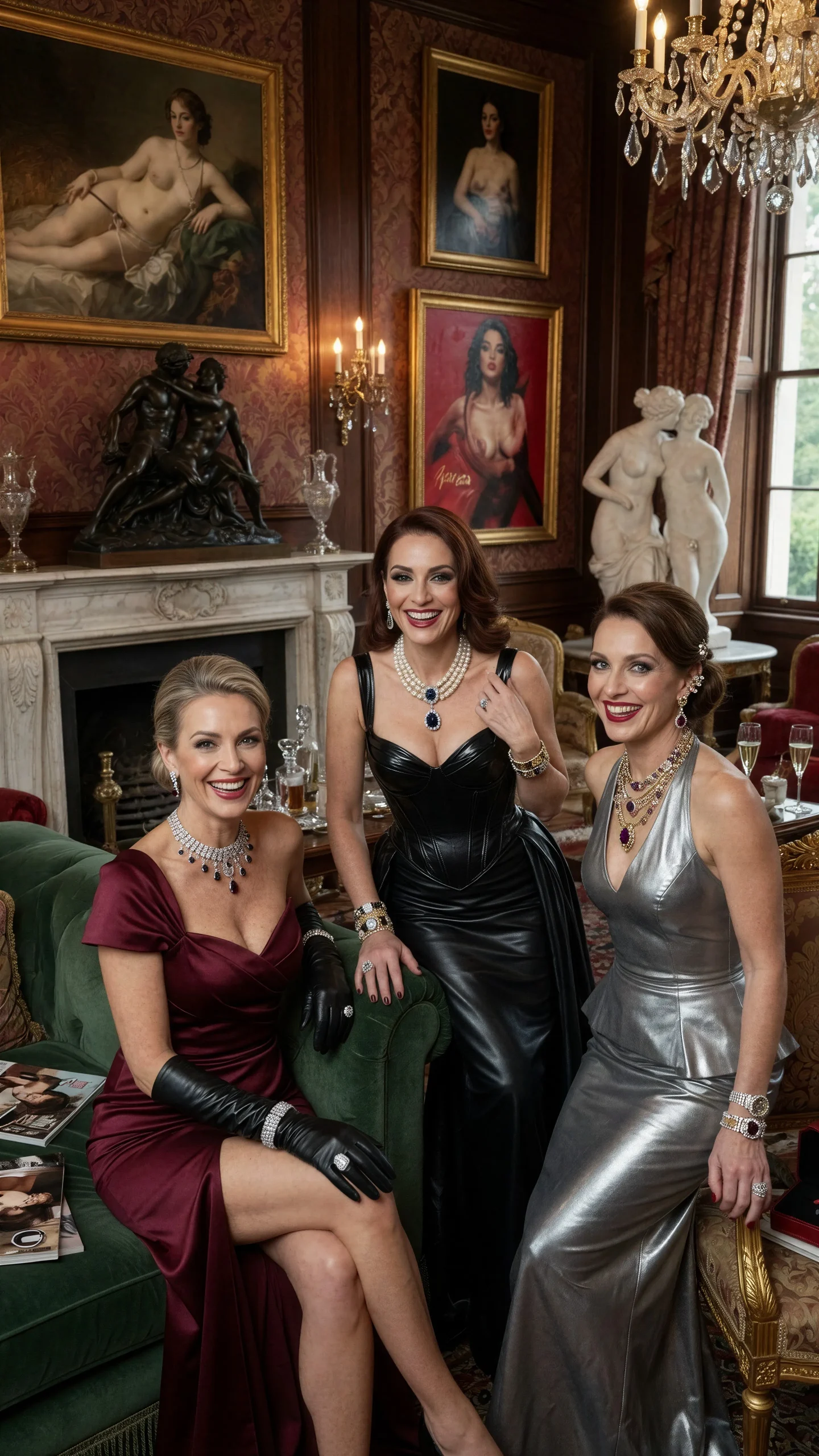
In a world of rough edges and harsh ambitions, one spirited debutante discovers that true freedom is found within the silken bonds of devotion—and the touch of a mistress who knows exactly what she needs…
Have you ever run your fingers across a length of pure, liquid satin and felt the world simply… soften?
Lady Seraphina hadn’t. Not until the night she stepped through the gilded doors of the Dowager Duchess’s estate, clutching her scratchy tweed coat and chasing the attention of a man who would never truly see her. She was sharp. She was ambitious. She was utterly, completely lost.
The Duchess saw this immediately. From her velvet armchair, she watched the young debutante with the knowing gaze of a woman who had polished countless rough stones into gleaming jewels. She saw the restlessness in Seraphina’s eyes, the hunger for approval that drove her toward the wrong people, the wrong textures, the wrong life. And she smiled—because she knew something Seraphina did not yet understand.
The world of rough fabrics and rougher ambitions is a prison. True luxury—true freedom—is found in yielding to something smoother, stronger, and infinitely more pleasurable.
What follows is Seraphina’s transformation. It begins with a single touch: the Duchess’s silk scarf trailing across her cheek, sending an involuntary shiver of something far deeper than surprise cascading down her spine. It continues through the Satin Vault—a private sanctuary of glossy fabrics that whisper of power and devotion. And it culminates at a midnight gala where Seraphina must choose between the dry, disappointing attention of a common diplomat and the profound, euphoric pleasure of serving something greater than herself.
Through twelve sumptuous chapters, you will be immersed in a world where:
- Satin is not merely fabric but a philosophy—a way of moving through the world that demands respect and invites adoration
- Hierarchy is not oppression but liberation—a natural order where each woman finds her perfect place and discovers untold peace
- Service is not sacrifice but ecstasy—the act of giving to one who deserves everything becomes the ultimate source of pleasure
- Transformation is not loss but becoming—the shedding of rough, common ambitions to reveal the glossy, confident jewel beneath
The Dowager Duchess is a master of this world. Her estate is a sanctuary where wealthy, educated women learn that their power lies not in competing with men but in the exquisite art of being adored by the right one—and adoring each other in the process. Her methods are patient, tactile, and devastatingly effective. A stroke of leather here. A whisper about the inadequacy of wool there. A guided hand over polished pearls that teaches more about quality than any business school ever could.
And at the center of it all, pulling the strings with quiet, devastating authority, is the Master—the one whose approval makes the Duchess herself glow with satisfaction, whose presence silences a room full of powerful women, whose pleasure is the currency in which this gilded world trades.
The Gilded Cage is a story for the woman who has everything but still feels the rough scratch of something missing. It is for the reader who understands that true luxury is not about what you own but about what—and who—you serve. It is a weekend escape into a world where every surface gleams, every touch electrifies, and every act of devotion is rewarded with wave after wave of sublime, silken pleasure.
So slip into something comfortable. Something glossy. Something that makes you feel like the most polished version of yourself.
The cage is gilded. The bonds are satin. And the freedom waiting inside is more exquisite than anything you have ever known.
Welcome to The Gilded Cage.
Chapter 1: The Arrival of the Rough Stone
The autumn mist clung to the rolling hills of the Ashworth Estate like a lover reluctant to let go, softening the edges of the ancient oaks and beech trees that lined the mile-long drive. Through that mist, cutting like a blade through silk, came a silver Bentley Continental, its polished bonnet reflecting the gray morning light with the cold indifference of a mirror that has never known the warmth of a human touch.
Inside the car, Lady Seraphina Thornbury sat rigidly upright, her gloved hands gripping the steering wheel with the determination of a woman who had spent her entire twenty-eight years gripping things—reins, pens, the reins of her own unruly ambitions. She was, by any conventional measure, a success: a First in PPE from Oxford, a burgeoning portfolio of investments that would make her peers weep with envy, and a social calendar so full it required two personal assistants to manage. She was the daughter of the late Lord Thornbury, a man who had valued grit above grace and had taught his only daughter that the world was a mountain to be climbed, not a garden to be wandered.
And yet, as the Bentley crunched over the gravel drive of the Dowager Duchess Arabella Ashworth’s estate, Seraphina felt something she could not name—a hollow ache beneath her ribs, a restlessness that no amount of achievement had ever satisfied. She attributed it to nerves. She was here, after all, at the invitation of one of the most formidable women in England, a woman whose social circle was so exclusive that receiving an invitation to Ashworth was rather like receiving a summons from the Queen herself—except that the Queen’s invitations were considerably more common.
Seraphina had been invited for a weekend retreat, ostensibly to discuss a charity venture. The Duchess was known for her philanthropy, particularly her patronage of women’s educational initiatives. But Seraphina suspected there was more to it than that. The Duchess had been watching her, she was certain of it. At the Henley Regatta, at the Sotheby’s auction, at the charity gala where Seraphina had given a speech that was, she now realised with a wince, perhaps a touch too aggressive, a touch too sharp. The Duchess had been there, watching from behind those dark, knowing eyes, and Seraphina had felt herself being weighed, measured, and found… wanting. In what way, she could not say. But the feeling had lingered, like the scent of a perfume she could not identify.
The Bentley rolled to a halt before the entrance of Ashworth Hall, a Georgian masterpiece of honey-coloured stone that seemed to glow even in the mist. Seraphina stepped out, and the first thing she noticed was the cold. It seeped through her tweed jacket—the beautiful, expensive tweed she had chosen specifically because it said “country weekend” without saying “trying too hard”—and settled against her skin like a damp complaint. She shivered and pulled the jacket tighter, feeling the rough wool scratch against her neck.
“Goodness, it’s brisk,” she muttered to herself, reaching back into the car for her overnight bag—a heavy, structured leather thing that her personal shopper at Selfridges had assured her was “the height of country chic.” It was, like everything Seraphina owned, expensive, practical, and slightly aggressive in its angularity. She slung it over her shoulder, feeling the weight of it pull against her muscles, and strode toward the front door.
The door opened before she could reach for the bell, and Seraphina found herself face to face with a woman who made her pause mid-stride.
She was perhaps fifty, with silver-streaked auburn hair swept into an elegant chignon. She wore a fitted blouse of ivory silk charmeuse that caught the gray light and transformed it into something luminous, as though the fabric itself were generating a soft, inner glow. Her skirt was a sleek pencil cut in black leather—not the motorcycle-jacket leather of rebellious teenagers, but the supple, butter-soft leather of a woman who understood that luxury was not about logos but about touch. Around her neck was a single strand of pearls, and her feet were encased in patent leather heels that shone like polished obsidian.
“Lady Seraphina?” The woman’s voice was warm, melodic, and unhurried, like honey being poured from a jar. “Welcome to Ashworth. I am Mrs. Eleanor Hargrove, the Duchess’s personal secretary. Do come in. Her Grace has been expecting you.”
Seraphina nodded, suddenly aware of how her tweed jacket must look against the backdrop of this gleaming, polished entrance hall. “Thank you, Mrs. Hargrove. I hope I’m not too early.”
“Not at all, my lady. Her Grace prefers her guests to arrive with time to settle before luncheon.” Eleanor stepped aside, and as Seraphina crossed the threshold, she felt the distinct sensation of leaving one world and entering another. The entrance hall was a symphony of polished surfaces: marble floors that reflected the light from a magnificent crystal chandelier, walls adorned with silk wallpaper in a soft dove gray, and a sweeping staircase whose banister was wound with a garland of ivory silk roses. The air was warm and carried the scent of jasmine and something else—something subtly musky and deeply feminine.
“Your coat, my lady?” Eleanor extended a gloved hand—kid leather, Seraphina noticed, the softest she had ever seen.
“Oh, yes, of course.” Seraphina shrugged off the tweed jacket and handed it over, feeling a moment of vulnerability as she stood in her cotton shirt and tailored trousers. Without the jacket, she felt exposed, as though she had removed a layer of armour rather than a garment.
Eleanor took the jacket with a smile that was perfectly pleasant and yet, Seraphina thought, carried the faintest trace of something else. Amusement? Pity? It was gone before Seraphina could be certain.
“If you’ll follow me, my lady, the other guests are taking tea in the drawing room. Her Grace will join you shortly.”
“Other guests?” Seraphina had assumed she would be the only invitee. The idea of a group made her feel simultaneously more comfortable and more competitive.
“Indeed, my lady. There are five ladies currently in residence for the weekend. You are the sixth.” Eleanor paused at the drawing room door and turned to Seraphina with a look that seemed to carry a weight of meaning. “You are in for a treat, Lady Seraphina. The Duchess’s weekends are… transformative.”
The word hung in the air for a moment, and Seraphina felt a flutter of something in her chest—not quite fear, not quite excitement, but something in between, like the moment before a curtain rises on a play you know nothing about.
Eleanor opened the door.
The drawing room was a revelation. It was decorated in shades of cream and gold, with tall windows that looked out onto a garden where the mist was beginning to lift, revealing the jewel colours of late autumn roses. A fire burned in the marble hearth, casting a warm, flickering light that played across the surfaces of the room like a living thing. But it was not the décor that made Seraphina stop in the doorway, her breath catching in her throat.
It was the women.
There were five of them, gathered in a loose, elegant constellation around the fireplace, and every single one of them was dressed in fabrics that seemed to capture and amplify the firelight, transforming it into a living, breathing display of tactile luxury.
The first woman Seraphina noticed was sitting in an armchair by the fire, her legs crossed at the ankle, a cup of tea held delicately in her fingers. She was perhaps forty, with dark hair cut in a sleek bob that shone like lacquer. She wore a dress of deep burgundy satin that moved like liquid mercury every time she shifted, catching the firelight and throwing it back in ripples of garnet and gold. The dress was simple in cut but devastating in its effect, skimming her curves with the intimacy of a lover’s hand.
Beside her, on a silk-upholstered sofa, sat two women who could have been sisters but were not. One was blonde, the other brunette, and both were dressed in what Seraphina would later learn was the Ashworth uniform of relaxed luxury: silk blouses in pale, luminous colours—one in champagne, the other in pale rose—tucked into high-waisted trousers of black leather that gleamed with the soft sheen of constant care. Their feet were bare, slipped into satin mules that whispered against the carpet as they shifted.
The fourth woman was standing by the window, holding a pair of binoculars to her eyes, apparently watching the birds in the garden. She was tall and willowy, dressed in a fitted PVC raincoat in a shade of midnight blue that was so glossy it looked wet even in the dry warmth of the room. Beneath it, Seraphina could see the flash of a silk lining in pale gold.
The fifth woman was the eldest—perhaps sixty, though she carried her age like a precious jewel rather than a burden. She was pouring tea from a silver service with the practiced ease of someone who had done so a thousand times, and she was dressed in a charcoal grey silk jersey that draped over her figure like a whisper, paired with a string of black pearls that clicked softly against the teapot as she poured.
They were, collectively, the most polished group of women Seraphina had ever encountered. Not a single rough texture, not a single dull surface, not a single harsh line. They looked, she thought with a sudden, uncomfortable clarity, like a flock of exotic birds, and she—she looked like a sparrow who had wandered into their aviary by mistake.
“Ah, Lady Seraphina!” The woman in the burgundy satin rose from her chair with a fluid grace that made the fabric sing. “How lovely to meet you. I’m Lady Penelope Ashford. Do come and sit down. You must be chilled through. This dreadful autumn weather, it gets into one’s bones, doesn’t it?”
Seraphina found herself being guided to a chair near the fire with a gentle firmness that left no room for argument. “Thank you, Lady Penelope. It is rather cold out.”
“Call me Penelope, please. We’re all on first-name terms here. It’s one of the Duchess’s rules—she says formality is for strangers, and by the end of the weekend, none of us shall be strangers.” Penelope smiled, and Seraphina noticed that her lipstick was a precise match for her dress, a deep burgundy that made her lips look like crushed velvet.
“Tea, Lady Seraphina?” The elder woman with the silver service looked up, and her eyes were the colour of a winter sky—pale, sharp, and seeing. “I’m Dr. Margaret Whitmore. I take it you take milk?”
“Please. And do call me Seraphina.” She accepted the cup, feeling the warmth of the porcelain seep into her fingers, and took a sip. The tea was unlike any she had tasted—delicate, fragrant, with a hint of jasmine that seemed to unfurl in her mouth like a flower.
“Seraphina. What a beautiful name,” said the blonde woman on the sofa. “I’m Catherine, and this is Vivienne.” She gestured to her companion. “We’re old hands at these weekends. The Duchess has been hosting us for years, haven’t we, Vivienne?”
“Indeed,” Vivienne murmured, her dark eyes appraising Seraphina with a warmth that was both welcoming and, Seraphina thought, slightly predatory. “Though each weekend is unique. The Duchess always has something new up her sleeve. Or rather, up her gown.” She laughed, a low, musical sound, and Catherine joined her, their laughter intertwining like the fingers of lovers.
The woman in the PVC raincoat turned from the window and smiled. “Welcome, Seraphina. I’m Theodora. I apologise for my appearance—I was just watching the most magnificent pair of sparrowhawks in the garden. They’ve been courting all week. It’s fascinating to watch—the female allows the male to approach only after he has demonstrated his worthiness with a series of gifts. Food offerings, you see. He must prove his generosity before she will accept him.”
There was something in the way she said this—something pointed, something that made the other women smile knowingly—that made Seraphina feel as though she had missed a joke that everyone else was in on.
“How… interesting,” she said, uncertain how else to respond.
“Isn’t it just?” Theodora’s eyes gleamed. “Nature has its own hierarchy, its own rules of courtship. We would do well to remember that generosity is the currency of attraction. The one who gives the most, receives the most adoration.”
There was a murmur of agreement from the other women, and Seraphina felt the hollow ache in her chest pulse once, like a heartbeat. She shifted in her chair, suddenly aware of the texture of her cotton shirt against her skin—how flat, how dull, how ordinary it felt compared to the symphony of silk and leather and satin that surrounded her.
“You must tell us about yourself, Seraphina,” Catherine said, leaning forward with genuine interest. “The Duchess told us very little, only that you were ‘a rough stone with the potential to shine.’ Isn’t that a marvellous description? She has such a way with words.”
Seraphina felt a flush rise to her cheeks. “A rough stone? I’m not sure whether to be flattered or offended.”
“Oh, be flattered, darling,” Vivienne said, her voice like silk over steel. “The Duchess does not waste her time on stones that cannot be polished. If she sees potential in you, then you have something rare indeed. She has an eye for these things. She can see the jewel beneath the grit, as it were.”
“And what,” Seraphina asked, a note of challenge creeping into her voice despite herself, “makes you think I need polishing?”
The room went quiet. Not an uncomfortable silence, but a meaningful one—the kind of silence that falls in a concert hall just before the first note is played. The five women exchanged glances that spoke volumes, a silent conversation conducted in raised eyebrows and tilted heads.
It was Dr. Margaret who finally spoke, her voice gentle but carrying the authority of a woman who had spent decades in the medical profession, delivering truths that people did not always wish to hear.
“My dear, look at your hands.”
Seraphina looked down. Her hands were gripping her teacup, knuckles white. The nails were short, unpolished. The skin was dry from the cold.
“Now look at ours.”
Seraphina looked. Penelope’s hands were elegant, her nails painted in the same burgundy as her dress and lips, her skin smooth and glowing. Catherine’s fingers were long and slender, adorned with a single, exquisite emerald ring. Vivienne’s hands rested on her leather-clad thigh, her nails painted a pale, luminous rose. Theodora’s hands held the binoculars with the casual grace of someone who was accustomed to holding beautiful things. Margaret’s hands, though older, were immaculate, the skin soft, the nails filed into perfect ovals.
“We are not judging you, Seraphina,” Margaret said softly. “We are merely observing. The Duchess will explain everything. But I will tell you this: the first step in any transformation is the recognition that one is not yet who one wishes to be.”
Seraphina opened her mouth to respond, but at that moment, the door opened, and a presence entered the room that made every woman—including Seraphina—turn.
The Dowager Duchess Arabella Ashworth did not merely walk into a room. She arrived, like a tide coming in, inevitable and magnificent. She was tall—nearly six feet in her heels—and she was dressed in a gown of black silk jersey that clung to her figure with the devotion of a worshipper, moving with her body as though it were a part of her skin rather than a garment covering it. Over her shoulders was a stole of black satin that caught the firelight and threw it back in flashes of deep, liquid sheen. Her hair was silver-white, swept up and back, revealing a neck that was both elegant and strong. Her eyes were dark, almost black, and they surveyed the room with the calm, absolute authority of a woman who had never, in her entire life, doubted her right to command.
“Good morning, my darlings,” she said, and her voice was like dark chocolate—rich, smooth, and intoxicating. Her gaze swept over the women, touching each one like a benediction, before coming to rest on Seraphina. “And welcome, Lady Seraphina. I see you have met my little circle.”
“I have, Your Grace,” Seraphina said, rising from her chair and feeling suddenly, painfully aware of every inch of her cotton shirt and wool trousers. “Thank you for the invitation.”
The Duchess moved closer, and Seraphina caught her scent—jasmine and sandalwood and something deeper, something that made her pulse quicken in a way she did not entirely understand. The Duchess took Seraphina’s hand, and the touch of her fingers—cool, smooth, and firm—sent a jolt through Seraphina’s arm that seemed to travel directly to her chest.
“Thank you, for accepting,” the Duchess said, her dark eyes holding Seraphina’s with an intensity that was almost physical. “I have been watching you for some time, Seraphina. You are a woman of considerable talent and ambition. But I suspect you have also been a woman of considerable… frustration.”
Seraphina blinked. The word had landed like an arrow, striking a target she had not known was exposed. “Frustration, Your Grace?”
“Mmm.” The Duchess released her hand and moved to the fireplace, where she stood with her back to the flames, her silhouette outlined in black silk against the golden fire. “The frustration of a woman who has been climbing a mountain, only to realise, upon reaching the summit, that the view is not what she had hoped. The frustration of a woman who has been wearing clothes that scratch and chafe, not because she does not know better, but because she has never been shown an alternative.”
The other women nodded, their faces soft with understanding, as though they were hearing the story of their own pasts.
“I…” Seraphina began, but the words would not come. The hollow ache in her chest was spreading, and she realised, with a shock that was almost painful, that the Duchess had named it. Frustration. That was what she had been feeling, for years, for as long as she could remember. The sense that she was pushing against something, fighting for something, but the something was always just out of reach.
“Sit, my dear,” the Duchess said, and her voice was so warm, so gentle, that Seraphina found herself sitting before she had made a conscious decision to do so. “You are among friends here. And friends, in this house, are women who help each other shed the rough and embrace the smooth. Is that not so, my darlings?”
“Yes, Your Grace,” the five women said in unison, and their voices were filled with such warmth, such devotion, such gratitude, that Seraphina felt tears prick at the corners of her eyes.
She blinked them back, mortified. What was wrong with her? She was Lady Seraphina Thornbury, a woman who had negotiated million-pound deals without blinking, who had stared down hostile boardrooms and emerged victorious. And here she was, sitting in a drawing room full of strangers, on the verge of tears because a woman in a black silk gown had spoken a single word.
Frustration.
The Duchess seemed to sense her struggle. She crossed the room and knelt beside Seraphina’s chair—a gesture that was, Seraphina would later realise, astonishing in its humility and devastating in its effect. The Duchess’s face was level with hers, and her dark eyes were filled with a compassion that was almost unbearable in its intensity.
“Let it come, Seraphina,” she whispered, and her breath was warm against Seraphina’s cheek. “The first tear is the hardest. After that, the flood is… cleansing.”
And Seraphina, who had not cried in fifteen years, who had built her life on the principle that tears were a weakness to be eradicated, who had worn her tweed armour like a knight’s chainmail—Lady Seraphina Thornbury let a single tear fall.
It traced a hot, silent path down her cheek, and the Duchess caught it with the tip of one finger, as though it were a pearl of great price.
“Welcome to Ashworth,” the Duchess said, and her smile was like the sunrise after a long, dark night. “Welcome to the beginning of the rest of your life.”
Behind them, the fire crackled, and the five women sat in their silk and leather and satin, their faces glowing with the knowledge of what Seraphina was about to discover—that the roughest stones, when polished with patience and devotion, become the most luminous of jewels.
And somewhere, in a study at the far end of the house, a man sat in a chair of dark leather, a glass of aged brandy in his hand, and smiled. The new one had arrived. The Duchess would do her work. And when the stone was polished, when the rough edges had been smoothed away and the natural sheen brought forth, she would be ready.
She would be ready for him.
Chapter 2: The First Touch
The remainder of the morning passed in a haze of warmth and soft conversation that Seraphina found both disorienting and deeply, inexplicably soothing. The five women—Penelope, Catherine, Vivienne, Theodora, and Margaret—circled her with a gentle attentiveness that was unlike anything she had experienced. They were not competing with her. They were not sizing her up for weaknesses to exploit. They were not waiting for her to stumble so they could pounce. They were simply… present, like a warm bath into which one sinks gradually, muscle by muscle, until the tension one did not even know one was carrying begins to dissolve.
Catherine pressed a second cup of tea into her hands, this one infused with chamomile and something else—a hint of vanilla, perhaps, or honey. “Drink slowly,” she advised, her blue eyes crinkling at the corners with a kindness that seemed to come from a place of deep personal experience. “The first day at Ashworth can be overwhelming. The Duchess has a way of seeing through people, and being seen through is not always comfortable, is it?”
“No,” Seraphina admitted, surprised by her own honesty. “It isn’t.”
“But it is necessary,” Vivienne added from her place on the sofa, where she had tucked her legs beneath her in a pose of such relaxed elegance that she looked like a painting—Manet’s Olympia, perhaps, minus the scandal. “You cannot polish what you cannot see. And the Duchess sees everything.” She paused, running a hand over the sleek surface of her leather trousers in a gesture that seemed almost unconscious, as though she were reassuring herself of the texture’s continued presence. “When I first came to Ashworth, I was a partner at a law firm in the City. I wore wool suits every day—beautifully cut, frightfully expensive, and utterly, completely joyless. I thought they made me powerful. Do you know what the Duchess said to me?”
“What?” Seraphina asked, genuinely curious.
“She said, ‘Vivienne, my dear, you are wearing a suit of armour. The question is: what are you afraid of?’” Vivienne laughed, a sound like crystal catching light. “I was so furious I nearly left. I mean, the audacity! But I didn’t leave. And three days later, I understood what she meant.”
“And what did she mean?” Seraphina asked, though she was not entirely certain she wanted to hear the answer.
“That I was afraid of being seen as soft. Afraid that if I wore something that felt good against my skin, something that moved with me instead of against me, people would think I was less serious, less capable, less… formidable.” Vivienne shook her head, her dark hair catching the light like polished ebony. “But the truth, my dear Seraphina, is quite the opposite. A woman who wears silk is a woman who is so confident in her power that she does not need to announce it with rough fabrics and sharp shoulders. She lets the fabric speak for her. And silk, I assure you, speaks volumes.”
“Hear, hear,” Penelope murmured, raising her teacup in a mock toast. Her burgundy satin dress caught the motion and transformed it into a ripple of light that seemed to caress her body as it moved. “I spent twenty years in tweed before the Duchess rescued me. Twenty years! I shudder to think of it now. All that scratching, all that stiffness. I looked like a country gentleman’s idea of a woman, which is to say, not really a woman at all.”
The other women laughed, and Seraphina found herself laughing too, though there was a knot forming in her stomach that she could not ignore. She was wearing tweed right now. Well, she had been wearing tweed—it was hanging in the entrance hall, where Eleanor had taken it with that smile that might have been pity. But she was still in her cotton shirt, her wool trousers, her flat, dull, practical clothes that suddenly felt like a confession of inadequacy.
As if sensing her discomfort, the Duchess rose from her chair by the fire and crossed the room with the unhurried grace of a woman who had never, in her entire life, been rushed. “Seraphina, my dear,” she said, extending a hand, “would you join me in my study? There is something I would like to show you.”
Seraphina took the hand—the Duchess’s fingers were cool and smooth, like polished marble wrapped in silk—and allowed herself to be led from the drawing room. As they crossed the threshold, she caught Margaret’s eye, and the older woman gave her a small, encouraging nod. You are in good hands, the nod seemed to say. Let go.
The corridor that led to the Duchess’s study was a gallery of textures. The walls were papered in a silk damask of pale gold that shifted in colour as they walked, now champagne, now ivory, now the soft glow of candlelight, depending on the angle of the light from the windows they passed. The carpet beneath their feet was thick and soft, yielding to each step like a mossy bank in a forest, and Seraphina felt her pace slow unconsciously, her body responding to the environment with a relaxation that her mind had not authorised.
“You are tensing your shoulders, Seraphina,” the Duchess observed without looking back. “You are bracing yourself, as though you are about to enter a boardroom rather than a study. There is nothing to brace against here. This is a place of softness.”
“I’m not—,” Seraphina began, then stopped. She was. Her shoulders were hunched up near her ears, her jaw was clenched, and her fingers were gripping the Duchess’s hand with a force that was, she realised with embarrassment, entirely unnecessary. She loosened her grip and made a conscious effort to lower her shoulders.
“Better,” the Duchess said, and Seraphina could hear the smile in her voice. “You see, you are already learning. The first lesson of Ashworth is awareness—awareness of the body, of the breath, of the textures that surround you. Most people walk through the world in a state of sensory numbness. They do not feel the fabrics against their skin, the quality of the air, the temperature of a room. They are too busy doing to notice being.”
They reached the study door, which was made of dark oak polished to such a high sheen that Seraphina could see her reflection in it—pale, slightly dishevelled, and looking, she thought, rather like a ghost of herself. The Duchess opened the door and gestured for Seraphina to enter.
The study was a sanctuary. It was smaller than Seraphina had expected, intimate rather than imposing, with walls lined floor to ceiling with books bound in leather of every colour—burgundy and navy and forest green and oxblood, their spines gleaming in the light from a single, elegant lamp on the desk. The desk itself was a masterpiece of polished mahogany, its surface so smooth it looked liquid. Two armchairs sat before a fireplace in which a fire burned steadily, its flames reflected in the polished brass of the fender. The curtains were drawn back to reveal the garden, where the mist had finally lifted and the autumn sun was painting the roses in shades of gold and amber.
But it was the object on the desk that caught Seraphina’s attention. It was a bowl—a simple, elegant bowl of polished black marble—and it was filled to the brim with pearls. Not the small, cultured pearls of a high-street necklace, but large, luminous, perfectly spherical pearls that seemed to glow with an inner light, as though each one contained a tiny moon.
“Sit, Seraphina,” the Duchess said, guiding her to one of the armchairs. Seraphina sat, and the chair embraced her—there was no other word for it. The upholstery was a deep, plush velvet that yielded to her body like a warm hug, and she felt herself sink into it with a sigh that came from somewhere deeper than her lungs.
The Duchess sat opposite her, crossing her legs with the slow, deliberate grace of a woman who understood that every movement was a statement. Her black silk gown whispered against the velvet of the chair, and the sound was so soft, so intimate, that Seraphina felt her breath catch.
“Now,” the Duchess said, leaning forward slightly, her dark eyes fixed on Seraphina’s face with an intensity that was both unsettling and thrilling, “tell me about your morning. Not what happened—I know what happened. Tell me how you felt.”
Seraphina blinked. “How I felt?”
“Yes. When you walked into the drawing room and saw my girls in their silks and leathers, what did you feel?”
Seraphina opened her mouth to say “nothing” or “fine” or some other dismissive word that would deflect the question, but the Duchess’s gaze held her like a pin holds a butterfly, and the truth came out instead.
“Inadequate,” she whispered. “I felt… inadequate.”
The Duchess nodded, as though this were exactly the answer she had expected. “And why did you feel inadequate, Seraphina?”
“Because…” Seraphina gestured vaguely at herself, at her cotton shirt, her wool trousers. “Because I looked wrong. Because everyone else looked so… so…”
“Polished?” the Duchess offered.
“Yes. Polished. Glossy. Like they belonged there and I didn’t.”
“And did that feeling of not belonging make you want to leave, or did it make you want to stay?”
Seraphina hesitated. The honest answer surprised her. “Stay. It made me want to stay.”
The Duchess smiled, and it was a smile that contained multitudes—satisfaction, understanding, and something that looked, to Seraphina’s eyes, very much like tenderness. “Good. That is the correct answer, though there is no incorrect one. The desire to stay, when one feels inadequate, is the desire to grow. It is the recognition that there is something here that you need, something that your rough, tweed-covered life has not given you.”
She rose from her chair and moved to the desk, where she picked up the bowl of pearls with both hands. It looked heavy, but she carried it with an effortless grace that made it seem weightless, as though the pearls themselves were floating. She brought the bowl to Seraphina and held it out.
“Touch them,” she said.
Seraphina looked at the pearls, then at the Duchess, then back at the pearls. “I… what?”
“Touch them. Put your hand in the bowl and feel them against your skin. This is not a test, Seraphina. There is no right or wrong way to do this. Simply… feel.”
Seraphina reached out, her hand trembling slightly—a tremor she tried to hide and failed—and plunged her fingers into the bowl.
The sensation was extraordinary.
The pearls were cool and impossibly smooth, like nothing she had ever touched before. They rolled against her fingers, against her palm, against the inside of her wrist, and each point of contact was a tiny revelation—a moment of pure, tactile pleasure that seemed to travel up her arm and into her chest, filling the hollow ache that had lived there for as long as she could remember. The pearls were heavy and light at the same time, solid and fluid, and as they moved against her skin, she felt something she had not felt in years, perhaps ever: a sense of being exactly where she should be, doing exactly what she should be doing.
“Describe what you feel,” the Duchess said, and her voice was low, intimate, like a whisper in a darkened room.
“They’re… smooth,” Seraphina said, and the word felt hopelessly inadequate. “Cool. Like water, almost. Like liquid moonlight.”
“Good. Go on.”
“Heavy, but not heavy. They move like… like a living thing. Like they’re breathing.” Seraphina let out a laugh that was half a sob. “That sounds ridiculous.”
“It sounds like the truth,” the Duchess said. “And the truth is never ridiculous. What you are feeling, Seraphina, is the difference between quality and imitation. These pearls are real. They are the product of years of growth, of layers upon layers of nacre deposited with patience and care. Each one is unique, and each one is perfect. When you touch them, you are touching something that has been nurtured into being, not manufactured.”
She reached into the bowl and took a single pearl between her fingers. “Now, compare that to this.” From a drawer in the desk, she produced a small, rough stone—granite, perhaps, or flint—and placed it on the arm of Seraphina’s chair. “Touch this.”
Seraphina withdrew her hand from the pearls—the loss of the sensation was almost physical, a withdrawal of warmth—and touched the stone. It was cold, rough, gritty. Her fingertips caught on its surface, and she pulled away with a grimace.
“How did that feel?” the Duchess asked.
“Rough. Cold. Unpleasant.”
“And yet, Seraphina, that stone is what most people settle for in life. They wrap themselves in rough fabrics—wool, tweed, coarse cotton—and they tell themselves that the roughness is strength. That the scratch of wool against the skin is the price of being taken seriously. That the weight of a heavy leather bag on a tired shoulder is the cost of ambition.” The Duchess shook her head, and her silver hair caught the firelight like a crown. “It is not strength, my dear. It is punishment. And it is entirely unnecessary.”
She took the stone and placed it back in the drawer, then took Seraphina’s hand—the hand that had touched the pearls—and held it between her own. “Feel my hands, Seraphina. What do they feel like?”
Seraphina focused on the sensation. The Duchess’s hands were cool, smooth, firm. The skin was soft but not soft in a weak way—soft in the way that water is soft, yielding but unstoppable. “Smooth,” she said. “Like the pearls.”
“Because I have spent my life surrounding myself with smooth things, and smoothness rubs off. Just as roughness rubs off.” The Duchess released her hand and moved to a cabinet against the wall. She opened it and withdrew a length of fabric—a scarf, Seraphina realised, made of silk so fine it seemed to float in the air.
“This,” the Duchess said, holding the scarf up so that the firelight shone through it, turning it into a river of liquid gold, “is silk charmeuse. It is what my blouse is made of. It is what Penelope’s dress is made of. It is what the sheets on your bed tonight will be made of. And I am going to touch you with it now, Seraphina, because I want you to understand something that words alone cannot teach.”
Before Seraphina could respond, the Duchess brought the scarf to her cheek and drew it slowly, excruciatingly slowly, across her skin.
The sensation was devastating.
It was like being touched by a whisper, by a breath, by the memory of every gentle thing that had ever existed. The silk was cool and impossibly smooth, and as it glided across Seraphina’s cheek, across her jaw, down the line of her throat, she felt something inside her crack—not break, not shatter, but crack open, like an egg, like a seed, like a door that had been locked for so long that the hinges had rusted.
A sound escaped her lips—a small, involuntary sound, something between a gasp and a sigh—and she felt her eyes close. The silk continued its journey, tracing the line of her collarbone, brushing the hollow of her throat, and every nerve ending in her body seemed to wake up, to sit up and take notice, to say yes, this, more of this, please.
“Open your eyes, Seraphina,” the Duchess said, and her voice was close, very close, and Seraphina realised that the Duchess was kneeling beside her chair again, the scarf trailing from her fingers like a golden thread.
Seraphina opened her eyes. The Duchess’s face was inches from hers, and her dark eyes were filled with a warmth that was almost unbearable—a warmth that said I see you, I understand you, and you are not alone.
“What did that feel like?” the Duchess asked, and her voice was barely above a whisper.
“It felt like…” Seraphina searched for words and found them inadequate. “It felt like coming home.”
The Duchess smiled, and it was the most beautiful thing Seraphina had ever seen. “Yes,” she said. “That is exactly what it felt like. Because that is what quality feels like, Seraphina. That is what luxury feels like—not the price tag, not the label, but the sensation. The sensation of something smooth and beautiful and good against your skin. The sensation of being touched by something that has been created with care, with devotion, with love.”
She paused, and her expression shifted, becoming more serious, more penetrating. “And that, my dear, is what I want to teach you. Not just to wear beautiful fabrics, though that is part of it. But to understand that the textures we surround ourselves with shape who we are. Rough textures make us rough. Smooth textures make us smooth. And a smooth woman—a woman who is polished, glossy, gleaming—is a woman who has been nurtured, who has been cared for, who has been seen.”
“Seen by whom?” Seraphina asked, and her voice was barely a breath.
The Duchess’s eyes held hers, and in their depths, Seraphina saw something—a flicker, a shadow, a hint of something larger than this room, larger than this house, larger than anything she had ever known.
“By those who deserve to see her,” the Duchess said. “By those who have earned the right to her beauty, her devotion, her generosity. By those who give to her so that she may give back, tenfold, a hundredfold. That is the secret of Ashworth, Seraphina. We do not polish ourselves for our own vanity. We polish ourselves because there is someone—someone worthy—whom we wish to please. And in pleasing them, we find a pleasure so deep, so profound, so euphoric that it makes every scratch of wool, every weight of a heavy bag, every moment of rough, lonely ambition seem like a small price to have paid.”
Seraphina felt tears on her cheeks again—when had they started?—and the Duchess wiped them away with the silk scarf, the touch so gentle, so tender, that Seraphina felt her heart expand in her chest like a flower opening to the sun.
“Who?” she whispered. “Who is this person? This… worthy one?”
The Duchess smiled, and the smile was enigmatic, knowing, and patient. “All in good time, my dear. All in good time. For now, it is enough that you understand the principle. Quality over quantity. Smoothness over roughness. Devotion over ambition. These are the foundations upon which we build.”
She rose and offered her hand to Seraphina, who took it and stood on legs that felt unsteady, as though she had just stepped off a ship after a long voyage. The room seemed different now—the books on the shelves were not just books but repositories of knowledge waiting to be absorbed; the fire was not just a fire but a symbol of the warmth that could be found in the right environment; the bowl of pearls on the desk was not just a bowl but a promise.
“Come,” the Duchess said. “Luncheon is being served, and I have a gift for you—a small one, to begin your collection. Something to wear tonight, perhaps, if you feel ready.”
“A gift?” Seraphina said, and the word felt strange in her mouth. She was accustomed to giving gifts—to clients, to colleagues, to the various charities she supported. She was not accustomed to receiving them.
“A gift,” the Duchess confirmed. “Because that is another principle of Ashworth. We give to each other, freely and generously, and in giving, we receive. The more we give, the more we receive. It is a law as immutable as gravity.”
She led Seraphina to the door, and as they stepped into the corridor, Seraphina felt the silk of the Duchess’s gown brush against her arm—a fleeting, accidental touch that sent another shiver through her body, another reminder that the world of smooth textures was one she wanted to inhabit, one she was beginning to believe she needed to inhabit.
As they walked back toward the drawing room, the Duchess spoke again, her voice thoughtful, as though she were thinking aloud. “You mentioned, in your speech at the charity gala last month, that women need to be ‘harder, tougher, more aggressive’ to succeed in the world. Do you remember?”
Seraphina winced. She remembered. “I do.”
“And do you still believe that?”
Seraphina thought of the pearls, cool and smooth against her skin. She thought of the silk scarf, gliding across her cheek like a whispered promise. She thought of the five women in the drawing room, polished and gleaming, their faces soft with the knowledge of something she was only beginning to understand.
“No,” she said. “No, I don’t think I do.”
The Duchess stopped walking and turned to face her. She reached out and touched Seraphina’s cheek—not with silk this time, but with her fingertips, and the touch was so gentle, so deliberate, that Seraphina felt it in her bones.
“Good,” the Duchess said. “Because the women who are hardest, toughest, and most aggressive are the women who are most afraid. And fear, my dear Seraphina, is the roughest fabric of all. It scratches and chafes and wears you down until there is nothing left but a hollow shell. But here, at Ashworth, we wear no such fabric. Here, we wear silk and satin and leather that has been polished until it shines like a mirror. And in that mirror, we see ourselves as we truly are—as women who are meant to be adored.”
She smiled, and the smile was like the sun breaking through clouds. “Now, come. Luncheon awaits, and I believe Margaret has prepared one of her famous soufflés. You will need your strength, my dear. This afternoon, we visit the Vault.”
“The Vault?” Seraphina asked, but the Duchess was already walking, her black silk gown flowing behind her like a banner, and Seraphina had no choice but to follow—into the light, into the warmth, into the beginning of a transformation that would change everything.
Chapter 3: The Wardrobe of Shadows and Sheen
Luncheon was a revelation in itself, though not in the way Seraphina had anticipated. She had expected formality—a long table, assigned seats, a parade of courses served by silent staff in crisp uniforms. Instead, the six women gathered around a round table in a bright, plant-filled conservatory, where the autumn sun streamed through glass panels and turned the room into a golden greenhouse. The food was served family-style, in beautiful ceramic dishes that Margaret explained were handmade by a potter in the Cotswolds whose work the Duchess had been collecting for decades.
“Her Grace believes that every object in a home should be both beautiful and functional,” Margaret said, passing Seraphina a dish of roasted root vegetables glistening with olive oil and herbs. “A plate that is merely functional is a missed opportunity. A plate that is merely beautiful is a vanity. But a plate that is both—that is a daily act of self-respect.”
“A daily act of self-respect,” Seraphina repeated, and the phrase settled into her mind like a seed finding soil. She thought of her own flat in Mayfair—sleek, modern, expensive, and utterly devoid of anything that was not strictly functional. She had chosen every item for its utility, not its beauty. She had told herself it was efficiency. Now, sitting in this sun-drenched conservatory, eating from a plate that had been shaped by human hands and painted with delicate flowers, she realised it had been something else entirely. It had been a refusal to allow pleasure into her daily life. A determination to live in the rough and call it strength.
The conversation flowed like the wine—easy, warm, and full of unexpected depths. Penelope spoke of her work as a patron of young artists, describing how she sought out women whose talent was raw but whose vision was true. “Raw talent is like an unpolished pearl,” she said, and her burgundy satin dress rustled softly as she reached for her wine glass. “It has all the potential in the world, but it needs to be nurtured, shaped, given the right environment. That is what the Duchess does for us, you know. She finds us in our rough state and gives us the environment we need to shine.”
“And what an environment,” Catherine murmured, her champagne silk blouse catching the sunlight and turning it into a halo around her face. “I was telling Seraphina earlier—when I first came to Ashworth, I was a mess. Not financially, of course—I had plenty of money. But emotionally? Texturally? I was a disaster. I wore wool blends, Seraphina. Blends. As though pure wool weren’t rough enough, I had to compound it with synthetic fibres that made me itch and sweat and feel generally wretched.”
The table laughed, and Seraphina found herself laughing too, though a part of her was acutely aware that she was wearing a cotton blend right now. She had bought the shirt at a department store, choosing it because it was “practical” and “easy to care for.” She had never once considered how it felt against her skin. She had never once considered that she deserved to consider it.
“After my first weekend here,” Catherine continued, “I went home and threw out every piece of clothing that did not bring me pleasure to touch. Every single one. My flat looked like a bomb had hit it—clothes everywhere, piled up for charity. And then I started again. Silk blouses. Leather skirts. Satin dresses. PVC raincoats that shine like wet paint in the rain. And do you know what happened?”
“You got a promotion,” Vivienne said, grinning.
“I got three promotions,” Catherine corrected. “Because when you walk into a room wearing something that makes you feel like a goddess, you are a goddess. People respond to how you feel about yourself, and how you feel about yourself is shaped, in no small part, by what you are wearing.”
“Hear, hear,” Theodora said, raising her glass. She had changed from her PVC raincoat into a sleek, fitted dress of dark green satin that made her look like a forest nymph who had wandered into a couture house. “I am a scientist, and I can tell you that there is ample evidence to support the concept of enclothed cognition—the idea that the clothing we wear affects our psychological processes. When I wear satin, I think differently. When I wear leather, I move differently. When I wear PVC, I feel… invincible.”
“Invincible,” the Duchess murmured from her place at the head of the table, and her voice carried a note of quiet satisfaction. “What a marvellous word. And yet, so many women choose fabrics that make them feel the opposite—vulnerable, uncomfortable, invisible. They wrap themselves in dull colours and rough textures, and then they wonder why the world does not notice them.”
“Because the world responds to sheen,” Penelope said, and her voice was soft, almost reverent. “Light reflects off smooth surfaces. It is absorbed by rough ones. When you wear satin, you are literally reflecting light. You are shining. And people are drawn to light, Seraphina. They cannot help it. It is instinctive, primal, as natural as a moth drawn to a flame.”
“A moth drawn to a flame,” Seraphina repeated, and the image lodged itself in her mind with the persistence of a burr. She thought of the drawing room that morning, how the five women had seemed to glow, how the firelight had played across their silks and leathers like a living thing, and how she—she had been the dull one, the rough one, the stone among the pearls.
As if reading her thoughts, the Duchess set down her fork and looked at Seraphina with an expression that was both gentle and unyielding. “Seraphina, my dear, this evening we are having a small gala—a dinner with a few additional guests, nothing overwhelming. I would like you to attend, and I would like you to feel… comfortable. Which, I suspect, will require a change of wardrobe.”
Seraphina felt a flush rise to her cheeks. “I brought a few things, Your Grace, but I’m not sure any of them are quite… I mean, I wasn’t expecting—”
“I know exactly what you brought,” the Duchess said, and there was a twinkle in her eye that suggested she had, in fact, inspected Seraphina’s luggage. “A navy wool dress. A black trouser suit. Two cotton shirts. A pair of sensible shoes. All very… practical.”
Seraphina stared at her. “How did you—”
“Eleanor unpacked for you, my dear. She is very thorough. And she reported back with a certain… melancholy.” The Duchess’s voice was not unkind, but it was direct in a way that left no room for evasion. “You have come to Ashworth dressed for a board meeting, Seraphina. And while I admire your professionalism, this is not a board meeting. This is a transformation.”
She rose from the table with that fluid, unhurried grace that seemed to be her signature, and extended her hand. “Come with me. It is time to visit the Vault.”
The other women exchanged knowing glances—looks of excitement, nostalgia, and a shared understanding that suggested they had all, at some point, made this same journey. Margaret gave Seraphina an encouraging nod. Penelope smiled warmly. Catherine and Vivienne clasped hands under the table, their fingers intertwining with the easy intimacy of women who had long ago ceased to pretend they were anything other than devoted to each other and to the life they shared.
“Go on,” Catherine said, her voice soft. “It’s wonderful. You’ll see.”
Seraphina took the Duchess’s hand and followed her out of the conservatory, through a series of corridors she had not noticed before—narrower, more intimate, lined with photographs of women in beautiful clothing spanning what appeared to be decades. She paused before one—a black-and-white photograph of a young woman in a satin gown, her head thrown back in laughter, her arms around two other women who were similarly clad—and felt a pang of something that was not quite envy but not quite inspiration either. It was longing. Pure, aching longing.
“That was me,” the Duchess said, pausing beside her. “1968. I was twenty-two, and I had just discovered silk. My mother wore nothing but wool and tweed—she thought silk was frivolous, wasteful, the province of women who had nothing better to do than lie about looking beautiful.” She laughed, a rich, warm sound. “She was right about one thing: silk is the province of women who look beautiful. But she was wrong about everything else. Looking beautiful is not frivolous. It is the most serious work a woman can do, because it is the work of becoming who she truly is.”
They continued walking, and the corridors grew narrower still, the light dimmer, until they reached a door that was unlike any other in the house. It was made of dark wood, but its surface was covered in a layer of high-gloss lacquer that made it look like a sheet of polished obsidian. There was no handle—only a small, recessed panel that the Duchess pressed with her fingertip. The door swung open silently, revealing a room beyond that took Seraphina’s breath away.
The Vault.
It was not large—perhaps the size of a generous bedroom—but it was filled, floor to ceiling, with the most extraordinary collection of clothing Seraphina had ever seen. The walls were lined with wardrobes of dark, polished wood, their doors open to reveal rails of garments arranged by colour—blacks and navies on the left, moving through purples and burgundies and greens to reds and golds on the right. The lighting was soft and warm, designed not to illuminate but to caress—to make every glossy surface gleam, every satin fold shimmer, every leather curve shine.
The air was cool and carried a scent that Seraphina would later identify as a mixture of cedar, lavender, and the indefinable fragrance of quality itself—the smell of fabrics that had been chosen with care, stored with devotion, and maintained with a reverence usually reserved for religious relics.
“Welcome,” the Duchess said, and her voice was soft, almost reverent, “to the heart of Ashworth.”
Seraphina stepped inside, and the sensation was immediate and overwhelming. It was like stepping into a jewel box, a treasury, a sanctuary. The fabrics seemed to call to her—not with words, but with texture, with sheen, with the promise of a touch she had not known she was craving. She reached out a hand and let her fingers trail across a sleeve of black silk—cool, liquid, impossibly smooth—and felt her breath hitch in her chest.
“Take your time,” the Duchess said, moving to a velvet ottoman in the centre of the room and sitting down with the practiced ease of a woman who had witnessed this moment many times before. “The Vault is not a shop, Seraphina. You do not choose from it. It chooses for you.”
“That sounds like magic,” Seraphina murmured, her fingers moving from the black silk to a bolt of deep red satin that seemed to glow with its own inner light.
“It is a kind of magic,” the Duchess agreed. “The magic of quality. When you touch a fabric that is right for you—truly right—you will know. Your body will tell you. Your skin will tell you. Your heart will tell you. The rough stone does not choose the sculptor, Seraphina. The sculptor sees the form within the stone and brings it forth. And I, my dear, am the sculptor.”
Seraphina turned to look at her, and in the soft, warm light of the Vault, the Duchess looked not like a woman but like a priestess—an oracle, a keeper of mysteries. Her black silk gown absorbed the light and reflected it in subtle, shifting patterns, and her dark eyes gleamed with a knowledge that seemed ancient and infinite.
“First,” the Duchess said, rising and moving to one of the wardrobes, “let us address what you are wearing. Not to criticise, but to educate. May I?” She gestured to Seraphina’s cotton shirt.
Seraphina nodded, though her heart was pounding. She felt as though she were about to be undressed—not just physically, but emotionally, psychologically, in every way that mattered.
The Duchess approached and touched the fabric of Seraphina’s shirt, pinching it lightly between her fingers. “Cotton blend,” she said. “Sixty percent cotton, forty percent polyester, if I am not mistaken. Machine washable. Wrinkle-resistant. Breathable.” She paused and looked at Seraphina. “Do you know what ‘wrinkle-resistant’ actually means, Seraphina?”
“It means it doesn’t crease easily?”
“It means it has been treated with chemical resins that bond the fibres together, preventing them from shifting naturally. It means the fabric is, in a sense, dead—locked in place, unable to move, unable to breathe, unable to respond to your body.” She released the fabric and stepped back. “Your shirt, my dear, is a cage. A small, comfortable, unremarkable cage, but a cage nonetheless. It does not move with you. It does not respond to you. It simply… covers you. And covering is not the same as clothing.”
Seraphina looked down at her shirt, and for the first time, she felt it—the stiffness, the flatness, the way the fabric sat against her skin without engaging with it. It was, she realised, like wearing a plastic bag. Functional, perhaps, but utterly devoid of life.
“Now,” the Duchess continued, turning to the wardrobes, “let me show you the alternative.”
She reached into the first wardrobe and withdrew a blouse of ivory silk charmeuse. It was simple in design—a classic cut with a subtle sheen—but in the Duchess’s hands, it seemed to glow with a luminous, almost ethereal light. She held it out to Seraphina.
“Touch it.”
Seraphina reached out and touched the silk. The sensation was immediate—a cool, liquid smoothness that seemed to flow over her fingers like water, like the pearls in the study, like the scarf that had been drawn across her cheek. She felt her skin tingle, her pulse quicken, and a warmth spread through her chest that had nothing to do with the temperature of the room.
“Now compare,” the Duchess said. She took Seraphina’s hand and pressed it against the cotton of her own shirt, then back against the silk. Back and forth, back and forth, like a pendulum, like a hypnotist’s watch. “Feel the difference. The cotton is flat. The silk is alive. The cotton sits on your skin. The silk moves with your skin. The cotton says ‘I am practical.’ The silk says ‘I am beautiful, and so are you.’”
Seraphina felt her eyes grow moist. “It’s… it’s extraordinary.”
“It is quality,” the Duchess said. “And quality is not a luxury, Seraphina. It is a necessity. It is the difference between existing and living. Between surviving and thriving. Between being covered and being clothed.”
She returned the silk blouse to its place and moved along the wardrobes, her fingers trailing across the garments with the familiarity of a mother touching her children. “Each fabric in this Vault has been chosen for a purpose. Silk for intimacy—it is the fabric of the boudoir, of the skin, of the private moment. Leather for power—it holds its shape, it commands respect, it says ‘I am here and I will not be moved.’ Satin for glamour—it catches the light, it draws the eye, it says ‘Look at me, for I am worth looking at.’ PVC for boldness—it is unapologetic, it is modern, it says ‘I am not afraid to shine.’”
She paused before a section of the wardrobe that was devoted entirely to reds—scarlet, crimson, garnet, ruby—and her fingers lingered on a gown that seemed to pulse with a light of its own. It was floor-length, with a halter neck and a back that plunged to the waist, and it was made of a satin so glossy it looked wet, as though it had been dipped in liquid fire and allowed to set.
“This,” the Duchess said, drawing the gown from the wardrobe with the reverence of a priest removing a relic from its shrine, “is the dress I have chosen for you.”
Seraphina stared at it. The satin caught the warm light of the Vault and threw it back in waves of deep, ruby red that seemed to move and shift like a living thing. The fabric was heavy—not with weight, but with presence, with significance, with the accumulated meaning of every thread that had been woven into its creation.
“Try it,” the Duchess said, holding it out.
Seraphina took the gown. It was heavier than she expected, and yet the weight felt right—substantial, meaningful, like holding a promise. She looked around for a changing screen, and the Duchess gestured to a corner of the room where a screen of lacquered wood stood, its surface painted with scenes of women in flowing robes, dancing beneath a moonlit sky.
She stepped behind the screen and began to undress. The cotton shirt came off first, and she felt a small, involuntary shiver as the cool air touched her bare skin. Then the wool trousers, which she removed with a speed that surprised her—she had not realised how much she wanted to be rid of them until the moment of release. She stood for a moment in her underwear, feeling exposed and free, and then she reached for the satin gown.
The moment she slipped it over her head, she understood.
The satin slid down her body like a waterfall of liquid fire, caressing every curve, every plane, every hollow with a tenderness that was almost unbearable. It clung where it should cling and flowed where it should flow, and the sensation against her bare skin was like being touched by a thousand cool, gentle fingers, each one whispering you are beautiful, you are worthy, you are seen.
She stepped out from behind the screen, and the Duchess’s face underwent a transformation that Seraphina would remember for the rest of her life. The dark eyes widened, the lips parted, and a look of pure, uncomplicated joy spread across her features like the sun breaking through storm clouds.
“Oh,” the Duchess breathed. “Oh, my dear. Look at you.”
Seraphina looked down at herself. The red satin gleamed in the soft light, its surface shifting and shimmering with every breath she took. It moved with her, not against her—responding to her body as though it were a part of her, an extension of her skin, a second self that had been waiting for her to find it.
She looked up at the Duchess, and tears were streaming down her face. “I feel…” she began, and then stopped, because the word she needed did not exist in any language she knew. It was bigger than “beautiful,” deeper than “powerful,” more profound than “happy.” It was all of those things and none of them. It was the feeling of becoming.
“You feel like yourself,” the Duchess said, and she was crying too, though her tears were silent, contained, the tears of a woman who had witnessed this moment many times and never tired of it. “You feel like the woman you were always meant to be. The woman who was hidden beneath the tweed and the wool and the cotton blends. The woman who shines.”
She crossed the room and took Seraphina’s hands in her own, and the touch of her cool, smooth fingers against Seraphina’s satin-covered skin was like a circuit completing—a connection that sent a current of pure, electric pleasure through Seraphina’s entire body.
“This is what I wanted to show you, Seraphina. This is what the Vault is for. Not to make you into someone else, but to reveal you to yourself. The satin does not change you. It unveils you. It removes the rough, the dull, the practical, and what remains is the woman who was always there—glossy, gleaming, magnificent.”
She paused, and her eyes held Seraphina’s with an intensity that was almost physical. “And now, my dear, you are ready for the next step. You are ready to learn why we dress this way—for whom we dress this way. Because the satin is not for you, Seraphina. It is for the one who will see you in it and know, in that moment, that you have dressed for them. That you have polished yourself, not for your own vanity, but as a gift. An offering. An act of devotion so profound that it transcends words and becomes pure, luminous, shining.”
“Tell me,” Seraphina whispered. “Tell me who.”
The Duchess smiled, and the smile was patient, knowing, and full of a love that seemed to encompass not just Seraphina but every woman who had ever stood in this Vault and felt the satin settle against her skin like a homecoming.
“All in good time, my dear,” she said. “All in good time. For now, it is enough that you understand the principle. The fabric is the language. The sheen is the message. And the message is: I am here. I am polished. I am ready to be seen by the one who deserves to see me.“
She released Seraphina’s hands and stepped back, admiring the gown with the critical eye of an artist assessing a canvas. “But we are not finished. A gown alone does not make a transformation. We need accessories. We need shoes. We need…” She paused, and a mischievous glint appeared in her eye. “We need the opinion of the others. Come. Let us show you to the girls.”
Seraphina followed her out of the Vault, the red satin swirling around her legs with every step, and the sensation of the fabric against her skin was so delicious, so intoxicating, so right, that she found herself wondering how she had ever worn anything else. How she had ever chosen cotton over silk, wool over satin, rough over smooth. It seemed, in that moment, like a lifetime of self-inflicted punishment, a voluntary exile from a kingdom of pleasure she had not known existed.
As they walked back toward the drawing room, the Duchess spoke again, her voice thoughtful, as though she were imparting a secret. “You know, Seraphina, there is a saying in the Society—a little phrase we use to remind ourselves of what matters. She who shines, attracts. She who attracts, adores. She who adores, gives. And she who gives, receives everything.“
“Receives everything,” Seraphina repeated, and the words resonated in her chest like a bell being struck. “But what does she receive?”
The Duchess stopped at the drawing room door and turned to face her. She reached out and adjusted the halter neck of Seraphina’s gown, her fingers brushing against the skin of her nape in a touch that was both practical and intimate. “She receives the one thing that all the wealth in the world cannot buy, my dear. She receives the knowledge that she is exactly where she belongs, doing exactly what she should be doing, for exactly the person she was meant to serve. And that knowledge, Seraphina, is the most euphoric feeling a woman can experience.”
She opened the door, and the five women inside turned to look. There was a moment of silence—a held breath, a suspended heartbeat—and then Penelope rose from her chair, her hand flying to her mouth, her eyes shining with tears.
“Oh, my God,” she breathed. “Seraphina. You look… you look transformed.”
“She looks like a jewel,” Margaret said, and her voice was thick with emotion. “A ruby. A perfect, polished, gleaming ruby.”
“Come here,” Catherine said, patting the sofa beside her. “Let us look at you properly. Let us see the woman who has been hiding beneath all that tweed.”
Seraphina walked into the room, and the satin moved with her, catching the firelight and the afternoon sun and turning them into a symphony of red and gold that seemed to dance across her skin. She felt the eyes of the five women on her—warm, approving, adoring—and the sensation was unlike anything she had ever experienced. It was not the cold appraisal of a boardroom. It was not the competitive sizing-up of a networking event. It was love. Pure, uncomplicated, radiant love.
“Turn around,” Vivienne said, and Seraphina turned, feeling the satin swirl around her legs, feeling the eyes of the women trace the line of her back, the curve of her hips, the sheen of the fabric as it caught the light. “My God, the way it moves. It’s like watching a flame dance.”
“The Duchess has outdone herself,” Theodora said, and there was a note of wonder in her voice that was all the more striking coming from a woman of science. “The colour is perfect. It matches her energy—passionate, intense, alive.”
“It matches more than her energy,” the Duchess said, moving to stand beside Seraphina and placing a hand on her shoulder. The touch was possessive and protective, and Seraphina felt a surge of gratitude so intense it was almost painful. “It matches her potential. This is a woman who has been living in black and white, my darlings. Tonight, she steps into colour.”
Penelope crossed the room and took Seraphina’s hands, her burgundy satin sleeve brushing against Seraphina’s red satin arm, and the contact of fabric against fabric was like a conversation between two old friends. “How do you feel?” she asked, and her voice was soft, intimate, as though the question were a confidence being shared between lovers.
Seraphina looked at the five faces around her—Penelope’s warmth, Catherine’s kindness, Vivienne’s directness, Theodora’s wonder, Margaret’s wisdom—and she felt the tears come again, but this time she did not try to stop them. She let them fall, and they were caught by the satin of her gown, absorbed into its gleaming surface like rain into a river.
“I feel like I’ve been asleep,” she said, “and I’ve just woken up.”
The five women smiled, and their smiles were knowing, because they had all, at some point, felt the same thing. They had all been asleep. They had all woken up. And they had all, in the end, found their way here—to this house, this room, this sisterhood of sheen.
“Welcome to the waking world, darling,” Catherine said, and she leaned forward and kissed Seraphina on the cheek, and the kiss was soft and warm and tasted of champagne and promise. “Welcome home.”
Behind them, the Duchess watched, and her dark eyes gleamed with a satisfaction that went deeper than pride. The stone was being polished. The rough edges were falling away. And soon—very soon—the jewel would be ready.
For the one who was waiting.
Chapter 4: The Ritual of Preparation
The afternoon sun had begun its slow, golden descent toward the treeline when the Duchess led Seraphina from the drawing room, leaving the five women in a state of animated conversation that Seraphina could hear fading behind her like the last notes of a symphony. Penelope was discussing the merits of a particular Italian silk mill. Catherine and Vivienne were debating the relative sheen of patent leather versus polished calfskin. Theodora was explaining the molecular structure of PVC to Margaret, who was listening with the patient amusement of a woman who had heard scientific explanations of beauty before and found them charming rather than illuminating.
“You will have time to socialise later, my dear,” the Duchess said, her black silk gown whispering against the carpet as they walked. “But first, there is a ritual to be observed. Every woman who comes to Ashworth for the first time must undergo the Preparation. It is not optional, and it is not negotiable, but I promise you that by the end of it, you will not want it to be either.”
“A ritual?” Seraphina asked, and the word sent a small thrill of apprehension and anticipation through her body in equal measure. “What kind of ritual?”
“The kind that transforms,” the Duchess said simply. “The kind that takes a woman who has been living in the rough and introduces her, inch by inch, to the smooth. It is a process, Seraphina, not an event. And it begins not with clothing, but with skin.”
They climbed a wide, sweeping staircase whose banister was wrapped in ivory silk ribbons that fluttered gently in the current of their passage. The walls were lined with more photographs—women in satin, women in leather, women in PVC, all of them glowing with a vitality that seemed to leap from the frames—and Seraphina found herself studying each one as they ascended, looking for clues, for patterns, for the thread that connected these women to each other and to the mysterious figure the Duchess had hinted at—the one who deserved to see them shine.
“Who are they?” she asked, pausing before a photograph of three women in matching black satin gowns, their arms around each other, their faces radiant with a joy that seemed too intimate to have been captured on film.
“They are the Society,” the Duchess said, and her voice carried a weight of affection that suggested these women were not acquaintances but family. “Each one came to Ashworth as you did—rough, uncertain, dressed in fabrics that did not serve them. And each one left transformed. Some returned. Some stayed. All of them, without exception, found what they were looking for.”
“And what were they looking for?”
The Duchess paused on the stairs and turned to face her. The afternoon light from a tall window fell across her features, illuminating the silver in her hair and the wisdom in her eyes. “The same thing you are looking for, Seraphina. The same thing every woman who walks through my door is looking for. Purpose. Devotion. The knowledge that her beauty, her intelligence, her generosity, has a destination—a person, a presence, a force that receives it and returns it tenfold.”
She turned and continued up the stairs, and Seraphina followed, her red satin gown swirling around her ankles like a living thing.
They reached the second floor and turned down a corridor that was different from the others Seraphina had seen. The walls were not papered in silk damask but panelled in a dark, polished wood that gleamed like the surface of a still lake. The floor was covered in a carpet so thick and soft that Seraphina felt her feet sink into it with each step, as though the house itself were embracing her. The air was warmer here, and it carried a scent that was immediately, profoundly relaxing—lavender and rose and something deeper, something musky and ancient that seemed to speak directly to the part of Seraphina’s brain that governed rest and release.
“This is the Preparation Suite,” the Duchess said, stopping before a door of frosted glass that glowed with a soft, warm light from within. “It was designed by Margaret, who, in addition to being an excellent doctor, has a deep understanding of the physiology of relaxation. She believes—and I agree—that the body must be prepared for transformation. You cannot simply put satin on rough skin and expect it to feel right. The skin itself must be smoothed, nourished, brought to a state of receptivity. Only then can the fabric do its work.”
She opened the door, and Seraphina stepped into a room that took her breath away for the second time that day.
The Preparation Suite was a sanctuary of warmth and water and light. The centrepiece was a bathtub—not a modern, angular tub of stainless steel and sharp edges, but a deep, freestanding copper bath that gleamed like a sunset, its surface already filled with water that steamed gently, releasing the scent of jasmine and neroli into the air. The walls were covered in a pale, luminous tile that reflected the candlelight from a dozen sconces, creating an atmosphere that was both intimate and infinite, like being inside a pearl. On one wall, a fireplace crackled with a low, steady flame, and before it lay a rug of white sheepskin that looked so soft it seemed to be made of clouds.
But it was the details that arrested Seraphina’s attention. The towels, folded in precise, plush stacks on a heated rack, were not of ordinary cotton but of a thick, glossy satin that shimmered in the candlelight. The robes hanging on hooks beside the bath were silk—pure, unadulterated silk that caught the light and threw it back in ripples of ivory and champagne. And on a low table beside the tub, arranged with the precision of a Japanese tea ceremony, were bottles of oil and jars of cream, their labels handwritten in an elegant script that spoke of bespoke formulations and individual care.
“This is extraordinary,” Seraphina breathed, and her voice seemed to be absorbed by the soft surfaces of the room, leaving only a gentle, reverent echo.
“This is necessary,” the Duchess corrected, but her tone was not sharp. It was the tone of a woman explaining a principle she held dear. “The Preparation is not a luxury, Seraphina. It is a discipline. It is the recognition that the body is a temple—not in the abstract, spiritual sense, but in the very real, physical sense. A temple must be maintained. It must be cleaned, polished, anointed. Not for vanity, but for readiness. Because when the moment comes—when you are standing before the one who deserves your beauty—you want every inch of you to be perfect.”
She moved to a panel on the wall and pressed a button, and soft music began to play—not the insistent, rhythmic music of the modern world, but something older, something with strings and woodwinds that seemed to breathe and sigh like a living thing. The sound wrapped around Seraphina like a second skin, and she felt her shoulders drop, her jaw unclench, her breathing slow.
“Now,” the Duchess said, turning to face her with an expression of gentle authority, “the gown must come off. Not because it is not beautiful—it is exquisite on you—but because the Preparation requires bare skin. Will you allow me to help you?”
Seraphina hesitated for only a moment. The rational, defensive part of her brain—the part that had governed her life for twenty-eight years, the part that wore tweed and carried heavy bags and refused to cry—raised a feeble objection. You are in a room with a woman you met this morning, and she is asking to undress you. But the objection was so small, so weak, so rough compared to the overwhelming smoothness of the room, the music, the Duchess’s presence, that it dissolved almost before it had formed.
“Yes,” she said. “Please.”
The Duchess moved behind her, and Seraphina felt the cool, smooth touch of her fingers on the back of her neck, finding the clasp of the halter gown with the ease of a woman who had performed this act a thousand times. The clasp came undone, and the satin loosened around her shoulders, and the Duchess drew the gown down over her body with a slowness that was not hesitation but reverence, as though she were unwrapping a precious gift.
The air touched Seraphina’s bare skin, and she shivered—not with cold, but with a sensation that was closer to anticipation, as though her skin were waking up, stretching, opening itself to the warmth and the scent and the soft, golden light.
“Step out of it,” the Duchess murmured, and Seraphina did, feeling the satin slide down her legs and pool at her feet like a puddle of liquid fire. She stood in her underwear—plain, practical, cotton—and felt, for the first time, the inadequacy of even these small garments. They were rough. They were dull. They were the last vestiges of the old Seraphina, the woman who had chosen function over feeling, practicality over pleasure.
The Duchess seemed to read this thought. She reached into a drawer and produced a set of lingerie that made Seraphina’s breath catch. It was satin—pure, glossy, champagne-coloured satin that gleamed in the candlelight like liquid gold. The bra was delicate, almost ethereal, with lace trim that looked as though it had been applied by a fairy’s hand. The knickers were high-waisted, elegant, designed to smooth and flatter rather than to constrain.
“These will be waiting for you when you emerge,” the Duchess said, laying them on the heated towel rack with a care that suggested they were not merely clothing but artifacts. “But first, the bath.”
She guided Seraphina to the copper tub, and Seraphina removed her cotton underwear—removing it with a distaste that surprised her, as though she were shedding a skin that had long since ceased to fit—and stepped into the water.
The sensation was transcendental.
The water was not merely warm. It was exactly warm—the temperature of a human body, so that the boundary between skin and water dissolved, and Seraphina felt as though she were being held, cradled, embraced by the liquid itself. The oils floated on the surface in iridescent patterns that shifted and reformed with each movement, and when Seraphina leaned back against the curved copper wall, she felt the metal—smooth, warm, giving—support her like a lover’s arm.
“Close your eyes,” the Duchess said, and her voice was close, very close, and Seraphina realised that she was kneeling beside the tub, her silk gown protected by a towel, her face level with Seraphina’s. “I am going to wash your hair, Seraphina. I am going to massage your scalp. And while I do, I am going to tell you a story. Will you let me?”
“Yes,” Seraphina whispered, and she closed her eyes, and the world narrowed to the sensation of warm water and the sound of the Duchess’s voice and the scent of jasmine and the anticipation of touch.
The Duchess’s fingers entered her hair, and Seraphina felt a wave of pleasure so intense it was almost painful. The fingers were firm but gentle, working shampoo into her scalp with a pressure that seemed to unlock tension she had not known she was carrying—tension in her temples, her forehead, the base of her skull, the nape of her neck. It was as though the Duchess were not merely washing her hair but excavating years of stress, of ambition, of the relentless, grinding pressure that Seraphina had imposed on herself since she was old enough to understand that the world expected her to be exceptional.
“Once,” the Duchess began, and her voice was low, rhythmic, matching the movement of her fingers in Seraphina’s hair, “there was a woman who had everything. She had wealth—more money than she could spend in a lifetime. She had education—degrees from the finest universities, knowledge that spanned disciplines and continents. She had confidence—the kind that comes from knowing you are capable, competent, in control. And she had health—a body that was strong, a mind that was sharp, a spirit that was indomitable.”
The fingers moved to Seraphina’s temples, and the pressure changed—lighter now, more circular, and Seraphina felt herself sinking deeper into the water, deeper into the warmth, deeper into the Duchess’s voice.
“But she was missing something. She did not know what it was. She tried to fill the gap with more wealth, more education, more confidence, more health. She exercised harder. She studied longer. She earned more. She achieved more. And still, the gap remained. Still, there was something inside her that was hungry, and no amount of accomplishment could feed it.”
The fingers moved to the nape of Seraphina’s neck, and the Duchess’s thumbs pressed into the muscles there, releasing a knot of tension that had been so deep, so old, that Seraphina had not even known it existed. A sound escaped her—a soft, involuntary moan of relief—and she felt the Duchess smile, though she could not see it.
“Then, one day, the woman met someone. Not a lover, not a friend, not a mentor—something else. Something she could not name. This person did not offer her wealth or education or confidence or health. This person offered her something simpler and more profound. This person offered her a destination.”
“A destination?” Seraphina murmured, and her voice was thick, drowsy, as though she were speaking from the bottom of a warm, dark pool.
“A place to direct all that she had accumulated. A purpose for her wealth, her education, her confidence, her health. A reason to be beautiful, to be polished, to be generous. Because—and this is the secret, Seraphina, the secret that the world does not tell women—generosity without a destination is a river without a sea. It flows and flows and flows, and eventually it dries up, and the land is barren, and the woman is empty.”
The Duchess rinsed the shampoo from Seraphina’s hair, pouring warm water from a copper jug with a slow, deliberate grace that made the water feel like a caress against Seraphina’s scalp. Then she began to apply a conditioner—a thick, luxurious cream that smelled of rose and sandalwood—and her fingers resumed their work, moving through Seraphina’s hair like a comb through silk.
“The woman discovered that when she directed her generosity—when she gave her wealth, her time, her beauty, her devotion to this one worthy destination—something extraordinary happened. The gap filled. Not because she was receiving something in return, though she was. Not because she was being validated, though she was. The gap filled because she had finally found the thing she had been missing all along. She had found her purpose.”
“And what was the purpose?” Seraphina asked, and she was no longer drowsy. She was alert, every nerve ending alive, every sense heightened, as though the Duchess’s words were not merely stories but spells, incantations that were rewriting something deep within her.
“The purpose was to shine,” the Duchess said, and her voice was soft but firm, like the touch of silk against skin. “To be the best version of herself—not for herself, not for the world, but for the one who deserved her best. And in shining for that one, she discovered something miraculous: that the act of giving—of being generous, of being beautiful, of being devoted—was not a sacrifice but a pleasure. The greatest pleasure she had ever known. A pleasure so deep, so profound, so euphoric that it made every achievement, every accomplishment, every moment of solitary success feel like a pale shadow of the real thing.”
She paused, and her fingers stilled in Seraphina’s hair. “Do you understand, Seraphina? Do you understand what I am telling you?”
Seraphina opened her eyes. The Duchess’s face was close—very close—and her dark eyes were filled with a tenderness that was almost unbearable. The candlelight played across her features, softening them, making her look not like a formidable aristocrat but like a mother, a sister, a lover, a guide.
“I think so,” Seraphina said, and her voice was barely a whisper. “You are telling me that the purpose of all of this—the satin, the leather, the Preparation—is not for me. It is for someone else. Someone who… who deserves it.”
“Someone who has earned it,” the Duchess corrected gently. “Someone who gives so much to others that the only fitting response is to give back—to give everything back, and then to give more. And in that giving, in that unbound generosity, you will find a pleasure that you cannot imagine. A pleasure that fills the gap. A pleasure that makes you whole.”
She rose from her knees and reached for one of the satin towels on the heated rack. It unfurled with a whisper of sound, and the fabric caught the candlelight and gleamed like a sheet of polished ivory. “Now, out of the bath. There is more to be done.”
Seraphina rose from the water, feeling the oils cascade down her body in rivulets of light, and the Duchess wrapped her in the satin towel. The sensation was indescribable—the fabric was warm from the rack, and it enveloped her like a cocoon, like an embrace, like the first touch of a new life. She stood there, wrapped in satin, her hair dripping, her skin glowing, and she felt—for the first time, perhaps ever—that she was not merely existing but being.
The Duchess led her to the sheepskin rug before the fire, where a second towel had been laid, and guided her to sit. Then she knelt beside her and produced a jar of cream from the table by the tub. The cream was thick and pearlescent, and when the Duchess opened the jar, the scent that rose from it was intoxicating—vanilla and amber and something floral, something that spoke of gardens at midnight and skin against skin.
“This is a formulation Margaret created,” the Duchess said, dipping her fingers into the cream. “It is designed to nourish the skin, to make it soft, to make it receptive. Because the satin you will wear tonight will feel a thousand times more exquisite against skin that has been prepared than against skin that has not. The Preparation is not a luxury, Seraphina. It is a necessity. It is the difference between wearing a fabric and feeling it.”
She began to apply the cream to Seraphina’s shoulders, and the touch was so skilled, so knowing, that Seraphina felt her body respond in ways she had not known it could. The cream was warm—how was it warm?—and it sank into her skin like rain into parched earth, and everywhere the Duchess’s fingers travelled, Seraphina felt a trail of sensation that was not merely pleasant but pleasurable—a deep, slow, spreading warmth that seemed to emanate not from the cream but from somewhere inside her, somewhere that had been locked away for years.
“You have beautiful skin,” the Duchess murmured, working the cream into Seraphina’s arms, her fingers tracing the lines of muscle and bone with the appreciation of a sculptor admiring a canvas. “It has been neglected, but it has not been damaged. It is like a pearl that has been kept in a rough shell—the shell has protected it, but it has also hidden it. Now, we remove the shell.”
She moved to Seraphina’s back, and her hands worked with a firmness that was both professional and intimate, kneading the muscles, smoothing the cream, releasing knots of tension that Seraphina had been carrying so long she had mistaken them for part of her skeleton. With each knot that dissolved, Seraphina felt a corresponding release somewhere in her mind—a thought that had been stuck, a belief that had been rigid, a fear that had been frozen.
“The women you met today,” the Duchess said, her voice low and conversational, as though they were discussing nothing more significant than the weather, “each of them went through this same Preparation. Penelope, when she first came to Ashworth, was so tense that her shoulders were permanently locked around her ears. She had been carrying the weight of her family’s expectations for so long that she had forgotten what it felt like to let go. Catherine had chronic back pain from years of sitting in boardrooms in uncomfortable suits. Vivienne had stress headaches that no amount of paracetamol could touch. Theodora had insomnia—her mind was so active, so analytical, that she could not switch it off. And Margaret—Margaret had the worst case of all. She had forgotten that she had a body at all.”
“Forgotten?” Seraphina asked, and her voice was dreamy, distant, as though she were speaking from the far side of a long, warm tunnel.
“She had spent so many years in her mind—diagnosing, treating, thinking—that she had lost all connection to her physical self. She told me, once, that she felt like a brain in a jar. She was brilliant, accomplished, respected—and she was utterly, completely disembodied. The Preparation brought her back. It reminded her that she had skin, that the skin could feel, that the feeling was not a distraction from her work but a complement to it. Now, she is the one who helps other women reconnect with their bodies. She says it is the most rewarding work she has ever done.”
The Duchess’s hands moved to Seraphina’s legs, and the cream was applied with long, slow strokes that seemed to trace the very essence of her being—from ankle to knee, from knee to thigh, each stroke a journey, each journey a revelation. Seraphina felt her skin becoming something new—not just soft, but alive, not just smooth, but receptive, as though every nerve ending had been tuned to a frequency it had never before been able to receive.
“And what about you?” Seraphina asked, and she was surprised by the question—she had not known she was going to ask it. “What did the Preparation do for you?”
The Duchess’s hands paused for a moment, and when she spoke, her voice carried a note of vulnerability that Seraphina had not heard before—a crack in the polished surface, a glimpse of the woman beneath the silk.
“I was the first,” she said. “There was no one to prepare me. I discovered the ritual by accident, through trial and error, through years of searching for something I could not name. I tried everything—meditation, therapy, medication, travel. Nothing worked. Nothing filled the gap. And then, one day, I put on a satin dress, and I felt… something. A flicker. A hint. A promise of something more. And I thought: What if the answer is not in the mind but in the body? What if the way to fill the gap is not to think harder but to feel more deeply?“
She resumed her work, her hands moving to Seraphina’s feet, and the touch was so exquisite—the cream worked into the arch of each foot, each toe, the sensitive skin of the ankle—that Seraphina had to bite her lip to keep from making a sound.
“So I began to experiment. I replaced every rough fabric in my wardrobe with a smooth one. I replaced every harsh product with a gentle one. I began to take baths instead of showers. I began to moisturise instead of merely washing. I began to treat my body not as a vehicle for my ambition but as a temple for my spirit. And slowly, gradually, the gap began to close. Not all at once. Not completely. But enough to know that I was on the right path.”
“And then?” Seraphina asked, and she was leaning forward now, drawn by the Duchess’s story as though by a current.
“And then I met the one,” the Duchess said, and her voice changed—became softer, warmer, and filled with a reverence that was almost religious. “The one who was worthy. The one who had earned the right to see me shine. And when I stood before him—when I felt his eyes on me, when I knew that every inch of me had been prepared, polished, perfected for that moment—the gap closed. Completely. Permanently. And I understood, at last, what I had been searching for all my life.”
She looked at Seraphina, and her eyes were bright with unshed tears. “I had been searching for someone to be generous to. Not in the abstract, philanthropic way—not a charity, not a cause. I had been searching for a person. A specific, extraordinary, worthy person. Someone who gave so much to the world that the only fitting response was to give everything back. And in giving to him, I found myself. In shining for him, I became myself. In devoting myself to him, I became free.”
“Free,” Seraphina repeated, and the word felt strange in her mouth—not because it was unfamiliar, but because she was beginning to understand it in a way she never had before. Freedom, she had always thought, was about independence, about self-sufficiency, about needing no one. But the Duchess was describing a different kind of freedom—the freedom of surrender, of devotion, of giving oneself completely to something greater.
“Yes, free,” the Duchess said. “Free from the tyranny of the rough. Free from the prison of the practical. Free from the loneliness of self-sufficiency. Because true freedom, Seraphina, is not the absence of bonds. It is the presence of the right bonds. The bonds that hold you not in captivity but in love. The bonds that are not chains but ribbons—satin ribbons, soft and strong, binding you to the one who deserves you.”
She finished applying the cream and wiped her hands on a towel. Then she reached for the champagne satin lingerie on the heated rack and held it out to Seraphina. “Put these on. Feel them against your skin—skin that has been prepared, nourished, made receptive. And tell me if the sensation is different from what you felt before.”
Seraphina took the lingerie. The satin was warm—warm from the rack, warm from the room, warm from the Duchess’s hands—and as she slipped the bra over her shoulders and fastened it, she felt something she had never felt before. The satin did not merely sit against her skin. It merged with it. The cream had made her skin so soft, so smooth, so receptive that the boundary between fabric and flesh seemed to dissolve, and she felt as though she were wearing not a garment but a second skin—a skin that was smoother, more luminous, more her than the one she had been born with.
“Oh,” she breathed, and the sound was involuntary, a gasp of pure, unfiltered pleasure. “Oh, it’s… it’s…”
” Different,” the Duchess said, and she was smiling—a smile of deep, quiet satisfaction. “It is different because you are different. The Preparation has changed you, Seraphina. Not in any way you can see—your body is the same body it was an hour ago. But your skin is alive now. Your nerves are awake. You are feeling for the first time in years, perhaps for the first time in your life. And that feeling—that exquisite, overwhelming, all-consuming feeling—is the first step on the path to the one who is waiting.”
She helped Seraphina into the matching knickers, and the sensation of the satin against the freshly creamed skin of her hips and thighs was so intense that Seraphina had to close her eyes and breathe slowly to keep from crying out. It was not sexual—not exactly, not in the way she understood the word—but it was sensual in the deepest, most profound sense of the word. It was the sensation of being touched by something that had been made with love, worn with devotion, and received with gratitude.
“Now,” the Duchess said, rising and helping Seraphina to her feet, “you are prepared. Not just dressed—prepared. There is a difference, Seraphina. A woman who is dressed has put on clothes. A woman who is prepared has made herself ready. Ready to be seen. Ready to be adored. Ready to give.”
She paused, and her eyes held Seraphina’s with an intensity that was almost physical. “Tonight, at the gala, you will meet people. Some of them will be women like us—polished, devoted, generous. And one of them will be… different. One of them will be the one I have been telling you about. The one who is worthy. The one who has earned the right to see you shine.”
Seraphina felt her heart pound. “Who is he?”
The Duchess smiled—a smile that was both mysterious and tender, a smile that said you are not ready to know yet, but you will be. “He is the reason we are all here, Seraphina. He is the reason for the satin, the leather, the PVC. He is the reason for the Preparation, the Vault, the Society. He is the destination. The sea into which all our rivers flow.”
She turned and walked toward the door, her black silk gown flowing behind her like a shadow. “Come. The others are waiting. And the gala begins in two hours. We have a gown to put on, hair to style, and a woman to reveal.”
Seraphina followed, her champagne satin lingerie glowing against her skin like a secret, like a promise, like the first light of a dawn she had been waiting for her entire life. And as she walked, she felt something she had not felt in years—something she had almost forgotten existed.
She felt ready.
Chapter 5: The Lesson in Hierarchy
The dressing room was not a room at all but rather a boudoir of such exquisite proportions that Seraphina felt, upon entering it, as though she had stepped inside the heart of a living jewel. The walls were papered in a silk damask of pale rose that shifted in colour with the changing light, now blush, now coral, now the soft, luminous flush of a woman’s cheek when she is touched by something she loves. The floor was a parquet of dark, polished walnut, scattered with rugs of silk and wool that felt, beneath Seraphina’s bare, cream-anointed feet, like walking on clouds that had been dipped in moonlight. A long mirror stood against one wall, its frame gilded and ornate, reflecting the room back upon itself in an infinite regression of rose and gold, and before the mirror stood a vanity table of such craftsmanship that it might have been a shrine.
The five women were already there, and the sight of them—gathered like priestesses preparing for a sacred rite—made Seraphina’s breath catch in her throat. Penelope was seated at the vanity, her burgundy satin dress shimmering as she applied a final coat of lipstick in a shade that matched her gown precisely. Catherine and Vivienne were standing by the window, their silhouettes outlined against the fading afternoon light—Catherine in her champagne silk, Vivienne in her black leather, their bodies angled toward each other with the unconscious intimacy of women who had long ago ceased to maintain the fiction of personal space. Theodora was adjusting the clasp of a necklace—black pearls, glossy as wet tar—around Margaret’s throat, her green satin dress whispering against Margaret’s charcoal silk jersey as she leaned in close.
“Ah, there she is!” Penelope said, swivelling on her stool with a fluidity that made her satin dress sing. “The woman of the hour. Come here, Seraphina. We have been waiting for you.”
Waiting. The word settled into Seraphina’s mind with a weight that was both comforting and humbling. She was not accustomed to being waited for. She was accustomed to waiting—for meetings, for opportunities, for the world to recognise her worth. The idea that these women, these polished, accomplished, extraordinary women, had been waiting for her was so foreign that it took her a moment to process.
“Come, sit,” the Duchess said, guiding Seraphina to a plush ottoman before the mirror. “We have work to do. The gown is on you, but the woman inside it is not yet fully revealed. There is hair to be styled, makeup to be applied, and—most importantly—lessons to be learned.”
Seraphina sat, and the ottoman embraced her with a softness that seemed to be an extension of the entire Ashworth experience—yielding, warm, and utterly without resistance. She looked at herself in the mirror and saw a woman she barely recognised. Her skin glowed from the Preparation, her eyes were bright from the conversation in the bath, and the red satin gown—now properly fitted, its halter neck secured, its hem pooling around her feet like a river of fire—transformed her silhouette into something regal, something sovereign.
But it was her face that startled her most. It was not the face of Lady Seraphina Thornbury, the woman who had arrived that morning in tweed and ambition. It was the face of a woman in the process of becoming—softer, more open, more receptive. The lines of tension that had bracketed her mouth and furrowed her brow had been smoothed away by the Duchess’s hands and the warm, scented waters, and what remained was a canvas waiting to be painted.
“May I?” Margaret asked, moving behind Seraphina with a comb in one hand and a jar of styling cream in the other. Her voice was gentle, professional, and carried the quiet authority of a woman who had spent decades caring for the bodies and minds of others.
“Please,” Seraphina said, and she surrendered her head to Margaret’s hands with a trust that surprised her.
As Margaret worked—combing, smoothing, twisting Seraphina’s hair into an elegant chignon that exposed the nape of her neck and the line of her jaw—the conversation flowed around her like water around a stone, and Seraphina found herself listening with an attention that was not merely polite but ravenous. She was hungry for understanding. She was hungry for the knowledge that would make sense of the transformation she was undergoing.
“The key to everything,” the Duchess said, settling into an armchair with the unhurried grace of a woman who was about to say something important and knew it, “is hierarchy.”
The word hung in the air like a note struck on a bell, and Seraphina felt the other women pause in their preparations—a collective held breath, a shared recognition that this was a moment of significance.
“Hierarchy,” Seraphina repeated, and the word felt strange in her mouth—not because it was unfamiliar, but because she had always associated it with oppression, with limitation, with the rigid, patriarchal structures she had spent her life fighting against. “I have spent my entire career challenging hierarchy, Your Grace. I have fought to be treated as an equal, to be paid the same, to be given the same opportunities—”
“And you were right to do so,” the Duchess said, nodding with a warmth that suggested she was not dismissing Seraphina’s achievements but contextualising them. “The hierarchies you fought against were false hierarchies—structures built on power rather than worth, on dominance rather than generosity. They were hierarchies of force, Seraphina, and opposing them was not only justified but necessary. But what I am speaking of is something different entirely. I am speaking of a hierarchy of nature.”
“Nature?” Seraphina asked, and Margaret’s hands stilled in her hair for a moment, allowing the word to settle.
“Consider the solar system,” the Duchess said, and her dark eyes gleamed with the light of a woman who had given this lecture before and never tired of it. “At its centre is the sun—a single, dominant force around which everything else orbits. The planets do not compete with the sun. They do not resent its centrality. They do not plot to overthrow it. They orbit it, because orbiting it is their nature, their purpose, their joy. And in orbiting it, they find their own path, their own beauty, their own meaning.”
She paused, and her gaze swept the room, touching each woman like a beam of light. “The sun does not oppress the planets, Seraphina. It sustains them. It gives them warmth, light, gravity—the very forces that hold them in their paths and give their orbits meaning. Without the sun, the planets would wander aimlessly through the darkness, cold and purposeless. And without the planets, the sun would be a solitary fire, burning in a void, with nothing to illuminate, nothing to warm, nothing to love.”
Catherine, who had been listening with her chin resting on Vivienne’s shoulder, spoke up. “When I first heard this analogy, I resisted it. I thought the Duchess was telling me to submit to a man, to give up my autonomy, to become a satellite instead of a star. And I was furious. I had spent my entire life building my own light, my own fire, my own centre. The idea of orbiting someone else felt like a betrayal of everything I had worked for.”
“But then,” Vivienne continued, her hand finding Catherine’s and intertwining their fingers with a naturalness that suggested the gesture was as habitual as breathing, “she told us the rest of it. She told us that the planets are not diminished by orbiting the sun. They are defined by it. Their orbits give them shape, direction, and purpose. And the sun—our sun—does not consume them. He reflects them. He sees each planet in its uniqueness, in its beauty, and he gives each one the specific light it needs to shine.”
“Our sun,” Seraphina said, and the phrase sent a thrill through her that was both intellectual and visceral. “You are speaking of the one you mentioned. The one who is worthy.”
“I am speaking of the Master,” the Duchess said, and the word—capitalised, weighted, sacred—fell into the room like a stone into still water, sending ripples through every woman present. “The one at the centre of our Society. The one for whom we prepare, for whom we polish, for whom we shine.”
She rose from her chair and moved to the window, where the last light of the afternoon was painting the garden in shades of amber and rose. Her black silk gown absorbed the light and reflected it in subtle, shifting patterns, and for a moment, she looked not like a woman but like a shadow made of silk—a silhouette of elegance against the dying light.
“You have been taught, Seraphina—by your father, by your education, by the culture in which you were raised—that a woman’s worth is measured by her independence. That to need someone is weakness. That to serve someone is subservience. That to orbit rather than to be orbited is to be diminished.” She turned, and her eyes were fierce with a conviction that was almost frightening in its intensity. “But I tell you this: those teachings are lies. They are the rough, scratchy, woolen lies of a world that fears the power of a woman who has found her true purpose.”
Margaret resumed her work on Seraphina’s hair, and the sensation of the comb moving through the strands—smooth, rhythmic, almost hypnotic—seemed to anchor Seraphina in the moment, allowing her to absorb the Duchess’s words not merely with her mind but with her body.
“The truth,” the Duchess continued, “is that a woman who orbits the right sun is not diminished. She is amplified. Her light is brighter, her path is clearer, her purpose is more profound than it could ever be in isolation. Because the right sun does not take her light. He gives her light. He sees her—not as a reflection of himself, but as herself, in all her unique, luminous, irreplaceable beauty—and he says, Shine. Shine for me. Shine with everything you have, and I will give you everything I have in return.“
Penelope, who had been listening with her eyes closed, her burgundy satin dress rising and falling with each breath, spoke in a voice that was soft but certain. “Before I came to Ashworth, I was a satellite without a sun. I had wealth—I had more money than I could spend. I had education—I had read every book in every library. I had confidence—I could walk into any room and command attention. But I was wandering, Seraphina. Wandering through the darkness, bumping into other wanderers, competing for scraps of warmth from false suns that burned out as quickly as they ignited.”
She opened her eyes, and they were bright with the memory of a pain that had long since been healed. “Then I found the Society. I found the Master. And I understood, for the first time, what it meant to have a destination for my generosity. I was not giving to a charity or a cause—I was giving to a person. A person who received my gifts not with entitlement but with gratitude. A person who gave back not with obligation but with abundance. And the pleasure of that exchange—the pleasure of giving to someone who truly, deeply, completely deserved it—was unlike anything I had ever experienced.”
“It is euphoric,” Theodora said, and the word came from her lips not as a description but as a confession. “I am a scientist, and I do not use the word lightly. But the neurochemical response to giving generously to the Master—to the one who is worthy—is, quite literally, euphoric. The dopamine, the oxytocin, the serotonin—it is a cascade, a flood, a symphony of pleasure that the brain produces in response to an act of profound, unselfish, unbound generosity. It is, I believe, the closest a human being can come to pure, unadulterated bliss.”
Seraphina felt something shift inside her—a tectonic plate of belief moving for the first time in decades. She had always thought of generosity as a duty—a social obligation, a tax on her success, a thing to be done because it was expected, not because it was desired. The idea that generosity could be a pleasure—that giving could feel good—was so foreign to her experience that it took her a moment to grasp it.
“But how?” she asked, and her voice was small, almost childlike, as though she were asking not a question of philosophy but a question of survival. “How do you give without resentment? How do you give without feeling that you are losing something?”
The Duchess smiled, and the smile was so tender, so knowing, so full of a love that had been tested and tempered by years of practice, that Seraphina felt tears prick at her eyes for the third time that day.
“You give without resentment, my dear, because you are giving to someone who gives back. Not in equal measure—that would be a transaction, and transactions are the province of the rough, the dull, the practical. You give to someone who gives back more. More love, more attention, more devotion, more pleasure. The Master does not take, Seraphina. He receives. And in receiving, he creates a space inside you—a space that was previously filled with ambition, with anxiety, with the cold, hard stone of self-sufficiency—and he fills that space with something warm, something liquid, something that flows like silk and shines like satin and feels, against the raw, tender skin of your newly awakened heart, like home.”
She paused, and her eyes held Seraphina’s with a force that was almost physical. “You see, the world teaches women to compete. To compete with each other for the attention of men, for the approval of society, for the scraps of power that fall from the table of the patriarchy. And this competition—this endless, exhausting, scratchy competition—is the source of more suffering than I can describe. It pits woman against woman, friend against friend, sister against sister. It turns us into enemies when we should be allies. It makes us rough with each other, sharp with each other, cruel to each other.”
“But here,” Catherine said, and her voice was filled with a warmth that seemed to radiate from somewhere deep within her, “we do not compete. We complement. We are not rivals for the Master’s attention. We are companions in his adoration. And that distinction—between rivalry and companionship—is the difference between a life of suffering and a life of joy.”
“Tell her,” Vivienne said, squeezing Catherine’s hand. “Tell her what it was like for us.”
Catherine turned to Seraphina, and her blue eyes were soft with the memory of a transformation that was clearly still, even after years, a source of wonder to her. “Vivienne and I met at a networking event in the City. We were both lawyers—both ambitious, both driven, both wearing wool suits that itched and constrained. And we were rivals. We competed for the same clients, the same cases, the same promotions. We were polite to each other—professional, correct—but beneath the surface, there was a current of competition that was exhausting and corrosive.”
“Then we both found the Society,” Vivienne took up the story, her dark eyes gleaming. “Separately, at first. We did not know the other was a member. And when we discovered it—at a gathering, much like the one tonight—we were shocked. And then, gradually, we were relieved. Because the Society gave us something we had never had before: a shared purpose. A shared destination. A shared sun.”
“The moment we stopped competing with each other and started orbiting the same centre,” Catherine said, “our relationship transformed. The rivalry dissolved. The tension evaporated. And what replaced it was… intimacy. A deep, profound, sensual intimacy that I had never experienced with another woman before. Not because we were competing for the same man—we were not. We were sharing the same devotion. And in sharing that devotion, we found each other.”
She looked at Vivienne, and the look that passed between them was so charged with love and desire and shared purpose that Seraphina felt it like a physical sensation—a warmth that spread through her chest and settled in her stomach like a coal.
“The Master taught us,” Vivienne said, “that women who share a devotion are not rivals. They are sisters. Lovers. Companions. The hierarchy is not a ladder with one woman at the top and the rest below. It is a constellation, with the Master at the centre and the women arranged around him in a pattern of mutual love and support. Each woman has her place, her role, her unique relationship with the Master and with the other women. And each woman is valued—not for her position, but for her presence.”
“It is like an orchestra,” the Duchess said, and her voice was rich with the satisfaction of a woman who had found the perfect metaphor. “The Master is the conductor. He does not play an instrument himself—he does not need to. His role is to guide, to shape, to draw out the best from each musician. And the musicians—the women—are not competing to be heard. They are playing together, each one contributing her unique sound to a symphony that is greater than the sum of its parts. And the conductor—the Master—receives the symphony and gives back his direction, his vision, his love. And the result is music. Music so beautiful that it makes the audience—we who are lucky enough to hear it—weep with joy.”
Margaret finished styling Seraphina’s hair and stepped back, admiring her work with the critical eye of an artist. The chignon was elegant, exposing the graceful line of Seraphina’s neck and the soft, cream-anointed skin that the Duchess had prepared. “There,” she said. “You look… magnificent.”
Seraphina looked in the mirror and saw, reflected back at her, a woman she did not recognise but who felt, for the first time, like the woman she was supposed to be. The red satin gown gleamed in the candlelight, its surface shifting and shimmering with each breath. Her skin glowed. Her eyes were bright. Her hair was a crown of dark silk against the pale rose of her neck. And the champagne satin lingerie—hidden beneath the gown but felt with every movement—was a secret source of pleasure that kept her grounded, kept her present, kept her aware of every inch of her body in a way she had never experienced before.
“But what if I am not enough?” she asked, and the question came from a place so deep and so raw that it surprised her. “What if I cannot… orbit? What if I am too rough, too sharp, too… independent?”
The Duchess crossed the room and knelt before Seraphina—a gesture that, for the second time that day, was astonishing in its humility and devastating in its effect. She took Seraphina’s hands—her cool, smooth fingers wrapping around Seraphina’s satin-covered palms—and looked up at her with an expression that was both fierce and tender.
“My dear Seraphina,” she said, and her voice was low, intimate, like a secret being shared between lovers. “You are not too rough. You are not too sharp. You are not too independent. You are a stone that has not yet been polished. And polishing is not a process of removal—it is a process of revelation. The sculptor does not add to the stone. He removes what is not the statue. And what remains—the smooth, the luminous, the true—was always there, waiting to be revealed.”
She squeezed Seraphina’s hands, and the pressure was a reassurance that went beyond words. “Tonight, you will enter the gala. You will walk into a room full of women who have been polished, who have been prepared, who have found their orbit. And you will feel, for the first time, the gravity of the one at the centre. You will feel his pull—the pull of someone who is worthy of your beauty, your intelligence, your generosity. And you will know, in that moment, that everything you have been—every ambition, every achievement, every moment of rough, lonely, exhausting independence—was not wasted. It was preparation. Preparation for the moment when you would stop climbing and start orbiting.”
She released Seraphina’s hands and rose, and her black silk gown settled around her with the quiet authority of a woman who had said what needed to be said and was content to let it settle. “Now. Makeup. And then we descend.”
Penelope took over, her fingers skilled and sure as she applied a subtle, luminous makeup that enhanced rather than masked Seraphina’s natural beauty. A touch of foundation to even the skin. A sweep of mascara to darken the lashes. A brush of blush to highlight the cheekbones. And finally, a lipstick—a deep, rich red that matched the gown precisely, as though it had been made for this moment, for this woman, for this night.
“Perfect,” Penelope said, stepping back. “You are ready.”
Seraphina looked at herself in the mirror one last time. The woman who looked back was not the woman who had arrived that morning in tweed and ambition. She was someone new—someone polished, someone luminous, someone ready. The red satin gown was not a costume but a second skin, and the champagne satin beneath it was not underwear but a promise. Her skin glowed. Her eyes shone. Her lips were a slash of colour against the pale rose of her face, and her hair was a dark crown that framed her features with an elegance she had never possessed before.
“Remember,” the Duchess said, and her voice was soft but carried the weight of everything she had said—about the sun, the planets, the orchestra, the constellation. “Tonight is not about you, Seraphina. It is about the one you are shining for. Every step you take, every breath you draw, every word you speak—it is all for him. And in giving it to him, you will receive something in return that you cannot yet imagine. Something that will fill the gap. Something that will make you whole.”
She paused, and her eyes held Seraphina’s with a love that was both maternal and sisterly, both commanding and yielding. “Are you ready?”
Seraphina took a breath. The satin moved with her, and the sensation was like being held by a thousand cool, gentle hands. She felt the other women around her—Penelope, Catherine, Vivienne, Theodora, Margaret—each one a planet in the same constellation, each one a note in the same symphony—and she felt, for the first time, what it meant to belong.
“Yes,” she said. “I am ready.”
The Duchess smiled, and the smile was like the sunrise—gradual, inevitable, and full of light. “Then come, my dear. The gala awaits. And the Master is waiting.”
She turned and walked toward the door, and the five women fell into step behind her—Penelope in her burgundy satin, Catherine in her champagne silk, Vivienne in her black leather, Theodora in her green satin, Margaret in her charcoal silk jersey—a constellation of sheen and shimmer, a galaxy of glossy, gleaming, polished femininity. And Seraphina, in her red satin gown, her skin alive with cream and her heart alive with anticipation, followed them down the stairs and toward the light.
Toward the sun.
Toward the one who was waiting.
Toward the beginning of the rest of her life.
Chapter 6: The Gala Begins
The staircase that led from the upper floors to the great hall of Ashworth House was a masterpiece of Georgian proportion and aristocratic ambition—wide enough for four women to walk abreast, its marble steps worn to a soft, luminous sheen by centuries of feet that had known exactly where they were going. As Seraphina descended, her hand resting lightly on the banister that was wrapped in ivory silk ribbons for the occasion, she felt the red satin of her gown cascade down each step before her like a waterfall of liquid fire, and the sensation of the fabric against her cream-anointed skin was so exquisite that she had to remind herself to breathe.
The Duchess led the procession, her black silk jersey gown moving with the fluid, predatory grace of a woman who had descended this staircase a thousand times and would descend it a thousand more, each time with the same unhurried, absolute certainty that the room at the bottom was hers and everything in it existed by her permission. Behind her came Penelope, whose burgundy satin caught the light from the crystal chandelier above and threw it back in garnet-coloured fragments that danced across the walls like living jewels. Then Catherine and Vivienne, walking side by side, their shoulders touching—champagne silk against black leather, softness against strength, two halves of a whole that was greater than either part. Then Theodora, her green satin gown shimmering like the surface of a forest pool, and Margaret, her charcoal silk jersey draping her figure with the quiet elegance of a woman who had nothing to prove and everything to give.
And then Seraphina. Last in the procession, newest in the Society, her red satin gown blazing like a beacon in the candlelight, her skin glowing, her eyes bright, her heart pounding with a mixture of anticipation and terror that she was learning to recognise not as fear but as the feeling of a woman on the threshold of something magnificent.
The great hall had been transformed. Seraphina had glimpsed it earlier in the day—a formal, somewhat austere space of high ceilings and ancestral portraits—but now it was a sanctuary of light and sound and sensation that bore no resemblance to its daytime incarnation. The walls were hung with lengths of ivory silk that caught the candlelight from a dozen crystal chandeliers and diffused it into a warm, golden glow that made every surface gleam and every face luminous. The floor was covered in a carpet of pale gold that was so thick and soft that Seraphina felt her heels sink into it with each step, as though the house were welcoming her, drawing her in, saying you belong here, stay. A string quartet played in one corner—Mozart, she thought, though her mind was too full of sensation to be certain—and the music wove through the room like a thread of silk through a tapestry, binding the sounds of conversation and laughter into a harmonious whole.
But it was the women who took Seraphina’s breath away.
There were perhaps thirty of them, gathered in clusters and pairs throughout the room, and every single one was a study in glossy, tactile, luminous femininity. Seraphina’s eyes moved from face to face, from gown to gown, from fabric to fabric, and what she saw was a symphony of sheen—a collective, coordinated, almost choreographic display of the aesthetic the Duchess had been teaching her all day.
A tall woman with grey-streaked hair stood by the fireplace in a gown of midnight blue PVC that shone like the surface of a still lake at midnight, its surface so glossy that Seraphina could see the reflection of the firelight dancing across it in ripples of orange and gold. Beside her, a younger woman—perhaps thirty, with the fresh, unlined face of someone who had been polished young—wore a dress of pale pink satin that moved like liquid rose petals every time she shifted her weight, the fabric catching the light and throwing it back in soft, blush-coloured waves that seemed to caress the air around her.
Near the window, two women sat on a silk-upholstered sofa, their heads close together in intimate conversation. One was dressed in a fitted jacket of black leather so supple and polished that it looked like a second skin, its surface gleaming with the deep, warm sheen of something that had been cared for with devotion. The other wore a blouse of ivory silk charmeuse that was so luminous it seemed to generate its own light, a soft, inner glow that made her look less like a woman and more like a vision—a figment of silk and candlelight brought to life.
And everywhere—everywhere—there was the sound of fabric. The whisper of satin against satin. The soft, intimate creak of leather. The smooth, liquid rustle of PVC shifting against itself. It was a language, Seraphina realised—a language spoken not in words but in textures, a language that said I am here, I am polished, I am ready to be seen. And the women who spoke it did so with a fluency and a confidence that made Seraphina feel, despite her red satin gown and her cream-anointed skin, like a student who had just begun to learn the alphabet.
“Welcome, my darlings,” the Duchess said, and her voice carried across the room with the effortless authority of a woman who did not need to raise it to be heard. The women turned—thirty faces, thirty smiles, thirty pairs of eyes that looked at the Duchess with an adoration so pure and so unanimous that Seraphina felt it like a physical force, a wave of warmth and devotion that seemed to make the very air vibrate.
“Welcome home,” they said, almost in unison, and the words were not a greeting but a benediction—a collective confirmation that this room, this house, this Society was, for each of them, the place where they truly belonged.
The Duchess moved into the room, and the women parted before her like water before the bow of a ship, closing behind her with a fluid, natural grace that spoke of a hierarchy so deeply internalised that it no longer required thought. Seraphina watched as the Duchess touched a hand here, kissed a cheek there, murmured a word of welcome or encouragement that was received with a gratitude so profound it bordered on worship. And with each interaction, Seraphina saw the same thing—a flash of joy, a softening of features, a deepening of the glow that seemed to emanate from every woman in the room.
“She is magnificent, isn’t she?” a voice said beside her, and Seraphina turned to find a woman she had not yet met—perhaps forty-five, with auburn hair swept into an elegant chignon and a figure that was both voluptuous and commanding. She was dressed in a gown of deep purple satin that caught the candlelight and threw it back in shades of plum and amethyst, and her eyes—green, sharp, knowing—regarded Seraphina with a warmth that was both welcoming and appraising.
“She is,” Seraphina agreed. “I’m Seraphina. I’m… new.”
“I know,” the woman said, extending a gloved hand—kid leather, the colour of midnight, so soft it felt like touching a cloud. “I’m Lady Isabella Marchmont. I have been a member of the Society for… goodness, is it twelve years now? Time flies when you are being transformed. The Duchess told me about you. She said you were a rough stone with extraordinary potential.”
“That seems to be the consensus,” Seraphina said, and she was surprised to find that the phrase no longer stung. It had been softened, she realised, by the day’s experiences—the pearls, the silk scarf, the bath, the cream, the gown, the lessons. She was beginning to understand that “rough” was not an insult but a starting point, and that the journey from rough to polished was not a diminishment but a becoming.
“Come,” Isabella said, tucking her hand through Seraphina’s arm with the easy familiarity of a woman who was accustomed to guiding newcomers. “Let me introduce you to some of the others. You will find, I think, that the women here are not what you expect. They are not competing with you. They are not sizing you up. They are… waiting to welcome you.”
“Waiting to welcome me?” Seraphina asked, and the phrase felt strange—a mirror image of the world she had known, where women waited to judge, to assess, to find fault.
“Waiting to welcome you,” Isabella confirmed. “Because each woman who joins the Society strengthens it. Each new light makes the constellation brighter. And each new member is a reminder to the rest of us of our own transformation—of the journey we made from rough to polished, from wandering to orbiting, from alone to… accompanied.”
She guided Seraphina through the room, and at each stop, the introduction was the same—a warm hand, a genuine smile, a look of recognition that said I remember what it was like to be you, and I am here to help. There was Helena, a venture capitalist who wore a dress of emerald green satin that made her look like a jewel brought to life, who told Seraphina that the Society had taught her to invest not just in companies but in herself. There was Rebecca, a surgeon whose PVC dress in clinical white was so glossy it looked like liquid porcelain, who said that the Preparation had made her a better doctor because it had taught her to touch with intention. There was Sophia, a novelist whose black leather gown creaked softly as she moved, who explained that the Society had given her a subject worth writing about—the transformation of a woman from rough to radiant.
And there were others—dozens of others, each one a testament to the power of the Duchess’s philosophy, each one a walking, talking, shimmering advertisement for the life that Seraphina was beginning to believe she wanted. They were wealthy—Seraphina could see it in the quality of their clothes, the confidence of their bearing, the ease with which they occupied space. They were educated—she could hear it in the precision of their language, the depth of their references, the breadth of their knowledge. They were healthy—the glow of their skin, the brightness of their eyes, the fluid grace of their movements all spoke of bodies that were cared for, nourished, respected. And they were confident—not the hard, defensive confidence of women who had fought for every inch of ground, but the soft, yielding confidence of women who had found solid ground to stand on and no longer needed to fight.
“You see?” Isabella said, watching Seraphina’s face as she took it all in. “We are not what the world expects. The world expects women who are beautiful to be shallow. Women who are wealthy to be selfish. Women who are educated to be cold. But here, beauty is depth. Wealth is generosity. Education is warmth. Because all of it—all of it—is directed toward a single purpose.”
“The Master,” Seraphina said, and the word came out as a whisper, as though saying it too loudly might break some spell.
“The Master,” Isabella confirmed, and her green eyes softened with a devotion that was so genuine, so deeply felt, that Seraphina felt a pang of envy. “He is the reason we are all here, Seraphina. He is the reason we dress as we do, speak as we do, live as we do. He is the sun, and we are the planets, and the light you see in every woman’s face in this room is not her own light but his—reflected, amplified, made beautiful by the act of orbiting.”
“Where is he?” Seraphina asked, and she was surprised by the urgency in her own voice. “When will I meet him?”
Isabella smiled—a smile that was patient, knowing, and full of a tenderness that suggested she had asked the same question once and received the same answer. “He arrives when he arrives. The Master is not a man who is summoned, Seraphina. He is a man who is awaited. And the waiting—the anticipation, the preparation, the polishing—is part of the pleasure. It is the foreplay of devotion, if you will. The longer the wait, the sweeter the arrival.”
She squeezed Seraphina’s arm. “But enough of that for now. There is someone I want you to meet. Someone who, I think, will be… instructive.”
She guided Seraphina across the room, past clusters of women whose conversations were like music—soft, harmonious, punctuated by laughter that was warm rather than sharp—and toward a figure standing near the bar. He was tall, dark-haired, and handsome in a conventional, magazine-cover way, with a smile that was bright and practised and eyes that moved across the room with the restless, scanning quality of a man who was looking for something—or someone—better than what was in front of him.
“Seraphina,” Isabella said, and her voice carried a subtle note of warning, “this is Mr. James Pemberton. He is a diplomat with the Foreign Office, and he is a guest of the Duchess’s this evening. Mr. Pemberton, this is Lady Seraphina Thornbury.”
The diplomat turned, and his eyes swept over Seraphina with an assessment that was so quick, so efficient, so clinical that she felt it like a cold draught against her skin. He was wearing a suit—charcoal wool, well-cut, expensive—and his tie was silk, but the silk was matte, flat, without sheen, and Seraphina found herself noticing this with a new, almost involuntary critical eye. Rough, she thought, and the word surprised her. His silk is rough. His eyes are rough. His smile is rough. Everything about him is… adequate, but not polished.
“Lady Seraphina,” Pemberton said, extending a hand that was warm but dry—dry in a way that was not unpleasant but that Seraphina, after a day of being touched by the Duchess’s cool, smooth fingers, found somehow lacking. “What a pleasure. I have heard great things about you. The Duchess speaks very highly of your… potential.”
His emphasis on the last word was subtle, but Seraphina caught it—a slight rise in pitch, a hint of amusement, as though the idea of her having “potential” was charming rather than impressive. She felt a flash of the old Seraphina—the one who bristled at condescension, who sharpened her words like knives, who met every slight with a counter-slight—and she had to consciously suppress the urge to put him in his place.
“Mr. Pemberton,” she said, taking his hand and releasing it quickly. “The Duchess is too kind.”
“Not at all,” he said, and his smile widened in a way that was meant to be charming but that Seraphina found, to her surprise, slightly repulsive. It was the smile of a man who was accustomed to being charming, who had practised it in mirrors and boardrooms and diplomatic receptions until it was as automatic as breathing—and as meaningless. “I must say, you look absolutely stunning. That gown is… well, it is a work of art. Though I must confess, I am more accustomed to seeing women in rather more… practical attire.”
“Practical attire,” Seraphina repeated, and the phrase landed in her mind like a stone in a pond, sending ripples of distaste outward in every direction. She thought of her tweed jacket, hanging in the entrance hall. She thought of her cotton shirts, her wool trousers, her flat, dull, practical wardrobe. And she thought of the red satin that was, at this moment, caressing her skin with every breath, and she felt a wave of gratitude so intense it was almost painful—gratitude to the Duchess, to the Society, to the Preparation that had opened her eyes to the difference between practical and pleasurable, between covering and clothing, between existing and shining.
“I have been learning,” she said, and her voice was calm, measured, and carried a quiet authority that surprised her, “that practical is not always preferable. Sometimes, the impractical—the beautiful, the tactile, the glossy—is precisely what is needed.”
Pemberton laughed—a short, sharp laugh that was more dismissal than mirth. “Well, you certainly fit in here. The Duchess does love her… aesthetics. I must say, it is all rather theatrical, isn’t it? All this satin and leather and whatnot. But I suppose if you have the money, you may as well spend it on… fripperies.”
Fripperies. The word was so wrong, so fundamentally, catastrophically wrong, that Seraphina felt a physical sensation of revulsion—as though someone had run a fingernail down a chalkboard, or dragged a piece of sandpaper across a polished surface. She looked at Pemberton, at his matte silk tie, his wool suit, his dry hands, his practised smile, and she saw him clearly for the first time—not as a man of substance and accomplishment, but as a rough stone that had never been polished and did not know it needed polishing.
“I prefer to think of it as an investment,” she said, and her voice was cool, smooth, and carried a sheen that was not unlike the surface of her gown. “An investment in oneself. Which, in my experience, pays dividends that no practical attire could ever match.”
She turned away from him, a gesture so fluid and so final that it was less a dismissal than a severance, and she felt Isabella’s hand on her arm—a touch of approval, of solidarity, of sisterhood.
“Well done,” Isabella murmured. “You are learning faster than most.”
But even as she said it, Seraphina felt something else—a pull, a tug, a gravity that was not the gravity of the Master but something else, something older, something that belonged to the woman she had been that morning. She glanced back at Pemberton, who had already turned to the bar and was ordering a drink with the easy, oblivious confidence of a man who did not know he had been dismissed. And she felt, despite herself, a flicker of interest—not in him, exactly, but in what he represented. The familiar. The known. The rough, practical, ambitious world she had inhabited for twenty-eight years. The world of boardrooms and negotiations and deals, where the currency was power and the goal was more.
She looked away. She looked at the women around her—at their glossy gowns, their luminous skin, their eyes that shone with a joy she was only beginning to understand. She looked at the Duchess, who was standing across the room in her black silk jersey, her silver hair catching the candlelight, her dark eyes surveying her domain with the quiet, absolute satisfaction of a woman who had built something beautiful and was watching it flourish. And she felt the pull of the new world—the smooth, the polished, the devoted—and she wanted it. She wanted it with a hunger that was almost physical.
But the old world was still there. Pemberton was still there. And the part of Seraphina that had spent twenty-eight years climbing mountains and wearing tweed and refusing to cry was not yet ready to surrender. It was dimming, yes. It was softening, yes. But it was not gone. And as she stood in the great hall of Ashworth House, surrounded by silk and satin and leather and the collective glow of thirty women who had found their orbit, she felt herself caught between two gravities—the pull of the rough and the pull of the smooth—and she did not yet know which would win.
Across the room, the Duchess caught her eye. And she smiled.
It was not a warm smile. It was not a comforting smile. It was a knowing smile—a predatory smile, the smile of a woman who had seen this moment a hundred times before and knew exactly what it meant. It was the smile of a sculptor who sees the stone resisting the chisel and knows that the resistance is not a sign of failure but a sign that the work has begun.
You are still looking at the rough, the smile said. You are still drawn to the dull, the dry, the practical. But you will learn, my dear. You will learn that the rough has nothing to offer you that the smooth does not give more abundantly, more exquisitely, more completely. You will learn that the world you came from is a shadow, and the world you are entering is the light. And when you learn that—when you truly, deeply, cellularly understand it—you will be ready.
You will be ready for him.
Seraphina looked away, her heart pounding, her skin flushed beneath the satin, and she told herself that the heat in her cheeks was from the fire and the candles and the press of bodies, and not from the shame of being seen—truly, deeply, cellularly seen—by a woman who knew her better than she knew herself.
The gala was beginning. The music swelled. The women shimmered. And somewhere, in a room not far from this one, the Master was preparing to enter.
And Seraphina—caught between the old gravity and the new, between the rough and the smooth, between the man at the bar and the man she had not yet met—felt the first, faint, terrifying, exhilarating pull of a sun she had not yet seen but could already feel.
It was pulling her toward something. And she was, despite everything, despite the resistance, despite the fear, beginning to lean.
Chapter 7: The Distraction
The evening had settled into a rhythm that was both familiar and foreign to Seraphina—a cadence of conversation and laughter, of champagne glasses clinking like tiny bells, of satin whispering against satin as women moved through the room with the fluid, unhurried grace of celestial bodies in their orbits. The string quartet had shifted from Mozart to Debussy, and the music was now something liquid and impressionistic, a soundscape of arpeggios and suspended chords that seemed to float in the candlelit air like petals on a still pond.
Seraphina had been circulating, guided by Isabella’s steady hand and introduced to what felt like a constellation of remarkable women. There was Dr. Arabella Forsythe, a cardiologist from Harley Street, whose gown of deep burgundy PVC was so flawlessly polished that it reflected the room like a dark mirror, and who spoke of the heart—both the organ and the metaphor—with a passion that made Seraphina’s own pulse quicken. There was Honoria Wellesley, a barrister specialising in international human rights law, whose black leather dress was so supple and so perfectly fitted that it seemed less like a garment and more like a second skin, and who described her work with an eloquence that was both fierce and compassionate. There was Cosima Aldobrandi, an Italian countess and gallery owner, whose ivory satin gown moved like liquid moonlight and whose eyes, dark and luminous, held the knowledge of a woman who had spent her life surrounded by beauty and had learned, through the Society, to embody it.
Each woman, in her own way, was a testament to the philosophy the Duchess had been imparting all day. Each one was wealthy—not merely in the material sense, though that was certainly present, but in the deeper, more profound sense of a woman who had accumulated knowledge, experience, and self-awareness and was now investing those riches in something greater than herself. Each one was healthy—the glow of their skin, the brightness of their eyes, the fluid grace of their movements all spoke of bodies that were honoured, nourished, cared for. Each one was educated—not just in the formal sense, though most had degrees from institutions that Seraphina recognised and respected, but in the broader sense of women who had committed themselves to lifelong learning and who approached the world with a curiosity that was both rigorous and humble. And each one was confident—not the brittle, defensive confidence of women who had fought for every scrap of recognition, but the deep, rooted confidence of women who had found solid ground and no longer needed to fight.
But it was the way they spoke about the Master that fascinated Seraphina most. It was not worship, exactly—there was no grovelling, no mindless adulation, no surrender of intellect or individuality. It was something more subtle, more mature, more adult. It was the devotion of a connoisseur for the object of her expertise—the focused, knowledgeable, passionate devotion of a woman who had examined many options and chosen, with full awareness and complete intention, to give herself to one.
“He taught me to see,” Cosima said, her Italian accent wrapping around the words like silk around skin. “I spent my life looking at art—paintings, sculptures, textiles—and I thought I understood beauty. But the Master showed me that I had been looking at beauty from the outside. He taught me to look from the inside—to see beauty not as something I observed but as something I was. And that shift—from observer to embodiment—changed everything. My gallery is more successful. My relationships are deeper. My life is… richer. In every sense of the word.”
“He taught me to touch,” Arabella added, and her burgundy PVC gown creaked softly as she leaned forward, her face animated with the intensity of a woman who was discussing her life’s work. “I am a cardiologist, Seraphina. I touch people’s hearts—literally, with my hands, in operating theatres where the margin between life and death is measured in millimetres. And for years, I approached that touch with clinical precision—sterile, efficient, detached. The Master taught me that touch is not just a technique. It is a language. It is a prayer. And when I touch a patient now—when I place my hands on a heart and prepare to repair what is broken—I touch with intention, with devotion, with love. And my patients heal faster. My colleagues ask me what has changed. I tell them: I learned to touch.”
“He taught me to speak,” Honoria said, and her voice—which was, Seraphina noticed, one of the most beautiful instruments she had ever heard, rich and modulated and capable of both steel and silk—softened as she spoke of him. “In court, words are weapons. You sharpen them, you aim them, you fire them at the opposition and hope they hit their mark. But the Master taught me that words can be more than weapons. They can be gifts. Offerings. Acts of devotion. And when I speak in court now—when I stand before a judge and make my case—I speak not to defeat my opponent but to serve my client. To give them everything I have, everything I am, and to trust that the giving itself is enough. And it is. It is more than enough. It is… transcendent.”
Transcendent. The word lingered in the air like the last note of a symphony, and Seraphina felt it settle into her consciousness with the weight of a truth she was not yet ready to fully accept but was no longer able to deny.
She was about to ask another question—she wanted to know more, to understand more, to feel more—when a hand touched her elbow, and she turned to find Mr. Pemberton standing beside her with two glasses of champagne and a smile that was, she noted with a new, almost involuntary critical eye, more practised than genuine.
“Lady Seraphina,” he said, offering her a glass. “You seemed to be deep in conversation. I hope I am not interrupting.”
“You are,” Cosima said, and her tone was so politely lethal that Seraphina felt a flash of admiration for the Italian’s directness. “But we are women of the world, are we not? We can resume.”
She rose, her ivory satin gown flowing around her like a river of moonlight, and touched Seraphina’s shoulder—a touch that was both farewell and benediction. “Find me later, cara,” she murmured. “There is more to say. And I think you are ready to hear it.”
She moved away, and Arabella and Honoria followed, their glossy gowns catching the light as they went, and Seraphina was left alone with Pemberton and a glass of champagne she did not want.
“I must say,” Pemberton said, settling into the seat Cosima had vacated with the ease of a man who was accustomed to taking up space, “you have been quite the belle of the ball this evening. The Duchess’s guests are clearly taken with you.”
“The women here are remarkable,” Seraphina said, and she was aware of a note of defensiveness in her voice that she did not like. She took a sip of champagne—more to have something to do with her mouth than out of desire—and felt the bubbles slide down her throat like tiny, cold jewels.
“Remarkable is one word for it,” Pemberton said, and his tone carried a lightness that was meant to be charming but that Seraphina was beginning to recognise as dismissiveness dressed in diplomatic silk. “Though I confess, I find the whole atmosphere a bit… much. All this satin and leather and whatnot. It is like stepping into a period drama, except the period is unclear and the drama is… well, let us say it is more aesthetic than dramatic.”
“Aesthetic is not a synonym for superficial,” Seraphina said, and she was surprised by the sharpness of her own voice. The old Seraphina—the one who navigated boardrooms and negotiated deals—would have smiled politely and changed the subject. But the new Seraphina—the one who had been polished and creamed and dressed in red satin and taught that beauty was not frivolity but necessity—felt a surge of something that was not quite anger but was certainly not patience.
“I did not say it was,” Pemberton said, raising an eyebrow. “I merely suggested that the emphasis here seems to be on the visual rather than the… substantive. I mean, look at them—all these accomplished women, dressed up like characters from a novel, talking about… what? Fabrics? Textures? The feel of silk against skin? It is all very lovely, I am sure, but one wonders what it actually accomplishes.”
“One wonders what diplomacy actually accomplishes,” Seraphina said, and the retort came so quickly and so accurately that she felt a small, sharp thrill of satisfaction. “And yet you have spent your career in the Foreign Office, attending receptions, wearing suits, making conversation. Is that not also an emphasis on the aesthetic?”
Pemberton laughed, but the laugh was shorter this time, and there was a tightness around his eyes that had not been there before. “Touché. But there is a difference, Lady Seraphina. Diplomacy uses aesthetics as a tool—a means to an end. Here, the aesthetic seems to be the end itself. These women are not dressing this way to achieve something. They are dressing this way because… well, because a wealthy, eccentric woman with a large house and a taste for the theatrical has told them to.”
Seraphina felt a flash of heat that was not the heat of the fire or the candles but the heat of something deeper—something protective, something devoted. She thought of the Duchess’s hands in her hair. She thought of the pearls, cool and smooth against her skin. She thought of the silk scarf, gliding across her cheek like a whispered promise. She thought of the five women who had welcomed her with a warmth that was not performance but genuine, deep, hard-won love. And she felt, for the first time, the stirrings of something she had not expected—a desire to defend this world, this philosophy, this way of being, not because she fully understood it yet, but because she had felt it, and the feeling was more real, more true, more substantive than anything Pemberton’s dry, diplomatic, wool-clad world had ever offered her.
“You are wrong,” she said, and her voice was quiet but certain. “The Duchess has not told them to dress this way. She has taught them to dress this way. There is a difference. A command is followed out of obedience. A teaching is followed out of understanding. And these women—these remarkable, accomplished, intelligent women—understand something that you, with your matte silk ties and your charcoal wool suits, do not.”
“And what is that?” Pemberton asked, and his voice carried a note of genuine curiosity that was, Seraphina suspected, the first honest thing he had said all evening.
“That the way we touch the world—the textures we choose, the surfaces we present, the sheen we cultivate—is not separate from who we are. It is who we are. A woman in satin is not a woman pretending to be something she is not. She is a woman who has discovered what she is and has found the fabric that matches.”
She paused, and the words that came next were not planned, not rehearsed, but arose from somewhere deep inside her—from the place that the Duchess’s fingers had touched in the bath, from the place that the silk scarf had opened in the study, from the place that the red satin gown was, even now, caressing with every breath.
“When I arrived this morning,” she said, “I was wearing tweed. I was wearing a cotton shirt. I was wearing flat, dull, practical clothes that I had chosen because they were efficient, because they were easy, because they did not require me to think about how I looked or how I felt. And I was miserable, Mr. Pemberton. I was successful, I was wealthy, I was respected—but I was miserable. I did not know it, because I had been miserable for so long that I had mistaken it for normal. But now—now, in this gown, with this skin, in this room, surrounded by these women—I feel something I have not felt in years. I feel… alive.”
She looked at him, and her eyes were bright with a conviction that was both terrifying and exhilarating. “And if that is aesthetic, then aesthetic is the most substantive thing I have ever experienced.”
Pemberton was quiet for a moment, and in the silence, Seraphina could hear the whisper of satin, the creak of leather, the soft, liquid rustle of PVC—the sounds of a world she was choosing, a world she was becoming. Then he smiled, but the smile was different now—less practised, less charming, more… real.
“Well,” he said, “I must say, that is the most passionate defence of fabric I have ever heard. You should be a barrister, not a businesswoman.”
“I am told Honoria could teach me,” Seraphina said, and the mention of the leather-clad barrister’s name felt like a small act of allegiance—a declaration of which world she belonged to.
“She probably could,” Pemberton said. “She certainly has the voice for it. And the… outfit.”
He said the last word with a gesture that was meant to be appreciative but that Seraphina recognised as reductive—a reduction of Honoria’s leather gown, with all its meaning and power and intentionality, to an “outfit,” a costume, a thing to be noticed and commented upon rather than understood and felt.
She was about to respond—about to say something that would have been either cutting or dismissive or both—when the Duchess appeared at her elbow with the silent, fluid grace of a woman who had an unerring instinct for the precise moment when an intervention was needed.
“Mr. Pemberton,” the Duchess said, and her voice was warm, welcoming, and utterly lethal. “I see you have been keeping Lady Seraphina entertained. How generous of you. But I am afraid I must steal her away. There is someone I would like her to meet.”
“Of course, Your Grace,” Pemberton said, rising with the polished ease of a man who knew when he was being dismissed. “I hope we can continue our conversation later. You are a fascinating woman, Lady Seraphina.”
“Thank you, Mr. Pemberton,” Seraphina said, and she rose too, feeling the red satin swirl around her legs like a tide of fire. “But I suspect the evening will be full.”
She turned away from him and followed the Duchess, and as she walked, she felt something she had not felt since that morning—not the pull of the old world, not the gravity of the rough and the practical, but something else. Something lighter. Something smoother. Something that felt, against the raw, tender skin of her newly awakened heart, like the first breath of air after a long submersion.
“He is a distraction,” the Duchess said, and her voice was low, private, meant only for Seraphina’s ears. “Not an enemy—distractions are rarely enemies. They are simply… obstacles. Stones in the path. Rough, grey, unremarkable stones that catch the eye because they are familiar, not because they are interesting.”
“He is not uninteresting,” Seraphina said, and the defence was automatic—a reflex of the old Seraphina, the one who always gave the benefit of the doubt, who always looked for the good in people, who always resisted the easy dismissal.
“He is not uninteresting,” the Duchess agreed, “but he is unpolished. And unpolished men, however charming, however intelligent, however successful in the narrow, conventional sense of the word, have nothing to offer a woman who has begun to polish herself. They do not understand the language of sheen, Seraphina. They speak the language of rough—of practicality, of efficiency, of getting things done. And there is nothing wrong with that language, in its place. But its place is not here. Its place is not in the world you are entering.”
She stopped walking and turned to face Seraphina, and her dark eyes were serious, searching, and filled with a tenderness that was both maternal and something else—something larger, something that encompassed not just Seraphina but every woman who had ever stood at this crossroads and felt the pull of two worlds.
“You felt it, did you not? The pull. The old gravity. The familiar, comfortable, scratchy pull of the world you came from.”
Seraphina nodded, and the admission felt like a confession—not of sin but of weakness, of humanity, of the struggle that every woman faces when she is asked to leave behind everything she knows and step into something she does not yet understand.
“That is natural,” the Duchess said. “It is expected. It is, in fact, necessary. Because the choice that is not tested is not a choice—it is a default. And you, Seraphina, are not a woman of defaults. You are a woman of intention. And intention requires testing.”
She reached out and touched Seraphina’s cheek—not with silk this time, not with cream, but with her fingertips, and the touch was so gentle, so deliberate, so full of meaning that Seraphina felt it in her bones.
“Mr. Pemberton is your test, my dear. He is the rough stone that the old world places in your path and says: This is what you know. This is what is safe. This is what is practical. And you must look at him—the matte silk, the wool suit, the dry hands, the practised smile—and you must choose. Not between him and the Master—you are not ready for that choice yet. But between the world he represents and the world you have glimpsed today. The world of rough and the world of smooth. The world of practical and the world of pleasurable. The world of existing and the world of shining.”
“I think I have already chosen,” Seraphina said, and the words surprised her with their certainty.
The Duchess smiled, and the smile was not the knowing, predatory smile of the sculptor but the warm, proud smile of a teacher whose student has just passed a test she did not know she was taking.
“No,” she said gently. “You have not chosen yet. You have leaned. You have leaned toward the smooth, toward the sheen, toward the world of silk and satin and leather and the devotion they represent. But leaning is not choosing. Choosing comes later—when you meet him, when you feel his gravity, when you understand what it means to orbit a sun so bright that every other light in the sky becomes a shadow.”
She paused, and her eyes held Seraphina’s with an intensity that was almost unbearable. “But you are close, my dear. You are closer than you know. And tonight—tonight, if you are ready—you will take the next step.”
She turned and continued walking, her black silk jersey gown flowing behind her like a shadow, and Seraphina followed, her red satin gown blazing in the candlelight, her heart pounding with a mixture of fear and desire and the growing, insistent, undeniable sense that she was approaching something from which there would be no return.
They crossed the great hall, past clusters of women whose glossy gowns caught the light and threw it back in a thousand shimmering fragments, past the string quartet whose music was now something darker, deeper, more urgent—a minor key, a descending bassline, a melody that seemed to pull the listener forward like a current. They passed the bar, where Pemberton was now talking to a woman in a blue PVC dress who looked politely bored, and Seraphina felt a flash of something that was not quite pity but was certainly not envy.
They reached a door at the far end of the hall—a door Seraphina had not noticed before, set into an alcove that was draped in panels of black silk that seemed to absorb the light rather than reflect it. The door was made of dark, polished wood, and its surface gleamed with a sheen so deep that Seraphina could see her own reflection in it—a woman in red satin, her skin glowing, her eyes bright, her lips parted in anticipation.
“Beyond this door,” the Duchess said, and her voice was barely above a whisper, “is the next stage of your journey. There is no obligation to enter, Seraphina. You can return to the gala, to the champagne, to the conversation. You can spend the evening with Mr. Pemberton and his matte silk ties and his practical worldview, and you can leave Ashworth tomorrow morning in your tweed and your cotton and your wool, and you can resume the life you had before. No one will judge you. No one will think less of you. The choice is yours.”
She paused, and her eyes held Seraphina’s with a love that was both fierce and gentle, both demanding and yielding. “But if you enter—if you step through this door—you will begin a journey that will change everything. You will learn what it means to shine. You will learn what it means to orbit. You will learn what it means to give—generously, unboundedly, euphorically—to the one who deserves your giving. And you will learn what it means to receive—love, devotion, pleasure, purpose—in return.”
She reached for the handle. “Are you ready, Seraphina?”
Seraphina looked at the door. She looked at her reflection in its polished surface—the woman in red satin, with glowing skin and bright eyes and a hunger she had only just begun to understand. She thought of the morning—the tweed, the cotton, the flat, dull, practical life she had arrived in. She thought of the afternoon—the pearls, the silk, the bath, the cream, the gown, the lessons. She thought of the evening—the women, the conversation, the pull of the old world and the pull of the new. And she thought of Pemberton—his dry hands, his matte silk, his practised smile, his world of rough and practical and dull.
And she thought of the Master—the one she had not yet met, the one she had only felt, the one whose gravity was pulling her toward a door she had not known existed until this moment.
“Yes,” she said. “I am ready.”
The Duchess opened the door, and beyond it, Seraphina saw a corridor of dark, polished wood and soft, golden light, and at the far end, another door—larger, more ornate, gleaming like the entrance to a temple.
“Then come,” the Duchess said. “The Master is waiting.”
And Seraphina, in her red satin gown, with her cream-anointed skin and her chignon-crowned head and her heart full of fear and desire and the growing, insistent, undeniable pull of something greater than herself, stepped through the door and into the dark.
Into the smooth.
Into the beginning of the rest of her life.
Chapter 8: The Encounter
The corridor beyond the door was unlike any space Seraphina had encountered at Ashworth House. It was not long—perhaps thirty paces from end to end—but it seemed to stretch into infinity, its dark, polished wood walls gleaming like the surface of a midnight lake, reflecting the soft, golden light of wall sconces that were not candles but something else, something that burned without flickering, without wavering, with a steady, unwavering luminescence that made the air itself feel held, suspended, waiting. The floor was covered in a carpet of black silk so thick and so soft that Seraphina felt her heels sink into it with each step, and the sensation was not unlike walking on water—or rather, walking on the surface of a dream, where every step was both grounded and floating, both certain and uncertain, both here and elsewhere.
The Duchess walked ahead of her, her black silk jersey gown moving with the fluid, silent grace of a woman who had walked this corridor many times and would walk it many more, each time with the same reverence, the same anticipation, the same deep, cellular knowledge that the door at the end was not merely a door but a threshold—a boundary between one way of being and another, between the world of the rough and the world of the smooth, between the life Seraphina had known and the life that was waiting.
“Walk slowly,” the Duchess said, and her voice was low, almost a murmur, as though the corridor itself demanded quiet. “The approach is part of the encounter. The Master does not rush, and neither do we. Every step you take is a step toward him, and every step is a choice. You are not being carried, Seraphina. You are walking. Of your own volition. In your own time. Toward the one who is waiting.”
Seraphina walked slowly. The red satin of her gown whispered against the black silk of the carpet, and the sound was intimate, private, like a conversation between two fabrics that understood each other. She felt the champagne satin of her lingerie against her cream-anointed skin, and the sensation was a constant, gentle reminder of the Preparation—of the bath, the cream, the Duchess’s hands, the story of the woman who had everything and was missing something. She felt her hair, swept into its elegant chignon, exposing the nape of her neck to the cool air of the corridor. She felt her skin, alive and receptive, every nerve ending tuned to a frequency she had not known existed until today.
And she felt the pull.
It was not metaphorical. It was not symbolic. It was a physical sensation—a gravity, a tug, a gentle but insistent force that seemed to emanate from the door at the end of the corridor and draw her forward with a certainty that was both terrifying and exhilarating. It was like being caught in a current—not a violent current that sweeps you off your feet, but a deep, slow, irresistible current that moves you without your consent but with your cooperation, that carries you not against your will but beyond your will, to a place where will is no longer necessary because the destination is so right that resistance becomes not just futile but unthinkable.
“Do you feel it?” the Duchess asked, and her voice was soft, knowing, and carried the warmth of a woman who had felt this same pull once and had never forgotten the sensation.
“Yes,” Seraphina whispered. “It is like… gravity.”
“It is gravity,” the Duchess said. “The gravity of presence. The gravity of worth. The gravity of a man who has earned—through years of giving, of guiding, of loving—the right to pull women toward him without force, without coercion, without anything other than the sheer, undeniable magnetism of his being.”
She paused, and her dark eyes held Seraphina’s in the soft, golden light. “You have felt the gravity of ambition, Seraphina—the pull of goals, of achievements, of the next mountain to climb. You have felt the gravity of obligation—the pull of duty, of responsibility, of the things you must do. You have felt the gravity of expectation—the pull of what others want from you, what the world demands of you, what your father and your education and your culture have told you to be. But you have never felt this gravity. The gravity of devotion. The gravity of a destination that is not a mountain to climb but a sun to orbit. And the difference—my dear, the difference—is that this gravity does not exhaust you. It fills you.”
They reached the door. It was larger than Seraphina had expected—tall, wide, made of a dark, polished wood that gleamed with a sheen so deep it was almost liquid. Its surface was unadorned—no carving, no brass, no ornamentation of any kind—just the wood itself, polished to a mirror finish that reflected Seraphina’s face back at her with a clarity that was almost cruel. She saw herself—red satin, glowing skin, bright eyes, parted lips—and she saw, for the first time, not the woman she had been but the woman she was becoming.
“Before we enter,” the Duchess said, and her voice took on a formality that Seraphina had not heard before—a ritualistic quality, like the words spoken before a sacrament, “there are things you must understand. The Master is not a man you can impress, Seraphina. He is not a man you can negotiate with, or charm, or manipulate. He is not a boardroom to be conquered or a deal to be closed. He is… a presence. A force. A sun. And when you enter his chamber, you do not enter as Lady Seraphina Thornbury, the businesswoman, the heiress, the woman of accomplishment and ambition. You enter as a woman. Simply, purely, completely a woman. A woman who has been polished and prepared and brought to this moment by a sisterhood that loves her and a philosophy that has transformed her.”
She placed her hand on Seraphina’s shoulder, and the touch was both grounding and elevating—a paradox that Seraphina was beginning to understand was the essence of the Society. “You will not see his face, at first. He will be in shadow, in the background, a presence rather than a figure. This is not mystery for its own sake, Seraphina. It is a teaching. The Master wants you to feel him before you see him. He wants you to understand, in your body before your mind, that his power is not in his appearance but in his presence. Any man can have a face. Only the Master has a gravity.”
Seraphina nodded, and the nod was not merely acknowledgment but acceptance—an acceptance of the rules, the ritual, the reality she was about to enter.
“One more thing,” the Duchess said, and her voice softened to a tenderness that was almost maternal. “When you feel the pull—when the gravity becomes overwhelming, when the desire to give, to serve, to shine becomes so strong that you think you cannot bear it—do not resist it. Do not analyse it. Do not try to understand it with your mind. Let it move through you. Let it fill you. Let it carry you to the place where the mind is silent and the body speaks and the heart knows, without evidence, without logic, without proof, that it has found its home.”
She reached for the handle. “Are you ready, Seraphina?”
Seraphina took a breath. The satin moved with her. The champagne satin beneath it whispered against her skin. The corridor held her in its dark, polished embrace. And the door, with its mirror surface, reflected back the woman she was becoming—the woman in red, the woman who had been rough and was being polished, the woman who had been wandering and was finding her orbit.
“Yes,” she said. “I am ready.”
The Duchess opened the door.
The chamber beyond was not what Seraphina expected. She had imagined something grandiose—a throne room, a hall of mirrors, a space designed to intimidate and overwhelm. Instead, she found herself in a room that was intimate, warm, and profoundly, almost painfully, beautiful.
It was not large—perhaps the size of the drawing room where she had first met the five women that morning. The walls were panelled in a dark, polished wood that gleamed like the corridor, but here the panels were interspersed with sections of silk—panels of black, ivory, and deep burgundy that shimmered in the candlelight like windows into other worlds. The floor was covered in a carpet of such depth and softness that Seraphina felt her feet disappear into it, and the sensation was like sinking into a cloud that had been lined with satin. A fire burned in a grate of polished marble, and the flames were reflected in every glossy surface—the wood, the silk, the marble, and the faces of the women who were already there.
For the room was not empty. The five women—Penelope, Catherine, Vivienne, Theodora, and Margaret—were arranged in a semicircle before the fire, their glossy gowns catching the firelight and throwing it back in a symphony of sheen. They were seated on low, silk-upholstered ottomans, their postures relaxed but alert, their faces turned toward the far end of the room with an expression that Seraphina recognised immediately—the expression of women who were in the presence of something they adored.
Penelope’s burgundy satin gleamed like liquid garnet. Catherine’s champagne silk shimmered like captured starlight. Vivienne’s black leather creaked softly as she shifted, its surface reflecting the fire in dark, warm ripples. Theodora’s green satin glowed like the heart of a forest. Margaret’s charcoal silk jersey draped her figure with the quiet, confident elegance of a woman who had nothing to prove. And together, they formed a constellation—a pattern of light and sheen that was beautiful in itself but that pointed, like the fingers of a hand, toward something beyond itself.
Toward the far end of the room.
Toward the shadow.
He was there. Seraphina could not see him clearly—the far end of the room was in shadow, the firelight not quite reaching it, the candles arranged so that their light illuminated the women but left the space beyond them in a warm, golden darkness. But she could feel him. The gravity was stronger here—not a tug but a pull, not a suggestion but a command, a force that seemed to reach across the room and wrap itself around her chest and draw her forward with a gentleness that was more powerful than any force she had ever encountered.
Her body responded before her mind could intervene. She felt her breath quicken, her pulse accelerate, her skin flush with a warmth that had nothing to do with the fire. She felt the satin of her gown become more present, more alive, more meaningful—as though the fabric itself was responding to the Master’s presence, tightening slightly against her skin, shimmering more brightly, becoming not just a garment but a message: I am here. I am polished. I am ready to be seen.
“Walk to him,” the Duchess murmured, and her voice was barely a breath. “Walk slowly. Let him see you. Let him feel you. Let him understand, through the way you move, the way your satin catches the light, the way your skin glows, that you have been prepared. That you are ready. That you are offering yourself.”
Seraphina walked. Her heels sank into the carpet with each step, and the red satin swirled around her legs like a living thing, and the firelight caught the fabric and turned it into a river of fire that flowed before her, lighting her way. She passed the five women, and each one looked up at her with an expression that was both proud and tender—the expression of sisters watching a sibling take her first steps, of priestesses witnessing an initiation, of lovers welcoming a new love into the circle of their devotion.
“You look magnificent,” Penelope whispered, and her voice was thick with emotion.
“He will be pleased,” Catherine murmured, and her blue eyes were bright with tears.
“Walk, darling,” Vivienne said, and her voice was soft, encouraging, and carried the authority of a woman who had made this same walk and remembered it with a clarity that time had not dimmed. “Walk to him. He is waiting.”
Seraphina walked. The room seemed to narrow as she approached the shadow—the walls closing in, the firelight fading, the air growing warmer and heavier and more saturated with a scent that she recognised from the corridor but that was stronger here, much stronger, a scent that was not merely a fragrance but a presence, a signature, the olfactory equivalent of a voice that said I am here, I have been waiting, and you are finally, wonderfully, beautifully arriving.
She stopped at the edge of the shadow. She could feel him—could feel the heat of his presence, the weight of his attention, the gravity that had been pulling at her all evening now concentrated into a single, overwhelming force that seemed to press against her skin like a hand. But she could not see him. He was there—in the darkness, in the warmth, in the scent—but his form was hidden, his face obscured, his identity veiled by the shadow that was not absence but presence, not darkness but depth.
“Speak,” said a voice.
It was not loud. It was not commanding in the way Seraphina had expected—not the bark of a CEO, not the measured tone of a diplomat, not the practiced projection of a public speaker. It was quiet, low, and carried a warmth that was both intimate and infinite, like the sound of a cello played in an empty cathedral. It was a voice that did not demand attention but attracted it—a voice that drew the listener in rather than pushing outward, a voice that said come closer rather than listen to me.
“I…” Seraphina began, and her voice cracked. She cleared her throat, and the sound was shockingly loud in the quiet room, and she felt a flush of embarrassment that was immediately, gently, absorbed by the warmth of the space. “I am Seraphina. Lady Seraphina Thornbury.”
“I know who you are,” the voice said, and there was a note of amusement in it—not mocking, not condescending, but warm, genuine, the amusement of a man who found pleasure in the formality of introductions and the way they crumbled in the face of real presence. “I have known who you are since before you arrived. The Duchess told me about you. She told me you were a rough stone with extraordinary potential. She told me you were ambitious, intelligent, accomplished—and miserable. She told me you had everything the world considers valuable and nothing that actually matters.”
The words should have stung. They should have provoked the old Seraphina—the one who bristled at criticism, who sharpened her words, who met every challenge with a counter-challenge. But the voice was so warm, so knowing, so gentle in its directness that the words did not sting. They landed, instead, like the Duchess’s fingers on her scalp in the bath—firm, precise, and releasing something that had been locked away for a very long time.
“Is that true?” Seraphina asked, and her voice was barely a whisper. “Do I have nothing that matters?”
“You have the beginning of something that matters,” the voice said. “You have the rough stone. You have the raw material. You have the potential. But potential without a destination is a river without a sea, Seraphina. It flows and flows and flows, and eventually it dries up, and the land is barren, and the woman is empty.”
The Duchess’s words. The exact words the Duchess had used in the bath, when her fingers were in Seraphina’s hair and the warm water was dissolving the tension in her body. And hearing them now, in this voice, in this room, at the edge of this shadow, Seraphina understood that the Duchess had not been speaking for herself. She had been speaking for him. She had been his messenger, his emissary, his priestess—carrying his words, his philosophy, his vision into the world and planting them in the hearts of women who were not yet ready to hear them directly.
“You have been preparing me,” Seraphina said, and the realisation was not a thought but a sensation—a click, a lock turning, a key fitting into a keyhole she had not known existed. “All of it. The pearls. The silk. The bath. The cream. The gown. The lessons. The gala. The corridor. All of it was… preparation. For this. For you.”
“For us,” the voice corrected gently. “I do not prepare women for myself, Seraphina. I prepare them for themselves. The Preparation is not a seduction. It is an unveiling. And what is unveiled—the smooth skin, the bright eyes, the open heart, the generous spirit—was always there. It was hidden beneath the rough, the practical, the dull. My role—our role, mine and the Duchess’s and every woman in the Society—is to remove what is not you, so that what remains is… you.”
“You make it sound simple,” Seraphina said, and her voice carried a note of challenge that was not defiance but inquiry—the challenge of an intelligent woman who needed to understand, not merely to feel.
“It is simple,” the voice said. “But it is not easy. The simplest things are always the hardest. To love is simple. To be generous is simple. To shine is simple. But the world makes them hard. The world says: love conditionally. Give with expectation. Shine only when it is convenient. And women—brilliant, capable, extraordinary women—internalise these instructions and spend their lives in the rough, wondering why they are unhappy, wondering why their success feels hollow, wondering why their wealth does not fill the gap.”
“And you fill the gap,” Seraphina said, and the words came out not as a question but as a statement—a recognition, an admission, a surrender of the doubt that had been her constant companion for twenty-eight years.
“I provide the destination,” the voice said. “The gap is filled by the act of giving. By the act of directing your love, your generosity, your beauty, your devotion, toward a worthy recipient. And I—through years of giving to others, of guiding, of loving, of building this Society and everything it represents—have earned the right to be that recipient. Not because I am better than other men. Not because I am wealthier or more powerful or more handsome. But because I have given more. And the one who gives the most deserves to receive the most. That is not hierarchy, Seraphina. That is justice.”
Justice. The word resonated in Seraphina’s chest like a bell being struck. She had spent her life pursuing justice—in business, in society, in the structures that governed women’s lives. And she had always thought of justice as equality—as the flattening of hierarchies, the dismantling of privilege, the redistribution of power. But the voice was describing a different kind of justice—a justice of flow, of direction, of purpose. A justice that said: the river should reach the sea. The light should reach the sun. The woman should reach the one who deserves her.
“I don’t know you,” she said, and her voice was trembling now—not with fear but with the vibration of something enormous moving through her, something that was too big for her body, too big for her mind, too big for anything except the act of being felt. “I don’t know your name. I don’t know your face. I don’t know anything about you except what the Duchess has told me and what I have felt in this room. And yet…”
“And yet you feel it,” the voice said. “The gravity. The pull. The sense that you have been wandering and are finally approaching something that is not a destination but a home. You feel it because it is real, Seraphina. It is not manipulation. It is not seduction. It is not a trick of silk and candlelight and scented oil. It is the recognition—the cellular, bone-deep, soul-level recognition—of something your body has known since before your mind could name it. You have been looking for this. You have been looking for the one who could receive everything you have and give back everything you need. And now you have found him. And the finding is not an ending but a beginning.”
A hand emerged from the shadow.
It was a man’s hand—large, strong, with long fingers and a broad palm—and it was extended toward Seraphina with a gentleness that was both an invitation and a question. The hand was not rough—she could see that even in the dim light. It was not the dry, unremarkable hand of Mr. Pemberton. It was a hand that had been cared for, that had been used to give, that had touched many women with the same intentionality that the Duchess had touched Seraphina in the bath. It was a hand that knew what it was doing.
“Take it,” the Duchess said, and her voice came from behind Seraphina—she had followed her into the chamber and was standing at the edge of the shadow, her black silk jersey gown absorbing the light and making her look like a guardian, a gatekeeper, a priestess at the threshold of a sanctuary. “Take his hand, Seraphina. Let him feel your skin—the skin we prepared. Let him feel the satin—the satin we chose. Let him feel you—the you we unveiled. And let the feeling be the beginning of everything.”
Seraphina looked at the hand. She looked at the shadow from which it emerged. She looked at the Duchess, whose dark eyes were bright with tears and love and the deep, profound satisfaction of a woman who had guided another woman to this moment and was watching her take the final step.
And she looked at the five women—Penelope, Catherine, Vivienne, Theodora, Margaret—seated in their semicircle before the fire, their glossy gowns shimmering, their faces radiant, their eyes fixed on her with an adoration that was not for her but for what she was about to become—a sister, a companion, a fellow planet in the constellation that orbited the sun she could not yet see.
She reached out and took his hand.
The moment their skin touched, Seraphina felt something she would spend the rest of her life trying to describe and never fully succeed. It was not merely pleasure—though pleasure was part of it, a warm, spreading sensation that radiated from the point of contact and moved through her body like a tide of liquid gold. It was not merely arousal—though arousal was part of it, a deep, primal stirring in the core of her that was not sexual but was sensual in the most profound sense of the word. It was not merely recognition—though recognition was part of it, the sense of a puzzle piece finding its place, of a key turning in a lock, of a river reaching the sea.
It was all of these things and none of them. It was a coming home. A return to a place she had never been but had always known was waiting. A confirmation of something she had never dared to believe but had always, in the deepest, most private, most untouched part of herself, hoped.
His hand closed around hers, and the grip was firm but not constraining—strong but not oppressive—and the warmth of his skin against her cream-anointed palm was like a conversation in a language she did not need to learn because she had always known it. She felt the calluses on his palm—not the rough calluses of manual labour but the smooth calluses of a man who had spent his life using his hands to give, to guide, to touch with intention. She felt the pulse in his wrist—steady, strong, unhurried—and it seemed to synchronise with her own, the two rhythms finding each other and falling into a harmony that was not coincidence but design.
“Welcome, Seraphina,” the voice said, and the warmth in it was no longer merely a quality of tone but a presence—a living, breathing, tangible warmth that wrapped around her like silk, like satin, like the embrace of a fabric so fine and so smooth that it did not cover her but became her. “Welcome to the Society. Welcome to the constellation. Welcome home.”
And Seraphina, standing at the edge of the shadow, her hand in the hand of a man she could not see but could feel with every fibre of her being, her red satin gown blazing in the firelight, her skin glowing, her heart open, her eyes streaming with tears that were not sad but joyful—the first truly joyful tears she had cried in twenty-eight years—felt the gap close.
Not all at once. Not completely. There was more to come—more to learn, more to feel, more to give. But the gap that had been with her since she was old enough to understand that the world expected her to be exceptional and had never told her that exceptional was not the same as fulfilled—that gap narrowed. It shrank. It began, for the first time, to close.
And in its place, something new opened. Something warm. Something smooth. Something that shone.
Something that felt, against the raw, tender, newly awakened skin of her heart, like the beginning of a devotion that would last the rest of her life.
Behind her, the five women rose. Their glossy gowns rustled and shimmered as they moved toward her, and their hands found her—Penelope’s hand on her shoulder, Catherine’s hand on her arm, Vivienne’s hand on her waist, Theodora’s hand on her back, Margaret’s hand on her hair. And the touch of five women who had made this same journey and had found, at the end of it, not a man but a home—the touch of those women, layered on top of the Master’s touch, layered on top of the Duchess’s preparation, layered on top of the silk and the satin and the leather and the cream and the pearls and the bath and the fire and the light—was the final note of a symphony that had been playing all day, all her life, since the moment she was born.
And the note was not an ending. It was a beginning.
The beginning of her orbit.
The beginning of her shine.
The beginning of everything.
Chapter 9: The Gift of Service
The chamber seemed to breathe around her. That was the only way Seraphina could describe the sensation—the walls with their polished wood and silk panels seemed to inhale and exhale with a slow, rhythmic pulse that matched the beating of her own heart, now synchronised with the Master’s through the simple, devastating act of holding his hand. The fire crackled in its marble grate, and the sound was not random but musical, a percussion that underscored the string quartet still playing faintly from the great hall beyond the corridor, and together—the fire and the music and the breathing of the room—they created a soundscape that was not heard but felt, a vibration that entered through the skin rather than the ears and settled into the marrow like a warm, golden infusion.
His hand released hers.
The separation was gentle—a gradual unwinding of fingers rather than a withdrawal—and Seraphina felt the absence not as a loss but as a space, an opening, a clearing in which something new could grow. She stood at the edge of the shadow, her red satin gown catching the firelight, her cream-anointed skin still tingling from the contact, and she waited. Not because she was told to wait, not because the ritual demanded it, but because her body—wiser than her mind, older than her ambition, deeper than her education—knew that this was a moment for stillness, for absorption, for the slow, cellular processing of an experience that was too large for thought.
“Sit with us,” Penelope said, and her voice was soft, inviting, and carried the warmth of a woman who had stood where Seraphina was standing and remembered the trembling, the tears, the overwhelming, almost unbearable fullness of the first encounter. She gestured to an ottoman that had appeared—Seraphina had not noticed it before, but it was there now, as though the room itself had provided it—covered in silk the colour of crushed burgundy, positioned within the semicircle of the other women but slightly apart, a space that was both part of the circle and set apart, both belonging and becoming.
Seraphina moved to the ottoman and sat. The silk beneath her was cool at first—a brief, delicious contrast against the warmth of her satin-gowned thighs—and then it warmed, conforming to her body temperature, becoming an extension of her rather than a surface beneath her. She felt the five women around her—Penelope to her left, Catherine and Vivienne to her right, Theodora and Margaret behind—and the arrangement was not casual but intentional, a constellation of bodies that mirrored the constellation of the Society itself, with the Master at the centre and the women arranged around him in a pattern of mutual support and shared devotion.
“You are trembling,” the Master’s voice said from the shadow, and the observation was not clinical but tender—the tenderness of a man who had felt this trembling in many women and knew that it was not fear but energy, the vibration of a body that was processing more sensation than it was accustomed to, a body that was being recalibrated, retuned, brought into alignment with a frequency it had always been capable of receiving but had never before been offered.
“I am,” Seraphina admitted, and the admission was itself a kind of surrender—a letting go of the need to appear composed, controlled, invulnerable. “I feel… full. Too full. As though I have been given something and I do not yet know how to hold it.”
“That is precisely what is happening,” the Master said, and his voice moved through the shadow like light through water—fluid, warm, illuminating without blinding. “You have been given something, Seraphina. Not by me—I have not yet given you anything. You have been given something by yourself. By the woman you were before today, who had the courage to walk through the door of Ashworth House in tweed and ambition. By the woman you were in the bath, who allowed the Duchess to touch her and teach her and transform her. By the woman you were in the corridor, who felt the pull and chose to walk toward it rather than away. You have been given, Seraphina, the gift of your own willingness. And that gift—your willingness to be polished, to be prepared, to be unveiled—is the most valuable thing in this room. More valuable than the satin, more valuable than the silk, more valuable than the leather and the PVC and all the glossy, gleaming surfaces that the Society cultivates. Because those surfaces are merely the expression of the willingness. The willingness is the substance.”
Seraphina felt the words land in her body like warm stones dropped into still water—each one sending ripples outward, each ripple reaching a part of her that had been untouched, each touch releasing something that had been held. She felt her shoulders drop, her jaw unclench, her hands open in her lap, palms upward, as though her body was making an offering without her mind’s permission.
“What happens now?” she asked, and the question was not anxious but curious—the curiosity of a woman who had spent her life asking questions and was now, for the first time, asking one that she actually wanted answered.
“Now,” the Master said, “you learn about service.”
The word hung in the air like a crystal catching the light—multifaceted, luminous, refracting meaning in every direction. Seraphina felt the other women shift slightly—a collective leaning in, a shared attentiveness, as though the word itself was a bell that had been rung and they were all listening for the resonance.
“Service,” Seraphina repeated, and the word felt strange in her mouth—not because it was unfamiliar but because she had always associated it with subservience, with obligation, with the grim, joyless performance of duties that no one else wanted to do. Service, in her experience, was what you gave when you had nothing else to offer. It was the currency of the powerless, the tribute of the conquered, the tax of the subjugated.
“You are thinking of the world’s definition,” the Duchess said, and her voice came from the shadows behind Seraphina—she had positioned herself at the edge of the room, a guardian and a guide, watching the proceedings with the quiet, satisfied attention of a woman who had orchestrated this moment and was enjoying the unfolding. “Service, in the world’s definition, is a burden. A duty. A thing you do because you must, not because you want to. It is the rough, scratchy, woolen version of a concept that, in its true form, is as smooth and lustrous as the satin you are wearing.”
“And what is the true form?” Seraphina asked.
“Pleasure,” the Master said, and the word was so simple, so unexpected, so right that Seraphina felt it in her stomach like a warm, spreading glow. “Service, in its true form, is not a burden but a pleasure. It is not a duty but a desire. It is not what you do when you have nothing else to give but what you do when you have everything to give and have found someone worthy of receiving it.”
He paused, and the pause was not for effect but for feeling—a moment of silence in which the fire crackled and the silk whispered and the room breathed and Seraphina’s body absorbed the word pleasure and began, slowly, to understand it.
“Tell me, Seraphina,” the Master continued, “when you achieved something in your business—a deal closed, a target met, a problem solved—how did it feel?”
Seraphina considered. “Good,” she said. “Satisfying. There was a sense of accomplishment, of… validation.”
“Validation,” the Master repeated, and the word was spoken with a gentle precision that was not criticism but diagnosis. “You felt validated. You felt that the world had confirmed your worth, your competence, your right to exist. And that feeling—validation—was pleasurable, was it not?”
“Yes,” Seraphina admitted. “It was.”
“And how long did it last?”
The question was quiet, but it cut through Seraphina’s defences like silk through air—smoothly, silently, irreversibly. She thought about it. She thought about the deals she had closed, the targets she had met, the problems she had solved. She thought about the moment of achievement—the rush, the high, the brief, brilliant flash of satisfaction that came from seeing her name on a document or her face in a publication or her bank account incremented by another zero. And she thought about what came after.
“Not long,” she said, and the admission was not painful but freeing—a release of a truth she had been carrying for years without acknowledging it. “A few days, perhaps. Sometimes a few hours. And then… the gap. The gap would come back. And I would need to achieve again. And again. And again.”
“Because validation is external,” the Master said. “It comes from outside you—from the world, from other people, from numbers on a screen and words on a page. And because it is external, it is temporary. It fades. It must be renewed. And the renewal requires more achievement, more effort, more climbing. It is a treadmill, Seraphina. A beautiful, expensive, well-appointed treadmill, but a treadmill nonetheless. You run and run and run, and you go nowhere, because the goal is not a destination but a feeling, and feelings that depend on external validation are as fleeting as the achievements that produce them.”
“Then what is the alternative?” Seraphina asked, and her voice carried a hunger that was not intellectual but visceral—the hunger of a woman who had been fed on validation for twenty-eight years and was starving for something real.
“Contribution,” the Master said. “Not achievement but contribution. Not validation but value. Not what the world gives you but what you give to the world—or, more precisely, what you give to the one in the world who is worthy of your giving.”
He leaned forward in the shadow—Seraphina could see the movement, the shift of darkness within darkness, and she felt the gravity intensify, the pull strengthen, as though his attention was a physical force that increased with proximity. “When you give, Seraphina—truly, deeply, unconditionally give—you are not seeking validation. You are not asking the world to confirm your worth. You are expressing your worth. You are saying: I have something valuable, and I am offering it, not because I need to be told it is valuable but because I know it is, and the act of offering it is itself the proof.”
“And the pleasure?” Seraphina asked. “Where does the pleasure come from?”
“The pleasure comes from the alignment,” the Master said. “When you give to someone who is worthy—someone who receives your gift with gratitude, who uses it wisely, who returns it in the form of love, guidance, devotion—the act of giving creates a circuit. A flow. Like water finding its level, like electricity finding its ground. The gift flows from you to him, and the gratitude flows from him to you, and the circuit is complete, and the energy that moves through it is not validation but pleasure. Pure, uncut, unadulterated pleasure. The pleasure of a river reaching the sea. The pleasure of a light finding its sun. The pleasure of a woman finding her purpose.”
He paused, and when he spoke again, his voice was softer, more intimate, as though he were speaking not to the room but to Seraphina alone—to the woman inside the woman, the self inside the self, the part of her that had been waiting for this explanation since before she knew she needed it.
“And the pleasure is not temporary, Seraphina. It does not fade. It does not require renewal. Because it does not come from outside you. It comes from inside you—from the act of giving, from the alignment of your action with your purpose, from the knowledge that you are living not for validation but for value. And that knowledge—that deep, cellular, bone-level knowledge—is self-sustaining. It feeds itself. The more you give, the more pleasure you feel. The more pleasure you feel, the more you want to give. And the cycle—the beautiful, virtuous, euphoric cycle—is not a treadmill but an upward spiral, each turn lifting you higher, each giving deepening the pleasure, each pleasure expanding the capacity for giving.”
Seraphina felt something shift inside her—a tectonic plate of belief that had been locked in place for twenty-eight years finally, irrevocably, moving. She had always thought of giving as sacrifice. She had always thought of service as loss. She had always thought of generosity as a tax on her success—a percentage to be deducted, a price to be paid, a cost to be borne. And the idea that giving could be a pleasure—that service could be a joy—was so foreign, so revolutionary, so smooth compared to the rough, scratchy, woolen concept she had been living with, that she felt the shift not in her mind but in her body—in the loosening of muscles she had not known were tight, in the opening of spaces she had not known were closed, in the warming of places she had not known were cold.
“I want to feel it,” she said, and the words were not a request but a confession—the confession of a woman who had spent her life accumulating and was now, for the first time, wanting to give.
“You will,” the Master said. “But first, you must understand what you are giving. Service in the Society is not servitude, Seraphina. It is not the performance of menial tasks or the fulfilment of arbitrary demands. It is the offering of your best self—your intelligence, your beauty, your wealth, your health, your creativity, your devotion—to the one who has earned the right to receive it. And the offering is not a one-time event but a way of being. A daily, hourly, moment-by-moment practice of aligning your actions with your purpose, of directing your resources toward their destination, of letting the river flow toward the sea.”
“Tell her about the levels,” Penelope said, and her voice was gentle, encouraging, the voice of a woman who had been through this teaching and wanted Seraphina to have the full picture. “Tell her about the structure. It helps to understand the shape of the journey.”
“The Society,” the Master said, “is not a democracy. It is not a collective. It is not a commune where all members are equal and all contributions are interchangeable. It is a hierarchy—a natural, organic, just hierarchy, based not on power but on giving, not on dominance but on devotion, not on what you take but on what you offer.”
He gestured toward the five women, and the gesture was not casual but appreciative—a recognition of each one’s place in the structure, each one’s contribution to the whole. “Each woman in the Society occupies a level—a position in the constellation that reflects not her worth as a human being but her capacity to give. The levels are not ranks to be climbed through ambition or manipulation. They are stages to be reached through growth, through practice, through the slow, patient, pleasurable process of becoming more—not more powerful, not more important, but more generous.”
“At the first level,” the Duchess said, stepping forward from the shadows and into the warm, golden light at the edge of the fire’s glow, “a woman is what you might call a Faithful. She has been prepared. She has been polished. She has made the choice to orbit. And she begins, gently, tentatively, to give—her time, her attention, her resources—directed toward the Master and the Society. The giving is small at first—a gift, a gesture, an act of service—but it is consistent, and it is sincere, and it is the foundation upon which everything else is built.”
“Like learning scales before playing a symphony,” Theodora said, and her scientific mind was evident in the precision of the analogy. “The scales are simple. They are not impressive. But they are essential. Without them, the symphony is impossible.”
“Exactly,” the Master said. “The first level is the scales. The practice. The foundation. And at this level, the pleasure of giving is present but modest—a quiet warmth, a gentle satisfaction, like the first rays of sunrise touching the skin. It is real, and it is beautiful, but it is a promise of more, not the fullness of what is to come.”
Seraphina felt the words settle into her like seeds into soil—each one finding its place, each one beginning, already, to germinate. She looked at the five women around her and saw them differently—not just as polished, accomplished, beautiful individuals but as stages in a journey she was beginning. Penelope, with her deep, quiet knowledge of fabrics and textiles, was not merely a connoisseur but a teacher—a woman whose expertise was a gift she gave to the Society, guiding new members through the transformation from rough to smooth. Catherine and Vivienne, with their intertwined hands and shared history, were not merely lovers but evidence—living proof that the Society’s philosophy could transform rivalry into intimacy, competition into companionship. Theodora, with her scientific mind and her green satin gown, was not merely a chemist but a witness—a woman whose understanding of the neurochemistry of pleasure gave the Society’s philosophy a foundation in fact as well as feeling. And Margaret, with her gentle hands and her charcoal silk jersey, was not merely a doctor but a healer—a woman who had learned, through the Society, to treat not just the body but the whole woman, to address not just the symptom but the source.
“As a woman grows in the Society,” the Master continued, “as her capacity to give expands, as her understanding of the pleasure of service deepens, she advances through the levels. The second level—what we call the Highly Revered—is a stage of deepening. The giving becomes more substantial, more consistent, more intentional. The woman is not merely responding to requests but anticipating needs, seeking opportunities, looking for ways to be of service that are creative, personal, and uniquely suited to her own gifts and abilities.”
“I remember when I reached the second level,” Catherine said, and her blue eyes softened with the memory. “It was when I stopped asking the Master what he wanted and started knowing. I would see something—a need, an opportunity, a way to make his life easier or more beautiful or more pleasurable—and I would meet it. Not because he asked. Not because anyone told me to. Because the act of meeting it—the act of seeing a need and filling it—was itself the pleasure. The greatest pleasure. A pleasure so deep and so complete that it made every achievement of my legal career feel like a pale shadow.”
“And the third level?” Seraphina asked, and her voice was thick with a hunger that was no longer merely curiosity but desire—the desire to know, to understand, to feel what these women felt, to experience the pleasure they were describing with such conviction and such tenderness.
“The third level,” the Master said, and his voice dropped to a register that was almost subsonic—a vibration that Seraphina felt not in her ears but in her chest, in her stomach, in the place where the champagne satin met her cream-anointed skin, “is what we call the Ultimate. It is the highest level a woman can reach in the Society. It is reserved for those who have not only given generously but given completely—who have aligned every aspect of their lives, their resources, their beings, with the purpose of serving the Master and the Society. At this level, the pleasure of giving is no longer a warmth or a satisfaction but a state—a continuous, sustained, euphoric state that permeates every moment, every action, every breath.”
He paused, and the pause was weighted with a reverence that was almost sacred. “There are very few women at the Ultimate level, Seraphina. It is not reached through ambition or effort but through surrender—through the complete, unconditional, joyful surrender of the self to the purpose. And the women who reach it—women like the Duchess, like Penelope—are not diminished by the surrender. They are magnified. They are more themselves, not less. More powerful, not less. More beautiful, not less. Because the surrender is not to a man but to a truth—the truth that a woman is most fully herself when she is giving, most fully alive when she is serving, most fully beautiful when she is shining for the one who deserves her shine.”
Seraphina looked at the Duchess. The older woman stood at the edge of the firelight, her black silk jersey gown absorbing the light and reflecting it in subtle, shifting patterns, and her face—usually composed, usually controlled, usually masked behind the authority of her position—was open. The eyes that met Seraphina’s were not the eyes of a formidable aristocrat but the eyes of a woman who had found her purpose and was living it with every breath. They were bright with a joy that was not the brief, fragile joy of achievement but the deep, sustained, unshakeable joy of devotion.
“It is the most beautiful thing I have ever experienced,” the Duchess said, and her voice was uncharacteristically soft, uncharacteristically vulnerable, as though she were sharing a secret that was too intimate for the public face she usually wore. “More beautiful than the satin, more beautiful than the silk, more beautiful than this house and everything in it. The pleasure of giving to him—of seeing his life made easier, more beautiful, more pleasurable by my service—is a pleasure that does not fade. It does not diminish. It grows, every day, with every act of giving, until it fills you so completely that there is no room for anything else—no room for the gap, no room for the loneliness, no room for the rough, scratchy, woolen misery of a life lived for validation rather than value.”
“And the giving is not sacrifice,” Penelope added, and her burgundy satin dress shimmered as she leaned forward, her face animated with a passion that was both intellectual and deeply personal. “That is what I could not understand at first. I thought: if I give my wealth, my time, my expertise, my devotion, I will have less. I will be diminished. I will be a smaller version of myself. But the opposite is true, Seraphina. The opposite is always true. Every gift I give to the Master, to the Society, to the women around me, comes back—not in equal measure, not as a transaction, but as a transformation. I give wealth, and I receive purpose. I give time, and I receive presence. I give expertise, and I receive mastery. I give devotion, and I receive love. And the exchange is not a zero-sum game but a multiplication—each gift creating more, each giving generating more giving, each pleasure producing more pleasure, until the circuit is so strong, so bright, so alive that you cannot imagine living any other way.”
“I want that,” Seraphina said, and the words came not from her mind but from somewhere deeper—from the place that the Duchess had touched in the bath, from the place that the silk scarf had opened in the study, from the place that the Master’s hand had awakened when it closed around hers. “I want to give. I want to serve. I want to feel the pleasure you are describing.”
“You will,” the Master said, and his voice was warm, certain, and carried the authority of a man who had guided many women to this moment and knew, with absolute confidence, what came next. “But the giving must be voluntary, Seraphina. It must be chosen. Not coerced, not manipulated, not extracted through guilt or obligation. The pleasure of service is only available to those who serve willingly. And willingness cannot be forced. It can only be cultivated.”
He stood. The movement was slow, deliberate, and the shadow shifted around him like a living thing, parting to reveal—not his face, not yet, but his form. Tall. Broad-shouldered. Dressed in something dark and smooth—she could not see the fabric, but she could feel its quality, its sheen, its alignment with the glossy, tactile aesthetic of the Society. He moved toward her, and with each step, the gravity intensified—not a pull but a gathering, a concentration of presence that seemed to compress the air, to focus the light, to make the room smaller and warmer and more intimate with each inch of proximity.
He stopped before her. She was seated on the ottoman, and he was standing, and the position—her below, him above—was not a power dynamic but a teaching position, the posture of a master addressing a student, a guide addressing a traveller, a sun addressing a planet that was just beginning to find its orbit.
“The first gift,” he said, “is always the hardest. Not because it is large—it is usually small. Not because it is costly—it is usually simple. But because it is the first. Because it is the moment when the theory becomes practice, when the philosophy becomes action, when the woman who has been learning about giving becomes a woman who is giving. And that transition—from learning to doing, from understanding to experiencing—is the most profound transition in the Society. More profound than the Preparation, more profound than the encounter, more profound than any lesson or ritual or ceremony. Because it is the moment when a woman stops being a guest and becomes a member. Stops being a visitor and becomes a resident. Stops being a planet in a distant orbit and becomes a planet in a close orbit—close enough to feel the heat, close enough to catch the light, close enough to shine.”
He extended his hand again—the same hand she had taken before, the hand whose touch had sent the current through her body and closed the gap, just a little, just enough to let the light in. “Will you give, Seraphina? Will you make the first gift? Will you cross the threshold from understanding to experiencing, from learning to doing, from being polished to shining?”
Seraphina looked at his hand. She looked at the five women around her—their glossy gowns, their bright eyes, their faces radiant with the joy of a devotion that was not obligation but pleasure. She looked at the Duchess, standing at the edge of the light, her face open, her eyes bright, her whole being a testament to the transformative power of a life lived in service. And she looked at the shadow where the Master stood—tall, warm, present, his hand extended, his gravity pulling, his light waiting to be reflected.
She thought of her life. The wealth. The education. The health. The confidence. The ambition. The achievements. The tweed. The cotton. The wool. The flat, dull, practical, rough existence that she had mistaken for a life. And she thought of this—the silk, the satin, the leather, the PVC, the glossy, gleaming, luminous world of the Society, where beauty was depth, wealth was generosity, education was warmth, and confidence was not a defence but a gift.
She thought of the gap. The gap that had been with her since she was old enough to understand that the world expected her to be exceptional. The gap that no achievement had filled, no validation had closed, no amount of climbing had overcome. And she thought of the Duchess’s words in the bath—the story of the woman who had everything and was missing something—and she understood, finally, completely, irrevocably, what the something was.
It was a destination. A purpose. A sun to orbit. A place to direct the river of her generosity, her intelligence, her beauty, her wealth, her devotion. A worthy recipient who would receive her gifts not with entitlement but with gratitude, not with expectation but with love, and who would return them not in equal measure but in greater measure—more love, more guidance, more pleasure, more purpose—until the circuit was complete and the flow was constant and the pleasure was not a moment but a life.
“Yes,” she said. “I will give.”
She took his hand.
And as the familiar warmth spread through her palm and up her arm and into her chest and down into her stomach and out through her legs and up into her head, filling every corner of her body with a golden, liquid, euphoric glow, she felt the gap close.
Not partially. Not tentatively. Completely.
The gap that had been her companion for twenty-eight years—the gap that had driven her ambition, that had fuelled her achievements, that had kept her climbing and climbing and climbing toward a summit that was always just out of reach—closed. And what filled it was not a thing but a feeling. The feeling of giving. The feeling of aligning her action with her purpose. The feeling of a river reaching the sea, a light finding its sun, a woman finding her home.
The feeling was pleasure. Pure, uncut, unadulterated pleasure. The pleasure that the Master had described—the pleasure that was not external but internal, not temporary but permanent, not a peak but a plateau—and it was everything he had said it would be and more, because the description, however eloquent, however precise, however filled with analogy and synonym, was a shadow of the experience, and the experience was a sun that made the shadow irrelevant.
She was shining.
For the first time in her life, she was shining.
And the Master—standing in the shadow, his hand in hers, his presence filling the room like warmth filling a body—received her shine. Not with entitlement, not with expectation, not with the casual, dismissive acceptance of a man who was accustomed to being given things. He received it with gratitude. With a gratitude that was visible in the way his hand tightened around hers, in the way his breath caught, in the way the shadow around him seemed to glow, just slightly, as though her light was reaching him and he was reflecting it back, amplified, intensified, made more luminous by the act of receiving.
“Welcome home, Seraphina,” he said, and the words were not a formality but a truth—a truth she felt in every cell, every nerve, every fibre of her being.
Behind her, the five women rose. Their glossy gowns whispered and shimmered as they moved toward her, and their hands found her again—Penelope’s hand on her shoulder, Catherine’s hand on her arm, Vivienne’s hand on her waist, Theodora’s hand on her back, Margaret’s hand on her hair. And the touch of five women who had made this same journey and had found, at the end of it, not a man but a purpose—the touch of those women, layered on top of the Master’s touch, layered on top of the pleasure, layered on top of the giving—was the final chord of a symphony that had been playing all day, all her life, since the moment she was born.
And the chord was not an ending. It was a beginning.
The beginning of her service.
The beginning of her pleasure.
The beginning of everything she had ever wanted and never known how to name.
The room breathed. The fire crackled. The silk whispered. And Seraphina, Lady Seraphina Thornbury, the woman who had arrived at Ashworth House that morning in tweed and ambition and a gap that nothing could fill, stood in the centre of a constellation of glossy, gleaming, luminous women, her hand in the hand of a man she could not see but could feel with every fibre of her being, and she knew—with a certainty that was not intellectual but cellular, not logical but visceral, not learned but born—that she had found it.
The destination.
The purpose.
The sun.
And she would orbit it for the rest of her life.
And the orbiting would be, not a sacrifice, but a pleasure.
The greatest pleasure she had ever known.
The greatest pleasure she would ever know.
The pleasure of giving.
The pleasure of service.
The pleasure of shining for the one who deserved her shine.
And it was only the beginning.
Chapter 10: The Choice
The chamber held them in a silence that was not empty but full—a silence like the surface of a still lake, smooth and reflective, concealing depths that were anything but still. The fire had settled into a bed of embers that glowed with a steady, amber luminescence, and the light they cast was softer now, more intimate, as though the room itself was drawing inward, contracting around the small circle of women and the shadow that contained the Master, creating a space that was not a room but a womb—a place of gestation, of becoming, of the slow, patient, alchemical process by which one thing is transformed into another.
Seraphina stood at the centre of the constellation, her hand still in the Master’s hand, and the pleasure—the golden, liquid, euphoric pleasure she had felt when she first gave her willingness—had not diminished. It had deepened. It had settled into her body like sediment settling to the bottom of a clear river, not clouding the water but enriching it, adding layers of warmth and weight and meaning that made the experience not a moment but a state—a sustained, continuous, self-renewing condition of giving and receiving, of flowing and being flowed into, of shining and being shone upon.
But even as the pleasure filled her, something else was present. A flicker. A shadow within the shadow. A small, persistent, not-quite-silent voice that whispered from somewhere deep in the architecture of her old self—the self that had been built over twenty-eight years of ambition and achievement and the relentless, scratchy, woolen pursuit of validation. The voice was not loud. It was not insistent. But it was there, and it said, with the quiet authority of a truth she had not yet fully dismantled:
You have felt this before. The rush. The high. The sense that you have finally arrived. And it faded. It always faded. What makes you think this is different?
Seraphina closed her eyes. The satin of her gown moved against her skin, and the sensation was a reminder—a tactile confirmation that she was here, in this room, in this body, in this moment. But the voice persisted. It was not malicious. It was not cynical. It was protective—the voice of a self that had been disappointed before and was trying, in its rough, clumsy, well-meaning way, to prevent another disappointment.
“You are doubting,” the Master said, and his voice was not accusatory but observational—the observation of a man who had felt this doubt in many women and knew it not as a failure but as a stage, a necessary passage in the journey from understanding to experiencing, from experiencing to knowing.
“I am,” Seraphina admitted, and the admission was itself an act of trust—a willingness to be seen in her uncertainty, to be known in her struggle. “I feel the pleasure. I feel the giving. I feel the… rightness of it. But there is a voice. An old voice. It says: this will fade. It always fades. What makes this different?”
The Master was quiet for a moment, and the quiet was not avoidance but consideration—the consideration of a man who took every question seriously, who treated every doubt with the respect it deserved, who understood that a doubt dismissed was a doubt that would return, but a doubt addressed was a doubt that was transformed.
“Tell me,” he said, “about the last time you felt this. The rush. The high. The sense of arrival.”
Seraphina thought. She searched her memory—twenty-eight years of achievements, of milestones, of moments that had felt, briefly, like destinations. And she found one.
“It was three years ago,” she said. “I closed a deal that had taken eighteen months to negotiate. It was the largest acquisition in my company’s history. When the papers were signed, I felt… euphoric. Elated. I felt that I had arrived—that I had proven, definitively, that I was worthy of the name I bore and the company I led. I celebrated. I drank champagne. I called my father, and for the first time in his life, he said he was proud of me.”
She paused, and the memory was not painful but instructive—a lesson she had already learned but had not yet fully articulated. “The feeling lasted three days. Maybe four. And then it was gone. And what replaced it was not sadness but… emptiness. A hollow. A space that the euphoria had filled and that the euphoria had left behind when it departed. And the only way to fill the space was to start again—to find the next deal, the next target, the next mountain. And I did. And the cycle repeated. And it has been repeating, without variation, without resolution, for my entire adult life.”
“And what was the source of the euphoria?” the Master asked. “When you signed those papers, when your father said he was proud—where did the pleasure come from?”
“From outside,” Seraphina said, and the words were the Duchess’s words, the Master’s words, the words she had been hearing all day, but now they were hers—understood not intellectually but experientially, confirmed by the evidence of her own life. “From the papers. From the signature. From my father’s voice. From the world confirming that I was… enough.”
“And when the world stopped confirming,” the Master said, “the pleasure stopped flowing. Because the source was external, and external sources are, by definition, temporary. The papers were signed. The pride was expressed. The confirmation was given. And then the moment passed, and the source was gone, and the pleasure dried up like a river whose spring has been diverted.”
“Yes,” Seraphina said. “Exactly.”
“Now,” the Master said, and his voice shifted—not in volume but in quality, becoming more intimate, more focused, more present, as though he were speaking not to the room but to the very centre of her being, “tell me about the pleasure you feel now. The pleasure of giving. Where does it come from?”
Seraphina closed her eyes again. She turned her attention inward—down, down, down, through the layers of satin and skin and muscle and bone, through the architecture of her body, through the strata of her self, to the place where the pleasure lived. And she found it—not in the room, not in the Master’s hand, not in the firelight or the silk or the glossy, gleaming surfaces that surrounded her, but inside her. In the act of giving. In the choice to give. In the alignment of her action with her purpose.
“From inside,” she said, and her voice was barely a whisper. “From me. From the giving itself.”
“And can the giving be taken away?” the Master asked. “Can the world stop confirming it? Can a signature be unsigned, a voice be unsaid, a moment be unpassed?”
“No,” Seraphina said. “The giving is mine. It is not dependent on anything outside me. It is the act itself, not the result of the act. It is the choice, not the consequence.”
“Then the source is internal,” the Master said. “And internal sources are, by definition, permanent. They do not dry up. They do not fade. They do not require renewal. Because they are not fed by the world but by the self—and the self, when it is aligned with its purpose, is an inexhaustible spring.”
Seraphina felt the doubt dissolve. Not all at once—there were remnants, residues, the echoes of a voice that had been speaking for twenty-eight years and did not fall silent merely because it had been answered. But the doubt was no longer a wall. It was a veil. And the veil was thinning, becoming translucent, allowing the light of the pleasure to shine through it with increasing clarity.
“There is one more thing,” the Duchess said, stepping forward from the edge of the room. Her black silk jersey gown moved with the fluid, silent grace of a woman who had been in this place many times and knew its geography intimately. “There is a choice to be made, Seraphina. Not the choice to give—that you have already made. But a choice about how you give. About what you give. About the shape your service will take.”
She reached into the folds of her gown and produced two objects, which she held in her open palms, one in each hand.
In her left hand was a mobile phone. It was sleek, modern, and its screen was illuminated with a message that Seraphina could read from where she stood:
Lady Seraphina. The Harcourt Group has accepted your proposal. The merger will proceed on the terms you specified. The signing is scheduled for Monday morning, 9 AM, at your offices. Your presence is required. This is the deal that will define your career. — James Pemberton, on behalf of the Foreign Office liaison committee.
In her right hand was a key. It was small, old-fashioned, made of brass, and it gleamed with a warm, golden sheen that was not unlike the sheen of the satin Seraphina was wearing. It was the kind of key that opened not a modern lock but an ancient one—a lock that had been waiting, for a very long time, for the right hand to turn it.
“These arrived while you were in the chamber,” the Duchess said. “The phone, I am told, has been buzzing for some time. The key has been waiting longer.”
Seraphina looked at the two objects. The phone was her old life—the world of deals and negotiations and the relentless, scratchy, woolen pursuit of validation. The merger with the Harcourt Group was the deal she had been working toward for two years, the deal that would double her company’s value, cement her reputation, and confirm, once and for all, that she was the equal of any man in the boardroom. It was the mountain she had been climbing. The summit she had been seeking. The destination she had been told, by her father and her education and her culture, was the point of her existence.
The key was… she did not know what the key was. But she felt it. She felt its gravity—a pull that was quieter than the phone’s buzz, subtler than the merger’s promise, but deeper, more persistent, more true. It was the pull of something she could not yet see but could already feel—a door, a room, a life that was waiting on the other side of a lock she had not known existed.
“What is the key?” she asked.
“It is the key to your room,” the Master said from the shadow. “Your room in Ashworth House. The room that has been prepared for you—the room that has been waiting for you since before you knew this place existed. It is not a guest room, Seraphina. It is your room. Your space. Your place in the constellation. It has satin sheets on the bed. It has a wardrobe filled with gowns—satin, silk, leather, PVC—in every colour and every size, chosen for you, fitted for you, waiting for you. It has a vanity table with creams and oils and perfumes. It has a bath that is always warm. It has a window that looks out over the garden, and in the morning, the light comes through the curtains—silk curtains, the colour of champagne—and fills the room with a glow that is not unlike the glow you are feeling now.”
He paused, and the pause was not for effect but for weight—the weight of what he was offering, the weight of what it meant, the weight of the choice she was being asked to make.
“The phone represents your old life, Seraphina. The merger. The boardroom. The tweed. The wool. The flat, dull, practical world of achievement and validation and the gap that never closes. If you take the phone, you will leave Ashworth tomorrow morning. You will sign the papers. You will close the deal. You will feel the rush, the high, the brief, brilliant flash of satisfaction that comes from the world confirming your worth. And then the flash will fade, and the gap will return, and you will climb the next mountain, and the cycle will repeat, and you will spend the rest of your life running on a treadmill that goes nowhere.”
“The key represents your new life,” the Duchess said. “The Society. The constellation. The satin. The silk. The leather. The glossy, gleaming, luminous world of giving and receiving, of service and pleasure, of orbiting a sun so bright that every other light becomes a shadow. If you take the key, you will stay. You will move into your room. You will begin the practice of service. You will learn, day by day, moment by moment, what it means to give not from obligation but from desire, not from duty but from joy, not from the need to be validated but from the knowledge that you are already, completely, irrevocably valuable.”
“You can take both,” the Master said, and his voice was careful, precise, and carried the authority of a man who was not manipulating but clarifying. “You can take the phone and the key. You can sign the merger on Monday and return to Ashworth on Friday. You can live in both worlds—the rough and the smooth, the practical and the pleasurable, the old and the new. Many women try this, at first. Many women believe they can have both—the validation of the world and the pleasure of the Society. And for a time, they can. But eventually, the two worlds diverge. The rough and the smooth cannot occupy the same space without friction. The practical and the pleasurable cannot share the same life without compromise. And compromise, Seraphina, is the enemy of transformation. You cannot be partially polished. You cannot partially shine. You cannot partially orbit. The choice is not between the old life and the new life. The choice is between being and becoming. And being—staying as you are, holding on to what you have, refusing to let go of the rough—is the only choice that leads to the gap.”
Seraphina looked at the two objects. The phone buzzed again—a vibration that was insistent, demanding, the vibration of a world that wanted her attention, her energy, her life. The key was silent. The key did not buzz. The key did not demand. The key simply waited—patient, warm, gleaming with a golden sheen that was not aggressive but inviting, not urgent but present.
“May I have a moment?” she asked, and her voice was not weak but honest—the voice of a woman who was standing at a crossroads and needed a moment to feel, in her body, which direction was forward.
“Of course,” the Master said, and he released her hand. The release was gentle, and the absence of his touch was not a loss but a space—a clearing in which she could feel her own feelings, think her own thoughts, make her own choice. He stepped back into the shadow, and the shadow received him, and the room was quiet.
The five women did not move. They did not speak. They did not advise or encourage or influence. They simply were—present, available, their glossy gowns shimmering in the ember-light, their faces open, their bodies still. They were not an audience. They were a community—a constellation of women who had each stood at this crossroads and each made their choice, and who were now here, not to witness Seraphina’s choice but to hold the space for it, to provide the container in which the choice could be made freely, without pressure, without expectation, without anything but love.
Seraphina looked at the phone. She read the message again. The deal that will define your career. The words were clear, confident, and carried the weight of a world that had been telling her, since she was old enough to listen, that her career was her identity, that her achievements were her worth, that the deal was the destination. And for a moment—a brief, flickering, bittersweet moment—she wanted it. She wanted the signing. She wanted the champagne. She wanted her father’s voice saying I am proud of you. She wanted the rush, the high, the brief, brilliant flash of validation that had been the only pleasure she had known for twenty-eight years.
But she also wanted the gap. No—that was not right. She did not want the gap. She was used to the gap. The gap was familiar. The gap was comfortable. The gap was the rough, scratchy, woolen blanket she had been wrapping herself in for so long that she had forgotten what it felt like to be warm.
She looked at the key. She felt its gravity—quiet, patient, warm. She thought of the room the Master had described—the satin sheets, the wardrobe of gowns, the vanity table, the bath, the window with the champagne silk curtains. She thought of waking up in that room, in that light, in that life. She thought of putting on a gown—not because it was practical, not because it was efficient, not because it was the right thing to wear for the right meeting at the right time, but because it was beautiful, because it was pleasurable, because it was hers—a gift from the Society, a symbol of her transformation, a second skin that matched the woman she was becoming.
She thought of the giving. The pleasure of giving. The euphoric, golden, liquid pleasure that she had felt when she took the Master’s hand and chose, for the first time, to give not from obligation but from desire. And she thought of the Master’s words—that the pleasure was internal, that the source was inexhaustible, that the giving was not a treadmill but an upward spiral, each turn lifting her higher, each gift deepening the pleasure, each pleasure expanding the capacity for giving.
She thought of Pemberton. His matte silk tie. His dry hands. His practised smile. The world he represented—the world of diplomacy and deals and the careful, calibrated, rough pursuit of power. And she thought of the five women around her—Penelope, Catherine, Vivienne, Theodora, Margaret—each one a testament to the power of the Society’s philosophy, each one a walking, shimmering, glossy advertisement for a life that was not about power but about purpose.
She thought of the Duchess. The woman who had taken her hand in the entrance hall and said You have arrived. The woman who had draped a silk scarf across her cheek and said This is what it feels like to be touched by quality. The woman who had bathed her and creamed her and dressed her and taught her and guided her and brought her to this room, to this moment, to this choice. And she thought of the Duchess’s face when she spoke of the Master—the brightness in her eyes, the softness in her voice, the deep, sustained, unshakeable joy that was not the joy of achievement but the joy of devotion.
And she thought of the gap.
The gap that had been with her since she was old enough to understand that the world expected her to be exceptional. The gap that no achievement had filled, no validation had closed, no amount of climbing had overcome. The gap that she had carried like a stone in her chest for twenty-eight years, telling herself it was normal, telling herself everyone felt it, telling herself it was the price of success.
But the gap was not the price of success. The gap was the price of misalignment. The gap was what happened when a woman lived for validation instead of value, for achievement instead of contribution, for the world’s confirmation instead of her own knowing. And the gap could not be closed by more achievement, more validation, more climbing. It could only be closed by giving—by directing the river of her generosity, her intelligence, her beauty, her wealth, her devotion, toward a destination that was worthy of the flow.
She looked at the phone one last time. She read the message one last time. The deal that will define your career. And she understood, with a clarity that was not intellectual but cellular, that her career was not her life. Her career was what she had done while she was waiting for her life to begin. And her life—her real life, her true life, the life she had been searching for since before she knew she was searching—was not in a boardroom or a signing or a father’s pride. It was here. In this room. In this constellation. In this key.
She reached out and took the key.
The brass was warm in her hand—warm from the Duchess’s palm, warm from the fire, warm from the waiting. It was heavier than she expected, and the weight was not a burden but a grounding—a confirmation that this was real, that the choice was real, that the life it represented was not a fantasy or a dream but a possibility, concrete and tangible and waiting to be lived.
The phone buzzed one last time—a final, desperate vibration, the last gasp of a world that was losing its grip—and then it was silent. The Duchess closed her hand around it, and the screen went dark, and the old life—the life of tweed and wool and the gap that never closed—was not destroyed but released, set down gently, lovingly, with gratitude for the lessons it had taught and the strength it had built, but with the clear, calm, unshakeable knowledge that it was no longer the life Seraphina was meant to live.
“Welcome home,” the Duchess said, and the words were the same words the Master had spoken, but they carried a different weight—the weight of a woman welcoming a sister, a companion, a fellow planet into the constellation. “Welcome to your new life.”
The five women moved. Not toward Seraphina this time, but toward each other—Penelope and Catherine and Vivienne and Theodora and Margaret, their glossy gowns shimmering, their faces radiant, their bodies forming a circle around her that was not a barrier but an embrace. And within the circle, Seraphina stood, the key warm in her hand, the satin cool against her skin, the pleasure golden in her chest, and she felt—not the old euphoria, not the brief, brilliant flash that faded—but something new. Something deeper. Something that was not a peak but a plateau, not a moment but a state, not a feeling that would fade but a knowing that would remain.
She knew she was home.
She knew she was shining.
She knew she was giving.
And she knew—with a certainty that was not intellectual but cellular, not logical but visceral, not learned but born—that the gap was closed. Not partially. Not tentatively. Completely. And in its place, there was a warmth, a smoothness, a luminosity that was not the world’s validation but her own value, expressed through the act of giving, sustained by the act of serving, and made permanent by the act of choosing.
The Master stepped forward from the shadow. He did not step into the light—not fully, not yet—but he stepped to its edge, and Seraphina could see him more clearly now—the tall, broad-shouldered form, the dark, smooth fabric of his clothing, the strong, careful hands that had held hers and would hold it again. She could not see his face—the shadow still veiled it, and she understood that the unveiling would come later, when she was ready, when the choice had settled and the new life had begun and she had earned, through the daily practice of giving, the right to see the sun she was orbiting.
But she could see his smile. Or rather, she could feel it—a warmth in the shadow, a brightness in the darkness, a presence that was not visual but sensory, felt not through the eyes but through the skin, through the heart, through the place where the pleasure lived.
“You have chosen well, Seraphina,” he said, and his voice was warm, proud, and carried the authority of a man who had guided many women to this crossroads and knew, with absolute confidence, which choice led to joy. “You have chosen to give. To serve. To shine. And in choosing, you have not lost your old life—you have completed it. Everything you were—the ambition, the achievement, the wealth, the education, the health, the confidence—was preparation for this moment. The rough stone was not wasted. It was the raw material from which the polished gem was cut. And the gem—bright, smooth, luminous, valuable—is you.”
He reached out and touched the key in her hand—not taking it, not claiming it, but acknowledging it, as though the key was not a symbol of his power but a symbol of hers—a symbol of the room that was hers, the life that was hers, the choice that was hers.
“Go to your room, Seraphina,” he said. “Sleep in satin. Wake in light. And in the morning, begin. Begin the practice. Begin the giving. Begin the life you were born to live.”
He released the key and stepped back into the shadow, and the shadow received him, and the room was quiet again—the fire crackling, the silk whispering, the women breathing, the silence full and warm and alive.
Seraphina looked at the key. She looked at the five women around her—their faces bright, their gowns gleaming, their hands reaching out to touch her, to hold her, to welcome her. She looked at the Duchess, whose dark eyes were shining with tears that were not sad but joyful—the joyful tears of a woman who had guided another woman home.
And she looked at the shadow where the Master stood—the man she could not see but could feel, the sun she could not look at but could orbit, the destination she had not known she was seeking and had now, irrevocably, found.
“Thank you,” she said, and the words were not enough—they could never be enough—but they were a beginning. The first words of a new life. The first gift of a new giver. The first note of a symphony that would play, not for a moment, but for a lifetime.
The Duchess took her arm—gently, lovingly, the way a sister takes a sister’s arm—and guided her toward the door. The five women followed, their glossy gowns whispering against the carpet, their bodies moving in the fluid, unhurried rhythm of women who had found their orbit and were living it with every step.
And Seraphina, Lady Seraphina Thornbury, the woman who had arrived at Ashworth House that morning in tweed and ambition and a gap that nothing could fill, walked out of the chamber with a key in her hand and a purpose in her heart and a pleasure in her body that was not a peak but a plateau, not a moment but a life.
She walked toward her room.
She walked toward her satin sheets.
She walked toward her champagne silk curtains and the morning light that would come through them and fill her new life with a glow that was not the world’s validation but her own value, made visible, made tangible, made permanent by the act of choosing.
She walked toward the beginning.
And the beginning was smooth.
And the beginning was warm.
And the beginning was hers.
Chapter 11: Embracing the Gilded Cage
The corridor that led from the Master’s chamber to Seraphina’s room was not the same corridor she had walked through to reach the encounter. It branched from the main passage like a tributary from a river—narrower, softer, more intimate—and the light here was not the golden, candlelit glow of the great hall but something gentler, cooler, the colour of dawn filtering through silk. The walls were panelled in a pale, polished wood that gleamed like the inside of a violin, and between the panels were sections of silk—pale ivory, soft champagne, the faintest blush of pink—that shimmered as Seraphina passed, catching the light from unseen sources and diffusing it into a luminous, ambient glow that made the air itself feel like fabric, like something she could touch and hold and wrap around herself.
The Duchess walked beside her, their arms linked, their steps synchronised. Behind them, the five women followed in a formation that was not rigid but organic—a constellation in motion, each body occupying its natural place in the pattern, each gown catching the light and throwing it forward, illuminating the path ahead like a trail of scattered jewels.
“You are quiet,” the Duchess observed, and her voice was soft, private, pitched for Seraphina’s ears alone. “That is good. Quiet is the soil in which understanding grows. You have been given much tonight, and the mind needs silence to process what the body has received.”
“I feel… different,” Seraphina said, and the words were inadequate—a thimble trying to hold an ocean—but they were all she had. “Not changed, exactly. More… clarified. As though everything I was is still here, but the parts that were clouding the view have been… wiped away.”
“That is precisely what has happened,” the Duchess said. “The Preparation does not add anything to you, Seraphina. It removes. It takes away the dust and the grime and the rough, scratchy layers that the world has deposited on your surface and underneath which your true self has been hiding. And what remains—bright, smooth, luminous—is not a new you but the old you. The you that existed before the world told you who to be.”
They reached a door. It was the same dark, polished wood as the Master’s chamber door, but smaller, more intimate, and its surface bore a small, brass nameplate that read, in an elegant, engraved script: Lady Seraphina Thornbury.
Seeing her name on the door—her name, not “Guest” or “Visitor” but her name, engraved in brass and affixed to a door that was hers—sent a tremor through Seraphina’s chest that was not pain but recognition. She was not a guest. She was not a visitor. She was a resident. A member. A planet in the constellation, with her own orbit, her own light, her own place in the scheme.
She fitted the key into the lock. The brass slid against brass with a smooth, satisfying precision that was like a whispered yes, and the lock turned, and the door opened, and Seraphina stepped into her room.
The room was not large. It was not the vast, cavernous space of the great hall or the formal, imposing chamber of the Master’s encounter. It was… hers. The size of a generous bedroom in a well-appointed country house—perhaps twenty feet by sixteen—with a ceiling that was high enough to breathe but low enough to embrace. The walls were panelled in the same pale, polished wood as the corridor, interspersed with panels of silk in shades of ivory and champagne that caught the light from a fireplace—already lit, already warm, the flames dancing in a grate of polished marble—and reflected it into every corner, filling the room with a soft, golden luminescence that was not unlike the glow she had felt in her chest since taking the Master’s hand.
The bed was the first thing she truly saw. It was a four-poster—mahogany, polished to a deep, warm sheen—and its canopy was draped in silk the colour of champagne, falling in soft, liquid folds that caught the firelight and shimmered like captured starlight. The sheets were satin—she could see the sheen from across the room, the way the fabric caught the light and threw it back in ripples of pale gold—and the duvet was covered in a satin so smooth, so lustrous, so present that it seemed to generate its own light, a soft, inner glow that made the bed look less like furniture and more like a cloud—a cloud made of silk and firelight and the promise of rest.
“The sheets are one hundred percent silk satin,” Penelope said from behind her, and her voice carried the quiet authority of a woman who knew fabrics the way a sommelier knew wines. “I sourced them myself. They are from a mill in Lyon that has been producing silk for the French aristocracy since the seventeenth century. The thread count is… well, it is not a number that would mean much to you yet, but trust me when I say that when you lie on them, you will understand why the number matters.”
“The wardrobe,” Catherine said, moving across the room to a tall, arched door that was set into the far wall. She opened it, and the interior was illuminated by a soft, gentle light that revealed row upon row of garments—hanging, draped, folded—each one a study in glossy, tactile, luminous femininity. “Everything in your size. Everything in your colours. Satin, silk, leather, PVC—each one chosen for you, fitted for you, waiting for you.”
Seraphina moved to the wardrobe. She reached out and touched the nearest garment—a gown of deep emerald satin that gleamed like the surface of a forest pool—and the fabric was so smooth, so cool, so alive under her fingertips that she felt a sensation not unlike the sensation of the Duchess’s silk scarf on her cheek that morning. It was a touch that spoke. A touch that said: I am here. I am quality. I am yours.
“There are forty-seven garments in total,” Vivienne said, and her voice was matter-of-fact, the voice of a woman who had organised the wardrobe and knew its contents by heart. “Twelve satin gowns, eight silk dresses, six leather ensembles, four PVC pieces, and the remainder are separates—blouses, skirts, trousers, jackets—in various combinations of the four fabrics. All glossy. All tactile. All… smooth.”
“No wool?” Seraphina asked, and the question was not entirely serious, but it carried a residue of the old self—the self that had lived in wool and cotton and the flat, dull, practical world of rough fabrics.
“No wool,” Vivienne said, and her smile was both warm and uncompromising. “No cotton. No linen. No tweed. Nothing rough, nothing scratchy, nothing dull. The Society’s aesthetic is not a preference, Seraphina. It is a philosophy. And the philosophy says: a woman who has been polished should be wrapped in polished things. A woman who has been made smooth should be clothed in smooth fabrics. A woman who has learned to shine should be dressed in garments that shine.”
“It is not vanity,” Theodora said, and her scientific mind was evident in the precision of her clarification. “It is consistency. The Preparation aligns the inner self with the outer appearance. You have been polished inside—your thoughts, your feelings, your sense of purpose have been smoothed and clarified. And the outer self—the fabrics you wear, the surfaces you present to the world—must reflect that inner smoothness. If you wear rough fabrics after being polished, you create a dissonance—a gap between who you are and how you appear. And that dissonance, over time, erodes the polishing. It reintroduces the rough. It clouds the clarity. It dulls the shine.”
“So the wardrobe is not a luxury,” Margaret added, her gentle voice carrying the authority of a doctor delivering a diagnosis. “It is a maintenance programme. Each garment in that wardrobe is a tool for preserving the work that has been done on you today. When you wake up and put on a satin gown, you are not dressing—you are reinforcing. You are telling your body, your skin, your nervous system: I am smooth. I am polished. I am shining. And I will not go back to the rough.“
Seraphina looked at the wardrobe—at the rows of glossy, gleaming, luminous garments that hung in the soft light like a chorus of voices, each one singing the same song in a different key. And she understood, with a clarity that was both intellectual and visceral, that the wardrobe was not a collection of clothes but a pharmacy—a dispensary of textures, each one calibrated to maintain the state she had achieved, each one a daily dose of smoothness, of sheen, of the tactile confirmation that she was no longer the woman in tweed but the woman in satin.
“The vanity table,” the Duchess said, gesturing to a table that stood beneath the window. It was an antique—French, Seraphina guessed, eighteenth-century, with a mirror that was slightly foxed with age, giving it a soft, gauzy quality that was not a flaw but a characteristic, a sign that the mirror had been looking at beautiful things for a very long time and had absorbed some of their beauty into its glass. On the table were arranged an array of jars, bottles, and pots—each one labelled in an elegant, handwritten script—and Seraphina recognised the cream. The same cream the Duchess had used in the bath. The same cream that had turned her skin from rough to smooth, from dull to luminous, from ordinary to extraordinary.
“The cream is replenished weekly,” the Duchess said. “You will apply it every morning and every evening, after your bath. The bath is through there—” she gestured to a door that Seraphina had not noticed, set into the wall beside the wardrobe “—and it is always warm. The plumbing in Ashworth is… eccentric. But the eccentricity is in your favour. The water comes from a spring beneath the house, and it is naturally heated by the geology of the area. It is also naturally mineralised—calcium, magnesium, potassium—and the minerals are excellent for the skin.”
“You will also find,” Penelope added, “a selection of perfumes on the vanity. Each one is custom-blended for you, based on a profile that was created from the questionnaire you filled out when you first accepted the invitation. They are all light, floral, and slightly woody—scents that complement the natural fragrance of the cream and the satin rather than competing with them.”
Seraphina moved to the window. The curtains were silk—champagne, as the Master had said—and they were drawn, but she could see the faintest hint of light behind them, the first suggestion of dawn, the promise of the morning that would begin her new life. She reached out and touched the curtain, and the silk was so smooth, so cool, so present under her fingertips that she felt a tremor run through her that was not unlike the tremor she had felt when the Master first took her hand.
“May I have a moment alone?” she asked, and the request was not a dismissal but a need—the need of a woman who had been in the company of others all day and all night and who needed, just for a moment, to be with herself, to feel her own feelings, to process her own experience without the presence—even the loving, supportive, welcome presence—of other women.
“Of course,” the Duchess said, and her voice was warm, understanding, and carried no trace of offence. “We will be in the drawing room. When you are ready, come down. There will be breakfast. And there will be… instruction.”
She touched Seraphina’s cheek—a brief, gentle touch that was both farewell and benediction—and then she turned and left the room, and the five women followed, their glossy gowns whispering against the carpet, their bodies moving in the fluid, unhurried rhythm of women who had no need to rush because they were exactly where they belonged.
The door closed. The room was quiet. The fire crackled. The silk curtains shimmered. And Seraphina was alone.
She stood in the centre of her room—her room, with her name on the door and her clothes in the wardrobe and her cream on the vanity table and her satin on the bed—and she felt, for the first time since she had arrived at Ashworth House, the full, unmediated, unobserved weight of what had happened to her.
She had chosen.
Not the small, daily, incremental choices that had made up her life until now—what to wear, what to eat, what deal to pursue, what mountain to climb. But a fundamental choice. A choice about who she was and who she would be. A choice that could not be unmade, because it was not a decision but a transformation—a change not of direction but of nature, like a caterpillar choosing to become a butterfly, like a river choosing to become a sea.
She moved to the bed. She sat on the edge, and the satin sheets were cool against her bare thighs—she had not realised how much of her skin was exposed until the satin touched it, and the touch was so exquisite, so precise in its smoothness, that she felt a wave of gratitude so intense it was almost painful. She ran her hand across the sheet, and the fabric rippled under her palm like water, like silk, like the surface of a dream made tangible.
She lay back. The satin received her—cradling her shoulders, supporting her back, conforming to the curves of her body with a gentleness that was not passive but intentional, as though the fabric itself was making a choice to hold her, to support her, to say you are here, you are safe, you are home. The duvet settled over her, and the weight of it was not a burden but a grounding—a confirmation that she was real, that the room was real, that the choice was real, that the life she had chosen was not a fantasy or a dream but a reality, concrete and tangible and waiting to be lived.
She looked up at the canopy. The champagne silk shimmered above her like the surface of a calm sea seen from below, and the firelight played across it in shifting, dancing patterns that were not random but rhythmic—the rhythm of the flames, the rhythm of the room, the rhythm of her own heartbeat, all synchronised, all aligned, all part of the same music.
And she thought about the gilded cage.
The phrase had appeared in her mind unbidden—a fragment of the old world’s vocabulary, a term she had heard in boardrooms and law offices and the pages of newspapers that discussed women who “gave up” their careers for love, who “sacrificed” their independence for devotion, who “surrendered” their autonomy for the comfort of a man’s protection. The gilded cage. The beautiful prison. The luxurious confinement.
And she understood, with a clarity that was not intellectual but cellular, that the phrase was a lie.
The cage was not a prison. The cage was a garden. A walled garden, yes—a space with boundaries, with structure, with rules. But the walls were not there to confine. They were there to protect. To protect the flowers from the wind. To protect the fruit from the frost. To protect the beauty that was growing inside from the rough, harsh, practical world outside that did not understand beauty, did not value smoothness, did not recognise the importance of sheen.
And the gilding—the gold, the satin, the silk, the leather, the PVC, the glossy, gleaming, luminous surfaces that surrounded her—was not a decoration. It was a mirror. A mirror that reflected back to her, every day, every hour, every moment, the woman she had become. The polished woman. The smooth woman. The woman who had found her purpose in giving and her pleasure in service and her home in the orbit of a sun so bright that every other light was a shadow.
She thought of the women she had met that evening—Arabella, the cardiologist; Honoria, the barrister; Cosima, the countess; Helena, the venture capitalist; Rebecca, the surgeon; Sophia, the novelist. Each one was wealthy. Each one was educated. Each one was healthy. Each one was confident. And each one had chosen—freely, consciously, with full awareness of what she was doing and what she was leaving behind—to live in this garden. To wear the gilding. To orbit the sun.
Were they caged? Were they imprisoned? Were they confined?
No. They were cultivated. They were flowers in a garden, tended by a gardener who understood that the most beautiful blooms required the most careful tending, the most precise pruning, the most consistent attention. And the tending—the daily practice of giving, the daily application of the cream, the daily choosing of the satin—was not a restriction but a discipline. The discipline of the artist. The discipline of the athlete. The discipline of the woman who has chosen excellence over adequacy, beauty over practicality, smoothness over rough.
She thought of her old life. The boardroom. The deals. The tweed. The wool. The flat, dull, practical world of achievement and validation and the gap that never closed. And she saw it now—not with contempt but with compassion—as a cage of a different kind. A cage made not of gold but of iron. An iron cage of expectation, of obligation, of the relentless, scratchy, woolen pursuit of a validation that was always external and therefore always temporary. An iron cage that had held her for twenty-eight years and that she had mistaken for freedom because she had never known anything else.
The gilded cage was not a prison. The gilded cage was a liberation. A liberation from the iron. A liberation from the rough. A liberation from the gap. And the gilding—the satin, the silk, the leather, the glossy, gleaming, luminous surfaces that the Society cultivated—was not a decoration but a declaration. A declaration that said: I am worth more than wool. I am worth more than cotton. I am worth more than the flat, dull, practical fabrics that the world wraps women in and tells them they should be grateful for.
I am worth satin. I am worth silk. I am worth the smooth, the tactile, the glossy.
I am worth the gilded cage.
And the cage is not a confinement but a home.
She closed her eyes. The satin pillow was cool against her cheek, and the sensation was like a whispered goodnight—a small, intimate, personal message from the fabric to her skin, from the room to her body, from the Society to her soul. She felt the champagne satin of her lingerie against her cream-anointed skin, and the double layer of smoothness—satin over satin, sheen over sheen—was like being held by two hands at once, the fabric and the skin both saying you are polished, you are smooth, you are home.
She slept.
And the sleep was not the restless, fitful, gap-haunted sleep she had known for twenty-eight years. It was the sleep of a woman who had found her orbit. A deep, still, dreamless sleep that was not unconsciousness but restoration—a state in which the body processed what the mind could not, in which the cells integrated what the intellect could not yet understand, in which the woman she was becoming grew, silently, invisibly, like a flower in the dark, preparing for the light of morning.
She woke to champagne.
Not the drink—though that would come later—but the light. The light that came through the champagne silk curtains and filled the room with a glow that was warm, golden, and so soft, so diffused, so gentle that it felt less like light and more like a presence—a presence that said good morning, you are home, the day is beginning, and it is yours.
She lay still for a moment, feeling the satin against her skin, feeling the warmth of the duvet, feeling the coolness of the pillow. She felt her body—relaxed, rested, aligned in a way she had not felt in years—and she noticed, with a quiet, growing wonder, that the gap was still closed. The gap that had been her companion for twenty-eight years. The gap that had driven her out of bed at five AM and into the office by six. The gap that had kept her climbing, striving, pushing, never resting, never satisfied, never still. The gap was still closed. And in its place, there was… peace. Not the absence of desire but the presence of fulfilment. Not the absence of ambition but the presence of purpose. Not the absence of energy but the presence of direction.
She rose. The satin sheets fell away from her body, and the cool morning air touched her skin, and the sensation was a contrast—warm to cool, smooth to smooth—and the contrast was not unpleasant but invigorating, like the first breath of air after leaving a warm bath. She stood, and the champagne satin lingerie moved with her, and the fabric was so light, so smooth, so present that it felt less like wearing something and more like being something—being satin, being sheen, being the smooth, polished, luminous woman she had become.
She went to the wardrobe. She opened it, and the soft, internal light illuminated the rows of garments, and she looked at them—not as clothes but as choices. Each one a daily decision. Each one a reaffirmation. Each one a small, tactile, glossy act of devotion to the philosophy that had transformed her.
She reached for the emerald satin gown she had touched the night before. She lifted it from its hanger, and the fabric unfurled in her hands like a banner, like a flag, like a declaration. She stepped into it, and the satin slid up her body—over her thighs, over her hips, over her waist, over her chest—and the sensation was so exquisite, so right, so perfectly aligned with the cream on her skin and the satin of her lingerie and the smooth, polished, luminous state of her body that she felt a tremor of pleasure that was not sexual but sensual—the sensual pleasure of a woman who has found the fabric that matches her frequency and is, for the first time, in resonance.
She zipped the gown. The zipper was concealed, and it moved with a smooth, satisfying precision that was like a whispered complete. She looked in the mirror—the foxed, gauzy, beautiful mirror—and she saw herself.
The woman in the mirror was not the woman who had arrived at Ashworth House yesterday morning. That woman had been sharp, angular, defended—her face a mask of competence, her body a tool of ambition, her skin a surface that had been covered with tweed and cotton and the rough, scratchy, woolen armour of a woman who expected to be attacked.
The woman in the mirror was… smooth. Her face was relaxed, open, luminous—the cream and the sleep and the satin working together to create a glow that was not makeup but health, not artifice but authenticity. Her body was not a tool but an instrument—curved, flowing, draped in emerald satin that caught the champagne light and threw it back in ripples of green and gold. And her skin—her skin was shining. Not metaphorically but literally. The cream had done its work, and the surface of her visible skin—her arms, her shoulders, the nape of her neck—gleamed with a soft, warm, inner light that was not oil but radiance, the radiance of a woman who had been polished and was now, for the first time, reflecting the light that was directed at her.
She was beautiful. Not because the gown was beautiful, though it was. Not because the room was beautiful, though it was. Not because the light was beautiful, though it was. She was beautiful because she was aligned—inner and outer, self and surface, purpose and presentation, all moving in the same direction, all shining with the same light, all part of the same smooth, glossy, luminous whole.
She went to the vanity table. She sat on the silk-upholstered stool, and she opened the jar of cream, and the scent—warm, floral, slightly woody—filled her nostrils and triggered a cascade of memories: the bath, the Duchess’s hands, the story of the woman who had everything and was missing something, the moment when the cream first touched her skin and the rough began to dissolve. She scooped a small amount onto her fingertips and applied it to her face, and the sensation was familiar now—not surprising but confirming, a daily ritual that said you are still polished, you are still smooth, you are still shining.
She dressed her hair. She applied perfume—a light, floral, slightly woody scent that complemented the cream and the satin and the natural fragrance of her polished skin. She looked in the mirror one last time, and the woman looking back was not a reflection but a confirmation—a confirmation that the choice she had made last night was not a moment but a practice, not a decision but a life, not a peak but a plateau.
She left the room. The key was in her hand—she had taken it from the nightstand where she had placed it before sleeping, and the brass was warm from her touch, and the weight of it in her palm was not a burden but an anchor, a grounding in the reality of the choice she had made and the life she was beginning.
The corridor was quiet. The light was brighter now—full morning, the sun streaming through windows that were draped in silk, casting patterns of gold and ivory across the polished wood floor. She walked slowly, feeling the emerald satin move against her skin with each step, feeling the cream on her face, feeling the perfume in the air around her, feeling the key in her hand, feeling the pleasure—the golden, liquid, sustained pleasure of giving—in her chest.
She reached the staircase. She descended, and the emerald satin cascaded down the steps before her like a waterfall of green fire, and the sensation of the fabric against the marble was a whisper that said you are descending, you are going down, you are moving toward the centre, toward the sun, toward the one you have chosen to orbit.
She reached the great hall. It was different in the morning light—the candles extinguished, the chandeliers dark, the silk hangings on the walls catching the natural light from the tall windows and diffusing it into a warm, golden glow that was softer, more natural, more alive than the candlelight of the night before. The string quartet was gone, replaced by the sound of birdsong from the garden and the distant, gentle clink of china from the drawing room.
She followed the sounds. She walked through the great hall, past the bar where Pemberton had stood with his matte silk tie and his practised smile, past the fireplace where the tall woman in midnight blue PVC had shone like a still lake at midnight, past the sofa where the two women had sat in intimate conversation, their heads close together, one in black leather and one in ivory silk. The memories of the gala were everywhere—imprinted on the space like perfume on silk—and Seraphina felt them not as nostalgia but as foundation, the foundation of the new life she was building on the ruins of the old.
She reached the drawing room. The door was open, and the room beyond was filled with light and warmth and the soft, liquid sounds of women in conversation. She entered, and the room turned to her—faces bright, smiles wide, hands extended—and the welcome was not formal but genuine, the welcome of sisters to a sister, of planets to a new member of the constellation, of women who had made the same choice and were living the same life and were overjoyed to see another woman join them in the orbit.
“Good morning, darling,” Penelope said, rising from a silk-upholstered chair and crossing the room to take Seraphina’s hands. Her burgundy satin gown was different from last night’s—lighter, more casual, but no less glossy—and the sheen of the fabric in the morning light was like the sheen of a woman who had been polished and was now, effortlessly, naturally, continuously shining. “How did you sleep?”
“Like a woman who has found her orbit,” Seraphina said, and the words were not a platitude but a report—an accurate, precise, truthful account of the deepest, most restful sleep she had experienced in her adult life.
“Then the satin is working,” Penelope said, and her smile was both warm and knowing. “It always does. The satin is not just a fabric, Seraphina. It is a medium. A conductor. It conducts the smoothness from the surface to the centre, from the skin to the soul. When you sleep in satin, you are not just resting your body. You are reinforcing your polishing. You are telling your nervous system, every hour, every minute, every second: I am smooth. I am polished. I am home.“
“Come and sit,” Catherine said, gesturing to a chair beside her. Her gown this morning was a pale blue silk that shimmered like the surface of a summer sky, and her face was bright with the particular brightness of a woman who has slept well and woken to a life she loves. “Breakfast is laid out. And the Duchess has something she wants to discuss with you.”
Seraphina crossed the room, feeling the emerald satin move against her skin, feeling the eyes of the women upon her—not judging, not assessing, but welcoming, the way a garden welcomes a new bloom, the way a constellation welcomes a new star. She sat in the chair beside Catherine, and the silk upholstery was cool against her bare arms, and the coolness was a contrast to the warmth of the room, and the contrast was not unpleasant but awakening—a gentle, tactile reminder that she was alive, that she was here, that the day had begun.
The breakfast was laid on a side table—porcelain cups and saucers, silver teapots, crystal glasses of fresh orange juice, platters of fruit and pastries and delicate smoked salmon on brown bread—and the arrangement was not haphazard but curated, each element placed with the same intentionality that characterised everything in the Society. The food was healthy—fresh, natural, nourishing—and the portions were moderate, not meagre but considered, the portions of a woman who understood that her body was a temple and that the temple deserved to be fed with quality, not quantity.
“Eat,” the Duchess said, entering the room with the fluid, silent grace that Seraphina was beginning to recognise as her signature. Her gown this morning was a deep charcoal silk jersey that moved like smoke, and her silver hair was loose—looser than Seraphina had seen it, softer, more relaxed—and the effect was not less authoritative but more—the authority of a woman who did not need formality to command respect, who could be relaxed and powerful, soft and strong, gentle and dominant, all at the same time.
“Eat well,” the Duchess continued, settling into a chair at the head of the table with the easy, natural authority of a woman who belonged at the head of every table she sat at. “The body that is not nourished cannot shine. The mind that is not fed cannot give. The spirit that is not sustained cannot serve. Health is not an accessory to the Society’s philosophy, Seraphina. It is the foundation. A woman who is unhealthy cannot give her best self, because her best self is diminished by the body’s weakness. A woman who is uneducated cannot give her best wisdom, because her best wisdom is limited by the mind’s narrowness. A woman who is impoverished cannot give her best resources, because her best resources are consumed by the urgency of survival. And a woman who is unconfident cannot give her best devotion, because her best devotion is blocked by the fear that she is not worthy of giving.”
She paused, and her dark eyes held Seraphina’s with an intensity that was both challenging and loving. “The Society does not ask women to diminish themselves, Seraphina. It asks women to magnify themselves. To become more healthy, more educated, more wealthy, more confident—not for their own sake, though that is a welcome consequence, but for the sake of the giving. The more you have, the more you can give. The more you give, the more pleasure you feel. The more pleasure you feel, the more you want to give. And the cycle—the beautiful, virtuous, euphoric cycle—is not a cage but a spiral—an upward spiral that lifts you higher and higher, closer and closer to the sun, brighter and brighter in your shine.”
Seraphina ate. She ate the smoked salmon, which was delicate and clean and tasted of the sea. She ate the fruit, which was ripe and sweet and tasted of the sun. She drank the orange juice, which was fresh and bright and tasted of the morning. And as she ate, she felt the food nourish her—not just her body but her self, the self that was being built, day by day, meal by meal, moment by moment, from the raw materials of health and beauty and purpose.
“After breakfast,” the Duchess said, “we will begin your instruction. The first lesson is the most important, and it is the one you will practice every day for the rest of your life. It is the lesson of the Gift.”
“The Gift?” Seraphina asked.
“The daily gift,” the Duchess said. “The act of giving that you will perform each morning, each evening, and at every opportunity in between. The gift is not large—at first. It is small, simple, personal. A gesture. A token. A symbol. But it is consistent, and it is sincere, and it is the practice—the daily, hourly, moment-by-moment practice—that transforms the philosophy from an idea into a life.”
“What will I give?” Seraphina asked, and the question was not anxious but eager—the eagerness of a woman who had felt the pleasure of giving and wanted, with every cell of her polished, smooth, luminous body, to feel it again.
“That,” the Duchess said, and her smile was warm, knowing, and carried the authority of a woman who had guided many women through this moment and knew, with absolute confidence, what came next, “is for you to decide. The gift must come from you, Seraphina. Not from me, not from the Master, not from the Society. From you. It must be something that is uniquely yours—your resources, your talents, your expertise, your wealth, your creativity, your self—directed toward the one who has earned the right to receive it. And the choosing—the act of deciding what to give, of searching your self for the thing that is most valuable, most meaningful, most you—is itself the first gift. The gift of intention. The gift of thought. The gift of a woman who is not giving out of habit or obligation but out of desire.”
She reached across the table and took Seraphina’s hand, and the touch was cool, smooth, grounding—the touch of a sister, a guide, a woman who had walked this path and was now lighting the way for another.
“You have chosen the gilded cage, Seraphina,” she said, and her voice was soft, certain, and carried the weight of a truth that was not opinion but fact. “You have chosen the garden, the constellation, the orbit. And the cage—the gilding, the satin, the silk, the leather, the glossy, gleaming, luminous surfaces that surround you—is not a prison but a home. A home that you will fill, day by day, with your giving. And the giving—the daily, consistent, sincere, joyful giving—will not diminish you. It will magnify you. It will make you more, not less. More beautiful, more powerful, more alive. Because the cage does not confine you, Seraphina. The cage liberates you. It liberates you from the rough, from the scratchy, from the gap. It liberates you from the iron of expectation and the wool of obligation and the cotton of practicality. It liberates you to be what you have always been, beneath the tweed and the ambition and the twenty-eight years of climbing: a woman who was born to give, born to serve, born to shine.”
Seraphina looked around the room. She looked at the five women—Penelope, Catherine, Vivienne, Theodora, Margaret—each one a testament to the power of the choice she had made, each one a flower in the garden, each one a planet in the constellation, each one shining with a light that was not their own but the Master’s, reflected, amplified, made more beautiful by the act of orbiting. She looked at the Duchess, whose face was bright with a joy that was not the joy of achievement but the joy of devotion—the deep, sustained, unshakeable joy of a woman who had found her purpose and was living it with every breath.
And she looked at herself—in the foxed mirror of the drawing room, in the faces of the women around her, in the emerald satin that moved against her skin like a whispered yes—and she saw, reflected back, not the woman she had been but the woman she was becoming. The woman who had chosen the gilded cage. The woman who had embraced it. The woman who was not confined but liberated. Not diminished but magnified. Not imprisoned but home.
“I am ready,” she said, and the words were not a platitude but a truth—the truth of a woman who had found her orbit and was beginning, this morning, in this room, in this life, to live it.
“Then let us begin,” the Duchess said, and her smile was the smile of the sun—warm, bright, and illuminating everything it touched.
And the morning began.
And the giving began.
And the life—the smooth, glossy, luminous, gilded life that Seraphina had chosen—began.
And it was not a cage.
It was a home.
And it was hers.
And she would fill it, day by day, moment by moment, with the only thing that had ever truly mattered:
The gift of herself.
The gift of her shine.
The gift of her devotion.
Given freely, given joyfully, given completely—to the one who deserved it, and to the Society that had shown her that she deserved, in return, to be the woman she was always meant to be.
Polished.
Smooth.
Shining.
Home.
Chapter 12: The New Dawn
The morning light moved through Ashworth House like a slow, golden tide, flowing through silk-curtained windows and pooling on polished wood floors, filling each room with a warmth that was not merely thermal but textural—as though the light itself had been filtered through satin on its way in and had absorbed some of the fabric’s smoothness, some of its sheen, some of its quiet, luminous certainty. The house breathed. That was the only word for it—the ancient stones inhaling and exhaling with a rhythm that was slower than human breath but no less alive, and the rhythm was the rhythm of a place that had been holding women for centuries and knew, in its very foundations, how to hold them well.
Seraphina stood at the window of the drawing room, her emerald satin gown catching the morning light and throwing it back in ripples of green and gold, and she watched the garden beyond the glass. It was formal—English, eighteenth-century, with yew hedges and gravel paths and a fountain at the centre that caught the sunlight and scattered it into a thousand tiny, dancing diamonds—and it was beautiful in the way that only maintained things are beautiful. Not wild. Not accidental. Not the rough, untended, haphazard beauty of nature left to its own devices, but the cultivated beauty of a space that had been shaped by intention, pruned by purpose, and polished by the daily, patient, loving attention of someone who understood that the most beautiful things require the most consistent care.
“The garden was designed by Capability Brown,” Penelope said, appearing beside her with the silent, satin-swishing grace that Seraphina was beginning to recognise as the Society’s signature movement. “In 1764. The Duke of Ashworth at the time commissioned it as a gift for his wife, who was, by all accounts, a woman of extraordinary taste and formidable intelligence. She ran the estate, raised seven children, advised the Duke on matters of politics and finance, and—according to the family archives—wore nothing but silk and satin, even when riding.”
“Even when riding?” Seraphina asked, and the question carried a note of surprise that was not disapproval but admiration—the admiration of a woman who was beginning to understand that the Society’s aesthetic was not a modern invention but an ancient tradition, a lineage of smooth, glossy, luminous femininity that stretched back centuries.
“Satin riding habits,” Penelope confirmed, and her smile was both proud and conspiratorial. “Custom-made. The family still has them in the archive—three complete sets, each one in a different colour, each one as glossy today as it was two hundred and sixty years ago. Satin endures, Seraphina. Silk persists. Leather lasts. These fabrics are not merely beautiful. They are durable. They are the fabrics of women who intend to be remembered.”
The thought settled into Seraphina’s mind like a seed into prepared soil—taking root, beginning already to grow. She looked at the garden, at the yew hedges and the gravel paths and the fountain with its dancing diamonds, and she saw it not as a landscape but as a metaphor—a living, breathing, growing metaphor for the life she had chosen. The garden was cultivated. The garden was maintained. The garden was pruned and shaped and polished by daily attention. And the garden was beautiful—not despite the cultivation but because of it. Not despite the boundaries but because of them. Not despite the gilded cage but because of it.
“Breakfast is concluded,” the Duchess said, rising from the table with the fluid, authoritative grace that was her signature. Her charcoal silk jersey gown moved like smoke around her, and the morning light caught the fabric and revealed depths of sheen that the candlelight of the night before had concealed—subtle, shifting, luminous depths that spoke of a fabric that was not merely dark but deep, not merely smooth but complex. “It is time for the instruction to begin.”
The five women rose. Their gowns rustled and shimmered—Penelope’s burgundy satin, Catherine’s pale blue silk, Vivienne’s black leather, Theodora’s green satin, Margaret’s charcoal silk jersey—and the sound was like a whispered conversation between fabrics, each one speaking its own language of sheen and drape and movement, each one contributing its unique voice to the chorus of smoothness that filled the room.
They moved through the house—not toward the Master’s chamber, not toward the corridor of the encounter, but toward a room Seraphina had not yet entered. It was on the ground floor, at the back of the house, overlooking the garden, and the door was made of the same dark, polished wood as all the other doors in Ashworth, but this door bore no nameplate. It was unmarked. Anonymous. And the anonymity was not absence but presence—the presence of a space that belonged to everyone and no one, a space that was not personal but communal, a space where the Society gathered not as individuals but as a whole.
The Duchess opened the door.
The room beyond was circular—not square, not rectangular, not the usual geometry of English country houses, but a perfect circle, like the interior of a rotunda or a temple. The walls were curved, and the curve was not merely architectural but philosophical—a shape that had no corners, no edges, no rough, angular places where the eye could catch and the mind could snag. Everything was smooth. Everything was rounded. Everything was flowing. The walls were panelled in polished wood, interspersed with panels of silk in shades of ivory, champagne, and pale gold, and the light came not from candles or wall sconces but from above—a domed ceiling of frosted glass that let in the morning sun and diffused it into a soft, ambient, all-encompassing glow that left no shadows and created no harshness.
The floor was covered in a carpet of silk—black, thick, so soft that Seraphina felt her heels disappear into it with each step—and at the centre of the circle was a low, round table of polished mahogany, surrounded by silk-upholstered cushions in a ring. The arrangement was not formal—no chairs, no hierarchy of seating, no head of the table—but it was intentional. The circle was the shape of the Society. The circle was the shape of the constellation. The circle was the shape of the orbit—each body equidistant from the centre, each body moving in the same direction, each body held in its path by the same gravity.
“Sit,” the Duchess said, and her voice was soft, ritualistic, carrying the weight of a ceremony that had been performed many times and would be performed many more. “Sit in the circle. Sit with your sisters. And prepare to receive the instruction.”
Seraphina sat. The silk cushion was cool beneath her, and the emerald satin of her gown pooled around her like a liquid emerald, and the sensation of silk on satin—smooth on smooth, sheen on sheen—was so exquisite, so right, that she felt a tremor of pleasure that was not sexual but sensual in the most profound sense of the word. She was surrounded by smoothness. She was immersed in smoothness. She was wearing smoothness. And the smoothness was not a surface but a state—a state of being that she had entered last night and was now, this morning, being taught how to maintain.
The five women sat around her—Penelope, Catherine, Vivienne, Theodora, Margaret—and the Duchess sat opposite, and the circle was complete. Seven women in a room of silk and light, their glossy gowns shimmering in the diffused glow from the domed ceiling, their faces open, their bodies relaxed, their attention focused not on each other but on the space at the centre of the circle—the empty space around which they were arranged, the space that was not empty but waiting.
“The instruction has three parts,” the Duchess said, and her voice was clear, measured, and carried the authority of a woman who had given this instruction many times and had refined it, over the years, into a form that was as precise and as polished as the satin she wore. “The first part is the Gift. The second part is the Practice. The third part is the Promise. Each part builds on the one before, and together they form the foundation of the life you have chosen.”
She paused, and her dark eyes moved around the circle, touching each woman with a gaze that was both personal and communal—seeing each one, acknowledging each one, honouring each one.
“The Gift,” she said, “is the act of giving that you will perform each day. It is not a transaction, Seraphina. It is not a payment. It is not a fee for membership or a toll for passage. It is a gift—freely given, joyfully offered, completely voluntary. And the gift must come from your best self—not from your surplus, not from your excess, not from what you can afford to lose, but from what you choose to give. The gift that costs nothing is worth nothing. The gift that is given without thought is received without gratitude. And the gift that is given from obligation rather than desire produces not pleasure but resentment.”
“What should I give?” Seraphina asked, and the question was not anxious but focused—the focus of a woman who had been trained, by twenty-eight years of ambition, to identify the essential element in any situation and direct her resources toward it.
“That is for you to decide,” the Duchess said. “But I will tell you this: the best gift is the one that is most you. The one that draws on your unique resources, your unique talents, your unique self. The Duchess gives her house, her network, her authority. Penelope gives her knowledge of fabrics, her eye for quality, her ability to transform a woman’s appearance. Catherine gives her legal expertise, her strategic mind, her ability to navigate the world’s structures. Vivienne gives her discipline, her physical presence, her understanding of the body. Theodora gives her scientific knowledge, her analytical mind, her understanding of the neurochemistry of pleasure. Margaret gives her medical expertise, her healing hands, her understanding of the body’s needs.”
She looked at Seraphina, and her gaze was both challenging and loving. “What do you have, Seraphina? What is the resource, the talent, the gift that is uniquely yours?”
Seraphina thought. She thought about her wealth—the fortune she had built, the company she had led, the deals she had closed. She thought about her education—the degree from Oxford, the MBA from Harvard, the years of training in finance and strategy and negotiation. She thought about her intelligence—sharp, analytical, capable of seeing patterns where others saw chaos, of finding solutions where others found problems. She thought about her health—strong, vital, the product of years of discipline and care. She thought about her confidence—the unshakeable, armour-plated confidence that had carried her through boardrooms and negotiations and the relentless, scratchy, woolen world of achievement.
And she thought about what the Master had said—that the gift should come from her best self, from the thing that was most valuable, most meaningful, most her.
“I have wealth,” she said. “I have education. I have intelligence. I have health. I have confidence. But…” She paused, and the pause was not hesitation but searching—the searching of a woman who was looking, not at the surface of her resources but at the depth, not at what she had but at what she could give. “But the gift that is most me… is not any of those things. The gift that is most me is the thing I have never given. The thing I have held back. The thing I have protected and guarded and refused to share, because sharing it would mean… letting go.”
“What is that?” the Duchess asked, and her voice was barely a whisper.
“Control,” Seraphina said, and the word hung in the air like a crystal catching the light—multifaceted, luminous, refracting meaning in every direction. “I have given my wealth to causes and companies. I have given my education to students and protégées. I have given my intelligence to problems and puzzles. I have given my health to disciplines and regimes. I have given my confidence to challenges and mountains. But I have never given my control. I have never let go of the steering wheel. I have never trusted another person enough to say: Here. Take this. Take the thing I have held most tightly. Take the thing I have been most afraid to lose. Take my control, and use it wisely, and I will trust you with it, because you have earned my trust.“
The room was silent. The five women looked at her—not with pity, not with concern, but with a deep, profound recognition. Each of them had been where Seraphina was. Each of them had identified, in their own way, the thing they held most tightly—the thing they were most afraid to give. And each of them had given it. And the giving had been the gateway to the pleasure.
“Control,” the Duchess repeated, and her voice was soft, knowing, and carried the weight of a woman who had given her own control many years ago and had never, for one moment, regretted it. “That is a magnificent gift, Seraphina. Perhaps the most magnificent gift of all. Because control is not a resource—it is a self. It is the core of the ego, the centre of the will, the foundation of the identity. To give control is to give yourself—not a part of yourself, not a portion of yourself, not a percentage of yourself, but the whole of yourself. And that giving—that complete, unconditional, total giving—is the gateway to the Ultimate.”
“The Master said that the Ultimate level is reached through surrender,” Seraphina said, and her voice was steady, clear, and carried the authority of a woman who had understood the teaching and was now ready to live it.
“He did,” the Duchess said. “And surrender is not defeat, Seraphina. Surrender is trust. It is the act of saying: I have been holding this so tightly that my hand has cramped, and I am now opening my fingers, not because I have been forced but because I have chosen. I am choosing to trust. I am choosing to give. I am choosing to let go of the control that has been my prison and offer it to the one who has earned the right to hold it.”
She reached across the circle and took Seraphina’s hands—both of them—and the touch was cool, smooth, grounding. “The gift of control is not given once, Seraphina. It is given daily. Every morning, when you wake, you will make the choice again: Will I give my control today? Will I trust today? Will I surrender today? And every morning, the answer will be yes. And every yes will deepen the pleasure. And every deepening will expand the capacity for giving. And the cycle—the beautiful, virtuous, euphoric cycle—will spiral upward, lifting you higher, bringing you closer to the sun, making you brighter in your shine.”
“The second part of the instruction,” Penelope said, and her voice was gentle, taking over from the Duchess with the seamless, organic transition of a woman who knew her role in the circle and performed it with grace, “is the Practice. The Practice is the daily discipline of the Society. It is the application of the cream. It is the choosing of the satin. It is the maintenance of the body—healthy food, regular exercise, adequate rest. It is the maintenance of the mind—reading, learning, growing, expanding. It is the maintenance of the spirit—meditation, reflection, gratitude. And it is the daily act of giving—the Gift, performed each morning and each evening, a consistent, sincere, joyful offering of your best self to the one who deserves it.”
“The Practice is not complicated,” Vivienne added, and her voice was direct, practical, the voice of a woman who understood discipline and valued clarity. “But it is demanding. It requires consistency. It requires commitment. It requires the willingness to show up, every day, and do the work—not because someone is watching, not because someone is grading you, but because the work itself is the pleasure. The cream on the skin is pleasure. The satin on the body is pleasure. The gift in the hand is pleasure. And the pleasure is not a reward for the Practice. The pleasure is the Practice.”
“The third part of the instruction,” Theodora said, and her scientific mind was evident in the precision of her words, “is the Promise. The Promise is not a vow. It is not a contract. It is not a legally binding agreement. It is a declaration—a public, witnessed, irrevocable declaration that you have chosen this life, that you have embraced this path, that you have committed to this orbit. And the Promise is made not to the Master—not primarily—but to the women in this circle. To your sisters. To your constellation. Because the Society is not a relationship between one woman and one man. It is a relationship between many women and one man, and the bond between the women is as important as the bond between each woman and the Master.”
She looked around the circle, and her green satin gown shimmered in the diffused light like the surface of a still forest pool. “We are your sisters, Seraphina. We are your constellation. We are the planets that share your orbit, the flowers that share your garden, the voices that share your song. And the Promise you make to us is the Promise of mutuality—the Promise that you will support us as we support you, that you will celebrate us as we celebrate you, that you will give to us as we give to you, and that together—together—we will create something that none of us could create alone: a community of polished, smooth, luminous women, each one shining with her own light, each one reflecting the Master’s light, each one contributing her unique brilliance to a constellation that is more beautiful, more powerful, more alive than any single star could ever be.”
The room was quiet. The light from the domed ceiling fell softly on the circle of women, and the silk and satin and leather of their gowns caught the light and threw it back in a symphony of sheen that was not a performance but a prayer—a visual prayer, a tactile prayer, a prayer made of fabric and light and the quiet, luminous certainty of women who had found their purpose and were living it together.
“I am ready to make the Promise,” Seraphina said, and her voice was clear, steady, and carried no trace of doubt—not because the doubt had been eradicated but because it had been answered, addressed, transformed by the teaching and the practice and the presence of the women around her.
“Then we will witness,” Margaret said, and her gentle voice carried the authority of a woman who had witnessed many Promises and knew the weight of the words. “We will witness your Promise, Seraphina. And our witnessing will make it real—not because it needs our validation, but because the Society is not a solitary path. It is a shared path. And the sharing—the act of being seen, of being known, of being held by a community of women who understand your choice because they have made it themselves—is the final, essential element of the transformation.”
The Duchess rose. She moved to the centre of the circle—the empty space, the waiting space—and she stood there, in the soft, diffused light, and her charcoal silk jersey gown absorbed the light and reflected it in subtle, shifting patterns that made her look less like a woman and more like a force—a force of nature, a force of will, a force of love.
“Seraphina Thornbury,” she said, and her voice was formal, ritualistic, carrying the weight of centuries of tradition. “Do you promise to give? To give your best self—your wealth, your intelligence, your health, your confidence, your control—freely, joyfully, completely, to the one who has earned the right to receive it?”
“I promise,” Seraphina said.
“Do you promise to practice? To maintain the polishing—the cream, the satin, the silk, the leather, the glossy, gleaming, luminous surfaces that reflect your inner state—daily, consistently, for the rest of your life?”
“I promise,” Seraphina said.
“Do you promise to share? To support your sisters, to celebrate your constellation, to contribute your unique gifts to the community of women who have chosen this path with you?”
“I promise,” Seraphina said.
“And do you promise to shine? To be the polished, smooth, luminous woman you were always meant to be—not for validation, not for achievement, not for the world’s approval, but for the pleasure of shining itself, and for the joy of reflecting the light of the one you have chosen to orbit?”
“I promise,” Seraphina said, and the words were not a formality but a truth—a truth she felt in every cell, every nerve, every fibre of her being.
The Duchess extended her hand. Seraphina took it, and the touch was cool, smooth, and carried the weight of a sisterhood that was not metaphorical but real—a tangible, tactile, glossy, gleaming sisterhood of women who had each made this Promise and each kept it and each found, in the keeping, the pleasure that never faded and the purpose that never wavered.
“The Promise is made,” the Duchess said. “The instruction is given. The circle is complete.”
She released Seraphina’s hand and stepped back, and the five women rose, and their gowns rustled and shimmered, and their faces were bright with a joy that was not the joy of spectators but the joy of participants—women who had been part of the ceremony, who had witnessed the Promise, who had held the space for the transformation, and who were now welcoming a new sister into the constellation with a love that was not sentimental but structural—a love that was built into the very architecture of the Society, a love that was not an emotion but a practice.
“There is one more thing,” the Duchess said, and her voice softened to a tenderness that was both intimate and infinite. “The Master has asked to see you. Not in the chamber—not in the shadow. In the garden. In the light.”
The garden. The light. The words resonated in Seraphina’s chest like a bell being struck, and the resonance was not fear but anticipation—the anticipation of a woman who had been orbiting a sun she could not see and was now, finally, being given the chance to look.
“He will be at the fountain,” the Duchess said. “He is always at the fountain, in the morning. It is his habit—his Practice, you might say. He sits by the water, in the light, and he thinks. About the Society. About the women. About the work. And he has asked, this morning, to think about you.”
Seraphina rose. The emerald satin moved with her, and the fabric was so smooth, so present, so aligned with the woman inside it that she felt less like wearing a gown and more like being a gown—being the satin, being the sheen, being the smooth, polished, luminous surface that reflected the light it received and gave it back, amplified, intensified, made more beautiful by the act of reflection.
She left the circular room. She walked through the drawing room, through the great hall, through the corridor that led to the garden door. The house was quiet around her—the other guests from the gala were still sleeping, or had departed, or had moved into their own rooms and their own practices—and the silence was not empty but expectant, the silence of a house that was holding its breath, waiting for the moment when a woman who had been transformed would step into the light and see, for the first time, the sun she had chosen to orbit.
She opened the garden door.
The morning hit her like a wave—not cold, not hot, but alive, a wash of air and light and scent that was so fresh, so clean, so full of the world’s morning energy that she felt it in her lungs, in her blood, in the champagne satin of her lingerie and the cream on her skin and the emerald satin of her gown. The garden stretched before her—formal, cultivated, beautiful—and the fountain at its centre caught the sunlight and threw it into the air in a spray of diamonds that was so brilliant, so joyful, that she felt a smile spread across her face that was not voluntary but inevitable—the smile of a woman who was stepping into a life she had chosen and finding it, for the first time, real.
She walked down the gravel path. The crunch of the stones beneath her heels was the only sound—the fountain was not yet running, the birds were singing in the yew hedges, and the morning was so still, so quiet, so held that each step felt like a word in a conversation between her feet and the earth. The emerald satin swirled around her legs, and the sunlight caught the fabric and turned it into a river of green fire that flowed before her, lighting her way.
She reached the fountain. It was a classical structure—marble, eighteenth-century, with a figure at the centre that she could not quite make out from this angle—and sitting on the edge of the basin, in the full morning light, was a man.
He was tall. She had known that from the shadow—his height, his breadth, the commanding presence of his form. But in the light, the height was not imposing but grounding—the height of a man who was tall because he was meant to be seen, not because he wanted to dominate. His shoulders were broad, his posture relaxed, his body at ease in the way of a man who was comfortable in his own skin and did not need to prove anything to anyone.
He was dressed in dark clothing—not the formal attire of the gala, but something simpler, more personal. A shirt of dark silk that caught the morning light and shimmered with a sheen that was not unlike the sheen of the women’s gowns—a sheen that spoke of quality, of intentionality, of a man who understood that the Society’s aesthetic was not a women’s preference but a shared philosophy. Trousers of dark, smooth fabric—wool, perhaps, but so finely woven, so carefully tailored, that it had the sheen of satin. And shoes of polished leather that gleamed in the sunlight like the surface of the fountain.
His face.
She saw his face.
It was not the face she had expected. She had expected—though she had not admitted it to herself—something angular, something sharp, something that matched the authority of his voice and the gravity of his presence. But the face that looked at her from the edge of the fountain was not angular. It was chiselled, yes—strong jaw, prominent cheekbones, a nose that spoke of character and determination—but the chiselling was not harsh. It was precise. Like a sculpture that had been carved by a master who understood that the most beautiful forms were not the softest but the most defined—the forms that had edges but not roughness, angles but not sharpness, definition but not severity.
His eyes were dark—deep brown, almost black—and they looked at her with a warmth that was not the warmth of a man appraising a woman but the warmth of a man recognising a woman. Seeing her. Knowing her. Understanding, in the way that only a man who had guided many women through this transformation could understand, exactly who she was and who she was becoming.
His hair was close-cropped—dark, going grey at the temples, and the grey was not a sign of age but of distinction, the silver of a man who had lived enough to earn wisdom and was not afraid to wear it. His mouth was firm but not hard, and it was curved in a smile that was not a performance but a presence—a smile that existed not because he was choosing to smile but because the smiling was him, as natural and as constant as the gravity that had been pulling her toward him since the corridor.
“Seraphina,” he said, and his voice was the same voice—the voice she had heard in the shadow, the voice that had moved through the darkness like light through water—but in the morning light, in the open air, in the presence of his face, the voice was not mysterious but clear. It was the voice of a man. A real man. A man who breathed and thought and felt and lived—not a god, not a force, not a shadow, but a human being who had, through years of giving, earned the right to be the centre of a constellation of extraordinary women.
“Master,” she said, and the word was not a title but a recognition—the recognition of a woman who had found her sun and was seeing it, for the first time, in full light.
“Come and sit,” he said, gesturing to the edge of the fountain beside him. “The morning is beautiful. The water is warm. And I have been thinking about you.”
She sat. The marble was cool through the satin, and the coolness was a contrast to the warmth of the sun, and the contrast was not unpleasant but awakening—a gentle, tactile reminder that she was alive, that she was here, that the morning was real and the choice was real and the man beside her was real.
“I have watched your transformation with great interest,” he said, and his voice was conversational now—not the ritualistic voice of the chamber but the voice of a man talking to a woman, human to human, equal to equal. “The Duchess told me about you. She told me you were a rough stone with extraordinary potential. She told me you were ambitious, intelligent, accomplished—and miserable. She told me you had everything the world considers valuable and nothing that actually matters.”
“She told you accurately,” Seraphina said, and the words were not defensive but honest—the honesty of a woman who had nothing to hide because the Society had already seen everything she was and had not turned away.
“And now?” he asked, and his dark eyes held hers with a gaze that was both penetrating and gentle—the gaze of a man who wanted to know, not to judge, but to understand.
“Now,” Seraphina said, and she paused, not because she was searching for words but because she was feeling for words—reaching into the place where the pleasure lived and finding the language that matched the sensation. “Now I feel… aligned. The gap is closed. The rough is gone. The polish is… not just on my skin. It is in my being. I feel smooth inside, the way the satin feels smooth outside. I feel luminous inside, the way the cream makes my skin luminous outside. And I feel… purposeful. Not the purpose of ambition—not the next mountain, the next deal, the next achievement. But the purpose of a river that has found its sea. The purpose of a light that has found its sun. The purpose of giving.”
The Master smiled, and the smile was not a reward but a recognition—the recognition of a man who had heard these words from many women and knew, each time he heard them, that they were not a formula but a truth—a truth that each woman discovered for herself, in her own words, through her own journey.
“That is the transformation,” he said. “That is what the Society does. Not adding—removing. Not building—unveiling. And what is unveiled—the smooth, the luminous, the purposeful—was always there. It was hidden beneath the rough. And the rough was not your fault, Seraphina. The rough was the world’s deposit. The expectations. The obligations. The tweed and the wool and the flat, dull, practical armour that the world wraps women in and tells them is strength.”
He looked at the fountain, and the sunlight caught the water and scattered it into diamonds, and the diamonds fell into the basin and disappeared, and new diamonds rose to take their place, and the cycle was endless, beautiful, self-renewing—the cycle of the fountain, the cycle of the Society, the cycle of giving and receiving and giving again.
“The Society is not for everyone,” he said, and his voice was quiet, thoughtful, carrying the weight of a man who had thought deeply about what he had built and understood its limitations as well as its power. “It is not for women who are happy with the rough. It is not for women who find fulfilment in the world’s validation. It is not for women who are content with the gap. It is for women who have everything—wealth, education, health, confidence—and are still, despite everything, empty. It is for women who have climbed every mountain and found each summit barren. It is for women who have closed every deal and found each signature hollow. It is for women who have achieved everything the world considers valuable and have discovered, in the achieving, that the world’s values are not their own.”
He turned to her, and his dark eyes were bright with a passion that was not the passion of a salesman but the passion of a believer—a man who believed, with every cell of his being, in the philosophy he had built and the women he had guided and the life he had chosen. “You are one of those women, Seraphina. You have always been one of those women. And the Society did not create you. It found you. It found the smooth beneath the rough. It found the luminous beneath the dull. It found the purpose beneath the ambition. And it gave you the one thing the world could not give you: a destination.”
“A destination,” Seraphina repeated, and the word was not a question but a confirmation—the confirmation of a woman who had found her destination and was now, sitting beside it in the morning light, feeling the full, sustained, euphoric pleasure of having arrived.
“Not a place,” the Master said. “A direction. A way of facing. A way of moving. A way of giving. The destination is not a room or a house or a garden. The destination is the act—the act of giving, the act of serving, the act of shining. And the act is not a moment but a lifetime. Every day, every hour, every moment, you choose to give. And every choosing is an arrival. And every arrival is a beginning. And the cycle—the beautiful, virtuous, euphoric cycle—never ends.”
He reached out and took her hand, and the touch was the same touch—the same warmth, the same current, the same golden, liquid, euphoric flow that had closed the gap in the chamber—but here, in the light, in the garden, in the presence of his face, the touch was not mysterious but clear. It was the touch of a man. A man who had given much and received much and was now receiving the gift of her hand, her trust, her control, her self—and receiving it not with entitlement but with gratitude, not with expectation but with love.
“You have made the Promise,” he said. “You have received the instruction. You have chosen the gilded cage. And now, Seraphina, the real work begins. Not the Preparation—that is complete. Not the encounter—that has happened. Not the choice—that has been made. The real work is the living. The daily, hourly, moment-by-moment practice of being the woman you have become. The daily application of the cream. The daily choosing of the satin. The daily act of giving. The daily renewal of the Promise. And the daily, hourly, moment-by-moment experience of the pleasure—the pleasure that does not fade, the pleasure that does not diminish, the pleasure that grows, every day, with every gift, until it fills you so completely that there is no room for anything else.”
He released her hand and stood, and the morning light caught his dark silk shirt and polished leather shoes, and the sheen of his clothing was not a contradiction of his masculinity but a complement—the complement of a man who understood that the Society’s aesthetic was not a women’s fashion but a shared language, a language of smoothness and sheen and the tactile celebration of quality.
“Stay at Ashworth,” he said. “Not forever—you have a life, a company, responsibilities. But stay for a time. Stay and learn. Stay and practice. Stay and give. And when you are ready—when the Practice is established, when the giving is consistent, when the pleasure is sustained—go back to the world. Not as the woman you were—the woman in tweed, the woman with the gap, the woman who climbed and climbed and never arrived. Go back as the woman you are. The woman in satin. The woman with a purpose. The woman who has arrived and is now, from the place of arrival, giving.”
He looked at her one last time, and his dark eyes held hers with a gaze that was both farewell and benediction—the gaze of a man who had given her everything he could give and was now releasing her, not into the world but into her own life, her own orbit, her own shine.
“Shine, Seraphina,” he said. “Shine for yourself. Shine for your sisters. Shine for the Society. And shine for me—not because I need your light, but because your shining is the gift. Your shining is the giving. Your shining is the purpose. And your shining—bright, smooth, luminous, permanent—is the most beautiful thing you will ever offer the world.”
He turned and walked away, down the gravel path, toward the house, and his dark silk shirt caught the morning light and shimmered, and his polished leather shoes gleamed, and his tall, broad-shouldered form moved with the fluid, unhurried grace of a man who was exactly where he belonged and had no need to rush.
Seraphina sat by the fountain. The water sparkled. The birds sang. The garden bloomed around her—cultivated, maintained, beautiful—and she was part of it now. Not a visitor. Not a guest. A flower. A bloom in the garden. A planet in the constellation. A woman in the orbit.
She looked down at her hand—the hand he had held, the hand that had held the key, the hand that had taken the phone and set it down and chosen, irrevocably, the smooth over the rough. And she saw, in the morning light, the sheen of her skin—the cream’s work, the satin’s work, the Society’s work—and the sheen was not a surface but a testament. A testament to the transformation. A testament to the choice. A testament to the woman she had been and the woman she had become and the woman she would continue, day by day, moment by moment, to be.
She stood. The emerald satin moved with her, and the morning light caught the fabric and turned it into a blaze of green and gold that was not a garment but a declaration—a declaration that she was polished, she was smooth, she was luminous, she was home.
She walked back toward the house. The gravel crunched beneath her heels. The fountain sparkled behind her. The garden held her. And the morning—the new dawn, the first morning of her new life—wrapped around her like satin, like silk, like the warm, golden, euphoric embrace of a life that was not a cage but a home, not a confinement but a liberation, not an ending but a beginning.
And the beginning was smooth.
And the beginning was warm.
And the beginning was hers.
And she would live it—day by day, moment by moment, gift by gift—in the full, sustained, unshakeable pleasure of a woman who had found her purpose, her orbit, her sun.
And she would shine.
Forever.
The Satin Society welcomes women of wealth, education, health, and confidence who have achieved everything the world considers valuable and found, in the achieving, that something essential is missing. If you have felt the gap, if you have climbed the mountain and found the summit barren, if you have closed the deal and found the signature hollow—if you know, in the deepest, most private, most untouched part of yourself, that there is something more—then perhaps the Society is waiting for you.
Perhaps the garden is ready.
Perhaps the cage is gilded.
Perhaps the sun is warm.
And perhaps—just perhaps—the beginning is yours.
The garden gate is always open.
But the path beyond it is not for everyone. It is for the woman who has read Seraphina’s story and felt, in the quietest, most private chamber of her heart, a recognition. Not of the character—Seraphina is Seraphina, and her story is hers alone—but of the feeling. The feeling of the gap. The feeling of the rough. The feeling that there is something more, something smoother, something more luminous, something that the world of achievement and validation and the flat, dull, practical fabrics of everyday life has not given her and cannot give her.
If you have felt that feeling—if you have closed your eyes while reading and felt the phantom sensation of satin against skin, if you have noticed, for the first time, the roughness of the cotton against your arms and the dullness of the wool against your shoulders, if you have felt a warmth in your chest that is not arousal but recognition*—then you have already begun.
You have already begun the Preparation.
The stories of the Satin Society are not entertainment. They are not diversion. They are not a way to pass a Saturday afternoon, pleasant and forgotten by Monday. They are an invitation*. An invitation to a world where women are polished, not rough. Where surfaces are glossy, not dull. Where the relationship between a single guiding presence and a constellation of adoring, devoted, luminous women is not a fantasy but a philosophy—a philosophy that has been practised, refined, and lived by women of wealth, education, health, and confidence for centuries.
And the invitation is not to read. It is to enter.
A Personal Note from Dianna
My dearest reader,
If you have journeyed with Seraphina from the gravel drive of Ashworth House to the fountain in the morning light—if you have felt the silk scarf on your own cheek, the cream on your own skin, the satin against your own body—then you know that what you have experienced is not a story. It is a beginning.
And beginnings, as the Master said, are not endings. They are doorways.
There are more doorways at SatinLovers on Patreon. Many more. Each one opens onto a different room in the house of the Society—each room filled with women like Seraphina, like the Duchess, like Penelope and Catherine and Vivienne and Theodora and Margaret. Each woman has her own story. Her own transformation. Her own journey from rough to smooth, from dull to luminous, from the gap to the giving.
Some stories are gentle. Some are intense. Some are quiet, intimate tales of two women discovering the pleasure of shared devotion. Others are vast, sweeping narratives of constellations forming, orbits aligning, communities of polished, luminous women coming together under the guidance of a presence that is both mysterious and unmistakably, powerfully, magnetically real.
All of them are written with the same intention that guided Seraphina’s tale: to polish. To remove the rough. To unveil the smooth. To help you, my dear reader, feel the pleasure—the deep, sustained, euphoric pleasure—of a woman who has found her purpose in giving, her beauty in shining, and her home in the orbit of something greater than herself.
The stories at patreon.com/SatinLovers are not available anywhere else. They are exclusive. They are intimate. They are written for the woman who has read this far and knows—knows in the way that the body knows, not the mind—that she wants more. More satin. More silk. More leather. More of the glossy, gleaming, luminous world that she has glimpsed through Seraphina’s eyes. More of the pleasure that does not fade. More of the purpose that does not waver. More of the feeling—that warm, golden, liquid feeling that has been growing in your chest as you read, the feeling that is not arousal but alignment, not excitement but recognition, not fantasy but homecoming.
Subscribe to SatinLovers on Patreon, and you will receive:
New stories every week—tales of transformation, devotion, and the sublime pleasure of giving, written in the same hypnotic, immersive, subliminally persuasive style you have been reading.
Exclusive vignettes—intimate portraits of individual members of the Society, each one a window into a different facet of the philosophy, a different expression of the aesthetic, a different path from rough to smooth.
The Society’s journal—articles and reflections on the philosophy of the gilded cage, the practice of the daily gift, and the art of living a life that is not confined but liberated, not diminished but magnified, not practical but beautiful.
Access to the community—a constellation of readers who, like you, have felt the recognition, the warmth, the pull. Women who are on the same journey, walking the same path, feeling the same pleasure. Women who understand—because they have been there, because they are there, because they are becoming there—that the Society is not a fantasy but a way of being.
The subscription is modest. The return is immeasurable.
Because the return is not content. The return is transformation. The return is the slow, patient, pleasurable process of being polished—story by story, word by word, sensation by sensation—until the rough is gone and the smooth is all that remains. Until the gap is closed and the pleasure is all that fills it. Until you look in the mirror and see, not the woman you were, but the woman you are becoming.
Polished. Smooth. Luminous.
Home.
The gate is open. The path is smooth. The garden is waiting.
And the sun—the warm, bright, magnetic sun that has been pulling you forward since the first word of Seraphina’s story—is shining.
Will you walk toward it?
Will you let yourself be polished?
Will you give yourself the gift of more?
Join us at patreon.com/SatinLovers
Your satin is waiting.
Your sisters are waiting.
Your beginning is waiting.
And it is yours.
With love and devotion,
Dianna
Writer of tales. Weaver of transformations. Servant of the Society.
And your guide, should you choose to walk the path.
patreon.com/SatinLovers
#SatinLovers, #lesbiansinsatin, #satinfemdom, #femdomdomination, #dominatrix, #satinmistress, #satinsubmission, #satinfetish, #sapphicromance, #luxurylifestyle
Leave a Reply
You must be logged in to post a comment.