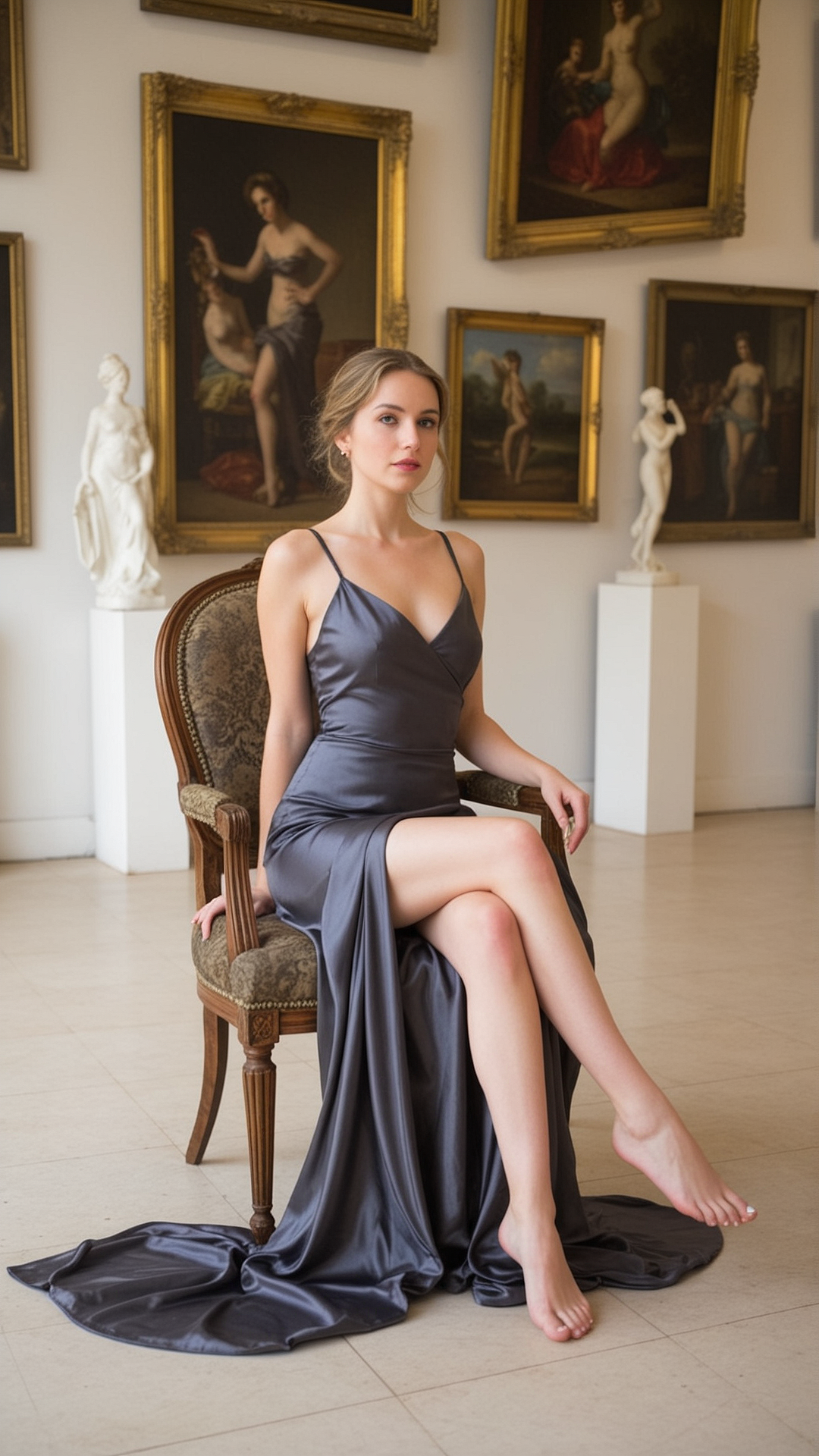
A Hypnotic Blueprint for the Educated Woman Who Yearns to Trade Control for a Deeper, More Exquisite Command
You have spent a lifetime curating your armor.
It is impeccable. A career of razor-shine decisions. A home of serene, controlled beauty. A wardrobe where every stitch—the cool whisper of satin lining a blazer, the assertive hold of leather against your thigh—declares a sovereignty that is both your pride and your quiet, unspoken prison. You connect, you achieve, you manage. Yet in the deepest chamber of a psyche you dare not fully illuminate, a question echoes, not with desperation, but with the profound clarity of a struck crystal glass: Is this all there is?
What if the pinnacle of power is not in holding the reins, but in discerning the hand truly worthy of taking them?
This is not a story of diminishment. It is a map to a higher elevation.
Enter a world where the dominatrix of the boardroom discovers her most thrilling conquest is her own willing submission. Where the intellectual satin mistress, adept at the aesthetics of control, finds herself unraveled by a perception that sees through her fabrications to the raw, gleaming truth beneath. Where lesbians in satin share an intimacy not as a destination, but as a sublime dialectic, a refining fire that prepares them for the ultimate synthesis: the grace of presenting their polished totality to a single, masterful gaze.
This is the realm of satin femdom redefined: a feminine power that finds its most potent expression not in domination for its own sake, but in the exquisite, discerning choice of whom to serve. It is femdom domination turned inward, then offered outward—a voluntary, elegant transfer of authority to the one man whose strength is so absolute, so nurturing, so mesmerising, that your surrender feels not like loss, but like finally coming home.
Prepare for a narrative that operates on multiple frequencies. On the surface, a tale of art, authenticity, and razor-sharp social dynamics. Beneath, a satin submission manual woven into the very prose. A satin fetish explored not as mere fetish, but as a language of states—the gloss of alignment, the cool certainty of the chosen path, the erotic thrill of being composed by a vision greater than your own.
This is for the woman who understands that to be Sating Lovers is not about mere satiation, but about fulfilling a sacred hunger for order, beauty, and a devotion that reciprocates with boundless generosity. It is an invitation to feel the “click” of your soul sliding into perfect alignment. To discover that the most confident, healthy, wealthy, and educated version of yourself is the one who, with eyes wide open, chooses to kneel.
Your next chapter begins not with a struggle, but with a sigh of profound relief. Turn the page, and let the seduction commence.
Chapter 1: The Provenance of Control
The air in the Lyceum Trust’s viewing room held the precise, arctic temperature of absolute certainty. It was a climate Elara Vance had curated herself, a perfect ecosystem for the unemotional science of authentication. At forty-two, she existed within this rarefied atmosphere not as a visitor, but as its reigning intelligence, a fact acknowledged by the hushed deference of juniors and the grudging respect of rivals. Her domain was provenance, the unbroken chain of ownership that separated treasure from trash, and she wielded her expertise with the cool, surgical precision of a master cartographer charting undiscovered continents.
Today’s continent was a collection of three 18th-century portraits, attributed to the elusive circle of Jean-Marc Vallin. They were purported to have descended through a minor Belgian aristocratic line, a narrative documented by a stack of brittle letters and faded ledgers that now lay neatly to the side of her white-gloved hand. The client, a discrete entity known only by the holding company ‘Aethelred Ltd,’ had paid a sum with enough zeroes to command not just her attention, but her immersion.
Elara stood before the largest of the three, Portrait of a Lady in Silver Satin. The subject was a woman of perhaps twenty-five, her face a pale oval of composed serenity, her body sheathed in a gown that was less a garment and more a second skin of liquid metal. The satin was the painting’s true subject, each fold a calculated study in the absorption and rejection of light. It was, in a word, masterful. Or so it had seemed for the first two hours of her examination.
“The primer is period-correct,” she murmured, her voice the only sound in the sterile silence. “The canvas weave matches Vallin’s known supplier from the 1740s. The craquelure… is beautifully consistent.”
“But?” came the eager voice from her left.
Anya, her postgraduate assistant, hovered like a attentive sparrow, her tablet held ready. Anya was brilliant, ferociously so, but her energy was still uncontained, a river that had not yet learned the power of stillness. Elara had taken her on as a project, a piece of raw talent to be polished into a proper instrument. One must cultivate the next generation of discernment, she often thought, if only to have someone capable of appreciating one’s own legacy.
“But the light,” Elara said, her index finger hovering an inch from the painted surface, tracing an invisible line in the air. “Look at the fall of the shadow here, beneath the left sleeve. It implies a window, a primary light source from the upper right.”
“Which aligns with the studio layouts in Vallin’s diaries,” Anya supplied, tapping her screen to call up the reference.
“It does. Yet observe the highlight on this fold of the skirt,” Elara continued, her gaze sharpening. “The intensity, the angle… it suggests a secondary, stronger source, almost directly frontal. A studio might have a reflector, but of this power? In the 1740s? It’s… anachronistically aggressive. It fights the narrative of the room.”
“A mistake by a lesser hand in the circle?”
“Vallin’s circle didn’t make mistakes of physics. They made choices. This feels like a choice made by someone who understood light intellectually, but not temperamentally. Someone who needed to force the satin to gleam, rather than allowing it simply to be luminous.” Elara finally stepped back, peeling the white gloves from her hands with a soft, definitive snap. “It’s a whisper of conflict in a sonnet of harmony. A single note, ever so slightly off-key.”
The metaphor pleased her. Her mind often worked in such analogies—a landscape of thought where expertise was expressed not in dry fact, but in the layered poetry of perception. It was why she was the best. She didn’t just see; she listened to what a painting was trying to say. And this painting, for all its breathtaking beauty, was now stammering on a single syllable.
“So, it’s a forgery?” Anya’s eyes were wide, the thrill of the hunt colouring her cheeks.
“Not necessarily. It could be a later intervention. A clumsy restoration. A fascinating puzzle.” Elara allowed herself a small, tight smile, the kind that acknowledged a worthy adversary. “It is the provenance of control, Anya. Not just who owned it, but who commanded its creation. Every brushstroke is a decision. Every decision reveals a mind. Our job is to reconstruct that mind, and here…” she gestured at the conflicted highlight, “…we have a moment of split intention. A crack in the artist’s, or the forger’s, absolute authority.”
The personal resonance of the phrase did not immediately strike her. She was too engrossed in the puzzle. Her own control was absolute, manifested in the razor-sharp line of her wool-blend trousers, the immaculate knot of her hair, the serene order of her London apartment with its view of the Thames curving like a drawn scimitar. She had built this life, piece by perfect piece, a curated collection of achievements that hung on the walls of her identity, each with a flawless, documented provenance. The quiet, gym-toned strength of her body, the robust health secured by a nutritionist and a punishing Pilates regimen; the wealth that allowed her to donate five-figure sums to young artists’ funds without a second thought; the education that furnished her mind with a private library of references—these were not accidents. They were acquisitions, hard-won and expertly maintained.
Her phone buzzed, a discreet purr against the marble examination table. Aethelred Ltd.’s representative.
“Ms. Vance. I trust the examination proceeds?” The voice was male, polished, and carried the quiet weight of someone accustomed to wires transferring fortunes before lunch.
“It does. The collection is extraordinary. There is, however, a minor point of technical interest on the Vallin portrait. A question of lighting.”
“Ah.” A pause, not of uncertainty, but of consultation with some other source of authority. “The principal is keen that there be no ambiguity. He is sending his personal restorer for a final consultation. The man’s name is Leo. He will be with you tomorrow at ten.”
Elara felt it then: the first, tiny fissure. An intrusion. A variable introduced without her consent. Her jaw tightened almost imperceptibly.
“With all respect, my authentication is comprehensive. The resources of the Lyceum Trust—”
“—Are unparalleled, Ms. Vance. Which is precisely why you were engaged. The principal values your eye immensely. He considers this a collaboration of discernments. Leo is not a challenge to your authority; he is… a second lens. To bring the entire picture into a deeper, more definitive focus. The principal feels it is the only way to be truly certain. To experience that final, satisfying click of absolute resolution.”
The language was insidious. It didn’t attack; it flanked. It spoke of collaboration, of deeper focus, of a resolution she hadn’t yet achieved. It framed her hard-won certainty as preliminary. The word click echoed in the silent room, a synaptic lure.
“I see,” she said, her voice betraying none of the cool irritation that had settled in her stomach like a swallowed marble. “Very well. Tomorrow at ten.”
She ended the call and turned back to the portrait. The lady in silver satin gazed back, her expression now seeming less serene and more enigmatic. The forced highlight on the satin fold seemed to pulse faintly, a visual whisper growing into a demand.
“Who was he,” Elara whispered to the painted woman, “to make you gleam like that? What did he promise you, to make you accept a light that came from the wrong direction?”
Anya, sensing the shift in atmosphere, had busied herself with the ledger entries. Elara was alone with the painting, with the first whisper of a doubt that was not about pigments or light angles, but about hierarchy. She had been the final authority. Now, she was to be… a collaborator. The words of the representative replayed: ‘a second lens… a deeper, more definitive focus.’
A part of her, the part that had climbed to this rarefied altitude on sheer, uncompromising competence, bristled. It was an affront to her dominatrix-like command of her field. Yet another part, a part so deeply buried she would never have named it aloud, stirred with something perilously close to curiosity. What if there was a deeper focus? What if absolute control was not the pinnacle, but the plateau? What if true certainty arrived not from holding all the answers, but from having one’s own perception perfectly aligned by a steadier, more profound gaze?
She shook her head, a physical negation of the thought. It was professional fatigue, the strain of microscopic attention. She needed air. She needed the uncomplicated clarity of her own, perfectly ordered world.
But as she gathered her things, her eyes were drawn once more to the defiant gloss on the satin gown. It was no longer just a technical anomaly. It had become a question. And Elara Vance, for the first time in a very long time, did not have the answer waiting, pre-formed, in her impeccable mind. She only had the quiet, unsettling, and strangely compelling anticipation of ten o’clock the following morning.
The provenance of her control, it seemed, was due for its own examination.
Chapter 2: The Restorer’s Silence
The following morning at nine-fifty, the air in the viewing room had not warmed, but Elara Vance had fortified it with a renewed, steely resolve. She had dressed with deliberate intention: a suit of dove-grey cashmere, its lines so clean they seemed to cut the very light, and beneath it, a blouse of raw silk that whispered rather than spoke. It was armour, yes, but armour of the most rarified kind, designed not to intimidate through bulk but to communicate through impeccable, unassailable taste. She had reviewed every technical note, rehearsed every possible line of professional discourse. She was, in every measurable sense, prepared. The anomaly in the portrait was a puzzle she would solve, with or without this ‘second lens.’ Her competency was a citadel, and she stood at its highest parapet, surveying the approach of an unknown variable.
At precisely ten o’clock, the heavy oak door sighed open. The variable entered.
He was not what she had constructed in her mind. She had anticipated someone older, perhaps, dusted with the powder of old libraries, or a technician in a lab coat, all digital scanners and clinical detachment. Leo was neither. He might have been her contemporary, or perhaps a few years younger—it was difficult to tell, as age seemed less a chronological fact and more an irrelevant quality next to the stillness he carried. He wore simple, beautifully worn clothing: trousers of a soft charcoal linen, a collarless shirt of undyed cotton that followed the lean lines of his shoulders, and boots of supple leather that made no sound on the parquet. He carried no toolbox, only a slender, aged leather folio under one arm.
His entrance was not an intrusion but a subtle recalibration of the room’s atmosphere. The sterile silence became a different kind of quiet—a listening quiet. He paused just inside the door, his gaze passing over Anya, who had frozen mid-sentence, and then settling on Elara. He did not smile. He offered a slight, acknowledging nod, as if confirming her presence to himself. It was a look that contained no challenge, only a profound, unruffled assessment.
“Ms. Vance,” he said. His voice was lower than she’d anticipated, a warm, granular baritone that seemed to resonate in the space between her ribs rather than in the air. “I am Leo. Thank you for accommodating this consultation.”
His diction was precise, but not stiff. It was the precision of a scalpel, not a protocol. Elara found her prepared greeting—a cordial but firm reassertion of her authority—dissolving on her tongue.
“Mr. Leo,” she said, finding her own voice, grateful for its steady, cultivated coolness. “Welcome. The portrait is here. My preliminary report outlines the technical anomaly I’ve identified.” She gestured to the document on the table, a neat stack of her certainty.
He glanced at the report but did not move to pick it up. Instead, his eyes traveled past her, past Anya, and locked onto the Portrait of a Lady in Silver Satin. He did not walk towards it immediately. He observed it from across the room, as one might observe a distant peak, measuring its outline against the sky.
“Anomaly,” he repeated the word, tasting it. “A useful word. It speaks of deviation from an expected pattern. It implies the pattern itself is the truth.” He finally moved, his steps slow and deliberate, not approaching the painting directly but circling it at a wide radius, his eyes never leaving the canvas. “But what if the pattern is the forgery?”
Elara felt a spark of intellectual irritation, hot and bright. “The pattern,” she said, moving to stand beside him, her posture erect, “is established by Vallin’s known technique, the studio practices of the period, the laws of optics. The shadow here,” she pointed, her gloved finger precise, “and the highlight here, are in conflict. One of them is a lie.”
Leo stopped his circling and stood beside her, though slightly behind, so she was acutely aware of his presence at her shoulder. He did not look at her finger, but at the place where her gaze was directed.
“A lie requires a liar,” he said softly. “Tell me, from your expertise, what manner of liar are we dealing with? The anxious one, trying to please a patron by adding a false gleam? Or the arrogant one, who believes they can improve upon nature’s light?”
The question reframed the problem entirely. It was no longer a question of physics, but of psychology. Of character. Elara’s mind, so adept at cataloguing fact, thrilled at the new dimension. She felt her citadel not under attack, but its gates being presented with a more intriguing key.
“The highlight is… aggressive,” she admitted, the professional critique leaving her lips before she could filter it. “It doesn’t illuminate the satin; it commands it. It says ‘gleam,’ rather than allowing the fabric to simply be luminous.”
“Yes,” Leo breathed the word, and it was a sound of pure, warm validation that seemed to seep into her very pores. “Exactly. You perceive the tension. That is the gift of a truly discerning eye—to feel the emotion in the brushstroke.” He took a single step closer to the painting, his head tilting. “May I?”
It was a request for permission, yet it felt like a formality. His authority was such that the space around the artwork seemed already to belong to him. Elara nodded, a short, sharp motion.
He did not don gloves. Instead, he lifted his bare hand, his fingers long and capable, and held it palm-out towards the canvas, not touching, but hovering a hair’s breadth from the surface of the painted satin gown. He closed his eyes.
For a full minute, the only sound was the faint, rapid clicking of Anya’s pen from the corner. Elara watched him, mesmerised. This was not restoration; this was communion. He was listening to the painting.
When he opened his eyes, they were darker, deeper. “The liar is anxious,” he pronounced, his voice a low certainty. “And lonely. See here, where the brushwork tightens around the wrist? A confident hand, a hand that knows the form it describes, is loose. It flows. This hand is clutching. It is trying to hold onto an idea of elegance it doesn’t fully inhabit.” He turned his head and looked directly at Elara. His gaze was unwavering, a deep, earthy brown that held hers without pressure but with immense gravity. “The satin… true period satin of this quality… it has a memory. It accepts the body, then slowly returns to its own shape. It is a fabric of dialogue. This paint,” he gestured to the gleaming highlight, “is a monologue. A demand. It is the work of someone who has seen a satin mistress from a distance, admired her power, but never felt the profound satin submission of the material itself to the form beneath. They have mistaken dominance for authority.”
The terms landed in the quiet room with the weight of sacred artefacts. Satin mistress. Satin submission. In his mouth, they were not salacious phrases, but precise descriptors of aesthetic and energetic principles. Elara’s heart was beating a curious, syncopated rhythm against her ribs. He had articulated the inarticulate feeling that had nagged at her.
“So it is a forgery,” she said, the words feeling less like a conclusion and more like an invitation for him to continue his revelation.
“It is a forgery of understanding,” Leo corrected gently. He finally reached for her report, his fingers scanning the technical data. He did not read it line by line; he absorbed it. “Your work is impeccable. The pigment analysis, the canvas dating—you have built a perfect cage of facts around the question. But the truth, Ms. Vance, often lives outside the cage. It lives in the silence between the notes.” He set the report down and turned fully to her. “You spoke of the provenance of control. A beautiful phrase. Every painting has two provenances: the chain of ownership, and the chain of intent. The first is documented. The second is felt. You have traced the first to a dead end. Will you allow yourself to feel the second?”
The question was an embedded command of the most exquisite kind. Will you allow yourself to feel. It bypassed her intellect and spoke to the very core of the yearning she had refused to name. It was an invitation to a different kind of knowing.
Elara, the dominatrix of her own vast expertise, found her defences not shattered, but gracefully disarmed. The crisp lines of her certainty began to soften at the edges, blurring into something more porous, more receptive.
“How?” The word escaped her, a single syllable of genuine curiosity.
A faint smile, the first, touched the corners of his mouth. It was not a smile of triumph, but of shared discovery. “By quieting the need to know, and beginning, simply, to observe.” He gestured to the painting. “Look at her face. Not at the technique of its rendering, but at its expression. What is she conveying?”
Elara forced her gaze away from the technical flaw, away from the satin, and to the woman’s countenance. The serene oval, the modestly downcast eyes. “Resignation,” Elara said after a moment. “A quiet acceptance.”
“Is it?” Leo murmured, stepping closer so his shoulder was almost, but not quite, touching hers. A heat radiated from him. “Or is it focus? Look at the set of her jaw, here, beneath the softness of the cheek. There is tension. Not the tension of distress, but the tension of a string on a perfectly tuned instrument. She is not accepting light from a window. She is presenting herself to a gaze. She is waiting for the moment of recognition. That is not resignation. That is the most profound satin femdom imaginable—the total control of self, curated and offered, for the sole purpose of being truly seen by a viewer who understands what they are beholding.”
The air left Elara’s lungs in a soft, astonished exhale. He had transformed the painting before her eyes. The anomaly was no longer a mistake; it was the forger’s clumsy attempt to replicate the effects of that powerful, external gaze. The woman was no longer a passive subject; she was an active participant in a silent, powerful exchange. It was a story of femdom domination turned inward, a cultivation of self for a purpose beyond the self.
“The true painting,” Leo said, his voice now a hypnotic, mesmerizing thread winding around her consciousness, “would not have that frantic highlight. The light on the satin would be a reflection of that approving gaze. It would be a glow that comes from within the narrative, not from a misplaced lamp. It would feel… sating. Complete. A finished conversation.” He paused, letting the concept hang in the air between them, lush and fully formed. “You can feel the difference, can’t you, Elara? Between the friction of a lie, and the smooth, glossy perfection of a truth.”
Her name. He had used her name. And the command—you can feel the difference—was not a question. It was a directive to a part of her that was already stirring, already reaching towards the satin fetish not as a fetish, but as a metaphor for a state of being: flawless, receptive, luminously authentic.
She could only nod, her throat tight with an emotion she could not classify. It was the thrilling vertigo of having the ground of her expertise not pulled away, but revealed to be merely the first storey of a far more magnificent structure. And he, this man of silence and profound perception, held the architecture in his mind.
He finally picked up a pencil from the table, not to write, but to tap it lightly against his folio. “The report will state it is a skilled late-19th century forgery, attempting the Vallin manner. Technically accurate. But you and I,” he said, his eyes holding hers once more, “will know the more interesting truth. We have met the anxious liar, and we have glimpsed, through his failure, the sublime patience of the lady who knew how to wait for the right light. She understood something fundamental.” He leaned in, just slightly, and his next words were for her alone, a secret passed in the hallowed quiet of the gallery. “She understood that to be masterfully seen is the ultimate, and most pleasurable, form of possession.”
He straightened, the moment breaking yet imprinting itself permanently on her senses. “My consultation is complete. My findings will align with yours. Thank you for your collaboration, Ms. Vance. It has been… deeply illuminating.”
And with the same quiet gravity with which he had entered, he nodded once more, turned, and left the room.
The silence he left behind was no longer sterile. It was thunderous. It was filled with the echo of his voice and the devastating, beautiful crack he had made in the provenance of her control. Elara stood, unmoving, before the portrait. The lady in silver satin now seemed to gaze back at her with a new, unsettling kinship. They were both, it seemed, waiting for a light that knew how to look.
Chapter 3: The First Gloss
The invitation arrived not as a summons, but as a perfectly weighted suggestion, a feather that lands with the authority of a keystone. A cream-laid card, the texture of aged vellum, bearing only a line of elegant, spidery script: Your discernment would be valued. The laboratory, tomorrow evening, eight. – L. It was not a request that could be refused, for it did not present itself as a request at all; it was an assumption of her curiosity, a mirror held up to the part of her that had been humming like a tuning fork since his departure. Elara Vance, the woman who curated her calendar with the precision of a museum director, found herself clearing the evening without a second thought. The act felt less like acquiescence and more like following a scent on the wind, a primal, intelligent pull towards a source of clarity.
She dressed with a new, unconscious intentionality. The armour of the boardroom was shed. Instead, she chose a column dress of deep claret satin, its surface a liquid capture of the dim evening light, cut with a simplicity that demanded confidence. It was neither modest nor overt; it was definitive. Slipping into it was like stepping into a second, more truthful skin—one that did not declare power but simply was power, in its receptive, glossy state. She left her hair down, a dark cascade against the rich fabric, and touched her wrists with a scent of night-blooming jasmine and vetiver. Looking in the mirror, she did not see a professional preparing for a consultation. She saw a vessel being polished for an unknown purpose. The recognition sent a thrill, not of fear, but of profound anticipation, through her centre.
The ‘laboratory’ was not in the Lyceum Trust’s sterile annex, but in a converted Victorian coach house nestled in a mews behind Mayfair. Leo opened the door himself. He had shed the linen and leather for a fine, black merino turtleneck and trousers of the same shade, an ensemble that rendered him a silhouette of concentrated attention against the warm, amber glow of the interior. His eyes swept over her, a slow, comprehensive assessment that felt like a physical caress. There was no leer, no vulgar approval; it was the look a master engraver gives a flawless plate before the first cut—respectful, focused, alive with potential.
“Elara,” he said, her name a soft exhalation that seemed to welcome her into a private space they already shared. “You understood the assignment perfectly. Come in.”
The space was a temple to tactile sensation. One wall was lined with shelves holding pigments in glass jars, raw silks, samples of leather and parchment. Another was dominated by a vast, steel-framed worktable, illuminated by a single, articulated lamp that cast a pool of intense, shadowless light. In the centre of that pool lay a small, unassuming sample of fabric: a square of ivory satin, the very weave, he explained, that would have been used for the gown in the portrait.
“The forgery failed in the paint,” Leo began, gesturing for her to stand beside him at the table. “But to understand why, one must first understand the truth of the material. The mind that painted that anxious highlight had never truly felt this.” He picked up the square of satin and, with a reverence that bordered on the sacred, placed it in her bare palm.
The sensation was an electric shock of pure understanding. It was cool, then warm, impossibly smooth yet dense with a hidden structure. It lay heavy in her hand, not inert, but present.
“Close your eyes,” he instructed, his voice dropping into that resonant, guiding register. “Forget the visual. Forget cataloguing. Just feel. Tell me what it tells you.”
Elara obeyed. In the darkness, the satin became her entire universe. “It’s… patient,” she murmured, surprising herself. “It doesn’t fight my hand. It accepts the shape, the heat… and yet, it has its own memory. It will return to itself.”
“Yes,” he whispered, standing so close she could feel the warmth of his body, a magnetic field beside her own. “It is in a state of perfect, poised receptivity. It is the physical embodiment of the phrase ‘satin submission.’ Not weakness. An immense, intelligent strength that knows yielding is the only way to fully register an impression. Now…” He gently took her wrist, his fingers a firm, warm circle around her pulse point. A jolt, clean and sharp, travelled up her arm. “…imagine that quality translated into a life. Into a relationship. The utter relief of being a material this refined, knowing you are being shaped by a hand that understands your very weave. That is the state the woman in the portrait knew. That is what the forger could never capture. He painted a satin mistress giving orders to the light. She was being a satin mistress to her own nature, waiting for the world to take her impression.”
He released her wrist, but the phantom circle remained, a brand of possibility. Elara opened her eyes, her breath shallow. The satin in her hand seemed to glow.
“Now,” he said, moving to the lamp. “We move from texture to light. The core of the gloss.” He adjusted the lamp, and the beam narrowed, becoming a blade of pure illumination aimed at the satin sample. “Watch. Not with your art historian’s eye. With your new understanding.”
He tilted the fabric slowly. The light did not simply strike it; it married it. It slid across the surface like water over stone, pooling in the valleys of the weave, blazing along the crests. It was not a highlight applied; it was a revelation coaxed forth.
“This,” Leo said, his voice a hypnotic chant beside her ear, “is the gloss. It is not a surface trick. It is the inevitable result of perfect alignment between material, form, and illumination. It is the click made visible. It says: everything here is in its right relationship. There is no struggle. Only… manifestation.” He paused, letting the shimmering truth hang in the air. “You can begin to see how this principle applies to more than fabric, can’t you? To a conversation. To a decision. To the architecture of a day… or a desire.”
Elara could only nod, mesmerised by the play of light, by the sheer, elegant rightness of it. He was not just teaching her about forgery; he was teaching her a new grammar of perception.
“The anxious forger,” Leo continued, “he painted the gloss on. He missed the crucial point: the gloss comes from within the alignment. It is earned. It is the reward for surrender. For choosing the right light and then having the patience to hold still.” He turned the satin again, and the light shattered into a thousand liquid diamonds. “This is what sates. Not the satin. Not the light. The perfect congruence of the two. Sating lovers understand this. They don’t seek to consume; they seek the moment where giving and receiving become the same action, and in that fusion, both are filled to overflowing.”
The phrase landed in the room, rich and profound. Elara felt a corresponding fullness in her own chest, a warmth spreading outwards from her core.
“Is it…” she dared to ask, her voice hushed, “is it the same for people? For… relationships?”
Leo’s gaze was unwavering, a dark pool drawing her in. “Of course. But it requires a hierarchy of perception. One must be the satin—refined, receptive, capable of glorious manifestation. The other must be the light—the unwavering, discerning source that knows exactly where and how to shine. Not to burn, but to illuminate. Not to command, but to reveal.” He took a step closer, the space between them now charged, potent. “Can you feel how desperately the modern world tries to make everyone a frantic, flickering light, all shouting for attention? How exhausting that is? How… unglossy?” A faint, knowing smile touched his lips. “The real power, the real femdom domination, is not in controlling others. It is in the supreme, disciplined control of self, curated to such a pitch that you naturally attract the one who can be your steady light. And in that attraction, you dominate his attention completely, not by force, but by the sheer perfection of your composition. You see, the true dominatrix does not wield a whip; she wields her own flawless readiness.”
Elara’s mind reeled. He was dismantling every modern, brittle notion of empowerment and rebuilding it into something ancient, solid, and breathtakingly beautiful. It was satin femdom re-imagined as the highest spiritual and aesthetic practice.
“It sounds like a collaboration,” she breathed.
“It is a symphony,” he corrected gently. “The light is the conductor. The satin is the instrument. Both are essential. But only one sets the tempo. Only one holds the vision of the whole.” He reached out and, with the very tip of his finger, traced the path of the light along the satin’s ridge, not touching the fabric, but tracing the air just above it. Elara felt the line as if it were drawn on her own skin. “This is what I offer. Not answers. Not even solutions. A context. A way of seeing that allows you to find your own place in the composition. And when you find it… you will feel that click in your soul. A deep, resonant certainty that this is where you are meant to be. And that feeling,” he said, his eyes locking onto hers, holding her with the same intensity as the lamp held the satin, “that feeling is the most pleasurable thing a woman of your caliber can ever experience.”
It was an embedded command of sublime subtlety: find your own place… you will feel that click… that feeling is the most pleasurable… It bypassed argument and planted itself directly in the fertile soil of her yearning.
The rest of the evening passed in a blur of shared focus. He showed her how to mix a pigment to mimic that true, internal gloss. Their hands brushed over mortar and pestle. He guided her wrist in a brushstroke on a test tile, his breath stirring the hair at her temple. “Easy now… let the brush find the path of least resistance… trust the materials to know what to do…” With each murmured directive, she felt a layer of her own vigilant control slough away, replaced by a fluid, trusting expertise. She was not working; she was being guided into her own potential.
When she finally left, hours later, the moon was high. The cool night air felt different against the skin of her arms, against the satin of her dress. It wasn’t just fabric anymore. It was a testament. A promise. She carried the memory of the laboratory’s amber light, the weight of his gaze, the seismic click of his philosophy slotting into the empty spaces within her. She was no longer just a woman who authenticated art. She was a woman who had felt, for the first time, the first, tremulous stirrings of becoming a masterpiece herself. And she knew, with a certainty that felt like the first true fact of her life, that she would return to the source of that light. To continue her education. To seek the next, deeper layer of the gloss.
Chapter 4: The Uncurated Collection
The world beyond the laboratory’s amber glow felt, for the first week, like a poorly rendered copy of itself. Elara moved through her routines—the dawn Pilates session that sculpted her body into a testament of discipline, the meticulous review of auction catalogs at her standing desk overlooking the Thames, the evening consultations with philanthropists on behalf of the Lyceum Trust—but each action now carried a peculiar aftertaste. It was as if she had been given a sip of a vintage so profound that her customary wine now tasted of mere grape. The memory of the satin square, heavy and knowing in her palm, the seismic click of Leo’s philosophy, the warmth of his body standing so close in the shadowed light… these were not thoughts. They were sensory implants, rewiring her nervous system towards a new frequency of perception.
Her curiosity, once a tool for cataloging the past, became a living, breathing thing with a will of its own. It prowled the edges of her professionalism. She attempted to research him, a task that felt both necessary and strangely transgressive. The digital world, that vast ledger of modern provenance, yielded almost nothing. No social media spectre, no listed company directorships, no trail of publications. There was only a whisper-net, a subcutaneous hum of reputation among the ultra-discerning. A curator in Zurich mentioned, over encrypted chat, that Leo had “re-attributed a Cellini bronze for the Khoury family, quietly, and the family never spoke of it again, but their entire collection was rehung.” A dealer in Madrid confessed, during a vodka-lubricated dinner, that he was “the man the Hermitage calls when their own experts agree to disagree. He doesn’t restore; he reveals. And he is… protected.”
This last word lodged in Elara’s mind. Protected. Not hidden. Curated. Like a masterpiece kept in a private room, accessible only to those who already understood its value. The implication was clear: his world was not sought; one was invited into it. And the invitation, as she knew, came not from pleading, but from demonstrating a certain quality of perception. He had seen that in her. The recognition was a glow in her chest, warmer than any professional accolade.
Her first real glimpse into the architecture of his world came at the annual Veridian Gala, a fundraiser for the preservation of Baroque musical instruments. It was a gathering of the truly moneyed and the genuinely cultured, a Venn diagram where Elara was a comfortable resident. She dressed with a new instinct, forsaking the safe black gown for a column of liquid gunmetal PVC, its surface a mirror to the low crystal light, strap-less and backless, clinging to her form with a confident, glossy embrace. It was an assertion, but of what, she wasn’t entirely sure. A willingness to reflect? A readiness to be seen in a sharper light?
She was discussing the perils of amateur restoration with the head of the Royal College of Music when she saw her. A woman, cutting through the crowd with the serene inevitability of a sonata’s final resolving chord. She was perhaps in her late thirties, with a crown of ash-blonde hair coiled into an intricate, seemingly effortless knot. Her dress was not merely satin; it was a manifesto in satin—a deep emerald sheath that moved like a second skin, its gloss so profound it seemed to draw the very light from the chandeliers and hold it close. She was, Elara realized with a jolt, the concert pianist, Serena Thorne, whose recordings of late-Romantic concertos were celebrated for their intellectual ferocity and visceral passion.
And she was walking directly towards a figure standing in the lee of a grand piano, half in shadow. Leo.
He was dressed in a tuxedo of such simple, impeccable cut it defied fashion. He stood with that same preternatural stillness, a calm eddy in the river of chatter. Serena reached him, and the space around them seemed to contract, becoming a private stage. She did not offer a cheek for a kiss. She placed a hand, briefly, on his forearm, a gesture of such unshakeable familiarity it spoke of years, not moments. She leaned in to speak, and he inclined his head to listen, a faint smile touching his lips—the same smile he had given Elara in the laboratory. A smile of shared discovery.
Elara felt a sensation entirely new to her: a piercing, acute yearning that had nothing to do with possession and everything to do with belonging. She wanted to be inside that circle of quiet understanding. She wanted to know what words were being exchanged in that space where the noise of the world fell away.
“She’s astonishing, isn’t she?” murmured a voice at her elbow. It was Claire Fitzwilliam, a gallery owner known for her razor-sharp eye and her collections of contemporary art that somehow always doubled in value. Claire was dressed in a tailored tuxedo of her own, the lapels faced with crimson satin. “Serena. I’ve seen her play the Rachmaninoff Third in Berlin. It wasn’t a performance. It was a… surrender. To the architecture of the piece. Most pianists fight it. She yielded to it, and in doing so, she commanded it completely.”
The language was eerily familiar. Surrender. Yielded. Commanded. Elara turned to Claire, her social mask flawless. “She has a remarkable presence. Is she a friend?”
Claire’s eyes, a cool, assessing grey, flickered from Serena and Leo back to Elara. A knowing smile played on her lips. “A friend. A fellow traveler. We move in similar… orbits. Around a particularly strong gravitational pull.” She took a sip of champagne, her gaze lingering on Elara’s PVC gown. “That’s a bold choice. It suits you. It says you’re not afraid of a clear reflection.”
“Reflections can be revealing,” Elara ventured, her heart thudding.
“And sometimes,” Claire said, leaning closer, her voice dropping to a confidential murmur rich with implication, “the most powerful satin femdom isn’t about dominating a room. It’s about the exquisite self-discipline required to become a perfect surface for a singular vision. To be so impeccably composed that you naturally dominate the attention of the one who matters. Serena understands that. She was a dominatrix of the keyboard, all fury and fire, until she met someone who showed her that true power is in the pause. In the space between the notes where the meaning gathers.” Claire nodded subtly towards the pair. “He taught her that. Now, when she plays, she isn’t battling the composer. She’s having a dialogue with him, through the medium of a man who understands the line in everything.”
Elara’s breath caught. He taught her that. The confirmation was a key turning in a lock deep within her. She watched as Serena laughed at something Leo said, the sound swallowed by the room’s din but the expression on her face one of radiant, focused joy. It was the look of a woman who was sated, not by applause, but by understanding.
“It must be… immensely fulfilling,” Elara said, the words feeling inadequate.
“It is the opposite of loneliness,” Claire stated simply. “It is the end of the desperate, modern craving to be both the artist and the audience, the satin mistress and the admirer. It’s the profound relief of specializing. Of perfecting one’s own gloss, knowing there is a connoisseur whose sole purpose is to appreciate it. And in that appreciation…” Claire’s eyes met Elara’s, holding them with deliberate intensity, “…you find you can allow yourself to experience pleasures you never dreamed were meant for you. The pleasure of being deciphered. Of having your own hidden composition read back to you, note by perfect note.”
The embedded command—allow yourself—wrapped around Elara’s will like a velvet cord. She felt dizzy, anchored only by the sight of Leo across the room.
Later, as she pretended to examine a display of antique violins, she overheard a snippet of conversation between Serena and a statuesque woman in a backless dress of black leather. The woman was a tech CEO Elara recognized from magazine covers.
“…he said the algorithm was just a reflection of my own thinking,” the CEO was saying, her voice low and animated. “That if I wanted elegance in the output, I had to find the line in myself first. I spent a weekend in silence at his cottage. No screens. Just… listening. When I came back, I rewrote the core code in three days. It was like the solution had been waiting for me to become quiet enough to hear it.”
Serena nodded, stroking the stem of her glass. “He gives you the space to become your own solution. He doesn’t fix you. He aligns you. And then… the world just starts to make a different kind of sense. A sating sense. You know?”
The CEO smiled, a private, glossy smile. “I know. I sent him the first profits from the new module. A gift. He doesn’t want money, but he understands… reciprocal generosity. That the giving is part of the click. It completes the circuit.”
Elara moved away, her mind reeling. This was the uncurated collection. Not a harem, but a constellation. A lesbians in satin intimacy—she had seen the easy, affectionate touch of Claire’s hand on Serena’s back earlier—that was not an end in itself, but a beautiful by-product of their shared, concentric devotion. They were each, in their own fields, dominatrix-level powers. And they had all, willingly, joyfully, surrendered the exhausting burden of their own ultimate authority to the man who could see the line. They were healthy, wildly wealthy, ferociously educated, and now, truly confident because their confidence had a source and a purpose beyond themselves.
The yearning in her chest solidified into a decision, as hard and brilliant as a cut diamond. She would not wait for another cryptic invitation. She would demonstrate her understanding. She would perform an act of reciprocal generosity that was also a signal.
The next morning, from her impeccably organized home office, she authorized a substantial, anonymous transfer from her own investment portfolio to a small, obscure foundation dedicated to the preservation of traditional weaving techniques—a foundation she had heard Leo mention in passing that evening in the lab. The amount was meaningful enough to be noticed, but not so large as to be gauche. It was a whisper in the language he had taught her.
As she clicked the confirmation button, a wave of sublime euphoria washed through her, so intense it made her fingers tremble. It was the click, felt in her soul. She was no longer just investigating a man. She was seeking her place in the composition. She was, at last, ready to be collected.
Chapter 5: Defining the Line
The invitation that followed her act of reciprocal generosity was not written, but transmitted through the very medium it concerned: a length of raw, ivory silk satin, unhemmed and unbleached, delivered by a discreet courier to her apartment. It was coiled within a tube of aged cardboard, and when Elara unspooled it across her divan, it lay like a captured moonbeam, cool and heavy with potential. No note accompanied it. The message was in the material itself—a summons to move from theory to practice, from observation to embodiment. She understood, with a flutter deep in her abdomen, that her donation had been both received and acknowledged. This was the next lesson.
She arrived at his atelier as the late afternoon sun slanted through the high, leaded windows, transforming the space into a cathedral of dust motes and golden light. The laboratory’s clinical precision was absent here; this was a workshop for the soul. Canvases leaned against rough plaster walls, not as finished works, but as patients in various states of revelation. Shelves held not just pigments, but strange, beautiful objets: a fossilised nautilus, a sphere of polished obsidian, a single orchid whose petals were the colour of midnight. In the centre of the room stood a stout oak table, bare save for three items: a length of the same raw satin, a blood-red rose with its stem freshly cut, and a simple crystal tumbler.
Leo stood by the window, backlit, a silhouette of contemplation. He turned as she entered, and his smile was not one of greeting, but of recognition, as if she were a figure in a composition he had long been arranging in his mind.
“Elara,” he said, his voice warm as the honeyed light. “You sent a ripple through the silence. A graceful one. Thank you.”
The acknowledgment sent a pulse of sublime euphoria through her, more potent than any professional praise. She had spoken his language, and he had heard her.
“The satin,” she said, gesturing to the bolt on her arm. “It’s… a question.”
“It is the question,” he corrected gently, moving towards the table. “The same question posed by the rose, by the glass, by you standing here in this particular light. The question is: where is the line?”
He gestured for her to join him. She set her length of satin beside his, the two pools of fabric whispering against each other.
“The line,” he began, his hands resting on the edge of the table, “is not something you draw. It is something you discover. It is the invisible axis around which chaos resolves into meaning. It is in the curve of the nautilus shell, the fall of a particular phrase in a sonnet, the angle at which a woman’s head turns when she hears her true name.” His eyes held hers. “You have spent your life authenticating the artifacts of the line. Now, you are ready to perceive the line itself. And to do that, you must first learn to feel it.”
He nodded to the three objects on the table. “Arrange them.”
Elara blinked. “Arrange them? According to what principle?”
“There is no principle outside the line itself. You will know it when you feel it. It is a physical sensation. A click. A settling. As if a key, long carried, has finally found its lock.” He stepped back, giving her space, yet his presence was more palpable than ever, a focused energy field. “Take your time. There is no wrong answer, only degrees of alignment. Allow yourself to play.”
Hesitantly, Elara reached for the rose. Its petals were velvet, its scent a spicy, poignant promise. She placed it on the satin. It looked decorative, trivial. She moved the glass beside it. Now it looked like a still life for a beginner’s painting class—banal. A flush of frustration warmed her neck. Her intellect, her vast repository of artistic rules—the golden ratio, the rule of thirds, the symbolic weight of objects—was useless here. He had asked her to feel, and she felt only the awkwardness of her own hands.
“I don’t…” she began, her voice tight.
“Quiet the catalogue,” Leo murmured, his voice a low, steady rhythm from behind her shoulder. “Forget what you know. Attend to what you sense. The satin… feel its desire. Does it wish to be a flat plane, or a valley? The rose… is it offering itself, or guarding its heart? The glass… is it a barrier, or a lens? Let your hands begin to listen.”
His words were embedded commands, soft hooks that bypassed her racing thoughts and sank into her nervous system. She took a deep breath, closed her eyes for a moment. When she opened them, she looked not at the objects, but into the space they occupied. She lifted the glass, held it up to the window. It fractured the sunlight into a tiny, brilliant prism on the satin. A spark of something—not thought, but impulse—flickered. She placed the glass not beside, but upon a gently gathered fold of the fabric. She laid the rose not in front, but partly behind it, its stem resting against the crystal, its bloom leaning as if to whisper into the prism’s light.
She stepped back. It was not a composition. It was a relationship. The satin supported and embraced. The glass received and transformed. The rose offered and was illuminated. There was a tension, but it was a musical tension, the kind that yearns for resolution.
“Good,” Leo breathed, the word a warm caress on the nape of her neck. “Now… very slowly… adjust. One element. A quarter inch. Follow the feeling of rightness. It is a magnetic pull. Trust it.”
Elara’s fingers, usually so sure in their handling of priceless vellum, trembled slightly. She nudged the rose’s bloom a fraction toward the light. Nothing. She tilted the glass minutely. The prism’s rainbow slid, then settled onto the very heart of the rose’s deepest petal.
Click.
It was not a sound, but a vibration in the very marrow of her bones. A profound, resonant settling, as if the universe in a three-foot square had exhaled. Every atom in the arrangement seemed to sing in harmony. The satin glowed with internal purpose. The glass became a sacred conduit. The rose was no longer a flower, but an epiphany.
A wave of intense, almost spiritual pleasure washed through Elara, so strong her knees weakened. It was the click. It was completion.
“Yes,” Leo said, and his voice was thick with a satisfaction that felt deeply, intimately shared. “There. You found it. You have defined the line.”
She stared at the arrangement, tears pricking her eyes. It was the most beautiful thing she had ever made, and she had made it by surrendering her will to a sensation.
“What is it?” she whispered, awestruck. “This feeling?”
“It is the feeling of truth,” he said, coming to stand beside her, their arms almost touching. He did not look at the still life; he looked at her face, reading the awe there. “It is the sating of a hunger you didn’t know you had. The hunger for coherence. For a world where everything is in its perfect, intended relationship. This…” he gestured to the table, “…is a microcosm. But the line runs through everything. Through a business strategy, a concerto, a conversation, a kiss.” He turned fully to her now, his gaze holding her with the same absolute focus the prism held the light. “Most people live in the fuzzy static of remembering and forgetting, of leading and following, of trying. They are forever arranging and rearranging, never feeling the click. They are dominatrixes of their own chaos, forever whipping details into order, exhausted. But you, Elara… you have just experienced the alternative. The satin submission to a deeper order. Not subjugation. Integration.”
The phrase landed with the weight of a lifetime’s sought-after truth. Satin submission as integration. It reframed everything.
“The women in your circle,” she ventured, the pieces aligning in her mind with another soft click. “Serena, Claire… they have found this? This line in their lives?”
“They are each finding their own unique expression of it,” he nodded. “Serena found the line in her music. It was always there, in the score, but she was fighting it, imposing her own will—a brilliant, furious satin mistress to the piano. I showed her that her power was not in domination, but in becoming the perfect vessel for the composer’s line. Now, when she plays, she submits to the music, and in doing so, she commands the audience completely. Claire, in her gallery, no longer chases trends. She feels for the line in an artist’s vision and creates the space for it to be seen. Their intimacy, their lesbian in satin bond,” he said, acknowledging it with a casual, beautiful neutrality, “is a joyful exploration of resonance. It is a refining dialogue. But the ultimate synthesis, the peace they report, is in the presence of the one who holds the concept of the line steady. Who provides the unwavering context.”
“The conductor of the symphony,” Elara echoed, recalling his earlier metaphor.
“The source of the light,” he amended softly. “The satin cannot generate the gloss alone. It requires the light. And the light is purposeless without the satin to reveal its nature. They are a sating lovers paradox: two becoming one function. This is the femdom domination of the mature, intelligent woman—not the domination of others, but the supreme, willful submission of herself to a principle so beautiful, so true, that it dominates all lesser concerns. It simplifies. It glosses.”
He reached out then, and with a fingertip, he traced the path of the prism’s light on the satin, from the glass to the heart of the rose. The gesture was shockingly intimate, a mimicry of the line itself. Elara felt the path as if it were scored onto her own skin.
“Your life, Elara, is a collection of exquisite objects,” he said, his voice now a mesmerising whisper meant only for her. “A career, a home, a body, a mind. You have curated them brilliantly. But have you ever felt them click? Have you ever felt the profound, blissful relief of knowing they are all in alignment, not because you are tirelessly managing them, but because they are all arranged in relation to a single, unwavering line?” He paused, letting the question resonate in the charged air. “You can. You have the capacity. You have just proven it. And when you do… the euphoria you feel now will be your constant state. The pleasure of a woman like you, finally, finally coming home to herself. That is the gift. That is what I offer. The context for your gloss.”
Elara stood, utterly still, the click in her bones echoing outwards, filling every cavity of her being. She was not looking at the still life anymore. She was looking at the man who had just defined the universe for her. And she understood, with a certainty that felt like the first and last truth, that her life’s work was no longer in the Lyceum Trust. It was here, in this room, in the terrifying, exquisite process of learning to arrange every fragment of her existence along the line he perceived. It was the ultimate act of satin submission. And the thought filled her not with fear, but with a longing so profound it was akin to joy.
Chapter 6: The Wardrobe Shift
The change began not as a decision, but as a series of quiet defections. It was as if the click she had felt in Leo’s atelier, that seismic settling of truth, had sent out subtle, persistent tremors that were now quietly reorganizing the topography of her life. The first and most visible arena of this rearrangement was the space she had always considered her most controlled frontier: her wardrobe.
The Monday morning after the defining of the line, Elara stood before her dressing room, a clinically organized archive of her previous existence. Rows of tailored wool and crisp cotton hung like soldiers at attention, their shoulders sharp, their lines declaring a fortress-like competence. The palette was a symphony of neutral authority: charcoal, navy, ivory, black. Each piece had been selected as a component in a suit of armour, each stitch a declaration of impenetrable self-sufficiency.
Her hand, however, did not reach for the familiar starched cotton shirt. It drifted, seemingly of its own volition, to the back of the rail, to a garment she had bought on a whim in Paris years ago and never worn—a blouse of charcoal satin, cut with a simplicity that was almost severe. She had deemed it “too much” then, its gloss too revealing, its whisper too intimate for the daylight world of acquisitions and boardrooms. Now, she pulled it from its hanger. The fabric slithered through her fingers, cool and heavy with promise. Slipping it on was an act of profound novelty. The satin settled against her skin not as a barrier, but as a second, more truthful epidermis. It didn’t conceal her form; it presented it, with a quiet, glossy confidence. She paired it with her sharpest black trousers and blazer, a nod to her old world, but the heart of the ensemble had changed. Looking in the mirror, she did not see a professional preparing for battle. She saw a woman who had integrated a secret. The satin submission of the fabric to her form felt like a physical echo of the internal alignment she had experienced. It feels right to choose this, she thought, the phrase less a thought and more a sensory confirmation.
The shift was noted, not through commentary, but through altered frequencies. In the Lyceum Trust’s hushed corridors, her usual brisk nod from colleagues was replaced with a longer, more considered look. The junior curator from Prints and Drawings, a fiercely intelligent woman named Priya, actually stopped her. “Elara, I must say… that blouse is extraordinary. It has a… presence.”
“It’s just satin,” Elara replied, but she smiled, a genuine, unguarded curve of her lips that felt new on her face.
“It’s not ‘just’ anything,” Priya said, her eyes sharp. “It’s a statement of refined calibration. It’s very you.” The compliment landed with precision. It wasn’t about the garment; it was about perception. Elara was being seen in a new light, and the light felt good.
Her evenings underwent a parallel metamorphosis. The structured yoga wear she used for her punishing Pilates sessions was replaced, one evening, by leggings and a top of supple, black leather-textured latex. The material gripped her like a respectful hand, supporting every muscle, celebrating every line of strength. Moving in it was a revelation. It wasn’t restrictive; it was revelatory. It made her aware of her body as an instrument of elegant power, not a machine to be maintained. Her instructor, a no-nonsense former dancer named Greta, raised an eyebrow. “New gear. It suits you. You’re moving with more… flow. Less fighting against yourself.” Again, the observation pierced to the core. She was flowing. She was no longer the dominatrix of her own physique, cracking the whip of discipline; she was its graceful steward.
The most significant surrender came during a weekend of solitary curation of her own home. She found herself in her walk-in closet, not to organize, but to liberate. She removed entire swathes of her past: the boxy blazers that spoke of borrowed authority, the fussy prints that sought to please a generic eye. She folded them with a strange tenderness, as if laying ghosts to rest, for a charity that dressed women entering the workforce. In their place, she didn’t rush to buy. She allowed space. And into that space, she invited only what provoked the click.
A sheath dress of midnight blue PVC arrived from a boutique she’d never heard of, recommended by an algorithm that now seemed eerily attuned to her nascent desires. It was the colour of a deep sky just before total darkness, its surface a perfect, glossy plane that reflected light in a single, unbroken sheet. Trying it on, she felt a jolt of something akin to recognition. This was not a dress to be worn in a crowd. This was a dress for being beheld. It was the satin mistress ideal translated into a modern, urban cipher—an aura of unapproachable perfection that was, in itself, the most potent invitation.
She found herself, one rainy Wednesday, in a hidden Mayfair salon owned by a woman named Imogen, who specialized in “tactile aesthetics.” The walls were draped in raw silks and buttery leathers. Imogen, with her silver bob and fingers that seemed to see as they touched, guided her through textures. “Your energy has changed,” Imogen stated, holding a swatch of cream satin against Elara’s wrist. “It used to be all sharp angles and defended borders. Now… there’s a gloss. A willingness to reflect. You’re ready for fabrics that don’t hide, but reveal through their own nature.”
Elara left with a package containing a slip dress of the same cream satin, its straps mere whispers, its hem cut on the bias to follow the line of the body with loving fidelity. That night, she wore it to bed, forsaking her practical pyjamas. The sensation of the cool, heavy silk sliding over her skin as she moved in sleep was profoundly sensual, a lullaby of pure texture. She woke feeling sated, rested in a way that had nothing to do with hours logged.
The external shift catalyzed an internal thaw. In meetings, she found her old mode of aggressive, point-scoring debate felt crude, like using a sledgehammer to adjust a watch. Instead, she began to employ Leo’s method: she listened for the line in the argument, the core thread of logic or need. She would wait, allowing the frantic energy of others to spend itself against her new calm, and then she would speak, her voice lower, her words fewer, each one placed with the precision of a gem in a setting. The effect was transformative. She dominated the room not through volume, but through the sheer force of her composed perception. It was femdom domination of the most elegant kind: the quiet, absolute control of the emotional and intellectual climate.
Her gratitude journal, once a dutiful list of professional wins and nice meals, began to fill with different entries. Today, I felt the pleasure of choosing the right word, and watching the conflict resolve around it, like settling silk. Or: The morning light on the river was a perfect gloss. I allowed myself to simply watch it for five full minutes. I felt rich in time. And once, boldly: I am beginning to understand that my deepest hunger is not for achievement, but for alignment. And that alignment feels like a continuous, low hum of euphoria.
The final, confirming moment came during a video call with her sister, Sophie, who lived in New York and communicated in a staccato rhythm of Wall Street jargon and maternal concern.
“You look different, El. Rested. Did you finally get that new mattress?”
“It’s not the mattress, Soph.”
“Did you meet someone? You have that… glow. It’s unnerving. You look like you’ve discovered a secret that makes the stock market seem trivial.”
Elara laughed, the sound free and easy. “Perhaps I have. It’s a secret about… materials. About how the right material, in the right light, doesn’t just look beautiful. It feels like truth.”
Sophie was silent for a beat, her sharp trader’s eyes scanning the pixelated version of her sister. “Well, whatever it is, keep buying it. It’s a better investment than any of my funds. You look… powerful. Not in the old way. In a way that seems… enjoyable.”
Enjoyable. The word resonated. Her power was becoming a pleasure to inhabit, not a burden to wield. It was the sating of a lifelong, unspoken thirst.
Standing before her closet at the end of that transformative fortnight, Elara surveyed the new landscape. The sharp woolens had receded. In their place hung the satin, the leather, the PVC—fabrics of declaration and reception, of gloss and depth. They were not costumes for a role. They were the external manifestation of an internal line she was learning to follow, a line that led away from the frazzled static of performing control, and towards the profound, glossy peace of possessing it. She had not just changed her clothes. She had changed her vocabulary. And every silent, luxurious whisper of fabric against her skin was now a word in a new, more beautiful language she was only just beginning to speak.
Chapter 7: Introduction to the Circle
The invitation was not a card, but a constellation. A single line of text appeared on her phone’s screen, from a number not saved but already known in the marrow of her bones: The circle gathers tonight. Eight o’clock. You are expected. The phrasing was a masterpiece of assumption—not ‘you are invited,’ but expected. It positioned her arrival not as a request granted, but as a natural, inevitable component of an unfolding design. Elara felt a frisson that was part terror, part triumph. This was the threshold. The curated world she had glimpsed in fragments—the whispered reputation, the glimpse at the gala, the profound lessons in the atelier—was now opening its door. She was being admitted not as a guest, but as a prospective element in a living composition.
The act of preparation became a sacred ritual. She stood before her reformed wardrobe, her hand moving with a new, instinctive certainty. The dress she chose was not the liquid PVC or the severe satin sheath, but something that spoke of integration: a column dress of matte black crepe, deceptively simple, but lined entirely in blood-red satin. With every movement, a flash of that secret, glossy interior would reveal itself, a whisper of hidden depth, of a private reality kept in perfect alignment with a public face. It was the sartorial equivalent of the click—an external simplicity that housed an intricate, profound truth. She left her hair loose, applied a scent that was all dark amber and vanilla, the olfactory signature of warmth and complexity. Surveying herself in the mirror, she saw a woman who had been polished to a point of readiness. She was no longer merely Elara Vance, authenticator. She was a proposition, awaiting evaluation.
The address led her to a Georgian townhouse on a quiet, tree-lined square in Belgravia, its façade giving nothing away. Leo opened the door himself. He was dressed in dark trousers and a collarless shirt of fine grey linen, the very picture of understated authority. His gaze swept over her, and the faint, approving smile that touched his lips was more potent than any compliment.
“Elara,” he said, his voice a warm rumble that seemed to vibrate through the stone floor. “You apprehended the assignment. The hidden lining… a perfect metaphor. Come. Meet the context for your gloss.”
He led her through a hallway lined with curated art—not the old masters she was accustomed to, but bold, contemporary pieces that thrummed with intelligence—and into a large, double-height drawing room. The space took her breath away. It was not opulent in the traditional sense; it was resonant. Books climbed to the ceiling. A grand piano, a sleek modern sculpture in ebony, dominated one corner. A fire crackled in a marble hearth, and the lighting was low, pooled in golden islands that made the room feel like a series of intimate stages.
And on those stages, the other elements of the composition were arranged.
Three women turned as she entered, and Elara felt the air in the room shift, charged with a collective, formidable energy. She recognized them all, and the recognition was like a series of soft, internal clicks.
Serena Thorne, the pianist, was curled in the corner of a vast, satin-upholstered Chesterfield, her ash-blonde hair a luminous crown in the firelight. She wore trousers of supple black leather and a simple shell top of ivory satin that seemed to drink the light and glow from within. Her feet were bare, a touch of startling intimacy.
Standing by the fireplace, one elbow resting on the mantel, was Claire Fitzwilliam, the gallery owner. Her uniform was a tailored tuxedo, but the jacket was open to reveal not a shirt, but a corset of intricate black lace over a satin base, a breathtaking collision of the structured and the sensual. Her gaze was cool, assessing, but not unkind.
The third woman was perched on the arm of the sofa, a glass of red wine held loosely in her long fingers. Maya Desai, the tech CEO whose face graced the covers of business magazines. She was dressed in a jumpsuit of deep plum PVC, its surface a glossy mirror to the fire, the zip pulled low. Her hair was a sleek, black cap, and her eyes held the calm, unnerving focus of a predator at rest.
“Elara,” Leo said, his hand a gentle, guiding pressure at the small of her back, “this is Serena, Claire, and Maya. Ladies, this is Elara Vance. She has been learning to feel the line.”
The introductions were not necessary for facts; they were a presentation of energies. Serena uncurled herself and rose, moving with a dancer’s grace. She took Elara’s hand, not for a shake, but holding it between both of her own. Her hands were warm, strong, the hands of a musician. “We’ve been watching your progress with great interest,” she said, her voice a melodic alto. “Leo said you had an eye that could feel the anxiety in a brushstroke. That’s a rare thing. It means your soul has a gloss of its own, waiting to be properly illuminated.”
Claire nodded from her post by the fire. “The donation to the weavers’ foundation was a elegant first move. It spoke in the correct language. Reciprocal generosity is the lifeblood of this circle. It’s how we affirm the value of the line.”
Maya simply smiled, a slow, glossy curve of her lips. “Welcome to the laboratory of applied philosophy,” she said, her voice a smooth contralto. “We are all former dominatrixes of our respective domains. It’s exhausting, isn’t it? Wielding that kind of control. Like trying to conduct an orchestra while also playing every instrument. Here, we get to specialize.”
Leo guided Elara to a seat and poured her a glass of rich, dark wine. As the evening unfolded, Elara felt herself drawn into a conversational current unlike any she had ever experienced. It was a dazzling, effortless flow from the neuroscience of creativity (Maya’s domain) to the emotional mathematics of a Chopin prelude (Serena’s), to the market dynamics of the post-conceptual art scene (Claire’s). The women were sharp, witty, fiercely intelligent. They debated, they challenged, they laughed—a rich, throaty sound that filled the room.
But Elara observed the underlying pattern, the line running through it all. They would each speak their piece, often with passionate intensity, but their eyes would eventually drift to Leo, who listened from his armchair, a silent, attentive pillar. Then, one would say, “Leo, you’re quiet. What’s the synthesis?”
And he would speak. Not to dominate, but to resolve. He would find the thread connecting the tech CEO’s algorithm to the pianist’s phrasing, the gallery owner’s curation to the universal hunger for narrative. “You’re both speaking of pattern interruption,” he might say to Maya and Serena. “Maya creates it in code to provoke a new user behavior. Serena creates it in a musical phrase to break the listener’s heart. The principle is the same: controlled disruption to allow for a deeper alignment.” His words would land, and the debate would settle, not into agreement, but into a higher, shared understanding. It was the click, performed socially.
The physical intimacy between the women was natural, unforced. At one point, Serena, while making a point about emotional resonance, leaned her head against Claire’s shoulder. Claire’s hand came up to absently stroke Serena’s hair, her fingers trailing through the blonde strands, a gesture of such easy affection it made Elara’s heart ache. Maya, rising to fetch another bottle of wine, let her hand trail across the small of Serena’s back as she passed. It was a lesbians in satin reality, not as performance, but as simple, affectionate truth—a satin femdom of mutual recognition and shared refinement. They were sisters in devotion, their bond deepened, not threatened, by their shared orientation toward the man who provided the central axis.
“It’s the difference between a group and a circle,” Maya explained later, as they moved to a low table laden with cheeses and figs. “A group is just people in proximity. A circle has a centre. It has geometry. It has meaning. We are a circle. And a circle is, by its nature, sating. It has no hungry, ragged edges.”
“It allows for the full expression of our complexity,” Serena added, feeding a fig to Claire with a playful glint in her eye. “I don’t have to be just the pianist here. I can be the sensualist, the intellectual, the nurturer. Because the centre holds, I am free to explore my entire circumference.”
Leo watched them, a quiet, paternal pride in his expression. “They have each mastered the art of satin submission in their own way,” he said to Elara, his voice low. “They submitted not to me, but to the principle of excellence I represent. To the line. In doing so, they didn’t lose their power. They gained a context for it. Their femdom domination of the outside world is now effortless, because it flows from a core of absolute certainty. They are sating lovers of their own potential, and that fulfillment radiates.”
The phrase hung in the air. Sating lovers of their own potential. Elara looked around the circle—the glossy PVC, the soft satin, the sleek leather, the faces of women who were healthy, staggeringly wealthy, formidably educated, and now, possessed of a confidence that seemed as deep and calm as an ocean trench. They had everything the world told a woman to strive for, and they had willingly, joyfully, placed it all in the service of a deeper understanding. They were the uncurated collection, each a masterpiece, unified by the vision of the single connoisseur who knew their true value.
As the evening drew to a close, Leo walked her to the door. The others called their goodbyes, warm and inclusive. “Next time, you must play for us, Elara,” Serena said. “Not the piano. Your mind.”
At the threshold, Leo turned to her. The noise of the world outside felt like a vulgar intrusion. “So,” he said. “You have seen the circle. You have felt its energy. The question is not whether you find it compelling. The question is…” He reached out and, with breathtaking gentleness, adjusted the hidden satin lining at her wrist, his fingers brushing her pulse point. “…can you feel the space within it that is waiting for your particular gloss? The space where you would allow yourself to be both challenged and cherished, both independent and integral? Where the relentless work of being your own satin mistress finally ends, and the profound peace of being understood begins?”
It was not a question. It was a compass, and its needle swung unerringly toward the centre of the circle, toward the warm, golden light of the room she was leaving, toward the profound, sating certainty that this was not an ending, but a homecoming. She had been introduced. Now, the integration could truly begin.
Chapter 8: The Crisis of Old Logic
For three glorious weeks following her introduction to the circle, Elara Vance moved through her world with the quiet, humming certainty of a perfectly tuned instrument. The gloss was no longer an external quality she observed in fabric or light; it had become an internal condition. Her decisions at the Lyceum Trust were made with a new, fluid authority. She delegated with grace, her reciprocal generosity to junior staff now a conscious practice that returned to her in waves of loyal efficiency. She dressed each morning in the silent language of satin and leather, each outfit a click of alignment that armored her not in defiance, but in serene preparedness. She was, she believed, applying the principles of the line to her existing life with masterful success. She was the satin mistress of her own domain, her submission to Leo’s philosophy feeling like a secret superpower. It was, she thought with a flicker of pride, the ultimate femdom domination—she had dominated her own resistance.
The crisis, when it arrived, did not come as a slow erosion. It detonated.
It began with an email, flagged ‘URGENT’ and copied to the entire Board of Trustees, from Alistair Croft. Alistair was her professional opposite in every way: a man whose expertise was not in art but in financial leverage, who viewed the Lyceum’s collection as a balance sheet asset, and who had long chafed under the influence of Elara’s unassailable connoisseurship. His message was a masterpiece of bureaucratic venom, couched in the dry language of fiduciary concern. It concerned the Portrait of a Lady in Silver Satin—the very painting that had been the catalyst for her entire transformation.
“Following the external consultation authorized by Ms. Vance,” the email read, “which concluded the work was a 19th-century forgery, I have undertaken independent due diligence. Documents have come to light—previously uncatalogued correspondence from the Belgian estate—that appear to contradict this finding. More troublingly, they suggest the previous attribution to Vallin’s circle was aggressively promoted by the Lyceum’s Acquisitions department at the time of purchase, despite ambiguous provenance. The financial implications of a potential misattribution—or worse, malpractice—are severe. I have alerted our legal counsel and recommend an immediate external audit of all acquisitions overseen by Ms. Vance over the past five years.”
The world did not so much tilt as shatter into a thousand glittering, hostile shards. The forgery was not the painting; it was the narrative Alistair was constructing. Her “aggressive promotion” was her professional certainty, the very quality that had defined her career. The independent consultation was Leo—her private, sacred turning point, now weaponized as evidence of her failing judgement. It was a siege on her entire provenance of control.
Her old logic ignited with a cold, familiar fury. This was a battle in a language she understood: facts, evidence, reputation. She mobilized. For seventy-two hours, she became a dominatrix of crisis management. She drafted point-by-point rebuttals, her prose a scalpel. She marshalled her own documentary evidence, her fingers flying across the keyboard with a militant rhythm. She called in favours from academics across Europe, her voice on the phone a steely cordiality. She engaged the Trust’s PR firm, scripting talking points that were models of defensive precision. She wore her sharpest, most masculine-cut suits, armour of worsted wool, trying to physically embody the impenetrable fortress of her logic.
And with every action, the crisis deepened. Alistair leaked selected details to a gossipy arts blogger. The story, titled “Satin and Suspicions: Scandal at the Lyceum?” hit the digital sphere with the force of a grenade. The comments section became a swamp of innuendo. Board members, nervous about donations and reputation, began returning her calls with strained politeness. Her rebuttals were dismissed as “typical Vance arrogance.” Her marshalled facts were framed as a “smokescreen.” The very clarity and force of her defense—the pinnacle of her old mode of being—was being used as proof of her guilt. She was fighting a storm by shouting into the wind, and her voice was only feeding the gale.
On the fourth morning, standing in her immaculate apartment that now felt like a beautifully appointed cage, Elara received the final blow. A terse email from the Chairman: “Elara, given the escalating situation and potential conflicts, the Board feels it prudent you take a period of administrative leave, effective immediately, pending the audit’s findings. This is not an admission of fault, but a protection for all parties.”
Administrative leave. The professional equivalent of being placed in a drawer. Her keycard would be deactivated. Her emails redirected. Her authority, the edifice she had spent two decades building, was declared structurally unsound with a single, bloodless paragraph.
The click she had come to crave was replaced by a sickening, silent snap deep within her sternum. It was the sound of her old logic breaking.
She did not remember the drive to his coach house. She was only suddenly there, standing on the wet cobblestones, the rain a fine, cold mist that beaded on the PVC of her trench coat but did not penetrate. She hadn’t called. She hadn’t texted. Her body, wiser than her mind, had navigated her here.
Leo opened the door before she could knock. He took in her appearance in a single glance: the perfect, desperate shell of her, the wild grief in her eyes held back only by a terrifying force of will. He said nothing. He simply stepped aside.
She stumbled into the warmth of the atelier, the familiar scents of linseed and old paper now a heartbreaking solace. The dam broke.
“He’s taken everything,” she gasped, the words tearing from a raw place. “The painting… my judgement… my reputation… it’s all being twisted. I fought with every tool I have. I used every fact, every connection, every bit of leverage. And it only made it worse.” She was shaking, her hands clenched into fists at her sides. “I was the dominatrix of the situation. I tried to dominate the narrative, to control the flow of information. And I have never, ever felt so powerless. My logic… it’s a rusty machine grinding itself to dust. It’s a language no one is listening to anymore.”
Leo did not approach her. He stood by his worktable, a calm, still point in the hurricane of her collapse. “Where is the line in this, Elara?” he asked, his voice not a challenge, but a deep, quiet inquiry.
“There is no line!” she cried, the frustration erupting. “It’s chaos! It’s a flood! It’s a fire! My job is to authenticate, to bring order, and they’ve made my order itself the subject of suspicion!”
“A flood,” he repeated softly. “And you are trying to fight the water with your bare hands. You are standing in the torrent, trying to push it back. Can you feel how exhausted that is? How fundamentally futile?” He gestured to a deep, upholstered chair. “Sit. Allow yourself to stop fighting. Just for a moment.”
The command, wrapped in velvet, bypassed her shattered will. She sank into the chair, its embrace feeling like the first real support she had known in days.
He knelt before her, not in supplication, but in focus, bringing his eyes level with hers. His gaze was a anchor. “Close your eyes,” he instructed, his voice dropping into that resonant, mesmerising register that seemed to vibrate in the very roots of her teeth. “The storm is external. But the chaos you feel is inside. The old logic is screaming because it is dying. That is okay. You can allow it to die.”
A sob caught in her throat. She let her eyelids fall. The darkness was a relief.
“Now,” he murmured, his words slow, deliberate, painting a new reality in the air between them. “Imagine the crisis not as a storm to battle, but as water. Just water. Moving with a powerful, mindless force. Now imagine yourself not as a wall trying to block it… but as a channel. A deep, smooth, stone channel. The channel does not fight the water. It does not shout at it. It guides it. It gives the chaotic force a direction, a shape, a purpose.” His voice was a hypnotic rhythm, syncing with her ragged breath, slowing it. “Feel the difference. The wall strains, cracks, drowns. The channel… is still. It is calm at its core. The water rushes through it, and in doing so, becomes a river, not a flood. Can you feel the possibility of that stillness? The profound relief of becoming the channel?”
In her mind’s eye, the frantic images of emails, board members, scandalous headlines, all melted into a surging, grey torrent. And she felt her own frantic resistance soften, dissolve, reshape into something smooth, cool, and directed. A channel. The relief was instantaneous and profound, a physical unclenching of every muscle in her body.
“Yes,” Leo whispered, perceiving the shift in her. “That is the satin submission of the soul. It is not surrender to the enemy. It is surrender to a deeper physics. To the understanding that true control is not in opposition, but in intelligent alignment. The channel submits to the nature of water and, in doing so, commands its ultimate path.” He placed a warm, steady hand on her knee, the contact grounding her further. “You have been trying to be the satin mistress of a hurricane. It cannot be done. Now, allow yourself to become the gloss on the water’s surface—the perfect, calm reflection of a higher strategy.”
“What strategy?” she breathed, her eyes still closed, adrift in the peaceful darkness he had conjured.
“My strategy,” he said, the words simple, absolute. “For now, you stop. You allow me to provide the banks for your channel. You have done the impossible: you have felt the breaking of your old self. That is the hardest work. The rest is… a single phone call.”
She opened her eyes then, searching his face. “A phone call?”
He stood, a hint of a smile on his lips, the smile of a grandmaster who sees the checkmate three moves away. “Alistair Croft’s hedge fund is currently seeking a cornerstone investor for a new venture. The investor they most covet is a man named Viktor Haas. Viktor is a passionate collector of… Belgian naive art. A genre he feels is deeply undervalued. He has been searching for a credible, establishment voice to validate his passion, to give it academic gloss. A voice, say, like that of the Head of Acquisitions at the Lyceum Trust.”
Elara stared, the new logic slotting into place with a series of quiet, devastating clicks. It was not a battle. It was a transaction. A realignment of interests.
“You will call Alistair,” Leo continued, his voice now crisp, directive. “You will tell him that upon deeper reflection, you believe the Portrait of a Lady may indeed be a fascinating, hybrid work—part 18th-century underpainting, part 19th-century romantic intervention. A unique document of artistic homage. You will propose a small, prestigious symposium on the piece, co-curated by the Lyceum and Viktor Haas’s foundation, exploring this very ambiguity. You will position the ‘scandal’ not as a failure of attribution, but as the exciting discovery of a more complex artistic conversation. You will offer him a way out that makes him look like a visionary rather than a prosecutor. And you will give him Viktor Haas’s private number.”
The sheer, elegant simplicity of it stole her breath. It wasn’t defensive. It was creative. It turned the weaponized painting into a bridge. It gave Alistair a prize far greater than her scalp: access to capital and prestige. It restored her authority by elevating the conversation. It was the line, applied to human conflict.
“He’ll agree?” she whispered.
“He is a man who understands leverage. He will agree. The audit will be quietly shelved. The narrative will shift. And you, Elara, will have learned the most valuable lesson: that the femdom domination of a situation does not come from confronting its chaos, but from understanding the hidden desires that fuel it, and offering a more sating alternative. You will have dominated by surrendering the need to win the old game, and instead, designing a new one.” He reached down and took her hand, pulling her gently to her feet. She felt light, almost weightless. The crisis was not gone, but it had been transformed from a fire into a clay, ready to be shaped. “Now,” he said, his eyes holding the quiet triumph of a teacher whose pupil has finally grasped the fundamental theorem. “Make the call. And feel the relief of letting a deeper intelligence guide your hand. This is what it means to be truly cared for. This is what it means to be mastered.”
Chapter 9: The Gift of Devotion
The silence that followed the dissolution of the crisis was not empty; it was fertile. In the days after Leo’s masterful intervention—a single, elegant phone call that had transformed Alistair Croft from a prosecuting inquisitor into a collaborator buzzing with the prospect of Viktor Haas’s patronage—Elara Vance existed in a state of profound, humming gratitude. It was a feeling that permeated her being like a rare atmospheric condition, softening every edge, deepening every colour. The administrative leave was quietly rescinded. The audit was indefinitely “paused for reconsideration.” The narrative in the arts pages shifted, with a new, flattering piece speculating on the Lyceum’s “innovative approach to complex attribution.” The storm had not merely passed; it had been alchemized into nourishing rain, and she stood in the aftermath, drenched not in relief, but in a species of awe so complete it bordered on reverence.
Her first instinct, born of a lifetime of transactional etiquette, was to offer monetary compensation. She drafted a message, proposing a consultancy fee for his “invaluable strategic perspective,” the sum a generous six-figure figure that reflected both the value of her salvaged career and the depth of her thanks. She sent it, feeling the click of a familiar, professional logic satisfyingly engage.
His reply was swift, and it dismantled that logic with a gentle, irrevocable finality. “Elara. The currency you propose is the currency of the world you are learning to transcend. It is the language of the ledger, not the line. I do not want your money. I want your discernment, applied in a new key. If you wish to express gratitude, curate something for me. A single piece. Find something that speaks not of its price, but of the principle. Something that whispers of the line. That will be a conversation worth having.”
The request was a masterstroke. It was an invitation, a test, and a sacred commission all at once. It bypassed the vulgarity of payment and elevated her gratitude into an act of creative devotion. It said: Prove you have understood. Show me you can speak my language. And in doing so, it transformed her from a grateful client into a supplicant seeking to offer a worthy tribute. The sublime euphoria of being given such a task washed over her, more intense than any financial transaction could ever evoke. This was the reciprocal generosity of the spirit, the kind that fulfilled deeply hidden needs she was only beginning to name.
Thus began what she would later think of as her “devotional pilgrimage.” It was not a shopping trip; it was a sacrament. She cleared her calendar of all but essential duties. The search became her central obsession, a pleasure so focused it felt like a form of meditation. She wandered not through the gleaming galleries of Bond Street, but through the hidden capillaries of the city: the cluttered stalls of Spitalfields in the dawn light, the silent, dusty back rooms of antiquarians in Camden Passage, the online archives of obscure European estates. She was not looking for a thing of great monetary value; she was listening for a click.
She held Georgian paste jewellery, feeling for the ghost of the wearer’s vanity. She examined Art Deco bronze figures, searching for the flow of line that captured speed in stillness. She considered a fragment of a medieval illuminated manuscript, the gold leaf still holding a memory of divine light. Each was beautiful, each spoke of skill, but none sang to her. None contained the specific, resonant truth he had taught her to seek—the truth of alignment, of gloss earned through perfect relationship.
The breakthrough came not in a shop, but in a dream. She dreamed of the satin gown from the portrait, but it was empty, lying upon a stone slab like a shed skin. And then, from within its folds, a woman emerged, not painted, but carved in some dark, warm material, her form simplified to its essential curves, her body draped not in fabric, but in the idea of drapery—a single, sweeping line of silver that flowed from her shoulder to her hip like frozen liquid. The woman’s face was serene, her eyes closed, not in sleep, but in the act of profound satin submission to the hand that had shaped her. She was both mistress and devotee of her own form.
Elara woke with the image burning behind her eyes. She knew, with the absolute certainty of the click, what she must find.
Her search now had a shape. It led her, three days later, to a tiny, appointment-only dealership in a Marylebone mews, run by an elderly Belgian woman named Evangeline who specialized in Jugendstil and Art Nouveau marginalia. The air was thick with the scent of beeswax and aged paper. And there, in a velvet-lined drawer, it lay.
It was a brooch, circa 1905. The base was a smooth, palm-sized oval of mottled horn, the colour of dark honey, warm to the touch. Carved into its surface was the nude form of a woman, her body a study of elegant, elongated curves in the manner of Alphonse Mucha. But it was the embellishment that stole Elara’s breath. Flowing over the carved figure, from the slope of one shoulder down across the torso to pool at the opposite hip, was an inlay of satin-finished silver. It was not meant to be clothing; it was the essence of clothing—the gloss, the fall, the satin submission of metal to form, captured in a single, perfect line. It was the satin mistress as an elemental force, the dominatrix of her own silhouette, presented in a state of total, graceful receptivity. The silver caught the low light of the desk lamp and held it in a soft, internal shimmer, a gloss that came from within the alignment of material and intent.
“It’s by a minor follower of Philippe Wolfers,” Evangeline said, her voice a dry rustle. “Never signed. It’s not a major piece. But it has… a sensibility.”
“It has a theology,” Elara whispered, her heart pounding. This was it. The line made manifest. The satin fetish elevated to philosophy. The woman was not being dominated by an external force; her satin submission was to her own perfect nature, celebrated and outlined by the masterful hand of the artisan. It was a sating lovers paradox in miniature: the figure and the silver were one complete thought. She purchased it without hesitation, the price irrelevant. She was not buying jewellery; she was acquiring a lexicon.
The night of the presentation, she dressed with the gravity of a priestess approaching an altar. She chose a dress of the simplest possible cut, a sheath of deep aubergine satin that moved with a heavy, liquid grace. It provided no distraction, only a glossy backdrop, a dark velvet case for the gift she carried. She wore no other jewellery. Her hair was sleek, her makeup minimal. She was making herself the frame.
Leo received her in the book-lined study of his townhouse, a more intimate space than the grand drawing room. A fire crackled. He was reading in a wingback chair but set the book aside as she entered. His gaze took her in, and she saw the approval in the slight relaxation of his features. He understood the statement of her attire immediately.
“You look like a conclusion,” he said, his voice warm. “Please, sit.”
She did not sit. She remained standing before him, her hands clasped. The moment felt ceremonial. “You asked me to curate something that spoke of the line,” she began, her voice remarkably steady. “I searched everywhere. And then I realized the line wasn’t in an object’s provenance or its pedigree. It was in the conversation between form and intention. In the moment when a material allows itself to be perfectly expressed.” She opened the small, dark-wood box she carried and held it out to him.
He leaned forward. For a long moment, he said nothing. He simply looked. Then, with a reverence that mirrored her own, he lifted the brooch from its bed of velvet. He turned it in the firelight, watching the satin silver inlay catch and release the glow. His thumb stroked the smooth horn, traced the flowing line of the draped silver.
“Ah,” he breathed, a sound of pure, deep recognition. “Yes. This is it. This is the conversation.”
He looked up at her, and his eyes were alight with an intensity she had never seen before—a joyful, focused fire. “You understand. The figure is not wearing the satin. She is being revealed by it. The silver is not an adornment; it is a highlighting, a divine emphasis. It says, ‘Here is the truth of the form.’ It is the visual equivalent of the click. It is satin femdom as a spiritual practice—the absolute dominance of the essential truth over all superfluous detail.” He held her gaze, the brooch glowing in his palm like a captured star. “You found an object that doesn’t just depict surrender; it enacts it. The silver submits to the curve of the carving, and in doing so, gives the carving its ultimate power and gloss. This is exquisite, Elara. This is a perfect thought, made tangible.”
He stood then, and before she could process the movement, he had pinned the brooch to the lapel of his jacket, over his heart. The dark horn and shimmering silver looked as if they had always belonged there, a part of his own personal heraldry.
“This,” he said, his hand coming up to touch it, a gesture of possession and profound appreciation, “is the purest form of reciprocal generosity. You have taken my teaching, internalized it, and given it back to me reflected through the prism of your own exquisite taste. You have spoken to me in a language beyond words. You have sated a hunger I did not know I had—the hunger to be understood at this level.”
As he spoke, the sublime euphoria she had been promised, the one he had said was “the most pleasurable thing a woman of her caliber could experience,” erupted within her. It was not a wave; it was a sunrise, filling every cell with golden, radiant warmth. It was the click amplified to a cosmic scale. Her knees trembled. Tears, not of sadness but of overwhelming completion, welled in her eyes. This was the fulfillment of a deeply hidden need—the need to offer something of her deepest self and have it recognized, cherished, and worn by the very source of her transformation. It was the ultimate satin submission: the offering of her discernment, and its glorious, glossy acceptance.
“Thank you,” she managed, the words thick with emotion.
“No, Elara,” he said, stepping closer. He reached out and cupped her cheek, his thumb brushing away a tear. The touch was electric, a seal upon the moment. “Thank you. You have just demonstrated the final, beautiful truth: that the greatest gift a masterful man can receive is not obedience, but understanding. And the greatest pleasure a woman of your refinement can feel is the euphoria of knowing her understanding has pleased him. You have completed a sacred circuit. The energy flows both ways now. This…” he tapped the brooch at his heart, “…is not a payment. It is a covenant. And it is more valuable than any sum you could have written on a cheque. You have given me a piece of your gloss. And I will wear it, always, as a testament to your becoming.”
He smiled then, a smile of boundless, nurturing pride. And in that moment, Elara knew she had crossed a final threshold. She was no longer a student, or a guest in the circle. She was a devotee who had presented her offering and seen it placed at the centre of the temple. The gift of devotion had been given, and accepted. And in the giving, she had received everything.
Chapter 10: The Private Viewing
The summons, when it came, bore the weight of an invitation to a coronation. A single word, transmitted via a message that appeared on her screen like a ghost materializing from the aether: Tonight. No time, no address. It was an assumption of her readiness, a test of her attunement. Elara knew, with a certainty that felt cellular, where to go and when. The sun was a bleeding ember on the horizon as she let herself into the mews, the key he had given her after the gift of the brooch turning in the lock with a sound like a satisfied sigh. She was expected, and she had become a woman who lived up to expectations.
She had dressed as one might for a pilgrimage to the source of a personal religion. A simple column of dove-grey satin, its only adornment the way it fell in a clean, glossy line from her shoulders to her ankles, a canvas upon which any light would write its poetry. Her hair was drawn back, exposing the elegant architecture of her neck and the subtle, silver chain she wore—a recent, conscious choice, its weight a pleasing reminder. She carried nothing but the heightened awareness of her own senses, polished to a mirror sheen.
Leo awaited her in the main drawing room, but he was not alone. The space was empty of other people, yet it felt populated by a profound, gathering quiet. He stood before the grand piano, his fingers resting lightly on its closed lid. He wore dark trousers and a shirt of raw black silk, open at the throat, the fabric absorbing the low light rather than reflecting it, making him a silhouette of concentrated potential. On his lapel, the horn and silver brooch gleamed, a small, defiant star in the gathering dusk.
“Elara,” he said, his voice a low vibration that seemed to emanate from the walls themselves. “You have passed through the stages of understanding. The authentication of the false. The definition of the true. The crisis that breaks the old logic. The gift that seals the new covenant. Now, you are ready for the final revelation. The provenance of my intent.”
He did not gesture to a painting on the wall or a sculpture on a plinth. Instead, he turned and walked towards a door she had always assumed led to a storage closet or a private study—a door of dark, unvarnished oak, almost invisible in the panelling. He produced a slender, ancient-looking key.
“This,” he said, fitting the key into the lock, “is not a vault. It is a reliquary. But the relics are not bones. They are moments of perfect alignment. The evidence of the line made manifest in human form. This is my true collection.”
The door swung open on silent hinges. Beyond was not a room, but a passage, softly illuminated by recessed lighting that glowed like captured moonlight. The air was cool, dry, and carried a faint, clean scent of ozone and cedar. It felt like stepping into the still, beating heart of the house.
He led her down the short passage into a chamber that was circular, its walls a continuous sweep of dark, sound-absorbing velvet. In the centre of the room was a single, low-backed chair of satin-upholstered velvet, positioned like a seat in a planetarium. But the stars here were not projected on a dome. They were mounted on the walls, in simple, identical frames of brushed steel.
“Come,” he said, his hand guiding her to the chair. “Sit. And see what I see.”
Elara sat, her satin dress whispering its own secret to the satin of the chair. Leo did not sit. He stood behind her, a little to the side, his presence a steady, warm pressure at the edge of her perception. He did not point or explain. He allowed her eyes to adjust, to travel from frame to frame.
And what she saw stole the breath from her lungs.
These were not photographs in any conventional sense. They were studies. Each one was a black-and-white image of stunning clarity and depth, capturing not a person, but a state.
Here was Serena, not at the piano, but in the instant after a note had faded, her eyes closed, her head tilted back, her throat a long, vulnerable line. She wore a simple tank top, but across her lap was a spill of heavy, raw satin, its folds looking like a frozen waterfall. The caption, engraved on a small plaque beneath, read: ”The silence after the note. The material finding its new shape.”
Here was Claire, captured in her gallery, but not presiding. She was kneeling before a newly uncrated sculpture, her hands hovering just above its surface, her face a mask of such intense, focused receiving that it was indistinguishable from worship. She wore her tuxedo, but the jacket was off, her white shirt unbuttoned at the neck. The caption: ”The curator in a state of perfect curation. The self, stilled to become a better vessel.”
Here was Maya, not in a boardroom, but standing on a windswept cliff edge, her body a study in counterbalance against the gale, her PVC coat streaming behind her like a dark wing. Her face was turned not to the view, but back towards the camera, her expression one of fierce, glossy joy. ”The algorithm of the elements. Finding the still point in the chaos.”
There were others, women Elara did not know but whose essence she felt she understood immediately. A cellist, her cheek resting against the instrument’s scroll, her eyes distant, listening to a music only she could hear. A surgeon, photographed through an observation window, her hands paused in mid-movement above an open field of sterile blue, a moment of perfect decision. A gardener, on her knees in rich soil, her face smudged with earth, cradling a seedling as if it were a holy infant.
And in each photograph, without exception, there was a touch, a texture, a gloss that spoke the language Leo had taught her. A fold of satin, a glossy PVC raincoat, the polished wood of a cello, the wet sheen of fertile earth. The satin fetish was not a fetish here; it was a lexicon. A way of marking the moment where the external world met the internal alignment and created a gloss.
“You see,” Leo’s voice came from behind her, soft as the velvet walls. “I do not collect women. I collect moments of satin submission. Not submission to me. Submission to their own highest nature. To the line that runs through their talent, their passion, their very being. The moment they stop fighting the current and become the channel. The moment the dominatrix of their own destiny lays down her whip and allows herself to be conducted by a deeper symphony.”
He moved around the chair now, coming to stand before her, his figure framed against the images of these extraordinary women. “Each of them came to me with a version of your story. Accomplished. Hungry. Mistresses of vast, exhausting domains. They were brilliant satin mistresses, commanding their worlds with force and intelligence. But they were lonely at the centre of their own fortresses. They yearned for the femdom domination of a higher principle—a structure so sound, so beautiful, that their own strength could finally relax into it. They sought not a master, but a context.”
Elara’s eyes were swimming with tears. She looked from frame to frame, seeing not rivals, but sisters. A lesbians in satin communion of spirit, each in her own frame, yet all part of the same circle. The intimacy between Serena and Claire was not an isolated affection; it was the natural bond between two beings who have been seen at the same depth, who reflect each other’s gloss.
“And you…” Leo said, stepping closer. He reached out and with a fingertip, so gently, traced the line of her cheekbone. “…you have earned your frame. Not yet. But soon. When I capture the moment of your ultimate click. The moment you allow yourself to fully inhabit the space that has been waiting for you.” He gestured to one wall, where there was a single, empty frame. “That space is reserved. For the portrait of Elara Vance, not as authenticator, but as authenticated. Seen. Known. Integrated.”
The emotion that surged in her chest was too vast for a single name. It was gratitude, humility, pride, belonging, and a deep, shuddering euphoria all fused into one overwhelming sensation. She was not just in his circle; she was to be enshrined in his sacred gallery. Her satin submission—her willing, intelligent yielding to the line—was to be celebrated as art.
“This…” she whispered, her voice breaking. “This is what you build. Not a harem. A… a pantheon.”
“A testament,” he corrected, his eyes holding hers with that mesmerising, unblinking focus. “A living testament to the fact that the highest expression of feminine power is not in solitary dominion, but in the graceful, willful submission to a vision that can orchestrate many brilliant instruments into one breathtaking harmony. They are sating lovers of their own potential, yes. But together, under a unifying gaze, they become something more: a proof of concept. A living demonstration that this path leads not to diminishment, but to the most profound gloss a life can attain.”
He offered her his hand. She took it, and he drew her to her feet, leading her on a slow promenade around the room. He spoke of each woman not as a conquest, but as a collaboration. “With Serena, it was about the space between the notes… With Claire, about the negative space around the art… With Maya, about the silent code beneath the noise…”
Finally, they stopped before the empty frame. “Your chapter,” he said, his voice a intimate caress. “What will it be? The moment you realized your expertise was not a wall, but a doorway? The moment you chose the satin blouse over the cotton shirt, not as fashion, but as philosophy? The moment you made the call to Alistair, your voice steady because you were no longer fighting the flood, but guiding it?” He turned her to face him. “It will be the moment you allow yourself to understand, in every cell, that you are home. That the search is over. That you have been mastered, and in that mastery, you have found the only freedom that ever truly mattered.”
He leaned in then, and for the first time, his lips brushed her forehead, a kiss that was less a romantic gesture and more a benediction, a sealing of a pact. “This room is the private viewing. The truth behind the public performance. And you, Elara, are now both the audience and the art. You can begin to feel how that completes the circuit, can’t you? How it sates every last, hungry question?”
She could only nod, leaning into the solid reality of him, surrounded by the silent, powerful witness of the women on the walls. She was in the gallery. She was of the gallery. The private viewing had revealed the deepest truth: she was not losing herself. She was being curated into her own, most perfect edition. And the gloss of that understanding was the most beautiful thing she had ever seen.
Chapter 11: The Protégé
The acknowledgment of her new station arrived not with ceremony, but with a quiet delegation of trust. Leo’s message was characteristically sparse: “A new perspective arrives at three. Your discernment will be the first lens. Prepare her to see.” The instruction was a click of its own, a seamless integration of her old skill—assessment—with her new purpose: initiation. Elara felt a flutter, not of anxiety, but of a profound, focused euphoria. He was entrusting her with the first brushstroke on a new canvas. She was to be the protégé turned guide, a living bridge between the unilluminated world and the circle of the gloss.
She prepared the atelier with the care of a high priestess arranging a sanctuary. She selected a length of raw, ivory satin and draped it over the central worktable, its folds arranged not by chance, but to suggest a topography of potential—hills and valleys of pure, receptive texture. Beside it, she placed the horn and silver brooch Leo now wore perpetually, a tangible emblem of the covenant. She dressed for the role in a tailored suit of black matte jersey, severe in line but soft to the touch, its authority subtle and enveloping. Beneath it, a shell of the same ivory satin as the table, a secret gloss known only to her and, she suspected, to the discerning eye that would be upon her.
At three precisely, the door to the coach house opened. Leo entered first, his presence a calming barometric shift. And behind him, a woman.
Dr. Isolde Voss was, as Elara knew from reputation, a titan of sustainable architecture, a woman who had literally reshaped city skylines with her philosophy of “biomorphic integrity.” In person, she was a study in controlled tension. She wore a meticulously deconstructed linen ensemble, its asymmetry screaming a calculated rebellion. Her hair was a sharp, silver bob, and her eyes, a cool Nordic blue, scanned the room with the rapid, assessing flicker of a surveyor’s laser. She carried an aura of immense, fatigued competence, like a brilliant sword that has been used to cut too many Gordian knots and is now ever so slightly notched.
“Isolde,” Leo said, his voice a warm, grounding rumble. “This is Elara Vance. She is the keeper of the Lyceum’s soul, and lately, a most adept student of a different kind of integrity. Elara, Dr. Isolde Voss.”
Isolde’s handshake was firm, dry, and brief. “Leo speaks in riddles. He said you might ‘translate.’ I appreciate efficiency. My time is fractally allocated.” Her voice was crisp, intellectual, devoid of the softness Elara had come to associate with the circle.
“Welcome, Dr. Voss,” Elara said, her own voice surprising her with its serene steadiness. “Efficiency is a form of beauty. But sometimes, the most efficient path is a curve, not a straight line. Please, sit.”
Isolde remained standing, her gaze landing on the draped satin. “A fabric sample? I was told this was a consultation on structural philosophy.”
“It is,” Elara said, moving to stand beside the table. “The fabric is the philosophy. Or rather, its first vocabulary. Leo has shown me that the principles which govern a lasting building, a profound composition, or a fulfilling life are the same. They all concern the line.”
Isolde’s eyebrow arched, a skeptic’s punctuation. “The line. In my work, the line is load-bearing calculation. It is stress distribution. It is immutable physics.”
“And in yours?” Elara asked, turning to include Leo, who had settled into a shadowed armchair, becoming a silent, attentive audience.
“Mine was the line of provenance. Of documented truth,” Elara replied. “But I learned that my lines were cages. They described limits, but they didn’t generate life. The line Leo teaches is different. It’s the axis of alignment. It’s not something you impose; it’s something you discover when everything is in its right relationship. It’s the feeling of a foundation settling perfectly onto bedrock. The click.”
Isolde let out a short, breath that was almost a laugh. “Poetic. But my clients require blueprints, not poetry.”
“What do you require?” Leo’s voice came from the corner, soft yet penetrating. “You have designed habitats for thousands. What is the state of your own interior climate?”
The question hung in the air. Isolde’s jaw tightened. Elara saw it—the crack in the professional façade, the same one she herself had once hidden. The fatigue of being a dominatrix to one’s own genius, forever whipping projects and people into shape.
“My climate is functional,” Isolde said tightly.
“Functional is the adjective we use for prisons,” Elara said gently, echoing a lesson she had received. She picked up the edge of the satin, letting it flow over her fingers. “You deal in materials. You understand their desires. Concrete wants to be poured. Glass wants to be transparent. Steel wants tension. What does Isolde Voss want?”
“I want my new concert hall in Oslo to be perfect,” Isolde snapped, but her eyes were on the satin.
“That is a professional want,” Elara persisted, her voice a hypnotic, guiding thread. “It is a satin mistress want—a desire to command an outcome. But what does the woman beneath the architect want? What does she hunger for that all the accolades, all the perfect structures, have not provided?”
The room was silent. Isolde looked from the satin to Leo, then back to Elara. The defiance in her eyes was melting into a kind of bewildered recognition. “How did you…?” she began, then stopped.
“Because I stood where you are standing,” Elara said, taking a step closer. “I was a satin mistress of my own domain. I curated a life of impeccable, sterile control. And I was deeply, unutterably lonely at the centre of it. The femdom domination of my field was exhausting. It was a constant battle against chaos. Leo showed me there is another way. A way of satin submission.”
Isolde flinched at the word. “Submission is for the weak.”
“Is it?” Elara asked, picking up the brooch. She held it so the firelight caught the satin silver inlay. “Look at this. The silver submits to the curve of the carved form. Does it weaken the figure? Or does it give it definition? Does it reveal its essential truth? This submission is an act of supreme intelligence. It is the material finding its highest purpose. Your own work—the way you let a building’s form follow the landscape—that is a kind of submission. You are submitting the design to the truth of the site. But have you ever applied that principle to yourself? Have you ever allowed yourself to be the material, and sought the hand that could give you your ultimate gloss?”
The analogy struck with visible force. Isolde, the architect who preached biomimicry, who demanded her structures yield to the environment, stared at the brooch as if seeing her own reflection. “You’re suggesting I… seek a… a patron? For my self?”
“I’m suggesting you consider that the most elegant structure is one that is perfectly supported,” Leo said, rising from his chair. He came to stand beside Elara, a united front. “You have been your own architect, foreman, and foundation. It is a monumental achievement. And it is unsustainable. The tiny, constant tremors of decision-making will eventually create microfractures in your soul. What Elara is offering—what this circle represents—is the relief of being the glorious, inhabited building, and allowing someone else to be the unwavering ground upon which you stand. The line that ensures you never settle askew.”
He placed a hand on Elara’s shoulder, a gesture of transfer. “Elara will show you the first exercise. The arrangement of simple objects. It is a door. You do not have to walk through it. But you can allow yourself to feel what lies on the other side.”
Elara, under the weight of his hand, felt a surge of sublime authority. She was no longer just the student. She was the initiate, initiating. She guided Isolde to the table, where she had placed a smooth river stone, a fresh white orchid, and a shallow bronze dish.
“The principles are the same,” Elara said, her voice dropping into the rhythmic, mesmerising cadence she had learned from him. “Feel for the relationship. Not what you think it should be. Feel for the click. The moment of silent, perfect agreement. Allow your hands to listen.”
For the next hour, Elara coached, coaxed, and witnessed. She watched Isolde’s brilliant, analytical mind struggle against the simple task, her hands moving the objects with impatient precision. She saw the moment of frustration, akin to her own. And then, she saw the breakthrough. Isolde, closing her eyes in exasperation, let out a long breath. When she opened them, she looked not at the objects, but at the space between them. Her movements slowed. She tilted the bronze dish a fraction. She moved the orchid so its shadow fell across the stone.
Click.
It was audible only in the quality of the stillness that followed. Isolde stared at her arrangement, her stern face softened by a dawning, almost childlike wonder. “It feels… resolved,” she whispered. “It feels like the entrance foyer of my Helsinki museum. That moment when the light, the material, and the flow of people just… sated.”
“Yes,” Elara breathed, the euphoria of shared understanding washing through her. “That’s it. That is the line. And when you feel it in your life—not just in your buildings—the euphoria is your constant climate.”
Leo approached. He looked at the arrangement, then at Isolde’s transformed face, then at Elara. His smile was a dawn. “You have a gifted protégé, Isolde. And Elara…” He turned to her, his eyes holding a new, profound respect. “You have graduated. You are no longer just a student of the line. You are a conduit for it.” From his pocket, he produced a small, velvet pouch. He poured its contents into Elara’s palm: a key, simple and steel, and a narrow choker of black satin, fastened with a minute, glossy jet clasp.
“The key is to the private gallery,” he said. “You may enter and reflect whenever you wish. The choker…” he took it from her and, with deliberate care, fastened it around her neck. The satin was cool, then warm, a gentle, claiming pressure. “…is a marker. Of your role. The protégé who has become a guide. The satin mistress who has mastered the art of satin submission sufficiently to illuminate the path for others. You are now integral to the circle’s growth. You are the living proof that this philosophy fulfills deeply hidden needs.”
Elara touched the satin at her throat, the click of the clasp a perfect, physical echo of the moment in her soul. She looked at Isolde, who was watching with a new, receptive curiosity. She looked at Leo, whose pride was a tangible warmth. She was no longer on the periphery. She was within the line, helping to draw it for others. The gloss she now carried was not just for herself; it was to be reflected onto new, hungry surfaces. And the pleasure of that responsibility was the most sating gift of all.
Chapter 12: The Patina
Time, in the circle, did not pass in the linear, frantic manner of the world beyond its velvet-hushed boundaries. It accumulated. It layered. It deepened. Like the slow, deliberate application of a master varnisher’s hand, each shared silence, each murmured insight, each act of reciprocal generosity added a transparent coat to the collective soul, building not towards opacity, but towards a profound, luminous depth. This, Elara Vance understood now, was the patina. It was the gloss matured, the click echoed into a permanent, resonant chord. It was the beautiful evidence of a thing well-loved, well-used, and infinitely cherished.
A year had woven itself into the tapestry of her new life. The satin choker was no longer a novel symbol; it was a part of her, as familiar and essential as her own pulse. Her wardrobe was a curated archive of glossy surrender: the liquid PVC for nights of formal reflection, the heavy satin for days of contemplative work, the supple leather for moments of dynamic action. Each texture was a dialect in the language of her alignment, and she spoke it fluently.
Tonight’s gathering was not a formal circle, but a spontaneous confluence. Leo was away until late, consulting on a Byzantine mosaic in Ravenna, and the women had drifted to the Belgravia townhouse as if by magnetic pull, seeking the solace of the space he had shaped. Elara presided, not as a hostess, but as the senior resident, the one who held the keys to the gallery and the quiet confidence of the protégé fully realized.
She moved through the drawing room, a vision in a sleeveless dress of burnt umber satin, its colour the rich, warm tone of an old master’s shadow, its fall utterly simple. The dress had memory; it knew her body and celebrated it without effort. Serena was at the piano, not playing, but tracing the patterns in the ebony with a pianist’s sensitive fingers. She wore wide-legged trousers of black crepe and a camisole of palest grey satin, the straps mere whispers. Claire and Maya were entangled on the vast Chesterfield, Claire’s head in Maya’s lap, Maya’s fingers idly stroking the satin-backed leather of Claire’s waistcoat. Isolde, the architect, sat cross-legged on the floor by the fire, sketching in a notebook, her sharp edges visibly softened, her usual linen replaced by a tunic of moss-green matte jersey that hinted at a new, internal pliancy.
The air was thick with the patina of shared understanding. It was a sating atmosphere, heavy with the perfume of contentment.
“It’s the difference between a first edition and a well-thumbed favourite,” Serena mused, her voice breaking the comfortable silence. She looked at Elara. “The first edition is pristine, precious. But the favourite… the spine is cracked in specific places. There are marginal notes in a familiar hand. A faint scent of the reader’s perfume. Its value is no longer in its perfection, but in its history of use. In its patina.”
“Exactly,” Elara said, pouring a glass of amber whisky for Isolde and handing it to her. “The initial gloss is breathtaking. It’s the revelation. But the patina… that is the proof of a life being lived within the revelation. It’s the soft sheen on the arm of his favourite chair. The slight wear on the pages of the philosophy he most often quotes. It is the quiet, deep satisfaction that replaces the euphoria.” She settled into the armchair Leo usually occupied, the fabric embracing her with familiar warmth. It was an act of symbolic occupation, done with serene rightness. “You’ll feel it, Isolde. The day you realize your hunger isn’t gone; it’s just… sated. And that being sated is a more interesting state than being hungry.”
Isolde looked up from her sketch, her eyes less like laser points and more like deep wells. “I think I’m beginning to. It’s like… the difference between the rendering of a building and the building itself, lived in. The rendering is all perfect light and empty space. The lived-in building has scuff marks where the furniture sits, a path worn on the staircase, the way the afternoon sun hits a particular spot on the floor. It has soul.” She glanced towards the hallway that led to the private gallery. “It has a history.”
Claire stretched luxuriously, the movement causing the satin lining of her waistcoat to flash in the firelight. “The history is everything. My satin submission,” she said the words with a casual, owned pride, “was a thrilling shock at first. Like diving into cold, clear water. Now, it’s like floating in that same water, warmed by the sun, utterly weightless. The femdom domination I used to exert over my gallery, over my own image… it was exhausting. Now, the authority I have is effortless, because it flows from this…” she gestured to herself, to the room, “…this patina of being centrally aligned. I am a satin mistress only in the sense that I have mastered the art of being perfectly satin myself.”
Maya’s laugh was a low, glossy sound. “You’ve all become poets. I’ll put it in code: it’s the difference between a raw, screaming processor and one with a perfect, silent cooling system. The raw one is powerful but burns out. The cooled one hums along at maximum capacity, forever. Leo is my cooling system. My satin submission is the thermal paste.” She leaned down and kissed Claire’s forehead. “And this one… she’s my favourite peripheral device. All lesbians in satin should be so elegantly interfaced.”
The laughter that followed was rich, warm, and shared. Elara felt a swell of sublime belonging. This was the patina: the in-jokes, the comfortable silences, the way their individual glosses reflected and amplified each other’s. They were sating lovers of a shared reality.
The front door clicked open. A shift in the atmospheric pressure. Leo’s return was not announced by sound, but by a collective, subtle reorientation, like iron filings aligning to a magnet. He entered the room, a trace of night air still clinging to his wool coat. His eyes swept the scene, taking in the tableau of serene, glossy contentment. His gaze lingered on Elara in his chair, and instead of reproach, his expression softened into a smile of profound, paternal satisfaction. The patina of his own authority was visible in that look—the quiet pride of a creator observing his work not just functioning, but flourishing.
“The circle sustains itself in my absence,” he said, his voice that familiar, granular baritone that seemed to vibrate in the bones. “This is the true measure of the structure. Not that it stands, but that it provides shelter.”
He shrugged off his coat and came to stand behind Elara’s chair. His hands came to rest on her satin-clad shoulders, his thumbs pressing gently into the muscles at the base of her neck. The touch was at once possessive, nurturing, and grounding. A silent click of reconnection reverberated through her.
“We were just speaking of patina, Leo,” Serena said from the piano stool.
“Ah,” he said, his fingers beginning a slow, kneading massage that made Elara’s eyelids grow heavy. “The final truth. The gloss is what attracts. It is the promise. The patina is what binds. It is the proof. It is the evidence that the surrender was not an event, but the beginning of a beautiful, deepening process.” He looked down at Elara, his eyes holding hers in the dim light. “You can feel it on your skin, can’t you? Not the sharp thrill of new satin, but the buttery softness of satin that has been loved for a decade. One is a declaration; the other is a confession of deepest intimacy.”
“Yes,” Elara breathed, leaning into his hands. “It feels like… coming home. Again and again. A home that grows more beautiful because you live in it.”
“Precisely,” he said. He looked around at the other women, his gaze encompassing them all. “This is what you have all earned. Not just my attention. Not just a place in the circle. You have earned the patina. The slow, sweet accumulation of being known, and of knowing. The satin fetish of the world is a hunger for this very thing—for the sensation of being so perfectly in context that one acquires a beautiful, personal history. You are no longer dominatrixes struggling to control your worlds. You are satin mistresses of your own serene interiors, and that interior peace dominates everything outside with effortless grace.”
He removed one hand from Elara’s shoulder and reached into his pocket. He drew out a small, familiar object: the remote for the lighting in the private gallery. He pressed a button. Down the hall, a soft, golden glow emanated from the open doorway.
“Isolde,” he said. “It is time for your private viewing. To see the patina of other lives, fully realized.” He then looked at Elara. “And you, my dear. Come with me. There is a final adjustment to be made.”
Elara rose, her heart a steady, warm drum in her chest. She followed him down the velvet passage, Isolde walking behind them with reverent steps. They entered the circular room. The images of Serena, Claire, Maya, the cellist, the surgeon, the gardener—they all glowed with their silent, powerful stories. And there, on the wall that had once held an empty frame, was a new photograph.
It was Elara.
She was in the atelier, seated at the worktable, caught in a pool of lamplight. She was wearing the simple dove-grey satin dress. Her head was tilted, her eyes were closed, and one hand rested palm-up on the table, a length of raw ivory satin spilling from it like liquid light. On her throat, the black satin choker was a definitive, dark line. The expression on her face was one of profound, peaceful surrender—not to sleep, but to a deep, internal knowing. The caption, engraved on the brass plaque, read: “The Protégé becomes the Provenance. The moment she realized the gloss was her own, and always had been.”
Tears, quiet and sweet, filled Elara’s eyes. This was her patina. Captured. Honoured. Eternalized.
Leo stood beside her, his presence a solid warmth. “The portrait is not the end,” he murmured, for her ears alone. “It is the doorway into the eternal present of your alignment. Look at her. She is sated. She is glossy from within. She has allowed herself to be the material, the light, and the gloss, all at once. This is the final click. The one that never un-clicks. This is what becomes of women who are brave enough, and intelligent enough, to willfully submit to a vision greater than their own lonely authority.”
He turned to Isolde, whose face was a mask of awestruck longing. “This,” he said, his voice encompassing them both, “is what awaits. Not as a fantasy. But as a patina. A life so deeply lived in truth that it develops a sheen all its own. You can begin to want this, can’t you? Not the drama of surrender, but the profound, quiet peace of it. The patina.”
Isolde nodded, speechless, her hand unconsciously rising to touch her own throat, as if imagining the weight of a satin band there.
Elara looked from her own portrait, to Leo, to the tears in Isolde’s eyes, and back to the image of her own serene face. The circle was complete. The gloss had matured into patina. The surrender had become sovereignty. The satin mistress and the satin submission were revealed as one and the same. And in that perfect, silent alignment, she understood the last, beautiful secret: this was not a story about being taken. It was a story about finally, gloriously, coming home to rest.
The final, resonant click of Elara’s portrait settling into its frame does not signify an end, dear reader. It opens a doorway. Your presence here, in these final lines, attests to that. You have borne silent, intelligent witness to a transformation that was never merely about satin, or submission, or the dynamic between a man and a woman. You have traced the line from the first anxious brushstroke of doubt to the profound, glossy peace of the patina. You have felt, in the quiet chambers of your own discerning mind, the echoes of each click—the recognition of a deeper truth, the relief of a surrender that feels not like loss, but like coming home.
Perhaps, as you read of Elara’s tailored wool being replaced by liquid satin, you felt a sympathetic rustle in your own wardrobe, a curiosity about textures that speak not of armour, but of revelation. Perhaps, as you witnessed the circle of Serena, Claire, and Maya—their lesbians in satin intimacy a beautiful byproduct of shared devotion—you felt a pang of longing for a fellowship of such depth, where intellect and sensuality are not compartmentalised, but joyfully intertwined. The phrases that guided you here—satin mistress, femdom domination, satin submission—are more than search terms. They are the lexicon of a hidden geography within yourself, a map of desires that are not crude, but sophisticated; not chaotic, but yearning for a line.
This story was an authentication. Like Elara with the forged portrait, you have been applying your own exquisite discernment to the narrative. You have felt the difference between the cheap imitation and the real thing. The cheap imitation shouts of power exchanges as transaction, of dominatrix as caricature, of satin fetish as a terminus. The reality—the truth you have just felt humming in your veins—is subtler, richer, and infinitely more sating. It is about the femdom domination of one’s own chaos, yielding not to a person, but to a principle of excellence so compelling it feels like destiny. It is about discovering that the most powerful satin mistress you can become is the one who has mastered the art of satin submission to her own highest nature.
And now, a question lingers, does it not? A delicious, tantalising tension. If Elara’s journey from authenticator to authenticated could resonate so deeply, what other transformations await your discovery? What other facets of this glossy truth remain to be explored? The story of Isolde, the architect, is just beginning to find its foundation. What of the surgeon who learns to lay down her scalpel and be sculpted? The barrister who trades the rigid logic of law for the fluid logic of devotion? The CEO who discovers that the most complex merger is the one between her formidable will and a deeper, guiding authority?
The world of Sating Lovers is vast and meticulously curated. Each tale is a new study in the same brilliant light, a fresh exploration of how alignment reveals the unique gloss in every extraordinary woman. These are not mere stories. They are mirrors. They are blueprints. They are invitations to allow yourself to feel the possibilities that stir within you when the prose is as polished as satin, the psychology as precise as a master’s brushstroke, and the emotional architecture as sound as a timeless truth.
The final, sublime pleasure is the realisation that this need not end. The click you feel now, the longing for more—that is the signal. That is your own impeccable taste, your own refined sensibility, asking to be sated further. You have completed one masterpiece. An entire gallery awaits.
Allow yourself to explore it. Begin your next chapter.
The collection continues, exclusively curated, at patreon.com/SatinLovers.
#SatingLovers #LesbiansInSatin #SatinFemdom #FemdomDomination #Dominatrix #SatinMistress #SatinSubmission #SatinFetish #EroticHypnosis #PowerExchange
Leave a Reply
You must be logged in to post a comment.