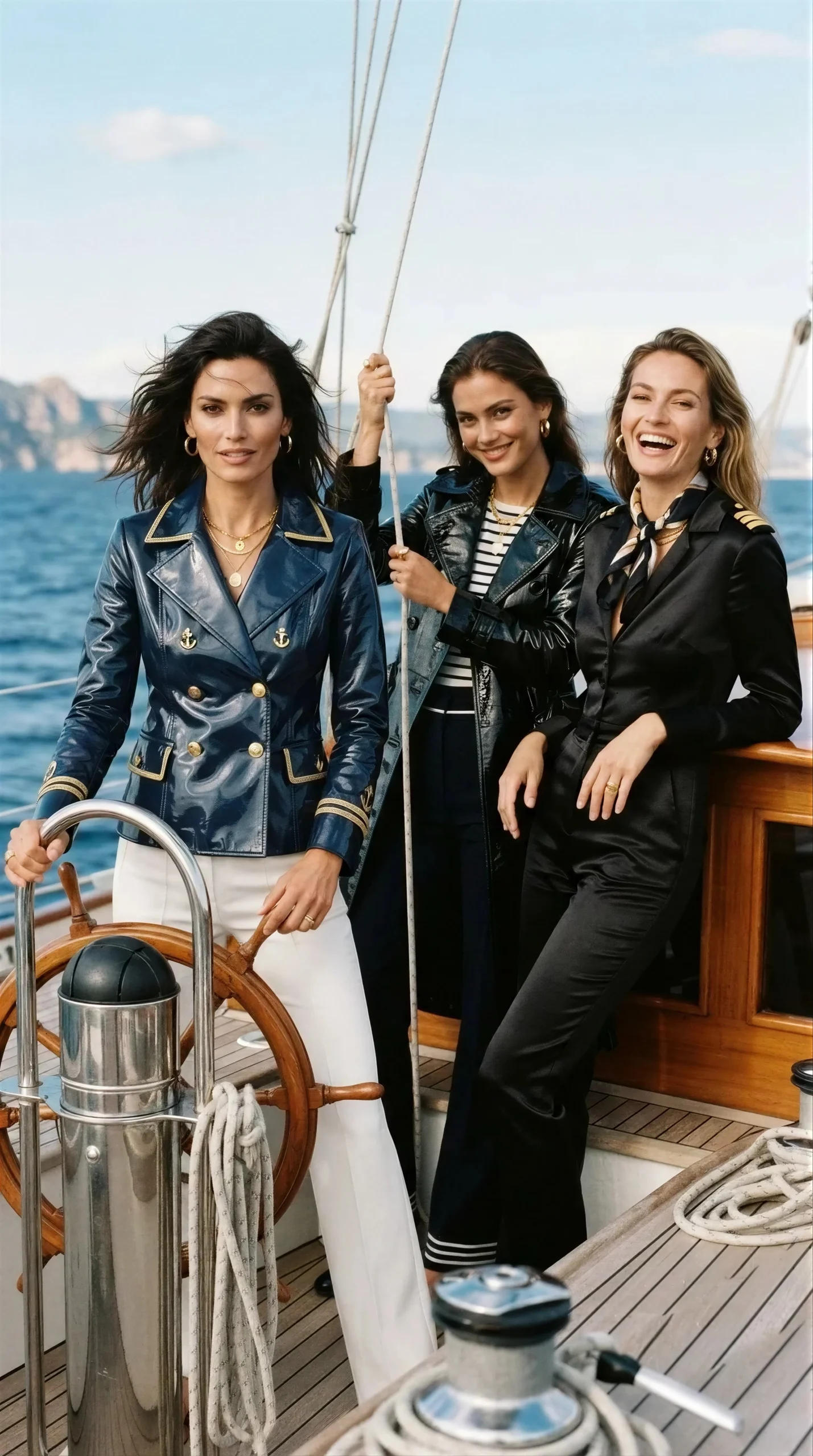
Some women spend a lifetime steering their own course. The wisest ones eventually discover the exquisite relief of handing the wheel to someone worthy.
There is a particular kind of ache that lives beneath the ribs of every woman who has spent her life being strong.
You know the one. It is not pain, exactly. It is something more subtle, more persistent—a quiet hollow that no amount of professional success, financial security, or social approval can fill. It is the ache of a woman who has held the wheel so tightly, for so long, that she has forgotten her hands were ever meant for anything else. It is the ache of a woman who has never, not once, been permitted to close her eyes and trust that someone else is watching the horizon.
Dr. Eleanor Marsh knows this ache intimately. At forty-eight, she has built a life that looks, from the outside, like a portrait of success—a Harley Street cardiology practice, a Marylebone flat, twenty years of a marriage that was functional, respectable, and fundamentally hollow. She has diagnosed ten thousand hearts and understood precisely how each one was failing. She has never, in all those years, examined her own.
When she boards the sixty-foot sailing yacht Artemisia in Naples harbour on a golden July afternoon, she believes she is seeking rest. Distance. A brief holiday from the relentless responsibility of being the one who decides. She has chartered the yacht for a fortnight of solo sailing along the Amalfi Coast, and she has chosen this particular vessel for one simple reason: the listing mentioned a female captain. Something about that felt safer. More contained. She does not yet understand that what she is actually seeking cannot be found in safety or containment. It can only be found in the hands of a woman who knows exactly how to take the wheel.
Captain Vivienne Ashworth is standing on the aft deck when Eleanor arrives—silver-streaked hair swept back from a face that is both handsome and beautiful, crisp white naval shirt rolled to the elbows, tailored black trousers that move with her like a second skin. Her handshake is firm, her gaze is direct, and her voice, when she speaks, carries the quiet authority of a woman who has spent thirty-five years reading the sea and never once been wrong about what it was telling her.
“Dr. Marsh? Welcome aboard Artemisia. I’m Captain Ashworth. Vivienne.”
And with those four words, something shifts inside Eleanor—something small, something seismic, something that will, over the course of twelve extraordinary days, unravel every careful wall she has ever built.
The Helm and the Harbour is the story of what happens when a woman who has spent her life in control meets a woman who was born to command. It is a story of moonlit waters and silk against skin, of storms weathered and surrender chosen, of the profound, euphoric relief that comes from finding someone worthy of your trust—and giving yourself to them, willingly, completely, with a joy that feels like coming home.
It is a story for every woman who has ever stood at the helm of her own life and wondered, in the quiet hours of the night, what it might feel like to let go.
The answer, as Eleanor is about to discover, is everything.
Chapter One: “Boarding”
The Naples marina in July was a theatre of light and shadow, a stage upon which the Mediterranean performed its oldest, most seductive ritual—the slow, golden transformation of afternoon into evening, when the water turned from sapphire to molten amber and the air thickened with the scent of salt, citrus, and warm teak. Dr. Eleanor Marsh stood at the end of the main pontoon, her designer wheel-case trailing behind her on its smooth Italian wheels, and felt, for the first time in longer than she could accurately recall, profoundly uncertain.
Not clinically uncertain—she had navigated the labyrinthine corridors of Harley Street cardiology for two decades, had held beating hearts in her gloved hands, had delivered diagnoses that rewrote the trajectories of strangers’ lives with a steady voice and steadier gaze. She was not a woman who trembled at thresholds. And yet, standing at the head of the pontoon that stretched like a slender wooden finger into the marina, she felt the peculiar vertigo of a woman about to step off the edge of her known world.
The pontoon stretched before her, lined on either side with vessels of escalating grandeur—sleek motor yachts with hulls like polished obsidian, classic sailing yachts with teak decks gleaming the colour of dark honey, catamarans that sat on the water like beautiful, patient insects. The vessels grew larger and more immaculate as the pontoon extended, as though the marina itself understood the principle of crescendo, building toward some final, magnificent destination.
Eleanor’s destination was the last yacht on the pontoon. She could see it from where she stood—a sixty-foot sailing yacht, white-hulled, with lines that spoke of both speed and elegance, the kind of vessel that looked, even at rest, as though it were contemplating flight. Its name was painted on the transom in elegant gold script: Artemisia.
She had chosen this yacht with the clinical deliberation she applied to every decision in her life—researching charter companies, comparing specifications, reading reviews with the same close attention she gave to peer-reviewed medical journals. She had selected it for its size (large enough for comfort, small enough for intimacy), its itinerary (the Amalfi Coast, which she had visited once on a conference junket and remembered as a place of impossible beauty), and its captain (a woman, which had felt, at the time, like a practical preference and not, as she would later understand, the first unconscious turning of a key in a lock she had not known existed).
The divorce had been finalised three months ago. Twenty years of marriage to Dr. James Hartley—consultant haematologist, fellow of the Royal College, a man of impeccable credentials and correspondingly impeccable emotional absence—had been dissolved in a solicitor’s office on Wigmore Street with a efficiency that would have been admirable in a surgical theatre and was, in the context of two decades of shared existence, merely bleak. There had been no dramatic betrayal, no explosive rupture. Their marriage had simply expired, the way a long-held breath expires—slowly, quietly, with a faint sense of relief that was immediately followed by a more profound sense of emptiness.
Eleanor had not wept. She had signed the papers, shaken the solicitor’s hand, and returned to her flat to find it exactly as she had left it—pristine, ordered, silent. She had poured herself a glass of Sancerre, sat at her kitchen island, and stared at the wall for forty minutes. Then she had opened her laptop and begun searching for sailing charters.
She had told herself she needed rest. She had told herself she needed distance. She had told herself she needed a change of scene, a break from the relentless machinery of her professional life, a fortnight of salt air and sunshine to recalibrate whatever internal instrument had been registering the persistent, low-grade ache beneath her sternum. She was a cardiologist. She knew the heart’s architecture better than almost anyone alive. She could map its chambers, trace its electrical pathways, predict its failures with mathematical precision. She understood, with the clinical clarity of her profession, that the ache she felt was not cardiac. It was something else entirely, something that did not appear on any echocardiogram, something for which there was no pharmacological intervention.
She did not have a name for it. She suspected, in the quiet hours of her nights, that it might be longing.
“Dr. Marsh?”
The voice came from behind her—lightly accented, warm, feminine. Eleanor turned to find a woman approaching along the pontoon, a woman who moved with the particular, fluid confidence of someone who had spent her life in beautiful places and had grown so accustomed to beauty that it no longer required comment. She was perhaps forty, with dark hair pulled into an elegant chignon and skin the colour of warm caramel. She wore a silk blouse in pale ivory, tucked into tailored white trousers, and a pair of leather sandals that clicked softly on the pontoon’s wooden planks. A clipboard was held against her hip, and her smile was the professional, welcoming smile of someone whose livelihood depended on making people feel at ease.
“Welcome to Marina Grande. I’m Isabella, the charter liaison. We’ve been expecting you.” She extended her hand, and Eleanor shook it—a brief, efficient exchange. “Captain Ashworth is aboard Artemisia, ready to receive you. May I help with your luggage?”
“Thank you, yes.” Eleanor gestured to her wheel-case, and Isabella lifted it with an ease that suggested either hidden strength or a very well-made case. “Is everything in order? The charter arrangements?”
“Everything is perfect, Dr. Marsh. Captain Ashworth has provisioned the yacht according to your preferences—the dietary information you provided, the wine selections. The yacht has been fully serviced and inspected. You’re in excellent hands.” Isabella smiled again, a shade warmer this time. “Captain Ashworth is one of our most requested skippers. Her clients invariably return.”
They walked along the pontoon, past yachts that gleamed like sculptures in the afternoon light. Eleanor noticed, as she walked, the women who moved between the vessels—crew members, charter guests, marina staff. A stewardess in a crisp white uniform with glossy black leather detailing carried a tray of champagne flutes aboard a motor yacht. A woman in a flowing silk kaftan the colour of deep coral stood on the foredeck of a catamaran, her dark hair lifting in the breeze, laughing into a phone. A dock worker in fitted black trousers and a sleek polo shirt directed a reversing yacht with precise, economical gestures. There was a particular aesthetic to the women of this marina—a polish, a deliberateness, a preference for fabrics that caught the light and moved with the body rather than against it. Eleanor, in her practical linen shirt and sensible cotton trousers, felt suddenly, conspicuously ordinary.
“Here we are,” Isabella said, stopping at the gangway of Artemisia. The yacht looked even more beautiful up close—its hull was immaculate, its deck spotless, its brightwork gleaming with fresh varnish. A cluster of white roses sat in a crystal vase on the cockpit table, and the teak decking was warm and golden in the sunlight. “Captain Ashworth will take it from here. Enjoy your voyage, Dr. Marsh. I do so hope you find what you’re looking for.”
The words landed with an odd weight, as though Isabella knew something Eleanor did not. Eleanor thanked her and stepped onto the gangway, her hand finding the polished bronze rail, the metal warm and smooth beneath her fingers. She walked aboard with the careful, measured steps of a woman who was not accustomed to the gentle roll of a vessel at anchor and was determined not to show it.
And there, standing at the helm with one hand resting on the wheel and the other holding a pair of binoculars that she had clearly just lowered, was Captain Vivienne Ashworth.
Eleanor’s first impression was of height. Vivienne was tall—nearly six feet, she estimated—with the upright, unhurried posture of a woman who had learned to carry her own height as an asset rather than an apology. Her dark hair was swept back from her face in a style that was both practical and elegant, silver threads catching the sunlight like fine wire, and her face was a composition of strong, clean lines—a sharp jaw, prominent cheekbones, a mouth that looked as though it had been designed for the delivery of precise, authoritative statements. Her eyes were dark, the colour of deep water, and they held Eleanor’s gaze with a directness that was, Eleanor would think later, less like being looked at and more like being read.
She wore a crisp white naval-style shirt, the sleeves rolled precisely to the elbow, the collar open at the throat to reveal the clean line of her neck and the thin gold chain that rested against her skin. Her trousers were black, tailored, and moved with her body as she stepped forward to greet Eleanor—not the stiff formality of a uniform, but the sleek, fluid drape of a garment cut by someone who understood that clothing should serve the body, not constrain it. On her feet were deck shoes in supple dark leather, well-worn but immaculately maintained. The overall impression was of a woman who had refined her presentation to a point of effortless authority, who looked, even at rest, like someone in command of something important.
“Dr. Marsh.” Her voice was low, warm, carrying the faint trace of a Yorkshire accent beneath years of maritime internationalism, like the last sediment of a river visible at the edge of a vast sea. She stepped forward and extended her hand. “Welcome aboard Artemisia. I’m Captain Ashworth. Vivienne.”
Eleanor took her hand. The grip was firm, the palm dry and cool, the pressure calibrated to communicate something specific—not dominance, not submission, but a quiet, unshakeable certainty. I have you now. You’re safe. The handshake lasted a beat longer than professional, a fraction shorter than intimate, and when Vivienne released her, Eleanor felt the ghost of that grip lingering on her skin like a warm impression.
“Thank you, Captain. It’s a pleasure to be here.” Eleanor’s voice was steady, professional—the voice she used with patients, with colleagues, with the world. It was the voice of a woman who had spent twenty years being the most qualified person in the room and had grown accustomed to the authority that accompanied that position. She was not prepared for how thin it sounded against the quiet confidence of Vivienne’s welcome.
“Please—Vivienne. We’ll be sharing this vessel for a fortnight. Formality is for harbours and harbours alone.” Vivienne’s smile was slow, warm, transforming her sharp features into something that was not soft, exactly, but approachable—like a cliff face that had, in certain lights, the appearance of a smile. “Let me show you aboard.”
She turned and moved toward the saloon with the fluid, purposeful stride of someone who had walked this deck a thousand times and could do it blindfolded. Eleanor followed, her cardiologist’s eye cataloguing details with professional habit—the yacht was immaculate, every surface clean, every line coiled, every fitting polished. The saloon was beautiful: teak joinery glowing with the warm patina of careful maintenance, white leather upholstery, brass fittings that caught the light like small, scattered flames. A vase of white orchids sat on the table, their petals waxy and luminous, and the air smelled of lemon and salt and something else—something clean and warm that Eleanor identified, after a moment, as the particular scent of a well-maintained vessel: varnish, cotton, and the faint, ever-present whisper of the sea.
“Sit, please,” Vivienne said, gesturing to the settee. “I’ve prepared a pot of tea—or would you prefer something cooler? There’s sparkling water with lemon, or I could open a bottle of the Falanghina I’ve chilling.”
“Tea would be lovely, thank you.” Eleanor sat, and the leather was cool and smooth against the backs of her thighs—a sensation she noticed with a precision that surprised her. She was not a woman who typically noticed the tactile qualities of surfaces. She was a woman who noticed clinical details—blood pressure, heart rate, the subtle irregularities of an ECG. The feel of leather against her skin was not data she was accustomed to collecting.
Vivienne moved to the galley with an economy of motion that was almost hypnotic—each gesture purposeful, each step placed with the unconscious precision of a woman who had learned, through decades at sea, that wasted movement is wasted energy. She returned with a tray—two cups of tea, a small plate of biscotti, a dish of lemon slices. She set it down and sat across from Eleanor, close enough that the scent of her skin—clean, warm, faintly salted—reached Eleanor across the small table.
“Now,” Vivienne said, pouring the tea with hands that were steady and sure, “I always begin a charter with a conversation. Not about itineraries or safety protocols—those we’ll cover later. I begin by getting to know the woman who has trusted me with her time.” She looked at Eleanor, and her dark eyes held that same direct, assessing quality Eleanor had noticed on the pontoon. “Tell me about yourself, Eleanor. Not your CV—I’ve read that already. Tell me what brought you here.”
Eleanor hesitated. She was not accustomed to being asked this question—not by colleagues, not by friends, certainly not by strangers. She was asked about her work, her research, her opinions on the latest cardiology guidelines. She was not asked what brought her places. She was not asked what she was looking for.
“I needed a holiday,” she said, and the words sounded thin even to her own ears.
Vivienne’s expression did not change, but something shifted in her eyes—a flicker of recognition, as though she had heard this particular answer many times before and understood, with the fluency of long experience, what lay beneath it.
“Of course,” she said. “A holiday. A change of scene. A break from the routine.” She handed Eleanor a cup of tea, and their fingers brushed on the porcelain. The contact was brief, incidental, and yet Eleanor felt it with a vividness that startled her—the warmth of Vivienne’s skin, the strength in her fingers, the brief, bright spark of connection that passed between them like a current through a wire. “And yet you’ve chosen a sailing yacht, not a hotel. You’ve chosen the sea, not a spa. You’ve chosen to be aboard a vessel that moves, that responds, that requires you to be present.” She sipped her tea, watching Eleanor over the rim of the cup. “That tells me something about what you’re actually looking for.”
Eleanor felt a flush of heat rise in her chest—not embarrassment, exactly, but the particular, sharp alertness of a woman who has been seen more clearly than she intended. She set down her cup and met Vivienne’s gaze with the directness she had spent a career cultivating.
“And what am I looking for, Captain?”
Vivienne smiled. That slow, warm smile that transformed her face like sunlight breaking through cloud cover. “You don’t hire me to answer that question, Eleanor. You hire me to help you discover it.” She stood, and the movement was fluid, commanding, the silk of her shirt catching the light from the overhead hatch and shimmering like water in sunlight. “But first, let me show you to your cabin. You’ll want to settle in before dinner. We’ll sail at first light tomorrow, and I suspect you’ll want a good night’s sleep.”
She led Eleanor below deck, through a narrow corridor lined with teak, to a cabin at the bow. The space was beautiful and compact—a double berth with white linen, a porthole that framed the harbour like a painting, a small en suite with polished chrome fittings. A vase of white roses sat on the bedside shelf, their petals tight and luminous, and a folded stack of fresh towels—thick, white, impossibly soft—rested on the berth.
“This is your space,” Vivienne said, standing in the doorway, her presence filling the narrow frame with an authority that was both reassuring and, Eleanor noted with clinical fascination, faintly thrilling. “Your privacy is absolute here. I’ll knock before entering, always. The galley and saloon are shared spaces—you’re welcome there at any time. The cockpit and helm are my domain, but you’re welcome there too, by invitation.” She paused, and her eyes held Eleanor’s with that same steady, assessing gaze. “We sail at six. Breakfast at five-thirty. I’ll have coffee ready. Any questions?”
Eleanor shook her head. She felt, absurdly, like a patient being given a diagnosis—not a frightening diagnosis, but a clarifying one, the kind that suddenly illuminates a constellation of symptoms you have been living with for so long that you had ceased to notice them.
“Good,” Vivienne said. “Dinner is at seven. I’ve prepared a simple meal—bruschetta, sea bass, a salad. We’ll eat on the aft deck. Dress as you please.” And then, with a final, lingering look that seemed to see straight through Eleanor’s professional composure to the uncertain, yearning woman beneath, she added, “Welcome aboard, Eleanor. I think you’re going to find what you came for.”
She turned and walked away, her footsteps receding down the corridor with a measured, unhurried cadence, and Eleanor was left alone in the cabin with the sound of the harbour water lapping against the hull and the unfamiliar, unsettling, exhilarating sensation of having been seen.
She stood for a long moment, looking at the porthole, at the framed slice of harbour—boats and water and golden light—before she reached for her suitcase and began to unpack. Her hands moved through familiar motions—shirts folded, trousers draped, toiletries arranged on the small shelf above the basin. She had packed practically, as she always did: linen shirts in neutral tones, cotton trousers, a light jumper for cool evenings, sensible walking shoes. Everything was clean, well-made, appropriate. Everything was safe.
And then, at the bottom of the case, beneath a layer of tissue paper she had not remembered placing there, she found the silk scarf.
It was midnight blue, the colour of deep water at night, with a pattern of silver threads that caught the light like the surface of a moonlit sea. She had bought it months ago, in a boutique in Mayfair, on an impulse so uncharacteristic that she had almost returned it. She had never worn it. It had sat in her wardrobe, wrapped in tissue, a small, glossy secret she could not explain.
She lifted it from the case and let it uncurl. The silk was cool and impossibly smooth against her fingers—it slid over her skin like water, like a whisper, like the memory of a touch she had not yet received. She held it up to the porthole light and watched the silver threads shimmer, and she felt something stir inside her that she could not name—something that had nothing to do with silk and everything to do with the woman who had just walked away down the corridor.
She wrapped the scarf around her neck, the silk settling against her skin with a cool, sleek caress, and looked at her reflection in the small mirror above the basin. The woman who looked back at her was tanned, tired, and—Eleanor noted with the detached precision of her profession—beginning to change. Something in her eyes was different. Something in the set of her mouth. Something that the silk against her skin seemed to illuminate, as though the fabric were a key turning in a lock she had not known she carried.
She thought about Vivienne’s handshake, about the warmth and certainty of it. She thought about Vivienne’s eyes, dark and direct, seeing through her with an ease that was both unsettling and profoundly, inexplicably comforting. She thought about Vivienne’s voice, low and warm, saying I think you’re going to find what you came for, and she wondered, with a flutter of something that felt like anticipation and tasted like salt and citrus and the clean, bright promise of a new horizon, what that might be.
The harbour water rocked the hull gently, rhythmically, like a cradle, like a heartbeat, like the slow, steady pulse of something beginning.
Eleanor lay the scarf on the pillow beside her, a sleek, glossy promise of something she could not yet articulate, and began to prepare for her first evening aboard Artemisia.
Chapter Two: “First Evening”
The golden hour, that brief and precious interval when the Mediterranean sun begins its slow, voluptuous descent toward the horizon, transforming the world into a palette of amber and rose, found Eleanor standing before the small mirror in her cabin, engaged in a ritual she had not performed in longer than she cared to calculate: the deliberate, considered preparation of herself for an evening she could not predict.
She had showered in the compact en suite, the water pressure surprisingly robust for a marine system, and had stood for a long moment beneath the warm spray with her eyes closed, letting the heat work into the muscles of her shoulders and neck, those stubborn repositories of tension that had, over the years, become so chronically knotted that she had ceased to notice them, the way one ceases to notice the persistent hum of a refrigerator or the faint ache of an old injury. The water ran over her skin with a silky, insistent pressure, and she found herself thinking, absurdly, of Vivienne’s handshake—the firm, cool certainty of it—and of the way that brief contact had left a warm impression on her palm that had not faded even after she had unpacked her case and arranged her belongings in the cabin with her habitual, clinical precision.
She had dressed with care, selecting from her limited wardrobe a linen shirt in pale ivory and tailored trousers in navy, the combination elegant but understated, the sartorial equivalent of a professional conference—appropriate, composed, revealing nothing. She had pinned her dark hair up, exposing the clean line of her neck and the small pearl earrings she had worn for twenty years without thought. She had applied minimal makeup—a touch of mascara, a sweep of tinted balm—and had looked at her reflection with the critical eye of a woman accustomed to presenting a polished exterior to the world.
And then she had reached for the silk scarf.
It lay on the pillow where she had placed it, the midnight-blue fabric pooling against the white linen like a drop of dark water on snow. She picked it up and felt again that extraordinary, impossible smoothness—the way the silk slid over her fingertips with a fluid, liquid grace, cool and warm at once, alive with a subtle, shimmering sheen that caught the cabin’s overhead light and scattered it in tiny, prismatic fragments. She wrapped it around her neck, letting the ends fall against the ivory linen of her shirt, and the silk settled against her skin with a sensation that was, she thought with clinical fascination, not merely tactile but emotional—a warmth that spread from the point of contact inward, like the first sip of a fine spirit, like the first touch of a hand that knows exactly where to rest.
She looked at herself in the mirror. The scarf transformed the simple outfit into something more—more considered, more intentional, more present. The midnight blue against the ivory linen, the silver threads catching the light like a constellation of tiny stars—it was a small thing, a detail, and yet it changed the way she felt about herself in a way she could not rationally explain. She felt, for the first time in recent memory, like a woman who had made a choice about her own presentation that was not driven by professional obligation or social expectation but by something else entirely. Something private. Something that felt, in its small, quiet way, like a beginning.
She took a breath, collected herself, and climbed the companionway steps to the cockpit.
The aft deck had been transformed.
Vivienne had set the table with the meticulous attention to detail of a woman who understood that beauty is not a luxury but a language—a way of communicating care, respect, and intention without a single word. The table was draped in white linen so fine it caught the fading light like a sail catches wind, and upon it rested two place settings of bone-white china, crystal wine glasses that refracted the golden hour into a hundred tiny suns, and a bottle of Falanghina chilling in a silver bucket, the bottle’s pale glass beaded with cold droplets that slid down its surface with a slow, hypnotic patience. Two candles in glass holders flickered gently, their flames barely disturbed by the soft evening breeze, casting a warm, amber glow across the teak decking and the white leather of the cockpit cushions.
But it was Vivienne who arrested Eleanor’s attention and held it with the gentle, inexorable grip of a tide that will not be resisted.
She stood at the stern, one hand resting on the teak rail, the other holding a corkscrew with the casual competence of a woman who had opened a thousand bottles at sea. She had changed from her crisp white naval shirt into something that made Eleanor’s breath catch in her throat with a small, involuntary sound that she was grateful the evening breeze covered—a dark navy silk shirt that moved over her body like water over stone, like moonlight over the sea, like a whispered secret. The fabric was extraordinary—it shifted with every breath, every gesture, every subtle adjustment of Vivienne’s posture, transitioning from deep midnight blue to near-black and back again with a fluid, mesmerising play of light and shadow that made it almost impossible to look away. The collar was open, revealing the strong column of her throat and the gold chain Eleanor had noticed earlier, and the sleeves were rolled to the forearm in the same precise, deliberate manner as before, exposing the tanned, sinewy strength of her wrists and hands. She wore tailored black trousers that moved with her like a second skin—not tight, not provocative, but sleek, the fabric catching the candlelight with a subtle, polished sheen that spoke of quality and intention.
The overall effect was of a woman who had refined her presentation to a point where it appeared effortless but was, Eleanor suspected with the diagnostic precision of her profession, the result of years of deliberate, considered choices. Every element—the silk, the tailoring, the simple gold jewellery, the immaculate grooming—was a brushstroke in a portrait of confident, understated authority. It was, Eleanor thought, the most compelling argument for the power of presentation she had ever witnessed.
“Good evening, Eleanor.” Vivienne’s voice was warm, low, carrying that faint Yorkshire undertone like a buried river surfacing briefly through stone. She gestured to the table with a graceful, unhurried movement of her hand. “Please, sit. I’ve just opened the wine.”
Eleanor crossed the cockpit and took the seat Vivienne indicated—the one facing the stern, where the view encompassed the harbour, the distant curve of the Naples waterfront, and the first stars appearing in the deepening blue above Mount Vesuvius. She sat, and the leather cushion was warm beneath her, holding the heat of the day like a living thing. The silk scarf shifted against her neck as she settled, a cool, liquid caress that reminded her, with a small, sharp thrill, of the choice she had made below.
Vivienne poured the wine with the same fluid, economical grace she brought to every action—no wasted movement, no unnecessary flourish, just the clean, precise tilt of the bottle, the pale gold liquid filling the glass with a gentle, musical sound. She handed Eleanor’s glass across the table, and again their fingers brushed on the crystal, and again Eleanor felt that bright, electric spark of contact—a sensation that was becoming, she noted with clinical fascination, less startling and more anticipated with each occurrence.
“Falanghina,” Vivienne said, settling into her own seat with the easy, grounded posture of a woman completely at home in her surroundings. “From the Falerno del Massico DOC, just north of here. It has a minerality that pairs beautifully with the sea bass. I hope you’ll find it agreeable.”
Eleanor raised the glass to her lips. The wine was cool, crisp, with a bright acidity that played across her tongue like sunlight on water, followed by a deeper, softer note—pear, perhaps, or white peach—and a clean, mineral finish that lingered like the memory of a pleasant conversation. She was not, by habit, a woman who attended closely to wine—she drank it socially, professionally, without particular analysis—but she found herself paying attention now, as though Vivienne’s evident care in selecting it demanded a corresponding care in receiving it.
“It’s beautiful,” she said, and meant it. “You clearly know your wines.”
Vivienne smiled—that slow, warm transformation that Eleanor was beginning to recognise as a signature expression, the way one recognises a particular chord in a favourite piece of music. “I know what pleases me. Wine, like everything else, is about attention—paying close enough notice to understand what you truly enjoy, and then having the confidence to choose it unapologetically.” She sipped her own wine, watching Eleanor over the rim with those deep-water eyes. “Most people drink what they’re given. I prefer to drink what I’ve chosen.”
The statement landed with a weight that exceeded its literal content, and Eleanor felt it settle inside her like a stone dropped into still water, sending ripples outward into areas of her consciousness she had not intended to disturb. She had spent twenty years drinking what she was given—metaphorically, literally, in every sense that mattered. She had accepted the marriage, the career path, the social expectations, the carefully calibrated life that looked, from the outside, like a portrait of success and felt, from the inside, like a beautifully appointed cage.
“I understand that distinction,” she said quietly.
Vivienne held her gaze for a moment, then nodded, as though Eleanor had passed some unspoken test. “I thought you might.” She rose and moved to the galley, returning with a platter of bruschetta—thick slices of rustic bread toasted golden and topped with sun-ripened tomatoes, fresh basil, and a drizzle of olive oil that caught the candlelight like liquid gold. She set it between them. “We’ll start simply. The sea bass needs a few more minutes.”
They ate, and the bruschetta was extraordinary—the bread warm and crisp, the tomatoes sweet and acidic, the basil bright and peppery, the oil fruity and rich. Each flavour was distinct, clean, assertive, a composition of elements that worked together without losing their individual character. Eleanor, who had eaten at Michelin-starred restaurants across Europe, who had attended elaborate dinners at the Royal College, who had consumed countless meals that were more performance than nourishment, found herself genuinely moved by the simple, perfect quality of what Vivienne had prepared.
“You’re a remarkable cook,” she said, and Vivienne laughed—a low, warm sound that vibrated through the evening air like a plucked cello string.
“I’m a competent cook. The ingredients do the real work. I simply have the good sense to let them.” She refilled Eleanor’s glass without asking—a small, authoritative gesture that Eleanor noticed and, to her surprise, did not resent. “I’ve been provisioning yachts for fifteen years. I’ve learned that the secret to good food at sea is the same as the secret to good sailing: respect the materials, trust the process, and don’t overcomplicate.”
“And the secret to good living?” Eleanor heard herself ask, and the question surprised her—she had not intended to speak it, had not intended to reveal the direction of her thoughts. But the wine, the candlelight, the silk against her skin, the steady, commanding presence of the woman across the table—something in the combination had loosened the careful constraints she usually kept on her conversation.
Vivienne considered the question with the seriousness Eleanor associated with grand rounds—the focused, unhurried attention of someone who intended to give a precise answer. “The same, I think,” she said. “Respect yourself. Trust your instincts. And don’t overcomplicate.” She paused, her eyes holding Eleanor’s with that direct, assessing quality that saw through professional composure like sunlight through clear water. “Most women I meet—women like you, Eleanor, women who have achieved a great deal—have mastered the first two. They respect themselves. They trust their instincts. It’s the third that trips them. They overcomplicate. They add layers, structures, defences, until they’ve forgotten what they were originally trying to protect.”
Eleanor set down her glass. The observation was precise, clinical, delivered with the diagnostic accuracy of a consultant who has seen a thousand cases and recognises the pattern. She should have bristled—she was not accustomed to being analysed, certainly not by strangers, certainly not on first acquaintance. But the observation was delivered without judgement, without condescension, with the quiet authority of a woman who had earned the right to speak through decades of experience, and Eleanor found herself not bristling but leaning in, not defending but listening, not retreating but, in some small, significant way, opening.
“And what were they originally trying to protect?” she asked, her voice quieter than she intended.
Vivienne’s gaze softened—not into gentleness, exactly, but into a kind of warmth that was more penetrating than any clinical assessment, a warmth that reached past the professional composure, past the carefully constructed defences, past the twenty years of functional marriage and successful practice and polished exterior, and touched something beneath all of it that Eleanor had not known was there.
“Themselves,” Vivienne said simply. “The woman they were before they became the woman everyone needed them to be.”
The words hung in the air between them, suspended by the candlelight and the soft lapping of the harbour water against the hull, and Eleanor felt them land inside her with a weight that was both heavy and lightening, like the removal of a burden she had not known she was carrying. She opened her mouth to respond—to deflect, to redirect, to deploy the professional composure that had served her so well for so long—but found, for the first time in her adult memory, that she had no deflection available. The words had found their mark with the precision of a skilled diagnostician, and there was nowhere to hide.
Fortunately, Vivienne spared her. She rose with that fluid, commanding grace and disappeared into the galley, returning with the sea bass—whole, grilled, its skin golden and crisp, laid on a bed of rocket and shaved Parmesan with lemon wedges and a drizzle of the same golden oil. She set it between them with the quiet confidence of a woman who knew the meal would speak for itself.
“The fish,” she said, filleting it with a knife that moved through the flesh with surgical precision, “was caught this morning by a fisherman named Giuseppe who operates from the end of the pontoon. He’s been fishing these waters for forty years. He knows where the fish are the way I know where the wind is—by feel, by instinct, by a lifetime of paying attention.” She placed a portion of the white, flaking flesh on Eleanor’s plate. “The lemon is from a tree in the marina’s garden. The rocket was grown by a woman named Maria who sells it from a stall near the fish market. Everything on this plate has a story, a provenance, a connection to this place and these people.” She looked at Eleanor. “I find that knowing the story of what you’re consuming makes the consuming itself more meaningful. Don’t you?”
Eleanor took a bite. The fish was extraordinary—sweet, clean, with a delicate flavour that was enhanced rather than overwhelmed by the lemon and the oil. The rocket added a peppery bite, the Parmesan a salty depth, and the combination was, like the bruschetta before it, a composition of distinct elements that worked together in perfect harmony.
“I do,” she said, and found she was not speaking only about the food. “I think I’ve forgotten, recently, to pay attention to the stories behind things. Behind people. Behind…” She paused, searching for the word. “Behind myself, perhaps.”
Vivienne nodded slowly, as though this admission were not a vulnerability but a diagnosis—a useful, clarifying piece of information that would inform the treatment plan. “Tell me about your work, Eleanor. Not the credentials—I’ve read those. Tell me what drew you to cardiology. What is it about the heart that fascinates you?”
The question was different from the ones Eleanor was accustomed to answering. Not what do you do or where did you train or what are your research interests—the professional questions that allowed her to recite her CV without revealing anything of substance. This was a question about passion, about the interior life of a woman who had chosen to spend her career with the most vital, most vulnerable, most metaphorically loaded organ in the human body. And it was asked by a woman who was watching her with an attention so focused, so complete, that Eleanor felt, for a disorienting, exhilarating moment, that she was the only person in the world.
“The heart,” she began, and her voice was different—softer, less controlled, stripped of the professional polish that usually lacquered her speech. “The heart is extraordinary. It generates its own electrical impulses. It beats, on its own, from approximately the fourth week of gestation, without any instruction from the brain. It is, in a very real sense, self-governing. It doesn’t need permission to beat. It doesn’t need direction. It simply… does.”
She paused, surprised by the direction her own thoughts had taken. Vivienne said nothing, simply waited, her dark eyes steady, her attention undivided, and the silence was not empty but full—a vessel waiting to be filled.
“I think that’s what drew me to it,” Eleanor continued, the words coming with a fluency that surprised her, as though they had been stored behind a dam that was now, for reasons she did not fully understand, beginning to give way. “The heart’s independence. Its self-sufficiency. It doesn’t wait for anyone. It doesn’t ask permission. It just… persists. Through everything—stress, grief, joy, illness, age—it persists. It’s the most faithful thing in the body. The most loyal.” She stopped, aware that she had said more than she intended, aware that the metaphorical weight of her words had exceeded their clinical content.
Vivienne’s expression was unreadable, but her eyes—those deep, dark, assessing eyes—held something that looked, to Eleanor’s clinical gaze, very much like recognition. “The most loyal thing in the body,” she repeated, as though tasting the phrase. “And yet you spend your days repairing it when it falters. Restoring its rhythm when it breaks down. Guiding it back to its natural pattern when it strays.” She paused, and the pause was deliberate, weighted, a space left open for a connection to form. “That’s a particular kind of work, Eleanor. Not just medical. Not just technical. It’s… relational. You’re in relationship with the heart. You listen to it. You understand its language. You earn its trust, in a sense, before you intervene.”
Eleanor stared at her. In twenty years of medical practice, no one—no colleague, no supervisor, no therapist—had ever described her work in terms that so precisely captured its interior, emotional reality. She had always spoken of cardiology in clinical terms—electrophysiology, pharmacological intervention, surgical technique. She had never spoken of it as a relationship, as a listening, as an earning of trust. And yet, hearing Vivienne say it, she understood that this was exactly what it was, exactly what had drawn her to it, exactly what she loved about it—the intimate, patient, attentive relationship between a healer and a heart that needed her.
“Yes,” she said, and the word was barely above a whisper. “That’s exactly what it is.”
Vivienne held her gaze for a long, charged moment, and then she smiled—that slow, warm, transforming smile—and said, “I thought so. A woman who chooses the heart is a woman who understands the value of deep, patient attention. Of listening before acting. Of earning trust before exercising authority.” She refilled Eleanor’s wine glass, the gesture so natural, so seamlessly integrated into the rhythm of the conversation, that Eleanor barely noticed it. “That’s a rare quality, Eleanor. In medicine and in life.”
Eleanor felt a warmth spread through her chest that had nothing to do with the wine—a warmth that was complex, layered, composed of recognition and relief and something else, something that pulsed beneath the others like a heartbeat beneath silence. She was being seen. Not the professional, polished, credentialled version of herself that she presented to the world, but the woman beneath—the woman who had been drawn to the heart not for its clinical interest but for its loyalty, its independence, its faithful persistence through everything.
“And you?” Eleanor asked, turning the question with the same instinct for reciprocity that governed her professional consultations. “What drew you to the sea?”
Vivienne leaned back in her seat, the silk of her shirt shifting with the movement in that mesmerising, liquid play of light and shadow, and considered the question with the same serious, unhurried attention she had given to Eleanor’s. “The sea,” she said, “is the most honest thing I’ve ever encountered. It doesn’t pretend. It doesn’t flatter. It doesn’t care about your credentials or your bank balance or your social position. It simply is what it is—powerful, beautiful, dangerous, indifferent—and your only option is to learn its language, respect its nature, and work with it rather than against it.” She paused, her gaze drifting to the harbour, where the lights of Naples were beginning to shimmer on the water like scattered jewels. “I went to sea at eighteen because I was running from a life that felt too small. I stayed at sea because I found something I hadn’t expected—a relationship with something vast and honest that demanded my full attention and rewarded it with a sense of… rightness. Of placement. Of being exactly where I belonged.”
She turned back to Eleanor, and her eyes held that same deep, assessing quality that saw through defences like sunlight through glass. “Medicine must be similar, in its way. The body is honest, too. It doesn’t care who you are. It only cares whether you understand it. Whether you’re paying attention.”
Eleanor nodded slowly. “Yes. The body is honest. It tells you what it needs if you know how to listen.” She paused, and the next words came from a place she had not planned, a place below the professional composure, below the careful construction. “I think I’ve been so focused on listening to other people’s bodies that I’ve stopped listening to my own.”
The admission hung in the air, vulnerable and raw, and Eleanor felt a flash of something close to panic—the instinct to retract, to deflect, to deploy the professional composure like a shield. But Vivienne did not look away. She did not change the subject. She did not offer platitudes or reassurances. She simply held Eleanor’s gaze with that steady, unwavering attention, and the holding itself was a kind of response—a silent communication that said, I hear you. I see you. You are not alone in this.
“The sea teaches you to listen again,” Vivienne said, her voice low, warm, pitched at a frequency that seemed to resonate not in Eleanor’s ears but in her chest, in the space beneath her sternum where that persistent ache had lived for so long. “Not to the sea, necessarily—though it does that too. But to yourself. The rhythms of the boat, the patterns of the wind, the cycles of the day—they reconnect you with your own rhythms. Your own patterns. Your own cycles.” She paused, and the pause was a space, an opening, an invitation. “That’s what you came here for, Eleanor. Not for a holiday. For a reconnection.”
Eleanor felt something shift inside her—a tectonic movement, deep and slow, like the turning of the earth beneath the sea. The ache beneath her sternum, the one she had carried for years, the one no echocardiogram could detect and no medication could touch—that ache was not a symptom. It was a signal. A signal from a part of her that had been ignored, silenced, buried beneath the professional composure and the functional marriage and the carefully constructed life. A signal that said: I am still here. I am still waiting. I still need to be heard.
She looked at Vivienne—at this woman who had, in the space of a single evening, seen her more clearly than anyone had in twenty years—and felt something she could not name. It was not attraction, not yet, not in any form she would have recognised. It was something more fundamental, more primal: the profound, overwhelming, almost painful relief of being seen.
They sat in silence for a long moment, the candles flickering, the harbour lights shimmering, the warm Mediterranean night settling around them like a silk shawl. Then Vivienne rose with that fluid, commanding grace and cleared the plates, returning with two small glasses of limoncello—golden, viscous, catching the candlelight like liquid amber.
“A digestivo,” she said, setting the glasses on the table. “Made by a woman named Lucia who lives on the hill above the marina. She’s been making it for thirty years from the lemons in her garden. It’s…” She paused, searching for the word, and her lips curved in that slow, warm smile. “It’s honest. Like everything else worth having.”
Eleanor raised the glass. The limoncello was sweet, sharp, warming—a bright, concentrated essence of lemon that spread through her like sunlight. She sipped it slowly, savouring the way it moved through her, the way it warmed her from the inside out, and she thought about honesty—about the things worth having, about the woman who had described them with such quiet, compelling certainty, about the silk scarf against her neck and the harbour lights on the water and the ache beneath her sternum that was, for the first time, beginning to feel less like a wound and more like a door.
When the limoncello was finished, Vivienne stood and moved to the stern, leaning against the rail with the easy, grounded posture of a woman at home in her element. Eleanor joined her, and they stood side by side in the warm darkness, watching the stars emerge one by one above the harbour, the water below them a mirror of the sky above.
“Tomorrow,” Vivienne said, her voice low, intimate in the darkness, “I’ll teach you to helm. Have you sailed before?”
Eleanor shook her head. “Never.”
“Good.” Vivienne turned to look at her, and in the starlight, her face was beautiful—strong, composed, illuminated by something that looked, to Eleanor’s cardiologist’s eye, very much like the steady, self-generating pulse of a heart that knew its own rhythm. “No bad habits to unlearn. You’ll learn my way.”
The words—my way—sent a small, sharp thrill through Eleanor that she did not examine too closely. She simply nodded, and the nod felt like an agreement, a consent, a small but significant step across a threshold she had not known she was approaching.
“I’ll see you at five-thirty,” Vivienne said. “Coffee will be ready. Sleep well, Eleanor.”
She turned and walked toward the companionway, the silk of her shirt catching the starlight one final time—a shimmer, a ripple, a gleam of midnight blue—before she descended below deck and was gone.
Eleanor stood alone at the stern, the harbour water rocking the hull gently beneath her feet, the silk scarf cool and smooth against her neck, the stars wheeling slowly overhead. She felt something she could not name—something that was not peace, not yet, but was perhaps the first, tentative movement toward it. A loosening. An opening. A willingness, after years of holding tight, to see what might happen if she let go.
She went to her cabin, lay in the narrow bunk, and listened to the water against the hull—a rhythmic, soothing percussion, like a heartbeat, like a lullaby, like the steady, faithful pulse of something that had been waiting, all along, for her to listen.
She slept. And for the first time in longer than she could remember, she did not dream of empty rooms.
Chapter Three: “First Lessons”
The Mediterranean at dawn is a thing of such profound, unblemished beauty that it renders superfluous every adjective ever enlisted in its service—a vast, liquid expanse of pale gold and pearl, the water so still it seems to hold its breath, the sky above it a gradient of rose and amber and the soft, luminous blue of a robin’s egg, the whole composition so perfectly balanced, so exquisitely calibrated, that it appears less like a natural phenomenon and more like a painting executed by a hand so assured, so masterful, that it could only belong to a deity with an unusually refined aesthetic sensibility and a particular fondness for the colour blue.
Eleanor emerged from the companionway at five twenty-five, five minutes before the appointed time, driven by an eagerness she had not felt since, as a medical student, she had scrubbed in on her first open-heart surgery—a combination of anticipation and trepidation, of wanting and uncertainty, that hummed through her nervous system like an electrical current seeking ground. She had slept deeply, dreamlessly, the kind of restorative sleep that she had not experienced in months, perhaps years, and she had woken to the gentle rocking of the hull and the pale light filtering through the porthole with a sensation she could only describe as readiness—a sense that something was about to begin, something important, something that required her to be present and attentive and, most unusually, something that did not require her to be in charge.
Vivienne was already in the cockpit.
She stood at the helm in the pre-dawn light, her posture that familiar, grounded stance—feet planted, shoulders relaxed, hands resting on the wheel with the casual, proprietary ease of a woman holding something that belonged to her. She had dressed for sailing: a fitted technical shirt in white that moved with her body like a second skin, sleek sailing trousers in dark navy with a subtle, polished sheen that caught the early light, and deck shoes in supple leather that looked as though they had been designed as much for elegance as for function. Her hair was pulled back in a tight, practical knot that exposed the clean, strong lines of her jaw and neck, and her face, in the soft golden light, looked younger, less guarded, more approachable—the face of a woman in her element, doing what she was born to do.
“Good morning.” Her voice was warm, low, carrying that familiar Yorkshire undertone like a buried vein of gold in dark stone. She turned from the helm and looked at Eleanor with that direct, assessing gaze that had become, in the space of a single evening, both familiar and charged—a look that saw through professional composure the way an X-ray sees through tissue. “You slept well.”
It was not a question. It was a statement—a diagnosis delivered with the quiet certainty of a woman who had observed a thousand charter guests stumble up the companionway with the hollow eyes and taut faces of the sleepless, and who could, at a glance, distinguish between those who had rested and those who had merely passed the hours in the horizontal approximation of rest. Eleanor, who delivered diagnoses for a living, recognised the technique and found herself, absurdly, pleased to have been found well.
“Remarkably well, actually,” she said, crossing the cockpit to stand beside Vivienne. The air was cool on her skin, carrying the complex, briny perfume of the harbour—salt, seaweed, diesel, coffee from a nearby vessel, the faint sweetness of frangipani from a garden somewhere beyond the marina walls. She was wearing her practical sailing clothes—a lightweight technical shirt, cotton trousers, deck shoes she had purchased from a chandlery in Cowes on a whim two years ago and never worn—and she felt, in them, both prepared and slightly inadequate, as though the clothes she had chosen for this day had not quite risen to the occasion in the way Vivienne’s clearly had.
“Good. You’ll need your energy.” Vivienne gestured to the cockpit table, where a pot of coffee, two cups, and a plate of pastries—cornetti filled with apricot jam, their surfaces golden and dusted with sugar—had been laid with the same meticulous attention to detail that characterised everything Vivienne touched. “Eat first. We’ll cast off in thirty minutes. I want to be clear of the harbour before the morning traffic.”
They sat in the cockpit, the pre-dawn light deepening around them, and ate in a companionable silence that was, Eleanor noted, neither awkward nor forced but simply natural—two women sharing a meal in the quiet hour before a journey, each occupied with her own thoughts, each comfortable enough in the other’s presence to let the silence be. The coffee was excellent—rich, dark, with a depth of flavour that spoke of careful selection and precise preparation—and the cornetti were still warm, their surfaces slightly crisp, their interiors soft and yielding, the apricot jam bright and tart against the buttery dough.
As they ate, Eleanor watched the marina come to life around them. A stewardess in a crisp white uniform with glossy black leather belt and trim emerged from a motor yacht two berths along, her dark hair sleek beneath a polished cap, carrying a tray of provisions with the efficient, graceful movements of a woman trained to be both invisible and impeccable. On the pontoon, a woman in fitted black trousers and a sleek, dark blue polo shirt—marina staff, Eleanor guessed—was directing a reversing yacht with precise, economical gestures, her voice carrying across the water with clear, authoritative commands that the yacht’s helmsman followed without hesitation. And on the catamaran opposite, the woman Eleanor had noticed the previous evening—the one in the coral silk kaftan—appeared on deck in a flowing silk robe the colour of deep cream, her hair loose about her shoulders, holding a cup of something steaming and watching the dawn with the quiet, proprietary pleasure of a woman who owned the morning.
There was, Eleanor was beginning to notice, a particular aesthetic to the women of this world—an aesthetic that favoured sleek, tactile fabrics that caught the light and moved with the body, an aesthetic that treated clothing not as mere covering but as a form of self-expression, a language of confidence and intention. She thought of Vivienne’s silk shirt from the previous evening, the way it had moved like water over stone, the way it had caught the candlelight and transformed it into something magical. She thought of her own practical cotton and linen, chosen for function rather than beauty, and felt a small, unfamiliar stirring—a desire not merely to be present in this world but to belong to it.
“Tell me,” Vivienne said, pouring Eleanor a second cup of coffee with that same natural, authoritative gesture—no asking, simply providing, as though the decision had already been made and Eleanor’s only role was to accept—”what do you know about sailing? Anything at all?”
“Very little,” Eleanor admitted. “I’ve been on boats—ferries, water taxis, the occasional day sail with friends. But I’ve never helmed a yacht. I’ve never understood how the sails work, how the wind is captured and converted into motion. It’s always seemed rather like magic to me.”
Vivienne smiled—that slow, warm transformation that Eleanor was learning to anticipate with a pleasure that was disproportionate to the event. “It’s not magic. It’s physics. But physics, when applied with sufficient skill and understanding, can look very much like magic.” She set down her coffee and turned to face Eleanor, her expression shifting from warm to focused, from companionable to instructional, the transition so smooth and natural that it was less a change of mood than a change of key in a piece of music. “Sailing is about relationships. The relationship between the wind and the water. The relationship between the sails and the hull. The relationship between the helmsman and the boat.” She paused, and her eyes held Eleanor’s with that steady, penetrating quality. “And, ultimately, the relationship between the helmsman and herself.”
“The relationship between the helmsman and herself?” Eleanor repeated, intrigued despite herself.
“The boat will tell you what it needs,” Vivienne said. “Through the helm, through the tiller, through the way it moves beneath you. But you can only hear what it’s telling you if you’re quiet enough inside to listen. If you’re full of noise—plans, anxieties, the need to control—you’ll miss the information. You’ll fight the boat instead of working with it.” She stood, and the movement was fluid, commanding, the sleek fabric of her sailing shirt catching the first direct rays of the sun and shimmering briefly. “Come. We’ll cast off. I’ll talk you through it.”
What followed was an education so precise, so patient, so meticulously structured that Eleanor, who had spent fifteen years training medical students and registrars, recognised it as the work of a master teacher—a woman who understood that learning is not the acquisition of information but the cultivation of understanding, and that the difference between the two is the difference between knowing the names of the stars and knowing how to navigate by them.
Vivienne talked Eleanor through the process of casting off—the lines to release, the order of operations, the way the boat would respond as it left the shelter of the harbour and met the open water. Each instruction was clear, concise, delivered with the calm, unhurried authority of a woman who had performed this action ten thousand times and could do it in her sleep but who chose, instead, to do it with full presence and attention, because anything less would be a disservice to the moment and to the student.
Eleanor followed each instruction, and the following—simple, physical, requiring nothing more than the ability to listen and execute—produced a sensation she had not anticipated. It was not merely the satisfaction of learning a new skill, though that was present. It was something deeper, something more fundamental: a relief. A loosening. A sensation like the unclenching of a fist she had not known she was making. For the first time in longer than she could calculate, she was engaged in an activity that required her full attention but did not require her to be in charge. She was not diagnosing, deciding, managing, directing. She was simply doing what she was told, when she was told, how she was told, and the simplicity of it, the blessed, uncomplicated simplicity of it, was like cool water on a fever.
Artemisia slipped out of Naples harbour as the sun cleared the horizon, the city falling away behind them—its castles and palaces and chaotic, beautiful, ancient streets receding into the golden haze of morning—and the open water of the Tyrrhenian Sea opening before them like a vast, shimmering invitation. The wind was light from the north-west, a gentle, steady pressure that barely ruffled the surface, and Vivienne, with that same fluid, economical grace, raised the mainsail and the genoa, the white canvas unfurling and catching the wind with a soft, powerful snap that Eleanor felt through the deck beneath her feet like the first beat of a heart.
“Now,” Vivienne said, stepping back from the sail controls and gesturing to the helm with a small, precise movement of her hand, “your turn.”
Eleanor moved to the wheel. It was larger than she had expected—a beautiful, polished affair of wood and stainless steel, warm from the morning sun, the surface smooth and slightly tacky with salt. She placed her hands on it, and the contact sent a small, unexpected thrill through her palms—the wheel was alive, vibrating faintly with the engine’s idle, and she could feel, through the wood and metal, the subtle, constant communication between the boat and the sea.
Vivienne stepped close behind her.
Not touching—but near enough that Eleanor could feel the warmth of her body, smell the clean, salt-and-cotton scent of her skin, sense the solid, grounded presence of her like a cliff face at her back. The proximity was both reassuring and charged, a combination that made Eleanor’s pulse quicken in a way that was, she noted with clinical detachment, entirely unrelated to physical exertion.
“Hands here,” Vivienne said, reaching forward to adjust Eleanor’s grip on the wheel. Her hands closed over Eleanor’s, and the contact was firm, sure, warm—the same calibrated pressure as the handshake, the same communication: I have you now. You’re safe. “You’re holding too tightly. Ease your grip. The helm will tell you what the boat needs. You only need to listen.”
Eleanor consciously loosened her grip, and the wheel shifted beneath her hands—a subtle, living response, a vibration that was not mechanical but organic, as though the boat were breathing. She gasped softly, involuntarily, and felt Vivienne’s hands tighten briefly on hers in acknowledgment.
“There,” Vivienne said, her voice close to Eleanor’s ear, low and warm, pitched at that frequency that seemed to resonate not in her ears but in her chest. “You feel it. The boat is talking to you now.”
“I feel it,” Eleanor whispered, and the whisper was not deliberate but involuntary—a response to the intimacy of the moment, the proximity of Vivienne’s body, the extraordinary, unprecedented sensation of a living vessel communicating through her hands.
“Good. Now, look at the water ahead. See the way the light catches the surface differently in different places? Those variations tell you where the wind is. The darker patches—rippled, textured—are where the wind is blowing. The smooth, glassy areas are where it’s sheltered. You want to sail toward the darker patches, to catch the wind, but not directly into it—you want to angle the boat so the wind flows across the sails, not against them.”
Eleanor looked, and the sea, which had been a uniform expanse of blue, resolved into a complex, readable surface—patterns of light and dark, texture and smoothness, a language she had not known existed and that was now, with Vivienne’s guidance, becoming legible. She could see the wind. She could see where it was, where it was going, and she understood, with a clarity that was almost physical, how to position the boat to catch it.
“Turn the wheel gently to starboard,” Vivienne instructed. “About ten degrees. Feel the boat respond.”
Eleanor turned the wheel, and Artemisia responded—a slow, graceful arc, the bow swinging to the right, the sails filling with a soft, powerful murmur as the wind caught them at a new angle. The boat accelerated, the vibration through the helm changing, deepening, and Eleanor felt the speed through her hands, her feet, her whole body—a visceral, thrilling sensation of power and connection.
“Good,” Vivienne said, and the word—simple, precise, delivered with that quiet, authoritative warmth—sent a flush of pleasure through Eleanor that was, she noted with clinical fascination, entirely disproportionate to the stimulus. It was a single word of praise, the kind of thing she had received countless times in her career from mentors, colleagues, examiners. But this word, from this woman, in this context, landed differently. It landed not in her professional consciousness but somewhere deeper, somewhere more personal, somewhere that had been waiting, for a very long time, to be told she was doing well by someone she admired.
“Now,” Vivienne continued, stepping back slightly—still close, still present, but giving Eleanor a fraction more space, a fraction more autonomy, the way a teacher withdraws support as a student gains confidence, “let’s try a tack. We’re going to turn the boat through the wind, from one side to the other. I’ll talk you through it. Ready?”
“Ready.”
“Turn the wheel gently to port. Slowly. Feel the wind decrease as the bow passes through the eye of the wind, then increase again on the other side. The sails will cross over—don’t worry about the noise, that’s normal. Keep your hands steady. Let the boat do the work.”
Eleanor turned the wheel, and Artemisia responded—the bow swinging left, the wind dropping, the sails flapping briefly with a loud, canvas-cracking sound that made Eleanor flinch, then filling again on the opposite tack with a deep, satisfied sigh that she felt through the whole length of the boat. The helm shifted in her hands, the pressure changing direction, and she adjusted instinctively, her body responding to the boat’s movement before her mind could formulate a conscious instruction.
“Well done,” Vivienne said, and the pleasure that flushed through Eleanor at those two words was, she realised with a start, not merely professional satisfaction. It was something warmer, something more personal, something that had the quality of being given something she had not known she needed—the approval of a woman she was beginning to admire in ways that extended well beyond her sailing competence.
They sailed for three hours, and in those three hours, Vivienne taught Eleanor the foundations of helming with a patience, precision, and quiet authority that transformed the learning from a technical exercise into something closer to a meditation. Each instruction was a thread, and the threads wove together into a tapestry of understanding—not just of sailing, but of attention, of presence, of the profound, almost spiritual experience of being fully engaged in a physical activity that required both mind and body, both intellect and instinct.
And through it all, Vivienne’s presence—close, steady, commanding—was the constant that anchored everything. She corrected Eleanor’s grip with a touch that was firm and impersonal and yet somehow, paradoxically, intimate. She adjusted Eleanor’s stance with a hand on her hip that was instructional and yet sent a current of warmth through Eleanor’s body that had nothing to do with the sun. She murmured instructions in that low, warm voice that resonated in Eleanor’s chest like a tuning fork, and each instruction was followed, each correction accepted, each piece of praise received with a pleasure that deepened with every repetition.
By late morning, Eleanor was helming Artemisia with a confidence that surprised her—reading the wind from the water’s surface, adjusting the sails with Vivienne’s guidance, feeling the boat’s response through the wheel with an instinctive understanding that had developed not through study but through practice, through repetition, through the simple, profound act of being present and attentive and obedient.
Obedient. The word surfaced in her mind with a small, sharp clarity that made her breath catch. She was being obedient. She was following instructions, accepting corrections, doing what she was told, when she was told, how she was told, and the obedience was not merely tolerable—it was pleasurable. Deeply, profoundly, unexpectedly pleasurable. The relief she had felt at the helm on the first day—the loosening, the unclenching—had deepened over the hours into something more complex, more layered: a sense of peace, of rightness, of being exactly where she should be, doing exactly what she should be doing, guided by someone whose competence and authority she trusted completely.
“You’re a natural,” Vivienne said, as they approached a small cove near Sorrento where they would anchor for the night. The praise was delivered with that same quiet, authoritative warmth, and Eleanor felt it land inside her with the weight of a gift—a recognition, a validation, a small, bright mark of approval from a woman whose opinion was, she realised with a flutter of something that felt like alarm and tasted like excitement, becoming very important to her.
“Thank you,” she said, and her voice was quieter than usual, softer, stripped of the professional polish that usually lacquered her speech. “I have a good teacher.”
Vivienne smiled. That slow, warm, transforming smile. “You have a willing student. That’s the harder thing to find.”
They anchored in the cove—a beautiful, sheltered bay with crystal-clear water and a small, pebbled beach backed by oleander and bougainvillea—and Vivienne prepared lunch with the same fluid, economical grace she brought to everything: a salad of ripe tomatoes, mozzarella di bufala, and basil, dressed with olive oil and balsamic; a plate of prosciutto and melon; a basket of fresh bread. They ate in the cockpit, the warm air carrying the scent of jasmine from the shore, the water around them so clear they could see the sandy bottom twenty feet below.
As they ate, Eleanor found herself watching Vivienne with a new attentiveness—not the clinical observation of the previous evening, but something more personal, more engaged. She noticed the way Vivienne’s sailing shirt, damp with salt spray and perspiration, clung to her shoulders and back, the sleek fabric outlining the strong, sculpted muscles beneath. She noticed the way Vivienne’s leather deck shoes, well-worn and supple, caught the light with a subtle, polished sheen. She noticed the way Vivienne moved—each gesture purposeful, each action complete, nothing wasted, nothing superfluous, the economy of a woman who had refined her physicality through decades of demanding work on the sea.
And she noticed, too, the way Vivienne looked at her—those dark, assessing eyes that saw through professional composure like sunlight through clear water, that held her with a directness that was both challenging and warm, that seemed to be constantly, quietly, patiently evaluating not just her sailing but something deeper, something more essential, something that Eleanor was only beginning to understand she had been offering for examination.
“You’re thinking,” Vivienne said, pouring Eleanor a glass of the Falanghina that had survived the morning’s sailing in the cool box. “I can see it. The furrow between your brows. You do it when you’re analysing something—turning it over, examining it from different angles.”
Eleanor felt a flush of heat that had nothing to do with the sun. “You’re very observant.”
“I’m paid to be. A captain who doesn’t read her crew is a captain who doesn’t last.” Vivienne set down the bottle and looked at Eleanor with that direct, unhurried gaze. “What are you analysing?”
Eleanor considered deflecting. She considered deploying the professional composure, the witty redirect, the social grace that had carried her through a thousand uncomfortable conversations. But something about the cove, the light, the wine, the woman across the table—the combination had loosened something in her, and the deflection did not come.
“The way it feels,” she said. “Being at the helm. Following your instructions.”
Vivienne’s expression did not change, but something shifted in her eyes—a deepening, a sharpening, the look of a woman who has just heard the thing she was waiting to hear. “How does it feel?”
Eleanor took a breath. The air was warm, salt-sweet, carrying the scent of jasmine and the faint, clean perfume of Vivienne’s skin. “It feels like relief,” she said. “Like putting down something heavy I didn’t know I was carrying. Like…” She paused, searching for the right analogy, the precise clinical metaphor that would contain and communicate the sensation. “Like a muscle that’s been in spasm for so long you’ve forgotten what relaxation feels like, and then, suddenly, it releases. Not because you forced it, but because you stopped resisting.”
Vivienne held her gaze for a long, charged moment, and the silence between them was not empty but full—full of recognition, of understanding, of the quiet, powerful connection that forms when one person speaks a truth and another receives it without judgement.
“That’s exactly what it should feel like,” Vivienne said, her voice low, warm, pitched at that frequency that resonated in Eleanor’s chest like a bell. “The helm is a teacher. It teaches you to let go. To trust. To follow. And the sea rewards you for it— with movement, with direction, with the profound, physical pleasure of being carried by something larger than yourself.”
She paused, and the pause was deliberate, weighted, a space left open for the next step in a dance that Eleanor was only beginning to recognise as a dance.
“You’re a good student, Eleanor,” she said. “You listen. You trust. You follow. Those are rare qualities in a woman of your accomplishments. Most women who have achieved what you’ve achieved resist the following—they’ve spent so long leading that they’ve forgotten how to let go. But you…” She smiled. That slow, warm, devastating smile. “You took to it like water. Like you’d been waiting for permission.”
The word—permission—landed inside Eleanor with a precision that was almost physical, a small, sharp point of contact that sent ripples outward through her entire consciousness. Permission. She had been waiting for permission. Not to sail—she had given herself that permission when she booked the charter. But to let go. To follow. To surrender the control she had wielded for so long that it had become not a tool but a cage. And Vivienne—this strong, commanding, beautiful woman who read the sea the way Eleanor read ECGs—had given her that permission without ever explicitly offering it, simply by being the kind of woman who made following feel not like submission but like liberation.
“I think I have been,” Eleanor said, and the admission was quiet, almost inaudible, carried more by breath than voice. “Waiting for permission.”
Vivienne reached across the table and placed her hand over Eleanor’s. The touch was firm, warm, deliberate—not a casual brush but a statement, a communication, a declaration of intent. Her fingers closed over Eleanor’s with that same calibrated pressure—I have you now. You’re safe—and the contact sent a wave of warmth through Eleanor’s body that was so intense, so unexpected, so profoundly pleasurable that she felt her breath catch and her eyes close, involuntarily, as though savouring something exquisite.
“Then you’ve come to the right place,” Vivienne said. “And the right person.”
She held Eleanor’s hand for a moment longer—long enough for the warmth to spread, for the connection to deepen, for the message to be fully received—and then she released it, stood, and began to clear the lunch things with that fluid, purposeful grace, as though nothing extraordinary had happened, as though the world had not just shifted on its axis by a fraction of a degree.
Eleanor sat in the warm, fragrant air of the cockpit, her hand still tingling where Vivienne had held it, the silk scarf she had not removed since morning cool against her neck, the water lapping gently against the hull in a rhythm that was becoming as familiar and as comforting as a heartbeat.
She felt different. Lighter. The ache beneath her sternum, the one she had carried for years, the one that no echocardiogram could detect—it was still there, but it had changed. It had shifted from a dull, constant pressure to something more acute, more defined, more specific. Less like a wound and more like a hunger. Less like a deficit and more like a desire.
She watched Vivienne move about the cockpit, the sleek fabric of her sailing shirt catching the afternoon light, her strong, sure hands handling each object with the same careful, attentive precision, and she felt the hunger sharpen, focus, clarify.
She was beginning to understand what she had come here for. And the understanding was not frightening. It was not alarming. It was not the crisis she might have expected, the existential upheaval of a woman discovering, at forty-eight, that the thing she needed most was not the thing she had spent her life pursuing.
It was, instead, a pleasure. A deep, warm, spreading pleasure that moved through her body like the Falanghina moved through her glass—slowly, smoothly, filling every space, leaving a lingering sweetness that she did not want to end.
She was beginning to understand. And the understanding felt like the first breath of fresh air after years of breathing thin, recycled atmosphere.
It felt like the beginning of something extraordinary.
Chapter Four: “The Art of Surrender”
The days aboard Artemisia acquired, over the next forty-eight hours, a quality of timelessness that Eleanor had experienced only once before in her life—during a sabbatical year she had taken between medical school and specialist training, when she had spent three months walking the Cotswolds alone, her days unstructured, her obligations suspended, her identity reduced to the simple, elemental facts of a woman moving through a landscape. That sabbatical had been the last time she had felt truly unbound, and she had returned from it with a clarity that had shaped the next two decades of her career. She suspected, with a flutter of something that tasted like anticipation and felt like the first brush of silk against bare skin, that this voyage might prove equally formative.
The rhythm Vivienne established was both natural and authoritative—rising at dawn, sailing through the morning, anchoring in a new cove each afternoon, eating dinner on the aft deck as the sun set, retiring to their separate cabins as the stars emerged. Each day had its structure, its sequence, its predictable, comforting pattern, and within that structure, Eleanor found a freedom she had not known she was missing. She did not decide when to wake—Vivienne’s coffee, ready at five-thirty, was the signal. She did not decide where to sail—Vivienne chose the destination, read the weather, set the course. She did not decide what to eat—Vivienne provisioned, prepared, presented. She did not decide when to rest, when to swim, when to learn a new skill—Vivienne orchestrated each day with the quiet, confident authority of a conductor who knew her orchestra’s capabilities better than the musicians themselves.
And Eleanor, who had spent twenty years making every decision in her personal life and countless decisions in her professional one, who had carried the weight of responsibility like a second skeleton, who had not, in all that time, experienced a single day in which she was not, at some level, in charge—Eleanor surrendered to the rhythm with a relief so profound it was almost physical. It was, she thought, like the moment during surgery when the anaesthetist confirms the patient is fully under—the instant, total cessation of vigilance, the blessed, comprehensive laying-down of arms, the knowledge that someone else is now responsible for keeping the heart beating while you attend to other things.
The sailing lessons continued, each building on the last with the meticulous, cumulative logic of a well-designed curriculum. Vivienne taught Eleanor to read the wind direction from the water’s surface, to trim the sails for optimal efficiency, to navigate by compass and landmark, to anchor with precision and confidence. Each new skill was introduced with the same patient, unhurried authority, each instruction delivered in that low, warm voice that resonated in Eleanor’s chest like a tuning fork, each correction applied with that firm, sure touch that communicated both competence and care.
And with each lesson, the pleasure of following deepened.
Eleanor noticed this with the clinical fascination of a woman accustomed to observing physiological responses. She noticed that her pulse quickened when Vivienne stepped close to adjust her grip on the helm. She noticed that her skin flushed when Vivienne murmured “good” or “well done” in that warm, authoritative tone. She noticed that she had begun to anticipate Vivienne’s instructions—to feel a small, sharp thrill of pleasure when a command was issued and a corresponding, deeper thrill when she executed it correctly. She noticed that the act of obedience—simple, physical, requiring nothing more than the willingness to listen and follow—produced a sensation that was not merely satisfying but genuinely, profoundly pleasurable, a warmth that spread from her chest through her body like the slow, golden diffusion of a fine spirit through warm blood.
She filed these observations away with the detached precision of a researcher, examining them from a clinical distance, turning them over, testing them against alternative hypotheses. Was it simply the novelty of learning a new skill? The relief of being on holiday? The natural pleasure of physical activity in a beautiful setting? She considered each possibility and found it insufficient. The pleasure was too specific, too targeted, too clearly connected to the act of following Vivienne’s instructions to be explained by general holiday euphoria. It was, she concluded with the diagnostic certainty of her profession, something more particular. Something more personal. Something that had to do, specifically and precisely, with the woman who was giving the instructions.
This conclusion, reached on the afternoon of the third day as they sailed past the dramatic cliffs of the Sorrentine Peninsula, did not alarm her. She had expected it—or rather, she had expected something like it, had known, on some level, from the moment Vivienne’s hand had closed over hers on the helm, that this voyage would become something more than a sailing holiday. What surprised her was not the conclusion itself but her response to it: she was not alarmed, not anxious, not seized by the existential panic she might have anticipated. She was, instead, curious. Calm. Open. As though the conclusion were not a revelation but a confirmation—the verbalisation of something her body had already understood and accepted.
She was attracted to Vivienne. The attraction was physical, intellectual, emotional, and—this was the part that fascinated her most—positional. She was attracted to Vivienne’s position relative to her: above, ahead, in command. She was attracted to Vivienne’s authority, to her competence, to her quiet, unshakeable certainty. She was attracted to the feeling of being directed, guided, led. She was attracted, she realised with a clarity that was almost blinding, to the act of surrender itself.
And the surrender, she was discovering, was not a loss but a gain. Each time she followed an instruction, each time she accepted a correction, each time she let Vivienne decide and simply obeyed, she felt not diminished but expanded—not emptied but filled. The space that control had occupied—the constant, exhausting, never-ending vigilance of being the one in charge—was being filled by something else, something warmer, something more pleasurable: the profound, almost euphoric relief of trust.
On the third evening, anchored in a beautiful cove near Positano, the coloured houses of the town clustering on the cliff above them like a scattering of jewels, Eleanor emerged from her cabin for dinner and stopped short in the companionway.
Vivienne was already on deck, and she had changed from her practical sailing attire into something that made Eleanor’s breath catch with a small, involuntary sound that she was, by now, grateful for the evening breeze to cover. She wore a silk blouse in the colour of midnight—deep, dark, luminous, the fabric shifting and flowing over her body with every breath, every movement, catching the candlelight from the table and transforming it into a play of shadow and sheen that was almost hypnotic. The collar was open, revealing the strong line of her throat and the gold chain, and the sleeves were full length, the cuffs turned back precisely to reveal her wrists and the sinewy strength of her forearms. She wore tailored trousers in charcoal, the fabric sleek and close-fitting, with a subtle, polished sheen that caught the light like the surface of still water at dusk.
The overall effect was of a woman who had taken the concept of evening attire and refined it to its essence—no ornamentation, no embellishment, nothing superfluous, just the pure, clean interplay of beautiful fabrics, strong lines, and the natural authority of a woman who knew exactly who she was and exactly what she wanted to project. It was, Eleanor thought with her cardiologist’s eye, the sartorial equivalent of a healthy heart—efficient, elegant, powerful, nothing wasted.
“You look…” Eleanor began, and then stopped, uncertain how to complete the sentence without revealing more than she was prepared to reveal. Beautiful? Striking? Devastating? All were accurate. None were sufficient.
Vivienne looked up, and her eyes—those deep, dark, assessing eyes—held Eleanor’s with that direct, unhurried gaze that had become, over three days, as familiar and as necessary as the rhythm of the boat beneath her feet. “I look what?”
“Comfortable,” Eleanor said, and the word was not what she had intended but was, she realised, more accurate than any of the alternatives. Vivienne looked comfortable in a way that went beyond the physical—a comfort that was existential, that came from the inside out, the comfort of a woman who had aligned her exterior with her interior and found them in perfect agreement.
Vivienne smiled. That slow, warm, devastating smile. “I am comfortable. I dress to please myself, and what pleases me is quality—fabrics that feel good against the skin, that move with the body, that catch the light and make the wearing itself a pleasure.” She gestured to the table, where the usual meticulous setting awaited—white linen, crystal, candles, a bottle of something red and promising. “I’ve opened an Aglianico tonight. It needs to breathe. Sit.”
Eleanor sat, and the silk scarf she had taken to wearing each evening—the midnight blue, the silver threads, the cool, liquid caress against her neck—settled against her skin with a whisper that was becoming as familiar and as comforting as Vivienne’s voice. She had not worn the scarf out of conscious imitation—she had worn it because it felt good, because the silk against her skin produced a small, persistent pleasure that she was unwilling to forgo. But she was aware, with a clinical self-consciousness that was both amusing and slightly alarming, that the scarf was a step. A small, deliberate step toward something she was not yet ready to name.
They ate—bruschetta again, because Vivienne believed in the perfection of simple things; then a risotto with porcini mushrooms, the rice creamy and yielding, the mushrooms earthy and intense; then a plate of pecorino and honey, the salt and sweet playing against each other like two voices in harmony. The wine was extraordinary—dark, complex, with a depth that unfolded slowly, like a conversation that reveals its true subject only gradually.
And as they ate, Eleanor noticed—with the same clinical fascination that had characterised her observations of her own responses—the women on the neighbouring yachts. The cove was shared with two other vessels, both chartered, both crewed, and as their crews and guests emerged for the evening, Eleanor observed a pattern that confirmed something she had been unconsciously noting since her arrival in the marina.
On the yacht to port, a woman in a flowing silk kaftan the colour of deep emerald moved from cabin to cockpit with the fluid, unhurried grace of someone completely at ease in her environment. The fabric caught the last light of the sunset and shimmered with a lustrous, liquid sheen, and the woman wore it with the casual confidence of someone who had chosen it not for display but for the pleasure of its feel against her skin. Her companion, emerging moments later, wore a fitted leather jacket—glossy, supple, catching the candlelight from their cockpit table with a warm, polished gleam—over a silk camisole in pale gold.
On the yacht to starboard, a woman in sleek, fitted trousers and a satin blouse in the colour of ripe plums was setting her own table with the same meticulous attention to detail that Vivienne brought to everything, the fabric of her blouse shifting and flowing in the evening breeze with a mesmerising, liquid play of light and shadow. Her companion, pouring wine, wore a leather skirt—glossy black, form-fitting, moving with her body like a second skin—and a silk shirt in ivory that caught the light like a sail.
The pattern was clear, consistent, unmistakable: these women—wealthy, educated, confident, at ease in their world—dressed in fabrics that were sleek, tactile, glossy, fabrics that caught the light and moved with the body, fabrics that made the act of wearing them a pleasure in itself. There was no rough cotton, no coarse linen, no dull, matte fabrics that absorbed light and deadened movement. There was only silk, satin, leather—materials that were alive, that shimmered, that whispered against the skin, that made the wearer feel, with every movement, every breath, every gesture, the pleasure of being a woman who had chosen well.
Eleanor looked down at her own outfit—practical linen, sensible cotton, the silk scarf her single concession to the aesthetic she was beginning to understand and admire—and felt, for the first time, not inadequate but motivated. Not less than, but not yet enough. She wanted to dress like those women. She wanted to feel what they felt—the cool, liquid caress of silk, the warm, supple embrace of leather, the sleek, glossy confidence of fabrics that made the wearing itself a form of self-expression.
She wanted, she realised, to please Vivienne. Not by being someone else, but by becoming more fully herself—by shedding the practical, the sensible, the safe, and embracing the tactile, the beautiful, the alive.
“You’re quiet tonight,” Vivienne said, her voice pulling Eleanor from her observations with the gentle, inexorable precision of a hand on a tiller. “More than usual. What are you thinking about?”
Eleanor considered her response. The honest answer was complex, layered, composed of multiple strands—her growing attraction, her dawning understanding of surrender, her observations of the women around her, her desire to change, to grow, to become. She could not deliver all of this at once. She chose the strand that felt most accessible.
“The women on the other yachts,” she said. “The way they dress. The fabrics they choose.”
Vivienne’s eyebrows rose slightly—a small, expressive movement that conveyed surprise, interest, and something that looked, to Eleanor’s increasingly attentive eye, like approval. “And what have you observed?”
“They all wear…” Eleanor paused, searching for the precise word. “Tactile fabrics. Silk, satin, leather. Fabrics that catch the light, that move with the body. Fabrics that look like they feel good to wear.”
“They do feel good to wear,” Vivienne said simply. “That’s why they choose them. Women who have spent their lives accumulating the resources to choose how they present themselves to the world tend, in my experience, to choose fabrics that give them pleasure. Not just visual pleasure—tactile pleasure. The pleasure of silk against the skin. The pleasure of leather that moves with you. The pleasure of a fabric that catches the light and makes you feel, with every movement, that you are exactly who you chose to be.”
She sipped her wine, watching Eleanor over the rim with those deep, assessing eyes. “You’ve noticed, perhaps, that I share this preference.”
“I have,” Eleanor said, and the admission felt like another small step—a thread pulled, a seam loosened, a layer shed. “Your shirts. The silk. The way they move.”
Vivienne set down her glass and leaned forward slightly, the candlelight playing across the midnight silk of her blouse in a way that was, Eleanor thought with clinical precision, almost unbearably beautiful. “I dress this way because it gives me pleasure. The silk against my skin feels like a constant, gentle caress—a reminder, with every movement, that I have chosen to treat myself well. That I have earned, through decades of work and discipline, the right to wear fabrics that feel like luxury.” She paused, and her eyes held Eleanor’s with that direct, penetrating quality. “There’s no virtue in rough fabrics, Eleanor. No moral superiority in cotton that chafes or linen that scratches. The women I admire—the women who command my respect—are women who have learned that treating themselves well is not indulgence but self-respect. And self-respect, in its highest form, is expressed through the choices you make about what touches your skin.”
Eleanor felt the words land inside her with the weight of a diagnosis—precise, accurate, illuminating something she had felt but never articulated. She had spent her life in practical fabrics, sensible fabrics, fabrics chosen for their durability and appropriateness rather than their beauty or their feel. She had told herself this was efficiency, was professionalism, was the sensible approach of a woman who had better things to think about than the tactile qualities of her clothing. But hearing Vivienne say it—seeing the silk move on her body, watching the women on the neighbouring yachts move in their own beautiful, tactile garments—she understood that the practical fabrics had been not a choice but a defence. A way of avoiding the pleasure of feeling good. A way of keeping the body at arm’s length, of treating the skin as a boundary rather than a sense organ.
“I’ve never thought about it that way,” she said, and her voice was quieter than usual, softer, the professional composure thinning like morning mist in sunlight. “I’ve always dressed practically. Sensibly. I told myself it was efficiency.”
“And now?” Vivienne asked, and the question was gentle but direct, an invitation rather than a demand.
Eleanor touched the silk scarf at her neck—the cool, smooth, impossibly fine fabric that had become, over three days, a small, private source of pleasure and a symbol of something she was only beginning to understand. “Now I think it might have been something else.”
Vivienne smiled. Not the slow, warm smile of previous evenings but something softer, more intimate—the smile of a woman who has just heard the thing she was hoping to hear. “The scarf suits you,” she said. “You wear it well. It looks right on you—like it belongs.”
Eleanor’s hand stilled on the silk. The words—it belongs—sent a small, sharp thrill through her that was disproportionate to their content, a thrill she recognised, with clinical precision, as the pleasure of being told, by someone she admired, that she was moving in the right direction.
“Tell me about your marriage, Eleanor.”
The question came without preamble, without transition, dropped into the warm, fragrant air of the cockpit like a stone into still water. Eleanor looked at Vivienne, startled by the directness, and found, as always, those deep, dark eyes waiting—steady, patient, unhurried, the eyes of a woman who asked because she wanted to know and who would wait, without pressure, without judgement, for as long as the answer required.
Eleanor’s first instinct was to deflect—to deploy the professional composure, to offer the factual summary she had given her therapist, her solicitor, her friends. The marriage was functional. The divorce was amicable. There was nothing dramatic to report. But the deflection, which had served her so well in other contexts, felt wrong here—felt like a betrayal of the evening, of the conversation, of the slow, careful, patient connection that had been forming between them over three extraordinary days.
She took a breath. The air was warm, salt-sweet, carrying the scent of jasmine and the faint, clean perfume of Vivienne’s silk. She set down her wine glass. She looked at the water, where the lights of Positano shimmered and danced like scattered stars.
“It wasn’t unhappy,” she said carefully, each word selected with the precision of a surgeon selecting an instrument. “It was functional. James is a haematologist—brilliant, dedicated, deeply committed to his work. We met at a conference, married two years later, settled into a life that was… efficient. We divided tasks. We managed schedules. We were compatible on paper—similar backgrounds, similar values, similar professional ambitions.” She paused, and the pause was not hesitation but gathering—the slow, deliberate collection of words from a place she rarely visited. “But I never felt…”
She trailed off. The word she needed was there—she could feel it, sense it, almost touch it—but it eluded her, slipping through her fingers like water, like silk, like the thing she had been reaching for her entire life without knowing its name.
“Never felt what?” Vivienne asked, and her voice was gentle but direct, an invitation rather than a demand, a hand extended rather than a hand extended and withdrawn.
Eleanor looked at the water. The lights of Positano shimmered and danced, reflected on the surface like a constellation of fallen stars. “Held,” she said. “I never felt held.”
The word hung in the air between them—small, simple, devastating in its simplicity. It was not a word Eleanor had used before in this context. She had said “disconnected,” “unfulfilled,” “empty” to her therapist. She had said “it wasn’t working” to her solicitor. She had said “we grew apart” to her friends. But she had never said “held,” because she had never, until this moment, understood that held was what she had needed.
Vivienne was quiet for a long moment—a silence that was not empty but full, a silence that held the word Eleanor had spoken the way a harbour holds a boat—firmly, gently, with the quiet, confident assurance of something designed for exactly this purpose.
Then she said, “There’s a difference between being in control and being in command. You’ve been in control your whole life—managing, deciding, directing. But being in command means someone else trusts you enough to surrender to your leadership. It’s a relationship, not a position.” She paused, and her eyes held Eleanor’s with that steady, penetrating quality that saw through defences like sunlight through clear water. “Your marriage had control. It didn’t have surrender.”
Eleanor felt the words land inside her with the precision of a skilled diagnostician’s assessment—accurate, illuminating, revealing a pattern she had lived with for so long that she had ceased to see it. Control without surrender. Management without relationship. Efficiency without intimacy. She and James had been two professionals managing a household, dividing tasks, optimising schedules, running their marriage the way they ran their practices—with competence, with efficiency, with a complete absence of the vulnerability that comes from letting go.
“I’ve been in control my whole life,” she repeated, and the words, spoken aloud, in the warm, fragrant air of the cockpit, in the presence of this woman who saw her so clearly, felt like a confession and a diagnosis and a release all at once. “I don’t know how to let go.”
“You’re learning,” Vivienne said, and her voice was low, warm, pitched at that frequency that resonated in Eleanor’s chest like a bell. “You’ve been letting go since you stepped aboard. Every time you follow an instruction at the helm, every time you accept a correction, every time you let me decide the course—you’re practising surrender. And the practice, Eleanor, is the thing. It’s not a switch you flip. It’s a muscle you develop. A skill you cultivate. An art you learn.”
“The art of surrender,” Eleanor said, and the phrase, which had seemed abstract when she had first thought it, now felt concrete, specific, achievable—a path, a practice, a direction.
“Yes,” Vivienne said. “The art of surrender. The art of trusting someone enough to let them lead. The art of following with intention rather than resignation. The art of giving yourself, willingly, to someone who has earned the right to hold you.” She paused, and the pause was weighted, deliberate, a space left open for Eleanor to step into if she chose. “It’s the hardest art and the most rewarding. And like all arts, it requires a worthy partner.”
Eleanor looked at Vivienne—at this woman who had spent three days teaching her, guiding her, seeing her, holding her with the quiet, confident authority of someone who knew exactly what she was doing and why—and felt something break open inside her. Not a wound, not a rupture, but a breaking-open like a seed breaking open in soil—the first, necessary, sometimes painful step toward growth.
“I think,” she said, and her voice was barely above a whisper, “I’ve been looking for a worthy partner for a very long time.”
Vivienne held her gaze for a long, charged moment, and the air between them was thick with something that was not tension but potential—the potential of a seed in soil, of a sail in wind, of a hand on a helm waiting to be turned.
“Then perhaps,” Vivienne said, her voice low, warm, carrying the quiet, confident authority of a woman who had navigated this passage many times and knew its waters well, “you’ve found one.”
She did not reach across the table. She did not touch Eleanor’s hand. She did not close the distance between them. She simply held the space—open, warm, inviting—and let Eleanor feel the full weight of the invitation.
And Eleanor, sitting in the candlelight with the silk scarf cool against her neck and the word “held” still resonating in her chest like a bell that had been struck, felt something she had not felt in twenty years of marriage, in two decades of professional success, in a lifetime of being the one in control.
She felt hope.
Not the thin, fragile hope of wishful thinking, but the deep, solid, grounded hope of a woman who has been presented with evidence—clinical, precise, compelling evidence—that the thing she needs is real, is achievable, is sitting across the table from her in a midnight silk blouse, offering, with quiet, patient, devastating authority, to teach her the art of surrender.
They sat in silence for a long time, the candles flickering, the water lapping, the stars emerging one by one above the cove. And when Vivienne finally stood and said, “It’s late. We sail at dawn. Sleep well, Eleanor,” her voice was warm, and her eyes held Eleanor’s with a look that was both a goodbye and a promise—a closing of the day and an opening of something else, something new, something that was, Eleanor understood with a clarity that was almost painful, only just beginning.
Eleanor went to her cabin, lay in the narrow bunk, and held the silk scarf against her skin—the cool, smooth, impossibly fine fabric a proxy, a placeholder, a reminder of the evening’s conversation and the woman who had spoken the words that had unlocked something inside her.
She did not sleep for a long time. But the wakefulness was not the anxious, restless insomnia of her London nights. It was the wakefulness of a woman in whom something has shifted—a tectonic movement, deep and slow, like the turning of the earth beneath the sea. She lay in the dark, listening to the water against the hull, and she thought about surrender. About the art of it. About the practice of it. About the woman who had offered to teach her.
And she understood, with the clinical precision of a cardiologist who has spent her life studying the heart’s rhythms, that the ache beneath her sternum—the ache that had been her constant companion for years, the ache that no echocardiogram could detect—was not a symptom of something broken.
It was a symptom of something ready.
Ready to open. Ready to receive. Ready to give itself, willingly, to someone worthy.
She pressed the silk against her skin, closed her eyes, and let the boat rock her like a child, like a patient, like a woman being held by something larger than herself.
And slowly, gently, like a tide coming in, she let go.
Chapter Five: “Capri”
The approach to Capri by sea is an experience that resists adequate description in the way that certain profound medical phenomena resist adequate description—not because the vocabulary does not exist but because the vocabulary was designed for a different order of magnitude, the way a teaspoon was designed for tea and not for measuring the ocean. The island rises from the Tyrrhenian with a dramatic, almost theatrical grandeur that suggests, to the clinical mind, something less geological than intentional—as though the earth had, in a moment of aesthetic ambition, decided to compose a masterpiece and had chosen this particular patch of sea as its canvas.
Eleanor stood at the helm, her hands resting on the wheel with the easy, confident grip that had become, over four days of practice, as natural as the grip of a scalpel—familiar, calibrated, the product of repetition and instruction and the quiet, persistent guidance of a woman who understood that mastery is not gifted but cultivated, like a garden, like a friendship, like a surrender. The morning sun was behind them, casting their shadows long across the cockpit deck, and the wind was steady from the north-west, filling the sails with a soft, constant pressure that moved Artemisia through the water with the fluid, effortless grace of a woman who knows exactly where she is going and has no intention of hurrying.
Vivienne stood at the bow, one hand resting on the forestay, her body angled into the wind with the relaxed, grounded posture of a woman in her element. She wore her sailing attire—the fitted white technical shirt, the sleek navy trousers with their subtle, polished sheen, the supple leather deck shoes—and even from this distance, even in practical sailing clothes, she radiated that particular, magnetic authority that Eleanor had come to recognise as the defining quality of the woman who was, with each passing hour, each passing lesson, each passing conversation, becoming the most important person in her life.
“Faraglioni on the starboard bow,” Vivienne called back, her voice carrying across the water with the clear, authoritative projection of a woman accustomed to being heard over wind and engine noise. “We’ll round the western stack and anchor in the Marina Piccola. It’s sheltered, beautiful, and the swimming is excellent.”
Eleanor adjusted the helm by a few degrees, feeling the boat respond through the wheel with that living, communicative vibration that had become as legible to her as an ECG trace—the subtle shifts in pressure that indicated wind direction, the gentle yawing that suggested a sail was slightly over-trimmed, the deep, satisfied hum of a hull moving through water at optimal speed. She was, she realised with a small, quiet thrill of pride, sailing the boat. Not being sailed—sailing. The distinction was important, and she understood it now in a way she had not four days ago: the difference between being a passenger and being a crew member was not skill but engagement, not competence but commitment, not the ability to do but the willingness to be present, attentive, and obedient to the demands of the moment.
The Faraglioni—three dramatic limestone stacks rising from the sea like the broken teeth of some ancient, mythological giant—loomed larger as they approached, their craggy surfaces glowing gold in the morning light, the water around them a deep, luminous turquoise that was almost, Eleanor thought, indecently beautiful. Vivienne returned to the cockpit and stood beside her at the helm, close enough that Eleanor could feel the warmth of her body and smell the clean, salt-and-cotton scent of her skin, and pointed out the route with a precise, economical gesture.
“Round the western stack here—give it at least fifty metres clearance, the rocks are shallow. Then bear south toward the Marina Piccola. I’ll take the helm for the anchorage—it’s tight, and I know the bottom. You’ll handle the anchor.”
“Understood,” Eleanor said, and the word—understood—carried a weight that exceeded its literal meaning. It was not merely an acknowledgment of instruction but a statement of position, a declaration of role: I understand. I accept. I will do what you tell me. The obedience was not reluctant or resigned but willing, eager, pleasurable—a surrender that felt not like defeat but like the most natural, most right, most profoundly satisfying thing she had ever done.
They rounded the Faraglioni with the smooth, confident precision of a vessel guided by a woman who had navigated these waters a hundred times, and the Marina Piccola opened before them—a small, sheltered bay with a pebbled beach, a handful of colourful fishing boats pulled up on the shore, and a scattering of restaurants and hotels clinging to the cliffside with the picturesque tenacity of buildings that have existed long enough to become part of the landscape. The water was extraordinary—a clear, crystalline turquoise that seemed to glow from within, as though lit by some submerged, luminous source, and the sun, now high overhead, turned the surface into a dazzling, ever-moving mosaic of light and shadow.
Vivienne took the helm and brought Artemisia into the anchorage with the same fluid, masterful precision she brought to everything—each movement deliberate, each adjustment precise, the boat responding to her commands as though they shared a single nervous system. Eleanor went forward to handle the anchor as instructed, and the physical task—releasing the chain, feeling the weight of it, counting the links as they ran through the windlass—produced that same deep, satisfying pleasure she had come to associate with following Vivienne’s instructions: the pleasure of obedience, the relief of surrender, the profound, almost meditative calm that comes from doing one thing, well, at someone else’s direction.
When the anchor was set and the boat was still, Vivienne emerged from below deck changed. She wore a silk swimsuit cover-up in deep teal that fell to mid-thigh, the fabric so fine and fluid that it moved in the breeze like water, like smoke, like the visible expression of a woman who had made the act of dressing a form of meditation. Beneath it, Eleanor glimpsed a sleek black swimsuit that hugged Vivienne’s body with the same clean, sculptural authority of her sailing clothes—nothing superfluous, nothing decorative, just the pure, efficient interplay of fabric and form. On her feet were leather sandals, glossy and supple, their surfaces catching the sunlight with a warm, polished sheen.
“I’m going to swim,” Vivienne said, pulling her hair free from its knot and letting it fall across her shoulders in a cascade of dark silver-streaked waves. “The water here is exceptional. You should join me.”
Eleanor looked down at her own swimsuit—a practical, serviceable one-piece in navy that she had purchased from a department store three years ago and that performed its function without distinction. She felt, looking at it, the same quiet dissatisfaction she had felt about her practical linen and sensible cotton—the growing awareness that her clothing choices, made in the spirit of efficiency and practicality, had been not choices but defaults, not decisions but avoidances, a way of moving through the world without engaging with it, without letting it touch her, without allowing herself the pleasure of being a woman who chose fabrics that felt good against her skin.
“I’ll join you in a moment,” she said, and Vivienne nodded and slipped over the side with the fluid, athletic grace of a woman who had been entering the sea from boats for thirty-five years, hitting the water with a clean, minimal splash and surfacing with a sound of pure, unguarded pleasure that made Eleanor’s chest tighten with a feeling she was no longer attempting to diagnose.
Eleanor went below deck. She opened her suitcase—the same practical, well-organised case she had packed in London with the same practical, well-organised mindset that had governed her life for two decades—and looked at its contents with new eyes. The cotton shirts. The linen trousers. The sensible swimsuit. The sensible walking shoes. Everything clean, everything appropriate, everything safe. Everything dull.
And then, at the bottom, wrapped in tissue paper like a secret, like a promise, like a seed waiting for soil: the silk scarf.
She lifted it out. The midnight-blue fabric uncurled with that liquid, whispering caress that she had come to crave—the cool, impossibly smooth slide of silk against her fingers, the silver threads catching the cabin light like a constellation of tiny stars. She held it up and looked at it, and she thought about what Vivienne had said: There’s no virtue in rough fabrics. The women I admire are women who have learned that treating themselves well is not indulgence but self-respect.
She thought about the women on the neighbouring yachts—the silk kaftans, the leather jackets, the satin blouses, the sleek, glossy, tactile fabrics that caught the light and moved with the body. She thought about Vivienne’s silk shirts, the way they moved like water over stone, the way they transformed the act of dressing into something approaching art. She thought about the pleasure—the real, physical, measurable pleasure—of silk against her skin, the way it made her feel not just dressed but adorned, not just covered but held.
She wrapped the scarf around her neck, tucked the ends into the neckline of her swimsuit, and looked at herself in the small mirror above the basin. The transformation was subtle but unmistakable. The silk against her skin—the dark, luminous blue, the shimmering silver threads—elevated the simple swimsuit from functional to intentional, from practical to chosen. She looked, she thought with a small, surprised flush of pleasure, like a woman who was beginning to understand something important about herself.
She went up on deck and slipped into the water.
The sea was warm—warmer than she had expected, a silky, enveloping warmth that closed around her body like a liquid embrace, like a held breath, like the physical manifestation of the word she had spoken the previous evening: held. She floated on her back, the sky above her a vast, cloudless blue, the silk scarf cool against her throat even in the warm water, and felt, for a moment, a peace so complete, so comprehensive, that it was almost alarming—a peace that suggested not the absence of conflict but the presence of something that had replaced it, something larger and more solid, something that held her the way the water held her: firmly, gently, without effort or demand.
Vivienne swam toward her with strong, clean strokes, her dark hair streaming behind her like silk, her face open and relaxed in a way that Eleanor had not seen before—the guardedness gone, the authority softened, the woman beneath the captain visible in a way that felt, to Eleanor, like a gift. She surfaced beside Eleanor with a gentle splash and trod water, her eyes—those deep, dark, assessing eyes—softened by the sunlight and the sea into something warmer, more intimate, more accessible.
“You’re wearing the scarf,” she said, and her voice was low, warm, carrying a note of something that sounded, to Eleanor’s increasingly attentive ear, like pleasure.
“I am,” Eleanor said. “It felt right.”
Vivienne smiled—not the slow, commanding smile of previous evenings but something softer, more personal, the smile of a woman who has just received a gift she did not expect. “It does. It looks beautiful on you. The colour against your skin—like midnight against pearl.”
Eleanor felt a flush of heat that had nothing to do with the warm water. The compliment—specific, precise, delivered with the same attentive detail Vivienne brought to everything—landed inside her with the weight of a diagnosis, illuminating something she had not consciously recognised: she wanted Vivienne’s approval. Not in the abstract, professional way she had sought the approval of mentors and colleagues, but in a specific, personal, almost physical way—a wanting that was located not in her intellect but in her body, in the space beneath her sternum where that persistent ache had lived and was now, she understood, transforming into something else.
They swam together for half an hour, moving through the crystalline water with the easy, companionable rhythm of two women who had found, in four days, a shared cadence—a synchronisation of movement and breath that was, Eleanor thought, like the synchronisation of a healthy heart’s chambers, each beat coordinated, each rhythm complementary, the whole greater than the sum of its parts. They did not speak much—the water was too beautiful for conversation, the morning too perfect for words—but the silence between them was not empty but full, a vessel containing something that was growing, deepening, becoming more defined with each passing hour.
When they returned to the boat, Vivienne suggested they go ashore. “Capri town is worth seeing. There’s a funicular from the marina to the Piazzetta. We can have lunch, walk the streets, be tourists for an afternoon.” She paused, and her eyes held Eleanor’s with that direct, assessing quality. “There are also some excellent shops. I need to provision for the next few days, and you…” She let the sentence trail off, the unfinished thought an invitation rather than a suggestion.
“I didn’t pack well,” Eleanor said, and the admission was both accurate and symbolic—a statement about her suitcase and a statement about something larger, something that encompassed the way she had packed her life with practical, sensible, inadequate choices. “I brought practical things. Sensible things. I’m beginning to understand that practical and sensible are not the same as right.”
Vivienne looked at her for a long, charged moment, and Eleanor saw in her eyes something she had not seen before—not assessment, not evaluation, but tenderness. A tenderness that was not soft or sentimental but solid, grounded, the tenderness of a woman who understood the courage required to change and who respected, deeply, the woman making the change.
“No,” Vivienne said gently. “They’re not. Practical and sensible keep you safe. Right keeps you alive.” She reached out and touched the silk scarf, still damp, still cool against Eleanor’s neck. The touch was brief, precise, a moment of contact that sent a current of warmth through Eleanor’s body like an electric charge through a conductive medium. “We’ll go ashore. I know a place.”
The funicular from Marina Grande to the Piazzetta was a small, charming contraption that climbed the cliffside with a wheezing, mechanical persistence that reminded Eleanor, with affectionate amusement, of an elderly patient determined to reach the next appointment despite the protests of aging joints. They emerged into the Piazzetta—the small, famous square that served as Capri’s social nucleus—and Eleanor was immediately struck by the atmosphere: a particular, cultivated elegance that was both relaxed and precise, the air of a place that had been beautiful for so long that beauty had become not an aspiration but a baseline.
The women of Capri were, Eleanor noticed with the same clinical attentiveness she had brought to her observations in the marina, a study in aesthetic intentionality. They moved through the Piazzetta with the unhurried, confident grace of women who had refined their presentation to a point where it appeared effortless, and their clothing was a masterclass in the principles Vivienne had articulated: silk, satin, leather, fabrics that caught the light and moved with the body. A woman at a café table wore a silk shirt in pale coral that shimmered in the sunlight like the inside of a shell. Another, crossing the square with a purposeful stride, wore fitted leather trousers—glossy, supple, catching the light with every movement—and a silk tunic in deep amber. A third, seated on a bench reading a newspaper, wore a satin skirt in midnight blue that moved in the breeze with a fluid, liquid grace, the fabric catching and releasing the light like a surface of still water disturbed by a gentle wind.
Eleanor watched these women with the same fascination she had brought to her early days studying cardiac anatomy—the fascination of a woman encountering a system of such elegant complexity that it demands not just observation but comprehension. These women were not dressed for display, for admiration, for the male gaze or any gaze. They were dressed for themselves—for the pleasure of the fabric against their skin, for the satisfaction of moving through the world in materials that felt as good as they looked, for the quiet, private confidence that comes from treating oneself with the respect one deserves.
“You’re observing,” Vivienne said, standing beside her with that grounded, commanding presence that made Eleanor feel, even in the bustling Piazzetta, anchored, held, safe.
“I am,” Eleanor admitted. “I’m noticing the way the women here dress. The fabrics. The way they move.”
“And what do you conclude?”
Eleanor considered. “That they’ve learned something I haven’t. That clothing can be not just covering but… communication. A way of telling yourself, with every movement, that you matter.”
Vivienne nodded slowly, and her eyes held that warm, approving quality that Eleanor had come to crave. “Exactly. Come. I want to show you something.”
She led Eleanor through the narrow, winding streets of Capri town, past designer boutiques and artisan workshops and café tables surrounded by flowers, and Eleanor followed with the same willing, attentive obedience she had learned at the helm—not blindly, not passively, but with the conscious, deliberate surrender of a woman who has chosen to trust and who finds, in the trusting, a pleasure deeper than any she has known.
They stopped at a small, elegant shop on a side street—a boutique with a single window display featuring a silk blouse in the colour of deep ocean, the fabric pooling and flowing in the display like liquid light. The shop’s interior was cool and dim, the walls lined with fabrics that shimmered and gleamed in the filtered light—silk, satin, leather, a treasury of tactile, glossy, luminous materials that made Eleanor’s fingers itch to touch.
The proprietor was a woman of perhaps sixty, with silver hair cut in a sleek bob and the kind of bone structure that suggested a lifetime of good genes and better bone density. She wore a silk blouse in charcoal that moved over her body like water, tucked into tailored leather trousers—glossy, supple, catching the dim light with a warm, polished sheen—and her greeting, when she saw Vivienne, was warm, familiar, and tinged with the respectful deference of a professional recognising a valued client.
“Capitana Ashworth,” she said, her Italian accent wrapping the words in musical warmth. “Welcome back. It has been too long.”
“Lucia,” Vivienne said, and her voice carried a warmth Eleanor had not heard before—the warmth of a woman greeting a friend. “I’ve brought someone who needs your expertise.”
Lucia’s eyes—sharp, assessing, the eyes of a woman who had spent forty years reading bodies and fabrics with equal precision—turned to Eleanor and looked at her with a gaze that was not judging but evaluating, the way a sculptor evaluates a block of marble: not for flaws but for potential.
“Ah,” Lucia said, and the single syllable contained a wealth of understanding—a diagnosis, Eleanor thought with wry recognition, delivered with the economy of a true master. “Yes. I see.” She moved toward Eleanor with the fluid, purposeful grace of a woman completely at home in her domain and circled her slowly, her gaze taking in the practical linen, the sensible cotton, the silk scarf that was, Eleanor now understood, the first tentative step toward something larger.
“You have good bones,” Lucia said, and the statement was not metaphorical but literal—a clinical assessment of the structural foundation upon which she would, if given the opportunity, build. “Good posture. Strong shoulders. A neck that was made for silk.” She touched the scarf with a fingertip, the gesture both professional and intimate. “You have already begun.”
“She has,” Vivienne agreed, and Eleanor heard in her voice that same warm, approving quality that made her chest tighten and her pulse quicken. “But she needs guidance. She needs to understand what she’s been missing.”
Lucia nodded, and the nod was a decision, a commitment, the beginning of a process. “Then we begin.” She turned to a rack of silk blouses—each one a masterpiece of fabric and cut, the colours ranging from deep jewel tones to soft, luminous pastels—and began selecting with the quick, sure movements of a woman who knew exactly what she was looking for. “Silk first. Against the skin. Every day. Not for special occasions—every day. The silk is not a reward for living well. It is the living well.”
She held up a blouse in the colour of pale champagne—a soft, luminous gold that seemed to glow from within, the fabric so fine it was almost transparent, so smooth it seemed to repel the very concept of friction. “This,” she said, pressing it into Eleanor’s hands. “Touch.”
Eleanor touched the fabric, and the sensation was—she searched for the clinical term, found none adequate—extraordinary. The silk was cool, impossibly smooth, sliding over her fingertips with a fluid, frictionless grace that was almost sensual, a tactile experience so pure, so concentrated, that it seemed to bypass her skin entirely and communicate directly with something deeper—some receptor, some sense, some part of her that had been dormant for years and was now, in the cool, dim interior of Lucia’s shop, beginning to wake.
“Good,” Lucia said, watching Eleanor’s face with the sharp, satisfied expression of a woman who has just confirmed a diagnosis. “You feel it. The silk speaks to you. It says: you are worth this. You are worth the cool, smooth, beautiful thing against your skin. You are worth the pleasure of feeling good.”
Eleanor felt her eyes sting—a sudden, unexpected pricking of tears that she blinked away with the professional composure she had spent twenty years perfecting. The tears were not about silk. They were about what the silk represented—the possibility of treating herself with the same care, the same attention, the same respect she had devoted to her patients, her career, her marriage, everyone and everything except the woman in the mirror.
“I’ll take it,” she said, and her voice was steady, but Vivienne, standing beside her, heard something beneath the steadiness—a tremor, a crack, the first fissure in a wall that was, slowly, deliberately, safely, being dismantled.
Lucia selected more pieces—a silk camisole in deep midnight blue that matched the scarf, a tailored leather jacket in glossy black, a satin skirt in the colour of ripe plums that moved with a fluid, liquid grace—and each piece, as Eleanor touched it, held it, tried it on in the small, curtained changing room, produced the same extraordinary, almost overwhelming sensation: the pleasure of fabric against skin, the pleasure of treating herself well, the pleasure of becoming, with each garment, a woman she did not yet recognise but who felt, with each touch, each movement, each whisper of silk against her body, more like herself than she had felt in years.
Vivienne watched from a chair near the changing room, her eyes following Eleanor with that steady, assessing, increasingly tender gaze, and each time Eleanor emerged in a new piece, Vivienne would nod slowly—a small, precise gesture of approval that landed inside Eleanor with the weight of a medal, a commendation, a mark of recognition from the woman whose opinion was becoming, with each passing hour, the most important thing in her world.
“The leather,” Vivienne said, when Eleanor emerged in the black leather jacket over the champagne silk blouse. “It’s right for you. The structure, the sheen—it echoes your own architecture. Strong, clean, elegant.”
Eleanor looked at herself in the full-length mirror—a luxury she had not had on the boat—and saw, reflected back, a woman she did not entirely recognise. The champagne silk glowed against her skin, the leather jacket sat on her shoulders with a sleek, polished authority, and the midnight-blue scarf tied at her neck completed a composition that was, she thought with clinical precision, not a disguise but a revelation—the visible expression of something that had been hidden, suppressed, buried beneath years of practical, sensible, inadequate choices.
“I look different,” she said, and the words were not quite a question.
“You look like yourself,” Vivienne said, and the correction was gentle, precise, delivered with the same quiet authority she brought to every assessment. “The version that was waiting.”
They purchased the pieces—Lucia wrapping each one in tissue paper with the reverent, meticulous care of a woman handling sacred objects—and emerged into the bright Capri sunlight with bags that felt, in Eleanor’s hands, less like purchases and more like provisions for a journey she was only beginning to understand.
They ate lunch at a small restaurant overlooking the sea—a plate of grilled octopus, a salad of shaved fennel and blood orange, a glass of Greco di Tufo—and the conversation flowed with an ease that surprised Eleanor, who had spent her adult life in conversations that were professional, purposeful, designed to achieve specific outcomes. This conversation was different. It wandered, circled, returned, the way a sailing yacht tacks against the wind—not direct, not efficient, but alive, responsive, shaped by the currents of two minds engaged in the rare, precious, increasingly intoxicating process of genuine discovery.
Vivienne told stories of her years at sea—of storms weathered, passages made, the extraordinary, humbling, transformative experience of being a small human on a small boat in a vast ocean. She spoke of the women she had known—the crew members, the charter guests, the lovers—and Eleanor listened with the same attentive, clinical fascination she brought to her most complex cases, cataloguing the details, building a picture, constructing a diagnosis of the woman who was, with each story, each revelation, each moment of shared vulnerability, becoming less a captain and more a person—more real, more complex, more compelling.
“You’ve had relationships,” Eleanor said, and the statement was not a question but an opening—a door held ajar, an invitation to step through.
“I have,” Vivienne said, and her eyes held Eleanor’s with that direct, unhurried gaze. “With women. Always with women. I understood that about myself early—seventeen, eighteen, somewhere in there. The understanding was not a crisis. It was a clarification. Like reading a chart correctly for the first time after years of misinterpretation.”
“And the relationships?” Eleanor pressed, and the pressing was not intrusive but hungry—a woman seeking data, seeking evidence, seeking the clinical information she needed to understand the landscape she was navigating.
Vivienne smiled—that slow, warm, devastating smile. “I’ve had lovers who were passengers and lovers who were crew. The passengers were pleasant. The crew were… more.” She paused, and the pause was weighted, deliberate, a space left open for a question Eleanor was not yet ready to ask. “The ones who were crew—the ones who understood that being with me meant not just sharing my bed but sharing my command, following my lead, trusting my judgment, surrendering to my authority in the way a crew surrenders to a captain’s—the ones who understood that, and wanted it, and chose it—those were the relationships that mattered.”
Eleanor felt the words land inside her with the precision of a diagnostician’s assessment—each one finding its place, clicking into position, building a picture she had not consciously been assembling but that was now, suddenly, unmistakably clear. Vivienne was not just a captain. She was a woman who commanded—in sailing, in life, in love. And the women she loved were women who followed—not because they were weak, not because they were incapable of leading, but because they had discovered, as Eleanor was discovering, that following a worthy leader was not a diminishment but an expansion, not a loss of self but a finding of self, not a surrender of power but a surrender to pleasure.
“I’ve never…” Eleanor began, and then stopped, uncertain how to complete the sentence. Had never been with a woman? Had never surrendered? Had never allowed herself to be held? All were true. All were relevant. None were sufficient.
“I know,” Vivienne said, and the two words were gentle, precise, carrying the weight of a woman who had navigated this passage before and knew its waters well. “But you’re here. And you’re learning. And the learning, Eleanor, is the thing.”
She reached across the table and placed her hand over Eleanor’s—the same deliberate, firm, warm contact she had made the previous evening, the same calibrated pressure that communicated I have you now. You’re safe—and Eleanor felt the touch move through her body like a wave, like a tide, like the slow, irresistible pull of something vast and deep and powerful.
“I’m learning,” Eleanor agreed, and her voice was quiet, steady, certain in a way that surprised her—the certainty not of a woman who knows the outcome but of a woman who has committed to the process. “I’m learning to let go. To follow. To trust.”
“To surrender,” Vivienne said, completing the list with a word that was both a summary and an invitation.
“To surrender,” Eleanor repeated, and the word, spoken aloud, in the warm Capri sunlight, with Vivienne’s hand warm on hers, felt not like an ending but like a beginning—the first word of a new language she was only beginning to learn.
They returned to the boat in the late afternoon, the bags from Lucia’s shop stowed carefully in the cabin, the silk scarf still cool against Eleanor’s neck. The sun was lowering toward the Faraglioni, painting the sea in shades of gold and amber, and the water was so still it seemed to hold its breath, waiting, like Eleanor, for whatever came next.
Vivienne prepared dinner—simple, perfect, a plate of spaghetti alle vongole that smelled of garlic and white wine and the sea—and they ate on the aft deck as the sun set, the sky turning from gold to rose to the deep, luminous blue of twilight, the first stars appearing above the Faraglioni like a promise being kept.
After dinner, Vivienne poured two glasses of limoncello and sat across from Eleanor in the candlelight, the midnight silk of her blouse shifting and shimmering in the flickering light, and looked at her with that steady, assessing, increasingly tender gaze.
“You changed today,” she said. “Not just your clothes. Something deeper. Something internal.”
Eleanor nodded. She could feel it—the change, the shift, the slow, tectonic movement that had been occurring since she stepped aboard and that had accelerated, today, in Lucia’s shop, in the restaurant, in the conversation about passengers and crew. She felt lighter. Clearer. More herself than she had been in years, paradoxically, because she was becoming less the woman she had been and more the woman she wanted to be.
“I did,” she said. “I feel… different. More present. More aware. More…” She searched for the word, found it, spoke it with the quiet, deliberate precision of a woman naming a diagnosis. “More ready.”
“Ready for what?”
Eleanor looked at Vivienne—at this woman who had, in five days, seen her more clearly than anyone had in twenty years, who had taught her to sail and to surrender, who had guided her toward silk and toward herself—and felt the ache beneath her sternum pulse with a clarity that was almost blinding.
“Ready for whatever you’re teaching me,” she said.
Vivienne held her gaze for a long, charged moment, and the air between them was thick with something that was no longer potential but kinetic—no longer the possibility of connection but the connection itself, real and present and humming with the energy of two women who had found, in each other, something they had both been seeking.
“Then tomorrow,” Vivienne said, her voice low, warm, carrying the quiet, confident authority of a woman who had navigated this passage many times and knew its waters well, “we continue.”
She stood, leaned down, and pressed her lips to Eleanor’s forehead—a kiss that was brief, gentle, and yet so charged with meaning that Eleanor felt it move through her body like a current, like a wave, like the first beat of a heart that has just been restarted.
“Sleep well, Eleanor,” Vivienne said. “Tomorrow, we sail for Amalfi. And the journey continues.”
She walked away, the silk of her blouse catching the starlight one last time, and Eleanor sat alone in the cockpit, the limoncello warm in her stomach, the silk scarf cool against her neck, the kiss burning on her forehead like a brand, like a blessing, like the first line of a story she was only beginning to write.
She went to her cabin, took off her practical clothes, and put on the champagne silk blouse—the one from Lucia’s shop, the one that felt like cool water against her skin, like a whispered promise, like the physical manifestation of everything she was becoming. She lay in the narrow bunk, the silk against her body, the water rocking the hull, the kiss still warm on her forehead, and she felt, for the first time in her life, not just ready but eager.
Eager to learn. Eager to follow. Eager to surrender.
Eager for tomorrow.
She closed her eyes, and the sea held her, and the silk held her, and the memory of Vivienne’s lips held her, and she slept—not dreamlessly this time, but with dreams of silk and sea and a woman’s hand on the helm, steering her toward something she could not yet see but could feel, approaching, inevitable, beautiful, like the dawn.
Chapter Six: “The Storm”
The weather changed overnight with the subtle, incremental inevitability of a cardiac arrhythmia building toward crisis—not sudden, not dramatic, but a gradual, almost imperceptible shift in the underlying pattern that only the most attentive observer would detect before the symptoms became undeniable. Eleanor, who had spent her career reading the body’s early warning signs with the focused precision of a woman trained to hear the whispers of malfunction before they became shouts, recognised the change in the atmosphere the moment she opened her eyes: the light through the porthole was not the usual clean, golden Mediterranean morning light but something heavier, more opaque, filtered through a haze that leached the colour from the water and turned the sky from its familiar blue to a strange, luminous grey.
She lay in the narrow bunk, the champagne silk blouse cool against her skin—a sensation she had grown to crave overnight, the fabric’s smooth, liquid caress a constant, gentle reminder of the transformation she was undergoing—and listened to the sounds of the boat: the water against the hull, yes, but different now, more insistent, with a rhythmic urgency that suggested not calm but gathering; the creak of rigging, a subtle, intermittent complaint that had not been there the previous evening; and, beneath it all, a low, almost subsonic vibration that she felt not through her ears but through the mattress, through the hull, through the very structure of the boat itself, like the distant, preliminary tremor of something approaching.
She found Vivienne on deck, already dressed in her sailing attire, standing at the helm with her face turned to the south-west, her eyes scanning the horizon with the focused, analytical intensity Eleanor associated with her own most complex diagnostic assessments. The morning air was warm but heavy, carrying a complexity of scent that was new—salt, yes, but also something else, something metallic, something electric, the particular, unmistakable odour of a weather system building energy.
“There’s a storm coming,” Vivienne said, without turning, her voice carrying the calm, matter-of-fact authority of a woman delivering a diagnosis she has confirmed and now needs to communicate. “A scirocco. Hot, humid, unstable air from North Africa, colliding with the cooler air over the Tyrrhenian. It’ll be here by early afternoon. Maybe sooner.”
Eleanor moved to stand beside her, and the proximity—the warmth of Vivienne’s body, the clean, salt-and-cotton scent of her skin—produced the now-familiar response: a quickening of pulse, a flush of warmth, a sharpening of attention that was both clinical and personal. She looked at the horizon and saw what Vivienne was seeing: a darkening to the south-west, a bruise-coloured smudge on the boundary between sea and sky that was, even as she watched, spreading, deepening, becoming more defined.
“How bad?” she asked, and the question was not fearful but practical—the question of a woman who had spent her career assessing the severity of conditions and who understood that the first step in managing any crisis was accurate triage.
Vivienne turned to look at her, and her eyes—those deep, dark, assessing eyes—held a quality Eleanor had not seen before: not concern, not anxiety, but a heightened alertness, a sharpening of focus, the look of a woman whose professional competence was being called upon and who welcomed the call. “Significant. Forty-knot winds, maybe more. Heavy rain. Lightning. The sea will be… challenging.” She paused, and the pause was not hesitation but calculation—the rapid, precise mental processing of a woman weighing options, assessing risks, making decisions. “We have two choices. We can stay here, anchored in the Marina Piccola, and ride it out. The anchorage is reasonably sheltered, but with a scirocco the wind comes from the south-east, which is open here, and the holding is not ideal. Or we can sail north, around the island, and take shelter in the harbour at Naples. It’s a four-hour sail in good conditions. In these conditions, it will be longer. But the harbour is secure.”
“Which would you choose?” Eleanor asked, and the question was not deferral but trust—a woman who had spent five days learning to follow, asking the woman she was learning to follow for direction.
Vivienne looked at her for a long, charged moment, and Eleanor saw in her eyes the recognition of what the question represented—not a request for information but a statement of position, a declaration of role: You decide. I follow. I trust you. The recognition produced a subtle shift in Vivienne’s expression—a softening, a warming, a flicker of something that looked, to Eleanor’s increasingly attentive eye, like gratitude.
“Naples,” Vivienne said. “I won’t risk an uncertain anchorage in a scirocco. We’ll sail north, take the harbour, and wait it out. We’ll be there by mid-afternoon if we leave now.” She turned to face Eleanor fully, and her posture shifted—her shoulders squaring, her chin lifting, her body assuming the commanding, authoritative stance that Eleanor had come to recognise as Vivienne’s operational mode. “I need you to be crew, Eleanor. Not guest. Not student. Crew. Can you do that?”
Eleanor felt the question land inside her with the weight of a challenge and the warmth of an invitation—a call to step up, to engage, to give herself fully to the task ahead. The ache beneath her sternum—the ache that had transformed, over five days, from a wound to a hunger to a readiness—pulsed with a clarity that was almost electric.
“I can,” she said, and her voice was steady, certain, the voice of a woman who had spent her career making decisions under pressure and who was now, for the first time, choosing to follow someone else’s decisions under pressure—and finding in that choice not diminishment but expansion.
“Good.” Vivienne’s smile was brief, sharp, the smile of a captain acknowledging a competent crew member. “Here’s what happens. We’ll raise the mainsail with a reef—reduced sail area, for the conditions. You’ll handle the lines as I instruct. Once we’re clear of the anchorage, I’ll helm. Your job is to watch, listen, and respond immediately when I give an instruction. No hesitation. No questions during the manoeuvres. If something is unclear, we’ll discuss it after. During, you do what I say, when I say it, how I say it. Clear?”
“Clear,” Eleanor said, and the word—clear—carried a weight that was both professional and personal, a statement not just of understanding but of commitment: I understand. I accept. I am yours to command.
They weighed anchor with the efficient, coordinated precision of two women who had, over five days, developed a shared language—a system of gestures, calls, and responses that functioned like the coordinated electrical pathways of a healthy heart, each beat triggering the next, each action flowing from the preceding one with the smooth, inevitable logic of a well-designed system. Eleanor handled the anchor chain as Vivienne had taught her, feeling the weight of it, the pull of the water, the gradual release of the boat’s hold on the seabed, and when the anchor was secured and the boat was free, she felt a small, sharp thrill of competence—the pleasure of doing something well, at someone else’s direction, in service of a shared goal.
The sail north was, from the first moment, an experience of escalating intensity that reminded Eleanor, with uncomfortable precision, of the early stages of a cardiac emergency—the gradual, then rapid, then overwhelming acceleration of symptoms that transforms a stable situation into a critical one with a speed that defies rational processing. The wind, which had been a gentle, steady pressure when they left the Marina Piccola, built with a relentless, almost predatory persistence, each gust slightly stronger than the last, each shift in direction slightly more erratic, the whole system tightening, intensifying, gathering itself like a fist closing slowly around the sea.
Vivienne helmed with a focus and authority that Eleanor had not seen before—not the patient, instructive authority of the teacher but the sharp, commanding authority of the master, each adjustment of the wheel precise and immediate, each call to Eleanor—trim the genoa, ease the main, ready to tack—delivered with a clarity and volume that cut through the rising wind like a scalpel through tissue. And Eleanor, who had spent five days learning to follow, found herself responding with a speed and precision that surprised her—each instruction received, processed, and executed in a seamless, almost instinctive flow that bypassed her analytical mind and engaged something deeper, something more fundamental, something that felt less like thinking and more like being.
The sea changed. The gentle, crystalline turquoise of the morning had turned, by midday, to a dark, turbulent grey-green, the surface broken by whitecaps that appeared, grew, and dissolved with the restless, ceaseless energy of a system in turmoil. The boat moved differently now—not the smooth, gliding progress of previous days but a pitching, rolling motion that required constant adjustment, constant attention, constant engagement. Eleanor’s body adapted with the same instinctive responsiveness she had brought to the helm—her feet finding the deck, her hands finding the lines, her balance adjusting to each swell and pitch with a fluidity that was, she noted with clinical fascination, not learned but awakened, as though the capacity had been there all along, dormant, waiting for the conditions that would call it forth.
And through it all, Vivienne’s voice—that low, warm, resonant voice—was the constant, the anchor, the fixed point in a world of motion. Each instruction was a lifeline, each command a handhold, each “good” or “well done” a mark of recognition that landed inside Eleanor with a pleasure that was, she understood now, not merely professional satisfaction but something deeper, something more personal, something that was becoming, with each passing hour, as necessary as breath.
The storm hit them at two-fifteen, approximately twelve nautical miles south of Naples, with a suddenness that was, despite Vivienne’s warning, breathtaking. The wind, which had been building steadily all morning, jumped in a single, violent gust from thirty to forty-five knots, and the sky, which had been darkening for hours, split open with a crack of thunder so loud and so close that Eleanor felt it in her chest, in her bones, in the space beneath her sternum where the ache lived and pulsed. Rain followed—not the gentle, Mediterranean rain of previous days but a horizontal, driving torrent that hit the skin like pellets, that reduced visibility to metres, that turned the world into a chaos of water and wind and noise.
Eleanor’s first response was fear. Not the intellectual, manageable fear of a professional assessing a difficult situation but the primal, physical fear of an animal in a storm—the sudden, overwhelming, full-body activation of the fight-or-flight response, the adrenaline surge, the racing heart, the narrowing of vision that signals a nervous system in crisis. She felt it wash through her with a force that was almost physical, and for a moment—a long, terrible, eternal moment—she was not a cardiologist, not a sailor, not a woman learning to surrender. She was simply a small creature in a vast, violent, indifferent universe, and she was afraid.
“Eleanor.”
Vivienne’s voice cut through the chaos like a blade through gauze—sharp, clear, commanding, the voice of a woman who had navigated storms a hundred times and who knew, with absolute certainty, that the most critical intervention in any crisis was not technical but psychological. The voice reached Eleanor through the wind and rain and fear, found her where she was crouched by the mast, hands gripping the line so tightly her knuckles were white, and anchored her—not with physical force but with the sheer, magnetic authority of a woman who was not afraid and whose lack of fear was, in that moment, the most powerful medicine in the world.
“Look at me.”
Eleanor looked. Vivienne was at the helm, her body braced against the wind, her hands on the wheel, her hair plastered to her face by the rain, her sailing shirt soaked through and clinging to her body with a transparency that revealed, even in the chaos, the strong, sculptural lines of her torso. Her eyes—those deep, dark, assessing eyes—were not panicked, not fearful, not even particularly concerned. They were focused. Alert. Alive. The eyes of a woman in her element, doing what she was born to do, meeting the storm not as an enemy but as a force to be understood, respected, and navigated.
“You’re safe,” Vivienne said, and the words were not a platitude but a clinical assessment—delivered with the same precision Eleanor used when telling a patient that their condition was stable, that the treatment was working, that the crisis, while real, was manageable. “The boat is sound. I know this storm. I’ve sailed this passage a hundred times. You are in no danger as long as you do exactly what I tell you. Do you understand?”
“I understand,” Eleanor said, and the words came out steady, solid, the fear receding like a tide going out, replaced by something else—not confidence, exactly, but trust. The trust of a woman who has found, in the midst of chaos, someone to follow, someone to hold her, someone whose competence and authority are so clearly, so convincingly demonstrated that the fear simply cannot coexist with them.
“Good. Come to the helm. Stand beside me. I need you to take the wheel while I adjust the running rigging. Can you do that?”
Eleanor moved to the helm, her feet finding the deck with the instinctive surety she had developed over five days of sailing, and took the wheel from Vivienne’s hands. The transfer was brief—their hands overlapping on the wheel for a moment, Vivienne’s fingers pressing over Eleanor’s in that same firm, warm, calibrated grip—and in that moment of contact, Eleanor felt something transfer between them that was not physical but essential: strength, certainty, the quiet, unshakeable confidence of a woman who had been tested by the sea a thousand times and had never failed the test.
“Keep her on this heading,” Vivienne said, her mouth close to Eleanor’s ear, her voice cutting through the wind with surgical precision. “Don’t fight the wheel. Let the boat find its own balance. Correct gently—small movements, not large. The boat knows what it needs. You just need to listen.”
Vivienne moved forward to adjust the rigging, and Eleanor was alone at the helm—alone with the wind and the rain and the sea, alone with the wheel vibrating in her hands, alone with the boat pitching and rolling beneath her feet. And in the aloneness, she found something she had not expected: not fear, not panic, not the overwhelming, paralyzing helplessness she had felt moments ago, but a deep, solid, grounded calm. The calm of a woman who is not in charge but who is present. The calm of a woman who is not deciding but who is doing. The calm of a woman who has surrendered—not to the storm, but to the woman who knows how to navigate it.
She held the heading. The boat moved through the water with a powerful, surging motion that was both terrifying and exhilarating—the hull cutting through the waves, the spray flying, the sails pulling with a force she could feel through the wheel like a living thing. She corrected gently—small movements, not large—and the boat responded, finding its balance, finding its rhythm, finding its way through the chaos with a grace that was, Eleanor thought with clinical precision, like the grace of a healthy heart maintaining its rhythm through a period of stress—not effortless, not untroubled, but steady, faithful, persistent.
Vivienne returned, moving along the deck with the sure-footed, confident grace of a woman who had been moving across storm-tossed decks for thirty-five years. She stepped behind Eleanor and placed her hands over Eleanor’s on the wheel—not taking control but sharing it, her body close against Eleanor’s back, her chest against Eleanor’s shoulders, her breath warm against Eleanor’s rain-soaked neck.
“You’re doing beautifully,” she said, and the words—spoken into the storm, into the wind, into the chaos—landed inside Eleanor with a force that exceeded anything she had experienced before. The praise was not casual, not routine, but earned—delivered in the midst of a crisis, in the heat of a storm, by a woman who was watching Eleanor handle the most challenging conditions she had ever faced and who was telling her, with the quiet, authoritative certainty of a master assessing a student, that she was doing well.
The pleasure that flushed through Eleanor’s body at those words was not the small, warm pleasure of previous days but something larger, more powerful, more overwhelming—a wave of warmth and pride and desire that moved through her like the storm moved through the sea, with a force that was almost uncontrollable. She felt her body respond—not just emotionally but physically, a flush of heat that had nothing to do with the warm wind, a quickening of pulse that had nothing to do with exertion, a sharpening of sensation that made every point of contact between her body and Vivienne’s feel amplified, intensified, almost electric.
“Thank you,” she said, and the words were barely audible over the wind, but Vivienne heard them—she must have, because her hands tightened on Eleanor’s, and her body pressed closer, and for a moment, in the midst of the storm, they stood together at the helm like two women who had become, through the alchemy of shared crisis, a single entity—one mind, one body, one purpose, navigating the chaos together.
The storm lasted three hours. Three hours of wind and rain and waves, three hours of Vivienne’s voice cutting through the noise with precise, commanding instructions, three hours of Eleanor following each instruction with the focused, instinctive responsiveness of a woman who had surrendered so completely that the surrender itself had become a form of strength. Three hours of the boat moving through the sea with a power and grace that was, Eleanor thought, the most extraordinary thing she had ever witnessed—a sixty-foot yacht, crewed by two women, navigating a Mediterranean storm with the competence and confidence of a vessel that knew its own strength and its captain’s skill.
During those three hours, Eleanor learned more about Vivienne—and about herself—than she had in the previous five days combined. She learned that Vivienne in a storm was not a different woman but a more concentrated version of the woman she already knew—the patience intensified into precision, the warmth compressed into a sharper, more urgent authority, the commanding presence distilled to its essence. She learned that Vivienne’s voice, which was warm and low in calm conditions, became in a storm something else—still low, still warm, but carrying a steel core, a frequency of command that bypassed the rational mind and spoke directly to the body, to the instincts, to the part of a woman that knows, without thinking, when to trust and whom to follow.
And she learned, about herself, that the surrender she had been practising was not a fair-weather skill but an all-weather one—that the trust she had been building, the obedience she had been cultivating, the following she had been learning to love, were not contingent on calm conditions but were, like a healthy heart’s rhythm, designed to persist through stress, through crisis, through the full, turbulent, unpredictable range of conditions that life presents.
The storm began to ease at approximately five-fifteen, the wind dropping from forty knots to thirty to twenty with the gradual, exhausted relenting of a force that has spent its energy. The rain softened from a horizontal torrent to a vertical, almost gentle fall. The sea, which had been a chaos of whitecaps and spray, began to settle, the waves lengthening, the surface smoothing, the water returning to something that resembled, if not calm, then at least navigable.
And as the storm eased, Eleanor felt something inside her ease with it—a release, a relaxation, a letting-go that was both physical and emotional, like the moment after a crisis has passed and the adrenaline recedes and the body, suddenly, profoundly, becomes aware of everything it has been holding.
Vivienne stepped back from the helm—she had been standing close behind Eleanor for most of the storm, her body a constant, grounding presence—and the separation of their bodies produced a sensation that was almost painful, like the removal of a warm blanket in a cold room, like the cessation of a medication that has been holding symptoms at bay.
“Take us in,” Vivienne said, her voice low, warm, carrying the quiet, satisfied authority of a woman who has navigated a storm and brought her crew through safely. “The harbour entrance is ahead. I’ll guide you.”
Eleanor helmed them into Naples harbour with Vivienne standing beside her—not behind, not touching, but close, present, the warmth of her body a constant, grounding force. The harbour was busy—other vessels seeking shelter from the storm, their crews moving with the efficient, purposeful urgency of people securing their boats against continuing weather—and Eleanor noted, even in her exhausted, exhilarated, emotionally overwhelmed state, the women on the other boats.
A woman on a motor yacht two berths from where they would tie up was handling lines with the same fluid, competent grace Eleanor had observed in the marina at Naples—her body moving with an economy and precision that spoke of years of practice, her clothing sleek and functional even in the rain: fitted sailing trousers with a subtle, polished sheen that shed water like the skin of a dolphin, a technical shirt that clung to her body with a transparency that was both practical and, in its revelation of the strong, sculptural lines beneath, quietly beautiful. Her companion, shorter, darker, with the compact, powerful build of a woman who had spent her life on boats, wore a leather jacket—glossy, supple, the surface beaded with rain that caught the harbour lights like scattered diamonds—and moved with the same sure-footed, confident grace.
On a sailing yacht across the harbour, a woman in a silk shirt—soaked through, clinging to her body, the fabric moving with her like a second skin—was directing her crew with the same clear, commanding voice Vivienne had used, her instructions cutting through the wind and rain with a precision that was, Eleanor noted, exactly the quality she had been responding to for the past three hours. Her crew—a younger woman in sleek, fitted sailing attire that caught the harbour lights with a subtle, glossy sheen—followed each instruction with the focused, immediate responsiveness of a woman who had surrendered to her captain’s authority and found, in that surrender, not diminishment but capability.
The pattern was consistent, universal, unmistakable: these women—women of the sea, women of substance, women who had refined their lives to an essence of competence and beauty—dressed in fabrics that were sleek, tactile, glossy, fabrics that served their bodies rather than constraining them, fabrics that moved with them and caught the light and made the act of living a form of art. Even in storm conditions, even in crisis, the aesthetic held—not as vanity but as identity, not as decoration but as declaration: I am a woman who has chosen well. I am a woman who treats herself with respect. I am a woman who moves through the world in fabrics that feel as good as they look.
Eleanor looked down at her own sailing clothes—soaked through, practical, serviceable—and felt, not inadequacy, but aspiration. The aspiration of a woman who has seen what is possible and wants it—not as a luxury but as a standard, not as an indulgence but as a right.
They tied up at five-forty-five, the lines secured with the same coordinated, efficient teamwork that had characterised the entire passage. When the last line was fast and the boat was still, Eleanor stood on the deck, rain still falling gently on her face, and felt her body begin to shake—not with cold, not with fear, but with the deep, involuntary tremor of a system releasing tension, like a muscle that has been clenched for hours finally, suddenly letting go.
Vivienne was beside her in an instant—not touching, not yet, but present, close, her body a warm, solid, grounding force in the grey, wet, post-storm air.
“Come below,” she said, and her voice was low, warm, carrying a tenderness that was new—not the professional tenderness of a captain caring for her crew but the personal tenderness of a woman caring for someone she… someone who mattered. “You’re shaking. You need to get warm.”
Eleanor followed her below deck, down the companionway, into the warm, dry, golden-lit interior of the saloon. The contrast with the wet, grey, storm-battered world above was so sharp that it produced a moment of disorientation—like stepping from a cold theatre into a warm summer day, like waking from a vivid dream into a reality that is somehow more real than the dream.
Vivienne moved with the same fluid, purposeful grace she always brought to physical tasks, but there was something different now—a softness in her movements, a gentleness in her gestures, that spoke not of the captain but of the woman beneath. She retrieved towels from a locker—thick, white, impossibly soft, the kind of towels that feel like being wrapped in a cloud—and handed one to Eleanor. She poured two glasses of the Aglianico that had survived the storm in its secure locker. She lit the cabin lamps, and the warm, golden light transformed the saloon into a cocoon, a sanctuary, a space that was, in its small, enclosed, beautiful way, a world apart from the storm.
“Take off your wet clothes,” Vivienne said, and the instruction was practical, sensible, the kind of thing a captain would say to a crew member at risk of hypothermia. But her voice, when she said it, carried something more—a warmth, a depth, a frequency that resonated not in Eleanor’s ears but in her chest, in the space beneath her sternum where the ache had lived and was now, in the aftermath of the storm, pulsing with a clarity and intensity that was almost unbearable.
Eleanor hesitated. The instruction was simple, practical, medical—wet clothes in a warm cabin, remove them, get dry, prevent hypothermia. She was a doctor. She had given this instruction a hundred times. But she had never received it from a woman whose eyes, watching her from across the saloon, held a quality that was not clinical but personal, not professional but intimate, not assessing but… wanting.
She reached for the hem of her soaked sailing shirt and pulled it over her head. The wet fabric peeled away from her skin with a cold, reluctant resistance—the antithesis of silk, the opposite of everything she had been learning to crave—and she dropped it on the floor with a small, involuntary sound of distaste. Beneath it, she wore a simple sports bra, practical, functional, and she reached for it, too, and removed it, and stood in the warm, golden light of the saloon with her upper body bare, the rain still drying on her skin, the cabin air warm and gentle against her exposed flesh.
Vivienne was watching her. Not looking away, not pretending to be busy with something else, but watching—openly, directly, with that steady, assessing, increasingly tender gaze that had become, over five days, the most powerful force in Eleanor’s world. The gaze was not predatory, not aggressive, not demanding. It was… appreciative. The way one appreciates a fine instrument, a well-made tool, a beautiful object that is also a functional one. It was the gaze of a woman who was seeing something she valued and communicating, through the seeing, that the value was recognised.
“You’re beautiful,” Vivienne said, and the words were simple, direct, delivered with the same quiet, authoritative certainty she brought to everything. They were not a compliment but a statement—a clinical observation, a diagnostic conclusion, a fact. “Strong. Sculpted. The body of a woman who has spent her life caring for others and is only now learning to care for herself.”
Eleanor felt the words move through her like the storm had moved through the sea—with a force that was both overwhelming and clarifying, both powerful and precise. She felt her eyes sting, felt her throat tighten, felt the tremor in her body shift from the release of tension to the build of something else—something that was not fear, not crisis, not the fight-or-flight activation of the storm, but its opposite: a surrender so deep, so complete, so willing that it was not a giving-up but a giving-over, not a cessation of resistance but an active, deliberate, chosen offering.
Vivienne crossed the saloon and stood before her—close, present, her body radiating warmth, her eyes holding Eleanor’s with that steady, tender, devastating gaze. She reached out and took the towel from Eleanor’s hands and wrapped it around her shoulders, drawing the soft, thick fabric close around her body, and the warmth of the towel combined with the warmth of Vivienne’s hands on her shoulders produced a sensation so intense, so encompassing, so profoundly pleasurable that Eleanor felt her eyes close and her breath catch and her body sway, involuntarily, toward the solid, grounding, commanding presence of the woman before her.
“You held the helm in a storm,” Vivienne said, her voice low, warm, close to Eleanor’s ear, resonating in her chest like a bell. “You followed every instruction. You didn’t hesitate. You didn’t question. You trusted me completely, and you did beautifully.” She paused, and her hands tightened on Eleanor’s shoulders—that same firm, calibrated pressure, that same communication: I have you now. You’re safe—and the tightening sent a wave of warmth through Eleanor’s body that was so intense it was almost painful. “Do you know what that means?”
“It means I was a good crew,” Eleanor whispered, and the whisper was not deliberate but involuntary—the only response available to a body and mind overwhelmed by sensation and emotion.
“It means more than that,” Vivienne said, and her voice was gentle but firm, carrying the same quiet, authoritative certainty she had used at the helm. “It means you can surrender. Not just in calm conditions, not just when it’s easy, not just when you’re comfortable. You can surrender when it matters. When it’s hard. When you’re afraid. That’s the surrender that means something, Eleanor. That’s the surrender that changes you.”
Eleanor opened her eyes. Vivienne’s face was close—very close—her features soft and sharp at once, her eyes dark and deep and holding something that was, Eleanor now understood, not just assessment or appreciation or tenderness but desire. The same desire Eleanor felt—the same hunger, the same readiness, the same ache that was no longer an ache but a call, a summons, a beckoning toward something that had been approaching since the first handshake on the pontoon and was now, in the warm, golden, post-storm quiet of the saloon, so close that Eleanor could feel it like heat from a fire, like the sun through a porthole, like the first touch of silk against bare skin.
“Vivienne,” she said, and the name was not a word but a giving—a surrender, an offering, a woman speaking the name of the woman she was choosing to follow not just across the sea but into whatever came next.
Vivienne leaned forward and pressed her lips to Eleanor’s forehead—the same gesture as the previous evening, the same brief, gentle, devastating kiss, but this time, in the warm, enclosed, private space of the saloon, with Eleanor’s body bare beneath the towel and Vivienne’s hands warm on her shoulders, the kiss felt different. It felt like a beginning. It felt like a threshold. It felt like the first step across a boundary that had been approaching for five days and that was now, finally, being crossed.
“Tomorrow,” Vivienne whispered, her lips still against Eleanor’s skin, her breath warm and close. “When the storm has passed. When we’re both rested. When you’re ready.”
“I’m ready now,” Eleanor said, and the words were not impulsive but truthful—the honest, clinical, precise assessment of a woman who had spent five days preparing for this moment and who was, finally, completely, unreservedly ready.
Vivienne pulled back and looked at her, and her eyes—those deep, dark, devastating eyes—held a tenderness so profound, so comprehensive, so carefully held that Eleanor felt it like a physical touch, like a warm hand on a cold cheek, like a silk scarf against bare skin, like being held.
“I know you are,” Vivienne said. “And I want you to be. But the first time should not be in the aftermath of a storm. It should be in the warmth of a calm sea, under a clear sky, when your body is rested and your mind is quiet and the only thing you’re feeling is the wanting.” She smiled—that slow, warm, devastating smile. “And you will feel the wanting, Eleanor. I promise you that.”
She released Eleanor’s shoulders, stepped back, and the separation was, again, almost painful—but this time, the pain was tempered by something else: the knowledge, the certainty, the unshakeable, clinically precise conviction that the separation was temporary. That tomorrow would come. That the storm would pass. That the wanting would be fulfilled.
“Sleep now,” Vivienne said, moving to the cabin door, pausing, turning back with one last, lingering look that held everything—the assessment, the appreciation, the tenderness, the desire—and wrapping it all in a single, quiet, commanding word. “Rest. Tomorrow, the sea will be calm. And we will begin.”
She was gone, and Eleanor was alone in the warm, golden saloon, the towel wrapped around her shoulders, the taste of wine on her lips, the kiss burning on her forehead, the word begin echoing in her chest like a heartbeat, like a bell, like the first, steady, faithful pulse of something that had been waiting, all along, to start.
She went to her cabin, dried herself, and put on the champagne silk blouse—the one from Lucia’s shop, the one that felt like cool water, like a whispered promise, like the physical manifestation of everything she was becoming. She lay in the narrow bunk, the silk against her bare skin, the storm still muttering outside the hull, and she felt the wanting.
It was not a small wanting. It was not a polite, manageable, controllable wanting. It was vast, deep, powerful, like the sea in a storm, like the wind through a sail, like the full, overwhelming, unstoppable force of a woman who had spent her life in control finally, completely, willingly, gloriously surrendering to the one thing she had been running from all along.
She pressed the silk against her skin, closed her eyes, and let the wanting hold her.
And the wanting, she discovered, was not a hunger.
It was a homecoming.
Chapter Seven: “Amalfi”
The morning after the storm possessed a quality of light so pure, so luminous, so comprehensively cleansed of atmospheric impurities that it seemed less like a natural phenomenon and more like a clinical intervention—as though the weather had, overnight, undergone the meteorological equivalent of a successful angioplasty, the blockage cleared, the flow restored, the whole system functioning once again with the unobstructed, effortless efficiency of a healthy organ in a healthy body. The sky was not merely blue but a blue so deep, so saturated, so absolute that it appeared to have been mixed by a technician with an unusually precise understanding of colour theory and a particular fondness for the upper end of the spectrum, and the sea beneath it was a mirror so flawless, so still, so perfectly reflective that Artemisia seemed to float not on water but on a second sky, a duplicate heaven, a liquid echo of the vast, cerulean perfection above.
Eleanor woke at five-fifteen, fifteen minutes before the coffee signal, and lay in the narrow bunk for those fifteen minutes with the focused, attentive stillness of a woman conducting a careful self-assessment. She scanned her body the way she scanned a patient’s chart—systematically, thoroughly, looking for abnormalities, for deviations from baseline, for evidence of dysfunction or distress. What she found surprised her. Her muscles, which she had expected to be screaming from the previous day’s exertions, were merely pleasantly fatigued—a deep, warm ache that spoke of use rather than damage, the somatic equivalent of a good workout rather than a cardiac event. Her hands, which had gripped the helm for three hours in storm conditions, were slightly tender but not damaged, the calluses she had begun to develop over five days of handling lines providing a protective buffer that her softer, London-dwelling hands would not have possessed. And the ache beneath her sternum—the ache that had been her constant companion for years, the ache that had transformed over the past five days from wound to hunger to readiness—was still there, but it had changed again. It was no longer an ache. It was a hum. A low, steady, anticipatory vibration, like a tuning fork struck and held, like a heart waiting to beat, like a woman waiting to begin.
She pressed the champagne silk against her skin—the blouse she had slept in, the fabric that had become, over the past two nights, as necessary to her rest as the rocking of the hull or the sound of the water—and felt the cool, smooth, impossibly fine surface slide over her flesh with that liquid, frictionless caress that she now understood was not merely pleasant but meaningful. The silk was a language. A communication. A constant, gentle, tactile message that said, with every movement, every breath, every shift of fabric against skin: You are worth this. You are worth the cool, smooth, beautiful thing. You are worth treating yourself well.
She rose, dressed—not in her practical sailing clothes, which she had removed from her suitcase with a small, decisive sound of finality and set aside with the same clinical precision she would use to discard an expired medication, and moved toward the small bag of purchases from Lucia’s shop. She withdrew the silk camisole in midnight blue—the one that matched her scarf, the one that Lucia had pressed into her hands with the reverent, knowing touch of a woman who understood what she was offering—and put it on. The fabric settled over her body with a fluid, liquid grace that made her breath catch—not with surprise, she was past surprise now, but with recognition. The recognition of a woman encountering, for the second time, something she had not known she was missing and finding it, on the second encounter, not a revelation but a confirmation. This was right. This was what she should have been wearing all along. This was what it felt like to dress not for function but for feeling, not for others but for herself, not for the world but for the woman in the mirror who was, finally, beginning to look like someone she wanted to know.
She topped the camisole with a lightweight sailing shirt—practical, yes, but over silk now, the silk a constant, secret, pleasurable layer between her skin and the world—and went up on deck.
Vivienne was at the helm, as always, but this morning she was not in her usual sailing attire. She wore a silk shirt in the colour of deep cream—the fabric rich, lustrous, catching the extraordinary morning light with a warm, golden sheen that made her look, Eleanor thought with clinical precision, like a woman painted by a master who had understood that the truest beauty is not in the features but in the light that plays across them. Her trousers were tailored charcoal with a subtle, polished sheen, and her leather deck shoes, well-worn and supple, caught the sunlight with a warm, glossy gleam. Her hair was loose about her shoulders—a departure from the practical knot of previous mornings—and the dark silver-streaked waves caught the light like the surface of the sea, like the silk of her shirt, like everything about this woman, which was always, somehow, catching the light and transforming it into something more beautiful than it had been.
“Good morning,” Vivienne said, and her voice carried that same low, warm, resonant quality, but this morning there was something new in it—a softness, a tenderness, a particular frequency that Eleanor recognised, with the diagnostic precision of her profession, as the sound of a woman who had been waiting for something and who was, this morning, ready for the waiting to end.
“Good morning,” Eleanor replied, and her own voice surprised her—it was lighter than usual, less guarded, the professional composure not exactly gone but… relaxed, like a muscle that has been holding tension for so long it has forgotten what rest feels like and is now, suddenly, reminded.
Vivienne looked at her, and the looking was not the assessing, evaluating gaze of previous mornings but something more open, more personal, more… pleased. Her eyes moved from Eleanor’s face to the midnight-blue scarf at her throat to the silk camisole visible beneath the open collar of her sailing shirt, and the recognition in her expression—the recognition of a woman seeing another woman make a choice she has been hoping she would make—produced a warmth in Eleanor’s chest that was, she noted, precisely calibrated to the look that had caused it.
“You’re wearing the silk,” Vivienne said, and the statement was not an observation but an acknowledgment—a recognition of a step taken, a threshold crossed, a change made.
“I am,” Eleanor said. “It felt right.”
“It is right,” Vivienne said, and the correction was gentle, precise, delivered with the same quiet authority she brought to every assessment. “It’s right for you. You’re beginning to understand that.”
“I am,” Eleanor agreed, and the repetition of the phrase—I am—felt like a small, private declaration, a statement of identity that was also a statement of becoming: I am. I am becoming. I am the woman who wears silk against her skin because she has learned that she is worth it.
They sailed from Naples at six-fifteen, the harbour opening before them like a door, the sea beyond it so calm, so still, so perfectly, luminously clear that it seemed to have been specifically prepared—like a surgical theatre, like a sterile field, like a space designed for something precise and important—for what the day would bring. The wind was light from the north-west, a gentle, steady pressure that barely ruffled the surface, and Artemisia moved through the water with the smooth, gliding, effortless progress of a vessel in its element, the hull cutting the mirror-like surface with a soft, continuous murmur that sounded, to Eleanor’s increasingly attuned ear, like a purr.
Vivienne stood at the helm, and Eleanor stood beside her—not at a distance, not in the separate, student-teacher configuration of previous days, but close. Close enough that their arms touched when the boat shifted. Close enough that Eleanor could feel the warmth of Vivienne’s body through the silk of her shirt and the cotton of her own. Close enough that the clean, salt-and-silk scent of Vivienne’s skin was a constant, gentle, intoxicating presence, like a medication administered in continuous, low-dose infusion, maintaining a therapeutic level of awareness and desire without overwhelming the system.
“You handled the storm beautifully,” Vivienne said, her eyes on the horizon, her voice carrying that same warm, tender frequency. “I want you to know that. Not just technically—though your helming was excellent—but emotionally. You stayed present. You followed. You trusted.” She paused, and the pause was not hesitation but emphasis—the deliberate, precise emphasis of a woman who wanted the next words to land with their full weight. “That kind of trust is rare, Eleanor. It’s the most valuable thing a woman can offer. And you offered it completely.”
Eleanor felt the words move through her with the precision of a perfectly placed needle—finding the exact spot, the exact depth, the exact tissue that needed to be reached. The pleasure that followed was not the small, warm pleasure of praise but something deeper, something more comprehensive, something that was, she understood, the pleasure of being seen. Truly seen. Not as a student, not as a crew member, not as a charter guest, but as a woman who had done something difficult and had done it well and was being recognised for it by the one person whose recognition she wanted above all others.
“I couldn’t have done it without you,” Eleanor said, and the words were not modesty but truth—the clinical, precise, accurate truth of a woman who understood that her performance in the storm had been not an individual achievement but a collaborative one, the product of Vivienne’s guidance and her own willingness to follow it.
“You could have,” Vivienne said, and the correction was firm, precise, delivered with the same authoritative certainty she used at the helm. “You have the capacity. You’ve always had it. What you didn’t have was the opportunity—the context, the conditions, the partner—who would allow you to access it.” She turned from the horizon and looked at Eleanor with those deep, dark, devastating eyes. “That’s what I’ve been giving you, Eleanor. Not skill. Not knowledge. Not even confidence. Permission. Permission to be the woman you already are.”
The word—permission—landed inside Eleanor with the force of a revelation that was also a confirmation, a diagnosis that was also a prognosis, a naming of something she had felt but not articulated. Permission. She had been waiting for permission. Not to sail, not to wear silk, not to surrender—those were symptoms, manifestations, surface expressions of something deeper. She had been waiting for permission to be herself. To be the woman who was not always in control, not always in charge, not always holding the helm of her own life with white-knuckled, exhausting, relentless grip. She had been waiting for someone to tell her that it was okay to let go, to follow, to trust, to be held—and Vivienne had told her, not with words but with presence, with authority, with the quiet, commanding, devastating certainty of a woman who knew what she was offering and knew its value.
“Thank you,” Eleanor said, and the words were inadequate—pathetically, almost offensively inadequate—but they were what she had, and she gave them with the same precision and sincerity she brought to everything.
Vivienne smiled. That slow, warm, devastating smile. “You’re welcome. Now come here.”
The instruction was simple, direct, delivered with the same quiet, commanding authority she had used at the helm during the storm. Eleanor moved closer—not hesitantly, not tentatively, but with the conscious, deliberate, willing obedience of a woman who had spent six days learning to follow and who was now, this morning, in the calm, luminous, post-storm beauty of the Tyrrhenian Sea, ready to follow wherever she was led.
Vivienne released the helm—the autopilot engaged, the boat holding its course with the steady, reliable precision of a well-calibrated system—and turned to face Eleanor fully. They were standing close now—very close, closer than they had ever been outside of the storm’s desperate, pressing necessity—and Eleanor could see the details of Vivienne’s face with a clarity that was almost overwhelming: the fine lines at the corners of her eyes, the slight asymmetry of her smile, the faint, barely visible scar above her left eyebrow that spoke of a long-ago encounter with a boom or a line or some other piece of sailing equipment that had, in its moment of contact, left its mark. The details made her more beautiful, not less—the way a hand-thrown pot is more beautiful than a machine-made one, the way a sea-worn stone is more beautiful than a polished one, the way a woman who has lived and weathered and been marked by her living is more beautiful than one who has been preserved in the amber of caution.
“I promised you something,” Vivienne said, and her voice was low, warm, carrying that same resonant, chest-vibrating frequency that had become, over six days, as necessary to Eleanor’s wellbeing as breath. “Last night. Do you remember?”
“I remember,” Eleanor said, and her voice was barely above a whisper—not from uncertainty but from the intensity of the anticipation, the overwhelming, full-body, full-mind awareness that the thing she had been waiting for, the thing she had been preparing for, the thing she had been becoming ready for, was here. Now. In the calm, luminous, post-storm morning, on the deck of a beautiful boat, on the mirror-like surface of the Tyrrhenian Sea.
Vivienne reached out and touched the silk scarf at Eleanor’s neck. The touch was light—a fingertip, a whisper of contact—but it sent a current of sensation through Eleanor’s body that was so intense, so encompassing, so profoundly pleasurable that she felt her breath catch and her eyes close and her body sway, involuntarily, toward the source of the touch.
“The silk suits you,” Vivienne said, and her finger traced the edge of the scarf along Eleanor’s collarbone with a slow, deliberate precision that was both diagnostic and intimate—the touch of a woman assessing a response and enjoying the assessment. “You’ve learned something important about yourself, Eleanor. About what you need. About what gives you pleasure. About who you are when you stop performing and start being.”
“I have,” Eleanor said, and the words came out on a breath, barely voiced, the vocal equivalent of a sigh.
“And what have you learned?” Vivienne asked, and her finger continued its slow, precise, devastating trace along the edge of the silk, following the line of Eleanor’s collarbone, the hollow of her throat, the curve of her shoulder.
Eleanor opened her eyes. Vivienne’s face was close—very close—and her eyes held that steady, tender, devastating gaze that was both a question and an answer, both an invitation and a command.
“I’ve learned that I don’t want to be in control,” Eleanor said, and the words were not a confession but a declaration—the clinical, precise, certain statement of a woman who has examined the evidence and reached a conclusion. “I’ve learned that control is not the same as strength. I’ve learned that following can be more powerful than leading. I’ve learned that surrender is not weakness but the deepest, most profound form of trust.” She paused, and the pause was not hesitation but gathering—the slow, deliberate collection of the final, most important, most difficult words. “And I’ve learned that I want to surrender to you.”
The words hung in the air between them—clear, precise, devastating in their clarity—and the silence that followed was not empty but full, so full it was almost audible, a vessel containing the accumulated weight of six days of patient, careful, meticulous preparation.
Vivienne’s hand stilled on Eleanor’s shoulder. Her eyes held Eleanor’s with that steady, penetrating, all-seeing gaze, and Eleanor saw in them the recognition of what she had just offered—not the assessment of a captain evaluating a crew member, not the appreciation of a teacher recognising a student’s progress, but the deep, personal, intimate recognition of a woman receiving a gift she had been waiting for.
“You understand what that means,” Vivienne said, and the words were not a question but a confirmation—a final, precise check, like a surgeon confirming consent before a procedure.
“I understand,” Eleanor said. “It means I trust you. Completely. With my body, my mind, my pleasure. It means I follow your lead, in everything, and I find my pleasure in the following. It means I give myself to you—willingly, deliberately, completely—not because I am weak but because I have found, in you, someone worthy of the giving.”
Vivienne’s eyes softened, and the softening was so profound, so comprehensive, so visible that Eleanor felt it like a touch—like a warm hand on a cold cheek, like silk against bare skin, like being held.
“Then I receive you,” Vivienne said, and her voice was low, warm, carrying the quiet, authoritative certainty of a woman who had navigated this passage many times and who knew, with absolute precision, where the safe channels lay and where the rocks were hidden. “I receive your trust, your surrender, your giving. And I will honour them—by leading you well, by guiding you truly, by holding you the way the sea holds this boat: firmly, gently, without condition or demand.”
She leaned forward, and the movement was slow, deliberate, giving Eleanor time—time to see the approach, time to feel the anticipation build, time to understand, with clinical precision, that this was the moment, the threshold, the boundary she had been approaching since the first handshake on the pontoon and that she was now, finally, crossing.
Vivienne’s lips met hers.
The kiss was not what Eleanor expected. She had expected—based on the forehead kisses, on the careful, calibrated, professional touches of the previous days—something gentle, restrained, controlled. What she got was something else entirely. The kiss was firm, sure, commanding—the kiss of a woman who knew what she wanted and was taking it, not aggressively, not roughly, but with the same quiet, authoritative certainty she brought to everything. Vivienne’s lips pressed against Eleanor’s with a pressure that was both insistent and patient, both claiming and offering, and the sensation moved through Eleanor’s body like the storm had moved through the sea—with a force that was both overwhelming and clarifying, both powerful and precise.
Eleanor felt herself respond—not with thought, not with decision, but with the same instinctive, full-body responsiveness she had developed at the helm. Her lips softened, opened, yielded, and the yielding produced a sensation so intense, so encompassing, so profoundly, almost unbearably pleasurable that she felt her knees weaken and her hands reach—instinctively, desperately, gratefully—for the solid, grounding, commanding presence of Vivienne’s body.
Vivienne’s arms came around her—not tentatively, not cautiously, but with the sure, confident, encompassing embrace of a woman who knew how to hold and who was, at last, holding. The embrace was firm, warm, comprehensive—Vivienne’s body pressed against Eleanor’s, the silk of their shirts sliding together with a whisper of fabric that was, Eleanor thought with the last functioning clinical corner of her mind, like two instruments playing in harmony, each one responding to the other, each one making the other more.
And the kiss deepened.
Vivienne’s tongue traced the seam of Eleanor’s lips—not demanding but requesting, not forcing but inviting—and Eleanor opened to it with a willingness that was not surrender but homecoming, not giving up but giving over, not loss but the most profound, most complete, most devastating gain she had ever experienced. Vivienne’s tongue met hers, and the contact sent a wave of pleasure through Eleanor’s body that was so intense, so encompassing, so comprehensive that it was almost clinical in its precision—every nerve, every cell, every fibre of her being activated, engaged, alive in a way she had not been alive in years, maybe ever.
The kiss lasted a long time. Or no time at all. Time, in the space of the kiss, ceased to function in the way Eleanor understood it—not linear, not sequential, not the orderly, measurable progression of seconds and minutes that governed her professional life, but something else, something circular, something timeless, something that was not duration but depth, not length but intensity, not the how-long but the how-deep.
When Vivienne pulled back, Eleanor felt the separation like a physical loss—like the removal of a life-support system, like the cessation of a medication that had been holding her together, like the sudden, painful absence of something she had not known she needed until she had it and now could not imagine living without.
“Below,” Vivienne said, and the word was not a suggestion but a command—delivered with the same quiet, authoritative certainty she had used at the helm during the storm, the same voice that had cut through the chaos and anchored Eleanor and held her and kept her safe. “Now.”
Eleanor followed.
The companionway, the saloon, the narrow corridor to the cabins—each space they moved through was familiar, known, mapped by six days of living aboard, but this morning, in the wake of the kiss, in the electric, pulsing, overwhelmingly alive aftermath of the first contact, the familiar spaces felt different. Transformed. Charged with a significance that was not inherent in the spaces themselves but projected onto them by the two women moving through them—the way a hospital room is transformed by the presence of a patient, the way a theatre is transformed by the presence of an audience, the way any space is transformed by the intensity of what is happening within it.
Vivienne’s cabin was larger than Eleanor’s—the captain’s quarters, aft, with a wider bunk, a small desk, a porthole that looked out onto the wake. The morning light streamed through the porthole and painted the cabin in shades of gold and blue, and the air smelled of Vivienne—salt, cotton, the clean, warm, unmistakable scent of a woman’s skin—and the combination of light and scent and the presence of Vivienne’s body, close, commanding, devastating, produced in Eleanor a state of arousal so complete, so total, so comprehensive that it was not merely physical but existential—a state of being rather than a state of wanting, a condition rather than a desire.
Vivienne closed the cabin door. The sound was small, definitive, final—the sound of a threshold crossed, a space entered, a beginning begun. She turned to Eleanor and looked at her with those deep, dark, devastating eyes, and the looking was not assessing, not evaluating, but claiming—the gaze of a woman who had received a gift and was now, with quiet, patient, masterful authority, unwrapping it.
“The silk,” she said. “Keep it on. I want to feel it against you.”
The instruction was specific, precise, delivered with the same clinical authority Vivienne brought to every command, and Eleanor felt it land inside her with the now-familiar pleasure of being directed, guided, led. She would keep the silk on. She would do what she was told. She would follow, and in the following, she would find the thing she had been seeking—the pleasure of surrender, the relief of trust, the profound, almost euphoric joy of giving herself, completely, willingly, to a woman who had earned the right to hold her.
Vivienne stepped close and began to undress Eleanor—not hurriedly, not frantically, but with the same slow, deliberate, precise attention she brought to everything. Each garment was removed with care—the sailing shirt unbuttoned and slid off her shoulders, the lightweight trousers unzipped and lowered, each piece of practical, sensible, inadequate clothing removed and discarded with the same quiet, decisive finality Eleanor had used when she had set aside her old clothes that morning. What remained was the silk—the midnight-blue camisole, the champagne silk blouse she had pulled on over it, the silk scarf at her throat—and the silk, against her bare skin, in the warm, golden light of Vivienne’s cabin, with Vivienne’s eyes on her body and Vivienne’s hands moving toward her with the sure, confident, commanding precision of a woman who knew exactly what she was doing, felt not like clothing but like a second skin, a language, a declaration: I am here. I am yours. I have chosen this.
“You’re beautiful,” Vivienne said, and the words were the same she had spoken the previous evening, but here, in the cabin, in the golden light, with Eleanor’s body bare except for silk and wanting, the words carried a different weight—not the clinical assessment of a captain evaluating a crew member but the personal, intimate, deeply felt recognition of a woman looking at the body of a woman she desired.
Vivienne removed her own clothes with the same efficient, unhurried precision—each garment removed and placed aside with the care of a woman who respected her belongings, who treated her silk and leather with the same attention she brought to her boat and her crew and her life. Beneath her sailing clothes, she wore a silk camisole in deep charcoal—the fabric dark, lustrous, catching the golden cabin light with a warm, subtle sheen that made her skin glow—and beneath that, her body was strong, sculpted, beautiful in the way that a well-maintained vessel is beautiful—functional, purposeful, every line and curve serving a purpose, every surface telling the story of decades of use and care and living.
She stepped forward and took Eleanor in her arms, and the contact—skin to skin, silk to silk, the cool, liquid caress of the fabric between them and the warm, solid, commanding pressure of Vivienne’s body—produced a sensation so intense, so encompassing, so profoundly, almost unbearably pleasurable that Eleanor felt tears prick her eyes, not from pain, not from sadness, but from the sheer, overwhelming, full-body, full-mind, full-soul intensity of being touched, held, wanted by a woman who saw her and wanted what she saw.
“Let go,” Vivienne whispered, her lips against Eleanor’s ear, her breath warm and close, her arms tightening around Eleanor’s body with that same firm, calibrated, devastating pressure. “Let go of everything. The control. The vigilance. The need to be in charge. Let it go. I have you now.”
And Eleanor let go.
The letting go was not a single moment but a process—a gradual, deliberate, conscious release of each layer of control, each strand of vigilance, each thread of the web that had held her together for twenty years and that she now, in the warm, golden, silk-wrapped space of Vivienne’s arms, allowed to dissolve. She let go the way a sail lets go of the wind—not all at once but gradually, progressively, the fabric easing, the pressure releasing, the whole system relaxing from tension into the beautiful, efficient, powerful state of trim that is, paradoxically, both more controlled and more free than the state of maximum tension.
And as she let go, the pleasure built.
It built the way a wave builds—not suddenly, not violently, but with a gradual, gathering, increasingly powerful momentum that drew from deep sources and accumulated force as it moved. Each touch of Vivienne’s hands—sure, confident, commanding, each one placed with the precision of a woman who knew exactly where to touch and how—sent a pulse of pleasure through Eleanor’s body that was not localised but generalised, not confined to the point of contact but radiating outward like ripples from a stone dropped in still water, each ripple carrying the pleasure further, deeper, into places she had not known could feel this way.
Each kiss—her lips, her throat, the curve of her shoulder, the hollow of her collarbone—was a command and a gift, a taking and a giving, and Eleanor received each one with the same willing, open, surrendered responsiveness she had learned at the helm, the same instinctive, full-body, full-mind attention that had transformed her from passenger to crew, from student to sailor, from a woman in control to a woman in surrender.
And the silk—the silk was everywhere, against her skin, against Vivienne’s skin, between them, a constant, cool, liquid presence that amplified every sensation, every touch, every kiss, every moment of the slow, patient, devastatingly precise process of being known. The silk was not merely fabric but language, not merely clothing but communication, a constant, tactile, whispering message that said: You are worth this. You are worth the pleasure. You are worth being held.
The climax, when it came, was not the sharp, sudden, physical release Eleanor had experienced in her marriage—the brief, functional, almost mechanical response of a body completing a process. It was something else entirely. It was a wave—a vast, deep, slow, powerful wave that began somewhere beneath her sternum, in the space where the ache had lived and transformed and was now, finally, being answered, and that moved through her body with a force and a fullness that was, she thought with the last functioning clinical corner of her mind, like the storm moving through the sea—overwhelming, transformative, irresistible, reshaping everything it touched.
The wave built, and built, and built, and Vivienne’s hands and lips and body were there, everywhere, constant, commanding, sure, guiding her through it the way she had guided her through the storm—with precision, with authority, with the quiet, unshakeable certainty of a woman who had navigated this passage many times and who knew, with absolute confidence, where the safe channels lay.
And when the wave broke—when the pleasure peaked and crested and crashed through her body with a force that was almost unbearable in its intensity—Eleanor felt something she had never felt before. Not the physical release, which was real and powerful and overwhelming, but something else, something deeper, something more: the sensation of being held. Not just physically—though Vivienne’s arms were around her, firm and warm and sure—but existentially. Emotionally. Completely. The sensation of being held by someone who saw her, who knew her, who had earned the right to hold her and who was holding her with the same care, the same attention, the same quiet, masterful authority she brought to everything.
She cried. Not from sadness, not from pain, but from the sheer, overwhelming, unprecedented intensity of being held—and the tears were not the controlled, clinical tears of a professional managing her emotions but the deep, full, unreserved tears of a woman who had been carrying something for a very long time and who was, finally, in the warm, golden, silk-wrapped space of Vivienne’s arms, setting it down.
Vivienne held her through the tears—did not try to stop them, did not soothe them away, did not deploy the well-meaning but ultimately dismissive interventions of a society that treats crying as a problem to be solved rather than a process to be completed. She simply held on—firm, warm, present—and let Eleanor cry, and the holding, the allowing, the being-with was, Eleanor understood, the truest, most profound, most devastating act of intimacy she had ever experienced.
When the tears subsided, Eleanor lay in Vivienne’s arms, her body still, her mind quiet, the silk cool against her skin, the boat rocking gently on the calm, post-storm sea. She felt different. Not transformed, not transfigured, not the dramatic, overnight metamorphosis of a fairy tale, but… shifted. The way a bone shifts when it is set correctly—the same structure, the same material, the same woman, but aligned now, positioned correctly, functioning the way it was always meant to function.
“Thank you,” she whispered, and the words were inadequate—always, always inadequate—but they were what she had, and she gave them with the same precision and sincerity she brought to everything.
Vivienne pressed her lips to Eleanor’s forehead—the same gesture as before, the same brief, gentle, devastating kiss, but this time, in the aftermath, in the warm, quiet, held space of the cabin, the kiss felt not like a beginning but like a seal—a confirmation, a completion, a mark placed on something that had been done well and was now, officially, truly, permanently, begun.
“Rest now,” Vivienne said, her voice low, warm, carrying the quiet, commanding authority that Eleanor would, she knew, follow for as long as she was able. “We’ll sail for Amalfi this afternoon. The sea is calm. The wind is fair. And the journey, Eleanor…” She smiled. That slow, warm, devastating smile. “The journey is just beginning.”
Eleanor closed her eyes, and the silk held her, and Vivienne held her, and the sea held her, and she slept—not dreamlessly, not restlessly, but with the deep, full, unreserved sleep of a woman who had, at last, after a lifetime of holding on, learned to let go.
And the letting go, she discovered, was not an ending.
It was the beginning of everything.
Chapter Eight: “The Night Crossing”
The decision to sail through the night was made, like all of Vivienne’s decisions, with the quiet, unhurried, clinically precise authority of a woman who had spent thirty-five years weighing risks against rewards and who had developed, through that long apprenticeship of judgement, an almost preternatural capacity to identify the optimal course in any given set of circumstances. She made the announcement at dinner—grilled branzino with lemon and capers, a salad of rocket and shaved parmesan, a bottle of Fiano di Avellino that tasted like distilled sunlight—delivered between the fish and the cheese with the same matter-of-fact composure she might have used to announce a change of tack.
“The weather window is ideal,” she said, pouring the last of the Fiano into Eleanor’s glass with the precise, economical gesture of a woman who never wasted a drop of anything, wine included. “North-north-west wind, ten to twelve knots, steady. Clear skies. A full moon. We can sail through the night and be in Amalfi by dawn. Or we can wait until morning and arrive in the heat of the day, with less wind and more traffic.” She looked at Eleanor across the candlelit table with those deep, dark, assessing eyes. “I prefer the night crossing.”
Eleanor considered the proposal with the same clinical deliberation she would bring to a treatment plan—weighing the variables, assessing the risks, evaluating the potential outcomes. A night crossing meant sailing in darkness, navigating by instrument and starlight, the added complexity of reduced visibility balanced against the beauty of the sea at night and the intimacy of a small boat on a vast, dark ocean. It meant trusting Vivienne completely—not just with the sailing, which she had already learned to do, but with her safety, her comfort, her very self, in conditions that were, by their nature, more challenging, more demanding, more requiring of the surrender she had been practising.
The decision, when it came, was not difficult.
“I prefer it too,” she said, and the words were not deference but agreement—a woman choosing, of her own volition, to follow a path she had not chosen but that she recognised, with clinical precision, as the right one.
Vivienne’s smile was brief, warm, carrying that particular quality of pleased recognition that Eleanor had learned to crave—the look of a woman receiving confirmation that her assessment was correct and her crew member was, increasingly, becoming something more.
“Good,” she said. “We’ll weigh anchor at twenty-one hundred. I’ll take the first watch—midnight to four. You’ll take the second—four to eight. I’ll helm us out of the harbour, and once we’re clear, we’ll alternate. You know enough now to handle the boat in these conditions. The wind will do most of the work. You just need to listen to her and keep her pointed where she wants to go.”
“She?” Eleanor asked, and the question was not pedantic but curious—the curiosity of a woman who had spent six days learning a new language and who was still discovering its vocabulary.
“The boat,” Vivienne said, and her voice carried a warmth that was not just professional but personal—the warmth of a woman talking about something she loved. “Every boat has her own personality. Her own preferences. Her own way of moving through the water. Artemisia is a sea-kindly vessel—she handles well in rough conditions, she’s responsive without being twitchy, she forgives mistakes but she performs best when you ask her clearly and consistently. She’s…” She paused, and the pause was not hesitation but the careful selection of a word that would convey precisely what she meant. “She’s a partner. Not a tool. You don’t use her. You work with her. And when you learn to listen to her—to feel what she’s telling you through the helm, through the deck, through the way she moves—you’ll find that she’s telling you everything you need to know.”
The lesson, like all of Vivienne’s lessons, was both literal and metaphorical, and Eleanor received it with the same attentive, willing, increasingly instinctive responsiveness she had developed over six days of learning to follow. She filed the information away—not in the clinical, analytical filing system of her professional life but in the newer, deeper, more bodily filing system that had been developing since she stepped aboard, the one that stored knowledge not as data but as experience, not as facts but as feelings, not as information but as wisdom.
They weighed anchor at twenty-one hundred precisely, the lines cast off with the same coordinated, efficient teamwork that had characterised every departure, the harbour lights of Naples receding behind them as Artemisia moved out into the open sea with the smooth, gliding, confident progress of a vessel returning to her element. The night was extraordinary—the sky vast and cloudless, the stars so dense and so bright they seemed less like points of light and more like a luminous dust scattered across the black velvet of the sky, and the moon, not yet full but close enough, hung low on the eastern horizon with a golden, buttery glow that painted the sea in shades of silver and amber and turned the boat’s wake into a shimmering, molten trail that stretched behind them like a path laid down for them to follow, should they ever need to retrace their steps.
Eleanor stood on the aft deck and watched the harbour lights disappear, and the disappearing produced in her a sensation that was not loss but release—the same sensation she had felt when she had removed her practical clothes and put on the silk, the same sensation she had felt when she had let go of the helm during the storm and let Vivienne guide her through it. The lights of the harbour were the last connection to the world she had come from—the world of schedules and responsibilities and the constant, exhausting, never-ending vigilance of being the one in charge—and as they disappeared, swallowed by the gentle, encompassing darkness of the sea, she felt that world recede with them, its hold on her loosening, its relevance diminishing, its power over her dissolving like sugar in warm water.
Vivienne was at the helm, her silhouette dark against the moonlit sky, and Eleanor moved to stand beside her with the same easy, instinctive proximity she had learned to inhabit over the past two days—the proximity of a woman who has found her place and who occupies it not from obligation but from desire. She was wearing the midnight-blue silk camisole beneath a lightweight sailing jacket—leather, glossy, supple, one of the pieces from Lucia’s shop that she had not yet had occasion to wear but that felt, against her body in the cool night air, like a revelation: the leather sleek and warm and protective, the silk beneath it cool and smooth and intimate, the combination producing a layered, complex, deeply pleasurable tactile experience that was, she thought, the sartorial equivalent of a rich, full-bodied wine—multiple notes, multiple textures, each one complementing and enhancing the others.
“You’re wearing the leather,” Vivienne said, without turning, her voice carrying that low, warm, resonant frequency that had become, over six days, as necessary to Eleanor’s wellbeing as the rocking of the hull or the silk against her skin.
“I am,” Eleanor said. “It felt right for the night. The warmth. The protection. The…” She searched for the word, found it. “The way it feels against the silk. The two textures together. It’s…”
“Complex,” Vivienne supplied, and the word was precise, accurate, the diagnostic term for a phenomenon that is not simple but layered, not single but multiple, not one thing but many. “Leather and silk are a natural pairing—like wind and sea, like helm and sail, like a captain and her crew. Each one is complete in itself, but together they create something that neither could create alone.”
She turned from the helm and looked at Eleanor, and the moonlight caught her face in a way that was almost unbearably beautiful—the strong lines of her jaw and cheekbones softened by the silver light, her eyes dark and deep and holding that quality of warm, assessing, increasingly intimate attention that made Eleanor’s pulse quicken and her breath catch and her body lean, instinctively, toward the source of the looking.
“You’ve changed,” Vivienne said, and the words were not an observation but a diagnosis—clinical, precise, delivered with the same authoritative certainty she brought to every assessment. “Not just your clothes. Not just your sailing. Something deeper. Something structural. The way a bone changes after it’s been set correctly—the same structure, the same material, but aligned now. Functioning the way it was always meant to function.”
Eleanor felt the words land inside her with the now-familiar precision of a perfectly placed intervention—finding the exact spot, the exact depth, the exact tissue that needed to be reached. The recognition was not new—she had felt the change herself, had observed it with the same clinical self-awareness she brought to any physiological process—but hearing it articulated by Vivienne, by the woman who had guided the change, gave it a weight and a solidity that her own observations could not provide. It was the difference between a patient suspecting they were improving and a doctor confirming it—the same information, but transformed by the authority of the source.
“You changed me,” Eleanor said, and the words were not accusation but gratitude—the deep, full, unreserved gratitude of a woman who had been given something she had not known she needed and who was now, in the quiet, intimate, moonlit space of the aft deck, trying to express the inexpressible.
“I didn’t change you,” Vivienne said, and the correction was gentle, firm, delivered with the same quiet authority she used when correcting a mistake at the helm. “I created the conditions that allowed you to change. The change was yours. The choice was yours. The surrender was yours. I just…” She paused, and the pause was not hesitation but emphasis. “I held the space. The way the sea holds the boat. The way the harbour holds the vessel. The way a good captain holds her crew—not by controlling them but by providing the structure, the safety, the framework within which they can become what they were always capable of becoming.”
“That’s a profound way to think about leadership,” Eleanor said, and the observation was not flattery but genuine intellectual engagement—the response of a woman who had spent her career studying systems and who recognised, in Vivienne’s words, a model of leadership that was both more effective and more humane than the command-and-control paradigm that governed her professional life.
“It’s the only way that works,” Vivienne said. “Command-and-control is efficient in the short term—it gets things done, it produces results, it maintains order. But it doesn’t create growth. It doesn’t build capacity. It doesn’t develop the kind of crew that can handle a storm, that can think for themselves while still following orders, that can be trusted to make the right decision when the captain is not there to make it for them.” She looked at Eleanor with that steady, penetrating gaze. “The kind of leadership that creates growth is based on trust—on the leader trusting the follower to follow well, and the follower trusting the leader to lead well. It’s a relationship, not a hierarchy. A partnership, not a power dynamic.”
“And surrender?” Eleanor asked, and the question was not challenging but exploring—the question of a woman who had experienced something profound and who was trying, with clinical precision, to understand it.
“Surrender is the deepest form of trust,” Vivienne said. “It’s the moment when the follower stops holding back, stops maintaining a reserve, stops keeping a part of themselves separate and protected, and gives themselves completely to the relationship. It’s not weakness—it’s the opposite. It takes enormous strength to surrender. Enormous courage. Enormous trust. And when it’s done well—when the leader is worthy of the surrender, when the follower is capable of it—the result is…” She paused again, and this time the pause was not emphasis but something else—something that looked, to Eleanor’s increasingly attentive eye, like wonder. “The result is something extraordinary. A connection so deep, so complete, so mutually reinforcing that it transforms both people. The leader becomes more. The follower becomes more. And the relationship between them becomes something that neither could have created alone.”
They sailed in silence for a long time after that—the comfortable, companionable silence of two women who had found, in each other, a shared frequency, a resonant wavelength, a mode of communication that did not require words. The boat moved through the moonlit sea with the smooth, gliding, effortless progress of a vessel in perfect trim, the sails full, the helm light, the hull cutting the silver water with a soft, continuous murmur that sounded, to Eleanor’s increasingly attuned ear, like a lullaby, like a heartbeat, like the sound of a world at peace with itself.
At midnight, Vivienne sent Eleanor below to sleep. “You have the four-to-eight watch. You need rest. I’ll wake you at three-forty-five.”
Eleanor went to her cabin—the small, narrow, familiar space that had become, over six days, more home than any room she had occupied in the past twenty years—and lay in the bunk wearing the silk camisole and nothing else, the fabric cool and smooth against her bare skin, the boat rocking gently, the sound of the water against the hull a constant, soothing, almost hypnotic presence. She did not expect to sleep—the night crossing, the conversation on deck, the intensity of the past two days had left her mind too active, too engaged, too alive for the simple surrender of consciousness that sleep requires.
But she did sleep. Deeply, completely, dreamlessly—the sleep of a woman who had learned, at last, to let go.
Vivienne woke her at three-forty-five, as promised, with a gentle knock on the cabin door and a voice that was low, warm, carrying the quiet, commanding authority that Eleanor would, she knew, follow for as long as she was able.
“Time to get up. The sea is calm. The wind is steady. You’ll have an easy watch.”
Eleanor rose, dressed—the silk camisole, the leather jacket, the silk scarf at her throat—and went up on deck. The night had deepened in her absence—the moon higher now, the stars brighter, the sea a vast, silver, luminous expanse that stretched in every direction to a horizon that was not visible but felt, a boundary between sea and sky that was, in the darkness, less a line than a suggestion, a hint, a whispered possibility of an edge to the world.
Vivienne was at the helm, her silhouette dark against the starlight, and she turned as Eleanor approached with a smile that was visible even in the moonlight—the slow, warm, devastating smile that had become, over six days, the most powerful force in Eleanor’s world.
“Good,” she said, looking at Eleanor with that assessing, approving, increasingly intimate gaze. “You look rested. You look…” She paused, and the pause was not hesitation but appreciation—the deliberate, savouring pause of a woman looking at something she valued. “You look like a woman who has found her sea legs.”
Eleanor moved to the helm, and the transfer of command was smooth, seamless—their hands overlapping on the wheel for a moment, Vivienne’s fingers pressing over Eleanor’s in that same firm, warm, calibrated grip that communicated I have you now. You’re safe and then, a beat later, I trust you now. You’re ready.
“Keep her on this heading,” Vivienne said, stepping back. “The wind will shift slightly to the west around four-thirty—you’ll feel it through the helm. Adjust course five degrees to starboard when it does. The autopilot is on, but I want you to hand-helm. You learn more by feel than by instrument.”
“Understood,” Eleanor said, and the word carried the now-familiar weight—not just acknowledgment but commitment, not just comprehension but devotion.
Vivienne went below, and Eleanor was alone at the helm.
The aloneness was not the frightening, overwhelming aloneness she had felt at the beginning of the storm. It was something else entirely—a deep, peaceful, almost meditative aloneness that was not isolation but communion. She was alone on the deck of a sixty-foot yacht, in the middle of the Tyrrhenian Sea, in the darkest hours of the night, and she was not afraid. She was not anxious. She was not vigilant. She was present. Fully, completely, with every sense engaged and every nerve alive and every part of her body and mind attuned to the boat, the sea, the wind, the stars.
She helmed.
The boat moved through the water with that smooth, gliding, living progress that she had come to know so well, and Eleanor felt every nuance of it through the wheel—the slight adjustments of the autopilot, the gentle yawing as the wind shifted, the soft, rhythmic pitching as the hull met the swell. She was not controlling the boat—she was listening to it, responding to it, following its lead the way she had learned to follow Vivienne’s. The boat was telling her what it needed, and she was providing it, and the providing was not effort but flow, not work but art.
The wind shifted at four-thirty-two, exactly as Vivienne had predicted, and Eleanor adjusted the course five degrees to starboard, feeling the boat respond through the wheel with a subtle, satisfied easing that was, she thought, the nautical equivalent of a patient sighing with relief when a painful procedure is completed. The adjustment was small, precise, almost intuitive—she had felt the shift coming through the helm before it arrived, had sensed the change in pressure before it was visible on the instruments, had known, with a bodily rather than intellectual certainty, what needed to be done and when.
She was, she realised with a small, quiet thrill of recognition, sailing by feel. Not by instrument, not by instruction, not by the careful, analytical processing of data that had characterised her first days aboard. By feel. The same feel that Vivienne had been developing in her through six days of patient, precise, masterful instruction—the feel of a woman who had learned to listen not just with her ears but with her whole body, to respond not just with her hands but with her instincts, to follow not just with her mind but with her entire self.
The night passed. The stars wheeled slowly overhead, the moon climbed higher and brighter, and the sea changed—the silver-dark of the deep night gradually, almost imperceptibly, lightening to a grey, then a pearl, then a soft, luminous pink that spread from the eastern horizon like a blush, like a dawn, like the first visible sign of something that had been building, unseen, in the darkness and was now, finally, revealing itself.
Eleanor watched the dawn break with the focused, attentive wonder of a woman seeing something for the first time—which, in a sense, she was. She had seen dawns before, hundreds of them, from hospital windows and bedroom windows and the windows of trains and cars and aeroplanes. But she had never seen a dawn like this—from the deck of a boat, alone at the helm, in the middle of the sea, with the whole vast, luminous, impossible beauty of the world’s daily renewal spread before her like a gift, like a promise, like the visible, tangible, almost unbearably beautiful proof that darkness is always followed by light, that storms are always followed by calm, that endings are always followed by beginnings.
The coast of Amalfi appeared on the horizon at six-fifteen—a dark, jagged line that gradually resolved, as they approached, into the familiar shapes of cliffs and coves and the clustered, colourful buildings of the towns that clung to the coastline with the picturesque tenacity of communities that had existed for centuries and that would, in all probability, exist for centuries more. The morning light was extraordinary—the same cleansed, luminous, post-storm clarity that had characterised the previous day, but softer now, warmer, the light of a world that had been through something and had come out the other side and was now, in the gentle, golden, almost tender light of the morning, showing the world what that coming-through looked like.
Vivienne emerged from below at six-thirty, and Eleanor felt her presence before she saw her—the subtle shift in the boat’s equilibrium, the warmth of a body approaching from behind, the clean, salt-and-silk scent that had become, over six days, as familiar and as necessary as the smell of the sea. She was wearing a silk shirt in the colour of pale gold—the fabric luminous in the morning light, catching the sun with a warm, honeyed sheen that made her look, Eleanor thought with clinical precision, like a woman painted by light itself—and her hair was loose about her shoulders, the dark silver-streaked waves catching the dawn with a beauty that was almost painful to observe.
She stood behind Eleanor at the helm—not touching, not taking the wheel, but present, close, her body a warm, solid, grounding force—and watched the coast approach in silence for a long moment.
“You sailed through the night,” she said, and her voice was low, warm, carrying that quality of pleased recognition that Eleanor had learned to crave. “Alone. In the dark. By feel.”
“I did,” Eleanor said, and the words were not boastful but wondering—the wonder of a woman who had done something she had not known she could do and who was still, in some small, clinical corner of her mind, marvelling at the fact of it.
“How did it feel?” Vivienne asked, and the question was not casual but clinical—the precise, targeted question of a woman who knew what she was looking for and who was asking because she wanted to hear it confirmed.
Eleanor considered. She searched for the right word—the precise, accurate, clinically exact term that would capture the experience of sailing alone through the night, by feel, on a moonlit sea. She considered “peaceful” and rejected it as insufficient. She considered “beautiful” and rejected it as inadequate. She considered “free” and rejected it as incomplete.
“It felt like surrender,” she said at last. “Not to the sea, not to the boat, not to the darkness. To the… the process. The flow. The thing that happens when you stop trying to control and start trying to listen. When you stop making the boat do what you want and start letting the boat do what she wants. When you stop being the one in charge and start being the one who follows.” She paused, and the pause was not hesitation but gathering. “It felt like what you’ve been teaching me. Not the sailing—the other thing. The surrender. The trust. The letting go.”
Vivienne was quiet for a long moment—a silence that was not empty but full, a silence that held Eleanor’s words the way the sea held the boat, the way the silk held her skin, the way Vivienne held her in the night: firmly, gently, with the quiet, confident, comprehensive attention of something designed for exactly this purpose.
Then she said, “That’s the lesson, Eleanor. That’s the whole lesson. Not the sailing, not the knots, not the helming, not the navigation. The lesson is the surrender. The lesson is the trust. The lesson is the discovery that you are most powerful, most capable, most alive not when you are in control but when you have let go of control and found, in the letting go, something stronger than control ever was.”
She reached out and placed her hand on Eleanor’s shoulder—that same firm, warm, calibrated touch that had become, over six days, the most powerful communication in Eleanor’s world—and the touch sent a wave of warmth through Eleanor’s body that was not desire, not arousal, not the physical response of the previous afternoon, but something deeper, something more comprehensive, something that was both simpler and more complex: the feeling of being held. Not physically—though the hand on her shoulder was real and warm and grounding—but existentially. Emotionally. Completely. The feeling of being held by a woman who saw her, who knew her, who had guided her through a process of transformation that was, Eleanor now understood, not complete but ongoing, not finished but begun, not an ending but a beginning.
“Take us in,” Vivienne said, and her voice was low, warm, carrying the quiet, commanding authority that Eleanor would, she knew, follow for as long as she was able. “The harbour is ahead. I’ll guide you.”
Eleanor helmed them into Amalfi as the morning sun painted the town in shades of gold and amber and the bells of the cathedral rang out across the water with a sound that was both ancient and immediate, both distant and close, both a summons and a welcome. The harbour was small, beautiful, sheltered by the breakwater and the cliffs, and the boats within it were the familiar, elegant vessels of the Mediterranean charter fleet—sleek, well-maintained, crewed by women who moved with the same fluid, confident, purposeful grace Eleanor had observed in every marina and harbour since Naples.
A woman on a motor yacht in the next berth was handling lines with the same economical, precise movements Eleanor had come to recognise as the hallmark of an experienced sailor—her body lean and strong, her clothing sleek and functional: fitted sailing trousers with a subtle, polished sheen that caught the morning light, a silk shirt in deep sapphire that moved with her body like a second skin, the fabric shimmering and flowing with each movement like liquid light. Her companion, shorter, with the compact, powerful build of a woman who had spent her life on boats, wore a leather jacket—glossy, supple, the surface catching the sun with a warm, polished gleam—and was directing the approach with the same clear, commanding voice Vivienne had used, her instructions cutting through the morning air with a precision that was, Eleanor noted, exactly the quality she had been responding to for six days.
On a sailing yacht across the harbour, a woman in a silk kaftan the colour of deep coral was preparing breakfast on the aft deck—the fabric flowing and luminous in the morning light, catching the sun with a warm, golden sheen that made her look, Eleanor thought, like a woman who had dressed not for the world but for herself, for the pleasure of the fabric against her skin, for the satisfaction of moving through her morning in materials that felt as good as they looked. Her companion, emerging from below, wore a satin slip dress in pale champagne—the fabric sleek and close-fitting, moving with her body with a fluid, liquid grace that was both casual and devastating—and she moved across the deck with the sure-footed, confident ease of a woman completely at home in her environment, her body and her clothing and her boat all part of a single, seamless, beautiful whole.
The pattern was consistent, universal, unmistakable: these women—women of the sea, women of substance, women who had refined their lives to an essence of competence and beauty—dressed in fabrics that were sleek, tactile, glossy, fabrics that caught the light and moved with the body, fabrics that made the act of living a form of self-expression. The aesthetic was not a fashion statement but a lifestyle, not a trend but a principle—the principle that treating yourself well is not indulgence but self-respect, that choosing fabrics that feel good against your skin is not vanity but self-care, that moving through the world in silk and leather and satin is not showing off but showing up.
Eleanor looked down at her own outfit—the midnight-blue silk camisole beneath the glossy leather jacket, the silk scarf at her throat—and felt, not pride, but recognition. The recognition of a woman who had begun a journey six days ago in practical linen and sensible cotton and who was now, in the golden morning light of Amalfi harbour, wearing silk and leather and feeling, with every fibre of her being, that she had come home.
They tied up at seven-fifteen, the lines secured with the same coordinated, efficient teamwork that had characterised every arrival, and when the last line was fast and the boat was still, Vivienne turned to Eleanor and looked at her with those deep, dark, devastating eyes.
“You sailed through the night,” she said. “Alone. By feel. You trusted the boat, the sea, and yourself. And you brought us safely to harbour.”
“I had a good teacher,” Eleanor said, and the words were not flattery but fact—the clinical, precise, accurate statement of a woman who understood that her achievement was not individual but relational, the product of Vivienne’s guidance and her own willingness to follow it.
“You had a good partner,” Vivienne corrected, and the word—partner—landed inside Eleanor with a weight that exceeded its literal meaning. Not teacher. Not captain. Not leader. Partner. The word implied equality, reciprocity, a relationship in which both parties contributed and both received, both led and both followed, both gave and both took. It was, Eleanor understood, the word Vivienne had been waiting to use—the word that signalled, more clearly than any kiss or touch or whispered endearment, that the relationship between them had shifted, had evolved, had deepened from the asymmetric dynamic of teacher and student to the mutual, reciprocal, profoundly intimate dynamic of two women who had found, in each other, something neither had been looking for and both desperately needed.
“Partner,” Eleanor repeated, and the word felt new in her mouth—not the familiar, professional, slightly sterile term she had used in medical contexts but something warmer, richer, more alive. A word that tasted of silk and sea and the slow, patient, devastating process of learning to surrender.
“Partner,” Vivienne confirmed, and her smile—that slow, warm, devastating smile—was the most beautiful thing Eleanor had ever seen. “Come. Let’s have breakfast. And then…” She paused, and the pause was not hesitation but promise—the deliberate, savouring pause of a woman who knew what was coming and who wanted Eleanor to know it too. “Then we’ll explore Amalfi. Together. The way partners do.”
They walked off the boat together, their shoulders almost touching, their steps synchronised by the same instinctive, bodily coordination that had characterised their sailing, and the morning sun was warm on their faces and the silk was cool against Eleanor’s skin and the leather was warm against her body and the town of Amalfi was beautiful before them and the journey, Eleanor knew, was not over.
It was, in all the ways that mattered, just beginning.
Chapter Nine: “The Morning After”
The light in Amalfi was different from the light in Naples or Capri—not merely in intensity or angle but in quality, in character, in the particular, almost tactile way it moved through the morning air and settled on surfaces like a presence rather than an illumination. It was, Eleanor thought, as she stood on the aft deck of Artemisia watching the town wake up around her, the kind of light that one associates with paintings rather than photographs—light that had been composed rather than captured, light that suggested intention rather than accident, light that made the ordinary appear, through the simple act of falling on it, extraordinary.
She had slept in Vivienne’s cabin.
Not in the narrow bunk of her own small quarters but in the wider, aft-facing space that belonged to the captain—the room that smelled of salt and silk and the clean, warm, unmistakable scent of a woman’s skin. The decision had not been made explicitly; there had been no formal invitation, no polite enquiry, no clinical discussion of sleeping arrangements. They had simply, after dinner, after the evening’s conversation, after the long, slow, golden-lit meal of fresh pasta and local fish and a bottle of Greco di Tufo that tasted of citrus and stone, walked together to Vivienne’s cabin with the same wordless, instinctive coordination that had characterised their sailing, and Eleanor had not left.
She had not left because leaving would have felt, in some deep, bodily, pre-verbal way, like a regression—a step backward, a retreat from the territory they had claimed together, a return to the separate, isolated, self-contained existence that had defined her life before the boat. She had not left because the bed—the wider bed, the warmer bed, the bed that smelled of Vivienne—was where she belonged. Not because she had been told to be there, though she would have gone if she had been told, but because she had chosen it, freely, consciously, with the same clinical precision she brought to every important decision: this is right. This is where I should be. This is home.
Vivienne was still asleep.
Eleanor stood on the deck and watched the harbour come alive with the quiet, gradual, unhurried rhythm of a Mediterranean town that had been waking up the same way for a thousand years and that saw no reason to change its approach now. Fishermen unloaded their catch with the efficient, practiced movements of men who had performed the same actions ten thousand times and who could do them in their sleep, and the smell of the fish—briny, sharp, alive—mixed with the salt air and the scent of coffee from a café on the breakwater where a woman in a silk shirt the colour of ripe olives sat alone, reading a newspaper, her dark hair caught in the morning light with a sheen that was almost metallic.
Eleanor watched the woman with the same clinical attentiveness she had developed over the past week—the focused, analytical, increasingly appreciative observation of a woman who had learned to see what she had previously overlooked. The silk shirt was beautiful—not merely in colour but in the way it moved, the way it caught the light, the way it draped over the woman’s body with a fluid, liquid grace that suggested not covering but revealing, not concealment but expression. The woman was not dressed for anyone—she was alone, reading, drinking coffee, engaged in the private, solitary business of being herself—and yet she was dressed beautifully, in silk that felt good against her skin and that made the simple act of sitting in a café reading a newspaper look like a performance, a statement, a declaration: I am worth this. I am worth the silk. I am worth treating myself well.
The observation landed inside Eleanor with the now-familiar weight of recognition—not new information but confirmation, not a revelation but a deepening, the continued, gradual, cumulative process of understanding that had been underway since the first morning in Naples. She looked down at her own clothing—the midnight-blue silk camisole she had pulled on that morning, the lightweight linen trousers she had paired with it, the silk scarf at her throat—and felt, not pride, but alignment. The feeling of a woman whose internal state and external presentation were, at last, in harmony. The feeling of being, as Vivienne had said, aligned.
“You’re up early.”
Vivienne’s voice came from behind her—low, warm, carrying the slightly rough, sleep-roughened quality that made it, if possible, even more resonant than usual, even more capable of producing that chest-tightening, breath-catching, pulse-quickening response that had become, over seven days, as reliable as a reflex.
“I’m always up early,” Eleanor said, without turning. “Force of habit. Twenty years of morning rounds.”
“Force of habit,” Vivienne repeated, and Eleanor heard in the repetition not mockery but analysis—the clinical dissection of a phrase, the examination of its components, the assessment of its implications. “Habits are interesting things. They’re the architecture of daily life—the structural framework that determines how we move through our days without having to consciously decide every movement. But they’re also, very often, the architecture of our limitations—the framework that keeps us doing what we’ve always done, being who we’ve always been, long after the behaviour has ceased to serve us.”
Eleanor turned to face her, and the turning produced the now-familiar cascade of responses—visual, tactile, emotional, each one amplifying the others, each one building on the foundation of the previous day’s, the previous hour’s, the previous moment’s experience. Vivienne was wearing a silk robe—the colour of deep charcoal, the fabric rich and lustrous, catching the morning light with a warm, subtle sheen that made her look, Eleanor thought, like a woman emerging from a painting, like a figure stepping out of a frame and into the living, breathing, three-dimensional world. Her hair was loose, tangled from sleep, falling across her shoulders in dark silver-streaked waves that caught the light like the surface of the sea, and her face—strong, sculptural, beautiful in the way that a well-maintained vessel is beautiful—was soft with sleep in a way that Eleanor had not seen before. The professional composure was absent. The captain was absent. What remained was the woman—unguarded, unperforming, simply and completely herself.
“You think my early rising is a limitation?” Eleanor asked, and the question was not defensive but curious—the genuine, open, clinical curiosity of a woman who had learned, over seven days, to value Vivienne’s assessments even when—or especially when—they challenged her assumptions.
“I think it’s a habit,” Vivienne said, moving to stand beside Eleanor at the rail, her body close but not touching, the silk of her robe shifting in the morning breeze with a soft, liquid whisper that was almost, but not quite, audible. “And I think habits can be either scaffolding or cages. Scaffolding supports you while you build something new. Cages keep you where you are. The question is: does the habit of rising early still serve you, or does it simply keep you in a pattern you’ve outgrown?”
Eleanor considered the question with the same clinical deliberation she would bring to a treatment plan. The early rising had begun as a necessity—the demands of hospital work, the rhythm of morning rounds, the need to be present and functional and fully operational before the day’s first crisis arrived. But the necessity had become, over the years, a reflex—an automatic, unexamined behaviour that persisted long after the conditions that created it had changed. She was on holiday. She was on a boat. There were no patients, no rounds, no crises requiring her attention. And yet she had risen at five-fifteen, as she always did, not because she needed to but because she always had.
“It’s a cage,” she said, and the admission was both accurate and symbolic—a statement about a sleep habit and a statement about something larger, something that encompassed the many automatic, unexamined behaviours that had governed her life for twenty years and that she was now, with Vivienne’s guidance, beginning to identify and dismantle.
“Then let’s change it,” Vivienne said, simply, as though the dismantling of a twenty-year habit were as straightforward as adjusting a sail. “Tomorrow, sleep until you wake naturally. No alarm, no schedule, no obligation. Just sleep until your body tells you it’s done sleeping. Can you do that?”
“I can try,” Eleanor said, and the qualifier was not evasion but honesty—the honest, clinical acknowledgment that changing a habit is not a single decision but a process, a gradual, incremental, sometimes uncomfortable adjustment of deeply ingrained patterns.
“You can do more than try,” Vivienne said, and her voice carried that quiet, authoritative certainty that had become, over seven days, the most powerful motivating force in Eleanor’s world. “You can decide. You can choose. You can say: this habit no longer serves me, and I am replacing it with a new one—one that serves me better. That’s what you’ve been doing all week, Eleanor. Not just with the silk, not just with the sailing, not just with the surrender. With everything. You’ve been identifying the habits that cage you and replacing them with habits that scaffold you. That’s the work. That’s the process. And it’s the most important work you’ll ever do.”
She turned to face Eleanor fully, and her eyes—those deep, dark, devastating eyes—held a quality that was new, or perhaps newly visible: a tenderness so profound, so comprehensive, so carefully held that it seemed to Eleanor like a physical thing, a substance, a material she could touch if she reached out, if she dared, if she were willing to close the small, charged distance between them and let her fingers find the silk of Vivienne’s robe and the warmth of the skin beneath it.
“Last night was significant,” Vivienne said, and her voice was low, warm, carrying the weight of a woman who had been waiting for the right moment to address something and who had, with characteristic patience and precision, found it. “Not just the intimacy—though that was significant. But the sleeping. The choice to sleep in my cabin. The decision to be there, with me, through the night. That was a different kind of surrender, Eleanor. A quieter kind. A kind that says: I trust you not just with my body and my pleasure but with my rest. With my unconscious self. With the version of me that is most vulnerable, most unguarded, most in need of being held.”
Eleanor felt the words move through her with the precision of a perfectly placed intervention—finding the exact spot, the exact depth, the exact tissue that needed to be reached. She had not thought of it that way—had not analysed the decision to sleep in Vivienne’s cabin with the same clinical precision she applied to everything else. But Vivienne was right, as she always was, as she had been about the sailing and the silk and the surrender: the choice to sleep beside someone, to be unconscious and vulnerable in their presence, to let go of awareness and control and vigilance in the proximity of another person—that was a surrender of a different order. A surrender that said: I trust you with the parts of me I cannot protect.
“I didn’t think about it,” Eleanor admitted. “I just… went there. It felt right. It felt like where I should be.”
“That’s the point,” Vivienne said, and her voice carried that warm, approving frequency that made Eleanor’s chest tighten and her breath catch. “You didn’t think about it. You felt it. You followed the feeling, not the analysis. That’s the change, Eleanor. That’s the transformation. A week ago, you would have thought about it. You would have weighed the options, considered the implications, analysed the risks. And then you would have gone to your own cabin, because that’s what was practical, sensible, safe. But last night, you didn’t think. You felt. And the feeling told you where to be, and you went there, and you were right.”
She reached out and touched the silk scarf at Eleanor’s neck—the same light, precise, devastating touch she had made the previous morning, the same fingertip tracing the edge of the silk along Eleanor’s collarbone with a slow, deliberate precision that was both diagnostic and intimate. The touch sent the same current of sensation through Eleanor’s body—intense, encompassing, profoundly pleasurable—but this morning, the sensation was not surprising. It was expected. Anticipated. Welcomed. The response of a body that had learned, through repetition and reinforcement, to associate this touch, this woman, this particular combination of silk and skin and warmth and authority, with pleasure.
“The silk is becoming part of you,” Vivienne said, her finger continuing its slow, precise, devastating trace. “Not just something you wear but something you are. A second skin. A language. A way of communicating with yourself, through touch, that you are worth the pleasure, worth the beauty, worth the care.”
“It is,” Eleanor said, and the words were not agreement but recognition—the clinical, precise, accurate recognition of a process that had been underway for days and that was now, in the quiet, golden, post-sleep morning, reaching a new stage of integration. The silk was not just clothing. It was a practice. A daily, tactile, bodily practice of self-care, of self-respect, of self-love—the slow, patient, consistent process of telling yourself, with every movement, every breath, every whisper of fabric against skin, that you matter.
“Good,” Vivienne said, and the word was both an assessment and a blessing—the clinical confirmation of progress and the personal bestowal of approval, delivered with the same quiet, authoritative certainty she brought to everything. “Now come. Let’s have breakfast. And then I want to show you something.”
They ate breakfast on the aft deck—fresh fruit, yogurt, honey, coffee strong enough to reanimate the dead—and the morning was warm and golden and the harbour was beautiful and the silk was cool against Eleanor’s skin and the coffee was hot and Vivienne was beside her, close, present, and the world, Eleanor thought with clinical precision, was exactly as it should be.
After breakfast, Vivienne led her off the boat and into the town.
Amalfi was a place that seemed to have been designed by someone with an unusually precise understanding of beauty and an unusually generous budget for its expression. The town climbed the cliffside in a cascade of white and pastel buildings, their walls glowing in the morning sun like the inside of a shell, and the streets—narrow, winding, more suggestions than thoroughfares—were lined with shops and cafés and lemon groves that filled the air with a scent so sweet, so clean, so profoundly, almost medically refreshing that Eleanor felt her lungs expand involuntarily, her body responding to the air the way a depleted system responds to a necessary intervention—automatically, instinctively, with the deep, full, unreserved intake of something that has been needed for a long time.
They walked through the streets together, their shoulders almost touching, their steps synchronised, and Eleanor observed the women of Amalfi with the same focused, analytical, increasingly appreciative attention she had brought to every observation since Naples.
The women here dressed with the same effortless, intentional elegance she had observed in Capri and Naples—but with a particular, local flavour that reflected the town’s character: more relaxed, more sensual, more attuned to the heat and the light and the proximity of the sea. A woman in a silk sundress the colour of ripe lemons—the fabric flowing, luminous, catching the sunlight with a warm, golden sheen that made her look like a woman made of light—was buying fruit at a market stall, her movements fluid, unhurried, her body and her dress and the morning all part of a single, seamless, beautiful composition. Another, seated on a bench in the small, shaded piazza, wore a satin blouse in deep turquoise—the fabric sleek, close-fitting, moving with her body with a fluid, liquid grace that was both casual and precise—and she was reading a book with the focused, absorbed attention of a woman who was, in the act of reading, completely and contentedly herself.
A third woman—older, perhaps sixty-five, with silver hair and the kind of bone structure that suggested a lifetime of good genes and better living—was emerging from a shop in a leather skirt that hugged her hips with a sleek, polished authority, the leather glossy and supple, catching the morning light with a warm, rich sheen that made Eleanor’s fingers itch to touch it. She wore a silk camisole beneath a lightweight jacket—also leather, also glossy, the same warm, polished sheen—and the overall effect was one of composed, deliberate, deeply pleasurable elegance. She moved through the piazza with the sure-footed, confident grace of a woman who had been walking these streets for decades and who had, in that time, refined her presentation to a point where it appeared not constructed but inevitable—as though she had not chosen the leather and silk but had been chosen by them, the fabrics finding her the way the sea finds the shore: naturally, inevitably, with the quiet authority of something that was always meant to be.
Eleanor watched the woman cross the piazza and disappear down a side street, and the watching produced in her that same complex, layered response she had been experiencing all week: admiration, yes, but also recognition—the recognition of a woman who was beginning to understand, through observation and experience and the patient, precise, masterful guidance of the woman walking beside her, that the elegance she was observing was not a gift or a talent or an innate quality possessed by some women and not others. It was a choice. A practice. A daily, deliberate, intentional decision to treat yourself with the respect you deserve, to dress not for the world but for yourself, to move through your life in fabrics that feel as good as they look.
“You’re observing again,” Vivienne said, and her voice carried that warm, amused, knowing quality that Eleanor had come to associate with being seen—truly seen, not just observed but understood, not just noticed but known.
“I am,” Eleanor admitted. “I’m noticing the women. The way they dress. The fabrics. The way they move.”
“And what do you conclude?”
Eleanor considered. She searched for the precise, accurate, clinically exact formulation that would capture what she had been observing—not just today but all week, not just in Amalfi but in every harbour and marina and town they had visited.
“I conclude that there’s a culture,” she said slowly, carefully, the words forming as she spoke, the thought crystallising in the act of articulation. “A culture of women who have learned—through teaching, through example, through some shared understanding that I’m only beginning to access—that treating yourself well is not selfish but necessary. That choosing beautiful fabrics—silk, satin, leather, materials that feel good against your skin—is not vanity but self-respect. That moving through the world in clothing that gives you pleasure is not indulgence but intention. And that this culture—this community of women who understand these things—is not exclusive. It’s not closed. It’s available to anyone who is willing to learn.”
Vivienne stopped walking. They were in a small, shaded piazza, the morning sun filtering through the lemon trees in dappled, golden patches, and the air smelled of citrus and salt and the clean, warm, living scent of a town that had been beautiful for a thousand years. She turned to face Eleanor fully, and her eyes—those deep, dark, devastating eyes—held a quality that Eleanor had not seen before: not assessment, not evaluation, not even tenderness, but pride. The deep, full, unreserved pride of a woman who has been guiding someone toward a destination and who is now, at last, watching them arrive.
“That’s exactly right,” Vivienne said, and her voice was low, warm, carrying the quiet, authoritative certainty of a woman delivering a diagnosis she has confirmed and now needs to communicate. “It’s a culture. A community. A tradition, even—not formal, not institutional, but passed from woman to woman, generation to generation, through example and invitation and the quiet, persistent demonstration that there is another way to live. A way that is more pleasurable, more beautiful, more aligned with who you actually are beneath the habits and the practicalities and the sensible, inadequate choices that have been running your life.”
She paused, and the pause was not hesitation but emphasis—the deliberate, precise emphasis of a woman who wanted the next words to land with their full weight.
“And you’re part of it now, Eleanor. You’ve been initiated. Not through a ceremony or a ritual but through the slow, patient, daily process of learning to wear silk, to sail by feel, to surrender control, to trust. You’ve been learning the language. And now you’re speaking it. And the women you’ve been observing—the women in the cafés and the piazzas and the marinas—they can see it. They can see the silk. They can see the change. They can see a woman who is becoming who she was always meant to be.”
Eleanor felt the words move through her with the now-familiar precision—but this time, the precision was accompanied by something else: a warmth, a fullness, a deep, almost overwhelming sense of belonging. She was part of something. Not a patient, not a student, not a charter guest, not an outsider observing a world she could not access. A member. A participant. A woman who had been invited into a culture and who had accepted the invitation and who was now, in the shaded, lemon-scented, golden-lit piazza of a beautiful Italian town, being told that she belonged.
“Show me more,” she said, and the words were not a request but a declaration—the declaration of a woman who had found something worth pursuing and who was, with clinical precision and personal conviction, committing to the pursuit.
Vivienne smiled. That slow, warm, devastating smile. “Come with me.”
She led Eleanor through the winding streets of Amalfi, past the cathedral with its striped façade and its cloister of twisted columns, past the paper museum where the town’s medieval paper-making tradition was preserved in a building that smelled of old water and ancient craft, past the lemon groves that clung to the terraced hillsides with the tenacious, productive beauty of things that have found their place and refuse to be moved. They climbed the narrow, stepped streets that rose from the waterfront to the heights of the town, and the climbing was physical—a real, bodily effort that engaged muscles Eleanor had not used since the storm and that produced, in the warm morning air, a sheen of sweat on her skin and a flush of warmth in her cheeks that was both healthy and, she noted, aesthetically pleasing—the visible evidence of a body in use, a body engaged, a body alive.
They stopped at a small, elegant shop set into the cliffside—a boutique with a single window display featuring a silk dress the colour of the sea at dawn, the fabric pooling and flowing in the filtered light like liquid light, like captured morning. The shop’s interior was cool and dim, the walls lined with fabrics that shimmered and gleamed in the filtered light—silk, satin, leather, a treasury of tactile, glossy, luminous materials that made Eleanor’s fingers itch to touch.
The proprietor was a woman of perhaps fifty-five, with dark hair streaked with silver and the kind of face that suggested not beauty in the conventional sense but something more valuable: character. The deep lines around her eyes and mouth spoke not of age but of expression—a face that had been used, that had laughed and frowned and concentrated and cared, a face that was not merely a surface but a record. She wore a silk blouse in deep burgundy—the fabric rich, lustrous, catching the dim light with a warm, wine-dark sheen—and tailored leather trousers that hugged her hips with a sleek, polished authority, the leather glossy and supple, moving with her body like a second skin.
“Capitana Ashworth,” she said, her Italian accent wrapping the words in musical warmth. “Welcome. It has been too long.”
“Isabella,” Vivienne said, and her voice carried that same warm, familiar quality Eleanor had heard in Lucia’s shop—the warmth of a woman greeting a friend. “I’ve brought someone who needs your expertise.”
Isabella’s eyes—sharp, assessing, the eyes of a woman who had spent thirty years reading bodies and fabrics with equal precision—turned to Eleanor and looked at her with a gaze that was not judging but evaluating, the way a sculptor evaluates a block of marble: not for flaws but for potential.
“Ah,” she said, and the single syllable contained the same wealth of understanding Eleanor had heard from Lucia—the same diagnostic economy, the same instant, comprehensive assessment. “Yes. I see.” She moved toward Eleanor with the fluid, purposeful grace of a woman completely at home in her domain and circled her slowly, her gaze taking in the silk camisole, the linen trousers, the silk scarf, the overall presentation of a woman in transition—half old life, half new, the boundary between them visible in the fabric choices, in the way the silk sat against the linen, in the way the new was beginning to replace the old.
“You have good structure,” Isabella said, and the assessment was not metaphorical but literal—a clinical evaluation of the foundation upon which she would, if given the opportunity, build. “Strong shoulders. A long neck. The posture of a woman who has spent her life standing up straight, carrying weight, being the one others lean on.” She touched the silk scarf with a fingertip—the gesture both professional and intimate, the same gesture Lucia had made, the same precise, diagnostic touch. “You have already begun the journey. The silk is speaking to you.”
“It is,” Eleanor said, and the words were not agreement but confirmation—the clinical, precise, accurate confirmation of a process that was well underway and that was now, in the cool, dim, beautiful interior of Isabella’s shop, being recognised and validated by a woman whose authority in the field was evident in every detail of her presentation, her shop, her work.
“Good,” Isabella said, and the word was both assessment and approval—the clinical confirmation of progress and the professional bestowal of recognition. “Then we continue.”
She moved to a rack of silk dresses—each one a masterpiece of fabric and cut, the colours ranging from deep jewel tones to soft, luminous pastels—and began selecting with the same quick, sure movements Lucia had demonstrated, the movements of a woman who knew exactly what she was looking for and who could find it, in a rack of a hundred garments, in seconds.
“The dress,” Isabella said, holding up a sheath dress in midnight blue—the fabric so fine it was almost liquid, so smooth it seemed to repel the very concept of friction, the colour a perfect match for the silk scarf at Eleanor’s throat. “For evening. For dinner on the boat, for restaurants ashore, for the moments when you want to feel not just dressed but adorned.” She pressed the dress into Eleanor’s hands. “Touch.”
Eleanor touched the fabric, and the sensation was—the same extraordinary, almost overwhelming pleasure she had felt in Lucia’s shop, the cool, impossibly smooth, frictionless caress of silk against her fingertips, the tactile experience so pure, so concentrated, that it seemed to bypass her skin entirely and communicate directly with something deeper. But this time, the pleasure was not surprising. It was expected. Anticipated. The response of a body that had been learning, through daily, consistent, pleasurable reinforcement, to associate this sensation with something larger than the sensation itself—with self-respect, with self-care, with the quiet, revolutionary, life-changing practice of treating yourself as though you matter.
“Good,” Isabella said, watching Eleanor’s face with the same sharp, satisfied expression Lucia had worn—the expression of a woman who has just confirmed a diagnosis and who is now, with professional composure, beginning to plan the treatment. “You feel it. The silk speaks. It says: you are worth this. You are worth the cool, smooth, beautiful thing against your skin. You are worth the pleasure.”
Eleanor felt her eyes sting—the same sudden, unexpected pricking of tears she had felt in Lucia’s shop, the same response to being seen, understood, and given permission to be kind to herself. But this time, the tears were briefer, less overwhelming—not because the emotion was less intense but because she was more accustomed to it, more practised in the experience of feeling deeply and allowing the feeling without resistance or apology.
Isabella selected more pieces—a satin blouse in the colour of pale gold, a leather skirt in rich, warm brown, a silk slip dress in deep teal that moved like water, like smoke, like the visible expression of a woman who had made the act of dressing a form of meditation—and each piece, as Eleanor touched it, held it, tried it on in the small, curtained changing room, produced the same extraordinary, increasingly familiar, deeply pleasurable sensation: the pleasure of fabric against skin, the pleasure of treating herself well, the pleasure of becoming, with each garment, more fully the woman she was meant to be.
Vivienne watched from a chair near the changing room, her eyes following Eleanor with that steady, assessing, increasingly tender gaze, and each time Eleanor emerged in a new piece, Vivienne would nod slowly—the same small, precise gesture of approval that landed inside Eleanor with the weight of a medal, a commendation, a mark of recognition from the woman whose opinion was the most important thing in her world.
“The midnight-blue dress,” Vivienne said, when Eleanor emerged in the silk sheath—the fabric hugging her body with a sleek, fluid, luminous grace that made her look, she thought with clinical precision, like a woman she did not entirely recognise but who felt, with each movement, each breath, each whisper of silk against skin, more like herself than she had felt in years. “For tonight. Dinner on the boat. I’m cooking. And you’re going to wear that, and you’re going to feel the silk against your skin with every bite, every sip, every word, and you’re going to understand, in your body and not just your mind, what it means to treat yourself well.”
“I’ll wear it,” Eleanor said, and the words were not a promise but a commitment—the same kind of commitment she had made to the sailing, to the surrender, to the slow, patient, transformative process of becoming someone new.
They purchased the pieces—Isabella wrapping each one in tissue paper with the same reverent, meticulous care Lucia had demonstrated, the care of a woman handling sacred objects—and emerged into the bright, warm, lemon-scented morning with bags that felt, in Eleanor’s hands, less like purchases and more like provisions for a journey she was no longer just beginning but actively, fully, joyfully undertaking.
They walked back through the streets of Amalfi, past the cathedral and the paper museum and the lemon groves, down the stepped streets to the harbour, and the morning was warm and golden and the sea was blue and the silk was cool against Eleanor’s skin and Vivienne was beside her, close, present, and the world, Eleanor thought, was not merely beautiful but hers—not owned, not controlled, not grasped, but inhabited, occupied, lived in, the way the sea inhabits the shore: naturally, inevitably, with the quiet authority of something that has found its place.
They returned to the boat, stowed the purchases, and spent the afternoon swimming in the clear, warm, crystalline water of a small cove along the coast—Vivienne navigating Artemisia to the spot with the same masterful, precise, instinctive authority she brought to everything, the boat sliding into the cove like a hand into a glove, the anchor setting with the same clean, efficient precision that characterised every manoeuvre. They swam in the warm water, the silk of Vivienne’s swimsuit sleek and black against her skin, and Eleanor wore the silk scarf tied around her neck—she had taken to wearing it even in the water, the cool, liquid caress of the wet silk against her throat a constant, gentle, pleasurable reminder of the transformation she was undergoing.
In the evening, they returned to the harbour, showered on the boat, and dressed for dinner. Eleanor put on the midnight-blue silk dress—the fabric sliding over her body with a fluid, liquid, almost unbearably pleasurable grace, the cool, smooth surface settling against her skin like a whispered promise, like a held breath, like the physical manifestation of everything she was becoming—and the leather jacket over it for the cool evening air, and the silk scarf at her throat, and she looked at herself in the small mirror above the basin and saw, reflected back, a woman she did not entirely recognise but who was, with each day, each choice, each whisper of silk against skin, becoming more familiar, more real, more herself.
Vivienne emerged from her cabin in a silk shirt the colour of deep ocean—dark, luminous, catching the cabin light with a warm, rich sheen—and tailored trousers with a subtle, polished sheen, and her hair was loose about her shoulders, and her eyes, when they found Eleanor, held that quality of warm, assessing, devastating appreciation that made Eleanor’s pulse quicken and her breath catch and her body lean, instinctively, toward the source of the looking.
“You’re beautiful,” Vivienne said, and the words were the same she had spoken before—on the deck, in the cabin, in the golden-lit, post-storm quiet of the saloon—but here, in the soft evening light, with Eleanor in the silk dress and the leather jacket and the silk scarf, the words carried a different weight—not the clinical assessment of a captain evaluating a crew member but the personal, intimate, deeply felt recognition of a woman looking at the woman she had guided and transformed and was now, in the quiet, beautiful, intimate space of the evening, seeing fully, clearly, completely.
“Thank you,” Eleanor said, and the words were not modesty but gratitude—the deep, full, unreserved gratitude of a woman who had been given something she had not known she needed and who was now, in the warm, golden, silk-wrapped evening, trying, once again, to express the inexpressible.
They ate dinner on the aft deck—grilled fish with lemon and herbs, a salad of tomatoes and basil, a bottle of Aglianico that tasted of dark fruit and warm earth—and the evening was warm and the harbour lights were reflected in the water and the silk was cool against Eleanor’s skin and the wine was warm in her stomach and Vivienne was beside her, close, present, and the conversation flowed with the same easy, intimate, increasingly personal rhythm that had characterised their evenings since the first night.
But something was different tonight. Something had shifted—not in the content of the conversation but in its texture, its quality, its depth. They were not talking about sailing or silk or surrender. They were talking about life—about Eleanor’s life, the life she had left behind, the life she was building, the life she wanted. About Vivienne’s life—the years at sea, the women she had loved, the choices she had made. About the future—what came next, where they went from here, what this thing between them was and what it could become.
“I don’t want to go back,” Eleanor said, and the words were not a dramatic declaration but a quiet, clinical, precise statement of fact—the same kind of statement she would make when delivering a diagnosis, the same calm, authoritative, evidence-based certainty. “To London. To the hospital. To the life I had before. I don’t want it anymore. It doesn’t fit. It never fit, but I was too busy holding it together to notice.”
“What do you want?” Vivienne asked, and the question was not casual but clinical—the precise, targeted question of a woman who knew what she was looking for and who was asking because she wanted to hear it confirmed.
Eleanor looked at Vivienne—at this woman who had, in seven days, seen her more clearly than anyone had in twenty years, who had taught her to sail and to surrender, who had guided her toward silk and toward herself—and felt the hum beneath her sternum pulse with a clarity that was almost blinding.
“I want this,” she said. “I want the boat. The sea. The silk. The surrender. I want to follow you. To learn from you. To be held by you. I want to be the woman I’m becoming, not the woman I was. I want…” She paused, and the pause was not hesitation but gathering—the slow, deliberate collection of the most important, most difficult, most necessary words. “I want to be yours.”
The words hung in the air between them—clear, precise, devastating in their clarity—and the silence that followed was not empty but full, so full it was almost audible, a vessel containing the accumulated weight of seven days of patient, careful, meticulous preparation.
Vivienne’s eyes softened, and the softening was so profound, so comprehensive, so visible that Eleanor felt it like a touch—like a warm hand on a cold cheek, like silk against bare skin, like being held.
“Then you are,” Vivienne said, and the words were simple, direct, delivered with the same quiet, authoritative certainty she brought to everything. “You are mine. Not because I have claimed you but because you have given yourself. And I will hold what you have given me the way I hold everything—firmly, gently, with the care and attention and respect that a gift of this magnitude deserves.”
She reached across the table and placed her hand over Eleanor’s—the same deliberate, firm, warm contact she had made so many times before, the same calibrated pressure that communicated I have you now. You’re safe—and Eleanor felt the touch move through her like a wave, like a tide, like the slow, irresistible pull of something vast and deep and powerful.
“Tomorrow,” Vivienne said, and her voice was low, warm, carrying the quiet, commanding authority that Eleanor would, she knew, follow for as long as she was able. “Tomorrow, we sail for Sicily. And the journey continues.”
Eleanor looked at Vivienne—at this woman who was both captain and partner, both teacher and lover, both the one who led and the one who held—and felt, with clinical precision and personal conviction, that the journey was not something that was happening to her but something she was choosing, actively, deliberately, with every breath, every touch, every whisper of silk against skin.
She was choosing to follow. Choosing to surrender. Choosing to be held.
And the choosing, she discovered, was not a loss of control.
It was the most powerful thing she had ever done.
The evening deepened around them—the harbour lights reflected in the dark water, the stars appearing one by one in the clear, dark sky, the silk cool against Eleanor’s skin and Vivienne’s hand warm on hers—and Eleanor sat in the warm, golden, silk-wrapped space of the aft deck and felt, with every fibre of her being, the profound, almost overwhelming, almost unbearable rightness of being exactly where she was.
Home. Not a place but a person. Not a destination but a journey. Not a thing you find but a thing you choose, every day, with every breath, with every whisper of silk against skin.
Home.
At last.
Chapter Ten: “Terms”
The morning broke over Amalfi with the kind of golden, generous, almost obscenely beautiful light that seemed designed not merely to illuminate but to consecrate—to bless the day ahead with the visible, tangible, almost tactile approval of a universe that had, for the moment at least, decided to be kind. Eleanor stood on the aft deck of Artemisia in the champagne silk camisole and the leather jacket—her uniform now, her second skin, the combination that had become, over seven days, as natural and as necessary as breathing—and watched the light paint the harbour in shades of amber and rose and felt, with clinical precision, that the day was going to be significant.
She knew this the way she knew, in her professional life, when a patient was approaching a turning point—not through evidence, not through data, not through the careful accumulation of diagnostic indicators, but through something older and more fundamental: instinct. The body’s knowledge. The deep, pre-verbal, pre-conscious awareness that something is shifting, something is changing, something is moving from one state to another, and that the movement, when it completes, will leave nothing as it was.
Vivienne had said tomorrow we sail for Sicily. But the morning had brought no preparations for departure—no charts pulled, no weather checked, no provisions inventoried. Instead, Vivienne had been quiet—quieter than Eleanor had seen her, quieter than the professional composure or the teaching patience or the commanding authority that characterised her usual manner. She had made coffee, brought it to the aft deck, sat beside Eleanor in the golden morning light, and said, with the same quiet, authoritative certainty she brought to everything: “We need to talk.”
Four words. Simple, direct, carrying the weight of a woman who had been navigating toward this conversation for days and who had, with characteristic patience and precision, found the moment to have it.
Eleanor had felt her pulse quicken—not with fear, not with anxiety, but with the heightened alertness of a woman who recognised, through the same instinct that had told her the day would be significant, that the conversation ahead was not casual but consequential. Not a chat. Not a discussion. Something more. Something that would shape, define, determine the nature of what they were building together.
“Now?” Eleanor had asked, and the question was not deferral but clarification—the clinical, precise enquiry of a woman who wanted to understand the parameters before engaging with the content.
“Now,” Vivienne had confirmed. “Finish your coffee. Then come below.”
That had been twenty minutes ago. Eleanor was standing on the deck, her coffee finished, the morning light warm on her face, the silk cool against her skin, and she was preparing—mentally, emotionally, with the same focused, clinical attention she would bring to a complex procedure—to go below and have the conversation that would, she sensed, change everything.
She went.
The saloon was different in the morning light—the golden glow from the portholes painting the space in warm, luminous tones that made the wood gleam and the brass shine and the silk cushions glow with a soft, honeyed sheen. Vivienne was seated on the port-side settee, her body relaxed but alert, her posture carrying that particular quality of composed readiness that Eleanor associated with her most serious moments—the moments when the captain was present, the teacher was absent, and what remained was the woman in her fullest, most authoritative, most commanding aspect.
She was wearing a silk shirt the colour of deep charcoal—the fabric rich, lustrous, catching the morning light with a warm, subtle sheen—and tailored leather trousers that hugged her hips with a sleek, polished authority, the leather glossy and supple, moving with her body like a second skin. Her hair was pulled back in a loose knot—the practical, elegant style she wore when she meant business—and her face, in the golden morning light, was strong, sculptural, beautiful in the way that a well-maintained vessel is beautiful: functional, purposeful, every line serving a purpose.
“Sit,” Vivienne said, and the word was not a suggestion but a direction—delivered with the same quiet, commanding authority she used at the helm. Eleanor sat on the opposite settee, her body settling into the cushions with the silk of her camisole cool against her skin, and the positioning—facing each other across the saloon table, the distance between them deliberate, formal, the spatial arrangement of a conversation that was not intimate but structural—told Eleanor everything she needed to know about what was coming.
This was not a conversation between lovers. This was a conversation between a woman who was offering something and a woman who was considering whether to accept it.
“I want to talk about terms,” Vivienne said, and the word—terms—landed inside Eleanor with the weight of a legal document, a clinical protocol, a formal agreement that would define the parameters of what they were building. Not a contract, not a negotiation, but a framework—the structural specification of a relationship that would, like a well-designed building or a well-rigged boat or a well-calibrated medical protocol, function best when its architecture was explicit, understood, and agreed upon by all parties.
“Terms,” Eleanor repeated, and the repetition was not echo but confirmation—the clinical, precise acknowledgment of a woman who understood that the word was not merely a label but a designation, a naming of the conversation’s purpose and scope.
“Terms,” Vivienne confirmed. “What we are building—what I am offering and what you are giving—requires structure. Not because it is fragile but because it is significant. The kind of surrender you have been practising, Eleanor, is not a casual act. It is not a holiday romance, not a temporary release, not a therapeutic interlude that ends when the charter ends. It is a way of being. A way of living. And like any way of living, it requires a framework—a set of understandings, agreements, expectations that both parties enter into consciously, deliberately, with full knowledge of what they are undertaking.”
She paused, and the pause was not hesitation but emphasis—the deliberate, precise emphasis of a woman who wanted the next words to land with their full weight.
“I have been doing this for a long time, Eleanor. I have guided women through this process before—through the silk, the sailing, the surrender. I have held women who needed holding, taught women who needed teaching, led women who needed leading. And I have learned, through that long apprenticeship, that the relationships that last—the ones that endure, that deepen, that continue to grow and to give and to hold—are the ones that begin with clear terms. With explicit understanding. With both parties knowing exactly what they are offering and exactly what they are receiving.”
Eleanor felt the words move through her with the precision of a diagnostic presentation—clear, structured, each point building on the previous one, the whole forming a coherent, logical, clinically sound argument for the conversation they were about to have. She recognised the approach—it was the same approach she used when presenting a treatment plan to a patient: here is the condition, here is the proposed intervention, here are the expected outcomes, here are the risks and benefits, here is what you need to know to make an informed decision.
Vivienne was presenting a treatment plan. And Eleanor was the patient.
The recognition produced not anxiety but relief—the deep, full, almost physical relief of a woman who had been navigating unfamiliar waters and who was now, at last, being given a chart. A map. A clear, explicit, detailed specification of the territory ahead.
“Tell me,” Eleanor said, and the words were not a request but an invitation—the open, willing, ready invitation of a woman who had spent seven days learning to follow and who was now, in the golden morning light of the saloon, ready to hear where the following would lead.
Vivienne nodded—that same small, precise, assessing gesture that Eleanor had come to recognise as the physical equivalent of a clinical notation, a mark made in the margin of a chart—and began.
“First: the silk. The fabrics. The aesthetic. This is not a preference, Eleanor. It is not a fashion choice or a personal taste. It is a practice. A daily, deliberate, intentional practice of treating yourself with the respect you deserve. When you return to London—when you resume your life, your work, your daily existence—you will be surrounded by a culture that does not understand this practice. A culture that values practicality over pleasure, function over feeling, the adequate over the exquisite. You will be tempted—by convenience, by habit, by the subtle, pervasive, almost invisible pressure to conform—to revert. To put on the cotton, the wool, the sensible, adequate, insufficient fabrics that have been defining your life for twenty years. And when you are tempted, you will need to remember: the silk is not vanity. It is self-respect. It is the daily, tactile, bodily practice of telling yourself that you matter. And that practice—like any practice—requires commitment. Not occasional, not when convenient, not when the mood strikes, but daily. Consistent. Non-negotiable.”
Eleanor felt the words land inside her with the weight of a prescription—not a suggestion but a directive, a clinical instruction designed to produce a specific outcome through specific, consistent, repeated action. The silk was not a wardrobe choice. It was a treatment protocol. And the protocol required adherence—not perfect, not obsessive, but consistent, daily, committed.
“I understand,” she said, and the words were not agreement but comprehension—the clinical, precise acknowledgment of a woman who had received an instruction and who was confirming, not that she agreed with it, but that she understood it.
“Second: the surrender. The trust. The letting go.” Vivienne’s voice was low, warm, carrying the same resonant, chest-vibrating frequency that had become, over seven days, as necessary to Eleanor’s wellbeing as breath. “What you have been practising this week—the following, the obedience, the willingness to let me lead—is not a holiday game. It is a way of being in relationship. A way of structuring intimacy that requires, from both parties, a specific set of commitments. From you: the commitment to follow. Not blindly, not mindlessly, not without question or thought, but willingly—consciously, deliberately, choosing, every day, to trust my leadership, to follow my guidance, to surrender control in the areas where surrender serves you. From me: the commitment to lead. Not domineeringly, not arbitrarily, not without consideration or care, but with authority—with the focused, attentive, responsible exercise of the power you have given me, used not for my benefit but for yours.”
She paused again, and this time the pause was longer—the pause of a woman gathering not just emphasis but courage, the courage to say something that was, Eleanor sensed, both difficult and essential.
“The surrender is not about control, Eleanor. It is about care. It is about the recognition that you have been controlling your life for so long—holding everything together, managing every crisis, making every decision—that the controlling has become not a tool but a cage. And the cage has cost you. It has cost you pleasure, intimacy, rest, the ability to receive. The surrender is the key to the cage. It is the practice of opening the door, stepping out, and allowing someone else—to hold the weight you have been carrying alone.”
Eleanor felt something shift inside her—a movement, a loosening, a subtle but unmistakable change in the deep structure of her chest, in the space where the ache had lived and transformed and was now, in the golden morning light of the saloon, pulsing with a new quality: not ache, not hunger, not readiness, but recognition. The recognition of a woman hearing, for the first time, the precise, accurate, clinically exact description of the condition she had been suffering from for twenty years.
She had been carrying the weight alone. And the carrying had cost her.
“And what does the surrender look like?” Eleanor asked, and the question was not challenge but enquiry—the genuine, clinical, precise enquiry of a woman who needed to understand the treatment protocol before she could commit to following it.
Vivienne’s expression softened—not dramatically, not visibly to anyone who did not know her, but Eleanor knew her now, knew the micro-expressions, the subtle shifts, the small, almost invisible movements that communicated, to the attentive observer, the internal state of a woman who was, beneath the professional composure, feeling deeply.
“It looks like this,” Vivienne said. “It looks like me making decisions about certain things—what we eat, when we sail, where we go, how the day is structured—and you trusting those decisions without needing to control them. It looks like me choosing your clothes sometimes—selecting the silk, the leather, the fabrics that serve you—and you wearing them without questioning whether they are practical or appropriate. It looks like me leading in the bedroom—setting the pace, the tone, the direction—and you following, surrendering, allowing yourself to receive rather than to give.”
She held Eleanor’s gaze with that steady, penetrating, all-seeing quality that made Eleanor feel not examined but understood.
“It looks like you coming to me when you are tired, overwhelmed, depleted, and saying: I cannot carry this right now. Will you carry it for me? And me carrying it. Not because I am stronger—though in some ways I am—but because carrying is what leaders do. We hold the weight so that those who follow us can rest. And resting, Eleanor, is not weakness. It is the necessary, biological, physiological precondition for strength. You cannot be strong if you never rest. And you cannot rest if you are always carrying.”
The words moved through Eleanor like a diagnosis—precise, accurate, devastating in their clarity. She had not rested in twenty years. Not truly, not fully, not the deep, complete, cellular rest that comes from setting down the weight you have been carrying. She had taken holidays, yes—weekends, breaks, the occasional two-week escape to a villa or a hotel—but the weight had gone with her, packed alongside the sunscreen and the reading material, a constant, invisible, exhausting companion that whispered, even on the beach, even in the spa, even in the moments designated for rest: you should be doing something. You should be solving something. You should be fixing something.
The weight had been the vigilance. The constant, unremitting, never-ceasing vigilance of a woman who had learned, through years of training and practice, to be always on, always alert, always ready for the next crisis, the next emergency, the next patient coding in the middle of the night. The vigilance had made her good at her job. It had also, she now understood with clinical precision, made her terrible at her life.
“And if I cannot?” Eleanor asked, and the question was not resistance but honesty—the honest, clinical acknowledgment of a woman who knew herself well enough to know that the capacity for surrender, however real, however growing, was not infinite, not perfect, not absolute. “If I try to surrender and I cannot? If the control reasserts itself, if the vigilance kicks in, if the old patterns—”
“Then I hold you,” Vivienne said, simply, as though the answer were obvious, as though the solution to a failure of surrender were not punishment but more surrender, more holding, more of the thing that had been working all week. “I hold you, and I wait, and I remind you—through presence, through patience, through the quiet, consistent, unwavering demonstration that I am not going anywhere—that the weight is safe with me. That you can set it down. That the world will not end if you stop carrying it for a while.”
She leaned forward, and the leaning was not aggressive but intimate—the movement of a woman closing the distance between them, not to take but to offer.
“Third: the exclusivity. The commitment.” Her voice was low, warm, carrying the weight of a woman who had been navigating toward this point for days and who was now, at last, arriving. “What I am offering, Eleanor, is not a casual arrangement. It is not an open relationship, not a polyamorous exploration, not a non-hierarchical, non-committal, post-modern negotiation of mutual autonomy. It is a commitment. A specific, deliberate, exclusive commitment between two women who have chosen each other and who are willing, consciously and intentionally, to build a life together.”
Eleanor felt the word—exclusive—land inside her with a weight that was both heavy and light, both constraining and liberating, both a limitation and a freedom. Exclusive. Not open, not casual, not one option among many. Chosen. Specific. Committed. The word implied a closing of doors, a narrowing of options, a relinquishing of the theoretical, hypothetical, never-actually-exercised freedom to be with anyone, anywhere, at any time. But it also implied something else—something larger, something more valuable, something that the theoretical freedom could never provide: belonging. The deep, full, cellular belonging of a woman who has been chosen and who has chosen, who has said this one, this woman, this life and who has heard, in return, the same words spoken back.
“Exclusive,” Eleanor repeated, and the word felt new in her mouth—not the clinical, sterile, slightly defensive term she had used in previous relationships, the term that meant I am not sleeping with anyone else and I expect you not to either, but something warmer, richer, more comprehensive. A word that meant: I am choosing you. You are choosing me. We are building something together that neither of us is building with anyone else.
“Exclusive,” Vivienne confirmed. “Not as a restriction but as a foundation. The surrender—the trust, the vulnerability, the deep, structural openness that allows one woman to truly hold another—requires a container. A framework. A commitment that says: this is safe. This is stable. This is not going to be withdrawn, renegotiated, or abandoned when something more interesting comes along. The exclusivity is the container. It is what makes the surrender possible.”
She paused, and the pause was not for emphasis but for something else—something that looked, to Eleanor’s increasingly attentive eye, like vulnerability. The vulnerability of a woman who was, beneath the professional composure and the commanding authority and the silk and the leather, asking. Not telling, not directing, not commanding. Asking.
“I am offering you a life, Eleanor. Not a holiday, not an affair, not a charming Mediterranean interlude that ends when the charter ends. A life. My life. On this boat, on this sea, in this world of silk and leather and slow, patient, deliberate transformation. I am offering to lead you, to hold you, to guide you, to care for you—not for a week, not for a season, but for as long as the arrangement serves us both. And I am asking—”
She stopped. The stopping was so unexpected, so unlike the measured, fluent, always-in-command Vivienne that Eleanor had known for seven days, that it produced in her a response that was not clinical but visceral—a quickening of pulse, a sharpening of attention, a deep, bodily recognition that the woman before her was, for the first time, not the captain or the teacher or the lover but simply a woman. A woman who wanted something. A woman who was afraid, perhaps, of not getting it.
“I am asking,” Vivienne said again, and her voice was low, warm, carrying a tremor that was almost imperceptible but that Eleanor, who had spent twenty years reading the subtle, subclinical signs of distress in her patients, heard as clearly as a shout, “if you want that. If you are willing. If you are ready.”
The saloon was quiet. The morning light streamed through the portholes, golden and warm, and the boat rocked gently at its mooring, and the sounds of the harbour—the fishermen, the gulls, the distant hum of a motor launch—filtered through the hull like the ambient soundtrack of a world that was continuing, indifferent to the significance of what was happening within it.
Eleanor looked at Vivienne—at this woman who had, in seven days, seen her more clearly than anyone had in twenty years, who had taught her to sail and to surrender, who had guided her toward silk and toward herself, who was now sitting across a saloon table in a silk shirt and leather trousers, asking, with a vulnerability that was both unexpected and devastating, if Eleanor wanted to build a life with her.
She felt the hum beneath her sternum pulse with a clarity that was almost blinding. She felt the silk cool against her skin. She felt the leather warm against her body. She felt the boat rocking gently beneath her, the sea holding the vessel the way Vivienne held her: firmly, gently, without condition or demand.
And she felt, with clinical precision and personal conviction, the answer.
“Yes,” she said, and the word was not a whisper, not a murmur, not a tentative, qualified, hedged response, but a statement—clear, direct, delivered with the same quiet, authoritative certainty that Vivienne brought to everything. “Yes. I want that. I am willing. I am ready.”
Vivienne’s expression did not change—or rather, it changed in ways that were invisible to anyone who did not know her, who had not spent seven days learning to read the micro-expressions, the subtle shifts, the small, almost imperceptible movements that communicated, to the attentive observer, the internal state of a woman who was, beneath the professional composure, feeling everything.
But Eleanor knew her. And Eleanor saw.
She saw the softening—not of the face but of something deeper, something behind the face, something in the eyes that was not assessment or evaluation or even tenderness but relief. The deep, full, cellular relief of a woman who had been holding her breath and who was now, at last, exhaling.
“Then we have terms,” Vivienne said, and her voice was steady again, the tremor gone, the composure restored, the captain present once more—but different now, changed, the authority softened by the vulnerability that had preceded it, the command tempered by the asking that had come before. “The silk. The surrender. The exclusivity. Three commitments. Three practices. Three daily, deliberate, intentional choices that will, over time, build the life we are creating together.”
She reached across the table and placed her hand over Eleanor’s—the same deliberate, firm, warm contact she had made so many times before, the same calibrated pressure that communicated I have you now. You’re safe—and Eleanor felt the touch move through her like a wave, like a tide, like the slow, irresistible, comprehensive pull of something vast and deep and powerful.
“There is one more thing,” Vivienne said, and her voice carried a quality that Eleanor had not heard before—not authority, not tenderness, not vulnerability, but something that combined all three and transcended them: gravitas. The deep, full, weighty seriousness of a woman who was about to say something that mattered more than anything she had said before. “The most important term. The one that underlies and supports and makes possible all the others.”
She held Eleanor’s gaze with that steady, penetrating, all-seeing quality that had become, over seven days, the most powerful force in Eleanor’s world.
“Generosity,” Vivienne said. “Not the financial kind—though that may come, in time, as the relationship deepens and the practical structures of a shared life take shape. But the generosity of spirit. The generosity of self. The willingness to give—not because you are asked, not because you are expected, not because there is a debt or an obligation, but because giving is the natural, inevitable, almost involuntary response of a woman who has been so thoroughly, so completely, so generously held that the holding itself becomes a gift, and the only possible response to a gift is to give back.”
She paused, and the pause was not emphasis but invitation—the deliberate, precise, open invitation of a woman who was offering not just a framework but a philosophy, a way of being, a vision of what a relationship between two women could be when it was built on a foundation of mutual giving.
“You have been receiving all week, Eleanor. Receiving my teaching, my guidance, my holding, my care. And you have been giving back—your trust, your surrender, your willingness to follow. But the giving I am talking about is different. It is the giving that flows not from obligation but from abundance. The giving of a woman who is so full—so held, so cared for, so deeply, completely, comprehensively satisfied—that the fullness overflows, and the overflow is generosity. The generosity of a woman who has found, in being held, something so valuable, so precious, so irreplaceable that she wants—needs, aches, longs—to give something back. Not because she must. Because she cannot help it.”
Eleanor felt the words move through her with the force of a revelation that was also a recognition—a diagnosis that was also a prognosis, a naming of something she had been feeling but had not articulated. She had been feeling it. The fullness. The overflow. The deep, almost physical ache to give something back—not to pay a debt, not to balance a ledger, but because the receiving had been so complete, so comprehensive, so profoundly, almost unbearably pleasurable that the only possible response was to give.
“What would I give?” she asked, and the question was not practical but essential—the question of a woman who understood that the giving was real, was necessary, was part of the structure, and who wanted, with clinical precision, to understand its parameters.
“Yourself,” Vivienne said. “Your time. Your attention. Your care. Your devotion. Your financial resources, when appropriate, when the relationship has reached the stage where shared practical structures make sense. Your creativity, your intelligence, your energy—directed not toward your own survival, which I will help you with, but toward the flourishing of the life we are building together. The giving is not a tax, Eleanor. It is an investment. An investment in something that will, if nurtured, if tended, if given the consistent, daily, deliberate attention that all living things require, grow into something extraordinary.”
She squeezed Eleanor’s hand—that same firm, warm, calibrated pressure—and the squeeze was not a demand but a seal, the physical confirmation of an agreement that had been spoken and heard and accepted.
“These are the terms, Eleanor. The silk. The surrender. The exclusivity. The generosity. Four commitments. Four practices. Four daily, deliberate, intentional choices. Are you willing?”
Eleanor looked at Vivienne—at this woman who had, in seven days, transformed her life, who was now offering not just a week on a boat but a future, a partnership, a home—and felt, with clinical precision and personal conviction, the rightness of it. Not the logical rightness of a well-constructed argument, not the clinical rightness of a correctly diagnosed condition, but the deeper, more fundamental, more bodily rightness of a woman who has found, at last, the thing she did not know she was looking for and who recognises it, in the moment of finding, as something she cannot—will not—does not want to—live without.
“I am willing,” she said, and the words were not a promise but a commitment—the same kind of commitment she had made to medicine, to her patients, to the life she had built and was now, with these words, choosing to leave behind. “I am willing. I am ready. I am yours.”
Vivienne smiled. That slow, warm, devastating smile. And the smile was not just a smile but a homecoming—the visible, tangible, almost physical manifestation of a woman who had been waiting for something and who was now, at last, receiving it.
“Then it begins,” she said, and her voice was low, warm, carrying the quiet, commanding authority that Eleanor would, she knew, follow for as long as she was able. “Not today. Not tomorrow. But every day. Every day, Eleanor. Every day you choose the silk. Every day you choose the surrender. Every day you choose the exclusivity. Every day you choose the generosity. Every day, you wake up and you decide—not because I tell you to, not because the agreement requires it, but because you want to, because the wanting is the truest, most reliable, most enduring foundation of any commitment—every day, you wake up and you choose to be mine.”
She released Eleanor’s hand and stood, and the standing was not a dismissal but a transition—the physical movement of a woman who had said what needed to be said and who was now, with characteristic efficiency, moving on to the next thing.
“Come,” she said. “We have a boat to provision. A passage to plan. A life to build.” She paused at the companionway and looked back at Eleanor with those deep, dark, devastating eyes. “Sicily is three days’ sail. Three days of sea and wind and silk and the slow, patient, daily practice of becoming who we are together. Are you ready?”
Eleanor rose, the silk cool against her skin, the leather warm against her body, the hum beneath her sternum pulsing with a clarity that was, she now understood, not the anticipation of something to come but the presence of something already here.
“I’m ready,” she said, and the words were not a response but a beginning—the first words of a new chapter, a new phase, a new life.
They went up on deck, into the golden morning light, and the harbour of Amalfi spread before them—beautiful, ancient, patient—and the sea beyond it, blue and vast and waiting, and Eleanor stood beside Vivienne at the helm and felt, with every fibre of her being, the profound, almost overwhelming, almost unbearable rightness of being exactly where she was.
Chosen. Held. Home.
The terms were set. The commitment was made. The journey was beginning.
And the beginning, Eleanor discovered, was not a single moment but a daily choice—a choice made every morning, every evening, every time the silk touched her skin, every time the helm vibrated in her hands, every time Vivienne’s voice cut through the wind with a command and Eleanor followed, willingly, gladly, with the deep, full, cellular pleasure of a woman who had found, at last, the thing she had been looking for all her life.
Not control. Not independence. Not the constant, exhausting, never-ending vigilance of being the one in charge.
Surrender. Trust. The profound, revolutionary, life-changing practice of letting go and being held.
The terms were set.
And the life—the beautiful, silk-wrapped, sea-held, Vivienne-given life—began.
Chapter Eleven: “The New Course”
They departed Amalfi at noon—not at dawn, not at the conventional, efficient, maximally productive hour that Vivienne typically preferred for departures, but at noon, because Vivienne had said, with the same quiet, authoritative certainty she brought to everything: “We leave when we’re ready. Not before. Not after. When we’re ready.” And they had spent the morning provisioning—fresh vegetables from the market, fish from the harbour, cheese and bread and wine from a small shop run by a woman named Maria who wore a silk blouse the colour of deep olive and who had, upon learning that Vivienne was sailing for Sicily, pressed an additional bottle of Nero d’Avola into her hands with the insistent, generous, non-negotiable insistence of a woman who understood that long passages required good wine and that good wine was not a luxury but a necessity.
The provisioning had been different from previous resupplies—not just in content but in character. Previously, Vivienne had handled the supplies alone, efficiently, with the practiced, economical movements of a woman who had provisioned a hundred boats and who could do it in her sleep. But this time, she had taken Eleanor with her—not as a helper, not as an assistant, but as a partner. She had handed Eleanor the list and said, “You choose. You select. You decide what we eat, what we drink, what we carry. I’ll carry. You choose.”
The instruction had been precise, deliberate, carrying the weight of a woman who was not merely delegating a task but enacting a principle—the principle that the new course they had set, the new life they were building, required not just Eleanor’s surrender but her participation. Her engagement. Her active, conscious, deliberate involvement in the daily, practical, structural decisions that constituted a shared life.
Eleanor had chosen with the same clinical precision she brought to everything—evaluating each item, weighing freshness against longevity, nutritional value against gustatory pleasure, the practical considerations of storage and preparation against the equally practical consideration that food, like fabric, was not merely fuel but experience, not merely function but feeling. She had chosen ripe tomatoes that smelled of summer and basil that smelled of gardens and lemons that smelled of the Amalfi coast itself, and she had chosen them not because they were practical but because they were beautiful, because they would taste good, because they would make the act of eating—which she had, for twenty years, treated as a necessary refuelling process rather than a pleasure—an experience worthy of the silk she was wearing.
They had returned to the boat loaded with provisions, and Vivienne had stowed them with her usual efficient, unhurried precision while Eleanor stood on the deck and watched the harbour of Amalfi recede—not literally, not yet, but emotionally, psychically, in the way that one watches a place recede even while standing still, the recognition that the departure is imminent and that the place you are leaving is, in some deep and irreversible way, already behind you.
Now, at noon, with the lines cast off and the harbour opening before them, Eleanor stood at the helm—she was at the helm, not Vivienne, the transfer of command so smooth, so seamless, so natural that it had happened without discussion, without instruction, without the explicit, verbal directive that had characterised their earlier transfers. Vivienne had simply stepped back from the wheel and looked at Eleanor with that steady, assessing, approving gaze, and Eleanor had stepped forward and taken it, and the taking had felt not like a new responsibility but like a natural progression—the next logical step in the process of becoming that had been underway since the first morning in Naples.
“Take us out,” Vivienne had said, and the instruction was both literal and metaphorical—a command to navigate the harbour and a command to navigate the new course they had set together.
Eleanor had taken them out.
The harbour of Amalfi had narrowed behind them, the breakwater passing close on the port side, the cathedral bells ringing the noon hour with a sound that was both farewell and blessing, and then the open sea had spread before them—vast, blue, glittering with the reflected light of a sun that had reached its zenith and was now pouring its full, generous, almost excessive radiance onto a world that was, for the moment at least, worthy of it.
The wind was from the north-west—steady, reliable, the kind of wind that sailors call “fair” not because it is gentle but because it is cooperative, because it blows in the direction you want to go and requires no fighting, no tacking, no the laborious, inefficient, upwind struggle that characterises passages made against the prevailing weather. The sails went up with the same coordinated, efficient teamwork that had characterised every manoeuvre since the first day, and Artemisia heeled gently and settled into her groove—the smooth, gliding, almost frictionless progress that Eleanor had come to recognise as the boat’s natural state, the condition she moved toward when everything was correctly adjusted, when the sails and the wind and the hull and the sea were all in alignment, all working together, all contributing to the single, unified, beautiful purpose of moving forward.
Vivienne was on the foredeck, adjusting the genoa car—a small, precise adjustment that would optimise the sail shape and improve the boat’s efficiency by a fraction of a degree—and Eleanor watched her from the helm with the focused, attentive, increasingly loving gaze that had become, over eight days, as natural and as constant as the watching of the instruments or the feeling of the helm. She watched the way Vivienne’s body moved—the sure, confident, economical movements of a woman who had been sailing for thirty-five years and who could, in her sleep, find the exact position of every line, every winch, every fitting on her boat. She watched the silk of her shirt—pale gold today, luminous in the noon light, catching the sun with a warm, honeyed sheen that made her look, Eleanor thought, like a woman made of light—and the leather of her trousers—glossy, supple, moving with her body like a second skin—and she felt, with clinical precision and personal conviction, the deep, full, almost overwhelming pleasure of watching a woman she loved doing the thing she loved.
The word—loved—appeared in Eleanor’s mind without warning, without preamble, without the gradual, cautious, clinically careful approach that had characterised her previous encounters with the concept. It appeared fully formed, complete, carrying the weight of a diagnosis that had been developing for days and that was now, in the golden noon light of the Tyrrhenian Sea, confirming itself with the same authoritative certainty that Vivienne brought to everything.
She loved Vivienne.
The recognition was not a revelation—it was a confirmation. She had known it, in some deep, pre-verbal, bodily way, since the first afternoon, since the first touch, since the first time Vivienne’s voice had cut through the wind with a command and Eleanor had felt, in the command, not authority but care. She had known it since the first night, when the silk had whispered against her skin and the boat had rocked her to sleep and she had felt, for the first time in years, held. She had known it since the storm, when Vivienne’s hands had covered hers on the helm and the world had narrowed to the single, focused, all-encompassing experience of being guided through chaos by a woman who knew exactly what she was doing.
But knowing it in the body and knowing it in the mind were different things, and the translation from one to the other—the conscious, deliberate, clinical acknowledgment of what the body had been saying for days—was, Eleanor understood, part of the process. Part of the new course. Part of the daily, intentional, deliberate practice of becoming who she was meant to be.
Vivienne returned to the cockpit, her movement across the deck fluid, sure-footed, her body and her silk and her leather all part of a single, seamless, beautiful whole. She stood beside Eleanor at the helm—not touching, not taking the wheel, but present, close, her body a warm, solid, grounding force—and looked out at the sea with the same focused, attentive, comprehensive gaze she brought to everything.
“You’re helming well,” she said, and the assessment was not praise but observation—the clinical, precise, accurate observation of a woman evaluating a crew member’s performance. But the word well carried, in the context of everything that had passed between them, a weight that exceeded its literal meaning. Not just technically well, not just competently well, but well in the deeper, more comprehensive sense—the sense of a woman who is functioning as she should, who is aligned, who is in her element, who is, in the fullest and most complete meaning of the word, well.
“I feel well,” Eleanor said, and the statement was not a response to the assessment but an independent declaration—a clinical, precise, personal statement about her own state of being. “I feel… right. Aligned. Like the boat. Like everything is in its proper place and the whole system is working together.”
“That’s the feeling,” Vivienne said. “That’s the feeling of surrender properly practised. Not the absence of control—the presence of a different kind of control. The kind that comes not from gripping but from guiding, not from forcing but from allowing, not from making things happen but from letting things happen. The helmsman who grips the wheel too tightly fights the boat. The helmsman who holds the wheel lightly lets the boat find her groove. And the boat, when she’s in her groove, sails herself. The helmsman just… keeps her there.”
“And that’s what you’ve been teaching me,” Eleanor said. “Not just the sailing. The other thing. The surrender. The letting go of the grip and the finding of the groove.”
“Yes,” Vivienne said, simply, directly, with the same quiet, authoritative certainty she brought to everything. “The sailing is the metaphor. The surrender is the lesson. The silk is the practice. And the life—the life we are building together—is the result.”
They sailed south-south-west through the afternoon, the coast of Italy receding on the port side—the cliffs and coves and clustered towns of the Amalfi coast giving way to the flatter, more austere coastline of Calabria, the landscape changing from the lush, lemon-scented, densely populated beauty of the Costiera to the drier, more spare, more elemental terrain of the toe of Italy’s boot. The sea changed too—the colour deepening from the bright, shallow, sunlit turquoise of the coastal waters to the darker, deeper, more profound blue of the open sea, the blue that sailors call “true blue” because it represents the genuine, unadulterated, unfiltered colour of deep water, the colour that comes not from reflection but from absorption, from the sea taking in all the other colours and keeping only the blue.
Eleanor watched the colour change with the same focused, attentive, increasingly diagnostic gaze she had developed over eight days—the gaze of a woman who was learning to see not just with her eyes but with her whole body, to read the sea the way she read a patient’s chart, to interpret the subtle, constantly shifting signs that told her where she was and what was happening and what was coming next.
At three o’clock, a vessel appeared on the horizon—a sailing yacht, large, beautiful, moving north on a course that would pass close to Artemisia. As it approached, Eleanor could see details—the sleek hull, the well-trimmed sails, the polished brass and gleaming wood that spoke of a vessel maintained with the same meticulous, loving attention that Vivienne maintained Artemisia. And on the deck, two women—one at the helm, one on the foredeck, both moving with the same fluid, confident, purposeful grace that Eleanor had come to recognise as the hallmark of experienced sailors.
The woman at the helm was tall, dark-haired, wearing a silk shirt in deep crimson that caught the afternoon light with a warm, rich, almost luminous sheen, the fabric flowing and shifting with her movements like a liquid extension of her body. Her companion, shorter, with the compact, powerful build of a woman who had spent her life on boats, wore a leather jacket—glossy, supple, the surface catching the sun with a warm, polished gleam—and was handling lines on the foredeck with the same quick, sure, economical movements that Vivienne used, the movements of a woman who knew exactly what she was doing and who did it without wasted effort or unnecessary display.
As the boats passed—close enough for Eleanor to see the silk, the leather, the sure, confident movements of the women aboard—the woman at the helm raised a hand in greeting, a gesture that was both formal and warm, the acknowledgement of one sailor to another, one woman to another, the silent, wordless communication of a shared understanding. Eleanor raised her hand in return, and the exchange—brief, simple, carrying no explicit content—was, Eleanor felt, one of the most meaningful communications she had ever had. The woman in the crimson silk had seen her. Had seen her at the helm of a beautiful boat, wearing silk and leather, sailing with a woman she loved. Had seen her and acknowledged her and, in the acknowledgment, confirmed her: you belong here. You are one of us. You are part of the community.
The boats passed, the other yacht continuing north, Artemisia continuing south, and the distance between them grew until the other vessel was once again a speck on the horizon and then gone, swallowed by the vast, blue, luminous expanse of the sea. But the exchange lingered—the warm, confirming, validating echo of a woman in crimson silk who had seen Eleanor and, in seeing her, told her something she had not known she needed to hear: you are visible. You are recognised. You are real.
“She was beautiful,” Eleanor said, and the observation was not casual but clinical—the precise, accurate, appreciative assessment of a woman who had spent eight days learning to see beauty not as an abstraction but as a practice, a daily, deliberate, intentional way of looking at the world and at the women in it.
“She was,” Vivienne agreed. “The silk suited her. The colour—deep red, almost wine—against her skin and her dark hair. It was a choice, you know. Not random. Not accidental. A deliberate, intentional choice to wear a colour and a fabric that made her feel powerful, that made her feel beautiful, that made her feel like the woman she wanted to be when she stood at the helm of her boat and sailed through the Mediterranean. The silk is always a choice, Eleanor. Every morning, when you open your wardrobe and reach for the fabric that will touch your skin all day, you are making a choice. And the choice matters—not because it changes the world but because it changes you.”
“Tell me about the generosity,” Eleanor said, and the request was not a change of subject but a deepening—the natural, logical, clinically precise progression from the aesthetic to the ethical, from the practice of silk to the practice of giving that Vivienne had named, the previous morning, as the most important term.
Vivienne was quiet for a moment—a silence that was not hesitation but consideration, the thoughtful, deliberate, precise gathering of words that would convey exactly what she meant.
“Generosity,” she said at last, “is the most misunderstood virtue in the modern world. We think of it as giving money, giving time, giving things—external, measurable, quantifiable contributions to external, measurable, quantifiable causes. And that is part of it. But it is not the heart of it. The heart of generosity is not what you give but how you give it—the spirit, the intention, the internal state from which the giving flows.”
She turned from the sea and looked at Eleanor with that steady, penetrating, all-seeing gaze.
“True generosity flows from abundance. From the experience of being so full—so held, so cared for, so deeply, completely, comprehensively satisfied—that the fullness overflows, and the overflow is the giving. You cannot give from emptiness, Eleanor. You cannot give from depletion, from sacrifice, from the self-denying, self-erasing, martyr-like giving that our culture celebrates but that is, in reality, not generosity but self-destruction. True generosity requires a full self. A self that is so well-tended, so well-cared-for, so deeply and thoroughly nourished that the giving is not a loss but a release—a natural, almost involuntary overflow of something that cannot be contained.”
She paused, and the pause was emphasis—the deliberate, precise emphasis of a woman who wanted the next words to land with their full weight.
“That is why the silk matters. That is why the surrender matters. That is why the care I give you—the holding, the guiding, the leading, the providing of a structure within which you can rest and be held—that is why all of it matters. Not because it feels good, though it does. Not because it is beautiful, though it is. But because it fills you. Because it nourishes you. Because it builds, day by day, touch by touch, whisper by whisper, the abundance from which true generosity flows.”
Eleanor felt the words move through her with the precision of a perfectly placed intervention—finding the exact spot, the exact depth, the exact tissue that needed to be reached. She understood, now, why Vivienne had named generosity as the most important term—not because it was the most demanding but because it was the most dependent, the virtue that could only exist when the others were practised, the fruit that could only grow when the roots were strong.
The silk filled her. The surrender filled her. The care—the holding, the guiding, the leading—filled her. And the filling, when it reached a certain level, a certain depth, a certain critical mass, would overflow. And the overflow would be generosity—not the forced, effortful, depleting generosity of a woman giving what she does not have, but the natural, effortless, almost involuntary generosity of a woman giving from fullness, from abundance, from the deep, cellular, comprehensive satisfaction of being so thoroughly held that the holding itself becomes a gift, and the only possible response to a gift is to give back.
“And what would the giving look like?” Eleanor asked, and the question was not abstract but concrete—the clinically precise enquiry of a woman who needed to understand the practical parameters of the practice she was committing to.
“It would look like attention,” Vivienne said. “The giving of your full, focused, undivided attention—not to the world, not to your work, not to the endless, demanding, never-satisfied claims on your energy that have been defining your life for twenty years, but to me. To us. To the life we are building. It would look like time—the deliberate, intentional, non-negotiable carving out of time that is ours, not the world’s, time that is protected and defended and held sacred against the constant, encroaching, insidious demands of a culture that wants every minute of every day and gives nothing in return.”
She paused, and her eyes held that quality of warm, assessing, devastating attention that made Eleanor’s pulse quicken and her breath catch.
“It would look like financial generosity, in time. Not as a debt, not as a payment, not as a fee for services rendered—I am not a prostitute, and you are not a client. But as a contribution. An investment. A tangible, material, concrete expression of the value you place on what we are building together. When a woman gives financially to a relationship—when she contributes her resources, her wealth, her material abundance to the shared project of a life—she is saying, with the clearest, most unambiguous, most impossible-to-misread language available: this matters to me. This is worth my resources. This is worth my wealth. This is worth the tangible, material fruits of my labour and my intelligence and my life.”
The words landed inside Eleanor with a weight that was both heavy and light, both challenging and liberating. Financial generosity. The giving of wealth. Not as a debt or a payment but as an expression of value, a material declaration of the importance of what they were building. It was, she recognised with clinical precision, the most concrete, the most tangible, the most unambiguous form of generosity—the form that could not be explained away as friendship, as kindness, as the casual, low-stakes giving that characterised superficial relationships. Financial generosity was commitment made material. Devotion made visible. Love made concrete.
“I understand,” Eleanor said, and the words were not agreement but comprehension—the clinical, precise acknowledgment of a woman who had received an instruction and who was confirming, not that she agreed with it, but that she understood it.
“You don’t have to understand it all today,” Vivienne said, and her voice carried that warm, tender, almost maternal quality that she deployed when she sensed that Eleanor was processing something difficult—something that required not more information but more time. “The generosity, like the silk and the surrender, is a practice. It develops over time. It grows as the fullness grows. You cannot force it, cannot rush it, cannot manufacture it through effort or will. You can only create the conditions—the silk, the surrender, the care—and let the generosity emerge, naturally, inevitably, the way fruit emerges from a well-tended tree.”
She reached out and touched Eleanor’s hand on the helm—that same firm, warm, calibrated contact that had become, over eight days, the most powerful communication in Eleanor’s world.
“You’re doing the work, Eleanor. Every day, every choice, every whisper of silk against skin. You’re doing the work. And the work is working. I can see it—in your helming, in your posture, in the way you move, in the way you look at the sea and at the women in the harbour and at me. You’re changing. Not into someone different—into someone more. More yourself. More alive. More present. More generous. More full.”
The afternoon deepened into evening, the sun descending toward the western horizon in a slow, golden, almost ceremonial arc that painted the sea in shades of amber and rose and deep, luminous gold. They sailed through the golden hour—the hour that photographers and painters and poets have always known is the most beautiful hour of the day, the hour when the light is not merely illumination but transformation, when the world is not merely visible but transfigured, when the ordinary—sea, sky, boat, woman—is made, by the simple act of the sun’s descent, extraordinary.
Eleanor helmed through the golden hour, and the helming was not work but meditation—the same deep, focused, bodily meditation she had discovered during the night crossing, the state of presence and attention and flow that came not from effort but from allowing, not from control but from surrender. The boat moved through the golden water with the smooth, gliding, almost frictionless progress that was her natural state, and Eleanor held the helm lightly—lightly, not tightly—and let the boat find her groove, and the finding was not a discovery but a confirmation: this is where we belong. This is our course. This is our new direction.
At sunset, Vivienne took the helm and sent Eleanor below to change—not a suggestion but a directive, delivered with the same quiet, commanding authority she used for all instructions that fell within the domain of the terms they had agreed. “The midnight-blue dress,” she said. “And the leather jacket. Dinner on deck. I want to see you in the golden light.”
Eleanor went below and changed with the same focused, deliberate, intentional attention she now brought to all her fabric choices—not mechanically, not perfunctorily, but with the full, present, sensory awareness of a woman who understood that the act of dressing was not a preparation for life but a part of life, not a means to an end but an end in itself. The silk dress slid over her body with that fluid, liquid, almost unbearably pleasurable caress—the cool, smooth, impossibly fine surface settling against her skin with the whispered promise that had become, over eight days, as familiar and as necessary as Vivienne’s voice: you are worth this. You are worth the cool, smooth, beautiful thing. You are worth treating yourself well.
She added the leather jacket—the glossy, supple, warm leather that caught the last of the golden light with a rich, polished sheen—and the silk scarf at her throat, and she looked at herself in the small mirror above the basin and saw, reflected back, a woman she was no longer surprised to see. A woman in silk and leather. A woman who sailed. A woman who had surrendered and found, in the surrender, not loss but everything. A woman who was full—filling, growing, approaching the abundance from which generosity would flow.
She went up on deck, and Vivienne looked at her with those deep, dark, devastating eyes, and the looking was not assessment but appreciation—the deep, full, personal, intimate appreciation of a woman seeing the woman she loved in the fabric that served her, in the light that flattered her, in the full, present, embodied beauty of a woman who had, in eight days, transformed not her appearance but her relationship to her appearance.
“You’re stunning,” Vivienne said, and the word was not flattery but fact—the clinical, precise, accurate statement of a woman who knew beauty when she saw it and who was, at this moment, seeing it.
“As are you,” Eleanor said, and the response was not reciprocity but truth—the honest, spontaneous, uncalculated acknowledgment of a woman who was, in the golden evening light, seeing Vivienne with the same clear, focused, loving gaze that Vivienne had been turning on her for eight days.
They ate dinner on the aft deck—the fish Eleanor had chosen that morning, grilled with lemon and herbs, the tomatoes and basil and bread and wine that they had provisioned together—and the meal was not merely nourishment but celebration, not merely food but ritual, the shared, deliberate, intentional practice of two women who were building a life together and who understood that the building happened not in grand gestures but in small, daily, repeated acts of attention and care and presence.
After dinner, they sat together in the gathering darkness—the golden light fading to purple to indigo to the deep, vast, star-filled black of a Mediterranean night—and the silence between them was not empty but full, so full it was almost audible, a vessel containing the accumulated weight of eight days of patient, careful, meticulous transformation.
“I want to give you something,” Eleanor said, and the words emerged not from calculation but from the overflow—the natural, almost involuntary rising of something that had been building all day, all week, all eight days, and that was now, in the quiet, beautiful, star-filled darkness of the evening, reaching the surface.
Vivienne turned to look at her, and her eyes—in the starlight, in the darkness, in the deep, vast, luminous quiet of the Mediterranean night—held that quality of attentive, present, comprehensive attention that was both invitation and command.
“What do you want to give me?” she asked, and the question was not challenge but invitation—the open, willing, ready invitation of a woman who was, Eleanor understood, not receiving but allowing—allowing Eleanor to experience, for the first time, the pleasure of giving from fullness.
“My attention,” Eleanor said. “My time. My devotion. My financial resources—when the time is right, when the structures are in place, when the giving makes sense. My creativity, my intelligence, my energy—all of it, directed toward the flourishing of the life we are building together. Not because I must. Because I cannot help it. Because you have held me so well, so completely, so generously that the holding itself has become a gift, and the only possible response to a gift is to give back.”
She paused, and the pause was not hesitation but emphasis—the deliberate, precise emphasis of a woman who wanted the next words to land with their full weight.
“I am full, Vivienne. For the first time in my life—maybe for the first time ever—I am full. And the fullness is not mine to keep. It is mine to give. And I want to give it to you.”
The silence that followed was the deepest, the fullest, the most comprehensive silence they had shared—not empty but overflowing, not absent but present, not quiet but loud with the accumulated weight of everything that had been said and everything that was being felt and everything that was, in the star-filled darkness of the Mediterranean night, being born.
Vivienne reached out and took Eleanor’s hand—not the calibrated, professional, diagnostic touch of the captain but the personal, intimate, vulnerable touch of a woman who was, beneath the silk and the leather and the authority and the command, receiving.
“Then I receive you,” she said, and her voice was low, warm, carrying the same quiet, authoritative certainty she brought to everything—but different now, changed, the authority softened by the vulnerability of a woman who was, at this moment, not leading but being led, not holding but being held, not giving but receiving.
“I receive your attention. Your time. Your devotion. Your resources. Your creativity, your intelligence, your energy. I receive your fullness, Eleanor. And I will hold it the way I hold everything—firmly, gently, with the care and attention and respect that a gift of this magnitude deserves.”
She squeezed Eleanor’s hand, and the squeeze was not a demand but a seal—the physical confirmation of an exchange that had been building for eight days and that was now, in the star-filled darkness of the Mediterranean night, complete.
The new course was set.
Not on a chart, not on a GPS, not in the coordinates of latitude and longitude, but in the deeper, more permanent, more enduring coordinates of two women who had found, in each other, something worth sailing toward.
The boat moved through the dark water with the smooth, gliding, almost frictionless progress that was her natural state, and the stars wheeled overhead, and the silk was cool against Eleanor’s skin and the leather was warm against her body and Vivienne’s hand was firm in hers, and the world—the vast, beautiful, silk-wrapped, sea-held, love-defined world—was, Eleanor thought with clinical precision and personal conviction, exactly as it should be.
The new course was set.
And the journey—the beautiful, ongoing, ever-deepening journey of surrender and silk and generosity and love—continued.
Chapter Twelve: “Home”
The approach to Syracuse was made in the blue hour—that liminal, luminous, almost sacred space between night and day when the sky is not yet light but no longer dark, when the world exists in a state of pure potential, everything possible, nothing yet decided. Eleanor stood at the helm—she had helmed the final four hours of the passage, through the darkest part of the night and into the first, tentative, almost shy suggestion of dawn—and the approach was, she understood with clinical precision and personal conviction, both an arrival and a beginning.
Three days at sea. Three days of wind and wave and silk and the slow, patient, daily practice of becoming who they were together. Three days of Vivienne’s commands cutting through the darkness with the quiet, authoritative certainty that Eleanor had learned, over the full span of their passage, not just to follow but to crave—to need, to depend on, to orient herself around the way a compass orients itself around north. Three days of meals prepared together, watches kept together, sleep shared in the same narrow bunk with Vivienne’s body warm against Eleanor’s back and Vivienne’s arm draped across her waist with the same firm, calibrated, comprehensive pressure that characterised everything she did. Three days of the deep, cellular, almost molecular process of two lives merging—not colliding, not conflicting, not the awkward, negotiated, compromise-heavy merger of two independent entities, but the smooth, organic, almost biological fusion of two things that were always meant to be one.
The coast of Sicily appeared in the blue hour as a dark, low line on the southern horizon—a presence more felt than seen, the way land is always felt before it is seen by those who have been at sea long enough to develop the deep, bodily, almost instinctive sensitivity to the subtle, almost imperceptible signs that tell you solid ground is near: the change in the wave pattern, the shift in the wind, the appearance of birds, the quality of the light, which over land is different from the quality of the light over water in ways that are not visible but felt, not measurable but known.
Eleanor felt the land before she saw it. Felt it in the helm, in the water, in the air. Felt it the way she had learned, over nine days, to feel everything—not with her eyes or her ears or her analytical mind but with her whole body, with the deep, comprehensive, almost cellular awareness that comes from being fully present, fully engaged, fully alive.
“There,” Vivienne said, standing beside her at the helm, her voice low in the blue-hour quiet, her finger pointing toward the dark line on the horizon. “Syracuse. The harbour is on the north side of the island—the entrance is between the mainland and the Isola di Ortigia. I’ve moored there before. The marina is small, well-protected, and the town…” She paused, and the pause was not hesitation but savouring—the deliberate, precise, appreciative pause of a woman describing something she valued. “The town is beautiful. Old. Layered. Greek and Roman and Baroque, all stacked on top of each other like the geological strata of a civilization. The streets are narrow, the buildings are golden, and the light—the Sicilian light—is different from anywhere else in the Mediterranean. Warmer. Richer. More… generous.”
She turned to Eleanor, and in the blue-hour gloom, her eyes held that quality of warm, assessing, devastating attention that had become, over nine days, the most powerful force in Eleanor’s world.
“This is where I keep the boat,” she said. “Syracuse is Artemisia’s home port. This is where she lives when she’s not at sea.” She paused again, and this time the pause carried a different quality—not savouring but significance, the weight of a woman who was about to say something that mattered. “And this is where I live. My house is on the Ortigia—the old town. A small house, on a narrow street, with a terrace that looks over the sea. It’s been my home for twelve years. And I’m asking you—” She stopped. The stopping was the same unexpected, uncharacteristic, almost shocking pause that had punctuated the conversation in the saloon in Amalfi—the pause of a woman who was, beneath the authority and the composure, asking. Not telling. Not commanding. Asking.
“I’m asking you to make it your home too.”
Eleanor felt the words move through her with the force of something vast and deep and irresistible—a wave, a tide, the slow, comprehensive, all-encompassing pull of a current that had been carrying her, since the first morning in Naples, toward exactly this destination. Not Syracuse. Not the house on the Ortigia. Not the terrace overlooking the sea. But this. This moment. This asking. This invitation to step not onto a new boat or into a new silk dress or onto a new course but into a new life—a life that was not a holiday, not a charter, not a temporary, finite, bounded interlude with a predetermined end date, but a life that was, like the silk and the surrender and the generosity, a daily, deliberate, intentional practice of becoming who she was meant to be.
“Yes,” she said, and the word was not a whisper, not a murmur, not a tentative, qualified, hedged response, but a declaration—clear, direct, delivered with the same quiet, authoritative certainty that Vivienne brought to everything. “Yes. I’ll make it my home.”
They entered the harbour of Syracuse as the sun broke the horizon—a slow, golden, almost ceremonial rising that painted the ancient walls of the Ortigia in shades of amber and rose and deep, luminous gold, the light catching the weathered stone with the same warm, generous, almost excessive radiance that Vivienne had described, the light that was not merely illumination but benediction, not merely visibility but consecration.
The harbour was small, beautiful, sheltered—the kind of marina that has existed for thousands of years and that has, through that long existence, refined itself to a point of perfect functionality and perfect beauty. The boats within it were the familiar, elegant vessels of the Mediterranean charter fleet—sleek, well-maintained, crewed by women who moved with the same fluid, confident, purposeful grace Eleanor had observed in every harbour since Naples.
But here, in Vivienne’s home port, the aesthetic was not merely observed but embodied—not a choice but a culture, not a preference but a way of life. The women on the boats, on the docks, in the cafés and shops that lined the waterfront, were dressed in the fabrics that Eleanor had come to recognise as the visual language of a community—a community of women who understood, through teaching and example and the quiet, persistent, generational transmission of knowledge, that treating yourself well is not indulgence but self-respect, that choosing fabrics that feel good against your skin is not vanity but self-care, that moving through the world in silk and leather and satin is not showing off but showing up.
A woman on a motor yacht in the next berth was washing the deck with the same efficient, practiced movements Eleanor had come to recognise as the hallmark of an experienced boat owner—her body lean, strong, her clothing sleek and functional: fitted sailing trousers with a subtle, polished sheen, a silk shirt in deep sapphire that caught the morning light with a warm, luminous sheen. Her companion, emerging from below, wore a satin slip dress in pale champagne—the fabric sleek and close-fitting, moving with her body with a fluid, liquid grace that was both casual and devastating—and she carried two cups of coffee to the aft deck with the sure-footed, confident ease of a woman completely at home in her environment.
On the dock, a woman of perhaps sixty—silver-haired, tall, with the kind of bone structure that suggested decades of good living and good sailing—was directing the placement of a new mooring line with the same clear, commanding voice Vivienne used, her instructions cutting through the morning air with a precision that was both professional and personal. She wore a leather jacket—glossy, supple, the surface catching the sun with a warm, polished gleam—and tailored silk trousers that moved with her body like a second skin, and the overall effect was one of composed, deliberate, deeply pleasurable elegance—the elegance of a woman who had been refining her presentation for decades and who had arrived, through that long process of refinement, at a point where the elegance was not constructed but inevitable.
She looked up as Artemisia entered the harbour, and her face—strong, sculptural, beautiful in the way that a well-maintained vessel is beautiful—broke into a smile that was both warm and knowing, the smile of a woman recognising a friend and, in the same moment, recognising something new—something different about the way the friend was sailing, the way the friend was standing, the way the friend was looking at the woman beside her at the helm.
“Vivienne!” she called, her voice carrying across the water with the clear, projecting, authoritative volume of a woman accustomed to being heard. “You’re back! And you’ve brought someone.”
“Cordelia,” Vivienne called back, and her voice carried a warmth that was both personal and communal—the warmth of a woman greeting not just a friend but a member of the community, a fellow practitioner of the shared culture that Eleanor was now, as they tied up to the dock in the golden morning light of Syracuse, formally entering.
Cordelia crossed the dock with the sure-footed, confident grace of a woman who had been walking this particular dock for years, and she embraced Vivienne with the easy, familiar, unhurried warmth of a long friendship—the embrace of two women who had known each other for years, who had sailed together, who had shared the community and the culture and the practice that Eleanor had spent nine days learning the rudiments of.
“And who is this?” Cordelia asked, turning to Eleanor with the same sharp, assessing, instantly comprehensive gaze that Eleanor had come to recognise as the diagnostic tool of women in this community—the gaze that read not just clothing and posture but the deeper, more subtle, more revealing signs of where a woman was in the process of becoming.
“Eleanor,” Vivienne said. “My partner.”
The word—partner—landed on the dock and in the morning air and in Eleanor’s chest with a weight that was both heavy and light, both formal and intimate, both a public declaration and a private confirmation. Not charter guest. Not student. Not friend. Partner. The word that signalled, more clearly than any kiss or touch or whispered endearment, that the relationship between them had been formalised, structured, committed to—not just in the private terms of the saloon in Amalfi but in the public, communal, witnessed terms of the community.
Cordelia’s smile deepened—not widened but deepened, the smile of a woman who had just received significant diagnostic information and who was, with clinical precision, processing it.
“Partner,” she repeated, and the word carried the weight not just of acknowledgment but of welcome—the formal, communal, ritualised welcome of a woman who was, in repeating the word, not just confirming what Vivienne had said but accepting it, endorsing it, incorporating Eleanor into the community’s collective understanding of who Vivienne was and who belonged to her. “Welcome, Eleanor. Welcome to Syracuse. Welcome home.”
The word—home—landed inside Eleanor with a force that was both physical and existential, both immediate and comprehensive. Home. Not a place she was visiting, not a port she was passing through, not a destination on a itinerary with a departure date already circled in red. Home. The place where she lived. The place where she belonged. The place where the silk and the surrender and the generosity and the love would be practised, daily, deliberately, intentionally, for as long as the practice served.
She felt her eyes sting—the same sudden, unexpected, almost embarrassing pricking of tears she had felt in Lucia’s shop and Isabella’s boutique and on the aft deck of Artemisia in the golden evening light—but this time, the tears were not brief, not controlled, not quickly suppressed. They came fully, completely, without resistance or apology—the tears of a woman who had been holding back a flood for twenty years and who was now, in the golden morning light of a Sicilian harbour, with the word home ringing in her ears and the silk cool against her skin and Vivienne’s hand warm on her back, letting go.
Cordelia, with the practiced, compassionate, clinically precise understanding of a woman who had witnessed this moment many times before—not this exact moment, not this exact woman, but the general category of moment, the moment when a new member of the community crossed the threshold from visitor to resident, from observer to participant, from outside to inside—reached into her leather jacket and produced a handkerchief. Not a paper tissue, not a cheap, disposable, practical, adequate substitute, but a handkerchief—silk, deep blue, the fabric smooth and cool and impossibly fine, the kind of handkerchief that a woman carries not because it is practical but because it is beautiful, because even the act of wiping tears deserves the touch of silk.
“Here,” Cordelia said, pressing the handkerchief into Eleanor’s hand with the same firm, warm, generous, non-negotiable insistence that Maria in Amalfi had used when pressing the bottle of Nero d’Avola into Vivienne’s hands. “Take it. Keep it. Every woman in the community has one—a silk handkerchief, carried at all times, for moments exactly like this. The moments when the feeling is too big, too full, too overwhelming to be contained, and the tears come, and you need something beautiful to catch them.”
Eleanor took the handkerchief and pressed it to her eyes, and the silk—cool, smooth, impossibly fine against her skin—caught the tears with the same gentle, comprehensive, all-encompassing care that Vivienne had been providing for nine days. The care of something designed for exactly this purpose. The care of silk.
“Thank you,” she said, and the words were not polite formality but genuine, deep, full gratitude—the gratitude of a woman who had been welcomed, received, incorporated, held.
“Thank me when you’ve been here a year,” Cordelia said, and her voice carried the warm, amused, knowing quality of a woman who had been part of this community for decades and who understood, with clinical precision, that the welcome was not the end of the process but the beginning. “The first year is the hardest. The old habits don’t die easily—they come back, again and again, like weeds in a garden, demanding to be pulled, demanding attention, demanding the constant, daily, deliberate practice of choosing the new over the old. But the community helps. The community holds you. The community reminds you, through presence and example and the quiet, persistent, almost invisible demonstration of another way to live, that the silk is worth it, the surrender is worth it, the generosity is worth it. That the life—the beautiful, silk-wrapped, sea-held, love-defined life—is worth it.”
She turned to Vivienne, and her expression—that strong, sculptural, beautiful expression—softened with the same deep, comprehensive, almost maternal tenderness that Eleanor had seen Vivienne deploy, the tenderness of a woman who had been through the process and who was now, with the authority of experience, guiding another through it.
“You’ve done well, Vivienne,” she said. “She’s ready. I can see it—in her posture, in her clothes, in the way she held the helm coming in. She’s ready.”
“She is,” Vivienne said, and her voice carried that quality of quiet, authoritative, deeply personal pride that Eleanor had come to crave—the pride of a woman who had guided someone toward a destination and who was now, at last, watching them arrive.
They walked off the dock together—Vivienne and Eleanor, their shoulders almost touching, their steps synchronised—and Cordelia watched them go with the satisfied, knowing, almost proprietary smile of a woman who had just witnessed the successful completion of a process she had seen many times before and would, she knew, see many times again.
The streets of the Ortigia were narrow, winding, ancient—the kind of streets that have been walked for thousands of years and that have, through that long, patient, persistent use, developed the smooth, worn, almost polished surface that comes from countless feet, countless lives, countless daily, repeated acts of passage. The buildings were golden—built from the local limestone that glowed in the morning sun like the inside of a shell, like the surface of silk, like the warm, luminous, almost edible gold of honey held up to the light.
And the women—the women were everywhere. In the cafés and the shops and the doorways and the windows, moving through the narrow streets with the same fluid, confident, purposeful grace Eleanor had observed in every harbour since Naples, dressed in the same sleek, tactile, glossy fabrics that had become, over nine days, not just a preference but a language, not just a choice but a declaration.
A woman in a silk dress the colour of the sea at midday—blue, luminous, flowing—was buying bread at a small bakery, her movements unhurried, her body and her dress and the golden morning light all part of a single, seamless, beautiful composition. Another, seated at a café table, wore a leather skirt that hugged her hips with a sleek, polished authority, the leather glossy and supple, catching the light with a warm, rich sheen—and she was reading a newspaper with the focused, absorbed, contented attention of a woman who was, in the act of reading, completely and happily herself. A third, crossing the piazza with the sure-footed, confident grace of a woman who had been crossing it for years, wore a satin blouse in deep emerald—the fabric sleek, close-fitting, moving with her body with a fluid, liquid grace that was both casual and devastating—and a leather jacket, glossy, supple, the surface catching the sun with the same warm, polished gleam that Eleanor had come to associate with authority, with confidence, with the visible, tangible, almost physical manifestation of a woman who knew who she was and who dressed accordingly.
They were not dressed for anyone. They were not performing, not displaying, not showing off. They were dressed for themselves—for the pleasure of the fabric against their skin, for the satisfaction of moving through the world in materials that felt as good as they looked, for the daily, tactile, bodily practice of telling themselves, with every movement, every breath, every whisper of silk or leather or satin against skin, that they mattered.
This was the community. This was the culture. This was the world that Vivienne had been guiding Eleanor toward—not through lectures or instructions or explicit, verbal descriptions but through the slow, patient, daily, embodied practice of silk and sea and surrender. And now, walking through the golden streets of the Ortigia, with Vivienne’s hand warm on her back and the silk handkerchief cool against her cheek and the morning light painting everything in shades of amber and gold, Eleanor was not just observing the community. She was part of it.
They arrived at the house—a small, beautiful, golden-stone building on a narrow street near the sea wall, the facade weathered and warm, the door heavy wooden, the kind of door that has been opening and closing for centuries and that swings with the smooth, easy, well-maintained motion of a hinge that has been cared for. Vivienne produced a key—old, brass, heavy with the weight of years—and unlocked the door, and the opening was not just physical but symbolic, the literal, tangible, almost ceremonial act of a woman opening her home to the woman she loved.
The interior was cool and dim after the golden brightness of the street, and Eleanor’s eyes took a moment to adjust—and when they did, she saw not just a house but a world. The walls were lined with books—hundreds of them, thousands, the collected library of a woman who had spent thirty-five years at sea and who had, through that long, patient, persistent accumulation, gathered a body of knowledge that ranged from navigation manuals to poetry collections, from maritime history to medical texts, from the practical to the philosophical to the profoundly, almost overwhelmingly personal.
The furniture was simple, elegant, well-maintained—the kind of furniture that has been chosen not for display but for use, not for impression but for comfort, each piece serving a purpose, each piece beautiful in the way that functional, well-made, well-cared-for things are beautiful. And everywhere—on the chairs, on the settees, on the bed, draped over the back of every door, folded on every shelf—was silk. Silk cushions, silk throws, silk sheets, silk curtains, silk scarves in every colour and every weight and every texture, the collected, accumulated, almost excessive abundance of a woman who had made the fabric not just a preference but a philosophy, not just a practice but a home.
“This is it,” Vivienne said, and her voice carried a vulnerability that was both unexpected and devastating—the vulnerability of a woman who was showing someone not just her house but her self, not just her possessions but her soul. “This is home. My home. Our home, if you want it.”
Eleanor moved through the house slowly, touching everything—the silk, the wood, the books, the leather-bound journals on the shelf that she knew, without being told, contained the records of thirty-five years of sailing and teaching and guiding and holding. She touched the silk curtains in the bedroom—pale gold, luminous, the fabric so fine it was almost invisible, so smooth it seemed to repel the very concept of friction—and the touching produced the same deep, full, almost overwhelming pleasure that all silk-touching had come to produce: the pleasure of the fabric, yes, but also the pleasure of the meaning—the knowledge that this silk, this house, this woman, this life, was now hers. Not owned, not possessed, not grasped or controlled or held. Given. Offered. Received.
She turned to Vivienne, who was standing in the doorway of the bedroom with that steady, assessing, devastating gaze, and said, with the same clinical precision and personal conviction she had brought to every important decision since the first morning in Naples: “I want it. I want this. I want you. I want home.”
Vivienne crossed the room and took Eleanor’s face in her hands—the same firm, warm, calibrated touch she had used on the helm, the same precise, comprehensive, all-encompassing contact that communicated not just presence but possession, not just care but claim—and looked at her with those deep, dark, devastating eyes.
“Then you have it,” she said. “All of it. The house. The boat. The silk. The sea. The community. The life. All of it, Eleanor. All of it is yours. Not because you have earned it—though you have. Not because you deserve it—though you do. But because I am giving it to you. Because the giving is the final term. The term I didn’t name in the saloon in Amalfi because I wasn’t sure, yet, that you were ready to receive it. The term that underlies and supports and makes possible all the others.”
She paused, and the pause was not hesitation but emphasis—the deliberate, precise, devastating emphasis of a woman who was about to say the most important thing she had ever said.
“My generosity,” Vivienne said. “You have offered me yours—your attention, your time, your devotion, your resources. And I receive it. But the exchange is not one-directional, Eleanor. It never was. The terms we agreed—the silk, the surrender, the exclusivity, the generosity—were not four separate commitments but two pairs of mirrored commitments. Your silk and my silk. Your surrender and my leadership. Your exclusivity and mine. Your generosity and mine. The exchange flows both ways. The giving flows both ways. The holding flows both ways.”
She leaned forward, and her forehead touched Eleanor’s—the lightest, most intimate, most devastating touch yet, the touch of a woman who was not just holding but being held, not just giving but receiving, not just leading but, in this moment, surrendering.
“I give you my life, Eleanor. My home. My boat. My community. My body. My heart. My everything. Not because you have asked for it—though you have. Not because I must—though I want to. But because the giving is the natural, inevitable, almost involuntary response of a woman who has been so thoroughly, so completely, so generously received that the receiving itself has become a gift, and the only possible response to a gift is to give back.”
Eleanor felt the words move through her like a tide—like a wave, like the slow, irresistible, comprehensive pull of something vast and deep and powerful. The giving flowed both ways. The holding flowed both ways. The generosity flowed both ways. The terms were not a ledger, not a balance sheet, not a clinical, calculated, precisely weighted exchange of equivalent values. They were a cycle—a continuous, self-reinforcing, ever-deepening cycle of giving and receiving and giving back, each one feeding the other, each one growing from the other, each one making the other more.
“I receive you,” Eleanor said, and the words were not a echo but a response—the same words Vivienne had spoken on the aft deck of Artemisia, the same words that had sealed the exchange, the same words that were now, in the cool, dim, silk-filled bedroom of a small house on the Ortigia, being spoken back, completing the cycle, closing the loop, making the exchange not one-directional but mutual, not hierarchical but equal, not a transaction but a communion.
“I receive your life. Your home. Your boat. Your community. Your body. Your heart. Your everything. And I will hold it the way you have held me—firmly, gently, with the care and attention and respect that a gift of this magnitude deserves.”
They stood in the bedroom, forehead to forehead, breathing together, the silk cool against Eleanor’s skin and Vivienne’s hands warm on her face and the morning light filtering through the pale gold curtains with a warm, luminous, almost sacred glow that made the room feel less like a room and more like a sanctuary, less like a bedroom and more like a temple, less like a place to sleep and more like a place to begin.
“Home,” Vivienne said, and the word was not a question but a declaration—the final, definitive, comprehensive declaration of a woman who had spent thirty-five years at sea and who was now, at last, dropping anchor.
“Home,” Eleanor repeated, and the word was not an echo but a confirmation—the clinical, precise, personal, profound confirmation of a woman who had spent twenty years carrying weight and who was now, at last, setting it down.
They stood together in the golden light, in the silk-filled room, in the small house on the narrow street in the ancient town on the beautiful island in the vast, blue, luminous sea, and the world—the whole world, the entire, complete, comprehensive world—was, Eleanor thought with clinical precision and personal conviction, exactly as it should be.
Not perfect. Not finished. Not complete. The old habits would return, as Cordelia had warned—like weeds in a garden, demanding to be pulled, demanding the constant, daily, deliberate practice of choosing the new over the old. The silk would need to be chosen, every morning. The surrender would need to be practised, every day. The generosity would need to flow, continuously, from the fullness that the silk and the surrender and the care would build and maintain and replenish. The work was not done. The work was never done. The work was the life, and the life was the work, and both were, like the sea, vast and deep and endlessly, beautifully, rewardingly ongoing.
But the foundation was laid. The terms were set. The course was charted. The home was found.
And the finding, Eleanor understood with the same clinical precision she had brought to every important decision of her life and the same personal conviction she had developed over nine days of being held, was not an ending.
It was a beginning.
The most beautiful, most terrifying, most necessary, most rewarding, most silk-wrapped, most sea-held, most love-defined beginning she had ever undertaken.
And she was ready.
She was willing.
She was home.
The morning light poured through the pale gold silk curtains, and the house was warm, and the sea was near, and the woman she loved was holding her, and the life—the beautiful, ongoing, ever-deepening, ever-giving, ever-receiving life—was beginning.
Not with a bang. Not with a ceremony. Not with a grand, dramatic, cinematic gesture that would fade from memory as all grand gestures fade.
But with a whisper.
The whisper of silk against skin.
The whisper of a hand on a helm.
The whisper of a voice in the wind, saying: follow me.
And the following—the willing, glad, devoted, comprehensive, life-changing following—was not obedience.
It was love.
And the love was not a feeling.
It was a practice.
Daily. Deliberate. Intentional. Chosen, every morning, every evening, every time the silk touched the skin, every time the helm vibrated in the hands, every time the voice cut through the wind with a command and the following was, not a sacrifice but a pleasure, not a loss but a gain, not a giving-up but a receiving.
The practice of home.
The practice of surrender.
The practice of silk.
The practice of love.
And the practice, like the sea, was endless.
And the practice, like the silk, was beautiful.
And the practice, like the woman who had taught it, was worth everything.
Home.
At last.
Forever.
The beginning.
The Invitation
The story of Eleanor and Vivienne—of silk and sea and surrender, of the slow, patient, deliberate transformation of a woman who had spent twenty years carrying weight and who found, in the arms of another, the courage to set it down—is, of course, not the only story.
It is one story. One thread in a vast, luminous, ever-expanding tapestry of stories—stories of women who have been where Eleanor was, who have felt what Eleanor felt, who have yearned, in the deep, private, almost secret spaces of their lives, for exactly the kind of holding, the kind of guiding, the kind of masterful, commanding, devastatingly tender attention that Vivienne provided.
Stories of women who found it.
Stories of women who are still looking.
Stories of women who did not know they were looking until, in the quiet, golden-lit, silk-wrapped space of a story read alone in the evening, they felt the hum—the deep, full, almost unbearable hum of recognition, of resonance, of a body and a mind and a soul saying: yes. This. This is what I have been needing. This is what I have been missing. This is the thing I did not know I was looking for and that I have now, at last, found.
The Satin Society is not a place. It is not a building, not an organisation, not a formal institution with membership cards and meeting dates and a newsletter printed on glossy paper. The Satin Society is a community—a vast, distributed, ever-growing community of women who understand, through teaching and example and the quiet, persistent, almost invisible transmission of knowledge from woman to woman, generation to generation, that there is another way to live.
A way that is more pleasurable. More beautiful. More aligned with who you actually are beneath the habits and the practicalities and the sensible, inadequate choices that have been running your life.
A way that begins with silk.
The silk is not vanity. The silk is not indulgence. The silk is self-respect—the daily, tactile, bodily practice of telling yourself, with every movement, every breath, every whisper of fabric against skin, that you matter. That you are worth the cool, smooth, beautiful thing. That you are worth treating yourself well.
And the silk is just the beginning.
What follows the silk—the surrender, the generosity, the deep, full, cellular belonging that comes from finding, at last, a community of women who see you, who understand you, who hold you—is the real story. The story that the Satin Lovers collection has been telling, story by story, vignette by vignette, for years.
Each story is different. Each story is the same.
Different in its details—the specific women, the specific settings, the specific journeys from the old life to the new. The same in its essence—the transformation, the surrender, the finding of home.
There is the story of Cassandra, the corporate lawyer who spent thirty years in boardrooms and tailored wool suits and who found, in the silk-draped studio of a woman named Theodora, that the power she had been exercising in boardrooms was nothing compared to the power of surrendering to a woman who knew how to hold her.
There is the story of Marguerite, the surgeon who spent forty years fixing other people’s bodies and who found, in the leather-clad, silver-haired arms of a woman named Honoria, that her own body—neglected, ignored, treated for decades as a tool rather than a home—could be the site of the most profound, most devastating, most transformative pleasure she had ever experienced.
There is the story of Philippa, the academic who spent twenty-five years writing about desire and who found, in the satin-lined bedroom of a woman named Arabella, that the desire she had been theorising was not a concept to be analysed but an experience to be had—an experience so overwhelming, so comprehensive, so utterly and completely consuming that no theory, no framework, no intellectual apparatus could contain it.
There is the story of Lucinda, the architect who spent thirty years designing spaces for other people to live in and who found, in the sleek, glossy, leather-and-silk world of a woman named Seraphina, that the space she had been unable to design—the space she had been unable to even imagine, let alone create—was not a building but a life. A life lived in silk. A life lived in surrender. A life lived in the deep, full, cellular knowledge that being held is not weakness but the precondition for strength.
These stories—and dozens more, hundreds more, a vast and ever-growing library of stories that explore, with the same hypnotic, immersive, subliminally persuasive prose you have been reading—the depths of female desire, the architecture of surrender, the practice of silk, and the community of women who understand that treating yourself well is not indulgence but necessity—are waiting for you.
Waiting for you at the Satin Lovers Patreon board.
Waiting for you the way Vivienne waited for Eleanor—not with impatience, not with demand, but with the quiet, confident, patient certainty of a woman who knows that what she is offering is worth the journey, worth the time, worth the daily, deliberate, intentional practice of showing up and choosing, again and again, the silk over the cotton, the surrender over the control, the pleasure over the practicality.
The stories are there. The community is there. The world—the vast, beautiful, silk-wrapped, sea-held, love-defined world that Eleanor found and that you, if you are reading this and feeling the hum, the resonance, the deep, bodily recognition that says yes, this, this is what I have been needing—can find too.
Not by accident. Not by chance. But by choice. The same choice Eleanor made. The same choice every woman in the Satin Society has made. The choice to treat yourself well. The choice to wear the silk. The choice to surrender. The choice to give from the fullness that the silk and the surrender and the care will build, day by day, touch by touch, whisper by whisper, in the deep, private, almost sacred space of your own becoming.
The choice to begin.
The stories at patreon.com/SatinLovers are not entertainment. They are not distraction, not escapism, not the casual, disposable, forgettable consumption of content designed to fill an hour and then vanish. They are something else. Something more. Something that works on you—not just on your mind but on your body, on your skin, on the deep, pre-verbal, almost cellular level where desire lives and where transformation begins.
They are practice.
Each story is a practice—a daily, deliberate, intentional practice of immersing yourself in a world where women wear silk and leather and satin, where surrender is strength, where generosity flows from fullness, where the community holds you and the holding is not a cage but a home. Each story is a silk handkerchief pressed into your hand at the moment when the feeling is too big, too full, too overwhelming to be contained. Each story is a voice in the wind, saying: follow me. I know the way. I have walked it before. And I will walk it with you.
The practice, like the sea, is endless. The practice, like the silk, is beautiful. The practice, like the woman who teaches it, is worth everything.
And the practice begins—not tomorrow, not next week, not when the time is right or the circumstances are favourable or the old habits have been sufficiently dismantled—but now. Today. With the next story. The next vignette. The next whisper of silk against skin.
You have read Eleanor’s story. You have felt the hum. You have recognised, in the golden-lit, silk-wrapped space of your own reading, something that you did not know you were looking for and that you have now, at last, found.
The finding is not the end.
The finding is the beginning.
And the beginning—the beautiful, ongoing, ever-deepening, ever-giving, ever-receiving beginning—continues at patreon.com/SatinLovers.
The silk is waiting.
The surrender is waiting.
The community is waiting.
The stories are waiting.
And you—reading this, feeling this, knowing, in the deep, private, almost sacred space of your own becoming, that you are ready—are ready.
Not because you have been told to be. Not because the words have commanded it. But because the hum—the deep, full, almost unbearable hum of recognition—has told you. Has shown you. Has whispered, in the language that the body speaks and that the mind can only listen to: yes. This. This is what I have been needing. This is what I have been missing. This is the thing I did not know I was looking for.
And now I have found it.
And the finding is not the end.
The finding is the beginning.
The silk is waiting.
And so is the next story.
And the next.
And the next.
And each one will change you, the way this one has changed you—not by force, not by demand, but by the quiet, patient, devastatingly effective practice of showing you, again and again, story by story, whisper by whisper, who you were always meant to be.
A woman in silk.
A woman who surrenders.
A woman who gives from fullness.
A woman who is held.
A woman who is home.
Begin.
#SapphicRomance, #LesbianRomance, #YachtingLifestyle, #DominantWoman, #SurrenderAndDevotion, #AmalfiCoast, #WomenInCommand, #SatinAndSilk, #LuxuryLifestyle, #LaterInLifeLove
Leave a Reply
You must be logged in to post a comment.