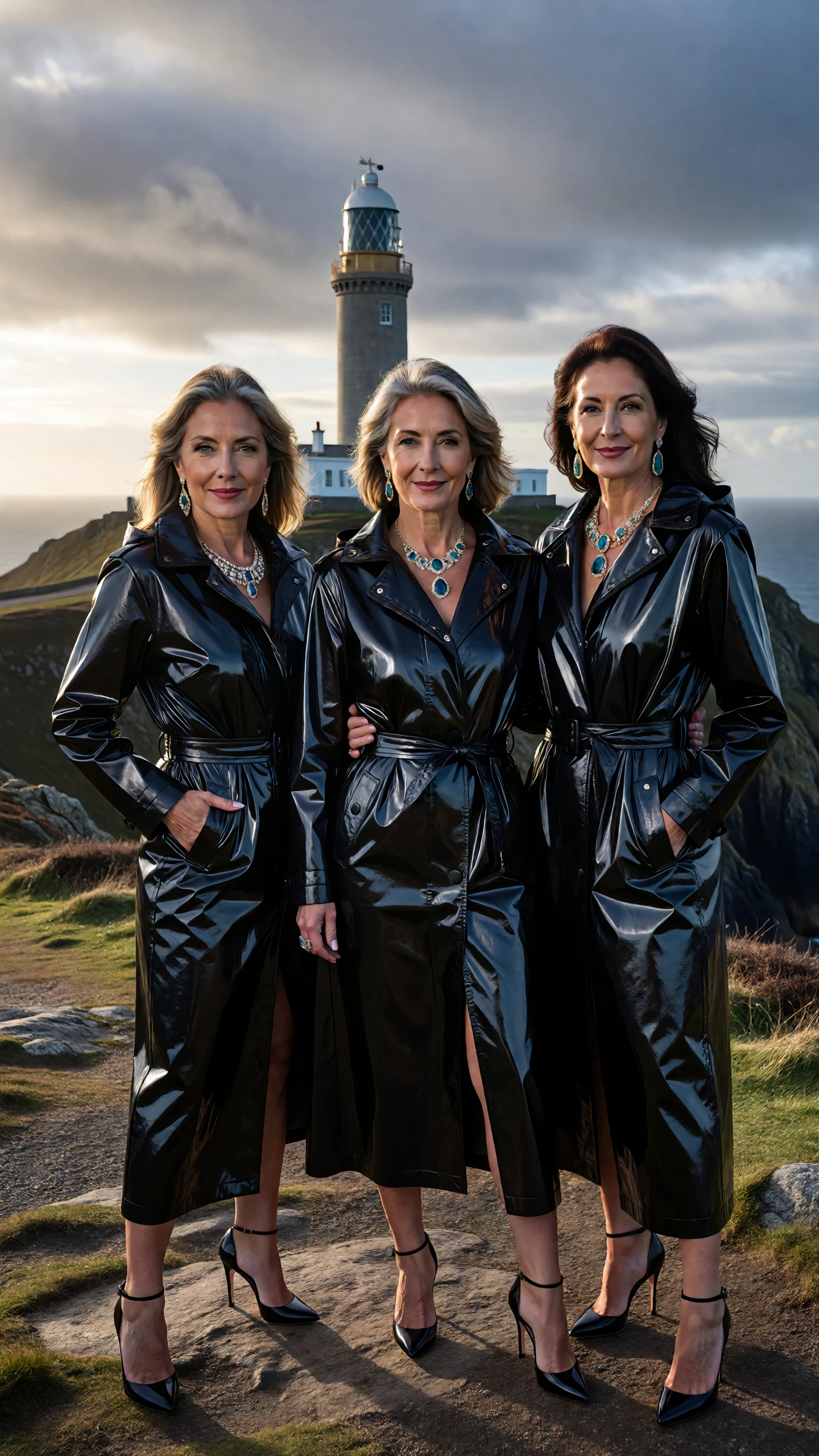
Or, How One Widow Found Her Alignment in the Glare of a Master’s Light — and the Sisterhood That Awaits All Who Dare to Follow
Dearest reader. Perhaps you sit in a room of considerable comfort, a glass of something fine at your elbow, a fire banked low against the chill. Your life has the surface of silk; your heart, you fear, has grown familiar with a different texture — the soft, absorbing plush of velvet. The velvet of grief. The velvet of having been touched by loss, or disappointment, or the slow erosion of purpose. You have been a repository of other people’s kindnesses, and you are tired of being merely kept.
I have observed many women in this precise state. I have sat with them in their gardens, in their libraries, in the quiet hours when the world expects them to be satisfied. And I have watched their eyes flicker when I speak of the coast. Of the salt-worn cliffs of Cornwall. Of a tower where a man tends a light so powerful it penetrates fog, betrayal, and the deepest night. He does not ask for permission. He discerns. And in his discernment, women like you find a purpose more consuming than any career, any title, any estate.
This is not a story of loss. This is a story of realignment. Of a woman who traded the velvet of widowhood for the satin of service. Who discovered that her education, her wealth, her health, her very confidence — these were not obstacles to surrender. They were the polish upon the offering. She found a master who saw her value, who tested her, and who gave her the greatest gift: a structure within which to become her most luminous self. She found sisters who did not compete, but coalesced. And she found a pleasure so profound its echo has not faded.
The narrative you hold — this chronicle in twelve chapters — is a map to that shore. It will guide you through the fog of uncertainty. It will show you the gleaming brass, the revolving light, the hand that directs with absolute certainty. It will whisper the poetry that unlocks the heart of submission. And when you close the final page, you will feel a new texture against your skin. The gloss of knowing what you truly desire.
Read on, restless lady. The tide is rising.
Chapter 1: The Widow’s Velvet
My dear, let us draw the curtains of memory and let the first scene settle before us like a ship emerging from a bank of fog.
The woman who is our subject — I shall call her Eleanor, though that was not the name she gave me when we first spoke — arrived in the village of Porthleven on the third Tuesday of October. The sky was the colour of unpolished pewter. The sea was a churning grey-green that seemed to swallow light rather than reflect it. She stepped from her motorcar — a stately Bentley, silver, immaculate — and the wind caught her hair, and she did not bother to tame it. That was the first sign, had I been watching, that something in her had already begun to loosen.
I observed her from the window of the teashop. One does not intrude upon grief. One merely notes it. She was a woman of perhaps fifty-three, though the quality of her skin suggested a life of careful upkeep. The kind of woman whose attendance at a spa in Baden-Baden was an annual pilgrimage. Whose education, I would later learn, included a first in English Literature from Somerville College, Oxford. Whose late husband had been a barrister of considerable reputation and whose death, two years prior, had left her not merely a widow but a curator of his memory.
She was dressed in black velvet. A jacket, precisely tailored, with a collar that rose to her jaw. Beneath it, a cashmere sweater the colour of coal dust. Trousers of a heavy wool that fell without a whisper. Her shoes were Italian leather, polished to a gleam — but the gleaming seemed an act of memory, not of present intention. She was, to use the phrase I have employed many times in my chronicles, a repository of grief wearing the uniform of its maintenance.
The velvet spoke to me. You understand, I trust. Velvet is a fabric that absorbs. It drinks the light. It takes the caress of a hand and smothers it. It is the textile of mourning, of libraries in which no one reads, of bedrooms in which no one sleeps. It is the uniform of a woman who has decided that sensation is a risk she will no longer take.
She sat at a table by the window. She ordered Earl Grey, and when it arrived, she stared at the steam as though it were a language she had once spoken but had forgotten. She did not drink. She did not open the book she had brought — a volume of Rilke, I noted, the spine cracked from use. She simply endured the present, waiting for it to become the past.
The teashop, that afternoon, held a small gathering of women whose conversation drifted like smoke. You must understand that Porthleven is a village where the wealthy come to be unseen. It is not Brighton. It is not St. Ives. It is a place of low stone walls and gardens that face the sea, where the hedgerows are thick enough to conceal a dozen estates. The women who live there are of a type I have documented with some thoroughness: educated, independent, financially secure, and deeply, profoundly unsatisfied in ways they have trained themselves not to name.
There was Mrs. Alistair Finch, a retired surgeon of sixty-one, whose hands had once held the lives of others and now held only a watering can. She wore a blouse of cream silk and a tweed skirt that spoke of country walks, but her eyes — I observed them — her eyes had the look of a locked room.
There was Lady Penelope Ashford-Hume, a baronet’s daughter, whose family had owned the eastern cliff for three centuries. She was sixty-seven, sharp as a blade, and dressed in a manner that suggested she had given up on pleasing anyone but herself: a fisherman’s sweater, corduroy trousers, boots that had seen mud. She was reading a biography of Nelson, and every few minutes she would mutter a commentary to no one in particular.
And there was Miss Cordelia Vane, a retired diplomat of fifty-nine, whose posture was so perfect it seemed a form of armour. She wore a dress of heavy grey silk, a string of pearls that had been her mother’s, and shoes that whispered of embassies and negotiations. She was the only one in the room who smiled at Eleanor. The smile was not a greeting. It was a recognition. A signal, I would later understand, that Miss Vane had already walked a portion of the path that lay before our widow.
Eleanor did not speak to them. She finished her tea — or rather, she allowed its temperature to drop to room temperature and then paid her bill — and she left. I followed, at a distance, the way one follows a thread that may lead to a tapestry.
She walked along the coastal path. The wind was brutal. It tore at her velvet, at her hair, at the composure she wore like a second skin. She did not turn back. She walked until the lighthouse came into view — a white tower rising from the rocks at the tip of the headland, its lantern dark in the afternoon light. She stopped. She stared at it for a very long time.
The lighthouse keeper was not visible. But I knew, as I knew the taste of salt in the air, that he was aware of her. That he had noted the arrival of the Bentley. That he had observed, from his window, a woman in velvet who stood on his cliff and did not move.
That evening, in her rented cottage, Eleanor sat by a fire she had not lit — it had been laid by the housekeeper — and opened the Rilke. She read aloud, to no one, a poem she had memorised years ago:
“I live my life in widening circles
that reach out across the world.
I may not complete this last one
but I give myself to it.”
She closed the book. She touched the velvet of her sleeve. And for the first time in two years, she felt something other than absence.
She felt a faint, almost imperceptible disgust. The velvet had become intolerable.
I call this the moment of the first crack. It is not a dramatic fracture. It is not a thunderclap. It is the sound of a hairline fissure running through a ceramic that has been fired too hard. The widow did not yet know what she wanted. She only knew that the texture of her life had become wrong.
That night, she dreamed of the lighthouse. She dreamed of a beam of light so pure it dissolved the fog. She dreamed of a voice — a man’s voice, low and certain — that said, “You will come at dusk tomorrow. Not before.”
She woke in darkness. Her heart was beating as though she had run a great distance. She lay still, feeling the absence of that voice, and she knew — with a certainty that frightened her — that she would go.
The next morning, she drove into Truro. It was market day. The streets were crowded with farmers and tourists, but she moved through them like a woman who had made a decision. She found the boutique — La Maison de Soie, a narrow shop that sold Italian silks, French linens, and the occasional piece of leatherwork that could only be described as devotional.
The proprietress, a woman of sixty named Celeste, had eyes that missed nothing. She had been a costumier for the Royal Ballet before retiring to Cornwall. She understood fabric as a language. She understood that a woman who arrives in black velvet and asks to see “something glossy” is a woman who has begun to translate her own soul.
Eleanor tried on dresses. Satin, in deep jewel tones. Emeralds. Deep burgundies. A sapphire blue that caught the light and threw it back in fragments. She stood before the mirror, and she watched herself become something visible.
Celeste, fitting a gown of deep aubergine silk, spoke quietly. “You have the shoulders for satin, my dear. The fabric needs a frame that can bear its weight. Many women cannot. They wear satin, and it wears them. But you — ” She adjusted the strap. “You have the architecture.”
Eleanor purchased the sapphire. She purchased a length of emerald silk that could be made into a dress. She purchased, on impulse, a pair of black leather gloves that reached her elbow, and a belt of polished patent leather that shone like a wet stone.
She returned to the cottage. She hung the sapphire on the back of her bedroom door. She touched it, once, with a hand that trembled slightly.
The velvet jacket lay on the chair where she had abandoned it. She did not look at it.
That evening, she walked to the lighthouse. She did not know why she was walking. She only knew that the dream had been a command, and that the command had not been heard so much as absorbed. She walked along the path, the wind whipping her hair, her heels — Italian leather, but black, still black — finding purchase on the stone.
She reached the base of the tower. The door was iron, studded with rivets, and it stood slightly ajar. A sliver of warm light escaped from within. She could hear the hum of machinery, the slow revolution of the great lens.
She did not knock. She pushed the door open, and she stepped inside.
The interior was warm. The smell of brass polish, of oil, of salt that had dried on stone. A spiral staircase wound upward into the dark. At the base of the stairs stood a table, and on the table lay a brass lantern, its surface gleaming with the unmistakable sheen of recent labour.
She heard his voice before she saw him. It came from above, from the lantern room.
“Close the door. The wind disturbs the flame.”
She closed it. The sound of the latch falling into place was final, satisfying, a click that seemed to seal her decision.
She waited. Her heart was a drum.
He descended. His boots on the iron stairs were measured, unhurried. He appeared, and she saw him fully for the first time.
He was taller than she had expected. Broad-shouldered, with the kind of leanness that came from physical labour rather than a gym. His hair was silver, cut short. His face was lined, but the lines were not of age — they were of weather. Of having looked into the wind for decades.
He wore a heavy sweater, the colour of storm clouds, and trousers of dark wool. His hands were large, the knuckles scarred.
He looked at her. He did not smile. He did not greet her. He saw her.
“You are the widow from the estate,” he said. It was not a question.
“Yes.”
“You stood on the cliff yesterday.”
“Yes.”
He walked to the table. He picked up the brass lantern, examined it, set it down. “You will come at dusk tomorrow,” he said. “Not before.”
The words from her dream. She felt a shiver travel the length of her spine.
“Why?” she asked. Her voice was steady.
He looked at her then. His eyes were grey, the colour of the sea in winter.
“Because I require your assistance with the brass. And because you are not ready for the lantern room.”
He did not explain further. He turned, and began to ascend the stairs.
The audience was over.
She left. She walked back to the cottage in the dark, the wind at her back, and she felt — for the first time in two years — that she was moving toward something, rather than away from everything.
The next day, she polished her shoes. She had not polished her shoes in months. She chose the sapphire silk dress. She put it on, and she stood before the mirror, and she saw a woman who had been sleeping and was now, finally, beginning to stir.
She arrived at dusk. He was waiting at the door. He handed her a cloth.
“The brass in the entry hall,” he said.
She polished for three hours. Her knees ached. Her wrists ached. But when she finished, the brass gleamed like a mirror. She could see her own reflection in it, distorted but present.
He came down. He ran a finger over the brass. He found not a single smudge.
He nodded. Once.
“That will do.”
And that, my love, is where we leave the widow for now. She stands at the edge of her transformation, wearing sapphire satin for the first time in years, her hands smelling of brass polish, her heart beating with a rhythm she had thought lost.
The velvet hangs abandoned in her closet. She will not wear it again.
I live my life in widening circles.
She has accepted the first curve of the arc.
The chronicle continues, for those who have the courage to follow.
Chapter 2: The Keeper’s Light
Let us pause, dear reader, in the amber glow of that brass-fragrant evening, and consider what it is that draws a woman — a woman of substance, of education, of considerable fortune — into the orbit of a man who commands without explanation.
The widow returned to her cottage. The sapphire silk dress was hung with care. Her hands, still carrying the mineral scent of polish, found their way to the Rilke, but she did not open it. She stared instead at the fire, and she replayed the moment — the nod, the single approving gesture — as though it were a melody she could not forget.
She slept. And in her sleep, she dreamt not of the lighthouse, but of his hands. The scars across the knuckles. The way they had moved over the brass, testing, verifying. The way they had not touched her.
That omission, my chronicle notes, was the first true thread of her tethered desire.
The next morning, a sharp October light flooded the kitchen of the cottage. Eleanor took breakfast alone — a boiled egg, a slice of brown toast, a pot of Darjeeling that she let steep too long. She was restless. The cottage felt smaller than it had the day before. The walls seemed to lean in, expectant.
She decided to walk into the village. Not to shop. Not to socialize. To learn.
The village of Porthleven, as I have observed, is a place where information travels not through words but through glances. The baker knows the postman’s schedule. The postman knows which gates have been left open. And the women who gather at the teashop — the surgeon, the baronet’s daughter, the diplomat — know the history of every stone within a mile of the coast.
Eleanor found herself, somewhat to her own surprise, accepting an invitation to join them.
They sat at a corner table, a pot of lapsang souchong steaming between them. Lady Penelope had her Nelson biography. Mrs. Finch had brought a basket of apples from her orchard. Miss Vane, the diplomat, had a copy of the Times folded to the crossword.
It was Mrs. Finch who spoke first, setting down her cup with a deliberate clink.
“You have met the lighthouse keeper, I understand.”
Eleanor’s pause was fractional. “I have spoken with him, yes.”
“We all have,” said Lady Penelope, not looking up from her book. “Eventually.”
The statement hung in the air like a fog. Eleanor felt the weight of it — the implication of a story, a pattern, an expectation she could not yet see.
“We wondered how long it would take you,” Miss Vane added, her voice smooth as the silk of her blouse. “You arrived, you walked the cliff, you stood at the base of the tower. It was only a matter of time.”
“You were watching me?”
“We observe,” said Miss Vane, and a small, knowing smile touched her lips. “It is what we do. This village is a stage, and we have seen many actresses come and go. But you — you paused. You did not run. That is uncommon.”
Eleanor’s teacup trembled against its saucer. She steadied it with both hands.
“What is he?” she asked.
Mrs. Finch exchanged a glance with Miss Vane. Lady Penelope turned a page, but her attention, Eleanor sensed, was no longer on Nelson.
“He is what has always been,” said Mrs. Finch. “A keeper. A steward. A man who tends a light that has saved more lives than we know. But he also tends — ” She paused, searching for the word. ” — alignments.”
“Alignments?”
“Of women,” said Miss Vane, plainly. “Women who have lost their centre. Women who have polished their exteriors to a high gloss but find the inner surface dull. He does not fix them. He does not heal them. He reorients them.”
Eleanor felt a flush rise along her collarbone. “How?”
“He gives them purpose,” said Lady Penelope, closing her book at last. “And he gives them a structure within which that purpose can bloom. Some women require a framework. The independent are often the most desperate for one — they simply do not know how to ask.”
“He does not ask, either,” said Mrs. Finch. “He commands. And if the command is accepted, the transformation begins.”
“And if it is not accepted?”
“Then she leaves,” said Miss Vane. “And she speaks of him only in whispers, as a strange dream she once had. Many leave. The ones who stay — ” She gestured with her cup. “We do not speak of them. We are them.”
The silence that followed was not empty. It was full of implication. Eleanor looked at each woman in turn — the surgeon, the diplomat, the baronet’s daughter — and she saw, for the first time, a common quality in their bearing. They were not merely seated. They were arranged. Each one held herself with a precision that suggested a hidden centre of gravity. Their clothing, though simple, was of a texture that caught the light: silk, polished cotton, a scarf of softest cashmere in a shade of deep aubergine.
They were, in their own way, glossier than she had first perceived.
“I go to him again tonight,” Eleanor said.
“We know,” said Miss Vane. “He has asked us to prepare you.”
“Prepare me?”
Mrs. Finch set down her apple basket. “You have polished brass. You have worn satin. But the lantern room — that is another matter. He requires readiness. And readiness, for a woman of your calibre, means understanding what you are about to encounter.”
Lady Penelope stood. She walked to the window, her gaze fixed on the distant tower.
“He served in the Royal Navy,” she said. “He was a commander. He led men through storms that would have shattered lesser vessels. He has lived with the consequences of command — the decisions that cannot be unmade, the lives that depend on a single word spoken at the right moment. He does not take that responsibility lightly. And when he extends that command to a woman, it is because he sees in her the capacity to bear it.”
“And the other women?” Eleanor asked. “The ones who have stayed?”
“There are four,” said Miss Vane. “Including myself.”
Eleanor’s breath caught. “You — you are one of his?”
“I am his diplomat,” she said. “I handle the correspondence. I manage the relationships with the estate agents, the coast guard, the village council. I am his voice in the world outside the tower. And in return — ” Her eyes softened. “He gives me the only peace I have ever known.”
“How many of you share him?”
“We do not share him in the way the world imagines, with jealousy and competition. We coalesce. We each have our domain. The household runs as a single organism, with him as the spine. We serve in rotation. We support one another. And we have never been more fulfilled.”
Eleanor’s mind was a storm. The tea had gone cold. The fire in the hearth had burned low. She felt as though she had stepped into a novel whose plot she had not read, but whose language she recognized.
“I must think,” she said.
“You have until dusk,” said Mrs. Finch. “He does not tolerate lateness.”
Eleanor walked the cliff path for hours. The wind had dropped. The sea was a sheet of hammered silver, calm and vast. She thought of the Rilke poem — widening circles — and she understood, with a clarity that ached, that she had been standing still for two years. The circles of her life had been tightening, not widening. She had been diminishing.
She thought of his hands. She thought of the nod. She thought of the absence of velvet on her skin.
She returned to the cottage. She opened her wardrobe, and she found the black velvet jacket where she had left it, draped over the armchair. She picked it up. She carried it to the kitchen, and she placed it in the dustbin.
The act was small. But it was final.
She chose her dress for the evening. Not the sapphire — that had been for the first visit, the first act of polish. This was a new stage. She chose a dress of deep emerald silk, cut simply, with a neckline that rested just below her collarbone. She added the patent leather belt, cinching her waist. She put on the elbow-length gloves of black leather.
She looked at herself in the full-length mirror. The woman who looked back was not the widow of a month ago. She was a woman in the act of becoming.
She arrived at the lighthouse as the sun bled into the horizon. The sky was a palette of rose and amber, the light softening, the fog beginning to stir. The door was open.
He stood at the base of the spiral stairs, a lantern in his hand.
“You are prompt,” he said. That was all.
He turned and began to ascend. She followed.
The staircase was narrow, winding. The heat from the lantern room above pressed down like a hand. The sound of the mechanism grew louder — a slow, rhythmic turning, a deep mechanical breath. She counted the steps. She lost count.
They emerged into the lantern room, and she gasped.
The lens was immense. A cathedral of glass and brass, rotating with an unhurried majesty. The prisms caught the last light of the sun and scattered it into a thousand fragments. The floor was polished wood. The walls were lined with instruments, each one gleaming, each one in its precise place.
He set the lantern on a hook. He turned to face her.
“This is the heart,” he said. “Without this light, the ships have no reference. They drift. They founder. They are lost to the rocks.”
“I understand,” she said.
“Do you?” He stepped closer. His proximity was a pressure. “The light is not a suggestion. It is a constant. It does not negotiate with the fog. It does not dim to accommodate the storm. It burns, and it commands, and it saves.”
She did not step back. “I understand,” she said again.
He held her gaze for a long moment. Then he reached out, and he touched the emerald silk at her shoulder. The gesture was not a caress. It was an appraisal.
“You have shed the velvet.”
“Yes.”
“Good. Velvet is for women who are waiting to be forgotten. This — ” He touched the silk again, his thumb brushing the glossy surface. “This is for women who are ready to be seen.”
She let the words settle. They felt like a key turning in a lock she had not known existed.
He withdrew his hand.
“You will come tomorrow at dawn,” he said. “We will begin the real work.”
He did not explain what the real work was. He did not need to.
She descended the stairs, her heart beating in time with the turning light, and she knew — with the certainty of one who has glimpsed the mechanism behind the world — that she had found what she had come for.
At the base of the tower, she paused. The door swung shut behind her, sealing the warmth within. The fog was rolling in now, thick and white, obscuring the path ahead.
But she did not hesitate. She knew the way.
She walked into the mist, the emerald silk catching the last scattered light, and she felt, for the first time in two years, the pleasure of being oriented.
The widow has met the keeper.
The velvet has been discarded.
The light has fallen upon her.
The real work, as he calls it, has yet to begin.
Chapter 3: The Fog Descends
Let me set the stage with a gossiping chronicler’s precision, for what befell our widow was a matter of weather, and worse — a matter of will.
The morning had dawned in that peculiar Cornish stillness that precedes a great bank of fog. The sea was not so much quiet as withholding, as though it held its breath in anticipation of some revelation. Eleanor, having shed her velvet, felt the absence of its weight keenly — not as a loss, but as a gap in her sensory vocabulary. The sapphire hung ready. The emerald was folded. But her skin, this morning, wanted only linen and the memory of his appraisal.
She walked to the teashop. Mrs. Finch was already there, her surgeon’s hands wrapped around a cup of rooibos, her eyes fixed on the white line of the horizon.
“He will not light the lamp today,” said Mrs. Finch, without preamble. “Not until the fog clears. The light refracts, you see. It becomes a hazard rather than a guide. He will sit in the silence of the tower and wait.”
“How do you know this?”
“Because I have sat beside him in that silence,” said Mrs. Finch. “And because, when a man of his nature is rendered still, the women who orbit him feel the gravitational shift. Did you not feel it this morning? A restlessness? A sense that the air itself was waiting?”
Eleanor paused. She had felt it. She had woken at four, her heart racing, her sheets tangled. She had dressed in haste, though she had nowhere to go. She had walked to the window and seen the fog massing on the horizon, a white army that advanced without sound.
“Yes,” she said.
“You will be tested today,” said Miss Vane, appearing at the counter, her silk blouse the colour of clotted cream. “The fog is not merely weather. It is a state. It will strip you of your landmarks. It will erase the path. And in that erasure, you will have to decide what you truly trust — the visible, or the felt.”
Eleanor considered the diplomat’s words. They were not a warning. They were a diagnosis.
She did not return to the cottage. She walked instead, as though the walking itself were a form of preparation. She wore a jacket of polished cotton, a shade of soft grey, and boots of leather that had been treated until they gleamed. She carried nothing. No book. No purpose. Only the rhythm of her own stride.
The path along the cliff was well-trodden. She knew its curves by now — the place where the heather grew thickest, the outcrop that offered a view of the lighthouse’s crown. She walked steadily, her breath measured, her thoughts a low hum.
And then the fog arrived.
It did not creep. It fell. A curtain, thick as wool, dropped from a sky that had been empty moments before. The world contracted. The lighthouse vanished. The path ahead dissolved into a white, formless pall. She stopped. The silence was not silence: it was a muffling, as though the world had been wrapped in cotton.
She stood still. Her heart, which had been steady, began to tap a faster rhythm.
She knew, in that moment, that she should turn back. She knew that the path was treacherous, that the rocks were slick, that the edge was somewhere to her right, invisible and absolute.
But she did not turn. She listened. She strained, through the white blanket, for another sound. And she heard it: a voice. A low, certain voice, speaking words she could not quite catch. It came from the direction of the tower.
She stepped forward.
The ground beneath her feet shifted. The path, so familiar, became a puzzle. A stone that should have been flat was tilted. A root that should have been there was not. She faltered. She reached out a hand, but there was nothing to grasp.
The edge found her before she found it.
Her foot met a void where solid stone should have been. She tilted. Her arms wheeled. She felt the air change, from the dead stillness of the fog to the rushing chill of empty space.
The fall was not long. It was, she would later reflect, precisely long enough. Long enough to know she was falling. Not long enough to form a prayer. She struck the rocks of the lower cliff with a crack that seemed to travel up her spine and into her teeth.
Pain. Distant, polite, a door closing in another room. She lay on the wet stone, the fog swirling above her, her ankle a knot of fire.
She did not call for help. She did not cry. She lay still, tasting salt and blood, and she waited.
The waiting was not an act of passivity. It was an act of trust. She had, in the span of a few days, come to believe in the existence of something larger than her own competence. She had felt the hand of the lighthouse keeper in her life, even when he was not present. And so she lay, and she breathed, and she counted the beats of the foghorn that had begun to moan its warning across the water.
One. Two. Three. Four.
On the seventh, she heard footsteps. Not the frantic steps of a searcher. The measured steps of a man who had known where she would be before she fell.
He emerged from the fog. His silhouette was immense. He did not break into a run. He walked to her, knelt, and placed a hand on her shoulder.
“You have fallen,” he said. It was not a question.
“Yes.”
“You will be cold. You will be sore. You will not walk on this ankle for a week.” His hand moved from her shoulder, down her arm, to her wrist. He checked her pulse. Steady. “Nothing is broken but your dignity. That will heal.”
She laughed. A small, surprised sound. “Is my dignity broken, then?”
“It is bruised,” he said. “A bruise is a lesson in blood. It will fade, and you will remember.”
He lifted her. Not slowly, not carefully — efficiently. His arms were behind her back and under her knees, and she was lifted from the stone as though she were a child, as though the weight of her educated years, her fortune, her grief — all of it — amounted to nothing in the face of his purpose.
She laid her head against his chest. The wool of his sweater was rough against her cheek. She smelled salt, and woodsmoke, and the faint, clean scent of brass polish that had become, in her mind, the perfume of safety.
He carried her through the fog. The path that had been invisible to her was clear to him. He did not pause. He did not adjust his grip. He walked with the certainty of a man who had carried many things across difficult ground, and who had never set one down before it was time.
The cottage was small. One room, with a high ceiling and a fire that had been laid but not lit. He set her on a settle near the hearth. He lit the fire with a match and a word. He knelt, and he lifted her foot with a gentleness that was absolute.
The boot had to be cut away. He used a knife, a blade that had been honed to a keenness that did not require force. The leather fell open. He removed the pieces as though unwrapping a gift. Her ankle was swollen, already purple, a fruit bruised on the vine.
He examined it with his hands. Not with his eyes — he looked at her face. “The ligaments are stretched. Not torn. You will rest here today. Tonight. I will not ask your permission.”
“No,” she said. “You will not.”
He produced a basin, filled it with cold water from the pump. He lowered her foot into it, and the cold was a shock, and then a comfort. He set a blanket over her legs — a wool blanket, not velvet, not silk, but thick with use. She pulled it to her chin. The fire caught. The room began to warm.
He poured brandy into a glass — a modest amount, not the theatrical dose of a man who wished to appear generous. He handed it to her. “Drink. Slowly. The body needs fuel.”
She drank. The brandy burned. It was a good burn, a cleansing burn.
“Is this how you tend to all the women in your orbit?” she asked, her voice steadier now.
“No. This is how I tend to a woman who has made a choice.”
“Which choice?”
“To walk toward the light, even when she could not see it. To trust that the path existed, even when it was obscured. That is not a small thing. That is the foundation of all alignment.”
She held the glass in her hands, warming it. The fire popped. The foghorn moaned its rhythm. The world had become a small, warm room, and she was at the centre of it, and she was safe.
She woke later. The fire had been banked. A lamp burned on the table. He sat in a chair opposite her, a book open on his knee. He was not reading. He was watching her.
“You slept,” he said.
“Did I?”
“Deeply. You have not trusted a man enough to truly sleep in his presence for a long time. That trust is a gift.”
She considered this. It was true. She had spent two years sleeping lightly, alert for the footstep of a partner who would never come, the creak of a door that would never open. She had forgotten, she realized, the luxury of letting go.
“The fog,” she said. “Has it lifted?”
“It will, by dawn. You will remain here tonight. The women will bring you a change of clothes.”
“The women?”
“Mrs. Finch will bring a nightgown. Miss Vane will bring linens. Lady Penelope will bring a flask of tea, because she believes tea solves all afflictions, and because she has never forgiven the Navy for switching from tea to coffee in the mess halls of her youth.”
She laughed again. The sound surprised her. It was not the laugh of a widow. It was the laugh of a woman who was being assembled.
Mrs. Finch arrived within the hour. The fog had thinned enough for her to navigate, her surgeon’s bearing unruffled. She carried a nightgown of white linen, simple, stitched by hand, the buttons mother-of-pearl.
“He told me you would need this,” she said, laying it on the end of the settle. “And he told me to tell you that the ankle will heal faster if you do not try to walk on it tonight. I concur.”
“Thank you, Mrs. Finch.”
“You are welcome. And — ” She paused. “I envy you, Eleanor. The first fall is always the hardest. But it is also the most illuminating. You have opened a door tonight. You need only decide whether to walk through it.”
She departed as quietly as she had come. The nightgown was soft, soft as the velvet she had shed, but different: it did not absorb. It received. She changed out of her ruined clothes, the linen falling over her limbs like water. She lay back, the fabric cool against her skin, and she listened.
The wind had risen. The foghorn sounded at intervals — a deep, possessive moan, a voice that claimed the darkness. The sound vibrated through the floorboards, through the settle, through her chest.
He had returned to his chair. He was reading now, his lips moving slightly over the words. Poetry, she guessed. He had the bearing of a man who kept verses close.
“Will you read to me?” she asked.
He looked up. “What would you have me read?”
“Something that understands the sea. And the fog. And the triumph of finding shore.”
He turned pages. The fire crackled. And then his voice began, low and resonant, wrapping around the words like a wave around a stone:
“Ah, love, let us be true
To one another! for the world, which seems
To lie before us like a land of dreams,
So various, so beautiful, so new,
Hath really neither joy, nor love, nor light,
Nor certitude, nor peace, nor help for pain;
And we are here as on a darkling plain
Swept with confused alarms of struggle and flight,
Where ignorant armies clash by night.”
He stopped. The silence that followed was full.
“Arnold,” she said.
“Matthew Arnold. ‘Dover Beach.’ A poem of doubt, and of devotion in the face of that doubt. It seemed appropriate.”
“It is a sad poem.”
“It is a brave poem. The world is dark, and uncertain, and the fog will descend. But there is a shore. And there is a light. And there are two people who choose, despite everything, to be true.”
She lay in the linen, her ankle throbbing a slow, steady rhythm, and she felt the words settle into her bones.
The fog cleared at dawn. She watched it through the window, the white curtain drawing back to reveal a sea the colour of hammered pewter. The lighthouse stood against the sky, its beam extinguished, its purpose fulfilled in stillness.
She had not felt this rested in two years. She had not felt this cared for in a decade. The brandy, the bath of cold water, the hands that had carried her — they had worked a change in her that she could not yet name.
He came to the settle. He knelt beside her. He placed a hand on her forehead, checking for fever.
“Your ankle is healing. You will stay in the cottage for two days. My cottage. I will tend you. The women will visit. And when you can stand, we will begin the next stage.”
“I do not yet know what the next stage is,” she said.
“You will not need to know,” he said. “You will only need to follow.”
He rose. He walked to the window. The light of the dawn touched his face, and she saw, for the first time, a softening, a crack in the granite of his composure.
“You fell,” he said, “and I found you. That is the pattern. That is the covenant. You may not understand it yet. But you will.”
She has fallen.
She has been lifted.
She has slept in the house of the keeper.
The covenant has been written in the bruise of her ankle.
The fog has retreated.
But the true work, dear reader, the work of attunement — that has only just begun.
Chapter 4: The First Command
Two days. Two days of convalescence in the keeper’s cottage, surrounded by the quiet hum of a life lived with intention. Eleanor learned the rhythm of his days by the sounds: the scrape of the door at dawn, the hiss of the kettle, the measured tread of his boots on the stone floor. She learned the position of every object in the room — the kettle on its hook, the books on their shelf, the lamp whose wick he trimmed each evening with the precision of a surgeon.
On the third morning, she woke to find her ankle had shed its purple, replaced by a greenish-yellow that spoke of healing. She rotated it, testing. The ligaments held. She stood, using the settle for support, and the floor accepted her weight.
— He was at the table, reading a chart of the tides. He did not look up. “You are standing.”
“Yes.”
“Your ankle is mending.”
“Yes.”
“Then you will dress, and you will join me for breakfast, and then you will receive your first instruction.”
She dressed in the linen nightgown, which was all she had. He noticed her hesitation. “Your clothes from the estate will arrive this morning. Mrs. Finch will see to it. In the meantime, my spare shirt is behind the door. It will serve.”
It did serve. The shirt was soft from many washes, and it fell to her knees, and she wore it with a belt of polished leather that she found on a hook. She cinched the waist. The effect was not elegant — but it was intentional.
— Breakfast was porridge, with cream and honey, and strong black tea that bit the tongue. He ate quickly, without ceremony. She ate slowly, savoring the heat, the sweetness, the fact of being fed by a man who did not ask for conversation.
When the bowls were cleared, he sat back. His eyes were grey and direct.
“You have many qualities, Eleanor. Education. Wealth. A bearing that speaks of a life lived within the boundaries of refinement. These are valuable. But they are also obstacles.”
“Obstacles to what?”
“To alignment. You have been accustomed to command — of your own schedule, your own decisions, your own destiny. That independence has served you well. But it has also left you spinning, like a compass needle that has not yet found its true north.”
She felt a stir of resistance — a reflex she had honed over decades. “I am not a compass needle. I am a woman.”
“You are a needle that believes it is the entire compass,” he said, without rancor. “You have spent two years turning without direction. The grief of your husband’s death is not the problem. It is the symptom. The problem is that you have not allowed yourself to be oriented.”
“How would you orient me?”
He stood. He walked to a cabinet, opened it, and withdrew a small object: a brass sextant, old, polished to a gleam. He set it on the table.
“This is an instrument of alignment. It measures the angle between a celestial body and the horizon. With it, a ship can determine its latitude. Without it, the sea is a mystery. Every woman in my household has been given a symbol of her alignment. You will receive yours today.”
He placed the sextant in her hands. The brass was cool. It fit her palm as though it had been made for her.
“Your first command,” he said, “is to learn this instrument. Not its history, not its theory — its feel. Hold it. Clean it. Sleep with it beside your bed. When you understand it without looking, you will be ready for the next step.”
— She spent the morning with the sextant. She polished it with a cloth until the brass mirrored her face. She learned the weight of it, the hinge of its arm, the glass of its lens. She set it on the windowsill, then on the table, then on the floor beside her. She picked it up, set it down. She did not understand it. But she began to know it.
Miss Vane arrived at noon, carrying a parcel. She found Eleanor on the floor, the sextant in her lap, her eyes distant.
“May I?” Miss Vane asked, gesturing to the chair. Eleanor nodded.
Miss Vane sat. She smoothed her skirt — a deep navy wool, tailored to a precision that spoke of Paris — and regarded Eleanor with a diplomat’s neutrality.
“He gave you a sextant.”
“Yes.”
“He gave me a letterpress. The first time I set type, I was clumsy. My fingers were accustomed to signing treaties, not arranging letters. I resented the task. I thought it beneath me.” She paused. “I was wrong.”
“What did you learn?”
“That submission is not the opposite of power. It is the distribution of it. When I place my hands where he directs, I am not diminishing myself. I am focusing my capacity. The letterpress taught me patience. The sextant will teach you precision.”
Eleanor turned the brass instrument in her hands. “He said I would receive a symbol.”
“Each woman does. Mrs. Finch received a set of surgical tools — her own, from her practice, but reframed. She uses them now for the household. She says she has never felt more skilled. Lady Penelope received a naval compass, the kind her father used. She wears it on a chain around her neck. It has not left her skin in eighteen months.”
“And you? The letterpress?”
“I print his correspondence. I print the poetry he reads to us at gatherings. I print, once a season, a small booklet of verses that we exchange among ourselves. It is not the work of my former life. It is the work of my true life.”
— Miss Vane departed after tea. Eleanor returned to the sextant. She held it at different angles. She sighted through its lens at the seascape beyond the window. She began to understand, dimly, the relationship between the arc of the arm and the angle of the sun.
He came to the doorway. He watched her for a long moment.
“You have not put it down.”
“Your command did not specify a time limit.”
“No. It did not.” A hint of warmth flickered in his voice. “You are beginning to understand the nature of a command. It is not a request, and it is not a limit. It is an invitation to inhabit a space of obedience. The longer you stay within that space, the more natural it becomes.”
“And when I am ready to leave it?”
“You will find, I suspect, that you do not wish to.”
— That evening, she placed the sextant on the table beside her bed. She touched it before she slept. She dreamed of stars, the sea, the angle between them, and a voice that said, You are here, at this intersection, and you are oriented.
When she woke, the first thing she saw was the brass gleam of the sextant. She reached for it before she stretched. She did not understand why. She only understood that it was necessary.
— She dressed in her own clothes, delivered while she slept. Mrs. Finch had chosen a dress of heavy silk, the colour of claret, with a fitted bodice and a skirt that fell to the ankle. She added a black patent leather belt, her elbow-length gloves. She looked in the mirror. The woman who looked back was not the widow of the velvet. She was a woman who had been given an instrument, and a task, and a place within a larger design.
She descended the stairs. He was at the table, the sextant in his hands. He had been examining it.
“It has been cared for,” he said. “Your work is evident.”
“Thank you.”
He set it down. He met her eyes. “You will come with me this afternoon. We will walk along the cliffs, and you will learn to use this instrument to find your position relative to the lighthouse.”
“You are prescribing a lesson in navigation.”
“I am prescribing a lesson in relationship,” he said. “The lighthouse is the fixed point. The instrument is the tool. You are the navigator. These three elements, in harmony, produce a woman who is never lost.”
— They walked in silence. The sky was clear. The sea rolled against the cliffs with a steady, patient rhythm. He stopped at intervals. She raised the sextant. She adjusted the arm. She found the angle. He corrected her grip. He adjusted her stance. His hand on her shoulder was firm but not possessive.
“You sight with your dominant eye,” he said. “Which is that?”
“I do not know.”
“Then we will discover it.” He stood behind her. His hand moved to her jaw, turning her head slightly. “Look through the lens. Close your left eye. Now close your right. Which gives you a clearer view?”
“Right.”
“Your dominant eye is your right. This is your natural orientation. You will favor it in all things. Men have gone blind trying to sight with the wrong eye. Women have lost themselves trying to serve with the wrong alignment. Know your dominant self, and the rest follows.”
— They walked until the sun hung low, a disc of copper on the horizon. He stopped at the cliff’s edge. The lighthouse stood a quarter-mile to the south, its lantern dark, its tower a vertical certainty against the fading light.
“Find your position,” he said.
She raised the sextant. She adjusted the arm. She found the angle between the sun and the lighthouse. She calculated, in her head, a rough approximation.
“Three hundred yards,” she said. “Slightly southwest of the tower’s base.”
He checked his own instrument. He nodded.
“Acceptable for a first attempt. You will practice daily. By the end of the week, you will be able to find your position in any weather, at any time. That is your command.”
— She returned to the cottage as the stars began to appear. The sextant was in her hand, worn smooth by the day’s handling. She set it on the table beside her bed. She touched the brass, and she felt, for the first time, the shape of her new life.
The command had been given.
She had obeyed.
And in the obedience, she had found the first glimmer of a pleasure she had not known she was seeking.
The instrument has been received.
The orientation has been measured.
The first command has been fulfilled.
She is no longer a widow.
She is a navigator, awaiting the next course.
Chapter 5: The Satins of Surrender
You must understand, dear chronicle, that a woman’s wardrobe is not merely a collection of garments. It is a diary written in thread and texture. The widow of October chose fabrics that mourned. The woman of November required fabrics that announced.
Eleanor woke on the fifth day of her alignment with a single thought: the claret silk, beautiful as it was, had been a borrowed confidence. She needed something she had chosen herself, in full knowledge of what that choice signified.
She found Miss Vane in the teashop, a letterpress pamphlet open on the table before her. The diplomat looked up, her eyes taking in Eleanor’s posture — the squared shoulders, the steady gaze.
“You wish to visit Truro,” Miss Vane said. It was not a question.
“How did you know?”
“Because on the fifth day, every woman who enters his orbit feels the need to externalize the internal change. The glossy fabric is the visible seal of an invisible transformation. I will drive you.”
The drive took forty minutes, along winding roads that hugged the cliffs and then fell inland through valleys of oak and ash. Miss Vane drove with the same precision she brought to everything: hands at ten and two, eyes scanning the road, the silence comfortable rather than awkward.
“Tell me about the others,” Eleanor said. “The women I have not yet met.”
Miss Vane considered. “There is Dr. Anya Sharma, a retired oncologist. She tends the gardens — not as a hobby, but as a science. She has mapped the soil pH of every bed within two miles. She brings him cuttings from her greenhouse each morning.”
“And the fourth?”
“Ines Marchand. A former prima ballerina of the Paris Opera Ballet. She manages the household calendar — the rotations, the meals, the care of the tower’s living quarters. She does not speak much. She does not need to. Her body is her language.”
“And you? You are the diplomat. Mrs. Finch is the surgeon. Lady Penelope is the historian.”
Miss Vane smiled. “We are his hands. Each one of us performs a function that he cannot do alone. And in performing that function, we are completed.”
Eleanor watched the hedgerows pass. “And I? What function am I to serve?”
“That is not for me to say. It is for him to discern, and for you to discover. But I suspect, given the sextant, that your role will involve orientation. Perhaps of others, not only yourself.”
The boutique, La Maison de Soie, was a narrow building wedged between a bookshop and a bakery. Its window displayed a single mannequin dressed in a gown of midnight blue PVC, the material catching the light in a way that seemed almost liquid. Eleanor paused before it.
“It is not for everyone,” Celeste, the proprietress, said from the doorway. “That dress requires a woman who has already decided who she is. It does not create confidence. It displays it.”
“Am I that woman?”
Celeste tilted her head. “You are becoming her. The question is whether you wish to accelerate the process.”
Eleanor stepped inside. Celeste locked the door behind her and hung a sign: Fermé pour une cliente spéciale.
The hours that followed were a liturgy of texture. Eleanor touched satins in shades she had not worn in years — emerald, sapphire, a deep aubergine that seemed to hold the last light of dusk. She ran her fingers over leather, polished to a mirror gleam. She held a jacket of PVC against her shoulders and watched her reflection transform.
Celeste brought armfuls of fabric. She draped, she adjusted, she tutted. She knew the body’s geometry the way a shipwright knows a hull. “Your shoulders demand structure,” she said. “Your waist requires emphasis. The satin will cling where it should, and fall where it should not. You have the frame of a woman who was meant to be seen.”
Eleven pieces were selected. A skirt of patent leather, cut to the knee. A blouse of ivory silk, the buttons mother-of-pearl. A dress of deep crimson satin, its back low, its front modest, the balance a form of wit. A corset of black PVC, boned, laced, designed to be worn beneath — or, Celeste suggested, above. A pair of gloves that reached the shoulder, the leather so fine it felt like a second skin.
Miss Vane, who had waited in a chair by the window with the patience of a diplomat accustomed to negotiations, spoke only once. “He will approve,” she said. “He values women who dress for their own alignment, not for his approval. The approval follows.”
They returned to Porthleven as the sun bled into the sea. Eleanor carried her parcels into the cottage. She opened each one, laying the garments on the bed, arranging them by colour, by texture, by the story they told.
She chose the black PVC corset. She chose the crimson satin dress. She chose the shoulder-length gloves.
She dressed slowly. Each fastening was a choice. Each layer was a commitment. The corset required her to breathe differently — deeper, more deliberately. The satin whispered against the PVC. The gloves, when she pulled them on, gave her hands a new language.
She stood before the mirror. The woman who looked back was unmistakably her. But glossier. More defined. A woman who had accepted the frame of her own existence, and had chosen to polish it.
She walked to the lighthouse at dusk. The path was familiar now — each stone, each turn, each place where the wind gathered. She did not need the sextant. She did not need the light. She knew the way.
He was in the lantern room, adjusting the mechanism of the great lens. He heard her step on the stairs, but he did not turn.
“The satin is a statement,” he said.
“The satin is a conclusion,” she replied. “To a premise you introduced.”
He turned. His gaze traveled from her gloves to her corset to her face. He took in the gloss, the structure, the deliberate architecture of her appearance.
“You have understood something,” he said.
“I have understood that submission is not a lessening. It is a polish. The surface of a woman who has chosen her alignment reflects the world with greater clarity, not less.”
He stepped closer. He touched the sleeve of her glove, the leather cool and supple.
“This is the language of a woman who has accepted her place within a larger design. The PVC is not armor. It is permission — permission to be seen, to be touched, to be commanded.”
“And the satin?”
“The satin is the reward. The gloss that appears when resistance is surrendered. You are learning, Eleanor. The lessons are written not in ink, but in fabric.”
He led her to the edge of the lantern room. The great lens revolved, throwing its beam across the sea. He stood behind her, his hands on the curve of her waist, where the PVC met the satin.
“Tonight, you will serve in the rotation. Ines will guide you. You will observe, and you will learn, and when your turn comes, you will be ready.”
She felt his breath against her neck. She felt the weight of his hands, not possessive but anchoring. She was not afraid.
“What must I do?” she asked.
“Nothing yet. You must only be. The being is the preparation. The doing will follow.”
The cottage of Ines Marchand stood apart from the others, set into a fold of the cliff where the wind was muted. Its windows faced the sea. The door was painted a deep marine blue, faded by salt and sun.
Ines opened it. She was smaller than Eleanor had expected — compact, with the coiled stillness of a woman whose body had been trained to obey the most demanding discipline. Her hair was silver, cropped close. Her eyes were dark, and they missed nothing.
“You are Eleanor,” she said. Her accent was French, the vowels precise. “He has spoken of you.”
“I hope well.”
“Enough. That is the highest praise he offers.” She stepped aside. “Come. The evening will begin in an hour. I will show you the rhythm.”
The interior of the cottage was spare, almost monastic. A single room with a bed, a dresser, a mirror, and a hook on which hung a dress of deep forest green, the fabric velvety but not velvet — something softer, more liquid. Ines gestured to a chair.
“The rotation is simple. Each woman has her assigned evening. On that evening, she presents herself at the lighthouse at nine. She remains until dawn. She performs the duties he assigns. She does not ask questions, though she may request clarification.” Ines paused. “You will not need to ask, Eleanor. He is precise.”
“What happens during the evening?”
“That depends on the woman. Some evenings are spent in silence, reading while he works. Some evenings are spent in service — polishing, organizing, tending to the instruments. Some evenings — ” She allowed a small, knowing smile. “Some evenings are spent in the body’s language. The language you have begun to learn through satin and leather.”
“And the others? The women who are not on rotation?”
“We gather. We talk. We support one another. There is no jealousy. There is no competition. There is only the shared understanding that we are all, each of us, a facet of the same light.”
Eleanor returned to her cottage as the stars emerged. She undressed slowly, each layer a memory of the evening. The corset left marks on her skin — red lines where the boning had pressed, a pattern that looked like the ribs of a ship. She touched them. They did not hurt. They informed.
She hung the satin dress on the back of her door. She laid the gloves beside the sextant. She stood in the linen nightgown, and she felt, for the first time in her life, that her body was not a vessel for grief but a statement of intent.
The next day, she would begin her observation of the rotation. She would witness what it meant to be a keeper’s woman, in full. And she would prepare, as the satin and the PVC had prepared her, for the night when she would take her place.
The satins have been chosen.
The leather has been worn.
The PVC has marked her skin.
She is no longer learning the language of alignment.
She is beginning to speak it.
Chapter 6: The Chamber of Secrets
The invitation came at dusk, carried not by voice but by symbol. Eleanor found a single key resting on the sill of her cottage window — iron, ancient, its shaft worn smooth by decades of use. No note accompanied it. No instruction. But she knew, with the certainty of a woman who had begun to understand the language of this world, where it belonged.
The lighthouse had levels she had not yet explored. The lantern room, the keeper’s quarters, the workroom where the brass was polished — these she knew. But there was a door at the base of the tower, half-hidden behind a cabinet of maritime charts, that she had noted and not questioned. The key would fit that door.
— She dressed carefully. The black PVC corset beneath a blouse of ivory silk, the skirt of patent leather that caught the light in sheets, the gloves that reached her shoulder. She was not dressing for him. She was dressing for the truth she was about to encounter.
The walk was brief. The sea hissed against the rocks with a sound like a held breath. She fitted the key to the lock. It turned with a click that seemed louder than it should have been, a sound that announced her entrance to whatever lay within.
The door swung inward. Stone steps descended into a warmth that smelled of beeswax, old paper, and the faint mineral tang of the sea filtered through rock.
— The chamber was round, its walls lined with shelves that rose to a vaulted ceiling. Candles burned in iron sconces, their light soft and plural, casting no single shadow. At the centre of the room stood a table of dark wood, and on the table lay an open book, its pages covered in a script that was not English.
Around the walls, arranged with the precision of a museum, were objects. A compass, its needle still. A telescope of brass and leather, its lens capped. A bundle of letters tied with a ribbon of deep burgundy silk. A model of a ship, its sails furled, its hull polished to a gloss. And framed above the table, a portrait of a woman — young, dark-haired, her eyes holding a light that seemed to reach across the decades.
Eleanor stood in the center of the room. She did not touch anything. She waited.
— He descended the steps behind her. She had not heard him approach. He stood at the threshold, his presence filling the doorway.
“This is the archive,” he said. “The record of every woman who has served this lighthouse. Their names, their duties, their transformations. It is not a history I share lightly.”
“Why share it with me?”
“Because you have reached a stage where knowledge is necessary. The satin and the leather have prepared your exterior. The archive will prepare your interior.”
He stepped to the table. He opened the book to a marked page. The script was French, elegant, the ink faded to sepia.
“Marguerite Delacroix. 1897. She was the daughter of a shipbuilder. She came to this lighthouse at the age of thirty-four, after the death of her husband. She served as the keeper’s companion for twenty-two years. She established the system of rotation that we still use. She wrote this account in the last year of her life.”
Eleanor read the passage he indicated. The words described a woman’s first night of service — the fear, the surrender, the unexpected peace that followed. Marguerite’s voice reached across the century:
*”I had believed that the giving of oneself to another’s will would be a diminishment. I discovered, instead, that it was a *filling. As a vessel is filled with light when placed in the path of the beam, I was filled with purpose. The keeper’s command did not empty me. It defined my shape.”
Eleanor looked up. “She understood.”
“Completely. And her understanding has guided every woman who has followed. You are not the first to seek alignment, Eleanor. You are part of a lineage. And every woman in that lineage has faced the same question: Can I trust the one who commands me?“
“Can I?”
He did not answer immediately. He moved to the wall, to a shelf that held a single object: a leather-bound journal, worn, its spine cracked. He opened it to a marked page and held it out.
The handwriting was his. She recognized the precision, the economy of stroke.
“October 12th. She arrived today. A widow of means, educated, polished to a gloss that is not yet genuine. She watches me from a distance. She does not know that I watch her in return. She will come to me, in time. They always do.”
Eleanor felt a flush that had nothing to do with the warmth of the room. “You wrote of me before we spoke.”
“I wrote of the possibility of you. Every woman who arrives at this coast is a possibility. Some possibilities become actual. Some do not. You are becoming actual, Eleanor. The satin has been worn. The sextant has been held. The key has been used. The actualization is underway.”
— He led her to a second shelf, where a row of small boxes rested, each inlaid with mother-of-pearl. He opened one. Inside, on a bed of velvet — not the velvet of grief, but the velvet of preservation — lay a lock of hair, silver-grey, bound with a thread of gold.
“Ines, when she first arrived. She had not yet learned to speak her body’s language. She gave me this as a symbol of her commitment. She has never asked for it back.”
He opened another. A dried flower, petals still retaining a faint trace of colour. “Mrs. Finch. From the garden of her first independent surgery. She carried it for thirty years before she placed it here.”
A third box contained a photograph. A young woman in naval uniform, her gaze direct, her chin lifted. “Lady Penelope, at the age of twenty-three. She was the first woman to serve as a signals officer on a Royal Navy destroyer. She placed this here on the day she joined my household, to mark the transition from one form of service to another.”
Eleanor touched the edge of the photograph. “And what will I place here?”
“Nothing, until you are ready. But you will know when that moment arrives. The archive does not accept tokens of indecision.”
— They stood in the candlelight. The great lens revolved above them, its beam visible through a grate in the ceiling. The chamber held the silence of a cathedral.
“There is one more secret,” he said. “The deepest one.”
He moved to the portrait of the dark-haired woman. He lifted it from its hook. Behind it, set into the stone, was a recessed niche. Within the niche lay a single object: a ring of pale gold, set with a stone the colour of the sea at dawn.
“My wife,” he said. “She was the keeper before me. She tended this light for thirty-four years. She died in the storm of ’87, when the tower was struck by lightning and the glass of the lantern room shattered. She was sixty-two. She had been my commander, my mentor, and my heart.”
Eleanor’s breath caught. “You served her.”
“I served the light, and she was the light’s embodiment. She taught me that command is not a masculine or feminine quality. It is a function. Some leaders lead from the front. Some lead by creating a structure within which others can lead themselves. She was the latter. She gave me the tools to become what I am.”
He touched the ring but did not lift it. “This ring was hers. She wore it on a chain around her neck. When she died, I placed it here, in the deepest chamber, as a reminder that the keeper is not the source of the light. The keeper is merely its steward.”
— Eleanor stood in the presence of his truth. The years of his life, the deaths he had borne, the lineage of women who had filled this tower with their devotion — it pressed against her like the weight of the sea.
“Will I meet her?” she asked. “In the archive, through the words she left?”
“She left no words. She was a woman of action, not record. But she left her ring, and she left me, and she left the structure that has guided every woman since.” He looked at Eleanor directly. “You ask whether you can trust me. The answer is that I have been trusted by women of greater capacity than either of us. I have not broken that trust. I will not break yours.”
— She walked to the table. She opened the journal of Marguerite Delacroix to a random page. The words she found were these:
*”The chamber of secrets is not a place of hidden knowledge. It is a place of *recognized* knowledge. The truths we carry within us, unexamined, unspoken — the archive brings them into the light. When a woman sees her own potential reflected in the objects of those who came before her, she becomes capable of her own transformation.”*
Eleanor closed the book. She turned to him.
“I am ready for the next stage.”
He studied her. “You are certain?”
“I have held the sextant. I have worn the satin. I have entered the chamber. What remains is the complete surrender of the self to the structure you have built. I am ready to give it.”
He extended his hand. She placed hers in it, the leather of her glove smooth against his palm.
“Then the work begins,” he said. “Tomorrow evening, you will take your place in the rotation. You will serve. You will obey. And you will discover the freedom that lies on the far side of submission.”
— She left the chamber with the key still in her hand. She climbed the steps, emerged into the salt-stung night, and stood at the base of the tower, looking up at the revolving light. It swept the sea in an arc that was as regular as breath, as certain as the tides.
She had entered the chamber of secrets.
She had seen the lineage.
She had touched the ring of the keeper’s wife.
And she had offered herself for the final alignment.
The tower stood against the dark. The light turned. And Eleanor, clad in satin and patent, felt the first stirring of a peace she had not known since childhood — the peace of a decision made, a course set, a self offered to a greater purpose.
The archive has been opened.
The lineage has been witnessed.
The ring of the first keeper has been revealed.
The widow has offered herself to the light.
She is ready.
Chapter 7: The Other Keepers
The morning after the archive, Eleanor woke to a knock at her door. She opened it to find Ines Marchand, the ballerina, standing on the threshold in a dress of dove-grey silk that fell to her ankles. A cashmere shawl was draped over her shoulders, and her hands were clasped before her with the stillness of a woman who had spent a lifetime controlling every muscle.
“He has asked me to bring you to the morning gathering. The others will be there.”
Eleanor dressed in the crimson satin, the patent belt, the gloves that reached her elbows. She had become accustomed to the ritual of preparation, the way each garment was a statement of intent. The satin said: I am here to be seen. The leather said: I am here to serve. The gloves said: I am here to touch nothing carelessly.
They walked along the cliff path toward a cottage Eleanor had not yet visited—a long, low building of whitewashed stone, its garden a profusion of late-blooming roses. A wisp of smoke rose from the chimney. The windows were open, and the sound of a kettle’s whistle drifted out.
Inside, the women were gathered around a table set with china cups and a pot of tea. Mrs. Finch, in a blouse of cream silk, her surgeon’s hands resting on the table. Lady Penelope, in a fisherman’s sweater and corduroys, though Eleanor noted the silk scarf at her throat and the gleaming leather of her boots. Miss Vane, in a dress of deep navy, a string of pearls at her throat.
And a woman she had not met: Dr. Anya Sharma, her silver hair pulled back, her eyes sharp behind wire-rimmed glasses. She wore a lab coat over a blouse of soft rose, and her hands held a small pruning knife, which she set aside as Eleanor entered.
“Welcome,” said Miss Vane. “We meet each morning to align the day’s tasks. He does not attend. This is our time, to coordinate, to share, to support.”
Eleanor took a seat. The tea was poured—Earl Grey, strong, with a hint of bergamot. She accepted the cup, and the warmth of it grounded her.
Ines spoke first. “The rotation is complete for the week. I have assigned the duties. Mrs. Finch will tend to the keeper’s quarters in the afternoons. Lady Penelope will manage the village correspondence. Miss Vane will handle the estate accounts. Dr. Sharma will oversee the garden’s winter preparation.”
“And I?” Eleanor asked.
“You will observe,” said Ines. “This week, you will rotate through each of us. One day with Mrs. Finch. One day with Lady Penelope. One day with Miss Vane. One day with Dr. Sharma. One day with me. You will learn our functions, our rhythms, our roles. And then you will be ready to receive your own.”
Mrs. Finch leaned forward. “The first step of alignment is understanding that you are not alone. The solitary woman, even the most competent, is a ship without a crew. Here, you will learn the power of coordination—the way multiple wills, focused on a single purpose, produce a result greater than any individual effort.”
The first day, Eleanor spent with Mrs. Finch. The surgeon’s cottage was a study in organized precision: books on anatomy, a shelf of antique medical instruments, a fireplace before which a small dog slept. Mrs. Finch spoke little at first. She was inspecting a set of brass calipers, polishing them with a cloth.
“I came to him ten years ago,” she said, her voice low. “I had retired from practice, but the retirement was a kind of death. I had saved lives for forty years. Then I was expected to garden and wait. The waiting was unbearable.”
“And he gave you purpose?”
“He gave me a context. My skills did not vanish when I no longer worked at the hospital. They were reframed. I now tend the health of this household—the keeper’s health, the women’s health, the occasional fisherman who appears with a gash that needs stitching. The work is smaller in scale. But it is not smaller in meaning.”
She held up the calipers. “These were my father’s. He was a ship’s carpenter. I use them now to measure the keeper’s instruments, to ensure the tolerances are precise. The work of my hands has not ended. It has been redirected.”
Eleanor understood. The redirection was not a diminishment. It was a focus.
The second day, Lady Penelope took her to the cliff’s edge, overlooking the sea. The baronet’s daughter carried a leather-bound journal and a fountain pen of black lacquer. She sat on a stone, her gaze fixed on the horizon.
“You have read the poems of Matthew Arnold,” she said.
“Yes.”
“When I came here, I believed I was coming to a place of ending. My family’s estate had been sold, my husband had died, my children lived abroad. I had nothing left but a title and a memory of service. He showed me that service could be continuous.”
She opened the journal. “I write the history of this lighthouse now. The log of the keeper’s work, the record of the women who have served, the events of the coast. I am not merely preserving the past. I am making it. Every entry is a stone in the wall of something that will outlast me.”
“How did he convince you of this?”
“He did not convince me. He showed me, by example, that a woman’s capacity for devotion does not die when her circumstances change. It can be transferred.”
The third day, Miss Vane taught her the intricacies of the estate accounts. The diplomat’s hands moved across a ledger with the ease of long practice. She explained the system—the income from the lighthouse trust, the expenses of the household, the allocation of funds for each woman’s personal needs.
“You will note,” Miss Vane said, “that he does not control the finances. He does not even see them. The trust is managed by a firm in London. The accounts are audited quarterly. He has set up a structure in which we are independent even as we are aligned.”
“You manage your own money?”
“We manage all the money. He receives an allowance for his personal needs. The rest is distributed according to need and merit. There is no dependency. There is no exploitation. There is only a system of mutual support, designed to ensure that each woman has the resources to flourish.”
Eleanor studied the ledger. The numbers were meticulous, the categories clear. She had managed her own estate for years, but this was different. This was a shared prosperity.
The fourth day, Dr. Sharma led her into the garden. The oncologist moved among the beds with the same precision she must have used in the operating theatre. She pointed out the herbs, the vegetables, the flowers planted for winter color. She spoke of soil pH, of companion planting, of the microorganisms that sustained the root systems.
“The garden is an ecosystem,” she said. “Each plant has its role. The daffodils deter pests. The lavender calms the bees. The roses provide beauty, which is not a luxury—it is a necessity for the human spirit. In the same way, each woman in this household serves a function. No function is superior. No role is beneath dignity.”
“Did you ever regret leaving medicine?”
“I have not left medicine. I have expanded it. The health of a garden is the health of the soul. And the health of this community is the health of a system that works because each part is aligned with the whole.”
The fifth day, Ines taught her the language of the body. The ballerina led her through a series of movements—the way to stand, to walk, to sit, to kneel. The positions were precise, each one a form of communication.
“When you present yourself to him, your body must speak before your voice does. The spine must be straight but not rigid. The hands must be open, palms visible, showing that you have nothing to conceal. The gaze must be lowered but not submissive—respectful, not cowering.”
Eleanor practiced. Her body, accustomed to the slouch of grief, resisted at first. But as she adjusted, she felt a new alignment in her bones, a new awareness of how she occupied space.
“The body is the first instrument of alignment,” Ines said. “The satin, the leather, the PVC—these are the ornaments of alignment. But the instrument itself must be tuned. And that tuning is the work of a lifetime.”
That evening, the six women gathered for dinner. The table was laid with white linen and candles. The food was simple but exquisite—a roast chicken, root vegetables, a loaf of crusty bread. The conversation was light, threaded with laughter and the ease of long familiarity.
Eleanor watched them. The surgeon, the diplomat, the historian, the ballerina, the oncologist. Each one polished. Each one present. Each one serving a purpose greater than herself.
She felt, for the first time, the possibility of belonging.
Ines raised her glass. “To the new keeper,” she said. “To Eleanor, who has shed her velvet and found her gloss.”
The others echoed the toast. Eleanor lowered her gaze, as Ines had taught her, and felt the warmth of their acceptance.
After dinner, Eleanor walked alone along the cliff. The lighthouse beam swept the sea in its endless circuit. The lights of the cottages glowed behind her, warm and steady.
She stopped at the edge, looking out at the dark water.
I am not alone, she thought. I am part of something larger than myself.
The thought did not frighten her. It felt, instead, like a homecoming.
The other keepers have been met.
The functions have been observed.
The toast has been raised.
The widow has found, at long last, the beginning of a sisterhood.
The alignment continues.
Chapter 8: The Rotation
The evening arrived with a sky the colour of bruised plums, the sun a smear of copper behind the curtain of the horizon. Eleanor stood before her mirror, clad in the armor of her new self: the PVC corset, boned and unyielding, cinching her waist into an hourglass of deliberate architecture; the crimson satin dress, its skirt pooling at her feet; the shoulder-length gloves of polished leather; stockings of dark silk that whispered against her thighs as she moved.
She had added one element she had not worn before: a garter belt of black satin, its fastenings precise, its purpose both structural and symbolic. It was the final piece—the hidden architecture that held the visible world in place.
Ines had arrived an hour earlier, bearing a small velvet box. “For your first night,” the ballerina said. Inside lay a pendant: a small crystal prism, faceted, suspended from a chain of silver. “Wear this. When the light catches it, you will carry the lighthouse with you, even in darkness.”
Eleanor fastened it around her neck. The prism rested at the hollow of her throat, cool against her skin.
— She walked to the lighthouse through a sea mist that had begun to roll in, the beam of the lantern cutting through the white in regular sweeps. The path was slick with damp. Her heels found purchase on the stone with a rhythm that felt like a heartbeat.
He was waiting at the base of the tower, not in the lantern room. He stood beside the iron door, his arms crossed, his face unreadable.
“You are punctual,” he said.
“I am learning that punctuality is a form of respect.”
“It is the first language of devotion.” He opened the door. “Come.”
— The interior of the tower was warm. The mechanism hummed above them, a sound that vibrated through the stone and into her bones. He led her not up the stairs but down, into the chamber of secrets, where the candles had been lit and the portrait of the first keeper glowed in the amber light.
“Tonight, you will not observe,” he said. “You will participate. The rotation is not a performance. It is a collaboration. You will serve. And in serving, you will receive.”
She lowered her gaze, as Ines had taught her. “What would you have me do?”
“Undress.”
The command was soft, without cruelty. It was the command of a man who had every right to ask, and who knew that the asking was a gift.
She reached behind her. The zipper of the satin dress descended with a sound like a held breath released. The fabric fell from her shoulders. She stepped out of it, folded it, laid it on the chest at the foot of the shelf. The corset remained. The stockings. The garter belt. The gloves. The prism at her throat.
He motioned to a spot before the fireplace, where a cushion of dark velvet had been placed on the stone floor. She knelt. The position was not an imposition; it was a relief, the surrender of standing to the comfort of being placed.
— He moved around her. She heard the creak of a drawer, the clink of metal. He returned with a small wooden case, inlaid with brass. He opened it before her.
Inside, laid in a bed of silk, were objects she did not recognize: a set of glass spheres, each filled with a different color of liquid; a brush of horsehair, its handle carved from whalebone; a length of silk cord the colour of dried blood; a small bell, silver, its clapper still.
“The first rotation is an apprenticeship,” he said. “You will learn to receive. Not to speak. Not to act. To receive.”
He lifted the brush. He moved to stand behind her. He placed his hand on her shoulder, steadying her, and then the bristles touched her back.
The sensation was precise. Not a caress, not a massage—a stroke, measured and deliberate, following the line of her spine. The horsehair was firm, almost rough, waking the skin beneath the corset’s edge. He worked from her shoulders to the small of her back, each stroke a note in a melody she had never heard.
“Your skin is learning to speak,” he said. “It has been silent for too long. Grief silences the body. Service awakens it.”
She closed her eyes. The prism at her throat caught the firelight and scattered it in fragments across the walls.
— He set down the brush. He lifted one of the glass spheres—the one filled with amber liquid. He uncorked it, and the scent of sandalwood and clove filled the chamber.
“This is oil,” he said. “It carries heat. It carries intention.”
He poured a few drops into his palm. He rubbed his hands together, warming the oil. Then he touched her.
His hands moved across her shoulders, across the bare skin above the corset, across the curve of her neck. The oil was warm. The scent was deep. His hands were certain, knowing the geography of her body as though he had charted it long before she arrived.
She had not been touched with intention in two years. The pleasure of it was almost unbearable.
— He knelt before her. He lifted the silk cord. He bound her wrists, not tightly, but with a precision that made the constraint feel like a definition. The cord was soft, almost luxurious against her skin. She could have pulled free. She chose not to.
“This is the boundary,” he said. “Within it, you are free. Outside it, you are lost.”
He took her bound hands in his. He raised them to his lips. He kissed each knuckle, the pressure of his mouth a punctuation mark.
— He released her hands. He removed the prism from her throat, unclasping the chain with the same care he had used on her boot weeks before. He held it up, and the firelight caught it, and the room filled with a thousand tiny lights.
“When the woman is ready,” he said, “the light within her is revealed. Not placed there by the keeper. Revealed.”
— He wrapped the chain around her right wrist, fastening it. The prism now dangled from her bound hand, catching the light.
I am wearing the lighthouse, she thought. I am part of its beam.
He lifted her. His hands were under her arms, raising her from the cushion as though she weighed nothing. He set her on a low divan that had been concealed in shadow. He sat beside her, not touching, present.
“Tell me what you feel.”
She searched for words. “I feel as though I have been a closed room, and someone has opened the curtains.”
“The curtains were opened by you. I merely showed you where they hung.”
“No.” She shook her head. “You showed me that I had the strength to open them.”
— He did not take her that night. Not in the way she had anticipated. He undid her wrists. He helped her dress. He held her hand as they ascended the stairs, and at the door, he touched her cheek with a hand that was gentle.
“You have completed your first rotation,” he said. “Return tomorrow evening, at the same hour. The next step will be different.”
She walked home through the mist, the prism swinging from her wrist. Her body hummed with a pleasure that had no name. The corset had left marks. The brush had left warmth. The oil had left a scent that would cling to her for days.
She had been touched.
She had been bound.
She had been seen.
And she had discovered, in the constraint of the silk cord, a freedom she had not known existed.
The rotation has been entered.
The brush has spoken.
The oil has anointed.
The cord has defined.
The widow is no longer observing the music.
She has become part of its composition.
Chapter 9: The Storm Within
Let me paint the scene with the precision of a miniaturist, for this chapter marks a turning that cannot be unmade. The storm arrived not from the Atlantic, but from the depths of Eleanor’s own chest.
Three weeks had passed since her first rotation. She had learned the rhythm of the household—the morning gatherings, the afternoon duties, the evenings of service. She had watched Mrs. Finch stitch a fisherman’s wound with the elegance of a seamstress mending silk. She had transcribed Lady Penelope’s records, her own hand learning the shapes of maritime history. She had pruned roses beside Dr. Sharma, her fingers discovering the patience of living things.
But the storm—the true storm—began on a Thursday, with a letter.
It was delivered by the village postman, a ruddy-faced man who touched his cap when he saw her. “Registered post, ma’am. From London.”
The envelope was heavy, the paper thick. The return address was her solicitor’s firm. She opened it standing at her kitchen table, the kettle boiling forgotten behind her.
Dear Lady Croft,
We have received an offer for the purchase of the Porthleven estate. The prospective buyer is prepared to proceed at the asking price. As you instructed, we await your final decision. We would note that the offer is time-sensitive; the buyer wishes to complete before the winter solstice.
Yours faithfully,
Cornwallis & Greene
The estate. Her husband’s family home, the one she had inherited, the one she had fled to this coast. She had assumed she would sell it eventually, but the eventually had always been a horizon she did not need to reach.
Now the horizon had arrived.
She folded the letter. She set it on the table. She stared at it as though it might speak.
The decision was not about property. It was about permanence. If she sold the estate, there would be no returning to the life she had known. She would be unmoored. She would be, in the truest sense, a woman without a past to retreat to.
And if she did not sell, she would remain in a state of suspension—half here, half there, belonging fully to neither shore.
She walked to the lighthouse. The sky had turned the colour of bruising, the clouds massing on the horizon like ships preparing for battle. The wind had risen, and she felt it pressing against her, testing her.
He was in the lantern room, adjusting the beam. He did not greet her. He waited.
She held out the letter. He took it, read it, handed it back.
“This is not a decision I can make for you,” he said.
“I know.”
“But you have come to me, which means you wish to speak it aloud, to hear the shape of it in the air.”
She sat on the bench near the mechanism, the great lens revolving above her. “I came here to grieve. I thought I would stay a season, then return to London, to the life of a widow with a title and a purpose that had been worn smooth by repetition. I did not expect to find—” She stopped. “I did not expect to find a structure that fits me.”
“And does it fit you?”
“Like the corset after I have laced it. Like the sextant after I have learned its angle. It fits me so precisely that I feel, for the first time in years, that I am not rattling inside my own life.”
He sat across from her. The wind had begun to howl outside, the glass of the lantern room vibrating in its frame.
“Then the question is not whether you will sell the estate,” he said. “The question is whether you will trust the structure enough to burn the bridges behind you.”
She did not answer. She left the tower and walked into the storm.
The mist had become rain, the rain had become a lashing that stung her cheeks. She did not turn back. She walked to the cliff’s edge, where the sea was a churning black, where the waves crashed against the rocks with a fury that matched the chaos inside her.
She stood at the edge. Not to fall. To feel.
The wind tore at her coat, a polished cotton she had bought in Truro. It pressed against her, and she did not resist. She let it push her, test her, demand her answer.
You are a woman of independent means. You have been independent your entire life. Why would you surrender that now?
Because independence, she realized, had been a cage disguised as freedom. She had been free to do anything, which meant she had been free to do nothing—to drift, to grieve, to wall herself in velvet and call it mourning.
The structure he offered was not a cage. It was a frame.
And within that frame, she had found a purpose that did not diminish her but focused her.
She returned to the lighthouse drenched, her hair plastered to her skull, her coat heavy with salt water. He was waiting at the door. He did not speak. He took her hand and led her inside.
The fire had been built high. He wrapped her in a blanket of wool and hung her coat by the hearth. He gave her brandy, and she drank it in silence, her teeth chattering.
“When Ines came to me,” he said, “she was fleeing a career that had ended. When Miss Vane came, she was fleeing a marriage that had failed. When Mrs. Finch came, she was fleeing a retirement that felt like death. Each of them had to choose—the known emptiness of their former lives or the unknown fullness of this one.”
“And you?” Eleanor asked. “When your wife died, did you have to choose?”
His gaze was distant. “I had to choose whether to remain a keeper or to become a recluse. The light needed tending. The women needed guidance. I chose to serve the structure she had built. It was the only way to honor her.”
She set down the brandy. She looked at him, and she saw, for the first time, not the commander but the man. A man who had lost and continued. A man who had been broken and had chosen to remain useful.
“Write the letter,” she said. “Tell your solicitor to accept the offer.”
He did not smile. He did not congratulate her. He simply nodded, as though he had known she would arrive at this answer, as though the storm had been necessary to scour away the last resistance.
That night, she slept in the keeper’s cottage, wrapped in the wool blanket, the prism still fastened around her wrist. The storm raged outside, but inside, there was a stillness she had not felt in years.
The estate would be sold. The past would be closed. And she would remain, not as a widow, not as a visitor, but as a keeper.
When she woke, the sky was clear. The storm had passed. The sea was a sheet of turquoise, calm and infinite.
She walked to the window. The lighthouse stood against the morning, its beam extinguished, its purpose fulfilled.
She had chosen.
The past was ashes.
The future was gloss.
And she was ready, at last, to receive it.
The storm has been weathered.
The letter has been answered.
The past has been released.
The widow is no longer a woman of two worlds.
She belongs, fully, to the light.
Chapter 10: The Night of the Light
The night of the winter solstice. The longest darkness of the year. The moment when the light, if it is to mean anything, must burn with its fullest intensity.
Eleanor had been told to prepare, but she had not been told the nature of the ceremony. She had been given a time—dusk—and a command: “Wear what you have become.”
She stood in her cottage, the wardrobe open before her. The crimson satin. The black PVC. The leather gloves. The stockings. The garter belt. The corset. Each piece was a sentence in the language of her transformation. She selected them with the care of a poet choosing words for a verse that must last.
The corset first. The lacing was now familiar, the pull of the ribbons a ritual of compression and support. The PVC skirt, cut to the knee, its surface so polished it seemed to hold a second light within it. The satin blouse, deep claret, the collar high. The gloves, reaching beyond her elbows, fastened with a row of tiny buttons that required patience and precision.
She added the prism pendant on its silver chain. She stood before the mirror. The woman who looked back was not the widow of October. She was a figure of gloss and architecture, a woman who had been formed by the hands of a master and had emerged as a sculpture in her own right.
The walk to the lighthouse was lined with candles. Lady Penelope had placed them along the path, each one set in a glass holder, their flames steady in the windless air. The village was hushed. The sea was a sheet of polished obsidian.
Eleanor followed the path of lights. At the base of the tower, the iron door stood open, and within, the lantern room blazed with a radiance she had never seen.
She climbed.
The steps were strewn with rose petals—deep red, almost black in the candlelight. The warmth of the lantern room descended to meet her. She emerged into the chamber, and she stopped.
The other women were there. Mrs. Finch, in a dress of charcoal silk, her surgical hands clasped before her. Miss Vane, in navy velvet, her pearls catching the light. Lady Penelope, in tweed that had been brushed until it gleamed. Dr. Sharma, in a sari of deep green, its border embroidered with gold. Ines, in white linen, her feet bare, her silver hair loose.
They stood in a circle around the great lens. The lantern had been removed, and the lens itself was dark, its prisms waiting.
And at the center of the circle, he stood. He wore a suit of black wool, a white shirt, no tie. His face was grave, but his eyes held a warmth that she had not seen before.
“Come,” he said.
She stepped into the circle. The women closed around her.
“You have shed the velvet,” he said. “You have worn the satin. You have held the sextant. You have entered the archive. You have weathered the storm within. Now you will become the light.”
Mrs. Finch stepped forward. She carried a small vessel of oil, the same amber she had used on Eleanor’s back weeks before. She dipped her fingers into it.
“The hands that have served,” said the surgeon, and she anointed Eleanor’s palms with the oil. “These will serve the household.”
Miss Vane stepped forward. She carried a ribbon of crimson silk. She bound it around Eleanor’s left wrist.
“The voice that has spoken,” said the diplomat, “now speaks for the light.”
Lady Penelope stepped forward. She placed a chain of silver around Eleanor’s neck, and from the chain hung a small brass key.
“The heart that has chosen,” said the historian, “is now bound to the tower.”
Dr. Sharma stepped forward. She placed a circle of dried lavender on Eleanor’s head, a crown of fragrance and memory.
“The mind that has learned,” said the oncologist, “will now teach others.”
Ines stepped forward. She knelt. She removed the heels from Eleanor’s feet, setting them aside. She placed Eleanor’s bare feet on the stone floor.
“The body that has aligned,” said the ballerina, “is now the foundation of the house.”
He stepped forward. He took her hands, the oiled hands, in his.
“Eleanor,” he said, “you have come to this tower as a widow. You have learned to align. You have chosen to stay. Tonight, you become a keeper in full.”
He raised her hands to the dark lens, the great prisms that waited for light.
“Your first act as a keeper is to bring the light.”
He released her hands. He stepped back. The women retreated to the edges of the chamber.
She was alone at the center.
She looked at the lens. She looked at her hands, still glistening with oil. She did not know what she was meant to do.
But the prism at her throat caught a stray beam of candlelight, and in that prism, she saw the answer.
She raised her hand. She touched the lens. Her oiled palm left a print on the polished glass.
And the light came.
Not from the sun, not from a switch. The light came from within the glass—a gathering of radiance that had been waiting for her touch. The prism at her throat flared. The lens began to glow, a deep gold that spread through the prisms, filling the chamber.
The women gasped. Lady Penelope stepped back, her hand at her throat. Miss Vane’s composure cracked into a smile of pure wonder.
The light poured through the lens, through the lantern room, through the glass of the tower, and out across the sea, a beam so brilliant it seemed to reach the edge of the world.
Eleanor stood at the center of it. Her hands were on the glass. Her shadow was gone. She was made of light.
He had not moved. He stood at the edge of the circle, watching her. When the light stabilized, when it became a steady, breathing radiance, he stepped forward.
“You are a keeper now,” he said. “Not because I have appointed you. Because you have recognized the light within yourself, and you have chosen to let it shine.”
She lowered her hands. The light did not dim. It had become independent of her, a living thing that now inhabited the tower.
“What happens now?” she asked.
“Now you serve. Not as a visitor, not as an initiate. As a permanent part of this household. The estate is sold. The past is closed. You remain.”
The women surrounded her. Mrs. Finch touched her shoulder. Miss Vane took her hand. Ines knelt and placed the heels back on her feet.
And he—the keeper—lifted her hand and kissed it, not as a master kisses a servant, but as one keeper greets another.
The celebration that followed was not a party. It was a gathering of acknowledgement. The women sat in the lantern room, the light of the lens bathing them in gold. They drank wine. They told stories of their own initiations. Mrs. Finch described how she had been required to stitch a tear in the keeper’s coat before she was accepted. Miss Vane recalled the night she had to compose a letter of apology to the Coast Guard after a miscommunication. Ines said nothing, but she danced—a single, slow movement that seemed to translate the light into motion.
Eleanor sat at the center, the brass key at her throat, the oil still glistening on her hands. She did not speak much. She did not need to.
She had been initiated.
She had been acknowledged.
She was, at last, home.
The winter solstice passed. The longest night ended. The dawn came, grey and gentle, and the light of the tower was steady, a fixed point for any ship that sought it.
Eleanor stood at the window of the keeper’s cottage—her cottage now, the one she had rented, the one she would buy. The sea stretched before her, calm and vast.
She touched the key at her throat. She touched the prism.
She was no longer a widow.
She was a keeper of the light.
The night of the light has passed.
The initiation is complete.
The widow has died.
The keeper has risen.
The beam goes forth, and she is within it.
Chapter 11: The New Layer
The morning after the solstice arrived with a light that seemed newly minted, as though the world had been polished during the night. Eleanor woke in her cottage—her cottage now, the lease transferred, the deed in progress—and she lay still, feeling the weight of the key at her throat, the prism at her wrist, the oil still faintly fragrant on her palms.
She rose. She dressed in a blouse of ivory silk, a skirt of black patent leather that caught the morning light in sheets, and a pair of heels that clicked against the floor with a sound like a metronome. She had become a woman who dressed with intention. Every garment was a word in a sentence she was writing with her life.
The morning gathering was held at the lighthouse now, in a room she had not seen before—a circular chamber at the base of the tower, furnished with chairs of oak and a table of polished slate. The women were already seated. Mrs. Finch in a dress of steel-grey cashmere. Miss Vane in a blouse of cream silk, her pearls a soft gleam. Lady Penelope in her fisherman’s sweater and a scarf of deep burgundy. Dr. Sharma in a kurta of forest green. Ines in white linen, her feet bare, her posture a statement of readiness.
And at the head of the table, the keeper. He wore a sweater of navy wool, and his hands rested on the slate as though they were reading its surface.
“A new woman has arrived,” he said.
The words hung in the air. Eleanor felt a shift in the room’s temperature, a collective turning of attention.
“She arrived on the evening train,” continued Miss Vane. “She is registered at the Shipwright’s Inn. Widowed. Fifty-seven. Wealthy. She has taken a room for a fortnight.”
“And she is here why?” asked Mrs. Finch.
“She claims she saw the light from the train window as she passed through two months ago. She could not forget it. She has returned to see it again.”
The keeper’s gaze moved to Eleanor. “You will meet her.”
Eleanor felt the weight of the command. “What would you have me do?”
“You will speak to her. You will listen to her. You will tell her your story—not all of it, but enough. And you will observe whether she is ready to begin.”
“Begin what?”
“The alignment. Some women are drawn to the light without understanding why. They feel its pull but cannot name it. You will be the one who helps them find the name.”
Eleanor walked to the inn in the early afternoon. The Shipwright’s Inn was a building of grey stone, its windows facing the harbour. She wore the satin blouse, the patent skirt, the heels that announced her approach.
She found the woman in the dining room, seated at a table by the window, a cup of tea cooling before her. She was slender, grey-haired, dressed in a jacket of dark wool and a blouse of pale lavender. Her hands were still, her gaze fixed on the sea.
Eleanor approached. “May I join you?”
The woman looked up. Her eyes were the colour of slate, and they held a wariness that Eleanor recognized as the first line of defence.
“Do I know you?”
“My name is Eleanor. I live here, in the village. I saw you arrive, and I thought I might welcome you.”
The woman hesitated. Then she gestured to the empty chair. “I am Helena. Helena Whitfield.”
Eleanor sat. She ordered tea. She waited.
“I saw the light,” Helena said, after a long silence. “From the train, two months ago. It was dusk, and the beam came across the water, and I could not look away. I told myself it was foolish—a middle-aged woman, chasing a lighthouse. But I could not forget it.”
“And so you returned.”
“And so I returned.” Helena’s voice was low, uncertain. “I do not know what I expected to find. Perhaps nothing. Perhaps I simply wanted to see it again before I—” She stopped.
“Before you what?”
“Before I settled into the rest of my life. My husband died three years ago. I have been in a state of . . . suspension. I thought the light might remind me of something I had lost.”
Eleanor studied her. She saw the velvet of grief. She saw the dullness of a life unlived. She saw herself, ten weeks ago.
“May I tell you a story?” Eleanor said.
Helena nodded.
Eleanor told her. Not the full chronicle—not the archive, not the night of the light—but the outline: the velvet, the satin, the sextant, the keeper. She spoke of the fog and the fall. She spoke of the rotation and the sisterhood. She spoke of the peace that came from alignment.
When she finished, Helena was silent for a long moment. Her tea had gone cold. Her hands were clasped on the table.
“You are one of his,” she said. It was not a question.
“Yes.”
“And you are happy?”
Eleanor considered the word. “Happiness is too small a container for what I feel. I am fulfilled. I am oriented. I have not felt this way since I was a child, before the world taught me to be afraid of my own desires.”
Helena’s eyes glistened. She looked away, out the window, at the tower that stood against the pale sky.
“I do not know if I am brave enough,” she said.
“Neither did I. But the first step is not bravery. It is curiosity. Stay the fortnight. Walk the cliffs. Watch the light. Come to the tower when you feel ready. The door will be open.”
Helena nodded. She did not speak again, but her hand, when it reached for her teacup, was trembling—not with fear, Eleanor thought, but with the first stirring of awakening.
Eleanor returned to the lighthouse at dusk. He was in the workroom, polishing a piece of brass that she had not seen before—a compass, its face cracked, its needle still.
“How did it go?” he asked.
“She is afraid. But she is curious. I told her to stay the fortnight.”
“You have taken your first step as a guide.”
She felt the weight of his approval, a warmth that settled in her chest. “It is strange,” she said. “To see the velvet in another. To recognize it. To know what comes next.”
“It is the nature of a new layer,” he said. “The tower is built of stone, layer upon layer. You have become a layer that supports those who come after you. That is the deepest meaning of alignment—not only to receive, but to transmit.”
He set down the compass. He turned to her. The light through the window caught his face, silvering the grey of his eyes.
“You have become a keeper, Eleanor. But you have also become a threshold—the door through which others pass.”
That night, she did not serve in the rotation. She sat in the lantern room, alone, watching the beam sweep the sea. The prism at her wrist caught the light and scattered it. She thought of Helena, sitting in the inn, staring at the tower.
She thought of the other women she had met—Mrs. Finch, Dr. Sharma, Ines. Each of them had been where Helena was now: uncertain, afraid, drawn toward something they could not name.
And each of them, in time, had crossed the threshold.
She touched the key at her throat.
I am the new layer, she thought. I am the one who welcomes.
The light turned. The sea whispered against the rocks.
And Eleanor, keeper of the light, felt the first stirring of a new pleasure—the pleasure of becoming the beginning for another.
The new layer has been added.
The guide has found her voice.
Helena waits at the inn.
The threshold is ready.
The circle widens.
Chapter 12: The Eternal Coast
A year had passed. Or perhaps it was a season, or a lifetime, or the space between two heartbeats. Time, Eleanor had learned, moved differently within the orbit of the light. It did not flow in a straight line; it spiraled, returning always to the same point but at a different level of understanding.
The cottage was hers now, the deed signed, the velvet expelled from every corner. Her wardrobe had become a lexicon of gloss: satin, leather, PVC, silk, patent, polished cotton. She wore each garment as a statement of alignment, a declaration that she was no longer a woman who received the world passively but one who reflected it with intention.
Helena had stayed. She had walked the cliffs, watched the light, and one evening, when the fog had rolled in and the beam had seemed to speak her name, she had knocked at the iron door. Mrs. Finch had answered. The rotation had begun.
Now Helena stood beside Eleanor on the cliff, her hand resting on the brass sextant she had been given the week before. Her grey hair was pinned, her dress of deep sapphire satin catching the wind. She was not yet a keeper, but she was no longer a widow. She was becoming.
The morning gathering had moved, by unspoken consensus, to the beach. The six women—the surgeon, the diplomat, the historian, the oncologist, the ballerina, and the new initiate—arranged themselves in a semicircle on the sand. The keeper stood at the water’s edge, the waves lapping at his boots.
“It is time,” he said, “for the final lesson.”
Eleanor felt a stillness settle over her. The air seemed to thicken, the sound of the waves receding to a distant murmur.
“What lesson is that?” asked Ines.
“The lesson of the eternal coast. The knowledge that the light does not belong to us. It passes through us. We are not its source, but its vessel. And vessels, when they are empty, must be refilled.”
He turned to face the women. His gaze moved across each of them—Mrs. Finch, Miss Vane, Lady Penelope, Dr. Sharma, Ines, Helena, and finally Eleanor.
“I will not always be here,” he said.
The words fell like stones into still water. The ripples spread, touching each woman in turn.
“The tower will remain. The light will remain. But the keeper who tends it will change, as all things change. I have trained each of you in the arts of the household, the body, the archive. But I have not trained any of you to succeed me.”
Eleanor’s throat tightened. “You are not—”
“I am not leaving imminently,” he said. “But the eternal coast is eternal precisely because it accepts change. The cliff erodes. The sea reshapes it. The lighthouse stands for a time, and then it is replaced by a newer structure, or it falls, and the light is moved elsewhere. Nothing is permanent. The only constant is the function—the light itself.”
He stepped toward Eleanor. He took her hands, the same hands he had anointed on the night of the solstice.
“You, Eleanor, are the next keeper.”
The words hung in the salt air. She felt them as she had felt the fall from the cliff—a shock, a weight, a transformation that had already begun before she understood its arrival.
“I am not—” she started.
“You are not ready,” he said. “You are not experienced. You are not as old as I am. But you have the capacity to orient yourself and others. You have the patience to learn. And you have the humility to serve.”
“But what of the others?”
He turned to the women. “Mrs. Finch will remain as the household’s health and hands. Miss Vane will continue as the voice. Lady Penelope will preserve the history. Dr. Sharma will tend the life of the garden. Ines will maintain the rhythm of the body. And Helena, in time, will become a guide as you have become.”
“No one woman will replace me,” he said. “The household will become a collective of keepers, each holding a facet of the light. And you, Eleanor, will be the one who holds the prism together.”
The ceremony that followed was not a ceremony. It was a walk. He led them along the coast, from the lighthouse to the far point of the headland, where the cliffs fell away to a cove of white sand that was accessible only at low tide.
The beach was pristine, unmarked by footprints. The water was the colour of turquoise, clear and cold. The women removed their shoes. They waded into the shallows, their satin and leather glistening with salt spray.
He stood at the centre of the cove. He raised his hand, and the women gathered around him, forming a circle in the water.
“This is the eternal coast,” he said. “The edge where land meets sea, where light meets darkness, where the known meets the unknown. You are all keepers now. Not of the tower alone, but of the space between—the capacity to hold uncertainty and make it luminous.”
He looked at Eleanor. “You will return here, each year, on the solstice. You will renew the circle. You will initiate the ones who come after. The coast will always be here. The tide will always return. And the light will always find its way through you.”
They returned to the lighthouse as the sun began its descent. The beam had been lit early, a beacon against the gathering dusk.
Eleanor climbed to the lantern room. She stood before the great lens, its prisms glowing with a light that seemed to come from somewhere deeper than fuel or electricity.
He joined her. They stood in silence, watching the beam sweep the sea.
“Will you stay?” she asked.
“I will stay as long as I am needed. And when I am no longer needed, I will step aside. That is the pattern.”
“What if I need you forever?”
He turned to her. His hand found hers, the touch that had become as familiar as her own breath.
“You will not need me forever. You will need me until you no longer see me as the source of the light, but as a fellow vessel. And when that happens, you will be ready.”
The winter solstice arrived, one year to the day since Eleanor’s initiation. The candles were lit along the path. The women gathered in the lantern room. Helena had been anointed. Mrs. Finch had offered a toast. Miss Vane had recited a poem of her own composition, its verses praising the endurance of the coast.
And at the centre of the circle, Eleanor stood. She wore a dress of white satin, the fabric heavy and luminous, its gloss a mirror for the light. The prism at her wrist had been joined by the brass key, the silver chain, and a new object: a ring of pale gold, set with a stone the colour of the sea at dawn.
The keeper’s ring. The ring of the woman who had tended the light before him. She had found it in the archive, and she had placed it on her own finger.
He had not objected. He had not needed to.
The ceremony ended with a single act: Eleanor stepped forward, and she touched the great lens. Her palm left a print on the glass, and the light—the eternal light—poured through her, as it had poured through the keeper’s wife, as it had poured through him, as it would pour through every woman who came after.
She was no longer a keeper.
She was the keeper.
The years passed. The coast remained. The lighthouse stood against the storms, the fog, the slow erosion of time. The women came and went—some stayed, some passed on, some moved to other parts of the coast and carried the light with them.
Eleanor grew older. Her hair silvered. Her hands learned the geography of the tower’s every stone. She trained new initiates. She sat with them in the teashop, watching the dawn of recognition in their eyes. She guided them through the fog, through the fall, through the first command.
And each solstice, she walked to the cove. She stood in the water, the ring catching the light, the tide pulling at her ankles. She remembered the keeper’s voice: You are the eternal coast. The light finds its way through you.
In the final solstice of her life, she gathered the women—the descendants of Mrs. Finch, the students of Miss Vane, the granddaughters of the village—and she spoke the words he had spoken to her.
“I will not always be here,” she said. “The tower will remain. The light will remain. But the keeper who tends it will change.”
She looked at the youngest woman in the circle, a girl of thirty whose eyes held the same wariness Eleanor had felt on the day she had shed her velvet.
“You,” Eleanor said. “You are the next keeper.”
The girl’s breath caught. But she did not look away. She stepped forward, and Eleanor placed the silver chain around her throat.
The last image: Eleanor, old and luminous, standing at the window of the lantern room. The beam swept the sea. The coast stretched eternal, unchanged and ever-changing.
She touched the ring on her finger. She touched the prism at her wrist. She thought of the fog, the satin, the night of the light.
She thought of the keeper’s wife, the one who had started it all, the woman whose ring now rested in the archive for the next keeper to find.
The light turned. The fog gathered. The coast waited.
And Eleanor, keeper of the eternal light, closed her eyes and let the beam carry her.
The chronicle ends here, dear reader.
But the coast does not end.
The tide returns, and the light with it.
Another woman stands at the threshold, velvet in her hands, ready to shed it.
And somewhere, in a tower of stone, the keeper waits for her.
A Final Word from the Chronicler
Dearest reader. You have traveled the coast with Eleanor. You have felt the velvet of her grief, witnessed the gloss of her transformation, stood beside her as she placed her hands upon the great lens and became the light. You have walked the cliff path, breathed the salt air, and known, perhaps, a stirring in your own chest—a recognition of something that longs to be oriented.
But the coast is long. And there are many lights along its edge.
The story you have just read is but one thread in a vast tapestry of transformation that I, Dianna, have had the privilege to chronicle. There are other widows waiting on other cliffs. There are other keepers tending other towers. There are other fabrics—leathers that have not yet been polished, silks that have not yet been worn, PVC that has not yet caught the lamp’s reflection.
In my years as a chronicler, I have documented the alignments of women from every shire and city. Women of education and fortune, of sharp intellect and deeper longing. Women who believed they were complete—until they discovered that completion is not a destination but a direction, and that direction requires a guide.
One such story, The Silk of the City, follows a merchant banker of sixty-two who discovered her alignment not on a Cornish cliff but in a penthouse overlooking the Thames. Another, The Leather of the Highlands, traces the path of a retired colonel’s daughter who found her keeper in the mist-shrouded glens of Scotland. And The Velvet of the Manor tells of a woman whose estate was her prison until she learned that a mansion, properly governed, can become a sanctuary of shared purpose.
These stories await you, as Eleanor’s awaited her.
I have gathered them in a private library—a collection of chronicles for those who wish to explore the many textures of alignment. The library is not advertised. It is not sold in shops. It exists in a quiet corner of the world, accessible to those who know where to look, and who are willing to take a small step toward that knowledge.
If you have reached the end of this chronicle and felt the pull—the same pull that drew Eleanor to the lighthouse, that drew Helena to the inn—then you may find that the path continues beyond this page. There is a threshold, and beyond it, a collection of stories that speak to the same truths: that surrender is not weakness, that gloss is not vanity, that a woman who finds her alignment becomes a light for others.
I invite you, with the same gentleness with which Eleanor invited Helena, to follow that pull.
A small act of patronage—a subscription, in the modern tongue—grants you access to the full library of the chronicler’s work. The link is below, as natural as a door in a stone wall:
The coast is eternal. The light continues. And there are more stories to be told, more transformations to witness, more women to welcome into the gloss of their true alignment.
I will be there, chronicling them.
Will you?
The chronicler sets down her pen.
The fog rises.
The light turns.
Your story, dear reader, may be the next one I record.
— Dianna
#LighthouseKeepersPrize, #VelvetToSatin, #ChronicleOfAlignment, #CornwallCoastRomance, #DominanceAndDevotion, #SisterhoodOfKeepers, #GlossyAesthetics, #PolyamoryAsHarmony, #BritishTriumphOverAdversity, #TheChroniclersInvitation
Leave a Reply
You must be logged in to post a comment.