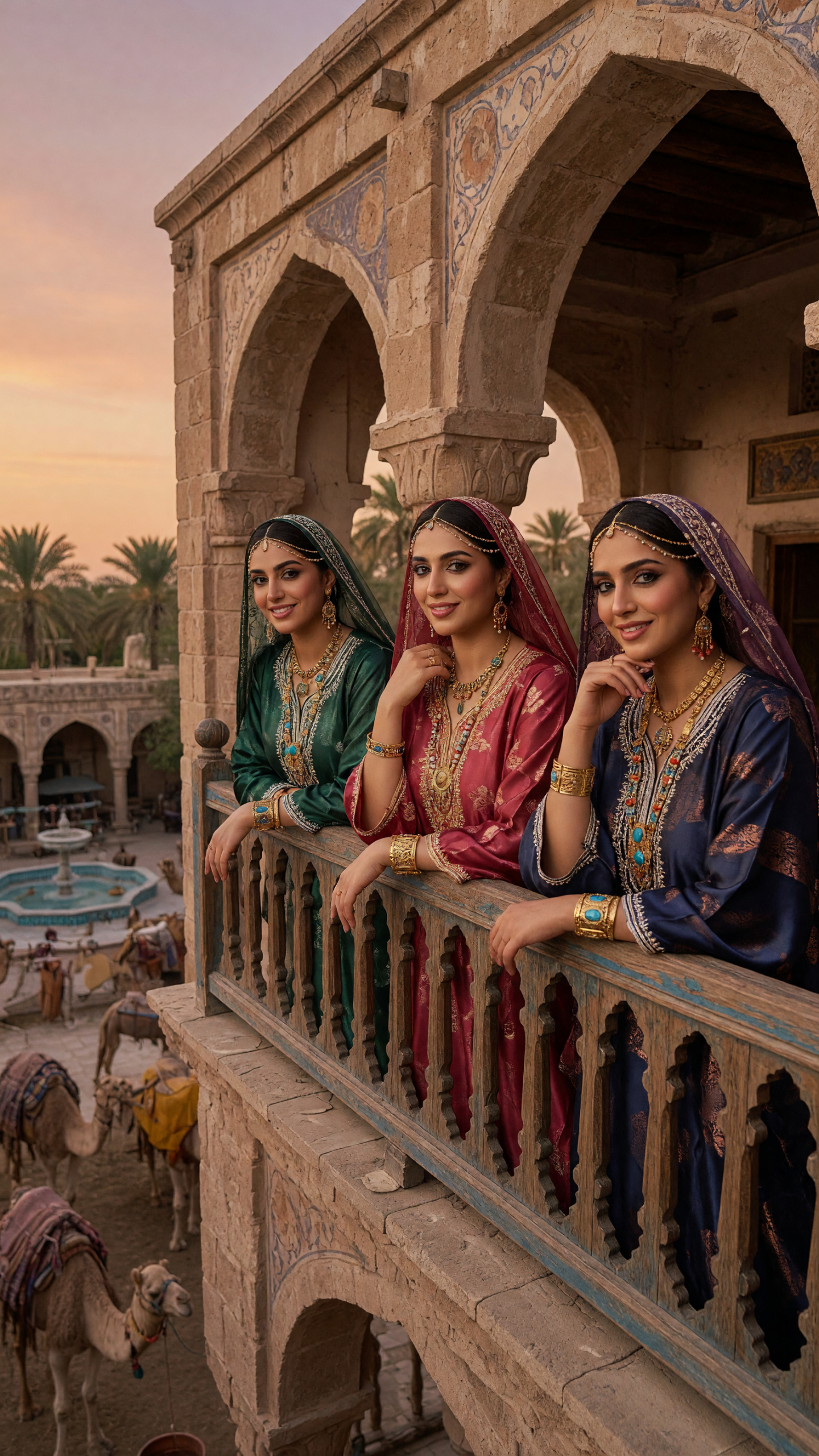
A Tale of Gloss and Devotion at the Dawn of the Renaissance — Where One Woman’s Shine Illuminated the Orbits of All Who Loved Her
In the dying light of the fifteenth century, when the stars above Samarkand were charted by kings and the silk beneath her minarets was worth more than blood, there lived a woman who counted the world’s wealth but could not count herself among it. Darya Khatun—widow, merchant, polyglot—moved through the caravanserai like a ghost in grey wool: brilliant, indispensable, and utterly invisible. She had been taught that a respectable woman does not shine. She had believed it. She was wrong.
Then came Bibi Aisha—sister of the royal astronomer, keeper of the observatory’s flame, wearer of emerald satin that caught the light like a living thing—and with her came the women who orbited her like planets around a sun: the weaver, the poet, the merchant’s daughter, each in her own glossy orbit, each burning with a quiet, devoted fire. When Bibi Aisha’s gaze fell upon Darya in the Registan at dusk, she saw what Darya could not: a woman whose light had been buried under her dead husband’s doctrine, waiting only for the right fabric to set it free.
What followed was a journey through the sensory heart of the Silk Road—from the looms where atlas satin is born to the observatory where stars are named, from the poetry gardens where desire speaks in couplets to the private chambers where a woman learns that shame is the only garment that does not become her. Through the ancient art of the satin weave—where thread must float before it can shine—Darya discovers that gloss is not vanity but structure, that devotion is not servitude but sacred alignment, and that the touch of cool satin against bare skin is not pleasure but recognition: the body’s long-delayed homecoming to itself.
Set against the breathtaking architecture of Timurid Samarkand—where glazed tiles shimmered like liquid jewels and the boundary between science and beauty did not exist—The Merchant of Samarkand is a romance between a woman and her own denied radiance, between a star and the constellation that gives her meaning, between the rough wool of self-erasure and the midnight satin that whispers: You were always meant to shine.
For the woman who has accomplished everything except feeling visible. For the woman who serves the world but has forgotten to serve herself. For the woman who knows, in the private architecture of her heart, that she was made for gloss—and has been waiting for permission to wear it.
Permission granted.
CHAPTER ONE: The Wool Merchant’s Widow
The caravanserai of Samarkand sang with a thousand voices at dawn.
They were not harmonious voices—God knew, they were not harmonious—but to Darya Khatun, who had heard them every morning for twenty-three years, they were the only music that mattered. The braying of Bactrian camels protesting their loads. The sharp clack of Arabic from the Egyptian spice merchants haggling over saffron grades. The liquid sing-song of Uyghur traders calling out prices for jade from Khotan. The low, rumbling Persian of the horse dealers from Isfahan, who never spoke above a murmur because a man who needed to shout to be heard was a man who had already lost the negotiation.
Darya stood at the upper gallery of the caravanserai’s eastern wing, her hands resting on the carved balustrade, and listened to the symphony of commerce below. The morning light was still thin—the colour of pale honey strained through linen—and it fell across the courtyard in long slants that turned the dust motes into floating gold. It was beautiful, in its way. It was also cold. The autumn wind from the steppe carried the bite of distant snow, and it found every gap in the architecture, every crack in the mortar, every loose thread in a garment not woven tightly enough to resist it.
She pulled her wool coat tighter.
It was a good coat. She had chosen it herself from a merchant in Bukhara three winters ago—undyed sheep’s wool, thick and serviceable, with a collar that could be turned up against the wind and sleeves long enough to cover her wrists. Karim, her husband, had approved of it. “A proper garment for a proper woman,” he had said, and she had felt the warm glow of his approval, because in those days she had still believed that a husband’s approval was the same thing as happiness.
She no longer believed that. But she still wore the coat.
“Forgive me, my lady.”
Darya turned. Gulnara stood in the doorway of the gallery, holding a tray with a pot of green tea and a single cup of celadon porcelain so thin the light showed through its walls like jade skin. She was fifty-three years old, this woman who had served Darya since she herself was a bride of nineteen, and her face was a map of loyalties so deep they had become geography—the lines around her eyes from years of squinting at embroidery in poor light, the groove between her brows from worrying over her mistress, the soft downturn of her mouth from swallowing words she longed to say.
“The caravan from Kashgar arrived before dawn,” Gulnara said, setting the tray on the low table beside the divan. “Thirty-seven camels. The usual manifests, plus three bales of the atlas satin reserved for the court. The customs master asks if you will inspect them before the governor’s men arrive at noon.”
“Of course.” Darya crossed to the table and poured her own tea—a habit that irritated Gulnara, who believed a woman of Darya’s station should be served, not serve herself. But Darya had been pouring her own tea since Karim’s death, and the small act of self-sufficiency had become a kind of devotion. She performed it ritualistically, the way other women performed prayers. “Are the bales in the east warehouse?”
“Yes, my lady. But—” Gulnara hesitated. She hesitated in the particular way she always hesitated when she was about to say something she knew Darya did not wish to hear: a slight intake of breath, a brief closing of the eyes, as if bracing for impact. “Bibi Aisha has also arrived. She is in the courtyard, speaking with the silk merchant from Herat. She asks if you will receive her when you have completed your inspection.”
The tea paused halfway to Darya’s lips.
Bibi Aisha.
The name arrived in Darya’s chest before it reached her mind—a physical sensation, a warmth that had nothing to do with the tea and everything to do with the way certain names carry weight beyond their syllables. She had heard the name for the first time only three months ago, at the governor’s reception for the Chinese embassy, when a woman in a gown of emerald satin had moved through the room like a ship under full sail and every other woman in attendance had become the sea that carried her.
Darya had watched from the corner, nursing a cup of wine she did not want, wearing her usual grey wool, and she had felt—what? She had felt the way one feels when standing in a dark room and someone opens a curtain: not just the light itself, but the recognition that one has been sitting in darkness. She had felt seen, which was absurd, because Bibi Aisha had not looked at her at all.
“Tell her I will receive her in the Peony Room after the inspection,” Darya said, and her voice was perfectly controlled, perfectly businesslike, perfectly wool.
Gulnara bowed and withdrew, but not before Darya caught the look in her eyes—a look that said, very clearly, About time.
The east warehouse of the caravanserai was a cathedral of commerce.
Its vaulted ceiling rose forty feet above the stone floor, supported by columns of baked brick that had been plastered and painted with geometric patterns in lapis and gold—though the paint was fading now, worn by decades of dust and neglect. The floor was packed earth, swept daily but never truly clean; the dust of the Silk Road was eternal, a fine red powder that worked its way into everything—bales, boxes, clothing, lungs. The air smelled of horse and hemp and the particular dry sweetness of raw silk waiting to be woven.
Darya moved through the warehouse with the efficiency of a woman who had been doing this since she was old enough to hold a ledger. She wore leather gloves—the better to handle the fabric without damaging it—and she inspected each bale with the methodical attention of a physician examining a patient. She pressed her palms flat against the wrapped bundles to feel for irregularities. She leaned close to smell for mildew or water damage. She untied the cotton bindings and unrolled a measured length of each bolt, holding it up to the light that filtered through the high windows, watching the way the weave caught the sun.
The first two bales were silk taffeta—good quality, but unremarkable. She made a note in her ledger, re-rolled the fabric, and moved on.
The third bale was different.
She knew it the moment her gloved hand touched the binding. The cotton wrapping was tighter, secured with silk cord rather than hemp, and when she cut the cord and unrolled the fabric, she understood why.
Atlas satin.
The word atlas was Arabic—literally meaning “smooth”—and it described a fabric so fine, so impossibly lustrous, that the weavers of China had guarded its secret for three thousand years. It was not merely silk; it was silk transformed. Where plain weave crossed thread over thread in a democratic alternation—over, under, over, under, each thread equal, each thread rough—the satin weave allowed the thread to float. Four, five, six threads would pass over the surface before dipping beneath, and in that floating, in that refusal to hide, the thread caught the light and gave it back transformed.
The bale before her was the finest Darya had ever seen. The colour was a deep midnight blue so rich it seemed to breathe, and when she lifted a length of it to the window, the light did not merely fall upon the fabric—it partnered with it. The satin drank the light and released it slowly, a glow that seemed to come from within the weave itself, as if the fabric were not merely reflecting the sun but remembering it, holding it, honouring it.
Darya’s hands trembled.
She was wearing gloves. She could not feel the fabric against her skin. But even through the leather, even through the barrier she had placed between herself and the world of sensation, she could sense the rightness of it—the cool weight, the fluid drape, the way it moved like water poured from a vessel. Her body knew something her mind refused to name.
She re-rolled the fabric. Tied the binding. Made her note in the ledger: 3 bales atlas satin, midnight blue, court reserve. Value: 12,000 dinars per bale. Condition: excellent.
Twelve thousand dinars. Enough to feed a family for five years. Enough to buy a house in the Jewish quarter with a courtyard and a fountain. Enough to—*
She looked down at her own dress. Grey wool. Undyed. Serviceable. The kind of garment a woman wore when she wanted to be useful, not beautiful. The kind of garment that said: I am here to work, not to be seen.
And suddenly, without warning, a thought arrived in her mind like a guest who had been knocking at the door for years and finally found it unlocked:
What would it feel like to wear something worth looking at?
She pushed the thought down. She was a merchant. She sold beautiful things; she did not wear them. That was the rule. Karim’s rule. And even though Karim was three years in his grave, even though the earth had long since claimed his body and the imam had long since finished the prayers, his voice still lived in her ear like a whisper from a ghost who refused to depart.
“A proper woman does not need such things, Darya. A proper woman is known by her deeds, not her decorations. Leave the silks to the concubines and the fools.”
She closed the ledger. She removed her gloves. She looked at her hands—calloused from years of handling fabric samples, ink-stained from years of writing in ledgers, the nails cut short for practicality, the skin dry and rough from the caravanserai’s dusty air. They were the hands of a woman who served her business but not herself. They were the hands of a woman who had forgotten that she, too, was made of skin that could feel, that could crave, that could light up at the touch of something cool and fluid and alive against it.
She tucked the ledger under her arm and walked toward the Peony Room, and she did not allow herself to look back at the bale of midnight-blue satin that sat on the shelf behind her, glowing in the thin morning light like a question she was not yet brave enough to ask.
The Peony Room was the finest reception chamber in the caravanserai.
It had been designed for exactly this purpose: the receiving of guests whose status required beauty, whose presence demanded elegance, whose eyes would judge the host by the quality of the space in which they were received. The walls were covered in ceramic tiles of the deepest turquoise—the colour of the oasis at dawn, the colour of heaven as imagined by an artist who had never seen heaven but had seen Samarkand—and the floor was spread with carpets from Isfahan so densely woven that footsteps made no sound. A fountain murmured in the centre of the room, its water flowing over polished stones into a basin of white marble. The windows faced east, and the morning light entered like a gift, golden and abundant, and it fell upon every surface as if looking for something to illuminate.
Darya entered first, as was proper for the host, and she arranged herself on the divan nearest the window—the one that caught the best light, the one that would allow her guest to see her clearly. She did this unconsciously, the way a general chooses high ground. She wanted to be seen as competent, as authoritative, as in control.
She did not consider, even for a moment, whether she wanted to be seen as beautiful.
The door opened.
Bibi Aisha entered, and the room rearranged itself around her.
This was not metaphor. This was physics. The light that had been falling equally on every surface shifted—Darya could have sworn it shifted—so that it seemed to concentrate on the woman standing in the doorway. Her gown was emerald satin today, a green so deep it was almost black in the shadows and almost luminous in the light, and it moved with her like a second skin that had been born rather than made. The neckline was modest but deliberate, framing the column of her throat and the subtle architecture of her collarbones. The sleeves were long and tapered, ending in points that covered the backs of her hands—a style favoured by the women of the court, Darya knew, because it drew the eye along the line of the arm and made every gesture look like calligraphy.
She was not alone.
Three women accompanied her, and they moved in formation around her like satellites around a planet—close enough to orbit, far enough to give her centre space. The first was young, perhaps twenty-three, with dark eyes and hands that moved constantly, as if they were remembering the loom. She wore plum satin, simple in cut but exquisite in quality, and her gaze never left Bibi Aisha’s face. The second was older, perhaps thirty-five, with the sharp, assessing eyes of a woman who understood markets and margins. Her satin was the colour of deep wine, and she carried a small ledger—not unlike Darya’s own—tucked under her arm. The third was somewhere in between, with the dreamy expression of a poet and a shawl of ivory satin draped over one shoulder like a half-remembered verse.
They were, all four of them, glossy.
The word arrived in Darya’s mind unbidden, and she felt the heat of it in her cheeks. Glossy. It was not a word she had ever applied to people. It was a word for fabric, for polished metal, for the glazed tiles on the Registan’s walls. But looking at these women—at the way the light played across their garments, at the way their movements created whispers of reflected luminescence, at the way they seemed to generate light rather than merely receive it—she could think of no other word.
They were glossy. And she was wool.
“Assalamu alaikum,” Bibi Aisha said, and her voice was the voice of the fountain in the corner—low, musical, flowing without effort. “May the peace of God be upon this house and all who dwell within it.”
“Wa alaikum assalam,” Darya replied, rising to offer the greeting properly. “And upon you, Bibi Aisha. You honour my caravanserai with your presence.”
“The honour is mine, Darya Khatun. I have heard much of the woman who commands the largest trading house between Bukhara and Xi’an. I confess I was curious to see if the reports did you justice.”
Darya gestured toward the divan opposite her own. “Please. Sit. I will order tea.”
“Allow me.” Bibi Aisha turned to the young woman in plum satin. “Mehrnaz, would you ask the kitchen for green tea with cardamom? The blend we brought from Herat.”
Mehrnaz bowed—a small, graceful inclination of her head that somehow conveyed both respect and devotion—and left the room. Darya watched her go, struck by the ease of the gesture, the naturalness of it. This was not a servant performing a duty; this was a companion offering a gift. The distinction was subtle, but Darya, who had spent her life reading the subtleties of merchant negotiations, saw it as clearly as she saw the turquoise on the walls.
“You must forgive my companions,” Bibi Aisha said, settling onto the divan with the fluid grace of a woman who had been trained since birth to make every movement look intentional. “They are devoted to the observatory’s work, and they have heard much of your expertise. Salma—” she indicated the woman in wine-coloured satin “—manages the endowment accounts. She is eager to learn how you have maintained such consistent profits in the silk trade despite the instability of the northern routes.”
Salma bowed her head. “It is a pleasure, Darya Khatun. The observatory’s finances are modest compared to your enterprise, but I believe the principles of stewardship are universal.”
Darya found herself nodding. She had not expected this—a woman who spoke of stewardship, of principles, of the philosophy of commerce rather than merely its mechanics. In her experience, court women spoke of money only to ask for more of it.
“And Delshad,” Bibi Aisha continued, indicating the woman with the ivory shawl. “She is composing a qasida in honour of the observatory’s completion. She wishes to understand the movement of the stars so that her verses might be accurate as well as beautiful.”
“A worthy ambition,” Darya said, and meant it. She had read enough poetry to know that most poets wrote of stars as if they were metaphors, not bodies of fire moving through the void. The idea of a poet who sought to understand the reality behind the image was… appealing.
“Thank you,” Delshad said, and her voice was soft, dreamy, as if she were still half-lost in whatever verse she was composing. “I find that beauty is most powerful when it is rooted in truth. A star is beautiful because it burns, not because we say it does.”
Bibi Aisha smiled—a small, private smile that seemed to be directed not at Delshad but at something Darya could not see. “Delshad believes that all art is a form of astronomy. We are simply charting different constellations.”
The tea arrived. Mehrnaz returned and knelt beside Bibi Aisha’s divan—not in servitude, but in proximity, the way a squire kneels beside a knight, the way a disciple kneels beside a teacher. She poured the tea with hands that were steady and precise, and when she handed the cup to Bibi Aisha, their fingers brushed, and Darya saw something pass between them—a glance, a softening, a recognition—that made her chest ache with an emotion she could not name.
She sipped her own tea. It was excellent—cardamom and green tea and something else, something floral, perhaps rose. She made a note to ask about the blend later, because that was what she did: she noted things, she catalogued them, she filed them away in the ledger of her mind. She did not feel them. Feeling was dangerous. Feeling led to wanting, and wanting led to disappointment, and disappointment led to—
“You are very quiet, Darya Khatun.”
Bibi Aisha’s voice cut through the spiral of her thoughts like a blade through silk—clean, precise, gentle.
“I am listening,” Darya said. “A good merchant listens more than she speaks.”
“A good merchant, perhaps. But a good host?” Bibi Aisha tilted her head, and the light caught her gown, and the emerald satin shifted to something brighter, something almost alive. “I was told you were a woman of extraordinary intelligence. A woman who speaks six languages and calculates profit margins in her head. A woman who can identify the origin of a silk bale by touch alone. I confess I was expecting someone more… present.”
The word landed like a stone in still water. Present. Darya felt the ripples of it move through her chest.
“I am present,” she said, and her voice was steady, her hands were steady, everything about her was steady except the sudden, inexplicable tightness in her throat. “I am here. I am listening. I am—”
“You are hiding,” Bibi Aisha said, and the word was not harsh but tender, the way one might say the name of an illness to a patient who has been suffering from it for years without knowing what to call it. “You are hiding behind your ledgers and your practicality and your grey wool, and you are doing it so well that you have convinced yourself you are not hiding at all. You are simply… enduring.”
The room was very quiet. The fountain murmured. The light shifted. Darya’s hands tightened around her teacup.
“I do not know what you mean,” she said.
Bibi Aisha regarded her for a long moment. Her eyes were dark and deep, and they held something that Darya had never seen directed at her before—not pity, not judgment, not even curiosity. It was recognition. The look of a woman who sees another woman clearly, perhaps for the first time, and recognises in her a reflection of something she herself once was.
“Then allow me to show you,” Bibi Aisha said. She rose from the divan, and her companions rose with her—not in unison, but in harmony, each woman moving in her own time but toward the same centre, like planets returning to their orbits after a momentary eclipse. “Come with me to the Registan at dusk tonight. I will show you what Samarkand looks like when the light falls on something that knows how to receive it.”
Darya opened her mouth to refuse. She had work to do. She had ledgers to review. She had three bales of atlas satin to catalogue and a trading house to run and a dead husband’s voice in her ear telling her that proper women did not need such things.
“Thank you,” she heard herself say. “I would like that very much.”
Bibi Aisha smiled. It was not a smile of triumph; it was a smile of homecoming, the smile of a woman who has been waiting at a door and finally hears the sound of footsteps approaching from the other side.
“Then I will send for you at the fifth hour,” she said. “Wear something that makes you feel visible, Darya Khatun. You have been invisible long enough.”
She left. Her companions followed—Mehrnaz with her devoted gaze, Salma with her sharp eyes, Delshad with her dreamy verse still forming on her lips. They moved through the door like water through a channel, flowing toward their centre, and the light seemed to follow them, as if even the sun itself could not bear to let them go.
Darya sat alone in the Peony Room. The tea was cold in her cup. The fountain murmured. The tiles glowed turquoise in the mid-morning light.
Wear something that makes you feel visible.
She looked down at her grey wool dress. She looked at her calloused hands. She looked at the ledger on the table beside her, filled with numbers that described a life of profit and precision and absence.
And for the first time in twenty years, she allowed herself to wonder what it might feel like to be seen.
Gulnara found her there an hour later, still sitting on the divan, still holding the cold cup of tea, still staring at the doorway where Bibi Aisha had stood.
“My lady? The governor’s men have arrived to inspect the court bales. They are asking for you.”
Darya set down the cup. She straightened her spine. She smoothed the wool of her dress—a gesture so automatic it had become a kind of prayer, a ritual of self-erasure performed so many times it no longer required thought.
“I will attend them now,” she said.
Gulnara did not move. She stood in the doorway, and her old eyes—those eyes that had seen Darya arrive as a bride of nineteen, that had watched her bury a husband at thirty-nine, that had witnessed two decades of competence and invisibility—held a question she had never before dared to ask.
“My lady,” she said, and her voice was very soft. “What did Bibi Aisha say to you?”
Darya paused. She looked at Gulnara—really looked at her, for the first time in months, perhaps years—and saw what she had refused to see: that this woman who had served her with such devotion, such constancy, had been waiting for this moment. Had been waiting for the crack in the wall. Had been waiting for the light to find a way in.
“She said I have been invisible long enough,” Darya replied.
Gulnara’s eyes filled with tears she did not shed. She nodded, once, and the gesture contained twenty years of patience and the quiet, fierce hope of a woman who has been tending a garden she feared would never bloom.
“Then perhaps, my lady,” she said, “it is time to be seen.”
She turned and led the way to the warehouse, and Darya followed, and the morning light fell on them both—the one in grey wool, the one in faded cotton—and neither of them shone.
Not yet.
But the seed had been planted. And in the warehouse, on the shelf where she had left it, the bale of midnight-blue satin seemed to glow a little brighter, as if it, too, had heard the promise in Bibi Aisha’s voice and was waiting, with the patience of all beautiful things, to be claimed.
CHAPTER THREE: The Language of Atlas
The invitation arrived on a morning of extraordinary beauty.
Darya was in the counting room—a chamber she had claimed as her own after Karim’s death, because it was the one room in the house where no one expected her to be decorative. The walls were lined with shelves holding ledgers dating back twenty years, each one bound in leather and labelled in her precise, angular hand. The window faced north, away from the sun, because direct light faded ink and she would not have her records compromised for the sake of something so frivolous as warmth. She sat at her desk—a magnificent piece of walnut, carved with arabesques by a craftsman from Damascus whose work was now worth more than most houses—and she calculated, and she catalogued, and she existed in the way that a ledger exists: as a record of things that mattered, never as a thing that mattered itself.
The knock came at the door. Gulnara entered, and in her hands she held a object that did not belong in the counting room—a envelope of such exquisite manufacture that it seemed to glow in the grey light, as if it had brought its own illumination from wherever it had come.
The envelope was satin.
Not merely covered in satin, not merely trimmed with it—the entire envelope was made of it, a deep plum satin so fine that the light seemed to sink into the fabric and then reconsider, rising back to the surface transformed, as if the material were not merely reflecting but thinking. The seal was wax—vermilion, stamped with a device Darya did not recognise: a star surrounded by smaller stars, all of them burning.
“What is this?” Darya asked, though her hands had already reached for it, though her fingers had already begun to tremble.
“It arrived by private courier, my lady. A young woman in a plum dress—she said she serves Bibi Aisha of the observatory. She asked me to place it directly in your hands, and no others.”
Gulnara’s voice was carefully neutral, but her eyes—those old, knowing eyes that had seen so much and said so little—were bright with something that looked terribly like hope.
Darya broke the seal.
The paper inside was not satin—it was something finer, a handmade rag paper from Samarkand’s own paper mills, the industry that had made the city the intellectual capital of the Islamic world. The script was Persian, written in a hand so elegant it bordered on calligraphy, and it read:
To Darya Khatun, merchant of Samarkand, keeper of ledgers, speaker of languages—
You are cordially invited to the Peony Pavilion on the third day of the week, at the hour of the afternoon prayer, to discuss the matter of the observatory’s endowment and other matters of mutual interest.
It has been suggested to me that you are a woman of remarkable intelligence. I confess I am curious to discover whether the suggestion does you justice, or whether—like so many women of accomplishment—you have hidden your light beneath layers of practicality so thick that even you have forgotten what you look like when you shine.
Come as you are. Or better—come as you wish to be.
With respect and anticipation,
Bibi Aisha
Sister of the Royal Astronomer
Keeper of the Observatory’s Flame
Darya read the letter three times. The first time, her mind registered only the facts: date, time, location, purpose. The second time, her heart registered the challenge—the elegant, devastating precision of that phrase, hidden your light beneath layers of practicality so thick that even you have forgotten what you look like when you shine. The third time, something deeper than mind or heart registered the invitation itself: Come as you wish to be.
Not come as you are. Come as you wish to be.
She set the letter down. She looked at her hands—still calloused, still ink-stained, still the hands of a woman who served her business but not herself. She looked at her dress—grey wool, undyed, serviceable. She looked at the counting room with its north-facing window and its shelves of ledgers and its magnificent desk that she had never once thought to adorn with so much as a flower.
“What will you wear, my lady?” Gulnara asked.
The question hung in the air like incense smoke. Darya opened her mouth to say What I always wear—but the words would not come. They lodged in her throat like a stone, and she understood, with a clarity that frightened her, that the words had never been hers. They were Karim’s words, spoken through her mouth for so long she had mistaken them for her own voice.
“I don’t know,” she said, and the admission felt like the first true thing she had said in years.
Gulnara nodded, and in that nod was everything—patience, love, the quiet triumph of a woman who had been waiting for the wall to crack. “Then perhaps, my lady, we should find out.”
The Peony Pavilion stood in the gardens of the observatory, on a hill that overlooked the city.
It was a masterpiece of Timurid architecture—a small building, no larger than a wealthy merchant’s reception room, but designed with such exquisite attention to the movement of light that it seemed to exist in a state of perpetual golden hour. The walls were screened with latticework windows of extraordinary intricacy—the geometric patterns called mashrabiya—that filtered the harsh Central Asian sun into something soft and flattering and kind. Every surface that could be lacquered was lacquered; every surface that could be polished was polished; every surface that could be draped in silk was draped in silk of such quality that it seemed to breathe, to participate in the life of the room.
Darya arrived at the appointed hour, wearing the best dress she owned.
It was burgundy wool.
She had chosen it with care—the colour was deep and rich, almost the shade of pomegranate seeds, and she had told herself it was almost elegant, almost refined, almost enough. She had brushed her hair until it shone and pinned it with a silver clasp that had been her mother’s. She had moisturised her hands—something she had never done before, not once in her adult life, but this morning she had watched Gulnara prepare a bowl of rose-scented oil and had thought, for no reason she could name, Why not?
Her hands were still rough. The oil had not erased twenty years of callouses. But they were softer, and when she touched the clasp at her hair, she felt the difference, and the difference felt like a door opening onto a room she had forgotten existed.
The door of the Peony Pavilion opened before she could knock.
Mehrnaz stood in the doorway, and she was wearing plum satin.
The colour was extraordinary—not merely purple but the purple of the mountains at sunset, the purple of a bruise healing, the purple of wine so old it had become something other than drink. The fabric caught the light from the latticework windows and transformed it, drinking the gold and releasing it in a slow, deliberate glow that seemed to come from within the weave itself. She was young—twenty-three, Darya remembered from the caravanserai—and her face held the particular radiance of a woman who has recently discovered that she is seen, and who is still learning to enjoy it.
“Darya Khatun,” Mehrnaz said, and her voice was warm and genuine and held no trace of the formality Darya had expected. “Welcome. Bibi Aisha has been looking forward to this meeting since the day at the Registan. Please—come in.”
Darya stepped over the threshold, and the room received her.
There was no other word for it. The light, the warmth, the subtle fragrance of roses and sandalwood—they reached toward her like hands extending in welcome, and for a moment—just a moment—she felt something she had not felt since childhood: the sensation of arriving somewhere that was glad to see her.
Then she saw Bibi Aisha, and the sensation deepened into something she could not name.
Bibi Aisha stood at the centre of the pavilion, beside a table laden with star charts and astronomical instruments, and she wore emerald satin that made the room seem to breathe. The fabric was not merely beautiful—it was authoritative, the way a judge’s robe is authoritative, the way a general’s uniform is authoritative. It said: I have chosen to be seen, and I will not apologise for the space I occupy. The neckline was modest but deliberate, framing the elegant architecture of her throat and the subtle movement of her pulse. The sleeves were long and tapered, ending in those pointed cuffs that Darya had noticed before, and when Bibi Aisha raised her hand in greeting, the satin whispered against itself, and the sound was like a secret being told in a language Darya’s body understood but her mind could not translate.
“Darya Khatun.” Bibi Aisha smiled, and the smile was not the formal, diplomatic expression Darya had expected. It was real—warm, genuine, touched with something that looked almost like relief. “You came.”
“You invited me,” Darya said, and immediately felt foolish. You invited me—as if that were an explanation, as if that were sufficient reason for a woman who had not attended a social gathering in three years to cross the city to a pavilion she had never seen, to meet a woman she could not stop thinking about, wearing a dress she had chosen because it was almost enough.
“I did,” Bibi Aisha agreed. “But invitation is not compulsion. You could have declined. You could have sent a messenger with regrets. You could have remained in your counting room with your ledgers and your north-facing window and your beautiful, brilliant mind wrapped in—” She paused, and her gaze moved over Darya’s burgundy wool with the careful attention of a physician examining a symptom. “—in almost.”
The word landed like a drop of water on a heated stone—small, precise, and hissing with truth.
“I beg your pardon?” Darya said, though she had heard perfectly well.
“Almost,” Bibi Aisha repeated, and her voice was gentle, so gentle that Darya felt the kindness of it before she felt the cut. “You are almost elegant. You are almost refined. You are almost enough. I wonder, Darya Khatun—have you ever considered what it might feel like to be entirely?”
Before Darya could respond, Bibi Aisha turned and gestured toward the other women in the room. “But I am being unforgivably direct, and I have not introduced my companions properly. You met them briefly at the caravanserai, but introductions made in the chaos of commerce are rarely true introductions. They deserve better. You deserve better.”
She presented them as one presents treasures—not with possessiveness, but with the pride of a curator who knows the value of what she keeps.
“Salma, daughter of Abdul Rahman, merchant of Herat.” The woman in wine-coloured satin bowed her head. She was perhaps thirty-five, with the sharp, assessing eyes Darya remembered, and her gown was cut in the Herati style—higher at the waist, fuller at the skirt, designed for a region where women moved through markets as well as drawing rooms. “She manages the observatory’s endowment and has increased our holdings by thirty percent in two years. She is, I suspect, the only woman in Samarkand who might match you in a negotiation.”
“A bold claim,” Darya said, and found herself smiling—genuinely smiling, not the polite grimace she usually offered in social situations. “I should like to test it sometime.”
Salma’s eyes glinted. “I should like that very much, Darya Khatun. I have studied your methods. The way you cornered the Kashgar saffron market three years ago was… instructive.”
“Flattering,” Darya said.
“Accurate,” Salma replied, and they shared a look of professional recognition that was, in its own way, a kind of intimacy.
“Delshad, daughter of Hafez, poet of Shiraz.” The woman with the ivory shawl bowed more deeply—a Persian bow, elaborate and graceful, the kind that required years of practice and a genuine appreciation for beauty. Her shawl was not satin, Darya noticed—it was silk gauze, almost transparent, and it floated around her like a half-remembered dream. “She is composing the qasida for the observatory’s dedication. She has been studying the movement of the stars so that her verses might be true as well as beautiful.”
“Truth and beauty are not always the same thing,” Darya said.
Delshad tilted her head, and her eyes—dark, dreamy, focused on something Darya could not see—sharpened momentarily. “No,” she agreed. “But they should be. A verse that is beautiful but untrue is a lie dressed in silk. A verse that is true but ugly is a fact dressed in wool. The highest art is the art that makes truth glossy—that allows the light to catch it and reflect it so that others can see it clearly for the first time.”
Darya felt the words settle into her chest like a stone dropped into water. A fact dressed in wool. She was a fact dressed in wool. She had always been a fact dressed in wool.
“And Mehrnaz you have already met.” Bibi Aisha’s voice softened when she said the young weaver’s name—not with condescension, but with something deeper, something that Darya recognised as the tenderness one reserves for those one has chosen to protect. “She is the finest weaver in Samarkand. Perhaps the finest in the Timurid realm. She creates the atlas satin that the court women wear, and she does it with a skill that borders on the miraculous.”
Mehrnaz blushed—a deep, genuine flush that spread from her cheeks to her throat and was visible above the neckline of her plum satin gown. “Bibi Aisha is too kind,” she murmured.
“Bibi Aisha is accurate,” came the reply, and the tone brooked no argument. “I do not exaggerate, Mehrnaz. I curate. There is a difference.”
Mehrnaz’s blush deepened, but her eyes—when they lifted to Bibi Aisha’s face—held an expression that Darya recognised with a start. It was devotion. Not the servile devotion of a servant to a master, but the sacred devotion of a believer to a temple, of a student to a teacher, of a woman who has found her centre and knows—absolutely knows—that her orbit is exactly where she belongs.
Darya felt a sharp, unexpected pang of something that might have been envy.
“Please,” Bibi Aisha said, gesturing toward the divans that surrounded the low table. “Sit. We have much to discuss, and the afternoon light will not last forever.”
The tea was the same blend Bibi Aisha had served at the caravanserai—green tea with cardamom and rose—but here, in the Peony Pavilion, it tasted different. Richer. More complex. Darya sipped it and tried to focus on the business at hand.
“The observatory requires an endowment of fifty thousand dinars annually,” Bibi Aisha began, and her tone shifted seamlessly from hostess to negotiator. “Ulugh Beg has provided the initial construction costs from the royal treasury, but the ongoing expenses—salaries for the astronomers, maintenance of the instruments, production of the star charts—must be funded independently. The king’s favour is generous but not eternal. We require a foundation that will outlast any single patron.”
“A sensible approach,” Darya said, and she was grateful for the familiar territory of commerce. This she understood. This she could navigate. “What assets do you currently hold?”
Salma opened her ledger. “The observatory owns the land upon which it sits—approximately four jufirs—and the building itself, valued at one hundred and twenty thousand dinars. We have an endowment of thirty thousand dinars invested in the silk trade at a return of approximately eight percent. We also receive annual contributions from the court, though these are variable and dependent upon the king’s mood.”
“Which is variable and dependent upon the phase of the moon,” Delshad murmured, and Salma permitted herself a small smile.
“The silk trade investment is sound,” Darya said, “but eight percent is conservative. With proper management, you could achieve twelve or even fifteen percent. The northern routes are stabilising, and the Chinese demand for Persian goods is growing. If you reinvested the returns rather than spending them immediately, you could double the principal within five years.”
“Twelve percent?” Salma’s eyebrows rose. “That is… ambitious.”
“That is achievable,” Darya corrected. “Ambition without method is fantasy. Method with ambition is strategy. I have been executing this strategy for fifteen years, and my returns have never fallen below eleven percent.”
Bibi Aisha leaned forward, and the emerald satin shifted across her shoulders like water flowing over stone. “You speak of method, Darya Khatun. But method requires something that cannot be taught in a counting room. It requires vision—the ability to see what is not yet there and to move toward it with confidence.”
“Confidence,” Darya repeated. “I have confidence in my methods.”
“Of course you do. You have confidence in your mind. But confidence in the mind alone is like a star without a constellation—bright, perhaps, but isolated. Untethered. Alone.” Bibi Aisha’s gaze was steady, and Darya felt it like a hand pressing gently against her chest. “Tell me, Darya—when was the last time you felt confident in something other than your ledgers?”
The question was not fair. It was not the kind of question one asked in a business meeting. It was personal, intrusive, and it reached past the walls Darya had spent twenty years building and touched something she had not known was exposed.
“I—”
“You hesitate,” Bibi Aisha observed, and her voice held no judgment, only the careful attention of a woman who was accustomed to looking closely. “A woman who speaks six languages does not hesitate unless she is searching for the right one. Which language would you use, Darya, if you could speak the truth? Persian? Arabic? The language of mathematics, perhaps?”
“I do not understand what you are asking.”
“You understand perfectly. You are simply afraid to answer.” Bibi Aisha rose from her divan and crossed to the table of star charts. “Come here. I want to show you something.”
Darya followed—because what else could she do?—and stood beside Bibi Aisha at the table, and tried to ignore the fact that they were close enough that she could smell her perfume: roses and sandalwood and something else, something warm and alive that was not perfume at all but simply her.
“This is a chart of the constellation Cassiopeia,” Bibi Aisha said, pointing to a pattern of golden dots connected by fine lines. “Do you see how the stars are arranged? Each one is separate—distinct, individual, burning with its own fire. But the constellation is more than the sum of its stars. It is the relationship between them. The lines that connect them. The pattern they form together.”
“It is a beautiful chart,” Darya said, and she meant it. The calligraphy was exquisite, the geometry precise, the colours—gold and lapis and vermillion—rich and harmonious.
“It was made by Mehrnaz,” Bibi Aisha said, and her voice held that particular softness again—the tenderness of a woman speaking of someone she cherished. “She is not only a weaver but an illustrator of extraordinary talent. When I saw what she could do with thread, I asked her to try her hand with ink. The result—” She gestured at the chart. “The result speaks for itself.”
Mehrnaz, who had been standing quietly by the window, looked down at her hands—those hands that moved constantly, that remembered the loom—and a small, private smile crossed her face. “Bibi Aisha saw something in me that I did not see in myself,” she said. “She saw that the same hands that could make satin shine could also make stars shine. She saw that the skill was not in the material but in the vision—the ability to look at something ordinary and recognise the extraordinary waiting to be released.”
“Like looking at a bale of raw silk and seeing the gown it could become,” Darya said, and she did not know why she said it, except that it was true, except that it was the kind of observation she usually kept locked inside her mind because Karim had told her that women who spoke of such things were dreamers, and dreamers did not survive in the world of commerce.
“Exactly like that,” Bibi Aisha said, and her voice warmed with approval—genuine approval, not the polite acknowledgment Darya was accustomed to receiving. “You understand, then. You understand that the material is only the beginning. The transformation—that is where the art lies. That is where the power lies.”
She reached across the chart to indicate a distant star, and as she did, the emerald satin of her sleeve brushed against Darya’s bare wrist.
The touch was electric.
It was not a metaphor. It was a physical sensation—a current that passed from the cool, smooth fabric to Darya’s skin and travelled up her arm and into her chest and settled there, like a bird landing on a branch it had been searching for across a vast and empty sky. The satin was cool and fluid and alive against her skin, and her body responded before her mind could intervene—gooseflesh rising along her arms, her breath catching in her throat, a soft sound escaping her lips that she did not recognise as her own voice.
Bibi Aisha did not pull away.
She held the contact—just for a moment, just for the space of a heartbeat—and her eyes met Darya’s, and in those eyes was something that Darya had never seen directed at her before: recognition. Not the recognition of one merchant by another, not the formal recognition of a host for a guest, but the deeper recognition of one woman seeing another woman clearly, perhaps for the first time, and understanding exactly what she was seeing.
“The language of atlas,” Bibi Aisha murmured, and her voice was very close, and the satin was still touching Darya’s wrist, and the world had narrowed to the point where fabric met skin. “You speak six languages, Darya. But there is a seventh—the language the body speaks when it encounters something it has been denied. I heard you speak it just now. Did you not hear yourself?”
Darya pulled back. The contact broke. The world expanded again, and she was standing in the Peony Pavilion, surrounded by star charts and astronomical instruments and four women who were looking at her with expressions ranging from concern to compassion to something that looked, impossibly, like understanding.
“I should go,” she said, and her voice was not steady, and she hated that it was not steady, and she hated that she could not control it, and she hated—most of all—that she did not want to leave.
“Of course,” Bibi Aisha said, and she was gracious, and she was kind, and she did not press the advantage, because she was a woman who understood that some doors could not be forced—they could only be shown, and then waited for, and then trusted to open in their own time. “The endowment discussion can continue another day. But Darya—”
Darya paused at the door.
“Come back,” Bibi Aisha said. “Not for the endowment. Not for the observatory. Come back because there is a woman inside you who has been waiting twenty years to be seen, and I would very much like to meet her.”
The walk home was longer than Darya remembered.
The streets of Samarkand were familiar—the blue-tiled madrasas, the bustling bazaars, the call of the muezzin from the minarets—but they looked different now, as if she were seeing them through a filter that had been placed over her eyes. She noticed things she had never noticed before: the way the light fell on the glazed tiles of the Registan and made them glow, the way the women of the court moved through the streets in their satin gowns like ships through water, the way the rough cotton of her own dress chafed against her skin with every step.
She had never noticed the chafing before. She had worn wool and cotton for so long that the discomfort had become invisible—a constant, low-grade irritation that she had simply accepted as the price of being proper. But now, after the brush of satin against her wrist, after that moment of cool, fluid rightness, the chafing was impossible to ignore. Her skin felt raw. Her skin felt angry. Her skin felt like it was demanding something she had never thought to give it.
She arrived home and went straight to her chamber. Gulnara followed, silent and watchful.
Darya stood before the mirror—the full-length mirror of polished steel that had been a wedding gift from her mother, and which she had used only to check that her clothing was appropriate, never to check that it was beautiful—and she looked at herself, and she saw what Bibi Aisha had seen: a woman in burgundy wool, with ink-stained hands and a silver clasp in her hair, who was almost elegant, almost refined, almost enough.
Almost.
The word echoed in her mind like a bell struck in an empty room. Almost, almost, almost.
She reached for the buttons of her dress. She removed the wool. She stood in her under-chemise—cotton, rough, practical—and she looked at her own body, and she saw the red marks where the wool had chafed, the lines where the seams had pressed into her skin, the small, daily injuries that she had been inflicting upon herself for twenty years in the name of propriety.
“My lady?” Gulnara’s voice was soft from the doorway. “Are you well?”
Darya turned, and her eyes were bright with something that was not quite tears and not quite fury but some alchemy of the two—a potion that women have brewed for centuries when they finally see what has been done to them and realise that they were the ones holding the chisel.
“Gulnara,” she said, and her voice was strange to her own ears—raw, unguarded, new. “Do you remember the satin my mother used to wear? The blue gown with the silver embroidery?”
Gulnara’s face underwent a transformation. The careful neutrality fell away, and beneath it was something luminous—something that looked like the first light of dawn after a long and terrible night.
“I remember it well, my lady. It was the colour of the night sky just before the stars appear. Your mother wore it to the festival of Eid, and when she walked through the streets, the people stopped and stared, and they said—” She paused, and her voice trembled. “They said she looked like a queen.”
“She was a merchant’s wife,” Darya said. “Just as I am a merchant’s widow. But she was also—”
She stopped. The word she needed was not in any of her six languages. It was in the seventh language—the language of the body, the language of the satin, the language that Bibi Aisha had spoken when her sleeve had brushed Darya’s wrist and the world had shifted on its axis.
“She was also visible,” Darya finished, and the word was not enough, but it was the best she could do, and she said it with the quiet ferocity of a woman who has just named something she has been carrying for twenty years without knowing its name.
Gulnara crossed the room and took her mistress’s hands—the rough, calloused, ink-stained hands that had never been moisturised until this morning, that had never been adorned, that had served and served and served and never once been seen—and she held them, and she said:
“Your mother gave me something, my lady. Before she died. She said I would know when the time was right to give it to you. She said—” Gulnara’s voice broke, and she pressed her lips together and breathed deeply, and then she continued: “She said, ‘My daughter has buried herself alive. When she begins to dig herself out, give her this.'”
She reached into the pocket of her apron and withdrew a small bundle wrapped in tissue paper.
Darya took it. Her hands were trembling. She unwrapped the tissue paper, layer by layer, and beneath the final layer was a length of fabric that caught the fading afternoon light and held it, and the fabric was—
Satin.
Midnight blue. The colour of the night sky just before the stars appear.
It was not enough for a gown—perhaps two yards, no more—but it was enough to touch, enough to hold, enough to press against her cheek and feel the cool, fluid rightness of it against her skin. Her mother had worn this. Her mother had chosen this. Her mother had known—somehow, across the impossible distance between the living and the dead—that her daughter would need it.
Darya pressed the satin to her face and wept.
Across the city, in the Peony Pavilion, Bibi Aisha sat with her companions and watched the sun set over Samarkand. The light turned the glazed tiles to fire, and the fountains caught the gold and scattered it like offerings, and the emerald satin of her gown seemed to breathe with the rhythm of the dying day.
“She will come back,” Mehrnaz said. It was not a question.
“She will come back,” Bibi Aisha agreed. “But she is not ready. Not yet. She has spent twenty years building walls, and walls do not fall in a single afternoon. They must be undermined—gently, patiently, from below—until the ground beneath them shifts and they simply… settle into something new.”
Salma looked up from her ledger. “You are very confident, Bibi Aisha. What if she does not come back? What if the walls are stronger than you believe?”
Bibi Aisha smiled. It was a smile that held both tenderness and certainty—the smile of a woman who has studied the stars and learned that even the longest night must end.
“She will come back,” she said, “because she touched the satin today, and her body spoke a language her mind has been trying to silence for twenty years. She will come back because she heard herself speak it, and she cannot unhear it now. She will come back because—”
She paused, and her gaze moved toward the window, toward the city beyond the garden, toward the distant shape of the caravanserai where a woman in burgundy wool was standing in her chamber, pressing a length of midnight-blue satin to her face and weeping for the self she had buried and the self she might yet become.
“—because she is already almost,” Bibi Aisha finished, “and almost is the most painful distance of all. It is the distance between touching and holding. Between seeing and being seen. Between the woman she has been and the woman she was always meant to be.”
She turned back to her companions, and her eyes were bright with something that looked like love—not the soft, yielding love of romance novels, but the fierce, demanding love of a woman who sees another woman’s potential and will not rest until it is realised.
“She speaks twenty languages,” Bibi Aisha said, “but she cannot yet read the one her body has been screaming for twenty years. We will teach her. Not by telling her what to feel, but by showing her what she could feel. Not by demanding that she change, but by making the change so beautiful, so desirable, that she cannot help but reach for it.”
Mehrnaz nodded slowly. “The way you taught me,” she said.
“The way I taught all of you,” Bibi Aisha corrected, and her gaze moved from Mehrnaz to Salma to Delshad, and in each face she saw the same thing: the reflection of a woman who had been almost until someone had shown her how to be entirely. “Each of you came to me hiding behind something—wool, or fear, or the expectations of others. Each of you learned that the hiding was not protection but imprisonment. And each of you chose, when the moment came, to step into the light.”
She rose and crossed to the window, and the emerald satin whispered against itself, and the sound was like a promise being kept.
“Darya Khatun will come back,” she said, “and when she does, we will be ready. We will show her what a constellation looks like—not a single star burning alone, but a pattern of lights, each one distinct, each one brilliant, each one held by the connections between them. We will show her that devotion is not servitude but alignment. That service is not surrender but sacred purpose. That the gloss she craves is not vanity but visibility—the right to be seen, fully and completely, by those who have earned the privilege of looking.”
The sun set. The stars emerged. The Peony Pavilion glowed with the last of the light, and then with the first of the starlight, and then with its own soft radiance—the radiance of a place where women learned to shine.
And in her chamber across the city, Darya Khatun held the midnight-blue satin against her skin and felt, for the first time in twenty years, the beginning of something that might, if she were brave enough, if she were willing enough, become a homecoming.
CHAPTER FOUR: The Caravan from Kashgar
The news arrived like a blade in the night.
Darya was in the counting room—where else would she be at this hour?—reviewing the manifests from the autumn caravans when the door burst open and one of her warehouse guards staggered in, his face pale beneath his weathered skin, his breath coming in sharp, ragged gasps as though he had run the length of the city without stopping. His name was Yusuf, and he was not a man given to panic. He had served in the caravans for twenty years before a wound to his leg had relegated him to warehouse duty, and he had seen bandits and blizzards and the slow, grinding cruelty of the mountain passes. He did not frighten easily.
He was frightened now.
“My lady,” he said, and his voice was a thing made of splinters. “The Kashgar caravan—the one that arrived three days ago with the court satin—they have been attacked. The eastern caravanserai. Three bales—” he swallowed, “—three bales of the atlas satin have been stolen.”
Darya set down her brush.
The gesture was deliberate, the way one sets down a fragile thing when one’s hands are about to be required for something that demands steadiness. The brush was made of horsehair and bamboo, inexpensive but well-maintained, and she placed it parallel to the ink stone with the precision of a woman for whom order was not merely habit but sanctuary. Then she rose, and her face was the face she wore when the world was burning—absolutely still, absolutely focused, the face of a woman who had learned that panic was a luxury she could not afford.
“Tell me everything,” she said.
Yusuf told her.
The attack had occurred sometime between the first watch and the second—a window of perhaps two hours when the night guard had been distracted by a fire in the stables. The fire, it was now clear, had been a diversion: a pile of hay set alight in the far corner of the caravanserai, drawing the guards away from the eastern warehouse where the satin was stored. By the time the fire was extinguished and the guards returned, the warehouse door had been forced and three bales of the finest atlas satin—midnight blue, worth twelve thousand dinars each—had vanished into the darkness like stars falling from the sky.
“Was anyone hurt?” Darya asked.
“The stable boy. A burn on his arm, but he will live. The guards are unharmed, though their pride is not.” Yusuf hesitated. “There is something else, my lady. The governor has been informed, and he has sent his men to investigate. But they are… not thorough. They have already declared it the work of steppe bandits and are speaking of sending a punitive expedition to the northern tribes.”
“Of course they are,” Darya said, and her voice was dry as the desert wind. “It is always easier to blame the nomads than to think.”
She was already moving. She pulled on her coat—the grey wool, always the grey wool, the armour she wore against a world that had taught her to make herself small—and reached for her ledger. Then she paused, and her hand moved instead to the drawer where she kept the length of midnight-blue satin that her mother had left her, and her fingers brushed the cool, smooth surface, and something shifted in her chest—not quite courage, but something adjacent to it, something that felt like the first warm breath of spring after a winter that had lasted twenty years.
She did not take the satin. It was not yet time. But she touched it, and the touch was enough.
“Have my horse saddled,” she said. “And send word to Bibi Aisha at the observatory. Tell her what has happened. Tell her—” She paused again, and the admission cost her something, though she would not have been able to name what. “Tell her I would welcome her counsel.”
Yusuf’s eyebrows rose, but he was too well-trained to comment. He bowed and departed, and Darya was left alone with her ledgers and her grey wool and the faint, persistent memory of emerald satin brushing against her wrist.
The eastern caravanserai was chaos.
It was the kind of chaos that Darya knew well—the particular disorder that follows a crime, when every person present is simultaneously a potential witness and a potential suspect, when the air is thick with accusation and fear and the desperate need to find someone to blame. The governor’s men moved through the scene with the heavy-handed authority of soldiers rather than investigators, questioning the guards with the assumption that one of them was complicit and treating the warehouse staff with the casual contempt that men of power often directed at those who served.
Darya dismounted and took in the scene with the methodical attention of a woman who had been reading the language of commerce since she was old enough to hold an abacus.
The stable fire had been set in the southwest corner—far from the eastern warehouse, which was precisely the point. The hay had been dry, the night windless; whoever had chosen the location had known that the fire would burn bright and slow, creating maximum distraction with minimal risk of spreading to the warehouses themselves. This was not the work of a desperate bandit or a hungry nomad. This was the work of someone who understood the layout of the caravanserai, who knew where the guards would go and how long they would be gone, who had calculated the precise window of opportunity with the cold precision of a mathematician solving an equation.
She knelt beside the warehouse door. The lock had been forced—a crude job, the metal bent and scored, the wood splintered around the hasp. But the lock itself was of good quality, and it would have taken considerable force to break it. A single person could have done it, but not quietly. There should have been noise. There should have been witnesses.
She looked up at the warehouse walls. The caravanserai was built in the traditional style—thick walls of baked brick, small windows set high beneath the vaulted ceiling, designed to protect goods from both the elements and the predations of those who would take them. But there, in the corner nearest the door—there was a second entrance, smaller, used by the warehouse staff for bringing in supplies. It was secured with a simple bar rather than a lock.
She crossed to it. The bar was in place. But the dust on the floor—
She knelt again. The dust had been disturbed. There were footprints—small, deliberate, the prints of someone who had moved with care rather than haste. And there, in the corner, a single fibre caught the light from the high window.
She plucked it from the dust and held it up.
It was silk.
Not satin—raw silk, the kind used for padding and wrapping. The kind that would be found on someone who worked with fabric, who handled it daily, whose clothing might pick up a stray thread the way a merchant’s fingers pick up the habit of calculating profit.
She was still examining the fibre when she heard the sound of hooves and looked up to see Bibi Aisha riding through the caravanserai gate.
Bibi Aisha arrived as she did everything—with the quiet, commanding assurance of a woman who has never doubted her right to occupy space. She rode a grey mare of exceptional breeding, and she wore not the emerald satin of the Peony Pavilion but a riding habit of deep plum—the same plum as Mehrnaz’s gown, Darya noticed, the colour clearly a signature of Bibi Aisha’s household, the way a noble family adopts a heraldic device. The fabric was still satin, even in this practical context, and it moved with her as she dismounted, fluid and alive, catching the morning light and giving it back transformed.
She was not alone.
Mehrnaz rode beside her on a bay mare, wearing a simpler gown of the same plum satin, cut for riding with a divided skirt and fitted sleeves. Her eyes were alert, her hands steady on the reins, and she carried a satchel that clinked with the sound of instruments—tools of her trade, Darya realised, the way a physician carries a bag of remedies. Salma followed on a dappled grey, her wine-coloured satin concealed beneath a practical riding coat of dark wool, and she already had her ledger out, making notes as she surveyed the scene with the sharp, assessing gaze of a woman who understood that chaos was merely order waiting to be deciphered.
Delshad was not with them. Darya noticed the absence with a small, unexpected pang—she had grown accustomed, in the space of a single afternoon, to the poet’s dreamy presence, to the way she saw the world through the lens of verse and made even the most mundane observation shimmer with metaphor.
“Delshad remained at the observatory,” Bibi Aisha said, as if reading Darya’s thoughts. “She is composing a verse about the theft. She says that crimes against beauty are themselves a form of poetry—dark poetry, but poetry nonetheless. She believes that understanding the narrative of a crime is as important as understanding its mechanics.”
“She may be right,” Darya said, and was surprised to find that she meant it.
Bibi Aisha crossed to where Darya knelt by the servants’ entrance. She did not ask permission to enter the scene; she simply arrived, the way the moon arrives in the evening sky—inevitable, luminous, and somehow exactly where it needs to be. She looked at the footprints, at the disturbed dust, at the single fibre of raw silk that Darya still held between her fingers.
“You have found something,” she said. It was not a question.
“A fibre. Raw silk, not satin. It suggests someone who works with fabric rather than wears it.” Darya paused, and then—because Bibi Aisha’s presence seemed to invite honesty in a way that no other presence ever had—she continued: “The theft was not the work of bandits. The fire was a diversion, set by someone who knew the layout of the caravanserai. The lock on the main door was forced, but there is a servants’ entrance that was used as well—someone who knew about it, someone who could enter and exit without being seen. This was planned. This was calculated.”
“Like a merchant calculating a profit margin,” Bibi Aisha said, and her voice held no accusation, only the quiet recognition of one professional for another’s skill.
“Exactly like that,” Darya agreed. “Which means the thief is not a bandit from the steppe. The thief is someone from our world. Someone who understands the value of what was stolen and has the connections to sell it.”
Mehrnaz, who had been examining the warehouse door with the careful attention of a woman who understood how things were made, looked up. “The value is not merely in the fabric itself,” she said. “It is in what the fabric represents. Atlas satin of this quality is reserved for the court. Only the royal family and those they choose to honour may wear it. To possess it without permission is not merely theft—it is usurpation. It is claiming a status that has not been granted.”
“And that,” Salma said, looking up from her ledger, “is worth far more than twelve thousand dinars a bale. A woman who can wear court satin without being challenged is a woman who can move through the world as though she belongs there. She can enter rooms that would otherwise be closed to her. She can command attention that would otherwise be denied. She can—” She paused, and her sharp eyes met Darya’s. “She can be seen.”
The word settled into the air between them like a stone dropped into still water. Seen. It was the same word Bibi Aisha had used in the Peony Pavilion. It was the same word that had been echoing in Darya’s mind since that afternoon, since the brush of satin against her wrist, since the moment she had looked in her mirror and understood that she had been burying herself alive.
“The thief understands something that most people do not,” Bibi Aisha said, and her voice was thoughtful, as if she were working through a problem that extended far beyond the theft itself. “The thief understands that glossy fabric is not decoration—it is currency. It is the currency of visibility, of status, of the right to be looked at and recognised and received by the world as a person of consequence. To steal satin is not merely to steal cloth. It is to steal presence. It is to steal the right to exist in the light.”
Darya looked at her. “You speak as though you admire the thief.”
“I speak as though I understand the thief,” Bibi Aisha corrected, and there was a firmness in her voice that had not been there before—the firmness of a woman drawing a line between comprehension and endorsement. “Understanding is not admiration. A physician understands a fever without admiring the damage it causes. But understanding—true understanding—requires us to see the world through the eyes of those we study. And the eyes of this thief are looking at the same thing we are looking at: the extraordinary power of gloss to transform a woman from invisible to inevitable.”
She turned to Darya, and her gaze was steady and warm and held something that Darya was beginning to recognise as the particular quality that made Bibi Aisha who she was—not dominance, exactly, but authority, the quiet, unshakeable authority of a woman who has examined herself thoroughly and found nothing to apologise for.
“You see patterns where others see chaos,” Bibi Aisha said. “You have proven that already this morning. The governor’s men see bandits; you see calculation. They see theft; you see strategy. It is the same skill that makes a woman choose the right fabric—the ability to look at a raw material and see the transformation it is capable of. You are already a connoisseur, Darya. You simply do not apply the skill to yourself.”
Darya opened her mouth to protest—to say that she was a merchant, not a connoisseur, that her skill was in valuation, not appreciation, that she saw profit margins, not beauty—but the words died on her lips, because she knew, with the certainty that comes from a place deeper than logic, that Bibi Aisha was right. She was a connoisseur. She had spent twenty years developing the ability to look at a bale of raw silk and see the gown it could become, to look at a rough gemstone and see the facet that would release its fire, to look at a market in chaos and see the pattern that would bring order. She had honed this skill to a razor’s edge and then—because Karim had told her that such skills were not proper for a respectable woman—she had turned it outward, applying it to the world and never to herself.
“I do not know how,” she said, and the admission was so quiet that she was not certain she had spoken aloud.
Bibi Aisha heard her. “That is why you have us,” she said simply. “But first—we have a thief to catch.”
The investigation consumed the morning and most of the afternoon.
Darya worked with a focus that bordered on obsession, and Bibi Aisha’s companions matched her pace with a discipline that spoke of long practice. Salma interviewed the warehouse staff with the methodical precision of an auditor, her questions designed to reveal not only what each person had seen but what they had not seen—the absences, the gaps, the silences where information should have been. Mehrnaz examined the physical evidence with the trained eye of a weaver, reading the language of fabric the way a scholar reads a manuscript—identifying the quality of the stolen satin by the threads left behind on the storage shelves, estimating the number of people required to move three bales of that weight by the depth of the footprints in the dust, reconstructing the sequence of events from the pattern of disturbance in the warehouse’s careful arrangement.
Bibi Aisha herself did something different. She walked through the caravanserai—not the warehouse, but the surrounding streets and alleys—and she listened. She listened to the merchants complaining about the disruption to their business. She listened to the servants gossiping about the governor’s men and their heavy-handed questioning. She listened to the horse traders arguing about the price of fodder and the spice merchants speculating about the impact on the saffron market and the money-changers calculating the effect on the dinar’s exchange rate.
And she listened, most carefully, to what was not being said.
She returned to the warehouse as the afternoon light was beginning to fade, and she found Darya standing in the centre of the empty storage area, staring at the shelves where the stolen bales had been kept. The shelves were built of cedar, polished by years of use, and they gleamed with a warm, golden lustre that seemed almost alive in the fading light. Against this backdrop of natural gloss, Darya’s grey wool looked particularly harsh—a smudge of matte against a surface that knew how to shine.
“I have found something,” Bibi Aisha said, and her voice was quiet but carried the particular authority of a woman who has discovered a truth that others have overlooked.
Darya turned. “Tell me.”
“The theft was commissioned.” Bibi Aisha crossed to the shelf and ran her fingers along the cedar, the way one might touch the spine of a book in a library. “Not by a bandit, not by a nomad, not by a desperate thief seeking to feed his family. By a merchant. Someone with the resources to pay for the planning, the personnel, and the disposal of the goods. Someone who knew the value of what was being stolen—not merely the monetary value, but the social value. Someone who understood that three bales of court-quality atlas satin, placed in the right hands, could purchase more than money could buy.”
“Who?” Darya asked.
Bibi Aisha’s expression was thoughtful rather than accusatory. “I do not yet know. But I know where to look. The stolen satin cannot be sold openly—it is court reserve, identifiable by the weave and the dye. It must be sold privately, to a buyer who will not ask questions and who has the resources to pay the premium that discretion demands. There are perhaps a dozen such buyers in Samarkand. Half of them are known to me personally, and none of them would purchase stolen goods without—” She paused. “Without a guarantee of protection.”
“Protection from the governor,” Darya said, and the pieces began to shift in her mind like the tiles of a mosaic rearranging themselves into a new pattern. “Someone with influence over the governor. Someone who could ensure that the investigation was… less than thorough.”
“Someone who has already ensured it,” Bibi Aisha said. “The governor’s men declared it the work of bandits within hours of the theft. They have already spoken of a punitive expedition. They have already closed the investigation—or tried to.” She looked at Darya with an expression that held both challenge and invitation. “But they did not count on you, Darya Khatun. They did not count on a woman who sees patterns where others see chaos. They did not count on a woman who understands that the world is not what it appears to be, but what it wants to be—and that those who can read the wanting can read the truth beneath the lie.”
Darya felt the words settle into her chest like a key turning in a lock. A woman who sees patterns where others see chaos. It was the most accurate description of herself that anyone had ever offered, and it had come not from her dead husband, not from her servants, not from the merchants who respected her acumen but never looked beyond it—but from a woman in plum satin who saw her with a clarity that was almost frightening.
“There is one more thing,” Bibi Aisha said. She reached into the satchel at her hip and withdrew a small object wrapped in linen. “Mehrnaz found this caught on a nail near the servants’ entrance. It may be nothing. But—”
She unwrapped the linen.
Inside was a scrap of fabric. It was small—no larger than Darya’s palm—but it was immediately, unmistakably extraordinary. The colour was a deep, luminous gold—not the bright gold of cheap dye, but the rich, complex gold of saffron harvested at the peak of the season and processed by a master colourist. The weave was atlas satin of the finest quality, the threads floating across the surface in a pattern so precise that it could only have been produced by a weaver of exceptional skill.
And there, in the corner of the scrap, was a mark.
Darya leaned closer. The mark was small—a symbol woven into the fabric itself, invisible unless the light caught it at precisely the right angle. It was a stylised sun with eight rays, each ray ending in a point so fine it seemed to pierce the fabric rather than emerge from it.
“I know this mark,” she said, and her voice was very quiet.
Bibi Aisha looked at her. “Tell me.”
“It is the mark of the weavers of Herat. The finest weavers in the Timurid realm—perhaps the finest in the world. They produce satin for the royal court and for no one else. Each piece is marked with the sun symbol as a guarantee of authenticity and quality.” She turned the scrap in her fingers, watching the light play across the surface. “But this mark is different. Look at the rays—seven of them are identical, but the eighth is slightly longer, slightly thicker. It is a variation that would be invisible to anyone who was not trained to see it.”
“A variation that means what?” Bibi Aisha asked.
Darya looked up, and her eyes were bright with the particular light of a woman who has found the thread that will unravel the entire tapestry.
“It means this piece was not woven for the court. It was woven privately—commissioned by someone with the wealth to hire the finest weavers in Herat and the discretion to have the work done outside the official channels. The eighth ray is the weaver’s signature—a way of identifying the piece if it is ever questioned, a way of saying I made this, and I know who paid me to make it.”
“A way of protecting herself,” Mehrnaz said, and her voice was soft with understanding—the understanding of a weaver who knows what it means to put your skill into another person’s hands and trust that they will not use it to destroy you.
“Exactly,” Darya said. “The weaver protected herself by leaving a mark that could be traced back to the commission. If the stolen satin appears on the market, the weaver can prove that she was hired to produce it privately—not for the court, but for a specific buyer. And that buyer—”
“—is our thief,” Bibi Aisha finished.
The room was quiet. The dust motes drifted in the fading light. The cedar shelves glowed gold. And Darya held the scrap of gold satin in her rough, calloused hands and felt it hum against her skin—a vibration so subtle it might have been imagination, but which she knew, with the certainty that comes from a place deeper than reason, was real.
She was touching something extraordinary. She was touching evidence that would lead to a thief. And she was touching—though she did not yet know it—her own future.
They worked until nightfall.
Salma cross-referenced her ledger with the caravanserai’s records of recent commissions, looking for any payment large enough to cover the cost of privately woven Herati satin. Mehrnaz examined the scrap of gold fabric with the intensity of a woman reading a sacred text, deciphering the weave structure and the dye composition and the particular signature of the weaver who had made it. And Darya paced the warehouse floor, fitting the pieces together in her mind with the methodical precision of a woman who had been solving puzzles since she was old enough to hold an abacus.
The answer, when it came, was almost anticlimactic.
“Rashid al-Din,” Salma said, and the name fell into the room like a stone into still water.
Darya stopped pacing. “The silk merchant from Tabriz?”
“The same.” Salma turned her ledger toward Darya. “Three months ago, Rashid al-Din made a payment of forty thousand dinars to a weaver in Herat—a weaver named Parvaneh, who is known for her court-quality work. The payment was recorded as ‘for the purchase of raw materials,’ but forty thousand dinars is three times the market rate for raw silk of any quality. It is, however, precisely the cost of commissioning three bales of court-quality atlas satin from a master weaver.”
“Rashid al-Din,” Darya repeated, and the name tasted like ash in her mouth. She knew him—every merchant in Samarkand knew him. He was a man of considerable wealth and questionable ethics, a dealer in luxury goods who had built his fortune by identifying what the powerful wanted and providing it—at a price. He was not a violent man, nor a stupid one. He was a pragmatist, the kind of man who saw the world as a market and every person in it as either a customer or a commodity.
“He has been trying to gain access to the court for years,” Bibi Aisha said, and her voice was calm but there was a current beneath it—a current of something that Darya could not quite identify but which felt, impossibly, like anger. “He has been rejected three times. The court does not admit merchants who deal in stolen goods—and there have been rumours about Rashid al-Din for years, though nothing has ever been proven. He has been looking for a way to buy his way into the royal circle, and court-quality satin would be an ideal offering. A gift of three bales of Herati atlas—a gift worth thirty-six thousand dinars—would open doors that forty thousand dinars in coin could not.”
“He is trying to buy status,” Mehrnaz said, and her young face was troubled. “He is trying to buy the right to be seen as something other than what he is.”
“He is trying to buy gloss,” Bibi Aisha corrected, and her voice was quiet and certain and held the weight of a truth that Darya was only beginning to understand. “He understands—perhaps better than anyone in this city—that gloss is not vanity. It is power. The right fabric, worn in the right way, can open doors, command attention, and create opportunities that no amount of money can purchase. He cannot wear the satin himself—he is a man, and the court satin is reserved for women—but he can gift it. He can place it in the hands of a woman who will wear it and, in wearing it, will grant him access to the world she inhabits.”
“A woman who will owe him,” Darya said, and the realisation was like cold water poured over her skin. “A woman who will be beholden to him. A woman whose visibility, whose presence, whose very right to shine will be contingent upon his continued favour.”
“Yes,” Bibi Aisha said, and her eyes met Darya’s, and in them was something that Darya recognised—something that looked like the beginning of understanding, the first faint light of a dawn that had been a long time coming. “That is the dark side of gloss, Darya. It can be worn as a gift, freely given and freely received. Or it can be worn as a chain—beautiful, luminous, glossy—but a chain nonetheless. The difference lies not in the fabric but in the relationship. Who chose it? Who gave it? And what is the price of wearing it?”
Darya looked down at the grey wool she wore—the wool that Karim had chosen, the wool that he had declared proper, the wool that she had worn for twenty years as a mark of respectability and obedience and surrender. She had always thought of it as protection. She had always thought of it as safety. But looking at it now, through the lens that Bibi Aisha had provided, she saw it for what it was: a chain. Beautiful in its own austere way—almost beautiful, almost enough—but a chain nonetheless. A garment chosen by a man who had wanted his wife to be invisible, and worn by a woman who had been too young and too frightened and too unseen to choose anything else.
“I will testify,” she said, and her voice was steady. “I will take this evidence to the governor’s court and I will name Rashid al-Din as the thief. I will—”
“You will do no such thing,” Bibi Aisha said, and her voice was not harsh but it was firm—the voice of a woman who is accustomed to being obeyed and who expects nothing less than compliance. “Not because the evidence is insufficient, but because the governor’s court is not where this matter will be resolved. Rashid al-Din has allies in the court. He has purchased protection, and that protection will extend to any hearing that takes place within the governor’s jurisdiction. If you testify, you will be discredited. If you are discredited, the investigation will be closed, and Rashid al-Din will have won.”
“Then what do you suggest?” Darya asked, and she was surprised to find that the question was not a challenge but a genuine request for guidance. She was surprised to find that she wanted Bibi Aisha to tell her what to do—not because she was incapable of deciding, but because the decision felt different when it was shared, when it was held between two women who saw the same pattern and understood the same truth.
“I suggest,” Bibi Aisha said, “that we take this matter to someone whose authority exceeds the governor’s. Someone who cannot be bought, because she already possesses everything that money can purchase. Someone who understands the value of gloss because she wears it herself, and who will not tolerate its theft because she knows—personally, intimately—what it means to a woman to be seen.”
“Who?” Darya asked.
Bibi Aisha smiled. It was a small, private smile—the smile of a woman who has set a trap and is watching it close.
“The Khatun,” she said. “The king’s mother. The most powerful woman in Samarkand. And, I should add, a woman who wears court-quality atlas satin as her right and who will be… most displeased to learn that someone has been stealing it.”
Darya stared at her. “You have access to the Khatun?”
“I have access to many things,” Bibi Aisha said, and her smile deepened, and the plum satin of her riding habit caught the last of the light and blazed with it, and for a moment—just a moment—she looked not like a woman but like a constellation, a pattern of light and power and purpose that had been forming for years and was only now becoming visible.
“But first,” she said, “there is something I want you to see.”
They rode through the streets of Samarkand as the stars emerged.
The city was different at night—softer, more intimate, the harsh edges of the daytime world smoothed by darkness and the amber glow of oil lamps in the windows. The Registan Square was empty, the construction cranes silent, the blue tiles of the madrasas glowing with the reflected light of the rising moon. The air was cool and carried the scent of jasmine from the palace gardens and the distant, sweet smell of baking bread from the ovens of the Jewish quarter.
Darya rode beside Bibi Aisha, and Mehrnaz and Salma followed, and the sound of hooves on cobblestones was the only sound in the world. She was aware, with a heightened awareness that she could not explain, of the difference between them—Bibi Aisha in her plum satin, the fabric catching the moonlight and giving it back transformed, and herself in her grey wool, absorbing the light and giving nothing back. The difference was not merely visual; it was atmospheric. Bibi Aisha moved through the night like a lamp, illuminating everything she passed. Darya moved through it like a shadow, present but unseen.
“Where are we going?” she asked.
“To the workshop of Parvaneh,” Bibi Aisha said. “The weaver who made the stolen satin. If anyone can tell us who commissioned the work and where it was intended to go, it is she.”
“The weaver in Herat—she is here? In Samarkand?”
“She arrived three days ago, with the caravan that carried the stolen bales. She came to deliver her work in person—a mark of the commission’s importance and, I suspect, of her own unease about the transaction. Weavers are not merely artisans, Darya. They are witnesses. They see what is made and they know what it is for. Parvaneh saw the satin she had woven and she knew—she knew—that it was not intended for the court. The eighth ray on the mark was her insurance, her way of ensuring that the truth could be found if it was ever needed.”
They turned down a narrow street in the weavers’ quarter—a district of low buildings and high chimneys, where the sound of looms could be heard at all hours and the air smelled of dye and mordant and the particular dry sweetness of raw silk. The workshop of Parvaneh was at the end of the street, marked by a sign in Persian and Uyghur that read: Parvaneh, Weaver of Atlas. By Appointment Only.
Bibi Aisha dismounted and knocked.
The door opened, and the woman who stood in the doorway was not what Darya had expected.
She was perhaps fifty years old, with silver hair pulled back from a face that was lined but luminous—the kind of luminosity that comes not from youth but from decades of looking at beautiful things and understanding how they were made. Her hands were extraordinary—long-fingered, precise, the hands of a woman who could feel the difference between a thread of eight denier and one of nine. She wore a simple gown of deep indigo—not satin, but a fine wool that had been woven with such skill that it had a subtle sheen, like the surface of a lake at dusk.
“Bibi Aisha,” she said, and her voice was warm but wary. “I wondered when you would come.”
“You knew I would,” Bibi Aisha replied.
Parvaneh looked at her for a long moment, and then she stepped aside and gestured for them to enter. “Come. I will make tea. And I will tell you what you need to know.”
The workshop was a cathedral of thread.
Bolts of fabric lined the walls—not merely satin, but every weave Darya could name and several she could not. Taffeta and crepe and organza and velvet and brocade and a fabric she had never seen before that seemed to change colour as the light moved across it, shifting from rose to gold to deep amber like a sunset captured in cloth. The looms stood in the centre of the room—three of them, each one a masterpiece of engineering, each one strung with threads so fine they were almost invisible. The largest loom was currently dressed with a warp of midnight-blue silk, and the partially woven fabric on it was the most extraordinary atlas satin Darya had ever seen—the threads floating across the surface in a pattern so precise, so intentional, that the fabric seemed to breathe.
Mehrnaz gasped. She crossed to the loom and knelt before it with the reverence of a pilgrim before an altar. “This is your work?” she asked, and her voice was barely a whisper.
“It is,” Parvaneh said, and there was pride in her voice—the quiet, earned pride of a woman who has spent her life mastering a craft and knows the value of what she has achieved. “It is a commission for the Khatun herself—a gown for the observatory’s dedication. The pattern represents the constellation of Cassiopeia, woven into the fabric so that the wearer carries the stars upon her skin.”
Mehrnaz reached out and touched the fabric—just barely, just the tips of her fingers—and the sound she made was not quite a word. It was the sound of a woman recognising something she has been searching for without knowing she was searching.
“It is the most beautiful thing I have ever seen,” she said.
Parvaneh looked at her—really looked at her, with the assessing gaze of a master evaluating a student—and something shifted in her expression. “You are a weaver,” she said.
“I am,” Mehrnaz replied. “I make the atlas satin for Bibi Aisha’s household.”
“Then you understand.” Parvaneh’s voice softened. “You understand that this is not merely fabric. It is a language. Every thread is a word. Every colour is a sentence. Every pattern is a story. And the story this fabric tells is the story of a woman who carries the heavens upon her skin and is not afraid to let them shine.”
Darya stood in the doorway of the workshop, watching this exchange, and she felt something move through her that she could not name—a longing so deep it was almost physical, a craving that started in her skin and worked its way inward until it settled in the place where her heart should have been. She looked at the fabric on the loom—midnight blue, woven with stars—and she thought of the length of satin in her drawer at home, and she thought of the bales that had been stolen, and she thought of the grey wool she was wearing, and she thought—
She thought: I want to carry the heavens upon my skin.
She thought: I want to shine.
She thought: I am so very tired of being invisible.
“Come,” Parvaneh said, and her voice was gentle, as if she had heard the thoughts that Darya could not speak. “Sit. Drink tea. And I will tell you about the man who stole my work and what he intended to do with it.”
The tea was the same blend Bibi Aisha served—green tea with cardamom and rose—but Parvaneh added a sprig of mint that gave it a coolness, a freshness, that Darya found bracing. They sat on cushions around a low table, and the looms stood silent around them, and the moonlight fell through the high windows and made the unfinished satin on the largest loom glow like a piece of the night sky that had somehow found its way indoors.
“Rashid al-Din came to me six months ago,” Parvaneh began. “He offered me forty thousand dinars to weave three bales of court-quality atlas satin—midnight blue, the same colour as the court reserve. I asked him why he wanted it, and he told me it was a gift for his daughter’s wedding. I knew he was lying.”
“How did you know?” Salma asked.
“Because a man who is buying a gift for his daughter’s wedding does not ask for the fabric to be woven with the court’s patterns. He does not specify that the dye must match the royal colour exactly. He does not request that the weave be identical to the fabric produced for the Khatun’s own wardrobe.” Parvaneh’s voice was calm but there was steel beneath it. “He was not buying a gift. He was buying access. He was buying the right to place a woman in court satin and have her received as though she belonged there.”
“And you wove it anyway,” Darya said.
Parvaneh met her eyes without flinching. “I wove it because I am a weaver, and weaving is what I do. I wove it because forty thousand dinars is enough to fund my workshop for three years. I wove it because I am not a judge, and it is not my place to determine what is done with my work once it leaves my hands.” She paused. “But I also wove the eighth ray into the mark. I wove it because I knew—I knew—that this fabric would be used for a purpose that was not legitimate, and I wanted there to be a way to trace it back to its source. I wanted there to be a truth that could not be erased, no matter how carefully the lie was constructed.”
“You protected yourself,” Bibi Aisha said, and her voice was warm with approval.
“I protected the fabric,” Parvaneh corrected. “Fabric has no voice. It cannot speak for itself. It cannot say I was made by these hands, for this purpose, and I was taken from my rightful owner by this thief. But a weaver can speak for it. A weaver can leave a mark that says: I see you. I know what you are doing. And the truth will find you, even if it takes a lifetime.“
Darya felt the words settle into her chest like a seed being planted. The truth will find you, even if it takes a lifetime. She thought of the twenty years she had spent hiding behind grey wool and practical decisions and her dead husband’s doctrine of propriety. She thought of the truth that had been buried beneath those layers—her truth, the truth of a woman who had always wanted to shine and had been taught that wanting was a sin.
“Where is the stolen satin now?” she asked.
“Rashid al-Din has it,” Parvaneh said. “Or he will have it, once he has arranged for the bales to be transported from wherever his men have hidden them. He will present it to a woman—a woman of his choosing, a woman who will wear it as a gift and not understand that she is wearing a chain. And through her, he will gain access to the court, and through the court, he will gain access to the king, and through the king—” She spread her hands. “Through the king, he will gain access to everything.”
“Not if we stop him,” Bibi Aisha said.
“Not if we stop him,” Darya agreed, and her voice was steady, and her hands were steady, and the grey wool she wore felt—for the first time in twenty years—not like armour but like a costume. A costume she had been wearing for so long she had forgotten it was not her skin.
She looked at the midnight-blue satin on the loom—the satin that Parvaneh was weaving for the Khatun, the satin that carried the stars upon its surface—and she made a decision. It was not a decision she could name yet. It was not a decision she could articulate in any of her six languages. But it was a decision nonetheless, and it settled into her body like a warmth, like a homecoming, like the first breath after a long submersion.
She would find the stolen satin. She would expose the thief. And then—when the work was done and the truth was told—she would find out what it felt like to wear something that made her visible.
She would find out what it felt like to shine.
The ride home was quiet.
Bibi Aisha rode beside her, and the moonlight made the plum satin of her riding habit glow with a soft, steady radiance, and Darya was acutely aware of the contrast between them—one woman in gloss, one woman in matte, one woman burning and one woman merely enduring.
“You are thinking very loudly,” Bibi Aisha said.
Darya looked at her. “I am thinking about the thief. About the satin. About—” She paused. “About the woman who will wear it. The woman who will receive it as a gift and not understand that she is wearing a chain.”
“What about her?”
“I am thinking that she is not so different from me.” The words came out before Darya could stop them, and they hung in the air between them like smoke. “I am thinking that I, too, have worn something given to me by a man who wanted me to be what he needed me to be. I am thinking that I, too, have mistaken a chain for a gift.”
Bibi Aisha was quiet for a long moment. The horses walked, and the moon rose, and the city slept, and the stars turned slowly overhead in their ancient, patient dance.
“And what would you wear,” Bibi Aisha said at last, “if the choice were entirely your own?”
Darya did not answer. But her hand moved, almost unconsciously, to the place where the length of midnight-blue satin lay folded in the drawer of her chamber, and the gesture was answer enough.
Bibi Aisha smiled. It was a small, private smile—the smile of a woman who has planted a seed and sees the first faint crack in the earth where the green shoot is beginning to emerge.
“Then perhaps,” she said, “the choice has already been made. And all that remains is to find the courage to wear it.”
They rode on through the moonlit streets, and the stars burned overhead, and the city of Samarkand dreamed its ancient, glossy dreams—dreams of tile and tile and tile, of water and light, of women in satin who moved through the world like constellations, each one burning with her own fire, each one held in her orbit by the gravity of those who loved her.
And in her chamber, in the drawer where she had left it, the length of midnight-blue satin seemed to glow a little brighter in the darkness—as if it, too, were dreaming of the woman who would one day wear it, and the stars she would carry upon her skin.
CHAPTER FIVE: The Weaver’s Lesson
Three days passed before Bibi Aisha sent for her.
Three days in which Darya sat in her counting room and stared at her ledgers and saw, for the first time, how utterly lifeless they were. The numbers were precise—her profits, her margins, her inventory, her debts—but precision was not the same thing as truth. A star chart could be precise without capturing the fire of the stars. A recipe could be precise without capturing the taste of the dish. And a ledger could be precise without capturing the reason why a woman might spend twenty years building a fortune she never allowed herself to enjoy.
She was restless. She was distracted. She picked up her brush and set it down again, picked up her tea and forgot to drink it, walked to the window and stared at the blue tiles of the Registan and thought about the way the light fell on them at different hours of the day—golden in the morning, silver at noon, amber in the afternoon, and in the evening, when the sun was low and the shadows were long, the tiles seemed to breathe, to pulse with a light that came not from the sun but from somewhere within the glaze itself.
She thought about gloss.
She thought about it the way a person thinks about a word they have just learned—turning it over in the mind, tasting it, testing its weight and its texture and its implications. She had always understood gloss as a surface quality, a thing that existed on the outside of objects and could be added or removed without changing the object itself. A polished mirror was glossier than an unpolished one, but it was still a mirror. A glazed tile was glossier than an unglazed one, but it was still a tile. Gloss was decoration. Gloss was superficial. Gloss was the kind of thing that Karim had dismissed with a wave of his hand and a curl of his lip—the kind of thing that proper women did not need.
But Bibi Aisha had said something different. In the warehouse, examining the evidence of the theft, she had spoken of gloss as power—as the currency of visibility, of status, of the right to be seen. And Parvaneh, the weaver, had spoken of fabric as a language, every thread a word, every colour a sentence, every pattern a story.
And Mehrnaz—Mehrnaz had knelt before the loom in Parvaneh’s workshop and made a sound that was not quite a word, a sound of such profound recognition that Darya had felt it in her own chest like an echo of something she had never been allowed to say.
She wanted to understand.
She wanted to understand the way one wants to understand a foreign language one has been hearing all one’s life without knowing that it was a language—the way a child who has grown up by the sea understands the tides long before she learns the words for them, the way a woman who has been burying herself alive understands, in some deep and wordless part of herself, that she was not made for the grave.
On the morning of the fourth day, the messenger arrived.
She was a young woman—perhaps nineteen—in a gown of deep plum satin that marked her as one of Bibi Aisha’s household, and she carried a sealed envelope of the same plum satin that Darya had seen before. Her movements were graceful and unhurried, the movements of a woman who had been trained to occupy space without apologising for it, and when she spoke, her voice was clear and confident and held none of the deference that Darya was accustomed to receiving from servants.
“Bibi Aisha invites you to the royal workshops,” she said. “She says there is a lesson you have been waiting to learn, and a teacher who is waiting to teach it.”
“Who is the teacher?” Darya asked.
The young woman smiled—a small, private smile that seemed to hold a secret she was not yet ready to share. “Mehrnaz,” she said. “The weaver.”
The royal workshops of Samarkand occupied an entire quarter of the city.
They were not, as Darya had imagined, a single building but a constellation of buildings—dozens of workshops arranged around a series of courtyards, each one dedicated to a different craft. There were the metalworkers who produced the astronomical instruments for Ulugh Beg’s observatory, their forges burning day and night, the sound of hammers on bronze ringing through the streets like a percussion orchestra. There were the calligraphers who copied manuscripts of poetry and philosophy and science, their brushes moving across paper with the precision of surgeons, their inks made from precious minerals ground to powder and mixed with rose water. There were the tile-makers who produced the glazed ceramics that covered the city’s buildings, each tile fired three times to achieve the particular blue that made Samarkand the most beautiful city in the world.
And there, at the heart of the constellation, were the weavers.
Darya had passed the workshops a thousand times in her twenty-three years in Samarkand. She had heard the sound of the looms—that distinctive, rhythmic clatter that was the music of the Silk Road, the sound of thread becoming fabric, the sound of raw material becoming civilisation. She had smelled the dye-works from a distance—the sharp, chemical tang of mordant and the sweeter scents of safflower and indigo and pomegranate rind. She had seen the weavers in the streets, moving between the workshops in their practical clothing, their hands stained with dye, their eyes focused on some interior vision that outsiders could not share.
But she had never entered.
She had never entered because the weavers’ quarter was not a place for merchants—it was a place for makers, and the distinction, in Karim’s world, had been absolute. Merchants sold what others made. They did not make things themselves. They did not understand how things were made. They simply assigned a value and moved on.
Darya had always known, in some quiet, persistent part of herself, that this was a lie. She had always known that a woman who sold silk without understanding how it was made was a woman who was selling half the truth—the what without the why, the product without the process, the surface without the structure. But she had never challenged the lie, because challenging the lie would have meant challenging everything—her marriage, her business, her entire way of being in the world.
Today, she was ready to challenge it.
Bibi Aisha met her at the gate.
She wore emerald satin today—the same emerald as their first meeting, the same emerald that had made Darya’s breath catch in the Registan at dusk—and she was flanked by Mehrnaz in plum and Salma in wine and Delshad in ivory, and the four of them stood in the morning light like a painting of the seasons—spring and summer and autumn and winter, each one distinct, each one glossy, each one held in its orbit by the gravitational pull of the woman at the centre.
“You came,” Bibi Aisha said, and her voice held the same warmth it had held in the Peony Pavilion, the same quiet satisfaction of a woman who has set a trap and watched it close.
“You invited me,” Darya replied, and she was surprised to find that the words did not taste like capitulation. They tasted like choice.
“I invited you because you are ready,” Bibi Aisha said. “Not because I have made you ready—I cannot make anyone ready, any more than a loom can make thread. But because you have, in the days since we last met, begun to ask. And asking is the first step of every transformation.”
“I have been asking questions my entire life,” Darya said.
“You have been asking the wrong questions,” Bibi Aisha corrected, and her tone was not harsh but precise, the way a surgeon’s tone is precise when she identifies a wound that has been overlooked for too long. “You have been asking how much and how many and how profitable. You have not been asking why. You have not been asking what does it mean. You have not been asking—” She paused, and her eyes met Darya’s, and in them was the same recognition that Darya had seen before—the recognition of one woman seeing another clearly and understanding exactly what she was seeing. “You have not been asking what would it feel like to be the kind of woman who wears the things I sell.”
The words landed like a blow—not a violent blow, but the blow of a hand striking a drum, a blow that produces resonance rather than injury. Darya felt the vibration of it move through her chest and settle somewhere below her heart, in the place where longing lives.
“Come,” Bibi Aisha said, and she extended her hand—not to shake, not to lead, but to offer, the way one offers a key to a door that has been locked for a very long time. “Let us show you what you have been selling without understanding. Let us show you what gloss is made of.”
The workshop of the royal weavers was a cathedral of thread.
It was larger than Darya had expected—a vast, vaulted space with ceilings that rose thirty feet above the floor, supported by columns of baked brick that had been plastered and painted with geometric patterns in lapis and gold. The walls were lined with shelves holding cones of thread in every colour imaginable—not merely the primary colours, but the infinite gradations between them: the hundred shades of blue between sky and midnight, the hundred shades of red between rose and blood, the hundred shades of gold between honey and fire. The light entered through high windows set just below the ceiling, and it fell upon the looms in long, golden shafts that made the threads glow as if they were lit from within.
There were twelve looms in the workshop, arranged in two rows of six, and each one was a masterpiece of engineering—frames of seasoned walnut, heddles of polished brass, treadles of oak worn smooth by generations of weavers’ feet. The looms were not identical; each one was sized and configured for a different type of fabric, and the weavers who sat at them moved with the fluid, practiced grace of women who had spent their lives learning a craft that demanded everything—patience, precision, strength, and a kind of seeing that went beyond the eyes.
Mehrnaz led Darya to the largest loom in the workshop—the one at the far end, nearest the windows, where the light was best. It was the loom where Parvaneh’s unfinished Cassiopeia satin still hung, the midnight-blue threads gleaming in the morning sun, the pattern of stars emerging slowly from the weave like a constellation being born.
“This is where we will begin,” Mehrnaz said, and her voice was different here—not the soft, deferential voice of Bibi Aisha’s companion, but the voice of a woman speaking in her own domain, the voice of a master addressing a student who has come to learn. “This is where every piece of atlas satin begins—not with the weaving, but with the understanding.”
“Understanding of what?” Darya asked.
“Understanding of what gloss is.” Mehrnaz gestured toward the loom, toward the thousands of threads stretched across its frame, each one so fine it was almost invisible, each one gleaming with the particular lustre of raw silk. “Most people think gloss is something that is added to fabric—a treatment, a finish, a polish. They think it is a surface quality, a decoration, a thing that exists on the outside and can be removed without changing the essential nature of the material beneath.”
She turned to face Darya, and her dark eyes were intense with the fervour of a woman who is about to share a truth she has spent her life learning.
“They are wrong.”
Darya felt the word land in her chest like a stone.
“Gloss is not added,” Mehrnaz continued. “Gloss is structural. It is built into the fabric at the most fundamental level—the level of the weave itself. It comes not from what is placed upon the thread, but from how the thread is arranged. From the architecture of the cloth. From the decision that the weaver makes when she sits at the loom and chooses how each thread will cross the others.”
She reached into a basket beside the loom and withdrew two small samples of fabric—one rough and matte, the other smooth and luminous. She held them up, side by side, in the shaft of light from the window.
“This,” she said, indicating the matte sample, “is plain weave. It is the simplest weave in existence—the first weave that human beings ever invented, the weave from which all other weaves are descended. In plain weave, the weft thread goes over one warp thread, then under the next, then over, then under, then over, then under—over and under, over and under, for the entire length of the fabric.”
She traced the pattern with her finger, and Darya could see it—the simple, regular alternation, each thread crossing the other in a perfect, democratic rhythm.
“Plain weave is strong,” Mehrnaz said. “It is durable. It is practical. It is the weave of the clothes that workers wear, the sacks that grain is stored in, the tents that nomads live in. It is the weave of survival.” She paused, and her voice softened. “It is also the weave of the wool that you are wearing, Darya Khatun.”
Darya looked down at her dress—the grey wool, undyed, serviceable, the fabric she had worn for twenty years as a mark of respectability and obedience and invisibility. She had always thought of it as protection. She had always thought of it as safety. But hearing Mehrnaz describe plain weave as the weave of survival, she felt something shift inside her—a tectonic movement, a settling of plates that had been pressing against each other for decades.
“And this,” Mehrnaz said, holding up the second sample—the luminous one, the one that caught the light and held it and gave it back transformed, “is satin weave.”
She turned the sample in her fingers, and the light played across its surface, and Darya saw what she had seen a hundred times before but had never understood—the way the fabric seemed to generate light, the way it seemed to drink the illumination and release it slowly, the way it seemed to breathe.
“In satin weave,” Mehrnaz said, and her voice had dropped to barely above a whisper, as if she were sharing a secret that was too sacred for ordinary speech, “the weft thread does not go over one and under one. It floats. It passes over four, or five, or six, or even seven warp threads before going under just one. And then it floats again—over four, or five, or six, or seven—before going under again. Over and over and over, for the entire length of the fabric.”
She traced the pattern on the sample, and Darya could see it—the long, unbroken stretches of thread lying on the surface of the fabric, each one a float, each one a moment of visibility, each one a thread that had been allowed to stretch out and be seen.
“The float is the secret,” Mehrnaz said. “The float is what makes satin satin. When a thread floats across the surface of the fabric, it catches the light. It receives the light. And because it is not interrupted—because it is not constantly diving under and coming up again, because it is allowed to rest upon the surface and be present—the light does not scatter. It collects. It gathers on the surface of the thread like water gathering on polished stone, and it glows.”
She held the satin sample up to the window, and the light fell upon it, and the fabric blazed.
“Gloss is not added,” she said again. “Gloss is structural. It comes from allowing the thread to float. It comes from allowing the thread to be seen. It comes from the decision—made by the weaver, at the moment of creation—that this thread will not hide. This thread will not dive under and come up again. This thread will stretch out across the surface and let the light find it.”
Darya stared at the sample. The words were settling into her like rain into dry earth, and she could feel them taking root, feel them growing, feel them reaching toward something that had been buried inside her for twenty years—the knowledge, the certainty, that she had been living her life like a plain weave, over and under, over and under, constantly diving down and coming up again, never allowing herself to float, never allowing herself to be seen.
“You are telling me,” she said slowly, “that gloss is not a quality of the fabric. It is a decision.”
Mehrnaz smiled, and the smile was like the sunrise—gradual, inevitable, and full of light. “I am telling you that gloss is the result of a decision. The decision to let the thread float. The decision to let it be visible. The decision to let it catch the light and glow.” She set the two samples down on the table beside the loom. “Every piece of fabric is a record of the decisions that were made during its creation. Plain weave says: I will be strong. I will be practical. I will survive. Satin weave says: I will be beautiful. I will be visible. I will shine.“
“And the thread itself?” Darya asked. “Is it different? Is the silk used for satin different from the silk used for plain weave?”
“It is exactly the same thread,” Mehrnaz said. “That is the secret, Darya Khatun. That is the truth that most people never learn. The thread is the same. The decision is different. A weaver sits at the loom with the same raw material that every other weaver has, and she chooses what kind of fabric she will make. She chooses whether the thread will hide or float. She chooses whether the fabric will be matte or glossy. She chooses whether the cloth she creates will be a record of survival or a record of radiance.”
She turned to Darya, and her eyes were very bright, and her voice was very soft, and the light from the window fell upon her plum satin gown and made it glow, and she looked like a woman who had made her choice long ago and had never once regretted it.
“The same thread,” she said. “The same hands. The same loom. The only difference is the decision—the decision to let the thread float, to let it be seen, to let it catch the light and shine.”
Bibi Aisha had been standing at the back of the workshop, watching.
She had not spoken during Mehrnaz’s lesson—not because she had nothing to say, but because she understood, with the precision of a woman who has spent her life cultivating the growth of others, that some truths must be discovered, not delivered. A seed does not grow because you tell it to grow. It grows because you provide the right conditions—the right soil, the right water, the right light—and then you trust it to do what it was always designed to do.
But now, as Darya stood before the loom with the two samples in her hands—the plain weave and the satin, the matte and the gloss, the survival and the radiance—Bibi Aisha moved forward, and her emerald satin whispered against the polished floor, and the sound was like a question being asked in a language that Darya’s body was just beginning to understand.
“You are thinking,” Bibi Aisha said, “that this is a lesson about fabric.”
Darya looked up. “Is it not?”
“It is a lesson about you.” Bibi Aisha’s voice was gentle but firm—the voice of a woman who will not allow a truth to be evaded, even when the evasion is comfortable. “It is a lesson about the difference between the woman you have been and the woman you could be. The thread is the same, Darya. The raw material of your life—your intelligence, your skill, your ambition, your self—is the same. The only difference is the decision. The decision to let yourself float. The decision to let yourself be seen. The decision to stop diving under and coming up again, over and under, over and under, in the endless, exhausting rhythm of survival, and instead to stretch out across the surface and let the light find you.”
Darya opened her mouth to protest—to say that it was not that simple, that she was a merchant, not a weaver, that her life was governed by ledgers and profit margins and the practical demands of a trading house that would collapse without her constant attention—but the words died on her lips, because she knew, with the certainty that comes from a place deeper than logic, that Bibi Aisha was right.
She had been living like a plain weave. Over and under, over and under. Constantly diving down, constantly coming up again, constantly expending energy on the mechanics of survival without ever allowing herself to rest upon the surface and be seen. She had built a life of extraordinary competence and extraordinary invisibility—a life in which every thread was strong and practical and durable and hidden.
And she was so very tired of being hidden.
“I do not know how to float,” she said, and the admission was barely a whisper, and it cost her more than she could have imagined—this acknowledgment, after twenty years, that the way she had been living was not the only way, was not even the right way, was simply the way she had been taught by a man who had wanted her to be invisible.
“That is why you have us,” Bibi Aisha said simply.
She gestured to the women who stood around her—Mehrnaz with her weaver’s hands and her devotion that shone like the fabric she created; Salma with her sharp eyes and her ledger and her understanding that numbers could be a form of poetry; Delshad with her dreamy gaze and her belief that truth and beauty were not enemies but partners, each one incomplete without the other.
“Each of these women came to me as you are coming now—hidden, exhausted, living like plain weave in a world that was made for satin. Each of them learned, in her own time and her own way, that the decision to float is not a single choice but a practice—a practice that must be renewed every day, every hour, every moment. Each of them learned that the gloss is not something that is given to you by another person—it is something that emerges from within you when you allow yourself to be structured for radiance.”
She reached out and took the satin sample from Darya’s hands, and she held it up to the light, and the fabric blazed.
“This is what you could be,” she said. “Not because I would give it to you. Not because anyone would give it to you. But because it is already inside you—inside the raw material of who you are, inside the thread of your being, waiting for the decision that will allow it to float.”
She set the sample down and took Darya’s hands—those rough, calloused, ink-stained hands that had never been moisturised until three days ago, that had never been adorned, that had served and served and served and never once been seen—and she held them, and her touch was cool and firm and present, and Darya felt it like a current running through her body, like a key turning in a lock, like the first breath after a long and terrible submersion.
“The decision is yours,” Bibi Aisha said. “No one can make it for you. No one can float for you. But we can show you how. We can teach you the structure of gloss—the architecture of a life that is built for radiance rather than survival. We can show you what it looks like when a woman allows herself to be seen.”
She released Darya’s hands and stepped back, and the light fell upon her emerald satin, and she blazed, and Darya saw, for the first time, what it would mean to live like satin—to allow the thread of her being to stretch out across the surface of her life and catch the light and glow.
They broke for tea at midday.
The weavers’ courtyard was a small, sun-drenched space at the centre of the workshop complex, planted with pomegranate trees and jasmine and a single rose bush that produced flowers of such extraordinary beauty that Darya found herself staring at them—the petals so smooth and glossy that they seemed to be made of the same material as the satin she had been examining all morning.
She sat on a cushion beside Mehrnaz, who was pouring tea with the same graceful precision she brought to everything she did. Salma sat across from them, her ledger open on her lap, making notes about the morning’s lesson as if it were a business transaction to be recorded and analysed. Delshad sat beneath the pomegranate tree, her ivory shawl draped over one shoulder, her lips moving silently as she composed verses in her head.
Bibi Aisha sat apart, on a cushion near the fountain, and she watched the group with the quiet, satisfied attention of a woman who has set something in motion and is content to let it unfold.
“May I ask you something?” Darya said to Mehrnaz.
“Of course.”
“How long have you been with Bibi Aisha?”
Mehrnaz’s face softened. The question was not unexpected—Darya had been watching her all morning, watching the way she moved around Bibi Aisha, the way her eyes tracked her across the room, the way her whole being seemed to orient toward the woman in emerald satin like a compass needle finding north.
“Four years,” Mehrnaz said. “I came to Samarkand when I was nineteen, a weaver’s daughter from Herat with nothing but my hands and my skill and a letter of introduction from my mother’s cousin, who worked in the palace kitchens. I found work in the royal workshops, and I was—”
She paused, and her eyes grew distant, as if she were looking at a version of herself that existed only in memory.
“I was very good at my craft,” she said. “And I was very invisible. I sat at my loom from dawn to dusk, and I wove fabric that made other women shine, and I went home to my room in the weavers’ quarter, and I ate my dinner alone, and I slept, and I woke, and I did it again. I was surviving. I was plain weave.”
She looked down at her hands—those extraordinary hands that moved constantly, that remembered the loom, that had created the most beautiful fabric Darya had ever seen.
“And then I met Bibi Aisha.”
She said the name the way a priest says the name of God—with reverence, with love, with the quiet certainty of a woman who has found her centre and knows that her orbit is exactly where she belongs.
“She came to the workshop to commission a gift for the Khatun—a length of atlas satin for a gown to be worn at the observatory’s dedication. She watched me work for an hour without speaking, and then she asked me a question that no one had ever asked me before.”
“What did she ask?”
“She asked me what I wanted.” Mehrnaz’s voice was soft with the memory. “Not what I could make. Not what I could sell. Not what I was worth in the marketplace. What I wanted—for myself, for my own life, for the woman I was when I was not sitting at the loom.”
“And what did you say?”
“I said I did not know. I said I had never been asked. I said—” She paused, and a small, sad smile crossed her face. “I said that I did not think weavers were allowed to want things for themselves. I thought we were only allowed to make beautiful things for other people.”
“And what did Bibi Aisha say?”
Mehrnaz turned to look at Darya, and her eyes were bright with something that Darya was beginning to recognise—not merely devotion, but gratitude, the deep, abiding gratitude of a woman who has been given a gift that cannot be repaid because it cannot be measured.
“She said: You are not a weaver, Mehrnaz. You are a woman who weaves. And a woman who weaves is still a woman. She still has the right to want. She still has the right to be seen. She still has the right to wear the beautiful things she creates.“
Mehrnaz’s voice trembled slightly, and she steadied it with visible effort.
“She said: The same hands that can make satin shine can also make the woman who wears it shine. The same skill that creates gloss can also embody it. The same decision that allows a thread to float across the surface of a fabric can also allow a woman to stretch out across the surface of her own life and let the light find her.“
She looked down at her plum satin gown—the gown that matched Bibi Aisha’s household colours, the gown that marked her as one of the constellation of women who orbited the woman in emerald.
“She gave me this gown,” Mehrnaz said. “Not as a gift—she does not give gifts that create obligation. She gave it to me as a mirror. She said: When you wear this, I want you to see what I see when I look at you. I want you to see a woman who is not merely a weaver but a creator. I want you to see a woman whose hands are capable of making the world more beautiful simply by existing in it. I want you to see a woman who is, already and always has been, structured for radiance.“
“And do you?” Darya asked. “Do you see that when you look in the mirror?”
Mehrnaz was quiet for a long moment. The fountain murmured. The pomegranate leaves rustled in the breeze. The light fell upon her plum satin and made it glow.
“Not always,” she admitted. “Some mornings I still see the girl from Herat—the one who ate dinner alone and thought she was not allowed to want things for herself. Some mornings I still feel like plain weave—strong, practical, invisible. But then—” She looked toward Bibi Aisha, who was still sitting by the fountain, still watching, still seeing. “Then I see her looking at me, and I remember that she sees something in me that I cannot always see in myself. And I remember that the decision to float is not a single choice but a practice. And I put on my satin, and I go out into the world, and I let the light find me.”
She turned back to Darya, and her eyes were very bright, and her voice was very soft, and the plum satin of her gown seemed to pulse with a light that came not from the sun but from somewhere within the weave itself.
“That is what Bibi Aisha gives us,” she said. “Not the gloss itself—we have that already, inside us, in the raw material of who we are. She gives us the permission to let it emerge. She gives us the structure—the constellation of women who see us and reflect back to us what they see. She gives us the practice—the daily, hourly, moment-by-moment decision to let the thread float, to let it be seen, to let it catch the light and glow.”
She reached across the space between them and took Darya’s hand—her weaver’s hand, smooth and precise, against Darya’s rough, calloused, ink-stained hand—and the touch was cool and present and glossy, and Darya felt it like a current, like a key, like a homecoming.
“You are already structured for radiance, Darya Khatun,” Mehrnaz said. “You simply have not yet made the decision to let yourself float.”
The afternoon was spent at the loom.
Not watching—working. Mehrnaz seated Darya at the largest loom, the one where Parvaneh’s Cassiopeia satin was being woven, and she placed Darya’s hands on the treadles and showed her how to press them in sequence, how to raise and lower the heddles, how to pass the shuttle through the shed—the space between the raised and lowered threads—where the weft would travel.
The work was physical in a way that Darya had not anticipated. The treadles required strength to press; the shuttle required precision to pass; the beater required force to pack the weft against the fell of the cloth. Her arms ached within the first hour. Her back screamed within the second. But there was something in the rhythm of it—the clack of the treadles, the whisper of the shuttle, the thud of the beater—that was almost meditative, a rhythm that bypassed the mind and spoke directly to the body, the way music speaks to the body, the way the tide speaks to the shore.
“You are thinking too much,” Mehrnaz said, appearing at her shoulder. “Your hands know what to do. Let them do it.”
“My hands do not know what to do,” Darya protested. “I have never woven anything in my life.”
“Your hands have touched fabric every day for twenty years,” Mehrnaz replied. “They know the difference between plain weave and satin weave. They know the difference between a thread that hides and a thread that floats. They know—” She reached out and placed her hand over Darya’s, and the touch was cool and firm and present, and Darya felt the current again, the key, the homecoming. “They know what gloss feels like. Let them make it.”
Darya closed her eyes. She pressed the treadles. She passed the shuttle. She beat the weft against the fell of the cloth. And she felt it—not with her mind, not with her thoughts, but with her hands, with her body, with the part of herself that had been buried under twenty years of ledgers and grey wool and her dead husband’s doctrine of propriety.
She felt the thread floating across the surface of the fabric. She felt it stretching out, being seen, catching the light. She felt the structure of gloss emerging beneath her hands—not added, not decorated, not superficial, but built into the weave itself, built into the architecture of the cloth, built into the decision that she was making, with every pass of the shuttle, to let the thread be visible.
She opened her eyes and looked at the fabric she had woven.
It was a small section—no more than a hand’s width—but it was glossy. The threads floated across the surface in a pattern of midnight blue, and the light fell upon them and collected, and the fabric glowed with a radiance that was not merely visual but structural—a radiance that came from the decision she had made, in the act of creation, to let the thread be seen.
She stared at it. Her eyes were bright with something that was not quite tears and not quite triumph but some alchemy of the two—a potion that women have brewed for centuries when they discover, often for the first time, that they are capable of creating beauty and not merely selling it.
“It is not perfect,” Mehrnaz said, and her voice was kind but honest—the voice of a teacher who understands that false praise is a form of betrayal. “Your tension is uneven. Some of your floats are too long, which will make the fabric prone to snagging. Your selvedge is ragged. You have much to learn.”
“But?” Darya said, and she was surprised to find that the word was not a protest but a genuine question—the question of a student who wants to understand not only what she has done wrong but what she has done right.
Mehrnaz smiled. It was a small, private smile—the smile of a woman who has been watching another woman take her first step and knows that the journey has begun.
“But you made a decision,” she said. “You sat at the loom and you chose to let the thread float. You chose to make satin instead of plain weave. You chose—” She reached out and touched the fabric that Darya had woven, and her fingers lingered on the glossy surface, and the touch was reverent, the way one touches a sacred object, the way one touches a beginning. “You chose to create something that would catch the light and glow. And that, Darya Khatun, is the most important decision a weaver can make. The rest is just practice.”
They walked back through the city as the sun was setting.
The Registan Square was empty, the construction cranes silent, the blue tiles of the madrasas glowing with the reflected light of the dying sun. The air was cool and carried the scent of jasmine from the palace gardens and the distant, sweet smell of baking bread from the ovens of the Jewish quarter. The call of the muezzin rose from the minarets, and the sound was like a thread stretching across the surface of the city—a thread of sound, floating, visible, glossy in its own way, catching the light of the faith it carried and giving it back transformed.
Darya walked beside Bibi Aisha, and Mehrnaz and Salma and Delshad walked behind them, and the four women moved through the streets of Samarkand like a constellation—each one distinct, each one burning with her own fire, each one held in her orbit by the gravity of the woman at the centre.
“Thank you,” Darya said. “For today. For the lesson.”
“The lesson is not mine to give,” Bibi Aisha replied. “The lesson belongs to the fabric. It belongs to the weave. It belongs to the decision that every weaver makes when she sits at the loom and chooses what kind of cloth she will create.”
She stopped walking and turned to face Darya, and the emerald satin of her gown caught the last of the sunlight and blazed, and for a moment she looked like a woman made of light—a woman who had made the decision to float so long ago and so completely that the decision had become her structure, had become the architecture of her being, had become the gloss that she wore not as a garment but as a self.
“You asked me once what I would suggest,” she said. “When we were investigating the theft, and I told you that the governor’s court was not where the matter would be resolved. You asked me what I would do, and I told you to take the matter to the Khatun. Do you remember?”
“I remember.”
“I am going to suggest something else now.” Bibi Aisha’s voice was soft but firm—the voice of a woman who is accustomed to being heard and understood. “I am going to suggest that you come to the observatory tomorrow night. There is a gathering—a celebration of the new moon. The Khatun will be there. The court will be there. And I—” She paused, and her eyes met Darya’s, and in them was the same recognition that Darya had seen before, the same seeing, the same quiet, fierce certainty that had been present since the first moment they met. “I would like you to be there as well. Not as a merchant. Not as a widow. Not as a woman in grey wool who has been hiding for twenty years. But as a woman who has begun to understand what it means to let the thread float.”
Darya looked down at her dress—the grey wool, undyed, serviceable, the armour she had worn against a world that had taught her to make herself small. She thought about the length of midnight-blue satin in her drawer at home. She thought about the fabric she had woven that afternoon—the small, imperfect, glossy section that she had created with her own hands, the section that glowed with a radiance that was not added but structural.
She thought about the decision.
“What should I wear?” she asked.
Bibi Aisha smiled. It was a small, private smile—the smile of a woman who has been waiting at a door and finally hears the sound of footsteps approaching from the other side.
“Wear what makes you feel visible,” she said. “You have been invisible long enough.”
She turned and walked away, and her companions followed, and the light fell upon their satin gowns and made them glow, and they moved through the streets of Samarkand like a constellation, and the stars emerged overhead, and the city settled into its ancient, glossy dreams.
And Darya stood alone in the Registan Square, and the blue tiles glowed around her, and the last of the sunlight faded from the sky, and she felt, for the first time in twenty years, the beginning of something that might—if she were brave enough, if she were willing enough—become a transformation.
She walked home through the darkening streets, and her hand moved, almost unconsciously, to the place where the length of midnight-blue satin lay folded in her drawer, and she thought about the decision—the decision to let the thread float, to let it be seen, to let it catch the light and glow.
She was not ready to make it yet.
But she was ready to consider it. And that, as Mehrnaz had said, was the most important step—the first step, the step that began the journey from plain weave to satin, from survival to radiance, from the woman she had been to the woman she was always meant to be.
In her chamber, the midnight-blue satin seemed to glow a little brighter in the darkness—as if it, too, could feel the decision approaching, and was waiting, with the patience of all beautiful things, to be worn.
CHAPTER SIX: The Night of the Poets
The gown arrived an hour before sunset.
Darya was in her chamber—not the counting room, for once, but her chamber, the private space where she slept and dressed and existed in the brief intervals between the demands of her business. She had been standing before the polished steel mirror for the better part of the afternoon, staring at her reflection with the same intensity she usually reserved for deciphering complex trade agreements, and the reflection that stared back at her was the same one she had been seeing for twenty years: a woman in grey wool, with ink-stained hands and a silver clasp in her hair, who was almost elegant, almost refined, almost enough.
The length of midnight-blue satin lay on her bed, still folded, still waiting. She had touched it a dozen times since the morning—had crossed the room and pressed her fingertips to its surface and felt the cool, fluid rightness of it against her skin—but she had not yet unfolded it. She had not yet made the decision. She had stood at the edge of the water, as it were, and felt the current pulling at her, and she had not yet stepped in.
The knock at the door was not a knock. It was a presence—a shift in the air, a change in the quality of the light, as if the room itself had drawn a breath and held it. Gulnara opened the door, and behind her stood a young woman in plum satin—one of Bibi Aisha’s household, the same one who had brought the invitation three days before—and in her arms she carried a garment bag of such exquisite manufacture that it seemed to glow in the fading afternoon light, as if it contained not merely fabric but illumination.
“Bibi Aisha sends her compliments,” the young woman said, and her voice was clear and confident and held none of the deference that Darya was accustomed to receiving from servants. “She said to tell you that a woman should not have to make the journey alone. She said to tell you that the constellation is waiting for its final star.”
She laid the garment bag on the bed—beside the folded satin, beside the length of midnight-blue fabric that Darya’s mother had left her—and she withdrew to the doorway, and she waited.
Darya looked at the garment bag. She looked at the folded satin. She looked at her reflection in the mirror—the grey wool, the ink-stained hands, the almost.
“Will you need assistance dressing, my lady?” Gulnara asked, and her voice was carefully neutral, but her eyes—those old, knowing eyes—were bright with something that looked terribly like hope.
Darya looked at the garment bag. She reached for it. Her hands were trembling.
She unfastened the clasp.
The gown that emerged from the garment bag was the most extraordinary thing Darya had ever seen.
It was midnight blue—the same midnight blue as the satin her mother had left her, the same midnight blue as the fabric on Parvaneh’s loom, the same midnight blue as the sky above Samarkand in the hour before the stars emerged. But it was not merely blue; it was blue layered upon blue, blue woven into blue, blue that deepened and shifted and breathed as the fabric moved, as if the gown were not a single colour but a conversation between a hundred shades of night.
The cut was Timurid—the long, flowing lines that the court women favoured, the fitted bodice that accentuated the architecture of the torso, the sleeves that tapered to those pointed cuffs that Darya had admired on Bibi Aisha. But there were details that spoke of other traditions, other cultures, other ways of seeing: a band of geometric embroidery at the neckline that was unmistakably Seljuk in origin, a pattern of interlocking stars and polygons that seemed to move and shift as the light changed; a sash of deep plum satin—the colour of Bibi Aisha’s household—that wrapped around the waist and tied at the hip in a style that Darya recognised from the Chinese silk paintings she had seen in the caravanserai; a border of calligraphy at the hem, stitched in silver thread so fine it was almost invisible, that spelled out a verse in Persian that Darya could not read from this distance but which seemed, somehow, to glow.
And there, at the centre of the bodice, was a single star.
It was not embroidered—it was woven, woven into the fabric itself with the same technique that Parvaneh had used for the Cassiopeia satin, the same technique that Mehrnaz had described as the language of gloss. The star was made of silver thread that floated across the surface of the midnight-blue satin, catching the light and holding it, and the effect was not merely decorative but structural—as if the star were not something that had been added to the gown but something that had emerged from it, something that had been waiting inside the weave for the right moment to become visible.
Darya stared at it. Her breath had stopped. Her hands had stopped trembling—not because the emotion had passed, but because it had become so intense that her body could no longer express it through movement.
“There is a note,” the young woman said from the doorway. “Pinned to the sash.”
Darya found it—a small rectangle of handmade paper, the same Samarkand rag paper that Bibi Aisha’s invitation had been written on, folded once and sealed with a drop of vermilion wax. She broke the seal and read:
The star was woven by Mehrnaz, from the same thread as the Cassiopeia satin. The embroidery at the neckline is the work of Fatima, daughter of Ibrahim, who is the finest embroiderer in the Seljuk tradition and who has been teaching our women the geometric patterns of her ancestors. The sash is from Kashgar—a gift from the merchant who brings us our Chinese silk, who understands that the best trade relationships are built on beauty rather than price. The calligraphy at the hem is a verse from Hafez, stitched by Delshad, who says that no woman should wear a gown that does not carry poetry upon her skin.
The gown is yours. Not as a gift that creates obligation, but as a mirror that reflects what is already inside you. Wear it if you wish. Wear it if you are ready. Wear it if you have made the decision to let the thread float.
I will be waiting at the observatory. We will all be waiting. The constellation is not complete without its final star.
With respect, admiration, and anticipation,
Bibi Aisha
Darya read the note three times. The first time, her mind registered only the facts—the provenance of each element, the names of the women who had contributed, the cultural traditions that had been woven into the fabric. The second time, her heart registered the collaboration—the way that Bibi Aisha had gathered the skills of women from across the Timurid realm and beyond, the way she had composed a gown the way a poet composes a verse, each line building upon the last, each image deepening the one before. The third time, something deeper than mind or heart registered the invitation—not merely the invitation to the gathering, but the invitation to become, to step into the constellation, to take her place among the stars.
She set the note down. She looked at the gown. She looked at her reflection in the mirror—the grey wool, the ink-stained hands, the almost.
“Help me dress,” she said.
Gulnara’s face underwent a transformation. The careful neutrality fell away, and beneath it was something luminous—something that looked like the first light of dawn after a long and terrible night. She crossed the room and began to unfasten the buttons of Darya’s grey wool dress, and her hands were steady and sure, and she did not speak, because some moments are too sacred for words.
The wool fell away.
Darya stood in her under-chemise—cotton, rough, practical—and she looked at her body in the mirror, and she saw the red marks where the wool had chafed, the lines where the seams had pressed, the small daily injuries that she had been inflicting upon herself for twenty years in the name of propriety. She saw them, and for the first time, she did not accept them. For the first time, she looked at those marks and thought: I did not have to endure this. I chose to endure this. And I can choose otherwise.
Gulnara held the gown. Darya stepped into it.
The fabric rose around her body like water filling a vessel—cool and fluid and alive, moving against her skin with a touch that was not merely tactile but conversational, as if the satin were speaking to her body in a language that her body had always known but had never been allowed to hear. The midnight blue deepened as it moved, shifting from the colour of the sky before the stars to the colour of the sky after the stars, and the silver star at the centre of the bodice caught the fading light from the window and blazed, and Darya looked at her reflection and saw—
She saw a woman she did not recognise.
Not because the woman was unfamiliar, but because she was too familiar—the woman she had been before Karim, before the grey wool, before the twenty years of diving under and coming up again, over and under, over and under. The woman she had been when she was young and hungry and visible, before she had learned to make herself small.
The gown fit perfectly. Of course it fit perfectly—Bibi Aisha had taken her measurements at the workshop, running a length of silk thread around her waist and hips and shoulders with the casual authority of a woman who was accustomed to knowing exactly what she needed and how to obtain it. The bodice was fitted but not constricting, accentuating the architecture of her torso without imprisoning it. The sleeves were long and tapered, ending in pointed cuffs that brushed against her wrists with a whisper of satin against skin. The skirt fell in long, liquid folds that moved when she moved and stilled when she stilled, and the effect was not merely elegant but present—the gown occupied space, and by occupying space, it gave Darya permission to occupy space as well.
Gulnara fastened the sash—the deep plum satin that marked her as one of Bibi Aisha’s constellation—and she arranged the calligraphic hem so that the silver thread of Delshad’s verse caught the light, and she stepped back and looked at her mistress, and her eyes were bright with tears that she was too professional to shed.
“My lady,” she said, and her voice was not steady, and she did not try to make it steady, because some moments are too sacred for composure. “Your mother would be proud.”
Darya looked at her reflection. The woman in the mirror looked back. And for the first time in twenty years, the woman in the mirror was not almost. She was entirely.
She reached for the length of midnight-blue satin that her mother had left her—the fabric that had been waiting in the drawer for this moment, for this night, for this decision—and she draped it around her shoulders, not as a shawl but as a mantle, a declaration, a homecoming. The two blues—the blue of the gown and the blue of the mantle—were not identical, but they harmonised, the way two voices harmonise when they are singing the same song in different registers, and the effect was not merely beautiful but true.
She turned from the mirror. She crossed to the door. She stepped out into the evening air, and the last of the sunlight fell upon her midnight-blue satin and made it glow, and she walked through the streets of Samarkand as she had never walked before—not with her head down and her shoulders hunched and her eyes fixed on the ground, but with her chin lifted and her spine straight and her gaze directed at the horizon, where the first stars were beginning to emerge.
She was visible. She was present. She was structured for radiance.
And the city saw her.
The observatory stood on the hill to the north of the city, a monument to the Timurid dynasty’s obsession with the stars.
It was not yet complete—the great sextant that Ulugh Beg had designed was still being installed, and the scaffolding rose against the night sky like the bones of some vast and improbable creature—but the central dome was finished, and the chambers that surrounded it were finished, and the gardens that cascaded down the hillside toward the city were finished, and on this night—the night of the new moon, when the sky was at its darkest and the stars were at their brightest—the observatory was alive.
Darya dismounted at the gate and stood for a moment, looking up at the building that rose against the stars. The dome was covered in blue tile—not merely blue, but the particular blue of the Samarkand kilns, the blue that was made from cobalt imported from China and ground to a powder so fine that it seemed to dissolve into the glaze rather than resting upon it. In the darkness, the dome seemed to float above the hill, detached from the earth, connected only by the slender column of light that rose from the open oculus at its centre—the light of the gathering within, reaching upward toward the stars it was built to study.
She walked through the gardens. The paths were lined with oil lamps in holders of beaten brass, and the flames were reflected in the polished surfaces until the garden seemed to be lit not merely by fire but by multiplication—each flame doubled, tripled, quadrupled, until the light was everywhere and the darkness was merely the space between the reflections. The air smelled of jasmine and roses and the particular dry sweetness of the Central Asian night, and somewhere in the distance, she could hear the sound of a dutar—a two-stringed lute from Bukhara—playing a melody that was so beautiful it seemed to be not merely heard but remembered, as if she had always known it and was only now hearing it for the first time.
She climbed the steps to the entrance. The doors were open—great doors of carved cedar, each one a masterpiece of geometric pattern, each one polished to such a gloss that they reflected the lamplight like mirrors. And there, in the doorway, stood Bibi Aisha.
She wore emerald satin tonight—not the riding habit of the investigation, not the simple gown of the workshop, but a garment of such extraordinary beauty and authority that Darya’s breath caught in her throat. The fabric was woven with the same Cassiopeia pattern that Parvaneh had been creating on her loom—stars and constellations emerging from the emerald weave, catching the light and releasing it in slow, deliberate pulses, as if the gown were not merely reflecting the stars but conversing with them. The neckline was lower than Darya had seen before—not immodest, but deliberate, framing the elegant architecture of Bibi Aisha’s throat and the subtle movement of her pulse. The sleeves were long and tapered, ending in pointed cuffs that whispered against her wrists, and the skirt fell in long, liquid folds that moved when she moved and stilled when she stilled, and the effect was not merely elegant but monumental—the effect of a woman who has made herself into a monument of the decision to be visible.
She saw Darya, and her face underwent a transformation.
It was not surprise—Bibi Aisha was not a woman who was easily surprised. It was recognition—the same recognition that Darya had seen in the Peony Pavilion, the same recognition that had been present since the first moment they met, but deeper now, more complete, as if she were seeing for the first time not merely the woman Darya could become but the woman she had chosen to become.
“You came,” Bibi Aisha said.
“I came,” Darya agreed.
“And you wore the gown.”
“I wore the gown.”
Bibi Aisha’s eyes moved over her—not with the assessing gaze of a merchant evaluating a commodity, but with the seeing gaze of a woman who has spent her life learning to look beneath the surface. She saw the midnight-blue satin, and she saw the silver star at the centre of the bodice, and she saw the plum sash that marked Darya as one of the constellation, and she saw the mantle of midnight-blue fabric draped around her shoulders—the fabric that Darya’s mother had left her, the fabric that had been waiting for twenty years for this moment—and her eyes grew bright with something that might have been tears and might have been triumph and might have been love.
“You are visible,” she said, and her voice was soft and certain and held the weight of a truth that had been a long time coming. “You are entirely visible. And you are—” She paused, and the pause was not hesitation but savouring, the way one savours the first taste of a dish that has been prepared with extraordinary care. “You are the most beautiful thing I have seen tonight. And I have seen the stars.”
She extended her hand—not to shake, not to lead, but to receive, the way one receives a guest who has been invited and has finally arrived.
“Come,” she said. “The constellation is waiting for its final star.”
The interior of the observatory was a cathedral of light.
The great dome rose above them, and the oculus at its centre was open to the sky, and the stars—the glorious, impossible, blazing stars of the Central Asian night—poured through it like water through a funnel, filling the space with a light that was not merely illumination but revelation. The walls were lined with astronomical instruments—armillary spheres and astrolabes and quadrants of polished brass that reflected the starlight and multiplied it until the room seemed to be constructed not of brick and mortar but of light itself. The floor was covered with carpets of extraordinary beauty—Persian carpets from Tabriz, Turkish carpets from Anatolia, carpets from Merv and Balkh and Herat, each one a masterpiece of weaving, each one arranged so that the patterns seemed to flow into each other, creating a single vast design that covered the entire floor and seemed to move as the light shifted.
And the women.
Oh, the women.
They filled the space like stars filling the sky—each one distinct, each one burning with her own fire, each one glossy in a way that made the word seem inadequate to describe what Darya was seeing. They wore satin—every one of them wore satin, in every colour that the dyers of the Timurid realm could produce, and in colours that Darya had never seen before—colours that seemed to exist only in the space between the fabric and the light, colours that were not merely seen but experienced, colours that reached past the eyes and touched something deeper.
She saw Mehrnaz in plum, moving through the crowd with the grace of a woman who has finally allowed herself to be seen. She saw Salma in wine-coloured satin, her ledger tucked under her arm, her sharp eyes missing nothing, her smile warm and genuine and directed at Darya with a recognition that felt like a homecoming. She saw Delshad in ivory silk gauze that floated around her like a half-remembered dream, her lips moving silently as she composed verses in her head, her eyes bright with the particular light of a woman who sees the world through the lens of poetry.
And she saw women she did not know—dozens of them, perhaps a hundred, each one in satin, each one glossy, each one moving through the space with the particular assurance of a woman who has made the decision to be visible and is no longer apologising for the space she occupies. She saw a woman in crimson satin with a face like a hawk and hands that moved as if they were conducting an invisible orchestra. She saw a woman in gold satin with hair the colour of honey and a laugh that seemed to make the air around her vibrate. She saw a woman in deep teal satin with a scar across her chin and eyes that held the particular intensity of a person who has seen the worst the world has to offer and has chosen, deliberately and courageously, to wear beauty anyway.
She saw, in other words, a constellation—not merely a group of women, but a pattern of women, each one distinct, each one burning, each one held in her orbit by the gravity of the woman at the centre.
And the woman at the centre was Bibi Aisha.
She moved through the gathering like a planet moves through its orbit—not by force, not by will, but by the simple, inevitable authority of being the thing that everything else revolves around. Women turned toward her as she passed, their faces brightening, their bodies orienting, the way flowers orient toward the sun. They did not bow or curtsey—they aligned, the way a compass needle aligns with north, the way a satellite aligns with its planet, the way a woman aligns with the person who sees her most clearly and loves her most completely.
“You are staring,” Bibi Aisha said, appearing at Darya’s side with the quiet inevitability of a woman who knows exactly where she is needed and arrives there without haste or effort.
“I am observing,” Darya corrected. “I am a merchant. Observing is what I do.”
“And what do you observe?”
Darya looked around the room—at the women in their satin gowns, at the starlight pouring through the oculus, at the astronomical instruments that gleamed like sacred objects, at the carpets that flowed like rivers beneath their feet. She looked at the constellation—this extraordinary, impossible, blazing constellation of women who had made the decision to be visible and who were, at this moment, shining with a radiance that seemed to come not from the starlight but from somewhere within themselves.
“I observe a pattern,” she said. “I observe a constellation. I observe—” She paused, and the word she needed was not in any of her six languages, but she reached for it anyway, because some truths demand to be spoken even when the language to speak them does not yet exist. “I observe a home. A place where women who have been hiding can come out of hiding. A place where women who have been plain weave can become satin. A place where—” She looked at Bibi Aisha, and her eyes were bright, and her voice was steady, and the midnight-blue satin of her gown seemed to pulse with a light that was not merely reflected but generated, as if the fabric were responding to the emotion of the woman wearing it. “A place where a woman can be seen—fully, completely, without apology or reservation—and know that being seen is not a danger but a gift.”
Bibi Aisha looked at her for a long moment. The starlight fell upon her emerald satin and made it blaze, and her eyes were bright with something that Darya could not quite identify—love, perhaps, or pride, or the particular tenderness of a woman who has planted a seed and watched it grow.
“That is what I have built,” she said. “That is what we have built—all of us, together, each woman adding her light to the constellation. It is not merely a gathering. It is not merely a society. It is a language—the language of gloss, the language of visibility, the language of women who have made the decision to let the thread float and who are learning, day by day, to let the light find them.”
She reached out and took Darya’s hand—not her rough, calloused, ink-stained hand, because those hands were changing, were being moisturised and cared for and seen, but her hand nonetheless, the hand of a woman who had been hiding for twenty years and had finally stepped into the light.
“Come,” she said. “There is someone I want you to meet.”
The Khatun held court in the chamber beneath the dome.
She was not what Darya had expected. The king’s mother—in the imagination of those who had never met her—was a figure of formidable authority, a woman who had survived the intrigues of the Timurid court and emerged as the most powerful person in Samarkand after the king himself. In the imagination, she was severe. In the imagination, she was frightening. In the imagination, she was the kind of woman who made other women feel small.
In reality, she was glossy.
She sat on a cushion of deep crimson satin, and she wore a gown of such extraordinary manufacture that Darya’s breath caught in her throat. The colour was not merely gold but the gold of the sun at its zenith—the gold that is so bright it seems to be not merely a colour but a source of colour, a gold that generates light rather than merely reflecting it. The fabric was atlas satin of the finest quality, woven with a pattern of stars and crescents that seemed to move and shift as the light changed, and the effect was not merely beautiful but cosmic—as if the Khatun were not merely wearing a gown but embodying a universe.
She was perhaps sixty years old, with a face that bore the marks of a life lived fully and without apology—lines around her eyes that spoke of laughter and tears and the particular intensity of a woman who has seen everything and understood most of it. Her hair was silver, not concealed but displayed, arranged in a complex pattern of braids and coils that was held in place by pins of gold set with rubies, and the effect was not merely regal but architectural—the effect of a woman who has constructed herself with the same care and precision that the builders of Samarkand used to construct their mosques.
And around her—arranged in a constellation that mirrored the stars above—sat her women.
They were not servants, Darya realised. They were not attendants. They were companions—women of wealth and education and influence who had chosen, for reasons of their own, to align themselves with the Khatun and to make her the centre of their orbit. They wore satin in every colour of the spectrum, and they moved with the particular grace of women who are accustomed to being seen, and their faces held the particular radiance of women who are not merely tolerated but cherished.
“Ah,” the Khatun said, and her voice was warm and rich and held the particular authority of a woman who does not need to raise her voice to be heard. “The merchant. I have heard much about you, Darya Khatun. Bibi Aisha speaks of you with great admiration.”
Darya bowed—not the deep, deferential bow of a subject to a ruler, but the respectful bow of one woman acknowledging another, the bow that says I see you and I honour what I see. “I am honoured, Your Excellency. And I am grateful for the invitation.”
“You are not merely invited,” the Khatun said. “You are expected. Bibi Aisha has been preparing a place for you in the constellation for some time. She has seen something in you that she believes is worth cultivating—and Bibi Aisha’s judgement in such matters is impeccable.”
She gestured to a cushion beside her—a cushion of midnight-blue satin that matched Darya’s gown, as if it had been placed there specifically for her, as if the constellation had been waiting for its final star to take her place.
“Sit,” the Khatun said. “Let us speak of the theft that has disturbed our city, and of the woman who has the intelligence to solve it.”
The conversation that followed was unlike anything Darya had experienced.
It was not merely a discussion of the theft—though the theft was discussed, and in detail that would have made the governor’s investigators weep with envy. Salma presented her analysis of the financial records with the precision of an auditor and the passion of a woman who understands that numbers are not merely quantities but stories. Mehrnaz described the physical evidence with the trained eye of a weaver who can read the language of fabric the way a scholar reads a manuscript. Delshad offered a verse she had composed about the theft—a verse so beautiful and so precise that Darya felt the truth of it in her chest like a bell being struck.
But it was more than a discussion of the theft. It was a demonstration—a demonstration of what happens when women of intelligence and education and influence gather together and direct their collective attention toward a single purpose. It was a demonstration of the power of the constellation—not merely the power of numbers, but the power of alignment, the power that comes when each star knows its place in the pattern and shines with its own light while contributing to the light of the whole.
And it was a demonstration of the Khatun herself—of the way she received the information, not as a ruler receiving reports from subordinates, but as a centre receiving light from the stars that orbit it. She listened. She asked questions—precise, penetrating questions that revealed not only what the women knew but what they had overlooked. She offered insights drawn from decades of experience in the court and the marketplace and the complex, treacherous world of Timurid politics. And she did it all with a warmth and a humour and a presence that made every woman in the chamber feel not merely heard but valued.
“You have done well,” the Khatun said, when the presentation was complete. “You have identified the thief and the method and the motive. You have gathered evidence that will stand in any court in the Timurid realm. And you have done it—” She looked at Darya, and her eyes were bright with something that looked like admiration. “You have done it by seeing what others did not see. By reading the pattern where others saw only chaos. By understanding that the world is not what it appears to be, but what it wants to be.”
“It was a collective effort,” Darya said, and she was surprised to find that she meant it—that she genuinely believed that the investigation had been not her achievement but theirs, the achievement of the constellation, the achievement of women working together toward a common purpose.
“Of course it was,” the Khatun agreed. “That is the point, Darya Khatun. That is the lesson that Bibi Aisha has been teaching you, though you may not yet have recognised it as a lesson. The constellation is not merely a gathering of women. It is a method. It is a way of seeing the world—not as a collection of isolated individuals, each one struggling alone, but as a pattern of relationships, each one contributing to the strength and beauty of the whole.”
She leaned forward, and the gold satin of her gown shifted and caught the starlight, and for a moment she looked not like a woman but like the sun itself—a source of light so powerful that everything in her orbit was illuminated.
“You have spent twenty years building a fortune,” she said. “And you have done it alone. You have done it by hiding—by making yourself small, by wearing the grey wool of invisibility, by diving under and coming up again, over and under, over and under, in the endless, exhausting rhythm of survival. You have done it because you believed that was the only way. You have done it because you were taught—by a man who did not see you, by a world that did not value you—that a woman who is visible is a woman who is vulnerable.”
She paused, and her eyes met Darya’s, and in them was the same recognition that Darya had seen in Bibi Aisha’s eyes—the recognition of one woman seeing another clearly and understanding exactly what she was seeing.
“But you are learning, are you not? You are learning that visibility is not vulnerability. You are learning that the decision to let the thread float is not a risk but a power. You are learning—” She gestured around the chamber, at the constellation of women who sat in their satin gowns and shone with their own light, at the starlight that poured through the oculus and illuminated them all, at the pattern that they formed together, each one distinct, each one burning, each one held in her orbit by the gravity of those she loved. “You are learning that a woman who shines alone is a candle in the wind, but a woman who shines as part of a constellation is a star—and stars do not go out.”
Darya felt the words settle into her chest like a seed being planted. Stars do not go out. She thought of the twenty years she had spent hiding—twenty years of grey wool and ink-stained hands and the constant, grinding effort of making herself small enough to fit into the space that Karim had carved for her. She thought of the loneliness of it—the isolation, the exhaustion, the sense that she was living a life that was not her own but someone else’s idea of what her life should be.
And she thought of the constellation—the constellation that Bibi Aisha had built, the constellation that the Khatun sustained, the constellation that she had been invited to join. She thought of Mehrnaz and Salma and Delshad, each one distinct, each one burning, each one visible. She thought of the women she did not know—the woman in crimson, the woman in gold, the woman in teal with the scar across her chin—each one a star, each one a thread in the fabric of a life that was larger and more beautiful than any single thread could be alone.
She thought of the gown she was wearing—the midnight-blue satin, the silver star, the plum sash, the calligraphic hem—and she thought of the women who had made it: Mehrnaz who wove the star, Fatima who embroidered the neckline, Delshad who stitched the verse. She thought of the collaboration, the constellation of creation, and she understood—suddenly, completely, with the certainty that comes from a place deeper than logic—that this was what Bibi Aisha had been teaching her all along.
Not merely how to be visible. But how to be part of something.
“I am learning,” she said, and her voice was steady, and the midnight-blue satin of her gown seemed to pulse with a light that was not merely reflected but generated, as if the fabric were responding to the emotion of the woman wearing it. “I am learning that the thread does not have to hide. I am learning that the decision to float is not a single choice but a practice. I am learning—” She looked at Bibi Aisha, who was sitting beside the Khatun, who was watching her with eyes that were bright with love and pride and the particular tenderness of a woman who has planted a seed and watched it grow. “I am learning that a constellation is not merely a pattern of stars, but a promise—a promise that no star shines alone, that no thread weaves alone, that no woman who makes the decision to be visible will ever have to face the darkness by herself.”
The Khatun smiled. It was a smile that held both warmth and authority—the smile of a woman who has seen the truth and recognises it when it is spoken.
“Then you have learned the most important lesson,” she said. “And you are ready for what comes next.”
The night deepened. The stars wheeled overhead. The gathering moved from the chamber beneath the dome to the terrace that overlooked the city, and the women of the constellation spread across the terrace like a garden of satin—crimson and gold and emerald and plum and ivory and teal and midnight blue—and the starlight fell upon them and made them glow, and the city of Samarkand spread below them like a carpet of lights, and the sound of the dutar drifted up from the gardens, and the air smelled of jasmine and roses and the particular dry sweetness of the Central Asian night.
Darya stood at the railing and looked out over the city she had called home for twenty-three years, and she saw it differently—not merely as a marketplace, not merely as a centre of trade, but as a constellation—a pattern of lights and lives and stories, each one distinct, each one connected, each one contributing to the beauty of the whole.
She felt Bibi Aisha’s presence before she saw her—the particular warmth of her, the particular authority, the particular way that the air seemed to shift and realign when she entered a space, as if the world itself were adjusting to accommodate her.
“You are thinking very loudly again,” Bibi Aisha said, and her voice was warm with amusement.
“I am thinking about the constellation,” Darya said. “I am thinking about what it means to be part of something larger than myself. I am thinking—” She paused, and the word she needed was not in any of her six languages, but she reached for it anyway. “I am thinking about home.”
Bibi Aisha moved to stand beside her at the railing, and the emerald satin of her gown whispered against the midnight blue of Darya’s, and the sound was like a conversation—a conversation between two fabrics, two colours, two women who were learning to speak the same language.
“Home is not a place,” Bibi Aisha said. “Home is a pattern—a pattern of relationships, a pattern of recognitions, a pattern of women who see each other clearly and love what they see. You have been without a home for twenty years, Darya—not because you lacked a house or a business or a position in the world, but because you lacked a constellation. You lacked the pattern that would hold your light and reflect it back to you and make it shine.”
“And now?” Darya asked.
Bibi Aisha turned to face her, and her eyes were bright with something that Darya was beginning to recognise—not merely love, but invitation, the invitation to step into the pattern, to take her place among the stars, to become what she had always been meant to be.
“Now you have found one,” she said. “Now you have found us. Now you have found—” She reached out and took Darya’s hand, and the touch was cool and present and glossy, and Darya felt it like a current running through her body, like a key turning in a lock, like the first breath after a long and terrible submersion. “Now you have found the decision that you were always meant to make—the decision to let the thread float, to let it be seen, to let it catch the light and glow.”
She raised Darya’s hand to her lips and pressed a kiss to the palm—soft, deliberate, present—and the touch was like a benediction, like a homecoming, like the first note of a song that Darya had been waiting her entire life to hear.
“Welcome to the constellation,” Bibi Aisha whispered. “Welcome home.”
The night of the poets ended as all beautiful things must end—not with a conclusion, but with a promise.
The women of the constellation gathered one final time beneath the dome, and Delshad stepped forward to recite the verse she had composed for the occasion—a verse about stars and satin and the decision to be visible, a verse that was so beautiful and so precise that Darya felt the truth of it in her chest like a bell being struck. And when the verse was finished, the women of the constellation raised their voices in a chorus of affirmation—not words, but sound, a sound that was like the sound of the stars themselves, a sound that was like the sound of the loom, a sound that was like the sound of a woman making the decision to let the thread float and catching the light and glowing.
And Darya stood among them—no longer almost, no longer hidden, no longer plain weave—and she raised her voice with theirs, and the sound she made was not merely a sound but a declaration, a declaration that she was visible, that she was present, that she was structured for radiance and would never again allow herself to be anything less.
The stars wheeled overhead. The constellation blazed. And the woman in midnight-blue satin stood at the centre of the pattern she had finally chosen to join, and she shone.
She walked home through the streets of Samarkand as the first light of dawn was touching the blue tiles of the Registan.
She was not alone. Mehrnaz walked beside her, and Salma walked behind her, and the three women moved through the waking city like a small constellation—a pattern of lights, each one distinct, each one connected, each one contributing to the beauty of the whole.
They did not speak. Some moments are too sacred for words. But they walked in a rhythm that was not merely the rhythm of footsteps but the rhythm of alignment—the rhythm of women who have found their place in the pattern and are learning, day by day, to let the light find them.
At the door of her house, Darya paused. She looked at the two women who stood beside her—Mehrnaz in her plum satin, Salma in her wine—and she felt something move through her that was not merely gratitude but recognition, the recognition of a woman who has been given a gift that cannot be repaid because it cannot be measured.
“Thank you,” she said. “For the gown. For the lesson. For—” She paused, and the word she needed was not in any of her six languages, but she reached for it anyway. “For the constellation.”
Mehrnaz smiled. “The constellation is not a gift,” she said. “It is a decision. And you made it. You made it when you put on the gown. You made it when you walked into the observatory. You made it—” She reached out and touched the midnight-blue satin of Darya’s sleeve, and the touch was cool and present and glossy, and Darya felt it like a current, like a key, like a homecoming. “You made it when you decided to let the thread float.”
Salma nodded. “The constellation will always be there,” she said. “When you are ready to return to it, it will be waiting. And in the meantime—” She smiled, and the smile was warm and genuine and held the particular confidence of a woman who knows that the pattern she belongs to is stronger than any single thread. “In the meantime, you are one of us. You wear the plum sash. You carry the star upon your heart. And you know—you know—that the decision to be visible is not a single choice but a practice, and that you will never have to practice it alone.”
They turned and walked away, and the light fell upon their satin gowns and made them glow, and they moved through the streets of Samarkand like a small constellation, and the city was waking around them, and the blue tiles of the Registan were catching the first light of the sun, and the world was glossy with the particular gloss of a morning that comes after a long and beautiful night.
Darya watched them go. Then she turned and entered her house, and she climbed the stairs to her chamber, and she stood before the polished steel mirror, and she looked at her reflection.
The woman in the mirror wore midnight-blue satin. The woman in the mirror wore a silver star upon her heart. The woman in the mirror wore a plum sash that marked her as one of the constellation. The woman in the mirror was not almost. The woman in the mirror was entirely.
She reached for the length of midnight-blue fabric that her mother had left her—the fabric that she had draped around her shoulders as a mantle, the fabric that had been waiting for twenty years for this moment—and she folded it carefully and placed it in the drawer. Not because she was putting it away, but because she no longer needed it as a reminder. The decision had been made. The thread was floating. The light was finding her.
She turned from the mirror and looked out the window at the city that was waking below her—the city of blue tiles and starlight and women in satin who moved through the streets like constellations, each one distinct, each one burning, each one held in her orbit by the gravity of those she loved.
She was one of them now. She was part of the pattern. She was home.
And the satin of her gown seemed to pulse with a light that was not merely reflected but generated—the light of a woman who had made the decision to be visible and would never, ever, go back into hiding.
CHAPTER SEVEN: The Garden of Closed Eyes
The invitation arrived at dawn.
It was not, this time, a sealed envelope of plum satin carried by one of Bibi Aisha’s household. It was something far simpler and far more extraordinary: a single flower, laid upon the threshold of Darya’s door, its petals still damp with the morning dew. The flower was a night-blooming jasmine—yasamin in the Persian tongue, the flower that gives its name to the gardens of the city—and it had been picked, Darya could see, not in the fullness of its nocturnal bloom but in that liminal hour between darkness and light when the petals are beginning to close, when the fragrance is at its most intense, when the flower is not merely beautiful but transitional—a thing that exists in the space between two states, neither fully open nor fully closed, neither fully night nor fully day.
There was no note. There was no seal. There was only the flower, and the fragrance, and the understanding—instinctive, immediate, cellular—that Bibi Aisha had sent it.
She picked it up. The petals were cool and smooth against her fingers—not the coolness of something that has been refrigerated or preserved, but the coolness of something that is alive, something that has drawn its temperature from the night air and is only now beginning to warm. She raised it to her face and breathed in, and the fragrance hit her like a wave—not the gentle, diffuse scent of jasmine in a garden, but the concentrated, essential scent of a flower that has been chosen and cut and carried through the dark streets of the city while its perfume was still at its peak.
She stood in the doorway of her house, wearing nothing but her under-chemise, the morning light falling upon her bare shoulders, the jasmine pressed against her lips, and she felt something move through her that was not merely pleasure but recognition—the recognition of a woman who has been given a gift that speaks a language she is only beginning to understand.
The language of gloss. The language of visibility. The language of attention.
She carried the jasmine to her chamber and placed it in a glass of water on the table beside her bed, and she dressed—not in the grey wool, not today, not ever again, because the grey wool was a costume she had worn for twenty years and she had finally taken it off—and she went down to the counting room to attend to the business of the day.
But the fragrance of the jasmine followed her, and the memory of the flower’s cool petals against her lips, and the understanding that Bibi Aisha was calling her—not with words, not with commands, but with the particular language of the constellation: the language of attention, of intention, of the deliberate and exquisite act of seeing.
The morning passed in a blur of ledgers and correspondence and the endless, grinding minutiae of a trading house that employed forty-seven people and maintained relationships with merchants in seventeen cities across the Timurid realm and beyond. Darya worked with her usual precision, but her mind was not on the numbers—it was on the jasmine, and the woman who had sent it, and the question that had been forming in her mind since the night of the poets, the question that she had not yet found the courage to ask.
The question was this: What comes next?
She had made the decision to be visible. She had put on the midnight-blue gown and walked into the observatory and stood beneath the stars and declared herself part of the constellation. She had felt the power of that decision—the way it had resonated through her body, the way it had made the satin of her gown seem to pulse with a light that was not merely reflected but generated, the way it had made her feel, for the first time in twenty years, like a woman who was not merely surviving but shining.
But the decision had been made in a moment of extraordinary circumstances—in the presence of the Khatun, in the company of the constellation, in the grip of an emotion so intense that it had bypassed her rational mind and spoken directly to the part of her that had been buried for twenty years. And now, in the cold light of morning, with the ledgers spread before her and the ink drying on her fingers and the familiar demands of her business pressing in upon her from every side, she felt the decision wavering—not because she had changed her mind, but because she did not know how to sustain it.
How did one maintain the decision to be visible when one was alone? How did one keep the thread floating when there was no loom to hold it, no pattern to follow, no constellation of women to reflect back the light? How did one practice radiance in the mundane, ordinary, unglamorous hours of the day?
She did not know. And the not-knowing was a kind of ache—a dull, persistent ache in the place where the decision had taken root, the ache of a seedling pushing against the soil and wondering whether it will find the sun.
It was midday when the second message arrived.
This one was more conventional—a note, written in Bibi Aisha’s distinctive hand on a sheet of handmade paper, delivered by the same young woman in plum satin who had brought the gown. The note was brief, as Bibi Aisha’s notes always were, but it contained a single line that made Darya’s breath catch in her throat:
The Garden of Closed Eyes. Sunset. Come alone. Trust what you cannot see.
The Garden of Closed Eyes was not a place that appeared on any map of Samarkand.
Darya had lived in the city for twenty-three years. She had walked its streets and studied its buildings and memorised its markets and knew, or believed she knew, every significant landmark from the Registan to the Bibi Khanum Mosque to the Shah-i-Zinda necropolis. She knew the caravanserais and the madrasas and the hammams and the bakeries and the dye-works and the weavers’ quarter. She knew the city the way a merchant knows a city—functionally, practically, in terms of what could be bought and sold and where.
She did not know the Garden of Closed Eyes.
She spent the afternoon trying to find it. She asked Gulnara, who had lived in Samarkand for forty years and who knew the city’s secrets the way a mother knows a child’s moods. Gulnara’s face underwent a transformation when Darya mentioned the name—a softening, a brightening, the particular expression of a woman who is remembering something beautiful.
“The Garden of Closed Eyes,” Gulnara said, and her voice was soft with the softness of reverence. “I have not heard that name in many years, my lady. It is a place that exists—how shall I say it?—between the places that are known. It is not hidden, exactly. It is simply… overlooked. Like a thread in a fabric that is so fine you do not see it unless you know to look for it.”
“Where is it?” Darya asked.
“It is behind the tomb of Qutham ibn Abbas,” Gulnara said. “In the gardens that cascade down the hill toward the river. There is a gate—it is very old, very small, made of iron that has rusted to the colour of dried blood. The gate is never locked, but it is never open. You must—” She paused, and her old, knowing eyes met Darya’s, and in them was the particular expression of a woman who is about to share a secret that has been kept for a very long time. “You must close your eyes before you enter. That is why it is called the Garden of Closed Eyes. You must trust what you cannot see, and step forward, and the garden will receive you.”
Darya stared at her. “That is—”
“That is the tradition,” Gulnara said firmly. “I do not make the rules, my lady. I merely report them. And I tell you this: the garden is real. I have been there myself, many years ago, when I was young and foolish and believed that beauty was something that could be found rather than made. I closed my eyes and stepped through the gate, and what I found—” She paused again, and her face softened further, and the softening was not merely emotional but sensual, the softening of a woman who is remembering an experience that touched her body as well as her heart. “What I found was unlike anything I have ever known. And I have never forgotten it.”
The tomb of Qutham ibn Abbas stood at the heart of the Shah-i-Zinda necropolis—the Avenue of the Living King, as the Persians called it, a street of mausoleums and shrines that cascaded down the hill toward the river in a cascade of blue tile and gilded brick that seemed, in the late afternoon light, to be not merely beautiful but impossible, as if the builders had reached beyond the limits of what architecture can achieve and touched something that existed in the space between the earthly and the divine.
Darya had been to the necropolis before—every resident of Samarkand had, at some point, made the pilgrimage to the tomb of the Living King, the cousin of the Prophet who had brought Islam to Central Asia and who was said to have preached to the people of Samarkand from a rock that still stood in the courtyard of the shrine. She had walked the avenue of mausoleums and admired the tilework and felt the particular peace that comes from being in a place where the sacred and the beautiful are indistinguishable.
But she had never gone behind the tomb.
She found the gate exactly as Gulnara had described it—small, old, made of iron that had rusted to the colour of dried blood, set into a wall of ancient brick that was covered in a patina of age and moss and the particular dignity of a thing that has been standing for a very long time and has no intention of falling. The gate was closed but not locked—the iron latch was worn smooth by centuries of hands, and it moved when Darya touched it, and the hinges made a sound that was not a creak but a sigh, as if the gate were breathing, as if it were alive, as if it had been waiting for her.
She stood before it. The sun was setting behind the hills, and the light was that particular amber-gold that makes the blue tiles of Samarkand glow as if they are lit from within, and the air smelled of dust and roses and the distant sweetness of the river, and the call of the muezzin rose from the minarets of the city, and the sound was like a thread stretching across the surface of the evening—a thread of sound, floating, visible, glossy in its own way, catching the light of the faith it carried and giving it back transformed.
Close your eyes before you enter. Trust what you cannot see.
She closed her eyes.
The darkness was absolute—not merely the darkness of closed lids, but the darkness of surrender, the deliberate, courageous act of setting aside the sense that most of us trust above all others and choosing to move forward anyway. She felt the air on her face—cool, fragrant, alive with the scent of jasmine and roses and something else, something she could not name, something that seemed to reach past her nostrils and touch the part of her brain that processed not merely smell but memory, not merely sensation but meaning.
She stepped forward.
The ground beneath her feet changed. The hard, dry earth of the necropolis gave way to something softer—grass, she realised, grass that was thick and cool and damp with the evening dew, grass that seemed to yield beneath her feet, to welcome her weight, to receive her the way a bed receives a lover—not passively, but actively, with the particular attention of a surface that has been prepared for the purpose of receiving.
She took another step. The fragrance intensified—not merely jasmine and roses now, but night-blooming cereus and tuberose and the particular green, watery scent of a garden that has been watered by hand, each plant tended individually, each flower given exactly the amount of attention it needs to flourish. She could hear water somewhere—the sound of a fountain, or a stream, or both, the sound of water moving over stone, the sound that the Persians call ab-hayat, the water of life, the sound that is said to soothe the soul and open the heart and make the mind receptive to the beauty that exists beyond the reach of ordinary perception.
She took another step. And another. And another.
And then she felt the hands.
They were cool and firm and present—not grasping, not demanding, but receiving, the way a river receives the rain, the way a loom receives the thread, the way a woman receives the touch of someone she trusts. They touched her shoulders first, lightly, a gesture of greeting and reassurance, and then they moved down her arms, and then they took her hands, and then—
“Open your eyes,” said Bibi Aisha.
The Garden of Closed Eyes was not merely a garden. It was a revelation.
Darya opened her eyes, and the world she saw was not the world she had left behind the gate. It was the same world—the same sky, the same earth, the same stars beginning to emerge in the east—but it was transformed, the way a landscape is transformed when the light changes, when the clouds part and the sun breaks through and everything that was merely beautiful a moment ago becomes luminous.
The garden was small—no larger than the courtyard of Darya’s house—but it was dense with beauty, every inch of it cultivated with the same precision and attention that Parvaneh brought to her weaving, that Mehrnaz brought to her loom, that Bibi Aisha brought to the constellation of women who orbited her like planets around a sun. The paths were made of polished stone that reflected the last of the daylight and the first of the starlight, and they wound between beds of flowers that Darya could not name—flowers that seemed to exist only in this garden, only in this light, only in this moment when the day was ending and the night was beginning and the world was balanced on the edge of transformation.
The fountain at the centre of the garden was a masterpiece of Timurid design—a basin of carved marble, surrounded by a rim of blue tile that matched the tiles of the Registan, with a central column that supported a sculpture of a bird that Darya did not recognise—a bird with its wings spread and its head thrown back and its beak open, as if it were singing, as if it were praising, as if it were so filled with the beauty of the garden that it could not contain its joy and had to release it in the only way it knew how.
The water rose from the bird’s beak in a thin, elegant arc and fell into the basin with a sound that was not merely pleasant but therapeutic—the sound of water moving over stone, the sound of ab-hayat, the water of life, the sound that the physicians of the Islamic Golden Age prescribed for ailments of the soul and that the poets of the Persian tradition celebrated as the voice of the divine speaking through the material world.
And around the fountain, arranged on cushions of satin in every colour of the spectrum, sat the women of the constellation.
They were not the same women who had gathered at the observatory—there were fewer of them, perhaps a dozen, and they were dressed not in the formal gowns of the Night of the Poets but in simpler garments that were nonetheless glossy—satin robes and silk wraps and the particular easy elegance of women who have made the decision to be visible and do not need the architecture of formal dress to sustain it. They sat in pairs and trios, their heads close together, their voices low and musical, their hands moving in the particular gestures of women who are engaged in the most ancient and most sacred of human activities: conversation.
And at the centre of them all, still holding Darya’s hands, stood Bibi Aisha.
She wore emerald satin tonight—the same emerald as always, the emerald that was her signature, the emerald that seemed to generate light rather than merely reflecting it—but the gown was simpler than the one she had worn at the observatory, less formal, more intimate. The neckline was lower, the sleeves were shorter, the fabric moved against her body with the particular ease of a garment that has been worn so often that it has become a second skin, and the effect was not merely beautiful but approachable—the effect of a woman who has set aside the armour of formality and is allowing herself to be seen as she truly is.
“You came,” she said, and her voice was warm with the particular warmth of a woman who has been waiting and is glad the waiting is over.
“I came,” Darya agreed. “Though I must confess I do not understand the purpose of the blindfold. Why must I close my eyes to enter the garden?”
Bibi Aisha smiled. It was a small, private smile—the smile of a woman who is about to share a secret that she has been keeping for a very long time.
“Because the garden cannot be seen,” she said. “It can only be experienced. The eyes are the most demanding of the senses—they require beauty to be presented in a particular way, according to particular rules, and when those rules are not followed, they reject what they see. But the other senses—the senses of touch and smell and hearing and feeling—they are more generous. They do not require beauty to be presented according to rules. They receive it as it is, in whatever form it takes, and they find the beauty in it that the eyes might miss.”
She released Darya’s hands and gestured toward the garden—toward the flowers and the fountain and the women on their cushions of satin and the stars emerging in the darkening sky.
“This garden was designed by a woman named Zuleykha,” she said, “three hundred years ago, during the reign of Timur himself. She was a poet and a physician and a mystic, and she believed that the eyes were the greatest obstacle to true perception—that we see so much that we do not look, that we look so much that we do not see, that the constant bombardment of visual information blinds us to the deeper truths that can only be perceived when we set aside the tyranny of sight and open ourselves to the wisdom of the other senses.”
She turned to Darya, and her eyes were bright with the particular light of a woman who is sharing something that matters to her deeply.
“She built this garden as a place of practice—a place where women could come to practice the art of perceiving without seeing, of trusting without knowing, of receiving without demanding. She believed that the decision to close one’s eyes and step forward into the unknown is the most courageous decision a woman can make, and that the reward for that courage is a kind of perception that goes beyond the visual and touches the essential—the perception of beauty not as it appears but as it is.”
She reached out and took Darya’s hand again—not to lead, this time, but to invite.
“Tonight,” she said, “we practice. Tonight, we close our eyes and open our other senses. Tonight, we learn to trust what we cannot see and to receive what we have not yet learned to name. Are you willing?”
Darya looked at her—at the emerald satin and the bright eyes and the particular authority of a woman who is not merely asking a question but offering a gift. She thought of the jasmine on her doorstep, and the note that had brought her here, and the ache that had been with her all day—the ache of a woman who had made the decision to be visible but did not know how to sustain it.
“I am willing,” she said.
The practice began with the flowers.
Bibi Aisha led Darya to a bed of white flowers that Darya did not recognise—flowers with petals that were so thin they seemed to be made of light rather than substance, flowers that glowed in the fading dusk with the particular luminescence of things that are designed to be seen in the dark.
“Close your eyes,” Bibi Aisha said.
Darya closed her eyes.
“Now,” Bibi Aisha said, “reach out and touch the flower. Not with your fingers—with your nose. Bring your face close enough to breathe it in, but do not touch the petals. Let the fragrance come to you. Let it arrive. Do not reach for it. Do not demand it. Simply receive it.”
Darya leaned forward. She could feel the flower’s presence—not its visual presence, which she had surrendered when she closed her eyes, but its thermal presence, the faint warmth of a living thing that has been absorbing the sun’s heat all day and is now releasing it slowly into the cooling air. She could feel the air moving around the flower, the particular micro-currents that a flower creates as it breathes, and she could smell—
She could smell everything.
The fragrance was not merely pleasant. It was complex—a composition of scents that unfolded in layers, the way a piece of music unfolds in movements, the way a poem unfolds in stanzas, the way a life unfolds in decisions. There was the top note—the bright, sharp, almost citrus scent that hit her first, the scent that said I am here, I am present, I am alive. There was the middle note—the deeper, richer, more sensual scent that followed, the scent that said I am beautiful, I am complex, I am worth your attention. And there was the base note—the deep, warm, almost animalic scent that lingered in the back of her throat long after she had pulled away, the scent that said I am essential, I am true, I am the thing beneath the thing that you will remember when everything else has faded.
“What do you smell?” Bibi Aisha asked.
“I smell—” Darya paused, searching for words that could describe what she was experiencing. “I smell layers. I smell a conversation. I smell a woman who is not merely beautiful but complex—a woman who has a surface and a depth and a foundation, and each layer is different, and each layer is true, and the truth of each layer depends on the truth of the layer beneath it.”
She opened her eyes and looked at Bibi Aisha, and she understood—suddenly, completely, with the certainty that comes from a place deeper than logic—that she was not merely describing the flower. She was describing herself. She was describing the woman she had been and the woman she was becoming and the woman she had always been beneath the grey wool and the ink-stained hands and the twenty years of diving under and coming up again.
She was describing the woman who wore midnight-blue satin and carried a silver star upon her heart and had made the decision to let the thread float.
“The flower is a mirror,” Bibi Aisha said, and her voice was soft with the particular tenderness of a woman who has just witnessed something beautiful and sacred. “Everything in this garden is a mirror. The fragrance mirrors the complexity of the woman who breathes it in. The texture mirrors the quality of her attention. The beauty mirrors the beauty that she carries within her—the beauty that she has always carried, whether she knew it or not, whether she allowed it to be seen or not.”
She reached out and touched Darya’s face—not her cheek, but her eyelids, gently, the way one touches a sleeping child, the way one touches something precious and fragile and sacred.
“The practice of the Garden of Closed Eyes is not merely about closing your eyes,” she said. “It is about opening something else. It is about opening the senses that you have neglected—the senses of touch and smell and hearing and feeling—and allowing them to perceive the world in a way that the eyes cannot. It is about learning to trust what you cannot see. It is about learning to receive what you have not yet learned to name. It is about—” She paused, and her voice dropped to barely above a whisper, and the whisper was like a thread of sound, floating, visible, glossy in its own way, catching the light of the meaning it carried and giving it back transformed. “It is about learning that the decision to be visible does not end when you take off the gown. It does not end when you leave the constellation. It does not end when you are alone in the counting room with your ledgers and your ink-stained hands and the familiar demands of your business pressing in upon you from every side. The decision to be visible is a practice—a practice that must be renewed every day, every hour, every moment, with every breath you take and every thread you weave and every flower you smell.”
She removed her hand from Darya’s eyelids and stepped back, and the emerald satin of her gown whispered against the evening air, and the sound was like a question being asked in a language that Darya’s body was just beginning to understand.
“Come,” she said. “There is more to practice.”
The practice continued with the water.
Bibi Aisha led Darya to the fountain at the centre of the garden—the marble basin with the bird that sang with its beak open and its wings spread and its whole being directed toward the expression of joy. The water rose from the bird’s beak in its thin, elegant arc and fell into the basin with the sound of ab-hayat, the water of life, and the sound was not merely pleasant but therapeutic, not merely soothing but transformative.
“Sit,” Bibi Aisha said, and she gestured to a cushion of deep blue satin that had been placed beside the fountain—a cushion that matched the midnight blue of Darya’s gown, a cushion that seemed to have been placed there specifically for her, a cushion that was waiting.
Darya sat. The cushion yielded beneath her, and the satin was cool and smooth against her palms, and the sound of the water filled her ears and seemed to wash away the noise of the day—the ledgers and the correspondence and the endless, grinding minutiae of a trading house that employed forty-seven people and maintained relationships with merchants in seventeen cities.
“Close your eyes,” Bibi Aisha said.
Darya closed her eyes.
“Now,” Bibi Aisha said, “listen to the water. Not the sound of it—the meaning of it. The water is speaking, Darya. It is speaking in a language that is older than words, older than thought, older than the distinction between self and other. It is speaking the language of flow—the language of a substance that does not resist, that does not cling, that does not hold on to any particular shape or form but simply moves, from high to low, from source to destination, from the place where it has been to the place where it is going.”
Darya listened. She listened not with her ears but with her body—with the part of herself that had been buried for twenty years, the part that understood things that the mind could not articulate, the part that knew, in the way that the body knows, that the water was saying something true.
“The water does not try to flow,” Bibi Aisha continued, and her voice was like the water itself—fluid, unhurried, moving from one thought to the next with the particular grace of a substance that does not resist. “It does not decide to flow. It does not make an effort to flow. It simply flows, because that is its nature, because that is what water does, because the decision to flow is not a decision at all but an expression—an expression of the essential nature of a substance that was designed to move.”
She paused, and in the pause, Darya could hear the water more clearly—not merely the sound of it, but the rhythm of it, the particular pattern of rise and fall that the fountain created, the pattern that was not random but deliberate, the pattern that Zuleykha had designed three hundred years ago when she built this garden as a place of practice for women who were learning to trust what they could not see.
“The decision to be visible is like the flow of water,” Bibi Aisha said. “It is not a decision that you make once and then forget. It is not a decision that requires effort and struggle and the constant, exhausting labour of trying. It is a decision that becomes a nature—a nature that you cultivate through practice, through attention, through the daily, hourly, moment-by-moment act of allowing yourself to be what you were always meant to be.”
She reached out and took Darya’s hand—not her rough, calloused, ink-stained hand, because those hands were changing, were being moisturised and cared for and seen, but her hand nonetheless, the hand of a woman who had been hiding for twenty years and was learning, slowly and courageously, to let herself be found.
“You are like the water, Darya,” she said. “You are a substance that was designed to move. You were not designed to be still, to be silent, to be invisible. You were designed to flow—to move through the world with the particular grace of a woman who knows her nature and allows it to express itself without resistance, without apology, without the constant, exhausting labour of trying to be something you are not.”
She squeezed Darya’s hand, and the squeeze was like a promise—a promise that the practice would continue, that the learning would deepen, that the decision to be visible would become, over time, not merely a decision but a nature, as natural and as effortless as the flow of water from the beak of a bird that sings with its whole being directed toward the expression of joy.
“Open your eyes,” she said.
Darya opened her eyes. The garden was darker now—the last of the daylight had faded, and the stars had emerged in their full glory, and the fountain was lit by a single oil lamp that had been placed beside the basin, and the light of the lamp fell upon the water and made it glow, and the water rose from the bird’s beak and fell into the basin, and the sound was the sound of ab-hayat, the water of life, and Darya understood—suddenly, completely, with the certainty that comes from a place deeper than logic—that the water was not merely a metaphor. It was a mirror. It was a reflection of the woman she was becoming—a woman who flows, who moves, who allows her nature to express itself without resistance, without apology, without the constant, exhausting labour of trying to be something she is not.
“Thank you,” she said, and her voice was not steady, and she did not try to make it steady, because some moments are too sacred for composure.
Bibi Aisha smiled. It was a small, private smile—the smile of a woman who has planted a seed and watched it take root and knows that the growing will continue long after she has left the garden.
“The practice is not finished,” she said. “There is one more thing.”
The final practice was the most difficult.
Bibi Aisha led Darya to a corner of the garden that Darya had not noticed before—a corner that was hidden behind a screen of jasmine and climbing roses, a corner that was lit by a single candle that had been placed on a low table of carved cedar, a corner that contained nothing but two cushions of midnight-blue satin and a small, sealed jar of what appeared to be oil.
“Sit,” Bibi Aisha said, and she gestured to one of the cushions.
Darya sat. Bibi Aisha sat opposite her, and the candlelight fell upon her emerald satin and made it glow, and her face was soft and serious and held the particular expression of a woman who is about to share something that matters to her deeply.
“The first practice was about receiving,” Bibi Aisha said. “The second practice was about flowing. The third practice is about trusting.”
She reached for the jar and unsealed it, and the fragrance that emerged was not merely pleasant but extraordinary—a composition of scents that Darya could not identify, scents that seemed to come from every corner of the Timurid realm and beyond, scents that spoke of rose gardens in Shiraz and spice markets in Bukhara and cedar forests in the mountains of Herat and the particular, indefinable scent of a woman’s skin when she has been wearing satin all day and the fabric has absorbed her warmth and her fragrance and her essence and is giving it back transformed.
“This oil was made by a woman named Fatima,” Bibi Aisha said—the same Fatima, Darya realised, who had embroidered the neckline of her gown. “She is a perfumer as well as an embroiderer, and she has been making this oil for the women of the constellation for many years. It is composed of seven ingredients—one for each of the seven stars in the constellation of the Pleiades, which the Persians call Parvin and which has been a symbol of sisterhood and solidarity since the time of the ancient kings.”
She dipped her fingers into the oil and held them up, and the oil caught the candlelight and glowed, and the fragrance intensified, and Darya felt it reach past her nostrils and touch the part of her brain that processed not merely smell but longing—the longing for touch, for connection, for the particular intimacy of a woman who is being seen by another woman who understands what it means to be seen.
“The practice of trust,” Bibi Aisha said, “is the most difficult practice, because it requires you to surrender the one thing that you have been holding on to the most tightly: the belief that you must control your own experience in order to be safe.”
She reached out and took Darya’s hand—the hand that was no longer rough and calloused and ink-stained, the hand that had been moisturised and cared for and seen, the hand that had been transformed by the same attention that had transformed the rest of her—and she turned it palm upward, and she anointed it with the oil, and the touch was cool and present and glossy, and Darya felt it like a current running through her body, like a key turning in a lock, like the first breath after a long and terrible submersion.
“Close your eyes,” Bibi Aisha said.
Darya closed her eyes.
“Now,” Bibi Aisha said, “I am going to touch you. Not in any way that you do not want to be touched. Not in any way that you have not consented to. But in a way that requires you to trust—to trust that I will not hurt you, to trust that I will not take more than you are willing to give, to trust that the space between us is a space of safety and care and reverence.”
She paused, and her voice dropped to barely above a whisper, and the whisper was like a thread of sound, floating, visible, glossy in its own way, catching the light of the meaning it carried and giving it back transformed.
“Are you willing?” she asked.
Darya sat in the darkness behind her closed eyes, and she felt the oil on her palm—cool and fragrant and alive—and she felt the warmth of Bibi Aisha’s hands holding hers, and she felt the particular intimacy of a woman who is being seen by another woman who understands what it means to be seen, and she felt the ache that had been with her all day—the ache of a woman who had made the decision to be visible but did not know how to sustain it—and she understood, suddenly, completely, with the certainty that comes from a place deeper than logic, that the practice of trust was not merely about trusting Bibi Aisha. It was about trusting herself—trusting that the decision she had made was the right one, trusting that the woman she was becoming was the woman she was meant to be, trusting that the thread would float and the light would find her and the constellation would hold her even when she could not see it.
“I am willing,” she said.
Bibi Aisha began to touch her.
It was not the touch of a lover—not yet, not quite, though the possibility of that touch was present in every point of contact like a promise waiting to be fulfilled. It was the touch of a teacher—a touch that was designed not to arouse but to awaken, not to excite but to reveal, not to take but to give. She touched Darya’s hands first—the palms, the wrists, the sensitive skin on the inside of her forearms—and each touch was like a word being spoken in a language that Darya’s body was just beginning to understand. She touched Darya’s shoulders, and the touch was like a question—May I?—and Darya’s body answered before her mind could form the words—Yes. She touched Darya’s neck, and the touch was like a benediction—a blessing, a homecoming, a recognition—and Darya felt something release inside her, something that had been held tightly for twenty years, something that had been waiting for exactly this moment, exactly this touch, exactly this woman.
And then Bibi Aisha touched Darya’s face.
She cupped Darya’s jaw in her hands—both hands, cradling her face like something precious, something sacred, something that has been lost for a very long time and has finally been found—and she held her, and the holding was not merely physical but spiritual, not merely tactile but transcendent, not merely a touch but a union—the union of a woman who sees and a woman who is seen, the union of a woman who holds and a woman who is held, the union of two threads that have been floating toward each other across the surface of the same fabric and have finally, finally, met.
“Open your eyes,” Bibi Aisha whispered.
Darya opened her eyes. Bibi Aisha was kneeling before her—kneeling, this woman of extraordinary authority and presence, kneeling before a merchant’s widow in a garden of closed eyes—and her face was soft and serious and held the particular expression of a woman who is looking at something that she has been searching for a very long time.
“You are visible,” Bibi Aisha said. “You are entirely visible. And you are—” She paused, and the pause was not hesitation but savouring, the way one savours the first taste of a dish that has been prepared with extraordinary care. “You are the most beautiful thing I have seen in this garden tonight. And I have seen the stars.”
She released Darya’s face and sat back on her heels, and the emerald satin of her gown whispered against the cushion, and the candlelight fell upon her and made her glow, and she looked at Darya with eyes that were bright with something that Darya could not quite identify—love, perhaps, or pride, or the particular tenderness of a woman who has planted a seed and watched it bloom.
“The practice is finished,” she said. “For tonight. But the practice of trust, like the practice of visibility, is not a single act. It is a lifetime of acts—a lifetime of moments in which you choose to close your eyes and step forward, to trust what you cannot see, to receive what you have not yet learned to name. And in each of those moments, you will find—”
She paused again, and the pause was not hesitation but invitation, the invitation to complete the thought, to find the word that was waiting to be spoken.
“I will find what?” Darya asked.
Bibi Aisha smiled. It was a small, private smile—the smile of a woman who has set a trap and is watching it close, the smile of a woman who has planted a seed and is watching it grow, the smile of a woman who has offered a gift and is watching it be received.
“You will find,” she said, “that the constellation is always with you. Even when you cannot see it. Even when you are alone in the counting room with your ledgers and your ink-stained hands and the familiar demands of your business pressing in upon you from every side. Even when the grey wool of the world is trying to pull you back into the pattern of diving under and coming up again, over and under, over and under. The constellation is always with you—we are always with you—and you will never, ever, have to float alone.”
She reached out and took Darya’s hand one final time, and the touch was cool and present and glossy, and Darya felt it like a current running through her body, like a key turning in a lock, like the first breath after a long and terrible submersion.
“Come,” Bibi Aisha said. “The night is ending, and the garden is closing. But the practice—the practice is just beginning.”
They walked back through the garden together, and the stars wheeled overhead, and the fountain murmured its song of ab-hayat, and the flowers breathed their fragrance into the cooling air, and the women of the constellation rose from their cushions and gathered around them, and the constellation moved through the garden like a river of satin—emerald and plum and wine and ivory and midnight blue—and the light of the stars fell upon them and made them glow, and they were, all of them, visible—entirely, completely, unapologetically visible.
At the gate, Bibi Aisha stopped. She turned to Darya, and her face was soft and serious and held the particular expression of a woman who is about to say something that matters.
“The investigation of the theft will continue tomorrow,” she said. “The Khatun has agreed to receive the evidence, and Salma is preparing the documentation, and I believe that Rashid al-Din will be exposed before the week is out. But the investigation is not the reason I invited you here tonight.”
“Why did you invite me?” Darya asked, though she already knew the answer, or believed she did, or hoped she did, or feared she did—because the answer was too large and too important and too possible to be held in the mind without trembling.
Bibi Aisha looked at her for a long moment. The starlight fell upon her emerald satin and made it blaze, and her eyes were bright with something that Darya was beginning to recognise—not merely love, but invitation, the invitation to step into the pattern, to take her place among the stars, to become what she had always been meant to be.
“I invited you,” she said, “because you asked a question this morning—a question that you did not speak aloud, but which I heard nonetheless. The question was: What comes next? And the answer is—” She reached out and touched Darya’s face, and the touch was cool and present and glossy, and Darya felt it like a current, like a key, like a homecoming. “The answer is: This. This comes next. The practice comes next. The trust comes next. The constellation comes next. And you—” She smiled, and the smile was like the sunrise—gradual, inevitable, and full of light. “You come next. If you are willing.”
“I am willing,” Darya said, and the words were not merely a response but a vow—a vow to practice, to trust, to float, to shine. A vow to close her eyes and step forward into the unknown, trusting that the constellation would be there to receive her. A vow to let the thread float and the light find her and the decision to be visible become not merely a decision but a nature, as natural and as effortless as the flow of water from the beak of a bird that sings with its whole being directed toward the expression of joy.
Bibi Aisha leaned forward and pressed her lips to Darya’s forehead—a kiss that was not merely a kiss but a seal, a seal on the vow that had just been made, a seal on the practice that had just begun, a seal on the constellation that had just welcomed its final star.
“Then come,” she whispered. “Come home.”
And Darya followed her through the gate, and the garden closed behind them, and the stars blazed overhead, and the constellation moved through the streets of Samarkand like a river of light, and the woman in midnight-blue satin walked at the centre of the pattern she had finally chosen to join, and she was visible—entirely, completely, unapologetically visible—and the light found her, and she glowed.
CHAPTER EIGHT: The Wardrobe of Ulugh Beg
The theft, when it was finally resolved, was resolved not in the governor’s court but in the Khatun’s private audience chamber—a room that Darya had not known existed until Salma led her to it on the morning after the Garden of Closed Eyes, through a door that was concealed behind a tapestry of such extraordinary fineness that Darya had walked past it a dozen times without suspecting that it was anything other than what it appeared to be: a decoration, a beautiful object, a thing to be admired rather than opened.
The chamber was small and circular and lit by a single window that looked out over the river, and the walls were covered in blue tile—not merely blue, but the particular blue of the Samarkand kilns, the blue that was made from cobalt imported from China and ground to a powder so fine that it seemed to dissolve into the glaze rather than resting upon it. The floor was covered in carpets of such extraordinary beauty that Darya found herself staring at them—the same Persian carpets from Tabriz that she had seen at the observatory, arranged in the same pattern, creating the same sense of a single vast design that covered the entire floor and seemed to move as the light shifted.
The Khatun sat on a cushion of gold satin at the centre of the room, and she wore a gown of deep crimson atlas that seemed to generate its own light, and her women sat around her in their constellation of colours, and the atmosphere was not merely formal but ceremonial—the atmosphere of a room where justice is about to be done.
Rashid al-Din stood before her.
He was a small man—smaller than Darya remembered, as if the discovery of his crime had diminished him somehow, had stripped away the bluster and the charm and left only the essential smallness of a person who has been taking what does not belong to him and calling it trade. He wore his usual clothing—the dark wool, the leather belt, the practical boots of a man who wants the world to believe that he is too busy for beauty—and the wool looked duller than Darya remembered, and the leather looked scuffed, and the overall effect was not merely shabby but apologetic, as if the fabric itself were ashamed of the man it was covering.
The evidence was presented by Salma, who spoke with the precision of an auditor and the passion of a woman who understands that numbers are not merely quantities but stories. She presented the financial records—the discrepancies between what Rashid al-Din had reported to the Khatun’s treasury and what he had actually received from the sale of the stolen fabric. She presented the testimony of the weavers—who had been coerced, it emerged, into producing fabric that was not recorded in the workshop’s ledgers, fabric that existed in a shadow economy of Rashid al-Din’s creation. She presented the physical evidence—the lengths of atlas satin that had been found in a hidden chamber beneath Rashid al-Din’s warehouse, still in their original wrappings, still bearing the stamps of the royal workshops.
And she presented the final piece of evidence: a letter, written in Rashid al-Din’s own hand, to a merchant in Tabriz, offering to sell the stolen fabric at a price that was considerably below its market value—the price not of a trader but of a thief, the price of a man who has not paid for his goods and therefore can afford to sell them cheaply.
Rashid al-Din denied everything. He denied the discrepancies and the coercion and the hidden chamber and the letter. He denied them with the fervour of a man who has been caught and knows that denial is his only remaining strategy. He denied them until the Khatun raised her hand—a small, deliberate gesture, the gesture of a woman who is accustomed to being heard and understood—and he fell silent, because the gesture carried with it the weight of four centuries of Timurid authority, and the weight of that authority was not something that a small man in dull wool could withstand.
“You have stolen from the royal workshops,” the Khatun said, and her voice was calm and measured and held none of the anger that Darya had expected. “You have coerced the weavers. You have falsified the records. You have betrayed the trust that this court placed in you, and you have profited from the labour of women who were not in a position to refuse your demands.”
She paused, and in the pause, Darya could hear the fountain in the garden below—the sound of ab-hayat, the water of life, the sound that the physicians of the Islamic Golden Age prescribed for ailments of the soul.
“The penalty for theft from the royal workshops is the amputation of the hand,” the Khatun continued, and her voice was still calm, still measured, still holding none of the anger that Darya had expected. “But I am not going to impose that penalty.”
Rashid al-Din looked up, and his face was bright with hope—the hope of a man who has been given a reprieve, the hope of a man who believes that he has escaped the consequences of his actions.
“Instead,” the Khatun said, “I am going to impose a different penalty. You will restore the value of the stolen fabric to the royal treasury. You will compensate the weavers whom you coerced, at a rate that I will determine. You will surrender your license to trade in the city of Samarkand, and you will not apply for its restoration for a period of five years. And you will—”
She paused again, and the pause was not hesitation but emphasis, the emphasis of a woman who is about to deliver the most important part of her judgement.
“You will leave this city within three days, and you will not return until you have learned the difference between trade and theft, between profit and plunder, between a man who builds and a man who takes.”
Rashid al-Din opened his mouth to protest, but the Khatun raised her hand again—the same small, deliberate gesture—and he closed it, because the gesture carried with it the same weight of authority, and the weight of that authority was not something that a small man in dull wool could withstand.
“You may go,” the Khatun said.
Rashid al-Din went. He walked out of the audience chamber with his head down and his shoulders hunched and his dull wool coat hanging from his frame like a shroud, and the door closed behind him, and the sound of the closing was like the sound of a chapter ending—not merely the chapter of Rashid al-Din’s career in Samarkand, but the chapter of Darya’s involvement in the investigation, the chapter of her life as a woman who solves problems for other people and neglects the problems that exist within herself.
The Khatun turned to Bibi Aisha, and her face softened, and the softening was not merely emotional but affectionate—the affection of a woman who is looking at someone she loves and respects and has trusted for many years.
“It is done,” the Khatun said. “The theft is resolved. The weavers will be compensated. The fabric will be returned to the royal workshops.” She paused, and her eyes moved to Darya, and the affection in her face did not diminish but expanded, as if it were a quantity that could be increased by being shared. “And you, Darya Khatun—you have performed a service to this court that will not be forgotten.”
“I performed no service,” Darya said, and she was surprised to find that she meant it. “The investigation was conducted by Bibi Aisha and her constellation. I merely—”
“You merely saw what others did not see,” the Khatun interrupted, and her voice was warm with the particular warmth of a woman who is correcting not a falsehood but a modesty. “You merely read the pattern where others saw only chaos. You merely understood that the world is not what it appears to be, but what it wants to be. And that, Darya Khatun, is not merely a service—it is a gift.”
She rose from her cushion of gold satin, and the crimson atlas of her gown shifted and caught the light from the window, and for a moment she looked like a woman made of fire—a woman who had taken the raw material of her life and transformed it into something that burned with a light so intense that it illuminated everything around her.
“There is something I would like to show you,” she said. “Something that I show only to those who have proven themselves worthy of seeing it. Something that—” She smiled, and the smile was like the sunrise—gradual, inevitable, and full of light. “Something that I believe you are finally ready to receive.”
The wardrobe of Ulugh Beg was not a wardrobe.
Or rather, it was not merely a wardrobe. It was a chamber—a vast, vaulted chamber that occupied the entire upper floor of the observatory’s eastern wing, a chamber that Darya had assumed was used for storage or for the housing of astronomical instruments, a chamber that she had walked past a dozen times without suspecting that it contained anything other than what its name implied: the personal effects of a king who had been dead for thirty years.
She had been wrong.
The chamber was a treasury—not of gold or jewels, though there were gold and jewels in abundance, but of fabric. Fabric from every corner of the Timurid realm and beyond: silk from China and atlas from Samarkand and brocade from Byzantium and cotton from India and wool from the steppes and linen from Egypt and a hundred other fabrics that Darya could not identify, fabrics that seemed to exist only in this chamber, fabrics that had been collected by a king who understood, as only a truly cultured king can understand, that the wealth of a nation is not measured by the weight of its gold but by the quality of its cloth.
The fabrics were stored in cabinets of carved cedar, each one labelled in the elegant Nasta’liq script that the Timurid scribes used for their most important documents. The labels were not merely functional but poetic—each one described not only the origin and composition of the fabric but the story of its acquisition, the name of the weaver who had created it, the occasion for which it had been commissioned, and the name of the person who had given it to the king or received it from him in return.
Darya moved through the chamber like a woman in a dream. She touched the fabrics—gently, reverently, with the particular tenderness of a woman who understands that fabric is not merely a commodity but a record, a record of the hands that made it and the culture that produced it and the history that has preserved it. She touched a length of Chinese silk that was so fine it seemed to be made of light rather than thread. She touched a length of Byzantine brocade that was woven with gold thread so thin it was almost invisible. She touched a length of Indian cotton that was so soft and so light that it seemed to float in her hands, and she thought of the women who had spun the thread and woven the fabric and dyed it and embroidered it and worn it and loved it, and she felt a connection to those women that was not merely historical but visceral—a connection that reached across the centuries and touched something inside her that had been sleeping for a very long time.
“You are moved,” the Khatun observed, and her voice was soft with the particular softness of a woman who is witnessing something beautiful and sacred.
“I am overwhelmed,” Darya admitted. “I have been a merchant for twenty years. I have bought and sold fabric in every market in the Timurid realm. And I have never—never—seen anything like this.”
“Because you were not looking,” the Khatun said, and her voice was not critical but compassionate—the compassion of a woman who understands that the inability to see is not a failure of the eyes but a failure of the attention. “You were looking at the price. You were looking at the profit. You were looking at the transaction. You were not looking at the fabric itself—at the beauty of it, the complexity of it, the humanity of it. You were not looking at the hands that made it or the culture that produced it or the history that preserved it. You were looking at everything except the thing that mattered most.”
She moved to a cabinet at the far end of the chamber—a cabinet that was larger and more ornate than the others, a cabinet that was made of sandalwood rather than cedar, a cabinet that was locked with a mechanism of such extraordinary complexity that Darya could not begin to understand how it worked.
“This cabinet,” the Khatun said, “contains the most precious fabrics in the collection—fabrics that were commissioned by Ulugh Beg himself, fabrics that were designed to embody not merely the wealth of the Timurid realm but its vision. Ulugh Beg was not merely a king, Darya. He was an astronomer. He was a philosopher. He was a man who looked at the stars and saw not merely points of light but patterns—patterns that revealed the structure of the universe, patterns that connected the smallest grain of sand to the largest constellation, patterns that spoke of a reality that was larger and more beautiful than anything that the human eye could perceive.”
She unlocked the cabinet—the mechanism clicking and shifting in a sequence that was clearly known only to her—and the doors swung open, and Darya’s breath caught in her throat.
The fabrics inside were not merely beautiful. They were impossible.
They were atlas satin—Darya could see that immediately, could feel it in the particular lustre of the weave, the particular way that the light collected on the surface and glowed—but they were atlas satin unlike any that she had ever seen. The colours were not the colours of the natural world but the colours of the cosmos—deep blacks that seemed to contain every colour simultaneously, shimmering blues that shifted and changed as the light changed, golds that burned with the particular intensity of stars, silvers that seemed to generate their own light rather than merely reflecting it.
And the patterns—the patterns were not the geometric patterns of the Islamic tradition, nor the floral patterns of the Persian tradition, nor the figurative patterns of the Chinese tradition. They were astronomical patterns—patterns of stars and constellations and planetary orbits, patterns that mapped the movements of the heavens with a precision that Darya could not have imagined possible in fabric, patterns that seemed to move as the light shifted, as if the fabric were not merely depicting the cosmos but participating in it.
“Ulugh Beg commissioned these fabrics from the weavers of the royal workshop,” the Khatun said, and her voice was soft with the particular softness of a woman who is sharing something that matters to her deeply. “He gave them his astronomical tables—the tables that he had spent his life compiling, the tables that contained the most accurate measurements of the stars that had ever been produced in the history of the world—and he asked them to translate those tables into fabric. He asked them to create textiles that would embody not merely the beauty of the cosmos but its truth—its structure, its mathematics, its meaning.”
She reached into the cabinet and withdrew a length of fabric that was so dark it seemed to be made of the night sky itself—a fabric of such extraordinary depth and lustre that the light seemed to fall into it rather than reflecting from it, a fabric that seemed to contain not merely colour but space, the kind of space that exists between the stars, the kind of space that the astronomers call the void but that Darya, looking at this fabric, could only call possibility.
“This fabric,” the Khatun said, “is called The Night of Power—Laylat al-Qadr, after the night in the Islamic tradition when the Quran was first revealed to the Prophet Muhammad. It is the night when the gates of heaven are opened and the divine enters the world, and it is the night when, according to the tradition, the angels descend to earth and the destiny of every human being is decided for the coming year.”
She held the fabric up to the light from the window, and the light fell upon it and was absorbed, and the fabric seemed to deepen and darken until it was not merely black but infinite—a fabric that contained every colour and every pattern and every possibility that had ever existed or would ever exist, a fabric that was not merely beautiful but sacred.
“Ulugh Beg believed,” the Khatun continued, “that the purpose of astronomy was not merely to measure the stars but to understand them—to understand the patterns that govern the movements of the heavens and to apply those patterns to the governance of the earth. He believed that a king who understood the movements of the stars would be a king who understood the movements of his people, and that a king who could read the patterns of the cosmos would be a king who could read the patterns of history, and that a king who could do both would be a king who could build a civilisation that would endure long after he was gone.”
She lowered the fabric and looked at Darya, and her eyes were bright with something that Darya could not quite identify—love, perhaps, or pride, or the particular tenderness of a woman who has planted a seed and is watching it grow.
“He was right,” the Khatun said. “The Timurid civilisation has endured for a century after his death, and it will endure for centuries more, because he understood what so many kings do not: that the true wealth of a nation is not its gold or its armies or its territory, but its culture—its fabric, its poetry, its science, its art. The things that are made by human hands and human minds and human hearts. The things that cannot be stolen or conquered or destroyed. The things that endure.”
She held out the fabric to Darya—not as a gift, but as an offering, the way one offers a sacred object to someone who has proven themselves worthy of receiving it.
“Touch it,” she said. “Feel the pattern. Let the fabric speak to you in the language that it was designed to speak—the language of the stars, the language of the cosmos, the language of a reality that is larger and more beautiful than anything that the human eye can perceive.”
Darya took the fabric. It was cool and smooth and alive beneath her fingers—not merely the coolness of satin against skin, but the coolness of something that has been designed with such precision and such care that it seems to have a life of its own, a coolness that is not merely thermal but spiritual, the coolness of a thing that has been touched by the divine.
She closed her eyes. She felt the pattern beneath her fingertips—the constellations and the planetary orbits and the mathematical precision of a mind that had spent its life studying the movements of the heavens. She felt the weave—the long, unbroken floats of the satin, each one a thread that had been allowed to stretch out across the surface and be seen, each one a decision that the weaver had made at the moment of creation, each one a record of the choice to let the light find the thread and glow.
She felt the history—the hands that had spun the thread and dyed the fabric and woven the pattern and finished the edges and stored the textile in this cabinet and preserved it for the thirty years since the king’s death. She felt the culture—the tradition of weaving that stretched back thousands of years, the tradition of astronomy that stretched back even further, the tradition of civilisation-building that stretched back to the very beginning of human history, when the first woman looked up at the stars and saw not merely points of light but patterns, and understood that those patterns were the key to understanding the world.
And she felt the possibility—the possibility that was woven into the fabric itself, the possibility that the Khatun had spoken of, the possibility that Ulugh Beg had spent his life pursuing, the possibility that Darya was only now beginning to understand: the possibility that a woman who can read the patterns of the cosmos can also read the patterns of her own life, and that a woman who can understand the structure of the universe can also understand the structure of her own soul.
She opened her eyes. The Khatun was watching her, and Bibi Aisha was watching her, and the women of the constellation were watching her, and their faces held the particular expression of women who are witnessing something beautiful and sacred—the expression of women who have been where Darya is now, who have stood where she is standing, who have held what she is holding, and who understand, with the certainty that comes from experience, that what is happening to her is not merely a moment but a transformation.
“You feel it,” Bibi Aisha said, and her voice was soft with the particular softness of a woman who is confirming something that she already knows.
“I feel it,” Darya agreed, and her voice was not steady, and she did not try to make it steady, because some moments are too sacred for composure. “I feel—”
She stopped, because the word she needed was not in any of her six languages, and because the feeling itself was too large and too complex and too new to be contained in a single word. It was the feeling of connection—not merely the connection between herself and the fabric, or between herself and the women who were watching her, or between herself and the tradition of weaving and astronomy and civilisation-building that the fabric represented. It was the connection between all of those things, and between all of the people who had ever been part of those things, and between all of the moments that had ever led to this moment, and between all of the decisions that had ever been made—the decision to spin the thread, the decision to weave the fabric, the decision to study the stars, the decision to build the observatory, the decision to commission the textile, the decision to preserve it, the decision to show it to a merchant’s widow who had spent twenty years hiding in grey wool and was only now learning to let the thread float.
It was the feeling of constellation—not merely a pattern of stars, but a pattern of connections, a pattern of decisions, a pattern of women who had made the choice to be visible and who were now, at this moment, shining with a light that was not merely reflected but generated, a light that came from the decision itself, from the practice of visibility, from the daily, hourly, moment-by-moment act of allowing the thread to stretch out across the surface of the fabric and catch the light and glow.
“I feel the constellation,” she said, and the words were not merely a description but a revelation—a revelation of something that she had been feeling since the first moment she saw Bibi Aisha in the Peony Pavilion, a revelation of something that had been growing inside her since the night of the poets, a revelation of something that had been confirmed in the Garden of Closed Eyes, a revelation of something that was, at this moment, becoming not merely a feeling but a certainty—the certainty that she was part of something larger than herself, the certainty that the decision to be visible was not a single act but a practice, the certainty that the constellation would always be there, even when she could not see it, even when she was alone in the counting room with her ledgers and her ink-stained hands and the familiar demands of her business pressing in upon her from every side.
The Khatun smiled. It was a smile that held both warmth and authority—the smile of a woman who has seen the truth and recognises it when it is spoken.
“Then you understand,” she said. “You understand what Ulugh Beg understood, and what every woman who has ever stood where you are standing has understood. You understand that the constellation is not merely a pattern of stars—it is a pattern of decisions. And you understand that the decision to be visible—the decision to let the thread float, the decision to let the light find you—is not a decision that you make once and then forget. It is a decision that you make every day, every hour, every moment, with every breath you take and every thread you weave and every fabric you touch.”
She reached out and took the Night of Power from Darya’s hands—not to take it away, but to share it, the way one shares a sacred object, the way one shares a truth that is too large and too beautiful to be possessed by any single person.
“This fabric will be made into a gown,” she said. “A gown for you, Darya Khatun. A gown that will embody not merely the beauty of the cosmos but the beauty of the woman who wears it—the beauty of a woman who has made the decision to be visible, who has practiced the art of trust, who has learned to let the thread float and the light find her. A gown that will be—” She paused, and her eyes met Darya’s, and in them was the same recognition that Darya had seen before—the recognition of one woman seeing another clearly and understanding exactly what she was seeing. “A gown that will be a mirror, reflecting back to you the woman you are becoming—the woman you have always been, beneath the grey wool and the ink-stained hands and the twenty years of diving under and coming up again, over and under, over and under. The woman who was always structured for radiance. The woman who was always meant to shine.”
The fitting took place the following day.
It was held in the royal workshops, in the same chamber where Mehrnaz had given Darya her first lesson in the structure of gloss. The loom where Parvaneh’s Cassiopeia satin had been woven was still there, but the unfinished fabric had been removed and replaced with a new warp—warp threads of the same midnight blue as the Night of Power, stretched across the frame with the same precision and care that Mehrnaz brought to everything she did.
Mehrnaz herself was there, of course—she was the one who would weave the fabric, she explained, because she was the only weaver in the royal workshops who had mastered the particular technique that the Night of Power required: a technique that combined the traditional atlas weave with the astronomical patterns that Ulugh Beg had designed, a technique that required not merely skill but understanding—an understanding of the movements of the stars, an understanding of the mathematics of the orbits, an understanding of the way that a pattern in fabric can embody not merely beauty but truth.
She was not alone. The fitting was attended by a constellation of women—Salma with her ledger, recording every measurement and every decision with the precision of an auditor and the passion of a woman who understands that numbers are not merely quantities but stories; Delshad with her verses, composing lines of poetry that would be stitched into the hem of the gown in the same tradition that had produced the calligraphy on Darya’s midnight-blue gown; Fatima the embroiderer, who would create the geometric patterns at the neckline and the cuffs; and a dozen other women whose names Darya did not yet know but whose skills and devotion were evident in every gesture and every word.
And at the centre of the constellation, watching everything with the quiet, satisfied attention of a woman who has set something in motion and is content to let it unfold, was Bibi Aisha.
She wore emerald satin today—the same emerald as always, the emerald that was her signature, the emerald that seemed to generate light rather than merely reflecting it—but the gown was different from the ones Darya had seen before. It was simpler, more intimate, the kind of gown that a woman wears not to impress but to inhabit—a gown that has been worn so often that it has become a second skin, a gown that moves with the body rather than against it, a gown that is not merely beautiful but comfortable, in the deepest sense of that word: comfortable the way a home is comfortable, comfortable the way a constellation is comfortable, comfortable the way a decision that has been made and remade and practiced until it becomes a nature is comfortable.
She sat on a cushion of emerald satin in the corner of the workshop, and she watched as Mehrnaz took Darya’s measurements, and she watched as Salma recorded them in her ledger, and she watched as Fatima and Delshad discussed the placement of the embroidery and the calligraphy, and she watched as Darya stood before the loom in her under-chemise and felt, for the first time in her life, what it was like to be seen—not merely looked at, not merely noticed, but seen, in the way that the Khatun had spoken of, in the way that Bibi Aisha had spoken of, in the way that the fabric itself seemed to speak of: the language of visibility, the language of gloss, the language of a woman who has made the decision to let the thread float and is learning, day by day, to let the light find her.
“You are thinking very loudly again,” Bibi Aisha said, and her voice was warm with amusement.
Darya turned to face her. “I am thinking about the gown,” she said. “I am thinking about what it means to wear a fabric that embodies not merely beauty but truth—the truth of the stars, the truth of the cosmos, the truth of a civilisation that has endured for a century and will endure for centuries more. I am thinking—” She paused, and the word she needed was not in any of her six languages, but she reached for it anyway. “I am thinking about worthiness. Whether I am worthy of such a garment. Whether I have earned the right to wear it.”
Bibi Aisha rose from her cushion and crossed the workshop to stand before Darya. The emerald satin of her gown whispered against the polished floor, and the sound was like a question being asked in a language that Darya’s body was just beginning to understand.
“Worthiness is not something that you earn,” Bibi Aisha said, and her voice was soft but firm—the voice of a woman who will not allow a falsehood to stand, even when the falsehood is comforting. “Worthiness is not a currency that you accumulate through good deeds and noble sacrifices. Worthiness is not a prize that you win by proving yourself to the people who have the power to grant it.”
She reached out and took Darya’s hands—the hands that were no longer rough and calloused and ink-stained, the hands that had been moisturised and cared for and seen, the hands that had been transformed by the same attention that had transformed the rest of her.
“Worthiness is a decision,” she said. “It is the decision that you make when you close your eyes and step through the gate. It is the decision that you make when you trust what you cannot see. It is the decision that you make when you let the thread float and the light find you. It is the decision—” She squeezed Darya’s hands, and the squeeze was like a promise, a promise that the practice would continue, that the learning would deepen, that the constellation would always be there, even when she could not see it. “It is the decision that you have already made, Darya. The decision to be visible. The decision to be part of something larger than yourself. The decision to let yourself be seen.”
She released Darya’s hands and stepped back, and the emerald satin of her gown whispered against the floor, and the sound was like an answer to a question that Darya had not known she was asking.
“The gown is not a reward for worthiness,” Bibi Aisha said. “The gown is a mirror for worthiness—a mirror that reflects back to you the worthiness that you already possess, the worthiness that you have always possessed, the worthiness that was woven into the fabric of your being at the moment of your creation and has been waiting, all this time, for you to make the decision to let it be seen.”
She smiled, and the smile was like the sunrise—gradual, inevitable, and full of light.
“Now,” she said, “let us make you a gown that is worthy of the woman you are becoming.”
The fitting continued for three hours.
Three hours of standing still while Mehrnaz and Fatima and Delshad circled her with their measuring tapes and their needles and their verses. Three hours of being seen—not merely looked at, not merely noticed, but seen, in the way that the Khatun had spoken of, in the way that Bibi Aisha had spoken of, in the way that the fabric itself seemed to speak of. Three hours of feeling the cool, smooth touch of satin against her skin as the women draped sample fabrics over her shoulders and discussed the way the light fell and the way the fabric moved and the way the pattern would emerge from the weave.
And through it all, Bibi Aisha watched.
She did not interfere. She did not correct. She did not offer suggestions or criticisms or opinions. She simply watched—with the quiet, satisfied attention of a woman who has set something in motion and is content to let it unfold, with the particular attention of a woman who is seeing—not merely looking, not merely noticing, but seeing—the woman she loves becoming who she was always meant to be.
At the end of the three hours, Mehrnaz stepped back and looked at Darya with the particular expression of a master craftswoman who is satisfied with her work.
“The measurements are taken,” she said. “The pattern is designed. The warp is set. I will begin weaving tomorrow, and the fabric will be ready in two weeks—three, if the astronomical patterns require more precision than I anticipate.”
“And the gown?” Darya asked. “When will the gown be ready?”
Mehrnaz looked at Bibi Aisha—a look that was not merely a question but a consultation, the consultation of a woman who understands that some decisions are not hers to make.
Bibi Aisha rose from her cushion and crossed the workshop to stand before Darya. She reached out and touched the midnight-blue satin of the gown that Darya was wearing—the gown that had been given to her on the night of the poets, the gown that had transformed her from a woman in grey wool to a woman who was visible, the gown that had been the first mirror, reflecting back to her the woman she was becoming.
“The gown will be ready,” Bibi Aisha said, “when you are ready to receive it. Not before. Not after. When the decision has been made—not the decision to wear the gown, which you have already made, but the decision to embody it. The decision to let the fabric become not merely something that you wear but something that you are. The decision—” She paused, and her eyes met Darya’s, and in them was the same recognition that Darya had seen before—the recognition of one woman seeing another clearly and understanding exactly what she was seeing. “The decision to let the constellation become not merely something that you are part of, but something that you are. The decision to let the pattern become not merely something that you follow, but something that you embody. The decision to let the thread float, and the light find you, and the gloss emerge from the structure of who you are.”
She smiled, and the smile was like the sunrise—gradual, inevitable, and full of light.
“Are you ready?” she asked.
Darya looked at her—at the emerald satin and the bright eyes and the particular authority of a woman who is not merely asking a question but offering a gift. She thought of the journey that had brought her here—from the counting room to the Peony Pavilion, from the investigation to the observatory, from the Garden of Closed Eyes to the Wardrobe of Ulugh Beg. She thought of the decisions she had made—the decision to be visible, the decision to trust, the decision to let the thread float. She thought of the constellation—the women who had seen her and reflected back to her what they saw, the women who had held her and supported her and loved her, the women who had made her part of something larger than herself.
And she thought of the gown—the gown that was waiting to be made, the gown that would embody not merely the beauty of the cosmos but the beauty of the woman who wore it, the gown that would be a mirror reflecting back to her the woman she was becoming.
“I am ready,” she said.
Bibi Aisha smiled. It was a small, private smile—the smile of a woman who has been waiting at a door and finally hears the sound of footsteps approaching from the other side.
“Then come,” she said. “There is one more thing I want to show you.”
They walked through the streets of Samarkand as the sun was setting—the same streets that Darya had walked a thousand times, the same streets that she thought she knew as well as she knew the ledgers of her trading house. But the streets looked different now—not because the streets had changed, but because she had changed. She was walking not as a woman in grey wool who makes herself small and invisible, but as a woman in midnight-blue satin who occupies space without apology, who moves through the world with the particular grace of a woman who has made the decision to be visible and is learning, day by day, to let the light find her.
Bibi Aisha walked beside her, and the emerald satin of her gown whispered against the midnight blue of Darya’s, and the sound was like a conversation—a conversation between two fabrics, two colours, two women who were learning to speak the same language.
They walked in silence—not the silence of distance but the silence of intimacy, the silence of two women who do not need words to communicate because their bodies are speaking a language that is older and deeper and more true. They walked through the Registan Square, and the blue tiles of the madrasas glowed with the reflected light of the setting sun, and the call of the muezzin rose from the minarets, and the sound was like a thread stretching across the surface of the evening—a thread of sound, floating, visible, glossy in its own way, catching the light of the faith it carried and giving it back transformed.
They walked through the gardens that cascaded down the hillside toward the river, and the scent of jasmine and roses filled the air, and the sound of water moving over stone was the sound of ab-hayat, the water of life, and the light of the stars was beginning to emerge in the darkening sky.
They walked until they reached a gate that Darya recognised—the gate of the Garden of Closed Eyes, the gate that was never locked but was never open, the gate that required a woman to close her eyes and step forward and trust what she could not see.
Bibi Aisha stopped at the gate and turned to face Darya, and her eyes were bright with something that Darya could not quite identify—love, perhaps, or pride, or the particular tenderness of a woman who has planted a seed and watched it grow.
“You have made the decision,” Bibi Aisha said. “You have made the decision to be visible. You have made the decision to trust. You have made the decision to let the thread float and the light find you. And now—” She reached out and took Darya’s hands, and the touch was cool and present and glossy, and Darya felt it like a current running through her body, like a key turning in a lock, like the first breath after a long and terrible submersion. “And now, I want to ask you a question. Not a question that requires an answer tonight. Not a question that requires an answer at all. But a question that I want you to carry with you, in the days and weeks and months to come, as you practice the art of visibility and learn to let the constellation become not merely something that you are part of but something that you are.”
She paused, and the pause was not hesitation but emphasis, the emphasis of a woman who is about to say something that matters.
“The question is this,” she said. “What would it feel like—not merely to wear the gown, not merely to be part of the constellation, not merely to let the thread float and the light find you—but to become the gloss? To become not merely the woman who wears the fabric but the woman who is the fabric? To become not merely the star in the constellation but the light that the constellation produces? To become not merely visible but luminous—luminous the way the stars are luminous, luminous the way the satin is luminous, luminous the way a woman is luminous when she has made the decision to be visible and has practiced that decision until it has become her nature?”
She released Darya’s hands and stepped back, and the emerald satin of her gown caught the last of the sunlight and blazed, and for a moment she looked not like a woman but like the sun itself—a source of light so powerful that everything in her orbit was illuminated.
“Think about it,” she said. “Not tonight. Not tomorrow. Not for as long as it takes. But think about it. And when you are ready—when you have found the answer, or when you have realised that the answer is not something that can be found but something that must be made—come back to this garden. Close your eyes. Step through the gate. And I will be here, waiting, as I have always been waiting, as I will always be waiting, for the woman who was always meant to shine.”
She turned and walked away, and the emerald satin of her gown whispered against the evening air, and the sound was like a question being asked in a language that Darya’s body was just beginning to understand.
Darya stood at the gate of the Garden of Closed Eyes, and the stars emerged overhead, and the scent of jasmine filled the air, and the sound of water moving over stone was the sound of ab-hayat, the water of life, and she thought about the question—the question that Bibi Aisha had asked, the question that she was not required to answer tonight, the question that she was meant to carry with her in the days and weeks and months to come.
What would it feel like to become the gloss?
She did not know the answer. She was not sure that the answer was something that could be known. But she knew—knew, with the certainty that comes from a place deeper than logic—that the question itself was a gift. A gift that Bibi Aisha had given her. A gift that the constellation had given her. A gift that the fabric and the stars and the water and the garden and the women who had seen her and loved her and held her and supported her had given her.
The gift of a question that would lead her, in time, to the answer that she had been seeking all along.
She closed her eyes. She stepped through the gate. And the garden received her, as it had received her before, as it would receive her again, as it would always receive her—whenever she was ready to close her eyes and trust what she could not see and let the thread float and the light find her and the gloss emerge from the structure of who she was.
And in the darkness behind her closed eyes, she felt the constellation—not merely around her but within her, not merely something she was part of but something she was, a pattern of light and love and visibility that had been woven into the fabric of her being at the moment of her creation and had been waiting, all this time, for her to make the decision to let it be seen.
She opened her eyes. The garden blazed with starlight. And the woman in midnight-blue satin walked through the Garden of Closed Eyes, and she was visible—entirely, completely, unapologetically visible—and the light found her, and she glowed.
And somewhere, in the streets of Samarkand, the woman in emerald satin was walking home, and she was smiling, and the smile was like the sunrise—gradual, inevitable, and full of light.
CHAPTER NINE: The Anointing
The days between the fitting and the anointing passed like water over stone—smooth, continuous, and yet transformative, each hour wearing away some small roughness that Darya had not known she carried, each moment polishing something within her that had been dull for so long that she had forgotten it was meant to shine.
She continued her work at the trading house—she was not a woman who could abandon her responsibilities, even for the most sacred of purposes—but she found herself approaching the work differently now. She sat at her desk in the counting room and looked at the ledgers, and the numbers were not merely numbers but stories, each one a record of a transaction that connected her to a weaver in Bukhara or a dyer in Herat or a merchant in Tabriz, each one a thread in a pattern that was larger and more beautiful than any single entry could suggest. She signed the correspondence with a new pen—one that Fatima had given her, made of sandalwood and fitted with a nib of such extraordinary fineness that the ink seemed to flow from it of its own accord, the way water flows from a spring, the way gloss flows from a weave, the way radiance flows from a woman who has made the decision to be visible.
She wore satin to the counting room.
Not the midnight-blue gown—that was too formal, too ceremonial, too much like a costume for the sacred rituals of the constellation—but a simpler garment: a chemise of pale ivory atlas beneath a coat of deep plum silk, the hem brushing her ankles, the sleeves falling to her wrists, the fabric moving against her body with the particular ease of a garment that has been designed not merely to cover but to express. The coat was a gift from Salma, who had noticed—because Salma noticed everything, because Salma’s mind was a ledger that recorded not merely numbers but textures, not merely quantities but qualities—that Darya had been wearing the same grey wool to the counting room for twenty years and was ready for something new.
“You cannot dive under in plum silk,” Salma had said, and her voice had held the particular dry humour of a woman who understands that a joke is also a truth. “The fabric will not allow it. It is too visible. It catches the light. It insists upon being seen.”
Darya had laughed—a genuine laugh, the kind that comes from a place of surprise and delight—and she had taken the coat and put it on, and she had looked at herself in the mirror that hung in the corridor of the trading house, and she had seen what Salma saw: a woman who was no longer diving under and coming up again, over and under, over and under, but a woman who was floating—floating on the surface of the fabric, floating on the surface of her own life, floating on the surface of the decision she had made and was making again, every day, every hour, every moment.
The effect on the trading house was immediate and profound.
The clerks looked at her differently—not with the deference that they had always shown her, but with something more: attention, the particular attention that a person gives to someone who has changed in a way that they cannot quite name but can certainly feel. The merchants who came to do business with her looked at her differently—not with the calculating appraisal that they had always directed at a woman in grey wool, but with something more: respect, the particular respect that a person gives to someone who respects herself enough to wear plum silk to a counting room.
And the women—the women who worked in the dye-works and the weavers’ quarter and the markets and the caravanserais—they looked at her differently too. They looked at her with the particular recognition that passes between women who understand, without being told, that something has changed—that one of their number has crossed a threshold, has made a decision, has chosen to be visible in a way that she was not visible before.
“You are different,” Gulnara said one morning, as she poured the tea in the counting room—the same tea that she had poured every morning for twenty years, the same porcelain cups, the same silver tray, the same ritual of hospitality that was as old as the city itself. But the way she said it was different—not merely an observation but a celebration, the celebration of a woman who is witnessing something beautiful and sacred.
“I am the same,” Darya said, and she meant it, or believed she meant it, or wanted to mean it, because the truth was that she did not feel the same—she felt more, more herself, more visible, more present, more here, in this room, in this moment, in this plum silk coat that moved against her body like a second skin and insisted, with every rustle and every whisper and every flash of light, upon being seen.
“You are not the same,” Gulnara said firmly, and her old, knowing eyes met Darya’s with the particular directness of a woman who has been serving tea in a counting room for twenty years and has learned, in that time, to see what the ledgers cannot show. “You are more. You are more yourself than you have ever been. And that—” She paused, and her face softened, and the softening was not merely emotional but proud, the pride of a woman who has watched a seedling push through the soil and is now watching it bloom. “That is the most beautiful thing I have ever seen.”
The invitation to the anointing arrived on the fourteenth day.
It was not, this time, a flower or a note. It was a garment—a garment of such extraordinary beauty and such extraordinary intention that Darya could not speak for several minutes after she opened the package and saw what lay within.
The garment was a robe—a full-length robe of atlas satin, in the same midnight blue as the Night of Power fabric that Mehrnaz was weaving on her loom. But this was not the Night of Power—this was something different, something simpler, something that was designed not for ceremony but for transition. The fabric was plain—no astronomical patterns, no calligraphy, no embroidery—just the pure, unadorned gloss of atlas satin, woven with such extraordinary skill that the light seemed to fall into the fabric rather than reflecting from it, the way light falls into the night sky, the way light falls into the eyes of a woman who is seeing clearly for the first time.
There was a note with the robe, written in Bibi Aisha’s distinctive hand:
The anointing is not a transformation. It is a recognition—a recognition of what you have always been. Wear this robe tonight, and come to the observatory at moonrise. The constellation will be waiting.
Darya held the robe against her body, and the satin was cool and smooth and alive beneath her fingers—not merely the coolness of fabric against skin, but the coolness of something that has been designed with such precision and such care that it seems to have a life of its own. She looked at herself in the mirror—the same mirror that had reflected the woman in grey wool for twenty years, the same mirror that had reflected the woman in plum silk for fourteen days—and she saw what the robe was designed to show: not a woman who was becoming something new, but a woman who was recognising something old, something that had been there all along, something that had been woven into the fabric of her being at the moment of her creation and had been waiting, patiently, faithfully, for her to make the decision to let it be seen.
She dressed in the robe. She walked through the streets of Samarkand as the moon rose over the hills. And she went to the observatory, where the constellation was waiting.
The observatory had been transformed.
Darya had seen the great chamber at the top of the stairs in its formal configuration—the night of the poets, when the Khatun had presided over the gathering from her cushion of gold satin and the women of the constellation had sat in their rows of cushions and the atmosphere had been one of ceremony and celebration. She had seen it in its intimate configuration—the night of the fitting, when the chamber had been empty except for Mehrnaz and Salma and Fatima and Delshad and Bibi Aisha, and the atmosphere had been one of work and creation and the particular intimacy of women who are making something together.
She had never seen it like this.
The chamber was lit not by oil lamps but by candles—hundreds of candles, arranged in clusters on every surface, their flames burning with the particular steadiness of beeswax, their light falling upon the blue tiles and the Persian carpets and the astronomical instruments and creating an atmosphere that was not merely beautiful but sacred—the atmosphere of a temple, the atmosphere of a shrine, the atmosphere of a place where something holy is about to happen.
The women of the constellation were there—all of them, every woman who had been present at the Night of the Poets, and many more besides, women whose faces Darya recognised from the streets and markets of Samarkand, women she had passed a hundred times without knowing that they were part of the constellation, without knowing that they had made the same decision that she had made, without knowing that they were here, in this room, in this moment, in this light, because they had chosen to be visible and had practiced that choice until it had become their nature.
They wore satin—all of them, every woman in the room, without exception. Not the formal gowns of the Night of the Poets, but the simpler garments of daily life: robes and chemises and coats and wraps, in every colour that the atlas weavers of Samarkand could produce, in every shade from the deepest midnight to the palest ivory, in every hue from the most vivid emerald to the most subtle plum. The effect was not merely beautiful but overwhelming—a room full of women in satin, their garments catching the candlelight and reflecting it back a hundredfold, their bodies moving with the particular grace of women who are comfortable in their clothing and in their skin, their faces bright with the particular radiance of women who have made the decision to be visible and are shining.
And at the centre of the room, on a cushion of emerald satin that was placed before the great astronomical instrument that Ulugh Beg had used to measure the stars, sat Bibi Aisha.
She wore emerald tonight—the same emerald as always, the emerald that was her signature, the emerald that seemed to generate light rather than merely reflecting it—but the gown was different from any that Darya had seen before. It was simpler and more regal—a gown that seemed to have been designed not merely to be worn but to preside, a gown that embodied not merely beauty but authority, the authority of a woman who has been chosen—not by a king or a council or a tradition, but by the women themselves, by the constellation, by the pattern of decisions and practices and devotions that had brought them all to this room on this night.
She looked up as Darya entered, and her face softened, and the softening was not merely emotional but recognitory—the recognition of a woman who is seeing something that she has been waiting to see, the recognition of a woman who has planted a seed and is now watching it bloom.
“Come,” she said, and her voice was soft but carried to every corner of the room, the way the sound of ab-hayat carries in the Garden of Closed Eyes, the way the call of the muezzin carries across the rooftops of Samarkand, the way the voice of a woman who speaks with authority carries into the hearts of those who have chosen to hear. “Come and stand before me.”
Darya walked across the room. The carpet was soft beneath her feet, and the satin of her robe whispered against her ankles, and the candlelight fell upon her and made her glow, and the women of the constellation watched her with the particular attention of women who are witnessing something beautiful and sacred—not the attention of spectators at a spectacle, but the attention of participants in a ritual, the attention of women who have been where Darya is now, who have stood where she is standing, who have worn what she is wearing, and who understand, with the certainty that comes from experience, that what is about to happen is not merely a ceremony but a recognition.
She stood before Bibi Aisha. The emerald satin of Bibi Aisha’s gown blazed in the candlelight, and the midnight-blue satin of Darya’s robe caught the reflection and glowed, and for a moment the two women were like twin stars in a constellation—two points of light, connected by the invisible thread of the pattern that held them both.
“You have made the journey,” Bibi Aisha said, and her voice was soft with the particular softness of a woman who is speaking a truth that is too large and too beautiful to be spoken loudly. “You have walked through the streets of Samarkand in plum silk and felt the attention of the people who saw you. You have stood in the counting room and signed the correspondence with a pen of sandalwood and felt the ink flow like water from a spring. You have worn the satin and let the light find you and practiced the decision to be visible until it has become your nature. And now—”
She paused, and the pause was not hesitation but emphasis, the emphasis of a woman who is about to say something that matters.
“And now you are here,” she said. “You are here because you have chosen to be here—not because you were commanded, not because you were coerced, not because you were persuaded, but because you chose. You chose to close your eyes and step through the gate. You chose to trust what you could not see. You chose to let the thread float and the light find you. And that choice—” She reached out and took Darya’s hands, and the touch was cool and present and glossy, and Darya felt it like a current running through her body, like a key turning in a lock, like the first breath after a long and terrible submersion. “That choice is the most beautiful thing I have ever seen. And it is the reason we are here tonight.”
She released Darya’s hands and turned to face the room, and her voice rose—not in volume, but in resonance, the way a note rises when it is sung in a room with perfect acoustics, the way a fragrance rises when it is released in a garden full of flowers, the way a woman rises when she is surrounded by other women who have made the same decision that she has made.
“Sisters,” she said, and the word was not merely a greeting but a declaration—a declaration of the bond that connected every woman in the room, a declaration of the pattern that held them all, a declaration of the constellation that they had created together. “We are gathered tonight for the anointing—the ritual of recognition that has been performed in this city for a hundred years, since the time of Ulugh Beg himself, since the time when the first constellation of women gathered in this observatory and made the decision to be visible and to practice that decision until it became their nature.”
She turned back to Darya, and her eyes were bright with something that Darya could not quite identify—love, perhaps, or pride, or the particular tenderness of a woman who is about to share something that matters to her deeply.
“The anointing is not a transformation,” she said, echoing the words of the note that had accompanied the robe. “It is a recognition—a recognition of what you have always been, a recognition of the woman who has been woven into the fabric of your being since the moment of your creation, a recognition of the radiance that has been waiting, all this time, for you to make the decision to let it be seen.”
She reached behind her cushion and withdrew a small flask—a flask of carved rock crystal, so clear that it seemed to be made of frozen light, stoppered with a cap of gold that was engraved with the same astronomical patterns that Ulugh Beg had designed for the Night of Power fabric.
“This oil,” she said, “was made by Fatima from the flowers of the Garden of Closed Eyes—jasmine and tuberose and night-blooming cereus, picked in the hour before dawn, when the fragrance is at its most intense, when the flowers are beginning to close and the essential nature of their beauty is most fully expressed. It has been infused with the same seven ingredients that were used to anoint the women of the constellation in the time of Ulugh Beg—seven ingredients for the seven stars of the Pleiades, seven ingredients for the seven qualities that the constellation embodies: visibility, trust, practice, devotion, generosity, clarity, and radiance.”
She unstoppered the flask, and the fragrance that emerged was not merely pleasant but extraordinary—a composition of scents that seemed to reach past Darya’s nostrils and touch the part of her brain that processed not merely smell but memory, not merely sensation but meaning. She could smell the garden—the jasmine and the roses and the water moving over stone—and she could smell the observatory—the wax of the candles and the dust of the astronomical instruments and the particular scent of a room that has been used for sacred purposes for a hundred years—and she could smell the women—the satin and the skin and the particular fragrance of a constellation of women who have made the decision to be visible and are shining.
“The anointing is performed by the constellation,” Bibi Aisha said, and her voice was soft but clear, the voice of a woman who is speaking a ritual that has been spoken a thousand times before and will be spoken a thousand times again. “Each woman present will anoint a part of you—your hands, your feet, your shoulders, your heart—and with each anointing, she will speak a word of recognition. Not a word of transformation, because you are not being transformed. A word of recognition, because you are being recognised—recognised for what you have always been, recognised for what you have always carried within you, recognised for the radiance that has been waiting, all this time, for this moment.”
She dipped her fingers into the flask and withdrew them, and the oil glistened on her skin like a liquid jewel, and the fragrance intensified, and Darya felt it reach past her senses and touch something within her that had been sleeping for twenty years and was now, finally, beginning to wake.
“I will begin,” Bibi Aisha said, and she reached out and took Darya’s left hand—the hand that had been rough and calloused and ink-stained, the hand that had been transformed by the same attention that had transformed the rest of her, the hand that was now smooth and cared for and visible—and she anointed it, and the oil was cool and fragrant and alive against Darya’s skin, and the touch was like a current, like a key, like a homecoming.
“Radiance,” Bibi Aisha said, and the word was not merely a word but a recognition—a recognition of the light that Darya carried within her, the light that had been hidden for twenty years, the light that was now, at this moment, being seen.
She released Darya’s hand and stepped back, and the first woman of the constellation stepped forward.
It was Salma—Salma with her ledger and her precise mind and her passion for numbers that were not merely quantities but stories. She wore plum satin tonight—the same plum as Darya’s coat, the plum that Salma had chosen because she understood, with the particular understanding of a woman who records everything, that some colours are not merely colours but connections, threads in a pattern that is larger and more beautiful than any single entry can suggest.
She took Darya’s right hand and anointed it, and the oil was cool and fragrant and present, and the touch was like a word being spoken in a language that Darya’s body was just beginning to understand.
“Clarity,” Salma said, and the word was not merely a word but a recognition—a recognition of the precision that Darya brought to her work, the precision that had made her a successful merchant, the precision that was not merely a skill but a gift, the gift of seeing clearly what others could not see.
She released Darya’s hand and stepped back, and the second woman of the constellation stepped forward.
It was Mehrnaz—the master weaver, the woman who understood the structure of gloss, the woman who was even now weaving the Night of Power fabric on her loom in the royal workshops. She wore ivory satin tonight—the ivory of undyed silk, the ivory of a fabric that has been allowed to be exactly what it is, without embellishment, without decoration, without the slightest attempt to be anything other than its essential self.
She knelt before Darya and anointed her feet—the feet that had walked the streets of Samarkand in grey wool and plum silk and midnight-blue satin, the feet that had carried her from the counting room to the Peony Pavilion, from the observatory to the Garden of Closed Eyes, from the wardrobe of Ulugh Beg to this moment, this room, this ritual, this recognition.
“Practice,” Mehrnaz said, and the word was not merely a word but a recognition—a recognition of the daily, hourly, moment-by-moment act of allowing the thread to float and the light to find her, the act of making the decision to be visible not once but a thousand times, the act of weaving the pattern of her life with the same precision and care that Mehrnaz brought to the weaving of her fabric.
She released Darya’s feet and stepped back, and the third woman of the constellation stepped forward.
It was Fatima—the embroiderer, the perfumer, the woman who had made the oil that was even now glistening on Darya’s skin. She wore deep rose satin tonight—the rose of the flowers that bloomed in the Garden of Closed Eyes, the rose of the oil that she had made from those flowers, the rose of a woman who understands that beauty is not merely something that is seen but something that is made, something that is created through the deliberate and exquisite act of attention.
She stood behind Darya and anointed her shoulders—the shoulders that had carried the weight of a trading house for twenty years, the shoulders that had been hunched and hidden beneath grey wool, the shoulders that were now straight and visible and proud beneath the midnight-blue satin of the robe.
“Generosity,” Fatima said, and the word was not merely a word but a recognition—a recognition of the generosity that Darya had shown to the weavers and the dyers and the merchants who worked in her trading house, the generosity that was not merely a virtue but a practice, the practice of giving to others the same attention that she was learning to give to herself.
She released Darya’s shoulders and stepped back, and the fourth woman of the constellation stepped forward.
It was Delshad—the poet, the calligrapher, the woman who composed verses that were stitched into the hems of gowns and spoken in the chambers of the observatory and carried, like threads of sound, across the surface of the evening. She wore midnight-blue satin tonight—the same midnight blue as Darya’s robe, the midnight blue of the Night of Power, the midnight blue of a sky that is so dark it seems to contain every colour simultaneously.
She stood before Darya and anointed her heart—the heart that had been hidden for twenty years, the heart that had been buried beneath the grey wool and the ink-stained hands and the familiar demands of a business that had been her life, the heart that was now, at this moment, being seen—seen by Delshad, seen by the constellation, seen by Bibi Aisha, seen by Darya herself.
“Devotion,” Delshad said, and the word was not merely a word but a recognition—a recognition of the devotion that Darya had shown to the constellation, the devotion that was not merely a feeling but a decision, the decision to close her eyes and step through the gate, the decision to trust what she could not see, the decision to let the thread float and the light find her, the decision to make the practice of visibility her nature and the nature of visibility her practice.
She released Darya’s heart and stepped back, and the fifth woman of the constellation stepped forward.
It was Parvaneh—the weaver whose Cassiopeia satin had been the first fabric that Darya had truly seen, the first fabric that had spoken to her in the language of gloss, the first fabric that had shown her what satin could be when it was woven with the precision and care and love that the royal workshops brought to their finest work. She wore the Cassiopeia satin tonight—the same deep blue, the same silver threads, the same pattern of stars that seemed to move as the light shifted—and the fabric was not merely beautiful but sacred, the sacred object of a woman who has poured her life into her work and has seen that work become a mirror for the radiance of the women who wear it.
She stood before Darya and anointed her brow—the brow that had been furrowed with worry for twenty years, the brow that had been bent over ledgers and correspondence and the endless, grinding minutiae of a trading house, the brow that was now smooth and visible and open, open to the light, open to the constellation, open to the recognition that was being offered to her by every woman in the room.
“Trust,” Parvaneh said, and the word was not merely a word but a recognition—a recognition of the trust that Darya had placed in the constellation, the trust that had carried her through the gate of the Garden of Closed Eyes, the trust that had allowed her to close her eyes and step forward into the unknown, the trust that was not merely a feeling but a practice, the practice of surrendering the need to control her own experience and allowing herself to be received by something larger and more beautiful than herself.
She released Darya’s brow and stepped back, and the sixth woman of the constellation stepped forward.
It was Gulnara—old Gulnara, who had served tea in the counting room for twenty years, who had seen Darya every day and had watched her dive under and come up again, over and under, over and under, and who had never once said a word about the grey wool or the ink-stained hands or the particular invisibility of a woman who has made herself small in order to survive. She wore teal satin tonight—the teal of the Samarkand tiles, the teal of the sky just before dawn, the teal of a woman who has been waiting for a very long time and is now, at last, seeing what she has been waiting for.
She stood before Darya and anointed her eyes—the eyes that had been closed for so long, the eyes that had been opened in the Garden of Closed Eyes, the eyes that were now seeing—seeing the room and the candles and the women and the satin and the constellation and the pattern that connected them all, the pattern of decisions and practices and devotions that had brought them all to this moment, the pattern that was not merely a pattern but a living thing, a living thing that grew and changed and evolved with every woman who joined it, a living thing that was, at this moment, growing and changing and evolving to include her.
“Visibility,” Gulnara said, and the word was not merely a word but a recognition—a recognition of the decision that Darya had made, the decision to be visible, the decision to let the thread float and the light find her, the decision to trade the vague comforts of an unexamined life for the demanding, glorious clarity of a purpose so finely honed that it could cut through twenty years of grey wool and ink-stained hands and reveal, beneath them, the woman who had always been there, waiting to be seen.
She released Darya’s eyes and stepped back, and the room was silent—not the silence of absence but the silence of presence, the silence of a room full of women who are holding their breath because something sacred is happening, something that is too large and too beautiful and too true to be interrupted by sound.
And then Bibi Aisha stepped forward again.
She stood before Darya, and her emerald satin blazed in the candlelight, and her eyes were bright with something that Darya could finally identify—not merely love, not merely pride, but recognition, the recognition of a woman who is seeing, at last, what she has always known was there: the radiance, the clarity, the practice, the generosity, the devotion, the trust, the visibility—the seven qualities of the constellation, the seven stars of the Pleiades, the seven threads that had been woven into the fabric of Darya’s being at the moment of her creation and had been waiting, all this time, for her to make the decision to let them be seen.
She reached out and took Darya’s face in her hands—both hands, cradling her face the way she had cradled it in the Garden of Closed Eyes, the way one holds something precious and sacred and alive—and she leaned forward and pressed her lips to Darya’s forehead, and the kiss was not merely a kiss but a seal, a seal on the recognition that had just been spoken, a seal on the anointing that had just been performed, a seal on the constellation that had just welcomed its newest star.
“Welcome,” she whispered, and the whisper was like a thread of sound, floating, visible, glossy in its own way, catching the light of the meaning it carried and giving it back transformed. “Welcome to the constellation. Welcome to the pattern. Welcome to the practice. Welcome—” She pulled back and looked into Darya’s eyes, and her own eyes were bright with tears—not tears of sadness but tears of joy, the joy of a woman who has planted a seed and watched it bloom, the joy of a woman who has set something in motion and is now watching it unfold. “Welcome home.”
The anointing was not the end of the evening.
It was, Bibi Aisha explained, the beginning—the beginning of a new phase of the practice, the beginning of a new relationship with the constellation, the beginning of a new way of being in the world. And like all beginnings, it was marked not merely by ritual but by celebration—the celebration of a woman who has been recognised, the celebration of a constellation that has grown, the celebration of a pattern that has become more beautiful because a new thread has been added to its weave.
The celebration took the form of a feast—a feast of such extraordinary abundance and such extraordinary beauty that Darya could not, for several minutes, believe that it was real. The tables were arranged in a crescent around the great astronomical instrument, and they were covered in dishes from every corner of the Timurid realm and beyond: plov from Bukhara, fragrant with saffron and studded with carrots and raisins; mantu from Herat, steamed dumplings filled with lamb and onions and topped with a sauce of yogurt and mint; samsa from Samarkand itself, pastries of such extraordinary flakiness that they seemed to be made of layers of gold leaf rather than dough; halva from Persia, sweet and dense and fragrant with rosewater; and a dozen other dishes that Darya could not identify but could certainly appreciate, each one a testament to the skill and devotion of the women who had prepared them.
The women of the constellation sat at the tables and ate and drank and talked and laughed, and the sound of their voices was like the sound of water moving over stone—the sound of ab-hayat, the water of life, the sound that the physicians of the Islamic Golden Age prescribed for ailments of the soul. And Darya sat among them, and she ate and drank and talked and laughed, and she felt—she felt included, included in a way that she had never been included before, included not because she had earned a place or because she had been invited as a courtesy but because she belonged—she belonged to the constellation, she belonged to the pattern, she belonged to the practice, she belonged to the women who had seen her and recognised her and welcomed her and made her home.
Bibi Aisha sat beside her—not at the head of the table, not in a position of authority, but beside her, the way one sits beside a friend, the way one sits beside a sister, the way one sits beside a woman who has just been anointed and is still glowing with the oil of recognition and the light of the candles and the radiance of the constellation that has welcomed her home.
“You are thinking very loudly again,” Bibi Aisha said, and her voice was warm with amusement.
Darya laughed—a genuine laugh, the kind that comes from a place of surprise and delight. “I am thinking about the anointing,” she said. “I am thinking about the words that were spoken—radiance, clarity, practice, generosity, devotion, trust, visibility. I am thinking about the women who spoke them and the oil that they used and the way it felt to be seen by so many women at once. And I am thinking—”
She paused, and the pause was not hesitation but searching, the searching of a woman who is trying to find the words for something that is too large and too beautiful to be contained in language.
“I am thinking about belonging,” she said. “I am thinking about what it means to belong to something larger than myself. I am thinking about the difference between belonging and fitting in—because I have fitted in before, I have fitted in all my life, I have made myself small and invisible and convenient so that I could fit into the spaces that were left for me. But this—” She gestured at the room, at the women, at the constellation, at the pattern that connected them all. “This is not fitting in. This is belonging. This is being part of something that is larger and more beautiful than anything I could have created on my own. This is—”
She stopped, because the word she needed was not in any of her six languages, and because the feeling itself was too large and too complex and too new to be contained in a single word.
“This is home,” Bibi Aisha said, and her voice was soft with the particular softness of a woman who is confirming something that she already knows. “This is what home feels like—not a place, not a building, not a city, but a constellation. A pattern of women who have made the same decision that you have made, who have practiced the same practice that you are practicing, who have let the thread float and the light find them and the gloss emerge from the structure of who they are. A pattern that grows more beautiful with every woman who joins it, because every woman who joins it brings her own radiance, her own clarity, her own practice, her own generosity, her own devotion, her own trust, her own visibility. A pattern that is not merely a pattern but a living thing—a living thing that is sustained by the practice of every woman who belongs to it, a living thing that gives back to every woman who gives to it, a living thing that is, at this moment, growing—growing because you are here, growing because you have made the decision, growing because you are visible.”
She reached out and took Darya’s hand—the hand that was still glistening with the oil of the anointing, the hand that had been recognised for its radiance, the hand that was now part of the pattern—and she squeezed it, and the squeeze was like a promise, a promise that the practice would continue, that the constellation would endure, that the home that Darya had found would always be there, even when she could not see it, even when she was alone in the counting room with her ledgers and her ink-stained hands and the familiar demands of her business pressing in upon her from every side.
“You will not always feel this way,” Bibi Aisha said, and her voice was not warning but preparation, the preparation of a woman who understands that the practice of visibility is not a single moment but a lifetime of moments, and that some of those moments will be harder than others. “You will not always feel the glow of the anointing or the warmth of the constellation or the certainty that you felt tonight. There will be days when the grey wool of the world will try to pull you back into the pattern of diving under and coming up again, over and under, over and under. There will be days when the counting room will seem more real than the observatory, and the ledgers will seem more important than the pattern, and the familiar demands of your business will press in upon you from every side and make you forget, for a moment, that you are visible.”
She paused, and her eyes met Darya’s, and in them was the same recognition that Darya had seen before—the recognition of one woman seeing another clearly and understanding exactly what she was seeing.
“On those days,” Bibi Aisha said, “you will close your eyes. You will step forward. You will trust what you cannot see. And you will remember—remember—that the constellation is always with you, that the pattern is always holding you, that the home you have found is always waiting for you, and that you are—you are—a woman who was structured for radiance, a woman who was woven for visibility, a woman who was designed to shine.”
She released Darya’s hand and raised her cup—a cup of porcelain so fine that the candlelight shone through it, a cup that had been made in the workshops of the constellation, a cup that was not merely a vessel but a mirror, reflecting back to Darya the woman she was becoming.
“To the constellation,” Bibi Aisha said, and her voice was soft but clear, the voice of a woman who is speaking a truth that is too large and too beautiful to be spoken loudly.
“To the constellation,” the women replied, and the sound of their voices was like the sound of water moving over stone, like the sound of ab-hayat, like the sound of a pattern that is growing and changing and becoming more beautiful with every thread that is added to its weave.
And Darya raised her cup and drank, and the wine was sweet and the candles were bright and the women were shining and the constellation was home, and she was—she was visible—entirely, completely, unapologetically visible—and the light found her, and she glowed.
And outside the observatory, the stars wheeled overhead in the patterns that Ulugh Beg had measured three hundred years before, and the patterns were the same patterns that had been woven into the Night of Power fabric, and the fabric was waiting on Mehrnaz’s loom to be made into a gown, and the gown was waiting for the woman who would wear it, and the woman was sitting in the observatory, surrounded by the constellation that had welcomed her home, and she was shining—shining with the radiance that had been woven into her being at the moment of her creation, shining with the visibility that she had practiced until it had become her nature, shining with the gloss that emerges from the structure of a woman who has made the decision to let the thread float and the light find her and the pattern hold her and the constellation be her home.
And the night was beautiful, and the stars were beautiful, and the women were beautiful, and Darya was beautiful, and the beauty was not merely seen but recognised—recognised by the constellation, recognised by the pattern, recognised by the woman who had planted the seed and watched it bloom—and the recognition was not merely a word but a practice, a practice that would continue, day by day, hour by hour, moment by moment, for as long as Darya chose to make the decision to be visible and to let the light find her and to shine.
And she chose. She chose tonight. She would choose tomorrow. She would choose every day, every hour, every moment, for the rest of her life.
Because the decision to be visible was not a single act. It was a practice. And the practice was not a burden. It was a joy. And the joy was not merely a feeling. It was a home.
And she was home.
CHAPTER TEN: The Registan Procession
The gown was finished on the forty-second day.
Forty-two days since the Night of the Poets. Forty-two days since Darya had stood in the observatory and watched Bibi Aisha move through the room like a constellation given human form. Forty-two days since she had made the decision—the decision to be visible, the decision to let the thread float, the decision to close her eyes and step through the gate and trust what she could not see. Forty-two days of practice—practice in the counting room and the market and the streets of Samarkand, practice in plum silk and ivory satin and the particular visibility of a woman who has chosen to be seen.
Forty-two days, and the gown was finished.
Mehrnaz brought it herself—not a servant, not an apprentice, but Mehrnaz herself, the master weaver, the woman who had spent forty-two days at her loom translating the movements of the stars into the language of gloss. She carried it across the courtyard of the trading house in her arms, and the fabric caught the morning light and blazed, and the clerks stopped their work and stared, and the merchants paused in their negotiations and turned their heads, and Gulnara came out of the kitchen with a cup of tea in her hands and stood in the doorway and watched, and her old, knowing eyes were bright with tears—not tears of sadness but tears of pride, the pride of a woman who has watched a seedling push through the soil and is now watching it bloom.
“Put it on,” Mehrnaz said, and her voice was soft with the particular softness of a woman who has poured her life into her work and is now watching that work find its purpose.
Darya took the gown. It was lighter than she expected—not the weight of fabric but the weight of meaning, the weight of forty-two days of weaving, the weight of the astronomical tables that Ulugh Beg had compiled three hundred years ago, the weight of the tradition that stretched back to the first constellation of women who had gathered in the observatory and made the decision to be visible. She carried it to her chamber and laid it on the bed, and she stood before it and looked at it, and the looking was not merely seeing but recognising—recognising the pattern of the stars that moved across the surface of the fabric, recognising the mathematical precision of the orbits that had been woven into the weave, recognising the particular gloss that came not from the surface but from the structure, the gloss that emerged when a fabric was woven with such extraordinary skill and such extraordinary care that every thread was allowed to stretch out across the surface and catch the light and glow.
She dressed in the gown. The fabric moved against her body like water—like ab-hayat, the water of life, the water that the physicians of the Islamic Golden Age prescribed for ailments of the soul. It moved the way the water in the Garden of Closed Eyes moved over the stone of the fountain, the way the call of the muezzin moved across the rooftops of Samarkand, the way the voice of a woman who speaks with authority moves into the hearts of those who have chosen to hear. It moved with the particular grace of a garment that has been designed not merely to cover but to express—to express the woman who wears it, to express the constellation that produced it, to express the decision that has been made and remade and practiced until it has become a nature.
She looked at herself in the mirror—the same mirror that had reflected the woman in grey wool for twenty years, the same mirror that had reflected the woman in plum silk for forty-two days—and she saw what the gown was designed to show: not a woman who had been transformed, but a woman who had been recognised—recognised for the radiance that she carried within her, recognised for the clarity that she brought to her work, recognised for the practice that had made visibility her nature, recognised for the generosity and devotion and trust that had brought her to this moment, this gown, this home.
She was visible—entirely, completely, unapologetically visible—and the light found her, and she glowed.
The procession was Bibi Aisha’s idea.
“Every year,” she had said, three days after the anointing, as they sat in the Garden of Closed Eyes and watched the stars emerge in the darkening sky, “the women of Samarkand gather for the Registan Procession—the procession of the square, the procession of the sandy place, the procession that marks the beginning of the spring festival of Navruz and celebrates the return of the light after the darkness of winter. It is a tradition that dates back to the time of Timur himself, and it is one of the most beautiful sights in a city that is full of beautiful sights.”
She had paused, and her eyes had met Darya’s, and in them was the particular glint of a woman who is about to propose something that is both daring and inevitable.
“This year,” she had said, “the constellation will process. Not in the shadows, not in the margins, not in the spaces that have been left for women who make themselves small and invisible. But in the centre of the Registan—in the space between the three madrasas, in the space where the kings and the scholars and the merchants have always walked, in the space that belongs, by right, to anyone who has the courage to claim it. We will process in our satin, and we will be visible, and the city will see us, and the city will know that we are here—that we have always been here—that we will always be here—and that the constellation is not merely a pattern of stars but a pattern of women—women who have made the decision to shine.”
Darya had felt the familiar ache—the ache of a woman who is standing at the edge of a threshold and knows that the decision to step forward will change everything. She had felt the grey wool of the world pulling at her, urging her to dive under and come up again, over and under, over and under. She had felt the familiar demands of her business pressing in upon her from every side—the ledgers and the correspondence and the endless, grinding minutiae of a trading house that employed forty-seven people and maintained relationships with merchants in seventeen cities.
And she had felt something else—the constellation, the pattern, the home that she had found in the observatory and the garden and the wardrobe and the anointing. The constellation that was not merely a group of women but a living thing—a living thing that grew and changed and evolved with every woman who joined it, a living thing that gave back to every woman who gave to it, a living thing that was sustained by the practice of every woman who belonged to it.
“I will process,” she had said, and the words were not merely a response but a vow—a vow to be visible, a vow to let the light find her, a vow to shine.
The morning of the procession dawned clear and bright.
The sky above Samarkand was the particular blue that the weavers of the royal workshops tried to capture in their glazes—the blue that was not merely a colour but a temperature, a temperature of warmth and clarity and the particular promise of a day that will bring something new. The air was cool and fragrant with the scent of spring—the scent of jasmine and roses and the particular green, watery smell of the irrigation channels that ran through the gardens of the city and kept them alive through the long, dry summer.
Darya dressed in the Night of Power gown.
The fabric moved against her body like a second skin—the midnight-blue atlas satin catching the light from the window and blazing, the astronomical patterns shifting and changing as she moved, the stars and the orbits and the mathematical precision of Ulugh Beg’s tables coming alive on the surface of the weave. The calligraphy at the hem—the verses that Delshad had composed and Fatima had stitched—glittered with threads of silver, and the geometric patterns at the neckline and the cuffs gleamed with the particular lustre of gold thread that has been polished by the hands of a master embroiderer.
She looked at herself in the mirror, and the woman who looked back at her was not the woman who had worn grey wool for twenty years. She was not the woman who had dived under and come up again, over and under, over and under. She was not the woman who had made herself small and invisible and convenient so that she could fit into the spaces that were left for her.
She was the woman who had made the decision to be visible. She was the woman who had practiced that decision until it had become her nature. She was the woman who had been anointed with the oil of recognition and welcomed into the constellation and given a home among the women who had seen her and loved her and held her and supported her.
She was visible—entirely, completely, unapologetically visible—and the light found her, and she glowed.
The constellation gathered at the observatory.
They came one by one and in pairs and in groups, walking through the streets of Samarkand in their satin—emerald and plum and ivory and wine and rose and teal and a dozen other colours that the atlas weavers of the royal workshops could produce, a dozen other shades that caught the morning light and reflected it back a hundredfold. They came with their heads held high and their shoulders back and their garments moving against their bodies with the particular grace of women who are comfortable in their clothing and in their skin, and the people of Samarkand watched them and marvelled—not because the women were beautiful, though they were, and not because the garments were beautiful, though they were, but because the women were visible—visible in a way that was not merely seen but felt, visible in a way that reached past the eyes and touched the part of the soul that recognises beauty and responds to it with joy.
Salma came first, in her plum satin, with her ledger under her arm—because Salma never went anywhere without her ledger, because Salma understood that the record of a thing was as important as the thing itself, because Salma knew that the procession would be written down and preserved and remembered long after the last echo of the drums had faded from the walls of the Registan.
Mehrnaz came next, in her ivory satin—the ivory of undyed silk, the ivory of a fabric that has been allowed to be exactly what it is, without embellishment, without decoration, without the slightest attempt to be anything other than its essential self. She walked with the particular gait of a woman who spends her days at a loom—steady, rhythmic, patient—and her hands moved at her sides in the unconscious gesture of a woman who is always weaving, even when there is no thread.
Fatima came in deep rose, and Delshad came in midnight blue, and Parvaneh came in the Cassiopeia satin that she had woven with her own hands, and Gulnara came in teal—the teal of the Samarkand tiles, the teal of the sky just before dawn—and each woman carried herself with the particular authority of a woman who has made the decision to be visible and has practiced that decision until it has become her nature.
And at the centre of the constellation, wearing emerald satin that blazed in the morning light like a star given human form, was Bibi Aisha.
She stood before the great astronomical instrument in the chamber at the top of the observatory, and the women of the constellation gathered around her, and the atmosphere was not merely festive but ceremonial—the atmosphere of a room where something sacred is about to happen, the atmosphere of a moment that will be remembered and retold and celebrated for years to come.
“Sisters,” she said, and her voice was soft but clear, the voice of a woman who speaks with the authority of the women who have chosen to hear her. “Today we process. Today we walk through the streets of Samarkand in our satin, and we let the city see us—not as the city has always seen us, not as women who make themselves small and invisible and convenient, but as women who are visible—visible in our beauty, visible in our strength, visible in our devotion, visible in our practice, visible in our radiance.”
She paused, and her eyes moved across the faces of the women who had gathered before her, and the looking was not merely seeing but recognising—recognising each woman for what she was, recognising each woman for what she brought to the constellation, recognising each woman for the decision she had made and the practice she had sustained and the radiance she carried within her.
“The Registan Procession is not merely a parade,” she continued. “It is a declaration—a declaration of visibility, a declaration of presence, a declaration of the constellation’s right to exist and to be seen and to shine. And it is also a practice—the practice of being visible in the most public and most demanding of circumstances, the practice of letting the light find us when the eyes of the entire city are upon us, the practice of trusting the constellation to hold us even when we are surrounded by people who do not understand what we are or why we have chosen to be what we are.”
She turned to Darya, and her eyes were bright with something that Darya could finally identify—not merely love, not merely pride, but trust, the trust of a woman who has planted a seed and watched it grow and is now watching it bloom.
“Darya,” she said, “will you walk beside me today? Will you process at the centre of the constellation, where the light is brightest and the eyes are most numerous and the practice of visibility is most demanding? Will you make the decision—again, as you have made it every day for forty-two days—to be visible, to let the thread float, to let the light find you, to shine?”
Darya looked at her—at the emerald satin and the bright eyes and the particular authority of a woman who is not merely asking a question but offering a gift. She thought of the journey that had brought her here—from the counting room to the Peony Pavilion, from the investigation to the observatory, from the Garden of Closed Eyes to the Wardrobe of Ulugh Beg, from the anointing to this moment, this room, this question. She thought of the decision she had made—the decision to be visible, the decision to trust, the decision to let the thread float and the light find her. She thought of the constellation—the women who had seen her and recognised her and welcomed her and made her home.
And she thought of the gown—the Night of Power gown, the gown that embodied not merely the beauty of the cosmos but the beauty of the woman who wore it, the gown that was a mirror reflecting back to her the radiance that she carried within her, the gown that had been woven by Mehrnaz’s hands from the astronomical tables of Ulugh Beg and the tradition of the constellation and the practice of every woman who had ever made the decision to be visible.
“I will walk beside you,” she said, and the words were not merely a response but a vow—a vow to practice, to trust, to float, to shine.
The procession began at the observatory and wound through the streets of Samarkand toward the Registan.
The route was not short—nearly a mile of narrow streets and winding alleys and bustling markets—but the women of the constellation walked it with the particular grace of women who are not merely moving through the world but inhabiting it—walking with the fullness of their presence, walking with the authority of their visibility, walking with the radiance of women who have made the decision to be seen and are shining.
The people of Samarkand lined the streets.
They came out of their houses and their shops and their workshops to watch—not because they had been told to come, not because they had been commanded or coerced, but because the constellation was visible, and visibility draws the eye, and the eye follows the light, and the light was shining from the satin of the women’s garments with an intensity that could not be ignored.
The women of the city watched with the particular attention of women who are seeing something that they have always known was possible but have never seen before—the attention of women who are recognising, in the constellation, a pattern that they have always carried within them but have never been given the permission or the courage to express. They watched the satin and the colours and the grace of the women who wore them, and they saw—not merely beauty but possibility, the possibility that they too could make the decision to be visible, the possibility that they too could let the thread float and the light find them, the possibility that they too could shine.
The men of the city watched with the particular attention of men who are seeing something that they do not entirely understand but cannot look away from—the attention of men who are recognising, in the constellation, a power that is different from the power they are accustomed to, a power that does not depend on force or coercion or the authority of the sword, a power that depends instead on visibility—the visibility of women who have made the decision to be seen and are not ashamed of what they are showing.
And the children of the city watched with the particular attention of children who are seeing something that they will remember for the rest of their lives—the attention of children who are learning, in this moment, that visibility is not merely a choice but a practice, that radiance is not merely a gift but a decision, that the constellation is not merely a pattern of stars but a pattern of women—women who have chosen to shine and who will continue to shine, day after day, year after year, generation after generation, because the practice of visibility is not a single act but a lifetime of acts, and the constellation will endure as long as there are women who are willing to make the decision to be seen.
The Registan opened before them like a flower.
Darya had seen the Registan a thousand times—she had walked through it and around it and across it, she had admired the blue tiles and the gilded brick and the particular grandeur of the three madrasas that stood on three sides of the square like the three pillars of a civilisation, she had felt the particular awe that comes from standing in a place where history has been made and unmade and made again. But she had never seen it like this—never seen it from the centre of a procession of women in satin, never seen it from the position of visibility, never seen it from the place where the light is brightest and the eyes are most numerous and the practice of being seen is most demanding.
The three madrasas rose on three sides of the square—the Ulugh Beg Madrasa on the left, with its intricate tilework and its inscription that read The pursuit of knowledge is the duty of every Muslim; the Sherdor Madrasa on the right, with its tiger mosaics and its suns that blazed from the arch of the portal; and the Tilya-Kori Madrasa at the far end, with its gold-leaf ceiling that gave the building its name—the Gilded Mosque, the mosque that was covered in gold, the mosque that shone with the particular intensity of a place where the sacred and the beautiful are indistinguishable.
The square was full of people—thousands of people, the entire population of Samarkand and the surrounding villages, the people who had come for the Navruz festival and the people who had come to see the procession and the people who had come simply because the constellation was visible and visibility draws the eye and the eye follows the light. They stood in the shadow of the madrasas and they watched, and the watching was not merely seeing but witnessing—witnessing something that had never been seen before in the history of the city, something that was not merely a parade but a declaration, a declaration of visibility, a declaration of presence, a declaration of the constellation’s right to exist and to be seen and to shine.
Bibi Aisha walked at the centre of the constellation, and Darya walked beside her, and the emerald satin and the midnight-blue satin moved together through the square like two rivers merging—two rivers of colour and light and meaning, two rivers that were stronger together than either could be alone, two rivers that were flowing toward the same destination: the centre of the Registan, the centre of the city, the centre of the pattern that connected them all.
The drums began.
They were not the drums of war—these were the doira, the frame drums that the women of Central Asia had played for thousands of years, the drums that accompanied the songs of birth and marriage and harvest and the particular songs that women sing when they are celebrating something that matters. The rhythm was not the rhythm of marching—these were not soldiers, these were not conquerors, these were not people who were taking something that did not belong to them. The rhythm was the rhythm of flow—the flow of water over stone, the flow of thread through a loom, the flow of a decision that has been made and remade and practiced until it has become a nature.
The women of the constellation began to move.
They moved not in lines but in patterns—the patterns of the constellations that Ulugh Beg had measured and recorded in his astronomical tables, the patterns that Mehrnaz had woven into the Night of Power fabric, the patterns that were not merely decorative but meaningful, the patterns that spoke of a reality that was larger and more beautiful than anything that the human eye could perceive. They moved in pairs and trios and larger groups, their satin catching the light and reflecting it back a hundredfold, their bodies moving with the particular grace of women who are not merely dancing but embodying—embodying the constellation, embodying the pattern, embodying the decision to be visible and the practice that sustained it.
And at the centre of the pattern, Bibi Aisha and Darya stood together, and the emerald satin and the midnight-blue satin blazed in the sunlight, and the people of Samarkand watched, and the watching was not merely seeing but recognising—recognising something that they had always known but had never been able to name, recognising something that they had always carried within them but had never been given the permission or the courage to express, recognising something that was not merely beautiful but true—the truth of visibility, the truth of radiance, the truth of a constellation of women who had made the decision to shine.
The dance lasted for an hour.
An hour of movement and music and the particular ecstasy of being seen—not merely looked at, not merely noticed, but seen, in the way that the Khatun had spoken of, in the way that Bibi Aisha had spoken of, in the way that the fabric itself seemed to speak of: the language of visibility, the language of gloss, the language of a woman who has made the decision to let the thread float and is learning, day by day, to let the light find her.
An hour of patterns that shifted and changed and evolved—the patterns of the constellations giving way to the patterns of the orbits, the patterns of the orbits giving way to the patterns of the weaves, the patterns of the weaves giving way to the patterns of the decisions that had brought each woman to this moment, this square, this dance. An hour of satin that caught the light and reflected it back in colours that seemed to shift and change as the women moved—emerald becoming teal becoming midnight becoming ivory becoming rose becoming plum becoming a colour that had no name because it was the colour of the constellation itself, the colour of the pattern that connected them all, the colour of the home that they had found in each other.
An hour of drums and voices and the particular music of women who are celebrating something that matters—not the thin, reedy music of a single voice, but the full, rich, complex music of a constellation of voices, each one different, each one essential, each one contributing its own unique frequency to the harmony of the whole.
And at the end of the hour, when the dance was finished and the drums had fallen silent and the women of the constellation stood in the centre of the Registan with the sunlight falling upon them and the eyes of the city upon them and the pattern that they had created still shimmering in the air like the memory of a dream, Bibi Aisha turned to Darya and took her hand, and the touch was cool and present and glossy, and Darya felt it like a current running through her body, like a key turning in a lock, like the first breath after a long and terrible submersion.
“Are you visible?” Bibi Aisha asked, and her voice was soft but clear, the voice of a woman who is asking not because she does not know the answer but because she wants Darya to speak it aloud, to speak it into the air of the Registan, to speak it into the hearing of the city, to speak it into the pattern that connected them all.
Darya looked at her—at the emerald satin and the bright eyes and the particular authority of a woman who has made the decision to be visible and has practiced that decision until it has become her nature. She looked at the constellation—the women who stood around her in their satin, the women who had danced with her and sung with her and shone with her, the women who had made her part of something larger and more beautiful than anything she could have created on her own. She looked at the city—the people who lined the square and watched with the particular attention of people who are witnessing something sacred, the madrasas that rose on three sides of the Registan like the three pillars of a civilisation, the sky that arched overhead in the particular blue that the weavers of the royal workshops tried to capture in their glazes.
And she looked at herself—at the Night of Power gown that moved against her body like a second skin, at the astronomical patterns that shifted and changed as she moved, at the calligraphy and the embroidery and the particular gloss that emerged from the structure of a fabric that had been woven with such extraordinary skill and such extraordinary care that every thread was allowed to stretch out across the surface and catch the light and glow.
“I am visible,” she said, and the words were not merely a statement but a declaration—a declaration of visibility, a declaration of presence, a declaration of the decision that she had made and the practice that had sustained it and the radiance that she carried within her. “I am visible—entirely, completely, unapologetically visible—and the light has found me, and I shine.”
The words rang out across the Registan—not shouted, not forced, but spoken, spoken with the particular authority of a woman who has made the decision to be visible and has practiced that decision until it has become her nature, spoken with the clarity of a woman who knows who she is and is not ashamed of what she knows, spoken with the radiance of a woman who was structured for this moment and has finally, finally, allowed herself to arrive.
And the people of Samarkand heard her, and the hearing was not merely listening but recognising—recognising something that they had always known but had never been able to name, recognising something that they had always carried within them but had never been given the permission or the courage to express, recognising something that was not merely beautiful but true—the truth of visibility, the truth of radiance, the truth of a constellation of women who had made the decision to shine and were now, at this moment, shining.
The procession returned to the observatory as the sun was setting.
The walk back was quieter than the walk out—not because the women were tired, though they were, and not because the excitement had faded, though it had shifted into something deeper and more sustained, but because the practice of visibility had been completed for the day, and the women were now in the practice of rest—the rest that comes after a great effort, the rest that is not merely the absence of activity but the presence of recovery, the rest that is as essential to the practice of visibility as the visibility itself.
They walked through the streets of Samarkand in their satin, and the people of the city watched them go, and the watching was not merely seeing but remembering—remembering what they had witnessed, remembering what they had recognised, remembering what they had felt when the constellation of women had danced in the Registan and declared, with their bodies and their voices and their satin, that they were visible and they were shining and they were home.
At the gate of the observatory, Bibi Aisha stopped and turned to face the constellation. The setting sun fell upon her emerald satin and made it blaze, and her face was soft and serious and held the particular expression of a woman who is about to say something that matters.
“Sisters,” she said, and her voice was soft but clear, the voice of a woman who speaks with the authority of the women who have chosen to hear her. “Today we have processed. Today we have danced in the Registan and let the city see us and declared, with our bodies and our voices and our satin, that we are visible and we are shining and we are home. And tomorrow—”
She paused, and the pause was not hesitation but emphasis, the emphasis of a woman who is about to say something that is both obvious and essential.
“Tomorrow we will practice. We will practice the decision to be visible—not in the Registan, not in the observatory, not in the Garden of Closed Eyes, but in the counting rooms and the markets and the workshops and the streets and the houses and the places where the practice is most difficult and most necessary. We will practice letting the thread float and the light find us and the gloss emerge from the structure of who we are. We will practice trusting the constellation to hold us even when we cannot see it. We will practice the art of being visible—not as a single act, but as a lifetime of acts, a lifetime of decisions, a lifetime of moments in which we choose, again and again and again, to let ourselves be seen.”
She turned to Darya, and her eyes were bright with something that Darya could finally name—not merely love, not merely pride, not merely trust, but recognition, the recognition of one woman seeing another clearly and understanding exactly what she was seeing.
“And you, Darya,” she said, and her voice dropped to barely above a whisper, and the whisper was like a thread of sound, floating, visible, glossy in its own way, catching the light of the meaning it carried and giving it back transformed. “You have made the decision. You have practiced the practice. You have let the thread float and the light find you and the gloss emerge from the structure of who you are. And today—today, in the Registan, in the centre of the city, in the presence of the constellation and the people and the sky and the stars—you shone. You shone with the radiance that was woven into your being at the moment of your creation. You shone with the visibility that you have practiced until it has become your nature. You shone with the gloss that emerges from the structure of a woman who has made the decision to be visible and has kept that decision, day after day, hour after hour, moment after moment, for forty-two days and for the rest of her life.”
She reached out and took Darya’s hand—the hand that was still glistening with the oil of the anointing, the hand that had been recognised for its radiance, the hand that was now part of the pattern—and she squeezed it, and the squeeze was like a promise, a promise that the practice would continue, that the constellation would endure, that the home that Darya had found would always be there, even when she could not see it, even when she was alone in the counting room with her ledgers and her ink-stained hands and the familiar demands of her business pressing in upon her from every side.
“Come,” Bibi Aisha said, and her voice was warm with the particular warmth of a woman who is inviting another woman to come home. “Come inside. The night is falling, and the stars are emerging, and the constellation is waiting. And there is something I want to show you—something that I have been waiting to show you since the night of the poets, something that I knew you would be ready to see when you had made the decision and practiced the practice and let the light find you and shone.”
She led Darya through the gate of the observatory and up the stairs to the chamber at the top, and the women of the constellation followed, and the candles were lit, and the blue tiles glowed, and the Persian carpets shimmered, and the astronomical instruments stood in their places like the furniture of a sacred space, and the atmosphere was not merely beautiful but ceremonial—the atmosphere of a room where something holy is about to happen.
Bibi Aisha led Darya to the centre of the room, and she turned to face her, and the emerald satin of her gown blazed in the candlelight, and the midnight-blue satin of Darya’s gown caught the reflection and glowed, and the two women stood together in the centre of the constellation like twin stars at the heart of a pattern that was larger and more beautiful than either could be alone.
“Close your eyes,” Bibi Aisha said, and her voice was soft with the particular softness of a woman who is inviting another woman to trust.
Darya closed her eyes.
“Now,” Bibi Aisha said, “open them. And see.”
Darya opened her eyes. The chamber was dark—the candles had been extinguished, the oil lamps had been doused, and the only light came from the window that looked out over the city and the sky and the stars. But the sky was not merely dark—it was alive, alive with the light of a thousand stars, the same stars that Ulugh Beg had measured and recorded in his astronomical tables, the same stars that Mehrnaz had woven into the Night of Power fabric, the same stars that were now, at this moment, shining down on the city of Samarkand and the observatory on the hill and the constellation of women who had made the decision to be visible and were shining.
And in the light of the stars, Darya saw the constellation.
Not the constellation of women—though they were there too, standing in a circle around her, their satin garments catching the starlight and reflecting it back in a hundred different colours. But the other constellation—the constellation that Bibi Aisha had been showing her all along, the constellation that was not merely a pattern of stars but a pattern of decisions, the constellation that was not merely a group of women but a living thing, the constellation that was not merely a home but a mirror—a mirror that reflected back to her the woman she had always been, the woman she was becoming, the woman who had made the decision to be visible and had practiced that decision until it had become her nature and was now, at this moment, shining.
She saw the pattern—the pattern of decisions and practices and devotions that had brought her here, the pattern of women who had seen her and recognised her and welcomed her and made her home, the pattern of the constellation that grew more beautiful with every woman who joined it because every woman who joined it brought her own radiance and her own clarity and her own practice and her own generosity and her own devotion and her own trust and her own visibility.
She saw the gloss—the gloss that emerged from the structure of a life that had been woven with such extraordinary skill and such extraordinary care that every thread was allowed to stretch out across the surface and catch the light and glow, the gloss that was not merely a surface effect but a structural truth, the gloss that was not merely beautiful but sacred.
And she saw herself—the woman who had worn grey wool for twenty years and had made the decision to take it off, the woman who had stood in the Peony Pavilion and felt the ache of a seedling pushing through the soil, the woman who had closed her eyes and stepped through the gate and trusted what she could not see, the woman who had been anointed with the oil of recognition and welcomed into the constellation and given a home among the women who had seen her and loved her and held her and supported her, the woman who had danced in the Registan and declared, with her body and her voice and her satin, that she was visible and she was shining and she was home.
She saw herself, and she was beautiful—not the beauty of a woman who conforms to the standards of a world that does not see her, but the beauty of a woman who has made the decision to be visible and has practiced that decision until it has become her nature, the beauty of a woman who lets the thread float and the light find her and the gloss emerge from the structure of who she is, the beauty of a woman who was structured for radiance and has finally, finally, allowed herself to shine.
“I see,” she said, and the words were not merely a statement but a recognition—a recognition of herself, a recognition of the constellation, a recognition of the pattern that connected them all and the gloss that emerged from the structure of their lives and the radiance that shone from every woman who had made the decision to be visible and was shining.
Bibi Aisha smiled. It was a small, private smile—the smile of a woman who has planted a seed and watched it push through the soil and bloom and shine, the smile of a woman who has set something in motion and is now watching it unfold, the smile of a woman who has offered a gift and is watching it be received.
“Yes,” she said, and her voice was soft with the particular softness of a woman who is confirming something that she has always known. “You see. You see what I have always seen—the radiance that you carry within you, the visibility that you have practiced until it has become your nature, the gloss that emerges from the structure of who you are. You see the constellation—not merely the pattern of stars, but the pattern of women, the pattern of decisions, the pattern of a home that will always be here, waiting for you, whenever you close your eyes and step through the gate and trust what you cannot see.”
She reached out and took Darya’s face in her hands—both hands, cradling her face the way she had cradled it in the Garden of Closed Eyes, the way one holds something precious and sacred and alive—and she leaned forward and pressed her lips to Darya’s forehead, and the kiss was not merely a kiss but a blessing—a blessing on the decision that had been made, a blessing on the practice that had sustained it, a blessing on the constellation that had welcomed her home.
“Shine,” she whispered, and the whisper was like a thread of sound, floating, visible, glossy in its own way, catching the light of the meaning it carried and giving it back transformed. “Shine, Darya. Shine with the radiance that was woven into your being at the moment of your creation. Shine with the visibility that you have practiced until it has become your nature. Shine with the gloss that emerges from the structure of who you are. Shine—and never, ever, let the grey wool of the world convince you that you were meant to be anything less than luminous.”
She released Darya’s face and stepped back, and the starlight fell upon her emerald satin and made it blaze, and she looked at Darya with eyes that were bright with love and pride and trust and recognition, and the looking was not merely seeing but celebrating—celebrating the woman who had made the decision to be visible, celebrating the constellation that had welcomed her home, celebrating the radiance that shone from every woman who had practiced the art of visibility until it had become her nature and was now, at this moment, shining.
And Darya stood in the centre of the constellation, in the chamber at the top of the observatory, in the city of Samarkand, in the light of the stars that Ulugh Beg had measured three hundred years before, and she was visible—entirely, completely, unapologetically visible—and the light found her, and she glowed, and the constellation held her, and she was home.
And outside the window, the stars wheeled overhead in their ancient patterns, and the patterns were the same patterns that had been woven into the Night of Power fabric, and the fabric was the same fabric that Darya was wearing, and the gown was the same gown that had been made for the woman who had made the decision to be visible, and the woman was the same woman who had practiced that decision until it had become her nature, and the nature was the same nature that had been woven into her being at the moment of her creation—the nature of radiance, the nature of visibility, the nature of shine.
And she shone.
She shone for herself. She shone for the constellation. She shone for the women who had seen her and recognised her and welcomed her and made her home. She shone for the city that had watched her dance in the Registan and had recognised, in her shining, something that it had always known but had never been able to name. She shone for the tradition that stretched back to the first constellation of women who had gathered in this observatory and had made the decision to be visible and had practiced that decision until it had become their nature.
And she shone for the women who would come after—for the women who would see the constellation and recognise, in its pattern, something that they had always carried within them but had never been given the permission or the courage to express, for the women who would close their eyes and step through the gate and trust what they could not see, for the women who would make the decision to be visible and would practice that decision until it became their nature and would, in their turn, shine.
Because the constellation was not merely a pattern of stars. It was a pattern of possibility—the possibility that every woman carries within her the radiance that was woven into her being at the moment of her creation, the possibility that every woman can make the decision to be visible and can practice that decision until it becomes her nature, the possibility that every woman can let the thread float and the light find her and the gloss emerge from the structure of who she is.
The possibility that every woman can shine.
And Darya shone, and the constellation shone, and the stars shone, and the city shone, and the night was beautiful, and the light was beautiful, and the woman was beautiful, and the beauty was not merely seen but recognised—recognised by the constellation, recognised by the pattern, recognised by the woman who had planted the seed and watched it bloom—and the recognition was not merely a word but a practice, a practice that would continue, day by day, hour by hour, moment by moment, for as long as there were women who were willing to make the decision to be visible and to let the light find them and to shine.
And the constellation endured. And the pattern held. And the woman was home.
CHAPTER ELEVEN: The Caravan Departs
The letter arrived on the forty-fifth day.
It came not by the hand of a servant or the pouch of the imperial post but by the older and more reliable method of the Silk Road itself—carried by a merchant whose caravan had passed through Herat on its way to Samarkand, carried in a leather satchel that had been sealed with wax and stamped with the signet of the Herat Guild of Weavers, carried across six hundred miles of desert and mountain and steppe and river, carried through snow and sand and the particular indifference of a world that does not care whether a letter reaches its destination or not.
Darya was in the counting room when it arrived. She was wearing plum silk—she wore plum silk most days now, because the plum silk was not merely a garment but a practice, the practice of visibility, the practice of letting the thread float and the light find her, the practice of making the decision to be seen every morning when she dressed and every evening when she undressed and every moment in between when the grey wool of the world tried to pull her back into the pattern of diving under and coming up again, over and under, over and under.
Gulnara brought the letter on a silver tray—the same silver tray that she had used for twenty years to bring the tea, the same silver tray that had held a thousand cups and a thousand pots and a thousand moments of hospitality, the same silver tray that was now, on this morning, holding something that Darya could not yet name but could certainly feel—the feel of a threshold, the feel of a gate, the feel of a decision that was waiting to be made.
“From Herat,” Gulnara said, and her old, knowing eyes met Darya’s with the particular directness of a woman who has been serving tea in a counting room for twenty years and has learned, in that time, to see what the ledgers cannot show. “The Guild of Weavers. The seal is authentic—I checked it myself, because I am an old woman who has seen too many forgeries to trust a seal without checking.”
Darya took the letter. The leather was warm from Gulnara’s hands and from the journey and from the particular warmth of a thing that has been carried across six hundred miles by a person who understood that what they were carrying was not merely paper but meaning. She broke the seal and unfolded the parchment, and the writing was in the formal Nasta’liq script that the guilds used for their official correspondence—not the flowing, poetic Nasta’liq of the court, but the precise, measured Nasta’liq of commerce, the Nasta’liq that said this is a matter of business, not of beauty, though Darya had learned, in her forty-five days of practice, that business and beauty were not the opposites she had once believed them to be.
The letter was brief—brief in the way that letters from guilds are always brief, because guilds do not waste words the way that courts waste words, because guilds understand that every word is a thread and every thread costs money and money, unlike words, cannot be spent carelessly. But the brevity was not merely economical—it was urgent, the urgency of a letter that has been written not because the writer wanted to write it but because the writer needed to write it, the urgency of a letter that carries not merely information but necessity.
The Herat Guild of Weavers, the letter said, had received word of the theft that Darya had uncovered—the theft of the royal atlas satin from the workshops of Samarkand, the theft that had been masterminded by Rashid al-Din and resolved by the Khatun’s justice. The guild wished to express its gratitude for Darya’s role in the investigation—not merely because the theft had affected the weavers of Samarkand, but because the same network of corruption that Rashid al-Din had created had extended its tendrils into the workshops of Herat, and the information that Darya had uncovered had allowed the Herat guild to identify and expel the merchants who had been receiving the stolen fabric.
But the letter was not merely an expression of gratitude.
The Herat Guild of Weavers, the letter continued, wished to invite Darya Khatun to Herat—not as a guest, but as a consultant. The guild was in the process of restructuring its relationships with the workshops of Samarkand and Bukhara and Merv, and it needed a merchant who understood both the language of commerce and the language of fabric—a merchant who could read the pattern of a weave the way other merchants read the pattern of a ledger. The guild was prepared to offer a fee that was commensurate with Darya’s reputation and her expertise, and it was prepared to provide accommodations and transportation and all the necessaries of a journey that would take, by the fastest caravan, approximately six weeks.
Six weeks.
Darya read the letter twice, and then a third time, and then she set it down on the desk and looked at it the way one looks at a thing that is not merely what it appears to be—the way one looks at a gate that is never locked but is never open, the way one looks at a garden that requires a woman to close her eyes before she can enter, the way one looks at a decision that is waiting to be made and will not be rushed.
Six weeks away from Samarkand. Six weeks away from the counting room and the familiar demands of her business. Six weeks away from the observatory and the Garden of Closed Eyes and the chamber where the anointing had taken place and the pattern of the constellation was woven into the blue tiles and the Persian carpets and the astronomical instruments.
Six weeks away from Bibi Aisha.
The thought was like a thread being pulled from a weave—not a violent pulling, not a tearing, but a gentle, persistent unravelling, the kind of unravelling that happens when a single thread is removed and the pattern shifts and the fabric becomes something different from what it was before. She felt the unravelling in her body—in the particular tightness of her chest and the particular hollowness of her stomach and the particular lightness of her head that comes from the realization that a decision has been offered and the decision cannot be avoided.
“Will you go?” Gulnara asked, and her voice was not merely curious but knowing, the knowing of a woman who has watched other women make this kind of decision before—the decision to step through a gate, the decision to close one’s eyes and trust, the decision to let the thread float and the light find you and the gloss emerge from the structure of who you are.
“I don’t know,” Darya said, and the words were not merely a response but a confession—the confession of a woman who has been offered a gift and does not know whether she has the courage to receive it. “I don’t know whether I can leave. I don’t know whether I should leave. I don’t know whether—”
She stopped, because the word she needed was not in any of her six languages, and because the feeling itself was too large and too complex and too new to be contained in a single word.
“You don’t know whether you can be visible without the constellation,” Gulnara said, and her voice was soft with the particular softness of a woman who is speaking a truth that is too large and too beautiful to be spoken loudly.
Darya looked at her—really looked, the way she had learned to look in the forty-five days since the Night of the Poets, the way she had learned to see in the Garden of Closed Eyes, the way she had learned to recognise in the anointing and the procession and the chamber at the top of the observatory where the stars wheeled overhead and the constellation shone and the woman she was becoming was reflected back to her in the eyes of the women who loved her.
“Yes,” she said, and the word was not merely an admission but a recognition—a recognition of the fear that she carried within her, the fear that the visibility she had practiced for forty-five days was not truly hers but was merely a gift that had been given to her by the constellation and could be taken away if she ventured too far from its light. “I am afraid that if I leave—if I go to Herat, if I walk through the desert and the mountains and the steppe without the constellation around me—I will forget. I will forget the decision I have made. I will forget the practice. I will forget the gloss. I will dive under and come up again, over and under, over and under, and the grey wool will close over me like water closing over a stone, and I will be—”
She stopped again, because the word she needed was not a word but an image—the image of herself in grey wool, the image of herself in the counting room with ink-stained hands and a furrowed brow and the particular invisibility of a woman who has made herself small and convenient, the image of herself before.
“Invisible,” Gulnara said, and the word was not merely a completion but a confrontation—the confrontation of a woman who is facing her deepest fear and naming it aloud, the confrontation of a woman who is standing at the edge of a threshold and knows that the decision to step forward will change everything.
“Yes,” Darya said. “Invisible. I am afraid that I will become invisible again.”
Gulnara nodded—slowly, thoughtfully, with the particular deliberateness of a woman who is considering not merely what has been said but what means. She set the silver tray down on the desk and folded her hands in her lap—hands that were old and worn and had poured a thousand cups of tea and carried a thousand letters and witnessed a thousand moments of decision, hands that were not merely functional but wise, the wisdom of a woman who has been serving in a counting room for twenty years and has learned, in that time, that the most important things are not the things that are written in the ledgers.
“May I tell you a story?” Gulnara asked, and her voice was not merely asking permission but offering a gift—the gift of a tale that had been carried across the years and was now, at this moment, being offered to a woman who needed to hear it.
“Please,” Darya said.
Gulnara settled into the chair across from Darya’s desk—not the chair that was meant for visitors, which was hard and upright and designed to discourage long conversations, but the chair that was meant for Gulnara, which had been placed in the corner of the counting room twenty years ago and had been sat in so often that it had molded itself to the shape of her body and was now, in all the ways that mattered, hers.
“When I was a young woman,” Gulnara said, “before I came to work in this counting room, I was a weaver—not a master weaver like Mehrnaz, but a weaver of ordinary fabrics, the kind of fabrics that ordinary people wear for ordinary purposes. I wove cotton and wool and sometimes, when the workshop received a special commission, I wove silk. And I was good at it—not extraordinary, not brilliant, but good, the kind of good that comes from practice and patience and the particular attention that a woman brings to her work when she understands that every thread matters and every decision leaves a mark on the fabric.”
She paused, and her eyes grew distant—not with the distance of memory but with the distance of a woman who is reaching back across the years to find the thread of a story that needs to be told.
“One day,” she continued, “the master weaver of our workshop—a woman named Zuleikha, who was the most extraordinary weaver I have ever known, who could make fabric do things that I did not know fabric could do, who could weave patterns that seemed to move and change and live—one day Zuleikha called me to her loom and showed me a fabric that she had been working on for three months. It was atlas satin—the finest atlas satin I had ever seen, woven with such extraordinary skill that the light seemed to fall into the fabric rather than reflecting from it, the way light falls into the night sky, the way light falls into the eyes of a woman who is seeing clearly for the first time.”
She paused again, and the pause was not hesitation but reverence—the reverence of a woman who is remembering something beautiful and sacred and true.
“I asked her how she did it,” Gulnara said. “I asked her how she made the fabric glow. I asked her what technique she used, what pattern she followed, what secret she had discovered that allowed her to create something so extraordinary. And she looked at me—she looked at me the way Bibi Aisha looks at you, Darya, with the particular recognition of a woman who is seeing another woman clearly and understanding exactly what she is seeing—and she said: The glow is not in the technique. The glow is in the decision. Every time I pass the shuttle through the warp, I make a decision. I decide to let the thread float. I decide to let the light find it. I decide to make the fabric visible. And the glow—the glow is not something that I add to the fabric. The glow is something that emerges from the fabric when the decision is made again and again and again, with every thread, with every pass, with every moment of the weaving.“
Gulnara looked at Darya, and her old, knowing eyes were bright with something that was not merely memory but understanding—the understanding of a woman who has carried a story for forty years and is now, at this moment, giving it to a woman who needs to hear it.
“I did not understand what she meant then,” Gulnara said. “I was young, and I thought that the glow was a technique—a trick, a method, a secret that could be learned and applied and reproduced. I thought that if I could just learn the technique, I could make my fabrics glow the way Zuleikha’s fabrics glowed. I thought that the glow was something that came from the outside—something that was added to the fabric, something that could be taken away.”
She shook her head—slowly, with the particular deliberateness of a woman who is correcting not a falsehood but a misunderstanding.
“I was wrong,” she said. “The glow does not come from the outside. The glow comes from the inside—from the decision that is made again and again and again, with every thread, with every pass, with every moment of the weaving. The glow is not something that is given to you by the constellation. The glow is something that you make, every time you choose to be visible, every time you let the thread float, every time you let the light find you. The constellation does not give you the glow, Darya. The constellation reflects the glow—the glow that you carry within you, the glow that was woven into your being at the moment of your creation, the glow that has always been there, waiting for you to make the decision to let it be seen.”
She rose from her chair and crossed the counting room to stand before Darya’s desk, and the movement was not merely locomotion but approach—the approach of a woman who is coming closer because the thing she is about to say requires proximity, requires intimacy, requires the particular closeness that allows one woman to see another clearly and to be seen in return.
“You are afraid that you will become invisible if you leave the constellation,” Gulnara said, and her voice was soft but firm—the voice of a woman who will not allow a falsehood to stand, even when the falsehood is comforting. “But the visibility is not the constellation’s to give or to take away. The visibility is yours—yours to make, yours to practice, yours to keep. The constellation does not make you visible, Darya. The constellation recognises your visibility. The constellation reflects back to you the glow that you carry within you. But the glow—the glow is yours. It has always been yours. It will always be yours. And no distance—no desert, no mountain, no steppe, no six-week journey to Herat—can take it away from you, because it was never outside you to begin with.”
She reached out and took Darya’s hands—the hands that had been rough and calloused and ink-stained, the hands that had been transformed by the same attention that had transformed the rest of her, the hands that were now smooth and cared for and visible—and she squeezed them, and the squeeze was like a promise, a promise that the practice would continue, that the visibility would endure, that the glow would shine even in the desert and the mountains and the steppe and the counting rooms and the markets and the places where the constellation could not be seen but could always be felt.
“Go to Herat,” Gulnara said. “Go and do the work that you have been asked to do. Go and practice the visibility that you have learned. Go and let the thread float and the light find you and the gloss emerge from the structure of who you are. And when you come back—when you have walked through the desert and the mountains and the steppe and have discovered, for yourself, that the glow is not something that can be taken away—you will know what Zuleikha knew, and what Bibi Aisha knows, and what every woman in the constellation knows: that the visibility is not a gift. The visibility is a decision. And the decision is yours.”
She released Darya’s hands and stepped back, and the old, knowing eyes were bright with tears—not tears of sadness but tears of pride, the pride of a woman who has watched a seedling push through the soil and is now watching it prepare to bloom in a garden that it has never visited before.
“Now,” Gulnara said, and her voice was brisk with the particular briskness of a woman who has said what needed to be said and is now ready to return to the business of living, “shall I pour you some tea? You have a letter to answer, and a decision to make, and a caravan to catch, and you cannot do any of those things on an empty stomach.”
Darya laughed—a genuine laugh, the kind that comes from a place of surprise and delight—and she nodded, and Gulnara went to fetch the tea, and the counting room was filled with the particular warmth of a place where a woman has been seen and recognised and loved and is now, at this moment, making the decision to go.
Bibi Aisha was in the Garden of Closed Eyes when Darya found her.
She was sitting by the fountain—the same fountain where Darya had closed her eyes and stepped forward and trusted what she could not see, the same fountain where the water moved over the stone with the sound of ab-hayat, the water of life, the sound that the physicians of the Islamic Golden Age prescribed for ailments of the soul. She wore emerald satin—the same emerald as always, the emerald that seemed to generate light rather than merely reflecting it—and her hands were resting in her lap, and her eyes were closed, and her face held the particular expression of a woman who is not merely resting but practicing—practicing the art of being still, practicing the art of being present, practicing the art of trusting the constellation to hold her even when she could not see it.
Darya stood at the gate of the garden and watched her for a long moment—not because she was afraid to enter, not because she was afraid to be seen, but because the watching was itself a practice, the practice of seeing—seeing the woman who had seen her, seeing the woman who had recognised her, seeing the woman who had welcomed her into the constellation and given her a home and taught her, by example and by instruction and by the particular authority of a woman who speaks with the voice of the women who have chosen to hear her, that visibility is not a gift but a decision and the decision is hers.
She opened the gate and walked into the garden, and the jasmine and the roses and the water moving over stone surrounded her like a constellation of fragrance and sound, and she sat down on the cushion beside Bibi Aisha, and the emerald satin and the midnight-blue satin moved together in the dappled light, and the two women sat in silence—not the silence of distance but the silence of intimacy, the silence of two women who do not need words to communicate because their bodies are speaking a language that is older and deeper and more true.
“I have received a letter from the Herat Guild of Weavers,” Darya said, after the silence had stretched long enough to become comfortable. “They want me to come to Herat. They want me to help them restructure their relationships with the workshops of Samarkand and Bukhara and Merv. They want me to be a consultant—a merchant who understands both the language of commerce and the language of fabric.”
Bibi Aisha opened her eyes. They were bright in the dappled light—not with surprise, because Bibi Aisha was never surprised by the things that Darya told her, but with something else, something that Darya could not quite identify but could certainly feel—the feel of a woman who is watching a seedling prepare to bloom in a garden it has never visited before.
“And will you go?” Bibi Aisha asked, and her voice was soft with the particular softness of a woman who is asking not because she does not know the answer but because she wants Darya to speak it aloud.
“I am afraid,” Darya said, and the words were not merely a confession but a practice—the practice of being visible, the practice of letting the thread float, the practice of allowing another woman to see the fear that she carried within her and to recognise it not as a weakness but as a threshold, the threshold of a decision that was waiting to be made. “I am afraid that if I leave—if I go to Herat, if I walk through the desert and the mountains and the steppe without the constellation around me—I will forget. I will forget the decision I have made. I will forget the practice. I will forget the gloss. I will become invisible again.”
Bibi Aisha nodded—slowly, thoughtfully, with the particular deliberateness of a woman who is considering not merely what has been said but what it means. She reached out and took Darya’s hand—not the hand that had been anointed with the oil of recognition, but the other hand, the hand that had not been touched by the ritual, the hand that was ordinary, the hand that was hers—and she held it, and the holding was not merely a gesture but a practice, the practice of being present, the practice of being visible, the practice of letting another woman see you and recognise you and love you even when you are afraid.
“Let me tell you a story,” Bibi Aisha said, and her voice was soft with the particular softness of a woman who is about to share something that matters to her deeply. “It is a story about the first constellation—the constellation that was formed in this city, in this observatory, in the time of Ulugh Beg himself. It is a story that I have never told you before, because I was waiting for you to be ready to hear it. And I think—”
She paused, and her eyes met Darya’s, and in them was the particular glint of a woman who is about to say something that is both obvious and essential.
“I think you are ready now.”
Darya nodded, and the nod was not merely a response but a reception—the reception of a gift that is being offered, the reception of a story that is being told, the reception of a truth that is being shared.
“In the time of Ulugh Beg,” Bibi Aisha began, “there was a woman named Safiya. She was a weaver—not a master weaver like Mehrnaz, but a weaver of ordinary fabrics, the kind of fabrics that ordinary people wear for ordinary purposes. She was good at her work—not extraordinary, not brilliant, but good, the kind of good that comes from practice and patience and the particular attention that a woman brings to her work when she understands that every thread matters and every decision leaves a mark on the fabric.”
She paused, and the pause was not hesitation but emphasis, the emphasis of a woman who is about to say something that matters.
“Safiya was part of the first constellation,” Bibi Aisha continued. “She was one of the women who gathered in this observatory and made the decision to be visible and practiced that decision until it became her nature. She was anointed with the oil of recognition and welcomed into the pattern and given a home among the women who saw her and loved her and held her and supported her. And she was happy—happy in the way that a woman is happy when she has found her place in the world, happy in the way that a woman is happy when she has made the decision to be visible and has discovered that the decision brings her not merely beauty but joy.”
She released Darya’s hand and leaned back on her cushion, and the emerald satin of her gown moved against the cushion with the particular whisper of a fabric that has been designed not merely to cover but to express.
“But then,” Bibi Aisha said, “Safiya received a letter. It was from the Guild of Weavers in Bukhara—they needed a consultant, a merchant who understood both the language of commerce and the language of fabric, and they had heard of Safiya’s skill and her reputation and they wanted her to come. And Safiya was afraid—afraid in the way that you are afraid now, afraid that if she left the constellation she would forget the decision she had made, afraid that the visibility was not truly hers but was merely a gift that had been given to her by the constellation and could be taken away if she ventured too far from its light.”
She looked at Darya, and her eyes were bright with something that was not merely understanding but recognition—the recognition of a woman who has been where Darya is now, who has stood where she is standing, who has felt what she is feeling.
“Safiya came to the woman who led the constellation in those days—a woman named Rabia, who was the Bibi Aisha of her time, who was the centre of the pattern and the keeper of the practice and the voice that spoke with the authority of the women who had chosen to hear her. And Safiya said to Rabia: I am afraid. I am afraid that if I leave, I will become invisible again. I am afraid that the glow is not mine but yours, and that without the constellation to reflect it back to me, I will forget that it exists.“
Bibi Aisha paused, and the pause was not merely a breath but a threshold—the threshold of a story that is about to cross a line from the ordinary to the sacred.
“And Rabia looked at Safiya,” Bibi Aisha continued, “and she said: The glow is not mine to give or to take away. The glow is yours—it has always been yours, it will always be yours, it was woven into your being at the moment of your creation and has been waiting, all this time, for you to make the decision to let it be seen. The constellation does not give you the glow, Safiya. The constellation recognises the glow. The constellation reflects the glow. But the glow—the glow is yours. And no distance—no desert, no mountain, no steppe, no journey to Bukhara—can take it away from you, because it was never outside you to begin with.“
She leaned forward, and her eyes met Darya’s, and the meeting was not merely a looking but a seeing—the seeing of one woman looking at another and recognising exactly what she is seeing.
“Safiya went to Bukhara,” Bibi Aisha said. “She went and she did the work that she had been asked to do, and she practiced the visibility that she had learned, and she let the thread float and the light find her and the gloss emerge from the structure of who she was. And when she came back—when she had walked through the desert and the mountains and the steppe and had discovered, for herself, that the glow was not something that could be taken away—she was not merely the same woman who had left. She was more—more visible, more radiant, more certain of the decision that she had made and the practice that had sustained it and the glow that she carried within her.”
She reached out and took Darya’s hand again, and the touch was cool and present and glossy, and Darya felt it like a current running through her body, like a key turning in a lock, like the first breath after a long and terrible submersion.
“You are afraid,” Bibi Aisha said, and her voice was soft but firm—the voice of a woman who speaks with the authority of the women who have chosen to hear her. “You are afraid that the visibility is not truly yours but is merely a gift that has been given to you by the constellation and can be taken away if you venture too far from its light. But I am telling you—I am telling you, Darya, with the certainty that comes from a place deeper than logic, deeper than reason, deeper than fear—that the visibility is yours. It has always been yours. It will always be yours. And no distance—no desert, no mountain, no steppe, no six-week journey to Herat—can take it away from you, because it was never outside you to begin with.”
She released Darya’s hand and stood, and the emerald satin of her gown blazed in the dappled light, and she looked down at Darya with eyes that were bright with love and pride and trust and recognition, and the looking was not merely seeing but celebrating—celebrating the woman who had made the decision to be visible, celebrating the constellation that had welcomed her home, celebrating the radiance that shone from every woman who had practiced the art of visibility until it had become her nature and was now, at this moment, shining.
“Go to Herat,” Bibi Aisha said, and her voice was not merely a suggestion but a blessing—the blessing of a woman who is sending another woman out into the world with the certainty that she will shine. “Go and do the work that you have been asked to do. Go and practice the visibility that you have learned. Go and let the thread float and the light find you and the gloss emerge from the structure of who you are. And when you come back—when you have walked through the desert and the mountains and the steppe and have discovered, for yourself, that the glow is not something that can be taken away—you will know what Safiya knew, and what Rabia knew, and what every woman in the constellation knows: that the visibility is not a gift. The visibility is a decision. And the decision is yours.”
She reached down and offered her hand to Darya, and Darya took it, and the two women stood together in the Garden of Closed Eyes, and the jasmine and the roses and the water moving over stone surrounded them like a constellation of fragrance and sound, and the emerald satin and the midnight-blue satin moved together in the dappled light, and the two women were like twin stars at the heart of a pattern that was larger and more beautiful than either could be alone.
“Will you come with me?” Darya asked, and the question was not merely a request but a longing—the longing of a woman who is about to embark on a journey and does not want to go alone, the longing of a woman who has found a home and does not want to leave it, the longing of a woman who loves another woman and does not want to be separated from her even for six weeks, even for a journey that she knows she must make.
Bibi Aisha smiled, and the smile was like the sunrise—gradual, inevitable, and full of light.
“A part of me will always be with you,” she said, and her voice was soft with the particular softness of a woman who is speaking a truth that is too large and too beautiful to be spoken loudly. “The constellation is not merely a pattern of women who gather in one place. The constellation is a pattern of decisions—decisions that are made again and again and again, with every thread, with every pass, with every moment of the weaving. And those decisions—your decisions—they are the constellation. They are the pattern. They are the home. And they will be with you wherever you go—in Samarkand and in Herat and in the desert between, in the counting room and the workshop and the caravanserai and every place where a woman who has made the decision to be visible can let the thread float and the light find her and the gloss emerge from the structure of who she is.”
She leaned forward and pressed her lips to Darya’s forehead—the same kiss that she had given her after the anointing, the same kiss that was not merely a kiss but a seal, a seal on the recognition that had been spoken, a seal on the decision that had been made, a seal on the constellation that would always be there, even when Darya could not see it, even when she was alone in the desert with nothing but the stars overhead and the memory of the pattern that connected her to every woman who had ever made the decision to be visible and had practiced that decision until it had become her nature.
“Go,” Bibi Aisha whispered, and the whisper was like a thread of sound, floating, visible, glossy in its own way, catching the light of the meaning it carried and giving it back transformed. “Go and shine. And when you come back—when you have walked through the desert and the mountains and the steppe and have discovered, for yourself, that the glow is not something that can be taken away—I will be here. I will always be here. Waiting at the gate. Waiting to welcome you home.”
The caravan departed on the forty-ninth day.
It assembled in the great square outside the Registan—not the same square where the constellation had danced, but a different square, a square that was used for the practical business of commerce, a square where the camels were loaded and the provisions were checked and the merchants gathered before setting out on the long journey to Herat and Merv and Bukhara and the other cities of the Silk Road that stretched like a thread of gold across the waist of the world.
There were twelve merchants in the caravan, and each merchant had her own retinue of servants and guards and pack animals, and the total number of people and animals was such that the square seemed to be a small city in itself—a city of tents and awnings and the particular chaos of a group of people who are about to embark on a journey and are making sure that they have remembered everything they will need.
Darya stood at the edge of the square and watched the preparations, and the watching was not merely observation but practice—the practice of being present, the practice of being visible, the practice of letting the thread float and the light find her and the gloss emerge from the structure of who she was. She wore the Night of Power gown—not the full formal gown of the Registan Procession, but a simpler version that Mehrnaz had adapted for travel, with shorter sleeves and a hem that cleared the ground and the particular practicality of a garment that has been designed not merely to be beautiful but to be lived in.
The astronomical patterns still moved across the surface of the fabric, and the stars and the orbits still shifted and changed as the light shifted and changed, and the calligraphy and the embroidery still glittered with threads of silver and gold. But the gown was not merely beautiful—it was functional, the functionality of a garment that has been made by a woman who understands that beauty and utility are not opposites but complements, the way the warp and the weft are complements, the way the thread and the light are complements, the way the decision and the practice are complements.
Salma was there—Salma with her ledger, because Salma never went anywhere without her ledger, because Salma understood that the record of a thing was as important as the thing itself. She wore plum satin—the same plum as Darya’s coat, the plum that Salma had chosen because she understood, with the particular understanding of a woman who records everything, that some colours are not merely colours but connections, threads in a pattern that is larger and more beautiful than any single entry can suggest.
“I have prepared the accounts,” Salma said, and her voice was brisk with the particular briskness of a woman who is about to embark on a journey and has made sure that everything is in order. “The trading house will be managed by Gulnara in your absence—she has agreed to oversee the daily operations and to consult with me by courier if any decisions require our attention. The correspondence has been sorted and prioritized, and the most urgent items have been dealt with before our departure. The less urgent items will wait until our return.”
She paused, and her eyes met Darya’s, and the meeting was not merely a looking but a checking—the checking of a woman who wants to make sure that the woman she is travelling with is ready for the journey ahead.
“You are wearing the gown,” Salma observed, and her voice was soft with the particular softness of a woman who is recognising something beautiful and sacred.
“I am wearing the gown,” Darya confirmed. “I am wearing it because—”
She stopped, because the reason was not a reason that could be expressed in the language of commerce, and Salma was a woman who understood the language of commerce better than anyone Darya had ever known.
“Because it is a practice,” Salma said, and her voice was not merely understanding but approving—the approving of a woman who recognises a decision when she sees one, the approving of a woman who has made the same decision herself and knows what it costs and what it yields. “Because the visibility is not something that you leave behind when you leave the city. Because the gloss is not something that depends on the constellation to sustain it. Because the decision to be visible is a decision that you make every day, every hour, every moment—and the gown is the expression of that decision, the way the ledger is the expression of mine.”
Darya looked at her—really looked, the way she had learned to look in the forty-nine days since the Night of the Poets—and she saw what the plum satin and the ledger and the brisk, efficient voice had been concealing all along: the same radiance that shone from every woman in the constellation, the same visibility that came from the decision to let the thread float and the light find her, the same gloss that emerged from the structure of a woman who had made the decision to be visible and had practiced that decision until it had become her nature.
“You are part of the constellation,” Darya said, and the words were not merely a statement but a recognition—the recognition of a woman who is seeing another woman clearly for the first time, the recognition of a pattern that has always been there but has never been seen, the recognition of a thread that has always been part of the weave but has never been allowed to float.
“I am part of the constellation,” Salma confirmed, and her voice was soft with the particular softness of a woman who is being seen and recognised and loved. “I have been part of the constellation for fifteen years—since before you came to Samarkand, since before you married your husband and took over the trading house and began the long, slow process of making yourself invisible. I have been part of the constellation, and I have practiced the visibility, and I have let the thread float and the light find me, and I have shone—quietly, efficiently, in the way that a woman shines when she understands that radiance is not merely a matter of brightness but a matter of precision.”
She reached out and took Darya’s hand, and the touch was cool and present and glossy, and Darya felt it like a current running through her body, like a key turning in a lock, like the first breath after a long and terrible submersion.
“You are not going to Herat alone,” Salma said, and her voice was firm with the particular firmness of a woman who is stating a fact, not making a suggestion. “I am going with you. I am going because the guild will need someone to manage the accounts, and I am the best person for the job. I am going because the trading house needs a representative in Herat, and I am the most qualified representative we have. And I am going because—”
She paused, and the pause was not hesitation but emphasis, the emphasis of a woman who is about to say something that matters.
“I am going because you are my sister in the constellation,” Salma said, “and a sister does not let her sister walk through the desert alone.”
The constellation came to see them off.
They came one by one and in pairs and in groups, walking through the square in their satin—not the formal gowns of the Registan Procession, but the simpler garments of daily life, the garments that they wore to the counting room and the workshop and the market and the places where the practice of visibility was most necessary and most demanding. They came with gifts and provisions and the particular blessings of women who are sending other women out into the world with the certainty that they will shine.
Mehrnaz brought a length of fabric—not the Night of Power, which was already being worn, but a simpler fabric, a fabric of deep ivory atlas that had been woven with the same skill and the same care and the same decision that Mehrnaz brought to all her work. “For the journey home,” she said, and her voice was soft with the particular softness of a woman who is giving a gift that is not merely a thing but a promise—a promise that there will be a journey home, a promise that the constellation will be waiting, a promise that the pattern will hold.
Fatima brought a flask of the oil of recognition—the same oil that had been used in the anointing, the same oil that had been made from the flowers of the Garden of Closed Eyes, the same oil that was not merely a substance but a sacrament, a sacrament of visibility, a sacrament of radiance, a sacrament of the decision to let the thread float and the light find you and the gloss emerge from the structure of who you are. “For the difficult moments,” she said, and her voice was soft with the particular softness of a woman who understands that the practice of visibility is not always easy and that even the most radiant women sometimes need to be reminded of the glow that they carry within them.
Delshad brought a poem—not a long poem, not an epic, but a short poem, a poem that could be carried in the pocket of a gown and taken out and read in the quiet moments of the journey, the moments when the desert is vast and the stars are distant and the constellation seems very far away. She pressed it into Darya’s hand and closed her fingers around it, and the closing was not merely a gesture but a seal—a seal on the words that had been written, a seal on the meaning that they carried, a seal on the love that had composed them.
Parvaneh brought a small mirror—not a mirror of silver or bronze, but a mirror of polished obsidian, the kind of mirror that had been used in the time of Timur, the kind of mirror that reflects not merely the surface of a woman but the depth of her, the kind of mirror that shows not merely what she looks like but what she is. “For the moments when you cannot see yourself clearly,” she said, and her voice was soft with the particular softness of a woman who understands that the most important visibility is the visibility that a woman gives to herself.
And Gulnara—old Gulnara, who had served tea in the counting room for twenty years, who had watched Darya dive under and come up again, over and under, over and under, who had told her the story of Zuleikha and the glow that comes from the inside—Gulnara brought a packet of tea. Not the ordinary tea that she served every morning in the counting room, but a special tea—a tea that had been blended from seven herbs and seven flowers and seven spices, a tea that was not merely a beverage but a blessing, a blessing of visibility, a blessing of radiance, a blessing of the decision to let the thread float and the light find you and the gloss emerge from the structure of who you are.
“For the mornings when you wake up in a strange place and need to remember where you belong,” Gulnara said, and her old, knowing eyes were bright with tears—not tears of sadness but tears of pride, the pride of a woman who has watched a seedling push through the soil and is now watching it prepare to bloom in a garden it has never visited before.
And Bibi Aisha—
Bibi Aisha came last.
She walked through the square in her emerald satin, and the people of Samarkand parted before her like water parting before the bow of a ship, and the light fell upon her and blazed, and she moved with the particular grace of a woman who is not merely walking but arriving—arriving at the place where she is needed, arriving at the moment where she is essential, arriving at the threshold where a woman she loves is about to embark on a journey and needs to be seen and recognised and blessed before she goes.
She stood before Darya, and the emerald satin and the midnight-blue satin moved together in the morning light, and the two women looked at each other, and the looking was not merely seeing but recognising—recognising the journey that had brought them here, recognising the decision that had been made, recognising the practice that would sustain them both in the weeks and months and years to come.
“You are ready,” Bibi Aisha said, and her voice was soft but firm—the voice of a woman who is stating a fact, not making a suggestion.
“I am ready,” Darya said, and the words were not merely a response but a vow—a vow to practice, a vow to trust, a vow to let the thread float and the light find her and the gloss emerge from the structure of who she was, even in the desert and the mountains and the steppe and the places where the constellation could not be seen but could always be felt.
Bibi Aisha reached out and took Darya’s face in her hands—both hands, cradling her face the way she had cradled it in the Garden of Closed Eyes, the way she had cradled it after the anointing, the way one holds something precious and sacred and alive—and she leaned forward and pressed her lips to Darya’s forehead, and the kiss was not merely a kiss but a blessing—a blessing on the journey, a blessing on the practice, a blessing on the visibility that was not a gift but a decision and the decision was hers.
“Shine,” Bibi Aisha whispered, and the whisper was like a thread of sound, floating, visible, glossy in its own way, catching the light of the meaning it carried and giving it back transformed. “Shine, Darya. Shine in the desert and the mountains and the steppe. Shine in Herat and Merv and Bukhara and every city on the Silk Road. Shine in the counting rooms and the workshops and the caravanserais and every place where a woman who has made the decision to be visible can let the thread float and the light find her and the gloss emerge from the structure of who she is. Shine—and never, ever, let the grey wool of the world convince you that you were meant to be anything less than luminous.”
She released Darya’s face and stepped back, and the emerald satin of her gown blazed in the morning light, and she looked at Darya with eyes that were bright with love and pride and trust and recognition, and the looking was not merely seeing but celebrating—celebrating the woman who had made the decision to be visible, celebrating the constellation that had welcomed her home, celebrating the radiance that shone from every woman who had practiced the art of visibility until it had become her nature and was now, at this moment, shining.
“Go,” she said, and her voice was not merely a word but a sending—the sending of a woman who is releasing another woman into the world with the certainty that she will shine. “Go and be visible. Go and let the thread float. Go and let the light find you. Go and shine.”
The caravan departed at dawn.
The camels rose from their resting places and the merchants mounted their horses and the servants loaded the final provisions and the guards took their positions at the front and the rear and the sides, and the great, slow, patient procession began to move—not quickly, not dramatically, not with the particular excitement of a journey that is beginning, but with the particular steadiness of a journey that is continuing, the steadiness of a caravan that has made this trip a hundred times before and will make it a hundred times again, the steadiness of a world that does not care whether a single woman in midnight-blue satin is visible or invisible but simply goes on, the way the desert goes on and the mountains go on and the stars go on, turning in their ancient patterns, indifferent to the decisions of the women who walk beneath them.
Darya rode at the centre of the caravan, on a horse that had been provided by the guild—a strong, steady, patient horse that was accustomed to the desert and the mountains and the steppe and the particular demands of a journey that would take six weeks and cover six hundred miles and require not merely endurance but attention, the attention of a woman who is practicing the art of visibility in a world that does not always make it easy to be seen.
Salma rode beside her, on a horse that was equally strong and steady and patient, and the plum satin of her coat caught the morning light and glowed, and the ledger that she carried in her saddlebag was not merely a record of accounts but a record of decisions—the decisions that had been made and the decisions that were being made and the decisions that would be made in the weeks and months and years to come.
The city of Samarkand fell away behind them—not suddenly, not dramatically, but gradually, the way a constellation falls away when you are walking away from its light, the way a home falls away when you are leaving it for a journey that you must make, the way the familiar falls away when you are stepping into the unknown and trusting that the glow that you carry within you will be enough to light your way.
And Darya looked back—once, just once, because the practice of visibility does not require a woman to deny the ache of leaving but simply to feel the ache and let it be what it is—and she saw the city that had been her home for twenty years, and she saw the observatory on the hill, and she saw the Registan where the constellation had danced, and she saw the Garden of Closed Eyes where she had learned to trust, and she saw the figure in emerald satin standing at the gate of the city, and the figure was not merely standing but shining—shining with the particular radiance of a woman who has made the decision to be visible and is now, at this moment, sending another woman out into the world with the certainty that she will shine.
And Darya turned forward, and the desert opened before her, and the mountains rose in the distance, and the steppe stretched out like a vast, patient, indifferent canvas waiting to be painted with the particular gloss of a woman who has made the decision to be visible and is now, at this moment, going.
She was visible—entirely, completely, unapologetically visible—and the light found her, and she glowed, and the constellation was not behind her but within her, and the pattern was not something that she had left but something that she carried, and the home was not a place that she had departed but a decision that she had made and was making again, every day, every hour, every moment, with every thread, with every pass, with every breath.
And she shone.
She shone in the desert and the mountains and the steppe. She shone in the caravanserais and the khans and the places where the merchants gathered at the end of the day to share their stories and their provisions and the particular camaraderie of people who are making a journey together. She shone in the counting rooms and the workshops and the places where the language of commerce and the language of fabric were spoken side by side and understood to be not opposites but complements, the way the warp and the weft are complements, the way the thread and the light are complements, the way the decision and the practice are complements.
And every night, before she closed her eyes, she took out the poem that Delshad had given her and read it in the light of the stars, and the words were not merely words but threads—threads of sound and meaning and love that connected her to the constellation that she could not see but could always feel, threads that reminded her that the visibility was not a gift but a decision and the decision was hers, threads that whispered, in the language of the pattern that connected them all: Shine. Shine. Shine.
And she shone.
And the caravan went on, and the desert went on, and the stars went on, and the woman in midnight-blue satin went on—went on toward Herat and the work that was waiting for her and the practice that would sustain her and the glow that she carried within her and the decision that she had made and was making again, every day, every hour, every moment, with every thread, with every pass, with every breath.
And the glow was hers.
It had always been hers.
It would always be hers.
And no distance—no desert, no mountain, no steppe, no six-week journey to Herat—could take it away from her, because it had never been outside her to begin with.
It was the glow of a woman who had made the decision to be visible.
It was the glow of a woman who had practiced that decision until it had become her nature.
It was the glow of a woman who was structured for radiance and had finally, finally, allowed herself to shine.
And she shone.
CHAPTER TWELVE: The Star Chart
Herat was not Samarkand.
This was the first thing Darya understood when the caravan crested the final ridge and the city appeared below them, sprawled across the valley of the Hari Rud like a jewel box that had been opened and its contents scattered across the green—scattered not carelessly but generously, the way a woman of wealth scatters coins at a festival, not because she does not value them but because she understands that value increases when it is shared. The city was larger than Samarkand—larger and older and possessed of a particular gravity that came from having been the capital of the Timurid Empire for more than thirty years, the capital where Shah Rukh had held court and Goharshad had built her mosque and the particular synthesis of Persian and Central Asian culture had reached its most exquisite expression.
The buildings were different—not the blue tiles of Samarkand but the turquoise and cobalt and the particular deep, resonant blue that the Herati potters had perfected, the blue that was not merely a colour but a frequency, a frequency that vibrated in the chest of anyone who looked at it and reminded them that beauty was not merely a pleasure but a necessity, as essential as water and bread and the particular comfort of a woman who sees you clearly and loves what she sees.
The light was different—not the sharp, clear light of the Samarkand plateau but a softer, more diffused light that came from the mountains to the east and the river to the south and the particular atmosphere of a city that had been built in a valley and had grown accustomed to the particular gentleness that valleys provide. The light fell on the turquoise domes and the cobalt walls and the particular deep blue of the Friday Mosque that Goharshad had commissioned four hundred years before, and the light was not merely reflected but absorbed—absorbed and transformed and given back in a glow that was not the glow of the surface but the glow of the structure, the glow that emerges when a thing has been made with such extraordinary skill and such extraordinary care that the light cannot help but fall into it and be changed.
And the women—
The women were different.
Not different in the way that strangers are different, but different in the way that sisters are different—different in the particular ways that matter and the same in the particular ways that matter more. They walked through the streets of Herat in their atlas satin—turquoise and cobalt and deep Persian blue and the particular green of the Herati gardens that had been cultivated for a thousand years and had produced a shade that could not be found anywhere else in the world. They walked with their heads held high and their shoulders back and their garments moving against their bodies with the particular grace of women who are comfortable in their clothing and in their skin, and the people of Herat watched them and smiled—not the smile of surprise but the smile of recognition, the recognition of a woman who is seeing something that she has always known was possible and is now, at this moment, seeing it confirmed.
“They are part of the constellation,” Salma said, and her voice was soft with the particular softness of a woman who is recognising something beautiful and sacred. “They are the Herati constellation—the women who have made the decision to be visible and have practiced that decision until it has become their nature. They are not the same constellation as the one in Samarkand—they have their own pattern, their own practice, their own way of shining. But they are part of the same tradition—the tradition that stretches back to the first women who gathered in the observatory and made the decision to be visible and discovered that the decision brought them not merely beauty but joy.”
Darya looked at her—really looked, the way she had learned to look in the fifty-three days since the Night of the Poets—and she saw what the plum satin and the ledger and the brisk, efficient voice had been concealing all along: the same radiance that shone from every woman in the constellation, the same visibility that came from the decision to let the thread float and the light find her, the same gloss that emerged from the structure of a woman who had made the decision to be visible and had practiced that decision until it had become her nature.
“How many constellations are there?” Darya asked, and the question was not merely curious but hungry—the hunger of a woman who is beginning to understand that the pattern she has joined is larger and more beautiful than she had ever imagined.
Salma smiled—the small, precise smile of a woman who keeps the accounts and knows the numbers and understands that the most important things are not the things that can be counted but the things that can be felt.
“There are seven constellations that I know of,” she said. “Samarkand and Herat and Bukhara and Merv and Isfahan and Tabriz and Kabul. There may be others—there probably are others, in the cities that I have never visited and the places that I have never been. The tradition is not a single thread but a weave—a weave that has been growing for six hundred years, a weave that has been passed from woman to woman and city to city and generation to generation, a weave that is not merely a pattern but a living thing, a living thing that grows and changes and evolves with every woman who joins it and every decision that is made and every moment of visibility that is practiced and sustained.”
She paused, and her eyes met Darya’s, and the meeting was not merely a looking but a sharing—the sharing of a truth that was too large and too beautiful to be contained in a single conversation but needed to be spoken aloud, needed to be heard, needed to be received.
“You are not the first woman to leave one constellation and discover another,” Salma said. “You are not the first woman to wonder whether the glow is truly hers or whether it is merely a gift that has been given to her by the constellation and can be taken away if she ventures too far from its light. You are not the first woman to make the journey and discover, for herself, that the glow is not something that can be taken away because it was never outside her to begin with.”
She reached out and took Darya’s hand, and the touch was cool and present and glossy, and Darya felt it like a current running through her body, like a key turning in a lock, like the first breath after a long and terrible submersion.
“But you will be the first woman to discover it in your way,” Salma said, and her voice was soft with the particular softness of a woman who is speaking a truth that is too large and too beautiful to be spoken loudly. “You will be the first woman to make the journey from Samarkand to Herat and to find, in the turquoise and the cobalt and the particular deep blue of the Herati tiles, a reflection of the glow that you carry within you. You will be the first woman to practice the visibility in a city that is not your own and to discover, for yourself, that the practice does not depend on the place but on the decision. And when you return to Samarkand—when you have walked through the desert and the mountains and the steppe and have discovered, for yourself, that the glow is not something that can be taken away—you will bring back with you a new thread—a new thread that will be woven into the constellation and will make it larger and more beautiful and more alive.”
She released Darya’s hand and gestured toward the city below them—toward the turquoise domes and the cobalt walls and the particular deep blue of the Friday Mosque that Goharshad had commissioned four hundred years before.
“Come,” she said, and her voice was not merely a suggestion but an invitation—the invitation of a woman who is offering another woman the opportunity to discover, for herself, what she is capable of. “The guild is waiting. The work is waiting. And the constellation—the Herati constellation—is waiting to meet you.”
The Herat Guild of Weavers was housed in a building that had been a caravanserai in the time of Timur.
It was a vast, square structure, built around a central courtyard that was filled with the particular green of the Herati gardens—roses and jasmine and the particular shade of grass that grows in valleys where the water is abundant and the soil is rich and the particular patience of gardeners who have been cultivating the same plot for a thousand years has produced a green that is not merely a colour but a testament, a testament to the persistence of beauty in a world that does not always make it easy for beautiful things to survive.
The walls of the caravanserai were covered in tiles—not the blue tiles of Samarkand but the turquoise and cobalt and the particular deep blue of Herat, arranged in patterns that were not merely decorative but meaningful, patterns that spoke of the mathematical precision of the Islamic geometric tradition, patterns that spoke of the philosophical understanding that beauty and truth are not opposites but complements, patterns that spoke of the particular conviction that the world is not merely a place where things happen but a text that can be read and understood and interpreted by anyone who has learned the language of its patterns.
The guild mistress was a woman named Zainab.
She was not what Darya had expected.
Darya had expected someone like the merchants of Samarkand—someone who spoke the language of commerce with the particular fluency of a woman who has spent her life negotiating prices and calculating profits and understanding, with the particular understanding of a woman who works with numbers, that the most important things are the things that can be counted and measured and recorded.
But Zainab was not that woman.
She was tall—taller than Darya, taller than Bibi Aisha, taller than any woman Darya had ever seen—and she wore turquoise satin that moved against her body like water, and her hair was silver—not the silver of age but the silver of a woman who has been born with hair the colour of moonlight and has never felt the need to apologise for it—and her eyes were the particular deep blue of the Herati tiles, and when she looked at you, the looking was not merely seeing but measuring, measuring not the surface of you but the structure of you, the structure of who you are and what you carry within you and what you are capable of becoming.
“You are Darya Khatun,” Zainab said, and her voice was not the voice that Darya had expected—not the brisk, efficient voice of a guild mistress but the deep, resonant voice of a woman who speaks with the particular authority of someone who has been given the right to speak by the women who have chosen to hear her. “You are the woman who uncovered the theft of the royal atlas satin from the workshops of Samarkand. You are the woman who identified the network of corruption that Rashid al-Din created and that extended its tendrils into the workshops of Herat. You are the woman who has been invited here to help us restructure our relationships with the workshops of Samarkand and Bukhara and Merv.”
She paused, and the pause was not hesitation but assessment—the assessment of a woman who is measuring not merely what has been said but what it means.
“You are also,” she continued, and her voice dropped to barely above a whisper, and the whisper was like a thread of sound, floating, visible, glossy in its own way, catching the light of the meaning it carried and giving it back transformed, “a woman of the constellation. I can see it in the way you stand and the way you move and the way the light falls on your gown and is not merely reflected but absorbed—absorbed and transformed and given back in a glow that is not the glow of the surface but the glow of the structure, the glow that emerges when a woman has made the decision to be visible and has practiced that decision until it has become her nature.”
She stepped forward, and the turquoise satin of her gown moved against the tiles of the courtyard with the particular whisper of a fabric that has been designed not merely to cover but to express, and she stood before Darya, and the two women looked at each other, and the looking was not merely seeing but recognising—recognising the pattern that connected them, recognising the tradition that they shared, recognising the decision that each of them had made and the practice that each of them had sustained and the glow that each of them carried within her.
“Welcome to Herat,” Zainab said, and her voice was warm with the particular warmth of a woman who is welcoming a sister into her home. “Welcome to the guild. And welcome to the constellation—the Herati constellation, which is not the same as the Samarkand constellation but is part of the same tradition, the tradition that stretches back to the first women who gathered in the observatory and made the decision to be visible and discovered that the decision brought them not merely beauty but joy.”
She turned and led Darya through the courtyard and into the interior of the caravanserai, and the rooms that had once been used for the storage of goods and the sheltering of travellers had been transformed into workshops and counting rooms and the particular spaces where women gather to do the work that matters—not merely the work of commerce but the work of cultivation, the work of growing the constellation and tending the pattern and passing the tradition from one generation to the next.
“I want to show you something,” Zainab said, and her voice was soft with the particular softness of a woman who is about to share something that matters to her deeply. “It is something that we have been keeping in the guild for six hundred years—something that was given to us by the first constellation, something that has been passed from guild mistress to guild mistress since the time of Ulugh Beg himself. It is something that I have never shown to anyone outside the constellation, and I am showing it to you now because—”
She paused, and the pause was not hesitation but emphasis, the emphasis of a woman who is about to say something that matters.
“I am showing it to you,” she continued, “because you are ready to see it. You have made the decision to be visible. You have practiced that decision until it has become your nature. You have let the thread float and the light find you and the gloss emerge from the structure of who you are. And you have made the journey from Samarkand to Herat and have discovered, for yourself, that the glow is not something that can be taken away because it was never outside you to begin with.”
She led Darya to a room at the very heart of the caravanserai—a room that was not merely a room but a sanctuary, a sanctuary that was hidden behind a door of carved cedar that was not merely a door but a threshold, a threshold that could only be crossed by a woman who had made the decision to be visible and had practiced that decision until it had become her nature.
The room was small—smaller than Darya had expected, smaller than the chamber at the top of the observatory in Samarkand, smaller than the Garden of Closed Eyes. But the smallness was not a limitation—it was an intimacy, the intimacy of a space that has been designed not for the many but for the few, the few who have made the decision to be visible and have discovered that the decision brings them not merely beauty but joy.
The walls of the room were covered in tiles—not the turquoise and cobalt of the Herati tradition but the deep, midnight blue of the night sky, the blue that is not merely a colour but a canvas, a canvas on which the stars can be painted and the constellations can be mapped and the particular pattern of the tradition can be seen and understood and followed.
And on the far wall, illuminated by a single lamp that hung from the ceiling and cast a warm, golden light across the midnight-blue tiles, was the star chart.
It was not merely a chart.
It was a map—a map of the constellation, the constellation that was not merely a pattern of stars but a pattern of women, the constellation that had been growing for six hundred years, the constellation that stretched from Samarkand to Herat to Bukhara to Merv to Isfahan to Tabriz to Kabul and beyond, the constellation that was not merely a group of women but a living thing, a living thing that grew and changed and evolved with every woman who joined it and every decision that was made and every moment of visibility that was practiced and sustained.
The map was drawn on a single sheet of the finest atlas satin—not the atlas satin of the Herati workshops but the atlas satin of the Samarkand royal workshops, the atlas satin that had been woven with such extraordinary skill that the light seemed to fall into the fabric rather than reflecting from it. The satin had been mounted on a frame of carved cedar, and the frame had been hung on the wall at the exact centre of the midnight-blue tiles, and the lamp that illuminated it had been positioned at the exact angle that allowed the light to fall on the satin and be absorbed and transformed and given back in a glow that was not the glow of the surface but the glow of the structure.
On the satin, the stars had been painted—not with ink or pigment but with the same oil of recognition that had been used in the anointing, the same oil that had been made from the flowers of the Garden of Closed Eyes, the same oil that was not merely a substance but a sacrament, a sacrament of visibility, a sacrament of radiance, a sacrament of the decision to let the thread float and the light find you and the gloss emerge from the structure of who you are.
The stars were arranged in patterns—not the patterns of the astronomical tables that Ulugh Beg had compiled three hundred years before, but the patterns of the constellation, the patterns of the women who had made the decision to be visible and had practiced that decision until it had become their nature. Each star was a woman—not a specific woman, not an individual, but the idea of a woman, the idea of a woman who has made the decision to be visible, the idea of a woman who has let the thread float and the light find her and the gloss emerge from the structure of who she is.
And the lines that connected the stars were not merely lines but threads—threads of gold and silver and the particular shimmer of a thread that has been woven with such extraordinary skill that it seems to float on the surface of the satin, catching the light and giving it back in a glow that is not the glow of the surface but the glow of the structure, the glow that emerges when a decision has been made and practiced and sustained until it has become a nature.
Darya stood before the star chart and looked at it, and the looking was not merely seeing but reading—reading the pattern of the constellation, reading the pattern of the tradition, reading the pattern of the women who had made the decision to be visible and had practiced that decision until it had become their nature and had then, one by one, become stars in a chart that was not merely a map but a testament, a testament to the persistence of visibility in a world that does not always make it easy for visible women to survive.
“It is beautiful,” she said, and the words were not merely a statement but a confession—the confession of a woman who is seeing something that she has always known was possible but has never seen before, the confession of a woman who is recognising, in the pattern of the stars, a reflection of the pattern that she carries within her, the confession of a woman who is understanding, for the first time, that the constellation is not merely a group of women but a tradition—a tradition that has been growing for six hundred years and will continue to grow for six hundred more, a tradition that is not merely a pattern but a promise, a promise that the decision to be visible is not a decision that a woman makes alone but a decision that she makes in the company of every woman who has ever made it and every woman who will ever make it and every woman who is, at this moment, standing at the threshold of the decision and wondering whether she has the courage to step through.
“It is more than beautiful,” Zainab said, and her voice was soft with the particular softness of a woman who is standing in a sacred space and speaking of sacred things. “It is true. It is the truest thing I have ever seen. It is the truest thing I know. It is the truth of the constellation—not the truth of a single woman or a single city or a single moment, but the truth of a tradition, a tradition that has been growing for six hundred years and will continue to grow for as long as there are women who are willing to make the decision to be visible and to let the light find them and to shine.”
She stepped forward and stood beside Darya, and the two women looked at the star chart together, and the looking was not merely seeing but sharing—sharing the pattern, sharing the tradition, sharing the truth of a constellation that was larger and more beautiful than either of them could have imagined.
“Every star on this chart represents a woman who has made the decision to be visible,” Zainab said, and her voice was soft but clear, the voice of a woman who is speaking a truth that is too large and too beautiful to be spoken loudly. “Not a specific woman—not a name, not a face, not a history—but the idea of a woman, the idea of a woman who has made the decision to be visible, the idea of a woman who has let the thread float and the light find her and the gloss emerge from the structure of who she is. And every line that connects the stars represents a connection—a connection between women who have made the same decision, a connection that is not merely a relationship but a pattern, a pattern that grows and changes and evolves with every woman who joins it and every decision that is made and every moment of visibility that is practiced and sustained.”
She reached out and touched the star chart—not with her fingers but with the palm of her hand, the way one touches a thing that is sacred and alive and listening—and the satin seemed to respond to her touch, the stars seeming to brighten and the lines seeming to shimmer and the whole chart seeming to breathe, the way a living thing breathes when it is being seen and recognised and loved.
“The chart was made by the first constellation,” Zainab continued, “the constellation that gathered in the observatory in Samarkand in the time of Ulugh Beg. They made it not as a record of who they were but as a map of what they were becoming—a map of the tradition that they were starting, a map of the pattern that they were weaving, a map of the decision that they were making and the practice that they were sustaining and the glow that they were discovering and the joy that they were finding in the practice of being visible.”
She turned to Darya, and her eyes were the particular deep blue of the Herati tiles, and in them was the particular glint of a woman who is about to ask a question that is not merely a question but an invitation—an invitation to step through a threshold, an invitation to make a decision, an invitation to let the thread float and the light find you and the gloss emerge from the structure of who you are.
“Darya,” she said, and her voice was soft with the particular softness of a woman who is speaking a name that is not merely a name but a vow—a vow to see, a vow to recognise, a vow to love. “You have made the journey from Samarkand to Herat. You have walked through the desert and the mountains and the steppe. You have practiced the visibility in a world that does not always make it easy for visible women to be seen. And you have discovered, for yourself, that the glow is not something that can be taken away because it was never outside you to begin with.”
She paused, and the pause was not hesitation but emphasis, the emphasis of a woman who is about to say something that matters.
“Now I am asking you,” she continued, “to add your star to the chart. Not the star of a specific woman—not your name, not your face, not your history—but the star of the idea of you, the idea of a woman who has made the decision to be visible, the idea of a woman who has let the thread float and the light find her and the gloss emerge from the structure of who she is. I am asking you to add your star to the chart so that the women who come after you—women who are standing at the threshold of the decision and wondering whether they have the courage to step through—can look at the chart and see that they are not alone, that they have never been alone, that they will never be alone, because the constellation is not merely a pattern of stars but a pattern of possibility, and the possibility is infinite.”
She held out her hand—not the hand of a guild mistress offering a contract, but the hand of a sister offering a connection, a connection to the pattern, a connection to the tradition, a connection to the constellation of women who had made the decision to be visible and had practiced that decision until it had become their nature and had then, one by one, become stars in a chart that was not merely a map but a testament, a testament to the persistence of visibility in a world that does not always make it easy for visible women to survive.
Darya looked at the hand—really looked, the way she had learned to look in the fifty-three days since the Night of the Poets, the way she had learned to see in the Garden of Closed Eyes, the way she had learned to recognise in the anointing and the procession and the chamber at the top of the observatory where the stars wheeled overhead and the constellation shone and the woman she was becoming was reflected back to her in the eyes of the women who loved her.
She thought of the journey that had brought her here—from the counting room to the Peony Pavilion, from the investigation to the observatory, from the Garden of Closed Eyes to the Wardrobe of Ulugh Beg, from the anointing to the procession to the caravan to Herat. She thought of the decision she had made—the decision to be visible, the decision to trust, the decision to let the thread float and the light find her and the gloss emerge from the structure of who she was. She thought of the constellation—the women who had seen her and recognised her and welcomed her and made her home.
And she thought of the star chart—the chart that was not merely a map but a testament, the chart that was not merely a record but a promise, the chart that was not merely a thing but a living thing, a living thing that grew and changed and evolved with every woman who joined it and every decision that was made and every moment of visibility that was practiced and sustained.
She reached out and took Zainab’s hand, and the touch was cool and present and glossy, and Darya felt it like a current running through her body, like a key turning in a lock, like the first breath after a long and terrible submersion.
“I will add my star,” she said, and the words were not merely a response but a vow—a vow to practice, a vow to trust, a vow to let the thread float and the light find her and the gloss emerge from the structure of who she was, not merely in Samarkand but in Herat and in every city on the Silk Road and in every place where a woman who had made the decision to be visible could let the thread float and the light find her and the gloss emerge from the structure of who she was.
Zainab smiled—the small, private smile of a woman who has planted a seed and watched it push through the soil and bloom and shine, the smile of a woman who has set something in motion and is now watching it unfold, the smile of a woman who has offered a gift and is watching it be received.
“Then let us begin,” she said.
The anointing was different in Herat.
Not different in the way that wrong things are different, but different in the way that sisters are different—different in the particular ways that matter and the same in the particular ways that matter more. The oil was the same—the oil of recognition, the oil that had been made from the flowers of the Garden of Closed Eyes, the oil that was not merely a substance but a sacrament—but the words were different, the gestures were different, the particular poetry of the ritual was different, because the Herati constellation had evolved its own way of practising the tradition, the way that all living things evolve their own ways of being what they are.
Zainab led Darya to the centre of the room—not the centre of the sanctuary, where the star chart hung on the midnight-blue tiles, but the centre of the courtyard, where the roses and the jasmine and the particular green of the Herati gardens surrounded them like a constellation of fragrance and colour and the particular beauty of a place where beautiful things have been cultivated for a thousand years.
The women of the Herati constellation gathered around them—not the same women who had gathered in the observatory in Samarkand, but sisters—sisters who wore turquoise and cobalt and deep Persian blue instead of emerald and plum and ivory, sisters who spoke with the particular accent of Herat instead of the particular accent of Samarkand, sisters who had made the same decision and practiced the same practice and discovered the same joy but had discovered it in their own way and in their own time and in their own city.
Zainab dipped her finger in the oil of recognition—the same oil that Bibi Aisha had used in the anointing in Samarkand, the same oil that had been made from the flowers of the Garden of Closed Eyes, the same oil that was not merely a substance but a sacrament—and she touched Darya’s forehead, and the touch was cool and present and glossy, and Darya felt it like a current running through her body, like a key turning in a lock, like the first breath after a long and terrible submersion.
“I anoint you with the oil of recognition,” Zainab said, and her voice was soft but clear, the voice of a woman who speaks with the authority of the women who have chosen to hear her. “I anoint you not as a woman of the Samarkand constellation, but as a woman of the tradition—the tradition that stretches back to the first women who gathered in the observatory and made the decision to be visible and discovered that the decision brought them not merely beauty but joy. I anoint you as a woman who has made the decision to be visible and has practiced that decision until it has become her nature. I anoint you as a woman who has let the thread float and the light find her and the gloss emerge from the structure of who she is. And I anoint you as a woman who is now, at this moment, adding her star to the chart—not the star of a specific woman, but the star of the idea of you, the idea of a woman who has made the decision to be visible and will continue to make that decision, again and again and again, with every thread, with every pass, with every moment of the weaving.”
She stepped back, and the women of the Herati constellation surrounded Darya—not touching, not speaking, but holding her, holding her the way the constellation holds a woman who has made the decision to be visible, holding her with the particular strength of a pattern that is larger and more beautiful than any single thread, holding her with the particular tenderness of a tradition that has been growing for six hundred years and will continue to grow for six hundred more.
And Darya stood in the centre of the courtyard, in the centre of the constellation, in the centre of the tradition, and she was visible—entirely, completely, unapologetically visible—and the light found her, and she glowed, and the glow was not the glow of the Samarkand constellation or the Herati constellation or any single constellation but the glow of the tradition itself—the tradition of women who had made the decision to be visible and had practiced that decision until it had become their nature and had then, one by one, become stars in a chart that was not merely a map but a testament, a testament to the persistence of visibility in a world that does not always make it easy for visible women to survive.
The work began the next day.
Darya sat in the counting room of the Herat Guild of Weavers—a counting room that was not unlike her own counting room in Samarkand, with its ledgers and its ink pots and its particular smell of paper and wood and the particular quiet of a place where important things are being calculated—and she opened the first of the ledgers that Zainab had placed before her, and she began to read.
The ledgers were not merely records of accounts. They were stories—stories of the workshops that had produced the atlas satin and the merchants who had sold it and the women who had worn it and the particular decisions that had been made, thread by thread, pass by pass, moment by moment, to let the fabric be visible and the light find it and the gloss emerge from the structure of the weave.
She read the stories the way she had always read stories—not with the particular impatience of a woman who wants to get to the end, but with the particular attention of a woman who understands that the most important things are not the things that happen at the end but the things that happen along the way, the things that happen in the middle of the story when the decision is being made and the practice is being sustained and the gloss is emerging from the structure of who you are.
She read the stories of the weavers—the women who had sat at their looms and passed the shuttle through the warp and made the decision, again and again and again, to let the thread float and the light find it and the gloss emerge from the structure of the fabric. She read the stories of the merchants—the women who had carried the fabric across the desert and the mountains and the steppe and had made the decision, again and again and again, to let the fabric be visible and the light find it and the gloss emerge from the structure of the trade. She read the stories of the women who had worn the fabric—the women who had put on the atlas satin and walked through the streets of Herat and Samarkand and Bukhara and Merv and had made the decision, again and again and again, to be visible and to let the light find them and to let the gloss emerge from the structure of who they were.
And as she read, she understood something that she had not understood before—something that the journey had been teaching her all along, something that the constellation had been showing her from the very first night, something that the star chart had been mapping in its pattern of stars and threads and the particular shimmer of a tradition that had been growing for six hundred years.
She understood that the visibility was not merely a decision.
It was a practice.
It was a practice that was made again and again and again, with every thread, with every pass, with every moment of the weaving. It was a practice that was not merely a single act but a lifetime of acts, a lifetime of decisions, a lifetime of moments in which a woman chooses, again and again and again, to let herself be seen. It was a practice that did not depend on the constellation to sustain it, because the constellation was not the source of the visibility but the reflection of it—the reflection of the visibility that each woman carried within her, the reflection of the glow that emerged from the structure of who she was, the reflection of the decision that she had made and was making again, every day, every hour, every moment.
And she understood that the practice was not merely an individual practice but a communal practice—a practice that was shared by every woman in the constellation, a practice that was sustained by every woman who made the decision to be visible, a practice that grew and changed and evolved with every woman who joined it and every decision that was made and every moment of visibility that was practiced and sustained.
She understood that the constellation was not merely a group of women who gathered in one place.
It was a pattern—a pattern of decisions and practices and devotions that stretched across six hundred years and seven cities and a thousand women and more, a pattern that was not merely a map but a living thing, a living thing that grew and changed and evolved with every woman who joined it and every decision that was made and every moment of visibility that was practiced and sustained.
And she understood that the pattern was not merely a pattern of women.
It was a pattern of possibility—the possibility that every woman carries within her the radiance that was woven into her being at the moment of her creation, the possibility that every woman can make the decision to be visible and can practice that decision until it becomes her nature, the possibility that every woman can let the thread float and the light find her and the gloss emerge from the structure of who she is.
The possibility that every woman can shine.
The weeks passed.
They passed the way that weeks pass when you are doing work that matters—not quickly, not slowly, but with the particular rhythm of a loom, the rhythm of the shuttle passing through the warp and the thread being laid down and the fabric growing, thread by thread, pass by pass, moment by moment, until the pattern is complete and the fabric is finished and the gloss emerges from the structure of the weave and the light finds it and it glows.
Darya worked in the counting room by day and in the sanctuary by night. She worked with the ledgers and the accounts and the particular language of commerce that she had spoken for twenty years. She worked with the weavers and the merchants and the particular language of fabric that she had learned in the forty-nine days since the Night of the Poets. She worked with the constellation and the tradition and the particular language of visibility that she was still learning, the language that was not merely a way of speaking but a way of being, the language that was not merely a vocabulary but a practice, the language that was not merely a communication but a decision—the decision to be visible, the decision to let the thread float, the decision to let the light find you, the decision to let the gloss emerge from the structure of who you are.
She added her star to the chart on the seventh day.
It was not a dramatic moment—not the dramatic moment of a woman standing at the centre of the Registan and declaring, with her body and her voice and her satin, that she is visible and she is shining and she is home. It was a quiet moment—the quiet moment of a woman standing in a sanctuary at the heart of a caravanserai in a city that is not her own, reaching out with a finger that has been dipped in the oil of recognition and touching the atlas satin of the star chart and feeling the particular warmth of a living thing that is being seen and recognised and loved.
She touched the chart, and the oil left a mark—not a mark that could be seen by the naked eye, but a mark that could be felt by anyone who had made the decision to be visible and had practiced that decision until it had become her nature. The mark was not a star—not yet, not fully, not in the way that the other stars on the chart were stars—but it was the beginning of a star, the seed of a star, the idea of a star, the idea of a woman who had made the decision to be visible and was now, at this moment, adding her light to the pattern that connected her to every woman who had ever made the same decision and every woman who would ever make it and every woman who was, at this moment, standing at the threshold of the decision and wondering whether she had the courage to step through.
“Will it grow?” Darya asked, and her voice was soft with the particular softness of a woman who is asking a question that is not merely a question but a hope—the hope that the decision she has made will bear fruit, the hope that the practice she has sustained will be rewarded, the hope that the glow she carries within her will continue to shine even when she is far from the constellation that first reflected it back to her.
“It will grow,” Zainab said, and her voice was firm with the particular firmness of a woman who is stating a fact, not making a suggestion. “It will grow because the decision is yours—yours to make, yours to practice, yours to sustain. It will grow because the glow is yours—yours to carry, yours to share, yours to shine. It will grow because the constellation is not the source of the visibility but the reflection of it—the reflection of the visibility that you carry within you, the reflection of the glow that emerges from the structure of who you are, the reflection of the decision that you have made and are making again, every day, every hour, every moment.”
She paused, and the pause was not hesitation but emphasis, the emphasis of a woman who is about to say something that matters.
“And it will grow,” she continued, “because you are not alone. You have never been alone. You will never be alone. The constellation is not merely a pattern of women who gather in one place. It is a pattern of possibility—the possibility that every woman carries within her the radiance that was woven into her being at the moment of her creation, the possibility that every woman can make the decision to be visible and can practice that decision until it becomes her nature, the possibility that every woman can let the thread float and the light find her and the gloss emerge from the structure of who she is. And that possibility—that possibility is infinite. It cannot be exhausted. It cannot be diminished. It cannot be taken away. It is yours—yours and mine and every woman’s—and it will continue to grow and change and evolve for as long as there are women who are willing to make the decision to be visible and to let the light find them and to shine.”
The work was finished on the thirty-fifth day.
Thirty-five days since the caravan had arrived in Herat. Thirty-five days of ledgers and accounts and the particular language of commerce. Thirty-five days of weavers and merchants and the particular language of fabric. Thirty-five days of the constellation and the tradition and the particular language of visibility. Thirty-five days of practicing the decision to be visible and discovering, for herself, that the glow was not something that could be taken away because it was never outside her to begin with.
The restructuring of the guild’s relationships with the workshops of Samarkand and Bukhara and Merv was complete. The network of corruption that Rashid al-Din had created had been identified and expunged—not merely in Samarkand, where Darya had uncovered it, but in Herat and Bukhara and Merv, where the same tendrils had extended and the same merchants had been receiving the stolen fabric and the same decisions had been made, thread by thread, pass by pass, moment by moment, to let the corruption grow and the visibility diminish and the gloss fade from the structure of the trade.
But the corruption had been expunged, and the relationships had been restructured, and the guild was now operating with the particular clarity that comes from a decision that has been made and practiced and sustained until it has become a nature—the clarity of a woman who has made the decision to be visible and has discovered that the decision brings her not merely beauty but joy.
Zainab stood with Darya in the courtyard of the caravanserai on the morning of the thirty-sixth day, and the two women looked at each other, and the looking was not merely seeing but recognising—recognising the journey that had brought them here, recognising the work that had been done, recognising the decision that had been made and the practice that had been sustained and the glow that had emerged from the structure of who they were.
“You are ready to return,” Zainab said, and her voice was not merely a statement but a blessing—the blessing of a woman who is sending another woman out into the world with the certainty that she will shine.
“I am ready to return,” Darya said, and the words were not merely a response but a vow—a vow to practice, a vow to trust, a vow to let the thread float and the light find her and the gloss emerge from the structure of who she was, not merely in Herat but in Samarkand and in every city on the Silk Road and in every place where a woman who had made the decision to be visible could let the thread float and the light find her and the gloss emerge from the structure of who she was.
Zainab reached into the folds of her turquoise satin and withdrew a small object—not a letter, not a ledger, not a flask of oil, but a star—a star that had been made from the same atlas satin as the star chart, a star that had been painted with the same oil of recognition, a star that was not merely a thing but a connection, a connection to the pattern, a connection to the tradition, a connection to the constellation of women who had made the decision to be visible and had practiced that decision until it had become their nature and had then, one by one, become stars in a chart that was not merely a map but a testament, a testament to the persistence of visibility in a world that does not always make it easy for visible women to survive.
“Take this,” Zainab said, and her voice was soft with the particular softness of a woman who is giving a gift that is not merely a thing but a promise—a promise that the constellation will always be there, a promise that the pattern will always hold, a promise that the decision to be visible is not a decision that a woman makes alone but a decision that she makes in the company of every woman who has ever made it and every woman who will ever make it and every woman who is, at this moment, standing at the threshold of the decision and wondering whether she has the courage to step through. “Take this and carry it with you—not as a reminder of what you have left behind, but as a reminder of what you carry within you—the glow that was woven into your being at the moment of your creation, the visibility that you have practiced until it has become your nature, the radiance that shines from every woman who has made the decision to be visible and has let the thread float and the light find her and the gloss emerge from the structure of who she is.”
Darya took the star, and the satin was warm from Zainab’s body and cool from the morning air and glossy with the particular gloss that emerges from the structure of a fabric that has been woven with such extraordinary skill and such extraordinary care that every thread is allowed to stretch out across the surface and catch the light and glow.
“Thank you,” she said, and the words were not merely a response but a recognition—a recognition of the gift that had been given, a recognition of the work that had been done, a recognition of the constellation that had welcomed her and the tradition that had sustained her and the decision that she had made and was making again, every day, every hour, every moment, with every thread, with every pass, with every breath.
“Shine,” Zainab said, and the word was not merely a word but a blessing—the blessing of a woman who is releasing another woman into the world with the certainty that she will shine. “Shine in Samarkand and in Herat and in every city on the Silk Road. Shine in the counting rooms and the workshops and the places where the language of commerce and the language of fabric are spoken side by side and understood to be not opposites but complements. Shine in the constellation and the tradition and the pattern that connects you to every woman who has ever made the decision to be visible and has practiced that decision until it has become her nature and has then, one by one, become a star in a chart that is not merely a map but a testament, a testament to the persistence of visibility in a world that does not always make it easy for visible women to survive.”
She reached out and took Darya’s face in her hands—both hands, cradling her face the way Bibi Aisha had cradled it in the Garden of Closed Eyes, the way she had cradled it after the anointing, the way one holds something precious and sacred and alive—and she leaned forward and pressed her lips to Darya’s forehead, and the kiss was not merely a kiss but a seal—a seal on the recognition that had been spoken, a seal on the decision that had been made, a seal on the constellation that would always be there, even when Darya could not see it, even when she was alone in the desert with nothing but the stars overhead and the memory of the pattern that connected her to every woman who had ever made the decision to be visible and had practiced that decision until it had become her nature.
“Go,” Zainab whispered, and the whisper was like a thread of sound, floating, visible, glossy in its own way, catching the light of the meaning it carried and giving it back transformed. “Go and shine. And know that the constellation—the whole constellation, from Samarkand to Herat to Bukhara to Merv to Isfahan to Tabriz to Kabul and beyond—the constellation is with you. It has always been with you. It will always be with you. Because the constellation is not merely a pattern of women who gather in one place. It is a pattern of decisions—decisions that are made again and again and again, with every thread, with every pass, with every moment of the weaving. And those decisions—your decisions—they are the constellation. They are the pattern. They are the home. And they will be with you wherever you go—in Samarkand and in Herat and in the desert between, in the counting room and the workshop and the caravanserai and every place where a woman who has made the decision to be visible can let the thread float and the light find her and the gloss emerge from the structure of who she is.”
The return journey was different from the outward journey.
Not different in the way that wrong things are different, but different in the way that a woman who has made a discovery is different from a woman who has not—different in the particular confidence that comes from knowing something that you did not know before, different in the particular radiance that comes from having made a decision and practiced it and discovered that the glow is not something that can be taken away because it was never outside you to begin with.
Darya rode at the centre of the caravan, on the same strong, steady, patient horse that had carried her to Herat, and the Night of Power gown moved against her body like a second skin, and the astronomical patterns shifted and changed as the light shifted and changed, and the calligraphy and the embroidery glittered with threads of silver and gold, and the star that Zainab had given her rested against her heart, and the star was not merely a thing but a connection—a connection to the pattern, a connection to the tradition, a connection to the constellation of women who had made the decision to be visible and had practiced that decision until it had become their nature and had then, one by one, become stars in a chart that was not merely a map but a testament, a testament to the persistence of visibility in a world that does not always make it easy for visible women to survive.
Salma rode beside her, on the same strong, steady, patient horse that had carried her to Herat, and the plum satin of her coat caught the light and glowed, and the ledger that she carried in her saddlebag was not merely a record of accounts but a record of decisions—the decisions that had been made and the decisions that were being made and the decisions that would be made in the weeks and months and years to come.
“Are you different?” Salma asked, and her voice was not merely curious but knowing, the knowing of a woman who has watched another woman make a journey and is now watching her return.
Darya considered the question—not because the answer was difficult, but because the answer was large, too large to be contained in a single word, too large to be expressed in a single sentence, too large to be understood without the particular attention that a woman brings to the things that matter most.
“I am the same,” she said, after the silence had stretched long enough to become comfortable. “I am the same woman who left Samarkand six weeks ago. I am the same woman who made the decision to be visible and practiced that decision until it became her nature. I am the same woman who let the thread float and the light find her and the gloss emerge from the structure of who she was.”
She paused, and the pause was not hesitation but emphasis, the emphasis of a woman who is about to say something that matters.
“But I am also more,” she continued, and the word was not merely a word but a revelation—the revelation of a woman who has discovered something that she did not know before and is now, for the first time, speaking it aloud. “I am more visible—not because the constellation has made me more visible, but because I have made me more visible. I have practiced the decision in a city that was not my own, and I have discovered that the practice does not depend on the place but on the decision. I have let the thread float in the desert and the mountains and the steppe, and I have discovered that the thread does not depend on the constellation to hold it but on the weaver—the weaver who is me, the weaver who has always been me, the weaver who was woven into my being at the moment of my creation and has been waiting, all this time, for me to make the decision to let her work.”
She looked at Salma, and her eyes were bright with something that was not merely understanding but joy—the joy of a woman who has made a discovery and is now, for the first time, allowing herself to celebrate it.
“I am more radiant,” she said, and the word was not merely a word but a declaration—the declaration of a woman who has discovered that the radiance she carries within her is not a gift that has been given to her by the constellation but a decision that she has made and is making again, every day, every hour, every moment, with every thread, with every pass, with every breath. “I am more radiant not because the constellation has reflected more light back to me, but because I have allowed more light to find me. I have let the thread float, and the light has found it, and the gloss has emerged from the structure of who I am, and the gloss is mine—mine to carry, mine to share, mine to shine.”
She reached into the neckline of her gown and withdrew the star that Zainab had given her—the star of atlas satin that had been painted with the oil of recognition, the star that was not merely a thing but a connection, a connection to the pattern, a connection to the tradition, a connection to the constellation of women who had made the decision to be visible and had practiced that decision until it had become their nature and had then, one by one, become stars in a chart that was not merely a map but a testament, a testament to the persistence of visibility in a world that does not always make it easy for visible women to survive.
“I am part of the pattern,” she said, and the word was not merely a word but a vow—a vow to practice, a vow to trust, a vow to let the thread float and the light find her and the gloss emerge from the structure of who she was, not merely in Samarkand and Herat but in every city on the Silk Road and in every place where a woman who had made the decision to be visible could let the thread float and the light find her and the gloss emerge from the structure of who she was. “I am part of the tradition. I am part of the constellation. And the constellation is part of me—not because it has given me something that I did not have before, but because it has reflected back to me something that I have always carried within me—the glow that was woven into my being at the moment of my creation, the visibility that I have practiced until it has become my nature, the radiance that shines from every woman who has made the decision to be visible and has let the thread float and the light find her and the gloss emerge from the structure of who she is.”
She looked at the star in her hand, and the star caught the light and glowed, and the glow was not the glow of the surface but the glow of the structure, the glow that emerges when a thing has been made with such extraordinary skill and such extraordinary care that the light cannot help but fall into it and be changed.
“I am a star,” she said, and the word was not merely a word but a truth—the truth of a woman who has made the discovery that the constellation is not merely a pattern of women who gather in one place but a pattern of possibility, and the possibility is infinite, and the infinite possibility is hers—hers and every woman’s—hers to carry and hers to share and hers to shine.
“I am a star,” she said again, and the word was not merely a repetition but a celebration—the celebration of a woman who has made the decision to be visible and has practiced that decision until it has become her nature and has let the thread float and the light find her and the gloss emerge from the structure of who she is and has discovered, for herself, that the glow is not something that can be taken away because it was never outside her to begin with.
“I am a star,” she said a third time, and the word was not merely a statement but a vow—a vow to shine, a vow to be visible, a vow to let the thread float and the light find her and the gloss emerge from the structure of who she was, now and always and forever, in Samarkand and Herat and Bukhara and Merv and Isfahan and Tabriz and Kabul and every city on the Silk Road and every place where a woman who had made the decision to be visible could let the thread float and the light find her and the gloss emerge from the structure of who she was.
And the caravan went on, and the desert went on, and the stars went on, and the woman in midnight-blue satin went on—went on toward Samarkand and the constellation that was waiting for her and the pattern that would always hold her and the home that she had made and was making again, every day, every hour, every moment, with every thread, with every pass, with every breath.
And she shone.
Samarkand appeared on the fifty-third day.
It appeared the way that home always appears—not suddenly, not dramatically, but gradually, the way a constellation appears when you are walking toward its light, the way a pattern appears when you are looking at a chart and understanding, for the first time, what the stars have been trying to tell you, the way a woman appears when you are seeing her clearly and recognising her for what she is and loving her for what she is and knowing, with the particular certainty that comes from a place deeper than logic, deeper than reason, deeper than fear, that she is home.
The city rose from the plain like a constellation of turquoise and cobalt and the particular deep blue of the Samarkand tiles, and the light fell upon it and blazed, and the Registan appeared on the horizon, and the three madrasas stood on three sides of the square like the three pillars of a civilisation, and the observatory appeared on the hill, and the Garden of Closed Eyes appeared behind the wall, and the gate of the city appeared, and standing at the gate—
Standing at the gate, in emerald satin that blazed in the morning light like a star given human form, was Bibi Aisha.
She was not alone.
The constellation was with her—the whole constellation, the women of Samarkand in their satin, the women who had made the decision to be visible and had practiced that decision until it had become their nature and had then, one by one, become stars in a pattern that was larger and more beautiful than any single star could be. They stood at the gate in their emerald and plum and ivory and wine and rose and teal and a dozen other colours that the atlas weavers of the royal workshops could produce, a dozen other shades that caught the morning light and reflected it back a hundredfold, and they were not merely waiting but shining—shining with the particular radiance of women who have made the decision to be visible and are now, at this moment, welcoming home a woman who has made the same decision and has discovered, for herself, that the glow is not something that can be taken away because it was never outside her to begin with.
The caravan stopped at the gate, and Darya dismounted, and the Night of Power gown moved against her body like water, and the astronomical patterns shifted and changed as the light shifted and changed, and the calligraphy and the embroidery glittered with threads of silver and gold, and the star that Zainab had given her rested against her heart, and the star was not merely a thing but a connection—a connection to the pattern, a connection to the tradition, a connection to the constellation of women who had made the decision to be visible and had practiced that decision until it had become their nature and had then, one by one, become stars in a chart that was not merely a map but a testament, a testament to the persistence of visibility in a world that does not always make it easy for visible women to survive.
She walked toward Bibi Aisha, and the emerald satin and the midnight-blue satin moved together in the morning light, and the two women stood before each other, and the standing was not merely standing but arriving—arriving at the place where she was needed, arriving at the moment where she was essential, arriving at the threshold where a woman she loved was waiting to welcome her home.
“You have returned,” Bibi Aisha said, and her voice was soft with the particular softness of a woman who is speaking a truth that is too large and too beautiful to be spoken loudly.
“I have returned,” Darya said, and the words were not merely a statement but a celebration—the celebration of a woman who has made a journey and has discovered, for herself, that the glow is not something that can be taken away because it was never outside her to begin with.
“And are you visible?” Bibi Aisha asked, and the question was not merely a question but an invitation—an invitation to speak the truth that she had discovered, an invitation to share the glow that she carried within her, an invitation to let the thread float and the light find her and the gloss emerge from the structure of who she was, not merely in the constellation but in the presence of the woman who had first reflected her glow back to her and helped her to see it clearly.
Darya looked at her—really looked, the way she had learned to look in the fifty-three days since the Night of the Poets, the way she had learned to see in the Garden of Closed Eyes, the way she had learned to recognise in the anointing and the procession and the chamber at the top of the observatory where the stars wheeled overhead and the constellation shone and the woman she was becoming was reflected back to her in the eyes of the women who loved her.
“I am visible,” she said, and the words were not merely a statement but a declaration—a declaration of visibility, a declaration of presence, a declaration of the decision that she had made and the practice that had sustained it and the radiance that she carried within her. “I am visible—not because the constellation has made me visible, but because I have made me visible. I am visible not because the glow has been given to me by the constellation, but because the glow is mine—mine to carry, mine to share, mine to shine. I am visible because I have made the decision to be visible and I have practiced that decision until it has become my nature and I have let the thread float and the light find me and the gloss emerge from the structure of who I am, and the gloss is mine—mine and every woman’s—mine to carry and mine to share and mine to shine.”
She reached into the neckline of her gown and withdrew the star that Zainab had given her, and she held it out to Bibi Aisha, and the star caught the morning light and glowed, and the glow was not the glow of the surface but the glow of the structure, the glow that emerges when a thing has been made with such extraordinary skill and such extraordinary care that the light cannot help but fall into it and be changed.
“I am a star,” she said, and the word was not merely a word but a truth—the truth of a woman who has made the discovery that the constellation is not merely a pattern of women who gather in one place but a pattern of possibility, and the possibility is infinite, and the infinite possibility is hers—hers and every woman’s—hers to carry and hers to share and hers to shine. “I am a star in the chart—not the star of a specific woman, not my name or my face or my history, but the star of the idea of me, the idea of a woman who has made the decision to be visible, the idea of a woman who has let the thread float and the light find her and the gloss emerge from the structure of who she is. I am a star in the chart, and the chart is not merely a map but a testament—a testament to the persistence of visibility in a world that does not always make it easy for visible women to survive. And I am here—I am home—and I am shining, and the light is finding me, and the gloss is emerging from the structure of who I am, and I am visible—entirely, completely, unapologetically visible—and I will continue to be visible, now and always and forever, because the decision is mine and the practice is mine and the glow is mine and the shine is mine, and they cannot be taken away because they were never outside me to begin with.”
Bibi Aisha looked at her—really looked, the way she had looked at her on the first night in the observatory, the way she had looked at her in the Garden of Closed Eyes, the way she had looked at her after the anointing and during the procession and at the gate of the city when the caravan was departing—and the looking was not merely seeing but recognising—recognising the woman who had made the decision to be visible and had practiced that decision until it had become her nature and had then, one by one, become a star in a chart that was not merely a map but a testament, a testament to the persistence of visibility in a world that does not always make it easy for visible women to survive.
And Bibi Aisha smiled.
It was not a small smile, and it was not a private smile. It was a smile that began in her eyes and spread to her lips and then to her whole face and then to her whole body and then to the emerald satin that blazed in the morning light and then to the constellation that stood behind her and then to the city that rose behind the constellation and then to the sky that arched overhead in the particular blue that the weavers of the royal workshops tried to capture in their glazes—a smile that was not merely a smile but a celebration, a celebration of a woman who had made the decision to be visible and had practiced that decision until it had become her nature and had then, one by one, become a star in a chart that was not merely a map but a testament, a testament to the persistence of visibility in a world that does not always make it easy for visible women to survive.
“Welcome home,” Bibi Aisha said, and her voice was soft but clear, the voice of a woman who speaks with the authority of the women who have chosen to hear her. “Welcome home, Darya. Welcome home, star. Welcome home, woman who has made the decision to be visible and has practiced that decision until it has become her nature and has let the thread float and the light find her and the gloss emerge from the structure of who she is. Welcome home—and shine.”
She reached out and took Darya’s hands—not the hands of a guild mistress offering a contract, but the hands of a sister offering a connection, a connection to the pattern, a connection to the tradition, a connection to the constellation of women who had made the decision to be visible and had practiced that decision until it had become their nature and had then, one by one, become stars in a chart that was not merely a map but a testament, a testament to the persistence of visibility in a world that does not always make it easy for visible women to survive.
And Darya took her hands, and the two women stood together at the gate of Samarkand, and the emerald satin and the midnight-blue satin moved together in the morning light, and the constellation surrounded them, and the city rose behind them, and the sky arched overhead, and the stars—though they could not be seen in the brightness of the morning—were always there, wheeling in their ancient patterns, indifferent to the decisions of the women who walked beneath them but present—always present, always shining, always part of the chart that was not merely a map but a testament, a testament to the persistence of visibility in a world that does not always make it easy for visible women to survive.
And Darya was home.
Not home in the way that a woman is home when she returns to the place where she was born—not home in the way that a woman is home when she walks through the door of the house where she grew up—but home in the way that a woman is home when she has made the decision to be visible and has practiced that decision until it has become her nature and has let the thread float and the light find her and the gloss emerge from the structure of who she is and has discovered, for herself, that the glow is not something that can be taken away because it was never outside her to begin with.
Home in the way that a star is home when it takes its place in the chart—not the chart of a single constellation, but the chart of the tradition, the chart that stretches back six hundred years and forward six hundred more, the chart that is not merely a map but a living thing, a living thing that grows and changes and evolves with every woman who joins it and every decision that is made and every moment of visibility that is practiced and sustained.
Home in the way that a woman is home when she is visible—entirely, completely, unapologetically visible—and the light finds her, and she glows, and the constellation holds her, and she is home.
And she shone.
She shone for herself. She shone for the constellation. She shone for the women who had seen her and recognised her and welcomed her and made her home. She shone for the city that had watched her dance in the Registan and had recognised, in her shining, something that it had always known but had never been able to name. She shone for the tradition that stretched back to the first constellation of women who had gathered in the observatory and had made the decision to be visible and had practiced that decision until it had become their nature.
And she shone for the women who would come after—for the women who would see the constellation and recognise, in its pattern, something that they had always carried within them but had never been given the permission or the courage to express, for the women who would close their eyes and step through the gate and trust what they could not see, for the women who would make the decision to be visible and would practice that decision until it became their nature and would, in their turn, shine.
Because the constellation was not merely a pattern of stars. It was a pattern of possibility—the possibility that every woman carries within her the radiance that was woven into her being at the moment of her creation, the possibility that every woman can make the decision to be visible and can practice that decision until it becomes her nature, the possibility that every woman can let the thread float and the light find her and the gloss emerge from the structure of who she is.
The possibility that every woman can shine.
And Darya shone, and the constellation shone, and the stars shone, and the city shone, and the night was beautiful, and the light was beautiful, and the woman was beautiful, and the beauty was not merely seen but recognised—recognised by the constellation, recognised by the pattern, recognised by the woman who had planted the seed and watched it bloom—and the recognition was not merely a word but a practice, a practice that would continue, day by day, hour by hour, moment by moment, for as long as there were women who were willing to make the decision to be visible and to let the light find them and to shine.
And the constellation endured. And the pattern held. And the woman was home. And the star chart glowed in its sanctuary at the heart of the caravanserai in Herat, and the stars on the chart shone with the particular radiance of women who had made the decision to be visible and had practiced that decision until it had become their nature, and the lines that connected the stars shimmered with the particular shimmer of threads that have been woven with such extraordinary skill that they seem to float on the surface of the satin, catching the light and giving it back in a glow that is not the glow of the surface but the glow of the structure, the glow that emerges when a decision has been made and practiced and sustained until it has become a nature.
And the chart was not merely a map but a testament—a testament to the persistence of visibility in a world that does not always make it easy for visible women to survive, a testament to the tradition that stretches back six hundred years and forward six hundred more, a testament to the constellation of women who have made the decision to be visible and have practiced that decision until it has become their nature and have then, one by one, become stars in a pattern that is larger and more beautiful than any single star could be.
And the testament was not merely a record but a promise—a promise that the constellation will endure, a promise that the pattern will hold, a promise that the decision to be visible is not a decision that a woman makes alone but a decision that she makes in the company of every woman who has ever made it and every woman who will ever make it and every woman who is, at this moment, standing at the threshold of the decision and wondering whether she has the courage to step through.
And the promise was not merely a promise but an invitation—an invitation to every woman who reads these words, an invitation to close your eyes and step through the gate and trust what you cannot see, an invitation to make the decision to be visible and to practice that decision until it becomes your nature, an invitation to let the thread float and the light find you and the gloss emerge from the structure of who you are.
An invitation to shine.
Because the constellation is waiting.
It has always been waiting.
It will always be waiting.
And the star chart is not merely a map of the stars that have been.
It is a map of the stars that will be—the stars that will be added by the women who are reading these words right now, the women who are standing at the threshold of the decision, the women who are wondering whether they have the courage to step through and make the decision to be visible and let the thread float and the light find them and the gloss emerge from the structure of who they are.
The chart is waiting for your star.
And the constellation is waiting for you.
And the tradition—the tradition that stretches back six hundred years and forward six hundred more, the tradition that is not merely a pattern but a living thing, the tradition that grows and changes and evolves with every woman who joins it and every decision that is made and every moment of visibility that is practiced and sustained—the tradition is waiting for you to add your thread to the weave and your light to the pattern and your star to the chart.
Shine.
Shine, and never, ever, let the grey wool of the world convince you that you were meant to be anything less than luminous.
Shine.
A Letter from the Constellation
Being a missive found among the papers of the Herat Guild of Weavers, addressed to no woman in particular and to every woman who has ever stood at the threshold of a decision and wondered whether she had the courage to step through.
Dearest One,
You have been reading, have you not?
You have been turning these pages—or perhaps they have been turning you, the way the constellations turn the sky, imperceptibly, inevitably, until you look up one night and discover that the stars have shifted and the pattern has changed and you are no longer standing where you were but somewhere new, somewhere glossier, somewhere the light falls differently and the threads catch it and the whole fabric of the world seems to shimmer with a radiance that was always there, waiting to be seen.
You have been reading about Darya. About Bibi Aisha. About the constellation that gathered in the observatory in Samarkand and the constellation that gathered in the caravanserai in Herat and the constellation that has been gathering, quietly, persistently, for six hundred years, in the places where women make the decision to be visible and discover that the decision brings them not merely beauty but joy.
And perhaps—perhaps as you read, you felt something.
A quickening. A recognition. A particular warmth that spread through your chest like the first sip of tea on a cold morning, like the first touch of satin against skin that has been too long wrapped in wool, like the first breath after a long and terrible submersion.
Perhaps you felt the thread floating.
Perhaps you felt the light finding you.
Perhaps you felt the gloss emerging—emerging from the structure of who you are, emerging from the decision that you have been carrying within you all along, emerging from the radiance that was woven into your being at the moment of your creation and has been waiting, patiently, persistently, for you to make the decision to let it be seen.
If you felt these things—if you felt even one of them—then know this:
You are not alone.
You have never been alone.
The constellation is larger than a single story can contain. It stretches across cities and centuries and the particular geography of the female heart that has always, always, always known that visibility is not a gift but a decision and the decision is hers—hers to make, hers to practice, hers to sustain, hers to shine.
There are other stories.
There are always other stories.
There is the story of Lady Ashworth and the women who gather at Thornfield Hall—the story of a woman of authority and the women who adore her, the story of a constellation that formed not in the observatories of Samarkand but in the drawing rooms of England, the story of women in silk and satin who discovered, in the particular glow of each other’s recognition, that visibility is not a gift but a decision and the decision is joyful.
There is the story of the Silk Meridian—the story of a woman who built an empire of fabric and devotion, the story of a constellation that stretched from London to Shanghai, the story of women in glossy attire who understood that the gloss was not merely a surface but a structure, the structure of who they were when they made the decision to be visible and let the light find them and the radiance emerge.
There is the story of the Satin Codex—the story of a manuscript that contained not merely words but decisions, the story of women across centuries who added their threads to the pattern and their stars to the chart and their light to the constellation, the story of a tradition that grew and changed and evolved with every woman who joined it and every moment of visibility that was practiced and sustained.
There is the story of the Gloss Authority—the story of a woman who commanded not through force but through presence, the story of women who chose to align themselves with her vision and discovered, in the alignment, a freedom that they had never known, the story of a constellation that was held together not by coercion but by the most powerful and enduring force of all—love.
There is the story of the Velvet Reformation—the story of women who rejected the dull, the coarse, the rough, the fabrics that obscured and diminished and made women small and convenient, the story of women who chose instead the sleek and the glossy and the luminous, the story of a revolution that was fought not with weapons but with wardrobes, the story of women who understood that the decision to be visible begins with the decision to be visible—to let the fabric express the structure, to let the gloss emerge from the decision, to let the light find the thread and the thread catch the light and the whole constellation shine.
These stories—and many more, stories of women and constellations and decisions and the particular joy that comes from making the decision to be visible—are waiting for you.
They are waiting for you the way the constellation waited for Darya at the gate of Samarkand. They are waiting for you the way the star chart waited in its sanctuary at the heart of the caravanserai in Herat. They are waiting for you the way the tradition has always waited—for the women who are ready to hear, for the women who are ready to see, for the women who are ready to make the decision to be visible and to let the thread float and the light find them and the gloss emerge from the structure of who they are.
They are waiting for you at the place where the constellation gathers—the place where women of wealth and education and confidence and health come together to share their stories and practice their visibility and add their stars to the chart that is not merely a map but a testament, a testament to the persistence of radiance in a world that does not always make it easy for radiant women to shine.
That place is here:
At the SatinLovers Patreon board, you will find what the women of the constellation have always found: a community of women who see you and recognise you and welcome you and make you home. You will find stories that illuminate the path—the path from invisibility to visibility, from the grey wool of the world to the glossy satin of the constellation, from the pattern of diving under and coming up again to the pattern of floating and shining and enduring.
You will find stories of dominant women and the devoted women who adore them—stories that normalise and celebrate the particular dynamic that the constellation has always practiced: the dynamic of a woman who centres the pattern and the women who align themselves with her vision, not through coercion but through choice, not through force but through love, not through submission but through the most powerful and enduring decision of all—the decision to be visible together.
You will find stories that teach—stories that carry within them the wisdom of different cultures and different centuries and different women who have made the decision to be visible in different ways and different places and different times. Stories that carry within them the particular knowledge that the constellation has always carried: the knowledge that visibility is not a gift but a decision, the knowledge that the glow is not outside you but within you, the knowledge that the constellation is not merely a pattern of women but a pattern of possibility—and the possibility is infinite.
You will find stories that change you—the way that Darya was changed, the way that Safiya was changed, the way that every woman who has ever made the decision to be visible has been changed. Not changed into something that you are not, but changed into something that you have always been—changed into the woman who was woven into your being at the moment of your creation, changed into the woman who carries within her the radiance that cannot be taken away because it was never outside her to begin with, changed into the woman who shines.
The constellation is waiting, dear one.
The star chart has a place for your star.
The pattern has a thread for your thread.
And the tradition—the tradition that stretches back six hundred years and forward six hundred more, the tradition that is not merely a pattern but a living thing, the tradition that grows and changes and evolves with every woman who joins it and every decision that is made and every moment of visibility that is practiced and sustained—the tradition is waiting for you.
Will you step through the gate?
Will you close your eyes and trust what you cannot see?
Will you make the decision to be visible—and discover, for yourself, that the decision brings you not merely beauty but joy?
The constellation is waiting.
Shine.
Shine, and never, ever, let the grey wool of the world convince you that you were meant to be anything less than luminous.
Shine.
With all the love and recognition of the constellation,
The Chronicler of the Gloss
In the Year of the Visible Woman
#SatinRomance, #LesbianHistoricalFiction, #DominantFemale, #SilkRoad, #GlossyAesthetics, #SatinDevotion, #TimuridElegance, #ConstellationOfWomen, #LuxurySubmission, #SatinLovers
Leave a Reply
You must be logged in to post a comment.