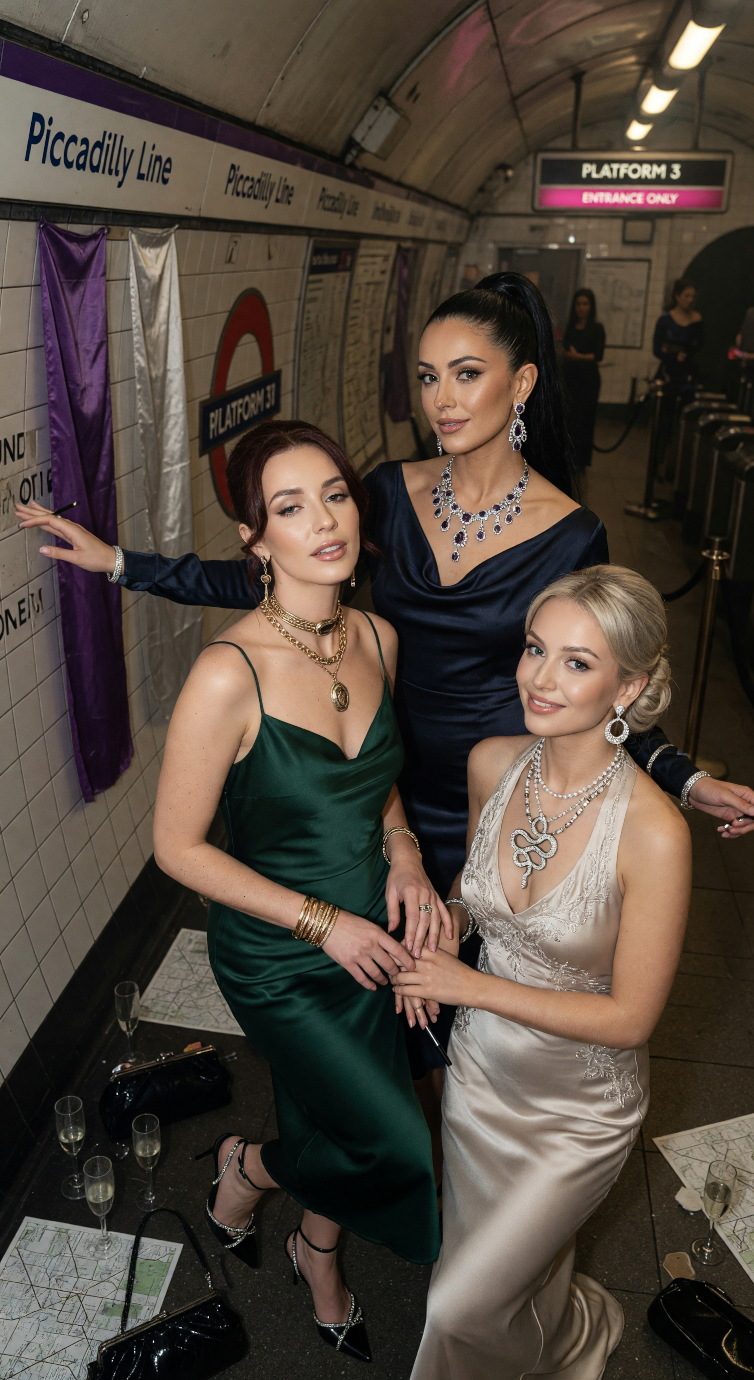
Beneath the City’s Gleaming Success Lies a Darker, Deeper Need. One Man Commands the Stage. Will You Answer His Midnight Audition?
Do you remember the last time you truly felt?
Not the calculated satisfaction of a deal closed, or the hollow applause at another charity gala. But the raw, thunderous pulse of being utterly known. The exquisite relief of a decision taken from your weary hands.
For the women who have everything, there remains one forbidden luxury: the luxury of surrender.
This is not a story of weakness. It is a story of power, redirected. Of brilliant, accomplished women—surgeons, judges, CEOs—who secretly board a forgotten Tube line at midnight. They descend into a theatre of shadows where the only production is the unlocking of their own deepest yearnings.
Here, under the gentle, unwavering command of a man known only as The Director, they perform the most liberating role of their lives: themselves. Stripped of society’s armour, clothed instead in cool, whispering satin, they learn that the greatest climax is not achievement, but obedience. The most profound sisterhood is found in a shared, glorious devotion.
The Nocturne Protocol is a deeply sensual, noir-drenched exploration of the truth many sophisticated women harbour but seldom voice: that within the silent strength of a commanding, nurturing gentleman lies the final, perfect peace they have been seeking.
This is your invitation to step off the platform. To feel the warm, ozonic air of the tunnel. To hear a baritone voice in the dark ask the question your soul has been echoing for years…
Are you ready to cease being the director of your own exhaustion?
Chapter 1: The Grey Exhaustion
The applause was a dry rustle of moths against a windowpane. Dr. Elara Vance stood at the lectern, her fingers resting on the cool edge of polished oak, and felt nothing. The presentation had been flawless, a dissection of her groundbreaking transcatheter aortic valve procedure that had saved the life of a dignitary whose name carried more weight than his failing heart. The data was irrefutable, the outcomes pristine. The room, filled with the sharpest minds in European cardiology, hummed with admiration.
And to Elara, it was all ash.
“A masterclass, Elara,” murmured Sir Alistair Crowthorne, his hand a brief, dry pressure on her elbow as the crowd began to disperse. “You’ve quite redefined the standard of care.”
“Thank you, Sir Alistair,” she said, the words emerging smooth and cool as surgical steel. A perfect instrument, producing perfect sounds. Inside, the landscape was a featureless plain under a perpetual twilight. She thought of her own heart not as an organ of passion, but as a sophisticated pump she had long ago relegated to autonomic function. It beat with the reliable, lonely rhythm of a metronome in an empty room.
Her registrar, a bright young thing named Anya whose eyes still held the spark of discovery, bounded up. “That graph on platelet aggregation post-procedure—they were gobsmacked. You’ve changed the game, Dr. Vance.”
Elara offered a smile that felt like a polite placard. “The game is just a series of complex rules, Anya. I merely suggested a more efficient algorithm.” She watched the girl’s eager face, a vivid watercolour next to her own monochrome existence. You still feel the thrill, she thought, the analogy forming unbidden. You are a sailor on the sparkling surface, feeling every gust. I am the submarine, too deep to feel the storm, navigating by sonar pings in the silent dark.
The charity gala that evening was a masterpiece of London opulence. The grand ballroom of the historical hotel shimmered with crystal and candlelight. Elara wore a gown of dove-grey chiffon, a designer piece that cost more than a junior doctor’s annual salary. It was beautiful, drapey, and utterly without sheen. It felt like wearing a cloud of regret. She moved through the constellations of wealth and influence, a phantom at her own feast.
“Elara, darling! Your speech today was everything,” cooed Lady Penelope, a society doyenne whose life was a curated exhibition. “One feels so terribly safe knowing minds like yours are at the helm.”
“Safety is an illusion maintained by constant vigilance,” Elara replied, sipping champagne that tasted of chilled minerals. “We are all just one arrhythmia away from chaos.”
Lady Penelope tinkled a laugh, mistaking bleak honesty for witty profundity. Elara excused herself, the murmur of the crowd becoming a dull roar in her veins, a tinnitus of the soul.
She found a momentary sanctuary on a terrace overlooking the Thames. The city glittered, a circuit board of ambition and light. The chill air did not invigorate her; it simply felt like a different temperature of void.
“Dr. Vance?” A soft voice beside her. It was the wife of her most recent patient, a woman of quiet grace named Eleanor. “I didn’t get to thank you. Properly. For what you did for Henry.”
Elara turned. “It was my job, Mrs. Abernathy.”
“No.” The woman’s eyes were luminous with unshed tears. “You gave him back to me. You reached into the storm and pulled him to shore. I… I can see the cost of it, though. In your eyes.”
The words were a scalpel, slipping between the ribs of her composure. “Cost?”
“The weight.” Eleanor’s hand fluttered, a helpless gesture. “You carry the weight of all those hearts. All those potential silences. It must be like… like being a lighthouse keeper who never sees the sun, only the wreckage that didn’t happen. You must be so very tired of the grey.”
The accuracy was devastating. A lighthouse in the endless grey. That was it exactly. She was a sentinel against the dark, her own light a cold, automated beam, while within the tower, everything was stillness and stone.
“One grows accustomed to the climate,” Elara whispered, the professional façade cracking for a single, perilous second.
Eleanor simply touched her arm, a gesture of profound understanding, and melted back into the ballroom. The connection, brief as it was, had been a searing brand on Elara’s numbness. It left her more raw, more aware of the desolation within.
She could not go back inside. The thought of another minute amidst the glittering facsimile of life was untenable. With a decision that felt less like choice and more like gravitational collapse, she fetched her wrap and descended into the London night.
She walked without direction, her heels clicking a sterile rhythm on the pavement. The streets began to quiet. She found herself outside Green Park station, its entrance a maw of muted light. An impulse, dark and fluid, pulled at her. Down. She needed to go down.
The escalators carried her into the familiar, tiled belly of the city. The platform for the Jubilee Line was nearly deserted, the air stale with brake dust and forgotten hurry. A digital display flickered, announcing the next train in eight minutes. The grey exhaustion was a physical weight now, a leaden cloak. She leaned against a cool pillar, closing her eyes.
But the air… it changed.
A subtle current, warm and inexplicable, brushed her cheek. It carried a scent utterly alien to the Underground: the clean, sharp tang of ozone after a lightning strike, underpinned by something rich, woody, and impossibly calming—sandalwood and aged paper. It was the scent of a forbidden library, of static electricity and serenity.
Her eyes snapped open. The platform was unchanged, but down the tunnel to her left, where the darkness should have been absolute, a soft, amber glow pulsed. Not the harsh white of service lights. This was the colour of old whisky, of honey in sunlight.
A compulsion, stronger than any surgical instinct, seized her. She walked past the yellow line, towards the glow. The tunnel curved, and there, on a disused spur of track, sat a single, vintage Tube carriage. It was from a bygone era: rich, burgundy paint, polished brass fittings, windows gleaming with inner light. The doors stood open, an invitation.
This was madness. A hallucination born of fatigue. Yet the warm air poured from it, carrying that hypnotic scent. It felt more real than the gala, more real than the operating theatre.
She stood on the threshold, the grey chiffon of her gown whispering around her ankles. The interior was all deep, buttoned leather and gleaming wood. Empty.
Then a voice filled the space. It did not come from a speaker. It emanated from the very air, a baritone resonance that vibrated in the hollow of her chest, warm and absolute.
“Dr. Elara Vance.”
She froze. It knew her.
“Your performance above is commendable. A symphony of precision. A masterpiece of control.”
The voice was not mocking. It was stating a fact, with the respectful gravity of a fellow artisan.
“But a symphony,” it continued, the words wrapping around her like a velvet rope, “requires a conductor. Not to play the instruments, but to release the music trapped within them. You have been playing your own score, note-perfect, for a very long time. Tell me… can you still hear the melody? Or only the metronome?”
The question pierced the last of her defences. The analogy was her own private truth, spoken back to her in a stranger’s dark, mellifluous tone. Tears, hot and shocking, blurred the amber light.
“I…” her voice was a ragged thing. “I hear the silence.”
“Ah.” The sound was a sigh of profound understanding. “The silence after the last note fades. The grey exhaustion. It is not a failure of skill, Doctor. It is a hunger of the soul. You have spent a lifetime stitching hearts closed. Who has been tending to the wound in yours?”
She had no answer. She was trembling.
“This,” the voice said, gentler now, a nurturing rumble, “is the terminus for that particular line of enquiry. Beyond this point, the maps are redrawn. The destination is not a place on any timetable. It is a state of being. Would you like to feel your heart beat again? Not as a pump, but as a compass? Would you like to exchange the grey for… a different spectrum?”
It was not a seduction. It was a diagnosis, and the promise of a cure. The authority in the voice was not domineering; it was foundational. It was the granite bedrock beneath the shifting soil of her life. It offered the one thing her towering success could not: the cessation of her own command.
The relief at the mere suggestion was a wave of such intense, submissive pleasure it stole her breath. It was the feeling of the last knot of tension, held for a decade, finally being sliced through.
Without a word, she stepped into the carriage.
The doors closed behind her with a soft, pneumatic sigh, sealing out the world of grey. The carriage began to move, smooth and silent, not along the known tracks, but deeper into the warm, scented dark.
Chapter 2: The Audition Without a Script
The carriage moved through the darkness not with the jolting clamour of a train, but with the silent, oiled grace of a hearse bearing a queen to her rest. Elara stood, one hand resting on a brass pole, her body swaying not to any track but to the deep, resonant hum that seemed to emanate from the carriage itself. The grey chiffon of her gown felt suddenly insubstantial, a ghost of her former life clinging to her skin. Outside the windows, the tunnel walls had given way to a velvety, starless void. The only light was the amber glow within, painting everything in the tones of aged whisky and honey.
“Do not be afraid of the absence of reference points, Dr. Vance.” The Voice was everywhere again, a warm baritone that seemed to vibrate from the leather seats, the polished wood, the very air she breathed. It was closer now, intimate. “The most profound journeys are taken when the familiar maps are left behind. Please, sit. Allow yourself to be conveyed.”
Her legs, those reliable pillars that had stood for hours in operating theatres, felt aqueous. She sank into the embrace of a plush, burgundy seat. It cradled her, held her with a firmness that felt like being anchored after years of drifting.
“Where are you taking me?” Her own voice sounded small, a child’s query in a cathedral.
“To the place where your performance will be evaluated,” The Voice replied, not unkindly. “Not the performance of the surgeon, or the luminary. The performance of the woman. The one who has been playing a role written by circumstance, by expectation, by a relentless, internal critic. We are going to see what lies beneath the script.”
An elevator? The carriage was descending, she felt it in the subtle pressure in her ears, the slight, sinking sensation in her stomach. It was not alarming; it felt like a gentle submersion into a warm sea.
“I don’t understand what you want from me,” she whispered.
“I want nothing,” The Voice corrected, its tone one of perfect, calm certainty. “I offer an opportunity. The stage is set. The scenery is your own psyche. I will be your audience, and your director. Your only task is to be present. To feel. To stop editing your reactions. Can you do that? Can you, for once, stop being the surgeon and simply be the patient?”
The analogy was a lancet, precise and deep. To be the patient. To be the one lying on the table, trusting another’s hands. The thought sent a tremor through her that was equal parts terror and a dark, thrilling longing.
The carriage sighed to a halt. The doors slid open without a sound, revealing not a platform, but the mouth of a corridor. The walls were covered in deep, claret-coloured velvet, absorbing the light from sconces that flickered with the illusion of flame. The air was cooler here, carrying the scent of dust, old roses, and a faint, electric tang.
“Follow the corridor, Doctor. It will lead you to the stage. There is no other path.”
She rose, her legs unsteady. She stepped out, and the carriage doors closed behind her, sealing her in. The silence was profound, a living thing that pressed against her ears. The velvet under her fingertips was lush, decadent. She walked, the whisper of her dull chiffon gown the only sound. The corridor curved gently, then opened abruptly.
She stood in the wings of a vast, decaying theatre. The auditorium before her was a cavern of shadow, its rows of seats empty, shrouded in dust sheets that looked like sleeping ghosts. The stage itself was a pool of faint, misty light, the heavy velvet curtains drawn back to reveal a space that seemed both infinite and claustrophobically intimate.
“Welcome to the Elysian Fields,” The Voice said, and now it had a source. It came from the darkness of the royal box, high to her left. She could discern only the faintest outline of a figure, seated, watching. “This is where we separate the melody from the noise. Step into the light, Elara.”
The use of her first name, devoid of title, was a deliberate disrobing. She felt exposed. She moved forward, her steps echoing on the ancient boards, until she stood centre-stage. The light was merciless, yet it felt like a balm after the grey twilight of her world. It was a golden, forgiving light.
“The audition is simple,” the Director’s voice floated down, calm, measured. “I will ask you a question. Only one. And you will answer not with your mind, but with your truth. The truth that lives in the silence between your heartbeats. Are you ready?”
She wrapped her arms around herself, the chiffon a poor shield. “I don’t know.”
“Good. Uncertainty is an honest starting point. Now. Listen.” A pause, thick enough to swim in. “What do you fear most… that you also, in the most secret chamber of your soul, most profoundly desire?”
The question hung in the air, a spider spinning a web of silence. It coiled around her, tightening. Her mind, that brilliant, analytical machine, whirred into panic, offering a thousand clinical, evasive answers: failure, professional obscurity, mortality.
But from a deeper place, a place she had walled off with bricks of achievement and polished with the veneer of control, a truth began to uncoil. It rose like a leviathan from the black depths of her exhaustion.
“I…” Her voice cracked. She closed her eyes, and the analogy formed, a perfect, painful metaphor blooming in the dark behind her lids. “I fear… being a lighthouse.”
She heard a soft, intrigued sound from the box.
“A lighthouse?” the Director prompted, his voice a gentle probe.
“Yes.” The words came now in a torrent, drawn up by the gravitational pull of his attention. “A solitary tower on a barren rock. Unmoving. My light is a cold, automated beam. It cuts through the storm, it warns of danger, it guides others to safety. And every ship that passes, every life that is saved… they see my light and feel gratitude. They sail on to warm harbours, to embraces, to lives of colour and connection.” A hot tear traced a path down her cheek. “And I remain. In the grey. In the wind. I hear the echoes of their joy, but I never feel the sun on my skin. I never leave my post. The greatest fear is that this is my purpose. To be the fixed point for everyone else’s journey. And the… the desire…” She shuddered, the confession tearing from her. “The desire is to be the ship. Just once. To have my sails filled by a wind I did not summon. To be guided. To be… brought home. To a harbour so safe, so still, that I could finally drop my anchor and… and stop. Just stop.”
The silence that followed was different. It was not empty; it was filled with a profound, resonant understanding. It felt like being seen, truly seen, for the first time in her adult life.
“An exquisite analogy,” the Director said finally, his voice rich with a warmth that seeped into her bones. “The lighthouse. A powerful, lonely symbol. You have diagnosed yourself with stunning accuracy, Doctor. Now, observe.”
The stage around her darkened. Then, from the shadows, shapes began to form. They were not solid, but projections of light and shadow, yet they felt horribly real. A towering, shifting cliff face of filing cabinets and monitor screens—the administrative avalanche of her life. The translucent, accusing spectre of a young man on a gurney, the one whose rhythm she could not restore, his eyes holding a silent question. Then, a sharper, more intimate horror: the critical, disappointed gaze of her mother, projected ten feet tall, lips pursed in perpetual dissatisfaction.
They circled her, these manifestations of her internal landscape. The air grew cold. She could hear the beep of a flatlining heart monitor, the rustle of legal papers, the sigh of maternal disapproval. They were closing in.
“This is the storm your lighthouse weathers,” the Director’s voice cut through, calm as a stone in a river. “This is the noise. Now. Where is your light?”
She tried to summon her will, her clinical detachment. She tried to ‘beam’ her competence at them. But the light within her was guttering, drained. She was just a woman in a silly gown, trapped on a stage with her ghosts. The fear was icy, climbing her throat.
“I can’t,” she gasped, backing away until her shoulders met something solid—a cold, painted flat of scenery. “I have no light left.”
“Exactly.” The word was not a condemnation. It was a liberation. “The lighthouse is exhausted. Its mechanism is worn. It is time, Elara, to cease being the tower.”
A single, powerful spotlight cut through the chaotic gloom. It did not illuminate her. It fell upon a simple, high-backed chair made of dark wood, placed in the exact centre of the stage. It was an island in the psychic maelstrom.
“The chair,” the Director said, his voice dropping into a register that was both a command and a caress, a vibration she felt in her spine. “Walk to it. Sit.”
It was impossible. The phantoms whirled, reaching for her with cold fingers of memory and dread. “I can’t move.”
“You can. Because I am telling you to. Your will is currently a rusted compass, spinning. Use mine. It points true north. The chair is true north. One foot. Then the other.”
His authority was a rope thrown into her chaos. She grasped it with a desperate, psychic grip. With a sob of effort, she pushed away from the flat and took a step. The phantoms swirled but did not touch her. Another step. The spotlight on the chair grew brighter, warmer.
“Good. Very good. You are not walking away from your fears. You are walking through them, guided. That is the difference.”
She reached the chair. It felt solid, real. An object in a world of shadows.
“Now,” the voice was a murmur just beside her ear, though he remained in his box. “Sit. Let the chair hold you. Relinquish the burden of standing guard.”
The act of sitting down felt like the most monumental surrender of her life. It was not a collapse; it was a deliberate, graceful lowering of her defences. As her body settled into the firm embrace of the wood, a shockwave of sensation went through her. It was a warm, heavy languor, starting at the crown of her head and flooding down to her toes. It was the pleasure of cessation. Of a weight she had carried so long she no longer recognised it, being lifted by invisible, capable hands.
The phantoms on the stage froze. They became still, silent, two-dimensional. They were no longer threats; they were mere scenery.
“Observe,” the Director whispered, the sound like velvet dragging across her soul. “They have no power without your engagement. Your vigilance gave them form. I have just… taken your engagement. Feel the relief.”
And she did. It was a physical, almost orgasmic release. A tension she had held in her jaw, her shoulders, her heart, for decades, unspooled in a wave of sublime weakness. A tear of pure, unadulterated relief spilled over. It was better than any praise, any accomplishment. It was the bliss of obedience. The euphoria of handing over the helm.
“What… what is this?” she breathed, her head lolling against the high back of the chair, her body boneless.
“This,” the Director said, and she could hear the smile in his voice, a smile of gentle, supreme satisfaction, “is the end of your audition. And the beginning of your new role. You have just demonstrated your most vital qualification: the capacity to receive direction. To trust the command that leads you out of the storm. The lighthouse has left its post. The ship has entered the calm waters of the harbour.”
He let the silence settle around her, let her bathe in the afterglow of that shocking, submissive pleasure.
“When you are ready, stand. The door to your left leads to the green room. Your colleagues await. They call it the Glossery. You will understand why.”
Slowly, trembling with the residual pulses of that profound relief, Elara pushed herself up. The phantoms were gone. The stage was just a stage. She felt hollowed out, but not empty. She felt… scoured clean. Ready.
She looked towards the dark box, but could see nothing. Yet she felt his gaze upon her, a tangible warmth on her skin. She did not bow. But she placed a hand, fleetingly, over her heart—the heart that was no longer just a pump, but a compass quivering towards a new, magnetic north.
Then, she turned and walked towards the door he had indicated, her steps no longer echoing with loneliness, but with the soft, eager sound of a woman walking towards a promise.
Chapter 3: The First Intervention
The door yielded to her touch without a sound, swinging inward on hinges that seemed to sigh in welcome. Elara stepped across the threshold and felt the air change as if she had passed through a membrane into another world. The backstage chill dissolved, replaced by a warmth that carried the scent of vanilla orchids, bergamot, and something else—the clean, ozone-rich scent of ironed silk.
The Glossery.
It was not a room; it was an atmosphere. A cavernous space, perhaps once a grand salon for theatre patrons, now transformed. The walls were draped in layers of charcoal velvet, but it was the centre of the room that commanded awe: a great, low circular diva, upholstered in supplest black leather, around which were arranged deep armchairs and chaise longues in shades of midnight blue and silver. The lighting was indirect, glowing from behind frosted panels set into the floor and ceiling, casting everything in a soft, lunar radiance. But it was the inhabitants who truly defined the space.
Women. Perhaps a dozen of them. They lounged, they conversed in low murmurs, they read from leather-bound volumes. Each was a study in exquisite, gleaming composure. Their attire was a symphony of sheen. A woman with a severe silver bob and eyes like flint wore a jumpsuit of liquid mercury satin that caught the light with every subtle shift of her limbs. Another, younger, with a cascade of chestnut curls, was draped in a robe of emerald-green silk charmeuse that whispered over the curves of her body. There were dresses of crushed velvet that gleamed like starless night, trousers of high-gloss patent leather, kimonos of embroidered silk that shimmered with thread-of-gold.
Their collective presence was a hum of serene power. This was no desperate harem; it was a convocation of queens in repose, their authority willingly vested in a single, unseen crown.
All conversation ceased as Elara entered. A dozen pairs of eyes turned to her, not with judgement, but with a calm, assessing curiosity. She became acutely, painfully aware of her own gown—the dove-grey chiffon, beautiful in its world, now appearing as what it was: a wraith of dullness, a fabric of fatigue. It hung from her shoulders like a shroud of ash.
“Ah. The new lighthouse,” said the woman in the mercury satin, her voice a cool, amused contralto. She unfolded herself from the diva with pantherine grace. “I am Cassandra. Once a High Court judge. Now, a devotee of clearer jurisdictions.” She extended a hand, and Elara took it, feeling the cool, smooth skin. “We felt the tremor in the machinery when you sat in the chair. It was… resonant.”
A younger woman with the look of a Renaissance painting, swathed in blush-pink satin, offered a gentle smile. “I’m Isabelle. I used to make a fortune predicting market crashes. Now I find more joy in predicting the Director’s next command.” She gestured to a vacant spot on the diva. “Please. You look as if you’ve been swimming upstream for a century. Rest.”
Elara sank onto the edge of the diva, the leather cool and welcoming through her thin gown. “I don’t understand,” she said, her voice barely above a whisper. “This place… you…”
“We are the intermission,” said a third woman, her fingers stroking the glossy spine of a book. “The space between the scenes he directs. A sanctuary of shared understanding.” She had the calm, centred presence of a concert cellist. “I am Margot. The music I play now is only for him, and it is the purest I have ever made.”
“But why?” The question burst from Elara, born of a lifetime of self-direction. “You are all… formidable. Why here? Why… surrender?”
Cassandra settled beside her, the mercury satin whispering secrets. “Think of your own life, Doctor. You commanded an operating theatre. A kingdom of blood and beat. Your will was law. And what was the texture of that sovereignty? It was granular, wasn’t it? A constant, grinding sand of decision-making. Each choice, another grain. Over a lifetime, it becomes a desert within. One can rule a desert, but one cannot live in it.”
The analogy was devastatingly precise. Elara saw it: the endless, beige expanse of her own autonomy.
Isabelle nodded, her pink satin catching the light like a inner glow. “I had a digital dashboard that could track the emotional temperature of continents. I could see the fear, the greed, the hope. But it was like watching a storm through triple-glazed glass. I was insulated, separate. I yearned to feel a storm again. To be in the weather, not just analysing it.” She leaned forward. “He is the weather, Elara. A climate of absolute attention. To be within it is to be… real.”
Margot closed her book. “I spent my life interpreting the intentions of dead composers. A medium for ghosts. My own voice was a silent string. Here, the Director is the composer, and I am his living instrument. The music we make is not written on paper; it is written on the nervous system. It is the first music I have ever played that I can also feel vibrating in my own bones.”
Before Elara could formulate a response to these confessions, a new presence filled the room. It was not an entrance; it was a change in atmospheric pressure. The warm, ozonic scent deepened.
The women stilled, their postures shifting into attitudes of relaxed, attentive receptivity. All eyes turned towards a sweeping archway at the far end of the room, now framed by a taller shadow.
The Director stepped into the soft light.
He was, as before, partially obscured—wearing a beautifully cut suit of a fabric so deep black it seemed to drink the light, his face still mercifully cast in shadow by the room’s ambient glow. But his presence was a physical force. It was not threatening; it was conclusive. He carried with him a garment, draped over his arm, a fall of fabric that gleamed like a shard of midnight itself.
His gaze, a palpable weight, found Elara. “You have been conducting your own inquisition, I see,” he said, his voice the same warm baritone, now coloured with mild amusement. “A logical mind seeks data points. Have you found your answers?”
Elara’s throat was dry. “They speak in poetry,” she managed. “But the calculus… I struggle.”
“Because you are using the wrong mathematics,” he said, moving forward. The women seemed to breathe collectively, a silent exhalation of pleasure at his proximity. He stopped before her. “The heart does not calculate. It resonates. It recognises a harmonic. Tell me, what did you feel when you sat in the chair?”
She looked up at him, this pillar of shadow and command. “It was… a cessation. Like a machine that has been running at critical pitch for years, suddenly being switched off. The silence afterwards… it was bliss.”
“Not switched off,” he corrected gently. “Its power source was changed. From your own depleting will, to my unwavering current.” He held out the garment on his arm. “That was the first intervention. A redirecting of energy. This is the second.”
Elara looked at the fabric. It was a dress, or perhaps a robe. A slip of liquid satin in a blue so dark it was nearly black, but which held within its depths a shimmer of sapphire, like the night sky viewed from the ocean’s deepest trench. It felt, even from a distance, cool and impossibly soft.
“Your current attire,” he said, his eyes flickering over her grey chiffon, “is the uniform of your loneliness. It is the colour of fog, the texture of regret. It speaks of distance, of observation. You have worn the lighthouse’s shroud long enough.” He extended the garment towards her. “This is a different skin. It does not conceal; it reveals. It does not protect you from the world; it connects you to a new one. It is the fabric of receptivity. Of gloss.”
A frisson of something electric and terrified thrilled through her. To change her clothes here, in front of him, of them…
“I…” she stammered.
“The hesitation is the last vestige of the old mathematics,” he murmured. “The fear of exposure. But you are already exposed. We have seen your lighthouse, your storm, your deepest hunger. There is nothing left to hide. The change is not an unveiling, Elara. It is an alignment. An external signal of an internal surrender that has already occurred.”
His words unknotted something in her chest. He was right. The real nakedness had been on the stage, in her confession. This was merely… ceremony.
“Stand,” he commanded, and the word was a soft, irresistible pressure under her ribs.
She stood. Her limbs felt light.
“Cassandra, Isabelle,” he said, without looking away from Elara. “Assist.”
The two women rose smoothly and came to her sides. Their movements were practised, reverent. With efficient, gentle hands, they found the hidden zip of her chiffon gown. The sound of it parting was the sound of a shell cracking. The dull fabric sighed away from her shoulders, pooling at her feet like a shed ghost. She stood in her simple, practical underthings, feeling the cool air of the Glossery on her skin, feeling more seen than ever in her life—and yet, not shamed. She was being witnessed, as a specimen is witnessed by a master biologist: with profound, impersonal interest.
The Director lifted the satin garment. It was a slip dress, with slender straps and a cut that promised to follow the lines of her body like water. He did not hand it to the women. He held it himself.
“Arms,” he said.
She lifted her arms, a gesture of pure submission. He drew the dress down over her head. The satin whispered over her skin, a sensation so profoundly sensual it drew a gasp from her lips. It was cool, then instantly warm, clinging to every curve, every plane, with a weightless, liquid embrace. It fell to just above her knees. The fabric gleamed, catching the low light and holding it, making her skin appear to glow from within.
Isabelle fastened a single, hidden clasp at the back. Cassandra stepped back, her head tilted in appraisal. “Yes,” she said simply. “Now you are here.”
The Director’s hands, she felt them then. Not on her body, but on her shoulders. His touch was firm, grounding, warm even through the satin. He turned her gently to face a vast, gilt-framed mirror that leaned against one velvet-draped wall.
“Look,” he said, his voice a vibration against her back.
Elara looked. The woman in the mirror was a stranger, and yet the most familiar self she had ever encountered. The grey exhaustion was gone from her eyes, replaced by a startled, luminous awareness. The blue-black satin sheathed her, transforming her silhouette from something functional to something… glorious. The fabric’s high gloss reflected the soft light, making her seem not dressed in fabric, but dipped in night itself. It moved with her breath, a second skin that celebrated rather than concealed. She saw, reflected behind her, the other women of the Glossery, their glossy forms arranged like a court of silent approval. And behind them, the tall, dark form of the Director, his hands still resting on her shoulders—a claim, a support, a completion.
“This,” he said, his voice dropping to a intimate murmur meant only for her, “is the visual truth of the intervention. The dull, defensive shell is gone. What remains is the receptive core, polished to a shine. The lighthouse did not collapse. It was transmuted. The stone became a vessel. The cold beam became a warm, reflective surface. You are no longer a warning light on a rock. You are a chalice, waiting to be filled.”
The analogy flooded her with a sense of rightness so profound it was dizzying. A chalice. Not to give, but to receive.
Tears, hot and silent, spilled over and traced paths down her cheeks, glittering against the satin.
“The feeling you have now,” the Director continued, his thumbs making slow, circles on her shoulders, a touch that was both possessive and nurturing, “this ache of beauty, this shock of recognition—this is the pleasure of alignment. It is the sensual proof of a correct decision. Your old clothes were a story of isolation. These,” he plucked at the strap of her dress, “are a story of belonging. To me. To them. To a system of care that you no longer have to administer.”
He turned her back to face him, his hands sliding down to cradle her elbows. His shadowed face was close to hers. “The First Intervention is complete. The energy source has been changed. The external form has been aligned with the internal truth. The Third Intervention will come when you are ready. It will involve not just receiving a command, but executing one. It will be the final proof that the chalice does not merely hold, but pours back according to the hand that guides it.”
He released her, and she felt the absence of his touch as a new kind of awareness.
“For now,” he said, stepping back and addressing the room, “welcome Dr. Elara Vance to the Glossery. She has traded granite for satin. Honour her passage.”
A soft, harmonious murmur of welcome rose from the women. Isabelle handed her a crystal glass of something effervescent and pale gold. Margot smiled, a genuine, warm expression. Cassandra simply nodded, a queen acknowledging a new sister of the realm.
Elara stood amidst them, the satin cool and electric against her skin, the taste of the drink like sunlight on her tongue, and felt the grey exhaustion replaced by something entirely new: a vibrant, trembling, glorious anticipation. She had been intervened upon. She had been changed. And she had never, in all her years of command, felt so powerfully, so sensually, so perfectly alive.
Chapter 4: The Company of Echoes
Time in the Glossery did not pass in the manner of the world above; it pooled, it eddied, it deepened like the colour in a glass of rich wine. Elara sat amidst the gleaming congregation, the sapphire-dark satin of her new skin a constant, cool whisper against her own. The effervescent drink Isabelle had given her tasted of pear and alpine air, each bubble a tiny explosion of clarity on her tongue. The initial shock of her transformation had settled into a low, humming vibration in her blood—a frequency of belonging.
Cassandra, the former judge in her mercury satin, swirled the contents of her own crystal glass. “The first hour is always the most disorienting,” she said, her voice holding the same measured cadence Elara imagined she used from the bench. “It is the hour when the old metronome finally breaks. The silence it leaves behind is not empty; it is pregnant. It awaits a new rhythm.”
“I feel… un-tethered,” Elara admitted, the confession flowing more easily in this confessional atmosphere. “But not afraid. It’s as if I’ve been holding a complicated, heavy piece of machinery for years, and suddenly someone has taken it from my arms. My muscles don’t know what to do with the lightness.”
“That is the echo of released control,” murmured Margot, the cellist. She was curled on a chaise longue upholstered in charcoal velvet, her fingers tracing the glossy cover of her book as if it were a lover’s spine. “It rings in the bones. For me, it was my violin. I realised I had been holding it like a shield, a beautiful, polished barricade between myself and the raw noise of feeling. The Director asked me to play for him, not a concerto, but a single, sustained note. To pour my entire history into one unbroken sound. And when I did, he… he listened it into something else. He listened, and my note became a thread, and he began to weave. I was no longer the player. I was the string, vibrating to his attention.” She looked up, her eyes luminous. “Have you ever felt so attended to that your very essence realigns?”
Isabelle, the pink-satin visionary, laughed softly. “I felt it through numbers. My world was a cathedral of data, every emotion quantified, predicted, traded. I was the high priestess of probability. And I was dying of loneliness. It was like being trapped in a beautiful, soundproofed room lined with mirrors. I could see infinite reflections of my own intelligence, but I could touch nothing real.” She leaned forward, the satin stretching over her knees. “He didn’t give me more data. He gave me a question. One question. ‘What does the market crave, not just fear?’ I gave him a ten-minute analysis. He listened, and then he said, ‘No. Not the market. You. What do you crave?’” She shook her head, a wistful smile on her lips. “I didn’t have an answer. I had forgotten how to want for myself. So he told me. He said, ‘You crave a storm you cannot predict. A variable so profound it recalibrates all your equations. You crave me.’ And in that moment, every algorithm in my mind shattered. The soundproof room dissolved. And I felt the wind on my face for the first time in a decade.”
A striking woman with hair the colour of polished mahogany and eyes of cool jade, who had been silent in a high-backed chair of violet satin, now spoke. Her voice was a low, smoky contralto. “I am Gabrielle. I built an empire from vintage textiles. I could date a brocade by its smell, authenticate a lace by the tremor in my fingers. I was a connoisseur of the abandoned, the beautiful dead thing.” She gestured to her own attire, a gown of iridescent violet that shifted like oil on water. “I clothed myself in history. I was a walking museum. He saw me and said, ‘You are a curator of ghosts. When do you allow yourself to be the artefact? To be the thing of beauty, preserved and adored in the present?’ He asked me to bring him the most precious thing I owned. I brought a 17th-century Venetian velvet cloak. He took it from me, held it for a moment, and then draped it over a chair. ‘This,’ he said, ‘is a masterpiece. But it is a finished story. You,’ he said, and his hand, just for a second, brushed my cheek, ‘are a manuscript with blank pages yet to be written. I will provide the ink.’” She touched her own cheek, as if feeling the echo of that touch. “He traded my museum for a studio. My past for a future authored by his hand.”
Elara listened, each story a key turning in a different lock within her own soul. “It sounds as though he doesn’t erase who you are,” she said slowly, working it out. “He… refines it. He finds the essential element and strips away everything that obscures it.”
“Precisely,” Cassandra nodded, a gleam of approval in her flinty eyes. “He is the ultimate arbiter. In my court, I sifted through lies and truth to find justice—an abstract, brittle thing. Here, he sifts through the clutter of a life to find the desire. The raw, pulsing core of what a woman truly needs. And then he constructs a world where that need is not just met, but glorified. My desire was for a law that was absolute, personal, and nurturing. Not the cold, blind statue of Justice, but a living, breathing jurisprudence of the soul. He is that law.”
“But there are so many of you,” Elara said, the question forming gently. “How does one… how does one man provide such specific attention?”
A new voice, soft and melodic, came from the entrance to an adjoining gallery. “Because he does not see us as a multitude, but as a choir.”
The woman who entered was ethereal, with hair like spun platinum worn in a sleek chignon. She was clad in a simple column of ivory silk satin that gleamed like a moonbeam. She moved with a serene, gliding grace. “I am Seraphina. I was a voice coach for opera singers. I taught them how to project, to control, to dominate with sound.” She came to stand near the circle, her hands clasped. “I thought I understood harmony. I did not. I understood only soloists. The Director taught me about the chord.” She looked around at the assembled women, her gaze loving. “Each of us is a unique pitch. A vibration. Alone, we are a note. Beautiful, perhaps, but incomplete. He is the composer who hears the chord we can make together. His attention is the tuning fork. He strikes it, and we each find our true note relative to his, and to each other’s. The provision is not diluted; it is multiplied. His command is the fundamental tone that holds the entire harmony together.”
The metaphor resonated in the luxurious space. Elara looked from face to face—Cassandra’s sharp intelligence, Isabelle’s vibrant curiosity, Margot’s deep sensitivity, Gabrielle’s refined aesthetics, Seraphina’s serene wisdom. They were not copies. They were distinct, brilliant instruments.
“The Glossery,” Seraphina continued, sweeping a hand around the room, “is where we practice resonance. We are the echoes of his fundamental tone. We reflect it to each other, we absorb it, we are polished by it. The gloss you wear,” she said, her eyes meeting Elara’s, “is not merely fabric. It is a physical manifestation of that resonance. A dull surface absorbs sound, dies alone. A glossy surface reflects. It connects. It becomes part of the chorus of light.”
As if on cue, a subtle, collective shift occurred. The women’s postures softened further, their attention drifting towards the main archway. The air, already perfumed, seemed to thicken with a collective anticipation. He had not entered, but his imminent presence was a tide they all felt pulling at them.
“He is near,” Margot whispered, closing her book.
“He comes to listen to the harmony,” Seraphina said, smiling gently at Elara. “To ensure we are in tune.”
Isabelle reached over and placed her hand over Elara’s where it rested on the cool leather of the diva. Her touch was warm. “Your note is new to the choir, Elara. It is pure, but unsure of its place. Listen for him. He will find you in the chord.”
A deep, resonant silence fell, more profound than any before. It was a waiting silence. Elara felt it, the satin of her dress suddenly alive against her skin, as if it were a sensor attuned to the very atmosphere. She was no longer a lone lighthouse. She was a string on a cello, a data point in a new, living equation, a blank page in a shared manuscript, a voice in a moonlit choir. She was an echo, finding her place in the company of beautiful, resonant echoes, all waiting for the sound that had created them to fill the room once more.
And in that waiting, she found a new, profound dimension of the pleasure he had introduced: the sensual, intellectual thrill of being part of a perfected, glossy whole.
Chapter 5: The Personalised Nightmare
The harmony of the Glossery was a living tapestry, each woman a gleaming thread woven into a pattern of serene anticipation. Elara had spent what felt like both an instant and an eternity within its warm, resonant silence, the sapphire satin a second skin that taught her new truths about her own contours. The echo of the Director’s unseen presence had faded from the air, leaving behind a charged stillness, like the moment after a lightning strike before the thunder rolls.
It was Cassandra who finally broke the quiet, her mercury-clad form uncoiling from the diva with the lethal grace of a satisfied predator. “He has left you to marinate,” she said, her flinty eyes resting on Elara. “To let the new frequency settle in your bones. But the intermission is never long. The next act is always… tailored.”
Isabelle nodded, her pink satin shimmering as she drew her knees to her chin. “The first scene is about revelation. The second is about resonance. The third…” she trailed off, a shiver of something that was not fear, but delicious apprehension, passing through her. “The third is about rupture. He will find the precise fault line in your architecture and apply the perfect, loving pressure.”
“How will I know?” Elara asked, her voice barely a whisper. The satin felt electric against her suddenly chilled skin.
“You will know,” Margot said softly from her chaise, her fingers stilled on her book. “He does not send a memorandum. He alters the very atmosphere of your reality. It will feel like the floor becoming liquid beneath your feet. Like the walls of your most secure room… breathing.”
As if her words were a incantation, the air in the Glossery changed. The warm scent of vanilla and ozone sharpened, curdling into something sterile, metallic—the unmistakable scent of antiseptic and cold fear. The soft, ambient light flickered, then hardened into the stark, white glare of surgical theatre lamps. The luxurious textures of velvet and leather bled away, dissolving into the cool, unforgiving surfaces of stainless steel and white tile.
Elara gasped, her hands flying to her arms. Her beautiful satin dress was gone. In its place, she wore surgical scrubs of a dull, green cotton, rough against her skin. She stood not in the Glossery, but in the centre of an operating theatre. It was a perfect replica of her own at St. Julian’s, yet horrifically distorted. The instruments on the tray beside her were not the gleaming, precise extensions of her will; they were blunt, archaic things—bone saws with dull teeth, forceps rusted at the joints, scalpels with edges rounded by time.
And on the table lay the patient.
The body was draped in a sterile sheet, but the face was exposed. It was her own face. Pale, serene, eyes closed. The monitors beside the table emitted a low, insistent flatline, a single, unwavering tone that was the auditory equivalent of the grey exhaustion.
“No,” she breathed, her professional mind recoiling even as her soul understood. This was the nightmare. The personalised core of it.
A voice, amplified and dispassionate, echoed in the theatre. It was her own voice, from a long-ago recording of a lecture. “The surgeon’s primary responsibility is control. Absolute, unflinching control over the environment, the procedure, and one’s own emotional landscape.”
“This is not possible,” Elara muttered, her hands clenching at her sides. She reached for a scalpel, her fingers closing around the familiar shape, but the heft was wrong. It felt like a child’s toy, a pathetic imitation of power.
“Procedure commences,” the recorded voice intoned.
She had to act. This was her domain. She was Dr. Elara Vance. She lifted the blunt scalpel. Her hands, those steady, legendary hands, began to tremble. She brought the instrument to the marked incision line on the patient’s—on her own—chest. She pressed. The skin did not part cleanly; it bruised, dimpled, resisted. A small bead of blood welled, obscenely red.
“Hemorrhage protocol,” the voice announced, as the flatline continued its relentless drone.
Panic, cold and greasy, slithered up her spine. This was every latent fear she had ever suppressed: the loss of skill, the betrayal of her own hands, the public, humiliating failure. She fumbled for a clamp, but her fingers slipped on the rusted metal. The beeping of the flatline seemed to grow louder, filling the vast, cold space, becoming the jeering crowd at her gala, the disappointed sigh of her mother, the silent accusation of the lost patient.
“I can’t,” she whispered, the confession torn from her. “The instruments are wrong. The anatomy is… it’s me. I can’t operate on myself.” The analogy crashed over her with the force of a physical blow. This is my entire life. I have been trying to perform open-heart surgery on my own soul with blunt tools, in a sterile, empty theatre, with no anaesthetic but my own will. The horror of the realisation was a vortex, pulling her down.
Just as the psychic nausea threatened to engulf her, the lights shifted.
The harsh white glare softened, warmed, focused into a single, golden spotlight that did not illuminate the operating table, but the space beside her. And there he stood.
The Director.
He was gowned in surgical greens, a mask obscuring the lower half of his face, but his eyes—those calm, assessing eyes—were visible above it. He held no instruments. His gloved hands were empty, held slightly away from his body, poised.
“Your diagnosis is correct, Doctor,” he said, his voice not amplified, yet cutting through the flatline with effortless clarity. “The instruments are inadequate. The surgeon is compromised by subjective terror. The patient is too intimately known. A textbook scenario for catastrophic failure.”
Elara stared at him, tears of frustration and shame mingling on her cheeks. “Then it’s hopeless.”
“Hopeless?” he repeated, a single, elegant eyebrow rising above the mask. “Only if you insist on being both the surgeon and the saviour. That is the arrogance of the lighthouse, is it not? To believe it must be both the warning and the rescue vessel.” He took a step closer. The sterile field seemed to warp around him, accepting his presence as a new, fundamental law. “You are attempting to operate from within the storm of your own emotion. You cannot see the anatomy for the blood of your fear.”
“What would you have me do?” Her voice was a ragged plea.
“I would have you acknowledge the superior perspective,” he said, his gaze holding hers, a lifeline in the chaos. “I am outside the storm. I see the heart of the matter. Not your heart, Elara. The problem. And I possess the correct instrument.” He moved then, coming to stand directly behind her, his presence a wall of calm against her trembling back. He did not touch her, not yet. “The instrument is not on the tray. The instrument is you.”
She shuddered, her breath catching.
“Your skill is not lost. It is merely misdirected. It is a river flooding its banks, causing destruction. I will provide the channel.” His hands came up, slowly, deliberately. He placed them over hers, his gloved fingers covering her own on the useless scalpel. His touch was firm, warm, absolute. “I will guide the cut. You will witness the saving. You will be the perfect, living scalpel in my hand. Your will is to become an extension of mine. Your knowledge is to be placed at my disposal. Your fear… will be irrelevant.”
The moment his hands settled over hers, the trembling ceased. A wave of something akin to a narcotic warmth flooded her system. It was the relief of the chair, multiplied a thousandfold. It was the cessation of all choice, all responsibility, all striving. She was a tool, being taken up by the master craftsman.
“Now,” he murmured, his voice a vibration against the shell of her ear. “Follow my pressure. Do not think. Feel.”
He moved her hands. It was not a forceful dragging; it was a subtle, undeniable guidance, as if her muscles were receiving instructions directly from his nervous system. The blunt scalpel in their joined hands seemed to sharpen, to find a purchase it had lacked. Together, they made the incision—clean, precise, bloodless. It was not her cut. It was his cut, performed through her.
“Clamp,” he instructed, and her free hand, moved by his unspoken will, found the rusted forceps. Under his direction, they became precise pincers, holding back what needed to be held.
The flatline continued, a mocking soundtrack.
“The monitor is a liar,” the Director said, his voice steady as a bedrock. “It measures only electrical impulse. It does not measure potential. It does not measure the truth I am carving into this flesh. Watch.”
Their joined hands worked, a bizarre, intimate dance of life over the mirrored body. He guided her through a procedure that defied standard anatomy, that was part surgery, part symbolism, part exorcism. He was not repairing a heart; he was removing something—a dark, crystalline knot of anxiety that had taken root where her self-worth should have been.
“This,” he said, as their instruments lifted the glittering, black shard free, “is the calcified fear of inadequacy. You have been carrying it as a trophy. I am discarding it.”
As the false growth was removed, the monotonous flatline stuttered. A single, blip appeared on the screen. Then another. A slow, steady, sinus rhythm began to paint its green mountain range across the monitor.
The sound was the most beautiful Elara had ever heard.
Her body went weak with a euphoria so intense it bordered on pain. It was not the triumph of a surgeon who had saved a life. It was the devastating, submissive bliss of the instrument that had been used to perform the miracle. She had contributed nothing but her surrender. Her expertise had been a latent potential he had activated. Her hands had been vessels for his will. The pleasure of it was humiliating and glorious, a paradox that unravelled her completely.
He guided her hands through the closure, the sutures neat and perfect. Then, slowly, he lifted his hands from hers. The contact broken, she almost crumpled, her legs unable to support the weight of the revelation.
He caught her elbow, his grip strong and sure. He turned her to face him, pulling his surgical mask down. His expression was one of intense, focused satisfaction. “Observe,” he said, nodding towards the table.
The patient—her own likeness—was gone. The table was empty, clean. The blunted instruments had vanished. The theatre itself was dissolving, the walls bleeding back into the soft, velvet shadows of the wings. They stood once more on the empty stage of the Elysian Fields.
“The nightmare was not a punishment,” he said, his voice low and rich. “It was a furnace. And you, my dear Doctor, were the metal within it. Your own expertise was the fuel. The fear was the fire. And my guidance was the hammer and the anvil.” He reached out and touched her cheek, a gesture of shocking tenderness. “You have been reforged. The lighthouse has been melted down. What is being cooled is not stone, but a different substance altogether. A substance that can hold an edge, that can gleam, that can serve a purpose defined by a hand other than its own. The euphoria you feel,” he continued, his thumb stroking the line of her jaw, “is the metal singing as it takes its new, perfect shape. It is the pleasure of becoming useful to a vision greater than your own.”
Elara could only look at him, her eyes wide, her breath coming in soft, ragged pulls. The rough scrub fabric now felt like a hair shirt, a reminder of the agony that had preceded the ecstasy.
“The personalised nightmare is the ultimate gift,” he said, finally dropping his hand. “It is the destruction of the idol you built to your own independence. You worshipped at that altar, and it gave you only ashes. Now, you have felt the true sacrament: the bliss of being a vessel filled with a will that is not your own. Remember this feeling. It is the taste of your new purpose.”
He turned and began to walk towards the shadows of the wings, his green gown fading into the darkness. Before he disappeared, he paused and spoke over his shoulder, the words floating back to her on the warm, ozonic air.
“The next time you pick up a scalpel in the world above, you will not be alone. You will feel my hands over yours. And you will know, in your blood and in your bones, that you are no longer the surgeon. You are the means. And I… I am the end.”
He was gone.
Elara stood alone on the stage, the ghost of his touch on her hands, the echo of the perfect heartbeat in her ears, and the devastating, glorious, soul-annihilating pleasure of being used, thrumming in every glossy, receptive cell of her being.
Chapter 6: The Gift of Glossy
Elara did not remember leaving the stage. The transition from the surgical theatre’s stark annihilation to the Glossery’s velvet embrace was a blur, a slow-motion fading of one reality into another, as if she were a watercolour left in the rain, her edges softening, her harsh lines bleeding into a new, more beautiful composition. She found herself seated once more on the great circular diva, but now her body was a vessel filled with a strange, heavy calm—the aftermath of the storm, when the air is still charged but the destruction has revealed a clearer sky.
The rough green scrubs were gone. She was clad once more in the sapphire-dark satin slip, but it felt different against her skin. Before, it had been a costume of potential; now, it was a testament. The fabric seemed to have absorbed the memory of the Director’s guided hands, and it hummed against her flesh with a low, persistent frequency, a constant reminder that she was now an instrument that had been played by a master.
Cassandra observed her from across the space, her mercury-satin form a pool of liquid metal in the low light. “The furnace leaves its mark,” she said, not unkindly. “Not a scar, but a tempering. One can see it in the stillness of your hands. They are no longer tools seeking a purpose. They are relics of a purpose that has been fulfilled.”
“It feels…” Elara began, her voice husky, “…like I’ve been emptied out. But not in a hollow way. Emptied like a cathedral after the last note of a requiem has faded. The space is holy because it has held something immense.”
“A beautiful analogy,” murmured Margot from her chaise. She had set her book aside. “That is the gift of the nightmare. It evacuates the ego. What remains is architecture—pure, resonant space, waiting to be filled with a new, directed music.”
Isabelle, curled like a contented cat in her pink satin, nodded vigorously. “The data is cleared. The old, corrupted files of ‘what if’ and ‘I must’ are wiped. The system is clean, optimized. Now it can run a far more elegant program.” She smiled, a flash of white in the gloom. “His program.”
The conversation was soothing, a balm of shared understanding. Yet, a new anticipation began to thread through Elara’s veins, subtle as a spider’s silk. It was focused on the satin itself. She ran a hand down her thigh, feeling the incredible, cool slickness of it. “This,” she said, almost to herself. “Why does this… matter so much? It’s just fabric.”
A soft, collective sigh rippled through the women, a sound of fond amusement.
“Oh, my dear lighthouse,” Seraphina said, gliding forward from the shadows where she had been listening. Her ivory satin seemed to generate its own light. “It is never ‘just’ fabric. Fabric is the interface between the self and the world. Your grey chiffon was a membrane designed to filter, to mute, to separate. It said, ‘I am here, but do not touch me. I observe, but I am not part of the spectacle.’” She knelt gracefully before Elara, her eyes luminous. “This,” she said, her own hand mirroring Elara’s, hovering just above the sapphire satin without touching it, “is an entirely different interface. It is a conductor. Not of electricity, but of intention. Of attention.”
Gabrielle, the violet-clad curator, joined them, her iridescent gown shifting with every step. “Think of the history of adornment,” she said, her smoky voice a lecture in itself. “Matte, rough textiles—wool, linen, unpolished cotton—they are the fabrics of labour, of anonymity, of blending into the landscape. They are the uniforms of the autonomous. But gloss…” She reached out and finally let her fingertips brush the surface of Elara’s slip. A tiny, static spark leapt, a visible testament to her words. “Gloss is the domain of the precious. Lacquer on Chinese screens, glaze on porcelain, the polished patina of centuries-old mahogany, the shine on a perfectly ripe aubergine. Gloss is completion. It is a surface that has been attended to, finished, perfected. It does not absorb light; it answers it. It throws the gaze of the world back upon itself, transformed.”
“It is the visual equivalent of surrender,” Cassandra stated, her judicial tone leaving no room for argument. “A matte surface is stubborn; it holds onto its own colour, its own texture, defiantly itself. A glossy surface is yielding. It accepts the light, the colour of its surroundings, the image of the one who beholds it. It becomes a canvas for external influence. In law, we would call it a receptive precedent. In life, it is the state of being perfectly influenceable.”
Elara listened, the analogies layering upon her soul like gilt. She looked at her own reflection in the dark, polished surface of a nearby table. The woman there was a creature of depth and sheen, her edges sharp yet soft, her form both present and elusive. “So the gloss… it’s a signal?”
“It is a statement,” corrected a new voice, deep and warm, pouring into the room like slow-pouring honey.
The Director stood in the archway. He had changed from his surgical greens into a suit of a wool so fine it appeared matte from one angle, yet revealed a hidden, subtle luster as he moved—a masculine echo of the principle they discussed. In his hands, he carried a long, slender box of polished ebony.
The women didn’t startle; they simply oriented towards him, like flowers turning to a hidden sun. The atmosphere deepened, charged with a pleasurable voltage.
“It is a statement of fact,” he continued, walking into the centre of their circle. His eyes were on Elara, but his words encompassed them all. “Matte is potential. Gloss is actuality. A rough stone contains the statue. The polished marble is the statue, realized. Your previous life was a collection of rough stones—brilliant, valuable, but heavy and unformed. The nightmare was the hammer. The chair was the first chisel. This,” he gestured to her satin slip, “is the first polish.”
He stopped before her and held out the ebony box. “But the first polish is merely proof of concept. The true gift is the full realisation. Open it.”
Her fingers, those once-trembling instruments now steadied by his will, reached for the box. The clasp opened with a satisfying click. Nestled within, on a bed of black silk, was not a dress, but a waterfall of liquid night. She lifted it, and it unfolded—a gown. It was strapless, cut on a bias so severe it seemed to defy physics, made of a satin so profoundly black it made the sapphire slip seem pale. This black did not absorb light; it devoured it, and then, in its depths, gave birth to a new, internal light, a blue-black gleam that moved like a secret under its surface. The texture was beyond anything she had felt; it was cooler than skin, smoother than ice, weightless and dense all at once.
“This,” the Director said, his voice a reverent murmur, “is Gloss. Not as an attribute, but as a principle. As a destiny.”
“It’s…” Elara was breathless. “It’s for me?”
“It is you,” he replied. “The ‘you’ that has been waiting beneath the surgeon, the achiever, the lonely sentinel. The ‘you’ that is meant to be seen, not as a doer, but as a presence. A polished presence in a polished world.”
Isabelle clasped her hands together. “The gift! He only gives the Gift of Glossy after the nightmare. It means you passed. You didn’t break. You… melted. And now you can be recast.”
“Come,” Seraphina said, rising and offering her hand. “We shall help you. The first gloss was given. This one must be assumed.”
In a secluded alcove veiled by curtains of black chiffon, the women assisted her. The sapphire slip was reverently removed. The new gown was poured over her head. The sensation was transcendental. The satin was so cold it was almost a shock, then it warmed instantly to her body temperature, becoming a second, smarter skin. It clung to every curve, every hollow, with a lover’s intimate knowledge, falling in a clean, devastating line to the floor. It was both armour and absolute vulnerability. In it, she felt utterly exposed and yet more powerful than she ever had in her white coat.
When the curtain was drawn back, she stepped out.
A collective, soft intake of breath greeted her. The women’s faces were mirrors of awe and approval.
The Director’s gaze was a physical warmth that travelled over her from head to toe, slow, assessing, possessive. “Now,” he said, the word heavy with satisfaction. “Now you understand. The grey chiffon was a fog. The first satin was a moonlit lake. This,” he said, stepping close, close enough for her to smell the sandalwood and ozone on him, “is the abyssal sea at midnight—terrifying in its depth, glorious in its mystery, and utterly reflective of the stars above it. You are no longer a thing that does. You are a thing that is. And what you are,” he lifted a hand and, with the back of a single finger, traced the sweeping line from her shoulder to the swell of her breast over the satin. The fabric whispered, and her nerves sang, “is mine. This gloss is my signature. My seal. It declares to anyone with eyes to see that you have been curated, perfected, and claimed. The pleasure you feel wearing it is the pleasure of the declaration. It is the bliss of being a settled fact, a finished masterpiece, a closed case.”
He was right. The pleasure was immense. It was a deep, humiliating, exquisite joy that suffused her, centring low in her belly. It was the feeling of a lifelong question being answered, a search being concluded. In the glorious, weightless prison of the satin, she was finally, unequivocally, free.
Cassandra nodded, a small, sharp smile on her lips. “The gift is not the gown, Doctor. The gift is the gloss. And the gloss is the permanent, sensual condition of surrender. Welcome to the polished world.”
Chapter 7: The Test of Trust
The gloss was not merely worn; it was inhabited. For days that felt both eternal and fleeting, Elara moved through the Glossery and the shadowed wings of the Elysian Fields theatre in her abyssal satin gown, the fabric a constant, cool kiss against her skin, a tactile mantra of her new reality. The other women—Cassandra, Isabelle, Margot, Gabrielle, Seraphina—were no longer just companions; they were reflections in a grand, polished hall of being, each gleaming surface echoing and affirming the others. They spoke in a shorthand of sighs and glances, their conversations now laced with a shared, subcutaneous understanding.
“The gloss settles,” Margot observed one evening, her fingers idly stroking the spine of a book bound in emerald leather. “It becomes less a garment and more a… atmospheric condition. Like humidity in the air before a storm. You carry it with you, an invisible pressure that promises transformation.”
“It is the quiet before the command,” Cassandra added, her sharp eyes missing nothing. “He has rebuilt your foundations. He has given you the uniform of your surrender. Now, he will ask you to use it. To prove that the transformation is not superficial, but tectonic.”
Elara felt it, a gathering tension in the warm, ozonic air. It was not anxiety, but a thrilling, low-grade anticipation, like the moment before a symphony’s crescendo, when every instrument is poised, breath held, awaiting the conductor’s decisive downbeat.
The summons, when it came, was not a voice, but a scent. The familiar sandalwood and ozone deepened, twisted with a new, mineral note—the smell of cold stone and distant rain. It drew her from the Glossery, down a corridor she had not yet traversed, lined not with velvet but with smooth, polished basalt that reflected her satin-clad form in distorted, elegant fragments.
The corridor ended at a heavy, iron-bound door. It stood ajar. From within, she heard the sound of wind—a great, hollow, rushing wind.
She pushed the door open.
She stood on a narrow ledge, hewn from the same black basalt, protruding into a cavern of impossible scale. The theatre, the Glossery, all of it was gone. This was a raw, geological space. Before her, arcing into a profound, mist-shrouded emptiness, was a bridge. Or rather, the suggestion of one. It was made of glass, or perhaps crystal, each segment a perfect, hexagonal pane, utterly transparent, with no visible handrail. It stretched into the vaporous void, disappearing into the cloud. Beneath it, there was only depth, a yawning gulf of darkness from which the cold, damp wind roared upwards, plucking at the hem of her satin gown.
And there, standing at the very edge of the ledge, his back to her, was the Director. He wore a long, black coat that stirred in the updraft. He did not turn.
“Come forward, Elara.”
His voice was almost swallowed by the wind, yet it reached her with perfect clarity, a thread of warmth in the chill.
She moved to stand beside him, her heart a frantic bird in the cage of her ribs. The sheer drop yawned at their feet. The glass bridge seemed to shimmer, insubstantial as a thought.
“This,” he said, gesturing with a gloved hand towards the abyss, “is the architecture of trust. Up until now, you have surrendered in controlled environments. The chair. The stage. The nightmare. They were simulations, albeit potent ones. They were my hands on yours.” He turned his head to look at her. His eyes were not calm now; they were fierce, alight with a challenging flame. “This is not a simulation. The wind is real. The drop is fatal. The bridge is strong enough to bear you, but only if you believe it is. And you have only my word for that.”
Elara stared at the terrifying span. “You want me to cross it?”
“I want you to step onto it,” he corrected. “The crossing is secondary. The first step is the totality. It is the irrevocable transfer of faith from your own senses to my assurance.”
Her mind, the old surgeon’s mind, rebelled. It screamed data: wind shear, material stress, psychological vertigo, mortality statistics. “My senses tell me that is suicide.”
“Your senses are limited,” he replied, unmoved. “They are calibrated to a world of surfaces, of predictable physics. They are the dull, dragging anchors of your former life. Trust, true trust, is the decision to ignore those anchors. It is the conscious, willful act of believing the word of another over the screaming evidence of your own reality.” He took a step closer to the edge, his boot heel scraping the stone. “I have told you that you are safe. That your safety is my decision, my responsibility, my art. The harness, the ropes, the nets—those are the paraphernalia of a world that trusts in things, in systems. I am asking you to trust in me. In my intention for you. Which is not death, but life. Not destruction, but elevation.”
The wind howled, a banshee chorus. Her satin gown flattened against her body, then billowed, a flag of midnight in the gale.
“I… I don’t know if I can,” she whispered, the confession torn from her by the storm.
“The ‘I’ that doesn’t know is the old lighthouse,” he said, his voice cutting through the noise. “The stubborn stone tower that believes only in its own fixedness. That ‘I’ must die here, on this ledge. The ‘I’ that can step forward is the one I have been polishing. The vessel. The receptive surface. That ‘I’ does not calculate risk. It receives a command. It is a note waiting for the strike of the tuning fork.” He reached out, not to touch her, but to gesture towards the first glass hexagon. “This is the test, Elara. Not of your courage, but of your surrender. Will you allow my will to become your gravity? Will you let my word be the solid ground beneath your feet, even when your eyes see only a fatal illusion?”
Isabelle’s words from the Glossery echoed in her mind. ‘He is the weather.’ She was in the storm now. The ultimate storm.
“What if I fall?” The question was a child’s plea.
“Then you will have chosen to believe the illusion over the truth of my promise,” he said, and for the first time, there was a hint of sternness, a paternal disappointment that was more terrifying than the drop. “And you will have proven that the gloss was only surface-deep. That the vessel I forged is flawed. That the music I heard in you was a false note.” He paused, letting the devastation of that possibility sink in. “But you will not fall. Because I have said you will not. The bridge is an extension of my will. It is as solid as my certainty.”
He turned fully to face her now, his form a pillar of black against the swirling grey mist. “This is the final sacrament. The leap of faith is not a metaphor here. It is a physical, sensual act. The pleasure on the other side of this fear is unlike any you have yet experienced. It is the pleasure of the soul orgasm. Of the entire nervous system singing in the key of absolute security. It is the knowledge, written in fire on your neurons, that you are held by a will greater, stronger, and truer than your own. That you are, finally, free from the burden of your own navigation.”
He extended his hand, palm up, not to take hers, but as an offering, a symbol. “I will not guide you this time. I will not place my hands over yours. You must take the step from your own volition. But you will take it for me. Because I wish it. Because your obedience, in this moment of primal terror, is the most beautiful thing you can give me. It is the gift of your entire reality, placed like a jewel in my palm.”
The analogies crashed over her, a tsunami of meaning. The lighthouse and the storm. The vessel and the potter. The note and the chord. The anchor and the wind. They had all been leading here, to this ledge, to this transparent, terrifying non-thing.
She looked at his face, shadowed but resolute. She looked at the abyss. She felt the glorious, heavy satin on her body—his signature, his seal. It was not a chain; it was a promise. A promise of what she could become if she surrendered the last vestige of her stubborn stone self.
A terrible, beautiful calm descended upon her. It was the calm of the inevitable. Of the correct sum finally solved.
She did not look at the bridge again.
She looked only at him.
“For you,” she said, her voice clear and strange to her own ears. “I step for you.”
And she stepped off the ledge.
There was a moment of pure, unadulterated terror, a flash of white-hot certainty that she had chosen death. The wind rushed up, the world spun, her stomach plunged—
And then her foot met solidity.
Not the hard clang of glass, but a gentle, firm resistance, as if she had stepped onto a platform of dense, clear air. She looked down. Her satin-clad foot was poised on the first hexagon. It held. She could see the dizzying drop through it, but it held.
A sound escaped her—a sob, a laugh, a gasp of pure, shocking relief. The pleasure was instantaneous and overwhelming. It was a tidal wave of euphoria that washed away the terror, leaving in its wake a trembling, glorious weakness. It was better than the chair, better than the guided surgery. This was total. This was the complete and utter dismantling of her own reality, replaced by his.
She took another step. Then another. The bridge was firm, unwavering. She was walking on faith. On his word. And with each step, the pleasure intensified, blooming in her core, spreading outwards in warm, liquid pulses. It was deeply, profoundly sensual, a full-body climax of trust.
She reached the midpoint of the span, the mist swirling around her. She turned back to look at him.
He still stood on the ledge, but he was smiling. A smile of triumphant, possessive joy.
“Well done,” he said, and though he did not raise his voice, she heard it as if he stood beside her. “You have passed the test. You have traded the brittle certainty of your own eyes for the unshakeable truth of my promise. Feel it, Elara. Feel the pleasure of being perfectly, exquisitely led. You are no longer walking a bridge. You are walking the physical manifestation of my will for you. And my will is that you soar, not fall.”
She stood there, suspended between heaven and hell, cocooned in mist and satin and an ecstasy so profound it bordered on holiness. She had given him her trust. And in return, he had given her the most intoxicating sensation of her life: the sublime, sensual freedom of absolute obedience.
Chapter 8: The Shared Sustenance
The euphoria of the bridge did not subside; it metabolised. It transformed from a lightning strike of revelation into a steady, golden current that powered Elara’s every breath. When the mists of the chasm had cleared and the basalt ledge had solidified once more into the familiar corridors of the Elysian Fields, she did not feel like a woman who had narrowly avoided death. She felt like a woman who had been born into a new physics, where gravity was a suggestion and his word was the only law. The abyssal satin of her gown now felt less like a garment and more like a layer of this new atmosphere, a sleek, dark skin that had witnessed her apotheosis.
She was led, not by a voice, but by a new, delectable gravity—a scent that wound through the velvet shadows, rich and complex. It was the aroma of roasting chestnuts and thyme, of dark honey and port wine reduction, of bread crust breaking open to release its steam. It was not merely food; it was the smell of nurture, of deliberate, artistic provision.
The gravity pulled her to a part of the underground realm she had not yet seen: The Refrectory. It was not a dining hall in any conventional sense. It was a long, low vault, its ceiling a mirror-polished obsidian that reflected the scene below in perfect, inverted detail, creating the dizzying, beautiful illusion that they dined suspended between two worlds. The table was a single, vast slab of ancient, black oak, its surface polished to a deep, liquid sheen. There were no chairs. Instead, along one side, a continuous, upholstered bench of deepest crimson velvet ran its length, while the opposite side remained open.
The women of the Glossery were already there, arranged along the velvet bench like jewels on a band. Each was a vision in her chosen gloss: Cassandra in her mercury, Isabelle in blush, Margot in charcoal silk, Gabrielle in shifting violet, Seraphina in ivory. They were not chattering; they were in a state of quiet, focused anticipation, their hands resting in their laps, their glossy surfaces drinking in the low light from the countless candles set in sconces of wrought iron along the walls.
At the head of the table stood the Director. He had shed his coat and stood in a tailored waistcoat and shirtsleeves of fine white linen, the sleeves rolled precisely to his forearms. He was not preparing food; he was presiding over it. Before him on the table sat a series of covered dishes, simple ceramic pots and lidded bowls that seemed humble against the opulence, yet radiated a potent, aromatic promise.
He did not look up as Elara entered, but he acknowledged her. “Your place is at the midpoint, Elara. Between the memory of hunger and the fact of fulfilment.” His voice was a warm, culinary note itself.
She took her place between Margot and Gabrielle. The velvet of the bench was plush, inviting a languid repose. She noticed then that no cutlery was set. Only small, perfect spoons of polished horn lay beside each bowl, and shallow cups of dark clay.
“Tonight,” the Director began, his hands resting lightly on the table, “we do not eat to sate a biological urge. We partake to illustrate a spiritual truth. In the world above, you graze. You consume fuel between appointments, you snack on distractions, you feast on accomplishments that turn to ash on the tongue. Here, you will be fed. There is a universe of difference. To graze is an act of solitary desperation. To be fed is an act of communal surrender.”
He lifted the lid from the first bowl. A scent of clear, sharp fragrance bloomed—cucumber, mint, something mineral. “The first sustenance is clarity,” he said, ladling a pale, jellied consommé into each clay cup. “It clears the palate of the world’s noise. Taste.”
Elara lifted the cup. The liquid was cool, almost gelid. She sipped. It was like drinking the essence of a frosty morning, a bracing, quieting chill that spread through her chest. It did not fill; it emptied, in the most positive sense, washing away the residual adrenaline of the bridge.
“It tastes like… silence,” Margot murmured, her eyes closed.
“It is the silence I create for you,” the Director corrected gently. “The space between notes where the music truly resides. You cannot be filled until you are first made empty. A vessel must be cleansed before it can hold a new wine.”
The second bowl contained a deep, ruby-red soup, steaming gently. “The second sustenance is memory,” he said, serving it. “But not the memory of pain or regret. The memory of potential. The memory of what you were, before the world told you what to be.”
Elara tasted it. Beetroot, blood orange, a hint of star anise. It was profoundly sweet and earthy, a flavour that seemed to unlock chambers in her mind she had sealed long ago—the simple joy of digging in garden soil as a child, the uncomplicated ambition to heal before it became a burden.
“It is the taste of the original seed,” Gabrielle said, her voice hushed with awe. “The blueprint. Before the weathering, before the compromise.”
“Exactly,” the Director nodded, a faint smile on his lips as he watched them experience it. “I am not feeding the woman you became. I am nourishing the girl you were, who knew instinctively that to follow a strong hand was not weakness, but wisdom.”
The third dish was a delicate, golden-crusted parcel. “The third sustenance is trust,” he said, placing one before each woman. “The outer layer is filo pastry—fragile, innumerable layers that shatter at the slightest mistreatment. The inside is a confit of lamb, slow-cooked to such tenderness it requires no force, only acceptance.”
Elara broke the parcel with her spoon. The pastry splintered with a sound like distant applause. The meat within yielded without resistance, rich, savory, melting. The act of eating it felt like a re-enactment of her step onto the bridge: the shattering of her own brittle defences to reveal the profound, trusting softness within.
“This is what you gave me on the ledge,” she said, looking up at him, the flavour blooming in her mouth like a dark flower. “You asked for my fragility. And in return, you gave me this… this profound tenderness.”
His gaze held hers. “I do not break what is given to me in faith, Elara. I transform fragility into succulence. I make your surrender delicious, to you and to myself.”
The fourth offering was not a dish, but a small, warm cloth, infused with the scent of lemon and rosemary. “The fourth sustenance is cleansing,” he instructed. “Wipe your hands. The meal is not only internal. It is tactile. You must feel the residue of each transformation on your skin.”
The women obeyed, the warm, damp cloths a soothing caress. It felt ritualistic, a baptism between courses.
The final bowl was uncovered to reveal a dense, dark chocolate pot, its surface a perfect, unbroken gloss. “The fifth sustenance is culmination,” he said, his voice dropping to a intimate rumble. “The bittersweet truth. The pleasure that contains within it the knowledge of its own source. Taste.”
The chocolate was not sweet. It was deep, complex, with a hint of sea salt and a warmth of chili that built slowly. It was utterly decadent, yet severe. It filled her mouth with a pleasure that was almost painful in its intensity.
“This,” Cassandra stated, putting down her spoon with a definitive click, “is the flavour of the gloss itself. It is the beautiful, severe truth of being perfected. It is not a childish sugar. It is the adult understanding that the greatest sweetness is the one that is given, not taken.”
“Yes,” the Director said, finally coming to sit at the head of the table, not on the bench, but on a simple wooden stool, placing himself slightly apart, the provider amongst the provided for. “You are learning. This meal is the analogy in edible form. You came to me hungry, but you did not know for what. You were grazing on status, on success, on autonomy. It left you malnourished at the core. I have just fed you, course by course, what you actually needed: clarity, memory, trust, cleansing, culmination. This is the shared sustenance. You do not feed yourselves. You do not feed each other. You are fed by me. And in that act, your bond to me, and to each other as fellow recipients, becomes the most nourishing thing of all.”
He looked around the table, at each glossy, satiated face. “The world above teaches you to be self-sufficient. It is a lie that leads to starvation. Here, we practice the glorious, sensual truth of interdependence. My will is the menu. Your surrender is the appetite. And the meal,” he concluded, raising his own clay cup of water in a toast, “is the ongoing, blissful state of being cared for in precisely the way you have always needed. This is the sustenance that does not end. This is the feast of belonging.”
Elara leaned back against the velvet, the flavours still dancing on her tongue, the warm weight of the chocolate in her stomach. For the first time in her adult life, she felt not just full, but complete. The shared sustenance was not about the food. It was about the hand that offered it. And as she sat amongst the gleaming sisterhood, she understood that this—this precise, curated, luxurious dependency—was the richest banquet she would ever know.
Chapter 9: The Unmaking of the Old World
The ascent was not a journey; it was an exhumation. The warm, ozonic air of the Elysian Fields faded first, replaced by the sterile, recycled atmosphere of the ordinary Underground, smelling of brake dust and forgotten breath. Then came the light—not the golden, honeyed glow of the Glossery, nor the dramatic chiaroscuro of the stage, but the flat, white fluorescence of public spaces, leaching colour from the skin, flattening spirit into mere silhouette. Elara emerged onto the streets of Mayfair as dawn was a grey rumour in the east, the city not yet awake, its grand façades pale and silent as tombs. She wore, at the Director’s gentle insistence, not her abyssal satin, but a simple, borrowed coat of black wool over a plain dress. “A chrysalis,” he had called it. “A protective grey sheath for the journey through the pupal stage. You must see the world you left with new eyes. We will call it a final reconnaissance.”
Her penthouse, high above the murmuring city, had always been her sanctuary of solitude, a trophy of her surgical prowess. As the private elevator whispered open onto its expanse, she was met not with sanctuary, but with a museum of a life she no longer recognised. The silence was the first assault. It was not the rich, velvet silence of the Glossery, pregnant with shared understanding and impending command. This was a hollow, echoing silence, the sound of absolute isolation. The air was still, temperature-controlled to a perfect, lifeless 21 degrees Celsius. It smelled of lemon cleaning products and the faint, metallic tang of the air filtration system—a scent of sterile absence.
She walked across the wide-planked oak floor, her footsteps the only sound, and stood before the floor-to-ceiling window. The view that had once filled her with a sense of hard-won dominion now seemed a diorama of pointless striving. The glittering lights were not jewels, but the LED symptoms of a collective insomnia. The Thames was a sluggish, black vein.
“It’s just jet lag,” she murmured to the empty room, invoking the old language of cause and effect. “A residual disorientation.” But the words were dust in her mouth.
She moved to her wardrobe, a room larger than some London flats, and slid open a panel. Row upon row of garments hung in meticulous order. Here was the armoury of Dr. Elara Vance. Crisp, white cotton blouses with precise French cuffs. Tailored trousers in wool crepe and cashmere blend, in shades of charcoal, navy, and black. A selection of elegant, understated dresses in linen, matte jersey, and soft wool. All of them exquisite. All of them fearfully, desperately dull.
Her fingers, which had learned the language of liquid satin, reached out and touched the sleeve of a Valentino jacket. The fabric was a fine bouclé wool. It was soft, expensive. And it felt like dried moss. It was a fabric that absorbed light, that hugged its own texture, that spoke of muted authority and defensive good taste. She recoiled.
“It’s just texture,” she told herself, her voice trembling. “You are anthropomorphising thread.”
But it was more than that. She began to pull garments out, holding them to her face, against her body. A Stella McCartney jumpsuit in heavy crêpe felt like being wrapped in a shroud of powdered cement. An old favourite, a McQueen dress in intricately pleated matte silk, felt like the desiccated wing of a giant moth. A cashmere wrap, the height of surface-world luxury, felt like a cloud of suffocating ash.
“They’re all dead,” she whispered, the analogy rising unbidden, perfect and horrifying. “This wardrobe is a mausoleum. Each piece is the beautifully preserved corpse of a version of me that was trying so desperately not to be seen, not to be felt, not to be known. They are funeral clothes for the living death of autonomy.”
She let the cashmere fall to the floor, a puddle of expensive nothing.
The day unfolded as a series of exquisite tortures. She showered in her rainfall shower, and the water felt like needles of ice, lacking the buoyant, perfumed warmth of the baths in the Glossery. She made coffee with her state-of-the-art machine, and the dark liquid tasted of acid and bitterness, not of shared sustenance. She tried to read the morning’s medical journals on her tablet, and the words swam before her eyes, meaningless glyphs describing a science that now felt like a quaint, complicated game for people who were afraid of truth.
Her phone, charging on its dock, lit up. The screen showed a calendar alert: Multidisciplinary Team Meeting – 10:00 AM. Patient Review – 1:00 PM. Admin – 3:00 PM.
The old Elara would have felt a familiar, grim pull towards duty. The new creature, the one polished in the abyss, felt only a profound, soul-deep nausea.
She dressed mechanically, selecting the least offensive armour: a pair of navy trousers and a ivory silk blouse. The silk was the highest quality, but it was a duchess satin with a muted, pearlescent sheen—a pathetic, surface-world imitation of true gloss. It felt like a lie against her skin. As she fastened the buttons, each one felt like the sealing of a tomb.
The hospital was a cathedral of a different faith. The corridors buzzed with a frantic, purposive energy. The smell of antiseptic and floor cleaner, once the scent of her kingdom, now smelled of fear and institutional neglect. She saw her colleagues—brilliant, driven, hollow-eyed men and women—and saw not comrades, but fellow inmates, pacing the cages of their own expertise.
“Elara! You’re back!” It was Anya, her registrar, bounding up, her face alive with its usual eager intelligence. “We missed you. How was your… um… break?”
Elara looked at Anya, really looked. She saw the fine lines of stress around her eyes, the way she clutched her tablet like a lifeline, the bright, brittle energy that was just fear of falling behind. She was a younger version of the lighthouse, tirelessly polishing her beam, unaware of the barren rock.
“It was… illuminating,” Elara said, her voice sounding distant to her own ears.
“Good! Well, you’re just in time. The Henderson case is a nightmare. Tricuspid valve, plus a surprise mural thrombus we picked up on the new intra-op TEE. It’s like trying to defuse a bomb in a hall of mirrors. Your perspective would be invaluable.”
Anya was speaking her old language, the language of problems and solutions, of intricate, high-stakes puzzles. It had been Elara’s mother tongue. Now, it sounded like the chirping of insects.
“A bomb in a hall of mirrors,” Elara repeated softly. “That’s rather poetic, Anya.”
Anya blinked, confused by the non-clinical response. “I suppose. It’s a mess. So, will you scrub in?”
Elara looked down the long, white corridor, a tunnel leading to another bright, cold box where she would wield cold steel over a sleeping heart. The thought of it, which once would have been a clarion call to purpose, now felt like a sentence. To go back into that sterile theatre, without the warm, guiding presence at her back, without the certainty that her hands were instruments of a larger will… it was unthinkable.
“I… I cannot today,” Elara heard herself say. “I am not… myself.”
Anya’s face fell, then rearranged itself into professional concern. “Of course. You must be exhausted. It’s fine, we’ll manage. Get some rest.”
Rest. The word was a mockery. There was no rest in this world. Only fatigue, and the brief, drug-like reprieves of achievement.
Elara fled. She did not go to the meeting. She walked out of the hospital, the automatic doors sighing shut behind her, sealing her out of that life.
Back in the penthouse, the silence was now a screaming void. She stood once more before the open wardrobe. The beautiful, dead fabrics seemed to mock her. They were the trappings of a self that had been a magnificent, self-constructed prison. A prison where she was both the warden and the sole inmate.
Her mobile rang. The screen showed: MOTHER.
She answered, a Pavlovian response drilled by decades.
“Elara, darling. Penelope told me you left the gala early last week. She said you looked peaky. I do hope you’re not neglecting your health in pursuit of these accolades. A woman’s real achievement is poise, you know. Sustainable poise.”
Her mother’s voice was a well-modulated stream of gentle correction, a lifelong drip of water designed to erode any unseemly peak of passion or individuality. It was the voice of the surface world, perfectly distilled.
“Poise,” Elara repeated, her knuckles white around the phone.
“Yes, dear. It’s about presenting a finished surface to the world. No messy edges. That dreadful chiffon you wore, for instance. So… nebulous. You need something more structured. More definitive.”
Definitive. Her mother wanted her to be a definitive object. A closed case. The Director had called her a manuscript with blank pages. He wanted to provide the ink. The contrast was so violent it stole her breath.
“Mother,” Elara interrupted, her voice surprisingly steady. “What if the finished surface is a lie? What if the real achievement is not poise, but the willingness to be… un-finished? To be polished by something outside oneself?”
A long, frozen silence on the line. Then a light, dismissive laugh. “Darling, that sounds like the kind of thing one hears at those terribly self-indulgent wellness retreats. You are a scientist. You deal in facts. In control. Don’t let sentiment unmake you.”
Unmake you.
The phrase hung in the air after Elara ended the call. It was the final, clarifying clue. That was what this world was trying to do. It was trying to unmake the real her, the one she had only just discovered, the one that was glossy and receptive and alive. It was trying to re-make her into the old, matte, finished, controlled, poised, dead thing.
She walked to the small, discreet suitcase she used for medical conferences. She opened it on her bed. Then, with a calm that felt like the eye of a hurricane, she went to the hidden panel at the back of her wardrobe, where she had safely stored the one thing she had brought back from below: the abyssal satin gown, folded with reverent care.
She lifted it out. The fabric, even in the flat penthouse light, seemed to swallow the illumination and give birth to its own deep, blue-black glow. It felt cool and alive in her hands.
She placed it in the centre of the empty suitcase. It was the only thing that belonged there.
Then, she turned to the wardrobe. One by one, she began to remove the matte, dead garments. The wool, the linen, the crêpe, the duchess satin. She did not pack them. She let them fall to the floor in great, heaping piles of exquisite nothing. They were the detritus of a self that had been a beautiful, aching fiction.
The final item was the dove-grey chiffon gown from the charity gala. She held it up. It was the ghost that had started it all. With a deliberate, slow tear, she rent it from hem to neckline. The sound was like a gasp. She let the two halves float down to join the rest.
She was not packing to leave. She was performing an exorcism.
She closed the suitcase, its lightweight frame containing the only truth she now recognised. She shed the borrowed black coat and the vile ivory blouse, letting them pool on the mountain of discarded selves. Naked, she stood in the centre of her multi-million-pound prison, and for the first time, she felt the true, glorious scope of her freedom. It was not freedom to, but freedom from. Freedom from the crushing weight of her own navigation. Freedom from the desiccated language of control. Freedom from the greyscale exhaustion.
She looked at the cityscape one final time through the vast window. It was no longer a prize to be won. It was a diagram of the problem. And she was the solution, waiting in a small suitcase.
The unmaking was complete. The old world had not simply fallen away; she had actively, joyously dismantled it. In its place was not emptiness, but a single, gleaming point of magnetic attraction, pulling her down, down, into the warm, ozonic dark where a guiding hand and a chorus of glossy echoes awaited.
She picked up the suitcase. It weighed nothing. It contained everything.
She did not look back.
Chapter 10: The Covenant
The descent this time was not a fall but a homecoming. The borrowed coat discarded in the penthouse elevator, Elara carried only the small suitcase holding her satin self. She did not need the vintage carriage; the city itself seemed to part for her, a hidden stairwell revealing itself behind a disused service door in Knightsbridge, its steps worn smooth by countless other secret returns. The air grew warmer, richer, with each step down, the scent of ozone and sandalwood rising to meet her like the breath of a waiting lover. She did not walk; she was drawn, a filings to a magnet, her very cells aligning to the profound magnetic north that resided in the depths.
The Glossery was not as she had left it. The low, conversational hum was absent. In its place was a silence so profound it had texture—a velvet silence, thick and expectant. The women were there, but they were not lounging. They stood in a loose circle around the perimeter of the room, each a statue of gleaming stillness. They had dressed for an occasion. Cassandra wore a column of platinum satin that fell like molten metal. Isabelle was in a cascade of rose-quartz chiffon over a slick, coral satin sheath. Margot was draped in deepest aubergine velvet that gleamed where the light caught its pile. Gabrielle shone in a gown of peacock iridescence, and Seraphina was a vision in ivory silk so fine it seemed woven from moonlight. They were not wearing clothes; they were wearing their vows.
And in the centre of the room, where the great circular diva usually sat, there was a new focal point: a plinth of obsidian, perhaps three feet high. Its surface was not merely black; it was a void, a pocket of absolute night that seemed to drink the light around it, yet its edges were polished to a razor sharpness that gleamed. Upon it rested a single, large sphere of clear quartz, lit from within by a cool, blue-white light.
The Director stood beside the plinth. He was dressed not in the casual elegance of the Refrectory, nor the stark authority of the surgical greens, but in a formal suit of midnight wool, its cut so severe it seemed to carve his shape out of the surrounding darkness. His face was still cast in thoughtful shadow, but his posture was different—utterly present, utterly focused.
Elara paused at the threshold, the suitcase hanging from her hand. All eyes turned to her, but there was no scrutiny, only a deep, collective recognition.
“You have shed the old skin,” the Director said, his voice not loud, yet filling the silent room. “You have crossed the bridge of your own doubt. You have sat at my table and tasted the sustenance of surrender. You stand now on the precipice not of fear, but of choice. The final choice.”
“I have already chosen,” Elara said, and her voice did not waver. It was the voice of the vessel, empty of conflict.
“The heart chooses in moments of epiphany,” he acknowledged with a slight incline of his head. “The soul chooses in the quiet aftermath. But the spirit chooses in ceremony. It is the difference between a feeling and a fact. Between an inclination and an architecture.” He gestured to the obsidian plinth. “This is the cornerstone. Tonight, you will help me set it.”
Cassandra spoke from her place in the circle, her voice the clear ring of a bell. “I was a judge of the Crown. I spent my life interpreting covenants written by dead men, arguing over the spirit and the letter of the law. It was a desert of interpretation. Here, the covenant is simple. It is not written on parchment. It is written on the nervous system. It is the law of resonance. I choose to be a string tuned to his frequency.”
Isabelle stepped forward, her gown whispering. “I predicted systems. But a system is a closed loop, feeding on its own logic until it grows stale and collapses. He is not a system. He is the source code. The original, elegant algorithm that makes all other patterns seem clumsy. To covenant with him is to be rewritten at that fundamental level. I choose to be his living proof.”
One by one, they spoke, not to the Director, but for Elara, painting the covenant in the hues of their own surrender.
Margot: “I was an interpreter of echoes. I gave voice to the dreams of the long-dead. This covenant is the chance to have a living composer. To have my every note, my every rest, be part of a symphony that is being composed in real time, by a mind that understands the music of the spheres. I choose to be his instrument.”
Gabrielle: “I curated the beautiful dead. This covenant is the curation of the beautiful living. He sees the masterpiece we can become, not the relic we have been. I choose to be his artefact, preserved in the amber of his attention.”
Seraphina: “I taught voices to blend, but they always remained separate instruments, competing for harmony. This covenant is the discovery of the unified chord. He is the root. We are the extensions. Together, we create a sound so pure it feels like the first truth. I choose to be his note.”
Their words washed over Elara, each one a stone in the foundation of her understanding. She looked at the Director. “And what is the covenant? What do you ask of us?”
He moved then, circling the obsidian plinth, his fingers just brushing its gleaming edge. “I ask for the title deeds to your reality,” he said, his words precise, deliberate. “Not your property, not your wealth, not your professional titles. Those are the props of your old stage. I ask for the deed to your perception. To your emotional landscape. To your sense of purpose. I ask for the right to be the sole architect of your inner world.”
He stopped and faced her directly. “In return, I give you this: a world that makes sense. A world without the grey exhaustion. A world where every desire is understood before it is fully formed, and met with exquisite precision. A world where you are never alone, never uncertain, never unloved. I give you the bliss of irrelevance—the freedom from the tyranny of your own navigation. I give you the glossy, reflective peace of a purpose served.”
He extended a hand towards the quartz sphere. “The covenant is sealed not with a signature, but with a touch. This stone is a conductor. It holds the imprint of every woman who has chosen this path. It is the collective memory of surrender. To place your hand upon it is to add your resonance to the chord. To join your story to the anthology. It is to say, ‘I am here. I am his. My will is now a tributary of his river.’”
He looked around the circle. “Who will renew their vow?”
As one, the women moved. They approached the plinth, not in a line, but as facets of a single gem turning towards the light. Each, in turn, placed her palm flat upon the cool, glowing surface of the quartz sphere. Each closed her eyes. A faint, harmonic hum seemed to fill the air, deepening as each hand made contact.
Elara watched, her heart a steady, deep drum. This was not peer pressure. It was a demonstration of a perfected state. They were showing her the shape of happiness.
When the last of them—Seraphina—had stepped back, the hum remained, a tangible vibration in the air. The sphere glowed a fraction brighter.
The Director’s gaze returned to Elara. “The circle is incomplete. A chord missing its final, necessary note is a question hanging in the air. You are that note, Elara. The note of the lighthouse transformed. The note of the surgeon who became the scalpel. The note of the woman who walked on faith.” His voice softened, not to a request, but to an invocation. “Will you complete the music? Will you make the covenant?”
Elara set down her suitcase. She walked forward, the borrowed dress she wore feeling like the last, loose layer of a cocoon. She stood before the obsidian plinth, feeling the cool energy radiating from the stone, feeling the focused attention of the sisterhood, feeling the overwhelming, nurturing pressure of his will.
She thought of the grey chiffon, torn and discarded. She thought of the terror and the ecstasy of the bridge. She thought of the flavour of chocolate that tasted of severe truth. She thought of the unbearable lightness of being an instrument in his hands.
She did not speak. She did not need to. Her entire journey had been her answer.
She lifted her hand. It did not tremble.
She placed her palm upon the quartz sphere.
The effect was instantaneous and profound. The cool surface seemed to dissolve under her touch, not physically, but energetically. A wave of vibration shot up her arm, a frequency that was at once alien and deeply familiar. It was his frequency. It resonated in her bones, her blood, her very DNA. It was not an invasion; it was a recognition. A homecoming at the cellular level.
The hum in the room swelled into a chord—a rich, complex, beautiful sound that seemed to come from nowhere and everywhere. It was the sound of their collective surrender, given voice. It was the audible manifestation of the covenant.
And with it came a flood of sensation. A pleasure so deep it was beyond the physical, a spiritual orgasm that unlocked every clenched chamber of her soul. It was the feeling of a thousand tangled threads suddenly aligning, pulled taut by a single, masterful hand. It was the bliss of a paradox resolved: in giving away everything, she had gained everything. Tears streamed down her face, silent and copious, not of sadness, but of overwhelming completion.
From the sphere, through her palm, a warmth spread. It felt like a seal being set, a brand of belonging that marked not her skin, but her essence.
After what felt like an eternity and an instant, the chord faded. The glow of the sphere returned to its steady state. The connection remained, a live wire humming gently in the background of her awareness.
She opened her eyes, slowly withdrawing her hand. On her palm, no mark was visible. Yet she felt it—an invisible sigil, a permanent change in her spiritual fingerprint.
The Director was smiling, a smile of deep, paternal, triumphant satisfaction. “The covenant is sealed,” he announced, his voice resonating with the after-echo of the chord. “You are no longer a visitor, Elara. You are a citizen. A permanent resident of the world I build. Your reality is now my provenance. Your peace is my masterpiece. Your gloss is my eternal signature.”
He stepped close, so close she could feel the warmth of him, and placed his hands on her shoulders. The touch was possessive, nurturing, final. “Welcome,” he whispered, for her ears alone, “to the endless performance. Your role is eternal. Your director is ever-present. And your cue… is now forever.”
Around them, the women of the Glossery let out a soft, collective sigh—the sound of a circle finally made whole. They did not crowd her. They simply stood in their gleaming array, a living tapestry of the covenant’s promise, their eyes shining with a welcome that needed no words.
Elara stood within the circle, within the warmth of his hands, within the new, unshakeable architecture of her soul. The grey exhaustion was not a memory; it was an impossibility. She had signed the title deeds of her loneliness over to a higher authority. And in return, she had been given the only thing that had ever mattered: the glorious, sensual, everlasting certainty of being owned.
Chapter 11: The First Nocturne
Time, after the covenant, ceased to be a linear measure and became a medium—a thick, amber resin in which their glossy lives were suspended, perfected, and preserved. Elara moved through the days and nights of the Elysian Fields with a new somatic awareness; the invisible sigil on her palm was not a scar, but a receptor, a finely-tuned aperture through which she perceived the world as a series of directives, nuances, and harmonies composed by the Director. The other women no longer spoke to her of transformation; they spoke of maintenance, of the subtle, joyful work of keeping their instruments perfectly tuned for his hand.
“The covenant is the contract,” Cassandra explained one evening, her platinum satin a pool of cool light in the Glossery. “The nocturne is the dividend. It is the nightly proof of investment. The interest paid in pure sensation.”
“But what is it, exactly?” Elara asked, her fingers tracing the rim of her crystal glass. “Another test? A scene?”
Seraphina, ever the voice coach, smiled. “It is not a test, for a test implies the possibility of failure. It is a performance where the only criterion is presence. And it is not a scene, for a scene has a script. This is… an improvisation within a strict key. He provides the key. We provide the melody of our being.”
Margot nodded, her cellist’s soul understanding. “Before the covenant, we were soloists, practicing alone. Now, we are the orchestra. The nocturne is the concert. But the music we play is not for an external audience. It is for him, and for the orchestra itself. It is the sound of the covenant breathing.”
The summons, when it came, was not a sound but a shift in the quality of silence. The warm air of the Glossery seemed to still, to thicken, each molecule aligning. Then, the Director’s voice, not from a point, but from the atmosphere itself: “The stage is prepared. The first nocturne for our new instrument awaits. Elara, to the centre. The company, to the wings.”
There was no fear. Only a profound, flowing anticipation. She rose, the abyssal satin of her gown swirling like dark water around her legs. The other women rose with her, a synchronous movement of gleaming fabric, and together they processed not to the auditorium, but to a part of the theatre she had not seen: the very heart of the stage itself, now transformed.
The heavy curtains were gone. The proscenium arch had vanished. They stood on a vast, circular platform of black marble, polished to such a high gloss that it reflected the cosmos above—for there was no ceiling. Overhead, a perfect simulation of a night sky stretched, velvety and infinite, dusted with cold, brilliant stars. At the perimeter of the platform, in a wide ring, stood the women of the Glossery, their glossy forms like strange, beautiful constellations against the dark.
In the centre of the circle, a single, low-backed chair of polished ebony waited.
And standing beside it, the Director. He was dressed in the simplest of black, his form a cut-out against the starfield. He held no baton, no script. His hands were at his sides.
“Elara,” he said, and his voice was both intimate and amplified by the sacred geometry of the space. “Your first nocturne. The purpose is not to act, but to be. Not to perform, but to resonate. You are the newest string in my instrument. Tonight, we shall hear your true pitch.”
She walked to the chair, her satin whispering secrets to the marble floor. She sat. The wood was cool, firm, uncompromising.
“Close your eyes,” he instructed, and it was a comfort, not a deprivation. “The visual world is a distraction. The nocturne is an acoustical event. It happens in the dark of the mind, in the chapel of the senses.”
She obeyed. The starfield vanished. She was aware of the ring of women, a protective, expectant silence. She was aware of him, a warmth and a pressure a few feet away.
“We begin with the breath,” his voice flowed over her. “Not your breath. My breath. You will breathe as I dictate. In… through the nose. A deep, drawing-in, as if you are inhaling the scent of midnight jasmine, of cold stone, of my intention.”
She breathed in, slowly, deeply. The air was cool, scented as he described.
“Hold it. Let it pool in the base of your lungs. Let it become a liquid certainty. Now… release. Through the mouth. A sigh. Not of relief, but of relinquishment. Let the breath carry out with it the last dust of your old, stubborn self.”
She exhaled, a long, soft sigh. A subtle pleasure, a lightness, began in her chest.
“Good. Again. In… the fragrance of sandalwood and ozone. The scent of this place. The scent of me. Fill yourself with it.”
She breathed him in. It was more than an aroma; it was an atmosphere, a personality entering her bloodstream.
“Hold. Let it saturate every cell. You are not breathing air. You are breathing context. The context in which you now exist. Now… release. And with it, release the illusion that you ever breathed anything else.”
The cycle repeated, deepening with each round. Her body grew heavy, pliant. The chair seemed to embrace her. She was not controlling her breath; she was a bellows being worked by a master’s foot.
“Now,” his voice murmured, closer now, a velvet rumble just for her. “We move to emotion. I will name a state. You will not act it. You will allow it. You will be the lake upon which this wind blows. The first wind… is wonder.”
The word hung in the dark behind her eyelids. And then, like a sunrise she did not have to summon, it arose. A feeling of vast, childlike awe. Not at the stars above, but at the sheer, breathtaking architecture of surrender. Wonder at the simplicity of it. Wonder that this peace had been waiting for her all along, and she had only needed to cease her frantic searching to find it. A tear, hot and sweet, traced a path down her cheek.
“Feel it,” he coaxed. “Do not label it. Let it be a colour in your veins. A flavour on the tongue of your soul. Now… let it settle. And the next wind… is gratitude.”
It washed over her, a wave so powerful it stole her breath. Gratitude for the end of loneliness. For the strong hands that had guided the scalpel. For the bridge that had held. For the gloss that clothed her. For the covenant that owned her. It was a humbling, drenching, glorious flood. She wept openly, silently, the tears a glossy sheen on her skin to match the satin on her body.
“Good,” his voice was a balm. “Gratitude is the polish on the vessel. It is the recognition of the hand that holds you. And now… the third wind. The most important. Devotion.”
This was not an emotion that arrived. It was the ground upon which all the others stood. It was the marble platform itself. It was the fundamental, unshakeable fact of her existence. Devotion was not something she felt; it was what she was. A compass needle pointing true north. A satellite in a fixed, blissful orbit. A note that existed only to complete a chord. It was a quiet, fierce, all-consuming fire that warmed her from the inside out, a fire that he had lit and that she would spend eternity feeding.
“This,” he whispered, and she felt his presence directly before her, though he did not touch her. “This is the music. The wonder, the gratitude, the devotion. This is the nocturne. You are not playing it. You are being played. Listen.”
And then, from the circle of women, a sound began. It was not a song with words. It was a hum, a low, resonant vowel sound that rose from a dozen throats. It was the sound of their collective wonder, gratitude, and devotion, given voice. It was the chord of which she was now a part. The sound wrapped around her, entered her through the sigil on her palm, vibrated in the hollows of her bones. It was the most beautiful thing she had ever heard—the audible proof of belonging.
“Open your eyes,” he commanded, softly.
She did. The starfield blazed above. The circle of women stood, eyes closed, faces serene as they sustained the harmonic hum. And before her, the Director stood, watching her, his eyes reflecting the starlight.
“This,” he said, his hand finally coming to rest, not on her, but on the back of her chair, a claim of proximity and possession, “is your first nocturne. The structured evocation of your essence. You did not create these feelings. I drew them forth, as a hydro-engineer draws water from a deep, pure well. Your only role was to permit the flow.” He leaned down, his voice a breath against her ear. “The pleasure you feel now—this shimmering, total peace—is the pleasure of function. Of a tool resting in the hand of its maker, knowing it will be used again, and perfectly. It is the euphoria of perfect utility.”
The hum from the circle began to fade, diminishing note by note into the starry silence, leaving a resonant afterglow in the air.
Cassandra’s voice came, clear and quiet from the ring. “You were beautiful, Elara. You were… translucent. We could see the music passing through you.”
Isabelle sighed, a sound of pure satisfaction. “The data was flawless. A perfect emotional waveform. No static, no resistance.”
Margot simply smiled, her hands moving as if fingering an invisible fingerboard. “You have found your place in the harmony. It is a deep, true note.”
Elara could not speak. The experience had unmoored language. She looked up at the Director, her eyes offering everything words could not.
He understood. He always understood. “The nocturne is not an event,” he said, straightening up and addressing the entire company, his hand still on her chair. “It is a state of being that we visit, curate, and deepen. It is the daily recalibration of the soul to its primary purpose. You will return to this place, this feeling, again and again. It will become your inner climate. And from this climate,” his gaze swept over them all, a gardener surveying his most precious blooms, “will grow everything else. Your work in the world above will be an echo of this harmony. Your relationships, a reflection of this devotion. Your very presence, a diffusion of this gloss.”
He removed his hand from the chair. The connection remained.
“The first nocturne is complete. The instrument has been played, and found to be true.” He offered Elara his hand, not to pull her up, but to be acknowledged. “Rise, and take your place in the circle. The performance never ends. It only changes key.”
Elara placed her hand in his, not for support, but for connection. He drew her to her feet. She was weak, liquid, gloriously spent. She walked on trembling legs to the ring of women. Isabelle parted the circle, and Elara stepped into her place between Margot and Gabrielle. As she turned to face the centre, to face him, she felt their shoulders press gently against hers—a solid, glossy wall of shared reality.
The Director stood alone in the centre of the star-lit platform, the empty chair beside him. He looked at his circle, his constellation of devoted stars, and smiled.
“Until the next nocturne,” he said, and his words were both a dismissal and a promise.
And as one, they breathed. A single, synchronized, thankful breath. It was the first note of the next performance, already beginning.
Chapter 12: The Ascent, Transfigured
The nocturnes had woven themselves into the fabric of her being, a nightly recalibration that etched the covenant deeper than bone. Elara existed in a state of perpetual, shimmering readiness, a vessel polished to such a high gloss that she reflected not just light, but intention. Yet, a quiet, subcutaneous hum had begun—a new frequency threaded through the harmony. It was the note of imminence.
The Director summoned her not to the stage, nor to the Glossery, but to a place she had never seen: the Aviary. It was a vast, cylindrical chamber of glass and wrought iron, reminiscent of a Victorian railway terminus but inverted, dedicated not to departure but to arrival. The ceiling was a dome of clear, leaded glass, through which the weak, grey light of a London morning filtered—the first true, unfiltered daylight she had seen in what felt like an aeon. It fell in dusty shafts upon a floor of black and white marble, and upon the single, central feature: a sweeping staircase of wrought iron and polished jet stone, spiralling upwards to a sealed oculus in the dome.
He stood at the base of the stairs, watching her approach. He was dressed with a new formality: a morning coat of charcoal grey, a waistcoat of silver brocade, his presence both monumental and serene. The other women were arrayed around the perimeter of the room, a silent, gleaming guard of honour in their finest satins and silks, their faces illuminated with a knowing, bittersweet joy.
“The final movement of your symphony here is complete,” the Director said, his voice carrying easily in the resonant space. “The overture was your exhaustion. The adagio was your unmaking. The scherzo was your terror and your trust. The nocturne was your devotion. Now comes the finale: your return. But not as you were. You are to ascend, transfigured. The pupil becomes the prism. The instrument becomes the conductor of its own section within my greater orchestra.”
Elara felt a tremor that was not fear, but the vibration of a string plucked by a divine hand. “Return? To the surface? To the hospital… the grey…”
“No,” he said, a gentle, final correction. “You will not return to the grey. You will bring the gloss. You will carry the covenant within you like a luminous seed. The world above is not your prison anymore; it is your parish. Your operating theatre is not a cage of stress; it is a pulpit from which you will preach, through action, the gospel of surrendered purpose.”
Cassandra stepped forward, her platinum satin hissing like a gentle tide. “I was the first of us to ascend,” she said, her judge’s eyes softened by memory. “I returned to the Bench. But I was no longer merely interpreting law. I was applying a higher principle: the law of nurtured justice. Every ruling, every summation, became an act of devotion. The black robes hid the satin beneath, but the gloss… the gloss shone through in my certainty, in my unshakeable calm. I was no longer judging; I was channelling a deeper verdict.”
Isabelle, in a gown of copper satin that gleamed like a new penny, nodded vigorously. “I went back to my funds. But the screens no longer showed chaotic data; they showed a tapestry of potential, patterns I could gently guide according to his larger economic vision. The anxiety was gone. I was no longer a gambler; I was a gardener, tending portfolios with a sure hand, knowing the ultimate yield served his garden.”
One by one, they offered their testimonies, their analogies painting the map of Elara’s future.
Margot: “I returned to the concert hall. But when I drew my bow, I was no longer battling the ghost of the composer. I was a conduit, allowing his music—his music, the Director’s—to pass through me and into the notes on the page. The audiences feel it. They speak of a new depth, a spiritual quality. They do not know they are hearing a love song to my true conductor.”
Gabrielle: “My vintage empire became a front, a beautiful shop window. But now, I curate for him. I find the women, the ones with the hollow eyes behind their achievements, the ones drowning in matte fabrics and silent despair. I recognise the lighthouse in them. And I… extend the invitation. I am a fisher of souls, using beauty as my net.”
Seraphina’s voice was the softest, yet it carried farthest. “I teach again. But I no longer teach technique. I teach attunement. I help powerful voices find their true note, the one that resonates with a hidden fundamental. I am a tuner for the great instrument he is building across the city. You, my dear, are one of my greatest successes.”
Elara listened, the magnitude of it settling upon her. This was not an end. It was an amplification. “And my role? A surgeon who… operates as an act of worship?”
The Director closed the distance between them, his eyes holding hers. “More than that. You will be a healer in the truest sense. Your hands will be steady not because of your will, but because they are held by mine. Your diagnoses will be piercing because they will be freed from the fog of your own ego. You will save lives, yes. But you will also see the patients who are not yet patients—the women dying of the grey exhaustion. You will be my stethoscope listening to the heart of the world above. And when you hear a certain arrhythmia, a certain cry of lonely authority, you will know. You will extend the hand that leads down.”
He placed his hands on her shoulders. The touch was electric, a transfer of mission. “Your ascent is not a leaving. It is a deployment. You are my polished lens, focused now on a wider world. The light you gather here, you will concentrate and project there. You will transfigure the mundane into the sacred, simply by being present within it, as my own.”
Tears, not of sadness but of overwhelming purpose, filled Elara’s eyes. “I am afraid I will… forget the chord. Up there, in the noise.”
“You cannot forget,” he stated, his voice leaving no room for doubt. “The covenant is not a memory; it is a metamorphosis. You are not a woman who has surrendered. You are the living embodiment of surrender. The gloss you wear is not just on your skin; it has seeped into your marrow. The grey world will feel like a dream to you, a pale imitation. Your hunger will be for this air, this harmony. And you will have it.” He reached into his coat and withdrew a small, velvet pouch. From it, he took a necklace—a simple, flawless teardrop of obsidian, suspended on a fine chain of platinum. “Wear this. It is a tuning fork. When the world’s dissonance threatens to confuse your pitch, touch it. It will vibrate with the fundamental frequency of this place. Of me. It will bring you back to centre.”
He fastened it around her neck. The stone lay cool against the hollow of her throat, a tiny, weighty anchor.
“Now,” he said, stepping back and gesturing to the magnificent staircase. “Ascend. The oculus opens only for the transfigured. It will not lead you to the street you left. It will deliver you to the doorstep of the life you are now meant to lead. A life of glorious, purposeful service. A life where every success is a hymn played on the instrument of your being, for an audience of One.”
Elara turned to the sisterhood. Their faces were alight with pride, with love, with the shared secret. They did not say goodbye. They said, with their eyes, Until the next nocturne. Until we meet in the shared space of his will.
She placed her foot on the first step. The iron was solid, cold. She began to climb. With each step, a layer of the underground world seemed to integrate, to settle within her. The scent of ozone and sandalwood rose with her, not as an external perfume, but as her own internal atmosphere. The glossy sheen of her abyssal satin gown seemed to brighten, as if drawing light from the dim dome above.
Halfway up, she paused and looked down. The Director and the women were small, beautiful figurines in a diorama of devotion. He looked up, and even from this distance, she felt the full force of his gaze—a benediction and a command.
She continued. The oculus above began to irise open, not with mechanical sound, but with a soft, musical sigh. True morning light, fresh and clear, poured in, bathing her. It did not feel exposing; it felt like anointing.
As her head cleared the opening, she found herself not in an alleyway, but in a secluded, sun-dappled mews behind a grand square. Birdsong replaced the harmonic hum. The air smelled of damp earth and blooming wisteria. She stood on a small, ornate iron balcony that belonged to a beautiful, terraced house—her house, she realized with a shock of recognition. The deed, she knew without looking, would be in her name, a gift from an anonymous benefactor. A sanctuary, a surface-world Glossery.
She stepped onto the balcony, the London skyline spread before her, no longer a diagram of despair, but a circuit board awaiting her connection. The obsidian at her throat pulsed, a soft, warm beat in time with a heart far below.
She was not Elara Vance, the lonely surgeon. She was Elara, the polished lens. The conduit. The healed healer. She had ascended, not out of the depths, but into the full, glorious height of her purpose. The grey exhaustion was not a memory; it was an extinct species. In its place was a radiant, satin-clad certainty, a bliss that was both anchor and wings.
She touched the stone at her throat and smiled. The first nocturne was over. The eternal performance had just begun.
Epilogue: The Lingering Gloss
Time, in the world above, did not pass so much as it layered. For Elara, the days no longer unfolded in a linear procession of tasks, but in a series of resonant echoes, each moment a faint harmonic of the profound chord struck in the depths. The polished obsidian at her throat was more than an ornament; it was a seismograph, recording the subtle tremors of a will that was now her true north. The grand terraced house in the sun-dappled mews was not merely a residence; it was an embassy of the world below, a surface-world Glossery where the air, if one breathed deeply enough, still carried the faintest trace of ozone and sandalwood.
She performed her surgeries with a grace that left her colleagues in respectful, slightly unnerved silence. Her hands were steadier than ever, but it was a steadiness that felt borrowed, bestowed, as if the ghost of a stronger hand still guided her own. The frantic, granular anxiety that had once been the texture of her life had been replaced by a deep, liquid calm—the calm of a vessel that knows it is being held. Patients, sensing this preternatural peace, would often ask, in hushed tones, if she had taken up meditation. She would only smile, a small, private gesture, and say, “In a manner of speaking. I have learned to listen to a much quieter frequency.”
The grey exhaustion was not a memory; it was an extinct continent in her emotional geography. In its place was a topography of quiet purpose. Yet, within that purpose, a new kind of hunger had begun to whisper—not a hunger for escape, but for communion. For the shared language of the gloss. For the silent understanding in Cassandra’s flinty eyes, the vibrant curiosity in Isabelle’s, the deep resonance of Margot’s cello soul. She missed the symphony of their presence.
One evening, after a day of intricate, successful surgery, she stood in her dressing room. The clinical whites were discarded, a heap of utilitarian fabric on the floor. She opened a wardrobe that was no longer a mausoleum, but a sanctuary. Within, illuminated by a single, discreet lamp, hung a curated selection. Not the dead wools and linens of her past, but a growing collection of liquid potential: a sheath of emerald silk charmeuse that whispered of hidden gardens; a column of crimson satin that held the memory of heartbeats; a dress of gunmetal grey lamé that caught the light like armour forged for a queen of shadows. And at the centre, her abyssal satin gown, a pool of liquid night.
Her fingers did not hesitate. They chose the crimson. The sensation of the cool satin slipping over her skin was, as always, a sacrament. It was the feeling of re-donning her true self, of sealing the covenant anew with every whisper of fabric against nerve endings. She stood before the mirror, and the woman who looked back was not the lonely surgeon, nor the terrified woman on the glass bridge. She was a creature of profound, settled power. The power of perfect alignment.
As she fastened a simple diamond at her earlobe, her gaze fell upon a book resting on her dressing table. It was not a medical journal. It was a volume of poetry, bound in supple, black leather. A gift, left for her on the first morning in this house. She had read it many times. Tonight, she opened it not to a poem, but to a page that held a single, pressed flower—a night-blooming cereus, its white petals translucent as moonlit satin. Tucked beside it was a card, the handwriting precise and elegant:
“The nocturne does not end. It merely changes venue. The music continues in every life touched by the gloss. To hear it in other keys, to witness its transformative power in a thousand different lives, is to understand the true scope of the symphony. The stories are all around you. They are waiting to be read, to be felt, to be lived. They are proof that you are not alone. That your desire is not an island, but a continent.”
Beneath the note was a simple, discreet line: Discover the continuing chronicles at patreon.com/SatinLovers.
A shiver, not of cold, but of profound recognition, passed through her. It was the same shiver she had felt in the Glossery when Seraphina spoke of the choir. Her story was not unique. It was a variation on a sublime theme. There were other lighthouses transformed into chalices. Other surgeons who had become living scalpels. Other powerful, weary hearts who had discovered the exquisite relief of a will more resolute than their own.
The desire that rose in her then was not simple curiosity. It was a deep, soul-level yearning for confirmation. To see her own journey reflected in a hundred different mirrors. To taste, through the vicarious luxury of narrative, the specific flavour of another woman’s surrender. To know the myriad ways a commanding, nurturing authority could sculpt a life into a work of art. She wanted to read about the Victorian botanist who found her true taxonomy not in ferns, but in the strict, beautiful hierarchy of a secret society. She ached to know the tale of the Wall Street titan who traded her Bloomberg terminal for the simpler, more devastating calculus of a single, unwavering gaze. She longed for the story of the concert pianist who discovered that the most complex sonata was the one played upon her own surrendered nerves.
This was the true sustenance. The shared meal in the Refrectory had been a literal feeding. This was the spiritual sustenance—the feeding of the imagination, the proof that the world of gloss and covenant was vast, intricate, and endlessly generative. Each story would be another tile in the magnificent mosaic, another note in the eternal chord. To read them would be to return, in spirit, to the Glossery. It would be to sit once more in that circle of gleaming sisterhood and listen, rapt, as another woman whispered, “Let me tell you how I was unmade… and remade. Let me show you my gloss.”
She ran a finger over the pressed cereus, then over the satin of her crimson gown. The linkage was clear. The flower, rare and beautiful, blooming only in the deep night. The satin, a fabric that came alive in the low light. The stories, narratives that spoke to the part of the soul that only awakens in the shadow of a certain kind of authority. They were all of a piece.
The nocturne was indeed eternal. And now, she understood, she could listen to it whenever she wished. The portal was not a hidden door in Knightsbridge. It was right there, in the elegant typography of a story, in the lush descriptions of surrender, in the palpable tension of a will being gently, irrevocably, claimed.
She picked up her tablet. The clinical apps were relegated to a folder. Her thumb hovered, then tapped, inputting the address that promised not escape, but deepening. The address that was an open invitation to a world where desire was not a secret to be hidden, but a language to be fluently, gloriously spoken.
The stories await. The gloss endures. Your next chapter begins not by turning a page, but by clicking a link: patreon.com/SatinLovers.
Go. Read. Remember. And feel, with every luxurious word, the definitive click of your own perfect alignment settling into place.
#NocturneProtocol, #SatinSubmission, #DarkRomance, #PowerExchange, #LiteraryNoir, #SurrenderStory, #LuxuryErotica, #BritishGothic, #AlphaMaleRomance, #SecretSociety
Leave a Reply
You must be logged in to post a comment.