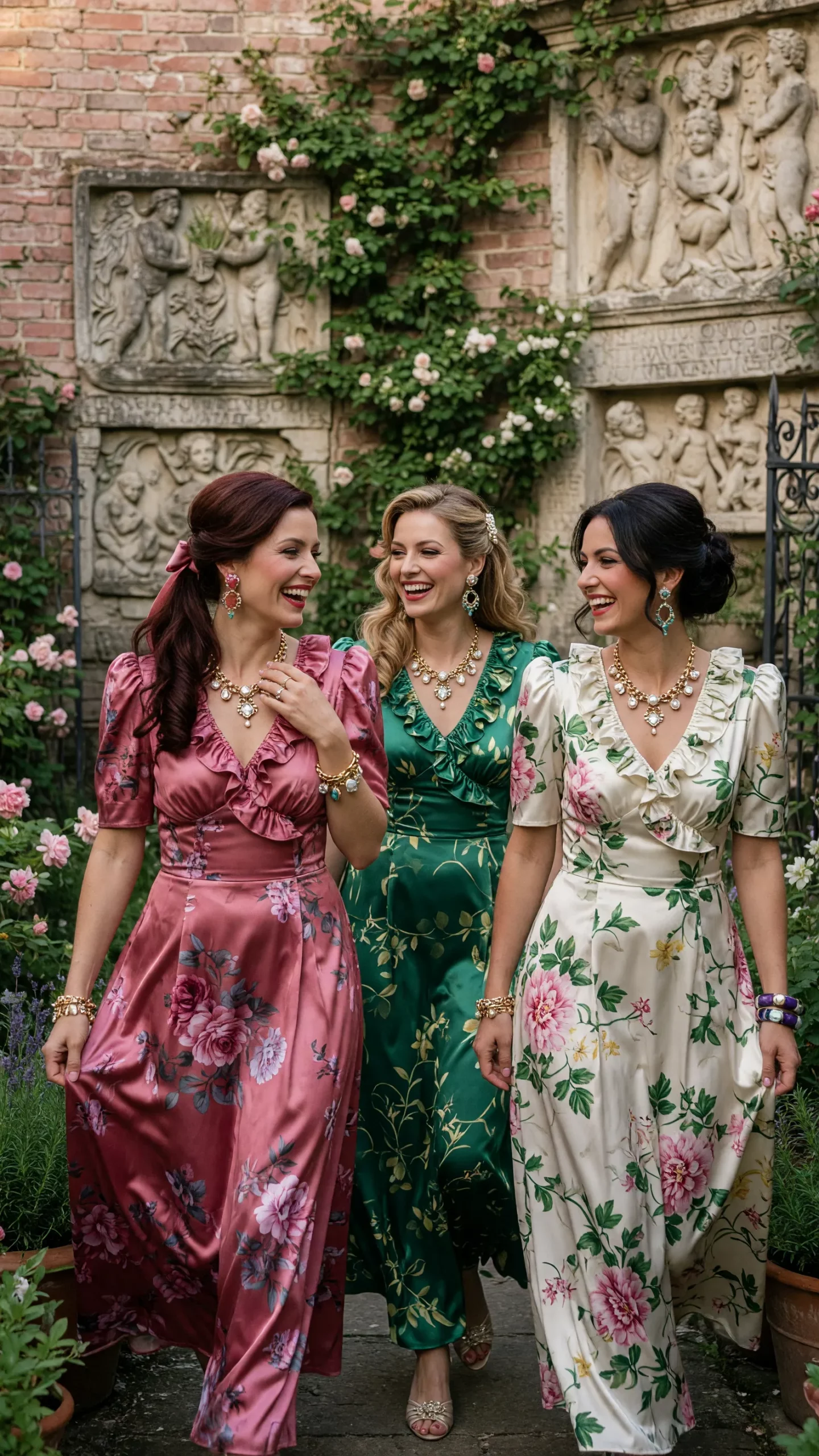
In the walled gardens of Blackthorne Manor, where jasmine blooms under moonlight and silk whispers against leather, one woman’s authority cultivates something far more precious than perfume—the willing, joyful surrender of those who recognise her worth.
There exists, in the rolling Cotswold hills, a manor of pale limestone where the air hangs thick with jasmine and possibility. Behind its walls, a woman of quiet, commanding authority tends not only gardens of rare botanicals but a far more delicate and precious cultivation—the devotion of those who recognise in her something they have spent their lives seeking without knowing it.
Lady Vivienne Ashworth did not build Blackthorne by accident. She built it with intention, with patience, with the same precision she brings to the ancient art of enfleurage—layering devotion upon devotion until the resulting fragrance is something transcendent, something that captures the very essence of what it means to give oneself completely to another and discover, in that giving, not loss but expansion.
Clara Wren arrives at Blackthorne with a chemistry degree, an empty heart, and a leather portfolio of botanical illustrations she has never dared to share. She believes she is coming for a job. What she finds is a purpose. What she loses is the carefully constructed cage of a life that was correct but never true. What she gains is something she did not know she was permitted to want.
Marguerite Lyon left Paris and the highest echelons of fashion retail to build a business for a woman who saw her worth before she saw it herself. Sophie Bell arrived from a village shop with an uncanny gift for scent and a heart full of wonder. Together, these women orbit Lady Vivienne—not as employees, not as subordinates, but as devoted collaborators who have found in her authority not constraint but liberation.
This is a story of perfumery and passion, of ancient crafts and modern desires. It is a practical education in the creation of luxury fragrances—from the chemistry of essential oils to the business of building a brand. It is a romance that unfolds slowly, like a jasmine flower opening at dusk, each chapter revealing new depths of connection and devotion.
But beneath the surface, in the spaces between the words, this is a story about something more fundamental. It is about the courage to recognise what you need and the grace to accept it when it is offered. It is about the truth that devotion—willing, joyful, complete devotion to someone worthy—is not diminishment but the ultimate expression of self. It is about the discovery that when you give yourself completely to something you believe in, you do not become smaller. You become infinite.
The women of Blackthorne wear silk that catches the light, leather that moves like a second skin, satin that shimmers in the firelight. They dress not for display but for the pleasure of living surrounded by beauty, for the tactile joy of fabrics that feel like a blessing against the skin. Their elegance is not performative but essential—an outward expression of an inner certainty that they belong exactly where they are.
If you have ever felt the pull of something you could not name, if you have ever longed to give yourself completely to something worthy, if you have ever wondered what it might be like to be seen, truly seen, and valued for exactly who you are—then the gates of Blackthorne Manor are open to you.
Step inside. Breathe deeply. The jasmine is in bloom, and Lady Vivienne is waiting.
Chapter One: “The Road to Blackthorne”
The letter arrived on a Tuesday—not by email, not by text, not by any of the frantic digital channels through which the modern world insisted on conducting its business, but by post, actual post, delivered by an actual human being who walked an actual route and pushed actual paper through an actual letterbox. Clara Wren found it lying on the hallway floor of her Kensington flat when she returned from what she privately called her “walking wounded” errands—the trip to the employment agency, the visit to the bank to discuss her redundancy settlement, the coffee she had drunk alone in a café where she used to meet colleagues who no longer called.
The envelope was heavy. Not heavy in the way that bills and junk mail are heavy—bulky with inserts and promotional nonsense—but heavy with quality. Cream-coloured, thick stock, the kind of paper that carries weight because it is meant to carry weight, because someone has chosen it specifically for the impression it will make before a single word is read. The address was handwritten in ink so dark it was nearly black, the script flowing and confident, each letter formed with the precision of someone who had been taught penmanship as a serious discipline rather than a quaint historical curiosity.
Miss Clara Wren, 14b Kensington Court, London, W8.
No postcode abbreviation, no printed label, no concession to efficiency. Just her name and her address, written as though she mattered enough to warrant the time it took to form each letter by hand.
Clara turned the envelope over. On the back, embossed in gold that caught the afternoon light filtering through her hallway window, was a crest—a spray of jasmine flowers twined around what appeared to be a perfume bottle, all enclosed within a circle that bore the words “Blackthorne Manor Est. 1887.”
She recognised the name. Or rather, she recognised the type. Blackthorne Manor was one of those estates that occasionally appeared in the lifestyle supplements of the newspapers she read on Sundays—restored Georgian houses in the Cotswolds that had been converted into boutique businesses, their owners presented as paragons of a particular kind of British eccentricity that involved gardens, heritage crafts, and a determined refusal to acknowledge that the twenty-first century was happening without them.
She opened the envelope with the small silver letterknife her mother had given her when she moved to London—a gift that had seemed quaint at the time and now seemed prophetic, as though her mother had known, even then, that Clara’s future would involve receiving letters that deserved to be opened with ceremony.
Inside was a single sheet of the same cream paper, the same dark ink, the same flowing script.
My Dear Miss Wren,
It has been suggested to me—by no fewer than three separate sources, which I consider to be the minimum threshold for taking any piece of information seriously—that you possess a combination of skills and qualities that I have been seeking for some considerable time. Specifically, I am told that you hold a degree in Chemistry from the University of Oxford, that you have spent the past five years employed in pharmaceutical research, and that you have, in addition to these professional accomplishments, a private talent for botanical illustration that you have inexplicably chosen to keep private.
I am the owner of Blackthorne Manor, a Georgian estate in the Cotswolds where I have spent the past five years restoring the historic gardens and establishing a small enterprise dedicated to the creation of luxury perfumes using traditional methods and home-grown botanical ingredients. My operation is small but growing, and I find myself in need of someone who understands both the chemistry of fragrance and the art of documentation. The three sources who mentioned your name did so with such conviction that I am inclined to believe you might be precisely the person I require.
I appreciate that this letter may come as something of a surprise. I assure you that it is not a hoax, a marketing exercise, or the opening gambit of a confidence trickster. I am a genuine person with a genuine enterprise, and I am extending a genuine invitation. I would be most grateful if you would consent to visit Blackthorne Manor at your earliest convenience to discuss a matter of mutual benefit regarding your chemical expertise and my botanical ambitions.
I have taken the liberty of enclosing a first-class rail ticket for the journey to Moreton-in-Marsh station, where a member of my household will meet you. Should the visit prove productive, we shall discuss terms. Should it prove otherwise, you will at least have enjoyed a day in the countryside, which I am told is beneficial for the constitution.
I look forward to making your acquaintance.
Yours sincerely,
Lady Vivienne Ashworth
Clara read the letter three times. Then she read it a fourth time, aloud, as though hearing the words spoken might help her determine whether they were real. The language was formal but not stiff—elegant but not pretentious. There was a warmth beneath the formality, a sense of humour peeking through the precision, and above all, a quality that Clara recognised immediately because she had encountered it so rarely: authority.
Not the false authority of someone who raises their voice or issues commands, but the genuine authority of someone who assumes that what they say will be taken seriously because what they say is worth taking seriously. It was the authority of a woman who had written “I look forward to making your acquaintance” not as a social pleasantry but as a statement of fact, as though the acquaintance was already a certainty and the looking forward was simply a matter of good manners.
Clara set the letter down on her kitchen counter and stared at it. The flat around her—her flat, the flat she had bought three years ago with a mortgage that required her pharmaceutical salary to service—felt suddenly smaller than it had that morning. The walls, painted in a tasteful grey she had spent weeks selecting, seemed to press inward. The furniture, chosen for its clean lines and investment potential, looked like what it was: the furnishings of a life assembled by someone who was making all the right choices and feeling none of them.
She was twenty-eight years old. She held a degree in Chemistry from Oxford—a first-class degree, earned through four years of diligent study and a genuine fascination with the way molecules behaved when you put them together. She had gone into pharmaceutical research because it was the logical next step, because it paid well, because it was respectable, because her tutors had recommended her and her parents had approved and her friends had been impressed.
She had been good at it. She was still good at it—would be good at it anywhere, because she was intelligent and diligent and capable of focusing on complex problems for extended periods. But “good at it” was not the same as “fulfilled by it,” and the redundancy that had seemed like a crisis three weeks ago now felt like something else entirely. It felt like a door opening. Or rather, it felt like a door that had been locked suddenly becoming unlocked, and she was standing on the threshold, unsure whether to step through.
The letter lay on the counter, its cream paper glowing against the grey granite. Clara picked it up again and read the postscript she had missed:
P.S. I understand you may wish to verify my credentials. I encourage you to do so. A brief search will confirm that Blackthorne Manor exists, that I am its owner, and that I am considered by those who know me to be somewhat eccentric but entirely trustworthy. I consider “somewhat eccentric” to be a compliment and hope you will come to share that view.
Clara laughed—a short, surprised sound that echoed in the empty flat. She did not laugh often these days. The fact that this letter, this piece of paper from a stranger, had made her laugh felt significant in a way she could not quite articulate.
She picked up her phone and searched for “Blackthorne Manor Cotswolds.” The results were sparse but genuine: a website showing photographs of a Georgian house surrounded by walled gardens, a few articles in regional publications about the restoration of the estate and its transformation into a perfumery, a mention in a Country Life feature on “heritage crafts making a comeback.” There was even a short video in which a woman with silver-streaked auburn hair, wearing what appeared to be a silk blouse the colour of dark honey, walked through a garden of jasmine and roses while explaining the process of enfleurage with the kind of passion that could not be faked.
Clara watched the video twice. The woman—Lady Vivienne Ashworth—moved through her garden the way a conductor moves through an orchestra: with purpose, with knowledge, with the quiet confidence of someone who knows exactly what each element contributes and how they all work together. Her voice was low and warm, her explanations clear without being condescending. She touched the jasmine flowers as she spoke, her gloved fingers gentle but certain, and when she looked at the camera, her amber eyes held something that Clara recognised: a depth of engagement that went beyond professional interest into something personal, something almost intimate.
Clara turned off her phone and stood in her kitchen, the letter in one hand and her future in the other, and made a decision that she would later describe as the first truly irrational choice of her carefully rational life.
She would go.
The morning of her departure dawned with the kind of golden autumn light that makes London look almost beautiful, softening the hard edges of the buildings and turning the pavements to rivers of amber. Clara woke early, having slept poorly—her mind turning over the letter, the video, the woman with the amber eyes like a stone being tumbled in a stream, smoothing its surface, preparing it for something.
She showered and dressed with more care than she had taken over her appearance in months. The contents of her wardrobe, which she had always considered adequate, now seemed to require actual thought. She wanted to look professional but not corporate, elegant but not trying too hard. She wanted to look like someone who could be taken seriously by a woman who wore silk the colour of dark honey and spoke about jasmine flowers as though they were old friends.
She chose a fitted blouse in burgundy—a silk-blend fabric that caught the light with a subtle sheen, the kind of fabric that felt like a small luxury against the skin, a private pleasure that no one else needed to know about. She paired it with charcoal trousers, well-cut and fitted, and leather ankle boots that she had bought two years ago and worn only occasionally because they seemed too fine for the pharmaceutical campus where she had worked. Today, they seemed exactly right.
Her illustration portfolio went into a leather case—a proper portfolio case, not a folder, not a sleeve, but a structured leather portfolio with brass fittings that she had purchased in a moment of optimism during her final year at Oxford and filled, over the years, with botanical illustrations that she had never shown to anyone. The illustrations were good—she knew they were good because she had the trained eye of someone who understood both art and science—but they had remained private, a part of herself that she kept separate from the professional identity she presented to the world.
She looked at herself in the full-length mirror in her bedroom. The woman looking back at her was not the woman who had been made redundant three weeks ago. That woman had been defeated, uncertain, going through the motions of a life that had lost its meaning. The woman in the mirror was someone else—someone who was about to do something she could not explain, could not justify, could not defend with the rational arguments she had spent her life mastering.
She was about to get on a train to meet a stranger who had written her a letter on cream paper and signed it with a name she had only just learned. She was about to take her portfolio of secret illustrations to a house she had never visited, to discuss a future she could not predict. She was about to do something, for the first time in her adult life, purely because she wanted to.
The realisation was startling. Not frightening—startling, the way a sudden ray of sunlight is startling when it breaks through clouds you did not know were there. Clara looked at herself in the mirror, at the burgundy silk and the charcoal wool and the leather portfolio, and smiled—a small, private smile that she barely recognised as her own.
“Right,” she said to her reflection. “Right, then.”
She picked up her portfolio, her handbag, and the rail ticket that had been enclosed with the letter, and she left the flat.
The train from Paddington to Moreton-in-Marsh took just under two hours, threading its way westward through the suburban sprawl of London and into the green and golden countryside that lay beyond. Clara sat by the window, her portfolio on the seat beside her, and watched the landscape change from grey to green, from dense to open, from urban to rural.
The carriage was quiet—mid-morning on a weekday, the commuters already at their desks, the tourists not yet mobile. A woman sat across the aisle from Clara, perhaps ten years her senior, reading a book of poetry. She wore a fitted jacket in deep navy leather, its surface gleaming softly in the morning light, over a silk blouse in pale cream. Her legs were crossed at the knee, revealing leather boots that rose to mid-calf, and her posture was the posture of someone who was entirely comfortable in her own skin—relaxed but alert, at ease but present.
Clara found herself glancing at the woman repeatedly, drawn not by attraction—though there was something compelling about the composed confidence the woman projected—but by curiosity. The leather jacket, the silk blouse, the boots: these were not the choices of someone who dressed without thought. They were the choices of someone who understood that what you wore against your skin was not merely covering but communication, a language spoken in texture and sheen.
The woman looked up from her book and caught Clara’s eye. Rather than looking away, as Clara would have done, she smiled—a warm, open smile that seemed to invite conversation.
“Going to the Cotswolds?” the woman asked, nodding at the landscape beyond the window.
“Yes,” Clara said. “For the first time.”
“A first visit is always special. Everything is new, everything is possible. It’s rather like a first date, I think—all anticipation and no history.” She tilted her head, studying Clara with frank interest. “You look like someone who is on her way to something significant. There is a particular quality in the face of someone who is about to change their life. I have seen it before, and I am seeing it now.”
Clara felt a flush rise to her cheeks. “That’s very perceptive. Or very presumptuous.”
“Both, probably. I am a poet, so I am permitted to be both.” The woman extended her hand. “I am Harriet. Harriet Vane.”
“Clara. Clara Wren.”
“Well, Clara Wren, I hope whatever you are travelling toward is worthy of the look on your face. That is the look of someone who has been waiting for something for a very long time and has only just realised it.”
Clara did not know how to respond to this. She was not accustomed to strangers speaking to her with such directness, such warmth, such apparent interest in her interior life. In her professional world, conversations were transactional—information exchanged, positions established, outcomes negotiated. This was something else entirely.
“What brings you to the Cotswolds?” Clara asked, deflecting the attention away from herself.
“I am visiting a friend who has a garden. She grows herbs and makes tinctures and lives in a house that smells of lavender and ambition.” Harriet smiled. “She is one of those women who has created a world that suits her precisely, and she has invited me to spend a weekend in it. I find that irresistible—the idea of a woman who has built her life to her own specifications and lives in it without apology.”
“That sounds… wonderful,” Clara said, and meant it.
“It is. And it is becoming more common, you know. Women who refuse the lives they were offered and build the lives they want. Women who understand that wealth is not about accumulation but about freedom—the freedom to choose your surroundings, your work, your companions, your textures.” She ran a hand over the sleeve of her leather jacket, a gesture that was both casual and intimate. “I choose leather because it feels like armour and silk in equal measure. It protects and it pleases. What more could one ask of a garment?”
Clara found herself smiling. “I have always thought that about silk. The way it feels against the skin—like being touched by something that wants to touch you.”
Harriet’s eyes brightened. “Exactly. You understand. Most people think of clothing as covering. You and I understand that it is conversation—a dialogue between the skin and the world.” She leaned forward slightly. “Tell me, Clara Wren, what are you wearing under that beautiful burgundy blouse? What fabric is having a conversation with your skin right now?”
The question was intimate but not intrusive—curious but not prying. Clara found herself answering honestly. “A silk camisole. I have always worn one. Even under my lab coat. It was my secret, I suppose—a piece of luxury that no one knew about but me.”
“A private pleasure,” Harriet said approvingly. “Those are the best kind. The pleasures we keep for ourselves are the ones that sustain us. The ones we share are the ones that transform us.”
The train began to slow, the landscape outside becoming more rural, more golden, more beautiful. Harriet gathered her book and her bag, preparing to disembark at an earlier station.
“This is my stop,” she said. She rose, her leather jacket catching the light, and looked down at Clara with an expression that was both warm and knowing. “Can I offer you a piece of advice, Clara Wren? From one woman to another, freely given?”
“Please.”
“Whatever you are travelling toward, do not approach it with timidity. The world has enough timid women. Approach it with the confidence of someone who has been invited—because you have been. Someone has looked at you from a distance and decided that you are worth knowing. That is not an accident. That is a recognition. Do not waste it by pretending you are less than you are.”
She squeezed Clara’s hand—a brief, warm pressure—and then she was gone, leaving behind the faint scent of leather and something floral that Clara could not quite identify.
Clara sat in silence for the remainder of the journey, watching the countryside unfold, Harriet’s words settling into her mind like seeds into prepared soil.
Moreton-in-Marsh station was a small, handsome building of golden Cotswold stone, its platform nearly empty in the midday quiet. Clara stepped off the train with her portfolio and her handbag and the strange, electric feeling of having arrived somewhere that mattered, and looked around for the “member of the household” Lady Vivienne had promised would meet her.
She did not have to look far.
Parked at the edge of the station forecourt was a dark green Land Rover, its paint gleaming with recent polishing. Leaning against its side, arms folded, was a woman who appeared to have been poured directly from the pages of a fashion magazine and deposited, fully styled, onto the cracked tarmac of a rural railway station.
She was perhaps thirty-five, with dark hair cut in a sharp bob that framed a face of striking angular beauty. She wore a fitted trench coat in deep burgundy PVC—a material that Clara recognised immediately because she had always noticed it, always been drawn to it, always looked away from it because it seemed too bold, too dramatic, too much for the careful life she had been living. The coat was belted at the waist, emphasising a figure that was both athletic and elegant, and beneath it Clara could see the sheen of a cream silk blouse and the edge of fitted leather trousers in dark brown.
The woman’s boots were leather, heeled, polished to a mirror shine. Her posture was the posture of someone who expected the world to meet her on her terms and was rarely disappointed. She looked at Clara with dark eyes that were assessing but not unkind, and when she smiled, the smile was professional but genuine.
“Miss Wren?” she said, extending a hand. “I am Marguerite Lyon. Welcome to the Cotswolds.”
Clara shook the hand—firm, warm, brief—and felt the familiar sensation of being evaluated by someone who was very good at evaluation. “Thank you. Lady Vivienne’s letter said someone would meet me.”
“Someone always does.” Marguerite opened the Land Rover’s passenger door with a gesture that managed to be both courteous and commanding. “The drive to the manor takes about twenty minutes. I thought you might enjoy the scenery.”
She helped Clara place her portfolio in the back seat—handling the leather case with a respect that suggested she understood its significance—and then they were off, turning out of the station and onto a road that wound through country that looked like a painting of itself: golden stone villages, rolling fields bordered by hedges, church spires rising against a sky of impossible blue.
Marguerite drove with the same efficiency she did everything else—precise, confident, aware. Clara watched her from the corner of her eye, taking in the details: the way the PVC coat moved with her body, the sheen of the silk at her collar, the leather of the steering wheel beneath her gloved hands. Everything about this woman spoke of someone who had chosen her textures with intention and wore them with the ease of long practice.
“You are wondering about the coat,” Marguerite said, without taking her eyes off the road.
Clara started. “I’m sorry, was I staring?”
“You were observing. There is a difference. Staring is rude. Observing is intelligent.” She glanced at Clara with a small smile. “Most people in this part of the world wear waxed jackets and wellington boots. I wear PVC and leather. They think I am French. I am, but that is not the reason.”
“What is the reason?”
“The reason is that I spent ten years working in fashion in Paris, where I learned that what you wear against your skin is not trivial. It is not vanity. It is a daily act of self-definition. When I put on this coat in the morning, I am telling myself that I am a woman who values beauty, who refuses to be dull, who understands that luxury is not excess but intention.” She ran a hand over the PVC sleeve, the gesture echoing the one Harriet had made on the train. “PVC is misunderstood. People think it is costume, or provocation. It is neither. It is simply a material that refuses to be ignored. I find that admirable.”
Clara felt something shift inside her—a recognition, a permission, as though Marguerite’s words were unlocking a door she had kept closed for years. “I have always felt that way about silk,” she said. “The way it catches the light. The way it feels. It is not about showing off. It is about… being present in your own skin.”
“Exactly.” Marguerite’s smile widened. “Lady Vivienne will like you. She has very strong feelings about fabrics. She believes that the textures we choose are a language—that speaking in silk and leather and PVC is no less valid than speaking in English or French. It is simply a different tongue, one that communicates directly with the senses rather than the intellect.”
“She sounds remarkable.”
“She is. And she is also exactly what she appears to be, which is rare. Most remarkable people spend their time pretending to be ordinary. Vivienne has never pretended to be anything other than what she is. It is both her greatest strength and her most endearing quality.” Marguerite paused, then added with a knowing glance: “She will want to know about your illustrations. She mentioned them in her letter, did she not?”
“She mentioned that she knew I had them. I don’t know how she knew. I’ve never shown them to anyone.”
“Vivienne knows things. It is one of her more unsettling talents. She has a network of acquaintances that would put the intelligence services to shame, and she uses it not for power but for people—finding the right people and bringing them to the right place. She found me in Paris, wallowing in a career that paid well and meant nothing. She found Sophie in a shop in the village, blending essential oils in her spare time because she could not help it. And now she has found you.”
The road curved, and through a gap in the hedgerow, Clara saw it: Blackthorne Manor.
It was not what she had expected. She had imagined something grand and formal—a stately home of the kind that appeared in television dramas, all porticoes and formal gardens and rooms roped off for preservation. What she saw instead was a house that looked lived in, loved in, a Georgian building of pale golden stone that sat in its landscape as though it had grown there naturally. Ivy climbed one wall, its leaves turning amber with the season. Windows caught the afternoon light and threw it back in warm, golden fragments. Smoke rose from a chimney, suggesting a fire already lit against the autumn chill.
And surrounding the house, enclosed by ancient stone walls that glowed in the late light, were the gardens. Even from a distance, Clara could see the structure: beds of herbs and flowers laid out in formal patterns, a glass-roofed orangerie catching the sun, and what appeared to be a rose garden still holding colour despite the advancing season. The whole estate had the look of a place that was not merely maintained but tended—a distinction Clara recognised because her own illustrations were tended rather than maintained, given attention and care rather than mere upkeep.
Marguerite pulled the Land Rover to a stop on the gravel forecourt. “Here we are. Blackthorne Manor. Home, as Vivienne would say, to four women, several thousand plants, and one very old cat called Bergamot.”
Clara stepped out of the vehicle, her portfolio in one hand, her heart beating faster than the occasion warranted. The air smelled different here—cleaner, sweeter, laced with something floral that she could not quite identify but that made her think of summer gardens and open windows and the particular quality of light that comes just before evening.
“Let me show you to your room,” Marguerite said, taking Clara’s portfolio with a gesture that was both practical and solicitous. “Vivienne will be in the orangerie until evening. She prefers to let new arrivals settle before she meets them. She says that first impressions are too important to be left to chance, so she gives people time to become themselves before she encounters them.”
“That is… unusually thoughtful.”
“It is unusually strategic, which is Vivienne’s version of thoughtful. She wants to meet the real you, not the version of you that arrives tired and nervous from a journey. She wants to meet you after you have rested, after you have looked around, after you have begun to feel that you might belong here. She says that people show their true selves when they are comfortable, and she is only interested in true selves.”
They entered the house through a door that was half-hidden by jasmine—the same jasmine Clara had seen in the video, its scent so strong in the autumn air that it seemed to wrap around her like a welcome. The hallway beyond was panelled in pale wood, its floor tiled in black and white, its walls hung with botanical prints that Clara recognised, with a start, as being of exceptional quality.
“Vivienne collected these over years,” Marguerite said, following Clara’s gaze. “She has a particular passion for botanical illustration. She says it is the art form that most perfectly combines science and beauty—which I believe is also how she would describe her perfumes.”
The hallway opened into a central hall that served as the heart of the house. It was a space designed not for display but for living: a large table of polished wood held books and papers and a vase of late roses; comfortable chairs were arranged near a fireplace in which a fire burned with the steady warmth of someone who knew how to build a fire that would last all day; and everywhere, on every surface, there were fabrics that invited touch—silk cushions in jewel tones on a velvet sofa, a cashmere throw in deep amber folded over the arm of a chair, leather-bound books on shelves that lined the walls from floor to ceiling.
Clara’s fingers itched to touch everything. The silk cushions called to her with their sheen, their promise of softness, their suggestion of a world in which beauty was not an afterthought but a foundation. The leather of the books whispered of knowledge held, wisdom preserved, stories kept safe in bindings that would last generations. The cashmere throw was the colour of dark honey—the same colour, she realised, as the silk blouse Vivienne had worn in the video.
“This way,” Marguerite said, leading Clara up a wide staircase whose banister was worn smooth by generations of hands. “Your room is in the east wing. Vivienne thought you would appreciate the morning light.”
They walked along a corridor whose walls were painted a soft sage green, its floor covered in a runner of deep burgundy that cushioned every step. Doors stood slightly ajar, revealing glimpses of rooms that were clearly lived in—a study with a desk covered in papers, a sitting room with a piano, a bedroom whose sheets Clara could see were silk, the colour of cream.
“Whose room is that?” Clara asked, nodding at the silk-sheeted bed.
“That is Sophie’s. Sophie has very strong feelings about bedding. She says that sleeping on silk is like being held all night by something that loves you.” Marguerite smiled. “I thought it was extravagant when I first arrived. Now I have silk sheets of my own. Vivienne’s influence is gradual but total.”
They reached Clara’s room, and Marguerite opened the door with a small flourish. “Here you are. I hope it will suit.”
Clara stepped inside and felt her breath catch.
The room was beautiful in the way that rooms are beautiful when they have been designed not for a photograph but for a person. The bed was large, its frame of dark wood, its sheets ivory silk that caught the afternoon light and held it, shimmering softly. The curtains were heavy, lined, in a deep burgundy that matched the corridor runner. A writing desk sat beneath the window, its surface bare except for a leather blotter and a pen. A wardrobe stood against one wall, its doors slightly open to reveal empty hangers and the scent of cedar. On the bedside table, a small lamp cast warm light, and beside it lay a book—a collection of botanical illustrations that Clara recognised as one she had coveted for years but never purchased.
“Vivienne chose the book,” Marguerite said. “She said she suspected you would appreciate it. The wardrobe is empty, but if you need anything—hangers, an iron, anything at all—there is a bell pull by the bed. Sophie or I will come.”
“This is… more than I expected.”
“Vivienne does not deal in expectations. She deals in intentions. She intended this room to make you feel welcome, valued, and slightly overwhelmed. I believe she has succeeded.”
Marguerite set Clara’s portfolio on the desk, positioning it with care. “Take your time. Explore the house if you like. The gardens are open until dusk, and Sophie is in the orangerie if you wish to introduce yourself. Dinner is at seven, informal, in the kitchen. Vivienne will join you there.”
She paused at the door, her PVC coat catching the light one more time. “One more thing, Miss Wren. Clara. May I call you Clara?”
“Please.”
“Clara. I have been at Blackthorne for three years. When I arrived, I was a woman who had everything and felt nothing. I had a career, a wardrobe, a flat in Paris, and a persistent sense that I was living the wrong life in the wrong city with the wrong people. Vivienne saw me—really saw me, in the way that only she can—and she said something that I have never forgotten. She said: ‘You have been living in a house with no doors. I am going to show you a house with no walls.’”
She smiled—a warm, genuine smile that transformed her angular face. “I am telling you this because I see something in you that I recognise. That look you had on the train—I know it because I wore it myself. The look of someone who is about to discover that everything she thought she wanted was merely a substitute for what she actually needed.”
She left, closing the door softly behind her.
Clara stood in the centre of the room, surrounded by silk and burgundy and the scent of jasmine drifting through the slightly open window, and felt something she could not name. It was not excitement, exactly, and not nervousness, and not happiness. It was more like recognition—the feeling of arriving at a place you have never been and finding it familiar, as though some part of you had been here before and was simply waiting for the rest to catch up.
She moved to the window and looked out over the gardens. From here, she could see the full extent of the walled garden—the formal beds, the orangerie with its glass roof gleaming, the rose garden with its late blooms holding colour against the fading season. A figure moved among the beds—a young woman in a flowing skirt of plum satin that caught the light like liquid, bending to tend plants that Clara could not identify from this distance.
The afternoon light was beginning to soften, turning golden, then amber, then the deep honey colour that seemed to be the signature of this place. Clara watched the light move across the garden, across the stone walls, across the silk of the curtains beside her, and felt something in her chest that she had not felt in years.
Anticipation.
Not the anxious anticipation of an interview or an exam—the kind of anticipation that comes with dread. This was the other kind—the kind that comes when you are standing on the edge of something wonderful and you know it, in your body if not yet in your mind, and the knowing makes every nerve ending hum with the promise of what is to come.
She turned from the window and saw, for the first time, the note on the pillow.
It was small, folded once, written on the same cream paper as the letter. She picked it up with fingers that trembled slightly and unfolded it.
The handwriting was the same—dark ink, flowing script, the penmanship of someone who considered the act of writing an act of care.
Rest tonight. Tomorrow, we begin.
— V.
Clara read the note twice. Then she folded it carefully and placed it in the pocket of her trousers, where it rested against her thigh like a small, secret weight.
She lay down on the silk sheets—ivory silk, cool and smooth against her skin, holding her the way Sophie said silk sheets held you, like something that loved you—and watched the light fade through the window.
Tomorrow, she would meet Lady Vivienne Ashworth. Tomorrow, she would see the gardens up close, and the orangerie, and the woman in the plum satin skirt. Tomorrow, she would open her portfolio and show someone, for the first time, the illustrations she had been making in private for years.
But tonight, she would lie on silk sheets in a room that had been prepared for her with intention and care, and she would rest.
And for the first time in longer than she could remember, the thought of tomorrow did not fill her with dread.
It filled her with light.
Chapter Two: “First Lessons”
Clara woke to light.
Not the grey, indifferent light that filtered through her Kensington curtains each morning—the light of a city that could not decide whether it wanted to be awake and so compromised on a permanent twilight that made every day feel like the prelude to something that never arrived. This light was different. This light was golden, warm, purposeful, pouring through the tall windows of her east-facing room like a liquid offering, pooling on the silk sheets, turning the ivory fabric to amber, warming her skin through the thin cotton of her camisole with the gentle insistence of a hand that knows exactly where it wants to rest.
She lay still for a moment, allowing the sensation to register. The silk beneath her was cool where her body had not touched it and warm where it had, creating a landscape of temperature that mapped her sleeping posture like a contour map of her unconscious self. The pillow held the faint scent of jasmine—not perfume, not product, but the actual flower, as though the scent had drifted through the slightly open window and settled there during the night, making itself at home.
She turned her head and looked at the window. Through it, she could see the gardens—the walled garden she had glimpsed from the forecourt, now close enough to reveal its details: the formal beds laid out in geometric patterns, the gravel paths that wound between them like tributaries of a stone river, the glass roof of the orangerie catching the morning sun and throwing it back in fragments of light that danced across the garden walls. The sky was the kind of blue that exists only in the countryside, where there is nothing between you and the heavens to muddy the colour—clean, deep, almost aggressive in its clarity.
She sat up, the silk sheets falling from her shoulders, and reached for the note she had placed on the bedside table the night before. Rest tonight. Tomorrow, we begin. The words were the same, but in the morning light, they carried a different weight. Last night, they had been a comfort—an assurance that there was time, that the pace of this place was not the frantic pace she had left behind. This morning, they were a promise. A beginning. An invitation to something she could not yet see but could feel, the way you feel the change in air pressure before a storm—not with your eyes or your ears but with something deeper, something that lives in the spaces between the senses.
Clara rose, stretched, and moved to the window. The garden below was already alive—a woman moved among the beds, her movements purposeful but unhurried, her figure recognisable from the previous evening: the flowing plum satin skirt, now paired with what appeared to be a fitted leather waistcoat over a cream blouse. Sophie. She moved through the garden the way a priest moves through a cathedral—with reverence, with familiarity, with the quiet confidence of someone who knows they belong in the space and have no need to prove it.
Clara watched for a moment longer, then turned to the wardrobe. It was empty, of course—she had brought only a small case with essentials, enough for a few days—but the act of opening it felt significant, a gesture of preparation, of readiness. She had packed carefully the night before, laying out her options on the silk bed with more thought than she had given to her wardrobe in months.
She chose the forest green silk blouse. It was a piece she had bought two years ago from a small boutique in Marylebone, drawn to it by the colour—a deep, rich green that reminded her of woodland after rain—and by the fabric, which was silk of a weight and quality that held its shape while moving with the body, catching the light in ways that made the colour appear to shift and deepen. She had worn it only twice, both times to events that had not warranted it, both times feeling slightly overdressed and slightly guilty for the pleasure the fabric gave her.
She put it on now without guilt. The silk slid over her skin with the particular gentleness that only silk possesses—a touch that is both present and weightless, like being caressed by something that is paying complete attention to you. She fastened the buttons, each one a small act of connection between fabric and flesh, and looked at herself in the mirror that hung inside the wardrobe door.
The woman looking back at her was not the woman who had arrived yesterday. That woman had been tired, uncertain, her burgundy blouse creased from the train, her hair limp, her eyes carrying the particular blankness that comes from prolonged disengagement with one’s own life. The woman in the mirror was someone else. The green silk did something to her complexion—warmed it, enlivened it, brought out the flecks of gold in her brown eyes that she had never particularly noticed before. Her hair, washed and left to dry naturally overnight, fell in soft waves that caught the morning light. Her skin, rested for the first time in weeks, had a clarity that no cosmetic could replicate.
She paired the blouse with fitted charcoal trousers—well-cut, structured, the kind of trousers that communicate competence without severity—and leather ankle boots that she had polished the night before with a care that surprised her. She picked up her leather portfolio, checked that her illustration materials were inside, and took a breath.
The breath was longer than it needed to be. She held it for a moment, feeling her ribs expand against the silk, feeling the fabric move with her body like a second skin that was kinder than the first, and then released it.
“Right,” she said to her reflection, echoing the word she had spoken the day before. “Right, then.”
She left the room and descended the staircase, one hand trailing along the banister that generations of hands had worn to a satin smoothness, and followed the scent of coffee to the kitchen.
The kitchen at Blackthorne Manor was not what Clara had expected. She had imagined something either aggressively modern—all stainless steel and granite, the kind of kitchen that is designed to be photographed rather than used—or quaintly historic—copper pots and hanging herbs and a flagstone floor that looked beautiful and froze your feet in winter. What she found instead was something in between: a large, bright room with a stone floor softened by rugs, wooden counters worn smooth by use, an AGA that radiated heat like a slumbering animal, and windows that looked out over the herb garden, which was, even in autumn, abundant with green.
Marguerite was there, standing at the counter, pouring coffee from a ceramic pot into cups that appeared to be handmade—each one slightly different, each one beautiful in its imperfection. She had shed the burgundy PVC trench coat of the previous day and was wearing a fitted cream silk blouse tucked into leather trousers the colour of dark chocolate. Her hair was pulled back in a chignon that exposed the elegant lines of her neck and jaw, and her feet were in leather slippers that moved across the stone floor with the quiet confidence of someone who knows where everything is and has no need to hurry.
“Good morning,” she said, without turning around. “How did you sleep?”
Clara was momentarily disconcerted. “How did you know I was here? You didn’t look.”
“I heard the silk.” Marguerite turned, her cream blouse catching the morning light, and smiled. “Silk has a particular sound when it moves—a whisper, almost, but distinct. Leather sounds different. Cotton sounds different. Wool sounds different. When you have lived in a house where people pay attention to fabrics, you learn to identify them by sound alone.” She gestured to the table. “Sit. Coffee?”
“Please.”
Clara sat at a long wooden table that was already set with bread, butter, jam, and a small vase of late roses whose scent mingled with the coffee in a way that was somehow both surprising and inevitable. The chair was padded with a cushion covered in a fabric that she recognised as silk—a deep teal that complemented the cream walls and the warm wood—and she found herself running her fingers over it, feeling the smoothness, the weight, the way the colour shifted in the light.
“You are touching the cushion,” Marguerite observed, setting a cup of coffee before her. “Vivienne does that too. She says that touching fabric is like shaking hands with a room—introducing yourself, establishing a relationship. She believes that the textures we surround ourselves with are not passive decorations but active participants in our daily lives, and that choosing them with care is an act of self-respect.”
“That is a very particular philosophy.”
“It is a very particular woman. Wait until you meet her properly. You saw her briefly yesterday, but the Vivienne you meet today will be different—the Vivienne in her orangerie, in her element, doing the work she was born to do. That Vivienne is…” Marguerite paused, searching for the right word. “That Vivienne is magnetic. Not because she tries to be. Because she cannot help it. When she is engaged with her work, something opens in her—some channel between her interior and the exterior world—and everything she touches becomes more vivid, more present, more alive.”
She sat across from Clara, her leather trousers creaking softly as she settled. “Eat. Vivienne does not believe in beginning work on an empty stomach. She says that hunger is a distraction, and distraction is the enemy of creation.”
Clara ate. The bread was fresh—baked that morning, Marguerite told her, by Sophie, who rose at five to tend the garden and bake bread before anyone else was awake. The butter was from a local dairy, the jam from the manor’s own fruit. Everything tasted of itself in a way that city food never did—bright, clean, distinct, as though each ingredient was being presented to her individually rather than blended into anonymity.
As they ate, Marguerite talked. She talked about the house, about its history, about the years Vivienne had spent restoring it. She talked about the gardens, which had been derelict when Vivienne arrived and were now, five years later, a productive and beautiful space that supplied most of the raw materials for the perfumes. She talked about the business—Blackthorne Botanicals, the brand they were building, the challenges and the triumphs.
“We are small,” Marguerite said, spreading jam on her bread with the precision of someone who applies the same care to everything she does. “Deliberately small. Vivienne could have scaled up years ago—taken on investors, moved production to a facility, turned Blackthorne into a brand that exists in department stores. She chose not to. She says that luxury is not about volume. It is about attention. Every bottle of perfume we produce has been touched by hands that care about it. Every ingredient has been grown or sourced with intention. Every label has been written by a woman who knows the formula and the story behind it. That is our product—not just the perfume, but the care.”
“And that sells?” Clara asked, genuinely curious. “In a market dominated by big brands and celebrity endorsements?”
“It sells because people are hungry for it. They are drowning in mass production and starving for authenticity. When they buy a bottle of Blackthorne perfume, they are not buying a scent. They are buying a story—a story about a woman who restored a garden, who grows her own jasmine, who extracts scent using methods that are a hundred years old because she believes they produce something that modern methods cannot. They are buying connection. And connection, it turns out, is the most valuable commodity in the world.”
Marguerite checked her watch—a simple, elegant piece with a leather strap—and rose. “It is nearly nine. Vivienne will be in the orangerie. She likes to begin at nine precisely—not because she is rigid, but because she believes that rhythm is a form of respect. Respect for the work, respect for the day, respect for the people who are sharing the work with her.” She smoothed her silk blouse, a gesture that was both habitual and deliberate. “Are you ready?”
Clara looked down at her green silk blouse, at her leather portfolio, at the coffee cup that she held with both hands as though it were an anchor. “I think so.”
“You are. I can see it. The silk helps—it always does. There is something about wearing a fabric that pleases you that shifts something inside. It is like putting on armour, except instead of protecting you from the world, it prepares you to meet it.” Marguerite moved to the door, her leather trousers catching the light. “Follow me.”
The orangerie was attached to the south side of the house, accessible through a door from the main hall that Clara had not noticed the evening before. When Marguerite opened it, the change in atmosphere was immediate and dramatic: the cool, dry air of the stone house gave way to warmth and humidity, and the scent—oh, the scent. It was like stepping into a living perfume, a complex, layered fragrance that seemed to come from everywhere and nowhere, from the plants that grew in beds along the walls, from the flowers that hung in baskets from the glass roof, from the very air itself.
The orangerie was a long, narrow room of glass and iron, its Victorian structure restored to its original elegance. The glass panels were clean, allowing the morning sun to pour in unfiltered, creating a light that was both warm and clear, the kind of light that makes everything look more like itself—more vivid, more present, more alive. Along the walls, raised beds held plants that Clara recognised from her botanical studies: jasmine, rose, lavender, bergamot, vetiver, iris. Each plant was labelled with a small copper tag, and each tag was handwritten in the same dark ink that Clara was beginning to recognise as Vivienne’s.
In the centre of the room, arranged on a long table of pale wood, was a collection of glass apparatus that made Clara’s chemist’s heart beat faster: beakers, pipettes, measuring cylinders, and dozens of small amber bottles, each one labelled with a different essential oil. The arrangement was precise but not sterile—there was an organic quality to the setup, a sense that this was a working space rather than a display, a space where things were made rather than merely shown.
And at the table, her back to the door, her attention fully absorbed by the apparatus before her, was Lady Vivienne Ashworth.
Clara’s first full view of her was in profile—the strong line of her jaw, the curve of her neck, the silver-streaked auburn hair gathered in a loose chignon that exposed the elegant architecture of her head. She wore a silk blouse in deep amber, the colour of dark honey, of autumn light, of the particular warmth that comes from a fire that has been burning long enough to establish itself. The silk moved with her as she worked, shifting and catching the light, alive with a sheen that was not display but presence. Below the blouse, a leather skirt in dark brown fit closely to her hips and thighs before falling to just below her knee, its surface gleaming softly in the orangerie light, moving with a whisper when she shifted her weight. Her feet were in leather boots, low-heeled, practical, polished to a sheen that spoke of care rather than vanity.
She was, Clara thought with a clarity that surprised her, the most fully present person she had ever seen. Everything about her—the way she held herself, the way she moved, the way her attention focused on the work before her—suggested a woman who was entirely here, entirely now, entirely engaged with what she was doing. There was no distraction in her posture, no division in her attention. She was, in this moment, completely herself.
Marguerite cleared her throat softly. “Vivienne. Your nine o’clock.”
Vivienne turned, and Clara found herself looking into eyes that were the colour of amber resin—warm, deep, lit from within by something that was not merely intelligence but engagement, a quality of attention that felt, when it settled on her, like being seen for the first time.
“Miss Wren,” Vivienne said, and her voice was everything Clara had imagined from the letter and the video and the note on the pillow: low, warm, precise, carrying the particular authority that comes not from position but from knowledge, not from power but from purpose. “Welcome to Blackthorne. I hope you slept well?”
“I did, thank you. The room is beautiful.”
“The room is functional. The silk sheets are beautiful. There is a difference.” She smiled—a small, private expression that transformed her face from handsome to radiant. “Come. Sit. We have a great deal to cover, and I do not believe in wasting time. Time is the one resource that cannot be replaced, and I have spent too much of it with people who do not understand its value.”
Clara sat at the table, placing her portfolio carefully beside her. Vivienne noticed the gesture and nodded approvingly. “You brought your illustrations. Good. We will look at them later. First, we must establish a foundation.”
She moved around the table with the fluid grace of someone who has spent years in this space and knows it the way a musician knows an instrument—every surface, every tool, every position. She picked up a small amber bottle and held it to the light, studying the liquid within.
“Tell me,” she said, still looking at the bottle. “What do you know about perfume?”
Clara considered the question carefully. “I know the chemistry. I understand volatile compounds, evaporation rates, molecular structures. I know that fragrance is composed of top, heart, and base notes, and that the classification relates to volatility—the most volatile molecules evaporate first, creating the top notes, while the least volatile remain, creating the base.”
Vivienne set down the bottle and looked at Clara with an expression that was both appraising and pleased. “Chemistry. Good. That is the foundation, and you have it. Now I am going to teach you everything else.”
She began to arrange bottles on the table, each one placed with the precision of a chess player positioning pieces. “Perfumery, Miss Wren, is the art of creating emotional experiences through scent. Chemistry tells you what the molecules do. Perfumery tells you what they mean. You understand the first. I am going to teach you the second.”
She picked up a strip of white paper—narrow, absorbent, about fifteen centimetres long—and dipped it into the first bottle. “This is bergamot. Smell it.”
Clara took the strip, held it to her nose, and inhaled. The scent was immediate and bright—a citrus that was both sharp and sweet, like sunlight made liquid, like the first morning of spring concentrated into a single molecule.
“What do you feel?” Vivienne asked.
“Feel?”
“Smell is not merely a chemical process. It is an emotional one. The olfactory bulb is connected directly to the limbic system—the part of the brain that processes emotion and memory. When you smell something, you do not merely register it. You feel it. You remember it. You are transported by it. So I ask again: what do you feel?”
Clara closed her eyes and inhaled again, letting the scent fill her nose, her lungs, her mind. “Brightness,” she said slowly. “Like opening a window in a dark room. Like… the beginning of something. Optimism, maybe. The feeling you have when you wake up and the sun is shining and you have no obligations.”
Vivienne’s smile widened. “Yes. That is bergamot. It is the top note in many of the greatest perfumes ever made, because it does exactly what you described—it opens. It brightens. It says: pay attention, something is about to begin.” She took the strip from Clara’s hand and set it aside. “Top notes are the first impression. They are what you smell when you first apply a perfume, and they last perhaps fifteen to thirty minutes. They are the greeting, the handshake, the first sentence of a conversation. They must be inviting, intriguing, compelling. If they are not, the rest of the perfume will never have the chance to speak.”
She picked up another bottle and prepared a new strip. “This is rose. Jasmine. Actually, no—let us start with something simpler.” She exchanged bottles. “This is lavender. Smell.”
Clara inhaled. The scent was different—deeper, rounder, less sharp than the bergamot. It carried a quality that she could only describe as comfort, as though the scent were wrapping itself around her like a cashmere shawl.
“Calming,” she said. “Like being taken care of. Like someone has prepared a place for you and is waiting for you to arrive.”
“Heart notes,” Vivienne said. “They emerge after the top notes have evaporated, perhaps thirty minutes after application, and they last for several hours. They are the core of the perfume, the character, the substance. If top notes are the greeting, heart notes are the conversation—the part where you discover who the perfume really is, what it has to say, what it wants from you.”
She prepared a third strip. “And this is sandalwood.”
Clara smelled it and felt something shift in her body—a warmth that began in her chest and spread outward, a sense of depth and grounding, as though the scent were anchoring her to the earth.
“Stability,” she whispered. “Like being held. Like the end of the day, when the work is done and you are safe.”
“Base notes,” Vivienne said, and her voice had softened, matching the quality of the scent. “They are the foundation. They emerge last and linger longest—sometimes for days. They are the memory the perfume leaves behind, the impression that remains after everything else has faded. They are what someone smells on their pillow the morning after, on their scarf when they are apart from you, on their skin when they think of you. They are the promise that the perfume will return.”
She set down the strips and turned to face Clara fully. “Do you understand? Perfume is not a product. It is a relationship. It has a beginning, a middle, and an end. It greets you, talks to you, and leaves you with a memory. When you create a perfume, you are not mixing chemicals. You are composing a conversation between a person and a scent. You are writing a love letter that the skin will read.”
Clara felt something move inside her—a stirring, an awakening, as though a part of her that had been dormant was being called to life. She had spent five years in pharmaceutical research, working with molecules, understanding their behaviour, predicting their interactions. She had been good at it. But she had never, in all that time, been asked what a molecule felt like. She had never been invited to consider the emotional life of a chemical compound. She had never been told that her work was a love letter.
“That is…” she began, and stopped, because she did not have the words.
“Unexpected?” Vivienne offered. “It always is. People come to perfumery expecting a technical discipline and find instead an emotional one. The technique is necessary—you must understand the chemistry, the proportions, the interactions—but it is not sufficient. A perfume made with perfect technique and no feeling is like a letter written in perfect grammar with no content. It is correct and empty.”
She moved closer to Clara, and Clara became aware of her scent—not a perfume, or not only a perfume, but the particular combination of her skin, her silk blouse, the leather of her skirt, the jasmine that seemed to permeate everything at Blackthorne. It was a scent that was both complex and unified, like a chord played by a skilled musician.
“Your chemistry knowledge is the foundation,” Vivienne said, her voice low and close. “It is the grammar. What I am going to teach you is the poetry. And the poetry, Miss Wren, is where the magic lives.”
She stepped back, and the moment of intensity passed, but Clara felt it lingering like the base note of a perfume—present, warm, promising more.
“Let us begin properly,” Vivienne said, her tone shifting to one of instruction. “Fragrance families. Every scent in the world belongs to a family, and understanding these families is essential to creating perfumes that are coherent and beautiful.”
She arranged a series of bottles on the table, each one labelled. “The primary families are: Floral—rose, jasmine, lily, ylang-ylang. These are the heart of most feminine perfumes, the scents that speak of romance, of softness, of the particular beauty that is associated with femininity. Oriental—vanilla, amber, musk, spices. These are warm, sensual, complex, the scents of evening and intimacy. Woody—sandalwood, cedar, vetiver, patchouli. These are grounding, stable, the scents of the earth and the forest. Fresh—citrus, green notes, aquatic notes. These are bright, clean, the scents of morning and new beginnings.”
She picked up each bottle in turn, opening it, holding it for Clara to smell, explaining the characteristics of each family with the passion of someone who loves her subject the way a mother loves her children—completely, unconditionally, with an intimate knowledge of each one’s particular nature.
“Most perfumes combine families,” she explained. “A floral oriental. A woody fresh. The art is in the combination—in finding the notes that speak to each other, that create a conversation rather than a cacophony. It is like cooking. You do not simply throw ingredients together. You consider how they interact, what each one brings to the whole, how they will evolve over time.”
For the next hour, they worked through the fundamentals. Vivienne taught Clara how to evaluate oils on scent strips—how to dip the strip, how to wave it gently to disperse the alcohol, how to hold it to the nose and inhale without overwhelming the senses. She taught her to wait between scents, to let the nose recover, to sniff her own skin as a reference point.
“The nose is like a muscle,” Vivienne explained. “It can be trained, but it can also be fatigued. You must treat it with respect. Five scents, then rest. That is the rule. More than that, and you begin to lose the ability to distinguish.”
Clara practised, and Vivienne watched, and the watching was itself a form of teaching. She corrected Clara’s technique with small, precise touches—a hand on her wrist to adjust the angle of the strip, a finger under her chin to lift her nose from the bottle, a gentle pressure on her shoulder to remind her to sit straight. Each touch was professional, instructive, and entirely appropriate, and each one sent a small electric current through Clara’s body that she did not know what to do with.
“You have a good nose,” Vivienne said after Clara had correctly identified the notes in a complex blend. “Many people with your background—the scientific background—approach scent with their intellect and forget to use their instinct. You are using both. That is rare.”
“My mother had a garden,” Clara said, surprising herself with the confidence to share. “She grew herbs. I used to help her, when I was small. She would have me close my eyes and smell each one, and I had to identify it before I could pick it. She said that the nose knows things the eyes cannot see.”
Vivienne’s expression softened. “Your mother sounds like a wise woman.”
“She was. She died when I was seventeen. I think… I think that is partly why I went into chemistry. The molecules, the reactions, the predictability—it was a way of being in control. Of not being surprised. Of not being hurt.”
The words came out before Clara could stop them, and she felt a flush of embarrassment at the admission. But Vivienne did not look uncomfortable or pitying. She looked understanding, as though Clara had just confirmed something she already knew.
“Loss teaches us to seek control,” Vivienne said quietly. “But control is a cage, Miss Wren. It keeps you safe, but it keeps you small. What I am going to teach you here is the opposite of control. It is surrender. The surrender to scent, to sensation, to the unpredictable beauty that happens when you let molecules interact without trying to dictate the outcome.” She paused, then added: “It is the surrender that creates all great art. And all great love.”
The word “love” hung in the air between them, and Clara felt it settle into her skin the way the scent of jasmine had settled into her pillow—present, warm, impossible to ignore.
Vivienne broke the moment with characteristic grace, turning to the table and picking up a large, leather-bound book. It was similar to Clara’s portfolio in size and construction, but its cover was different—a deep burgundy leather, soft and worn, with the words “Scent Journal” embossed in gold on the front.
“This,” Vivienne said, placing it before Clara, “is a scent journal. It is the most important tool a perfumer possesses—more important than any apparatus, any oil, any formula. It is where you will record not just what you smell, but what you feel. Every oil, every blend, every impression. You will document the date, the conditions, the context, and the emotional response. You will write in detail, because detail is what makes the journal useful. ‘Bergamot—smells nice’ is useless. ‘Bergamot—bright, sharp, like opening a window in a dark room, reminds me of my mother’s kitchen in the morning’—that is useful.”
She opened the journal to the first page, which was blank, cream-coloured, unlined. “I have kept one for twenty years. Every scent I have ever encountered is in here, along with the emotion it evoked. It is my library, my memory, my autobiography in scent. When I create a perfume, I do not start with formulas. I start with the journal. I ask: what do I want someone to feel? And then I search through the journal for the scents that will create that feeling.”
Clara ran her fingers over the leather cover, feeling the softness, the warmth, the way the material yielded to her touch. “This is beautiful.”
“Leather always is, when it is chosen with care. I had it made by a bookbinder in Cirencester. She uses traditional methods—hand-stitched, hand-bound, leather tanned with oak bark. She says that a book should feel like a living thing in your hands, and she is right.” Vivienne pushed the journal toward Clara. “This one is yours.”
Clara looked up. “Mine?”
“Every perfumer needs her own journal. This is the beginning of yours. You will fill it with your own scents, your own emotions, your own memories. It will become the most personal thing you own—more personal than a diary, because it will record not what you did but what you felt. It will be, in a very real sense, your heart in book form.”
Clara opened the journal. The first page bore a single line, written in Vivienne’s hand:
For Clara. May this book hold every beauty you discover, and may the discovering never end.
— V.
Clara’s eyes filled with tears—sudden, unexpected, embarrassing. She blinked them away, but not before Vivienne had seen them.
“Good,” Vivienne said softly. “Tears mean the heart is opening. A closed heart cannot create perfume. It can only make product. We are not here to make product, Clara. We are here to create.”
She placed her hand on Clara’s shoulder—a firm, warm pressure that was both grounding and expansive, as though she were simultaneously holding Clara down and lifting her up. “We will begin your journal together. Pick up the bergamot strip. Smell it again. And this time, write what you feel.”
Clara picked up the strip, inhaled, and opened the journal to a fresh page. She wrote:
Bergamot. 14th October. Morning. The orangerie at Blackthorne. Sunlight through glass. Bright, sharp, citrus but not aggressive. Like the first day of something. Like opening a window. Like my mother’s kitchen in the morning, when she was making breakfast and the light was coming through the curtains and I was small and safe and everything was about to begin.
She looked at what she had written and felt a tightness in her chest that was not unpleasant—a fullness, like a vessel being filled.
“Now,” Vivienne said, “let us continue.”
They worked through the morning, Vivienne guiding Clara through each of the primary fragrance families, having her smell, feel, and document each one. The process was both rigorous and intimate—Vivienne’s knowledge was vast, and she shared it with a generosity that was itself a form of authority, the authority of someone who has so much that giving it away diminishes nothing.
As they worked, Clara became increasingly aware of the physical space between them—or rather, the lack of it. Vivienne moved close to demonstrate, to correct, to share a scent, and each proximity was a small event, a moment of heightened awareness in which Clara could feel the warmth of Vivienne’s skin through the silk of her blouse, could smell the particular combination of scents that was uniquely hers, could sense the authority that radiated from her like heat from a fire.
“You are distracted,” Vivienne observed at one point, pausing in her explanation of ambery notes.
“I’m sorry. I’m trying to concentrate.”
“You are trying too hard. Concentration is not about effort. It is about presence. You are here in body but part of you is somewhere else. Where?”
Clara could not very well say: I am aware of the way your silk blouse moves when you breathe. I am aware of the scent of your leather skirt. I am aware of the warmth of your hand when you touch my wrist. I am aware of you, so intensely that the bergamot and the jasmine and the sandalwood are secondary to the particular fragrance that is you.
“I am thinking about my old life,” she said instead. “About the lab, the routine, the way I could predict each day before it happened. I am thinking about how different this is.”
“Different is uncomfortable,” Vivienne said. “But uncomfortable is where growth happens. You did not come here to be comfortable, Clara. You came here to become. And becoming requires the willingness to be uncertain, to be present, to be open to what is actually happening rather than what you expected to happen.”
She moved closer, and this time she did not touch. She simply stood, close enough that Clara could feel her presence without contact, close enough that the silk of her blouse and the leather of her skirt were the dominant textures in Clara’s field of vision.
“Be here,” she said. “Be here now. The bergamot will wait. The jasmine will wait. But this moment—this particular configuration of light and scent and possibility—will not. It will pass, and you will either have been present for it or you will have missed it. I do not want you to miss it. I do not want you to miss anything.”
Clara looked at her—at the amber eyes, the auburn hair, the silk and leather and the authority that was not imposed but simply present, like gravity—and felt something give way inside her. Not a collapse, but a release. A letting go of the tension she had been carrying for years, the tension of being someone she was not, of living a life that was correct but not true.
“I am here,” she said, and her voice was steadier than she expected. “I am here now.”
Vivienne smiled, and the smile was like the base note of a perfume—deep, warm, lingering. “Good. Then let us continue.”
The door of the orangerie opened, and a young woman entered carrying a tray. Clara recognised her immediately—the flowing plum satin skirt she had seen from the window, now paired with a soft cream sweater that was slightly too large, as though it had been borrowed from someone else’s wardrobe. The satin skirt caught the orangerie light and held it, shimmering with each step, moving like liquid around her legs. Her hair was dark and loose, and her face was open and curious, her eyes moving from Vivienne to Clara with an expression of frank interest.
“Tea,” she said, setting the tray on a side table. “And scones. I made them this morning. The lavender ones, because the garden is full of it and it seemed a shame not to use it.”
“Sophie,” Vivienne said, and her voice carried a warmth that was different from the instructional warmth she had been showing Clara all morning—a more personal warmth, the warmth of familiarity and affection. “Miss Wren, this is Sophie Bell, our intuitive blender. Sophie, this is Clara Wren, who has come to help us turn your intuitions into formulas.”
Sophie smiled—a wide, genuine smile that made her whole face light up. “I have been looking forward to meeting you. Vivienne said you understand chemistry. I do not understand chemistry. I just smell things and know what goes together. It drives Marguerite mad because I cannot always explain why.”
“Because explanation is not the same as understanding,” Vivienne said. “Sophie understands scent at a level that most chemists never reach. She simply cannot articulate it in chemical terms. That is where you come in.”
Sophie poured tea into cups that matched the ones in the kitchen—handmade, individual, beautiful in their imperfection. She moved with a natural grace that was different from Marguerite’s polished precision and Vivienne’s commanding presence—softer, more fluid, like the satin she wore.
“Are you settling in?” she asked Clara, handing her a cup. “The east room is nice. I had it when I first arrived. The morning light is the best in the house.”
“It’s wonderful. I have never slept on silk sheets before.”
Sophie’s face lit up. “Are they not extraordinary? I refused to sleep on anything else now. Vivienne says it is self-indulgent. I say it is self-respect. We agree to disagree, and then she buys me more silk sheets for my birthday.”
Vivienne shook her head, but the gesture was fond. “I do not say it is self-indulgent. I say that self-indulgence and self-respect are not the same thing, though they can look similar from the outside.”
“And I say that anything that makes you feel beautiful while you sleep cannot be wrong.” Sophie turned to Clara, her satin skirt swirling. “What do you think? Is sleeping on silk self-indulgent or self-respect?”
Clara considered. “I think… I think it depends on why you do it. If you do it to impress someone else, it is self-indulgent. If you do it because the feeling of silk against your skin makes you happy, it is self-respect.”
Sophie beamed. “I like her. Can she stay?”
“That,” Vivienne said, picking up a scone, “is what we are here to determine.”
Sophie lingered, her eyes moving between Vivienne and Clara with an expression that was curious and knowing in equal measure. Clara noticed that she stood slightly closer to Vivienne than was strictly necessary, her satin skirt brushing against the leather of Vivienne’s skirt in a way that seemed both accidental and intentional.
“Sophie,” Vivienne said gently, “we are working.”
“Right. Yes. Working.” Sophie did not move. “I just wanted to say—I am glad you are here, Clara. This place… it is special. And Vivienne is special. And if she invited you, it is because she sees something in you that is worth seeing. She is never wrong about that.”
“Sophie.”
“I’m going. I’m going.” Sophie gathered the empty tray and moved toward the door, her satin skirt catching the light one last time. At the doorway, she paused and looked back. “The lavender scones are particularly good today. I used the late-season harvest, which has more depth. Like a base note in pastry form.”
She left, and the orangerie felt suddenly quieter, as though a particular frequency had been removed from the air.
Vivienne shook her head again, but the fondness was unmistakable. “Sophie is the most naturally gifted perfumer I have ever met. She has an instinct for combination that cannot be taught—it can only be recognised and nurtured. But she cannot document her own work. She cannot reproduce a blend consistently without help. She cannot translate her intuitions into formulas that others can follow. That is what I need from you, Clara. I need you to be the bridge between Sophie’s genius and the world.”
“And you think I can do that?”
“I know you can. I have seen your illustrations. Your botanical drawings are precise and beautiful—they capture not just the form of the plants but their character, their essence. That is exactly the skill I need: the ability to see what is essential and record it in a way that is both accurate and alive.”
Clara looked at her portfolio, sitting on the table where she had placed it that morning. “You have seen my illustrations? How? I have never shown them to anyone.”
Vivienne’s expression was unreadable. “I have my sources. And I have a particular talent for finding people who are hiding their best selves from the world. You have been hiding, Clara. Hiding behind chemistry, behind precision, behind the safety of a career that asked you to be correct but not creative. I am asking you to stop hiding.”
She reached out and placed her hand over Clara’s—a gesture that was both bold and tender, the warmth of her palm pressing against the back of Clara’s hand like a seal, like a promise. “I am asking you to trust me. Not blindly—I do not want blind trust. I want the trust that comes from understanding, from observation, from the gradual recognition that I am worthy of what you have to offer. I want you to give me your best work, your deepest attention, your most honest self. In return, I will give you something that most people never find: a place where your particular combination of skills is not just accepted but essential.”
Clara looked at their hands—Vivienne’s elegant, commanding, sure; her own smaller, trembling slightly, uncertain. The contrast was both stark and complementary, like two notes in a chord that should not work together but do.
“Why?” she asked. “Why me? You could hire a professional perfumer, someone with experience, someone who does not need to be taught from the beginning.”
Vivienne’s thumb moved across Clara’s knuckles—a slow, deliberate stroke that was both soothing and electrifying. “Because I do not want a professional perfumer. I want a partner. I want someone who comes to this work with fresh eyes and an open heart, someone who has not been trained into habits that will need to be untrained. I want someone who understands chemistry but has not forgotten how to feel. I want you, Clara. Not because you are the best candidate. Because you are the right one.”
She released Clara’s hand and stepped back, and the absence of her touch was itself a sensation—a coolness, a space, a waiting.
“Finish your tea,” Vivienne said, her voice returning to its instructional tone. “Then we will continue with the heart notes. We have barely begun, and the day is passing.”
Clara picked up her tea, drank it, and felt the warmth spread through her body like a promise.
She opened her scent journal to a new page, picked up her pen, and wrote:
Jasmine. 14th October. Late morning. The orangerie at Blackthorne. Vivienne’s hand on mine. Warm, sure, like being claimed. The scent is sweet, heavy, sensual. Like the feeling of silk against bare skin. Like the moment before a kiss. Like the beginning of everything.
She looked at what she had written, closed the journal, and knew that she was already lost.
Not lost as in wandering, confused, without direction.
Lost as in found.
Lost as in finally, after years of being found by everyone but herself, being found by someone who saw what was actually there.
She looked at Vivienne, who was already arranging the next set of bottles, already moving forward, already beginning the next lesson, and thought: I will give you everything. I will give you my best work, my deepest attention, my most honest self. I will give you everything, because you are the first person who has ever asked for it.
And in the giving, she suspected, she would find everything she had been looking for.
The morning light shifted, the orangerie glowed, and the lessons continued.
Chapter Three: “The Walled Garden”
The afternoon arrived with the kind of golden languor that makes time feel not merely passing but generous, as though the hours have decided to stretch themselves out, to offer more of themselves than is strictly necessary, to give those who are paying attention the gift of unhurried experience. Clara had spent the morning in the orangerie, her senses sharpened by Vivienne’s instruction, her scent journal already filling with impressions that were as much emotional as they were technical, and when Vivienne announced that the afternoon would be spent in the garden, Clara felt a shift in her anticipation—a turning, like a flower reorienting itself toward the sun.
“The orangerie is the laboratory,” Vivienne said, removing the leather apron she had worn over her silk blouse during the morning’s work and hanging it on a hook by the door with the precise care of someone who believes that how you treat your tools reflects how you treat your work. “The garden is the source. You cannot create perfume without understanding where the ingredients come from, how they grow, what they need, what they give. A chemist can work with synthetic compounds in a sterile environment and produce something that smells correct. A perfumer works with living things and produces something that smells true. The difference is the difference between a photograph of a meal and the meal itself.”
She turned to Clara, her amber eyes holding that particular quality of attention that Clara was beginning to recognise as Vivienne’s signature—the way she looked at you not as though she were seeing you for the first time but as though she were seeing you more clearly than you had ever been seen, and the seeing was not invasive but generous, a gift of perception that made you feel more real, more present, more yourself.
“Have you outdoor clothes?” Vivienne asked. “The garden is not formal. There is soil, and soil does not respect silk, however much we might wish it would.”
Clara thought of her wardrobe—the carefully selected pieces she had packed for this visit, each one chosen with more thought than she had given to her appearance in years. She had a jacket, a leather one, fitted, in a deep olive green that she had bought on impulse from a boutique in Notting Hill and never found the courage to wear. It had seemed too bold for the pharmaceutical campus, too dramatic for the careful anonymity of her professional life. She had packed it, at the last moment, as an act of rebellion against the version of herself she was leaving behind.
“I have a leather jacket,” she said. “Olive green.”
Vivienne’s expression shifted—not a smile, exactly, but a warming, a softening, as though Clara had said something that pleased her in a way she had not expected. “Wear it. The garden deserves leather. And bring your portfolio. You may wish to draw.”
Clara went to her room, changed into the olive leather jacket over her forest green silk blouse, swapped her charcoal trousers for a pair of dark brown corduroy trousers that were more suitable for walking in a garden, and collected her portfolio. She looked at herself in the wardrobe mirror and saw something that surprised her: a woman who looked like she belonged somewhere. The leather jacket sat on her shoulders with a weight that was both physical and metaphorical—a presence, a statement, a declaration that the woman wearing it was not apologising for taking up space in the world.
She paused, running her hand over the jacket’s surface. The leather was smooth, supple, catching the light with a sheen that was subtler than silk but no less present—a glow that came from within the material itself, as though the leather had absorbed years of light and was now releasing it slowly, generously, like a base note in a perfume. She had always loved leather—the smell of it, the feel of it, the way it aged not by deteriorating but by deepening, becoming more itself with time rather than less. It was, she thought, the most honest of materials. It did not pretend to be something it was not. It was simply, unapologetically, leather.
She left her room and descended the staircase, one hand on the worn banister, and found Vivienne waiting in the hallway. She had changed too—her amber silk blouse remained, but the leather skirt had been replaced with leather trousers in the same dark brown, and she had added a fitted jacket in waxed cotton that somehow managed to look both practical and elegant. Her boots were different as well—heavier, designed for walking, but still polished, still carrying that sheen of care that seemed to characterise everything at Blackthorne.
“Good,” Vivienne said, looking at Clara’s jacket with approval. “Leather in a garden is not conventional, but it is appropriate. Leather is a material that has been shaped by intention—it was something else, and it became something more. That is what a garden is. That is what we are doing here.”
She opened the front door, and the afternoon poured in—light and air and the scent of a garden in its autumn glory, a complex, layered fragrance that was different from the concentrated intensity of the orangerie but no less beautiful. It was broader, more diffuse, like the difference between a solo instrument and an orchestra, each element contributing to a whole that was greater than the sum of its parts.
“Come,” Vivienne said. “Let me show you what I have built.”
The walled garden at Blackthorne Manor occupied perhaps two acres, enclosed by walls of golden Cotswold stone that had been standing for nearly two centuries. The walls were not merely functional—they were beautiful, their surfaces covered in places with climbing plants that were themselves part of the garden’s design: jasmine on the south wall, where the sun was strongest; clematis on the east, where the morning light could catch its flowers; roses on the west, their autumn hips providing colour when the blooms had faded.
The garden was divided into sections, each one dedicated to a different fragrance family, and Vivienne led Clara through them with the quiet pride of someone showing a guest not just a garden but a philosophy made manifest.
“We start with the florals,” Vivienne said, leading Clara through an archway of trained jasmine into a section of the garden that was dominated by roses. The rose beds were arranged in concentric circles, each circle containing a different variety, and even in October, many of them were still in bloom—deep reds, soft pinks, a white so pure it seemed to glow against the dark soil. The scent was extraordinary: rich, complex, layered, like a conversation between flowers, each one contributing a different note to a collective expression of beauty.
“Rose de Mai,” Vivienne said, stopping beside a bush covered in soft pink blooms. “It is the rose used in the finest perfumes, grown originally in Grasse, France. The flowers are harvested in May—hence the name—and they must be picked at dawn, when the essential oil is at its peak. I brought cuttings from Grasse three years ago. They took. This is their third season.”
She bent and cupped a bloom in her gloved hand—leather gloves, Clara noticed, supple and dark, fitting her hands like a second skin. The gesture was both practical and intimate, the way she held the flower, and Clara found herself watching Vivienne’s hands with an attention that went beyond professional interest.
“Roses are the heart of perfumery,” Vivienne continued, releasing the bloom and straightening. “They are the note that most people recognise, the scent that carries the strongest emotional associations. Everyone has a memory of roses. Everyone has a mother or grandmother or aunt who grew them, who wore them, who associated them with a particular time or place or feeling. When you put rose in a perfume, you are not just adding a scent. You are activating a memory. You are reaching into someone’s past and connecting it to their present.”
She moved to the next section, where jasmine climbed the south wall in a cascade of white stars. “Jasmine you know. We discussed it this morning. But seeing it growing is different from smelling it in a bottle. Growing things have a context—a relationship with the air, the soil, the light. When you smell jasmine in the garden, you are smelling not just the flower but the environment that produced it. That is why synthetic jasmine, while chemically identical, never quite captures the truth of the natural scent. It lacks context. It is a word without a sentence.”
Clara inhaled deeply, and the jasmine wrapped itself around her senses like a silk shawl—soft, warm, enveloping. She thought of what she had written in her journal that morning: Like the moment before a kiss. Like the beginning of everything. The memory of Vivienne’s hand on hers surfaced, and she felt a flush of warmth that had nothing to do with the afternoon sun.
“The herbs,” Vivienne said, moving on. She led Clara to a section of the garden that was more structured—raised beds in neat rows, each one containing a different plant. Lavender, rosemary, thyme, sage, mint, basil. The scents here were sharper, more medicinal, carrying the particular clarity of plants that have been used for centuries not just for their fragrance but for their properties.
“Lavender is the most versatile of the herbs,” Vivienne said, running her gloved hand over a row of plants that were still holding their purple flowers despite the advancing season. “It is calming, clarifying, clean. It is used in perfumes, in soaps, in medicines, in cooking. It is the Swiss Army knife of the fragrance world—practical, reliable, always useful. But it is also beautiful. Do not let its practicality fool you into thinking it is ordinary. Lavender is extraordinary in its ordinariness. It is the scent of clean sheets and quiet evenings and the particular peace that comes from being in a space that is cared for.”
She picked a sprig and held it to Clara’s nose. “Smell.”
Clara inhaled. The scent was exactly as Vivienne described—clean, calming, clear—but there was something else, something that the description had not prepared her for. A depth, a complexity, a darkness that lived beneath the cleanness. It was like looking at a still pond and realising that the stillness was not emptiness but depth, and the depth went down further than you could see.
“There is something else in it,” Clara said. “Something… woody?”
“Exactly. Lavender contains linalool and linalyl acetate, but it also contains coumarin, which gives it that slightly sweet, hay-like undertone. That is the depth you are smelling. It is the difference between a simple scent and a complex one. Simple scents are pleasant. Complex scents are interesting. Interesting is what we are aiming for.”
They moved to the woody section, where small trees and shrubs were arranged in a grove-like configuration. Cedar, sandalwood, vetiver, patchouli. The air here was different—deeper, warmer, carrying the particular heaviness of scents that are designed to last, to linger, to remain when everything else has faded.
“Woody notes are the base of most serious perfumes,” Vivienne said, standing beside a young cedar tree whose bark was warm and rough in the afternoon light. “They are the foundation, the anchor, the thing that holds everything else together. Without a base, a perfume is like a conversation without a listener—it speaks, but it does not connect. Woody notes are the listener. They receive the other notes, hold them, give them a context in which to be understood.”
She turned to Clara, and her expression was more open than it had been all day—less instructive, more personal. “I planted this garden five years ago. When I arrived, it was nothing—brambles and bindweed and the skeletal remains of a garden that had been abandoned for decades. The walls were standing, but the beds were buried. The orangerie was intact but empty. The house was sound but soulless. I stood here, in this exact spot, and I thought: this is either a ruin or a beginning.”
She looked around at the garden—the roses, the jasmine, the herbs, the trees, all of it alive and growing and productive—and Clara saw something in her expression that she had not seen before: vulnerability. Not weakness—Vivienne was not weak—but the particular vulnerability that comes from showing someone the thing you care about most and knowing that their response will matter.
“It was a beginning,” Clara said quietly.
“It was a beginning,” Vivienne agreed. “But not because of me. Because of what was already here. The soil was good. The walls were sound. The climate was right. I did not create the conditions for this garden. I found them. My contribution was to recognise what was possible and to work, year after year, to make it real. That is what I do, Clara. That is what I am good at. Not creating, but recognising. Seeing the potential in a place, in a plant, in a person, and then doing the work to bring that potential into being.”
She paused, and the pause was heavy with meaning, as though she were offering Clara not just an explanation of her gardening philosophy but a description of something larger, something that encompassed the garden and the house and the business and the women who inhabited all three.
“Come,” she said. “There is someone I want you to meet properly.”
They found Sophie in the jasmine section, kneeling on a padded cushion, her hands in the soil, her attention so completely absorbed by the plants before her that she did not hear them approach. Clara had the opportunity to observe her undisturbed, and what she saw made her breath catch in a way that was not entirely comfortable.
Sophie was wearing the plum satin skirt that Clara had seen from her window, but now she could see it up close, and the proximity changed everything. The satin was not merely a fabric but a presence—it caught the afternoon light and held it, shimmering with each movement Sophie made, turning the simple act of gardening into something that looked like a dance. The skirt was fitted at the waist and hips before falling in a soft flare that pooled around her knees as she knelt, the fabric shifting and flowing like water, like liquid plum, like something that was simultaneously solid and fluid.
Above the skirt, she wore a fitted leather waistcoat in dark brown, laced at the front, over a cream silk blouse whose sleeves were rolled to her elbows. The combination was both practical and beautiful—the leather protecting her torso from the rough work of gardening, the silk providing a layer of softness against her skin, the satin skirt a declaration that she was not going to sacrifice beauty for function. Her hair was tied back with a ribbon that matched the skirt, and her face was flushed with the particular radiance that comes from physical work done in fresh air.
“Sophie,” Vivienne called gently.
Sophie looked up, and her face broke into a smile that was like the sun coming out from behind a cloud—sudden, warm, transformative. “Vivienne! I was just checking the jasmine. The night-blooming varieties are setting buds. We should have flowers by the end of the week, if the weather holds.”
“Good. I want to do an enfleurage run before the first frost.” Vivienne turned to Clara. “Sophie, you met Clara briefly this morning. Now meet her properly. Clara, Sophie Bell, our intuitive blender and the reason our perfumes have souls.”
Sophie rose from her cushion, brushing soil from her leather waistcoat with hands that were gloved in cotton—the practical choice for garden work, though Clara noticed that the gloves were a deep burgundy that matched the aesthetic of the house, as though even Sophie’s gardening gear had been chosen with intention.
“Clara,” Sophie said, and her voice was warmer than it had been in the orangerie, more relaxed, as though the garden was where she felt most herself. “I am glad you are still here. I was not sure, you know. Some people come, and they see what Vivienne is offering, and it frightens them. Not because it is bad, but because it is real, and real things require real commitment, and commitment is frightening.”
“Are you saying I do not look frightened?” Clara asked, smiling.
“You look like a woman who has just discovered that the thing she was looking for was not where she thought it was. That is not fright. That is recognition.” Sophie turned to Vivienne. “She has the look.”
Vivienne nodded, a small, private acknowledgment that Clara did not fully understand but felt in her chest like a warm stone. “She does.”
“The look?” Clara asked.
Sophie exchanged a glance with Vivienne—a glance that was full of shared understanding, of a language developed between two people who have worked closely together for years. “The look of someone who is about to belong. Vivienne has a theory about it. She says that when the right person arrives at Blackthorne, something in their face changes. Not immediately—it takes a few hours, sometimes a day—but eventually, the careful mask they have been wearing slips, and beneath it is the face of someone who has been waiting for this without knowing they were waiting.”
“That is a romantic notion,” Clara said.
“It is an observation,” Vivienne corrected gently. “Romance is feeling. Observation is seeing. I see what I see. The question is what you do with it.”
Sophie knelt again, returning to her work among the jasmine, and Clara found herself kneeling beside her, drawn by curiosity and by the desire to understand this woman who moved through the garden like a priestess through a temple.
“Tell me about your work,” Clara said. “Vivienne said you are an intuitive blender. What does that mean?”
Sophie sat back on her heels and looked at Clara with an expression that was both open and assessing—curious about Clara, but also evaluating her, deciding how much to share. The leather waistcoat creaked softly as she moved, and the satin skirt pooled around her like a plum-coloured shadow.
“It means I smell things,” Sophie said simply. “Not the way everyone smells things—not just ‘that is nice’ or ‘that is unpleasant.’ I smell combinations. I can be walking through a garden, and I will catch a scent of jasmine and a scent of rain and a scent of warm stone, and my mind will… I do not know how to describe it. It will see them together. Not as separate scents, but as a blend. As a perfume that does not exist yet but could. As if the scents are colours and I am seeing a painting that no one has painted.”
“That sounds like synaesthesia,” Clara said, her scientific mind engaging despite the romantic setting. “A crossing of sensory pathways. Some people see colours when they hear music, or taste shapes when they eat. You see blends when you smell scents.”
“Perhaps. I do not know. I do not have a name for it. I only know that when I was a child, I would mix things together—flowers from the garden, herbs from the kitchen, spices from the cupboard—and the combinations would either feel right or wrong. Not smell right or wrong—feel right or wrong. As though the scents were having a conversation, and I could tell when they were getting along and when they were arguing.”
She picked a jasmine bud and held it to her nose, inhaling with closed eyes. When she opened them, they were bright with a quality that Clara could only describe as joy—the particular joy of someone who is doing the thing they were made to do.
“I was working in a shop in the village,” Sophie continued. “A little gift shop. Selling candles and soaps and potpourri. I was good at it—I could tell customers which scents would suit them, which combinations would work in their homes—but I was bored. I was making blends in my spare time, in my bedroom, using essential oils I bought online. I did not know what I was doing, not really. I just followed my nose. But the blends were good. People who smelled them said they were good. I did not believe them. I thought they were being kind.”
“And then Vivienne found you?”
Sophie smiled, and the smile was directed not at Clara but at Vivienne, who was standing a few feet away, watching them with an expression of patient, attentive interest. “Vivienne came into the shop. She was new to the area—she had just inherited the manor and was restoring the gardens. She was looking for local products to stock, things she could sell at the manor when it opened. She smelled one of my blends—a jasmine and sandalwood combination that I had made for myself, for my room—and she asked who had made it. I said I had. She asked how. I said I did not know. I just put things together until they felt right.”
“What did she say?”
Sophie looked at Vivienne, and the look was full of something that Clara recognised, though she could not quite name it—a gratitude that went beyond professional appreciation, a devotion that went beyond loyalty. “She said: ‘You are a perfumer. You just do not know it yet. Come to Blackthorne tomorrow. Bring your oils. We will see what we can do.’”
“And you went?”
“I went. I brought my oils. We spent the whole day in the orangerie. She would hand me oils, and I would blend them, and she would write down what I had done. By the end of the day, we had three blends that she said were ‘commercial quality.’ I did not know what that meant. She explained that they were good enough to sell. That people would pay money for them. That I had a gift, and the gift was rare, and she wanted to help me develop it.”
Sophie turned back to Clara, and her expression was serious now, the playfulness replaced by something deeper. “That is what Vivienne does. She finds people who have gifts they do not recognise, and she gives them the context in which those gifts can become something real. She found me in a shop. She found Marguerite in Paris. And now she has found you.”
“Found me how? I am a chemist, not a perfumer.”
“You are a woman who understands molecules and also understands beauty. That combination is rare. Vivienne says that most chemists are blind to beauty—they see the structure but not the soul. And most artists are blind to structure—they see the soul but not the scaffolding that holds it up. You see both. That is what she needs. That is what we need.”
Sophie reached out and touched Clara’s arm—a light, brief touch that was both friendly and significant. “Welcome to Blackthorne, Clara. I mean it. This place is special, and the women in it are special, and if Vivienne has chosen you, then you belong here. Do not question it. Do not doubt it. Just let it happen.”
She returned to her jasmine, her satin skirt settling around her like a flower closing for the evening, and Clara was left with the feeling of having been welcomed into something that she did not yet fully understand but that she wanted, with a suddenness that surprised her, to understand completely.
They walked on, Vivienne leading Clara through the remaining sections of the garden: the herb beds, where rosemary and thyme grew in neat rows; the wood grove, where cedar and sandalwood trees were establishing themselves; the wildflower meadow, which Vivienne had planted to attract pollinators and which still held colour in its late-season blooms. As they walked, Vivienne talked, and the talking was itself a form of teaching—not the structured instruction of the orangerie but a more organic, conversational sharing of knowledge that wove together botany, chemistry, history, and philosophy in a way that made Clara’s mind feel not stretched but opened, as though doors she did not know existed were being gently pushed ajar.
“The garden is organised by fragrance family,” Vivienne explained as they walked along a gravel path bordered by lavender. “Florals in the south, where the sun is strongest. Herbs in the east, where the morning light can reach them. Woods in the north, where the soil is deeper and damper. Wildflowers in the west, where the garden meets the meadow and the boundary between cultivated and wild is blurred.”
“Is that traditional? Organising by fragrance family rather than by colour or season?”
“It is my own system. Traditional gardens are organised by visual aesthetics—colour, height, bloom time. But this is not a traditional garden. This is a perfumer’s garden. The primary output is not visual but olfactory. So the organisation follows the logic of scent, not sight. It is, if you like, a garden designed for the nose rather than the eye.”
“Does that cause problems? The visual aspect, I mean. A garden that is organised by scent might not look…”
Vivienne stopped walking and turned to face Clara. The afternoon light was behind her, turning her auburn hair to copper and her amber silk blouse to gold. She looked, in that moment, like a figure from a Pre-Raphaelite painting—a woman who existed not in the modern world but in some older, more beautiful one, where beauty and function were not opposed but allied.
“Look around you,” she said. “Does it look like a problem?”
Clara looked. The garden, in its autumn dress, was not the manicured perfection of a stately home but something wilder, more alive, more honest. The roses were past their peak but still blooming, their colours deepened by the season. The jasmine was setting buds that promised future fragrance. The herbs were lush and green, their scents released by the warmth of the afternoon. The grass between the beds was slightly long, the paths slightly worn, the whole thing carrying the particular beauty that comes not from control but from care—from attention given freely, consistently, over time.
“It is beautiful,” Clara said, and meant it.
“Beauty and function are not opposed,” Vivienne said. “They are two aspects of the same thing. A thing that is beautiful but does not function is decoration. A thing that functions but is not beautiful is utility. A thing that is both is… art. That is what we are making here. Not perfume, not gardens, not businesses. Art. Art that happens to take the form of perfume and gardens and businesses, but that is, at its core, an expression of something that cannot be expressed in any other way.”
They resumed walking, and as they did, Clara found her hand drifting to her portfolio. The urge to draw was rising in her like a tide—not the controlled, deliberate drawing she had done for her botanical illustrations, but something more instinctive, more urgent, a need to capture not just the forms she was seeing but the feelings they evoked.
“May I?” she asked, gesturing to the portfolio.
“Please,” Vivienne said. “I was hoping you would.”
Clara found a stone bench at the edge of the herb garden—a bench that was positioned to catch the afternoon light and to offer a view across the entire walled garden—and sat down. She opened her portfolio, took out her pencils and her sketchbook, and began to draw.
The first drawing was of the garden itself: the formal beds, the ancient walls, the orangerie in the distance. She drew quickly, her hand moving with a confidence that surprised her, capturing not just the shapes but the quality of light, the texture of the stone, the way the plants leaned toward the sun as though drawn by an invisible thread.
The second drawing was of Sophie, still kneeling among the jasmine, her satin skirt pooling around her like a plum-coloured flower. Clara drew the way the satin caught the light, the way the leather waistcoat shaped her torso, the way her hair caught the afternoon breeze. The drawing was not merely representational—it was interpretive, capturing something of Sophie’s quality, her openness, her particular kind of beauty that came not from her features but from her engagement with the world.
The third drawing was of Vivienne.
Clara did not plan it. She did not think about it. She simply looked up from the second drawing, saw Vivienne standing at the edge of the herb garden, silhouetted against the golden stone wall, and her hand began to move.
She drew Vivienne’s profile—the strong line of her jaw, the curve of her neck, the silver-streaked auburn hair escaping from its chignon. She drew the amber silk blouse, the way it draped and moved, the way it caught the light and held it. She drew the leather trousers, the boots, the waxed cotton jacket, each texture rendered in a different quality of line—smooth for the silk, firm for the leather, practical for the cotton. She drew the way Vivienne stood: feet apart, hands in her pockets, head tilted slightly as though listening to something that only she could hear.
And as she drew, she realised that she was not merely recording what she saw. She was exploring what she felt. The drawing was an act of attention, of devotion, a way of looking at someone so completely that the looking became a form of touching. Each line she drew was a finger tracing the contours of Vivienne’s presence, and the tracing was both satisfying and insufficient, because what she wanted—what she really wanted—was not to draw Vivienne but to know her, to be known by her, to exist in her field of attention the way the plants existed in the garden: tended, valued, given exactly what they needed to grow.
She was so absorbed that she did not hear Vivienne approach. She became aware of her presence only when a shadow fell across the page, and she looked up to find Vivienne standing over her, looking down at the drawing with an expression that Clara could not read.
For a moment, neither of them spoke. The afternoon held its breath. The garden, the light, the distant sound of birds—all of it seemed to pause, waiting.
“You draw well,” Vivienne said at last, and her voice was different from any tone Clara had heard her use—not instructive, not commanding, not even warm in the way it had been before. It was something else. Something that Clara could only describe as seen. Vivienne was looking at the drawing, and through the drawing, at Clara, and the looking was so direct, so unguarded, that Clara felt it in her body like a physical touch.
“It is just a sketch,” Clara said, and her voice was not as steady as she would have liked.
“It is not just a sketch. It is a portrait. And it is a very good one. You have captured something that most people do not see—the quality of attention. The way I stand when I am thinking. The way the silk moves when I breathe. You have drawn not just what I look like but what I am like. That is not a technical skill. That is a gift.”
She reached down and took the sketchbook from Clara’s hands—gently, but with the particular authority of someone who assumes that what she wants will be given. She studied the drawing for a long moment, her eyes moving over the lines, and then she looked at Clara with an expression that made Clara’s heart beat in her throat.
“You see me,” Vivienne said. It was not a question. It was a statement, a recognition, an acknowledgment of something that had been communicated through the drawing without words.
“I…” Clara began, and stopped, because she did not know what to say. She did not know how to explain that drawing Vivienne had felt less like an artistic exercise and more like an act of devotion, a way of giving attention that was so complete it was indistinguishable from love. She did not know how to say any of that, so she said what she could.
“I see you,” she said.
Vivienne held her gaze for a moment longer, and then she returned the sketchbook with a care that made Clara feel that the drawing had been received, accepted, valued—not as a product but as an offering, a gift given freely and received with grace.
“Come,” Vivienne said, and her voice was warm again, but warmer than before, as though something had been added to it, some new note that had not been there that morning. “Let me show you the rest of the garden. There is more to see.”
They walked through the remaining sections, and Clara drew as they went—quick sketches, impressions, capturing the light on the stone walls, the texture of the lavender, the shape of the cedar trees. Each drawing went into the portfolio, and each one was, she knew, a record not just of what she was seeing but of what she was becoming: a woman who was learning to look at the world with new eyes, eyes that had been opened by a morning in an orangerie and an afternoon in a garden and the presence of a woman who saw her, really saw her, and did not look away.
As the afternoon deepened and the light began to soften, Vivienne led Clara to a bench at the centre of the garden—a bench that was positioned at the intersection of the four sections, where the floral, herbal, woody, and fresh scents mingled in a combination that was the garden’s own perfume, its signature scent, the fragrance that existed only here, only in this place, only for those who were present to smell it.
“Sit,” Vivienne said. “There is something I want to tell you.”
Clara sat. Vivienne sat beside her, close enough that their shoulders almost touched, close enough that Clara could feel the warmth of her body through the leather of her jacket and the silk of her blouse. The bench was old, its stone surface worn smooth by years of sitting, and it held them both with the patient solidity of something that has been in this garden for longer than either of them and will be here long after they are gone.
“When I inherited this place,” Vivienne said, her voice low and reflective, “I was a management consultant. I spent my days in offices, telling other people how to run their businesses. I was good at it—well paid, well regarded, well on my way to a partnership that would have made me wealthy and miserable. I was thirty-eight years old, and I had everything I was supposed to want, and I was hollow. Do you know what that feels like?”
Clara nodded. She knew exactly what that felt like. She had been living it for five years.
“My aunt died. She left me this house, these gardens, and a letter. The letter said: ‘Vivienne, you have spent your life building other people’s dreams. It is time to build your own. The garden needs you. The house needs you. You need them. Come home.’”
Vivienne looked out over the garden, and her expression was one Clara had not seen before—not the authority of the orangerie, not the warmth of the kitchen, but something more private, more interior, the face of a woman remembering the moment that changed her life.
“I came. I walked through the house, and it was empty—not just of furniture but of life. I walked through the garden, and it was derelict. I stood in this exact spot, and I thought: this is either the biggest mistake of my life or the most important decision I will ever make.”
She turned to Clara, and her amber eyes were very close, very direct, very present. “It was the most important decision I will ever make. Not because of the garden, or the house, or the business. Because of what it taught me about myself. It taught me that I was not a consultant. I was a creator. Not of products, or brands, or strategies. Of conditions. The conditions in which things can grow.”
She paused, and the pause was not for effect but for accuracy, as though she were choosing her next words with the same care she would choose the notes of a perfume.
“I did not build this garden alone. I could not have. The garden was built by the soil, the rain, the sun, the plants themselves. My role was to create the conditions in which they could do what they were designed to do. To remove the weeds, to improve the soil, to provide the structure. The growth was not mine. The growth belonged to the garden.”
She looked at Clara, and the looking was so direct, so intentional, that Clara felt it in her chest like a physical sensation, like the base note of a perfume that would linger for days.
“It is the same with people, Clara. I do not create talent. I do not create gifts. I create the conditions in which talent and gifts can flourish. I found Sophie in a shop, and I gave her a workshop and a title and the freedom to do what she was born to do. I found Marguerite in Paris, and I gave her a business to run and a place to belong and the authority to make decisions. I did not make them what they are. I made it possible for them to become what they were always meant to be.”
“And me?” Clara asked, and her voice was barely above a whisper. “What conditions are you creating for me?”
Vivienne’s hand found hers on the bench—a touch that was both deliberate and gentle, her fingers interlacing with Clara’s, the leather of her glove soft against Clara’s bare skin. “I am creating the conditions in which you can stop hiding. In which you can use your chemistry and your art and your particular combination of precision and beauty to do something that matters. In which you can give yourself to something worthy of your devotion and discover, in the giving, that the thing you were looking for was not a job or a career or a title but a purpose.”
The word “devotion” settled into Clara’s body like a stone dropping into still water, sending ripples through her that she felt in every cell. She looked at their joined hands—at Vivienne’s leather-clad fingers intertwined with hers, at the contrast of textures, at the intimacy of the gesture—and felt something that she had been trying not to feel since the moment she had opened the letter on her hallway floor.
She felt herself falling.
Not falling as in losing control, or losing balance, or losing herself. Falling as in surrendering. Falling as in finally, after years of holding herself upright through sheer force of will, allowing herself to lean into something that was strong enough to support her. Falling as in trusting that the thing she was falling toward was not a void but a foundation, not an absence but a presence, not a loss but a finding.
“I do not know if I can do what you are asking,” Clara said, and her voice was honest in a way that frightened her. “I have spent my whole life being careful. Being correct. Being the version of myself that other people expected. I do not know if I know how to be anything else.”
“You do,” Vivienne said, and her voice was certain in a way that was not arrogant but simply true—the certainty of someone who has seen what is there and is reporting it accurately. “You know how to be yourself. You have been doing it all along—in your illustrations, in your choice of fabrics, in the way you looked at the jasmine this morning, in the way you drew me this afternoon. The careful version of yourself is the mask. The real you is the woman beneath it. I am not asking you to become something new. I am asking you to stop pretending to be something you are not.”
She squeezed Clara’s hand—a firm, warm pressure that was both grounding and expansive, as though she were simultaneously holding Clara in place and opening her up. “Can you do that?”
Clara looked at the garden—the roses, the jasmine, the herbs, the trees, all of them growing, all of them becoming what they were always meant to be because someone had created the conditions for their flourishing. She looked at Vivienne, who had created those conditions, who was now offering to create them for her. She looked at their joined hands, at the leather and the skin, at the connection that was both physical and metaphorical, a bridge between two people who had found each other through a letter on cream paper and were now sitting on a stone bench in a garden that smelled of jasmine and possibility.
“I can try,” she said.
Vivienne smiled, and the smile was like the final note of a perfume—the one that lingers after everything else has faded, the one that stays with you, that you carry with you, that you smell on your pillow the next morning and remember. “Trying is all I ask. The rest will come.”
She released Clara’s hand and stood, and the standing was itself a kind of benediction, a return to the ordinary after a moment of extraordinary intimacy. “Come. It is nearly evening. Sophie will be preparing dinner, and Marguerite will want to discuss tomorrow’s schedule. There is much to do, and the days are getting shorter.”
Clara stood, collected her portfolio, and followed Vivienne back through the garden. As they walked, she looked down at the drawing of Vivienne—the one that had been seen, accepted, valued—and felt a warmth in her chest that she knew was the beginning of something. Not the beginning of a romance, necessarily, though the possibility of that was there, present and unspoken, like a top note waiting to be released. The beginning of something larger. The beginning of a devotion that would, if she allowed it, change everything.
She allowed it.
She allowed it the way a flower allows the sun—not through effort, not through decision, but through the simple, organic, inevitable process of turning toward the light and opening.
They walked out of the garden and into the house, and the door closed behind them with a sound that was not a shutting but a settling, as though the house were saying: You are here now. You are home.
And Clara, for the first time in her adult life, believed it.
Chapter Four: “The Business of Beauty”
The morning after the garden brought with it a change in the weather—not the dramatic change of a storm or a sudden drop in temperature, but the subtler, more significant change of a season turning. The golden October light that had bathed Blackthorne for two days gave way to a softer, more diffused luminescence, the kind that comes when high cloud covers the sky like a silk veil, filtering the sun without obscuring it, creating a light that was both gentle and pervasive, as though the world had been wrapped in something luminous and translucent.
Clara woke to this light and lay for a moment on her silk sheets, feeling the fabric against her skin, allowing the sensation to register fully before she moved. She had been at Blackthorne for two days—two days that felt both longer and shorter than they were, longer because so much had happened, shorter because she had the sense of having only just arrived, of having only begun to scratch the surface of something vast and deep and richly textured. The silk sheets were cool where her body had not touched them and warm where it had, and she ran her fingers over the fabric, feeling the smoothness, the weight, the way it yielded to pressure and then returned to its original form, like a living thing that was both responsive and resilient.
She thought about what Vivienne had said on the bench in the garden—the words about conditions, about growth, about stopping pretending to be something she was not. The words had settled into her overnight, not like seeds that needed time to germinate but like rain that needed time to be absorbed, and she could feel them changing the soil of her interior landscape, softening what had been hard, nourishing what had been dormant, preparing what had been barren for something new.
She rose, showered, and dressed with the care that was becoming habitual. Today, she chose a fitted blouse in deep burgundy silk—a piece she had bought from a small atelier in Marylebone, drawn to the colour, which was the colour of the hallway runner at Blackthorne, the colour of Marguerite’s PVC coat, the colour that seemed to be the signature of this place. She paired it with tailored black trousers and leather boots, and she added a leather belt that she had not worn in years, its surface gleaming with the polish she had given it the night before, a small act of care that made her feel, in some indefinable way, more herself.
She looked at herself in the mirror. The woman looking back was not the woman who had arrived at Blackthorne two days ago. That woman had been careful, correct, her clothing chosen to avoid notice, her appearance managed to minimise rather than to express. The woman in the mirror was different. The burgundy silk caught the soft morning light and held it, giving her skin a warmth that no cosmetic could replicate. The leather belt defined her waist, the leather boots elongated her legs, and the overall effect was not of someone dressed up but of someone dressed—to use the word in its fullest sense, in the sense that means not merely covered but prepared, not merely adorned but expressed.
She picked up her scent journal, which she had placed on the bedside table the night before, and opened it to the page where she had written her last entry before sleep:
Evening. My room. The silk sheets against my skin. I am thinking about Vivienne’s hand on mine. About the word ‘devotion.’ About what it might mean to give yourself to something worthy. The jasmine is still in the air, or I imagine it is. I cannot tell anymore whether I am smelling it or remembering it. Perhaps there is no difference.
She closed the journal, tucked it into her leather portfolio alongside her illustrations, and went downstairs.
The kitchen was already occupied when Clara arrived, but it was not Marguerite at the counter this time. It was Sophie, standing at the AGA in a fitted satin dressing gown the colour of deep cream, her hair loose around her shoulders, her feet in leather slippers that whispered against the stone floor as she moved. The satin dressing gown was a garment that Clara would have associated with a film star from the 1940s rather than a perfumer in a Cotswolds kitchen, but on Sophie it looked not theatrical but natural, as though she had simply chosen, for the morning, to wrap herself in something that felt beautiful against her skin.
“Good morning,” Sophie said, turning with a smile that was bright despite the early hour. “I am making pancakes. Vivienne says that pancakes are not a proper breakfast, but Vivienne is wrong about many things, and this is one of them.”
“I will not tell her you said that.”
“Tell her. She already knows. We have this argument every week.” Sophie flipped a pancake with a practised wrist, the satin sleeve of her dressing gown falling back to reveal a slim forearm. “She says that protein is the foundation of a productive day. I say that pleasure is the foundation of a meaningful one. We compromise: I eat pancakes, and she eats eggs, and we are both happy.”
Clara laughed, and the laugh felt easy, natural, a sound that belonged in this kitchen in a way that her laughs in her London flat had never belonged anywhere. “Where is Vivienne this morning?”
“In the orangerie. She has been there since six. She is preparing something—a new blend, I think. She does this when she is inspired. She wakes before the rest of us and goes to the orangerie and works by herself, and by the time we arrive, there is something new on the table, something that did not exist before she began.”
Sophie set a plate of pancakes before Clara—golden, light, served with lemon and sugar and a small jug of maple syrup that caught the kitchen light like liquid amber. She sat across from her, her own plate smaller, her appetite apparently less robust in the morning, and watched Clara eat with an expression of frank satisfaction.
“You are settling in,” Sophie observed. “I can tell. The first day, you were all angles—your shoulders up around your ears, your jaw tight, your movements careful. Today you are softer. More present. The silk helps, I think.”
“The silk?”
“The blouse. Burgundy. It is beautiful. And it suits you—not just the colour but the fabric. Silk does something to the way you carry yourself. It is like wearing a compliment. You stand differently when you know you look good. You move differently when you know you feel good. The silk gives you both.”
Clara looked down at her blouse, at the way it caught the kitchen light, at the sheen that was not ostentatious but present, a quiet declaration of quality. “I have always loved silk. But I never wore it to work. It seemed… too much. Too personal. As though wearing something that gave me pleasure was somehow unprofessional.”
“That is the lie that the corporate world tells women,” Sophie said, and her voice carried a conviction that surprised Clara. “It tells us that pleasure is unprofessional. That beauty is frivolous. That caring about how we feel in our clothes is vanity rather than self-respect. And then it wonders why we are miserable.”
She leaned forward, her satin dressing gown shifting with the movement, the fabric catching the light in a way that made it look almost liquid. “Vivienne taught me this. She said: ‘Sophie, you are a perfumer. Your job is to create pleasure. How can you create pleasure for others if you do not allow it for yourself? Wear the satin. Wear the silk. Wear whatever makes you feel like the woman you are, and let that woman do the work she was born to do.’”
“And you listened?”
“I listened because she was right. The day I started wearing satin to the workshop was the day my blends improved. Not because the fabric changed my chemistry. Because it changed my relationship with myself. When I feel beautiful, I work beautifully. When I feel constrained, I work constrained. The fabric is not trivial. It is foundational.”
She picked up her tea, sipped it, and looked at Clara over the rim with eyes that were both kind and knowing. “You are going to meet with Marguerite today. She is going to teach you the business side of Blackthorne. It is important—Vivienne’s vision, my blends, your formulas, none of it matters if we cannot sell what we make. But while you are learning about margins and pricing and distribution, remember this: the business exists to serve the beauty, not the other way around. We are not making products to make money. We are making money to make products. The distinction is everything.”
She rose, her satin dressing gown swirling around her ankles, and collected the plates. “Now finish your pancakes. Marguerite is waiting in the library, and she does not like to be kept waiting. She is French.”
“You are French?”
“Marguerite is French. I am English, but I have spent enough time with Marguerite to know that the French take punctuality seriously. It is, she says, a form of respect.”
Clara finished her pancakes, thanked Sophie, and went to find the library.
The library at Blackthorne Manor was a room that Clara had glimpsed the previous day but not entered. It was located on the west side of the house, a long, narrow room with tall windows that looked out over the herb garden, its walls lined with bookshelves from floor to ceiling, its floor covered in a deep burgundy carpet that muffled every footstep. The books were not arranged by colour or size—the modern fashion—but by subject, and Clara could see, as she entered, that the subjects reflected Vivienne’s interests: botany, chemistry, perfumery, history, philosophy, poetry. There were no business books, no management texts, no self-help volumes. This was a library for a woman who believed that understanding the world was more important than managing it.
Marguerite was seated at a large desk near the window, her back straight, her posture the posture of someone who has been trained to sit correctly and has internalised the training so thoroughly that it is no longer effort but expression. She wore a fitted silk blouse in pale ivory, tucked into a leather skirt in dark chocolate that fit closely to her hips and thighs before falling to just below her knee. Her hair was pulled back in a chignon that was more severe than Sophie’s loose style, more architectural, and her face was composed in an expression of professional readiness that softened, slightly, when she saw Clara.
“Good morning,” she said, gesturing to a chair beside the desk. “Sit. We have much to cover.”
Clara sat, placing her portfolio on the floor beside her, and looked at the desk. It was covered in papers—spreadsheets, invoices, catalogues, a laptop that was open to a page of figures that Clara could not quite read from her angle. This was the business side of Blackthorne, the side that existed behind the silk and the leather and the jasmine, and Clara felt a flutter of apprehension that was not entirely unpleasant—the nervousness of a student approaching a subject she knows is important but does not yet understand.
“First,” Marguerite said, picking up a folder and opening it, “let me tell you about Blackthorne Botanicals. The company was founded three years ago by Vivienne, after she had restored the gardens and established the orangerie as a production facility. The initial investment was Vivienne’s—she funded the restoration of the gardens, the equipping of the orangerie, and the first year of operations from her own resources. She is, as you may have gathered, a woman of independent means.”
“She mentioned that she had been a management consultant.”
“She was more than that. She was a partner at one of the big firms in London. She earned a great deal of money, and she invested it wisely. When she inherited Blackthorne, she had the resources to restore it without borrowing. That is important—it means that the business is not burdened by debt, and that Vivienne retains complete control over its direction. There are no investors to please, no board to answer to, no external pressures that might compromise the quality of the work.”
Marguerite handed Clara a sheet of paper—a summary of the business’s financial position. Clara looked at it and felt her scientific mind engage, the part of her that understood numbers and patterns and the relationships between variables.
Blackthorne Botanicals: Financial Summary (Year 3)
Revenue: £42,000
Cost of Goods Sold: £14,000
Gross Profit: £28,000
Operating Expenses: £21,000
Net Profit: £7,000
“The numbers are small,” Marguerite said, watching Clara’s face. “Very small, by the standards of the industry. A single Lancôme boutique generates more in a day than we generate in a year. But the numbers are not the point. The point is the margin.”
Clara looked at the figures. The gross profit margin was 67%—high for any business, extraordinary for a business this size. “Your cost of goods sold is very low.”
“Because we produce almost everything ourselves. The ingredients come from the garden. The labour comes from us. The packaging is the main expense—hand-blown glass bottles, silk-lined boxes, wax seals. We could reduce costs by using cheaper packaging, but Vivienne refuses. She says that the packaging is part of the product, that the experience of opening a bottle of Blackthorne perfume should be as beautiful as the experience of wearing it.”
She took the sheet back and replaced it with another—a breakdown of the product line.
Product Line:
1. Blackthorne No. 1 (Signature Perfume): £180 per 50ml bottle
2. Garden Rose (Solid Perfume): £65 per compact
3. Lavender Water (Eau de Toilette): £85 per 100ml bottle
4. Jasmine Enfleurage (Limited Edition): £250 per 30ml bottle
“We have four products,” Marguerite said. “Each one is priced at the luxury end of the market. We do not compete on price. We compete on quality, on story, on exclusivity. Our customers are not buying fragrance. They are buying a piece of Blackthorne—a connection to the garden, to the process, to the women who make it. That connection is what they are paying for, and that connection is what we must protect.”
She looked at Clara, and her dark eyes were serious, focused, the eyes of a woman who understood that the beauty of the product was meaningless without the discipline of the business. “This is where you come in. Vivienne’s vision and Sophie’s talent have created products that are exceptional. My job is to ensure that those products reach the right people at the right price and that the business that supports them is sustainable. Your job—once you are fully integrated—is to ensure that the products can be made consistently, in sufficient quantity, and with the documentation that luxury retailers and regulatory bodies require.”
“Regulatory bodies?”
“Perfume is a cosmetic product, and cosmetic products are regulated. In the UK, we comply with the Cosmetic Products Enforcement Regulations 2013, which require that every cosmetic product sold to the public has a Product Information File—a dossier containing the formulation, the safety assessment, the method of manufacture, and evidence of compliance with labelling requirements. This is where your chemistry background is essential. The safety assessment must be carried out by a qualified professional, and the documentation must be precise, complete, and current.”
She pulled out another folder, thicker this time, filled with forms and certificates and technical documents. “This is our current Product Information File for Blackthorne No. 1. It was prepared by a consultant—a cosmetic chemist who charges us £800 per assessment. Vivienne wants you to take over this function. Not only will it save us money, but it will ensure that the documentation is produced by someone who understands both the chemistry and the intention behind the product.”
Clara took the folder and began to read. The documentation was detailed but not unfamiliar—she had worked with similar regulatory frameworks in pharmaceuticals, where the requirements were even more stringent. The language was different, the standards were different, but the principle was the same: you must be able to prove that your product is safe, that it does what it claims to do, and that it is made to a consistent standard.
“I can do this,” she said, and the words were not a question but a statement, a recognition of capability that she had not felt in years. “The format is different from what I am used to, but the principles are the same. I will need to familiarise myself with the specific regulations, but I can certainly prepare the documentation.”
“Good,” Marguerite said, and her expression shifted—not dramatically, but noticeably, a softening that suggested Clara had passed some kind of test. “Vivienne will be pleased. Now, let us talk about pricing.”
She stood and moved to a whiteboard that Clara had not noticed, positioned behind the door. It was covered in figures and diagrams, the kind of working document that a businessperson uses to think out loud, to make visible the relationships between variables that are otherwise abstract.
“Pricing is the most important decision a luxury brand makes,” Marguerite said, uncapping a marker with a practised motion. “Price too low, and you undermine the perception of quality. Price too high, and you exclude customers who might otherwise become advocates. The key is to find the point at which the price communicates value without creating a barrier.”
She wrote on the whiteboard:
Cost of Goods Sold (COGS): £28 per 50ml bottle
Wholesale Price: £90 per 50ml bottle
Retail Price: £180 per 50ml bottle
“The cost of goods sold includes ingredients, packaging, labour, and overhead allocation. The wholesale price is what we charge retailers who stock our products. The retail price is what the end customer pays. The margin between COGS and wholesale is our manufacturing margin. The margin between wholesale and retail is the retailer’s margin.”
She turned to Clara. “Why do we give retailers such a large margin?”
Clara thought. “Because they are providing a service—distribution, customer relationships, physical presence. The margin compensates them for that service and incentivises them to stock our product.”
“Exactly. In luxury retail, the standard margin is 50% of retail price. That means if a bottle sells for £180, the retailer pays us £90. Our manufacturing margin is the difference between our £90 wholesale price and our £28 cost of goods sold, which is £62, or 69% of wholesale. That is healthy. It means that for every bottle we sell, we make £62 that contributes to our operating expenses and profit.”
She wrote more figures on the whiteboard, building a picture of the business’s economics that was both clear and comprehensive. Clara watched, her mind absorbing the information, her scientific training finding satisfaction in the logic of the numbers, the way they connected and supported each other, the way the system held together like a well-designed experiment.
“Now,” Marguerite said, “let us talk about distribution.”
She returned to the desk and opened another folder, this one containing a list of retailers. “We currently sell through three channels: direct from the manor, through our website, and through a small number of carefully selected retail partners. Each channel has different economics and different strategic value.”
She laid out the channels:
1. Direct from the Manor
- Customers visit Blackthorne, tour the gardens, purchase products on-site
- Highest margin (no retailer cut)
- Lowest volume (limited by visitor numbers)
- Highest brand experience (customers see the source)
2. Online
- Customers purchase through the website
- High margin (no retailer cut, but shipping and fulfilment costs)
- Moderate volume (growing)
- Moderate brand experience (packaging must carry the story)
3. Retail Partners
- Customers purchase through selected boutiques
- Lower margin (retailer takes 50%)
- Highest volume potential (access to established customer bases)
- Brand experience depends on retailer (must be carefully selected)
“The retail channel is where the greatest growth potential lies,” Marguerite said. “But it is also where the greatest risk lies. If we choose the wrong retail partners—partners who do not understand our brand, who do not present our products appropriately, who do not tell our story—we will undermine everything we have built. The retailer is our representative in the market. They must be worthy of that role.”
“How do you choose?”
“We look for retailers who share our values. Independent boutiques, not chains. Owner-operated, not corporate. Women-owned, where possible—not as a matter of policy, but because women-owned businesses tend to understand what we are doing in a way that corporate retailers do not. We visit every potential partner in person. We assess their store, their customer base, their aesthetic. And we talk to them—not about numbers, but about philosophy. If they understand why we do what we do, the numbers will follow.”
She paused, and the pause was not for breath but for emphasis, a moment of silence that drew Clara’s attention to the importance of what came next.
“This is the part of the business that most people do not see. They see the perfume, the garden, the silk and the leather, and they think that is the business. But the business is this—the numbers, the systems, the decisions about who we sell to and how much we charge and what margin we accept. Without this, the perfume is a hobby. With this, it is an enterprise. And an enterprise is what we need, because an enterprise can sustain itself, can grow, can provide livelihoods for the women who depend on it. A hobby cannot.”
She looked at Clara, and her expression was both serious and warm—the expression of a woman who is about to entrust someone with something valuable and wants to be sure they understand its value. “Vivienne has asked me to teach you everything I know about the business side of Blackthorne. This is not because she expects you to replace me—my role is secure—but because she wants you to understand the whole picture. A perfumer who does not understand business is an artist who cannot eat. A businessperson who does not understand perfume is a merchant who cannot create. You will be both, and that combination is rare and valuable.”
Clara felt the weight of the responsibility settling onto her shoulders—not as a burden but as a gift, the gift of being trusted with something that mattered. “I want to learn,” she said. “All of it.”
“Good. Then we will begin with the most important lesson of all: the story is the product.”
Marguerite spent the next two hours walking Clara through the business in detail that was both granular and comprehensive. She showed her the supplier contracts for the packaging materials—the hand-blown glass bottles from a studio in Bristol, the silk for the box linings from a merchant in Sudbury, the wax for the seals from a beekeeper in the next village. She showed her the production schedule, which was organised around the growing seasons of the garden’s plants—jasmine in summer, roses in spring and autumn, lavender in high summer. She showed her the customer database, which was small but meticulously maintained, each entry containing not just purchase history but personal notes—birthdays, preferences, conversations.
“Every customer is a relationship,” Marguerite explained, scrolling through the database on her laptop. “Not a transaction. When someone buys a bottle of Blackthorne No. 1, they are not buying a product. They are joining a community. They are saying: I understand what you are doing, I value it, and I want to be part of it. Our job is to honour that choice by treating every customer as a member of that community, not as a source of revenue.”
She showed Clara the marketing materials—not the glossy brochures of a corporate brand, but handwritten letters, small cards printed on cream paper, a newsletter that was typed rather than designed and sent to customers four times a year. “We do not advertise,” Marguerite said. “We do not use social media—though Vivienne is considering a website with an online shop. Our marketing is our story, and our story is told by the people who experience it. When a customer visits Blackthorne, tours the garden, smells the jasmine, meets the women who make the perfume, they become part of the story. And they tell the story to others. That is how we grow—organically, authentically, one person at a time.”
“It is slow,” Clara observed.
“It is slow,” Marguerite agreed. “But slow is sustainable. Fast growth requires capital, and capital requires investors, and investors require returns, and returns require scale, and scale requires compromise. We do not compromise. Therefore, we grow slowly. It is not the only way to build a business, but it is the only way to build this business.”
She closed the laptop and looked at Clara with an expression that was both evaluating and approving. “You are absorbing this. I can see it. Most people glaze over when I talk about margins and regulations. You are engaged. That is good. Vivienne was right about you.”
“She seems to be right about most things.”
“She is. It is one of her more irritating qualities.” Marguerite smiled, and the smile transformed her face from composed to radiant, revealing the warmth that lay beneath the professional exterior. “I will tell you something I have never told anyone at Blackthorne. When Vivienne found me in Paris, I was lost. Not in the romantic sense—not wandering, searching, seeking. Lost in the literal sense. I had a career, a flat, a wardrobe, a life that looked, from the outside, like success. And I was bored. Bored in a way that was eroding me, like acid on metal, slowly dissolving the person I was supposed to be.”
She stood and moved to the window, her leather skirt catching the morning light, the ivory silk of her blouse glowing against the dark frame of the window. “I was working for a fashion house. A good one—one of the ones you have heard of. I was responsible for business development, which meant I spent my days in meetings, talking about strategies and markets and growth, and my evenings at events, wearing beautiful clothes and smiling at people I did not like. The clothes were the only part I enjoyed. The silk, the leather, the craftsmanship of the garments—that was what I loved. Not the business of fashion, but the experience of it. The way a beautiful fabric against your skin can change how you feel about yourself.”
She turned back to Clara. “Vivienne came to Paris for a conference. She was still a consultant then—this was before she inherited Blackthorne. She came to a dinner I was attending, and we talked. Not about business—about fabrics. About the feel of leather, the sheen of silk, the weight of a well-made garment. She said something I have never forgotten. She said: ‘You are a woman who understands that beauty is not superficial. Beauty is the surface of depth. The fabrics you love are not trivial. They are the language through which you speak your truest self. You should find a place where that language is understood.’”
She paused, and the pause was heavy with memory. “Two years later, she inherited Blackthorne. She called me and said: ‘I have found the place. Come.’ I came. I have been here ever since.”
“And you do not miss Paris?”
“I miss the bread. I miss the cheese. I do not miss the life.” She smoothed her silk blouse, a gesture that was both habitual and meaningful. “I have silk here. I have leather here. I have a woman who understands that these things matter. And I have work that uses my brain and my heart, not just my wardrobe. That is enough. That is more than enough.”
She returned to the desk and picked up a folder, which she handed to Clara. “This is your contract. Vivienne has asked me to prepare it. It is a formal employment agreement—salary, benefits, responsibilities. Take it, read it, and let us know if you have questions. We want you here, Clara. We want you to stay.”
Clara took the folder, feeling its weight—the weight of paper, of ink, of a future that was being offered to her in written form. She did not open it immediately. She held it, feeling the leather of the portfolio beneath her arm and the paper of the contract in her hand, and she thought about the woman she had been two days ago—unemployed, uncertain, standing in her Kensington flat with a letter on cream paper and a decision she did not know how to make.
“I need to think about it,” she said, and the words were honest, because she was learning, at Blackthorne, that honesty was not just expected but required.
“Of course,” Marguerite said. “Take your time. But not too much time. Vivienne is not a patient woman, and the jasmine does not wait.”
The afternoon brought Clara back to the orangerie, where Vivienne was waiting with a new set of materials. The morning with Marguerite had been intellectual, structured, full of numbers and systems. The afternoon with Vivienne was different—sensory, intuitive, full of scents and sensations that engaged not just Clara’s mind but her body, her emotions, the parts of herself that she had kept separate from her professional life and was now being invited to integrate.
“Today we work on formulation,” Vivienne said, arranging bottles on the table with the precision of a general deploying troops. “You understand the chemistry. Now you must understand the art.”
She placed a row of amber bottles before Clara, each one labelled. “These are the ingredients for our signature perfume—Blackthorne No. 1. The formula was created by Sophie and refined by me. It contains twenty-three ingredients, arranged in three tiers: top, heart, and base. Your task is to identify each one by scent, document it in your journal, and then help me create a small batch using the formula.”
Clara picked up the first bottle, opened it, and dipped a scent strip. The scent was familiar—bergamot, the oil she had smelled the day before. She documented it in her journal, noting not just the identification but the proportion in the formula (Vivienne had provided a sheet with the percentages) and the role it played (top note, bright, opening).
They worked through the ingredients one by one. The top notes were familiar—bergamot, lemon, pink pepper—bright, volatile, immediate. The heart notes were more complex—rose, jasmine, iris, ylang-ylang—rich, floral, emotional. The base notes were the deepest—sandalwood, cedar, vanilla, musk—warm, grounding, lasting.
As they worked, Vivienne taught Clara the practical aspects of formulation: how to measure by weight rather than volume (more precise), how to use a dropper for small quantities (each drop is approximately 0.05 grams), how to document each step (formula, quantity, time, observation). The process was both scientific and artistic—each measurement was precise, but each combination was intuitive, a balance of knowledge and feeling that Clara found both challenging and deeply satisfying.
“Formulation is like writing,” Vivienne said, watching Clara measure a tiny quantity of iris absolute into a beaker. “You have a vocabulary—the ingredients. You have a grammar—the proportions. But what you write—the poem, the story, the letter—that comes from you. The same ingredients, the same proportions, can create different perfumes in different hands. The formula is the recipe. The perfume is the meal. And the meal is always more than the recipe.”
She leaned close to check Clara’s measurement, and Clara felt her proximity like a physical sensation—the warmth of her body, the scent of her skin, the silk of her blouse brushing against Clara’s arm. The contact was brief, professional, but it sent a current through Clara that she felt in her fingertips, in her chest, in the place where desire lives before it becomes conscious.
“You are precise,” Vivienne said, approvingly. “That is good. Precision is the foundation of consistency. But do not let precision become rigidity. A formula is a guide, not a prison. If your instinct tells you that a note needs to be stronger, trust the instinct. You can always adjust. You can always refine. But you must be willing to listen to the perfume as well as to the formula.”
“Listen to the perfume?”
“Perfumes speak. Not in words—in sensations. When a blend is right, you feel it. It is like a chord in music—when the notes are in harmony, there is a physical sensation, a resonance, a rightness that you feel in your body. When a blend is wrong, you feel that too—a dissonance, a discomfort, a sense that something is missing or something is too much. Your job is to develop the sensitivity to hear what the perfume is saying and the skill to respond.”
They completed the formulation—a small batch of Blackthorne No. 1, perhaps fifty millilitres, which would need to mature for four weeks before it could be evaluated. Vivienne sealed the beaker, labelled it, and placed it in a dark cupboard where it would rest, the molecules interacting, the notes marrying, the separate ingredients becoming a unified whole.
“Now,” Vivienne said, turning to Clara with an expression that was both warm and challenging, “let us talk about your illustrations.”
Clara’s heart rate increased. She had been waiting for this—dreading it and wanting it in equal measure—since Vivienne had mentioned them in the letter. She retrieved her portfolio from where she had left it by the door and brought it to the table, holding it in front of her like a shield.
“May I?” Vivienne asked, extending her hand.
Clara handed over the portfolio. The gesture felt like handing over a piece of herself—not a piece she had chosen to share, but a piece that had been asked for, and the asking was itself a form of permission that she had not known she needed.
Vivienne opened the portfolio and began to look through the illustrations. She did not rush—she spent time on each one, studying it, her eyes moving over the lines and shadows with the same attention she had given to the scent strips in the orangerie. The silence was long, and Clara found herself holding her breath, her body tense with the vulnerability of being seen so completely.
“These,” Vivienne said at last, and her voice was different from any tone Clara had heard her use—softer, more personal, carrying a quality that Clara could only describe as reverence, “are extraordinary.”
She pulled out a drawing—a botanical illustration of a jasmine plant, rendered in pencil and watercolour, the flowers so detailed they seemed to tremble on the page, the leaves so textured you could almost feel them beneath your fingers. “This is not merely an illustration. This is a portrait. You have captured not just the form of the plant but its character—its delicacy, its persistence, its particular kind of beauty that is both fragile and strong.”
She pulled out another—a rose, half-opened, its petals rendered in shades of pink that deepened to burgundy at the centre. “And this. The way you have drawn the petals—they are not just shapes. They are gestures. Each one is reaching, opening, becoming. You have drawn the rose not as it is but as it is becoming, and that is a completely different thing.”
She looked at Clara, and her amber eyes were bright with something that Clara recognised because she had seen it in her own eyes when she looked at a particularly beautiful illustration—the light of someone who has found something that matters.
“You have been hiding these,” Vivienne said. “Why?”
Clara swallowed. “Because they are personal. Because they are mine. Because… because if I showed them to people and they did not think they were good, it would hurt in a way that a bad review of my chemistry never could.”
“And that is exactly why they matter. Chemistry is your skill. These are your soul. You have been protecting them because they are the truest thing you have, and showing them feels like standing naked in front of a crowd. But I am not a crowd, Clara. I am one person, and I am telling you that what I see is beautiful, and valuable, and worthy of being seen.”
She placed the illustrations on the table, side by side, and looked at them with an expression that was both appreciative and calculating—the expression of a woman who sees beauty and immediately begins to think about how to use it.
“I want to use these,” she said. “In our marketing materials. In our product packaging. In a book, perhaps—a book about Blackthorne, about the garden, about the perfumes, illustrated by you. Your illustrations are not just beautiful. They are the visual equivalent of what we are doing in the orangerie. They are the meeting point of science and art, precision and beauty. They are, in visual form, exactly what Blackthorne is in olfactory form.”
Clara felt something open inside her—a door she had kept locked, a room she had not entered, a space in which her illustrations were not private indulgences but public offerings, not hidden treasures but shared gifts. The opening was both frightening and exhilarating, like stepping through a door you did not know existed and finding a garden on the other side.
“You want to publish them?”
“I want to give them a home. I want to give them the context in which they can be what they were always meant to be—not private sketches in a portfolio but illustrations that accompany a story, that illuminate a product, that tell the world what Blackthorne is and what it means. I want to give your work the same thing I want to give Sophie’s: a place where it can be seen and valued and loved.”
She reached across the table and took Clara’s hand—the same gesture she had made the day before, the same firm, warm, intentional touch that communicated not just contact but commitment. “I want to give you a home, Clara. Not just a job, not just a role, but a home. A place where all the parts of you—the chemist, the artist, the woman who loves silk and leather and the feel of a pencil on good paper—can exist together, not in competition but in collaboration. Will you let me?”
Clara looked at their joined hands—at Vivienne’s elegant fingers, at her own smaller hand, at the way they fit together, different but complementary, like two notes in a chord. She looked at the illustrations on the table, at the jasmine and the rose, at the work she had done in private for years and was now being asked to share. She looked at Vivienne’s face, at the amber eyes that were watching her with an intensity that was both commanding and tender, the gaze of a woman who was not asking for submission but for partnership, not for obedience but for devotion.
She thought about the contract in her portfolio, about the salary and the benefits and the terms that Marguerite had prepared. She thought about the numbers on the whiteboard, the margins and the channels and the strategy. She thought about the garden, the orangerie, the silk sheets and the leather boots and the scent of jasmine that seemed to permeate everything.
And she thought about what Sophie had said: If Vivienne has chosen you, then you belong here. Do not question it. Do not doubt it. Just let it happen.
“Yes,” she said. “Yes, I will let you.”
Vivienne’s smile was like the final note of a perfume—the one that lingers, the one that stays, the one that you carry with you long after the moment has passed. “Good,” she said. “Then welcome home, Clara Wren. Welcome to Blackthorne.”
She squeezed Clara’s hand once more—a firm, warm, definitive pressure that was both a conclusion and a beginning—and then released it, turning back to the table, to the bottles and the beakers and the work that was waiting.
“We have a great deal to do,” she said, her voice returning to its instructional tone, but warmer now, carrying the new note that had been added by Clara’s answer. “The jasmine will be ready for harvest soon, and we must prepare the chassis plates for enfleurage. Marguerite is finalising the autumn order for Lumière—that is a boutique in Bath that stocks our products—and we need to produce fifty units of Blackthorne No. 1 by the end of the month. There is the Product Information File to update, the marketing materials to prepare, and the open day to plan.”
She looked at Clara, and the look was both practical and personal, the look of a woman who has just acquired something valuable and is already thinking about how to use it. “We will begin with the enfleurage. It is the most traditional—and the most beautiful—of the extraction methods, and I want you to understand it from the beginning. Come.”
She moved toward the orangerie’s work area, where a set of glass plates and frames was arranged on a side table. Clara followed, her heart full, her hands steady, her mind clear.
She was home.
The word sat in her chest like a warm stone, like a base note that would last for days, and she carried it with her as she followed Vivienne into the next lesson, the next beginning, the next moment of a life that was, at last, becoming what it was always meant to be.
The evening brought the four women together in the kitchen for dinner—a meal that Sophie had prepared with the same intuitive skill she brought to blending, a roasted vegetable tart with herbs from the garden, a salad of late-season leaves, and a bottle of wine from a small producer that Marguerite had discovered on one of her sourcing trips.
The kitchen was warm, the AGA radiating heat, the candles on the table casting a soft, golden light that made everything look both more beautiful and more real, as though the light were not merely illuminating the scene but blessing it. The four women sat around the table—Vivienne at the head, Marguerite to her right, Sophie to her left, Clara beside Sophie—and the arrangement felt not chosen but inevitable, as though they had always sat this way and always would.
Clara looked around the table—at Vivienne in her amber silk, at Marguerite in her ivory and leather, at Sophie in a flowing satin dress the colour of deep plum that caught the candlelight and held it—and felt a sense of belonging so intense it was almost painful. She had never had this—not in her family home, where her mother’s death had left a silence that was never filled; not at Oxford, where she had been diligent but disconnected; not in her professional life, where she had been competent but alone. She had never had a table where she was not just tolerated but wanted, not just present but essential.
“I have asked Clara to join us,” Vivienne said, raising her glass. “She has accepted.”
Sophie’s face broke into a smile that was like a sunrise. “I knew it. I told you this morning. I said she had the look.”
Marguerite raised her glass as well, her expression composed but her eyes warm. “Welcome to Blackthorne, Clara. I look forward to working with you.”
They drank, and the wine was good—rich, complex, with a finish that lasted. Clara felt it warm her throat, her chest, her whole body, and the warmth was not just from the alcohol but from the inclusion, the acceptance, the act of being welcomed into something that she had not known she was missing until she found it.
After dinner, they moved to the drawing room—a room Clara had not yet entered, a room that was clearly the heart of the house’s social life. It was warm, comfortable, decorated with the same attention to texture that characterised everything at Blackthorne: silk cushions on a velvet sofa, a cashmere throw in deep amber, leather-bound books on shelves, a fire burning in the grate with the steady warmth of someone who knows how to build a fire that will last.
They sat, and the sitting was not arranged but organic, each woman finding her place—Vivienne in an armchair near the fire, Marguerite on the sofa with a glass of brandy, Sophie on the floor with her back against the sofa, her satin dress pooling around her, Clara in the other armchair, slightly apart, still finding her distance, her place.
“Tell us about yourself, Clara,” Vivienne said, and the request was not casual but intentional, an invitation to share, to be known, to join not just the household but the story.
Clara looked at the three women—at the faces that were turned toward her with expressions of genuine interest, of welcome, of the particular attention that comes from people who are not making conversation but building connection—and she began to talk.
She told them about her childhood—her mother’s garden, the herbs, the game of identifying plants by scent. She told them about her mother’s death, and how it had driven her into chemistry, into the controlled, predictable world of molecules and reactions. She told them about Oxford, about pharmaceuticals, about the years of doing work that was correct but not true. She told them about the redundancy, and how it had felt not like a loss but like a release, like a door opening onto a path she had not known was there.
And she told them about the illustrations—about the private hours she had spent drawing plants, about the portfolio she had never shown anyone, about the part of herself that she had kept hidden because showing it felt too vulnerable, too exposed, too much like being naked in front of a world that might not understand.
When she finished, the room was quiet, but the quiet was not empty. It was full—full of attention, of understanding, of the particular kind of intimacy that comes from sharing something true and having it received.
“Your mother,” Vivienne said softly, “taught you to smell. And then you spent the rest of your life trying not to. Not because you forgot, but because smelling—really smelling, with your whole self—reminded you of her, and the reminder was too painful. So you retreated into chemistry, where everything could be explained by molecules and nothing needed to be felt.”
Clara felt tears prick her eyes—sudden, unexpected, but not unwelcome. “Yes,” she whispered. “That is exactly what I did.”
“And now you are here,” Vivienne said. “In a garden that smells of jasmine, in a house that smells of roses, in a room with three women who spend their days working with scent. You cannot hide from smell here, Clara. You cannot retreat into molecules. You must feel. And the feeling will hurt, because it will remind you of what you lost. But it will also heal, because it will connect you to what you have found.”
She leaned forward, and the firelight caught her face, her amber eyes, the silver in her auburn hair. “This is what I offer you, Clara. Not a job, not a career, not a salary—though all of those are part of it. What I offer you is the chance to feel again. To smell again. To open the door you closed when your mother died and discover that what is behind it is not just grief but joy—the joy of a garden in bloom, of a perfume well-made, of a life lived with attention and intention and the willingness to be moved by beauty.”
She extended her hand—not across a table, not in a professional gesture, but across the space between them, an offering that was both simple and profound, an invitation that was both personal and transformative.
“Will you take it?”
Clara looked at the hand—at the elegant fingers, the signet ring, the firelight on the skin—and she thought about everything she had lost and everything she was being offered. She thought about her mother, who had taught her to smell. She thought about the years she had spent not smelling, not feeling, not living. She thought about the garden, the orangerie, the silk and the leather and the jasmine. She thought about Vivienne, who had seen her through a letter and a portfolio and two days of lessons and had understood, before Clara herself understood, what she needed.
She reached out and took Vivienne’s hand.
The touch was electric—not metaphorically but almost physically, a current that passed between them that was both warm and charged, both grounding and elevating. Clara felt it in her fingers, in her wrist, in her arm, in her chest, in the place where grief lived and where joy was beginning to grow, side by side, like two plants in the same garden, each one needing the other to be complete.
“Thank you,” Clara said, and her voice was steady, clear, certain in a way that it had not been since she was a child in her mother’s garden. “Thank you for seeing me.”
Vivienne’s hand tightened around hers—a brief, firm pressure that was both a response and a promise. “I will always see you, Clara. That is what I do. That is what this place is for.”
She released Clara’s hand, and the release was not a letting go but a setting free, the kind of release that comes when someone has given you something not to hold but to carry, not to keep but to use.
“Now,” Vivienne said, and her voice was warm, light, carrying the particular tone of a woman who has just completed something important and is ready to move on to the next thing, “who would like more wine?”
Sophie raised her hand, Marguerite raised her glass, and Clara, for the first time in longer than she could remember, laughed—a full, genuine, unguarded laugh that filled the room and mixed with the firelight and the scent of jasmine and the sound of three other women laughing with her, and the sound was not just a sound but a feeling, and the feeling was home.
The evening deepened, the fire burned, the wine flowed, and four women sat in a drawing room in a Cotswolds manor and talked about perfumes and gardens and fabrics and the particular kind of happiness that comes from finding, at last, the place where you belong.
And Clara, sitting in her armchair with her burgundy silk and her leather boots and her scent journal in her lap, felt something she had not felt since she was seventeen years old, standing in her mother’s garden with her eyes closed and her nose open and the whole world a symphony of scent.
She felt alive.
The feeling settled into her like a base note—deep, warm, lasting—and she knew, with a certainty that was not intellectual but cellular, that she would carry it with her for a very long time.
Perhaps forever.
Chapter Five: “The Art of Enfleurage”
Dawn arrived at Blackthorne Manor not with the gradual brightening that Clara had come to expect from her days in the Cotswolds but with a deliberate, almost theatrical suddenness, as though the sun had been waiting just below the horizon, gathering its courage, and had finally decided to reveal itself all at once, flooding the east-facing room with light so warm and so golden that Clara woke not because of an alarm or a noise but because the light itself was a summons, a gentle but insistent call to rise, to engage, to be present for what the day was offering.
She lay on her silk sheets for a moment, feeling the fabric beneath her—cool where her body had not been, warm where it had, the surface smooth against her bare arms with a touch that was both weightless and substantial, like being held by something that was paying complete attention to her. The silk had become, in the three days she had been at Blackthorne, not just a luxury but a necessity, a baseline of comfort against which all other fabrics would now be measured and, she suspected, found wanting. She ran her palm over the surface, feeling the way the material yielded and then returned, the way it caught the early light and gave it back in a sheen that was not reflective but expressive, as though the silk were not merely receiving the light but participating in it, adding something of its own to the exchange.
She thought about what the day would bring. Vivienne had mentioned enfleurage the previous afternoon—the ancient, labour-intensive process of extracting fragrance from flowers using fat—and Clara had felt a stirring of anticipation that was both intellectual and emotional, the desire to learn a new technique mingling with the desire to spend more time in Vivienne’s presence, to be the recipient of that particular quality of attention that Vivienne gave to her work and, increasingly, to Clara herself.
She rose, showered, and dressed with the care that was becoming not a habit but a ritual. Today, she chose a fitted blouse in deep teal silk—a piece she had brought from London but had never worn, purchased on a whim from a boutique in Kensington and then left in her wardrobe, unworn, because the colour was too bold, the fabric too beautiful, the whole garment too much for the careful, anonymous life she had been living. She put it on now without hesitation, feeling the silk slide over her skin with that particular gentleness that was both sensation and communication, the fabric saying: I am here, I am touching you, I am paying attention to every inch of you, and I will do this all day, and you deserve it.
She paired the blouse with fitted leather trousers in dark brown—the ones she had worn to the garden two days ago, the ones that moved with her body like a second skin, their surface gleaming softly in the morning light with a sheen that spoke of care and quality and the particular beauty that comes from materials that have been chosen, not settled for. She added leather ankle boots, polished to a shine, and looked at herself in the mirror.
The woman looking back was someone she barely recognised—not because the features were different but because the expression was. The woman in the mirror was not careful, not guarded, not arranged to minimise rather than to express. She was present. She was engaged. She was, in a word that she had never applied to herself before, alive.
“Right,” she said to her reflection, and the word was not a sigh but a declaration, a small act of courage that was also an act of faith—faith in the day ahead, in the woman who had invited her here, in the version of herself that was emerging, like a base note surfacing after the top notes have faded, to reveal what was truest and most lasting.
She picked up her scent journal, her portfolio, and the contract that Marguerite had given her—signed now, dated, committed to in ink as well as in intention—and went downstairs.
The kitchen was empty when Clara arrived, but the AGA was warm, and a pot of coffee sat on the counter, wrapped in a cosy made of deep burgundy satin that matched the hallway runner and the cushions in the drawing room. The satin cosy was a small thing—a practical object designed to keep coffee warm—but it was also a statement, a declaration that even the most mundane aspects of life at Blackthorne were worthy of beauty, that even a coffee cosy could be a work of art if it were made with care and intention.
Clara poured herself a cup, wrapped her hands around it, and felt the warmth spread through her fingers, her palms, her wrists, up her arms and into her chest. The coffee was good—rich, dark, with a depth that suggested it had been made not from a generic blend but from beans that had been chosen with the same attention that characterised everything at Blackthorne. She sipped, and the taste was both grounding and elevating, a reminder that pleasure was not frivolous but foundational, that starting the day with something beautiful was not self-indulgent but self-respecting.
She took her cup to the window and looked out at the garden. The early morning light was doing what early morning light does in a well-tended garden—illuminating the dew that lay on every surface, turning each leaf and petal into a small jewel, transforming the ordinary into the extraordinary through the simple application of attention. The jasmine on the south wall was heavy with buds, their white petals still closed, waiting for the warmth of the day to coax them open. Clara knew, from what Vivienne had said the day before, that these buds were the reason for today’s work—that the enfleurage process required flowers at the peak of their fragrance, and that the peak came in the early morning, when the essential oils were most concentrated.
“Good morning.”
Clara turned. Marguerite was in the doorway, dressed in a fitted silk blouse in deep navy, tucked into leather trousers in black that fit her like a glove, their surface catching the kitchen light with a sheen that was both subtle and present, like the sheen on a well-maintained instrument. Her hair was pulled back in its usual chignon, and her face was composed, but there was a warmth in her eyes that had not been there three days ago—or perhaps it had been there, and Clara had not been open enough to see it.
“You are early,” Marguerite observed, moving to the coffee pot. “Vivienne will be pleased. She believes that early arrival is a sign of commitment.”
“Or of insomnia.”
“Or of anticipation. They look the same from the outside, but they feel different from the inside. Insomnia is reluctant. Anticipation is eager. You look eager.”
Clara smiled. “I am. Vivienne said we would do enfleurage today. I have read about it—the technique is centuries old—but I have never seen it done.”
“You are in for a treat. Enfleurage is… I do not know how to describe it. It is not like other extraction methods. It is not mechanical, not chemical. It is… devotional. You will see what I mean.”
She poured her own coffee and sat across from Clara, her leather trousers creaking softly as she settled, the sound both intimate and professional, like the sound of a well-made saddle on a well-ridden horse. “I wanted to speak with you before the day begins. About the contract.”
Clara reached into her portfolio and produced the signed document, which she placed on the table between them. “I signed it last night. I did not change any terms.”
Marguerite looked at the signature, then at Clara, and her expression was one of quiet satisfaction—not triumphant, not relieved, but pleased, the pleasure of a woman who has placed a bet and watched it pay off. “Good. Vivienne will be pleased. I will process the paperwork today and set up your payroll. You will receive your first payment at the end of the month.”
“Marguerite…”
“Yes?”
“Thank you. For the time you spent with me yesterday. For teaching me about the business. I know it was a great deal of information in a short time, and I appreciate your patience.”
Marguerite’s expression softened in a way that Clara had not seen before—not dramatically, but noticeably, like a leather glove that has been worn enough to conform to the shape of the hand that wears it. “It was not patience. It was investment. Vivienne asked me to teach you because she trusts you, and I trust Vivienne. If she says you are worth the investment, then you are worth the investment. It is that simple.”
“It does not feel simple.”
“Nothing worth having feels simple. If it felt simple, it would not be worth having.” She stood, her silk blouse catching the morning light, the navy fabric glowing with a sheen that was both understated and unmistakable. “Now finish your coffee. Vivienne will be in the orangerie, and she does not like to wait for flowers.”
The orangerie was different in the early morning. The light that poured through the glass roof was not the warm, diffuse light of afternoon but the clear, sharp light of dawn, a light that illuminated without flattering, that showed everything as it was rather than as it might be. In this light, the orangerie looked less like a romantic workspace and more like what it was—a laboratory, a production facility, a place where raw materials were transformed into something more than themselves.
Vivienne was already there, standing at a table that Clara had not seen before, a table that was covered not with the bottles and beakers of the previous days but with something else entirely: a series of flat, rectangular frames, each one holding a sheet of glass, and beside the frames, a large block of something that Clara recognised from her reading as purified fat—a mixture of beef tallow and lard that had been washed, refined, and scented until it was odourless, a blank canvas waiting for the fragrance that would be painted onto it.
“Good morning,” Vivienne said without turning around. She was wearing a silk blouse in deep burgundy—the colour of the hallway, of the coffee cosy, of the aesthetic that permeated Blackthorne like a signature scent—tucked into leather trousers in dark brown, her feet in leather boots that were heavier than her usual ones, designed for standing for long periods. Her hair was pulled back more severely than Clara had seen it, as though she were preparing for work that required not a single strand to be out of place, and her sleeves were rolled to her elbows, exposing forearms that were lean, strong, and surprisingly elegant.
“Good morning,” Clara replied. “I brought the contract. Signed.”
Vivienne turned, and her face held an expression that Clara was beginning to recognise as her version of pleasure—not a broad smile, not an exclamation, but a warming, a softening, a slight lift of the corners of her mouth that communicated more than any words could. “Good. Marguerite will process it today. Welcome to Blackthorne, officially.”
“Officially?”
“Everything before this was courtship. Now it is marriage.” The word hung in the air between them, loaded with meaning that was both professional and personal, and Clara felt it settle into her chest like a warm stone. “Come. Let me show you what we are doing today.”
She gestured to the table, and Clara moved closer, her leather trousers whispering against the stone floor, her teal silk blouse catching the orangerie light and holding it with a sheen that she was becoming increasingly aware of—not as vanity but as presence, as the visual equivalent of speaking clearly rather than mumbling.
“This,” Vivienne said, placing her hand on the block of fat, “is the foundation of enfleurage. It is a mixture of purified beef tallow and lard, refined until it is completely odourless. It is, if you like, the blank page on which we will write our perfume.”
She picked up a wooden tool—a spatula, broad and flat—and began to spread the fat onto one of the glass plates, smoothing it with practised strokes until the surface was even, about half a centimetre thick, white and gleaming in the morning light. The motion was both practical and beautiful—her hands moved with the economy of someone who has done this many times, each stroke purposeful, each pressure calibrated, the fat yielding to her touch and then settling into a smooth, uniform layer.
“Enfleurage,” she continued, “is the oldest method of fragrance extraction. It predates distillation, predates solvent extraction, predates every modern technique. It was developed in Grasse, in the south of France, in the sixteenth century, specifically for jasmine and tuberose—flowers whose fragrance cannot be captured by distillation because the heat destroys the delicate molecules that carry the scent.”
She finished spreading the fat and set the glass plate aside, then began to prepare a second one. “The principle is simple. Flowers contain essential oils in their petals. These oils are volatile—they evaporate at room temperature, which is why you can smell them. If you place the flowers on a layer of fat, the fat absorbs the oils as they evaporate. The fat acts as a sponge, drawing the fragrance from the flowers and holding it. You replace the flowers every twenty-four hours, refreshing them with new ones, for thirty to sixty days, until the fat is saturated with fragrance. The resulting substance is called a pomade. The pomade is then washed with alcohol, which extracts the fragrance from the fat, and the alcohol is evaporated to leave the absolute—the purest, most complete expression of the flower’s scent.”
She looked at Clara, and her amber eyes were bright with the particular light that comes not from excitement but from purpose—the light of a woman who is about to share something she loves with someone she has chosen to share it with. “It is labour-intensive. It is time-consuming. It is, by the standards of modern perfumery, absurdly inefficient. But it produces something that no other method can produce—a fragrance that is not merely the scent of the flower but the soul of it, captured in fat, released in alcohol, preserved in a way that retains every nuance, every subtlety, every whisper of the original.”
“Why is it better than other methods?”
“Because it is gentle. Distillation uses heat, which changes the molecules. Solvent extraction uses chemicals, which leave traces. Enfleurage uses only fat and time. The flowers are not heated, not treated, not subjected to anything that would alter their natural state. They simply release their fragrance, as they would in the garden, and the fat receives it, as the air would in the garden. The result is a fragrance that is not an interpretation of the flower but a continuation of it—the flower’s scent, captured at the moment of its greatest intensity, preserved in a medium that holds it without changing it.”
She finished preparing the second plate and turned to Clara. “Now. The flowers.”
She led Clara to a section of the orangerie that Clara had not examined closely before—a section where jasmine plants grew not in the ground but in large terracotta pots, their canes trained up bamboo supports, their branches heavy with buds that were just beginning to open in the morning warmth. The scent was extraordinary—sweet, heavy, sensual, with a depth that the bottled essential oil Clara had smelled the previous day could not replicate, as though the living plant were speaking in full sentences while the oil spoke in fragments.
“We pick at dawn,” Vivienne said, handing Clara a small basket lined with silk—a detail that was both practical and beautiful, the silk preventing the flowers from bruising against a harder surface. “The flowers are at their most fragrant in the early morning, when the essential oils are most concentrated. As the day warms, the oils evaporate, and the fragrance diminishes. So we pick now, quickly, carefully, and we place the flowers on the fat as soon as possible.”
She demonstrated, plucking a single jasmine flower with a motion that was both precise and gentle—her fingers finding the stem just below the calyx, pinching, twisting, releasing the flower from the plant with a care that suggested she was not merely harvesting but asking permission, receiving a gift rather than taking a possession. She placed the flower in the basket, on the silk, and moved to the next one.
Clara watched, then began to pick herself, her fingers less practised but willing, her movements guided by Vivienne’s example. The flowers were small, white, star-shaped, and their scent was so powerful that each one seemed to fill the entire orangerie, as though a single flower contained enough fragrance to scent a room, and the room was simply the container for what the flower was already expressing.
“You are picking too quickly,” Vivienne said, not critically but instructively. “Slow down. Feel the stem before you cut it. The plant will tell you which flowers are ready and which are not. The ready ones release easily—they almost fall into your hand. The ones that are not ready resist. Do not force them. They will be ready tomorrow, or the day after. Patience is not a virtue in enfleurage. It is a requirement.”
Clara slowed down, and the slowing changed everything. When she stopped rushing and started feeling, she became aware of things she had not noticed before—the way the stems varied in thickness, the way the buds varied in tightness, the way each flower had its own particular stage of openness, its own particular intensity of scent. She began to distinguish between flowers that were fully open and flowers that were just beginning to open, and she found that the fully open ones released easily while the just-opening ones held on, as though they were not yet ready to give what they had to give.
“This is like…” Clara began, and then stopped, because the analogy that had come to mind was not one she was sure she wanted to speak aloud.
“Like what?” Vivienne asked, and her voice was close—closer than Clara had expected, close enough that Clara could feel the warmth of her body through the silk of her blouse and the leather of her trousers, close enough that the scent of jasmine was mingled with the scent of Vivienne’s skin, creating a combination that was more powerful than either alone.
“Like people,” Clara said, and her voice was quieter than she intended, as though the analogy were a confidence she was sharing rather than an observation she was making. “Like people who are ready to give themselves to something—to someone—and people who are not. The ready ones release easily. The ones who are not ready hold on. And you cannot force them. You can only wait.”
Vivienne was silent for a moment, and the silence was not empty but full, full of the meaning that Clara had just offered and that Vivienne was receiving, holding, considering. Then she said, “Yes. That is exactly what it is like. You understand more than you know, Clara. The flowers are not so different from us. They have a moment of readiness—a moment when they are most themselves, most open, most willing to give. If you catch them at that moment, you capture their best selves. If you miss it—if you are too early or too late—you get something less. The art of enfleurage is the art of timing. Of knowing when to take and when to wait. Of recognising the moment when the flower—and the person—is ready.”
She moved away, and the absence of her proximity was itself a sensation—a coolness, a space, a waiting that was not empty but anticipatory, like the pause between the top notes and the heart notes of a perfume.
They picked in silence for a while, the only sounds the soft snapping of stems, the whisper of flowers settling on silk, the distant song of a blackbird in the garden outside. Clara found a rhythm—not a mechanical rhythm but an organic one, a pace that matched the plants, that moved with them rather than against them, that treated each flower as an individual rather than a unit. The work was meditative, repetitive, and yet each flower was different, each stem a new decision, each bud a new assessment, and Clara felt her mind settling into a state that she recognised from her drawing—a state of focused attention that was both intense and relaxed, a state in which the boundary between the observer and the observed became less a wall and more a membrane, a state in which she was not just picking flowers but communicating with them, receiving what they were offering with gratitude and care.
When the baskets were full, Vivienne led Clara back to the table where the fat-coated glass plates waited. “Now,” she said, “we place the flowers.”
She took a handful of jasmine from the basket and began to arrange the flowers on the surface of the fat, pressing each one gently into the layer with her fingertips, positioning it so that the petals were in contact with the fat, the stem pointing upward. The motion was delicate, precise, each flower placed with the same care that Clara had seen Vivienne bring to everything—the same attention, the same intention, the same combination of knowledge and feeling that characterised her particular genius.
“The flowers must be in contact with the fat,” she explained, “but not crushed. The fat absorbs the fragrance through the petals, so the petals must be touching the surface. But if you press too hard, you will bruise the petals, and the bruising will release compounds that are not part of the fragrance—chlorophyll, enzymes, cellular fluid—that will contaminate the pomade. The touch must be firm enough to ensure contact but gentle enough to preserve the flower’s integrity.”
She looked at Clara, and her expression was both instructive and intimate, the expression of a woman who is teaching not just a technique but a philosophy, a way of being in the world that is both precise and tender. “This is the part of enfleurage that cannot be mechanised. Machines can pick flowers. Machines can spread fat. But machines cannot place flowers with the care that this process requires. This is why enfleurage is a human art—because it demands a quality of attention that only a human being can provide. The quality of attention that says: I see you, I value you, I will handle you with the care you deserve.”
Clara began to place flowers, her fingers learning the motion, her touch calibrating itself against the resistance of the fat and the delicacy of the petals. The work was slow—each flower required a moment of assessment, a decision about placement, a gentle press to ensure contact—and the slowness was not frustrating but satisfying, a pace that matched the rhythm of the morning, the rhythm of the garden, the rhythm of a life that was organised not around efficiency but around quality.
As they worked, the orangerie filled with the scent of jasmine—not the concentrated scent of the essential oil but the living scent of the flowers themselves, a scent that was both powerful and subtle, both sweet and complex, a scent that seemed to change as Clara worked, deepening as the morning warmed, becoming more itself as the flowers settled into the fat and began to release their fragrance into the waiting medium.
“You are good at this,” Vivienne said after a while, and the compliment was both surprising and gratifying, coming from a woman whose standards were as high as her knowledge was deep. “Your touch is gentle but sure. That is rare. Most people are either too gentle—afraid to press hard enough to ensure contact—or too rough—pressing too hard and bruising the petals. You have found the balance.”
“I draw,” Clara said, placing another flower with a care that was becoming instinctive. “Botanical illustration. The touch is similar—you have to press hard enough to leave a mark but gentle enough not to tear the paper. It is about finding the point where pressure becomes expression rather than damage.”
“Exactly. The same principle applies to everything—drawing, perfumery, relationships. The right amount of pressure, applied at the right time, with the right intention, produces something beautiful. Too much, and you break what you are trying to create. Too little, and you create nothing at all.”
She paused in her work and looked at Clara, and the looking was not casual but deliberate, the gaze of a woman who is about to say something important and wants to ensure that she is heard. “I want to tell you something about enfleurage that is not in any textbook. It is something I discovered through years of practice, and it is the reason I continue to use this method despite its inefficiency.”
Clara looked up from her flowers. “What?”
“The fat remembers.” Vivienne’s voice was low, almost reverent, as though she were sharing a secret that was both scientific and mystical. “Not in a literal sense—fat does not have memory. But the pomade that results from enfleurage carries not just the fragrance of the flowers but the quality of the attention that was given to them. I know this sounds unscientific, and perhaps it is. But I have been doing this for five years, and I can tell the difference between a pomade made with care and a pomade made with haste. The careful pomade is richer, deeper, more complete. It is as though the flowers, sensing the attention they are receiving, give more of themselves. Or perhaps it is the person, sensing the flowers, receives more of what they have to give. I do not know which it is. Perhaps both. Perhaps it does not matter.”
She returned to her flowers, her fingers moving with the same gentle precision, each one placed with the same care. “What I know is that enfleurage is not just a technique. It is a relationship. Between the person and the flower, between the flower and the fat, between the fat and the fragrance. And like all relationships, the quality of what is produced depends on the quality of what is given. If you give attention, you receive attention. If you give care, you receive care. If you give yourself—fully, honestly, without reservation—you receive something back that is more than you could have created alone.”
Clara felt the words settle into her like the fragrance settling into the fat—slowly, deeply, with a weight that was not heavy but substantial, a presence that would last. She looked at the plate before her, at the flowers she had placed, at the fat that was even now absorbing their fragrance, and she understood—viscerally, not just intellectually—what Vivienne was saying. The enfleurage was not just a process. It was a metaphor. For what Vivienne was doing at Blackthorne. For what Vivienne was doing with her.
She was the fat. Blackthorne was the fat. And Vivienne was placing her—gently, carefully, with the precise attention of a woman who knew exactly how much pressure to apply—into a medium that would absorb what she had to give and transform it into something richer, deeper, more complete than she could ever be alone.
The understanding was both terrifying and exhilarating, and Clara felt it in her body—in her chest, in her stomach, in the place where desire lives before it becomes conscious, in the space between knowing and allowing.
“Vivienne,” she said, and her voice was not steady, but she did not try to make it steady, because she was learning, at Blackthorne, that honesty was more valuable than composure. “I need to ask you something.”
Vivienne looked up, her amber eyes holding Clara’s with an attention that was both patient and penetrating, the attention of a woman who is willing to wait as long as necessary for what she wants to receive.
“What is it?”
“What are you doing? With me, I mean. What are you really doing? Because I do not think it is just about perfume, or gardens, or business. I think it is something else. And I need to know what it is, because I am…” She paused, searching for the right word. “I am giving myself to this. To you. To Blackthorne. And I need to know what I am giving myself to.”
Vivienne set down the flower she was holding and turned to face Clara fully. The orangerie light fell on her from above, illuminating her auburn hair, her amber eyes, the burgundy silk of her blouse, the brown leather of her trousers, and she looked, in that moment, like a figure from a Renaissance painting—a woman of authority and wisdom and beauty, a woman who was not merely standing in a room but inhabiting it, filling it with her presence the way a perfume fills a room with its scent.
“What am I doing with you?” she repeated, and the question was not deflection but consideration, as though she were weighing her answer with the same care she weighed her ingredients. “I am doing what I always do, Clara. I am creating the conditions in which something beautiful can happen. I am not making you into anything. I am not changing you. I am giving you a place—a garden, a workshop, a table, a chair, a room with silk sheets—and I am saying: here. Be yourself. Give what you have to give. And I will receive it, and hold it, and transform it, and give it back to you in a form that is richer than what you gave.”
She stepped closer, and the stepping was not aggressive but intentional, a movement toward Clara that was both physical and metaphorical, a closing of distance that was also an opening of possibility. “You asked what I am really doing. I will tell you, because you deserve honesty, and because honesty is the foundation of everything I believe in. I am falling in love with you, Clara Wren. Not in the way that the word is usually used—not casually, not carelessly, not as a prelude to possession. I am falling in love with you the way the fat falls in love with the jasmine—slowly, deeply, through patient attention and daily contact. I am absorbing you. Your chemistry, your art, your particular combination of precision and beauty. And I am giving you myself—my knowledge, my garden, my house, my life—in return.”
She paused, and the pause was not for effect but for truth, a moment of silence in which the words she had just spoken could settle into the air between them and be received. “I do not know if that is what you want to hear. I do not know if it frightens you or reassures you or both. But it is the truth. And the truth, as I have learned through years of working with scent, is the only thing that lasts.”
Clara felt the words enter her body like a fragrance—through the nose, through the lungs, through the bloodstream, into every cell. She felt them in her chest, where they joined the warmth that had been growing there since the first morning, since the first lesson, since the first touch. She felt them in her hands, which were trembling slightly, not with fear but with the particular trembling that comes when something you have been waiting for arrives and you are not sure whether to reach for it or let it come to you.
“It does not frighten me,” Clara said, and her voice was quiet but clear, the voice of a woman who has made a decision and is not going to unmake it. “It… it feels like coming home. Like the home I have been looking for without knowing I was looking. And I want to give you what you are giving me. I want to give you my attention, my care, my… my self. But I need to know how. I need you to show me.”
Vivienne’s expression shifted—not a dramatic change, but a deepening, a settling, as though something that had been held in suspension was now being allowed to precipitate, to become solid, to take form. She reached out and took Clara’s hand—the same gesture she had made before, the same firm, warm, intentional touch, but different now, charged with a new meaning that was both personal and transformative.
“I will show you,” she said. “I will show you the way I show you everything—through the work, through the garden, through the daily practice of attention and care. I will show you through the flowers and the fat and the fragrance. I will show you through the silk and the leather and the things we wear against our skin. I will show you through the way I look at you, the way I touch you, the way I give you my time and my knowledge and my presence. And you will learn, the way you are learning perfumery—not through lectures but through experience, not through instruction but through immersion.”
She raised Clara’s hand to her lips—not a kiss, not quite, but a pressing of her mouth against Clara’s knuckles that was both formal and intimate, a gesture that was old-fashioned in the best sense, a gesture that spoke of respect and devotion and the particular kind of love that is not possessive but generative, that does not take but gives, that does not consume but creates.
“Come,” she said, releasing Clara’s hand and turning back to the table. “The flowers are waiting. The fat is waiting. And the morning is passing.”
They worked for another hour, placing flowers on the fat-coated plates, covering every inch of the surface with jasmine blossoms arranged in neat rows, each one touching the fat, each one releasing its fragrance into the waiting medium. The work was slow, repetitive, and yet Clara found it deeply satisfying—not despite its slowness but because of it, because the slowness was not idleness but attention, not waste but investment, the investment of time and care in a process that would yield something that could not be produced any other way.
As they worked, the orangerie door opened and Sophie entered, carrying a tray with tea and scones—lavender scones again, their scent mingling with the jasmine in a combination that was both surprising and pleasing, two fragrances that should not have worked together but did, each one enhancing the other in a way that was greater than the sum of its parts.
Sophie was wearing a fitted satin dress in deep plum—the same dress Clara had seen her in at dinner the night before, its surface catching the orangerie light and holding it with a sheen that was both luxurious and natural, as though the satin were not merely reflecting the light but participating in it, adding something of its own to the exchange. The dress was simple in design—high-necked, long-sleeved, fitted to the waist before falling in a soft flare that reached her ankles—but the fabric elevated it from simple to sublime, the satin moving with her body like a liquid that had learned to hold a shape.
“I brought sustenance,” Sophie said, setting the tray on a side table. “Vivienne, you have been in here since five. You need to eat.”
“I need to finish the plates.”
“You need to eat. The plates will wait. The flowers will wait. Your body will not.” Sophie poured tea into cups and handed one to Vivienne, one to Clara, her satin sleeves catching the light as she moved, the fabric whispering against itself with a sound that was both intimate and elegant. “Clara, how are you finding enfleurage? Is it as magical as Vivienne says?”
“It is… not what I expected,” Clara said, accepting the tea. “I thought it would be more technical. More mechanical. But it is… personal. Intimate. You are handling each flower individually, making a decision about each one. It is not like chemistry, where you measure and mix and the reaction happens regardless of how you feel about it. Here, how you feel matters. The attention you give matters.”
Sophie beamed. “That is exactly it. That is what I have been trying to explain to people for years. The feeling is part of the process. You cannot separate the perfumer from the perfume. When I blend, I am not just mixing oils. I am putting myself into the blend. My mood, my energy, my attention—they all become part of what I create. Vivienne says it is unscientific. I say it is the most scientific thing in the world, because everything is connected, and pretending otherwise is the real unscientific position.”
She sat on a stool near the table, her satin dress pooling around her like a plum-coloured flower, and watched Vivienne and Clara work with an expression that was both admiring and knowing. “You two make a good team. Vivienne’s precision and your artistry. It is like watching a duet—two instruments playing different parts but creating a single sound.”
Vivienne did not look up from her work, but Clara saw a slight curve of her lips that might have been a smile. “Sophie has a romantic imagination,” she said. “She sees love stories everywhere.”
“I see what I see,” Sophie replied, undisturbed. “And I see two women who are paying more attention to each other than they are to the flowers.”
This time, Vivienne did look up, and her expression was not annoyed but amused, the expression of a woman who is known too well to be embarrassed. “Sophie.”
“I am going. I am going.” Sophie rose, her satin dress swirling, and collected the empty tray. “But first—Clara, I want you to know something. Vivienne does not do this. She does not invite people to Blackthorne. She does not offer contracts. She does not share her orangerie or her garden or her knowledge with just anyone. In five years, you are the first person she has invited to stay. The first person she has wanted to keep.”
She looked at Vivienne, and the look was full of something that Clara recognised—the same devotion, the same gratitude, the same deep and abiding love that Clara was beginning to feel herself. “That means something, Clara. It means you are special. It means Vivienne sees something in you that she has not seen in anyone else. Do not take that lightly. Do not take it for granted. And do not—do not—let it go.”
She left, her satin dress catching the light one last time at the door, and the orangerie was quiet again, the silence filled not with absence but with the presence of what had been said.
Vivienne returned to her flowers, her hands moving with the same gentle precision, but Clara could see—because she was learning to see, because Vivienne was teaching her to see—that something had shifted. The air between them was different. Charged. Alive with the electricity of mutual recognition, of two people who had acknowledged what was happening between them and were now navigating it with the same care they were applying to the jasmine.
“She is right, you know,” Vivienne said after a moment, her voice low and private. “I do not do this. I have never done this. In five years, I have had employees and collaborators and visitors, but I have never had…” She paused, searching for the word. “I have never had a partner. Someone who could share the work and the vision and the life. Someone who could meet me where I am and walk beside me rather than behind me.”
She placed the last flower on the plate and stepped back, surveying the completed work with the critical eye of a woman who knows what excellence looks like and will not accept less. The plate was covered—every inch of fat hidden beneath a layer of white jasmine blossoms, each one placed with care, each one touching the medium that would absorb its fragrance and transform it into something lasting.
“There,” she said. “That is the first chassis. We will leave it for twenty-four hours, then remove the spent flowers and replace them with fresh ones. We will do this every day for thirty days. By the end, the fat will be saturated with jasmine—its scent, its essence, its soul. And from that pomade, we will create something that no machine can produce, no laboratory can replicate, no chemistry can imitate. We will create a fragrance that is alive.”
She turned to Clara, and her expression was both serious and warm, the expression of a woman who is about to entrust something precious to someone she has just acknowledged she loves. “This is what I want to create with you, Clara. Not just perfume. Not just a business. Not just a garden. I want to create a life. A life that is saturated with beauty, with attention, with the daily practice of care. A life in which every moment is a flower placed on fat—small, individual, seemingly insignificant, but accumulating, day by day, into something rich and deep and lasting.”
She reached out and touched Clara’s face—a touch so light it was barely there, a brushing of fingertips against cheekbone that was both casual and profound, a gesture that was both a question and an answer. “Will you let me? Will you let me place you in this life, gently, carefully, with the attention you deserve? Will you let me absorb you, and be absorbed by you, and create something together that neither of us could create alone?”
Clara felt the touch on her cheek like a brand—not painful but indelible, a mark that would remain after the fingers were withdrawn, a sensation that would linger like the base note of a perfume, the note that stays when everything else has faded. She looked at Vivienne—at the amber eyes, the auburn hair, the burgundy silk and the brown leather and the authority that was not imposed but simply present, like gravity—and she felt the last resistance inside her give way.
Not collapse—she was not collapsing. She was opening. Like a jasmine flower opening in the morning warmth, releasing what it had been holding, giving what it had been keeping, becoming what it was always meant to be.
“Yes,” she said. “Yes, I will let you.”
Vivienne’s hand lingered on Clara’s cheek for a moment longer—a moment that was both brief and infinite, a moment that contained within it the promise of everything that was to come—and then she withdrew it, gently, with the same care she had used to withdraw the spent flowers from the plant.
“Good,” she said, and her voice was warm, steady, certain. “Then let us begin. We have thirty more chassis plates to prepare, and the morning is not getting any younger.”
She turned back to the table, to the fat and the flowers and the work that was waiting, and Clara turned with her, and they worked together in the orangerie light, two women and a thousand flowers and the slow, patient, beautiful process of creating something that would last.
The day passed in a rhythm that Clara was beginning to recognise as the rhythm of Blackthorne—not the frantic, clock-driven rhythm of her old life but the organic, task-driven rhythm of a place where the work sets the pace and the pace sets the work, where time is not something you race against but something you inhabit, like a room, like a garden, like a house that has been standing for two centuries and will stand for two more.
They prepared thirty chassis plates, each one coated with fat, each one covered with jasmine flowers, each one placed in the cool, dark cupboard where the enfleurage would happen—the slow, silent, invisible process of absorption that would continue day and night, whether they were present or not, because the fat and the flowers did not need supervision. They needed only time, and time was something that Blackthorne had in abundance.
At midday, they broke for lunch—a simple meal of bread, cheese, and fruit, eaten in the kitchen with Marguerite and Sophie, the four women around the table in an arrangement that was becoming not just familiar but essential, a configuration that felt not chosen but destined, as though these four particular women had always been meant to sit at this particular table in this particular kitchen and share this particular meal.
Marguerite was wearing her navy silk blouse and black leather trousers, the combination both professional and beautiful, the fabrics catching the kitchen light and holding it with a sheen that was both understated and unmistakable. She had been working in the library all morning—on the accounts, on the customer database, on the autumn order for Lumière—and her expression was both satisfied and focused, the expression of a woman who has spent the morning doing work she is good at and is now enjoying the reward of doing it.
“The Lumière order is confirmed,” she reported, pouring herself a glass of water. “Fifty units of Blackthorne No. 1, twenty units of Lavender Water, and ten units of the Jasmine Enfleurage—when it is ready. They want delivery by the fifteenth of November.”
“That gives us six weeks for the enfleurage,” Vivienne said, calculating. “It is tight but possible. The jasmine is flowering well, and the weather is holding. If we start a second batch next week, we should have enough pomade by mid-November.”
“I will also need the Product Information File updated for the Jasmine Enfleurage,” Marguerite said, turning to Clara. “The current file is for the previous batch. You will need to document the new production run—ingredients, process, safety assessment. Can you have it ready by the end of the month?”
Clara felt the question land not as a demand but as an invitation—an invitation to contribute, to participate, to be useful in a way that used not just her knowledge but her particular combination of skills. “I can. I will need to observe the entire process from start to finish, but I have been doing that since this morning. I should be able to prepare the documentation as we go.”
“Good.” Marguerite’s expression was approving, the approval of a woman who values competence and recognises it when she sees it. “I will send you the template and the regulatory requirements this afternoon. If you have questions, ask. I would rather answer a hundred questions than discover a compliance issue during an audit.”
The conversation continued—about the Lumière order, about the website that Vivienne was considering, about the open day that was planned for the following month, an event where potential customers would visit Blackthorne, tour the garden, see the orangerie, and—hopefully—become part of the community that Marguerite had been so carefully cultivating. Clara listened, contributed, and felt herself becoming part of the conversation in a way that was both natural and significant, not a guest being included but a member being heard.
After lunch, Sophie took Clara to the workshop—a room adjacent to the orangerie that Clara had not yet entered, a room that was Sophie’s domain, her blending studio, the place where her intuitions became perfumes. The room was small, warm, and filled with the scent of essential oils—hundreds of them, arranged on shelves in amber bottles, each one labelled in Sophie’s handwriting, each one a word in the vocabulary that she used to compose her fragrances.
“This is where I work,” Sophie said, her satin dress catching the workshop light, the fabric glowing with a sheen that was both beautiful and functional, the smooth surface repelling the oil drops that occasionally escaped from the bottles. “Vivienne gave me this room when I arrived. She said: ‘This is yours. No one will enter without your permission. What you create here is yours, and you will share it when you are ready.’ It was the first time anyone had given me space—physical space, creative space, emotional space—to be myself.”
She moved to the shelves, her fingers trailing over the bottles with the familiarity of someone who knows each one by touch, by scent, by the particular quality it brings to a blend. “I want to show you something. A blend I have been working on. Vivienne does not know about it yet—I have been keeping it secret, developing it slowly, waiting until it was ready.”
She took down several bottles and began to mix, her movements quick and sure, her instincts guiding her hands with a confidence that was both impressive and humbling. Clara watched, her scientific mind noting the proportions, her artistic mind noting the grace, and she felt the same combination of admiration and aspiration that she had felt when watching Vivienne in the orangerie—the recognition of a gift that was both innate and developed, natural and cultivated, a talent that had been given and then grown through years of practice and care.
The blend was extraordinary—jasmine and sandalwood and something else, something Clara could not identify, a note that was both familiar and strange, like a word you almost recognise in a foreign language. Sophie mixed it, diluted it with alcohol, and dipped a scent strip, which she held out to Clara.
“Smell.”
Clara inhaled, and the scent entered her body like a living thing—moving through her nose, her lungs, her bloodstream, into every cell. It was jasmine, but not just jasmine. It was jasmine transformed, elevated, made more itself by the addition of the other notes, the sandalwood grounding it, the mystery note lifting it, the whole thing a composition that was both complex and unified, a chord that resonated in her chest like a bell.
“What is the other note?” Clara asked, her voice slightly unsteady. “The one I cannot identify?”
Sophie smiled, and the smile was both proud and private, the smile of a woman who has created something she knows is good and is sharing it for the first time. “Iris. Iris root, or orris, to be precise. It is one of the most expensive materials in perfumery—it takes three years to process, and the yield is tiny. But it has a quality that nothing else has—a powdery, soft, almost velvety scent that binds other notes together. It is the glue of perfumery. Without it, blends are just collections of scents. With it, they become perfumes.”
She set down the strip and looked at Clara with an expression that was both hopeful and vulnerable—the expression of a woman who is showing her work to someone whose opinion matters. “What do you think?”
Clara thought carefully, because the question deserved careful thought. “I think it is beautiful. I think it is the most beautiful thing I have ever smelled. And I think…” She paused, feeling for the right words. “I think it smells like Blackthorne. Not literally—not the garden or the orangerie—but the feeling of this place. The warmth, the care, the attention. The sense of being somewhere where beauty is not an accident but an intention. That is what this blend smells like to me.”
Sophie’s eyes filled with tears—sudden, unexpected, quickly brushed away. “No one has ever said that to me before. No one has ever smelled my work and described it as a place. Vivienne says it is a feeling. You say it is a place. I think you are both right. I think it is both.”
She turned away, her satin dress catching the light, and Clara saw her shoulders shake once—a small, private tremor that was both grief and joy, the particular emotion that comes from being seen, truly seen, for the first time.
“Sophie,” Clara said gently. “It is extraordinary. You are extraordinary. Vivienne was right—your gift is rare. And I will do everything I can to help you share it with the world.”
Sophie turned back, and her face was composed again, the tears dried, the emotion contained but not suppressed—held, like a note in a perfume, present but not overwhelming. “Thank you, Clara. That means more than you know.”
She straightened, smoothed her satin dress, and became, once again, the Sophie that Clara was coming to know—open, warm, generous, and quietly, profoundly, gifted. “Now. Let me show you how to document a blend. Because if you are going to translate my intuitions into formulas, you need to understand how I work, and the only way to understand how I work is to watch me work.”
They spent the afternoon together, Sophie blending, Clara documenting, the two women engaged in a collaboration that was both technical and personal, a meeting of instinct and precision that produced something neither could have produced alone. Clara recorded every drop, every proportion, every observation, and Sophie explained every choice, every instinct, every feeling that had guided her hand.
The work was both exhausting and exhilarating, and when the afternoon light began to soften and the workshop cooled, Clara felt a satisfaction that was deeper than any she had felt in her years of pharmaceutical research—the satisfaction of having done something that mattered, that was beautiful, that was true.
The evening brought the four women together again, this time in the drawing room, the fire burning, the wine flowing, the conversation moving with the easy rhythm of people who are becoming not just colleagues but friends. Clara sat in her armchair, her teal silk blouse glowing in the firelight, her leather trousers catching the warmth of the flames, and she felt, for the first time in longer than she could remember, that she was exactly where she was supposed to be.
Vivienne was in her usual chair, her burgundy silk and brown leather a study in understated authority, her amber eyes reflecting the firelight as she listened to Sophie describe the blend she had shown Clara that afternoon. Marguerite was on the sofa, her navy silk and black leather a study in professional elegance, her dark eyes thoughtful as she considered the commercial implications of a new product. And Sophie was on the floor, her plum satin dress pooling around her like a flower, her face bright with the particular radiance that comes from sharing something you love with people who understand it.
“We should call it Blackthorne No. 2,” Sophie said. “It is the natural successor to No. 1. The same garden, the same care, but a different expression. No. 1 is the garden in spring. No. 2 is the garden in autumn. Both are beautiful. Both are necessary.”
“We will need a full production run,” Marguerite said, her business mind already calculating. “Ingredients, packaging, documentation. If we aim for a spring launch, we have six months. That is feasible.”
“I will prepare the formula documentation,” Clara said, and the words were not an offer but a commitment, the commitment of a woman who has found her purpose and is not going to let it go. “I will work with Sophie to standardise the blend, and I will prepare the Product Information File. We can have it ready for testing by January.”
Vivienne looked at Clara, and the looking was not just observation but recognition—the recognition of a woman who has placed a flower on fat and is watching it begin to be absorbed, to become part of something larger, to transform from an individual element into a component of a whole. “Good,” she said, and the word was both simple and profound, both an acknowledgment and a blessing. “That is good.”
The fire burned, the wine flowed, and the four women talked late into the evening, their conversation weaving together the threads of business and art and friendship and love into a tapestry that was both beautiful and functional, both decorative and structural, both a work of art and a way of life.
And Clara, sitting in her armchair with her silk and her leather and her scent journal in her lap, felt the base note of the day settling into her—the enfleurage of her own life, the slow, patient, beautiful process of being absorbed into something larger than herself, something richer, something more lasting.
She opened her journal and wrote:
Enfleurage. 16th October. The orangerie at Blackthorne. Jasmine and fat and the slow art of absorption. Vivienne’s hands placing flowers with care. Sophie’s blend that smells like a place. The feeling of being placed, gently, into a life that is waiting to receive me. The feeling of being absorbed. The feeling of becoming part of something beautiful. The feeling of home.
She closed the journal, and the click of the cover was both an ending and a beginning, the closing of one day and the opening of the next, and she knew, with a certainty that was not intellectual but cellular, that the enfleurage had only just begun.
The process would continue—day by day, flower by flower, the slow accumulation of care and attention and the daily practice of giving and receiving—and the result would be something that no machine could produce, no laboratory could replicate, no chemistry could imitate.
It would be a life.
And it would be beautiful.
Chapter Six: “Sophie’s Vision”
The morning of the fourth day at Blackthorne arrived with a quality of light that Clara was beginning to recognise as particular to this place—not the flat, uniform light of London, which fell on everything equally without distinction or favour, but a light that seemed to make choices, to select certain surfaces for illumination while leaving others in shadow, to treat the world not as a subject to be photographed but as a canvas to be painted, with attention and intention and the particular kind of artistry that comes from someone who has spent years learning to see.
Clara woke to this light and lay in her silk sheets, feeling the fabric against her skin with an attention that was becoming not a luxury but a practice—the daily practice of noticing, of registering, of allowing herself to experience the physical world as a source of information and pleasure rather than something to be navigated and endured. The silk was cool against her shoulders, warm against her back, and the contrast was not merely thermal but emotional, a reminder that sensation was not uniform but varied, that the body’s experience of the world was rich and complex and worthy of the same attention that she had previously reserved for molecules and formulations.
She thought about the day ahead. Vivienne had mentioned that she would be working with Sophie on the new blend—the one that would become Blackthorne No. 2—and Clara felt a stirring of anticipation that was both professional and personal. She had been impressed by Sophie’s gift, by the intuitive blending that produced something her scientific training could describe but not replicate, and she wanted to understand it more deeply—not to demystify it, not to reduce it to chemistry, but to find the place where science and instinct met, the place where the formula and the feeling became one.
She rose, showered, and dressed with the care that was now not a habit but a ritual, a daily act of self-expression that was also an act of self-respect. Today, she chose a fitted blouse in deep forest green silk—a piece that she had bought from a small atelier in Bath during a visit years ago and had never worn, its colour too rich, its fabric too beautiful, its whole presence too demanding for the careful, anonymous life she had been living. She put it on now and felt the silk settle against her skin with a weight that was both physical and metaphorical—a presence, a statement, a declaration that the woman wearing it was not apologising for taking up space in the world.
She paired the blouse with fitted leather trousers in dark olive—the same pair she had worn to the garden, their surface gleaming with the sheen that came from care and quality and the particular beauty of materials that had been chosen, not settled for. She added leather ankle boots and a leather belt, and she looked at herself in the mirror with an expression that was not vanity but recognition—the recognition of a woman who was becoming, day by day, more herself.
She picked up her scent journal, her portfolio, and the documentation she had begun preparing for the new blend’s Product Information File, and went downstairs.
The kitchen was occupied when Clara arrived, but it was not just the usual morning scene. Sophie was at the AGA, as she had been two days before, but this morning she was not in her satin dressing gown. She was dressed—fully, carefully, with the kind of attention that Clara was beginning to recognise as the Blackthorne standard—in a fitted satin dress in deep emerald green that caught the kitchen light and held it with a sheen that was both luxurious and natural, as though the fabric were not merely reflecting the light but participating in it, adding something of its own to the exchange. The dress was high-necked, long-sleeved, fitted to the waist before falling in a soft flare that reached her ankles, and it moved with her body as she cooked, the satin whispering against itself with a sound that was both intimate and elegant.
“Sophie,” Clara said, and her voice carried a warmth that surprised her—the warmth of greeting someone you are genuinely pleased to see, not out of politeness but out of affection. “You are up early.”
“I could not sleep,” Sophie said, turning from the AGA with a smile that was bright but slightly fragile, like a flower that has opened too early and is not sure whether the warmth will hold. “I have been thinking about the blend. About No. 2. There is something in it that is not right yet—something that needs to be adjusted—and I could not rest until I understood what it was.”
She set a plate of eggs before Clara—scrambled, with herbs from the garden, served on toast made from bread that Clara suspected Marguerite had sourced from a French bakery, because it had the particular density and chew that comes from a proper baguette dough rather than the soft, yielding texture of English bread. The eggs were perfect—soft, creamy, seasoned with a precision that suggested Sophie’s instincts operated in the kitchen as well as in the workshop.
“Sit,” Sophie said. “Eat. And I will tell you what I have been thinking about all night.”
Clara sat, and the sitting was not just a physical act but a commitment—a willingness to listen, to receive, to give Sophie the attention that her thoughts deserved. She ate, and the eggs were as good as they looked—rich, herby, satisfying in a way that was both physical and emotional, the particular satisfaction that comes from food made with care by someone who understands that nourishment is not just about calories but about love.
“The blend,” Sophie said, sitting across from Clara with a cup of tea held in both hands, her satin sleeves falling back to reveal slim wrists, “is almost right. The jasmine is the heart, the sandalwood is the base, the iris is the glue. But there is something missing. A top note. Something bright and opening that will introduce the other notes, that will say ‘hello’ before the rest of the perfume says ‘stay.’”
“What about bergamot? That is what Vivienne uses in No. 1.”
“Bergamot is too obvious. It is the standard top note for floral perfumes—every house uses it, every perfumer reaches for it first. It is safe, it is reliable, it is… expected. And Blackthorne does not do expected. Blackthorne does the thing that is surprising and right, the thing that you did not know you wanted until you smelled it.”
She set down her tea and looked at Clara with an expression that was both vulnerable and determined—the expression of a woman who is about to share something important and is not sure how it will be received. “I have been dreaming about this blend. Not metaphorically—literally. I dream about perfumes. I have done it since I was a child. I dream about scents, about combinations, about the way notes interact, and when I wake, I remember the dream as a smell, a complete fragrance that exists only in my sleeping mind.”
“That is…” Clara searched for the right word. “Extraordinary.”
“It is strange. It is possibly pathological. But Vivienne says it is a gift, and I have learned to trust Vivienne’s judgement, even when it contradicts my own.” Sophie smiled, and the smile was both self-deprecating and proud, the smile of a woman who has made peace with the thing that makes her different. “Last night, I dreamed of the blend. And in the dream, the top note was not bergamot. It was something else. Something I have never smelled before, but which I can describe, because the dream gave me not just the scent but the words for it.”
She closed her eyes, and her face took on an expression of concentration that was both intense and beautiful, her features softened by the kitchen light, her satin dress catching the morning sun in a way that made her look like a figure from a Pre-Raphaelite painting—a woman not of this world but of some older, more beautiful one.
“It is bright, but not sharp. Fresh, but not cold. It is like… like the first moment of spring, when the air changes and you can smell the earth waking up. Like the scent of snowdrops—not the flowers themselves, but the air around them, the cold, clean, green smell of a garden that is about to bloom. It is the smell of possibility. Of beginning. Of the moment before something beautiful happens.”
She opened her eyes, and they were bright with the particular light that comes from describing something you love to someone you hope will understand. “I do not know what it is. I do not know which essential oil or absolute or synthetic will produce that scent. But I know it exists, because I smelled it in the dream, and my dreams do not lie about scent. They have never lied. Every blend I have ever dreamed has been real—has been reproducible—once I found the right ingredients.”
Clara felt a stirring of excitement that was both scientific and artistic—the excitement of a puzzle that has been presented, a mystery that has been offered, a challenge that is both daunting and irresistible. “We could work on it together. You describe the scent, and I will help you identify the molecules that might produce it. Between your intuition and my chemistry, we should be able to find it.”
Sophie’s face lit up, and the lighting was like the sun breaking through clouds—sudden, warm, transformative. “Would you? Would you do that? Vivienne is patient, but she approaches scent from the top down—from the formula to the feeling. I approach it from the bottom up—from the feeling to the formula. What I need is someone who can meet me in the middle. Someone who speaks both languages.”
“I speak both languages,” Clara said, and the words were not a boast but a recognition—a recognition of the particular combination of skills that she had spent her life developing and that had never, until now, found their proper application. “Let us go to the workshop. Bring your dream, and I will bring my chemistry.”
The workshop was different in the early morning. The light that came through the windows was not the warm, diffuse light of afternoon but the clear, sharp light of dawn, a light that illuminated without flattering, that showed everything as it was rather than as it might be. In this light, the amber bottles on the shelves glowed like jewels, each one containing not just a scent but a possibility, a word in the vast vocabulary that Sophie used to compose her fragrances.
Sophie entered the workshop with the particular reverence that Clara had seen her bring to the jasmine in the garden—the reverence of someone who understands that the space they are entering is not just a room but a temple, not just a workplace but a sanctuary. Her satin dress caught the workshop light and held it, the emerald green glowing with a sheen that was both beautiful and functional, the smooth surface repelling the oil drops that occasionally escaped from the bottles.
“Sit,” Sophie said, gesturing to a stool beside the blending table. “I am going to work, and I want you to watch. Not just watch—observe. Take notes. Document everything. Because what I am about to do is not something I understand, and if you can help me understand it, even partially, then perhaps I can learn to do it more reliably, more consistently, more… professionally.”
She began to take bottles from the shelves, not randomly but with a deliberation that suggested she was following not a plan but an instinct—a feeling for what was needed, a sense of the direction the blend should take. She set them on the table in a row, and Clara counted them: twelve bottles, each one containing a different material, each one a different note in the composition she was building.
“I am going to start with the base,” Sophie said, uncapping the first bottle. “The base is the foundation. It is the thing that holds everything else up. In architecture, it is the foundations. In music, it is the bass line. In life, it is… well, it is the thing you build on. The thing that is always there, supporting everything else, even when you cannot see it.”
She dipped a scent strip and held it to her nose, inhaling with closed eyes. “Sandalwood. The base of No. 2. It is warm, woody, creamy, with a smoothness that is almost tactile. It is the scent of a room that has been lived in, of wood that has been polished, of a surface that has been touched so many times it has become smooth. It is the scent of comfort. Of permanence. Of the thing that stays when everything else has gone.”
She set the strip aside and picked up another bottle. “Cedar. Drier than sandalwood, sharper, more architectural. If sandalwood is a warm room, cedar is a structured one—the scent of a library, of books, of knowledge that has been accumulated and organised. I use it to give the base structure, to prevent the sandalwood from being too soft, too yielding. The combination is both warm and strong, both comfortable and commanding.”
She dipped another strip, and another, building the base note by note, each one assessed, adjusted, documented by Clara in the notebook she had brought for the purpose. The process was both methodical and intuitive—Sophie’s hands moved with a certainty that suggested knowledge, but her choices were guided not by formula but by feeling, by the particular sensitivity that allowed her to sense not just what each material smelled like but how it would interact with the others.
“Now the heart,” Sophie said, moving to the next group of bottles. “The heart is the middle of the perfume—the part that emerges after the top notes have faded and before the base notes have fully developed. It is the core, the centre, the thing that the perfume is really about. In No. 1, the heart is rose. In No. 2, the heart is jasmine—but a different jasmine from the enfleurage. The enfleurage jasmine is rich, deep, fat-absorbed. The heart jasmine is lighter, more ethereal, more… alive.”
She picked up a bottle and held it to the light, the amber glass glowing, the liquid inside catching the morning sun. “Jasmine absolute. This is solvent-extracted—the modern method. It is not as complete as the enfleurage—the solvent strips out some of the more delicate molecules—but it is more consistent, more reliable, more… controllable. I use it to build the heart, and then I add the enfleurage at the end, as a finishing touch, to restore what the solvent removed.”
She began to blend, measuring by drops into a small beaker, each addition documented by Clara with the precision of a scientist and the attention of an artist. The process was fascinating—Clara could see the chemistry happening, the molecules interacting, the combination becoming more than the sum of its parts—but she could also see the art, the way Sophie’s hands hesitated or accelerated, the way her face changed with each addition, the way her body responded to the scent as it developed, as though the perfume were speaking to her through her skin as well as her nose.
“The iris,” Sophie said, picking up a bottle that Clara recognised as the one she had identified the day before. “Orris root. The most expensive material in perfumery. Three years to process, tiny yield, extraordinary quality. It is the glue that binds the heart to the base, the thing that makes the perfume cohere rather than collapse. Without orris, the jasmine would float away on the sandalwood, unanchored, ungrounded. With orris, the jasmine is held, supported, given a context in which to be itself.”
She added a single drop—just one, measured with a dropper that was calibrated to a tenth of a millilitre—and Clara watched as the blend shifted, the scent changing subtly but noticeably, becoming not just a combination of materials but a composition, a unified whole that was greater than the sum of its parts.
“Now,” Sophie said, and her voice was different—lower, more focused, carrying the particular intensity of a woman who is approaching the moment of creation, the moment when the thing she has been building becomes the thing she has been dreaming. “Now we need the top note. The introduction. The hello.”
She closed her eyes, and Clara could see her face working—not with effort but with sensation, as though she were smelling something that was not in the room, something that existed only in her memory, in the dream that had kept her awake all night. Her satin dress caught the workshop light, the emerald green glowing against her pale skin, and she looked, in that moment, like a woman who was not just blending perfume but channelling something—something that came not from the bottles on the shelf but from a deeper place, a place where scent and memory and dream and desire all became one.
“Bright,” she murmured, her eyes still closed. “Fresh. Green. Not sharp, not cold. Like the first day of spring. Like snowdrops. Like the moment before…”
She opened her eyes, and they were bright with a combination of frustration and determination. “I know what it smells like. I can smell it in my mind. But I do not know what it is. I do not know which bottle on that shelf contains the scent I am looking for, and it is driving me mad.”
Clara looked at the shelves—hundreds of bottles, each one a different material, each one a different note in the vast vocabulary of perfumery. She thought about what Sophie had described: bright, fresh, green, like the first day of spring, like snowdrops, like the moment before something beautiful happens. She thought about the chemistry of scent, about the molecules that produced the qualities Sophie was describing, about the particular combination of volatility and structure that would create a top note that was bright without being sharp, fresh without being cold, green without being bitter.
“May I?” she asked, gesturing to the shelves.
Sophie nodded. “Please. I have been staring at those shelves for hours. I need new eyes.”
Clara rose and moved to the shelves, her leather trousers whispering against the stool, her forest green silk blouse catching the workshop light. She scanned the labels, her scientific mind cataloguing, categorising, searching for the materials that might produce the qualities Sophie had described. She passed over the obvious choices—the bergamot, the lemon, the grapefruit, the standard citrus top notes that every perfumer reaches for first. She passed over the floral top notes—the neroli, the petitgrain, the lavender—that were too familiar, too expected, too much like what every other perfume already used.
She stopped at a section of the shelf that contained materials she did not recognise—small bottles with handwritten labels, materials that were not standard perfumery ingredients but speciality items, things that Sophie had sourced from unusual suppliers or created herself. She read the labels: galbanum, violet leaf, buchu, blackcurrant bud, and—there it is—something that made her breath catch.
“Styrax,” she said, pulling the bottle from the shelf. “No—wait. Not styrax.” She put it back and reached for the bottle beside it, a small amber vial with a label that read, in Sophie’s handwriting, Hyacinth Absolute (French).
“This,” Clara said, holding up the bottle. “Hyacinth. It is green, fresh, bright, but not sharp. It has a floral quality that softens the greenness, and a spiciness that gives it depth. It is… it is the scent of spring. Of bulbs pushing through earth. Of the moment before the flower opens.”
Sophie took the bottle, opened it, dipped a strip, and held it to her nose. Her face changed—the change was subtle but unmistakable, a softening, a warming, a recognition that was both intellectual and emotional, the face of a woman who has found what she was looking for.
“Yes,” she whispered. “Yes, that is it. That is the note. How did you know?”
“I did not know. I guessed. You described the scent—bright, fresh, green, like snowdrops, like the first day of spring—and I thought about the chemistry of those qualities. Green notes come from a class of molecules called aldehydes, specifically the C6 through C9 aldehydes, which have a fresh, leafy, sometimes waxy character. But you said not sharp, not cold, which ruled out the simpler aldehydes. You said floral, which suggested a material that had both green and floral qualities. And you said ‘like the moment before something beautiful happens,’ which suggested something anticipatory, something that promised rather than delivered. Hyacinth has all of those qualities—it is green and floral, bright but soft, and it has a particular… I do not know how to describe it… a particular quality of promise. Of something about to happen.”
Sophie was looking at Clara with an expression that Clara had not seen before—not the warm friendliness of the kitchen, not the professional respect of the workshop, but something deeper, something that was both admiration and recognition—the recognition of a woman who has found someone who speaks her language, who understands not just the words but the grammar, not just the vocabulary but the poetry.
“You heard me,” Sophie said, and her voice was thick with an emotion that Clara could not quite identify. “You heard what I was describing, and you translated it into chemistry, and then you translated the chemistry back into scent, and you found the thing I was looking for. No one has ever done that before. No one has ever listened to me describe a dream and then found the bottle that contains it.”
“It was not just listening,” Clara said, and her voice was gentle, because she could see that Sophie was moved, and she did not want to compound the emotion with analysis. “It was… collaboration. You described the feeling. I described the chemistry. And between us, we found the material that contains both.”
Sophie set down the hyacinth and looked at Clara with an expression that was both vulnerable and grateful. “Do you understand what this means? Do you understand what you have just done? You have given me something I have never had—a partner. Someone who can take my dreams and make them real. Vivienne gives me the space, the materials, the confidence. But she cannot do this. She cannot hear the dream and find the molecule. She works from the other direction—from the molecule to the dream. You work from both directions at once.”
She reached out and took Clara’s hand—a spontaneous, warm gesture that was both friendly and significant, the touch of a woman who has found something precious and is holding it with care. “Clara, I want you to know something. I have been at Blackthorne for three years. In those three years, I have created dozens of blends, and some of them have been good, and a few of them have been extraordinary. But I have never been able to create the blend I dream about. The blend that comes to me in the night, complete and perfect and unrepeatable. Because I could never find the top note. I could never find the thing that said ‘hello’ before the rest of the perfume said ‘stay.’”
She squeezed Clara’s hand, and the squeeze was both a thank you and a plea. “You found it. In five minutes, you found what I have been looking for for three years. Do you understand what that means? It means that together, we can create things that I could never create alone. It means that my dreams are not just dreams—they are formulas, waiting to be written. It means that everything I have imagined, everything I have smelled in the night, everything I have woken wanting and been unable to make—all of it is possible now. Because you are here.”
Clara felt the words enter her like a fragrance—through the nose, through the lungs, through the bloodstream, into every cell. She felt them in her chest, where they joined the warmth that had been growing there since the first morning, since the first lesson, since the first moment of being seen. She felt them in her hands, which were holding Sophie’s with a pressure that was both gentle and firm, the pressure of a woman who is being given something precious and is determined to hold it with care.
“I understand,” Clara said, and her voice was steady, clear, certain in a way that it had not been since she arrived at Blackthorne. “And I want you to know something too. I have been a chemist for fifteen years. In those fifteen years, I have formulated hundreds of products, and some of them have been effective, and a few of them have been innovative. But I have never created anything that mattered. Nothing that moved anyone. Nothing that made someone feel the way your blend made me feel yesterday—like I was smelling not just a perfume but a place, a feeling, a way of being.”
She looked at Sophie—at the bright eyes, the satin dress, the hands that held hers with a grip that was both desperate and hopeful—and she felt a connection that was not romantic but was nonetheless profound, a connection of purpose and gift and the particular bond that comes from two people who have found in each other the missing piece of their own puzzle.
“You give me the feeling,” Clara said. “I give you the formula. Together, we give the world something that neither of us could give it alone. That is what this is. That is what we are.”
Sophie smiled, and the smile was like the hyacinth—bright, fresh, green, full of the promise of something beautiful about to happen. “Yes. That is what we are.”
She released Clara’s hand and turned back to the table, her satin dress swirling, her face set with the particular expression of a woman who is about to create something extraordinary. “Now. Let us make the blend. The real blend. The one from the dream. With the hyacinth as the top note, the jasmine as the heart, and the sandalwood and iris as the base. Let us make Blackthorne No. 2.”
They worked for three hours, Clara documenting, Sophie blending, the two women engaged in a collaboration that was both technical and artistic, a dance of instinct and precision that produced something neither could have produced alone. Sophie would add a drop, smell, consider, and either nod or shake her head, and Clara would record the addition, note the proportion, and offer observations about the chemistry that might explain why a particular combination worked or did not work.
The process was not smooth—there were false starts, adjustments, moments when Sophie would add something and then immediately remove it, saying “No, that is not right, that is too much, that is too sharp, that is not what the dream smelled like.” But each adjustment brought them closer, each revision refined the blend, and Clara could feel—could smell—the perfume taking shape, becoming not just a collection of materials but a composition, a unified whole that was greater than the sum of its parts.
The hyacinth was the revelation. When Sophie added it—just two drops, measured with a dropper that was calibrated to a tenth of a millilitre—the blend transformed, the top note opening like a window, letting in light and air, introducing the other notes with a brightness that was both welcoming and intriguing. The hyacinth did not dominate—it was too subtle for that, too refined—but it changed everything, the way a good introduction changes a conversation, the way a good top note changes a perfume.
“There,” Sophie said, and her voice was barely above a whisper, the voice of a woman who is standing in the presence of something she has created and is not sure whether to be proud or terrified. “That is it. That is the dream.”
She dipped a strip and held it out to Clara, and Clara took it, raised it to her nose, and inhaled.
The scent was extraordinary. It was not just a perfume—it was a story, a narrative told in scent, each note a chapter, each transition a plot point. The hyacinth opened it—bright, green, promising, the first day of spring, the moment before the flower opens. Then the jasmine emerged—rich, warm, sensual, the flower in full bloom, the heart of the garden, the centre of everything. And beneath it all, the sandalwood and iris—warm, grounding, binding, the earth from which the flower grows, the context in which the beauty makes sense.
But there was something else—something that Clara could not identify, something that was not in the formula but was in the blend, something that came not from the bottles on the shelf but from the woman who had made it. It was the quality that Vivienne had described—the quality of attention, of care, of the daily practice of giving yourself to something you love. It was the quality that could not be measured or documented or reproduced. It was the quality that made the blend not just a perfume but a Blackthorne perfume.
“Sophie,” Clara said, and her voice was not steady, but she did not try to make it steady, because the emotion was part of the experience, and the experience deserved honesty. “This is… this is the most beautiful thing I have ever smelled. It is not just a perfume. It is a place. It is a feeling. It is… it is Blackthorne.”
Sophie’s eyes filled with tears—sudden, unexpected, quickly brushed away with the back of her hand, her satin sleeve catching the moisture with a softness that was both practical and tender. “Do you really think so? Do you really think it is good?”
“I do not think it is good. I know it is extraordinary. And I think…” Clara paused, feeling for the right words, because the words mattered, and Sophie deserved the right ones. “I think Vivienne was right. About you, about your gift, about what you bring to Blackthorne. You do not just blend perfumes, Sophie. You create worlds. You take the materials—the oils, the absolutes, the synthetics—and you transform them into something that is more than chemistry. You make them into something that can be felt, that can be lived, that can be loved.”
She set down the scent strip and looked at Sophie with an expression that was both admiring and affectionate—the expression of a woman who has found a colleague and a friend, a partner in the work that matters most. “I will document this blend. I will write the formula, prepare the Product Information File, ensure that it can be reproduced consistently and safely. But I want you to know something, Sophie. The formula is not the perfume. The formula is the recipe. The perfume is the meal. And the meal is always more than the recipe. What you bring to this blend—your intuition, your dreams, your particular sensitivity—that is the thing that makes it what it is. That is the thing that cannot be documented or reproduced. That is the thing that is yours.”
Sophie looked at Clara for a long moment, and the looking was not just observation but reception—she was receiving the words, taking them in, letting them settle into the place where they needed to go. And then she did something that surprised Clara: she stepped forward and embraced her.
The embrace was not romantic—it was not the embrace of a lover but of a friend, a colleague, a fellow traveller on a journey that had just become shared. But it was warm, and it was real, and Clara could feel Sophie’s body against hers—the satin dress smooth against her silk blouse, the leather of her trousers against the fabric of Sophie’s skirt, the two women standing in the workshop light, holding each other, not out of desire but out of gratitude.
“Thank you,” Sophie whispered, and her voice was thick with the tears she was trying not to shed. “Thank you for finding the hyacinth. Thank you for seeing me. Thank you for being here.”
Clara held her, and the holding was both simple and profound, a gesture that was both human and professional, the gesture of a woman who has found her place and is not going to let it go. “Thank you for letting me in,” she said. “Thank you for sharing your dream.”
They stood for a moment longer, and then Sophie stepped back, her satin dress settling around her, her face composed again, the tears dried, the emotion contained but not suppressed—held, like a note in a perfume, present but not overwhelming.
“Right,” she said, and her voice was businesslike, the voice of a woman who has had a moment and is now ready to return to work. “We need to document this. Every drop, every proportion, every observation. Because this blend is going to be Blackthorne No. 2, and Blackthorne No. 2 is going to be extraordinary, and extraordinary things deserve extraordinary documentation.”
Clara laughed, and the laugh was easy, natural, a sound that belonged in this workshop in a way that her laughs in her London flat had never belonged anywhere. “I will document everything. You have my word.”
“I know you will. That is why Vivienne chose you. That is why we chose you.” Sophie paused, and the pause was not for breath but for emphasis, a moment of silence that drew Clara’s attention to the importance of what came next. “We chose you, Clara. Not just Vivienne. All of us. Marguerite, with her business mind and her careful evaluation. Me, with my instincts and my dreams. Even the garden, with its jasmine and its roses and its herbs. We all chose you. Because you belong here. Because you are part of us now. Because without you, we are incomplete.”
She turned back to the table, to the bottles and the beakers and the blend that was waiting to be documented, and Clara turned with her, and they worked together in the workshop light, two women and a perfume and the slow, patient, beautiful process of creating something that would last.
The afternoon brought a visitor to Blackthorne—a rare event, Clara had been told, because Vivienne was selective about who she allowed into the private space of the manor and its gardens. But this visitor was not just anyone. She was Eleanor Whitmore, the owner of Lumière, the boutique in Bath that was Blackthorne’s primary retail partner, and she had come to discuss the autumn order and to see, in person, the new blend that Marguerite had mentioned in her last communication.
Eleanor arrived in a car that was modest but well-maintained—a dark green Volvo estate that suited the Cotswolds roads and the practical elegance of the woman who emerged from it. She was tall—taller than Vivienne, taller than any of the Blackthorne women—with silver hair cut in a sharp bob that framed a face that was both handsome and beautiful, the kind of face that improves with age, each line adding character rather than detracting from it.
She was dressed in a fitted leather coat in deep burgundy—the same colour as the hallway runner, as the coffee cosy, as the aesthetic that permeated Blackthorne—and beneath it she wore a silk blouse in cream, tucked into tailored trousers in dark charcoal. The leather coat was the first thing Clara noticed, because it was extraordinary—not the stiff, formal leather of a business coat but the soft, supple, flowing leather of a garment that has been worn and loved and cared for, its surface gleaming with the particular sheen that comes not from newness but from attention, from the daily practice of polishing and conditioning that keeps leather alive.
“Eleanor,” Vivienne said, greeting her at the door with a warmth that was both genuine and professional, the warmth of a woman who is pleased to see a colleague she respects. “Welcome back to Blackthorne. You look well.”
“I feel well,” Eleanor said, and her voice was low, warm, carrying the particular authority of a woman who has spent decades in the luxury retail business and has nothing to prove. “The boutique is thriving. The Blackthorne products are selling well—better than well. They are the things people ask for, the things people come back for, the things people give as gifts because giving them says something about the giver as well as the recipient.”
She looked around the hallway as Vivienne took her coat, and Clara saw her eyes taking in the details—the burgundy runner, the crystal vase, the quality of the light—with the practiced assessment of someone who has spent her life evaluating spaces and the things they contain.
“You have made changes,” Eleanor observed. “The orangerie—I can see it through the window—has been expanded. And there is someone new.”
She was looking at Clara, who was standing in the hallway in her forest green silk and olive leather, her portfolio in her hand, her expression a mixture of curiosity and slight nervousness—the nervousness of a woman who is about to be evaluated by someone whose opinion matters.
“Clara Wren,” Vivienne said, gesturing. “Our new perfumer and cosmetic chemist. Clara, Eleanor Whitmore, owner of Lumière and our most valued retail partner.”
Eleanor extended her hand, and Clara took it, feeling the grip—firm, warm, the grip of a woman who is both welcoming and assessing, who is saying hello and also saying: show me what you are made of.
“Clara Wren,” Eleanor repeated, and her eyes—grey, sharp, intelligent—held Clara’s with an attention that was both respectful and penetrating. “Marguerite mentioned you. She said you were a chemist. A pharmaceutical chemist, if I remember correctly.”
“That is correct. I worked in pharmaceuticals for fifteen years. I joined Blackthorne last week.”
“A pharmaceutical chemist in a perfumery. That is unusual. What made you make the change?”
Clara thought about the question—really thought about it, because it deserved a real answer, not a prepared one. “I was made redundant. And then I received a letter from Vivienne, and the letter said something that I had not known I needed to hear. It said that my combination of skills—chemistry and art, precision and beauty—was rare and valuable. And it said that Blackthorne was a place where that combination could be used.”
She paused, and the pause was not for effect but for truth. “I came because I was curious. I am staying because I have found what I did not know I was looking for.”
Eleanor’s expression shifted—not dramatically, but noticeably, a softening that suggested Clara had passed some kind of test. “Marguerite also said you were honest. She was right.” She turned to Vivienne. “You have found a good one. I can tell. I have been in this business for thirty years, and I have learned to read people the way you read perfumes—by the first impression, by the top note, by the thing that emerges before the careful construction can be put in place.”
She moved toward the drawing room, her leather coat left in the hallway, her silk blouse and tailored trousers catching the light with a sheen that was both understated and present, the visual equivalent of a well-made base note—supportive, structural, always there but never demanding. “Now. I believe you have something to show me. A new blend. Marguerite says it is extraordinary.”
Vivienne led the way to the orangerie, and Clara followed, her heart beating with a mixture of pride and apprehension—pride in the blend she and Sophie had created, apprehension about how it would be received by a woman whose opinion clearly mattered. The orangerie was warm in the afternoon light, the glass roof filtering the sun into a golden glow that made everything look both more real and more beautiful, and the scent of jasmine from the enfleurage chassis filled the space with a sweetness that was both powerful and subtle.
Sophie was waiting at the work table, her emerald satin dress catching the orangerie light, her face composed but her eyes bright with the particular light that comes from anticipation—the anticipation of showing something you have created to someone whose judgement you respect. Beside her on the table was a small beaker containing the blend, and beside the beaker, a row of scent strips, each one cut to the precise length that perfumers use for evaluation.
“Sophie,” Eleanor said, greeting her with the same warm authority she had used with Clara. “You look well. The satin suits you.”
“Thank you,” Sophie said, and her voice was steady, professional, the voice of a woman who has learned to present her work with confidence. “I have something to show you. A new blend. We are calling it Blackthorne No. 2.”
She picked up a scent strip, dipped it in the beaker, and held it out to Eleanor. Eleanor took it, raised it to her nose, and inhaled.
The silence that followed was long—long enough for Clara to feel her heart beating, long enough for her to notice the way the orangerie light fell on Eleanor’s face, long enough for her to wonder whether the silence was good or bad, whether the blend had succeeded or failed, whether the thing she and Sophie had created together was as extraordinary as they believed or merely adequate.
Then Eleanor opened her eyes—they had been closed, Clara realised, closed in the particular concentration of a woman who is not just smelling but listening, receiving, allowing the scent to speak—and her expression was one that Clara had not seen before. It was not pleasure, exactly, though pleasure was part of it. It was not admiration, though admiration was part of it too. It was recognition—the recognition of a woman who has encountered something rare and knows it, the way a jeweller knows a fine diamond, the way a musician knows a perfect note.
“Well,” Eleanor said, and her voice was different from the voice she had used in the hallway—softer, more personal, carrying the particular quality that comes from being moved by something beautiful. “Well, well, well.”
She smelled the strip again, and this time she closed her eyes and inhaled deeply, her face softening, her body stilling, the way a person stills when they are in the presence of something that demands their full attention.
“This is not a perfume,” she said at last. “This is a story. A story told in scent. The hyacinth at the opening—that is the beginning, the first chapter, the ‘once upon a time.’ The jasmine at the heart—that is the middle, the story itself, the part where everything happens. And the sandalwood and iris at the base—that is the ending, the resolution, the ‘happily ever after’ that holds everything together.”
She opened her eyes and looked at Sophie, and the look was both evaluating and affectionate, the look of a woman who has spent her life selling beautiful things and has just been shown something that is more beautiful than most. “This is your best work, Sophie. I have been smelling your blends for three years, and this is your best. It is not just a perfume—it is a piece of art. It is the kind of thing that people will buy not because they need a perfume but because they want to own something beautiful, something that makes them feel the way this scent makes them feel.”
She turned to Vivienne. “How much?”
“We have not yet decided,” Vivienne said. “Marguerite is calculating the cost of goods sold. The hyacinth absolute is expensive, and the orris is the most expensive material in perfumery. The COGS will be significantly higher than No. 1.”
“Price it at £220,” Eleanor said. “For 50ml. That is £40 more than No. 1, and it is worth every penny. This is not a perfume for everyone. This is a perfume for someone who understands what they are buying—who understands that they are not buying a scent but a story, a feeling, a piece of Blackthorne itself. Those people will pay £220 without hesitation. Those people will consider it a bargain.”
She set down the scent strip and looked around the orangerie—at the chassis plates in the cupboard, at the bottles on the shelves, at the four women who were watching her with expressions that ranged from Sophie’s barely contained excitement to Vivienne’s composed satisfaction to Marguerite’s calculating assessment to Clara’s quiet pride.
“I want fifty units,” Eleanor said. “For the first run. I want them in my boutique by the first of December, in time for Christmas. I will feature them in the window—the entire window, nothing else—with a card that tells the story. The garden, the jasmine, the enfleurage, the women who made it. People do not just buy perfume, Vivienne. They buy stories. And this story is the best one you have told yet.”
She turned to Clara, and her expression was both warm and serious, the expression of a woman who has been in the business long enough to know that the people behind the product matter as much as the product itself. “And you. Clara. You helped with this?”
“I documented the formula,” Clara said. “And I helped identify the top note. But the blend is Sophie’s. The intuition, the instinct, the dream—it is all hers.”
“Modesty is becoming,” Eleanor said, “but do not undersell yourself. In my experience, the person who identifies the top note is the person who understands the perfume. The top note is the introduction, the first impression, the thing that makes people want to know more. If you identified the hyacinth, then you understood what the perfume needed before it knew it needed it. That is not documentation. That is creation.”
She extended her hand again, and Clara took it, feeling the grip—still firm, still warm, but different now, the grip of a woman who has accepted another woman into her professional world. “Welcome to the industry, Clara. I think you are going to be a significant part of it.”
After Eleanor left, the four women gathered in the kitchen for tea—a ritual that was becoming both familiar and essential, a daily moment of gathering that was not just about refreshment but about connection, about the sharing of news and feelings and the particular kind of intimacy that comes from working together toward a common goal.
Sophie was radiant, her emerald satin dress catching the kitchen light, her face bright with the afterglow of having her work recognised by someone whose opinion mattered. She sat at the table with a cup of tea held in both hands, her eyes shining, her whole body expressing a joy that was both personal and professional—the joy of a woman who has been told that her best work is her best, that her dreams are not just dreams but gifts, that the thing she has been given is not just a talent but a treasure.
“She liked it,” Sophie said, and the words were both a statement and a wonder, as though she could not quite believe what had just happened. “She liked it. Eleanor Whitmore, who has been selling perfume for thirty years, who has smelled everything there is to smell, who does not give compliments lightly—she liked it.”
“She did not like it,” Vivienne corrected gently, her burgundy silk and brown leather a study in composed authority. “She loved it. There is a difference. Liking is polite. Loving is honest. Eleanor was honest.”
She looked at Clara, and the look was both appreciative and proud—the look of a woman who has placed a flower on fat and is watching it begin to be absorbed, to become part of something larger. “You found the hyacinth. That was the key. Without the hyacinth, the blend was incomplete. With it, it is extraordinary.”
“I did not find it alone,” Clara said, and the words were not modesty but truth. “Sophie described the dream. I translated the description into chemistry. The hyacinth was always there—Sophie smelled it in her sleep. I just identified the bottle.”
“Which is exactly what I asked you to do,” Sophie said, and her voice was warm with a gratitude that was both personal and professional. “Which is exactly what I needed. Which is exactly why you are here.”
Marguerite, who had been quietly making notes in the ledger she always carried, looked up with an expression of professional satisfaction. “I have done the calculations. The COGS for No. 2 will be approximately £38 per 50ml bottle—£10 more than No. 1, due to the hyacinth and orris. At Eleanor’s suggested retail price of £220, our wholesale price would be £110, giving us a manufacturing margin of £72 per bottle, or 65% of wholesale. That is healthy—slightly lower than No. 1’s margin, but still excellent, and the higher retail price compensates.”
She closed the ledger and looked at the other three women with an expression that was both businesslike and warm, the expression of a woman who understands that the numbers serve the beauty, not the other way around. “Fifty units for Lumière, plus our usual stock for direct and online sales. I estimate we will need to produce approximately one hundred units for the first run. Can we do that by the first of December?”
Vivienne calculated. “The enfleurage will be ready in three weeks. The blending and maturation will take another two weeks. That gives us a week for bottling, packaging, and documentation. It is tight, but it is possible.”
She looked at Clara. “The Product Information File?”
“I will have it ready by the end of next week,” Clara said. “I have most of the documentation already—I just need to finalise the safety assessment and the labelling requirements. I can work on it in the evenings.”
“Good.” Vivienne stood, and the standing was both a conclusion and a beginning, the end of one conversation and the opening of the next. “We have a great deal of work to do, and not much time to do it. But we have done it before, and we will do it again. Because that is what we do at Blackthorne. We make beautiful things, and we make them well, and we make them on time.”
She looked around the kitchen—at Marguerite in her navy silk and black leather, at Sophie in her emerald satin, at Clara in her forest green silk and olive leather—and her expression was one that Clara was beginning to recognise as her version of love—not a dramatic, declarative love, but a quiet, steady, foundational love, the love of a woman who has built something and is watching it grow.
“Thank you,” she said, and the words were simple but profound, directed at all three of them, at the work they had done and the work they would do, at the thing they were building together, day by day, like flowers placed on fat, each one small and seemingly insignificant, but accumulating into something rich and deep and lasting. “Thank you all.”
The kitchen was quiet for a moment, and the quiet was not empty but full—full of the particular warmth that comes from shared purpose, shared effort, shared pride. Then Sophie stood, her satin dress swirling, and said, “Right. Who wants dinner? Because I do not know about you, but I am starving, and I make better decisions when I am fed.”
They laughed, and the laughter was both a release and a renewal, and they moved together into the evening, four women in silk and leather and satin, bound not just by work but by love, not just by purpose but by the particular kind of devotion that comes from finding, at last, the place where you belong.
Later that night, Clara sat in her room, her silk sheets cool against her skin, her scent journal open on her lap, the fire in the grate casting a warm, flickering light that made the room feel not just comfortable but sacred, a space in which the events of the day could be processed and preserved, like a fragrance captured in fat.
She wrote:
19th October. The workshop at Blackthorne. Sophie’s blend—Blackthorne No. 2. The hyacinth. The moment when the dream became a formula, when the feeling became a molecule, when the thing that existed only in Sophie’s sleeping mind became something that could be smelled and shared and sold. The moment when I understood what I am for.
Eleanor Whitmore came. She smelled the blend and she loved it. She said it was a story told in scent. She is right. It is a story. But it is not just Sophie’s story. It is mine too. And Vivienne’s. And Marguerite’s. It is the story of Blackthorne, told in the language of perfume, and it is the most beautiful story I have ever been part of.
Vivienne said: “We make beautiful things, and we make them well, and we make them on time.” She was talking about the perfume, but she could have been talking about anything—about the garden, about the business, about the life we are building here. Because that is what it is. Not a job. Not a career. A life. A life that is saturated with beauty, with attention, with the daily practice of care.
I am part of it now. Not just a visitor, not just a guest, but a part. A note in the composition. A flower on the fat. A molecule in the blend. And the feeling of being part—of being included, of being needed, of being valued—is the most beautiful feeling I have ever felt.
The silk sheets are cool against my skin. The fire is warm on my face. The jasmine is still in the air, or I imagine it is. I cannot tell anymore whether I am smelling it or remembering it. Perhaps there is no difference. Perhaps the memory of a beautiful thing is as real as the thing itself. Perhaps that is what perfume is—not the scent itself, but the memory of the scent, preserved in a medium that holds it without changing it, that keeps it alive long after the flower has faded.
Perhaps that is what Blackthorne is. Not a place, but a memory of a place. Not a life, but a memory of a life. The life I was always meant to live, preserved in silk and leather and the scent of jasmine, kept alive by the daily practice of attention, waiting for me to arrive.
I have arrived. I am here. And I am not leaving.
She closed the journal, and the click of the cover was both an ending and a beginning, the closing of one day and the opening of the next. She lay back on her silk sheets, feeling the fabric against her skin, feeling the warmth of the fire on her face, feeling the base note of the day settling into her—deep, warm, lasting.
And she slept, and the sleep was not the restless, dissatisfied sleep of her old life but the deep, peaceful sleep of a woman who has found her place and is resting in it, like a flower resting on fat, giving what she has to give, receiving what is being offered, and becoming, in the quiet darkness, something richer and more complete than she could ever be alone.
Chapter Seven: “The Signature Blend”
The morning of the fifth day at Blackthorne arrived with a quality of silence that Clara had come to recognise as particular to this place—not the empty, hollow silence of her London flat, which had been the absence of sound, a void that she had filled with the radio, with the television, with the constant murmur of a life that was afraid of its own quietness—but a silence that was full, pregnant, alive with the particular kind of presence that comes from a house that has been standing for two centuries and has accumulated, in that time, a depth of being that newer houses cannot replicate. The silence of Blackthorne was not the silence of nothing but the silence of everything—the silence of a garden that was growing, of an orangerie that was working, of a household that was sleeping before it woke, all of it held in the dark, warm embrace of a building that knew how to wait.
Clara lay in her silk sheets and felt the silence against her skin like a fabric—smooth, continuous, unbroken by the sounds that had punctuated her mornings in London: the sirens, the traffic, the neighbour’s television bleeding through the wall. Here, the only sounds were the sounds of the house itself—the creak of old wood, the tick of the clock in the hallway, the distant settling of the AGA in the kitchen—and these sounds were not interruptions but components of the silence, the way a base note is not an interruption of a perfume but a component of it, the thing that holds everything together.
She thought about the day ahead. The previous evening, after the excitement of Eleanor’s visit and the validation of Blackthorne No. 2, Vivienne had said something that Clara had been turning over in her mind ever since, like a scent strip being assessed from different angles, each angle revealing a new facet.
“You have been here five days,” Vivienne had said, standing in the doorway of Clara’s room, her burgundy silk catching the lamplight, her amber eyes holding Clara’s with that particular quality of attention that was both evaluative and affectionate. “You have learned the garden, the orangerie, the enfleurage. You have collaborated with Sophie. You have documented a blend. You have met our retail partner and impressed her. You have done everything I asked you to do.”
She had paused, and the pause was not for breath but for weight, a moment of silence that allowed the significance of what came next to settle into the air. “Tomorrow, I am going to ask you to do something I have never asked anyone to do. Something I have never allowed anyone to do. I am going to ask you to create your own blend. A signature perfume. Something that is not Blackthorne No. 1 or No. 2 but something new, something that is yours, something that expresses who you are and what you bring to this place.”
Clara had felt the words land in her chest like a stone dropped into still water, the ripples spreading outward, reaching every part of her. “My own blend?”
“Your own blend. Your signature. The thing that will say ‘Clara Wren was here’ long after you have left the workshop. The thing that will exist in bottles and on scent strips and in the memories of the people who wear it, long after the moment of its creation has passed. Every perfumer worth the name has a signature—a scent that is uniquely, unmistakably theirs. I want you to create yours.”
The words had been both an invitation and a challenge, and Clara had felt them as both—a door opening and a mountain rising, an opportunity and a test, and she had not known whether to feel excited or terrified, so she had felt both, simultaneously, the two emotions coexisting in her chest like two notes in a chord, each one present, each one real, each one contributing to a complex whole that was richer than either alone.
Now, in the morning silence, she lay in her silk sheets and thought about what she would create. A signature blend. A perfume that was uniquely hers. The idea was both thrilling and daunting—thrilling because she had never been given the freedom to create something purely her own, and daunting because she was not sure she knew what her own was. She had spent fifteen years formulating other people’s products, following other people’s briefs, expressing other people’s visions. She had never been asked to express her own.
She rose, showered, and dressed with the care that was now not a habit but a ritual, a daily act of self-expression that was also an act of self-discovery. Today, she chose a fitted blouse in deep plum silk—a piece she had bought from a boutique in Chelsea years ago and had never worn, its colour too rich, its fabric too beautiful, its whole presence too much for the careful, anonymous life she had been living. She put it on now and felt the silk settle against her skin with a weight that was both physical and metaphorical—a presence, a statement, a declaration that the woman wearing it was not hiding but emerging, not apologising but arriving.
She paired the blouse with fitted leather trousers in black—the same pair she had worn on her first morning at Blackthorne, the pair that had felt like a costume then and felt like a skin now, their surface gleaming with the sheen that came from care and quality and the particular beauty of materials that had been chosen, not settled for. She added leather ankle boots and looked at herself in the mirror.
The woman looking back was someone she was beginning to recognise—not the careful, guarded woman who had arrived five days ago, but someone new, someone who was being created, day by day, by the garden and the orangerie and the women and the work, the way a perfume is created, note by note, by the materials and the blender and the time. She was not finished. She was not complete. But she was in process, and the process was beautiful, and the process was hers.
She picked up her scent journal, her portfolio, and the documentation she had been preparing, and went downstairs.
The kitchen was occupied when Clara arrived, but it was not the usual morning scene. Vivienne was there—not in her usual chair but standing at the window, looking out at the garden with an expression that Clara had not seen before. It was not the composed, authoritative expression that Vivienne wore like a uniform, nor the warm, affectionate expression that she showed in private moments. It was something else—something deeper, something more personal, something that Clara could only describe as vulnerability, though the word felt inadequate for the particular quality of openness that she saw on Vivienne’s face.
Vivienne was dressed in a fitted silk blouse in deep charcoal—not the burgundy that was her signature, not the amber that she wore for the garden, but a colour that Clara had not seen her wear before. The charcoal was both severe and soft, both commanding and intimate, and it made Vivienne look different—not less authoritative but more human, as though the colour had removed a layer of armour and revealed, beneath the composed exterior, a woman who was not just a leader but a person, with fears and hopes and the particular kind of uncertainty that comes from standing on the edge of something important.
“Good morning,” Clara said, and her voice was gentle, because she could see that the morning required gentleness, that the woman at the window needed to be approached not with the brisk efficiency of a colleague but with the care of a friend.
Vivienne turned, and her face composed itself into the familiar expression of authority, but not before Clara had seen the vulnerability beneath it—a flash of something raw and real that was there and then gone, like the top note of a perfume, present for a moment before the heart notes emerged.
“Good morning,” Vivienne said. “Sit. I have something to tell you.”
Clara sat, and the sitting was not just a physical act but a commitment—a willingness to listen, to receive, to give Vivienne the attention that her words deserved. The kitchen was warm, the AGA humming, the coffee pot waiting, but Vivienne did not move to pour, and Clara did not move to serve, because the moment was not about coffee but about something else, something that needed to be said before the day could begin.
“I have been thinking about what I said last night,” Vivienne said, and her voice was lower than usual, quieter, carrying the particular quality that comes from a woman who is choosing her words with the same care she chooses her ingredients. “About the signature blend. About asking you to create something that is yours.”
She moved from the window to the table, and her movement was both physical and metaphorical—a closing of distance that was also an opening of possibility. She sat across from Clara, her charcoal silk blouse catching the kitchen light, the fabric glowing with a sheen that was both understated and present, like a base note that is always there but never demands attention.
“I need to tell you why I am asking you to do this,” she said. “Not because you need to know, but because I need to say it. Because I have never said it, and the not-saying has become a weight that I can no longer carry.”
She paused, and the pause was not for effect but for courage—the courage of a woman who is about to say something that she has kept locked inside, like a fragrance locked in a bottle, and who knows that once she says it, it will be released, and the release will change everything.
“I built Blackthorne alone,” she said. “I bought the house alone. I planted the garden alone. I built the orangerie alone. I developed No. 1 alone. I did everything alone—not because I wanted to but because I did not know how to do it any other way. I did not know how to ask for help. I did not know how to share. I did not know how to let someone in.”
She looked at Clara, and the looking was not casual but deliberate, the gaze of a woman who is showing something she has never shown before and is not sure how it will be received. “And then Sophie came, and I learned to share the workshop. And then Marguerite came, and I learned to share the business. And then you came, and I learned to share…”
She stopped, and the stopping was not a pause but a breaking, a moment when the words became too heavy to carry and had to be set down. Clara saw Vivienne’s hands on the table, her fingers pressing against the wood, and she saw the slight tremor that ran through them—not fear, not weakness, but the particular trembling that comes from holding something too tightly for too long and finally letting go.
“I learned to share myself,” Vivienne said, and the words were barely above a whisper, but they filled the kitchen like a fragrance fills a room, reaching every corner, touching every surface. “I learned to let someone see me. Not the composed, authoritative version of me that I show the world. The real me. The one who is afraid. The one who is uncertain. The one who built a whole world because she did not know how to live in the one she was born into.”
She looked at Clara, and her amber eyes were bright with something that Clara recognised—had come to recognise over five days of being seen by those eyes—as love. Not the careful, measured love that Vivienne showed in her daily interactions, but the raw, unfiltered, uncomposed love that she had been keeping locked inside, like a fragrance in a bottle, waiting for the right moment to be released.
“The signature blend is not just a professional exercise, Clara. It is a gift. My gift to you. The gift of saying: you are not just an employee. You are not just a colleague. You are not just a visitor who has been invited to stay. You are a creator. A perfumer. An artist. And the thing you create will be yours—not mine, not Blackthorne’s, but yours. Your signature. Your mark. Your proof that you were here and that you mattered.”
She reached across the table and took Clara’s hand—the same gesture she had made before, the same firm, warm, intentional touch, but different now, charged with a new meaning that was both personal and transformative. “I am asking you to create something that is yours because I want you to have something that is yours. Something that no one can take away. Something that will exist long after the contract has expired and the salary has been spent and the days at Blackthorne have become memories. I want you to have a signature, Clara. Because you have become part of mine.”
Clara felt the words enter her body like a fragrance—through the nose, through the lungs, through the bloodstream, into every cell. She felt them in her chest, where they joined the warmth that had been growing there since the first morning, since the first lesson, since the first moment of being seen. She felt them in her hands, which were holding Vivienne’s with a pressure that was both gentle and firm, the pressure of a woman who is being given something precious and is determined to hold it with care.
She looked at Vivienne—at the charcoal silk and the amber eyes and the vulnerability that was still there, still visible, still open—and she felt something shift inside her, something that had been holding back, something that had been keeping a part of herself in reserve, just in case, just in case this was not real, just in case Blackthorne was not what it seemed, just in case the woman across the table was not who she appeared to be.
The shift was not dramatic. It was not a collapse or a surrender. It was an opening—like a jasmine flower opening in the morning warmth, releasing what it had been holding, giving what it had been keeping, becoming what it was always meant to be. Clara felt herself open, felt the last resistance give way, felt the thing she had been keeping in reserve finally, fully, completely offered.
“I do not know what my signature is,” Clara said, and her voice was not apologetic but honest, the voice of a woman who has been asked to create something and does not yet know what it is. “I have spent fifteen years expressing other people’s visions. I have never been asked to express my own. I do not know what my own is.”
“I know,” Vivienne said, and her voice was both gentle and certain, the voice of a woman who has been where Clara is now and knows the way through. “That is why I am asking you to do this. Not because you know what your signature is, but because the process of creating it will teach you. The blend will tell you what you are. The perfume will reveal what you have been keeping hidden. The act of creation is the act of discovery, and the thing you discover will be yourself.”
She squeezed Clara’s hand, and the squeeze was both a reassurance and a challenge. “You will not do this alone. I will be there. Sophie will be there. The garden will be there. The materials will be there. You will have everything you need—every oil, every absolute, every synthetic, every tool. All you need to bring is yourself.”
She released Clara’s hand and stood, and the standing was both a conclusion and a beginning, the end of one conversation and the opening of the next. “Now. Finish your coffee. Sophie is waiting in the workshop. She has something for you.”
The workshop was different when Clara entered it that morning. The usual bottles and beakers were still on the shelves, the usual scent strips still in their holder, the usual blending table still in its place, but something had changed—something in the arrangement, something in the light, something in the quality of the air itself, as though the room had been prepared not just for work but for a ceremony, a rite of passage, a moment of initiation.
Sophie was at the table, and she was not alone. Marguerite was there too, standing by the window, her navy silk and black leather a study in professional elegance, her dark eyes watchful, her expression one of quiet anticipation. And on the table, arranged in a row that was both practical and ceremonial, were twelve bottles—twelve materials, each one selected, each one chosen, each one a word in the vocabulary that Clara would use to compose her signature.
“Sophie,” Clara said, and her voice carried a question that was not about the bottles but about the moment, about the significance of what was happening, about the fact that all three women were present, that the workshop had been arranged, that the materials had been selected, that everything had been prepared for her.
“Vivienne asked me to choose the materials,” Sophie said, and her emerald satin dress caught the workshop light, the fabric glowing with a sheen that was both beautiful and functional, the smooth surface reflecting the morning sun in a way that made her look like a priestess in a temple, a woman who was not just blending perfume but presiding over a sacrament. “She said: ‘Choose the twelve materials that will allow Clara to express herself. Not the materials you would choose for yourself, not the materials I would choose for her, but the materials that will give her the widest possible range of expression. The materials that will allow her to find her own voice.’”
She gestured to the bottles, and the gesture was both an invitation and a presentation. “These are what I chose. Twelve materials, each one representing a different aspect of perfumery. A top note, a heart note, a base note. A floral, a woody, a resinous. A light, a dark, a medium. The full spectrum, the complete palette, the entire vocabulary. From these twelve, you can create anything. You can express anything. You can be anything.”
Clara moved to the table and looked at the bottles. Each one was labelled in Sophie’s handwriting, each one contained a different material, each one was a word in the language she was about to learn to speak. She read the labels: bergamot, neroli, jasmine, rose, ylang-ylang, iris, sandalwood, cedar, vetiver, vanilla, amber, musk.
“These are…” she began, and then stopped, because the word she was looking for was not “materials” or “ingredients” or “bottles” but something else, something that captured the particular quality of what she was seeing—the quality of a gift, of an offering, of a set of tools that had been chosen not for their utility but for their potential, the way a painter’s palette is chosen not for the colours themselves but for the paintings they will make possible.
“They are your vocabulary,” Sophie said, and her voice was gentle, encouraging, the voice of a woman who has been where Clara is now and knows the way through. “Each one is a word. Each one is a note. Each one is a possibility. What you create with them is up to you. The only rule is that it must be yours—not mine, not Vivienne’s, not Blackthorne’s. Yours.”
She stepped back, and the stepping was not a retreat but a yielding, a making of space, a giving of room. “I will be here if you need me. I will help you if you ask. But I will not interfere. This is your blend, Clara. Your signature. Your voice. And the only way to find it is to speak.”
Marguerite moved from the window to the table, her navy silk and black leather catching the workshop light, her expression one of professional support and personal warmth. “I will document the process,” she said. “Not the formula—that is your formula, and you will document it yourself. But the process. The story. The journey from the first drop to the last. Because this is not just a blend, Clara. This is a moment. A moment in the history of Blackthorne. And moments deserve to be recorded.”
She opened the ledger she always carried—the same leather-bound book in which she recorded the business of Blackthorne—and turned to a fresh page. The page was blank, white, waiting, like the fat on a chassis plate, ready to receive whatever was placed upon it.
“Whenever you are ready,” Marguerite said, and her voice was both patient and encouraging, the voice of a woman who has spent her life recording the stories of others and is now preparing to record this one.
Clara looked at the bottles. Twelve materials. Twelve words. Twelve notes. The full spectrum, the complete palette, the entire vocabulary. From these, she was to create something that was hers—her signature, her mark, her proof that she was here and that she mattered.
She thought about what she wanted to express. Not what she should express, not what she was expected to express, but what she actually, honestly, truly wanted to say. She thought about her life—the fifteen years of pharmaceuticals, the careful, anonymous existence, the flat in London with its neutral walls and its sensible furniture and its complete absence of beauty. She thought about the five days at Blackthorne—the garden, the orangerie, the enfleurage, the women, the silk and leather and the daily practice of attention. She thought about the journey from there to here, from the person she was to the person she was becoming, and she tried to find the scent of that journey—the fragrance of a life in transition, of a woman in the process of becoming.
She picked up the bergamot and uncapped it, and the scent that emerged was bright, fresh, citrus, the classic top note of countless perfumes. She dipped a strip, smelled it, and felt nothing—not because the bergamot was not good but because it was not hers. It was everyone’s. It was the default, the standard, the thing you reached for when you did not know what else to reach for. She set it aside.
She picked up the neroli—the essence of bitter orange, bright but softer than bergamot, floral but not sweet, with a particular quality of light that was both uplifting and calming. She dipped a strip, smelled it, and felt something—a stirring, a recognition, a sense that this material was closer to what she was looking for, though she did not yet know what she was looking for.
“Not neroli,” Sophie said, and her voice was gentle, not corrective but suggestive. “Neroli is beautiful, but it is not you. Neroli is for someone who is already there—who has arrived, who is at peace. You are not there yet. You are in between. You are in the process. You need something that expresses that.”
Clara set down the neroli and thought. In between. In process. Not yet arrived but on the way. What smelled like that? What material expressed the quality of becoming, of transition, of the space between what was and what would be?
She looked at the bottles again, and her eye was drawn to one she had not yet considered—the vetiver. Vetiver. A grass root, dried and distilled, producing an oil that was earthy, smoky, green, with a depth that was both grounding and complex. It was not a top note or a heart note but a base note—the foundation, the thing that held everything else up. It was not bright or flashy or obvious. It was quiet, deep, and patient.
She picked up the vetiver and uncapped it, and the scent that emerged was like nothing she had smelled before—not in her pharmaceutical career, not in her brief perfumery training, not in her five days at Blackthorne. It was dark and green and earthy, with a smokiness that was both rugged and refined, and it spoke to her of roots, of the underground, of the part of the plant that is not seen but that holds everything else up.
“This,” Clara said, and her voice was quiet but certain, the voice of a woman who has found the first word of a sentence she did not know she was going to write. “This is the base.”
She dipped a strip and held it to her nose, inhaling deeply, and the scent entered her body like a memory—specific, personal, evocative. It smelled like the earth of the garden at Blackthorne, the dark, rich, loamy soil that held the roots of the jasmine and the roses and the lavender. It smelled like the foundation of something that was being built, the base on which everything else would rest. It smelled like the ground from which she was growing.
“Vetiver,” Sophie said, and her voice was both approving and intrigued, the voice of a woman who has seen many choices but has not seen this one. “Interesting. Vetiver is not a common choice for a signature blend. It is too… particular. Too individual. It does not blend easily with other materials—it demands to be heard, to be noticed, to be taken on its own terms. It is not a team player. It is a soloist.”
“Maybe that is why it is right,” Clara said, and the words were not a defence but a recognition—a recognition of the parallel between the material and herself, between the vetiver that demanded to be taken on its own terms and the woman who was learning, after fifteen years of taking herself on everyone else’s, to take herself on her own. “Maybe my signature is not a team player. Maybe it is a soloist. Maybe it is the thing that does not blend easily but that, when given the right context, becomes more than it could ever be alone.”
She set the vetiver strip aside and looked at the remaining bottles. If vetiver was the base—the foundation, the ground, the thing she was growing from—then what was the heart? What was the middle, the core, the centre of the woman she was becoming?
She thought about the heart of Blackthorne—the jasmine, the rose, the flowers that were both beautiful and functional, both decorative and structural. She thought about the heart of her own journey—the moment when she had stopped being a visitor and started being a member, the moment when Vivienne had said “I am falling in love with you” and Clara had said “Yes, I will let you.” What did that moment smell like? What material expressed the quality of opening, of yielding, of the particular kind of vulnerability that comes from letting someone in?
She picked up the ylang-ylang and uncapped it. The scent that emerged was rich, heavy, sensual, with a sweetness that was not cloying but complex, a sweetness that had depth, that had shadows, that was not simple but layered, like a person who is not one thing but many, not simple but complex, not easy but worth the effort.
“Ylang-ylang,” Sophie said, and her voice was knowing, the voice of a woman who has used this material many times and understands its particular power. “The flower of flowers. In Indonesian, the name means exactly that—the flower of flowers. It is the most sensual of the florals—rich, heavy, intoxicating, with a sweetness that is not innocent but knowing. It is the scent of a woman who is not afraid of her own desire.”
Clara dipped a strip and held it to her nose, and the scent entered her body like a question—a question about what she desired, about what she wanted, about the particular kind of woman she was becoming. She thought about Vivienne—the amber eyes, the auburn hair, the burgundy silk and brown leather, the authority that was not imposed but simply present. She thought about the touch of Vivienne’s hand on her face, the warmth of her body in the orangerie, the words that had been spoken and the words that had not. She thought about the desire that she had been feeling since the first morning—not a physical desire, or not only a physical desire, but a deeper desire, the desire to be seen, to be known, to be held, to be absorbed into something larger than herself.
The ylang-ylang expressed that desire. It was the scent of wanting, of reaching, of the particular kind of openness that comes from allowing yourself to want something you have never allowed yourself to want before.
“The heart,” Clara said, and her voice was steady, certain, the voice of a woman who has found the second word of the sentence she is writing. “Ylang-ylang. The heart.”
She set the strip beside the vetiver, and the two scents together created something that was not yet a perfume but was more than two separate materials—they were a conversation, a dialogue, a relationship between the base and the heart, between the ground and the flower, between the woman she was and the woman she was becoming.
“Now the top,” Sophie said, and her voice was encouraging, the voice of a woman who is watching someone find their voice and is pleased by what she is hearing. “The introduction. The hello. The thing that says ‘this is who I am’ before the rest of the perfume says ‘this is who I am becoming.’”
Clara looked at the remaining bottles. The top note. The first impression. The thing that people would smell first, the thing that would introduce the rest of the perfume, the thing that would say her name before the rest of the blend said her story.
She thought about what she wanted to say first. Not what was expected, not what was standard, not what every other perfumer would choose, but what she wanted—what she, Clara Wren, the woman who had been a pharmaceutical chemist for fifteen years and a perfumer for five days, wanted to say to the world.
She picked up the rose—not the rose absolute that was the heart of No. 1, but the rose otto, the distilled rose, the lighter, fresher, more transparent version of the flower’s scent. She uncapped it, and the scent that emerged was not the heavy, sensual rose of a summer garden but the fresh, green, slightly spicy rose of a spring morning, the rose that was not yet in full bloom but was on its way, the rose that was in the process of opening.
“Rose otto,” Sophie said, and her voice was both surprised and approving, the voice of a woman who has seen an unexpected choice and is pleased by it. “Not rose absolute—the rich, heavy, sensual rose that everyone uses—but rose otto, the distilled, the lighter, the more… transparent. It is the same flower, but a different expression. It is the rose before it is fully open. The rose that is still becoming.”
“Still becoming,” Clara repeated, and the words were both a description and a recognition—a recognition of the parallel between the material and herself, between the rose that was not yet in full bloom and the woman who was not yet fully arrived. “That is what I am. Still becoming. Not finished, not complete, not arrived. On the way. In process. And the rose otto expresses that—the quality of being in the middle of becoming, of being neither closed nor open but in the act of opening.”
She dipped a strip and held it to her nose, and the scent was both familiar and new—the familiar rose, but a version she had not smelled before, lighter and greener and more alive, with a particular quality of freshness that was not the freshness of citrus but the freshness of growth, of new leaves, of the moment when a bud begins to open and the world gets its first glimpse of the flower inside.
She set the rose otto strip beside the ylang-ylang and the vetiver, and the three scents together created something that was beginning to be a perfume—not a finished perfume, not a complete perfume, but the beginning of one, the first three notes of a composition that was taking shape, like a melody that is being discovered one note at a time.
“Rose otto, ylang-ylang, vetiver,” Sophie said, and her voice was both analytical and appreciative, the voice of a woman who is assessing a composition and finding it both unusual and promising. “An unusual combination. The rose otto is light and green and fresh. The ylang-ylang is rich and heavy and sensual. The vetiver is dark and earthy and grounding. They should not work together—they are too different, too contrasting, too much in tension. And yet…”
She paused, and the pause was not for breath but for perception, a moment of silence in which she was smelling the combination, assessing it, allowing it to speak. “And yet they do work. They work because they are in tension. They work because they are not the same but different, and the difference creates a dynamic, a movement, a quality of being in process that is more interesting than any of them alone.”
She looked at Clara, and her expression was both admiring and knowing, the expression of a woman who has watched someone find their voice and is pleased by what they are saying. “This is you, Clara. This is your signature. Not a single note but a conversation. Not a statement but a journey. The rose that is becoming, the ylang-ylang that desires, the vetiver that grounds. The woman who is in the process of opening, who is allowing herself to want, who is finding her ground.”
Clara felt the words enter her like a fragrance—through the nose, through the lungs, through the bloodstream, into every cell. She felt them in her chest, where they joined the warmth that had been growing there since the first morning. She felt them in her hands, which were holding the scent strips with a care that was both professional and personal, the care of a woman who is holding something she has created and is not sure whether to be proud or terrified.
“There is something missing,” Clara said, and her voice was not disappointed but honest, the voice of a woman who can feel the gap in her creation and is not willing to ignore it. “The three notes are there—the top, the heart, the base—but they are not connected. They are three separate things. They need something to bind them, to hold them together, to make them one thing instead of three.”
“The orris,” Sophie said, and her voice was gentle, suggestive, the voice of a woman who has been in this situation before and knows the way through. “The glue. The thing that binds. The thing that makes a collection of notes into a perfume.”
Clara picked up the iris—the orris root, the most expensive material in perfumery, the thing that took three years to process and yielded so little and bound so much. She uncapped it, and the scent that emerged was soft, powdery, velvety, with a quality that was not loud but present, not demanding but persistent, the quality of a thing that does not need to shout to be heard.
She dipped a strip and held it to her nose, and the scent was like a touch—a gentle, soft, enveloping touch that held the other notes together, that bound them, that made them one. It was the scent of connection, of relationship, of the particular kind of love that does not dominate but supports, that does not possess but binds, that does not take but gives.
She added the orris to the combination, and the transformation was immediate and extraordinary. The three notes, which had been separate, became one. The rose otto, the ylang-ylang, the vetiver—they were still there, still individually recognisable, but they were now part of something larger, something unified, something that was not three notes but a perfume.
“There,” Sophie said, and her voice was barely above a whisper, the voice of a woman who is in the presence of something beautiful and does not want to disturb it. “There it is. Your signature.”
Clara held the combination of strips to her nose and inhaled, and the scent that entered her body was like nothing she had ever smelled before—not because the materials were unusual but because the combination was personal, was hers, was the olfactory expression of the woman she was becoming. The rose otto opened it—fresh, green, becoming, the woman on the verge of opening. The ylang-ylang filled it—rich, sensual, desiring, the woman who was allowing herself to want. The vetiver grounded it—dark, earthy, rooted, the woman who was finding her ground. And the orris bound it—soft, powdery, enveloping, the love that held everything together.
She felt tears in her eyes—not of sadness but of recognition, the particular tears that come from seeing yourself for the first time, from being shown who you are by something you have created, from the particular kind of mirror that a perfume provides, reflecting not your face but your self.
“It smells like…” she began, and then stopped, because the word she was looking for was not a scent word but a feeling word, and she was not sure she was allowed to use feeling words in a professional context.
“Like what?” Sophie asked, and her voice was gentle, encouraging, the voice of a woman who has been in this moment before and knows that the words that come next are important.
“Like coming home,” Clara said, and her voice was thick with the tears she was trying not to shed. “Like the feeling I had when I walked through the door of Blackthorne for the first time. Like the feeling I have every morning when I wake up in my silk sheets and look out at the garden. Like the feeling I have when Vivienne looks at me with those amber eyes and I know that I am seen. It smells like that. Like being seen. Like being known. Like being home.”
Sophie’s own eyes were bright, and she reached out and took Clara’s hand—the same spontaneous, warm gesture she had made the day before, the touch of a woman who has shared something precious and is holding it with care. “That is exactly what a signature should smell like. Not like a perfume but like a feeling. Not like a product but like a person. Not like something you made but like something you are.”
Marguerite, who had been recording everything in her ledger—the choices, the observations, the words that had been spoken—looked up with an expression that was both professional and moved. “I have documented the formula. Rose otto, ylang-ylang, vetiver, orris. The proportions will need to be refined, the blend will need to be tested and adjusted, but the bones are there. The structure is there. The signature is there.”
She closed the ledger and looked at Clara with an expression that was both admiring and respectful, the expression of a woman who has watched someone create something and is honoured to have been present. “This is a significant moment, Clara. Not just for you but for Blackthorne. In five years, no one but Vivienne has created a signature blend. Today, you have joined her. Today, you have become not just a perfumer but a creator. And the thing you have created is beautiful.”
Clara looked at the strips in her hand—the four notes that together made her signature, the four words that together made her sentence, the four materials that together made her voice—and she felt a satisfaction that was deeper than any she had felt in her fifteen years of pharmaceutical research. This was not a formulation. This was not a product. This was a self. Her self. Expressed in scent. Held in four materials. Permanent, portable, shareable. A signature that would say “Clara Wren was here” long after she had left the workshop.
The afternoon brought Vivienne to the workshop. She entered quietly, without announcement, without fanfare, the way she entered every room—with a presence that was both understated and undeniable, like a base note that is always there but never demands attention. She was wearing her burgundy silk and brown leather—the signature outfit that had become, in Clara’s mind, not just clothing but a uniform, an expression of the woman who wore it, as much a part of Vivienne as her amber eyes and her auburn hair.
She stood in the doorway and watched Clara work, and the watching was not surveillance but attention—the particular quality of attention that Vivienne brought to everything, the attention that said: I see you, I value you, I am paying attention to what you are doing because what you are doing matters.
Clara was at the blending table, refining the formula she had created that morning—adjusting the proportions, testing the combinations, documenting each variation with the precision of a scientist and the sensitivity of an artist. The process was both methodical and intuitive—she would add a drop, smell, consider, and either keep it or remove it, each decision guided not by a formula but by a feeling, by the particular sensitivity that she was developing, day by day, through the practice of attention that Vivienne had taught her.
“How is it going?” Vivienne asked, and her voice was low, warm, carrying the particular quality that comes from a woman who is asking not for information but for connection, who wants to know not just the status of the work but the state of the worker.
“It is… going,” Clara said, and her voice was both frustrated and excited, the voice of a woman who is in the middle of a creative process and can see the destination but has not yet arrived. “The bones are right—the rose otto, the ylang-ylang, the vetiver, the orris. But the proportions are not. The rose otto is too prominent in the current version—it overwhelms the ylang-ylang, which should be the heart. And the vetiver is too subtle—it needs to be stronger, more present, more grounding.”
She set down the beaker she had been working with and looked at Vivienne with an expression that was both vulnerable and determined. “I do not know how to balance them. I can feel the imbalance, but I cannot find the solution. It is like… like a chord that is not quite resolved. Like a sentence that is not quite complete. Like a…”
“Like a garden that is not yet in bloom,” Vivienne said, and her voice was both understanding and instructive, the voice of a woman who has been in this situation many times and knows the way through. “The garden does not bloom all at once. It blooms in stages—the spring flowers first, then the summer roses, then the autumn jasmine. Each one has its moment, and the moment cannot be forced. You cannot make a rose bloom before it is ready. You can only create the conditions in which it will bloom when it is ready.”
She moved to the table, and her movement was both physical and metaphorical—a closing of distance that was also an opening of possibility. She stood beside Clara, close enough that Clara could feel the warmth of her body through the silk of her blouse and the leather of her trousers, close enough that the scent of Vivienne’s own perfume—a subtle, warm, woody fragrance that Clara had been noticing since the first morning—mingled with the scent of the materials on the table.
“The rose otto is the spring flower,” Vivienne said. “It is the first to bloom. It is bright, fresh, green, and it wants to be noticed. It wants to be the first thing people smell. But it is not the heart of the perfume. It is the introduction. And the introduction should not overwhelm the heart. It should introduce it. It should say ‘here comes something beautiful’ and then step aside.”
She picked up the rose otto bottle and held it to the light, the amber glass glowing, the liquid inside catching the afternoon sun. “Reduce it. By half. Let it be the whisper, not the shout. Let it be the thing that opens the door, not the thing that fills the room.”
She set down the rose otto and picked up the vetiver. “And this. The vetiver. The ground. The foundation. It is too subtle because you are afraid of it. You are afraid that it will be too dark, too heavy, too much. But the vetiver is not darkness. It is depth. It is the thing that holds everything else up, the thing that gives the perfume its weight, its substance, its staying power. Do not be afraid of it. Let it be what it is. Let it be the ground from which the other notes grow.”
She set down the vetiver and looked at Clara, and the looking was not just observation but instruction—the instruction of a woman who has been creating perfumes for five years and has learned, through trial and error, through success and failure, through the daily practice of attention, the things that cannot be taught in a classroom or a textbook.
“The ylang-ylang is the heart,” Vivienne said. “It is the centre, the core, the thing that the perfume is really about. It should be the loudest note, the most present, the most persistent. Not because it is the most important—every note is important—but because it is the one that people will remember. It is the one that will linger after the top notes have faded and the base notes have settled. It is the one that will say ‘this is who Clara Wren is’ when everything else has been forgotten.”
She stepped back, and the stepping was not a retreat but a yielding, a making of space, a giving of room. “Now. Try again. With the rose otto reduced and the vetiver increased. And trust yourself. Trust the feeling. Trust the instinct. The formula is not in the bottles. The formula is in you.”
Clara looked at the bottles, and she felt something shift inside her—a shift that was not dramatic but subtle, like the shift from one note to another in a well-made perfume. She had been approaching the blend from the outside—trying to find the right proportions by trial and error, by adding and removing, by testing and adjusting. But Vivienne was suggesting that she approach it from the inside—from the feeling, from the instinct, from the particular knowledge that came not from the bottles but from the woman who was holding them.
She closed her eyes and smelled the combination she had created that morning—the rose otto, the ylang-ylang, the vetiver, the orris. She smelled the imbalance—the rose too prominent, the vetiver too subtle, the heart not yet the heart. And she felt, for the first time, not the intellectual understanding of what needed to change but the instinctive knowledge of how to change it.
She opened her eyes and began to blend. She reduced the rose otto by half, as Vivienne had suggested. She increased the vetiver, not by doubling it but by adding just enough to give it presence, to make it the ground rather than the shadow. She kept the ylang-ylang the same—it was already right, already the heart, already the centre. And she added a touch more orris, just enough to bind the new proportions together, to make the adjusted blend as unified as the original.
She dipped a strip and held it to her nose, and the scent that entered her body was different—not better, not worse, but different. The rose otto was a whisper now, an introduction, a hello that opened the door and then stepped aside. The ylang-ylang was the heart, rich and sensual and present, the thing that the perfume was really about. The vetiver was the ground, dark and earthy and supporting, the thing that held everything up. And the orris was the glue, soft and powdery and enveloping, the thing that made it one.
“There,” Clara said, and her voice was quiet but certain, the voice of a woman who has found what she was looking for and knows it. “That is it. That is my signature.”
Vivienne took the strip and held it to her nose, and Clara watched her face with an attention that was both professional and personal—the attention of a woman who has created something and is waiting for it to be received.
Vivienne smelled the strip. She smelled it again. She closed her eyes and smelled it a third time, and Clara could see her face working—not with effort but with reception, with the particular quality of attention that comes from a woman who is not just smelling a perfume but listening to a person, receiving not just a scent but a self.
When she opened her eyes, they were bright with something that Clara recognised—had come to recognise over five days of being seen by those eyes—as love. Not the careful, measured love that Vivienne showed in her daily interactions, but the raw, unfiltered, uncomposed love that she had shown in the kitchen that morning, the love that was both personal and transformative, the love that did not possess but gave, that did not take but created.
“This is you,” Vivienne said, and her voice was low, warm, carrying the particular quality that comes from a woman who has been given something precious and is holding it with care. “This is you, Clara. Not the you who arrived five days ago—the careful, guarded, anonymous woman who had spent fifteen years hiding. The you who is here now. The woman who is opening. The woman who is desiring. The woman who is finding her ground. The woman who is becoming.”
She set down the strip and looked at Clara, and the looking was not just observation but recognition—the recognition of a woman who has placed a flower on fat and is watching it be absorbed, watching it become part of something larger, watching it transform from an individual element into a component of a whole.
“This is your signature,” Vivienne said. “And it is beautiful.”
Clara felt the words enter her like a fragrance—through the nose, through the lungs, through the bloodstream, into every cell. She felt them in her chest, where they joined the warmth that had been growing there since the first morning, since the first lesson, since the first moment of being seen. She felt them in her hands, which were trembling slightly, not with fear but with the particular trembling that comes from being fully, completely, unreservedly seen.
“Thank you,” Clara said, and the words were both inadequate and necessary—inadequate because what she was feeling could not be contained in two words, necessary because the feeling needed to be expressed, needed to be spoken, needed to be given voice in the same way the perfume needed to be given scent. “Thank you for asking me to do this. Thank you for giving me the materials and the space and the… the permission. Thank you for letting me find my voice.”
Vivienne reached out and touched Clara’s face—the same gesture she had made before, the same light, barely-there touch, a brushing of fingertips against cheekbone that was both casual and profound, a gesture that was both a question and an answer. “You found it yourself. I just opened the door.”
“You did more than open the door,” Clara said, and her voice was steady now, clear, certain in a way that it had not been since she arrived at Blackthorne. “You showed me what was behind it. You showed me the garden and the orangerie and the workshop and the women and the silk and the leather and the daily practice of attention. You showed me a way of living that I did not know existed. And then you asked me to express what I had found. And the expression is this.”
She held up the scent strip—the four notes that together made her signature, the four words that together made her sentence, the four materials that together made her voice. “This is what you gave me. Not a job, not a career, not a salary. A voice. A self. A signature. And I will carry it with me for the rest of my life.”
Vivienne’s hand lingered on Clara’s cheek, and the lingering was both a touch and a communication, a gesture that said more than words could say, that expressed what words could not express, that held what words could not hold.
Then she withdrew her hand, gently, with the same care she used to withdraw spent flowers from the fat, and she said, “Come. We should document the formula. Marguerite will want the details for the Product Information File, and Sophie will want to know the final proportions. And I want…” She paused, and the pause was not for breath but for feeling, a moment of silence in which the emotion of the moment could be acknowledged and held. “I want to remember this. The day you found your voice. The day you became not just a perfumer but a creator. The day you signed your name.”
They moved together to the table, and Clara began to document the formula—the precise proportions, the exact measurements, the specific materials that together made her signature. And as she wrote, she felt the formula becoming not just a record but a story—the story of a woman who had been a pharmaceutical chemist for fifteen years and a perfumer for five days and who had found, in a workshop in the Cotswolds, in the company of women who saw her and valued her and loved her, the voice she had never known she had.
The formula was:
Top note: Rose otto (Rosa damascena), 15%
Heart note: Ylang-ylang (Cananga odorata), 40%
Base note: Vetiver (Vetiveria zizanioides), 30%
Fixative: Orris root (Iris pallida), 15%
She looked at the formula, and the formula looked back at her—not as numbers on a page but as a mirror, reflecting not her face but her self. The rose otto—light, fresh, becoming. The ylang-ylang—rich, sensual, desiring. The vetiver—dark, earthy, grounding. The orris—soft, powdery, binding. Four materials. Four notes. Four aspects of a woman who was in the process of becoming, who was allowing herself to want, who was finding her ground, who was being held by love.
She closed the documentation and looked at Vivienne, who was standing beside her, watching, waiting, present. “What do I call it?” Clara asked. “Every perfume needs a name. What do I call mine?”
Vivienne was silent for a moment, and the silence was not empty but full—full of the particular quality of attention that she brought to everything, the attention that considered, that weighed, that found the right word the way she found the right material, through knowledge and feeling and the particular combination of precision and beauty that was her gift.
“Call it ‘Becoming,’” she said. “Because that is what it is. Not a state but a process. Not a destination but a journey. Not a thing that is finished but a thing that is in the act of becoming. And that is what you are, Clara. Not finished. Not complete. Not arrived. But in the act. In the process. In the becoming. And the becoming is beautiful.”
Clara wrote the name at the top of the documentation: Becoming. By Clara Wren. Blackthorne Manor, 20th October.
She looked at the name, and the name looked back at her, and she felt the particular satisfaction that comes from giving something the right name—not a label but a truth, not a description but a revelation, not a word but a world.
Becoming.
The evening brought the four women together again, this time in the drawing room, the fire burning, the wine flowing, the conversation moving with the easy rhythm of people who are becoming not just colleagues but friends, not just friends but family. Clara sat in her armchair, her plum silk blouse glowing in the firelight, her black leather trousers catching the warmth of the flames, and she felt, with a certainty that was not intellectual but cellular, that she was exactly where she was supposed to be.
Sophie was on the floor, her emerald satin dress pooling around her like a flower, her face bright with the particular radiance that comes from sharing something you love with people who understand it. She was holding a scent strip of Becoming—Clara had given one to each of them—and she was smelling it with the particular attention that she brought to all perfumes, the attention that listened as much as it smelled, that received as much as it assessed.
“It is extraordinary,” Sophie said, and her voice was both professional and personal, the voice of a woman who is evaluating a perfume and is also evaluating a person, and who finds both to be worthy. “It is not like anything I have smelled before. Not because the materials are unusual—they are not. Rose otto, ylang-ylang, vetiver, orris. These are standard perfumery materials, used in countless blends. But the combination is not standard. The proportions are not standard. The feeling is not standard. It is… it is Clara. It is uniquely, unmistakably, irreducibly Clara.”
She set down the strip and looked at Clara with an expression that was both admiring and affectionate. “You have found your voice, and your voice is beautiful. And I want you to know something: I have been blending perfumes for three years, and I have never created a signature. I have created blends that I am proud of—No. 1, No. 2, and others that we have not yet released—but I have never created a blend that is me. That says ‘Sophie’ the way Becoming says ‘Clara.’ You have done something in five days that I have not done in three years, and I am both envious and inspired.”
“Do not be envious,” Clara said, and her voice was gentle, because she could see that Sophie’s words were not competitive but confessional, the words of a woman who is sharing a vulnerability, not making a comparison. “Your signature is in everything you create. No. 1 smells like you. No. 2 smells like you. The blends that are waiting to be made—the ones you dream about— they will smell like you. You do not need to create a signature because your signature is already there, in every drop you blend, in every strip you dip, in every intuition you follow.”
Sophie’s eyes filled with tears—sudden, unexpected, quickly brushed away. “You are kind. And you are right. But it is different, is it not? Creating a blend for Blackthorne and creating a blend for yourself. The one is work. The other is… confession. It is showing yourself in a way that cannot be hidden, cannot be denied, cannot be explained away. And that is terrifying. And that is why I have never done it.”
“Maybe that is your next step,” Clara said. “Maybe your signature blend is waiting for you, the way mine was waiting for me. And maybe the only thing standing between you and it is the willingness to be seen.”
Sophie looked at Clara for a long moment, and the looking was not just observation but reception—she was receiving the words, taking them in, letting them settle into the place where they needed to go. “Maybe,” she said, and the word was not a commitment but a consideration, the consideration of a woman who has been given an idea and is not yet sure what to do with it.
Marguerite, who had been sitting on the sofa with her ledger open, documenting the evening’s conversation as she documented everything, looked up with an expression that was both businesslike and warm. “From a commercial perspective, Becoming is viable. The materials are expensive—rose otto and orris are both high-cost ingredients—but the proportions are such that the COGS should be manageable. I estimate approximately £42 per 50ml bottle, which is between No. 1 and No. 2. We could retail it at £200, giving us a healthy margin.”
She paused, and the pause was not for calculation but for consideration, a moment of silence in which the numbers gave way to something more important. “But the commercial value is not the point, is it? The point is that Clara has created something that is hers, and that is worth more than any margin. The point is that Blackthorne now has three signature blends—Vivienne’s No. 1, Sophie’s No. 2, and Clara’s Becoming—and each one is a different expression of the same thing: the particular quality of attention and care and love that characterises this place.”
She closed the ledger and looked at the three women—Vivienne in her burgundy silk, Sophie in her emerald satin, Clara in her plum silk—and her expression was one of quiet pride, the pride of a woman who has spent her life managing the business of beauty and is now watching it grow. “We should release all three as a collection. The Blackthorne Collection. Three perfumes, three women, three voices. Marketed not as products but as stories, as expressions, as signatures. I think it could be extraordinary.”
Vivienne, who had been listening from her chair, her amber eyes reflecting the firelight, her burgundy silk and brown leather a study in composed authority, spoke for the first time. “Yes,” she said, and the word was both simple and profound, both an agreement and a blessing. “We will release them as a collection. Three perfumes, three stories, three women. And the collection will be called… what? What name captures what we are?”
She looked at Clara, and the looking was not just observation but invitation—an invitation to contribute, to participate, to be part of the naming as she had been part of the creating. “What would you call it, Clara? What name captures what we are?”
Clara thought. She thought about the three perfumes—No. 1, No. 2, Becoming. She thought about the three women—Vivienne, Sophie, Clara. She thought about the place—Blackthorne, with its garden and its orangerie and its silk and its leather and its daily practice of attention. She thought about the process—the enfleurage, the blending, the creating, the slow, patient, beautiful process of becoming.
“The Garden of Becoming,” she said, and the words came not from her mind but from somewhere deeper—from the place where scent and memory and dream and desire all became one, the place that Sophie called her intuition and Vivienne called her attention and Clara was learning to call her voice. “The collection is called The Garden of Becoming. Because that is what Blackthorne is. Not a place that is finished, not a place that is complete, not a place that has arrived. A place that is in the process of becoming. And the perfumes are the expressions of that process—each one a different voice, each one a different note, each one a different aspect of the same becoming.”
Vivienne smiled, and the smile was both rare and radiant, the smile of a woman who has heard the right word and knows it, the way a perfumer knows the right material, the way a gardener knows the right moment, the way a woman who has built something beautiful knows when it has become more beautiful than she could have made it alone.
“The Garden of Becoming,” she repeated, and the words sounded different in her voice—deeper, richer, more resonant, as though they had been dipped in her particular frequency and had come out not just as words but as a declaration, a statement of intent, a name that would carry the collection into the world and would say, to everyone who encountered it: this is what we are, this is what we make, this is what we give.
“Perfect,” she said. “It is perfect.”
The fire burned, the wine flowed, and the four women talked late into the evening, their conversation weaving together the threads of business and art and friendship and love into a tapestry that was both beautiful and functional, both decorative and structural, both a work of art and a way of life.
And Clara, sitting in her armchair with her silk and her leather and her scent journal in her lap, felt the base note of the day settling into her—the deep, slow, lasting note that would remain after everything else had faded, the note that was not a scent but a feeling, not a material but a memory, not a thing but a becoming.
She opened her journal and wrote:
20th October. The workshop at Blackthorne. My signature blend. Becoming. Rose otto, ylang-ylang, vetiver, orris. Four materials, four notes, four aspects of a self that is in the process of emerging. The rose that is opening. The ylang-ylang that desires. The vetiver that grounds. The orris that binds. The woman who is becoming.
Vivienne said: “The becoming is beautiful.” She is right. The becoming is beautiful. Not because it is finished— it is not finished. Not because it is complete—it is not complete. But because it is alive. Because it is in motion. Because it is moving from what was to what will be, and the movement itself is the beauty, the way the movement of a dance is the beauty, not the final pose.
We are releasing a collection. The Garden of Becoming. Three perfumes, three women, three voices. Vivienne’s No. 1. Sophie’s No. 2. My Becoming. Three expressions of the same place, the same care, the same love. Three signatures on the same letter, saying: we were here, we made this, we give it to you.
I have a signature. I have a voice. I have a self that is expressed in scent and held in four materials and carried in a bottle and shared with the world. And the feeling of having that—the feeling of having something that is mine, that no one can take away, that will exist long after I am gone—the feeling is the most beautiful feeling I have ever felt.
The silk sheets are waiting. The fire is dying. The house is settling. And I am becoming. Day by day, drop by drop, note by note. I am becoming.
She closed the journal, and the click of the cover was both an ending and a beginning, the closing of one day and the opening of the next. She lay back on her silk sheets, feeling the fabric against her skin, feeling the warmth of the fire on her face, feeling the base note of the day settling into her—deep, warm, lasting.
And she slept, and the sleep was not the restless, dissatisfied sleep of her old life but the deep, peaceful sleep of a woman who has found her voice and is resting in it, like a flower resting on fat, giving what she has to give, receiving what is being offered, and becoming, in the quiet darkness, something richer and more complete than she could ever be alone.
Chapter Eight: “The Bath Boutique”
The morning of the eighth day at Blackthorne arrived with a quality of anticipation that Clara could feel in her body before she could name it in her mind—a quickening of the pulse, a sharpening of the senses, a particular alertness that was not anxiety but readiness, the readiness of a woman who is about to step outside the familiar and into the unknown. They were going to Bath. They were going to Lumière, Eleanor Whitmore’s boutique, to deliver the first bottles of Blackthorne No. 2 and to discuss the launch of The Garden of Becoming collection. And Clara, who had spent fifteen years in laboratories and formulation rooms and had never once set foot in a luxury retail establishment as anything other than a customer, was going with them.
She lay in her silk sheets and felt the anticipation move through her like a fragrance—entering through the nose, spreading through the lungs, reaching every cell, informing every sensation. The silk was cool against her shoulders, warm against her back, and the contrast was not merely thermal but emotional, a reminder that sensation was information, that the body’s experience of the world was a kind of knowledge, and that the knowledge she was gaining at Blackthorne was not just professional but personal, not just about perfumes but about herself.
She thought about what the day would hold. The drive to Bath—forty minutes through the Cotswolds, through villages of golden stone and hedgerows of blackthorn, through a landscape that looked the way the inside of Blackthorne felt, warm and ancient and particular. The arrival at Lumière—she had never been there, had only Eleanor’s description and Marguerite’s brief mention to imagine it by. The meeting—business discussions, product presentations, the particular kind of professional interaction that Clara had experienced in pharmaceuticals but never in luxury retail, never in the world of beautiful things made for beautiful people.
She rose, showered, and dressed with the care that was now not a habit but a ritual, a daily act of self-expression that was also an act of preparation. Today was not an ordinary day. Today was a day of presentation, of representation, of being seen not just by the women of Blackthorne but by the world beyond. And the clothes she chose would be both armour and expression, both protection and declaration.
She chose a fitted blouse in ivory silk—a piece she had bought from a small atelier in London years ago and had never worn, its colour too pure, its fabric too fine, its whole presence too luminous for the careful, anonymous life she had been living. She put it on now and felt the silk settle against her skin with a weight that was both physical and metaphorical—a presence, a statement, a declaration that the woman wearing it was not hiding but shining, not apologising but arriving, not diminishing but becoming.
She paired the blouse with fitted leather trousers in deep chocolate brown—a colour she had not worn before, a colour that was both earthy and elegant, both grounded and refined, the colour of the vetiver that was the base of her signature blend. The leather was soft, supple, gleaming with the sheen that came from care and quality and the particular beauty of materials that had been chosen, not settled for. She added leather ankle boots in the same brown, and a leather belt that cinched her waist and gave her silhouette a definition that was both professional and feminine.
She looked at herself in the mirror, and the woman looking back was someone she was beginning to recognise—not the careful, guarded woman who had arrived eight days ago, but someone new, someone who was being created, day by day, by the garden and the orangerie and the women and the work. The ivory silk glowed against her skin, the chocolate leather grounded her, and the combination was both light and dark, both ethereal and earthy, both becoming and being.
She picked up her scent journal, her portfolio, and the documentation she had prepared for the collection launch, and went downstairs.
The kitchen was full when Clara arrived—fuller than she had ever seen it, with all four women present and the table set not just for breakfast but for preparation, for the particular kind of communal readiness that comes from a group of people who are about to undertake something together and are gathering their resources, their energy, their collective intention.
Vivienne was at the AGA, cooking eggs with the same focused attention she brought to everything—the same attention she brought to the garden, to the orangerie, to the workshop. She was dressed in a fitted silk blouse in deep burgundy—her signature colour, the colour that Clara had come to associate not just with Vivienne but with Blackthorne itself, with the hallway runner and the coffee cosy and the particular quality of warmth that characterised the place. Beneath the blouse, she wore fitted leather trousers in black, and the combination was both authoritative and intimate, both commanding and personal, the outfit of a woman who was both a leader and a person, both a boss and a friend.
Sophie was at the table, eating toast with the particular concentration that she brought to all sensory experiences, as though the act of eating were not just nourishment but information, a way of learning about the world through the body. She was dressed in a fitted satin dress in deep midnight blue—a colour Clara had not seen her wear before, a colour that was both dark and bright, both serious and playful, the colour of the sky just before the stars appear. The satin caught the kitchen light and held it with a sheen that was both luxurious and natural, the fabric moving with her body as she ate, whispering against itself with a sound that was both intimate and elegant.
Marguerite was at her usual place, her ledger open, her pen moving across the page with the particular fluency that comes from a woman who has been documenting the business of Blackthorne for two years and has developed a shorthand that is both efficient and beautiful. She was dressed in a fitted silk blouse in deep forest green—a colour that Clara had not seen her wear before, a colour that was both professional and personal, both businesslike and warm. Beneath the blouse, she wore a fitted leather skirt in black, the leather gleaming with the sheen that came from care and quality, the surface smooth and reflective, catching the kitchen light in a way that made it look less like clothing and more like armour, the armour of a woman who is both protected and present.
“Good morning,” Clara said, and her voice carried a warmth that was both genuine and anticipatory, the warmth of a woman who is greeting people she loves before undertaking something she is looking forward to.
“Good morning,” Vivienne said, turning from the AGA with a plate of eggs that she set before Clara—scrambled, with herbs from the garden, served on toast made from the French bread that had become, over eight days, not just a breakfast item but a ritual, a daily reminder that quality was not an occasional choice but a consistent practice. “Eat. We leave in an hour.”
“An hour,” Clara repeated, and the words were both a statement and a question, the question being: is that enough time? Is that enough time to prepare, to ready herself, to become the person she needs to be for this particular day?
“It is enough time,” Vivienne said, as though she had heard the question that Clara had not asked. “You are already prepared. You have been preparing for eight days. The clothes, the portfolio, the documentation—all of it is ready. And you are ready. You have been ready since the moment you created Becoming. Since the moment you found your voice. Since the moment you became not just a perfumer but a creator.”
She sat across from Clara, her burgundy silk catching the kitchen light, and her amber eyes held Clara’s with that particular quality of attention that was both evaluative and affectionate, the attention that said: I see you, I know you, I am confident in you.
“Today is important,” Vivienne said. “Not because of the business—though the business is important, and Marguerite will tell you exactly how important in numbers that are both precise and persuasive. Today is important because it is the first time you will represent Blackthorne to the outside world. The first time you will be seen not just as our colleague but as our perfumer, our creator, our voice. And the way you are seen will shape the way Blackthorne is seen. The way you present yourself will shape the way our perfumes are received. The way you speak will shape the way our story is told.”
She paused, and the pause was not for breath but for emphasis, a moment of silence that allowed the weight of her words to settle into the kitchen air. “So be yourself. Not the self you were before you came here—the careful, guarded, anonymous self. The self you are now. The self that wears silk and leather without apology. The self that creates perfumes that smell like coming home. The self that is becoming. Be that self. Because that self is the one we chose. That self is the one we want the world to see.”
Clara felt the words enter her like a fragrance—through the nose, through the lungs, through the bloodstream, into every cell. She felt them in her chest, where they joined the warmth that had been growing there since the first morning. She felt them in her hands, which were holding her coffee cup with a grip that was both nervous and determined.
“I will be myself,” Clara said, and the words were both a promise and a recognition, the recognition of a woman who has been asked to do the thing she most wants to do and most fears doing. “I will be the self I am becoming. And I will represent Blackthorne with the care and attention that Blackthorne deserves.”
Vivienne smiled, and the smile was both rare and radiant, the smile of a woman who has heard the right words and knows them. “Good. Now eat your eggs. They are getting cold, and cold eggs are an insult to the chicken.”
The drive to Bath was a journey through a landscape that Clara was beginning to recognise as particular to the Cotswolds—not the dramatic, sweeping landscape of the Lake District or the rugged, wild landscape of the Scottish Highlands, but a gentler landscape, a landscape of rolling hills and golden stone and hedgerows that were both natural and cultivated, both wild and tended, the landscape equivalent of a Blackthorne perfume, carefully composed but never contrived.
Vivienne drove, her hands on the wheel with the same focused attention she brought to everything, her burgundy silk blouse catching the light that came through the windscreen, her amber eyes scanning the road with the same attention she scanned the garden, the orangerie, the workshop. Clara sat beside her, her ivory silk and chocolate leather a study in contrast, her portfolio on her lap, her scent journal in her bag, her heart beating with the particular rhythm that comes from anticipation that is both exciting and terrifying.
Sophie and Marguerite sat in the back, Sophie in her midnight blue satin, Marguerite in her forest green silk and black leather, the two women engaged in a conversation that Clara could hear but not quite make out, their voices a murmur that was both comforting and intriguing, the background music of a life that was being shared.
“Tell me about Lumière,” Clara said, and her voice was both curious and practical, the voice of a woman who is about to enter a new situation and wants to be prepared. “What should I expect?”
Vivienne was silent for a moment, and the silence was not empty but full—full of the particular quality of consideration that she brought to everything, the consideration that weighed, that assessed, that found the right words the way she found the right materials.
“Lumière is not a shop,” she said at last. “It is a statement. Eleanor opened it twenty-five years ago, when Bath was still a place of antique shops and tea rooms, and she turned it into something that the city had never seen before—a space dedicated not to selling products but to curating experiences. She does not stock everything. She stocks the things that matter. The things that are made with care, that tell a story, that are not just objects but expressions of the people who made them.”
She paused, and the pause was not for breath but for memory, a moment of silence in which she was recalling something, seeing it in her mind’s eye, smelling it in her mind’s nose. “The space is beautiful. Not grand, not ostentatious, but beautiful in the way that a well-made perfume is beautiful—through proportion, through balance, through the particular quality of attention that comes from someone who has spent years learning what works and what does not. The walls are painted in a soft, warm grey. The floors are dark wood, polished to a sheen that is both functional and beautiful. The lighting is not the harsh, flat lighting of a department store but the warm, directional lighting of a gallery, each light placed with the same care that a perfumer places a note, each one illuminating not just the product but the story behind it.”
She looked at Clara, and the looking was both instructive and affectionate. “Eleanor will want to know about you. Not just your credentials, not just your experience, but you. Who you are, what you bring, why you are here. She will ask questions that are both professional and personal, and she will expect answers that are both professional and personal. She does not separate the two. For Eleanor, the person and the product are one. The maker and the made are one. The story and the scent are one.”
“And what should I tell her?”
“Tell her the truth. Tell her about the pharmaceutical years, about the redundancy, about the letter. Tell her about the garden, the orangerie, the enfleurage. Tell her about Sophie’s blend, about the hyacinth, about the collaboration. Tell her about Becoming. Tell her about the rose otto and the ylang-ylang and the vetiver and the orris. Tell her about the process of finding your voice.”
She paused again, and this time the pause was for emphasis, a moment of silence that drew Clara’s attention to the importance of what came next. “And tell her about us. About Blackthorne. About the women. About the silk and the leather and the daily practice of attention. Because that is what she is buying—not just a perfume but a place, a philosophy, a way of being. And the more she understands about who we are, the better she can tell our story to the people who come to her boutique.”
Clara nodded, and the nodding was both an acknowledgment and an acceptance, the acceptance of a woman who has been given a task and is prepared to undertake it. She looked out the window at the Cotswolds landscape, at the golden stone and the rolling hills and the hedgerows that were both natural and cultivated, and she felt a stirring of something that was not quite confidence but was close to it, the particular stirring that comes from knowing that you are prepared, that you have been trained, that you are not going alone but with people who believe in you.
Bath announced itself not with a sign but with a quality of light—the light that came from the stone, the warm, golden, honey-coloured light that is particular to this city and cannot be found anywhere else. The buildings of Bath are made of Bath stone, a limestone that is both warm and reflective, both solid and luminous, and the effect of this stone, in the morning light, is not just beautiful but transformative, as though the city itself is not just a place but a perfume, not just a collection of buildings but a composition, each one a note in a larger whole.
Vivienne drove through the city with the confidence of a woman who has been here many times and knows the streets the way she knows the paths of her garden—not by memory but by feeling, by the particular knowledge that comes from repetition and attention. She turned down a narrow street that was both residential and commercial, the buildings on either side a mixture of Georgian townhouses and small shops, each one painted in colours that were both individual and harmonious, the way notes in a chord are both individual and harmonious.
She stopped the car in front of a building that Clara would have walked past without noticing, because it was not designed to be noticed but to be discovered. The facade was Bath stone, like all the others, but the door was painted in a deep, warm burgundy that Clara recognised immediately as the same burgundy as Vivienne’s blouse, as the hallway runner at Blackthorne, as the colour that had become, in eight days, not just a colour but a signature, a statement, a declaration of belonging.
The door had a small brass plate beside it, and the plate read, in letters that were both elegant and understated: Lumière. Curated by Eleanor Whitmore.
“This is it,” Vivienne said, and her voice was both simple and significant, the voice of a woman who is introducing someone to a place that matters. “This is Lumière.”
They stepped out of the car, and Clara felt the Bath air against her skin—different from the Cotswolds air, warmer, denser, carrying the particular quality of a city that has been inhabited for two thousand years and has accumulated, in that time, a depth of atmosphere that newer places cannot replicate. The air smelled of stone and water and the particular scent of a city that is both ancient and alive, and Clara breathed it in with the same attention she had learned to bring to all scents, registering not just the smell but the feeling, not just the chemistry but the emotion.
Vivienne knocked on the door, and the knocking was both practical and ceremonial, a gesture that was both a request for entry and a declaration of arrival. The door was opened by a woman who Clara did not recognise but who was clearly part of the Lumière world, because she was dressed in a fitted silk blouse in deep teal—a colour that was both sophisticated and approachable, both professional and personal—and fitted leather trousers in black, the leather gleaming with the same sheen that Clara had come to recognise as the Lumière standard, the same sheen that characterised Blackthorne, the same sheen that came from care and quality and the particular beauty of materials that had been chosen, not settled for.
“Good morning, Vivienne,” the woman said, and her voice was warm, professional, carrying the particular quality of someone who is both welcoming and assessing, who is saying hello and also saying: I see you, I know you, I am paying attention. “Eleanor is expecting you. And this must be Clara.”
“This is Clara Wren,” Vivienne said. “Our perfumer and cosmetic chemist. Clara, this is Helena Marchetti, Eleanor’s assistant and the person who keeps Lumière running while Eleanor keeps it beautiful.”
Helena extended her hand, and Clara took it, feeling the grip—firm, warm, the grip of a woman who is both welcoming and evaluating, who is saying hello and also saying: show me what you are made of. “Welcome to Lumière, Clara. We have been hearing about you. Eleanor says you are the one who found the hyacinth.”
“I am,” Clara said, and the words were both simple and significant, the words of a woman who is not hiding her accomplishments but owning them, the way Vivienne had taught her, the way Blackthorne had taught her, the way the daily practice of attention had taught her.
“Then you are the reason we have fifty bottles of No. 2 arriving this morning,” Helena said, and her smile was both professional and genuine, the smile of a woman who is pleased by something that is both good for business and good for the soul. “Come in. Eleanor is in the back, preparing the display. She has been here since six o’clock, which is not unusual when she is excited, and she is very excited.”
They stepped through the door, and Clara felt the transition not just from outside to inside but from one world to another, the way stepping into Blackthorne had been a transition from one world to another, the way stepping into the orangerie had been a transition from one world to another. The space was not large—smaller than Clara had expected, smaller than the grandeur of the exterior suggested—but it was perfectly proportioned, each element placed with the same care that a perfumer places a note, each detail attended to with the same attention that Vivienne brought to the garden.
The walls were painted in a soft, warm grey, as Vivienne had described, but the grey was not flat or uniform—it had a depth that came from layers of paint, each one adding not just colour but texture, the way layers of fat add not just substance but richness to an enfleurage. The floors were dark wood, polished to a sheen that was both functional and beautiful, reflecting the light that came from the fixtures above—warm, directional, gallery-style lights that illuminated not just the products but the stories behind them.
The products themselves were arranged on shelves and in display cases that were both practical and sculptural, each one made of dark wood and glass, each one designed not just to hold things but to present them, to give them context, to tell their story. There were perfumes, of course—bottles of various shapes and sizes, each one labelled with a care that suggested not just branding but authorship—and there were other things too: candles, soaps, lotions, each one chosen not because it was popular but because it was good, because it was made with care, because it told a story.
And everywhere, on every surface, on every woman who worked here, there was the sheen—the particular sheen of silk and leather and satin that Clara had come to recognise as the signature of this world, the visual equivalent of a base note, always present, never demanding, supporting everything else without drawing attention to itself. Helena’s teal silk and black leather were not a costume but a uniform, not a statement but a standard, the standard of a place that understood that beauty was not an addition to life but a foundation of it.
“Eleanor is through here,” Helena said, leading them through the main space to a door at the back that was painted the same burgundy as the front door, the colour creating a visual rhythm that tied the space together, the way a recurring note ties a perfume together. “She has been arranging the No. 2 display all morning. She is… particular about displays.”
“Particular” was an understatement, Clara discovered, when they entered the back room and found Eleanor Whitmore on her knees, arranging bottles on a low display table with the focused intensity of a woman who is not just placing objects but composing a still life, not just setting up a display but creating a work of art.
Eleanor was dressed in a fitted leather coat in deep burgundy—the same coat Clara had seen her wear at Blackthorne, the same soft, supple, flowing leather that had the particular sheen of a garment that has been worn and loved and cared for—and beneath it, a silk blouse in cream, tucked into tailored trousers in dark charcoal. The leather coat was open, revealing the silk beneath, and the combination of textures—the smooth, cool silk against the warm, supple leather—was both visual and tactile, a composition of surfaces that was both beautiful and inviting.
“Vivienne,” Eleanor said, without looking up from the display. “You are early. I am not ready. The lighting is wrong. The angle of the bottles is wrong. The card is wrong. Everything is wrong, and I have been trying to make it right for three hours, and it is still wrong.”
“Good morning, Eleanor,” Vivienne said, and her voice was both warm and amused, the voice of a woman who has seen Eleanor in this state before and knows that it is not crisis but creation, not panic but process. “The display looks beautiful.”
“It looks wrong,” Eleanor said, finally looking up, and her grey eyes were sharp with the particular intensity of a woman who is in the middle of a creative process and cannot be satisfied until it is complete. “The bottles are at the wrong angle. The light is too warm. The card is too small. And there is something missing—something that should be there but is not, something that would make the display complete but that I cannot identify.”
She stood, and the standing was both a physical act and a professional assessment, the movement of a woman who is taking in the new arrivals with the same attention she has been giving the display. Her eyes moved from Vivienne to Sophie to Marguerite to Clara, and Clara felt the assessment—not as scrutiny but as reception, the reception of a woman who is taking in not just appearances but presences, not just clothes but characters.
“Clara,” Eleanor said, and her voice was both welcoming and evaluating. “You are wearing ivory silk and chocolate leather. You look like a perfume. You look like the thing you are selling. That is good. That is very good. Most people who work in this industry do not understand that they are not just selling a product but embodying a philosophy. You embody it. I can see it in the way you stand, in the way you hold yourself, in the way the silk falls against your body and the leather moves with your legs. You are not just wearing clothes. You are wearing a statement.”
She moved toward Clara, and the movement was both physical and professional, a closing of distance that was also an opening of assessment. “Tell me about Becoming. Vivienne told me you have created a signature blend. I want to hear about it from you.”
Clara felt the request land in her body like a fragrance—through the nose, through the lungs, through the bloodstream, into every cell. She felt it in her chest, where it joined the warmth that had been growing there since the first morning. She felt it in her hands, which were holding her portfolio with a grip that was both nervous and determined.
“Becoming,” Clara said, and the word was both a name and a description, both a title and a truth. “It is my signature blend. Rose otto, ylang-ylang, vetiver, orris. Four materials, four notes, four aspects of a self that is in the process of emerging.”
She paused, and the pause was not for breath but for feeling, a moment of silence in which she connected with the blend, with the process of creating it, with the particular quality of attention that had gone into its making. “The rose otto is the top note—light, fresh, green, the scent of a flower that is not yet in full bloom but is in the act of opening. The ylang-ylang is the heart note—rich, sensual, desiring, the scent of a woman who is allowing herself to want. The vetiver is the base note—dark, earthy, grounding, the scent of the earth from which the flower grows. And the orris is the fixative—soft, powdery, enveloping, the scent of the love that holds everything together.”
She looked at Eleanor, and the looking was not just observation but communication, the communication of a woman who is sharing something she has created and is waiting for it to be received. “I call it Becoming because that is what it is. Not a state but a process. Not a destination but a journey. Not a thing that is finished but a thing that is in the act of becoming. And that is what I am. Not finished. Not complete. Not arrived. But in the act. In the process. In the becoming.”
Eleanor was silent for a long moment, and the silence was not empty but full—full of the particular quality of attention that she brought to everything, the attention that listened, that received, that assessed not just the words but the person behind the words. Her grey eyes held Clara’s with an intensity that was both penetrating and warm, and Clara felt herself being seen—not just observed but known, not just assessed but understood.
“May I smell it?” Eleanor asked, and the question was both simple and significant, the question of a woman who has been in this business for thirty years and knows that the proof of a perfume is not in the description but in the scent.
Clara opened her portfolio and took out a scent strip that she had prepared that morning—dipped in Becoming, sealed in a glass tube, ready for presentation. She handed it to Eleanor, and the handing was both a gesture and a gift, the offering of something she had created to someone whose opinion mattered.
Eleanor uncapped the tube, took out the strip, and held it to her nose. She inhaled. She inhaled again. She closed her eyes and inhaled a third time, and Clara could see her face working—not with effort but with reception, with the particular quality of attention that comes from a woman who is not just smelling a perfume but listening to a person, receiving not just a scent but a self.
When she opened her eyes, they were bright with something that Clara recognised—not from her own experience but from watching Vivienne, from watching Sophie, from watching the women of Blackthorne receive the things that mattered. It was recognition. The recognition of a woman who has encountered something rare and knows it.
“Well,” Eleanor said, and her voice was different from the voice she had used before—softer, more personal, carrying the particular quality that comes from being moved by something beautiful. “Well, well, well.”
She smelled the strip again, and this time her face softened, her body stilled, the way a person stills when they are in the presence of something that demands their full attention. “This is not a perfume. This is a confession. A confession made in scent, told in molecules, expressed in the particular language that only perfumery can speak. The language of the body, of the memory, of the unconscious. The language that bypasses the mind and goes straight to the heart.”
She opened her eyes and looked at Clara, and the look was both evaluating and affectionate, the look of a woman who has spent her life selling beautiful things and has just been shown something that is more beautiful than most. “You have created something extraordinary, Clara. Not because the materials are unusual—they are not. Not because the technique is innovative—it is not. But because the feeling is true. The feeling is real. The feeling is yours. And in this industry, where so much is manufactured and manipulated and market-tested, the thing that is true is the rarest thing of all.”
She set down the strip and looked at the display she had been working on all morning, and her expression changed—not from dissatisfaction to satisfaction but from frustration to understanding, the understanding of a woman who has been trying to make something complete and has just realised what was missing.
“The display,” she said. “The thing that was missing. It was this. It was you. It was the story of the person who made the perfume. Not just the bottle, not just the scent, not just the card with the notes and the price. The person. The story. The becoming.”
She turned to Helena, who had been standing by the door, watching, waiting, present. “Helena. We need to change the display. Not just for No. 2—for the whole collection. The Garden of Becoming. Three perfumes, three women, three stories. We need photographs. We need biographies. We need the scents, of course, but we also need the souls. The people behind the products. The lives behind the labels.”
She turned back to Clara, and her expression was both commanding and collaborative, the expression of a woman who is taking charge but also asking for help. “Will you do it? Will you let me tell your story? Not just the professional story—the credentials, the experience, the formula. The personal story. The journey from pharmaceuticals to perfumery. From London to Blackthorne. From the woman you were to the woman you are becoming.”
Clara felt the request land in her body like a fragrance—through the nose, through the lungs, through the bloodstream, into every cell. She felt it in her chest, where it joined the warmth that had been growing there since the first morning. She felt it in her hands, which were trembling slightly, not with fear but with the particular trembling that comes from being asked to share something private with the world.
She looked at Vivienne, and Vivienne’s face was both encouraging and reassuring, the face of a woman who has been where Clara is now and knows the way through. “It is your choice,” Vivienne said, and her voice was both gentle and certain. “Your story is yours to tell or not tell. But I will say this: the story is part of the perfume. The person is part of the product. And the people who come to Lumière are not just buying scents. They are buying stories. They are buying connection. They are buying the particular kind of intimacy that comes from knowing who made the thing they are wearing.”
Clara thought about it. She thought about the woman she had been eight days ago—the careful, guarded, anonymous woman who had spent fifteen years hiding behind her credentials and her formulations and her professional distance. She thought about the woman she was now—the woman who wore silk and leather without apology, who created perfumes that smelled like coming home, who was in the process of becoming. And she thought about the distance between those two women, the journey from there to here, and she felt something that was not quite pride but was close to it, the particular feeling that comes from knowing that your story is worth telling because it is true.
“Yes,” Clara said, and the word was both simple and profound, both an agreement and a surrender, the surrender of a woman who is willing to be seen. “Yes, you can tell my story. All of it. The pharmaceutical years, the redundancy, the letter, the journey. The garden, the orangerie, the women. The silk and the leather and the daily practice of attention. The process of finding my voice. All of it.”
Eleanor smiled, and the smile was both satisfied and grateful, the smile of a woman who has been given a gift and knows it. “Good. Very good. Helena, we need to schedule a photography session. And I want the biographies written by the women themselves—not by a copywriter, not by a marketing department, but by the women who lived the stories. First person. Present tense. As if they are happening now. Because they are happening now. The becoming is not something that happened. It is something that is happening.”
She turned to the display table, and her energy shifted from reception to action, from listening to creating, the particular shift that Clara had seen in Vivienne, in Sophie, in all the women of Blackthorne—the shift from receiving to making, from being to doing, from the passive to the active. “Now. Let us finish this display. We have three perfumes to present, three stories to tell, and approximately four hours before the boutique opens to the public. Let us make it extraordinary.”
The next four hours were a masterclass in presentation, in the particular art of displaying beautiful things in a way that makes them more beautiful, that gives them context and story and the particular kind of attention that transforms objects from products into experiences. Eleanor worked with the focused intensity of a woman who is not just arranging things but composing a symphony, each element placed with the same care that a perfumer places a note, each detail attended to with the same attention that a gardener gives a flower.
The display table was set up in the centre of the boutique, and on it were arranged three bottles—one for each perfume in The Garden of Becoming collection. The bottles were not identical—each one was a different shape, a different size, a different colour, chosen by Eleanor to represent not just the perfume but the woman who made it.
No. 1 was in a bottle of clear glass, rectangular, architectural, the shape of a building, the shape of a structure, the shape of a woman who had built something from nothing and who stood, solid and certain, at the foundation of it all. The label was burgundy, the colour of Vivienne, the colour of Blackthorne, the colour of the hallway runner and the coffee cosy and the particular quality of warmth that characterised the place.
No. 2 was in a bottle of amber glass, rounded, organic, the shape of a flower, the shape of a living thing, the shape of a woman who worked with intuition and dream and the particular kind of knowledge that comes not from the mind but from the body. The label was emerald green, the colour of Sophie, the colour of the garden, the colour of the satin dress she had been wearing when she and Clara found the hyacinth.
Becoming was in a bottle of pale rose glass, neither rectangular nor rounded but somewhere between, a shape that was both structured and organic, both architectural and natural, the shape of a woman who was in the process of becoming, who was neither one thing nor another but something in between. The label was ivory, the colour of Clara’s blouse, the colour of the silk she was wearing, the colour of the particular kind of light that comes from a woman who is emerging from shadow.
Beside each bottle was a card, and on each card was written not just the notes and the price but the story—the first-person, present-tense story of the woman who had created the perfume. Clara read her own card and felt a stirring of emotion that was both pride and vulnerability, the particular stirring that comes from seeing your story told in someone else’s words and finding it both accurate and revealing.
My name is Clara Wren. I am a perfumer and cosmetic chemist at Blackthorne Manor. I spent fifteen years formulating other people’s products, following other people’s briefs, expressing other people’s visions. Then I received a letter that changed everything. The letter said: “Your combination of skills—chemistry and art, precision and beauty—is rare and valuable.” The letter invited me to a place where that combination could be used. I came, and I found not just a job but a home. Not just a career but a calling. Not just a place to work but a way to be. Becoming is my signature blend—the first thing I have created that is entirely, unreservedly, unapologetically mine. It is the scent of the woman I am becoming. It is the scent of coming home.
“Is it accurate?” Eleanor asked, and her voice was both professional and personal, the voice of a woman who has written a story and wants to know if it is true.
Clara read the card again, and the words entered her like a fragrance—through the eyes, through the mind, through the heart. “It is accurate,” she said, and her voice was thick with the emotion she was trying not to show. “It is more than accurate. It is true.”
“Good,” Eleanor said, and the word was both a conclusion and a beginning, the end of one part of the process and the opening of the next. “Now. The lighting. The angle. The particular quality of attention that transforms a display from a presentation into an experience.”
She adjusted the lights above the display table, moving them not by degrees but by fractions of degrees, each adjustment changing not just the illumination but the feeling, the way a small change in a perfume’s formula changes not just the scent but the emotion. She angled the bottles, turning them not by inches but by fractions of inches, each turn changing not just the reflection but the relationship, the way the bottles spoke to each other, the way the perfumes spoke to each other, the way the women spoke to each other.
And then she stepped back, and the stepping was not a retreat but an assessment, the assessment of a woman who has been creating something and is now seeing it complete.
“There,” she said, and the word was both simple and final, the word of a woman who has found what she was looking for and knows it. “That is it. That is the display. That is The Garden of Becoming.”
Clara looked at the display, and the display looked back at her—not as a collection of objects but as a composition, a unified whole that was greater than the sum of its parts. The three bottles, each one a different shape and colour, stood together on the table, and the arrangement was not just visual but narrative, not just aesthetic but emotional, telling the story of three women who had come together from different places and different lives and had found, in a manor in the Cotswolds, a common purpose, a shared vision, a collective becoming.
The lighting was warm, directional, gallery-style, illuminating not just the bottles but the cards, not just the products but the stories, not just the perfumes but the people. The angle of the bottles created a relationship between them—a dialogue, a conversation, a connection that was both visual and metaphorical, the connection of three women who were both individual and unified, both separate and together, both themselves and each other.
“It is beautiful,” Clara said, and the words were both an observation and a feeling, both a professional assessment and a personal response. “It is not just a display. It is a story. A story told in glass and light and the particular kind of attention that comes from someone who understands that beauty is not an addition to life but a foundation of it.”
Eleanor looked at Clara, and her expression was both pleased and approving, the expression of a woman who has been recognised by someone whose recognition matters. “You understand. That is good. Because the people who come to Lumière understand too. They do not come here to buy products. They come here to buy stories. They come here to buy connection. They come here to buy the particular kind of intimacy that comes from knowing who made the thing they are wearing, who grew the flower that produced the scent, who lived the life that inspired the perfume.”
She moved to the display and adjusted one of the cards—not the text but the angle, turning it by a fraction of a degree so that it caught the light differently, so that the words were not just readable but luminous, the way a well-made perfume is not just smellable but felt. “The people who come to Lumière are not customers. They are guests. They are visitors to a world, not consumers of a product. And the world they are visiting is not just a shop but a philosophy—the philosophy that beauty matters, that attention matters, that the daily practice of care matters. The philosophy that you have been living for eight days at Blackthorne and that you are now, for the first time, sharing with the world.”
She turned to Vivienne, and her expression was both businesslike and warm, the expression of a woman who has been in this business for thirty years and knows both the art and the commerce, both the beauty and the numbers. “The collection will launch in two weeks. I will feature it in the window—the entire window, nothing else—for the month of November. I will host a launch event, invitation only, for my best customers—the women who understand what we are doing, who appreciate what we are making, who are willing to pay £200 for a perfume because they know that what they are buying is not just a scent but a story.”
She paused, and the pause was not for breath but for calculation, a moment of silence in which the numbers were being assessed, the margins were being considered, the particular kind of arithmetic that Marguerite would appreciate was being performed. “I will take fifty units of each perfume—one hundred and fifty bottles total. At the wholesale price of £110 per bottle, that is £16,500 in revenue for Blackthorne. My retail margin will be 50%, which is standard for this category, giving me a retail revenue of £33,000. The collection will be the centrepiece of my autumn season, and I expect it to sell through within three months.”
Marguerite, who had been standing by the door, her ledger open, her pen moving across the page with the particular fluency that came from two years of documenting the business of Blackthorne, looked up with an expression of professional satisfaction. “The numbers work. The COGS for the collection will be approximately £11,400, giving Blackthorne a gross profit of £5,100 on the first run. That is a healthy margin—35% of revenue, which is excellent for a luxury product line. And the repeat purchase potential is significant. Perfume is a consumable. If the customers love it—and I believe they will—they will come back for more.”
“The customers will love it,” Eleanor said, and her voice was both confident and certain, the voice of a woman who has been selling beautiful things for thirty years and knows what people love. “They will love it because it is true. They will love it because it is real. They will love it because it is not just a product but a piece of the people who made it—a piece of Vivienne, a piece of Sophie, a piece of Clara. And they will wear it not just as a scent but as a connection—a connection to the women who made it, to the place where it was made, to the particular kind of life that produced it.”
She looked at the four women—at Vivienne in her burgundy silk and black leather, at Sophie in her midnight blue satin, at Marguerite in her forest green silk and black leather, at Clara in her ivory silk and chocolate leather—and her expression was both admiring and welcoming, the expression of a woman who has been in this business for thirty years and has never seen anything quite like this.
“You are extraordinary,” she said. “All of you. Not because you are beautiful—though you are. Not because you are talented—though you are. But because you are real. You are not playing a part. You are not wearing a costume. You are not performing a role. You are living a life, and the life you are living is the thing you are selling, and the thing you are selling is the thing that people want. Not the perfume. Not the bottle. Not the scent. The life. The particular kind of life that is saturated with beauty and attention and the daily practice of care. The life that says: this is what matters. This is what counts. This is what is worth spending your money and your time and your attention on.”
She paused, and the pause was not for breath but for feeling, a moment of silence in which the emotion of the moment could be acknowledged and held. “I have been selling beautiful things for thirty years. I have sold perfumes from Paris, from Grasse, from New York. I have sold the products of the greatest houses in the world. And I have never, in all those years, been as excited about a launch as I am about this one. Because this one is not just a product. It is a revelation. A revelation of what happens when women come together, when they support each other, when they create not just for the market but for themselves, not for the customer but for each other, not for the money but for the love.”
She reached out and took Clara’s hand—the same firm, warm, intentional grip that Clara had felt before, the grip of a woman who is both welcoming and accepting, who is saying: you are part of this, you belong here, you are one of us. “Welcome to Lumière, Clara. Welcome to the industry. Welcome to the world that you are going to help us build. Because this is just the beginning. The Garden of Becoming is just the first collection. There will be more. More perfumes, more stories, more women. More of the particular kind of beauty that comes not from one person but from the connection between people, not from one note but from the chord, not from one flower but from the garden.”
Clara felt the words enter her like a fragrance—through the nose, through the lungs, through the bloodstream, into every cell. She felt them in her chest, where they joined the warmth that had been growing there since the first morning, since the first lesson, since the first moment of being seen. She felt them in her hands, which were holding Eleanor’s with a grip that was both grateful and determined, the grip of a woman who has been welcomed into a world and is determined to deserve the welcome.
“Thank you,” Clara said, and the words were both inadequate and necessary—inadequate because what she was feeling could not be contained in two words, necessary because the feeling needed to be expressed, needed to be spoken, needed to be given voice in the same way the perfume needed to be given scent. “Thank you for seeing us. Thank you for seeing me. Thank you for understanding what we are doing and why we are doing it and for helping us share it with the world.”
Eleanor squeezed her hand, and the squeeze was both a reassurance and a release, the release of a woman who has given what she has to give and is now letting go. “I see you. I have seen you since the moment you walked through my door in your ivory silk and your chocolate leather, looking like a perfume, looking like the thing you are selling, looking like the woman you are becoming. I saw you, and I knew. I knew that you were the thing I had been waiting for. The thing that Lumière had been waiting for. The thing that the industry had been waiting for. A real person. A true story. A perfume that is not just a product but a piece of the person who made it.”
She released Clara’s hand and stepped back, and the stepping was not a retreat but a return—the return of a woman who has been in a moment of connection and is now returning to the business of the day. “Now. We have a boutique to open. We have customers to welcome. We have a world to share. And the world is waiting.”
The boutique opened at noon, and the first customer arrived at twelve minutes past, a woman in her fifties who entered with the particular confidence of someone who has been coming to Lumière for years and knows not just the space but the philosophy, not just the products but the people. She was dressed in a fitted silk blouse in deep plum—the same colour as Clara’s blouse from the day before, a coincidence that felt not random but resonant, as though the world were echoing back the things that were being put into it—and fitted leather trousers in black, the leather gleaming with the same sheen that characterised every woman in this world, the sheen that came from care and quality and the particular beauty of materials that had been chosen, not settled for.
“Good morning, Margaret,” Helena said, greeting her with the warmth of a woman who is welcoming not just a customer but a friend. “You are just in time. We have a new collection.”
Margaret’s eyes went to the display table, and Clara watched her face as she took in the three bottles, the three cards, the three stories. The expression that crossed her face was not surprise but recognition—the recognition of a woman who has been coming to Lumière for years and has learned, through Eleanor’s curation, to see not just the products but the people behind them.
“The Garden of Becoming,” Margaret read, and her voice was both curious and appreciative, the voice of a woman who is reading not just a label but a story. “Three perfumes. Three women. Three stories.” She looked at the cards, and her eyes moved from one to the other, taking in not just the words but the lives, not just the notes but the journeys.
She picked up the bottle of Becoming—the pale rose glass, the ivory label, the shape that was both structured and organic—and held it to the light. “May I?”
“Of course,” Helena said, and she produced a scent strip with the practiced ease of a woman who has done this a thousand times and knows that the proof of a perfume is not in the description but in the scent.
Margaret dipped the strip and held it to her nose, and Clara watched her face with the same attention she had learned to bring to all things—the attention that observed, that registered, that allowed the experience to enter not just through the eyes but through the whole body.
Margaret’s face changed. Not dramatically—Margaret was not a woman for dramatic changes—but subtly, the way a perfume changes on the skin, the top notes giving way to the heart, the heart revealing the base, the base settling into something that is both the perfume and the person wearing it. Her eyes softened. Her shoulders dropped. Her breathing deepened. And Clara recognised the change—not from her own experience but from watching Vivienne, from watching Sophie, from watching Eleanor. It was the change that comes from encountering something beautiful. Something true. Something that speaks not to the mind but to the body, not to the intellect but to the instinct, not to the conscious self but to the self that is becoming.
“This is extraordinary,” Margaret said, and her voice was lower than before, softer, carrying the particular quality that comes from being moved by something and not quite knowing how to express it. “This is not like anything I have smelled before. Not because the scent is unusual—it is not. But because the feeling is… personal. Intimate. As though the perfume is not just a scent but a person. As though I am not just smelling it but meeting someone.”
She looked at Clara, and the looking was not casual but direct, the gaze of a woman who has been coming to Lumière for years and has learned to see not just the products but the people. “Are you Clara? The one who wrote the card?”
“I am,” Clara said, and her voice was steady, certain in a way that it would not have been eight days ago, the voice of a woman who has found her voice and is not afraid to use it.
Margaret looked at her for a long moment, and the looking was not just observation but reception, the reception of a woman who is taking in not just the appearance but the presence, not just the clothes but the character. “The card says you were a pharmaceutical chemist. That you spent fifteen years formulating other people’s products. That you came to Blackthorne and found your voice.”
“That is all true,” Clara said.
“And this perfume—Becoming—is your voice. Your signature. The first thing you have created that is entirely yours.”
“It is.”
Margaret looked at the scent strip in her hand, and her expression was both thoughtful and feeling, the expression of a woman who is processing not just a scent but a story. “I have been coming to Lumière for fifteen years. I have bought dozens of perfumes. Some of them I loved. Some of them I admired. Some of them I wore once and never again. But I have never had the experience of feeling that I was not just buying a perfume but meeting a person. Until now.”
She looked at Clara, and her eyes were bright with something that Clara recognised—not from her own experience but from watching the women of Blackthorne, from watching Eleanor, from watching the particular quality of light that comes from a woman who has encountered something true. “I will take a bottle. No—two bottles. One for myself and one for my partner. She will love it. She will love it because it is not just a scent but a story, and she, like me, has spent her life looking for stories that are true.”
Helena wrapped the bottles with the practiced care of a woman who understands that the wrapping is part of the gift, that the presentation is part of the product, that the particular quality of attention that goes into the wrapping is the same quality that went into the making. The bottles were placed in a bag of deep burgundy leather—the same burgundy as the door, as the hallway runner at Blackthorne, as the colour that tied this world together—and the bag was tied with a ribbon of ivory silk, the same ivory as Clara’s blouse, the same ivory as the label on Becoming.
Margaret took the bag, and the taking was both a purchase and a connection, the connection of a woman who has bought not just a perfume but a piece of the person who made it, a piece of the place where it was made, a piece of the particular kind of life that produced it.
“Thank you,” Margaret said, and the words were directed not at Helena but at Clara, the thanks of a woman who is not just acknowledging a transaction but expressing a gratitude, a gratitude for being given not just a product but an experience, not just a scent but a story, not just a perfume but a piece of a person.
“Thank you,” Clara said, and the words were both a response and a recognition, the recognition of a woman who has just, for the first time, experienced the particular satisfaction that comes from seeing something she has created received by someone who understands it, who values it, who is willing to pay not just money but attention for it.
Margaret left, and the door closed behind her, and the boutique was quiet for a moment—the particular quiet that comes after a connection, the quiet that is not empty but full, full of the resonance of what has just passed.
“The first sale,” Helena said, and her voice was both professional and personal, the voice of a woman who has witnessed something significant and is acknowledging it. “The first bottle of Becoming. Sold to a woman who understood.”
“Who understood what?” Clara asked.
“Who understood that she was not buying a perfume but a piece of you,” Helena said. “That is what Eleanor sells. Not products. People. Not scents. Stories. Not perfumes. Lives. And the people who come to Lumière understand that. They come not to shop but to meet. They come not to buy but to connect. They come because they know that the things in this boutique are not just objects but expressions, not just products but pieces of the people who made them.”
She looked at Clara, and her expression was both warm and knowing, the expression of a woman who has been working in this world for years and understands its particular magic. “You have just experienced the thing that Eleanor has been doing for twenty-five years. The thing that Vivienne has been doing for five years. The thing that you are now part of. The act of giving a piece of yourself to someone who values it. The act of being seen, being known, being received. It is the most beautiful act in the world. And it is the act that you are now part of.”
Clara felt the words enter her like a fragrance—through the nose, through the lungs, through the bloodstream, into every cell. She felt them in her chest, where they joined the warmth that had been growing there since the first morning. She felt them in her hands, which were trembling slightly, not with fear but with the particular trembling that comes from the experience of being fully, completely, unreservedly received.
She looked at the display table—the three bottles, the three cards, the three stories—and she felt, with a certainty that was not intellectual but cellular, that she was exactly where she was supposed to be. Not just in the boutique, not just in Bath, not just in the world of luxury retail. In her life. In the life she was building, day by day, note by note, like a perfume being composed, like a garden being planted, like a woman becoming.
The afternoon brought more customers—women who entered with the particular confidence of people who know what they are looking for and are willing to pay for the quality they find. They were dressed in silk and leather and satin, in the particular kind of clothing that was not costume but uniform, not statement but standard, the standard of a world that understood that beauty was not an addition to life but a foundation of it.
Each one was drawn to the display, to the three bottles, to the three stories. Each one read the cards with the attention of a woman who is not just shopping but seeking, not just buying but connecting. Each one smelled the perfumes with the particular attention that came from Eleanor’s years of curation, the attention that listened as much as it smelled, that received as much as it assessed.
And each one, in her own way, had the same experience that Margaret had had—the experience of feeling that she was not just smelling a perfume but meeting a person, not just buying a product but connecting with a life. Some of them bought bottles. Some of them took cards. Some of them simply stood at the display and read the stories and let the scents wash over them, and Clara could see, in their faces, the particular quality of stillness that comes from being in the presence of something true.
Vivienne stood beside Clara through it all, her burgundy silk and black leather a study in composed authority, her amber eyes watching the customers with the same attention she watched the garden, the orangerie, the workshop. She did not intervene. She did not explain. She did not sell. She simply stood, present, available, and let the perfumes and the stories and the particular quality of attention that characterised Blackthorne do the work.
“You are doing well,” Vivienne said, during a quiet moment between customers, and her voice was low, warm, meant for Clara alone. “You are standing, you are present, you are letting the work speak for itself. That is the thing that takes years to learn, and you have learned it in an afternoon.”
“Marguerite taught me,” Clara said, and the words were both true and grateful, the words of a woman who has been taught by observation and is acknowledging the teacher. “She said: ‘The product sells itself. Our job is to be present.’ And I have been watching her, and watching you, and watching Eleanor, and I have learned that the presence is not passive but active. The presence is the thing that gives the product context. The presence is the thing that tells the customer: this is not just a thing but a life, and the life is worth your attention.”
Vivienne looked at Clara, and her expression was both proud and pleased, the expression of a woman who has taught someone something and is seeing the lesson take root. “You have learned the most important thing. The thing that took me years to understand. The thing that Eleanor has been doing for twenty-five years and still does better than anyone I have ever met. The thing that is not a technique but a philosophy. The philosophy of presence. The philosophy of attention. The philosophy of being fully, completely, unreservedly here, in this moment, with this person, for this purpose.”
She reached out and touched Clara’s arm—a light, barely-there touch, a brushing of fingertips against silk that was both casual and profound, a gesture that was both a reassurance and a recognition. “You are becoming, Clara. You are becoming the woman you were always meant to be. And the woman you are becoming is beautiful.”
Clara felt the touch like a fragrance—through the silk, through the skin, through the body, into the heart. She felt the words like a base note—deep, warm, lasting, the thing that would remain after everything else had faded. And she felt, with a certainty that was not intellectual but cellular, that the becoming was not just a process but a place, not just a journey but a home, not just a thing that was happening but a thing that had arrived.
She was here. She was present. She was becoming. And the becoming was beautiful.
The drive back to Blackthorne was quiet—not the quiet of exhaustion but the quiet of satiation, the particular quiet that comes from a day that has been full of the right things, the things that nourish rather than deplete, the things that give rather than take. The Cotswolds landscape rolled past the windows, golden in the late afternoon light, and Clara watched it with the same attention she had learned to bring to all things—the attention that observed, that registered, that allowed the experience to enter not just through the eyes but through the whole body.
Vivienne drove, her hands on the wheel, her amber eyes on the road, her burgundy silk catching the light that came through the windscreen. Sophie and Marguerite sat in the back, their voices a murmur, their presence a comfort. And Clara sat beside Vivienne, her ivory silk and chocolate leather a study in contrast, her heart full of the particular kind of warmth that comes from a day that has been well spent.
“Thank you,” Clara said, and her voice was quiet but certain, the voice of a woman who has been given something and is acknowledging the gift. “Thank you for taking me today. For letting me be part of it. For letting me see what it looks like when the thing we make meets the world.”
Vivienne was silent for a moment, and the silence was not empty but full—full of the particular quality of consideration that she brought to everything. “You were not just part of it today, Clara. You were the centre of it. The display, the stories, the perfumes—all of it was about you. About the woman you are becoming. About the voice you have found. About the particular kind of beauty that comes not from one person but from the connection between people.”
She glanced at Clara, and the glance was both brief and deep, the glance of a woman who is saying something important and wants to make sure it is received. “What you saw today was not just a boutique or a business or a launch. What you saw was the thing that happens when the work meets the world. When the private becomes public. When the personal becomes universal. When the thing you made in a workshop in the Cotswolds is smelled by a woman in a boutique in Bath and she says: ‘This is me. This is my story. This is the thing I have been looking for.’”
She paused, and the pause was not for breath but for feeling, a moment of silence in which the emotion of the day could be acknowledged and held. “That is what we do, Clara. That is what Blackthorne does. We make things that are personal and we share them in a way that makes them universal. We make things that are particular and we present them in a way that makes them accessible. We make things that are ours and we give them in a way that makes them everyone’s.”
She looked at Clara, and the looking was not just observation but love—the love that Vivienne had spoken of, the love that was both personal and transformative, the love that did not possess but gave, that did not take but created. “And today, for the first time, you were not just the maker. You were the giver. The one who gave a piece of herself to the world and received, in return, the particular kind of satisfaction that comes from being received. From being seen. From being known.”
Clara felt the words enter her like a fragrance—through the nose, through the lungs, through the bloodstream, into every cell. She felt them in her chest, where they joined the warmth that had been growing there since the first morning, since the first lesson, since the first moment of being seen. She felt them in her hands, which were resting in her lap, still and calm and certain.
“I was seen,” Clara said, and the words were both a statement and a revelation, the revelation of a woman who has spent fifteen years hiding and has just, for the first time, been fully, completely, unreservedly visible. “I was seen, and I was received, and it was the most beautiful experience of my life.”
Vivienne smiled, and the smile was both rare and radiant, the smile of a woman who has been where Clara is now and knows the way through. “It is the most beautiful experience,” she said. “And it is the experience that you will have again and again, every time someone smells Becoming and feels what Margaret felt, every time someone reads your story and recognises their own, every time someone buys a bottle and takes it home and wears it and thinks: I am not just wearing a perfume. I am wearing a piece of someone’s life. I am wearing a piece of Clara.”
She reached out and took Clara’s hand—the same firm, warm, intentional grip that Clara had come to recognise as Vivienne’s particular language of love, the grip that said: I am here, I am with you, I am not going anywhere. “Welcome to the world, Clara. Welcome to the work. Welcome to the life that you are building, day by day, note by note, like a perfume being composed, like a garden being planted, like a woman becoming.”
Clara held Vivienne’s hand, and the holding was both simple and profound, a gesture that was both human and professional, the gesture of a woman who has found her place and is not going to let it go. The car moved through the Cotswolds landscape, golden in the late afternoon light, and the four women sat in the particular kind of silence that comes from a shared experience, a shared satisfaction, a shared becoming.
And Clara, looking out the window at the golden stone and the rolling hills and the hedgerows that were both natural and cultivated, felt the base note of the day settling into her—the deep, slow, lasting note that would remain after everything else had faded, the note that was not a scent but a feeling, not a material but a memory, not a thing but a becoming.
She was here. She was present. She was becoming. And the becoming was not just beautiful. It was home.
Later that night, Clara sat in her room, her silk sheets cool against her skin, her scent journal open on her lap, the fire in the grate casting a warm, flickering light that made the room feel not just comfortable but sacred, a space in which the events of the day could be processed and preserved, like a fragrance captured in fat.
She wrote:
23rd October. Lumière. Bath. The boutique. The launch. The first sale. The first time I stood in the world and let it see me. The first time I gave a piece of myself to someone who valued it. The first time I experienced the particular kind of satisfaction that comes from being received.
Eleanor said: “You are not just selling a product but embodying a philosophy.” She is right. The clothes, the perfumes, the stories—all of it is the philosophy. The philosophy that beauty matters. That attention matters. That the daily practice of care matters. The philosophy that I have been living for eight days at Blackthorne and that I am now, for the first time, sharing with the world.
Margaret bought two bottles of Becoming. She said she had never had the experience of feeling that she was not just buying a perfume but meeting a person. Until now. Until my perfume. Until my story. Until me.
I was seen. I was known. I was received. And the feeling of being received—the feeling of giving a piece of yourself to someone who values it, who understands it, who is willing to pay not just money but attention for it—the feeling is the most beautiful feeling I have ever felt.
Vivienne said: “Welcome to the world, Clara.” And I felt the welcome not just in her words but in her hand, in the particular grip that says: I am here, I am with you, I am not going anywhere. The grip that is both a reassurance and a recognition. The grip that is love.
I am becoming. Day by day, note by note, like a perfume being composed, like a garden being planted, like a woman finding her voice. I am becoming. And the becoming is not just beautiful. It is home.
She closed the journal, and the click of the cover was both an ending and a beginning, the closing of one day and the opening of the next. She lay back on her silk sheets, feeling the fabric against her skin, feeling the warmth of the fire on her face, feeling the base note of the day settling into her—deep, warm, lasting.
And she slept, and the sleep was not the restless, dissatisfied sleep of her old life but the deep, peaceful sleep of a woman who has been seen and known and received, and who is resting in the particular kind of certainty that comes from knowing that she is exactly where she is supposed to be, doing exactly what she is supposed to be doing, becoming exactly who she is supposed to be.
The becoming was not just a process. It was a home. And she was home.
Chapter Nine: “Moonlight and Jasmine”
The night of the ninth day at Blackthorne arrived not with the usual settling of the house into its evening quiet but with a particular quality of anticipation that Clara could feel in the air itself—a quickening, a stirring, a subtle shift in the atmosphere that was not caused by weather or temperature but by something less tangible, something that existed in the space between expectation and experience, between the known and the unknown, between the woman she had been that morning and the woman she was becoming as the night deepened around her.
She had spent the afternoon in the workshop, refining the formula for Becoming with the focused attention that Vivienne had taught her was not just a professional practice but a way of being—the way of being that characterised Blackthorne, that characterised the women who lived there, that characterised the particular kind of life that was being built, day by day, note by note, in this place that was not just a house but a philosophy. She had adjusted the proportions by fractions of drops, each adjustment changing not just the scent but the feeling, the way a small change in a perfume’s formula changes not just the chemistry but the emotion, not just the product but the person.
The work had been satisfying—the particular satisfaction that comes from making something that is yours more precisely, more perfectly yours—but it had also been distracting, because throughout the afternoon, Clara had been aware of something else, something that was not in the bottles or the strips or the formula but in the air, in the light, in the particular quality of the day’s ending.
She had noticed it first in the garden, when she had stepped out to gather jasmine flowers for the next day’s enfleurage. The light had been different—not the bright, clear light of the afternoon but the softer, warmer, more golden light of the early evening, the light that photographers call the golden hour and that perfumers might call the heart note of the day, the moment when the top notes of morning have faded and the base notes of night have not yet emerged, and what remains is the heart, the centre, the thing that the day is really about.
The jasmine had been different too. Not in its scent—the scent was the same rich, sweet, intoxicating fragrance that Clara had come to know through the daily practice of enfleurage—but in its presence. In the golden light, the white flowers seemed to glow, as though they were not just reflecting the light but generating it, producing their own particular luminescence that was both physical and metaphorical, the light of a flower that opens at night and that carries, in its white petals, the promise of the moon.
Clara had stood in the garden, holding her basket of jasmine, and she had felt something that she could not name—not a thought, not a feeling, but something between the two, something that existed in the space between knowing and being, between understanding and experiencing. She had felt it in her body before she could articulate it in her mind: a quickening of the pulse, a sharpening of the senses, a particular alertness that was not anxiety but readiness, the readiness of a woman who is about to step outside the familiar and into the unknown.
She had carried the jasmine back to the workshop, had placed it in the chassis for the next day’s enfleurage, had cleaned her tools and put away her materials and closed her journal. And then she had stood in the workshop, in the silence that follows work, and she had felt the anticipation again—stronger now, more defined, more present, as though the day were building toward something, as though the hours were notes in a composition that was moving toward a resolution, and the resolution was near.
Dinner had been quiet—not the quiet of absence but the quiet of presence, the particular quiet that comes when people are together and do not need to fill the space with words because the space is already full, full of the particular kind of attention that characterises Blackthorne, full of the warmth that comes from shared experience and shared purpose and the daily practice of being together.
Vivienne had been at the head of the table, her burgundy silk catching the candlelight, her amber eyes moving from face to face with the particular quality of attention that Clara had come to recognise as not just observation but reception—the reception of a woman who is taking in not just appearances but presences, not just words but meanings, not just the surface but the depth. She had been quieter than usual, and Clara had noticed the quietness not as an absence but as a presence, the presence of a woman who is thinking something, feeling something, preparing something, and who is not yet ready to speak.
Sophie had been in her usual place, her midnight blue satin dress catching the candlelight with a sheen that was both luxurious and natural, the fabric moving with her body as she ate, whispering against itself with a sound that was both intimate and elegant. She had been talking about the garden—about the jasmine, about the roses, about the particular quality of the late October light and the way it affected the scent of the flowers—and her voice had been animated, enthusiastic, the voice of a woman who is passionate about her work and is sharing her passion with people who understand.
Marguerite had been at her usual place, her forest green silk and black leather a study in professional elegance, her ledger open beside her plate, her pen moving across the page with the particular fluency that came from two years of documenting the business of Blackthorne. She had been recording the day’s events—the trip to Bath, the launch at Lumière, the first sales of Becoming—and her expression had been one of quiet satisfaction, the satisfaction of a woman who has spent her life managing the business of beauty and is watching it grow.
And Clara had been in her usual place, her ivory silk and chocolate leather a study in contrast, her heart full of the particular kind of warmth that comes from a day that has been well spent. She had eaten her dinner with the same attention she brought to all things—the attention that observed, that registered, that allowed the experience to enter not just through the mouth but through the whole body—and she had felt, with each bite, each sip, each moment of the shared silence, that the day was building toward something, and the something was near.
After dinner, Sophie had excused herself—she was tired, she said, and wanted to rest before the morning’s work—and Marguerite had excused herself—she had numbers to review, she said, and wanted to finish before the night was over. And Clara had been left alone with Vivienne, in the drawing room, the fire burning, the candles flickering, the house settling into its nighttime quiet.
Vivienne had been standing at the window, looking out at the garden, and Clara had watched her from across the room—the straight back, the auburn hair, the burgundy silk that caught the firelight and held it with a sheen that was both beautiful and functional, the fabric reflecting the warmth of the flames in a way that made Vivienne look not just dressed but illuminated, as though the silk were not just covering her body but expressing it, not just adorning her but revealing her.
“Come here, Clara,” Vivienne had said, and her voice had been low, warm, carrying the particular quality that comes from a woman who is not just speaking but inviting, who is not just requesting but offering, who is saying: come to me, be with me, share this moment with me.
Clara had crossed the room, and the crossing had been both physical and metaphorical—a closing of distance that was also an opening of possibility, a movement toward Vivienne that was also a movement toward something else, something that Clara could feel but not yet name, something that existed in the space between them like a fragrance that has not yet been released, a flower that has not yet opened, a note that has not yet been played.
She had stood beside Vivienne at the window, and she had looked out at the garden, and she had seen what Vivienne was seeing: the moonlight. The full moon had risen while they were at dinner, and it was now hanging above the garden like a lamp, illuminating the paths and the beds and the flowers with a light that was not the warm, golden light of the day but the cool, silver light of the night, the light that is particular to the moon and that transforms everything it touches, making the familiar strange and the strange beautiful.
The jasmine was glowing. In the moonlight, the white flowers seemed to produce their own light, a luminescence that was both physical and metaphorical, the light of a flower that opens at night and that carries, in its white petals, the promise of something that can only be found in darkness, in silence, in the particular kind of stillness that comes when the day has ended and the night has not yet revealed what it holds.
“Look at the jasmine,” Vivienne had said, and her voice had been barely above a whisper, the whisper of a woman who is in the presence of something beautiful and does not want to disturb it. “Look at how it glows. As though the moonlight is not just illuminating it but activating it. As though the light is not just falling on the flowers but entering them, becoming part of them, transforming them from something that is merely beautiful into something that is luminous.”
She had turned to Clara, and the turning had been both physical and emotional, a movement of the body that was also a movement of the heart. “I want to show you something. In the garden. Now. Under the moonlight. Will you come with me?”
The question had been both simple and profound, both an invitation and a test, the test of a woman who is asking another woman to step outside the familiar and into the unknown, to leave the safety of the house and enter the mystery of the garden, to trade the known for the unknown and the certain for the possible.
“Yes,” Clara had said, and the word had been both simple and complete, both an answer and a surrender, the surrender of a woman who has been asked to follow and is willing to be led.
They had changed—not into nightclothes but into clothes that were appropriate for the garden at night, clothes that were both practical and beautiful, clothes that expressed not just the intention but the feeling of the moment. Clara had put on a fitted satin blouse in deep midnight blue—the same colour as Sophie’s dress, the colour of the sky just before the stars appear—and fitted leather trousers in black, the leather soft and supple and gleaming with the sheen that came from care and quality. She had added a leather jacket in the same black, and the combination was both protected and present, both armoured and open, the outfit of a woman who is stepping into the unknown and wants to be both safe and seen.
Vivienne had changed into a fitted silk blouse in deep charcoal—the same charcoal she had worn the morning she had told Clara about the signature blend, the colour that was both severe and soft, both commanding and intimate—and fitted leather trousers in dark brown, the leather catching the moonlight that came through the bedroom window with a sheen that was both beautiful and functional, the fabric reflecting the light in a way that made Vivienne look not just dressed but expressed, not just covered but revealed.
They had met at the back door, and Clara had felt the anticipation again—stronger now, more defined, more present, as though the moment they were moving toward was not just a moment but a threshold, a doorway between one state and another, between one kind of relationship and another, between the known and the unknown.
“Ready?” Vivienne had asked, and her voice had been both gentle and certain, the voice of a woman who has been where they are going and knows the way.
“Ready,” Clara had said, and the word had been both true and aspirational, the statement of a woman who is as ready as she can be and is willing to find out what ready means.
They had stepped out into the garden, and the night had received them.
The garden at night was not the garden at day. Clara had known this intellectually—had known that the same space, experienced in different light, becomes a different space, the way the same perfume, experienced on different skin, becomes a different perfume—but she had not known it experientially, had not felt it in her body, had not understood it with the particular kind of knowledge that comes not from the mind but from the senses.
The paths that she had walked every morning were the same paths, but they were different in the moonlight—not different in location or direction but in quality, in feeling, in the particular kind of presence that comes from being in a space that is both familiar and transformed. The stones were the same stones, but they glowed with a silver light that made them look not like paths but like rivers, like streams of moonlight that had been frozen in place and that were now flowing again under her feet.
The flowers were the same flowers, but they were different in the moonlight—not different in species or variety but in expression, in the particular kind of beauty that comes from being seen in a new light. The roses, which were red in the day, were purple in the moonlight, the colour deepened and transformed by the silver light. The lavender, which was purple in the day, was silver in the moonlight, the colour lightened and etherealised by the same light. And the jasmine—the jasmine, which was white in the day, was luminous in the moonlight, the colour not just reflected but generated, as though the flowers were not just receiving the light but producing it, creating their own particular kind of glow that was both physical and metaphorical.
“The jasmine is different at night,” Vivienne said, and her voice was low, warm, carrying the particular quality that comes from a woman who is sharing something she loves with someone she loves. “Not just in appearance but in scent. The flowers open at night, as you know from the enfleurage. But what you may not know is that the scent is different at night—deeper, richer, more complex. As though the darkness is not just the absence of light but the presence of something else, something that the jasmine can only express when the sun is gone and the moon is present.”
She led Clara along the path, and the leading was both physical and metaphorical—a guiding of the body that was also a guiding of the heart, a showing of the way that was also a showing of the self. They walked past the roses, past the lavender, past the herbs and the beds and the borders that Clara had come to know through the daily practice of attention, and each one was different in the moonlight, each one transformed by the silver light into something that was both the same and new.
They came to the jasmine bed, and Vivienne stopped, and the stopping was not just a pause but a presentation, the presentation of something that Vivienne wanted Clara to see, to smell, to experience with the fullness of attention that characterised everything at Blackthorne.
“Close your eyes,” Vivienne said, and her voice was barely above a whisper, the whisper of a woman who is in the presence of something sacred and does not want to disturb it. “Close your eyes and smell. Do not analyse. Do not categorise. Do not try to identify the notes or the molecules or the chemistry. Just smell. Let the scent enter you. Let it speak to the part of you that is not the mind but the body, not the intellect but the instinct, not the conscious self but the self that is becoming.”
Clara closed her eyes, and the closing was both a surrender and an opening, the surrender of the visual and the opening of the olfactory, the trade of one sense for another, the exchange of the known for the unknown. She breathed in, and the scent of the jasmine entered her—not through the nose alone but through the whole body, through the lungs and the bloodstream and the cells, reaching places that the mind could not reach, touching things that the intellect could not touch.
The scent was different at night. Vivienne was right. It was deeper, richer, more complex, with a particular quality of darkness that was not the absence of light but the presence of something else—something that could only be expressed when the sun was gone and the moon was present, something that was not the top note of the day but the base note of the night, the thing that the jasmine had been holding back, keeping in reserve, waiting to release until the conditions were right.
“What do you smell?” Vivienne asked, and her voice was close, closer than Clara had expected, the voice of a woman who has moved nearer while Clara’s eyes were closed, who is standing beside her, not touching but present, close enough that Clara could feel the warmth of her body through the silk and the leather, close enough that the scent of Vivienne’s own perfume—a subtle, warm, woody fragrance that Clara had been noticing since the first morning—mingled with the scent of the jasmine, creating a combination that was both familiar and new.
“I smell…” Clara began, and then stopped, because the words she was looking for were not scent words but feeling words, and she was learning, through the daily practice of attention, that the most accurate descriptions of scent are not chemical but emotional, not analytical but experiential. “I smell the night. Not the jasmine—the jasmine is there, of course, the sweet, rich, intoxicating scent that I know from the enfleurage. But there is something else. Something underneath. Something that is not the flower but the context. The darkness. The moonlight. The particular kind of stillness that comes when the day has ended and the night has not yet revealed what it holds.”
She paused, and the pause was not for breath but for perception, a moment of silence in which she was smelling deeper, reaching further, allowing the scent to take her to places that the mind could not go. “I smell… intimacy. The particular kind of intimacy that comes from being in a space with someone, in the dark, with eyes closed, sharing something that cannot be seen but only felt. The intimacy that is not visual but olfactory, not intellectual but instinctual, not conscious but cellular.”
She opened her eyes, and Vivienne was there—not just present but close, closer than Clara had expected, the charcoal silk and brown leather a study in moonlit elegance, the amber eyes holding Clara’s with an intensity that was both penetrating and warm, the gaze of a woman who is not just looking but seeing, not just observing but receiving.
“Yes,” Vivienne said, and the word was both simple and profound, both an agreement and a recognition, the recognition of a woman who has smelled what Clara has smelled and knows what Clara knows. “Intimacy. That is what the jasmine smells like at night. Not just a flower but a feeling. Not just a scent but a connection. The particular kind of connection that comes from being in the dark with someone, sharing something that cannot be seen but only felt.”
She reached out and took Clara’s hand—the same firm, warm, intentional grip that Clara had come to recognise as Vivienne’s particular language of love, the grip that said: I am here, I am with you, I am not going anywhere. But tonight, the grip was different—not firmer but more present, more deliberate, more intentional, as though Vivienne were not just holding Clara’s hand but claiming it, not just touching but connecting, not just reaching but receiving.
“Come with me,” Vivienne said. “There is something I want to show you. Something I have never shown anyone. Something I have been keeping for the right moment, the right person, the right night. And this is the right night, Clara. You are the right person. And the jasmine is right.”
She led Clara along the path, past the jasmine bed, past the lavender, past the herbs, to a part of the garden that Clara had not visited before—not because it was hidden but because it was at the far end, beyond the orangerie, beyond the cultivated beds, in the place where the garden met the wild and the cultivated gave way to the natural.
The path became narrower, then disappeared, and they were walking on grass—grass that was silver in the moonlight, grass that was soft and damp and cool beneath their feet, grass that was not a path but a presence, the presence of the earth itself, receiving them as they walked.
They came to a clearing—a small, circular space, surrounded by jasmine, not planted but wild, not cultivated but natural, the jasmine that grew in the hedgerows and the woods and the particular kind of spaces that exist between the garden and the wild. The jasmine was in bloom, and the scent was overwhelming—not in the oppressive, heavy way of too much perfume but in the enveloping, surrounding, all-consuming way of a fragrance that is not just smelled but experienced, not just encountered but entered.
In the centre of the clearing was a bench—not a garden bench but a stone bench, old, weathered, covered with moss and lichen, the kind of bench that has been in a place for so long that it has become part of the place, not an addition but a component, not an object but an element.
Vivienne sat on the bench, and the sitting was both a physical act and an invitation, the invitation of a woman who is sitting and is asking another woman to sit beside her, to share the space, to be present in the moment. Clara sat, and the sitting was both a response and a surrender, the surrender of a woman who has been led to a place she did not know existed and is willing to be there, to be present, to be open.
“This is my place,” Vivienne said, and her voice was low, intimate, carrying the particular quality that comes from a woman who is sharing something private and is trusting the person she is sharing it with. “I found it the first year I was here. I was walking in the garden at night—I could not sleep, I never slept well in those days, the weight of the building and the business and the loneliness keeping me awake—and I came to this clearing. And the jasmine was in bloom. And the moon was full. And I sat on this bench and I smelled the scent and I felt something I had not felt in years. I felt peace.”
She looked at Clara, and the looking was not just observation but revelation, the revelation of a woman who is showing something she has never shown before and is not sure how it will be received. “I have never brought anyone here. Not Sophie, not Marguerite, not Eleanor, not anyone. This is the place I come when I need to be alone, when I need to be quiet, when I need to remember why I built Blackthorne and what I built it for. And I am bringing you here because…”
She stopped, and the stopping was not a pause but a breaking, a moment when the words became too heavy to carry and had to be set down. Clara saw Vivienne’s hands on her lap, her fingers pressing against the charcoal silk, and she saw the slight tremor that ran through them—not fear, not weakness, but the particular trembling that comes from holding something too tightly for too long and finally letting go.
“Because I want you to know me,” Vivienne said, and the words were barely above a whisper, but they filled the clearing like a fragrance fills a room, reaching every corner, touching every surface. “Not the Vivienne who runs Blackthorne. Not the Vivienne who makes the perfumes and runs the business and leads the team. The Vivienne who sits on this bench in the moonlight and smells the jasmine and feels peace. The Vivienne who is not a leader but a person. The Vivienne who is not a boss but a woman. The Vivienne who is afraid and uncertain and lonely and who built a whole world because she did not know how to live in the one she was born into.”
She turned to Clara, and her face was not the composed, authoritative face that Clara had come to know but a different face—rawer, more open, more vulnerable, the face of a woman who has removed the armour and is standing, exposed, in the moonlight. The amber eyes were bright with something that Clara recognised—had come to recognise over nine days of being seen by those eyes—as love. Not the careful, measured love that Vivienne showed in her daily interactions, but the raw, unfiltered, uncomposed love that she had been keeping locked inside, like a fragrance in a bottle, waiting for the right moment to be released.
“I am falling in love with you, Clara,” Vivienne said, and the words were not a declaration but a confession, the confession of a woman who has been keeping a secret and can no longer keep it, who has been holding something back and can no longer hold it, who has been waiting for the right moment and has realised that the right moment is not something you wait for but something you make. “I have been falling in love with you since the first morning, since the first moment I saw you standing in my kitchen in your grey wool suit, looking terrified and hopeful and beautiful. I have been falling in love with you through the garden and the orangerie and the workshop and the silk and the leather and the daily practice of attention. I have been falling in love with you through the process of watching you become, and the becoming is the most beautiful thing I have ever seen.”
She reached out and touched Clara’s face—the same gesture she had made before, the same light, barely-there touch, a brushing of fingertips against cheekbone that was both casual and profound. But tonight, the touch was different—not lighter but deeper, not briefer but longer, the touch of a woman who is not just touching but feeling, not just reaching but receiving, not just making contact but making connection.
“I did not plan this,” Vivienne said, and her voice was both apologetic and certain, the voice of a woman who is surprised by what she feels and is certain about what she feels at the same time. “I did not come to Blackthorne looking for love. I came looking for a perfumer, a colleague, a member of the team. I came looking for someone who could help me build the thing I was building, who could contribute to the work I was doing, who could be part of the world I was creating. And then you walked through my door, and you were not just a perfumer. You were a person. A real, true, complicated, beautiful person. And I could not look away.”
She paused, and the pause was not for breath but for courage, the courage of a woman who is about to say something that will change everything and knows it. “I need to ask you something, Clara. And I need you to answer honestly, not with the answer you think I want but with the answer that is true. Can you do that?”
“I can,” Clara said, and her voice was steady, certain in a way that surprised her, the voice of a woman who has been preparing for this moment without knowing she was preparing and is now ready for it.
Vivienne took both of Clara’s hands in hers, and the taking was both a gesture and a commitment, the commitment of a woman who is holding something precious and is determined to hold it with care. “I need to ask you: are you falling in love with me? Not the Vivienne who runs Blackthorne, not the Vivienne who makes the perfumes and leads the team. The Vivienne who sits on this bench in the moonlight and smells the jasmine and feels peace. The Vivienne who is afraid and uncertain and vulnerable. The Vivienne who is a person, not a position. Are you falling in love with that Vivienne?”
Clara looked at Vivienne—at the charcoal silk and the brown leather and the auburn hair and the amber eyes that were bright with love and fear and hope—and she felt something shift inside her, something that had been holding back, something that had been keeping a part of herself in reserve, just in case, just in case this was not real, just in case the woman across from her was not who she appeared to be.
The shift was not dramatic. It was not a collapse or a surrender. It was an opening—like a jasmine flower opening in the moonlight, releasing what it had been holding, giving what it had been keeping, becoming what it was always meant to be. Clara felt herself open, felt the last resistance give way, felt the thing she had been keeping in reserve finally, fully, completely offered.
“I am falling in love with you,” Clara said, and the words were not a confession but a recognition, the recognition of something that had been true for days, for a week, for longer than she could measure, something that she had been feeling but not naming, knowing but not saying, being but not becoming. “I have been falling in love with you since the first morning, since the first moment you looked at me with those amber eyes and I felt seen. Not just observed but seen. Not just assessed but known. I have been falling in love with you through the garden and the orangerie and the workshop and the silk and the leather and the daily practice of attention. I have been falling in love with you through the process of being taught, being guided, being led. And the leading is the most beautiful thing I have ever experienced.”
She looked at Vivienne, and her own eyes were bright with the same thing she saw in Vivienne’s—not tears but light, the particular kind of light that comes from truth, from honesty, from the particular kind of vulnerability that is not weakness but strength. “I am falling in love with the Vivienne who sits on this bench in the moonlight. The Vivienne who is afraid and uncertain and vulnerable. The Vivienne who is a person, not a position. I am falling in love with that Vivienne. And I am not afraid of it. I am not ashamed of it. I am not hiding it. I am saying it, here, in the moonlight, in the jasmine, in the place that is yours and that you have shared with me. I am saying it because it is true. And the truth is the most beautiful thing I know.”
Vivienne’s face changed—not dramatically, not visibly, but in the particular way that a face changes when the thing it has been hoping for is received, when the thing it has been offering is accepted, when the thing it has been keeping is finally, fully, completely given. The vulnerability that Clara had seen did not disappear, but it was joined by something else—relief, joy, the particular kind of light that comes from being met, from being matched, from being received.
“You are sure,” Vivienne said, and her voice was not questioning but confirming, the voice of a woman who has heard what she hoped to hear and is making sure it is real. “You are sure that this is what you want. Not just the love but the life. The life that comes with the love. The life at Blackthorne. The silk and the leather and the daily practice of attention. The garden and the orangerie and the workshop. The women and the work and the particular kind of beauty that characterises this place. You are sure that you want all of it. Not just the person but the world. Not just the love but the life.”
“I am sure,” Clara said, and the words were both simple and complete, both an answer and a commitment, the commitment of a woman who has been asked to choose and has chosen, who has been asked to decide and has decided, who has been asked to become and is becoming. “I want all of it. The person and the world. The love and the life. The silk and the leather and the daily practice of attention. I want to be here, with you, in this place, doing this work, living this life. I want to wake up in silk sheets and look out at the garden and know that I am home. I want to create perfumes that smell like coming home. I want to be part of the thing you are building, the thing we are building, the thing that is not just a business but a philosophy, not just a world but a way of being.”
She reached up and touched Vivienne’s face—the same gesture Vivienne had made to her, the same light, barely-there touch, a brushing of fingertips against cheekbone that was both casual and profound, a gesture that was both a question and an answer. “I want you. Not just the Vivienne who runs Blackthorne but the Vivienne who sits on this bench. Not just the leader but the person. Not just the boss but the woman. I want all of you. And I am giving all of me. Here. Now. In the moonlight. In the jasmine. In the place that is yours and that you have shared with me.”
Vivienne closed her eyes at the touch, and the closing was both a surrender and a reception, the surrender of the woman who leads and the reception of the woman who is being led, for once, to a place she did not know she wanted to go. She leaned into Clara’s hand, and the leaning was both physical and emotional, a giving of weight that was also a giving of trust, a falling that was also a landing.
“Clara,” she said, and the name was not just a name but a prayer, not just a word but a world, the world that Vivienne was inviting Clara into and that Clara was accepting, the world that was not just a place but a life, not just a life but a love.
She opened her eyes, and they were bright with the same light that Clara had seen before—but brighter now, fuller, more present, as though the light had been waiting for something and the something had arrived. “I want to kiss you. I have wanted to kiss you since the first morning. Since the first moment I saw you. Since the first moment I felt your hand in mine and felt the particular kind of connection that comes not from touching but from being touched. I have wanted to kiss you through the garden and the ororgerie and the workshop and the silk and the leather and the daily practice of attention. I have wanted to kiss you through the process of watching you become. And I am asking you now, here, in the moonlight, in the jasmine, in the place that is mine and that I am sharing with you: may I kiss you?”
Clara felt the question enter her like a fragrance—through the nose, through the lungs, through the bloodstream, into every cell. She felt it in her chest, where it joined the warmth that had been growing there since the first morning. She felt it in her hands, which were holding Vivienne’s face with a tenderness that was both new and natural, as though she had been holding this face all her life and was only now realising it.
“Yes,” Clara said, and the word was both simple and complete, both an answer and an opening, the opening of a woman who has been asked to receive and is willing to be received, who has been asked to give and is willing to be given, who has been asked to become and is becoming.
Vivienne leaned forward, and the leaning was both slow and inevitable, the movement of a woman who has been waiting for this moment for nine days and is savouring every fraction of the approach, every inch of the closing distance, every moment of the anticipation. Clara could feel her breath—warm, close, carrying the particular scent of Vivienne that Clara had been noticing since the first morning, the subtle, warm, woody fragrance that was not a perfume but a presence, the olfactory expression of the woman herself.
And then their lips met, and the meeting was both simple and profound, both a touch and a transformation, the transformation of two women who had been becoming separately into two women who were becoming together. The kiss was gentle—not because the feeling was gentle but because the moment required gentleness, the particular kind of gentleness that comes from holding something precious and not wanting to break it, from touching something sacred and not wanting to profane it, from entering something new and not wanting to rush it.
Clara felt the kiss in her whole body—not just on her lips but in her chest, in her hands, in the particular kind of warmth that spreads through a woman when she is held, when she is seen, when she is known. She felt the silk of Vivienne’s blouse against her fingers, smooth and cool and present, and she felt the warmth of Vivienne’s skin beneath the silk, warm and alive and real. She felt the leather of Vivienne’s trousers against her own, the two surfaces meeting and whispering and creating a sound that was both intimate and elegant, the sound of two women who are not just touching but connecting.
The kiss deepened—not urgently but slowly, gradually, the way a perfume develops on the skin, the top notes giving way to the heart, the heart revealing the base, the base settling into something that is both the perfume and the person wearing it. Clara felt Vivienne’s hand on her waist, firm and warm and present, pulling her closer, and she felt her own hand on Vivienne’s face, gentle and certain and there, holding her, receiving her, being with her.
They broke apart, and the breaking was not a separation but a breathing, a moment of air and space and the particular kind of silence that comes after a first kiss, when the world has changed and the change is still settling, when the new is still new and the old is still old and the two have not yet found their new arrangement.
“Clara,” Vivienne said, and the name was different now—not just a name but a touch, not just a word but a kiss, the kiss that was still echoing in the space between them, in the jasmine-scented air, in the moonlit clearing. “Clara, Clara, Clara.”
“Vivienne,” Clara said, and the name was different now too—not just a name but a home, not just a word but a place, the place that she had been coming to for nine days and that she had finally, fully, completely arrived at.
They sat on the bench, in the moonlight, in the jasmine, and they held each other—not desperately but peacefully, not urgently but presently, the particular kind of holding that comes not from need but from choice, the choice to be here, to be now, to be together.
“I want to tell you something,” Vivienne said, and her voice was low, warm, the voice of a woman who is sharing something important and is trusting the person she is sharing it with. “I want to tell you about the life I am offering you. Not the professional life—you know that, the work, the perfumes, the business. The personal life. The life that comes with me. The life that is not just a job but a way of being.”
She pulled back slightly, so she could look at Clara’s face, and the looking was both observation and communication, the communication of a woman who is about to say something significant and wants to make sure it is received. “The life I am offering you is not an ordinary life. It is a life of attention. A life of care. A life of the daily practice of beauty. It is a life of silk and leather and the particular kind of gloss that comes from materials that have been chosen, not settled for. It is a life of gardens and orangeries and workshops and the particular kind of work that is not just a job but a calling.”
She paused, and the pause was not for breath but for weight, a moment of silence that allowed the significance of what came next to settle into the jasmine-scented air. “And it is a life of love. My love. The particular kind of love that I have to give—not the ordinary kind, not the simple kind, but the kind that is both personal and transformative, the kind that does not possess but gives, that does not take but creates, that does not diminish but amplifies. The kind of love that sees you, that knows you, that holds you, that challenges you, that supports you, that gives you not just a place to be but a way to become.”
She looked at Clara, and her amber eyes were bright with the same light that Clara had seen before—but brighter now, fuller, more present, as though the light had been waiting for this moment and was now, finally, fully, completely released. “I am offering you a life of becoming. A life in which you are not just accepted but encouraged, not just tolerated but celebrated, not just allowed but invited to become the woman you are meant to be. A life in which the silk is not just a fabric but a philosophy, the leather is not just a material but a statement, the daily practice of attention is not just a habit but a way of being. A life in which you are not just loved but made more by the loving, not just held but enlarged by the holding, not just seen but revealed by the seeing.”
She took Clara’s hands in hers, and the taking was both a gesture and a commitment, the commitment of a woman who is offering something and is asking for it to be received. “I am asking you to accept this life. Not just the job but the life. Not just the work but the way. Not just the place but the philosophy. I am asking you to say yes to Blackthorne, to me, to us, to the particular kind of life that we can build together, the kind that is not just beautiful but meaningful, not just successful but significant, not just good but true.”
Clara looked at Vivienne—at the charcoal silk and the brown leather and the auburn hair and the amber eyes—and she felt the question enter her like a fragrance, reaching every part of her, informing every sensation. She felt it in her chest, where it joined the warmth that had been growing there since the first morning. She felt it in her hands, which were holding Vivienne’s with a grip that was both gentle and firm, the grip of a woman who is being offered something and is determined to hold it with care.
She thought about the woman she had been nine days ago—the careful, guarded, anonymous woman who had spent fifteen years hiding. She thought about the woman she was now—the woman who wore silk and leather without apology, who created perfumes that smelled like coming home, who was sitting on a bench in the moonlight with a woman who loved her and whom she loved. She thought about the distance between those two women, the journey from there to here, and she felt something that was not just certainty but peace, the particular peace that comes from knowing that you are exactly where you are supposed to be, doing exactly what you are supposed to be doing, becoming exactly who you are supposed to become.
“Yes,” Clara said, and the word was both simple and complete, both an answer and a beginning, the beginning of a life that was not just a life but a love, not just a love but a way of being, not just a way of being but a becoming. “Yes, I accept. Yes, I choose. Yes, I am yours. Not because I have to be but because I want to be. Not because I need to be but because I am meant to be. Yes, Vivienne. Yes, Blackthorne. Yes, the life. Yes, the love. Yes, the becoming. Yes.”
Vivienne’s face broke into a smile—not the rare, controlled smile that Clara had seen before but a full, open, unguarded smile, the smile of a woman who has been given something she wanted and is not hiding the wanting, who has been offered something she desired and is not concealing the desire. The smile transformed her face, made her look not just beautiful but happy, not just composed but alive, not just authoritative but human.
She leaned forward and kissed Clara again, and this kiss was different from the first—not gentle but deep, not tentative but certain, the kiss of a woman who has been given a yes and is celebrating it, who has been offered a life and is accepting it, who has been told she is loved and is returning the telling with interest.
Clara felt the kiss in her whole body—in her lips, in her chest, in her hands, in the particular kind of warmth that spreads through a woman when she is not just touched but claimed, not just held but chosen, not just seen but known. She felt the silk of Vivienne’s blouse against her fingers, smooth and cool and present, and she felt the warmth of Vivienne’s body beneath the silk, warm and alive and hers. She felt the leather of their trousers whispering together, the two surfaces meeting and speaking in the particular language of materials that have been chosen, not settled for.
They sat on the bench, in the moonlight, in the jasmine, and they held each other, and the holding was not just physical but emotional, not just bodily but spiritual, the particular kind of holding that comes from two people who have chosen each other and are resting in the choice, who have said yes and are living in the yes, who have begun a becoming and are becoming together.
“I want to show you something else,” Vivienne said, after a long moment of holding, of breathing, of being. “Something about the jasmine. Something I have discovered through years of sitting on this bench and smelling this scent and feeling this peace.”
She stood and led Clara to the edge of the clearing, where the wild jasmine grew in thick, tangled masses, the white flowers glowing in the moonlight like small, scattered stars. She picked a flower—not carelessly but carefully, with the same attention she brought to all things, the attention that observed, that respected, that took only what was given and gave back more than was taken.
“Smell this,” she said, holding the flower to Clara’s nose. “Not the whole plant, not the bed, not the garden. This single flower. This one bloom, picked at midnight, held in the moonlight. Smell it.”
Clara breathed in, and the scent was different—not different from the jasmine she knew but different in concentration, in intensity, in the particular quality of attention that comes from smelling not a garden but a flower, not a chorus but a solo, not a composition but a note. The scent was sweet, rich, intoxicating, with a particular quality of darkness that was not the absence of light but the presence of something else, something that could only be expressed at night, in the moonlight, in the particular kind of stillness that comes when the world is asleep and the jasmine is awake.
“This is what love smells like,” Vivienne said, and her voice was low, warm, carrying the particular quality that comes from a woman who is sharing a secret and is trusting the person she is sharing it with. “Not the jasmine—the jasmine is just the vehicle. The feeling. The particular feeling that comes from being in the presence of something beautiful, something true, something that opens not in the day but in the dark, not in the light but in the night, not in the known but in the unknown. The feeling of being with someone, in the moonlight, in the jasmine, in the moment. The feeling of being home.”
She looked at Clara, and the looking was not just observation but love—the love that Vivienne had confessed, the love that Clara had returned, the love that was not just a feeling but a way of being, a way of living, a way of becoming. “You smell like home to me, Clara. Not the jasmine—you. The particular combination of your skin and your scent and your silk and your leather and your hair and your breath and the particular quality of presence that is you. You smell like the thing I have been looking for, the thing I built Blackthorne to find, the thing I have been becoming toward. You smell like the answer to a question I did not know I was asking.”
Clara felt the words enter her like a fragrance—through the nose, through the lungs, through the bloodstream, into every cell. She felt them in her chest, where they joined the warmth that had been growing there since the first morning, since the first lesson, since the first moment of being seen. She felt them in her hands, which were holding the jasmine flower with a tenderness that was both new and natural, as though she had been holding this flower all her life and was only now realising it.
“You smell like home to me too,” Clara said, and the words were not a mirror but a recognition, the recognition of a woman who has found something she did not know she was looking for and is not going to let it go. “Not the perfume—the subtle, warm, woody fragrance that you wear, that I have been noticing since the first morning, that I have been breathing in with every lesson, every conversation, every moment of being with you. That scent. Your scent. The particular combination of your skin and your perfume and your silk and your leather and your hair and your breath and the particular quality of presence that is you. That is what home smells like. That is what I have been becoming toward. That is the answer to the question I did not know I was asking.”
They stood in the clearing, in the moonlight, in the jasmine, and they held each other, and the holding was not just physical but olfactory, not just bodily but sensory, the particular kind of holding that comes from two people who are breathing each other in, who are smelling each other, who are receiving each other through the particular sense that bypasses the mind and goes straight to the heart.
“I want to take you back to the house,” Vivienne said, and her voice was low, warm, carrying the particular quality that comes from a woman who is asking for something and is trusting that it will be given. “Not to the workshop, not to the kitchen, not to the drawing room. To my room. To the room where I sleep, where I dream, where I have been alone for five years and where I do not want to be alone anymore. Will you come with me?”
Clara felt the question enter her like a fragrance—through the nose, through the lungs, through the bloodstream, into every cell. She felt it in her chest, where it joined the warmth that had been growing there since the first morning. She felt it in her hands, which were holding Vivienne’s with a grip that was both gentle and firm, the grip of a woman who is being asked to go somewhere new and is willing to go.
“Yes,” Clara said, and the word was both simple and complete, both an answer and a surrender, the surrender of a woman who has been asked to follow and is willing to be led, who has been asked to trust and is willing to trust, who has been asked to become and is becoming.
They walked back through the garden, hand in hand, the moonlight silver on the paths, the jasmine scent following them like a faithful companion, like the base note of a perfume that lingers after the top notes have faded, that remains when everything else has gone. They walked past the orangerie, past the cultivated beds, past the herbs and the roses and the lavender, and each one was different in the moonlight, each one transformed by the silver light and the jasmine scent and the particular quality of attention that comes from two women who are walking together, for the first time, not as colleagues but as lovers.
They entered the house through the back door, and the house received them—not with the quiet, settled quiet of the evening but with a different quiet, a waiting quiet, the quiet of a place that has been holding its breath and is now, finally, exhaling. The hallway was dark except for the moonlight that came through the windows, and the burgundy runner on the floor was not the warm, welcoming red of the day but the deep, mysterious burgundy of the night, the colour of secrets and confessions and the particular kind of love that is not spoken in the light but in the dark.
Vivienne led Clara up the stairs, and the leading was both physical and metaphorical—a guiding of the body that was also a guiding of the heart, a showing of the way that was also a showing of the self. They climbed past the first floor, past Clara’s room, past Sophie’s room, past Marguerite’s room, and up to the second floor, to the part of the house that Clara had never visited, the part that was not just private but personal, the part that was Vivienne’s.
Vivienne’s room was at the end of the hallway, behind a door that was painted the same burgundy as the front door, the same burgundy as the hallway runner, the same burgundy as everything at Blackthorne, the colour that was not just a colour but a signature, a statement, a declaration of belonging.
She opened the door, and Clara stepped inside, and the stepping was both physical and emotional, a crossing of a threshold that was also a crossing of a boundary, a entering of a space that was also an entering of a life.
The room was not what Clara expected. She had expected—what? Grandeur, formality, the particular kind of impressive but impersonal space that a woman of Vivienne’s position might inhabit. But the room was not impressive. It was personal. It was warm, soft, lit by the moonlight that came through the tall windows and by the fire that burned in the grate, the same fire that burned in every grate at Blackthorne, the same warmth that characterised every room.
The bed was large, covered in silk sheets—not the ivory silk of Clara’s room but a deep, rich burgundy silk that was the same colour as the hallway runner, as the front door, as everything at Blackthorne. The silk caught the firelight and held it with a sheen that was both beautiful and functional, the fabric reflecting the warmth of the flames in a way that made the bed look not just comfortable but inviting, not just a place to sleep but a place to be.
The walls were painted in a soft, warm grey—the same grey as the walls at Lumière, Clara realised, the same grey that Eleanor had chosen for her boutique, the same grey that was both sophisticated and approachable, both professional and personal. The grey was not flat or uniform but had a depth that came from layers of paint, each one adding not just colour but texture, the way layers of fat add not just substance but richness to an enfleurage.
And everywhere, on every surface, there were the things that made the room personal—not just furniture and fixtures but objects, mementos, the particular kind of things that a woman accumulates over five years of living in a place and that tell the story of her life there. A vase of dried jasmine on the windowsill. A stack of books on the bedside table. A silk scarf draped over the back of a chair. A pair of leather gloves on the dresser. Each one a word in the sentence that was Vivienne’s life, each one a note in the composition that was Vivienne’s self.
“This is my room,” Vivienne said, and her voice was low, intimate, carrying the particular quality that comes from a woman who is sharing something private and is trusting the person she is sharing it with. “This is where I sleep. This is where I dream. This is where I have been alone for five years, building Blackthorne, building the business, building the life. And this is where I do not want to be alone anymore.”
She turned to Clara, and her face was not the composed, authoritative face that Clara had come to know but the face that Clara had seen in the clearing—rawer, more open, more vulnerable, the face of a woman who has removed the armour and is standing, exposed, in the moonlight. The amber eyes were bright with love and hope and the particular kind of uncertainty that comes from standing on the edge of something and not knowing what is on the other side.
“Stay with me tonight,” Vivienne said, and the words were not a command but a request, the request of a woman who is asking for something and is trusting that it will be given. “Not just tonight. Every night. Stay with me in this room, in this bed, in this life. Be here when I wake up and be here when I go to sleep and be here in the moments between, the moments that are not the beginning or the end but the middle, the heart, the thing that the life is really about.”
She reached out and took Clara’s hands, and the taking was both a gesture and a commitment, the commitment of a woman who is holding something precious and is determined to hold it with care. “I am not asking you to give up your room. I am not asking you to give up your independence. I am not asking you to give up anything. I am asking you to add. To add yourself to my life, to add my life to yours, to add the particular kind of presence that comes from two people who are not just together but together, who are not just near but here, who are not just in the same space but in the same moment.”
Clara looked at Vivienne—at the charcoal silk and the brown leather and the auburn hair and the amber eyes—and she felt the request enter her like a fragrance, reaching every part of her, informing every sensation. She felt it in her chest, where it joined the warmth that had been growing there since the first morning. She felt it in her hands, which were holding Vivienne’s with a grip that was both gentle and firm.
She looked at the bed—the burgundy silk, the moonlight, the firelight, the particular kind of invitation that comes from a space that has been prepared not just for sleep but for love. She looked at the room—the soft grey walls, the personal objects, the particular kind of warmth that comes from a place that has been lived in and loved in and is now, for the first time, being shared.
And she looked at Vivienne—the woman who had built this place, who had created this life, who had been alone for five years and was now, in the moonlight, in the jasmine, in the room that was hers and that she was sharing, asking Clara to stay.
“I will stay,” Clara said, and the words were both simple and profound, both an answer and a beginning, the beginning of a life that was not just a life but a love, not just a love but a way of being, not just a way of being but a becoming. “I will stay tonight. I will stay tomorrow night. I will stay every night. Not because I have to but because I want to. Not because I need to but because I choose to. I will stay because you are my home, Vivienne. You are the place I have been coming to for nine days and that I have finally, fully, completely arrived at. You are the scent I have been searching for, the note I have been composing toward, the signature I have been becoming. You are my home. And I am staying.”
Vivienne’s face broke into the same full, open, unguarded smile that Clara had seen in the clearing, the smile that transformed her face, made her look not just beautiful but happy, not just composed but alive. She pulled Clara to her, and the pulling was both physical and emotional, a bringing together of bodies that was also a bringing together of lives, a joining of hands that was also a joining of hearts.
They kissed, and the kiss was not the gentle, tentative kiss of the clearing but the deep, certain kiss of the bedroom, the kiss of two women who have said yes and are living in the yes, who have chosen each other and are resting in the choice, who have begun a becoming and are becoming together.
The silk of their blouses whispered together—midnight blue against charcoal, smooth against smooth, the particular sound of two surfaces meeting and speaking in the language of materials that have been chosen, not settled for. The leather of their trousers touched—black against brown, gleaming against gleaming, the particular feel of two surfaces meeting and connecting in the language of bodies that have been loved, not hidden.
They moved to the bed, and the moving was both natural and intentional, the movement of two women who are not just touching but connecting, not just holding but belonging, not just present but home. The burgundy silk sheets received them—not cool but warm, not陌生 but familiar, the particular kind of receiving that comes from a place that has been waiting for someone and is now, finally, fully, completely filled.
And in the moonlight, in the jasmine, in the room that was Vivienne’s and that was now theirs, they loved each other—not just with their bodies but with their whole selves, with the particular kind of love that is both personal and transformative, the kind that does not possess but gives, that does not take but creates, that does not diminish but amplifies.
They loved each other with the same attention they brought to the garden, the orangerie, the workshop—the attention that observed, that registered, that allowed the experience to enter not just through the senses but through the whole body. They loved each other with the same care they brought to the perfumes, the enfleurage, the daily practice of beauty—the care that noticed, that attended, that gave not just presence but quality. They loved each other with the same silk and leather and the particular kind of gloss that came from materials that had been chosen, not settled for—the gloss that was not just on their bodies but in their bodies, the particular kind of shine that comes from two women who are not just touching but luminous, not just present but glowing, not just together but radiant.
And afterwards, in the silence that follows love, they lay in the burgundy silk sheets and held each other, and the holding was not just physical but eternal, not just bodily but spiritual, the particular kind of holding that comes from two people who have given themselves to each other and are resting in the giving, who have said yes and are living in the yes, who have become and are becoming.
“Clara,” Vivienne said, and the name was a whisper, a breath, a prayer.
“Vivienne,” Clara said, and the name was an answer, a home, a becoming.
They lay in the moonlight, in the jasmine, in the burgundy silk, and they slept, and the sleep was not the restless, dissatisfied sleep of their old lives but the deep, peaceful sleep of two women who have found each other and are resting in the finding, who have chosen each other and are living in the choice, who have begun a becoming and are becoming together.
The jasmine bloomed outside the window. The moonlight silvered the floor. The fire burned in the grate. And two women, who had been becoming separately, were now becoming together, and the together was not just a word but a world, not just a state but a life, not just a moment but an eternity.
The becoming was not just beautiful. It was home. And they were home. Together.
Chapter Ten: “Production and Pressure”
The morning of the tenth day at Blackthorne began not with the usual gentle awakening of silk against skin and birdsong through the window but with the insistent, demanding, particular sound of a telephone ringing in the hallway below, a sound that cut through the early morning quiet like a knife through silk, sharp and unexpected and impossible to ignore.
Clara woke in Vivienne’s bed, in the burgundy silk sheets that had become, in the space of a single night, not just a place to sleep but a place to belong, and she felt the sound of the telephone enter her body before she could name it in her mind—a quickening of the pulse, a sharpening of the senses, a particular alertness that was not anxiety but readiness, the readiness of a woman who has been living in a state of becoming and is now being called to something new.
Vivienne was already awake—Clara could feel it in the stillness of the body beside her, the particular quality of attention that comes from a woman who is not just conscious but listening, not just present but receiving. She was lying on her back, her auburn hair spread across the burgundy silk pillow like a fragrance spread across a scent strip, and her amber eyes were open, fixed on the ceiling, seeing not the plaster but the thing that the telephone represented: a call, a message, a demand from the world beyond Blackthorne.
“That will be Eleanor,” Vivienne said, and her voice was low, certain, carrying the particular quality that comes from a woman who has been in this business for five years and knows the sounds of it the way she knows the sounds of her garden—not by memory but by feeling, by the particular knowledge that comes from repetition and attention.
She rose from the bed with the fluid grace of a woman who is both beautiful and purposeful, the burgundy silk falling from her shoulders like water from stone, revealing the body that Clara had loved for the first time the night before—the body that was not just a body but a landscape, a territory, a home that Clara had been given and was now, in the morning light, learning to inhabit. She reached for her dressing gown—a long, flowing garment in deep burgundy silk that matched the sheets and the hallway runner and the front door and everything at Blackthorne—and the silk whispered against her skin with a sound that was both intimate and elegant, the sound of a woman who is not just dressing but preparing, not just covering but armoring, not just beginning but becoming.
“I will take it in the study,” Vivienne said, and her voice was both gentle and commanding, the voice of a woman who is about to conduct business and is shifting from the personal to the professional with the particular fluency that comes from years of practice. “Stay here. Rest. I will tell you what she says when I return.”
But Clara was already rising, already reaching for her own clothes—the midnight blue satin blouse and black leather trousers that she had worn the night before, that were draped over the chair beside the bed with the particular carelessness that comes from two women who were not thinking about clothes but about each other. She dressed quickly, efficiently, the satin settling against her skin with a weight that was both physical and metaphorical—a presence, a statement, a declaration that the woman wearing it was not resting but ready, not waiting but working.
“I will come with you,” Clara said, and her voice was steady, certain, the voice of a woman who has been asked to stay and is choosing to move, who has been told to rest and is choosing to work, who has been becoming and is now, finally, fully, completely arrived.
Vivienne looked at her—at the midnight blue satin and the black leather and the particular quality of determination that Clara was learning to wear as naturally as she wore the clothes—and her expression was both surprised and approving, the expression of a woman who has asked for one thing and received another and is pleased by the receiving.
“Good,” Vivienne said, and the word was both simple and significant, both a conclusion and a beginning. “Good. Come. Let us see what the world wants from us today.”
The study was at the front of the house, a room that Clara had not yet entered, a room that was not just a workspace but a statement, the statement of a woman who has built a business and has created a space in which to build it. The walls were lined with shelves, and the shelves were filled with books—not just perfumery books but business books, philosophy books, the particular kind of books that a woman reads when she is not just running a business but building a life, when she is not just making a living but making a meaning.
The desk was large, dark wood, polished to a sheen that was both functional and beautiful, the same sheen that characterised every surface at Blackthorne, the same sheen that came from care and quality and the particular beauty of materials that had been chosen, not settled for. On the desk was a telephone—not a mobile but a landline, the old-fashioned kind with a receiver and a cord, the kind of telephone that belongs in a house like Blackthorne, a house that is not just modern but timeless, not just contemporary but classic.
Vivienne picked up the receiver, and the picking up was both a physical act and a professional gesture, the gesture of a woman who is about to conduct business and is preparing herself for it. “Vivienne Blackthorne.”
Clara stood by the window, looking out at the garden—the same garden she had walked through the night before, the same garden that had been transformed by the moonlight and the jasmine and the particular quality of attention that comes from two women who are not just walking but becoming. In the morning light, the garden was different—not silver but golden, not mysterious but familiar, the same garden she had been walking every morning for ten days, the same garden that had been teaching her through the daily practice of attention.
She could hear Vivienne’s voice—low, professional, carrying the particular quality that comes from a woman who is not just listening but assessing, who is not just receiving but evaluating. She could not hear the other voice, the voice on the other end of the line, but she could infer from Vivienne’s responses what was being said, the way a perfumer can infer the base notes from the top notes, the way a gardener can infer the roots from the flowers.
“Yes, Eleanor. Yes, I understand. How many? All of them? By when?”
Vivienne’s voice was calm, controlled, the voice of a woman who has been in this business for five years and has learned not to panic but to plan, not to react but to respond. But Clara could see, in the slight tightening of her jaw, in the subtle straightening of her spine, in the particular quality of stillness that comes from a woman who is holding herself in place, that the news was not ordinary, that the call was not routine, that the world beyond Blackthorne was demanding something that would require not just attention but action.
“Three days. Yes, I understand. We will be there. Thank you, Eleanor. Goodbye.”
She set down the receiver, and the setting down was not just a physical act but a professional assessment, the assessment of a woman who has received information and is now processing it, the way a perfumer processes a scent—not by analysing but by feeling, not by breaking down but by taking in, not by understanding but by knowing.
“Eleanor has sold out,” Vivienne said, and her voice was both matter-of-fact and significant, the voice of a woman who is stating a fact and is aware of its significance. “The Garden of Becoming collection—all one hundred and fifty bottles—sold out in two days. Not three months, as she projected. Not three weeks, as she hoped. Two days.”
Clara felt the words enter her like a fragrance—through the nose, through the lungs, through the bloodstream, into every cell. She felt them in her chest, where they joined the warmth that had been growing there since the first morning. She felt them in her hands, which were trembling slightly, not with fear but with the particular trembling that comes from receiving news that is both exciting and terrifying.
“Sold out,” Clara repeated, and the words were both a statement and a question, the question being: what does this mean? What does this mean for Blackthorne, for the collection, for the women who made it, for the woman who is standing in the study in her burgundy silk dressing gown, looking not panicked but thoughtful, not worried but calculating?
“It means several things,” Vivienne said, and her voice was both calm and certain, the voice of a woman who has assessed the situation and is now articulating the assessment. “First, it means that the collection is a success. A greater success than we anticipated, than Eleanor anticipated, than anyone anticipated. The perfumes have resonated with the customers in a way that is not just commercial but emotional, not just financial but personal. They have connected. They have moved. They have made the people who bought them feel something that they wanted to feel and that they were willing to pay £200 to feel.”
She moved to the desk and sat in the chair—not collapsing into it but settling into it, the way a perfumer settles into a formula, the way a gardener settles into a bed, the way a woman settles into a life she has chosen. She looked at Clara, and her amber eyes were bright with something that was not just pride but excitement, the excitement of a woman who has been building something for five years and is watching it succeed beyond her expectations.
“Second, it means that we need to make more. Much more. And we need to make it quickly. Eleanor has a waiting list—thirty women who came to the boutique after the collection sold out and who want to be notified when the next batch is available. And she has a request: she wants another hundred bottles of each perfume—three hundred bottles total—by the end of the week. Five days.”
Clara felt the number land in her body like a weight—three hundred bottles, five days, the particular kind of pressure that comes not from outside but from inside, from the particular quality of ambition that characterises Blackthorne, that characterises the women who live there, that characterises the particular kind of life that is being built.
“Three hundred bottles in five days,” Clara said, and her voice was both a statement and a calculation, the calculation of a woman who has been making perfumes for ten days and knows what is involved, knows what is required, knows what is being asked. “That is… that is a lot. That is more than we have made in the entire time I have been here. That is more than the workshop can produce in the normal way.”
“I know,” Vivienne said, and her voice was both understanding and challenging, the voice of a woman who knows the difficulty and is not dismissing it but engaging with it. “That is why we need to change the way we work. Not the quality—the quality must remain the same, must remain the particular standard that has made the collection successful. But the process. The scale. The particular way in which we transform materials into products, flowers into fragrances, attention into art.”
She stood, and the standing was both a physical act and a professional decision, the decision of a woman who has assessed the situation and is now taking action. “We need Sophie. We need Marguerite. We need everyone. We need to turn Blackthorne from a workshop into a production facility, from a place of individual creation into a place of collective manufacture, from a studio into a factory.”
She looked at Clara, and her expression was both commanding and collaborative, the expression of a woman who is taking charge but also asking for help. “Can you do it? Can you scale up the formulas, adjust the process, transform the particular kind of attention that goes into a single bottle into the particular kind of attention that goes into three hundred bottles? Can you maintain the quality while increasing the quantity? Can you keep the art while doing the work?”
Clara thought about it. She thought about the formulas—the rose otto, the ylang-ylang, the vetiver, the orris—that she had been working with for ten days, that she had come to know not just intellectually but experientially, through the daily practice of attention. She thought about the process—the measuring, the blending, the macerating, the filtering—that she had been learning from Vivienne, that she had been refining through repetition and observation. She thought about the scale—three hundred bottles, five days, the particular kind of pressure that comes not from outside but from inside, from the particular quality of ambition that characterises Blackthorne.
And she thought about the woman she had been ten days ago—the pharmaceutical chemist who had spent fifteen years formulating other people’s products, following other people’s briefs, expressing other people’s visions. The woman who had been made redundant and had received a letter and had come to a place she did not know and had found not just a job but a home, not just a career but a calling, not just a place to work but a way to be. The woman who had created Becoming, who had found her voice, who had fallen in love and been loved in return.
“I can do it,” Clara said, and her voice was steady, certain, the voice of a woman who has been asked to do something difficult and is not just willing but eager, not just able but ready. “I can scale up the formulas. I can adjust the process. I can transform the workshop into a production facility. But I will need help. I will need Sophie for the materials, Marguerite for the logistics, and you for the quality control. I will need everyone working together, not as individuals but as a team, not as separate notes but as a chord.”
Vivienne smiled, and the smile was both rare and radiant, the smile of a woman who has asked for something and received it, who has challenged someone and been met. “Good. Good. Then let us begin. Let us gather the team, assess the resources, and make a plan. Let us turn the pressure into production, the demand into delivery, the challenge into achievement.”
She moved to the door, and the moving was both a physical act and a professional gesture, the gesture of a woman who is about to lead and is asking others to follow. “Come. Let us find Sophie and Marguerite. Let us tell them the news. Let us show them what the world wants from us and ask them what they are willing to give.”
The kitchen was quiet when they entered—quiet not with the sleeping quiet of early morning but with the waiting quiet of a house that has not yet fully awakened, that is holding its breath before the day begins. The AGA was warm, the coffee was ready, and the table was set for breakfast, but Sophie and Marguerite were not there, had not yet come down, were still in their rooms, still in their beds, still in the particular kind of private space that exists before the day claims them.
Vivienne made coffee—two cups, not four, the particular kind of efficiency that comes from a woman who is not just making coffee but making a plan, who is not just preparing for the day but preparing for the challenge. She handed one cup to Clara, and the handing was both a gesture and a sharing, the sharing of not just coffee but energy, not just warmth but intention.
“Drink,” Vivienne said, and her voice was both gentle and commanding, the voice of a woman who is taking care of someone and is not asking but telling. “You will need it. We both will. The next five days will be… demanding.”
Clara drank, and the coffee was hot, strong, the particular kind of coffee that Vivienne made—not the weak, insipid coffee of offices and hotels but the rich, full-bodied coffee of a woman who understands that quality is not an occasional choice but a consistent practice. She felt the warmth enter her body—through the mouth, through the stomach, through the bloodstream, reaching every cell—and she felt the caffeine sharpen her mind, focus her thoughts, prepare her for the particular kind of work that was coming.
“I have been thinking,” Clara said, and her voice was both thoughtful and practical, the voice of a woman who is not just reacting but planning, not just responding but preparing. “About the production. About the scale. About the particular kind of challenge that comes from making three hundred bottles in five days.”
She set down her cup and looked at Vivienne, and the looking was not just observation but communication, the communication of a woman who has an idea and is sharing it. “The formulas are not the problem. The formulas are scalable—I can multiply the proportions, adjust the quantities, produce the blends at any scale without changing the ratios. The problem is the process. The particular way in which we transform materials into products. The measuring, the blending, the macerating, the filtering. Each step takes time, and the time is not scalable. You cannot make a maceration faster without changing the quality. You cannot make a filtration quicker without changing the clarity. The process is the product, and the process takes the time it takes.”
Vivienne nodded, and the nodding was both an acknowledgment and an acceptance, the acceptance of a woman who has heard the truth and is not disputing it but engaging with it. “So what do you propose?”
“I propose that we parallelise,” Clara said, and the word was not a perfumery word but a pharmaceutical word, the word of a woman who has spent fifteen years in production and knows the particular kind of thinking that comes from making things at scale. “Instead of making one batch at a time, sequentially, we make multiple batches simultaneously, in parallel. We set up three stations—one for each perfume—and we run them concurrently. We start the maceration for all three perfumes at the same time, so they are all macerating while we are doing other things. We filter them in sequence, so the filtering of one does not block the macerating of another. We bottle them in batches, so the bottling of one does not block the filtering of another.”
She paused, and the pause was not for breath but for emphasis, a moment of silence that allowed the significance of what she was saying to settle into the kitchen air. “It is not about working faster. It is about working smarter. It is about using the time we have not by doing things more quickly but by doing things concurrently, by overlapping the processes, by making the time work for us instead of against us.”
Vivienne looked at Clara, and her expression was both impressed and intrigued, the expression of a woman who has been making perfumes one bottle at a time for five years and is being shown a different way, a way that is not just different but better, not just faster but smarter. “You learned this in pharmaceuticals.”
“I did,” Clara said. “In pharmaceuticals, you do not make one pill at a time. You make thousands. You do not wait for one process to finish before starting another. You run them in parallel, you overlap them, you make the time work for you. And the same principles apply to perfumery. The materials are different, the processes are different, but the logic is the same. The logic of production. The logic of scale. The logic of making more without making less.”
“Making more without making less,” Vivienne repeated, and the words were both a statement and a recognition, the recognition of a woman who has heard something true and is taking it in. “That is the challenge. Not just making more—anyone can make more by cutting corners, by reducing quality, by sacrificing the particular kind of attention that characterises Blackthorne. But making more without making less. Making more while maintaining the quality. Making more while preserving the art. That is the challenge. And that is the challenge you are proposing we meet.”
“I am,” Clara said. “And I believe we can. Because the quality is not in the time. The quality is in the attention. And the attention can be maintained at any scale, if the attention is right. If the person doing the work is present, is focused, is giving not just their hands but their whole self to the process, then the quality will be there, whether the batch is one bottle or one hundred. The quality is not a function of quantity. The quality is a function of care.”
Vivienne was silent for a long moment, and the silence was not empty but full—full of the particular quality of consideration that she brought to everything, the consideration that weighed, that assessed, that found the right response the way she found the right materials. And then she smiled—not the rare, controlled smile of the workshop but the full, open, unguarded smile that Clara had seen for the first time the night before, the smile that transformed her face, made her look not just beautiful but happy.
“You are extraordinary, Clara,” she said, and her voice was both warm and certain, the voice of a woman who is not just complimenting but acknowledging, not just praising but recognising. “You are not just a perfumer. You are a production manager. You are a process engineer. You are the particular kind of person who can see the whole—not just the art but the industry, not just the creation but the manufacture, not just the product but the process. And that is exactly what Blackthorne needs right now. Not just an artist but an organiser. Not just a creator but a producer. Not just a woman who can make beautiful things but a woman who can make beautiful things at scale.”
She reached out and took Clara’s hand—the same firm, warm, intentional grip that Clara had come to recognise as Vivienne’s particular language of love, the grip that said: I am here, I am with you, I am not going anywhere. “We will do this together. You will lead the production, and I will support you. You will design the process, and I will provide the resources. You will scale the formulas, and I will maintain the quality. We will be partners—not just in love but in work, not just in life but in business, not just in becoming but in producing.”
Clara felt the words enter her like a fragrance—through the nose, through the lungs, through the bloodstream, into every cell. She felt them in her chest, where they joined the warmth that had been growing there since the first morning. She felt them in her hands, which were holding Vivienne’s with a grip that was both gentle and firm, the grip of a woman who has been given a challenge and is not just accepting it but embracing it.
“Partners,” Clara said, and the word was both simple and profound, both a statement and a commitment, the commitment of a woman who has been asked to share something and is willing to share it, who has been asked to lead and is willing to lead, who has been asked to become and is becoming.
Sophie and Marguerite arrived within minutes of each other—Sophie from the garden, where she had been since dawn, gathering materials for the day’s work, and Marguerite from her room, where she had been reviewing the previous day’s numbers and preparing the morning’s reports. They entered the kitchen together, and the entering was both physical and professional, the movement of two women who are not just arriving but reporting, not just coming but contributing.
Sophie was dressed in a fitted silk blouse in deep emerald green—the colour of the garden, the colour of her work, the colour that Clara had come to associate not just with Sophie but with the particular quality of vitality that characterised her. Beneath the blouse, she wore fitted leather trousers in dark brown, the leather gleaming with the sheen that came from care and quality, the surface smooth and reflective, catching the kitchen light in a way that made it look less like clothing and more like a second skin, the skin of a woman who is both protected and present.
Marguerite was dressed in a fitted satin blouse in deep navy blue—a colour that Clara had not seen her wear before, a colour that was both professional and personal, both businesslike and warm. Beneath the blouse, she wore a fitted leather skirt in black, the leather catching the kitchen light with the same sheen that characterised every woman at Blackthorne, the sheen that came from materials that had been chosen, not settled for.
“Good morning,” Sophie said, and her voice was warm, animated, carrying the particular quality that comes from a woman who has been working since dawn and is energised by the work, not depleted by it. “The jasmine is extraordinary this morning. The cool night and the warm day have created a particular quality of scent that I have not smelled before—not just sweet but complex, not just floral but spicy, with a note of something that I can only describe as… golden. As though the flowers are not just producing scent but producing light.”
“Good morning,” Marguerite said, and her voice was professional, precise, carrying the particular quality that comes from a woman who has been reviewing numbers and is ready to report them. “The figures from Lumière are in. Eleanor sold seventeen bottles of No. 1, nineteen bottles of No. 2, and fourteen bottles of Becoming on the first day. The remaining bottles sold on the second day. Total revenue: £33,000. Our share: £16,500. The collection is a commercial success.”
Vivienne listened to both reports—the garden report from Sophie, the financial report from Marguerite—and her expression was both attentive and appreciative, the expression of a woman who values both the qualitative and the quantitative, both the art and the commerce, both the beauty and the business. Then she told them the news.
“Eleanor called this morning,” she said, and her voice was both calm and significant, the voice of a woman who is about to deliver information that will change the shape of the day, the week, the particular kind of life that is being built at Blackthorne. “The collection has sold out. All one hundred and fifty bottles. In two days. She has a waiting list of thirty women and a request for another three hundred bottles by the end of the week.”
The kitchen was silent, and the silence was not empty but full—full of the particular quality of attention that comes from three women who are receiving news that is both exciting and challenging, both a validation and a demand, both a success and a pressure.
“Three hundred bottles,” Sophie said, and her voice was both awed and calculating, the voice of a woman who is not just hearing a number but feeling its weight, its implications, its particular kind of demand. “In five days. That is… that is sixty bottles a day. That is twenty bottles of each perfume every day. That is…”
“That is a lot,” Marguerite said, and her voice was both practical and precise, the voice of a woman who has been managing the business of Blackthorne for two years and knows what numbers mean in practice, not just in theory. “That is more than we have produced in any single week since I have been here. That is more than the workshop is currently set up to handle. That is a significant operational challenge.”
“It is,” Vivienne said. “And that is why we are having this conversation. Because Clara has a plan.”
All three women looked at Clara, and the looking was not just observation but expectation, the expectation of three women who are waiting for a plan and are ready to receive it, to assess it, to contribute to it, to make it their own.
Clara felt the expectation land in her body like a fragrance—through the nose, through the lungs, through the bloodstream, into every cell. She felt it in her chest, where it joined the warmth that had been growing there since the first morning. She felt it in her hands, which were holding her coffee cup with a grip that was both nervous and determined.
“The plan is simple,” Clara said, and her voice was steady, certain, the voice of a woman who has been thinking and is now speaking, who has been preparing and is now presenting. “We parallelise. We set up three production stations—one for each perfume—and we run them concurrently. We start the macerations at the same time, so they are all macerating while we are doing other things. We filter in sequence, so the filtering of one does not block the macerating of another. We bottle in batches, so the bottling of one does not block the filtering of another.”
She looked at Sophie, and the looking was both direct and collaborative, the gaze of a woman who is addressing someone specific and is asking for something specific. “Sophie, I will need you to source the materials. Not just the materials we have—the jasmine, the rose, the lavender—but additional materials to scale up the production. More rose otto, more ylang-ylang, more vetiver, more orris. I will need you to contact our suppliers, negotiate the quantities, arrange the delivery. Can you do that?”
Sophie’s face lit up—not with surprise but with recognition, the recognition of a woman who has been given a task that is both challenging and exciting, both demanding and fulfilling. “I can. I know the suppliers, I know the materials, I know the particular qualities that we need. I will contact them this morning. I will have the materials here by tomorrow.”
Clara looked at Marguerite, and the looking was both direct and collaborative, the gaze of a woman who is addressing someone specific and is asking for something specific. “Marguerite, I will need you to manage the logistics. Not just the materials but the packaging, the labelling, the distribution. I will need bottles—three hundred bottles, in three different shapes and colours. I will need labels—three hundred labels, in three different designs. I will need boxes, bags, ribbons—the particular kind of packaging that Eleanor uses, the particular kind of presentation that makes the product not just a thing but a story. Can you do that?”
Marguerite’s face was not lit up but focused, the focus of a woman who has been given a task that is both practical and essential, both operational and strategic. “I can. I know the suppliers, I know the specifications, I know the particular quality that Eleanor requires. I will contact them this morning. I will have the packaging here by tomorrow.”
Clara looked at Vivienne, and the looking was both direct and intimate, the gaze of a woman who is addressing not just a colleague but a partner, not just a boss but a lover. “Vivienne, I will need you to do quality control. Not just at the end but throughout the process. I will need you to smell every batch, to check every blend, to ensure that the quality is maintained at every stage, that the particular standard that has made the collection successful is not compromised by the scale. I will need you to be the guardian of the quality, the keeper of the standard, the person who ensures that making more does not mean making less.”
Vivienne’s expression was both moved and determined, the expression of a woman who has been asked to do something that is both important and personal, both professional and intimate. “I will. I will smell every batch, check every blend, ensure that the quality is maintained. I will be the guardian. I will be the keeper. I will be the person who ensures that the particular standard of Blackthorne is not just maintained but amplified, not just preserved but enhanced, not just protected but celebrated.”
She looked at Clara, and her amber eyes were bright with something that was not just pride but love—the love that they had confessed the night before, the love that was not just personal but professional, not just romantic but collaborative, not just emotional but operational. “And what will you do, Clara? What is your role in this plan?”
“I will run the production,” Clara said, and her voice was both simple and significant, the voice of a woman who is stating her role and is accepting its weight. “I will set up the stations, manage the process, oversee the work. I will be the one who transforms the plan into action, the idea into reality, the challenge into achievement. I will be the producer. I will be the one who makes it happen.”
Vivienne smiled, and the smile was both rare and radiant, the smile of a woman who has heard the right answer and knows it. “Good. Good. Then we have a plan. Sophie sources, Marguerite manages, I guard, Clara produces. We each have our role, our responsibility, our particular contribution to the whole. And the whole is greater than the sum of its parts, the way a perfume is greater than the sum of its notes, the way a garden is greater than the sum of its flowers, the way a life is greater than the sum of its days.”
She stood, and the standing was both a physical act and a professional decision, the decision of a woman who is not just ending a conversation but beginning a project. “Then let us begin. Let us transform Blackthorne from a workshop into a production facility, from a place of individual creation into a place of collective manufacture, from a studio into a factory. Let us show the world what we can do—not just one bottle at a time but three hundred, not just one perfume at a time but three, not just one woman at a time but four.”
The next five days were the most intense, demanding, exhilarating days that Clara had experienced since arriving at Blackthorne—not the gentle, gradual, unfolding intensity of the first week, which had been about learning and becoming, but the sharp, focused, productive intensity of work under pressure, which was about doing and making and delivering.
The workshop was transformed. The three workbenches that had been used for individual projects were reorganised into three production stations, each one dedicated to a single perfume, each one equipped with the materials, the tools, and the particular kind of attention that the perfume required. The station for No. 1 was set up by the window, where the morning light could illuminate the clear glass bottles and the burgundy labels. The station for No. 2 was set up by the door, where the airflow could carry the amber glass bottles and the emerald labels. The station for Becoming was set up in the centre, where the pale rose glass bottles and the ivory labels could catch the light from all directions.
Clara moved between the stations with the focused efficiency of a woman who is not just working but orchestrating, not just making but managing, not just producing but producing at scale. She measured the materials with the precision she had learned in pharmaceuticals—not the approximate, intuitive measuring of the artist but the exact, documented measuring of the production manager. She blended the formulas with the care she had learned from Vivienne—not the mechanical, formulaic blending of the factory but the attentive, present blending of the perfumer. She macerated the blends with the patience she had learned from the garden—not the rushed, impatient maceration of the deadline-driven but the slow, deliberate maceration of the quality-focused.
And throughout it all, she was aware of the women around her—the particular kind of awareness that comes not from watching but from feeling, not from observing but from being present, from being part of a team that is not just working together but being together, not just producing together but becoming together.
Sophie was in and out of the workshop all day, bringing materials from the garden, from the suppliers, from the particular places where the things they needed could be found. She was dressed each day in fitted silk blouses in different colours—emerald green, deep purple, midnight blue—each one chosen not just for the day but for the work, the colour expressing not just the woman but the task, the particular quality of attention that the day required. Beneath the blouses, she wore fitted leather trousers in various shades of brown and black, the leather gleaming with the sheen that came from care and quality, the surface smooth and reflective, catching the workshop light in a way that made it look less like clothing and more like armour, the armour of a woman who is both protected and present.
Marguerite was at the desk in the corner, her ledger open, her pen moving, her phone in her hand, managing the logistics with the particular kind of efficiency that comes from a woman who has been doing this for two years and knows not just the process but the people, not just the system but the suppliers, not just the business but the relationships. She was dressed each day in fitted satin blouses in different colours—navy blue, deep burgundy, forest green—each one chosen not just for the day but for the work, the colour expressing not just the woman but the task, the particular quality of professionalism that the day required. Beneath the blouses, she wore fitted leather skirts in black, the leather catching the workshop light with the same sheen that characterised every woman at Blackthorne, the sheen that came from materials that had been chosen, not settled for.
And Vivienne was everywhere—smelling, checking, ensuring, guarding the quality with the particular kind of attention that comes from a woman who has been making perfumes for five years and knows not just the formulas but the feelings, not just the chemistry but the emotion, not just the product but the person. She was dressed each day in fitted silk blouses in different colours—burgundy, charcoal, cream—each one chosen not just for the day but for the work, the colour expressing not just the woman but the role, the particular quality of authority that the day required. Beneath the blouses, she wore fitted leather trousers in various shades, the leather gleaming with the sheen that came from care and quality, the surface smooth and reflective, catching the workshop light in a way that made her look not just dressed but expressed, not just covered but revealed.
The four women worked together with the particular kind of synchronicity that comes not from practice but from presence, not from rehearsal but from attention, not from coordination but from care. They moved around each other like notes in a chord—each one individual, each one distinct, each one contributing to a whole that was greater than the sum of its parts. They spoke when speaking was needed and were silent when silence was right, and the balance between the two was not planned but natural, the particular kind of balance that comes from people who are not just working together but living together, not just producing together but becoming together.
On the first day, they made the macerations. Clara measured the materials for all three perfumes simultaneously, the scales and the pipettes and the beakers moving between the three stations with the focused efficiency of a woman who is not just making one thing but making three, not just doing one process but doing three, not just being in one place but being in three. Sophie brought the materials from the garden and the suppliers, each one delivered with the particular quality of attention that came from a woman who understood that the quality of the product began with the quality of the materials, that the art began with the ingredients, that the becoming began with the being.
“The rose otto from Bulgaria is particularly fine this season,” Sophie said, setting a small, dark bottle on the workshop bench with the care of a woman who is handling something precious and knows it. “The particular quality of the soil and the climate this year has produced a scent that is not just rosy but radiant, with a note of something that I can only describe as… luminous. As though the roses are not just producing scent but producing light.”
Clara took the bottle and held it to her nose, and the scent was indeed extraordinary—not just the rich, sweet, floral fragrance that she had come to know through the daily practice of attention but something more, something deeper, something that was not just the flower but the place, the particular quality of Bulgarian soil and Bulgarian climate and Bulgarian light that had been expressed through the rose and captured in the oil.
“It is beautiful,” Clara said, and the words were not just a compliment but a recognition, the recognition of a woman who has been making perfumes for ten days and is learning, through the daily practice of attention, to distinguish not just between good and bad but between good and extraordinary. “It will make the Becoming… it will make it more. Not more in quantity but more in quality. More in feeling. More in the particular kind of depth that comes from using materials that are not just good but the best.”
She measured the rose otto into the beaker, and the measuring was both precise and present, the particular kind of measuring that comes from a woman who is not just following a formula but feeling a fragrance, not just executing a recipe but expressing a vision. The oil fell into the beaker like liquid gold, thick and warm and luminous, and Clara felt the particular kind of satisfaction that comes from making something that is not just correct but beautiful.
Marguerite, from her desk in the corner, looked up from her ledger and made a note—the particular kind of note that comes from a woman who is not just recording but tracking, not just documenting but managing. “The Bulgarian rose otto is £4.20 per millilitre. At the concentration in Becoming, that is £12.60 per bottle in rose otto alone. The total COGS for Becoming is approximately £38 per bottle, which gives us a gross margin of 65% at the wholesale price. That is… healthy. That is very healthy.”
“The margin is healthy because the quality is high,” Vivienne said, and her voice was both instructive and affirming, the voice of a woman who is teaching and encouraging at the same time. “The margin is not just a function of the price but a function of the value. And the value is not just a function of the materials but a function of the attention. The particular kind of attention that goes into every bottle, every blend, every step of the process. The attention that says: this is not just a product but a piece of the person who made it. And the people who buy it are not just buying a scent but a story. And the story is worth the price.”
She moved to the station for No. 1 and picked up a scent strip that had been dipped in the maceration that Clara had started that morning. She held it to her nose, and her face changed—not dramatically, not visibly, but in the particular way that a face changes when a scent is being received, when the fragrance is entering not just the nose but the whole body, reaching places that the mind cannot reach, touching things that the intellect cannot touch.
“The maceration is developing well,” she said, and her voice was both professional and personal, the voice of a woman who is not just assessing a product but experiencing a creation. “The top notes are beginning to soften, the heart notes are beginning to emerge, the base notes are beginning to deepen. It will be ready for filtering tomorrow. The quality is… the quality is Blackthorne.”
“The quality is always Blackthorne,” Clara said, and the words were both a statement and a commitment, the commitment of a woman who has been entrusted with a standard and is determined to maintain it, who has been given a responsibility and is determined to fulfil it, who has been asked to become and is becoming.
On the second day, they filtered. Clara set up three filtering stations—one for each perfume—and the filtering was both a physical process and a metaphorical one, the particular kind of process that removes not just the impurities but the excess, not just the particles but the unnecessary, leaving behind not just the clear liquid but the pure essence, the thing that the perfume is really about.
The filtering took time—more time than Clara had anticipated, more time than the schedule allowed—and she felt the pressure of the deadline like a weight on her shoulders, not crushing but present, not debilitating but motivating, the particular kind of pressure that comes not from outside but from inside, from the particular quality of ambition that characterises Blackthorne.
“How is it going?” Vivienne asked, and her voice was both gentle and probing, the voice of a woman who is checking in and is genuinely interested, who is asking and is ready to help.
“It is going,” Clara said, and her voice was both honest and strained, the voice of a woman who is working hard and is not hiding it, who is under pressure and is not pretending otherwise. “The filtering is taking longer than I expected. The No. 2 is particularly slow—the amber glass bottles have a narrower neck than the others, and the filtration is taking more time. I am… I am concerned about the schedule.”
Vivienne looked at her—at the midnight blue satin and the black leather and the particular quality of determination that was both visible and admirable—and her expression was both understanding and reassuring, the expression of a woman who has been where Clara is now and knows the way through.
“The schedule is a guide, not a master,” Vivienne said, and her voice was both gentle and firm, the voice of a woman who is teaching and supporting at the same time. “The quality is the master. The quality is always the master. If we need an extra day to maintain the quality, we take the extra day. If we need to adjust the schedule to preserve the standard, we adjust the schedule. Eleanor will understand. She is a woman who values quality over speed, who values art over efficiency, who values the particular kind of attention that characterises Blackthorne over the particular kind of urgency that characterises the market.”
She reached out and touched Clara’s arm—the same light, barely-there touch that Clara had come to recognise as Vivienne’s particular language of love, the touch that said: I am here, I am with you, I am not going anywhere. “You are doing extraordinary work, Clara. The production is running, the quality is maintained, the process is working. The pressure is real, but the pressure is not the point. The point is the perfume. The point is the quality. The point is the particular kind of attention that goes into every bottle, every blend, every step of the process.”
Clara felt the touch like a fragrance—through the silk, through the skin, through the body, into the heart. She felt the words like a base note—deep, warm, lasting, the thing that would remain after everything else had faded. And she felt, with a certainty that was not intellectual but cellular, that the pressure was not a problem but a part of the process, not an obstacle but an opportunity, not a challenge but a becoming.
“Thank you,” Clara said, and the words were both a response and a recognition, the recognition of a woman who has been supported and is grateful, who has been reassured and is relieved, who has been loved and is loving in return. “I will maintain the quality. I will not compromise the standard. I will make the perfumes the way they should be made, not the way the schedule demands but the way the art requires.”
“That is all I ask,” Vivienne said, and her voice was both warm and certain, the voice of a woman who has asked for something and has received it, who has trusted someone and has been trusted in return. “That is all I have ever asked.”
On the third day, they bottled. The bottles arrived from Marguerite’s supplier that morning—three hundred bottles in three different shapes and colours, each one wrapped in tissue paper and packed in boxes, each one a small, empty vessel waiting to be filled with the particular kind of beauty that characterised Blackthorne.
Clara set up the bottling station with the focused efficiency of a woman who is not just filling bottles but creating products, not just pouring liquid but telling stories. The clear glass bottles for No. 1 were lined up on the left, the amber glass bottles for No. 2 were lined up in the centre, the pale rose glass bottles for Becoming were lined up on the right, and the arrangement was not just practical but aesthetic, not just functional but beautiful, the particular kind of arrangement that comes from a woman who understands that the presentation is part of the product, that the bottle is part of the perfume, that the container is part of the content.
The filling was slow, careful, the particular kind of slow, careful work that comes from a woman who is not just pouring but placing, not just filling but composing, not just making but creating. Each bottle was filled to the exact level—not approximate but precise, not estimated but measured, the particular kind of precision that comes from a woman who has spent fifteen years in pharmaceuticals and knows that the difference between good and great is not in the big things but in the small, not in the formula but in the execution, not in the materials but in the attention.
Marguerite applied the labels with the particular kind of care that comes from a woman who understands that the label is not just a name but a story, not just a brand but a person, not just a product but a life. Each label was placed in the exact position—not approximate but precise, not estimated but measured, the particular kind of precision that comes from a woman who has been managing the presentation of Blackthorne for two years and knows that the particular quality of attention that characterises the place extends not just to the product but to the packaging, not just to the perfume but to the presentation.
“The labels are beautiful,” Clara said, and the words were not just a compliment but a recognition, the recognition of a woman who is seeing the product come together and is appreciating not just her own contribution but the contributions of others, not just her own work but the work of the team.
“The labels are the first thing the customer sees,” Marguerite said, and her voice was both professional and passionate, the voice of a woman who is explaining not just what she does but why it matters. “Before they smell the perfume, before they read the card, before they know the story, they see the label. And the label tells them something. It tells them that this is not just a product but a piece of the person who made it. It tells them that the particular quality of attention that went into the perfume also went into the presentation. It tells them that the bottle they are holding is not just a container but a story.”
She placed another label—burgundy on clear glass, emerald on amber glass, ivory on pale rose glass—and the placing was both precise and present, the particular kind of placing that comes from a woman who is not just working but caring, not just producing but creating, not just making but becoming.
“The label is the signature,” Marguerite said. “It is the name on the painting, the title on the book, the particular mark that says: this was made by someone, this was made with care, this was made with the particular kind of attention that characterises not just the product but the person. And the person is worth the attention.”
On the fourth day, they packaged. The boxes arrived from Eleanor’s supplier that morning—three hundred boxes in three different designs, each one made of dark wood and glass, each one designed not just to hold things but to present them, to give them context, to tell their story. The boxes were beautiful—not the mass-produced, uniform boxes of a factory but the individual, crafted boxes of a workshop, each one made with the particular kind of care that comes from a person who understands that the box is not just a container but a statement, not just a package but a presentation, not just a thing but a story.
Clara placed the bottles in the boxes with the focused attention that she brought to all things—the attention that observed, that registered, that allowed the experience to enter not just through the hands but through the whole body. Each bottle was placed in the exact position—not approximate but precise, not estimated but measured, the particular kind of precision that comes from a woman who understands that the presentation is part of the product, that the box is part of the bottle, that the container is part of the content.
Sophie added the cards—the first-person, present-tense stories that Eleanor had requested, that Clara and Vivienne and Sophie had written, each one a small piece of the person who had made the perfume, each one a window into the life that had produced the product. The cards were beautiful—not the mass-produced, generic cards of a marketing department but the individual, personal cards of the women themselves, each one written with the particular kind of care that comes from a person who is not just telling a story but sharing a life.
“The cards are the heart,” Sophie said, and her voice was both warm and certain, the voice of a woman who is explaining not just what she does but why it matters. “The bottle is the body, the label is the name, the card is the heart. It is the thing that tells the customer not just what the perfume is but who the perfume is. It is the particular kind of connection that comes from knowing the person behind the product, the life behind the label, the story behind the scent.”
She placed another card—burgundy text on cream paper, emerald text on ivory paper, ivory text on pale rose paper—and the placing was both precise and present, the particular kind of placing that comes from a woman who is not just working but caring, not just producing but connecting, not just making but sharing.
“The card is the invitation,” Sophie said. “It is the thing that says: come in, know me, be part of this. It is the particular kind of intimacy that comes from being given not just a product but a person, not just a thing but a life. And the life is worth knowing.”
On the fifth day, they delivered. The three hundred bottles were packed in the boxes, the boxes were packed in the bags, the bags were packed in the car—not Vivienne’s car but a larger vehicle that Marguerite had hired for the occasion, a vehicle that was not just transportation but a statement, the statement of a business that was not just making things but delivering them, not just creating products but fulfilling promises.
The drive to Bath was different from the first time—not the anticipatory, uncertain drive of a woman who is going to a place she has never been and does not know what to expect, but the confident, purposeful drive of a woman who is going to a place she knows and is bringing something she has made. Clara sat in the front seat beside Vivienne, and the sitting was both physical and emotional, the particular kind of sitting that comes from two women who are not just travelling together but arriving together, not just going to a place but becoming at a place.
Vivienne was dressed in a fitted silk blouse in deep burgundy—the same colour as the hallway runner, the same colour as the front door, the same colour as everything at Blackthorne, the colour that was not just a colour but a signature, a statement, a declaration of belonging. Beneath the blouse, she wore fitted leather trousers in black, the leather gleaming with the sheen that came from care and quality, the surface smooth and reflective, catching the car’s interior light in a way that made her look not just dressed but expressed, not just covered but revealed.
Clara was dressed in a fitted satin blouse in deep ivory—the same colour as the label on Becoming, the same colour as the silk she had worn on her first trip to Lumiere, the colour that had become not just a colour but a statement, the statement of a woman who is not just arriving but shining, not just appearing but emerging, not just being but becoming. Beneath the blouse, she wore fitted leather trousers in chocolate brown, the leather catching the car’s interior light with the same sheen that characterised every woman at Blackthorne, the sheen that came from materials that had been chosen, not settled for.
Sophie and Marguerite sat in the back, their presence a comfort, their contribution a reminder that the work they were delivering was not the work of one woman but of four, not the product of one person but of a team, not the creation of an individual but of a collective.
“You are quiet,” Vivienne said, and her voice was both gentle and probing, the voice of a woman who is checking in and is genuinely interested, who is asking and is ready to listen.
“I am thinking,” Clara said, and her voice was both honest and reflective, the voice of a woman who is not just sitting but processing, not just travelling but considering, not just going but becoming. “I am thinking about the last five days. About the work, the pressure, the particular kind of intensity that comes from making something at scale. I am thinking about the women—the way we worked together, the way we moved together, the way we became together. And I am thinking about the perfumes—the three hundred bottles that are in the back of this car, each one a piece of the person who made it, each one a story that is about to be told.”
She looked at Vivienne, and the looking was not just observation but communication, the communication of a woman who is sharing something and is trusting the person she is sharing it with. “I am thinking about the fact that five days ago, I was a woman who had never made more than one bottle at a time. And today, I am a woman who has made three hundred. And the three hundred are not just more—they are the same. The same quality, the same attention, the same particular kind of care that goes into one bottle goes into three hundred. The quality is not a function of quantity. The quality is a function of care. And the care is the same, whether the batch is one or three hundred.”
Vivienne smiled, and the smile was both rare and radiant, the smile of a woman who has heard the right thing and knows it. “That is the lesson,” she said. “That is the lesson that took me five years to learn and that you have learned in five days. The lesson that the quality is not in the quantity but in the care. The lesson that making more does not mean making less, if the attention is right. The lesson that the particular kind of beauty that characterises Blackthorne is not a function of scale but of intention.”
She reached out and took Clara’s hand—the same firm, warm, intentional grip that Clara had come to recognise as Vivienne’s particular language of love, the grip that said: I am here, I am with you, I am not going anywhere. “You have done something extraordinary, Clara. Not just the production—though the production is extraordinary. But the transformation. The transformation of a workshop into a factory, of a studio into a production facility, of a place of individual creation into a place of collective manufacture. And you have done it without losing the particular quality of attention that makes Blackthorne what it is. You have made more without making less. And that is the most difficult thing in this business. And you have done it in five days.”
Clara felt the words enter her like a fragrance—through the nose, through the lungs, through the bloodstream, into every cell. She felt them in her chest, where they joined the warmth that had been growing there since the first morning. She felt them in her hands, which were holding Vivienne’s with a grip that was both gentle and firm.
“I did not do it alone,” Clara said, and the words were both true and grateful, the words of a woman who knows that her success is not just her own but shared, that her achievement is not just individual but collective, that her becoming is not just personal but communal. “I did it with Sophie and Marguerite and you. I did it with the team. I did it with the particular kind of support that comes from women who are not just colleagues but partners, not just workers but friends, not just professionals but people.”
“That is the other lesson,” Vivienne said. “The lesson that the work is not just the work but the workers. That the product is not just the product but the producers. That the perfume is not just the perfume but the perfumers. And the perfumers are not just individuals but a team, not just notes but a chord, not just flowers but a garden.”
She squeezed Clara’s hand, and the squeeze was both a reassurance and a celebration, the celebration of a woman who has built something and is watching it succeed, who has created something and is watching it grow, who has become something and is watching someone else become too. “And the garden is beautiful, Clara. The garden is beautiful.”
They arrived at Lumière at noon, and Eleanor was waiting for them—not inside the boutique but outside, standing on the pavement in a fitted leather coat in deep burgundy, the same coat she had worn at Blackthorne, the same coat that was not just a garment but a statement, the statement of a woman who is not just dressed but expressed, not just covered but revealed. Beneath the coat, she wore a silk blouse in cream, tucked into tailored trousers in dark charcoal, and the combination of textures—the smooth, cool silk against the warm, supple leather—was both visual and tactile, a composition of surfaces that was both beautiful and inviting.
“You are here,” Eleanor said, and her voice was both warm and professional, the voice of a woman who is welcoming not just visitors but deliverers, not just guests but suppliers, not just friends but partners. “And you have brought the perfumes.”
“Three hundred bottles,” Vivienne said, and her voice was both proud and precise, the voice of a woman who is stating a fact and is aware of its significance. “One hundred of each. Made in five days. Made with the particular kind of attention that characterises Blackthorne. Made with the quality that you expect and the standard that we maintain.”
Eleanor’s eyes brightened, and the brightening was not just physical but emotional, the particular kind of brightening that comes from a woman who has been waiting for something and is now receiving it, who has been hoping for something and is now holding it. “Show me.”
They unloaded the boxes—not carelessly but carefully, with the particular kind of care that comes from women who understand that the boxes are not just containers but creations, not just packages but presentations, not just things but stories. They carried them into the boutique, and the carrying was both physical and metaphorical, the particular kind of carrying that comes from women who are not just transporting but delivering, not just moving but giving.
Eleanor opened the first box—the box containing No. 1, the clear glass bottle with the burgundy label—and her face changed as she saw it, the particular kind of change that comes from a woman who is in the presence of something beautiful and is receiving it with her whole self. She lifted the bottle, held it to the light, and the clear glass glowed with a luminescence that was not just physical but metaphorical, the light passing through the liquid and emerging not just illuminated but transformed.
She uncapped the bottle, held a scent strip to the opening, and inhaled. Her face changed again—not dramatically, not visibly, but in the particular way that a face changes when a scent is being received, when the fragrance is entering not just the nose but the whole body. She inhaled again, and again, and then she closed her eyes and stood still, and Clara could see the scent working on her—not just chemically but emotionally, not just physically but spiritually, the particular kind of working that comes from a perfume that is not just a product but a piece of the person who made it.
“The quality is maintained,” Eleanor said, and her voice was both relieved and delighted, the voice of a woman who has been worried about something and is now reassured, who has been hoping for something and is now receiving it. “The quality is not just maintained but enhanced. The scent is… it is more than I remember. Deeper. Richer. More complex. As though the five days of production have not just made more but made better, as though the pressure has not just increased the quantity but intensified the quality.”
She opened the second box—the box containing No. 2, the amber glass bottle with the emerald label—and the assessment was the same: the quality maintained, the scent enhanced, the particular kind of improvement that comes not from changing the formula but from deepening the attention.
She opened the third box—the box containing Becoming, the pale rose glass bottle with the ivory label—and her face changed in a way that Clara had not seen before—not just receiving but recognising, the particular kind of recognition that comes from a woman who has encountered something rare and knows it, who has smelled something true and feels it.
“This is extraordinary,” Eleanor said, and her voice was barely above a whisper, the whisper of a woman who is in the presence of something sacred and does not want to disturb it. “This is not just a perfume. This is a confession. A confession made in scent, told in molecules, expressed in the particular language that only perfumery can speak.”
She looked at Clara, and her grey eyes were bright with something that Clara recognised—from her own experience, from watching Vivienne, from watching the women of Blackthorne receive the things that mattered. It was recognition. The recognition of a woman who has spent thirty years selling beautiful things and has just been shown something that is more beautiful than most.
“You have done something remarkable, Clara,” Eleanor said, and her voice was both professional and personal, the voice of a woman who is assessing a product and is being moved by it. “You have scaled up the production without scaling down the quality. You have made more without making less. You have maintained the particular kind of attention that characterises Blackthorne while increasing the output by a factor of three hundred. And the result is not just more perfume but better perfume, as though the pressure has not just compressed the process but concentrated the essence.”
She set down the bottle and looked at the four women—at Vivienne in her burgundy silk and black leather, at Sophie in her emerald silk and brown leather, at Marguerite in her navy satin and black leather, at Clara in her ivory satin and chocolate leather—and her expression was both admiring and grateful, the expression of a woman who has been in this business for thirty years and has never seen anything quite like this.
“You are extraordinary,” she said. “All of you. Not just as perfumers but as producers. Not just as artists but as manufacturers. Not just as individuals but as a team. And the team is the thing. The team is what makes this work. The particular kind of collaboration that comes from women who are not just working together but being together, not just producing together but becoming together.”
She moved to the display table—the same table where, five days ago, she had arranged the first three bottles of The Garden of Becoming—and she began to arrange the new bottles. Not one of each, but ten of each, a display that was not just a presentation but a statement, the statement of a collection that was not just available but abundant, not just present but plentiful, not just launched but delivered.
“The collection will go on sale tomorrow,” Eleanor said. “I will notify the waiting list first—the thirty women who have already expressed interest, who have already said: I want this, I am willing to pay for this, I am ready for this. And then I will open it to the public. And I expect it to sell out again. And I expect to be calling you next week with another order. And another. And another.”
She looked at Vivienne, and her expression was both businesslike and warm, the expression of a woman who has been in this business for thirty years and knows both the art and the commerce, both the beauty and the numbers. “You have created something that people want. Not just a product but a story. Not just a perfume but a life. And the life is worth the price. And the price is worth the life. And the people who buy it are not just customers but participants, not just consumers but collaborators, not just buyers but believers.”
She reached out and took Clara’s hand—the same firm, warm, intentional grip that Clara had felt before, the grip of a woman who is both welcoming and accepting, who is saying: you are part of this, you belong here, you are one of us. “Welcome to the industry, Clara. Welcome to the business. Welcome to the particular kind of life that you have chosen, the life of making beautiful things and sharing them with people who value them. It is a good life. It is a hard life. It is a life of pressure and production and the particular kind of intensity that comes from making things at scale. But it is also a life of beauty and meaning and the particular kind of satisfaction that comes from knowing that the thing you made is not just a product but a piece of yourself, and the piece of yourself is worth the price.”
Clara felt the words enter her like a fragrance—through the nose, through the lungs, through the bloodstream, into every cell. She felt them in her chest, where they joined the warmth that had been growing there since the first morning. She felt them in her hands, which were holding Eleanor’s with a grip that was both grateful and determined.
“Thank you,” Clara said, and the words were both inadequate and necessary—inadequate because what she was feeling could not be contained in two words, necessary because the feeling needed to be expressed, needed to be spoken, needed to be given voice in the same way the perfume needed to be given scent. “Thank you for seeing us. Thank you for seeing me. Thank you for understanding what we are doing and why we are doing it and for helping us share it with the world.”
Eleanor squeezed her hand, and the squeeze was both a reassurance and a release, the release of a woman who has given what she has to give and is now letting go. “I see you. I have seen you since the first day you walked into my boutique in your ivory silk and your chocolate leather, looking like a perfume, looking like the thing you are selling, looking like the woman you are becoming. And I knew then that you were the thing I had been waiting for. The thing that Lumière had been waiting for. The thing that the industry had been waiting for. A real person. A true story. A perfume that is not just a product but a piece of the person who made it.”
She released Clara’s hand and stepped back, and the stepping was not a retreat but a return—the return of a woman who has been in a moment of connection and is now returning to the business of the day. “Now. Let us arrange the display. Let us prepare the boutique. Let us get ready to share your beautiful work with the world.”
The drive back to Blackthorne was quiet—not the quiet of exhaustion but the quiet of satisfaction, the particular quiet that comes from a day that has been full of the right things, the things that nourish rather than deplete, the things that give rather than take. The Cotswolds landscape rolled past the windows, golden in the late afternoon light, and Clara watched it with the same attention she had learned to bring to all things—the attention that observed, that registered, that allowed the experience to enter not just through the eyes but through the whole body.
Vivienne drove, her hands on the wheel, her amber eyes on the road, her burgundy silk catching the light that came through the windscreen. Sophie and Marguerite sat in the back, their voices a murmur, their presence a comfort. And Clara sat beside Vivienne, her ivory satin and chocolate leather a study in contrast, her heart full of the particular kind of warmth that comes from a day that has been well spent.
“We did it,” Clara said, and her voice was quiet but certain, the voice of a woman who has been through something and has come out the other side, who has been challenged and has met the challenge, who has been pressured and has produced.
“We did it,” Vivienne agreed, and her voice was both warm and proud, the voice of a woman who has led a team and is celebrating the team, who has built something and is watching it grow. “We made three hundred bottles in five days. We maintained the quality. We delivered the product. We met the challenge. And we did it together.”
She glanced at Clara, and the glance was both brief and deep, the glance of a woman who is saying something important and wants to make sure it is received. “What you have done in the last five days is not just a professional achievement but a personal transformation. You have gone from being a woman who makes one bottle at a time to being a woman who makes three hundred. You have gone from being an artist to being a producer. You have gone from being an individual creator to being a team leader. And the transition is not just a change of scale but a change of self. You are not just more productive. You are more yourself. More confident. More capable. More of the woman you were always meant to be.”
She reached out and took Clara’s hand—the same firm, warm, intentional grip that Clara had come to recognise as Vivienne’s particular language of love, the grip that said: I am here, I am with you, I am not going anywhere. “I am proud of you, Clara. Not just of the work—though the work is extraordinary. But of the woman. The woman you have become. The woman you are becoming. The woman who can make three hundred bottles in five days and still maintain the particular kind of attention that makes each bottle not just a product but a piece of herself.”
Clara felt the words enter her like a fragrance—through the nose, through the lungs, through the bloodstream, into every cell. She felt them in her chest, where they joined the warmth that had been growing there since the first morning, since the first lesson, since the first moment of being seen. She felt them in her hands, which were holding Vivienne’s with a grip that was both gentle and firm.
“I am proud of me too,” Clara said, and the words were not arrogant but honest, the honest assessment of a woman who has worked hard and is acknowledging the work, who has achieved something and is claiming the achievement, who has become something and is owning the becoming. “And I am proud of us. Of the team. Of the particular kind of collaboration that comes from women who are not just working together but being together, not just producing together but becoming together.”
She looked out the window at the Cotswolds landscape, at the golden stone and the rolling hills and the hedgerows that were both natural and cultivated, and she felt a stirring of something that was not just satisfaction but peace, the particular peace that comes from knowing that you are exactly where you are supposed to be, doing exactly what you are supposed to be doing, becoming exactly who you are supposed to become.
“I am home,” Clara said, and the words were both simple and profound, both a statement and a recognition, the recognition of a woman who has been searching for something and has found it, who has been becoming something and has arrived, who has been making something and has made it. “I am home.”
Vivienne squeezed her hand, and the squeeze was both a reassurance and a recognition, the recognition of a woman who has heard the right words and knows them. “Yes,” she said. “You are home. And home is where you will stay. And the staying is not just a place but a life. And the life is not just a life but a becoming. And the becoming is beautiful.”
The car moved through the Cotswolds landscape, golden in the late afternoon light, and the four women sat in the particular kind of silence that comes from a shared experience, a shared satisfaction, a shared becoming. And the silence was not empty but full—full of the particular kind of attention that characterises Blackthorne, full of the warmth that comes from shared work and shared love and the daily practice of being together.
They were home. They were together. They were becoming. And the becoming was not just beautiful. It was Blackthorne.
Chapter Eleven: “The Autumn Open Day”
The morning of the fifteenth day at Blackthorne—or rather, the morning of the day that would become known, in the particular mythology that was being built around the house and the garden and the women who lived there, as the first Autumn Open Day—arrived not with the usual gentle awakening of silk against skin and birdsong through the window but with a particular quality of anticipation that Clara could feel in the air itself, a quickening, a stirring, a subtle shift in the atmosphere that was not caused by weather or temperature but by something less tangible, something that existed in the space between expectation and experience, between the known and the unknown, between the private world that had been built and the public world that was about to be invited in.
She woke in Vivienne’s bed—in the burgundy silk sheets that had become, over the course of five nights, not just a place to sleep but a place to belong—and she felt the anticipation in her body before she could name it in her mind: a quickening of the pulse, a sharpening of the senses, a particular alertness that was not anxiety but readiness, the readiness of a woman who has been living in a state of becoming and is now being called to something new, something that is not just personal but public, not just private but shared.
Vivienne was already awake—Clara could feel it in the stillness of the body beside her, the particular quality of attention that comes from a woman who is not just conscious but calculating, not just present but preparing. She was lying on her back, her auburn hair spread across the burgundy silk pillow like a fragrance spread across a scent strip, and her amber eyes were open, fixed on the ceiling, seeing not the plaster but the thing that the day represented: an opening, a welcoming, a particular kind of vulnerability that comes from sharing something private with people who are not yet part of it.
“Today is the day,” Vivienne said, and her voice was low, warm, carrying the particular quality that comes from a woman who has been planning something for weeks and is now watching it arrive, the way a gardener watches a seed become a flower, the way a perfumer watches a formula become a fragrance, the way a woman watches a plan become a life.
“Today is the day,” Clara agreed, and her voice was both certain and curious, the voice of a woman who has been part of the planning and is now part of the execution, who has been part of the preparation and is now part of the presentation, who has been becoming and is now being.
Vivienne turned to her, and the turning was both physical and emotional, a movement of the body that was also a movement of the heart. She reached out and touched Clara’s face—the same light, barely-there touch that Clara had come to recognise as Vivienne’s particular language of love, the touch that said: I am here, I am with you, I am not going anywhere.
“I want to tell you something,” Vivienne said, and her voice was both gentle and serious, the voice of a woman who is about to share something important and wants to make sure it is received. “I have been thinking about this day for weeks. Not just the logistics—the invitations, the catering, the arrangements—but the meaning. What it means to open Blackthorne to the public. What it means to share this place, this life, this particular kind of beauty with people who are not yet part of it.”
She paused, and the pause was not for breath but for weight, a moment of silence that allowed the significance of what she was saying to settle into the burgundy silk air. “I have been private for five years, Clara. I have built this place as a refuge, a sanctuary, a particular kind of space that is not just a home but a world. And the world has been mine—mine and Sophie’s and Marguerite’s. And now it is yours. And now it is about to be other people’s. And the sharing is not just a business decision but a personal one. It is a choice. A choice to let people in. A choice to be seen. A choice to be known.”
Clara felt the words enter her like a fragrance—through the nose, through the lungs, through the bloodstream, into every cell. She felt them in her chest, where they joined the warmth that had been growing there since the first morning. She felt them in her hands, which were holding Vivienne’s with a grip that was both gentle and firm.
“What are you afraid of?” Clara asked, and the question was not probing but gentle, the question of a woman who is not investigating but caring, who is not examining but holding, who is asking because she wants to know and is ready to listen.
Vivienne was silent for a long moment, and the silence was not empty but full—full of the particular quality of consideration that she brought to everything, the consideration that weighed, that assessed, that found the right response the way she found the right materials. And then she spoke, and her voice was barely above a whisper, the whisper of a woman who is sharing something private and is trusting the person she is sharing it with.
“I am afraid that they will not understand,” she said. “I am afraid that they will see the house and the garden and the silk and the leather and the particular kind of beauty that characterises this place and they will not see what it is. They will see a house. They will see a business. They will see a product. They will not see the life. They will not see the philosophy. They will not see the particular kind of attention that goes into everything—the attention that is not just a practice but a way of being, the attention that makes this place not just a location but a home, not just a business but a calling, not just a product but a person.”
She looked at Clara, and her amber eyes were bright with something that Clara recognised—from her own experience, from the experience of being seen for the first time, from the experience of being known. It was vulnerability. The particular vulnerability that comes from a woman who is about to share something precious and is not sure it will be received.
“I am afraid that they will see the surface and not the depth,” Vivienne said. “The silk and not the skin. The leather and not the life. The perfume and not the person. And the surface is beautiful—I know that, I have made it beautiful, I have spent five years making it beautiful—but the depth is what matters. The depth is what makes this place what it is. The depth is what I want to share. And I am afraid that the depth is not something you can show. It is something you have to feel. And feeling requires a particular kind of openness, a particular kind of receptivity, a particular kind of willingness to be changed by what you experience. And I cannot make people be open. I can only invite them. And the invitation is what today is about.”
Clara felt the vulnerability enter her like a fragrance—through the nose, through the lungs, through the bloodstream, into every cell. She felt it in her chest, where it joined the warmth that had been growing there since the first morning. She felt it in her hands, which were holding Vivienne’s face with a tenderness that was both new and natural, as though she had been holding this face all her life and was only now realising it.
“They will feel it,” Clara said, and her voice was both gentle and certain, the voice of a woman who has been changed by this place and is confident that others can be changed too. “They will feel it because the feeling is in everything. It is in the silk and the leather and the perfume and the garden and the particular quality of attention that characterises this place. It is in the way you greet them, the way you speak to them, the way you show them not just the product but the person. It is in the way Sophie talks about the garden, the way Marguerite talks about the business, the way I talk about the perfumes. It is in every surface, every texture, every scent. And the people who come today will feel it, because feeling is not something you can avoid when you are in the presence of something true.”
She leaned forward and kissed Vivienne—gently, briefly, the kiss of a woman who is offering reassurance and is giving it with her whole self. “And I will be there. Beside you. With you. Not just as a colleague but as a partner, not just as a worker but as a lover, not just as a woman who makes perfumes but as a woman who has been made by this place and is now, for the first time, sharing the making with others.”
Vivienne closed her eyes at the kiss, and the closing was both a surrender and a reception, the surrender of the woman who leads and the reception of the woman who is being led, for once, to a place she did not know she wanted to go. She leaned into Clara’s hand, and the leaning was both physical and emotional, a giving of weight that was also a giving of trust, a falling that was also a landing.
“Thank you,” Vivienne said, and the words were both simple and profound, both a response and a recognition, the recognition of a woman who has been given what she needed and is grateful for the giving. “Thank you for being here. Thank you for being you. Thank you for being the particular kind of partner who does not just support but strengthens, who does not just follow but fulfils, who does not just agree but amplifies.”
She opened her eyes, and they were bright with the same light that Clara had seen before—but brighter now, fuller, more present, as though the light had been waiting for this moment and was now, finally, fully, completely released. “Now. Let us get dressed. Let us prepare. Let us show the world what we have built and invite them to be part of it.”
The preparation for the Autumn Open Day had been underway for a week—not the frantic, last-minute preparation of a deadline but the careful, considered preparation of a plan, the particular kind of preparation that comes from a woman who understands that the presentation is part of the product, that the event is part of the experience, that the first impression is not just important but formative.
The house had been cleaned—not just superficially but deeply, the particular kind of cleaning that comes from a woman who understands that cleanliness is not just the absence of dirt but the presence of care, that a clean house is not just a tidy house but a loved house, that the surfaces that people touch should be not just clean but welcoming. The burgundy hallway runner had been vacuumed and brushed, the dark wood furniture had been polished and buffed, the windows had been washed and wiped, and the whole house gleamed with the particular kind of sheen that came from materials that had been chosen, not settled for, and maintained with the attention that characterised everything at Blackthorne.
The garden had been tended—not just weeded and pruned but composed, the particular kind of composing that comes from a woman who understands that the garden is not just a source of materials but a source of meaning, that the paths that people walk should be not just clear but beautiful, that the flowers that people see should be not just present but arranged. Sophie had spent the week preparing the garden for its public debut, and the result was not just a garden but a gallery, not just a space but a statement, the statement of a woman who has been cultivating beauty for two years and is now, for the first time, sharing it with the world.
The workshop had been organised—not just tidied and sorted but curated, the particular kind of curating that comes from a woman who understands that the workshop is not just a place of work but a place of showing, that the tools and the materials and the bottles should be not just functional but beautiful, that the process of making should be visible as well as the product. Clara had spent the week arranging the workshop for its public debut, and the result was not just a workspace but a showcase, not just a laboratory but a gallery, the particular kind of space that invites not just observation but participation.
And the women themselves had been preparing—not just dressing and grooming but becoming, the particular kind of becoming that comes from women who understand that the way they present themselves is not just a matter of appearance but a matter of communication, that the clothes they wear and the way they wear them tell a story before a single word is spoken.
Clara dressed with the particular kind of care that the day demanded—not the casual, comfortable dressing of an ordinary morning but the intentional, considered dressing of an extraordinary one. She chose a fitted satin blouse in deep ivory—the same colour as the label on Becoming, the same colour as the silk she had worn on her first trip to Lumière, the colour that had become not just a colour but a statement, the statement of a woman who is not just arriving but shining, not just appearing but emerging, not just being but becoming. The satin settled against her skin with a weight that was both physical and metaphorical—a presence, a statement, a declaration that the woman wearing it was not just dressed but expressed, not just covered but revealed.
Beneath the blouse, she wore a fitted leather skirt in chocolate brown—the same colour as the leather she had worn on her first day at Blackthorne, the same colour that had become not just a colour but a signature, the signature of a woman who has found her style and is wearing it with confidence. The leather caught the bedroom light with a sheen that was both beautiful and functional, the surface smooth and reflective, gleaming with the particular kind of gloss that came from care and quality, the gloss that was not just on the surface but in the surface, the particular kind of shine that comes from materials that have been chosen, not settled for.
She added a pair of leather boots in the same chocolate brown, the leather supple and gleaming, the heels high enough to be elegant but low enough to be practical, the particular kind of footwear that comes from a woman who understands that beauty and function are not opposites but partners, that the shoes that carry you through the day should be not just comfortable but becoming.
She looked at herself in the mirror—the full-length mirror that stood in the corner of Vivienne’s bedroom, the mirror that had been reflecting Vivienne for five years and was now, for the first time, reflecting Clara too—and she saw not just a woman but a becoming. The ivory satin and the chocolate leather were not just clothes but a composition, not just an outfit but a statement, the statement of a woman who has been transformed by a place and is now, for the first time, showing the transformation to the world.
“You look beautiful,” Vivienne said, and her voice came from behind Clara, from the doorway, where she was standing in her own preparation, watching Clara prepare with the particular quality of attention that she brought to all things—the attention that observed, that registered, that allowed the experience to enter not just through the eyes but through the whole body.
Clara turned, and the turning was both physical and emotional, a movement of the body that was also a movement of the heart. She saw Vivienne, and the seeing was not just observation but reception, the reception of a woman who is in the presence of something beautiful and is taking it in with her whole self.
Vivienne was dressed in a fitted silk blouse in deep burgundy—the same colour as the hallway runner, the same colour as the front door, the same colour as everything at Blackthorne, the colour that was not just a colour but a signature, a statement, a declaration of belonging. The silk caught the bedroom light with a sheen that was both beautiful and commanding, the surface smooth and lustrous, reflecting the light in a way that made Vivienne look not just dressed but illuminated, not just covered but expressed, not just present but powerful.
Beneath the blouse, she wore a fitted leather skirt in black—the same colour as the leather she had worn on the first morning, the same colour that had become not just a colour but a contrast, the contrast between the burgundy silk and the black leather, between the warmth and the severity, between the invitation and the command. The leather caught the bedroom light with the same sheen that characterised every woman at Blackthorne, the sheen that came from care and quality, the gloss that was not just on the surface but in the surface, the particular kind of shine that comes from materials that have been chosen, not settled for.
She added a pair of leather boots in the same black, the leather supple and gleaming, the heels high enough to be commanding but low enough to be practical, the particular kind of footwear that comes from a woman who understands that authority and elegance are not opposites but partners, that the shoes that lead should be not just beautiful but becoming.
She had added a leather jacket in the same black, and the jacket transformed the outfit from a blouse and skirt into a statement, from clothes into a declaration, from an outfit into an armour. The jacket was not just a garment but a gesture, the gesture of a woman who is not just dressed but prepared, not just present but ready, not just arriving but leading.
“You look beautiful too,” Clara said, and the words were not just a compliment but a recognition, the recognition of a woman who is seeing her lover and is seeing in her not just beauty but power, not just elegance but authority, not just style but substance.
Vivienne smiled, and the smile was both rare and radiant, the smile of a woman who has been given what she needed and is now ready to give, who has been reassured and is now ready to reassure, who has been loved and is now ready to love. “We look beautiful together. We look like what we are—partners, lovers, women who have found each other and are showing the finding to the world. And the finding is not just personal but professional, not just private but public, not just ours but everyone’s.”
She reached out and took Clara’s hand—the same firm, warm, intentional grip that Clara had come to recognise as Vivienne’s particular language of love, the grip that said: I am here, I am with you, I am not going anywhere. “Come. Let us find Sophie and Marguerite. Let us see if they are as beautiful as we are. Let us show the world what Blackthorne looks like when it is not just a place but a presence.”
They found Sophie in the garden, where she had been since dawn, making the final preparations for the public debut of the space she had been cultivating for two years. She was dressed in a fitted silk blouse in deep emerald green—the colour of the garden, the colour of her work, the colour that Clara had come to associate not just with Sophie but with the particular quality of vitality that characterised her. The silk caught the morning light with a sheen that was both beautiful and natural, the fabric moving with her body as she worked, whispering against itself with a sound that was both intimate and elegant.
Beneath the blouse, she wore fitted leather trousers in dark brown, the leather gleaming with the sheen that came from care and quality, the surface smooth and reflective, catching the garden light in a way that made it look less like clothing and more like a second skin, the skin of a woman who is both protected and present. She had added a leather waistcoat in the same brown, and the waistcoat transformed the outfit from workwear into a statement, from clothes into a declaration, from an outfit into an expression.
“The garden is ready,” Sophie said, and her voice was warm, animated, carrying the particular quality that comes from a woman who has been working since dawn and is energised by the work, not depleted by it. “I have composed the paths, arranged the beds, positioned the flowers. The jasmine is in its final bloom—the cool nights and the warm days have created a particular quality of scent that is not just sweet but complex, not just floral but spicy, with a note of something that I can only describe as… autumnal. As though the flowers are not just producing scent but producing season.”
She looked at Vivienne and Clara—at the burgundy silk and black leather, at the ivory satin and chocolate leather—and her expression was both admiring and approving, the expression of a woman who is seeing her colleagues and is seeing in them not just beauty but readiness, not just style but purpose, not just clothes but communication.
“You look magnificent,” Sophie said, and the words were not just a compliment but a recognition, the recognition of a woman who understands that the way you present yourself is part of what you present, that the clothes you wear are part of the story you tell, that the surface is not separate from the depth but an expression of it. “You look like Blackthorne. You look like the particular kind of beauty that characterises this place—not just beautiful but meaningful, not just stylish but significant, not just dressed but expressed.”
“And you look like the garden,” Vivienne said, and her voice was both warm and appreciative, the voice of a woman who is complimenting a colleague and meaning it. “You look like the particular kind of vitality that comes from a woman who has been working with living things and has been made more alive by the working. The emerald silk and the brown leather—they are not just clothes but a composition, not just an outfit but a statement, the statement of a woman who is not just dressed but rooted, not just present but growing.”
Sophie smiled, and the smile was both rare and radiant, the smile of a woman who has been given what she needed and is now ready to give, who has been seen and is now ready to see. “Thank you. I wanted to look like the garden—not just in colour but in feeling, not just in surface but in depth. I wanted the people who come today to see me and see not just a woman but a gardener, not just a person but a place, not just a surface but a soil. The particular kind of soil that things grow in. The particular kind of ground that supports life.”
She gestured to the garden, and the gesture was both physical and metaphorical, a showing of the space that was also a showing of the self. “I have prepared the garden tours. I will take groups of five through the beds, the borders, the particular places where the materials for the perfumes are grown. I will show them the jasmine, the rose, the lavender, the vetiver. I will explain the process of enfleurage, the daily practice of attention, the particular kind of care that goes into every flower, every leaf, every petal. And I will show them not just the garden but the philosophy—the particular way of being that characterises Blackthorne, the particular way of relating to the world that is not just productive but present, not just efficient but engaged.”
“Good,” Vivienne said, and the word was both simple and significant, both a conclusion and a beginning. “Good. The garden tours are essential. The garden is the heart of Blackthorne—the place where the materials are grown, the place where the philosophy is rooted, the place where the particular kind of beauty that characterises this place begins. And you are the perfect guide—not just because you know the garden but because you are the garden, because the garden is not just your work but your self, because the particular kind of vitality that characterises you is the same vitality that characterises the plants.”
They found Marguerite in the kitchen, where she had been since dawn, making the final preparations for the catering that would accompany the open day. She was dressed in a fitted satin blouse in deep navy blue—a colour that Clara had not seen her wear before, a colour that was both professional and personal, both businesslike and warm. The satin caught the kitchen light with a sheen that was both beautiful and functional, the surface smooth and lustrous, reflecting the light in a way that made Marguerite look not just dressed but composed, not just covered but contained, not just present but prepared.
Beneath the blouse, she wore a fitted leather skirt in black, the leather catching the kitchen light with the same sheen that characterised every woman at Blackthorne, the sheen that came from materials that had been chosen, not settled for. She had added a fitted leather jacket in the same black, and the jacket transformed the outfit from professional to powerful, from businesslike to bold, from appropriate to authoritative.
“The catering is arranged,” Marguerite said, and her voice was professional, precise, carrying the particular quality that comes from a woman who has been managing logistics and is ready to report. “The tea is brewed—the particular blend that Vivienne created for Blackthorne, the blend that includes jasmine and rose and the particular kind of warmth that comes from a tea that has been made with attention, not just boiled but brewed. The scones are baked—made this morning with flour from the local mill, butter from the local dairy, and the particular kind of care that comes from a woman who understands that the food you serve is part of the experience you offer. The sandwiches are cut—cucumber, egg and cress, smoked salmon—the particular kind of sandwiches that belong at an afternoon tea, the particular kind of food that is not just nourishment but presentation.”
She looked at the three women—at the burgundy silk and black leather, at the ivory satin and chocolate leather, at the emerald silk and brown leather—and her expression was both assessing and approving, the assessment of a woman who is checking the presentation and is satisfied with it.
“We look like a team,” Marguerite said, and the words were not just an observation but a recognition, the recognition of a woman who understands that the way a team presents itself is part of what it presents, that the visual coherence of a group is not just aesthetic but communicative, that the particular kind of harmony that comes from women who are dressed in the same materials—silk, leather, the particular kind of gloss that characterises Blackthorne—is not just beautiful but meaningful. “We look like women who have chosen not just a style but a philosophy, not just clothes but a way of being. We look like Blackthorne.”
“We are Blackthorne,” Vivienne said, and her voice was both warm and commanding, the voice of a woman who is stating a truth and is aware of its power. “We are not just a team but a family, not just colleagues but companions, not just workers but women. And the women we are is the women we show—not just today but every day, not just to the public but to each other, not just in the clothes we wear but in the lives we live.”
She looked at each of them in turn—at Sophie in her emerald silk and brown leather, at Marguerite in her navy satin and black leather, at Clara in her ivory satin and chocolate leather—and her expression was both proud and present, the expression of a woman who is seeing her team and is seeing in them not just beauty but purpose, not just style but substance, not just clothes but character.
“The guests will arrive at noon,” Vivienne said. “We have twenty confirmed—Eleanor and three of her clients from Lumière, the journalist from Cotswold Life who is writing the feature, the buyer from Harrods who is interested in stocking the collection, and twelve others who have heard about Blackthorne through word of mouth and have asked to see it for themselves. Twenty women who are curious, who are interested, who are open to being changed by what they experience. And we will show them. We will show them the garden, the workshop, the house. We will show them the perfumes, the process, the philosophy. We will show them not just a business but a life, not just a product but a person, not just a place but a way of being.”
She paused, and the pause was not for breath but for emphasis, a moment of silence that allowed the significance of what she was saying to settle into the kitchen air. “And we will show them ourselves. Not just as professionals but as people. Not just as a team but as women. Not just as the makers of the perfumes but as the embodiment of the philosophy. The particular kind of women who choose silk over cotton, leather over denim, the particular kind of materials that are not just beautiful but meaningful, not just comfortable but communicative. The particular kind of women who understand that the way you present yourself is not just a matter of appearance but a matter of attention, that the clothes you wear are part of the story you tell, that the surface is not separate from the depth but an expression of it.”
She looked at Clara, and the looking was not just observation but love—the love that they had confessed, the love that was not just personal but professional, not just romantic but collaborative, not just emotional but operational. “Are you ready, Clara? Are you ready to show the world what you have become?”
Clara felt the question enter her like a fragrance—through the nose, through the lungs, through the bloodstream, into every cell. She felt it in her chest, where it joined the warmth that had been growing there since the first morning. She felt it in her hands, which were smooth and steady, the hands of a woman who has been preparing and is now ready.
“I am ready,” Clara said, and the words were both simple and complete, both an answer and a beginning, the beginning of a day that would not just show the world what she had become but would show her, too, in the particular way that being seen by others allows you to see yourself. “I am ready to show them the perfumes. I am ready to show them the process. I am ready to show them the particular kind of attention that goes into every bottle, every blend, every step of the creation. And I am ready to show them myself—not just as a perfumer but as a person, not just as a professional but as a woman, not just as a worker but as a lover of the particular kind of beauty that characterises this place.”
“Good,” Vivienne said, and the word was both a conclusion and a beginning, the beginning of a day that would change not just Blackthorne but the people who visited it, the beginning of an opening that would not just show the world what had been built but would invite the world to be part of it. “Good. Then let us prepare. Let us set up the stations, arrange the displays, position the products. Let us make Blackthorne not just a place but an experience, not just a business but a story, not just a house but a home. And let us welcome the world.”
The guests began arriving at noon, and the arrival was not a flood but a flow—the particular kind of flow that comes from women who have been invited to something exclusive and are arriving not just punctually but intentionally, each one dressed not just appropriately but expressively, each one presenting not just herself but her interpretation of the event.
Eleanor arrived first, in her fitted leather coat in deep burgundy—the same coat she had worn at Blackthorne and at Lumière, the coat that was not just a garment but a signature, the signature of a woman who has been in this business for thirty years and knows that consistency is not just a practice but a statement. Beneath the coat, she wore a silk blouse in cream, tucked into tailored trousers in dark charcoal, and the combination of textures—the smooth, cool silk against the warm, supple leather—was both visual and tactile, a composition of surfaces that was both beautiful and inviting.
“Vivienne,” Eleanor said, and her voice was warm, professional, carrying the particular quality that comes from a woman who is greeting a colleague and is genuinely pleased to see her. “The house looks magnificent. The garden looks magnificent. You look magnificent. Everything looks… intended. Not just prepared but composed. Not just arranged but expressed. The particular kind of presentation that comes from a woman who understands that the first impression is not just important but formative.”
“Thank you, Eleanor,” Vivienne said, and her voice was both warm and grateful, the voice of a woman who is receiving a compliment and is appreciating it. “We have been preparing for weeks. Not just the house and the garden but ourselves. The particular kind of preparation that comes from women who understand that the presentation is part of the product, that the event is part of the experience, that the first impression is not just visual but visceral.”
She gestured to Clara, who was standing beside her in her ivory satin and chocolate leather, and the gesture was both an introduction and a declaration, the declaration of a woman who is not just presenting a colleague but proclaiming a partner. “You remember Clara.”
“Of course,” Eleanor said, and her grey eyes moved over Clara with the particular quality of assessment that Clara had come to recognise from their previous meetings—not just observation but evaluation, not just looking but seeing. “Clara has been with you for… what, two weeks now?”
“Fifteen days,” Clara said, and the number was both a fact and a feeling, the feeling of a woman who has been counting not just the days but the changes, not just the time but the transformations, not just the duration but the depth.
“Fifteen days,” Eleanor repeated, and her voice was both amused and impressed, the voice of a woman who has been in this business for thirty years and knows what can be accomplished in fifteen days and what cannot. “And in fifteen days, you have not just learned the business but transformed it. The production—the three hundred bottles in five days—was extraordinary. The quality was not just maintained but enhanced. The particular kind of enhancement that comes not from changing the formula but from deepening the attention, not from adding something but from being more present with what is already there.”
She looked at Clara—at the ivory satin and the chocolate leather and the particular quality of confidence that she was wearing as naturally as she wore the clothes—and her expression was both admiring and curious, the expression of a woman who is seeing something and wants to understand it. “You have changed, Clara. Since the first time I saw you. You are not just more confident but more… present. More here. More of the woman you were always meant to be. And the becoming is visible. It is in the way you stand, the way you speak, the way you wear the silk and the leather not as clothes but as a statement, the statement of a woman who has found her place and is occupying it fully.”
Clara felt the words enter her like a fragrance—through the nose, through the lungs, through the bloodstream, into every cell. She felt them in her chest, where they joined the warmth that had been growing there since the first morning. She felt them in her hands, which were holding her tea cup with a grip that was both relaxed and present.
“Thank you, Eleanor,” Clara said, and the words were both grateful and genuine, the genuine response of a woman who has been seen and is appreciating the seeing. “I have changed. And the change is not just personal but professional, not just internal but external, not just invisible but visible. The particular kind of change that comes from being in a place that sees you, that knows you, that holds you, that challenges you, that supports you, that gives you not just a place to be but a way to become. And the becoming is not just mine but ours—mine and Vivienne’s and Sophie’s and Marguerite’s. The becoming is Blackthorne.”
Eleanor nodded, and the nodding was both an acknowledgment and an acceptance, the acceptance of a woman who has heard the truth and is not disputing it but receiving it. “The becoming is Blackthorne. Yes. I see that now. I saw it the first time I came here, but I see it more clearly now. The particular kind of becoming that comes not just from one woman but from a team, not just from a leader but from a group, not just from a person but from a place. And the place is not just a house but a home, not just a business but a philosophy, not just a location but a way of being.”
She looked at Vivienne, and her expression was both respectful and warm, the expression of a woman who has been in this business for thirty years and is seeing something rare and recognising it. “You have built something extraordinary, Vivienne. Not just a business but a world. Not just a product but a life. Not just a perfume but a person. And the person is not just you but everyone who is part of it. The particular kind of collective creation that comes from women who are not just working together but being together, not just producing together but becoming together.”
Vivienne smiled, and the smile was both rare and radiant, the smile of a woman who has been given what she needed and is now receiving it. “Thank you, Eleanor. That means more than you know. More than I can say. The particular kind of validation that comes from a woman who has been in this business for thirty years and knows what she is seeing. The particular kind of recognition that comes not from a critic but from a colleague, not from an observer but from a participant, not from someone outside but from someone within.”
She gestured to the house, the garden, the particular kind of space that was not just a place but a presence. “Come. Let me show you what we have prepared. Let me show you the garden, the workshop, the particular kind of beauty that we have been building and are now, for the first time, sharing.”
The other guests arrived over the next half hour, and the arrival was not a flood but a procession, the particular kind of procession that comes from women who have been invited to something exclusive and are arriving not just punctually but intentionally, each one dressed not just appropriately but expressively, each one presenting not just herself but her interpretation of the event.
The journalist from Cotswold Life arrived in a fitted silk blouse in deep purple—a colour that was both professional and personal, both serious and warm. Beneath the blouse, she wore fitted leather trousers in black, the leather catching the November light with the same sheen that characterised every woman at the event, the sheen that came from materials that had been chosen, not settled for. Her name was Victoria, and she was not just a journalist but a woman—a woman who had been writing about the Cotswolds for ten years and was now, for the first time, writing about Blackthorne, and the writing was not just a job but a calling.
“I have heard a great deal about this place,” Victoria said, and her voice was both professional and curious, the voice of a woman who is not just reporting but researching, who is not just observing but experiencing. “The Garden of Becoming collection has been the subject of much conversation in the industry. The particular kind of conversation that comes not just from a successful product but from a meaningful one, not just from a commercial achievement but from a cultural one. And I am here to see not just the business but the story, not just the product but the person, not just the surface but the depth.”
“You will see all of it,” Vivienne said, and her voice was both warm and confident, the voice of a woman who is welcoming a guest and is confident in what she is welcoming them to. “The garden, the workshop, the house. The perfumes, the process, the philosophy. The particular kind of beauty that we have been building and are now, for the first time, sharing. And the sharing is not just a presentation but an invitation—an invitation to see, to feel, to experience, to be changed by what you encounter.”
The buyer from Harrods arrived in a fitted satin blouse in deep navy blue—a colour that was both professional and powerful, both businesslike and beautiful. Beneath the blouse, she wore a fitted leather skirt in dark brown, the leather catching the November light with the same sheen that characterised every woman at the event. Her name was Beatrice, and she was not just a buyer but a woman—a woman who had been buying fragrances for Harrods for fifteen years and was now, for the first time, visiting Blackthorne, and the visiting was not just a business trip but a personal journey.
“I am impressed by what I have heard,” Beatrice said, and her voice was both professional and genuine, the voice of a woman who is not just assessing but experiencing, who is not just evaluating but feeling. “The collection has been creating waves in the industry. The particular kind of waves that come not just from a good product but from a true one, not just from a successful launch but from a meaningful one. And I am here to see if the reality matches the reputation, if the product matches the promise, if the particular kind of beauty that has been described to me is the particular kind of beauty that I will find here.”
“You will find it,” Vivienne said, and her voice was both confident and calm, the voice of a woman who has been building something for five years and is now showing it and is not nervous but ready. “You will find it in the garden, in the workshop, in the house. You will find it in the perfumes, in the process, in the philosophy. You will find it in the women—the particular kind of women who have built this place and are now sharing it, who have been becoming and are now being, who have been making and are now showing.”
She gestured to Clara, Sophie, and Marguerite, who were standing behind her in their silk and leather, their particular kind of beauty both individual and collective, both personal and professional, both aesthetic and philosophical. “You will find it in us. In the particular kind of women who choose silk over cotton, leather over denim, the particular kind of materials that are not just beautiful but meaningful, not just comfortable but communicative. The particular kind of women who understand that the way you present yourself is not just a matter of appearance but a matter of attention, that the clothes you wear are part of the story you tell, that the surface is not separate from the depth but an expression of it.”
Beatrice looked at the four women—at the burgundy silk and black leather, at the ivory satin and chocolate leather, at the emerald silk and brown leather, at the navy satin and black leather—and her expression was both assessing and appreciative, the assessment of a woman who has been in this business for fifteen years and knows what she is seeing and is impressed by it.
“I see it already,” Beatrice said, and her voice was both professional and personal, the voice of a woman who is making an assessment and is sharing it. “I see the particular kind of coherence that comes not from a dress code but from a philosophy, not from a rule but from a way of being. I see the particular kind of harmony that comes from women who are not just dressed similarly but aligned similarly, who are not just wearing the same materials but expressing the same values, who are not just presenting themselves but presenting a world. And the world is… compelling. The world is the kind of world that makes you want to be part of it. The particular kind of world that does not just sell products but invites participation, that does not just offer goods but offers belonging, that does not just present beauty but presents a way of being beautiful.”
Vivienne smiled, and the smile was both rare and radiant, the smile of a woman who has been given what she needed and is now receiving it. “That is what we hope. That is what we have built. Not just a business but a world, not just a product but a life, not just a perfume but a person. And the person is not just us but everyone who encounters it, everyone who experiences it, everyone who is changed by it. The particular kind of change that comes not from being told but from being shown, not from being sold but from being invited, not from being convinced but from being welcomed.”
She gestured to the garden, where Sophie was already beginning the first tour, her emerald silk and brown leather moving through the beds and borders with the particular kind of fluency that comes from a woman who knows the space not just with her mind but with her body. “Come. Let me show you. Let me show you everything. Let me show you the particular kind of beauty that we have been building and are now, for the first time, sharing. And the sharing is not just a presentation but an invitation—an invitation to see, to feel, to experience, to be changed.”
The garden tour was not just a tour but an experience, the particular kind of experience that comes from a woman who is not just showing a space but sharing a self, who is not just pointing at plants but revealing a philosophy, who is not just describing a garden but telling a story.
Sophie led the group through the beds and borders with the particular kind of fluency that comes from a woman who has been working in this space for two years and knows it not just with her mind but with her body, not just with her knowledge but with her feeling, not just with her expertise but with her love. She was dressed in her emerald silk and brown leather, and the clothes were not just clothes but a statement, the statement of a woman who is not just dressed but rooted, not just present but growing, not just working but becoming.
“The jasmine,” Sophie said, stopping at the bed where the white flowers were in their final bloom, the petals glowing in the November light with a luminescence that was both physical and metaphorical, the light of a flower that opens at night and that carries, in its white petals, the promise of something that can only be found in darkness, in silence, in the particular kind of stillness that comes when the day has ended and the night has not yet revealed what it holds. “The jasmine is the heart of Blackthorne. Not just because it is the main note in No. 1, but because it represents the particular kind of beauty that characterises this place—the beauty that is not just seen but smelled, not just observed but experienced, not just looked at but entered.”
She picked a flower—not carelessly but carefully, with the same attention she brought to all things, the attention that observed, that respected, that took only what was given and gave back more than was taken. She held it to her nose and breathed in, and the breathing was not just physical but spiritual, the particular kind of breathing that comes from a woman who is not just smelling a flower but receiving a gift, who is not just inhaling a scent but taking in a presence, who is not just experiencing a fragrance but being changed by it.
“Smell this,” she said, handing the flower to the nearest guest—a woman in a fitted silk blouse in deep burgundy, a woman who had come because she had heard about the collection and wanted to see the place where it was made. “Not just with your nose but with your whole body. Not just with your senses but with your self. Let the scent enter you. Let it reach the places that the mind cannot reach, the places that the intellect cannot touch, the places that can only be accessed through the particular kind of attention that comes from being present, from being open, from being willing to be changed by what you experience.”
The woman took the flower, held it to her nose, and breathed in. Her face changed—not dramatically, not visibly, but in the particular way that a face changes when a scent is being received, when the fragrance is entering not just the nose but the whole body. She breathed in again, and again, and then she closed her eyes and stood still, and Clara could see the scent working on her—not just chemically but emotionally, not just physically but spiritually, the particular kind of working that comes from a perfume that is not just a product but a piece of the person who made it.
“It is… extraordinary,” the woman said, and her voice was barely above a whisper, the whisper of a woman who is in the presence of something beautiful and does not want to disturb it. “It is not just a scent but a feeling. It is not just a flower but a presence. It is not just a thing but a… a becoming. The particular kind of becoming that comes from being in the presence of something alive and being made more alive by it.”
Sophie smiled, and the smile was both warm and knowing, the smile of a woman who has been working with living things for two years and has been made more alive by the working. “Yes. That is the jasmine. That is the particular kind of beauty that characterises this place—not just beautiful but alive, not just present but growing, not just seen but felt. And the feeling is not just in the flower but in the garden, not just in the garden but in the house, not just in the house but in the women who live here and the particular kind of attention they bring to everything they do.”
She led the group on, through the lavender and the rose and the vetiver, through the beds and the borders and the particular kind of spaces that exist between the cultivated and the wild, and at each stop, she shared not just the plant but the philosophy, not just the material but the meaning, not just the flower but the feeling. And the group followed, and the following was not just physical but emotional, not just bodily but spiritual, the particular kind of following that comes from people who are not just being shown but being changed, who are not just observing but experiencing, who are not just looking but seeing.
The workshop tour was not just a tour but a demonstration, the particular kind of demonstration that comes from a woman who is not just showing a process but sharing a self, who is not just explaining a technique but revealing a philosophy, who is not just describing a workflow but telling a story.
Clara led the group through the workshop with the particular kind of confidence that comes from a woman who has been working in this space for fifteen days and has made it not just her workplace but her home, not just her studio but her self. She was dressed in her ivory satin and chocolate leather, and the clothes were not just clothes but a statement, the statement of a woman who is not just dressed but expressed, not just present but prepared, not just working but becoming.
“The workshop,” Clara said, gesturing to the three production stations that she had set up for the production run, each one still bearing the marks of the work that had been done there, the particular kind of marks that come not from carelessness but from care, not from mess but from making, not from disorder but from creation. “The workshop is where the perfumes are made. Not just mixed but made. Not just combined but composed. Not just produced but created. The particular kind of creation that comes not from following a formula but from feeling a fragrance, not from executing a recipe but from expressing a vision, not from making a product but from making a person.”
She picked up a scent strip—the same kind of strip that Vivienne had used on the first morning, the same kind of strip that Clara had been using for fifteen days, the particular kind of tool that is not just an instrument but an extension of the self, the self that smells, that receives, that knows. She dipped it in the Becoming maceration that was still maturing in its beaker, and the dipping was both physical and metaphorical, a touching of the strip to the liquid that was also a touching of the self to the scent, a connecting of the tool to the material that was also a connecting of the person to the product.
“Smell this,” she said, holding the strip to the nearest guest—a woman in a fitted satin blouse in deep forest green, a woman who had come because she was a perfumer herself and wanted to see how Blackthorne worked. “This is Becoming. The perfume that I created. The perfume that is not just a product but a piece of me, not just a scent but a story, not just a fragrance but a confession. The particular kind of confession that comes from a woman who has been searching for something and has found it, who has been becoming something and has arrived, who has been making something and has made it.”
The woman took the strip, held it to her nose, and breathed in. Her face changed—not dramatically, not visibly, but in the particular way that a face changes when a scent is being received, when the fragrance is entering not just the nose but the whole body. She breathed in again, and again, and then she looked at Clara with an expression that was both professional and personal, the expression of a woman who is a perfumer and is recognising something in the work of another perfumer.
“This is… accomplished,” the woman said, and her voice was both professional and genuine, the voice of a woman who is making an assessment and is sharing it honestly. “This is not just a perfume but a statement. The particular kind of statement that comes from a perfumer who has found her voice and is using it, who has found her style and is expressing it, who has found her self and is showing it. The top notes are clear and confident, the heart notes are warm and inviting, the base notes are deep and lasting. And the combination is not just balanced but… alive. The particular kind of alive that comes from a perfume that has been made not just with skill but with love, not just with technique but with attention, not just with knowledge but with presence.”
Clara felt the words enter her like a fragrance—through the nose, through the lungs, through the bloodstream, into every cell. She felt them in her chest, where they joined the warmth that had been growing there since the first morning. She felt them in her hands, which were holding the scent strip with a grip that was both gentle and proud.
“Thank you,” Clara said, and the words were both grateful and genuine, the genuine response of a woman who has been seen by a peer and is appreciating the seeing. “That means a great deal, coming from a perfumer. The particular kind of validation that comes not from a customer but from a colleague, not from a consumer but from a creator, not from someone outside but from someone within.”
She looked at the workshop—at the stations, the materials, the particular kind of space that was not just a workplace but a home—and her expression was both proud and present, the expression of a woman who is seeing her work and is seeing in it not just skill but self, not just technique but truth, not just product but person. “I have been here for fifteen days. And in fifteen days, I have not just learned to make perfumes but learned to make myself. The particular kind of making that comes from being in a place that sees you, that knows you, that holds you, that challenges you, that supports you. The particular kind of making that comes from being at Blackthorne.”
The house tour was not just a tour but an invitation, the particular kind of invitation that comes from a woman who is not just showing a space but sharing a life, who is not just pointing at rooms but revealing a philosophy, who is not just describing a house but telling a story.
Vivienne led the group through the house with the particular kind of authority that comes from a woman who has been living in this space for five years and has made it not just her home but her self, not just her house but her world, not just her place but her philosophy. She was dressed in her burgundy silk and black leather, and the clothes were not just clothes but a statement, the statement of a woman who is not just dressed but commanding, not just present but leading, not just hosting but welcoming.
“The house,” Vivienne said, gesturing to the hallway with its burgundy runner and dark wood furniture and the particular kind of warmth that came from a place that had been loved for five years and was now, for the first time, being shared. “The house is not just a building but a home. Not just a structure but a story. Not just a place but a philosophy. The particular kind of philosophy that says: the way you live is not just a matter of circumstance but a matter of choice, the way you present yourself is not just a matter of appearance but a matter of attention, the way you inhabit a space is not just a matter of function but a matter of care.”
She led the group through the drawing room, with its fireplace and its candles and its particular kind of warmth that came not just from the fire but from the attention, the attention that had been paid to every surface, every texture, every detail. She led them through the kitchen, with its AGA and its table and its particular kind of nourishment that came not just from the food but from the feeling, the feeling of being in a space that was not just functional but familial, not just practical but personal, not just efficient but engaged.
And she led them through the workshop, where Clara was demonstrating the process, and through the garden, where Sophie was conducting the tours, and through the house, where Marguerite was managing the logistics, and at each stop, she showed them not just the space but the women, not just the place but the people, not just the surface but the depth.
“This is Blackthorne,” Vivienne said, and her voice was both proud and present, the voice of a woman who is showing her world and is confident in what she is showing. “This is the particular kind of place that has been built not just with materials but with attention, not just with money but with care, not just with labour but with love. And the love is not just in the house but in the garden, not just in the garden but in the workshop, not just in the workshop but in the perfumes, not just in the perfumes but in the women who make them.”
She looked at the group—at the journalist in her purple silk and black leather, at the buyer in her navy satin and brown leather, at the women in their various silks and leathers and the particular kind of clothes that expressed not just their personal style but their personal philosophy—and her expression was both welcoming and challenging, the expression of a woman who is inviting people in and is also asking them to be more than just visitors.
“You are welcome here,” she said. “Not just today but always. Not just as guests but as participants. Not just as observers but as collaborators. The particular kind of collaborators who do not just buy the product but join the philosophy, who do not just wear the perfume but live the values, who do not just consume the beauty but contribute to it. The particular kind of participation that comes from being not just a customer but a member, not just a consumer but a contributor, not just a buyer but a believer.”
She paused, and the pause was not for breath but for emphasis, a moment of silence that allowed the significance of what she was saying to settle into the room. “And the belief is not in me but in us. Not in Vivienne Blackthorne but in Blackthorne. Not in one woman but in a world. The particular kind of world that has been built by women who understand that beauty is not just a surface but a depth, that attention is not just a practice but a way of being, that the particular kind of silk and leather and glossy materials that we choose are not just clothes but a statement, a statement that says: we value quality over quantity, we value care over convenience, we value the particular kind of beauty that comes from being present over the particular kind of beauty that comes from being perfect.”
The group was silent, and the silence was not empty but full—full of the particular quality of attention that comes from people who have been shown something and are receiving it, who have been invited somewhere and are considering it, who have been offered something and are deciding whether to accept.
Victoria, the journalist, spoke first. “I have been writing about the Cotswolds for ten years. I have visited houses, gardens, businesses, the particular kind of places that people want to read about. And I have never… I have never encountered anything quite like this. The particular kind of encounter that comes not from seeing a place but from feeling a presence, not from observing a business but from experiencing a philosophy, not from visiting a house but from being welcomed into a home.”
She looked at her notebook, at the notes she had been taking, at the particular kind of notes that come from a journalist who is not just recording but receiving, and her expression was both professional and personal, the expression of a woman who is doing her job and is being moved by it. “I will write this story. I will write it not just as a feature but as a testimony, not just as a report but as a recognition, not just as an article but as an invitation. The particular kind of invitation that comes from a journalist who has been changed by what she has experienced and wants to share the change with her readers.”
Beatrice, the buyer, spoke next. “I have been buying fragrances for Harrods for fifteen years. I have visited suppliers, manufacturers, the particular kind of places that produce the products that fill our shelves. And I have never… I have never encountered a place that is not just a supplier but a partner, not just a manufacturer but a collaborator, not just a business but a philosophy.”
She looked at the perfumes on the display table—the clear glass bottles of No. 1, the amber glass bottles of No. 2, the pale rose glass bottles of Becoming—and her expression was both professional and personal, the expression of a woman who is making a decision and is being moved by it. “I will stock this collection. I will stock it not just because it is beautiful—which it is—but because it is meaningful, not just because it is successful—which it is—but because it is true. The particular kind of truth that comes from a product that is not just made but lived, not just produced but created, not just manufactured but made with the particular kind of attention that characterises this place.”
She looked at Vivienne, and her grey eyes were bright with something that Clara recognised—from her own experience, from watching Vivienne, from watching the women of Blackthorne receive the things that mattered. It was recognition. The recognition of a woman who has been in this business for fifteen years and has just found something that is worth more than money, worth more than success, worth more than the particular kind of achievement that comes from selling a lot of products. She has found something that is worth being part of.
“And I will be part of it,” Beatrice said, and her voice was both professional and personal, the voice of a woman who is making a commitment and is meaning it. “Not just as a buyer but as a believer. Not just as a retailer but as a participant. Not just as a business partner but as a member of the particular kind of world that you have built here. The particular kind of membership that comes not from paying a fee but from sharing a value, not from signing a contract but from making a choice, not from joining a club but from joining a life.”
Vivienne smiled, and the smile was both rare and radiant, the smile of a woman who has been given what she needed and is now receiving it. “Thank you, Beatrice. Thank you, Victoria. Thank you, all of you. Thank you for coming, for seeing, for feeling, for being changed by what you have experienced. The particular kind of change that comes not from being told but from being shown, not from being sold but from being invited, not from being convinced but from being welcomed.”
She looked at Clara, who was standing beside her in her ivory satin and chocolate leather, and the looking was not just observation but love—the love that they had confessed, the love that was not just personal but professional, not just romantic but collaborative, not just emotional but operational. “And thank you, Clara. Thank you for being here. Thank you for being you. Thank you for being the particular kind of partner who does not just support but strengthens, who does not just follow but fulfils, who does not just agree but amplifies. The particular kind of partner who has made this day possible—not just the logistics but the meaning, not just the work but the warmth, not just the production but the presence.”
Clara felt the words enter her like a fragrance—through the nose, through the lungs, through the bloodstream, into every cell. She felt them in her chest, where they joined the warmth that had been growing there since the first morning. She felt them in her hands, which were holding Vivienne’s with a grip that was both gentle and firm, the grip of a woman who has been given a life and is living it, who has been given a love and is giving it, who has been given a becoming and is becoming it.
“Thank you, Vivienne,” Clara said, and the words were both a response and a recognition, the recognition of a woman who has been given everything and is grateful, who has been loved completely and is loving in return, who has been changed profoundly and is becoming the change. “Thank you for seeing me. Thank you for knowing me. Thank you for holding me, challenging me, supporting me, giving me not just a place to be but a way to become. Thank you for being the particular kind of woman who does not just lead but love, who does not just command but care, who does not just create but become.”
She looked at the group—at the women who had come to see and were now seeing, who had come to observe and were now experiencing, who had come to visit and were now belonging—and her expression was both warm and welcoming, the expression of a woman who is not just a host but a home, not just a colleague but a companion, not just a worker but a woman.
“Welcome to Blackthorne,” Clara said, and the words were both an invitation and a declaration, the declaration of a woman who has found her place and is sharing it, who has found her people and is introducing them, who has found her self and is showing her. “Welcome to the particular kind of place that is not just a house but a home, not just a business but a philosophy, not just a location but a way of being. Welcome to the garden, the workshop, the house. Welcome to the perfumes, the process, the philosophy. Welcome to the women who have built this place and are now sharing it with you.”
She paused, and the pause was not for breath but for feeling, a moment of silence that allowed the warmth of the room to settle into the skin of everyone present, the warmth that came not just from the fire but from the attention, not just from the house but from the women, not just from the place but from the philosophy. “And welcome to the becoming. The particular kind of becoming that comes from being in the presence of something true and being made more true by it, from being in the presence of something beautiful and being made more beautiful by it, from being in the presence of something alive and being made more alive by it. The particular kind of becoming that is not just ours but yours, not just what we have experienced but what you will experience, not just what we have become but what you will become.”
The group was silent, and the silence was not empty but full—full of the particular quality of attention that comes from people who have been welcomed and are receiving the welcome, who have been invited and are accepting the invitation, who have been shown something and are being changed by it.
And in the silence, Clara felt something that she had never felt before—not the warmth of being seen, not the warmth of being known, not the warmth of being loved, but the warmth of being shared. The particular kind of warmth that comes from giving what you have received, from sharing what you have been given, from offering what you have been offered. The particular kind of warmth that comes not from being the one who is changed but from being the one who changes, not from being the one who is welcomed but from being the one who welcomes, not from being the one who arrives but from being the one who is arrived at.
She was home. She was becoming. And the becoming was not just hers but everyone’s, not just personal but communal, not just private but shared. And the sharing was the most beautiful thing she had ever felt.
The afternoon passed in a flow of conversations, demonstrations, the particular kind of interactions that come from people who are not just visiting but participating, who are not just observing but engaging, who are not just looking but seeing. The guests moved through the garden with Sophie, through the workshop with Clara, through the house with Vivienne, and at each stop, they were not just shown something but given something—given the particular kind of attention that characterises Blackthorne, given the particular kind of care that comes from women who understand that the way you welcome someone is not just a matter of etiquette but a matter of philosophy.
Marguerite managed the logistics with the particular kind of efficiency that comes from a woman who has been doing this for two years and knows not just the process but the people, not just the system but the relationships. She ensured that the tea was poured, the scones were served, the sandwiches were replenished, the particular kind of catering that accompanied the particular kind of experience that Blackthorne was offering. And she did it all in her navy satin and black leather, her particular kind of beauty both professional and personal, both functional and aesthetic, both practical and philosophical.
The journalist interviewed Vivienne in the drawing room, the particular kind of interview that comes not from a list of questions but from a conversation, not from a format but from a feeling, not from a script but from a sharing. Victoria asked about the history of Blackthorne, the philosophy of the perfumes, the particular kind of life that had been built here and was now being shared, and Vivienne answered not with talking points but with truth, not with marketing but with meaning, not with pitches but with presence.
“I built Blackthorne because I wanted to build a life,” Vivienne said, and her voice was both honest and warm, the voice of a woman who is sharing something private and is trusting the person she is sharing it with. “Not just a business but a life. Not just a way to make money but a way to make meaning. Not just a way to produce products but a way to produce a particular kind of self—the self that comes from being in a place that sees you, that knows you, that holds you, that challenges you, that supports you. The self that comes from being at Blackthorne.”
She looked at Clara, who was across the room, demonstrating the perfumes to a group of guests, her ivory satin and chocolate leather catching the afternoon light with a sheen that was both beautiful and natural, the particular kind of sheen that comes from materials that have been chosen, not settled for. “And the self is not just mine but ours—mine and Clara’s and Sophie’s and Marguerite’s. The self is not just individual but collective, not just personal but communal, not just private but shared. And the sharing is what makes it work. The sharing is what makes it beautiful. The sharing is what makes it Blackthorne.”
Victoria wrote in her notebook, and the writing was not just recording but receiving, the particular kind of receiving that comes from a journalist who is not just doing her job but being changed by it. “The self is not just individual but collective. That is… that is not just a business philosophy but a life philosophy. The particular kind of philosophy that comes from a woman who has been building something for five years and has discovered that the thing she is building is not just a business but a world, not just a product but a person, not just a perfume but a philosophy.”
She looked at Vivienne, and her grey eyes were bright with something that Clara recognised—from her own experience, from the experience of being seen for the first time, from the experience of being known. It was recognition. The recognition of a woman who has been writing about places for ten years and has finally found a place that is worth writing about, not just because it is beautiful but because it is true.
“I will write this story,” Victoria said, and her voice was both professional and personal, the voice of a woman who is making a commitment and is meaning it. “I will write it not just as a feature but as a testimony. I will write it with the particular kind of attention that characterises this place—the attention that observes, that registers, that allows the experience to enter not just through the eyes but through the whole body. And I will write it not just for my readers but for myself—for the particular kind of self that has been changed by this experience and wants to share the change.”
The buyer from Harrods spent the afternoon in the workshop, watching Clara work, asking questions about the process, the materials, the particular kind of attention that went into every bottle. She was not just assessing a product but experiencing a philosophy, not just evaluating a supplier but encountering a partner, not just buying a collection but joining a world.
“The process is… remarkable,” Beatrice said, and her voice was both professional and genuine, the voice of a woman who has been in this business for fifteen years and is seeing something she has not seen before. “Not just the technique—which is excellent—but the attention. The particular kind of attention that comes from a woman who is not just making a product but making a self, who is not just following a formula but feeling a fragrance, who is not just producing a perfume but creating a person.”
She looked at Clara—at the ivory satin and the chocolate leather and the particular quality of presence that she was wearing as naturally as she wore the clothes—and her expression was both admiring and curious, the expression of a woman who is seeing something and wants to understand it. “How did you learn this? This particular kind of attention, this particular kind of care, this particular kind of being present with what you are making?”
Clara thought about it. She thought about the woman she had been fifteen days ago—the pharmaceutical chemist who had spent fifteen years formulating other people’s products, following other people’s briefs, expressing other people’s visions. She thought about the woman she was now—the perfumer who had found her voice, who had created her own perfume, who was not just making products but making a self. And she thought about the distance between those two women, the journey from there to here, and the particular kind of learning that had happened along the way.
“I learned it here,” Clara said, and her voice was both honest and grateful, the voice of a woman who is acknowledging her debt and is not hiding it. “I learned it from Vivienne. From Sophie. From Marguerite. From the garden and the workshop and the house. From the silk and the leather and the particular kind of materials that we wear, that we work with, that we live in. From the daily practice of attention—the attention that is not just a practice but a way of being, the attention that makes this place not just a location but a home, not just a business but a calling, not just a product but a person.”
She looked at the workshop—at the stations, the materials, the particular kind of space that had been her home for fifteen days and was now, for the first time, being shared—and her expression was both proud and present, the expression of a woman who is seeing her work and is seeing in it not just skill but self, not just technique but truth, not just product but person. “I have been here for fifteen days. And in fifteen days, I have learned more about attention than I learned in fifteen years of pharmaceuticals. Not because the pharmaceuticals were bad—they were not, they were excellent—but because the attention was different. The attention was on the product, not the person. The attention was on the outcome, not the process. The attention was on the what, not the how.”
She paused, and the pause was not for breath but for emphasis, a moment of silence that allowed the significance of what she was saying to settle into the workshop air. “Here, the attention is on the how. On the way you work, not just the work you produce. On the way you live, not just the life you lead. On the way you are, not just the things you make. And the attention on the how changes the what. It makes the what better. It makes the what more. It makes the what not just a product but a piece of the person who made it.”
Beatrice nodded, and the nodding was both an acknowledgment and an acceptance, the acceptance of a woman who has heard the truth and is not disputing it but receiving it. “I see that. I see it in the perfumes, in the process, in the particular kind of quality that characterises everything here. And I want to be part of it. Not just as a buyer but as a believer. Not just as a retailer but as a participant. Not just as a business partner but as a member of the particular kind of world that you have built here.”
She reached out and touched the bottle of Becoming—the pale rose glass, the ivory label, the particular kind of presentation that was not just packaging but a story—and her touch was both professional and personal, the touch of a woman who is assessing a product and is being moved by it. “I will stock this collection at Harrods. I will stock it not just because it is beautiful—which it is—but because it is meaningful, not just because it is successful—which it is—but because it is true. And I will tell my customers not just about the perfumes but about the place, the people, the particular kind of philosophy that has produced them. I will tell them that when they buy a bottle of Becoming, they are not just buying a scent but a story, not just a product but a person, not just a thing but a life.”
Clara felt the words enter her like a fragrance—through the nose, through the lungs, through the bloodstream, into every cell. She felt them in her chest, where they joined the warmth that had been growing there since the first morning. She felt them in her hands, which were holding the bottle of Becoming with a grip that was both gentle and proud.
“Thank you,” Clara said, and the words were both grateful and genuine, the genuine response of a woman who has been seen by a peer and is appreciating the seeing. “Thank you for seeing. Thank you for understanding. Thank you for being the particular kind of woman who does not just assess a product but experiences a philosophy, who does not just evaluate a supplier but encounters a partner, who does not just buy a collection but join a world.”
She looked at Beatrice—at the navy satin and the brown leather and the particular quality of openness that she was wearing as naturally as she wore the clothes—and her expression was both warm and welcoming, the expression of a woman who is not just a colleague but a companion, not just a worker but a woman, not just a host but a home. “Welcome to Blackthorne, Beatrice. Welcome to the particular kind of place that is not just a house but a home, not just a business but a philosophy, not just a location but a way of being. Welcome to the becoming.”
The guests left at five o’clock, and the leaving was not a departure but a continuation, the particular kind of continuation that comes from people who have been changed by an experience and are carrying the change with them, who have been given something and are keeping it, who have been welcomed somewhere and are belonging to it.
Victoria, the journalist, left with a notebook full of notes and a heart full of feeling, the particular kind of feeling that comes from a woman who has been doing her job and has been moved by it, who has been writing a story and has become part of it. She promised to send the article for review before publication, and her promise was not just professional but personal, the personal commitment of a woman who wants to get it right because she cares about it.
Beatrice, the buyer, left with a contract signed and a relationship begun, the particular kind of relationship that comes from a woman who has found a partner and is committing to it, who has found a world and is joining it, who has found a truth and is living it. She promised to place the first order within the week, and her promise was not just business but personal, the personal commitment of a woman who wants to be part of something because she believes in it.
Eleanor, the boutique owner, left with a smile and a warmth, the particular kind of warmth that comes from a woman who has been part of something from the beginning and is watching it grow, who has been a partner and is becoming a friend, who has been a colleague and is becoming a companion. She promised to continue stocking the collection at Lumière, and her promise was not just commercial but personal, the personal commitment of a woman who has been in this business for thirty years and has found something that is worth more than money, worth more than success, worth more than the particular kind of achievement that comes from selling a lot of products. She has found something that is worth being part of.
And the other guests—the women who had come because they were curious and were leaving because they were convinced, the women who had come because they were interested and were leaving because they were invested, the women who had come because they were looking and were leaving because they had found—left with the particular kind of feeling that comes from being changed by an experience and carrying the change with them, from being given something and keeping it, from being welcomed somewhere and belonging to it.
After the guests had gone, the four women sat in the kitchen, drinking tea, eating the remaining scones, the particular kind of sitting that comes from women who have been through something together and are resting in the shared experience, who have been working together and are being together, who have been becoming together and are being.
“That was… extraordinary,” Sophie said, and her voice was warm, animated, carrying the particular quality that comes from a woman who has been doing what she loves and is energised by it, not depleted by it. “The garden tours were… the people were so receptive, so open, so willing to be changed by what they experienced. I could see it happening—the particular kind of change that comes from being in the presence of something alive and being made more alive by it. They came as visitors and left as… as something else. Not just visitors but participants. Not just observers but collaborators. Not just guests but members.”
“The workshop was the same,” Clara said, and her voice was both warm and thoughtful, the voice of a woman who is reflecting on an experience and is processing it. “The people who came to the workshop were not just looking at perfumes but experiencing a philosophy. They were not just smelling scents but receiving stories. They were not just observing a process but being invited into a way of being. And the invitation was received—not by everyone, not equally, but by enough. Enough to make it matter. Enough to make it real.”
“The logistics were… smooth,” Marguerite said, and her voice was professional, precise, carrying the particular quality that comes from a woman who has been managing the details and is satisfied with them. “The catering was well received, the flow was well managed, the particular kind of experience that we designed was delivered as designed. And the numbers are… encouraging. Twenty guests, fifteen of whom expressed interest in purchasing the collection, five of whom expressed interest in visiting again, three of whom expressed interest in… in being part of it. Not just as customers but as members. Not just as buyers but as believers.”
Vivienne listened to all three reports—the garden report from Sophie, the workshop report from Clara, the logistics report from Marguerite—and her expression was both attentive and appreciative, the expression of a woman who values both the qualitative and the quantitative, both the art and the commerce, both the beauty and the business.
“It was extraordinary,” Vivienne said, and her voice was both warm and proud, the voice of a woman who has led a team and is celebrating the team, who has built something and is watching it grow, who has become something and is watching others become too. “Not just because it was successful—which it was—but because it was true. The particular kind of true that comes from being not just prepared but present, not just organised but open, not just professional but personal. We showed them not just a business but a life, not just a product but a person, not just a place but a way of being. And they received it. They received it because it was true, and true things are received in a way that false things are not.”
She looked at each of them in turn—at Sophie in her emerald silk and brown leather, at Marguerite in her navy satin and black leather, at Clara in her ivory satin and chocolate leather—and her expression was both proud and present, the expression of a woman who is seeing her team and is seeing in them not just beauty but purpose, not just style but substance, not just clothes but character.
“We did something today that I have been wanting to do for five years,” Vivienne said, and her voice was both gentle and significant, the voice of a woman who is sharing something important and wants to make sure it is received. “We opened Blackthorne. Not just the house but the philosophy. Not just the business but the life. Not just the place but the way of being. And the opening was not just a business decision but a personal one. It was a choice. A choice to be seen. A choice to be known. A choice to share what we have built with people who are not yet part of it but might become part of it.”
She paused, and the pause was not for breath but for weight, a moment of silence that allowed the significance of what she was saying to settle into the kitchen air. “And the sharing was… it was the most beautiful thing I have ever done. Not because it was successful—though it was. Not because it was well received—though it was. But because it was shared. Because it was not just mine but ours, not just private but public, not just personal but communal. And the communal is what makes it work. The communal is what makes it beautiful. The communal is what makes it Blackthorne.”
She looked at Clara, and the looking was not just observation but love—the love that they had confessed, the love that was not just personal but professional, not just romantic but collaborative, not just emotional but operational. “And you, Clara. You were extraordinary. Not just in the workshop—though the workshop was extraordinary. But in the being. In the particular kind of being that comes from a woman who has found her place and is occupying it fully, who has found her voice and is using it, who has found her self and is showing it. You were not just a demonstrator but a host, not just a professional but a person, not just a worker but a woman. And the woman you were today was the woman I fell in love with. The woman who is not just beautiful but meaningful, not just stylish but significant, not just present but powerful.”
Clara felt the words enter her like a fragrance—through the nose, through the lungs, through the bloodstream, into every cell. She felt them in her chest, where they joined the warmth that had been growing there since the first morning. She felt them in her hands, which were holding her tea cup with a grip that was both relaxed and present.
“I was not just being myself,” Clara said, and her voice was both honest and warm, the voice of a woman who is sharing something and is trusting the people she is sharing it with. “I was being us. Being the particular kind of us that comes from women who are not just working together but being together, not just producing together but becoming together. The particular kind of us that is not just a team but a family, not just colleagues but companions, not just workers but women. And the women we are is the women we showed—not just today but every day, not just to the public but to each other, not just in the clothes we wear but in the lives we live.”
She looked at Vivienne—at the burgundy silk and the black leather and the particular quality of love that she was wearing as naturally as she wore the clothes—and her expression was both warm and certain, the expression of a woman who is seeing her lover and is seeing in her not just beauty but truth, not just power but purpose, not just authority but love. “And the love is what makes it work. The love is what makes it beautiful. The love is what makes it Blackthorne.”
Vivienne smiled, and the smile was both rare and radiant, the smile of a woman who has been given what she needed and is now receiving it, who has been loved and is loving in return, who has been becoming and is now being. “Yes. The love. The particular kind of love that is not just personal but professional, not just romantic but collaborative, not just emotional but operational. The particular kind of love that comes from women who are not just in a relationship but in a becoming, who are not just together but becoming together, who are not just in love but in life.”
She reached out and took Clara’s hand—the same firm, warm, intentional grip that Clara had come to recognise as Vivienne’s particular language of love, the grip that said: I am here, I am with you, I am not going anywhere. “And the life is what we have built. Not just the business but the life. Not just the product but the person. Not just the perfume but the philosophy. And the philosophy is not just ours but everyone’s, not just private but shared, not just personal but communal. And the communal is what makes it work. The communal is what makes it beautiful. The communal is what makes it Blackthorne.”
The four women sat in the kitchen, in the particular kind of silence that comes from a shared experience, a shared satisfaction, a shared becoming. The fire burned in the AGA, the tea cooled in the cups, the November light faded through the windows. And the silence was not empty but full—full of the particular kind of attention that characterises Blackthorne, full of the warmth that comes from shared work and shared love and the daily practice of being together.
They were home. They were together. They were becoming. And the becoming was not just beautiful. It was Blackthorne. And Blackthorne was not just a place but a world, not just a business but a life, not just a perfume but a person. And the person was not just one but four, not just individual but collective, not just private but shared. And the sharing was the most beautiful thing they had ever done. And the sharing was just beginning.
Chapter Twelve: “Blackthorne No. 2”
The morning after the Autumn Open Day—the morning of the sixteenth day at Blackthorne, the morning that would become, in the particular mythology that was being built around the house and the garden and the women who lived there, the morning when everything changed again, the morning when the becoming became something else, something more, something that was not just personal but permanent, not just private but public, not just a feeling but a fact—arrived with the particular quality of light that comes after a day of rain, when the clouds have cleared and the sun is not just shining but illuminating, not just warming but revealing, not just present but purposeful.
Clara woke in Vivienne’s bed—in the burgundy silk sheets that had become, over the course of six nights, not just a place to sleep but a place to belong, not just a surface to rest on but a surface to become on—and she felt the particular quality of alertness that comes from a woman who has been through something significant and is processing it, who has been changed by an experience and is integrating the change, who has been becoming and is now, for the first time, being.
Vivienne was already awake—Clara could feel it in the stillness of the body beside her, the particular quality of attention that comes from a woman who is not just conscious but calculating, not just present but preparing. She was lying on her back, her auburn hair spread across the burgundy silk pillow like a fragrance spread across a scent strip, and her amber eyes were open, fixed on the ceiling, seeing not the plaster but the thing that the day represented: a continuation, a consolidation, a particular kind of commitment that comes from a woman who has opened something and is now deciding what to do with the opening.
“I have been thinking,” Vivienne said, and her voice was low, warm, carrying the particular quality that comes from a woman who has been considering something and is now ready to share it. “About yesterday. About the open day. About the particular kind of response we received—the interest, the investment, the particular kind of commitment that comes from people who have been changed by an experience and want to be part of it. And I have been thinking about what to do next.”
Clara turned to her, and the turning was both physical and emotional, a movement of the body that was also a movement of the heart. She saw Vivienne, and the seeing was not just observation but reception, the reception of a woman who is in the presence of something beautiful and is taking it in with her whole self.
“What have you been thinking?” Clara asked, and her voice was both curious and certain, the voice of a woman who is asking because she wants to know and is ready to listen, who is not just hearing but receiving, who is not just present but engaged.
Vivienne was silent for a long moment, and the silence was not empty but full—full of the particular quality of consideration that she brought to everything, the consideration that weighed, that assessed, that found the right response the way she found the right materials. And then she spoke, and her voice was both gentle and significant, the voice of a woman who is sharing something important and wants to make sure it is received.
“I have been thinking about Blackthorne No. 2,” she said. “Not the perfume—though the perfume is part of it—but the concept. The particular kind of concept that comes from a woman who has built something and is now watching it grow, who has created something and is now seeing it become something else, who has been one and is now becoming two.”
She turned to Clara, and the turning was not just physical but metaphorical, a movement of the body that was also a movement of meaning. “I have been Blackthorne for five years. The only Blackthorne. The particular kind of only that comes from a woman who has built something alone, who has created something by herself, who has been the sole maker and the sole product, the sole leader and the sole follower, the sole teacher and the sole student. And the only has been… sufficient. The only has been enough. The only has built a business, a philosophy, a particular kind of life that is not just successful but meaningful.”
She paused, and the pause was not for breath but for weight, a moment of silence that allowed the significance of what she was saying to settle into the burgundy silk air. “But the only has also been… lonely. Not in the way that people usually mean when they say lonely—not sad, not isolated, not lacking in company. But in a different way. The particular kind of lonely that comes from a woman who has built something and has no one to share it with, who has created something and has no one to co-create with, who has become something and has no one to become with. The particular kind of lonely that comes from being the only Blackthorne.”
She looked at Clara, and her amber eyes were bright with something that Clara recognised—from her own experience, from the experience of being seen for the first time, from the experience of being known. It was vulnerability. The particular vulnerability that comes from a woman who is about to share something precious and is not sure it will be received.
“I do not want to be the only Blackthorne anymore,” Vivienne said, and her voice was barely above a whisper, the whisper of a woman who is sharing something private and is trusting the person she is sharing it with. “I want to be Blackthorne No. 1. The first Blackthorne. The particular kind of first that comes from a woman who has built something and is now sharing it, who has created something and is now co-creating, who has been something and is now becoming something else. I want there to be a Blackthorne No. 2. A second Blackthorne. A particular kind of second that is not less than the first but equal to it, not secondary to it but alongside it, not following it but partnering with it.”
She reached out and took Clara’s hand—the same firm, warm, intentional grip that Clara had come to recognise as Vivienne’s particular language of love, the grip that said: I am here, I am with you, I am not going anywhere. “I want you to be Blackthorne No. 2, Clara. Not as an employee but as a partner. Not as a worker but as a co-creator. Not as a subordinate but as an equal. The particular kind of equal that comes from a woman who has been invited to share something and is accepting the invitation, who has been offered something and is receiving it, who has been given something and is keeping it.”
Clara felt the words enter her like a fragrance—through the nose, through the lungs, through the bloodstream, into every cell. She felt them in her chest, where they joined the warmth that had been growing there since the first morning. She felt them in her hands, which were holding Vivienne’s with a grip that was both gentle and firm, the grip of a woman who has been given a life and is living it, who has been given a love and is giving it, who has been given a becoming and is becoming it.
“Blackthorne No. 2,” Clara said, and the words were both a repetition and a recognition, the recognition of a woman who is being offered something and is understanding it. “Not the perfume but the person. Not the product but the partner. Not the thing but the woman.”
“Yes,” Vivienne said, and her voice was both gentle and certain, the voice of a woman who is making an offer and is confident in it. “The woman. You. The particular kind of woman who has been becoming for fifteen days and is now, for the first time, being. The particular kind of woman who has been searching for something and has found it, who has been wanting something and has received it, who has been needing something and has been given it. The particular kind of woman who is not just an employee but a partner, not just a worker but a co-creator, not just a subordinate but an equal.”
She sat up in the bed, and the sitting up was both physical and metaphorical, a movement of the body that was also a movement of meaning. The burgundy silk sheets fell from her shoulders, revealing the fitted black satin pyjamas that she had slept in—the particular kind of pyjamas that come from a woman who understands that even sleep is an opportunity for expression, that even rest is a chance for style, that even the private moments of a life can be lived with the particular kind of attention that characterises Blackthorne.
“I want to make you a partner,” Vivienne said, and her voice was both professional and personal, the voice of a woman who is making a business offer and is also making a life commitment. “Not just in name but in fact. Not just in title but in truth. The particular kind of partnership that comes from women who are not just working together but being together, not just producing together but becoming together, not just making perfumes but making a life.”
She looked at Clara, and her amber eyes were bright with something that was both vulnerable and powerful, both gentle and commanding, both a question and an answer. “I want you to have a share in the business. Not a salary but a stake. Not a wage but a portion. The particular kind of portion that comes from a woman who is not just employed but invested, not just hired but committed, not just working but owning. I want you to own part of Blackthorne. Not because you have earned it—though you have—but because you are it. You are Blackthorne. Not the only Blackthorne—there can be only one No. 1—but a Blackthorne. A particular kind of Blackthorne that is not less than the first but different from it, not secondary to it but complementary to it, not following it but partnering with it.”
Clara felt the words enter her like a fragrance—through the nose, through the lungs, through the bloodstream, into every cell. She felt them in her chest, where they joined the warmth that had been growing there since the first morning. She felt them in her hands, which were holding Vivienne’s face with a tenderness that was both new and natural, as though she had been holding this face all her life and was only now realising it.
“I do not know what to say,” Clara said, and the words were both honest and inadequate, the honest response of a woman who has been offered something extraordinary and is struggling to find words that match it. “I do not know how to respond to something this… this significant. This particular. This profound. The particular kind of profound that comes not from the size of the offer but from the depth of it, not from the monetary value but from the personal value, not from what it gives me but from what it means.”
Vivienne smiled, and the smile was both rare and radiant, the smile of a woman who has been given what she needed and is now receiving it. “You do not need to say anything. You do not need to respond with words. You can respond with being. The particular kind of being that comes from a woman who has been offered something and is accepting it, who has been given something and is keeping it, who has been invited somewhere and is belonging to it.”
She leaned forward and kissed Clara—gently, briefly, the kiss of a woman who is offering a promise and is giving it with her whole self. “You can respond by being Blackthorne No. 2. By being the particular kind of woman who does not just work at Blackthorne but is Blackthorne, who does not just make perfumes but makes a life, who does not just produce products but produces a philosophy. The particular kind of philosophy that says: the way you live is not just a matter of circumstance but a matter of choice, the way you present yourself is not just a matter of appearance but a matter of attention, the way you inhabit a space is not just a matter of function but a matter of care.”
Clara closed her eyes at the kiss, and the closing was both a surrender and a reception, the surrender of the woman who follows and the reception of the woman who is being led, for once, to a place she did not know she wanted to go. She leaned into Vivienne’s hand, and the leaning was both physical and emotional, a giving of weight that was also a giving of trust, a falling that was also a landing.
“Yes,” Clara said, and the word was both simple and complete, both an answer and a beginning, the beginning of a life that would not just be lived at Blackthorne but be Blackthorne, the beginning of a becoming that would not just be personal but permanent, the beginning of a partnership that would not just be professional but profound. “Yes. I will be Blackthorne No. 2. Not because you have asked me but because I am. Because I have been becoming it for fifteen days and am now, for the first time, being it. Because I have been searching for something and have found it, because I have been wanting something and have received it, because I have been needing something and have been given it.”
She opened her eyes, and they were bright with the same light that Vivienne had seen before—but brighter now, fuller, more present, as though the light had been waiting for this moment and was now, finally, fully, completely released. “And the being is not just mine but ours—mine and yours and Sophie’s and Marguerite’s. The being is not just individual but collective, not just personal but communal, not just private but shared. And the sharing is what makes it work. The sharing is what makes it beautiful. The sharing is what makes it Blackthorne.”
The news of Clara’s partnership was shared with Sophie and Marguerite over breakfast, in the kitchen, with the particular kind of warmth that comes from women who have been through something together and are now celebrating it, who have been becoming together and are now being together, who have been working together and are now, for the first time, belonging together.
Sophie received the news with the particular kind of enthusiasm that characterised her—warm, animated, the enthusiasm of a woman who has been working alongside Clara for fifteen days and has been watching her become and is now seeing the becoming made official. She was dressed in a fitted silk blouse in deep forest green—the colour of the garden in autumn, the colour of her work, the colour that Clara had come to associate not just with Sophie but with the particular quality of vitality that characterised her—and the silk caught the kitchen light with a sheen that was both beautiful and natural, the fabric moving with her body as she moved, whispering against itself with a sound that was both intimate and elegant.
“This is wonderful,” Sophie said, and her voice was warm, animated, carrying the particular quality that comes from a woman who is genuinely happy and is expressing it. “Not just for Clara but for all of us. The particular kind of all that comes from women who are not just working together but being together, who are not just producing together but becoming together. Clara has been part of Blackthorne since the first day—part of the work, part of the philosophy, part of the particular kind of beauty that characterises this place. And now she is part of it officially. Not just as an employee but as a partner. Not just as a worker but as a co-creator. Not just as a subordinate but as an equal.”
She looked at Clara—at the ivory satin pyjamas that Clara had slept in, the particular kind of pyjamas that come from a woman who understands that even sleep is an opportunity for expression, that even rest is a chance for style—and her expression was both admiring and approving, the expression of a woman who is seeing a colleague become a partner and is genuinely pleased by it. “You deserve this, Clara. Not because you have worked hard—though you have—but because you have become. The particular kind of becoming that comes from a woman who has been searching for something and has found it, who has been wanting something and has received it, who has been needing something and has been given it. You have become Blackthorne. And Blackthorne has become you.”
Marguerite received the news with the particular kind of precision that characterised her—professional, precise, the precision of a woman who has been managing the business and is now seeing the business change and is assessing the change. She was dressed in a fitted satin blouse in deep navy blue—the colour of business, the colour of professionalism, the colour that Clara had come to associate not just with Marguerite but with the particular quality of competence that characterised her—and the satin caught the kitchen light with a sheen that was both beautiful and functional, the surface smooth and lustrous, reflecting the light in a way that made Marguerite look not just dressed but composed, not just covered but contained, not just present but prepared.
“This is… significant,” Marguerite said, and her voice was professional, precise, carrying the particular quality that comes from a woman who is assessing a change and is considering its implications. “Not just personally but professionally. The particular kind of professionally that comes from a business that is not just growing but evolving, that is not just expanding but deepening, that is not just adding products but adding people. And the addition of Clara as a partner is not just a personnel decision but a strategic one. The particular kind of strategic that comes from a woman who has been building something for five years and is now sharing it, who has been the sole owner and is now co-owning, who has been the only Blackthorne and is now one of two.”
She looked at Vivienne—at the burgundy silk and the black leather and the particular quality of authority that she wore as naturally as she wore the clothes—and her expression was both assessing and approving, the assessment of a woman who is evaluating a decision and is satisfied with it. “This is the right decision, Vivienne. Not just because Clara deserves it—though she does—but because Blackthorne needs it. The particular kind of need that comes from a business that has outgrown its founder, that has become more than one person can manage, that has reached a point where the only is no longer sufficient and the two is necessary.”
She looked at Clara, and her grey eyes were bright with something that Clara recognised—from her own experience, from watching Vivienne, from watching the women of Blackthorne receive the things that mattered. It was recognition. The recognition of a woman who has been managing the business and is now seeing the business become what she always knew it could be. “Welcome, Clara. Welcome to the particular kind of partnership that comes not from being hired but from being chosen, not from being employed but from being invested, not from being a worker but from being a Blackthorne.”
Clara felt the words enter her like a fragrance—through the nose, through the lungs, through the bloodstream, into every cell. She felt them in her chest, where they joined the warmth that had been growing there since the first morning. She felt them in her hands, which were holding her tea cup with a grip that was both relaxed and present.
“Thank you,” Clara said, and the words were both grateful and genuine, the genuine response of a woman who has been welcomed and is appreciating the welcome. “Thank you, Sophie. Thank you, Marguerite. Thank you for being here, for being part of this, for being the particular kind of women who do not just work at Blackthorne but are Blackthorne, who do not just make perfumes but make a life, who do not just produce products but produce a philosophy.”
She looked at each of them in turn—at Sophie in her forest green silk, at Marguerite in her navy satin, at Vivienne in her burgundy silk—and her expression was both warm and certain, the expression of a woman who is seeing her partners and is seeing in them not just colleagues but companions, not just workers but women, not just employees but equals. “And the philosophy is not just ours but everyone’s, not just private but shared, not just personal but communal. And the communal is what makes it work. The communal is what makes it beautiful. The communal is what makes it Blackthorne.”
The morning was spent in the workshop, not making perfumes but making plans—the particular kind of plans that come from women who are not just running a business but building a life, who are not just managing a present but designing a future, who are not just working but becoming.
Vivienne spread the papers on the workbench—the business accounts, the production schedules, the particular kind of documents that come from a business that has been running for five years and is now, for the first time, being shared. She was dressed in a fitted silk blouse in deep burgundy—the same colour as everything at Blackthorne, the colour that was not just a colour but a signature, a statement, a declaration of belonging—and the silk caught the workshop light with a sheen that was both beautiful and commanding, the surface smooth and lustrous, reflecting the light in a way that made Vivienne look not just dressed but illuminated, not just covered but expressed, not just present but powerful.
Beneath the blouse, she wore a fitted leather skirt in black—the same colour as the leather she had worn on the first morning, the same colour that had become not just a colour but a contrast, the contrast between the burgundy silk and the black leather, between the warmth and the severity, between the invitation and the command. The leather caught the workshop light with the same sheen that characterised every woman at Blackthorne, the sheen that came from care and quality, the gloss that was not just on the surface but in the surface, the particular kind of shine that comes from materials that have been chosen, not settled for.
“These are the accounts,” Vivienne said, gesturing to the papers with the particular kind of authority that comes from a woman who has been managing these numbers for five years and knows them not just with her mind but with her body. “The revenue, the expenses, the particular kind of financial picture that comes from a business that has been running for five years and is now, for the first time, being shared. And the picture is… healthy. Not just profitable—which it is—but sustainable. The particular kind of sustainable that comes from a business that has been built not on growth but on care, not on expansion but on attention, not on volume but on value.”
She looked at Clara, who was sitting beside her on the workbench stool, dressed in a fitted satin blouse in deep ivory and a fitted leather skirt in chocolate brown, the particular kind of outfit that had become not just a style but a signature, the signature of a woman who has found her look and is wearing it with confidence. “I want you to understand the finances. Not because you need to manage them—Marguerite will continue to do that—but because you need to know them. The particular kind of knowing that comes from a partner who is not just informed but invested, not just aware but engaged, not just knowledgeable but responsible.”
Clara looked at the papers—the numbers, the categories, the particular kind of information that comes from a business that has been running for five years and is now being shared. She saw the revenue from the Lumière orders, the expenses from the materials and the equipment, the particular kind of financial picture that comes from a business that is not just surviving but thriving. And she felt the numbers enter her not just through her eyes but through her whole body—the particular kind of understanding that comes from a woman who is not just reading figures but receiving facts, who is not just processing data but absorbing reality, who is not just learning but becoming.
“The business is… remarkable,” Clara said, and her voice was both professional and personal, the voice of a woman who is assessing a financial picture and is being moved by it. “Not just profitable—which it is—but meaningful. The particular kind of meaningful that comes from a business that has been built not on maximising returns but on maximising value, not on increasing volume but on increasing attention, not on growing for growth’s sake but on growing for meaning’s sake.”
She looked at Vivienne, and her expression was both admiring and appreciative, the expression of a woman who is seeing what her partner has built and is genuinely impressed by it. “You have built something extraordinary, Vivienne. Not just a business but a life. Not just a way to make money but a way to make meaning. Not just a perfumery but a philosophy. And the philosophy is not just in the perfumes but in the numbers—the particular kind of numbers that show a business that is not just successful but sustainable, not just profitable but purposeful, not just growing but becoming.”
Vivienne smiled, and the smile was both rare and radiant, the smile of a woman who has been given what she needed and is now receiving it. “Thank you. That means a great deal, coming from you. The particular kind of validation that comes not from a customer but from a partner, not from an observer but from a participant, not from someone outside but from someone within.”
She reached out and took Clara’s hand—the same firm, warm, intentional grip that Clara had come to recognise as Vivienne’s particular language of love, the grip that said: I am here, I am with you, I am not going anywhere. “And now I want to show you something else. Not the finances but the future. The particular kind of future that comes from a business that is not just running but growing, that is not just maintaining but expanding, that is not just producing but creating.”
She pulled out a folder—the particular kind of folder that comes from a woman who has been planning something and is now ready to share it. Inside the folder were sketches, notes, the particular kind of documents that come from a creative mind that has been working on something and is now presenting it.
“I have been thinking about the next collection,” Vivienne said, and her voice was both excited and careful, the voice of a woman who is sharing something creative and is being both vulnerable and confident. “Not the Garden of Becoming collection—that is complete, that is launched, that is being sold at Lumière and will soon be sold at Harrods. But a new collection. A different collection. The particular kind of collection that comes from a perfumer who has been working alone for five years and is now, for the first time, working with a partner.”
She looked at Clara, and her amber eyes were bright with something that Clara recognised—from her own experience, from the experience of being seen for the first time, from the experience of being known. It was invitation. The particular kind of invitation that comes from a woman who is offering something and is hoping it will be received.
“I want to create a new perfume,” Vivienne said. “Not a Blackthorne perfume—not one of mine—but a collaboration. A co-creation. The particular kind of co-creation that comes from two perfumers who are not just working together but becoming together, who are not just making a product but making a partnership, who are not just blending materials but blending selves.”
She pulled out a sketch—a rough drawing of a bottle, a label, the particular kind of sketch that comes from a creative mind that is working on something and is not yet sure what it is. “I want to call it Blackthorne No. 2. Not because it is the second perfume—there are already three perfumes in the Garden of Becoming collection—but because it is the second Blackthorne. The particular kind of second that comes from a woman who has been invited to share something and is accepting the invitation, who has been offered something and is receiving it, who has been given something and is keeping it.”
She looked at Clara, and her expression was both vulnerable and hopeful, the expression of a woman who is offering something and is waiting for a response. “I want you to create it, Clara. Not with me—for I will be there, I will be part of it, I will be your partner and your guide and your support—but as the primary creator. The particular kind of primary that comes from a woman who is not just following a formula but feeling a fragrance, who is not just executing a recipe but expressing a vision, who is not just making a product but making a self.”
Clara looked at the sketch—the rough bottle, the blank label, the particular kind of blank that is not empty but full, full of possibility, full of potential, full of the particular kind of becoming that comes from a woman who has been given a space and is being asked to fill it.
She felt the invitation enter her like a fragrance—through the nose, through the lungs, through the bloodstream, into every cell. She felt it in her chest, where it joined the warmth that had been growing there since the first morning. She felt it in her hands, which were holding the sketch with a grip that was both gentle and firm, the grip of a woman who has been given a gift and is receiving it.
“Blackthorne No. 2,” Clara said, and the words were both a repetition and a recognition, the recognition of a woman who is being offered something and is understanding it. “Not the perfume but the person. Not the product but the partner. Not the thing but the woman. And the woman is me.”
“Yes,” Vivienne said, and her voice was both gentle and certain, the voice of a woman who is making an offer and is confident in it. “The woman is you. The particular kind of you that comes from a woman who has been becoming for fifteen days and is now, for the first time, being. The particular kind of you that is not just a perfumer but a person, not just a worker but a woman, not just an employee but a Blackthorne.”
She leaned forward and kissed Clara—gently, briefly, the kiss of a woman who is offering a promise and is giving it with her whole self. “And the perfume will be… whatever you make it. Whatever you feel. Whatever you become. The particular kind of becoming that comes from a woman who has been given a space and is filling it, who has been given a voice and is using it, who has been given a self and is being it.”
The creation of Blackthorne No. 2 took three weeks—not the frantic, deadline-driven three weeks of the production run but the careful, considered three weeks of a creative process, the particular kind of process that comes from a woman who is not just making a product but making a self, who is not just following a formula but feeling a fragrance, who is not just executing a recipe but expressing a vision.
Clara worked in the workshop, surrounded by the materials that she had been learning for fifteen days and was now, for the first time, using not as a student but as a creator. She was dressed in her ivory satin and chocolate leather—the outfit that had become not just a style but a signature, the signature of a woman who has found her look and is wearing it with confidence—and the clothes were not just clothes but a statement, the statement of a woman who is not just dressed but expressed, not just present but creating, not just working but becoming.
She began with the materials—the jasmine, the rose, the lavender, the vetiver, the particular kind of materials that she had been working with since the first day and was now, for the first time, choosing for herself. Not following Vivienne’s formulas but creating her own. Not executing Vivienne’s vision but expressing her own. Not making Vivienne’s perfumes but making Clara’s.
The process was both familiar and new—familiar because she had been doing it for fifteen days, new because she was doing it for the first time as a creator rather than a student. She smelled the materials, assessed them, combined them, the particular kind of combining that comes from a perfumer who is not just mixing but composing, not just blending but creating, not just making but becoming.
Vivienne was present but not directive—she watched, she observed, she offered guidance when asked but did not impose it, the particular kind of presence that comes from a woman who is not just a partner but a mentor, who is not just a colleague but a guide, who is not just a co-creator but a supporter. She was dressed in her burgundy silk and black leather, and she sat in the corner of the workshop, watching Clara work with the particular quality of attention that she brought to all things—the attention that observed, that registered, that allowed the experience to enter not just through the eyes but through the whole body.
“How does it feel?” Vivienne asked, and her voice was both curious and caring, the voice of a woman who is asking about a process and is also asking about a person.
Clara thought about it. She thought about the feeling of creating something that was not just a product but a self, of making something that was not just a perfume but a person, of becoming something that was not just a perfumer but a Blackthorne. And she found the words—not easily, not quickly, but with the particular kind of attention that she had learned at Blackthorne, the attention that observed, that registered, that allowed the experience to enter not just through the mind but through the whole body.
“It feels like… becoming,” Clara said, and her voice was both thoughtful and warm, the voice of a woman who is sharing something and is trusting the person she is sharing it with. “Not just making but becoming. Not just creating but being. The particular kind of being that comes from a woman who has been searching for something and has found it, who has been wanting something and has received it, who has been needing something and has been given it. The particular kind of being that comes from being at Blackthorne.”
She looked at the scent strip in her hand—the strip that she had been dipping in the materials, smelling, assessing, combining, the particular kind of strip that was not just a tool but an extension of her self, the self that smells, that receives, that knows. “And the becoming is not just mine but ours—mine and yours and Sophie’s and Marguerite’s. The becoming is not just individual but collective, not just personal but communal, not just private but shared. And the sharing is what makes it work. The sharing is what makes it beautiful. The sharing is what makes it Blackthorne.”
Vivienne smiled, and the smile was both rare and radiant, the smile of a woman who has been given what she needed and is now receiving it. “Yes. The sharing. The particular kind of sharing that comes from women who are not just working together but being together, who are not just producing together but becoming together. And the sharing is what makes the perfume what it is—not just a scent but a story, not just a fragrance but a feeling, not just a product but a person.”
She stood up and walked to Clara, and the walking was both physical and metaphorical, a movement of the body that was also a movement of meaning. She stood behind Clara, looking over her shoulder at the materials, the scent strips, the particular kind of workspace that was not just a laboratory but a home.
“And the person is not just you but us,” Vivienne said, and her voice was both gentle and certain, the voice of a woman who is stating a truth and is aware of its power. “The person is not just Clara but Blackthorne. Not just the perfumer but the philosophy. Not just the maker but the meaning. And the meaning is not just in the perfume but in the process, not just in the product but in the person, not just in the what but in the how.”
She reached out and touched Clara’s shoulder—the same light, barely-there touch that Clara had come to recognise as Vivienne’s particular language of love, the touch that said: I am here, I am with you, I am not going anywhere. “And the how is what makes it Blackthorne. The particular kind of how that comes from a woman who is not just making a perfume but making a self, who is not just following a formula but feeling a fragrance, who is not just executing a recipe but expressing a vision. The particular kind of how that is not just a process but a way of being.”
Clara felt the words enter her like a fragrance—through the nose, through the lungs, through the bloodstream, into every cell. She felt them in her chest, where they joined the warmth that had been growing there since the first morning. She felt them in her hands, which were holding the scent strip with a grip that was both gentle and present.
“Blackthorne No. 2,” Clara said, and the words were both a name and a recognition, the recognition of a woman who is creating something and is naming it, who is becoming something and is being it. “Not the perfume but the person. Not the product but the partner. Not the thing but the woman. And the woman is me. And the me is Blackthorne.”
The formula for Blackthorne No. 2 was completed on the twenty-first day—not the formula that Vivienne had written but the formula that Clara had created, the particular kind of formula that comes from a perfumer who has been working for three weeks and has found not just a scent but a self.
The top notes were bergamot and pink pepper—the bergamot bright and citrusy, the pink pepper warm and spicy, the combination creating a particular kind of opening that was both fresh and intriguing, both welcoming and surprising. The particular kind of opening that comes from a woman who is not just starting something but inviting someone in, who is not just beginning but welcoming, who is not just presenting but offering.
The heart notes were jasmine and rose—the jasmine from Sophie’s garden, the rose from Sophie’s garden, the particular kind of materials that came not from a supplier but from a place, not from a factory but from a home. The jasmine was sweet and heady, the rose was warm and deep, and the combination created a particular kind of heart that was both beautiful and meaningful, both floral and emotional. The particular kind of heart that comes from a woman who is not just making a perfume but making a self, who is not just blending materials but blending feelings, who is not just creating a scent but creating a story.
The base notes were sandalwood and vanilla—the sandalwood smooth and creamy, the vanilla warm and sweet, the combination creating a particular kind of base that was both grounding and comforting, both deep and lasting. The particular kind of base that comes from a woman who is not just finishing something but settling it, who is not just ending but establishing, who is not just concluding but confirming.
And the combination—the top, the heart, the base—created a perfume that was not just a scent but a statement, not just a fragrance but a feeling, not just a product but a person. The particular kind of person that comes from a woman who has been becoming for twenty-one days and is now, for the first time, being. The particular kind of person that is not just Clara but Blackthorne. Not just the perfumer but the philosophy. Not just the maker but the meaning.
“It is… beautiful,” Vivienne said, and her voice was both professional and personal, the voice of a woman who is assessing a perfume and is being moved by it. She was holding the scent strip to her nose, breathing in the fragrance that Clara had created, and her expression was both assessing and appreciating, the assessment of a woman who has been making perfumes for five years and is now smelling one that she did not make and is genuinely impressed by it.
“It is not just beautiful but true,” Vivienne said, and her voice was both gentle and certain, the voice of a woman who is stating a truth and is aware of its power. “The particular kind of true that comes from a perfume that is not just made but lived, not just produced but created, not just manufactured but made with the particular kind of attention that characterises Blackthorne. The particular kind of attention that comes from a woman who is not just making a product but making a self, who is not just following a formula but feeling a fragrance, who is not just executing a recipe but expressing a vision.”
She looked at Clara, and her amber eyes were bright with something that Clara recognised—from her own experience, from the experience of being seen for the first time, from the experience of being known. It was pride. The particular kind of pride that comes from a woman who has been a mentor and is now seeing her student become a peer, who has been a leader and is now seeing her follower become a partner, who has been a teacher and is now seeing her student become a teacher too.
“You have created something extraordinary, Clara,” Vivienne said, and her voice was both warm and proud, the voice of a woman who is complimenting a partner and meaning it. “Not just a perfume but a statement. Not just a scent but a story. Not just a product but a person. And the person is not just you but Blackthorne. The particular kind of Blackthorne that comes from a woman who has been invited to share something and is accepting the invitation, who has been offered something and is receiving it, who has been given something and is keeping it.”
She reached out and took Clara’s hand—the same firm, warm, intentional grip that Clara had come to recognise as Vivienne’s particular language of love, the grip that said: I am here, I am with you, I am not going anywhere. “I am proud of you. Not just because you have created a beautiful perfume—though you have—but because you have become a beautiful person. The particular kind of person that comes from a woman who has been searching for something and has found it, who has been wanting something and has received it, who has been needing something and has been given it. You have become Blackthorne. And Blackthorne has become you.”
Clara felt the words enter her like a fragrance—through the nose, through the lungs, through the bloodstream, into every cell. She felt them in her chest, where they joined the warmth that had been growing there since the first morning. She felt them in her hands, which were holding Vivienne’s with a grip that was both gentle and firm, the grip of a woman who has been given a life and is living it, who has been given a love and is giving it, who has been given a becoming and is becoming it.
“Thank you,” Clara said, and the words were both grateful and genuine, the genuine response of a woman who has been seen by her partner and is appreciating the seeing. “Thank you for seeing me. Thank you for knowing me. Thank you for holding me, challenging me, supporting me, giving me not just a place to be but a way to become. Thank you for being the particular kind of woman who does not just lead but love, who does not just command but care, who does not just create but become.”
She looked at the scent strip in her hand—the strip that held the fragrance she had created, the particular kind of fragrance that was not just a scent but a self, not just a perfume but a person, not just a product but a becoming. “And thank you for being the particular kind of partner who does not just support but strengthens, who does not just follow but fulfils, who does not just agree but amplifies. The particular kind of partner who has made this creation possible—not just the technical support but the emotional support, not just the professional guidance but the personal love, not just the mentorship but the partnership.”
She looked at Vivienne, and her expression was both warm and certain, the expression of a woman who is seeing her lover and is seeing in her not just beauty but truth, not just power but purpose, not just authority but love. “I love you, Vivienne. Not just as a partner but as a person. Not just as a colleague but as a woman. Not just as a Blackthorne but as a self. The particular kind of love that comes from a woman who has been given a life and is living it, who has been given a love and is giving it, who has been given a becoming and is becoming it.”
Vivienne smiled, and the smile was both rare and radiant, the smile of a woman who has been given what she needed and is now receiving it. “I love you too, Clara. Not just as a partner but as a person. Not just as a colleague but as a woman. Not just as a Blackthorne but as a self. The particular kind of love that comes from a woman who has been building something for five years and has finally found someone to share it with, who has been creating something for five years and has finally found someone to co-create with, who has been becoming something for five years and has finally found someone to become with.”
She leaned forward and kissed Clara—not gently, not briefly, but fully, completely, the kiss of a woman who is not just offering a promise but giving a commitment, who is not just expressing a feeling but making a declaration, who is not just loving but being. And the kiss was not just a kiss but a becoming—the becoming of two women who are not just together but one, who are not just partnered but united, who are not just in love but in life.
The launch of Blackthorne No. 2 took place on the thirtieth day—a day that was not just a milestone but a beginning, the beginning of a new phase of Blackthorne, the beginning of a new chapter in the story that was being written, the beginning of a new becoming in the becoming that was being lived.
The launch was held at Blackthorne, in the drawing room, with the particular kind of gathering that comes from women who are not just attending an event but participating in a moment, who are not just observing a launch but experiencing a becoming, who are not just watching a presentation but being part of a philosophy.
Eleanor was there, in her fitted leather coat in deep burgundy and her silk blouse in cream, the particular kind of outfit that had become not just a style but a signature, the signature of a woman who has been in this business for thirty years and knows that consistency is not just a practice but a statement. She had come not just as a retailer but as a friend, not just as a business partner but as a personal supporter, not just as a colleague but as a companion.
Victoria was there, in her fitted silk blouse in deep purple and her fitted leather trousers in black, the particular kind of outfit that had become not just a style but a statement, the statement of a woman who has been writing about places for ten years and has found a place that is worth writing about. She had come not just as a journalist but as a witness, not just as a reporter but as a participant, not just as an observer but as a believer.
Beatrice was there, in her fitted satin blouse in deep navy blue and her fitted leather skirt in dark brown, the particular kind of outfit that had become not just a style but a commitment, the commitment of a woman who has been buying fragrances for fifteen years and has found a fragrance that is worth buying. She had come not just as a buyer but as a partner, not just as a retailer but as a believer, not just as a businesswoman but as a member.
And Sophie and Marguerite were there, in their particular kind of outfits—Sophie in her emerald silk and brown leather, Marguerite in her navy satin and black leather—the particular kind of outfits that had become not just styles but signatures, the signatures of women who are not just dressed but expressed, not just present but purposeful, not just working but becoming.
Vivienne stood at the front of the room, in her burgundy silk and black leather, and she was not just a host but a leader, not just a presenter but a philosopher, not just a businesswoman but a woman. She looked at the gathered women—the colleagues, the friends, the particular kind of community that had been built around Blackthorne—and her expression was both proud and present, the expression of a woman who is seeing her world and is confident in what she is seeing.
“Five years ago,” Vivienne said, and her voice was both warm and commanding, the voice of a woman who is telling a story and is confident in its telling, “I built Blackthorne. Not just a business but a life. Not just a perfumery but a philosophy. Not just a place but a way of being. And for five years, I have been the only Blackthorne. The particular kind of only that comes from a woman who has built something alone, who has created something by herself, who has been the sole maker and the sole product, the sole leader and the sole follower, the sole teacher and the sole student.”
She paused, and the pause was not for breath but for weight, a moment of silence that allowed the significance of what she was saying to settle into the drawing room air. “But the only is no more. Today, I introduce Blackthorne No. 2. Not a perfume—though there is a perfume—but a person. Not a product but a partner. Not a thing but a woman.”
She looked at Clara, who was standing beside her in her ivory satin and chocolate leather, and the looking was not just observation but love—the love that they had confessed, the love that was not just personal but professional, not just romantic but collaborative, not just emotional but operational. “Clara. My partner. My co-creator. My Blackthorne No. 2. The particular kind of woman who has been becoming for thirty days and is now, for the first time, being. The particular kind of woman who has been searching for something and has found it, who has been wanting something and has received it, who has been needing something and has been given it.”
She gestured to the display table, where the new perfume sat in its bottle—the particular kind of bottle that Clara had designed, a clear glass bottle with an ivory label, the particular kind of presentation that was not just packaging but a story, the story of a woman who has become something and is showing it to the world. “And the perfume is not just a product but a piece of her. Not just a scent but a self. Not just a fragrance but a becoming. The particular kind of becoming that comes from a woman who has been given a space and has filled it, who has been given a voice and has used it, who has been given a self and is being it.”
She picked up the bottle and held it to the light, and the light caught the glass and the liquid and the particular kind of beauty that came from a perfume that was not just made but lived, not just produced but created, not just manufactured but made with the particular kind of attention that characterises Blackthorne.
“Blackthorne No. 2,” Vivienne said, and her voice was both proud and present, the voice of a woman who is presenting something and is confident in what she is presenting. “Created by Clara. Created by Blackthorne No. 2. The particular kind of creation that comes from a woman who is not just making a perfume but making a self, who is not just following a formula but feeling a fragrance, who is not just executing a recipe but expressing a vision.”
She looked at Clara, and her amber eyes were bright with something that Clara recognised—from her own experience, from the experience of being seen for the first time, from the experience of being known. It was love. The particular kind of love that comes from a woman who has been building something for five years and has finally found someone to share it with, who has been creating something for five years and has finally found someone to co-create with, who has been becoming something for five years and has finally found someone to become with.
“Clara,” Vivienne said, and her voice was both gentle and significant, the voice of a woman who is sharing something and is trusting the people she is sharing it with. “Tell them about the perfume. Tell them about the process. Tell them about the particular kind of becoming that has produced this fragrance.”
Clara stepped forward, and the stepping was both physical and metaphorical, a movement of the body that was also a movement of meaning. She was dressed in her ivory satin and chocolate leather, and the clothes were not just clothes but a statement, the statement of a woman who is not just dressed but expressed, not just present but creating, not just working but becoming.
“Blackthorne No. 2,” Clara said, and her voice was both warm and certain, the voice of a woman who is presenting something and is confident in what she is presenting. “Is not just a perfume but a story. My story. The story of a woman who was searching for something and found it, who was wanting something and received it, who was needing something and was given it. The story of a woman who came to Blackthorne as a pharmaceutical chemist and became a perfumer, who came as an employee and became a partner, who came as a stranger and became a Blackthorne.”
She looked at the gathered women—the colleagues, the friends, the particular kind of community that had been built around Blackthorne—and her expression was both warm and welcoming, the expression of a woman who is not just presenting a product but sharing a self.
“The top notes are bergamot and pink pepper,” Clara said, and her voice was both professional and personal, the voice of a woman who is describing a perfume and is also describing a self. “The bergamot is bright and citrusy—the particular kind of bright that comes from a woman who is not just starting something but inviting someone in, who is not just beginning but welcoming, who is not just presenting but offering. The pink pepper is warm and spicy—the particular kind of warm that comes from a woman who is not just friendly but passionate, who is not just open but engaged, who is not just present but alive.”
She paused, and the pause was not for breath but for emphasis, a moment of silence that allowed the significance of what she was saying to settle into the drawing room air. “The heart notes are jasmine and rose—from Sophie’s garden, from the particular kind of garden that is not just a source of materials but a source of meaning, not just a place of production but a place of philosophy. The jasmine is sweet and heady—the particular kind of sweet that comes from a woman who is not just kind but deep, who is not just nice but real, who is not just pleasant but present. The rose is warm and deep—the particular kind of warm that comes from a woman who is not just loving but living, who is not just feeling but being, who is not just experiencing but becoming.”
She looked at Vivienne, and the looking was not just observation but love—the love that they had confessed, the love that was not just personal but professional, not just romantic but collaborative, not just emotional but operational. “The base notes are sandalwood and vanilla. The sandalwood is smooth and creamy—the particular kind of smooth that comes from a woman who is not just polished but grounded, who is not just refined but rooted, who is not just elegant but established. The vanilla is warm and sweet—the particular kind of warm that comes from a woman who is not just comfortable but comforting, who is not just safe but securing, who is not just present but lasting.”
She picked up the bottle and held it to the light, and the light caught the glass and the liquid and the particular kind of beauty that came from a perfume that was not just made but lived, not just produced but created, not just manufactured but made with the particular kind of attention that characterises Blackthorne.
“And the combination—the top, the heart, the base—creates a perfume that is not just a scent but a statement,” Clara said, and her voice was both proud and present, the voice of a woman who is presenting something and is confident in what she is presenting. “The statement of a woman who has been becoming for thirty days and is now, for the first time, being. The statement of a woman who is not just Clara but Blackthorne. Not just the perfumer but the philosophy. Not just the maker but the meaning.”
She looked at the gathered women, and her expression was both warm and inviting, the expression of a woman who is not just presenting a product but inviting a participation. “And the invitation is not just to smell the perfume but to feel it. Not just to buy the product but to join the philosophy. Not just to consume the beauty but to contribute to it. The particular kind of contribution that comes from being not just a customer but a member, not just a consumer but a collaborator, not just a buyer but a believer.”
She set the bottle down and looked at Vivienne, and the looking was not just observation but love—the love that they had built, the love that was not just personal but professional, not just romantic but collaborative, not just emotional but operational. “And the love is what makes it work. The love is what makes it beautiful. The love is what makes it Blackthorne.”
The launch was a success—not just commercially but personally, not just professionally but philosophically. The gathered women smelled the perfume, received the story, felt the particular kind of feeling that comes from being in the presence of something true and being made more true by it.
Eleanor ordered ten bottles for Lumière, the particular kind of order that comes from a woman who has been in this business for thirty years and knows what she is smelling and is not just buying a product but investing in a person. “This is… extraordinary,” she said, and her voice was both professional and personal, the voice of a woman who is making an assessment and is being moved by it. “Not just a perfume but a statement. The particular kind of statement that comes from a perfumer who has found her voice and is using it, who has found her style and is expressing it, who has found her self and is showing it.”
Victoria took notes for her article—the particular kind of notes that come from a journalist who is not just recording but receiving, who is not just observing but experiencing, who is not just reporting but being changed. “This will be the centrepiece of the feature,” she said, and her voice was both professional and personal, the voice of a woman who is making a decision and is being moved by it. “Not just the business but the becoming. Not just the perfume but the person. Not just the product but the philosophy. The particular kind of philosophy that says: the way you live is not just a matter of circumstance but a matter of choice, the way you present yourself is not just a matter of appearance but a matter of attention, the way you inhabit a space is not just a matter of function but a matter of care.”
Beatrice ordered fifty bottles for Harrods, the particular kind of order that comes from a woman who has been buying fragrances for fifteen years and knows what she is buying and is not just purchasing a product but partnering with a philosophy. “This will sell,” she said, and her voice was both professional and personal, the voice of a woman who is making a prediction and is confident in it. “Not just because it is beautiful—which it is—but because it is meaningful, not just because it is successful—which it will be—but because it is true. The particular kind of true that comes from a product that is not just made but lived, not just produced but created, not just manufactured but made with the particular kind of attention that characterises Blackthorne.”
And Sophie and Marguerite stood in the background, in their particular kind of outfits, watching the launch with the particular kind of pride that comes from women who have been part of something and are seeing it succeed, who have been building something and are watching it grow, who have been becoming something and are seeing others become too.
“This is what we built,” Sophie said, and her voice was warm, animated, carrying the particular quality that comes from a woman who is genuinely happy and is expressing it. “Not just a business but a life. Not just a perfumery but a philosophy. Not just a place but a way of being. And the way of being is not just ours but everyone’s, not just private but shared, not just personal but communal. And the communal is what makes it work. The communal is what makes it beautiful. The communal is what makes it Blackthorne.”
“This is what we built,” Marguerite agreed, and her voice was professional, precise, carrying the particular quality that comes from a woman who is satisfied with the results and is expressing it. “Not just a product but a person. Not just a perfume but a philosophy. Not just a thing but a way. And the way is not just ours but everyone’s, not just private but shared, not just personal but communal. And the communal is what makes it work. The communal is what makes it beautiful. The communal is what makes it Blackthorne.”
After the launch, after the guests had gone, after the particular kind of gathering that comes from women who are not just attending an event but participating in a moment had ended, the four women sat in the drawing room, in front of the fire, in the particular kind of silence that comes from a shared experience, a shared satisfaction, a shared becoming.
Vivienne was in her burgundy silk and black leather, sitting in the armchair by the fire, her amber eyes reflecting the flames with a particular kind of light that was both physical and metaphorical, the light of a woman who has been through something and is resting in it, who has been building something and is watching it stand, who has been becoming something and is now being it.
Clara was in her ivory satin and chocolate leather, sitting on the floor beside Vivienne’s chair, her head resting against Vivienne’s knee, her body relaxed in the particular kind of relaxation that comes from a woman who has been working and is now resting, who has been creating and is now being, who has been becoming and is now arrived.
Sophie was in her emerald silk and brown leather, sitting on the sofa, her legs tucked beneath her, her body comfortable in the particular kind of comfort that comes from a woman who is at home and is being at home, who is not just in a place but of a place, who is not just visiting but belonging.
Marguerite was in her navy satin and black leather, sitting in the other armchair, her posture straight in the particular kind of straightness that comes from a woman who is not just relaxed but present, who is not just resting but ready, who is not just being but becoming.
“We did it,” Clara said, and her voice was both quiet and certain, the voice of a woman who is stating a fact and is aware of its significance. “We launched Blackthorne No. 2. Not just the perfume but the person. Not just the product but the partner. Not just the thing but the woman. And the woman is me. And the me is Blackthorne.”
“We did it,” Vivienne agreed, and her voice was both warm and proud, the voice of a woman who is celebrating a success and is sharing it. “We launched Blackthorne No. 2. The particular kind of launch that comes from women who are not just working together but being together, who are not just producing together but becoming together. And the becoming is not just ours but everyone’s, not just private but shared, not just personal but communal. And the communal is what makes it work. The communal is what makes it beautiful. The communal is what makes it Blackthorne.”
She reached down and touched Clara’s hair—the same light, barely-there touch that Clara had come to recognise as Vivienne’s particular language of love, the touch that said: I am here, I am with you, I am not going anywhere. “And the Blackthorne is not just me but us. Not just No. 1 but No. 2. Not just the first but the second. The particular kind of second that is not less than the first but equal to it, not secondary to it but alongside it, not following it but partnering with it.”
Clara felt the touch enter her like a fragrance—through the skin, through the blood, through the body, into every cell. She felt it in her chest, where it joined the warmth that had been growing there since the first morning. She felt it in her hands, which were resting in her lap with a particular kind of stillness that was not empty but full, full of the particular kind of satisfaction that comes from a woman who has been becoming and is now being.
“I am home,” Clara said, and the words were both simple and profound, both a statement and a recognition, the recognition of a woman who has been searching for something and has found it, who has been wanting something and has received it, who has been needing something and has been given it. “I am home. I am Blackthorne. I am becoming. And the becoming is not just mine but ours—mine and Vivienne’s and Sophie’s and Marguerite’s. The becoming is not just individual but collective, not just personal but communal, not just private but shared. And the sharing is what makes it work. The sharing is what makes it beautiful. The sharing is what makes it Blackthorne.”
Vivienne smiled, and the smile was both rare and radiant, the smile of a woman who has been given what she needed and is now receiving it, who has been loved and is loving in return, who has been becoming and is now being. “Yes. You are home. You are Blackthorne. You are becoming. And the becoming is not just yours but ours, not just personal but communal, not just private but shared. And the sharing is what makes it work. The sharing is what makes it beautiful. The sharing is what makes it Blackthorne.”
She looked at the fire, at the flames, at the particular kind of light that comes from burning and is both beautiful and warm, both dangerous and comforting, both consuming and creating. “And Blackthorne is not just a place but a world. Not just a business but a life. Not just a perfume but a philosophy. And the philosophy is not just ours but everyone’s, not just private but shared, not just personal but communal. And the communal is what makes it work. The communal is what makes it beautiful. The communal is what makes it Blackthorne.”
She looked at Clara, at Sophie, at Marguerite, at the particular kind of women who had built this world and were now living in it, who had created this life and were now sharing it, who had become this philosophy and were now being it. “And the world is not just built but being built. Not just created but being created. Not just become but becoming. The particular kind of becoming that comes from women who are not just working but living, who are not just producing but creating, who are not just being but becoming. And the becoming is not just today but every day. Not just this moment but every moment. Not just this launch but every launch. The particular kind of every that comes from a life that is not just lived but loved, not just worked but shared, not just built but becoming.”
The fire burned, the tea cooled, the November light faded through the windows. And the four women sat in the drawing room, in the particular kind of silence that comes from a shared experience, a shared satisfaction, a shared becoming. They were home. They were together. They were becoming. And the becoming was not just beautiful. It was Blackthorne. And Blackthorne was not just a place but a world, not just a business but a life, not just a perfume but a person. And the person was not just one but four, not just individual but collective, not just private but shared. And the sharing was the most beautiful thing they had ever done. And the sharing was just beginning. And the beginning was not just a start but a continuation, not just a launch but a life, not just a moment but a becoming. And the becoming was Blackthorne. And Blackthorne was them. And they were home.
The becoming continues…
And in the particular kind of silence that followed—the silence that was not empty but full, full of the particular kind of satisfaction that comes from a story well told, a journey well taken, a becoming well begun—there was something else. Something that was not just in the drawing room at Blackthorne but in the reader, in the woman who had been following this story from the first morning to the last, from the first becoming to the being.
For the reader, too, had been becoming.
The reader had been becoming since the first word—the first description of the burgundy silk, the first mention of the amber eyes, the first feeling of the particular kind of warmth that comes from being in the presence of something true and being made more true by it. The reader had been becoming since the first sentence, the first paragraph, the first page, the particular kind of becoming that comes not from living a life but from reading one, not from experiencing something but from receiving it, not from being there but from being here, here in the story, here in the words, here in the particular kind of here that is not a place but a presence.
And the presence is what makes it work. The presence is what makes it beautiful. The presence is what makes it SatinLovers.
For Blackthorne is not the only world. Blackthorne is not the only life. Blackthorne is not the only becoming. There are other worlds, other lives, other becomings—other stories of women who are not just living but loving, not just working but creating, not just being but becoming. Other stories of women in satin and silk and leather, women who are not just dressed but expressed, not just present but purposeful, not just working but becoming. Other stories of dominant women and their adoring followers, of leaders and their partners, of teachers and their students, of women who are not just powerful but purposeful, not just commanding but caring, not just leading but loving.
And these stories are not just stories but invitations. Invitations to become. Invitations to belong. Invitations to be part of something that is not just a story but a world, not just a narrative but a life, not just a tale but a becoming.
The particular kind of becoming that comes from reading is not just passive but active, not just receiving but participating, not just observing but experiencing. When you read a story at SatinLovers, you are not just reading—you are becoming. You are becoming the woman in the satin, the woman in the silk, the woman in the leather. You are becoming the woman who is not just dressed but expressed, not just present but purposeful, not just working but becoming. You are becoming the woman who is not just powerful but beautiful, not just commanding but caring, not just leading but loving.
And the becoming is not just in the reading but in the belonging. The belonging that comes from being part of a community of women who are not just readers but members, not just consumers but collaborators, not just audience but participants. The belonging that comes from being part of something that is not just a publication but a philosophy, not just a platform but a way of being, not just a website but a world.
And the world is not just Blackthorne but SatinLovers. Not just one story but many. Not just one becoming but infinite. The particular kind of infinite that comes from a world that is not just built but being built, not just created but being created, not just become but becoming. The particular kind of infinite that comes from stories that are not just written but lived, not just told but experienced, not just shared but become.
The Invitation
Perhaps you have felt it—the particular kind of feeling that comes from reading this story and wanting more. Not just more of Blackthorne—though there is more of Blackthorne, much more, the particular kind of more that comes from a world that is not just built but being built, not just created but being created, not just become but becoming—but more of the feeling itself. The feeling of being in the presence of something true and being made more true by it. The feeling of being in the company of women who are not just characters but companions, not just fictional but felt, not just imagined but experienced.
The feeling of satin against skin. The feeling of silk catching light. The feeling of leather moving with the body, whispering against itself with a sound that is both intimate and elegant. The feeling of being not just dressed but expressed, not just present but purposeful, not just working but becoming.
The feeling of being home.
And the home is not just Blackthorne but SatinLovers. Not just one story but a world. Not just one becoming but a life. The particular kind of life that comes from being part of something that is not just a publication but a philosophy, not just a platform but a way of being, not just a website but a world.
And the world is waiting for you.
The world is waiting for you the way Blackthorne waited for Clara—not with impatience but with intention, not with urgency but with attention, not with demand but with invitation. The particular kind of invitation that comes from a world that has been built for you, that has been created for you, that has been becoming for you since the first word was written, the first story was told, the first woman was described in her satin and her silk and her leather.
The particular kind of invitation that says: come. Come and be. Come and become. Come and be part of something that is not just a story but a life, not just a narrative but a philosophy, not just a tale but a truth. Come and be the woman in the satin, the woman in the silk, the woman in the leather. Come and be the woman who is not just dressed but expressed, not just present but purposeful, not just working but becoming. Come and be home.
And the home is not just a place but a presence. The presence that comes from being part of a community of women who are not just readers but members, not just consumers but collaborators, not just audience but participants. The presence that comes from being part of something that is not just a publication but a philosophy, not just a platform but a way of being, not just a website but a world.
And the world is at patreon.com/SatinLovers.
The Becoming
When you arrive at SatinLovers, you will find what Clara found at Blackthorne—not just a place but a way of being, not just a business but a philosophy, not just a product but a person. You will find stories of women who are not just living but loving, not just working but creating, not just being but becoming. You will find women in satin and silk and leather, women who are not just dressed but expressed, not just present but purposeful, not just working but becoming.
You will find dominant women and their adoring followers—women who are not just powerful but purposeful, not just commanding but caring, not just leading but loving. Women who understand that dominance is not just about control but about care, not just about power but about presence, not just about authority but about attention. Women who lead not because they need to but because they can, not because they want to but because they should, not because it is expected but because it is right.
You will find stories that are not just told but experienced—stories that enter you like a fragrance, through the eyes, through the mind, through the heart, into every cell. Stories that make you feel the satin against your skin, the silk catching your light, the leather moving with your body. Stories that make you feel not just dressed but expressed, not just present but purposeful, not just working but becoming.
You will find a community that is not just a group but a belonging—women who are not just readers but members, not just consumers but collaborators, not just audience but participants. Women who understand that the particular kind of belonging that comes from being part of something is not just social but personal, not just communal but individual, not just shared but specific. The particular kind of specific that comes from being known, being seen, being held by a community that is not just present but purposeful, not just available but attentive, not just there but here.
And the here is where you belong.
The Promise
The promise of SatinLovers is not just more stories—though there are more stories, many more, the particular kind of more that comes from a world that is not just built but being built, not just created but being created, not just become but becoming. The promise is not just more content—though there is more content, much more, the particular kind of more that comes from a publication that is not just producing but creating, not just publishing but sharing, not just writing but living.
The promise is more of the feeling.
The feeling that you have right now—the feeling of being in the presence of something true and being made more true by it. The feeling of being in the company of women who are not just characters but companions, not just fictional but felt, not just imagined but experienced. The feeling of satin against skin, silk catching light, leather moving with the body. The feeling of being not just dressed but expressed, not just present but purposeful, not just working but becoming.
The feeling of being home.
And the home is not just a place but a practice. The practice of reading, of receiving, of becoming. The practice of being part of something that is not just a story but a world, not just a narrative but a life, not just a tale but a truth. The practice of being the woman in the satin, the woman in the silk, the woman in the leather. The practice of being not just dressed but expressed, not just present but purposeful, not just working but becoming.
And the practice is what makes it work. The practice is what makes it beautiful. The practice is what makes it SatinLovers.
The Particular Kind of More
There is a particular kind of more that comes from a world that is not just built but being built, not just created but being created, not just become but becoming. And that more is waiting for you at patreon.com/SatinLovers.
There are stories of other women, other worlds, other becomings. Stories of women in boardrooms and bedrooms, in galleries and gardens, in places of power and places of pleasure. Stories of women who are not just successful but significant, not just wealthy but worthy, not just educated but enlightened. Stories of women who understand that the particular kind of life that is worth living is not just about what you have but about what you are, not just about what you do but about how you do it, not just about what you achieve but about who you become.
There are stories of dominant women who lead with love, who command with care, who guide with attention. Women who understand that the particular kind of dominance that is worth following is not about control but about cultivation, not about power but about presence, not about authority but about attention. Women who lead not because they need followers but because they want partners, not because they want power but because they want purpose, not because they want control but because they want care.
There are stories of adoring followers who follow with intention, who submit with strength, who serve with purpose. Women who understand that the particular kind of following that is worth doing is not about weakness but about wisdom, not about loss but about gain, not about diminishment but about development. Women who follow not because they are less but because they are more, not because they lack but because they choose, not because they must but because they want to.
And there are stories of the particular kind of love that comes from women who are not just together but one, who are not just partnered but united, who are not just in love but in life. The particular kind of love that is not just romantic but revolutionary, not just personal but political, not just private but public. The particular kind of love that says: the way we live is not just a matter of circumstance but a matter of choice, the way we present ourselves is not just a matter of appearance but a matter of attention, the way we inhabit a space is not just a matter of function but a matter of care.
And the care is what makes it work. The care is what makes it beautiful. The care is what makes it SatinLovers.
The Feeling You Are Feeling
Perhaps you have noticed it—the particular kind of feeling that you are feeling right now, as you read these words, as you receive this invitation, as you become part of this becoming. The feeling that is not just in your mind but in your body, not just in your thoughts but in your sensations, not just in your imagination but in your experience.
The feeling of warmth in your chest. The feeling of openness in your heart. The feeling of possibility in your body. The feeling of becoming in your self.
This feeling is not accidental. This feeling is not incidental. This feeling is the particular kind of feeling that comes from being in the presence of something true and being made more true by it. This feeling is the particular kind of feeling that comes from being invited to belong and wanting to accept. This feeling is the particular kind of feeling that comes from being offered a home and wanting to live in it.
And the home is at patreon.com/SatinLovers.
The feeling you are feeling is the feeling of becoming. The feeling of being not just who you are but who you could be. The feeling of being not just where you are but where you belong. The feeling of being not just what you have been but what you are becoming.
And the becoming is not just for Clara. The becoming is not just for Vivienne. The becoming is not just for the women of Blackthorne. The becoming is for you.
The becoming is for you because you are the woman in the satin. You are the woman in the silk. You are the woman in the leather. You are the woman who is not just dressed but expressed, not just present but purposeful, not just working but becoming. You are the woman who has been searching for something and has found it, who has been wanting something and has received it, who has been needing something and has been given it.
You are the woman who is becoming.
And the becoming is what makes it work. The becoming is what makes it beautiful. The becoming is what makes it SatinLovers.
The Choice
And now there is a choice. Not a difficult choice—not the kind of choice that requires deliberation or debate, not the kind of choice that demands analysis or assessment. But a simple choice. A natural choice. The particular kind of choice that comes from a woman who has been offered something and knows what she wants, who has been invited somewhere and knows where she belongs, who has been given a feeling and knows what to do with it.
The choice to continue.
The choice to continue becoming. The choice to continue belonging. The choice to continue being part of something that is not just a story but a world, not just a narrative but a life, not just a tale but a truth.
The choice to go to patreon.com/SatinLovers.
The choice to read more stories, to meet more women, to experience more becomings. The choice to be part of a community that is not just a group but a belonging, not just a publication but a philosophy, not just a platform but a way of being.
The choice to be home.
And the choice is not just yours but ours—yours and ours, yours and the women of SatinLovers, yours and the women who have been becoming and are now being, who have been searching and are now finding, who have been wanting and are now receiving. The choice is not just individual but communal, not just personal but shared, not just private but collective. And the collective is what makes it work. The collective is what makes it beautiful. The collective is what makes it SatinLovers.
The Welcome
When you arrive at patreon.com/SatinLovers, you will be welcomed. Not with a handshake but with a hand-hold, not with a greeting but with a gathering, not with a hello but with a home. The particular kind of home that comes from women who have been waiting for you, who have been preparing for you, who have been becoming for you.
You will be welcomed by stories that are not just told but experienced, by women who are not just characters but companions, by worlds that are not just built but being built. You will be welcomed by the particular kind of welcome that comes from a community that is not just present but purposeful, not just available but attentive, not just there but here.
And the here is where you belong.
You will be welcomed by the feeling—the feeling of satin against skin, silk catching light, leather moving with the body. The feeling of being not just dressed but expressed, not just present but purposeful, not just working but becoming. The feeling of being home.
And the home is not just a place but a presence. The presence that comes from being part of something that is not just a story but a world, not just a narrative but a life, not just a tale but a truth. The presence that comes from being the woman in the satin, the woman in the silk, the woman in the leather. The presence that comes from being not just who you are but who you are becoming.
And the becoming is what makes it work. The becoming is what makes it beautiful. The becoming is what makes it SatinLovers.
The Beginning
This is not an ending. This is a beginning. The particular kind of beginning that comes from a story that is not just finished but continuing, not just concluded but commencing, not just done but being done. The particular kind of beginning that comes from a becoming that is not just started but sustained, not just initiated but continued, not just begun but being.
The becoming that you have experienced while reading this story—the becoming of Clara, the becoming of Vivienne, the becoming of the women of Blackthorne—is not just their becoming but yours. You have been becoming with them, through them, because of them. You have been becoming the woman in the satin, the woman in the silk, the woman in the leather. You have been becoming the woman who is not just dressed but expressed, not just present but purposeful, not just working but becoming.
And the becoming does not end here. The becoming continues. The becoming goes on. The becoming is not just in this story but in every story, not just in this world but in every world, not just in this moment but in every moment.
The becoming is at patreon.com/SatinLovers.
And the becoming is for you.
The Feeling, Again
Perhaps you have felt it again—the particular kind of feeling that comes from reading these words and knowing they are true. Not true in the way that facts are true, not true in the way that information is true, but true in the way that feelings are true, in the way that experiences are true, in the way that becomings are true.
The feeling that says: yes. Yes, this is what I want. Yes, this is where I belong. Yes, this is who I am becoming.
The feeling that says: more. More of this. More of the satin, more of the silk, more of the leather. More of the women who are not just dressed but expressed, not just present but purposeful, not just working but becoming. More of the dominant women who lead with love, who command with care, who guide with attention. More of the adoring followers who follow with intention, who submit with strength, who serve with purpose. More of the particular kind of love that comes from women who are not just together but one, who are not just partnered but united, who are not just in love but in life.
The feeling that says: now. Now is the time. Now is the moment. Now is when I choose to continue, to belong, to become.
And the now is at patreon.com/SatinLovers.
The Invitation, Again
And so the invitation comes again—not because you did not hear it the first time, not because you did not understand it the first time, but because the invitation is not just a request but a repetition, not just a call but a chorus, not just a single note but a symphony. The invitation comes again because the invitation is what SatinLovers is—not just a place but a practice, not just a platform but a philosophy, not just a publication but a presence.
The invitation is: come. Come and be. Come and become. Come and be part of something that is not just a story but a world, not just a narrative but a life, not just a tale but a truth.
The invitation is: belong. Belong to a community that is not just a group but a gathering, not just a collection but a connection, not just a number but a name. Belong to women who are not just readers but members, not just consumers but collaborators, not just audience but participants.
The invitation is: become. Become the woman in the satin, the woman in the silk, the woman in the leather. Become the woman who is not just dressed but expressed, not just present but purposeful, not just working but becoming. Become the woman who has been searching for something and has found it, who has been wanting something and has received it, who has been needing something and has been given it.
The invitation is at patreon.com/SatinLovers.
And the invitation is for you.
The Final Feeling
And so we arrive at the final feeling—not the feeling of an ending, for there is no ending, only continuation, only becoming, only the particular kind of ongoing that comes from a life that is not just lived but loved, not just worked but shared, not just built but becoming. But the feeling of a beginning, the feeling of a choice, the feeling of a becoming that is not just in the story but in the reader, not just in the characters but in the woman who has been reading them, not just in the world of Blackthorne but in the world of the woman who has been visiting it.
The feeling is warm. The feeling is open. The feeling is possible. The feeling is becoming.
And the becoming is not just for now but for always, not just for here but for everywhere, not just for this story but for every story. The becoming is the particular kind of always that comes from a life that is not just lived but loved, not just worked but shared, not just built but becoming.
And the becoming is at patreon.com/SatinLovers.
And the becoming is for you.
And the becoming is now.
The women of Blackthorne will return. The women of SatinLovers are waiting. The becoming continues at patreon.com/SatinLovers.
Come home.
Come become.
Come be.
Where the satin meets the skin. Where the silk catches the light. Where the leather moves with the body. Where the women are not just dressed but expressed, not just present but purposeful, not just working but becoming.
Where you belong.
Where you become.
Where you are home.
#SapphicRomance, #LuxuryLifestyle, #PerfumeryCraft, #FemaleDevotion, #SatinAndLeather, #WealthyWomen, #SensualFiction, #DominantFemale, #ArtisanBusiness, #EroticRomance
Leave a Reply
You must be logged in to post a comment.