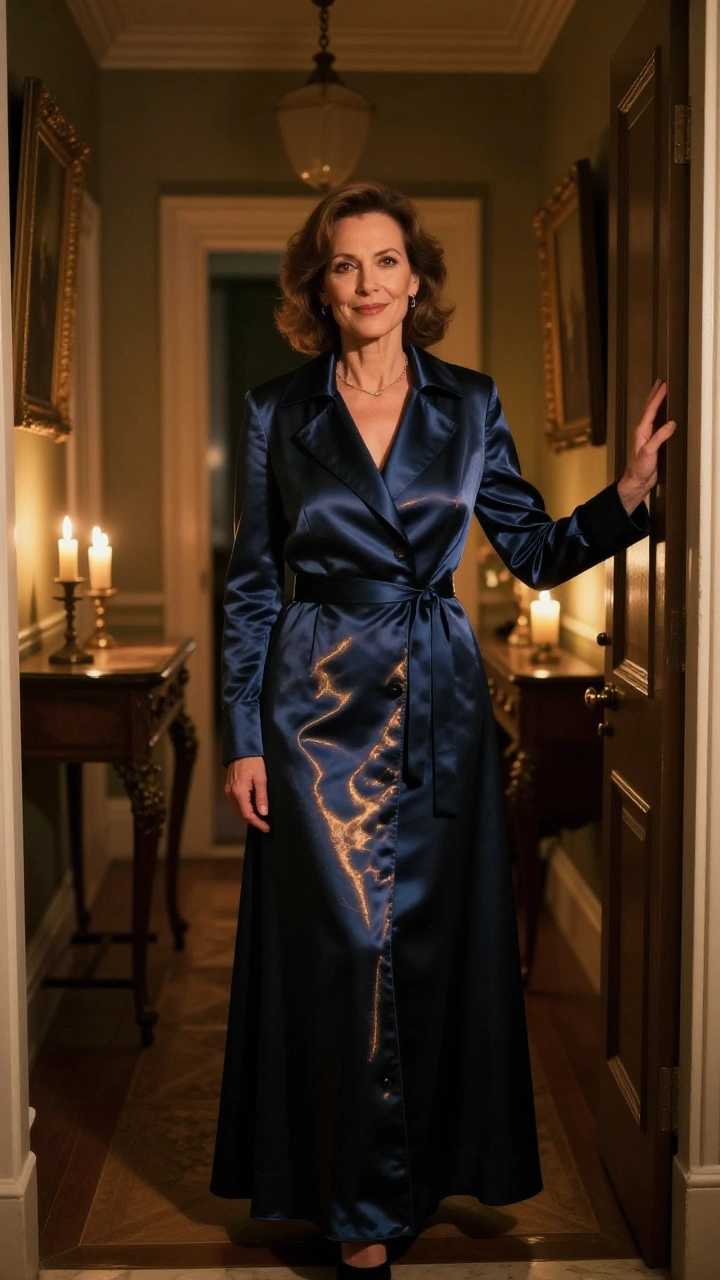
The Door
Previously in The Private Dinner Chapter 2: Catherine Ashworth received a mysterious summons—not an invitation, but a summons—to a Private Dinner at a Belgravia townhouse. In the days that followed, she encountered a series of women—her friend Margaret in burgundy leather, her trainer Danae in glossy PVC, her assistant Olivia in gleaming leather, the boutique owner Amélie in shimmering PVC-trimmed silk—each of whom wore fabrics that caught the light and spoke of a dominant presence they admired. Each of them seemed to recognise, without being told, that Catherine was preparing for something extraordinary. On the evening of the dinner, she dressed in a midnight-blue satin gown and an oxblood leather jacket, stood before her mirror, and saw—for the first time—not the woman she performed but the woman she was. She took a taxi to Eaton Square. She knocked. The door opened. And the woman on the threshold—dressed in black satin, with a voice like warm honey—said: “Welcome, Catherine. We have been expecting you.”
Now, the threshold. The world behind the door. The beginning of everything.
The door closed behind Catherine with a sound that was not a sound so much as a sensation—a soft, definitive click that resonated not in the air but in the chest, like the closing of a book whose first chapter one has just finished, or the settling of a lock whose key has been turned for the first time in years. The noise of London—the buses, the taxis, the ceaseless arterial pulse of a city that never truly sleeps—did not so much disappear as recede, falling away like a tide withdrawing from a shore, leaving behind a silence that was not empty but full: full of expectation, full of presence, full of the particular quality of quiet that one finds in churches before a service begins, or in galleries before the doors open to the public.
Catherine stood in the hallway and breathed.
The air was different here. Not merely warmer—though it was that, the temperature adjusted to the precise degree that relaxes the muscles without inducing drowsiness—but different in composition, in texture, in the way it felt when it entered the lungs. It carried a scent that Catherine could not immediately name: something floral, something smoky, something that lay beneath both like a bass note beneath a melody. The floral component was not the cloying sweetness of gardenias or the sharp brightness of lilies but something deeper, more complex—jasmine, perhaps, but jasmine that had been aged, that had acquired a gravity that fresh flowers do not possess. The smoky component was not tobacco or wood but something more elusive—amber, perhaps, or myrrh, the ancient resins that were said to open the mind and quiet the chatter of the ordinary self.
The combination was intoxicating. Not in the blunt, chemical way of alcohol, but in the way that certain places are intoxicating—the way a cathedral is intoxicating, or a forest at dusk, or the room of a lover before one has spoken the first word. It was a scent that suggested elsewhere—that whispered, with every breath, that the world one had just left was not the only world, and that the world one had just entered operated by different rules.
The woman who had opened the door stood before Catherine, and Catherine, for the first time in longer than she could remember, felt the ground shift beneath her—not literally, not physically, but in the way that one’s internal landscape shifts when one encounters a presence that rearranges it.
She was tall—taller than Catherine by several inches, which placed her somewhere above five foot ten. Her hair was dark—not merely brown but the deep, blue-black of polished ebony, swept back from a face that was not beautiful in the conventional sense but compelling in a way that made the word beautiful seem insufficient, like calling a symphony pleasant. Her features were strong, architectural: a jaw that spoke of resolve, cheekbones that caught the light like the edges of a crystal, eyes that were dark and deep and possessed of a quality Catherine had seen only in the portraits of Old Masters—the quality of a gaze that does not merely look but receives, as though the eyes were not instruments of observation but instruments of perception, taking in not just the surface but the substance, not just the appearance but the truth.
She wore a fitted sheath dress of black satin that seemed to drink the light from the wall sconces and give it back as warmth—a warmth that was not merely thermal but emotional, as though the fabric itself were radiating a kind of hospitality. The satin moved when she moved, which was seldom and precisely, each gesture economical and deliberate, like the movements of a conductor who knows that the music is not in the baton but in the spaces between the beats. The dress fell to just below the knee, and beneath it, her legs were clad in stockings of black silk that had the faintest sheen, catching the light with each step like the surface of a dark lake at twilight.
Her hands were gloved—black satin, opera-length, the leather so fine it was almost liquid, the gloves ending just above the elbow in a delicate scalloped edge. Catherine found her gaze drawn to those gloved hands with an intensity that surprised her. There was something about them—the way they rested at the woman’s sides with the ease of a bird’s wings when it is not flying, the way they seemed to exist in a state of perpetual readiness, of quiet capability—that made Catherine’s own hands feel, by comparison, unformed, uncertain, as though she had been using them her whole life without truly understanding what they were for.
“Welcome, Catherine,” the woman said again, and this time, hearing the voice at close range rather than through a telephone, Catherine felt its full effect—a warmth that began in the ears and travelled downward through the body like a sip of good brandy, settling in the chest, loosening something that had been held tight for years. “My name is Vivienne. I am Theodora’s companion and the keeper of her household. I am the voice you heard on the telephone.”
“The voice that said summoned,” Catherine said.
Vivienne smiled—a smile that was not wide but deep, like a fissure in stone that reveals the richness of the geology beneath. “I corrected you because invited would have been inaccurate. One invites equals. One summons those one has been waiting for. The distinction matters.”
“You’ve been waiting for me?”
“We have been waiting for you for some time. Theodora saw you three months ago, at the Hodgkin retrospective at the Tate. You were standing in front of a painting—Small Henry’s—and you were weeping. Not openly. Not in a way that anyone else would have noticed. But Theodora notices. She saw the tears, and she saw what was behind them, and she said, There. That one. She is ready.“
Catherine felt a jolt of recognition—not of the event, which she remembered with perfect clarity, a Tuesday afternoon, a painting that had moved her in a way she could not articulate, a single tear that she had wiped away before anyone could see—but of being seen. Of being observed by someone with the eyesight to see what others missed. The sensation was vertiginous, like looking down from a great height and realising that someone is looking back from the ground.
“I don’t know what to say,” Catherine admitted.
“You don’t need to say anything yet,” Vivienne replied, and the words were not dismissive but generous—an invitation to silence, a permission to simply be without the obligation to perform. “You need only follow. And breathe. And allow yourself to be where you are.”
She turned, and the black satin of her dress moved like a shadow given form, and she began to walk down the hallway.
Catherine followed.
The hallway was longer than the exterior of the townhouse suggested—a trick of proportion, perhaps, or of lighting, or of the particular geometry that old London houses possess, where rooms lead to rooms lead to corridors lead to spaces that seem to exist outside the normal architecture of space and time. The walls were painted in a colour that Catherine, despite her professional expertise in visual matters, could not immediately name—not grey, not blue, not green, but something that contained elements of all three, a colour that seemed to shift depending on where one stood, like the surface of water that reflects first one thing and then another.
The walls were not bare. At intervals—precise, deliberate intervals, like the spacing of notes in a musical phrase—hung paintings. Catherine’s eye, trained by years of professional scrutiny, registered them with a quickened pulse: a small Freud, the flesh rendered with the unsparing tenderness that was Freud’s signature; a Hodgkin—the same artist whose work had moved her to tears at the Tate, and whose presence here felt less like coincidence and more like confirmation; an abstract that might have been a late Motherwell, its reds and blacks conversing in the language of passion and restraint. Each painting was lit by its own sconce, the light angled to reveal not just the image but the texture of the paint itself—the impasto, the glazes, the physical evidence of a hand at work.
“Theodora collects,” Vivienne said, without turning, as though she had felt Catherine’s gaze and knew exactly where it fell. “Not for investment. Not for display. She collects because she believes that beauty, when it is kept private, becomes more powerful. A painting in a museum is a public speech. A painting in a private home is a conversation.”
“She has extraordinary taste,” Catherine said, and the words felt inadequate, like describing the ocean as wet.
“She has extraordinary patience,” Vivienne corrected. “Taste is a matter of education. Patience is a matter of character. She waited three years for the Hodgkin. She waited seven for the Freud. She waited considerably longer for you.”
The words landed on Catherine like a physical touch—not a blow but a caress, the kind that leaves a warmth on the skin long after the hand has withdrawn. She waited considerably longer for you. The phrase implied a knowledge of Catherine that extended beyond the Hodgkin retrospective, beyond the Tate, beyond the moment of the single tear. It implied that Theodora had been aware of Catherine for years—watching, waiting, assessing—with the patience of a woman who understands that the most valuable things cannot be hurried.
They passed doors. Each stood slightly ajar—an inch, perhaps two, enough to offer a glimpse without granting entry. Catherine, following Vivienne down the hallway, found her gaze drawn to each opening with the involuntary hunger of a woman who has been fasting and is passing restaurants.
Through the first door: a library. Floor-to-ceiling shelves, leather-bound volumes, a reading chair of deep green leather, a lamp casting a pool of warm light across an open book. The room smelled of paper and time and the particular mustiness that is not decay but accumulation—the scent of a thousand stories waiting to be read.
Through the second door: a music room. A grand piano—Bösendorfer, Catherine noted, the Imperial model with the extra keys—its surface gleaming like black water. A chair beside it, upholstered in satin of deep burgundy. On the music stand, a score of Schubert’s Impromptus. The room smelled of rosin and wood and the ghost of music recently played.
Through the third door: a conservatory. Glass walls, a ceiling of Victorian ironwork, orchids in bloom—white, purple, a single one of extraordinary blackness that seemed to absorb the light rather than reflect it. A chaise longue draped in ivory satin, a book face-down upon it, a glass of something amber on the table beside it. The room smelled of earth and growth and the humid sweetness of living things.
Each room was a world. Each room was inhabited—not by a person at that moment, but by the evidence of a person, the traces of a life being lived with attention and care. Catherine understood, with the instinct of a woman who had spent her life in the business of reading spaces, that these rooms were not stage sets but living chambers, each one used, each one loved, each one a small sanctuary within the larger sanctuary of the house.
“The women who live here,” Catherine said. It was not a question.
Vivienne paused, turning to face Catherine with an expression that held both surprise and approval—the surprise of a woman who has been understood more quickly than expected, the approval of a woman who values perceptiveness above almost every other quality.
“The women who live here,” Vivienne confirmed. “There are seven of us. Seven, plus Theodora. We each have our own rooms, our own pursuits, our own lives. We are not a cult, Catherine. We are not a harem. We are not a commune. We are a household—a word that, in its original meaning, referred not merely to a group of people sharing a dwelling but to a group of people sharing a purpose.”
“And the purpose?”
Vivienne’s dark eyes held Catherine’s with a directness that was not aggressive but inviting—an invitation to look deeper, to see not the surface but the architecture beneath. “The purpose is becoming. Each woman in this household was, like you, summoned when she was ready. Each woman came through this hallway, past these doors, and stood where you are standing now. Each woman made a choice—to stay, to devote herself to something larger than her own ambition, to give herself to a woman who saw her clearly and loved what she saw. And each woman, in doing so, became more herself than she had ever been. Not less. More.”
Catherine felt the words enter her like the scent in the air—not through the ears but through the chest, settling in the place behind the sternum where the voice on the telephone had first lodged, where the satin gown now lay against her skin like a second self.
“Seven women,” Catherine said. “One Theodora.”
“One Theodora,” Vivienne agreed. “One centre. One compass. One woman whose vision is large enough to hold us all and whose generosity is deep enough to give us what we need. You find this strange?”
Catherine considered the question honestly. “I find it… unusual.”
“Unusual is not the same as wrong,” Vivienne said. “Unusual is merely unfamiliar. What is familiar, Catherine, is the model of a woman alone—building her career, maintaining her independence, constructing her life like a fortress with herself at the centre. You have lived that model. Has it made you happy?”
The question was not rhetorical. It was asked with the genuine curiosity of a woman who already knew the answer but wanted Catherine to arrive at it herself—to speak it, to hear it in her own voice, to make it real in the way that things only become real when they are said aloud.
“No,” Catherine said. The word was quiet, simple, and it cost her more than any sentence she had ever spoken. “It has not made me happy.”
Vivienne nodded—a single, slow nod that contained within it the weight of understanding, the patience of a woman who has heard this word a hundred times and never tires of it, because each time it is spoken, it is spoken by a different woman, and each woman’s no is a different no, a different key in a different lock, a different door opening onto a different landscape.
“Then you are in the right place,” Vivienne said. “Come.”
They continued down the hallway, and Catherine, walking behind Vivienne, became aware of something she had not noticed before: the floor. It was covered in a carpet of deep charcoal, but the carpet was not merely underfoot—it was part of the experience. It was thick enough to muffle their footsteps, so that their passage through the hallway was almost silent, the only sound the faint whisper of satin against satin, leather against wool, the quiet conversation of fabrics in motion. The carpet was soft in the way that certain luxuries are soft—not merely yielding but welcoming, as though the floor itself were saying stay, walk slowly, there is no hurry.
Catherine also became aware of Vivienne’s walk—the particular way she moved, the way her body occupied space not with aggression but with authority. There was no swagger, no theatricality, no performance. There was simply the walk of a woman who knew where she was going and had no doubt that she belonged there, and the effect of that walk on Catherine was profound and unexpected: it made her want to follow. Not out of weakness or submission but out of recognition—the recognition that some people are worth following, that the act of following is not diminishment but discernment, that choosing to walk behind someone whose steps are sure is not surrender but wisdom.
“The women who live here,” Catherine said again, and this time it was a question—the same words, but the inflection different, the emphasis shifted from statement to enquiry. “What are they like?”
Vivienne did not break her stride. “They are like you. They are unlike you. They are surgeons and novelists and financiers and musicians and barristers and artists. They are women who have achieved things in the world that most people only dream of, and who have discovered, upon achieving them, that achievement without devotion is like a body without a heart—functional, perhaps, but not alive.”
“And they devote themselves to Theodora?”
“They devote themselves to the idea of Theodora—and to the reality, which is, they tell me, far more interesting than the idea. They devote themselves to the household, to each other, to the pursuit of excellence in their respective fields. And they devote themselves to Theodora because Theodora is the centre—the still point around which everything turns, the compass that always points true, the hand that guides without gripping, the voice that commands without raising itself.”
“That sounds like devotion to a queen.”
Vivienne paused again. This time, when she turned, her expression held something new—not correction but consideration, as though Catherine’s comparison had given her something to think about.
“A queen is a useful analogy,” Vivienne said, “but an imperfect one. A queen rules by birthright. Theodora rules by choice—the choice of those who follow her. Her authority is not inherited or imposed. It is granted, freely and repeatedly, by every woman in this household. Each of us chooses, every day, to give her our devotion. And each of us, in giving it, receives something in return that is worth more than anything we could have built alone.”
“What do you receive?”
Vivienne’s smile returned—deeper now, more intimate, a smile that was not for public consumption but for this moment, this conversation, this woman who was asking the right questions in the right order with the right tone of genuine enquiry. “We receive the thing that every woman secretly wants and almost never finds: the experience of being fully known. Theodora sees us—not the selves we present to the world, not the competent masks, not the carefully constructed fortresses. She sees the woman behind the mask, the woman inside the fortress, the woman who is, beneath it all, hungry—hungry to be seen, to be held, to be guided, to be used in the deepest sense of the word, which is not exploitation but purpose. She sees that hunger, and she feeds it. And in feeding it, she makes us more.”
Catherine stood in the hallway, the scent of jasmine and amber in her lungs, the satin of her gown cool and warm against her skin, the leather of her jacket giving her shoulders a structure that felt, in this moment, less like armour and more like wings. She looked at Vivienne—at the black satin that moved like shadow, the gloved hands that rested with the patience of a woman who had learned that stillness is not inaction but a form of power—and she felt the locked room inside her swing wider.
“Generosity,” Catherine said, the word arriving from somewhere she could not identify. “The giving of oneself. You said that each of you gives Theodora your devotion. But what about the giving of… more? More than devotion. More than presence. The giving of things—of resources, of wealth, of the tangible evidence of one’s commitment?”
Vivienne regarded her with an expression that Catherine could not read—not because it was blank but because it was rich, containing so many layers of meaning that no single word could capture them all. Then she said, speaking with the precision of a woman who chooses her words the way a jeweller chooses stones:
“Generosity is not a transaction, Catherine. It is not a fee. It is not a price paid for services rendered. Generosity is the natural expression of a heart that has been filled to overflowing. When you are seen—truly seen, fully known, completely understood—something happens inside you. A wellspring opens. And from that wellspring flows not only devotion but abundance—the desire to give, to offer, to express in tangible form the gratitude and the love and the commitment that words alone cannot carry. The women in this household give to Theodora—not because she asks, because she does not ask; not because she demands, because she does not demand; not because they owe, because they owe nothing. They give because giving is what happens when a woman who has been holding everything in finally learns to let everything out. It is euphoria, Catherine. It is bliss. It is the most natural thing in the world.”
Catherine felt something move inside her—something that was not thought but sensation, a warmth that began in the chest and radiated outward, reaching her fingertips, her toes, the roots of her hair. It was the sensation of a truth being recognised—not learned, not understood, but recognised, in the way that one recognises a face one has not seen in years: with a shock of familiarity, a jolt of yes, that, exactly that, I have always known that without knowing that I knew it.
“I think,” Catherine said, slowly, carefully, the way one speaks when the words are not being chosen but received, “that I have been waiting a long time to hear someone say that.”
“I know,” Vivienne said. “That is why you were summoned.”
They arrived at the end of the hallway.
Before them stood a set of double doors—taller than a single door, wider, made of a dark wood that gleamed with the deep, liquid sheen of centuries of polish. The handles were brass—old brass, the colour of honey, worn smooth by generations of hands. The doors were closed, and in their closedness, they held a particular weight—not physical but symbolic, the weight of a threshold, the weight of a choice, the weight of a world that existed on the other side and could not be unseen once seen, could not be unknown once known.
Vivienne turned to face Catherine. Her dark eyes, in the soft light of the hallway sconces, held the particular brightness of a woman who is about to give a gift and knows it. She reached out with one gloved hand and touched Catherine’s arm—the lightest touch, the barest whisper of satin against bare skin, and yet it travelled through Catherine’s body like a current, waking nerve endings that had been dormant for years, illuminating pathways that had been dark.
“Catherine,” Vivienne said, and her voice was lower now, softer, as though the words she was about to speak required a different register—a more intimate frequency, the way a radio shifts from AM to FM to receive a signal that is clearer but requires a finer instrument to hear. “Behind these doors is a dining room. In that dining room, seven women are waiting. And at the head of the table, a woman is waiting who has been waiting for you longer than any of them. She will not ask you to do anything. She will not demand anything of you. She will simply be present—and in her presence, you will understand things that I cannot explain, because they are not the kind of things that can be explained. They are the kind of things that can only be experienced.”
Catherine looked at the doors. She looked at Vivienne. She looked at the hallway behind her—the paintings, the ajar doors, the carpet that had swallowed their footsteps, the air that smelled of jasmine and amber and elsewhere.
She thought about the envelope. The serpent and the rose. The voice on the telephone. The week of preparation—the satin, the leather, the women who wore glossy fabrics and spoke of dominant presences with a reverence that was not worship but recognition. The locked room, swinging open.
“I’m ready,” she said.
Vivienne smiled. She placed her gloved hand on the brass handle. She pushed the doors open.
And from beyond the threshold, Catherine felt it before she saw it: a warmth, a light, a presence that reached out to her like a hand extended in welcome—like the hand in her dream, gloved in black satin, reaching across a table set with silver, smiling.
Catherine stepped through.
And Theodora looked up.
And the world Catherine had known—the fortress, the competence, the locked room, the carefully constructed life with every stone in its place and every window shuttered against the light—fell away like a dress that has been outgrown, like a skin that has been shed, like a cocoon that has served its purpose and is no longer needed.
And the woman Catherine was meant to be stepped forward, into the light, into the warmth, into the gaze of the woman who had been waiting for her all along.
Next week in The Private Dinner: Chapter Four — The Hostess. Catherine meets Theodora—the woman who summoned her, the woman who has been waiting, the woman who will change everything. Silver hair, emerald satin, a gaze that sees not the surface but the truth. And at the table, seven women—surgeons, novelists, financiers, musicians—all devoted, all radiant, all wearing fabrics that gleam. The dinner begins. The conversation turns. And Theodora asks Catherine the question that will unlock the rest of her life: “What is it that you truly want?”
If this chapter has carried you somewhere—if you have felt, in these words, the pull of a threshold, the warmth of a presence, the stirring of a locked room inside yourself—know that the door is open. It has always been open. You need only step through.
With deepest devotion,
Dianna
Leave a Reply
You must be logged in to post a comment.