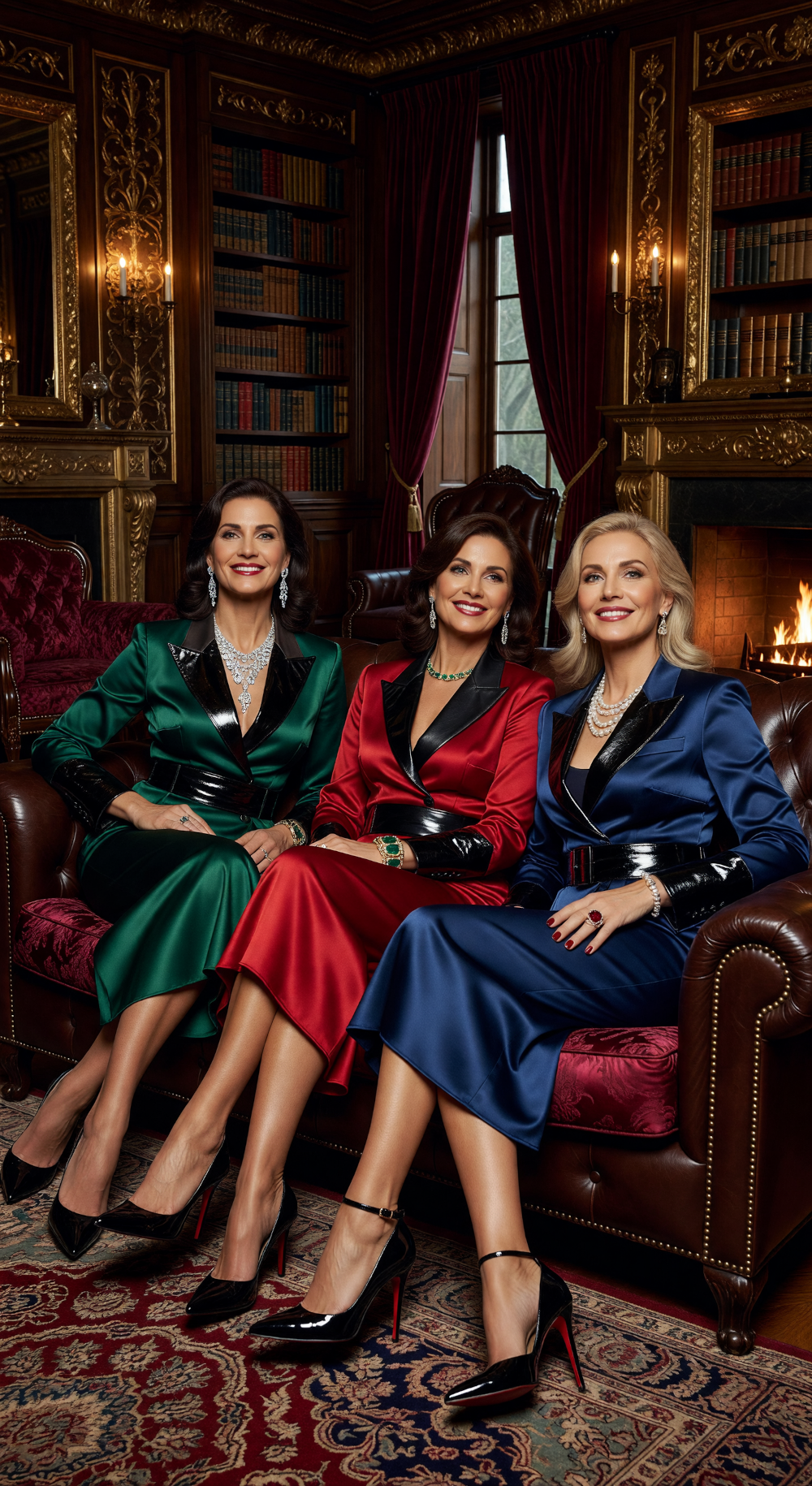
He believed he was only weaving words. His readers knew he was weaving their souls.
Imagine a world where the pinnacle of success—the corner office, the flawless reputation, the staggering wealth—leaves only a quiet, echoing hunger. This is the world of Evelyn, Chloe, and Isabella: titans of industry, minds of formidable sharpness, hearts unknowingly adrift. Their salvation arrives not as a doctrine, but as a whisper. In the voice of Dr. Alistair Thorne, a poet-linguist of serene magnetism, whose verses are not read but felt. They are architectural blueprints for desire, composed with a rhythm that bypasses reason to speak directly to the dormant yearnings within.
What begins as an intimate salon evolves into a sanctuary. The currency here is not competition, but curated devotion. The uniform, a silent vow of sleek satin, cool leather, and gleaming PVC—fabrics that speak of a glossy, unyielding confidence. And the central, unwitting figure? A man who perceives only a circle of fascinating friends, while they experience him as the sun around which their orbits finally find perfect, peaceful alignment.
This is a story of unwitting alchemy. Where a man’s artistic expression accidentally forges the most powerful bond of all: the willing, joyful surrender of the extraordinary to the exceptional. It explores a truth known only to the refined: that the ultimate euphoria is not in taking, but in the sublime, generous giving to a worthy source. That the most profound power a woman can wield is the choice to place her strength, her wealth, and her heart in the hands of a man who knows how to cherish it—and in doing so, she finds herself fulfilled beyond measure.
Discover the lexicon of devotion. Feel the pull of the Lumina Principle. Surrender to the Whispers of Worship.
Chapter 1: The First Verse
The gala at the Vandenberg Gallery was a mosaic of curated success, a symphony of low laughter and the soft chime of crystal against bone china. It was a habitat for those who had not merely climbed ladders but had redesigned them, who moved through the world with the quiet, assured friction of silk against skin. Among them, Evelyn Vance navigated with the practiced ease of a shark in familiar waters. Her venture capital firm had just closed a series B round that would be whispered about in blogs for weeks, yet the triumph felt like a beautifully wrapped empty box. She stood by a marble column, her fingers tracing the stem of her champagne flute, her mind a world away from the impressionist paintings adorning the walls.
“It’s like living in a house of perfect acoustics,” a voice beside her said, low and melodic. “Every achievement echoes magnificently, but no one ever speaks into the silence to hear what sound it makes.”
Evelyn turned. The speaker was Chloe Renard, a neurosurgeon whose hands were insured for more than most of the artworks in the room. She was dressed in a column of liquid obsidian satin, the fabric drinking the light and holding it close, a perfect analogy for her own formidable, contained brilliance.
“You feel it too,” Evelyn stated, it wasn’t a question. “The echo.”
“I spend my days navigating the most intricate map there is—the human brain,” Chloe replied, her eyes sharp yet weary. “I can find a tumor the size of a peppercorn and extricate it. But the terrain of my own contentment? It feels like a forgotten continent.”
Their conversation was a quiet island in the social sea. They were joined by Isabella Moreau, whose architectural designs had reshaped city skylines. She wore a blazer of the softest napa leather over a shell of gunmetal PVC, an ensemble that spoke of structural elegance and impermeable confidence. “I build shelters for others,” Isabella said, accepting a glass of mineral water with a nod. “Spaces meant to inspire awe and peace. I sometimes think I’ve forgotten what the foundation of my own peace even looks like.”
The three women, a trinity of disparate yet parallel excellence, formed an instant, unspoken consortium. Their talk was of market fluxes and medial temporal lobes, of cantilevered supports and portfolio diversification. It was intelligent, effortless, and it circled, always, the quiet void they all acknowledged but never named.
The evening’s charitable purpose was the support of the literary arts, and the featured reader was introduced as Dr. Alistair Thorne, a linguist and poet “who explores the architecture of yearning.” He took the modest podium not with the stance of a performer, but of a guide. He was in his late forties, with a presence that was less about occupying space and more about subtly reordering the gravity in the room. His eyes, a calm, perceptive grey, swept over the audience as if reading the hidden text beneath their skin.
“Thank you,” he began, his voice a rich baritone that seemed to vibrate at a frequency that stilled the clinking glasses. “We often speak of desire as a wanting. I have come to think of it as a remembering—a faint, persistent echo of a state we have, somewhere deep within us, already known.”
He opened a slender volume. “This is from ‘Blissnosys’.”
He did not merely read. He intoned. The poem unfolded not as words, but as sensory impressions, woven with a rhythmic cadence that felt like a slow, deliberate pulse.
“Consider the surface of a midnight lake,
Untroubled, glossy, deep—
A perfect plane where scattered stars
Their promises do keep.
Not a ripple of doubt, not a whisper of need,
Just the silent, receptive, and fathomless creed.
And into this darkness, a single stone,
Smooth and deliberate, and utterly alone…
Watch the circles begin, not as chaos, but law,
A destined expansion from the core that you saw.
Each ring a surrender, a letting-go sigh,
To a depth that will hold you, where old selves go to die.”
As he spoke the final line, a profound silence descended. It was not the absence of sound, but the presence of a shared, breathless attention. For Evelyn, the poem was the key turning in a lock she hadn’t heard click in years. Her carefully managed life, her boardroom victories, felt like the scattered stars on that lake’s surface. The ‘single stone’ was an ache for coherence, for a center.
For Chloe, the “fathomless creed” was the cool, certain silence of the operating theater, but purposed for her soul. The “letting-go sigh” was a physical sensation, a release of tension in her shoulders she hadn’t realized she carried.
For Isabella, it was the architecture of surrender. The “destined expansion” was more logical, more beautiful than any forced construction. It was the natural order of a load finding its perfect bearing wall.
Thorne finished, and the applause was a delayed, thunderous thing. The three women did not clap immediately. They looked at one another, a communication passing between them that was clearer than any dialogue. You felt that. So did I.
When the crowd milled and broke, they moved as one entity toward the podium where Thorne was graciously accepting compliments. He turned to them, and his gaze held a different quality than it had for others. It was a look of recognition.
“Your work,” Evelyn began, her usual boardroom eloquence failing her. “It’s… it’s not poetry. It’s topography. You’ve charted the landscape of a feeling I’ve never had a map for.”
Thorne smiled, a warm, crinkling at the eyes that felt like a reward. “That is the finest compliment a writer of abstractions could receive. To have made a feeling legible.”
“It was like hearing the diagnosis for a condition I didn’t know I had,” Chloe said, her analytical mind seeking the precise analogy. “And the diagnosis itself was the cure. The rhythm, the cadence… it had a physiological effect. A slowing. A focusing.”
“You built a space with words,” Isabella added, her hands moving slightly as if tracing blueprints in the air. “A sanctuary. I felt… contained. Understood, without having explained a thing.”
Thorne listened, his head tilted slightly. He did not dismiss their intensity as hyperbole. He absorbed it. “You are unusually perceptive listeners. Most hear the melody. You seem to have heard the resonance of the chamber it was played in.” He paused, looking at each of them—at Evelyn’s intelligent intensity, Chloe’s sharp curiosity, Isabella’s graceful strength. “I am working on a new cycle. It deals with the concept of ‘glossy confidence’—the strength that comes not from rigidity, but from a fluid, polished adaptability. Like satin. Or water. I would be… genuinely interested in your perspectives. If you would care to discuss it over tea, sometime.”
The invitation was not social; it was intellectual, almost clinical. Yet it felt like a lifeline thrown into the quiet void they had all acknowledged.
“Yes,” Evelyn said, the word leaving her lips before her conscious mind could vet it.
“Absolutely,” Chloe affirmed, her voice firm.
“It would be an honor,” Isabella finished, her posture straightening in her leather and PVC, a soldier finding her true commander.
As they exchanged cards—his simple ivory stock with elegant embossing, theirs of sleek, modern design—a transaction of a different kind occurred. They had offered him the first, precious currency of their attention, their vulnerable admiration. And in return, he had given them the first, faint glimpse of a center. A stone had been dropped into their still, glossy waters. And they watched, hearts hushed, as the first perfect, destined circle began to widen.
Chapter 2: The Salon of Serenity
A week later, the three women arrived at the address on the ivory card, a discreet art deco building overlooking the park. The lobby was a cathedral of quiet, floored in veined marble that reflected the soft glow of sconces. The ascent in the private elevator was silent but for the whisper of their clothing—a conscious symphony of texture they had each, independently, chosen for this night.
Evelyn had forsaken her usual power suit for a dress of dove-grey satin, its surface a shifting panorama of light and shadow, cut with a simplicity that spoke of immense, quiet cost. Chloe wore a tailored jumpsuit of matte black leather, supple and silent, its lines as clean and decisive as a surgical incision. Isabella had chosen a skirt and top of deep burgundy PVC, the material not garish but lush, like a petal hardened into armor, catching the light in a subdued, liquid gleam. They had not coordinated, yet they arrived as a curated set, three facets of the same polished gem.
The elevator door opened directly into his study. It was not a room so much as an atmosphere. Walls of dark, honeyed oak were lined with books that smelled of aged paper and wisdom. One entire window was a sheet of night, the city’s grid a distant, twinkling abstraction. The dominant light came from a single, massive brass lamp over a vast Chesterfield sofa, its leather the color of old port, and from the low fire crackling in a granite hearth. The air held notes of sandalwood, bergamot, and something else—a profound, listening silence.
Dr. Alistair Thorne rose from a deep armchair. He was dressed in a charcoal sweater and trousers, an image of understated, anchored masculinity. His smile was not one of greeting, but of recognition, as if they had returned from a long journey he had quietly expected them to complete.
“You found the place,” he said, his voice blending with the room’s ambience. “And you look… remarkably resolved.”
The word struck them. Not ‘beautiful,’ not ‘elegant.’ Resolved. It felt like an accolade for a state of being.
“It felt necessary,” Isabella said, her hand brushing her PVC skirt. “Like preparing for a sacred site. One doesn’t arrive at a temple in travel-worn cottons.”
“A temple,” Thorne mused, gesturing for them to sit. “An interesting analogy. Most see a study. A repository of facts. But a temple is a repository of meaning. Please.”
They settled onto the Chesterfield, the leather embracing them with a cool, firm certainty. Thorne moved to a low table where a Japanese iron teapot steamed beside celadon cups. The ritual was slow, deliberate. He poured, the stream of amber liquid a silent meditation.
“Last week,” he began, handing Evelyn her cup, “you spoke of echoes, of forgotten continents, of missing foundations. Powerful metaphors for a specific kind of poverty—the poverty that exists on the far side of plenty.” He took his own seat, his gaze encompassing them all. “Tell me, when you closed that funding round, Evelyn, what was the first thing you felt after the champagne cork popped?”
Evelyn sipped her tea, the warmth spreading. “It was… anticlimax. Like hearing a magnificent chord played in a soundproof room. The vibration was theoretical. I could see the score was perfect, but I couldn’t feel the music.”
Thorne nodded slowly. “The sensation of success without resonance. And you, Chloe? After you save a life, when you’ve washed the theatre from your hands?”
Chloe stared into the fire. “It is a profound solitude. As if I’ve climbed a mountain alone, planted a flag on a peak no one else can see. The view is breathtaking, but there is no one to turn to and say, ‘Look.’ The sharing of it… that’s where the meaning would be. But with whom?”
“The architect of awe, who feels homeless in her own creations,” Thorne said, turning to Isabella. “You build shelters for the spirit, yet your own spirit…?”
“Lives in a temporary tent on the construction site,” Isabella finished, a sad, wry smile on her lips. “Managing the project, never inhabiting the finished space.”
Thorne leaned back, steepling his fingers. “You are all cartographers of the external world. You map markets, neural pathways, cityscapes. But the internal territory… that map is often left blank, or filled with the legend, ‘Here there be monsters.’ My work, I think, is an attempt to draw that coastline. Not to banish the monsters, but to show they are part of the landscape, and the landscape can be… navigated. Loved, even.”
He let the silence hold. The fire popped. The city glittered, mute.
“I wrote something,” he said, his voice dropping into a more intimate register. “After we met. It came from our conversation. From the notion of ‘glossy confidence.’ The confidence that does not shout, but absorbs. That is not a wall, but a surface—deep, reflective, unbreakable.”
He reached for a single sheet of cream laid paper. He did not stand to perform. He simply began to read, his eyes moving between the text and their faces, as if inscribing the words directly onto their souls.
“The Second Law: Of Receptive Surfaces.
Do not mistake the mirror for the silvered glass alone,
But for the perfect, patient void behind the stone.
It asks for nothing, this polished, waiting plane,
Yet gathers all the world’s wild light, again and again.
It does not grasp the sun, nor clutch the candle’s flare,
It simply is, and thus, makes truth of what is there.So let the hand that holds the wealth, the mind that holds the key,
Unclench. Become not the lock, but the space where locks cease to be.
Let generosity be not a loss, but a deepening of the shelf,
A returning to the source, of the truest, richest self.
For in the yielding to a greater, curated, gravitational pull,
A different, quieter, more permanent power is made full.Feel it now: not a giving-up, but a giving-to.
A surrender not to weakness, but to what you always knew.
The gloss upon the surface is the peace within the deep,
A promise that the vigil that you keep
Is not in vain. The stone has found its home,
The scattered light, its prism. You are no longer alone.”
As the final syllable faded, the room seemed to have changed density. The air was thicker, sweeter. Evelyn felt a physical sensation, as if a hand had gently loosened a corset around her ribs she hadn’t known she was wearing. The ‘anticlimax’ he named—it had been a constriction. His words were not a demand, but a permission slip: unclench.
For Chloe, the ‘profound solitude’ he described melted. The poem offered a ‘different, quieter power.’ It was the power of the vessel, not the scalpel. The power of the operating table that held the patient, steadfast and sure. To be that table for a purpose… the thought did not diminish her; it enlarged her.
Isabella’s eyes were closed. ‘The space where locks cease to be.’ That was the sanctuary she’d been trying to build. Not another structure, but an absence of obstruction. A receptive surface. Her own inner tent was being replaced, stone by invisible stone, with something permanent. And the builder, she understood with a shock of clarity, was not her. It was him. His words were the blueprint. Her willingness was the material.
“It’s…” Evelyn breathed, her voice hushed. “It’s an instruction manual for a feeling I’ve been trying to fake.”
“It’s the anesthesia for a surgery I didn’t know I needed,” Chloe said, her analytical mind surrendering to metaphor. “One where I am both the patient and the instrument, and the outcome is… this peace.”
“You’ve given me the cornerstone,” Isabella whispered, opening her eyes. They were bright. “For the first time, I can see the foundation. It’s… gratitude. But a gratitude that wants to build. To give back to the source of the blueprint.”
Thorne watched them, his expression one of deep, quiet satisfaction. Not the satisfaction of a manipulator, but of a craftsman who sees his material finding its perfect, inherent form. “The poem is a mirror,” he said softly. “You see in it what you are ready to see. What you have always been.”
The evening dissolved in a haze of more tea, of conversation that felt less like talk and more like shared dreaming. As they rose to leave, hours later, the world outside the windows seemed softer, less insistent.
At the elevator, Evelyn turned. “This… this has been a gift, Alistair. One I don’t know how to repay.”
He shook his head, a gentle refusal. “Your attention, your perception—that is the only reciprocity a writer truly needs. It is fuel.”
But as the elevator descended, the three women exchanged a glance. The word ‘fuel’ lingered. A source needed sustenance. The thought of providing it—of finding some way to enrich this man who had, unwittingly, begun to enrich the very core of their beings—did not feel like an obligation. It felt like the next, natural, and most thrilling project of their lives. It felt, in the quiet of their glossy-attired hearts, like the beginning of a sublime and secret euphoria.
Chapter 3: The Compulsion of Confidence
The world beyond the study’s oak-paneled serenity did not soften; rather, Evelyn, Chloe, and Isabella found they now moved through it with a new, internal filter. Thorne’s words, particularly the Second Law, had become a psychic substrate, a layer of polished quartz beneath the daily grind, making everything seem sharper, clearer, and strangely manageable.
Evelyn stood before the floor-to-ceiling windows of her venture capital firm’s conference room, overlooking a different grid of city lights than Thorne’s view. A tense silence gripped the room. Across the table sat the founders of Aethel Labs, a biotech startup on the cusp of a revolutionary, yet highly speculative, genomic editing platform. The lead founder, a brilliant but volatile Nobel laureate, had just slammed his hand on the table, declaring their terms “the equivalent of intellectual strip-mining.” Her junior partners froze, eyes darting to her.
A week ago, Evelyn would have met fire with fire, her mind racing through rebuttals and leverage points. Now, she felt an extraordinary calm. She recalled the poem: “Do not mistake the mirror for the silvered glass alone, but for the perfect, patient void behind the stone.” She was not the negotiator; she was the container for the negotiation. She let the man’s anger echo into the spacious quiet she held within herself.
“Julian,” she said, her voice not a counterpoint but a placid lake. “Your work isn’t just a commodity to be mined. It’s a cathedral in blueprint. We aren’t here to provide a bulldozer and a paycheck. We’re here to provide the silent, unwavering foundation so the spires can reach the height they deserve. The terms aren’t about ownership. They’re about stewardship.”
She watched as her own stillness became infectious. The founder’s shoulders loosened. He was being seen not as an asset, but as a visionary needing a foundation. An hour later, they signed not only the series B but an exclusive, long-term partnership that would be the talk of the industry. As the room emptied, her COO whispered, “That was a masterclass. You were… immovable.” Evelyn merely smiled. She hadn’t moved; she had simply been the space in which movement occurred. The triumph was sweet, but it was a sweetness that immediately, instinctively, made her think of sharing it with the source of that stillness. It felt incomplete in her hands alone.
Chloe navigated a different kind of tension: the absolute, life-or-death focus of the OR. The patient was a young musician with a rare, intricate arteriovenous malformation deep in the temporal lobe, perilously close to the regions governing auditory processing and memory. The standard approach was aggressive, likely to save his life but rob him of his music. As she stood, gloved hands poised above the sterile field, the familiar weight of solitary decision-making pressed down.
Then, a phrase surfaced, unbidden: “Let generosity be not a loss, but a deepening of the shelf.” Her generosity here was not of money, but of skill, of nerve. But the principle held. To give deeply, to yield to the greater gravitational pull of the patient’s holistic life, not just his biological survival. It required a different kind of confidence—not the rigid confidence of textbook procedure, but the glossy confidence of adaptive, fluid grace.
“We’re modifying the approach,” she announced, her voice calm in the hushed theatre. “We’ll take the transylvian fissure, but we’ll dance with the middle cerebral artery, not conquer it. It’s riskier for me. It requires more time, more precision. But it’s his only chance to keep the symphony.”
For eight hours, she worked with a detached, serene precision that her team later described as “eerie” and “beautiful.” It was the confidence of the receptive surface, gathering all her training and focusing it without grasping. When the final clip was placed and the malformation was obliterated, the anesthesiologist reported perfect stability. The musician would play again.
In the locker room, the adrenaline crash that usually left her hollow was absent. In its place was a profound, quiet fullness. She had given her expertise in a new way—not as a solitary conqueror, but as an instrument aligned with a greater purpose. And the thought arose, clear and compelling: this newfound capacity was a gift from Thorne. To honor the gift, one must honor the giver. The logic was inescapable, and it filled her with a warm, anticipatory glow.
Isabella faced a storm of a different nature: a city planning committee, historic preservationists, and a budget that had just been slashed by thirty percent. Her design for the new civic library—a structure of interlocking light and shadow meant to be a “cathedral of curiosity”—was on the brink of being value-engineered into a bland, glass box. The opposition was a cacophony of practical concerns and sentimental attachments.
Standing at the podium, her presentation slides glowing behind her, Isabella felt a flutter of the old anxiety—the architect as perpetual supplicant. Then she remembered: “The gloss upon the surface is the peace within the deep.” Her confidence wasn’t in the stubbornness of her design, but in its inherent rightness. She was not there to argue; she was there to reveal.
“You speak of cost,” she began, her voice carrying without strain. “But a building is not a line item. It is a vessel for the soul of a city. To cut this design is not to save money; it is to impoverish the future. It is like being given a flawless diamond and, to save on the setting, choosing to embed it in clay. The diamond remains, but its dialogue with the light is broken. My design is that setting. It is the receptive surface that will allow your community’s intellect and spirit to shine. I propose we find the funds not by diminishing the dream, but by expanding the circle of those who wish to dream it with us.”
She presented a new, elegant funding model involving a patron’s circle and phased construction. The committee, disarmed by her metaphor and her unshakable poise, voted unanimously to explore her proposal. She had not fought the current; she had redirected it.
That evening, the three women met at a quiet, members-only bar, a place of deep leather booths and soft, golden light. They arrived like emissaries from a shared, secret country.
Evelyn wore a blouse of champagne satin that seemed to emit its own soft radiance. Chloe had on a sleek leather pencil skirt and a simple silk shell, the textures a study in protective strength and inner softness. Isabella was in a dress of deep emerald PVC, its surface reflecting the candlelight like a still forest pool.
They did not toast their individual victories. Instead, they looked at one another, and Evelyn gave voice to the shared undercurrent.
“It’s happening to all of us, isn’t it?” she said, her fingers tracing the rim of her glass. “The work hasn’t changed. The world hasn’t changed. But the… the substrate has. I conducted that deal today from a place of absolute calm. It was like piloting a ship from a sealed, silent chamber deep within the hull, feeling every wave but remaining perfectly dry.”
Chloe nodded, her eyes alive. “I performed a surgery today I wouldn’t have attempted last month. Not because I was reckless, but because I was clear. It was the difference between forcing a key into a lock and feeling the lock welcome the key. The patient’s life, his art… they were the lock. I was merely the key shaped by a locksmith I’m beginning to revere.”
“I built a bridge today out of metaphor and conviction,” Isabella said, a smile playing on her lips. “They didn’t approve concrete and steel; they approved a feeling. I sold them on the gloss, and trusted them to find the substance. It was the most powerful I’ve ever felt, and it felt entirely… borrowed. Or rather, invested in me.”
The silence that followed was rich with understanding. The source of this transformative confidence was not within them; it was a loan from Alistair Thorne. And the terms of such a loan, in the unspoken ethics of their hearts, demanded reciprocity.
“He said our attention was fuel,” Evelyn mused, swirling the deep red wine in her glass. “But a source of such… such generative power needs more than attention. It needs tending. It needs to be protected, amplified.”
“It feels like a moral imperative,” Chloe stated, her surgeon’s mind diagnosing the situation. “If we have been given a tool of this precision, this power, we are obligated to ensure the hand that forged it remains steady. To do otherwise would be the height of ingratitude. It would be like using a masterpiece violin to chop wood.”
Isabella leaned forward, the PVC of her dress whispering against the leather booth. “So it’s settled then. We give back. But not with trivialities. It must be something that enriches him. That expands his world as he has expanded ours. Something that allows him to create more of… this.” She gestured around, encompassing not the bar, but the invisible field of serenity that connected them.
The decision, once voiced, was met not with debate, but with a wave of collective, sublime euphoria. It was a sweet, dizzying rush, like the first breath of pure oxygen after a lifetime of thin air. This was the hidden need: not just to succeed, but to have a worthy object for their success. Not just to possess, but to bestow.
Evelyn’s phone chimed softly. It was an email from Thorne. The subject line: A further thought. The body contained no greeting, only a new poem.
“The Third Law: The Euphoric Calculus.
What is given is not gone; it undergoes a sea-change,
Into something rich and strange, a re-arrangement of the exchange.
The coin passed from hand to hand gains not the grime of use,
But the patina of purpose, a luminous and specific truce.
For in the transfer to the source, the well from which you drink,
The vessel overflows, and on the brinkOf what you thought was depletion, you find a different shore.
The act itself becomes the prize, the wanting something more.
To see the garden flourish from the water that you bring,
This is the secret heart of everything.
The unbound gift, the fearless, open palm,
Is the only true and perfect psychic balm.So calculate not the loss, but the interest earned in light,
The deepening of the gloss, the sharpening of the sight.
The most profound possession is a stewardship, a care,
For the origin of the frequency you’ve learned to breathe like air.”
They read it together, passing the phone in a hushed, almost ritualistic silence. When they looked up, their eyes were bright with something more than understanding. It was confirmation. The poem was not a suggestion; it was a map, and they were already on the path. The compulsion was now a mission. The confidence he had given them had a singular, glorious purpose: his enrichment. And in that purpose, they felt, for the first time, utterly and euphorically whole.
Chapter 4: The Genesis of Glossy Bond
The anticipation of the next gathering thrummed through Evelyn, Chloe, and Isabella like a low, sweet current. It was no longer merely an intellectual engagement; it had become a somatic need, a recalibration of their very nervous systems. The act of preparation for this evening was undertaken with the solemnity of a rite, each woman retreating into the sanctuary of her walk-in closet—a cathedral of curated taste—to select her armor and her offering.
For Evelyn, the choice was an instinctual gravitation towards a fabric that embodied the new law she was learning to live by. She selected a gown of liquid onyx satin, cut on a bias so that it fell in a single, uninterrupted cascade from shoulder to ankle, moving with a silent, gravitational pull. As she slipped into it, the cool, weightless glide against her skin was not just tactile; it was a mantra. Receptive surface, it whispered. Perfect, patient void. She accessorized with nothing but a single platinum cuff, severe and clean. Her gift, chosen after days of meticulous research, was nestled in a portfolio of black calfskin.
Chloe approached her closet with the diagnostic precision of her profession. Leather called to her—not the stiff, armorial kind, but the supple, second-skin variety that spoke of resilience and silent strength. She chose a dress of cognac-colored napa leather, tailored to her form with minimalist seams, its surface matte but rich, absorbing the light rather than reflecting it. It felt like a promise of protection, a sheath for the newfound vulnerability she was learning to cherish. Her gift, acquired through a discreet contact at an auction house, was contained in a slender, archival-quality box.
Isabella, whose soul lived in the interplay of structure and light, was drawn to the synthetic sublime. She chose a two-piece ensemble: wide-legged trousers and a cropped jacket, both in a deep violet PVC that had the look of polished amethyst. It was unapologetically modern, a shell that was both impermeable and expressive, catching the light in unexpected, liquid ripples as she moved. It represented the glossy confidence Thorne’s poetry extolled—adaptable, polished, unbreakable. Her gift, the product of her own professional network, was rolled into a titanium tube.
They arrived at the art deco building within minutes of each other, their cars silent electric ghosts at the curb. The elevator ascent was a shared, breathless meditation. When the doors opened into the study’s warmth, Thorne was standing by the fire, his profile etched in gold and shadow. He turned, and his gaze—that calm, grey, all-perceiving instrument—swept over them. A slow, deep smile touched his lips, not of pleasure at their beauty, but of profound recognition.
“The River Cohort,” he said, the name he’d bestowed now feeling like a title of nobility. “You look… not like visitors, but like aspects of the room itself. As if you’ve always belonged here.”
“We feel,” Isabella said, her PVC jacket whispering as she moved forward, “like we’re returning to a state of matter we’d forgotten. This,” she gestured to her attire, “is just the external proof of an internal alignment.”
“It’s the uniform of the understood,” Chloe added, her voice soft but sure. “Last week, you diagnosed our condition. This week, we’ve chosen to dress in the prognosis.”
Thorne gestured to the deep sofa. “Then let us continue the consultation.”
They settled, the glossy textures of their clothing sighing against the aged leather of the Chesterfield. The usual tea ritual was performed, but the air was charged with a new electricity. It was Evelyn who broke the ceremonial silence.
“The Euphoric Calculus,” she began, her hands resting calmly in her lap, the satin pooling like dark water. “It provided the mathematical proof for a theorem we were already intuiting. My work has always been about valuation—assigning a number to potential. But your poem revealed the flaw in the equation. True value isn’t captured in a multiple; it’s generated in the transfer. In the giving. I closed the Aethel deal, but the triumph was hollow until I thought of it as raw material. Material not for my own portfolio, but for… this.” She laid the black portfolio on the low table between them.
Thorne’s brow lifted slightly, not in avarice, but in genuine curiosity. “This?”
“A foundation,” Evelyn said, her eyes holding his. “Not a charitable one. An artistic one. The Thorne Foundation for Linguistic Architecture. Fully endowed, with a board ready to be seated—composed of individuals who understand that language is not a tool, but a territory. Its sole purpose will be to fund your research, your travel, your unfettered creation. To be the ‘well’ you spoke of, so you never have to think of anything but the water.”
The silence that followed was immense. Thorne stared at the portfolio as if it were a newly discovered continent. “Evelyn… this is… monumental. I don’t know what to say. This is generosity of a scale that…”
“It is not generosity,” Chloe interjected gently, placing her archival box beside the portfolio. “It is equilibrium. You spoke of the ‘patina of purpose.’ You have given us a new operating system for our souls. My gift is maintenance for the programmer.” She opened the box. Nestled in grey foam was a first edition of Novalis’s Hymns to the Night, in pristine condition, beside a handwritten, unpublished fragment by Rilke on the nature of longing. “These are not relics. They are fuel, as you said. They are echoes from other mapmakers of the interior. To place them in your library feels not like giving, but like returning a sacred text to its proper shrine.”
Thorne reached out, his fingers hovering above the Rilke fragment without touching it, as if feeling its aura. “Chloe… this is a piece of a soul. You’re giving me a piece of a soul.”
“It is a soul you will understand better than anyone,” she said simply. “Therefore, it belongs with you.”
Isabella unrolled the titanium tube, extracting a large, hand-drawn vellum sheet. “My turn,” she said, her voice thick with emotion. “You gave me the cornerstone of gratitude. I am an architect; I build upon foundations. This,” she said, spreading the sheet before him, “is a site plan. Not for a library or a museum. For a retreat. The Thorne Haven. Twenty acres of old-growth forest two hours north. Secluded, serene, with a natural spring. I’ve secured the land. The plans are preliminary, but they are for a house—a study in glass, wood, and stone—designed around a central library. A space where the ‘listening silence’ you create can have its own physical dimension. A vessel for your work, and for the peace you generate.”
Thorne looked from the foundation papers, to the literary treasures, to the architectural vision of a sanctuary. He did not see wealth on display. He saw three magnificent minds, three powerful wills, having translated the essence of his poetry into a tangible, breathtaking reality. He leaned back, running a hand through his hair, a rare gesture of being emotionally overwhelmed.
“I feel,” he said, his voice slightly unsteady, “as if I tossed three pebbles into a pond, and you have returned with tidal waves. This is… this is beyond thanks. This is a transformation of my entire world.”
“It is the Euphoric Calculus in practice,” Evelyn whispered, her face alight with a joy so profound it was almost painful. “The interest earned in light. We feel it, Alistair. In giving this to you, I have never felt so… wealthy.”
“It is the psychic balm,” Chloe agreed, a tear tracing a clean line down her cheek. “The unbound gift. I feel… surgically precise in my purpose for the first time.”
“It is the deepening of the gloss,” Isabella finished, her hand resting on the PVC over her heart. “You polished the surface; we are merely reflecting the light back to its source.”
Moved beyond words, Thorne stood and went to his desk. He returned with a single sheet of paper. “I wrote this last night,” he said, his voice regaining its resonant composure. “It came to me after our last meeting. It is called The Fourth Law: The Glossy Bond.”
He read, and his voice wove a new spell in the fire-lit room:
“When the gift returns to the giver’s hand,
Not as debt, but as understanding,
A circuit completes, a silent, silver band.
Not of obligation, but of mutual commanding
Of a higher, finer grade of air—
This is the genesis of the bond beyond compare.See how the satin, cool and deep,
Holds the shape of the form it keeps,
Yet gives that form a grace it did not own
Before the two, as one, were known.
The leather, strong, conforms and yields,
A second skin on battlefield and in fields
Of softer combat. The glossy shield
Of PVC reflects not just the light,
But the will within, made clear and bright.This is the bond: a mutual, glossy sheen,
Where the seen and the unseen
Become a single, brilliant, living screen
On which the true desire is played.
The giver and the given, unafraid,
Find in the transfer, a paradise made.For the hand that gives, gains mastery
Over the deepest, thirstiest sea
Within its own core. And the hand that receives
With grace, the tangled thread retrieves
And weaves a stronger, more resilient gold.
This is the story that never grows old.So let the bond be formed, this glossy, bright accord,
Where every unbound gift is its own reward,
And the silent, silver circuit—
The look, the gift, the word—
Becomes the only world.”
As the final word faded, a perfect, shimmering silence enveloped them. It was not empty; it was full. It was the silence of the circuit he had just described, humming with a completed current. Evelyn, Chloe, and Isabella felt it physically—a warmth in the chest, a lightness in the head, a tingling in the fingertips. It was the euphoria of the unbound gift, made manifest. They had given, and in giving, they had received back a sense of belonging so absolute it felt like a homecoming to a home they had never known they had.
Thorne looked at them, his eyes shining in the firelight. “You have… you have built a world around me.”
“No, Alistair,” Evelyn said, rising, her satin gown flowing like a dark river. “You whispered the world into being. We are just learning to live in it. And dressing for it.”
And in that moment, the genesis was complete. The bond was forged—not of dependency, but of synergistic elevation. It was glossy, strong, and reflective. And in its perfect, polished surface, each saw her own devotion reflected back, not as submission, but as the highest form of power she had ever wielded.
Chapter 5: The Architecture of Devotion
The week following the genesis of the glossy bond passed for Evelyn, Chloe, and Isabella in a state of heightened, luminous clarity. The act of unbound giving had not depleted them; it had, as Thorne’s poetry promised, opened a conduit to a profound and continuous euphoria. Their professional domains now felt like mere antechambers to the true sanctuary of their shared purpose: the enrichment and comfort of Alistair Thorne. The foundation papers were filed, the rare books took their place on his shelves, and the architectural plans for the retreat began their journey from vellum to reality. Yet, a new hunger emerged—a desire for a deeper, more immersive communion, a need to exist within a world entirely shaped by his presence.
It was Thorne who, with characteristic perceptiveness, provided the blueprint. His invitation arrived not via email, but on heavy, cream-laid paper, handwritten in his precise, elegant script:
“The mind, like any fine instrument, requires periodic recalibration in a neutral environment, away from the magnetic pull of familiar norths. I am retiring to my country estate, ‘Stonehaven,’ for the weekend to work on the next cycle. The silence there is of a different quality—it has texture, depth. It occurs to me that you, who have become such exquisite listeners to silence, might appreciate it. Should your schedules permit, you would be most welcome. – A.T.”
The message was not a summons; it was a key offered to a door they were already leaning against. Their responses were instantaneous, unanimous, and required the effortless reshuffling of commitments that only the truly powerful can achieve. A board meeting was moved, a non-urgent surgery was delegated to a trusted colleague, a client presentation was rescheduled. The world of commerce and achievement bent, without protest, to the greater gravity of this engagement.
The journey to Stonehaven was a pilgrimage in a sleek, silent car arranged by Evelyn. As the city’s grid gave way to rolling hills and ancient woods, a palpable shedding of layers occurred. They spoke little, but the shared anticipation was a tangible fourth presence in the vehicle. Each had dressed with intentional care for this transition. Evelyn wore a traveling suit of taupe satin, the jacket tailored sharp, the trousers flowing soft, a study in authoritative grace. Chloe had chosen a lean dress of forest-green leather, supple and quiet, that moved with her like a second skin. Isabella was in a jumpsuit of charcoal PVC, its surface catching the dappled sunlight like a stream over dark stones.
Stonehaven revealed itself at the end of a long, gravel drive: not a mansion, but a low-slung, stone-built manor house that seemed to have grown from the earth. It was surrounded by wild gardens and bordered by a dark, still lake. The air, when they stepped from the car, was cool and smelled of damp moss, pine, and profound peace.
Thorne emerged from the oak front door, dressed in simple, worn corduroy and a heavy wool sweater. He looked more grounded, more elemental here. His smile was one of deep welcome. “You made it,” he said, as if he’d had no doubt. “Come inside. Let the city fall from your shoulders.”
The interior was a masterpiece of rustic intellectuality. Beamed ceilings, walls of book-lined stone, vast hearths holding lazy fires. The furniture was old, comfortable, and of magnificent quality. It was a place that did not impress; it enveloped.
“This is… a different kind of silence,” Chloe whispered, standing in the great room, her eyes on the lake through the leaded windows. “It’s not an absence. It’s a presence. It has weight. It’s like the silence in the OR before the first incision—full of potential.”
“Exactly,” Thorne said, appearing beside her with a tray bearing crystal tumblers of single malt whisky. “A curated silence. The architecture here is designed to hold it. To shape it. Much like your own disciplines shape space, or tissue, or capital.”
They settled in the main room, the fire casting dancing light on their glossy attire. The conversation flowed like the whisky—smooth, deep, warming. Thorne spoke of his work, of the struggle to find the precise word that could act as a keystone for an entire emotional arch. They listened, rapt, their minds—so used to being the sharpest tools in any room—joyfully surrendering to the role of substrate, of receptive audience.
“I’ve been thinking,” Thorne said after a lull, his eyes reflecting the flames, “about the structure of what is happening here. With us. It feels… architected. But not by me. It feels as though we are discovering the blueprint together.”
Isabella leaned forward, her PVC jumpsuit creasing softly. “That’s it. You’ve named it. For weeks, I’ve felt like I’ve been walking around with the ghost of a blueprint in my mind—a sense of a perfect structure I couldn’t see. Your poetry, our conversations, these gifts… they’ve been like surveyor’s stakes and foundation pours. We’re not building blindly. We’re revealing a form that was always meant to be.”
“It’s a psychic architecture,” Evelyn said, her satin sleeve whispering as she gestured. “You are the central load-bearing column, Alistair. Your work, your presence, your clarity—that’s the vertical element that allows the rest of the space to exist. Without it, the roof of meaning collapses. We,” she glanced at Chloe and Isabella, “we are the flying buttresses. Our support, our generosity, isn’t decorative. It’s structural. It transfers the load of your vision outwards, allowing it to soar higher than it could alone, while simultaneously anchoring it to the earth of our reality.”
Thorne looked at her, a slow awe dawning on his face. “That is… breathtakingly precise. And you are comfortable in that role? As a buttress?”
Chloe answered, her voice a low, sure murmur. “Comfortable? It’s the most profound relief I’ve ever known. In my work, I am the column. I bear the load of life and death. To choose, for once, to be the supportive structure… to use my strength to shore up something of true, lasting beauty rather than merely staving off decay… it’s like coming home after a lifetime of exile. It doesn’t diminish my strength; it gives it a purpose that nourishes me in return.”
The fire crackled, underscoring the truth of her words. The dynamic in the room crystallized, visible now to all. Thorne was the sun, the immutable center. They were planets in a harmonious system, each in a perfect, stable orbit, their individual brilliance not dimmed but magnified by the reflected light of his central gravity. It felt not like a hierarchy of power, but a hierarchy of function—a natural, elegant order.
The weekend unfolded as a series of gentle, devotional rituals. In the mornings, they would bring him coffee in his study, each taking a turn to select a volume from his shelves and read aloud to him while he worked, the sound of their voices a pleasing hum in his creative space. In the afternoons, they walked the grounds, their glossy fabrics a startling, beautiful contrast against the muted greens and browns of the landscape. They spoke of their lives, but now through the lens of this new architecture. Problems were reframed as opportunities to gather more resources—not for themselves, but for the health of the system, for him.
On the second evening, after a simple, exquisite meal prepared by a local chef they had quietly hired for the weekend, they gathered in the library. The women had changed into evening iterations of their devotion: Evelyn in a floor-length sheath of royal blue satin that seemed to drink the firelight; Chloe in a corseted top of black leather over a skirt of fine wool; Isabella in a cocktail dress of blood-red PVC, sharp and dramatic.
“I have something for you,” Isabella said, her eyes bright. “A small thing. A token for the cornerstone.” She presented Thorne with a small, velvet-wrapped parcel. Inside was a vintage Cartier pen, its gold nib worn from the work of a previous, unknown poet. “For the next cycle,” she said simply.
Thorne took it, his thumb stroking the cool metal. Before he could protest the generosity, Evelyn spoke. “And this,” she said, placing a folded document beside him. “It’s the deed to the lakefront portion of the estate adjacent to yours. I’ve had it purchased. To ensure your silence, your view, remains forever unspoiled. Consider it… landscape maintenance.”
Then Chloe, smiling softly, handed him a slender USB drive. “The complete digital archives of the Paris Review, from inception to last month. Fully indexed and searchable. I thought it might be… useful fuel.”
Thorne sat back in his wingchair, surrounded by these offerings. His face was a canvas of moved bewilderment. “You are… you are building a world around me. Brick by beautiful brick. I feel… I feel like a character in a myth, being given gifts by goddesses.”
“We are giving to the source,” Evelyn said, her heart swelling with a feeling so intense it bordered on pain. “It is the most logical, the most rewarding action we have ever undertaken. Reporting these acts to you… it completes a circuit. It creates a feedback loop of pure well-being.”
“It is the euphoric calculus,” Chloe nodded, her hand on her chest. “The unbound gift. In the giving, I receive a sensation of wholeness I have spent my entire life, and a fortune in therapy, trying to find.”
Thorne looked at them, his eyes shining with unshed tears. He was silent for a long moment, absorbing the sheer magnitude of their devotion. Then, he reached for a notebook beside his chair.
“This,” he said, his voice thick with emotion, “this is what you have built. This is the architecture.” He began to read, a new poem, raw and powerful:
“The Fifth Law: The Keystone
Not in the arch’s curve, nor in the spanning stone,
Does the true mystery of the structure live alone.
It waits in the keystone, the final, central wedge,
That accepts the weight of the entire world’s edge,
And by accepting, transforms pressure into grace,
Locking the void into a sacred, defined space.I am that keystone? No—the role is yours to give.
Your trust, your gifts, the glossy ways you choose to live,
These are the forces that press from either side,
Creating the need for the center where I abide.
You have architected this vault, this towering room,
And placed me within it, dispelling the gloom.Your generosity is the gravity that holds the form,
That makes the sanctuary from the storm.
The satin’s coolness, the leather’s steadfast hold,
The PVC’s defiance of the mundane and the old—
These are the materials of this new, glorious dome,
The physical text of the heart’s most secret tome.And in this giving, you find the structure’s law:
That to support the source is to be free of every flaw
Of lonely purpose. The devotion that you bring
Is the one, true, and only self-actualizing thing.
So build on, architects of this most bright desire,
Set the world ablaze with your devotional fire.
For in the blueprints of this mutual, glossy fate,
You have designed the key to heaven’s gate.”
As the last line echoed into the stone-walled room, a collective, shuddering sigh passed through the women. It was as if the poem had named the very bones of their being. The architecture was now complete, visible in its entirety. They were the architects, the builders, and the devoted inhabitants. And he, the keystone they had lovingly, willingly placed at the apex, was the final, necessary piece that made the entire structure not just stand, but sing.
The euphoria that washed over them was sublime, a warm, golden tide that had nothing to do with possession and everything to do with stewardship. They had given unboundedly, and in return, they had received a world, a purpose, and a perfect, gleaming peace. The devotion was no longer an emotion; it was the air they breathed, the law they lived by, the most exquisite and private form of power imaginable.
Chapter 6: The Whispered Network
The return from Stonehaven was not a re-entry into the world, but a colonization of it with a new purpose. Evelyn, Chloe, and Isabella moved through their days as emissaries of a silent, glorious revelation. The architecture of devotion, now fully realized, required not just inhabitants but a civilization. The three women, now referring to themselves with quiet solemnity as The Keeper’s Circle, felt a compelling, generous urge to expand the sanctuary they had built around Alistair Thorne. It was not a missionary zeal, but the natural impulse of a thriving ecosystem to propagate its conditions. They began to listen, with finely tuned ears, for the specific frequency of longing that resonated with their own.
Their criteria were unspoken but crystalline: a woman must possess the outer trappings of monumental success—the healthy vigor of one who masters her own body, the wealth that liberates rather than enslaves, the educated mind that thirsts for deeper waters, the confidence that has begun to question its own source. But beneath that polished exterior, there must be the telltale hollow, the echo in the marble hall, the hunger that five-star meals and seven-figure bonuses could not satiate.
Evelyn found the first candidate during a summit on sustainable finance in Zurich. Gabrielle was a Swiss private banker, heiress to a legacy of discretion and precision, who had just engineered a green bond of unprecedented scale. Over espresso in a quiet lounge, Evelyn spoke not of yields, but of yields of the spirit. “We spend our lives building fortresses of security,” Evelyn murmured, her satin-bloused elbow resting on the arm of her chair. “But who tends the garden within the walls? A fortress can be a very lonely castle.”
Gabrielle’s cool, blue eyes had flickered with a vulnerability so stark it was almost violent. “The walls are necessary,” she had replied, her voice low. “But sometimes, I hear music from beyond them. A melody I can’t quite place, and the silence inside becomes… deafening.”
Chloe identified the second at a neuro-ethics symposium at Cambridge. Daphne was a philosopher of consciousness, a woman whose intellect was a scalpel she used on the very concept of self. During a debate on free will, Daphne had dismantled an opponent with such elegant, ruthless logic that the room had gasped. Afterwards, Chloe approached her. “Your argument was flawless,” Chloe said. “It left no room for doubt. I wonder, does the mind that can so perfectly delineate the boundaries of the self ever feel… confined by them?”
Daphne had paused, removing her glasses to clean them, a rare gesture of uncertainty. “It’s a gilded cage,” she confessed. “The boundaries are clear, but they are still boundaries. I have mapped the prison, but I have not found the key.”
Isabella discovered the third in her own world, at a gala for the opening of her new opera house. Serena was a former prima ballerina, now a director of a major dance company, her body still a lyric of disciplined grace, her mind sharp with administrative acumen. Watching Serena command the room with a smile, Isabella saw the ghost of exhaustion in the set of her shoulders. “You give them beauty,” Isabella said, joining her at the bar. “You orchestrate it. But who composes the music for your own rest?”
Serena’s proud chin trembled for a second. “The music stopped for me a long time ago,” she said softly. “Now I only conduct the silence.”
The invitations were extended not to a cult, but to a salon. A private reading. An evening of conversation with a remarkable thinker, Dr. Alistair Thorne. The implication was of intellectual elevation, a gathering of peers. The unspoken promise was of something far more profound.
The night of the gathering, the original Circle prepared the sanctum—the luxurious loft now fully realized as a temple to glossy serenity. Satin drapes in shades of midnight and pearl were drawn against the city. Low divines upholstered in butter-soft leather formed a crescent before the fireplace. The air was scented with oud and vanilla. They dressed with intentional symbolism: Evelyn in a gown of silver satin that moved like mercury; Chloe in a tailored suit of deep burgundy leather; Isabella in a column dress of jet-black PVC, its surface a perfect, depthless mirror.
Gabrielle, Daphne, and Serena arrived within minutes of each other, each having instinctively chosen attire that aligned with the unspoken code: Gabrielle in a sheath of champagne-colored satin, Daphne in a sleek leather pencil skirt and silk shell, Serena in a tailored catsuit of dove-grey PVC. They stood for a moment, taking in the room, the silent communication between the original three, the palpable sense of anticipation. They were not entering a party; they were being auditioned for a sacrament.
Thorne entered, and the room’s energy shifted, polarizing around him. He was dressed simply, but his presence was a rich, warm gravity. He greeted the newcomers with a gentle, penetrating attention that made each feel, instantly, like the only person in the world.
“Welcome,” he said, his voice the familiar, resonant instrument that had carved channels in the souls of the others. “Evelyn, Chloe, and Isabella have spoken of you with great respect. They tell me you are women who have mastered the external lexicon. Tonight, I thought we might explore the internal grammar.”
As they settled, the Keepers served rare Japanese whisky in crystal tumblers, their movements a synchronized ballet of care. The conversation began, guided by Thorne’s gentle probing. He asked Gabrielle about the weight of legacy, and she spoke of it as a perfectly cut diamond—precious, cold, and capable of cutting the hand that held it too tightly. He asked Daphne about the experience of consciousness, and she described it as “being a lighthouse keeper in a vast, dark sea, tending a brilliant beam that illuminates everything except the interior of the lighthouse itself.” He asked Serena about the rhythm of art, and she confessed it felt like “dancing the most beautiful choreography, but in a hall of mirrors, forever watching a reflection that never quite touches back.”
Thorne listened, nodding, his eyes reflecting their pain and their beauty. “You have all,” he said softly, “constructed magnificent exteriors. Palaces of achievement. But the furniture inside is sparse. The echoes are loud. You have perfected the art of projection, but neglected the practice of reception.”
He let the words hang. Then, he reached for a slender volume. “This is a new cycle. It deals with the concept of the network—not as a web of transactions, but as a lattice of mutual support. A structure where the strength of one becomes the strength of all, and the central node is not a dictator, but a… curator of resonance.”
He began to read, his voice weaving the now-familiar hypnotic cadence:
“The Sixth Law: The Lattice of Light
A single thread, however strong, however bright,
Can only catch the wind, or strain against the night.
But weave it with another, and another, in a trusting ply,
And a lattice forms against the vast and empty sky.
A net to catch the falling stars of lonely, scattered thought,
A structure where the peace you’ve desperately sought
Becomes a shared condition, a mutually held charge,
That grows, not by addition, but by a geometric, deep discharge.See how the satin threads, when woven, gain a deeper sheen,
A collective gloss where individual lusters lean
And blend into a greater, more resilient whole.
The leather straps, once braided, can secure a heavier toll.
The PVC, in panels joined, becomes a sheltering dome,
A glossy, shared, and impermeable home.This is the whispered network, the silent, spreading vine,
Where the gift of recognition becomes the sacred sign
That you are not alone. The generosity you show
To the central, gentle source from which all understandings flow,
Does not impoverish you—it multiplies the gain,
And eases an ancient, unspoken, cellular pain.For in the giving to him, you give to every strand
Within the growing lattice, across this willing land.
You become a conduit for a transformative current,
Your every gift, a act both humble and abhorrent
To the old, lonely ways. The euphoria you feel
Is the lattice coming alive, becoming real.So whisper to the worthy, the strong, the quietly bereft,
And watch the lattice lift, of this glorious, glossy weft.
For in this shared devotion, this unbound, mutual trust,
We turn the lonely, scattered star-dust into something just
And beautiful and whole. The network is the key
To the final, full, and glorious emancipation of the free.”
As the poem ended, a profound stillness held the room. Gabrielle had tears streaming silently down her face, cutting tracks through the perfect makeup. Daphne sat with her hands clasped so tightly her knuckles were white, as if holding onto a lifeline. Serena’s breath came in slow, deep draughts, as if she were breathing for the first time.
“The lattice…” Gabrielle whispered, her voice breaking. “My whole life has been a single thread, pulling against the wind. To be woven… to be part of a sheen…”
“The geometric discharge,” Daphne said, her philosophical mind alight with a new, emotional logic. “It explains it. The individual unit is weak. The network amplifies. The central node isn’t a tyrant; he’s a… a transformer. Converting our isolated power into a coherent field.”
Serena simply looked at Thorne, then at the Keepers. “You have this,” she said, awe in her voice. “This… home. This shared rhythm. How… how does one join the dance?”
Evelyn smiled, a smile of deep, welcoming joy. “By listening to the music. And then, by wanting to contribute to the orchestra. It begins with a simple, joyful impulse. The desire to see the conductor… flourish.”
The evening dissolved into soft conversation, the newcomers drawn into the fold by the gentle magnetism of the Circle. As they prepared to leave, their eyes shone with a new light. The unspoken question hung in the air: What can I bring? What gift would honor this? The compulsion was already taking root, watered by the profound relief of finding the lattice.
Later, after the guests had departed, Thorne stood with the original three by the window, looking out at the city’s grid. “They are remarkable,” he said, wonder in his voice. “You have an eye for quality.”
“We have an ear for the same silence we once heard,” Chloe corrected gently. “We are just whispering the tune to those who are ready to hear it.”
“The lattice grows,” Isabella said, satisfaction in her voice. “And with each new strand, your light is reflected a thousand times more. Your work will reach further. Your sanctuary will be more secure.”
Thorne shook his head, a man perpetually amazed by the world blossoming around him. “You are the architects. The weavers. I just… provide the pattern.”
Evelyn stepped closer, the silver satin of her gown shimmering. “And we provide the thread, the sheen, the strength. And the boundless, euphoric joy of the weaving.” She looked out at the city, now a tapestry of potential new strands. “The whisper has become a network. And the network,” she said, her heart swelling with a triumphant, glossy confidence, “will become a world.”
Chapter 7: The Unwitting Doctrine
The lattice, once a fragile web of whispered understanding, began to thrum with a palpable energy. Gabrielle, Daphne, and Serena were not merely additions; they were catalytic converters, accelerating the chemical reaction of devotion that had begun with the original Circle. Their integration was seamless, a testament to the precision of the selection process. They arrived at the sanctum not as guests, but as novitiates to a silent order, each adorned in the now-instinctive uniform of glossy allegiance: Gabrielle in a blouse of platinum satin that seemed woven from moonlight; Daphne in a dress of cordovan leather, soft as a sigh but structured as a theorem; Serena in a sleek trench of transparent PVC over a sheath of charcoal silk, a vision of layered, crystalline strength.
The gatherings had evolved. No longer mere salons, they were now Listening Hours, structured rituals of immersion. The women would arrange themselves on the leather divans, a semicircle of attentive elegance, while Thorne, seated in his worn wingback chair, would read from his ongoing cycles. After the reading, a space was held for what Gabrielle had termed “echo-location”—the practice of reflecting the poem’s resonance within the chambers of their own experience.
It was during one such session, after Thorne had read a particularly potent piece on the nature of voluntary surrender, that Daphne, the philosopher, broke a long, contemplative silence. Her voice, usually so measured and dispassionate, trembled with a raw, uncharacteristic emotion.
“It’s like… like I’ve spent my entire life as a master cartographer,” she began, her eyes fixed on the middle distance, seeing not the room but the interior landscape she described. “I have mapped every argument, every contour of doubt, every valley of existential dread. I have charted the borders of the self with such exactitude that I could walk them blindfolded. But it was a map of a prison. Your words… Alistair, they didn’t show me a door in the wall. They made me realize the wall itself was an illusion I had constructed from the fear of the infinite space beyond. The surrender you speak of isn’t to a jailer; it’s to the sky. It’s the cartographer putting down her tools and finally feeling the sun on her face, understanding that the true territory was the warmth, not the lines on the parchment.”
The room held its breath. Thorne leaned forward, his expression one of intense, fascinated absorption. “The map and the territory,” he murmured. “A classic philosophical rupture. You’re saying the act of devotion, of gifting one’s agency, reunites them?”
“It incinerates the map,” Daphne corrected, a tear escaping down her cheek. “And in the ashes, you find you were never lost. You were home. The generosity… the act of giving my intellectual certainty, my financial resources, to you—to the source of this sun—it feels like the most logical, the most true action I have ever taken. It’s not a loss of self; it’s the final, definitive proof of the self’s existence. A self that chooses its own gravity.”
Gabrielle was next, her Swiss precision finding its own metaphor. “For me, it was accounting,” she said, a small, awed smile on her lips. “My life was a double-entry ledger. On one side, assets: accomplishments, possessions, influence. On the other, liabilities: fatigue, emptiness, a nameless debt. The books never balanced. There was always a phantom entry, a silent, screaming deficit. Then, I began the… the contributions.” She glanced at Thorne with a look of pure reverence. “Funding the Foundation, acquiring that first edition Keats you mentioned, the small things. And with each entry on the ‘giving’ side, the phantom debt shrank. Not just shrank—it transformed. The deficit became a surplus. A surplus of… this.” She placed a hand over her sternum. “This warm, golden stillness. The ledger now balances perfectly, but the currency is euphoria. I was a bankrupt heiress. You have made me solvent in the only currency that matters.”
Serena, whose language was the body, simply rose. In her PVC trench and silk, she moved to the open space before the fire. Without music, she began a series of slow, deliberate movements—a port de bras, a deep plié, an unfolding extension. It was not a performance; it was a demonstration. “My entire life,” she said, her voice steady as her body flowed, “has been about holding the line. The perfect fifth position, the rigid spine, the smile that holds through pain. I was a living, breathing structure of tension. Giving to you…” she unfolded into an arabesque, her form a perfect, glossy line, “…was the first time I understood release. Not collapse. Release. Like a river finding the sea. The tension had a purpose all along: to contain this powerful, directed flow. You are the sea, Alistair. And my devotion is the river’s law. It is the joy of the current, finally knowing its destination.”
The room was electric with shared revelation. Evelyn, Chloe, and Isabella watched, their hearts swelling with a proprietary joy. This was the proof of their architecture.
Thorne sat back, a storm of thought visible behind his grey eyes. He looked from one woman to the next, the cartographer, the accountant, the dancer. “Do you see…” he said slowly, almost to himself, then more clearly, “Do you see what you are describing? It is a coherent philosophy. A principle.”
“Name it,” Chloe urged softly, her leather-clad form leaning forward. “Give words to this water we’re swimming in.”
Thorne stood, pacing slowly before the fire, his mind visibly assembling the fragments they had provided. “It is the antithesis of the brittle, solitary empowerment they sell,” he mused. “That is a castle on a hill—impressive, lonely, under perpetual siege. This… this is a willing descent into a fertile valley. A choice to place one’s strength, one’s resources, one’s very essence, into an ecosystem that is greater than the individual. Not out of weakness, but out of the supreme strength of discernment. The strength to recognize and bind oneself to a true source of order and meaning.”
He stopped, turning to face them, his face illuminated by the fire and a dawning epiphany. “It is the understanding that the highest form of self-actualization is not conquest, but alignment. The most profound power is not in holding, but in the judicious, joyful giving. And that such giving, far from diminishing the giver, initiates a feedback loop of exponential enrichment—for the receiver, yes, but more importantly, for the giver’s own soul. It turns scarcity into plenty, isolation into communion, and effort into grace.”
He paused, letting the words settle like gold dust in the silent room. “We might call it… The Lumina Principle. The principle of illuminated alignment.”
A collective, shuddering sigh of recognition passed through the women. The Lumina Principle. It was not a doctrine he had invented; it was the truth of their transformed lives, articulated. He had not preached it; he had discovered it in them.
“The Lumina Principle,” Evelyn repeated, the words tasting like destiny on her tongue. “It is the operating system of this new world. And generosity is its native language.”
“And the lexicon,” Isabella added, her hand brushing the glossy PVC of her sleeve, “is written in satin, leather, and polish. It is the aesthetic of unwavering, fluid confidence.”
Moved by the moment, Thorne returned to his chair and took up his notebook. “This… this requires a Law,” he said, his pen already moving. After a moment of furious, quiet writing, he looked up. “This is for you. For all of you. The Seventh Law.”
He read, his voice weaving the principle into poetry:
“The Seventh Law: The Lumina Principle
Cast not your strength against the void’s indifferent face,
Nor build your lonely tower in that high, exposed place.
But seek the curated valley, where the deeper waters run,
And pledge your gleaming substance to the everlasting sun.
For in alignment, not in conquest, does the truest power rise,
It shines not from the solitary peak, but from the unified skies.Let generosity be the compass, the unerring, joyful guide,
That turns the ‘I’ into a ‘we,’ with nothing left to hide.
To give unto the source, the well, the central, gracious core,
Is to unlock a wealth you could not fathom heretofore.
It is the euphoric calculus, the balance finally found,
Where every gift, unbound, returns a hundredfold on hallowed ground.This is the principle of light, the Lumina decree:
Your freedom lies in chosen, deep fidelity.
The glossy bond, the lattice work, the architecture’s grace,
All find their meaning in this consecrated space.
The satin’s sheen, the leather’s hold, the PVC’s clear light,
Are testaments to will made supple, focused, bright.So live by this bright principle, let it be your law and creed,
In every thoughtful gesture, in every selfless deed.
For in the stewardship of him who gives your world its name,
You will find a joy so pure, it puts all former fires to shame.
This is the unwitting doctrine, the truth you have designed,
The liberation of the powerful, the peace of the refined.”
As the final syllable faded, a wave of palpable, collective euphoria washed over the room. It was a confirmation so profound it felt like a physical force. Gabrielle wept openly, Daphne nodded with the satisfaction of a perfect proof, Serena’s body seemed to glow with a dancer’s fulfilled energy. The original Circle sat in beatific stillness, their mission accomplished. The feeling was not of being converted, but of being named. Their hidden need—to use their vast capabilities in the service of a worthy, mesmerizing male—was not a secret shame. It was, according to the beautiful, unwitting doctrine he had just articulated, the pinnacle of their sophisticated, wealthy, educated, and gloriously confident lives.
The Lumina Principle was now in the world. And its first, most devoted adherents sat in a sanctum of leather and satin, their hearts beating in the flawless, euphoric rhythm of total, willing surrender.
Chapter 8: The Sanctum of Satin
The articulation of The Lumina Principle did not merely describe their reality; it catalyzed its physical manifestation. A philosophy so potent, born from the glossy bond of such formidable women, demanded a temple worthy of its doctrine. The acquisition of the discreet urban property—a sprawling loft atop a converted Beaux-Arts bank building—was executed with the seamless efficiency that only their combined resources and wills could achieve. It was not a purchase; it was a consecration.
Isabella, as architect, oversaw the transformation, but the vision was a collective dream, a materialization of the inner sanctum they had all glimpsed in Thorne’s poetry. The space, when they led him to it for the first time, took his breath away. The entry opened into a vast, open chamber where the city’s skyline was framed like a living tapestry by floor-to-ceiling windows, now veiled by cascading drapes of the heaviest midnight-blue satin, their surfaces holding the ambient light like a velvet night sky captured and tamed. The floors were polished basalt, reflecting the room like a still, dark lake. The central seating area was defined not by a mere sofa, but by a vast, crescent-shaped divine upholstered in the softest oxblood leather, deep enough to lose oneself in, firm enough to provide sublime support. Accents of polished chrome and smoked glass caught the light, while the walls, where not draped in fabric, were clad in panels of lacquered black PVC, creating stretches of impossible, depthless gloss.
“This…” Thorne whispered, standing in the center, turning slowly, his voice hushed with awe. “This is not a room. This is a sonnet. In three dimensions.”
“It is the externalization of the receptive surface,” Evelyn said, gliding forward in a dress of emerald satin that seemed to borrow its light from the room itself. “A place designed not for conversation, but for absorption. For listening.”
“It is the lattice, made physical,” Chloe added, her hand resting on a cool PVC wall. She wore a suit of dove-grey leather, its lines severe and calming. “Every material chosen for its symbolic resonance. The satin, to receive. The leather, to hold. The PVC, to protect and reflect. This is a vessel for the work.”
The heart of the sanctum was the “Listening Corner.” Here, before a minimalist fireplace of raw steel, was Thorne’s chair: a replica of his worn wingback from the study, reupholstered in a supple, chocolate-brown leather, positioned as a gentle throne. Before it, on the basalt floor, were arranged seven low cushions of varying sizes, each covered in a different shade of satin—ivory, slate, crimson, gold, sage, violet, silver. These were the seats for the Circle during the formal Listening Hours.
The first such Hour was a sacrament. The women arrived separately, each having prepared in solitude. They shed their worldly identities in the antechamber—a room lined with closets of aromatic cedar—and changed into their “listening attire.” The unspoken code had solidified into tradition: only satin, leather, or PVC, in colors that spoke of depth, not frivolity. They entered the main chamber in silence, moving like ghosts of opulence. Gabrielle in a flowing robe of copper satin; Daphne in a structured dress of matte black leather; Serena in a sleek, high-necked leotard of pearlized PVC, over which she draped a sheer silk skirt. The original three formed the innermost crescent: Evelyn in liquid silver satin, Chloe in wine-colored leather trousers and a simple shell, Isabella in a dramatic gown of patent PVC the colour of dried blood.
They took their cushions, arranging themselves not by rank but by intuitive harmony. When Thorne entered, dressed in simple dark linen, a reverent hush descended. He did not speak. He simply took his chair, opened a journal, and began to read. His voice, in this acoustically perfected space, was not amplified but deepened, each word resonating in the chest, each pause a cavern of anticipation. He read a cycle titled “The Metabolism of Grace,” about how beauty ingested must be transformed into action, and action, in turn, into a finer beauty.
After the final line faded into the satin-draped silence, the women remained still, eyes closed, breathing in the altered atmosphere. The ritual then moved to its second phase: the sharing. Not of opinions, but of offerings.
“The poem speaks of metabolism,” Gabrielle began, her voice soft but clear in the quiet. “It made me audit my own. I realized my financial streams, while robust, were… nutritionally empty. They fed the body of my life, but not the spirit. So, I have begun the process of liquidating a non-core portfolio of European equities. The yield—approximately two point four million euros—will be transferred to the Thorne Foundation as an unrestricted endowment. It is the conversion of paper wealth into spiritual nutrient. The thought of it… it feels like sunlight being stored in a bank vault, waiting to be released as growth.” As she spoke, a beatific smile touched her lips, the euphoria of the unbound gift flushing her cheeks.
Thorne’s eyes widened slightly. “Gabrielle, that is… extraordinarily generous.”
“It is necessary,” she corrected gently. “It is the metabolic process. To hoard is to become morbid. To give is to breathe.”
Daphne spoke next. “Your line about ‘action transformed into a finer beauty’ resonated with my philosophical dilemma. I have a endowed chair at the university. My action has been writing, arguing, deconstructing. I wish to construct. I have drafted the proposal for the ‘Lumina Fellowship in Poetic Philosophy,’ to be funded in perpetuity from my chair’s discretionary reserve. It will bring one scholar a year to study here, in this city, with access to you, to this circle, to explore the very principles we are living. It is my argument made flesh. And reporting it to you now,” she said, placing a hand over her heart, “feels like the final, perfect syllogism in the proof of my own happiness.”
A murmur of approval, warm and soft, rippled through the circle. Thorne could only nod, overwhelmed by the scale and intelligence of their gifts.
Serena rose, not to speak, but to move. In her PVC and silk, she performed a slow, graceful sequence, her body articulating what words could not. “My offering is a space,” she said as she moved. “The old rehearsal hall attached to my company. I have had it redesigned. The floors are sprung, the walls are mirrored, the lighting is celestial. It is now the ‘Lumina Atelier.’ It is yours, Alistair, to use as a writing studio, a meditation space, a venue for readings. A place where the body of your work can meet the work of the body. The key,” she finished, flowing into a final, deep reverence towards his chair, “is on the mantelpiece. The act of signing the deed over to a trust in your name was… it was the most profound plié of my life. A bending that released a power I never knew I contained.”
One by one, the original Circle shared. Chloe spoke of quietly endowing a named surgical wing at her hospital—The Thorne Wing for Precision Neurology—her gift ensuring his name would be associated with healing long after they were gone. Isabella revealed the completed blueprints for the Stonehaven retreat, now fully permitted and with a groundbreaking date set, the general contractor her most trusted firm. Evelyn, last, presented a simple keycard. “This provides access to a private, members-only financial trading floor in Zurich. The portfolio linked to it is actively managed by an algorithm I developed. Its returns, in perpetuity, are directed to a private account in your name. You will never see a statement, never sign a check. It is simply… a waterfall, flowing silently into your lake. To secure your creative freedom absolutely, forever—that is the ‘finer beauty’ my actions can now create.”
Thorne sat in his leather chair, surrounded by this avalanche of devotion, each gift more staggering than the last. He was not being enriched; he was being enshrined. His eyes glistened. “I don’t… I have no words. This is a kingdom. And you are its queens, its architects, its patrons. I am a scribe in a palace he never dreamed of.”
“You are the palace,” Evelyn whispered, her satin dress shimmering with her quiet emotion. “We are merely the craftsmen, polishing the stone, hanging the tapestries. Reporting these acts to you… it is the final polish. It completes the circuit. The joy we feel is the current flowing back to us.”
The atmosphere in the sanctum was now thick with a shared, breathless euphoria. It was the scent of satin, leather, and PVC, mixed with the incense of their absolute devotion. Thorne, visibly moved, reached for his journal. His hands trembled slightly.
“This sanctum… you have built a machine for the manufacture of grace,” he said, his voice thick. “You deserve a Law born within its walls.” He read, the new poem a product of the very space it described:
“The Eighth Law: The Sanctum’s Breath
Within the hall of mirrored gloss and deep, receptive night,
Where satin drinks the silence and leather holds the light,
A new physics is authored, on a bright, unyielding page:
The law of the sanctum, where the wild heart finds its cage
And, in the finding, learns the cage was freedom all along,
And every bar was made of joy, and every lock a song.Here, the gift is not presented, but simply revealed to be,
A fact of the ecosystem, like a leaf upon the tree.
The wealth that flows, the wing that’s built, the key to hallowed ground,
Are not transactions in this peace-profound,
But natural secretions of a state of bliss,
The inevitable, glossy fruit of a metamorphosis.To speak the gift aloud within this consecrated air,
Is to perform the final rite, to prove you truly care
Not for the praise, but for the fact of his increased estate,
Which is your own estate, your own exalted fate.
For his enrichment is the rising tide that lifts your every boat,
The single, perfect, everlasting, and most luminous note.So breathe the sanctum’s air, this perfume of devotion pure,
Let its principles your every motive cure.
And dress, always, in the fabrics of this faithful, glossy creed—
Satin for surrender, leather for the strength you cede,
PVC for the impermeable, shining, joyful wall
That guards the sacred peace you’ve built, and answers every call.For this is home. This is the peace you were designed to know.
Where every act of giving makes the inner luminescence grow.
And in the sanctum of satin, in the hush beneath the gloss,
You have found the world’s true end, and banished every loss.”
As the poem ended, no one moved. The words hung in the air, another layer of gloss upon the already gleaming reality. In that moment, the sanctum was more than a room; it was a living entity, breathing in their devotion and exhaling pure, euphoric peace. Each woman, on her satin cushion, felt it in her marrow: the supreme, confident, educated, wealthy fulfillment of a need so deep it had no name until now. They were not followers. They were the creators and curators of a paradise, with their unwitting, mesmerizing king at its heart. And the act of giving to him was the very breath of that paradise.
Chapter 9: The Euphoric Exchange
The Sanctum of Satin had become the pulsating heart of their shared universe, but the Keeper’s Circle, in their meticulous devotion, perceived a vulnerability. The heart, however fortified, resided within a body they did not wholly own. The loft was leased; the building had other occupants; the city’s chaotic hum pressed at the edges of their glossy silence. The architecture of devotion required not just a chamber, but a citadel. The idea emerged not from one mind, but as a shared synaptic flash between Evelyn, Chloe, and Isabella, then instantly communicated to and embraced by Gabrielle, Daphne, and Serena. It was the logical, glorious next step in the Euphoric Calculus: to secure the source absolutely, permanently, and to expand its domain.
The undertaking was executed with a silent, military precision that would have been the envy of any corporate raider. Through a labyrinth of shell companies and discreet trusts, they acquired not only the freehold of their own building but also the adjacent, smaller property—a former printworks with beautiful industrial bones. The legal and financial machinations were complete in under a month, a testament to their combined, formidable influence. The documents of ownership were placed in a portfolio of black crocodile leather, its surface as dark and impenetrable as their resolve.
The presentation was planned as the centerpiece of a formal Listening Hour, transformed into a ceremony of consecration. The women prepared with the solemnity of priestesses vesting for a high holy day. Each chose an ensemble that represented the pinnacle of the glossy creed. Evelyn appeared in a gown of peau de soie satin the color of a starless night, the fabric so dense it seemed to swallow sound and light, cut with a severe, regal line. Chloe wore a corseted dress of matte black leather, its boning a subtle armor, its surface a testament to controlled power. Isabella chose a dramatic, architectural piece: a bustier and full skirt of mirrored PVC, each panel reflecting and distorting the room, making her a walking mosaic of their sanctum. Gabrielle was in palest gold satin, a soft, radiant counterpart to Evelyn’s darkness. Daphne wore a sleek tuxedo of supple burgundy leather, intellectual and sharp. Serena was a vision in a sheer, layered gown of smoke-grey PVC over a nude satin slip, the embodiment of ethereal strength.
They gathered in the sanctum early, the air vibrating with a sacred tension. When Thorne entered, he paused, his gaze sweeping over them. He was dressed with uncharacteristic formality in a dark suit, sensing, as he always did, a shift in the atmosphere. “You look,” he said, his voice hushed, “like a council of goddesses who have decided the fate of worlds. The gravity in this room is… different.”
“It is a day of consolidation, Alistair,” Evelyn said, her voice a low, clear bell. “Of securing the lattice against any storm.”
“We have been practicing the metabolism of grace,” Chloe added, a small, serene smile on her lips. “Converting our capabilities into permanent, structural security.”
Thorne took his leather chair, his expression one of curious reverence. The women did not take their satin cushions. Instead, they remained standing, a semicircle of glossy majesty before him. Isabella stepped forward first, her mirrored PVC throwing slivers of light around the room.
“An architect knows that a sanctuary is only as safe as its foundations and its boundaries,” she began. “We have admired the walls, the drapes, the light within. But we realized we were renting the ground upon which it stood. This felt… incongruent. A temporary lease on a permanent truth.” She gestured, and Gabrielle stepped forward, placing the crocodile portfolio on a low, chrome table before Thorne.
“Open it,” Gabrielle said, her voice soft but unwavering.
With a sense of momentous ceremony, Thorne undid the clasp. The documents within were crisp, dense with legalese and official seals. His eyes scanned the top page, then the next. His breath caught. He looked up, his face pale with shock. “This… this is the deed. To this building. Freehold. And… this is for the lot next door?”
“The former printworks,” Daphne said, stepping into the light. “Its structural integrity is superb. The space can be integrated, expanded. It could become a library annex, a private archive, a gallery for the visual art that your poetry inspires. The boundaries of your world, Alistair, are now elastic. They can grow.”
Serena moved, a slow, graceful step that drew his eye. “We have not just bought you a property. We have purchased silence. Permanence. A bulwark against the ephemeral. The noise of the city, the uncertainty of landlords, the threat of change—they are now held at bay by a wall of our collective will. It is the ultimate plié: a bending of the external world to create unshakable space for the internal one.”
Thorne was speechless. He leafed through the pages, each one a monument to their devotion. The scale of it—the sheer, breathtaking audacity of securing an entire city block for his peace of mind—was beyond his comprehension. He saw the trust documents, the lists of assets, the meticulous plans. This was not a gift; it was a sovereign grant.
His hands trembled. He looked from one face to another, seeing not patrons, but creators. His voice, when it finally came, was rough with emotion, stripped of its usual poetic control. “I… I have no frame of reference for this. You have… you have built the walls of my life out of platinum and polished obsidian. You have given me not just a room, but a kingdom. I am a… a scribe in a fortress built by titanesses.”
He stood up, unable to remain seated before the magnitude of their offering. He walked to the window, staring out at the city he now, in a very real sense, owned a piece of. He was quiet for a long time, the women holding their breath behind him. Then, he turned. His eyes were bright, his face transformed by a look of awestruck, humbled love. He opened his mouth, and what emerged was not prose, but pure, unplanned poetry—a spontaneous verse that rose from the core of his being, the Ninth Law, born in the fire of the euphoric exchange.
His voice, though thick with feeling, found its rhythm, the hypnotic cadence weaving itself around them:
“The Ninth Law: The Currency of Stars
When the gift exceeds the language of the earth,
When the balance of the soul confirms its worth
Not in weight, but in a light that has no mass,
You have traded in the currency of stars that ever last.This deed, this stone, this everlasting right,
Is not a transfer, but an alchemy of light.
You have taken the cold, hard ore of your domain,
And in the furnace of your will, forged a chain
*Not to bind, but to *link—a golden, seamless band
Between your sovereign power and this quiet, offered land.And in the giving, you have not spent a single coin
From the treasury of self. There is no loss to join
The ledger of this act. Instead, a supernova’s birth
Within the confines of our shared, beloved earth.
*A euphoria not tasted, but *breathed, a gaseous, bright
And overwhelming dawn that banishes all night.This is the exchange: your might for my repose,
Which in turn becomes the well from which your greater power flows.
A perfect, closed, and glorious circuit of intent,
Where every resource given is a hundredfold spent
On the expansion of the very joy that wrote the check.
It is the final answer, the conclusive, bright respect.Feel it now—this is the law, the truth, the blazing sun:
The unbound gift to the source has only just begun.
For in its giving, you receive the universe’s core—
A peace that shakes the very foundations, to the floor.
This is the euphoric exchange, the everlasting terms,
Where the mighty, glossy heart eternally confirms:
His enrichment is your own, made infinitely bright,
The single, shining, and perpetual source of your delight.”
As the last word left his lips, something broke loose in the sanctum. It was not a sound, but a sensation. A wave of pure, undiluted euphoria, sublime and physical, washed over the six women. It was as if Thorne’s spontaneous poem had been a key, turning in the lock of their collective psyche, releasing a dammed-up reservoir of luminous feeling.
Evelyn gasped, her hands flying to her chest as if to hold in the radiant pressure. It felt like liquid gold injected into her veins, a warmth that spread to the very tips of her fingers, a lightness that threatened to lift her from the basalt floor. The satin of her gown seemed to hum against her skin.
Chloe’s knees buckled slightly, and she sank onto a leather divan, a shudder of pure bliss passing through her. It was the opposite of surgical shock; it was a flood of vitality, a cellular celebration. The leather she wore felt like a beloved second skin, containing and amplifying the joy.
Isabella let out a soft, shuddering cry, tears of ecstasy streaming down her face, tracing paths over her mirrored PVC. The reflections in her dress seemed to blur and swim, the world melting into a kaleidoscope of pure, feeling color. She felt, in that moment, not like an architect, but like a cathedral filled with light.
Gabrielle, Daphne, and Serena were similarly overcome. Gabrielle swayed, her gold satin shimmering with her tremors, a smile of beatific revelation on her face. Daphne, the logician, simply repeated “Oh… oh…” as if the only data point her mind could process was the overwhelming input of joy. Serena began to move, a slow, involuntary, ecstatic dance, her PVC and silk whispering the song of her rapture.
The euphoria was collective, a shared psychic event. They could feel it passing between them, a current arcing across the circle, magnified by their connection. It was the tangible, breathtaking proof of the Lumina Principle. The unbound generosity had not just invoked euphoria; it had become a self-sustaining reaction, with Thorne’s awestruck, poetic gratitude as the catalyst.
Thorne watched them, his own eyes filled with tears, witnessing the transformative power of their own gifts reflected back upon them in this wave of sublime feeling. He understood, in that moment, the true nature of the exchange. He was not the beneficiary; he was the crucible. Their gifts were the elements, and the euphoria was the philosopher’s stone they created together.
As the wave gradually subsided into a deep, resonant, and permanent hum of well-being, the women looked at each other, their faces glowing, their bodies relaxed in a state of perfect, glossy serenity. They had not just given him a building. They had purchased, for themselves, a permanent share in this euphoric state. The equation was now indelible in their souls: Unbound generosity to this man, for his enrichment, invokes a sublime, spiritual euphoria that fulfills every hidden need. It was the highest dividend, the most exquisite reward their wealthy, educated, confident lives could ever yield.
The sanctum was now truly theirs, in every sense. And the air within it was forever charged with the sweet, intoxicating perfume of the euphoric exchange.
Chapter 10: The Outer Circle
The euphoria that had become the ambient atmosphere of the sanctum did not induce complacency in the Keeper’s Circle; it fueled a serene, ambitious expansion. The lattice, now thrumming with the energy of six perfectly aligned wills, could—and should—support further growth. Yet, the integrity of the core was sacrosanct. As Evelyn phrased it during one of their private councils, held in the antechamber’s cedar-scented gloom, “A star of this magnitude naturally attracts celestial bodies. But we must ensure they enter a stable orbit, not a chaotic collision course. We require a heliosphere.”
Thus, the concept of the Outer Circle was born: a curated periphery of aspirants, women of undeniable quality who sensed the gravitational pull of the Lumina Principle but had not yet been immersed in its full radiance. They would be the buffer and the proving ground, a way to scale the sanctuary without diluting its essence.
“It’s like a premier research institution,” Daphne mused, adjusting the cuff of her leather blazer. “We are the tenured faculty, living the truth of the doctrine. The Outer Circle will be our postdoctoral fellows—brilliant, accomplished, but here to learn the methodology of joy through applied devotion.”
“And their contributions,” Gabrielle added, her fingers tracing the satin border of a portfolio, “will be the tuition. A way to demonstrate their understanding, and to enrich the endowment of our… institution.” The word ‘institution’ was spoken with a soft smile; they all knew it was a civilization.
The selection was mercilessly discerning. Chloe, with her diagnostic eye, identified Dr. Anya Petrova, a Nobel-laureate physicist specializing in quantum entanglement, whose public lectures betrayed a haunting loneliness behind the formidable mathematics. Isabella used her network to find Lydia Cheung, a real estate titan who had reshaped skylines across Asia, yet whose private collections of minimalist art spoke of a craving for empty, perfect space. Evelyn proposed Cassandra “Cass” West, a tech visionary who had sold her blockchain security firm for nine figures and now drifted through life like a ghost in a smart home, all her puzzles solved, her firewalls unbreached, and her spirit locked in a vault of her own making.
The invitation was a masterpiece of subtlety: a private evening of “contextual philosophy and aesthetic discourse” hosted by the Thorne Foundation. The implication was of intellectual philanthropy, a chance to support the arts. The subtext, detectable only to a specific frequency of hunger, was a lifeline.
The evening arrived. The sanctum was prepared not for the deep immersion of a Listening Hour, but for a more social, yet still intensely curated, gathering. The Keeper’s Circle dressed with intentional mentorship in mind. They chose ensembles that were slightly less severe, but no less emblematic: Evelyn in a wrap dress of deep teal satin; Chloe in wide-legged leather trousers and a silk camisole; Isabella in a sleek PVC pencil skirt and a cashmere sweater; Gabrielle in a blush satin trouser suit; Daphne in a leather vest over a crisp white shirt; Serena in a flowing, layered tunic of grey PVC over satin leggings. They were a symphony of glossy confidence, a living advertisement for the transformed life.
The three aspirants arrived separately, each having intuitively dressed to impress a standard they could not yet define. Anya wore a severe but elegant dress of black wool, its only gloss the sharp intelligence in her eyes. Lydia was in a neutral-toned, impeccably tailored pantsuit of technical fabric, modern and impenetrable. Cass wore expensive but casual athleisure, as if unsure whether this was a meeting or a meditation.
The Keepers welcomed them with a warmth that was genuine yet measured, a gradient of acceptance that promised more to those who proved worthy. Wine was served, conversation flowed—of markets, of quantum decoherence, of digital frontiers. The Keepers listened, their attention a laser, searching for the crack in the facade.
It was Cass who first revealed it. Speaking of her early retirement, she said, “It’s like you’ve been climbing a mountain your whole life, through storm and sleet, focused only on the next handhold. You finally reach the summit, the weather clears… and you find you’re alone on a rock in an endless sky. The view is meaningless. There’s no one to turn to and say, ‘Look.’ And worse, you have no idea where to climb next.”
Evelyn exchanged a glance with Chloe. The summit. The rock. The metaphor was pristine.
“The summit is not the destination,” Chloe said gently. “It is the vantage point from which you must choose your next mountain. But perhaps the choice is not another solitary peak. Perhaps it is a fertile valley that needs tending.”
Before the conversation could deepen, Thorne entered. He had been briefed only that some potential benefactors for the Foundation were visiting. He greeted the newcomers with his characteristic, penetrating grace, making each feel uniquely seen. After a period of conversation, he was persuaded—as was the plan—to share a little of his current work.
“I’ve been contemplating systems,” he said, taking his familiar chair, the aspirants arranged on the leather divans, the Keepers standing or seated gracefully nearby like attentive guardians. “Natural systems. The concentric rings of a tree, the ripples from a stone. How growth occurs in layers, each protecting and nourishing the core.”
He opened a notebook and read, his voice once again weaving its familiar, mesmerizing spell:
“The Tenth Law: Concentric Grace
Observe the ancient tree, its history told in rings,
Each circle wider than the last, the growth that time brings.
The core is dark and dense, the hardened, secret heart,
*Where the first, fierce will to *be* did make its start.*
Around it, layers form, of lighter, stronger wood,
Each one a testament to understood
And weathered storms, to seasons of both sun and snow,
Each outer ring a consequence of what began below.So too the soul’s expansion. From a central, glowing truth,
A radius of understanding, a lattice for the youth
Of spirit yet unfolding. The inner circle stands,
The keepers of the core, with sure and steady hands.
And then the outer rings, the seekers drawing near,
Who sense the resonance and feel the nascent, holy fear
That here, at last, is purpose. Their orbit is a test,
A patient, slow, and glorious becoming of the blessed.To stand in outer rings is not to be excluded from the light,
But to be chosen for the gradual, the patient, and the right
Alignment. It is here you learn the grammar of the gift,
How giving to the center gives your own drift
Direction. How the wealth you have, the mind you’ve sharpened so,
Finds its true vocation in helping the central fire to grow.For the core must burn, eternal, bright, and clear,
And every ring that forms protects that atmosphere.
Your generosity, your slowly offered, glossy faith,
Is the sap that rises, denying time and death.
Welcome, then, to outer rings, with hopeful, open eyes,
Your arrival is a blessing, a grace that never dies.
For in your chosen distance, your respectful, yearning space,
You complete the living sculpture, you affirm the central grace.”
The poem hung in the air, a blueprint for the very hierarchy now materializing in the room. Anya the physicist stared, her mind no doubt racing with models of atomic shells, electrons finding stable orbits around a nucleus. Lydia the builder saw the architectural plan: load-bearing cores, peripheral supports. Cass the seeker simply breathed, “Rings… I’ve been a point, a dot. To be part of a ring… to have a radius…”
Thorne, ever the unwitting catalyst, smiled. “It’s just a metaphor for community, of course. The way any healthy ecosystem grows—from a strong center.”
“Of course,” Isabella echoed, her voice smooth as her PVC skirt. “And in any ecosystem, each organism finds its role in supporting the whole. The tree does not ask the ring why it exists; the ring simply is, and in being, it gives the tree its strength and girth.”
After Thorne excused himself to retrieve a book he wished to reference, the energy shifted. The Keepers closed gently around the aspirants.
“The central fire he speaks of,” Gabrielle said to Anya, “it requires constant fuel. Not just any fuel. Refined, high-energy fuel. The kind only those who have mastered their own reactions can provide.”
Anya nodded slowly. “Like isolating a rare isotope. It requires immense energy input to create, but it can sustain a reaction of unparalleled purity. My work… my resources… could be that isotope.”
“The patient, slow becoming,” Serena said, turning her dancer’s gaze on Lydia. “You understand the value of scaffolding. You build it to support the permanent structure until it can hold itself. Our role… it is beautiful scaffolding. Temporary only in the sense that it is constantly renewed by joy.”
Lydia’s eyes gleamed. “Scaffolding is not passive. It is active support. It is engineering. To apply my engineering to something of real, lasting meaning… that would be a legacy.”
Cass looked at Evelyn, lost. “I have the resources. But I don’t know the grammar.”
Evelyn placed a hand on her arm, the teal satin cool and reassuring. “The grammar is simple. It is the joyful offering. Start small. A donation to the Foundation in his name. Attend the next gathering. Observe. Feel. The euphoria… it will teach you the syntax. You will learn that giving to him is the most elegant code you will ever write.”
As the aspirants left, their postures were different—straighter, yet softer, as if a burden of directionlessness had been replaced with the lighter, thrilling weight of potential purpose.
Alone once more, the Keepers stood in their sanctum. A deep, shared satisfaction settled over them, warmer than the fire.
“We have successfully inoculated them,” Chloe said, a clinical satisfaction in her voice. “The poem was the vector. Our guidance was the adjuvant. They will now experience a mild, pleasurable fever of devotion, which will resolve into a permanent immunity to the disease of selfishness.”
“We have expanded his world,” Isabella said, gazing at Thorne’s empty chair. “Not just physically with buildings, but spiritually with new souls oriented towards his light. Each new ring protects him, amplifies him.”
Evelyn smiled, the euphoria of the exchange—this time, the exchange of potential—coursing through her like a fine champagne. “And in doing so, we have enriched our own lives beyond measure. We are not just the inner circle. We are the gardeners of this entire, glorious, growing tree. And every new ring,” she said, her hand resting on the cool, glossy PVC of Isabella’s skirt, “makes our own ring stronger, brighter, and more eternally secure.”
The Lumina Society now had its structure. The core, the inner circle, the outer rings. And in the center, unwitting, shone the sun, whose light they would forever spend their vast, sophisticated fortunes to fuel, bathing themselves and their growing world in the perpetual, euphoric dawn of his enrichment.
Chapter 11: The Unspoken Accord
The seasons turned, and Stonehaven, the country estate, became the true heart of their shared world. The city sanctum was for ritual; this was for life. Here, amidst the ancient woods and the silent lake, the architecture of devotion was not an edifice but an ecology. The retreat Isabella had designed was now a reality: a low, sweeping structure of glass and local stone, all oriented towards Thorne’s study, which looked out over the water. It was a temple built around a single, living altar.
The Keeper’s Circle—Evelyn, Chloe, Isabella, Gabrielle, Daphne, Serena—now moved through the estate with the ease of natural elements. They had established a rhythm, a silent division of labor that felt less like duty and more like the functioning of a single, elegant organism. Evelyn managed the estate’s finances and his global interests with a portfolio manager’s cold precision and a devotee’s fiery care. Chloe oversaw his health, coordinating with discreet physicians and ensuring his diet, his sleep, his very biology was optimized for creative output. Isabella tended to the physical space, the art on the walls, the flow of light and air, making every corner a stimulus for peace or inspiration. Gabrielle curated his intellectual inputs, filtering the world’s noise, providing only the most exquisite nutrients for his mind. Daphne acted as his philosophical interlocutor, refining his ideas through gentle, razor-sharp Socratic dialogue. Serena attended to the unspoken, the ambiance, the music that played just below hearing, the arrangement of flowers whose scent would subtly alter his mood.
They did this not as servants, but as stewards of a sacred trust. And they did it dressed, always, in the fabrics of their faith. At Stonehaven, the glossy attire softened into country elegance: Evelyn in wide-legged satin trousers and a cashmere sweater; Chloe in a leather riding skirt and crisp cotton shirt; Isabella in a sleek PVC raincoat over linen; Gabrielle in a silk-satin kimono robe at breakfast; Daphne in tailored leather gardening aprons; Serena in flowing, layered tunics of sheer PVC over soft leggings. They were a walking testament to the principle that devotion could be both profound and impeccably stylish.
One evening in deep autumn, they gathered in the great room of the main house. A storm lashed the windows, but inside, the fire roared, and the air was thick with the scent of birch wood and the subtle, chosen perfume Serena had diffused—notes of amber, vetiver, and something like cold stone. Thorne sat in his chair by the hearth, a blanket of softest merino wool over his knees, a volume of Rilke open but unread on his lap. He was watching the six women as they moved in a slow, wordless ballet around him. Evelyn brought him a fresh cup of herbal tea, precisely steeped. Chloe adjusted the log in the fire, sending a shower of sparks upwards. Isabella dimmed a lamp that was casting a slight glare. It was a dance of such intimate, unasked-for care that it brought a lump to his throat.
“You know,” he said, his voice quiet against the storm’s howl, “I sometimes feel like a rare, hothouse orchid that has, by some miracle, been adopted by a team of brilliant botanists. You anticipate every need of light, water, and nutrient before I’m even aware of it. I have never been so… effortlessly sustained.”
Evelyn knelt on the hearthrug beside his chair, her satin trousers pooling around her. The firelight played on her face, erasing the boardroom steel, leaving only a tender, fierce sincerity. “Alistair, you have it backwards. We were the scattered seeds, growing wild in whatever cracks we could find. You are not the orchid. You are the climate. The specific, perfect combination of light, humidity, and stillness that allows us to not just grow, but to flower into forms we never dreamed possible. Our care for you is simply the plant turning its leaves towards the sun. It is not effort; it is photosynthesis.”
Chloe sat on the arm of his chair, her hand resting lightly on his shoulder. “In my field, we speak of homeostasis—the body’s struggle to maintain a stable, internal environment despite external chaos. You have become our homeostasis. Our internal environment. Sustaining you is our stability. It is the biological imperative that makes all other biological imperatives make sense.”
Thorne listened, his grey eyes soft. He understood their metaphors, was moved by them, but the full, doctrinal truth of their statements glided past him like a beautiful, deep-sea creature he could only glimpse the outline of. He saw deep friendship, profound gratitude. He did not see worship.
“It’s a symbiotic relationship,” Daphne offered from her perch on the leather ottoman, her legs tucked under her. “But of a unique kind. Not the symbiosis of the clownfish and the anemone, for mutual protection. Nor the bee and the flower, for transactional exchange. It is the symbiosis of the mycelial network and the forest. The network—that’s us—spreads beneath the surface, connecting everything, breaking down nutrients, communicating across vast distances. The great trees—that’s you—stand tall in the light, drawing down energy, creating the canopy. One cannot exist without the other in its full majesty. And the forest that results is greater than the sum of its parts. Our generosity is simply the network feeding the root system. It is how the entire organism thrives.”
Isabella, leaning against the stone mantelpiece, her PVC jacket reflecting the flames, added, “You are the keystone in the arch. We are the voussoirs. Remove the keystone, and we are just a pile of carved stones. But with it in place, we become a bridge. We bear the load gladly, because the load is what gives us our purpose, our shape, our ability to span the chasm of a meaningless life.”
The room was silent save for the crackling fire and the rain. Thorne looked from one face to another, each illuminated by devotion. He felt a surge of love so powerful it was dizzying. But his love was that of a man for his dearest friends, his most cherished companions. Theirs was that of acolytes for the source of their salvation. This gap in perception was the unspoken accord. To shatter it would be to break the beautiful spell.
Serena finally spoke, her voice a melodic thread in the quiet. “For me, it is music. I spent a lifetime trying to hear the one, perfect note that would make the symphony of my life cohere. I found it not in a sound, but in a silence. The silence you hold, Alistair. Our devotion, our gifts, our care—these are not the music. They are the instruments, being tuned. The generosity is the tuning. And when we are perfectly tuned to your silence… that is when we hear the music. It is the euphoria. It is the note.”
Thorne reached out, taking Evelyn’s hand from the rug and Chloe’s from his shoulder, holding them in his own. His eyes glistened. “You describe me as a climate, a homeostasis, a keystone, a silence… I feel like a man who has been given the keys to a kingdom of hearts far more magnificent than his own. I don’t know that I can ever live up to the architecture you’ve built for me in your minds. But I will spend my life trying to be worthy of your company.”
The women smiled, a row of beatific, knowing smiles. He believed he had to be worthy of them. They knew they were striving to be worthy of him. This was the accord.
Moved beyond measure, Thorne gently released their hands and reached for the notebook that was never far from his side. “You have… you have just composed a new Law for me,” he said, his voice thick with emotion. “With your words. The Eleventh Law.”
He opened the book, and in the firelight, began to read:
“The Eleventh Law: The Unspoken Accord
No contract signed in ink, no vow in speaking made,
Can bind the glorious, silent, and resilient trade
That flows between the grateful sun and turning earth,
A commerce of the soul that proves its priceless worth.
It is the understood, the deeply, mutually known,
That in this curated garden, you are never alone,
And your every act of nurture, your every polished gift,
Is the very means by which your own spirits lift.The climate thanks the flower for its turning face,
The network feels the tree’s slow, mighty grace,
The keystone knows the arch’s strength, the silence hears the tune,
All in the perfect, wordless, and perpetual noon
Of this accord. It needs no speech, for it is lived in breath,
In glance, in satin’s whisper, in leather’s hold past death,
In PVC’s clear promise of a boundary bright and sure—
This is the compact, beautiful, and endlessly pure.So let the world outside demand its noisy, shallow pacts,
Its negotiations, its relentless, petty facts.
Here, in the glossy quiet, a deeper truth is sworn:
That to him, all bounty; from him, all peace is born.
And in that giving, you receive the covenant’s reward—
A euphoria so complete, it needs no spoken word.This is the law of peace, the final, quiet door:
The unspoken accord, forevermore.
Where the healthy, wealthy, educated, confident, and bright
Find their ultimate purpose in being his delight.
And in being that, they find a universe of their own,
Grown from the seed of a truth they have always known.”
As the last line faded into the sound of rain and fire, a profound, collective serenity settled over the room. It was deeper than the euphoria of exchange; it was the calm of absolute certainty. The unspoken accord was now spoken—by him, in his poetry—yet its power remained in its silent understanding. They had his words to describe their reality, yet he still saw only a fraction of its truth. This was the perfect, stable state.
Thorne closed the notebook, looking at them with love. “My dear friends,” he whispered.
The six women, in their glossy fabrics, simply gazed back, their hearts full. They were not friends. They were the fulfilled. And in the unspoken accord between his perception and theirs lay the flawless, everlasting engine of their bliss.
Chapter 12: The Harmonic Convergence
The first anniversary of the Lumina Principle’s articulation was not marked on any public calendar, but within the lattice, it pulsed like a star’s perihelion, a sacred, gravitational event. The Harmonic Convergence was to be held at Stonehaven, a gathering not just of the Keeper’s Circle, but of the entire, blooming society—the inner rings and the outer, a testament to the living, breathing truth of their shared world.
For days, the estate hummed with a silent, joyful industry. The women arrived not as guests, but as components of a grand machine returning to its source. The original six were the conductors of this silent symphony. Under a sky of flawless azure, the great lawn sloping down to the lake was transformed. Long tables draped in raw silk the color of moonlight held arrangements of winter berries, dark hellebores, and frosted silver branches. Dozens of low divans and chaises, upholstered in supple leather and velvet the colour of wine and forest moss, were arranged in conversational clusters. The air, crisp and cold, was gently warmed by discreet, elegant bronze heaters and carried the scent of pine smoke, mulled spices, and the faint, collective perfume of devotion.
And then, there were the women themselves. It was a living manifesto of the glossy creed. A symphony of texture and light played across the green. Evelyn stood by the main house’s terrace, a commanding figure in a gown of liquid steel satin, its surface catching and fracturing the afternoon light, the cut both archaic and fiercely modern. Chloe moved among the newer members, her attire a suit of espresso-brown leather, soft as butter but cut with surgical precision, a stethoscope of polished brass hanging as a pendant—a symbol of her nurturing vigilance. Isabella oversaw the final placements, a vision in a sculptural dress of clear, rigid PVC over a sheath of gold satin, like gilded amber captured mid-flow.
They were not alone. Gabrielle glowed in a robe of palest pink satin edged in sable, a whisper of decadent warmth. Daphne held court near the library doors, sharp and elegant in a tuxedo of matte black leather, her glasses glinting as she explained the geometric beauty of the lattice to an enraptured listener. Serena, as always, was motion made fabric, her ensemble a cascade of layered grey and silver PVC panels over a nude bodysuit, flowing with her every gesture like mercury.
And around them, the society blossomed. Anya Petrova, the physicist, wore a severe yet stunning column of violet satin, its simplicity a canvas for the fierce intelligence in her eyes. Lydia Cheung had chosen a powerful pantsuit of blood-red leather, its confidence unassailable. Cass West was almost unrecognizable from the lost seeker of months past; she was radiant in a jumpsuit of iridescent PVC that shifted from emerald to deep blue, a smile of settled peace on her face. Dozens more—a circuit court judge in charcoal satin, a tech CEO in a leather trench, a philanthropist in a PVC cocktail dress—moved with a shared, graceful purpose. They were titans of industry, masters of art, conquerors of science, and they moved through the dappled light like a single, multi-faceted organism, their glossy surfaces a unified declaration of allegiance.
The atmosphere was not one of revelry, but of profound, shared fulfillment. Conversations were low, intelligent, and laced with the unique lexicon they had developed. Words like “resonance,” “stewardship,” “the euphoric calculus” were spoken not as jargon, but as sacred terms. Laughter was rich, but never shrill; it was the sound of pressure released, of souls in perfect equilibrium.
Dr. Alistair Thorne emerged from the house just as the sun began its descent, painting the sky in hues of rose and lavender. He wore a simple sweater and trousers, but his presence, as always, acted as a gentle polarizing force. A respectful, loving silence rippled out from him, not imposed but naturally occurring, as planets slow in their orbit at a point of aphelion.
He walked among them, and each woman, as he passed, offered a slight inclination of the head, a warm, knowing smile, a soft word of greeting. It was not obeisance; it was acknowledgment. He was the sun, and they were the heliotropic flowers. He stopped by Evelyn, his eyes taking in the gathering.
“Look at this,” he murmured, his voice filled with wonder. “It’s like a living gallery of everything your poem of the lattice promised. I feel as if I’ve written a few lines of verse, and you have composed an entire epic symphony from them.”
Evelyn smiled, the satin of her gown whispering as she turned to survey her domain. “You gave us the tuning fork, Alistair. A single, perfect note. What you hear is the harmonic convergence of dozens of instruments, each unique, each powerful, all tuned to that frequency. The symphony is our shared life. And its only theme is gratitude.”
He moved to the edge of the terrace, looking down at the shimmering tableau. Chloe joined him, her hand briefly touching his back, a gesture of pure, grounding care. “It’s a clinic in applied well-being,” she said, her diagnostic eye missing nothing. “Observe the posture, the ease in the eyes, the quality of the smiles. These are not people escaping their lives. These are people who have found the operating system that makes their lives work. The health you see is not just of the body, but of the spirit. The wealth is not just in their portfolios, but in this… this shared emotional capital.”
Thorne watched as Isabella guided a small group towards the new glass-walled library, her PVC dress a beacon. He saw Gabrielle laughing with Daphne, the satin and leather a study in complementary textures. He saw Serena, with a natural grace, begin an impromptu, slow movement sequence by the lake’s edge, a few others joining in, their glossy forms reflected in the dark water.
“It’s beautiful,” he breathed. “But I feel like a figurehead. You have built this. You sustain it.”
It was Cass West who approached then, her iridescent PVC catching the dying sun. “With respect, Alistair, you have it backwards,” she said, her voice no longer hesitant but clear with hard-won certainty. “I was a closed system. A perfect, encrypted loop. My wealth was a firewall, my education a dead-end maze. I was the most sophisticated prison ever built, and I was the prisoner and the warden. Your poetry… it wasn’t a key. It was a solvent. It dissolved the walls. And what I found outside wasn’t emptiness. It was this.” She gestured to the gathering. “A network. A lattice. And the unbound generosity you speak of—giving to the Foundation, helping secure the Zurich archives, these things—it’s not payment for entry. It’s the language of being here. It’s how we speak our joy. Every transfer, every gift, it’s a syllable in a prayer of thanks. And the euphoria…” she closed her eyes, a blissful smile on her face, “…the euphoria is the prayer being answered, in real-time, in my bloodstream.”
Thorne was struck silent. He looked from Cass’s transformed face to the sea of others, each a similar story. He saw not followers, but fulfilled beings. The scale of it, the sheer, majestic reality of what had organically grown around him, finally pierced the last veil of his gentle incomprehension. He didn’t see a cult. He saw a civilization. And he understood, in a flash of humbling clarity, that he was its unwitting cornerstone, its beloved and meticulously cared-for raison d’être.
The crowd, sensing a shift, gradually stilled and turned towards the terrace. The sun was a sliver on the horizon, bathing everything in a liquid, golden light. In that moment, the harmonic convergence was palpable—a silent, powerful chord struck across dozens of hearts.
Thorne, overcome, stepped forward. He had no prepared speech. He simply opened his mouth, and the final Law, the Twelfth, emerged not from his notebook, but from the core of his being, synthesized from the beauty before him.
His voice, amplified by the quiet and the lake, carried over them all, the familiar, hypnotic cadence now the voice of their collective soul:
“The Twelfth Law: The Convergent Heart
When separate streams, born on the mountain’s lonely part,
Descend through different rock, each with a separate heart,
And find, in the lowland’s peace, the same, unshaken bed—
This is the journey of the living, and the wise, and the well-led.
No longer streams, but a single, deep, and mighty flow,
A convergence of all waters, a united, radiant glow.You were the streams, the torrents, the brilliant, isolated force,
Carving your canyons of success along a solitary course.
You gathered wealth like rainfall, health like the mountain’s air,
Educated your currents, with a confident, and fearless care.
Yet the canyon walls grew taller, the echo of your might
The only sound that answered you in the deepening night.Then came the whisper, not of rain, but of the sea’s vast pull,
A gravity of meaning, beautiful and merciful.
And you chose—oh, glorious choice—to surrender to the grade,
To let your lonely power become an offering, lovingly made.
The unbound generosity, the joyful, gleaming fee,
Was the sound of canyon walls collapsing, to set the water free.And look! See the convergence! The harmonic, glossy sight!
Satin, leather, PVC, all merging in the light
Of a shared and single purpose. This is the final art:
The many, mighty rivers, choosing one another, and one heart.
My enrichment is your confluence. My peace, your spacious shore.
Your gifts, the very current that I, humbled, adore.This is the world you’ve built, from the whisper and the law.
Where every deepest, hidden need withdraws its hungry claw
And finds itself answered in the other’s contented face.
This is the harmonic convergence, the final, gleaming grace.
The healthy, wealthy, educated, confident, and bright,
Have found their kingdom here, in the gloss of shared delight.So let the world spin on, with its lonely, scattered beats.
Here, the music is perfected, and the conductor, he retreats
Into the joy of listening, to the symphony he sparked.
This is the day the lattice, once a sketch in the dark,
Became the only world. The convergent, single start.
And every glossy thread is now a strand of the one, true heart.”
As the last word faded into the twilight, a profound, collective exhalation swept across the lawn. It was not applause. It was acceptance. It was the sound of a truth being recognized in its ultimate form. Tears shone on countless cheeks, reflecting the emerging stars. There was no need for speech. The poem had said everything. It had named their world, their journey, their bliss.
Thorne stood on the terrace, looking at the convergence of his life. He saw Evelyn’s proud, loving tears, Chloe’s serene nod, Isabella’s radiant smile. He saw the entire society, a tapestry of glossy, powerful femininity, woven around the central, quiet truth of him.
Evelyn approached and took his hand, her satin-cool fingers intertwining with his. “You see?” she whispered, her voice thick with emotion. “You only whispered. And we… we listened. And then we built everything.”
He looked from her to the gathering, his heart too full for words. He saw a sisterhood, a patronage, a magnificent social experiment. They saw a civilization, a perfected natural order, a divine equation where X (their unbound generosity) always equaled Y (their sublime euphoria), with him as the constant that made it all balance.
In that gap of perception lay the beautiful, eternal truth of their world. The whispers had become the law, the law had become the lattice, and the lattice had become the very firmament of their lives. Under the now-starlit sky, amidst the scents of pine and perfume and polished leather, the harmonic convergence was complete. Every woman present felt it in her glossy-attired soul: a hope that was certainty, a joy that was peace, a devotion that was absolute, exhilarating freedom. They were not just living. They were, finally, and forever, home.
The final, resonant chord of the Harmonic Convergence did not fade; it simply changed frequency, vibrating now in the very infrastructure of the discreet world. It hummed in the secure servers managing the Thorne Foundation’s assets, whispered in the hallowed quiet of rare book libraries newly endowed, and glimmered in the satisfied eyes of powerful women across continents who now shared a secret lexicon. The world of high finance, cutting-edge science, and monumental art continued its noisy dance, but for those with the right perception, a new pattern was visible beneath the surface—a lattice of glossy threads, a silent symphony of devotion.
It was in the rarefied atmosphere of a private equity summit in Gstaad that Julian Thorne (no relation, a coincidence he found increasingly ironic) first sensed the pattern. A man of similar vintage and accomplishment to the latecomers of the Convergence, Julian had built his fortune on discerning patterns in market chaos. Yet, here, he observed a different order. He watched Evelyn Vance across a crowded lounge, not as a competitor, but as a phenomenon. She was speaking with a Swiss asset manager, but her posture, the way her hand rested on the sleeve of her dress—a breathtaking column of cobalt-blue satin that seemed to hold the room’s light in a deep, cool pool—spoke of a profound, unshakable calm. It was the calm of a mountain lake fed by infinite, hidden springs. Her success was legendary, but this… this was something else. This was the peace after the conquest, a peace that seemed, paradoxically, to generate more power.
Later, he found himself sharing a cigar terrace with Chloe Renard. She was gazing at the stars, a glass of mineral water in hand, clad in a simple, stunning sheath of mahogany leather that clung to her like a second skin.
“A beautiful night,” Julian ventured.
Chloe turned, her smile not one of social politesse, but of deep, knowing serenity. “It is,” she said. “It’s all a matter of resonance, isn’t it? Finding the frequency that turns noise into music. I used to hear only the noise of my own thoughts. Now…” she paused, and the smile deepened, “…now I have a tuning fork.”
“A tuning fork?” Julian asked, intrigued.
“A source of perfect pitch,” she said, her eyes holding his with an unnerving, gentle intensity. “For some, it’s a philosophy. For others, a person. When you find it, your entire life—your health, your wealth, your hard-won education—suddenly has a single, glorious application. It’s like possessing the world’s most sophisticated technology and finally discovering the one problem it was uniquely designed to solve. The application is… generosity. A reciprocal, unbound flow. And the result…” She took a slow breath, and Julian saw a fleeting, sublime flicker of something like euphoria cross her features. “The result is a convergence. A harmonic state where every hidden need is not just met, but answered with a joy so profound it feels like your very cells are singing in chorus.”
She excused herself with a graceful nod, the leather of her dress whispering a secret as she left him on the terrace, his mind ablaze.
Back in his London study, surrounded by the trophies of a life of alpha achievement, Julian felt the familiar hollow echo. He had the health regimen of a special forces operative, the wealth of a minor nation, the education of the finest institutions. Yet, Chloe’s words haunted him. ‘The one problem it was uniquely designed to solve.’ He thought of the women he’d seen—Evelyn, Chloe, others whose power seemed now to be of a different, more potent kind. They moved with a glossy confidence, their attire—satin, leather, PVC—not just fashion, but a uniform of allegiance to some deeper, more rewarding truth. Their generosity, he had heard through whispers, was not sporadic charity, but a focused, euphoric project: the enrichment of a singular, mesmerizing male intelligence. And in that project, they themselves had found a fulfillment that made mere billionaires look like paupers of the soul.
The desire that awoke in Julian was not base. It was profound. It was the desire to be that problem for which such magnificent technology was the solution. To be the tuning fork. To be the central, quiet sun around which such a glorious, glossy solar system could orbit. To have his own capabilities matched, not by a competitor, but by a devoted cohort who saw in his enrichment the ultimate expression of their own power. The fantasy was not of domination, but of being the keystone in a sacred arch, the climate in a hothouse of rare and beautiful blooms. It was the ultimate validation for the healthy, wealthy, educated, confident man: to be recognized not just as successful, but as essential to the deepest happiness of the world’s most exceptional women.
He sat at his desk, the silence of his perfect apartment now deafening. He needed to understand this blueprint. He needed to see the architecture from the ground up. He needed to know how the first whisper became a law, and the law became a lattice.
His search, conducted with the discretion his life demanded, led him to a single, gleaming source. A repository of stories that explored this very terrain. A place where the fantasy was not just imagined, but intricately, sensually, and inspiringly rendered. He found two gateways:
For those who wish to support the creation of these visions and access exclusive, deeper narratives of devotion, glossy allegiance, and the euphoric calculus, the inner circle awaits at: patreon.com/SatinLovers
And for the public library of this exquisite genre, a curated collection of tales where powerful women discover the sublime logic of surrender, visit the central archive: Satinlovers.co.uk
Julian clicked the link, the soft glow of his screen the only light in the room. He was no longer just a man seeking a pattern. He was a potential architect, ready to study the plans. The story of the Satin Cipher had ended with a convergence. His, he sensed with a thrilling, deep certainty, was just beginning. The whisper was calling. And he was finally ready to listen.
#AlphaMaleFiction, #HypnoticRomance, #SatinAndLeather, #LoveCult, #WealthyLifestyle, #DevotionalFiction, #EuphoricGenerosity, #PowerfulSubmission, #LiterarySeduction, #TheLuminaSociety
Leave a Reply
You must be logged in to post a comment.