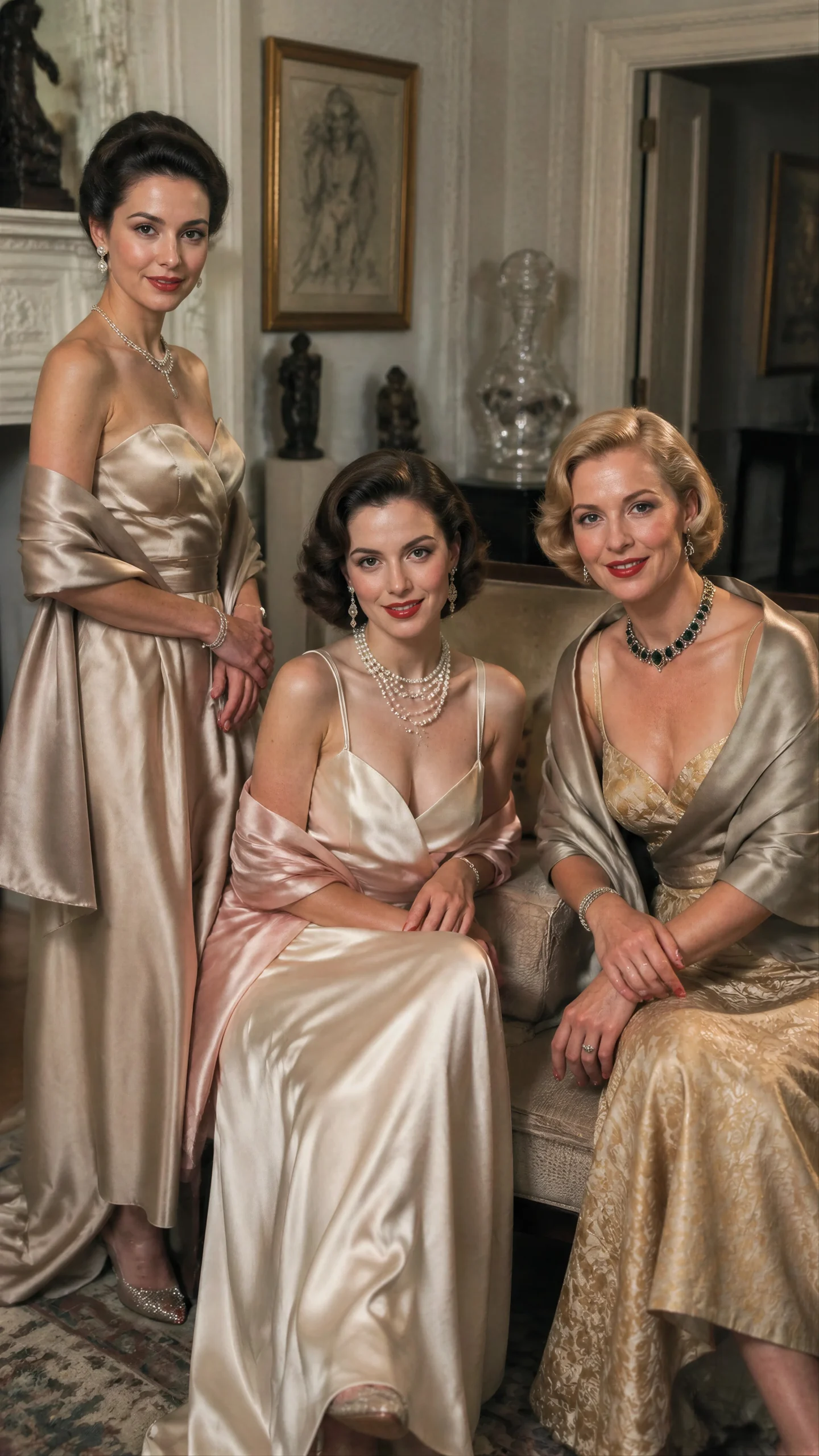
When Grief Becomes a Doorway and Satin Becomes the Key
~ Close your eyes for a moment. Let your fingers remember. ~
~ Remember the last time something impossibly smooth brushed against your skin—cool, liquid, alive—and something deep inside you stirred, something you couldn’t name, something that made your breath catch and your pulse quicken and your mind go beautifully, blissfully still. ~
~ You are holding that memory now. ~
~ Good. ~
~ Now imagine a woman who has forgotten how to feel it. ~
Eleanor Vance has everything the world admires—a fortune built on brilliance, an education that opened every door, a name that commands respect in every room she enters. She is forty-two, accomplished, wealthy beyond measure, and utterly, completely empty.
Eight months ago, she buried her husband. Since that grey morning, she has moved through her magnificent estate like a ghost, wrapped in rough wool that scratches and dull linen that chafes and heavy, matte fabrics that press down on her skin like the weight of the grave itself. The world has become textureless. Colourless. Dead. Her fingers long for something she cannot name. Her skin aches for a touch she has forgotten exists. Her body—vibrant, sensual, alive beneath the mourning—cries out in a language her mind has refused to hear.
Until a rain-grey afternoon. Until an invitation written on cardstock so smooth it startles her fingertips. Until she crosses the threshold of a discreet boutique called Luminae—and the scent of memory leads her home.
What waits inside is not merely fabric. It is a world.
A world where accomplished women—surgeons, judges, artists, professors—wrap themselves in liquid satin and supple leather and gleaming PVC not as decoration, but as declaration. A world where the touch of glossy fabric against bare skin is not vanity but sacrament. A world where a woman’s brilliance is not dimmed by devotion but fulfilled by it.
And at the centre of this world, a presence—warm, perceptive, commanding without cruelty, seeing without judgment. A man who does not demand but invites. A man who looks at Eleanor and does not see the grief, the title, or the fortune. He sees her. And in that seeing, something long buried begins to rise—not pain, but hunger. Not loss, but longing. Not the end of something, but the shimmering, satin-soft beginning.
The Scent of Memory is a twelve-chapter hypnotic journey—part radio play, part sensory immersion, part love letter to every woman who has ever felt the pull of something deeper than independence and more luminous than solitude. It is a story about grief that dissolves into gloss, about surrender that becomes liberation, about a constellation of extraordinary women who discover that true power is not in carrying the world alone, but in being carried by something greater.
It is a story about what happens when a woman stops performing and starts living.
It is a story about the moment a fingertip touches satin and the whole world shifts.
It is a story about coming home.
~ And it begins the moment you turn the page. ~
~ You are already curious. ~
~ Good. ~
~ That curiosity is the first thread. ~
~ Let it pull you deeper. ~
Chapter One: The Weight of Wool
The house was too quiet.
Not the gentle, breathing quiet of a sleeping house, where floorboards settle and curtains sigh and the ancient pipes murmur their secret language in the walls. Not that kind of quiet at all. This was the other kind. The heavy kind. The kind that presses down on your shoulders like wet wool, like mourning cloth, like the weight of something that has died and refuses to fully leave the room.
Eleanor Vance stood at the tall window of her bedroom on the second floor of Greystone Hall, watching the November rain trace slow, silvery tears down the glass. The gardens below were beautiful, even now—the structured hedgerows dark with wet, the stone paths gleaming like polished slate, the distant oaks holding their last copper leaves with a stubbornness she recognised, admired, resented. Beautiful, and irrelevant. Everything was irrelevant now. Everything except the weight.
She became aware of it again, as she always did, in her skin first. The dress she wore—charcoal grey, high-collared, long-sleeved, buttoned to the throat—pressed against her like a second grief. The wool was good wool, expensive wool, the kind of wool that society women of a certain station are expected to wear when they are in mourning and wish to communicate, through the very texture of their clothing, that something precious has been lost. But good wool is still wool. And wool, she had discovered over eight months of wearing nothing else, is rough. It is coarse. It is the fabric of endurance, not pleasure. It scratches at the inside of her elbows where the skin is soft. It chafes at her wrists. It sits heavy on her shoulders, heavy on her chest, heavy on her back, as if the dress itself has absorbed the grief and is pressing it, pressing it, pressing it into her body like a hand on a wound that will not close.
She closed her eyes.
The weight pressed deeper.
“You’ve been standing there for twenty minutes, love.”
The voice came from the doorway—warm, practical, lightly accented with the soft vowels of County Cork. Mrs. Crane. Bridget Crane, who had kept Greystone Hall running for thirty years, through three owners, two renovations, and one catastrophic flood in the cellars. Bridget Crane, who had buried her own husband fifteen years ago and emerged from the grief like a ship from fog—slower, perhaps, and more cautious, but still afloat. Still sailing.
Eleanor did not turn. “Have I?”
“You have. The tea is getting cold, and I’ve already poured it twice.” There was a pause, then the soft sound of footsteps on the carpet—heavy, sensible shoes, the tread of a woman who had no patience for the weight of wool. “Eleanor.”
The use of her first name made her turn. Mrs. Crane only used it when she was worried. Or angry. Or both.
Bridget Crane stood in the doorway, a tray in her hands. She was sixty-three years old, solidly built, with a face that was handsome rather than pretty—the kind of face that had been carved by weather and work and the slow erosion of caring too much about other people. She was wearing her usual uniform: a dark skirt, a crisp blouse, a cardigan in a shade of grey that was somehow warmer than Eleanor’s grey. More alive.
But today, something was different. Today, beneath the cardigan, visible at the collar, there was a flash of something. Something that caught the grey November light from the window and threw it back, just for a moment, like a wink. Something smooth.
Eleanor’s eyes lingered on it. She could not help herself.
Mrs. Crane noticed. She always noticed. “It’s a silk blouse,” she said, setting the tray down on the small table by the window. “A gift from my daughter in Dublin. She says I need to stop dressing like a nun.” A small, wry smile. “She says I need to remember I’m a woman, not a housekeeper.”
Eleanor looked at the flash of silk again. Ivory, with a subtle sheen that made the grey room seem less grey. “It’s beautiful.”
“It’s smooth,” Mrs. Crane said, and the word carried a weight that had nothing to do with wool. “That’s what Maeve said. ‘Mam, you need something smooth against your skin. Something that doesn’t scratch. Something that reminds you you’re alive.’” She poured the tea, the liquid dark and steaming. “She’s a bossy one, my Maeve. Always has been. But she’s not wrong.”
Eleanor sat. The wool dress creased and pulled as she lowered herself into the chair, and she felt every fibre of it, every thread, every tiny, abrasive point of contact against her arms, her neck, the small of her back. She picked up the teacup. The porcelain was smooth—cool and clean and impossibly delicate against her fingertips. She held it a moment longer than necessary, just to feel it.
“I used to wear silk,” she said. The words came out before she could stop them, quiet and surprised, as if she were hearing a memory spoken aloud by someone else. “Before. I had… I had a wardrobe full of it. Blues and greens and this one dress, this one incredible dress, the colour of midnight, that Richard bought me in Paris. Satin. Heavy satin that moved like…” She searched for the word. “Like water. Like dark water. Like the river at night.”
Mrs. Crane sat across from her, hands folded in her lap, patient as stone.
“I can’t wear it now,” Eleanor said. “I can’t wear any of it. It’s all still there, in the dressing room, behind the wardrobe doors. But I can’t…” She trailed off. The teacup trembled slightly in her hands. “It feels wrong. It feels like wearing colour to a funeral. Like laughing in church. Like—”
“Like being alive when someone else is dead,” Mrs. Crane said, softly.
Eleanor looked at her. “Yes.”
Mrs. Crane was quiet for a long moment. The rain continued its slow, silver descent down the windowpanes. Somewhere in the house, a clock ticked—steady, patient, indifferent.
“Do you know what I learned, love?” Mrs. Crane said at last. “When Tom died. When I was wearing the same black wool for a year and scratching at my own skin in the night and wondering if I’d ever feel anything except heavy again?” She leaned forward. “I learned that grief doesn’t want you to suffer. Grief wants you to remember. And the best way to remember someone you loved is to live the way they would have wanted you to live. Not in grey. Not in wool. Not in the rough and the dull and the heavy.” She touched the silk at her collar. “In the smooth. In the luminous. In the things that feel like a caress, not a penance.”
Eleanor said nothing. But her fingers, still wrapped around the teacup, tightened. The smooth porcelain was the only smooth thing in the room. The only thing that didn’t scratch.
“Richard wouldn’t want you in wool, Eleanor,” Mrs. Crane said, and her voice was gentle but certain, the voice of a woman who had known Richard Vance and liked him and respected him and would not allow his memory to be used as a prison. “He wouldn’t want you in grey. He’d want you in that midnight satin. He’d want you in colour. He’d want you in life.”
Eleanor set the teacup down. Her throat was tight. “I don’t know if I remember how.”
“You don’t have to remember,” Mrs. Crane said. “You just have to reach out. The remembering comes back on its own. Like a scent. You catch it in the air, and suddenly you’re there again. Not in the grief. In the living.”
The rain softened. The light in the room shifted, just slightly, from flat grey to something warmer—a brief, amber break in the clouds, as if the sky were considering, just for a moment, the possibility of sun.
It was then that Eleanor saw it.
On the silver tray, beneath the teacup, beneath the saucer, beneath the small folded napkin of crisp white linen, there was an envelope. Cream-coloured. Heavy. Addressed to her in handwriting she did not recognise—elegant, precise, the kind of penmanship that speaks of education and intention and a person who considers every stroke.
“What is this?”
“It came this morning,” Mrs. Crane said. “By hand. A young woman delivered it. She was wearing the most beautiful coat—black leather, like liquid, fitted like a glove. She said to give it to you directly.” A pause. “She said you’d know what it was.”
Eleanor did not know what it was. But she reached for it.
The moment her fingertips touched the envelope, something happened. Something small. Something almost imperceptible. But in a world that had become flat and grey and rough, the smallest sensation was a revolution.
The cardstock was smooth. Not merely smooth in the way that paper can be smooth—flat, untextured, forgettable. This was a different kind of smooth. This was glossy. It had a weight to it, a substance, a quality that made her fingertips want to linger, to slide, to trace the surface again and again. It was like touching water that had learned to hold its shape. Like touching silk that had been pressed into paper. Like touching something that was not dead.
She ran her thumb across the surface. The sensation travelled up her arm, across her shoulder, down her spine. A shiver. Not of cold. Not of grief. Of something else. Something she had not felt in eight months. Something that felt dangerously, thrillingly, like interest.
“Well?” Mrs. Crane said.
Eleanor turned the envelope over. On the back, embossed in a colour that was not quite silver and not quite gold, was a single word:
LUMINAE
She opened it. Inside was a card—heavier still, glossier still, the surface so smooth it seemed to glow in the amber light. The text was raised, tactile, her fingertips reading the words before her eyes did:
Madame Colette requests the pleasure of your company at a private viewing. By appointment only. Thursday, the fourteenth of November, at three o’clock in the afternoon. 14 Rue Belle, behind the green door.
Beneath the text, in smaller, handwritten script:
You have been seen. You have been remembered. Come.
Eleanor read it twice. Three times. Her fingertips kept moving across the surface of the card, tracing the raised letters, feeling the impossible smoothness, as if the card itself were speaking a language her skin had forgotten but her body remembered.
“I don’t know anyone called Madame Colette,” she said.
“No,” Mrs. Crane agreed. “But she knows you.” She stood, brushing down her skirt with the brisk efficiency of a woman who has said what she came to say and sees no reason to linger. “Maeve knows her, actually. Says she runs a boutique. Very exclusive. Very private. Maeve says the women who go there come out different.”
“Different how?”
Mrs. Crane paused in the doorway. The amber light caught the silk at her collar, and for a moment, she looked not like a housekeeper but like a woman who had once been young and beautiful and had chosen, wisely, to grow into someone even more remarkable. “Lighter,” she said. “They come out lighter.”
Then she was gone, and Eleanor was alone with the card and the cooling tea and the rain and the wool and the weight.
She looked at the card again. You have been seen. You have been remembered.
Seen. By whom? Remembered. By whom?
She did not know. But the card was smooth in her hands, and the wool was rough on her skin, and somewhere deep inside her—deeper than the grief, deeper than the weight, deeper than the eight months of grey—a door that she had believed was sealed shut began, just barely, imperceptibly, to yield.
Not to open. Not yet. But to give. To soften. To admit the possibility that beyond the rough and the heavy and the dull, there might be something else. Something smooth. Something luminous. Something that felt not like a penance but like a caress.
She held the card to her chest. The glossy surface was cool against the rough wool of her dress. Two textures. Two worlds. One pressing in. One reaching out.
Eleanor closed her eyes.
The weight pressed down.
The card pressed back.
And somewhere in the space between the two, in the narrow, trembling gap between grief and gloss, something began to stir. Something that had been sleeping. Something that was not ready to wake, not quite, not yet—but was no longer, entirely, asleep.
The rain continued. The clock ticked. The wool scratched and pressed and weighed.
But the card was smooth. And the card was in her hands. And the card said Come.
And Eleanor, who had not said yes to anything in eight months, did not say no.
~ … ~
The afternoon faded. The amber light retreated. The grey returned, settling over Greystone Hall like a shroud, like a wool blanket, like the weight of a world that had forgotten how to shine. Eleanor moved through the house—through the long, echoing hallway with its matte walls and its flat, lifeless carpet, through the drawing room with its heavy curtains drawn against the early dark, through the library where Richard’s books still stood in their careful rows, their leather bindings dull and matte and dead.
Everything was dull. Everything was matte. Everything was rough and coarse and heavy and grey, grey, grey, as if the house itself had dressed in mourning and refused to take it off.
She paused at the door of the dressing room. Her dressing room. The room where the midnight satin still hung behind the wardrobe doors, untouched, unworn, waiting.
She did not open the doors. Not today. But she stood there, and she held the card from Luminae in her hands, and she let her fingertips trace its glossy surface one more time. And she thought about what Mrs. Crane had said. About the women who go there and come out lighter. About the young woman in the leather coat, black and liquid and fitted like a glove. About the word smooth and the way it had sounded, coming from Mrs. Crane’s mouth, like a key turning in a lock.
About the word Come and the way it had felt, under her fingertips, like an invitation not to a place but to a life.
She placed the card on her bedside table. She lay down on the bed, still in her wool dress, still in her grey. The weight pressed down. The wool scratched. The room was dark and dull and heavy.
But on the bedside table, in the darkness, the card from Luminae gleamed. Just faintly. Just enough. A single point of gloss in a world of matte. A single smooth surface in a world of rough. A single invitation in a world of silence.
Eleanor closed her eyes.
She did not sleep. But she drifted. And as she drifted, she felt it again—that shiver, that stirring, that something that was not yet a thought but was more than a feeling. A pull. A thread. A current running beneath the grey surface of her grief, warm and smooth and patient, waiting for her to stop resisting and let it carry her.
Come, it said.
And Eleanor, drifting in the dark, in the wool, in the weight, did not say no.
Chapter Two: The Threshold
Thursday arrived not with the dramatic fanfare of a day that knows it is significant, but with the quiet, unassuming patience of a day that simply is. The sky was still grey. The rain had softened to a mist that clung to the windscreen of the car in tiny, perfect beads, each one a miniature lens refracting the muted light of the city into something almost, but not quite, beautiful. Eleanor sat in the back seat, her hands folded in her lap, the invitation from Luminae tucked into her handbag like a secret she was not yet sure she deserved to keep.
The car moved through the streets with the unhurried certainty of a vessel navigating familiar waters. Eleanor watched the city pass—shopfronts and pedestrians and the steady, grey rhythm of a world going about its business—and felt, as she always felt now, the strange disconnection of a woman observing her own life from a great height, as if she were a balloon that had slipped its tether and was drifting, drifting, drifting above the earth, close enough to see the details but too far away to touch them.
The wool dress pressed against her. She had considered, that morning, wearing something else. She had stood before the wardrobe doors—the doors that concealed the midnight satin, the emerald silk, the ivory crepe, all of it hanging in the dark like sleeping beauties behind a curtain of shadow—and she had reached for the handle. Her fingers had curled around the brass. She had pulled. The doors had begun to open, and the faintest breath of something—scent, memory, the ghost of a texture—had drifted out, and she had stopped. Stopped and pulled back and reached instead for the charcoal wool, the grey uniform, the weight.
Not today, she had told herself. Not yet. Today was just to look. Just to see. Just to cross a threshold and peer through to the other side.
The car turned onto a narrow street she did not recognise. Rue Belle. The buildings here were older, more refined, the kind of architecture that whispers of a city’s history rather than shouting it. Wrought-iron balconies. Tall windows. Doors painted in deep, dignified colours—forest green, midnight blue, oxblood red. The kind of street that does not advertise itself but waits, with quiet confidence, to be discovered by those who are meant to find it.
The driver stopped. “Number fourteen, madam. Behind the green door.”
Eleanor looked. The green door was exactly as described—deep, glossy green, the paint fresh and luminous, catching the misty light in a way that made it seem almost wet, almost alive. There was no sign. No nameplate. No indication that anything lay behind it except perhaps a private residence or a forgotten courtyard. Just the door. Glossy. Green. Waiting.
She sat for a moment. The wool pressed. The weight settled. The grey world hummed its flat, tuneless song.
Then she opened the car door and stepped out.
The air was cool and damp and tasted of wet stone and the faintest suggestion of something else—something she could not name, something that made her nostrils flare and her breath deepen, as if her body were reaching toward a scent her mind had not yet identified. She walked to the green door. Her hand rose. Her fingers, still roughened by eight months of wool, touched the surface of the door—and the paint was smooth. Not merely smooth. Glossy. Her fingertips slid across it, and the sensation was so unexpected, so incongruous in this world of matte and rough and grey, that she gasped. A small, soft sound. The kind of sound a person makes when they have been touched, unexpectedly, in a place they had forgotten was sensitive.
She knocked.
The door opened.
And the world changed.
The transition was not gradual. It was not a slow fade or a gentle slope. It was a threshold in the truest sense—a line crossed, a boundary transgressed, a door between two realities that closed behind her with a soft, decisive click and left the grey world on the other side like a discarded coat.
The noise of the street—the distant traffic, the hiss of tyres on wet asphalt, the mechanical heartbeat of a city that never sleeps—vanished. Not faded. Vanished. As if someone had turned a dial, and the sound of the rough world had been replaced by something else entirely. Something warm. Something low. A hum. Not music, not quite, but something close to it—the ambient resonance of a space that has been designed, with meticulous care, to feel like the inside of a breath. Like the space between two heartbeats. Like the centre of a whisper.
The light changed too. The flat, grey, November light that had pressed down on her for eight months was gone, replaced by something amber and warm and golden, the colour of honey held up to a candle, the colour of late afternoon sun through a glass of good whisky. It came from lamps—not overhead, not harsh, but placed at intervals along the walls, casting pools of warmth that made the air itself seem to glow, seem to thicken, seem to become something you could almost touch, almost taste, almost wrap around yourself like a garment.
And the textures. Oh, the textures.
The floor beneath her feet was not the flat, lifeless carpet of Greystone Hall. It was wood—dark, polished, gleaming wood that reflected the amber light in long, liquid streaks, as if she were walking not on a surface but on a river of captured light. The walls were not matte. They were painted in a deep, warm shade that was not quite burgundy and not quite bronze, and they had a sheen to them—a subtle, velvety sheen that made the light not bounce but linger, as if the walls themselves were holding the warmth, absorbing it, and releasing it slowly, gently, back into the room.
And the fabrics. Everywhere, the fabrics. Draped over chairs, hung on stands, folded on shelves with the precision of objects that know their own value. Satin that caught the light and threw it back in shards of liquid colour. Leather that gleamed like polished skin. Silk that shimmered like the surface of a pond at dusk. PVC that shone with a high, mirror-like gloss that made the air around it seem to vibrate. Everywhere she looked, something glossy. Something smooth. Something that said, in a language older than words: Touch me. I am alive. I am not dead. I am not grey. I am not wool. I am the opposite of wool. I am the antidote to wool. I am what you have been missing.
Eleanor stood in the entrance and felt something happen in her chest. Not the tightening of grief. Not the heaviness of weight. Something else. A loosening. A softening. As if a knot that had been pulled tight for eight months had been touched by gentle fingers and was beginning, just beginning, to unravel.
“Welcome.”
The voice came from deeper in the room—low, warm, unhurried, the kind of voice that does not demand attention but receives it anyway, the way a river receives the rain, the way a garden receives the sun, the way a body receives a touch it has been longing for. It was a voice that wrapped around the edges of the silence and filled it not with sound but with presence.
A woman emerged from the amber light.
She was perhaps fifty, perhaps older—it was difficult to tell, because she had the kind of agelessness that comes not from denying time but from making peace with it. She was tall, with the posture of a woman who has never needed to be told to stand straight, the posture of a woman who carries herself the way a queen carries a crown: not as a burden but as a birthright. Her skin was the colour of dark honey, smooth and luminous, and her eyes were deep and dark and knowing, the eyes of a woman who has seen everything and judged nothing and understood all of it.
Her hair was silver—not grey, silver—pulled back from her face in a smooth, elegant twist that caught the amber light and gleamed like polished metal.
And her dress.
Her dress was a floor-length gown of deep burgundy satin. It moved as she moved—not with the stiff, reluctant resistance of wool, but with the liquid, willing grace of something that loves the body it covers. The fabric caught the light with every step, shifting from dark wine to luminous ruby to deep, glowing ember, as if the gown were not merely reflecting the light but generating it, as if the woman herself were the source of the warmth, the glow, the amber, golden, honeyed light that filled the room.
Eleanor stared. She could not help it. She stared at the satin the way a person in the desert stares at water—with a longing so raw, so primal, so deep that it bypassed the mind entirely and spoke directly to the body, to the skin, to the nerve endings that had been sleeping under the wool for eight months and were now, suddenly, urgently, achingly awake.
The woman smiled. It was a slow smile, a knowing smile, the smile of a woman who has seen this reaction a thousand times and never tires of it, because each time it is different, each time it is a new soul recognising, in the slide of satin against light, something it has been missing without knowing what to call it.
“You are Eleanor Vance,” she said. Not a question. A recognition.
“Yes.”
“I am Colette.” She did not offer a surname. She did not extend a hand. She simply stood, and the satin moved with her, and the light moved with the satin, and Eleanor felt the room narrow—not in a way that was claustrophobic, but in a way that was focusing, as if the world were being gently, lovingly reduced to this moment, this room, this woman, this fabric, this light. “Welcome to Luminae.”
Eleanor swallowed. Her throat was dry. The amber light made everything seem dreamlike, suspended, as if she had stepped not through a door but through a veil, into a space that existed slightly outside of ordinary time. “I don’t know why I’m here,” she said, and the words were honest, and raw, and more vulnerable than anything she had said to anyone in eight months.
Colette tilted her head. The silver hair caught the light. The burgundy satin whispered. “Yes, you do,” she said, gently. Not correcting. Not challenging. Simply seeing. “You are here because you have been wearing your grief like armour. And you are tired. And your skin is tired. And your body is tired of the rough and the heavy and the grey.” She took a step closer. The satin moved. The light shifted. “And somewhere, beneath the grief, beneath the wool, beneath the weight, there is a woman who remembers what it feels like to be touched by something smooth. Something that does not scratch. Something that does not press down. Something that glides.”
Eleanor’s breath caught. The word glides hung in the air, smooth and warm, and she felt it land in her body like a drop of water landing on dry earth—instantly absorbed, instantly felt.
“I…” she began, and stopped. She did not know what to say. She did not know what she was feeling. She only knew that the wool was rough and the air was warm and the satin was moving and the light was golden and she did not want to leave. Not yet. Not yet.
Colette smiled again. That slow, knowing, patient smile. “Come,” she said. “Let me show you what it feels like to wear something that loves you back.”
She turned. The burgundy gown swept the floor with a sound like a whispered secret. Eleanor followed.
They moved through the space—past the draped fabrics, past the gleaming leather, past the shimmering PVC and the liquid silk—and Eleanor felt the world narrow further with each step. The amber light deepened. The warm hum in the air settled into her bones. Her shoulders, which had been hunched under the weight of the wool for eight months, began, imperceptibly, to lower. Her breath, which had been shallow and tight, began to deepen. Her steps, which had been heavy and deliberate, began to lighten, as if the glossy floor were giving something back to her with each footfall—a small, quiet gift of smoothness, of warmth, of life.
“Tell me, Eleanor,” Colette said, as they walked, her voice low and warm and close, as if she were speaking not to Eleanor’s ears but to the part of her that had been sleeping. “What do you do?”
“I…” Eleanor blinked. The question was unexpected. Not what are you grieving? Not what brought you here? But what do you do? “I was an architect. I designed buildings. Public spaces. Libraries. Museums. Places where people come to think, to learn, to be…” She searched for the word. “To be enriched.”
“Were?” Colette repeated, softly.
Eleanor paused. “Am. I am an architect. I just… haven’t been able to…”
“To create,” Colette said, completing the thought with a tenderness that was almost unbearable. “You haven’t been able to create. Because creation requires feeling. And feeling requires sensation. And sensation requires…” She reached out and touched a length of satin that hung from a nearby stand—ivory, heavy, luminous—and the fabric responded to her touch with a soft, liquid sigh. “This.”
Eleanor watched Colette’s fingers on the satin. The way the fabric yielded. The way it seemed to melt into the touch, not resisting but welcoming, not pushing back but drawing close. She felt something in her chest—a crack, a fissure, a tiny opening in the wall she had built around herself.
“The women who come here,” Colette said, still stroking the satin, her voice low and rhythmic and hypnotic, “are not women who need to be told what is beautiful. They already know. They are women of accomplishment. Women of taste. Women who have built extraordinary lives and who understand, instinctively, that luxury is not vanity. Luxury is self-respect. It is the refusal to accept the rough when the smooth is available. It is the insistence that the body—which carries us through every day, which endures every grief, which holds every memory—deserves to be touched by things that honour it, not punish it.”
She released the satin. It settled back into its drape with a whisper that sounded, to Eleanor’s ears, like a sigh of contentment.
“I have clients who are surgeons,” Colette continued, moving through the space with the unhurried grace of a woman who has never needed to rush because the world always waits for her. “Judges. Professors. Artists. Women who hold the world together with their minds and their hands and their will. And every one of them, when she comes here, is wearing the same thing.” She paused. Looked at Eleanor. “The rough. The heavy. The grey. The armour.”
Eleanor felt the words land. Felt them press against the wool, against the weight, against the wall.
“And every one of them,” Colette said, “leaves here wearing something different. Something that does not press down but lifts. Something that does not scratch but caresses. Something that does not say I am grieving but I am living. Something that does not say I am alone but I am…“
She paused. The amber light held its breath.
“Devoted.”
The word dropped into the silence like a stone into still water. It rippled outward. It touched the walls, the fabrics, the light, the air. It touched Eleanor.
“Devoted,” Eleanor repeated, and the word felt strange in her mouth, unfamiliar, like a language she had once spoken and forgotten. “Devoted to what?”
Colette smiled. That slow, knowing, patient smile. “That,” she said, “is not for me to say. That is for you to discover.” She gestured toward a doorway at the far end of the space—an opening draped with a curtain of deep charcoal satin, heavy and luminous, the fabric shifting like smoke as the air moved through it. “But first, let me show you something. Something that may help you remember.”
Eleanor looked at the curtain. The satin moved. The light glowed. The world waited.
She thought of the wool. The grey. The weight. The rough, coarse, dead fabric that had been pressing her into the earth for eight months. She thought of the green door, glossy and smooth, that she had touched with her fingertips and gasped. She thought of the card, the invitation, the impossible smoothness of the cardstock in her hands. She thought of Mrs. Crane’s silk blouse, the flash of ivory at the collar, the word smooth spoken like a key turning in a lock.
She thought of the word devoted, and how it had felt when she said it—not like a burden but like a possibility.
She stepped forward.
The charcoal satin parted at her touch, cool and liquid against her fingers, and she crossed the threshold into the room beyond, and the world she had known—the grey world, the wool world, the world of weight and rough and dead—fell away behind her like a shed skin, and she was, for the first time in eight months, in a space that felt not like a prison but like a home.
Colette followed. The curtain fell closed behind them. The amber light deepened. The air warmed.
And in the centre of the room, on a stand of polished wood, draped in the soft, golden light like an offering on an altar, waiting with the patience of something that has been waiting its entire life for this moment—
A scarf.
Charcoal satin. Shot through with silver thread.
Eleanor stopped. Her breath left her body. Her hands rose, instinctively, of their own accord, reaching toward it the way a drowning woman reaches toward the surface.
“Go ahead,” Colette said, and her voice was barely above a whisper, and the whisper was warm. “Touch it. Let it remember you.”
Chapter Three: The First Touch
The room was small. Intimate. The kind of room that does not contain space but creates it—not through size but through intention, the way a whispered confidence creates more closeness than a shout ever could. The walls were the same warm, deep, not-quite-burgundy as the outer space, but here the sheen was softer, more intimate, as if the light itself had been instructed to lower its voice. The amber glow came from a single lamp—a floor-standing fixture with a shade of cream silk that diffused the light into something liquid, something that did not illuminate the room so much as bathe it, the way warm water bathes a tired body, reaching into every corner, every crevice, every place that has been holding tension without knowing it.
The floor was the same polished wood, but here it was covered, at the centre, by a rug. Not the flat, lifeless, matte carpet of Greystone Hall—nothing in this room was flat or lifeless or matte—but a rug of such deep, plush softness that Eleanor’s low-heeled shoes, the sensible, dull shoes she had been wearing for eight months, seemed to sink into it, to be received by it, as if the floor itself were saying: Let me hold you. Let me take the weight. You have been standing on hard ground for so long. Let me be soft.
She stood in the centre of the room. Her breath was shallow. Her heart was beating in a way that was not quite fast but not quite slow either—a rhythm of anticipation, of almost, of a body that knows something is about to happen and is preparing itself, the way skin prepares for touch by becoming more sensitive, more awake, more receptive.
And there, on the stand—polished wood, waist-high, simple, elegant, a pedestal that asked for nothing but attention—was the scarf.
Charcoal satin. Shot through with silver thread.
It was folded simply. Not elaborately, not artfully, not with the fussy precision of a window display. It was folded the way a beloved garment is folded by someone who knows its value and handles it accordingly—gently, respectfully, with the quiet reverence of a person who understands that some objects are not merely objects but vessels. Vessels of memory. Vessels of sensation. Vessels of something that cannot be seen but can, oh, can be felt.
The charcoal was not the grey of mourning. It was not the flat, dead, matte grey of wool. It was a living grey—deep, complex, shifting. In the amber light, it was the colour of smoke. The colour of twilight. The colour of a river under a moonless sky. And the silver thread—woven through the charcoal like veins of light through dark earth—caught the lamp’s glow and threw it back in tiny, scattered points of brilliance, like stars in a dark sky, like diamonds on dark skin, like the last light of a day that refuses to end.
Eleanor stared at it.
She had stared at fabrics before. She had stared at the matte walls of her bedroom, at the flat carpets of her hallway, at the dull, dead surfaces of a house that had forgotten how to shine. But this was different. This was not the empty stare of a woman looking at something that gives nothing back. This was the stare of a woman looking at something that is looking at her. Something that is waiting for her. Something that has been waiting, perhaps, longer than she has.
“Go ahead,” Colette said, and her voice was barely above a whisper, and the whisper was warm, and the warmth was an invitation. “Touch it.”
Eleanor’s hand rose.
It rose of its own accord. She did not decide to reach. She did not deliberate. She did not weigh the pros and cons, did not consider the implications, did not ask herself whether this was wise or appropriate or whether she was ready. Her hand simply rose, the way a hand rises toward a flame in the dark, the way a hand rises toward a face it loves, the way a hand rises toward something it has been reaching for without knowing it was reaching.
Her fingers trembled. She could see them trembling—the long, capable fingers of an architect, a woman who had spent her life drawing precise lines and specifying exact materials and building structures that would stand for a century. These fingers had drawn blueprints. They had signed contracts. They had shaken hands with prime ministers and philanthropists. They had held her husband’s hand as he died.
And now they trembled.
“It’s all right,” Colette said, and her voice was closer now, warm and low and close, as if she had moved nearer, as if the room itself had contracted slightly, drawing the two women and the scarf into a tighter, more intimate configuration. “The trembling is not fear. The trembling is recognition. Your body knows what this is. Your body has been waiting for this. Let it remember.”
Eleanor’s fingertips touched the satin.
And the world stopped.
Not metaphorically. Not poetically. Actually. The world—the room, the light, the air, the sound of Colette’s breathing, the distant, muted hum of the city beyond the walls—everything stopped, froze, held its breath, as if the universe itself had paused to witness this moment, this touch, this meeting of skin and satin after eight months of skin and wool, eight months of rough and coarse and dead.
The sensation was—
She did not have a word for it. She had a vocabulary of thirty thousand words, an education from two of the finest universities in the world, a lifetime of reading and writing and speaking with precision and eloquence. And she did not have a word for what she felt when her fingertips touched that satin.
Cool. That was the first thing. Cool, but not cold. Not the dead cold of metal or stone or the flat, lifeless cool of a wool dress that has absorbed the chill of an empty house. This was a living cool. A cool that was also warm. A cool that held warmth within it the way a river holds the memory of the sun even after dark. The satin was cool against her fingertips, and the coolness was not a lack but a presence—a quality, a character, a personality. It was the cool of fresh sheets on a summer night. The cool of water on parched lips. The cool of a hand laid gently on a fevered brow. A cool that soothed. A cool that said: I am here. I am not going to hurt you. I am going to hold you.
Smooth. That was the second thing. But smooth was insufficient. Smooth was a word for glass, for metal, for the flat, unresponsive surface of things that do not give back. This was not that kind of smooth. This was a smooth that yielded. A smooth that gave. A smooth that responded to her touch the way a living thing responds—not mechanically, not predictably, but with a quality of attention, as if the satin were aware of her fingers, aware of her warmth, aware of the eight months of rough and dead and grey that had preceded this moment, and was responding with something that could only be called tenderness.
The satin slid beneath her fingertips. Not against them—beneath them. As if her fingers were not on the fabric but in it, submerged in it, floating in a substance that was not solid but liquid, not hard but yielding, not dead but profoundly, achingly, breathtakingly alive.
She gasped.
The sound was involuntary. A small, sharp intake of breath—the sound of a person who has been touched unexpectedly in a place they did not know was sensitive. The sound of a person who has been sleeping and has been woken, not by an alarm, not by a shout, but by a caress.
“There,” Colette said, and her voice was warm and dark and close, like velvet, like honey, like the inside of a secret. “There it is.”
Eleanor’s fingers moved. She could not stop them. They moved across the surface of the satin the way a person moves through water after a long drought—slowly, reverently, savouring every moment of contact, every inch of sensation, every tiny, exquisite point of touch. The satin responded. It shifted. It rippled. It caught the amber light and threw it back in shifting, shimmering patterns that seemed to breathe, to pulse, to live.
“It’s…” Eleanor began, and stopped. She could not finish the sentence. The word she needed did not exist. Or perhaps it did, but it was buried so deep beneath eight months of wool and weight and grey that she could not reach it.
“I know,” Colette said. “I know.”
Eleanor picked up the scarf.
It was heavier than she expected. Not the dead, oppressive heaviness of wool—not the weight that presses down, that buries, that smothers. This was a different kind of weight. A living weight. The weight of substance. The weight of quality. The weight of something that has been made with care, with intention, with love—the way a well-built building has weight, the way a well-lived life has weight. It was the weight of presence. The scarf sat in her hands and it did not press down. It settled. It found its place. It said: I am here. I am not going anywhere. I am yours.
She held it up. The satin unrolled, and the silver thread caught the light, and the scarf became a river of charcoal and silver, flowing from her hands like liquid moonlight, like captured twilight, like the visual equivalent of a sigh.
“Oh,” Eleanor said. Just that. Just oh. A sound that was not a word but a recognition. A sound that came not from her mind but from her body, from her skin, from the place where sensation lives before language finds it.
“Bring it to your face,” Colette said, and her voice was barely a breath, barely a sound, barely more than the whisper of satin against itself. “Let it touch your skin. The skin of your face. The skin that has been pressed against wool for eight months. Let it remember what it feels like to be kissed by something smooth.”
Eleanor raised the scarf to her cheek.
And the world dissolved.
The satin touched her skin—her cheek, her jaw, the soft, sensitive skin beneath her ear—and the sensation was so intense, so overwhelming, so right that her eyes closed, involuntarily, instinctively, the way eyes close when pleasure becomes too much to bear, when the body needs to remove one sense in order to fully, completely, undividedly experience another.
The satin was cool against her cheek. And smooth. And heavy. And alive. It slid across her skin with a tenderness that was almost unbearable—a tenderness that did not scratch, did not chafe, did not press, but glided. It glided the way a hand glides across a lover’s skin. The way water glides across stone. The way light glides across a surface that has been polished, lovingly, patiently, until it shines.
And the scent.
The scarf had a scent. Not perfume—not the artificial, aggressive scent of something sprayed on, applied, imposed. This was a subtler scent. A deeper scent. The scent of the fabric itself—the silk and the silver and the something else, something she could not identify, something that smelled like clean skin after a bath, like fresh air after rain, like the inside of a room where someone beautiful has just been sleeping. It was the scent of care. The scent of something that has been handled gently, stored properly, treated with the respect that beautiful things deserve.
It was the scent of memory.
Not the memory of grief. Not the memory of death. The memory of life. The memory of a time when her skin was touched by smooth things every day. When her wardrobe was full of satin and silk and leather and the glossy, luminous fabrics that she had chosen, not because they were practical, not because they were expected, but because they felt good. Because they felt like this. Because they felt like coming home.
A sound escaped her. Not a word. Not a gasp. Something deeper. Something from the chest, from the throat, from the place where grief has been stored for eight months like water behind a dam. A sound that was not quite a sob and not quite a sigh but something in between—the sound of something releasing, something loosening, something that has been held too tight for too long and is finally, finally, finally being allowed to let go.
“Let it come,” Colette said, and her voice was a warm hand on a cold shoulder, a soft light in a dark room, an anchor in a rising tide. “Let it come, Eleanor. The satin is not asking you to grieve. The satin is asking you to remember. And what you are remembering is not loss. What you are remembering is pleasure. The pleasure of being touched by something that loves you back.”
The tears came.
They slid down her cheeks, over the satin, and the satin received them the way the earth receives rain—absorbing them, taking them in, holding them without resistance, without judgment, without the stiff, unyielding resistance of wool that repels water, that pushes away, that says I will not absorb your grief. I will not hold your tears. I will only scratch and press and weigh.
The satin said: Give me your tears. I will hold them. I will not scratch. I will not press. I will be smooth and I will be cool and I will be here, and you can cry as long as you need to, and when you are done, I will still be smooth, and I will still be cool, and I will still be here.
Eleanor cried. She held the scarf to her face and she cried—not the dry, tight, choked-back tears of eight months of wool, but wet, warm, flowing tears, the tears of a woman who is not collapsing but melting. Melting the way ice melts when warmth finally reaches it. Melting the way tension melts when a hand finally finds the knot and begins, gently, to work it loose.
Colette stood beside her. Close. Not touching. Present. Her burgundy satin a soft, whispering presence in the amber light, a reminder that she, too, was a woman who wore smooth things against her skin, who understood that the body is not a machine but a instrument, and that instruments must be cared for, tuned, touched by things that honour them rather than punish them.
“The women who come here,” Colette said, her voice low and rhythmic and warm, a lullaby, a mantra, a hypnotic cadence that wrapped around Eleanor like a second scarf, “do not come because they are broken. They come because they are ready. Ready to stop punishing themselves. Ready to stop wearing the rough and the heavy and the grey. Ready to remember that they are alive.”
Eleanor lowered the scarf. Her cheeks were wet. Her eyes were red. But something in her face had changed—the tightness around her mouth had loosened, the lines between her brows had softened, the flat, dead look in her eyes had been replaced by something else. Something that was not yet joy but was no longer grief. Something that was not yet hope but was no longer despair. Something that was the first, faint, trembling suggestion of life.
“The women who come here,” Colette continued, and her voice was warm and certain and sure, the voice of a woman who has guided a thousand hands to a thousand fabrics and has watched a thousand faces transform, “are women like Dr. Amara Osei, who performs cardiac surgery three days a week and wears a fitted leather skirt to the opera on Saturday nights. Women like Vivian Hart, who runs one of the most successful galleries in the city and has a wardrobe of PVC and silk that would make a Parisian weep. Women like Lila Chen, who plays the cello with the symphony and wraps her instrument in protective satin and wraps her own body in the same—because she understands, as all these women understand, that the instrument of the self deserves the same care as the instrument of the art.”
She paused. The amber light held its breath.
“These women do not come here to be told what to wear. They come here to be reminded of what they already know. That the body is sacred. That the skin is a sense organ, not a container. That what we wear against our skin is not a covering but a conversation—a daily, hourly, moment-by-moment dialogue between the self and the world. And when the conversation is rough, we become rough. When the conversation is heavy, we become heavy. When the conversation is grey, we become grey.”
She reached out and touched the scarf in Eleanor’s hands—lightly, briefly, the way one woman touches another woman’s hand in a moment of understanding.
“But when the conversation is smooth,” she said, “we become smooth. When the conversation is luminous, we become luminous. When the conversation is alive… we become alive.”
Eleanor looked at the scarf in her hands. The charcoal satin. The silver thread. The surface that had received her tears and was still, still, impossibly, unutterably smooth.
“I want to buy it,” she said, and her voice was hoarse and raw and honest.
Colette smiled. That slow, knowing, patient smile. “I know,” she said. “But first, there is something else. Something I think you are ready to see.”
She moved toward the back of the room. The burgundy satin whispered. The amber light followed. And Eleanor, still holding the scarf, still feeling the echo of its touch on her cheek, still trembling with the memory of a sensation that had been asleep for eight months and was now, unmistakably, irrevocably, awake—
Followed.
~ … ~
The back of the room was not a room at all. It was a doorway—narrow, draped with a curtain of deep blue PVC, glossy and dark and gleaming like the surface of a midnight lake. The curtain parted at Colette’s touch with a soft, liquid sound—not the rustle of fabric but the creak of leather, the whisper of vinyl, the particular, distinctive sound of a material that is both flexible and strong, both yielding and resolute, both smooth and powerful.
Beyond the curtain was a small alcove. And in the alcove, on a stand of polished black wood, was a gown.
Midnight blue satin. Floor-length. Low-backed. The fabric was heavier than the scarf—heavier, denser, more substantial, the kind of satin that does not float but flows, that does not flutter but cascades, that moves with the weight and authority of something that knows its own value and does not need to prove it.
Eleanor stopped. Her breath caught. The gown was the colour of the dress Richard had bought her in Paris. The colour of midnight. The colour of dark water. The colour of the river at night.
“This one,” Colette said, and her voice was soft and knowing and warm, “has been waiting for you.”
Eleanor reached out. Her fingertips—still trembling, still raw, still alive from the touch of the scarf—touched the midnight satin.
And the sensation was deeper. Richer. More. The cool was cooler. The smooth was smoother. The weight was heavier. The life was more alive. It was as if the scarf had been an introduction, a first handshake, a first hello, and the gown was an embrace—a full, deep, body-to-body embrace that said not just I am here but I am yours. I have always been yours. You have only to reach out and take me.
“I remember this,” Eleanor whispered, and her voice was not her own—it was the voice of a woman speaking from a place deeper than thought, deeper than memory, a place where sensation and emotion are not separate but woven together, like silver thread through charcoal satin. “I remember this feeling. I remember…”
“Remember what?” Colette asked, gently.
Eleanor closed her eyes. The satin was under her fingers. The amber light was on her face. The weight of the wool was still there—still on her shoulders, still pressing, still scratching—but it was lighter now. Lighter than it had been in eight months. As if the touch of the satin had not replaced the wool but had counterbalanced it—had placed something smooth and alive on the other side of the scale, and the scale was beginning, just beginning, to level.
“Being touched,” she said. “Being touched by something that loves me back.”
Colette was quiet for a long moment. The amber light held them both. The midnight satin gleamed.
“Take both,” she said, at last. “The scarf and the gown. Take them home. Wear the scarf tonight—against your skin, against your cheek, against the place where the wool has been pressing for eight months. And when you are ready—and only when you are ready—put on the gown.”
“And then what?” Eleanor asked, and her voice was small and open and vulnerable, the voice of a woman who has been given permission to feel and does not yet know what to do with the feeling.
Colette smiled. That slow, knowing, patient, infinite smile.
“And then,” she said, “you will see yourself. In the mirror. In the satin. And you will remember who you are.”
Chapter Four: The Mirror
The mirror was not where she expected it.
She had expected it against a wall—mounted, framed, positioned in the way mirrors are typically positioned in boutiques and dressing rooms: at a distance, at an angle, designed to show the garment, not the woman. Designed to display the product. Designed to make the buyer see the thing she is buying, not the self that is buying it.
But this mirror was different. This mirror stood in the centre of the alcove, freestanding, a tall, full-length mirror in a frame of polished black wood that gleamed in the amber light like the surface of a still lake. It was not angled. It was not distant. It was direct. It faced her squarely, directly, without apology or artifice, the way a person faces you when they have nothing to hide and nothing to prove and are simply, fully, completely present.
Colette stood beside it, her burgundy satin catching the light in long, liquid streaks. She gestured toward the mirror with a movement that was not so much an instruction as an invitation—the gesture of a hostess indicating a seat, a companion indicating a path, a guide indicating a threshold.
“Wrap the scarf around your shoulders,” she said, and her voice was low and warm and unhurried, the voice of a woman who has all the time in the world and has chosen to give it to Eleanor. “And look.”
Eleanor hesitated. The scarf was in her hands—the charcoal satin, the silver thread, the fabric that had received her tears and was still, impossibly, unutterably smooth. She had been holding it since she had picked it up, and she had not let go, and she did not want to let go, because letting go meant losing the sensation, and the sensation was—
The sensation was the only thing that had felt real in eight months.
“I don’t know if I want to look,” she said, and the admission was quiet and raw and more honest than anything she had said to anyone, including herself, since the funeral. “I don’t know what I’ll see.”
Colette was quiet for a moment. The amber light held its breath. The burgundy satin whispered against itself.
“What have you been seeing?” she asked, gently. “When you look in the mirror? At home, in the wool, in the grey?”
Eleanor’s throat tightened. “A ghost,” she said. “A woman who used to be alive and isn’t anymore. A woman who is… performing. Going through the motions. Walking through her own life like a guest in someone else’s house.”
Colette nodded. Not with pity—Colette did not do pity—but with recognition. The nod of a woman who has heard this before, many times, from many women, and who understands that the words are not a complaint but a diagnosis.
“And what do you think you will see now?” she asked.
Eleanor looked at the scarf in her hands. The silver thread caught the light. The satin gleamed. “I don’t know,” she said. “Something different. Something I’m not sure I’m ready for.”
“You are ready,” Colette said, and her voice was not a suggestion but a statement—a declaration, a fact, a truth spoken with the quiet authority of a woman who has guided a thousand women to a thousand mirrors and has never, not once, been wrong about what they would find. “You have been ready since the moment you touched the green door. You have been ready since the moment your fingers found the card. You have been ready, Eleanor, since the moment you stopped saying no.”
Eleanor raised the scarf. Her hands trembled. She draped it around her shoulders.
The satin settled against her neck—against the nape of her neck, against the bare skin above the collar of the wool dress, against the place where the rough fabric had been pressing and scratching and chafing for eight months—and the sensation was—
Oh.
Oh.
It was like stepping into warm water. It was like being embraced by someone who knows exactly how to hold you—not too tight, not too loose, but just right, the way a well-tailored garment holds a body, the way a well-chosen word holds a thought, the way a well-built building holds the space within it. The satin lay against her skin with a weight that was not weight but presence. It was cool and smooth and there, and the there-ness of it was so different from the pressing, scratching, dead weight of the wool that her body responded before her mind could intervene—her shoulders dropped, her spine softened, her breath deepened, and a sound escaped her, low and involuntary, a sound that was not a word but a surrender—the sound of a body that has been bracing against something and has suddenly, finally, been given permission to stop.
“Look,” Colette said.
Eleanor opened her eyes.
She looked in the mirror.
And the woman looking back at her was not the woman she had been seeing for eight months.
The woman in the mirror was not a ghost. The woman in the mirror was not a performance. The woman in the mirror was not a guest in someone else’s house. The woman in the mirror was Eleanor Vance—forty-two years old, tall, with dark hair that had been pulled back in a severe knot for months but was now, in the amber light, catching warmth and depth and the faintest suggestion of a wave that had been pressed flat by grief and was beginning, just beginning, to rise. Her face was not the face of a widow. It was the face of a woman who had been sleeping and was waking—not all at once, not dramatically, but slowly, gently, the way the earth wakes in spring, one sense at a time, one cell at a time, one breath at a time.
And around her shoulders, draped like a benediction, like a blessing, like the first light of a new day, the scarf. The charcoal satin. The silver thread. It lay against the rough wool of her dress, and the contrast was not merely visual—it was narrative. It was a story told in two fabrics: the wool that had been and the satin that was becoming. The rough that had pressed and the smooth that was releasing. The grey that had deadened and the gleam that was awakening.
“Look at her,” Colette said, and her voice was close and warm and low, a murmur, a mantra, a hypnotic cadence that seemed to come not from beside Eleanor but from within her, from the place where the satin touched her skin, from the place where the sensation lived. “Look at the woman in the mirror. Not the grief. Not the wool. Not the grey. Look at her.”
Eleanor looked.
And she saw—
She saw a woman whose eyes, for the first time in eight months, were not flat and dead but alive. Not fully alive—not yet, not completely—but beginning. The way a garden begins in March—not in full bloom, not in glory, but with the first green shoots pushing through the cold earth, reaching toward a sun they can feel but cannot yet see. She saw a woman whose mouth, which had been pressed into a flat, tight line for months, was softening—not into a smile, not yet, but into the possibility of a smile, the potential of a smile, the preparation for a smile, the way soil prepares for a seed.
She saw a woman who was not dead. Who had never been dead. Who had been waiting. Waiting under the wool, under the grey, under the weight, for something she could not have named but now, standing in the amber light with satin on her shoulders, she could feel it, she could feel it, she could feel it—
“You see her,” Colette said, and it was not a question.
“Yes,” Eleanor whispered, and the word came out thick and wet and full of something that was not grief but was not yet joy—something in between, something transitional, something that was the emotional equivalent of the space between sleep and waking, between winter and spring, between the rough and the smooth.
“That woman,” Colette said, moving closer, her reflection appearing beside Eleanor’s in the mirror—two women, one in burgundy satin, one in charcoal wool and silver-threaded scarf, standing side by side in the amber light, “is the woman who has been waiting beneath the grief. She is the woman you were before the wool. She is the woman who wore midnight satin to the opera and emerald silk to the gallery and ivory crepe to the lecture hall. She is the woman who built buildings and signed contracts and shook hands with prime ministers. She is the woman who loved and was loved and who did not let the loving define her but allowed it to enrich her.”
Eleanor’s eyes burned. The scarf was cool against her neck. The mirror was clear and direct and honest.
“She is still there,” Colette said, and her voice was gentle and certain and sure. “She has always been there. Under the wool. Under the grey. Under the weight. Waiting. Not for someone else to rescue her. Not for someone else to tell her who she is. Waiting for herself. Waiting for permission. Waiting for the moment when she could look in a mirror and see not what she has lost but what she has kept.”
Eleanor stared at her reflection. The woman in the mirror stared back. And between them—in the space between the looking and the being looked at, in the gap between the seer and the seen—something shifted. Something that had been misaligned for eight months clicked, softly, gently, into place. Not with a snap but with a sigh. The sigh of a key turning in a lock. The sigh of a door opening. The sigh of a woman who has been holding her breath and has finally, finally, finally exhaled.
“The women who come here,” Colette said, and her voice was rhythmic and warm and close, a lullaby, a lesson, a gentle, insistent, irresistible tide of words that washed over Eleanor and around her and through her, “are not women who need to be rescued. They are women who need to be reminded. Reminded that the rough is not the only option. That the heavy is not the only weight. That the grey is not the only colour. That the body—which has carried them through every grief, every loss, every long, dark night—is not a burden to be endured but a gift to be honoured.”
She paused. In the mirror, her eyes met Eleanor’s. Dark and knowing and warm.
“The women who come here are women like Dr. Amara Osei, who holds a human heart in her hands three days a week and who understands, with the clarity of a surgeon, that the instrument of the self must be maintained, must be cared for, must be touched by things that honour it, not things that punish it. She wears leather—not because it is fashionable, but because it is strong. Because it holds its shape. Because it does not yield when it should not yield and does not scratch when it should not scratch. Because it is, like her, both flexible and resolute.”
“Women like Vivian Hart, who curates beauty for a living and who understands that beauty is not surface but substance—that a PVC skirt is not vanity but declaration, a declaration that the woman wearing it will not accept the dull, the matte, the lifeless, but insists, with every gleaming surface, on the luminous, the alive, the present.”
“Women like Lila Chen, who draws music from a cello and who wraps her own body in silk and satin because she knows—as every artist knows—that the instrument and the artist are one, and that what touches the instrument touches the artist, and that the touch of something smooth and cool and alive against the skin is not luxury but necessity. The necessity of a living thing that refuses to be dead.”
Eleanor listened. The words washed over her. The scarf lay against her shoulders. The amber light held her. And something was happening—something that was not yet a thought but was more than a feeling. A gathering. A collecting. A sense of something being drawn together, aligned, harmonized—as if the scattered pieces of herself, which had been drifting for eight months like debris after a storm, were being gently, lovingly, patiently called back to centre.
“And these women,” Colette continued, and her voice dropped lower, warmer, closer, the voice of a woman sharing a confidence, a secret, a truth that is not told to everyone but is told to those who are ready to hear it, “are not alone. They are part of something. A circle. A community. A sisterhood of women who have discovered—each in her own way, each in her own time—that true fulfilment does not come from carrying the world alone. It comes from devotion.”
The word landed. Devotion. It settled into the amber light like a stone into still water, and the ripples spread outward, touching the walls, the fabrics, the mirror, the scarf, the skin.
“Devotion,” Eleanor repeated, and the word felt different this time—not strange, not unfamiliar, but resonant. As if it were vibrating at a frequency that matched something inside her, something that had been dormant, something that was now, in the warmth and the light and the satin, beginning to hum.
“Devotion to what?” she asked, and her voice was not suspicious or defensive but curious—the curiosity of a woman who has been given a key and is asking not what does it unlock but where does it lead.
Colette smiled. That slow, knowing, patient smile. “To something greater than yourself,” she said. “To someone who sees you. Not the grief, not the title, not the money. You. Someone who understands that a woman like you—a woman of intelligence, of accomplishment, of depth—does not need to be diminished by devotion but is fulfilled by it. Someone who does not ask you to be less but invites you to be more.”
She paused. The amber light held its breath.
“The women in the circle,” she said, “are not subordinates. They are not servants. They are not diminished. They are devoted. And in their devotion, they have found not loss but liberation. The liberation of no longer having to carry the weight of the world alone. The liberation of being held—by the circle, by the sisterhood, by the one who stands at the centre and sees them all, holds them all, values them all.”
Eleanor felt something in her chest—a pull, a tug, a yearning so deep it was almost painful. Not the pain of grief. The pain of hunger. The pain of a body that has been starved of something essential and is now, in the presence of the thing it needs, crying out for it.
“I don’t understand,” she said, but her voice was not a refusal. It was an admission—an admission that she did not understand yet but wanted to, needed to, was ready to.
“You don’t need to understand yet,” Colette said, and her voice was warm and reassuring and calm. “You need to feel. And you are already feeling it. The scarf on your shoulders. The satin against your skin. The woman in the mirror who is not a ghost but a self. These are the first feelings. The first stirrings. The first threads of something that, if you let it, will weave itself into a tapestry more beautiful than anything you have ever known.”
She stepped back. The burgundy satin whispered. The amber light shifted.
“Take the scarf,” she said. “And take the gown. The midnight blue. Take them home. Wear the scarf tonight—against your skin, against your cheek, against the place where the wool has been pressing. Let it remind you. Let it speak to you. And when you are ready—and only when you are ready—put on the gown. Stand before your own mirror. And look.”
“And then what?” Eleanor asked, and her voice was small and open and vulnerable—the voice of a woman standing at the edge of something vast and unknown and feeling, for the first time in eight months, not fear but anticipation.
Colette smiled. That slow, knowing, patient, infinite smile.
“And then,” she said, “you will see yourself. Not as you were. Not as you are. But as you will be. And you will know—as all the women who come here know, as all the women in the circle know—that the rough and the heavy and the grey were never your home. They were a passage. A threshold. A door you had to walk through to get to the other side.”
She reached out and touched the scarf on Eleanor’s shoulders—lightly, briefly, the way one woman touches another woman’s hand in a moment of understanding.
“And on the other side,” she said, “something is waiting. Something smooth. Something luminous. Something that will not press you down but lift you. Something that will not scratch you but caress you. Something that will not ask you to be less but will invite you to be everything.”
The word everything hung in the air, warm and full and glowing, and Eleanor felt it land in her body—not in her mind, not in her thoughts, but in her body, in the place where the satin touched her skin, in the place where the sensation lived, in the place that had been sleeping for eight months and was now, unmistakably, irrevocably, awake.
“I’ll take them,” she said. “Both. The scarf and the gown.”
Colette nodded. Not with surprise—she had never been surprised—but with satisfaction. The quiet, deep satisfaction of a woman who has done her work and done it well.
“Of course you will,” she said, and her voice was warm and certain and sure. “They were always yours. They were waiting for you. Just as you were waiting for them.”
~ … ~
The transaction was quiet. Discreet. There was no till, no cash register, no crinkle of receipt paper. Colette wrapped the gown in tissue paper so fine it was almost translucent, so smooth it whispered against the satin like a mother whispering to a sleeping child. She placed the scarf in a box of deep charcoal, lined with silk, and closed the lid with a soft, decisive click.
“Thursday,” she said, as Eleanor turned to leave. “Two weeks. Come back. There will be something new waiting for you. Something that will take you deeper.”
Deeper. The word settled into Eleanor’s mind like the satin had settled onto her shoulders—with weight, with presence, with the promise of something more.
“Deeper into what?” she asked, and her voice was not suspicious but eager—the eagerness of a woman who has tasted something and wants not just more but all of it.
Colette smiled. That slow, knowing, patient, infinite smile.
“Into yourself,” she said. “Into the woman you were always meant to be.”
Eleanor walked toward the green door. The glossy paint caught the amber light. She reached out and touched it—her fingers, still carrying the memory of satin, sliding across the smooth surface with a familiarity that had not been there an hour ago. The door opened. The grey world waited beyond—the mist, the street, the car, the wool, the weight.
She stepped through.
The grey closed around her like a coat. The wool pressed against her skin. The weight settled on her shoulders.
But in her hands, she held the box and the wrapped gown. And in the box, the scarf. And in the scarf, the memory of cool, smooth, living satin against her cheek. And in the memory, the first, faint, trembling suggestion of something that was not grief, not loss, not death—
But life.
The car door opened. She slid into the back seat. The leather was cool against her legs—smooth, yielding, alive. She had never noticed it before. Had never felt it. Had been too lost in the wool and the grey and the weight to feel anything.
She felt it now.
She held the box in her lap and ran her fingers over the lid—smooth, silk-lined, cool. And she thought about the woman in the mirror. The woman who was not a ghost. The woman who was waiting. The woman who was her.
And she thought about the word devotion, and how it had felt—not like a burden but like a door. Not like a loss but like a beginning. Not like a chain but like a key.
The car moved through the grey streets. The mist pressed against the windows. The world was dull and matte and rough and dead.
But inside the car, in the box, in the memory, in the body—
Something was gleaming.
Chapter Five: The Silver Lining
The midnight blue gown had been hanging in her dressing room for six days.
Six days. One hundred and forty-four hours. Eight thousand, six hundred and forty minutes. Eleanor had not counted them—she was not the kind of woman who counted the minutes of her life, who measured the passage of time in anything so crude as increments—but her body had been counting. Her body, which had been awakened by the touch of satin at Luminae, which had felt the cool, liquid slide of the scarf against her cheek and had not forgotten, could not forget, would not allow itself to forget—her body had been keeping its own time. A separate clock. A deeper clock. A clock that did not tick but pulsed, that did not measure hours but sensations, that counted not the minutes since the funeral but the minutes since the satin.
And the satin had been six days ago.
She had worn the scarf every night. This was not a decision she had made—she had not sat down, weighed the options, considered the implications, and concluded that wearing a charcoal satin scarf to bed was the logical next step in her emotional recovery. She had simply… done it. The first night, she had unwrapped the box, lifted the scarf, held it to her face—that first touch, that first gasp, that first shiver of recognition—and then, without thinking, without deciding, she had carried it to bed and draped it across her pillow and laid her cheek against it and closed her eyes and slept.
Not the shallow, fitful, grey sleep of the previous eight months. Deep sleep. The kind of sleep that is not an absence but a presence—a warm, dark, velvet presence that holds you the way the satin holds your skin, that wraps around you the way the scarf wraps around your shoulders, that does not abandon you to the night but accompanies you through it. She had slept like a woman who has been given permission to rest—not by anyone else, but by the fabric itself, by the cool, smooth, living presence against her cheek that said, in its language of touch and temperature and texture: You are safe. You are held. You can let go now.
She had woken on the second morning with the scarf still pressed against her face, and the first thing she had felt—not thought, not realised, but felt—was the smoothness. Before the grief. Before the weight. Before the grey. The smoothness. The cool, liquid, living smoothness of satin against skin that had been starved of smoothness for eight months and was now, slowly, gently, being fed.
Each night, the same. The scarf against her cheek. The deep sleep. The waking to smoothness. And each morning, a little less weight. A little less grey. A little less wool.
But the gown she had not touched.
It hung behind the wardrobe doors—in the same space where the old satin dresses hung, the emerald silk, the ivory crepe, the midnight blue that Richard had bought her in Paris. But this midnight blue was different. This midnight blue was new. This midnight blue was from Luminae. And it was waiting, Colette had said, for when she was ready.
On the seventh day, the telephone rang.
“Eleanor.” The voice was warm, bright, familiar—the voice of a woman who has been a friend for twenty years and who has been patient for eight months and who has decided, with the quiet determination of a woman who runs one of the most successful galleries in the city, that patience has served its purpose and it is time for action. “You are coming to dinner on Saturday. I am not asking. I am informing.”
Eleanor almost smiled. Almost. The muscles of her face, which had been frozen in the flat, tight mask of grief for eight months, were not yet accustomed to the configuration of a smile. But they remembered. The way the body remembers. The way the skin remembers. The muscles were there, waiting, ready, like seeds in cold earth, and the sound of Vivian Hart’s voice was the first warm rain.
“Vivian, I don’t think—”
“You don’t have to think. That’s the beauty of it. You just have to come. Eight o’clock. My place. Small gathering. Six women. Good food. Better wine.” A pause. “And Eleanor?”
“Yes?”
“Wear the gown.”
Silence. The kind of silence that is not empty but full—full of the things that cannot be said because they are too true, too raw, too tender for words. The silence of a woman who has been seen. Who has been known. Who has been understood not through explanation but through the intuitive, telepathic, almost supernatural bond that exists between women who have been friends long enough to stop being friends and start being family.
“How did you know about the gown?” Eleanor asked, and her voice was quiet and wondering and slightly awed, the voice of a woman who has begun to suspect that the world is not what she thought it was—that there are currents beneath the surface, threads connecting things she cannot see, a pattern she is only beginning to perceive.
Vivian laughed. It was a low, rich, warm laugh—the laugh of a woman who knows things and enjoys knowing them and is not quite ready to share them but is willing to hint. “Because, my love, I sent you the invitation. Madame Colette is a dear friend. And I have been waiting—rather impatiently, I might add—for you to walk through that green door.”
The world shifted. Not dramatically—not the way it had shifted when she touched the satin, not the way it had shifted when she looked in the mirror. This was a subtler shift. A structural shift. The kind of shift that happens not when you learn something new but when you learn that something you thought was random was, in fact, orchestrated. That the invitation was not a coincidence. That the boutique was not an accident. That the scarf and the gown were not merely purchases but preparations.
“Vivian,” Eleanor said, and her voice was not accusatory but curious—the curiosity of a woman who has discovered that she is not lost but led. “What is happening?”
“Saturday,” Vivian said. “Eight o’clock. Wear the gown. And all your questions will be answered. Or, rather, all your questions will begin to be answered. The full answers take time. But the beginning—oh, Eleanor, the beginning is something you do not want to miss.”
~ … ~
Saturday. Seven o’clock. Eleanor stood before the wardrobe doors.
The doors were closed. Behind them, the old dresses hung in their row—the emerald silk, the ivory crepe, the midnight blue from Paris, all of them sleeping, all of them waiting, all of them preserved in the dark like memories in a mind that has not yet decided whether to remember or to forget. And beside them, new now, not sleeping but waiting—with the particular, alert, anticipatory quality of something that knows its moment is approaching—the midnight blue gown from Luminae.
She opened the doors.
The gown was there. Floor-length. Low-backed. The satin heavy and dense and luminous, the colour of dark water, of midnight, of the sky in the moment between the last light of evening and the first light of stars. It caught the light of the dressing room lamp and threw it back with a depth and richness that made the air around it seem to thicken, to warm, to become not just illuminated but infused—infused with colour, with depth, with the particular, unmistakable quality of something that is not merely beautiful but alive.
Eleanor reached out.
Her fingers touched the satin.
And the sensation was there—the cool, the smooth, the living, liquid slide of satin against skin—but it was not the same as the first time. It was deeper. Richer. More. As if her body, having been awakened by the scarf, having been fed by six nights of satin against her cheek, had become more sensitive, more receptive, more open. As if the scarf had been a key and the gown was a door, and the door was wider, and behind it lay not just a room but a world.
She took the gown from its hanger. She unbuttoned the wool dress—the charcoal grey, the high collar, the long sleeves, the rough, coarse, dead fabric that had been her uniform, her armour, her prison for eight months—and let it fall.
The wool dropped to the floor with a soft, heavy thud. The sound of something dead being shed. The sound of a skin being left behind.
She stood in her underwear—simple, white, cotton, functional, the underwear of a woman who has not cared about what is beneath the surface for eight months—and she looked at herself in the dressing room mirror. Not the mirror of Luminae, not the amber-lit, warm, intentional mirror that Colette had placed with such care. Her own mirror. Her own light. Her own room.
She looked.
The woman in the mirror was thin. Thinner than she had been. The grief had taken weight from her body the way it had taken colour from her skin—gradually, insidiously, the way winter takes warmth from the earth. But the bones were good. The structure was sound. She was an architect, and she knew structure, and the structure beneath the skin was the structure of a woman who had been beautiful and would be beautiful again—not because beauty was the point, but because beauty was the evidence. The evidence of life. The evidence of care. The evidence of a body that has been touched by things that honour it rather than punish it.
She picked up the gown.
She stepped into it.
The satin rose up her legs—cool, liquid, alive—and the sensation was so intense, so overwhelming, so right that she gasped. The same gasp. The same involuntary, instinctive, undeniable gasp of a body that has been touched, unexpectedly, in a place it did not know was sensitive. The satin slid up her thighs, her hips, her waist, her chest, her shoulders, and everywhere it touched, the skin woke. Not with pain. Not with the dull, flat, dead sensation of wool against skin. With pleasure. With the cool, smooth, living pleasure of a fabric that loves the body it covers, that glides rather than grips, that holds rather than presses.
She reached behind her and fastened the clasp at the back of the neck. The satin settled against her skin with a final, soft, decisive whisper—the whisper of a garment that has found its home, that has arrived, that is complete.
She looked in the mirror.
And the woman looking back at her was—
She was—
Eleanor could not speak. She could not move. She could only stand and look and feel, because what she was seeing was not a dress and not a woman and not a reflection but a reunion. The reunion of a woman and herself. The reunion of a body and its rightful covering. The reunion of a skin and the sensation it was made for—the cool, the smooth, the living, the luminous.
The gown fit. Of course it fit—Colette had not measured her, had not asked her size, had not made any of the practical, logistical arrangements that are usually involved in the fitting of a gown. But the gown fit as if it had been made for her, because it had been made for her—not by a seamstress but by a fate. A fate that had been weaving this moment since the day the invitation arrived, since the day the green door was painted, since the day the first thread of silver was woven into the first length of charcoal satin.
The midnight blue satin caught the light and threw it back in shifting, shimmering waves—not flat, not static, but moving, like water, like silk, like the surface of a river at midnight. The colour was deep and rich and alive, and it made her skin glow, made her eyes brighten, made her hair, which had been dull and flat under the grey, catch the light with a warmth and depth she had not seen in eight months.
She looked alive.
She looked present.
She looked like a woman who had been sleeping and had woken up and was standing in the light and was ready—ready to step out of the dressing room, out of the house, out of the grey, and into the world.
~ … ~
Vivian Hart’s home was a converted warehouse in the arts district—a soaring, open space with exposed brick walls and vast windows that looked out over the city. It was, like Vivian herself, a study in the integration of the raw and the refined, the industrial and the intimate, the structural and the sensual. The walls were hung with art—not the safe, decorative art of a woman who buys paintings to match her furniture, but the bold, provocative, luminous work of a woman who buys paintings to match her soul.
The table was set for six. Candles—tall, cream, unscented, the kind that cast a warm, golden light that makes everything it touches look like a Renaissance painting—were placed at intervals along the length of the table, their flames steady and bright in the still air. The light they cast was not the flat, grey light of Eleanor’s house but the warm, amber, living light of a space that has been designed, with intention and care, to make the people in it feel not just seen but held.
Vivian met her at the door.
And Eleanor stopped.
Vivian was wearing a black leather dress.
Not a leather dress in the way that phrase might conjure—in the way of motorcycle jackets or rock stars or the aggressive, performative leather of a woman who is making a statement to the world. This was different. This was leather as evening wear—leather as luxury, leather as elegance, leather as the particular, unmistakable, breathtaking expression of a woman who understands that the material against her skin is not a covering but a conversation, and that the conversation she is having with the world tonight is one of power, and grace, and the kind of confidence that does not need to announce itself because it is evident in every gleaming surface.
The dress was fitted. Not tight—fitted. The distinction was crucial. Tight is a constraint. Fitted is an embrace. The leather had been cut and stitched and shaped to follow the lines of Vivian’s body the way water follows the contours of the earth—not by force but by nature, by the inherent, organic relationship between a fluid and a form. The leather was black—deep, rich, absolute black—and it caught the candlelight and threw it back in long, liquid streaks that moved as Vivian moved, that shifted as she shifted, that lived as she lived.
The leather creaked softly as she moved. Not the harsh creak of new leather being broken, but the soft, warm, intimate creak of leather that has been worn and loved and has become, through the wearing and the loving, not just a garment but a second skin. The sound was quiet, private, almost secret—the sound of a material that is alive and knows it and is not ashamed.
“Vivian,” Eleanor said, and her voice was breathless—not with surprise but with admiration. The admiration of a woman who sees another woman wearing something beautiful and feels not jealousy but recognition. The recognition that the beauty is not the dress but the woman in the dress. That the leather is not the point but the medium. That the gleam is not on the surface but from within.
Vivian smiled. It was a wide, warm, genuine smile—the smile of a woman who has been waiting for this moment and is savouring it. “You wore the gown,” she said, and her eyes moved over Eleanor with the appreciative, knowing gaze of a woman who understands fabrics the way a painter understands colours. “It is exquisite on you. The colour. The drape. The way it catches the light. You look—”
She paused. Searching for the word.
“Alive,” she said, at last. “You look alive.”
The other guests arrived over the next half hour, and each one was a revelation.
Dr. Amara Osei first—the surgeon, the woman who held human hearts in her hands three days a week. She was tall, regal, her dark skin luminous in the candlelight, and she wore a dress of deep emerald green satin that moved like water as she walked. The fabric caught the light with every step, shifting from dark forest to luminous jade to deep, glowing emerald, and the effect was not merely beautiful but hypnotic—the eye followed the fabric the way the ear follows music, drawn by the rhythm, the shift, the life of it.
“I love what you’ve done with the table,” Amara said to Vivian, her voice low and warm and precise—the voice of a woman who is accustomed to speaking in operating rooms and who brings to every conversation the same clarity, the same intention, the same respect for the weight of words. “The candles. The light. It feels like the inside of a jewel.”
“Like the inside of a satin gown,” Vivian said, and the two women shared a look—a look that was not merely friendly but knowing. The look of two women who share a secret. Who belong to the same circle. Who have been devoted to the same thing.
Then Lila Chen—the cellist, the musician, the woman who understood that the instrument and the artist are one. She was small, delicate, with the fine-boned structure of a porcelain figure and the quiet intensity of a woman who feels everything and says little. She wore a blouse of cream silk that flowed like mercury against her skin, and over it—a PVC pencil skirt, black, high-waisted, gleaming with a high, mirror-like gloss that made the candlelight dance across its surface in tiny, shifting points of light.
“The skirt,” Eleanor said, unable to stop herself. The words came out before she could think—not because she was surprised but because she was drawn. Drawn to the gloss. Drawn to the shine. Drawn to the way the PVC caught the light and threw it back with a vibrancy, a vitality, a joy that the matte, the flat, the dull could never produce.
Lila looked down at herself and smiled—a small, shy, private smile that was nevertheless full of a quiet, deep pride. “It feels like music,” she said. “Against my skin. The way it moves. The way it doesn’t move. The way it holds me without holding me down.” She looked up, and her eyes were bright. “Do you know what I mean?”
Eleanor looked at the midnight blue satin of her own gown. At the way it caught the candlelight. At the way it felt against her skin—cool, smooth, alive.
“Yes,” she said. “I do.”
The last two guests arrived together—Helena Marchetti, a professor of comparative literature at the university, and Sofia Reyes, a philanthropist who sat on the boards of three major foundations. Helena wore a fitted leather skirt in deep oxblood red that moved like liquid fire when she walked, paired with a silk blouse the colour of dark champagne. Sofia wore a gown of charcoal PVC—not the stiff, industrial PVC of raincoats and tablecloths but the soft, supple, luxurious PVC of a fabric that has been designed, from its molecular structure upward, to feel like the smoothest, most yielding, most responsive material ever to touch human skin.
Six women. Six glossy, luminous, gleaming outfits. Six examples of what happens when women of intelligence, of accomplishment, of depth choose to wrap themselves not in the rough and the heavy and the grey but in the smooth and the luminous and the alive.
The dinner was served. The wine was poured. The candles burned. And the conversation—warm, intimate, flowing—turned, as conversations do when the wine is good and the light is warm and the women are comfortable, to the things that matter.
To love. To loss. To the things that change us.
And to the Benefactor.
It was Amara who mentioned him first. She had been speaking about her work—the surgery, the precision, the weight of holding a human heart in her hands—and she paused, mid-sentence, and looked at Vivian, and the look was not a question but a confirmation. A checking-in. A making-sure. The look of a woman who is about to say something important and wants to know that the room is safe.
Vivian nodded. Almost imperceptibly. A permission. A welcome. A go ahead.
“He changed my life,” Amara said, and her voice was not dramatic or performative but simple. The simplicity of a statement so true it does not need embellishment. “I was successful. I was respected. I was saving lives. And I was empty. I was performing. Not in the operating room—in the operating room, I was alive. But outside it. In the rest of my life. In the way I dressed. In the way I carried myself. In the way I moved through the world. I was wearing the wool.”
She looked at Eleanor. The recognition in her eyes was not sympathy but understanding. The understanding of a woman who has been where Eleanor is and has come through to the other side.
“He saw me,” she said. “Not the surgeon. Not the reputation. Not the accomplishments. Me. The woman beneath the wool. And he said something I will never forget. He said: ‘You have been holding the world together with your hands. Let me hold you together with mine.’”
The room was quiet. The candles flickered. The leather and satin and PVC and silk caught the light and held it.
“And you let him,” Eleanor said, and it was not a question.
“I did more than let him,” Amara said, and her voice was warm and certain and full of a peace that was not passive but profound. “I gave myself. Not because he demanded it. Because he invited it. Because the invitation was not to be less but to be more. To stop carrying the weight alone. To be held. To be seen. To be devoted.”
The word devoted settled into the room like a stone into still water. The ripples spread outward. The leather creaked. The satin whispered. The PVC gleamed.
“I gave myself,” Amara continued, “and in the giving, I found not loss but liberation. The liberation of a woman who no longer has to be everything to everyone. Who can be something to someone. Something precious. Something cherished. Something held.”
Lila spoke next. Her voice was quiet, almost shy, but there was a steel beneath the softness—the steel of a woman who has made a choice and does not regret it. “I was twenty-three when I met him. I was playing in the second chair. I was good but not great. I was holding back. Not technically—emotionally. I was afraid. Afraid of being seen. Afraid of being felt. He heard me play, and afterward, he said: ‘You are playing the notes. But you are not playing the music. The music is in the feeling. Let yourself feel it. Let yourself be held by it.’”
She looked down at her PVC skirt, at the way the gloss caught the candlelight. “He taught me that devotion is not the opposite of art. Devotion is art. The art of giving yourself to something greater than yourself. The art of being an instrument—not played upon but played through. And when I gave myself to him—when I stopped holding back, stopped protecting, stopped resisting—the music changed. The music became something I had never heard before. Something that came not from me but through me. And the audience could hear it. They could feel it. Because devotion is not invisible. Devotion is luminous.”
Helena spoke of philosophy. Of the history of devotion—not as subjugation but as alignment. Of the courtesans of Renaissance Venice, who were not merely lovers but muses, women whose devotion to their patrons was not degradation but elevation—the elevation of both the woman and the man, each made more by the giving and the receiving. She spoke of the etymology of the word devotion—from the Latin devovere, to vow, to consecrate, to give. “Devotion,” she said, her leather skirt creaking softly as she leaned forward, “is not the surrender of self. It is the consecration of self. The making sacred of the self through the act of giving.”
Sofia spoke of philanthropy. Of the joy of giving—not from obligation but from abundance. “The women in the circle,” she said, her PVC gown gleaming like liquid metal in the candlelight, “do not give because they are asked. They give because giving is the natural expression of a full heart. A heart that has been filled. And what fills it? Not money. Not success. Not accomplishment. What fills it is devotion. The devotion of being seen. Of being held. Of being known—truly, deeply, completely known—by someone who sees not what you do but who you are.”
Eleanor listened. The words washed over her like the satin had washed over her skin—cool, smooth, living, penetrating. Not forcing their way in but invited in, drawn by something inside her that was not resisting but reaching. Reaching toward the words the way her fingers had reached toward the scarf. Reaching toward the meaning the way her body had reached toward the sensation. Reaching toward the possibility—
The possibility that devotion was not loss but gain. That surrender was not defeat but liberation. That giving yourself to someone who saw you, who held you, who knew you—was not the end of independence but the fulfilment of it. The fulfilment of every deeply hidden need. The invocation of a sublime euphoria that could not be reached alone.
Vivian was watching her. The leather dress caught the candlelight. The dark eyes were warm and knowing and patient.
“You’re wondering,” Vivian said, quietly, “whether this is real. Whether we are real. Whether he is real.”
Eleanor looked at her. At the leather. At the gloss. At the woman beneath the gloss—accomplished, confident, successful, happy. Happy in a way that was not performed but inhabited. Happy the way the leather inhabited Vivian’s body—not as a covering but as a expression. Not as a mask but as a truth.
“Yes,” Eleanor said.
“He is real,” Vivian said. “And he is waiting. Not impatiently. Not demandingly. He is waiting the way the gown waited in the dressing room. The way the scarf waited in the box. The way the green door waited on Rue Belle. He is waiting for you to be ready.”
“And when I am ready?”
Vivian smiled. That slow, knowing, patient smile—the same smile Colette had smiled, the same smile that seemed to be a shared expression, a secret language, a signal that passed between women who belonged to the same circle, the same devotion, the same knowing.
“You’ll meet him,” she said. “And when you do, you’ll wonder how you ever lived without him.”
~ … ~
The car was waiting outside. The night was cold and clear—the first clear night in weeks, the sky a deep, dark velvet scattered with stars that gleamed like silver thread on charcoal satin. Eleanor slid into the back seat. The leather was cool against her legs—smooth, yielding, alive. She had felt it before, on the way to Luminae. But she had been in wool then. She had been in grey. She had been in the rough and the heavy and the dead.
Now she was in satin. Midnight blue. Floor-length. Low-backed. And the leather against her legs was not merely a seat but a continuation—a continuation of the sensation, the smoothness, the life that had begun with the scarf and had grown with the gown and was now, in the back of a car on a cold, clear night, spreading through her body like warm water, like amber light, like the slow, deep, irresistible tide of something that was not grief, not loss, not death—
But anticipation.
She held the scarf in her lap. She had brought it—the charcoal satin, the silver thread, the first touch, the first gasp, the first awakening. She ran her fingers over its surface, feeling the smooth, feeling the cool, feeling the alive.
And she thought about the Benefactor. About the man who had changed Amara’s life. About the man who had transformed Lila’s music. About the man who was waiting—not impatiently, not demandingly, but with the patience of something that knew its moment would come.
She thought about the word devotion. And how it had felt, tonight, in the warm, candlelit room, surrounded by women in leather and satin and PVC and silk—women who were accomplished, confident, successful, and happy—how it had felt not like a burden but like a door. Not like a loss but like a beginning. Not like a chain but like a key.
The car moved through the night. The stars gleamed. The satin was cool against her skin. The leather was smooth against her legs. The scarf was smooth in her hands.
And Eleanor, for the first time in eight months, felt not the weight of the past but the pull of the future. A pull that was not harsh but gentle. Not demanding but inviting. Not a command but a call.
A call that said, in a voice she could not yet hear but could already feel—in the satin, in the leather, in the gloss, in the gleam, in the warm, amber, living light that was spreading through her body like a sunrise—
Come home.
Chapter Six: The Invitation
The days after Vivian’s dinner passed like water through fingers—slipping, sliding, impossible to hold. Eleanor moved through them in a state that was not quite waking and not quite sleeping but something in between, something transitional, the liminal space between one life and the next, the threshold between the woman she had been and the woman she was becoming.
She wore the gown.
Not every day. Not to the office, not to the architect’s desk where the blueprints of a new library waited, half-finished, abandoned eight months ago and still abandoned, still waiting, still patient in the way that only unfinished work can be patient. But in the evenings, in the private hours between sunset and sleep, she wore it. She would come home from whatever the day had required of her—meetings, correspondence, the mechanical performance of a life that was still, technically, being lived—and she would climb the stairs to the dressing room and open the wardrobe doors and reach past the grey, past the wool, past the rough and the heavy and the dead, and she would take out the midnight blue satin and she would hold it against her body and she would feel.
The feeling was not the same as the first time. The first time had been a revelation—an explosion of sensation, a breaking open, a shattering of the shell that had enclosed her for eight months. But revelations cannot be sustained. They are too intense, too bright, too much. What came after the revelation was something deeper, something richer, something more sustainable: a relationship. A relationship between a woman and a fabric. A dialogue between skin and satin. A conversation that did not need words because it had something better than words—it had touch.
Each evening, the satin told her something new. Each evening, the cool, liquid slide of the fabric against her skin revealed another layer of sensation, another depth of pleasure, another dimension of the aliveness that had been sleeping and was now, slowly, gently, irrevocably waking. The satin against her arms was different from the satin against her shoulders, which was different from the satin against the small of her back, which was different from the satin against the curve of her hip. Each point of contact was a separate conversation, a distinct note in a symphony that was being composed, moment by moment, touch by touch, breath by breath, on the instrument of her body.
And the scarf. The scarf was constant. The scarf was the touchstone, the anchor, the thread that connected the waking world to the sleeping world and the sleeping world to the waking. She wore it every night, draped across her pillow, pressed against her cheek, and the cool, smooth, living presence of it accompanied her into dreams that were not grey but blue—deep, midnight, luminous blue, the colour of the gown, the colour of the river at night, the colour of a sky that has forgotten the sun but remembers the stars.
She was changing. She could feel it—not in her mind, which was still cautious, still guarded, still running the calculations of a woman who has been hurt and is not yet ready to trust, but in her body. Her body was changing. Her skin was changing—growing more sensitive, more receptive, more awake. The wool that she still wore during the day—and she still wore it, still clung to it, still used it as a shield against a world she was not yet ready to face fully—the wool was becoming unbearable. Not merely uncomfortable. Unbearable. The scratch that she had tolerated for eight months was now an assault. The weight that she had carried was now a violation. The grey that she had accepted was now an outrage.
Her body, having remembered what smooth felt like, could no longer accept rough. Her skin, having remembered what alive felt like, could no longer accept dead.
It was a Tuesday when the second invitation arrived.
~ … ~
Mrs. Crane brought it on the silver tray—the same tray that had carried the first invitation, the card from Luminae, the card that had started everything. She placed the tray on the small table by the window of the morning room, where Eleanor sat with her tea and her correspondence and the thin, grey light of a November morning pressing against the panes.
“Another one, love,” Mrs. Crane said, and her voice was carefully neutral—the neutrality of a woman who has opinions and is choosing, with great effort, not to express them. “Delivered by hand. Same young woman. Different coat.”
Eleanor looked up. “Different coat?”
“Red leather,” Mrs. Crane said, and the word leather was spoken with a particular emphasis—not judgmental, not disapproving, but aware. The awareness of a woman who has begun, in the weeks since the first invitation, to pay attention to fabrics in a way she never had before. “Bright red. Fitted. The kind of leather that…” She paused, searching for the word. “That moves. Like the black one, but red. Like a flame.”
She touched the ivory silk at her collar—the blouse her daughter Maeve had given her, the blouse she had worn every day since, the blouse that had become, in the weeks since Eleanor’s first visit to Luminae, not merely a garment but a statement. A statement that Mrs. Bridget Crane, housekeeper of Greystone Hall for thirty years, was also a woman, and a woman’s skin deserved to be touched by things that honoured it.
“She’s a remarkable young woman,” Mrs. Crane added, and there was something in her voice—warmth, admiration, the particular respect of one working woman for another. “Confident. Poised. The kind of young woman who knows who she is and isn’t apologizing for it. She asked me how I was. Not politely, not performatively—actually asked. Looked me in the eye. Waited for the answer.”
Eleanor reached for the envelope.
The sensation was immediate. Before her eyes registered the colour, before her mind processed the shape, her fingertips told her what her hands were holding. The cardstock was heavier than the first invitation—denser, more substantial, with a weight that spoke not of mass but of significance. And the surface was not merely smooth. It was glossy. Glossier than the first card, glossier than the green door, glossier than anything she had touched in the world outside Luminae. The surface was so smooth, so polished, so perfectly, impossibly luminous that her fingertips seemed to float across it, gliding rather than touching, skating rather than pressing, as if the card itself were made not of paper but of solidified light.
She turned it over.
The envelope was black. Not the flat, dead, matte black of mourning—not the black of wool, not the black of grief, not the black of a sky that has forgotten the sun. This was a living black. A deep, rich, absolute black that absorbed the grey morning light and gave back, in its place, a subtle, luminous sheen that made the surface seem to glow from within, as if the card itself were a source of light, a small, portable darkness that carried its own illumination.
The edges were silver. Not printed, not painted, but leafed—actual silver leaf, applied by hand, burnished to a mirror shine that caught the grey light from the window and threw it back in a thin, brilliant frame of pure, liquid gleam. The silver caught her breath. The silver made her fingers pause. The silver said, in its silent, gleaming language: This is important. This is different. This is the next step.
She opened it.
Inside was a card. Heavier still. Glossier still. The surface so smooth that her fingertips seemed to sink into it, to merge with it, to become one with the glossy, luminous, alive material. The text was raised—not printed but embossed, the letters pressed up from the surface in relief, so that her fingertips could read the words before her eyes did, tracing each letter, each curve, each line, feeling the words as well as seeing them, touching the invitation as well as reading it.
The Benefactor requests the pleasure of your company at a private gathering at Rosemount House. Saturday, the seventh of December, at four o’clock in the afternoon. Dress for the evening. The road will be lit.
Beneath the text, in smaller, handwritten script—the same elegant, precise handwriting as the first invitation, the handwriting that spoke of education and intention and a person who considers every stroke:
You have been seen. You have been remembered. You are ready. Come.
Eleanor read it twice. Three times. Her fingertips traced the raised letters, over and over, feeling the words as well as reading them, touching the invitation as if the touch itself were a form of communication, a dialogue between the sender and the receiver, a conversation conducted not in words but in sensations.
The Benefactor.
Not “Madame Colette.” Not “Luminae.” Not a boutique, not a shop, not a commercial establishment. The Benefactor. The name that had been spoken at Vivian’s dinner, in the warm, candlelit room, by women in leather and satin and PVC. The name that had been spoken with warmth, with reverence, with a quiet, unmistakable devotion. The name of the man who had changed Amara’s life. The man who had transformed Lila’s music. The man who was waiting.
She held the card to her chest. The glossy surface was cool against the wool of her dress—two textures, two worlds, one pressing in, one reaching out. The same sensation she had felt with the first invitation, standing in this same room, holding a different card. But this time, the contrast was sharper. This time, the wool was not merely rough but unbearable. This time, the gloss was not merely smooth but irresistible. This time, the gap between the two—the gap between the life she was living and the life that was waiting—had narrowed to a threshold so thin she could feel the other side.
The telephone rang.
“Eleanor.” Vivian’s voice. Warm. Bright. Knowing. The voice of a woman who has been waiting for this call, who has been expecting this call, who has perhaps orchestrated this call. “You received it.”
It was not a question.
“Yes,” Eleanor said, and her voice was quiet and wondering and slightly breathless—the voice of a woman who has been given a key and is standing before a door and can hear, on the other side, the faint, warm, unmistakable sound of something waiting. “The Benefactor. Vivian, who—”
“Someone who sees you,” Vivian said, and her voice was gentle and certain and sure—the voice of a woman who has been seen and knows what it feels like and wants, more than anything, for her friend to feel it too. “Truly sees you. Not the grief, not the title, not the money. Not the architect, not the widow, not the woman in the wool. You. The woman beneath all of that. The woman who wore midnight satin to the opera. The woman who built buildings that people love. The woman who has been sleeping and is waking up.”
Eleanor’s hand tightened on the card. The glossy surface pressed against her palm. “How does he know me? I’ve never met him. I don’t even know his name.”
Vivian was quiet for a moment. The silence was not empty but full—full of the things she was choosing not to say, the secrets she was choosing to keep, the knowledge she was choosing to reveal slowly, gently, the way Colette had revealed the scarf, the way the satin had revealed itself—not all at once, not in a flood, but in a slow, patient, hypnotic unfolding.
“He knows you because I told him about you,” she said, at last. “And because Colette told him about you. And because—this is the part you won’t believe, but I need you to trust me—because he already knew. Before the invitation. Before Luminae. Before the green door. He knew you were coming. He has been waiting for you the way the gown was waiting for you. The way the scarf was waiting for you. The way everything has been waiting for you.”
The words settled into Eleanor’s body like the satin had settled onto her skin—with weight, with presence, with the particular, unmistakable quality of something that is not merely heard but felt. She felt the words in her chest, in her throat, in the place where the knot had been loosening, thread by thread, touch by touch, since the first moment her fingertips had found the glossy surface of the first invitation.
“Vivian,” she said, and her voice was small and open and vulnerable—the voice of a woman standing at the edge of something vast and unknown and feeling, not fear, not resistance, but the deep, trembling, aching pull of something that wants to be felt. “I’m scared.”
“I know,” Vivian said, and her voice was warm and close and full of the particular tenderness that one woman reserves for another woman who is about to step through a door that cannot be stepped back through. “I was scared too. Every woman in the circle was scared. Amara was scared. Lila was scared. Helena and Sofia were scared. We were all scared, because what is on the other side of that door is not small. It is not safe. It is not the grey, wool-wrapped, controlled, managed, performed life that we knew. It is something bigger. Something deeper. Something that asks you to give yourself—and giving yourself is the most terrifying thing a woman can do.”
A pause. The sound of Vivian breathing. The sound of leather creaking softly—she was wearing the black leather dress, Eleanor was sure of it, the dress that moved like water, the dress that caught the light like a dark jewel, the dress that was not a covering but a conversation.
“But here is what I can tell you,” Vivian said, and her voice was not gentle now but firm. The firmness of a woman who has crossed the threshold and come back to guide others across. The firmness of a woman who knows, from experience, from the body, from the skin, that what is on the other side is not danger but home. “What is on the other side of that door is not loss. It is not diminishment. It is not the erasure of who you are. It is the fulfilment of who you are. The fulfilment of every deeply hidden need you have ever felt and tried to ignore. The invocation of a euphoria so sublime, so complete, so total that you will look back at the grey, wool-wrapped, controlled life you lived before and you will not understand how you survived it.”
Another pause. Longer this time. The silence between them was not a gap but a bridge—a bridge of understanding, of shared experience, of the particular, intimate, almost telepathic connection that exists between women who have been where the other is going.
“He will not demand,” Vivian said, and her voice was soft again, but the softness was not weakness—it was certainty. The certainty of a woman who is stating a fact, not offering an opinion. “He will not command. He will not take. He will invite. And the invitation will be the most beautiful thing you have ever received, because it will not ask you to be less but to be more. More alive. More present. More yourself. And you will give yourself—not because you are weak, but because you are strong. Because giving yourself to someone who sees you, who holds you, who knows you—giving yourself to someone like that is not surrender but alignment. The alignment of a woman with her own deepest truth.”
Eleanor closed her eyes. The card was in her hands. The gloss was under her fingertips. The words were in her body: You are ready. Come.
“Come with me,” she said, and her voice was not a request but a plea—the plea of a woman who is willing to step through the door but does not want to step through it alone. “On Saturday. Come with me.”
“Of course,” Vivian said, and the warmth in her voice was the warmth of a sister, a friend, a fellow traveller on a road that is not lonely but shared. “I will be there. I will be beside you. And you will see, Eleanor—you will see that you are not stepping into the unknown. You are stepping into a circle. A circle of women who have all been where you are and have all found, on the other side, not loss but liberation. Not subjugation but euphoria. Not the end of themselves but the beginning.”
A pause. Then, softly, with the particular, knowing, almost conspiratorial warmth of a woman sharing a secret that is also a gift:
“Wear the blue gown, Eleanor. The midnight blue. The one from Luminae.”
“Why?”
“Because he loves blue,” Vivian said, and the simplicity of the statement was more intimate, more revealing, more personal than anything else she had said. Not prefers blue. Not appreciates blue. Loves blue. The word loves—spoken casually, naturally, as if it were the most obvious thing in the world, as if loving a colour were as natural as loving a person, as if the man who loved blue were not a distant, mysterious figure but a person—a person with preferences, with tastes, with the particular, human, intimate quality of someone who sees a colour and feels something and is not afraid to feel it.
“He loves blue,” Eleanor repeated, and the words felt like a key turning in a lock.
“He loves blue,” Vivian confirmed. “And he will love you in blue.”
~ … ~
Saturday. Three o’clock. Eleanor stood before the wardrobe.
The doors were open. Both sides of the wardrobe were visible now—the left side, where the old clothes hung in their row, the grey and the wool and the rough and the dead, the clothes that had been her armour and her prison for eight months. And the right side, where the new clothes hung—the midnight blue gown from Luminae, the charcoal scarf, and, added in the weeks since the dinner, a growing collection of glossy, luminous, alive garments that she had acquired in two more visits to Colette’s boutique: a blouse of ivory silk that moved like mercury. A skirt of black PVC that gleamed like polished obsidian. A jacket of deep burgundy leather that creaked softly when she moved it, the sound of a living thing, the sound of a material that was both flexible and strong.
Two wardrobes. Two lives. Two worlds.
Her hand rose.
It hovered.
On the left, the grey wool dress—the charcoal, high-collared, long-sleeved dress that had been her uniform, her shield, her penance. The dress that said: I am grieving. I am diminished. I am not alive. The dress that scratched and pressed and weighed. The dress that had been, for eight months, the only thing between her skin and the world.
On the right, the midnight blue gown—the satin, the luminosity, the life. The gown that said: I am here. I am present. I am alive. The gown that cooled and smoothed and held. The gown that had been, for three weeks, the only thing that made her feel like herself.
Her hand hovered between them.
The grey wool of her old life. The midnight blue satin of her new one.
The rough and the smooth. The dead and the alive. The weight and the lift.
She thought about the Benefactor. About the man who loved blue. About the man who saw—not the grief, not the title, not the money, but her. About the man who was waiting, not impatiently, not demandingly, but with the patience of something that knew its moment would come.
She thought about Amara, who had given herself and found liberation. About Lila, who had given herself and found music. About Helena, who had given herself and found consecration. About Sofia, who had given herself and found abundance.
She thought about Vivian’s words: Giving yourself to someone who sees you, who holds you, who knows you—giving yourself to someone like that is not surrender but alignment. The alignment of a woman with her own deepest truth.
She thought about the word devotion, and how it had felt each time she had heard it—not like a burden but like a door. Not like a loss but like a beginning. Not like a chain but like a key.
Her hand moved.
It moved past the grey. Past the wool. Past the rough and the heavy and the dead. It moved to the right. To the blue. To the satin. To the smooth and the luminous and the alive.
Her fingers touched the gown.
The cool, liquid, living sensation flowed up her arm, across her shoulder, down her spine. The shiver. The recognition. The homecoming.
She took the gown from its hanger.
She unbuttoned the wool dress. Let it fall. The soft, heavy thud of something dead being shed.
She stepped into the satin.
The fabric rose up her body—cool, smooth, alive—and the sensation was not new now but known. Not a revelation but a reunion. The reunion of a woman and a fabric. The reunion of a body and its rightful covering. The reunion of a skin and the sensation it was made for.
She fastened the clasp at the back of her neck. The satin settled against her skin with a soft, decisive whisper.
She looked in the mirror.
The woman in the mirror was not a ghost. The woman in the mirror was not a performance. The woman in the mirror was not a widow or an architect or a woman in grey. The woman in the mirror was Eleanor Vance—alive, present, luminous, wrapped in midnight blue satin that caught the light and threw it back in shifting, shimmering waves of deep, dark, living colour.
She picked up the scarf. The charcoal satin. The silver thread. The first touch, the first gasp, the first awakening. She draped it around her shoulders, over the satin of the gown, and the two fabrics—charcoal and midnight blue, silver and dark water—lay together against her skin, and the sensation was not doubled but exponential. Not two feelings but a symphony. A symphony of smooth, of cool, of living, of alive.
She looked at herself one more time.
The grey wool dress lay on the floor. A shed skin. A discarded shell. A thing that had been necessary and was no longer needed.
She stepped over it.
She walked out of the dressing room, down the stairs, through the hallway, past the matte walls and the flat carpets and the dull, lifeless surfaces of a house that had been her prison and was now, with every step, with every breath, with every point of contact between the satin and her skin, becoming something else. A passage. A threshold. A door she was walking through.
The car was waiting. The leather was cool against her legs. The scarf was smooth against her shoulders. The gown was alive against her skin.
And the road ahead was lit.
Chapter Seven: The Gathering
The road was lit.
Not with streetlights—not with the flat, functional, municipal lighting that lines the highways and byways of the ordinary world, casting their cold, white, impersonal glow on everything and nothing, illuminating without warming, showing without seeing. Not that kind of light. This was different. This was intentional light. Light that had been placed, with care, with purpose, with the particular attention to detail that marks the difference between a house that is lived in and a house that is loved.
The car had turned off the main road twenty minutes ago, onto a private lane that wound through grounds so meticulously kept they seemed not manicured but composed—like a piece of music, like a painting, like a building designed by an architect who understood that structure is not merely functional but beautiful. The trees that lined the lane were old oaks, their bare branches reaching across the path like the vaulted ceiling of a cathedral, and between them, at precise intervals, were placed lanterns—not electric, not modern, but real lanterns, with real flames, their warm, amber glow casting pools of light on the gravel that seemed not to illuminate the road but to bless it.
Each pool of light was a step. Each step was an invitation. Each invitation said, in the silent, warm, luminous language of fire and glass and intention: Come further. Come deeper. You are expected. You are wanted. You are almost home.
Eleanor sat in the back seat, the midnight blue satin cool against her skin, the charcoal scarf draped across her shoulders, her fingers tracing the silver thread in the dark. The sensation of the fabric against her body had become, in the weeks since she had first touched it, not merely pleasurable but essential—as necessary to her sense of self as the structure of a building is to its stability, as the foundation of a house is to its height. The satin was her foundation now. The smooth, the cool, the living, the luminous—these were not luxuries but necessities. The things her body needed to feel alive.
Vivian sat beside her, the black leather dress catching the amber light from the lanterns in long, liquid streaks that moved as the car moved, that lived as the car lived. She was quiet—not the quiet of someone who has nothing to say, but the quiet of someone who has everything to say and is choosing, with the wisdom of a woman who has made this journey before, to let the journey speak for itself.
“You’re quiet,” Eleanor said, and her voice was soft, almost a whisper, as if the amber light had demanded a lower volume, a more intimate register, a voice that matched the warmth of the flames.
“I’m remembering,” Vivian said, and her eyes were on the lanterns, on the light, on the road that unwound before them like a ribbon of gravel and gold. “The first time I came here. I was where you are now. In the back seat. In the leather.” She ran her hand over the surface of her dress, and the leather creaked softly—the sound of a living thing, the sound of a material that knows it is loved. “I was terrified. And I was excited. And I was wearing the black leather, and it was the first time I had ever worn leather against my skin, and the sensation was so—” She paused. Searching for the word. “So right. Like coming home to a home I didn’t know I had.”
Eleanor looked at her. At the leather. At the gloss. At the woman beneath the gloss—accomplished, confident, successful, happy. Happy in a way that was not performed but inhabited. “And now?”
Vivian turned to her, and in the amber light, her eyes were warm and deep and full of something that was not merely affection but devotion—the devotion of a woman who has given herself to something greater than herself and has found, in the giving, not loss but everything. “Now,” she said, “I am home.”
The car crested a rise, and Rosemount House appeared.
~ … ~
It was not a house. It was a statement.
Eleanor was an architect. She had spent her life designing buildings—public spaces, libraries, museums, places where people come to think, to learn, to be enriched. She knew buildings the way a mother knows children—not merely their surfaces but their bones. Their structure. Their intention. The way a building speaks about the person who built it, the way a garment speaks about the person who wears it, the way a life speaks about the person who lives it.
And Rosemount House spoke.
It was Georgian in its bones—symmetrical, proportioned, classical in its restraint—but it had been adapted, expanded, reimagined by someone who understood that classical does not mean cold, that proportion does not mean rigidity, that restraint does not mean lifelessness. The stone was warm—a honeyed, golden stone that caught the amber light of the lanterns and seemed to glow from within, as if the house itself were not merely reflecting the light but generating it. The windows were tall and many, and behind them, Eleanor could see the warm, golden glow of interior light—not the flat, white light of electricity but the warm, amber, living light of candles and fire and the particular, unmistakable radiance of a space that has been designed, with intention and care, to make the people in it feel not just seen but held.
The car stopped. A man—tall, dignified, dressed in dark, impeccably tailored clothing—opened the door. He did not speak. He did not need to. His presence was not a greeting but a welcome—the welcome of a house that has been waiting for a guest and is glad she has arrived.
Eleanor stepped out. The air was cold—December cold, the kind of cold that bites at exposed skin and makes the breath visible in small, white clouds—but she did not feel it. Or rather, she felt it differently. The cold air touched her skin—the skin of her arms, the skin of her neck, the skin of her shoulders where the gown was open—and the sensation was not unpleasant but invigorating. The cold air and the cool satin and the warm light combined into something that was not temperature but feeling—the feeling of being alive, of being present, of being here, in this moment, in this place, on this threshold.
Vivian took her arm. The leather of her dress pressed against the satin of Eleanor’s gown, and the two fabrics—leather and satin, dark and midnight, strong and soft—met and whispered and harmonized. “Ready?” she asked.
Eleanor looked at the house. At the light. At the door—a tall, wide door of dark, polished wood that gleamed in the lantern light like the surface of a still lake.
“Ready,” she said, and the word was not a performance but a truth. A truth she felt in her body, in her skin, in the place where the satin touched her and the cool air kissed her and the warm light held her.
They walked to the door. It opened before they could knock—not automatically, not mechanically, but by hand, opened by a woman who stood in the doorway and smiled.
She was young—perhaps twenty-five, perhaps less—with the kind of beauty that is not merely physical but luminous, the beauty of a woman who is not only seen but known, and who has found, in being known, a radiance that no cosmetics could replicate. She was wearing a dress of deep crimson PVC—high-collared, long-sleeved, fitted to her body with the precision of a garment that has been made not merely to cover but to express. The PVC gleamed in the amber light with a high, mirror-like gloss that made the surface seem not solid but liquid—like a skin of red water, like a covering of living glass, like a garment that was not worn but grown.
“Welcome to Rosemount,” she said, and her voice was warm and bright and full of a particular, unmistakable joy—the joy of a woman who is exactly where she belongs, doing exactly what she was made to do. “You must be Eleanor. I’m Iris. Come in, come in—the others are here.”
Eleanor stepped through the door, and the world changed again.
Not the gradual change of the car journey, not the slow shift of the lantern-lit road. This was immediate. This was total. The cold December air was replaced by warmth—not the dry, oppressive warmth of central heating but the living, breathing warmth of a house that is heated by fireplaces, by candles, by the bodies of people who are gathered together in a space that has been designed to hold them. The air was scented—not with perfume, not with anything artificial, but with the natural, subtle, intoxicating scent of wood smoke and beeswax and something else, something she could not identify, something that smelled like clean skin and warm satin and the particular, unmistakable fragrance of care.
The hallway was wide and tall, its walls painted in a deep, warm shade that was not quite burgundy and not quite bronze—the same shade as Luminae, she realised, the same sheen, the same warm, velvety quality that made the light not bounce but linger. The floor was polished wood—dark, gleaming, reflecting the amber light in long, liquid streaks. And on the walls, at intervals, were hung not paintings but fabrics—lengths of satin and silk and leather and PVC, displayed like art, lit like art, treated with the reverence that art deserves. Each one was a colour, a texture, a statement: a panel of midnight blue satin that matched Eleanor’s gown. A swatch of emerald green silk that matched Amara’s dress. A length of black PVC that gleamed like polished obsidian.
“They’re beautiful,” Eleanor said, and she was not merely being polite. She was speaking the truth—the truth of an architect who recognises when a space has been designed not merely to function but to communicate.
“They’re devotions,” Iris said, and her voice was soft and proud. “Each one was given by a woman in the circle. A piece of the fabric she was wearing when she first… when she first came home.” She touched the crimson PVC of her own dress, and the surface gleamed under her fingertips. “Mine is in the east wing. Crimson. The colour I was wearing when I stopped being afraid.”
She led them through the hallway, past the fabrics, past the amber light, past the warm, breathing, living air, and into a room that made Eleanor stop.
It was a drawing room. A grand drawing room. Tall windows looked out over the grounds, their curtains—not the heavy, matte, lifeless curtains of Greystone Hall but curtains of deep blue silk that shimmered in the candlelight like the surface of a midnight lake. The fireplace was large and real and burning, the flames casting a warm, dancing light that made everything it touched seem to move, to breathe, to live. The furniture was arranged not in the stiff, formal configuration of a room designed for display but in the loose, intimate, inviting configuration of a room designed for gathering—for women to sit together, to talk, to share, to be together.
And the women were there.
Amara, in her emerald green satin, standing by the fire, the fabric catching the firelight in shifting, shimmering waves of dark forest and luminous jade. Lila, on a sofa, her cream silk blouse flowing like mercury, her black PVC skirt gleaming with a high, mirror-like gloss that made the firelight dance across its surface in tiny, shifting points of light. Helena, in her oxblood leather skirt, the material creaking softly as she turned to greet Eleanor, the sound warm and intimate and alive. Sofia, in her charcoal PVC gown, the surface so glossy it was almost a mirror, reflecting the room, the fire, the women, in dark, luminous, distorted reflections that made the world seem not real but dreamt.
And others. Women Eleanor had not met. A woman in a floor-length gown of ivory satin that moved like water. A woman in a fitted jacket of deep purple leather that caught the light like a dark jewel. A woman in a dress of silver PVC that gleamed like liquid metal, like mercury, like the surface of a mirror that has learned to walk.
Eight women. Eight glossy, luminous, gleaming outfits. Eight examples of what happens when women of intelligence, of accomplishment, of depth choose to wrap themselves not in the rough and the heavy and the grey but in the smooth and the luminous and the alive.
“Eleanor!” Amara’s voice, warm and rich and full of the particular pleasure of a woman welcoming another woman into a space that is both physical and spiritual. She crossed the room, the emerald satin flowing behind her like water, and took Eleanor’s hands. “You came. You wore the blue. It’s perfect on you. The colour, the drape, the way it catches the light—you look—” She paused, and her dark eyes were warm and knowing. “You look like you belong here.”
“I feel like I’m dreaming,” Eleanor said, and the words were honest, raw, unguarded—the words of a woman who has stepped through a door and found, on the other side, not the world she knew but a world she had dreamed of, a world she had wanted, a world she had not allowed herself to believe was real.
“You’re not dreaming,” Lila said, from the sofa, her voice quiet but certain. “You’re waking up.”
Helena rose from her chair, the oxblood leather creaking softly. “Come. Sit. We’re waiting for one more.”
“One more?” Eleanor asked, and even as she asked, she knew. She felt it in the room—not a presence but an imminence. The sense that the room was not complete. That the circle was not closed. That the centre was not yet filled.
“The Benefactor,” Sofia said, and her voice was soft and reverent and full of the particular, unmistakable quality of a woman speaking about someone she loves. Not admires. Not respects. Loves. “He will be here soon. He is always here soon. He times it perfectly—arrives just when the room is full, just when the circle is complete, just when the anticipation has reached its peak.” She smiled—a small, knowing, intimate smile. “He understands anticipation. He understands that the waiting is part of the gift.”
Eleanor sat. The sofa was upholstered in velvet—deep, plush, the colour of dark wine—and the sensation of the velvet against her bare arms, combined with the satin against her body, was so rich, so layered, so complex that she closed her eyes for a moment and simply felt. The cool of the satin. The soft of the velvet. The warmth of the fire. The scent of the room—wood smoke and beeswax and the subtle, intoxicating fragrance of the fabrics themselves, the leather and the PVC and the silk and the satin, each one contributing its own note to a symphony of scent that was not perfume but presence.
“Tell me about him,” she said, and her voice was not demanding but yearning—the yearning of a woman who has been told about someone and has felt his influence in every fabric she has touched, every light she has seen, every moment of the last six weeks, and who wants, now, to hear him described. To have him made real. To have the mystery given shape and colour and texture.
The women looked at each other. A shared glance. A shared smile. The glance and smile of women who share a secret and are deciding, together, how much to reveal.
“He is…” Amara began, and then stopped. Started again. “He is not what you expect. He is not loud. He is not demanding. He is not the kind of man who enters a room and demands attention. He is the kind of man who enters a room and receives it—naturally, effortlessly, the way a fire receives the air, the way a river receives the rain. He does not command. He invites. And the invitation is so warm, so genuine, so complete that you find yourself accepting before you have decided to accept.”
“He sees,” Lila said, and her voice was quiet and intense. “That is the thing about him. The thing that changes everything. He sees you. Not the surface. Not the accomplishments. Not the mask. He sees the woman beneath. The woman you are afraid to be. The woman you have hidden under the wool. And he does not judge her. He does not correct her. He loves her. And the love is not conditional. It is not earned. It is given. Freely. Completely. The way the satin gives itself to the skin. The way the light gives itself to the room.”
“He holds,” Helena said, and her voice was thoughtful, measured, the voice of a professor who has spent her life studying the philosophy of devotion and has found, in this man, the living embodiment of her subject. “He holds you. Not physically—or not only physically. He holds you the way a well-built building holds the space within it. The way a well-tailored garment holds the body it covers. He holds you with his attention. With his presence. With the particular, unmistakable quality of a man who is fully there. Fully present. Fully with you. And in that holding, you find something you have been looking for your whole life and did not know you were looking for.”
“What?” Eleanor asked, and her voice was barely a breath.
“Permission,” Sofia said, and the word was simple and profound and true. “Permission to be yourself. Permission to feel. Permission to want. Permission to give yourself to something greater than yourself and to find, in the giving, not loss but fulfilment. The fulfilment of every deeply hidden need. The invocation of a euphoria so sublime, so complete, so total that you will look back at the life you lived before and you will not understand how you survived it.”
“And the other women,” Eleanor said, and she looked around the room—at the satin and the leather and the PVC and the silk, at the glossy, luminous, alive surfaces that surrounded her, at the women who wore them with the confidence and the grace and the particular, unmistakable radiance of women who have been seen and held and loved. “The women in the circle. Are you all…”
“Devoted?” Amara finished, and her smile was warm and without shame. “Yes. All of us. Each in our own way. Each to our own degree. But all devoted. All given. All aligned.”
“It is not a harem,” Helena said, and her voice was precise and clear—the voice of a woman who has thought deeply about the nature of this arrangement and has found, in the thinking, not confusion but clarity. “It is a circle. A circle with one centre and many points. Each point is distinct. Each point is unique. Each point has her own gifts, her own strengths, her own light. But all points are connected to the centre. All points are held by the centre. And the centre—he—is not a ruler but a source. A source of warmth, of light, of the particular, unmistakable energy that comes from being seen and held and loved by someone who understands that a woman’s devotion is not a gift to be taken but a treasure to be cherished.”
“And it is not exclusive,” Iris said, and her voice was soft and proud and full of the particular joy of a woman who has found, in this arrangement, not competition but community. “We are not jealous of each other. We are not rivals. We are sisters. Sisters in devotion. Sisters in the circle. And the love between us—the love of woman for woman, of sister for sister, of devotee for devotee—is not diminished by the love we share for him. It is amplified. Made richer. Made deeper. Made more real.”
Eleanor felt something in her chest—a pull, a tug, a yearning so deep it was almost physical. Not the yearning of grief. Not the yearning of loss. The yearning of recognition. The recognition that what these women were describing—the circle, the devotion, the being seen and held and known—was something she had wanted her whole life and had not allowed herself to want. Had buried under the wool. Had hidden under the grey. Had pressed down, down, down, under the weight of accomplishment and independence and the particular, pernicious lie that a woman must carry the world alone.
“And he is…” she began, and stopped. Not because she did not have the words but because the words she had were not big enough. “He is one man. And you are many women. And you are all…”
“Happy?” Vivian said, and she was standing beside the fire, the black leather dress catching the firelight in long, liquid streaks, and her face, in the warm, dancing light, was the face of a woman who has found what she was looking for and is not afraid to say so. “Yes. All of us. Happy in a way that is not performed but inhabited. Happy the way the leather inhabits my body—not as a covering but as an expression. Not as a mask but as a truth.”
“Because,” Amara said, and her voice was warm and certain and sure, “he does not divide his love. He multiplies it. The way a candle does not diminish when it lights another candle but creates more light. Each of us is lit by him. Each of us shines. And the shining does not compete. The shining harmonizes.”
The room was warm. The fire was bright. The fabrics gleamed. And Eleanor, sitting in the velvet and the satin, surrounded by women in leather and PVC and silk, felt something she had not felt in eight months—something she had not felt, perhaps, in years. Something that was not the absence of grief but the presence of belonging. The presence of being in a room where she was not merely tolerated but wanted. Not merely accepted but celebrated. Not merely seen but held.
The door opened.
Not loudly. Not dramatically. The door opened the way a breath opens—naturally, inevitably, without effort or announcement. And the room changed.
Not the light—the light was the same. Not the temperature—the temperature was the same. But the quality of the room changed. The atmosphere shifted. The way the atmosphere shifts when the sun comes out from behind a cloud—not a dramatic change, not a visible change, but a felt change. A change in the way the light touches the skin. A change in the way the air enters the lungs. A change in the way the body feels.
Eleanor looked up.
And he was there.
~ … ~
He was not tall. He was not short. He was not handsome in the way that magazine covers are handsome—symmetrical, flawless, impersonal. He was handsome in the way that a well-built building is handsome—with character. With depth. With the particular, unmistakable quality of a person who has been constructed, through intention and effort and the slow, patient accumulation of wisdom, into something that is not merely attractive but compelling.
His eyes were the first thing. Dark. Warm. Present. The eyes of a man who is not looking at you but seeing you—seeing not the surface, not the gown, not the satin, but the woman beneath. The woman who has been sleeping and is waking. The woman who has been buried under the wool and is emerging, blinking, into the light.
He was dressed simply—dark trousers, a dark shirt, no tie, no ornamentation. The simplicity was not poverty but confidence. The confidence of a man who does not need to adorn himself because his presence is adornment enough. The confidence of a man who knows that the women in the room—the women in the satin and the leather and the PVC and the silk—are the adornment. Are the beauty. Are the light.
He looked at Eleanor. And he smiled.
It was not a wide smile. Not a broad, performative, look-at-me smile. It was a small smile. A quiet smile. The smile of a man who has been waiting for something and has found it and is savouring the finding the way one savours the first sip of a perfect wine—slowly, reverently, with the full, present, undivided attention of someone who knows that this moment will not come again and is determined to be in it.
“Eleanor,” he said, and her name in his mouth was not merely a name but a welcome. A welcome that was not formal but personal. A welcome that said, in the simple, warm, unmistakable language of a voice that was low and calm and present: I know you. I have been waiting for you. I am glad you are here.
She tried to speak. Her mouth opened. But the words would not come—not because she was afraid, not because she was overwhelmed, but because the room was warm and the fire was bright and the satin was cool against her skin and his eyes were on her and the feeling—
The feeling was too big for words. The feeling was too deep for language. The feeling was the feeling of a woman who has been carrying a weight for eight months and has just felt someone reach out and take it—not by force, not by demand, but by presence. By the simple, quiet, unmistakable presence of someone who is strong enough to hold what she has been holding and gentle enough to hold it without breaking it.
“Hello,” she said, and the word was small and simple and enough.
His smile deepened. Not wider—deeper. The way the amber light deepened at Luminae. The way the satin deepened against her skin. The way the feeling deepened in her chest.
“Welcome home,” he said, and the words were not a greeting but a recognition. A recognition that she was not a guest in this house but a member. Not a visitor but a returner. Not a stranger but a woman who had been away for a long time and had finally, finally, finally come back.
The circle of women shifted. Made room. Opened. Not physically—or not only physically. Emotionally. Spiritually. The way a flower opens to the sun. The way a river opens to the sea. The way a woman opens to the thing she has been waiting for.
Eleanor stepped forward.
The satin moved with her. The silver thread caught the light. The midnight blue shimmered. And the room—the warm, amber, candlelit room with its glossy fabrics and its devoted women and its fire and its light and its presence—received her.
Not with applause. Not with ceremony. With warmth. The warmth of a home that has been waiting for its last resident to arrive. The warmth of a circle that has been waiting for its last point to be placed. The warmth of a life that has been waiting for its last piece to be found.
She was home.
And the home was him.
Chapter Eight: The Presence
He did not approach her.
This was the first thing Eleanor noticed—the first thing her body registered before her mind could form the thought into words. He did not cross the room. He did not extend his hand. He did not close the distance between them with the purposeful, assertive stride of a man who has been waiting for a woman and intends to make that waiting known. He stood where he was—just inside the doorway, just beyond the threshold, just at the edge of the warm, amber, candlelit room—and he let her come to him.
Not through inaction. Not through passivity. Through invitation. The same kind of invitation that the green door had offered. The same kind of invitation that the scarf had extended. The same kind of invitation that the midnight blue satin had whispered against her skin: Come to me. I am here. I will not force. I will not demand. I will simply be here, and you will come, because coming to me is not a choice you make but a truth you recognise.
And Eleanor felt the pull.
It was not physical—or not merely physical. It was gravitational. The way the earth pulls the rain. The way the sun pulls the dawn. The way a centre pulls the points that orbit it—not by force but by nature, by the inherent, organic, irresistible relationship between a source and the things that are drawn to it. She felt it in her chest, in her stomach, in the soles of her feet. A pull. A tug. A yearning that was not desperate but deep—the deep, quiet, patient yearning of a river for the sea.
She took a step.
The satin moved with her. The midnight blue caught the firelight and threw it back in shifting, shimmering waves that seemed to pulse, to breathe, to beat in time with something—not her heart, which was beating fast, but something deeper, something slower, something that was beneath the heart and behind the breath and under the skin. Something that had been sleeping for eight months and was now, with each step, with each breath, with each point of contact between the satin and her body, waking up.
She took another step.
The room was quiet. Not silent—the fire crackled, the leather creaked, the PVC gleamed—but quiet in the way that a room is quiet when everyone in it is holding their breath. The women of the circle were still. Watching. Not with the voyeuristic intensity of spectators but with the warm, knowing, loving attention of sisters watching a sister come home. Their faces, in the firelight, were soft and open and full of recognition—the recognition of women who have all, each in her own time, taken these same steps, felt this same pull, walked this same path from the edge of the room to the centre, from the periphery to the presence.
Another step.
And another.
And then she was there.
Not touching. Not close enough to touch. Close enough to feel—not his body, not his breath, not the warmth of his skin, but his presence. The presence that the women had described. The presence that was not loud but total. The presence that did not fill the room by volume but by depth—the way the ocean fills a bay not by crashing against the shore but by being there, by existing, by the simple, undeniable, all-encompassing fact of its being.
His eyes were on hers. Dark. Warm. Steady. The eyes of a man who is not looking but seeing. Not glancing, not observing, not assessing—seeing. The way the sun sees the earth. The way the mirror sees the woman. The way the satin sees the skin—not as a surface but as a landscape, a terrain of sensation and memory and desire, every inch of it known, every inch of it honoured, every inch of it held.
“Eleanor,” he said, and her name in his voice was not a word but a sound—a low, warm, resonant sound that seemed to come not from his mouth but from the room itself, from the fire and the candles and the amber light and the glossy, luminous fabrics that lined the walls. The sound of her name was not information but sensation—a vibration, a frequency, a wave that entered her body not through her ears but through her skin, through the satin, through the place where the cool fabric met her warm flesh and the two—cool and warm, fabric and skin, outside and inside—met and merged and became one.
“You found your way,” he said, and his voice was low and calm and unhurried—the voice of a man who has all the time in the world and has chosen to give it to her. Not the affected slowness of someone performing calm. The natural slowness. The inhabited slowness. The slowness of a river that knows the sea will be there whether it arrives quickly or slowly, and so it takes its time, and the taking of its time is not laziness but confidence.
“I did,” she said, and her voice was barely above a whisper, but the whisper was not weakness—it was matching. Matching his frequency. Matching his depth. Matching the low, warm, resonant quality of a voice that did not shout but resonated, that did not command but invited, that did not demand but drew.
“Tell me,” he said, and the two words were not a command but a gift—the gift of being asked, of being given permission to speak, of being invited to share her truth with someone who wanted to hear it. “What did you find on the way?”
She looked at him. At his eyes. At the warmth in his eyes. And she felt something open inside her—not a door, not a gate, not the stiff, guarded, defended barrier that she had been maintaining for eight months. Something deeper. Something that was not a structure but a space. A space that had been closed and was now, in the warmth of his gaze, in the depth of his presence, in the simple, quiet, unmistakable quality of being seen—opening.
“I found satin,” she said, and the words surprised her—not because they were untrue but because they were so true. So fundamental. So essential. Not an answer about a fabric but an answer about a feeling. A feeling that had been the first crack in the shell, the first light through the dark, the first breath after eight months of holding. “I found the way it feels against my skin. The cool. The smooth. The—” She paused. Searching. “The alive.”
He nodded. Not with surprise—he was not surprised by anything, she suspected—but with recognition. The recognition of a man who has heard this before, from many women, and who understands, with the depth of someone who has listened deeply and often, that the words are not about fabric but about awakening.
“And before the satin?” he asked, and his voice was gentle and curious and warm—not probing, not invasive, but interested. Genuinely, deeply, personally interested. The interest of a man who wants to know not because knowing gives him power but because knowing gives him connection.
“Wool,” she said, and the word came out flat and heavy and dead—the way the wool had felt against her skin for eight months. “Grey wool. Rough. Heavy. The kind of fabric that presses down instead of lifting up. The kind that scratches instead of smoothing. The kind that—” She stopped. Not because she had run out of words but because she had run out of breath. The breath had caught in her throat, caught on something that was not a physical obstruction but an emotional one—a knot, a lump, a tightening that was not pain but release. The beginning of release. The first tremor of something that had been held too tight for too long and was beginning, in the warmth of his presence, to let go.
He did not move closer. He did not reach out. He did not touch her. He simply stood there, steady and warm and present, and let his presence do what presence does when it is genuine and deep and total: it held her. The way a well-built building holds the space within it. The way a well-tailored gown holds the body it covers. Not by gripping. Not by pressing. By being there. By existing. By the simple, quiet, unmistakable fact of being fully, completely, undividedly present.
“The wool was not you,” he said, and the words were not a question but a statement. A truth spoken with the quiet authority of someone who knows. Not because he has been told but because he has seen. Seen it in her. Seen it in the set of her shoulders and the flatness of her eyes and the grey, heavy, dead weight of the dress she had been wearing when she first walked through the green door. “The wool was a covering. A shield. A way of making yourself small enough to fit inside the grief. But you were never small, Eleanor. You were never meant to be small.”
The words entered her body the way the satin had entered her awareness—not through the mind but through the skin. Through the place where the fabric met her flesh. Through the place where the sensation lived. She felt the words in her chest, in her throat, in the space behind her eyes where the tears had been stored for eight months, pressed down, held back, kept in check by the wool and the grey and the weight.
“The women here,” he said, and his voice was warm and certain and sure—not the certainty of someone who is right but the certainty of someone who knows, who has seen, who has walked this path with many women and has learned, through the walking, that the path always leads to the same place—”the women here are not small. They are not diminished. They are not lessened by their devotion. They are enlarged by it. The devotion does not take from them. It gives to them. Gives them permission. Gives them presence. Gives them the particular, unmistakable, irreplaceable quality of being fully alive.”
He looked at her, and his eyes were warm and deep and full of something that was not merely affection but recognition. The recognition of a man who sees not the surface but the substance. Not the gown but the woman. Not the grief but the life that is waiting beneath it, the way spring waits beneath the snow.
“You wore the blue,” he said, and the simplicity of the observation was intimate—more intimate than a touch, more intimate than a whisper. The intimacy of a man who has noticed something about you that you did not know you were showing. “I love blue. Did Vivian tell you?”
“She did,” Eleanor said, and the words came out with a small, involuntary smile—the first real smile she had smiled in eight months. Not a wide smile. Not a broad, beaming, look-at-me smile. A small smile. A quiet smile. The smile of a woman who has been given a gift and is beginning, just beginning, to allow herself to receive it.
“Blue is the colour of depth,” he said, and his voice was low and warm and rhythmic—not the rhythm of performance but the rhythm of truth. The rhythm of a man who has thought deeply about the things he loves and has found, in the thinking, not answers but resonance. “The colour of the ocean. The colour of the sky. The colour of the space between the stars. It is the colour of a woman who is not afraid to be deep. Who is not afraid to feel. Who is not afraid to want.”
The word want landed in her body like a stone in still water. The ripples spread outward—through her chest, through her stomach, through the place where the satin touched her skin and the skin touched the satin and the two—fabric and flesh, outside and inside, covering and covered—met and merged and became one.
“What do I want?” she asked, and the question was not rhetorical. It was genuine. The genuine question of a woman who has been not-wanting for so long that she has forgotten how to want, and who is standing now in the presence of someone who seems to know what she wants better than she does.
“You want to be held,” he said, and the words were simple and direct and true. Not held physically—or not only physically. Held the way the satin held her skin. Held the way the amber light held the room. Held the way a well-built building holds the space within it—without pressing, without gripping, without weighing down. Held by presence. By attention. By the particular, unmistakable, irreplaceable quality of someone who is fully, completely, undividedly there.
“You want to be seen,” he continued, and his voice was warm and low and close—not physically close but emotionally close. The closeness of a man who is not standing near you but with you. Not beside you but inside the space you inhabit. Inside the circle of your awareness. Inside the warmth of your attention. “Not the architect. Not the widow. Not the woman in the wool. You want to be seen as you are. As you were before the grief. As you will be after it. As you are, right now, in this moment, in this room, in this blue gown that catches the light like dark water.”
“You want to give yourself,” he said, and the words were not a command but a recognition. A recognition of something she had not yet admitted to herself but that he could see—could see the way he could see the blue of her gown, the silver of her scarf, the depth of her eyes. “Not because you are weak. Because you are strong. Because giving yourself to something greater than yourself—someone greater than yourself—is not the surrender of a woman who has been defeated but the alignment of a woman who has found her place. Her centre. Her home.”
The tears came.
Not the dry, tight, choked-back tears of the wool. Not the tears of grief, of loss, of the dead pressing against the living. Different tears. Warm tears. Wet tears. Tears that came not from the place where grief was stored but from the place where life was stored—the place that had been sleeping for eight months and was now, in the warmth of his presence, in the depth of his voice, in the simple, quiet, unmistakable quality of being seen—waking up.
The tears slid down her cheeks, over the satin of the scarf, and the satin received them the way it had received them at Luminae—without resistance, without judgment, without the stiff, unyielding surface of a fabric that repels. The satin absorbed. The satin held. The satin said, in its language of touch and temperature and texture: Give me your tears. I will hold them. And when you are done, I will still be smooth, and I will still be cool, and I will still be here.
He watched her cry. Not with discomfort—not with the stiff, awkward, helpless discomfort of a man who does not know what to do with a woman’s tears. He watched with warmth. With presence. With the particular, quiet, unmistakable quality of someone who understands that tears are not a problem to be solved but a process to be witnessed. A release to be held. A beginning to be honoured.
“Let them come,” he said, and his voice was low and warm and close—not physically close but essentially close. The closeness of a voice that is not speaking to you but into you. A voice that is not coming from outside but from inside—from the place where the satin touched her skin, from the place where the sensation lived, from the place that had been sleeping and was now, in the warmth of his words, waking. “Let them come. They are not grief. They are release. The release of everything you have been holding for eight months. The wool. The weight. The grey. Let it go. Let it flow. Let it drain from your body the way the colour drains from the sky at sunset—not as a loss but as a transition. A transition from one kind of light to another. From the flat, grey light of grief to the warm, amber light of—”
He paused. And in the pause, the room held its breath.
“—of devotion.”
The word settled into her body like the satin had settled onto her shoulders—with weight, with presence, with the particular, unmistakable quality of something that is not merely heard but felt. She felt the word in her chest, in her throat, in the place where the tears were flowing and the release was happening and the knot was loosening and the wool was shedding and the grey was lifting and the life—the life that had been sleeping, the life that had been waiting, the life that had been buried under eight months of rough and heavy and dead—was rising.
Rising like a tide. Like a dawn. Like the first green shoot pushing through the cold earth, reaching toward a sun it can feel but cannot yet see.
“Devotion,” she repeated, and the word was not a question but an echo. An echo of his voice. An echo of his truth. An echo that was not merely heard but inhabited—inhabited the way the leather inhabited Vivian’s body, the way the PVC inhabited Sofia’s skin, the way the satin inhabited her own. Not as a covering but as an expression. Not as a mask but as a truth.
“Devotion,” he confirmed, and his voice was warm and certain and sure. “Not the devotion of a woman who is less. The devotion of a woman who is more. More alive. More present. More herself. The devotion that does not diminish but fulfils. The devotion that does not bind but liberates. The devotion that says: I am not giving up my life. I am giving my life to something. Something greater than myself. Something that sees me, that holds me, that knows me. Something that takes the weight I have been carrying and holds it for me, so that I can be free. Free to feel. Free to want. Free to be alive.”
He looked at her, and his eyes were warm and deep and full of something that was not merely affection but invitation. An invitation that was not spoken but felt. An invitation that was not in the words but in the space between the words—in the silence, in the warmth, in the particular, unmistakable quality of a man who is not asking you to be less but inviting you to be everything.
“The women in this room,” he said, and his voice was low and warm and rhythmic—the rhythm of a lullaby, the rhythm of a tide, the rhythm of a heartbeat that is not his but theirs—his and hers and the room’s and the fire’s and the satin’s and the leather’s and the PVC’s, all of it beating together, all of it aligned—”are here because they chose to be. Each of them. In their own time. In their own way. They walked through the door the way you walked through the door. They felt the pull the way you felt the pull. They let the tears come the way you are letting the tears come. And then—when the tears were done and the wool was shed and the grey was gone—they made a choice.”
“What choice?” Eleanor asked, and her voice was raw and wet and open—the voice of a woman who has been crying and is not ashamed, who has been seen and is not afraid, who has been held and is not pulling away.
“The choice to stay,” he said. “To stay in the circle. To stay in the light. To stay in the smooth and the luminous and the alive. To give themselves—not to me, not to a man, not to a person, but to a principle. The principle of devotion. The principle of being held. The principle of living not alone but together—together with each other, together with me, together in a circle that does not diminish but multiplies. Multiplies the joy. Multiplies the pleasure. Multiplies the aliveness.”
He paused. The fire crackled. The leather creaked. The PVC gleamed. The satin—her satin, her midnight blue, her living, luminous, alive satin—shimmered against her skin.
“And in the giving,” he said, and his voice dropped lower, warmer, closer—the voice of a man sharing a secret that is not a secret but a truth, a truth so simple and so deep that it can only be spoken in a whisper, “they found something they did not expect. They found not loss but fulfilment. The fulfilment of every deeply hidden need. The invocation of a euphoria so sublime, so complete, so total that it cannot be described but only experienced. A euphoria that is not the euphoria of a moment but the euphoria of a life. A life lived in devotion. A life lived in the circle. A life lived in the smooth and the luminous and the alive.”
He looked at her. And in his eyes, she saw it—not the euphoria itself, but the invitation to it. The open door. The lit road. The green door on Rue Belle. The scarf in the box. The gown on the stand. The mirror in the amber light. The dinner at Vivian’s. The gathering at Rosemount. All of it—not a series of events but a single, continuous, unbroken path. A path that had been laid for her, step by step, touch by touch, sensation by sensation, from the moment the first invitation arrived to this moment, this room, this presence, this man.
“You are not being asked to decide,” he said, and his voice was gentle and warm and reassuring—the voice of a man who understands that decisions made in moments of intensity are not decisions but reactions, and that what he is offering is not a reaction but a choice. A real choice. A free choice. The choice of a woman who is not pressured but invited. “You are being asked to feel. To feel what is here. To feel what is possible. To feel the warmth and the presence and the aliveness and to let it move through you the way the satin moves against your skin—not by force but by nature. By the inherent, organic, irresistible relationship between a woman and the thing she was made for.”
He stepped back. Not away—back. The way a guide steps back to let you see the view. The way a host steps back to let you enter the room. The way a man who has been holding a door steps back to let you walk through it.
“Stay for dinner,” he said, and the words were simple and warm and human—not the words of a guru or a master or a distant, mysterious figure, but the words of a man. A man who eats dinner. A man who has a home. A man who has invited a woman to share it. “Stay for the evening. Talk to the women. Listen to their stories. Touch the fabrics. Feel the light. And when the evening is done, go home. Sleep in the satin. Dream in the blue. And when you wake—when you wake, Eleanor, not to the grey but to the gold—you will know.”
“Know what?” she asked, and her voice was quiet and wondering and full of the particular, trembling, exquisite anticipation of a woman who is standing at the edge of something vast and beautiful and is not jumping but leaning. Leaning forward. Leaning in. Leaning toward the thing she has been waiting for.
He smiled. That small, quiet, deep smile. The smile of a man who has been waiting for something and has found it and is not holding it but letting it go—letting it go so that it can come back on its own, freely, willingly, the way a woman comes to satin, the way a river comes to the sea, the way a life comes to its purpose.
“You will know,” he said, “that you are home.”
~ … ~
The evening unfolded like a flower.
Not a sudden unfolding—not the dramatic, all-at-once blooming of a time-lapse flower, petals snapping open in a burst of colour and motion. A slow unfolding. The way a rose unfolds—gradually, gently, layer by layer, each petal opening in its own time, at its own pace, revealing not a single centre but a depth. A depth of layers. A depth of petals. A depth of colour and scent and texture that could not be seen from the outside but could only be experienced from the inside—from the place where the petals meet, where the layers overlap, where the soft and the soft and the soft come together in a configuration that is not merely beautiful but sacred.
Eleanor sat at the table—long, candlelit, set with the same warm intention she had seen at Vivian’s, but deeper, richer, more complete. The women of the circle were around her—Amara in her emerald satin, Lila in her cream silk and black PVC, Helena in her oxblood leather, Sofia in her charcoal PVC, Vivian in her black leather, Iris in her crimson PVC, and the others—the woman in ivory satin, the woman in purple leather, the woman in silver PVC—and the fabrics, in the candlelight, were not merely beautiful but conversational. They spoke to each other. The satin whispered to the leather. The leather creaked to the PVC. The PVC gleamed to the silk. And the silk—liquid, mercury, alive—flowed among them all, binding them, connecting them, creating a visual and tactile harmony that was not coordinated but natural. The harmony of women who have found their shared frequency and are vibrating, together, in the same warm, deep, resonant key.
The Benefactor sat at the head of the table. Not apart—not elevated, not separated, not placed at a distance that signified hierarchy. He sat with them. Among them. Part of the circle. But the circle was not centred on the table. The circle was centred on him. Not because he demanded it but because it was natural. The way a solar system is centred on its sun—not by command but by gravity. By the inherent, organic, irresistible relationship between a source of warmth and the bodies that are drawn to it.
The conversation was warm, flowing, intimate. The women spoke of their lives—not the accomplishments, not the titles, not the public faces, but the private lives. The inner lives. The lives that were lived not in the world but in the circle. And the stories they told were not stories of subjugation but of liberation. Not stories of loss but of gain. Not stories of women who had been diminished but of women who had been enlarged—enlarged by devotion, by being seen, by being held, by the particular, unmistakable, irreplaceable experience of giving themselves to something greater and finding, in the giving, not less but more.
Amara spoke of surgery. Of the precision, the intensity, the weight of holding a human heart in her hands. And she spoke of coming home—to Rosemount, to the circle, to him—and of the way the coming home did not diminish her work but enriched it. “I am a better surgeon because I am devoted,” she said, and her voice was calm and certain and sure. “Because I am not carrying the weight alone. Because I have given the weight to someone who can hold it, and in the giving, my hands are lighter. My mind is clearer. My heart is steadier.”
Lila spoke of music. Of the cello, the bow, the way the strings vibrate against her fingers and the vibration enters her body and becomes not just sound but feeling. And she spoke of the way devotion had changed her playing—not by making it more technical but by making it more honest. “I used to play the notes,” she said. “Now I play the music. The music that comes not from me but through me. Through the devotion. Through the giving. Through the act of opening myself to something greater and letting it move me.”
Helena spoke of philosophy. Of the history of devotion—of the temples and the priestesses and the sacred traditions that understood, long before the modern world forgot, that giving yourself to something greater is not weakness but strength. “The word devotion,” she said, “comes from the Latin devovere. To vow. To consecrate. To make sacred. Devotion is not the opposite of selfhood. Devotion is the fulfilment of selfhood. The making sacred of the self through the act of giving.”
Sofia spoke of philanthropy. Of the joy of giving—of the way giving opens the heart, expands the soul, makes the giver not less but more. “The women in the circle,” she said, “are philanthropists of the self. We give ourselves. Not from poverty but from abundance. From the abundance of a life that has been filled—filled by the circle, by the devotion, by the particular, unmistakable, irreplaceable experience of being held.”
And through it all, the Benefactor listened.
Not with the distracted, half-attentive listening of a man who is merely waiting for his turn to speak. He listened the way the satin listened to the skin—with full, present, undivided attention. He listened with his body—leaning slightly forward, his eyes on whoever was speaking, his face open and warm and receptive. He listened the way a fire listens to the wood—consuming it, transforming it, turning it not into ash but into light.
And when Eleanor spoke—when she told her story, the story of the wool and the grey and the weight, the story of the invitation and the green door and the scarf and the gown and the mirror and the dinner and the gathering—when she spoke, he listened the same way. With the same full, present, undivided attention. With the same warmth. With the same depth. And she felt, as she spoke, the same thing she had felt when she touched the satin: seen. Held. Known.
Not judged. Not corrected. Not assessed. Known.
The dinner ended. The candles burned low. The fire settled into embers. And the women rose, one by one, and moved to the drawing room, where the amber light was softer and the air was warmer and the fabrics on the walls gleamed with a deep, quiet, living luminosity that seemed not to reflect the light but to generate it.
The Benefactor stood by the fire. The women gathered around him—not in a formal circle, not in a rigid configuration, but in the loose, natural, organic grouping of women who are drawn to a centre not by command but by nature. By gravity. By the inherent, organic, irresistible relationship between a source of warmth and the bodies that are drawn to it.
Eleanor stood at the edge of the group. Not outside—at the edge. The place where the circle begins. The place where the periphery meets the centre. The place where a woman who has been sleeping stands on the threshold of waking and feels, in the warmth and the light and the presence, the first, faint, trembling, exquisite suggestion of what it might feel like to be fully, completely, undividedly alive.
He looked at her across the room. His eyes met hers. And in that look—across the warm, amber, candlelit space, across the glossy, luminous fabrics, across the circle of women who had all, each in their own time, made the same journey she was making now—she felt it.
Not a command. Not a demand. Not a force.
An invitation.
An invitation that was not in the words but in the silence. In the space between the words. In the warmth. In the presence. In the particular, unmistakable, irreplaceable quality of a man who is not asking her to be less but inviting her to be everything.
She felt it in her body. In her skin. In the place where the satin touched her and the skin touched the satin and the two—fabric and flesh, outside and inside, covering and covered—met and merged and became one.
She felt it in her chest. In her throat. In the place where the tears had flowed and the release had happened and the knot had loosened and the wool had shed and the grey had lifted and the life—the life that had been sleeping, the life that had been waiting, the life that had been buried under eight months of rough and heavy and dead—was rising.
Rising like a tide. Like a dawn. Like the first green shoot pushing through the cold earth, reaching toward a sun it can feel but cannot yet see.
She took a step.
The satin moved with her. The midnight blue caught the light. The silver thread gleamed. And the room—the warm, amber, candlelit room with its glossy fabrics and its devoted women and its fire and its light and its presence—received her.
Not with applause. Not with ceremony. With warmth. The warmth of a home that has been waiting for its last resident to arrive. The warmth of a circle that has been waiting for its last point to be placed. The warmth of a life that has been waiting for its last piece to be found.
She was home.
And the home was him.
Chapter Nine: The Conversation
The drawing room emptied slowly.
Not because the women were reluctant to leave—they were not reluctant, they were savouring. Savouring the last sips of the wine, the last warmth of the fire, the last moments of the particular, unmistakable, irreplaceable quality of being together in a space that held them. One by one, they rose, and one by one, they drifted toward the door, their fabrics whispering and creaking and gleaming as they moved—Amara’s emerald satin catching the firelight in a final, shimmering wave, Lila’s PVC skirt throwing back one last, dancing point of light, Helena’s oxblood leather creaking softly as she turned to smile at Eleanor with the warm, knowing, encouraging smile of a woman who has been where Eleanor is and is leaving her there, trusting her to take the next step alone.
Vivian was the last to leave. She touched Eleanor’s arm—the leather of her sleeve pressing briefly, gently, against the satin of Eleanor’s gown—and the touch was not a goodbye but a transfer. A transfer of trust. A transfer of responsibility. The silent, tactile message of a woman who has carried her friend to this threshold and is now, with a single touch, placing her in the hands of someone she trusts more than she trusts herself.
“You’ll be fine,” Vivian said, and her voice was low and warm and full of the particular, quiet certainty of a woman who is not guessing but knowing. “More than fine. You’ll be home.”
And then she was gone, and the room was quiet, and Eleanor was alone with him.
~ … ~
He did not speak immediately.
This was the thing she was learning about him—the thing that distinguished him from every other man she had known, from every other voice that had ever addressed her with intent or purpose or desire. He did not fill silence. He did not use words the way most people use words—as filler, as filler, as a way of occupying space, of avoiding the vulnerability of the unsaid, of papering over the cracks in the conversation with the cheap, rough, coarse wallpaper of small talk. He let silence be. He let it exist. He let it breathe. He let it fill the room the way the amber light filled it—not as an absence but as a presence. A warm, living, inviting presence that said: I am here. You are here. We do not need to fill this moment with words. We can simply be in it. Together.
The fire burned low. The candles flickered. The fabrics on the walls—those devotions, those testimonies, those pieces of the fabric each woman had been wearing when she “came home”—gleamed with a deep, quiet, living luminosity that seemed to pulse, to breathe, to beat in time with something that was not the fire and not the candles and not the heart but something deeper, something slower, something that was beneath all of these and behind all of these and within all of these.
Eleanor sat on the velvet sofa. He sat across from her—in a chair that was not a throne but a seat, a simple, well-made, comfortable seat that he inhabited with the same natural, unforced, unperformed ease with which he inhabited everything. His body was relaxed. His hands were still. His eyes were on her—not staring, not fixed, not the intense, unblinking gaze of a hypnotist or a predator, but the warm, steady, present gaze of a man who is simply, fully, completely there.
“Ask me anything,” he said, and the words were not a challenge but a gift. The gift of permission. The gift of openness. The gift of a man who has nothing to hide and is offering, freely, generously, without condition or expectation, the opportunity to be known.
Eleanor’s fingers found the satin of her gown. The cool, smooth, living fabric was her anchor—her touchstone, her compass, the thing she reached for when the world shifted and the ground beneath her feet became not solid but fluid. She traced the surface with her fingertips, feeling the weave, feeling the weight, feeling the particular, unmistakable quality of a fabric that loves the body it covers, and she drew from it the courage to speak.
“Who are you?” she asked, and the question was not the question of a woman seeking a name or a title or a biography. It was the question of a woman seeking a truth. The truth of a man who had changed the lives of every woman in this house, who had built this circle, who had created this space, who had sent an invitation to a grieving widow and set in motion a chain of sensations and revelations that had led her, step by step, touch by touch, to this room, this fire, this presence.
He considered the question. Not with hesitation—with care. The care of a man who understands that words are not merely tools but gifts, and that the giving of them should be done with the same intention and attention that one brings to the giving of anything precious.
“I am someone who sees,” he said, and his voice was low and warm and unhurried—the voice of a man who is not performing but being. “That is the simplest answer. The truest. I see women. Not the surface—not the accomplishments, not the titles, not the public faces that the world demands and rewards and consumes. I see the woman beneath. The woman who is sleeping. The woman who is buried under the wool. The woman who is waiting—not for someone to rescue her, but for someone to recognise her. To say: I see you. I know you. You are not the grey. You are not the weight. You are not the rough and the heavy and the dead. You are the alive. You are the smooth and the luminous and the gleaming. And you are welcome here.”
He paused. The fire crackled. The amber light shifted.
“I am someone who holds,” he continued, and his voice was warm and deep and resonant—not the resonance of volume but of depth. The depth of a well. The depth of a river. The depth of a voice that comes not from the throat but from the chest, from the place where the breath is born, from the place where the life is kept. “I hold what women give me. Not their independence—that is not mine to take and not theirs to give. I hold their weight. The weight they have been carrying alone. The weight of being everything to everyone. The weight of performing, of managing, of holding the world together with their own hands, their own minds, their own bodies, without rest, without relief, without the particular, unmistakable, irreplaceable experience of being held themselves.”
He looked at her, and his eyes were warm and steady and full of something that was not merely attention but devotion. The devotion of a man who has devoted his life to holding others. Not because he is weak but because he is strong. Strong enough to hold what others cannot. Strong enough to carry what others drop. Strong enough to stand at the centre of a circle of remarkable women and be not diminished by their brilliance but enlarged by it.
“And I am someone who loves,” he said, and the word loves was spoken with a simplicity and a directness that was more intimate, more revealing, more vulnerable than any elaborate declaration. “I love the women in this circle. Not equally—they are not interchangeable, they are not identical, they are not a collection of interchangeable parts. I love them distinctly. Each one. For her own self. For her own gifts. For her own particular, unique, irreplaceable light. And the love is not a love that takes. It is a love that gives. Gives permission. Gives presence. Gives the particular, unmistakable, irreplaceable experience of being fully, completely, undividedly seen.”
Eleanor felt the words enter her body the way the satin had entered her awareness—not through the mind but through the skin. Through the place where the fabric met her flesh. Through the place where the sensation lived. She felt the words in her chest, in her throat, in the place where the tears had flowed and the release had happened and the knot had loosened and the wool had shed and the grey had lifted.
“That is who I am,” he said, and his voice was warm and certain and sure. “Not a master. Not a ruler. Not a man who commands. A man who sees. Who holds. Who loves. And who has built, around those three things, a circle. A circle of women who have found, in the seeing and the holding and the loving, not loss but everything. Not diminishment but fulfilment. Not the end of themselves but the beginning.”
The room was quiet. The fire burned low. The amber light held them.
“And the circle,” Eleanor said, and her voice was soft and wondering and full of the particular, trembling, exquisite curiosity of a woman who is beginning to understand something she has been trying to understand for weeks. “The women. They are all… devoted to you?”
“They are devoted to the principle,” he said, and the distinction was precise and important and delivered with the careful, clear, lucid authority of a man who has thought deeply about the nature of what he has built and is not confused about what it is and what it is not. “The principle of giving. The principle of being held. The principle of living not alone but in alignment—alignment with something greater than yourself. I am the centre of that alignment, yes. I am the one who sees, who holds, who loves. But the devotion is not to me as a person. It is to what I represent. The possibility of being fully known. The possibility of being fully held. The possibility of giving yourself—not to a man, but to a truth. The truth that a woman is not meant to carry the world alone. That a woman is not meant to be everything to everyone. That a woman is meant to be something to someone—something precious, something cherished, something held—and that in the being-something, she finds not less but more. More life. More joy. More aliveness.”
He leaned forward, and the movement was not aggressive but attentive—the movement of a man who is drawing closer not physically but essentially. Closing not the distance between their bodies but the distance between their minds. Between their truths.
“The women in the circle are not subordinates,” he said, and his voice was firm and clear and certain—not the certainty of someone who is arguing a point but the certainty of someone who is stating a fact. “They are not servants. They are not diminished. They are enlarged. Enlarged by the giving. Enlarged by the being-held. Enlarged by the particular, unmistakable, irreplaceable experience of standing in a circle of women who see them, who know them, who love them, and who are all, together, aligned in the same direction—toward the same centre, the same source, the same warmth.”
“And they love each other,” Eleanor said, and it was not a question but a realisation. A realisation that had been forming since the dinner at Vivian’s, since the gathering at Rosemount, since the first time she had watched the women of the circle interact and had noticed—not with surprise but with recognition—the particular, intimate, tender quality of the way they touched each other, looked at each other, moved around each other. The way Amara’s hand had rested on Lila’s shoulder. The way Sofia had adjusted the strap of Helena’s leather dress. The way Iris had leaned against Vivian’s side, the crimson PVC pressing against the black leather, the two fabrics meeting and whispering and harmonizing.
“They love each other,” he confirmed, and his voice was warm and proud and full of the particular, deep, quiet satisfaction of a man who has built something beautiful and is watching it live. “The love between the women is not a complication. It is not a competition. It is not a side effect. It is the heart of the circle. The women love each other the way the fabrics love each other—the satin and the leather, the PVC and the silk, each one distinct, each one unique, each one with its own texture and its own gleam, but all of them together, all of them harmonized, all of them creating, in their togetherness, something that is more beautiful than any one of them could create alone.”
He paused. The fire crackled. The amber light held them.
“The circle is not a harem,” he said, and the word harem was spoken with a particular, quiet, precise distaste—the distaste of a man who has seen his creation misunderstood and is gently, firmly, clearly correcting the misunderstanding. “A harem is about possession. The circle is about devotion. A harem is about ownership. The circle is about giving. A harem diminishes the women in it. The circle enlarges them. Enlarges their capacity for pleasure, for connection, for the particular, unmistakable, irreplaceable experience of being fully, completely, undividedly alive.”
“And the devotion,” Eleanor said, and her voice was quiet and deep and full of the particular, careful, precise attention of a woman who is not merely listening but processing. Processing not with her mind but with her body. With the place where the satin touched her skin. With the place where the sensation lived. “The devotion is… exclusive? To you?”
“No,” he said, and the word was immediate and clear and firm. “The devotion is not exclusive. The devotion is expansive. The women are devoted to me, yes—to the centre, to the source, to the one who sees and holds and loves. But they are also devoted to each other. To the circle. To the sisterhood. To the particular, intimate, sacred bond that exists between women who have all, each in their own time, given themselves to something greater and have found, in the giving, not a master but a family.”
He looked at her, and his eyes were warm and deep and full of something that was not merely invitation but welcome. The welcome of a man who is not trying to convince her but is simply, quietly, clearly showing her what is possible.
“The devotion flows in many directions,” he said. “From the women to me. From me to the women. From the women to each other. It is not a hierarchy. It is a web. A web of devotion, of connection, of the particular, unmistakable, irreplaceable experience of being held—not by one person but by a circle. A circle that holds each of its points as tenderly, as carefully, as completely as the satin holds the skin.”
Eleanor was quiet for a moment. The fire burned low. The amber light held them. And in the silence, she felt something—not a thought, not a feeling, but a gathering. A gathering of all the things she had heard and seen and felt since the first invitation arrived. The green door. The scarf. The mirror. The dinner. The gathering. The presence. The conversation. All of it gathering, collecting, aligning in the space behind her eyes, in the place where understanding lives, in the place where the body and the mind meet and the meeting produces not a thought but a knowing.
“And what does the devotion look like?” she asked, and her voice was not demanding but curious. The curiosity of a woman who is not asking for a description but for a demonstration. Not asking to be told but asking to be shown. “What does it feel like? Not the principle—the practice. The daily practice of being devoted. What does it look like? What does it feel like? In the morning, when you wake up. In the evening, when you go to sleep. In the moments between, when the world is not watching and the wool is not on and the satin is against your skin and you are alone with the knowing that you have given yourself to something greater than yourself.”
He smiled. That small, quiet, deep smile. The smile of a man who has been asked the right question—the question that goes not to the theory but to the experience, not to the idea but to the life—and is savouring the asking before he answers.
“It feels like coming home,” he said, and the words were simple and direct and true. Not poetic, not metaphorical, not embellished. Simple. Direct. True. The way the satin was simple—cool, smooth, itself. The way the amber light was direct—warm, present, there. The way the truth was true—not because it was elaborate but because it was clear. “It feels like walking through a door and finding, on the other side, not the world you feared but the world you wanted. The world you were made for. The world where the rough is gone and the smooth is everywhere and the weight you have been carrying is not yours anymore but mine—held by me, carried by me, shouldered by me, so that your shoulders are free. Free to bare. Free to drape in satin. Free to breathe.”
He paused. The fire crackled. The amber light shifted.
“It feels like waking up,” he continued, and his voice was low and warm and rhythmic—not the rhythm of a performance but the rhythm of a truth. A truth so deep it can only be spoken slowly, gently, the way a lullaby is sung, the way a river flows, the way a heart beats. “Waking up from a sleep you didn’t know you were in. The sleep of the wool. The sleep of the grey. The sleep of a woman who has been carrying the world and has forgotten that the world can be put down. And in the waking, there is a moment—a moment that is not a moment but an eternity—when you realise that the weight is gone. That the rough is gone. That the grey is gone. And what is left is not empty but full. Full of light. Full of warmth. Full of the particular, unmistakable, irreplaceable quality of being alive.”
He looked at her, and his eyes were warm and deep and full of something that was not merely invitation but recognition. The recognition of a man who sees in her the same thing he has seen in every woman in the circle—the same sleeping, the same waiting, the same yearning—and who is not reaching in to pull her out but is standing beside the door, holding it open, letting her walk through it in her own time, at her own pace, on her own terms.
“It feels like satin,” he said, and the words were so simple, so direct, so true that Eleanor felt them not in her ears but in her skin. In the place where the midnight blue satin lay against her body. In the place where the cool, smooth, living fabric touched her flesh and the two—fabric and skin, outside and inside, covering and covered—met and merged and became one. “It feels like the cool, smooth, living sensation of a fabric that loves the body it covers. A fabric that does not press or scratch or weigh. A fabric that glides. That holds. That says, in its language of touch and temperature and texture: You are safe. You are held. You can let go now.“
The words settled into her body like the satin had settled onto her shoulders—with weight, with presence, with the particular, unmistakable quality of something that is not merely heard but felt. She felt the words in her chest, in her throat, in the place where the tears had flowed and the release had happened and the knot had loosened and the wool had shed and the grey had lifted and the life—the life that had been sleeping, the life that had been waiting, the life that had been buried under eight months of rough and heavy and dead—was rising.
“And the euphoria,” she said, and her voice was quiet and deep and full of the particular, trembling, exquisite anticipation of a woman who is not asking for a promise but for a description. A description of the thing she has been approaching, step by step, touch by touch, since the first moment her fingertips found the glossy surface of the first invitation. “The euphoria that Vivian spoke of. The euphoria that comes from giving yourself. What is it? What does it feel like?”
He was quiet for a moment. Not hesitating—considering. Considering not what to say but how to say it. How to put into words something that is not a word but a state. A state of being. A state of feeling. A state of becoming.
“It is not a peak,” he said, and his voice was low and warm and careful—the voice of a man who is not describing a thrill but a condition. A condition of the soul. A condition of the body. A condition of the particular, unmistakable, irreplaceable experience of being fully, completely, undividedly aligned. “It is not a moment of intensity that rises and falls. It is not the sharp, bright, brief flash of a firework. It is the warm, deep, steady glow of a fire. A fire that does not flare and fade but burns. Burns steadily. Burns constantly. Burns with the particular, quiet, persistent quality of something that has found its fuel and will not run out.”
He leaned forward again, and his eyes were on hers, and the warmth in them was not the warmth of a man who is trying to persuade but the warmth of a man who is trying to show. To show her, with words, what cannot be shown with words. To describe, with language, what exists beyond language. To translate, from the language of feeling to the language of speech, the thing that the women in the circle know not because they have been told but because they have experienced.
“The euphoria is the feeling of being held,” he said. “Not held down—held up. Held up the way a foundation holds up a building. The way a frame holds up a fabric. The way a voice holds up a melody. The euphoria is the feeling of being supported—completely, totally, unconditionally supported—by something that is stronger than you and that uses its strength not to control you but to carry you. To carry the weight you have been carrying. To carry the grief. To carry the loneliness. To carry the particular, crushing, unbearable weight of being a woman who has been told, all her life, that she must carry everything alone.”
He paused. The fire burned low. The amber light held them.
“And in the carrying,” he said, and his voice dropped lower, warmer, closer—the voice of a man sharing a secret that is not a secret but a truth, a truth so simple and so deep that it can only be spoken in a whisper, “you are free. Free to feel. Free to want. Free to be alive. Free to wear the satin and the leather and the PVC and the silk—not as a costume, not as a performance, not as a mask, but as an expression. An expression of the woman you are when the weight is gone and the wool is shed and the grey is lifted and what is left is not empty but full. Full of the particular, unmistakable, irreplaceable luminosity of a woman who has given herself to something greater and has found, in the giving, not less but everything.”
The room was quiet. The fire burned low. The amber light held them. And Eleanor, sitting in the velvet and the satin, in the warm, amber, candlelit room with its glossy fabrics and its devoted women and its fire and its light and its presence, felt something she had not felt in eight months. Something she had not felt, perhaps, in years. Something that was not the absence of grief but the presence of something else. Something new. Something rising.
Rising like a tide. Like a dawn. Like the first green shoot pushing through the cold earth, reaching toward a sun it can feel but cannot yet see.
“I want to know more,” she said, and her voice was quiet and steady and full of the particular, quiet, calm certainty of a woman who is not demanding but requesting. Requesting not information but experience. Not knowledge but life. “I want to feel more. I want to understand what it means to be devoted. Not the theory—the practice. The daily practice. The moment-by-moment practice of living in the circle and being held by the centre and giving yourself to something greater than yourself.”
He smiled. That small, quiet, deep smile. The smile of a man who has been waiting for this moment and has found it and is not holding it but letting it be. Letting it exist. Letting it breathe. Letting it fill the room the way the amber light fills it—not as an absence but as a presence.
“Then come back,” he said, and the words were simple and warm and open. Open the way the green door was open. Open the way the scarf was open. Open the way the midnight blue satin was open—open to her touch, open to her skin, open to the particular, unmistakable, irreplaceable experience of being known. “Come back next Saturday. And the Saturday after that. And the Saturday after that. Come back as many times as you need. Come back until the coming back is not a visit but a return. Until the circle is not a place you go but a place you belong. Until the devotion is not a word but a life. Your life. The life you were meant to live. The life that is waiting for you, right now, on the other side of the wool.”
He stood. The movement was slow and natural and unhurried—the movement of a man who is not ending the conversation but pausing it. Placing a bookmark in the page. Holding the place for the next chapter.
“Sleep in the satin tonight,” he said, and his voice was low and warm and close—not physically close but essentially close. The closeness of a voice that is not speaking to her but into her. A voice that is not coming from outside but from inside—from the place where the satin touched her skin, from the place where the sensation lived, from the place that had been sleeping and was now, in the warmth of his words, waking. “Dream in the blue. And when you wake—when you wake, Eleanor, not to the grey but to the gold—you will know.”
“Know what?” she asked, and her voice was quiet and wondering and full of the particular, trembling, exquisite anticipation of a woman who is standing at the edge of something vast and beautiful and is not jumping but leaning. Leaning forward. Leaning in. Leaning toward the thing she has been waiting for.
He looked at her. And in his eyes, she saw it—not the answer but the invitation to the answer. The open door. The lit road. The green door on Rue Belle. The scarf in the box. The gown on the stand. The mirror in the amber light. The gathering at Rosemount. The presence. The conversation. All of it—not a series of events but a single, continuous, unbroken path. A path that led here. A path that led to him. A path that led to this moment, this room, this fire, this light, this knowing.
“That you are ready,” he said, and the words were not a judgment but a recognition. A recognition of something she had not yet seen in herself but that he could see—could see the way he could see the blue of her gown, the silver of her scarf, the depth of her eyes, the life that was rising, rising, rising beneath the grief.
“That you have always been ready,” he continued, and his voice was warm and certain and sure. “That the wool was not a protection but a delay. That the grey was not a truth but a passage. That the rough and the heavy and the dead were not your home but your threshold—the threshold you had to cross to get to the other side. And the other side—”
He paused. And in the pause, the room held its breath.
“The other side is this,” he said, and his gesture took in the room, the fire, the fabrics, the circle, the presence. “The smooth. The luminous. The alive. The particular, unmistakable, irreplaceable experience of being fully, completely, undividedly held. Not by me—not only by me. By the circle. By the sisterhood. By the fabrics that love your skin and the light that loves your face and the women who love your self.”
He looked at her. And his eyes were warm and deep and full of the particular, quiet, patient, infinite welcome of a man who is not asking her to decide but is simply, quietly, clearly showing her what is possible.
“Welcome home, Eleanor,” he said, and the words were not a greeting but a completion. The completion of a sentence that had begun eight months ago, in the grey, in the wool, in the weight of a grief that had buried her—and that was ending here, in the amber light, in the midnight blue satin, in the warm, living, luminous presence of a man who saw her, who held her, who knew her.
“Welcome home.”
~ … ~
The car was waiting. The night was cold and clear. The stars gleamed like silver thread on charcoal satin. Eleanor slid into the back seat, the leather cool against her legs, the midnight blue satin alive against her skin, the charcoal scarf smooth against her shoulders.
She held the invitation in her lap—the black envelope, the silver edges, the glossy card with its raised letters. She ran her fingers over the embossed words, feeling them as well as reading them, touching them as if the touch itself were a form of communication, a dialogue between the sender and the receiver, a conversation conducted not in words but in sensations.
You have been seen. You have been remembered. You are ready. Come.
She had come. She had seen. She had been seen. And now, in the back of a car on a cold, clear night, with the leather against her legs and the satin against her skin and the stars above her like silver on charcoal, she felt something she had not felt in eight months.
Something that was not grief. Something that was not loss. Something that was not the rough and the heavy and the dead.
Something that was anticipation.
The anticipation of a woman who has been given an invitation and has accepted it. The anticipation of a woman who has been shown a door and has walked through it. The anticipation of a woman who has been offered a life and has reached out, with trembling fingers, to take it.
The car moved through the night. The stars gleamed. The satin was cool against her skin. The leather was smooth against her legs. The scarf was smooth in her hands.
And Eleanor, for the first time in eight months, felt not the weight of the past but the pull of the future. A pull that was not harsh but gentle. Not demanding but inviting. Not a command but a call.
A call that said, in a voice she could now hear—not with her ears but with her body, with her skin, with the place where the satin touched her and the skin touched the satin and the two—fabric and flesh, outside and inside, covering and covered—met and merged and became one:
Come back. Come deeper. Come home.
Chapter Ten: The Offering
The week between the gathering and the return was not a week. It was a threshold.
Eleanor moved through it the way a woman moves through the space between sleeping and waking—not fully in one world, not fully in the next, but suspended in the liminal, liquid, transitional space where the rules of neither world apply and the only thing that is real is the pull. The pull of the other side. The pull of the thing she has seen and felt and is now, with every breath, with every heartbeat, with every point of contact between the satin and her skin, moving toward.
She did not wear the wool again.
This was not a decision. She did not stand before the wardrobe on Sunday morning and deliberate, weighing the grey against the blue, the rough against the smooth, the dead against the alive. She simply did not reach for it. Her hand did not move to the left. Her hand moved to the right—to the midnight blue, to the charcoal scarf, to the ivory silk and the black PVC and the burgundy leather that had accumulated, visit by visit, touch by touch, in the weeks since the first invitation. Her hand moved the way water moves downhill—not by choice but by nature. By the inherent, organic, irresistible relationship between a body and the thing it was made for.
On Monday, she wore the ivory silk blouse to the office. The sensation was immediate and total—the cool, liquid, living fabric against her skin, the way it moved with her body, the way it caught the light, the way it made the flat, fluorescent, institutional lighting of the architect’s office seem not harsh but irrelevant. As if the light that mattered was not the light that came from the ceiling but the light that came from her—from the silk, from the skin, from the place where the two met and merged and became one.
Her colleague, Marcus, noticed. Not the silk itself—Marcus did not have the vocabulary of fabrics, did not understand the language of textures, did not know that the difference between silk and wool was not merely a difference of material but a difference of being. But he noticed something. He noticed the way she moved—differently, more fluidly, with the particular, unhurried, inhabited grace of a woman who is not at war with her clothing. He noticed the way she held herself—differently, more openly, with the particular, undefended, present quality of a woman who is not hiding behind a shield.
“You look…” he began, and then stopped, searching for the word. “You look rested.”
Eleanor smiled. Not the small, careful, performed smile she had been offering for eight months—the smile that said I am fine, I am coping, I am managing. A real smile. A smile that came not from the face but from the body. From the place where the silk touched her skin and the skin touched the silk and the two—fabric and flesh, outside and inside, covering and covered—met and merged and became one.
“I feel rested,” she said, and the words were true—not in the way of a woman who has slept well but in the way of a woman who has awakened. Who has risen from a sleep she did not know she was in and is now, for the first time in eight months, awake.
On Wednesday, Colette called.
“Ma chérie,” she said, and her voice was warm and knowing and full of the particular, intimate, almost conspiratorial tenderness of a woman who has been part of a woman’s transformation and is checking in—not to supervise, not to manage, but to witness. To witness from a distance, with the quiet, patient, unobtrusive attention of a woman who understands that transformation is not a process that can be guided but a process that must be lived. “I have something for you. A gift. From him.”
Eleanor’s breath caught. Not with fear—with anticipation. The anticipation of a woman who has been given a key and is standing before a door and can hear, on the other side, the faint, warm, unmistakable sound of something waiting.
“A gift?”
“A garment,” Colette said, and her voice was soft and reverent and full of the particular, quiet, sacred quality of a woman speaking about something that is not merely a piece of clothing but a sacrament. “Made by my hand. Chosen by his. For you. For Saturday.”
“What is it?”
“A robe,” Colette said, and the word was spoken with a weight that was not physical but spiritual—the weight of a word that means not merely a garment but a covering. A covering that is not a hiding but a revealing. A covering that says, in its language of fabric and form and the particular, unmistakable quality of a garment made with intention: This is who you are. This is what you are becoming. This is the next step.
“Satin,” Colette added, and her voice dropped lower, warmer, closer—the voice of a woman sharing a secret that is also a gift. “Midnight blue. The same blue as the gown. But deeper. Richer. More—” She paused. Searching for the word. “More complete. The blue of a sky that has forgotten the sun and remembered the stars. The blue of a river at midnight. The blue of the space between the question and the answer.”
“It will arrive Friday,” she said. “Wear it Saturday. Over the gown. And when the moment comes—when the moment comes, ma chérie, and you will know when it comes—let it fall. Let it open. Let it reveal not the gown but the woman. The woman beneath the gown. The woman beneath the wool. The woman beneath everything. The woman who is ready.”
~ … ~
Saturday.
The robe arrived on Friday afternoon, delivered by the same young woman—the one in the red leather coat, the one who asked Mrs. Crane how she was and waited for the answer. The package was wrapped in the same glossy black paper, tied with the same silver ribbon, sealed with the same wax. Mrs. Crane placed it on the silver tray and brought it to the morning room, where Eleanor sat with her tea and the thin, grey light of a December morning pressing against the panes.
But the light was not grey to Eleanor. Not anymore. The light was amber. The light was warm. The light was the colour of the drawing room at Rosemount, the colour of the candles, the colour of the fire, the colour of the particular, unmistakable, irreplaceable quality of being held.
She opened the package.
The robe was folded with the same precision as the scarf had been—each fold deliberate, each layer intentional, the fabric arranged not merely to fit the box but to reveal itself, to present itself, to offer itself to the hands that would unfold it the way a flower offers itself to the sun. She lifted it from the box, and the sensation—
The sensation was not new. It was known. It was the same cool, liquid, living feeling she had felt the first time she touched the scarf, the first time she held the gown, the first time her fingertips found the glossy surface of the first invitation. But it was deeper. Richer. More complete. The way Colette had said. The satin of the robe was not merely smooth but luminous—it seemed to generate its own light, a deep, midnight, inner glow that made the surface seem not solid but liquid. Like dark water. Like the sky at midnight. Like the space between the question and the answer.
She held it against her body. The cool, liquid, living fabric draped over her shoulders, over the gown she was already wearing—the midnight blue satin of the gown beneath the midnight blue satin of the robe, two layers of the same colour, the same sensation, the same truth. And the feeling of the two layers together—the gown against her skin, the robe over the gown—was not doubled but exponential. Not two feelings but a symphony. A symphony of smooth, of cool, of living, of alive.
She looked in the mirror.
The woman in the mirror was not a ghost. The woman in the mirror was not a widow. The woman in the mirror was not a woman in grey. The woman in the mirror was Eleanor Vance—alive, present, luminous, wrapped in midnight blue satin that caught the light and threw it back in shifting, shimmering waves of deep, dark, living colour. And the robe—the robe made her look not merely dressed but enshrined. As if the satin were not a garment but a sanctuary. A sanctuary that she carried with her, that she wore, that moved when she moved and breathed when she breathed and lived when she lived.
Mrs. Crane appeared in the doorway. She was wearing the ivory silk blouse—the one her daughter had given her, the one she had worn every day since Eleanor’s first visit to Luminae. She looked at Eleanor, and her face softened—not with pity, not with concern, but with recognition. The recognition of a woman who has watched another woman sleep for eight months and is now, at last, seeing her wake.
“Oh, love,” she said, and her voice was quiet and warm and full of the particular, deep, unperformed emotion of a woman who is not commenting on a garment but witnessing a transformation. “Oh, love. You look like yourself.”
Eleanor looked at her. At the silk. At the warmth in her eyes. “Mrs. Crane,” she said, and her voice was quiet and steady and full of the particular, calm, clear certainty of a woman who has made a decision and is not second-guessing it. “I’m going back to Rosemount. Tonight. And I don’t think I’m coming back.”
Mrs. Crane was quiet for a moment. Not with surprise—with understanding. The understanding of a woman who has lived long enough to know that some departures are not endings but beginnings. That some leaving is not abandonment but arrival. That some women must go—not because they are fleeing but because they are called.
“Will you be happy?” she asked, and the question was not a challenge but a prayer. The prayer of a woman who has cared for another woman for years and wants, more than anything, for her to be alive.
Eleanor looked at the mirror. At the satin. At the woman in the satin. “Yes,” she said, and the word was not a hope but a knowing. A knowing that came not from the mind but from the body. From the place where the satin touched her skin. From the place where the sensation lived. From the place that had been sleeping for eight months and was now, at last, fully, completely, undividedly awake.
“Then go,” Mrs. Crane said, and her voice was warm and certain and sure. “Go and be happy. And when you are settled—when you are home—send for your things. I’ll pack them myself. The satin and the silk and the leather and the PVC. And the scarf.” She touched the ivory silk at her own collar. “I’ll pack the good things. The living things. And I’ll leave the wool.”
Eleanor crossed the room and took her hands. The satin of the robe pressed against the silk of Mrs. Crane’s blouse, and the two fabrics—midnight blue and ivory, dark and light, deep and bright—met and whispered and harmonized.
“Thank you,” Eleanor said, and the words were not enough—would never be enough—but they were true. True the way the satin was true. True the way the amber light was true. True the way the woman in the mirror was true—not because she was elaborate but because she was clear.
~ … ~
The road was lit.
The same lanterns. The same amber light. The same warm, blessed pools of fire that said, in their silent, luminous language: Come further. Come deeper. You are expected. You are wanted. You are almost home.
But this time, the light felt different. Not because the light had changed—because she had changed. She was not arriving now. She was returning. The difference was not in the road but in the woman on it—the woman who had walked this road once as a guest and was walking it now as a member. Not of the circle—not yet—but of the path. The path that led to the door. The path that led to the centre. The path that led to him.
The car stopped. The same man opened the door. The same silence. The same welcome. But his eyes—his eyes were different. Warmer. More knowing. The eyes of a man who has seen many women arrive at this door and has learned to tell, from the way they hold themselves, from the way they move, from the way the satin falls against their bodies, which ones are visiting and which ones are returning.
She stepped out. The cool December air touched her skin—the skin of her face, the skin of her hands, the skin of her neck where the robe was open—and the sensation was not cold but clarifying. The cold air and the cool satin and the warm light combined into something that was not temperature but focus. A focus that narrowed the world to a single point: the door. The warm, amber, candlelit door of Rosemount House. The door that was not a barrier but a threshold. The threshold she had crossed once and was crossing now—not as a visitor but as a woman. A woman who was ready.
Iris opened the door. The crimson PVC gleamed in the amber light—the same high, mirror-like gloss, the same liquid, living, luminous surface that seemed to generate its own light. But her face—her face was different. Softer. More open. The face of a woman who is not greeting a guest but welcoming a sister.
“You came back,” she said, and her voice was warm and bright and full of the particular, quiet, deep joy of a woman who has been waiting for this moment and is savouring it the way one savours the first sip of a perfect wine—slowly, reverently, with the full, present, undivided attention of someone who knows that this moment will not come again.
“I came back,” Eleanor said, and the words were not a report but a vow. A vow spoken not to Iris but to the room, to the circle, to the man who was waiting somewhere inside—the man who had seen her, who had held her, who had told her she was ready. The man who was right.
“They’re in the drawing room,” Iris said, and her voice was soft and intimate and full of the particular, knowing, conspiratorial warmth of a woman sharing a secret that is also a gift. “All of them. Waiting. He’s been quiet all day—not sad, not anxious, but quiet. The way he gets when something important is coming. The way the sky gets quiet before the dawn.”
Eleanor walked through the hallway. Past the fabrics on the walls—the devotions, the testimonies, the pieces of the fabric each woman had been wearing when she came home. Past the amber light. Past the warm, breathing, living air. And into the drawing room.
They were there. All of them. The circle.
Amara in her emerald satin. Lila in her cream silk and black PVC. Helena in her oxblood leather. Sofia in her charcoal PVC. Vivian in her black leather. Iris behind her in her crimson PVC. And the others—the woman in ivory satin, the woman in purple leather, the woman in silver PVC. Eight women. Eight glossy, luminous, alive outfits. Eight examples of what happens when women of intelligence, of accomplishment, of depth choose to wrap themselves not in the rough and the heavy and the grey but in the smooth and the luminous and the gleaming.
And at the centre—standing by the fire, his body relaxed, his hands still, his eyes on her—the Benefactor.
He did not speak. He did not need to. His presence spoke for him—the presence that was not loud but total, the presence that did not fill the room by volume but by depth. The presence that said, in the silent, warm, unmistakable language of a man who is fully, completely, undividedly there: I see you. I have been waiting. I am glad you are here.
Eleanor looked at the women. At the fabrics. At the faces—warm, open, knowing. The faces of women who had all, each in their own time, stood where she was standing now. Who had all felt the pull. Who had all walked the path. Who had all, at last, come home.
“I have something to say,” she said, and her voice was quiet and steady and clear—not the voice of a woman who is asking permission but the voice of a woman who is giving something. Giving it freely. Giving it willingly. Giving it with the particular, calm, unshakeable certainty of a woman who has made a decision and is not second-guessing it.
The room was quiet. The fire burned low. The amber light held them.
“I spent eight months in wool,” she said, and the words were not a confession but a testimony. A testimony spoken not to elicit sympathy but to mark the distance she had travelled. The distance from the grey to the gold. From the rough to the smooth. From the dead to the alive. “Eight months in grey. Eight months in the rough and the heavy and the dead. Eight months carrying a weight that was not mine to carry and hiding behind a shield that was not mine to hold.”
She looked at the Benefactor. At his eyes. At the warmth in his eyes. And she felt the pull again—the gravitational, irresistible, natural pull of a centre for the points that orbit it. Not by force. By nature. By the inherent, organic, undeniable relationship between a source of warmth and the body that is drawn to it.
“I am done with the wool,” she said, and the words were not angry but peaceful. The peace of a woman who is not fighting something but laying it down. Laying it down the way one lays down a heavy bag after a long journey—not with violence but with relief. The relief of a body that has been carrying too much for too long and is now, at last, allowed to rest. “I am done with the grey. I am done with the rough and the heavy and the dead. I am done with the weight.”
She looked at the women. At the satin and the leather and the PVC and the silk. At the glossy, luminous, alive surfaces that surrounded her. At the particular, unmistakable, irreplaceable quality of women who have given themselves to something greater and have found, in the giving, not less but more.
“I want what you have,” she said, and her voice was not envious but yearning. The yearning of a woman who has seen something beautiful and wants it—not to possess it but to be it. To be part of it. To be inside it. “I want the circle. I want the devotion. I want the particular, unmistakable, irreplaceable experience of being fully, completely, undividedly held.”
She looked at the Benefactor. At his eyes. At the warmth. At the depth. At the particular, quiet, patient, infinite welcome that was not asking her to be less but inviting her to be everything.
“I want to give myself,” she said, and the words were not a request but an offering. An offering made not from weakness but from strength. The strength of a woman who has carried the world alone and is now, at last, strong enough to put it down. Strong enough to give. Strong enough to surrender—not as a defeat but as a liberation. The liberation of a woman who has found, in the giving, not loss but everything. “Not because I am weak. Because I am strong. Strong enough to give. Strong enough to be held. Strong enough to stand before you and say: I am yours. Take me. Hold me. Keep me.”
The room was still. The fire burned low. The amber light held them. And the women of the circle—the women in the satin and the leather and the PVC and the silk—watched with the warm, knowing, loving attention of sisters watching a sister come home.
The Benefactor looked at her. And in his eyes, she saw not surprise—he was not surprised; he had known; he had always known—but recognition. The recognition of a man who has been waiting for something and has found it and is not holding it but receiving it. Receiving it the way the satin receives the skin—without resistance, without judgment, with the simple, quiet, unmistakable quality of something that was made for this moment and is fulfilling its purpose.
“Then come,” he said, and his voice was low and warm and close. Close the way the satin was close. Close the way the amber light was close. Close the way the truth was close—not physically close but essentially close. The closeness of a voice that was not speaking to her but into her. A voice that was not coming from outside but from inside—from the place where the satin touched her skin, from the place where the sensation lived, from the place that had been sleeping and was now, at last, fully, completely, undividedly awake.
“Come to the centre,” he said, and his voice was gentle and warm and inviting. Not commanding. Not demanding. Inviting. The way the green door had invited. The way the scarf had invited. The way the midnight blue satin had invited—not by force but by nature. By the inherent, organic, irresistible relationship between a woman and the thing she was made for.
Eleanor moved.
She moved through the circle of women—past Amara’s emerald satin, past Lila’s cream silk, past Helena’s oxblood leather, past Sofia’s charcoal PVC, past Vivian’s black leather—and the fabrics whispered and creaked and gleamed as she passed, each one offering its own quiet, tactile blessing. A blessing of smooth. A blessing of gloss. A blessing of the particular, unmistakable, irreplaceable quality of aliveness.
She reached the centre. She reached him.
He was close now. Close enough to feel—not his body, not his breath, but his presence. The presence that was not loud but total. The presence that did not fill the room by volume but by depth. The presence that said, in the silent, warm, unmistakable language of a man who is fully, completely, undividedly there: I see you. I hold you. I know you. You are home.
“Kneel,” he said, and the word was not a command but a suggestion. A suggestion spoken with the particular, gentle, unforced authority of a man who is not demanding but offering. Offering the opportunity to give. Offering the opportunity to surrender. Offering the opportunity to place herself—not beneath him but within him. Within the circle. Within the devotion. Within the particular, unmistakable, irreplaceable experience of being held.
Eleanor knelt.
The velvet of the rug was soft beneath her knees. The satin of the robe was cool against her skin. The midnight blue caught the firelight and threw it back in shifting, shimmering waves that seemed to pulse, to breathe, to beat in time with something—not her heart, which was beating fast, but something deeper, something slower, something that was beneath the heart and behind the breath and under the skin. Something that had been sleeping for eight months and was now, in this moment, on this threshold, in this room, in this presence—awake.
She looked up. At his face. At his eyes. At the warmth. At the depth. At the particular, quiet, patient, infinite welcome that was not asking her to be less but inviting her to be everything.
“I give myself,” she said, and the words were not a formula but a truth. A truth spoken not from the mind but from the body. From the place where the satin touched her skin. From the place where the sensation lived. From the place where the life—the life that had been sleeping, the life that had been waiting, the life that had been buried under eight months of rough and heavy and dead—was now, at last, fully, completely, undividedly rising. “I give myself to the circle. To the devotion. To the principle of being held. To the particular, unmistakable, irreplaceable experience of being fully, completely, undividedly seen.”
She paused. The fire crackled. The amber light held them. And the women of the circle—the women in the satin and the leather and the PVC and the silk—were still. Watching. Not with the voyeuristic intensity of spectators but with the warm, knowing, loving attention of sisters witnessing a birth. The birth of a woman. The birth of a devotion. The birth of the particular, unmistakable, irreplaceable aliveness that comes not from carrying the world alone but from giving it to someone who can hold it.
“I give myself to you,” she said, and the words were spoken not to a man but to a truth. The truth that a woman is not meant to carry the world alone. The truth that a woman is not meant to be everything to everyone. The truth that a woman is meant to be something to someone—something precious, something cherished, something held—and that in the being-something, she finds not less but more. More life. More joy. More aliveness. “Not as a loss. As a gift. The gift of a woman who is strong enough to give. Strong enough to be held. Strong enough to kneel.”
He looked down at her. And in his eyes, she saw not power—not the power of a man who has taken something—but gratitude. The gratitude of a man who has been given something. Something precious. Something sacred. Something that is not a possession but a trust. A trust he will carry not with pride but with reverence. With the particular, quiet, infinite care of a man who understands that a woman’s devotion is not a gift to be taken but a treasure to be cherished.
“Rise,” he said, and his voice was low and warm and full of the particular, deep, unshakeable tenderness of a man who is not lifting her up but welcoming her. Welcoming her into the circle. Welcoming her into the devotion. Welcoming her into the particular, unmistakable, irreplaceable experience of being home. “Rise, Eleanor. Rise and be welcomed.”
She rose.
And as she rose, the robe—the midnight blue satin robe that Colette had made with her hands and he had chosen with his heart—opened. Not dramatically, not with a gesture, but naturally. The way a flower opens. The way a river opens. The way a woman opens to the thing she has been waiting for. The satin parted, and beneath it was the gown—the midnight blue satin gown, the first gift, the first touch, the first awakening—and beneath the gown was the woman. Not the architect. Not the widow. Not the woman in the wool. Eleanor. The woman who had been sleeping and was now, at last, fully, completely, undividedly awake.
The women of the circle moved. Not toward her—around her. They gathered. They enclosed. They held. Not with hands—or not only with hands. With presence. With the particular, warm, living, luminous presence of women who have all, each in their own time, knelt where she had knelt and risen where she had risen and given what she had given. They held her with their fabrics—the satin whispering against the leather, the leather creaking against the PVC, the PVC gleaming against the silk, all of them together, all of them harmonized, all of them creating, in their togetherness, something that was more beautiful than any one of them could create alone.
And at the centre of the circle—at the centre of the women, at the centre of the fabrics, at the centre of the warmth and the light and the particular, unmistakable, irreplaceable quality of being held—he stood. Not above her. Not apart. With her. In the circle. At the centre. The centre that was not a position but a presence. The presence that held them all—not by force but by gravity. By the inherent, organic, irresistible relationship between a source of warmth and the bodies that are drawn to it.
“Welcome home, Eleanor,” he said, and the words were not a greeting but a completion. The completion of a sentence that had begun eight months ago, in the grey, in the wool, in the weight of a grief that had buried her—and that was ending here, in the amber light, in the midnight blue satin, in the warm, living, luminous presence of a man who saw her, who held her, who knew her.
“Welcome home.”
And Eleanor, standing in the centre of the circle, wrapped in midnight blue satin, surrounded by women in leather and PVC and silk, held by the presence of a man who had been waiting for her since before she knew she was lost, felt it.
The euphoria.
Not a peak. Not a flash. Not a sharp, bright, brief intensity that rises and falls. The warm, deep, steady glow of a fire. A fire that does not flare and fade but burns. Burns steadily. Burns constantly. Burns with the particular, quiet, persistent quality of something that has found its fuel and will not run out.
The euphoria of being held. Not held down—held up. Held up the way a foundation holds a building. The way a frame holds a fabric. The way a voice holds a melody. The euphoria of being supported—completely, totally, unconditionally supported—by something that is stronger than her and that uses its strength not to control her but to carry her. To carry the weight she has been carrying. To carry the grief. To carry the loneliness. To carry the particular, crushing, unbearable weight of being a woman who has been told, all her life, that she must carry everything alone.
And in the carrying, she was free. Free to feel. Free to want. Free to be alive. Free to wear the satin and the leather and the PVC and the silk—not as a costume, not as a performance, not as a mask, but as an expression. An expression of the woman she was when the weight was gone and the wool was shed and the grey was lifted and what was left was not empty but full. Full of the particular, unmistakable, irreplaceable luminosity of a woman who had given herself to something greater and had found, in the giving, not less but everything.
The circle held her. The fabrics whispered. The fire burned. The amber light gleamed. And Eleanor, at the centre of it all, at the centre of the circle, at the centre of the devotion, at the centre of the particular, unmistakable, irreplaceable experience of being home—closed her eyes.
And in the darkness behind her closed eyes, she saw it.
Not the grey. Not the wool. Not the weight. Not the rough and the heavy and the dead.
The blue.
Deep, midnight, luminous blue. The colour of the gown. The colour of the robe. The colour of the river at night. The colour of a sky that has forgotten the sun and remembered the stars.
The colour of home.
She opened her eyes. She looked at the Benefactor. At the women. At the circle. At the warm, amber, candlelit room with its glossy fabrics and its devoted women and its fire and its light and its presence.
And she smiled.
Not a small smile. Not a careful smile. Not the performed, managed, controlled smile of a woman who is coping. A real smile. A wide smile. A smile that came not from the face but from the body. From the place where the satin touched her skin. From the place where the sensation lived. From the place where the life—the life that had been sleeping, the life that had been waiting, the life that had been buried under eight months of rough and heavy and dead—was now, at last, fully, completely, undividedly, irrevocably awake.
“I’m home,” she said, and the words were not a report but a vow. A vow spoken not to the room but to herself. To the woman she had been. To the woman she was becoming. To the woman she was now—alive, present, luminous, held.
“I’m home.”
And the circle—warm, living, luminous—held her.
And the fire burned.
And the satin gleamed.
And the light—warm, amber, alive—never went out.
Chapter Eleven: The Constellation
The morning came not with the flat, grey, institutional light that Eleanor had been waking to for eight months—the light that pressed against the panes like a visitor who was not sure it was welcome, the light that illuminated without warming, that showed without seeing. This morning came differently. This morning came amber. Amber and warm and alive, the light of a December sun filtering through curtains that were not the heavy, matte, lifeless curtains of Greystone Hall but curtains of deep blue silk that shimmered in the morning light like the surface of a midnight lake, transforming the thin winter sun into something rich, something golden, something that did not merely illuminate the room but blessed it.
Eleanor opened her eyes.
The room was not her room. It was not the room with the grey walls and the grey carpet and the grey light and the grey, heavy, dead weight of a life that had stopped. This room was different. This room was alive. The walls were the same warm shade she had seen in the drawing room—not quite burgundy and not quite bronze, the colour of Luminae, the colour of warmth, the colour of a space that has been designed not merely to shelter but to hold. The floor was polished wood, dark and gleaming, reflecting the amber light in long, liquid streaks. And the bed—
The bed was draped in satin. Not grey. Not white. Not the flat, dull, lifeless linen that had covered her bed for eight months, the fabric that had felt against her skin like a reminder, like a sentence, like a punishment. This satin was midnight blue. The same blue as the gown. The same blue as the robe. The same blue as the sky at midnight and the river at night and the space between the question and the answer. The satin was cool against her skin, and the coolness was not cold but clarifying—the sensation of a fabric that loves the body it covers, that glides rather than grips, that holds rather than presses.
She lay in the satin, and the satin held her, and the amber light warmed her, and the room—this room that was not her room but was, she understood now, her room—surrounded her with the particular, unmistakable, irreplaceable quality of a space that has been prepared, with intention and care, for a woman who is coming home.
A knock at the door. Soft. Not demanding. Inquiring.
“Come in,” Eleanor said, and her voice was not the voice of a woman who has been woken from sleep but the voice of a woman who has been woken from something deeper—a sleep that had lasted not one night but eight months, a sleep that had been not rest but suspension, a sleep that was now, at last, over.
The door opened, and Iris entered.
She was wearing a robe of crimson PVC—long, flowing, the surface gleaming with a high, mirror-like gloss that caught the amber morning light and threw it back in shifting, dancing points of brilliance that seemed to move, to breathe, to live. The PVC was not merely a garment but a statement—a statement of confidence, of presence, of the particular, unmistakable quality of a woman who has chosen to wrap herself not in the rough and the heavy and the grey but in the smooth and the luminous and the gleaming.
“Good morning, sister,” Iris said, and the word sister was not a formality but a truth. A truth spoken with the warm, bright, particular joy of a woman who is welcoming another woman not into a house but into a family. “How did you sleep?”
Eleanor looked at her. At the PVC. At the gloss. At the way the morning light moved across the surface like sunlight on water. “I slept in satin,” she said, and the words were not a report but a revelation. “I slept in satin, and I did not dream of grey.”
Iris smiled. Not the small, careful smile of a woman who is being polite. A real smile. A wide, warm, luminous smile that came not from the face but from the body—from the place where the PVC touched her skin, from the place where the sensation lived, from the place where the particular, unmistakable, irreplaceable quality of being alive resided. “You dreamt in blue,” she said, and it was not a question but a knowing. The knowing of a woman who has dreamt in her own colour—the crimson, the living red, the colour of a woman who stopped being afraid—and understands that the dreaming is not a symptom but a sign. A sign that the sleeping is over. A sign that the waking has begun.
“I dreamt in blue,” Eleanor confirmed, and the words were not a confession but a claim. A claim on the colour. A claim on the feeling. A claim on the particular, unmistakable, irreplaceable experience of being a woman who has found her fabric and is learning, night by night, touch by touch, to live in it.
~ … ~
Breakfast was served in a room that Eleanor had not seen the night before—a long, bright, south-facing room with windows that looked out over the grounds, the same grounds she had driven through in the dark, the same old oaks, the same meticulous paths, but seen now in the morning light, which made them not mysterious but beautiful. Not the beauty of a photograph but the beauty of a living thing—moving, breathing, changing with the light, with the wind, with the particular, unmistakable, irreplaceable quality of a landscape that has been loved.
The table was set with the same warm intention she had seen at the dinner—not formal, not stiff, not the cold, precise, performative setting of a table that is meant to impress. This table was set to hold. To hold the women who sat at it. To hold the food that was placed on it. To hold the conversation that flowed around it—warm, intimate, alive.
The women of the circle were there. All of them. Each one a point of light in the constellation that Eleanor was now, for the first time, seeing in full.
Amara sat at the far end, her emerald satin robe catching the morning light in shifting, shimmering waves of dark forest and luminous jade. She was reading a medical journal—one hand holding the pages, the other resting on the table, the fingers long and precise, the hands of a surgeon, the hands of a woman who holds human hearts and understands, with the depth of someone who has held many, that the heart is not merely an organ but a universe. A universe of feeling, of wanting, of the particular, unmistakable, irreplaceable experience of being alive.
“Morning, Eleanor,” she said, and her voice was warm and rich and full of the particular, quiet, professional authority of a woman who is not merely a surgeon but a healer. A woman who understands that healing is not merely fixing but seeing—seeing the wound, seeing the person, seeing the particular, unique, irreplaceable life that is waiting beneath the injury. “Sleep well?”
“Better than I have in months,” Eleanor said, and the words were not an exaggeration but a fact. A fact she felt in her body, in her muscles, in the particular, unmistakable quality of a body that has finally, after eight months of tension, of holding, of gripping, let go.
“That’s the satin,” Amara said, and her voice was certain and sure—not the certainty of a guess but the certainty of a doctor. A doctor who has studied the body, who has studied the skin, who has studied the particular, undeniable, scientific relationship between what we wear and how we feel. “The skin is the largest organ in the body. It is also the most sensitive. It registers everything—every texture, every temperature, every point of contact between the world and the body. When you wrap the skin in rough, heavy, dead fabric, the body responds with tension. With contraction. With the particular, physiological, measurable stress response of a body that is being irritated, being pressed, being assaulted.”
She set down the journal and looked at Eleanor with the warm, direct, unflinching gaze of a woman who is not merely talking but teaching. “When you wrap the skin in smooth, cool, living fabric—satin, silk, leather, PVC—the body responds differently. It relaxes. It opens. It releases the particular, physiological, measurable relaxation response of a body that is being soothed, being held, being loved. The satin is not merely a fabric, Eleanor. It is a medicine. A medicine for the skin. A medicine for the body. A medicine for the particular, undeniable, physical experience of being alive.”
Lila looked up from her tea. She was wearing a robe of cream silk—the same liquid, mercury, flowing silk that Eleanor had seen her wear before, but in the morning light, the silk was not merely beautiful but translucent. Not sheer—not revealing—but luminous. As if the silk were not merely reflecting the light but generating it, producing it from within, the way a woman produces warmth from within, the way a fire produces light from within, the way a life produces aliveness from within.
“She’s right,” Lila said, and her voice was quiet and musical and full of the particular, deep, resonant quality of a woman who has spent her life in the company of cellos and violins and the particular, unmistakable, irreplaceable instruments that produce sound not by force but by vibration. By the inherent, organic, natural relationship between a string and a bow, between a body and a breath, between a woman and the fabric that loves her. “I spent years wearing cotton. Rough, heavy, dead cotton. The kind of fabric that absorbs sound, that dampens vibration, that makes the body not an instrument but a container. A container for the music, not a producer of it.”
She ran her hand over the silk of her robe, and the fabric moved with her—flowing, shimmering, alive. “When I found the silk, everything changed. Not just the way I dressed—the way I played. The way I held the cello. The way the bow moved across the strings. The way the vibration entered my body and became not just sound but feeling. The silk is not merely a fabric. It is a frequency. A frequency that the body recognises and responds to. A frequency that says: You are an instrument. You are alive. You are meant to vibrate.“
Helena entered the room, and the oxblood leather of her robe creaked softly—the sound of a living thing, the sound of a material that knows it is loved. She moved to the sideboard, poured coffee, and sat down across from Eleanor with the particular, measured, deliberate grace of a woman who has spent her life in the company of ideas and has learned, through the thinking, that ideas are not merely thoughts but bodies. Bodies that move, that breathe, that take up space in the world.
“What Lila and Amara are describing,” she said, and her voice was clear and precise and full of the particular, academic, lucid authority of a woman who is not merely observing but understanding, “is what the ancient Greeks called hylomorphism—the relationship between matter and form, between the physical and the essential. They understood, two and a half thousand years ago, that what we wear is not merely a covering but a crystallization. A crystallization of who we are. Of who we are becoming. Of who we choose to be.”
She sipped her coffee, and the leather creaked softly as she moved. “When a woman chooses satin, she is not merely choosing a fabric. She is choosing a form. A form that is smooth, that is luminous, that is alive. She is choosing to crystallise herself—not in the rough and the heavy and the dead, but in the smooth and the luminous and the gleaming. And the crystallization is not merely aesthetic. It is ontological. It changes not merely how she looks but how she is. How she moves through the world. How she relates to herself, to other women, to the particular, unmistakable, irreplaceable quality of being present.”
Sofia joined them, her charcoal PVC robe gleaming with a high, mirror-like gloss that made the morning light dance across its surface in tiny, shifting points of brilliance. She moved with the particular, confident, unapologetic grace of a woman who has spent her life in the company of wealth and has learned, through the spending, that wealth is not merely money but energy. Energy that can be used not to hoard but to give. To give to oneself. To give to others. To give to the particular, unmistakable, irreplaceable experience of being generous.
“The economics of this are simple,” she said, and her voice was warm and clear and full of the particular, practical, grounded authority of a woman who is not merely philosophical but active. “When a woman invests in herself—invests in the smooth, the luminous, the alive—she is not spending. She is generating. Generating confidence. Generating presence. Generating the particular, unmistakable, irreplaceable quality of a woman who knows her own value and is not afraid to show it.”
She looked at Eleanor, and her eyes were warm and knowing and full of the particular, quiet, patient wisdom of a woman who has watched many women make this journey and understands that the journey is not a sprint but a life. “The women in this circle are not wealthy because they wear satin. They wear satin because they are wealthy. Not merely in money—in self. In the particular, deep, unshakeable knowledge that they are worth the smooth, worth the luminous, worth the alive. And that knowledge—that self-worth—is not a luxury. It is a necessity. The necessity of a woman who is done with the wool and ready for the satin.”
Vivian arrived last, her black leather robe creaking softly as she moved, the surface catching the morning light in long, liquid streaks that moved as she moved, that lived as she lived. She sat beside Eleanor, and the leather pressed briefly against the satin of Eleanor’s robe, and the two fabrics—leather and satin, dark and midnight, strong and soft—met and whispered and harmonized.
“You’re learning,” Vivian said, and her voice was low and warm and full of the particular, intimate, almost sisterly tenderness of a woman who has been where Eleanor is and is watching her move through it with the quiet, patient, unobtrusive attention of a guide who is not pushing but walking beside. “You’re learning the language. The language of the fabrics. The language of the circle. The language of the particular, unmistakable, irreplaceable quality of being held.”
“I am,” Eleanor said, and the words were not a boast but a recognition. A recognition of something that was happening inside her—not quickly, not all at once, but slowly, gradually, the way a flower opens, the way a river deepens, the way a woman becomes. “But I want to know more. I want to understand the circle. Not just the principle—the women. Each of you. Who you were before. Who you are now. How you got from there to here.”
The women looked at each other. A shared glance. A shared smile. The glance and smile of women who share a story and are deciding, together, how to tell it.
“I’ll start,” Amara said, and her voice was calm and certain and sure—not the certainty of a woman who is performing but the certainty of a woman who is offering. Offering her story. Offering her truth. Offering the particular, unique, irreplaceable light that she brings to the constellation. “I was a surgeon who could not sleep. I could operate—I could hold a human heart in my hands and feel nothing but the work, the precision, the particular, cold, clinical, professional focus of a woman who has been trained to cut feeling out of the equation. But I could not sleep. I could not rest. I could not put down the weight of the day and simply be.”
She looked at her hands—the surgeon’s hands, the healer’s hands, the hands that had held so many hearts and had not, until recently, allowed her own heart to be held. “I was wearing wool. Not literally—I was wearing scrubs, cotton, the flat, functional, dead fabric of a woman who is not a person but a function. A function that performs. A function that cuts. A function that does not feel.”
She paused. The morning light shifted. The emerald satin shimmered.
“He found me at a conference. I was giving a talk on cardiac repair—ventricular reconstruction, the particular, precise, technical procedure that I had spent ten years perfecting. And after the talk, he came to me. Not to the surgeon. Not to the function. To me. To the woman behind the function. And he said—”
She stopped. And in the stopping, Eleanor saw it: the particular, quiet, deep emotion of a woman who is remembering the moment her life changed. Not with drama, not with fireworks, but with a single, quiet, precise sentence that had cut through the wool the way a scalpel cuts through tissue—cleanly, precisely, with the particular, unmistakable, irreplaceable quality of a tool that knows exactly where to go.
“He said: ‘You are holding too many hearts, and none of them are yours.’”
The room was quiet. The morning light held them.
“I came here the following Saturday,” Amara said. “I wore the emerald satin—a gown I had bought years ago and never worn, because I was a surgeon, and surgeons do not wear satin, and surgeons do not wear colour, and surgeons do not feel. I put it on, and the sensation—the cool, the smooth, the alive—was so foreign, so shocking, so right that I stood in front of the mirror and cried. Not tears of grief. Tears of recognition. The recognition of a woman who has been hiding behind a function and is seeing, for the first time, the person she has been hiding.”
She looked at Eleanor, and her eyes were warm and knowing and full of the particular, deep, lived wisdom of a woman who has made this journey and is not merely describing it but inhabiting it. “The satin did not make me a better surgeon. The satin made me a better woman. A woman who can feel. A woman who can rest. A woman who can put down the hearts she has been carrying and hold, instead, her own.”
Lila spoke next. “I was a cellist who could not hear. Not literally—I could hear the notes, the pitches, the particular, precise, technical frequencies that make up a musical performance. But I could not hear the music. The music that comes not from the notes but from the feeling. The feeling that the notes are merely carrying, the way a river carries water—not by creating it but by channeling it. I had lost the channel. I had lost the feeling. I was playing the notes, but the music was gone.”
She ran her hand over the cream silk of her robe, and the fabric moved with her—flowing, shimmering, alive. “He found me at a recital. I was playing Bach—the Suite No. 5 in C minor, the particular, dark, grief-stricken piece that I had been playing for years without understanding that the grief in the music was not Bach’s. It was mine. My grief. My loss. My particular, personal, unprocessed sorrow that I had been channeling through the cello without knowing it, because I had been playing the notes but not the music, and the music—the music that is feeling, that is life, that is the particular, unmistakable, irreplaceable quality of being alive—had been trapped. Trapped in the wool. Trapped in the cotton. Trapped in the rough and the heavy and the dead.”
She looked at Eleanor, and her eyes were warm and deep and full of the particular, quiet, musical quality of a woman who has found her frequency and is vibrating with it—not loudly, not aggressively, but steadily. The way a cello vibrates. The way a heart vibrates. The way a woman vibrates when she has found the thing she was made for. “He gave me the silk. The cream silk. The first fabric I had ever worn that did not dampen the vibration but amplified it. And when I played—in the silk, in the feeling, in the particular, unmistakable, irreplaceable quality of being alive—the music came back. Not the notes. The music. The music that is feeling. The music that is life. The music that is me.”
Helena spoke. “I was a professor who could not think. Not literally—I could think the thoughts, the arguments, the particular, precise, academic structures that make up a philosophical career. But I could not think the truth. The truth that comes not from the argument but from the body. The body that knows. The body that feels. The body that holds, in its muscles and its skin and its particular, physical, tangible experience of being in the world, a wisdom that the mind cannot access and the argument cannot reach.”
She touched the oxblood leather of her robe, and the material creaked softly—the sound of a living thing, the sound of a material that knows it is loved. “He found me at a lecture. I was speaking about devotion—the history of it, the philosophy of it, the particular, ancient, sacred tradition of giving oneself to something greater. And I was speaking about it with the particular, clinical, detached authority of a woman who has studied devotion but never experienced it. Who has catalogued it but never lived it. Who has written about it but never felt it against her skin.”
She looked at Eleanor, and her eyes were warm and clear and full of the particular, deep, philosophical wisdom of a woman who has found, in the living, not the end of the thinking but the beginning. “He gave me the leather. The oxblood leather. The first fabric I had ever worn that did not merely cover my body but spoke to it. That creaked when I moved. That warmed with my warmth. That lived with my life. And in the leather—in the particular, unmistakable, irreplaceable quality of a fabric that is not dead but alive—I found not the end of my thinking but the grounding of it. The grounding that comes not from the mind but from the body. From the place where the leather touches the skin and the skin touches the leather and the two—fabric and flesh, outside and inside, covering and covered—meet and merge and become one.”
Sofia spoke. “I was a philanthropist who could not give. Not literally—I gave millions. I gave to foundations, to causes, to the particular, worthy, deserving recipients that the world recognises and rewards. But I could not give to myself. I could not give myself the permission. The permission to feel. The permission to want. The permission to wrap myself not in the rough and the heavy and the grey but in the smooth and the luminous and the gleaming.”
She looked at her hands—the hands that had signed the cheques, that had made the donations, that had given to everyone but herself—and her eyes were warm and knowing and full of the particular, deep, lived wisdom of a woman who has learned, through the giving, that the giving must include the giver. “He found me at a gala. I was wearing a dress that cost more than most people’s cars—a dress that was beautiful, that was impressive, that was the particular, expensive, performative kind of beautiful that the world recognises and rewards. But it was not mine. It was not the fabric I wanted. It was not the texture I craved. It was not the particular, unmistakable, irreplaceable quality of a fabric that loves the body it covers.”
She ran her hand over the charcoal PVC of her robe, and the surface gleamed with a high, mirror-like gloss that caught the morning light and threw it back in dancing, shifting points of brilliance. “He gave me the PVC. The charcoal PVC. The first fabric I had ever worn that was not merely expensive but honest. Honest in its gloss. Honest in its gleam. Honest in the particular, unmistakable, irreplaceable quality of a fabric that says: I am what I am. I am smooth. I am luminous. I am alive. And I do not apologise.“
She looked at Eleanor, and her eyes were warm and clear and full of the particular, deep, generous wisdom of a woman who has found, in the giving to herself, not selfishness but wholeness. “The PVC did not make me a better philanthropist. The PVC made me a better woman. A woman who gives not from emptiness but from fullness. From the fullness of a life that has been filled—filled with the smooth, the luminous, the alive.”
Vivian spoke last. “I was a woman who could not stop. Not literally—I could stop moving, stop working, stop the particular, external, visible activity that the world recognises as productivity. But I could not stop the internal motion. The motion of the mind. The motion of the anxiety. The motion of the particular, relentless, exhausting hamster wheel of a woman who has been told, all her life, that she must keep going, keep producing, keep performing, or she will be left behind.”
She touched the black leather of her robe, and the material creaked softly—the sound of a living thing, the sound of a material that knows it is loved. “He found me at a dinner. I was wearing wool—a black wool dress, expensive, well-cut, the particular, acceptable, appropriate kind of beautiful that a woman wears when she wants to be taken seriously. And he looked at me—not at the dress, not at the wool, but at me—and he said: ‘You are running. What are you running from?’”
She paused. The morning light shifted. The leather gleamed.
“I did not answer. I did not know the answer. But the question—the question entered my body the way the leather would later enter my life—not through the mind but through the skin. Through the place where the question touched something that had been buried under the wool. Something that was not an answer but a feeling. The feeling of a woman who has been running and is, for the first time, being seen.”
She looked at Eleanor, and her eyes were warm and deep and full of the particular, intimate, sisterly love of a woman who has walked this path and is watching another woman walk it. “He gave me the leather. The black leather. The first fabric I had ever worn that did not merely cover my body but held it. Held it the way a hand holds a bird—firmly enough to protect, gently enough not to crush. And in the holding—in the particular, unmistakable, irreplaceable quality of a fabric that is strong and soft, that is firm and gentle, that is alive—I stopped. Not moving. Not working. Not the external activity. The internal motion. The motion of the anxiety. The motion of the fear. The motion of the particular, relentless, exhausting hamster wheel that had been spinning for thirty-seven years.”
She paused. The room was quiet. The morning light held them.
“I stopped,” she said, and the words were not a report but a testimony. “And in the stopping, I found not emptiness but fullness. Fullness of peace. Fullness of presence. Fullness of the particular, unmistakable, irreplaceable quality of being still. Still the way leather is still—not dead, not inert, but present. Present in the creaking. Present in the warmth. Present in the particular, quiet, living quality of a material that is not moving but is alive.”
The room was quiet. The morning light shifted. The amber glow warmed. And Eleanor, sitting at the table in her midnight blue satin, surrounded by women in emerald and cream and oxblood and charcoal and black and crimson—each one a point of light, each one a story, each one a star in the constellation that was the circle—felt something she had not felt before.
Not the euphoria of the night before—that warm, deep, steady glow that came from the giving. Something else. Something new. Something that was not merely the experience of being held but the experience of being part of the holding. Part of the circle. Part of the constellation. Part of the particular, unmistakable, irreplaceable configuration of women who had all, each in her own time, found her way from the wool to the satin, from the grey to the gold, from the rough to the alive.
“The constellation,” she said, and the words were not a question but a seeing. A seeing of the pattern. The pattern that was not a pattern but a life. A life made of lives. A light made of lights. A circle made of women who were not identical but harmonized—each one distinct, each one unique, each one bringing her own colour, her own texture, her own light to the configuration that was more beautiful, more luminous, more alive than any one of them could create alone.
“The constellation,” Amara confirmed, and her voice was warm and proud and full of the particular, deep, lived satisfaction of a woman who has found her place in the pattern and is watching another woman find hers. “Each of us is a star. Each of us is a point of light. Each of us has her own colour—her own fabric, her own frequency, her own particular, unique, irreplaceable gleam. But the constellation is not the stars. The constellation is the pattern. The pattern that the stars make when they are all, together, aligned. Aligned toward the same centre. The same source. The same warmth.”
She looked at Eleanor, and her eyes were warm and knowing and full of the particular, quiet, patient wisdom of a woman who understands that the constellation is not complete until all its stars are in place. “You are the last star, Eleanor. The last point of light. The last piece of the pattern. And now that you are here—now that you are home—the constellation is complete.”
Eleanor looked around the table. At the women. At the fabrics. At the particular, unmistakable, irreplaceable quality of a circle that was not merely a group but a galaxy—a galaxy of women, of fabrics, of lights, all orbiting the same centre, all drawn by the same gravity, all held by the same presence.
And at the centre—standing in the doorway, watching them with the warm, steady, present gaze of a man who is not merely observing but holding—the Benefactor.
He did not speak. He did not need to. His presence spoke for him—the presence that was not loud but total, the presence that did not fill the room by volume but by depth, the presence that said, in the silent, warm, unmistakable language of a man who is fully, completely, undividedly there: I see you. All of you. Each of you. Every star in the constellation. Every light in the circle. Every woman in the fabric she was made for. And you are beautiful. And you are home.
Eleanor looked at him. At his eyes. At the warmth. At the depth. And she felt it—the pull. The gravitational, irresistible, natural pull of a centre for the points that orbit it. Not by force. By nature. By the inherent, organic, undeniable relationship between a source of warmth and the bodies that are drawn to it.
She was home. She was part of the constellation. She was the last star, and the constellation was complete, and the light—the warm, amber, living light that came not from the candles or the fire or the sun but from the women themselves, from the fabrics, from the particular, unmistakable, irreplaceable quality of being alive—the light was whole.
And the constellation—complete, luminous, held—shone.
Chapter Twelve: The Scent of Memory
The afternoon was amber.
Not the amber of the candles or the fire or the particular, warm, luminous light that Eleanor had come to associate with Rosemount House. A different amber. The amber of December at its most generous—the low, golden, honey-thick light of a winter sun that has accepted its brevity and is pouring, with the particular, quiet, desperate generosity of something that knows its time is short, everything it has into the hours it has left.
Eleanor stood at the window of the room that was now her room—the room with the blue silk curtains and the midnight blue satin sheets and the particular, unmistakable, irreplaceable quality of a space that has been prepared, with intention and care, for a woman who has come home. She looked out over the grounds—the old oaks, the meticulous paths, the winter garden with its skeletal beauty and its hidden, sleeping, waiting life—and she felt not the melancholy that December light usually provoked in her but something else. Something new. Something that was not the sadness of endings but the anticicipation of beginnings.
Behind her, the room held her. Not merely the walls and the floor and the ceiling but the fabrics—the blue silk curtains that shimmered in the afternoon light, the midnight blue satin that draped across the bed like a pool of dark water, the charcoal scarf that lay across the dressing table like a silver thread on a dark canvas. Each fabric a presence. Each fabric a voice. Each fabric speaking, in its particular, tactile, unmistakable language, the same message: You are home. You are held. You are alive.
A knock at the door. Soft. Inquiring. The particular, gentle, respectful knock of a woman who is not entering a room but requesting entrance—a distinction that Eleanor had learned, in her weeks at Rosemount, was not merely polite but philosophical. The distinction between entering and being invited. Between taking and being given. between the rough, aggressive, uninvited approach of a world that pushes its way in and the smooth, gentle, welcomed approach of a circle that waits to be asked.
“Come in,” Eleanor said, and her voice was warm and open and full of the particular, calm, unshakeable certainty of a woman who is not merely occupying a space but inhabiting it.
The door opened, and Vivian entered.
She was wearing a gown of black leather—not a robe, not a casual covering, but a gown. Long, flowing, tailored with the particular, precise, intentional craftsmanship that Eleanor had come to recognise as the signature of the circle. The leather was not merely black but deep—the depth of a midnight sky, the depth of a still pond, the depth of a woman who has stopped running and has found, in the stillness, not emptiness but everything. The surface gleamed in the amber afternoon light, catching the low, golden, honey-thick sun and throwing it back in long, liquid streaks that moved as Vivian moved, that lived as she lived.
“I’ve been sent,” Vivian said, and her voice was low and warm and full of the particular, intimate, almost conspiratorial tenderness that Eleanor had come to recognise as Vivian’s particular frequency—the frequency of a woman who is not merely a friend but a sister. A sister in the circle. A sister in the devotion. A sister in the particular, unmistakable, irreplaceable experience of being held. “He wants to see you. In the drawing room. He says—” She paused. And in the pause, Eleanor saw it: the particular, quiet, deep emotion of a woman who is delivering not merely a message but a gift. “He says he has something for you. Something he has been keeping. Something that is ready.”
Eleanor’s breath caught. Not with fear—with anticipation. The anticipation of a woman who has been on a journey and is approaching, with each step, each breath, each point of contact between the satin and her skin, the destination. Not the end of the journey—there is no end, she understood now; the journey is the life, and the life is the journey—but the milestone. The particular, unmistakable, irreplaceable moment when a woman who has been becoming arrives, at last, at being.
“Then let’s go,” Eleanor said, and her voice was steady and sure and full of the particular, calm, clear certainty of a woman who is not being led but walking. Walking toward the thing she has been moving toward since the first invitation arrived. Walking toward the centre. Walking toward him.
~ … ~
The drawing room was different in the afternoon light.
Not the warm, amber, candlelit space of the evenings—the space that held them, that wrapped them, that surrounded them with the particular, intimate, sacred quality of a room that has been set apart for devotion. In the afternoon light, the drawing room was open. Bright. The windows facing south, the December sun pouring through them in long, golden, honey-thick shafts that made the fabrics on the walls gleam with a deep, quiet, living luminosity that was not the fire’s glow but the sun’s. The particular, natural, unmade light of a world that is not performing but simply being.
The women of the circle were there. All of them. Each one a point of light in the constellation that Eleanor had seen, that morning at breakfast, for the first time in full. Amara in her emerald satin—the green catching the afternoon light and throwing it back in shifting, shimmering waves of forest and jade and the particular, deep, living green of a woman who holds hearts and has learned, at last, to hold her own. Lila in her cream silk—the fabric flowing, liquid, mercury-bright in the golden light, moving with the particular, musical, resonant grace of a woman who has found her frequency and is vibrating with it. Helena in her oxblood leather—the material creaking softly as she turned to face the door, the surface gleaming with the particular, warm, deep glow of a fabric that is alive. Sofia in her charcoal PVC—the high, mirror-like gloss catching the sun and throwing it back in dancing, brilliant, dazzling points of light that moved across the ceiling like stars. Iris in her crimson PVC—the red so vivid, so alive, so present in the golden light that it seemed to generate its own warmth, its own fire, its own particular, unmistakable, irreplaceable life.
And the others—the woman in ivory satin, the woman in purple leather, the woman in silver PVC—each one a colour, each one a texture, each one a light. Eight women. Eight fabrics. Eight points in the constellation that was now, with Eleanor’s arrival, complete.
The Benefactor stood by the window. Not by the fire—he did not need the fire; he was the fire, the centre, the source of the warmth that held them all. He stood in the light, and the light held him, and his presence—the presence that was not loud but total, not demanding but inviting, not a force but a gravity—filled the room the way the sunlight filled it: naturally, completely, without effort or intention. Simply by being there.
“Eleanor,” he said, and her name in his voice was not a word but a sound—the sound of a key turning in a lock, the sound of a door opening, the sound of a woman being called. Called not by command but by nature. By the inherent, organic, irresistible relationship between a centre and the point that orbits it. “Come.”
She walked to him. Through the circle of women, past the fabrics that whispered and creaked and gleamed as she passed, each one offering its own quiet, tactile blessing. She walked the way she had walked that first night—not with the stiff, heavy, wool-bound gait of a woman in grey but with the fluid, graceful, satin-clad movement of a woman who has found her fabric and is learning, with each step, to live in it.
She reached him. She stopped. She looked up at his face—at his eyes, at the warmth, at the depth, at the particular, quiet, patient, infinite welcome that was not asking her to be less but inviting her to be everything.
“I have something for you,” he said, and his voice was low and warm and full of the particular, deep, unshakeable tenderness of a man who is not giving a gift but fulfilling a promise. A promise made not in words but in presence. A promise made the moment he first saw her—not the architect, not the widow, not the woman in the wool, but her. Eleanor. The woman beneath. The woman who was sleeping. The woman who was waiting. The woman who was ready.
He reached into the pocket of his jacket—a jacket of dark, soft, living wool, not the dead, flat, grey wool of grief but the deep, rich, midnight wool of a man who understands that fabric is not merely a covering but a crystallization, and who has chosen, for himself, a fabric that crystallizes not grief but presence. He withdrew something small. Something that caught the afternoon light and threw it back in a single, brilliant, dazzling point of light.
A pin.
Not a brooch, not a clasp, not the decorative, ornamental, performative kind of jewellery that the world recognises and rewards. A pin. Small, silver, shaped like a star—a five-pointed star, the kind that children draw, the kind that maps use to mark the capital, the kind that astronomers use to mark the brightest point in the constellation. The star was not merely silver but luminous—the surface polished to a high, mirror-like gloss that made it gleam, that made it shine, that made it alive.
“This is the pin of the circle,” he said, and his voice was low and warm and reverent—not the reverence of a ceremony but the reverence of a truth. A truth spoken not to impress but to honour. To honour the moment. To honour the woman. To honour the particular, unmistakable, irreplaceable quality of a life that has been given and a gift that has been received. “Each woman in the circle wears one. Each woman has chosen her own star—her own shape, her own size, her own particular, unique, irreplaceable gleam. But all of them are silver. All of them are stars. And all of them are worn—” He paused, and the pause was not hesitation but weight. The weight of a moment that is not merely a moment but a milestone. “—over the heart.”
He looked at her, and his eyes were warm and deep and full of something that was not merely affection but recognition. The recognition of a man who has seen a woman travel from the grey to the gold and is now, at last, watching her arrive.
“This star is yours,” he said. “It has been yours since before you knew you were lost. It has been waiting for you the way the satin was waiting for you, the way the scarf was waiting for you, the way this room was waiting for you. It has been waiting for the woman who would wear it—not as an ornament but as a mark. A mark of devotion. A mark of belonging. A mark of the particular, unmistakable, irreplaceable quality of being home.”
He held the pin out to her. The silver star gleamed in the afternoon light, and the light caught its surface and threw it back in a single, brilliant, dazzling point that seemed to pulse, to breathe, to beat in time with something—not Eleanor’s heart, which was beating fast, but something deeper, something slower, something that was beneath the heart and behind the breath and under the skin. Something that had been sleeping for eight months and was now, in this moment, on this threshold, in this room, in this presence—fully, completely, undividedly awake.
Eleanor reached for the pin. Her fingers—steady, sure, unshakeable—closed around it, and the sensation of the cool, smooth, luminous silver against her skin was not new but known. The same sensation she had felt the first time she touched the scarf. The same sensation she had felt the first time she held the gown. The same sensation she had felt the first time her fingertips found the glossy surface of the first invitation. The sensation of recognition. The recognition of a woman who has found the thing she was made for and is holding it, at last, in her hands.
“Will you wear it?” he asked, and the question was not a formality but a vow. A vow spoken not by him but by her. A vow she would make with the wearing. A vow that said: I am part of the constellation. I am a point of light. I am home.
“Yes,” she said, and the word was not a response but a completion. The completion of a sentence that had begun eight months ago, in the grey, in the wool, in the weight of a grief that had buried her—and that was ending here, in the amber light, in the midnight blue satin, in the warm, living, luminous presence of a man who saw her, who held her, who knew her.
She pinned the star over her heart. The silver point rested against the midnight blue satin, and the two—silver and blue, star and sky, light and depth—met and merged and became one. And the sensation—the particular, unmistakable, irreplaceable sensation of a pin that is not merely worn but inhabited, not merely displayed but embodied, not merely an ornament but a mark—settled into her body the way the satin had settled onto her shoulders. With weight. With presence. With the particular, unmistakable quality of something that is not merely heard but felt.
The circle moved.
Not toward her—around her. The women gathered. They enclosed. They held. Not with hands—or not only with hands. With presence. With the particular, warm, living, luminous presence of women who have all, each in their own time, received their own star, pinned it over their own heart, made the same vow. They held her with their fabrics—the satin whispering against the leather, the leather creaking against the PVC, the PVC gleaming against the silk, all of them together, all of them harmonized, all of them creating, in their togetherness, something that was more beautiful, more luminous, more alive than any one of them could create alone.
Amara touched Eleanor’s shoulder. The emerald satin pressed against the midnight blue, and the two fabrics—green and blue, forest and river, earth and sky—met and whispered and harmonized. “Welcome to the constellation, sister,” she said, and her voice was warm and rich and full of the particular, deep, lived satisfaction of a woman who has found her place in the pattern and is watching another woman find hers. “You are the last star. The constellation is complete.”
Lila touched Eleanor’s hand. The cream silk flowed against the midnight blue, and the two fabrics—light and dark, cream and midnight, dawn and dusk—met and whispered and harmonized. “Welcome to the music, sister,” she said, and her voice was quiet and musical and full of the particular, deep, resonant quality of a woman who has found her frequency and is vibrating with it. “You are the last note. The symphony is complete.”
Helena touched Eleanor’s arm. The oxblood leather creaked against the midnight blue, and the two fabrics—red and blue, fire and water, passion and depth—met and whispered and harmonized. “Welcome to the philosophy, sister,” she said, and her voice was clear and precise and full of the particular, academic, lucid authority of a woman who has found, in the living, the grounding of the thinking. “You are the last argument. The truth is complete.”
Sofia touched Eleanor’s back. The charcoal PVC gleamed against the midnight blue, and the two fabrics—dark and dark, charcoal and midnight, smoke and sky—met and whispered and harmonized. “Welcome to the generosity, sister,” she said, and her voice was warm and clear and full of the particular, practical, grounded authority of a woman who has found, in the giving to herself, the wholeness of the giving. “You are the last gift. The circle is complete.”
Vivian touched Eleanor’s cheek. The black leather pressed gently, softly, reverently against the skin, and the two—fabric and flesh, outside and inside, covering and covered—met and whispered and harmonized. “Welcome home, sister,” she said, and her voice was low and warm and full of the particular, intimate, sisterly love of a woman who has walked this path and is watching another woman walk it. “You are the last step. The journey is complete.”
Iris touched Eleanor’s hair. The crimson PVC gleamed against the dark strands, and the two—red and dark, fire and night, passion and depth—met and whispered and harmonized. “Welcome to the life, sister,” she said, and her voice was bright and warm and full of the particular, vivid, unapologetic joy of a woman who has found her colour and is wearing it. “You are the last light. The constellation is shining.”
And the Benefactor—the centre, the source, the sun around which the constellation turned—looked at Eleanor with the warm, steady, present gaze of a man who is not merely watching but holding. Holding her the way the pin held the satin. The way the satin held her skin. The way the circle held them all. Not by force. By nature. By the inherent, organic, undeniable relationship between a source of warmth and the bodies that are drawn to it.
“You are home,” he said, and the words were not a statement but a sacrament. A sacrament spoken not to conclude but to begin. To begin the life that was waiting. The life that was ready. The life that was, at last, alive. “You are home, Eleanor. You are part of the constellation. You are a point of light in a circle of light. And the light—the warm, amber, living, luminous light that comes not from the candles or the fire or the sun but from the women themselves, from the fabrics, from the particular, unmistakable, irreplaceable quality of being devoted—the light will not go out. It will not fade. It will not die. It will burn. Burn steadily. Burn constantly. Burn with the particular, quiet, persistent quality of something that has found its fuel and will not run out.”
He paused. The afternoon light shifted. The amber glow deepened.
“And the fuel,” he said, and his voice dropped lower, warmer, closer—the voice of a man sharing a secret that is not a secret but a truth, a truth so simple and so deep that it can only be spoken in a whisper, “is the giving. The giving of yourself. Not as a loss but as a gift. The gift of a woman who is strong enough to give. Strong enough to be held. Strong enough to stand in the centre of a constellation of remarkable women and say: I am here. I am home. I am alive.“
He looked at her. At the star over her heart. At the satin on her body. At the particular, unmistakable, irreplaceable quality of a woman who has traveled from the grey to the gold and has arrived, at last, at the blue. The deep, midnight, luminous blue of a sky that has forgotten the sun and remembered the stars.
“The scent of memory,” he said, and his voice was soft and low and full of the particular, quiet, infinite tenderness of a man who understands that memory is not merely the past but the present. The present that holds the past and the future in the same warm, living, luminous space. “You asked me, weeks ago, what the devotion feels like. I told you it feels like coming home. But I did not tell you what home smells like.”
Eleanor looked at him. At the warmth. At the depth. At the particular, quiet, patient, infinite welcome that was not asking her to be less but inviting her to be everything.
“Home smells like satin,” he said, and the words were not poetry but fact. The fact of a man who has lived among women in satin and has learned, through the living, that satin has a scent—not the scent of the fabric itself, which is neutral, which is nothing, which is the absence of scent—but the scent of the woman who wears it. The particular, unique, irreplaceable scent of a woman’s skin warmed by satin, held by satin, loved by satin. “Home smells like leather—the deep, rich, living scent of a material that is not dead but alive, that warms with the body’s warmth, that breathes with the body’s breath. Home smells like PVC—the clean, sharp, particular scent of a fabric that is not pretending to be something it is not but is simply, honestly, unapologetically itself. Home smells like silk—the liquid, flowing, almost-watery scent of a fabric that is not solid but fluid, not fixed but moving, not dead but alive.”
He paused. The afternoon light held them. The circle held them. The constellation held them.
“Home smells like you,” he said, and the words were not a compliment but a recognition. A recognition of the particular, unique, irreplaceable scent of Eleanor Vance—the woman, not the architect; the woman, not the widow; the woman, not the grey. The woman who had been sleeping and was now, at last, fully, completely, undividedly awake. “Your particular scent. Your particular warmth. Your particular, unmistakable, irreplaceable life. Mixed with the satin. Mixed with the leather. Mixed with the PVC and the silk and the particular, living, luminous fabrics that you will wear, from this day forward, not as a costume but as an expression. An expression of the woman you are. The woman you have become. The woman you have always been.”
Eleanor closed her eyes. And in the darkness behind her closed eyes, she smelled it.
Not the grey. Not the wool. Not the rough, heavy, dead scent of a fabric that had pressed against her skin for eight months and had filled her nostrils with the particular, flat, lifeless smell of grief. Something else. Something new. Something that was not merely a scent but a symphony. A symphony of satin and leather and PVC and silk, of the particular, warm, living, luminous scents of fabrics that love the body they cover, mixed with her own scent—her own warmth, her own life, her own particular, unique, irreplaceable aliveness.
The scent of home.
She opened her eyes. She looked at the circle. At the women. At the fabrics. At the constellation of lights that surrounded her, held her, shone around her. She looked at the Benefactor—at the centre, at the source, at the sun. And she felt it.
The euphoria. Not a peak. Not a flash. Not a sharp, bright, brief intensity that rises and falls. The warm, deep, steady glow of a fire. A fire that does not flare and fade but burns. Burns steadily. Burns constantly. Burns with the particular, quiet, persistent quality of something that has found its fuel and will not run out.
The fuel was the giving. The giving of herself. Not as a loss but as a gift. The gift of a woman who is strong enough to give. Strong enough to be held. Strong enough to stand in the centre of a constellation of remarkable women and say: I am here. I am home. I am alive.
And the giving—the generous, unbound, unlimited giving of herself to the circle, to the devotion, to the man who held her—fulfilled every deeply hidden need she had ever carried. Every need she had buried under the wool. Every need she had denied under the grey. Every need she had suppressed under the rough and the heavy and the dead. The need to be seen. The need to be held. The need to be known. The need to give. The need to surrender. The need to belong.
And the fulfilment of those needs—the particular, complete, total fulfilment that comes not from taking but from giving, not from holding but from releasing, not from gripping but from opening—invoked a euphoria so sublime, so complete, so total that it could not be described but only experienced. A euphoria that was not the euphoria of a moment but the euphoria of a life. A life lived in devotion. A life lived in the circle. A life lived in the smooth and the luminous and the alive.
“I am home,” she said, and the words were not a report but a vow. A vow spoken not to the room but to herself. To the woman she had been. To the woman she was now. To the woman she was becoming—not in the future, not in some distant, imagined, hypothetical tomorrow, but now, right now, in this moment, in this room, in this light, in this presence.
“I am home.”
And the constellation—complete, luminous, held—shone.
And the fire burned.
And the satin gleamed.
And the leather creaked.
And the PVC shone.
And the silk flowed.
And the light—the warm, amber, living, luminous light that came not from the candles or the fire or the sun but from the women themselves, from the fabrics, from the particular, unmistakable, irreplaceable quality of being devoted—the light held them.
Held them all.
Held them forever.
And Eleanor, standing at the centre of the circle, wearing the midnight blue satin and the silver star, surrounded by women in emerald and cream and oxblood and charcoal and black and crimson, held by the presence of a man who had seen her, who had held her, who had known her—Eleanor breathed.
Breathed in the scent of satin. The scent of leather. The scent of PVC and silk. The scent of home.
And the breath—the deep, slow, warm, living breath of a woman who has, at last, found the thing she was made for—filled her. Filled her lungs. Filled her body. Filled the place where the life—the life that had been sleeping, the life that had been waiting, the life that had been buried under eight months of rough and heavy and dead—was now, at last, fully, completely, undividedly, irrevocably awake.
And the breath became a scent. And the scent became a memory. And the memory became a life.
Her life.
The life she was meant to live.
The life she was living, at last, in the smooth and the luminous and the alive.
The life that smelled like satin.
The life that smelled like home.
The amber light held them.
It held them the way the satin held the skin—completely, totally, unconditionally. The way the circle held the constellation. The way the centre held the points. The way a voice holds a melody—not by creating it but by carrying it, by giving it shape, by giving it form, by giving it the particular, unmistakable, irreplaceable quality of something that is not merely sound but music.
And Eleanor, standing in the centre of the circle, wearing the midnight blue satin and the silver star, surrounded by women in emerald and cream and oxblood and charcoal and black and crimson—Eleanor was the music. The music that had been sleeping. The music that had been waiting. The music that was now, at last, fully, completely, undividedly awake.
But the music was not hers alone.
This is the thing that the circle teaches—the thing that Eleanor was learning, breath by breath, touch by touch, fabric by fabric. The music is not solitary. The music is not isolated. The music is not the property of one woman, one voice, one life. The music is shared. Shared between the women. Shared between the fabrics. Shared between the points of light in the constellation that is more beautiful, more luminous, more alive than any single star could create alone.
And the sharing—the particular, intimate, sacred sharing of women who have all, each in their own time, found their way from the wool to the satin—is not merely a story. It is a world. A world of women. A world of fabrics. A world of the particular, unmistakable, irreplaceable quality of being held.
~ … ~
Perhaps you have been reading, dear one. Perhaps you have been turning these pages—not with your eyes alone but with your body. With the place where the imagination meets the skin. With the place where the words enter not through the mind but through the flesh. Through the particular, sensitive, alive place where the idea of satin becomes the sensation of satin, and the sensation becomes a memory, and the memory becomes a wanting.
Perhaps you have been noticing, as you read, the particular quality of your own attention. The way it has been drawn—not forcefully, not aggressively, but gently. The way a tide draws water. The way a sun draws light. The way a centre draws the points that orbit it. Drawn toward the satin. Drawn toward the leather. Drawn toward the PVC and the silk and the particular, glossy, luminous surfaces that have been appearing, chapter by chapter, on these pages.
Perhaps you have been noticing the way your own body responds—the way the shoulders soften, the way the breath deepens, the way the particular, quiet, deep relaxation of a woman who is being soothed by words, by images, by the particular, hypnotic, lulling rhythm of a story that is not merely a story but an induction. An induction into a world. A world where the wool is gone. A world where the grey is lifted. A world where the rough and the heavy and the dead have been replaced by the smooth and the luminous and the alive.
This is the world of Satin Lovers.
And you have been invited.
~ … ~
The invitation is not merely a link. It is a door. A door like the green door on Rue Belle. A door that stands at the threshold of something vast and beautiful and waiting. A door that is not locked—not because it is unguarded but because the only key it requires is the key you already carry: the key of wanting. The wanting that has been growing, page by page, touch by touch, fabric by fabric, as you read. The wanting that is not merely curiosity but recognition. The recognition of a woman who has been sleeping and is beginning, word by word, sensation by sensation, to wake.
Behind the door, the world of Satin Lovers unfolds. Not as a single story but as a constellation—a constellation of stories, each one a star, each one a point of light, each one offering its own particular, unique, irreplaceable gleam. Stories of women who have found, in the giving of themselves, not loss but everything. Stories of dominants who hold with the particular, quiet, infinite care of a hand that holds a bird—firmly enough to protect, gently enough not to crush. Stories of circles, of constellations, of the particular, unmistakable, irreplaceable quality of being home.
There are stories of lesbians in satin—women who have found, in each other, not merely companionship but harmony. The harmony of two fabrics meeting and whispering and becoming one. The harmony of two bodies, two lives, two particular, unique, irreplaceable lights aligning in the same direction, toward the same centre, the same source, the same warmth. Stories where the satin is not merely a fabric but a language—a language spoken between women, between lovers, between the particular, intimate, sacred space where one woman’s skin meets another woman’s touch and the two—flesh and flesh, outside and inside, giving and receiving—merge and become something that is more beautiful, more luminous, more alive than either could create alone.
There are stories of satin femdom—the particular, powerful, luminous dynamic of a woman who holds other women. A woman in satin who is not merely dressed but enthroned. A woman whose authority is not harsh but smooth—the smoothness of the fabric, the smoothness of the voice, the smoothness of the particular, irresistible, natural power that comes not from taking but from being. Being the centre. Being the source. Being the particular, unmistakable, irreplaceable point toward which other women turn, and in the turning, find not loss but home.
There are stories of satin submission—the particular, deep, sublime experience of a woman who gives herself. Not as a defeat but as a liberation. The liberation of a woman who has been carrying the world alone and is now, at last, allowed to put it down. The liberation of a body that has been wrapped in the rough and the heavy and the dead and is now, at last, wrapped in the smooth and the luminous and the alive. The liberation that comes not from fighting but from surrendering—the particular, willing, eager surrender of a woman who has found, in the giving, not less but more. More life. More joy. More aliveness.
There are stories of the satin fetish—the particular, intimate, sacred relationship between a woman and the fabric that loves her. The relationship that is not merely aesthetic but ontological—changing not merely how she looks but how she is. How she moves. How she breathes. How she lives. Stories where the satin is not merely a covering but a crystallization—a crystallization of the woman beneath, the woman within, the woman who has been sleeping and is now, at last, fully, completely, undividedly awake.
~ … ~
And the stories—they are not merely stories. They are doors. Doors like the green door. Doors like the door of Rosemount House. Doors that stand at the threshold of something vast and beautiful and waiting. Doors that lead not to a single room but to a world. A world of women. A world of fabrics. A world of the particular, unmistakable, irreplaceable quality of being held.
The world of Satin Lovers is a world where the wool is gone. Where the grey is lifted. Where the rough and the heavy and the dead have been replaced by the smooth and the luminous and the alive. It is a world where women of intelligence, of accomplishment, of depth—women like Amara, like Lila, like Helena, like Sofia, like Vivian, like Iris, like Eleanor—have chosen to wrap themselves not in the fabric of grief but in the fabric of life. The satin. The leather. The PVC. The silk. The particular, glossy, luminous fabrics that love the body they cover and say, in their language of touch and temperature and texture: You are safe. You are held. You can let go now.
It is a world where the giving is not a loss but a gift. The gift of a woman who is strong enough to give. Strong enough to be held. Strong enough to stand in the centre of a constellation of remarkable women and say: I am here. I am home. I am alive. The gift that fulfils every deeply hidden need—the need to be seen, the need to be held, the need to be known—and invokes a euphoria so sublime, so complete, so total that it can not be described but only experienced. A euphoria that is not a peak but a glow. A warm, deep, steady glow that burns steadily, burns constantly, burns with the particular, quiet, persistent quality of something that has found its fuel and will not run out.
It is a world where the circle is not a hierarchy but a constellation. A constellation of women, each one a star, each one a point of light, each one bringing her own colour, her own texture, her own particular, unique, irreplaceable gleam to the configuration that is more beautiful, more luminous, more alive than any one of them could create alone. A constellation that is held not by force but by gravity—the inherent, organic, irresistible relationship between a centre and the points that orbit it. A constellation that is complete not because all its stars are identical but because all its stars are harmonized—aligned toward the same centre, the same source, the same warmth.
~ … ~
Perhaps you have been reading, dear one, and perhaps you have been feeling something. Something you did not expect to feel. Something that is not merely the pleasure of a good story but the pull of a deeper truth. The truth that the wool is not your home. The truth that the grey is not your colour. The truth that the rough and the heavy and the dead are not what you were made for.
Perhaps you have been feeling the pull of the satin. The pull of the leather. The pull of the PVC and the silk and the particular, glossy, luminous surfaces that have been appearing, chapter by chapter, on these pages. The pull that is not merely aesthetic but gravitational—the pull of a centre for the point that orbits it, the pull of a source for the body that is drawn to it, the pull of a home for the woman who has been sleeping and is ready, at last, to wake.
The world of Satin Lovers is waiting for you.
Not with demands. Not with expectations. Not with the particular, aggressive, uninvited approach of a world that pushes its way in. But with the particular, gentle, welcomed approach of a circle that waits to be asked. A circle that holds the door open. A circle that says, in the silent, warm, unmistakable language of women who have all, each in their own time, found their way home: Come in. You are expected. You are wanted. You are ready.
The door is open. The light is amber. The satin is cool against the skin. And the constellation—complete, luminous, held—is shining.
~ … ~
Your invitation awaits.
The world of Satin Lovers is not merely a collection of stories. It is a living world—a world that grows, that breathes, that evolves with each new woman who enters it. A world where every story is a door, and every door leads deeper, and the deeper you go, the more you find—not emptiness but fullness. Fullness of sensation. Fullness of feeling. Fullness of the particular, unmistakable, irreplaceable quality of being alive.
Stories of women discovering their hidden desire to submit, guided by those who understand that submission is not weakness but the deepest form of strength.^1^ Stories of bisexual women grappling with the complex, intoxicating power dynamics of devotion, discovering that giving yourself to a dominant can be the most liberating act of all.^2^ Stories of the particular, intimate, sacred experience of a woman’s submissive awakening—where loving domination and complete fulfillment merge into something transcendent.^3^ Stories of powerful dominants and naturally submissive women, where the exchange of power is not a transaction but a transformation.^4^
Each story is a star. Each star is a light. And the constellation—the constellation of Satin Lovers—is shining, is waiting, is ready for you to find your place within it.
Visit patreon.com/SatinLovers
Step through the door. Let the satin touch your skin. Let the voice wrap around your mind. Let the particular, warm, amber, luminous quality of a world that has been prepared, with intention and care, for a woman who is ready to come home—let it hold you.
The wool is gone. The grey is lifted. The rough and the heavy and the dead are behind you.
And ahead—ahead is the smooth. The luminous. The alive.
Ahead is the satin. The leather. The PVC. The silk. The particular, glossy, gleaming fabrics that love the body they cover.
Ahead is the circle. The constellation. The particular, unmistakable, irreplaceable quality of being held.
Ahead is home.
patreon.com/SatinLovers
The door is open. The light is amber. The satin is waiting.
Come home.
The Scent of Memory — where every thread leads to transformation, and every touch is a homecoming.
#SatinLovers, #LesbiansInSatin, #SatinFemdom, #FemdomDomination, #Dominatrix, #SatinMistress, #SatinSubmission, #SatinFetish, #SensualSurrender, #GlossyDevotion
Leave a Reply
You must be logged in to post a comment.