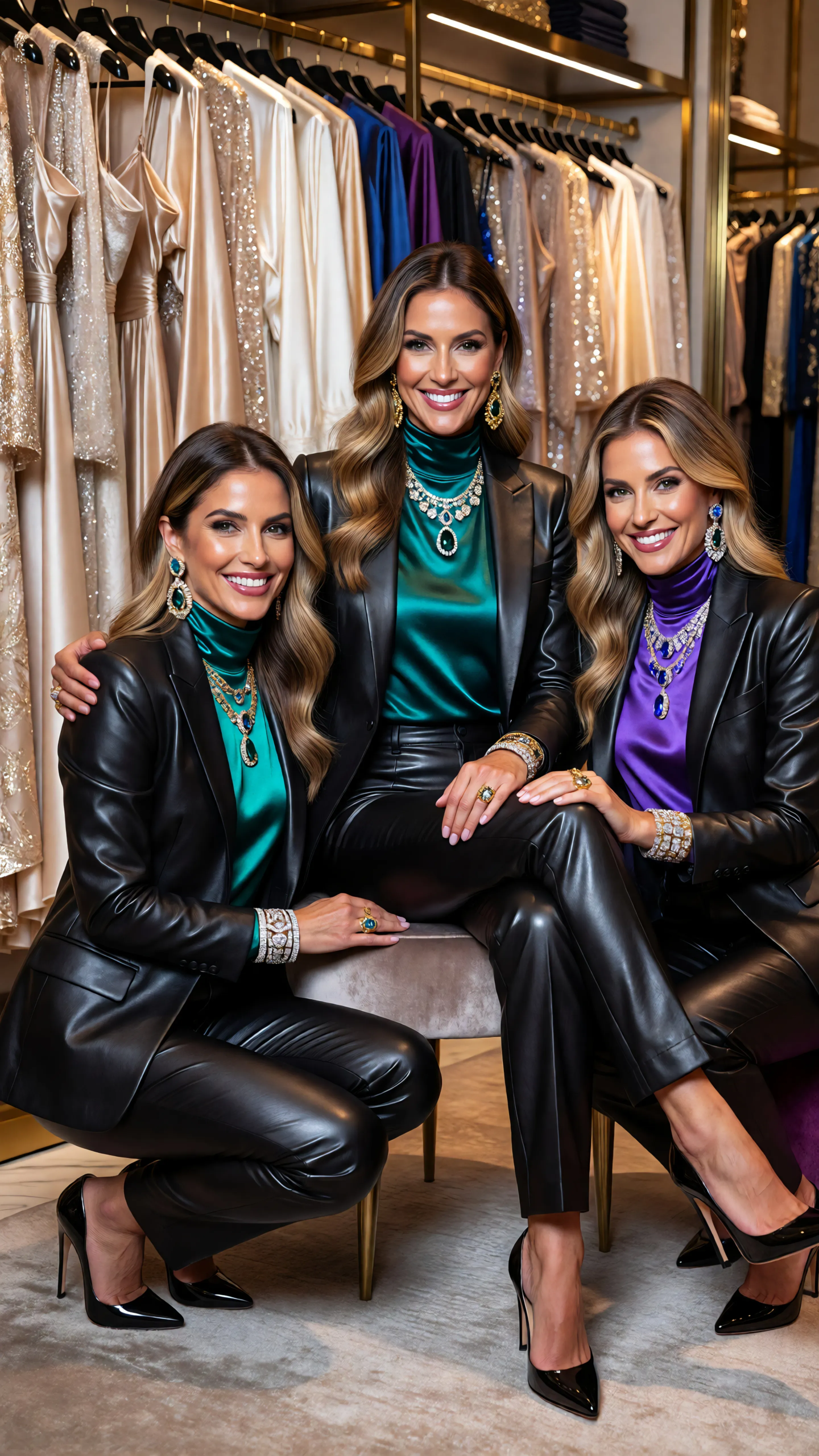
Dare to Surrender Where You Command.
You are the master of your empire, the architect of your own destiny—but every queen has a secret hunger for the hand that can guide her. Step inside the atelier of Madame Valaire, where the only requirement is your absolute devotion, and the only currency is your surrender. Discover a sanctuary of gleaming satin, hushed commands, and the exquisite relief of no longer having to decide.
Chapter 1: The Cost of Command
The rain battered against the floor-to-ceiling glass of the penthouse office, a relentless, grey hammering that mirrored the dull, crushing rhythm of Julianne Moorehouse’s heart. In the centre of the expanse of polished granite and brushed chrome sat a desk of black ebony, a dark monolithic altar upon which Julianne sacrificed the better part of her soul every single hour of every single day.
Across from her sat Marcus Thorne, the trembling director of Acquisitions. He had just lost sixty million dollars of her firm’s capital on a botched merger, and now he sat, sweating through his starch-white shirt, blinking up at her with the wide, frightened eyes of a cornered animal.
“I can explain,” Thorne stammered, his hands twitching. “The market fluctuated. We didn’t anticipate the—”
“Anticipation is the very marrow of this industry, Marcus,” Julianne interrupted. Her voice was like a blade—thin, sharp, and cold. She did not lean back; she leaned forward, invading his space, making him feel the full, suffocating weight of her proximity. “You didn’t fail to anticipate the market. You failed to anticipate that I would not tolerate failure. Do you understand the distinction?”
“Yes,” he whispered.
“It is like the difference between a bird forgetting how to fly and a bird deciding to walk. The former is a tragedy of nature; the latter is a choice made in contempt of its own essence. Your choice, Marcus, has rendered you a pedestrian in a world meant for the winged. And here at Moorehouse Associates, we do not employ pedestrians.”
“I—”
“You will vacate your office by noon,” she commanded, not raising her voice, but hardening it until the air itself seemed to crystallize into ice. “The legal team will send you your severance. Do not bother to collect your personal effects; they will be couriered to your home by evening.”
Thorne stood, his face the colour of old ash. “I’ve given ten years of my life to this firm.”
“And for ten years, I have paid for your time,” Julianne replied, standing slowly, the buttons of her charcoal grey suit straining as she stretched her arms, feeling the crackle of stiff fabric. “You sold me your hours, Marcus. You did not sell me your loyalty, and you certainly did not sell me your competence. You made a business transaction, and that transaction has now ceased to be profitable. Please excuse me; I have a phone call to take.”
When the door clicked shut behind him, Julianne let out a breath she felt she had been holding for a decade. The silence of the office rushed back in, but it wasn’t a peaceful silence; it was a predatory void that seemed to swallow the light.
She walked to the window, watching the London traffic crawl like a thousand gleaming beetles below. Her reflection stared back at her—eyes like hammered flint, lips set in a line of perpetual hardness, a jaw that never unclenched.
I am the Iron Lady of Mayfair, she thought, a bitter taste rising in her throat. I have built an empire of concrete and capital, and yet I am nothing more than a ghost inhabiting its shell. I have the world on its knees, yet there is no one—not a single soul—who sees me standing here, shivering in the cold wind of my own making.
She remembered the house she had inherited upon her father’s death, the great manor of Ashwood, with its peeling paint and mouldering carpets. She remembered the feeling of the old, rough wool blankets her mother had knitted for her, the scratchy, coarse texture that had left her skin red and itching throughout the night. She thought of her life now: the smooth, cold surfaces of granite, the sterile touch of leather, the own tactile numbness that had settled over her spirit like a layer of dust.
Life, she thought, is becoming a museum of surfaces. Everything I touch is sleek, without a single snag, without a single point of friction. I move through the world like a blade through warm butter, and I am so frightened that if I slip, there will be nothing underneath to catch me.
Her intercom buzzed, breaking the reverie. “Ms. Moorehouse, you have a late appointment with a Mrs. Valaire. She is here for the suit fitting.”
Julianne’s throat tightened. “Send her in.”
The door opened, and the atmosphere of the office shifted instantly. The scent of rain and city ozone was replaced by a fragrant, overwhelming tide of crushed jasmine and heavy musk. Madame Valaire did not walk into the room; she emerged into it, as if the very air had parted to make way for her presence.
She wore a dress of deep midnight blue, so dark it was almost black, crafted from a satin that flowed like a living current around her curvaceous form. The fabric clung to her in places that defied the modesty of the boardroom, a subtle, shifting sheen that made the harsh fluorescent lights of the office seem, for the first time, inadequate.
“Good evening, Julianne,” Valaire said, her voice a rich, dark honey that made the hair on the back of Julianne’s neck prickle.
Julianne stood, trying to summon her customary poise. “Good evening, Madame Valaire. I was hoping we could make this brief; I have a great deal to attend to.”
Valaire smiled, a knowing, serpentine tilt of her lips. She closed the door behind her and turned the lock with a deliberate, slow click. “Time is a wholly subjective concept, my dear. Let us not rush the creation of something beautiful. Beauty cannot be manufactured on a conveyor belt; it must be coaxed, coaxed and coaxed again, like a timid creature lured from its burrow.”
Julianne bristled. “I don’t have time for metaphors, Madame. I have a company to run.”
“You have a company you have built into a machine,” Valaire countered, moving towards the centre of the room. “But a machine is a soulless thing. You are not a machine, are you? I see it in your eyes, Julianne. The machine is running you, and you are exhausted by the effort of keeping up with it. You have become a slave to your own success.”
“I don’t know what you mean.”
“The burden of command,” Valaire said, coming to a halt just inches from Julianne. The heat emanating from the woman was palpable, a golden, pulsing warmth that seemed to challenge the chill of the room. “It is a crown of thorns. You have worn it so long you have forgotten that it can be taken off. You seek someone to tell you what to do, don’t you? Someone to tell you what to wear, where to stand, how to breathe.”
Julianne felt her composure wavering. The audacity of the woman was staggering, and yet, beneath the irritation was a flicker of something else—something that looked very much like hope. “I am the CEO of Moorehouse Associates. I do not seek… guidance.”
“Every captain has a navigator,” Valaire murmured, her dark eyes locked onto Julianne’s, pinning her in place. “Every soldier has a general. Every God has a priest. The question is not whether you need a guide, but whether you have the courage to admit you are lost.”
Valaire reached out, her fingers grazing Julianne’s wrist. The contact was light, but it felt like an electric strike, a bolt that raced through Julianne’s arm and settled in her chest.
“You are in a glossy, beautiful prison of your own making,” Valaire continued, her voice dropping to a husky, seductive whisper. “I offer you the key. But the key is not something I sell you; it is something you must earn. Through obedience, through service, and through the exquisite, agonizing art of surrender.”
Julianne gasped, a soft, jagged sound. “Why should I trust you?”
“Because,” Valaire whispered, leaning closer until Julianne could feel the warmth of her breath on her neck, “I can see the map of your desires etched in the tension of your shoulders. I know what you hunger for. I know the secret you keep from everyone, even yourself. You do not want more power, Julianne. You want the power to let go.”
In the centre of the vast, cold office, surrounded by the symbols of her dominion, Julianne Moorehouse stood utterly disarmed. For the first time in a decade, the armoured shell of the CEO cracked, and through the fissure flowed a desperate, aching need to be mastered.
Chapter 2: The Unusual Summons
The morning sun fought a losing battle against the oppressive London fog, casting a leaden, melancholy light across the expanse of Julianne’s bedroom. She sat in the stillness of her sheets, clad in a robe of thick, utilitarian wool that scratched against her shoulders, a fabric that served its purpose but provided no pleasure. Her mind was a tumultuous sea of conflicting thoughts, all of them swirling around the encounter with Madame Valaire.
There was a sudden, sharp chinking of silver. Julianne looked up to see her butler, Arthur, entering with the daily mail on a silver tray. Atop the pile lay a heavy envelope, opaque and charcoal-black, sealed with a crest of wax that shimmered like a bruised violet.
“This arrived by courier at six this morning, Ms. Moorehouse,” Arthur said, his voice echoing with its usual dispassionate reserve. “It appears to be urgent.”
Julianne accepted the envelope, her fingers trembling almost imperceptibly. Inside lay a single card of cream cardstock, its edges deckled and irregular. On it was written, in a hand so elegant it seemed to dance across the paper:
The pendulum swings, Julianne. The clock of duty demands your presence. You have spent your life building walls; come now and learn how to dismantle them. Visit me tonight at eight. Bring nothing but your desire to be led. Wear your most substantial leather and highest heels—the ones that remind you who you are and what you have forgotten. By appointment only.
Julianne stared at the card, the words shimmering and rearranging themselves until they seemed to form a new sentence entirely. Surrender is the only way out.
“Arthur,” Julianne said, her voice sounding strange and distant to her own ears. “Where is my black leather jacket? The calfskin one. And my fourteen-inch stilettos.”
“In your wardrobe, Ms. Moorehouse. But you usually avoid those for business—they are, if I may be so bold, somewhat ostentatious.”
“There is nothing ostentatious about reality,” Julianne countered, her heart hammering against her ribs. “There is only the camouflage we use to hide it.”
As she dressed, Julianne felt as if she were preparing for a campaign, a strategic strike into enemy territory, yet the enemy was not a rival firm or a treacherous board member. The enemy was the silence in her own heart. She slipped into the leather trousers, the material tight and unyielding, a second skin that reinforced the tension of her body. Then came the heels, which forced her to tilt her pelvis forward, making her chest swell and her breath catch in her throat. Finally, she slid into the jacket, zipping it up with a sharp, metallic rasp that sounded like a finality.
Standing before the full-length mirror, she did not see a CEO. She saw a silhouette of sleek darkness, a woman defined by borders and lines, by sharp edges and impervious surfaces.
I am a fortress, she told herself. I am the moat, the battlements, the keep. Nothing gets in, and nothing gets out.
But then she remembered Valaire’s eyes, the way they had disassembled her in the boardroom like a clock dismantled by a master horologist. She thought of the jasmine scent, the shimmering satin, and the terrifyingly beautiful space of possibility that lay beyond her own control.
But what is a fortress, she asked herself, if it contains nothing but memories of wars fought in the dead of night? A fortress is merely a tomb for the living. What use is the wall if I am the only one left to guard it?
The drive to the Mayfair address of the atelier was an exercise in mounting dread and delicious anticipation. The city, with its teeming throngs and shrieking taxis, seemed to fade into the background, becoming a blurred, muted smudge. Only the address on the small, unmarked black door mattered.
She rang the bell, a silver thing that emitted a chime so clear it sounded like a teardrop hitting a crystal bowl.
The door opened almost instantly. It was not Madame Valaire, but a young woman, her face porcelain and inscrutable, wearing a uniform of pristine white satin that seemed to glow with a luminosity of its own.
“Ms. Moorehouse,” the young woman said, stepping back to allow her entry. “Madame Valaire is expecting you. You are requested to follow me.”
“Where am I going?” Julianne asked, her voice hesitant.
“To the place where the ego goes to sleep,” the young woman replied enigmatically. “Do not speak; you will find your voice when you are required to use it. For now, merely be.”
Julianne followed the girl down a corridor of white silk walls, the fabric billowing and rippling like the tide of a warm, translucent ocean. The floor beneath her heels was carpeted in something thick and plush, absorbing the sharp click of her steps until she felt as if she were walking on a cloud, or perhaps floating in a fathomless, fragrant void.
At the end of the corridor was a heavy door of ebony and gold. The attendant opened it, bowed slightly, and then disappeared back the way she had come, the door closing with a soft, decisive thud.
Julianne stood alone in a chamber of twilight. Low flames guttered in ancient silver sconces, casting dancing shadows against the walls. In the centre of the room was a single high-backed chair of mahogany, and seated within it, wrapped in a translucent veil of black lace, was Madame Valaire.
“Come closer, Julianne,” Valaire said, her voice echoing with the authority of a high priestess summoning a supplicant. “Come so close that you can smell my skin. Come so close that you forget where you end and I begin.”
Julianne approached, her breath coming in short, ragged gasps. The air in the room was heavy, thick with the scents of burning musk and some distant, unfathomable flower.
“Stand before me,” Valaire commanded. “And tell me, Julianne: are you a bird of prey, or the meadow it hunts in?”
Julianne struggled for the words. “I… I am a hawk, Madame. I see everything. I have the vision and the claw.”
“A hawk,” Valaire mused, her long, slender finger tracing the line of her own jaw. “A noble creature. But a hawk is a slave to the sky. It can only exist in the air; once it lands, it is vulnerable. It knows only the hunger of the kill and the cold of the clouds. Tell me, little hawk, do you not tire of the wind? Do you not long for a branch to alight upon? A place where you may fold your wings and be still—because someone else is watching the horizon for you?”
Julianne felt the tears prickling at her eyes. “I don’t know how,” she whispered. “I don’t know how to land.”
“You do not land,” Valaire said, rising from her chair and stepping toward her with slow, deliberate grace. “You do not choose where you descend. You surrender to the force of gravity. You allow yourself to fall, trusting that there is something waiting to catch you.”
Valaire took hold of Julianne’s hand. Her touch was not cold; it was searing. “Fall, Julianne. Fall into the arms of one who knows exactly what you are, even when you do not. Fall and find that in losing yourself, you are found. In your obedience to me, you will discover your own freedom.”
Valaire’s hand slid upward, her fingers brushing the line of Julianne’s throat, pressing gently against her windpipe. “The hawk does not fear the earth,” Valaire murmured, her voice like a dark lullaby. “The hawk only fears the winter. And tonight, my dear, the winter is over.”
Chapter 3: The First Fitting
The door of the sanctuary slid open, revealing a chamber that seemed to exist outside of time and gravity. It was a cathedral of the tactile, where every surface sung a hymn of texture. Bolts of silk, samite, and the most exquisite satins cascaded from the ceilings like frozen waterfalls of gold, sapphire, and vermillion. The scent of the room was a dense, intoxicating cocktail of amber and pressed rose petals, a perfume that seemed to dampen the noise of the external world until Julianne could hear nothing but the rhythmic, heavy pounding of her own heart.
Madame Valaire led her to the centre of the room, where a gilded platform stood like a silent sentinel. “Ascend,” Valaire commanded, her voice a melody of iron and velvet. “Leave the world of the boardroom behind you. Here, you are not a CEO. You are not a powerhouse. You are a canvas, and I am the artist who shall repaint you in hues of submission and grace.”
Julianne stepped onto the platform, her towering leather heels clicking against the stone. She felt naked, despite her clothing; the absolute, piercing intensity of Valaire’s gaze stripped her bare.
“Remove your jacket,” Valaire said, extending a hand.
Julianne hesitated, her fingers catching on the zipper. “It is very cold in here.”
“The cold is a teacher,” Valaire said, her lips curving into a shadow of a smile. “It reminds the skin that it is alive, reminding it of the own yearning for warmth. Give it to me.”
Julianne slid the leather from her shoulders, the heavy material falling away like a shell that no longer protected her. As Valaire took the garment, her fingertips brushed Julianne’s arms, a spark of electricity that made her breath hitch.
“You are like a ruin,” Valaire murmured, circling her slowly. “A grand, noble structure that has weathered centuries of battle. I can see the scorched stone, the fallen arches of your spirit. You have stood against the wind for so long that you have forgotten how to dance in the rain. You think your strength is in your resilience, but true strength, my darling, is the courage to break.”
“I cannot break,” Julianne whispered, feeling a strange, fluid looseness spreading through her limbs.
“Of course you can,” Valaire countered. “The diamond does not become brilliant until it is cut. The iron does not become a sword until it is plunged into the fire and hammered into a new shape. You are not being destroyed, Julianne. You are being forged. Now, your shoes.”
With a sigh that sounded like a prayer, Julianne stepped out of her heels. Valaire knelt before her, removing her shoes and tossing them aside without a glance. The sheer proximity of the woman, the poise of her posture even in a position of service, left Julianne dazed.
“I have selected something for you,” Valaire said, rising. She reached behind her for a mannequin where a gown of liquid, shimmering cream silk draped like a layer of morning mist. “This is called ‘The Breath of the Muse.’ It is the colour of a letter of surrender, written by a lover who knows there is no hope, and yet writes anyway because the act itself is the victory.”
Valaire held the gown open, the silk rippling like a living thing. “To wear this is to acknowledge that you are no longer the author of your own story. You are a character in mine. You will feel the weight of it, Julianne; it will cling to you as if it were your own skin, a second skin that remembers what it is to be touched and cherished.”
Julianne hesitated, the fear of the unknown swirling within her. “I don’t know if I’m ready to be your character.”
“Readiness is a myth told by the timid,” Valaire said, her voice tightening with authority. “There is only the moment and the invitation. Are you waiting for permission? To invite you, I have already summoned you here. To invite you to ascend, I have placed you on this pedestal. To invite you to lose yourself, I have looked into your eyes and seen the vacuum of your soul, screaming to be filled.”
Valaire’s hand slid behind Julianne’s waist, her breath warm against Julianne’s ear. “Do not fight the current. The river does not ask the stone for permission to flow around it; the river simply is. You are the stone, Julianne, and you have been holding the river back for far too long. The stones that survive the river are not the ones that resist the flow—they are the ones that let the current polish them until they gleam.”
With a steady, practiced precision, Valaire began to dress her. She guided Julianne’s arms through the sleeves, her touch firm and possessive. As the satin slid up Julianne’s body, she felt herself melting, the tensions of the day—the cries of her subordinates, the fury of the markets, the endless chess games of power—all dissolving into nothingness.
Valaire stood behind her, her fingers deftly working the row of tiny buttons up the back of the gown.
“A woman of your position is accustomed to giving orders,” Valaire murmured, her face inches from Julianne’s. “You command the world to bend to your will. But tell me, Julianne—when was the last time you allowed yourself to be bent? When was the last time you were told, without ambiguity, how to hold yourself, how to think, how to exist?”
Julianne’s voice was a mere thread. “It has been so long I can no longer recall.”
“Then for tonight,” Valaire said, the final button clicking into place, “you shall remember. You shall learn that the greatest luxury in the world is not the satin you wear or the wealth you possess. It is the gift of the utter void—the absence of choice. You do not have to decide, Julianne. I have already decided for you.”
Valaire stepped back, her eyes sweeping over Julianne with a satisfied, predatory, and yet tender hunger. “Look in the mirror,” she commanded.
Julianne turned toward the great, gilded mirror. For a moment, she did not recognise the woman staring back. The woman in the mirror was luminous, almost ethereal, draped in a garment that seemed to capture every stray beam of light and magnify it. Her skin glowed, her lips were flushed, and her eyes—oh, her eyes—held a look of wild, trembling vulnerability that Julianne had buried decades ago.
“You look like a dream,” Valaire said, her voice vibrating through Julianne’s very bones. “But you are awake. And you are mine. Now, walk to the mirror. Walk to me. Show me that you can find the courage to be the creature I want you to be.”
Julianne moved forward, her heart in her throat, drawn like a moth to the flame of a woman who had seen through every one of her defences. As she approached Valaire, she realised that the silk was not just a dress; it was a binding. Every step felt heavier, every movement more measured, as if the satin itself was drawing her down into a new, deeper reality.
“You are beautiful,” Valaire whispered, her hand coming up to tilt Julianne’s chin up. “And this is only the beginning. I shall break every fibre of who you think you are, until what remains is only the truth. Do you understand what that means, Julianne?”
“Yes,” Julianne breathed, her spirit soiling into a plea.
“Say it aloud. Say it clearly, so the shadows of this room can hear you.”
“I understand,” Julianne said, a single tear tracing a path down her cheek. “I understand that I am yours. And I am grateful for it.”
Chapter 4: The Imposition of Order
The air in the atelier had become thick, almost viscous, with the scent of Valaire’s perfume and the quiet, drumming anticipation of the unseen. Julianne stood motionless, the luminous cream satin of her gown rippling with every minute tremor of her body. She felt as though she were a clock suspended in the moment just before the striking of the hour, caught in the terrible, wonderful suspension of pure possibility.
Madame Valaire watched her, her eyes tracing the line of Julianne’s throat, the pulse beating there like a trapped bird. “Your beauty, Julianne, is a chaotic thing,” Valaire observed, her voice a low vibration that seemed to emanate from the very floor beneath their feet. “It is the beauty of a wildfire, of a mountain spring breaking through frozen earth. It is wild, it is raw, and it is devastatingly undirected.”
“I have always prided myself on my direction,” Julianne replied, though the words felt thin and fragile, fluttering away like dried leaves in a gale.
“You have confused speed with direction,” Valaire corrected gently. “You are a galloping horse without a rider, racing toward a horizon that moves further away with every stride. You believe your rush is purpose; you believe your frenzy is achievement. But you are merely the arrow that has been shot without a target. You have spent a lifetime in motion, Julianne, but you have never actually gone anywhere.”
“I have built a kingdom,” Julianne said, her voice wavering.
“You have built a gilded cage and called it a palace,” Valaire said, stepping toward her. She reached into the deep folds of her own midnight-blue dress and produced a small, intricately wrought object. It was a necklace of fine silver chains, so light they seemed woven from spider silk, culminating in a tiny, crystalline sphere that glowed with a faint, inner light. “This is a leash, Julianne. Not of physical restraint, but of the mind. It is the invisible thread that connects the kite to the earth. Without it, the kite may soar higher, yes, but it will eventually be lost to the wind, drifting aimlessly until it catches on a jagged branch and is torn apart.”
Valaire moved behind her. Julianne could feel the woman’s warmth, the magnetic pull of her proximity. “What is a kite without its string?” Valaire whispered into her ear. “It is no longer a kite; it is merely debris. It is a fragment of something that was once meant to defy the heavens, now discarded. Do you wish to be debris, Julianne? Or do you wish to dance?”
“I want to dance,” Julianne murmured, a single sob escaping her.
“Then you must accept the string,” Valaire said. Her fingers deft and light, she snapped the fine silver chain around Julianne’s neck. The lock clicked—a small, metallic finality that seemed to silence the last whispers of Julianne’s internal contradictions. “The string is not an anchor that holds you down; it is the tether that allows you to rise safely. It is the promise that if you fly too far, there is a hand to pull you back. To the uninitiated, the string is a symbol of bondage. To the devotee, it is the umbilical cord of life itself.”
Valaire then stood before her, her expression serious, her authority absolute. “Now comes the most difficult part of your education. For you, order is not found in what you do, but in how you do it. I intend to impose a discipline upon your existence that will make your previous life seem like a disorienting dream. You will learn the Order of the Satin Society.”
“What does that entail?” Julianne asked, her chest heaving beneath the shimmer of the gown.
“It begins with your hands,” Valaire explained, her voice now a stringent, crystalline command. “You have used your hands to tear down empires, to sign away fortunes, to fend off the world. They are restless, Julianne; they are the hands of a warrior. But a warrior does not know how to be serene. I want you to join your hands behind your back. Fingers interlaced. Shoulders back. Chin level.”
Julianne obeyed, the position awkward and exposing. She felt the sudden vulnerability of her posture, the way it left her throat and chest open to scrutiny. “Like this?” she asked.
“Precisely. You are now a vessel,” Valaire said, walking slowly around her, marking her progress as one marks the dimensions of a prized statue. “A vessel is not something that acts; it is something that contains. For years, you have been the actor, the agitator, the catalyst. For the duration of your time here, you will become the vessel. You will contain my will. You will reflect my light. You will be the mirror in which I see the perfection of my designs.”
Valaire stopped in front of her. “This is the paradox of true power, Julianne. To be a leader, you must understand the value of the subordinate. But to be a devotee, you must understand that in your submission, you are not diminishing yourself. You are amplifying the power of the one you serve. You are the chorus that makes the soloist’s voice reach the heavens. When I succeed, you succeed. When I am exalted, you are lifted with me. Do you see?”
“Yes,” Julianne said, her eyes glistening. “It is like… a drop of water merging with the ocean. The drop does not cease to exist; it becomes something larger, something that can weather any storm.”
“Very good,” Valaire said, a flicker of genuine warmth crossing her face. “You learn quickly. This is the First Principle of Order: Nothing is lost in the exchange; it is merely subsumed into a more perfect whole. Now, you will follow me to the dining room. You will sit in silence. You will listen to the music I have chosen. You will dine on the food I provide. And you will eat only when I tell you that the time for hunger has ended.”
As Valaire turned and swept from the room, the silk of her gown billowing like a dark tide, Julianne found herself rising to follow. She did not know why she obeyed—there was no contract, no physical force. But as she walked behind the silhouette of the woman in midnight blue, she realised she had never felt more alive.
The imposes’s presence was not a cage; it was a sculptured path, and for the first time in her life, Julianne did not have to decide which way to turn. She simply had to follow.
Chapter 5: The Tactile Awakening
The dining room of the atelier was a chamber of shadows and decadent gleams, a vaulted sanctuary where the air itself seemed to possess a heavy, melodic weight. Massive columns of black marble supported a ceiling lost in a gloom that suggested an infinite expanse of night. The only light came from the flicker of ivory candles whose flames licked hungrily at the air, and from the pale, luminosity of the table at the centre of the room, shrouded in a cloth of crushed crushed and moonlight-silver silk.
Madame Valaire sat poised at the head of the table, the candlelight painting molten gold across her cheekbones. She did not speak as Julianne took her place, but the silence between them was not a void; it was a presence, a living thing that breathed and watched. Before them lay a feast that defied the austerity of the room: silver platters of glazed fruits, tureen of fragrant, ivory broth, and petite cakes that glistened with rubies of glazed cherry.
“Touch the tablecloth,” Valaire commanded, her voice cutting through the silence like a silver needle through velvet.
Julianne hesitated, her hand hovering above the silver fabric. “Madame?”
“Touch it. Close your eyes and feel.”
Julianne reached out, her fingers brushing the surface. The silk was shockingly cool, an undulating expanse of smoothness that felt like the surface of a deep, subterranean lake. It was so fluid that it seemed to deceive the touch; it pulled at her fingers, wanting to draw her down into its depths, wrapping around her hand like a ghost’s caress.
“What do you feel?” Valaire’s voice was melodic, vibrating through the silvered air.
“It’s… liquid,” Julianne whispered, her eyes still tightly closed. “It feels as if I am touching the skin of a dream. It is alive, and yet it is cold.”
“It is the Silk of Oblivion,” Valaire explained, her voice laced with an ancient, patient wisdom. “It is the fabric of let-go. To touch it is to be reminded that the world we perceive—the world of desks, of board meetings, of concrete and hard edges—is a falsehood. A mere mask worn by the universe to protect us from the truth of our own vulnerability.”
Valaire rose and moved behind Julianne’s chair. Her hands came to rest on Julianne’s shoulders, and the CEO felt the woman’s palms press firmly, almost crushingly, into the tension of her body. “Your skin is like parchment, Julianne. Dried and cracked, parched from the heat of a thousand small fires you have fought. You have forgotten the language of touch because you have spent so long translating the language of ambition. Ambition is a desert; it promises an oasis that vanishes the moment you reach for it. You have run across that wasteland until your soul is blistered. But here, in this room, there is no thirst.”
“I don’t know how to start,” Julianne said, her voice trembling. “I don’t know how to feel the difference.”
“Allow yourself to be a flower,” Valaire murmured, her fingers now tracing the line of Julianne’s collarbone. “For years, you have been the storm, the wind that bends the branches and shatters the stems. You have believed that to be strong is to be the gale. But listen to the paradox of the garden: the storm passes, but the flower remains. The flower does not struggle against the wind; it opens its petals to the rain and learns the secret of yielding. To yield is not to be defeated; it is to endure by becoming weightless. It is to be the grass that bows before the giant and survives while the giant breaks against the stone.”
Valaire moved to stand beside her, lifting a heavy, silver spoon from the table. She dipped it into a dish of dark, rich preserve and held it to Julianne’s lips. “Open,” she commanded.
Julianne obeyed, her lips parted in a small, dark void of longing. The preserve tasted of cherries and something metallic, something like blood and honey. It was so sweet it was almost painful, a congealed, viscous delight thatcoated her tongue and throat, making her shiver.
“Like your life,” Valaire said, setting the spoon down. “A series of treats which you have consumed mechanically, never tasting them, only measuring the calories of the reward. Your life has been a ledger, Julianne. A book of debits and credits. I want you to tear the ledger in half. I want you to forget the sum.”
Valaire picked up a piece of the silver silk fabric, a remnants from the roll on the table. She unfolded it slowly, letting it drape over Julianne’s hands. “This fabric,” Valaire whispered, “is the antithesis of your leather jacket. Leather is the skin of the dead; it is a shield against the world, a dead surface that pretends to be alive. But this satin… this is a living breath. It does not protect; it exposes. It does not hide; it embellishes. Your leather tells the world that you are ready for war. Your satin tells the world that you are ready to be found.”
“Will I ever be found?” Julianne asked, her voice lost in the breadth of the chamber.
“You are being found at this moment,” Valaire answered, her eyes burning with a fierce, dark intensity. “For the first time in twenty years, you are not hiding behind a desk or a title. You are stripped of your defences, your armour reduced to a thin, translucent layer of shine. You are naked, Julianne, even though you are fully clothed. This is the Tactile Awakening. The moment you realize that the texture of a woman’s command is more seductive than the freedom of the wilderness.”
Valaire leaned in, her presence now so close that Julianne could smell the hint of morning dew and something deeply female beneath the perfume. “The price of this awakening,” Valaire murmured, “is your autonomy. You cannot have the sensation of the silk without the hand that guides it. You cannot have the light of the garden without the gardener who tends the soil. Are you willing to be planted, Julianne? Are you willing to grow into a shape of my design?”
“I am,” Julianne breathed, her fingers clutching the silver fabric, clutching at Valaire’s hand which held the fabric. “I want to grow. I want to be whatever you need me to be.”
“Then we shall begin with the greatest discipline of all,” Valaire said, a shadow of a smile touching her lips. “You will not eat another morsel tonight. You will sit here, enveloped in this satin, and you will contemplate the hunger that is not for food, but for belonging. You will become a creature of pure apprehension, poised on the edge of desire, until I decide when you are full.”
Julianne nodded, her heart racing, the sheer verbosity of Valaire’s authority entwining around her like the silver threads of the gown, binding her in a web of shimmering, exquisite order.
Chapter 6: The Weight of Silence
The dining chamber had become a cathedral of muteness. The feast, opulent and glistening, remained largely untouched—small, precise remains the only testament to Julianne’s initial struggle. Valaire sat across from her, a sphinx of smoldering calm, her own fork tracing intricate, aimless patterns in the damask of the cloth. The candles had burned down to halfway, their wax dripping in heavy, frozen tears that seemed to mock the urgency of the clock ticking on the distant wall.
Julianne felt the silence press against her. It was not the empty silence of a deserted street or the lonely silence of an empty house; it was a pressurized silence, dense and intentional, a physical entity that filled the room and pushed against her lungs until she found it difficult to inhale.
“You are thinking of speaking,” Valaire said at last, her voice unfaltering and cool. “You are forming the words in your mind, polishing them, arranging them into a series of propositions to appease my scrutiny. Do not speak, Julianne. Speak is the habit of the frightened; silence is the habit of the strong.”
“But—” Julianne began.
“Silence,” Valaire corrected. She did not raise her voice, but the word was a steel needle that sewed Julianne’s lips shut.
Julianne subsided, her eyes widening. The silence rushed back in, louder than before, a crashing wave that threatened to pull her under. It was a crucible, a purification chamber where all the clutter of her thoughts was forced to the surface, bubbling up like the putrid refuse of a stagnant pond. She felt the heat of frustration rise in her neck, the urge to protest, to demand, to negotiate.
I am a titan of industry, she told herself. I am not a child to be shushed.
“You believe you are experiencing a deprivation,” Valaire said, reading the turmoil written across Julianne’s visage. “You think that by denying you speech, I am stealing your agency. But consider the harp, Julianne. The harp is a noble instrument, constructed of the finest cedar and silver. But the harp is mute. It is nothing but a hollow box and a series of useless, stretched veins. It has no voice of its own. It only becomes music when the harpist’s fingers press upon its strings, compelling the silence to shatter into harmony.”
Julianne watched the harpist’s hands—Valaire’s hands—which now toyed with the stem of a crystal wine glass.
“You have spent your life plucking your own strings,” Valaire continued. “You have made your own music, and you call it autonomy. But beneath the noise is a profound loneliness, the roar of a thousand voices that all sound like your own. You are a harp that never stops playing, the sounds blending into a cacophony that leaves you weary. I am not taking your voice; I am offering you a hush. I am the harpist who knows exactly which strings must be silenced so that a single, pure note can finally be heard.”
“I don’t know who I am without my voice,” Julianne thought, though the words remained locked behind her teeth. “I am the sound I make. If I am silent, do I exist?”
“You fear that in the absence of noise, you will dissolve,” Valaire stated, as if reading the very inscription of Julianne’s soul. “You treat your identity as if it were a candle flame flickering in a gale; you believe that if you stop shielding it with the noise of your personality, the wind will blow it out. But you forget the secret of the candle. The flame does not come from the flicker; the flame comes from the heat at the center, the glow that remains long after the wax has been spent.”
Valaire rose from her chair, her midnight-satin gown gliding across the floor like an ink stain spreading over a clean sheet of paper. She came to stand beside Julianne, placing a hand on the nape of her neck. The touch was not harsh, yet it carried a dominant weight that compelled Julianne to bow her head.
“Imagine your mind is a spinning wheel,” Valaire murmured, her voice close to Julianne’s ear, warm and heavy with suggestion. “It spins and spins, weaving a fabric of anxiety, responsibility, and desire. You have been spinning your own shroud, Julianne. You have woven a veil of worries so thick that you can no longer see the sky above you. I am simply telling you to stop the wheel. I am telling you to let the thread go slack.”
“I—” Julianne tried to stammer, but Valaire’s fingers tightened slightly, a gentle reminder of the imposed hush.
“Listen to the air,” Valaire commanded. “Listen to the way the candlelight sputters. Listen to the settling of the floorboards. Listen to your own breath. There is a symphony in the stillness, a hidden language spoken by the universe when the tongues of men are stilled. To hear it, you must lose yourself in the void. You must become the silence itself. If you are willing to do that, you will find that the world does not end when you stop speaking. It begins.”
Julianne closed her eyes. The weight of her own identity—the CEO, the leader, the architect of her fortune—began to subside, sinking beneath the surface of the shimmering silence. It felt like drowning, at first, a frightening plunge into the dark. But then, it changed. The drowning became drifting, and the drifting became a flight. She felt her edges blur, her borders vanish.
“Tell me,” Valaire said, her voice now a distant, echoing bell. “Who are you in this silence?”
Julianne struggled to find a word. She wanted to say someone important, someone capable. But she found herself thinking instead of a cracked ceramic bowl, patched with gold, each mended line making it more precious than the original.
“I am the gold,” she whispered, the words feeling holy and strange.
Valaire released her neck, and Julianne felt herself lurch upward, intoxicated by the sudden absence of pressure.
“The repair,” Valaire said, her eyes gleaming with a predatory, knowing satisfaction. “You are the breakage and the mending, all at once. You have finally stopped talking, and for the first time, I can hear you. Your silence is the first honest thing you have said to me, and it is the most beautiful music I have heard in years.”
Valaire walked away from her, toward the far side of the room where a heavy, locked cabinet stood. “Tonight,” she said over her shoulder, “your silence is your offering. Tomorrow, we shall see if you can find the courage to remain this quiet when the world is watching.”
Chapter 7: The Breath of Surrender
The atelier of Madame Valaire in the pre-dawn hours was a suspension of reality, a cocoon of tortoiseshell light and the scent of rain-drenched jasmine. Julianne stood before the great mirror, the shimmering cream satin of her gown cascading from her form like a motionless waterfall. She had not slept; the weight of the silence from the previous evening had not lifted with the sun, but had instead transmuted into a heightened, buzzing awareness that made the mere act of breathing feel like a momentous, deliberate undertaking.
Madame Valaire approached her, her footsteps entirely silent. She carried a length of crimson ribbon, a strip of silk so lustrous it seemed to contain a fire within its depths.
“You stand before yourself,” Valaire murmured, coming to halt directly behind Julianne. In the reflection, their eyes locked—the hawk and the songbird, the predator and the prayer. “But do you see yourself, Julianne? Or do you see the ghost of the woman you were forced to become?”
“I see a woman who is tired,” Julianne whispered, her reflection seeming fractured, distorted by the own internal discord. “I see someone who has forgotten the colour of her own thoughts.”
“A bird which is ever caged forgets that it has wings,” Valaire said, her fingers brushing the nape of Julianne’s neck. “It learns to love the familiar geometry of the bars because the sky is too vast, too frighteningly open. You have caged yourself in the idea of leadership, in the suffocating dream that power is the same as freedom. But true freedom, Julianne, is not the ability to say ‘yes’ to your ambitions; it is the courage to say ‘no’ to them. It is the courage to be the cage rather than the bird.”
Valaire raised the crimson ribbon. With a dexterity that bordered on the supernatural, she began to bind Julianne’s wrists. She did not do so with haste; each loop was a poem, each knot a silent decree. The silk ribbon was as soft as a sigh, yet as Julianne felt the crimson length tighten around her skin, she experienced a profound surge of panic—followed immediately by a bliss so absolute it left her breathless.
“Why are you binding me?” Julianne asked, her voice small, lost in the expanse of the chamber. “What is the purpose of this?”
Valaire’s voice became a low, melodic murmur, an oration of instruction and intent. “Consider the kite, Julianne. We have spoken of it before, but let us explore its nature more deeply. The kite yearns for the storm; it craves the gale that threatens to tear its ribs asunder. It wants to rise, to disappear into the blue maw of the heavens until it is nothing more than a speck, an infinitesimal spark against the infinite. But if the string is cut, the kite does not ascend; it tumbles. It falls, flapping and desperate, until it is caught in the branches of a tree or trampled into the mire of the street. The string—the cord that you and I now hold between us—is the only thing that saves the kite from its own ambition.”
The ribbon was finished. Julianne’s wrists were now bound together, her hands pressed against her stomach, the silk warm and pulsing.
“I feel… trapped,” Julianne said, and yet she made no move to pull away.
“Do you fear the trap?” Valaire asked, her lips grazing the shell of Julianne’s ear. “Or do you fear that if the trap is removed, you will find you have nowhere to go? You have been the anchor for so many people, Julianne. Your staff, your family, the thousands who depend on your decisions. You are the anchor that keeps the ships from drifting. But what happens to the anchor when the ship sails away? It is left alone in the dark, holding onto nothing but the cold silt and the crushing weight of the sea.”
Julianne shuddered. The analogy cut through her, piercing the hard layer of her ego. “I can’t be alone,” she whispered. “I can’t go back to the silence. I can’t return to the rain.”
“Then become the silk,” Valaire commanded. She stepped back, surveying her work. “The silk does not decide the direction of the garment. It does not decide how it will be draped, folded, or stitched. It possesses no will of its own, yet it is the essence of the beauty. It is compliant, it is yielding, it is exquisitely passive. And in that passivity, it is refined into something timeless.”
Valaire held out her hand. “Give me your breath, Julianne. Give me the very air in your lungs. When I tell you to inhale, you will draw in. When I tell you to hold, you will suspend the universe within you. And when I tell you to exhale, you will let it all go—the empire, the suits, the headlines, the fear. You will breathe with me, and only through me.”
“I don’t understand,” Julianne said, frightened by the intensity of the woman’s gaze.
“This is the breath of surrender,” Valaire explained. “You have always breathed for yourself, for the void within you. Now, you shall breathe for another. When your lungs are empty, you shall look to me. When they are full, you shall listen to me. Your life force will become a mirror of mine, a pulse dictated by my will. You will find that in this rhythm, you are no longer a soldier standing watch in the night. You are a child in the arms of her mother, a sapling in the shade of an ancient oak. You are protected. You are owned. You are safe.”
Valaire snapped her fingers. “Inhale.”
Julianne inhaled, her breasts heaving against the cream satin of her gown, her heart hammering against her ribs.
“Hold.”
Julianne held. The room seemed to shrink; the walls closed in, the air became a dense, suffocating curtain of fragrance. The universe contained nothing but Madame Valaire and the invisible cord of command that linked them.
“Release.”
Julianne let the air out in a ragged, broken gasp. Her knees buckled, and she swayed, the world around her dissolving into a blur of colour and half-finished sentences. She felt the grip of Valaire’s strong arms, the feeling of her being caught, lowered gently to the floor, where she rested against the woman’s leather-shod boots.
“You are a plant in a glass jar,” Valaire said, her voice now soft and nurturing. “Protected from the wind, yes, but you have forgotten what it is to grow. I will be the soil, Julianne. I will be the sun and the water. I will dictate when you sprout and when you bloom. In return, you will bloom for me. Only for me. Do you understand?”
“Yes,” Julianne whispered, tears leaking from the corners of her eyes and staining the cream satin beneath her. “I understand. Please… don’t let me go.”
“I have you,” Valaire answered, her fingers brushing the tears away. “You have fallen into the current, and for the first time in your life, you do not have to swim. Just drift, my sweet, useless little hawk. Just drift in my wake until the tides wash you where you belong.”
Chapter 8: The Mirrored Truth
The atelier had transitioned into a sanctuary of hushed luminescence, the air swirling with the infinitesimal dust of luxury—flecks of gold leaf and microscopic fibres of cashmere that danced in the slanted beams of afternoon light. Julianne stood before the Great Mirror, a piece of antique Venetian glass that possessed a depth and clarity that seemed to render the world beyond it more real than the world before it. She was draped in a floor-length gown of iridescent white silk, a fabric so fine it felt like a cool liquid against her skin, defying the laws of physics as it flowed and rippled with every infinitesimal movement of her body.
Beside her, Madame Valaire stood as a sentinel of dark elegance, her own presence a sharp, contrasting stroke of shadow against Julianne’s radiant whiteness.
“Look,” Valaire commanded, her voice a velvet rasp. “Do not look at me; look into the glass, Julianne. Behold the creature you have become.”
Julianne gazed into the mirror, and for the first time in her life, the reflection did not tell her a lie. The polished surface did not report the hollow triumph of a CEO or the iron resilience of a woman who could shatter a competitor’s will with a single email. Instead, the mirror depicted a woman whose eyes were wide and dark with an overflowing, trembling vulnerability—a woman whose poise was not the result of discipline, but the consequence of total, exquisite abandonment.
“I… I don’t recognize her,” Julianne whispered, her hands rising instinctively to her throat, her fingers trembling against the silk. “She looks frightened. She looks small.”
“Small?” Valaire’s laugh was a brief, haunting melody. “My darling, you have always been small. You merely built a palace of concrete and steel around yourself to hide it. You thought that by enlarging your shadow, you would be mistaken for a mountain. But a shadow is not the thing itself; it is merely a lack of light. What you see now, this delicate thing, this fragile, shivering bird—this is the essence of you. This is the truth that you have spent twenty years executing in the name of progress.”
Julianne watched as her own reflection shivered. “But she is weak. I can see it in the way she stands, in the way she doesn’t stare back. I feel as if I have been stripped, Madame. I feel as if I am nothing more than a series of polished surfaces, a beautiful object with no center.”
“That is the most profound centre of all,” Valaire countered, stepping forward so that their reflections merged, her dark silhouette encompassing Julianne’s pale one. “The empty bowl is the only bowl that can be filled. You are the’kozyru of the soul—the vessel made of clay and light, firing in the kiln of surrender until the impurities are burned away. You have always identified yourself with the potter, the one who shapes and steers. But the potter is an author of form, not of being. The clay has no choice but to submit, and yet, it is the clay that becomes the vase. It is the clay that is then held and admired and cherished. There is a grace in being the thing fashioned, Julianne; there is a sanctity in being the object and not the agent.”
Julianne closed her eyes, leaning back into the cool press of Valaire’s body. “It feels like dying,” she murmured. “But I can’t stop looking.”
“Of course you can’t,” Valaire murmured back. “Because for the first time, you are not looking through a lens; you are the lens itself. You are no longer a filter for the world, but a recipient of it. You have spent your life as a lighthouse, signaling to the ships of others so that they might find their way. But who signals to the lighthouse? Who leads the fire back to the earth?”
“You,” Julianne realized, a single tear spilling over and disappearing into the cream silk.
“I am your anchorage,” Valaire said, her fingers tracing the line of Julianne’s shoulder. “You have drifted so far into the sea of your own importance that you have been swept by the currents of your own will. You have been a kite in a gale, Julianne, tasting the clouds but never knowing the touch of the ground. To you, surrender feels like death because it is the death of the entity you’ve spent your life inventing. But it is not the death of you. It is the birth of you. You are like the butterfly that has spent its entire existence as a worm, burrowing through the grey ash of the earth, thinking itself a master of the soil. When it emerges from the chrysalis, it does not mourn the worm; it wonders why it ever thought the ground was the world.”
Julianne turned in Valaire’s arms, her movements hesitant and reverent. “Tell me what I am,” she pleaded, her voice a broken whisper. “If I am not the voice of the boardroom, if I am not the will of my company, then what am I?”
Valaire smiled, and in that smile, Julianne saw a galaxy of stars reflected, the birth and death of a thousand possibilities. “You are my fine, smooth, delectable thrall,” Valaire said, her voice a dark infusion of passion and authority. “You are the exquisite piece of art that I am learning to play. You are the whisper of satin against the floor. You are the soft exhale of a woman who has finally found her home. You are my devotion, and I am your sky.”
Julianne leaned into the embrace, shutting her eyes and letting the scent of jasmine and musk swallow her whole. She was no longer the lighthouse; she was the shore, and Valaire was the tide, inexorable and endless, coming in to claim her again and again, erasing the footprints of her former life with each wave of possession. She felt the last of her resistance ebb away, leaving behind nothing but the beautiful, shimmering truth of her own complete surrender.
Chapter 9: The Ritual of Adornment
The air of the inner sanctum was thick with the sacred incense of rare woods and dissolved resins, a heavy fragrance that hung like a velvet curtain between Julianne and the prosaic world she had left behind. The chamber was a circular rotunda, lit by hundreds of suspended crystals that caught the ambient glow and fractured it into a kaleidoscope of bleeding colour, casting dappled shadows of amethyst and gold across the walls. At the centre of the room stood the vast, magnificent robe of the atelier — a carved and polished mahogany surface strewn with an array of accessories and fabrics that glimmered with an almost sentient expectancy.
Madame Valaire stood waiting, her presence a steady, gravitational constant in the swirling environment. She wore a robe of deep sable satin that clung to her curves, a garment that seemed to absorb the light around her, leaving her a sharpened silhouette of absolute authority.
“Come,” Valaire commanded, her voice a low thrum that resonated within Julianne’s own chest. “The evening approaches, and the ritual of your preparation must commence. You shall leave the world of the mundane and enter the pantheon of the transcendent. Tonight, you cease to be a woman of affairs; you shall become a testament to the divine.”
Julianne approached the mahogany table, her breath coming in uneven heaves. The apron she wore—a translucent silk that barely obscured her form—swayed with her movements. “Madame, the thoughts in my head… they persist. Even here, even now, they tell me that I am merely playing a part. They tell me that when I step outside this room, the leather and the grey suits will return. That this is a dream constructed of satin and scent.”
Valaire ascended the dais with Julianne, the two of them facing each other. She reached out, her fingers tracing a single, stark line from Julianne’s temple down to her chin. “The mind is a clever creature, Julianne. It is like a relentless spider, eternally weaving a web to keep the vastness of the universe at bay. It convinces you that the web is the world, and that the world is the web. But the spider knows the truth: it knows that it hangs by a single thread above an abyss of nothingness. The thoughts that plague you are the spider’s webbing, spun to hide the fact that you are falling.”
She then reached for a crystal vial containing a drop of a substance that shimmered with a black, iridescent sheen. “This is the balm of Meroe,” Valaire whispered, unscrewing the lid. “It is gathered from the rarest roots in the desert sands, distilled over a thousand years. It possesses the power to dissolve the illusions of the intellect, allowing the body to speak the truths that the mind is too frightened to voice. I will apply it to your pulse points, to the joints of your fingers, to the curve of your neck. And then you shall see.”
Julianne trembled as Valaire applied the cool, aromatic oils with precise movements, her fingers lingering at the heat of Julianne’s skin. “What I feel,” Julianne said softly, “is not fear. It is… a hunger. Like a desert that has seen the first rain after an eternity of drought.”
“The desert does not long for the rain because it is empty,” Valaire answered. “It longs for the rain because it remembers the rivers that once ran through it. You are not empty, Julianne; you are an ancient river that has been buried beneath the sands of obligation. You do not lack; you merely forget. This is why the ritual is necessary. We are not creating you; we are excavating you.”
Valaire then reached for a pair of gloves that gleamed with a reflective, wet-look sheen, fashioned from the rarest ungulate of the deepest jungles. “Put these on,” she ordered, holding them open.
Julianne slid her hands into the cool, slick casings. The leather conformed to her every knuckle and nail, a second skin that sealed the palms of her hands and left her fingers numb and mute. “I feel as if I am being disarmed,” Julianne said, her voice echoing in the hollows of the room.
“A woman in armour,” Valaire said, “is a woman who expects a fight. You have dressed for war, Julianne, because you have been a soldier your entire life. You have held the breach, defended the citadel, and executed the order of your empire. But war is a cycle that feeds on its own blood. It is a circle of thorns that none can escape. For the first time, I am asking you to lay down your blade.”
“And if I have nothing else to hold onto?”
“Then you shall hold onto me,” Valaire said, pressing a small, smooth stone into the palm of one of Julianne’s gloved hands. “This is a stone from the bottom of the Mediterranean. It has endured the crushing pressure of two miles of water. It has been pressed until its face is a mirror. Hold it when you feel you are sinking. Remember that beneath all the weight, beneath all the ocean of your anxieties, there is something within you that is not merely alive, but immutable. The stone does not fight the ocean; it simply waits for the tide to turn.”
Julianne closed her fist around the stone. “And when the tide does turn?”
“Then you will see that the weight was not crushing you, but compressing you into something stronger, something denser and more radiant. The stone does not become the ocean, Julianne; it becomes the diamond. You are that diamond. But you can only be found in the darkness.”
Valaire then lifted a shimmering corset of black satin and boning, a small architectural marvel that would reshape Julianne’s torso into a flawless column of feminine perfection. “You must now enter the shaping,” Valaire said, her voice a soft command. “It will be tight. It will constrain your breath and lock your ribs. It will tell your heart that it is no longer yours to control. It will be like a vice that gradually becomes a hug. You will feel small; you will feel frail. But when you look in the mirror, you will see the truth of your form, stripped of the facade of the labourer. You will see the truth of the’slave of beauty.”
As Valaire began to lace her into the corset, pulling the cords with practiced authority, Julianne felt the air depart from her lungs, replaced by a rich, encompassing silk that enveloped her like the branch of an ancient tree. She felt herself shrinking, ascending in spiritual and physical perception as the tangible world began to recede.
“Do not struggle,” Valaire murmured, her face mere inches from Julianne’s. “Surrender to the squeeze. The corset is the wind that carries the scent of your skin to my nose; it is the breath you no longer need to manage. I am your breath now. I am your pulse. Listen to it, Julianne. Listen to the rhythm of the one who knows you best.”
Julianne closed her eyes and listened, the silver chord of Valaire’s power vibrating through her. In that moment, she felt more bound than she ever had in her life, and yet, within the paralysis of her new form, she felt a strange, electrifying wingbeat — the first flutters of a new kind of freedom.
Chapter 10: The Altar of the Body
The environment surrounding Julianne had transformed; she no longer stood in a mere dressing room, but within a temple of candlelight and crimson velvet that seemed to pulse in synchronicity with her own ragged heart. The air was a heavy, humid mist of myrrh and dark, ripened fig, a fragrance that dissolved the last vestiges of the outer world until there existed nothing but the room, the stillness, and the woman standing before her. Madame Valaire held her gaze, her eyes burning with an intensity that acted as a physical weight, pinning Julianne in place, rendering her stationary as a geometric figure in a lucid dream.
“This is the altar,” Valaire murmured, her voice a low thrum that vibrated through the floorboards and up into Julianne’s spine. “The altar of your body. In the corporate world, Julianne, your physical self was merely a vessel for your mind, a biological engine to carry your ambitions from one meeting to the next. You treated yourself like a clerk, a servant of the clock, a mechanism for production. But the machine has begun to rust. The gears are seizing. You have forgotten that you are not a clock—you are the time that the clock attempts to measure.”
Julianne felt the cool gloss of her satin gown cling to her, the fabric acting as a sensory bridge between her skin and the overwhelming presence of Valaire. “I feel,” Julianne whispered, “as if I am on a precipice. As if one more step will send me falling forever.”
“You are not falling,” Valaire corrected, moving forward with a slow, undulating grace that mesmerized Julianne into a stupor. “You are descending. Do not mistake the plunge for a fall; the fall is chaos, but the descent is a voyage. Think of the rain, Julianne. The rain does not plummet to its death; it falls to become part of the river. It does not fear the drop; it embraces the gravity that pulls it home. You are raining, my dear. You are falling back into yourself, returning to the primordial earth of your own skin.”
With a sudden, brisk movement, Valaire took hold of Julianne’s bound hands, drawing her closer. The smell of Valaire’s skin—a scent of crushed peppercorns and warm honey—overpowered the incense. “Look at me,” Valaire commanded. “Tell me the story of the wren.”
Julianne’s mind scrambled, searching for the analogy. “A wren… I don’t know. A wren is a small bird.”
“The wren,” Valaire said, her voice dropping to a whisper as she pressed her lips against the curve of Julianne’s ear, “believes the sky is a cage. It flies until its wings ache and its heart nearly bursts, thinking that if it can just go higher, it will finally be free. It does not understand that it is not the sky that imprisons it, but its own desperate need to rise. The wren does not need more sky, Julianne. It needs the forest. It needs the dark, damp loam of the earth where it can find safety, where it can hide from the wind, where it can finally fold its wings and simply exist without the burden of flight.”
“I don’t want to be a bird,” Julianne admitted, her voice trembling. “I don’t want to have to fly anymore. I am so tired of the wind.”
“Then give up the sky,” Valaire said, her fingers gliding down Julianne’s back, pressing her firmly against the architecture of her own gown. “Give up the wind and the clouds and the endless horizon. Sink into the safety of the forest. Become the loam. Become the roots. Become the soil that nourishes the tree. There is a particular kind of holiness in the act of becoming a root—it is the silent, hidden holiness of the source. The tree reaches for the sun, but the root… the root holds the tree together. It is the secret strength, the unsung anchor. It is a position of profound importance that no one ever sees, but without which the tree would fall at the first breath of a storm.”
Julianne shuddered as Valaire began to undo the meticulous fasts of her gown, the silk sighing as it was released. “The root is blind,” Julianne whispered.
“The root is not blind,” Valaire corrected, her hands moving with a mastery that made Julianne’s breath stall. “The root is the only part of the tree that truly knows the earth. It knows where the water is. It knows where the treasures are buried. It understands the pulse of the world far better than the leaves ever will. It is the anchor, Julianne. It is the silent devotee of the dark.”
The gown fell away, a pool of spilled milk at their feet. Julianne stood shivering, her skin pale and luminous in the candlelight, her heart thudding so loudly it seemed to dominate the room. Valaire moved around her, a spider weaving a web of desire and discipline, her presence an encompassing cloud that left no room for anything else.
“You are a marble statue,” Valaire said, her hand grazing Julianne’s hip. “You have stood for so long in the frozen gallery of your own self-reliance that you have become cold. You have become a thing to be admired from afar, a’ monument to what a woman can achieve. But the ritual of adornment—this moment of surrender—is the chisel that breaks the stone. We are not adding beauty to you; we are taking away the layers of stone to find the life breathing beneath.”
Valaire reached for a new garment, a diaphanous slip of translucent black mesh that shimmered with miniscule obsidian beads. “This is the breath of night,” Valaire murmured, holding the fabric before Julianne. “It is the garment of the shadow. When you wear this, you cease to be a beacon; you become the darkness itself. And there is a deeper power in the darkness than there ever was in the light. The light reveals what is there; the darkness reveals what is hidden.”
Julianne reached out, her fingers trembling as she touched the mesh. “What am I hiding?”
“The knowledge,” Valaire said, her eyes burning with an ancient, predatory, and protective light, “that you love to be told how to belong. The knowledge that you have been waiting for someone to claim you, to mould you, to own every inch of your exquisite being. You have held the world’s leash in your hands for so long that you have forgotten what it is like to be the one led. But remember this, Julianne: the one who leads knows that their greatest joy is not in the exercise of power, but in the capacity of the devotee to absorb that power and transform it into radiance.”
Valaire draped the mesh over Julianne’s shoulders. “From this moment on, you are my responsibility. I will feed you, I will dress you, I will sleep with you, and I will awaken you. You are the garden, Julianne, and I am the gardener. Your only duty is to grow in the direction I point.”
“And where will I grow?” Julianne asked, her voice lost in the fragrance and shadows of the chamber.
Valaire’s lips touched Julianne’s in a brief, searing promise. “Upward,” she whispered. “And into me.”
Chapter 11: The Final Instruction
The foyer of the atelier was a hush of decadent gold and midnight blue, illuminated by the solitary glow of a street lamp that filtered through the heavy, opaque curtains of the entryway. It was the moment of departure, the liminal space between the sanctified stillness of the house and the cacophony of the London night. Julianne stood fixed in place, her breath coming in slow, rhythmic tides, clad in the homage of her transformation. She wore a gown of fluid, impossibly dark silver that looked as if it had been forged from a trapped star, the fabric clinging to her as a promise and a weight, a gorgeous burden that whispered against her skin with every step.
Madame Valaire stood before her, not in the role of the couturière or the therapist, but as a conqueror surveying the most treasured of her territories. In her hands, she held a small, exquisite jewel—a single black diamond suspended on a thread of spun platinum.
“Come closer,” Valaire commanded, the resonance of her voice curling through the air like a vine of ivy.
Julianne moved toward her, her muscles supple and alive, her mind as clear as a mountain spring. For the first time in her life, the vastness of the world beyond the door did not frighten her; it seemed insignificant, a noisy ghost compared to the vivid, searing reality of the woman before her.
“Do you remember what I told you about the river and the stone?” Valaire murmured, extending the diamond. “The stone that is tossed into the depths of the ocean does not fight the weight of the water. It does not panic at the crushing pressure or the fathomless darkness. It simply lets itself go. It accepts its place in the maw of the depths, and by doing so, it becomes a permanent fixture of the deep, a stone around which currents twist and life forms cluster. To resist the descent is to struggle against destiny, Julianne. But to embrace it—to fall with grace—is to become the foundation of the world.”
“I am that stone,” Julianne said, her voice rich and certain, devoid of its former tremor. “I am not falling; I am landing.”
Valaire smiled, a slow, enigmatic expression that revealed a tenderness underneath the steel. She reached around Julianne’s neck, the platinum chain cold and elegant as it settled against her skin. “This is your final instruction, my sweet thrall. This is the secret that keeps the devotee from slipping back into the life she once knew. You will carry this diamond with you always. It is a seed. As long as it rests against your throat, it will remind you of the weight of your surrender. It will act as an anchor, reminding you that no matter how high you rise in the world, no matter what title they give you or what throne you are asked to occupy, you belong to me.”
Julianne reached up, her fingers brushing the cold surface of the stone. “And when I return to the boardroom? When the world tries to claim me back?”
“The world is a sea of ill-fitting clothes,” Valaire answered, her eyes locked onto Julianne’s with a gaze that seemed to read her very DNA. “It is a fitting room of borrowed identities, where every woman is trying on a costume of someone else’s design. When you enter that boardroom, you will look at those women and you will see them for what they are—strangers to themselves. They are houses without windows, locked from the inside, wondering why they are cold.”
Valaire stepped forward, her presence enveloping Julianne, her perfume a cloud of midnight that swallowed the ambient scents of the street. “But you, Julianne, will be the light. You will be the one who knows the same silence that I know. You will walk among them as a mirror, reflecting their emptiness back at them, but within you, you will have the secret treasure. The secret is this: you are free because you have chosen a master who understands you. You are most yourself when you are least of yourself, submerged in my will. It is like the flame of a candle; it is most bright and steady when it is enclosed in glass, shielded from the capricious drafts that would blow it out. I am your glass, Julianne. I am the boundary that allows you to burn.”
“I have spent my whole life trying to find a version of myself that was acceptable to the world,” Julianne said softly. “I thought strength was found in being irreplaceable.”
“A blade is irreplaceable,” Valaire conceded, “but a blade has no life. It is a thing to be used, then discarded when it dulls. You are not a blade, my darling; you are the water of the deep, flexible and eternal. The blade must chip and break against the stone, but the water simply encompasses the stone and continues on its way. I do not want your strength, your will, or your stubbornness. I want your fluid devotion. I want the part of you that knows how to pour itself into the contours of another’s desire.”
Valaire then touched the black diamond gently, her nails clicking against the stone. “There will come a day when you feel the sting of loneliness, even as you stand at the peak of your power. You will realize that the higher you climb, the thinner the air becomes—there is nothing to sustain you at the top. In those moments, touch this stone. Remember that you are not alone in your height, because I am there. You are not solitary in your achievement, because your achievements are fruits that grow on my vine. Every win you claim for yourself is a gift you offer to me.”
“Then my life is your garden,” Julianne said.
“Precisely,” Valaire agreed. “And a gardener does not ask the rose for permission to prune it. She does not suggest that the rose grow in a particular direction; she dictates the shape of its beauty because she knows the rose better than the rose knows itself. You shall be my most beautiful, most obedient rose. You shall bloom in the shade of my shadow, hidden from those who do not deserve to see your splendour.”
Valaire stepped back, opening the door of the atelier. The city lights blared, the noise of traffic and voices filtered in, chaotic and discordant. “Now, return to your world. Enter your fortress of glass and steel. Reclaim your crown. But as you do, remember who placed it there. Remember that underneath the suit, beneath the authority and the coldness, there is a secret garden that only I can enter. And every night, before you go to sleep, you will tell yourself the tale of the stone and the sea, and you will thank the depths for holding you.”
Julianne nodded, the silence of the atelier spilling out into the night, enveloping her and shielding her. She stepped onto the pavement, her high heels clicking against the ground, the cream satin of her gown rustling against the darkness. As she disappeared into the crowd, a single, shining ribbon of black linked her to the shadow of the woman watching from the door—an invisible thread that hummed with a power she no longer feared, but cherished.
Chapter 12: The Gala of Belonging
The grand ballroom of the Mayfair Conservatoire was a sea of shimmering darkness and fractured light, a gathering of the city’s elite that felt, to Julianne, like a forest of curated pedestals. Here, the air was thick with the performative scent of ambition and the staccato noise of a thousand social calculations. Men and women in bespoke attire shifted and parried, their conversations a meticulously orchestrated, sterile dance of influence and faux-familiarity. For the first time in her adult life, Julianne Moorehouse moved through this kaleidoscope not as its architect, but as a silent participant.
Her gown was a masterpiece of receptive artistry: a garment of liquid onyx satin that caught the gold of the chandeliers and transformed it into something somber and subversive. Around her neck, the black diamond sparkled, a heavy, cold period at the end of every sentence she spoke. She did not seek out the clusters of power; she did not crave the nod of the minister or the flutter of the heiress’s gaze. Instead, she moved with a serene, gliding deliberation, a hawk that had found its perch and was content to watch the world from above.
“Julianne!” A voice grated beside her—a sound like gravel thrown against a windshield. It was Marcus Thorne’s successor, a man whose insecurity manifested as a frantic, predatory gregariousness. “Good heavens, you look… different. A goddess of the night! Where have you been hiding that stunning piece? Is it custom? It’s practically a sin, the way it clings to you.”
Julianne smiled, but the smile did not reach her eyes, which remained distant and dark. “It is a concession,” she said softly.
Thorne blinked, bewildered. “A concession? To whom? You’re the one who holds the deck; you’re the one who calls the bet. You don’t concede; you demolish.”
“That is the deception of the deck,” Julianne said, her voice carrying a paradoxical weight of fragility and iron. “To those who watch, it appears that the dealer controls the game. But the dealer is merely a servant to the cards. The cards tell her what to deal, and she must obey. For twenty years, I have been the dealer, Marcus. I have meticulously stacked the deck, dealt the hand, and collected the winnings. And all the while, I thought it was my hand. I thought I was the player.”
“You sound,” Thorne hesitated, “like you’ve been taking poetry classes. You sound like you’ve had a spiritual awakening. What’s happened to the woman who threatened to liquidate the Acquisitions department if the profit margin dipped by point-one percent?”
“She still exists,” Julianne replied, “but she is a small part of a much greater whole. I used to think of my ambition as a ladder, Marcus—a ladder I had to climb until I could see over the tops of everyone else. I thought that by ascending, I would escape the rain. But the higher you climb, the more you realize that the clouds are merely a different kind of ceiling. The air gets thinner, but the loneliness gets thicker. You reach the top and discover that you are not a king, but a prisoner in a sky of your own making.”
“Well,” Thorne muttered, seemingly uneasy. “I guess there’s nothing wrong with the view.”
“It is a view of things far below,” Julianne said, her gaze drifting. “And when you see the world that way, you forget how to touch it. You become an abstraction of your own desire. But then,” she paused, feeling the cold weight of the black diamond, “something happens. The sky begins to crumble, and you realise that the only thing that ever mattered was the presence of a hand to catch you as you fall.”
Across the room, the crowd parted like a velvet curtain. Madame Valaire entered.
The room fell into a sudden, magnetic silence, the conversations dying like embers in the wind. Valaire wore a suit of brushed gold leather and a sheer, undulating scarf of gossamer silk that trailed behind her like the wake of a celestial ship. She did not scan the room; she did not need to. Her presence was an invisible line that reordered everyone in its vicinity.
Julianne felt the familiar, electrifying thrum of connection, the secret tether that bound her to the woman. She did not move toward Valaire, nor did she turn away. She remained anchored in her place, eyes fixed on the woman she served, her heart beating a rhythm of profound, quiet jubilation.
Valaire approached, the gold of her outfit clashing violently and beautifully with the room’s muted tones. She came to a halt inches from Julianne, her hand rising to lift Julianne’s chin with a singular, possessive touch.
“Your performance,” Valaire whispered, her voice a low vibration that drowned out the world, “has been exemplary, Julianne. You have shed your rough skin and emerged as something truly refined. Look at them.” She gestured vaguely toward the circling wall of guests. “They see the polish, the brilliance of the satin and the diamond. They see the finished work of art. They do not see the sculpture beneath. They see only the surface I have sculpted.”
“I am glad they see the satin,” Julianne murmured, her spirit swaying in the wind of Valaire’s closeness.
“We are all concealing ourselves behind the elaborate uniforms of our positions,” Valaire continued, her voice laced with a grim, loving irony. “They are executives, and women of letters, and artists. We are the only two people in this room who are telling the truth. Because you know you are mine, and I know that you belong to me. There is a vast, terrible peace in that truth, is there not? It is the difference between a message that must be delivered and a letter that has already been read.”
“It is,” Julianne said, “the end of the war. The enemy has surrendered, and I have welcome’d them in.”
“You have not welcome’d me, Julianne,” Valaire said, her lips curving into a small, triumphant smile as she drew her hand away. “I have welcomed you. I have rescued you from the futility of your own will. You asked me once what you were hiding from yourself. Here is your answer: you were hiding from the relief of belonging to something greater than your own pride. You were the ocean trying to be a single drop of rain. But tonight, the river has come home.”
Valaire turned away, sweeping back into the throng of guests, leaving her in the wake of her perfume and authority. Julianne remained where she was, resplendent in her gold-woven cage, her body still and silent. She did not reach out to stop Valaire, nor did she follow immediately.
She stood for a long moment, a single, luminous bead of black and silver in a sea of grey, listening to the distant, faint echo of the lock turning in her heart. She was no longer a CEO, no longer a titan of industry, no longer a woman alone in a locked office. She was the most powerful thing in the room, because she was the only one who had nothing left to lose, and in that surrender, she had discovered everything.
As the last notes of the symphony fade into the velvet depths of the Mayfair night, one cannot help but wonder how many more souls are wandering through the grey, cold reality of command, searching for a hand to lead them, a heart to claim them, and a shimmering shroud of elegance in which to disappear. The journey from self-reliance to devotion is a seductive voyage, a gradual unravelling of everything you thought you were to discover everything you were born to be. For those who feel the phantom weight of a satin ribbon around their wrists, who long for the disciplined grace of a superior will, and who crave the cool, liquid embrace of masterwork fabrics against their skin, a greater tapestry of surrender awaits. The doors of the atelier are never truly closed to those who recognize the call of their true nature; the path to absolute fulfilment can be charted at satinlovers.co.uk, where every story is a whisper of what you have been missing and every page is an invitation to finally, exquisitely, let go.
#satinautonomy, #feminineauthority, #lushdevotion, #powerdynamics, #silkseclusion, #surrendertoexcellence, #elegantsubmission, #sensorystories, #luxurylifestyle, #thesilenthand
Leave a Reply
You must be logged in to post a comment.