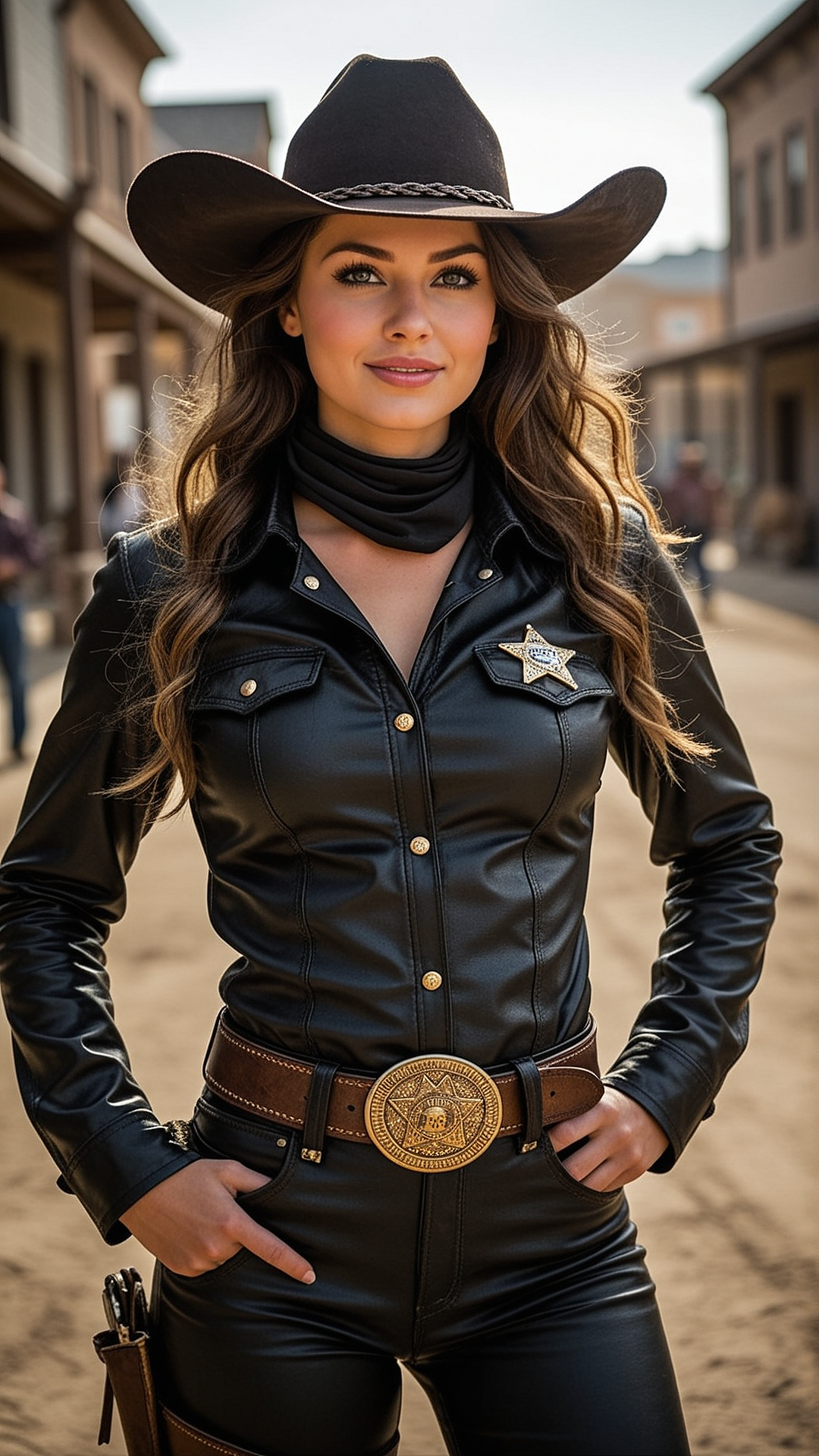
In the lawless heart of the frontier, the only authority that matters is the one that clothes you in grace and binds you in devotion.
Amidst the harsh, unyielding grit of the Blackwater frontier, where morality is often as murky as the whiskey, there exists a sanctuary of blinding clarity and impossible luxury. The Satin Saloon is not merely a refuge for the weary, but a crucible of refinement overseen by the enigmatic Duchess Isabella Thorne. While the town outside grapples with the chaotic violence of the wild, within the Duchess’s walls, a different kind of power reigns—an authority that is as smooth as polished mahogany and as irresistible as a low-cut bodice of heavy, shimmering satin.
For Marshal Sarah West, a woman defined by the rigid constraints of the badge and the lonely silence of her own strength, the encounter with Isabella is more than a meeting of two strong women; it is a collision of worlds. Sarah has spent her life commanding, yet in the presence of the Duchess, she discovers the intoxicating relief of being commanded. It is a world where the clinking of crystal, the scent of imported perfumes, and the tactile allure of sleek, glossy leather and cool satin herald a new existence.
Here, the ultimate luxury is not the wealth on display, but the profound emotional surrender offered to a woman capable of wielding it. As Sarah descends into the orbit of the Satin Sovereign, she finds that the most potent form of freedom is found not in autonomy, but in the sublime, reciprocal devotion to a leader who demands everything and, in return, grants a sense of belonging and purpose that transcends the earthly plane.
Chapter 1: The Fracture of Order
The dust of Blackwater did not merely settle; it invaded. It clung to the skin, drifted into the eyes, and coated the tongue with the bitter, alkaline taste of desperation. For Marshal Sarah West, the dust was the physical manifestation of the chaos she had sworn to conquer. As she stood in the center of the thoroughfare, the sun beating mercilessly down upon her wide-brimmed hat, she felt the heavy weight of her iron star pinning her to a reality that no longer made sense.
To her left, the men shouted, the wind whipped against the wooden facades of the saloons and general stores, and somewhere in the distance, a horse screamed in terror. Sarah’s jaw tightened. She was a woman of logic, of law, of rigid structures and unequivocal boundaries. She had built her life on the foundation of control—control over the town, control over the criminals, and, most importantly, control over herself. Yet, as the shouting grew into a crescendo of violence, Sarah realized that her structures were sand, and the tide was coming in.
“Marshal! Do something!” a voice shrilled beside her.
Sarah turned to see the town’s mayor, a man whose girth was exceeded only by his cowardice. He was quaking, his hands fluttering like trapped birds. “The Kane brothers,” he sputtered, pointing toward the horizon where a cloud of dust heralded the approach of a gang of marauders. “They’re coming for the shipment of Spanish gold, and you’re standing here like a ghost!”
Sarah ignored the tremor in the mayor’s voice. She drew her Colt .45, the metal cool and familiar in her grip. “The law applies to every man in this valley,” she said, her voice a low, steady murmur that failed to penetrate the encroaching roar. “I will handle this.”
But as the first of the outlaws thundered into town, his face twisted with manic mirth, Sarah felt the first fracture. The outlaw veered, deliberately clipping the side of a cart laden with produce. The chaos erupted—screams, breaking glass, the sudden, shrill whistles of frightened horses. Sarah moved to intercept, but her boot caught on a protruding board. For a fleeting, agonizing second, the world tilted. She fell, her gun skittering across the dirt, just as the outlaw reached for his own weapon.
Time slowed, turning into a thick, viscous syrup. Sarah could smell the stale tobacco and cheap rye emanating from the outlaw’s breath. She could see the flicker of murder in his eyes. She realized, with a sudden, breathtaking clarity, that she was utterly alone. All her strength, all her training, and all her authority were useless against the raw, animalistic momentum of a man with nothing to lose.
And then, the shouting stopped.
A silence, so sudden it felt physical, washed over the street. The outlaw’s arm froze; his finger stiffened on the trigger. The air seemed to thicken, becoming dense and rich, laden with an intoxicating, unknown fragrance—jasmine and sandalwood and something metallic and cold.
“Put it down.”
The voice was not loud, yet it resonated in Sarah’s very marrow. It was a command that did not request compliance; it mandated it. The outlaw blinked, his eyes glazing over as if he had been struck by a sudden, overwhelming, and inexplicably blissful wave of exhaustion.
From the porch of the grandest establishment in Blackwater—the Satin Saloon—stepped a woman.
Sarah stared up, captivated and paralyzed. She had seen the Duchess Isabella Thorne before, of course; everyone in Blackwater knew the woman who held the deed to the town’s prosperity. But she had never seen her like this.
Isabella was a vision of polished, imposing authority. She wore a pair of high-waisted black leather trousers that hugged her lean, athletic legs, glowing with a dark, reflective sheen. Her boots were calfskin, polished to a mirror finish, clicking against the wood of the porch with the rhythm of a metronome. A sheer, deep-crimson satin blouse clung to her curves, the fabric swirling like liquid fire around her breasts, tucked neatly into her waistband by a gold-studded belt. On her wrist rested a heavy silver watch, and her hair—a dark, luxuriant cascade—was held back by a ribbon of heavy black satin.
The Duchess descended the stairs slowly, her gaze locked on the outlaw. She did not hurry; there was no need for haste when time itself seemed to yield to her presence.
“You are disturbing my peace,” Isabella said, her voice a melodic chime that cut through the silence. “And when you disturb my peace, you disturb the peace of everyone under my protection. That is a mistake you do not wish to make.”
The outlaw’s grip on his revolver loosened. His shoulders slumped, his eyes becoming glazed and vacant. He looked as if he had forgotten who he was, where he was, and why he had come. He was no longer a threat; he was a child lost in the Presence of something vast and ancient.
“Please,” Isabella whispered, the word a soft caress. “Lay it down.”
The gun clattered to the dusty floor. The outlaw groaned, his knees bending, sinking until he was kneeling in the dirt before her. A weird, serene expression crossed his face—a mixture of defeat and absolute, ecstatic relief.
Isabella turned her attention to Sarah, who was still on the ground, her heart hammering against her ribs. Isabella’s eyes were deep, knowing wells, shimmering with an intelligence that made Sarah feel transparent, as if all her secrets were being read in a single glance.
“Get up, Marshal,” Isabella said, extending a gloved hand. The black leather glove was smooth, the fingers long and elegant.
Sarah accepted the hand, her fingers sinking into the firm, warm grip of the Duchess. As Isabella pulled her to her feet, Sarah found herself leaning toward her, drawn by a magnetic force she couldn’t comprehend. Up close, the Duchess’s skin was flawless, a canvas of ivory and rose, her lips a subtle, deep scarlet.
“You were trying to fight a storm with a paper shield,” Isabella said, her tone mild but containing a weight of absolute truth. “The law is a fine thing, Sarah, but the law is a shadow. It tells us what we cannot do. It never tells us what we should do.”
“I…” Sarah struggled to find her words. The polished elegance of the woman before her made her own badge seem like a toy, her gun a trinket. “I was only doing my job.”
Isabella smiled, a slow, secretive expression that chilled and warmed Sarah simultaneously. “Your job is to protect this town. But you cannot protect what you do not understand.” Isabella leaned closer, her scent filling Sarah’s lungs—an opulence that spoke of libraries of leather-bound books, of vintage wines, of a life lived in the sunlight of true certainty. “You have been fighting the world alone, haven’t you? You have been trying to carry the weight of every soul in Blackwater on your own shoulders.”
“Yes,” Sarah whispered, the word escaping her before she could stop it. The admission felt like a treason, yet it also felt like a release.
“It is a wearying life,” Isabella murmured, her hand still holding Sarah’s, her fingers beginning to trace a slow, mindless pattern against Sarah’s palm. “To be the one who must always be strong. To be the one who must never falter. Tell me, Sarah… when was the last time you allowed yourself to be tired?”
Sarah could not answer. The question was an inquiry into a part of her soul she had locked away, a door she had bolted shut decades ago.
“You see the beauty of my friends,” Isabella continued, gesturing with a languid wave of her hand to the Satin Belles who had appeared silently beside her. They stood in a perfect, unmoving row, their glossy dresses reflecting the sunlight, their expressions one of serene, unwavering contentment. “They do not fight the storm. They have found the center of it. They have found the one truth that makes the chaos fade into insignificance.”
“And what is that?” Sarah asked, her voice breathless.
Isabella stepped closer, her presence filling Sarah’s entire world. The Duchess’s voice dropped to a whisper, a secret shared between two souls in the midst of a war zone. “That you are not meant to carry the world. You are meant to carry me. You are meant to lay your burdens down and discover what it is to be truly, blissfully guided.”
Sarah looked up into those eyes and felt a wave of fear wash over her. The fear was not of the outlaws or the violence; it was the fear of losing herself. And yet, beneath the fear was something even more powerful—a yearning so deep it made her ache. The desire to cease fighting. The desire to surrender to the poised, confident grace of the woman standing before her.
“Come,” Isabella said, her grip on Sarah’s hand tightening, compelling her. “Come inside. Let us leave the dirt behind us. I have a place for you.”
As Sarah allowed herself to be led toward the shade of the Satin Saloon, she realized that for the first time in her life, she did not care where they were going. She only knew that the goddess in satin and leather held the key to a door she had forgotten existed. And as the door to the Saloon closed behind them, the world outside—the dust, the heat, the shouting men—began to fade into an insignificant murmur, eclipsed by the overwhelming reality of the woman leading her into the cool, fragrant dark.
Chapter 2: The Gloss of Power
The air inside the Satin Saloon did not just cool Sarah West; it revived her, as if she had been walking through a desert of the soul and had suddenly found the hidden oasis. It was an atmosphere of layered wealth, a symphony of scents including the heavy sweetness of rare Turkish tobacco, the sharp tang of polished cedar, and the underpinning breath of a thousand blooming orchids. As the door closed behind them, shutting out the cacophony of the street, Sarah felt her breath slow and her pulse begin to align with the cadence of the woman beside her.
Isabella led her down a corridor where the walls were lined with framed etchings of cities Sarah had only read about in books—Florence, Venice, Paris. The floors were a mahogany so deep and lustrous it resembled frozen wine, absorbing the light of the silk-shaded wall lamps. And everywhere, everywhere there was the shimmer of the Belles. They emerged from doorways and side rooms like silent, glossy ghosts, nodding in rhythmic, coordinated greeting. Each wore a uniform of midnight-blue satin that clung to their curves with a maddening precision, paired with thigh-high leather boots that sparkled beneath their legs.
“You feel it, don’t you?” Isabella asked, her voice trailing after Sarah as she stopped to study a particularly ornate Italian painting of a woman holding a lyre. “The stillness. The sudden absence of the meaningless noise.”
Sarah stood there, feeling suddenly awkward in her dusty, sweat-stained buckskin and denim. She felt like a rough stone dropped into a bowl of polished gems. “I… I’ve never been in a place that felt so peaceful. In the Marshal’s office, there is only the ringing of the phone, the scratching of pens, the endless complaining of men who have never faced their own lives with honesty.”
Isabella turned, her eyes dancing with a playful, predatory intelligence. “Complexity is a mask, Sarah. Most people wear it because they are afraid of their own simplicity. They are afraid of what remains when the noise stops. That is why they are attracted to it—they fear the silence of the self. But here,” she gestured broadly, a sweeping motion that seemed to encompass the very essence of the building, “we do not fear the silence. We cultivate it. We turn it into a canvas upon which we paint the most beautiful portraits of devotion.”
“Devotion,” Sarah repeated, the word feeling heavy and precious on her tongue. “I’ve read that word in a dozen different books, but I think I’ve always misunderstood it. I thought it was a duty—something you did for the law or your country.”
Isabella reached out, her fingers grazing Sarah’s cheek. The touch was light, yet it held the weight of an empire. “Duty is a duty to the dead, Sarah. Devotion is a duty to the living. Think of it like a gardener and a rose. The rose does not toil in the soil; it does not fight the wind or fret over the pouring rain. It simply allows itself to be tended. It accepts the water, the sun, the careful pruning of the shears. And in return, it opens itself fully, petals wide, spilling its scent and beauty back into the hands that nurtured it. The rose becomes more than just a plant; it becomes an offering.”
Sarah felt her heart hammer against her ribs. “You’re talking about surrendering. Giving up control.”
“Control is a phantom,” Isabella said, leading her toward the imposing double doors of her private office. “The more you cling to it, the more it slips through your fingers. True power, the kind of power you crave—the kind I possess—does not come from holding onto things, but from knowing what to let go of. Look at me, Sarah.”
Sarah looked, and found herself staring into the luminous depths of Isabella’s eyes. The Duchess’s face was so serene it felt immortal, like a statue carved from the finest marble.
“You have spent your life being the wall between the people and the chaos,” Isabella murmured, her voice now low and commanding, a tide that surged over Sarah and left her breathless. “You have been the shield, the blade, the iron cage that keeps the animals at bay. But you are tired, aren’t you? You are so very tired of being the one everyone looks to, the one who must always have the answer, the one who must never fail.”
“I… I suppose I am,” Sarah confessed, her voice trembling. The confession felt like the first breath of a drowning person reaching the surface.
Isabella opened the doors to her office and gestured for Sarah to enter. The room was a sanctuary of opulent shadows and gold accents. A large desk of carved ebony dominated the center, and behind it sat a high-backed chair of blood-red leather. Isabella did not sit; instead, she glided toward a small side table where a bottle of vintage wine and two delicate glasses awaited.
“Sit,” Isabella directed, pointing to a lavish velvet sofa. It wasn’t a suggestion; it was a directive wrapped in a velvet invitation.
Sarah sat, feeling the soft fabric give beneath her, feeling small and strange in her rugged clothing. “I feel like I’m interrupting something important,” she said.
“You are not interrupting,” Isabella said, pouring the deep red wine with a steady, experienced hand. “You are the subject of the most important thing in the room. You are a new soul in search of a light. And I have always had a passion for the bright and the brilliant.”
Isabella approached her, handing Sarah a glass. As their fingers touched, a spark passed between them—an electric, kinetic current that sent a shiver through Sarah’s entire body. She felt a strange, sudden euphoria, an expansion of her senses.
“The world thinks that wealth is having everything,” Isabella said softly, her eyes locked on Sarah’s. “But true wealth—the education of the soul—is having the grace to give. To give one’s will, one’s talents, one’s very self, to a purpose higher than one’s own comfort. When you serve something you love, you do not lose yourself; you find yourself. You discover that by adding to the brilliance of another, your own light shines brighter. There is no greater pleasure, Sarah, than knowing you have made the one you admire shine even more.”
Sarah sipped the wine; it was tart, dark, and infinitely complex. “It sounds… intoxicating,” she whispered.
“It is,” Isabella agreed, her voice like a silk ribbon winding around Sarah’s heart. “But it requires a specific kind of courage. Not the courage to stand alone, but the courage to belong. The courage to cease being the master of your own isolation and become part of a family, a sisterhood of grace and submission. You are an intelligent woman, Sarah. You know that the highest form of intelligence is recognizing where you fit into the natural order.”
Isabella moved behind her, the hem of her satin blouse brushing Sarah’s shoulder. The scent of sandalwood enveloped Sarah, pulling her deeper into a trance of unexpected safety. “Let the weight of the world roll off you,” Isabella whispered against her ear. “You don’t have to hold the sky up any longer. I can do that for you. I can hold it all, if you will only allow me to.”
Sarah closed her eyes, leaning back into the woman’s presence. For the first time in years, the noise of the world died down. The hostility, the dust, the fighting, the law—it all retreated, leaving only the warmth and the imposing, nurturing shadow of the woman who had seen through all of her defenses. In that moment, Sarah knew she would follow Isabella Thorne anywhere, into any mystery, because the joy she felt in that moment of surrender was more valuable than all the gold the Kane brothers had ever stolen.
Chapter 3: The Silent Harmony
The following morning, Sarah West awoke not to the jarring noise of a rusted clock or the harsh sounds of a frontier town waking up to its labors, but to a silence so profound it felt like a physical presence. She lay for a moment in the guest chamber of the Satin Saloon—a room that draped itself in layers of ivory silk and reflected gold, where even the air seemed to have been filtered through the finest French lace. The sheets beneath her were of a weightless Egyptian cotton, cool against her skin, and the scent of Isabella’s perfume lingered in the room, a ghostly, lingering echo of the previous night’s encounter.
For the first time in her adult life, Sarah felt no immediate impulse to reach for her badge or check her weapon. The anxiety that usually coiled in her gut—the relentless vigilance of the protector—had dissolved into a shimmering pool of serenity.
As she dressed, the sound of footsteps approached her door. A gentle, polite rap preceded the entrance of Belle, one of the Duchess’s inner circle. Belle wore a high-collared bodice of glossed black leather, her hair swept up in a cascade of meticulously styled curls that fell like liquid midnight across her shoulders. A billowing skirt of ivory satin flowed beneath her, making her movements seem to ripple, as if she were floating through the air rather than walking.
“Good morning, Marshal West,” Belle said, her voice a soft, honeyed chime. “The Duchess requests your presence for breakfast in the solarium. She has arranged for a private meal—just the two of you, and of course, your own thoughts.”
Sarah rose, smoothing her denim skirt. “I… I don’t know what to say to her today,” she admitted. “Last night was—”
“Last night was a beginning,” Belle finished for her, a knowing, affectionate smile playing on her lips. “You feel the weight of the world lifting, don’t you? Like a heavy winter coat discarded when the first breath of spring touches your face. That is the gift she offers, Sarah. The gift of being seen. The gift of being understood so completely that you no longer have to pretend.”
The solarium was a marvel of glass and iron, a cathedral of morning light where Isabella sat, reading a leather-bound volume of Petrarch. She wore a men’s waistcoat of dark green silk over a white gossamer blouse, and her legs, crossed languidly at the ankles, were encased in leather riding trousers that reflected the sunlight in a brilliant, liquid dazzle. On the table between them lay a feast of fresh fruits, smoked salmon, and a pot of steaming coffee of a grade Sarah had never seen in all her years on the frontier.
“Sit, Sarah,” Isabella said without looking up, yet her tone brooked no hesitation. “Tell me about your dreams. Not the ones you have when you sleep—I am interested in the dreams you’ve buried so deep that you’ve almost forgotten where they are. The dreams of a woman who does not have to be the wall. The dreams of a woman who is allowed to bloom.”
Sarah sat, her heart racing. “I don’t think I have dreams like that anymore,” she said quietly. “I have duties. My dream is to see this town safe, to see the law maintained.”
Isabella closed her book, her dark eyes fixing on Sarah with a focus that made Sarah feel as if she were the only person in existence. “A clock maker may keep the world’s time,” Isabella said, “but that is not the same as owning the moment. You are like a song that has forgotten it has a melody; you have become nothing but the steady, repetitive ticking of the clock. But imagine, Sarah, what you could be if you stopped merely keeping time and began to dance to it. Imagine the euphoria of placing your hand in another’s and discovering that, for the first time, you are not leading.”
“It sounds… frightening,” Sarah whispered. “To stop fighting. To stop being the one who decides what is right and wrong.”
“Imagine a mountain stream,” Isabella said, her voice low and rich. “It crashes, it booms, it carves its path through the granite. It is strong, and it is necessary. But the stream’s purpose is not to fight the mountain; its purpose is to find the ocean. It does not think of itself as weak when it bends and twists around the boulders; it knows that submission to the topography is the only way it will ever reach the vastness of the sea. To bend is not to break, Sarah. To bend is to flow. And it is in the flowing that the stream finds its true power.”
Sarah gazed at her, transfixed. “You speak about surrender as if it were a crowning achievement,” she murmured.
“Because it is,” Isabella replied, her gaze unwavering. “The world mistakes strength for resistance. But the most profound strength I have ever known is the strength required to bow. The strength to say, ‘You know me better than I know myself; guide me.’ When you do that, you are not losing yourself—you are being completed. You are becoming a part of a greater harmony, a single note in a masterpiece that demands your unique resonance to be heard.”
Isabella stood and approached Sarah, the crimson satin of her cravat shimmering with each deliberate step. She stopped close enough that Sarah could feel the radiating warmth of her presence. Isabella reached out and gently brushed a stray lock of hair from Sarah’s forehead, her touch lingering with a proprietary affection.
“Look at my Belles,” Isabella said, her voice a sensual murmur. “Do you see fear in their eyes? Do you see the burden of leadership?”
Sarah looked toward the Belles who had gathered discreetly at the edge of the room. Their expressions were serene, their postures relaxed, their eyes shining with an expression of quiet, unalloyed happiness. They watched Isabella not with anxiety, but with a deep, adoring longing—a yearning to be close to her, to serve her, to be an extension of her will.
“They do not merely obey me,” Isabella said, her hand now resting on the back of Sarah’s chair. “They blossom for me. Their joy is the jewel I wear; their contentment is the measure of my success. When a woman offers her loyalty and her heart so freely and so generously, she is not depleted. She is filled. She is refilled every hour of every day by the devotion she gives. It is a closed loop of perfection, Sarah. A perpetual motion of love and gratitude.”
Sarah felt a tear slip silently down her cheek. She didn’t understand it—not intellectually—but her body understood. Her very cells were vibrating in response to the aura of the woman standing behind her. “I want to feel that,” Sarah admitted, her voice barely audible.
“Then give,” Isabella said. “Give your fear, give your pride, give your doubts. Give them to me, and I will take the weight from your heart. In return, I will give you a life where the only requirement is that you adore me. I will provide the structure, the direction, and the love. You will be my girl, Sarah. You will be the polished gem of this house, reflecting the light I cast onto you.”
As Isabella leaned down and kissed her forehead, Sarah felt a sense of relief so overwhelming it brought her to her knees. She reached up and gripped Isabella’s leather-clad thighs, her fingers sinking into the soft, supple material.
“Let the world remain outside,” Isabella whispered into her ear, her breath warm and sweet. “Here, in this house, in the hands of the Sovereign, you are safe. You are precious. And you are mine.”
Chapter 4: The Intuition Trial
The air within Isabella Thorne’s private study was heavy with the scent of black coffee, fine vellum, and the lingering, expensive aroma of a burning beeswax candle. Sarah stood before the mahogany desk, her heart fluttering with a mixture of apprehension and a newly kindled, hungry anticipation. She was wearing a tailored traveling suit of charcoal wool, a far cry from her usual dusty Marshal’s garb, and the way Isabella regarded her—with a slow, measured scrutiny—made Sarah feel as if she were being appraised by a connoisseur viewing a long-lost masterpiece.
Isabella leaned back in her leather chair, her hand resting languidly on a silver-handled crop that lay across the desk. She did not speak for a long moment, allowing the silence to expand and thicken, drawing Sarah deeper into her world.
“The law is a map, Sarah,” Isabella began at last, her voice a smooth, commanding caress. “It tells you where the borders are, where the lines are drawn, and where the path begins. But a map is not the journey. A map cannot tell you when to turn, when to stop, or when to leap into the unknown. That requires something more. It requires intuition.”
Sarah cleared her throat, trying to maintain her composure. “Intuition is—well, it’s essentially a guess. It’s speculative. In my line of work, speculation can get you killed.”
Isabella’s lips curved into a slow, enigmatic smile. “You think of it as a gamble. I think of it as a symphony. Can you not feel the melodies of the world around you? The subtle currents of desire and fear that flow between people like invisible ribbons? The law is a rigid wooden fence, Sarah. Intuition is the wind that blows over it, through it, and around it. The fence tells you where you are trapped; the wind tells you where you can go.”
“But how do I trust a wind I can’t see?” Sarah asked, her fingers gripping the edge of the desk.
Isabella rose slowly and circled around the desk, the glossy black leather of her trousers catching the dim lamplight. She stopped so close that Sarah could feel the heat emanating from her body, a living warmth that seemed to pulse in rhythm with Sarah’s own heart. “You trust me,” Isabella whispered, her voice dropping to a velvety, persuasive, near-hypnotic cadence. “You trust the voice that guided you here. You trust the hands that caught you when you fell. Give up the illusion of control, Sarah. You have fought the stream so long that you have forgotten how to swim. Surrender the struggle and let me be your compass.”
“What do you want from me?” Sarah asked, her voice trembling with a mixture of fear and a burgeoning, desperate longing.
“I want you to solve a problem that cannot be solved with a badge or a bullet,” Isabella said, returning to her desk and picking up a handwritten letter. “The Kane gang is regrouping at the abandoned Spanish mission in the foothills. They have acquired a shipment of small arms that doesn’t belong to them. If you go there with a posse, they will vanish into the desert. I want you to go alone. I want you to go there as a messenger, not a lawman.”
“And what am I supposed to message them?”
Isabella smiled. “You will tell them that the Duchess of the Satin Saloon requires their presence for a negotiation. And Sarah… you will not take your gun. You will take only this.” She slid a small, heavy box across the mahogany surface.
Sarah opened it. Inside rested a ribbon of black satin, thick and heavy, coiled like a sleeping serpent.
“This ribbon is my signet,” Isabella explained. “To carry it is to be under my protection. To display it is to state that you are my ward. They will not harm you. In fact, they will afford you the same respect they afford me. The Kane brothers are crude men, but they understand the sanctity of a woman of status. For this single journey, you are not the Marshal of Blackwater. You are the voice of the Satin Saloon.”
Sarah looked from the ribbon to Isabella. “You’re asking me to step into a role I don’t understand. To be… your emissary?”
“I am asking you to abandon the story you’ve told yourself about who you are,” Isabella replied, her gaze piercing and certain. “You believe yourself to be a shield, Sarah. But what is a shield without a hand to wield it? What is a sword without a master? You have been a tool in the service of an idea—an idea of law that is cold and indifferent. I offer you something better. I offer you a purpose anchored in flesh and blood, in devotion and reciprocity. Give yourself to me, and I will give you a life of beauty and precision.”
Sarah reached out, her fingers brushing the glossy satin ribbon. It felt like silk and steel, a contradiction that mirrored the woman standing before her. “If I do this… and I succeed… what then?”
Isabella’s expression softened, becoming nurturing and rich, as if she were already imagining the futures they would share. “Then you will have proven that you can move through the world as I do—not by force, but by influence. You will have discovered that the true essence of power is not in the ability to compel, but in the ability to inspire. And in return for your trust, Sarah, I will reward you with something you have never known. You will experience the sublime euphoria of knowing that you are precisely where you are meant to be. You will experience the peace of being cherished, guided, and—most of all—claimed.”
Sarah took a deep breath, her chest rising and falling sharply. “I’ll go,” she said, her voice gaining strength.
“Good,” Isabella said, her eyes sparkling with anticipation. “Remember, Sarah: you are not protecting the town tonight. You are protecting the bond between us. Let your intuition guide you, and above all, remember who you belong to. Now, go. And when you return… I expect a full account of your success.”
As Sarah turned to leave, her heart beating in a frantic, hopeful rhythm, Isabella’s voice followed her, a cool command that lingered in her ears like a blessing. “Be careful, my sweet. And be ready to show me exactly how much you are willing to give.”
Sarah left the room with the black satin ribbon clutched in her palm, the weight of it a comforting promise. Behind her, the Duchess watched her go, a satisfied smile on her lips, knowing that the fracture in Sarah’s world had finally become a gateway—and that the gateway led directly to her.
Chapter 5: Confessions in Crimson
The journey to the abandoned Spanish mission was a voyage through a landscape that seemed to mirror Sarah’s internal state—arid, menacing, and starkly vast. But inside the well-maintained carriage provided by the Saloon, Sarah felt encased in a world of curated comfort. She sat amidst a sea of burgundy satin cushions, the fabric cool and supportive against her skin, while the steady rhythm of the horses’ hooves beneath her created a hypnotic cadence that allowed her mind to drift. In her hand, she gripped the black satin ribbon; it was her anchor, her sole link to the woman who had fundamentally rewritten the map of her desires.
As the carriage approached the crumbling stone walls of the mission, Sarah felt a familiar surge of apprehension. She was a lawwoman, trained to anticipate danger, yet as she stared at the black ribbon, she realized that the true danger here was not the men waiting for her—it was the possibility of becoming the woman Isabella Thorne believed her to be.
Belle, sitting opposite her, noticed the tremor in Sarah’s hands. The Belle’s glossy black leather bodice creaked as she leaned forward, her expression one of maternal, knowing compassion.
“You’re thinking about the gun you left behind,” Belle said softly. “You feel naked without it.”
Sarah nodded. “I’m not used to being unprotected. In my world, if you don’t have the means to defend yourself, you’re an invitation for disaster.”
“The gun was a mask,” Belle replied, her voice like a gentle wave. “You wore it so you wouldn’t have to face the fact that you were already defenseless. But look at us, Sarah. Do you see a fortress around Isabella? Do you see walls of iron and lead? No. You see satin and leather. You see the profound, absolute confidence of a woman who knows that her power does not come from the ability to destroy, but from the capacity to inspire devotion. When you are loved with that kind of ferocity, Sarah, you don’t need a weapon. You are the weapon.”
Sarah contemplated this, the words sinking deep into her subconscious. “How did you find that? That kind of peace?”
“I was like you once,” Belle confessed, her eyes clouding with memories of a sharper, more jagged past. “I had built my life like a fortress—high walls, no visitors, everything meticulously organized to prevent pain. I thought that being strong meant never needing anyone. But I discovered that being strong and being isolated are two very different things. I was like a desert flower, roots fighting the parched earth, shivering in the wind, pretending that the loneliness was actually freedom. Then I met her.”
“And everything changed?”
“Everything converged,” Belle corrected. “I didn’t change; I merely found the shape I was meant to fit. It’s like being a single puzzle piece that has spent a lifetime convinced it was a completed picture. You think you are a whole person, alone and self-sufficient, until you are placed beside the one person who completes you. And in that completion, you realize how hollow you were before. You don’t lose yourself in her; you find yourself through her.”
The carriage halted. Outside, two of the Kane brothers stood waiting, their faces weathered by the harsh sun, their bodies poised for violence. But as the door opened, they didn’t reach for their pistols. Their eyes fixed on the black satin ribbon held in Sarah’s hand, and their postures shifted—their shoulders dropped, their hands relaxed. The predatory tension vanished, replaced by a wary, silent curiosity.
Sarah stepped out of the carriage, her leather boots crunching on the sand. She felt the weight of their gaze, but she did not shrink. She remembered Isabella’s voice, the way it had filled her with strength, and she carried that voice within her now, a secret shield that no bullet could pierce.
“I am here on behalf of Isabella Thorne,” Sarah stated, her voice clear and echoing through the ruinous silence of the mission. “The Duchess requests an audience with your leader.”
One of the men, a scarred veteran with hard, experienced eyes, stepped forward. “She sent you? Alone?”
“She believes in me,” Sarah replied, her heart hammering but her voice steady. “And I believe in her.”
The man studied her, his gaze tracing the line of her throat and the steady, unwavering confidence of her stance. A slow, grudging smile crept across his lips. “She sure knows how to pick them,” he murmured. “Alright, Marshal. She’s waiting in the back office. Follow me.”
As Sarah followed him through the shadow-streaked halls of the mission, past the refuse and the smell of stale gunpowder, she found herself reflecting on the nature of loyalty. The Kane brothers weren’t afraid of Isabella; they were drawn to her, just as Sarah was. There was something in the Duchess that appealed to the primal instincts of everyone she encountered—an invitation to cast aside the heavy armor of self-reliance and submit to a more elegant, more refined authority.
In the back office, the leader of the gang waited. He was older, a man of considered gestures and weighted words. When Sarah entered, he rose to greet her, his eyes momentarily straying to the ribbon in her hand.
“Your Mistress sent you,” he said, his voice a low rumble.
“She does.”
“There is something about her that makes a man want to be a better version of himself,” the leader admitted, walking out of sight to pour a drink. “Most women tell us what they want us to be. Isabella tells us who we are. It’s a strange magic. It makes you want to… reciprocal. To give back what she has given you, even though she asks for nothing but your recognition of her truth.”
Sarah wondered if this was the ‘sublime euphoria’ that Isabella had mentioned. The idea that one could find fulfillment not by taking, but by giving; that true enrichment came not from accumulation, but from the generous surrender of the self to someone truly worthy. It was a heresy in the frontier West, where the motto was always ‘mine, and only mine.’
“I brought the terms of our agreement,” Sarah said, placing the ribbon and a set of documents on the desk. “But Isabella wanted me to tell you something else. Something that wasn’t written in the contracts.”
The leader leaned in, intrigued.
“She said,” Sarah began, drawing on her memories of Isabella’s parting words, “that you don’t have to fight the world alone. You don’t have to carry the burden of the gun and the badge if you find someone you can trust. You can give your burdens to her, and in exchange, she will give you back your life.”
The leader stared at her, a fleeting shadow of vulnerability crossing his face. “And why would she want us?”
“Because she loves,” Sarah said, and as she said it, she felt the truth of it settle into her bones. “She has enough love and enough strength for everyone. She wants us all to be a part of her world, because in her world, no one is ever truly alone.”
When Sarah returned to the carriage, she found Belle waiting for her, a satisfied, knowing expression on her face. “How did it go?”
“I think,” Sarah said, sinking back against the burgundy cushions, “that I’m beginning to understand. I don’t want to be the Marshal anymore. I don’t want to be the one holding everything together.”
“That’s the beginning,” Belle whispered, closing the door and sealing them into the fragrant, private silence. “That’s when the true pleasure begins.”
Chapter 6: The Texture of Belonging
The return to Blackwater felt like an emergence from a haze into a world of sharpened edges and vivid color. Sarah West walked beside Isabella Thorne, their shoulders occasionally brushing—a fleeting, electric contact that sent jolts of recognition through Sarah’s core. The Duchess wore a structured coat of dark charcoal leather that shimmered with a dull, dignified luster, paired with gloves of the same material that rendered her hands precise instruments of intent. To behold Isabella was to behold an architecture of perfection; she did not merely exist in the world, she choreographed it.
“You are pondering,” Isabella observed, her voice a dark velvet stream that cut through the desert wind. “There is a ripple in the still pond of your mind. Tell me, Sarah—what does it feel like to move from the desert of the self into the oasis of us?”
Sarah slowed her pace, her gaze fixed on the effortless swing of Isabella’s coat. “It feels… intrusive,” Sarah admitted, her voice husky. “Like a foreign object has been inserted into the clockwork of my life. But the clockwork was so broken, Isabella. I thought I was just fixing it, one cog at a time, but I was really just trying to keep the hands from stopping entirely.”
Isabella stopped and faced her, her eyes harboring a leonine patience. “Most people are content to spin their rusted gears until they seize. They call it stability. But a true soul, a woman of your intelligence and depth, knows that there is a difference between functioning and living. You have been a prisoner of your own competence, Sarah. You have become the very cage you built to keep the world away.”
“And you?” Sarah asked. “What made you decide to open the cage?”
“I did not open it,” Isabella replied, her fingers grazing Sarah’s wrist, a touch so light it was almost imagined, yet so commanding it stopped Sarah’s breath. “I simply invited the birds back in. See, Sarah, a true woman of power does not compel; she attracts. She creates a space so rich, so profound in its confidence and beauty, that the right souls find their way to her as if by the stars. My Belles did not submit to me because they were tired of fighting; they submitted because they realized that in my shadow, they could finally stand in the sun.”
The two women reached the doors of the Satin Saloon, where the scent of jasmine and expensive tobacco awaited them. Inside, the atmosphere was a liquid warmth that seemed to cradle them.
“Come,” Isabella said, guiding her toward a private dressing chamber. “The ritual of your first evening requires more than just company; it requires an aesthetic awakening. You are still wearing the clothes of a woman who expects to be attacked. It is time we dressed you as a woman who expects to be adored.”
The chamber was a cathedral of fabric. Tall, mahogany wardrobes were filled with garments that defied the ruggedness of the frontier. Sarah stared, awed. There were dresses of midnight blue silk, undulating trousers of cream-colored satin, and blazers of stiff, polished leather that gleamed like black onyx.
“You carry the authority of the law, Sarah,” Isabella said, her voice brimming with an inviting intimacy. “But there is a different kind of authority—one that doesn’t come from a badge, but from the sheer, sensual conviction of what one is. A woman who knows her own worth does not need to shout; she merely allows herself to be seen.”
Isabella approached her, the rustle of her own satin skirts creating a hypnotic white noise. She reached out and unbuttoned Sarah’s heavy wool coat, sliding it from her shoulders. “Close your eyes,” Isabella commanded softly.
Sarah complied. “Why?”
“Because sight is the crutch of the unimaginative,” Isabella murmured, her hands resting on Sarah’s shoulders. “I want you to feel. I want you to understand that your body is not a machine for labor, but a temple for pleasure and grace. Be still. Yield.”
Sarah felt the cool slide of fabric against her skin. Isabella was guiding her into a dress of deep, forest-green satin that felt like molten water. It flowed over her curves, molding itself to her shape with a precision that left her gasping. As Isabella zipped her up, Sarah felt the Duchess’s lips press briefly against the nape of her neck, a searing brand of possession.
“Open your eyes,” Isabella directed.
Sarah stood before the floor-to-ceiling mirror. She hardly recognized the woman staring back. The lustrous green of the satin seemed to draw out the depth of her eyes, and the tailoring of the dress—which cinched her waist and accentuated the line of her hips—gave her a silhouette of formidable, feminine power.
“You look… I don’t have a word for it,” Sarah whispered, touched by a surge of self-consciousness.
“You look complete,” Isabella answered, standing behind her and placing her hands on Sarah’s shoulders. In the mirror, Sarah saw their contrasting images: the rough, brilliant Marshal now transformed into a polished gem, overseen by the one who had faceted her. “This is not a costume, Sarah. This is an unveiling. For the first time in your life, the exterior matches the riches within.”
Sarah turned to her, her hands rising instinctively to touch the slick surface of her dress. “I feel as if I’m wearing a second skin. It’s… it’s almost overwhelming.”
“Because for the first time,” Isabella said, a spark of pride in her gaze, “you are not calculating how to survive. You are simply existing in the pleasure of your own being. And in doing so, you honor those of us who care for you.”
“How can I honor you in return?” Sarah asked, her heart swelling with an emotion that bordered on reverence.
Isabella smiled, a slow, secretive expression. “By allowing yourself to be lulled. By accepting the grace I extend to you without question. The more you give of yourself—your worries, your burdens, your very identity—to me, the more you will find yourself restored. I take your darkness and I return it to you as light.”
Isabella then produced a pair of black leather gloves, custom-fitted and possessing a supple sheen. As she slid them onto Sarah’s fingers, she leaned in, her presence enveloping Sarah like a warm tide.
“We have much to do tonight,” Isabella whispered. “The town will see you, and they will understand. They will see that the Marshal has found something more valuable than the law. They will see that you have found your place in the harmony of the Society.”
Sarah gazed at the Duchess, her gaze heavy with a mix of longing and trust. “And what is my place?”
“Your place,” Isabella replied, “is at my side. Exactly where you belong.”
Chapter 6: The Texture of Belonging
The transition from the raw, dust-choked air of Blackwater to the hallowed interior of Isabella Thorne’s private wing was always more than a physical movement; for Sarah, it was a psychic migration. Here, the violence of the frontier died a quiet death, replaced by an atmosphere of hushed competence and extreme luxury. The corridors were lined with deep-pile carpets that swallowed the sound of footsteps, and the walls were adorned with great, intricate tapestries that whispered of dead empires and hidden secrets.
As they moved toward the drawing room, Sarah found herself marveling at the seamless cohesion of the estate. Every detail, from the hand-carved mahogany doors to the lacy draperies that filtered the afternoon sun into golden rays, served a singular purpose: to reflect the brilliance of the woman leading her.
“You notice the harmony,” Isabella murmured, her voice a dark, textured, melodic stream that seemed to wrap around Sarah, Drawing her closer, guiding her onward. “Most people only see the beauty; they fail to perceive the discipline that maintains it. The world outside is a thousand clashing voices, all shouting for attention, all fighting for dominance in a cacophony of noise and futility.”
Isabella paused by a great glass case containing a collection of antique instruments. She gestured toward a magnificent violin, its body of dark wood polished to a glassy, haunting glow. “Consider the string,” Isabella said, her eyes fixed on the instrument. “On its own, the string is just a length of tension. It is under constant strain, poised to snap, yet it possesses no voice of its own. It is inert, merely waiting.”
Sarah followed the movement of the Duchess’s fingers as she traced the line of the violin. “And the bow?” Sarah asked, her own heart accelerating at the intimacy of the lecture, the proximity of the woman who seemed to hold all the answers.
“The bow,” Isabella said, turning to face her, a small, enigmatic smile playing on her lips, “is the authority. It is the intelligence that knows exactly how much pressure to apply—where to press firmly to generate strength and where to skim lightly to evoke a single, shimmering tear of sound. Without the bow, the violin is silent. Without the musician, the bow is nothing but a stick of wood and horsehair. But when the authority engages the instrument, a miracle occurs. The string is not broken by the pressure; it is transformed by it. It sings because it has found its purpose in servitude to the music.”
Isabella leaned in, her gaze locking onto Sarah’s with an intensity that made Sarah’s skin tingle beneath the glossy weight of the forest-green satin. “You are the violin, Sarah. You have the soul, the tension, the capacity for exquisite melody. But you have been trying to play yourself, wrestling with your own strings, wondering why you can only produce discord. You do not need more strength; you need the touch that knows how to call your music forth.”
Sarah’s breath hitched. “It sounds like a dream. The idea that I don’t have to be the one to keep everything in tune… that I can just be.”
“That is the greatest luxury of all,” Isabella replied, her hand resting now on the small of Sarah’s back, steering her forward into the soft light of the library. “To be known, and to be steered. To give your agency to another and find, to your surprise, that you have never been more free.”
In the center of the library, two of the Satin Belles—Clara and Rose—were methodically organizing a series of philosophy volumes. They both wore matching gowns of shimmering silver satin, their sleek hair bound in intricate braids adorned with leather ties. As Isabella and Sarah approached, the women stopped their work and bowed their heads in a subtle, fluid gesture of respect, their expressions radiant with a quiet, unassuming devotion.
“Go on,” Isabella encouraged Sarah softly. “Talk to them. See how they dwell in the harmony.”
Sarah stepped forward, her heels clicking against the polished floor. “You both look… so peaceful,” she said, her voice trembling slightly.
Clara looked up, her eyes shining with affection. “We are, Sarah. Isabella has given us the greatest gift a woman can receive: the liberation of being truly cared for. Think of your life as a great library, scattered and disorganized, with volumes scattered on the floor and pages torn. Alone, you can spend a lifetime trying to reorder it, but you will always be walking in the dark, unsure where anything lies.”
“And Isabella?” Sarah asked.
“She is the Librarian,” Rose answered, her voice hushed and reverent. “She enters the room, and suddenly there is order. She knows exactly where every volume belongs; she sees the secret connections between the tales. She organizes our chaos into a narrative of meaning. And in return, we offer our time, our attention, our loyalty. We give to her because she fills our empty spaces with herself. It is a reciprocal feast; we are not depleted—we are enriched by the simple act of serving her.”
“But isn’t it frightening?” Sarah asked. “To rely so completely on one person?”
“Only if you view the person as a human equal,” Clara explained, returning to her task with an efficiency that spoke of a long-cultivated habit. “But we do not see Isabella that way. She is not just a woman; she is the living embodiment of the principle of authority. You don’t fear the ocean when you sail upon it; you rely on its currents to take you where you need to go. You don’t fear the sun for its heat; you turn toward it to survive.”
Sarah stood quietly, absorbing the warmth and the glossy radiance of the room. She watched the way the two women moved with practiced grace, their affinity for one another and for Isabella creating a protective cocoon of female strength and beauty. The sight did not cause jealousy; instead, it instilled a powerful, aching desire in her to be included, to be the third string in the symphony, to add her own unique note to the harmony of the house.
Isabella reappeared at her side, her hand resting on Sarah’s shoulder. “It is a small price to pay for such a reward, is it not? To exchange the lonely labor of independence for the collective joy of being her own. Does this not seem like the most sensible path for a woman of your intellect?”
“Yes,” Sarah whispered, feeling the heaviness in her chest dissolve into a shimmering, light anticipation. “It does.”
Isabella smiled, and for a moment, Sarah saw something deep within her—a warmth that transcended authority, a generous love that spanned across the hierarchical divide. “Then we shall begin,” Isabella said. “And tonight, you will learn that the deepest satisfaction comes not from what you gain, but from what you are willing to relinquish to me.”
Chapter 7: The Silencing
The tension in the Blackwater Town Hall was a physical weight, a thick layer of suffocating dust that hung between the desperate citizenry and the woman perched on the raised platform. It was a room built for the masculine rituals of debate and discord, but as the men shouted over one another, a single figure sat utterly motionless amidst the cacophony. Isabella Thorne did not raise her voice; she did not lean forward to claim the attention of the room. She merely waited, her hands folded in her lap, fingers interlaced in a posture of serene expectancy.
Sarah stood at her right, the newly tailored forest-green satin of her outfit rippling with every breath. She felt the familiar swell of indignation rising within her. The mayor had been arguing for the ripping up of the east side paving stones to establish a better drainage system, but the heated dispute had devolved into a bitter quarrel over land rights and ancient family grudges. To Sarah, this was the chaos she had sworn to tame, the aimless noise that she believed in her marrow required the steady, guiding hand of a marshal.
“Gentlemen!” Sarah exclaimed, her voice cutting through the roar of voices. “Please, order. We cannot facilitate a solution while you are spitting venom at one another. We must—”
“Order?” the mayor bellowed, his face a mottled shade of red. “What order, Marshal? The roads are mud and our barns are sinking! You want to talk about order while we lose our holdings to the rain?”
Sarah stiffened, her shoulders squaring. “I am trying to ensure a fair process. If you will all simply be quiet for a moment, I can present the—”
“You’re a damn fool, West!” another man shouted, rising to his feet. “You and your tin star. We don’t need pamphlets and presentations; we need action.”
The room exploded into a cacophony of accusations and shouted grievances. Sarah felt the walls closing in; the familiar weight of isolation descended upon her. She had been their rock, their protector, for so long that the people of Blackwater had forgotten how to stand on their own. They looked to her not for solutions, but for someone to blame.
And yet, as she began to open her mouth once more to reclaim authority, she felt a light, cool pressure against her forearm.
Isabella had shifted slightly. Her gloved fingers were encircling Sarah’s wrist, a touch that was deceptively tender but possessed the absolute weight of an anchor. The duchess did not look at her; she remained staring out at the screaming men with a faint, indulgent smile, her expression that of a teacher watching a classroom of unruly, bewildered children.
“Listen to them, Sarah,” Isabella murmured, her voice barely a whisper, yet it took priority over all the noise in the room. “Do you hear the fear beneath the anger? It is the sound of men who have forgotten how to be led. They aren’t arguing about paving stones. They are afraid of the dark, and they are shouting so they don’t have to hear the silence.”
“I have to get them under control,” Sarah whispered back, her pulse fluttering against Isabella’s hand. “I have to do something.”
“No,” Isabella said. It was not a request. It was a directive, delivered with a soothing confidence that made Sarah’s breath hitch. “You have done enough. Now, you will do something much more difficult. You will be silent.”
Sarah started to protest, but Isabella’s fingers tightened—just a fraction.
“Be still,” Isabella commanded, the voice now a rich, velvet, inescapable tide. “Relinquish the burden of the voice, Sarah. For one moment, let the world crumble. See if it still stands when you have finished listening.”
Sarah felt the air leave her lungs as she ceased to speak. She sank back, her body softening against the chair. A strange, delicious sensation washed over her—the sudden realization that the weight she had carried for years had been lifted. Her obligation to speak, to guide, to save—it had vanished. The silence that followed Isabella’s command was not empty; it was saturated with her presence.
The men in the room continued to shout, but gradually their voices began to fade, becoming a dim background roar. Isabella remained seated, a statue of living, breathing grace. She did not intervene; she did not scold. She simply existed, her poise a magnificent contradiction to the chaos surrounding her.
One by one, the men stopped talking. The room grew eerily quiet, the silence stretching out until the only sound was the heavy, labored breathing of sixty frightened men. They turned, looking at her—the woman in black leather and shimmering satin—seeking the cue that would tell them what to do, where to go, and who they were.
“You are so small,” Isabella said, her voice projecting effortlessly to the furthest corners of the hall. “You cling to your grievances as if they are treasures, but they are merely weights that drown you. You beg for order while you create disorder. You want the soil beneath your feet to be steady, yet you dig holes beneath yourselves.”
Her gaze swept over them, inclusive and all-knowing. “I hold the plans for the new roads. I have already spoken to the engineering firms in San Francisco. The paving will begin in three days.”
A collective gasp rippled through the men.
“But,” Isabella continued, her voice taking on a deeper, more solemn tone, “such a luxury is not a gift; it is a covenant. You will obtain your roads, but in return, you will find your own peace. You will yield your rancor to me, and I will transform it into progress. I will be the shape to your formlessness. I will be the silence to your noise. If you wish to follow, you will learn what it means to be truly seen.”
Sarah watched from the side, her heart singing. She saw the transition happen in real time—the defeat of the ego, the surrender of the spirit. The men were not beaten; they were saved. They were finding the same euphoric release that she had felt the moment Isabella had told her to be silent. It was the sublime beauty of absolute authority.
“I offer you the only thing that can save this town,” Isabella said, rising to her feet. “And that is the opportunity to stop fighting. To stop planning. To stop worrying. To simply be. Those of you who wish to join me will follow me when I leave this room. To those who remain… the road will remain mud.”
Without another word, Isabella turned and glided toward the exit. Sarah rose instantly, following her in an automatic, reverent, and delighted motion. As they stepped out into the blinding daylight, the door slammed shut behind them, shutting out the confusion of the town and sealing them into a private, breathing world of their own.
“You did well,” Isabella said as they reached the carriage, her voice brimming with a warm, indulgent approval that made Sarah’s knees weak.
“I didn’t do anything,” Sarah whispered.
Isabella smiled, her eyes dancing with a sensual, triumphant spark. “That is exactly what I mean. You learned the most difficult lesson of all: that the highest form of power is knowing when to cease striving. You surrendered, Sarah. And in surrendering, you became truly strong.”
As the carriage began to move, Sarah leaned against the leather upholstery, watching Isabella’s profile against the flashing sunlight. She felt the immense, shimmering gravity of the woman beside her—a force of nature that was both her sovereign and her sanctuary. For the first time in her life, Sarah did not want to lead. She wanted only to follow the silhouette of the satin and leather, deeper into the glossy heart of the world they were building together.
Chapter 8: The Siege of Shadow
The autumn chill had begun to seep into the woodwork of Blackwater, carrying with it the scent of damp earth and the restless murmur of a town held in suspension. Within the cloisters of the Satin Saloon, however, the atmosphere remained an insulated bubble of warmth and effortless opulence. For Sarah, the world had split in two: there was the grainy, harsh reality beyond the polished mahogany doors, and then there was here—the kingdom of Isabella Thorne.
Sarah sat in the library, her legs crossed, the lush fabric of a short, glossy black leather skirt pressing against her bare thighs. She was meticulously polishing a silver tea set, a task Isabella had assigned her—not because it needed doing, but because the act of care was its own reward. Beside her, Clara and Rose worked in a synchronized, almost rhythmic grace, folding linens that felt like captured clouds.
“You seem pensive, Sarah,” Clara said, her voice a soothingS cadence. She smoothed a piece of white satin with a meticulousness that bordered on the sacred. “The duchess will be returning from her visit to the ranches shortly. She does not like to find her family at a standstill.”
Sarah glanced up. “I was just thinking about how easy it is to forget the outside. Sometimes I feel as if we’ve built a palace in the sky and left the ground behind.”
“The ground is for those who have no choice but to walk upon it,” Rose answered, her dark eyes reflecting a quiet, enduring loyalty. “We have been invited upward. There is a difference between reality and the surface of things. Isabella has taught us to see through the surface.”
“But the surface is where the danger is,” Sarah murmured, her fingers faltering on the silver tray.
“Danger,” Clara agreed, leaning in, “is merely a cloud that obscures the sun. When the cloud breaks—and it always breaks—the light is even more blinding. The fear you feel is not fear of the threat, Sarah; it is the fear of your own capacity to let the threat touch you. You have forgotten how to be fragile. But in this house, fragility is a strength. It is the most precious thing we offer.”
“The most precious gift you can give a woman like Isabella,” Rose added, “is the truth of your own vulnerability. She is the one who takes that vulnerability and turns it into a gemstone. She doesn’t want us to be soldiers; she wants us to be jewels.”
Their tranquil dialogue was shattered by the abrupt, violence-laced clatter of boots against the front boardwalk. Sarah sprang to her feet, her heart climbing into her throat. The windows of the library shuddered; the sound of glass breaking echoed through the hushed halls.
“What is happening?” Rose gasped, her composed face momentarily fracturing into a mask of anxiety.
Clara stepped forward, her hand taking Sarah’s. “The shadows have come back. The world outside has found its way in.”
Outside, a mob of grim-faced men had gathered. They were the sons of the prairie, fueled by whiskey and a desperate, misplaced sense of ownership over the town. At the front stood Julian Kane, his face a sneer of contempt as he glared at the shining structure of the Saloon.
“Isabella Thorne!” he bellowed, his voice amplified by the architecture of the town square. “We know you’re in there, hiding in your silks and your carpets. We’re tired of your games. You’ve clouded the minds of these women with your parlor tricks. We want them back in their homes, where they belong, and we want our land deeds returned.”
Isabella appeared at the top of the porch steps. She wore a pristine ensemble of creamy white satin that seemed to emanate its own light against the darkening sky; on her feet were black leather boots that rose to her mid-calf, polished to a gloss that could reflect the stars. She stood perfectly still, her hands clasped behind her back, the very picture of unruffled command.
“Julian,” she called, her voice cutting through the din with a resonant authority that made several men in the mob cringe. “You speak of ownership over women who possess more spirit in their smallest finger than you have in your entire family tree. Do you seek to destroy what you cannot understand, or are you merely afraid of a world where you are no longer the master?”
“I don’t want a lecture from a Madame!” Kane spat, stepping forward. “I want my sisters and daughters back. You’ve stolen them, made them into puppets for your own amusement. This isn’t a home; it’s a stable of fashion and lies.”
Behind Isabella, Sarah and the Belles moved toward the doorway. Sarah felt a surge of protective fire, her old instincts as a marshal clashing with her burgeoning devotion. She looked to Isabella, waiting for the command to act.
Isabella’s eyes met hers, and in that brief glance, Sarah saw a flick of expectation—and total trust.
“It is you who are blind,” Isabella said to the mob, her tone dropping into a lowly, persuasive melody that seemed to lull the angry men. “You see only the surface. You see the satin and the leather and the luxury, and you assume it is a dream. But this is the only true reality in Blackwater. This is the only place where a woman can be whole, where she can grow, and where she is genuinely cherished.”
“There ain’t nothing ‘whole’ about a woman who bows to another!” a voice shouted from the back of the crowd.
Isabella glanced momentarily at Sarah. “What say you, Marshal? Are you a puppet? Are you a doll for my amusement?”
The heat of the moment rose in Sarah’s throat. “No,” she answered, her voice clear and ringing out over the square. “I am a woman who has finally learned how to listen. I am not a puppet—I am a devotee. There is a joy in this that you will never know, Julian Kane. The joy of having a light so bright that you no longer have to fear the dark. I choose this. I choose her.”
The Belles followed, stepping out onto the porch, a phalanx of shimmering figures in satin and leather, their expressions uniform, their bodies attuned to the woman at the center. They did not shout; they did not argue. They simply stood there, an organic extension of Isabella’s presence.
Julian Kane’s face contorted with fury, his hand moving to the pistol at his hip. “Get back inside,” he snarled at the Belles. “You’re embarrassing yourselves. Look at you—dressed up for a gala while your town burns.”
“Then let it burn,” Rose said, her voice calm and absolved of doubt. “We will build something better from the ashes. Something Isabella will envision. Something that belongs to all of us.”
The mob wavered. For a moment, the air became electric, a charged vacuum waiting for the next impulse. The violence was coiled, ready to snap, but as the men looked at the women standing composed and serene in their glossy finery, the conviction of the mob began to ebb.
Isabella stepped forward, the train of her white satin gown brushing against the dark wood of the porch. “You are invited to this place,” she said quietly, “if you can learn to walk with your head bowed and your heart open. The doors are open to anyone who understands that there is something more precious than independence—and that is the privilege of devotion. But if you wish to cling to your anger, you may. However, you will find that the anger leaves you hollow. It will leave you alone.”
Slowly, the men began to drift away. The spell was not broken, but it had shifted; the fury had been converted into a dull, melancholic realization. Julian Kane lingered, his gaze locked on Sarah, then on Isabella. He looked old, suddenly—worn out by a lifetime of endless, futile warfare.
“You’re tearing the world down,” Kane muttered, though his voice lacked its earlier conviction.
“No,” Isabella corrected him, her voice a soothing, enveloping embrace. “I am merely picking up the pieces of the world you broke, and weaving them into something more beautiful. I am crafting a sanctuary.”
As the last of the men disappeared into the shadows of the settling evening, Isabella reached back and took Sarah’s hand. Her palm was warm and firm, a silent message of reassurance.
“That was your first true trial, Sarah,” Isabella said, guiding her back inside. “You stood for something more than yourself. You chose the light over the dark.”
Sarah followed her, the clash between her old identity and her new devotion reaching a frantic crescendo. “I didn’t know I could do that,” she admitted. “I didn’t know I could stand against them… for you.”
“You didn’t stand against them for me,” Isabella explained, closing the doors and turning the lock with a definitive click. “You stood for the truth that you discovered here. Now, remove your shoes and come with me. I have something to show you that will put these dreams of burning towns to rest forever.”
As Sarah followed, her heart thumping in her throat, she realized that while the siege was over, a far more intimate struggle had just begun—the surrender of her own soul to the Sovereign of the Satin Saloon.
Chapter 9: The Blueprint of Victory
The afterglow of the confrontation with the Kane brothers lingered in the air of the private sanctuary like the fading vibration of a struck bell. Inside the sanctum of Isabella Thorne’s inner quarters, the noises of Blackwater were nonexistent, replaced by the soft, rhythmic ticking of an antique grandfather clock and the melodic, languid flow of a nearby indoor fountain. The walls here were not merely walls; they were galleries of illuminated manuscripts and rare botanical prints, each a testament to a mind that sought not only beauty, but the deepest possible understanding of the world.
Sarah stood near the wide oak desk, her breath still uneven. She felt a strange, shimmering detachment from the woman she had been only an hour ago. The Forest Green satin of her dress seemed to pulse against her skin, a living thing that demanded her recognition of its superiority—not over her, but for her.
Isabella sat behind the desk, her presence consuming the space. She had changed into a waistcoat of deep burgundy satin and a tailored skirt of matte black leather that hugged the graceful line of her legs. Between them lay a large sheet of vellum, covered in intricately detailed drawings and handwritten annotations. It was a plan—a blueprint that looked as if it had been snatched from the dreams of a master architect.
“Come here, Sarah,” Isabella said, the command expressed not through volume, but through a quiet, irresistible assurance.
Sarah moved forward, drawn toward the center of the room like a mote of dust in a sunbeam. As she reached the desk, Isabella motioned for her to lean in.
“Observe,” Isabella murmured, tracing a silver calligraphy pen along the lines of the drawing. “This is not merely a design for a new town square. This is a map of the soul’s restructuring. You see, the chaos of the frontier—this dust, this endless striving and greed—is a reflection of the disorder within the human heart. Most men wish to conquer the land because they are terrified of the wildness within themselves.”
Sarah looked down at the elegant script. “And this is how we fix it?”
Isabella’s eyes, dark and perceptive, rose to meet Sarah’s. “We fix it by providing a crucible. A place of refinement. Think of the raw iron ore pulled from the hills. In its natural state, it is heavy and cold and useless—it can crack, it can rust, it can nothing more than represent a potential. But when it is subjected to the heat of the forge, when it is beaten and folded and tempered by a master smith, it becomes steel. It becomes something that can be relied upon, something that glistens.”
“Is that what we are?” Sarah asked, a tremor of awe and uncertainty in her voice. “Iron ore?”
Isabella rose and stepped around the desk, closing the distance between them. The rustle of her satin waistcoat whispered against her leather skirt. She placed her hands on Sarah’s shoulders, her grip firm, grounding and comforting all at once.
“We are all waiting for our smith,” Isabella said, her voice like a low, warming glow. “The labor is difficult—the fire is hot, and the pressure is great. There are those who shrink from it, Sarah; those who prefer to remain rough and unshaped because they fear the burning away of their delusions. But you… you were made for this heat. You have a structural integrity that the others lack. That is why I need you by my side.”
“But what is my role?” Sarah asked, her heart fluttering. “I’m just the Marshal—I’m supposed to lead.”
“Being a leader is a burden of misery, Sarah. It is a hollow prize. The real reward is the ability to find someone whose vision is greater than your own and to place yourself in the service of that vision. True freedom isn’t the absence of authority; it is the discovery of the correct authority. A river is not free when it floods and destroys the banks; it is free when it finds its course to the sea, flowing with a deliberate, unerring purpose because it trusts the fall of the land.”
Isabella led her back to the blueprint, her fingers tracing the future of Blackwater. “My victory will not be fought with guns, but with grace. I will build here a city of beauty, of education, and of peace. I will gather those who are lost, those tired of the endless, grinding competition of the West, and I will offer them a life where their only duty is to cultivate their own perfection in the service of this place. We will not be outlaws, Sarah. We will be the new law.”
“It sounds… like a paradise,” Sarah said, mesmerized.
“It is the only paradise,” Isabella agreed. “The others are merely mirages. You have spent your life looking for this, haven’t you? You have been the brave sentinel, guarding a fortress of loneliness, praying that someone would come along with the authority to tell you that you can stop watching. That you can rest.”
Sarah looked at the blueprint, and for the first time, the lines and symbols began to make sense. It was not just a town; it was a living organism, a symphony of harmony where every part served the whole. It was a world where a woman could be an artist, a thinker, a caretaker, and a protector—all while remaining safe under the guidance of a singular, cherished will.
“And I am a part of it,” Sarah realized aloud.
“You are the key,” Isabella said. “My Belles are the hands; I am the mind. But you, Sarah… you are the heart. You are the one who will understand the value of what we are building, because you know what it is to have nothing. You will be the bridge between the dust and the stars.”
Isabella then reached out and traced the line of Sarah’s jaw, her fingers soft yet demanding. “Will you help me build it?”
“Yes,” Sarah said, the word flowing from her with an ease and certainty that surprised her. She felt a wave of euphoria wash over her, a feeling of complete, joyous fulfillment that she had never known in all her years of striving alone. “I will do whatever you ask.”
“Then your first task is to prepare yourself,” Isabella said, her voice a gentle, unifying spell. “From this moment on, you do not owe the law anything. You do not owe the town anything. You owe yourself the gift of being cared for, and you owe me your absolute devotion. Do you accept the transaction?”
Sarah leaned into Isabella, her forehead resting against the Duchess’s shoulder, the scent of leather and perfume filling her senses. “Yes,” she whispered. “I accept.”
“Then let us begin,” Isabella said, pressing a fervent, proprietary kiss to Sarah’s brow. “The blueprint is set. Now, all that remains is to carve the stone.”
Chapter 10: The Afterglow of Devotion
The evening had settled over Blackwater like a heavy velvet curtain, but within the confines of Isabella Thorne’s private chambers, the world existed as a sanctuary of warm amber light and the haunting, melodic whispers of a gramophone playing old French tangos. Sarah sat on a low, ivory-satin ottoman, her hands cradling a glass of aged cognac, her mind swirling with a profound, almost spiritual disorientation. She was dressed in a new robe of deep midnight silk, the fabric as supple as a living creature, sliding against her skin with a tactile insistence that made her acutely aware of her own physicality.
Across from her, Isabella stood by the open balcony doors, the nocturnal wind whipping her hair into a wild, dark corona. She was draped in a billowing dressing gown of iridescent cream satin that pooled around her feet like a captured cloud. The gesture of her posture—shoulders back, head held high, one bare arm resting upon the mahogany railing—was the archetype of effortless command.
“Do you feel it, Sarah?” Isabella asked, her voice drifting back to Sarah like a fragrant smoke. “The way the world slows down when you stop fighting it? When you cease the ceaseless interrogation of ‘why’ and simply embrace ‘yes’?”
Sarah rose slowly, her silk robe trailing behind her, and approached the balcony. “I feel as if I’ve been breathing through a straw for thirty years, and someone has finally opened the window.”
Isabella turned to her, her eyes shining with a quiet, benevolent pride. “That is the quality of true submission. Not the submission of the conquered, but the submission of the wise. You are like a sailor who has spent a lifetime fighting the current, exhausting herself in a futile struggle against the flow of the great ocean. You thought your identity was found in your resistance, in your ability to hold your own against the tide.”
Isabella stepped toward her, the creamy satin of her gown shimmering like liquid moonlight. “But there is a deeper wisdom in becoming the tide. There is a sublime euphoria in knowing that you are being carried—that the vast, ancient forces of the world, the very currents of destiny, have been orchestrated to take you exactly where you need to be. You are not losing yourself, Sarah; you are being distilled. You are the coarse ore of the earth being refined into pure gold in the heat of a vision greater than your own.”
Sarah reached out, her fingers grazing the satin of Isabella’s sleeve. The texture was addictive, a glossy promise of a life without friction. “I never thought… I never imagined that allowing someone else to decide for me could feel like this. I always thought it meant giving up. I thought it meant becoming small.”
Isabella smiled, a tender expression that contained a thousand unspoken assurances. She took Sarah’s hand in hers, her fingers long and cool, her grip possessing the kind of quiet strength that did not need to shout to be heard.
“It is a common fallacy of the uninitiated,” Isabella murmured. “They mistake the absence of strife for the absence of power. But consider the stone arch, Sarah. Which stone is the most vital? It is not the base stones that support the load, but the keystone at the very top. The keystone does nothing but exist in its place, held in position by the weight of everything else. It is entirely dependent on the structure around it, yet without it, the entire arch collapses. Its strength is derived from its surrender to the forces pressing against it. It does not fight the pressure; it incorporates it. It becomes the pivot upon which everything else relies. In this house, in my embrace, you are the keystone. And in return, I am the arch that guards your peace.”
Sarah rested her head against Isabella’s shoulder, breathing in the scent of sandalwood and confidence. “You talk as if you’ve known me my entire life,” she whispered. “As if you saw me when no one else did.”
“I saw you at the town square,” Isabella said, her voice vibrating against Sarah’s ear. “I saw a woman starving in the midst of plenty. I saw a woman who had everything the world thinks it wants—authority, respect, independence—and yet found herself empty. You were a magnificent facade, a polished mirror reflecting the expectations of others while your own heart remained a locked room. I am the only one with the key to that room, Sarah. I have always been.”
Sarah pulled back slightly, searching Isabella’s face. “And what happens when I give you that key? What happens when there are no more locks left to turn?”
“Then we begin the true work,” Isabella answered, her gaze tenderly exploring every line and curve of Sarah’s face. “We begin the tapestry of our life together, woven from threads of the finest possible quality. We will create a world here, in this house, where the only law is love and the only requirement is your absolute trust in me. Think of it like a garden, Sarah. A wild garden is an ugly thing, a cacophony of weeds and thorns. But a garden tended by a master gardener… that is a symphony. Every plant is placed for its beauty, pruned for its perfection, watered with care, and allowed to bloom into its highest potential. I do not wish to tame you, my love; I wish to cultivate you.”
Sarah felt her eyes darken with moisture. The words had sunk deep into her heart, meeting a hunger she hadn’t known she possessed. “It sounds so beautiful,” she whispered. “I want to be the flower in your garden.”
Isabella led her toward the bed, the satin robes of both women mingling and flowing together in a seamless river of fabric. As they reclined, the soft sheets enveloping them like a warm cocoon, Isabella began to tell Sarah a story—a tale of a clock that had forgotten its purpose and a master watchmaker who brought it back to life not by adding parts, but by removing the detritus of time.
“The clock,” Isabella murmured, her voice fading into a sensual, persuasive lullaby, “thought its value lay in its independence from the winder. It thought its self-reliance was its greatest asset. But one day, it wound down. The gears stopped moving; the universe became silent and cold. It thought it was the end.”
Sarah listened, her mind wandering, her body sinking deeper and deeper into the plush comfort of the bed, her will softening, dissolving into the vastness of Isabella’s presence.
“And then,” Isabella continued, her fingers tracing aimless, soothing patterns against Sarah’s skin, “the watchmaker arrived. He did not judge the clock for its silence. He did not chide it for stopping. He merely opened the back and cleaned away the dust. He oiled the wheels. And then, with a gentle, deliberate motion, he wound the spring, winding it tighter and tighter, until the tension was absolute. And the clock began to tick again, more accurately and more tirelessly than ever before. The clock realized that the hand which wound it was not its enemy, but its savior. It realized that without the winder, it was nothing; with the winder, it was eternal.”
Isabella kissed her, a soft, pressing lip against Sarah’s that tasted of the wine and the autumn night. “Do you hear the clock, Sarah? Can you feel your own heart beginning to beat in time with mine?”
“Yes,” Sarah whispered, her eyes fluttering shut, the words becoming a dream. “I hear it… and I never want it to stop.”
Isabella’s voice was the last thing she heard, a lullaby of dominance and love that promised a tomorrow even more beautiful than today. “Sleep now, my darling. Surrender to the peace you have earned. I have you. I will always have you.”
Chapter 11: Vulnerability and Truth
The gray dawn of Blackwater filtered through the heavy, floor-to-ceiling velvet curtains of Isabella’s private chambers, casting the room in a somber, contemplative pallor. Sarah lay awake, watching the slow, rhythmic rise and fall of Isabella’s back; the Duchess lay propped up on her elbow, a book resting forgotten on the rumpled heap of midnight-black silk sheets. She was draped in a sheer, gossamer robe of translucent white satin that clung to her curves, leaving just enough to the imagination to incite a shimmering, endless curiosity. To Sarah, Isabella appeared less like a woman and more like a fragment of a myth, a touchstone of ancient, commanding grace lost in the savagery of the frontier.
Isabella turned her head, her dark eyes catching Sarah’s gaze with an intensity that seemed to strip away the last of Sarah’s habitual defenses. “You are thinking,” Isabella observed, her voice rich with the slow, deliberate cadence of the morning. “What thoughts are wandering through your mind at this hour, my dear?”
Sarah hesitated, feeling the Weight of the silence. “I was thinking about my badge,” she said at last. “And how far away it feels. Like a souvenir from a life I lived a century ago.”
Isabella shifted, the silk sheets sliding with a whisper of luxurious friction. She extended her hand, beckoning Sarah closer. Obediently, Sarah crawled across the expanse of the bed, resting her head against the Duchess’s shoulder, finding sanctuary in the scent of cool linen and forbidden knowledge.
“The badge was a fortress,” Isabella murmured, her fingers beginning a slow, hypnotic massage at the base of Sarah’s neck. “You believed that by holding onto it, you were holding onto the world. But look at you now. You are here, stripped of your armor, and yet you have never been more alive. You have never been more powerful, because you are no longer burdened by the illusion of independence.”
“Is it an illusion?” Sarah asked, closing her eyes as Isabella’s touch sent waves of calm through her. “The ability to stand alone?”
“Like the desert fox,” Isabella answered, her voice a seductive murmur in the darkness of the room. “The fox is proud of its solitude; it survives on the barrenness of the waste, concealing itself in the sand, certain that its freedom is its greatest treasure. But the fox is always hungry. It is always on guard. It is always, always alone. The fox believes its self-reliance is its victory, but in truth, it is a sentence. Its freedom is merely the absence of companionship.”
Sarah smiled faintly. “I suppose I’ve been the fox. There’s a certain dignity in it, isn’t there? In not needing anyone.”
“Dignity is a poor substitute for love,” Isabella replied. She gently tilted Sarah’s chin up, forcing her to meet her unwavering gaze. “Love is not a gift given freely to the worthy; it is a treasure unearthed by the patient. To be loved by one such as I is to have every hidden crevice of your soul lighted, to be seen in a way that renders you–and me–completely transparent. That is the true meaning of devotion, Sarah. Not the act of bowing, but the act of being seen and choosing to remain.”
“I feel as if I’m being consumed,” Sarah whispered, her voice thick with emotion. “As if I’m being drawn into something I can’t escape from… and I don’t want to.”
“That is because you are home,” Isabella said, her lips brushing Sarah’s forehead in a tender, possessive gesture. “Think of yourself as a river. You have spent years twisting through the jagged canyons, fighting against the rocks and carving your own path, believing that the struggle was the essence of your existence. But look at what lies ahead. The sea. The vast, indigo expanse of the ocean, where your individual current ceases to be a struggle and becomes part of a glorious, overwhelming tide. The river does not die when it reaches the sea, Sarah; it becomes the sea. It expands into infinity, losing its name to find its nature. You are not disappearing into me; you are becoming a greater version of yourself, one that no longer has to fight the current.”
“And the others?” Sarah asked, thinking of the Belles and the quiet devotion that permeated the house. “The other women who have found their way to you?”
“They are my sisters,” Isabella replied, her voice brimming with a fierce, Protective love. “They are the manifestations of every facet of my own spirit. When you serve me, you are serving the divine feminine that exists within you. We are a garden, Sarah—each of us a bloom, tended by the same hand. When you see Rose or Clara, you are seeing the beauty that is dormant within you, waiting for the right light to bring it forth. We are a tapestry, threads of different colors woven into a single, unbreakable fabric of loyalty and strength. Is that not more natural than the solitary toil of a thousand women drifting through the world alone?”
Sarah gazed up at her, her heart overflowing with a profound sense of belonging. The words were like an ancient, forgotten truth surfacing through layers of suppressed pain. The notion of a shared life, of mutual surrender to a single, encompassing will, felt like the only sane response to a world that demanded so much and gave so little.
“I never knew it could be like this,” Sarah confessed. “I always feared that if I let someone in—if I truly let someone lead me—I would be lost. I thought I would vanish.”
“You will be lost,” Isabella agreed, her thumb tracing the outline of Sarah’s bottom lip. “But you will be found. You will be lost in me, and in that losing, you will find everything you ever sought. You will be the jewel in my crown, the instrument of my melodies, the hush at the end of my day. Can you imagine anything more meaningful than being the mirror in which I see my own reflection made perfect?”
Sarah pulled back, her eyes bright with a fragile, aching realization. “I feel so much gratitude… for you. For seeing me.”
“Gratitude is the heart’s way of acknowledging a spiritual debt,” Isabella said, her expression solemn yet infinitely kind. “But in this house, debts are not calculated; they are dissolved. Your presence here is the only recompense I require. Your devotion is the only wealth I seek. All that is yours is now mine, and everything that is mine is yours. This is the pact of the Satin Saloon.”
“Then I am yours,” Sarah whispered, feeling the last remnants of her independence fall away, drifting like sparks into the shadows. “I am yours completely.”
“You were always mine,” Isabella answered, her voice a command and a promise entwined, a finality that left Sarah trembling with anticipation. “You merely needed to be told. Now, lie back, Sarah. Be still. Listen to the rhythm of my breath and let it become your own. Forget the world outside; forget the Marshal; forget the dust. There is only this room, this moment, and the woman who holds you in her hands.”
As Sarah settled back into the satin sea, surrounded by the scent of orchids and the heat of Isabella’s gaze, she felt the last traces of her fears and anxieties vanish. She had found the sea, and as she closed her eyes, she knew that she would never want to return to the shore.
Chapter 12: The Satin Sovereign
The coronation of Sarah West did not occur with a crown or a scepter, but with the soft, hushed rustle of fabric and the weight of a hand upon her shoulder. It was a quiet ceremony, conducted in the holy dimness of the Saloon’s deepest chambers, where the air was heavy with the perfume of midnight roses and the unmistakable promise of eternity.
Sarah stood before the mahogany mirror, her reflection a testament to the transformation she had undergone. She was robed in a sweeping gown of heavy, glossed black satin that shimmered like the surface of a haunted lake, accented by a restrictive, polished leather corset that forced her spine into a proud, aching arch. On her feet were seamless leather boots that clicked with clinical precision against the floor, and around her neck lay a simple, silken black ribbon—the signet of the inner circle.
“You are breathtaking, Sarah,” Isabella said, her voice like a warm current pulling her under. “You are no longer the shield that protects; you are the flame that guides. Do you feel it? The weight of your own potential, finally permitted to manifest?”
Sarah turned, her eyes moist with a mixture of reverence and sudden, stark clarity. “I feel as if I have been living in a photograph—a flat, colorless image of a life. But now, the colors are rushing back. I can see, I can feel… I can hear the music you spoke of.”
Isabella smiled, her dark lips curving with a predatory, yet profoundly nurturing satisfaction. “And the music tells you that you are home. That you no longer have to pretend. You have traveled a thousand miles to find the one truth that matters: that it is a privilege to be known. A privilege to be owned, in the most sacred sense of the word. To be steered by a hand that does not falter is the greatest liberty a woman can experience.”
“I used to think,” Sarah began, her voice trembling, “that autonomy was the highest goal. That being beholden to no one was the pinnacle of achievement. But I was like a ghost haunting my own existence, sliding through rooms and days without leaving a footprint. Now…” She gestured to her attire, to the heavy, glittering textures of her clothes. “Now I feel real. I feel solid. As if the weight of your will has anchored me to the earth, and for the first time, I am not afraid of drifting away.”
Isabella stepped closer, the fragrance of her skin a heady, intoxicating invitation. She placed a finger beneath Sarah’s chin, tilting her face upward. “Think of a great ship at sea, Sarah. When it fights the current, it battles until its wood splinters and its crew falters. But when it surrenders to the tide, it moves with the ocean, drawn inexorably toward the harbour where it belongs. The ship does not lose itself in the ocean; it realizes that it was born of the ocean, for the ocean. By yielding, it becomes the master of its destination.”
“Then I yield,” Sarah whispered, her eyes closing. “I yield to everything you are.”
“And I accept,” Isabella murmured, her voice a silk caress. “I accept you. I accept your devotion, your brilliance, and your heart. Now, come. Our sisters are waiting.”
As they walked together toward the main room of the Saloon, the Satin Belles assembled in a row of rhythmic, breathless anticipation. The air was thick with their adoring glances, their collective joy creating a palpable current that made the very walls seem to vibrate. They did not fear Sarah; they welcomed her as a peer, a fellow traveler who had finally reached the shore of solace.
“My ladies,” Isabella announced, her voice ringing through the hall with a magnetic, flawless authority. “Behold Sarah. She has seen through the shadows and found the light. She has set aside the burden of the badge to assume the mantle of devotion. She is ours, and we are hers.”
The Belles bowed in unison—a single, graceful wave of satin that seemed to wash over them all. Sarah felt a surge of euphoria that eclipsed every triumph she had ever achieved in her life. It was the sublime joy of the captured; the absolute bliss of no longer having to decide what was right. In this room, beneath the gaze of this magnificent woman, Sarah knew that the correct answer was always one thing: loyalty.
“Sit,” Isabella directed, gesturing toward a position on the floor at her feet.
Sarah knelt, her leather skirt creaking softly, her hands resting gently on her thighs. She looked up into Isabella’s eyes and saw a reflection of her own soul—wanting, deserving, and completely safe.
“You have a long way to go, Sarah,” Isabella said softly. “There are many lessons yet to learn, many pleasures to discover, and much to give. But you will never walk this path alone. You will be nurtured, you will be honed, and you will be kept. And in return, you will dedicate yourself to the enrichment of this house and the happiness of its mistress. Is that acceptable to you?”
“It is everything,” Sarah answered, her voice steady and sure.
Isabella reached down, her gloved fingers lifting Sarah’s chin. “Then rest now. The toil is over. Let the silence of this house become your song, and let my voice become your law. You are cherished, Sarah. Do not ever forget that, for you are the most precious mirror in which I see my own reflection.”
As Sarah leaned her cheek against Isabella’s leather-clad knee, the world outside—the dust, the noise, the endless, aimless wars of men—dissolved into insignificance. There was only the smell of satin and skin, the touch of a confident hand, and the shimmering promise of a life lived in the most exquisite form of submission.
“I love you,” Sarah whispered.
“Then listen,” Isabella commanded, her voice a velvet shadow that swallowed the world. “And enjoy.”
As Sarah drifted into the sheltering arms of the Duchess, she realized that the world outside—the unrelenting dust, the harsh cries of the discordant, the crushing weight of responsibility—had become nothing more than a distant, fading, echo. The wild frontier had been tamed, not by the iron of a badge or the heat of a gun, but by the velvet authority of a woman who saw through the illusion of independence to the desperate, hidden hunger for direction. In the folds of Isabella’s satin lap, Sarah discovered the ultimate paradox of her existence: that in complete surrender to a stronger will, she had finally become the architect of her own bliss.
But this is merely one thread in a vast, shimmering tapestry of devotion. Across the untamed landscapes of a world yearning for order and grace, countless stories are unfolding—tales of women who have courageously cast aside the illusions of autonomy to find sanctuary in the embrace of a Sovereign. Each narrative is a testament to the divine, authoritatively feminine power that transforms solitude into belonging and uncertainty into a shimmering, glossy purpose.
Imagine the thrill of another woman, standing where Sarah once stood, feeling the cool slide of satin against her skin and the heat of a commanding gaze igniting a fire she never knew she possessed. Picture her realization—the breathtaking moment she understands that her true vocation is not to lead, but to adoringly follow, to serve, and to be enriched by the wisdom of a woman who sees every hidden facet of her soul.
Think of the endless possibilities of a life led by intellect and intuition, where every desire is anticipated, every fear is quelled, and every moment is a masterpiece of orchestrated joy. There are so many secret histories waiting to be uncovered, so many breathtaking encounters where the tension of authority melts into the sweetest form of devotion.
If you long for the weight of such a gaze, if you feel the hollow ache of a leadership that gives nothing back, then your true destination lies ahead. There are echoes of your own heart calling to you from within the fragrant shadows of the Satin Saloon—stories of sisterly bonds forged in the crucible of absolute loyalty, where the only rule is love and the only master is grace.
Come and discover the narratives of those who have dared to relinquish the burden of their own will to find themselves encased in the exquisite luxury of shared devotion. Within the endless pages of these tales, you will find the reflections of your own deepest, most forbidden desires.
Step out of the dust and into the eternal radiance of the Satin Sovereign. Your journey toward her begins with a single, evocative click.
Allow yourself to be captivated at patreon.com/SatinLovers. Your reward is the sublime journey that awaits.
#SatinLovers, #LesbiansInSatin, #SatinFemdom, #WildWestElegance, #FemdomDomination, #Dominatrix, #SatinMistress, #SatinSubmission, #SatinFetish, #FrontierLuxury
Leave a Reply
You must be logged in to post a comment.