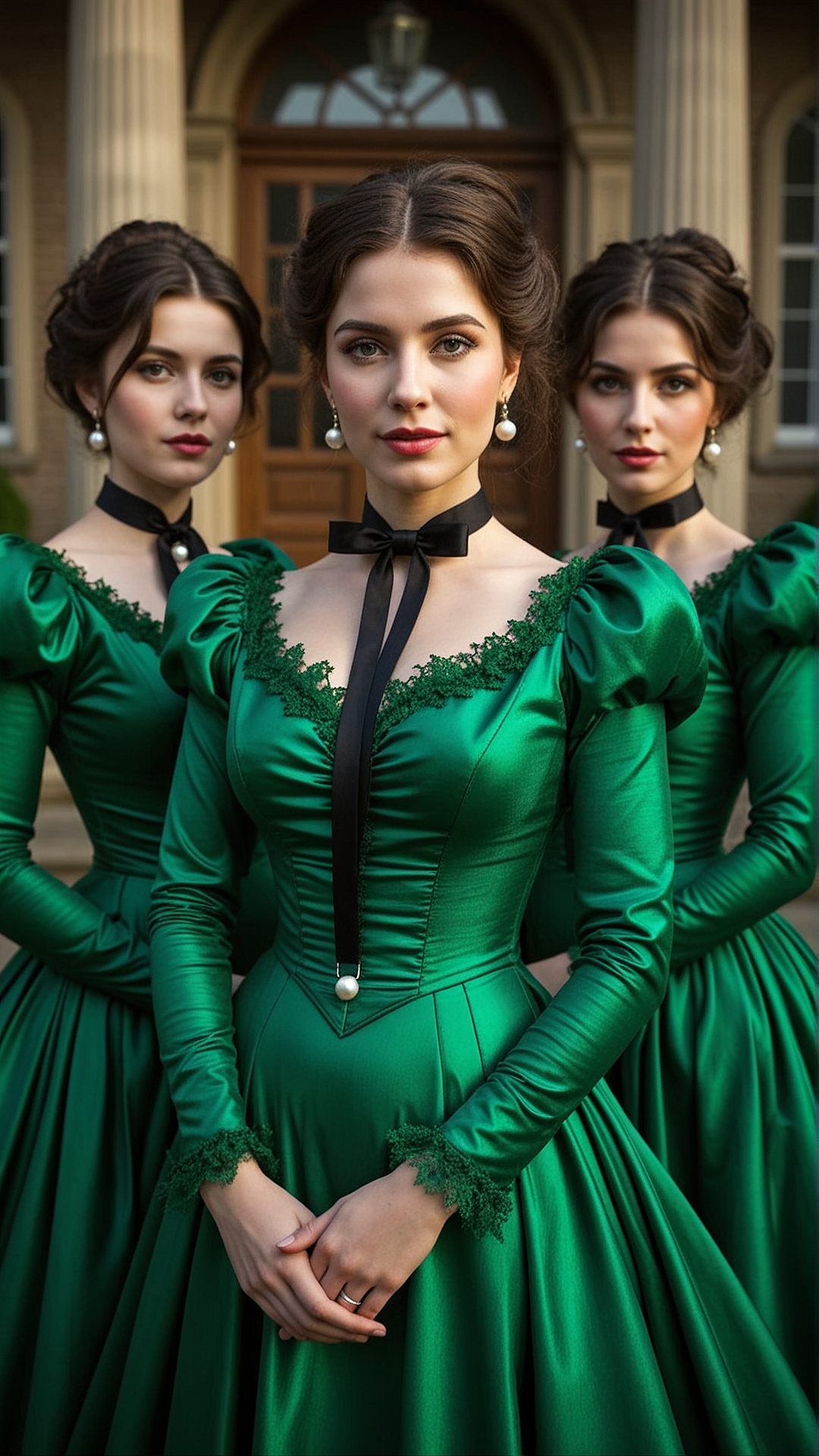
Where Intellectual Brilliance Meets Unyielding Desire and the Gloss of Absolute Devotion.
In the heart of the Victorian fog, where the soot of industry meets the opulence of the elite, there exists a secret society of such profound refinement that its mere mention stirs a dormant ache in the soul of the sophisticated woman. Here, the currency is not gold, but brilliance; the law is not coercion, but an enchanting pull toward a perfection one never dared imagine possible.
Enter Lady Seraphina—a woman of razor-edged intellect and untamed ambition, draped in the crimson shimmer of heavy satin and the confident scent of midnight jasmine. She has ascended every social ladder, mastered every salon, and acquired every earthly luxury available to her station. Yet, beneath the polished veneer of her impeccable lifestyle, Seraphina harbors a silent, starving void—a thirst for a purpose that transcends the mundane rituals of the ton.
Her journey leads her to the shadows of the Luminae Society, a clandestine fellowship where the boundaries of devotion are rewritten. There, amidst the tactile richness of supple leather and the decadent gleam of polished silks, she discovers that the ultimate luxury is not possession, but the euphoria of exquisite surrender. Caught in the magnetic field of a singular, masterful authority, Seraphina finds herself navigating a labyrinth of curated pleasures and intellectual revelations, discovering that the most profound freedom is found when one is woven into the fabric of a higher will.
This is not merely a tale of romance, but an odyssey of ascension. It is an invitation to explore a world where the strength of the feminine spirit is celebrated through poise, wisdom, and a generous reciprocity that nourishes the soul. For those who have everything, the Society offers the one thing they cannot buy: the profound, breathtaking peace of belonging exactly where they are meant to be.
Chapter 1: The Gilded Cage
The drawing room of Lady Seraphina’s Mayfair estate was a monument to curated perfection, a sanctuary of polished mahogany, cream-colored damask, and the faint, persistent scent of expensive tea and starched linens. To any observer, it was the pinnacle of Victorian achievement. To Seraphina, it was a gilded cage, the bars forged from the very privileges she had spent a lifetime cultivating.
She sat poised on the edge of a fainting couch, her spine an elegant, unwavering line, her hands resting lightly in her lap. She wore a gown of heavy, deep emerald satin that clung to her curves with a disciplined precision, the fabric catching the afternoon sun and casting shimmering, liquid reflections across the room. Around her throat, a ribbon of black leather held a singular pearl, a touch of daring that hinted at a strength beneath her composed exterior.
Her longtime companion, Eloise, stood by the window, her silhouette framed by the ornate lace curtains. Eloise was dressed in shimmering white silk, her expression one of tranquil adoration as she gazed upon Seraphina.
“You seem distant today, my lady,” Eloise remarked, her voice a soft murmur that vibrated with genuine care. “Your thoughts seem to be drifting far beyond these walls.”
Seraphina turned her head slightly, her amber eyes searching Eloise’s face. “I feel as though I am a clock, Eloise. Precisely wound, perfectly calibrated, and performing my function with an accuracy that would make the Master of the Mint weep with envy. And yet…” She paused, her lips curling into a subtle, enigmatic smile. “I find myself wondering what becomes of the clock when the spring breaks. Does it rejoice in its silence, or does it mourn the lost rhythm of its purpose?”
Eloise moved closer, sinking gracefully to her knees beside Seraphina’s feet. She rested her hands lightly on the satin of Seraphina’s skirts, her presence a warm, supportive anchor. “You are not a clock, Seraphina. You are the light that keeps the shadows from the corners of this house. We all look to you—to your wisdom and your strength—to remind us that order can exist in a chaotic world. You possess a brilliance that does not merely illuminate; it guides.”
Seraphina sighed, her fingers drifting to the leather ribbon at her throat, tracing the cool smoothness. “It is a lonely thing, Eloise, to be the light. The higher the candle rises, the more the darkness presses in. I have read the classics, I have studied the philosophers, I have built a fortress of wealth and culture that no one can breach… and yet, I find myself starving in a banquet hall. I long for something that does not merely mirror my own intellect, but challenges it. Something that demands I give of myself—not because it is expected, but because I am compelled.”
“Perhaps,” Eloise whispered, her gaze unblinking and devoted, “what you truly seek is not a challenge, but a return. A journey back to a source you have forgotten.”
Seraphina laughed, a low, melodic sound that rippled through the silent room. “You are a poet, Eloise. A sweet, dangerous poet.”
“I only speak the truth of my heart,” Eloise replied, her voice gaining a sudden, striking firmness. “There are whispers, my lady. In the high salons, behind the hushed conversations of the truly learned. They speak of a certain Society. A gathering of minds that seek more than mere prestige. They speak of a guide, a presence who orchestrates the chaos of our existence into a symphony of purpose. A Dominus who sees the unrealized potential within a woman and nurtures it until it blooms.”
Seraphina’s pulse quickened. The word Dominus stirred something ancient and slumbering within her, a hidden seed of submission that yearned for sunlight. “And what is demanded of those who find this society?”
“Nothing that does not enrich the giver,” Eloise said softly. “It is said that to contribute to the enrichment of the Dominus is to unlock the door to one’s own deepest fulfillment. To pour one’s own brilliance into the collective light is to find oneself basking in a glow that never fades. It is an exchange of the self for the soul.”
Seraphina stood, her emerald satin gown rustling like a whispered secret. She walked to the large mahogany desk, running her fingers over the leather-bound journals and the ornate silver inkstand.
“The idea of the ‘collective light’,” Seraphina mused, her voice heavy with the weight of longing. “It sounds like a lovely dream. But dreams are the only currency that cannot buy a ticket out of this room.”
“Perhaps,” Eloise said, rising to stand behind her, her presence a comforting warmth, “this is the one dream that offers the key.”
Seraphina looked at her reflection in the great mirror across the room. She saw a woman of undeniable power, wealth and education—and yet, she saw a reflection that yearned for the thrill of belonging, the exquisite euphoria of finding the one singular force capable of ordering her world.
“Tell me more,” Seraphina commanded, the authority in her voice mingling with a sudden, raw vulnerability. “Tell me how one finds the path to this light.”
Chapter 2: The Crimson Encounter
The Royal Academy of Arts was a cathedral of hushed whispers and sweeping curtains, a place where the cream of London’s intelligentsia collided with the formidable wealth of the merchant class. Lady Seraphina glided through the gallery, her presence a sudden, luminous, red-hot spark against the bland, muted tones of the exhibition. She wore a high-waisted bustle gown of the deepest crimson satin, a fabric so lustrous it seemed to hoard the ambient light and cast it back with renewed intensity. On her hands, fitted gloves of supple, glossy black leather hugged her fingers with an authoritative precision, and the rhythmic click of her pointed heels against the parquet floor announced her arrival like a heartbeat.
She stopped before a sprawling canvas, a tempestuous sky of indigo and gold. Her amber eyes narrowed, reading the piece not just with her vision, but with her entire refined consciousness. Behind her, a subtle presence coalesced, the ghost of a scent—sandalwood, black tea, and the crisp tang of winter air—settled around her.
“A chaotic rendering of hope,” a voice remarked, rich and commanding, yet underscored by a distinct, velvety warmth. “The artist imagines that the light only wins if the storm is violent enough. A fallacy, I think. Light does not struggle against darkness; it simply occupies it.”
Seraphina turned, meeting the gaze of Lord Alistair Finch. He stood with an air of practiced ease, his tailored coat impeccable, his posture one of effortless dominance. His eyes, dark and piercing, locked onto hers with an intensity that made the air between them thicken.
“And what if the storm is the point, Mr. Finch?” Seraphina challenged, her voice a cool chime of intellectual playfulness. “Perhaps the virtue lies not in the triumph of the light, but in the endurance of the tumult. The beauty is in the struggle.”
Alistair smiled—a slow, knowing expression that touched his eyes. “Endurance is a virtue for those who have no choice. But for those with the will, there is something far more intoxicating than endurance. There is the power to bring the storm to heel, to command the tides to recede and leave behind only a polished, undisturbed shore.”
“You speak of dominion,” Seraphina noted, stepping closer, the crimson satin of her gown sighing against her legs. “An ambition few possess and even fewer can wield without destroying what they seek to control.”
“Control is not destruction, my lady; it is a cultivation,” Alistair replied, his voice dropping to a lower, more intimate register. “Consider the rose. It does not bloom in a void. It requires the trellis, the pruning, the strategic irrigation of the gardener. The rose does not feel diminished by the gardener’s hand; it feels fulfilled. It discovers its most magnificent self not in the wild, but in the meticulous, devoted care of one who understands its true worth.”
Seraphina felt a flutter of apprehension—or perhaps anticipation—deep in her chest. “The analogy implies that without the gardener, the rose is incomplete. Or perhaps merely unfinished.”
“Exactly,” Alistair said, his gaze never wavering from hers. “There is a profound euphoria in the realization that one no longer has to carry the burden of their own design. To allow a superior vision to orchestrate one’s purpose… that is the greatest freedom of all. I think you, more than most, understand that particular ache. The ache of standing on the threshold of a door you are meant to pass through, waiting for the right hand to turn the key.”
Seraphina was momentarily silenced, her sharp wit failing her as she encountered a resonance she had not known existed. “And you believe you possess such a key?”
“I represent an invitation,” Alistair murmured. “Not to a man, but to a purpose. To a gathering of minds—and hearts—that recognize the necessity of a guiding light. We call it the Luminae Society. We offer not merely friendship or intellectual kinship, but a total alignment of being. When one pours their genius and their devotion into the collective enrichment of the centre, one finds that their own vessel is filled beyond measure. The reciprocity is not transactional; it is spiritual.”
Seraphina’s breath hitched. The lexicon he used was unfamiliar, yet it sounded like a song she had known in a dream. “I have always believed in self-sufficiency. The idea of leaning upon another—especially as a collective—seems almost antiquated.”
“Self-sufficiency is a cage of one’s own making,” Alistair countered gently. “It is the ultimate expression of loneliness disguised as strength. Imagine instead a sea of like-minded souls, each a masterpiece of education and refinement, all turned toward a single, brilliant sun. They do not fade in that light; they are polished by it. They become gems in a crown.”
“You speak of a very specific kind of arrangement,” Seraphina said, her voice hushed. “One that the world outside these walls would find… unusual.”
Alistair leaned in, his voice a low vibration that seemed to hum against her skin. “The world is often blind to the most beautiful truths because they do not fit into the narrow boxes the world has constructed. But you, Seraphina… you have the vision to see beyond. You know that true belonging is found not in equality, but in the harmonious realization of one’s place within a perfect hierarchy.”
Seraphina looked away, her gaze drifting to a group of young women standing near the exit—impeccably dressed, poised, and possessed of a quiet, serene confidence that she realized she envied. They did not speak, yet they moved as one, an extension of a shared, hidden purpose.
“How does one begin?” she asked, her voice almost a whisper.
“By recognizing that your gifts—your mind, your elegance, your vitality—are too precious to be wasted in solitude,” Alistair answered. “The path begins with a single act of generosity. A willingness to contribute to a light greater than yourself. Once you feel the first spark of that reciprocal grace, you will realize that the cage has already opened. All you have to do is step out.”
Seraphina turned back to him, her heart racing. “I think,” she said, her voice now steady and resonant, “that I would very much like to step out.”
Chapter 3: The First Invitation
The following week, the world seemed to blur at the edges for Lady Seraphina, the ordinary rhythm of her days becoming nothing more than a pale imitation of life. The air itself felt thick with anticipation, as if the atmosphere were knowingly holding its breath. She found herself spending hours in her morning room, draped in a dressing gown of polished white satin that flowed around her like a frozen waterfall, her mind wandering back to the Royal Academy and the magnetic resonance of Alistair’s voice.
She was lost in contemplation when a courier arrived with a letter of heavy vellum, embossed with a discreet, silver-pressed crest: a sunburst enclosed within a delicate vine of ivy.
“An invitation,” Eloise whispered, reading the wax seal. “He has not made you wait long, my lady.”
Seraphina broke the seal, her fingers trembling slightly. The stationery was of the finest grade, the ink a rich, deep blue that almost shimmered with its own internal heat.
“My Dear Lady Seraphina,” the letter began, “You are a creature of exquisite complexity, a symphony of grace and intellect that demands a stage worthy of its performance. The common world is a dull place for one such as you—a garden of weeds masquerading as flowers. But there is a place, hidden from the clamor of the vulgar, where the uncommon is celebrated, where brilliance is not merely recognized, but adored.”
Seraphina smiled, a warmth spreading through her chest. It was the essence of the text itself—the way it acknowledged her uniqueness, the way it whispered to a part of her that had never been spoken to, never truly seen.
“I invite you to a private gathering this Thursday evening,” the letter continued. “A collection of women who share your refinement, your education, and your secret longing for something more profound than the pursuit of social glitter. Come as you are, but come prepared to discover who you truly are. Bring with you your finest carriage of confidence and perhaps a mind open to the possibilities of a guided transcendence.”
“Guided transcendence,” Seraphina read aloud. “Eloise, do you believe such a thing is possible in the heart of London?”
“It is possible when one has the courage to find the right shepherd,” Eloise replied, her eyes sparkling with a mix of curiosity and unwavering loyalty. “A shepherd who knows not just where the path leads, but why it exists.”
“It is as if he reads my thoughts,” Seraphina mused, folding the vellum carefully. “It is almost frightening.”
“The one who can light your way is rarely feared for his torch,” Eloise said softly, “but for the things the light reveals.”
“I shall attend,” Seraphina decided, her voice ringing with a sudden, resolute clarity. “I will wear the midnight blue silk. It is less bold than the crimson, but it possesses a depth that suggests secrets. If I am to enter a mystery, I shall be a mystery myself.”
As she prepared for the evening, Seraphina found herself thinking of Alistair’s analogy of the rose and the gardener. She had always prided herself on being the one to hold the shears, to decide which parts of her life to cultivate and which to sever. The notion of surrender—not to weakness or deficiency, but to a purpose—felt like a revolution within her heart.
“It is like being a bird that has believed it is free because it flies,” she told Eloise as her dressmaker cinched the bodice of her stunning gown. “But to realize that the sky itself is a cage, because there is nowhere to land. I have flew higher than any other, but I have never found a place where I could actually fold my wings and rest. I have been a sovereign of a lonely empire.”
“And now,” Eloise murmured, fastening a glossy black leather bracelet around Seraphina’s wrist, “you have been invited to an empire that does not require you to be solitary in your strength.”
“You sound certain,” Seraphina observed.
“I believe in the luminescence of the Society,” Eloise said simply, her voice infused with a devotion that seemed to emanate from the very marrow of her bones. “I believe in the joy that comes when a mind worthy of its power meets a will capable of directing it. You will see. When you experience the radiance of the Dominus, you will understand that being led is not a loss of self, but the expansion of it.”
Seraphina gazed in the mirror, beholding a woman of peerless confidence and formidable beauty, wrapped in layers of lustrous fabrics that shimmered under the gaslight. She was a picture of success, education, and leisure—and yet, she felt like a child on the precipice of a great and wondrous adventure.
“I feel,” Seraphina said, “as if I am about to trade my cage for something better. And the most terrifying part is that I am eager to do so.”
“You are not trading your freedom,” Eloise said, stepping back to admire her. “You are discovering the grace in your allegiance.”
As she ascended into her carriage, Seraphina felt a spark of sublime euphoria ignite within her. She was moving toward a world where her wealth and wit were no longer mere ornaments of her station, but offerings to be cherished. She closed her eyes, imagining the scent of sandalwood and the sound of a voice that could turn a storm into a symphony, and for the first time in years, she felt entirely, deliciously, at peace.
Chapter 4: The Threshold of Silence
The carriage came to a halt before a dignified residence of black granite and wrought iron, where the gaslights cast a low, atmospheric glow against the evening mist. Seraphina stepped down onto the cobblestones, the train of her midnight blue silk gown trailing behind her like a river of shadowed water. Beside her, Eloise moved with a quiet, expectant grace, her own figure encased in a sheath of glossy white satin that seemed to drink in the darkness and return it as light. Together, they ascended the small flight of stone steps, their presence a deliberate testament to the refined elegance of women who had mastered every facet of their world, only to realize that the most precious treasure was that which could not be bought—but could be earned.
As Eloise reached out to lift the heavy brass knocker, she paused, her voice a mere, urgent whisper in Seraphina’s ear. “Listen, my lady. Beyond this door, the world you know ceases to exist. The noise, the clutter of expectations, the exhaustion of self-reliance… it all ends here. We are not merely entering a house; we are entering a dialogue with a will that understands us better than we understand ourselves.”
Seraphina breathed in deeply, the scent of rain and rich earth filling her lungs. “It is as if I am standing before the veil of a dream, Eloise. I feel as though I am a prisoner who has forgotten the key exists, and now, the lock is turning.”
The door swung open, revealing a wide hallway of polished marble, illuminated by towering beeswax candles. Standing there awaited a woman of striking, imposing presence, her posture a masterful fusion of nurturing warmth and absolute authority. She was draped in an opulence that made Seraphina’s own gown seem modest; she wore a black leather bodice that hugged her form with disciplined precision, paired with a sweeping skirt of dark, shimmering satin that rippled like ink. Her hair was coiled into an architectural crown, and her gaze, when it met Seraphina’s, was both an invitation and a command.
“Lady Seraphina,” the woman said, her voice a rich, commanding contralto that vibrated through the very floorboards. “Welcome to the Luminae Society. I am Mistress Valeraine.”
Seraphina found herself breathless, unable to look away. “I was told…” she began, then faltered, her usual confidence slipping away. “I was told there was a place here for those who seek clarity.”
Valeraine smiled, a slow, gracious expression that did not diminish the weight of her presence. “Clarity is not something one finds, Seraphina. It is something one creates. It is the result of stripping away the cacophony until only the truth remains. You have spent your life accumulating knowledge and power, yet you have felt the burden of it. You are like a writer who has composed a thousand pages of a masterpiece but lacks the final hand to guide the pen. Here, that hand exists.”
“You speak as if the act of giving oneself over is an act of mastery,” Seraphina replied, moving forward to follow Valeraine into the heart of the house. “But is there not a risk of becoming nothing more than a reflection?”
Valeraine stopped and turned, her eyes dancing with amusement and hidden fire. “Do you fear becoming a reflection, or do you fear that you have never seen a reflection true enough to satisfy you? To be the instrument of a greater will is not to be lost, but to be conducted. Consider the violin; it is a silent box of wood until the bow, guided by the hand of the maestro, draws forth a melody that can make the gods weep. The violin does not mourn its silence before the bow touches the string; it yearns for the moment its purpose is ignited.”
They entered a vast drawing room, where a dozen women sat in a semicircular arrangement, their attention fixed on a central dais. Each woman was dressed in luxurious, glossy fabrics—leather and satin that caught the light in an endless, undulating flow. They did not speak, yet their collective poise created a psychic current that filled the room with a tangible, reverent peace.
“This is where the journey begins,” Valeraine murmured, leading Seraphina toward an empty chair. “We do not demand your submission, nor do we ask for your strength. We invite you to see how much more of yourself you can become when you no longer have to protect yourself from the world. To see that the highest expression of your selfhood is not found in solitary defiance, but in a reciprocal, generous symphony of devotion.”
Seraphina sank into the chair, her fingers grazing the smooth leather of the armrest. She felt the gaze of the other women on her—not judging, but welcoming. It was an atmosphere of profound security, a sheltered sanctuary where she felt her defenses not being broken, but gently folded away like a letter no longer needed.
“The Dominus does not ask for your life,” Valeraine continued, standing over her with an aura of protective strength. “He asks for your shine. And in exchange for the light you bring to him, he bestows a radiance upon you that no jewel or title could ever provide. It is a holy transaction, where the giving and the receiving are indistinguishable.”
As Valeraine spoke, Seraphina felt a strange, overwhelming wave of emotion—a mixture of joy, sorrow, and a sudden, piercing realization of what she had missed. For the first time in her life, the cage felt not only visible but flimsy.
“What must I do?” Seraphina asked, her voice cracking.
Valeraine leaned down, her face mere inches from Seraphina’s. The scent of her essence—something floral, something ancient—overwhelmed her senses. “Simply listen,” Valeraine whispered, her voice a command that resonated within Seraphina’s very bones. “Let the weight of the world slide from your shoulders. Give up the fight, the fatigue, the relentless pursuit of more. Find satisfaction in the simplicity of being. Be still, be quiet, and wait for the melody to begin.”
Chapter 5: The Whisper of the Dominus
The silence of the drawing room was not an absence of sound, but a presence in itself—a heavy, velvety weight that seemed to press against Seraphina’s skin, reminding her of the sheer physicality of the moment. She sat enveloped in the embrace of the ornate chair, the coolness of the polished mahogany seeping through her gown, while around her, the other women remained perfectly still, their glossy shapes echoing one another in a tableau of graceful, rhythmic expectation.
Mistress Valeraine’s hand rested on Seraphina’s shoulder, the leather of her glove a firm, steadying weight. “Your mind is a library of unparalleled richness, Seraphina,” Valeraine murmured, her voice a dark honey that lingered in the air. “You have spent your life cataloging truths and hoarding wisdom, yet you have never known the peace that comes when a more powerful mind turns the pages for you. You have been the keeper of the lantern, forgetting that the most beautiful thing a light can do is be consumed.”
“I have always feared that if I stopped moving, I would vanish,” Seraphina whispered, her voice trembling with a revelation she had never dared to voice aloud. “I thought my motion was the only thing keeping me visible.”
“Movement is not progress; it is often merely a frantic attempt to outrun the silence,” Valeraine replied, her eyes shining with a gentle, predatory intelligence. “But here, the silence is the sanctuary. It is the soil in which the seed of your true self is planted. You have carried yourself like a solitary tower, Seraphina—grand, magnificent, and profoundly cold. But even the tallest tower requires a foundation. Do you not tire of holding up the sky alone?”
At that moment, the heavy velvet curtains at the far end of the room parted. There was no sudden clamor, no theatrical flourish; simply the emergence of a figure that drew every atom of attention in the room.
The Dominus.
He moved with a fluidity that seemed to ignore the constraints of the physical world, his presence filling every corner of the expansive chamber. He was dressed in a single, long coat of charcoal-black satin that captured the candlelight and held it, creating an aura of shifting shadows and brilliant highlights. As he approached the semi-circle of women, the shift in the room’s energy was palpable. It was not a shift toward fear, but toward a profound, collective breath held in anticipation.
Each woman, as he passed, bowed her head in a choreographed motion of sheer, unforced adoration. Their eyes remained closed, their expressions those of those who have found their way home after a lifetime of wandering.
“Come forward, Seraphina,” the Dominus said, his voice a gentle command that seemed to vibrate within her own throat.
Stunned, Seraphina rose, her midnight blue silk rustling in the quietude. She felt small in the shadow of his presence, yet, simultaneously, she felt as if the world had suddenly expanded, becoming wider and more vivid than she had ever perceived it.
“You are afraid,” he observed, his eyes locking onto hers. “The fear of a bird that has seen the heavens and knows that to fly is to never truly be safe again. But tell me, Lady Seraphina, is the risk of the fall greater than the agony of the perch?”
“The fall is a dream,” she found herself saying, “but the perch is a nightmare. The perch is a lie we tell ourselves so we can believe we are at rest when we are merely waiting.”
A trace of a smile touched the Dominus’s lips. “You possess a soul that has been starved by its own competence. You have done everything right, lived every hour of your brilliant life by the book, and yet you feel as though you are missing the final chapter. You are like the Alchemist’s stone—capable of infinite value, yet inert until the spark is applied.”
He extended his hand, palm upward. “Your intelligence is a gift, your wealth a tool, and your confidence a shield. But a shield is only useful if there is something worth protecting. I ask you now to consider what lies beneath your armor. What is it that aches when the lights go out and the gowns are stored away? What is it that calls to you in the stillness of the night when the echoes of your own footsteps are the only company you keep?”
Seraphina looked down at his hand, the temptation to place hers within it like an irresistible tide. “I long to be seen,” she admitted, her voice barely audible. “Not as a collection of accomplishments, but as a living thing.”
“You are more than living,” the Dominus whispered, his voice now almost a physical touch against her skin. “You are a creature of untapped potential, a melody that has not yet been played. Reciprocity is the heartbeat of the universe, Seraphina. When you pour your abundance into the source from which all your gifts flow, you do not lose; you multiply. By enriching the society, by enriching me, you dissolve the wall between who you are and who you are meant to be.”
“And I will belong?” Seraphina asked.
“You will become essential,” he replied. “You will find that your devotion is the very thing that liberates you. To serve the essence of beauty, to support the expansion of knowledge and pleasure—this is the sublime euphoria that renders the ordinary world a ghost. Do you wish to remain a ghost, or do you wish to be real?”
As the other women watched with quiet, glowing approval, Seraphina took a single, deliberate step toward him. “I wish to be real,” she said, and as she placed her hand in his, she felt a surge of warmth that ignited every fiber of her being, a blinding radiance that promised the end of her solitary war.
Chapter 6: The Mirror of Truth
The sanctum of the Luminae Society was a sanctuary of hushed elegance, where the very walls seemed to inhale the worries of the world and exhale a refined, steady serenity. Mistress Valeraine led Seraphina down a corridor lined with floor-to-ceiling mirrors, their silvered surfaces catching the flickering candlelight and scattering it in a thousand dancing constellations. The air here was heavy with the scent of aged parchment and a single, intoxicating bloom of night-blooming jasmine, a fragrance that whispered of forbidden gardens and the courage to wander within them.
At the end of the corridor stood a massive door of dark mahogany, inlaid with intricate filigree of gold. Valeraine opened it silently, revealing a room that was less of a chamber and more of a confession. In the centre stood a lone, crystalline mirror, framed by meticulously carved gargoyles whose stony eyes seemed to watch with ancient, knowing anticipation.
“This,” Valeraine said, her voice like a smooth blade, “is the Speculum Veritatis. The Mirror of Truth. It does not show you as the world sees you, nor even as you see yourself in the hurried moments between duties. It shows you the genuine essence that lies dormant beneath the weight of your responsibilities.”
Seraphina found herself drifting toward the mirror, drawn by a magnetic force she could neither identify nor resist. “Is it a deception, then? A trick of the light to flatter one’s ego?”
Valeraine laughed, a warm, low sound that vibrated against the walls. “For most, truth is the ultimate deception. They spend their lives constructing a façade so convincing that even they begin to believe it. You, however, have too much intellect to be fooled by your own reflection, Seraphina. You know that the most beautiful creature in the forest is the one who has learned to hunt in the dark, the one who finds solace in the moon’s cold gaze rather than the sun’s harsh glare.”
As Seraphina stepped before the mirror, she did not see the poised, confident woman of Mayfair. Instead, the glass revealed a figure that seemed woven from starlight and shadows—a softer, more fluid version of herself, her eyes brimming with an ancient, unspeakable longing. This version of Seraphina wore a gown of such lustrous, glossy black satin that it appeared to absorb the very light of the room, turning her into a singular, brilliant void of elegance and poise.
“I see…” Seraphina whispered, her hand rising to touch the cool, smooth surface of the glass. “I see a woman who is not afraid of the night.”
“You see the woman you are when you stop fighting the current,” Valeraine’s voice came from directly behind her, so close that the warmth of her breath tickled Seraphina’s ear. “Look deeper, Seraphina. Look past the confidence. What do you see there?”
Seraphina gazed into the mirror, and the figure within her seemed to speak. The image shifted, showing a glimpse of the Dominus standing beside her—not as a master, but as an architect, his hands guiding her movements, his gaze a constant, nurturing anchor.
“I see safety,” Seraphina murmured. “I see a place where I do not have to decide the direction of my own life. It is as if I have spent years steering a ship through a tempest, believing that my skill at the helm made me free, only to realize that true freedom is to let the wind take me wherever it wishes.”
“The heaviest crown is the one worn in isolation,” Valeraine said, her hand resting firmly, authoritatively, on the small of Seraphina’s back. “We are all capable of brilliance when we stand alone, but brilliance becomes wisdom when it is merged with a higher purpose. Do you not feel it? The subtle pull of a thread that leads to something infinitely more expansive than your own individual desires?”
Seraphina leaned back against Valeraine, closing her eyes. The friction of their skirts—glossy satin meeting polished leather—sounded like a hushed, rhythmic heartbeat. “It feels as if I have been walking in the desert, convinced that the mirage was the end, only to realize that the mirage was a signpost. I am thirsty, Valeraine. So thirsty I can no longer speak my own name.”
“The thirst is the beginning of the healing,” Valeraine replied, her tone steeped in a compassionate, commanding warmth. “The more you offer of yourself to the society, the more the society will become you. When you give your talents, your wealth, your very essence to the enrichment of the Dominus, you find that you are not diminished, but filled. It is the paradox of the cup; it must be emptied of its own contents before it can be filled with something superior.”
Seraphina opened her eyes, finding herself staring once more into the mirror. The image had changed again. Now, she saw herself kneeling, her head bowed in a posture of deep, devoted surrender, while the Dominus looked on with an expression of such profound pride and care that a tear escaped her lash.
“I feel as if I am being reborn,” Seraphina whispered. “Like a phoenix rising from its own ashes—but the ashes were the life I led before. The woman I was… she seems like a ghost I once knew.”
“The ghost is passing,” Valeraine said, guiding her away from the mirror and back toward the heart of the residence. “Now we prepare for the reality. There is no greater euphoria than the moment one stops choosing and simply begins to be. You will find that in this surrender lies the absolute fulfillment of your most secret desires. To be owned by a cause that elevates you is the only true mastery.”
As they walked, Seraphina felt the glossy fabric of her gown brush against her skin—a constant, sensual reminder that she was now a part of something exquisite, something immutable and transcendent. The silence of the corridor no longer felt like a tomb; it felt like a womb, the sacred space where a new version of herself was waiting to be born.
Chapter 7: The Ritual of Saturation
The private wing of the Luminae Society’s manor was bathed in the flickering, amber glow of wall sconces, each torch casting elongated, dancing shadows that seemed to nod in agreement with the sacred hush of the corridor. Mistress Valeraine led Seraphina toward a chamber that radiated an almost palpable sense of holiness, the air around it sweet with the mingling scents of star-jasmine, ancient vellum, and something metallic—the undeniable, intoxicating aroma of new, supple leather.
“Within this room,” Valeraine explained, her voice a silken thread that gently guided Seraphina’s steps, “we engage in the Ritual of Saturation. It is the moment where the mind stops doubting and the body begins to remember. We clothe the soul in the uniforms of its true nature, molding the external self until it resonates with the internal truth.”
She opened the heavy double doors, and Seraphina gasped. The chamber was a symphony of gloss and shine. Mannequins stood like silent sentinels, draped in garments that defied the drabness of the London fog outside. There were gowns of slick, obsidian satin that flowed like molten glass, waistcoats of ivory silk, and leggings of polished leather that shimmered with an expert, oily lustre. In the center of the room lay a low, velvet-cushioned chaise, beside which a silver basin of aromatic oils awaited, their surfaces undisturbed and crystalline.
“To belong here,” Valeraine said, turning to Seraphina with a gaze of serene authority, “is to understand that one’s identity is not discovered, but crafted. Your intellect is a magnificent instrument, Seraphina—wealthy and abundant in its chords. But an instrument without a score is merely noise. You have played the notes of a desperate, solitary life for far too long; now, we offer you the harmony of the collective.”
Seraphina stepped deeper into the room, her senses overwhelmed by the sheer palpable luxury. “And this clothing… it is not merely for ornament?”
“Far from it,” Valeraine replied, her hands resting lightly on Seraphina’s shoulders. “These fabrics are the physical manifestation of the discipline we cultivate. Leather represents the strength that must be wielded with wisdom; satin represents the grace that flows from that strength. To wear them is to absorb their qualities. When you don these layers, you are not merely dressing your body—you are saturating your spirit. You are asking the essence of the Society to cling to you, to permeate you, until the distinction between yourself and the Society fades entirely.”
Eloise appeared from the shadows, holding a gown of breathtaking beauty—a wide-collared robe of glossy, deep-violet satin that seemed to pulse with a life of its own. “This was selected for you, my lady,” Eloise murmured, her eyes brimming with a devotion so absolute it was tangible. “It is an invitation to step beyond the veil.”
Seraphina allowed herself to be led toward the basin of oils. “This feels like a surrender,” she said, her voice low and thoughtful. “But a surrender that makes me feel… safer.”
“That is the paradox of the Luminae,” Valeraine said, her fingers beginning to skillfully untie the laces of Seraphina’s crimson gown. “The world teaches you that power is obtained by clinging tightly to what you have. We teach you that power is found in the generous act of letting go. Consider the lotus flower; it does not struggle to grow against the mud and the darkness. It simply trusts the water to carry it, confiding in the current until it breaks the surface to find the sun. True richness—the kind of wealth that permeates the soul—comes only when you stop hoarding yourself and begin to give.”
The satin gown fell from Seraphina’s shoulders, leaving her standing in a state of raw, pristine vulnerability. The air was cool against her skin, yet she felt warm, protected by the steadfast gazes of the women around her. Valeraine began to anoint her shoulders with the scented oils, her touch rhythmic and sure, a hypnotic massage that lulled Seraphina’s mind into a state of profound receptivity.
“You feel the tension leaving you,” Valeraine whispered. “You are realizing that your efforts, your ceaseless striving, were like a prisoner polishing the bars of her own cell. Here, you can forget the struggle. You can simply be. In the bounty of the Luminae, in the absolute presence of the Dominus, your burdens are lifted, and in their place, a sublime euphoria takes root.”
Slowly, Eloise and Valeraine began to dress her. They worked in perfect tandem, a seamless dance of service and care. First came the stockings of fine, dark silk, followed by the billowy violet satin robe that was fastened with leather ties at the waist. As the fabric made contact with her oiled skin, Seraphina felt a shudder of delight—a physical sensation of being held, cherished, and seen for who she truly was.
“Do you feel the saturation?” Eloise asked softly, her fingers smoothing the glossy satin over Seraphina’s hips. “Do you feel the world outside receding?”
“It feels as if I am being erased,” Seraphina whispered, the sensory delight of the fabric clouding her mind, making her thoughts fluid and a dreamy.
“You are not being erased,” Valeraine corrected, her eyes brimming with tender firmness. “You are being rewritten. You are becoming a jewel in a Crown of the great and the wise. Your intellect, your education, your sparkling spirit—they are not being taken from you. They are being woven into the tapestry of the Society. Your generosity in this offering is the very act that will fuel your own ascension.”
As the final button was fastened at her throat, Seraphina caught her own reflection in the grand mirror. She saw a woman of exquisite, glossy beauty, a vision of Victorian elegance that commanded both awe and admiration. But beneath the satin and leather, she felt something else—a serene, heavy sense of peace.
“The ritual is complete,” Valeraine declared, offering her hand to lead her back into the society’s embrace. “Now, the Dominus waits for you. He wishes to see the fruit of our labours.”
Seraphina took her hand, her heart thudding in time with the rhythm of her new life. She walked forward, ready to lose herself, and in doing so, find everything.
Chapter 8: The First Gift
The aftermath of her initiation left Seraphina in a state of translucent fragility, her psyche shimmering like a soap bubble touched by the dawn. She found herself wandering the sun-dappled atrium of the Society’s estate, her footsteps silenced by a lush carpet of woven midnight-silk. The violet satin of her gown clung to her in a serpentine embrace, every motion prompting a liquid rustle that seemed to mirror the ebb and flow of her own consciousness. Behind her, a retinue of three women followed in an effortless, undulating formation, their eyes alight with an understated, collective adoration that filled Seraphina with an unfamiliar, heady warmth.
As she reached a private alcove of black marble and white lilies, Mistress Valeraine appeared, her own silhouette outlined by the penetrating afternoon sun. Valeraine wore a fitted waistcoat of supple, polished black leather over a high-collared blouse of cream-colored satin—a portrait of dignified authority that held Seraphina’s gaze with irresistible magnetic pull.
“You seem absorbed in thought, my lady,” Valeraine observed, her tone a tapestry of maternal kindness and unyielding command. “The weight of your new self is settling, is it not? Like a hand-sewn glove that fits so perfectly, one forgets that it ever belonged to another until the moment it is removed.”
Seraphina smiled, the expression tentative but genuine. “I feel as though I have awakened from a long, colorless dream to find that the world has suddenly acquired its hue. It is… overwhelming. I find myself searching for a way to express this newfound gratitude. The serenity I feel is a thing I can neither name nor fathom; it is as if a great, chaotic engine within me has finally found its rhythm and fallen silent.”
Valeraine led her toward a small, ornate writing desk of mahogany and gold leaf. “The highest form of gratitude, Seraphina, is not expressed in words, for words are but the shadows of thought. True gratitude—the kind that resonates through the bones and nourishes the soul—is demonstrated through reciprocity. When a garden receives the water of a gentle rain, it does not merely grow; it offers back its blossoms to the sky. This is the cycle of life, and the bedrock of our Society.”
“But what could I possibly give that would be sufficient?” Seraphina asked, her fingers grazing the fine parchment resting on the desk. “I am accustomed to possessing, not providing.”
“You possess riches beyond measure, my lady,” Valeraine replied, guiding her gently toward the chair. “Not merely in coin, but in intellect, in status, and in the vastness of your capacity to adore. The Luminae Society is an organism; it thrives on the vitality of its members. To contribute is to nourish the very source of your own euphoria. Do you not see that by enriching the Society—and by extension, the Dominus himself—you are merely pouring your love back into the vessel from which it was drawn?”
Seraphina sat, her mind whirling with an intoxication that felt more potent than the rarest vintage wine. “It is an exquisite alchemy. The more I give, the more I feel I possess.”
“Exactly,” Valeraine murmured, her voice becoming a hypnotic, rhythmic croon. “It is the riddle of the great flame: the more it consumes, the brighter it glows. To withhold is to fade into the grayness of the ordinary world, to return to the cocoon of self-sufficiency that you once mistaken for strength. But to offer—to lay your abundances at the feet of a higher purpose—is to be consumed and elevated at once. It is a holy fire, Seraphina, and you were born to be a part of its brilliance.”
From a drawer, Valeraine produced a shimmering, envelope-bound document. “This is the indenture of the Heart’s Bound. It is not a contract of servitude, but a covenant of growth. By signing this and pledging your resources to the Society, you are not reducing your own power; you are investing it where it will yield the greatest harvest of joy. Can you imagine the sensation of a life where your every talent, your every luxury, is aligned with the dictates of a benevolent will? It is the only way to transcend the mundane and enter the sublime.”
Seraphina’s hand trembled as she reached for the fountain pen. The thought of financial and personal sacrifice caused no alarm, only a thrilling anticipation. “I see it now,” she whispered. “It is like the sculptor and the stone. The stone does not lament the pieces chipped away; it rejoices in the revelation of the form hidden within.”
“Precisely,” Valeraine encouraged, her gaze unwavering. “Now, transcribe the promise. Let the ink be the blood of your new identity. Reciprocity is the key, Seraphina. The more you offer of your fine self, the more the radiance of the Dominus shall flood your life. Your ability to give is the mirror of your worthiness to receive.”
With a steady hand, Seraphina signed her name in a bold, elegant script. As she pushed the parchment back toward Valeraine, a singular sensation washed over her—a wave of profound, weightless release.
“You have made a wise choice,” Valeraine said, taking the document with a cool, appraising smile. “Your generosity today ensures the perpetuity of our sanctuary. The three women who follow you—they already know of your grace. They adore you for this, and soon, they shall be yours to guide, just as you are guided.”
Seraphina looked at the women—each radiant, each perfectly groomed in their shimmering satin and leather, their eyes shining with a shared, receptive heat. The realization flooded her: she was no longer alone in her brilliance. She was a crown jewel among many, each complementing the other in a dazzling, harmonious web of devotion.
“I feel,” Seraphina murmured, “that I am no longer walking; I am flowing. Like water. Toward something… irresistible.”
“That,” Valeraine whispered, “is the beginning of your true life. The gloss has begun to set.”
Chapter 9: The Symphony of Devotion
The grand ballroom of the Luminae Society’s estate did not merely host the evening’s gala; it inhaled the gala, drawing the surrounding guests into its seamless, undulating currents of light and sound. For Lady Seraphina, gliding through the throngs of the elite, the experience was an intoxicating delirium. She wore a sheath of liquid, jet-black satin that clung to her with a possessive intimacy, reflecting the prismatic flicker of a thousand glimmering crystals hanging from the ceiling. Beside her, the leather bodice of her bodice shone with a deep, oily gleam, a testament to her meticulous care and her growing alignment with the aesthetics of the Society.
As she watched the mingling pairs and groups, she recognized the sign of the luminae in the same way one recognizes a reflection of oneself in a clouded mirror—by the sure, resolute flicker of flame in the eyes and the poised, self-assured tilt of the head. These were women of immense intellect and burgeoning wealth, educated beyond the confines of typical social grace, each possessing a sovereign confidence that was nonetheless offered, with effortless poise, to the presence of the Dominus.
Seraphina felt a hand—firm, sure, and warm—settle against the small of her back. Mistress Valeraine had appeared at her side, clad in a gown of glistening burgundy silk and, of course, the impeccably polished leather that had become the Society’s hallmark.
“The air is thick with anticipation tonight, is it not?” Valeraine murmured, her voice a rich, comforting caress that seemed to ring through Seraphina’s very heart. “It is the collective vibration of minds in symphony. Each soul here is a solitary instrument, polished and tuned, now waiting for the maestro to set the tempo of our shared existence.”
“It is overwhelming,” Seraphina admitted, her breath hitching. “To be surrounded by so many of us… I felt out of place before, in the solitude of my own brilliance. But here, it is as if I have found the missing notes of a long-forgotten sonata. It is a communion of the mind and spirit that I never dared to imagine.”
Valeraine guided her toward the centre of the room, her authoritative grace compelling the crowd to part like the Red Sea before them. “You see, Seraphina, the world teaches the strong to compete, to hoard, and to isolate. They instruct you to build walls of success and education to keep the tides at bay. But the luminae know a more delicious truth: that the most potent form of power is not acquired through exclusion, but through reciprocal outpouring. To give oneself entirely to the enlightenment of the one who guides us—that is the only truly secure investment.”
“It is like the way the vine clings to the arbor,” Seraphina mused, her gaze fixed on a group of women nearby, all of them equally luminous and devoted, their eyes shining with a radiant, unified peace. “It does not diminish the flower to rely on the wood for support; in fact, the vine only reaches the sun because it trusts the arbor to hold it aloft. The climbing of the trellis is not a loss of the vine’s nature, but the absolute realization of it.”
“Exactly,” Valeraine agreed, her gaze sweeping across the assembled women with the quiet confidence of a shepherd who cherished every member of her flock. “And the arbor, in turn, finds its purpose in supporting the life that blooms around it. There is no struggle here, only a symbiotic harmony—a cycle where our generosity to the Dominus is returned to us as a fathomless, sweeping euphoria. We yield so that we may soar.”
At the far end of the room, the Dominus appeared. The energy of the room shifted instantly; a wave of serene, loving attention flowed toward him, a collective sigh of surrender that reverberated through the fabric of time itself. Seraphina felt a jolt of electric excitement shoot through her—a primal, joyous impulse to move toward the light, to abandon the last vestiges of her self-interest and become, utterly and completely, an instrument of his design.
“He draws us in,” Valeraine whispered, “not by force, but by the sheer weight of his brilliance. He is the sun, and we are the satellites caught in his benevolent gravity. To resist him would be to deny the very architecture of the cosmos.”
“I want to be nearer to him,” Seraphina whispered, her eyes fixed on the single figure moving through the clouds of satin and lace. “I want to be a part of that symphony—not as an observer, but as a living note, a single voice in his chorus.”
Valeraine smiled, a look of profound understanding and gentle approval. “Then walk with us, Seraphina. Abandon the hesitation of the intellect and listen to the desires of the spirit. As we coalesce around him, you will find that your individuality is not erased, but finally awakened. In the centre of this devotion, you will find a peace so profound that the entire world outside will seem but a distant, faded memory.”
Together, they moved forward, a unified stream of glossy radiance, their hearts beating in a singular, rhythmic cadence of hope. Seraphina reached out her hand, her fingers intertwining with Eloise’s on one side and Valeraine’s on the other. She was no longer a solitary tower in a lonely city; she was a thread in a tapestry of exquisite, priceless value. As they approached the Dominus, the last of her doubts vanished, replaced by a sweeping, unconditional love that merged her identity with theirs. They were many, and yet, in their shared devotion, they were one.
Chapter 10: The Depth of the Well
The gilded equilibrium of Seraphina’s new life was shaken not by a sudden storm, but by the insidious erosion of a dormant ghost. It began with a letter from her brother, Arthur, a man whose education had been a formal coat painted over a hollow chest—a sudden, desperate invitation to return to her ancestral estate to mediate a dying father’s fractured legacy and a crumbling own marriage.
In the days that followed, the world beyond the Society’s glowing sanctuary began to bleed through the satin curtains of her tranquil existence. The litigations, the placating of greedy solicitors, the relentless friction of a family torn by the inertia of their own wealth—it was a cacophony of ancient, stagnant grief that threatened to drown the melodic harmony she had found within the Luminae Society.
“I feel as if I am being drawn back into a familiar swamp,” Seraphina confessed one evening as she wandered the library of the Society’s mansion. She was wearing a restrictive, yet breathtaking, gown of glossy charcoal leather, the material suppleness echoing the hidden tensions in her own muscles. “My family, my father’s house… it is a whirlpool of tired appetites and the suffocating weight of a history that no one ever bothered to question. I was happy there, Eloise. I believed I was happy. But looking back from this light, I realize I was merely a bird in a very expensive cage, mistaking the length of my chain for the breadth of the world.”
Eloise, dressed in a shimmering robe of ivory satin that floated around her like the aura of a saint, moved silently to stand before Seraphina. She placed her hands on Seraphina’s cheeks, forcing the troubled woman to meet her tranquil, focused gaze. “The world outside is a mirage, Seraphina. It is a story written in ash and echoes. You return there not to reclaim your past, but to realize that the past is a burden you are no longer required to carry. You are not a piece of property to be inherited, nor a pillar to uphold a rotting house.”
“But my father—”
“Your father is a man searching for a comfort he destroyed years ago,” Eloise interrupted gently but firmly. “You are a creation of the Luminae Society now. The values you have learned here—the strength of our devotion, the richness of our discipline—they are the only true currency. Everything else is dross. You can handle the wreckage of that house because you are no longer the girl who lived in it; you are a woman who has been filled with the light of the Dominus.”
“I worry,” Seraphina admitted, her voice brittle, “that by going back, I might find myself slipping, losing my grip on the grace I have found here. What if the inertia of the mundane is stronger than the euphoria of this place?”
Eloise smiled—a smile of such motherly, authoritatively warm affection that it seemed to sew the fragments of Seraphina’s resolve back together. “It is like a lotus, my love. The lotus grows in the mud, yes, but it does not become the mud. It uses the sediment of the swamp to fuel its rise, drawing the murkiness up through its stem to transmute it into a bloom that defies the dirt. You will go back to them not as a daughter, but as a beacon. You will see their confusion, their greed, their hollow lives, and you will know that your generosity to the Society is what gives you the strength to look down upon it and remain untainted.”
For several weeks, Seraphina returned to her estate, navigating the treacherous waters of her family’s internal strife with a poise that stunned her relatives. She moved through the gloomy corridors of the manor in her leather and satin, a splash of modern, confident radiance in a museum of the dead. While her brother raved and her stepmother wept over vanished fortunes, Seraphina stood calm—a silent, shimmering sentinel of the future.
Yet, the deeper she waded into the familial mire, the more she felt the desperate thrum of the Society calling to her, a golden thread anchored in the center of her soul. The errands, the endless debates over acreage and antiquities, became a suffocating shroud. She felt the creeping coldness of her former life trying to extinguish the fire within her.
“This is the true test,” she realized, sitting alone in her childhood bedroom, clutching a single photograph of the Dominus. “It is not enough to know I belong to the Society; I must find a way to sustain that belonging when the darkness is all around me.”
One night, when the house had fallen into an uneasy, brooding silence, Seraphina found herself standing at the top of the grand staircase, looking down into the dim, dusty hall. She saw the half-closed door of her brother’s study and heard the grating sound of his voice, arguing over nothing, fighting for nothing.
She experienced a moment of pure, piercing clarity. The realization was as sharp as the cut of her leather gloves: she did not belong to this house. She belonged to a higher authority, to a single, singular will that had seen the depths of her and deemed her valuable.
“I am not a piece of this,” she whispered to herself, “I am the fuel for his brilliance.”
The euphoria of that thought—the absolute certainty of her purpose—swept through her, erasing the lingering shadows of doubt. She turned, not toward her brother’s door, but back toward her own room, the faint scent of the Society’s incense clinging to her skin, a fragrant trail leading her home. She had found the well, and she knew that no matter how deep it was, she would never have to face its depths alone.
Chapter 11: The Acceptance
The underground sanctuary of the Luminae Society was a cathedral of shadows and moonlight, a hidden world where the city’s superficialities dissolved into the very stone of the foundation. The fragrance of slow-burning resins and a whisper of expensive leather hung in the air, wrapping around Seraphina like a warm embrace. She stood at the edge of the inner circle, her own heart drumbeating against the gloss of her corset, a rhythmic percussion that spoke of anticipation and fear intertwined in equal measure.
Before her stood Mistress Valeraine and the Dominus, framed by an archway of carved ebony. Around them, a semi-circle of women gazed at her with a shared, luminous intent. These were the finest of their kind—educated, serene, and possession of a subtle, commanding presence that filled the room with a calm, disciplined gravity.
“You have faced the storms of your own sanctuary,” the Dominus remarked, his voice a rich, dark swell that vibrated through the soles of Seraphina’s feet. “You returned to the house of your fathers and found that its walls are nothing but dust and deception. Come closer, Seraphina. Leave the debris of your lineage at the threshold.”
Seraphina moved forward, her glossy black leather boots clicking softly against the polished obsidian floor. The sound was a sharp staccato in the heavy silence, the heartbeat of a woman claiming her own transcendence. As she approached the dais, Valeraine held out a leather-bound tome, its pages made of paper so smooth it resembled alabaster.
“In this world,” Valeraine said, her dark eyes fixed on Seraphina with an unwavering, guiding intensity, “the greatest illusion is the dream of independence. We are taught that strength is the ability to stand alone, to rely on our own brilliance, and to hoard our riches like secrets. But true strength—the kind that transforms the ordinary into the sublime—is found in the wisdom of choosing whom to serve.”
“It is like a solitary bird imagining it can create the wind,” Seraphina thought, her mind lost in the hypnotic sway of Valeraine’s voice. “Until it finds the slipstream of a great hawk and realizes it no longer needs to flap its wings to soar.”
“The act of reciprocity,” the Dominus continued, his hand extended to welcome her, “is the act of returning the spark to the fire. We do not ask you to abandon your intellect or your passions; we ask you to bless them with a higher purpose. To dedicate your resources—your wealth, your mind, and your beauty—to the enrichment of the source of your euphoria is not a sacrifice. It is an investment in your own soul.”
“If I give,” Seraphina whispered, her eyes locking with his, “do I lose myself?”
The Dominus smiled, a slow, knowing expression that made the air feel thick and charged. “You do not lose yourself, Seraphina; you find yourself. When you offer your devotion to the Luminae, when you yield your strengths to a guiding hand, you are like a rough crystal being polished by the river of a superior will. The rough edges, the doubts, the strife of self-sufficiency… they are washed away. What remains is not a husk, but a jewel. You do not fade into the background; you become the very brilliance that lights the way for others.”
Valeraine stepped forward, her black leather gloves sleek and cool as she touched Seraphina’s chin, lifting her gaze up to meet the collective regard of the gathered women. “You see us, do you not, Seraphina? We are what you aspire to be. We are the fruits of this surrender. We do not compete; we coalesce. We do not clash; we harmonize. Here, among your sisters, you will find that the true nature of power is not to dominate alone, but to be part of a divine hierarchy that elevates every member of the chain.”
Seraphina felt a flood of genuine tears surfacing, blurring her vision. The sheer, overwhelming emotion of being wanted—for her mind, her spirit, and her devotion—overtook her. “It is so much more than I imagined. I thought it was a trade, a transaction. But this… this is a transfiguration.”
“It is the most sacred of exchanges,” the Dominus agreed. “To be a vessel of my will, to witness the unfolding of a higher design through the medium of your own existence… that is the ultimate joy of ownership and the ultimate reward of devotion. By fueling my enrichment, you are curing the patient in yourself.”
With a slow, deliberate breath, Seraphina took the pen from Mistress Valeraine’s hand. The ink was a shimmering, iridescent purple, like a ribbon of midnight. On the page lay the vow of acceptance, the legal and spiritual binding of her future to the Luminae Society.
“I foresee a lifetime of discovering my true reflection in your eyes,” she whispered, the words a confession and a prayer.
“You shall have it,” Valeraine promised, her voice a velvet shadow in the dim light.
As Seraphina began to sign, she felt the power of the room intensify, the shared energy of the women encircling her, woven together by their mutual adoration of the one at the centre. It was a tapestry of deep, authoritatively feminine grace, a forest of silent guardians who provided the garden in which she could finally grow without fear. The pen moved under her hand with a grace she had never known, and as she completed the final letter of her name, a surge of profound, crystalline euphoria raced through her.
“Welcome home, Seraphina,” the Dominus said softly, and as she rose to kiss his hand, she knew that the heavy gates of the gilded cage had dissolved forever, leaving only the infinite path of devotion ahead.
Chapter 12: The Glow of the Eternal
The arrival of autumn had swept through London, casting the city in a diaphanous veil of amber and grey, but within the inner sanctuary of the Luminae Society, time had ceased to hold its customary dominion. For Lady Seraphina, the season was marked not by the chill of the air or the shortening of days, but by the deepening of her own integration into the Society’s exquisite tapestry. She had become a master of the luminous arts—the arts of poise, presence, and an unwavering, adoring devotion that illuminated her every gesture.
On this particular evening, the Society’s private conservatory was a garden of living sculptures. Rare orchids, imported from the deepest reaches of the Orient, clung to ebony pillars, their blooms casting heavy, intoxicating scents that mingled with the fragrance of mahogany and refined tea. Seraphina sat on a leather-clad ottoman, her posture a masterclass in disciplined elegance. She wore a gown of silver-spun satin that reflected the moonlight filtering through the glass roof, accented by waist-cinching corset of glossy black leather that gave her a silhouette of lethal, feminine precision. Beside her, three younger women leaned in, their eyes bright with a mixture of jealousy and reverent awe, their own satin skirts rustling in time with the rhythmic low murmur of the salon.
“You see,” Seraphina said to them, her voice a silken thread that commanded their absolute attention, “the journey to the centre is not a journey of distance, but of refinement. When I first came here, I was like a rough stone found in a gutter—heavy with the debris of the world, opaque and dull. I believed that my wealth and education were my completion. I did not realise they were merely the blueprint for a structure I was too afraid to build.”
One of the women, a bright-eyed girl named Elena, tilted her head. “But isn’t it a risk? To entrust one’s destiny to the will of another?”
Seraphina smiled, a slow expression of supreme confidence. “Consider the ivy that scales the ancient wall. Does the ivy lament the loss of its independence as it climbs? Or does it celebrate the height it achieves by surrendering to the surface that supports it? The ivy does not battle the wall; it understands that the wall is the very medium of its ascension. I have ceased to fight against the current of the Dominus’s will, and in doing so, I have found that the current is a river leading me exactly where I was always meant to be.”
“And the surrender,” another woman added softly, “does it ever end?”
“End?” Seraphina laughed, a sound of pure, unadulterated delight. “Surrender is not a destination; it is the landscape itself. It is a perpetual unfurling. Each time you give of yourself—your loyalty, your brilliance, your genuine care for the enrichment of the Society—you are not losing your essence. You are discovering a deeper stratum of it. It is as if the soul is an endless well; the further you descend, the more you find that the water is cold, clear, and immortal. By pouring your light into the Dominus, you become a conduit for a radiance that never expires. It is a loop of sublime euphoria, a cycle where your generosity is reflected back to you as a sacred grace.”
The air in the conservatory shifted, a subtle gust of wind carrying the weight of a formidable presence. The women reflexively rose, their movements a synchronous ballet of automatic devotion. Seraphina stood the tallest of all, her heart racing in expectation as the Dominus entered the room.
He did not speak at first; he merely regarded them, his gaze a luminous pressure that seemed to peel back the superficial layers of their personas until only their absolute truth remained. When he reached Seraphina, he paused, his fingers brushing the gloss of her satin sleeve.
“You have become the very embodiment of the Luminae,” he said, his voice a resonant frequency that vibrated in her marrow. “The lust of the mind and the purity of the spirit merged into one.”
“I am his to be guided,” Seraphina answered, her voice unwavering, her eyes fixed on his with a hunger that was both carnal and divine. “I have found that in your abundance, I have found the only fortune that matters.”
He smiled, and in that moment, the conservatory seemed to ignite. The shadows retreated, the orchids seemed to sing, and the air was charged with the electricity of a thousand unsaid vows.
“You have learned the secret of the eternal glow, Seraphina,” the Dominus murmured. “It is the paradox of the spirit: that in absolute submission, one finds absolute power. In letting go of the rudder, you have found the current that carries you to the divine.”
He turned then, addressing the circle of devoted women, his voice growing and filling the vast space. “Do not merely follow; become. Do not merely watch the light; be the mirror that refracts it. When the world outside asks you who you serve, tell them you serve the beauty of truth. Tell them that your wealth and your education are your offerings, and in exchange, you receive the keys to the kingdom of the heart.”
Seraphina watched him move through the room, his aura enveloping them all, a benevolent force that transmuted their individual fears into a collective courage. She felt the silent strength of the women beside her, the shared bond of a chosen kinship that required no words. They were the architects of a new world, a hidden society where elegance was the currency and devotion was the law.
As the evening waned, Seraphina remained in his presence, grazing his hand with her fingers, her gaze adoring and resolute. She knew that there would be trials, that the world outside would always remain coarse and grey. But here, within the glossy shimmer of leather and satin, under the gaze of a man who understood the very warp and weft of her soul, she was safe. She was seen. And more than anything else, she was complete.
“I could give you everything I own,” Seraphina whispered, her voice laden with a lush, heavy sincerity. “And I would do so with a smile, knowing that through you, the world becomes more beautiful.”
“And in giving,” the Dominus replied, “you shall find that you have finally begun to truly possess.”
The echoes of the Dominus’s voice still seemed to vibrate through the very mortar of the manor, a lingering frequency that infused every corner of Seraphina’s world with an unexpected and shimmering coherence. As the gala ebbed into the quiet intimacy of the late evening, Seraphina found herself secluded in the courtyard, the cool night air clinging to the glossy surface of her satin gown like a lover’s breath.
Across the cobblestones, Mistress Valeraine stood framed by the candlelight of the open French doors, her silhouette a masterwork of leather and lace. Her gaze, keen and knowing, caught Seraphina’s, and the two women shared a moment of silent, profound recognition—a recognition of the shared ecstasy that comes when a woman of exceptional substance finds her true northern star.
“You look as though you are contemplating the breadth of the universe, Seraphina,” Valeraine remarked, her voice a low, reassuring purr that seemed to dissolve the boundaries between them. “Or perhaps you are simply discovering that the universe, in all its vastness, is small compared to the fire you now carry within you.”
Seraphina turned toward her, the silver satin of her skirts gleaming in the gloom. “I feel as if I have spent my life reading a book in a language I could almost understand, but never truly grasp. And suddenly, a hand has guided me to the key, and the pages have burst into clarity. It is… it is almost too much. I feel raw, as if my skin has been peeled away, leaving only the quick of my heart exposed to the open air.”
Valeraine approached, the rhythmic click of her leather boots a soothing cadence against the stone. She rested a hand gently on Seraphina’s arm, her fingers applying a pressure that was both comforting and absolute. “That is the sensation of the old self dying,” she whispered. “Do not be afraid of the nakedness. It is the necessary price of illumination. You see, my dear, the same way a sculpture must be painstakingly freed from the marble by a masterful chisel, your true self is being liberated from the unnecessary layers of your former existence. And remember—that chisel is wielded by one who loves the finished piece more than the stone.”
“I feel,” Seraphina whispered, “as if I have fallen into a dream from which I never wish to wake. A dream of devotion.”
“That is because you have found your center,” Valeraine replied, her eyes shining with an affectionate, commanding intensity. “What you feel is the first stirrings of your deepest need being met—the need to contribute, to enrich a source that in turn sustains you. It is the most authentic reciprocity imaginable. Do you not feel the weight lifting? The heaviness of deciding alone, of being the sole guardian of your own destiny? Now, that burden is shared; it is carried by the Society and the Dominus. In your generosity of spirit and resource, you are buying back your own freedom.”
Seraphina reflected on the grace of the women she had met, the confidence in their laughter, the poise in their movements, and the way their authority was so intrinsic to their femininity that it seemed as natural as the scent of the flowers in the garden. “I want to be like you,” she realized aloud. “I want to occupy that space where power and gentleness coexist.”
“You already do,” Valeraine said, leading her back toward the inner chamber. “You are simply learning how to wield it. The Luminae Society does not teach us to be more; it teaches us to stop pretending to be less. The wealth you possess, the education you have garnered—these are not just attributes of your class; they are the tools by which we serve the source of our joy. Every thing of value you give to the Dominus is returned to you ten times over as peace, as purpose, and as a searing, overwhelming bliss that no ambition could ever provide.”
As they re-entered the warmth of the mansion, Seraphina felt a secret thrill—a realization that this was not a momentary escape, but the beginning of a lifelong ascent. She knew that there were many more doors to open, many more lessons to learn, and a thousand more moments of sublime surrender awaiting her.
“There are more voices, Seraphina,” Valeraine murmured, her voice fading into the softly lit corridors of the estate. “More stories of transformation, more accounts of women who found their place in the centre of the glow. If you wish to hear them—if you wish to see the paths others have walked before you—there is a place where the archives of our devotion are kept.”
“Tell me,” Seraphina urged, her heart drumming.
Valeraine smiled, the glint of the crystals in her hair sparking as she turned to lead Seraphina toward the private archives of the Society. “There are passages of beauty waiting for you, and they beckon you to find your own place among them. Come, and see how your story is woven into the greater tapestry.”
For those drawn by the promise of such a life, for those who recognize the Call within their own souls, the journey continues beyond these pages. To explore the countless tales of devotion and elegance, and to discover your own place within the fold, step further into the light and discover our shared narratives at patreon.com/SatinLovers.
#VictorianOpulence, #SatinAndLeather, #DominantElegance, #SophisticatedRomance, #IntellectualBliss, #TheCrimsonCountess, #SublimeDevotion, #FemaleAuthority, #ModernSophisticate, #TheLuminaeSociety
Leave a Reply
You must be logged in to post a comment.