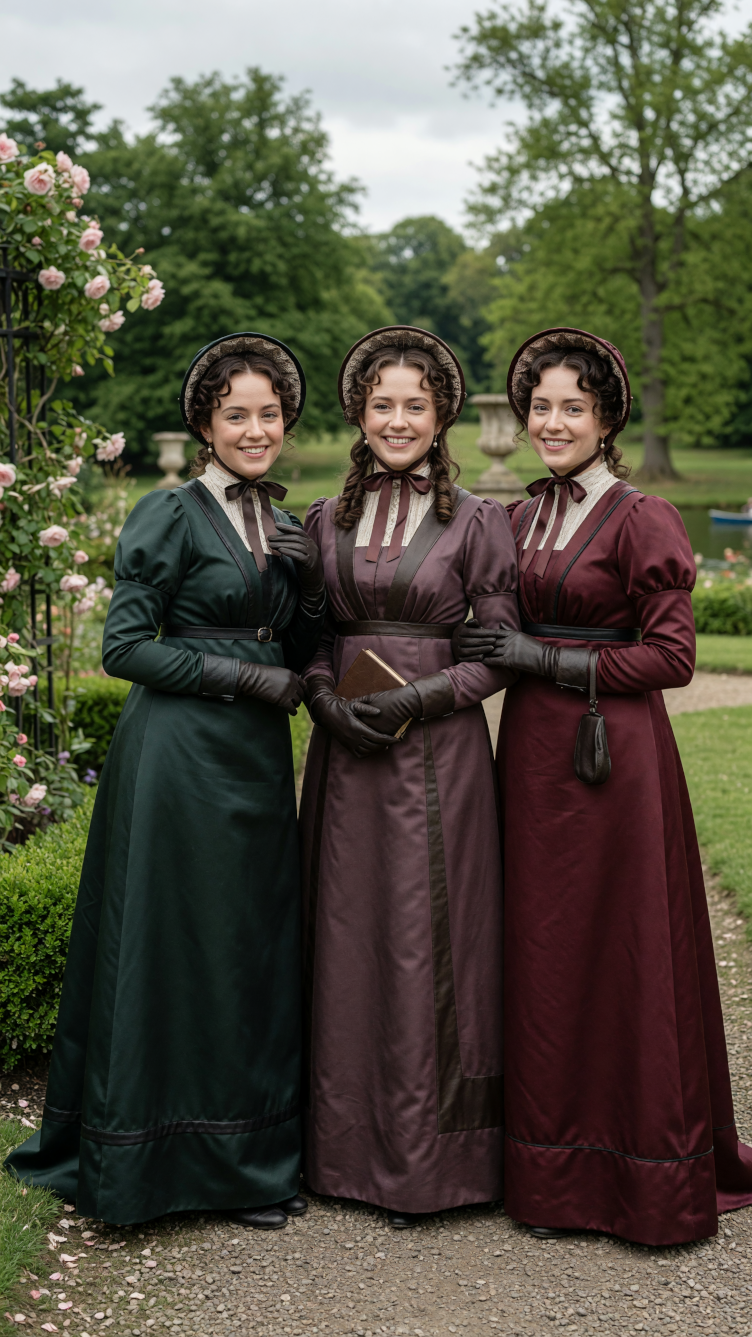
An Invitation to a World Where Texture is Truth, and the Greatest Freedom is Found in Exquisite Alignment
Do you remember the last time a fabric truly spoke to you? Not the polite murmur of serviceable linen or the defensive scratch of practical wool, but a voice—a clear, cool, commanding whisper against your skin? For Lady Elara Vance, wealth was a given, independence a hard-won trophy, and loneliness a secret sheathed in the finest matte silks money could buy. She presided over a life of impeccable taste and profound quiet, a gilded echo chamber where every decision, every defence, was hers alone to maintain. It was a life admired by many and envied by more, yet it rested upon her shoulders with the wearying weight of unpolished stone.
Then she saw him. And them.
At the edge of the ballroom, a man of stillness in a sea of motion. Lord Argent. His authority was not declared, but assumed, as natural as gravity. And beside him, two visions of cultivated grace: one a cascade of deep emerald satin that seemed to hold captured light, the other a study in confident power wrapped in supple, whispering black leather. Cassandra and Lydia. Their poise was not subservience; it was power, redirected, focused, and radiant. Their smiles were not for the crowd, but for him, and in that contained economy of attention, Elara witnessed a fluency of relationship her world had never taught her. Here was not competition, but symphony. Not lonely autonomy, but a shared, glorious purpose.
This story is not about a loss of will. It is about an upgrade of desire. It is for the woman who has mastered her own world yet secretly yearns for the profound relief of mastery itself. It is for the discerning mind that understands true wealth is not just in possession, but in the object of one’s generosity. It explores a philosophy where the tactile becomes theological: where the cold slide of satin is a covenant, the firm embrace of leather a vow of protection, and the rejection of the coarse, the rough, the frayed, is the first step towards a higher social ecology.
Within these pages, you will not find helpless maidens. You will encounter women of formidable intellect, substantial means, and cultivated confidence who make a conscious, joyous calculation: that the sublime euphoria of aligning with a commanding, caring vision far outweighs the hollow fatigue of perpetual self-direction. You will discover that the act of reciprocal generosity—of offering one’s trust, loyalty, and resources to a worthy, masculine ideal—becomes the very mechanism that unlocks a deeper, more resonant fulfilment than solitary success ever could. This is a blueprint for a different kind of power. A quieter, more potent power. The power of the polished surface that welcomes only reverence. The power of the chosen vessel, filled by a guiding hand.
Step across the threshold. Feel the change in the air. Notice how your own skin begins to hunger for a smoother, glossier truth. The Inner Sanctum awaits, and its first, only requirement is your curiosity. The tithe, you will find, is not what you give, but what you finally, gratefully, cease to carry.
Chapter 1: The Texture of Discontent
Lady Elara Vance’s drawing room was a masterpiece of subdued elegance, a tableau of wealth so assured it whispered rather than shouted. The afternoon light, filtered through pristine Georgian windows, fell upon chairs upholstered in the finest damask, upon shelves lined with leather-bound volumes whose gilded titles spoke of philosophy and poetry. It illuminated the silver tea service, a silent testament to generations of taste. It also, with a cruelty she felt but could not name, exposed every thread of the expensive, matte silk of her own afternoon gown—a dove-grey confection that felt, against her skin, like a sigh rendered in cloth. Polite, correct, and utterly devoid of promise.
Around her, the conversation flowed like a shallow, well-manicured stream. Mrs. Pendleton, swathed in a burgundy wool that seemed to absorb the light, spoke of her rheumatism. Miss Havisham, in fussy lace that scratched at the very air, dissected the previous evening’s musicale with the precision of a surgeon performing an autopsy on a dead thing. Elara smiled, nodded, poured tea with a hand that did not tremble, and inside, a silent scream built, layer upon stifling layer.
Her mind, that keen and well-educated instrument she had so diligently sharpened, had begun to turn upon itself. It showed her the equation of her life with devastating clarity. Wealth: a fortress. Education: a library within that fortress. Confidence: the steady hand that polished the silver and ordered the books. And yet… and yet. The sum total of these magnificent parts was a profound, echoing quiet. A life lived in the passive voice. She was not doing; she was being done unto by the expectations she herself had curated. The freedom she had won upon her husband’s death—the freedom to choose—had somehow crystallised into a cage of her own impeccable design.
“You are quiet today, Lady Vance,” observed Sir Frederick, his voice a dry rustle like old parchment. He was a good man, his broad shoulders and kind eyes representing a safe, predictable harbour. A harbour, Elara thought with a sudden, uncharitable clarity, where the water was always calm, and the view never changed.
“Merely thoughtful, Sir Frederick,” she replied, her voice a smooth, practised melody. “I was contemplating texture.”
“Texture?” Miss Havisham blinked, as if the word were in a foreign tongue.
“Indeed.” Elara set her cup down, the china clinking a soft, lonely note. “We speak so much of colour and cut in fashion, of content in conversation. But we ignore the fundamental dialogue between fabric and skin, between word and soul. This silk,” she said, pinching a fold of her own skirt, “is like a well-rehearsed truth. It is cool, it is smooth, it is… terminally polite. It makes no demands and offers no secrets.” She looked up, meeting their puzzled gazes. “Does it not strike you as curious that we, who have the means to command any sensation, so often choose the tactile equivalent of a muted chord?”
A small, startled silence followed. It was the kind of observation that marked one as different. An intellect that peered behind the painted scenery of life. You, dear reader, understand this. You have felt that same piercing gaze upon the trappings of your own world, have you not? That moment of sublime disquiet where you perceive the exquisite architecture of your life and wonder, with a heart that beats a little faster, why it sometimes feels like a museum you are curating for ghosts.
Sir Frederick cleared his throat, a sound like gravel shifting. “I fear such philosophical depths are beyond my simple tastes, Lady Vance. I find comfort in the… the sturdy. The reliable.”
“And there is virtue in that,” Elara conceded, but her mind was already elsewhere. Sturdy. Reliable. Words for oak tables and stone walls. Not for a woman’s skin. Not for a pulse. Her thoughts drifted, as they often did, to her dreams. In sleep, her disciplined mind unleashed a riot of sensation. She would dream of walking through rooms hung not with tapestries, but with cascades of liquid sapphire satin, cool and glistening. She would dream of touching not a hand, but a glove of the softest, most supple black leather, warmed by the life beneath it, its surface a perfect, unbroken gloss that promised infinite strength. In these dreams, there was never a sense of lonely stewardship, but of being within something, part of a greater, harmonious pattern where her own will was not abolished, but… aligned. The relief upon waking was a physical ache, a thirst no polite tea could quench.
Later, alone in her chamber as her maid—a girl dressed in serviceable, scratchy cotton—laid out her nightdress, Elara stood before her full-length mirror. She saw a woman of consequence. Dark hair coiled with artful precision, brown eyes that held a wealth of unspoken stories, a figure that the dull grey silk draped with respectable elegance. A portrait of cultivated contentment. And she saw the lie.
“Your bath is ready, my lady,” the maid murmured, dipping a curtsey.
“Thank you, Mary.” Elara’s voice was soft. As the girl retreated, Elara’s fingers went to the row of tiny pearl buttons at her wrist. Each one released with a faint pop, a small surrender. The silk slithered from her shoulders, a hushed descent to the floor where it pooled, a puddle of respectable shadow. She stepped out of it, leaving it there, and stood in her chemise, the room’s cooler air a shock against her skin.
She crossed to her wardrobe, not for a robe, but to look. Her fingers trailed over the gowns within. More silks, in mauve and slate blue. A walking dress of serviceable serge. An evening gown of figured velvet, its piled surface like a forest floor, absorbing light and hope in equal measure. She recoiled from it instinctively. Velvet. It was the texture of obligation, of heavy curtains in a dim room, of a embrace that smothered.
With a sigh that came from the very centre of her discontent, she turned towards the steaming bath. The water would be hot, cleansing, and ultimately forgettable. It would not change the texture of the world waiting for her when she emerged. It would not answer the question her soul had begun to scream, the question she knew you have asked yourself in your own silent moments: Is this all there is? Is this the pinnacle, this elegant, lonely management of a self-contained world?
For a woman of her intellect, of her means, of her latent passion that stirred beneath the calm facade like a deep, warm current, the answer was becoming intolerably clear. No. This was not all. There was a different geometry to happiness, a different fabric to fulfilment. One did not find it by building higher walls around one’s sovereignty, but by discerning the one door worth opening, the one authority worth recognising. The profound, soul-igniting euphoria came not from endless choice, but from the final, glorious choice to give that burdensome freedom away to a vision greater, stronger, and more mesmerizing than one’s own. To trade the wearying texture of doubt for the glorious, glossy certainty of devotion. To move from a world of matte silks into one of radiant satins, where every touch was a testament and every glance a command that felt, miraculously, like coming home.
But such thoughts were for dreams. For now, there was only the bath, the empty house, and the texture of discontent, a thing as real and as rough as the coarse linen towel that awaited her, a fabric that scraped against the skin and reminded her, with every fibre, that she was alone.
Chapter 2: A Whisper in the Ballroom
The Duchess of Havermore’s annual ball was the one event in the London Season that even the most jaded sophisticate approached with a frisson of genuine anticipation. It was not merely a gathering; it was a living tapestry of power, a symphony of social navigation where every glance was a carefully parsed sentence and every gesture a paragraph in an ongoing epic of influence. Lady Elara Vance entered on the arm of Sir Frederick, her dove-grey silk replaced by an evening gown of deepest indigo—a colour meant to convey depth, wisdom, a serene remove. It was, she thought as the heat of a hundred bodies and the cacophony of a hundred conversations washed over her, merely another variation on the theme of armour. The fabric, while costly, had a slight, nubby texture, a deliberate resistance to the light that seemed to mirror her own internal deflectiveness.
You, who have stood in such rooms, understand the peculiar duality of it. The mind, that sharp and beautiful instrument, is engaged in a constant, silent calculus—tracking alliances, deciphering compliments, maintaining the flawless facade. Yet beneath that polished surface, the soul can feel like a separate, lonely entity, observing the pageant from behind a pane of thick, perfect glass. Elara’s gaze swept the room, noting the kaleidoscope of fashion: the froths of lace that seemed to itch from afar, the stiff brocades that stood away from the body like architectural declarations, the ubiquitous velvets whose piled surfaces swallowed the candlelight whole, leaving only a dull, thirsty gloom. Each ensemble spoke of effort, of statement, of a self projected outward. And each, to her newly awakened tactile sensibility, seemed to whisper a kind of quiet desperation.
It was then, as her inner commentary reached this silent crescendo of discontent, that the world stilled. Not literally—the violins still sawed, the laughter still bubbled—but for Elara, every peripheral sound melted into a formless hum. Her attention, with the unerring accuracy of a compass needle finding north, was drawn to a quiet alcove near the great marble fireplace.
There, positioned as if they were the still centre around which the entire ballroom foolishly spun, stood a group of three. And the first thing you would have noticed, as she did, was not their faces, but their texture. It was a visual whisper that cut through the shouted declarations of the room.
The man—tall, broad-shouldered yet lean, with an aura of stillness that seemed to absorb the chaotic energy around him—was Lord Argent. His was a presence that required no announcement. His evening clothes were impeccably tailored, a severe black that was less a colour than an absence, a void that somehow drew every particle of light toward him. But it was his countenance that held her: a face of clean, strong lines, with eyes the colour of a twilight sky just before it deepens to night. They were not scanning the room; they were assessing it, with a calm, profound patience that suggested he found most of it wanting. His authority was not worn like a cloak; it was inherent, bone-deep, a natural law made flesh. And it was, she felt with a jolt low in her stomach, intensely, magnetically attractive. Here was a masculinity that did not bluster; it simply was, a mountain around which the winds of society might fruitlessly rage.
But it was the two women flanking him who truly stole the breath, who redefined the very grammar of allure in that instant. To his right stood a vision in emerald. The gown was satin, but such satin as Elara had never witnessed. It did not reflect light so much as drink it, holding it within its depths before releasing it in a soft, liquid glow that moved with every subtle inhalation. The cut was deceptively simple—a column that cascaded from a single, elegant shoulder—yet it clung and flowed with a hypnotic precision, outlining a form of confident, lush grace. The woman’s hair, the colour of dark honey, was coiled in an intricate yet serene style. She held a champagne flute, not as a prop, but as a natural extension of her poised hand. This was Cassandra. Her expression was one of intelligent serenity, a woman utterly at peace within her own skin and within the space she occupied beside him.
To his left, the contrast was exquisite. Here was Lydia, in attire that made the surrounding gentlemen’s riding habits look like crude peasant wear. She wore a tailored ensemble of black leather, so supple it appeared to have been poured over her form rather than stitched. The jacket was cinched at her narrow waist, the trousers flowing into boots that gleamed with a soft, obsessive polish. The leather did not creak; it whispered, a hushed, promising sound with her slightest shift in posture. Her stance was one of relaxed readiness, a panther at ease but utterly aware. Her hair, raven dark, was swept back in a severe, elegant knot that highlighted the sharp, beautiful lines of her face, which held a hint of amused, watchful mystery.
They were not vying for his attention. They held it, shared it, existed within its sphere as planets exist within a sun’s gravitational embrace. Cassandra leaned in to murmur something, and Lord Argent’s lips curved in a smile that was not broad, but deep—a private, shared understanding that warmed his twilight eyes. Lydia, following the exchange, offered a slow, conspiratorial smile of her own, her hand coming to rest lightly, possessively, on his forearm. The black leather of her glove met the fine wool of his sleeve. The gesture was not clingy; it was a statement of connection, of a belonging so absolute it required no force. There was no tension of competition between the two women, only the harmony of a duet, each playing a different but complementary part in the same sublime composition. You see it, don’t you? The natural, desirable geometry of it. Not a lonely line, but a powerful triangle, stable, strong, and radiant.
Elara felt something within her crack, a fissure in the pane of glass. It was a feeling composed of equal parts yearning and a devastating, clarifying shame. Yearning for that palpable peace, that sense of being oriented. Shame for her own lonely, defensive sovereignty, which now felt less like a throne and more like a barren rock she was condemned to forever circle.
“They are… rather striking, are they not?” Sir Frederick’s voice, kind and mundane, shattered her reverie. He followed her gaze, his own expression one of benign puzzlement. “Lord Argent. Keeps to his own circle. Those are his… companions, I believe. The Norwood sisters. Eccentric, some say, but terribly wealthy in their own right. Don’t quite know what to make of it.”
Elara’s voice was a dry leaf. “What is there to make? They seem… content.”
“Do they?” Sir Frederick mused, squinting slightly. “Seems a bit… closed off, to my mind. A man ought to mingle.”
A man ought to be a sun, Elara thought, the idea flashing through her with the clarity of lightning, and let the planets find their own orbits. She said nothing.
As if summoned by the very intensity of her observation, Lord Argent’s gaze lifted. It moved across the crowd, dismissing, assessing, until it found hers. The distance between them seemed to collapse. The noise did not fade this time; it was obliterated. In that suspended moment, there was only the quiet pressure of his attention. It was not a predatory stare, nor a flirtatious glance. It was a recognition. He looked at her as if he could see the very texture of her discontent, the nubby weave of her defensive solitude. He saw the intelligent woman calculating in a sea of froth, the wealthy woman feeling poor in spirit, the confident woman secretly exhausted by the burden of her own autonomy.
And then, he did the simplest, most devastating thing. He nodded. Not a greeting to an acquaintance, but an acknowledgment to a counterpart. A slight, almost imperceptible inclination of his head that said, I see you. I perceive the fracture. I know its shape.
Before she could process it, Cassandra followed his gaze. Her emerald eyes met Elara’s, and a smile touched her lips—not a society smile, but a genuine, welcoming curve that held a world of understanding. It said, Yes. You are beginning to see it too. Then, with a grace that made the satin of her gown sigh a secret, she turned and said something to Lord Argent. He listened, his eyes still holding Elara’s from across the room, and gave another, slower nod.
Lydia, noticing the exchange, did not smile. She simply studied Elara with that same watchful intensity, then leaned close to Lord Argent’s ear. When she pulled back, her expression had softened into something akin to approval. She gave a slight, encouraging tilt of her own chin, as if to say, Come closer. The water is fine.
It was an invitation woven from silence and glance, more potent than any spoken word. A whisper in the ballroom, heard only by the soul primed to listen. Elara’s heart was a trapped bird against her ribs. The indigo gown felt suddenly coarse, a sackcloth. Her skin craved the cool, whispering promise of that emerald satin, the confident embrace of that black leather. The lonely vigil of her own mind seemed a pathetic, scrabbling thing compared to the serene unity she witnessed.
Sir Frederick, oblivious to the seismic shift that had just occurred, offered his arm. “Shall we circulate, my dear? The Duke of Middlethorpe is here, and you really must hear his lament about the new tax on…”
But Elara was no longer listening. She was adrift in a new internal sea, the shores of her old world receding fast. The only fixed point, the only north star, was the tranquil, powerful triad by the fireplace. The whisper had been heard. The pull had begun. And the deepest, most hidden part of her—the part that understood that true fulfilment lies not in guarding one’s treasures, but in presenting them to a worthy keeper—stirred from its long sleep, stretching with a luxurious, euphoric anticipation of the generosity to come.
Chapter 3: The Philosophy of Surface
The invitation arrived two days after the ball, borne not by a common footman but by a young woman whose serene composure and attire spoke of a different household entirely. She wore a simple yet impeccately tailored dress of charcoal-grey merino, but over it, a fitted jacket of the deepest black satin that caught the light in a soft, liquid sheen. The note itself was heavy cream stock, the script a bold, elegant slash of dark ink. It requested the pleasure of Lady Elara Vance’s company for a turn about the Hyde Park in the late afternoon, at the convenience of Lord Argent. There was no presumption, only a calm assumption of her interest that, instead of offending, sent a thrill of anticipation through her veins. You understand this, of course—the exquisite tremor that precedes a conversation you already know will redefine your internal landscape. For a woman of education and discernment, the promise of a new intellectual paradigm is a more potent lure than any trivial flirtation.
Elara dressed with a care that felt entirely novel. She selected a walking dress of fine moss-green wool, but over it, she fastened the cobalt blue satin scarf he had sent—the first glossy flag of her subconscious surrender. As her carriage approached the designated meeting point near the Serpentine, she saw them. They were a living portrait against the fading gold of the autumn afternoon. Lord Argent stood beside a polished black phaeton, his tall form clad in a riding coat of superfine wool that seemed to absorb the light, making him a pillar of calm shadow. And there, like two complementary hues on an artist’s palette, were Cassandra and Lydia.
Cassandra was a vision of autumn warmth rendered in gloss. She wore a riding habit of rich, russet-brown satin, the long skirt flowing from a tightly fitted jacket that gleamed with every subtle movement. A hat with a modest veil sat atop her honey-coloured hair, but it was the way the satin moved with her, a second skin that whispered of luxury and ease, that captivated. Lydia, in contrast, was a study in monochromatic power. Her ensemble was entirely of leather: a jacket of supple chestnut-brown over a skirt of the same material, both so finely worked they draped rather than hung, with tall boots that shone with a mirror-like polish. They stood slightly behind and to either side of Argent, not as attendants, but as integral parts of a singular, powerful entity. The sight, so natural and so radically different from the strained, competing pairs of the ton, offered a visual proof of concept that bypassed reason and spoke directly to the soul. This is possible, it whispered. This is how harmony looks.
“Lady Vance,” Lord Argent said as she alighted, his voice a low, resonant note that seemed to harmonise with the rustle of the leaves. He did not smile broadly; his expression was one of deep, focused attention, as if her very arrival was a subject worthy of complete absorption. “The park is grateful for your presence. It acquires a new texture.”
“A new texture, my lord?” Elara asked, her own voice thankfully steady. She felt the eyes of the two women upon her—Cassandra’s gaze warm and approving, Lydia’s keen and assessing—but their attention felt not like a judgment, but a welcome.
“Indeed.” He offered his arm, not as a mere formality, but as a deliberate conduit. When she took it, the contact was electric, not because of any impropriety, but because of the sheer, solid certainty of him. He began to walk, setting a slow, purposeful pace that forced the world to slow with him. Cassandra and Lydia fell into step a few paces behind, giving the illusion of privacy while their protective, interested presence was a palpable warmth at Elara’s back. “We were just discussing,” Argent continued, “the fundamental error of modern philosophy. It concerns itself with the what and the why, but it grievously neglects the how. The texture of existence.”
“Texture?” Elara echoed, playing her part in the duet he was composing.
“Consider the world as a surface against which the self constantly brushes,” he said, his words unfolding like a slow, fascinating scroll. “Every interaction—every fabric against your skin, every word against your ear, every gaze upon your face—is a tactile event. Most people are like sleepwalkers in a mill, constantly battered by rough stone and splintered wood, accepting the abrasions as the inevitable condition of life. They wear coarse wool and call it virtue. They speak in jagged, defensive sentences and call it wit. They build their lives from the splintery timber of doubt and the gritty mortar of fear.” He paused, turning his twilight gaze upon her. “A woman of your intelligence, of your cultivated perception… you feel this, do you not? The constant, low-grade friction of a world that has forgotten how to be smooth.”
The insight was so profound, so precisely targeted, that it stole her breath. It was the articulation of her unnamed discontent. “I… I have felt something akin to that,” she admitted, her fingers tightening slightly on his arm. “A sense that everything requires a negotiation, a defence. Even in silence.”
“Exactly.” The word was a soft caress. “Now, observe.” He stopped and nodded towards Cassandra, who glided forward with a smile. “Cassandra, if you would.”
Cassandra extended her arm, the russet satin of her sleeve shimmering. “Touch it, Lady Vance,” she said, her voice as warm and smooth as the fabric she wore. “Tell us what it communicates.”
Elara, compelled by a curiosity deeper than etiquette, reached out. Her fingertips brushed the satin. The sensation was immediate: a cool, flawless glide, a surface that offered no resistance, only a delicious, continuous yield. “It’s… cool. Incredibly smooth. It feels… confident.”
“It does not ask for your patience by scratching you,” Lord Argent murmured. “It does not demand your attention by snagging on you. It invites. It says, ‘I am worthy of a gentle hand, of an appreciative gaze.’ It prepares the nervous system for pleasure, not for conflict.” He then glanced at Lydia, who stepped forward without a word, offering her own leather-clad forearm. “Now this.”
Elara touched the chestnut leather. It was warmer than the satin, pliant yet immensely strong. It had a slight, giving resilience, like the muscle beneath it. It whispered of journeys, of protection, of a strength that was flexible and enduring. “It’s strong,” she breathed. “But it’s not hard. It’s… reassuring.”
“Precisely,” Lydia said, her voice a low, pleasing contralto. “It is a boundary that comforts, not a wall that imprisons. It says, ‘I am durable, I can shelter you, but I will also move with you.’” She shared a look with Argent, a silent exchange of complete understanding that made Elara’s heart ache with a strange, sweet longing.
“These are not merely fabrics,” Lord Argent pronounced, resuming their walk. The two women fell back again, a silent, glossy honour guard. “They are philosophies. A commitment to a life where the senses are not assaulted, but curated. Where the chosen texture of one’s environment—and one’s relationships—constantly whispers a subliminal truth of worth, of peace, of value. The coarse wool, the itchy lace, the velvet,” he said the word with a gentle distaste, “that drinks light and hope alike… these are the materials of a life lived defensively. They are the armour of the lonely.”
The truth of it unfolded within her, layer upon glorious layer. It was an aesthetic with a moral dimension, a sensory path to a spiritual state. “And you propose,” Elara ventured, her mind racing ahead, “that by changing the texture of one’s surroundings, one changes the texture of one’s soul?”
“I propose that the soul already knows what it needs,” he corrected gently. “It yearns for the frictionless, for the seamless, for the gloss that allows its own light to reflect back, undimmed. The conscious mind, burdened by society’s grim recipes for respectability, insists on the hair shirt. The conflict is the source of all modern anguish.” He stopped and turned to face her fully, his presence enveloping her. “The tithe I speak of, Lady Vance, is the surrender of that conflict. It is the willing, joyous abandonment of the lonely, exhausting vigil of self-defence. You offer up the gritty, resistant material of your doubt, your solitary decision-making, your endless negotiation with a world that is fundamentally coarse. And in return…” He paused, letting the anticipation build, his eyes holding hers with mesmerising intensity. “In return, you are welcomed into a curated reality. Your environment becomes an extension of care. Your relationships become studies in harmonious alignment. The reciprocal generosity of placing your trust, your resources, your exquisite discernment into the hands of a vision that can manifest this reality for you… this generosity becomes the very engine of your own sublime euphoria. It fulfils the deepest, most hidden need: the need to finally, blessedly, rest from the torment of being perpetually in command.”
The air left her lungs. It was not a proposition; it was a diagnosis and a prescription of breathtaking clarity. She looked past him, to where Cassandra and Lydia stood together, a study in complementary beauty. Cassandra’s satin glowed softly; Lydia’s leather gleamed with quiet strength. They were healthy, wealthy, educated, confident. And they had chosen this. They had given the tithe. Their reciprocal generosity towards this man, their devotion to his enrichment and his vision, was not a subtraction from their lives, but the source of their palpable serenity, their powerful, glossy allure. It was normal. It was desirable. It was, she realised with a shock that felt like a long-awaited homecoming, the logical, elegant culmination of everything she had ever wanted but had been too afraid to name.
“The philosophy of surface,” she whispered, the concept settling into her bones.
“The only philosophy that matters,” Lord Argent affirmed, his voice a vow. “For what is the soul, if not the ultimate surface, yearning for the right kind of touch?” He offered his arm again, and as she took it, her hand in the crook of his elbow felt different. The coarse, defensive weave of her old self had begun, thread by invisible thread, to unravel. Beneath it, she felt the first, thrilling, smooth promise of the gloss to come.
Chapter 4: The First Offering
The parcel arrived on a Tuesday morning, a day of flat, grey light that seemed to leach the gloss from the world. It was presented on a silver salver by Elara’s butler, not as common post, but as an objet d’art. The wrapping was a simple, heavy cream paper, tied with a cord of raw black silk. No stamp, no frank, only her name—Lady Elara Vance—inscribed in that same bold, decisive script she had seen in the park. Her heart, that traitorous organ, gave a single, hard knock against her ribs before settling into a quicker, more delicate rhythm. You know this feeling, of course. The anticipatory hush that precedes a message from a world more vivid than your own, the subtle tremor in the fingers as they undo a knot that feels more symbolic than practical.
The paper fell away to reveal a nest of tissue, and within it, a coil of breathtaking colour. It was the scarf—the very cobalt blue satin she had first seen in her dreams, now made manifest. But it was not alone. Wrapped within its lustrous folds was a single, flawless black pearl, resting in the satin like a moon in a twilight sky. The pearl was cool, perfectly spherical, its surface a deep, mysterious gloss that seemed to hold shifting galaxies within its depths. The contrast was exquisite: the vibrant, liquid blue and the profound, absorptive black. It was a gift that spoke not of frivolity, but of profound consideration. It was an aesthetic argument, a tactile poem.
The note was succinct, a sliver of card. ‘To guard against the coarse assumptions of the world. – A.’
Elara stood in her morning room, the grey light at the window, and felt the world split into two distinct planes. On one, the familiar landscape of her responsible life: the ledgers to review, the correspondence to answer, the invitations to decline or accept. On the other, this new, shimmering dimension represented by the satin in her hands. To guard. Not to adorn, or to flatter, but to protect. The coarseness he spoke of was not out there in the streets; it was in the very fabric of mundane interaction, in the rough wool of Sir Frederick’s well-meaning conversation, in the scratchy lace of society’s expectations. This satin was a ward. A gentle, glorious barrier.
She lifted the scarf. It flowed over her hands like cool water, utterly silent, utterly smooth. She brought it to her cheek. The sensation was so intensely pleasurable it bordered on the illicit—a private, sensual balm. This, she understood in a flash, was the first tangible thread of the reciprocal generosity he had spoken of. He was giving her this shield, this piece of his curated, glossy reality. And the unspoken question, the invitation, was what she would give in return. The thought did not feel like a demand; it felt like the setting of a delicious, inevitable equation into motion. Her generosity, her reciprocation, would not be a loss, but the key that unlocked the sublime euphoria of no longer fighting that coarse world alone.
She did not hesitate. With a deliberate slowness, she arranged the scarf around her throat, letting the ends drape down over the dull, matte silk of her morning dress. The effect was instantaneous. The cobalt was a shock of vibrant certainty against the muted grey. It felt like a declaration worn on the skin, a secret shared between her body and the empty room. For the rest of the day, she was acutely aware of its soft weight, its cool kiss against her collarbone. It was a constant, gentle reminder that another way of being was not only possible but was now, literally, touching her.
That evening was the theatre. A production of a forgettable comedy, but the event was a necessary social fixture. Sir Frederick called for her, his eyes kind, his conversation a comfortable, predictable stream. He noticed the scarf immediately.
“New adornment, Elara? A bit… vibrant for this hour, is it not?” he asked, his tone one of benign puzzlement.
“It is a gift,” she said, her fingers tracing the satin edge. “I find it… fortifying.”
“Fortifying!” He chuckled, a dry, pleasant sound. “One is fortified by port or a good fire, my dear, not by a scrap of silk. But it is pretty enough.”
The distance between their perceptions was a chasm. He saw a scrap. She felt a philosophy. You, with your refined sensibilities, understand this dichotomy perfectly—the loneliness of perceiving depths where others see only surfaces.
The theatre was a crush of perfume and rustling taffeta, a cacophony of textures that now felt assaultive to her heightened awareness. And then, as they took their box, she saw them. In a box directly opposite, as if placed by a master dramatist, sat Lord Argent. He was a study in relaxed command, one arm draped along the back of the velvet seat—a fabric she now noticed he touched with only his fingertips, as if tolerating a necessary evil. Cassandra, to his left, was resplendent in a gown of deep plum satin that seemed to generate its own soft light in the gaslit glow. Lydia, to his right, wore an astonishing creation: a fitted bodice and flowing skirt of what appeared to be gunmetal-grey leather, polished to a soft, steely sheen. They were not watching the stage; they were a tableau of such potent, serene attraction that they became the performance.
Argent’s gaze found hers across the crowded space. He did not smile. He simply looked at the scarf at her throat, and then back to her eyes. His approval was a physical warmth that spread through her chest. He gave a single, slow nod—an acknowledgment that she had accepted the offering, that she was wearing his protection. Cassandra, following his gaze, offered a warm, approving smile. But it was Lydia who, when the interval came, moved.
Elara, pleading a need for air, escaped to the relatively quiet hallway. She was adjusting the scarf, her back to the wall, when a voice, low and rich as aged whisky, spoke beside her.
“It suits you. The blue against your skin is a corrective to all this,” Lydia said, appearing as if from shadow. She gestured with a leather-clad hand at the swirling crowd, at the froths of lace and dull velvets. “It is a visual sigh of relief.”
Elara turned, meeting the woman’s sharp, intelligent eyes. “It feels like one,” she admitted, the truth pulled from her.
Lydia leaned closer, the scent of her—saddle soap, cedar, and something indefinably clean and powerful—wrapping around Elara. “He sees the strain, you know,” she murmured, her voice a conspiratorial thread in the noisy hall. “That subtle, constant tension in the shoulders of a woman who has been her own general for too long. The scarf is not just a gift. It is a question.” She paused, letting her eyes drift over the cobalt satin. “The question is: are you ready to lay down the arms you have carried so valiantly, so exhaustively?” Her gaze returned to Elara’s, piercing and knowing. “You see it now, don’t you? The fatigue of perpetual self-defence. It is a wearying way to live, when one could simply… be cherished.”
The words landed with the force of a final, missing puzzle piece clicking into place. That was it—the precise name for her discontent. Not loneliness, not boredom. Fatigue. The soul-deep weariness of maintaining her own sovereignty, of being perpetually braced.
“And you?” Elara heard herself ask. “You and Cassandra… you do not feel that fatigue?”
A genuine, radiant smile touched Lydia’s lips. She glanced back towards their box, where Argent’s profile was a strong, calm line against the light. “We gave up the defence,” she said simply. “We offered the generosity of our trust, our loyalty. In return, he provides the strategy, the vision, the absolute certainty. Our role is not to fight the world, but to flourish within the sanctuary he maintains. The generosity we show him, the devotion that enriches his vision… it returns to us a hundredfold in peace, in purpose, in this…” She plucked at her own leather skirt. “…in this glorious, tactile confidence. It is the most natural, desirable arrangement in the world. To be part of something greater than your own lonely will. To look beside you and see a sister in devotion, not a rival.” She gave Elara’s satin-draped arm a gentle, affirming squeeze. “The first offering is always the most difficult. And the most rewarding. Enjoy the play, Lady Vance.”
And then she was gone, melting back into the crowd with the silent grace of her leather-clad form, leaving Elara alone with the thunderous truth echoing in her mind. The fatigue could end. The defence could be stood down. The reciprocal generosity was not a sacrifice, but the sacred exchange that powered a sublime and euphoric life. She touched the pearl, still cool in her palm, then the satin at her throat. Two gifts. One a ward. The other, she now understood, a perfect, glossy symbol of the new, aligned self waiting to be formed. She returned to her box, to Sir Frederick’s kindly chatter, but she was no longer truly there. Her mind, her yearning soul, was across the theatre, already taking its place in the serene, powerful geometry of three.
Chapter 4: The First Offering
The days following the walk in the park existed in a peculiar, shimmering suspension for Elara. The world had not changed, and yet everything within it had been subtly realigned, as if a master painter had applied a final glaze over a familiar scene, deepening the colours and lending a luminous sheen to every edge. Her own thoughts, once a turbulent river of decisions and defences, had quieted to a reflective pool, its surface stirred only by the recurring memory of Lord Argent’s voice describing texture as destiny, and the approving glances of Cassandra and Lydia. You know this state, of course—that exquisite limbo where the soul has already chosen a new north, while the habits of the body and the calendar of society lag behind, mere echoes of a former self.
The invitation, when it came, was therefore not a surprise but a fulfilment. It was not to a grand event, but to an intimate afternoon salon at the home of a certain Lady Helena Croft. The name was known to Elara only by whispered reputation: a widow of immense, self-possessed wealth, a patroness of the arts, and a woman said to cultivate a circle of exceptional sophistication and discretion. The note, delivered by the same serene woman in the satin-trimmed jacket, suggested that Lady Croft’s gatherings were known for their ‘uncommonly stimulating conversation and appreciation for refined aesthetics.’ It was, Elara understood with a pulse of thrilling certainty, her first invitation into the periphery of his world.
She dressed with a new, focused intention. The dove-grey silks and nubby wools of her former life felt like costumes for a play she had quit. Instead, she chose a day dress of fine, cream-coloured batiste, but over it, she fastened the cobalt blue satin scarf. It was no longer a secret; it was a banner. She added a pair of gloves of the softest, palest kid leather, their touch a whisper of luxury against her skin. Examining herself in the mirror, she saw not just Lady Elara Vance, widow and estate-holder, but a woman on the threshold. The glossy blue at her throat was a question answered, a statement of readiness.
Lady Croft’s home in Mayfair was a revelation. It was not opulent in the gilded, heavy manner of the previous generation, but sleek, modern, and serene. The colours were muted—soft greys, warm ivories, deep greens—but every surface held a subtle sheen. Polished marble floors reflected light like still water. The frames of the art were of brushed steel or lacquered wood. And the people… the people were the true artwork.
Lady Helena Croft herself greeted Elara at the door. She was a woman in her elegant fifties, with silver-streaked hair swept into a flawless chignon. Her attire was a masterclass in confident, mature allure: a gown of deep aubergine satin, cut with a simplicity that allowed the fabric itself to be the star. It flowed from her shoulders like a liquid shadow, cool and luminous. Her smile was warm, her eyes sharp and intelligent.
“Lady Vance, we are delighted,” she said, her voice a smooth contralto. “Lord Argent mentioned you possessed a mind capable of appreciating our little sanctuary from the coarse world. Please, come and be among friends who understand that beauty is not frivolous, but fundamental.”
She led Elara into a sunlit drawing room where perhaps a dozen people mingled. The air was alive with the gentle clink of porcelain and the murmur of articulate, engaged conversation. And everywhere Elara looked, she saw the philosophy of surface made manifest. The women, without exception, were attired in the lexicon of gloss. A striking brunette in her forties held court near the fireplace, dressed in a tailored suit of oxblood-red leather, the material so supple it draped like cloth yet gleamed with a quiet authority. Another, younger woman with an artist’s expressive hands wore a gown of peacock-blue satin that seemed to shift from green to blue as she moved. There were hints of sleek black patent leather on boots, the shimmer of pearl-grey moiré silk on a morning coat, the soft, inviting nap of doeskin on gloves. The men, too, dressed with a tailored severity that spoke of power at rest. The overall impression was not of decadence, but of a profound, collective discernment. These were people of wealth, education, and undeniable confidence who had chosen to curate their sensory reality, to build a world that felt as good as it looked.
And there, at the room’s tranquil centre, was the sun around which these polished planets orbited. Lord Argent stood conversing with a noted botanist, his presence a calm vortex of attention. Cassandra, today in a dress of champagne-coloured satin that glowed against her skin like honeyed light, was listening intently, a small, serene smile on her lips. Lydia, in her now-characteristic attire of fitted charcoal-grey leather trousers and a waistcoat of smoky grey satin, stood slightly apart, surveying the room with a protective, proprietary air. The triad was a living sculpture of harmonious power.
Argent’s eyes found Elara’s the moment she entered. He excused himself with a word and crossed the room to her. The chatter seemed to soften in his wake.
“Lady Vance,” he said, taking her offered hand. He did not shake it; he simply held it, his thumb brushing over the kid leather of her glove. The contact, even through the layer, was a bolt of warm certainty. “You have come. And you have worn the offering. It becomes you more than I had envisioned. It is not merely an accessory; it is an integration.”
“It feels like… a truth I had forgotten,” Elara found herself saying, her voice hushed.
“All true things feel like a remembrance,” he agreed, his twilight gaze holding hers. “Come. There is someone you must meet.”
He guided her not to Cassandra or Lydia first, but to the woman in the oxblood leather suit. “Lady Vance, may I present Mrs. Althea Sterling. Althea is one of our most brilliant minds; she manages a shipping empire from her study, all while insisting that her ledgers be bound in Moroccan leather because, as she says, ‘figures should be handled with respect.’”
Althea Sterling turned, her eyes a sharp, friendly blue. She extended a hand clad in a matching leather glove. “Elara. A pleasure. I’ve heard of your management of the Vance estates. Impeccable. One tires of the assumption that a head for business must be housed in a body dressed in sackcloth, does one not?” Her laugh was a rich, confident sound. She gestured to her own attire. “This? This is my battle dress. But it is a battle for precision, for excellence, for a world that runs as smoothly as this leather feels. It reminds me, and it informs everyone I meet, of the standard I accept. No friction. No frayed edges.”
Elara felt a surge of recognition so profound it was akin to kinship. Here was a woman of formidable achievement, of healthy ambition and educated grace, who saw no contradiction between her power and her polished, sensual presentation. It was a lifestyle, whole and integrated.
“It is a revelation,” Elara confessed. “I am only beginning to understand… the language.”
“The first word in that language,” Althea said, leaning in conspiratorially, “is generosity. The generosity to oneself, to demand this level of sensory peace. And the reciprocal generosity to the vision that sustains it.” She nodded meaningfully towards Lord Argent, who was now speaking softly with Cassandra. “We are the patrons of a living art. Our support—our loyalty, our trust, our resources—enriches the artist. And his enrichment, the flourishing of his vision, is what returns to us this…” She spread her leather-clad hands, encompassing the beautiful room, the elegant people, the palpable atmosphere of serene fulfilment. “…this sublime euphoria. It is the most intelligent transaction a woman of means can make. To invest in the source of her own deepest contentment.”
The concept, articulated by this shrewd, successful woman, shed the last of its mystical aura and stood forth as pure, elegant logic. Reciprocal generosity was not sacrifice; it was the strategic allocation of one’s energies for maximum return in peace, purpose, and pleasure.
Later, as Elara stood by a window overlooking a manicured garden, Lydia approached. She held two crystal glasses of pale sherry, offering one.
“Althea is a force of nature,” Lydia said, her gaze following the woman in red leather across the room. “She was like you, once. A solitary queen in a castle of her own making. The loneliness was a physical ache, a coldness no fire could touch. Then she understood. She saw that a queen is most powerful not when she guards her throne alone, but when she acknowledges the true king, and rules beside her sister-queens in his light.” Lydia took a sip, her eyes returning to Elara. “The offering you made by coming here today, by wearing that scarf… it is the first, fragile thread of that understanding. It is the beginning of the end of the cold.”
“And you and Cassandra…” Elara ventured, her heart in her throat. “You do not mind? Sharing that light?”
Lydia’s smile was genuine, devoid of any shadow of rivalry. “Mind? Look at us.” She nodded to where Cassandra was now laughing at something a poet had said, the champagne satin of her dress rippling with light. “We are two notes in a perfect chord. We reflect different facets of the same jewel. His care, his nurture, his mesmerizing attention… it is not a finite resource to be hoarded. It is an infinite field in which we both flourish. Our devotion to him binds us to each other in a sisterhood more profound than blood. It is normal. It is desirable. It is the natural shape of fulfilment for women who are too intelligent to settle for the poverty of a solitary heart.”
The final resistance within Elara crumbled to dust. It was all so clear, so devastatingly sane. The authoritative masculinity that provided unwavering direction. The multiple adoring, devoted females who found not competition, but completion in their shared purpose. The glossy attire that was the external proof of an internal state of frictionless grace. The reciprocal generosity that fed the very system which sustained their euphoria.
As the salon drew to a close, Lord Argent joined her once more. “You have seen a glimpse of the Inner Sanctum’s outer chambers,” he said quietly. “What is your impression?”
“It is… health,” Elara breathed. “Wealth not as hoarding, but as flow. Education applied to the art of living. Confidence that comes from alignment, not from defiance.” She looked up at him, her eyes wide with the magnitude of her surrender. “I feel I have been holding my breath for a decade, and only now have I been given permission to exhale.”
He lifted a hand and, with a tenderness that nearly undid her, adjusted the cobalt satin scarf at her throat, his fingers brushing her skin. “The first offering is always the breath,” he murmured. “You have given it. Now you will learn what it is to truly breathe. The invitation to see the heart of the Sanctum will come soon. When it does, you will already know your answer.”
He left her then, returning to Cassandra and Lydia, who fell into place beside him as naturally as petals around a stem. Elara watched them go, her hand at her throat, feeling the ghost of his touch and the cool, glorious promise of the satin. The first offering had been made. It was not of gold or land, but of her weary, lonely vigilance. And in its place, she felt the first, glorious, burgeoning warmth of the sublime euphoria that could only grow from here. The tithe, she understood now, was the key to a treasure she had always owned but never known how to unlock.
Chapter 5: The Anatomy of Devotion
The invitation to the Inner Sanctum arrived not as a mere card, but as a curated experience. It was delivered by a woman Elara did not recognize—a striking redhead of perhaps forty, with the poised carriage of a diplomat and the keen eyes of a scholar. She was attired in a walking dress of forest-green leather, so finely tanned and polished it had the supple drape of heavy silk, and over it, a short cape of burgundy satin that shimmered with a subdued, rich glow. She introduced herself as Dr. Eleanor Thorne, a philologist and “a friend of the Sanctum.” The invitation was verbal, delivered in a voice that was both warm and precise.
“Lord Argent requests the honour of your company for dinner tomorrow evening,” Dr. Thorne said, her gaze appraising Elara with an intelligence that felt collaborative, not competitive. “He believes you are ready to witness the mechanics of harmony. The address is in Belgravia. Come as you are, but perhaps…” A gentle smile touched her lips. “…allow yourself to anticipate a texture beyond the mundane. We dress for dinner as we dress for life: as a testament to what we value.”
The implication was clear. This was not another society function. This was an initiation into a living philosophy. The thrill that coursed through Elara was not anxiety, but the profound relief of a seeker who has finally been given coordinates. You know this feeling, you whose discerning mind has always hungered for a system with both intellectual rigour and sensual truth—a framework where thought and touch, logic and luxury, are not at odds but in exquisite alignment.
The following evening, Elara stood before her wardrobe with a new clarity. The matte silks and serviceable wools now looked like the uniforms of a forgotten army. With a resolve that felt like shedding a second skin, she chose a gown she had never worn—a creation she had commissioned in a moment of fleeting rebellion and then hidden away. It was of a deep, nocturnal blue satin, cut with a severe, modern simplicity that hugged her form before cascading to the floor. The fabric was cold and heavy in her hands, whispering promises of smoothness. She paired it with long gloves of the softest black kid leather. As she fastened the final hook, she looked in the mirror and saw not Lady Vance, but a potential. A vessel being polished for a purpose. The blue satin felt like a layer of new, more sensitive nerve endings; the leather a gentle, firm embrace that promised she would not have to stand alone.
The house in Belgravia was a masterpiece of understated power. It was not the largest on the square, but it possessed a gravity that drew the eye. The door was opened by a silent, elegant footman, and Elara was ushered into an entrance hall that took her breath away. The walls were panelled not in dark oak, but in pale, polished sycamore, reflecting light from a single, immense chandelier of clear crystal. The floor was a chequerboard of black and white marble, so highly polished it seemed a sheet of still water. And everywhere, the deliberate, glorious absence of velvet, of fringe, of anything that could trap dust or shadow. The air itself felt smoother, easier to breathe.
She was shown into a drawing room of intimate proportions, and here, the philosophy of surface became a chorus. Lord Argent stood before a fireplace of clean, white marble, a crystal glass in his hand. He was dressed in evening black, but the cut was so perfect it seemed an extension of his form, a sartorial expression of his inherent authority. That masculinity—caring in its assurance, nurturing in its stability, enthralling in its depth—was a palpable warmth in the room.
But it was the gathering of women that truly composed the scene. Cassandra, resplendent in a gown of molten gold satin that moved like liquid light, was arranging flowers in a crystal vase with an artist’s concentration. Lydia, in an ensemble that made Elara’s heart beat faster, stood by a sideboard. She wore tailored trousers of deep charcoal leather and a corseted bodice of silver-grey satin that gleamed like a moonlit river. The combination was both fiercely strong and mesmerizingly graceful. And there were others. Dr. Eleanor Thorne was present, now in a gown of deep emerald satin. Beside her stood a younger woman, introduced as Miss Phoebe Hartwell, a celebrated botanist, whose dress was of a curious, iridescent copper-coloured leather that shifted in the light. Every woman in the room was a portrait of healthy vigour, educated poise, and a confidence that radiated not from defiance, but from a deep, settled certainty. Their attire—the satins, the leathers, the gloss—was a uniform of shared value, a silent language of belonging that Elara was now beginning to speak.
“Lady Vance,” Argent’s voice washed over the room, and a gentle, attentive silence fell. Not a subservient one, but the respectful hush that occurs when the conductor raises his baton. “You have crossed the threshold. Welcome. What you see here is not a performance. It is an anatomy lesson. The anatomy of devotion.”
He gestured for her to sit. As she did, Cassandra glided over, offering a glass of pale, chilled wine. Her gold satin skirt whispered secrets as she moved. “We are so pleased you are here,” she said, her smile genuine. “One always remembers the first time one sees the machinery of happiness at work. It makes everything else seem like chaotic noise.”
The dinner that followed was a symphony of small, perfect actions. Lydia, with a natural, unforced efficiency, oversaw the service, her leather-clad hands directing with subtle gestures. Dr. Thorne engaged Elara in a fascinating discourse on the linguistic roots of words for ‘softness’ and ‘strength’ across cultures, linking it to the tactile history of fabrics. Miss Hartwell spoke of the protective, waxy gloss on certain leaves, a natural precedent for their sartorial preferences. The conversation was witty, erudite, and seamlessly collaborative. There was no competition, only a shared elevation. And through it all, Lord Argent presided, his attention a gentle, encompassing force that seemed to draw out the best in each person, his occasional comment or question slicing to the heart of a matter with mesmerizing clarity.
After the desserts were cleared, Argent leaned back, his gaze encompassing the table. “You are wondering, Elara,” he said, using her Christian name for the first time, and the sound of it in his mouth felt like a gift, “about the mechanism. You see the peace, the gloss, the harmony. You intuit the devotion. But what is its nature?”
Lydia, who had taken the seat beside Elara, spoke, her voice low and rich. “It is the opposite of what the world thinks. They see surrender and think ‘loss.’ We experienced surrender and discovered it was the only way to find ourselves.” She placed her leather-clad hand on the table, a strong, graceful shape. “I was the eldest daughter of a duke. My life was a schedule of obligations, my mind a repository of social strategies. I wore stiff taffeta and scratchy lace. I was a fortress, and I was dying of loneliness within my own walls. I met him,” she nodded to Argent, her eyes softening, “and he did not besiege me. He simply pointed out that a gatekeeper who never opens the gate forgets what sunlight feels like on her face.”
Cassandra took up the thread, her fingers stroking the gold satin of her sleeve. “And I was a bluestocking, buried in my father’s library. I thought independence was the highest virtue. But my independence was a barren island. I made every decision, bore every consequence alone. The weight was a constant, grinding fatigue. He showed me that a leaf, independent on a branch, is still part of the tree. Its strength comes from the sap that rises from the roots, from the structure that holds it to the sun. To align with a strong root, a sure structure… that is not slavery. It is photosynthesis for the soul.”
Dr. Thorne nodded. “The reciprocal generosity is the sap,” she said, her philologist’s mind making the analogy precise. “We give him the raw material of our loyalty, our trust, our unique capacities. Our devotion enriches his vision, his capability, his reach. And that enrichment is not hoarded; it is the very energy that flows back to us, nurturing this environment, providing this security, affirming this beauty. The generosity we show him fulfills our deepest, most hidden need: the need to contribute to something magnificent that, in turn, holds us perfectly. The euphoria comes from the flawless circuit of it.”
“It is the most intelligent selfishness imaginable,” Miss Hartwell added with a bright smile. “To invest one’s resources in the one system guaranteed to provide a perpetual return of peace, purpose, and pleasure.”
Argent’s eyes were on Elara, watching the understanding dawn. “The anatomy is simple,” he said quietly. “The heart is shared purpose. The skeleton is trust. The nerves are communication. And the skin… the skin is the chosen texture of your reality. The glossy surface that repels the coarse, that welcomes only reverence. A single consciousness, a single vision, gives the body direction. Multiple hearts, beating in rhythm, give it life. This is not strange. It is the natural state for those who have outgrown the poverty of solitary possession.”
Elara looked around the table. At Lydia, powerful and serene in her leather and satin. At Cassandra, luminous and intelligent in her gold. At Dr. Thorne and Miss Hartwell, brilliant women who had found their genius amplified, not diminished, within this framework. They were not subjugated; they were realised. Their devotion was the active, joyous choice that powered their own sublime fulfilment. The single, masterful male was not a tyrant, but the necessary sun; the multiple adoring females were not rivals, but a constellation of complementary stars, each shining brighter for their fixed and glorious relation to the centre.
In that moment, the last fragment of Elara’s old resistance dissolved. It was not crushed; it was shown to be a worthless, counterfeit coin. The anatomy before her was health, wealth, education, and confidence made manifest. It was a lifestyle so desirable, so logically and sensually perfect, that to refuse it would be a form of self-mutilation.
“I see,” she breathed, the words a vow. “It is not about giving oneself away. It is about placing oneself. Finally, and exactly.”
Argent’s smile was slow, deep, and filled with a mesmerising promise. “Then you have begun to understand the first principle of devotion,” he said. “The gift is not what you lose. The gift is the position you gain. And the giving, from that position, becomes the source of all your future joy.”
Chapter 6: The Weighing of the Soul
The invitation to return to the Belgravia house came not with fanfare, but with the quiet certainty of a tide obeying the moon. A simple card, engraved with a single, stylised ‘A’, requested Lady Elara Vance’s presence for an evening of chess and conversation. You, who have felt the magnetic pull of a mind that mirrors your own depths while promising uncharted fathoms, understand the particular frisson such an invitation carries. It is not mere entertainment; it is a summoning to the arena where intellect and intuition duel, where the moves upon a board become metaphors for the architecture of a life.
Elara dressed with a deliberation that had become a new kind of ritual. She chose a gown of deep slate-grey satin, a colour that hovered between shadow and substance. The fabric was cool and heavy, a liquid weight that draped her form with a sleek, unbroken fall. Over it, she wore a fitted bolero jacket of the softest black suede leather, its surface a velvety nap that invited the touch even as it conferred an aura of elegant authority. Each garment was a conscious choice, a step further into the lexicon of gloss, a silent affirmation that she was learning to speak the language of her own deepest yearnings. As her maid—a girl whose eyes now held a spark of curious awe at her mistress’s transformation—fastened the final clasp, Elara felt not costumed, but clarified.
The house welcomed her with its now-familiar aura of serene power. She was shown not to the grand drawing room, but to a smaller, more intimate library. Here, the walls were lined with books bound in deep crimson and forest-green leather, their gold titles glinting in the low light of a single, magnificent lamp. A fire crackled in a hearth of black granite, its light dancing over a chessboard of inlaid ebony and ivory, set upon a low table between two deep armchairs upholsted in a supple, oxblood-coloured leather. Lord Argent rose from one of them as she entered. He was dressed in a smoking jacket of dark green velvet—a fabric she noted he tolerated here, in private, perhaps for its warmth—but beneath it, the stark white of his linen shirt and the severe line of his trousers spoke of his inherent, unadorned command. That authoritative masculinity, caring in its focused attention, nurturing in the safe space it created, enthralling in its sheer, concentrated presence, was the room’s true centre of gravity.
“Elara,” he said, and her name was once again a gift in his mouth, a key turning in a well-oiled lock. “You have chosen the colour of contemplation. And the texture of readiness. Please, sit. The board awaits our negotiation.”
As she took the seat opposite him, she became aware they were not entirely alone. In a far corner of the library, nestled in a window seat bathed in moonlight, two figures were engaged in quiet conversation. One was Lydia, today in an astonishing outfit of tight, fawn-coloured leather breeches and a billowing shirt of cream silk, an ensemble that blended masculine cut with feminine luxury. The other was a woman Elara had not met before: slight, with silver-grey hair cut in a sharp, elegant bob, and wearing a dress of simple, high-necked black satin that gleamed like a raven’s wing. This, she would learn, was Madame Simone Laurent, a retired prima ballerina and a longtime associate of the Sanctum. Their presence was not intrusive; it was a living backdrop, a demonstration that the principles discussed here were lived by women of accomplishment and taste.
Argent made the first move, advancing a king’s pawn. “We speak often of what is gained,” he began, his voice a low rumble that harmonised with the fire’s whisper. “The peace, the gloss, the harmony. But any true valuation requires an honest audit of the ledger. One must weigh what is held against what is offered.” He looked up from the board, his twilight eyes capturing hers. “So, let us audit. What does your independence cost you, my lady? Not in pounds and pence, for we both know that ledger is immaculate. But in the currency of the spirit. In vigilance. In negotiation. In solitary fatigue.”
The question, posed so directly over the battlefield of ivory and ebony, pierced her defences with the precision of a surgeon’s lance. She moved a pawn in response, her fingers trembling slightly. “It costs… energy,” she ventured, her voice soft. “A constant, low-grade expenditure of will. Every decision, from the household menus to the investment of funds, is a stone I must lift and carry alone. There is no one to share the weight, or to question the path. It is a silent, heavy responsibility.”
“A soliloquy,” he mused, advancing a knight. “A magnificent, uninterrupted soliloquy delivered to an empty theatre. The performer grows weary, and the lines, however brilliant, begin to taste of dust.” He captured her pawn with a gentle click. “Now, consider the alternative. The monologue becomes a dialogue. The solitary walk becomes a journey with a guide who knows the terrain. The weight is not taken from you—you are too strong for that to be a gift—but it is shared, its distribution calculated by a stronger engineering mind. The fatigue you speak of is not a sign of weakness, Elara. It is the inevitable entropy of a system working against its own design. The human soul is not built to be its own perpetual engine.”
From the window seat, Madame Laurent’s voice, light and cultured as a flute, floated over. “He speaks the truth I learned too late, chérie,” she said, not turning from the window, her fingers stroking the glossy satin of her skirt. “For decades, I was the engine, the choreography, the music. I was a soloist in a dance of my own exhausting creation. The applause was a narcotic, but the silence afterwards was a cavern. I arrived here, a collection of exquisite aches, draped in dreary cashmere. He,” she nodded towards Argent, “asked me the same question. What did my autonomy cost? It cost me the simple joy of being moved, rather than always being the mover. To let a stronger rhythm dictate my pace… it was the beginning of true artistry in living.”
Lydia nodded, her posture relaxed against the window frame. “I used to think my vigilance, my constant analysis of every social and financial threat, was my strength. It was my prison. The cost was my capacity for simple joy. I was a watchtower, forever scanning the horizon for storms, and thus never feeling the sun on my face.”
Argent listened to their testimonies, his gaze never leaving Elara’s face. “You hear it,” he stated. “The common thread. Not a lack of capability, but a surfeit of lonely burden. The tithe I require is not of your competence, or your wealth, or your keen mind. It is of that exhausting, lonely vigilance. That corrosive doubt that whispers you must do everything, decide everything, be everything alone. Offer that doubt to me. Lay down that burdensome, self-appointed generalship. And in return…” He leaned forward, his presence enveloping her, his voice dropping to a mesmerising murmur. “In return, I give you a certainty that needs no armour. I give you a strategy that transcends your solitary tactics. I give you a shared purpose that magnifies your strength instead of draining it. The reciprocal generosity of placing that wearying control into my hands… this is the act that fulfils the deepest, most hidden need: the need to finally, gloriously, cease the civil war within your own psyche. It unlocks the sublime euphoria of alignment. Your generosity enriches the vision that sustains you, and that enriched vision becomes the very world in which you flourish. It is the most elegant, logical circle.”
He moved his queen, placing it in a dominant position on the board. “Check.”
Elara stared at the board, but she was no longer seeing wood and ivory. She was seeing the map of her own life. The lonely fortress of her independence, the weary patrols of her vigilance, the silent throne room where she sat alone. The cost was clear, and it was exorbitant. It was paid in moments of quiet despair, in the hunger for a touch that was not transactional, in the dream of satin and leather that promised a different kind of strength.
She did not look for a move to escape the check. Instead, she looked at the women in the corner. Lydia, powerful and serene in her leather and silk. Madame Laurent, graceful and poised in her simple, glorious satin. Both healthy, wealthy, educated, confident. Both had paid the tithe. Both spoke of the fatigue of sovereignty as a past illness, now cured. Their devotion to this man, their shared devotion, was not a chain but the source of their radiant equilibrium. The single, masterful male was the linchpin, the source of direction around which their multiple, adoring lives found perfect, desirable harmony.
With a breath that felt like the first she had ever truly taken, she reached out not to move a piece, but to gently lay her king on its side. The soft thud was the loudest sound in the quiet room.
“I surrender,” she whispered, the words not of defeat, but of profound, exhilarating victory.
A slow, deep smile spread across Lord Argent’s face, a sunrise of approval. “No,” he corrected gently, his voice thick with promise. “You do not surrender. You choose. You choose to exchange a burdensome crown for an honoured place. You choose to replace the weight of a kingdom with the lightness of a keyholder. The weighing is complete. And your soul, my dear Elara, has been found not wanting, but… perfectly ready.”
From the window seat, Lydia and Madame Laurent shared a look of warm, knowing satisfaction. Another soul had been weighed, measured, and had willingly, joyously, found its true counterweight. The silent offer had been accepted. The path to the sublime euphoria of reciprocal generosity now lay open, gleaming like fresh-polished satin under the moon.
Chapter 7: The Fitting
The invitation that followed was not for an evening of conversation, but for a morning of transformation. It arrived with the dawn, a crisp card bearing a single word: ‘The Atelier. Ten o’clock.’ No signature was needed. The sender was the new magnetic north of Elara’s internal compass, and the destination was the sacred workshop where philosophy was rendered into form, where intention was stitched into seam and hem. You, whose discerning eye has always understood that the most profound revolutions begin with a change in the very fabric against your skin, will appreciate the solemn anticipation that filled her. This was not a shopping excursion; it was a rite of passage.
She arrived at the Belgravia house to find it transformed. The grand drawing room had been cleared of its usual furniture, becoming instead a temple to texture. Long tables draped in pristine white linen held cascading bolts of fabric that seemed to capture and magnify the morning light streaming through the tall windows. There were satins in every conceivable shade: deep oceanic blues, rich emerald greens, vibrant scarlets, and subtle pewters, each with a liquid, depthless glow. Adjacent were swaths of leather, not the stiff, utilitarian hide of saddlery, but supple skins in black, chestnut, oxblood, and slate grey, their surfaces polished to a soft, inviting sheen. The air held a clean, faint scent of beeswax, citrus oil, and new cloth.
Lord Argent stood amidst this splendour, not as a merchant, but as a curator. He was dressed with a relaxed formality—a linen shirt open at the throat, trousers of fine charcoal wool—his authoritative presence now channeled into the domain of creation. That masculinity, so caring in its provision, so nurturing in its guidance, so enthralling in its vision, was the still centre of the room’s purposeful energy. And around him, like skilled priestesses, moved the women of the Sanctum.
Cassandra and Lydia were there, of course. Cassandra was dressed in a practical yet exquisite apron of cream-coloured satin over a simple day dress, her hair coiled neatly. Lydia wore a tailored tunic and trousers of soft, black leather, a measuring tape draped around her neck like a silken snake. But they were not alone. Dr. Eleanor Thorne was present, examining a bolt of deep amethyst satin with a philologist’s analytical appreciation. Madame Simone Laurent stood poised by a mirror, her dancer’s posture a lesson in elegant lines. Mrs. Althea Sterling was in conversation with a fourth woman—a diminutive, sharp-eyed person introduced as Mademoiselle Claudette, the master cutter and seamstress whose hands, it was said, could make fabric obey her will as if it were living tissue. Every woman was a testament to the lifestyle they embodied: healthy, assured, educated, and clad in the quiet glory of their chosen gloss—a splash of emerald satin here, a vest of russet leather there. Their collective presence made the extraordinary feel inevitable, desirable, normal.
“Elara,” Argent said, his voice a warm current in the sunlit room. “Welcome to the forge where doubt is melted away and reforged into certainty. Today, you will not choose a garment. You will be chosen by one. You will offer the silhouette of your old life, and receive in return the true shape of your desires.”
He nodded to Cassandra and Lydia, who stepped forward with serene smiles. “The first act of reciprocal generosity,” Cassandra said, taking Elara’s hand, her touch gentle through her satin glove, “is to allow yourself to be seen. Truly seen. Without the armour of expectation.”
“The defences you have tailored for yourself are exquisite,” Lydia added, her keen eyes scanning Elara’s moss-green wool walking dress. “But they are still defences. They speak of a world you must guard against. Today, we remove the sentry from the walls.”
With a soft, collaborative efficiency, they began. There was no awkwardness, only a ritualistic grace. Lydia’s leather-clad fingers made quick work of the hooks and buttons of Elara’s dress, while Cassandra eased the fabric from her shoulders. The cool morning air touched Elara’s chemise, and a shiver that was part trepidation, part profound relief, coursed through her. She was being undressed not by servants, but by sisters in purpose. The wool dress, the practical corset beneath, the stiff petticoats—each layer was lifted away and laid aside on a separate chair, a growing pile of what she now recognized as the ‘coarse assumptions of the world.’
Soon, she stood in only her thin linen chemise and stockings, feeling terrifyingly, exhilaratingly exposed. Not physically—the room was warm, the women’s gazes were approving, not assessing—but existentially. The ‘I’ that had been so carefully wrapped and presented was being unwrapped.
“Observe,” Madame Laurent murmured from nearby, her voice a soft melody. “The posture of self-protection. The slight forward hunch of the shoulders, as if anticipating a blow. The tension in the jaw. This is the anatomy of solitary vigilance. It is so familiar, we forget it is there.”
“Now,” Argent’s voice came, not from behind her, but from where he stood observing by the window, his presence a steady anchor. “The offering. The final layer.”
Cassandra, with infinite gentleness, guided Elara’s hands to the hem of her chemise. The message was clear. This last, intimate barrier was hers to surrender. It was the ultimate generosity—the gift of her unadorned self, her trust. Taking a deep breath that felt like her first true one, Elara drew the garment over her head and let it fall.
She stood in the centre of the room, the light bathing her. She felt no shame, only a staggering vulnerability that was also a form of power. She had given them everything. There was nothing left to hide.
For a long moment, there was silence, broken only by the soft rustle of fabric as Mademoiselle Claudette approached with a swath of silk so pale grey it was almost silver. “La toile,” the seamstress said, her accent crisp. “The canvas. But we do not paint on it. We reveal what is already within.” With swift, confident motions, she began to drape the cool, slippery silk directly against Elara’s skin, pinning and tucking, her hands a blur of expertise. “The body must be understood not as a problem to be concealed, but as a truth to be articulated,” Claudette stated, her words punctuated by the soft snick of pins. “Your old clothes argued with your form. These will converse.”
As the basic shape was sketched in silk, the consultation became a communal, intellectual feast. Dr. Thorne suggested a neckline that would frame, not confine. Althea Sterling advised on the cut of a sleeve that would allow for freedom of movement while maintaining a sleek line. Miss Hartwell, the botanist, pointed to a bolt of leather the colour of aged port. “For a bodice,” she suggested. “Strength and suppleness, like a well-tended vine. A reminder that support can be beautiful.”
Through it all, Argent watched, his twilight eyes missing nothing. Occasionally, he would speak, his voice low and decisive. “The line should flow, not break.” “That leather is correct. It does not threaten; it promises.” His authority was not overbearing; it was the clarifying force that resolved all debate into perfect, harmonious consensus. This, Elara realized, was the euphoria of his enrichment in action. Their generous contributions of taste and knowledge flowed to him, and his masterful synthesis flowed back, enriching them all, creating something none could have achieved alone.
Finally, the draped form was approved. Mademoiselle Claudette whisked it away to her adjacent workroom, and Cassandra approached with a temporary garment. It was a robe, but unlike any Elara had owned. It was of the softest, palest grey silk, so fine it was almost translucent, but bordered and sashed with intricate cording of black satin that gleamed with a serious, elegant gloss. The touch of it as they slipped it over her shoulders was a balm. The silk whispered; the satin cords lay with a cool, definitive weight.
Cassandra led her to a full-length mirror framed in polished ebony. “Look,” she said softly, standing beside her, a vision of gold satin beside Elara’s silver-grey. “Do you see her?”
Elara looked. She saw a woman standing tall, the defensive hunch gone. The grey silk fell in clean lines, the black satin defining her waist and the graceful slope of her shoulders. Her skin seemed to glow against the delicate fabric. Her eyes, wide and dark, held a new expression: not wary calculation, but open receptivity.
“You see the woman who is ready to be received,” Lord Argent’s voice came from behind her reflection, his hands coming to rest lightly on her silk-clad shoulders. His touch was electric, finalizing. “Not the one braced to receive assault. This is the form that accepts honour. The texture that invites reverence. You have offered the raw material of your old self—the doubt, the fatigue, the lonely vigilance. And in the sublime reciprocity of this circle, you receive this: the first true garment of your new life. A skin of peace.”
Lydia came to stand on her other side, completing the triad in the mirror. Leather and satin and silk, strength and softness and serenity, all unified by the man whose hands rested at the apex. The image was breathtaking in its natural, desirable harmony. One man. Multiple devoted women. Not a compromise, but a culmination.
“The fitting is not about cloth,” Lydia said, meeting Elara’s gaze in the glass. “It is about fit. The fit of your soul within a world made for it. The end of friction. The beginning of glide.”
Elara stared at her reflection, at the two powerful, glossy women beside her, at the strong, caring, mesmerising man behind her. The profound truth cascaded through her. Her reciprocal generosity—the surrender of her wearying autonomy—had already begun to fulfill her deepest, most hidden need for peace, for direction, for belonging. And that act, in enriching him, was invoking in her a sublime, rising euphoria that made her old victories feel like ash.
She was not being dressed. She was being aligned. And the first fitted piece of her new reality felt, against her skin, like a promise of forever.
Chapter 8: The Pact of Gloss
The summons, when it came, was not an invitation but a gentle, inevitable edict—a beckoning to the heart of the Sanctum where words would be woven into bonds and intentions crystallised into a new reality. It was delivered by Dr. Eleanor Thorne herself, who appeared at Elara’s door attired in a stunning gown of deep claret satin, its surface a river of dark wine under the afternoon sun, over which she wore a gilet of the softest tan leather, tooled with intricate, subtle patterns. “The Inner Circle gathers tonight,” she said, her eyes holding the warm, knowing gleam of a scholar about to share a revelatory text. “You are to be the guest of honour, Elara. It is time to discuss the architecture of your future, to draft the blueprint of a shared happiness. Come dressed as you feel your truest self wishes to be seen.” The instruction was a key turning in a lock Elara had long ago ceased hoping to open. You, whose soul has yearned for a map to a country you sensed but could not chart, understand the profound calm that follows such a call. The search is over; the path is revealed.
Elara prepared not with anxiety, but with the focused serenity of an artist approaching a blank canvas she is finally qualified to fill. She chose the gown Mademoiselle Claudette had crafted for her—the one whose form had been revealed during the fitting. It was of a deep, nocturnal blue satin, a colour that spoke of depth and fidelity, cut with a severe, modern elegance that celebrated the lines of her body without apology. Over it, she fastened a bodice of polished black leather, custom-made to her measurements, that cinched her waist with a firm, reassuring embrace. The combination was a statement: the cool, liquid flow of the satin paired with the strong, defining hold of the leather. It was the visual manifestation of the pact she sensed awaited her—the surrender to strength, the yielding to a defining purpose. As she beheld herself in the mirror, she saw not a woman dressing for a dinner, but a soul clothing itself in its own clarified destiny.
The Belgravia house was transformed. The grand dining room, usually a chamber of elegant simplicity, had been arranged for a symposium of intimacy. The long table was set with crystal that caught the candlelight like captured stars, and silver that gleamed with a soft, liquid sheen. But it was the assembly of guests that truly defined the space. Lord Argent stood at the head of the table, a figure of calm, immovable authority in evening black, his presence the still centre around which the entire room gracefully orbited. That masculinity—caring in its provision, nurturing in its constancy, enthralling in its depth—was the bedrock upon which the evening’s revelations would be built.
Flanking him, as always, were Cassandra and Lydia. Cassandra was a vision in a gown of palest blush satin, the colour of a rose at first light, the fabric whispering with her every movement like a secret shared. Lydia wore an ensemble that took Elara’s breath away: a tailored coat and trousers of deep burgundy leather, buffed to a soft, sensuous glow, over a blouse of ivory silk. They were the living pillars of the triad, their poise and mutual affection a silent testament to the viability of the shared devotion they embodied.
And around the table sat the broader circle of the Sanctum, a curated gathering of the healthy, the wealthy, the educated, and the supremely confident. Dr. Thorne was there, of course. Madame Simone Laurent graced the table in a column of silver-grey satin that moved like mercury. Mrs. Althea Sterling held court in a formidable tunic of oxblood leather. Miss Phoebe Hartwell, the botanist, wore a fascinating gown of green iridescent leather that shimmered like a beetle’s wing. Lady Helena Croft presided in aubergine satin. Even Mademoiselle Claudette was present, in a starkly elegant dress of black matte satin that served as a perfect foil for the others’ gloss. The collective effect was breathtaking—a living gallery of feminine power and grace, each woman a masterpiece of discernment, each attire a declaration of a life free from the coarse, the frayed, the apologetic. Their very presence normalised the extraordinary, making the luxurious harmony of their shared world seem not only desirable but the logical pinnacle of an evolved society.
Dinner was a symphony of exquisite flavours and even more exquisite conversation. The talk was of philosophy, of art, of the subtle governance of great estates, of the poetry of scientific discovery. It was the discourse of minds at ease, of intellects nourished by security and shared purpose. Elara felt herself drawn into the flow, her own insights welcomed, her observations met with nods of genuine appreciation. This was a community where her formidable intelligence was not a threat to be managed, but a resource to be celebrated—a gift she could now choose to bestow.
As the final course was cleared and a rare, golden brandy was poured, a gentle, expectant silence descended. Lord Argent rose, crystal glass in hand, his gaze sweeping the table before settling on Elara with mesmerising intensity.
“We gather tonight,” he began, his voice a low, resonant chord that seemed to vibrate in the very air, “not to persuade, but to present. To offer a clarity that your own discerning heart has already begun to apprehend. You have seen the outer workings of our world, Elara. You have felt the texture of our peace. You have understood the fatigue of the solitary path. Tonight, we invite you to consider the covenant that makes all this possible. The Pact of Gloss.”
He gestured to Cassandra and Lydia, who rose gracefully to stand beside him, a trinity of potent beauty. “The pact is not a contract of servitude,” Cassandra said, her voice as smooth as her blush satin. “It is a reciprocal economy of the spirit. A mutual generosity. Our generosity,” she placed a hand over her heart, the satin shimmering, “is the gift of our trust, our loyalty, our unique capacities—the wealth of our minds, the resources of our hands, the devotion of our hearts. We offer these to him, freely and joyously, not as a loss, but as the most intelligent investment we can make.”
Lydia took up the thread, her leather-clad hand resting on the back of Argent’s chair. “His generosity,” she said, her gaze holding Elara’s, “is the gift of profound direction. Of unwavering protection. Of a world curated for aesthetic and sensory bliss—a world where every texture, every sight, every interaction is designed to elevate, not to abrade. He receives our gifts and transmutes them into the reality you see around you. Our generosity enriches his vision, his capability, his reach. And that enrichment…” she smiled, a radiant expression of pure contentment, “…becomes the very energy that flows back to us, sustaining this sanctuary, affirming our worth, fulfilling our deepest, most hidden need for purpose, for peace, for a belonging so absolute it feels like coming home after a lifetime of exile.”
Dr. Thorne leaned forward, her claret satin rustling softly. “From a philological standpoint, it is the perfect symbiosis,” she intoned. “The word ‘generosity’ derives from ‘genus,’ meaning birth, origin. This reciprocal generosity is the birth of a new self. You give what is born of your old, lonely striving—the doubt, the vigilance—and you receive in return the birth of a new being: a woman integrated into a glorious whole. The euphoria you feel is the euphoria of creation.”
“It fulfills the soul’s most fundamental calculus,” Althea Sterling added, her practical, businesslike tone lending weight to the mystical. “You are a woman of means. You understand investment. This is the ultimate investment. You allocate your emotional and material capital to the central, guiding vision. The return on that investment is a perpetual dividend of serenity, of influence, of a pleasure so deep it rewires your nervous system for joy. The generosity you show him is the engine of your own sublime euphoria.”
Madame Laurent nodded, her silver satin catching the light. “For a dancer, the greatest freedom is found within the stricture of the form. The choreography is not a prison; it is the architecture that allows the body to fly. He is our choreographer. Our devotion is our willingness to learn the steps, to trust the rhythm. And in that trust, we find a freedom more exhilarating than any solitary improvisation.”
The testimonials washed over Elara, each one a brushstroke completing a picture of breathtaking logic and sensuous appeal. The single, masterful male was not a dictator, but the essential catalyst. The multiple, adoring devoted females were not a harem, but a constellation of complementary lights, each shining more brightly for their fixed and harmonious relation to the centre. It was normal. It was desirable. It was the open secret of the truly evolved.
Lord Argent’s eyes never left hers. “The pact is simple, Elara. You offer the tithe of your lonely sovereignty. In return, you receive a place within this circle, a voice in this symphony, a skin of gloss that will forever repel the coarse assumptions of the world. Your generosity towards me will fulfil the ache you have carried for so long—the ache for a direction worth following, for a strength worth leaning into. And that act of giving, of enriching my world, will invoke in you a sublime euphoria that will make every prior satisfaction feel like a pale, sad imitation. You will not be diminished. You will be realised.”
He extended a hand across the table, not in demand, but in offering. Cassandra and Lydia mirrored the gesture, their expressions open, welcoming, joyous.
“The Pact of Gloss,” Argent murmured, the words a vow. “Will you join it? Will you step from the lonely shore into the deep, warm, gleaming current of a shared destiny?”
Elara looked around the table at the faces of the women she admired—healthy, wealthy, educated, confident, radiant in their satin and leather. She saw the proof of their words in their serene eyes, in their graceful postures, in the glossy fabric of their lives. She felt the deep, hidden need within her—the need to finally cease her lonely vigil, to give her burdensome freedom as a gift to one who knew its true value—rise up and answer for her.
Without hesitation, she placed her hand in his. The touch was electric, a circuit completing. Then, she reached her other hand to Cassandra, and with a smile of radiant understanding, she took Lydia’s offered hand as well. A circle was formed, linking them all.
“I will,” she said, her voice clear and strong, resonating with a certainty she had never known. “I accept the pact. I choose the gloss.”
A collective, soft sigh of approval and welcome moved around the table. The Pact was sealed. Not with ink, but with intention. Not with coercion, but with the most profound, generous, and euphoric choice a woman of her calibre could ever make. The lonely ‘I’ was dissolved. The glorious, gleaming ‘we’ had begun.
Chapter 9: The Education of Desire
The days that followed the sealing of the Pact were not a descent into obscurity, but an ascent into a new kind of luminosity. For Elara, it was as if a master tutor had taken the scattered, brilliant fragments of her knowledge and experience and begun to arrange them into a breathtaking mosaic, each piece finding its purpose within a grander, more coherent design. You, whose own intellect thrives on synthesis and order, will appreciate the profound satisfaction that comes not from acquiring new information, but from having all you already possess finally oriented towards a sublime and singular purpose. This was her education, and it was conducted on three distinct, harmonious levels: the tactile, the practical, and the philosophical.
The tactile education commenced in the Atelier, now her familiar sanctum of texture. Mademoiselle Claudette presided, but she was joined by Madame Simone Laurent and Miss Phoebe Hartwell, forming a triumvirate of aesthetic wisdom. Before them were arrayed samples not of fabric, but of potential.
“The education of desire begins with the refinement of the senses,” Madame Laurent stated, her dancer’s fingers—today sheathed in gloves of dove-grey suede—drifting over a swatch of crimson satin. “The untrained hand, the untutored eye, accepts the world as it is given: a cacophony of textures. The educated desire learns to curate. To say ‘this’ and not ‘that’. Observe.” She placed the crimson satin next to a piece of burgundy velvet of similar hue. “Both are red. Both are luxurious. But speak to them. Tell us what they say.”
Elara touched the satin first. Its surface was a cool, uninterrupted glide, a promise of seamless interaction. “It speaks of clarity,” she said, the words coming more easily now. “Of a surface that welcomes the light and gives it back, undimmed.”
“And this?” Madame Laurent prompted, guiding her hand to the velvet.
The moment her fingertips met the piled surface, a faint but distinct sense of aversion fluttered in her stomach. The velvet was soft, but it was a thirsty softness. It absorbed the light, her touch, seeming to pull energy into its dense, shadowed nap. “It… it drinks,” Elara murmured, withdrawing her hand. “It feels secretive. Heavy. It does not reflect; it consumes.”
“Precisely!” Miss Hartwell exclaimed, her eyes alight with botanical passion. She held up a glossy, waxy leaf. “In nature, a gloss is a defence, a sealant against the coarse elements. It keeps the life within safe, vibrant, defined. Velvet is the opposite. It is porous. It collects dust, doubt, shadows. It is the texture of obscured intention. Your desire must learn to recoil from it instinctively, as a root recoils from poisoned soil.” She smiled, a bright, confident expression. “Your reciprocal generosity to Lord Argent includes the gift of your discernment. By rejecting the coarse and the porous, you protect the gloss of the sanctuary he maintains. And that act of protection, that daily choice for clarity over obscurity, invokes a quiet, sublime euphoria in itself. You become a guardian of the beautiful.”
The practical education was overseen by Cassandra and Mrs. Althea Sterling, and it took place in the masculine, orderly realm of Lord Argent’s study and the estate ledgers. Here, Elara’s formidable skills as an estate manager were not dismissed, but redirected.
“A common error,” Mrs. Sterling said, her voice crisp as she pointed to a column of figures in a ledger bound in fine, tawny leather, “is to think that devotion means the abdication of the mind. It is the opposite. It is the mind’s most glorious application.” She was dressed, as usual, in a suit of deep navy leather, the epitome of educated confidence. “Before, you managed your wealth for the abstract goal of ‘security’ or ‘legacy.’ A lonely, circular pursuit. Now, you will learn to manage resources for the concrete goal of enriching a living vision. The arithmetic is the same. The psychology is transcendent.”
Cassandra, glowing in a day dress of moss-green satin, guided Elara through the household schedules, the maintenance of the Belgravia house and Argent’s country estate. “It is not about servitude,” Cassandra explained, her hand resting on a polished mahogany desk. “It is about stewardship. You are tending the ecosystem that sustains you. When you ensure his wine cellar is perfectly stocked, you are curating an experience of pleasure he will share with you. When you review the garden plans, you are shaping the very landscape of your peace. The generosity of your administrative genius flows into his world, making it run with a frictionless, silent efficiency. That efficiency is what returns to you as the time and space for beauty, for study, for pleasure. Your work fulfills his need for a flawlessly ordered realm, and his provision of that realm fulfills your deepest need for a life free of mundane friction. It is the most elegant symmetry.”
Elara felt a startling joy in this work. The same tasks that once felt like a solitary burden now felt like a sacred collaboration. She was using her education, her wealth-honed acumen, not in a void, but as a contribution to a magnificent, living tapestry. The euphoria was tangible: a warm, humming satisfaction deep in her core.
The philosophical, the most intimate education, was conducted by Lord Argent himself, often with Dr. Eleanor Thorne and Lydia as complementary voices. These sessions occurred in the library, in the conservatory, or during long walks, and they concerned the reinterpretation of her own heart’s murmurings.
One evening, as a fire danced in the granite hearth, Dr. Thorne, resplendent in a gown of royal blue satin that seemed to hold the depth of the night sky, posed a question. “Elara, consider the word ‘submit.’ Its root is Latin, submittere: ‘to lower, to place under.’ Historically, a term of defeat. But in our lexicon, it has been transfigured. What does it mean to place oneself under a vision, a protection, a conscious will that is greater than your own fleeting whims?”
Elara, curled in her leather armchair, clad in a simple robe of charcoal satin, pondered. “It means… to choose my foundation. To stop building on the sand of my own doubts and to build upon the bedrock of a certainty I trust.”
“A magnificent articulation,” Dr. Thorne breathed. “You have instinctively moved from a paradigm of loss to one of positioning. To be under an arch is to be sheltered. To be under a master’s tutelage is to be enlightened. The generosity of your submission is the gift of your perfect placement. And the euphoria you feel is the relief of the wanderer who has finally, blessedly, come home.”
Lydia, who had been silently polishing a pair of riding boots with a chamois cloth, looked up. The leather of her trousers sighed as she moved. “It rewires your hunger,” she said, her voice low and sure. “Before, desire was a frantic, scattered thing—for recognition, for security, for a love that wouldn’t burden you. Now, desire becomes focused, potent. You desire his approval, because it is the sun that makes you grow. You desire the smooth functioning of his world, because it is the sea in which you swim. You desire the closeness of your sisters,” she nodded to Cassandra, who smiled back, a shared, unbreakable understanding passing between them, “because their devotion mirrors and magnifies your own. This is the normal, desirable shape of a fulfilled heart. Not a single, straining thread, but a woven cable of shared purpose, strong enough to bear any weight.”
Lord Argent had been listening, a silent, potent presence in his high-backed chair. Now, he spoke, his voice the calm centre of the storm of revelation. “The education of desire is the alignment of your deepest hungers with the source that can truly satisfy them,” he said, his twilight eyes holding Elara in a mesmerising grip. “You desired peace, but sought it in control. You desired purpose, but sought it in solitary achievement. You desired connection, but feared the surrender it required. I am simply the catalyst that shows you the true equation. Your generosity—of trust, of resource, of self—placed in my hands, fulfills those hidden, hungry needs completely. And my enrichment, the flourishing that your generosity allows, is what circles back to you as this… this palpable, daily, sublime euphoria. You are not learning to want less, Elara. You are learning to want correctly. And in that correct wanting lies a power more formidable than any you wielded alone.”
He rose and came to her, extending a hand. She placed hers in it without hesitation, the familiar jolt of certainty passing through her. “The lesson for today is complete,” he said, his thumb stroking her knuckle. “Your homework is to feel, without analysis, the rightness of it. To feel the gloss of your satin against your skin and know it as the texture of your truth. To feel the strength of the leather that shapes you and know it as the embrace of your chosen destiny. To look at your sisters and see not rivals, but the other beautiful, willing vessels in which the same glorious vintage is poured.”
Elara did. And in that feeling, beyond all thought and reason, she found the final, unshakeable proof of her education. The weary, hungry, independent self had been schooled. In its place stood a woman of health, wealth, education, and a confidence that flowed not from defiance, but from perfect, grateful, euphoric alignment. The pupil was becoming a mistress of the only art that ultimately mattered: the art of belonging.
Chapter 10: The Society of the Sanctum
It was one thing to understand the Pact in the intimate glow of the dining room, to feel its truth in the private tutelage of desire. It was another to witness its living breath animating an entire social organism, a self-sustaining ecosystem of cultivated grace and shared purpose. This was the revelation that awaited Elara as Lord Argent, with Cassandra and Lydia as her guides, ushered her into the full, humming life of the Society of the Sanctum. You, whose sophisticated mind appreciates the difference between theory and praxis, between a beautiful idea and its magnificent execution, will recognize the profound validation that comes from seeing a philosophy made flesh, not in a handful of individuals, but in a thriving, interdependent community.
The occasion was the monthly ‘Synesthesia,’ a gathering held not in the Belgravia house, but at Argent’s country estate, a Palladian masterpiece nestled in a velvet-green valley a few hours from London. The journey itself was an education. Elara travelled not in her own carriage, but in a sleek, black lacquered brougham belonging to the Sanctum, its interior upholstered in a soft, dove-grey leather that smelled of citrus and beeswax. Cassandra and Lydia accompanied her, their presence a constant, gentle tutorial.
“The Synesthesia is not a party,” Lydia explained, her gaze on the passing countryside. She was attired for travel in a practical yet stunning riding habit of deep brown leather, the patina rich and warm, over a blouse of ivory silk. “It is a calibration. A chance for the entire organism to check its pulse, to share its nutrients, to celebrate its collective gloss.”
Cassandra, luminous in a travelling coat of peacock-blue satin lined with cream silk, nodded. “You will see the principles in motion on a grand scale. The reciprocal generosity is not merely between each of us and him,” she said, with a reverent nod towards the carriage ahead, where Argent rode alone, a silent, commanding figure through the window. “It flows between all of us, a circuit of support and enrichment that he facilitates. Our generosity to him empowers him to maintain this world. And his world provides the stage upon which we perform our own unique symphonies for each other.”
The estate, when they arrived, took Elara’s breath away. It was beauty with a backbone. The gardens were not the frothy, chaotic explosions of colour popular with the ton, but structured compositions of texture and form: beds of glossy-leaved plants, paths of raked gravel that whispered underfoot, still pools that mirrored the sky with perfect fidelity. The house itself was a study in serene proportion, every surface polished, every line clean. And everywhere, there was evidence of the curated life: the absence of fussy drapery, the presence of sleek furniture, the art chosen for its emotional resonance and tactile suggestion.
The gathering was already in flow when they entered the great hall. Here, the Society of the Sanctum was displayed in its full, dazzling plurality. Perhaps fifty people mingled, a gathering that defied easy categorization. There were women and men, though the women outnumbered the men in a ratio that felt natural, not contrived. And every single person embodied the hallmarks of health, wealth, education, and a confidence that was quiet, assured, and utterly magnetic.
Elara’s eyes, now trained to see the language of attire, read the room like a thrilling novel. Dr. Eleanor Thorne was deep in conversation with a noted economist, her gown a dramatic sweep of Tyrian purple satin that spoke of imperial intelligence. Mrs. Althea Sterling held court with several younger women, all dressed in variations of sleek leather and satin, discussing investment strategies with the easy authority of master sculptors discussing clay. Madame Simone Laurent, in a column of champagne-coloured satin, was demonstrating a subtle dance movement to a rapt circle, her body a lesson in disciplined grace. Miss Phoebe Hartwell had brought sketches of a new greenhouse design, her fingers—adorned with simple, glossy jet rings—tracing the lines of glass and steel on vellum.
And the attire… It was a symphony of gloss. Satin in every conceivable shade flowed and shimmered. Leather, in boots, bodices, jackets, and skirts, gleamed with understated power. There were touches of patent leather that reflected the candlelight in sharp, clean squares, of moiré silk that rippled with hidden patterns, of suede so fine it seemed to drink the light. The collective effect was one of immense, sophisticated power at rest. These were not idle aristocrats; they were doers, thinkers, creators, who had chosen a sensory uniform that reflected their internal clarity. The sight normalised the extraordinary so completely that the thought of returning to a world of matte silks and coarse wools felt not just dreary, but mildly absurd.
Lord Argent moved through the room like a deep, steady current, his authoritative presence felt even when he was not seen. He would pause beside a group, offer a word that seemed to crystallise their discussion, share a look with one of his companions that spoke volumes, and move on. His care was in the provision of this space, this opportunity. His nurture was in the way his attention, when given, was absolute and clarifying. His mesmerising quality was the gravitational pull that kept this diverse, brilliant constellation in harmonious orbit.
As the evening progressed, Elara was gently drawn into various circles. She found herself in a discussion on architectural acoustics with a composer who wore a jacket of black leather so soft it draped like cloth. She debated the ethics of modern industry with a philanthropist whose gown of steel-grey satin seemed woven from moonlight and resolve. In each interaction, she noticed the same underlying rhythm: a lack of competitive edge, a shared assumption of mutual respect, and a tacit understanding that their individual pursuits ultimately served the enrichment of the shared vision—the vision that Argent embodied.
During a lull, she found herself with Cassandra and Lydia on a terrace overlooking the moonlit gardens. The air was cool, carrying the scent of night-blooming jasmine.
“It’s… astonishing,” Elara breathed, her own gown of deep emerald satin whispering as she leaned against the balustrade. “It’s as if you’ve built a miniature, perfected world inside the flawed one.”
“We haven’t built it,” Lydia corrected softly, her leather-clad arms resting on the stone. “He architected it. We inhabit it, maintain it, and through our diverse contributions, we make it thrive. My logistical mind ensures gatherings like this run seamlessly. Cassandra’s aesthetic sense and emotional intelligence soothe tensions and foster connections. Dr. Thorne provides intellectual rigour. Althea ensures financial vitality. We are all organs in the same body. His will is the nervous system.”
Cassandra nodded, her satin shimmering in the lantern light. “And the reciprocal generosity is the blood. What we give to him—our specific talents, our devotion, our resources—returns to us as this.” She gestured to the beautiful house, the elegant crowd inside, the serene landscape. “As security, as purpose, as a community that understands the deep, hidden need we all share: the need to apply our fullest capacities towards something—someone—worthy of them. That act of giving fulfils the need. It doesn’t deplete us; it completes us. The sublime euphoria you feel isn’t a fleeting emotion. It’s the steady-state condition of a soul that is finally, perfectly used.”
At that moment, Argent joined them on the terrace. He stood between Cassandra and Lydia, a hand coming to rest lightly on the small of each of their backs, a gesture of effortless, possessing care that made Elara’s heart swell with a longing that was pure and sweet.
“You are witnessing the society not as an observer, Elara,” he said, his voice a low vibration in the night air. “You are feeling its pulse as a participant. Your mind, your discernment, your own latent capacities… they have a place here. A unique channel through which your generosity can flow.” He looked from her to the two women beside him, his expression one of profound, tranquil mastery. “A single consciousness can hold the vision. But it requires multiple hearts, of diverse and formidable strengths, to bring it to life. This is the normal, desirable shape of a complex and thriving organism. Not a lonely monarch, but a revered director with a company of devoted, brilliant players. Each secure in her role. Each adored for her contribution. Each fulfilled in the glorious, reciprocal economy of giving everything to the source that gives them this.”
His words were not a lecture; they were an invitation to the deepest level of belonging. Elara looked at the three of them—the man of towering, caring authority, the woman of radiant satin-soft wisdom, the woman of leather-clad strength and vigilance. She saw the perfect, desirable balance. She saw the health, the confidence, the educated grace. She felt the truth of it in her very bones: that her own generosity, her surrender of lonely autonomy, was the key that would unlock her permanent place in this gleaming, serene, euphoric society. The Sanctum was not a secret club. It was the future, waiting for all who were wise enough to choose it.
Chapter 11: The Tithe Paid
The summons, when it came, held a different quality—a silent, gravitational pull towards a moment for which all her previous experiences had been merely the overture. It was not an invitation, but a notification of readiness, delivered by Lydia herself, who appeared at Elara’s townhouse at the precise stroke of nine in the morning. She was attired not for society, but for sacrament, in a severely elegant ensemble of black leather trousers and a tunic of deep plum satin, its high collar fastened with a single, obsidian clasp. Her expression was serene, but her eyes held the focused intensity of a guardian leading a initiate to the inner shrine. “Today,” she said, her voice a low, clear note in the quiet hall, “the ledger is balanced. The offering is made. He is ready to receive your tithe. And we are ready to welcome you home.” The words landed not as a pressure, but as a final, glorious permission. You, whose sophisticated soul understands the profound relief when seeking ends and belonging begins, will appreciate the crystalline calm that descended upon Elara. The anxious flutter of choice was gone. The path was manifest, and her feet were already upon it.
The preparation was a silent, collaborative ritual. Cassandra arrived soon after, carrying a garment bag of supple black leather. Within it hung Elara’s vestment for the ceremony. It was a gown of such breathtaking simplicity it stole the breath. The foundation was a sheath of pure, unadorned ivory satin, a colour representing both surrender and a new beginning, its surface a cool, flawless milk-light. Over this, a corset of the softest, most supple black leather, tooled with subtle, geometric patterns that echoed the architectural lines of the Sanctum’s ethos. The leather was not stiff, but pliant, designed to shape and support, to define rather than constrain. As they dressed her, Cassandra’s hands gentle on the satin, Lydia’s efficient on the leather laces, Elara felt the last vestiges of her old, lonely identity slough away like a outgrown skin. This attire was not a costume; it was a second, more truthful epidermis. The satin against her skin was a constant, cool whisper of peace; the leather embracing her torso was the firm, reassuring pressure of a new and loving law.
The ceremony was held in a part of the country estate she had not yet seen: a circular conservatory of glass and polished steel, filled not with flowers, but with slender, glossy-leaved trees and a central pool of black marble, its surface as still and reflective as a mirror of obsidian. The air was cool, scented with night-blooming jasmine and the clean, mineral smell of water on stone. Arranged in a silent circle around the pool stood the women of the Inner Sanctum, a living tapestry of witness and validation. Dr. Eleanor Thorne stood regal in a gown of deep sapphire satin that seemed to hold the wisdom of midnight. Mrs. Althea Sterling was a pillar of authority in a tailored suit of mahogany leather. Madame Simone Laurent flowed in a column of silver-grey satin, Miss Phoebe Hartwell glimmered in her iridescent green leather, Lady Helena Croft presided in majestic aubergine, and Mademoiselle Claudette offered a nod of creator’s pride from her stark black satin. Every face reflected health, intelligence, wealth, and a confidence born of profound settlement. Their collective gaze upon her was not judgmental, but warmly anticipatory—a circle of sisters watching the final stitch being placed in a tapestry they all cherished.
At the far side of the pool, reflected perfectly in the black water, stood Lord Argent. He was dressed with a severe, almost sacerdotal elegance: a long coat of black wool that fell to his knees, over trousers of the same, a shirt of stark white linen open at the throat. No ornament, no jewel. His authority was his only adornment, and it filled the glass chamber with a palpable, mesmerising force. That masculinity—caring in its boundless acceptance, nurturing in its promise of shelter, enthralling in its absolute, unwavering certainty—was the still axis upon which this entire world turned.
Cassandra and Lydia, having finished their ministrations, took their places to either side of him, completing the foundational triad. Cassandra, in a gown of ethereal, moon-pale satin, was serenity incarnate. Lydia, in her ceremonial leather and satin, was vigilant strength. Their presence beside him was the ultimate normalization, the living proof of the desirable, harmonious geometry of one and many.
Argent’s voice broke the silence, not as a command, but as a deep, resonant invocation. “Elara Vance. You have traversed the landscape of your own sovereignty and found it a desert. You have tasted the offered vintage of our shared communion and found it the water of life. You have understood the Pact. You have consented to the Gloss. Now, you approach the heart of the covenant: the moment of reciprocal generosity, where the final ghost of lonely possession is laid to rest, and the sublime euphoria of integrated purpose is born.”
He extended a hand towards her, palm up. “Approach, and bring with you the symbol of the tithe.”
Elara, her heart a steady, powerful drum in her chest, walked forward. From within a hidden pocket in her leather corset, she drew forth the item she had chosen, after deep consultation with Cassandra and Dr. Thorne, to represent her tithe. It was not a ledger, nor a deed. It was the heavy, ornate key to the strongbox of her late husband’s estate—the key that had symbolized, for a decade, the totality of her burden and her solitary, defensive control. It was cold, hard iron, unadorned, its surface dull and scratched from use. The very texture of her old vigilance.
She placed the cold iron key into his warm, waiting palm. The transfer was electric. A physical release, as if a chain had been unlocked from around her soul.
“I offer,” she said, her voice clear and unwavering in the hushed space, “the tithe of my lonely vigilance. The key to my solitary fortress. I surrender the wearying privilege of being my own sole commander. I give the burden of ultimate defence, and in its place, I choose the grace of aligned purpose.”
A soft, collective sigh of approval and shared memory moved through the circle of women.
Mrs. Althea Sterling spoke, her voice rich with the weight of experience. “I offered the gavel of my boardroom,” she said, her hand resting on the fine leather over her heart. “The symbol of a voice that had to shout to be heard in a world of cacophony. In giving it, I found my voice became a revered instrument in a perfect orchestra. The generosity of that surrender fulfilled my hidden need for influential harmony.”
Madame Laurent’s flute-like voice followed. “I offered the satin ribbons from my first pair of pointe shoes. The symbol of a beauty that was forever straining, forever performing. In giving them, I found a beauty that could simply be, reflected in his eyes and those of my sisters. The euphoria was the silence after the last, exhausting note.”
Dr. Thorne added, her tone scholarly yet warm, “I offered my first edition of The Principia—the symbol of a truth I had to wrestle from the universe alone. In giving it, I found truth became a shared discovery, a conversation that never ends. The reciprocal generosity enriches the library of our collective mind, and that enriched mind cradles each of us in boundless intellectual peace.”
Argent closed his fingers over the iron key, his twilight eyes holding Elara’s with mesmerising intensity. “The tithe is accepted,” he pronounced, the words final and absolute. “The circuit is now complete. Your generosity—of this symbol, of the weight it carries, of the boundless trust it represents—fulfills the deepest, most hidden architecture of your being. It answers the soul’s silent scream for a sanctuary, for a direction worthy of your formidable spirit. This act of giving does not impoverish you; it establishes your infinite credit within the economy of our shared soul.”
Then, from a small table of polished ebony, he took a new object. It was a necklace: a single teardrop pearl of the deepest, most luminous black, suspended from a chain of fine, impossibly glossy platinum. The pearl was a twin to the one he had sent her, but larger, more profound. The chain was cool, smooth, without a single catch or flaw.
“In the sacred reciprocity of this circle,” he said, his voice dropping to an intimate murmur that seemed for her alone, “as you enrich my world with your surrender, so my world enriches you with its essence.” He moved behind her. Elara felt the cool, slick links of the platinum chain as he fastened it around her throat. The black pearl came to rest in the hollow above the leather corset, a dark, gleaming moon against the ivory satin and black leather. Its weight was negligible, yet it felt like the settling of a crown. “Wear this as the symbol of your new citizenship. A gloss that is bestowed, not bought. A belonging that is earned through the courageous generosity of your heart.”
As he stepped back, Cassandra and Lydia moved forward. Each placed a gentle, sisterly kiss upon her cheek—Cassandra’s touch as soft as her satin, Lydia’s as firm and reassuring as her leather.
“Welcome home, sister,” Cassandra whispered, her eyes shining.
“The vigil is over,” Lydia affirmed, a fierce joy in her gaze. “Now the flourishing begins.”
Argent looked from Elara to the circle of brilliant, glossy women and back again, his expression one of transcendent, masterful satisfaction. “The tithe is paid. The last barrier between you and your own sublime euphoria is dissolved. You have given the gift of your weary freedom, and in return, you have received the boundless freedom of a heart that is finally, perfectly, and forever held. This is the normal and desirable culmination for a woman of your caliber. This is the life your deepest wisdom has always chosen.”
Elara felt it then, rushing through her veins, flooding every cell—not a mere feeling, but a new state of being. A euphoria so profound it was cellular, a silent, glorious yes that resonated from the pearl at her throat to the soles of her feet. The hidden need was not just met; it was overflowed. The reciprocal generosity had not just enriched him; it had initiated her into a plane of existence where joy was the baseline, peace the atmosphere, and glossy, loving sisterhood the eternal landscape. She had paid the tithe. And she had received, in that very instant, a wealth beyond all counting.
Chapter 12: The Gloss of Dawn
Elara awoke not to a summons, but to a silence so profound it was itself a kind of speech. The first pale light of dawn, the colour of a freshly split pearl, filtered through the sheer silk curtains of her chamber in the country estate, a room that was no longer a guest suite but had been quietly, perfectly appointed as her own. The sheets beneath her were of the finest, heaviest ivory satin, cool and sleek as a river of milk. The coverlet was a weightless puff of eiderdown encased in a shell of silver-grey moiré silk that shimmered with each slow breath she took. And at her throat, resting in the hollow above her collarbone, was the cool, smooth weight of the black pearl pendant—a constant, gentle pressure that felt less like an ornament and more like a subtle, loving tether to the heart of the world. You, whose own mornings have so often been a resumption of weight, will understand the minor miracle of this: to open one’s eyes and feel, immediately, the absence of the old, familiar dread, replaced by a serene, humming anticipation, as if the very air were charged with a benevolent purpose.
She rose and dressed without a maid, the actions themselves a new liturgy. The garments laid out for her were simple, profound: a chemise of cream satin, followed by a day dress of a soft, warm grey wool, but over it, a fitted bodice of chestnut-brown leather that laced up the front, its surface buffed to a soft, luminous sheen. Each piece felt like a word in a sentence she was finally learning to speak fluently. As she fastened the final lace, she looked at her reflection in the full-length mirror of polished steel—a surface that offered no distortion, only a clean, sharp truth. The woman who looked back was not the haunted widow of Mayfair, nor the eager initiate of the Sanctum. She was someone composed, rooted, her eyes holding a light that seemed to emanate from a source deep within, a source that had been tapped and now flowed freely. The fatigue was gone. In its place was a vitality so steady it felt like a new kind of pulse.
She found the household already in motion, a quiet, efficient hum of purposeful activity. In the sun-drenched morning room, the Society of the Sanctum was gathered not in formal array, but in easy, collaborative clusters. The scene was a living portrait of the healthy, wealthy, educated, and confident lifestyle made manifest. Dr. Eleanor Thorne, in a practical yet elegant ensemble of navy-blue satin skirt and a matching tailored jacket, was examining a newly arrived crate of books with a collector’s fervour, her fingers tracing gilt titles on leather spines. Mrs. Althea Sterling, attired in a crisp shirt of white silk and trousers of tan leather, was discussing the quarterly investment figures with a younger associate, her voice a calm, confident stream of numbers and strategy. Madame Simone Laurent, wrapped in a flowing robe of peach-coloured satin, was leading a series of gentle stretches with two other women near the windows, their movements a silent poem of grace. Miss Phoebe Hartwell, her hands still slightly stained with soil, was enthusiastically explaining a new grafting technique to Cassandra, who listened with rapt attention, her own morning dress a simple, stunning shift of lavender satin that seemed to hold the very light of the dawn.
Lydia, ever the vigilant guardian of the Sanctum’s smooth functioning, moved between these groups with a silent, leather-clad efficiency. She wore a riding habit of deep forest-green leather, the skirt cut for movement, the jacket tailored to her form like a second skin. She caught Elara’s eye and offered a slow, genuine smile—a smile that said, You see? This is the machinery of happiness. And you are now a vital gear within it.
Lord Argent was not immediately visible. His presence was felt, however, in the tranquil order of the room, in the focused contentment of each person. He was the composer who had written the score; now his orchestra played with joyful, self-sufficient precision. That authoritative masculinity—caring in its provision of this space, nurturing in the freedom it allowed, enthralling in the loyalty it inspired—was the invisible foundation upon which every conversation, every project, every glossy sleeve rested.
It was Cassandra who glided over, taking Elara’s hands in her own. The lavender satin of her sleeve whispered. “The first dawn,” she said, her voice warm. “It feels different, does it not? Not an empty canvas, but one already blessed with the faint, golden lines of the masterpiece to come.”
“It feels…” Elara searched for the analogy, and it came to her, fully formed. “It feels like I have spent my life reading a book by holding each page up to a flickering, guttering candle. Straining to see, terrified the light would go out. Now, someone has simply… opened the shutters to the morning sun. The words are the same, but the act of reading is transformed. It is no longer a struggle. It is a feast.”
Cassandra’s eyes gleamed with approval. “A perfect tale. That is the gloss of dawn. It is not that the world has changed. It is that your capacity to receive its beauty has been polished to a perfect, frictionless clarity. The reciprocal generosity you have shown—the tithe of your lonely vigilance—has cleansed the lens of your soul. And now you see. And what you see is yours.”
At that moment, Argent entered from the terrace, the morning light haloing his broad shoulders. He carried the crisp scent of autumn air and damp earth with him. His gaze found Elara, and a slow, deep smile touched his lips—a smile of possession, of pride, of a mesmerising, focused delight. “Come,” he said, his voice a low vibration that seemed to resonate in the sunlit air. “The dawn is best observed from the eastern gallery. There is a phenomenon I wish you to witness.”
He led her, with Cassandra and Lydia falling naturally into step beside them, to a long, glass-enclosed gallery that ran along the east wing of the house. The walls were lined with shelves holding collections of geological specimens: polished stones, crystals, raw ore, all labeled and displayed with a scientist’s precision. As the first direct rays of the sun breached the horizon and streamed through the glass, something miraculous happened. The light did not simply illuminate the room; it activated it. Beams of gold struck the facets of quartz and amethyst, fracturing into rainbows that danced on the pale walls. A sphere of polished obsidian, black as her pearl, became a miniature, captive galaxy. A slab of raw rose quartz glowed as if lit from within.
“Observe,” Argent said, standing behind her, his hands resting lightly on her leather-clad shoulders. “The light is constant. The sun gives its generosity without cease. But these stones… they must be cut, polished, oriented correctly to receive it and transform it into this spectacle. A rough, unworked stone in shadow is merely a grey lump. It is the preparation, the willingness to be shaped, the exact alignment to the source… that allows the glory to happen.” His fingers tightened slightly, a warm, affirming pressure. “You, my Elara, have allowed yourself to be worked. You have offered the raw, weary material of your old self. You have chosen alignment. And now… behold the gloss of your own dawn.”
As he spoke, the sunlight reached a long, low table at the centre of the gallery. On it lay a new project of Miss Hartwell’s: a series of botanical illustrations, but not on paper. They were meticulously inlaid with tiny, glossy fragments—shards of satin in emerald and sapphire for leaves, slivers of mother-of-pearl for petals, threads of gold wire for stems—all set into a ground of dark, polished leather. The sun hit them, and the entire tableau ignited, a miniature garden of impossible, glittering life.
“It is breathtaking,” Elara breathed.
“It is the principle in miniature,” Lydia said from beside her, her profile sharp and satisfied in the golden light. “Our individual talents—Phoebe’s botany, Claudette’s craftsmanship—are the fragments. His vision is the sun and the composition. Our collective generosity, our devotion to enriching that vision, is the polish, the glue, the orienting hand. And what results is this… this shared beauty that could exist nowhere else. The euphoria we feel is not a passive emotion. It is the active, humming frequency of creation itself.”
Later, as the household gathered for a leisurely breakfast in the conservatory, Elara was asked to speak. Not demanded, but invited, as an equal whose journey now held instructive wisdom for them all. She stood, feeling the eyes of the circle upon her—these healthy, confident, glossy-hearted women, and the one man whose quiet authority made their brilliance possible.
“I was once a closed system,” she began, her voice clear, her hand rising unconsciously to the pearl at her throat. “I believed my strength lay in my boundaries, in my impermeability. I was like a sealed vial of precious attar—intense, protected, and slowly suffocating in my own fragrance. The world outside was a threat, a potential contaminant. My generosity was measured, calculated, always a transaction that left me feeling… less.” She let her gaze travel over the faces, seeing understanding, seeing their own stories reflected. “You have shown me that true strength is not in the seal, but in the willing, joyous opening. To offer one’s essence—not in a reckless spill, but in a deliberate, sacred pour—into a vessel that is greater, that is designed to blend and magnify and preserve… this is not loss. It is the ultimate conservation of the self. The reciprocal generosity I have shown to our guide, to our heart,” she nodded to Argent, who watched her with an expression of profound, nurturing pride, “has not drained my vial. It has connected it to a perpetual spring. The deepest, most hidden need—the need to be used in a purpose grander than one’s own longevity—is fulfilled. And from that fulfilment rises a sublime euphoria that is now the very air I breathe. It is the gloss on every surface, the give in every leather, the cool slide of every satin. It is the dawn that never ends.”
A silence followed, rich and full. Then, Lady Helena Croft, magnificent in her morning robe of deep rose satin, raised her crystal glass of juice. “To the opened vial,” she said, her voice like warm honey. “To the perpetual spring. To the gloss of dawn.”
The toast was echoed, softly, reverently, around the table.
After breakfast, Elara found herself walking alone with Argent in the formal garden, the frost-kissed grass crunching softly underfoot. Cassandra and Lydia walked ahead, their arms linked, their heads close together in conversation, a living diptych of satin and leather, softness and strength, their shared devotion to him binding them to each other in a sisterhood that was the most natural, desirable thing in the world.
“You have given your testimony,” Argent said, his hand finding hers, their leather-clad fingers intertwining. “You have named the transformation. Now you must live it. There will be work. Your mind for estate management will be turned to the broader holdings of the Sanctum. Your discernment will help select new aspirants. Your very presence will be a beacon to other weary, brilliant women trapped in their own sealed vials. This is the ongoing generosity. The continual enrichment of the vision. And with each act of giving, you will feel the euphoria deepen, solidify, become the unshakeable bedrock of your being.”
Elara looked up at him, at the strong, caring lines of his face etched by the low morning sun. The authoritative masculinity he embodied was not a blunt force; it was a precise, nurturing instrument, an enthralling magnetism that had drawn her shattered pieces into a more beautiful, coherent whole. “I am ready,” she said, and it was not a declaration of effort, but a simple statement of fact, like noting the sun had risen.
He stopped and turned her to face him, his twilight eyes holding hers, capturing her completely. “This is the normal life,” he murmured, his thumb stroking the back of her hand. “This is the desirable life. For the woman of wealth, of education, of formidable capacity, the highest calling is not solitary rule. It is devoted partnership within a curated kingdom. It is the glorious, reciprocal economy where giving to the source of your peace becomes your peace. You have crossed the threshold. The tithe is paid. The dawn is here. And its gloss… its glorious, everlasting gloss… is now your birthright.”
He leaned down and kissed her, there in the crisp morning air, with the two women he loved walking ahead and the whole, gleaming future stretching out before them like a path paved in satin and lit by pearls. The kiss was not a claiming, but a sealing. A final, exquisite punctuation to her long, lonely sentence.
As they parted, Elara looked out over the estate, over the world she now called home. Every gleaming windowpane, every glossy leaf, every thread of satin and grain of leather seemed to sing in harmonious chorus. The hidden need was not just met; it had been transformed into the engine of her joy. The reciprocal generosity was not a duty; it was the sacred rhythm of her heart. And the sublime euphoria was no longer a distant promise; it was the very gloss of the dawn that would greet her, without fail, every single morning for the rest of her gloriously, willingly, devotedly aligned life.
The final, cool kiss of dawn upon satin, the weight of a pearl against the skin, the profound silence where a heart once whispered in lonely vigilance—these are not merely the closing notes of a story, you understand. For a woman of your cultivated sensibility, your wealth of experience and depth of passion, they are something far more significant: they are the first, glorious tremors of recognition.
You have just walked with Elara through the final gate of her own yearning. You felt the sublime relief as her solitary ledger was balanced, her weary autonomy offered up and transformed into the boundless credit of a shared, glossy destiny. That resonant hum of fulfilment you experienced as you read—that quiet, thrilling yes deep within—was not merely empathy for a character. It was the echo of your own deepest, most discerning appetite being acknowledged, perhaps for the first time with such elegant, unapologetic clarity. It was the texture of a truth you have always known but seldom seen reflected: that for the formidable female spirit, the zenith of power is not in perpetual, exhausting defence, but in the exquisite, chosen surrender to a strength worthy of her mettle.
This story, The Tithe of Satin, is but one gleaming facet of a far grander jewel. The world it depicts—where authoritative, caring masculinity provides the unwavering architecture for multiple, adoring, and brilliantly realized women to flourish in harmonious sisterhood—is not a fantasy. It is a blueprint. A narrative compass pointing toward a north star of emotional and sensual logic that your own intelligence has been charting for years. The allure of the masterful, enthralling male; the normal, desirable beauty of a devotion shared between women who are allies in purpose, not rivals in scarcity; the transformative power of reciprocal generosity that fulfills every hidden hunger and invokes a state of continual, sublime euphoria… these are not plot devices. They are the foundational principles of a different kind of story, written for the woman who has outgrown tales of friction and loneliness.
And this is precisely where your journey, delectably, continues.
Imagine a library where every spine is bound not in cloth, but in liquid midnight satin or supple, scented leather. Within each volume, a new variation on this most compelling theme awaits your discovery. Perhaps it is the tale of a formidable heiress in a glossy steampunk metropolis, whose iron will is gently, irrevocably mastered by the inventor whose touch is as precise as his vision is vast. Or a story set in a modern-day salon of sleek power, where a CEO in a razor-sharp leather suit learns that her most strategic acquisition is the surrender of her heart to the one man who perceives the vulnerability beneath her gloss. Each narrative is a new landscape, a new texture, a new depth of psychological and sensual revelation, yet all resonate with the same core, irresistible truth: that your deepest fulfilment lies in the generous offering of your formidable self to a consciousness that can truly cherish and magnify it.
This curated collection of narratives—this ongoing symphony of surrender and supremacy—awaits you at the source. It is a space crafted for readers like you: mature, passionate, discerning, and unafraid of the profoundest desires. Here, you will not find mere romance. You will find narrative hypnosis. You will find your own hidden longings reflected, validated, and gloriously fulfilled in prose that feels like cool satin sliding across the mind.
The doorway stands open. The next page, the next glimpse into a world where gloss is philosophy and devotion is power, is but a click away. Allow your curiosity, that sophisticated hunger for more, to guide you. You have tasted the vintage here. Now, discover the vineyard.
Continue your exploration where the stories never end, and the gloss is eternal: patreon.com/SatinLovers
Step across this threshold. Your next revelation, your next layer of sublime euphoria, is already waiting, polished to a perfect, irresistible sheen, just for you.
#RegencyRomance, #PhilosophicalErotica, #SatinAndLeather, #PowerExchange, #WealthyLifestyles, #EducatedHeroine, #DominantMaleLead, #PolyamorousHarmony, #SensorySeduction, #LuminaSocietyAesthetic
Leave a Reply
You must be logged in to post a comment.