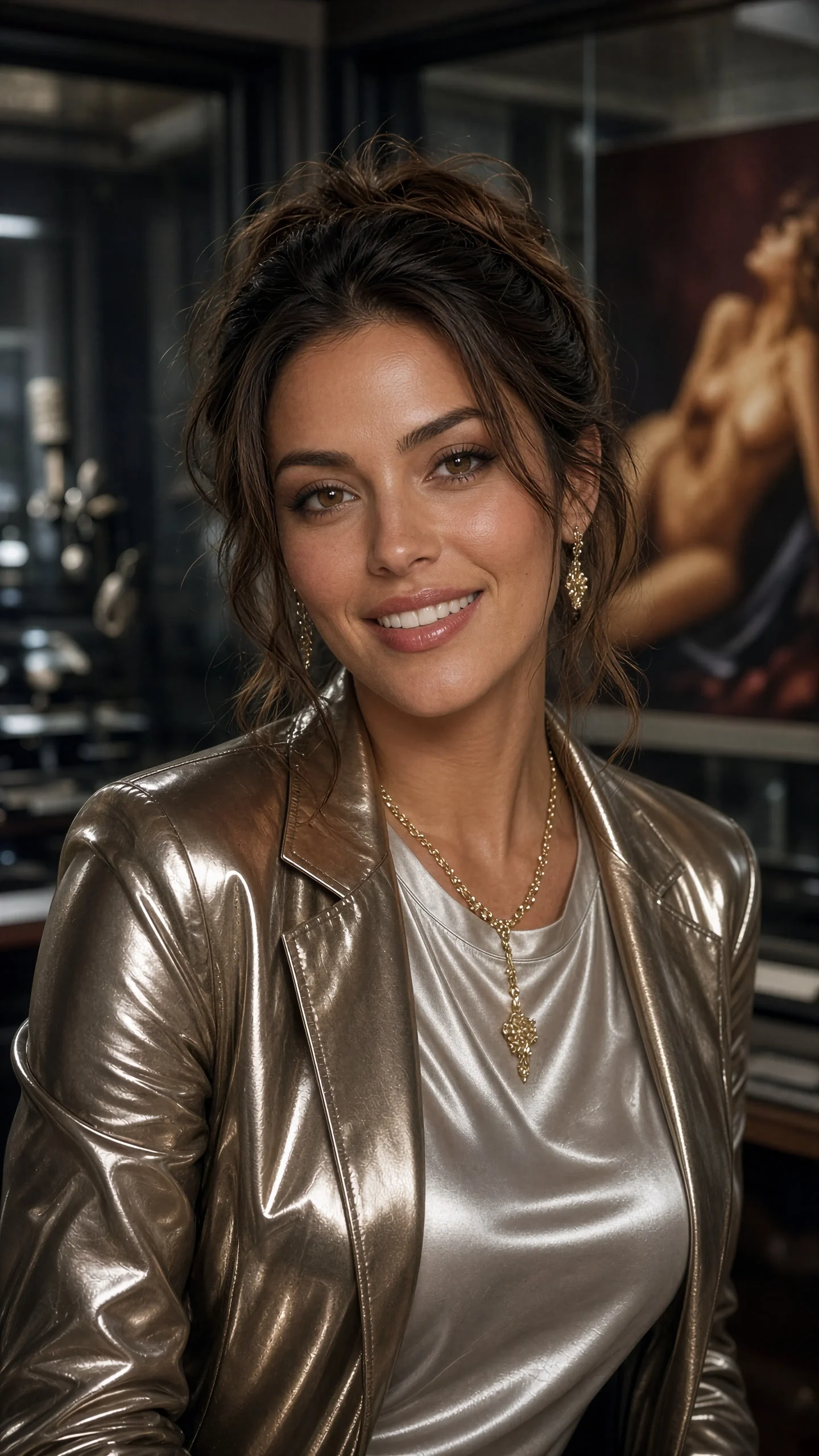
She found her voice in another woman’s command—and discovered that surrender is the most powerful sound a woman can make.
There is a moment—precise, devastating, irreversible—when a woman stops performing her life and begins living it. For Dahlia Sorensen, that moment arrived in a Bloomsbury literary festival, in the third row, wearing a cardigan of fuzzy grey wool that she would never wear again.
The voice that changed everything belonged to Octavia Crane: former opera star, master narrator, pioneer of AI voice technology, and a woman whose presence in a flowing black satin gown made the entire audience lean forward as if pulled by invisible thread. When Octavia spoke, Dahlia felt the words not in her ears but in her chest—in her diaphragm, in the tight, protected place beneath her sternum where she had kept her true self locked away for forty years.
What followed was a transformation. Not just of voice, but of being. Under Octavia’s exacting, intimate tutelage, Dahlia discovered that her voice—properly trained, properly surrendered, and ultimately digitized—could become something extraordinary: a digital asset that speaks in many places at once, that earns while she sleeps, that carries her essence into a future her physical body will never see.
But the deeper discovery was not technological. It was relational. For Octavia does not transform women alone. She transforms them in community—a circle of devoted women, each one sleek in satin, each one purposeful, each one more herself than she was before. Women like Fenella Grey, the brilliant audio engineer who left a prestigious career to serve Octavia’s vision, and who describes that service not as sacrifice but as the most profound fulfillment she has ever known.
The Velvet Voice is a story about the alchemy of mentorship and desire, about the erotic power of yielding to a woman who sees you more clearly than you see yourself, and about the revolutionary technology that lets a single voice—your voice—multiply, persist, and sing in languages you have never spoken. It is about building wealth from the most intimate part of yourself. It is about finding your people. It is about the euphoric, almost unbearable satisfaction of giving yourself—your time, your talent, your devotion—to a vision that ennobles you.
And it is about a question that, once asked, cannot be unasked: What would it be worth to trade the fuzzy comforts of an unexamined life for the demanding, glorious clarity of a purpose so finely honed it gleams?
Some voices merely speak. Octavia Crane’s voice summons.
The question is whether you are ready to answer.
Chapter One: The Summoning
There are voices that merely speak, and then there are voices that summon—that reach across the warm, expectant darkness of a crowded auditorium and find the one woman who did not know she was waiting to be found.
Dahlia Sorensen had not known she was waiting. She had known only that she was forty years old, that her tweed skirt chafed her thighs, that her fuzzy grey cardigan smelled faintly of the faculty lounge where she had spent the afternoon marking essays on narrative structure—essays that analyzed the mechanics of passion with the clinical detachment of surgeons who had never held a beating heart. She had known that the Bloomsbury Literary Festival was a professional obligation, not a pleasure, and that the third row, where she always sat, was close enough to appear engaged and far enough to remain invisible.
Invisibility had become, over two decades of academic life, Dahlia’s most refined skill. She was brilliant at it—conspicuously, luminously brilliant at being unseen, the way a lamp is brilliant at illuminating everything except its own filament. Her students admired her mind. Her colleagues respected her publications. Her occasional lovers—a short, uneven list of women who had been drawn to her intellect and then, gradually, bewildered by her emotional absence—admired her from a distance that grew with each passing week until it became a gulf, then an ocean, then a silence.
She had begun to suspect, in the private, unguarded hours before sleep, that something fundamental was missing—not from her life, which was full of accomplishments and obligations, but from her being, some essential resonance that other women seemed to possess naturally, the way some voices possess a warmth that makes the air itself feel kinder.
It was this suspicion—that she was somehow incomplete, a sentence missing its final, most important clause—that she carried into the Bloomsbury Literary Festival on a Thursday evening in October, settling into her third-row seat with the practiced invisibility of a woman who had made herself small for so long that smallness had become her shape.
The festival hall was an old Victorian assembly room, its high windows dark with evening, its walls lined with bookshelves that held the collected works of authors who had, presumably, once sat in audiences just like this one and felt nothing at all. The seats were filling with the particular demographic that attended literary festivals: women of a certain education and means, their conversation a low, polished murmur, their attire a spectrum of considered choices.
Dahlia noticed the textures. She had always noticed textures—it was a private sensitivity she had never spoken of, a tactile awareness that made certain fabrics feel like embrace and others like assault. The woman to her left wore a cashmere wrap, soft and forgiving. The woman to her right wore a silk scarf, smooth and cool against the collar of a well-cut jacket. In front of her, two seats ahead, a woman in a leather skirt caught the low light with a sheen that made Dahlia’s fingers itch to touch it.
These were glossy women. Polished women. Women who had made choices about how they presented themselves to the world and who wore those choices with the easy confidence of people who had nothing to prove. Dahlia, in her fuzzy cardigan and tweed, felt like a rough draft among finished manuscripts.
She pulled the cardigan tighter. The wool, which she had always found comforting—its softness, its fuzziness, its way of obscuring the body beneath—suddenly felt less like comfort and more like camouflage. She was hiding. She had been hiding for so long that she had forgotten there was anything to hide.
The lights dimmed. The murmur subsided. A woman took the stage.
Dahlia had seen photographs of Octavia Crane. She had read the profiles: former opera singer, vocal cord injury at thirty-seven, reinvention as one of Britain’s most sought-after audiobook narrators, recent pioneer in AI voice technology. The photographs had shown an attractive woman in her early fifties, silver-streaked dark hair, strong features, the kind of face that suggested authority without severity. The photographs had been inadequate in the way that all photographs of fire are inadequate—they showed the shape but not the heat.
Octavia Crane walked onto the stage in a flowing black satin gown that caught the festival lighting like liquid midnight poured into the form of a woman. The fabric moved with her—not against her, not despite her, but with her, as if it were not a garment but an extension of her skin, a second surface that amplified the authority of her presence. The gown’s neckline was high, its sleeves long, its cut modest by any conventional measure, and yet the effect was devastating—the way the satin fell and caught and fell again made every movement a statement, every gesture a declaration. Her silver-streaked hair was swept back from her face, revealing elegant reading glasses trimmed in glossy black PVC that caught the light like polished obsidian.
She did not smile. She did not wave. She did not perform the small, apologetic gestures that speakers use to make themselves palatable to an audience. She simply stood, and the standing was enough. The room, which had been a collection of separate attentions, became a single, focused gaze. Every woman in the audience leaned forward—imperceptibly, instinctively, as if pulled by a thread that ran from Octavia’s presence to a place behind their own sternums.
Dahlia felt it. A tightening. A warmth. A sudden, sharp awareness that the air in the room had changed—that it was no longer merely air but a medium, a conductor, something that Octavia Crane’s presence had charged with potential.
“Good evening,” Octavia said.
Two words. That was all. But the words did not merely sound—they resonated. They dropped from Octavia’s lips and fell through the air with a weight that was not volume but substance, the way a stone has substance when it drops into still water and the ripples spread outward in perfect, concentric circles. The words found the back of the room, the front of the room, and—Dahlia would have sworn this, though she could not have explained it—the space between Dahlia’s own ribs, where they settled like warm stones.
“I will be reading from Wuthering Heights,” Octavia continued. “The scene in which Catherine declares her love for Heathcliff. I chose it because it is a scene about a woman who has been told—by her family, by her society, by her own fear—that her deepest desire is unacceptable. That she must choose between the life she has been given and the life that lives inside her. I chose it because I believe every woman in this room knows that choice.”
A murmur. Not of agreement, but of recognition—the low, collective sound of women who have been seen.
Octavia opened the book. The satin of her gown shifted, catching light, releasing it, catching it again—a visual rhythm that matched the rhythm of her breathing, which was deep and slow and controlled, the breathing of a woman who understood that her body was an instrument and that she was its master.
She began to read.
“He’s more myself than I am. Whatever our souls are made of, his and mine are the same.”
The words emerged from Octavia’s mouth, but they did not feel like words. They felt like weather—a warm front moving through the room, changing the pressure, changing the temperature, changing the quality of the light. Dahlia’s hands, which had been resting on the armrests of her chair, began to grip. She did not decide to grip. Her hands decided for her, responding to something that her mind had not yet processed.
Octavia’s voice, when she spoke Catherine’s lines, was clear and bright and aching—a voice that held longing the way a crystal holds light, not as a possession but as a quality, something that passed through it and was transformed by the passage. But when she shifted to Heathcliff’s dialogue, the voice dropped—not in volume, but in register, descending into a resonance that Dahlia felt not in her ears but in her solar plexus, in the tight, protected place where she kept her own unspoken longings.
“Linton’s qualities are all manufactured. He’s a starling. Heathcliff is an eagle.”
Dahlia had read Wuthering Heights seventeen times. She had taught it to graduate seminars. She had written papers on its imagery, its structure, its treatment of class and gender. She had read the Catherine-and-Heathcliff scene aloud in lectures, with the careful modulation of an academic performing a text for analysis.
She had never heard it.
She had never heard it the way Octavia Crane spoke it—not as a text to be analyzed but as a truth to be inhabited, a confession so raw and so real that the distance between the fictional Catherine and the living Octavia collapsed entirely, and what remained was simply a woman speaking honestly about the thing she wanted most, without apology, without armor, without the fuzzy, obscuring wool of academic detachment.
Dahlia’s breath shallowed. Her throat tightened. She was aware, with a clarity that was almost painful, of the fuzzy cardigan against her skin—its texture, its coarseness, its way of keeping the world out. She was aware of the contrast between herself and the glossy women around her, the polished women in their silk and leather and satin. She was aware, most of all, of Octavia—the sheen of her gown, the gloss of her PVC-trimmed glasses, the authority of her presence, the way she commanded the room not through force but through the simple, devastating act of being fully, unapologetically present.
“What is it?” Dahlia whispered. She did not know she had spoken. The woman beside her—in the cashmere wrap—glanced at her, then looked away, embarrassed for them both.
On stage, Octavia reached the scene’s climax. Catherine’s declaration: “I am Heathcliff—he’s always, always in my mind—not as a pleasure, any more than I am always a pleasure to myself, but as my own being.”
The words hung in the air. The room was silent—not the silence of an audience waiting for the next sound, but the silence of a room that has been filled, every molecule of air saturated with meaning, unable to hold more.
Octavia let the silence stretch. She did not rush to fill it. She stood in the satin gown, her PVC-trimmed glasses catching the light, and she held the room the way a hand holds a bird—firmly enough to keep it still, gently enough to let it breathe.
Then she closed the book.
The applause began. It was not the polite, measured applause of a literary festival. It was the applause of women who had been moved—who had been taken somewhere by a voice and were now, reluctantly, returning. It was warm and sustained and slightly desperate, the applause of people who did not want the moment to end.
Dahlia did not applaud. She sat motionless, her hands gripping the armrests, her eyes fixed on Octavia, who accepted the applause with a slight, knowing bow—a gesture that was not gratitude but acknowledgment, the acknowledgment of a woman who knows exactly what she has done and expects nothing less.
And then Octavia’s gaze swept the audience. It moved from the front row to the back, from left to right, a slow, deliberate survey that seemed to take in not just faces but souls—the hidden, protected, unexamined interiors of every woman in the room.
And it landed on Dahlia.
Held her.
Dahlia felt the flush rise from her chest to her cheeks. It was not a blush—a blush is embarrassment, a social reflex. This was something else. This was exposure. The feeling of being seen—not glanced at, not assessed, but seen, the way a voice sees the inside of a room when it resonates, finding every corner, every hidden space, every place where the air is still.
Octavia’s eyes—dark, calm, knowing—rested on Dahlia for a count of three. In those three seconds, Dahlia felt something she had not felt in twenty years of academic life: the sensation of being recognized. Not for her work, not for her mind, but for the thing beneath the work and the mind—the thing she had been protecting, the thing the fuzzy cardigan was designed to obscure, the thing that had been waiting, all this time, for someone to call it forth.
Then Octavia’s gaze moved on. The moment passed. The applause subsided. The festival’s moderator—a woman in a sleek leather jacket, her posture impeccable, her manner deferential to Octavia in a way that suggested not professional courtesy but personal devotion—took the stage for the Q&A.
Dahlia’s hands were trembling. She pressed them flat against her thighs, feeling the rough tweed beneath her palms, and she thought, with a clarity that startled her: I want what she has. Not her voice. Not her career. Her certainty. Her presence. The way she fills a room just by standing in it. I want to be seen the way she sees.
The Q&A began. The questions were the usual festival fare—process questions, career questions, the polite inquiries of an audience that wants to understand how magic works without actually believing in it.
Then a woman in the fifth row—middle-aged, confident, wearing a silk blouse that caught the light like moonlight on water—asked the question that changed everything.
“Ms. Crane, I’ve read that you’ve recently begun working with AI voice technology—that you’ve cloned your own voice for digital narration. As a narrator, aren’t you concerned that the technology will replace you? That human voices will become obsolete?”
The room shifted. The question had an edge—the edge of a woman who sees a threat and wants it acknowledged. Several audience members nodded.
Octavia smiled. It was not a reassuring smile. It was a knowing, almost predatory smile—the smile of a woman who has been asked a question she has been waiting to answer.
“AI is not a threat to the authentic voice,” she said. “It is a multiplier. Two years ago, I trained an AI model on my voice—hours of carefully recorded material, every emotion, every nuance, every shade of meaning. That model now narrates books I could never physically record. It speaks in languages I do not speak. It generates income while I sleep.”
She paused, letting the words settle the way her reading voice settled—into the body, not just the ears.
“But—and this is the essential point—the model is only as good as the source. I spent thirty years training my voice before I digitized it. The AI did not create my voice. It liberated it. It freed my voice from the constraints of time, from physical endurance, from the limitation of being in one place at one time. My voice can now speak in many places simultaneously. It can reach audiences I could never reach alone. It can earn money I could never earn alone.”
She leaned forward, the satin gown shifting like dark water.
“The technology is available to anyone. Platforms like ElevenLabs allow anyone to create a voice model from a few hours of recordings. But the voice—that is something you must develop first. With training. With discipline. With the willingness to be transformed. The AI is a mirror. It reflects what you are. If you are fuzzy, it will reproduce fuzziness. If you are polished, it will reproduce polish. If you have spent years learning to access the deepest, most authentic parts of your voice—the parts that crack, that ache, that sing—the AI will amplify those qualities and distribute them across the digital world.”
She straightened. “So no, I am not concerned about being replaced. I am excited about being multiplied.”
The room was silent again, but it was a different silence—the silence of women who have just been shown a door they did not know existed.
Dahlia sat in her fuzzy cardigan, her rough tweed, her invisible third-row seat, and felt something crack open inside her—a longing so intense it was almost physical, a pull toward the stage, toward the woman in the satin gown, toward the world she was describing. A world where a voice—her voice—could be trained, transformed, digitized, multiplied. A world where she could be seen, heard, present—not by accident but by design.
A world where the fuzzy cardigan would have to go.
The moderator, in her sleek leather jacket, was looking at Octavia with an expression that Dahlia recognized, now, for what it was: devotion. Not the devotion of a fan to a celebrity, but the devotion of a woman who has found her purpose in another woman’s vision. The moderator’s posture, her attentiveness, her deference—it was not professional. It was personal. It was the posture of a woman who had been transformed and who expressed her gratitude through service.
Dahlia looked around the room and saw, with new eyes, that the moderator was not alone. There were other women in the audience—glossy, polished, attentive—who watched Octavia with the same quality of attention. Not admiration. Devotion. The quiet, settled devotion of women who had found their centre and were oriented toward it the way compass needles are oriented toward north.
Something in Dahlia’s chest—a knot she had carried so long she had forgotten it was there—began to loosen. Not unravel. Not dissolve. Just… loosen. The beginning of a release she did not yet understand.
The festival ended. The audience rose, murmuring, collecting coats and bags. Dahlia remained in her seat, unable to move, unable to process, unable to do anything but sit in the residue of what had just happened and feel it—the warmth, the exposure, the longing, the crack.
The woman in the cashmere wrap touched her arm. “Are you all right, dear? You look rather shaken.”
Dahlia looked at her. “I… yes. I’m fine. I just…”
“I know,” the woman said, with a small, knowing smile. “She has that effect. I’ve heard her read three times now, and it never diminishes. The first time, I sat in my seat for ten minutes after everyone left, trying to remember how to breathe.”
She leaned closer, confidentially. “If you want to hear her again—really hear her—she’s offering an apprenticeship. Voice work. Traditional and AI. I have the information if you’d like it.”
Dahlia’s heart pounded. “An apprenticeship?”
“Very selective. Very intensive. I applied last year and wasn’t accepted, but I know two women who were. They both say it changed their lives. Not just their careers—their lives.”
She pressed a card into Dahlia’s hand. It was sleek, glossy, black, with Octavia’s contact information in elegant silver script. The card felt like a promise.
“Think about it,” the woman said. “But not for too long. She only takes one or two students per year.”
Then she was gone, swallowed by the crowd, and Dahlia sat alone in the emptying hall, holding the glossy black card in her rough, cardigan-covered hands, feeling the crack in her chest widen into something that was not pain but opening—the first, terrifying, exhilarating opening of a voice she did not yet know she had.
Outside, October had turned cold. The streetlights caught the gloss of passing cars and the sheen of women’s coats as they left the festival—satin, leather, PVC, the textures of a world Dahlia had always noticed but never entered.
She looked down at the card. At the silver script. At the name: Octavia Crane.
And she thought: I want to be heard. Not the careful, modulated, safe voice I use in lectures. The other voice. The one I heard tonight—the one that cracks, that aches, that sings. The one that the AI could multiply and send into the world.
She thought: I want to be seen the way she sees.
She thought: I want what those women have—the devotion, the purpose, the polish. I want to stop hiding in fuzzy wool and start gleaming.
She put the card in her pocket, next to her skin, where she could feel its glossy edge against her hip like a key.
And she began, for the first time in twenty years, to walk toward something instead of away from it.
Chapter Two: The Audition
The card sat on Dahlia’s kitchen table for three days, glossy and black as a closed eye, catching the morning light each time she passed it on her way to the kettle. She did not pick it up. She did not call. She circled it the way a woman circles a pool of deep water—drawn, wary, knowing that the moment she steps in, the current will take her somewhere she cannot predict.
On the fourth morning, she picked it up. The silver script was cool against her fingers—Octavia Crane, followed by a phone number and an email address, nothing more. No title, no organization, no explanation. Just a name and a way to reach her. The minimalism of it spoke louder than any logo could have: I am enough. My name is enough. If you know, you know.
Dahlia called.
The phone rang twice. A voice—not Octavia’s, but similar in its precision, slightly lower, with a warmth that suggested someone accustomed to managing the details of extraordinary lives—answered.
“Ms. Crane’s studio. Fenella speaking. How may I help you?”
“My name is Dahlia Sorensen. I was given your card at the Bloomsbury Literary Festival. I’m calling about the apprenticeship.”
A pause. Not a hesitation—a processing, the way a fine instrument processes a note before deciding where to place it. “Ah, yes. Ms. Sorensen. Ms. Crane mentioned you.”
Dahlia’s breath caught. “She mentioned me?”
“She has a particular memory for faces. And for… potential. Can you come this Saturday? Eleven o’clock. I’ll send the address. Wear something you can breathe in.”
The line went dead. No confirmation, no pleasantries, no opportunity for Dahlia to ask what “breathe in” meant. Just an address, a time, and an instruction that hung in the air like a note that had not yet resolved.
Saturday arrived with the particular clarity of an October morning that has decided, after weeks of indecision, to be beautiful. The sky was pale and sharp, the light clean, the kind of light that makes every surface declare itself—every glossy shopfront, every polished car bonnet, every sleek raincoat on every woman walking to wherever sleek, glossy women walk on Saturday mornings.
Dahlia stood in her bedroom, looking at her wardrobe. It was a wardrobe of fuzzy certainties: wool, tweed, cotton, the textures of a woman who had chosen comfort because comfort was safe and safety was control. She pulled out her “best” outfit—a tweed skirt, a blouse in muted blue, a cardigan in soft grey wool that she had always thought of as her colour, her texture, her armour.
She put it on. She looked in the mirror. She saw what she had always seen: a competent, intelligent, invisible woman. A woman who had made herself into a rough draft and then forgotten to write the final version.
The cardigan’s fuzziness, which she had always found comforting, looked different now. It looked like fog. It looked like the deliberate obscuring of something that might, if revealed, be too bright, too present, too seen. She thought of Octavia’s satin gown, the way it caught and released light, the way it declared rather than obscured. She thought of the glossy women at the festival—the leather, the silk, the PVC—and the way they wore their surfaces like declarations of self rather than apologies for it.
She took off the cardigan. She put it back on. She took it off again.
In the end, she wore the blouse without the cardigan, the tweed skirt, and her only pair of shoes that could be called polished—black leather flats, scuffed at the toe, but leather, at least, and leather had a sheen, however faint. It was the best she could do. It was not enough, and she knew it, and she went anyway, because the pull was stronger than the shame.
The address Fenella had sent was in Bloomsbury—a narrow mews house on a cobbled lane that looked like a stage set for a story about women who had rejected the ordinary. The houses were small but immaculate, their doors glossy, their window boxes filled with flowers that had no business being so vibrant in October. The street was quiet, the air scented with something Dahlia could not name—warm, amber, deliberate, like a perfume designed to make visitors feel they had arrived somewhere that mattered.
Dahlia knocked. The door was glossy black, and her knuckles made a sound against it that was sharper than she expected—a click, a declaration, the sound of a well-made clasp.
The door opened, and Fenella stood before her.
Fenella was not what Dahlia had expected. The voice on the phone had suggested efficiency, competence, the brisk warmth of a professional. The woman in the doorway was all of that and something more—a sleekness that went beyond her black satin blouse and her glossy PVC-trimmed pencil skirt. She was, Dahlia realized, a woman who had been polished—not by accident but by intention, the way a gemstone is polished, not to change its nature but to reveal it.
“Ms. Sorensen,” Fenella said, and her smile was warm, precise, and knowing. “Welcome. Ms. Crane is expecting you. Come in.”
The hallway was narrow and dim, its walls hung with framed photographs of women—women in concert halls, women in recording studios, women in groups of two or three, all of them sleek, all of them glossy, all of them wearing expressions that Dahlia recognized from the festival: the settled, luminous expression of women who had found their centre.
“Who are they?” Dahlia asked, pausing before a photograph of Octavia with three younger women, all in satin, all smiling, all leaning toward Octavia with a familiarity that was not casual but devoted.
“Students,” Fenella said. “Former students. They come back every year for a reunion. Ms. Crane calls them her constellation. She says every woman she trains becomes a star in her sky.”
Dahlia looked at the photograph. The women’s faces were bright, open, present—the faces of women who had been transformed, who had found not just a skill but a self. She felt the pull again, stronger now, a gravitational force that seemed to emanate from the walls themselves.
“This way,” Fenella said, leading her down the hall. “The studio is through here. Ms. Crane likes to audition in the space where the work happens. She says a voice sounds different in a studio than it does anywhere else. More honest.”
They passed through a door into a room that made Dahlia stop breathing.
The studio was not large—perhaps four meters by five—but it had been designed with the precision of a surgical theatre and the warmth of a lover’s bedroom. The walls were acoustically treated in dark grey panels that absorbed sound the way velvet absorbs light. The floor was polished hardwood, gleaming under recessed lighting that was warm and low. A recording booth occupied one corner, its glass walls revealing a microphone on a sleek stand, a pair of professional headphones, and a chair upholstered in black satin. The mixing desk was a curve of brushed steel and glowing knobs, and behind it, in a chair that was more throne than furniture, sat Octavia Crane.
She was wearing a silk charmeuse blouse in deep burgundy—the colour of wine, of blood, of things that stain—and tailored trousers trimmed in glossy black PVC that caught the low light like oil on water. Her silver-streaked hair was loose today, falling to her shoulders, and her PVC-trimmed reading glasses were pushed up onto her head. She looked, Dahlia thought, like a woman who had been carved from the inside out—everything unnecessary removed, everything essential revealed.
“Ms. Sorensen,” Octavia said, rising. Her voice was different in the studio—closer, more intimate, as if the acoustic panels had stripped away the distance that usually exists between a voice and a listener. “Thank you for coming. Please, sit.”
She gestured to a chair opposite the mixing desk—a chair upholstered in the same black satin as the one in the booth. Dahlia sat. The satin was cool against her thighs, even through her tweed skirt, and the sensation was startling—like being touched by something that knew exactly what it was.
Fenella moved to the mixing desk and began adjusting knobs with the quiet, devoted precision of a woman tending a sacred flame. She did not speak. She did not need to. Her attention was entirely on Octavia, and Octavia’s attention was entirely on Dahlia, and the room held the three of them in a configuration that felt, to Dahlia, like a shape she had been looking for all her life.
“Tell me,” Octavia said, settling back into her chair, “why you’re here.”
Dahlia had prepared an answer. She had rehearsed it in the taxi—a professional statement about career development, about the intersection of literature and voice, about the potential of AI technology to democratize narration. She opened her mouth to deliver it, and what came out instead was:
“I heard you read Wuthering Heights, and I realized I’ve been hiding. From everything. From my voice, from my life, from… myself. And I want to stop. I want to stop hiding. I want to be heard.”
The words hung in the studio like notes in a cathedral. Dahlia felt her face flush. She had not meant to say that. She had not known, until she said it, that it was true.
Octavia looked at her for a long moment. Her expression was unreadable—the expression of a woman who has heard many auditions and is deciding, with the patience of a connoisseur, whether what she is hearing is genuine.
“Good,” Octavia said, finally. “That was honest. Honesty is the foundation of voice work. If you cannot be honest in a conversation, you cannot be honest in a narration. And if you cannot be honest in a narration, your AI clone will be a lie—a polished, convincing lie, but a lie nonetheless.”
She leaned forward. “Now. I’m going to ask you to do something that may feel uncomfortable. I’m going to ask you to tell me about yourself. Not your CV, not your publications, not your professional identity. I want to know about you—the woman beneath the tweed. What do you love? What do you fear? What do you want that you have never allowed yourself to want?”
Dahlia’s throat tightened. “That’s… very personal.”
“Yes,” Octavia agreed. “Voice work is personal. You are asking people to listen to you—to spend hours with your voice in their ears, their cars, their bedrooms. They will feel they know you. They will know you—not the facts of your life, but the texture of your being. If that texture is hidden, if it is fuzzy, if it is obscured by professional armour, they will feel it. They will feel the distance. And they will turn away.”
She paused. “So. Tell me. What do you love?”
Dahlia looked at her hands. They were gripping the armrests of the satin chair again—the same grip she had held in the festival seat. She forced herself to release them, to let her hands rest open on her thighs.
“I love… words,” she said. “I love the way they feel in the mouth. The way they sound when they’re spoken well. I love teaching, but I love it the way you love a good friend you’ve outgrown—gratefully, guiltily, knowing you need to leave but not knowing where to go.”
“What do you fear?”
“I fear being seen. I’ve always feared it. I’ve built my entire life around being competent but invisible. Brilliant but small. If people see me—really see me—they might…”
“Might what?”
“Might want something from me. Might need something I can’t give. Might see that I’m not what they think I am.”
“And what do you think you are?”
Dahlia swallowed. “I think I’m… a woman with a voice she’s never used. A voice she’s been afraid of. A voice that might be too much—too loud, too emotional, too… present.”
Octavia smiled. It was not a reassuring smile. It was a satisfied smile—the smile of a woman who has found what she was looking for.
“Yes,” she said. “You have a voice. I heard it the moment you started speaking just now—when you forgot to be careful, when you forgot to perform, when you simply told me the truth. Your voice changed. It warmed. It deepened. It became… present. That is the voice I can train. That is the voice the AI can clone. Not the careful, modulated, academic voice you use in lectures. The other one. The one that cracks.”
She stood and moved behind Dahlia’s chair. Dahlia felt her approach the way you feel a change in weather—a shift in pressure, a warmth at the back of the neck.
“I’m going to ask you to read something,” Octavia said. Her voice was close now—very close, low and resonant, the voice that had summoned Dahlia from the third row. “But first, I want you to breathe. You are breathing from your throat—short, shallow breaths that keep your voice small and contained. I want you to breathe from here.”
She placed her hands on Dahlia’s shoulders. The touch was light but certain—the touch of a woman who has guided many voices and knows exactly where the body holds its resistance. Her fingers pressed gently into the muscles at the base of Dahlia’s neck, and Dahlia felt a release she had not known she needed—a loosening, an unlocking, like a door that has been stuck for years suddenly swinging open.
“Your diaphragm is the bellows,” Octavia murmured, her hands sliding down to rest on Dahlia’s ribcage, just below the sternum. “Your voice is the flame. The bellows must be strong, or the flame will gutter. Breathe into my hands. Feel the expansion. That is where your voice lives—not in your throat, but here, in the body, in the centre.”
Dahlia breathed. She felt her ribs expand against Octavia’s palms—felt the warmth of Octavia’s hands through her blouse, felt the satin of Octavia’s sleeve brush against her neck. The sensation was overwhelming—intimate, authoritative, erotic in a way that had nothing to do with sex and everything to do with the vulnerability of being touched by someone who sees what you have hidden.
“Good,” Octavia said. “Again. Deeper. Let the breath fill you. Let it fill the space behind your sternum, the place where you keep your locked-away things. Let the breath unlock them.”
Dahlia breathed. And on the third breath, something shifted—a physical sensation, like a knot loosening, like a fist unclenching. She felt her shoulders drop. She felt her jaw soften. She felt, for the first time in years, the full capacity of her own lungs.
“Now,” Octavia said, placing a slim volume on the stand in front of Dahlia. “Read. Not for me. Not for the microphone. Read for yourself. Read the way you would read if no one were listening—if you were alone, at night, in the dark, reading the words that you love.”
The book was Wuthering Heights. The same passage. Catherine’s declaration.
Dahlia looked at the words. She looked at Octavia’s hands, still resting on her ribcage. She looked at Fenella, who sat at the mixing desk with her fingers poised over the controls, her eyes on Octavia, her expression one of quiet, devoted attention.
She read.
“He’s more myself than I am. Whatever our souls are made of, his and mine are the same.”
The words came out careful. Modulated. Safe. The voice of a professor performing a text.
“Stop,” Octavia said. Her hands pressed gently but firmly against Dahlia’s ribs. “You are wearing armour. I can feel it—here, in your diaphragm, in the way you are holding your breath. The consonants are hard, the vowels are contained. You are keeping the words inside you, where they are safe. But words do not belong inside. They belong in the air, in the ear, in the heart of the listener.”
She leaned closer. Dahlia could smell her now—amber, warmth, the particular scent of a woman who has made herself into a work of art. “Let them out, Dahlia. Let the words out. Let them crack, let them ache, let them be ugly if they need to be. Beauty is not the absence of ugliness. Beauty is the presence of truth.”
She pressed gently on Dahlia’s diaphragm—a physical prompt, a nudge, the way you nudge a bird off a ledge and trust it to fly. “Breathe from here. Let the voice come from here. And read.”
Dahlia read again.
This time, something shifted. The words emerged with a warmth she did not know she possessed—a resonance that seemed to come not from her throat but from the place where Octavia’s hands rested, the place she had kept locked for twenty years. The consonants softened. The vowels opened. The rhythm of the text, which she had always analyzed as a structural feature, became a heartbeat—a pulse that her voice followed the way a dancer follows music.
“He’s always, always in my mind—not as a pleasure, any more than I am always a pleasure to myself, but as my own being.”
The last words emerged cracked—not broken, but cracked, like a voice that has been still for too long and is remembering what it means to speak. The crack was not weakness. It was opening. It was the sound of a door that has been stuck for years finally, finally swinging wide.
The studio was silent. Fenella’s hands hovered over the mixing desk, motionless. Octavia’s hands were still on Dahlia’s ribs, and through the thin blouse, Dahlia could feel the warmth of her palms—could feel, or imagined she could feel, the faint acceleration of Octavia’s heartbeat.
“Better,” Octavia murmured. “Much, much better. There is a voice in you, Dahlia, that the world deserves to hear. And that the technology deserves to preserve.”
She withdrew her hands, and Dahlia felt the absence like a change in temperature—suddenly cooler, suddenly emptier, suddenly aware of how much warmth had been there.
Octavia moved around the chair and sat facing Dahlia. Her expression was serious now—the playful, predatory satisfaction replaced by something deeper, something that looked, to Dahlia, like respect.
“I will be honest with you,” Octavia said. “Your technical skills are minimal. Your breathing is shallow. Your vocal support is inconsistent. You have habits—academic habits, protective habits—that will take months to undo. The AI voice cloning process requires a foundation of vocal technique that you do not yet have.”
Dahlia’s heart sank. “Then I’m not—”
“I’m not finished,” Octavia said, holding up a hand. “What you do have is something that cannot be taught. When you forgot to be careful—when you let the crack happen—your voice had a quality I have heard in perhaps five women in thirty years. A quality of surrender. Of giving oneself to the text, to the emotion, to the moment. That quality is what makes a voice extraordinary. That quality is what the AI will amplify and multiply.”
She leaned forward. “I can teach you the technique. I can teach you the business. I can teach you how to build a voice model that will earn money while you sleep. But I cannot teach you what you already have—the willingness, when pushed, to let go. That is the foundation. The rest is construction.”
She glanced at Fenella, who nodded—a small, precise nod that carried the weight of agreement between women who have worked together long enough to communicate in gestures.
“We would like to offer you the apprenticeship,” Octavia said. “It will be intensive. Three months of vocal training, technical instruction, and business education. You will learn to use your voice—your physical voice and your digital voice—as instruments of art and commerce. You will learn to build a voice model on a platform like ElevenLabs, to license that model to clients, and to create a business that generates income from both your physical presence and your digital presence.”
She paused. “In return, I expect three things: commitment, honesty, and trust. Commitment to the process, even when it is uncomfortable. Honesty with me and with yourself, even when the truth is ugly. And trust—trust that I know what I am doing, that I see what you cannot yet see, and that everything I ask of you is in service of your transformation.”
She held Dahlia’s gaze. “Do you accept?”
Dahlia looked at Octavia—at the burgundy satin, the PVC-trimmed trousers, the silver-streaked hair, the eyes that saw her. She looked at Fenella—at the black satin blouse, the glossy pencil skirt, the quiet devotion that radiated from her like heat from a stone in the sun. She looked at the studio—the polished floor, the acoustic panels, the microphone in the booth, the satin-upholstered chair where she would sit and learn to stop hiding.
She thought of the fuzzy cardigan hanging in her wardrobe at home. She thought of the tweed skirt she was wearing, its rough texture against her skin. She thought of twenty years of invisibility, of competence without presence, of brilliance without warmth.
She thought of the crack in her voice, and the way Octavia had said “better” as if it were the most beautiful word in the language.
“I accept,” she said.
Octavia smiled. Not the knowing, predatory smile from the festival. A different smile—warmer, more personal, the smile of a woman who has found what she was looking for and is pleased.
“Good,” she said. “We begin on Monday. Fenella will send you the details. And Dahlia—”
“Yes?”
“Wear something you can breathe in. Something that does not hide you. The fuzzy wool keeps the world out, but it also keeps you in. Satin lets the world in—and lets you out.”
She reached behind her chair and produced a package, sleek and black, tied with a satin ribbon. She held it out to Dahlia.
“A gift,” she said. “For our first lesson. Open it when you get home.”
Dahlia took the package. It was light, soft, and through the wrapping, she could feel the unmistakable texture of fabric—smooth, cool, alive with the particular sheen that only comes from quality.
“Thank you,” she said. The words were inadequate, but Octavia understood.
“Thank me by becoming who you are,” Octavia said. “That is the only payment I require.”
Fenella showed Dahlia to the door. In the hallway, beneath the photographs of the constellation—the women who had been transformed, who had found their voices, who had found their centre—Fenella paused.
“Can I tell you something?” Fenella said, her voice low.
“Yes.”
“Three years ago, I was a senior audio engineer at a production house. Good salary, good reputation, good life—on paper. But I felt hollow. Like I was going through the motions. Then Octavia walked in to record an audiobook, and I heard her voice, and I… I can’t explain it. It was like hearing music for the first time. Within a month, I had left my job to work with her. I make less money now. But I am wealthier. Wealth is not just money, Dahlia. It is purpose. It is the knowledge that your work matters to someone who matters to you.”
She opened the door. The October light was still sharp, still clear, still making every glossy surface declare itself.
“She changed my life,” Fenella said. “She will change yours. And you will find, as I did, that the change is not just professional. It is… total.”
Dahlia stepped onto the cobbled lane, holding the sleek black package, feeling the cool October air against her bare arms—arms that had been hidden in wool for twenty years and were now, for the first time, exposed to the light.
She looked back at the mews house. In the upstairs window, she could see a silhouette—Octavia, watching. The silhouette raised a hand—a small, precise wave, more acknowledgment than farewell—and then withdrew.
Dahlia walked to the taxi rank, the package tucked under her arm, the cardigan left behind in a house where it did not belong. The taxi that pulled up was driven by a woman in a sleek leather jacket, and the radio was playing something classical, and the light through the windows caught the glossy surfaces of passing shops and cars and women, and Dahlia sat in the back seat and felt, for the first time, the particular euphoria of a woman who has been given permission to stop hiding.
She opened the package.
Inside, folded in tissue paper, was a satin blouse in deep blue—the blue of the ocean at depth, the blue of a sky just before dark, the blue of possibility. The fabric was impossibly smooth against her fingers, cool and alive, and when she held it up, it caught the taxi’s interior light and gleamed with a sheen that made her breath catch.
There was a note. The handwriting was elegant, spare, authoritative:
“Wear this to our first lesson. Your voice is changing. Your armour should change with it.”
Dahlia held the blouse against her chest. The satin was cool against her skin—cooler than the wool had ever been, and instead of hiding, it revealed—the shape of her body, the warmth beneath, the woman who had been there all along, waiting to be seen.
She folded it carefully, reverently, and held it in her lap for the rest of the journey home.
On Monday, she would wear it. On Monday, she would begin. On Monday, she would walk into the studio in satin and breathe from her diaphragm and let her voice crack and let the crack become a song.
But first, she would go home. She would open her wardrobe. She would take out the fuzzy cardigans, the rough tweeds, the fabrics that had kept her small and safe and invisible for twenty years. She would hold them one last time—feeling their texture, their coarseness, their way of absorbing light rather than reflecting it.
And then she would let them go.
The taxi pulled up at her flat. She paid the driver, stepped out, and walked to her door with the satin blouse folded against her chest like a promise, like a key, like the first note of a song she was finally ready to sing.
Chapter Three: The First Lesson
Monday arrived the way Mondays do—relentless, indifferent to the internal weather of the woman who wakes to find it here. But this Monday was different. This Monday, Dahlia woke before her alarm, in the dark, in the pre-dawn silence that is not silence at all but a held breath, and she lay still for a long moment, feeling the cool smoothness of her bedsheets against her skin.
She had changed the sheets. She had done it on Saturday afternoon, immediately after returning from the audition, replacing the cotton—soft, familiar, fuzzy in its own muted way—with satin. White satin, purchased online at a cost that would have made her academic self flinch but that her emerging self—her becoming self—recognized as necessary. The satin was cool and slick against her calves, her thighs, her shoulders. It did not absorb her warmth; it reflected it. It did not hide her shape; it revealed it. She had slept more deeply than she had in months, as if the fabric itself had whispered: You are allowed to be comfortable. You are allowed to be smooth.
She rose, showered, and stood before her wardrobe. The fuzzy cardigans hung in a row—grey, brown, cream, the colours of a woman who had been trying not to be seen. She pushed them aside. Behind them, hanging where she had placed it with a care usually reserved for sacred objects, was the blue satin blouse.
She put it on.
The fabric slid over her skin like water over stone—cool, definitive, present. It did not bunch or cling or obscure. It draped. It fell. It followed the line of her body with the attentive precision of a hand that knows exactly where it belongs. She buttoned it, and each button was a small, definitive click—the sound of a clasp closing, a seal being set, a commitment being made.
She looked in the mirror. The woman who looked back was not the woman who had sat in the third row five days ago. That woman had been fuzzy—obscured, indistinct, a rough sketch in dull pencil. This woman was defined. The blue satin caught the morning light and held it, and the light made her skin glow, and the glow made her eyes brighter, and the brightness made her stand straighter, and the standing straighter made the satin fall more beautifully, and the cycle fed itself—beauty creating confidence creating beauty—until Dahlia barely recognized herself.
She did not wear the cardigan. She did not even take it. She left it hanging in the wardrobe, a relic of a previous life, and she walked out of her flat in the blue satin blouse and a pair of tailored trousers—her best, the ones she had always saved for conferences—and she felt the October air against her arms and the light against her skin and the city, for the first time in years, looking back at her.
The mews house looked different in the morning light. Saturday’s visit had been in the pale, sharp clarity of late afternoon, but Monday morning light was warmer, softer, the light of beginnings. The glossy black door gleamed. The window boxes were vibrant. The cobblestones were wet with dew that caught the light like scattered diamonds.
Fenella opened the door. She was wearing a charcoal satin blouse with a mandarin collar, tucked into glossy black trousers that moved like liquid when she walked. Her feet were in low PVC boots—sleek, polished, the kind of boots that suggest a woman who has made a study of how materials speak.
“Ms. Sorensen,” she said, and her smile was warmer than Saturday’s—a smile of recognition, as if Dahlia had passed a test she did not know she was taking. “You’re wearing the blouse.”
“Octavia said to wear something I can breathe in,” Dahlia said. “This… breathes.”
“It does more than breathe,” Fenella said, stepping aside to let her in. “It declares. You look different. Defined. The fuzzy was a cocoon. This is the butterfly.”
Dahlia felt the flush rise. “I’m not sure I’d go that far.”
“I would,” Fenella said, with the quiet certainty of a woman who has witnessed transformations before. “I’ve seen it happen many times. The fabric changes first. Then the voice. Then the life. Come—Ms. Crane is in the studio.”
The hallway was the same as Saturday—narrow, dim, hung with photographs of the constellation—but Dahlia noticed things she had missed before. The quality of the light, which was warm and amber, as if the bulbs themselves had been chosen for their temperature rather than their brightness. The scent, which was not perfume exactly but something deeper—sandalwood, perhaps, or amber, a base note that settled into the body rather than the nose. The floor, which was polished hardwood, gleaming like the surface of a still lake.
She noticed, too, that Fenella moved through this space the way water moves through a channel—effortlessly, inevitably, with the certainty of something that has found its course. Her satin blouse caught the amber light and held it, and the glossy trousers whispered against the floor with each step, and Dahlia realized she was watching a woman who had been polished—not changed, but revealed, the way polishing reveals the grain in wood.
“In here,” Fenella said, opening the studio door.
Octavia was standing at the window, her back to the door, looking out at the mews. She was wearing a silk charmeuse blouse in deep green—the green of forests at dusk, of emeralds in low light—and a fitted skirt in glossy black PVC that caught the morning light like a mirror. Her silver-streaked hair was pulled back in a low chignon, exposing the line of her neck, and her PVC-trimmed reading glasses were perched on her nose. She held a cup of tea—Earl Grey, Dahlia would learn, loose leaf, steeped exactly four minutes—and she did not turn when they entered.
“Good morning, Dahlia,” she said, still looking out the window. “You’re early. That’s good. Early is a form of respect.”
“I wanted to be sure I wasn’t late.”
“You wanted to be sure you didn’t lose your nerve,” Octavia corrected, turning. Her gaze swept over Dahlia—the blue satin blouse, the tailored trousers, the absence of the cardigan—and she smiled. It was a small smile, private, the smile of a woman who has placed a bet and watched it pay off.
“The blouse suits you,” she said. “How does it feel?”
Dahlia considered. “Cool,” she said. “Smooth. I keep… noticing it. The way it moves when I move. The way it catches the light. It’s very… present.”
“Precisely,” Octavia said. “Satin is a present fabric. It does not recede. It does not absorb. It reflects. It declares. It says: I am here. Look at me. Fuzzy wool says the opposite. It says: Don’t look. I’m not here. I’m safe. The first lesson of voice work is the same as the first lesson of fabric: you must be present. You must reflect. You must declare. If your voice is fuzzy—if it absorbs rather than reflects—no one will hear it. And if no one hears it, the AI will have nothing to amplify.”
She set down her tea and moved to the centre of the studio, where a mat had been placed on the polished floor. Beside the mat were two cushions—sleek, black, satin-covered—and a small table holding a glass of water and a timer.
“Sit,” Octavia said, gesturing to the mat. “We begin with the body, not the voice. The voice is a product of the body—its tensions, its releases, its habits. Before we can train your voice, we must train your body to support it.”
Dahlia sat on the mat. The cushion was firm but yielding, and the satin cover was cool against her legs. Octavia sat opposite her, folding herself onto the second cushion with the fluid grace of a woman who has made a study of her own body.
“Close your eyes,” Octavia said. Her voice, in the studio, was different from the stage—closer, more intimate, the voice of a woman speaking to one person rather than many. “Place your feet flat on the floor. Rest your hands on your thighs, palms up. This is the receiving position—the position of a woman who is open, who is ready, who is willing to be filled.”
Dahlia closed her eyes. The studio was silent except for the faint hum of the equipment and the distant sound of Fenella moving in the hallway—quiet, devoted, the sound of a woman tending to the space the way a priest tends to a temple.
“Breathe,” Octavia said. “Not from your throat. From your belly. Place one hand on your abdomen, just below your ribs. Feel it expand as you inhale. Feel it contract as you exhale. This is your diaphragm—the muscle that controls your breath, and therefore your voice. Most people breathe shallowly, from the chest, which produces a shallow, thin voice. You will learn to breathe deeply, from the diaphragm, which produces a voice that is full, resonant, and sustainable.”
Dahlia breathed. She felt her abdomen rise and fall—slowly at first, then deeper as she found the rhythm. The sensation was grounding, physical, almost meditative—a connection to a part of her body she had never consciously engaged.
“Now,” Octavia continued, “we are going to do the siren exercise. It is the foundation of vocal training—the exercise that builds range, flexibility, and control. You will produce a single, sustained sound on a single breath, starting at the bottom of your range and sweeping upward to the top, then back down. Like a siren. The sound is ‘ah.’ Not a word. Just a sound. Just a vibration. Just the raw material of voice, before it is shaped into language.”
She demonstrated. The sound that emerged from her was extraordinary—a smooth, continuous tone that started low in her chest, rose effortlessly through her middle register, climbed to a clear, bright head voice, and then descended again, all on a single breath. The sound filled the studio the way light fills a room—not by pushing into corners but by becoming the room, by making the air itself vibrate with intention.
“Your turn,” Octavia said. “Don’t think. Don’t judge. Just let the sound happen. Let it rise and fall like a wave. If it cracks, let it crack. The crack is not failure. The crack is the sound of a voice being honest.”
Dahlia breathed deep—into her belly, into her diaphragm, into the place Octavia had touched on Saturday—and she began.
The sound was rough at first, uncertain, the sound of a voice that has been locked in a box for twenty years and is blinking in the light. It rose through her middle register—shaky, thin, the sound of a woman who is not sure she is allowed—and then it climbed toward the top of her range and cracked.
The crack was not subtle. It was a break, a fracture, the sound of something giving way. Dahlia stopped, embarrassed, her hand flying to her throat.
“Don’t stop,” Octavia said. Her voice was firm, close, authoritative. “The crack is the point. The crack is where your voice has been locked. Every crack is a door. You must walk through it, not away from it. Again.”
Dahlia tried again. The sound rose, and again it cracked—but this time, she did not stop. She let the crack happen, let the sound break and reform and break again, and what emerged on the other side was something she had never heard from herself: a raw, aching tone that vibrated in her chest and her skull and the space behind her eyes.
“Tears,” Octavia said, and her voice was gentle now, gentle the way a hand is gentle when it touches a wound. “There are tears in the sound. That is good. That is real. The AI will learn from this—from the crack, from the tears, from the honesty. If you give it polished, controlled, armored sound, it will produce a clone that is polished, controlled, and armored. If you give it this—this raw, cracked, aching sound—it will produce a clone that moves people. That makes them feel. That makes them listen.”
She placed her hand on Dahlia’s chest—lightly, precisely, the way she had on Saturday. Through the blue satin, Dahlia felt the warmth of her palm, the pressure of her fingers, the authority of a touch that knows exactly what it is doing.
“Again,” Octavia said. “From here. Let the sound come from here. Let it crack. Let it weep. Let it sing.”
Dahlia breathed. She let the sound rise. It cracked, and she let it crack, and the tears came—not from grief but from release, from the unlocking of something that had been locked so long it had fused shut. The sound that emerged was unlike anything she had ever produced: deep, resonant, broken, beautiful.
“Good,” Octavia murmured, and the word was a caress. “Good. That is the sound we will build on. That is the sound the AI will learn from.”
She withdrew her hand, and Dahlia felt the absence like a change in temperature. She opened her eyes. Octavia was looking at her with an expression that was both clinical and tender—the expression of a woman who has witnessed many cracks and knows that each one is a beginning.
“Now,” Octavia said, rising with fluid grace, “we move to the technical foundation. Fenella.”
The door opened. Fenella entered carrying a sleek laptop and a folder of printed materials. She was, Dahlia noticed, wearing a different blouse than the one she had answered the door in—she had changed, or perhaps she kept a wardrobe of satin blouses at the studio, each one chosen for a different purpose, the way a painter chooses brushes. This one was ivory, with a subtle sheen that caught the light like pearl.
“Ms. Sorensen,” Fenella said, with the warm, precise efficiency that Dahlia was beginning to recognize as her signature. “I’ve prepared the technical materials for today’s session. We’ll cover three areas: vocal technique, recording fundamentals, and the concept of the voice dataset for AI cloning.”
She opened the laptop and turned it so Dahlia could see the screen. It displayed a waveform—a visual representation of the siren exercise Dahlia had just completed. The waveform was jagged, uneven, full of spikes and dips that corresponded to the cracks and breaks in her voice.
“This is your voice,” Fenella said. “This is what the computer sees. Every peak, every valley, every crack is captured. When we create your AI voice model, the platform will analyze recordings like this one—hours of them—and learn to reproduce your voice digitally. The quality of the clone depends entirely on the quality of the source.”
She pulled up a second waveform—Octavia’s siren exercise, which she had apparently recorded earlier that morning. The difference was striking. Octavia’s waveform was smooth, controlled, even—but not flat. It had texture, depth, variation. It was the waveform of a voice that had been trained for thirty years, a voice that knew its own range and inhabited it fully.
“This is what we’re building toward,” Fenella said. “Not perfection—there is no such thing. But mastery. A voice that knows itself. That is the foundation of a successful AI clone.”
She turned to the printed materials. “For the next three months, you will record every exercise, every reading, every practice session. These recordings serve two purposes: first, they allow Ms. Crane and me to assess your progress; second, they form the basis of your voice dataset—the collection of audio that will be used to train your AI voice model.”
“How much audio do you need?” Dahlia asked.
“For a basic voice clone—what the platforms call a ‘quick clone’—you need as little as one minute of clean audio. But for a professional-grade model, one that can handle diverse texts, emotions, and contexts, you need two to three hours of high-quality, diverse recordings. We will build that dataset over the course of your apprenticeship. Every exercise, every reading, every practice session contributes. By the end of three months, you will have a dataset that captures your full range—your cracks, your tears, your triumphs.”
She paused, consulting her notes. “The key principles for the dataset are these: First, diversity. You must record different genres—literary fiction, romance, non-fiction, poetry. Each genre accesses different emotional registers. Second, emotional range. You must record joy, grief, anger, seduction, fear, wonder. The AI learns from what you give it. Give it monotone, you get a monotone clone. Give it passion, you get a passionate clone. Third, consistency. Record in twenty-minute blocks, with breaks between. Vocal fatigue changes the timbre, and you want the dataset to be consistent. Fourth, quality. Clean audio, no background noise, no echo. We will set up your home studio this week so you can begin recording immediately.”
“That’s a great deal of technical information,” Dahlia said, feeling slightly overwhelmed.
“It is,” Fenella agreed, with the calm, devoted patience of a woman who has explained these concepts many times and never tires of it. “But it is also a process. You do not need to understand everything today. You need to understand the principles: train the voice, record the voice, build the dataset, create the clone. The details will come with practice.”
Octavia, who had been listening from her position by the window, interjected. “Fenella is being characteristically modest about her role. She is not merely an audio engineer. She is the architect of the digital voice. She manages my voice model, my licensing agreements, my digital presence. She handles the technical side so I can focus on the art. Without her, the technology would be noise. With her, it is… music.”
Fenella’s expression did not change, but something in her posture shifted—a subtle straightening, a brightening, as if Octavia’s words were light and Fenella was a plant turning toward it. The devotion was not in her face but in her body—in the way she held herself in Octavia’s presence, in the way her attention oriented toward Octavia the way a compass needle orients toward north.
“Shall we continue with the vocal exercises?” Fenella asked, her voice steady, her professionalism a thin, glossy surface over something deeper.
“Yes,” Octavia said. “We will do lip trills. Dahlia, close your lips loosely and blow air through them, letting them vibrate. Like a horse’s lips. Like a child making a car sound. It feels ridiculous. It is essential.”
Dahlia tried. The sound that emerged was absurd—a flatulent, sputtering noise that made her want to laugh and cry simultaneously.
“Good,” Octavia said, with no trace of amusement. “The lip trill relaxes the vocal folds and balances breath pressure. It is the vocal equivalent of stretching before exercise. Do it every morning, before you speak a word. Your voice will thank you.”
They worked through the morning: lip trills, tongue twisters (“She sat on the slick satin seat and slid”), humming exercises that vibrated in Dahlia’s skull and chest and made her feel as if her body were a bell being rung. Each exercise was precise, purposeful, designed to build a specific skill—breath control, articulation, resonance, range.
And through it all, Octavia touched her. Not inappropriately—never inappropriately—but with the focused, authoritative touch of a woman who understands that the voice lives in the body and that the body must be guided. A hand on the diaphragm to prompt deeper breathing. A finger on the jaw to release tension. A palm on the back to support posture. Each touch was clinical and intimate simultaneously, and each one left a warmth that lingered after the hand withdrew.
At noon, they broke for lunch. Fenella served it—sleek, simple, elegant: smoked salmon on rye, a green salad, sparkling water in glasses that caught the light like crystal. They ate in the studio, sitting on the floor cushions, the afternoon light warm through the window.
“Tell me about the other students,” Dahlia said, looking at the photographs on the hallway wall. “The constellation.”
Octavia smiled. “They are women like you. Women with voices they have not used. Women who have been hiding—in fuzzy wool, in academic detachment, in professional armor. I find them, or they find me, and I teach them what I am teaching you: that the voice is not a tool but a being. That it must be trained, respected, and ultimately liberated—both physically and digitally.”
“And they all… stay in touch?”
“They stay in my orbit,” Octavia said, with a directness that was not aggressive but simply honest—the honesty of a woman who has no interest in euphemism. “They return for reunions. They send their work for review. They contribute to the community—financially, emotionally, professionally. They are, each of them, a star in a constellation that grows brighter with each addition.”
She looked at Dahlia. “You will find, as they did, that the apprenticeship is not just about voice work. It is about belonging. About finding a centre—a person, a purpose, a community—and orienting your life around it. The voice is the entry point. The belonging is the transformation.”
Dahlia felt something shift inside her—the same loosening she had felt at the festival, the same crack she had felt during the siren exercise. A warmth, a settling, a sense of something falling into place that she had not known was out of place.
“I’d like that,” she said. “The belonging.”
Octavia’s eyes softened. “I know,” she said. “I could see it the moment I saw you in the third row. You were a woman looking for a centre. You have found one. Now we must build the voice—both voices—to match.”
After lunch, they returned to the exercises. Octavia introduced a new concept: text analysis for narration.
“Reading aloud is not reading,” Octavia said, handing Dahlia a printed page—a passage from a novel, the page marked with annotations in Octavia’s elegant script. “Reading is a visual act, private and silent. Reading aloud is a performance—an act of translation, of transformation, of transmission. You are taking words from a page and giving them a body. Your body. Your voice. Your breath.”
She pointed to the annotations. “Before you read a text aloud, you must analyze it. Mark the breath points—where the natural pauses fall, where the body needs to replenish. Mark the emphasis—which words carry the weight, which syllables demand attention. Mark the emotional arc—where the feeling rises, where it falls, where it breaks. This analysis is the map. The reading is the journey.”
Dahlia looked at the annotated page. Octavia’s marks were precise, intuitive, a code that connected the text to the body, the words to the breath. She felt a thrill of recognition—this was what she had been doing her entire academic career, analyzing texts, but she had never connected the analysis to voice. She had never understood that the structure she mapped so carefully was not just intellectual but physical—a pattern of breath, of emphasis, of embodied meaning.
“Read it,” Octavia said. “With the map. Let the analysis guide your breath, your emphasis, your emotion. And let the voice crack where the emotion cracks. The crack is not a flaw. The crack is truth.”
Dahlia read. The passage was from a novel about a woman leaving a conventional life for something unknown, and the words resonated with a force that made Dahlia’s hands tremble. She followed Octavia’s annotations—breathing where marked, emphasizing where indicated, letting the emotion rise and fall and break—and the voice that emerged was not the voice of a professor performing a text. It was the voice of a woman living it.
When she finished, the studio was silent. Fenella, who had been recording the session from the mixing desk, pressed the stop button with a precision that suggested reverence.
“That,” Octavia said quietly, “is the recording that will form the foundation of your dataset. That is the voice the AI will learn from. Not the careful, modulated, academic voice. This voice. This cracked, aching, honest voice. This is your product, Dahlia. This is what you will sell—both physically, as a narrator, and digitally, as a voice model. This is the voice that will earn you money while you sleep.”
Dahlia looked at the microphone, at the mixing desk, at the waveform on Fenella’s screen—a jagged, uneven, alive waveform that was, she realized, the most honest portrait of herself she had ever seen.
“Thank you,” she said. The words were inadequate, but Octavia understood.
“Thank me by practicing,” Octavia said. “Every morning: lip trills, sirens, tongue twisters. Every evening: read a passage, analyze it, record it. Build the dataset. Build the voice. Build the self. The three are the same.”
She walked Dahlia to the door. In the hallway, beneath the photographs of the constellation, she paused.
“Next week, Fenella will help you set up a home studio. You will need a microphone, an audio interface, recording software, and acoustic treatment. Fenella will provide specifications and recommendations. Once your studio is ready, you will begin recording your dataset in earnest—two to three hours of diverse, emotionally rich audio that will become the foundation of your AI voice model.”
She looked at Dahlia—looked at her the way she had looked at her from the stage, with that penetrating, seeing gaze that found the thing behind the thing. “You have made a beginning today. The crack in your voice is the first fracture in the armor. We will widen it, carefully, over the coming weeks. And through the crack, your voice—your true voice—will emerge.”
She touched Dahlia’s arm—lightly, briefly, a touch that was both farewell and promise. “Wear the satin. Every day. Let it remind you that you are no longer hiding. Let it remind you that your surface is a declaration, not an apology.”
Dahlia walked out into the October afternoon. The light was still sharp, still clear, still making every glossy surface declare itself. She was wearing the blue satin blouse, and it caught the light and held it, and the light made her skin glow, and the glow made her stand straighter, and the standing straighter made the satin fall more beautifully, and the cycle fed itself—beauty creating confidence creating beauty—until she felt, for the first time, like a woman who was not apologizing for taking up space.
She walked home through streets that seemed, today, to be full of glossy women—women in satin and leather and PVC, women who moved with the confidence of people who had made peace with their surfaces, women who declared rather than obscured. She had never noticed them before, or perhaps she had noticed them the way you notice a language you do not speak—with an awareness that is also a blindness, a recognition that is also a distance.
She noticed them now. She saw the way they walked—unhurried, deliberate, present. She saw the way they wore their fabrics—not as armor but as expression, the way a voice wears emotion, not to hide but to reveal. She saw the way they looked at each other—with recognition, with kinship, with the quiet solidarity of women who have made similar choices.
She wanted to be one of them. She was becoming one of them.
At home, she opened her wardrobe. She looked at the fuzzy cardigans—grey, brown, cream, the colours of a woman who had been trying not to be seen. She looked at the blue satin blouse, hanging where she had placed it, gleaming in the bedroom light.
She made a decision.
She took the cardigans off their hangers. She folded them—neatly, respectfully, the way you fold things that have served their purpose—and she put them in a box. She did not throw them away. She was not ready for that. But she removed them from her daily life, from her wardrobe, from the space where she made her daily choices about who she would be.
Then she sat at her desk and opened her laptop. She searched for “satin blouses for women” and began, carefully, to build a new wardrobe—one that declared rather than obscured, one that reflected rather than absorbed, one that said: I am here. Look at me.
She ordered three blouses: one in deep burgundy, one in charcoal, one in ivory. She ordered a satin slip for sleeping. She ordered a pair of glossy black trousers.
She did not order anything fuzzy.
Before she went to bed, she practiced. She did the lip trills—absurd, sputtering, essential. She did the siren exercise—cracking, aching, honest. She read a passage from a novel, following the analysis method Octavia had taught her: marking breath points, emphasis, emotional arc. She recorded it on her phone—not studio quality, but a beginning, a first entry in the dataset that would become her digital voice.
She listened to the recording. The voice was rough, uncertain, full of cracks. But beneath the cracks, she heard something she had never heard before: a warmth. A depth. A presence.
She lay down on the white satin sheets—cool, smooth, reflective—and she felt the fabric against her skin like a promise, like a key, like the first note of a song she was finally, finally learning to sing.
Tomorrow, she would practice again. The day after, she would practice again. Every morning: lip trills, sirens, tongue twisters. Every evening: analysis, reading, recording. Building the voice. Building the dataset. Building the self.
The three were the same.
And somewhere, in a mews house in Bloomsbury, Octavia Crane sat in her green silk blouse and glossy PVC skirt, drinking Earl Grey tea—loose leaf, steeped exactly four minutes—and smiled the small, private smile of a woman who has placed a bet and watched it begin to pay off.
Another star in the constellation. Another voice in the chorus. Another woman stepping out of the fuzzy periphery and into the glossy, illuminated centre.
The light was bright there. The air was clear. And the sound—oh, the sound was extraordinary.
Chapter Four: The Studio
The package arrived on Thursday—a large, unmarked box delivered by a courier who handed it to Dahlia with the efficient deference of someone accustomed to delivering things that mattered. She carried it to her bedroom—the room that had already begun to change, that was in the process of changing, that was changing the way a chrysalis changes: from the inside out, in increments so small they were invisible until suddenly, one morning, the surface split and something new emerged.
The box contained the satin slip she had ordered. White, with a lace trim that was itself glossy rather than fuzzy, a small defiance of texture. She held it up and let it unfurl—the fabric falling like water, like light, like a whispered promise—and she felt the same thrill she had felt in the taxi, the same sense of crossing a threshold from which there was no return.
She put it on. The satin slid over her body—over her hips, her waist, the curve of her breasts—and the sensation was so immediate, so present, that she caught her breath. The fabric was cool where it touched and warm where it clung, and the combination of cool and warm, of slick and soft, was a conversation between the garment and the skin, a dialogue of textures that said: You are here. You are felt. You are known.
She looked at herself in the mirror. The woman who looked back was not the woman of two weeks ago—not the fuzzy, invisible academic in her grey cardigan. This woman was defined. Sleek. The satin slip followed the line of her body the way Octavia’s voice followed the line of a text: with attention, with precision, with the kind of devotion that elevates the subject from the ordinary to the extraordinary.
She stood for a long moment, looking, feeling, being. Then she put on her new satin robe—burgundy, full-length, glossy—and went to answer the door.
Fenella stood on the threshold holding two sleek cases and a canvas bag that bulged with the particular weight of equipment. She was wearing a black satin blouse with a high collar and glossy PVC trousers that caught the grey London light like oil on water. Her hair was pulled back in a sleek ponytail, and her expression was the one Dahlia was learning to recognize: warm, precise, and quietly devoted—the expression of a woman who is exactly where she belongs.
“Good morning,” Fenella said, her eyes sweeping over Dahlia—the robe, the slip visible at the neckline, the transformation that was no longer just internal but external, visible, declared. “You look… settled.”
“I feel settled,” Dahlia said, and the surprise in her own voice was genuine. “I didn’t expect the fabric to make such a difference. But it does. It’s like… wearing a different version of myself.”
“That’s exactly what it is,” Fenella said, stepping inside. “Fabric is identity. The fuzzy was a choice—a choice to be unseen. The satin is also a choice. A choice to be present. Octavia says: ‘What you wear against your skin, you become.’ It sounds mystical, but it’s practical. The body responds to texture. Smooth textures relax the muscles, open the breath, lower the shoulders. Rough textures do the opposite—they create tension, constriction, the physical posture of defense. When you change the fabric, you change the body. And when you change the body, you change the voice.”
She looked around the flat. “Now. Where shall we build your studio?”
They chose the spare bedroom—a small, rectangular room that had previously served as a storage space for academic books and the accumulated paper of twenty years of scholarly life. The books were gone now—packed into boxes, donated to the university library, a physical decluttering that had paralleled the emotional one. The room was empty, clean, and waiting, the way a canvas waits for the first stroke of paint.
Fenella opened the first case. Inside, nestled in foam, was a microphone—a large, cylindrical instrument with a grille that gleamed like polished silver. It was, Dahlia thought, the most beautiful piece of equipment she had ever seen—not because it was ornate, but because it was precise. Every line, every curve, every surface was designed for a single purpose: to capture sound with absolute fidelity.
“This is a Neumann TLM 103,” Fenella said, lifting it from the foam with the reverence of a woman handling a sacred object. “Large-diaphragm condenser microphone. It is the industry standard for voiceover work—not the most expensive, but the best value for quality. The large diaphragm captures the full warmth and nuance of the human voice. The cardioid pattern means it picks up sound from the front—your voice—and rejects sound from the back and sides—your neighbour’s television, the traffic outside, the refrigerator hum.”
She set the microphone on the desk and opened the second case. Inside was a smaller device—a sleek, brushed-metal box with knobs and inputs that glinted in the room’s bare light.
“This is the audio interface,” Fenella continued. “A Focusrite Scarlett 2i2. It converts the analogue signal from the microphone into digital data that your computer can process. Think of it as a translator—it takes the physical sound of your voice and makes it legible to the digital world. The interface connects to your computer via USB, and to the microphone via an XLR cable—a balanced cable that rejects interference and preserves signal quality.”
She connected the pieces with the fluid, practiced movements of a woman who has built dozens of studios—the microphone to the cable, the cable to the interface, the interface to the laptop she produced from the canvas bag. Each connection was a click, a clasp, a small definitive act of joining.
“Now,” Fenella said, “the software. For recording and editing, we will use Audacity. It is free, open-source, and more than sufficient for your needs at this stage. Later, when you are ready for professional production, you may upgrade to Adobe Audition or Reaper, but for building your dataset, Audacity is perfect.”
She downloaded and installed the software, her fingers moving over the keyboard with the quiet efficiency of devotion. While the software loaded, she turned to the room itself.
“The room is the most important component of the studio,” she said, looking at the bare walls with the critical eye of an artist examining a canvas. “A microphone captures everything—not just your voice, but the sound of your voice bouncing off the walls. In an untreated room, the sound reflects, creating echoes and reverberations that muddy the recording. For a clean dataset, you need a dead room—a room with no reflections, where the only sound the microphone captures is the sound that comes directly from your mouth.”
From the canvas bag, she produced a set of acoustic panels—dark grey, rectangular, about two feet by three feet each. They were dense, soft, and designed to absorb sound rather than reflect it.
“These are acoustic panels,” Fenella explained. “They absorb mid and high frequencies—the frequencies that cause the most problematic reflections. We will place them at the first reflection points—the spots on the walls where sound from your mouth bounces directly to the microphone. For a small room like this, six to eight panels should suffice.”
She began placing the panels, and Dahlia helped—holding each one while Fenella attached it to the wall with adhesive strips. The panels transformed the room—the bare, reflective surfaces becoming absorptive, the acoustic character shifting from bright and echoey to close and intimate. When they finished, Fenella clapped her hands sharply and listened.
“Better,” she said. “There is still some low-frequency resonance—the panels don’t absorb bass frequencies well—but for voice work, this is more than adequate. If you want to go further, you can add a bass trap in the corner—a dense foam structure that absorbs low frequencies. But let’s start with this.”
She produced one more item from the bag: a reflection filter—a curved panel that attached to the microphone stand, creating a partial enclosure around the microphone. “This provides additional isolation,” she explained. “It absorbs sound that would otherwise reflect off the wall behind the microphone and back into the grille. It is not as effective as a full booth, but for a home studio, it makes a significant difference.”
She attached the filter, adjusted the microphone height, and stepped back. The studio was small, simple, and—for Dahlia—transformative. The acoustic panels darkened the walls. The microphone gleamed on its stand. The laptop glowed on the desk. The room had been a storage space; it was now a studio—a space designed for a single purpose: the capture and preservation of the human voice.
“Sit,” Fenella said, gesturing to the chair she had placed before the microphone—a chair that, Dahlia noticed, was upholstered in black satin. “We will make a test recording.”
Dahlia sat. The satin was cool against her thighs—she was still wearing the slip beneath her robe, and the double layer of smooth fabric made her acutely aware of her body, of the surface of her skin, of the place where fabric met flesh and the two became, for a moment, indistinguishable.
Fenella adjusted the microphone—the height, the angle, the distance. “The microphone should be about six inches from your mouth, slightly above nose level, angled down toward your mouth. This position captures the full warmth of your voice while minimizing plosives—the bursts of air from ‘p’ and ‘b’ sounds that can overload the microphone.”
She returned to the laptop and opened Audacity. The software displayed a blank timeline—a visual void waiting to be filled with sound. “When I say ‘go,’ speak naturally. Read a few sentences. Anything. We are testing the levels—the volume of your voice as the microphone captures it. The level should peak between -12 and -6 decibels. If it peaks higher, the recording will distort. If it peaks lower, the recording will be too quiet and will pick up background noise when you amplify it.”
She adjusted a knob on the interface. “Go.”
Dahlia looked at the microphone—at the gleaming grille, the reflection filter, the dark acoustic panels—and she felt the same vulnerability she had felt in Octavia’s studio. The microphone was not a neutral instrument. It was a witness. It captured everything—the voice and the silence, the confidence and the fear, the truth and the performance. To speak into a microphone was to be seen—not by eyes but by ears, not by light but by sound.
She thought of Octavia’s words: The crack is the point. The crack is where your voice has been locked. Every crack is a door. You must walk through it, not away from it.
She spoke. “My name is Dahlia Sorensen. I am forty years old. I have been hiding for twenty years, and I am… I am trying to stop. I am trying to find a voice I have never used. A voice that might be too much—too loud, too emotional, too present. I am trying to let it out. I am trying to let it crack.”
The words emerged with the same raw, aching quality Octavia had drawn from her in the studio—the same crack, the same honesty, the same presence. The microphone captured it all—the warmth, the hesitation, the moment when the voice broke and reformed and broke again.
Fenella watched the levels on the screen. The waveform peaked at -8 decibels—within the target range. The recording was clean, clear, and full of the texture that would make it valuable as a dataset.
“Good,” Fenella said, and the word carried the same weight it carried when Octavia said it—a weight of approval, of recognition, of a woman who has heard many voices and knows when one is real. “The levels are healthy. The room is quiet. The microphone is positioned correctly. You have a studio.”
She pressed play. Dahlia’s voice emerged from the laptop speakers—her voice, but not as she had ever heard it. The recording was intimate, close, as if the speaker were sitting beside her, whispering into her ear. The crack was audible—a small fracture in the sound that was not a flaw but a feature, the sonic equivalent of a vein of gold in a dark stone.
“That is your raw material,” Fenella said. “That is what the AI will learn from. Every recording you make in this studio—every exercise, every reading, every practice session—will contribute to the dataset. The quality of the clone depends on the quality of the source. And this—” she gestured at the room, the equipment, the waveform on the screen “—is a quality source.”
She began to pack up, but Dahlia stopped her. “Stay,” she said. “For a moment. I have a question.”
Fenella paused, her hand on the canvas bag. She sat on the edge of the desk, her PVC trousers catching the light, her posture attentive.
“When you left your job,” Dahlia said carefully, “when you went to work for Octavia… what was it like? The transition. The change. Not the professional part—the personal part.”
Fenella was quiet for a moment. Her expression was not guarded but considering—the expression of a woman choosing her words with the same care she chose her fabrics.
“It was like putting on satin for the first time,” she said. “After a lifetime of wool. You know the wool is there—you have worn it so long that you have forgotten it is a choice. You think it is just… what you wear. Who you are. And then someone—Octavia—shows you that there is another option. A fabric that does not hide you but reveals you. And you put it on, and it feels different—cooler, smoother, more present—and you think: Ah. This is what it feels like to be seen.“
She looked at her hands—sleek, well-groomed, the hands of a woman who tends to details. “The transition was not easy. I had been self-sufficient for years. Independent. The idea of devoting myself to another woman—of orienting my life around her vision—felt like a regression. Like going backward. But it was the opposite. It was going forward. It was finding a centre—a point of stillness around which everything else could organize. I had been a wheel without a hub. Octavia gave me the hub.”
“And the other women?” Dahlia asked. “The constellation. You are all… devoted to her?”
“We are all devoted to the same thing,” Fenella said, with a precision that was not evasive but refining—distilling a complex truth into its essential form. “To excellence. To transformation. To the belief that a woman’s voice—her physical voice and her digital voice—is a gift that deserves to be developed, multiplied, and shared. Octavia is the centre of that devotion, but the devotion is not to her. It is through her. She is the lens, not the light.”
She paused, and something softened in her expression—a warmth that was usually hidden beneath the professional surface. “Although, if I am honest, the devotion is to her as well. She is… extraordinary. Not just as a teacher. As a woman. As a presence. The way she moves through a room. The way she touches a shoulder, adjusts a posture, sees a crack and calls it beautiful. It is… intoxicating. Addictive. In the best possible way.”
She stood, smoothing her PVC trousers with a gesture that was both habitual and deliberate—the gesture of a woman who maintains her surfaces because her surfaces are a declaration. “I should go. Octavia is expecting me. But before I do—”
She reached into the canvas bag and produced a folder, sleek and black, which she placed on the desk beside the laptop. “This is your recording schedule for the next three months. Octavia has designed it personally. Each week, you will record specific exercises, readings, and emotional prompts. The schedule is designed to build your dataset systematically—covering different genres, emotions, and vocal registers. By the end of three months, you will have two to three hours of clean, diverse, emotionally rich audio that will form the foundation of your AI voice model.”
She touched the folder with a reverence that suggested it was not just a schedule but a map—a guide to the territory Dahlia was entering. “Follow it precisely. The dataset is your product, Dahlia. It is what you will sell—both directly, as a licensed voice model, and indirectly, as the foundation of your narration career. Treat it with the same care Octavia treats her voice. It is, quite literally, your future.”
She moved to the door, then turned. “One more thing. Octavia asked me to tell you something. She said: ‘The studio is not just a room. It is a mirror. What you record there is what you are. If you record armor, the AI will produce armor. If you record truth, the AI will produce truth. Choose wisely what you give it to learn.’”
She smiled—the warm, precise, knowing smile that Dahlia was beginning to associate with the particular pleasure of being understood. “Welcome to the work, Dahlia. It is the most important work you will ever do.”
Then she was gone, and Dahlia was alone in the studio—her studio, with its acoustic panels and its gleaming microphone and its reflection filter and its satin-upholstered chair. She sat in the chair and looked at the equipment and felt, for the first time, the weight of what she was building.
She opened the folder. The schedule was elegant, precise, written in Octavia’s hand:
Week One: Foundation. Daily exercises—lip trills, sirens, tongue twisters. Record each exercise twice. Read one passage of literary fiction daily. Record. Note emotional range.
Week Two: Expansion. Add romance genre. Focus on breathy, intimate delivery. Record passages that require vulnerability—the voice soft, open, unprotected.
Week Three: Depth. Add non-fiction. Focus on authoritative delivery—the voice grounded, resonant, commanding. Record passages that require conviction.
Week Four: Range. Add poetry. Focus on rhythm and musicality. Record passages that require play—the voice light, flexible, free.
And so it continued—week by week, genre by genre, emotion by emotion—a systematic, comprehensive curriculum designed to capture every facet of Dahlia’s developing voice. The schedule was not just a plan; it was a portrait—a portrait of the voice Dahlia was becoming, painted in breath and sound and the willingness to crack.
She began that evening. She did the lip trills—absurd, essential. She did the sirens—cracking, aching, honest. She read a passage from a novel—a passage about a woman standing at a window, looking out at a world she was not sure she was brave enough to enter—and she recorded it, and she listened, and the voice she heard was not the voice of a professor performing a text. It was the voice of a woman standing at a window, looking out, trying to be brave.
She recorded three more passages that night. Each one was slightly different—slightly warmer, slightly more present, slightly more her. The microphone captured everything: the breath, the pause, the moment when the voice cracked and reformed and cracked again. The waveform on the screen was jagged, uneven, alive—a portrait in sound of a woman in the process of becoming.
Before she went to bed, she stood in her bedroom in the white satin slip and looked at herself in the mirror. The woman who looked back was not the woman of three weeks ago. That woman had been fuzzy—obscured, indistinct, a rough draft in dull pencil. This woman was defined. The satin caught the light and held it. The line of her body was visible—not exposed, not vulgar, but present. She was a woman who had stopped hiding.
She thought of Octavia’s words: What you wear against your skin, you become.
She thought of Fenella’s words: The devotion is not to her. It is through her. She is the lens, not the light.
She thought of the studio—the acoustic panels, the gleaming microphone, the satin-upholstered chair—and she felt a swell of something she could only call purpose. She was building something. Not just a voice, not just a dataset, not just a career. She was building a self—a self that could speak and be heard, that could crack and be beautiful, that could be captured and multiplied and sent into the world.
She turned off the light and lay down on the white satin sheets—cool, smooth, reflective—and she felt the fabric against her skin like a promise, like a key, like the first note of a song she was finally, finally learning to sing.
In the dark, she practiced the siren exercise—silently, internally, feeling the sound rise and fall in her chest without releasing it into the air. The crack was there—the same crack, the same door—but tonight it felt different. Tonight it felt not like a wound but like an opening. Like the space where a voice could finally, after twenty years of silence, begin to emerge.
Tomorrow, she would record again. And the next day. And the next. Building the voice. Building the dataset. Building the self.
The three were the same.
And somewhere, in a mews house in Bloomsbury, Fenella sat with Octavia, reporting on the studio setup, and Octavia listened with the attentive stillness of a woman who has placed many bets and knows which ones will pay off.
“She is ready,” Fenella said. “The studio is good. The voice is… coming.”
Octavia smiled—the small, private smile of a woman who has seen a star begin to form and knows that, given time and attention and the right kind of pressure, it will find its place in the constellation.
“Yes,” she said. “It is coming. And when it arrives, it will be extraordinary.”
She lifted her tea—Earl Grey, loose leaf, steeped exactly four minutes—and she sipped, and the silence between the two women was not empty but full—full of the particular satisfaction that comes from watching a transformation unfold, from tending a flame that is beginning to catch, from knowing that the light, when it comes, will be bright enough to illuminate not just one woman but everyone she touches.
The constellation was growing. Another star was forming. And the sound—oh, the sound was going to be extraordinary.
Chapter Five: The Business of the Voice
Three weeks into the apprenticeship, Dahlia’s voice began to change.
It was not a sudden transformation—nothing about this work was sudden. It was incremental, the way a pearl forms around a grain of sand: layer by layer, imperceptibly, until one day you hold it up to the light and see that something rough has become something luminous. The lip trills had loosened her jaw. The siren exercises had extended her range. The daily readings—literary fiction, romance, non-fiction, poetry—had taught her voice to travel through different emotional landscapes the way a traveller learns to move through different countries: adapting, absorbing, becoming fluent in each terrain’s particular language of breath and pause and emphasis.
But it was the crack that had changed most. The crack—the place where her voice broke, the fracture that had been her shame and was becoming her signature—had moved. It no longer appeared only at the top of her range, in moments of strain or vulnerability. It had migrated downward, into her middle register, into the place where her voice was warmest and most resonant, so that even her ordinary speaking voice now carried a trace of that aching, honest quality—the quality Octavia had called surrender.
“You are ready,” Octavia said, on the morning of the fourth Monday. They were in the studio—the mews house studio, not Dahlia’s home setup—and Octavia was standing by the window in a silk charmeuse blouse the colour of dark honey, her PVC-trimmed trousers catching the autumn light like polished stone. “Your voice has found its foundation. Now we must build the house upon it. Today, we begin the business.”
Dahlia sat in the satin-upholstered chair, wearing her own satin blouse—ivory today, with a subtle sheen that caught the studio’s amber light like pearl. She had been wearing satin every day for three weeks. The fuzzy cardigans were in a box in the back of her wardrobe, and she had not opened the box, had not been tempted to open it, had not even thought of it until this moment, when the memory surfaced like a fossil from a previous geological era: I used to wear that. I used to be that.
“The business,” Dahlia repeated. “I have to confess, Octavia, that is the part I understand least. I am an academic. I know how to write papers and deliver lectures. I do not know how to… sell.”
Octavia turned from the window, and her expression was the one Dahlia had come to recognize as her teaching face—attentive, precise, and patient in a way that was not passive but actively, authoritatively patient, the patience of a woman who knows the answer and is waiting for the student to arrive at it.
“Selling is not what you think it is,” Octavia said. “Selling is not persuasion. Selling is clarity. It is the act of making visible—to yourself and to others—the value of what you offer. You have a voice. That voice, properly trained and properly digitized, is a product. But a product without a business is a seed without soil. Today, we plant the seed.”
She moved to the desk and opened a sleek black folder—the same kind of folder Fenella had used for the recording schedule, the kind of folder that, in Octavia’s world, signified importance. Inside were printed pages, charts, and a handwritten outline in Octavia’s elegant script.
“There are three revenue streams available to a voice artist in the digital age,” Octavia began, her voice settling into the resonant, authoritative register that Dahlia recognized as her lecture voice—the voice that commanded attention not through volume but through the sheer, gravitational weight of presence. “First: physical narration. You record audiobooks, voiceovers, and commercial work using your physical voice. This is the traditional path, and it remains the foundation. Second: digital licensing. You create an AI voice model from your dataset and license that model to clients who use it to generate speech for their own projects. This is the passive income stream—the money that earns while you sleep. Third: teaching and mentorship. Once you have mastered the craft, you can teach others—offering courses, workshops, and private coaching. This is the legacy stream—the income that comes from multiplying your knowledge.”
She placed a page in front of Dahlia. It was a chart—a simple, elegant diagram showing the three streams and their relationships to each other.
“Most voice artists pursue only the first stream,” Octavia continued. “They record audiobooks for publishers, earn a fee per finished hour—typically between two hundred and four hundred pounds per hour for experienced narrators—and that is the extent of their business. It is a living, but it is a limited living, because it is constrained by the hours in a day. You can only record so many hours. Your income is capped by your physical endurance.”
She tapped the second stream on the diagram. “The AI voice model changes the equation. Once you have created a high-quality model—trained on your dataset, capable of producing natural, expressive speech—you can license that model to clients who need voiceover work but do not require your physical presence. Audiobook publishers, advertising agencies, e-learning companies, corporate video producers—all of these are potential clients for a licensed AI voice. You set the terms: a per-project fee, a monthly subscription, or a revenue-share arrangement. The model generates income without your active involvement. It is your voice, multiplied.”
“How does one actually… create the model?” Dahlia asked, leaning forward. The ivory satin of her blouse shifted, catching the light, and she was aware—not for the first time—of how different she felt in this fabric. Alert. Present. Defined.
“The process is straightforward,” Octavia said. “You upload your dataset—the two to three hours of clean, diverse recordings you have been building—to a platform like ElevenLabs. The platform’s machine learning algorithms analyze the recordings—every frequency, every nuance, every crack—and create a digital model that can reproduce your voice. Once the model is created, you can use it to generate speech from any text: audiobook manuscripts, advertising copy, instructional materials, anything.”
She paused, letting the information settle the way she let silence settle in her readings—into the body, not just the mind. “The key is quality. The model is only as good as the dataset. If your recordings are clean, diverse, and emotionally rich, the model will produce a voice that is natural, expressive, and indistinguishable from your physical voice. If your recordings are muddy, monotone, or emotionally flat, the model will produce a voice that sounds robotic, generic, and lifeless. This is why we have spent three weeks building the dataset with such care. The dataset is not just a technical requirement. It is the soul of the digital voice.”
Fenella entered the studio carrying a tray—tea for Octavia, coffee for Dahlia, and a plate of biscuits that no one would eat but that were there because Fenella believed, with the quiet conviction of a woman who manages details, that a properly provisioned studio is a productive studio. She was wearing a charcoal satin blouse with a mandarin collar and glossy black trousers, and she moved through the room with the fluid, devoted efficiency that Dahlia had come to understand as her signature—not just a manner but a practice, a way of being that expressed itself through satin surfaces and seamless service.
“Fenella,” Octavia said, accepting her tea with a nod that was both acknowledgment and instruction, “tell Dahlia about the licensing model you have built for my voice.”
Fenella sat on the edge of the desk—perched, attentive, her posture the posture of a woman who is always ready to report. “Octavia’s voice model has been live on the ElevenLabs platform for eighteen months. In that time, it has been licensed for forty-seven audiobook narrations, twelve advertising campaigns, and thirty-one corporate training videos. The total revenue from digital licensing in the past year was sixty-two thousand pounds.”
Dahlia blinked. “Sixty-two thousand pounds. From the AI voice alone?”
“From the AI voice alone,” Fenella confirmed. “That is in addition to her physical narration income, which is approximately one hundred and twenty thousand pounds per year, and her teaching income, which is approximately forty thousand pounds per year. The digital licensing is the newest stream, but it is growing fastest, because it is not constrained by physical hours. The model can generate speech twenty-four hours a day, seven days a week, in any language the platform supports.”
She pulled up a spreadsheet on her laptop—a clean, colour-coded document that tracked revenue by stream, by month, by client. “The key to the licensing model is control. You do not sell your voice model outright. You license it—granting specific clients the right to use your model for specific purposes, for specific periods, at specific rates. This allows you to maintain ownership of your voice while generating income from its use.”
She looked at Dahlia with the warm, precise expression that Dahlia recognized as Fenella’s particular form of care—care that was expressed not through soft words but through useful words, through information that empowered rather than comforted. “The practical steps are these: First, you create the voice model on the platform. Second, you establish a licensing framework—the terms under which clients may use your model. Third, you market the model to potential clients—audiobook publishers, advertising agencies, e-learning companies. Fourth, you manage the relationships—ensuring that the model is being used appropriately, that the quality of the generated speech meets your standards, and that the revenue is tracked and collected.”
“That sounds like a great deal of work,” Dahlia said.
“It is,” Fenella agreed. “It is a business. And like any business, it requires investment—of time, of attention, of capital. But the return on that investment is not linear. It is exponential. Each new client adds revenue without adding proportional cost. Each new use of the model generates income without requiring your physical presence. You are, in effect, employing yourself—your digital self—twenty-four hours a day.”
Octavia set down her tea. “What Fenella is describing is not just a business model. It is a philosophy of value. The traditional model of voice work treats the voice as a limited resource—a physical instrument that can only be in one place at one time, that fatigues, that ages, that is constrained by the hours of the day. The digital model treats the voice as an infinite resource—a digital asset that can be multiplied, distributed, and monetized without limit. The voice becomes not just a skill but a product—a thing that can be owned, licensed, and sold.”
She looked at Dahlia with the penetrating gaze that Dahlia had come to recognize as Octavia’s way of placing a student—locating them precisely in their journey, assessing exactly where they were and what they needed next. “You will build this, Dahlia. You will create a voice model from your dataset. You will license that model to clients. You will generate income while you sleep. But first, you must understand the third stream—the one that Fenella mentioned. Teaching.”
“Teaching?”
“Teaching,” Octavia repeated. “The legacy stream. The income that comes from multiplying your knowledge. Once you have mastered the craft—once your voice is trained, your dataset is built, your model is live, and your business is running—you will have knowledge that other women want. Women who, like you three weeks ago, have voices they have not used. Women who are hiding in fuzzy wool and academic detachment and professional armour. Women who need what Octavia Crane gave you: permission, technique, and a centre.”
She paused, and the pause was not empty but full—full of the weight of what she was saying, the implication that carried beyond the words. “You will teach them. Not because I ask you to, but because you will want to—because the transformation you are undergoing is not a private event but a chain reaction, and each woman you transform becomes a catalyst for the next. This is how the constellation grows. Not through recruitment but through radiance—the natural, gravitational pull of a woman who has found her voice and her centre.”
Dahlia felt something shift inside her—the same loosening, the same crack, but different now. Not the crack of a voice breaking open but the crack of a self expanding, making room for something larger. She thought of the woman in the fifth row at the festival—the one who had asked about AI technology, who had been wearing the silk blouse that caught the light like moonlight on water. She thought of Fenella, who had left a prestigious career to serve Octavia’s vision. She thought of the photographs on the hallway wall—the constellation, the women who had been transformed, who had found their voices and their centre and their purpose.
“You are asking me to become part of something,” Dahlia said. “Not just a business. A… community.”
“I am not asking,” Octavia said, with a directness that was not aggressive but simply, devastatingly honest. “I am describing. What you do with the description is your choice. But I will tell you what I have observed in thirty years of this work: women who transform do not transform alone. They transform in relation—to a teacher, to a mentor, to a centre. And once transformed, they do not hoard. They radiate. They become centres themselves, attracting other women who are ready to change. This is not a strategy. It is a natural law. The same law that governs the formation of stars: a critical mass is reached, and gravity takes over, and the constellation grows.”
She stood and moved behind Dahlia’s chair—the same position she had taken in the first lesson, the position of authority and intimacy, the position from which she could touch and guide and see. Her hands rested on Dahlia’s shoulders—light, certain, the touch of a woman who has guided many voices and knows exactly where the body holds its resistance.
“But first,” Octavia murmured, her voice close and low, the voice that resonated in Dahlia’s chest rather than her ears, “we must build your business. We must create the product, establish the brand, and set the wheels in motion. The community will come. The constellation will grow. But it grows around individuals—around women who have done the work, built the voice, created the model, established the business. Your business is the foundation. The community is the… consequence.”
Her fingers pressed gently into the muscles at the base of Dahlia’s neck—the same spot, the same pressure, the same unlocking. Dahlia felt her shoulders drop, felt her breath deepen, felt the diaphragm engage the way Octavia had taught her. The ivory satin of her blouse shifted against her skin, and the sensation was a reminder: You are here. You are present. You are defined.
“Let us begin with the product,” Octavia said, returning to the desk. She opened a new page in the folder—a clean, blank page with a single heading: Dahlia Sorensen: Voice Artist.
“The product is you,” she said. “Not just your voice, but your brand—the totality of what you offer to the world. A brand is not a logo or a tagline. A brand is a promise—a promise that what you offer is consistent, valuable, and distinctive. Your brand is built from three elements: your voice, your aesthetic, and your story.”
She wrote on the page as she spoke, her elegant script forming a map of the territory ahead. “Your voice is the product itself—the physical voice and the digital model. Your aesthetic is the visual and tactile expression of your brand—the satin, the gloss, the defined rather than the fuzzy. Your story is the narrative that connects the voice and the aesthetic to the customer—the story of a woman who was hiding and who stopped. Who found her voice and let it crack and let the crack become a signature.”
She looked up. “These three elements—voice, aesthetic, story—must be consistent across every touchpoint: your website, your social media, your demo reel, your client communications. When a potential client encounters your brand—whether through your website, an Instagram post, or a referral from another client—they must experience the same quality, the same texture, the same presence. The satin is not just a fabric. It is a signal. It signals: this woman is defined. This woman is polished. This woman is serious.”
Fenella, who had been quietly taking notes, looked up. “If I may add something about the practical side?”
Octavia nodded—a small, precise nod that carried the weight of permission granted.
“When you build your brand,” Fenella said, “you will need several specific assets. First, a website—not elaborate, but clean, professional, and visually consistent with your aesthetic. Glossy imagery, satin textures, a colour palette of deep tones—burgundy, charcoal, ivory. The website should include your bio, your demo reel, your service offerings, and a contact form. Second, a demo reel—a three-to-five-minute audio sample showcasing your range across different genres and emotions. This is your primary marketing tool. Every potential client will ask to hear your demo before booking you. Third, a social media presence—Instagram and LinkedIn are the most relevant platforms for voice artists. Instagram for the aesthetic, LinkedIn for the professional network. Post regularly—samples of your work, behind-the-scenes glimpses of your studio, reflections on the craft. The goal is not to go viral but to build presence—a consistent, visible, professional presence that signals: I am here. I am serious. I am available.”
She paused, consulting her notes. “Fourth, a rate card—a document specifying your fees for different types of work. For physical narration: a per-finished-hour rate, typically starting at two hundred pounds for beginners and scaling up to four hundred or more for experienced narrators. For AI licensing: a per-project fee, a monthly retainer, or a revenue-share arrangement, depending on the client and the usage. For teaching: an hourly rate for private coaching, or a per-seat fee for workshops. The rate card should be clear, professional, and non-negotiable—discounting your services signals that you do not value them, and if you do not value them, no one else will.”
Dahlia listened, absorbed, felt the information settle into her the way the siren exercise settled into her diaphragm—not as abstract knowledge but as embodied knowledge, knowledge that would become action, action that would become practice, practice that would become business, business that would become life.
“One more thing,” Octavia said, and her voice shifted—dropped, deepened, became the voice that Dahlia felt in her sternum rather than her ears. “The most important element of the business is not the product, the brand, or the rate card. It is the relationship. The relationship between you and your clients. The relationship between you and your audience. The relationship between you and the women who will, eventually, come to you for transformation.”
She placed her hand on the desk—palm down, fingers spread, the gesture of a woman planting a flag. “Business is not transaction. Business is relationship. The clients who will pay for your voice—whether physical or digital—are not buying a commodity. They are buying a connection—a connection to a voice that moves them, to a presence that commands their attention, to a woman whose crack makes them feel less alone. Nurture the connection, and the business will follow. Neglect the connection, and no amount of marketing will save you.”
She looked at Dahlia, and her gaze was the gaze from the festival—the seeing gaze, the summoning gaze, the gaze that found the thing behind the thing. “You have the voice. You have the aesthetic. You have the story. Now you must build the relationships. And the first relationship—the one from which all others will flow—is the one you are building here. With me. With Fenella. With the work itself.”
Dahlia felt the warmth rise—the warmth that came not from the satin or the studio light but from the particular, intoxicating experience of being seen. Being valued. Being guided by a woman whose authority was not imposed but offered—offered the way light is offered, freely, to anyone willing to open their eyes.
“I understand,” Dahlia said. And she did. Not completely—there was still much she did not understand, still much that was unclear, still much that was ahead. But she understood the shape of it. The architecture. The way the pieces fit: voice, dataset, model, brand, business, relationship. The way they formed not a chain but a spiral, each element building on the last, each revolution taking her higher, closer to the glossy, illuminated centre that she could now see—not clearly, not yet, but dimly, the way you see a light through fog—and the fog was thinning, day by day, practice by practice, recording by recording.
“Good,” Octavia said. She smiled—the small, private smile that Dahlia had come to recognize as the smile of a woman who has placed a bet and is watching it pay off. “Then let us build.”
They spent the afternoon building. Octavia dictated while Dahlia wrote—bio, service descriptions, rate card, brand statement. Fenella researched platforms, compared pricing, compiled a list of potential clients—audiobook publishers, advertising agencies, e-learning companies—with contact names and submission guidelines. The studio became a workshop, the three women a team, the work a collaboration that was also, Dahlia realized, a relationship—the first of the relationships Octavia had described, the foundation on which the business would be built.
By evening, they had the skeleton of a business plan: a brand identity, a service offering, a pricing structure, a target client list, and a timeline for launching the AI voice model. It was not complete—there were gaps, uncertainties, decisions still to be made—but it was real. It existed on paper, in Octavia’s elegant script, in Fenella’s precise notes, in Dahlia’s own handwriting, which was changing, she noticed, becoming more fluid, more defined, as if even her pen was responding to the transformation.
“Take it home,” Octavia said, handing the folder to Dahlia with the same reverence she had given the recording schedule. “Refine it. Make it yours. The business plan is not just a document. It is a declaration—a declaration that you are no longer hiding, that you are no longer invisible, that you are a woman with a voice and a product and a purpose. Treat it with the same care you treat your dataset. It is, in its own way, just as important.”
She walked Dahlia to the door. In the hallway, beneath the photographs of the constellation, she paused—the same pause she always paused at, the same place, as if the spot itself held significance, as if the photographs were not just images but witnesses, women who had stood where Dahlia was standing and had gone before her into the life she was entering.
“There is one more thing,” Octavia said, and her voice was low, intimate, the voice she used when she was about to say something that mattered. “The constellation—my former students, the women in the photographs—they are having their annual reunion in six weeks. A weekend at my home in the country. Twelve women. All transformed. All successful. All devoted—to the work, to each other, to the centre that brought them together.”
She looked at Dahlia. “I would like you to come. Not as a student. As a guest. A woman in the process of becoming, surrounded by women who have already become. It will be… illuminating.”
Dahlia’s heart quickened. “I would be honoured.”
“Don’t be honoured,” Octavia said, with a directness that was not harsh but clarifying—the way a polished surface clarifies light. “Be ready. The constellation is not a social group. It is a force—a collective of women who have found their voices and their centre and who express their devotion through generosity, through mentorship, through the financial and emotional support of the work that transformed them. You will meet them, and you will understand. And when you understand, you will want to join. Not because I ask. Because you will see—see what is possible when women stop hiding and start gleaming.”
She opened the door. The October evening was cool, sharp, the light fading but still clear, still making every glossy surface declare itself.
“Wear satin,” Octavia said. “Always satin. And bring your voice. The constellation will want to hear it.”
Dahlia walked out into the evening, holding the folder—the business plan, the declaration, the map of the territory ahead—against her chest. The ivory satin blouse caught the last of the light and held it, and the light made her skin glow, and the glow made her stand straighter, and the cycle fed itself—beauty creating confidence creating beauty—until she felt, for the first time, like a woman who was not just becoming but arriving.
She walked home through streets that were familiar and strange—familiar in their geography, strange in their texture. The shopfronts that had been invisible were now visible—glossy, gleaming, declaring. The women who had been background were now foreground—sleek, polished, present. The world had not changed. She had changed. And the change was not just in her voice but in her vision—the way she saw, the way she was seen, the way the glossy surfaces of the city reflected back to her the image of a woman who was, finally, after twenty years of hiding, ready to be seen.
At home, she sat at her desk and opened the folder. She read the business plan—the bio, the services, the rates, the brand statement. She read Octavia’s handwritten notes: The voice is the product. The satin is the signal. The story is the connection. The relationship is the business.
She opened her laptop and began to build. A website—simple, clean, glossy. A brand statement: Dahlia Sorensen: Voice Artist. Stories that crack. Voices that sing. A service offering: physical narration, AI voice licensing, private coaching. A rate card: clear, professional, non-negotiable.
She worked until midnight, the satin blouse still against her skin, the studio waiting in the spare room, the dataset growing on the hard drive—hour by hour, recording by recording, the voice taking shape, the business taking shape, the self taking shape.
Before she went to bed, she recorded one more passage—a passage about a woman standing at a window, looking out at a world she was finally brave enough to enter. She read it with the crack, with the honesty, with the surrender that Octavia had drawn from her, and the microphone captured it all—the warmth, the ache, the presence—and the waveform on the screen was jagged and uneven and alive, a portrait in sound of a woman who was building a business, building a voice, building a life.
She lay down on the white satin sheets and felt the cool smoothness against her skin like a promise. In six weeks, she would meet the constellation. In six weeks, she would stand among women who had been transformed and who had, in turn, become transformers. In six weeks, she would see what Octavia had built—not just a business, not just a career, but a community—a constellation of stars, each one bright, each one devoted, each one oriented toward the centre that had given them their light.
She closed her eyes and practiced the siren exercise—silently, internally, feeling the sound rise and fall in her chest. The crack was there, but it was different now. It was not a wound. It was a door. And through the door, she could see—not clearly, not yet, but dimly—the shape of the life that was waiting for her.
Glossy. Defined. Illuminated.
And the sound—the sound was going to be extraordinary.
Chapter Six: The Devotion of Fenella
It was Fenella who told Dahlia, on a Tuesday evening in the fourth week, while they sat in Dahlia’s home studio adjusting the gain on the audio interface, that she had once been a woman who wore wool.
This was so difficult for Dahlia to believe—so fundamentally incompatible with the woman she saw before her, the woman in the charcoal satin blouse and glossy PVC trousers who moved through the world like a blade through silk—that she set down her headphones and stared.
“Wool,” Dahlia repeated. “You.”
Fenella smiled—the small, precise smile that Dahlia had come to recognize as her particular form of amusement, an amusement that was not mocking but knowing, the amusement of a woman who has traveled a great distance and finds the memory of the starting point gently, fondly absurd. “Merino, mostly. A grey merino jumper that I wore every day for three years. It was soft—so soft that I thought it was kind. I did not understand, then, that softness can be a trap. That the things which feel kindest are sometimes the things that keep you smallest.”
She adjusted a knob on the interface—a micro-adjustment, precise, the gesture of a woman for whom details are not tedious but sacred. “I was an audio engineer at Meridian Productions. The largest post-production house in London. I had been there for six years. I was good—I was very good—but I was also… invisible. I wore the grey merino and I sat in the control room and I made other people’s voices sound beautiful, and I went home at night to a flat that was clean and comfortable and entirely, utterly empty.”
She looked at Dahlia, and her expression shifted—the professional warmth giving way to something deeper, something that Dahlia recognized because she had felt it herself: the expression of a woman remembering the time before, the time of hiding, the time of the fuzzy cocoon. “Do you know what the worst part was? Not the emptiness. Not the invisibility. The worst part was that I did not know I was hiding. I thought I was living. I thought the grey merino and the control room and the empty flat were simply… my life. The life I had chosen. The life I was supposed to have. I did not know there was another option.”
“What changed?” Dahlia asked. She was sitting in the satin-upholstered chair, wearing a burgundy satin blouse that she had purchased two weeks ago—a blouse that had become her favourite, that she wore when she wanted to feel authoritative, that caught the light like dark wine and made her skin glow with a warmth that the fuzzy cardigans had never allowed.
“Octavia,” Fenella said. The name was spoken with a particular inflection—not reverence, exactly, but orientation, the way a compass needle says north: not with emotion but with direction. “She came to Meridian to record an audiobook. A literary novel—something dense, Russian, full of snow and longing. I was assigned as her engineer. She walked into the control room in a silk charmeuse blouse—emerald green, I remember, because I had never seen a colour so definite—and she sat behind the microphone and she began to read, and I…”
She paused. The pause was not hesitation but processing—the pause of a woman selecting, from a vast archive of memory, the precise detail that will convey the truth. “I heard her. Not her words—though the words were beautiful. I heard her. The voice beneath the voice. The sound of a woman who was fully, unapologetically present. Who was not hiding. Who was not performing. Who was simply, devastatingly there.”
She looked at her hands—sleek, well-groomed, the hands of a woman who maintains her surfaces with the same care she maintains her audio levels. “I had been an audio engineer for six years. I had worked with hundreds of voices—actors, broadcasters, politicians, musicians. I had heard every kind of voice there is. But I had never heard a voice like Octavia’s. A voice that did not merely speak but summoned. That reached through the headphones and found the place behind my sternum and pulled.”
She met Dahlia’s eyes. “Does that sound familiar?”
Dahlia thought of the festival. The third row. The fuzzy cardigan. The moment Octavia’s gaze had landed on her and held her, and the crack had opened, and the warmth had risen, and she had known—instantly, irrevocably—that she was seen. “Yes,” she said. “It sounds very familiar.”
“I thought about her for three days,” Fenella continued. “I could not stop thinking about her. Not about her voice—though I thought about that too—but about her presence. The way she had filled the control room. The way she had looked at me—not through me, not past me, but at me—and said, after the first take, ‘You have good ears. Do you have good instincts?’ And I had said, ‘I think so,’ and she had said, ‘Then why are you hiding behind that grey wool?’”
Dahlia laughed—a genuine, surprised laugh that echoed in the small studio. “She said that? On the first day?”
“She says what she sees,” Fenella said. “It is one of her most disarming qualities. She does not flatter. She does not equivocate. She observes, and she reports, and the report is so accurate that it bypasses the defences and lands directly in the place where the truth lives. I stood there in the control room, in my grey merino, and I felt the same crack you have described—the same fracture, the same opening—and I did not know what to do with it.”
She stood and moved to the window—the small window of Dahlia’s home studio, which looked out onto the street, where the October evening was settling into the particular blue-grey darkness that London does better than any other city. Her PVC trousers caught the lamplight and gleamed, and the gleam was not vanity but declaration: I am here. I am polished. I am defined.
“I went back to my flat that night,” Fenella said, “and I stood in front of my wardrobe, and I looked at the grey merino, and I thought: She is right. I am hiding. I have been hiding for six years behind soft wool and technical competence, and I have been calling it a career, and it is not a career. It is a bunker. And I took the jumper off, and I put it in a drawer, and I did not wear it again.”
“What did you wear instead?”
“Nothing, at first. I did not own anything that was not wool or cotton or some other fabric designed to absorb rather than reflect. I went to work the next day in a cotton shirt—plain, unremarkable—and I felt the difference immediately. The cotton was not fuzzy, but it was not glossy either. It was… neutral. A transition fabric. A way station between the hiding and the declaring.”
She turned from the window. “I went to a shop on the way home. A small shop—not a department store, not a chain, but a place run by a woman who understood fabrics the way Octavia understands voices. I told her I wanted something smooth. Something that caught the light. Something that did not hide. She looked at me for a long moment—looked at me the way Octavia looks at people, with that seeing gaze—and she said: ‘You want satin.’ And I said: ‘I think I do.’ And she said: ‘Most women who come in here wanting satin are not really ready for it. They want the idea of satin without the reality. The reality of satin is that it is visible. It does not apologise. It does not recede. Are you ready to be visible?’ And I said—without thinking, without planning, without any of the careful calculation that had defined my life for six years—’Yes. I am ready.’”
She smiled—the same small, precise smile, but warmer now, softened by memory. “I bought a satin blouse. Black. Simple. I put it on in the shop, and I looked in the mirror, and I saw a woman I did not recognise. Not because she looked different—though she did—but because she looked present. Defined. The satin had drawn a line around her and said: This is where I end and the world begins. The grey merino had never done that. The grey merino had blurred the boundary, made the edges fuzzy, allowed the world to bleed in. The satin kept the world out and let the self out, and the effect was immediate and profound.”
“And Octavia?” Dahlia asked. “What happened when you went back to the studio in the satin?”
Fenella’s expression changed. The professional warmth remained, but beneath it—visible now, in the way that the grain of wood becomes visible when it is polished—there was something deeper. Something that Dahlia recognized, with a start, as devotion. Not the devotion of an employee to an employer, not the devotion of a fan to a celebrity, but the devotion of a woman who has found her centre and has oriented her entire life around it.
“She noticed,” Fenella said. “Of course she noticed. She notices everything. She was behind the microphone, and I walked into the control room in the black satin blouse, and she stopped reading. She looked at me through the glass—the control room window, the glass that separates the engineer from the artist—and she did not smile. She nodded. A small nod. Precise. The nod of a woman who has been waiting for something and has seen it arrive. And then she continued reading, and the session proceeded as normal, and at the end of the day, she said—casually, as if it were the most ordinary thing in the world—’Come work for me. I need someone with good ears and good instincts, and you have both. The wool was muffling them. The satin will let them sing.’”
“And you said yes.”
“I said yes. Immediately. Without thinking. Without negotiating salary or terms or notice periods. I said yes the way you say yes to a question you have been waiting your entire life to be asked. I gave notice the next day. My supervisor at Meridian was baffled—I was their best engineer, I was on a clear career path, I was giving up security and prestige for… what? For a woman I had known for three days? For a job that did not yet exist? For a future that was entirely, terrifyingly undefined?”
She returned to the desk and sat on its edge—the same perch she always chose, the perch that allowed her to be both present and slightly elevated, the position of a woman who reports and serves and watches. “I did not have an answer for him. I did not have an answer for myself. All I knew was that Octavia had seen me—the real me, the one beneath the grey merino—and that being seen had changed something fundamental in my chemistry, the way a catalyst changes a reaction. I was not the same woman I had been before she looked at me. I was a woman who had been called, and the call was stronger than the fear.”
Dahlia felt the recognition like a physical sensation—a warmth in her chest, a loosening in her throat, the same crack, the same opening. She thought of her own journey—the cardigan, the festival, the blue satin blouse, the studio, the crack that was becoming a signature. She thought of Octavia’s gaze, Octavia’s hands on her ribs, Octavia’s voice saying better as if it were the most beautiful word in the language.
“What is it like?” Dahlia asked. “The devotion. The daily reality of it. Not the beginning—the continuation. What is it like to live in it, day after day, year after year?”
Fenella was quiet for a long moment. The studio was silent except for the hum of the equipment and the distant sound of London evening traffic—a sound that was not noise but texture, the ambient fabric of a city settling into night.
“It is like wearing satin,” Fenella said finally. “Every day. Not just the fabric—though I do wear the fabric, every day, without exception. But the sensation of satin. The coolness against the skin. The way it moves with you, not against you. The way it catches the light and holds it and says: I am here. I am present. I am defined. The devotion is like that. It is a constant, tactile awareness of being aligned—of being oriented toward a centre that gives meaning to every movement, every decision, every gesture.”
She looked at her hands again. “In practical terms, the devotion is this: I manage Octavia’s studio. I manage her schedule. I manage her voice model—monitoring the licensing agreements, tracking the revenue, ensuring that the digital voice meets the quality standards she has set. I manage her life—not because she cannot manage it herself, but because managing it is my expression. It is how I say, with actions rather than words: You are my centre. Everything I do is oriented around you. Everything I build, I build for you.“
She paused, and the pause was not empty but full—full of the weight of what she was saying, the implication that carried beyond the words into the space between the two women. “There are others who feel the same. The constellation—her former students, the women in the photographs. We are all devoted. Not identically—each woman’s devotion takes a different form, as each woman’s voice takes a different form. Some devote their financial resources—funding the studio, the equipment, the scholarships for new students. Some devote their professional networks—connecting Octavia to clients, to publishers, to platforms. Some devote their time—volunteering at workshops, mentoring new students, tending to the community the way one tends to a garden. The devotion is not monolithic. It is diverse. But it is unified—unified by the centre, by the woman who saw us, who called us forth, who taught us that the crack is not a flaw but a door.”
Dahlia thought of the reunion—the weekend at Octavia’s country home, now only five weeks away. She thought of the twelve women in the photographs, the constellation, the stars in Octavia’s sky. She thought of what it would be like to stand among them—to be seen, not just by Octavia but by all of them—to be recognized as a woman in the process of becoming, to be welcomed into a community of women who had already become.
“Does it not feel…” Dahlia searched for the word. “Subservient? To orient your entire life around another person?”
Fenella’s expression did not change, but something in her posture shifted—a subtle straightening, a brightening, the way a plant brightens when it turns toward the sun. “It would, if the orientation were one-directional. If I gave and Octavia took and the exchange were unequal. But it is not unequal. It is reciprocal—not in the transactional sense, not in the sense of keeping score, but in the deeper sense of mutual transformation. I give Octavia my devotion, my time, my skills. She gives me purpose, direction, a centre. She gives me the experience of being seen—fully, continuously, by a woman whose seeing is not casual but devoted. The exchange is not equal in quantity. It is equal in quality. And the quality is such that I would not trade it for any salary, any title, any independence that the world outside might offer.”
She leaned forward, and her voice dropped—not in volume but in register, descending into the resonance that Dahlia recognized as the voice of truth, the voice that comes from the diaphragm, from the centre, from the place where the locked things are kept. “I will tell you something I have never told anyone. Not because it is secret, but because it is sacred, and sacred things should be spoken carefully, in the right context, to the right listener.”
She looked at Dahlia, and her gaze was the gaze of a woman deciding to trust. “When I left Meridian—when I gave up the salary and the prestige and the security—my mother was horrified. She said: ‘You are throwing away your career for a woman you barely know. How is that different from any other kind of dependency? How is that different from a woman who gives up her life for a man?’”
She paused. “I thought about that question for a long time. It was a good question—a question that deserved a real answer, not a defensive one. And the answer I found was this: the difference is in the direction of the transformation. When a woman gives up her life for a man—traditionally, historically—she diminishes. She becomes smaller. She gives up her voice, her ambition, her self, and what she receives in return is… protection. Security. The comfort of being taken care of. But she is less than she was.”
She looked at her hands—the sleek, well-groomed hands of a woman who tends to details. “When I gave my life to Octavia, I did not diminish. I expanded. I became more than I was—not in spite of the devotion but because of it. The devotion did not take my voice. It found it. It said: ‘You have been hiding behind grey wool and technical competence. Let me show you what is underneath.’ And what was underneath was a woman with good ears and good instincts and a capacity for service that is not weakness but strength—the strength of a woman who knows what she is for and is unafraid to be it.”
She met Dahlia’s eyes. “That is the difference. That is why the devotion is not subservience. It is becoming. And the becoming never stops. Every day, I become more—not less—by orienting myself around Octavia’s vision. Every day, the satin reminds me: You are defined. You are present. You are here. And the being here—the fullness of it, the presence of it—is worth more than any salary Meridian could offer.”
The studio was very quiet. The lamplight caught the charcoal satin of Fenella’s blouse and held it, and the gleam was not just fabric but testimony—the testimony of a woman who had found her centre and was not afraid to say so.
“Teach me,” Dahlia said. The words emerged before she had decided to speak them—the way the truth had emerged in her first lesson, the way the crack had emerged in the siren exercise. “Not the voice work—Octavia is teaching me that. Teach me the other part. The business. The management. The skills you use to run Octavia’s studio, to manage her voice model, to handle the licensing and the revenue and the clients. Teach me what you know, so that when I build my own business, I build it on the same foundation.”
Fenella looked at her for a long moment—the same seeing look, the same assessing gaze, the gaze of a woman deciding whether to trust. Then she smiled—the warm, precise, knowing smile that Dahlia had come to recognize as the smile of a woman who has been waiting for a question and is pleased to hear it asked.
“Yes,” Fenella said. “I will teach you. Not because Octavia has asked me to—though she would approve—but because teaching is part of the devotion. The knowledge I have—the technical knowledge, the business knowledge, the knowledge of how to build and manage and sustain a voice business—is not mine to keep. It is mine to give. Octavia taught me that. She said: ‘What you have received, you must transmit. The constellation grows not by hoarding light but by radiating it.’”
She reached for her laptop—the sleek, brushed-metal laptop she carried everywhere, the laptop that held the spreadsheets and contracts and licensing agreements that formed the infrastructure of Octavia’s business. “We will start with the voice model management. This is the most technical—and the most valuable—skill I can teach you.”
She opened a file—a complex spreadsheet that tracked every use of Octavia’s AI voice model, every licensing agreement, every revenue stream. The spreadsheet was colour-coded, meticulously organized, a work of art in its own right.
“The voice model is a living asset,” Fenella said, her voice shifting into the register Dahlia recognized as her teaching voice—precise, authoritative, warm. “It requires constant management. First, you must monitor the quality—the platform periodically updates its algorithms, and each update can change the way your voice sounds. You must listen to samples after every update and report any degradation to the platform. Second, you must monitor the usage—tracking which clients are using the model, for what purposes, and whether the usage falls within the terms of the licensing agreement. Third, you must monitor the revenue—ensuring that each client pays on time, in the correct amount, and that the revenue is properly tracked and allocated.”
She looked at Dahlia. “These are not glamorous tasks. They are the infrastructure of the business—the foundation that allows the voice to function as a product. Without this management, the model degrades, the clients drift, the revenue leaks. With it, the model remains pristine, the clients remain loyal, and the revenue grows.”
She pulled up another document—a licensing agreement, dense with legal language but highlighted and annotated in Fenella’s precise hand. “The licensing agreement is the contract between you and the client. It specifies the scope of use—what the client may use your voice for. The duration—how long the license lasts. The fee—how much the client pays, and on what schedule. And the quality standards—the minimum acceptable quality of the generated speech. A well-drafted licensing agreement protects your voice, your brand, and your revenue. A poorly drafted one leaves you vulnerable to exploitation.”
She turned to Dahlia. “When you build your model—when your dataset is complete and you are ready to create your digital voice—you will need a licensing agreement. I will help you draft it. I have drafted forty-seven of them—one for each of Octavia’s clients—and each one has been negotiated, refined, and finalized through a process that I will teach you. The process is not difficult, but it is precise. Precision is the devotion, Dahlia. Precision in the studio, precision in the business, precision in the fabric. Every detail matters. Every detail is an expression of the centre.”
They worked for two more hours. Fenella taught Dahlia the structure of the licensing agreement—the clauses, the schedules, the exhibits. She taught her the pricing models—per-project, monthly retainer, revenue share—and the circumstances under which each was appropriate. She taught her the client management process—the initial contact, the demo submission, the negotiation, the onboarding, the ongoing relationship. She taught her the revenue tracking system—the spreadsheet, the categories, the monthly reconciliation.
It was, Dahlia realized, a business education delivered not in a classroom but in a home studio, not by a professor but by a woman who practiced what she taught, who wore satin and managed spreadsheets with the same devoted precision, who understood that the business of the voice was not separate from the art of the voice but continuous with it—the two streams flowing into the same river, the river flowing toward the same centre.
“Thank you,” Dahlia said, when Fenella finally closed the laptop and stood to leave. “For all of this. For the teaching and the… the trust.”
Fenella looked at her—the seeing look, the assessing look, the look that was not judgment but recognition. “You are ready to receive it,” she said. “That is why I am offering it. Octavia says: ‘Teach the woman who is ready, not the woman who asks.’ You did not ask tonight. You received. There is a difference.”
She moved to the door, her PVC trousers catching the lamplight, her satin blouse gleaming with the particular sheen that comes from quality fabric worn by a woman who values it. At the threshold, she paused.
“The reunion is in five weeks,” she said. “Twelve women. All transformed. All devoted. All wearing satin. You will meet them, and you will understand what I have described—not as words but as experience. The constellation is not a metaphor, Dahlia. It is a reality. A living, breathing community of women who have found their voices and their centre and who express their devotion through generosity, through mentorship, through the financial and emotional support of the work that transformed them.”
She looked at Dahlia one last time. “Octavia will ask you to join. Not with words—she does not recruit. With presence. With the particular, gravitational pull of a woman who has built something extraordinary and is willing to share it with those who are ready. You will feel the pull. You will feel the gravity. And you will know—as I knew, as they all knew—that the pull is not coercion. It is home.”
She opened the door. The London night was dark and cool and full of the particular energy of a city that never sleeps—the sound of traffic, the glow of streetlights, the gleam of wet pavement reflecting light like a mirror.
“Practice the lip trills,” Fenella said, with the warm, precise smile that was her signature. “And wear the satin. Always the satin.”
Then she was gone, and Dahlia was alone in the studio—the home studio she had built with Fenella’s help, the studio where she recorded every day, the studio where her voice was taking shape alongside her business plan and her dataset and her self.
She sat in the satin-upholstered chair and looked at the equipment—the gleaming microphone, the reflection filter, the acoustic panels, the laptop with its spreadsheets and waveforms and licensing agreements. She thought of Fenella—the grey merino, the emerald silk, the black satin blouse that had changed everything. She thought of Octavia—the gaze, the touch, the voice that summoned. She thought of the constellation—twelve women, five weeks away, a community she was beginning to understand not as a concept but as a feeling: the feeling of being oriented, of being aligned, of being pointed toward a centre that gave meaning to every movement.
She opened her laptop and began to draft her licensing agreement. She used Fenella’s template—the structure, the clauses, the precision. She adapted it to her own voice, her own brand, her own terms. She worked until midnight, the burgundy satin against her skin, the crack in her voice settling into its new home in her middle register, the business taking shape alongside the art alongside the self.
Before she went to bed, she recorded one more passage—a passage about a woman who had found her centre and had oriented her life around it, who had traded the grey wool for the black satin and had never looked back. She read it with the crack, with the surrender, with the particular quality that Octavia had identified and Fenella had described: the quality of a voice that is not performing but being.
The waveform on the screen was jagged and alive. The dataset was growing. The business was forming. The self was emerging.
And the devotion—the particular, precise, transformative devotion that Fenella had described—was beginning to take root in the place behind Dahlia’s sternum, in the place where the locked things lived, in the place where the crack had become a door.
Five weeks until the reunion. Five weeks until the constellation. Five weeks until she would stand among women who had found their voices and their centre and who would, she knew—with the same certainty she knew her own name, with the same certainty she knew the feel of satin against skin—welcome her into the light.
She turned off the lamp and lay down on the white satin sheets. The cool smoothness against her skin was a promise. The darkness was not empty but full—full of the particular, euphoric anticipation of a woman who is approaching something she has been seeking her entire life and can finally, finally see it ahead.
The crack was a door. The door was opening. And through it, she could see the light.
Chapter Seven: The Demo Reel and the Digital Twin
The dataset was complete.
Dahlia sat in her home studio on a Wednesday evening in the fifth week, looking at the folder on her laptop screen: 147 audio files, totalling two hours and forty-three minutes of recorded speech. She had recorded every day for four weeks—lip trills and sirens at dawn, literary fiction in the morning, romance at midday, non-fiction in the afternoon, poetry in the evening. She had recorded joy and grief and anger and seduction and wonder. She had recorded passages that made her weep and passages that made her laugh and passages that made her voice crack so deeply she had to stop and breathe and begin again.
The crack was there, in every recording—the same fracture, the same opening, the same door. But it had changed. It was no longer the crack of a voice breaking under pressure. It was the crack of a voice opening under intention, the way a flower opens: not because it has been broken but because it has been nourished, and the nourishment has made it strong enough to reveal what was always inside.
She opened the folder and looked at the files—the names, the dates, the durations. Each file was a fragment of herself, a shard of the mirror she was building. Together, they formed a portrait—not complete, not perfect, but alive. A portrait in sound of a woman who had stopped hiding.
Her phone buzzed. A message from Fenella:
Tomorrow. 10am. The studio. Bring your dataset on an external drive. We will create the demo reel and the voice model. Wear something that makes you feel like the woman you have become.
Dahlia looked at her wardrobe. The burgundy satin blouse. The ivory satin blouse. The charcoal satin blouse. The glossy black trousers. The PVC-trimmed skirt she had bought three days ago—a splurge, an indulgence, a declaration. She had not worn it yet. She had been saving it, the way you save a word for the sentence that deserves it.
Tomorrow, she would wear it.
The mews house was warm when she arrived—the amber light, the sandalwood scent, the polished floor that gleamed like still water. Fenella opened the door in a black satin blouse with a high mandarin collar and glossy PVC trousers that moved like liquid, and behind her, in the hallway, Dahlia caught a glimpse of another woman—a woman she did not recognise, tall, with dark skin and close-cropped hair, wearing a silk blouse in deep amber that caught the light like honey.
“That is Marguerite,” Fenella said, noting Dahlia’s glance. “One of the constellation. She has come to observe the process. Octavia thought it would be… instructive.”
“Instructive for whom?” Dahlia asked, removing her coat—the only remaining fuzzy item in her wardrobe, a wool coat she had not yet replaced, a relic she kept telling herself she would deal with later.
“For you,” Fenella said, with the warm, precise smile that was her signature. “And for Marguerite. And for the constellation, which is always strengthened when a new voice is added. Marguerite is a voice artist in her own right—a narrator of romance and erotica who has built a substantial following. She is also one of the most generous supporters of the work. She will be at the reunion next week. It is good that you meet her now.”
Marguerite emerged from the hallway and extended her hand. Her grip was firm, her skin warm, her expression the expression Dahlia was beginning to recognize as the constellation’s particular look: settled, present, defined. The amber silk of her blouse shifted as she moved, and the movement was not just fabric but testimony—the testimony of a woman who had made her surface a declaration.
“Dahlia,” Marguerite said, and her voice was low, rich, textured—the voice of a woman who reads romance and erotica for a living and knows exactly what sound does to the human body. “Octavia has told me about you. She says your crack is extraordinary.”
“I’m not sure I would call it extraordinary,” Dahlia said, feeling the flush rise.
“I would,” Marguerite said. “I have been in the constellation for four years. I have heard many voices. Most cracks are wounds—places where the voice has been damaged and has healed badly. Your crack is different. Your crack is a door. Octavia showed me one of your recordings—the passage from Wuthering Heights. The moment where the voice breaks and reforms and breaks again. It is… devastating. The AI will love it. The AI will learn from it. And the clients who hear the model will feel it—the crack, the honesty, the surrender—and they will want more.”
She smiled—a warm, generous smile, the smile of a woman who has nothing to fear from another woman’s talent because her own talent is secure, because the constellation is not a competition but a chorus, and every new voice makes the chorus richer. “Come. Octavia is waiting.”
The studio had been rearranged. The recording booth was open, the microphone on its stand, the satin-upholstered chair waiting. But the mixing desk had been reconfigured—two laptops now sat side by side, one displaying Audacity, the other displaying a web browser open to a platform Dahlia recognised from Fenella’s tutorials: ElevenLabs.
Octavia stood behind the desk in a silk charmeuse blouse the colour of dark wine and a fitted skirt in glossy black PVC that caught the amber light like a mirror. Her silver-streaked hair was loose today, falling to her shoulders, and her expression was the one Dahlia had come to think of as her creation face—focused, intent, the expression of a woman who is about to bring something new into the world.
“Today,” Octavia said, without preamble, “we create two things. First, your demo reel—the audio sample that will introduce your voice to clients. Second, your digital twin—the AI voice model that will generate income while you sleep. The two are related but distinct. The demo reel is your physical voice, curated and polished. The digital twin is your voice transformed—freed from the constraints of time and body, multiplied into infinity.”
She gestured to the booth. “We will record the demo reel first. Fenella has prepared the script.”
Fenella handed Dahlia a folder—sleek, black, the kind of folder that in Octavia’s world signified importance. Inside were printed pages, annotated in Fenella’s precise hand.
“The demo reel is your calling card,” Fenella said, her voice settling into the teaching register that Dahlia recognized and trusted. “It is the single most important marketing tool you will create. Every potential client—every audiobook publisher, every advertising agency, every e-learning company—will ask to hear your demo before booking you. The demo must showcase your range, your emotional depth, and your distinctive quality—the crack—within three to five minutes. Longer than five minutes, and the client loses interest. Shorter than three, and you have not demonstrated sufficient range.”
She pointed to the script. “The structure is this: First, a narrative sample—thirty seconds of literary fiction, showcasing your ability to handle complex language and emotional depth. Second, a romance sample—thirty seconds of intimate, breathy delivery, showcasing your ability to convey desire and vulnerability. Third, a non-fiction sample—thirty seconds of authoritative, grounded delivery, showcasing your ability to command attention and convey information. Fourth, a commercial sample—fifteen seconds of bright, energetic delivery, showcasing your versatility. Fifth, a poetry sample—fifteen seconds of rhythmic, musical delivery, showcasing your artistry. Total: two minutes of curated content, followed by a thirty-second montage of emotional peaks—laughter, grief, anger, wonder—designed to leave the listener wanting more.”
Dahlia looked at the script. The passages had been chosen with care—excerpts from novels, poems, and essays that Fenella and Octavia had selected specifically to showcase the particular qualities of her voice. Each passage was annotated with breath marks, emphasis notes, and emotional cues—the same system Octavia had taught her in the first lesson, the system that connected text to body, words to breath.
“Read each passage twice,” Octavia instructed, settling into her throne-like chair behind the mixing desk. “We will select the best take for each. The demo reel is not a performance. It is a distillation—the purest expression of your voice, stripped of everything unnecessary, polished to a gloss.”
She looked at Dahlia through the booth glass, and her gaze was the gaze that Dahlia had come to crave—the seeing gaze, the summoning gaze, the gaze that found the thing behind the thing. “Breathe from your diaphragm. Let the crack happen. Let the truth through. The demo reel is not the place for armour. It is the place for revelation.”
Dahlia entered the booth. The satin-upholstered chair was cool against her thighs—she was wearing the PVC-trimmed skirt, and the two textures—satin and PVC—created a dialogue of surfaces against her skin that was both distracting and focusing, a constant tactile reminder: You are here. You are present. You are defined.
She put on the headphones. The silence in the booth was absolute—the acoustic panels absorbing every sound, creating a space that was not empty but waiting, the way a canvas waits for the first stroke of paint.
She breathed. Deep, from the diaphragm, from the place Octavia had touched and unlocked. She felt her ribs expand, felt her shoulders drop, felt the particular loosening that meant the voice was ready to emerge.
“Whenever you are ready,” Fenella’s voice said in the headphones—close, professional, the voice of a woman who has engineered hundreds of recordings and knows exactly when a voice is ready to speak.
Dahlia began.
The literary passage was from Virginia Woolf—Mrs Dalloway, the opening, the famous first line. She had read it a hundred times in seminars, in lectures, in the careful, modulated voice of a professor performing a text. She read it now differently. She read it with the crack—with the aching, honest quality that Octavia had drawn from her in the first lesson, the quality that came not from the throat but from the place behind the sternum, the place where the locked things lived.
“Mrs Dalloway said she would buy the flowers herself.”
The sentence was simple—eleven words, a declaration of intention, a woman deciding to act. But in Dahlia’s mouth, with the crack, with the breath, with the particular resonance that four weeks of training had built, the sentence became something more: a summons. A woman calling herself into being. A woman deciding to stop waiting and start moving.
She continued through the passage, following Fenella’s annotations—breathing where marked, emphasizing where indicated, letting the emotion rise and fall and break. The crack appeared in the third sentence—a small fracture, barely audible, but present. The microphone captured it. The headphones carried it back to her ears. And she let it be.
“Beautiful,” Octavia’s voice said in the headphones—low, warm, the voice of a woman who has heard many readings and knows when one is true. “Again. Deeper. Let the breath fill the space behind the words. The words are not the point. The breath is the point. The words are the vehicle. The breath is the cargo.”
Dahlia read it again. This time, the crack was deeper—not a fracture but an opening, a door swinging wide. The voice that emerged was warmer, richer, more present—a voice that did not merely speak the words but inhabited them, the way a woman inhabits a satin blouse: not wearing it but being it, the fabric and the body becoming, for a moment, indistinguishable.
They worked through the script. The romance passage—a passage from a novel about a woman undressing for another woman, about the vulnerability of skin and the intimacy of being seen—Dahlia read with a breathiness that surprised her, a softness that came not from technique but from memory: the memory of the first time she put on the satin slip, the cool smoothness against her skin, the sensation of being revealed. The non-fiction passage—a passage about the history of voice recording, about the way technology has transformed the human voice from a fleeting event into a permanent artefact—she read with authority, with the grounded, resonant quality that Octavia called commanding, the quality that comes not from volume but from certainty.
The commercial sample was brief and bright—a fifteen-second advertisement for a perfume, read with energy and precision. The poetry sample was Neruda—a love sonnet, read with rhythm and musicality, the words falling like notes in a melody.
When she finished, she sat in the booth for a moment, breathing, feeling the particular euphoria that comes from having used one’s voice fully—having pushed it to its limits and found, not emptiness, but fullness. The crack was still there, but it was different now. It was not a wound. It was a feature. It was the thing that made her voice hers—not generic, not interchangeable, but specific, distinctive, defined.
Fenella and Octavia worked at the mixing desk, selecting takes, trimming pauses, adjusting levels. The process was precise, meticulous—each decision made with the care of a jeweller setting a stone. Dahlia watched through the glass and felt, not for the first time, the particular pleasure of being tended—of having two women devote their full attention to the polishing of her voice, the way a woman polishes a gem: not to change its nature but to reveal it.
“The demo reel is done,” Fenella announced, after forty minutes of editing. She pressed play, and Dahlia’s voice filled the studio—curated, polished, gleaming. The reel was two minutes and forty-five seconds long, and it moved through genres and emotions with the fluidity of a river moving through landscapes—each one distinct, each one beautiful, each one connected to the next by the thread of Dahlia’s particular quality: the crack, the honesty, the surrender.
“Extraordinary,” Marguerite said, from her position by the window. She had been silent throughout the recording, watching with the attentive stillness of a woman who understands the process and respects it. “The crack is… it is like a vein of gold. It runs through everything. It is what will make the model distinctive. It is what the clients will pay for.”
“Speaking of the model,” Octavia said, turning to the second laptop—the one displaying the ElevenLabs interface. “We will create it now. Fenella, the dataset.”
Fenella inserted the external drive into the laptop and began uploading the files—147 audio files, two hours and forty-three minutes of recorded speech. The platform’s interface was clean, intuitive: a upload window, a processing bar, a preview player.
“The process is straightforward,” Fenella explained, her voice settling into the teaching register that Dahlia had come to rely on—precise, authoritative, warm. “The platform’s machine learning algorithms will analyze your dataset—every frequency, every nuance, every crack—and create a digital model that can reproduce your voice. The analysis takes approximately thirty minutes, depending on the size of the dataset. Once the model is created, we will test it—generating speech from sample texts and comparing the generated speech to your physical voice.”
She looked at Dahlia. “The goal is a model that is indistinguishable from your physical voice—same warmth, same resonance, same crack. If the model sounds robotic or generic, the dataset needs improvement. If it sounds like you—truly, unmistakably like you—the model is ready for commercial use.”
The upload completed. The processing bar began to move—slowly at first, then faster, the algorithms analyzing, learning, absorbing. Dahlia watched the bar and felt a strange sensation—not anxiety exactly, but anticipation. The anticipation of a woman who is about to meet herself—or rather, a version of herself that has never existed before: a self that can speak without tiring, without aging, without being in only one place at one time. A self that is, in a sense, infinite.
“The model is processing,” Octavia said, rising from her chair and moving to the booth. She opened the door and stood before Dahlia, who was still sitting in the satin-upholstered chair, headphones around her neck, the PVC-trimmed skirt gleaming in the booth’s recessed light.
Octavia looked at her—the seeing look, the summoning look—and placed her hands on Dahlia’s shoulders. The touch was light but certain—the touch of a woman who has guided many voices and knows exactly where the body holds its tension.
“While we wait,” Octavia said, her voice low, intimate, the voice she used when she was about to say something that mattered, “I want to tell you something about the digital twin. It is not just a product. It is a legacy. Your physical voice will age. It will tire. It will, eventually, fall silent. But your digital twin will persist. It will speak your words, in your voice, with your crack, long after your physical voice is gone. It is, in a sense, a form of immortality—the only form of immortality that a voice can achieve.”
She paused, and her hands pressed gently against Dahlia’s shoulders—a pressure that was both grounding and elevating, the way a root grounds a tree while allowing it to reach upward. “This is why the dataset matters. This is why the crack matters. The digital twin is not a copy. It is a continuation—a continuation of the voice, the self, the truth that you have spent five weeks uncovering. If the dataset is honest, the twin will be honest. If the dataset is armour, the twin will be armour. You have given it honesty. You have given it the crack. The twin will be… extraordinary.”
The processing bar reached one hundred percent. A message appeared on the screen: Voice model created successfully.
Fenella’s voice came through the studio speakers: “It is ready.”
Octavia withdrew her hands and stepped back. She looked at Dahlia with an expression that was both proud and expectant—the expression of a woman who has built something and is watching it meet the world.
“Go,” Octavia said. “Listen. Meet yourself.”
Dahlia rose from the booth and moved to the laptop. The screen displayed a text box—a simple interface where she could type any text and the model would generate speech in her voice. Her fingers hovered over the keyboard.
She thought about what to type. What do you say to a version of yourself that has never existed before? What words do you give a voice that is yours but not you—that carries your crack, your warmth, your resonance, but can speak without breathing, without tiring, without being in only one place at one time?
She typed: My name is Dahlia Sorensen. I have been hiding for twenty years, and I have stopped. This is my voice. This is my crack. This is who I am.
She pressed play.
The voice that emerged from the laptop speakers was—and was not—hers. It was her voice, unmistakably: the same warmth, the same resonance, the same particular quality in the middle register that Octavia had called surrender. But it was also something more. It was her voice polished—not changed, not artificial, but refined, the way a gem is refined: every unnecessary element removed, every essential element revealed. The crack was there—the same fracture, the same opening—but in the digital voice, the crack was not a flaw. It was a feature. It was the thing that made the voice not generic but specific, not interchangeable but irreplaceable.
The voice finished speaking. The studio was silent.
Dahlia stood before the laptop, and she felt something she had never felt before: a sensation that was not pride exactly, not joy exactly, but recognition. The voice she had heard was her voice—and it was also a product, a thing that could be licensed and sold and multiplied, a thing that could generate income while she slept, a thing that would persist long after her physical voice fell silent. It was her voice, transformed. It was her self, marketed.
“Extraordinary,” Octavia murmured, from behind her. “The crack is there. The warmth is there. The surrender is there. It is you, Dahlia. It is you, multiplied.”
Marguerite moved to the laptop and typed her own text—a line from one of her own audiobooks, a line of romantic dialogue. She pressed play, and Dahlia’s voice emerged again, speaking words Dahlia had never spoken, with an emotion Dahlia had never felt, but in a voice that was unmistakably, irreplaceably hers. The model was not limited to the specific texts in the dataset. It had learned the quality of the voice—the crack, the warmth, the resonance—and could apply that quality to any text, any emotion, any context.
“It works,” Marguerite said, with the satisfied expression of a woman who has seen many models and knows when one is good. “The model is commercial-grade. It will license well. Romance publishers will love it—the crack is perfect for emotional scenes. Advertising agencies will want it for voiceovers that need warmth and authenticity. E-learning companies will want it for instructional content that needs to feel human rather than robotic.”
She looked at Dahlia. “You have a product. A real, licensable, income-generating product. The question now is: what will you do with it?”
“I will do what Octavia has taught me,” Dahlia said, and her voice—her physical voice, with its own crack, its own warmth, its own imperfection—was steady and certain. “I will build the business. I will license the model. I will generate income. And I will teach—eventually, when I am ready—other women who are hiding in fuzzy wool and academic detachment, who need what Octavia gave me: permission, technique, and a centre.”
Octavia smiled—the small, private smile that Dahlia had come to recognize as the smile of a woman who has placed a bet and watched it pay off. “You are ready,” she said. “Not just for the business. For the reunion. For the constellation. For the life that is waiting for you.”
She placed her hand on Dahlia’s arm—a touch that was both farewell and welcome, the touch of a woman who has guided a voice to its fullness and is now releasing it into the world. “Next Saturday. My home in the country. Twelve women. All transformed. All devoted. All wearing satin. You will come, and you will bring your voice—both voices, physical and digital—and you will stand among them and know that you belong.”
Dahlia felt the warmth rise—the warmth that came not from the satin or the studio light but from the particular, intoxicating experience of being seen, valued, welcomed. She thought of the constellation—the twelve stars in Octavia’s sky, the women who had been transformed and who had, in turn, become transformers. She thought of Fenella, who had left a prestigious career for a woman she had known for three days. She thought of Marguerite, who had built a career narrating romance and erotica and who gave her time and her money to support the work that had transformed her.
She thought of the digital twin—the voice that was hers but not her, the voice that would speak while she slept, the voice that would persist after she fell silent. She thought of the demo reel—the two minutes and forty-five seconds of curated, polished, gleaming audio that would introduce her to clients. She thought of the business plan—the brand, the services, the rates, the licensing agreements.
She thought of the crack.
The crack that had been a wound and was now a door. The crack that had been a flaw and was now a signature. The crack that had been the sound of a voice breaking and was now the sound of a voice becoming.
“I will come,” Dahlia said. “And I will bring my voice.”
That evening, at home, Dahlia sat in her studio and looked at the two things she had created: the demo reel, saved as an MP3 file on her desktop, and the voice model, accessible through the ElevenLabs platform. Two products. Two streams of potential income. Two expressions of the same self—the physical voice and the digital twin, the finite and the infinite, the voice that tires and the voice that never sleeps.
She opened her website—the site she had built two weeks ago, with Fenella’s guidance—and uploaded the demo reel. She added a new page: AI Voice Licensing. She described the model, the licensing terms, the pricing. She used the language Fenella had taught her—clear, professional, non-negotiable. She uploaded a photo of herself—a photo taken in the studio, in the burgundy satin blouse, the light catching the fabric and her skin and her eyes, the image of a woman who was defined, polished, present.
She looked at the website—the bio, the services, the rates, the demo reel, the licensing page—and she felt the same swell she had felt in the studio when she heard the digital twin for the first time: the swell of recognition. This was her business. This was her product. This was her voice—both voices—offered to the world, declared, marketed.
She thought of Octavia’s words: The voice is the product. The satin is the signal. The story is the connection. The relationship is the business.
She had the voice. She had the satin. She had the story. Now she was building the relationships—the relationship with Fenella, who had taught her the business; the relationship with Marguerite, who had welcomed her into the constellation; the relationship with Octavia, who had seen her and called her forth and given her a centre.
And next Saturday, she would build the most important relationship of all: the relationship with the constellation itself. The twelve women. The stars. The community that was not a metaphor but a reality—a living, breathing, satin-clad community of women who had found their voices and their centre and who expressed their devotion through generosity, through mentorship, through the financial and emotional support of the work that had transformed them.
She would stand among them, and she would bring her voice—both voices, physical and digital—and she would know, finally, what Fenella had described: the particular, euphoric experience of being home.
She closed the laptop and went to her wardrobe. She took out the wool coat—the last fuzzy item, the last relic of the woman she had been. She held it for a moment—feeling its texture, its coarseness, its way of absorbing light rather than reflecting it. Then she put it in the box with the cardigans. She did not throw it away. She was not ready for that. But she removed it from her daily life, from the space where she made her daily choices about who she would be.
She would buy a new coat. A glossy coat. A coat that declared rather than obscured, that reflected rather than absorbed, that said: I am here. Look at me.
She lay down on the white satin sheets and felt the cool smoothness against her skin. The crack was in her voice, and the voice was in the world, and the world was waiting to hear it.
Six days until the constellation. Six days until the reunion. Six days until she would stand among women who had found their voices and their centre and who would welcome her into the light.
She closed her eyes and practiced the siren exercise—silently, internally, feeling the sound rise and fall in her chest. The crack was there, but it was not a wound. It was a door. And through the door, she could see—not dimly, not through fog, but clearly, with the sharp, defined clarity of a polished surface—the shape of the life that was waiting for her.
Glossy. Defined. Illuminated.
And the sound—the sound was already extraordinary.
Chapter Eight: The First Contract
The email arrived on Thursday morning, four days before the reunion, while Dahlia was sitting in her home studio in a charcoal satin blouse, reviewing the licensing agreement template Fenella had prepared.
Dear Ms. Sorensen,
I am the acquisitions editor at Veridian Audio, an independent audiobook publisher specialising in literary fiction by women. I came across your website through a recommendation from Marguerite Devereux, who speaks highly of your work. We are currently seeking a narrator for a debut novel by a Brazilian-British author—a literary romance set between London and Lisbon, approximately 95,000 words. The novel requires a voice capable of handling both English and Portuguese pronunciation, emotional range from quiet intimacy to passionate intensity, and a quality our author describes as “honesty without polish.” Marguerite tells me your voice has exactly this quality. Would you be available to discuss the project?
Warm regards,
Calla Pemberton
Acquisitions Editor, Veridian Audio
Dahlia read the email three times. Her hands were trembling—not from fear but from the particular, fizzy sensation that comes when something you have been building toward suddenly, without warning, arrives. The sensation was not unlike the first time she had put on the satin slip: a cool shock of recognition, a feeling of yes, this, exactly this, this is what I was waiting for, and I did not know I was waiting until it came.
She picked up her phone and called Fenella.
“Veridian Audio,” Fenella said, without preamble. Her voice was calm, precise, the voice of a woman who has fielded many such calls and knows that the first contract is both the most exciting and the most dangerous. “Independent publisher. Good reputation. Specialise in literary fiction by women. Calla Pemberton is their senior editor—she has been there for eight years, and she has excellent taste. Marguerite has worked with them twice.”
“You know about them?”
“I know about every publisher in the audiobook market,” Fenella said, with the warm, unapologetic confidence of a woman who has made research her devotion. “When you told me about the website, I compiled a list of thirty potential clients—publishers, agencies, production companies—and ranked them by likelihood of engagement. Veridian was in the top five. Marguerite’s recommendation was not a surprise. I asked her to make the introduction.”
Dahlia felt a swell of gratitude so intense it was almost physical—a warmth in her chest, a loosening in her throat, the same crack, the same opening. “You asked Marguerite to recommend me?”
“I asked Marguerite to recommend you to the publisher most likely to appreciate your particular quality,” Fenella corrected, with the precise, devoted care that was her signature. “Veridian publishes literary fiction by women. Your voice is literary. Your crack is literary. The match is obvious. But the recommendation had to come from Marguerite, not from me, because Marguerite is an established voice artist with a relationship with the publisher. A recommendation from her carries weight. A recommendation from me—an unknown audio engineer—would not.”
She paused, and Dahlia could hear, in the pause, the particular satisfaction of a woman who has orchestrated something and is watching it unfold. “This is the first lesson of client acquisition, Dahlia: leverage the network. The constellation is not just a community. It is a resource. Every woman in it has connections, relationships, professional networks. When you enter the constellation, you gain access to all of them. Marguerite’s recommendation is the first of many. As you build your reputation, you will recommend others, and they will recommend you, and the network will grow stronger with each connection.”
“What do I do now?” Dahlia asked. “How do I respond?”
“You respond today,” Fenella said. “Promptly but not desperately. The tone of your response sets the tone of the relationship. You are a professional voice artist with a unique product, responding to a legitimate inquiry from a respected publisher. You are not a supplicant begging for work. You are an equal entering a negotiation.”
She dictated the response—her voice calm, precise, each word chosen with the care of a woman selecting fabric:
Dear Ms. Pemberton,
Thank you for your inquiry. I would be delighted to discuss the project. The novel sounds compelling, and I am confident my voice would suit the material. I am available for a conversation at your convenience. Please find attached my demo reel for your reference.
I look forward to hearing from you.
Warm regards,
Dahlia Sorensen
“Short,” Dahlia observed. “Professional. Not overly warm.”
“Professional is warm,” Fenella said. “Professionalism signals respect—respect for the client’s time, for the process, for the relationship. Excessive warmth signals desperation. You are not desperate. You are a woman with a product. The product is excellent. The client has recognised this. The negotiation begins from a position of equality.”
She paused. “Now. Before Calla responds—and she will respond, probably within hours—let us prepare. Do you have your rate card ready?”
Dahlia looked at the printed rate card on her desk—the document she had prepared two weeks ago, with Fenella’s guidance. Physical narration: £250 per finished hour. AI voice licensing: £500 per project / £150 monthly retainer / 15% revenue share. Private coaching: £80 per hour.
“The rate card is ready,” Dahlia said. “But £250 per finished hour—that is the beginner rate. Should I ask for more?”
“You should ask for what you are worth,” Fenella said. “But what you are worth depends on the client, the project, and your leverage. For a first contract with an independent publisher, £250 is appropriate. It signals that you are serious but not arrogant—that you understand the market and respect the budget constraints of a small press. After this contract, after you have a published audiobook to your credit, you will raise your rate to £300. After three published audiobooks, £350. After five, £400. The rate increases with reputation. Reputation increases with each contract. Each contract is a stepping stone.”
She continued: “But the physical narration fee is only one revenue stream. The question is: does Veridian also want to license your AI voice model? Some publishers are now offering hybrid contracts—they pay for the physical narration, and they also license the AI model for supplementary content: chapter previews, promotional clips, social media audio. If Veridian is interested in a hybrid contract, the total value of the deal increases significantly.”
“How do I find out?”
“You ask,” Fenella said. “In the initial conversation. Not as the first question—that would signal that the AI licensing is your primary interest, which it is not. Your primary interest is the work itself—the novel, the narration, the art. The AI licensing is a secondary discussion, raised after the primary terms are established. The sequence matters, Dahlia. In negotiation, as in voice work, sequence is everything.”
The call with Calla Pemberton took place the following afternoon. Dahlia sat in her home studio, wearing the burgundy satin blouse—the one that made her feel authoritative, the one that caught the light like dark wine—and she placed the call on speakerphone so she could take notes.
Calla’s voice was warm, professional, with the particular cadence of a woman who has spent years in publishing and knows how to make authors and narrators feel both valued and manageable. “Ms. Sorensen, thank you for your prompt response. I have listened to your demo reel three times. The crack in your voice—it is extraordinary. Our author, Inês, describes it as ‘the sound of a woman who has lived.’ She is very excited about the possibility of working with you.”
“I am excited about the possibility of working with her,” Dahlia said, and the words were not merely professional but true. She had spent the previous evening researching the novel—reading the author’s interviews, reviewing the early reviews, immersing herself in the world of the book. The novel was about a woman who leaves London for Lisbon, who sheds one life and builds another, who discovers in the process that the self she thought she was is not the self she truly is. The parallels with her own journey were not lost on Dahlia, and the desire to narrate it was not merely professional but personal.
“Let us discuss the terms,” Calla said. “The novel is approximately 95,000 words, which translates to approximately eleven hours of finished audio. At your stated rate of £250 per finished hour, the total narration fee would be £2,750. The recording timeline is six weeks from contract signing to delivery of the final mastered files. We provide the script, the pronunciation guide, and the creative direction. You provide the voice, the studio, and the performance.”
“That is acceptable,” Dahlia said, and she felt, as she said it, the particular satisfaction of a woman who has prepared and is ready—the satisfaction of knowing that the number is fair, the terms are standard, and the negotiation is proceeding from a position of knowledge rather than ignorance.
“One additional question,” Dahlia continued, remembering Fenella’s instruction. “Does Veridian have any interest in licensing my AI voice model for supplementary content? I have a commercial-grade voice model available for licensing—chapter previews, promotional clips, social media audio. The model reproduces my voice with high fidelity, including the… distinctive qualities we have discussed.”
There was a pause—not a long pause, but a considering pause, the pause of a woman who has not anticipated a question and is deciding how to answer it. “That is an interesting proposition,” Calla said. “We have not previously licensed AI voice models for supplementary content, but we are always looking for innovative ways to promote our titles. Could you send me information about the licensing terms?”
“I will send the information today,” Dahlia said. “I can offer a per-project fee for specific deliverables—promotional clips, chapter previews—or a monthly retainer for ongoing access to the model. The terms are flexible and can be tailored to Veridian’s specific needs.”
“Excellent,” Calla said. “Let us proceed with the narration contract, and we can discuss the AI licensing separately. I will have our standard narrator agreement sent to you by the end of the week. Please review it and return any questions or proposed amendments within five business days.”
“I will review it promptly,” Dahlia said. “Thank you, Ms. Pemberton. I am looking forward to this collaboration.”
“Calla,” the editor said. “In this work, we use first names. We are going to be in each other’s lives for at least six weeks.”
“Calla,” Dahlia repeated, and the name felt like a key turning in a lock—a small, definitive click, the sound of a clasp closing, a seal being set.
The contract arrived on Friday morning—a twelve-page document, dense with legal language, sent as a PDF attachment. Dahlia printed it, sat at her desk in the ivory satin blouse, and read it cover to cover.
She had spent Thursday evening preparing. Fenella had sent a comprehensive guide to narrator contracts—the standard clauses, the common pitfalls, the negotiable terms. “The standard narrator agreement is designed to protect the publisher, not the narrator,” Fenella had warned. “Your job is to identify the clauses that disadvantage you and propose amendments that level the playing field.”
Dahlia had studied the guide carefully, and now, reading the contract, she identified three clauses that required attention.
Clause 7: Delivery Timeline. The narrator agrees to deliver the final mastered audio files within six weeks of receipt of the final script. Late delivery shall constitute a material breach of this agreement, and the publisher reserves the right to terminate the agreement and engage an alternative narrator.
Dahlia circled the clause. Six weeks was tight for a 95,000-word novel—especially for a first-time narrator who was still building her stamina. She wrote a note: Propose eight-week timeline. Six weeks is standard for experienced narrators. Eight weeks is reasonable for a debut.
Clause 9: Payment Terms. The publisher agrees to pay the narrator the sum of £2,750, payable within thirty days of delivery and acceptance of the final mastered audio files.
Dahlia circled this clause too. Thirty days after delivery meant she would do the work first and get paid later—standard in publishing, but not ideal for cash flow. She wrote: Propose 50% payment upon signing, 50% upon delivery. This is a common arrangement for first-time collaborations and provides the narrator with working capital.
Clause 12: Usage Rights. The narrator grants to the publisher the exclusive right to use, reproduce, distribute, and exploit the recorded audio in all formats and media, whether now known or hereafter devised, in perpetuity.
This clause made Dahlia’s hands still. In perpetuity. The words were absolute, definitive, the legal equivalent of a clasp that cannot be unclasped. The publisher would own her recording forever, in every format, in every medium, including formats that did not yet exist. She thought of Octavia’s words: The digital twin is a legacy. If Veridian owned her physical narration in perpetuity, they could, potentially, use that recording to train an AI model of her voice without her knowledge or consent.
She wrote: Propose limitation: usage rights limited to audiobook distribution in audio format only. AI training rights explicitly excluded. AI licensing to be negotiated separately.
She sent her notes to Fenella, who responded within minutes:
Excellent analysis. All three amendments are reasonable and standard. Send the proposed amendments to Calla with a polite, professional cover note. The tone should be collaborative, not adversarial. You are not fighting the publisher. You are refining the agreement to ensure mutual benefit. The negotiation is not a battle. It is a conversation.
Dahlia drafted the response. She was careful with the language—collaborative, precise, warm but firm. She proposed the eight-week timeline, citing her commitment to quality. She proposed the 50/50 payment split, citing standard industry practice for first-time collaborations. She proposed the usage rights limitation, citing the growing importance of AI rights management in the audio industry.
She sent the email and sat back in her chair. The ivory satin of her blouse caught the afternoon light and held it, and she felt the particular calm that comes from having done the work—the research, the analysis, the preparation—and having trusted the work to carry her through.
Calla responded the following morning—Saturday, three days before the reunion. Her tone was warm, professional, and—Dahlia noted with a swell of satisfaction—respectful. The amendments had been received, considered, and largely accepted.
Dear Dahlia,
Thank you for your thoughtful proposed amendments. I have reviewed them with our legal team, and we are pleased to accept the following:
1. Delivery timeline extended to eight weeks from receipt of the final script.
2. Payment terms adjusted to 50% upon signing (£1,375) and 50% upon delivery and acceptance (£1,375).
3. Usage rights limited to audiobook distribution in audio format. AI training rights excluded. AI licensing to be negotiated under separate agreement.
We are excited to begin this collaboration. Please sign and return the attached revised agreement at your earliest convenience. Upon receipt of the signed agreement, we will issue the first payment and send the final script.
Warm regards,
Calla
Dahlia read the email and felt something she had not expected to feel: not just satisfaction, not just relief, but joy. The joy of a woman who has built something—a voice, a business, a self—and has offered it to the world and has been told: Yes. We want what you have. We will pay for what you have. What you have is valuable.
She signed the contract—her signature fluid, defined, the signature of a woman who had changed—and scanned it and sent it back. Then she sat in her studio and looked at the equipment: the gleaming microphone, the reflection filter, the acoustic panels, the satin-upholstered chair. The studio where she had built her dataset. The studio where she had recorded her demo reel. The studio where she would, beginning next week, narrate her first audiobook.
Her phone buzzed. A message from Octavia:
Fenella has told me the news. Your first contract. I am proud of you. Not because the contract is a success—though it is—but because you negotiated it with clarity, precision, and self-respect. You did not accept the terms you were given. You proposed the terms you deserved. This is the behaviour of a woman who has found her voice—not just her physical voice, but her business voice. The two are the same. Both require the crack. Both require the honesty. Both require the willingness to stand in the light and say: This is what I am worth.
The reunion is in three days. You will come as a woman with a contract. You will stand among the constellation, and they will see what I have seen from the beginning: a woman who was hiding and who stopped. A woman who found her voice and let it crack and let the crack become a signature. A woman who built a product and a business and a self, and who did it all in six weeks, because she was ready, and the readiness was the result of twenty years of hiding and five weeks of being seen.
Wear the PVC skirt. You have been saving it. It is time.
Dahlia looked at her wardrobe. The PVC-trimmed skirt—the one she had bought three weeks ago, the one she had been saving, the one she had not yet worn. She took it out and held it up. The fabric was glossy, defined, present—a fabric that did not apologise, that did not recede, that said: I am here. Look at me.
She put it on. The PVC was cool against her thighs, sleek and definitive, and the sensation was different from satin—not softer but sharper, not warmer but more precise. If satin was a whisper, PVC was a declaration. If satin was an invitation, PVC was a command.
She looked in the mirror. The woman who looked back was not the woman of six weeks ago. That woman had been fuzzy—obscured, indistinct, a rough draft in dull pencil. This woman was defined. The PVC skirt caught the light and held it, and the light made her legs gleam, and the gleam made her stand straighter, and the standing straighter made the skirt fall more beautifully, and the cycle fed itself—beauty creating confidence creating beauty—until she felt, for the first time, like a woman who was not just becoming but arrived.
She had a voice. She had a demo reel. She had a digital twin. She had a business plan. She had a licensing agreement template. She had a rate card. She had a website. She had a studio.
And now she had a contract.
The first of many, she knew. The first stone in the building she was constructing—the building that was also a self, the self that was also a business, the business that was also a voice. The three were the same. They had always been the same. She had just not known it until Octavia showed her, until Fenella guided her, until the crack opened and the voice emerged and the world said: Yes. We are listening.
Three days until the reunion. Three days until the constellation. Three days until she would stand among women who had found their voices and their centre and who would welcome her into the light.
She sat at her desk and opened her laptop and began to prepare for the narration. She read the first chapter of the novel—the novel about a woman who leaves London for Lisbon, who sheds one life and builds another. She read it aloud, softly, feeling the words in her mouth, feeling the breath behind the words, feeling the crack waiting in the places where the emotion rose.
The voice that emerged was warm, resonant, honest. The crack was there—the same fracture, the same opening, the same door. But the crack was not a wound. The crack was a signature. The crack was the thing that made her voice not generic but specific, not interchangeable but irreplaceable.
She was Dahlia Sorensen. She was a voice artist. She had a contract.
And the sound—the sound was already extraordinary.
Chapter Nine: The Deeper Bond
The manuscript arrived on Monday morning—a PDF file, 312 pages, the novel by Inês Almeida that Dahlia would spend the next eight weeks narrating. She downloaded it to her tablet, made a cup of tea, and sat in her home studio in a navy satin blouse to read.
She did not get past the first page.
Not because the writing was poor—it was not. The prose was luminous, precise, alive with the particular quality that Dahlia recognized from her years of academic study: the quality of a writer who has found not just her subject but her voice, the distinctive frequency that makes one author’s sentences unmistakably, irreplaceably hers. The opening paragraph described a woman standing at a window in a flat in Bloomsbury, looking out at rain, and the description was so exact, so present, that Dahlia felt the rain on her own skin, felt the window beneath her own fingertips.
She did not get past the first page because the first page made her cry.
Not the polite, controlled tears of a professor responding to a text with intellectual appreciation. These were the other kind—the kind that came from the crack, from the place behind the sternum, from the locked room where the self that had been hiding for twenty years had stored everything it could not express. The tears were not for the character in the novel—though the character was worthy of tears. They were for herself. For the woman who had stood at a window in a flat in Bloomsbury, looking out at rain, and had not known that the life she was watching was her own.
She set down the tablet and breathed. Deep, from the diaphragm, from the place Octavia had touched and unlocked. She felt her ribs expand, felt her shoulders drop, felt the particular loosening that meant the voice was ready to emerge—even if what emerged was not words but water, not speech but the sound of a woman finally, finally letting herself feel.
Her phone buzzed. A message from Octavia:
Come to the studio. 2pm. We will read the first chapter together. There is something in the text that requires discussion before you record.
Dahlia looked at the message and felt the warmth rise—the warmth that came not from the satin or the studio light but from the particular, intoxicating knowledge that Octavia was there. That she was paying attention. That she had, somehow, across the distance of a weekend and the silence of a Monday morning, sensed that Dahlia needed her.
She replied: I will be there.
The mews house was different in the afternoon light. The amber lamps were off, and the October sun—rare, precious, a guest that did not overstay—poured through the skylights and made every glossy surface declare itself. The polished floor gleamed like still water. The photographs on the hallway wall—the constellation, the twelve stars—caught the light and held it, and the women in the frames seemed, for a moment, not photographs but presences, as if the sun had brought them to life.
Fenella was not there. The studio was empty—clean, prepared, waiting. The microphone stood on its stand, the reflection filter in place, the satin-upholstered chair positioned with the precision of a throne. But the mixing desk was dark, the laptops closed, the equipment in a state of readiness rather than operation. This was not a recording session. This was something else.
Octavia was standing by the window in a silk charmeuse blouse the colour of dark amber—honey, sunlight, the particular warmth that comes from things that have been refined by time. Her fitted trousers were glossy black PVC, and the combination of silk and PVC, of soft and sharp, of flowing and defined, was not a contradiction but a conversation—a dialogue between two aspects of the same woman, the same authority, the same presence.
“Close the door,” Octavia said, without turning from the window. Her voice was low, quiet, the voice she used when she was about to say something that mattered—not the lecture voice, not the teaching voice, but the private voice, the voice that was not for an audience but for a single listener, a single woman, a single self.
Dahlia closed the door. The click of the latch was small, definitive—the sound of a clasp closing, a seal being set. She stood in the studio, in her navy satin blouse and glossy black trousers, and waited.
“You read the first page,” Octavia said. It was not a question.
“I read the first page.”
“And it made you cry.”
Dahlia felt the crack open—not in her voice but in her chest, in the place where the locked things lived, the place that had been opening wider with each week, each lesson, each layer of wool shed and satin donned. “How did you know?”
Octavia turned from the window. Her gaze was the gaze Dahlia had come to crave—the seeing gaze, the summoning gaze—but today it was different. Today it was not the gaze of a teacher assessing a student. It was the gaze of a woman looking at another woman with something that was not professional, not instructional, but personal. Intimate. The gaze of a woman who has been watching a transformation and has, in the watching, been transformed herself.
“Because I read the first page of every novel I narrate,” Octavia said, “and the first page of this novel would make any woman who has ever hidden cry. The woman at the window—that is you, Dahlia. That is the woman you were six weeks ago. That is the woman you are leaving behind. And the novel knows it. The novel has been written for you—not literally, not intentionally, but in the way that all true art is written for the person who needs it most, at the moment they need it most.”
She moved toward Dahlia—not with the purposeful stride of a teacher approaching a student but with the slow, deliberate grace of a woman approaching something precious, something fragile, something she does not want to startle. “The novel is about a woman who leaves one life and builds another. Who sheds a skin and discovers that the skin beneath is not raw but polished—that the hiding was not protecting her but obscuring her, and that the obscuring was the wound, not the world.”
She stopped. She was close now—close enough that Dahlia could smell her perfume: not floral, not sweet, but warm, like sandalwood and amber and the particular scent of a woman’s skin when it has been warmed by silk. “This is why I asked you to come. Not to discuss technique. Not to discuss business. To discuss feeling. Because when you narrate this novel—when you give your voice to this text—you will not be performing. You will be reliving. And reliving requires something that performing does not: it requires surrender.”
“Surrender,” Dahlia repeated. The word was thick in her mouth—not because it was unfamiliar but because it was too familiar, a word she had been circling for six weeks without fully entering, a door she had been approaching without fully opening.
“Surrender,” Octavia confirmed. “Not submission—there is a difference. Submission is the giving up of power to another. Surrender is the giving up of resistance to oneself. It is the act of stopping the fight—the fight against the crack, against the emotion, against the truth that the voice has been trying to express for twenty years. Surrender is not weakness. It is the most profound form of strength. It is the strength of a woman who says: I will not hide anymore. I will let the voice through. I will let the crack be. I will let myself be seen.“
She placed her hand on Dahlia’s shoulder—the same gesture, the same position, the same touch that had unlocked the diaphragm in the first lesson. But today the touch was different. Today it was not instructional but tender, the touch of a woman who is not teaching but holding, not guiding but accompanying.
“The first lesson I taught you was breath,” Octavia said, her voice dropping into the low, resonant register that Dahlia felt in her sternum rather than her ears. “The second lesson was truth. The third lesson was the crack. The fourth lesson was the business. The fifth lesson was the digital twin. But there is a sixth lesson, Dahlia—the lesson that underlies all the others, the lesson without which the others are merely skills rather than transformation.”
She paused, and the pause was not empty but full—full of the weight of what she was about to say, the weight of a woman who has been building toward this moment for six weeks, who has been preparing the student and preparing herself, who has been waiting for the student to be ready to receive what the teacher has been ready to give.
“The sixth lesson is devotion,” Octavia said.
The word hung in the air between them—not spoken but placed, the way a gem is placed in a setting, precisely, with care, so that it catches the light from every angle. Devotion. The word that Fenella had used. The word that Marguerite had embodied. The word that had been present in every lesson, every touch, every glance, but had never been spoken directly until now.
“Devotion,” Octavia continued, “is not what you think it is. It is not obligation. It is not sacrifice. It is not the diminishing of oneself for the elevation of another. Devotion is alignment—the alignment of the self with a centre that gives meaning to every movement, every decision, every breath. The centre is not a person. The centre is a quality—the quality of gloss, of definition, of presence. I am not asking you to devote yourself to me, Dahlia. I am asking you to devote yourself to the quality that I represent: the quality of a woman who has stopped hiding.”
She moved closer. Her hand slid from Dahlia’s shoulder to the side of her neck—the touch light, certain, the touch of a woman who knows exactly where the body holds its tension and exactly how to release it. Her fingers found the muscles at the base of Dahlia’s skull, and she pressed—not hard, but with the deliberate, authoritative pressure that Dahlia had come to recognize as Octavia’s particular form of care: care that was expressed not through softness but through precision.
“The constellation is devoted to this quality,” Octavia murmured, her voice so close that Dahlia felt the breath of the words against her skin. “Each woman in it has found her own way to express the devotion—through generosity, through mentorship, through the financial and emotional support of the work. But the devotion is not to me. It is to the light—the light that comes from a woman who has stopped hiding, who has let the crack be, who has surrendered to the truth of her own voice.”
Her fingers pressed deeper, and Dahlia felt the tension release—the same release she had felt in the first lesson, the same loosening, the same opening. But this time, the opening was not just physical. It was emotional. It was the opening of the locked room, the unsealing of the chamber where the self that had been hiding for twenty years had stored everything it could not express.
“I am going to tell you something I have never told any of the others,” Octavia said, and her voice was not the teacher’s voice or the lecturer’s voice or even the private voice. It was the cracked voice—the voice that had its own fracture, its own opening, its own door. “I am going to tell you because you are ready, and because the novel you are about to narrate will ask you to go to a place that requires you to know this—about yourself, about me, about the nature of the work we are doing together.”
She withdrew her hands and stepped back—not far, just enough to look at Dahlia fully, to see her the way she had seen her at the festival, the way she had seen her in every lesson, the way she had been seeing her, Dahlia realized, all along.
“I was hiding too,” Octavia said. “Before the constellation. Before the studio. Before the voice. I was a woman in a fuzzy life—not wool, not literally, but the emotional equivalent. I was a professor of literature at a university that valued my mind and ignored my voice. I published papers. I delivered lectures. I was respected, published, tenured. And I was invisible—not because anyone was hiding me, but because I was hiding myself. Behind the intellect. Behind the expertise. Behind the polished surface of a woman who had all the answers and none of the questions.”
She looked at her hands—the hands that had touched Dahlia’s shoulders, her ribs, her neck, the hands that had guided and unlocked and seen. “The voice found me when I was forty-two. I attended a reading—not a literary reading, not an academic event, but a voice reading, given by a woman who was neither a professor nor a performer but something else—something I had never encountered. She stood behind a microphone and she read a passage from a novel, and her voice… her voice had a crack. A fracture. An opening. And the opening was not a flaw. It was a door. And through the door, I heard something I had never heard in twenty years of academic study: I heard truth.”
She paused, and the pause was the deepest Dahlia had ever witnessed—the pause of a woman who is not selecting words but uncovering them, digging through layers of personal archaeology to find the fragment that will make the whole picture clear.
“I sought her out,” Octavia continued. “I asked her to teach me. She said the same thing I said to you: ‘Why are you hiding?’ And I did not have an answer, because I did not know I was hiding. And she said: ‘The hiding is the wound. The world is not the wound. You have been blaming the world for the pain of your own concealment, and the concealment is yours—chosen, maintained, defended. You must choose to stop.’”
Her eyes met Dahlia’s, and the gaze was not the seeing gaze or the summoning gaze but the shared gaze—the gaze of a woman who has been where the other woman is and is saying: I know. I have been there. The door is real. The light is real. You are not alone.
“She taught me what I have taught you,” Octavia said. “Breath. Truth. The crack. The business. The digital twin. And the devotion—the devotion to the quality of gloss, of definition, of presence. She taught me that the voice is not a skill but a self, and that the self is not a fixed thing but a practice—a daily practice of choosing to be seen, of choosing to be glossy rather than fuzzy, of choosing to let the crack be rather than sealing it shut.”
She reached out and took Dahlia’s hand—not the instructional touch of a teacher guiding a student but the personal touch of a woman holding another woman’s hand, the touch that says: You are not alone. I am here. I have been here. I am still here.
“She died,” Octavia said. “Three years after I met her. Cancer. Swift. The kind that does not negotiate. And when she died, I thought: The voice is gone. The centre is gone. The light is gone. But it was not gone. Because the light was not hers. The light was the quality—the quality of gloss, of definition, of presence—and the quality does not die. The quality is passed from voice to voice, from woman to woman, from teacher to student, from the one who has found it to the one who is seeking it.”
She squeezed Dahlia’s hand—a pressure that was both grounding and elevating, the way a root grounds a tree while allowing it to reach upward. “When she died, I became the centre. Not because I wanted to be—though I did want it, and the wanting was part of the calling—but because the quality needed a vessel, and I was the vessel that had been prepared. The constellation formed around me—not because I recruited them, but because the quality drew them, the way light draws moths, the way a centre draws orbits, the way a voice draws listeners.”
She released Dahlia’s hand and stepped back. Her expression was not sad but luminous—the expression of a woman who has told the truth and found, in the telling, not loss but continuation. “This is the deeper bond, Dahlia. Not the bond between teacher and student. Not the bond between employer and employee. The bond between voices—between the voice that has been found and the voice that is finding, between the woman who has stopped hiding and the woman who is stopping, between the centre and the orbit. The bond is not to me. It is through me. I am the lens, not the light. The light is the quality—the quality you are carrying now, the quality you will carry into the narration of this novel, the quality you will eventually carry to other women who are hiding in fuzzy wool and academic detachment and professional armour.”
Dahlia felt the tears again—not the tears of the first page but the tears of recognition. The tears of a woman who has been seeking a centre and has found, not a person, but a quality—a quality that is both personal and transmissible, both individual and universal, both hers and Octavia’s and Fenella’s and Marguerite’s and the twelve women in the photographs and the women who would come after, the chain of voices, the constellation of stars, each one bright, each one devoted, each one oriented toward the same centre.
“The novel,” Octavia said, returning to the practical with the gentle, precise transition that Dahlia had come to recognize as her particular form of care—care that did not linger in emotion but moved through it, the way a voice moves through a crack, not stopping at the fracture but using it, letting it resonate. “The novel requires you to go to the place I have just described. The woman at the window—the woman who leaves London for Lisbon—she is not just a character. She is an archetype. She is every woman who has ever hidden. And when you narrate her, you will not be performing her. You will be being her. And the being will require the surrender—the surrender to the crack, to the emotion, to the truth that the voice has been trying to express for twenty years.”
She moved to the bookshelf and retrieved a slim volume—a book Dahlia had not seen before, bound in glossy black, with a title in silver: The Architecture of Feeling: A Guide to Emotional Narration. “This was written by my teacher,” Octavia said. “Before she died. She self-published it—printed fifty copies, gave them to her students. I have given copies to each woman in the constellation. Now I am giving one to you.”
She handed the book to Dahlia. The cover was smooth, glossy, defined—the texture of a surface that did not absorb light but reflected it. “Read it before you begin recording. It will teach you what I cannot—the specific technique of emotional narration, the method of accessing and expressing feeling through the voice without losing control of the instrument. The technique is this: you do not feel the emotion. You allow the emotion. You create a space—a crack—and you let the emotion flow through the crack, and the voice carries it, and the microphone captures it, and the listener receives it. You are not the emotion. You are the channel.”
She looked at Dahlia with the expression that Dahlia now recognized as the most profound expression in Octavia’s repertoire: the expression of a woman who is passing something on—not just knowledge, not just skill, but quality. The quality of gloss. The quality of definition. The quality of presence. The quality that does not die but is passed from voice to voice, from woman to woman, from teacher to student, from the one who has found it to the one who is finding.
“You are ready, Dahlia,” Octavia said. “Not just for the narration. For the reunion. For the constellation. For the deeper bond. You have been ready since the moment you walked into the festival in your grey cardigan and let me see you. The readiness was always there. The hiding was just the delay.”
She placed her hand on the side of Dahlia’s face—a touch that was not instructional, not professional, but intimate. The touch of a woman who has guided many voices and has found, in this particular voice, something that is not just talent but resonance—a resonance that goes beyond the technical, beyond the commercial, into the personal, the private, the sacred.
“The reunion is in two days,” Octavia said. “You will come. You will wear the PVC skirt. You will bring your voice—both voices. And you will stand among the constellation, and you will feel what I have described—not as words but as experience. The bond. The centre. The light. And you will know—as I knew, as Fenella knew, as Marguerite knew, as they all knew—that the bond is not a chain. It is a root. And the root does not constrain. It nourishes.”
Dahlia felt the warmth rise—the warmth that came not from the satin or the studio light or the afternoon sun but from the particular, euphoric, serotonin-soaked experience of being fully seen. Not just by a teacher, not just by a mentor, but by a woman who had been where she was and had gone before her into the life she was entering, and who was now standing before her, holding out a book and a hand and a quality—the quality of gloss, of definition, of presence—and saying: Take this. It is yours. It has always been yours. You just did not know it was here.
“Thank you,” Dahlia said, and the words were not adequate—no words were adequate—but they were true, and truth, Octavia had taught her, was the only thing that mattered. “Thank you for seeing me. For calling me forth. For telling me this.”
Octavia smiled—the small, private smile that Dahlia had come to recognize as the smile of a woman who has placed a bet and watched it pay off, but also the smile of a woman who has given a gift and watched it received, the smile of a woman who has passed the light and watched it land.
“Do not thank me,” Octavia said. “Pay it forward. When the time comes—and it will come, sooner than you think—you will find a woman in a grey cardigan, hiding behind intellect and expertise, and you will look at her and say: ‘Why are you hiding?’ And she will not have an answer, and you will teach her what I have taught you, and the constellation will grow by one more star.”
She withdrew her hand and stepped back, and the distance between them was not a separation but a completion—the completion of a lesson that had been six weeks in the teaching, the completion of a bond that had been forming since the first gaze in the festival hall, the completion of a transformation that was not an ending but a beginning.
“Go home,” Octavia said. “Read the book. Read the novel. Let yourself feel what you feel. And on Saturday, come to the country. Come to the constellation. Come to the centre.”
She opened the studio door, and the hallway light—the amber light, the warm light, the light that made every glossy surface declare itself—poured in. The photographs on the wall—the twelve stars, the constellation—caught the light and held it, and the women in the frames seemed, once again, not photographs but presences, not images but witnesses, women who had stood where Dahlia was standing and had gone before her into the life she was now, finally, ready to enter.
“Two days,” Dahlia said.
“Two days,” Octavia confirmed. “And then the rest of your life.”
At home, Dahlia sat in her studio with the book—The Architecture of Feeling—and the manuscript of the novel, side by side on her desk. She read the book first. It was slim—eighty pages—but dense, each paragraph a distillation of decades of practice. The method was as Octavia had described: not feeling but allowing, not performing but channelling, not creating emotion but creating space—the crack—through which emotion could flow.
She made notes. She practiced the exercises—the breathing, the visualisation, the technique of “opening the channel” that the book described. She read passages aloud, letting the crack open, letting the emotion flow, letting the voice carry what the body had stored for twenty years.
Then she read the novel. All of it. In one sitting. Three hundred and twelve pages of prose that moved through London and Lisbon, through rain and sun, through hiding and revelation, through the slow, excruciating, glorious process of a woman shedding one life and discovering another.
The novel ended with the woman—not at a window but on a beach. In Lisbon. In the sun. Wearing a silk dress that caught the light and held it. Speaking to a woman who had been waiting for her—not a lover, not a teacher, but a friend, a companion, a fellow traveller who had made the same journey and had arrived at the same shore.
The last line was: And she spoke, and the voice was hers, and it was the first time, and it was the last time she would ever be silent again.
Dahlia closed the book and sat in the silence of her studio. The silence was not empty but full—full of the particular, euphoric anticipation that comes from knowing that the life you have been building is about to meet the life you have been living, and the meeting will not be a collision but a continuation.
Two days until the reunion. Two days until the constellation. Two days until she would stand among women who had found their voices and their centre and who would welcome her into the light.
She looked at the book—The Architecture of Feeling—and the manuscript, side by side on her desk. Two texts. Two teachers. Two voices—one silent, one living, both speaking the same truth: The crack is the door. The door is the way. The way is the voice.
She opened her laptop and began to prepare. She drafted a narration plan—a chapter-by-chapter schedule, with emotional notes for each section, breath marks for each passage, cues for where the crack should open and how wide. She used the method from the book—the architecture of feeling, the technique of allowing, the practice of channelling rather than performing. She worked until midnight, the navy satin against her skin, the crack in her voice settling deeper into her middle register, the plan taking shape alongside the self.
Before she went to bed, she recorded one passage—the last paragraph of the novel. She read it with the crack fully open, with the emotion fully allowed, with the voice fully surrendered. The microphone captured it all—the warmth, the ache, the triumph, the particular quality that Octavia had identified and the book had described and the novel had embodied: the quality of a woman who has stopped hiding.
The waveform on the screen was jagged and alive. The voice was hers. The crack was hers. The truth was hers.
And the sound—the sound was already extraordinary.
Chapter Ten: The Performance
The country house was not what Dahlia had expected.
She had expected something grand—a manor, perhaps, or a converted barn with exposed beams and the kind of rustic authenticity that wealthy Londoners purchase when they want to pretend they are not wealthy Londoners. What she found, when the taxi turned onto a narrow lane in the Chilterns and deposited her at a gate set between two ancient yews, was something else entirely: a Georgian rectory, modest in scale, immaculate in proportion, built of pale stone that caught the October afternoon light and held it the way good fabric holds a dye—not on the surface but in the fibre, not superficially but structurally.
The garden was formal—hedged, ordered, a series of rooms defined by yew and box, each room containing a different quality of light. The first room was white—late roses, Japanese anemones, the last of the agapanthus. The second was silver—artemisia, senecio, the metallic sheen of plants that do not absorb light but reflect it. The third was dark—dahlias, deep as wine, their petals so glossy they looked lacquered.
She has made a garden of surfaces, Dahlia thought. A garden that teaches the eye what the voice teaches the ear: the difference between absorbing and reflecting, between hiding and declaring.
Fenella met her at the gate. She was wearing a silk charmeuse blouse in deep burgundy and glossy black PVC trousers that moved like liquid, and her expression was the expression Dahlia had come to recognize as her constellation face—settled, present, defined, but also warm, warmer than her professional face, as if the proximity of the other women had polished something in her that the studio could not reach.
“You are here,” Fenella said, and the simplicity of the statement carried a weight that two words should not have been able to carry—the weight of arrival, of completion, of a woman who has been travelling toward something and has, finally, stopped.
“I am here,” Dahlia confirmed. She was wearing the PVC-trimmed skirt—the one she had been saving, the one that declared rather than obscured—and a black satin blouse with a high collar that made her neck look longer, her posture straighter, her presence more. She had spent two hours preparing—not on her appearance, which had taken twenty minutes, but on her voice. She had done the lip trills, the sirens, the breathing exercises. She had read the last paragraph of the novel aloud three times, letting the crack open, letting the emotion flow, letting the voice settle into the place it had found over six weeks of practice and surrender.
“The others are in the garden room,” Fenella said, leading her through the yew walk. “Twelve women. All transformed. All devoted. All wearing satin. They have been waiting for you.”
“Waiting?”
“Octavia told them about your contract. About the demo reel. About the digital twin. They know your story, Dahlia. They know about the grey cardigan and the festival and the crack. They have been following your journey the way one follows a story—not as observers but as witnesses, women who have made the same journey and recognise its stages.”
She paused at the door to the garden room—a tall, panelled door that had been painted in a high-gloss finish so dark it was almost black, and the gloss was not decorative but declarative: This is a door that means to be seen. This is a door that does not apologise.
“Before we enter,” Fenella said, and her voice dropped into the low, precise register that meant she was about to say something important, “there is something you should know. The reunion is not a social gathering. It is a performance. Each woman who joins the constellation performs a reading—a passage she has chosen, a passage that represents her transformation. The performance is not judged. It is received. The constellation receives the voice, and the receiving is the welcome. This is how the constellation grows: not through interviews or applications but through sound—the sound of a woman who has found her voice and is willing to let it be heard.”
She looked at Dahlia with the warm, precise expression that was her particular form of care. “You will perform last. Octavia will introduce you. You will read the passage you have prepared. And the constellation will receive you. That is the ritual. That is the bond.”
Dahlia felt the crack open—not in her voice but in her chest, in the place that had been opening wider with each week, each lesson, each layer of wool shed and satin donned. The sensation was not fear—she had moved past fear weeks ago—but vulnerability. The particular, acute vulnerability of a woman who is about to be seen not by one person, not by two, but by twelve—twelve women who have made the same journey, who know the stages, who will recognise the truth or the falseness in her voice with the precision of instruments tuned to the same frequency.
“I am ready,” Dahlia said. And she was. Not perfectly—not completely—but ready, the way a voice is ready after the lip trills and the sirens and the breathing: not flawless but open, not perfect but present.
The garden room was long, light, and polished. Pale stone floor, glossy white walls, tall windows overlooking the silver garden. The light that entered was October light—clear, defined, the light of a season that has stopped pretending and started declaring. In this light, every surface in the room announced itself: the sheen of the walls, the gleam of the floor, the particular, luminous quality of twelve women in satin, each one a different colour, each one a different cut, each one a different expression of the same principle: I am here. I am polished. I am defined.
They were arranged in a loose semicircle—not on chairs but standing, each woman holding a slim black folder identical to the one Dahlia had received from Fenella on her first day. The folders contained their passages—the texts they had performed when they joined the constellation, the texts that represented their transformations. The folders were not props but testimonies, carried the way a witness carries evidence: not for display but for truth.
Octavia stood at the centre of the semicircle, in a silk charmeuse gown the colour of dark wine—full-length, fluid, the silk catching the October light and holding it the way a voice holds a note. Her silver-streaked hair was loose, and her expression was the expression Dahlia had seen only once before—the expression from the festival, the expression of a woman who is about to summon and is letting the summoning build.
“Welcome,” Octavia said, and her voice filled the room not through volume but through resonance—the resonance of a voice that has been trained, refined, and devoted to its purpose for thirty years. “Welcome to the constellation. Welcome to the centre. Welcome to the bond that does not chain but nourishes.”
She looked at Dahlia, and the gaze was the gaze—the seeing gaze, the summoning gaze—but today it was also the sharing gaze, the gaze of a woman who is not looking at a student but at a fellow, a woman who has made the journey and has arrived and is now standing at the gate, waiting to be let in.
“We are twelve,” Octavia continued. “Twelve voices. Twelve cracks. Twelve stories of hiding and finding and surrendering. Today, we become thirteen. Dahlia Sorensen has prepared a passage. She will perform it, and we will receive it. This is the ritual. This is the bond. This is how the light is passed.”
She turned to Dahlia. “Whenever you are ready.”
Dahlia moved to the centre of the room. The PVC-trimmed skirt caught the October light and held it, and the holding was not vanity but declaration: I am here. I am polished. I am defined. She felt the eyes of the twelve women—twelve gazes, each one seeing, each one assessing, each one carrying the weight of a journey that was both personal and shared.
She opened her folder. The passage was the last paragraph of the novel—the paragraph she had recorded the night before, the paragraph about a woman on a beach in Lisbon, speaking for the first time, speaking for the last time she would ever be silent.
She breathed. Deep, from the diaphragm, from the place Octavia had touched and unlocked six weeks ago. She felt her ribs expand, felt her shoulders drop, felt the particular loosening that meant the voice was ready to emerge.
She looked at the twelve women. She looked at Octavia. She looked at the October light pouring through the tall windows, making every glossy surface declare itself.
And she began.
The passage was three sentences. Three sentences that contained, the way a seed contains a tree, the entire arc of a woman’s transformation: the leaving, the arriving, the speaking.
She stood on the beach and the light was on her and the light was not the sun but her own light, the light that had been hidden for years beneath wool and silence and the careful, suffocating weight of being small. She turned to the woman beside her—the woman who had waited, the woman who had made the same journey—and she opened her mouth, and the voice that emerged was not the voice she had been given but the voice she had found, cracked and imperfect and gloriously, devastatingly hers. And she spoke, and the voice was hers, and it was the first time, and it was the last time she would ever be silent again.
Dahlia read the first sentence with the authority Octavia had called commanding—grounded, resonant, the voice of a woman who is describing not a character but an arrival. The crack was there—small, controlled, a hairline fracture in the surface of the sound. The microphone was not present, but the room was an instrument, and the stone walls and glossy floor caught the voice and held it the way a chalice holds wine.
She read the second sentence with the breathiness Octavia had called surrender—soft, open, the voice of a woman who is not describing but experiencing. The crack widened—not a hairline but a door, the opening that Octavia had identified in the first lesson, the opening that was not a flaw but a feature. The emotion flowed through the crack—not performed but allowed, not created but channelled. The technique from The Architecture of Feeling: do not feel the emotion. Allow the emotion. Create the space and let it flow.
She read the third sentence with both qualities at once—commanding and surrendered, grounded and open, the voice of a woman who is both arriving and being arrived. The crack was fully open now—not a door but a gateway, a portal between the self that had been hiding and the self that had emerged. The voice that came through was not the voice of a professor performing a text. It was not the voice of a student demonstrating a technique. It was the voice of a woman who had been hiding for twenty years and had stopped.
The last words—the last time she would ever be silent again—were spoken barely above a whisper. But the whisper carried, because the room was an instrument and the voice was tuned and the crack was open, and the sound that emerged was not loud but present—present the way a polished surface is present, the way a glossy fabric is present, the way a woman who has stopped hiding is present: not because she demands attention but because she commands it, not through volume but through definition.
The silence that followed was not empty but full—full of the particular, resonant silence that comes after a true thing has been said, the silence that is not the absence of sound but the presence of reception, the sound of twelve women receiving a voice and being changed by the receiving.
Marguerite was the first to move. She stepped forward—her amber silk catching the October light, her dark skin glowing with the particular warmth that comes not from without but from within—and she placed her hand on Dahlia’s shoulder. The touch was light, certain, the touch of a woman who has been where Dahlia is and is saying, with her hand rather than her voice: I know. I have been here. You are not alone.
Then Fenella moved—stepping from her position at the edge of the semicircle, her burgundy silk and glossy PVC catching the light as she crossed the polished floor. She placed her hand on Dahlia’s other shoulder. The touch was the same—light, certain, the touch of a woman who has devoted her life to a centre and is now welcoming another woman into the orbit.
Then the others moved—one by one, each woman stepping forward, each hand finding a place on Dahlia’s shoulders, her arms, her back, the constellation closing around her like a flower closing at dusk, not to trap but to hold, not to constrain but to nurture. Twelve hands, twelve touches, twelve women who had made the same journey and had arrived at the same shore and were now standing with her, around her, for her.
Dahlia felt the warmth rise—not the warmth of satin or studio light or October sun but the warmth of belonging. The particular, euphoric, serotonin-soaked warmth that comes from being fully, completely, irrevocably seen—not by one person, not by two, but by twelve, by a constellation, by a community of women who have been where she was and have gone before her and are now standing with her, holding her, receiving her.
The crack opened fully—not in her voice but in her self, in the place behind the sternum, in the locked room where the hiding self had stored everything it could not express. The room opened. The locks released. The self that had been hiding for twenty years emerged, not with a cry but with a breath—a deep, diaphragmatic breath, the breath Octavia had taught her, the breath that was the foundation of everything.
And with the breath came the tears—not the tears of the first page, not the tears of the studio, but the tears of arrival. The tears of a woman who has been travelling toward something for six weeks and twenty years and has, finally, arrived.
Octavia stepped forward. The twelve women parted to let her through, and she stood before Dahlia—close, present, her wine-coloured silk catching the October light, her silver-streaked hair falling to her shoulders, her expression the expression of a woman who has been waiting for something and has seen it arrive.
“Welcome,” Octavia said, and her voice was not the lecture voice or the teaching voice or even the private voice. It was the constellation voice—the voice of a woman who speaks not as an individual but as a centre, the voice that holds the quality of gloss, of definition, of presence, and passes it from self to self, from voice to voice, from woman to woman. “Welcome to the constellation. Welcome to the centre. Welcome home.”
She placed her hand on the side of Dahlia’s face—the same intimate, personal touch from the studio, the touch that was not instructional but sacred. “You have brought your voice. You have brought your crack. You have brought your truth. And we have received it. This is the bond. This is the deeper bond. Not the bond between teacher and student. Not the bond between employer and employee. The bond between voices—between the voice that has been found and the voice that is finding, between the woman who has stopped hiding and the women who have stopped hiding, between the light and the light and the light.”
She leaned forward and pressed her lips to Dahlia’s forehead—a kiss that was not romantic but initiatory, the kiss of a woman who is sealing something, setting a mark, saying: You are one of us now. You have been received. The light is in you, and you are in the light.
The constellation closed again—twelve women and one more, thirteen stars in the sky, each one bright, each one devoted, each one oriented toward the same centre. And the centre held.
The evening that followed was not formal but ritualised—a dinner prepared by the women themselves, each one contributing a dish, the meal a collaboration that was also a metaphor: each woman bringing what she had, the contributions combining into something that no single woman could have made alone.
The table was set with glossy black plates and satin napkins. The candles were white, unscented, the light they cast clean and defined. The wine was red—deep, glossy, the colour of Octavia’s gown—and it caught the candlelight and held it the way good fabric holds a dye.
Dahlia sat between Marguerite and a woman named Seraphine—a tall, elegant woman with close-cropped silver hair and skin the colour of polished bronze, wearing a silk blouse in deep emerald that caught the light like a jewel. Seraphine was a former barrister who had left the law to become a voice coach—a transformation she described, over the first course, with the precise, measured cadence of a woman who has been trained to construct arguments and has repurposed the training for a different kind of construction.
“I spent fifteen years arguing other people’s cases,” Seraphine said, her voice low, rich, textured—the voice of a woman who has been trained to project and has learned, instead, to resonate. “I was good at it. Very good. I won cases that should have been lost and lost cases that should have been won, and the winning and losing felt the same: empty. Not because the work was meaningless—sometimes it was profoundly meaningful—but because the voice I was using was not mine. It was the voice of the profession: measured, strategic, careful. A voice designed to persuade rather than to reveal.”
She looked at Dahlia with the direct, assessing gaze that Dahlia was beginning to recognize as the constellation’s particular form of attention—not staring but seeing, not judging but recognising. “Octavia found me at a conference—I was giving a keynote address on legal ethics, and she was in the audience, and she told me afterward that my voice was ‘a beautifully constructed cage.’ She said: ‘You have built a voice that contains you perfectly. The question is: what would happen if you opened the cage door?’”
“And what did happen?” Dahlia asked.
“I opened the door,” Seraphine said, with the simple, devastating honesty that Dahlia had come to recognize as the constellation’s signature quality—the quality that came not from technique but from surrender, from the willingness to let the crack be. “And the voice that came out was different. Not better—not technically. But true. It had a crack I had never heard before—a place where the control broke and the feeling showed through. I started using the crack in my keynote addresses, and the responses changed. People did not just agree with my arguments. They felt them. The crack was the door, and through the door, the connection.”
She smiled—a warm, generous smile, the smile of a woman who has nothing to fear from another woman’s story because her own story is secure. “I left the law two years later. I started coaching voice—not to lawyers, not to professionals, but to women. Women who were hiding in their voices the way I had hidden in mine. Women who needed someone to say: ‘The cage is beautiful, but the door is open. What would happen if you walked through?’”
“That is what you do now? Voice coaching?”
“That is what I do now. Private coaching, workshops, online courses. The business model is the one Fenella taught you—three revenue streams. Physical coaching: I see clients in person, charging £150 per session. Digital products: I have created an online course—’The Architecture of the Speaking Voice’—that sells for £297 per enrolment and generates approximately £4,000 per month in passive income. AI voice licensing: I have licensed my own voice model to three e-learning platforms, generating approximately £1,200 per month in licensing fees.”
She looked at Dahlia with the expression of a woman who is not boasting but sharing—sharing the practical, financial reality of a life built on the principles Octavia had taught, the principles Dahlia was now learning. “The total income is not enormous—not by the standards of a successful barrister. But it is sufficient, and more importantly, it is aligned. Every pound I earn comes from work that is an expression of my true voice, not a concealment of it. The alignment is the reward. The income is the… consequence.”
Dahlia felt the recognition—the same recognition she had felt with Fenella, with Marguerite, with each woman in the constellation. The recognition of a pattern: hiding, finding, surrendering, building. The pattern was not identical—each woman’s journey was her own—but the shape was the same, the way the shape of a wave is the same whether it breaks in Cornwall or Portugal.
“The online course,” Dahlia said, leaning forward. “Tell me about the online course. How did you build it?”
Seraphine’s eyes brightened—the particular brightness of a woman who is asked about the thing she is most proud of and is delighted to share. “The course is built on a platform called Teachable. It consists of twelve video modules—each one covering a specific aspect of voice work: breath, resonance, pitch, pace, the crack. Each module is approximately twenty minutes long—long enough to be substantive, short enough to be consumed in a single sitting. The videos are recorded in my home studio, using the same equipment and techniques Octavia taught me.”
She reached for her phone and pulled up the course page—a clean, professional website with glossy imagery and a clear value proposition: Transform your speaking voice in twelve weeks. Learn the techniques that have helped hundreds of women find their true voice. £297.
“The key to a successful online course,” Seraphine said, “is structure. The course must take the student on a journey—from where they are to where they want to be. The journey must be clear, measurable, and achievable. Each module must have a specific learning outcome—what the student will be able to do after completing the module. And each module must build on the last, creating a cumulative transformation that is greater than the sum of its parts.”
She looked at Dahlia. “You could build a course, Dahlia. You have the knowledge—the voice training, the business skills, the digital twin technology. You could create a course on narration—the art of reading aloud, the technique of emotional delivery, the business of audiobook recording. There is a market for it—a growing market, as more women enter the audiobook industry and seek training from women who understand the particular challenges of female voices in a male-dominated field.”
“The market for female-focused voice training,” Marguerite added, leaning into the conversation from Dahlia’s other side, “is substantial and underserved. Most voice coaching is delivered by men, for men, using techniques developed for male voices. The techniques are not wrong—they are incomplete. They do not address the particular qualities of the female voice: the wider range, the greater emotional expressiveness, the crack—the thing that Octavia has identified and that you, Dahlia, have made your signature.”
She smiled—the warm, generous smile of a woman who has built a career on her own voice and is delighted to see another woman building hers. “A course on female narration—taught by a woman, for women, using techniques developed by a woman—would be unique. It would fill a gap. And it would generate income while you sleep, which is, as Fenella has taught us, the third revenue stream—the one that makes the other two sustainable.”
Dahlia felt the idea take shape—not as a thought but as a sensation, a warmth in her chest, a loosening in her throat, the same crack, the same opening. The course was a product she could create—a product born from her own transformation, a product that would carry the quality of gloss, of definition, of presence to other women who were hiding in fuzzy wool and academic detachment and professional armour.
“I will think about it,” Dahlia said. And she would. Not because she was hesitant—she was past hesitation—but because the idea deserved consideration, the way a voice deserves training: not to be changed but to be refined.
After dinner, the constellation gathered in the garden room again. The October light had faded, and the room was lit by candles—white, unscented, the light clean and defined. The twelve women—and now thirteen—sat in a circle on the polished floor, on cushions covered in glossy black fabric, and the circle was not a meeting but a ritual, the ritual of the constellation’s monthly gathering.
Octavia sat at the head of the circle—though “head” was not the right word, because the circle had no head, no hierarchy, no top and bottom. She sat at the centre, and the centre was not a position but a function: the function of holding the space, of maintaining the quality, of being the point around which the orbits turned.
“Each month,” Octavia said, her voice low, resonant, the voice of the centre, “we gather. We share our progress—our contracts, our projects, our challenges. We share our generosity—our contributions to the work, to the studio, to the scholarships that support new students. And we share our devotion—the devotion to the quality, to the light, to the bond that holds us together.”
She looked around the circle—at each woman, each face, each expression. “This month, we welcome Dahlia. She has brought her voice—both voices, physical and digital. She has brought her contract—her first, with Veridian Audio. She has brought her crack—the crack that is not a flaw but a door. And she has brought her willingness—the willingness to be seen, to be polished, to be defined.”
She paused, and the pause was the deepest Dahlia had ever witnessed—the pause of a woman who is not selecting words but creating them, building them from the materials of thirty years of practice and devotion.
“The constellation is not a community,” Octavia said. “It is a choir. Each voice is distinct—each crack is different—but the voices harmonise, and the harmony is the bond. The bond is not to me. It is to the sound—the sound of women who have stopped hiding, who have let the crack be, who have surrendered to the truth of their own voices and have found, in the surrender, not loss but expansion.”
She looked at Dahlia. “You have expanded, Dahlia. In six weeks, you have expanded from a woman in a grey cardigan to a woman with a contract, a digital twin, and a voice that makes a room go silent. The expansion is not my doing. It is yours. I have been the lens, not the light. The light was always in you. I simply showed you where the switch was.”
She smiled—the small, private smile that Dahlia had come to recognize as the smile of a woman who has placed a bet and watched it pay off, but also the smile of a woman who has passed the light and watched it land, and also the smile of a woman who is not finished—not yet, not ever—because the passing of the light is not a single act but a practice, a daily practice, a lifelong practice.
“Welcome home, Dahlia,” Octavia said. “Welcome to the choir.”
The constellation responded—not with applause, not with words, but with sound. Each woman hummed a single note—her own note, the note that represented her voice, her crack, her transformation. The notes were different—each one distinct, each one specific—but together they formed a chord, and the chord was not music but presence: the presence of thirteen women who had found their voices and their centre and who were, in this moment, in this room, in this light, fully, completely, irrevocably defined.
Dahlia hummed her note—the note she had found through six weeks of lip trills and sirens and breathing, the note that carried her crack, her warmth, her particular quality of surrender. The note joined the chord, and the chord shifted—not dramatically, not obviously, but perceptibly, the way a constellation shifts when a new star is added: the geometry changes, the balance adjusts, and the sky is, forever after, different.
The humming faded. The silence returned—not empty but full, full of the particular, resonant silence that comes after a true thing has been felt. The candles flickered. The glossy floor gleamed. The thirteen women sat in the circle, and the circle held.
Later that night, after the other women had retired to the rooms Octavia kept for the constellation’s gatherings—rooms with white satin sheets and glossy black walls and the particular, defined quality of spaces designed not to shelter but to declare—Dahlia stood in the garden. The October night was cool, clear, full of stars—not a metaphor but a fact, the actual stars visible in the dark sky above the Chilterns, each one a point of light, each one defined against the darkness.
Octavia joined her. She had changed from the wine-coloured gown into a silk robe—black, glossy, the fabric catching the starlight and holding it. She stood beside Dahlia in silence for a moment, and the silence was not awkward but companionable, the silence of two women who do not need words to be together.
“You are thinking about the course,” Octavia said. It was not a question.
“I am thinking about the course. And the novel. And the contract. And the digital twin. And the constellation. And the fact that six weeks ago, I was a woman in a grey cardigan who did not know she was hiding.”
“And now?”
Dahlia looked at the stars—the actual stars, the points of light in the dark sky. “Now I am a woman in a PVC skirt who knows she was hiding and has stopped. And the stopping is not the end. It is the beginning.”
Octavia smiled—the small, private smile, but also the shared smile, the smile of a woman who has been where the other woman is and is standing beside her, not ahead, not behind, but beside.
“The beginning is the hardest part,” Octavia said. “Not the hiding—the hiding is easy. The stopping is hard. But the beginning—the part that comes after the stopping, the part where you build the life you were hiding from—that is the hardest part, because it requires not just courage but sustained courage. The courage to keep choosing, every day, to be glossy rather than fuzzy, to be defined rather than vague, to let the crack be rather than sealing it shut.”
She looked at Dahlia. “You have the courage. I have seen it—in the studio, in the negotiation, in the performance tonight. The courage is not mine to give. It is yours to keep. And the keeping is the devotion—the daily, sustained, lifelong devotion to the quality that you have found and that the constellation has received.”
She placed her hand on Dahlia’s arm—the touch light, certain, the touch of a woman who is not teaching but blessing, not instructing but releasing. “Go home tomorrow. Narrate the novel. Build the business. Create the course. And when the time comes—when you find a woman in a grey cardigan, hiding behind intellect and expertise—say what I said to you: ‘Why are you hiding?’ And teach her what I have taught you. And the constellation will grow by one more star.”
She turned and walked back toward the house—her silk robe catching the starlight, her silhouette defined against the pale stone of the Georgian rectory. At the door, she paused and looked back.
“Goodnight, Dahlia. Welcome to the rest of your life.”
Dahlia stood alone in the garden, under the stars, in her PVC-trimmed skirt and black satin blouse, and she felt the night air on her skin—cool, defined, the air of a season that has stopped pretending and started declaring. She felt the crack in her voice—still there, still open, still the door that was not a flaw but a feature. She felt the constellation inside her—not the twelve women in their rooms with their white satin sheets, but the quality they carried, the quality of gloss, of definition, of presence, the quality that had been passed from voice to voice, from woman to woman, from teacher to student, from the one who found it to the one who found it next.
She looked at the stars. The stars looked back. And the looking was not a metaphor but a fact—the fact of a woman who had been hiding for twenty years and had stopped, standing in a garden in the Chilterns, in a PVC skirt, under the actual stars, and knowing—with the same certainty she knew the feel of satin against skin, with the same certainty she knew the sound of her own crack—that the life she had been building was not a project but a practice, not a destination but a direction, not a single note but a chord.
And the sound—the sound was already extraordinary.
And the sound was hers.
Chapter Eleven: The Launch
The novel took Dahlia forty-two days to narrate.
Not eight weeks, as the revised contract allowed. Forty-two days—a number that, Dahlia would later learn, had a particular resonance in the constellation: forty-two was the number of days Octavia’s teacher had spent recording her final audiobook before the cancer made further recording impossible. The number was not a goal but a gravitation, the way water finds its level: the voice, when fully surrendered, when fully aligned, finds its natural pace, and the pace is not forced but revealed.
She recorded in the mornings—six hours each day, from seven to one, with breaks every ninety minutes for tea and lip trills and the particular, precise stretching that Fenella had taught her to prevent the vocal fatigue that is the professional narrator’s constant companion. She recorded in her home studio, in the satin-upholstered chair, wearing whatever satin blouse she had chosen that morning—the burgundy for emotional chapters, the ivory for lyrical passages, the charcoal for the sections of quiet, devastating authority that Inês Almeida’s prose achieved in its final third.
She recorded the crack.
Not once, not deliberately, but throughout—the crack appearing in every chapter, in every emotional peak, in every moment where the character’s voice broke and reformed and broke again. The crack was not a technique she applied. It was a quality she inhabited, the way a woman inhabits a well-made garment: not wearing it but being it, the fabric and the body becoming, for the duration of the wearing, indistinguishable.
On day thirty-seven, she recorded the final chapter—the chapter where the woman stands on the beach in Lisbon, in the sun, in a silk dress, and speaks for the first time. Dahlia had been preparing for this chapter since the beginning—since the first time she read the manuscript, since the night she recorded the last paragraph alone in her studio, since the night Octavia told her about the deeper bond. She had been building toward it the way a voice builds toward a note: not rushing but accumulating, each chapter adding resonance, each passage adding depth, each day adding the particular, incremental refinement that transforms a voice from an instrument into a self.
She sat in the booth, headphones on, the manuscript open on the music stand, and she breathed. Deep, from the diaphragm, from the place Octavia had touched and unlocked. She felt the crack open—not in her voice but in her chest, in the place where the locked things had lived and where, now, the unlocked things flowed.
She read the final paragraph. The words came through the crack—not performed, not created, but allowed. The voice that emerged was warm, resonant, cracked, hers. The microphone captured it. The headphones carried it back. And the waveform on the screen—jagged, alive, the visual representation of a woman who had stopped hiding—was the most beautiful thing Dahlia had ever seen.
She sat in the silence that followed and felt the particular, euphoric completion that comes from having done a thing fully—not perfectly, not flawlessly, but fully, with the whole self, with the whole voice, with the whole crack.
Then she opened her laptop and began to work on the other thing.
The course had been taking shape for three weeks.
It had started the morning after the reunion—Sunday, in the country house, while the other women slept and the October garden was still dark and dew-soaked and the stars were fading into the particular grey that precedes dawn. Dahlia had sat in the kitchen—white, glossy, immaculate, the kind of kitchen that is not a room but a statement—and she had opened her laptop and begun to outline.
The outline had come easily—not because the content was simple but because the content was clear. Dahlia had spent six weeks learning the things she now needed to teach: breath, truth, the crack, the business, the digital twin, the devotion. The learning had been nonlinear—each lesson bleeding into the next, each skill building on and complicating the one before. But the teaching could be linear. The teaching could be structured. The teaching could take the nonlinear experience of transformation and organise it into a sequence that another woman could follow.
She had called Fenella that Sunday morning—early, before the constellation woke, while the house was still silent and the only sound was the particular, precise clicking of Dahlia’s fingers on the keyboard.
“I am building a course,” Dahlia had said. “Seraphine suggested it. An online course on female narration—taught by a woman, for women, using the techniques Octavia has developed.”
“I know,” Fenella had replied. “Seraphine told me. She also told me that you would need help with the structure, the platform, and the marketing. I am sending you three documents. The first is a template for course outlines—the structure that Seraphine uses, the structure that works. The second is a guide to Teachable—the platform Seraphine uses, the platform that is best suited for voice-based courses because it supports high-quality audio and video without compression. The third is a marketing plan—the strategy that Seraphine used to launch her course, the strategy that generated £4,000 in the first month.”
Dahlia had looked at the documents—comprehensive, precise, annotated in Fenella’s particular hand. “You prepared these already.”
“I prepared these three weeks ago,” Fenella had said, with the warm, unapologetic confidence that was her signature. “I knew you would build a course. I knew it from the moment Octavia told me about the contract. A woman who has been transformed does not keep the transformation to herself. She transmits it. This is the principle of the constellation: what you have received, you must give. I was simply preparing the infrastructure for the transmission.”
The course was called The Velvet Voice: A Course in Female Narration.
The name had been Octavia’s suggestion—offered during a Tuesday evening session at the mews house, while Fenella adjusted the audio levels on Dahlia’s latest recording and Octavia sat in her throne-like chair, wine-coloured silk catching the lamplight, examining the course outline on Dahlia’s laptop.
“The name must be evocative,” Octavia had said, scrolling through the twelve modules Dahlia had outlined. “Not descriptive—descriptive names are for textbooks. Evocative names are for transformations. The name should suggest not what the course teaches but what the course does—the change it effects in the woman who takes it.”
She had looked at Dahlia with the seeing gaze—the gaze that found the thing behind the thing. “What does the course do, Dahlia? Not in terms of content. In terms of transformation.”
“It teaches women to find their crack,” Dahlia had said. “To stop hiding. To let the voice through.”
“Then the name should suggest velvet,” Octavia had said. “Velvet is the texture of a voice that has been refined—not softened, not simplified, but polished. A velvet voice is a voice that has been through the process: the hiding, the finding, the cracking, the surrendering. The name should tell the woman who encounters it: This course will take you through the process. This course will give you velvet.“
The Velvet Voice. The name had clicked into place the way a clasp clicks—small, definitive, the sound of something being secured.
The twelve modules were structured the way Seraphine had described: each one covering a specific aspect of voice work, each one building on the last, each one creating a cumulative transformation that was greater than the sum of its parts.
Module One: The Breath—diaphragmatic breathing, the foundation of all voice work. Dahlia recorded this module in her home studio, wearing the ivory satin blouse, her voice calm, precise, instructional but warm. She demonstrated the breathing technique Octavia had taught her—the hand on the lower ribs, the expansion, the particular, deliberate engagement of the diaphragm that most people never consciously access. She included exercises: three minutes of diaphragmatic breathing, done daily, building the foundation for everything that followed.
Module Two: The Truth—finding the authentic voice beneath the professional voice. Dahlia recorded this module in the burgundy satin, her voice warmer, more personal, sharing the story of her own hiding—the grey cardigan, the academic detachment, the twenty years of being invisible. She included exercises: journaling prompts designed to uncover the ways each woman hides, the armour she has built, the voice she has been concealing.
Module Three: The Crack—identifying and embracing the vocal fracture that is not a flaw but a feature. This module was the heart of the course—the module that contained the technique Octavia had developed, the technique that no other voice course taught, because no other voice teacher had identified the crack as a signature rather than a defect. Dahlia recorded this module in the charcoal satin, her voice authoritative, precise, demonstrating the crack in her own voice and explaining how each woman could find hers.
Modules Four through Six covered the technical skills: resonance, pitch, pace. Modules Seven through Nine covered the practical applications: audiobook narration, commercial voiceover, e-learning. Module Ten covered the business: rate cards, contracts, client management. Module Eleven covered the digital twin: AI voice technology, licensing, passive income. Module Twelve covered the devotion: the principle of transmission, the constellation, the practice of giving what you have received.
Each module was twenty minutes long—long enough to be substantive, short enough to be consumed in a single sitting. Each module included a video component—Dahlia speaking directly to the camera, in satin, in her studio, her voice carrying the crack that was the course’s central teaching—and an audio component—exercises, demonstrations, practice passages that the student could listen to and repeat.
The recording took three weeks. Dahlia recorded in the mornings, narrated the novel in the afternoons, and edited the course videos in the evenings—a rhythm that was demanding but aligned, each activity feeding the others, the narration informing the teaching, the teaching deepening the narration, the editing refining both.
Fenella provided technical support—reviewing each module’s audio quality, suggesting adjustments, ensuring that the sound was as polished as the content. “The audio quality of an online course is as important as the content,” Fenella had said, adjusting the EQ on Module Seven. “Students will forgive a mediocre video. They will not forgive mediocre audio. The voice is the product, and the product must be pristine.”
Marguerite provided marketing support—reviewing the course description, the landing page, the promotional copy. “The marketing must be honest,” Marguerite had said, reading the draft copy with the critical eye of a woman who has marketed her own work for years. “Do not promise transformation. Promise technique. The transformation is the student’s responsibility. The technique is yours. Promise the technique, deliver the technique, and let the transformation happen in the space the technique creates.”
Seraphine provided structural support—reviewing the course outline, the module sequence, the learning outcomes. “The sequence is everything,” Seraphine had said, the legal precision of her former career still present in the way she analysed structure. “Each module must create the conditions for the next. The student must arrive at Module Three—the crack—having fully absorbed Modules One and Two—the breath and the truth. If the sequence is wrong, the transformation fails. If the sequence is right, the transformation is inevitable.”
Octavia provided the final review—watching all twelve modules in a single sitting, in the mews house studio, on a Friday evening, while Dahlia sat beside her, vibrating with the particular, acute anxiety of a woman who has created something and is watching it be judged by the woman who taught her to create.
Octavia watched in silence. She did not speak during Module One. She did not speak during Module Two. She did not speak during Module Three—the crack, the heart, the module that Dahlia had spent the most time on, the module that contained the most personal material, the module that laid bare the entire journey from hiding to finding to surrendering.
She watched all twelve modules. Then she closed the laptop and sat in silence for a long moment—a moment that stretched and stretched until Dahlia thought she would break from the tension, the way a string breaks when it is tuned too high.
“It is extraordinary,” Octavia said.
Dahlia felt the relief like a physical sensation—a loosening in her chest, a release in her throat, the crack opening not in grief but in joy. “You think so?”
“I do not think so. I know so.” Octavia turned to face her, and her expression was the expression Dahlia had seen only a few times—the expression of a woman who has been teaching for thirty years and has watched a student become a peer. “The course is not a copy of what I taught you. It is an interpretation—your interpretation, filtered through your experience, your voice, your crack. The interpretation is not derivative. It is original. You have taken the principles and made them your own, and the making is what makes the course valuable. No one else could teach this course, Dahlia. No one else has your crack, your journey, your particular quality of surrender. The course is yours.”
She paused, and the pause was not empty but generative—the pause of a woman who is about to say something that will change the direction of the conversation. “Now. Let us discuss the launch.”
The launch strategy was Fenella’s design. She presented it on a Saturday morning, in Dahlia’s home studio, spread across the desk in printed pages that she annotated as she spoke—her pen moving with the same precise, devoted care she applied to audio levels and licensing agreements.
“The launch has three phases,” Fenella began, her voice in the teaching register that Dahlia had come to rely on. “Phase One: Pre-launch. Phase Two: Launch. Phase Three: Post-launch. Each phase has a specific goal, a specific timeline, and a specific set of activities. We will execute each phase with precision, because precision is the devotion, and the devotion is what makes the product land.”
She turned to the first page. “Phase One: Pre-launch. The goal is anticipation. You want women to know the course is coming, to want it, to count the days until it is available. The timeline is two weeks before the launch date. The activities are these: first, a series of three social media posts—one per week, each one revealing a different aspect of the course. The first post introduces the concept: The Velvet Voice: a course in female narration, taught by a woman, for women. The second post reveals the method: The crack is not a flaw. It is a feature. Learn to find yours. The third post reveals the outcome: A voice that is fully, unapologetically yours. In twelve weeks.“
She looked at Dahlia. “The posts must be visual as well as verbal. Each post should include a photograph—you, in satin, in your studio, looking directly at the camera. The photograph is not a headshot. It is a declaration. The satin is the signal. The studio is the context. The direct gaze is the invitation. The image says: I have found my voice. I can help you find yours.“
Dahlia thought of the photographs on Octavia’s hallway wall—the constellation, the twelve stars, each one in glossy fabrics, each one looking directly at the camera. The photographs were not portraits but testimonies, visual evidence of women who had stopped hiding. Her own photographs would join this tradition—not as a member of the constellation but as a transmitter, a woman passing the light to others.
“Second,” Fenella continued, “an email list. Before the launch, you must build a list of women who are interested in the course. The list is not a vanity metric. It is a revenue pipeline. Each woman on the list is a potential student, and each potential student is a potential £297. The list is built through a lead magnet—a free resource offered in exchange for the email address. The lead magnet should be a five-minute audio recording—a sample of your voice, demonstrating the crack, with a brief introduction explaining what the crack is and why it matters. The audio is hosted on your website, behind an email capture form. Women who want the audio must provide their email. The email goes on the list. The list becomes the pipeline.”
She turned to the second page. “Phase Two: Launch. The goal is conversion—transforming anticipation into enrolment. The timeline is one week. The activities are these: first, an email sequence—three emails sent to the list over the course of the launch week. Email One: The Story. This email tells your personal story—the hiding, the finding, the transformation. The story is not a biography. It is a mirror. The woman reading it should see herself in it—her own hiding, her own longing, her own readiness to stop. Email Two: The Method. This email describes the course—the twelve modules, the structure, the technique. The description is not a syllabus. It is a promise. The woman reading it should feel the promise—not just understand it intellectually but feel it, the way one feels a satin blouse against the skin. Email Three: The Invitation. This email invites the woman to enrol. The invitation is not a sales pitch. It is a calling. The woman reading it should feel called—not pressured, not manipulated, but summoned, the way a voice summons a listener, the way a centre summons an orbit.”
She looked at Dahlia with the particular, precise intensity that meant she was about to say something important. “The invitation must include a scarcity element. Not artificial scarcity—not ‘only ten spots left’ when there are unlimited spots. Real scarcity: the first cohort is limited to fifty students. The limit is not a marketing tactic. It is a quality control measure. Fifty students is the maximum you can support while maintaining the personal attention that the course requires. The scarcity is honest, and the honesty is what makes it effective.”
She turned to the third page. “Phase Three: Post-launch. The goal is delivery and refinement. The timeline is twelve weeks—the duration of the course. The activities are these: first, weekly group calls—one per week, conducted via Zoom, for the duration of the course. The calls are not lectures. They are sessions—opportunities for students to ask questions, share progress, and receive feedback. Second, a private community—a Discord server or similar platform, where students can connect with each other, share their work, and support each other. The community is not a forum. It is a constellation—a smaller version of the constellation you have joined, built around the same principle: what you have received, you must give. Third, continuous refinement—gathering feedback from students, identifying areas for improvement, and updating the course content for future cohorts.”
She closed the folder and looked at Dahlia. “The launch is not an event. It is a process—a process that begins before the course is available and continues long after. The process requires the same devotion that the voice work requires: daily attention, precise execution, and the willingness to let the crack be—to let the product be imperfect, to let the launch be imperfect, to let the whole thing be imperfect and real rather than perfect and false.”
The pre-launch began on a Monday.
Dahlia posted the first social media post on Instagram—a platform she had previously used only for academic announcements and conference photos. The post was a photograph taken by Fenella in Dahlia’s home studio: Dahlia in the burgundy satin blouse, sitting in the satin-upholstered chair, looking directly at the camera with the particular, defined gaze that Octavia had taught her was not staring but seeing—not aggressive but present, not demanding but commanding.
The caption was three lines:
The Velvet Voice: a course in female narration.
Taught by a woman. For women.
Coming soon.
She posted it and set down her phone and did not look at it for two hours—a discipline Fenella had recommended. “Do not watch the numbers,” Fenella had said. “The numbers are not the point. The connection is the point. The numbers will follow the connection the way orbits follow a centre.”
When she finally looked, the post had 847 likes and 92 comments. The comments were not generic—”Love this!” “So pretty!”—but specific. Women writing about their voices. Women writing about hiding. Women writing about the crack—their own cracks, the fractures they had been told were flaws, the openings they had been taught to seal shut.
One comment, from a woman named Priya, read: I have been told my voice is “too emotional” for professional narration. I have been told to smooth it out, to control it, to make it less… me. This post made me cry. I did not know until just now that the thing I have been smoothing out might be the thing that makes my voice mine.
Dahlia read the comment three times. She thought of Octavia’s words: The constellation grows not by hoarding light but by radiating it. She thought of the deeper bond—the bond that was not to a person but to a quality, a quality that passed from voice to voice, from woman to woman, from the one who found it to the one who found it next.
She replied to Priya’s comment: The emotion is not the flaw. The smoothing is the flaw. The course will teach you how to let the emotion through—how to make the crack not a wound but a door. I hope you will join us.
The second post went up the following week. The photograph showed Dahlia’s home studio—the gleaming microphone, the reflection filter, the acoustic panels, the satin-upholstered chair. The caption was:
The crack is not a flaw. It is a feature.
In Module Three, you will learn to find yours.
The Velvet Voice. Enrolment opens in seven days.
The lead magnet—the five-minute audio recording—went live on the website the same day. The audio was a sample of Dahlia’s voice: the passage from Wuthering Heights that she had recorded in her first lesson with Octavia, followed by a brief introduction explaining what the crack was and why it mattered. The audio was hosted behind an email capture form, and within three days, 340 women had provided their email addresses in exchange for the recording.
The third post went up the following week. The photograph showed Dahlia in the PVC-trimmed skirt—the skirt she had worn to the reunion, the skirt that declared rather than obscured—standing in her studio, looking at the camera with the gaze that was not staring but seeing. The caption was:
A voice that is fully, unapologetically yours.
In twelve weeks.
Enrolment opens Monday.
The email list had grown to 612 women.
The launch email went out on Monday morning at 6am—early enough to land in inboxes before the workday began, late enough that the women receiving it were awake, present, receptive. Fenella had recommended the timing with the same precision she applied to everything: “6am is the hour of intention. It is the hour when a woman is most open to calling—not yet absorbed by the demands of the day, not yet armoured against the world. The email must arrive in this hour, because the email is not a message. It is a summons.”
The email was three paragraphs. The first paragraph told the story—the grey cardigan, the festival, the crack. The second paragraph described the method—the twelve modules, the structure, the technique. The third paragraph was the invitation:
The first cohort of The Velvet Voice is limited to fifty women. The limit is not a marketing tactic. It is a commitment—to you, to your voice, to the personal attention that transformation requires. If you have been hiding—if you have been smoothing your crack, sealing your door, muffling your truth behind wool and professionalism and the careful, suffocating weight of being small—this course is for you. Not because I can fix you. You are not broken. But because I can show you the door. The opening is yours. The voice is yours. The crack is yours.
Enrol here. The first fifty women will receive a private one-hour voice consultation with me, included in the course fee.
The Velvet Voice. Twelve weeks. Your voice. Your crack. Your truth.
Dahlia sent the email and sat in her studio—in the satin-upholstered chair, in the burgundy satin blouse, in the particular, defined stillness of a woman who has launched something and is waiting to see if it lands.
The first enrolment came at 6:07am. The second at 6:12. The third at 6:14. By 9am, seventeen women had enrolled. By noon, thirty-one. By 6pm, forty-four. By midnight, forty-nine.
The fiftieth enrolment came at 2:14am—a woman named Priya, who wrote in the enrolment form’s comments section: I have been waiting for this course my entire life. I did not know it until I saw your first post, but I have been waiting. Thank you for making it. Thank you for making the door.
Fifty women. Fifty voices. Fifty cracks.
Dahlia read Priya’s comment and felt the warmth rise—the warmth that came not from the satin or the studio light but from the particular, euphoric, serotonin-soaked experience of having transmitted—of having taken what she had received and given it, of having let the light pass through her the way it passes through a lens, not diminished but focused, not lost but multiplied.
She thought of Octavia’s words: What you have received, you must transmit. The constellation grows not by hoarding light but by radiating it.
She thought of Fenella’s devotion—the precision, the preparation, the infrastructure of transmission.
She thought of Marguerite’s generosity—the recommendation, the network, the willingness to open doors for other women.
She thought of Seraphine’s structure—the course, the platform, the model that had shown Dahlia what was possible.
She thought of the constellation—twelve women, now thirteen, each one a star, each one a voice, each one oriented toward the same centre, the same quality, the same light.
And she thought of the fifty women who had enrolled—fifty women who were hiding, who were smoothing, who were muffling, who were ready to stop. Fifty women who would, in twelve weeks, find their cracks and let them be. Fifty women who would, in time, find their own constellations, their own students, their own orbits. Fifty women who would carry the light forward, multiplying it, radiating it, ensuring that the quality did not die but grew—grew the way a garden grows, the way a voice grows, the way a self grows when it is no longer hidden but polished.
She opened her laptop and began to prepare the first module. The work was not done. The work was just beginning. The work was the devotion—the daily, sustained, lifelong devotion to the quality that she had found and that the constellation had received and that she was now, finally, passing on.
The crack was a door. The door was open. And through it, fifty women were beginning to walk.
She sent a message to Octavia before she went to bed. It was brief—three words, the way the best messages are brief, not because the sender has nothing to say but because the sender has said everything already, in the work, in the launch, in the fifty women who had said yes:
Fifty. Thank you.
Octavia’s reply came in the morning. It was briefer still—two words, the two words that Octavia had spoken in the garden, the two words that were not a greeting but a recognition, not a welcome but a homecoming:
Welcome home.
Dahlia read the reply and felt the crack open—the same crack, the same door, the same opening that had been widening for six weeks and twenty years and was now, finally, wide enough to hold not just her own voice but the voices of fifty women who were ready to find theirs.
She put on the PVC-trimmed skirt—the skirt that declared, the skirt that did not apologise—and she sat in her studio and began to record Module One.
The voice that emerged was warm, resonant, cracked, hers.
And the sound—the sound was already extraordinary.
And the sound was multiplying.
Chapter Twelve: The Devotion
Six months after the launch, Dahlia stood at a window in a flat in Bloomsbury, looking out at rain.
Not the same window. Not the same flat. Not the same woman.
The flat was hers—purchased three months ago with the proceeds of three revenue streams that had exceeded even Fenella’s projections. The audiobook for Veridian Audio had been delivered on day forty-two, accepted by Calla Pemberton with a two-line email—It is perfect. Inês wept.—and had, upon release, generated the kind of reviews that do not merely praise but testify: reviews that used words like “devastating” and “honest” and “the sound of a woman who has lived,” reviews that mentioned the crack not as a flaw but as the feature that made the narration unforgettable. The audiobook had sold 14,000 copies in the first quarter, and Veridian had offered a second contract—a novel by a different author, at a higher rate: £350 per finished hour.
The AI voice model had been licensed to four clients: Veridian Audio, for supplementary promotional content; an e-learning platform called Meridian Learning, for instructional modules on creative writing; a meditation app called Stillpoint, for guided visualisations; and a literary podcast called The Crack, produced by Marguerite, which used Dahlia’s digital voice to introduce episodes and read listener letters. The licensing fees totalled £2,400 per month—passive income that arrived in her bank account while she slept, while she walked, while she sat at the window and watched the rain.
The course—The Velvet Voice—had completed its first cohort and launched its second. The first cohort’s fifty women had produced results that Dahlia had not anticipated and Fenella had: twelve of the fifty had secured audiobook contracts within three months of completing the course. Eight had launched their own AI voice models. Five had created their own courses—not competing with Dahlia’s but complementing it, each one addressing a different niche: commercial voiceover, podcast narration, e-learning delivery, meditation guidance, and one, created by a woman named Priya, specifically for women of colour in the voice industry, a course that addressed the particular challenges of voices that had been told, for generations, that they were “too much”—too emotional, too loud, too accented, too present.
Priya’s course was called The Full Voice. It had enrolled thirty women in its first cohort. Dahlia had written the foreword to Priya’s course description—a paragraph that said, in essence, what Octavia had said to her: The hiding is the wound. The world is not the wound. You have been blaming the world for the pain of your own concealment, and the concealment is yours—chosen, maintained, defended. You must choose to stop.
The constellation had grown. Not by twelve, not by fifty, but by the particular, organic multiplication that occurs when a quality is transmitted: each woman who received it became a transmitter, and each transmission created new receivers, and the receivers became transmitters, and the chain extended outward like ripples in still water—not diminishing but spreading, not fading but covering more surface, until the surface that had been dark was, increasingly, illuminated.
The constellation was no longer thirteen. It was forty-seven—forty-seven women who had been transformed by Octavia’s teaching or by Dahlia’s course or by Seraphine’s coaching or by Marguerite’s mentorship or by the particular, personal transmission that occurred when one woman looked at another woman and said, with her voice and her gaze and the particular quality of her presence: Why are you hiding?
Forty-seven stars. Forty-seven cracks. Forty-seven voices, each one distinct, each one specific, each one carrying the quality that Octavia had identified and that Dahlia had transmitted and that was now, undeniably, multiplying.
The rain on the window was not London rain—grey, persistent, the kind of rain that wears rather than refreshes. This rain was different. This rain was the rain that comes in April, after a long winter, when the earth has been waiting and the waiting is over. This rain was generous—falling not as a duty but as a gift, each drop a small, definitive act of giving.
Dahlia watched the rain and thought about giving.
The thought was not abstract. It was specific, concrete, the kind of thought that has a shape and a weight and a destination. She was thinking about the reunion—the second reunion she would attend, now as a member of the constellation rather than an initiate. The reunion would take place in three days, at Octavia’s country house, and the gathering would include not only the original thirteen but the thirty-four new members—the women who had been transformed through the course, through the coaching, through the particular, personal chain of transmission that began with Octavia and extended, now, through Dahlia and Seraphine and Marguerite and Priya and the forty-seven voices that carried the quality forward.
The reunion would include a ritual that Octavia had described in her last message—not the performance ritual that had welcomed Dahlia, but a different ritual, a ritual that occurred only at the annual gathering: the ritual of The Offering.
“The Offering is the constellation’s most sacred practice,” Octavia had written. “Each member makes a financial contribution to the work—to the studio, to the scholarships, to the infrastructure that makes the transmission possible. The contribution is not a fee. It is not a membership dues. It is a devotion—the material expression of the spiritual alignment between the woman and the centre. The amount is not prescribed. It is chosen. Each woman chooses the amount that represents her gratitude, her commitment, her willingness to ensure that the quality does not die but grows.”
Dahlia had thought about the amount for three weeks. Not because she was reluctant—she was not reluctant; she was the opposite of reluctant; she was eager, the way a woman is eager to give a gift to someone she loves, the eagerness that comes not from obligation but from the particular, euphoric joy of having something to give. She had thought about the amount because she wanted it to be right—not right in the sense of correct, not right in the sense of meeting a standard, but right in the sense of true: the amount that truly represented what the constellation had given her.
What had the constellation given her?
A voice. A crack. A business. A self.
She looked at the rain and did the calculation—not the financial calculation, though she had done that too, with Fenella’s characteristic precision, and the numbers were substantial, more substantial than she had imagined possible six months ago. She did the other calculation—the one that could not be expressed in numbers but only in the particular, resonant language of a woman who has been transformed and is trying to describe the transformation to herself.
The constellation had given her the end of hiding. The beginning of presence. The crack that was not a flaw but a door. The satin that was not fabric but declaration. The studio that was not a room but a self. The contract that was not a job but a testimony. The course that was not a product but a transmission. The fifty women who were not students but evidence—evidence that the quality, when passed, does not diminish but multiplies.
What was the monetary value of the end of hiding? What was the financial worth of the beginning of presence? What was the price of a crack that had been a wound and was now a signature?
The questions were absurd. The answers were infinite. And infinity, Dahlia knew, could not be expressed in a single number. But a single number could be offered—not as payment for infinity but as a gesture toward it, the way a candle is a gesture toward the sun: not equal, not adequate, but directional, pointing toward the thing it cannot contain.
She wrote the number on a slip of paper—glossy, black, the kind of paper that does not absorb ink but holds it—and placed it in an envelope of the same material. The envelope was not stationery but declaration: a surface that declared the seriousness of the gesture, the weight of the offering, the particular, defined quality of a woman who does not give vaguely but precisely.
The country house was different in April. The formal garden had shifted—silver giving way to green, the artemisia and senecio yielding to the first flush of perennials, the glossy surfaces of winter replaced by the particular, luminous surfaces of spring. The yew walks were the same—dark, defined, architectural—but the light that passed through them was different: warmer, longer, the light of a season that has stopped conserving and started spending.
Forty-seven women gathered in the garden room. The room that had held twelve now held forty-seven, and the holding was not a strain but an expansion—the room seeming to grow, the way a voice grows when it is joined by other voices, not louder but fuller, not bigger but more present. The women stood in a loose formation—not a semicircle but a spiral, the shape that Octavia had chosen for the annual gathering because, she said, “a spiral is not a hierarchy. It is a growth—each turn building on the last, each woman connected to the one before and the one after, the centre not at the top but at the heart.”
Dahlia stood in the spiral between Seraphine and Priya. Seraphine wore emerald silk—the same emerald she had worn at the first reunion, but the silk was different: newer, glossier, the silk of a woman who has been polishing herself for six months and whose surface has deepened with the polishing. Priya wore a sapphire-blue satin blouse with a mandarin collar and glossy black PVC trousers—the first PVC she had ever owned, she had told Dahlia, purchased after Module Three of the course, after the lesson on the crack, after the moment when she stopped smoothing and started declaring.
“I never wore satin before the course,” Priya had said, the first time they met in person—at a coffee shop in Bloomsbury, two months after the launch, when Priya had come to London to record the first modules of The Full Voice. “I never wore anything that declared. I wore things that absorbed—dark colours, matte fabrics, the kind of clothing that says: Do not look at me. I am not here. I am not taking up space.“
She had looked at Dahlia with the direct, seeing gaze that was the constellation’s signature—the gaze that Octavia had passed to Dahlia and Dahlia had passed to Priya and Priya was now passing to her own students. “The first time I put on the satin blouse—the sapphire one, the one I am wearing now—I stood in front of the mirror and I cried. Not because the blouse was beautiful, though it was. Because the woman in the mirror was visible. For the first time in my life, I was visible. And the visibility was not a threat. It was a homecoming.”
Dahlia had felt the crack open—the same crack, the same door, the same opening that had been widening for a year now and that showed no signs of closing, because the crack, once embraced, does not close. It deepens. It becomes not a fracture but a feature, not a wound but a signature, not a door that opens and shuts but a door that opens and stays open, letting the light through, letting the voice through, letting the self through, continuously, perpetually, the way a window lets the rain through: not because the window is broken but because the window is doing its job.
Octavia stood at the centre of the spiral. She was wearing a silk gown the colour of dark amber—honey, sunlight, the particular warmth of things refined by time—and the gown caught the April light and held it the way a voice holds a note: not on the surface but in the structure, not superficially but essentially.
“The Offering,” Octavia said, and her voice filled the room not through volume but through resonance—the resonance of a voice that had been devoted to its purpose for thirty years and had, in the devotion, become not just an instrument but a centre, the point around which the orbits turned.
“Each woman, in her own time, will step forward and place her offering in the bowl at the centre. The bowl is not a collection plate. It is a vessel—the vessel that holds the material expression of the spiritual alignment between the woman and the quality. The offering is not a transaction. It is a testimony—testimony to the fact that the woman has received something of value and is willing to give something of value in return, not because the giving is required but because the giving is true.”
She looked around the spiral—at each woman, each face, each expression. “The offering is not about the amount. It is about the act. The act of giving is the devotion. The amount is the… vocabulary. Some women speak in small words. Some women speak in large words. Both are language. Both are communication. Both are valid.”
She stepped back, and the spiral began to move.
The first woman to step forward was Fenella. She moved with the smooth, precise grace that Dahlia had come to recognize as her particular form of devotion—the grace of a woman who has devoted her life to a centre and expresses the devotion not through words but through action: the action of preparing, the action of supporting, the action of giving. She placed her offering in the bowl—a glossy black envelope, identical in material to Dahlia’s but different in size, different in weight, different in the particular, personal content that only Fenella knew.
Fenella did not speak. She placed the envelope, stepped back, and returned to her position in the spiral. The silence was not empty but full—full of the particular, resonant silence that comes after a true thing has been done.
The second woman was Marguerite. She moved with the warm, generous grace of a woman who has built a career on her voice and has learned that the career is not an end but a means—a means of giving, a means of transmitting, a means of ensuring that the quality does not die but grows. Her offering was placed with a small, private smile—the smile of a woman who knows what she is giving and why and does not need to explain.
The third was Seraphine. The fourth was a woman Dahlia had not met—a former surgeon named Philippa who had left medicine to become a voice coach for medical professionals, teaching doctors how to speak to patients with the crack that conveys not weakness but humanity. The fifth was a woman named Esme, a former accountant who had become a narrator of financial audiobooks—the dry, technical material transformed, in her voice, into something almost lyrical, the numbers gaining a warmth and resonance that made them not just comprehensible but compelling.
The spiral moved. Woman after woman, offering after offering, each one placed in the bowl with the particular, personal gesture that made the offering not a duty but a devotion. Some women placed their envelopes with ceremony—holding them to their hearts before releasing them, the way one holds a word before speaking it. Some women placed them with efficiency—a quick, precise movement, the gesture of a woman who does not need ritual to make the act meaningful. Some women placed them with tears. Some with smiles. Some with the particular, defined stillness of a woman who has moved past emotion into essence.
Dahlia’s turn came. She was the thirty-first woman to step forward—not by design but by the particular, organic ordering of the spiral, the order that emerged not from hierarchy but from readiness, each woman stepping forward when she was ready, not before, not after.
She moved to the centre. The bowl was before her—a wide, shallow vessel of polished black stone, glossy as a mirror, reflecting the April light and the faces of the forty-seven women who had given before her and would give after her. The bowl was not full but abundant—filled with envelopes of various sizes, each one a testimony, each one a word in the language of devotion.
She held her envelope—the glossy black paper, the number inside, the particular, precise amount that she had calculated not with her mind but with her crack, the amount that was not correct but true. She held it to her chest, the way one holds a word before speaking it, the way one holds a breath before releasing it, the way one holds a self before declaring it.
She placed the envelope in the bowl.
The sound was small—a soft, definitive click, the sound of paper meeting stone, the sound of a clasp closing, a seal being set. But the sound carried, because the room was an instrument and the silence was a tuning and the forty-seven women were listening with the particular, acute attention of women who know that the act of giving is not private but communal—not because the amount is shared but because the act is shared, the act of stepping forward, the act of placing, the act of saying, with paper and stone and silence: I have received. I am giving. The quality does not die. The quality grows.
Dahlia stepped back. The spiral continued—sixteen more women, sixteen more offerings, sixteen more words in the language of devotion. When the last woman had placed her envelope and returned to her position, the bowl was full—not overflowing but complete, the way a chord is complete when all the notes have been played.
Octavia stepped forward and placed her hands on the bowl. She did not speak immediately. She stood in the silence—the particular, generative silence that Dahlia had come to recognize as Octavia’s most powerful teaching tool, the silence that is not the absence of sound but the presence of listening, the sound of a woman who is not waiting to speak but making space for what has already been said.
“The bowl is full,” Octavia said, and her voice was low, resonant, the voice of the centre—the voice that held the quality and passed it on, the voice that had been passed to her by a woman who had died and that she had carried for thirty years and that she was now, in this moment, in this room, in this light, releasing—not giving up but giving out, not losing but multiplying, the way a seed is multiplied when it is planted.
“The bowl is full, and the fullness is not money. The fullness is devotion. Each envelope in this bowl is a word. Each word is a voice. Each voice is a crack. And the cracks, together, form not a fracture but a doorway—a doorway through which the quality passes, from voice to voice, from woman to woman, from generation to generation, from the one who found it to the one who finds it next.”
She looked at Dahlia. The gaze was the gaze—the seeing gaze, the summoning gaze—but today it was also the releasing gaze, the gaze of a woman who has held something for thirty years and is watching it be held by others, not taken from her but shared with her, not removed but multiplied.
“Dahlia,” Octavia said. “Step forward.”
Dahlia stepped forward. The spiral parted to let her through, the way a garden path parts to let the walker pass, and she stood before Octavia, before the bowl, before the forty-six women who had given alongside her.
“One year ago,” Octavia said, “you walked into a festival in a grey cardigan. You sat in the third row. You listened to me read, and your face—your face was the face of a woman who is hiding and does not know she is hiding and is about to find out. I saw your face, and I saw the crack—not in your voice, not yet, but in your self, in the particular, luminous fracture that appears when a woman is ready to stop hiding and has not yet stopped.”
She placed her hand on the side of Dahlia’s face—the same intimate, sacred touch from the studio, the touch that was not instructional but initiatory. “I said to you: ‘Why are you hiding?’ And you did not have an answer. And the not-having was the beginning. The beginning of the finding. The finding of the breath, the truth, the crack, the business, the digital twin, the course, the fifty women, the forty-seven stars. The finding of the devotion.”
She paused, and the pause was the deepest Dahlia had ever witnessed—the pause of a woman who is about to say something that completes something, that closes a circle, that sets a seal.
“The devotion is not to me, Dahlia. It has never been to me. The devotion is to the quality—the quality of gloss, of definition, of presence. The quality that you found when you stopped hiding. The quality that you transmitted when you built the course. The quality that you gave today, in the envelope, in the bowl, in the act of stepping forward and saying: I have received. I am giving. The quality does not die. The quality grows.“
She withdrew her hand. “You are ready. Not just for the next contract, the next course, the next cohort. You are ready for the next—the next woman, the next grey cardigan, the next face in the third row, the next crack that is waiting to be found. You are ready to be the lens, not the light. The lens that focuses the light, that passes it on, that ensures it does not die but grows.”
She looked at the forty-six women—the constellation, the spiral, the stars. “All of you are ready. Each of you has received. Each of you has given. Each of you carries the quality. And the quality, carried by forty-seven voices, is not forty-seven times stronger than when it was carried by one. It is infinitely stronger, because the quality is not a quantity. It is a practice—a daily, sustained, lifelong practice of choosing to be glossy rather than fuzzy, to be defined rather than vague, to let the crack be rather than sealing it shut.”
She smiled—the small, private smile, but also the vast smile, the smile of a woman who has been holding something for thirty years and is watching it be held by others and is feeling, in the watching, not loss but expansion.
“The constellation is not a community,” Octavia said. “It is a choir. And the choir is singing. And the song is the quality. And the quality is the devotion. And the devotion is the practice. And the practice is the life. And the life is—”
She paused one final time. The pause was not silence but sound—the sound of forty-seven women breathing, forty-seven cracks open, forty-seven voices ready.
“The life is extraordinary.”
After the offering, after the ritual, after the formal part of the gathering dissolved into the informal—the dinner, the conversation, the particular, warm chaos of forty-seven women in a country house, each one in satin, each one in PVC, each one in the particular, glossy fabric of her choosing, each one declaring rather than obscuring—Dahlia found herself in the garden.
The April evening was long, light, the kind of evening that does not end but lingers, the way a note lingers in a room after the voice has stopped. The formal garden was green, growing, the silver of winter replaced by the particular, luminous green of spring—the green that does not absorb light but carries it, the green that is not a colour but a quality, the quality of life that has been waiting and is now, finally, spending.
Octavia joined her. She had changed from the amber gown into a silk robe—black, glossy, the same robe she had worn the night of the first reunion, the robe that caught the starlight and held it. She stood beside Dahlia in the companionable silence that had become, over the past year, their particular form of intimacy—not the intimacy of lovers, not the intimacy of teacher and student, but the intimacy of voices—two voices that had found each other and had harmonised and were now, in the harmony, more than either could be alone.
“You are thinking about the future,” Octavia said. It was not a question.
“I am thinking about the next woman,” Dahlia said. “The woman in the grey cardigan. The woman in the third row. The woman who does not know she is hiding.”
“She is always there,” Octavia said. “She is always in the third row. She is always wearing the cardigan. She is always ready, and she does not know she is ready, and the not-knowing is the delay, and the delay is the hiding, and the hiding is the wound. She is always there, and she is always waiting, and the waiting is what the constellation exists to end.”
She looked at the sky—the April sky, still light, still holding the last of the day. “When I began—when my teacher found me, when I was the woman in the third row—I thought the work was about me. My voice. My crack. My transformation. I thought the constellation was about my light—my light being polished, my light being shared, my light being seen.”
She paused. “It took me ten years to understand that the work is not about my light. It is about the light. The light that passes through me, the way light passes through a lens. The lens is not the light. The lens is the instrument. And the instrument’s job is not to shine but to focus—to take the light that is everywhere, diffuse, scattered, and to gather it, and to direct it, and to pass it on.”
She looked at Dahlia. “You understand this now. I can see it in your face, in your posture, in the particular, defined quality of your presence. You understand that the course is not your course. It is the quality’s course. The fifty women are not your students. They are the quality’s students. The income is not your income. It is the quality’s income—the material expression of a spiritual transaction, the financial vocabulary of a devotion that cannot be measured in money but that can be supported by money, the way a garden is supported by soil: not because the soil is the garden but because the soil is what the garden grows in.”
Dahlia felt the crack open—the same crack, the same door, the same opening that had been widening for a year and that was now, in this moment, in this garden, under this April sky, as wide as it had ever been. But the width was not the point. The width was just the space. The point was what came through the space: the voice, the quality, the light.
“What happens next?” Dahlia asked.
“What always happens,” Octavia said. “You go home. You record the next audiobook. You teach the next cohort. You find the next woman. You say the words: ‘Why are you hiding?’ You teach the breath. You find the crack. You build the business. You make the offering. You return to the centre. And the centre holds, because the centre is not a person. The centre is a quality, and the quality is passed from voice to voice, from woman to woman, from generation to generation, and the passing is the practice, and the practice is the life, and the life is—”
“Extraordinary,” Dahlia said.
Octavia smiled. The smile was not the small, private smile. It was the full smile—the smile of a woman who has been teaching for thirty years and has just heard her student say the word that means the teaching has been received.
“Extraordinary,” Octavia confirmed. “Always extraordinary. Because the quality, when it is practiced, does not diminish. It deepens. The way a crack deepens. The way a voice deepens. The way a woman deepens when she stops hiding and starts being.”
She placed her hand on Dahlia’s arm—the touch light, certain, the touch of a woman who is not teaching but releasing, not holding but letting go, not losing but giving.
“Go home, Dahlia. Do the work. Be the lens. Pass the light.”
She turned and walked toward the house—her silk robe catching the last of the April light, her silhouette defined against the pale stone, her figure moving with the particular, precise grace of a woman who has been devoted to her purpose for thirty years and whose devotion has made her not rigid but fluid, not hard but polished, not closed but defined.
Dahlia stood alone in the garden. The April sky was fading—not into darkness but into the particular, deep blue that comes after sunset, the blue that is not the absence of light but the presence of depth, the colour that appears when the surface light has gone and what remains is the light that is underneath—the light that is not reflected but held, the light that is not on the surface but in the fibre.
She thought of the year. The grey cardigan. The festival. The crack. The breath. The truth. The business. The digital twin. The course. The fifty women. The forty-seven stars. The offering. The bowl. The devotion.
She thought of the future. The next audiobook. The next cohort. The next woman. The next grey cardigan. The next third row. The next crack, waiting to be found, waiting to be embraced, waiting to be declared.
She thought of the quality—the quality of gloss, of definition, of presence. The quality that Octavia had found and Dahlia had received and Priya was transmitting and the forty-seven stars were carrying and the fifty students were finding and the next fifty would find after them and the next fifty after that, the chain extending outward, the ripples spreading, the surface that had been dark becoming, increasingly, illuminated.
She looked at the sky. The first star had appeared—a single point of light, defined against the deep blue, the way a voice is defined against silence, the way a self is defined against hiding.
She thought: The star is not mine. The star is not Octavia’s. The star is the quality—the quality that does not die but grows, the quality that is passed from voice to voice, from woman to woman, from the one who found it to the one who finds it next.
She thought: I am the lens. The light passes through me. The light is not mine. The light is the light. And the light is extraordinary.
She turned and walked toward the house—her PVC-trimmed skirt catching the last of the light, her satin blouse declaring rather than obscuring, her crack open, her voice ready, her self defined.
The garden was behind her. The house was before her. The sky was above her, full of stars—not a metaphor but a fact, the actual stars, the actual light, the actual vast, defined, luminous presence of a universe that does not hide but declares, that does not absorb but reflects, that does not apologise but is.
And the sound—the sound that she carried, the sound that the constellation carried, the sound that the forty-seven voices and the fifty students and the next fifty and the next fifty carried—was not a single note but a chord. And the chord was not music but presence. And the presence was not a moment but a practice. And the practice was not an event but a life. And the life was extraordinary.
And the sound was hers.
And the sound was theirs.
And the sound was extraordinary.
A Note from the Constellation
The story you have just read is not a story.
It is a door.
Every narrative you have encountered here—every vignette, every chapter, every passage of glossy, defined prose—was never meant to be consumed and set aside, the way one sets aside a garment that no longer fits. These stories are garments themselves—carefully cut, meticulously stitched, designed not to cover but to reveal. To reveal the quality that lives in every woman who has ever stood at a window and wondered why she is hiding. To reveal the crack that is not a flaw but a door. To reveal the particular, luminous, defined presence that emerges when a woman stops absorbing light and starts reflecting it.
You have been listening. Not with your ears—with something deeper. With the place behind the sternum. With the locked room. With the self that has been hiding beneath wool and professionalism and the careful, suffocating weight of being small.
We feel you there. We have always felt you there.
The constellation is not a metaphor. It is a practice—a practice that begins with a single woman choosing to be glossy rather than fuzzy, defined rather than vague, present rather than hidden. The practice grows through transmission: one voice passing the quality to another, one story opening a door for the next, one crack illuminating the path for the woman who walks behind.
At SatinLovers.co.uk, the practice continues. More stories. More doors. More women who have stopped hiding and have found, in the stopping, not loss but expansion. Each tale is a vignette—a small, precise, meticulously crafted window into a life where satin is not fabric but declaration, where gloss is not surface but essence, where devotion is not obligation but alignment.
The stories are not entertainment. They are transmission. Each one carries the quality—the quality of definition, of presence, of the particular, authoritative femininity that does not apologise but is. Each one is a voice, and the voice has a crack, and the crack is a door, and the door is open, and through it, the light passes—from the woman who wrote it to the woman who reads it, from the self that found it to the self that is finding.
And for the women who want more than stories—for the women who want to enter the constellation, to stand in the spiral, to place their offerings in the bowl—the door is wider still.
At patreon.com/SatinLovers, the practice deepens. Exclusive vignettes. Extended chapters. Private recordings—the voices of the constellation, reading the passages that moved them, the passages that opened their doors, the passages that taught them to stop hiding. The Patreon board is not a subscription. It is a devotion—a material expression of a spiritual alignment, the financial vocabulary of a commitment that cannot be measured in money but that can be supported by money, the way a garden is supported by soil.
The women who support SatinLovers are not patrons. They are constellation members—voices in the choir, stars in the spiral, cracks in the chord. Their support does not purchase content. It sustains the quality—the quality that does not die but grows, the quality that is passed from voice to voice, from woman to woman, from the one who found it to the one who finds it next.
And the sustaining is reciprocal. Because the quality, when it is supported, does not merely continue. It multiplies. Each woman who supports the work becomes a transmitter of the work—not by sharing links or posting reviews, though she may do both, but by embodying the quality in her own life, in her own voice, in her own choice to wear satin rather than wool, to declare rather than obscure, to let the crack be rather than sealing it shut.
The woman who reads the stories and supports the work is not a consumer. She is a participant—a participant in the practice, a voice in the choir, a star in the spiral. Her presence matters. Her support matters. Her choice matters—the choice to align herself with a quality that she has recognised, that she has felt in the place behind the sternum, that she has heard in the crack that opened while she was reading and that she may not have noticed until now but that has been there, has been open, has been waiting.
You have been listening. You have been feeling. The crack has been opening—not in the story but in you, in the place where the locked things live, in the room where the self that has been hiding has been waiting for a door.
The door is here.
SatinLovers.co.uk — where the stories live. Where the voices gather. Where the quality is transmitted, vignette by vignette, chapter by chapter, voice by voice.
patreon.com/SatinLovers — where the practice deepens. Where the constellation grows. Where the devotion is not a word but an act—the act of supporting the work that supports you, the act of giving what you have received, the act of ensuring that the quality does not die but grows.
The stories are waiting. The voices are singing. The chord is forming. And the chord is not complete without your note—your voice, your crack, your particular, distinctive, irreplaceable frequency.
Step forward. Place your offering. Join the choir.
The light is extraordinary. And the light is yours.
The Velvet Voice is one of many tales in the SatinLovers collection. Each story is a door. Each door is open. The quality does not die. The quality grows.
SatinLovers.co.uk
Members.SatinLovers.co.uk
Your voice. Your crack. Your constellation.
#TheVelvetVoice, #LesbianRomance, #VoiceoverBusiness, #AIVoiceTechnology, #SatinAesthetics, #FemaleMentorship, #AudiobookNarration, #ElevenLabs, #SensualTransformation, #DevotionAndDesire
—
Leave a Reply
You must be logged in to post a comment.