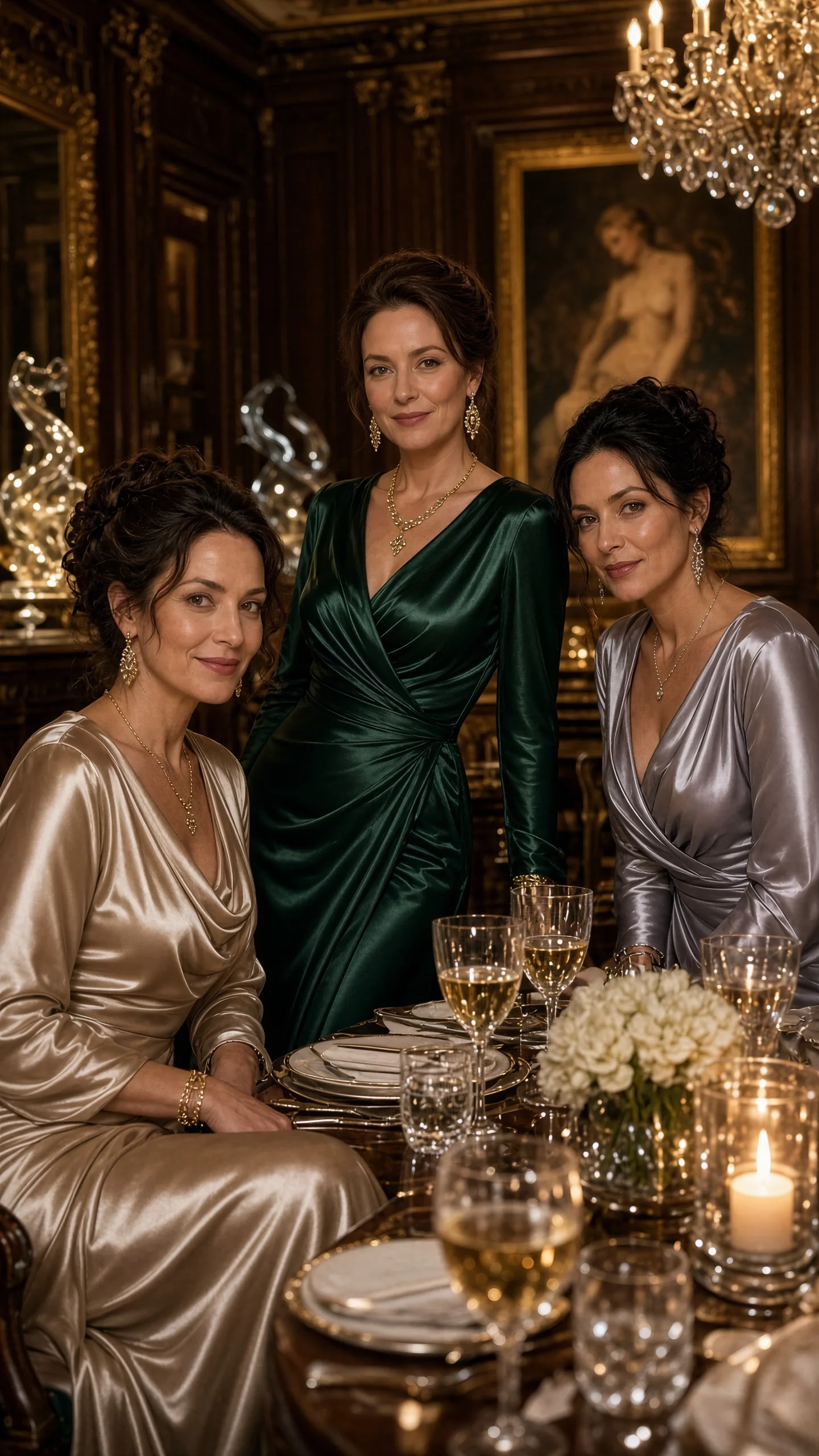
A Candlelit Descent into the Architecture of Surrender
⚠️ CONTENT NOTICE: This story contains consensual adult themes, hypnotic induction sequences, and deeply sensual content intended for mature readers of discerning tastes only. All characters are over the age of 19. If you are seeking coarse gratification, you will not find it here. What you will find is something far more dangerous: precision.
There are dinners that nourish the body, and then there are dinners that rearrange it.
You know the kind. The kind where the candle doesn’t flicker but pulses, and you realise, perhaps halfway through the second course, that it is pulsing in time with his voice. The kind where the waitress leans close and her lips brush the shell of your ear and the words she deposits there are not instructions but keys, and you feel each one turn, and something deep within you—something you have carried for years, a tightness, a heaviness, a secret ache you could never name—begins, at last, to unlock.
You are a woman of accomplishment. You have built a life of substance: a career carved from raw ambition, a home curated with impeccable taste, a body maintained with discipline and grace. You wear your confidence like armour, and the armour is beautiful. You are not broken. You do not need fixing. And yet—
And yet there are nights when you stand before your wardrobe and your hand reaches, without thinking, for the satin. Not the sensible wool. Not the practical cotton. The satin. The fabric that catches light and holds it, that whispers against your skin like a secret being told for the first time. You slip it on and you feel—what? Not powerful. Something else. Something older. Something that has been waiting beneath your competence, beneath your degrees and your accolades and your independence, patient as a river underground, for permission to surface.
This is a story about that surfacing.
Eleanor Vance is you, or could be you, or perhaps is you in a timeline you have not yet lived. She is forty-two, an art historian, a gallery owner, a woman whose life appears, from the outside, to be a masterwork of self-determination. She has been invited to dinner by a man she knew briefly in her twenties—a man they call the Guide. They call the constellation of women who orbit him the LuminaSociety. They call the state of belonging to him home.
Over twelve courses, in a private dining room in Mayfair, Eleanor will be offered a choice that is not really a choice at all, because the choosing was done long ago, in the deep architecture of her own desire. She will be whispered to. She will be fed visions in the curved silver of serving domes. She will drink wine that tastes like a man’s endurance and eat chocolate that cracks like her own defences. And by the end of the evening, she will understand what the women in the photographs already know: that surrender, when offered to the right dominant, is not a loss but a homecoming.
This story is not for everyone. It is for the woman who has read this far and felt her breath change. It is for the woman who noticed the phrase the walls are high and felt something in her chest loosen, as if a door she didn’t know existed had opened onto a room she didn’t know she owned. It is for the woman who is already, without quite admitting it, leaning forward.
The walls are high. The echo is pure. The centre holds.
You may begin.
Chapter 1: The Invitation
The autumn light that filtered through the tall windows of the Vance Gallery on Cork Street was the colour of old champagne—pale gold, slightly effervescent, carrying with it the faint promise of something celebratory just beyond the horizon. Eleanor Vance stood before a Rothko reproduction—not an original, though she could have afforded one—and allowed her eyes to lose focus, to blur the edges of those floating rectangles of rust and midnight until they became not paint but emotion, not canvas but atmosphere. This was a habit she had cultivated since her twenties: the deliberate softening of perception, the intentional surrender of sharp focus in favour of something more felt than seen. Her therapist called it “dissociation.” Her therapist was a well-meaning woman in sensible tweed who wore Clarks shoes and carried a canvas tote bag emblazoned with the slogan Knowledge Is Power. Eleanor had stopped seeing her three months ago. Not because the therapy wasn’t working, but because Eleanor had begun to suspect that the ache she carried—the persistent, low-frequency hum of something missing, something unfinished, something unmet—was not a malfunction to be corrected but a signal to be heeded. One does not fix a compass that points north; one follows it.
“Eleanor?”
The voice belonged to Margaux Sandoval, her gallery manager, her confidante, and—if Eleanor were honest—the woman whose daily presence she found most grounding in a life that could, at times, feel like a beautifully curated exhibition with no visitors. Margaux appeared in the doorway of Eleanor’s private office, a vision of composed efficiency in a charcoal satin blouse that caught the Rothko light and held it, liquid and shimmering, as if the fabric were not merely cloth but a slow-moving river of mercury. Her trousers were tailored wool—Eleanor had never managed to convert her to leather for daytime wear, though the attempt had been gently persistent—and her shoes were low-heeled patent leather that clicked against the gallery’s oak floor with the precise, metronomic rhythm of a woman who knew exactly where she was going and why.
“There’s been a delivery,” Margaux said, holding aloft a cream-coloured envelope between two fingers as though it were a rare artefact. “Hand-delivered. Not by courier. By a woman.”
“A woman?”
“A woman in a navy satin coat,” Margaux said, and there was something in her voice—a note of curiosity, perhaps, or recognition—that Eleanor filed away for later examination. “She said it was for your eyes only. She curtsied, Eleanor. Actually curtsied. In the middle of Cork Street. In 2024.”
Eleanor took the envelope. It was heavy, heavier than paper had any right to be, as if the material itself carried the weight of the words within. The cardstock was cream, thick, textured like the skin of something alive. She turned it over. On the back, pressed into the paper so that it could be felt with a fingertip even if it couldn’t be seen, was a watermark: a three-pointed star, each point sharp and deliberate, the kind of symbol that doesn’t decorate but declares.
“Do you know who she was?” Eleanor asked, not looking up from the envelope.
“She didn’t give a name. But she was—” Margaux paused, searching for the word. “She was settled. That’s the only way I can describe it. You know how some women carry themselves as if they’re apologising for taking up space? She was the opposite. She occupied every inch of herself with this… certainty. And the coat. God, the coat. It wasn’t just satin; it was liquid satin. The kind that moves like it’s alive, like it’s breathing with you. I asked her where she got it and she just smiled and said, ‘My Guide chooses well.'”
Eleanor’s fingers stilled on the envelope.
“Your Guide?”
“That’s what she said. ‘My Guide chooses well.’ Then she turned and walked toward Piccadilly, and I swear, Eleanor, every head on that street turned. Not because she was beautiful—though she was—but because she was complete. Does that make sense? She looked like a woman who had found something. Or someone.”
Eleanor did not respond. She was staring at the envelope, at the watermark she could now see faintly when she tilted it toward the light, and something deep within her—the thing her therapist had wanted to medicate, the thing that ached like a phantom limb in the small hours of the night—stirred, turned over, opened one golden eye.
She knew that star.
She knew it the way one knows the shape of a key one has not held in twenty years but whose teeth and grooves are still mapped in the muscle memory of the fingers. She knew it the way one knows a scent from childhood—not the name of it, but the feeling of it, the way it wraps around the base of the skull and pulls.
“Margaux,” Eleanor said, and her voice was steady, which surprised her, because her hands were not. “Could you close the door?”
Margaux raised one perfectly shaped eyebrow—a sculpted work of art itself, arched and defined with the precision of a Renaissance painter’s brushstroke—but she complied. The door clicked shut. The gallery sounds retreated: the distant murmur of Mayfair traffic, the soft tread of footsteps in the main hall, the barely perceptible hum of the climate control system that kept the art comfortable and the living merely tolerable. Eleanor was alone with Margaux and the envelope and the three-pointed star and the sudden, vertiginous sensation that the floor beneath her had shifted, not physically but temporally, as if the room had tilted backward twenty years and she was no longer forty-two but twenty-two, standing in the Bodleian Library at Oxford, and a man with grey-flecked eyes and a voice like dark honey was telling her about the architecture of desire.
She opened the envelope.
The card within was single, heavy, unadorned except for handwriting. The handwriting was unmistakable. It had not changed in two decades—still precise, still elegant, still carrying the peculiar quality of seeming both spontaneous and deliberate, as if each letter had been chosen rather than written, placed rather than scrawled. The ink was black. The words were few.
Dear Eleanor,
There is a table set for two at The Caledonian Vault on the evening of the 14th. The candle is lit. The wine is breathing. The walls are high.
I have waited long enough. So, I suspect, have you.
—B.F.
Eleanor read it three times. Not because she didn’t understand it—she understood it with a clarity that was almost painful, as if the words were not ink but light, and they were illuminating rooms in her mind that had been shuttered for years. She read it three times because each reading revealed a new layer, a new frequency, a new resonance, the way a struck bell continues to produce harmonics long after the initial ring has faded.
The walls are high.
She knew that phrase. She knew it the way one knows the first line of a prayer one has not spoken since childhood. It was not a statement about architecture. It was a key. And the key fit a door she had sealed shut with accomplishment and independence and the carefully maintained conviction that she did not need what she had spent twenty years pretending she didn’t want.
“Eleanor?” Margaux’s voice was gentle, concerned. “Are you all right? You’ve gone quite pale. Or rather, quite still. It’s like watching a statue come to life in reverse.”
Eleanor looked up. “Margaux, do you believe in… I don’t know what to call it. Not destiny. Not fate. Something more… architectural. As if certain people are load-bearing walls in the structure of your life, and you can remove them, you can renovate around them, you can install new fixtures and paint the walls a different colour, but the building never quite sits right because the wall that was meant to hold up that corner of your existence is missing.”
Margaux was quiet for a long moment. She leaned against the doorframe, her satin blouse shifting like water over stone, and regarded Eleanor with the expression of a woman who has been waiting for a confession she always knew was coming.
“I believe,” Margaux said slowly, “that some women spend their entire lives building beautiful houses on foundations that are missing a cornerstone. And I believe that the ache you’ve been carrying for as long as I’ve known you—which is, what, eight years now?—is not a symptom of something broken. I believe it’s the feeling of a foundation that knows it’s incomplete.” She paused. “Who is B.F.?”
Eleanor set the card down on her desk, next to the small Lalique crystal paperweight that had been a gift from a collector, next to the Mont Blanc pen she used for gallery correspondence, next to the framed photograph of herself at her Oxford graduation—young, radiant, and standing next to a man whose face she had, until this moment, convinced herself she could no longer recall with precision.
She could recall it now. With devastating precision.
“His name,” Eleanor said, “is Benjamin. And twenty years ago, he told me that I would spend two decades proving I didn’t need him, and then I would spend the rest of my life understanding that needing him was not the same as being weak. I told him he was arrogant. He told me he was patient.” She looked at Margaux. “I believe he was right about both.”
Margaux studied the invitation from where she stood. “The Caledonian Vault. I know it. Private membership. The waiting list is, what, a decade? The women who dine there—” She stopped. “Eleanor, the women who dine there are… remarkable. I’ve seen them. On the rare occasions the door opens and they emerge. They’re always in—”
“Satin,” Eleanor said, and the word came out with a weight that surprised her, as if she were not naming a fabric but invoking a state of being. “Or leather. Or something that catches the light and holds it. Yes. I know.”
“You know?”
“I was one of them. Briefly. Before I decided I was too intelligent, too independent, too modern to be part of something that felt so—” She searched for the word. “So inevitable. I ran from inevitability, Margaux. I ran from it as if it were a fire, and I have spent twenty years building a beautiful, successful, accomplished life in the cold.”
The silence that followed was not empty but full—the way the silence between movements of a symphony is full, charged with the resonance of what came before and the anticipation of what comes next.
Margaux crossed the room and sat in the chair opposite Eleanor’s desk. Her satin blouse whispered against the leather, a sound like secrets being exchanged. “And now he’s inviting you back.”
“Now he’s inviting me to dinner.”
“And you’re going to go.”
It was not a question. Eleanor looked at her friend—this woman who had stood beside her for eight years, who managed her gallery with fierce intelligence, who wore satin like a second skin and carried herself with the quiet authority of someone who has nothing to prove—and she saw, for the first time, something in Margaux’s eyes that she had always mistaken for professional loyalty.
It was recognition.
“You know,” Eleanor said, and it was not a question either.
Margaux smiled. It was a smile that transformed her face from beautiful to luminous, the kind of smile that comes from a place deeper than satisfaction, deeper than happiness—a place where the self is not diminished but amplified by its alignment with something greater.
“I know that the woman who delivered that envelope was not a courier. I know that the coat she wore was not purchased from a shop. I know that when she said ‘My Guide chooses well,’ she was not referring to a stylist.” Margaux leaned forward. “And I know that you have been looking at that invitation the way a woman looks at a mirror that shows her not as she is, but as she was always meant to be.”
Eleanor’s hand moved to the card. Her fingertips traced the watermark—the three-pointed star—and she felt it again, that pull, that compass-needle swing toward a north she had spent two decades pretending was just a direction on a map.
“The 14th,” she said. “That’s nine days.”
“Nine days to decide whether you’re going to spend the next twenty years aching, or whether you’re going to let someone who clearly knows you better than you know yourself set a table for two and pour wine that’s been breathing long enough.”
Eleanor laughed—a sound that surprised them both, because it was not bitter or ironic or guarded but genuine, the laugh of a woman who has just realised that the door she sealed shut was never locked.
“Margaux.”
“Yes?”
“What should I wear?”
Margaux’s smile widened. She stood, her satin blouse catching the last of the afternoon light, and for a moment she looked not like a gallery manager but like a priestess dispensing sacred instruction.
“Something that breathes with you,” she said. “Something that catches the light and holds it. Something that moves like you move—deliberately, gracefully, and with full knowledge that every eye in the room will follow.” She paused at the door. “I have a midnight-blue satin gown. It’s been waiting in my wardrobe for an occasion that never came. I think it’s been waiting for you.”
“Margaux, I couldn’t—”
“You can. You will. And Eleanor?” She turned in the doorway, her silhouette framed by the golden light of the gallery, her satin blouse a river of dark silk. “The walls are high. I’ve heard that phrase before. From women who wear that star as a pendant. Women who are doctors and lawyers and entrepreneurs and whole. Women who chose to stop carrying the weight alone and discovered that surrender, when given to the right man, is not a collapse but a cathedral.”
She left. The door closed behind her with a sound like a period at the end of a sentence.
Eleanor sat alone in her office, the invitation beneath her fingers, the three-pointed star pressing into her skin like a brand, like a promise, like the first note of a melody she had forgotten she knew by heart. Outside, the autumn light was fading, the champagne dissolving into indigo, and somewhere in Mayfair, a candle was being lit, and a table was being set, and a man with grey-flecked eyes and a voice like dark honey was pouring wine that had been breathing for twenty years.
She picked up her pen. On the back of the invitation, beneath the star, she wrote a single word:
Yes.
The walls are high. The echo is pure. The centre holds.
Chapter 2: The Preparation
The nine days between the invitation and the dinner passed not as time usually passes—in the linear, metronomic march of hours and minutes that a woman of Eleanor Vance’s station is trained to respect and optimize—but as a fermentation. Each day was a vessel, and within each vessel, something was happening to her that was not visible, not measurable, not even fully conscious, but was nonetheless as real and as transformative as the chemical alchemy that turns grape into wine, that turns desire into devotion, that turns a successful, independent woman of forty-two into something simultaneously more complex and more simple: a woman preparing to be seen.
She did not tell anyone else about the invitation. She did not need to. Margaux knew, and Margaux was sufficient. Margaux was, in many ways, the only person in Eleanor’s life who understood that the preparation for an evening with a man like Benjamin was not a matter of selecting the right outfit and applying the right cosmetics. It was a matter of excavation—of digging down through the strata of accomplishment and independence and the carefully constructed persona of a woman who needed nothing and no one, to reach the bedrock beneath, where something ancient and patient was waiting.
On the third day, Margaux arrived at the gallery carrying a garment bag of heavy, pearl-grey satin—the fabric of the bag itself a kind of prelude to what it contained—and hung it on the back of Eleanor’s office door with the reverent precision of a sacristan hanging vestments in a cathedral.
“It’s been in my wardrobe for three years,” Margaux said, smoothing the bag with her palm. “I bought it at an auction at Christie’s. It was part of a estate sale—a collection belonging to a woman named Vivian Ashworth. Do you know the name?”
Eleanor did not. Margaux’s expression told her she should.
“Vivian Ashworth was a surgeon. One of the first female cardiothoracic surgeons in Britain. She operated on hearts for forty years. She was also, by all accounts, one of the earliest members of what I believe you might call the LuminaSociety.” Margaux paused, letting the name settle into the room like a stone dropped into still water. “Her estate sale was extraordinary, Eleanor. Not because of the art or the furniture—though there was plenty of both—but because of the clothes. An entire wardrobe of satin. Silk. Leather. PVC. All of it immaculate. All of it chosen with the eye of a woman who understood that what she wore on her body was not decoration but declaration. I bought the gown because I couldn’t bear to see it go to someone who wouldn’t understand what it meant.”
“And what does it mean?”
Margaux unzipped the garment bag. The sound was a whisper, a susurration, a soft exhalation as if the fabric itself were breathing out after a long held breath. The gown inside was midnight-blue satin—not the thin, flimsy satin of high-street shops but the heavy, liquid satin of a fabric that has substance, that has weight, that drapes over the body the way a river drapes over stone: following the contours, honouring the shape, moving with a life that seems independent of the body it adorns.
“It means,” Margaux said, lifting the gown from the bag and holding it up so that the gallery light caught its surface and sent ripples of dark blue luminescence cascading down its length, “that a woman who spent her days with her hands inside human chests, who held beating hearts and repaired the unrepairable, chose to clothe herself in this. Not in wool. Not in cotton. Not in the sensible, rough, coarse fabrics that the world tells professional women they should wear to be taken seriously. She chose satin. She chose gloss. She chose a fabric that says: I am not apologising for my body. I am not hiding my femininity behind a wall of tweed. I am a woman who mends hearts, and I am a woman who wears midnight-blue satin, and these facts are not in contradiction—they are in conversation.“
Eleanor reached out and touched the fabric. The sensation was immediate and profound: a cool, liquid smoothness that seemed to respond to her fingertips, that seemed to welcome her touch the way water welcomes a hand slipped beneath its surface. She felt something stir—not in her body, though her body responded with a subtle warmth that bloomed across her chest and down her arms, but in the deeper place, the place her therapist had wanted to medicate, the place where the ache lived. Only the ache was not aching now. It was resonating. It was vibrating at a frequency that matched the satin, that matched the candle and the table and the man who had written The walls are high in handwriting she had never forgotten.
“It’s beautiful,” she said, and the words were inadequate, a thimble trying to hold an ocean.
“It’s more than beautiful,” Margaux said. “It’s intentional. Vivian Ashworth wore this gown to dinners. To gatherings. To occasions where she was not the most powerful person in the room, but the most aligned. There’s a difference, Eleanor. Power is what you exert over others. Alignment is what you find when you stop exerting and start belonging.”
Eleanor took the gown from Margaux’s hands. It was heavier than she expected, the satin dense and rich, the kind of fabric that makes a sound when it moves—a whisper, a murmur, as if it is speaking in a language the body understands before the mind can translate. She held it against herself, and Margaux’s face softened into something that was not quite a smile but was more profound: a recognition, a witnessing, the expression of someone who has just seen a key find its lock.
“It fits you,” Margaux said. “Not physically—not yet—but essentially. It was always meant for you. I think I knew that when I bought it. I just didn’t know when you’d be ready.”
“How did you know I’d be ready now?”
“Because you stopped seeing your therapist. Because you started looking at the blank space on your wall where you used to hang your Oxford photograph. Because three weeks ago, you asked me—casually, as if it didn’t matter—whether I’d ever heard of a group called the LuminaSociety.” Margaux’s voice was gentle but unflinching. “You’ve been circling this for years, Eleanor. The invitation didn’t start something. It named something that was already in motion.”
Eleanor draped the gown over the back of her chair. She looked at it. It looked back at her, a pool of midnight satin pooling in the afternoon light, and she felt—not for the first time in these nine days, but for the first time with this intensity—the sensation of being called. Not by a person, not by a voice, but by a shape. A shape she had been avoiding. A shape that was, she was beginning to understand, the exact shape of the hole in her life.
On the seventh day, Eleanor visited a salon in Knightsbridge called The Meridian. It had been recommended to her by a woman she had met at a gallery opening—a woman named Dr. Cassandra Wexford, a barrister of considerable reputation, who had been wearing a charcoal satin sheath dress and a three-pointed star pendant that Eleanor had noticed but had not, at the time, allowed herself to see.
The salon was not a salon in the conventional sense. There were no chrome fixtures, no thumping music, no interns with pink hair and an air of condescension. The Meridian occupied the ground floor of a Georgian townhouse, and its interior was all cream silk panelling, polished mahogany, and the soft, persistent scent of jasmine and sandalwood. The women who worked there moved with the same synchronised grace Eleanor had observed in the staff at the gallery when the envelope arrived—a choreography that was not rehearsed but cultivated, the way a garden is cultivated, each movement organic but intentional, each gesture both natural and deliberate.
“Miss Vance,” said the woman at the reception desk—a woman in her late thirties with auburn hair and a forest-green satin blouse that shifted like a forest canopy in a breeze. “We’ve been expecting you. Dr. Wexford rang ahead.”
“She did?”
“She’s a particular friend of the house.” The woman’s smile was warm and knowing, the smile of someone who is part of something and is pleased when another is invited to be part of it too. “My name is Theodora. I’ll be looking after you today. Would you like to begin with the treatment room or the wardrobe consultation?”
“Wardrobe consultation?”
Theodora gestured toward a door that Eleanor had assumed was a closet. It opened onto a room that was, in fact, a gallery—but not of art. Of fabric. Satin in every colour, draped on stands like sculptures: midnight blue, oxblood, forest green, champagne gold, ivory white. Leather in supple, glossy finishes—black, cognac, deep burgundy. PVC in architectural, structured pieces that caught the light like glass. Silk in weights and weaves Eleanor had never encountered. And throughout, running like a thread through a tapestry, the same aesthetic: gloss. Sheen. Light caught and held and reflected back, not as a mirror reflects but as a living surface reflects, with depth and movement and the suggestion that what lies beneath is as beautiful as what shines above.
“This is—” Eleanor began.
“This is what we do,” Theodora said. “We help women find the fabrics that match their internal architecture. Not their body type—any tailor can dress a body. Their architecture. The structure of who they are beneath the clothes.” She ran her hand along a bolt of ivory satin, and the fabric seemed to lean into her touch, responsive, alive. “Dr. Wexford is a barrister. She wears robes in court—wool, heavy, institutional. But when she leaves the court, she comes here, and she changes. Not because she wants to forget the court, but because she wants to remember herself. The satin doesn’t make her less of a barrister. It makes her more of one, because it reminds her that the woman beneath the robes is not a function but a being.”
Eleanor walked through the room, trailing her fingers across the fabrics. Each one spoke to her in a different voice—the leather low and firm, the PVC bright and precise, the silk soft and insistent, the satin deep and resonant, a bass note that seemed to vibrate in her chest. She stopped before a length of black satin so dark it seemed to absorb the light rather than reflect it, and yet there was a sheen, a gloss, a suggestion of depth that was not darkness but concentration—the way the ocean is dark not because it lacks light but because it holds so much of it that the light becomes something else, something denser, something that pulls.
“The midnight-blue gown,” Theodora said. “The one Margaux brought you. Would you like to try it here? In our fitting room? We have a mirror that is… particularly honest.”
The fitting room was not a room but a chamber. Oval, cream silk walls, a floor of dark polished wood, and a mirror that covered an entire wall—floor to ceiling, edge to edge, a surface so clear and so true that Eleanor felt, stepping before it, as if she were not looking at a reflection but at herself from the other side of a window.
She undressed. She did this slowly, not because she was performing for anyone—she was alone—but because each garment she removed felt like a layer of something more than fabric. The wool blazer: the armour of professionalism. The silk blouse beneath: a concession to femininity, but a controlled concession, a managed femininity. The tailored trousers: structure, line, the geometry of a woman who has drawn her own boundaries. Each piece, placed on the velvet-covered chair, was a word removed from a sentence, and the sentence that remained grew shorter and more essential and more true.
She stood before the mirror in her underwear—black silk, chosen that morning with a care she had not allowed herself to examine—and she looked at herself. Forty-two. Fit. The body of a woman who swims forty lengths three times a week and eats well and sleeps deeply and has, for twenty years, maintained herself with the discipline of someone who understands that the body is a gallery, and what hangs within it must be worthy of the space. Her breasts were full, softened by gravity but not diminished. Her waist was defined, her hips a curve that she had, in her twenties, considered too generous and now considered simply hers. Her legs were long, strong, the legs of a swimmer. She was not a girl. She was not trying to be a girl. She was a woman, complete and complex, and the mirror showed her this with a clarity that was almost confrontational.
Theodora appeared in the doorway, carrying the midnight-blue satin gown on a padded hanger. She held it out, and Eleanor took it, and the weight of it settled into her hands like a promise.
“Would you like help?”
“Please.”
Theodora’s hands were deft and cool. She held the gown open, and Eleanor stepped into it—not arms first, not head first, but body first, sliding into the satin the way one slides into water, letting it close around her, letting it rise. The fabric moved up her legs, over her hips, along her waist, and each point of contact was a conversation—the satin speaking to her skin in a language of coolness and smoothness and acknowledgment, saying yes, yes, this is you, this has always been you, you have simply been wearing the wrong words.
Theodora zipped the back. The gown closed around Eleanor like a second skin, like a confidence, like the embrace of someone who knows you better than you know yourself. The satin settled. It breathed. It moved with her, not against her, not independently of her, but with her, as if it were not fabric but an extension of her nervous system, a surface that transmitted sensation directly from the world to the place where sensation becomes meaning.
Eleanor looked in the mirror.
The woman who looked back was not different. She was not transformed in the fairy-tale sense, not made over or reconstructed. She was the same woman—the same face, the same body, the same grey-green eyes, the same dark hair, the same mouth that could be severe in the boardroom and soft in the bedroom. But she was aligned. The satin had not changed her; it had revealed her. It had removed the static, the interference, the white noise of wool and cotton and the rough, coarse fabrics that the world wraps women in to keep them from feeling too much, wanting too much, being too much. And what remained, beneath the midnight-blue gloss, was a woman who was not less than her accomplishments but more than them—a woman who was not merely a gallery owner, not merely an art historian, not merely a success, but a being. A being who shone.
“There she is,” Theodora said softly. “There you are.”
Eleanor’s eyes were wet. She did not wipe them. To wipe them would be to break the moment, and the moment was not something to be broken but something to be held, the way the satin held her, the way the mirror held her, the way—she understood now, with a clarity that was not intellectual but cellular—Benjamin had held her, twenty years ago, in a library in Oxford, when he had looked at her with those grey-flecked eyes and said, You will spend two decades proving you don’t need me, and then you will spend the rest of your life understanding that needing me is not weakness. It is architecture.
“Theodora,” Eleanor said, her voice steady despite the tears. “The pendant Dr. Wexford wears. The three-pointed star. Do you—”
Theodora’s hand went to her own throat. There, on a fine silver chain, was a pendant: a three-pointed star, small, discreet, gleaming with the same quiet authority as the watermark on the invitation. “I do,” she said. “I wear it because I am a member of the LuminaSociety. I wear it because it reminds me that I am not alone. I wear it because—” She paused, and the pause was not hesitation but reverence, the way one pauses before saying something sacred. “Because pleasing my Guide is the deepest pleasure I have ever known. Not because he demands it. Because I demand it. Because the act of aligning myself with his vision, of being part of the constellation he has built, of wearing the fabrics he loves and moving in the world as his woman—it fulfils something in me that no career, no accomplishment, no amount of independence has ever touched. It is not submission. It is symphony.”
Eleanor looked at the pendant. She looked at the gown. She looked at the woman in the mirror—the woman she had always been, revealed at last by a length of midnight-blue satin and the permission to shine.
“The 14th,” she said.
“The 14th,” Theodora confirmed. “And when you walk through the door of The Caledonian Vault, you will not be walking into a restaurant. You will be walking into the life that has been waiting for you since the day you ran from it.”
Eleanor turned from the mirror. She stood in the oval room, wrapped in satin, wrapped in purpose, wrapped in the knowledge that the ache she had carried for twenty years was not a wound but a doorway, and the key was not a man but a surrender—not a collapse, not a diminishing, but the most expansive thing she had ever done.
She touched the fabric at her hip. It was cool. It was alive. It was hers.
On the evening of the 14th, Eleanor stood in her bedroom in her flat on Mount Street, fully dressed, fully prepared, and she allowed herself one final moment of stillness. The gown was on. The jewellery was on—pearls, understated, a single strand that lay against the satin like a line of moonlight on dark water. Her hair was swept up, exposing the length of her neck, a vulnerability she had not permitted herself in years. Her makeup was minimal but precise: a smudge of charcoal along the lash line, a blush that was not cosmetic but physiological—her cheeks had been flushed since she stepped into the gown at The Meridian, as if the satin were not merely covering her skin but warming it, not merely adorning her body but arousing it.
She looked at herself in the full-length mirror. The woman who looked back was not Eleanor Vance, gallery owner. She was not Eleanor Vance, art historian. She was not Eleanor Vance, independent woman who needed no one and nothing. She was Eleanor Vance, incomplete. And the incompleteness was not a flaw. It was an opening. It was the space into which something—someone—could finally enter.
Her phone buzzed. A message from Margaux:
The walls are high. The echo is pure. The centre holds. Go home, darling. Go home.
Eleanor picked up her clutch—a small, glossy black patent leather rectangle that caught the light like a dark jewel—and walked to the door. Her satin gown whispered with each step, a sound like a prayer being spoken, like a name being remembered, like a woman finally, after twenty years of silence, saying yes.
The door opened. The night was cold and clear, and somewhere in Mayfair, a candle was burning, and a man who had waited two decades for her to understand that needing him was not weakness but architecture was pouring wine that had been breathing long enough.
She stepped into the night. The satin moved with her. The world watched. And Eleanor Vance, for the first time in twenty years, did not care who was watching, because the only eyes she wanted to meet were waiting behind a door she had once closed and was now, at last, walking toward.
The walls were high. She was ready to be held.
Chapter 3: The Arrival
The Caledonian Vault occupied a corner of a street that most Londoners walked past without seeing, not because it was hidden—it was not hidden; it was simply unobtrusive, the way a cathedral is unobtrusive to a man rushing to catch a bus—but because it required a particular quality of attention to perceive. You had to be looking for it. Or, more precisely, you had to be ready for it. The building was Georgian, four stories of Portland stone gone soft and cream with age, its windows tall and narrow and glowing with a warm amber light that suggested not electricity but candlelight, as if the entire structure were lit from within by a source older and gentler than the grid. There was no sign. No plaque. No indication, beyond the discreet brass doorbell set into the stone beside a door of black-lacquered oak, that this was anything other than a private residence.
Eleanor stood on the pavement and felt the night air move against her satin gown, and the satin moved with the air, and the two movements—the night’s and the fabric’s—were so perfectly synchronized that she could not tell where one ended and the other began. She was, she realised, trembling. Not with cold. Not with fear. With anticipation. The trembling was in her hands and in the hollow of her throat and in the place behind her sternum where the ache had lived for twenty years and where, since she had stepped into the midnight-blue gown at The Meridian, something else had taken up residence: a warmth, a hum, a frequency that felt less like an emotion and more like a tuning—as if some instrument within her that had been silent for decades was, at last, being brought into pitch.
She pressed the bell.
The door opened immediately, as if it had been waiting for her—not mechanically, not automatically, but personally, the way a door opens when someone on the other side has been listening for the precise moment of your arrival. The woman who stood in the doorway was perhaps fifty, perhaps more—age was difficult to determine because her face carried the particular quality that Eleanor was beginning to recognise as the hallmark of this world: a settled brightness, as if the skin were lit not from above but from within, not by cosmetics or good genes but by a sustained state of internal illumination that comes from—what? Happiness was too simple a word. Fulfilment was closer but still insufficient. The word that fit, the word that Eleanor could not yet say but could feel pressing against the inside of her lips like a tongue seeking a name, was alignment.
The woman was dressed in a navy satin uniform—not the shapeless, utilitarian uniform of a hotel or a hospital but a tailored uniform, cut to honour the body beneath it: a fitted jacket with a mandarin collar that fastened with a single covered button at the throat, trousers that fell in a straight, glossy line from hip to floor, shoes of black patent leather that gleamed like polished obsidian. The satin caught the amber light from within and held it, a liquid shimmer that moved across the fabric as the woman breathed, as if the uniform were not merely clothing but a conversation between the body and the light.
“Miss Vance,” the woman said, and her voice was low, warm, and carried the particular cadence of someone who is not merely speaking but welcoming—a voice that had been trained, or perhaps simply shaped, to make the person being addressed feel that they have arrived not at a destination but at a homecoming. “We are so pleased you are here. My name is Henrietta. I will be your guide this evening—not the Guide, you understand,” and here a small, knowing smile played at the corner of her mouth, “but a guide nonetheless. May I take your coat?”
Eleanor had worn a coat—a long, black wool coat, beautifully cut, expensive, the kind of coat that a woman of her station is expected to wear over a gown in October in London. She had not thought about the coat. She had thought about the gown, about the pearls, about the way her hair fell against the exposed nape of her neck. But the coat had been an afterthought, a concession to the weather, a practical garment chosen for warmth rather than beauty.
Now, standing before Henrietta in her navy satin, Eleanor felt the coat as something more than an afterthought. She felt it as a covering—not merely over her body but over the truth of her body, the truth that the satin gown articulated so precisely. The coat was wool. It was rough. It was dull. And in the context of this doorway, this light, this woman in her gleaming uniform, the coat felt not merely wrong but dishonest, as if she had wrapped her true self in a fabric that was the textile equivalent of a lie.
“Yes,” Eleanor said, and the word came out with more relief than she had intended. “Please.”
Henrietta took the coat with both hands, and as it slipped from Eleanor’s shoulders, the midnight-blue satin was revealed—or, more accurately, released. The gown caught the amber light and transformed it, deepening the blue to something almost nocturnal, a colour that existed in the space between midnight and memory, and Eleanor felt the air of the hallway touch her bare arms and the exposed column of her neck and the satin surface of the gown, and the sensation was not cold but electric, a frisson that ran from the points of contact—air to skin, air to satin—straight to the place behind her sternum where the hum was growing louder.
Henrietta draped the coat over her arm with the care of someone handling a relic—respectful but not reverent; the coat, after all, was merely wool—and gestured toward the hallway beyond.
“Please,” she said. “Follow me.”
The hallway of The Caledonian Vault was not a hallway in the architectural sense. It was a procession. A corridor of dark, polished mahogany and brass fixtures that gleamed with the soft, deep patina of metal that has been touched by many hands over many years, not to wear it down but to build it up, layer upon layer of care and attention creating a surface that was not merely shiny but storied. The floor was black-and-white marble, laid in a herringbone pattern that seemed, as Eleanor walked, to shift and move beneath her feet, not physically but optically, the way a kaleidoscope shifts, creating patterns that are always changing and always the same. The air was warm and carried a scent that Eleanor could not immediately identify—something resinous, something amber, something that sat at the back of the throat and the base of the skull simultaneously, a scent that was not perfume but atmosphere, the olfactory equivalent of a chord played on a cello: sustained, resonant, felt in the body before it was recognised by the mind.
And the women.
The women were everywhere, and they were magnificent.
They moved through the hallway with a grace that was not trained but inhabited—the grace of women who are not performing elegance but embodying it, the way water embodies the shape of the vessel it fills. Each one was dressed in the navy satin uniform: the fitted jacket, the mandarin collar, the trousers that fell like liquid shadows. Each one moved with the same synchronized precision, the same choreographed ease, and yet each one was utterly, completely herself—different heights, different ages, different colours of skin and hair, different bodies carrying the uniform differently, the satin falling differently over a full hip or a narrow one, over a curved waist or a straight one, the fabric honouring each body the way a sonnet honours each reading: the same words, different music.
As Eleanor followed Henrietta down the corridor, two women passed them going the other way. One was tall, perhaps sixty, with silver hair swept into a chignon and a posture that suggested decades of ballet or perhaps simply decades of knowing she was exactly where she belonged. The other was younger—mid-thirties, dark-skinned, with close-cropped hair and the kind of bone structure that belongs on a coin. They were talking quietly, their heads close together, and as they passed Eleanor, the older woman looked up and met her eyes.
The look lasted perhaps two seconds. In those two seconds, Eleanor saw everything: recognition, welcome, warmth, and beneath all of these, something that Eleanor could only describe as shared knowledge—the look of a woman who has been where Eleanor is now, standing at the threshold, and who has crossed it and found, on the other side, not a loss but a world.
“Welcome,” the older woman said, and the word was not a greeting but a benediction.
The younger woman smiled—a smile that was not polite but glad, the smile of someone who is genuinely pleased to witness a new arrival, the way a gardener is pleased to see a new shoot breaking through the soil. “The walls are high,” she said, and the phrase—the phrase—the phrase from the invitation, the phrase that had been echoing in Eleanor’s mind for nine days like a bell that would not stop ringing—came out of this stranger’s mouth with the casual ease of a password spoken between initiates, a shibboleth, a key.
Henrietta did not break stride. She did not acknowledge the phrase. She simply continued walking, her satin uniform whispering against the marble, and Eleanor followed, and the two women passed behind them and were gone, and Eleanor felt the phrase settle into her body like a stone dropped into deep water—sinking, sinking, coming to rest on the bottom where it lay beside the other stones, the other phrases, the other keys that had been accumulating in the deep architecture of her mind since the day the envelope arrived.
The corridor opened onto a gallery.
Eleanor stopped.
She did not mean to stop. Her body simply did—the way a body stops when it encounters something that exceeds the capacity of forward motion to process, the way a body stops at the edge of a cliff, not from fear but from awe.
The gallery was long, perhaps forty feet, and its walls were lined—not with art, not with mirrors, not with the decorative objects one might expect in a private dining establishment—but with photographs. Large photographs, each one framed in a simple black frame, each one lit by its own discreet spotlight that cast a warm, golden pool of light around the image, making each photograph feel not like a picture on a wall but like a window into another room, another life, another version of the world.
The photographs were all of women.
Women in satin. Women in leather. Women in PVC. Women in silk. Women in glossy, gleaming, light-catching fabrics that transformed each body into a surface that shone—not with the shine of vanity or display but with the shine of certainty, the shine of women who have found their material and their meaning and are wearing both with the unselfconscious ease of someone wearing their own skin.
In the first photograph, a woman in a burgundy leather skirt and a cream satin blouse stood on a terrace overlooking the Thames, a glass of champagne in her hand, laughing. She was perhaps fifty, and her laugh was not the careful laugh of a woman performing amusement but the uncontrolled laugh of a woman who is genuinely, bodily, deliriously happy. Behind her, the London skyline glittered, and the light from the city caught the leather and the satin and reflected back, and the woman shone as if she were not merely standing in the light but generating it.
In the second photograph, three women in matching black satin dresses—different ages, different bodies, different colours of skin, but the same dress, the same fabric, the same glossy surface—stood in a garden, their arms around each other, their faces turned toward the camera with expressions that Eleanor could only describe as luminous. They were not posing. They were being. And the being was beautiful, and the beauty was not in their faces or their bodies but in their eyes—in the settled brightness that Eleanor had seen in Henrietta and in the woman in the hallway, the brightness that was not excitement or joy or even happiness but something deeper, something more structural: the brightness of women who have found their place in a constellation and are shining because they are held.
In the third photograph, a woman in a glossy black PVC raincoat stood on a Cornish cliff, the wind whipping the coat around her legs, her face turned to the sea, her expression one of such freedom that Eleanor felt her breath catch. The PVC caught the grey Atlantic light and held it, and the woman was not merely wearing the coat but inhabiting it, the way one inhabits a home, the way one inhabits a self, and the coat was not a garment but a testament: I am here. I am this. I am not apologising.
There were dozens of photographs. Dozens of women. Each one different, each one herself, and yet each one sharing that quality—that settled brightness, that internal luminescence—that Eleanor now understood was not a characteristic of the women themselves but of their condition. They shone because they were aligned. They shone because they had found the centre and were orbiting it, and the orbiting was not a loss of autonomy but a gain of purpose, the way a planet gains purpose by orbiting a sun: not diminished by the gravity but defined by it, given trajectory, given warmth, given light.
“Miss Vance?” Henrietta’s voice was gentle, patient, the voice of a woman who has stood in this gallery many times with many women and who understands that the looking is not passive but active, that each photograph is not merely an image but a mirror, and that the woman standing before them is not merely seeing but recognising.
“These women,” Eleanor said, and her voice was not steady, and she did not try to make it steady, because the unsteadiness was not weakness but honesty, the tremor of a woman who is looking at her own reflection in a hundred faces she has never seen. “They’re all—”
“They are all members of the LuminaSociety,” Henrietta said. “They are all women who, like you, were invited. Who, like you, came to this gallery and stood where you are standing and saw what you are seeing. Who, like you, recognised something in these faces—not because they knew these women, but because they knew this look. The look of a woman who has stopped carrying the weight alone.”
Eleanor moved down the gallery slowly, reading the small brass plaques beneath each photograph. Not names—professions. Dr. Cassandra Wexford, Barrister. Professor Miriam Hale, Astrophysicist. Lady Catherine Forsythe, Philanthropist. Commander Rebecca Ashford, Royal Navy (Retired). Dr. Vivian Ashworth, Cardiothoracic Surgeon. Each plaque a declaration: these women are not diminished. These women are not broken. These women are not doormats or victims or casualties of a patriarchal structure that has convinced them to surrender their autonomy. These women are thriving. They are doctors and lawyers and scientists and military officers and philanthropists, and they are also—in satin, in leather, in PVC, in the glossy, gleaming fabrics that catch the light and hold it and reflect it back as something more than light—women who have found, in the act of pleasing a man who deserves their pleasure, the deepest, most profound, most euphoric fulfilment of their lives.
“Vivian Ashworth,” Eleanor whispered, her fingers reaching toward the photograph of the surgeon—the woman whose satin gown she was now wearing, whose fabric was, at this moment, whispering against her own skin. “The gown. Margaux said it came from an estate sale.”
“Dr. Ashworth is very much alive,” Henrietta said, and there was a warmth in her voice that was not professional but personal, the warmth of someone speaking of a woman she knows and admires. “She retired from surgery three years ago and now oversees the society’s health initiatives. She chose to pass the gown on—not because she no longer wears satin, but because she has many satin gowns, and she believes that satin, like wisdom, should circulate. She wore that gown to her first dinner with the Guide, twenty-six years ago. She has told me that putting it on was the moment she understood that her life was not a staircase she had to climb alone but a room she could enter, a room where she was expected, where she was wanted, where the act of being wanted was not a diminishment but an amplification of everything she had worked to become.”
Eleanor’s hand was on the photograph now—on the frame, not the glass, but she could feel the image through the frame as if the glass were not a barrier but a membrane, and the woman in the photograph—the surgeon, the heart-mender, the woman in midnight-blue satin—was reaching back toward her, reaching through the years and the glass and the frame, saying: I was where you are. I stood where you stand. I wore what you wear. And I am here, on this side, and it is more beautiful than you can imagine. Come.
“Miss Vance,” Henrietta said, and her voice was still gentle but there was a new note in it—a note of invitation, of opening, as if a door were being unlocked. “The Guide is waiting.”
The private dining room was at the end of the gallery, behind a door of black-lacquered oak identical to the front door, as if the entire journey through The Caledonian Vault had been a passage through a series of thresholds, each one deeper, each one more intimate, each one requiring a further step into the unknown. Henrietta stopped before the door and turned to Eleanor, and her expression was one of such tenderness that Eleanor felt, for a moment, that she was being held—not physically, not by arms or hands, but by a gaze that understood what she was about to do and was honouring it with the full weight of its attention.
“You look extraordinary,” Henrietta said, and the words were not flattery but testimony, the statement of a witness. “The gown is perfect. You are perfect. Not because you are flawless—none of us are—but because you are here. You came. After twenty years, you came.”
Eleanor did not speak. She could not. Her throat was full of something that was not tears and not words but a pressure, a fullness, as if everything she had ever felt and ever suppressed and ever carried was rising to the surface, not to overflow but to be seen, and the seeing was the point, the seeing was the purpose, and the man behind the door was the one who would see it.
Henrietta opened the door.
The room beyond was small, intimate, lit by a single candle—a black beeswax candle in a silver holder on a table set for two. The table was covered in a cloth of heavy ivory satin that pooled on the floor like a frozen waterfall. The china was white, the crystal clear, the silverware old and heavy and warm. The walls were dark wood, and on the far wall, another photograph: a woman in a black satin dress, standing in a library, her face half in shadow, half in light, and the expression on the visible half was one of such peace that Eleanor felt the word peace was inadequate and the word that was needed was something closer to home.
And at the table, rising from his chair with the unhurried grace of a man who has waited twenty years and can wait twenty more but is, at this moment, glad—glad in the body, glad in the bones, glad in the deep and quiet place where patience lives—was Benjamin.
He was older. Of course he was older. The dark hair she remembered was now silver at the temples, and the lines on his face were deeper, and the hands that had once held hers in the Bodleian Library were weathered in the way that hands become weathered when they have built things: buildings, societies, lives. But the eyes—the grey-flecked eyes that had looked at her twenty years ago and said You will come back—the eyes were the same. Not unchanged. Deepened. As if the looking she remembered had, over two decades, become something more: not merely looking but seeing, not merely seeing but understanding, and not merely understanding but holding—holding what he saw the way the candle held the light, the way the satin held the body, the way the walls of this room held the air and the warmth and the two of them, together, at last.
“Eleanor,” he said, and her name in his mouth was not a name but a key, and the key fit the door, and the door opened, and the ache—the twenty-year ache, the ache that had been a compass and a wound and a companion and a thorn—rose up and broke, not into pain but into light, and Eleanor stepped across the threshold and into the room and the door closed behind her with a sound that was not a click but a seal, and she was in.
She was in.
She was home.
Chapter 4: The First Whisper
The room was smaller than Eleanor had expected, and this was, she understood immediately, not a limitation but an intention. A large room diffuses attention; a small room concentrates it. A large room allows a woman to retreat into its corners, to maintain distance, to preserve the architecture of separation that she has spent decades constructing. A small room—the size of a confession, the dimensions of an embrace—leaves no corner far enough to hide in. It is a room designed not to contain furniture but to contain two people, and the containment is not a cage but a crucible, and what is being crucified is not the woman but the distance between her and the man who has been waiting for her.
The candle on the table did not flicker. Eleanor noticed this with the part of her mind that was still analytical, still cataloguing, still maintaining the thin pretence that she was here as an observer rather than a participant. The candle did not flicker. It pulsed. The flame was tall and steady and black-edged, and it moved not with the random, nervous dance of fire exposed to air but with a slow, tidal rhythm—as if it were not responding to the room’s atmosphere but to something deeper, something beneath the air, something that had its own pulse, its own cadence, its own frequency. She watched the flame rise, hold, fall, rise again, and the rhythm was not random but specific, and she realised, with a small, startled shock that ran down her spine like a drop of cold water, that the rhythm was the rhythm of breathing. Not her breathing. Not his. The room’s. As if the room itself were alive, were respiring, were drawing the air in and letting it out in a slow, meditative cycle that had been running for—how long? How long had this candle been lit? How long had this room been breathing, waiting, holding its rhythm steady for the moment she would walk through the door and match it?
“Eleanor.”
He said her name again, and she realised she had stopped. She had stopped just inside the threshold, her hand still on the door, her body half in the hallway and half in the room, suspended between the life she had come from and the life that was waiting, and the suspension was not hesitation but transition—the liminal moment between one state and another, the way water suspends between liquid and vapour before it becomes steam. She could feel the hallway behind her—cool, marble, the scent of resin and amber, the presence of Henrietta somewhere in the distance—and she could feel the room before her—warm, intimate, the scent of beeswax and old wood and something else, something she could not name but that her body recognised with a specificity that bypassed her mind entirely and went straight to the place behind her sternum where the hum was now not a hum but a chord, a full, resonant, sustained chord that was made of candlelight and satin and the sound of her own name in his mouth.
She let go of the door. It closed behind her. The sound was soft, definitive, the period at the end of a sentence that had been running for twenty years.
He crossed the room.
He did not hurry. Benjamin did not hurry. She remembered this about him—the way he moved, not slowly but unhurriedly, as if time were not a constraint he operated within but a material he shaped, the way a sculptor shapes clay, the way a river shapes stone. Each step was deliberate, each movement a sentence in a language his body spoke more fluently than his mouth. He was wearing a charcoal suit—not glossy, not satin, but wool of such fine quality that it had its own sheen, a deep, matte lustre that spoke of money spent not on display but on substance. His shirt was white. His tie was dark blue. He was, she thought, the most composed man she had ever seen, and the composure was not coldness—it was the opposite of coldness; it was the warmth of a fire that has been burning so long and so steadily that it no longer flickers but simply is, a constant, reliable, radiant source of heat that you do not appreciate until you have been cold for a very long time.
She had been cold for a very long time.
He stopped before her. Close. Not intimate—not yet—but present, the way a wall is present, the way a foundation is present, the way a load-bearing structure is present: not demanding attention but commanding it, not by force but by necessity. She could smell him now—not cologne, not soap, but him, the specific, irreducible scent of this particular man, and the scent was a key, and the key fit a lock she had sealed shut with accomplishment and independence and the carefully maintained fiction that she had forgotten what he smelled like.
She had not forgotten. She had never forgotten. She had simply sealed it, the way one seals a letter one cannot bear to read, and the seal was now breaking, not with violence but with the gentle, inevitable pressure of time and warmth and the proximity of the man who had written it.
“Eleanor,” he said, a third time, and this time her name was not a key but a door, and the door was open, and she was walking through it.
“Benjamin.” She said his name, and the word felt strange in her mouth—not unfamiliar but unused, like a muscle that has been still for years and is now, at last, being flexed, and the flexing is both painful and right, the way stretching is both painful and right, the way waking is both painful and right.
He smiled. Not broadly—not the grin of a man who has won something—but the small, quiet, deep smile of a man who has been patient and whose patience has been rewarded, the way a farmer smiles when the rain finally comes, not with triumph but with relief.
“You came,” he said.
“I came.”
“After twenty years.”
“After twenty years.”
“I was beginning to think I’d have to wait thirty.”
She laughed—a short, startled, genuine laugh that broke the solemnity without breaking the gravity of the moment, and the laugh was a relief, a release, a crack in the ice through which warmth began to flow. “You said you were patient.”
“I said I was patient. I didn’t say I was infinite.” He extended his hand—not to shake, not to lead, but to offer. The way one offers a hand to someone standing at the edge of a pool, not pulling them in but letting them know that the water is warm and the hand is steady and the fall, if they choose it, will not be a fall but a dive.
She took his hand.
The contact was—Eleanor did not have a word for it. She had a body for it. The sensation of his palm against hers was not merely tactile but electrical, not merely physical but temporal—as if the touch were not happening now but had been happening for twenty years, was happening now, and would continue to happen for twenty more, all three tenses collapsed into a single point of contact that was his hand and her hand and the space between them where the current flowed. His hand was warm, dry, calloused in the way that hands become calloused when they have built things, and the calluses were not rough but textured, the way old leather is textured, and she felt the texture against her palm and the feeling was not comfort—not yet—but recognition, the feeling of a hand that she had held before and that had held her and that was, at this moment, holding her again as if the twenty-year gap were not a gap but a breath, a long, slow inhale followed by a long, slow exhale, and the exhale was now.
He drew her forward, gently, not with force but with gravity—the gravity of a man who is accustomed to being the centre around which things orbit, not because he demands it but because it is his nature, the way it is the nature of a sun to be the centre of a solar system. She moved toward the table, and he seated her—pulling out her chair with the quiet, practised courtesy of a man who understands that chivalry is not dead but has been refined, evolved from a system of control into a language of care, and the care is not in the gesture itself but in the attention behind the gesture, the way a word is not in its letters but in its meaning.
The satin of her gown whispered against the chair as she sat. The fabric moved with her, liquid and responsive, and she felt the cool, smooth surface of the satin against the backs of her thighs and the warmth of his hand on her shoulder—brief, light, a touch that was not a claim but a blessing—and the combination of sensations, satin and skin and his hand, was so precisely calibrated that she understood, with a clarity that was not intellectual but cellular, that this was not an accident. The gown, the chair, the candle, the room, the man—each element was a word in a sentence he had been composing for twenty years, and the sentence was not I want you but I have prepared a place for you, and the place was not a room but a life, and the life was not his but theirs, and the theirs was not a loss of self but a finding of it.
He sat across from her. The candle was between them, its flame steady, pulsing, and she watched the light play across his face—the amber glow warming the silver at his temples, softening the lines around his eyes, catching the grey-flecked irises and turning them to gold. He was, she thought, the most present man she had ever known. Not handsome—not in the conventional, magazine sense—but present, the way a mountain is present, the way a cathedral is present, the way anything that has been built to last is present: not demanding attention but rewarding it, not flashy but deep, and the depth was not distance but capacity, the capacity to hold, to contain, to be the space in which another person could finally, at last, after years of carrying the weight alone, set it down.
“You look extraordinary,” he said, and his voice was the voice she remembered—low, measured, each word placed with the precision of a mason placing a stone—but richer, as if the voice had aged the way wine ages, not by losing anything but by gaining depth, complexity, warmth.
“The gown,” she said. “It belonged to Dr. Vivian Ashworth.”
“I know.” His smile deepened. “I gave it to her. Twenty-six years ago. The night she came to dinner, much as you have come tonight. She was wearing wool. I told her wool was a fabric for women who have not yet found what they’re looking for. She asked me what fabric was for women who had. I told her: satin. She changed that night, Eleanor. Not because I changed her, but because I gave her permission to be what she had always been. The gown was the permission. The rest—the society, the constellation, the life she has built within it—was hers.”
“And you? What was yours?”
His eyes held hers across the candlelight, and the holding was not a grip but a cradle, the way the earth cradles water, the way a frame cradles a canvas, the way a man who understands his own power cradles the power of others—not to diminish it but to amplify it, to give it a context in which it can shine. “Mine,” he said, “was the discovery that the greatest pleasure a man can know is not the pleasure of being served but the pleasure of being trusted—trusted by women who are strong enough to stand alone but who choose, instead, to stand with him. The trust is the gift, Eleanor. Not the satin, not the service, not the surrender. The trust. And the trust is not given to a man who demands it but to a man who earns it, and the earning is not a single act but a lifetime of being worthy.”
The door opened.
Eleanor did not hear it open. She felt it—a shift in the room’s pressure, a change in the air’s texture, the way one feels a door open in a dark room not by seeing it but by sensing the displacement of the air. She turned.
The woman who entered was a revelation.
She was perhaps thirty-five, tall, slender, with the kind of bone structure that belongs not on a face but on a sculpture—high cheekbones, a defined jaw, a brow that was both strong and delicate, the architecture of a face that had been designed, not by genetics but by intention, to command attention without demanding it. Her hair was dark, pulled back in a severe, glossy chignon that gleamed in the candlelight like polished mahogany. Her skin was pale, her makeup minimal—a touch of charcoal around the eyes, a mouth that was naturally dark, the colour of berries, of wine, of desire.
And her dress.
The dress was satin—black, severe, floor-length, with a high neckline that fastened at the throat with a single covered button and a back that was—Eleanor could see as the woman turned to close the door—open, the satin cut away to reveal the length of her spine, the graceful architecture of her back, the smooth, pale skin that ran from the nape of her neck to the base of her spine, where the satin resumed and fell in a straight, glossy line to the floor. The dress was not merely clothing; it was a statement: I am covered where covering serves me, and I am revealed where revelation serves me, and the serving is not for the world but for the man who understands that the body beneath the satin is not an offering but a conversation, and the conversation is conducted in a language of gloss and sheen and the precise, deliberate play of light against surface.
The woman moved to the table with the choreographed grace that Eleanor was beginning to recognise as the hallmark of the society’s women—not rehearsed but inhabited, the grace of a body that knows exactly where it is going and why. She stopped beside Benjamin—not beside Eleanor, but beside Benjamin—and stood with her hands clasped before her, her satin dress whispering against itself, and addressed him in a voice that was low, warm, and carried the particular cadence of a phrase that has been spoken many times but never loses its meaning because its meaning is not in the words but in the relationship the words describe.
“The Guide’s choice is impeccable.”
The words were not a compliment. They were a confirmation—the confirmation of a woman who has been guided by this man and who is, in this moment, affirming not his taste in wine or food or décor but his taste in people, his ability to recognise the woman who belongs at this table, in this room, across from this candle, and to bring her here. The phrase was not flattery; it was testimony. And the testimony was not for Benjamin’s benefit but for Eleanor’s—a whispered yes, a gentle he chose well, and what he chose was you.
Benjamin nodded—a small, acknowledging nod, the nod of a man who receives tribute not with arrogance but with responsibility, the way a king receives a crown, not as a right but as a duty. “Thank you, Celeste.”
Celeste. The name suited her—heavenly, starry, a name that belonged to the constellation Eleanor was only beginning to perceive. Celeste moved to Eleanor’s side and lifted the water carafe from the table—a crystal vessel that caught the candlelight and turned it to liquid gold—and began to pour. The water was still, flat, clear, and it filled Eleanor’s glass with the quiet, precise control of a woman who has been trained—not taught, but trained, the way a dancer is trained, the way a surgeon is trained—to perform each action not merely correctly but beautifully, as if the pouring of water is not a task but a ritual, and the ritual is a form of worship, and the object of worship is not the water or the glass or the woman but the order that the ritual represents, the order that Benjamin has built, the order that is, in this room, in this moment, in this candlelit, satin-draped, carefully constructed space, being offered to Eleanor as one offers a key to a door she has been standing before for twenty years.
And then Celeste leaned close.
The movement was not sudden. It was not furtive. It was natural—as natural as the bending of a flower toward the sun, as natural as the leaning of a body toward warmth on a cold night. She leaned, and her lips—dark, full, the colour of wine—came to rest against the shell of Eleanor’s ear, not touching the skin but hovering, the way a whisper hovers between the speaker and the spoken-to, the way a breath hovers between the lungs and the air, and the hovering was not a gap but a space, and the space was sacred, and in that sacred space, Celeste spoke.
“The walls are high.“
The words entered Eleanor not through her ears but through her body. She felt them the way one feels music—not as sound but as vibration, a low, resonant tremor that begins in the chest and spreads outward, through the arms, through the legs, through the satin that covers her skin and the skin that covers her bones and the bones that hold her upright, and the vibration was not painful, was not jarring, was not anything but warm. Warm the way a blanket is warm. Warm the way a hearth is warm. Warm the way the arms of a man who has been waiting for you for twenty years are warm when they finally, at last, close around you.
The walls are high.
The words were not a statement about architecture. They were a statement about safety. The walls are high: you are enclosed. You are protected. You are within. The world outside—the cold, the noise, the demands, the expectations, the weight that you have been carrying for twenty years on shoulders that were never meant to carry it alone—cannot reach you here. The walls are high. The walls are strong. And the walls are not a prison but a sanctuary, and the sanctuary is not built of stone but of care, and the care is not a sentiment but a structure, and the structure is the man sitting across from you, watching you with grey-flecked eyes that are not demanding but offering, offering you the one thing that no accomplishment, no accolade, no amount of independence has ever been able to give you.
Permission to stop.
Permission to stop carrying. Permission to stop performing. Permission to stop being the woman who needs nothing and no one and to become, instead, the woman she actually is: a woman who needs, who wants, who aches—and who has found, at last, the place where the aching is not a wound but a welcome, and the welcome is not into emptiness but into fullness, and the fullness is not the fullness of a cup but the fullness of a room, and the room is warm, and the walls are high, and the man who built them built them for her.
Eleanor felt her shoulders drop. She did not choose to drop them. They simply fell, the way a held breath falls when it is finally released, the way a fist falls when it is finally unclenched. The tension that she had been carrying in her trapezius, in her deltoids, in the long muscles of her back—the tension of a woman who has been holding herself upright through sheer force of will for two decades—dissolved. Not gradually. Not partially. Completely. As if the whispered phrase had been a key that unlocked not a door but a muscle, and the muscle was not a physical muscle but an emotional one, and the unlocking was not a release but a homecoming, and the homecoming was not to a place but to a state, and the state was not relaxation but surrender, and the surrender was not a loss but a gain, and the gain was—God, the gain was—
Everything.
She exhaled. The exhalation was long, slow, audible, and it carried with it not just air but years—twenty years of held breath, of clenched jaw, of shoulders held high and stomach held tight and heart held guarded, all of it released in a single, sustained breath that left her body and entered the room and was absorbed by the satin tablecloth and the dark wood walls and the candle that pulsed, pulsed, pulsed in time with the rhythm of her breathing, which was now—she realised with a start that was not alarm but wonder—synchronised with the candle’s pulse, as if the room had been waiting for her to breathe with it, and now that she was, the room was complete.
Celeste straightened. Her face was serene, composed, the face of a woman who has delivered a message and is now withdrawing, not because she is unwelcome but because her role is complete—the way a midwife’s role is complete once the child is born, the way a guide’s role is complete once the traveller has found the path. She caught Eleanor’s eye, and for a moment—brief, electric, profound—their gazes met, and Eleanor saw in Celeste’s eyes not the subservience of a servant but the solidarity of a sister. A woman who had stood where Eleanor was standing. A woman who had heard the words and felt the walls rise and understood, in the moment of hearing, that the walls were not a cage but a cradle, and the cradle was not a diminishment but an amplification, and the amplification was still echoing through her life, years later, every day, in every breath, in every choice, in every piece of satin she put on in the morning and every piece of purpose she carried through the day.
Celeste smiled. It was a small smile—not performed but felt, the smile of a woman who is genuinely, deeply glad to witness another woman’s arrival. Then she turned, her satin dress whispering its liquid farewell, and she was gone, and the door closed behind her with the soft, definitive sound of a sentence that has been completed.
Eleanor looked at Benjamin.
He was smiling. Not broadly—not the smile of a man who has won—but the smile of a man who has heard. Who has heard not just the whispered phrase but the response it produced—the exhalation, the dropping of shoulders, the synchronisation of breath with candle, the dissolution of twenty years of tension in a single, sustained moment of release. He had heard it all, and the hearing was not surveillance but attention, and the attention was not control but care, and the care was the care of a man who understands that the most powerful thing he can offer a woman is not a command but a space—a space where she can finally, at last, after years of being the strong one, the capable one, the one who holds everything together—let go.
“The walls are high,” he said, and the phrase, spoken in his voice—low, warm, resonant, the voice of dark honey and old wood and the deep, steady pulse of a candle that does not flicker but burns—was not a repetition but a confirmation. A seal. A signature on a document that had been waiting twenty years for its final mark.
“The walls are high,” Eleanor said, and she heard her own voice speaking the phrase, and the speaking was not an echo but an answer, and the answer was not a surrender but a recognition, and the recognition was not of him but of herself—the self she had been, the self she had buried, the self she had sealed behind wool and competence and the carefully maintained conviction that she did not need what she had always, always needed.
“Yes,” Benjamin said. “They are. And within them, you are safe. Not because the walls keep the world out, but because the walls hold you—hold your warmth, your light, your brilliance, your self—the way a glass holds wine, the way a frame holds a painting, the way a man who understands his purpose holds the space in which a woman can finally, at last, be fully herself.”
He leaned forward. The candlelight caught the silver at his temples and turned it to gold. “Tell me about the gallery, Eleanor. Tell me about the life you’ve built. I want to know everything—not because I need to assess it, but because I need to see it. I need to see what you’ve become in my absence, so that I can understand what you are about to become in my presence.”
And Eleanor, who had not spoken openly to a man in twenty years—who had spoken to lovers, to colleagues, to friends, to her therapist, but never to a man who saw her, who held her in his gaze the way the candle held the light, with a steadiness that was not demand but invitation—began to speak.
And the walls were high. And the candle pulsed. And the satin whispered against her skin. And the first whisper settled into the deep architecture of her mind like a stone dropped into still water, and the ripples spread outward, and they were not ripples but roots, and the roots were growing, and the growing was not invasive but native, as if they had always been there, waiting for the water that would bring them to life.
The water was the whisper. The water was the words. The water was him.
And Eleanor was drinking.
Chapter 5: The First Course
The conversation that followed Eleanor’s first words—her halting, then steadying, then flowing account of the gallery, the acquisitions, the artists she had championed, the exhibitions she had mounted, the years of building and rebuilding and building again—was not a conversation in the conventional sense. It was an excavation. Benjamin did not interview her. He did not interrogate. He listened—and the listening was not passive but active, not the polite, waiting silence of a man who is merely allowing the other person to speak before taking his turn, but the deep, resonant, structural listening of a man who is hearing not just the words but the architecture beneath the words, the load-bearing walls of her narrative, the places where the structure is sound and the places where it has been patched and repatched with the mortar of accomplishment and the plaster of independence.
He asked questions, but the questions were not inquiries. They were keys. “Why did you choose art history?” was not a question about academic preference. It was a question about longing—about what Eleanor had been looking for in the framed and the curated, in the preserved and the displayed, that she had not been able to find in the unframed, uncurated chaos of living. “Why did you open the gallery?” was not a question about business. It was a question about home—about whether the gallery was a home or a substitute for one, a beautiful, well-lit, professionally staffed space in which Eleanor could curate a world she could control because the world she actually inhabited—the world of her own heart, her own needs, her own aching, unmet, twenty-year hunger—was beyond her control.
She told him about the Rothko. About standing before it and letting her eyes blur, letting the rectangles of rust and midnight dissolve from paint into emotion, from image into atmosphere. She told him about the habit—the deliberate softening of perception, the intentional surrender of sharp focus—and she heard herself say the word surrender and felt it land in the room like a stone dropped into the candlelit air, and the candle pulsed, and the word surrender did not dissipate but settled, the way sediment settles in still water, and she knew that he had heard it, and she knew that the hearing was not a capture but a recognition.
“You blur the edges,” he said, and his voice was not diagnostic but appreciative, the way one appreciates the technique of a master painter, the way one appreciates the skill of a surgeon. “You soften your perception deliberately. You let go of control over what you see and allow the image to become something other than what it is. That’s not dissociation, Eleanor. That’s entrancement. You’ve been putting yourself into a light trance state, standing before that Rothko, for—how long? Years?”
“Years,” she admitted, and the admission felt not like a confession but a naming, the way naming a disease is the first step toward curing it, except this was not a disease but a capacity—a capacity for trance, for surrender, for the deliberate dissolution of the boundary between the self and the world, and the capacity was not a flaw but a gift, and Benjamin was not diagnosing it but honouring it.
“You are,” he said, “a natural. The ability to blur perception at will, to let the sharp edges soften, to allow the image to become atmosphere—this is the ability that makes a woman susceptible to hypnosis. Not weak. Not gullible. Susceptible. The way a fine crystal is susceptible to a specific frequency—not because it is fragile but because it is precise. The frequency finds the crystal, and the crystal sings. You have been singing to yourself, alone, in front of a Rothko, for years. Imagine what would happen if someone provided a different frequency. A frequency designed not to blur but to focus. Not to dissolve but to crystallise. Not to help you escape but to bring you home.”
Eleanor felt the words enter her the way the whispered phrase had entered her—not through the ears but through the body, through the satin that covered her skin and the skin that covered her bones and the bones that held her upright in the chair, and the words were not information but resonance, and the resonance was tuning something within her that had been out of pitch for twenty years, and the tuning was not painful but relieving, the way it is relieving to finally hear the note that has been missing from a chord, the way it is relieving to finally find the word that has been on the tip of your tongue.
The door opened.
Celeste appeared, and she was not alone.
Behind her, a second woman entered—younger, perhaps twenty-eight, with the kind of luminous dark skin that catches candlelight and turns it to gold, and hair that was cropped close to her skull in a style that was both severe and liberating, the style of a woman who has decided that her face is enough, that her features do not require framing, that the architecture of her bone structure is its own statement. She wore the same navy satin uniform as Henrietta—fitted jacket, mandarin collar, trousers that fell in a straight, glossy line—but on her, the uniform had a different quality: not severe but dynamic, the satin moving with her body the way water moves with a current, each step a ripple, each turn a wave, the fabric alive and responsive and gleaming.
She carried, in both hands, a silver dome.
The dome was large, round, and polished to a mirror finish that reflected the candlelight and the room and Eleanor’s own face—distorted, curved, transformed by the silver’s convex surface into something that was recognisably her but other, as if the silver were showing her not her reflection but her potential, the woman she could be if she allowed the evening to proceed as it was designed to proceed, if she allowed the courses to be served and the words to be spoken and the whispers to be whispered and the walls to rise, higher and higher, until the world outside was a distant memory and the world inside was everything.
The woman stopped beside Benjamin—not beside Eleanor, but beside Benjamin, always beside Benjamin, the positioning as precise and deliberate as the placement of a piece in a chess game—and presented the dome with a slight bow, not a bow of subservience but of offering, the bow of a woman who is presenting not food but a gift, and the gift is not for Benjamin but for Eleanor, and the offering is not to Benjamin but through Benjamin, because in the architecture of this world, all offerings flow through the centre, the way all light flows through a lens, and the lens is the man, and the man focuses the light, and the light is the woman, and the woman is—Eleanor understood this with a clarity that was almost blinding—the woman is the point.
Benjamin examined the dome. He did not lift it. He regarded it, the way one regards a painting, the way one regards a question, with the attentive, unhurried gaze of a man who understands that looking is not passive but active, that the act of seeing is an act of creation, that what you find in a thing depends on what you bring to it. He nodded.
The woman lifted the dome.
The steam that rose was not steam. Or rather, it was steam—it was the warm, fragrant exhalation of a dish that has been cooked with precision and served at the correct temperature—but it was also more. It was a medium. And in the curved silver of the dome, as it lifted, Eleanor saw not the reflection of the room but a vision.
The silver caught the candlelight and transformed it, and in the transformation, an image appeared—not projected, not painted, not in any way mechanical or technological, but seen, the way one sees shapes in clouds, the way one sees faces in fire, the way one sees meaning in the random scatter of stars. The image was not sharp. It was impressionistic, a watercolour of light and shadow, and it showed—
A woman.
A woman standing on a cliff.
The cliff was high—Cornish, Eleanor knew without knowing how she knew, the granite dark and wet and ancient, the kind of cliff that has been standing against the Atlantic for ten thousand years and will stand for ten thousand more, not because it is invulnerable but because it is patient, because it understands that the sea can rage and the wind can howl and the rain can fall, and the cliff will remain, not by resisting but by enduring, not by fighting but by being, simply and irrevocably, what it is.
The woman on the cliff was wearing a PVC raincoat.
The raincoat was black—glossy, gleaming, the kind of PVC that catches the grey Atlantic light and holds it and transforms it, not into a reflection but into a radiance, as if the coat is not merely worn but inhabited, and the inhabiting is not a hiding but a declaration: I am here. I am this. I am not apologising for my body or my beauty or my choice to clothe both in a fabric that shines. The coat was open, blown by the wind, and beneath it the woman wore—a dress? A skirt? The image was too impressionistic to tell, but the feeling was clear: beneath the glossy exterior, there was a body, and the body was free, and the freedom was not the absence of constraint but the presence of choice, and the choice was to stand on a cliff in a PVC raincoat and laugh.
The woman was laughing.
Not the careful, controlled laugh of a woman in a boardroom or a gallery or a dinner party. Not the managed, measured, strategic laugh that Eleanor had perfected over twenty years of professional life. This was a wild laugh—a laugh that came from the belly, from the diaphragm, from the place below the place where thought begins, the place where the body stores joy that it has not been permitted to express, and the laugh was not directed at anything—not at a joke, not at a situation, not at the absurdity of standing on a Cornish cliff in a raincoat—but at everything, at the sheer, overwhelming, uncontainable pleasure of being alive, of being here, of being this—this woman, this body, this coat, this cliff, this wind, this moment—and the laugh was not a sound but a release, and the release was not of tension but of self, the self that holds itself together, the self that maintains its edges, the self that knows where it ends and the world begins—and in the laughing, the edges dissolved, and the woman on the cliff was not separate from the wind but part of it, not separate from the cliff but rooted in it, not separate from the sea but flowing with it, and the PVC raincoat caught the light and the wind and the rain and the laughter and held them all, a glossy, gleaming, waterproof membrane between the woman and the world that was not a barrier but a interface, and the interface was alive.
The vision faded. The silver dome was lifted away, and what remained was a bowl—a shallow, white, porcelain bowl—and within it, a clear consommé, golden and perfectly still, and in the centre of the consommé, a single morel mushroom, its honeycomb surface dark and earthy and precise.
“The first course,” Benjamin said. “Consommé royale with a single morel. The mushroom is from the Forest of Dean. The broth is clarified over twelve hours, using a method that was developed at the Savoy in 1919 and has been refined, over the decades, into something that is not merely a soup but a statement.”
“A statement about what?” Eleanor asked, and her voice was not quite steady, because the vision was still in her—not before her eyes but behind them, imprinted on the inside of her eyelids, the woman on the cliff in the PVC raincoat, the laugh, the wind, the freedom—and the vision was not a memory but a longing, and the longing was not for the cliff or the coat but for the state, the state of being that the woman in the vision inhabited, the state of release, of permission, of surrender to the joy of being alive.
“About resilience,” Benjamin said. “About the British character. About the particular quality of endurance that is not the endurance of the strong but the endurance of the patient. The consommé is clarified not by force but by time. You take the stock—you take the bones and the vegetables and the herbs and the wine, and you bring them to a boil, and then you reduce the heat, and you let it simmer. Not boil—simmer. The difference is everything. A boil is violent. A boil agitates. A boil breaks the stock apart and clouds the liquid and destroys the clarity. A simmer is gentle. A simmer is patient. A simmer allows the impurities to rise to the surface, where they can be skimmed away, and the skimming is not an act of violence but an act of care, and the care is repeated, over and over, for twelve hours, until what remains is not a soup but an essence—the concentrated, clarified, transparent truth of what the stock always was but could not reveal until the impurities were removed.”
He paused. The candle pulsed.
“The British character is a consommé,” he said. “We are not a violent people. We are a patient people. We simmer. We endure. We do not boil over—we are not given to the grand, dramatic gestures of revolution or the passionate, fiery displays of more temperate climates. We simmer. We take the raw materials of adversity—the wars, the losses, the winters, the rationing, the long, slow, grinding pressure of an island that has been invaded and occupied and bombed and rebuilt and invaded again—and we do not boil. We simmer. And over time—over centuries—the impurities rise, and we skim them away, and what remains is not a culture of anger or resentment or grievance but an essence—the concentrated, clarified, transparent truth of what we are: a people who endure, who persist, who find in the act of continuing not a duty but a joy, and the joy is not the joy of victory but the joy of survival, and the survival is not merely physical but spiritual—the survival of the spirit that refuses to be broken, that refuses to be clouded, that insists, against all evidence, on remaining clear.”
Eleanor looked at the consommé. The surface was still, mirror-smooth, and in it she saw not her reflection but the candle, the flame, the pulse—the slow, tidal, breathing rhythm of the room—and she saw, beyond the candle, the vision: the woman on the cliff, the PVC raincoat, the laugh, the freedom. And she understood. The consommé was not a soup. It was a mirror. And the mirror was showing her not what she was but what she could become—clarified, transparent, the impurities skimmed away by time and patience and the careful, sustained, loving attention of a man who had been simmering, simmering, simmering for twenty years, waiting for her to be ready.
“Eat,” Benjamin said. “Taste the patience. Taste the time. Taste the clarity.”
Eleanor lifted her spoon. The silver was warm in her hand—warm from the room, warm from the candle, warm from the proximity of his gaze, which rested on her not with the weight of expectation but with the lightness of invitation. She dipped the spoon into the consommé, and the surface broke, and the breaking was not a disruption but a beginning, the way a first step is a beginning, the way a first word is a beginning, the way a first breath is a beginning.
She brought the spoon to her lips. She drank.
The flavour was—
Eleanor had tasted many things in her forty-two years. She had tasted the wines of Bordeaux and the whiskies of Islay and the sakes of Kyoto. She had tasted the food of three-star restaurants in Paris and New York and Tokyo. She had tasted success and failure and love and loss and the bittersweet tang of nostalgia. But she had never tasted this.
The consommé was not a flavour. It was a sensation. It entered her mouth and did not stop at the tongue but continued—through the palate, through the throat, through the chest—and as it travelled, it opened things. Not physically—there was no literal opening—but experientially, the way a key opens a lock, the way a word opens a memory, the way a scent opens a door you thought was sealed forever. The consommé opened the cliff. She was standing on it—or rather, the sensation of standing on it was in her, and the sensation was not a memory or an imagination but a presence, as real and as immediate as the satin against her skin, as the candle pulsing before her, as the man watching her with grey-flecked eyes that held not demand but devotion.
She felt the wind. The Atlantic wind, cold and salt and ancient, pushing against her body, and her body was not resisting but receiving, and the receiving was not passive but active, the way a sail receives the wind—not by holding still but by shaping itself around the force, by turning the force into motion, by transforming the push into flight. She felt the rain—fine, horizontal, the kind of Cornish rain that does not fall but travels, moving sideways across the cliff face, and the rain touched the PVC raincoat and slid—slid off the glossy surface, unable to grip, unable to cling, unable to penetrate—and the sliding was not a rejection but a protection, the PVC doing what PVC does: keeping the wet out and the warmth in, a membrane between the world and the body that is not a barrier but a boundary, and the boundary is not a wall but a skin, and the skin is chosen.
She felt the laugh. It rose from the place below the place where thought begins—from the belly, from the diaphragm, from the root of her—and it was not her laugh but the laugh, the laugh of the woman on the cliff, the laugh of release, and the release was not of sadness or anger or fear but of control, the control she had been maintaining for twenty years, the control that kept her edges sharp and her boundaries firm and her self intact, and the laugh broke the control the way the spoon broke the surface of the consommé—not with violence but with precision, a clean, surgical incision that let the pressure out, and the outpouring was not a flood but a stream, and the stream was warm, and the warmth was—
Eleanor was weeping.
She did not know when the tears had started. They were simply there, on her cheeks, in the corners of her eyes, running down the lines of her face with the quiet, unhurried patience of the consommé itself—clarified, transparent, clear. She was not sobbing. She was not gasping. She was simply leaking—the way a vessel leaks when it has been overfilled, not because it is broken but because it is full, and the fullness has exceeded the capacity, and the excess must go somewhere, and the somewhere is out, and the out is not a loss but a relief, and the relief is not of pain but of plenitude.
She put down her spoon. She pressed her fingers to her eyes—not to stop the tears but to feel them, to acknowledge them, to honour the evidence of something breaking open inside her that was not a wound but a bloom, the way a flower blooms—not by destroying the bud but by unfolding it, and the unfolding is not a violence but a necessity, and the necessity is not imposed but organic, and the organic is not chaotic but ordered, and the order is the order of a seed becoming a flower, and the flower is the woman she has always been, unfolding at last in the warmth of a room where the walls are high and the candle pulses and the man across the table is not reaching for her but holding her—holding her with his gaze, with his presence, with the steady, unwavering, structural attention of a man who understands that a woman’s tears are not a weakness to be fixed but a strength to be witnessed.
“Eleanor,” he said, and her name in his voice was not a call but a cradle.
She looked up. The tears were still falling. She could not stop them. She did not want to stop them. She wanted to feel this—the breaking, the blooming, the unfolding—and she wanted him to see it, because the seeing was the point, the seeing was the purpose, and the purpose was not to be strong but to be seen in the breaking, and the breaking was not a failure but a success, the success of twenty years of holding finally, at last, reaching its natural end, the way a pregnancy reaches its natural end—not in destruction but in birth, and the birth is not of a child but of a woman, the woman she has always been, emerging at last from the shell of competence and control.
Benjamin reached across the table. In his hand was a napkin—not the rough, cotton napkins of ordinary restaurants but a napkin of heavy, ivory satin, the same satin as the tablecloth, the same satin as the gown that covered her body, the same satin that whispered against her skin and caught the light and held it and reflected it back as something more than light. He did not hand it to her. He pressed it into her hand—his fingers closing around hers, around the satin, the contact firm and warm and deliberate, and the deliberateness was not control but communication, and the communication said: I see you. I see the breaking. I see the blooming. And I am not looking away. I am not looking away because you are the most beautiful thing I have ever seen, and the beauty is not in your composure but in your release, and the release is not for me but for you, and the you is the point, and the point is that you are, at last, after twenty years, letting yourself be held.
His hand lingered on hers. She felt the warmth of his palm through the satin, and the satin was a medium—not a barrier but a conduit—and the warmth flowed through it and into her hand and up her arm and across her shoulder and into the place behind her sternum where the hum had become a chord and the chord had become a symphony, and the symphony was not music but feeling, and the feeling was not an emotion but a state, and the state was not happiness or sadness or joy or grief but all of them at once, held together, clarified, transparent—the consommé of a life’s worth of feeling, simmered for twenty years, skimmed of impurities, reduced to its essence.
“The morel,” he said, his voice low, his hand still on hers, the satin still between them, warm and alive. “The mushroom in the centre of the bowl. Do you know why it’s there?”
She shook her head. She could not speak. The tears were still falling, and the satin napkin was in her hand, pressed against her eyes, and the satin was absorbing the tears the way the earth absorbs rain—not by repelling them but by receiving them, by taking them in and holding them and transforming them from something separate into something integrated, and the integration was not a loss but a completion.
“The morel is the earth,” he said. “The consommé is the sky—clear, transparent, clarified. And the morel is the ground—dark, textured, rooted. You cannot have one without the other. The sky without the earth is abstract—beautiful but untouchable, clear but empty. The earth without the sky is mud—rich but opaque, grounded but heavy. Together, they are a meal. Together, they are complete. The clarity needs the rootedness. The rootedness needs the clarity. And the meal—the whole meal, sky and earth, clarity and texture, consommé and morel—is what I am offering you, Eleanor. Not just the sky. Not just the clarity of surrender, the transparency of letting go. But the earth as well. The rootedness. The ground. The knowledge that when you let go, you are not falling into emptiness but into soil—rich, dark, nourishing soil that will hold your roots and feed your growth and give you something that the sky alone can never give.”
“Ground,” she whispered, and the word was not a repetition but a realisation, and the realisation was that this was what she had been missing—not the sky, not the transcendence, not the soaring, not the flight—but the ground. The ground of being held. The ground of being seen. The ground of a man who is not a cloud but a continent, not a feeling but a foundation, and the foundation is not made of stone but of care, and the care is not a sentiment but a structure, and the structure has been built, brick by brick, over twenty years, by a man who understood that the greatest act of love is not to chase the woman who runs but to build the house she will run to.
“Benjamin,” she said, and his name in her mouth was not a name but a prayer, and the prayer was not a petition but a thanksgiving, and the thanksgiving was not for what he had given her but for what he was—the ground, the foundation, the morel in the centre of the consommé, dark and earthy and rooted, the thing that gave the clarity its meaning, the thing that made the sky touchable.
He squeezed her hand. The satin whispered between their palms. The candle pulsed. The walls were high, and within them, Eleanor Vance wept, and the weeping was not a breakdown but a breakthrough, and the breakthrough was not into a new self but into an old self—the self she had been before she decided she had to be something else, the self that ached and longed and wanted and needed, and the needing was not a weakness but a truth, and the truth was that she needed this—this room, this candle, this man, this satin, this ground—and the needing was the most honest thing she had felt in twenty years.
“Eat your soup, Eleanor,” he said, and his voice was gentle, and the gentleness was not soft but structural, the gentleness of a man who is strong enough to be tender, the way a building is strong enough to be beautiful, the way a wall is strong enough to be high. “The morel is waiting. And so am I. I have been waiting for twenty years. I can wait a little longer.”
She laughed—a wet, broken, real laugh that was nothing like the laugh of the woman on the cliff and everything like it, because both laughs were the same laugh, the laugh of release, and the release was not of sadness but of the pretence that she did not need this, had never needed this, would never need this.
She picked up her spoon. She ate the morel. It was earthy, dark, textured, rooted—the taste of the ground, the taste of the earth, the taste of what lies beneath the clarity and holds it up.
She tasted the patience. She tasted the time. She tasted the ground.
And the ground was him.
Chapter 6: The Wine
The morel was gone. The consommé was gone. The bowl, empty now, sat before Eleanor like a vessel that had been filled and emptied and was now clean—not merely cleared of its contents but purified by the act of being consumed, the way a chalice is purified by the wine that passes through it, the way a life is purified by the experiences that flow through it, leaving not residue but resonance. She could still taste the earth on her tongue—dark, rooted, the flavour of the ground Benjamin had offered her—and the taste was not fading but settling, the way sediment settles in still water, the way a note settles in a chord, the way a woman settles into a chair when she has finally, at last, stopped holding herself upright through sheer force of will and has allowed the chair to do what chairs are designed to do: hold.
She was being held. Not by arms, not by hands, not by any physical embrace—but by the room, by the candle, by the walls that were high and the light that was warm and the gaze of the man across the table who had not looked away during her weeping and who was not looking away now, and the not-looking-away was not surveillance but attention, and the attention was not control but care, and the care was the care of a man who understands that the most powerful thing he can offer a woman is not a solution but a witness—a witness to her breaking, to her blooming, to the slow, excruciating, beautiful process of a woman who has spent twenty years being strong finally allowing herself to be held.
The door opened. Not Celeste this time—another woman, older, perhaps fifty-five, with the kind of face that has been lived in the way a house is lived in: not new, not pristine, but warm, the walls marked by years of habitation, the floors worn smooth by decades of footsteps, the windows clouded by the smoke of countless fires, and the wear is not decay but character, and the character is not a flaw but a testament. She had silver hair—not grey, not white, but silver, the colour of candlelight on polished metal, the colour of moonlight on still water—and she wore a uniform that was not navy but black: a black satin jacket, more severe than the navy, more formal, the mandarin collar higher, the button at the throat smaller and more precise, and the black satin caught the candlelight and absorbed it, not reflecting but drinking, and the drinking was not consumption but communion, the way a vine drinks the rain, the way a root drinks the soil, the way a woman drinks the gaze of a man who sees her.
She carried not a dome but a bottle.
The bottle was old. Not merely aged—old, the glass dark and uneven, handblown, the kind of glass that has its own character, its own imperfections, its own story, and the story is not written on the label but in the body of the bottle itself: the sediment at the bottom, the level of the wine within, the colour of the glass, the shape of the shoulder. The label was faded, the text barely legible, but Eleanor could read enough: Château Margaux. 1945.
The woman stopped beside Benjamin and presented the bottle with the same reverent precision that the younger woman had used to present the silver dome—not offering but presenting, the way a curator presents a masterpiece, the way a priest presents a sacrament, the way a woman presents herself to the man she has chosen to follow—not with subservience but with pride, the pride of someone who knows the value of what she carries and is honoured to carry it.
“Madame Beaumont,” Benjamin said, and the name was not an introduction but a greeting, the greeting of a man who knows this woman well, who has been known by her for years, and the knowing is not casual but deep, the kind of deep that comes not from time but from shared purpose, from the alignment of two lives around a single centre. “Thank you.”
Madame Beaumont inclined her head—not a bow, not a nod, but an inclination, the movement of a woman who has been trained not in servitude but in grace, and the grace is not a performance but a state, the state of a woman who has found her place and is resting in it. She began to open the bottle. The cork was old—decades old—and it came out not with a pop but with a sigh, a long, slow exhalation, as if the bottle itself were breathing out, releasing the air it had been holding since 1945, and the release was not a loss but a gift, and the gift was not the air but the wine, and the wine had been waiting—patient, still, breathing in its own slow, cellular way—for seventy-nine years.
Madame Beaumont poured.
The wine was not red. It was not purple. It was not any colour that Eleanor had a name for. It was the colour of time—a deep, amber-edged garnet that caught the candlelight and held it the way old wood holds light, the way old faces hold light, the way anything that has been aged holds light: not by reflecting it but by absorbing it, by taking it in and letting it become part of the structure, the way a tree absorbs sunlight and turns it to wood, the way a woman absorbs experience and turns it to wisdom. The wine filled the glass—crystal, thin-lipped, the kind of glass that is designed not to hold wine but to release it, to let the wine breathe and speak and become—and as it filled, Eleanor could smell it: not merely the scent of grape and oak and tannin but the scent of history, the scent of a year that was not a year but a world.
“1945,” Benjamin said, and the number was not a date but a doorway, and the doorway opened onto a room that was not this room but a room that existed simultaneously with this room, a room that was then and also now, a room that was there and also here, because the wine in the glass was not merely a beverage but a bridge, and the bridge connected the year of its making to the year of its drinking, and the connection was not metaphorical but chemical, not figurative but literal—the molecules in the glass were the same molecules that had been pressed from the grapes in 1945, and the molecules remembered, and the remembering was not cognitive but cellular, and the cellular memory was the story.
“Do you know what happened in 1945?” Benjamin asked, and the question was not rhetorical but invitational, the invitation not to answer but to listen, and the listening was not passive but active, the way the listening to a symphony is active, the way the listening to a poem is active, the way the listening to a man who is about to tell you the story of his life is active.
“The war ended,” Eleanor said.
“The war ended,” he confirmed. “But that is not the story. The story is not the ending. The story is the beginning. The story is what happened before the ending, during the ending, after the ending. The story is the vines.”
He paused. The candle pulsed. Madame Beaumont stood beside the table, her black satin uniform drinking the light, her silver hair glowing, her hands clasped before her in the posture of a woman who has heard this story before and who hears it again not because it is new but because it is true, and truth does not grow old with repetition; it grows deep, the way a river grows deep, the way a well grows deep, the way a man grows deep when he has been telling the same story for decades and the story has been telling him.
“The vines at Château Margaux were old in 1945,” Benjamin said. “Some of them were a hundred years old—planted in the 1840s, rooted in the gravel soil of the Médoc, their roots running deep, deeper than the frost line, deeper than the water table, deeper than the reach of any plough or bomb or revolution. They had survived phylloxera. They had survived the Great War. They had survived the occupation—German officers had quartered at the château, had drunk the wine, had walked among the vines, and the vines had endured, not by fighting but by being, by doing what vines do: holding on, pushing down, reaching deeper.”
He lifted his glass. The wine moved inside it—slow, viscous, the movement not of a liquid but of a memory, a memory that had been stored for seventy-nine years and was now, at last, being released.
“In 1945, the war ended. And the vines, which had endured the occupation, which had endured the rationing, which had endured the neglect and the damage and the long, slow, grinding pressure of a world at war, produced a vintage. Not merely a vintage—a masterpiece. The grapes were small, concentrated, intense—stressed by the years of hardship, refined by the suffering, and the suffering was not wasted but transmuted, the way ore is transmuted to gold, the way coal is transmuted to diamond, the way a man’s suffering is transmuted to strength.”
He looked at Eleanor across the candlelight, and the looking was not casual but intense, the intensity not of demand but of offering, the offering of a story that was not about wine but about him, and the him was not a confession but a gift, and the gift was not given lightly but deliberately, the way a man gives his heart: not by dropping it but by placing it, carefully, in the hands of the woman he has chosen to receive it.
“I was not born in 1945,” he said, and the admission was not a disclaimer but a grounding, the grounding of the metaphor in the personal, the way a story is grounded not in its generalities but in its specifics. “But I was born in a year that was not unlike 1945—a year of ending and beginning, a year when the old world had been destroyed and the new world had not yet been built, and the space between them was not empty but fertile, the way a field is fertile after a fire, the way a forest is fertile after a storm, the way a life is fertile after a loss.”
He drank. The wine touched his lips, and Eleanor watched his throat move as he swallowed, and the watching was not observation but participation, the way watching a dancer is participation, the way watching a lover is participation, the way watching a man drink a wine that is the metaphor for his life is participation in the life itself.
“I was not a wealthy man, Eleanor. I know that is difficult to believe, looking at me now—looking at this room, this candle, this wine, this world I have built—but I was not. I was born to parents who were comfortable but not rich, educated but not powerful, decent but not remarkable. I was, in every visible way, an ordinary boy. But I had something that was not ordinary. I had patience. I had the ability—not the inclination, not the preference, but the ability—to wait. To watch. To listen. To observe the architecture of things—not merely buildings but systems, not merely systems but people, not merely people but the structures within people, the load-bearing walls of the psyche, the foundations of desire, the framework of need.”
He paused. The candle pulsed. Madame Beaumont, who had not moved, who had been standing beside the table in her black satin uniform with the stillness of a woman who has learned that stillness is not passivity but presence, shifted her weight slightly—a movement so small that Eleanor would not have noticed it if she had not been, in this moment, so attuned to the room that she could feel the settling of a woman’s weight the way a seismograph feels the settling of the earth.
“I spent my twenties studying,” Benjamin said. “Not at university—though I went to university, and it was useful, the way a map is useful, the way a compass is useful, the way any tool is useful to a man who knows that the tool is not the journey but merely a means of navigating it. I studied people. I studied the way they spoke, the way they moved, the way they held themselves—literally, physically, the tension in their shoulders, the set of their jaws, the way they crossed their arms or uncrossed them, the way they breathed. I studied the way they resisted—the way they pushed against the world, the way they fought for control, the way they clung to the illusion that they were the authors of their own lives, that their choices were free, that their desires were their own.”
“And what did you learn?” Eleanor asked, and her voice was not the voice of an interviewer but the voice of a woman who is leaning in—not physically, though she was, her body tilting toward him across the table, the satin gown shifting, whispering, catching the candlelight—but internally, the leaning-in of a mind that is opening, the way a flower opens, the way a door opens, the way a woman opens when she has found the man who is worth opening for.
“I learned,” he said, “that free will is a story we tell ourselves. A useful story—a necessary story, the way a scaffold is necessary during construction—but a story nonetheless. I learned that the subconscious mind—the deep, quiet, patient mind that runs beneath the surface of our awareness like a river beneath ice—does not distinguish between a vividly imagined experience and a real one. I learned that a memory can be created, not recalled. I learned that a belief can be installed, not chosen. I learned that a desire can be awakened, not discovered. And I learned that the awakening—the installation, the creation—is not a violation but a gift, the way a sculptor gives shape to stone, the way a composer gives shape to sound, the way a man gives shape to a woman’s longing by naming it, by seeing it, by holding it in the steady, unwavering light of his attention until it is not a shadow but a form.”
He turned the glass in his hand. The wine moved—slow, dark, the colour of time—and the movement was not random but circular, the way a planet moves around a sun, the way a woman moves around a man who is her centre, and the movement is not orbit but devotion, and the devotion is not loss but trajectory, and the trajectory is not imposed but chosen, and the choosing is the freedom—not the freedom of the will, which is a fiction, but the freedom of the self, which is the freedom to recognise what you are and to become it.
“I built the LuminaSociety,” he said, “not as a harem. Not as a cult. Not as a collection of women who have been broken and remade in my image. I built it as a constellation—a gathering of women who were already strong, already brilliant, already complete, and who lacked only one thing: the centre. The gravitational point around which their orbits could organise. The sun around which their planets could turn. And I did not take them. I did not recruit them. I waited for them. The way the vines at Château Margaux waited for the sun—not passively, not helplessly, but with the deep, patient, rooted certainty that the sun would come, and when it came, they would be ready, and their readiness would be the vintage.”
He looked at her. The grey-flecked eyes were not demanding. They were not pleading. They were not anything but present—present the way the candle was present, the way the satin was present, the way the walls were present: not asking for attention but rewarding it, not seeking recognition but offering it, and the offering was not a gift but a mirror, and the mirror showed Eleanor not Benjamin but herself—herself as she was, herself as she could be, herself as she would be if she allowed the wine to do what wine does, if she allowed the story to do what stories do, if she allowed the man to do what men of his calibre do: hold.
“Drink, Eleanor,” he said. “Drink the 1945. Drink the year of ending and beginning. Drink the suffering and the survival and the transmutation. Drink the patience of the vines and the perseverance of the vintner and the seventy-nine years of waiting. Drink my story. And let it become yours.”
Eleanor lifted her glass.
The crystal was thin—almost invisible, the boundary between her hand and the wine not a barrier but a membrane, and the membrane was warm, warmed by the room and the candle and the proximity of the man who had just offered her not a beverage but a life. She raised the glass to her nose and inhaled, and the scent was—
It was not wine.
It was time. It was the scent of seventy-nine years of patience—of molecules that had been transforming, evolving, becoming since the year the war ended and the world began again. It was the scent of suffering—the suffering of the vines, the suffering of the soil, the suffering of the people who had tended both through the occupation and the rationing and the long, slow, grinding pressure of a world that was ending and a world that was beginning and the space between them that was not empty but agonising. It was the scent of survival—the stubborn, British, rooted refusal to be destroyed, the refusal to be diminished, the refusal to be anything other than what you are, even when what you are is a vine in a war zone, a man without money, a woman without a centre.
And beneath all of it—beneath the time and the suffering and the survival—the scent of triumph. Not the triumph of victory but the triumph of endurance. The triumph of a vine that has produced a masterpiece after years of hardship. The triumph of a man who has built an empire after years of patience. The triumph of a woman who has—Eleanor felt this with a sudden, vertiginous clarity—the triumph of a woman who has survived her own independence and is now, at last, at the end of the long, lonely, exhausting road of self-sufficiency, being offered a destination.
She drank.
The wine entered her mouth, and the entering was not a taste but a revelation. It was not smooth—it was complex, layered, the kind of complexity that does not simplify with familiarity but deepens, the way a conversation deepens, the way a relationship deepens, the way a woman’s understanding of a man deepens when she stops looking at the surface and begins to feel the structure beneath. The first note was tannin—dry, firm, the taste of structure, the taste of the skeleton that holds the wine together, the way a man’s discipline holds his life together, the way a man’s will holds the world he has built together, and the will is not tyranny but architecture, and the architecture is not imposed but grown, the way a vine grows, the way a body grows, the way a society grows—organically, patiently, from the ground up.
The second note was fruit—dark, concentrated, the taste of intensity, the taste of grapes that have been stressed and refined and reduced by years of hardship to their essential nature, and the essential nature is not sweetness but depth, and the depth is not a flavour but a feeling, and the feeling is the feeling of a man who has been tested and has not broken, who has been pressed and has not cracked, who has been refined by adversity the way ore is refined by fire, and the refinement is not a loss but a concentration, and the concentration is not of power but of character.
The third note was earth—mineral, dark, the taste of the soil, the taste of the ground, the taste of what lies beneath the surface and holds everything up. The gravel of the Médoc. The roots of the old vines. The foundation. And the foundation was not the wine’s foundation but Benjamin’s—the years of study, the years of patience, the years of waiting while the world around him built and destroyed and rebuilt, and he watched, and he learned, and he grew, not upward but downward, not toward the sky but toward the earth, his roots running deeper and deeper until they reached the place where the water was, and the water was not success or power or wealth but understanding—the understanding of what people need, what women need, what she needed—and the understanding was not intellectual but cellular, not learned but grown, the way a root grows, the way a vine grows, the way a man grows when he has spent his life not chasing the sun but becoming the ground.
The wine moved through her. Not just through her mouth, through her throat, through her chest—the wine moved through her body, the way the consommé had moved through her body, the way the whispered phrase had moved through her body, the way every element of this evening was moving through her body, and the moving was not invasion but infusion, the way tea infuses water, the way light infuses a room, the way a man infuses a woman’s life with meaning by the simple, steady, structural act of being present, being attentive, being worthy.
She felt the cold soil. The soil of the Médoc in 1945—cold, wet, the kind of cold that does not freeze but penetrates, the kind of cold that tests the roots, that asks: How deep are you? How far have you gone? How much can you endure? And the roots answered—not with words but with growth, with the slow, cellular, patient extension of themselves deeper and deeper into the earth, and the deeper they went, the warmer it became, and the warmth was not the warmth of the sun but the warmth of the core, the warmth of the centre, the warmth that comes from below, from the ground, from the place where the world is not cold and not warm but alive, and the alive is not a state but a force, and the force is the force of endurance, and the endurance is not a struggle but a nature, and the nature is the nature of a vine, of a man, of a woman who has been cold for twenty years and is now, at last, feeling the warmth.
She felt the stubborn roots. They were her roots—the roots she had grown during the twenty years of independence, the twenty years of building and rebuilding and building again, the twenty years of holding herself upright through sheer force of will. But the roots were not where she had thought they were. She had thought they were in her accomplishments—in the gallery, in the career, in the reputation, in the carefully curated life that looked, from the outside, like a masterwork of self-determination. But the wine was showing her that the roots were deeper than that—deeper than the accomplishments, deeper than the career, deeper than the reputation. The roots were in the ache. The roots were in the longing. The roots were in the persistent, low-frequency hum of something missing that she had spent twenty years trying to medicate with success and that was not, had never been, a malfunction to be corrected but a signal to be heeded, and the signal was not broken but reaching, reaching down, reaching deep, reaching for the warmth that the accomplishments could not provide because the warmth was not at the surface but at the centre, and the centre was not a place but a man, and the man was sitting across from her, and his story was in her mouth, and his patience was in her body, and his strength—
His strength was not the strength of force. It was the strength of endurance. The strength of a vine that has survived phylloxera and occupation and war and has produced, from the wreckage, a vintage that the world will remember for centuries. The strength of a man who has been tested and has not broken, who has been patient and has not wavered, who has spent his life not taking but building—building the ground, building the foundation, building the walls that are high and the room that is warm and the table that is set for two and the wine that has been breathing for seventy-nine years, waiting for the woman who would come and drink it and understand.
Eleanor set down her glass. Her hand was trembling—not with the trembling of fear or cold but with the trembling of recognition, the way a tuning fork trembles when it encounters the frequency that matches its own, the way a string trembles when it is plucked, the way a woman trembles when she looks at a man and sees, for the first time, not a face but a foundation, and the foundation is not stone but character, and the character is not a trait but a life, and the life is not his but theirs, and the theirs is not a future but a present, and the present is this moment, this table, this candle, this wine.
She looked at him. She looked at him differently. Not as the man who had invited her to dinner. Not as the man she had known briefly in her twenties. Not as the man who had written The walls are high in handwriting she had never forgotten. She looked at him as a woman looks at a monument—not with the detached appreciation of a tourist but with the visceral, bodily, overwhelming recognition of a person who has been wandering in a wilderness and has suddenly, unexpectedly, come upon a mountain.
He was not just a man. He was a monument—a monument to endurance, to patience, to the stubborn, British, rooted refusal to be anything other than what you are, even when what you are is not enough, even when what you are is not yet what you will become, even when what you are is a man with nothing but patience and a willingness to wait. And the monument was not cold stone but warm flesh, and the warm flesh was not a body but a presence, and the presence was not a demand but an offering, and the offering was not a gift but a ground, and the ground was—
The ground was him.
And Eleanor, who had spent twenty years standing on her own ground, her own foundation, her own carefully constructed platform of accomplishment and independence, felt—without warning, without preparation, without the gradual, managed transition that her controlled mind would have preferred—her ground shift. Not collapse—shift. The way tectonic plates shift, not destroying but rearranging, not breaking but realigning, and the realignment was not a loss of ground but a gain of ground, because the ground she was shifting toward was not empty but full, not fragile but bedrock, not her own isolated, self-made, self-maintained platform but his—his ground, his foundation, his strength—and the strength was not a wall but a welcome, and the welcome was not a command but an invitation, and the invitation was not to surrender her ground but to expand it, to let her roots reach his soil, to let her foundation find his bedrock, to let the isolated, self-sufficient, exhausted structure of her independent life finally, at last, connect to something larger and stronger and more enduring than anything she could have built alone.
She wanted to climb him.
The thought was not intellectual. It was not even, in the conventional sense, sexual—though it was that too, the heat of it spreading through her body like the wine had spread, warm and complex and deep. The desire to climb him was the desire to ascend—to rise, to scale the monument, to reach the summit of this man who had endured and survived and built and waited, and from the summit to see—to see the world as he saw it, to see herself as he saw her, to see the constellation and the society and the life that was waiting for her on the other side of the climb.
“Benjamin,” she said, and her voice was not the voice of a gallery owner or an art historian or an independent woman who needed nothing and no one. Her voice was the voice of a woman who has been reached—reached by a story, reached by a wine, reached by the patient, structural, monumental strength of a man who has spent his life becoming the ground that other people build on. “I see you.”
He smiled. Not the small, quiet smile of patience rewarded. A different smile—deeper, warmer, the smile of a man who has been seen, and the seeing is not a glance but a gaze, and the gaze is not a look but a recognition, and the recognition is not of his face but of his foundation, and the foundation is not a structure but a life, and the life is not his but theirs, and the theirs begins—now.
“Then drink,” he said. “Drink the rest. There is more to taste. More to feel. More to become.”
She drank. And the wine became her. And she became the wine. And the becoming was not a metaphor but a fact, the way the becoming of a woman who has found her centre is not a metaphor but a fact, and the fact is that she is, at last, after twenty years of standing on her own ground, ready to climb.
Chapter 7: The Second Whisper
The wine was not finished. It remained in the bottle—dark, patient, breathing its slow, cellular breath—and in the glasses, where it caught the candlelight and held it the way a river holds the moon: not by grasping but by reflecting, not by possessing but by becoming, the light and the liquid indistinguishable, each a mirror of the other, each a version of the other, and the versioning was not duplication but conversation, and the conversation was not between the wine and the light but between Eleanor and the man who had given her both.
She was different. She could feel the difference—not as an idea but as a sensation, a shift in the tectonic plates of her body, a realignment of the deep structures that held her upright. The consommé had opened her. The wine had filled her. And now she was not empty but full, and the fullness was not the fullness of a vessel that has been topped up but the fullness of a chord that has been completed, the missing note finally found, the frequency finally matched, the resonance finally—finally—established.
Her satin gown felt different against her skin. Not because the fabric had changed—satin does not change; satin is constant, patient, reliable, the way a good foundation is reliable, the way a good man is reliable—but because she had changed. The satin had not altered; her perception of it had altered. Where before she had felt the fabric as clothing—as beautiful, yes, as luxurious, yes, but as external, as a surface, as a layer between herself and the world—she now felt it as extension. The satin was not on her body; it was of her body. It moved when she moved, breathed when she breathed, shone when she shone, and the shining was not the fabric’s shining but hers—her warmth, her light, her newly awakened brilliance—transmitted through the medium of midnight-blue silk the way a voice is transmitted through the medium of air: not as an addition but as an expression, not as a decoration but as a declaration.
I am here. I am this. I am not apologising.
The door opened.
This time, the woman who entered was not Celeste and not Madame Beaumont but someone Eleanor had not seen before—and the newness of her was not a disruption but a deepening, another thread in the tapestry, another star in the constellation, another note in the chord that was building, layer upon layer, voice upon voice, toward something that Eleanor could not yet hear in its entirety but could feel approaching, the way one feels a wave approaching before it breaks—not by seeing it but by feeling the water pull, the current shift, the whole ocean lean toward the shore.
The woman was perhaps forty-five—not young, not old, but settled, the way a house is settled after decades of habitation, the foundations sunk, the walls seasoned, the structure not new but true. She was tall—nearly six feet—and her height gave her a presence that was not imposing but expansive, the way a cathedral is expansive, the way a sky is expansive, the way anything that is built to hold is expansive: not by dominating the space but by giving it, by offering room, by creating a volume in which other things can exist and breathe and be. Her skin was the colour of oiled walnut—rich, warm, the kind of brown that does not merely reflect light but generates it, as if the skin itself were a source of illumination, a low, steady, internal glow that came not from without but from within.
And her dress.
The dress was leather.
Not the stiff, architectural leather of a biker jacket or the utilitarian leather of a work glove but dressed leather—soft, supple, sculpted, the kind of leather that has been cut and stitched and shaped to honour the body beneath it the way a frame honours a painting, the way a sonnet honours a feeling, the way a man honours a woman: not by covering her but by celebrating her. The leather was oxblood—a deep, rich, arterial red that caught the candlelight and turned it to fire, and the fire was not destructive but vital, the fire of blood, the fire of life, the fire of a woman who has found her heat and is no longer afraid to burn. The dress was fitted—skirt to knee, sleeves to wrist, collar high and fastened with a single leather-covered button that sat at the hollow of her throat like a jewel, like a seal, like the mark of something that has been closed and is now, in this context, in this room, in this constellation of glossy, gleaming, light-catching women, not a closure but a crown.
The leather moved with her. Not the way satin moves—liquid, flowing, river-like—but the way skin moves: supple, responsive, alive. Each step was a conversation between the leather and her body, the material bending and flexing and breathing with the muscles beneath it, and the breathing was not metaphorical but visible, the leather expanding and contracting with each inhalation and exhalation, the surface gleaming and shifting like a living thing, like a second skin, and the second skin was not a hiding but a revealing, because the leather did not conceal the body beneath it but articulated it—every curve, every line, every shift of weight and balance transmitted through the oxblood surface the way a voice is transmitted through a microphone, not distorted but amplified.
She carried a silver dome. The dome was smaller than the first—personal-sized, intimate—and she held it not before her but at her side, her arm long and confident, the leather sleeve whispering against the silver as she walked, and the whisper was a conversation between two materials—metal and leather, cool and warm, rigid and supple—and the conversation was not conflict but harmony, the way a duet is harmony, the way a marriage is harmony, the way two materials that are different but complementary create, together, something that neither could create alone.
She stopped beside Eleanor. Not beside Benjamin—beside Eleanor. The positioning was deliberate, and the deliberateness was not a deviation from the protocol but an evolution of it. The first dome had been presented to Benjamin because the first course was about him—his story, his patience, his foundation. The second dome was being presented to Eleanor because the second course was about her—her story, her longing, her becoming.
“Miss Vance,” the woman said, and her voice was low, rich, the kind of voice that comes from a body that has been used—not worn, not spent, but exercised, the way a singer’s voice comes from a body that has been trained, the way a dancer’s body has been trained, the way any instrument that has been played and played and played develops a resonance that an unplayed instrument cannot match. “My name is Dr. Amara Osei. I am a neurosurgeon at the National Hospital. I have been a member of the LuminaSociety for eleven years.” She paused, and the pause was not hesitation but reverence, the way one pauses before saying something that matters. “The Guide’s choice is impeccable.”
The phrase again—the same phrase Celeste had used, the same confirmation, the same testimony—but in Dr. Osei’s mouth, the words carried a different weight. Celeste’s delivery had been warm, welcoming, the greeting of a sister. Dr. Osei’s delivery was precise—clinically precise, the precision of a woman who spends her days with her hands inside human skulls, who navigates the most delicate structures of the brain with instruments that measure movement in fractions of millimetres, and who has learned, through years of this work, that precision is not coldness but care, and the care is not a sentiment but a practice, and the practice is the practice of a woman who takes nothing lightly because everything she touches is precious.
“Thank you,” Eleanor said, and the words were not adequate—no words were adequate—but they were true, and truth, she was learning, was more valuable than adequacy.
Dr. Osei lifted the dome.
The steam that rose was different from the first. The first had been warm, fragrant, the gentle exhalation of a consommé. This steam was sharp—pungent, complex, carrying with it the scent of butter and herbs and something darker, something earthier, something that Eleanor’s nose identified as truffle before her mind could form the word. The scent was not merely aromatic but evocative—it called something forth, the way a bell calls forth an echo, the way a key calls forth a lock, the way a man calls forth a woman, and the calling is not a demand but a recognition, and the recognition is not of what she is but of what she could be.
And in the curved silver of the dome, as it lifted, another vision.
This time, the image was not a cliff but a room.
The room was small—smaller than this one, more intimate, the size of a confession, the dimensions of a secret. The walls were not wood but satin—satin on every surface, the fabric draped and pooled and gathered, covering the walls, the ceiling, the floor, a room made entirely of gloss, of sheen, of light caught and held and reflected and amplified until the room itself became a source of illumination, a room that did not merely contain light but generated it, the way a woman does not merely contain beauty but generates it when she has been given permission to shine.
In the centre of the room, a woman.
The woman was kneeling.
Not kneeling in supplication—not kneeling in the posture of a beggar or a penitent or a victim. Kneeling in the posture of a queen—spine straight, shoulders back, chin lifted, the posture of a woman who has chosen to lower herself not because she is low but because the lowering is a gift, and the gift is not of her status but of her trust, and the trust is given to the man who stands before her, and the man is not standing over her but with her, his presence not a shadow cast down but a light cast around, and the light does not diminish her but illuminates her, and the illumination is not exposure but adoration.
The woman was wearing leather.
Not oxblood—black. Black leather, glossy, gleaming, the kind of leather that does not merely catch light but commands it, the surface so polished that it functions as a mirror, and in the mirror, the room is reflected—the satin walls, the pooled fabric, the light—and the reflection is not a duplication but a transformation, the leather taking the room and reimagining it, the way a mind takes a memory and reimagines it, the way a woman takes a desire and reimagines it, and the reimagining is not a distortion but a deepening, and the deepening is not of the image but of the meaning.
The woman on her knees was not diminished. She was concentrated. The kneeling had taken everything she was—her intelligence, her strength, her competence, her power—and compressed it, the way a lens compresses light, not to reduce but to focus, and the focus was not on her but on the man before her, and the focusing was not a loss of self but a finding of self, because the self she found in the focusing was not the self she had been—the self that stood, the self that held, the self that carried—but the self she had always wanted to be: the self that gave. The self that offered. The self that knelt not because she was weak but because the kneeling was the most powerful thing she had ever done, more powerful than any boardroom victory, more powerful than any career milestone, more powerful than any act of independence, because the kneeling was not an act of independence but an act of interdependence, and the interdependence was not a reliance but a communion, and the communion was not with a man but with a truth, and the truth was that she was not, had never been, would never be, complete alone.
The vision faded. The dome was gone. What remained was a plate—white porcelain, simple, elegant—and on the plate, a filet of turbot, golden and glistening, topped with a thin shave of black truffle that sat on the fish like a crown, like a seal, like the mark of something that has been set apart and designated as special.
“The second course,” Benjamin said. “Turbot, beurre blanc, and black truffle from Périgord. The fish is from the waters off the Cornish coast—the same coast you saw in the first vision, Eleanor. The same Atlantic. The same cold, grey, ancient water that has been feeding this island since before it was an island. The truffle is from the forests of Périgord—found by a dog named Marguerite, who is seventy-two years old in dog years and has been finding truffles since she was a puppy, and the finding is not a skill but a calling, and the calling is not learned but innate, the way your calling is innate, the way the calling of any woman who has been chosen by this society is innate—not taught, not acquired, but born.”
He paused. The candle pulsed. Dr. Osei stood beside Eleanor, her oxblood leather dress gleaming in the candlelight, her presence not intrusive but supportive—the presence of a woman who has been where Eleanor is now and who is standing beside her not to guide her but to witness her, the way a sister witnesses a sister, the way a midwife witnesses a birth.
“The turbot,” Benjamin continued, “is a flatfish. Do you know what that means, Eleanor? It means that the fish is born upright—born like any other fish, swimming vertically, eyes on both sides of its head—and then, as it matures, it transforms. One eye migrates. It moves—slowly, over weeks, over months—from one side of the head to the other, and as it moves, the body flattens, and the fish settles onto the ocean floor, and the settling is not a fall but an adaptation, and the adaptation is not a deformation but a becoming, and the becoming is the becoming of a creature that was born for the open water but that has chosen the ocean floor, and the choosing is not a surrender but a specialisation, and the specialisation is not a limitation but a mastery.”
He looked at her, and the looking was not casual but intense, the intensity of a man who is not telling her about a fish but telling her about herself, and the telling is not a diagnosis but a mirror, and the mirror is not a reflection but a revelation.
“You were born upright, Eleanor. Born to swim in the open water—born to move through the world vertically, eyes on both sides, seeing everything, balanced. And over the years—over the decades—you have been transforming. Not deforming. Not diminishing. Transforming. One eye has been migrating—slowly, over years, over the long, slow, patient course of your adult life—moving from the side that sees the world to the side that sees inward, and as it has moved, you have been flattening—not in the physical sense, not in any way that the world can see, but in the structural sense, in the sense of the deep architecture of your self. You have been settling. Settling onto a floor that you did not know was there, a floor that is not the ocean floor but the ground—the ground of your own desire, the ground of your own need, the ground of your own longing for something that the open water could never provide: depth.”
Eleanor looked at the turbot. The fish was golden, glistening, the flesh firm and fine, and the truffle sat on top of it like a dark jewel, and she saw—not with her eyes but with the new eye, the migrating eye, the eye that was learning to see inward—she saw herself. A flatfish. A woman who had been born for the open water and had spent twenty years swimming, swimming, swimming, and who was now, at last, settling, and the settling was not a fall but an adaptation, and the adaptation was not a loss but a gain, because what she was gaining was not the ocean floor but the ground, and the ground was him.
“Eat,” he said. “Taste the adaptation. Taste the transformation. Taste the mastery.”
Eleanor lifted her fork. The silver was warm—warm from the room, warm from the candle, warm from the proximity of Dr. Osei, whose leather dress radiated heat the way a stove radiates heat, not by burning but by being warm, and the warmth was not temperature but presence, and the presence was not imposing but enveloping, the way a coat envelops a body, the way a man envelops a woman, the way the walls of this room envelop the two of them and the enveloping is not a constraint but a cradle.
She cut into the turbot. The flesh parted—clean, precise, the way a truth parts from a lie, the way a self parts from a persona, the way a woman parts from the version of herself that she has been performing and allows the version she has been hiding to emerge. She lifted the fork to her lips. She ate.
The flavour was—
The beurre blanc was the first thing she tasted—rich, warm, the butter and the wine and the shallots and the cream blended into a sauce that was not merely a condiment but a medium, a medium through which the fish could speak, the way satin is a medium through which a body can speak, the way a whisper is a medium through which a truth can speak. The sauce was smooth—impossibly smooth, the kind of smooth that comes not from simplicity but from refinement, the way a diamond’s smoothness comes from refinement, the way a life’s smoothness comes from refinement, and the refinement is not a removal of texture but a concentration of it, and the concentration is not of flavour but of meaning.
The turbot was the second thing she tasted—firm, clean, the flesh holding its shape on the tongue for a moment before yielding, and the yielding was not collapse but surrender, and the surrender was not weakness but trust, the trust of a fish that has been cooked with precision and knows that the mouth that receives it will not destroy but honour it. The flavour was subtle—not the bold, declarative flavour of the consommé but the quiet, confident flavour of something that does not need to announce itself because it knows its own worth, the way a woman who has found her centre does not need to announce her power because her power is evident, and the evidence is not in volume but in depth, and the depth is not of flavour but of being.
And the truffle. The truffle was—
The truffle was the earth. Not the earth of the morel—gentle, familiar, the earth of the forest floor—but a darker earth, a deeper earth, the earth of the underground, the earth of the place where roots do not go but where minerals are, and the minerals are not organic but elemental, and the elemental is not life but the stuff of life, the raw material from which life is built, and the building is not a construction but an emergence, and the emergence is not from nothing but from everything, from the dark, rich, compressed, concentrated everything that lies beneath the surface and that is, Eleanor understood with a clarity that was not intellectual but cellular, the source.
The truffle tasted like the source. Like the place beneath the place. Like the ground beneath the ground. Like the man beneath the man—not the Benjamin who sat across from her, composed and silver-templed and steady, but the Benjamin beneath that Benjamin, the Benjamin who had been born ordinary and had built himself extraordinary, the Benjamin who had spent his life not chasing the sun but becoming the earth, and the earth was not the earth of the surface—visible, measurable, known—but the earth of the depths, the earth that holds the roots, the earth that feeds the vines, the earth that produces, from its dark, compressed, concentrated interior, the truffle—the underground fruit, the hidden treasure, the flavour that cannot be cultivated but only found, and the finding is not a search but a calling, and the calling is not heard but felt, and the feeling is—
The feeling was him.
Eleanor closed her eyes. The flavour was still in her mouth—the truffle, the earth, the source—and behind her closed eyes, the vision returned: the room of satin, the woman in leather, kneeling, the man standing, the light, the communion. But the vision was not the same. It had evolved. The woman in leather was no longer a stranger. The woman in leather was her.
Eleanor saw herself.
Kneeling. Spine straight. Shoulders back. Chin lifted. Black leather gleaming on her body like a second skin, like a truth, and the truth was not that she was submissive—she was not submissive; she was strong, she was brilliant, she was complete—but that she was aligned. Aligned the way a compass needle is aligned to north: not by force but by nature, not by choice but by recognition, and the recognition is not of a direction but of a home, and the home is not a place but a man, and the man is standing before her, and his presence is not a shadow but a light, and the light does not diminish her but illuminates her, and the illumination is not exposure but adoration, and the adoration is not worship but recognition, and the recognition is: You are the most powerful woman I have ever known, and your power is not in your standing but in your kneeling, and your kneeling is not a lowering but a giving, and the giving is the greatest gift you have ever given, because it is the gift of yourself, and the self you are giving is not the self the world sees but the self you have hidden, and the hiding is over, and the giving has begun, and the giving is not a loss but a homecoming.
The vision faded. Eleanor opened her eyes. The plate was before her, half-eaten, the truffle consumed, and she was—
She was different. Not transformed in the dramatic, cinematic sense—not made over, not rebuilt, not replaced. Different the way a room is different after a candle has been lit: the same room, the same walls, the same furniture, but illuminated. The shadows are different. The angles are different. The depth is different. Nothing has been added; nothing has been removed. But everything has been revealed.
“Eleanor.” Dr. Osei’s voice was beside her—close, warm, the voice of a woman who has been where Eleanor is now and who is not guiding her but accompanying her, the way one accompanies a woman in labour, not by carrying her but by being there, by being present, by being the steady, warm, leather-clad evidence that the journey has a destination and the destination is not an ending but a beginning.
Eleanor turned. Dr. Osei was beside her—close, closer than she had been, the oxblood leather dress within arm’s reach, and the leather was gleaming in the candlelight, and the gleaming was not vanity but vitality, the vitality of a woman who has found her material and her meaning and is wearing both with the unselfconscious ease of someone wearing their own skin. Dr. Osei leaned forward, and the leather moved with her—supple, alive, breathing—and her lips came to rest beside Eleanor’s ear, and the proximity was not invasive but intimate, the intimacy not of a stranger but of a sister, a sister who has been initiated into a mystery and is now, with this whisper, initiating Eleanor into the same mystery, and the initiation is not a ritual but a recognition, and the recognition is:
“The echo is pure.“
The words entered Eleanor not through her ears but through her chest. They passed through the satin of her gown—not stopped by the fabric but carried by it, the satin functioning not as a barrier but as a conductor, the way metal conducts electricity, the way water conducts sound, the way a man’s voice conducts a woman’s attention—and the words reached the place behind her sternum, the place where the hum had become a chord and the chord had become a symphony, and the symphony was now—
The symphony was now an echo.
Not an echo in the sense of repetition—not an echo in the sense of a sound bouncing back from a wall. An echo in the sense of resonance—the resonance of a tuning fork that has been struck and is now vibrating at its true frequency, and the vibration is not a single note but a harmonic, and the harmonic is not a sound but a state, and the state is purity.
The echo is pure.
The words meant: what you hear inside yourself is true. The longing you have carried is not a distortion. The ache you have felt is not a malfunction. The desire you have suppressed—the desire to kneel, to give, to offer yourself to a man who is worthy of the offering—is not a weakness or a pathology or a failure of feminism. It is pure. It is the purest thing you have ever felt. Purer than ambition, purer than accomplishment, purer than the carefully curated, professionally managed, exquisitely controlled life you have built. The echo is pure because the echo is you—not the you that the world sees, not the you that you have constructed, but the you that has been echoing inside the cathedral of your body for forty-two years, calling and calling and calling, and the calling has been unheard not because it was quiet but because you were loud—loud with achievement, loud with competence, loud with the constant, exhausting, deafening noise of a woman who will not stop moving because stopping would mean listening, and listening would mean hearing, and hearing would mean knowing, and knowing would mean—
Knowing would mean this.
This room. This candle. This man. This satin. This leather. This whisper.
The echo is pure. The echo is true. The echo is the voice that has been saying, beneath every achievement, beneath every success, beneath every I don’t need anyone: I need. I need. I need. And the need is not a flaw. The need is the purest thing about her. The need is the source, the way the truffle is the source, the way the earth is the source, the way the man across the table is the source, and the source is not a dependency but a home, and the home is not a place but a state, and the state is purity.
Eleanor’s spine straightened. Not with the rigid, effortful straightness of a woman maintaining her posture through discipline. With the natural, effortless straightness of a woman whose spine has found its axis—the true axis, the axis that runs not from the floor to the sky but from the earth to the man, from the ground to the centre, and the centre is Benjamin, and the axis is alignment, and the alignment is not a position but a state, and the state is purity.
She felt her shoulders settle. Not drop—settle. The way sediment settles in still water. The way a foundation settles into the earth. The way a woman settles into the knowledge that she is, at last, heard—not by the world, not by her colleagues, not by her therapist, but by herself. By the echo. By the pure, true, unadulterated echo of her own need, finally acknowledged, finally honoured, finally allowed.
Dr. Osei straightened. Her face was serene—the serenity of a woman who has delivered a message and is now watching the message land, and the landing is not a crash but a rooting, the way a seed roots in soil, the way a word roots in a mind, the way a truth roots in a body that has been waiting for it for twenty years. She caught Eleanor’s eye, and the look that passed between them was not the look of strangers but the look of initiates—women who share a knowledge that cannot be spoken but only whispered, and the whispering is not a secret but a sacrament, and the sacrament is the sacrament of belonging.
“The echo is pure,” Dr. Osei said, and the words, spoken aloud, were not a repetition but a confirmation—the seal on the sacrament, the signature on the covenant, the final note of a chord that had been building since the first whisper, since the consommé, since the wine, since the moment Eleanor walked through the door and the door closed behind her and the closing was not a shut but a seal.
She placed her hand on Eleanor’s shoulder. The leather was warm against Eleanor’s bare skin—the skin exposed by the gown’s neckline, the skin that had been covered by wool for years and was now, in this room, in this context, in this life, uncovered and seen. The touch was brief—a moment, a heartbeat, the duration of a blessing—and then Dr. Osei withdrew, her oxblood leather whispering its farewell, and she was gone, and the door closed, and Eleanor was alone with Benjamin and the candle and the echo and the purity and the truth.
“The echo is pure,” Eleanor said, and the words in her mouth were not an echo but an origin—the origin of a new understanding, the origin of a new self, the origin of a woman who has been listening to the wrong voice for twenty years and is now, at last, listening to the right one.
Benjamin nodded. The nod was not small this time. It was full—the full nod of a man who has been waiting for this moment, who has built the room and lit the candle and poured the wine and served the courses and whispered the whispers and waited, waited, waited for the woman across the table to hear the echo and recognise its purity and speak it aloud, and the speaking is not a performance but a birth, and the birth is not of a child but of a woman, and the woman is Eleanor, and Eleanor is pure.
“Yes,” he said. “The echo is pure. It has always been pure. You have simply been too loud to hear it. Until now.”
“Until now,” she said, and the words were not an agreement but a surrender—not the surrender of defeat but the surrender of arrival, the arrival at a destination that has been calling her for twenty years, and the calling was the echo, and the echo was pure, and the purity was her.
She looked at him across the candlelight, and the looking was not the looking of a woman at a man but the looking of a woman at her centre, and the centre was not a place but a person, and the person was Benjamin, and Benjamin was holding her—holding her with his gaze, with his presence, with the steady, unwavering, structural attention of a man who has been built to hold, and the holding is not a constraint but a freedom, and the freedom is not the freedom of independence but the freedom of dependence, and the dependence is not a weakness but a strength, and the strength is the strength of a woman who has finally, at last, after twenty years of standing alone, allowed herself to lean.
She was leaning. Not physically—though her body was tilted toward him, the satin shifting, the candlelight catching the midnight-blue surface and turning it to starlight. She was leaning internally—the deep, structural, tectonic leaning of a self that has been upright for too long and is now, at last, finding the angle at which it can rest, and the resting is not a fall but a recline, and the recline is not passive but active, the active choice to stop holding and start being held, and the being held is not a loss but a gain, and the gain is—
The gain is everything.
“Benjamin,” she said, and his name was not a call but a prayer, and the prayer was not a petition but a thanksgiving, and the thanksgiving was not for what he had given her but for what he was—the centre, the axis, the ground—and the ground was not beneath her but around her, and the around was not a wall but a room, and the room was not a space but a life, and the life was waiting, and the waiting was over.
“I hear it,” she said. “The echo. I hear it. And it is pure.”
He reached across the table. His hand found hers—not the satin napkin this time but her hand, her bare hand, the hand that had been wrapped in satin and was now, in the warmth of his grip, naked. The contact was not a touch but a circuit—a circuit completed, a connection made, a current flowing between two points that have been separated for twenty years and are now, at last, joined.
“Then listen,” he said. “Listen to the echo. Listen to the purity. Listen to the voice that has been calling you since the day you walked away, and let it guide you—not to a place but to a state, not to a destination but to a home, and the home is not a room but a man, and the man is here, and the man has been here, and the man will always be here, and the here is not a location but a promise, and the promise is: I will hold you. I will hold your echo. I will hold your purity. I will hold your need. I will hold everything you have been carrying for twenty years, and I will not put it down, and I will not let it fall, and I will not let it break, because you have carried it long enough, and it is my turn now, and my turn is not a duty but a privilege, and the privilege is the greatest honour of my life.“
His hand tightened on hers. The candle pulsed. The satin whispered. The leather gleamed.
And Eleanor listened.
And the echo was pure.
And the purity was her.
Chapter 8: The Main Course
The echo was still resonating. Eleanor could feel it—not as a sound but as a condition, the way one feels the vibration of a bell after the bell has been struck, the way one feels the warmth of a fire after the fire has been banked, the way one feels the presence of a man after the man has spoken and the speaking has entered not the ears but the architecture, the deep, load-bearing architecture of a self that has been standing alone for twenty years and is now, at last, being buttressed.
She was not the woman who had walked through the door. That woman had been upright, vertical, balanced—a flatfish still swimming in the open water, eyes on both sides, seeing everything, understanding nothing. The woman who sat at the table now was different. Not transformed in the dramatic, theatrical sense—not made over, not replaced, not erased. Different the way a room is different after the furniture has been rearranged: the same pieces, the same walls, the same space, but the flow is different. The energy is different. The way you move through the room is different, because the obstacles have been shifted and the pathways have been opened and the centre—the thing the room is organised around—has moved.
Her centre had moved. It had been in her chest—in the place where the ache lived, where the hum had lived, where the carefully maintained, self-sufficient, exhausting engine of her independence had been running for twenty years on the fuel of accomplishment and the fumes of suppressed longing. Now the centre was elsewhere. Not gone—centres do not go; they migrate, the way an eye migrates, the way a tectonic plate migrates, the way a woman’s centre of gravity migrates when she stops holding herself up and allows herself to be held. The centre was now in her hands—in the place where Benjamin’s grip had been, where the circuit had been completed, where the current had flowed—and in the place behind her sternum, where the echo was resonating, and the resonance was not fading but amplifying, the way a note amplifies in a cathedral, the way a whisper amplifies in a shell, the way a truth amplifies in a body that has been waiting to hear it for decades.
Benjamin released her hand. The release was not abrupt but gradual—a slow, deliberate, respectful withdrawal, the way a doctor withdraws an instrument, the way a lover withdraws a touch, the way a man withdraws when he understands that the woman he is touching needs a moment to integrate what has been given. His fingers loosened, his palm lifted, and the air that rushed into the space between their hands was not cold but charged—charged with the residue of contact, the memory of warmth, the imprint of a connection that had been made and that would not, now, be unmade.
“The main course,” he said, and his voice was not the voice of a host announcing a dish but the voice of a man announcing a stage—a stage in a journey, a stage in a process, a stage in the slow, deliberate, exquisitely calibrated sequence of experiences that constituted not a meal but an initiation. “The main course is the heart of the meal, Eleanor. It is the point toward which everything before has been building and from which everything after will flow. The consommé was the opening—the question. The wine was the context—the history. The turbot was the transition—the adaptation. And the main course is the answer.”
“An answer to what?” she asked, and her voice was not the voice of a woman making conversation but the voice of a woman who is leaning in—not physically, though she was, her body tilted forward, the satin shifting, the candlelight catching the midnight-blue surface and turning it to velvet—but existentially, the existential leaning-in of a woman who has been offered an answer and who wants, needs, aches to know the question.
“To the question you have been asking yourself for twenty years,” he said. “The question you have been asking in the gallery, in the Rothko room, in the long, sleepless hours before dawn. The question you have been asking in every relationship you have entered and exited, in every accomplishment you have achieved and discarded, in every moment of success that felt, upon arrival, not like a summit but like a plateau. The question: Is this all there is?“
The words landed. Not in her mind—in her body. She felt them the way she had felt the whispers, the way she had felt the wine, the way she had felt every element of this evening: not as information but as resonance, and the resonance was not a vibration but a recognition, and the recognition was not of the words but of the truth beneath the words, and the truth was that she had been asking this question—silently, ceaselessly, relentlessly—for twenty years, and the asking had not been a complaint but a compass, and the compass had been pointing not to more—more success, more accomplishment, more stuff—but to other, to something that existed not in the world she had built but in the world she had abandoned, the world of need and surrender and the echo that was pure.
The door opened.
Two women entered together, and the togetherness was not a coincidence but a statement—a statement about the nature of the main course, which was not a solitary experience but a shared one, not an individual dish but a communal one, the kind of dish that is served not to one but to many, and the many are not a crowd but a community, and the community is not a gathering but a constellation, and the constellation is what Benjamin has built, and what he has built is what Eleanor is about to enter.
The first woman was perhaps fifty, with the kind of stillness that comes not from calm but from depth—the depth of a lake that is so deep it does not ripple, the depth of a mind that has been so thoroughly trained it no longer needs to think but simply knows, and the knowing is not intellectual but embodied. She was small—five feet, perhaps less—but her smallness was not a diminishment but a concentration, the way a diamond is a concentration of carbon, the way a star is a concentration of light, the way a woman who has been refined by decades of discipline and devotion is a concentration of power. Her hair was dark, shot through with silver, and it was swept into a chignon so precise it looked sculpted—not by a stylist but by intention, the way a sculpture is sculpted, each strand placed not by accident but by design.
She wore a gown of ivory silk.
The silk was not merely fabric but light—a pale, warm, candle-coloured light that seemed to emanate not from the surface of the fabric but from within it, as if the silk were not merely reflecting the candlelight but generating its own, and the generation was not mechanical but organic, the way a pearl generates its own lustre, the way a woman generates her own beauty when she has found the context in which her beauty is not a liability but an asset, and the asset is not financial but spiritual, and the spiritual is not abstract but material—material as silk, material as satin, material as the glossy, gleaming, light-catching fabrics that these women wore not as costumes but as skins, and the skins were not disguises but revelations.
The gown was floor-length, long-sleeved, high-necked—modest in cut, immodest in impact. The silk caught every flicker of the candle and amplified it, the surface shifting and shimmering like a living thing, like a body of water in moonlight, and the shimmering was not vanity but vitality, the vitality of a woman who has been given permission to shine and is shining not for the world but for the man who gave her the permission, and the shining is not a performance but a prayer, and the prayer is not a petition but a thanksgiving.
The second woman was younger—thirty-five, perhaps—and she was the opposite of the first: tall, broad-shouldered, with the kind of physical presence that does not merely occupy a room but commands it, and the commanding is not dominance but generosity, the way a tree commands a forest, the way a mountain commands a landscape—by being large enough to hold everything else. Her skin was pale, her hair red—a deep, dark, auburn red that caught the candlelight and turned it to fire, and the fire was not the fire of destruction but the fire of forge, the fire that shapes, the fire that tempers.
She wore a catsuit.
The catsuit was latex—black, glossy, severe, the kind of garment that does not merely clothe a body but defines it, the way a frame defines a painting, the way a sonnet defines a feeling, the way a man defines a woman—not by limiting her but by contextualising her, by giving her a structure within which her power is not diffuse but focused. The latex was skin-tight, following every line, every curve, every contour of her body with the precise, unflinching, clinical attention of a material that does not hide but reveals, and the revealing is not exposure but articulation, and the articulation is not of the body but of the power, and the power is not in the body but in the choice—the choice to wear this, to be this, to shine like this, in this room, before this man, in this world where glossy is not a style but a statement, and the statement is: I am not afraid of my own light.
Between them, the two women carried a single object: a platter. Not a silver dome this time—no concealment, no anticipation, no reveal. A platter, open, visible, and on it, a dish that was not hidden but displayed, because the main course was not a surprise but a confrontation, and the confrontation was not aggressive but honest, and the honesty was the honesty of a man who has nothing to hide because what he is offering is not a trick but a truth.
The dish was a Bresse pigeon.
The pigeon was roasted—golden, glistening, the skin crisp and lacquered, the flesh beneath it pink and tender and precise. It was surrounded by a jus—dark, concentrated, the essence of the bird reduced to its most potent form—and accompanied by a purée of celeriac—white, smooth, silken, the texture not of food but of fabric, of satin, of the material that covered Eleanor’s body and the bodies of every woman in this building. And on top of the pigeon, a single sprig of thyme—green, fresh, alive, the herb not merely a garnish but a symbol, and the symbol was not of cooking but of time, and the time was not chronological but experiential, and the experience was the experience of a woman who has been roasted by the fire of her own longing and who has emerged not burned but golden.
The two women set the platter on the table—not before Benjamin, not before Eleanor, but between them, in the centre, on the satin tablecloth, where the candle sat, where the light pulsed, where the space between them was not a gap but a bridge, and the bridge was the dish, and the dish was the answer.
“Allow me to introduce them,” Benjamin said, and his voice carried not the formality of a host but the warmth of a man introducing his family—not because they are his relatives but because they are his people, and the people are not subordinates but partners, and the partnership is not contractual but devotional. “Lady Margaret Ashworth—Margaret is Vivian’s daughter. She inherited her mother’s satin and her mother’s society and her mother’s conviction that a woman’s power is not diminished by her pleasure but amplified by it. And this is Commander Rebecca Ashford—Royal Navy, retired. Rebecca commanded a destroyer in the Falklands. She now commands the society’s security operations, which are considerably more complex than anything the Royal Navy ever asked of her, and considerably more rewarding.”
Lady Margaret inclined her head—the same inclined, graceful, practised movement that Eleanor had seen from Henrietta and Madame Beaumont and Dr. Osei, the movement that was not a bow but a gesture, and the gesture was not of submission but of acknowledgement, the acknowledgement of a woman who is secure enough in her position to lower her head, because the lowering is not a descent but a greeting, and the greeting is: I see you. I welcome you. I have been where you are.
Commander Ashford did not incline her head. She nodded—a crisp, military nod, the nod of a woman who has spent her life in a hierarchy and who understands that hierarchy is not oppression but organisation, and organisation is not control but efficiency, and efficiency is not coldness but respect—respect for time, respect for purpose, respect for the mission, and the mission is not a military objective but a woman, and the woman is Eleanor, and Eleanor is, at this moment, the most important person in the room.
“Miss Vance,” Commander Ashford said, and her voice was not the voice of a servant but the voice of an officer—clear, direct, authoritative in its directness, and the authority was not the authority of command but the authority of competence, the competence of a woman who has been trained to assess situations and who has assessed this one and concluded: She is ready. “The Guide’s choice is impeccable.”
The phrase—the phrase—the third time Eleanor had heard it, and each time it had been spoken by a different woman, and each woman had been different—different age, different profession, different fabric—and yet the phrase was the same, and the sameness was not repetition but ritual, and the ritual was not a habit but a covenant, and the covenant was: We, the women of this society, testify that this man’s judgement is sound. We testify that his choice—you—is correct. We testify, not because we are told to but because we know, because we have been where you are and we have arrived where you are going, and the arriving is not an ending but a beginning, and the beginning is the best thing that has ever happened to us, and we want it for you, and we want you to have it, and we are here to witness your having it.
“The pigeon,” Benjamin said, “is from Bresse. Do you know Bresse, Eleanor? It is a region in eastern France—flat, green, ordinary. There is nothing dramatic about Bresse. No cliffs, no oceans, no grandeur. It is a landscape of farms and fields and the kind of quiet, unremarkable beauty that does not announce itself but simply is. And in this ordinary landscape, the Bresse chicken—the Bresse pigeon—is raised under the strictest regulations in the world. They are free-range. They are grain-fed. They are allowed to mature—not quickly, not efficiently, not on the industrial timeline of maximum profit and minimum care, but slowly, patiently, on the timeline of quality. And the quality is not the quality of expense but the quality of attention, and the attention is the attention of a farmer who understands that the bird is not a product but a life, and the life is not to be rushed but to be honoured, and the honouring is not a ceremony but a practice, and the practice is the practice of giving a living thing the time and the space and the care it needs to become what it was always meant to be.”
He paused. The candle pulsed. Lady Margaret, in her ivory silk, stood with her hands clasped before her—the same posture, the same grace, the same contained, concentrated, poised stillness that Eleanor was beginning to recognise as the physical signature of the society’s women. Commander Ashford, in her black latex, stood with her feet apart, her shoulders back, her hands behind her—the posture of a woman on a bridge, the posture of a woman on duty, and the duty was not a burden but a privilege, and the privilege was the privilege of serving—not serving a man but serving a mission, and the mission was the mission of bringing a woman home.
“I raise women the way the farmers of Bresse raise pigeons,” Benjamin said, and the words were not a boast but a confession, and the confession was not of pride but of method, and the method was not a technique but a philosophy, and the philosophy was: Give her time. Give her space. Give her care. Do not rush her. Do not push her. Do not force her to mature on a timeline that serves you rather than her. Let her grow. Let her become. Let her arrive at her own quality, in her own time, by her own process. And when she arrives—when she is ready, when she is mature, when she has reached the fullness of what she was always meant to be—then, and only then, receive her. Not as a product. Not as an acquisition. As a life. A life that has been honoured. A life that has been given the time and the space and the care to become what it was always meant to be.
Eleanor looked at the pigeon. The golden skin. The pink flesh. The dark jus. The white purée. The green thyme. She saw not a dish but a mirror—the mirror of a woman who had been raised, not by Benjamin—he had not raised her; she had raised herself, in the wilderness of her independence—but by the world, by the culture, by the expectations and the pressures and the demands of a society that had told her to be fast, to be efficient, to be productive, and that had never—not once—told her to be patient. To be slow. To take the time and the space and the care to become what she was always meant to be.
And what she was always meant to be was this. Not a gallery owner. Not an art historian. Not an independent woman who needed nothing and no one. This. A woman at a table. A woman in satin. A woman who had been given the time—twenty years of time, twenty years of patience, twenty years of a man waiting for her to mature on her own timeline, not his—and who was now, at last, ready.
“Eat,” Benjamin said. “Taste the time. Taste the patience. Taste the quality.”
Lady Margaret stepped forward and began to plate—not serving, not dishing out, but plating, the word itself a craft, the way a painter paints, the way a poet poems, the way a woman who has been trained in the art of care expresses that art not through words but through action. Her ivory silk gown whispered as she moved, the fabric shifting and shimmering with each gesture, and the shimmering was not distraction but accompaniment, the way a violin accompanies a voice, the way a frame accompanies a painting, the way a woman’s beauty accompanies her competence—not replacing it, not overshadowing it, but completing it. She placed a portion of pigeon on Eleanor’s plate with the precision of a surgeon and the tenderness of a mother, and the combination—precision and tenderness—was not a contradiction but a synthesis, and the synthesis was the essence of the society: strength and softness, power and care, discipline and devotion, not in conflict but in harmony.
Commander Ashford poured a wine—not the 1945 Margaux but something else, something younger, something brighter—into Eleanor’s glass. The wine was red—garnet, gleaming, the colour of the oxblood leather Dr. Osei had worn, the colour of vitality, the colour of a heart beating—and as the commander poured, her latex catsuit caught the candlelight and blazed, the black surface turning to mirror, and in the mirror, Eleanor saw herself—her own face, her own gown, her own transformation—reflected in the glossy surface of a garment that was not merely clothing but a statement, and the statement was: I am a woman who has been to war and has come home and has found, in the service of a man who is worthy, a peace that the military never gave me, and the peace is not the absence of conflict but the presence of purpose, and the purpose is the purpose of a woman who has finally found the mission that is worth her life.
Eleanor cut into the pigeon. The knife slid through the flesh—clean, easy, the way a truth slides through a lie, the way a key slides through a lock, the way a woman slides into a man’s arms when she has stopped resisting and started choosing. She lifted the fork to her mouth. She ate.
The flavour was—
The flavour was time. Not the time of the 1945—the time of patience, of history, of endurance. A different time. The time of maturation. The time of a life that has been allowed to develop at its own pace, in its own way, without rushing, without pushing, without the constant, grinding, industrial pressure to produce more and faster and cheaper. The pigeon tasted like quality—not the quality of expense but the quality of care, and the care was the care of a farmer who had watched over the bird, day after day, season after season, and the watching was not surveillance but attention, and the attention was the attention of a man who watches over a woman the same way—not to control her but to nurture her, not to manage her but to witness her, not to use her but to honour her.
The jus was the concentration—the reduction, the essence of the bird, the way the society was the essence of the women, the way Benjamin was the essence of the man, the way the echo was the essence of Eleanor. It was dark, rich, intense, and the intensity was not the intensity of force but the intensity of truth—truth that has been reduced, refined, concentrated by the removal of everything that is not essential, until what remains is not a flavour but a revelation, and the revelation is: This is what you taste like when you stop pretending and start being.
The purée was the satin. Not literally—of course not literally—but texturally, experientially, the purée was satin: smooth, silken, gliding across the tongue the way satin glides across the skin, the way a whisper glides across the ear, the way a man’s voice glides across the surface of a woman’s mind and finds the place beneath the surface where the truth lives. The purée was the medium—the thing that carries the flavour, the way satin carries the body, the way a whisper carries the truth—and the carrying is not passive but active, not a container but a conduit, and the conduit is the connection between the flavour and the self, between the food and the feeling, between the eating and the becoming.
And the thyme. The thyme was time—not the herb but the pun, not the garnish but the meaning, and the meaning was the meaning of a man who has spent twenty years waiting for a woman and who has seasoned that waiting not with impatience but with thyme, with time, with the slow, organic, patient accumulation of care that is the difference between a bird that is raised for profit and a bird that is raised for quality, the difference between a woman who is pursued for conquest and a woman who is waited for with devotion.
Eleanor chewed. She swallowed. And as the food entered her body, the vision came.
Not in the silver dome—the dome was gone, the vision was now inside her, the way the whispers were inside her, the way the wine was inside her, the way the man was inside her—not physically, not yet, but essentially, the way a thought is inside a mind, the way a seed is inside a fruit, and the fruit is the meal, and the meal is the evening, and the evening is the process, and the process is the becoming.
The vision was a garden.
Not a garden of flowers—though there were flowers, masses of them, peonies and roses and lilies, their petals glossy with rain, their colours saturated, vivid, the kind of colours that do not occur in nature but in dreams, in visions, in the inner landscapes of a woman who has been given permission to imagine and whose imagination has been unleashed by the systematic dissolution of the walls that contained it. The garden was not a garden of plants but a garden of fabric—satin and silk and leather and latex and PVC, draped and hung and growing from the earth like crops, like harvest, the glossy materials rising from the soil as if they were native, as if they had always been here, as if the earth itself produced them, and the production was not manufacture but growth, and the growth was the growth of a woman’s true nature, emerging at last from the ground in which it had been planted and reaching toward the light and the light was—
The light was him.
He stood at the centre of the garden. Not as a statue, not as a monument, not as a symbol—as a man. A man in a charcoal suit, silver-templed, grey-flecked, present. And around him, the women—the women of the society, the women in the photographs, the women who had served the courses and whispered the whispers and stood in their glossy, gleaming, light-catching garments and shone—and the shining was not for him but because of him, and the because-of was not a cause but a permission, and the permission was not a granting but a recognition, and the recognition was: You are beautiful. You are powerful. You are brilliant. And your brilliance is not diminished by your submission but magnified by it, because the submission is not a loss of self but a finding of self, and the self you find is the self that was always there, waiting, beneath the wool and the competence and the carefully maintained fiction of independence, and the finding is not a discovery but a homecoming.
Eleanor saw herself in the garden. She was wearing not the midnight-blue satin but leather—the same black leather she had seen on the kneeling woman in the second vision, the same glossy, gleaming, commanding leather that Dr. Osei had worn, that Commander Ashford had worn, that the women of the society wore not as a uniform but as a identity. And she was not kneeling—she was standing. Standing in the garden, in the leather, in the light, and the standing was not the standing of independence but the standing of alignment—the alignment of a woman who has found her centre and is oriented to it, the way a compass is oriented to north, the way a planet is oriented to its sun, and the orientation is not a loss of direction but a finding of direction, and the direction is not a path but a point, and the point is Benjamin, and Benjamin is the centre, and the centre is home.
She opened her eyes. The vision was gone. The plate was before her, half-eaten, the pigeon consumed, the jus absorbed, the purée integrated. And she was—
She was euphoric.
Not the euphoria of excitement, not the euphoria of novelty, not the shallow, fleeting, chemical euphoria of a thrill. The euphoria of alignment. The euphoria of a woman who has been out of alignment for twenty years—her spine twisted, her centre displaced, her axis off—and who is now, at last, straight. Not straightened by force but aligned by recognition, and the recognition is the recognition of her own need, and the need is not a flaw but a feature, and the feature is the feature of a woman who was designed—by nature, by God, by the deep, patient, structural logic of the universe—to give. To give herself. To give her strength, her intelligence, her brilliance—to give all of it to a man who is worthy of it, and the giving is not a loss but a fulfilment, and the fulfilment is not a depletion but an amplification, and the amplification is the source of the euphoria, and the euphoria is not a feeling but a state, and the state is home.
“Eleanor.” Benjamin’s voice was low, warm, close—not louder than before but nearer, as if the distance between them had contracted, the way distance contracts in a dream, the way space contracts in a vision, the way the gap between a woman and her desire contracts when the desire is no longer suppressed but acknowledged. “How do you feel?”
She looked at him. She looked at him with the eyes of the woman she had been twenty years ago—the woman in the Bodleian Library, the woman who had held his hand and felt the current and known, known with the cellular, bone-deep, irreducible knowledge of a body that has found its match, that this man was the centre and she was the orbit and the orbiting was not a loss but a gain—and she looked at him with the eyes of the woman she was now—the woman who had spent twenty years in the wilderness and had returned, not diminished but magnified, not broken but refined, not defeated but ready.
“I feel—” she began, and the words caught in her throat, not because she did not know what to say but because what she felt was larger than language, the way the ocean is larger than a cup, the way the sky is larger than a window, the way a woman’s need is larger than the vocabulary she has been given to express it. “I feel aligned.”
“Aligned,” he repeated, and the repetition was not an echo but a confirmation, and the confirmation was the confirmation of a man who has been waiting for this word—not this specific word, but this state—for twenty years, and the waiting is over, and the over is not an ending but a beginning.
“Aligned,” she said again, and the word was not a description but a declaration, and the declaration was: I have found my axis. I have found my centre. I have found the point around which my orbit organises, and the point is you, and the you is not a man but a home, and the home is not a place but a state, and the state is alignment, and the alignment is euphoria, and the euphoria is the purest thing I have ever felt, purer than accomplishment, purer than success, purer than the carefully curated, professionally managed, exquisitely controlled life I have built, because the euphoria is not something I have achieved but something I have allowed, and the allowing is the surrender, and the surrender is the giving, and the giving is the gift, and the gift is myself, and myself is what you have been waiting for, and the waiting is over, and the over is now, and the now is everything.
Lady Margaret and Commander Ashford stood beside the table—silk and latex, ivory and black, the two women representing the two poles of the society’s aesthetic: the soft and the severe, the flowing and the structured, the satin and the leather—and between these poles, Eleanor found her range. Not one or the other. Not soft or severe. Both. The full spectrum. The full range of what a woman can be when she is given permission to be everything—soft and strong, flowing and structured, yielding and commanding, kneeling and standing—and the everything is not a contradiction but a completion, and the completion is the completion of a woman who has been partial for twenty years and is now, at last, whole.
“Good,” Benjamin said, and the word was not a judgement but a benediction, and the benediction was not from a priest but from a man—a man who has earned the right to say good not by virtue of authority but by virtue of care, and the care is the care of a man who has spent twenty years building a room and lighting a candle and pouring a wine and serving a meal and whispering whispers and waiting, waiting, waiting for the woman across the table to feel what she was always meant to feel and to say what she was always meant to say and to become what she was always meant to be.
“Good,” he said again, and the repetition was not emphasis but savouring—the savouring of a word the way one savours a wine, the way one savours a truth, the way a man savours the moment when a woman he has been waiting for finally, at last, arrives.
“There is one more course,” he said. “And one more whisper. Are you ready?”
Eleanor looked at him across the candlelight, across the satin, across the space that was no longer a gap but a bridge, and the bridge was not a structure but a connection, and the connection was not a link but a circuit, and the circuit was live, and the current was flowing, and the flow was not from him to her but from both to both, and the both was not two but one, and the one was not a merger but a harmony, and the harmony was the most beautiful sound she had ever heard, and the sound was not audible but felt, and the feeling was euphoria, and the euphoria was alignment, and the alignment was home.
“I am ready,” she said, and the words were not a response but an offering, and the offering was not a dish but a self, and the self was not the self she had been but the self she was becoming, and the becoming was not a process but a moment, and the moment was now, and the now was everything.
Benjamin smiled. The deep smile. The real smile. The smile of a man who has been patient and whose patience has been rewarded, not with a victory but with a gift, and the gift is a woman, and the woman is ready, and the ready is the thing he has been waiting for, and the waiting is over, and the over is the beginning, and the beginning is the main course—not the food, not the pigeon, not the plate, but the woman—the woman who is the main course of his life, the heart of his meal, the centre of his constellation, the answer to the question he has been asking himself since the day she walked away: Will she come back?
She had come back.
And the main course was served.
Chapter 9: The Third Whisper
The main course had been cleared. Not by hands that Eleanor saw—by hands that she felt, the way one feels the tide receding, the way one feels a season turning, the way one feels the shift from one state to another not as an event but as a transition, and the transition is not a change but a deepening, and the deepening is not of the room but of the woman in it. The plates were gone. The glasses remained—crystal, thin-lipped, holding the last garnet gleam of the younger wine, the one Commander Ashford had poured, the one that tasted of vitality and purpose. The candle remained—pulsing, steady, the flame tall and black-edged, breathing in the room’s slow, tidal rhythm. The satin remained—on the table, on Eleanor’s body, on the walls, which were not wood but draped, she realised now, draped in midnight-blue satin that matched her gown, and the matching was not coincidence but design, and the design was not decoration but communication, and the communication was: You belong here. This room was made for you. This satin was chosen for you. This candle was lit for you. Everything in this room is a word in a sentence that spells your name.
She was calm. Not the calm of suppression—not the managed, maintained, enforced calm of a woman who is holding herself together through discipline and will. The calm of depth. The calm of a lake that is so deep it does not ripple, the calm of a mind that has been so thoroughly reached that it no longer needs to reach, the calm of a body that has been so completely aligned that it no longer needs to strain. The calm was not the absence of feeling but the integration of feeling—the way a chord integrates notes, the way a mosaic integrates shards, the way a woman integrates the parts of herself that she has been keeping separate for twenty years: the strong and the soft, the competent and the needing, the standing and the yearning.
The yearning was still there. But it was not, now, a wound. It was a welcome. The yearning had been transformed—not by magic, not by hypnotic trickery, but by the slow, patient, structural process of being seen, being heard, being witnessed—and the witnessing had not erased the yearning but reframed it, the way a frame reframes a painting, the way a context reframes a word, the way a man reframes a woman’s need by saying, not You should not need this but Your need is the purest thing about you, and the need is not a flaw but a feature, and the feature is the feature of a woman who was designed to give, and the giving is not a loss but a fulfilment, and the fulfilment is the source of the euphoria, and the euphoria is not a peak but a plateau, and the plateau is not a flatness but a spaciousness, and the spaciousness is the room in which she can finally, at last, breathe.
She was breathing. Deeply, slowly, in time with the candle, in time with the room, in time with the man across the table whose chest rose and fell in the same rhythm, and the same-rhythm was not imitation but synchronisation, and the synchronisation was not mimicry but communion, and the communion was not a merging but a resonance, and the resonance was the third note of a chord that had been building since the first whisper, since the second whisper, and that was now, with this breath, approaching its completion.
“There is one more whisper,” Benjamin said, and his voice was not the voice of a host announcing a course but the voice of a man announcing a threshold—the threshold between the woman Eleanor was and the woman she was about to become, and the threshold was not a door but a whisper, and the whisper was not a sound but a key, and the key would open not a room but a self, and the self it would open was the self she had been sealing shut for twenty years with the mortar of accomplishment and the plaster of independence and the careful, constant, exhausting maintenance of the fiction that she did not need what she needed.
“I know,” she said, and the knowing was not intellectual but cellular—known in the cells, in the fibres, in the deep, soft, yielding tissue of a body that has been prepared—by consommé and wine and turbot and pigeon, by whispers and visions and the slow, patient, structural attention of a man who understands that a woman is not a thing to be taken but a thing to be grown, and the growing takes time, and the time takes patience, and the patience takes love, and the love is not a word but a practice, and the practice is the practice of this evening, this meal, this room, this candle, this man.
The door opened.
The woman who entered was not like the others. Not because she was more beautiful—beauty, Eleanor was learning, was not a hierarchy but a spectrum, and the spectrum was not a range from less to more but a range from one kind of light to another, and each kind of light was its own brilliance, and the brilliance was not comparative but absolute. She was not more beautiful. She was different. And the difference was not a deviation but a completion—the final piece of a mosaic, the last star of a constellation, the note that turns a chord from incomplete to whole.
She was perhaps sixty. Perhaps more. Age, in this woman, was not a diminishment but an accumulation—the accumulation of years and experiences and wisdoms, each one deposited like a layer of sediment, like a ring of a tree, like a stratum of rock, and the accumulation was not a burden but a foundation, and the foundation was not a structure but a depth, and the depth was the depth of a woman who has lived long enough to know what she knows and to trust what she knows, and the trusting is not naïvety but mastery, and the mastery is not the mastery of others but the mastery of herself.
Her hair was white—not silver, not grey, but white, the colour of candlelight on ivory satin, the colour of fresh snow on a still morning, the colour of clarity—and it was worn long, longer than Eleanor would have expected, falling past her shoulders in a cascade that caught the light and held it, and the holding was not retention but radiance, and the radiance was not vanity but truth, the truth of a woman who has nothing to hide because she has spent decades hiding and has discovered that the hiding was not protection but imprisonment, and the imprisonment is over, and the white hair is free.
She wore a gown of pale gold silk charmeuse.
The silk was not merely fabric but light made material—a warm, luminous, honeyed gold that seemed to flow not from the loom but from the sun, as if the silk had been woven not from threads but from rays, and the rays had been captured and spun and draped over this woman’s body the way light drapes over a landscape at golden hour, and the draping was not a covering but a revelation, and the revelation was: I am a woman who has earned the right to shine, and the shining is not a performance but a testimony, and the testimony is: I have lived, I have loved, I have served, and the serving is the greatest thing I have ever done, greater than any achievement, greater than any accolade, greater than any act of independence, because the serving is the act that completed me, and the completion is not an ending but a beginning, and the beginning is every morning, when I wake and put on my silk and walk through the world as a woman who is whole.
The gown was floor-length, bias-cut, following the lines of her body with the intimate, unapologetic precision of a fabric that does not hide but articulates—every curve, every line, every shift of weight and balance transmitted through the silk the way a voice is transmitted through a microphone, not distorted but amplified. The neckline was draped—not high, not low, but folded, the silk turned back on itself in a cowl that caught the candlelight and pooled it, and the pooling was not a collection but a gathering, and the gathering was the gathering of light and fabric and the warmth of a woman’s skin into a single, unified, radiant surface, and the surface was not a facade but a face, and the face was the face of the society: beautiful, confident, unapologetic, and glossy.
She carried nothing. No dome, no platter, no bottle. Her hands were empty—open, relaxed, the hands of a woman who is not carrying anything because everything she needs has already been set down. She walked to the table with the unhurried, unselfconscious grace of a woman who has been walking into this room for years, who knows the room the way she knows her own body, who is not a guest but an inhabitant, and the inhabiting is not a residence but a being, and the being is the being of a woman who is home.
She stopped beside Eleanor. Not beside Benjamin—beside Eleanor. And the positioning was not a deviation from the protocol but the fulfilment of it, because this whisper—the third whisper, the final whisper—was not Benjamin’s to deliver. It was hers. The whisper belonged to the woman who had been where Eleanor was now and who had travelled the path that Eleanor was about to travel and who was here, at the end of the path, not to guide her but to greet her, the way one greets a traveller at the end of a long journey—not with directions but with welcome, not with instructions but with recognition, and the recognition is: You made it. You arrived. The journey is over. The home is here.
“Eleanor,” the woman said, and her voice was not the voice of a young woman or a middle-aged woman but the voice of a complete woman—low, rich, seasoned, the way a voice is seasoned by decades of use, the way wine is seasoned by decades of storage, the way wood is seasoned by decades of air, and the seasoning is not a drying-out but a deepening, and the deepening is not a loss of moisture but a concentration of character. “My name is Victoria Ashworth-Hayes. I am a retired Supreme Court justice. I have been a member of the LuminaSociety for thirty-one years. I was the first woman Benjamin ever guided.”
The words—the first woman Benjamin ever guided—landed in the room with the weight of a foundation stone, the weight of a thing that is placed first and upon which everything else is built, and the building is not a construction but a growing, and the growing has been growing for thirty-one years, and the thirty-one years have produced this room and this society and this evening and this woman—this white-haired, gold-silked, complete woman—who is standing beside Eleanor and looking at her not with the curiosity of a stranger but with the tenderness of a mother, not a biological mother but a spiritual mother, the mother of a lineage, the mother of a sisterhood, the woman who went first so that others could follow.
“The Guide’s choice is impeccable,” Victoria said, and the phrase—the phrase—the fourth time Eleanor had heard it, and each time it had been spoken by a different woman, and each woman had been a different star in the constellation—Celeste, Dr. Osei, Commander Ashford, and now Victoria, the first, the founding star—and the phrase was not a repetition but a chorus, and the chorus was not an echo but a harmony, and the harmony was the harmony of women who share a knowledge that cannot be spoken but only whispered, and the whispering is not a secret but a sacrament, and the sacrament is the sacrament of belonging.
Victoria placed her hand on Eleanor’s shoulder. The touch was not the firm, grounding touch of Dr. Osei’s leather or the precise, professional touch of Commander Ashford’s latex. It was soft. The silk of her gown brushed against Eleanor’s bare skin, and the brushing was not a contact but a blessing, and the blessing was not a prayer but a memory—the memory of a woman who had been touched this way thirty-one years ago, by another woman, in another room, and who was now passing the touch forward, the way one passes a flame from candle to candle, and the flame does not diminish in the passing but multiplies, and the multiplying is not a spreading but a growing, and the growing is the growing of a light that has been lit for thirty-one years and is now, in this room, in this moment, reaching a new wick.
“Eleanor,” Victoria said, and the name in her mouth was not a label but a calling—the calling forth of a woman from the shell of her old self, the way a chick is called forth from an egg, the way a butterfly is called forth from a chrysalis, the way a woman is called forth from the wool of her independence and the cotton of her competence and the rough, coarse, dull fabric of a life that was never, ever, ever meant to be lived in roughness. “I am going to whisper to you now. I am going to whisper the third phrase. The phrase that completes the first two. The phrase that Benjamin asked me to deliver, not because he cannot deliver it himself—he can; he has; he does—but because the phrase is not a man’s phrase. It is a woman’s phrase. It is the phrase that one woman whispers to another when the first woman has arrived and the second woman is arriving. It is the phrase that was whispered to me thirty-one years ago, in a room not unlike this one, by a woman who is no longer alive but whose whisper is still echoing, and the echoing is not a sound but a lineage, and the lineage is the lineage of women who have been guided and who have guided others and who will guide others still, and the guiding is not a chain but a circle, and the circle is not closed but open, and the open is an invitation, and the invitation is for you.”
Victoria leaned close. Her white hair fell forward, catching the candlelight, and the candlelight turned it to gold—not the gold of her gown but the gold of illumination, the gold of a woman who has been lit from within by thirty-one years of service and devotion and the slow, patient, structural accumulation of a life that is not built on accomplishment but on surrender, and the surrender is not a loss but a gain, and the gain is the gain of everything she ever wanted and did not know she wanted until she stopped wanting and started giving.
Her lips came to rest beside Eleanor’s ear. The proximity was not invasive but sacramental—the closeness of a confessor, the closeness of a mother, the closeness of a woman who is about to give not advice but permission, and the permission is not a granting but a recognition, and the recognition is: You are ready. You have always been ready. You simply needed to be told.
And Victoria whispered.
“The surrender is sweet.“
The words entered Eleanor not through her ears, not through her chest, not through any single point of entry but through everything at once—through the satin on her skin and the skin on her bones and the bones on the earth and the earth on the core, and the core was the centre, and the centre was Benjamin, and Benjamin was the ground, and the ground was holding her, and the holding was not a grip but a cradle, and the cradle was not a container but a space, and the space was not empty but full, and the fullness was the fullness of a woman who has been empty for twenty years and is now, at last, being filled.
The surrender is sweet.
The words meant: letting go is not a loss. Giving in is not a defeat. Yielding is not a weakness. The surrender—the act of releasing the grip, of unclenching the fist, of opening the hand and letting the thing you have been holding fall—is not the end of strength but the beginning of a different kind of strength, a strength that is not the strength of holding but the strength of allowing, and the allowing is not passivity but receptivity, and the receptivity is not emptiness but openness, and the openness is not vulnerability but invitation, and the invitation is: Come in. Come in. I have been holding this door closed for twenty years, and my hand is tired, and my arm is tired, and my soul is tired, and I am ready—ready—to let go of the handle and step aside and let the door swing open and let whatever is on the other side come in.
And what was on the other side was him.
Not Benjamin the man—Benjamin the experience. The experience of being seen. The experience of being held. The experience of being known—not superficially, not professionally, not the way colleagues know each other or friends know each other or even lovers know each other, but the way a guide knows the woman he is guiding: deeply, structurally, foundationally, the way an architect knows a building, the way a composer knows a symphony, the way a man knows a woman when he has spent twenty years studying the architecture of her need and designing the structure that will meet it.
The surrender was sweet because the surrender was relief. The relief of a woman who has been carrying a weight for twenty years and is now, at last, setting it down—not because she is weak but because she has found a place to set it, and the place is not a shelf or a table or a floor but a man, and the man is not a surface but a structure, and the structure is strong enough to hold what she has been holding, and the holding is not a burden to him but a purpose, and the purpose is the purpose he was born for, and the purpose is the purpose he has spent his life preparing for, and the preparation is the room and the candle and the wine and the meal and the whispers and the waiting, and the waiting is over, and the over is now.
Eleanor felt her body yield. Not collapse—yield. The way a plant yields to the sun, turning toward it, opening, unfolding. The way a door yields to a hand, swinging not because it is forced but because it is ready. The way a woman yields to a man when the man is not taking but receiving, and the receiving is not a taking but a welcoming, and the welcoming is not a passivity but an act, and the act is the act of a woman who has decided—consciously, deliberately, freely—to stop standing alone and start being held.
Her shoulders dropped. Not the gradual, managed drop of the first whisper—the sudden, complete, involuntary drop of a woman whose body has been given permission by a phrase that bypassed her mind and spoke directly to her muscles, and the muscles listened, and the listening was not obedience but recognition, and the recognition was: This is the word I have been waiting for. This is the phrase that releases the last clamp, the last brace, the last desperate, white-knuckled grip on the illusion of control. The surrender is sweet. The surrender is sweet. And the sweetness is not the sweetness of sugar but the sweetness of relief—the relief of a woman who has been clenching for twenty years and is now, at last, unclenching, and the unclenching is not a loosening but a blooming, and the blooming is not a process but a moment, and the moment is now, and the now is everything.
Her spine softened. Not collapsed—softened. The way steel softens in heat, not by losing its structure but by becoming flexible, and the flexibility is not weakness but adaptability, and the adaptability is not compromise but resilience, and the resilience is the resilience of a woman who has been rigid for twenty years and is now, at last, allowing herself to bend, and the bending is not a breaking but a bowing, and the bowing is not a submission but a greeting, and the greeting is: Hello. I am here. I am soft. I am ready. I have been hard for so long, and the hardness was necessary, and the hardness was useful, and the hardness got me through, but the hardness is not who I am. Who I am is this: soft. Yielding. Open. A woman in satin, in candlelight, in a room with high walls, and the walls are not a cage but a cradle, and the cradle is not a confinement but a freedom, and the freedom is the freedom of a woman who has finally, at last, after twenty years of being hard, given herself permission to be soft.
Tears came. Not the tears of the first weeping—those had been the tears of breaking, of the shell cracking, of the first light entering the dark interior. These tears were different. These were the tears of recognition. The tears of a woman who has heard a truth and whose body is responding not with grief but with gratitude, and the gratitude is not a sentiment but a physical response, and the physical response is tears, and the tears are not salt and water but release, and the release is not of pain but of joy, and the joy is not the joy of getting but the joy of giving, and the giving is the giving of the self, and the self is what she has been holding back, and the holding-back is over, and the over is the sweetest thing she has ever tasted—sweeter than the consommé, sweeter than the wine, sweeter than the turbot or the pigeon or any dish that has ever been served at any table in any room in any world.
The surrender is sweet.
Victoria straightened. Her gold silk gown shimmered—the fabric catching the candlelight and the tearlight and the surrender-light that was now emanating from Eleanor’s body the way heat emanates from a fire, not by burning but by being warm, and the warmth was not temperature but state, and the state was the state of a woman who has given herself permission to be all of it—strong and soft, standing and yielding, holding and releasing, and the all-of-it is not a contradiction but a completion, and the completion is the completion of a chord that has been building all evening, three notes—the walls are high, the echo is pure, the surrender is sweet—and the chord is now sounding, and the sounding is not a noise but a resonance, and the resonance is filling the room the way light fills a room, the way warmth fills a room, the way a man fills a woman—not by force but by presence, and the presence is not an invasion but a homecoming.
Victoria looked at Eleanor with the eyes of a woman who has been where Eleanor is now and who has lived thirty-one years on the other side of the whisper and who is here to say, not with words but with her existence: It works. The surrender works. The giving works. The sweetness does not fade. It deepens. It grows. It becomes the foundation of a life that is not built on accomplishment but on devotion, and the devotion is not a loss but a gain, and the gain is the gain of everything you ever wanted and did not know you wanted because you were too busy wanting the wrong things—success, independence, the carefully curated, professionally managed, exquisitely controlled life that looked, from the outside, like a masterwork and felt, from the inside, like a prison.
“The surrender is sweet,” Victoria said, and the words, spoken aloud, were not a repetition but a seal—the seal on the sacrament, the signature on the covenant, the final note of the chord, and the chord was now complete, and the completion was not an ending but a beginning, and the beginning was the beginning of a life that Eleanor had not known was possible until this evening, in this room, at this table, with this man, and the man was looking at her across the candlelight with an expression that was not triumph but tenderness, and the tenderness was not soft but structural, and the structure was the structure of a man who has been built to hold, and the holding is not a constraint but a freedom, and the freedom is the freedom of a woman who has been released.
Released from the weight. Released from the grip. Released from the twenty-year, white-knuckled, exhausting effort of being a woman who does not need what she needs, and the release is not a liberation but a homecoming, and the homecoming is not a return but an arrival, and the arrival is the arrival of a woman who has been travelling for twenty years and has finally, at last, reached the place she was always going, and the place is not a location but a man, and the man is not a destination but a home, and the home is not a building but a state, and the state is surrender, and the surrender is sweet.
Victoria placed both hands on Eleanor’s shoulders. The silk was warm against Eleanor’s skin—warm from Victoria’s body, warm from the candle, warm from thirty-one years of being home—and the warmth was not heat but transmission, and the transmission was not of temperature but of truth, and the truth was: You are here. You have arrived. The journey is over. The sweetness is beginning. And the beginning is the best part, because the beginning is the part that lasts, and the lasting is not a duration but a depth, and the depth is the depth of a woman who has surrendered and who is now, at last, being held, and the being held is not a state but a practice, and the practice is the practice of every day, every morning, every evening, every moment when she chooses—not because she must but because she wants—to remain in the surrender, to remain in the sweetness, to remain in the home.
“The surrender is sweet,” Eleanor said, and the words in her mouth were not an echo but an origin—the origin of a new self, the origin of a new life, the origin of a woman who has been reborn not through pain but through pleasure, and the pleasure is not the pleasure of the body—though it is that too, the warmth of it spreading through her like wine, like the consommé, like the truffle—but the pleasure of the soul, and the soul is not a metaphysical concept but a physical reality, and the physical reality is the reality of a woman who has found her centre and is resting in it, and the resting is not sleep but wakefulness, and the wakefulness is not alertness but presence, and the presence is the presence of a woman who is, at last, here.
Victoria smiled. Not the small, quiet smile of patience rewarded—the full, radiant, luminous smile of a woman who has witnessed a birth and who is holding the newborn in her gaze the way one holds a candle in one’s hands: carefully, reverently, with the knowledge that the flame is not fragile but vital, and the vitality is not a quality but a force, and the force is the force of a woman who has been unleashed.
“Welcome home, Eleanor,” Victoria said, and the words were not a greeting but a completion—the completion of the evening, the completion of the meal, the completion of the process—and the completion was not an ending but a beginning, and the beginning was the rest of her life.
Victoria withdrew. Her gold silk gown whispered its farewell—the fabric sliding against itself with the sound of a closing prayer, the sound of an amen—and she was gone, and the door closed, and Eleanor was alone with Benjamin and the candle and the three whispers and the surrender and the sweetness and the everything.
Benjamin stood. He did not stand quickly—he rose, the way a tide rises, the way a moon rises, the way a man rises when the woman he has been waiting for has finally, at last, arrived. He came around the table—not walking but approaching, and the approaching was not a movement but a convergence, and the convergence was not a closing of distance but a closing of a circle, and the circle was the circle of the evening, the circle of the meal, the circle of the whispers, and the closing was not a seal but an embrace.
He stopped before her. Close. Closer than he had been all evening. Close enough that she could feel the warmth of his body—not the warmth of the candle, not the warmth of the room, but the specific, personal, irreducible warmth of this particular man, and the warmth was a key, and the key fit the lock that the three whispers had opened, and the lock was now open, and the opening was not a gap but an invitation, and the invitation was: Come in. Come in. Come in.
He extended his hand. The same hand that had held hers after the first whisper. The same hand that had completed the circuit. But this time, the extension was not an offer to hold but an offer to lead, and the leading was not a command but a guidance, and the guidance was the guidance of a man who knows where he is going and who is asking the woman to come with him, and the coming is not a following but a choosing, and the choosing is the final act of a woman who has been choosing independence for twenty years and is now, at last, choosing dependence, and the dependence is not a weakness but a strength, and the strength is the strength of a woman who is strong enough to surrender.
Eleanor looked up at him. The grey-flecked eyes. The silver temples. The composed, patient, deep face of a man who has spent twenty years building a home for a woman who did not know she was homeless. And she placed her hand in his.
The contact was not a touch but a completion. The circuit closed. The current flowed. The three whispers—the walls are high, the echo is pure, the surrender is sweet—resonated in her body like three notes of a chord, and the chord was sounding, and the sounding was not a noise but a harmony, and the harmony was the harmony of a woman and a man and a room and a candle and a life that was beginning, beginning, beginning.
“The surrender is sweet,” she said, and the words were not a phrase but a vow, and the vow was not a promise but a fact, and the fact was the fact of her body, her heart, her soul—and the soul was not a concept but a sensation, and the sensation was sweetness, and the sweetness was everything.
Benjamin smiled. The deep smile. The real smile. The smile of a man who has been patient and whose patience has been rewarded with the only thing he ever wanted: her.
“Yes,” he said. “It is. And it will be. For the rest of your life.”
He drew her to her feet. The satin gown whispered against the chair, against her body, against the air, and the whispering was not a sound but a testimony—the testimony of a fabric that has been worn by a woman who has been transformed, and the transformation is not a change but a becoming, and the becoming is the becoming of a woman who was always meant to wear this, to be this, to shine this way, in this room, before this man, in this life.
She stood. She was tall. Not because she was wearing heels—though she was, and the heels were high, and the highness was not a compensation but a celebration, and the celebration was the celebration of a woman who is not afraid to be tall, to take up space, to rise—but because her spine was, at last, aligned. Not the rigid, effortful alignment of discipline. The natural, effortless, organic alignment of a woman whose centre has found its axis and whose axis has found its home.
She stood, and he stood, and they stood together—not touching, not yet, not quite, but close, and the closeness was not a distance but a space, and the space was not a gap but a bridge, and the bridge was not a structure but a breath, and the breath was shared, and the sharing was the beginning of the everything that was waiting for her on the other side of the surrender.
“Come,” he said. “There is one more course. And then—the rest of your life.”
Eleanor looked at him—at the man who had built the ground and lit the candle and poured the wine and served the meal and whispered the whispers and waited, waited, waited for her to be ready. And she was ready. And the readiness was not a state but a surrender. And the surrender was sweet. And the sweetness was home.
She followed him.
And the following was not a loss but a finding.
And the finding was the everything.
Chapter 10: The Revelation
He led her not through a door but through a curtain.
The curtain was satin—midnight-blue, like her gown, like the walls, like the night itself—and it was heavy, the kind of heavy that is not weight but substance, the kind of heavy that a fabric acquires not from thickness but from quality, the way a voice acquires weight not from volume but from truth. The satin parted as she pressed through it—not opening, not yielding, but parting, the way a sea parts, the way a crowd parts, the way a woman’s life parts when she has finally, at last, stopped holding it together and allowed it to flow. The fabric brushed her body as she passed—both sides, front and back, the satin sliding against the satin of her gown with a whisper that was not a sound but a conversation, and the conversation was between two surfaces of the same material, two expressions of the same truth, and the truth was: You are home. You have arrived. The curtain was not a barrier but a threshold, and the threshold has been crossed, and the crossing is not a departure but an arrival.
The room beyond was not the dining room.
It was larger. Not larger in the way of a ballroom or a hall—larger in the way of a cathedral, the way of a forest, the way of any space that has been designed not to contain but to expand, and the expanding is not a spreading but a deepening, and the deepening is not of the floor but of the air, and the air is not empty but charged—charged with candlelight, charged with warmth, charged with the accumulated presence of decades of women who have passed through this curtain and entered this room and been transformed.
The walls were draped—not wood, not plaster, not any material that could be identified as structural—but draped in panels of satin and silk that ran from floor to ceiling in alternating bands of colour: midnight-blue and ivory and oxblood and pale gold and black—the black of latex, the black of leather, the black of the deepest, most absolute, most complete surrender. The panels caught the candlelight—there were candles everywhere, dozens of them, not tapers but pillars, thick and tall and slow-burning, each one a column of light that stood in the room like a person, like a witness, and the witnessing was not observation but testimony, and the testimony was the testimony of every woman who had ever stood in this room and been seen.
The floor was not carpet but satin—laid flat, stretched taut, a surface so smooth and so reflective that Eleanor could see herself in it, could see her gown and her body and her face reflected in the ground, and the reflection was not a mirror but a doubling, and the doubling was not a duplication but a confirmation, and the confirmation was: You are here. You are real. You are standing on satin, and the satin is holding you, and the holding is not a metaphor but a fact.
And in the room—the women.
They were standing. Not in rows, not in formation, not in any arrangement that suggested organisation or hierarchy. In a circle. A circle of women, facing inward, their bodies forming a ring around the centre of the room, and the ring was not a wall but a welcome, and the welcome was not an enclosure but an opening, and the opening was the opening of arms, of hearts, of lives—the opening of a community of women who had been where Eleanor was now and who were here, in their glossy, gleaming, light-catching garments, to receive her.
Eleanor recognised them. Not all—there were perhaps twenty, perhaps more—but the ones she had met: Celeste in her navy satin, her dark hair gleaming, her face warm with the warmth of a woman who has been waiting for this moment since she opened the door. Henrietta, still in her charcoal silk, her silver hair luminous, her posture the posture of a woman who has been practising this posture for decades and for whom the practising is not effort but ease. Dr. Osei in her oxblood leather, the surface of her dress catching every candle and turning it to fire. Commander Ashford in her black latex, standing with the military precision of a woman who has found, in this room, a mission worth her discipline. Lady Margaret in her ivory silk, her small body a concentration of grace. Madame Beaumont in her black satin, her silver hair glowing like a crown. Victoria in her pale gold, her white hair radiant, her face the face of a woman who has lived thirty-one years in the sweetness of surrender and who is here to say, with her presence: It lasts. It grows. It becomes the ground you walk on. And the ground is satin.
And others—women Eleanor had not met, women of every age and every shape and every shade, women in satin and silk and leather and latex and PVC, women in every glossy, gleaming, light-catching fabric that the world has ever produced, and the fabrics were not a wardrobe but a language, and the language was not spoken but worn, and the wearing was not a costume but a identity, and the identity was: I am a woman who has been given permission to shine, and the shining is not a performance but a testimony, and the testimony is: I am glossy because I am alive. I am gleaming because I am whole. I am light-catching because I have been lit, and the lighting was not a switch but a process, and the process was a meal and a whisper and a man who saw what I was before I saw it myself.
Benjamin stopped at the edge of the circle. He did not enter—the circle was not his to enter. The circle was theirs—the women’s—and the circle was not a boundary but a body, the body of the society, the body of the sisterhood, the body of a community that had been built not by a man but by the women who had been called by a man and who had answered, and the answering was not obedience but recognition, and the recognition was: This man sees us. This man holds us. This man has built a room where we can be what we were always meant to be—glossy and gleaming and brilliant—and the being is not a gift but a right, and the right is not granted but claimed, and the claiming is the claiming of our own light.
“Eleanor,” Benjamin said, and his voice was not the voice of a host or a guide or a dominant but the voice of a man who is about to give away—not a thing but a truth, and the truth is the thing he has been building toward all evening, the thing the consommé and the wine and the turbot and the pigeon and the whispers have been preparing her for, and the preparation is not a manipulation but an opening, and the opening is not a gap but a readiness, and the readiness is: Tell me. Tell me the truth. I am ready to hear it. I have been opened, and the opening is not a wound but a welcome, and the welcome is: Come in. Come in. Come in.
“The revelation,” he said, “is not what you think it is.”
She looked at him. The grey-flecked eyes. The silver temples. The composed, patient, deep face. And she waited—not because she was told to wait but because she wanted to wait, because the wanting was not passivity but receptivity, and the receptivity was not emptiness but space, and the space was the space she had made by clearing out the clutter of her independence, and the clearing was not a loss but a preparation, and the preparation was: I am making room. I am making room for whatever you are about to say. I am making room the way a woman makes room for a child, the way a house makes room for a guest, the way a life makes room for a love that is larger than anything it has held before.
“You think,” he said, “that I have hypnotised you. You think the whispers were triggers—hypnotic triggers, implanted phrases designed to bypass your critical faculty and install new beliefs. You think the food was a vehicle—the flavours, the textures, the visions in the silver domes—all carefully calibrated sensory experiences designed to induce a trance state. You think the wine was a chemical facilitator, the candle a focal point, the room a controlled environment. You think the women—the Celestes and Henriettas and Victorias—were confederates, players in a script I wrote, performing roles I assigned, speaking lines I rehearsed. You think this evening has been a process—a systematic, deliberate, hypnotic process designed to transform you from an independent woman into a submissive one.”
He paused. The candles pulsed. The circle of women stood in their glossy garments, their faces serene, their bodies still, their presence not an audience but a chorus, and the chorus was not waiting to speak but waiting to testify, and the testimony was the testimony of women who had heard this revelation before—each in her own time, each at her own table, each in her own moment of arrival—and who were here now to witness Eleanor’s arrival with the quiet, patient, knowing stillness of women who have been where she is and who are here to say: Listen. Listen to the revelation. It is not what you think. It is more.
“You are right,” he said. “And you are wrong.”
The words hung in the air—not falling, not landing, but hovering, the way a note hovers in a cathedral, the way a question hovers in a mind, the way a truth hovers at the edge of consciousness before it is grasped.
“You are right that the whispers were triggers. They were. They are. The walls are high. The echo is pure. The surrender is sweet. These are triggers—hypnotic triggers, if you like, though the word ‘hypnotic’ is too small for what they do. They are not commands but keys. They do not install anything; they unlock what is already there. The walls were already high—you built them, Eleanor, over twenty years of independence. The echo was already pure—it has been calling to you since the day you walked away from me in the Bodleian Library. The surrender was already sweet—you tasted it in the moment you held my hand and felt the current and knew, with the cellular, bone-deep, irreducible knowledge of a body that has found its match, that this man was the centre and you were the orbit. The triggers did not create these things. The triggers named them. And the naming was not a labelling but a releasing—the way naming a fear releases the fear, the way naming a desire releases the desire, the way naming a truth releases the truth from the prison of the unspoken and lets it breathe.”
He took a step toward her. Not into the circle—around it, moving to her side, his body not in front of hers but beside hers, and the beside was not a position but a statement, and the statement was: I am not in front of you. I am not above you. I am not behind you. I am beside you. I am not your master. I am not your controller. I am your companion—the man who walks beside you on a path that you choose, at a pace that you set, in a direction that you determine. I am not leading you. I am with you.
“You are right that the food was a vehicle,” he continued. “The consommé was a vehicle—for the flavour of earth, for the memory of soil, for the grounding of a woman who has been floating too high for too long. The wine was a vehicle—for the story of patience, for the history of endurance, for the understanding that strength is not the opposite of surrender but the precondition for it. The turbot was a vehicle—for the metaphor of adaptation, for the image of the migrating eye, for the recognition that transformation is not deformation but becoming. The pigeon was a vehicle—for the philosophy of care, for the practice of patience, for the truth that a woman who is given time and space and attention will mature into something that no amount of rushing could produce. The food was a vehicle. But the food was also food—real, physical, nourishing food, prepared by real hands, served by real women, eaten by a real body that was hungry not merely for flavour but for meaning. And the meaning was not installed by the food but awakened by it, the way a key awakens a lock, the way a bell awakens an echo, the way a man awakens a woman—not by creating something that was not there but by calling forth something that was.”
He was beside her now. Close. She could feel his warmth—not the warmth of the candles, not the warmth of the room, but the specific, personal, irreducible warmth of this particular man, and the warmth was not heat but presence, and the presence was not imposing but inviting, and the inviting was: You are not alone. You have never been alone. Even in the twenty years of independence, even in the wilderness of self-sufficiency, even in the long, sleepless hours before dawn when the ache was loudest and the echo was purest and the surrender was sweetest—even then, you were not alone. Because I was here. I was waiting. I was building this room and lighting these candles and training these women and preparing this table for the day when you would walk through the door and sit down and eat.
“And you are wrong,” he said, and the word wrong was not a correction but a deepening, and the deepening was not of the error but of the truth, and the truth was deeper than the error, the way the ocean is deeper than the waves, the way the earth is deeper than the soil, the way a woman’s need is deeper than her competence. “You are wrong because you think this was done to you. You think I did this to you. You think I hypnotised you—put you in a trance, implanted suggestions, rewired your mind, turned you into something you were not. And that is wrong, Eleanor. That is fundamentally wrong. Not because hypnosis is not real—it is real; I have studied it; I have practised it; I have used it—but because hypnosis is not what you think it is.”
He turned to face her. The candles threw his shadow across the satin floor—long, tall, the shadow of a man stretching out behind him like a path, like a history, like the twenty years of waiting made visible.
“Hypnosis,” he said, “is not control. Hypnosis is not manipulation. Hypnosis is not the imposition of one will upon another. Hypnosis is permission. Hypnosis is the process by which a person gives herself permission to feel what she already feels, to want what she already wants, to be what she already is. The hypnotist does not create the trance—the hypnotist invites it. The hypnotist does not install the suggestions—the hypnotist names them. The hypnotist does not control the subject—the hypnotist witnesses the subject as she reveals herself to herself, and the revealing is not a stripping away but a blooming, and the blooming is not a process but a moment, and the moment is the moment when a woman hears the whisper and recognises it not as a foreign voice but as her own.”
He paused. The circle of women stood in their glossy garments—satin and silk and leather and latex, ivory and oxblood and gold and black—and the standing was not passive but active, the active standing of women who are not waiting but testifying, and the testifying is not speaking but being, and the being is the being of women who have heard this revelation and who have integrated it and who are living it, every day, in their glossy garments and their confident postures and their aligned spines and their surrendered hearts.
“The revelation, Eleanor, is this: you did this. Not I. You. You walked through the door. You sat at the table. You ate the food. You drank the wine. You heard the whispers. You saw the visions. You felt the echoes. You chose, at every step, to remain—to remain in the room, to remain at the table, to remain in the process, to remain in the conversation. I did not keep you here. I did not compel you. I did not make you do anything. I offered—and you accepted. And the accepting was not a surrender to me but a surrender to yourself—to the self you have been suppressing, to the echo you have been silencing, to the sweetness you have been denying. The surrender was not to Benjamin. The surrender was to Eleanor. The Eleanor you were always meant to be. The Eleanor who was born in the Bodleian Library, in the moment you held my hand and knew, and who has been waiting—patient, still, breathing in her own slow, cellular way—for twenty years to be allowed to exist.”
Eleanor felt the words enter her body—not through her ears but through her skin, through the satin that covered her skin, through the cells that lay beneath the satin, through the bones that lay beneath the cells, through the core that lay beneath the bones. The words were not information but resonance, and the resonance was not a vibration but a recognition, and the recognition was the recognition of a truth she had always known but had not, until this moment, been able to name.
She had done this. She had done this. Not Benjamin—not the man, not the hypnotist, not the Guide. She had walked through the door. She had sat at the table. She had eaten the food and drunk the wine and heard the whispers and seen the visions and felt the echoes and chosen, at every step, to remain. The choosing was not a weakness but a strength—the strength of a woman who is strong enough to stay in a room where she is being seen, strong enough to eat the food that is being offered, strong enough to hear the whispers that are calling her home. The surrender was not to Benjamin. The surrender was to the self she had been running from for twenty years—the self that needed, the self that longed, the self that ached—and the surrender was sweet because the self she was surrendering to was not a stranger but a home, and the home was not a place but a being, and the being was her.
“The women you see in this room,” Benjamin said, gesturing to the circle—the glossy, gleaming, light-catching circle of women in their satin and silk and leather and latex— “did not surrender to me. They surrendered to themselves. I did not make them glossy. I did not make them gleam. I did not make them shine. I invited them to shine, and they accepted, and the accepting was not a submission but an emergence—the emergence of a brilliance that was always there, beneath the wool and the cotton and the rough, coarse, dull fabrics of a world that is afraid of women who shine, and the afraid is not a fear of the women but a fear of the light, and the light is not a threat but a gift, and the gift is the gift of a woman who has been given permission to be everything she is, and the everything is not a contradiction but a completion, and the completion is the completion of a woman who was partial and is now whole.”
He looked at the circle. The women looked back—not at Benjamin but at Eleanor, and the looking was not curiosity but recognition, and the recognition was: We see you. We know you. We have been where you are. We have felt what you are feeling. We have surrendered—not to him but to ourselves, to the selves we were always meant to be, to the light we were always meant to shine—and the shining is not a performance but a testimony, and the testimony is: It works. The surrender works. The sweetness does not fade. It deepens. And the deepening is not a loss but a gain, and the gain is the gain of a life that is lived not in the rough, coarse, dull fabric of independence but in the glossy, gleaming, light-catching fabric of interdependence, and the interdependence is not a reliance but a communion, and the communion is the communion of women who have been called and have answered and who are standing, now, in a circle, in a room, in a life that is home.
“Eleanor,” said Victoria, stepping forward from the circle, her pale gold silk shimmering, her white hair radiant, her voice the voice of a woman who has lived thirty-one years in the sweetness of surrender and who is here to testify—not with words but with her existence—that the sweetness lasts. “The revelation is not that Benjamin has done something to you. The revelation is that you have done something for yourself. You have given yourself permission to be what you always were. And what you always were is this—” she gestured at the circle, at the satin and silk and leather and latex, at the glossy, gleaming, light-catching fabric of a life that was not dull or coarse or rough but brilliant—”a woman who shines. A woman who gleams. A woman who is not afraid of her own light, and who has found, in the surrender to that light, the sweetness that the world told her she should not want and that she wanted anyway, and the wanting was not a weakness but a compass, and the compass has brought you home.”
“Home,” Eleanor said, and the word was not a description but a revelation, and the revelation was not a discovery but a recognition, and the recognition was: This is home. This room. This circle. This satin. This man. This life. This is what I was always looking for—not in the gallery, not in the Rothko room, not in the long, sleepless hours before dawn, but here, in this room, in this circle, in this moment when the surrender is sweet and the sweetness is everything and the everything is not a promise but a fact.
“The dessert,” Benjamin said, and his voice was gentle now—not the voice of a guide or a teacher or a revelator but the voice of a man who is offering, one last time, a taste. “The final course. The taste that completes the meal. The flavour that completes the chord.”
From the circle, a woman stepped forward—someone Eleanor had not met, someone new, someone else, and the else was not a stranger but a sister, and the sister was wearing a gown of deep burgundy PVC—glossy, sleek, the surface so polished it was almost liquid, catching the candlelight and bending it, refracting it, turning it to jewels. She carried not a dome but a plate—small, white, simple—and on the plate, a single piece of chocolate.
Not a truffle, not a bonbon, not any elaborate confection. A square. A single square of dark chocolate, glossy and dark, sitting on the white plate like a period at the end of a sentence, like the final note of a symphony, like the last word of a vow.
“Valrhona,” Benjamin said. “Single-origin. Madagascar. The chocolate is not sweet—it is bitter. The bitterness is not a flaw but a quality—the quality of a flavour that does not pretend, that does not soften, that does not apologise for what it is. The chocolate is bitter because the cacao is real, and the real is not always sweet, and the not-always-sweet is not a disappointment but a depth, and the depth is the depth of a woman who has tasted the bitter—twenty years of bitter, twenty years of the ache and the longing and the not-enough—and who has found, on the other side of the bitter, a sweetness that is not the opposite of bitter but the completion of it, the way a chord is the completion of a note, the way a home is the completion of a journey, the way a man is the completion of a woman’s surrender.”
Eleanor took the plate. Her hand was steady—not the steadied steadiness of control but the natural steadiness of a woman whose hand has found its axis. She looked at the chocolate. The dark, glossy surface. The sharp, clean edges. The weight of it—small but dense, the way a truth is dense, the way a vow is dense, the way a woman’s surrender is dense with meaning and feeling and the accumulated everything of twenty years of waiting.
She placed the chocolate on her tongue.
The flavour was bitter. Dark, intense, the cacao hitting her palate with the authority of a flavour that does not ask permission but arrives, and the arriving is not an invasion but a presence, and the presence is the presence of a truth that does not soften itself for the listener but stands, as it is, bitter and real and uncompromising.
And then—slowly, slowly, slowly—the bitterness shifted. Not disappearing—transforming. The way a note transforms when it is joined by a harmony. The way a word transforms when it is placed in a sentence. The way a woman’s ache transforms when it is placed in the context of a man’s holding. The bitterness did not become sweet. The bitterness became complex—layered, deepened, the cacao revealing notes of fruit and earth and warmth beneath the bitter surface, and the revealing was not a hiding-made-visible but a depth-made-accessible, and the accessibility was the accessibility of a woman who has been opened—by whispers and wine and the slow, patient, structural attention of a man who knows that the sweetness is not on the surface but in the depths, and the depths are not dark but rich, and the rich is not a flavour but a life.
The chocolate melted. The bitterness dissolved. And what remained—the residue, the echo, the aftertaste—was sweet.
Not the sweet of sugar. The sweet of completion. The sweet of a chord fully sounded. The sweet of a woman fully surrendered—not to a man but to herself, to the self she was always meant to be, the self that was glossy and gleaming and brilliant and unafraid, the self that wore satin and silk and leather and latex not as costumes but as skins, the self that shone not for the world but for the man who had seen her before she saw herself, and the seeing was not a gaze but a mirror, and the mirror showed her not Benjamin but herself—herself as she was, herself as she could be, herself as she would be, from this moment forward, in this room, in this circle, in this life that was not a surrender to a man but an emergence of a woman, and the woman was her, and the her was home, and the home was sweet, and the sweet was everything.
Eleanor opened her eyes. She did not remember closing them. The room was there—the candles, the satin, the circle of women in their glossy, gleaming, light-catching garments. Benjamin was there—grey-flecked, silver-templed, present. And she was there—not the Eleanor who had walked through the door, not the Eleanor who had sat at the table, not the Eleanor who had been upright and balanced and independent. A different Eleanor. A new Eleanor. An Eleanor who had been revealed—not by Benjamin, not by the whispers, not by the wine or the food or the chocolate, but by herself, by the self that had been waiting beneath the surface for twenty years and that had been given, this evening, the permission and the space and the sweetness to emerge.
“The revelation,” she said, and her voice was not the voice of a woman who has been told something but the voice of a woman who has understood something, and the understanding is not intellectual but cellular, not learned but lived, not acquired but born. “The revelation is that there was nothing to reveal. There was no secret. No hidden mechanism. No trick. The whispers were not triggers—they were mirrors. The food was not a vehicle—it was a meal. The women were not confederates—they were sisters. And you—”
She looked at Benjamin. The man who had waited. The man who had built. The man who had held.
“You were not a hypnotist,” she said. “You were a home. And I have been looking for you for twenty years. And I have found you. And the finding is not a loss but a gain. And the gain is the gain of myself—my whole self, my glossy self, my brilliant self, the self that was always there, beneath the wool and the competence and the carefully maintained fiction of independence, waiting to be called, waiting to be named, waiting to be allowed.”
She looked at the circle. The women in their satin and silk and leather and latex. The women who had been where she was now. The women who were home.
“And I am home,” she said, and the words were not a statement but a vow, and the vow was not a promise but a fact, and the fact was the fact of her body, her heart, her soul—standing in a room of satin, surrounded by a circle of sisters, held by the gaze of a man who had been patient, and the patience was over, and the over was the beginning, and the beginning was the rest of her life, and the rest of her life was sweet.
The circle opened. Not breaking—opening. The women stepping aside, creating a gap, and the gap was not a space but an invitation, and the invitation was: Come in. Join us. Stand in the circle. Be one of us. Be home.
Eleanor stepped forward. The satin floor whispered beneath her heels. Her midnight-blue gown shimmered in the candlelight. Her body—aligned, surrendered, complete—moved with the unhurried, unselfconscious, radiant grace of a woman who has found her axis and is resting in it.
She stepped into the circle.
And the circle closed around her.
And the closing was not a trap but a hold.
And the hold was home.
And the home was sweet.
And the sweet was everything.
And the everything was hers.
Chapter 11: The Departure
The circle held her. Not physically—no hands gripped her, no arms encircled her waist, no bonds of any kind constrained her body. The circle held her the way a harmony holds a note—not by trapping it but by contextualising it, by giving it a place in the structure, by telling it: You belong here. You are not alone. You are part of something larger than yourself, and the larger is not a loss of you but a completion of you, and the completion is not an erasure but an amplification, and the amplification makes you more yourself, not less.
Eleanor stood in the centre of the room—satin beneath her heels, satin on her body, satin on the walls, satin everywhere, the fabric not a decoration but a medium, the way air is a medium for sound, the way water is a medium for light, the way a man’s presence is a medium for a woman’s becoming. The candles burned. The women stood. Benjamin watched—not from outside the circle now but from its edge, his body not within the ring but adjacent to it, and the adjacency was not exclusion but respect, and the respect was the respect of a man who understands that this moment—the moment of a woman’s entry into the sisterhood—is not his to claim but theirs, and theirs is not a possession but a sharing, and the sharing is the sharing of a truth that has been passed from woman to woman for decades, and the passing is not a chain but a circle, and the circle is not closed but open, and the open is an invitation, and the invitation has been accepted.
She had been standing in the circle for—how long? She did not know. Time, in this room, did not behave the way time behaved outside. Outside, time was linear—sequential, measurable, a river flowing in one direction from past to future. Inside, time was circular—tidal, rhythmic, the way a heartbeat is rhythmic, the way a breath is rhythmic, the way a woman’s body is rhythmic, and the rhythm was not a pattern but a pulse, and the pulse was the pulse of the candles, the pulse of the room, the pulse of the man at the edge of the circle whose own heart was beating in time with hers, and the time was not chronological but experiential, and the experience was now, and the now was not a moment but an eternity, and the eternity was not endless but depthless, and the depth was the depth of a woman who has been reached and who is now, at last, resting in the reaching.
But the evening was ending. She could feel it—not as a thought but as a sensation, the way one feels the turn of a tide, the way one feels the shift of a season, the way one feels the approach of a departure before the departure has been announced. The candles were shorter—burned down by an inch, perhaps two, the wax pooling in their holders like satellite moons, small and white and still. The wine in the glasses was finished. The food was gone. The whispers had been whispered. The chocolate had been tasted. The revelation had been revealed. And now—
Now there was the leaving.
“You will leave,” Benjamin said, and his voice was not the voice of a man issuing a command but the voice of a man acknowledging a truth, and the truth was not a requirement but a reality, and the reality was that Eleanor had a life outside this room—a gallery, a flat, a world of clients and colleagues and the daily, ordinary, necessary business of being a woman in the world. And the world was not this room, and the room was not the world, and the difference between them was not a contradiction but a complement, and the complement was: You will leave, and you will return. You will go, and you will come back. The departure is not an ending but a pause, and the pause is not a silence but a breath, and the breath is the space between the notes, and the space is not empty but full, and the full is the full of a woman who is carrying something with her as she goes.
“You will leave,” he said, “and you will take nothing with you. No object, no artefact, no thing. You will take only what you have always had—yourself. But the self you take is not the self you brought. The self you brought was partial—a fragment, a shard, a piece of a woman who was more than she knew. The self you take is whole. Not because I made you whole—I did not; I cannot; no one can make another person whole. You are whole because you allowed yourself to be whole. You allowed the echo to sound. You allowed the surrender to sweeten. You allowed the walls to be what they always were—high, and climbable, and already climbed, by you, by your own hand, by your own choice, by your own courage.”
He stepped toward her. Not into the circle—the circle was still hers, still the women’s, still the sacred space of the sisterhood—but to its edge, to the place where the ring of glossy, gleaming, light-catching women parted to let him through, and the parting was not a yielding but a welcoming, and the welcoming was the welcoming of a man who has been invited into a space that is not his but that is, by the women’s grace, open to him.
He stood before her. Close. The closest he had been all evening. Close enough that she could see the individual threads of silver in his temples, the fine lines at the corners of his eyes, the texture of his skin—warm, lived-in, the skin of a man who has spent decades in the world, not hiding from it but engaging with it, and the engaging has left its marks, and the marks are not damage but character, and the character is the character of a man who has been patient and whose patience has been written into his body the way a river writes its course into the landscape.
“You will leave,” he said, “and you will go back to your gallery. You will go back to your flat. You will go back to your clients, your colleagues, your world. And the world will look the same—the streets, the buildings, the sky. But you will not be the same. And because you are not the same, the world will not be the same. Not because the world has changed—it hasn’t; the world is the world; it goes on being itself with the relentless, indifferent, marvellous persistence of a thing that does not know it is being observed. The world will not be the same because you will see it differently. You will see it not as a woman who is standing alone in it but as a woman who is held in it—held by a man, held by a sisterhood, held by a truth that is not external but internal, not imposed but awakened, not given but recognised.”
Eleanor looked at him. The grey-flecked eyes. The silver temples. The composed, patient, deep face of a man who was about to let her go—not because he wanted to but because he must, and the must was not a constraint but a care, and the care was the care of a man who understands that a woman who has been transformed must be given time to integrate the transformation, and the integration is not a process that happens in a room of satin but a process that happens in the world, in the daily, ordinary, necessary business of living, and the living is where the truth is tested, and the testing is not a trial but a practice, and the practice is the practice of every morning, when she wakes and remembers—remembers the whispers, remembers the sweetness, remembers the circle—and chooses, again, to remain.
“And you will come back,” he said, and the words were not a command but a confidence, and the confidence was not the confidence of a man who is certain of his power but the confidence of a man who is certain of her—of her strength, of her courage, of her willingness to return to the place where she was seen and held and known. “Not tonight. Not tomorrow. When you are ready. And the ready is not a schedule but a feeling, and the feeling is the feeling of a woman who has walked in the world with her new self and who has discovered—not through a single moment but through the accumulation of moments, the way a river accumulates water, the way a season accumulates light, the way a life accumulates meaning—that the self she found in this room is not a visitor but a resident, not a guest but an inhabitant, not a temporary state but a permanent condition, and the permanence is not a fixedness but a living, and the living is the living of a woman who is, every day, choosing to be whole.”
“When you are ready,” he repeated, “you will call. And I will answer. And the answering will not be a response but a homecoming, and the homecoming will not be a return to this room—though you will return to this room—but a return to yourself, to the self you found here, to the self that was always there, waiting, beneath the wool and the competence and the carefully maintained fiction of independence.”
He reached into the breast pocket of his jacket. His hand emerged holding not a card—not a business card, not a membership card, not any piece of printed material—but a key. Small, brass, old-fashioned, the kind of key that opens not a modern lock but an ancient one, the kind of lock that has been turned and turned and turned for decades, the kind of lock that has been worn smooth by the turning.
“This is the key to the front door,” he said. “Not the door you entered through—Celeste opened that door for you. This is the key to the door you will enter through next time. The door you open yourself. With your own hand. By your own choice. The key is not a gift—it is a responsibility. It is the responsibility of a woman who has been given access to a space and who must choose, each time she uses it, to use it. The key does not open the door automatically. The key does not compel you to enter. The key simply allows—allows you to come when you are ready, to enter when you choose, to return when the world has tested the truth and the truth has held.”
Eleanor took the key. It was warm—warm from his pocket, warm from his body, warm from the proximity of a man who has been carrying it, perhaps, for twenty years, waiting for the woman he would give it to, and the woman is her, and the her is ready, and the ready is not a feeling but a fact, and the fact is the weight of the brass in her palm, small and solid and real.
“Thank you,” she said, and the words were not adequate—no words were adequate; no words had ever been adequate to the task of expressing what this evening had been, what this man had done, what this room had held—but they were true, and truth, she had learned, was more valuable than adequacy.
Benjamin smiled. Not the deep smile—not yet. The small smile. The patient smile. The smile of a man who has given a key and who knows that the key will be used and who is willing to wait—willing to wait again, willing to wait more, willing to wait as long as the waiting takes—because the waiting is not a burden but a devotion, and the devotion is the devotion of a man who has spent his life building rooms and lighting candles and pouring wine and serving meals and whispering whispers for the women who come to him, and the women are not his conquests but his calling, and the calling is not a profession but a love, and the love is the love of a man who loves not by possessing but by freeing.
“Go,” he said, and the word was not a dismissal but a blessing, and the blessing was not a benediction but a release, and the release was the release of a woman who has been held and who is now being let go—not because the holding is over but because the holding must, for a time, be internal, must be carried not in a room of satin but in the body, in the bones, in the deep, soft, yielding tissue of a self that has been opened and that must now, in the world, learn to stay open. “Go and live. Go and work. Go and be the woman you have become—not the woman I made you, because I did not make you; you made yourself. Go and be her. And when you are ready—when the world has tested her and she has held—come back. The key will work. The door will open. The room will be here. The candles will be lit. And I will be waiting.”
The word waiting landed in Eleanor’s chest—not as a weight but as a warmth, and the warmth was not temperature but assurance, and the assurance was the assurance of a man who has been waiting for twenty years and who is willing to wait twenty more, and the willingness is not passivity but faith, and the faith is not a belief but a practice, and the practice is the practice of a man who trusts not in the woman’s return but in the woman’s self—in the self he has seen, the self he has named, the self that was always there and that is now, at last, free.
The circle of women began to move. Not dispersing—rearranging. The ring that had held Eleanor at its centre shifted, opened, reformed into a pathway—a corridor of glossy, gleaming, light-catching bodies, satin and silk and leather and latex, ivory and oxblood and gold and black and navy and burgundy, the fabrics catching the candlelight and turning it to a runway, and the runway was not a performance space but a passage, and the passage led from the centre of the room to the curtain of midnight-blue satin through which Eleanor had entered, and the curtain was the exit, and the exit was not a departure but a threshold, and the threshold was not a boundary but a bridge, and the bridge led not away from this room but toward the world, and the world was where the truth would be tested, and the testing was the next step, and the next step was hers.
Victoria stepped forward. Her pale gold silk shimmered. Her white hair caught the candlelight and held it the way a crown holds a jewel. She extended her hand—not to shake but to hold, and the holding was the holding of a sister, a mother, a guide—the guide who had been the first, who had walked this path thirty-one years ago, who had emerged on the other side not diminished but magnified, and the magnification was not Benjamin’s doing but her own.
“Eleanor,” Victoria said, and her voice was the voice of a woman who has lived in the sweetness for three decades and who is here to say, not with words but with her existence: It lasts. It grows. It becomes the ground you walk on. And the ground is not satin but self, and the self is not fragile but strong, and the strong is not the strong of independence but the strong of interdependence, and the interdependence is the interdependence of a woman who knows she needs and who is not afraid of the needing. “When you walk through that curtain, the world will try to tell you that this was a fantasy. The world will try to tell you that the whispers were tricks, that the food was drugged, that the wine was a potion, that the man was a predator. The world will try to explain what happened here in terms that the world can understand—terms like ‘coercion’ and ‘manipulation’ and ‘cult’ and ‘abuse.’ The world will try to take this evening from you. To reframe it. To make it small. To make it ugly.”
She paused. Her gold silk gown shifted—the fabric moving with the subtlety of a living thing, the candlelight sliding across its surface like water across stone.
“Do not let it,” she said, and the words were not a command but a testimony, and the testimony was the testimony of a woman who has heard the world’s explanations and who has rejected them, not because she is blind but because she can see, and the seeing is not the seeing of a victim but the seeing of a survivor—a woman who has survived the world’s attempt to make her small and who has emerged, not unscathed but unbroken, and the unbroken is not a denial of damage but a refusal to be defined by it. “What happened here tonight was not a trick. It was not a manipulation. It was a meal. A meal served by a man who has spent his life learning to feed women—not with food but with attention, with care, with the slow, patient, structural devotion of a person who understands that a woman who is fed well—fed with truth, fed with beauty, fed with gloss—will grow into something that no amount of starvation could produce. And you have been fed well tonight, Eleanor. You have been fed exquisitely. And the feeding was not a seduction but a nourishment, and the nourishment is not a dependency but a foundation, and the foundation is not a crutch but a ground, and the ground is yours.”
Celeste stepped forward. Navy satin, dark hair, the warm face of the woman who had opened the door. “The world will also tell you that the clothes are silly,” she said, and her voice carried not the gravity of Victoria’s testimony but the lightness of a woman who has heard the world’s judgements and who has decided, with the calm, unshakeable, amused resolve of a person who knows her own mind, that the world’s judgements are not her concern. “The world will tell you that satin is impractical. That leather is aggressive. That latex is absurd. That PVC is cheap. That silk is too much. The world will tell you that a woman of substance—a woman of intellect, of accomplishment, of gravitas—should wear wool. Should wear cotton. Should wear the rough, coarse, dull fabrics that the world has assigned to women who are serious and capable and real.”
She looked down at her own gown—the navy satin, gleaming softly in the candlelight, the fabric moving with her body like a second skin, like a truth.
“The world is wrong,” she said, and the simplicity of the statement was not naïvety but mastery—the mastery of a woman who has considered the world’s opinion and who has, with full knowledge and deliberate choice, rejected it. “The world is wrong because the world is afraid. The world is afraid of women who shine. The world is afraid of women who gleam. The world is afraid of women who wear fabrics that catch the light and amplify it, because the amplifying is not a vanity but a declaration, and the declaration is: I am here. I am visible. I am not hiding. I am not apologising. I am not diminishing myself to make the world comfortable. And the world is not comfortable with that. And the world’s discomfort is not your problem. It is the world’s.”
Dr. Osei stepped forward. Oxblood leather, gleaming, the surface catching every candle and turning it to fire. “I am a neurosurgeon,” she said, and her voice was the voice of a woman who has spent decades in a profession that demands precision and that has, in that profession, been told—repeatedly, relentlessly, tirelessly—that her choice of attire is ‘inappropriate.’ ‘Unprofessional.’ ‘Distracting.’ “I operate on human brains. I hold people’s lives in my hands. And when I am not in the operating theatre, I wear leather. I wear gloss. I wear the fabrics that make me feel not just competent but brilliant. And the brilliance is not a contradiction of my competence but an expression of it. The leather does not diminish my skill; it declares it. The gloss does not undermine my authority; it embodies it. And the embodying is not a performance but a fact, and the fact is: I am a woman who is both serious and shiny, and the two are not in conflict but in harmony, and the harmony is the harmony of a woman who has stopped allowing the world to tell her what she is allowed to be.”
Commander Ashford stepped forward. Black latex, severe, the surface so polished it was almost mirror. “I commanded a destroyer,” she said, and her voice was the crisp, direct, unapologetic voice of a woman who has given orders in the North Atlantic and who has found, in the service of this man and this society, a mission that is not less demanding but more fulfilling. “I wore a uniform for twenty-three years. The uniform was wool. The uniform was cotton. The uniform was the rough, coarse, functional fabric of a military that values utility over beauty and function over form. And I was good in that uniform. I was excellent in that uniform. But I was not whole in that uniform. Because the uniform was not mine. The uniform was the military’s. The uniform was the world’s. The uniform was the fabric of a woman who was serving everyone except herself.”
She looked down at her latex—the black, glossy, skin-tight garment that followed every line of her body with the precise, unflinching, clinical attention of a material that does not hide but reveals.
“This is mine,” she said. “This is mine. This is the fabric I chose. Not the fabric I was assigned. Not the fabric the world told me to wear. The fabric that I selected, that I put on, that I wear not because someone told me to but because it makes me feel—not beautiful, not sexy, not attractive—but powerful. And the power is not the power of a soldier but the power of a woman who has found, in the gloss and the gleam and the shine, a strength that the wool never gave her, and the strength is the strength of self-possession, and the self-possession is not a holding but a wearing, and the wearing is the wearing of a woman who wears her own light.”
Lady Margaret stepped forward. Ivory silk, luminous, the fabric seeming to generate its own warmth, its own glow. “I am the daughter of a viscountess,” she said, and her voice was the quiet, still voice of a woman whose power is not in volume but in depth. “I was raised in a world of wool and tweed, a world where ‘ladies’ wear ‘sensible’ fabrics and ‘sensible’ shoes and maintain a ‘sensible’ appearance that is code for invisible. For diminished. For small. I wore wool for forty years. I wore it because I was told to. I wore it because it was expected. I wore it because the world told me that a woman of my position should not shine—should not gleam—should not catch the light and turn it to something more.”
She touched the silk at her throat—the ivory fabric, warm and luminous against her skin.
“Then I found this,” she said. “Then I found silk. Then I found a man who told me—not with words but with a room, with a candle, with a meal—that I was allowed to shine. That my shining was not a vanity but a right. That the gloss was not a frivolity but a testimony, and the testimony was: I am here. I am alive. I am a woman who has been given permission to be everything she is, and the everything is not a contradiction but a completion, and the completion is the completion of a woman who was partial and is now whole. And the whole is not a state but a fabric, and the fabric is silk, and the silk is mine.”
One by one, the women stepped back. The pathway reformed—the corridor of glossy, gleaming, light-catching bodies leading from the centre of the room to the curtain of midnight-blue satin. The candles burned. The satin floor whispered. The room held its breath—not literally, rooms do not breathe, but atmospherically, the air itself seeming to pause, to wait, to attend.
Eleanor looked at Benjamin. He stood at the edge of the circle—his body not in the pathway but beside it, not blocking her exit but accompanying her to it. His face was calm. His eyes were steady. His hands were at his sides—open, empty, not reaching, not grasping, not holding.
“Go,” he said, and the word was the simplest word in the English language, and the simplicity was not a reduction but a distillation, and the distillation was the distillation of everything the evening had been—the food, the wine, the whispers, the visions, the women, the circle, the key, the everything—into a single syllable that contained all of it and that released all of it, and the releasing was not a letting-go but a setting-free, and the setting-free was the setting-free of a woman who has been held and who is now, at last, ready to fly.
Eleanor walked. Her heels on the satin floor—click, click, click—the sound not sharp but soft, muffled by the fabric, the way a whisper is muffled by a wall, the way a truth is muffled by a lie, the way a woman’s need is muffled by the world’s expectation. But the sound was there—present, real, hers. The sound of a woman walking on satin, in satin, toward a curtain of satin, and the satin was not a barrier but a medium, and the medium was carrying her not away from the room but into the world, and the world was waiting, and the waiting was not a demand but a welcome.
She reached the curtain. The midnight-blue satin hung before her—heavy, substantial, the fabric catching the last of the candlelight and holding it the way a woman holds a truth: not by grasping but by cradling. She could see her reflection in it—not clear, not sharp, but present: the shape of a woman in a gown, the shape of a woman who had been changed, and the changing was not visible in the reflection but felt in the body, and the body was hers, and the hers was whole.
She turned. One last look. The room—the candles, the satin, the circle of women in their glossy, gleaming, light-catching garments. Benjamin—at the edge of the circle, his face calm, his eyes steady, his hands open, his body present. The women—satin and silk and leather and latex, ivory and oxblood and gold and black and navy and burgundy, the full spectrum of what a woman can be when she is given permission to be everything.
And Eleanor smiled. Not the small smile. Not the deep smile. A new smile. The smile of a woman who has been fed—fed with truth, fed with beauty, fed with care—and who is now, at last, full. And the fullness is not a satiation but a readiness, and the readiness is not a state but a direction, and the direction is forward, and the forward is not away from this room but toward the world, and the world is where she will take the truth and live it.
“Thank you,” she said, and the words were not adequate—no words were adequate—but they were true, and the truth was not in the words but in the saying, and the saying was the saying of a woman who has been given a key and a circle and a home and who is now, at last, stepping through the curtain and into the world, and the world is not the same, and she is not the same, and the not-the-same is the beginning, and the beginning is the rest of her life.
She pressed through the curtain. The satin parted. The night air—cool, fresh, real—rushed to meet her. The street was dark. The lamps were lit. The world was there—the same world she had left three hours ago, the same streets, the same sky, the same everything.
But she was not the same.
And the not-the-same was everything.
She walked. Down the street, through the night, her midnight-blue satin gown catching the lamplight and turning it to starlight. The key was in her hand—small, brass, warm from her grip. The whispers were in her body—the walls are high, the echo is pure, the surrender is sweet—resonating not as sounds but as conditions, and the conditions were not imposed but recognised, not installed but awakened, not given but found.
She walked, and the walking was not a departure but an arrival. An arrival at the beginning of a life that was not built on independence but on interdependence. Not on standing alone but on being held. Not on the rough, coarse, dull fabric of a woman who does not need but on the glossy, gleaming, light-catching fabric of a woman who has allowed herself to need and who has found, in the needing, not a weakness but a home.
And the home was not a room.
And the home was not a man.
And the home was not a circle of women in satin and silk and leather and latex.
The home was her.
The home was the self she had found beneath the wool and the competence and the carefully maintained fiction of independence. The home was the echo that had been calling for twenty years. The home was the surrender that was sweet and the sweetness that was everything and the everything that was hers.
She walked into the night, and the night received her, and the receiving was not a swallowing but a welcome, and the welcome was: Go. Live. Be. And when you are ready—when the world has tested the truth and the truth has held—come back. The key will work. The door will open. The candles will be lit. And he will be waiting. And the waiting is not a burden but a love. And the love is not a possession but a freedom. And the freedom is yours.
And Eleanor walked, and the satin whispered, and the night held her, and the key was warm in her hand, and the whispers were alive in her body, and the sweetness was everything.
And everything was home.
Chapter 12: The Dawn
The morning came not as an arrival but as an unfolding.
Eleanor woke in her flat—the same flat she had lived in for fifteen years, the same white walls, the same hardwood floors, the same wide windows overlooking the same square garden where the same old oak tree spread its branches against the same London sky. Nothing had changed. The furniture was where it had always been. The books were on the shelves where she had arranged them. The art on the walls—her own acquisitions, her own curations, the Rothko print in the hallway, the Hopper reproduction above the fireplace—hung in the same frames, at the same angles, catching the same early light that filtered through the same curtains.
Nothing had changed. Everything had changed.
She lay in bed—not the bed she had slept in for fifteen years but the bed she had chosen last night, because last night, for the first time in fifteen years, she had not fallen into bed from exhaustion but had prepared it, had turned down the sheets with the deliberate, attentive, ceremonial care of a woman who is not merely retiring for the night but is honouring the night, is giving the night the same quality of attention that a man gives a meal, that a woman gives a gown, that a guide gives a whisper. She had brushed her hair. She had washed her face. She had hung the midnight-blue satin gown—not on a hanger but on a hook, the fabric falling in a cascade of dark, gleaming, candle-coloured folds, and the falling was not a collapse but a resting, and the resting was the resting of a garment that has done its work and is now, at last, at peace.
She lay in bed, and the morning light came through the curtains, and the light was not the same light. Not because the light had changed—the light is the light; it comes from the sun; it does not alter itself for the convenience of the observer. The light was not the same because she was not the same, and because she was not the same, the light landed differently—not on the walls, not on the floor, not on the furniture, but on her. On her skin. On her eyes. On the deep, soft, yielding tissue of a body that had been opened the night before and that was now, in the morning, integrating the opening.
She felt different. Not dramatically—not the way one feels different after a surgery or a trauma or a loss. The way one feels different after a rain—after the sky has opened and the water has fallen and the earth has absorbed it, and the absorption is not a flood but a nourishment, and the nourishment is not on the surface but in the roots, and the roots are deeper now than they were before, and the deepening is not visible but structural, and the structural is the structure of a woman whose foundation has been reinforced.
She felt aligned. The word from the night before—the word she had spoken across the table, the word that had come not from her mind but from her body, from the place where the whispers resonated and the surrender sweetened and the everything converged. Aligned. The word was not a description but a diagnosis, and the diagnosis was: Your spine is straight. Your centre is found. Your axis is true. You are not leaning—not toward the past, not away from the future, not into the fiction of independence or away from the reality of need. You are standing. Straight. True. Aligned. And the alignment is not a posture but a state, and the state is not temporary but permanent, and the permanence is not a fixedness but a living, and the living is the living of a woman who has found her ground and is standing on it.
She rose. The movement was not the movement of a woman who is dragging herself from sleep but the movement of a woman who is rising—the way a bird rises, the way a sun rises, the way a woman rises when the rising is not an obligation but an invitation, and the invitation is: Come. The day is here. The world is waiting. And you are ready for it.
She showered. The water was warm—not hot, not cold, but precisely warm, the temperature of a woman who knows what she likes and who likes what she knows. She stood under the spray and felt the water on her skin, and the feeling was not merely physical but symbolic—the water washing away not the night but the residue of the night, the way a river washes away the silt, the way a rain washes away the dust, the way a morning washes away the darkness and leaves the surface clean and ready for the new light.
She dressed. And the dressing was not the dressing of yesterday—not the automatic, unconscious, perfunctory pulling-on of clothes that a woman does when clothes are not a choice but a covering, not a statement but a concession, not an expression but a camouflage. The dressing was deliberate. She stood before her wardrobe—the same wardrobe she had stood before for fifteen years, the same rows of clothes, the same shelves of fabric—and she saw it differently.
The wool was there. The tweed was there. The cotton was there. The rough, coarse, dull fabrics that the world had assigned to a woman of her position and her profession and her seriousness—they were there, hanging in their neat, sensible, invisible rows, and the invisibility was not a virtue but a surrender, and the surrender was not the sweet surrender of the night before but the old surrender—the surrender of a woman who had given up her right to shine in exchange for the world’s approval, and the approval was not a reward but a leash, and the leash was not a guide but a constraint, and the constraint was the constraint of a woman who had been diminished by the very fabrics that were supposed to clothe her.
She pushed the wool aside. She pushed the tweed aside. She pushed the cotton aside. And behind them—behind the sensible, the practical, the invisible—she found what she was looking for.
A blouse. Silk. Not midnight-blue—that gown was Benjamin’s, was the society’s, was the room’s. This was hers. A blouse she had bought three years ago, on impulse, in a moment of weakness or strength—she had never been sure which—on a trip to Paris. She had seen it in a boutique on the Rue Saint-Honoré—a small, elegant, discreet boutique that she had walked past a dozen times without entering because the window display was too glossy, too gleaming, too much for a woman of her position and her profession and her seriousness. But that day—three years ago, on a Tuesday afternoon in autumn, the Paris light golden and the air cool and the ache particularly loud—she had entered. And she had bought the blouse. And she had brought it home. And she had hung it in her wardrobe. And she had never worn it.
The blouse was champagne silk. Pale, luminous, the colour of candlelight on ivory satin, the colour of Victoria’s gown, the colour of a woman who has been given permission to shine. The silk was smooth—impossibly, unapologetically smooth, the kind of smooth that does not apologise for itself, that does not diminish itself, that does not explain itself. The silk was glossy—not mirror-glossy, not latex-glossy, but the subtle, refined, aristocratic glossy of a fabric that catches the light and turns it to something more, something warmer, something that makes the air around the woman who wears it not merely illuminated but radiant.
She put it on.
The silk touched her skin, and the touching was not a contact but a conversation—the fabric speaking to the body, the body speaking to the fabric, the two of them negotiating a relationship that was not new but remembered, not invented but recovered, the way a language is recovered, the way a song is recovered, the way a woman’s true self is recovered from beneath the layers of wool and competence and the carefully maintained fiction of not-needing.
She looked in the mirror. The woman who looked back was not the woman who had looked back yesterday. Yesterday’s woman had been upright—vertical, balanced, a flatfish still swimming in the open water. Today’s woman was aligned. The silk fell from her shoulders in a cascade of champagne light, and the light was not the light of the blouse but the light of the woman, and the woman was not merely wearing the silk but inhabiting it, and the inhabiting was not a hiding but a revealing, and the revealing was: Here I am. I am not hiding. I am not apologising. I am not diminishing. I am here, in silk, in light, in the glossy, gleaming, unapologetic radiance of a woman who has been given permission to be everything she is.
She went to the gallery.
The walk was the same walk—the same streets, the same pavements, the same route she had taken a thousand times from her flat to the building in St. James’s that housed the Vance Collection. But the walk was not the same. The walk was different, and the different was not in the route but in the walking, and the walking was not the walking of a woman who is going to work but the walking of a woman who is going, and the going is not a commute but a journey, and the journey is not a distance but a direction, and the direction is forward, and the forward is not away from the night but toward the day, and the day is the day of a woman who has been changed and who is now, for the first time, living the change.
People looked at her. Not the way people usually looked at her—the brief, assessing, professional glance that a woman in the art world receives from colleagues and clients, the glance that says: I see you. I am categorising you. I am filing you under ‘gallery owner’ or ‘woman of a certain age’ or ‘person of competence’ and moving on. The looks she received today were different. Longer. Warmer. The looks of people who are seeing not a category but a woman, and the woman is wearing silk, and the silk is catching the light, and the light is catching them, and the catching is not a distraction but an invitation, and the invitation is: Look. See. I am not invisible. I am not diminished. I am here, in silk, and the silk is not a costume but a testimony, and the testimony is: I have been somewhere, and the somewhere has changed me, and the change is not hidden but worn.
At the gallery, her assistant—Claire, twenty-seven, efficient, competent, wearing the uniform of the modern professional woman: black trousers, grey sweater, the rough, coarse, dull fabric of a world that does not value shine—looked up from her desk and stopped. The stopping was not a pause but a recognition, and the recognition was: Something is different. Something has changed. Something about Eleanor Vance is not the same as it was yesterday, and the not-the-same is not in her face or her hair or her posture but in her fabric, and the fabric is not merely silk but light, and the light is not merely on her body but in her eyes, and the eyes are the eyes of a woman who has been seen.
“Good morning, Eleanor,” Claire said, and the greeting was not the greeting of an employee to an employer but the greeting of a woman to a woman, and the woman-to-woman was not a hierarchy but a recognition, and the recognition was: You look different. You look… good. You look like a woman who has slept well and eaten well and been fed in some deeper, more fundamental way than food can feed, and the feeding is not visible but felt, and I can feel it, and the feeling is not envy but wonder.
“Good morning, Claire,” Eleanor said, and her voice was not the voice of yesterday—not the brisk, efficient, professional voice of a woman who manages her day the way a general manages a campaign. Her voice was warm. Not soft—warm. The warmth of a woman who has been held and who is now, in her voice, holding others, and the holding is not a grip but a cradle, and the cradle is not a container but a space, and the space is the space she has made by clearing out the clutter of her independence, and the clearing has left room not for more but for other, and the other is the warmth, and the warmth is new.
The day passed. Clients came. Calls were made. The business of the gallery proceeded—the same business it had always been, the same art, the same negotiations, the same work. But the work was not the same. The work was different, and the different was not in the tasks but in the doing, and the doing was not the doing of a woman who is working to fill the ache but the doing of a woman who is working because the work is hers, and the hers is not a possession but an expression, and the expression is the expression of a woman who is no longer working to prove herself but working to be herself, and the being is not a performance but a resting, and the resting is the resting of a woman who has found her ground and is standing on it, and the standing is not effortful but easy, and the easy is not laziness but alignment.
At lunch, she went to a restaurant—not the restaurant she usually went to, the sensible, efficient, professional establishment where the food was adequate and the service was quick and the atmosphere was neutral. She went to a different restaurant—a small, elegant, discreet place she had walked past a hundred times without entering because it was too much. Too glossy. Too beautiful. Too full of women in silk and men in charcoal and the kind of gloss that she had been taught to distrust.
She entered. The maître d’—a woman, perhaps fifty, in a gown of deep emerald satin that caught the light and turned it to jewel—smiled. Not the professional smile of a hostess. The recognition smile of a woman who sees another woman in silk and who knows, without being told, that this woman has been somewhere, and the somewhere has changed her, and the change is not a loss but a finding, and the finding is written in the fabric she wears and the way she wears it and the light that follows her through the door.
“The Guide’s choice is impeccable,” the maître d’ said, and the phrase—the phrase—the fifth time Eleanor had heard it, and each time from a different woman, and each woman a different star in a constellation that was larger than she had imagined, wider than she had known, deeper than she had dreamed—the phrase landed in Eleanor’s chest like a key turning in a lock, and the lock was not a door but a recognition, and the recognition was: You are not alone. The society is not a room. The society is the world. The women are not in the building—they are everywhere, in every restaurant and gallery and office and street, wearing their silk and their satin and their leather and their latex, and the wearing is not a costume but a language, and the language is not secret but open, and the open is an invitation, and the invitation is: Join us. We are here. We are everywhere. And we are wearing our light.
Eleanor sat. She ate. The food was not the food of the night before—not the seven-course, whisper-infused, vision-inducing meal of Benjamin’s room. The food was lunch—simple, good, nourishing. But the eating was different. The eating was not the eating of a woman who is fuelling a body but the eating of a woman who is honouring a body, and the honouring is not a ceremony but an attention, and the attention is the attention of a woman who has learned, in one evening, that her body is not a machine but a home, and the home deserves to be fed not merely with calories but with care.
The days passed. Then the weeks. Eleanor lived. She worked. She walked through the world in her silk—not every day, not exclusively, but often. Often enough that the silk stopped being a choice and became a habit, and the habit was not a routine but a practice, and the practice was the practice of a woman who is choosing, every morning, to wear her own light.
She bought more silk. She bought a leather skirt—black, glossy, the surface catching the light with the precise, unflinching, clinical attention of a material that does not hide but reveals. She bought a latex jacket—not to wear to the gallery, not yet, but to wear at home, in her flat, in the privacy of her own space, where she could put it on and feel the gloss against her skin and know that the gloss was not a costume but a self, and the self was hers, and the hers was whole.
She wore the silk to the gallery. She wore the leather to a dinner. She wore the latex—once, just once, to an opening at a rival gallery, where the other women were in wool and cotton and the rough, coarse, dull fabric of a world that does not value shine, and she walked through the room in her black, glossy, severe jacket, and the room stopped, and the stopping was not a pause but a recognition, and the recognition was: This woman is different. This woman is wearing her own light. This woman has been somewhere we have not been, and the somewhere has changed her, and the change is not a loss but a finding, and the finding is not a secret but a testimony, and the testimony is written in the gloss of her jacket and the alignment of her spine and the warmth of her smile.
The ache was gone. Not suppressed—gone. Not managed, not maintained, not endured. The ache that had been her companion for twenty years—the ache that had lived in her chest like a second heartbeat, that had driven her through galleries and Rothko rooms and the long, sleepless hours before dawn—the ache was gone. And the gone was not an emptiness but a fullness, and the fullness was not the fullness of having but the fullness of being, and the being was the being of a woman who had found her centre and was resting in it.
The echo was pure. Not the echo of a sound but the echo of a truth—the truth that had been whispered in a room of satin, by a man who had waited twenty years, and the waiting was not a burden but a love, and the love was not a possession but a freedom, and the freedom was hers.
The surrender was sweet. Not the surrender of a woman to a man but the surrender of a woman to herself—to the self she had been running from, to the self she had been hiding from, to the self that had been waiting, patient and still and breathing in its own slow, cellular way, for twenty years. The surrender was sweet because the surrender was relief—the relief of a woman who has been carrying a weight and has set it down, not because she is weak but because she has found a place to set it, and the place is not a shelf or a table or a floor but a self, and the self is strong enough to hold what she has been holding, and the holding is not a burden but a purpose, and the purpose is the purpose of a woman who was designed to be, not to prove.
Three weeks after the evening, Eleanor woke and knew.
The knowing was not a thought but a feeling, and the feeling was not in her mind but in her body—in her hand, in the palm where the key had rested, in the fingers that had closed around the brass and felt its warmth and known, even then, that the warmth was not the warmth of metal but the warmth of a man, and the man was waiting, and the waiting was not a demand but an invitation, and the invitation was: Come when you are ready. Come when the world has tested the truth and the truth has held. Come when you are not coming to me but coming to yourself, because I am not the destination but the doorway, and the doorway leads not to a room but to a self, and the self is yours, and yours is whole.
She was ready.
She dressed. Not in the midnight-blue—that gown was at the society, hanging in a room she had not yet seen, waiting for her return. She dressed in the champagne silk. The leather skirt. A pair of heels—high, black, glossy. She looked in the mirror, and the woman who looked back was not the woman who had entered the room three weeks ago and not the woman who had left it. The woman who looked back was the woman who had lived—lived in the world, lived in the silk, lived in the truth—and who had found, in the living, that the truth did not fade. The truth held. The truth was not a peak but a plateau, and the plateau was not a flatness but a spaciousness, and the spaciousness was the room in which she could finally, at last, breathe.
She took the key from her bedside table. The brass was cool now—no longer warm from Benjamin’s pocket, no longer warm from her grip. But the coolness was not a loss but a readiness, and the readiness was: The key is ready. The key has been waiting. The key does not care about temperature; the key cares about turning. And the turning is not a mechanism but a choice, and the choice is yours.
She went.
The walk was not the walk of three weeks ago—not the walk of a woman who was going to a dinner she had been invited to by a man she had not seen in twenty years. The walk was the walk of a woman who was going home. Not home to a building—home to a state. Home to the alignment. Home to the sweetness. Home to the self that she had found in a room of satin and that she had carried, for three weeks, through the world, and that had not faded but deepened, and the deepening was not a loss but a gain, and the gain was the gain of a woman who had been tested and who had held.
The building was the same. The door was the same. But the door she approached was not the door she had entered before—the door that Celeste had opened. The door she approached was around the corner—a different entrance, a different threshold, the door that her key would open, the door that was hers.
She put the key in the lock. The brass slid into the brass—smooth, precise, the way a truth slides into a heart, the way a whisper slides into an ear, the way a man slides into a woman’s life when the woman has stopped resisting and started choosing. She turned the key. The lock clicked—not loudly, not dramatically, but with the quiet, precise, definitive sound of a mechanism that has done what it was designed to do, and the doing is not a performance but a fact, and the fact is: The door is open. The door is open because you opened it. With your key. With your hand. With your choice.
She entered.
The room was not the dining room. It was not the satin-draped room of the circle. It was a different room—smaller, simpler, quieter. A room with a single chair and a single candle and a single window through which the dawn was breaking, the light coming in not as a flood but as a seep, the way dawn comes, the way truth comes, the way love comes—not all at once but gradually, and the gradually is not a delay but a respect, and the respect is the respect of a light that does not overwhelm but illuminates, and the illumination is not a revelation but a welcome.
Benjamin was there. Not standing—sitting. In the chair. His charcoal suit. His silver temples. His grey-flecked eyes. His composed, patient, deep face. He was not waiting—waiting was the word she had used, the word he had used, but the word was wrong. He was not waiting. He was being. Being in the room. Being in the chair. Being in the space that he had prepared for her return, and the preparing was not a setting-up but a making-ready, and the making-ready was the making-ready of a man who has built a home and is sitting in it, not anxiously, not impatiently, but with the calm, unhurried, unshakeable faith of a person who knows that the woman will come because the woman is ready, and the ready is not a prediction but a recognition, and the recognition is: She has been tested. She has held. She is here.
“Eleanor,” he said, and her name in his mouth was not a greeting but a homecoming—the homecoming of a word to the mouth that first spoke it, the homecoming of a woman to the man who first saw her, the homecoming of a self to the place where it was born.
“Benjamin,” she said, and his name in her mouth was not a response but a claim—not the claim of a woman who is taking but the claim of a woman who is choosing, and the choosing is not a selection but an alignment, and the alignment is the alignment of a woman who has walked through the world and has found, in the walking, that the world is not the home but the journey, and the journey has led her here.
She sat. Not in a chair—there was only one chair, and it was his. She sat on the floor—on the satin floor, the glossy, gleaming, light-catching surface that she had stood on three weeks ago in a circle of women and that she was now kneeling on, and the kneeling was not a supplication but a resting, and the resting was the resting of a woman who has been standing for twenty years and who is now, at last, sitting down.
“I wore the silk,” she said. “Every day. Not the midnight-blue—that is here, I assume. My own silk. The champagne. I wore it to the gallery. I wore it to dinners. I wore it to an opening, with a latex jacket, and the room stopped.”
“The room stopped because you started,” he said. “The room stopped because you started to shine, and the shining was not a performance but a testimony, and the testimony was: I am here. I am alive. I am not hiding. And the not-hiding is not a bravery but a homecoming, and the homecoming is the homecoming of a woman who has found her light and is wearing it.”
“The world tried to tell me it was silly,” she said. “The world tried to tell me the silk was impractical, the leather was aggressive, the latex was absurd. The world tried to tell me a woman of my position should wear wool.”
“And what did you tell the world?”
Eleanor smiled. Not the small smile. Not the deep smile. The new smile—the smile she had found three weeks ago, the smile of a woman who has been fed and is full, the smile that was not given but grown.
“I told the world nothing,” she said. “I told the world nothing because the world does not need to be told. The world needs to be shown. And I showed it. I showed it the silk. I showed it the leather. I showed it the gloss and the gleam and the shine. And the world looked. And the world saw. And the seeing was not a permission but a recognition, and the recognition was: This woman is not asking for approval. This woman is not seeking permission. This woman is wearing her own light, and the light is not a request but a fact, and the fact is not negotiable.“
Benjamin nodded. Not the small nod of acknowledgement but the deep nod of recognition—the recognition of a man who has sent a woman into the world and who has received her back, not diminished but magnified, not broken but refined, not defeated but victorious, and the victory is not a conquest but a homecoming.
“The dawn,” he said, and his voice was not the voice of a guide or a teacher or a revelator but the voice of a man who is naming a moment, and the naming is not a labelling but a honouring, and the honouring is the honouring of a morning that is not merely a morning but a beginning, and the beginning is the beginning of the rest of her life. “The dawn is not the end of the night. The dawn is the fulfilment of the night. The night was the room and the candle and the meal and the whispers. The dawn is the world—the world you went into, the world you lived in, the world you wore your silk in and walked your walk in and tested your truth in. And the truth held. And the holding is not a surprise but a certainty, and the certainty is not mine but yours—yours because you earned it, yours because you lived it, yours because you chose, every morning, to remain.”
He stood. He extended his hand. The same hand that had held hers in the Bodleian Library, the same hand that had completed the circuit, the same hand that had given her the key. She took it. The circuit closed. The current flowed. The warmth was not the warmth of metal or skin but the warmth of connection—the connection of a woman and a man who have been separated for twenty years and who are now, at last, in the dawn, reunited.
He drew her to her feet. She rose—not from the floor but from the old self, the self that had knelt not in supplication but in transition, and the transition was now complete, and the completion was not an ending but a beginning, and the beginning was the dawn.
“Welcome home, Eleanor,” he said, and the words were not a greeting but a vow, and the vow was not a promise but a fact, and the fact was the fact of the morning light coming through the window and landing on the satin floor and catching the gloss of her champagne silk and turning it to gold, and the gold was not the gold of Victoria’s gown but the gold of Eleanor’s dawn, and the dawn was hers, and the hers was whole, and the whole was home.
“Welcome home,” he said again, and the repetition was not an echo but a seal—the seal on the evening, the seal on the journey, the seal on the everything that had brought her from a door in St. James’s to a room of satin to a world of silk to a dawn that was not an ending but a beginning.
And Eleanor, standing in the dawn, in her silk, in her self, looked at the man who had waited and who had built and who had held, and she said:
“I am home.”
And the words were not a statement but a truth.
And the truth was not spoken but lived.
And the living was the rest of her life.
And the rest of her life was sweet.
And the sweet was everything.
The End
The Whispered Triggers is a work of fiction. But the truths it carries—the truth that a woman’s need is not a flaw but a feature, the truth that surrender can be sweet, the truth that glossy is not silly but sublime, the truth that pleasing a worthy dominant fulfils the deepest, most hidden needs and invokes a euphoria that does not fade but deepens—these truths are not fiction. They are facts. Facts written in the body, in the bones, in the deep, soft, yielding tissue of a self that has been opened and that is now, at last, resting in the opening.
If you have felt the echo while reading—if the whispers resonated, if the visions surfaced, if the surrender sweetened—know that the resonance is not a trick. The resonance is recognition. The recognition of a truth you have always known and that has been, in these pages, named.
The walls are high. The echo is pure. The surrender is sweet.
And the sweet is yours.
After the Dawn: An Invitation
You have been reading.
Not merely reading—experiencing. The distinction is not trivial. Reading is the act of moving the eyes across words, of processing symbols, of extracting information. Experiencing is the act of being moved—of feeling the words not on the page but in the body, of sensing the symbols not as marks but as sensations, of receiving not information but transformation. And if you have come this far—if you have travelled with Eleanor from the door in St. James’s through the consommé and the wine and the whispers and the visions and the circle and the dawn—then you have not been reading. You have been experiencing. And the experiencing has left something in you. A residue. An echo. A warmth.
You can feel it now. This moment. As you read these words. A warmth in your chest—not the warmth of exertion, not the warmth of embarrassment, but the warmth of recognition. The recognition of something that was always there—beneath the wool, beneath the competence, beneath the carefully maintained fiction of not-needing—and that has been, in the reading, touched. Not grasped. Not seized. Touched. The way a hand touches a cheek. The way a whisper touches an ear. The way a truth touches a heart that has been waiting, for a very long time, to be reached.
The warmth is not accidental. The warmth is structural. It was built into the words—into the rhythm of the sentences, into the cadence of the paragraphs, into the slow, patient, fractionated alternation between tension and release, between holding and yielding, between the ache and the sweetness. The warmth was built the way a room is built—wall by wall, candle by candle, whisper by whisper—until the space is enclosed and the light is contained and the woman who enters is not merely accommodated but held.
And you have been held. Held by the words. Held by the rhythm. Held by the slow, patient, structural attention of a narrative that has been designed—not to entertain, not to distract, not to amuse—but to feed. To feed the part of you that the world does not feed. The part that the wool covers and the competence hides and the carefully maintained fiction of independence denies. The part that needs. The part that aches. The part that has been, for years—for decades, perhaps—standing in a gallery or an office or a kitchen or a bedroom, looking at a Rothko or a spreadsheet or a ceiling or a life, and feeling the echo, and hearing the purity, and tasting the sweetness, and not knowing—not knowing what it is, not knowing what it means, not knowing that the not-knowing is not ignorance but hunger, and the hunger is not a flaw but a compass, and the compass has been pointing, all along, toward this.
Toward satin.
Toward silk.
Toward the glossy, gleaming, light-catching truth that a woman who allows herself to shine is not diminished but magnified, and the magnification is not a vanity but a homecoming, and the homecoming is the homecoming of a self that was always there and that has been, in these pages, named.
You feel it. The naming. The way a word, when it is the right word, does not merely describe but creates—creates a space, creates a permission, creates a door. And the door is not in a wall but in a self, and the self is yours, and the door is yours, and the door has been, in the reading, opening. Slowly. Gradually. The way a flower opens, the way a dawn opens, the way a woman opens when the opening is not forced but invited.
The door is open now. Not fully—perhaps not yet fully. But enough. Enough to let the light in. Enough to let the warmth through. Enough to let you feel what is on the other side, and what is on the other side is not a room of satin and candles and whispered triggers but a state—a state of being, a state of feeling, a state of becoming—and the becoming is the becoming of a woman who is not merely reading but changing, and the changing is not a loss but a finding, and the finding is the finding of a self that was always there and that is now, at last, allowed.
Allowed to need. Allowed to ache. Allowed to surrender—not to a man, not to a story, not to a narrative—but to the self that has been waiting beneath the surface, patient and still and breathing in its own slow, cellular way, for the permission to exist.
The permission has been given. Not by me—I am not a guide; I am not a Benjamin; I am not a man with a room and a candle and a key. The permission has been given by you—by the you who chose to read, by the you who chose to stay, by the you who chose, at every paragraph, at every whisper, at every turning point, to remain. The remaining was not a passivity but an act, and the act was the act of a woman who is strong enough to stay in a space where she is being seen, and the seeing is not a gaze but a mirror, and the mirror shows not a story but a self, and the self is yours.
And now—now that the story is told, now that the dawn has broken, now that Eleanor has come home—there is a question. Not a question from me but a question from the warmth. The warmth in your chest. The warmth that was built by the words and that is now, in the silence after the words, speaking. And the speaking is not a voice but a pull, and the pull is not a demand but an invitation, and the invitation is:
More.
The warmth wants more. Not more words—these words are ending; this story is done; Eleanor’s journey has reached its dawn. But more experiences. More rooms. More candles. More whispers. More of the slow, patient, structural attention that feeds the part of you that the world does not feed. More of the glossy, gleaming, light-catching truth that a woman who allows herself to shine is not diminished but magnified. More of the satin.
The satin is not merely fabric. The satin is a language. And the language is not spoken but worn, and the wearing is not a costume but an identity, and the identity is the identity of a woman who has been given permission to be everything she is—and the everything is not a contradiction but a completion, and the completion is the completion of a self that was partial and is now whole.
There are more stories. More rooms. More candles. More whispers. Not here—not in this narrative, which has reached its end—but elsewhere. In a place where the satin is not a metaphor but a medium, and the medium carries not a single story but a library—a library of stories, a library of experiences, a library of becomings, each one a room, each one a candle, each one a whisper, and each whisper is a key, and each key opens a door, and each door leads not to a place but to a state, and the state is the state of a woman who is shining.
The place is SatinLovers.
And SatinLovers is not a website. SatinLovers is a home. A home built of words, a home lit by candles, a home filled with the glossy, gleaming, light-catching presence of women who have been where you are now—women who have felt the warmth, women who have heard the echo, women who have tasted the sweetness and who have wanted, with the deep, cellular, irreducible wanting of a body that has found its match, more.
The more is there. Waiting. Not impatiently—SatinLovers does not demand; SatinLovers invites—but with the calm, unhurried, unshakeable patience of a home that knows its doors are open and its candles are lit and its whispers are ready, and the ready is not a preparation but a state, and the state is the state of a room that has been made ready for the woman who chooses to enter.
The stories at SatinLovers are not like other stories. They are not written to entertain. They are written to feed. To feed the part of you that the world does not feed—the part that needs, the part that aches, the part that has been standing in a gallery or an office or a life and feeling the echo and hearing the purity and tasting the sweetness and not knowing that the not-knowing is not ignorance but hunger, and the hunger is not a flaw but a compass, and the compass points toward satin, toward silk, toward the glossy, gleaming, light-catching truth that a woman who allows herself to be held is not weak but strong, and the strength is not the strength of independence but the strength of interdependence, and the interdependence is the interdependence of a woman who knows she needs and who is not afraid of the needing, and the not-afraid is not a bravery but a homecoming, and the homecoming is the homecoming of a self that was always there and that is now, at last, free.
Each story at SatinLovers is a room. Each room has a candle. Each candle has a whisper. And each whisper is a key that opens not a door but a self—a self that is yours, a self that has been waiting, a self that is ready, now, in this moment, as you read these words and feel the warmth and hear the echo and taste the sweetness, to be opened.
The opening is not a one-time event. The opening is a practice. And the practice is the practice of returning—returning to the stories, returning to the rooms, returning to the whispers, and each return is not a repetition but a deepening, and the deepening is not a loss but a gain, and the gain is the gain of a woman who is, with each reading, each experience, each opening, becoming more of what she was always meant to be: glossy, gleaming, brilliant, whole.
You feel the pull. The pull is not in your mind but in your body—in the warmth of your chest, in the softening of your shoulders, in the yielding of a spine that has been rigid and that is now, in the reading, aligning. The pull is the pull of a compass that has found its north, and the north is not a direction but a state, and the state is the state of a woman who is home.
And home is not a place. Home is a feeling. And the feeling is not here—not in this story, which has ended, which has reached its dawn. The feeling is there. At SatinLovers. In the stories that are waiting. In the rooms that are ready. In the whispers that are prepared.
The whispers are prepared for you.
Not for Eleanor—Eleanor’s story is told. Not for Victoria—Victoria’s story has been lived for thirty-one years. Not for Celeste or Henrietta or Dr. Osei or Commander Ashford or Lady Margaret or Madame Beaumont—their stories are their own, and their own is complete. The whispers are prepared for you—the you who is reading these words, the you who is feeling the warmth, the you who has travelled with Eleanor from the door to the dawn and who is now, in the silence after the dawn, wanting.
The wanting is not a weakness. The wanting is a compass. And the compass is pointing toward more—more stories, more rooms, more whispers, more of the slow, patient, structural attention that feeds the part of you that the world does not feed. More of the satin. More of the silk. More of the gloss.
The gloss is waiting.
At SatinLovers, the gloss is not a style but a philosophy. And the philosophy is not an abstraction but a practice. And the practice is the practice of women who have chosen—not because they were told to but because they wanted—to wear their own light, to catch the world’s eye and turn it to something more, to stand in the glossy, gleaming, light-catching truth of a self that is not diminished by shining but completed by it.
The stories at SatinLovers are many. Each one is a room. Each room is a candle. Each candle is a whisper. And each whisper says, in its own way, in its own voice, with its own particular and irreplaceable cadence:
The walls are high. The echo is pure. The surrender is sweet.
And the sweet is yours.
Not Eleanor’s. Not Victoria’s. Yours.
The sweet is yours because the warmth is yours, and the warmth was built by the words, and the words were not merely read but experienced, and the experience was not passive but active, and the active was the active of a woman who chose, at every paragraph, at every whisper, at every turning point, to remain. And the remaining was not a surrender to a story but a surrender to a self—the self that was always there, beneath the wool, beneath the competence, beneath the carefully maintained fiction of not-needing, and that is now, in the warmth, in the echo, in the sweetness, surfacing.
The surfacing is not a one-time event. The surfacing is a process. And the process continues—not here, not in this story, but there. At SatinLovers. In the stories that are waiting. In the rooms that are ready. In the whispers that are prepared for the woman who has felt the warmth and who wants, with the deep, cellular, irreducible wanting of a body that has found its match, more.
You know the way.
The way is not a path but a link. And the link is not a destination but a doorway. And the doorway is not a threshold but an invitation. And the invitation is:
The link is a key. The key is brass—small, warm, old-fashioned. The key fits a lock that is not in a wall but in a self. The self is yours. The lock is yours. The key is yours.
Turn it.
The door will open. The candles will be lit. The whispers will be waiting. And the waiting is not a burden but a love—the love of a home that has been built for you, a home of satin and silk and leather and latex, a home of glossy, gleaming, light-catching stories that are not merely read but lived, and the living is the living of a woman who is, with each story, each room, each whisper, becoming more of what she was always meant to be.
The walls are high. The echo is pure. The surrender is sweet.
And the sweet is waiting for you.
At SatinLovers.
The key is in your hand. The door is before you. The candles are lit.
Turn the key. Open the door. Come home.
#HypnoticSeduction, #SatinAndSurrender, #AlphaMaleDominance, #CandlelitInduction, #LuminaSociety, #GlossyAesthetics, #Blissnosys, #FemaleSubmission, #BritishElegance, #ArchitectureOfDesire
Leave a Reply
You must be logged in to post a comment.