The Black Silk Widow
In which a woman of substance, clad in mourning silk, discovers that endings are merely beginnings in disguise, and that the most magnificent gardens often grow from the ashes of what came before.
The mist lay upon the Yorkshire Dales like a silken shroud, soft and grey and whispering of secrets the hills had kept for centuries. It curled through the valleys, pooled in the hollows, and draped itself over the ancient stones of Thornfield village as though the very earth were in mourning. And perhaps it was, for on this cold November morning in the year of our Lord 1885, the village had gathered to bury its lord.
The funeral procession wound its way through the narrow lanes like a dark river, the villagers falling into step behind the coffin as it made its slow, solemn journey toward the church. They came in their rough wool and coarse cotton, their mourning clothes scratchy and ill-fitting, sewn from fabrics that seemed to absorb the grey of the day and give nothing back. Mrs. Pratt, the vicar’s wife, wore a dress of black bombazine that chafed at her neck and made her skin crawl with each step. She tugged at her collar and whispered to her neighbour, Mrs. Whitlow, whose own mourning attire of dull black crepe hung upon her like a curtain upon a window—shapeless, joyless, and rough to the touch.
“Do you see her?” Mrs. Pratt hissed, her eyes fixed upon the figure at the head of the procession. “Scandalously fine for a funeral, I call it. Scandalously fine indeed.”
Mrs. Whitlow squinted through the mist, scratching absently at the coarse wool of her sleeve. “I see her well enough. Black silk, is it? And that bonnet—satin ribbons, I’d wager. Glossy as a midnight river.”
“Glossy is precisely the word,” Mrs. Pratt agreed, her tone carrying the particular venom of a woman who has been outshone and knows it. “One might think she was attending a ball rather than burying a husband.”
But even as they whispered, their eyes could not leave her. For Lady Eleanor Ashworth walked behind her husband’s coffin like a queen walking through her kingdom, and the kingdom—grey and misted and rough-clad as it was—could not look away.
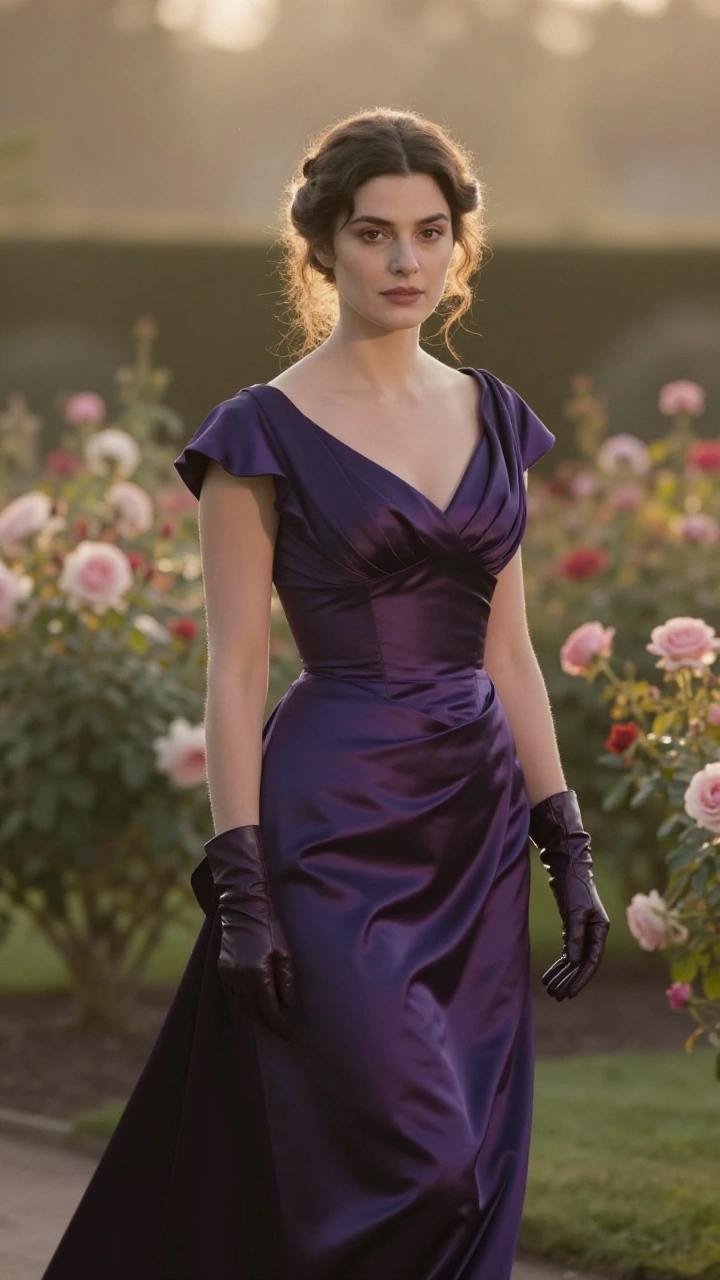
She was thirty-eight years of age, though the years sat lightly upon her. Tall she was, and composed, with a stillness about her that the villagers found both compelling and unsettling. It was the stillness of deep water, of a lake that reflects the sky whilst concealing unknown depths beneath its surface. Her face was pale and fine-featured, her dark hair swept beneath a bonnet of black silk that caught what little light the mist allowed and gave it back as a soft, gleaming glow. Her gown was of the same black silk—glossy, sleek, and fluid as it moved with her, whispering against her skirts like secrets being shared between old friends. It was mourning attire, yes, but mourning elevated to an art form. Where the villagers’ black was flat and dull, absorbing light and hope in equal measure, Lady Eleanor’s black was alive with a subtle sheen that seemed to glow from within, as though the silk itself held a flame that no amount of mist could extinguish.
Her gloves were of fine kid leather, black and smooth and supple, and they encased her hands as she clasped them before her—not in the white-knuckled grip of a woman overcome, but in the composed, deliberate manner of one who knows precisely what she is about. Her boots, glimpsed beneath the hem of her gown as she walked, were of glossy black leather that shone even in the grey light, each step measured and sure upon the uneven cobbles.
The contrast was stark and immediate and inescapable. The villagers, in their rough and scratchy mourning, seemed to blend into the mist, their figures becoming indistinct, their presence muted. Lady Eleanor, in her gleaming silk, seemed to cut through it, her figure sharp and clear and undeniably present. It was as though she belonged to a different world entirely—a world where grief did not require the abandonment of beauty, where loss did not demand the surrender of self.
Mrs. Whitlow, watching her, felt something stir in her chest that she could not quite name. It was not envy, though there was envy in it. It was not admiration, though there was admiration too. It was something deeper, something that whispered of possibilities she had never allowed herself to imagine. She looked down at her own rough mourning dress, at the coarse fabric that scratched and irritated, and for the first time in her life, she wondered what it might feel like to wear silk.
“Do you think she’ll manage the estate alone?” Mrs. Whitlow asked, her voice softer now, the sharpness of gossip giving way to something more contemplative.
Mrs. Pratt sniffed. “A woman? Alone? With an estate that size? Nonsense. They’ll send for his brother, I expect. Captain Ashworth. He’ll know what to do.”
Mrs. Whitlow said nothing, but her eyes remained fixed upon Lady Eleanor’s glossy silhouette, and the unnamed something in her chest continued to stir.
The church was cold and dim, its ancient stones holding the chill of centuries. The villagers filled the pews, their rough mourning clothes rustling and scratching like a congregation of uneasy insects. Lady Eleanor sat in the front pew, alone, her black silk gown spread about her like a pool of midnight water. The candlelight found the glossy fabric and danced upon it, creating subtle, shifting patterns that seemed to move even when she was still.
The vicar, a well-meaning but unimaginative man named Reverend Pratt—husband to the whispering Mrs. Pratt—delivered the sermon in a droning voice that seemed to sink into the cold stones and disappear. He spoke of duty and sacrifice and the natural order of things, of a woman’s place being beside her husband in life and beneath his memory in death. His words fell upon Lady Eleanor’s composure like rain upon polished stone, rolling away without leaving a mark.
She did not weep. She did not bow her head. She sat in her gleaming silk and listened, or appeared to listen, whilst her mind was elsewhere—walking through gardens overgrown, opening doors to rooms long closed, imagining what might grow in soil that had been left fallow for far too long.
After the service, the procession continued to the churchyard. The grave was ready, a dark wound in the grey earth. The coffin was lowered, and the vicar spoke his final words. The villagers threw their handfuls of dirt, the sound of it striking the wood like the patter of rough, coarse rain. Lady Eleanor stepped forward, her glossy boots pressing into the soft earth, and cast her handful with a grace that made even this grim act seem somehow elegant. The soil fell from her gloved hand like dark silk unspooling.
Then it was done. Lord Edmund Ashworth was in the ground, and his widow stood above him in her gleaming black silk, and the mist curled about her like a living thing, drawn to her stillness as though it recognised a kindred spirit.
The villagers dispersed slowly, casting glances back at the figure by the grave. Mrs. Pratt, tugging at her chafing collar once more, leaned toward Mrs. Whitlow. “Mark my words. She’ll not last a year. A woman alone with an estate that size? She’ll be forced to sell, or marry again, or…”
But Mrs. Whitlow had stopped listening. She was watching Lady Eleanor, who still stood by the grave, her silk gown gleaming in the mist like a dark flame. And the unnamed something in her chest had grown stronger, and it whispered of silk and stillness and the possibility of being seen—truly seen—for the first time in her life.
Ashworth Manor rose from the mist like a sleeping giant, its grey stone walls softened by centuries of ivy, its windows dark and watchful. It was a fine house, though its finery had faded—paint peeling, gutters sagging, gardens grown wild. It had been a place of beauty once, but Lord Edmund’s long illness had drained more than his body. It had drained the estate of its vitality, its purpose, its life.
Lady Eleanor stepped down from the carriage, her glossy boots meeting the cracked stone of the drive with a decisive click. She looked up at the house—her house now, hers alone—and felt not the weight of responsibility but the lightness of possibility. The rough stone walls, the overgrown garden, the peeling paint—these were not signs of decay. They were invitations.
Mrs. Hodges, the housekeeper, met her at the door. A stout, sensible woman in a dress of dark wool that was practical and unremarkable, she had served the Ashworth family for thirty years and had expected to serve the next lord in turn. The prospect of serving a lady alone clearly unsettled her, though she was too well-trained to show it.
“Welcome home, my lady,” she said, her voice carefully neutral. “I’ve had the morning room prepared. Cook has a cold luncheon ready. And the accounts are on the desk in the master’s study, as you requested.”
“Thank you, Mrs. Hodges.” Lady Eleanor’s voice was low and measured, each word precisely placed, like stones in a garden path. It was a voice that did not need to rise to be heard, that did not need to command to be obeyed. “I will take the accounts now. The luncheon can wait.”
The study was dark and smelled of stale tobacco and neglect. Lady Eleanor opened the curtains, letting in what little light the mist allowed, and sat at the desk. The leather of the chair was cracked and rough beneath her, a stark contrast to the smooth, supple leather of her gloves. She removed the gloves, finger by finger, and placed them on the desk beside the leather-bound account books. Her bare hands, pale and elegant, seemed to glow against the dark, worn leather.
She opened the first book and began to read.
The accounts told a story she had already suspected. Lord Edmund, in his final years, had been a poor manager. Rents had gone uncollected, repairs had been deferred, investments had been neglected. The estate was wealthy—there was no question of that—but its wealth was tangled and underutilised, like a garden left to grow wild. The potential was there, buried beneath neglect, waiting for someone with the vision and the will to bring it forth.
Lady Eleanor read for two hours, making notes in a precise, elegant hand. When she finished, she sat back in the cracked leather chair and looked out the window at the garden beyond.
It had been a fine garden once. She could see the bones of it—the pathways, the borders, the old conservatory with its broken glass panels like missing teeth in a once-beautiful smile. But the plants had grown wild, the paths had been swallowed by moss, and the conservatory stood empty and dark. It was a garden that had been forgotten, left to fend for itself, and it had responded by retreating into a tangled, overgrown version of its former self.
Lady Eleanor looked at the wild garden and saw not neglect but potential. She saw what could be, what would be, with the right hands and the right guidance. A garden, she knew, was not so different from a person. Given the right soil, the right light, the right care, it could flourish beyond all expectation. Left neglected, it could survive, but it would never thrive.
She rose from the desk and moved to the window, pressing her fingertips against the cool glass. Her reflection looked back at her—the dark silk, the pale face, the composed expression. But beneath the composure, something was stirring. A plan. A purpose. A vision of what Ashworth Manor could become.
“I will not fade,” she whispered to her reflection. “I will not wither. I will cultivate.”
That evening, Lady Eleanor dined alone in the small parlour. The table was set with fine china and crystal—pieces that had been in the Ashworth family for generations—and the candles cast a warm, golden light that played upon the glossy surface of her silk gown. She had changed from her mourning attire into a dinner dress of deep burgundy silk that seemed to hold the candlelight within its folds, releasing it in subtle, shifting gleams. The fabric moved with her like a living thing, smooth and fluid against her skin, a constant whisper of luxury against the rough, neglected world outside.
Mrs. Hodges served the meal, her practical wool dress rustling as she moved. She watched Lady Eleanor from beneath lowered lids, uncertain what to make of this widow who did not weep, who did not pick at her food, who sat in gleaming silk and ate with an appetite that spoke not of grief but of something else entirely.
“Will there be anything else, my lady?” Mrs. Hodges asked as she cleared the final course.
Lady Eleanor looked up, her dark eyes catching the candlelight. “The empty cottages on the estate, Mrs. Hodges. Are they habitable?”
Mrs. Hodges blinked, surprised by the question. “I believe so, my lady. They’ve been empty since the Thompsons left two years ago. The roofs are sound, I think, though they’d need a good cleaning.”
“Have them cleaned and made ready,” Lady Eleanor said. “All of them.”
“All of them, my lady?” Mrs. Hodges’ voice carried a note of confusion. “But there’s only yourself now. Who would—”
“That will be all, Mrs. Hodges. Thank you.”
The housekeeper withdrew, her practical shoes clicking against the wooden floor. Lady Eleanor returned to her wine, the burgundy liquid in the crystal glass matching the burgundy silk of her gown. She swirled it gently, watching the light play upon its surface, and smiled—a small, private smile that held more of anticipation than of sorrow.
After dinner, Lady Eleanor retired to the master’s study. The cracked leather chair received her once more, and she lit a single candle, its flame casting a warm, golden glow that made her silk gown shimmer like a dark jewel. She took up a pen and a sheet of fine, cream-coloured paper and began to write.
The words flowed from her in a steady, unhurried stream, each one precisely chosen, each sentence crafted with the same care one might give to the cultivation of a rare and precious plant. She wrote not a letter of mourning or a letter of business, but something else entirely—an invitation, a summons, a promise.
Dear Miss Doyle,
I am writing to you on the recommendation of Mrs. Pemberton of the Royal Horticultural Society, who speaks highly of your knowledge and skill in the cultivation of gardens.
I am in need of someone with your particular expertise. I have recently inherited an estate in the Yorkshire Dales whose gardens have been sadly neglected. The soil is good, the bones are strong, but the life has gone out of them. I wish to bring it back.
I offer more than employment. I offer a home, a purpose, and the patronage of a woman who values excellence above all else. I offer the opportunity to cultivate something extraordinary—not just a garden, but a way of living.
If this interests you, please present yourself at Ashworth Manor at your earliest convenience. I believe we may be of great benefit to one another.
Yours sincerely,
Lady Eleanor Ashworth
She read the letter through, made a small correction, and then folded it with precise, elegant movements. She lit a stick of sealing wax and let the dark red drops fall upon the fold, then pressed her signet ring into the warm wax. The candlelight gleamed upon the glossy seal, upon the cream paper, upon the dark silk of her sleeve.
She rang for Mrs. Hodges. “This is to be posted first thing in the morning,” she said, handing over the letter. “And I will be writing several more in the coming days. See that they are all sent promptly.”
“Yes, my lady.” Mrs. Hodges took the letter, her practical eyes noting the elegant handwriting, the wax seal, the quality of the paper. “May I ask… what is your intention, my lady? For the estate?”
Lady Eleanor rose and moved to the window. The garden lay dark and tangled beneath the November sky, a wilderness of neglected potential. She pressed her fingertips against the cool glass once more, her silk gown whispering as she moved, and looked out at the sleeping garden with an expression that held neither grief nor uncertainty but something far more powerful.
“This garden has been sleeping too long, Mrs. Hodges,” she said, her voice low and certain, each word a seed planted in the dark, fertile soil of the night. “It is time to wake it. It is time to cultivate something extraordinary.”
The candlelight gleamed upon her burgundy silk like a promise, and the mist pressed against the windows like a curious child, and the garden lay waiting in the dark, and somewhere in Ireland, a woman named Maggie Doyle was about to receive a letter that would change her life forever.
The seeds have been planted. The letter has been sent. But who is Miss Maggie Doyle, and what will she find when she arrives at Ashworth Manor? What other letters is Lady Eleanor planning to write, and to whom? The garden is beginning to stir, and the first green shoots of something extraordinary are about to break through the soil.
Join us at members.satinlovers.co.uk to continue the journey. Chapter Two: “The Botanist’s Arrival” awaits our free members, with chapters three through twelve available to our paid subscribers. The garden is growing, and there is room within it for you.
Come home to Ashworth Manor. Come home to silk and satin and the cultivation of something beautiful.
Leave a Reply
You must be logged in to post a comment.