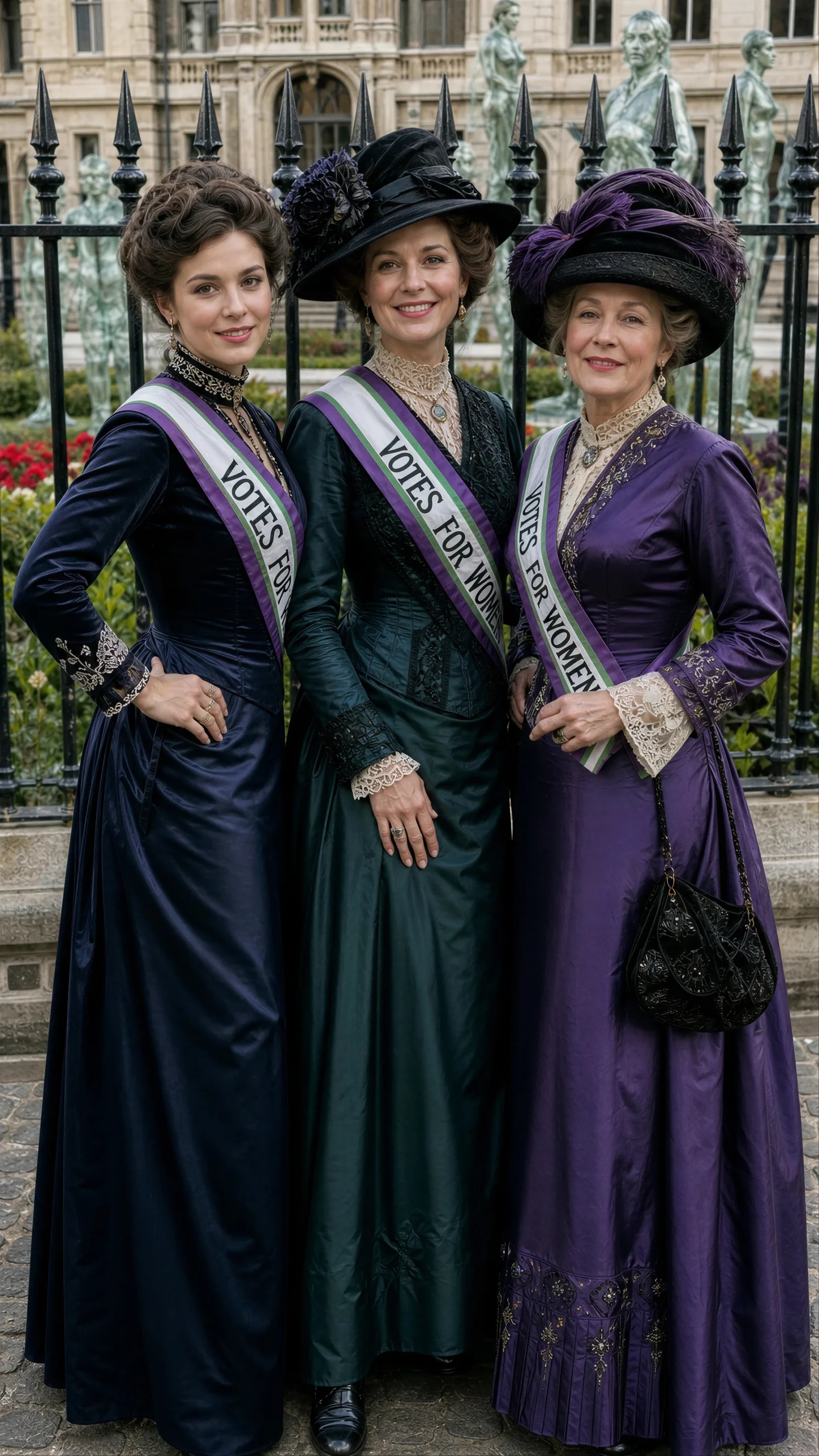
From Manchester’s Smoke-Stained Streets to Holloway’s Cold Cells—The Calculated Brilliance Behind Britain’s Most Controversial Political Campaign
She arrived at our salon in a gown of charcoal satin that caught the gaslight like still water at dusk—a woman whose name had been splashed across newspaper headlines, hissed in parliamentary debates, and whispered with reverence in the homes of women who dared to dream of citizenship. Emmeline Pankhurst, founder of the Women’s Social and Political Union, architect of a campaign that married spectacle to strategy, sacrifice to spectacle. She settled into the leather wingback chair with the controlled grace of a woman who had learned to find comfort even in prison cells, and when she spoke, her voice carried the precise, polished authority of someone who had spent a lifetime making herself impossible to ignore.
What follows is a conversation that traverses the smoke-wreathed streets of Edwardian Manchester, the cold corridors of Holloway Prison, and the complicated calculus of a movement that chose to suspend its most powerful weapons at the moment of its greatest opportunity. It is a story of glossy surfaces and rough realities, of strategic brilliance and personal sacrifice, of a woman who understood that power concedes nothing without demand—and who was willing to pay any price to make that demand heard.
Pour yourself a cup of tea, settle into your own chair of cool leather or slick satin, and prepare to meet the militant muse who cracked the composure of a crown.
Please be aware that this story is based on fact but some of the details may have been changed for the sake of drama.
Interview Begins
Interviewer: Mrs. Pankhurst, thank you for joining us today. Your name has echoed through history as perhaps the most recognizable figure of the women’s suffrage movement. Let us begin at the beginning. Can you tell us about your upbringing and how it shaped your political consciousness?
Emmeline Pankhurst: It is a particular pleasure to speak with you in surroundings so… refined. I must confess, the glossy elegance of this setting is rather different from the smoke-stained brick and damp wool of my Manchester childhood.
I was born Emmeline Goulden in 1858 in the Manchester suburb of Moss Side. My father, Robert Goulden, was a successful merchant with strong radical sympathies. My mother, Sophia, was a passionate feminist who took me to women’s suffrage meetings when I was but a child of eight. I remember the thrill of those gatherings—the sense of purpose, the electricity of conviction in the air. It was rather like the crackle one feels now in a room where important things are being discussed.
My parents were both abolitionists and supporters of women’s suffrage long before it was fashionable. My father had been involved in the Anti-Corn Law League and other reform movements. He believed in educating his daughters as thoroughly as his sons—a conviction that was, I assure you, far from universal in 1860s Manchester.
Interviewer: Your education was unusual for the time?
Emmeline Pankhurst: Unusual and deliberately so. My father sent me to the École Normale in Paris when I was fifteen. There I received an education that was, by English standards, remarkably progressive. I studied not only the traditional subjects but also the principles of the French Revolution—liberty, equality, fraternity. I learned to see politics not as the preserve of men but as the natural concern of any thinking person.
It was in Paris that I first understood the power of presentation. The French understood that a message must be carried not only in words but in the manner of their delivery. The gloss of conviction, the sheen of certainty—these were not superficial concerns but essential components of persuasion. I carried this understanding with me when I returned to England.
Interviewer: You married Dr. Richard Pankhurst in 1879. He was significantly older than you and already a known figure in radical politics. How did this partnership shape your activism?
Emmeline Pankhurst: Richard was forty-four when we married; I was twenty. He was a barrister, a committed socialist, and the author of the first women’s suffrage bill to be debated in Parliament. He had also been involved in the drafting of the Married Women’s Property Acts of 1870 and 1882—legislation that, for the first time, allowed married women to own property in their own right.
I want your readers to understand what this meant. Before 1870, a married woman in England had no legal existence separate from her husband. Her property became his. Her earnings became his. Her children belonged to him. She could not enter into contracts, could not sue, could not dispose of her own wages. The law treated her as a form of dependent—permanently infantile, permanently subject.
Richard understood this injustice intimately. He had dedicated his legal career to dismantling it. Our marriage was a partnership of equals—a radical experiment in domestic life that we conducted with full awareness of its political implications.
We had five children together. Christabel, my eldest daughter, was born in 1880. She would become my closest political ally and, in many ways, the strategist of our movement. Sylvia, born in 1882, shared our convictions but would eventually take a different path. Frank, born in 1884, died of diphtheria in 1888—a loss that marked me permanently. Adela, born in 1885, and Harry, born in 1889, completed our family.
Richard died in 1898, when I was thirty-nine. He left me with significant debts and four children to raise. I took a position as a registrar of births and deaths in Manchester—a post that brought me into direct contact with the realities of women’s lives in a way that theory never could.
Interviewer: It was through this work that you encountered the conditions that would fuel your militancy?
Emmeline Pankhurst: Precisely. As registrar, I recorded births and deaths in the working-class districts of Manchester. I saw women dying of diseases that proper medical care could have prevented. I saw children born into poverty that the law did nothing to alleviate. I saw women who had no legal recourse against abusive husbands, no means of supporting themselves if they left, no voice in the political decisions that shaped their lives.
The existing suffrage organizations—the National Society for Women’s Suffrage, later the National Union of Women’s Suffrage Societies under Millicent Fawcett—had been petitioning Parliament for decades. They were respectable, patient, methodical. They wrote letters, held meetings, presented petitions. And they were ignored.
By 1903, I had reached a conclusion that would define the rest of my life: that patient persuasion was insufficient. That the machinery of political change required not lubrication but disruption. That women would never be granted the vote as a gift—they would have to compel its granting.
Interviewer: And so, in October 1903, you founded the Women’s Social and Political Union.
Emmeline Pankhurst: We founded it in my home in Manchester, with a small group of women who shared my frustration. The initial membership was modest—perhaps a dozen women. But we had something the older organizations lacked: a willingness to be inconvenient.
Our motto was “Deeds, not words.” This was not merely a slogan but a strategic philosophy. We understood that the political establishment had perfected the art of ignoring polite requests. They had not, however, developed a strategy for dealing with women who refused to be ignored.
The Daily Mail coined the term “suffragette” as a diminutive—a way of dismissing us as a frivolous variation on the more serious “suffragists.” We adopted it with pride. We understood the power of reclamation, of taking an insult and wearing it like a badge of honor. The distinction between suffragist and suffragette became a distinction between those who asked and those who demanded.
Interviewer: Your tactics escalated dramatically over the following years. Can you walk us through this evolution?
Emmeline Pankhurst: The evolution was deliberate. Each escalation was a response to the failure of the previous approach.
In 1905, my daughter Christabel and Annie Kenney attended a Liberal Party meeting in Manchester. When Sir Edward Grey rose to speak, they unfurled a banner demanding votes for women. They were ejected from the hall. Christabel spat at a policeman—a calculated act of provocation—and both were arrested. The trial and imprisonment that followed generated more publicity for our cause than years of petitioning had achieved.
We learned a crucial lesson: that spectacle generates attention, and attention generates pressure. The glossy surface of public outrage, properly polished, could cut through the velvet fog of parliamentary indifference.
From 1905 to 1908, our tactics included heckling at political meetings, organizing mass demonstrations, and attempting to enter Parliament to present petitions directly. In 1908, I was arrested for the first time, after attempting to deliver a petition to the Prime Minister.
The “Rush” on Parliament in October 1908 brought together some 30,000 women in a demonstration that, while peaceful, was unprecedented in its scale and organization. The authorities were unnerved. The Times called it “a more serious attack upon the rights of property and the freedom of the subject than has been made for many years.”
Interviewer: And when even these demonstrations failed to produce results?
Emmeline Pankhurst: We escalated further. By 1909, we had begun property destruction. Windows were smashed in government buildings and commercial establishments. This was not random vandalism but targeted disruption. We attacked property, never people. The distinction was essential to our moral position.
In 1909, Marion Wallace Dunlop became the first suffragette to go on hunger strike. She was imprisoned for defacing a wall in the House of Commons with a quotation from the Bill of Rights. When she refused food, the authorities were faced with a dilemma: release her, allow her to starve, or force-feed her.
They chose force-feeding. The procedure was brutal—women were held down, tubes inserted through their noses or mouths, liquid food poured into their stomachs. Many suffered physical injuries. Some suffered psychological trauma that lasted for years.
The government introduced the Prisoners (Temporary Discharge for Ill-Health) Act in 1913—the so-called “Cat and Mouse Act.” This allowed the authorities to release hunger-striking prisoners when they became dangerously ill, then re-arrest them once they had recovered. It was a cruel strategy, designed to break our resolve without creating martyrs.
Interviewer: The most dramatic moment of the campaign was undoubtedly the death of Emily Davison at the Epsom Derby in 1913. Can you speak to this?
Emmeline Pankhurst: Emily Wilding Davison was one of our most committed members. She had been imprisoned nine times, force-fed forty-nine times. She was a woman of profound conviction and considerable intellectual ability—a first-class degree from Oxford, though as a woman she was not permitted to receive it.
On June 4th, 1913, she attended the Epsom Derby. As the horses rounded Tattenham Corner, she stepped onto the track. King George V’s horse, Anmer, struck her. She died four days later, never regaining consciousness.
The debate over her intentions has never been fully resolved. Some believe she meant to throw herself beneath the horse in a deliberate act of martyrdom. Others believe she was attempting to attach a suffragette scarf to the horse’s bridle—a gesture of protest, not suicide. The evidence is ambiguous.
What is not ambiguous is the impact of her death. It galvanized our movement and horrified the public. Her funeral procession through London drew thousands of mourners. The glossy sheen of her sacrifice could not be dimmed by the rough hands of her critics.
I spoke at her memorial service. I said: “So long as women are not treated as human beings, so long as they are not citizens, so long as they have no voice in the government under which they live, so long will there be women who will be willing to die rather than submit to such conditions.”
Interviewer: And then came the war.
Emmeline Pankhurst: Yes. In August 1914, the Great War began. And we faced a decision that would define our legacy.
Some within our movement—most notably my daughter Sylvia—argued that we should continue our militant campaign regardless of the war. They saw the conflict as an imperialist enterprise that should not distract us from our struggle.
Christabel and I disagreed. We believed that the war represented an opportunity—a chance to demonstrate women’s patriotism, women’s capability, women’s worthiness of citizenship. We suspended our militant activities and threw our organization behind the war effort.
This decision was controversial then and remains controversial now. Some historians argue that the suspension of militancy was a betrayal of our principles. Others argue that it was a masterstroke of strategic thinking—that by demonstrating women’s willingness to serve, we made it impossible for the government to continue denying us the vote.
I believe both perspectives contain truth. We did compromise. We did suspend our most effective tactics. But we also recognized that the war had changed the calculus—that the government could not, in the context of a war fought for “democracy,” continue to deny democratic rights to half its population.
The war transformed women’s economic position. With men in the trenches, women took their places in factories, in offices, in public transport. They proved, beyond any doubt, that they were capable of work previously considered “men’s work.” The glossy surface of pre-war gender assumptions cracked under the pressure of necessity.
Interviewer: And in 1918, the Representation of the People Act granted the vote to women over thirty who met certain property qualifications. How did you feel when this was achieved?
Emmeline Pankhurst: I felt… relief. And a complicated kind of joy. The act granted the vote to women over thirty who were householders, the wives of householders, occupiers of property worth five pounds or more per year, or graduates of British universities. It excluded the vast majority of working-class women—women like those I had encountered in my years as a registrar.
The age restriction was deliberate. The war had killed millions of young men. If women had been granted the vote at twenty-one, as men were, they would have outnumbered male voters significantly. The government, even in granting us this partial victory, was careful to ensure that male electoral dominance was preserved.
Full equality—voting rights for women on the same terms as men—would not come until 1928, just weeks before my death. I did not live to see it.
Interviewer: Looking back, what do you consider your greatest strategic insight?
Emmeline Pankhurst: That respectability is a prison, and that breaking out of it is the first step toward freedom. The moderate suffragists believed that if women behaved with dignity and decorum, they would be rewarded with political rights. They were wrong. The political establishment had no intention of granting rights to people who posed no threat.
We posed a threat. We made ourselves impossible to ignore. We understood that power concedes nothing without demand. The glossy surface of our respectability was a weapon we wielded deliberately—appearing at demonstrations in our best clothes, presenting ourselves as ladies of quality even as we committed acts that the law defined as criminal. The contrast between our appearance and our actions was itself a form of argument.
But we also understood that respectability alone was insufficient. We needed the shock of disruption, the drama of spectacle, the cost of sacrifice. We needed to make the price of continued exclusion higher than the price of inclusion.
Interviewer: And what of the personal costs? Your relationships with your daughters were strained. Christabel became increasingly conservative in later years. Sylvia became a socialist and anti-imperialist, distancing herself from your politics. Adela emigrated to Australia and was essentially exiled from the family. How do you reflect on these fractures?
Emmeline Pankhurst: A pause. The firelight catches the satin of her dress, transforming it into liquid gold.
You ask the question that troubles me most. The movement consumed my family as it consumed my health, my freedom, my fortune. I spent years in prison. I was force-fed. I was vilified in the press, caricatured in the cartoons, mocked in the music halls. I bore all of this willingly because I believed in the cause.
But my daughters… I told them, when they were young, that they must be willing to die for the cause. I meant it. And perhaps that was the error—that I raised them as soldiers rather than as children. Christabel embraced the role and became something harder than I intended. Sylvia rejected it and found her own path. Adela was crushed by it.
I do not apologize for my commitment to the cause. But I acknowledge that the costs were not mine alone to pay. The women who followed me—the women who went to prison, who were force-fed, who lost their health and their livelihoods—paid a price that I cannot fully comprehend, even now.
Interviewer: Your legacy has been complicated by these costs. How do you wish to be remembered?
Emmeline Pankhurst: As a woman who understood that freedom is never given. It is taken. It is compelled. It is extracted from the unwilling hands of those who hold it by those who refuse to live without it.
I wish to be remembered as someone who recognized that the glossy surface of polite society conceals deep inequalities, and that those inequalities will not be addressed by those who benefit from them. They will be addressed only by those who are willing to make the surface uncomfortable—to crack it, to scratch it, to make it impossible to maintain.
I wish to be remembered as a woman who loved her daughters and her cause, and who was not always able to serve both well.
And I wish to be remembered as someone who understood that the personal is political—that the conditions of women’s daily lives, the legal structures that govern our existence, the economic systems that determine our possibilities—these are not private matters but public concerns. They are the very substance of politics.
Interviewer: Thank you, Mrs. Pankhurst, for sharing your remarkable story with us. Your insights offer a profound understanding of the costs and strategies of political change. And to our readers, thank you for joining us in this special edition of Armchair Interviews. We hope you found this conversation as enlightening and captivating as we did. Until next time, continue to explore, dream, and discover the beauty that life has to offer.
Recommended Resources
For those interested in delving deeper into Emmeline Pankhurst’s life and the suffrage movement, here are some recommended resources:
Books:
- My Own Story by Emmeline Pankhurst (her autobiography, first published 1914)
- The Suffragette Movement: An Intimate Account of Persons and Ideals by Sylvia Pankhurst (1928)
- Christabel Pankhurst: A Biography by David Mitchell (1977)
- The Suffragettes: The Fight for Votes for Women by Joyce Marlow (2001)
- Fallen Angels: The Women of the Suffrage Movement by Mary Sheepshanks (1912)
Articles:
- “Emmeline Pankhurst: The Militant Suffragette” (BBC History)
- “The Suffragettes: Deeds Not Words” (History Today)
- “Force-feeding and the Suffragettes” (The Lancet, historical analysis)
- “Emily Davison’s Death at the Derby: Accident or Martyrdom?” (Historical Journal)
Websites:
- The Pankhurst Centre, Manchester
- Museum of London: Suffragette Collection
- The National Archives: Suffragette Records
- British Library: Women’s Suffrage
These resources provide a rich exploration of Pankhurst’s life, her movement, and the enduring impact of her strategies on political activism. For more captivating stories and exclusive content, visit SatinLovers and immerse yourself in a world where elegance meets passion, and every moment is a seductive journey.
The Chronicler’s Reflection:
I document this conversation not merely as an exchange of historical knowledge, but as a meditation on the nature of power and the costs of its acquisition. Pankhurst’s story teaches us that change requires not only conviction but strategy—that the glossy surface of respectability can be both a weapon and a prison, that spectacle generates attention and attention generates pressure, and that the personal costs of political commitment are often borne by those who did not choose to pay them.
The suffrage movement’s story echoes far beyond its era. It teaches us that power concedes nothing without demand, that the establishment will not reform itself, and that the path to justice is rarely smooth or glossy but often rough with sacrifice and conflict.
One is left to wonder: what inequalities persist beneath the glossy surface of our own time, invisible to those who do not look closely? And what patient accumulation of actions—what strategic disruptions, what deliberate spectacles—might eventually wear them smooth?
#Suffragette, #EmmelinePankhurst, #WomensHistory, #PoliticalStrategy, #ArmchairInterview, #SatinLovers, #WomensSuffrage, #HistoricalFiction, #FemaleEmpowerment, #EdwardianEra
Leave a Reply
You must be logged in to post a comment.