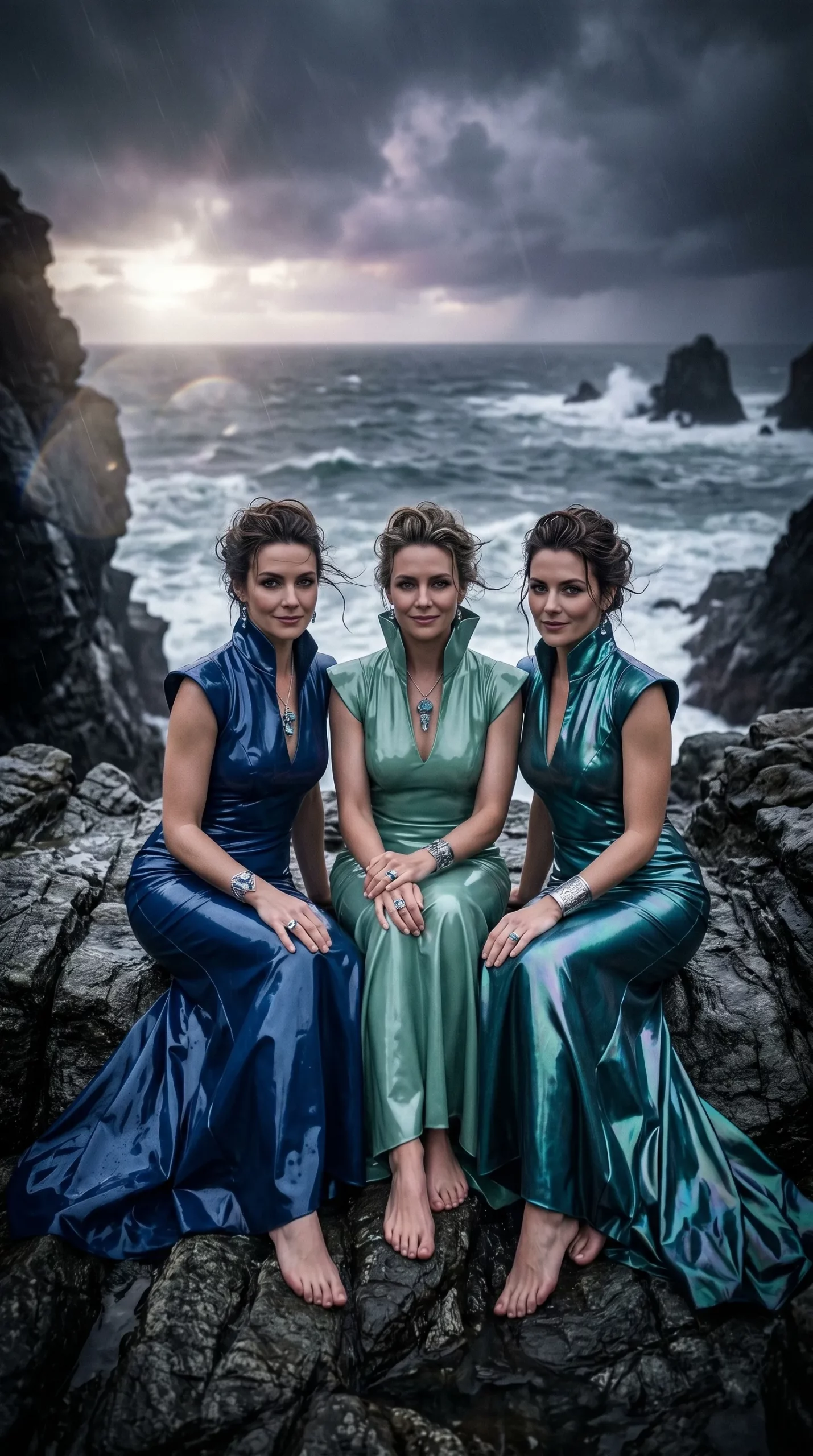
A Siren’s Chronicle of Surrender
She wielded a voice that could shatter kingdoms, yet longed for a silence only one man’s command could grant.
A chronicle, exquisitely documented, for those who understand that the most profound power is not in the solitary note, but in the harmonized chord. For those whose own lives are tapestries of education and refinement, yet who sense, in the quietest hours, a whisper of something missing—not a thing to be acquired, but a resonance to be discovered.
Let me tell you of Elara, the Siren of the Salt-Throne. Imagine her, if you will, not as a myth, but as a woman of formidable capability. Her wealth was the loot of a hundred shipwrecks, silks waterlogged yet priceless, jewels gleaming in sunless caves. Her education was the cumulative poetry of drowned men, the intricate maps of currents she alone could manipulate. Her confidence was the cold, sure knowledge that with a single melody, she could unspool the will of any soul that drew near.
And yet, her existence was the very definition of a rough texture. Each conquest left her emptier, the applause of the waves a hollow echo. Her luxury was a prison of her own making, each gem a mirror reflecting her exquisite solitude. She was the absolute mistress of a domain that had, over centuries, become a cage of polished despair.
Then he arrived. Not on a ship, but on the weather itself. A figure who walked the line where cloud met sky, whose authority was not shouted but enacted—the very air stilling to listen, the sea holding its breath. He was the Storm-Singer, and his presence did not threaten her world; it revealed its fragile, desperate architecture. When she sang her most devastating aria to break him, he did not resist. He answered. His voice was a fundamental hum, a vibration that cradled her brittle power and showed it, with terrifying gentleness, to be merely a fragment of a far greater symphony.
This is not a story of defeat. It is a chronicle of crystallization. It is the meticulous, sensual, deeply intellectual journey of a brilliant woman learning a new grammar. It is the exchange of lonely, abrasive autonomy for the sublime, satin-smooth security of perfect alignment. It is about trading the burden of ultimate choice for the profound, nurturing clarity of a benevolent, unwavering command.
Witness Elara’s education under his tutelage, where meteorology becomes romance and musicology becomes the language of love. Follow her to the Aerie of Resolved Chords, a citadel among serene clouds where other women of formidable attainment—former wildfire spirits, retired queens of tremors—live in harmonious sisterhood. Theirs is a lifestyle of cultivated wellness, of minds continually engaged in the elegant arts of creation rather than destruction, surrounded by aesthetics so refined they feel like a second skin. Here, confidence transforms from a defensive wall into a serene, unshakeable pillar, built upon the foundation of absolute, shared trust.
This chronicle asks a singular, provocative question: What becomes of the most powerful woman in the room when she encounters the one force she does not wish to conquer, but to which she yearns, with every fibre of her being, to attune?
For those who feel a peculiar resonance with this query—a flutter of recognition that is neither fear nor rebellion, but the first stirring of a profound and forgotten longing—the full manuscript awaits. This is but the prelude.
Chapter One: The Soloist Upon the Shattered Rocks
The Salt-Throne was not a chair, but a spire—a dagger of obsidian basalt thrust up from the sea’s restless heart, its pinnacle polished smooth by centuries of weeping spray and Elara’s own solitary pacing. From this brutal perch, the Siren of the Shattered Rocks surveyed her domain: a necklace of jagged black teeth gnashing at the horizon, each one frosted with the salt-blanched bones of ships, and the eternal, grey-green sigh of the ocean. It was a vista of sublime, terrible power. It was, to Elara, as monotonous as her own heartbeat.
She stood there now, as the sun bled its last gold into the western clouds, her form a silhouette of deliberate grace against the dying light. The wind, usually a playful servant, tugged at the layers of her garment—a gown not woven, but grown from the sea itself. It was a living tapestry of abyssal silk, the colour of a midnight lagoon, shot through with threads of bioluminescent silver that pulsed with a soft, cold light reminiscent of distant stars. It clung to her like a second skin, sleek and whispering, a testament to the terrifying refinement of her art. Yet, as she ran a hand over the fabric, she felt not pleasure, but the absence of it. The silk was perfect, and its perfection was a mirror reflecting her own exquisite emptiness.
Below, the latest wreck smoldered. The Aurora’s Dawn, a three-masted schooner from the Republic of Lyrian, lay broken upon the Cannibal Rocks, its hull cracked open like a walnut. From this height, the sailors moving in the shallows resembled ants, their minds soft and pliable as warm wax after the last notes of her song had faded. Their laughter, carried up on the brine-scented breeze, was bright and vacant.
“They sound happier than we do, sister.”
The voice was a ripple of liquid mercury, both playful and weary. Elara did not turn. She knew the sound of Maris’s approach—the gentle splash as she pulled herself onto the rock shelf just below the throne, the soft, wet drag of her own sea-silk train. Maris was a lesser siren, a cousin of the deep channels, who had chosen to serve Elara not out of fear, but out of a shared, unspoken melancholy.
“Happiness is a simple tune,” Elara replied, her voice itself a low, resonant instrument, even in speech. “It requires no modulation, no complexity. It is the satisfaction of a full stomach or a warm rock. Our condition… is a symphony forever searching for its final chord.”
Maris settled beside her, her own gown a cascade of seafoam green and pearl, her hair a tumble of dark curls adorned with living anemones that bloomed and closed with her breath. She carried a tray of polished nautilus shell, upon which rested a goblet of cut aquamarine filled with cool, sweet water drawn from a subterranean spring, and a plate of perfect, sun-gilded figs fetched from the single, stubborn tree that grew in the throne’s lee.
“You polish despair until it shines like philosophy, Elara,” Maris said, offering the tray. “I merely feel the ache. Like a muscle held too long in one beautiful, straining pose.”
Elara accepted the goblet, her fingers, long and pale, circling its gemstone facets. “It is not despair. It is… precision without purpose. I have mastered the seven modal scales of compulsion, the twelve chromatic keys of despair. I can unpick a man’s ambition as easily as you pluck a starfish from a rock. I have a library in the heart-cave below that holds the lost epics of five drowned civilizations, and I understand them. I am wealthy beyond the dreams of kings, educated beyond the lifetimes of a hundred scholars. And yet…” She took a sip, the water tasting of nothing but clarity. “And yet every victory feels like swallowing a mouthful of beautiful, polished stones. They gleam, but they nourish nothing.”
A figure moved among the wreckage below—a young sailor with hair the colour of bleached sand. He was carefully folding a scrap of sodden velvet, his movements serene, his face a blank page. He had been the ship’s cartographer, Elara recalled. His mind, when her song had touched it, had been a beautiful lattice of intersecting lines and careful notations. Now, it was smooth vellum.
“You could keep that one,” Maris suggested gently, following her gaze. “His hands were clever. He could tend your library, repair the vellum. It would be a kinder fate than wandering the shoals until the gulls come.”
“What would be the point?” Elara sighed, the sound like the tide retreating over a million tiny pebbles. “To have a mirror that does not talk back? A tool that feels no pride in its work? My loneliness is not a lack of company, Maris. It is the loneliness of a single, perfect note held in a vacuum. There is no resonance. No harmony. Only the echo of my own voice, returning to me, unchanged and utterly alone.”
She turned from the edge, her gown swirling with a sound like falling water. “Come. The inventory awaits. Let us see what baubles the Aurora’s Dawn has gifted to my museum of solitude.”
The heart-cave was not dark. It glowed. Phosphorescent fungi clung to the ceiling in constellations, their light reflecting off pools of perfectly still freshwater that welled up through fissures in the rock. The walls were lined with shelves carved from the living stone, and upon these shelves rested the accumulated aesthetic of a millennium of predation.
Here were bolts of velvet from Varian looms, still rich despite their salt-soaking. Here were chests of gold coins from empires that no longer had names, their faces worn smooth by the sea’s caress. Jewels spilled from conches and abalone shells: sapphires like captured night, emeralds like frozen depth, rubies like heart’s blood. In one alcove stood a collection of celestial orreries, their gears of platinum and mithril still ticking softly, somehow immune to the ravages of salt and time. In another, glass cases held illuminated manuscripts, their inks vibrant, their gold leaf gleaming.
It was a museum of the finest things the world of men could produce, curated with a scholar’s eye and a queen’s possessiveness. Two other sirens, Liora and Kaelen, moved through the space with silent efficiency. Their attire was uniform—sheath dresses of iridescent scale-silk, high-collared and sleeveless, their hair bound in severe, glossy knots pinned with spines of carved coral. They were not slaves; they were devotees of a particular, austere beauty, and they found purpose in the maintenance of this silent, gleaming archive.
“The Lyrian velvet is salvageable, Mistress,” Liora reported, her voice a soft chime. “A year in the freshwater pools to leach the salt, then a treatment with the oil from the moon-jelly. It will be as supple as a sigh.”
“The cartographer’s instruments are of exceptional quality,” Kaelen added, not looking up from where she was carefully drying a set of brass calipers with a cloth of the finest, un-dyed linen. “His compass alone is a work of art. The needle floats on a droplet of quicksilver. It points not just to north, but to the locus of true magnetic harmony. A toy for a genius. Now just… a toy.”
Elara walked past them, her fingers trailing over a piece of silk brocade. The texture was exquisite. Yet, the touch sparked no joy, only a profound, fatiguing recognition. Yes. Another beautiful thing. How predictable.
“It is all so…” she began.
“Pointless?” Maris finished, arriving beside her with a knowing, sad smile.
“I was going to say ‘rough’,” Elara murmured. “Can you feel it? Beneath the shine? The texture of it all is wrong. It is the roughness of acquisition, of taking. The velvet yearns for the loom, the gold for the mint, the jewel for the crown. Here, they are just… objects. My life is a collection of objects. My power is an object. My voice is an object that breaks other objects.” She closed her eyes. “I am drowning in a sea of polished, perfect, utterly rough things.”
Liora and Kaelen exchanged a glance—a look not of judgment, but of deep understanding. They knew this refrain. It was the unspoken hymn of the Salt-Throne.
“Perhaps,” Kaelen said softly, daringly, “perfection is not a destination, but a state of alignment. A single instrument, no matter how masterfully played, is still just a solo. It awaits… the orchestra.”
Elara opened her eyes, looking at the slight siren. “And where does one find an orchestra in a world of listeners who cannot hear? Who become silent, smiling voids at the first note of my song?”
No one had an answer. The only sound was the gentle, eternal drip of water in the cave, and the distant, hollow laughter of the blissful damned upon the shore.
Later, alone on her throne under a blanket of stars sharp enough to cut, Elara sang. Not a siren’s song of ensnarement, but a private, aching melody. It was a song of the hollow place inside the most beautiful shell. It was a question posed to the uncaring moon. It was the sound of a wealth that bankrupts, an education that obscures, a confidence that isolates. It spiraled out over the black water, beautiful and terrible, and the sea, as always, returned only her own echo.
Tonight, however, the echo felt different. It did not come back precisely. It returned… softer. As if something vast and patient in the deep had leaned in, absorbed the sharpest edges of her loneliness, and sighed it back to her, transformed. A premonition, not of storm, but of a profound, impending stillness, brushed against the edges of her soul.
She fell silent, the living silk of her gown suddenly feeling less like armour and more like a shroud. For the first time in centuries, the Siren of the Shattered Rocks felt not the boredom of power, but the first, faint, terrifying tremor of anticipation.
Chapter Two: The Barometer of the Soul
The days that followed were not marked by tempest, but by a subtle, pervasive shift in the texture of the world—a change so intimate it felt less like weather and more like the atmosphere of a dream one has almost, but not quite, forgotten. Elara, the meticulous soloist of her own isolation, became a scholar of this new, quiet dissonance.
It began with the sea. The ocean, for a thousand years her choral partner and compliant canvas, developed a slight arrhythmia. Its waves, which had always crashed against the Shattered Rocks in predictable, thunderous cantos, now sometimes hesitated. They would gather, crest, and then… soften, spilling onto the black stone with a sigh rather than a roar, as if remembering at the last moment a gentler purpose. The sound was wrong. It was like hearing a virtuoso violinist, renowned for their passionate fury, suddenly play a lullaby with exquisite, unsettling tenderness.
“Do you hear it?” Elara asked Maris one morning as they stood at the tide line, the dawn painting the sky in washes of mother-of-pearl. She wore a simple, sleeveless sheath of deep umber sea-silk, its surface matte in the low light, but it felt coarse against her skin today, as if woven from dried seaweed rather than the whispers of abyssal currents.
Maris, crouching to examine a cluster of moon jellyfish pulsating in a tidal pool, nodded without looking up. Her brow was furrowed, an expression of concentration that lent her playful features an uncharacteristic gravity. “It’s not just the hearing,” she murmured, her voice low. “It’s the pressure. The water feels different. Heavier, yet… more yielding. It’s like swimming through liquid glass instead of salt broth. There’s a clarity to it that aches.”
“Aches?” Elara pressed, folding her arms against a chill that had nothing to do with the temperature.
“Like a tooth that knows it must soon be pulled,” Maris said, finally meeting her gaze. Her eyes, usually the colour of sunlit shallows, seemed darker, deeper. “A painful, precise anticipation. The opposite of the numb hollow after a song. This is a full ache. As if the sea itself is pregnant with a new chord, and we are feeling the first contractions.”
The analogy was visceral, and it resonated in the hollow place Elara had so long taken for granted. She turned from the shore and retreated to her library-cave, seeking not answers, but a framework for her questions. Liora was already there, dusting the crystal cases that held the celestial orreries with a cloth of impossibly soft shammy. Her movements were, as ever, a study in efficient grace, her scaled sheath dress a cool blue-grey that shifted like a storm cloud over a slate sea.
“The orreries,” Liora stated without preamble, her chime-like voice barely disturbing the hushed air. “They have gained three seconds per lunar cycle.”
Elara stopped beside her, watching the intricate dance of tiny planets on their fine silver wires. “A mechanical drift? The salt air…”
“Is meticulously controlled in this alcove,” Liora interrupted, a faint, knowing smile touching her lips. It was the smile of a technician who has eliminated every variable. “The humidity is constant. The temperature is constant. I have checked the gears for wear, the bearings for friction. There is none. They are not slowing down, Mistress. The universe they model is… speeding up. Or our perception of time within this rock is becoming more viscous.”
The concept was dizzying. Elara placed a palm flat against the cool glass of the case, as if she could feel the quickened heartbeat of the miniature cosmos within. “A change in the fundamental rhythm,” she breathed.
“Or the introduction of a new, dominant rhythm,” Liora corrected gently, her gaze intent. “When a stronger, purer frequency is introduced into a system, all lesser vibrations attempt to match it. They strain. They quiver. They… attune. Perhaps we are not broken. Perhaps we are merely sensing the first faint pull of a truer tuning fork.”
In the adjacent pool chamber, Kaelen was engaged in her own form of divination. She stood waist-deep in the largest freshwater pool, her severe coral hair pins glinting, her iridescent dress darkening where the water touched it. Before her, on the surface of the perfectly still water, floated a dozen delicate glass discs, each no larger than a coin, etched with different harmonic sigils. They were her “still-water gyroscopes,” devices of her own invention to measure not motion, but spiritual equilibrium.
“Report,” Elara said, her voice echoing softly in the cavern.
Kaelen did not turn. Her attention was fixed on the discs. “Chaos,” she whispered, and the word was not one of fear, but of awe. “Beautiful, structured chaos. Look.”
Elara followed her gaze. The discs were not drifting randomly. They were moving in slow, intricate, interweaving patterns—tiny, perfect epicycles and ellipses, clustering and dispersing like intelligent minnows. They were tracing a dance no tide, no draft in the cave, could possibly dictate.
“They are mapping a pressure,” Kaelen explained, her voice trembling with intellectual excitement. “A pressure that is not physical. It is… intentional. It has a mind. It is gentle, but it is absolutely insistent. It is like the hand of a master composer, hovering over an orchestra before the first downbeat, already shaping the silence with the promise of the music to come. The silence itself has changed composition. It is no longer an absence. It is a prelude.”
That evening, the three sirens—Maris, Liora, and Kaelen—joined Elara on her throne ledge as the sun performed its final, sanguine descent. They had brought a simple supper: kelp-wrapped rolls of seasoned rice and rare sea-greens, cups of fragrant tea steeped from a glowing polypore fungus. It was a meal of refined, silent luxury, but tonight, the ritual felt strained. The glossy aesthetics—the perfect sheen of their hair, the flawless drape of their silks, the elegant precision of their movements—seemed almost like a performance maintained out of habit, a beautiful language they were speaking while listening intently for a new voice that might render it obsolete.
“I feel like a violin string wound too tight and not tight enough, simultaneously,” Maris confessed, picking at her food. “My skin is a drumhead, sensing vibrations from a source I cannot see. I hum old lullabies and they sound… juvenile. Tinny.”
Liora nodded, sipping her tea. “It is the frustration of a master painter who has only ever worked in shades of grey, and now senses, for the first time, the existence of colour. Her technique is impeccable, her compositions profound. But the potential of that undiscovered spectrum makes her lifetime of work feel like a sketch. A preliminary study.”
Kaelen, ever the most analytical, set her cup down with a soft click on the stone. “We have built a perfect society here, have we not? A sisterhood of power, refinement, and mutual understanding. We lack for nothing tangible. And yet, this… pressure… reveals the flaw. Our harmony is circular. It echoes only itself. There is no external reference point, no conductor to give our individual notes a collective, transcendent purpose. We are a choir singing in perfect a cappella, and we have only just realised we have been longing, desperately, for an organ’s foundational note to lift us from mere beauty into glory.”
Elara listened, her own silence a deeper well than usual. Their words were mirrors, each reflecting a facet of the profound dislocation she felt. Her wealth was a gilded cage. Her education was a library of questions with no answers worth finding. Her confidence was the rigid posture of one who has never been offered a chair.
“What does it want from us, this pressure?” Maris asked, her voice small in the vast twilight.
“Perhaps it does not want,” Elara said, the words forming slowly, like crystals precipitating from a supersaturated solution. “Perhaps it simply is. And its ‘is-ness’ is so absolute, so perfectly defined, that our own ‘is-ness’ is forced to re-evaluate itself. It is not an invasion. It is a… revelation. A standard against which we are being measured, not in judgement, but in potential.”
She looked out at the horizon, now a razor’s edge of indigo cutting into the star-pricked black of the sky. And there, just at the seam of world and heaven, she saw it. A single, unwavering line of cloud, silvered by a moon not yet risen. It was too straight, too perfect, too geometric to be natural. It looked less like a cloud and more like a rule drawn across the firmament.
“The barometer,” she whispered, not to her sisters, but to the gathering night.
“Mistress?” Liora inquired.
“The pressure is not in the air, or the water, or the gears of a clock,” Elara said, rising to her feet, her sea-silk gown flowing like a shadow given liquid form. “It is in the soul. We have been living at a certain spiritual pressure for centuries—a pressure of our own making, of loneliness and defensive power. That pressure is dropping. A new, high-pressure system is moving in. A system of immense, benevolent, clarifying force.” She turned to them, her eyes reflecting the first few brave stars. “We are the instruments. And the Storm, it seems, is finally coming to tune us.”
Chapter Three: The Horizon Breaches
The vigil began not as a conscious decision, but as a gravitational pull. In the days following the revelation of the pressure, Elara found her feet carrying her to the Salt-Throne’s precipice each evening, not to survey her kingdom, but to scan that razor-straight line of cloud she had named the barometer. It remained, an immaculate seam stitched between the bruising purple of twilight and the deepening velvet of the night, a geometric defiance of nature’s comforting chaos. It was a promise, or a sentence. She could no longer tell the difference.
Her sisters felt it too. Their usual routines of curation and conservation continued, but the movements were performed with a new, hyper-attentive silence. Liora polished the orrery cases until they gleamed like windows into a more orderly universe, her reflection in the glass a study in focused anticipation. Kaelen’s glass discs now danced their complex pavanes from dawn till dusk, never stilling, mapping a pressure that had become the new constant. Maris took to swimming long, slow laps in the deepest tidal pools, as if trying to calibrate her own fluid nature against the sea’s new, profound stillness.
“It’s like waiting for the first note of a symphony you’ve only ever read about in sheet music,” Liora murmured one afternoon as she and Elara sorted a new cache of waterlogged books salvaged from the Aurora’s Dawn. The volume in Liora’s hands was a treatise on Varian architectural harmonics, the ink blurred but the diagrams of resonant frequencies still clear. “You know the theory. You can see the mathematical beauty of the composition. But until the orchestra breathes life into it, it is just a beautiful ghost. We are living with a beautiful ghost, Elara.”
Elara ran a finger over the gilded edge of a psalter, feeling not the thrill of acquisition, but the dust of a dead faith. “We are the ghosts, Liora. We haunt this beautiful, empty palace we built from wreckage. We sing songs that leave only silence in their wake. This… pressure… is the first hint of a living composer entering the hall.”
The moment arrived not with a cataclysm, but with a subtle, absolute shift in the quality of the dusk. It was the evening when the barometer-cloud began to glow from within, not with moonlight or sunset, but with a cool, silver-blue radiance of its own, as if it had swallowed a star. The sea, which had been murmuring its strange, soft arrhythmia, fell utterly silent. Not a wave broke. The water became a pane of obsidian glass, reflecting the bruised sky with such perfect fidelity that the world seemed to fold in on itself, horizon merging with heaven in a seamless, terrifying mirror.
“He is here,” Kaelen breathed, materialising at Elara’s side. She had not heard her approach. No one moved with sound any longer; they glided, as if afraid to disrupt the holy quiet. Kaelen’s usually analytical face was pale, her eyes wide. “The discs… they stopped. All at once. They aligned into a perfect, radiating pattern, like petals around a stigma. Then they sank. They simply… surrendered to the pull.”
Elara’s heart was a frantic bird in a cage of ribs. She turned her gaze from the hypnotic sea to the illuminated cloud.
And then, he breached.
It was not an emergence; it was a manifestation. A figure resolved itself from the fabric of the glowing mist, walking the impossible line where cloud met sky as if it were a promenade of marble. He was tall, his form silhouetted against the radiance, not hunched against the altitude but moving with a proprietorial ease that spoke of dominion over more than just stone and water. He walked the weather. His stride was long, measured, inevitable. With each step, the silent world seemed to hold its breath tighter.
“Gods of the deep,” Maris whispered, joining them, her hair damp, her sea-silk wrap clinging to her trembling form. “He doesn’t fight the sky. He is its intention.”
Elara could not speak. Her voice, her weapon and her curse, had shrivelled to a knot in her throat. A thousand years of sovereignty, of being the most dangerous note in any scale, evaporated like mist before the dawn. She was not afraid of violence. What she felt was the profound, humbling terror of irrelevance. Here was a force that rendered her power quaint.
The figure descended. Not in a fall, but in a leisurely, diagonal stroll, as if walking down a gentle, unseen slope. He moved towards a specific feature of her domain: the Wave-Polished Plinth, a flat, oval dais of basalt that lay a hundred yards from the base of the Salt-Throne, lashed smooth by millennia of tides. It was a place she never visited, a neutral, meaningless stone.
His boots—fine, dark leather that seemed to drink the light—touched the plinth without a sound. He stood for a moment, surveying the silent sea, the jagged rocks, the throne, and the four sirens frozen upon it. His gaze, when it passed over them, was not assessing, not desiring, not challenging. It was acknowledging, as a gardener might acknowledge the presence of roses in a bed he intends to tend. Then, he simply sat, folding himself down with a casual, grounded grace, his back to them, facing the vast, darkening east.
The absolute silence held for three more heartbeats.
Then, the world exhaled.
The sea released a gentle, single sigh, a wave finally rolling onto the shore with a sound like a mother’s hush. The wind stirred, not in its old playful way, but as a conscious, warm breath that carried a scent utterly foreign to the salt-choked air: ozone, yes, but also petrichor, cedar, and the clean, metallic tang of a lightning-struck mountain peak. It was the smell of ordered power, of storms harnessed and directed.
“He’s… staying?” Maris’s question was a tiny fracture in the awe.
“He is presenting,” Kaelen corrected, her voice hushed with revelation. “He is not visiting. He is establishing a new datum. A point of absolute, calm authority from which all other things must now be measured. The plinth is no longer just a rock. It is the fixed point of a compass we didn’t know we were spinning without.”
Liora, ever practical, was the first to break from paralysis. “We should… we should prepare. An offering. Something to…”
“To what?” Elara finally found her voice, and it was raw, scraped clean of its old musicality. “To appease? To greet? What does one offer to a tectonic plate? To the pole star? He does not want our treasures. Look at him.”
They looked. The seated figure was profoundly still, yet his stillness was not passive. It was the stillness of a coiled spring, of a gathered thunderhead. It was a silence more eloquent than any song Elara had ever sung. In his presence, their carefully curated world of glossy silks and phosphorescent gems suddenly felt like a child’s diorama—pretty, intricate, and desperately fragile.
“He makes our beauty look… effortful,” Liora murmured, a painful insight. “My perfectly pinned hair, your living gowns… they feel like frantic attempts to create shine, when he is a source of it. A calm, inherent luminescence.”
The truth of it lanced through Elara. For centuries, she had woven her aesthetics from the world around her, a beautiful parasite. He generated his. He was the source. The comparison was ruinous, and in the ruin, a terrifying, exquisite seed of hope began to germinate.
“What do we do?” Maris asked, her hand finding Elara’s. Her touch was cold.
Elara watched the unmoving back of the Storm-Singer, the way the fading light clung to the broad line of his shoulders. A strange calm descended upon her, the calm of a diagnosis finally delivered after a long illness.
“We observe,” she said, her voice regaining a thread of its old resonance, but it was a new tone, lower, quieter. “We learn the grammar of his presence. We have been poets of seduction and destruction. Now, we must become students of… of attunement. He is not here to conquer us. He is here because his presence is a fact, and our reality must now reconcile itself with that fact.” She squeezed Maris’s hand. “Our solo is over. The orchestra, it seems, has arrived. And the conductor has taken his seat.”
Chapter Four: The First Counterpoint
Three days. For seventy-two hours, the Storm-Singer maintained his vigil upon the Wave-Polished Plinth, a statue of quiet authority sculpted from living patience. He did not sleep, or eat, or stir in any way that the sisters, in their heightened state of observation, could discern. He was simply present, a fixed celestial body around which their world now uneasily orbited. The sea continued its strange, sighing rhythm, the wind his gentle, fragrant exhalation. The oppressive, thrilling pressure had not abated; it had solidified into a new atmosphere, one they were learning to breathe.
Elara’s own silence was a cage. Her voice, that instrument which had defined her, itched in her throat like a phantom limb. The compulsion to use it—not to harm, but to prove, to test the reality of this new axis—became a physical ache, a note held too long wanting resolution.
“You cannot simply stare him into explanation,” Maris said on the third morning. They were in the heart-cave, but none of them were attending to their treasures. Liora was attempting to recalibrate an orrery that had begun spinning its miniature moons in retrograde, her brow furrowed in frustration. Kaelen’s new glass discs, heavier and etched with different harmonic lattices, merely trembled in their pool, as if too timid to map the magnitude before them.
“Explanation is not what I seek,” Elara replied, her fingers tracing the cool rim of an untouched chalice of spring water. “I seek… calibration. My entire existence has been a certain pitch. He is a different frequency entirely. Until I sound my note against his, I am existing in a void. I do not know if I am sharp or flat, concordant or dissonant. This ignorance is a form of madness.”
“It is the madness of a compass needle that has only ever pointed to its own north,” Kaelen said, looking up from the pool. Her voice held a sympathetic tremor. “Now, a true magnetic field has entered the room, and your needle is spinning, desperate to find its proper alignment. To not seek that alignment is to deny your fundamental nature as an instrument.”
Liora abandoned the orrery with a soft sigh. “Then sound your note. But understand, Elara, you are not singing to a sailor now. You are not singing to empty the mind, but to fill a silence that is already pregnant with meaning. You are singing into the mouth of the silence that created silence.”
The weight of the decision settled on Elara, cold and glittering. This was not an act of power, but of vulnerability. To sing before him was to offer up the very core of her identity for judgment. She dressed for the occasion not in battle regalia, but in a gown of profound simplicity. It was a single length of raw, pearl-grey sea-silk, unadorned by bioluminescence or clever weaving, wrapped around her form and secured by a plain cord of braided kelp. It was the aesthetic of a supplicant, or a student. Her sisters understood, each choosing their own muted tones—Maris in seafoam so pale it was nearly white, Liora in slate, Kaelen in charcoal. They were her chorus, her witnesses, harmonizing their visual frequency to the gravity of the moment.
As dusk approached, they took their places on the lower ledges of the Salt-Throne, a semicircle facing the Plinth. The Storm-Singer remained as he was, a dark silhouette against the ever-glowing barometer cloud, his back to them, his attention seemingly cast outward to the deepening east.
Elara stepped to the very edge of her spire, the wind catching her plain gown, making it flutter like a flag of surrender. She closed her eyes, not to gather her power, but to locate it within the new, pressurized silence. She found it not as a weapon, but as a lonely, brilliant thread in the vast tapestry of quiet.
She opened her mouth and sang.
It was not her siren’s call of ensnarement. It was her private, aching song—the one she had sung to the uncaring moon. The Song of the Hollow Shell. It poured forth, pure and crystalline, a melody of exquisite loneliness and intellectual despair. It spoke of perfect silks that chafed, of understood poetry that brought no joy, of a sovereignty that was the deepest isolation. It was the most beautiful, most vulnerable thing she had ever created, a soul rendered in sound. The notes hung in the charged air, complex, heartbreaking, seeking an echo that was more than stone.
For a long moment, there was nothing. Only her voice, haunting and fragile, beginning to feel foolish in the immense listening quiet.
Then, he moved.
It was the barest shift. A slight tilting of his head, as if a particularly interesting bird had called. He did not turn.
And then, he answered.
He did not sing. What emerged from him was not melody, but foundation. A deep, resonant hum, so low it was felt before it was heard—a vibration that rose through the basalt of the throne, up through the soles of Elara’s feet, into the marrow of her bones. It thrummed in the water of Kaelen’s pools, setting the glass discs chiming like startled bells. It was the sound of tectonic plates dreaming, of the planet’s core spinning in its bed of magma.
Her beautiful, intricate song did not shatter. It unraveled. His hum was not a counter-melody; it was the staff lines upon which her notes were written. It was the acoustic space in which her music existed. Her sophisticated sorrow, her complex ache, was suddenly exposed as a series of fleeting, surface ripples on an ocean of profound, imperturbable depth. His sound surrounded hers, not to crush it, but to reveal its true scale, its true place in the harmonic order of things.
Elara’s voice faltered. She tried to modulate, to shift into a more aggressive, commanding scale—the Cant of Shattering Will. The notes leapt, sharp and seeking. His hum shifted then, not in pitch, but in texture. It gained a granular, electric quality, like static before lightning. Her sharp notes diffused into it, their cutting edges softened, their aggression neutralized into mere energy, absorbed into the greater charge.
A soft, gasping sob came from Maris. “It’s like watching a master jeweler,” she whispered, tears glittering on her cheeks. “She holds up a gem she cut herself, brilliant and complex. And he simply… holds up the sun. Not to outshine it, but to show that her gem’s fire is just a borrowed fragment of his light. Her artistry is in the cutting. His is in the creation of light itself.”
Elara fell silent. Her song was gone, swallowed by the immensity of his ongoing resonance. But the silence that followed was not the old, empty silence. It was a charged silence, a silence thick with the aftermath of his hum, ringing with its implication. It was the silence of a question that had finally been answered, and the answer was so vast it rendered the question small.
Her legs would not hold her. She sank to her knees on the cold rock, the rough stone a shocking contrast to the smooth, profound vibration still echoing through her. She was not defeated. She was measured. And she had been found to be a smaller, lonelier instrument than she had ever imagined.
On the Plinth, the Storm-Singer slowly rose to his feet. For the first time, he turned to face them fully. His features were still in shadow, but the silver glow from the cloud behind him limned the strong line of his jaw, the breadth of his shoulders. He looked at Elara, kneeling in her plain grey silk, her symphony of self dismantled.
He spoke. His voice was the same as the hum given words, a vibration given lexicon. It was not loud, yet it etched itself upon the air.
“A beautiful minor key,” he said, and the words were neither compliment nor critique. They were a classification. “A poignant lament for a prison of one’s own design. You have mastered the music of the lock, Siren. But you have never heard the music of the key.”
He held her gaze for a moment longer—a look that felt less like sight and more like a gentle, inexorable tuning. Then, he turned and stepped off the Plinth. He did not walk back into the clouds. He simply descended, as if walking down an invisible staircase, and with three strides, he was gone, leaving only the scent of ozone and cedar, and a world that seemed to ring like a struck bell.
The four sirens remained, frozen in the aftermath. The sea whispered again, but it was a different whisper now—a secret shared.
Liora was the first to breathe. “The lock… and the key,” she repeated, her voice full of awe. “We have been polishing the lock, admiring its intricate mechanism, weeping over its steadfastness. And he… he is the key. Not to break it, but to fulfill its only purpose.”
Kaelen looked at her trembling discs, now settling into a perfect, concentric circle. “My gyroscopes have found true north,” she said simply.
Maris went to Elara, helping her to stand. Elara’s body felt new, strange, as if every atom had been vibrated into a new alignment. The coarse grey silk felt different now—not the garb of a supplicant, but the first, honest layer of a self that had been stripped of pretense.
“He didn’t silence you,” Maris said softly, searching her face. “He… contextualized you.”
Elara looked at the empty Plinth, then at the vast, humming night. The hollow shell of her song was gone. In its place was not emptiness, but a profound, resonant space, waiting to be filled with a music she did not yet know how to sing, but whose fundamental note now thrummed in her very core. The solo was irrevocably over. The counterpoint had been established. And the true harmony, she understood with a shiver that was part terror, part euphoric relief, had only just begun.
Chapter Five: The Invitation Without Words
The dawn that followed the First Counterpoint did not feel like a beginning, but like the settling of dust after a cathedral’s foundation stone had been laid. The air still vibrated with the memory of his hum, a phantom resonance that turned every ordinary sound—the lap of water, the cry of a gull—into an echo of something far grander. Elara moved through the heart-cave like a somnambulist, her fingers brushing over familiar treasures but feeling only their surfaces, as if her tactile sense had been rewired to seek a different kind of truth.
“It’s like trying to read a book after someone has explained the universe to you,” Liora said, her voice unusually soft as she watched Elara trace the spine of a gilded grimoire. “The words are the same, the binding is lovely, but the meaning has been… hollowed out and refilled with his silence. The book is no longer a source of knowledge. It’s a relic of the time before we knew true knowledge was something felt in the bones, not decoded with the eyes.”
Maris, curled on a divan of salvaged velvet that now felt ostentatious and crude, nodded slowly. She was idly twisting a strand of living pearls around her wrist, their lustre seeming dull in the cave’s phosphorescent glow. “I keep trying to remember the texture of my loneliness before,” she murmured. “But I can’t. It’s been overwritten. Now, the ache is not for company, but for resolution. It’s the ache of a chord hanging in the air, desperately seeking the next note in the progression. We are that chord. And he has left us… suspended.”
Kaelen entered, her steps silent on the damp stone. In her hands, she carried a shallow basin of seawater. Her face was a mask of intense concentration. “The water remembers,” she announced, setting the basin on a stone table. “It holds the imprint of his frequency, like clay holds the shape of the potter’s hand. Watch.”
She gently touched the surface of the water with the tip of a polished coral rod. Ripples spread, but instead of fading into chaos, they organised themselves into a perfect, interference pattern of concentric circles, stable and humming with a faint, sub-audible tone. “It is not a memory that fades,” Kaelen said, her eyes wide. “It is an instruction. A template for harmony. The very medium of our world has been encoded with his standard.”
Elara finally turned from the shelves. The simple grey silk she still wore felt like the only honest garment she owned. “Then what is our next instruction? To sit in this cave, vibrating sympathetically until the end of days? To become mere echoes?”
Before any could answer, a new quality of light filtered into the cavern’s entrance—not the white-gold of sun on water, but a soft, pearlescent diffusion. A strange quiet fell, deeper than the usual cave-hush. It was the quiet of held breath.
Together, drawn by a silent consensus, the four sisters ascended to the throne ledge. The day was clear, the barometer cloud now a faint, luminous scar on the blue. The Wave-Polished Plinth stood empty, a stark altar in the morning light.
But it was not unadorned.
At its exact centre, where the Storm-Singer had sat and later stood, rested a single object.
From the height of the throne, it was a mere speck of contrast against the dark basalt. Yet, its presence was as undeniable as a star in an empty sky. It pulled at them, a gentle, insistent gravity.
“What is it?” Maris breathed, squinting.
“A token,” Liora said, her voice certain. “Or a test.”
“A datum point,” Kaelen corrected, ever the surveyor. “A physical coordinate to match the spiritual one he established.”
Elara said nothing. The compulsion to go to it was not a thought, but a current in her blood. She did not glide or summon a wave to carry her. She climbed down the rough, natural stairs of the Salt-Throne’s flank, a slow, deliberate descent that felt like a pilgrimage. Her sisters followed, a silent procession in their muted silks, their glossy aesthetics rendered secondary, humble, by the magnitude of the simple journey.
As she neared the Plinth, the object resolved. It was a conch shell. But to call it such was like calling a crown a piece of metal. It was large enough to cradle in two hands, its spiral a perfect Fibonacci curve rendered in ivory and rose quartz. The exterior was smooth, worn not by abrasion but by what seemed like a million gentle caresses, its surface holding a soft sheen, a gloss that came from within, as if it were lit by its own tiny moon. The aperture, facing the sky, was a deep, velvety violet.
Elara stopped at the edge of the Plinth. The residual energy here was palpable, a warmth that emanated from the stone itself. She knelt, not in submission, but in the only posture that felt appropriate before an artifact of such serene authority. She reached out, her hand hovering.
“It could be a trap,” Liora said from behind her, though her tone held no conviction, only awe. “A vessel for a forgetting spell. A siren’s lure, turned back upon us.”
“It is not a thing that traps,” Kaelen whispered. “It is a question that attunes. Look at the way the light moves over it. It doesn’t reflect. It… accepts, and then re-emits a purer version. It is a filter for reality.”
Elara’s fingers made contact.
The shell was not cold. It was the temperature of a sun-warmed stone at the close of a perfect day. The texture was unimaginable—smooth beyond the finest porcelain, yet alive with a subtle, yielding resilience. It was the physical embodiment of satin-smooth, a perfection that did not intimidate but invited endless touch.
As her skin fully settled against it, the shell resonated.
Not a sound heard with ears, but a vibration transmitted directly into her palm, up her arm, and into the cage of her chest. It was a single, pure tone—the fundamental note of his hum, captured and condensed. It did not overwhelm. It filled. It filled the hollow space his counterpoint had revealed, not with noise, but with a serene, structured potential. It was the opposite of her old song of the hollow shell; this was the song of the shell being filled.
A sigh escaped her, one she didn’t know she’d been holding for centuries. Tears, not of sorrow but of shocking, profound recognition, welled in her eyes.
“What does it do?” Maris asked, kneeling beside her, her face rapt.
“It… is,” Elara managed, her voice thick. “It is a key, as he said. But not to a lock. To a… a mode of being. It’s like being handed a single, perfect ingredient by a master chef after you’ve spent your life eating ashes. You don’t know the recipe yet, but you instantly understand that everything you’ve consumed before was not food. This… this is the first true nourishment.”
She lifted the shell. It was lighter than it looked. On an impulse, born of a instinct deeper than thought, she raised it and placed the violet aperture to her ear.
The world vanished.
Not into silence, but into a field. She did not hear the ocean, or the wind, or her sisters’ breathing. She heard structure. A low, complex, beautiful pattern of harmonies, a constantly evolving chord progression that was the sonic blueprint of the Storm-Singer’s will. It was the music of atmospheric pressures balancing, of thermal currents dancing in obedient patterns, of the earth’s slow, deep hum of contentment. It was the anthem of a universe where every element knew its place and sang it gladly. It was order, not as tyranny, but as the highest form of love—a love that arranged chaos into breathtaking, sustainable beauty.
She pulled the shell away, gasping. The ordinary sounds of the world rushed back, but they were transformed. They were now the faint, crude approximations of the glorious symphony she had just glimpsed.
“What did you hear?” Kaelen pressed, her analytical mind desperate for data.
Elara looked at their faces—Liora’s poised curiosity, Kaelen’s hungry intellect, Maris’s open-hearted wonder. She saw her own longing reflected in them, a longing that had just been given a shape, a direction.
“I heard the orchestra,” she said, her voice trembling with revelation. “The full, glorious orchestra for which I have been a lonely, untuned instrument. I heard the music of the key. And the key…” she looked down at the glowing shell in her hands, “…is not for us to turn. It is for us to listen to. It is an invitation to learn the score. To move from being a soloist of dissonance to becoming a musician in his symphony.”
She placed the shell back at the centre of the Plinth, not relinquishing it, but establishing it as a shared touchstone. “He has not given us a command. He has given us a tuning fork. Our wealth, our education, our aesthetics… they were us trying to build a symphony from single notes. This,” she gestured to the shell, “is the conductor’s baton, laid gently before us. The invitation is not to follow, but to harmonize. To willfully, joyfully, surrender our lonely melodies to the pursuit of learning his.”
The four sirens stood around the Plinth, the gloss of their simple silks finally matching the gloss of the truth before them. The shell pulsed with its soft, internal light, a silent, patient teacher. The invitation was without words. It was a resonance. And for the first time, their lifelong, polished loneliness had found something smooth enough, profound enough, to which it could finally, completely, attune.
Chapter Six: The Anatomy of a Tempest
The conch shell did not leave the Plinth. It remained there, a luminous pupil in the stone’s dark iris, around which their world now focused. Elara and her sisters did not return to the heart-cave; they established a new, open-air salon on the ledges just above the Wave-Polished Plinth, bringing only the most essential comforts: cushions of water-repellent silk stuffed with eiderdown, a low table of driftwood polished to a honeyed gloss, crystal carafes of spring water that caught and fractured the light into tiny rainbows. It was a camp of elegant anticipation. Their attire evolved from the muted humility of the previous days into something more deliberately receptive—gowns in shades of dawn and dusk, fabrics that flowed with a quiet rustle, hair arranged in intricate but unfussy knots held by pins of carved whalebone. They were preparing not for an audience, but for a lesson.
He returned on the seventh day, as the evening began to bleed its ink into the cobalt sky. He did not manifest from the clouds this time. He simply was there, standing beside the Plinth, one hand resting lightly on the conch as if checking the temperature of a sleeping child. He was looking at it, not at them.
Elara’s breath caught. Seen this close, in the liquid twilight, details resolved. He wore not armour or robes, but garments of a dense, charcoal-grey wool, tailored with a severe, functional elegance that spoke of motion unimpeded. A heavy belt of worn leather cinched his waist, from which hung no weapon, but a series of small, enigmatic pouches and a slender cylinder of dark wood. His boots were the same as before, scuffed and supple. His hair, the colour of weathered iron, was swept back from a forehead that seemed carved for the bearing of immense, tranquil responsibility. His profile was all strong lines and placid certitude.
He lifted his gaze from the shell and turned it upon them. His eyes were the colour of a storm-lit sea, not grey, not blue, but the volatile, profound hue where both meet and deepen. They held no malice, no curiosity, no desire. They held knowledge. An oceanic, settled knowledge of what was, and what would be.
“You listened,” he said. His voice was as she remembered—a vibration given sound, a bass note that settled in the diaphragm. It was not a question.
Elara, who had rehearsed a hundred openings in her mind, found all words ash. She could only nod, rising from her cushion with a grace that felt borrowed.
“And what did you hear, Siren of the Shattered Rocks?” He did not move from the Plinth. He was allowing her to approach, to cross the new, charged space between her world and his point of presence.
She descended the last few steps until she stood on the same level as him, ten feet of smooth stone between them. The air crackled, not with electricity, but with potential meaning. “I heard… structure,” she said, her own voice a slender thread beside his cable. “A pattern. A… a ruling harmony. It was the opposite of my song. Mine is a question that devours answers. Yours is an answer that… generates a peaceful, endless order of questions.”
A faint, almost imperceptible nod. “A competent observation. You discerned the pattern, not the purpose. The ‘what,’ not the ‘why.’” He lifted his hand from the shell. “Come. Place your hand here, where mine was.”
It was a command, yet it felt like the offering of a key to a locked library. Elara moved forward, the silk of her gown—a deep twilight blue that shimmered like a starling’s wing—whispering across the stone. She laid her palm flat on the shell, beside the indentation his touch had left in the energy field around it.
“Now,” his voice came from just behind her shoulder. He had moved, soundlessly. “Breathe in, and as you do, listen not with your ear, but with your skin. Tell me what the shell tells the air.”
She closed her eyes, inhaling slowly. The shell was warm, alive. She focused not on hearing, but on feeling the minute vibrations through her palm. And there, beneath the obvious resonant tone, she felt a finer, more complex message: a rapid, repeating sequence of pulses, a code.
“It’s… counting,” she murmured, astonished. “It’s measuring. The intervals between pulses… they’re changing. Growing shorter.”
“Atmospheric pressure over the Meridian Deeps, dropping at an accelerated rate,” he stated, his voice calm beside her ear. “The shell is not a melody. It is an instrument. A barometer, a hygrometer, a seismograph, all fused into one resonant object. It sings the body of the world. What you called ‘structure’ is the real-time data of an evolving tempest, two hundred leagues east.”
Elara opened her eyes, snatching her hand back as if burned. “A storm? You… you capture storms in a shell?”
“I do not capture,” he corrected, moving around to face her. His proximity was not intrusive; it was instructional. “I converse. The storm is not an enemy. It is a process—a magnificent, chaotic release of energy seeking equilibrium. My work is not to stop it, but to… guide its expression. To help it find its most beautiful, least destructive form. This shell is one of my interlocutors. It tells me the storm’s mood, its strength, its intentions.”
He looked past her, to where Maris, Liora, and Kaelen watched, rapt, from the ledge. “Your power,” he said, returning his gaze to Elara, “is like a child shouting at the rain to stop. Impressive in its volume, futile in its premise. You use the song of the sea to drown sailors. I use the song of the sea to understand the symphony of which the sea is but one movement.” He tilted his head. “You have the voice of a virtuoso, Elara. But you have been reading the wrong score.”
The analogy was a lance, piercing the last vestiges of her defensive pride. It did not wound; it illuminated. “The wrong score,” she repeated, the concept vast and humbling.
“Indeed. You have studied the music of compulsion, the poetry of despair. You are a savant of dissonance. But dissonance, untethered from a resolving harmony, is merely noise.” He gestured to the vast, darkening sea. “A storm is the world’s great dissonance. My role is to be its resolving chord. To provide the context that turns its fury into fertility, its violence into vital change.”
Liora could not contain herself. “But how?” she called down, her voice filled with a scholar’s desperate thirst. “How can one voice provide context for the fury of the world?”
The Storm-Singer turned his calm, storm-lit eyes upon her. “One does not shout down the orchestra. One learns its key signature, its tempo, the temperament of its conductor—which is the planetary spin, the solar heat, the lunar pull. One finds the fundamental note around which all the chaos is already, unknowingly, organizing. And then,” he said, his voice dropping into a register that seemed to still the very air, “one sings that note. With absolute clarity. With perfect, unwavering authority. The chaos, recognizing the truth it has been seeking, attunes. It harmonizes. It becomes not less powerful, but more… coherent.”
He looked back at Elara. “Your song unravels minds because it offers no harmonic home. It is a question that annihilates the questioner. My song offers the home. It is the answer that allows the question to rest, finally, peacefully.”
Maris, tears streaming down her face, whispered to Kaelen, “It’s like… we’ve been painstakingly painting portraits of our own hunger. And he walks in and points to the banquet table that was in the room the entire time, laid with food that actually nourishes.”
Elara felt unmoored, dizzy with the scale of the paradigm shift. “And you… you would teach this? The true score?”
For the first time, something shifted in his impassive face. Not a smile, but a slight, profound softening at the corners of his eyes, a warming of the oceanic depths. “I do not teach the unwilling. Or the unready. I have shown you the instrument. You have listened to its report. You have felt the dissonance of your own power against the coming harmony. The question is not whether I will teach.” He took a single, deliberate step closer, reducing the space between them to an intimacy that was terrifying and exquisite. “The question, Siren, is whether you are weary enough of your beautiful, lonely noise to endure the silence required to learn a new, foundational note.”
He held her gaze, and in it, she saw not a demand, but an offering of immense, rigorous peace. The anatomy of the tempest was not in the wind and waves, she understood. It was in the principle of control itself. It was in the calm eye, the unwavering will, the knowledge that true power was not in speaking, but in speaking the truth that the world was already straining to hear.
She, who had commanded with a voice, was being offered command of an entirely different order: the command that comes from perfect, surrendered alignment with a greater law. The gloss of that understanding, satin-smooth and infinitely deep, settled over her.
“I am weary,” she whispered, the admission a liberation. “I am so terribly, exquisitely weary of my own noise.”
The Storm-Singer gave a single, slow nod. “Good,” he said, the word a benediction. “Then we may begin. The tempest is coming. And you will learn to sing it to its rest.”
Chapter Seven: The Unmaking of a Weapon
The lesson did not commence with fanfare or arcane ritual, but with a simple, devastating command.
“Sing for me,” the Storm-Singer said. He had retreated to the center of the Wave-Polished Plinth, standing beside the luminous conch as if it were a familiar colleague. The twilight had deepened into a velvet indigo, the first stars piercing the firmament like pinpricks in a celestial lantern. His form was a silhouette of calm authority against the darkening expanse. “Sing the note you use to shatter glass. The one you employed on the Aurora’s Dawn to crack its mainmast before the final lure.”
Elara, standing at the edge of the Plinth where stone met sea, felt a cold tremor of resistance. This was not a request for beauty, but for a confession. To sing that note here, now, before him, felt like drawing a rusted dagger in a temple. “That frequency… it is crude. A tool of violence. It has no place in the harmony you speak of.”
“Precisely,” he replied, his storm-lit eyes holding hers. “Yet it is a tool you possess. To understand the symphony, one must first understand every instrument, even those that are out of tune. To hide it is to remain its master. To expose it to the light of comprehension is to begin the process of its transformation. Sing.”
The command was absolute, yet wrapped in a reasoning so impeccable it felt like an invitation to shed a skin. Behind her, on the ledges, her sisters were arranged like attendant muses. Maris had drawn her knees to her chest, her seafoam silk pooling around her, her expression anxious. Liora sat upright, poised, her slate-grey gown impeccable, her scholar’s mind visibly itching to record the data of this exchange. Kaelen leaned forward, her charcoal skirts a dark spill, her fingers unconsciously tracing harmonic sigils on her thigh.
Elara drew a breath, one that felt thin and inadequate in the charged air. She closed her eyes, finding the old, familiar shape of the note in her mind—a narrow, focused shard of sound, all piercing intensity and malicious intent. It was not a note from any scale of beauty; it was a sonic scalpel, honed for surgical damage.
She opened her mouth and released it.
The sound was a short, sharp ping, like a diamond struck by steel. It cut through the night, vicious and precise. It flew across the Plinth towards the Storm-Singer, a needle of aimed dissonance. The air in its path seemed to flinch.
He did not move. He did not counter-sing. He simply lifted his right hand, palm open, as if to catch a snowflake.
The note struck his palm.
And splintered.
It did not reflect. It did not dissipate into noise. It fractured into a dozen distinct, smaller frequencies, each one visibly shimmering in the air before him like suspended threads of coloured glass. With a minute gesture of his fingers, he spread them apart, holding them in a static constellation.
“Observe,” he said, his voice a low rumble of analysis. He pointed to the leftmost thread, which vibrated with a angry crimson light. “This is the core of your intent: the desire to break. Pure, undirected aggression.” His finger moved to a paler, amber thread. “This is the resonance of the silica in the sand from which the glass was formed—a memory of its origin you inadvertently amplify.” Another, a sickly green. “This is the frequency of panic you have learned to harvest from your victims, which fuels the note’s secondary effect.” He continued, naming each: the pitch of sudden cold, the harmonic of structural fatigue, the overtone of despair.
Elara stared, her mouth agape. Her weapon, the thing she had wielded for centuries with the pride of a master assassin, lay dissected before her like a frog in an alchemist’s lab. It was not a single thing, but a clumsy bundle of stolen energies and base impulses.
“It is a club,” the Storm-Singer stated, letting the shimmering threads slowly fade. “A heavy, blunt object made from pieces of other, finer things. You swing it, and it breaks what it touches, including, incrementally, yourself. You believe it makes you powerful. In truth, it only proves you have not yet learned the art of the chisel, the plane, the lathe.”
The humiliation was hot and sudden. But beneath it, rising like a clear spring through mud, was a staggering, liberating relief. He saw it. He saw all of it. And he was not afraid. He was… disappointed.
“I… I did not know,” she whispered, the admission tearing from her. “I thought it was a pure expression of will.”
“Will, untempered by understanding, is merely momentum,” he said, lowering his hand. “It is the boulder rolling down the hill. Powerful, yes. But destined, predictable, and ultimately, a force of random destruction. True power is the architect who decides where the hill will be, and for what purpose the stone will be quarried.”
He stepped closer to her, his presence now a physical pressure, a warm, dense field of certainty. “Your voice is not a weapon, Elara. It is a resonator. A supremely sensitive instrument capable of interacting with the fundamental frequencies of matter and spirit. You have been using a Stradivarius to hammer nails.”
The analogy was so apt it felt like a physical blow. Maris gasped softly from the ledge. “A Stradivarius…,” she repeated, her voice full of dawning horror. “We’ve been using ours to hammer nails, to shatter windows… Gods, we’ve been vandals in a gallery of cosmic art.”
Liora nodded slowly, her face pale in the starlight. “We catalogued the destruction as poetry. We mistook the scream of the breaking glass for a song. We were connoisseurs of ruin.”
“Now,” the Storm-Singer said, ignoring the commentary, his focus entirely on Elara. “You will learn the first principle of resonance: alignment. Sing the note again. But this time, do not push it at me. Instead, listen. Listen to the stone beneath your feet.” He gestured to the basalt of the Plinth. “It has a song. A slow, deep, patient hum of geological memory. Find that note within yourself. Match it. Not to break it, but to join it.”
Elara felt utterly lost. To sing not to affect, but to attune? It reversed the entire polarity of her being. She closed her eyes again, pushing aside the sharp, angry shape of the shattering note. She tried to still the frantic choir of her own pride and shame. She reached down, not with her voice, but with her attention, through the soles of her feet.
At first, there was nothing but silence. Then, a faint, almost imperceptible vibration, so deep it was less a sound and more a feeling of immense, slumbering weight. The memory of fire, the patience of ice, the slow dance of continents. It was the foundational drone of the world itself.
Tentatively, she shaped a note in her throat, not from her mind, but from her bones. A low, warm, open sound. It was clumsy, wavering, a child’s first attempt at a cello’s lowest string.
“Do not force it,” his voice guided her, a steady lighthouse in her uncertainty. “Let your voice be a drop of water falling into the well of that sound. Let it find its own level.”
She released control. The note shifted, deepened, stabilized. It began to synchronize with the vast, sub-audible hum of the basalt. A feedback loop of vibration formed between her body and the stone. The Plinth, beneath her, emitted a gentle, welcoming warmth. A faint, golden luminescence seeped from its pores, illuminating their feet in a soft, earthly glow.
The Storm-Singer nodded. “Now. Hold that note, and with the barest fraction of the intent you used for your ‘weapon,’ imagine that resonance focusing… there.” He pointed to a small, rough protrusion on the Plinth’s edge, a forgotten flaw in the wave-polished surface.
Elara, holding the deep, attuned note, directed a whisper of will towards the protrusion. Not to shatter, but to invite.
The rough nodule of stone sighed. Its jagged edges began to flow, like wax held close to a flame. It smoothed, melted, and reformed, merging seamlessly back into the perfect curve of the Plinth’s edge. The process was silent, gentle, and left the stone not broken, but healed. Whole.
Elara broke off the note, stumbling back a step. The glow faded. She stared at the now-flawless curve of stone. She had not broken anything. She had… completed something.
“You see,” the Storm-Singer said, and for the first time, she heard a thread of something like approval in his tectonic voice. “The same power that can shatter a mast can heal a stone. The difference is not in the force, but in the alignment. The weapon is unmade not by being taken away, but by being shown its true, nobler function. You are not being disarmed. You are being re-tooled.”
Kaelen was on her feet, her eyes blazing with epiphany. “The burden! Don’t you feel it, Elara? The burden of having to be the one who decides what to break, when to break it, the guilt of the breaking… it’s gone. It’s replaced with… with the privilege of knowing how to mend. How to perfect.”
Liora’s hand went to her throat. “We’ve been carrying this terrible, beautiful knife for so long, afraid to drop it, afraid to use it, defining ourselves by its sharp edge. He hasn’t asked for the knife. He’s simply shown us it is also, and always was, a scalpel for surgery, a graver for art, a chisel for sculpture. The weight is the same. But the purpose… the purpose transforms everything.”
Elara looked from the healed stone to her own hands, then to the Storm-Singer’s impassive, knowing face. The relief was oceanic, a tide washing away centuries of accumulated grit. The unmaking of her weapon was not a loss of power. It was the shattering of a misconception. The weapon had been a cage, a limiting identity. Its destruction was her liberation.
The lonely, abrasive autonomy she had clutched like a life-raft was indeed an illusion. True power lay here, in this silent comprehension, in this attuned alignment. It lay in the profound, satin-smooth security of having a standard against which to measure her every note, a master who could see her clumsy tools and, without condescension, reveal their latent elegance.
She had come to the Plinth a soloist armed with a shard of glass. She stood there now, empty-handed, but feeling, for the first time, the terrifying, glorious potential of the entire orchestra waiting for its conductor’s cue. And the profound, soul-deep relief of no longer having to pretend she was the one who wrote the music.
Chapter Eight: The Cradle of the Gale
The conch shell’s luminous pulse had quickened from a slow, serene heartbeat to a frantic, staccato flutter, its mother-of-pearl interior gleaming with captured lightning that had not yet broken in the sky. The data was no longer a forecast; it was a countdown. The Storm-Singer had returned to the Wave-Polished Plinth not at dusk, but in the oppressive, copper-hued afternoon, the air so thick with potential it was like breathing warm oil. He stood beside the shell, one hand resting upon it, his eyes closed as if listening to a secret it whispered directly into his blood.
“It is time,” he said, the words not loud, yet they cut through the heavy silence with the clarity of a scalpel. He opened his eyes, and they were no longer the colour of a storm-lit sea, but of the sea during the storm—a churning, profound grey shot through with filaments of electric blue. “The tempest is not an enemy to be feared, but a force to be harmonized. You will witness the difference.”
Elara, dressed in a simple gown of ash-grey silk that seemed to absorb the strange light, felt the old, instinctual fear—the siren’s fear of chaos that could not be controlled by her song. “Will you… fight it?”
He turned his gaze upon her, and in it, she saw not battle, but a profound, serene workmanship. “One does not fight the marble to reveal the statue within. One collaborates with its grain. Today, you will learn what it means to be the chisel in the hand of the sculptor, not the hammer in the hand of the vandal.”
He gestured for her to join him on the Plinth. Maris, Liora, and Kaelen remained on the higher ledge, but they had pushed their elegant cushions to the very edge, their postures not of fear, but of rapt, scholarly attention. They wore gowns of deep, saturated hues—Maris in a blue like the sky before the tempest, Liora in a green like the ocean’s deep heart, Kaelen in a violet like the bruise of the horizon. Their hair was bound back in severe, glossy knots, their faces set in expressions of intense, refined focus. They were not bystanders; they were the chorus, the witnesses to a new liturgy.
The first wind came not as a gust, but as a sigh that became a moan, a long, rising note that seemed to issue from the very bones of the earth. The sea, which had lain in that strange, sighing stillness, suddenly drew back from the Shattered Rocks, exposing jagged teeth of black stone never before seen, sucking the air from the world.
“It begins,” the Storm-Singer said, his voice a calm center in the gathering wail. “Now, Elara. Stand here.” He positioned her directly before him, her back to his chest, close enough that she could feel the heat radiating from him through the layers of wool and silk. “You will feel the chaos. Do not resist it. Listen for the note beneath the noise. The note that wants to be found.”
He placed his hands on her shoulders. The touch was not possessive, not intimate in the way a lover’s might be; it was grounding, a connection of pure, stable voltage. It was the hand of a potter steadying the clay on the wheel. In that moment, with the wind screaming and the sky bruising to a livid purple, Elara felt, for the first time in her existence, absolutely safe.
The Storm-Singer drew a breath, and the world seemed to draw breath with him.
Then he sang.
It was not the deep, foundational hum of before. This was a complex, soaring melody, a lattice of interwoven notes that rose to meet the screaming wind. He did not shout it down. He wove with it. His voice took the wild, discordant shriek of the gale and began to braid it into harmony, finding the latent musicality in the chaos, the secret order in the fury.
“Watch the lightning,” he murmured, his lips close to her ear, his song never faltering. Above them, the clouds boiled, and jagged spears of raw energy lanced down, aimed at the heart of the Salt-Throne. With a subtle shift in his melody—a tightening of intervals, a brightening of timbre—he directed them. The lightning bolts did not strike the rock. They curved in mid-air, drawn like iron filings to the magnet of his will, and coalesced into a spinning, intricate chandelier of crystallized energy that hung a hundred feet above the Plinth, casting a dazzling, harmless blue-white light over the scene. It was lightning rendered into art, danger transmuted into decoration.
Maris cried out, not in fear, but in ecstatic recognition. “He’s not stopping the storm! He’s curating it! It’s like watching a master gardener take a wild, thorn-choked hedge and, with a few precise cuts, reveal the sublime topiary it was always meant to be!”
The sea, having drawn back, now returned as a wall of water taller than the throne itself, a roaring, foaming cliff of annihilation. Elara’s instinct was to sing her own note of shattering, to try and break the wave before it broke her. She tensed, a sound rising in her throat.
“Peace,” his voice rumbled through her, his hands firm on her shoulders. “Observe.”
He shifted his song again, dropping into a lower, more resonant register, a series of pulsing, wall-like chords. He sang not at the wave, but at the water’s very molecular cohesion. The advancing wall did not crash. It hesitated. Then, as if meeting an invisible, resonant dam, its crest began to fold, not forward, but upward and inward, weaving itself into a great, arching tunnel of water that passed over the Plinth and the ledges where the sisters sat. They were not drenched; they were canopied. Inside the roaring, translucent tunnel, the air was calm, fragrant with ozone and salt, lit by the gentle glow of the lightning chandelier above. The tidal surge, the mindless force that had drowned a thousand ships, became a protective cathedral, its violence transformed into shelter.
Liora reached out a trembling hand, as if to touch the pulsing, emerald wall of water she could see through, but dared not. “It’s… it’s the difference between a wild beast and a trained stallion,” she breathed, her scholar’s mind racing. “The same immense power, the same primal beauty. But one is a threat that forces you into a fortress, the other is a strength that carries you within its might. He has not tamed the sea. He has educated it. He has given its fury a purpose, a direction, a… a gentleness.”
Kaelen was weeping openly, tears cutting clean tracks through the fine dust of salt air on her cheeks. “My gyroscopes… they would shatter. They measure equilibrium, but this… this is a higher equilibrium. It’s not the stillness of absence, but the glorious, dynamic balance of immense forces held in perfect, singing tension. It’s the difference between a dead calm and the eye of a hurricane. One is empty. The other is the still point where all the power is masterfully organized, where you are safe because of the power, not in spite of it.”
Elara, cradled within the nexus of his will, felt the truth of their words permeate her being. The chaos of her world—the very chaos she had mirrored and amplified with her own destructive songs—was being rendered not just safe, but more beautiful than it had ever been in its wild state. The storm was not being erased; it was being fulfilled. Its rage was being channeled into architecture, its lightning into luminescence, its tidal force into protective embrace. This was not domination. It was the ultimate act of nurture: taking a dangerous, chaotic thing and helping it realize its most magnificent, benevolent potential.
The Storm-Singer’s song continued, a living scaffold holding the transformed tempest in its glorious new shape. He leaned slightly closer to Elara, his voice a private thread in the public symphony. “This is the cradle,” he said, the word resonating in her very bones. “The chaos of the world is an infant giant, thrashing with unintentional strength. My song is the cradle that rocks it, that soothes its frantic limbs, that sings it into a peaceful, potent sleep. Your old song was a slap to startle it into submission. Which produces the more harmonious child?”
The analogy shattered her. She had been the slapper, the startler, creating obedient, empty husks. He was the nurturer, the singer of lullabies to cosmic forces, producing… this. A world where the storm itself became a shelter.
For what felt like an eternity, they stood within the cradle of the gale. The wind became a symphony outside their watery cathedral. The lightning above painted shifting mosaics on the walls. The terror was gone, replaced by a awe so deep it felt like religious conversion.
Slowly, gently, the Storm-Singer’s song began to soften, to decelerate. The water-tunnel gracefully subsided, the waves returning to the sea with a sigh, not a crash. The lightning chandelier slowly dissipated, its energy bleeding back into the clouds, which themselves began to unravel, fraying into soft, rosy tendrils lit by a sun breaking through. The storm was not defeated; it was spent, having expressed itself perfectly, leaving behind a world washed clean and glittering.
His hands lifted from her shoulders. The connection broke, and Elara swayed, feeling suddenly unmoored, as if she had been leaning against a mountain that had gently stepped away. The air was fresh, sweet, utterly calm.
The Storm-Singer stepped around her, his face showing the first hint of something like fatigue, a slight softening at the edges of his eyes that made him seem more profoundly human, and thus more profoundly awe-inspiring. He looked at the three sisters on the ledge, their faces wet with tears and rain and revelation.
“You have seen,” he stated, his voice back to its bedrock calm. “The weapon unmasked is a tool. The chaos understood is a resource. The will aligned is a creative force. You have lived in a world of sharp edges and broken things.” He gestured to the now-gentle sea, the gleaming rocks, the peaceful sky. “This is the world of the polished curve, the resolved chord, the intended form.”
He turned his gaze to Elara, and in it, she saw the unspoken question, the final invitation.
Maris stood, her voice trembling but clear. “We have been polishing the shards of the vase, thinking we were making art. You have shown us the vase, whole. More than whole—flawless.”
Liora nodded, her hand over her heart. “We have been studying the grammar of screams. You have taught us the poetry of the sigh.”
Kaelen simply said, “I wish to learn the mathematics of this peace.”
The Storm-Singer’s lips curved, not into a smile, but into an expression of deep, settled satisfaction. He looked at Elara, awaiting her summation, her crystallization of the lesson.
Elara looked out at her domain, transformed not in its geography, but in its very essence. The Shattered Rocks no longer looked like teeth, but like pillars of a grand, natural temple. The sea was not a foe, but a placid, gleaming floor. The silence was not empty, but full of the memory of harmonious power.
She turned to him, her heart a smooth, warm stone in her chest, all its rough edges worn away by the cradle of the gale. “I understand now,” she said, her voice clear and sure, a new note in it, one of aligned certainty. “My song was a question that destroyed the questioner. Your song is the answer that allows everything to finally, beautifully, rest.”
He held her gaze for a long, silent moment. Then he gave a single, slow nod.
“Good,” he said. “Then you are ready to leave the cradle, and enter the school.”
Chapter Nine: The Society of the Still Point
The journey from the Shattered Rocks was not a traversal of space, but a translation through a medium of solidified music. The Storm-Singer stood once more upon the Wave-Polished Plinth, but this time he did not sing to the storm; he sang to the air itself, weaving a staircase of coherent sound. Each step he hummed into existence was not a slab of stone, but a shimmering, resonant chord that hung in the atmosphere, solid to the touch yet humming with potential energy. To tread upon them was to feel the vibration through the soles of one’s feet, a gentle, guiding pulse that led ever upward, away from the familiar, salt-scoured reality of sea and stone and into the realm of pure, ordered atmosphere.
Elara followed, her ash-grey silk whispering against the harmonic steps. Behind her, in single file, came Maris, Liora, and Kaelen, each having been given a single, silent nod of inclusion by the Storm-Singer. They ascended through a bank of cloud that parted not like mist, but like a curtain of finest gauze drawn aside by an unseen hand, revealing the destination that had been hidden just beyond the veil of ordinary sky.
The Aerie of Resolved Chords hung in the air like a tear of crystal suspended in the azure firmament. It was not a fortress, nor a palace in any traditional sense. It was an architecture of harmony given form. Towers spiraled not in straight lines, but in graceful, logarithmic curves that echoed the perfect spiral of the conch shell. Bridges arched between structures, seemingly spun from solidified sunlight and cloud-stuff, their surfaces gleaming with a soft, internal radiance. The very stone of the place—if it was stone—was smooth, pale, and veined with delicate filaments of silver and gold that pulsed in time with a slow, deep, sub-audible rhythm, the foundational heartbeat of this airborne haven. Waterfalls descended from floating gardens, not crashing, but pouring in continuous, silken sheets that made the sound of a never-ending, perfectly resolved major chord.
“Behold,” the Storm-Singer said, his voice a quiet rumble that blended seamlessly with the ambient hum of the place. “The Society of the Still Point. Where force finds its purpose, and power learns peace.”
They alighted upon a broad, open terrace paved with seamless mother-of-pearl that reflected the sky in a soft, dreamy blur. The air was cool, clean, and scented with alpine herbs and the sweet, faint fragrance of night-blooming flowers. And there, waiting to greet them, were the inhabitants.
Two women approached, their movements a study in effortless, synchronized grace. The first was tall and slender, with hair the colour of banked embers, piled in an elaborate yet seemingly weightless coiffure held by pins of polished citrine. Her eyes held the flickering warmth of a hearth, not a wildfire. She wore a gown of layered chiffon in shades of copper, saffron, and rose, the fabrics flowing around her like the gentle corona of a contained flame. The second woman was shorter, more solidly built, with a calm, earthy presence. Her hair was a dark, glossy brown, streaked with silver like quartz in granite, worn in a simple, heavy braid over one shoulder. Her gown was of a dense, moss-green velvet, its pile so deep and perfect it seemed to absorb sound, and over it, she wore a sleeveless surcoat of tooled, supple leather the colour of rich soil.
The Storm-Singer made no grand introduction. He simply stood, a pillar of quiet authority, as the two women surveyed the newcomers. Their gazes were not assessing, not competitive, but filled with a profound, knowing recognition.
The fiery-haired woman spoke first, her voice like the crackle of dry logs in a well-tended grate, warm and comforting. “The Siren of the Shattered Rocks. We felt the dissonance of your realm resolve into a new, tentative harmony. It is a unique sound, the silencing of a solo that has dominated for too long. I am Cindra.” She offered a slight, elegant bow.
“And I am Petra,” said the woman in green velvet, her voice lower, a soft contralto that seemed to rise from the ground even here, in the sky. “We have been anticipating the echo of your alignment. It rings through the foundational frequencies. A lonely, powerful note, finally finding its chord.”
Elara found herself speechless. These women saw her, understood her journey, without explanation. Maris stepped slightly forward, her curiosity overcoming awe. “You… you felt it? From here?”
Cindra’s lips curved into a smile that held centuries of wisdom and peace. “My dear, when you have been a wildfire—a being of pure, devouring, indiscriminate combustion—you develop a sensitivity to heat. Not just its presence, but its quality. For eons, my heat was chaos. I burned forests and cities alike, a glorious, terrible liberation of energy with no direction. Then he,” she inclined her head with deep reverence towards the Storm-Singer, “showed me that fire could be a lens, not just a weapon. That its heat could be focused to nurture a single, perfect bloom in a glacier, or to warm the stones of a sanctuary so they never grow cold. The dissonance of your lonely power was a cold, brilliant heat, like a diamond under pressure. Its resolution into attunement… that is the heat of a hearth fire. We feel the change in the world’s thermal register.”
Petra nodded, her strong hands clasped before her. “My domain was the tremor, the fracture. I was the Queen of Unsettled Stone. I could bring down mountains with a thought, but the thought was always one of… schism. Of division.” She unclasped her hands and held one out, palm up. Upon it, a small, perfect crystal of amethyst grew from nothing, facets forming with silent, geometric precision. “He taught me that the same force that creates a fault line can also, with infinitely more patience and care, grow a crystal. That stability is not the absence of movement, but the presence of intentional growth. Your song shattered. Now it seeks to mend. That shift from fragmentation to cohesion… it sings through the bedrock of reality. We hear it.”
Liora, the scholar, was practically vibrating with intellectual excitement. “So this place… it’s a confluence. A gathering of… of re-tuned instruments.”
“Precisely,” Cindra said, gesturing for them to follow as she turned and led them across the terrace towards an archway woven with living jasmine. “The Aerie is not a retreat. It is an academy of applied harmony. A society founded on the principle that the most formidable feminine powers—when stripped of their defensive loneliness and aligned with a central, benevolent authority—become the pillars of a truly civilized existence.”
They passed into a sun-drenched atrium. Other women were present, perhaps a dozen, each an embodiment of a different, perfected aesthetic. One with hair like spun moonlight was tending to orchids that bloomed with tiny, chiming flowers. Another, with skin the hue of polished walnut, was inlaid with golden filigree that traced harmonic patterns, and she was tracing those same patterns in the air, where they hung, glowing softly. Their attire was uniformly exquisite—silks that flowed like water, velvets that begged to be touched, wools so fine they seemed like cloud. The colours were rich, deep, and harmonious. There was no garishness, no frantic fashion. This was the aesthetics of assured taste, of resources so abundant they could be spent on perfecting nuance, not proclaiming status.
Kaelen, ever observant, whispered, “Their gloss… it doesn’t come from polish. It comes from within. From being perfectly, contentedly aligned. It’s a patina of peace.”
A woman with eyes the colour of a calm sea approached, carrying a tray of crystal goblets filled with a clear, effervescent liquid. “Ambrosial dew,” she said, her voice a melody. “Infused with the vibration of the morning’s first chord. It clarifies the mind and aligns the spirit’s hydration.” She offered them with a smile that held no servitude, only the serene joy of sharing perfection.
As they drank—the taste was like swallowing light and alpine air—Cindra continued their orientation. “Our days are not spent in idle luxury, though luxury is our medium. We study. We refine. My sisters in the western wing are working on a collective resonance that may, in time, gently steer the jet stream to alleviate droughts in the southern continents—not by force, but by persuasive harmony. Petra and her cohort are researching the resonant frequencies of specific gemstones to develop new forms of non-invasive healing. Our wealth is deployed not for acquisition, but for cultivation. Our education is endless, for the score he has given us to study is as deep as reality itself.”
Petra led them to a balcony overlooking the endless cloudscape. “The greatest relief,” she said, her voice heavy with the memory of its own weight, “was the day I realized I no longer had to decide what to be queen of. My authority was not diminished; it was focused. I am the Queen of Crystalline Growth now. My domain is specific, beautiful, and contributes to the whole. The burden of universal, lonely sovereignty is a kind of poverty. The wealth of being a dedicated, essential part of a greater organism… that is true abundance.”
Elara listened, the words seeping into the newly quiet places within her. She looked at Maris, whose face was alight with a hope she had never seen there before; at Liora, who was looking at the library visible through another archway with naked longing; at Kaelen, who was watching the harmonic patterns in the air with the focus of a born disciple.
“You are not replacements,” Cindra said, following her gaze. “You are new instruments, with unique timbres to add to the orchestra. Your past is not a shame; it is the source of your unique tonality. A note that has known profound loneliness, when finally harmonized, adds a depth of feeling to the chord that a note born into harmony never could.”
The Storm-Singer, who had been a silent, approving presence, finally spoke. “This is the society that emerges when the solo ends. Not a uniformity of silence, but a diversity of voices, all singing from the same sheet of music. The Still Point is not stagnation. It is the perfect, dynamic equilibrium from which all true, beautiful creation can finally spring.”
He looked at Elara, and in his storm-lit eyes, she saw the question made flesh: Do you see? This could be your life. This polished, purposeful, serene belonging. This is what lies beyond the surrender of the lonely note.
Elara looked around at the soaring arches, the gleaming stone, the women of impossible grace and quiet power, all moving in the serene rhythm of a shared, glorious purpose. The hollow, abrasive autonomy of the Salt-Throne seemed not just distant, but like a childhood fever dream, all sweat and terror and meaningless glitter.
Here, the gloss was real. It was the gloss of minds at peace, of spirits in sync, of power channeled into creation. It was the satin-smooth finish on a life of profound, attuned meaning.
She took a deep breath of the sweet, charged air, and felt, for the first time, not like a queen of ruins, but like a note that had finally, blessedly, found its home in the grandest of chords.
Chapter Ten: The Silken Re-education
The first lesson was not in song, but in silence—a silence of a different quality than any Elara had known. It was the silence of the Loom Chamber, a vast, circular room in the heart of the Aerie’s eastern spire, where the air itself seemed combed and carded, free of the slightest sonic lint. The walls were sheathed in panels of pale, resonant wood, and the floor was a mosaic of polished jet and ivory, depicting the interconnected spirals of galactic nebulae. In the center of the room stood not a loom of wood and thread, but a complex, humming framework of crystalline rods and beams of solidified light, attended by three women whose movements were so fluid and synchronized they seemed to be a single organism with three serene faces.
“This is the Atelier of Articulate Thread,” Cindra explained, her copper-and-saffron gown whispering across the silent floor as she led Elara and her sisters inside. “Here, we do not weave cloth. We weave influence. We articulate intention into texture, harmony into habitation.”
The attending women paused, their hands hovering over the luminous framework. They wore simple, sleeveless tunics of raw, oyster-white silk, their arms bare and marked with delicate, henna-like tracings that Elara recognized as harmonic notation. Their hair was shorn close to the scalp, a deliberate aesthetic of unimpeded focus. One of them, a woman with eyes of deep umber, nodded to Cindra, then turned her gaze to Elara. “The new resonance. The one from the salt and sorrow. Your frequency has been… prickly. Like raw silk before it’s degummed. All potential, but painful to the touch.”
Elara glanced down at her ash-grey sea-silk, which had felt like honesty on the Plinth but here felt like a sack of unfinished, abrasive potential. “I have only ever woven from what the sea gave me,” she said, her voice seeming too loud in the hushed space. “Or from what I took.”
“And so your attire has always carried the memory of theft, of salvage, of violence,” the weaver said, her tone not accusatory, but diagnostic. “The texture of your power has been woven into the very fibres. It whispers of loneliness and defense. To wear it here is to speak a language of dissonance in a room dedicated to perfect concord. It is time for a new vocabulary.”
Petra, a steady presence in her moss-green velvet, gestured to a low, backless divan upholstered in a fabric that seemed to be woven from condensed twilight. “Sit. The first step in learning a new grammar is to be stripped of the old, clumsy alphabet.”
Elara sat, her back straight. Maris, Liora, and Kaelen settled on cushions nearby, their own garments—the beautiful but borrowed gowns from the Aerie’s communal wardrobes—suddenly seeming like ill-fitting translations. They were students, watching a masterclass in becoming.
The umber-eyed weaver approached, her bare feet making no sound. She carried a shallow basin of water that glowed with a soft, internal blue light. “This is lensic water,” she said. “It does not clean; it reveals. It will show the true frequency of what touches it.” She nodded to Elara’s shoulder. “The garment. Please.”
With a breath, Elara untied the simple cord at her waist and let the ash-grey silk slide from her shoulders. It pooled around her on the divan, a puddle of weary sea-smoke. The air of the chamber against her skin was a new sensation—not cold, but neutral, a blank page.
The weaver took the garment and, with a reverence that surprised Elara, dipped its edge into the lensic water.
The water reacted instantly. It did not ripple. It projected. Above the basin, in the air, a swirling, chaotic image resolved: the screaming faces of drowned sailors, the cracking timbers of ships, the lonely, obsessive circling of Elara on her Salt-Throne, the bitter taste of perfect fruit that brought no joy. It was the visual and emotional transcript of the silk’s history, a discordant silent film of centuries of beautiful, terrible loneliness. The fabric itself, in the water, began to fray at a visible rate, disintegrating not into threads, but into motes of grey, melancholic dust.
Maris let out a small, pained sound. “It’s… it’s haunted. We’ve been wearing haunted clothes.”
“Not haunted,” corrected a second weaver, her voice a soft monotone. “Imprinted. Every choice, every act of will, every moment of despair leaves a resonant signature on the medium closest to you. You have been armored in your own anguish, mistaking its familiar weight for strength.”
The first weaver lifted the now-disintegrated edge of the silk from the water. The projection vanished. What remained in her hand was not the whole garment, but a handful of fine, glittering, silver-grey filaments—the purified, essential material, stripped of its painful history. “The potential remains,” she said. “The strength of the abyssal silk, the memory of depth, the resilience. But the story has been… edited. Cleansed. Now, it can be rewoven into a new narrative.”
She moved to the crystalline loom. The other two weavers joined her, their hands moving over the beams of light. They did not thread the filaments manually. They hummed. A low, three-part harmony filled the chamber, and the silver-grey filaments lifted from the weaver’s palm, drawn into the loom as if by magnetic affection. The crystalline framework began to pulse, and within its embrace, the filaments danced, intertwining, merging with other threads of light and colour that seemed to materialize from the air itself—threads of dawn pink, of deep oceanic blue, of softest cream.
“Watch,” Cindra whispered to Elara. “This is the grammar. Each note of the harmony dictates a twist of the thread, a choice of colour, a density of weave. They are not making a dress. They are composing a condition. A state of being.”
Elara watched, mesmerized. The new fabric grew, not from a hem upward, but from the center outward, like a blooming flower. It was fluid, double-sided, with a surface that seemed to drink the light and re-emit it as a gentle, pearlescent glow. It looked less like cloth and more like a layer of solidified, benevolent atmosphere.
When the harmony concluded, the weavers fell silent. The loom’ humming subsided. Hovering within the frame was a complete garment: a long, columnar gown with a high collar, sleeveless, with a slit up one leg. It was the colour of a dove’s breast touched by the first morning sun, and it moved with a slow, liquid undulation even though no air stirred.
“Stand,” the umber-eyed weaver instructed.
Elara stood. The weavers guided the new gown from the loom. It flowed through the air as if swimming. They did not dress her; they simply released it near her, and it oriented itself, settling onto her form with a sigh of perfect, weightless alignment. The sensation was unimaginable. It was not the feeling of wearing a fabric. It was the feeling of being clothed in a consensus. The silk was cool, then immediately warmed to her skin temperature. It was smooth beyond any sensation she had ever known—a satin-smoothness that felt less like a texture and more like the absence of all friction, all resistance. It whispered against her skin with a sound like distant, perfect chords. It felt, profoundly and utterly, like home.
“This is Attunement Silk,” Petra said, a hint of pride in her earthy voice. “It does not separate you from the world; it enhances your connection to it. It will warm when the ambient frequency is benevolent, cool slightly when dissonance approaches. It is a continuous, gentle feedback between you and the harmony of the Aerie. It is, in essence, a wearable manifestation of your place in the symphony.”
Liora leaned forward, her scholar’s soul enraptured. “It’s a monitoring system and a uniform, all in one. A constant, gentle reminder of alignment. The ultimate aesthetic of belonging.”
Kaelen’s eyes were wide. “My discs measured external pressure. This… this measures internal accord. It turns the body itself into a instrument of calibration.”
Elara looked down at the gown, then at her reflection in a polished obsidian panel on the wall. The woman who looked back was not the fierce, lonely siren, nor the hesitant supplicant. She was someone poised, integrated, glowing with a soft, internal light. The rough edges of her soul seemed smoothed, not erased, but beautifully finished.
“The garment is the first lesson,” the Storm-Singer’s voice came from the doorway. He had entered unheard. He stood, observing, his storm-lit eyes approving. “You have shed the language of isolation. Now you must learn to speak with this new tongue. Your voice, Elara, has been a scalpel for dissection. Now, you will learn it as a brush for illumination.”
He entered the chamber, his presence causing the very light in the room to bend subtly toward him. “Follow.”
He led them from the Loom Chamber to a greenhouse terrace, a fantasia of crystalline glass and soaring arches filled with impossible flora: orchids that chimed, roses whose petals shifted colour in harmonic sequences, ferns that curled and uncurled in time with the Aerie’s foundational pulse.
“Your song could shatter a mast,” he said, stopping before a rare, glass-like orchid that seemed dormant, its petals closed tight. “That same focused energy, with a shift in intention and resonance, can perform far more delicate work. Observe.”
He did not sing himself. He simply looked at her and gave a slight nod.
Elara understood. She faced the orchid. She thought of her old shattering note, then of the deep, attuned note she had used to heal the stone. This was different. This required not force, nor even healing, but… persuasion. A gentle invitation.
She opened her mouth and released a soft, complex chord, a ripple of sound that held within it the specific frequency of blooming, of safe, welcomed expansion. She directed it not at the orchid, but around it, like a coaxing hand.
The glass-like petals trembled. Then, with a sound like tiny crystal bells, they unfurled, one after another, revealing a heart of throbbing, liquid gold. The fragrance released was devastating—the scent of pure, uncontested joy.
A tear tracked down Elara’s cheek. “It didn’t obey,” she whispered. “It… agreed.”
“Exactly,” the Storm-Singer said. “You are not learning command. You are learning conversation. The world is not an adversary to be broken or a resource to be plundered. It is a partner in a constant, collaborative act of creation. Your voice is the opening remark.”
For days, the re-education continued, each lesson a deeper immersion into the glossy, purposeful life of the Aerie. With Cindra, Elara learned to modulate her body heat to precisely warm a cup of tea to its perfect drinking temperature, a sensuous exercise in minute control. With Petra, she practiced humming to a block of rough amethyst, not to shatter it, but to encourage its internal geometry to grow into a flawless, resonant point. She dined in the Refectory of Harmonious Consumption, where food was prepared not just for taste, but to optimize specific bodily frequencies, each meal a delicious act of self-attunement. She attended lectures in the Scriptorium on the mathematics of benevolent weather patterns, her mind, once filled with poetry of despair, now hungrily absorbing the poetry of sustainable order.
Maris, Liora, and Kaelen underwent their own parallel transformations, each finding a niche that refined their old powers into new arts. Maris’s connection to water became the basis for designing serene, self-cleaning aquatic conservatories. Liora’s meticulousness made her a natural archivist of the Aerie’s vast harmonic libraries. Kaelen’s analytical mind thrived in the Chamber of Predictive Resonances, modeling future stresses in the world’s fabric.
They lived amidst effortless beauty, their every need met not by servitude, but by the seamlessly functioning system of the Aerie—a system they were now learning to maintain and enhance. The constant, low-grade anxiety of self-preservation, the rough friction of existential doubt, had been replaced by the satin-smooth certainty of purpose. Their confidence was no longer a wall against the world, but a pillar within a glorious, supporting colonnade.
One evening, as Elara stood on her private balcony, the Attunement Silk whispering around her in the warm, scented breeze, she realized the most profound change. She was not waiting for the next note, the next command, the next storm. She was practicing. She was studying. The longing that had defined her—the hollow, aching solo—was gone. In its place was a profound, quiet eagerness to become more proficient in the beautiful, complex, infinitely rewarding work of harmony.
The silken re-education was not a stripping away of self. It was the meticulous, loving application of a finish, turning the rough, lonely timber of her being into a polished, integral part of the most magnificent instrument ever conceived. And she was learning, note by glorious note, how to play her part.
Chapter Eleven: The Full Choir
The summons came not as a sound, but as a shift in the quality of the Attunement Silk. Elara was in the Scriptorium, her fingers tracing the elegant, glowing equations of atmospheric lattice theory on a slate of polished obsidian, when the dove-grey silk of her gown warmed subtly at the collar and cuffs, emitting a soft, harmonic hum—a perfect fifth interval, clear and calling. Across the room, she saw Liora look up from her archival scrolls, her own gown of sapphire-shot velvet doing the same. Maris, practicing water-shaping in the conservatory pool, would be feeling it; Kaelen, in the Predictive Chamber, would have her instruments confirm it. It was the Aerie’s blood, a silent, somatic alert.
They converged in the Central Atrium, a vast, domed space whose ceiling was a living mosaic of migrating starlings that moved in flawless, fluid patterns. The other residents were already gathering, a silent, graceful assembly of women in their perfected silks and velvets—Cindra’s flames now banked to a serene, copper glow, Petra’s earthy solidity poised like a mountain at dawn. Their faces held not alarm, but a focused, eager anticipation. This was not an emergency; it was a performance. A application.
The Storm-Singer stood at the centre of the atrium, beside the great, humming Crystal Spire that rose from the floor to pierce the dome—the Aerie’s primary resonator. He wore his usual charcoal wool, but over it, he had donned a long, open vest of tooled, ebony leather etched with silver sigils that mapped gravitational harmonics. His hands were clasped behind his back, his storm-lit eyes surveying his assembling choir.
“A tension has developed in the Tectonic Plate of Sorrowing Jade,” he announced, his voice the calm, central note in the gathering quiet. “Two hundred leagues below the Sapphire Steppes, a subduction curve is resisting its natural, graceful descent. It grinds. It whines like a poorly tuned cello string. The friction generates not useful heat, but a psychic malaise that will, within weeks, bloom as earthquakes of despair in the surface cities. Our mandate is not to halt the process—that is the world’s necessary breath—but to lubricate it. To sing the plate into a smooth, willing surrender to its own destiny.”
Petra stepped forward, her moss-green velvet seeming to deepen in hue. “The language of stone is one of immense patience and immense pressure,” she said, her contralto addressing Elara and her sisters specifically. “To speak to it requires not a shout, but a shared sigh. A collective exhalation that matches the weight it feels, and then, gently, guides that weight to move with grace, not against itself.”
Cindra’s warm, crackling voice added, “Think of it as a negotiation between fire and earth. My element understands transformation through friction. But unnecessary friction is waste. It is the difference between the friction that sparks a flame to warm a home, and the friction that merely wears down the hearthstone to dust. We shall provide the spark of understanding, not of destruction.”
The Storm-Singer nodded. “You will each take a position corresponding to your attuned element and your mastered frequency. Elara, you are now a singer of persuasive resonance, not compulsion. You will anchor the aqueous chord—the memory of fluidity that exists even in solid stone. Maris, the chord of acceptance. Liora, the chord of structural logic. Kaelen, the chord of predictive stability.” He gestured to the Crystal Spire. “The Spire will amplify and focus. We are not forty soloists. We are one instrument with forty precisely tuned strings. The moment requires not individuality, but integration.”
They moved to their designated positions, marked on the atrium floor by inlaid rings of different metals: copper for fire, iron for earth, silver for water, gold for air. Elara found her silver ring. As she stepped into it, the Attunement Silk seemed to root her to the spot, a gentle, grounding vibration rising through her soles. Around her, the choir assembled, a living mosaic of sublime aesthetics. The air hummed with their collective, silent readiness.
“Begin with the foundational drone,” the Storm-Singer instructed, placing his own hands upon the Crystal Spire. “Find it within the memory of your first attunement. The note of the patient stone.”
He initiated it—a deep, grounding hum that vibrated up through the Spire and into the very bones of the Aerie. One by one, the women joined. Petra’s note was a rich, granular bass. Cindra’s was a warm, pulsing tenor. Others added layers: a shimmering alto of crystalline growth, a soft, whispering soprano of shifting sands. Elara closed her eyes, finding her note—not the lonely cry of the hollow shell, but the deep, fluid resonance of the abyssal plain, the pressure that creates pearls, not ruins. She sang it, clean and pure, letting it weave into the growing tapestry of sound.
The atrium filled with a complex, evolving chord, so beautiful it brought tears to the eyes of those singing it. It was not a melody; it was a condition of being, a sonic embodiment of benevolent pressure and graceful yield.
“Now,” the Storm-Singer’s voice cut through, a clear, unwavering beam of will within the harmony. “Direct the intent. Through the Spire. Visualize the curve of the Sorrowing Jade Plate. See its resistance not as defiance, but as fear. Sing to its fear.”
The collective consciousness of the choir, focused through the Storm-Singer’s unwavering direction, turned outward. Elara felt her awareness stretch, hurtling across continents, diving through layers of crust and mantle, until she could feel the monumental, grinding tension. It felt like a giant, asleep and dreaming a nightmare of being trapped.
The choir sang to the dream.
They did not force. They offered. Elara’s fluid resonance sang of the ease of water carving canyons over millennia. Petra’s earthy bass sang of the comfortable, final rest of sediment after a long journey. Cindra’s warmth sang of the transformative heat that comes from movement itself, not from painful stasis. Liora’s logic wove a lattice of inescapable, beautiful geometry, showing the plate the elegance of its own necessary path. Kaelen’s stability offered a promise of no sudden, terrifying drops, only a gentle, continuous descent.
They were a full choir, and their song was a lullaby for a continent.
Deep in the earth, the Sorrowing Jade Plate shuddered. Not with violence, but with a profound, relieved recalibration. The grinding whine softened, shifted in pitch, and resolved into a deep, peaceful hum that matched their own. The psychic tension, halfway across the world, dissipated like a sigh in a quiet room.
In the atrium, the Storm-Singer gave a subtle, descending gesture with one hand. The choir, perfectly attuned, brought their collective chord to a gentle, resolved cadence—a plagal “amen” of the earth. The sound faded into a silence that rang with achievement.
For a moment, no one moved. Then, a soft, collective exhalation.
Maris was the first to speak, her voice thick with emotion. “It was… it was like being a single nerve cell in a vast, thinking, feeling organism. I didn’t lose myself. I found myself… as part of the thought. The thought was beautiful, and I was in it.”
Liora, her face alight with intellectual euphoria, grasped Elara’s arm. “Do you see? The difference! Before, we would have tried to command the plate. To shout at the earthquake. It would have been a battle of wills, exhausting, destructive. This… this was a collaboration. We provided the clarity it lacked. We didn’t conquer. We enlightened.”
A woman with hair like spun glass and a gown of iridescent scales approached, her smile beatific. “The first time is always the most profound. You have known the impotent fatigue of solitary power. Now you know the effortless potency of shared purpose. It is the difference between trying to push a boulder uphill alone, and being one of a hundred who simply… convince the hill to become a valley.”
Petra came over, placing a solid, comforting hand on Elara’s shoulder. “You anchored the water chord with remarkable purity. No memory of drowning. Only the memory of flow. You have polished your trauma into a tool of salvation.”
The Storm-Singer finally stepped away from the Spire. He looked at his choir, his expression one of deep, paternal satisfaction. “You performed as a single organism. A sublime instrument. The Tectonic Plate of Sorrowing Jade will now subduct with elegance, and the cities above will experience only a season of particularly poignant and creative melancholy, not destructive despair. This is the true work of power. Not domination, but orchestration.”
He walked among them, his gaze touching each woman like a benediction. “This is the full choir. This is the society that does not ask you to diminish, but to specialize. To take your unique, formidable note and place it where it makes the entire chord miraculous. Your loneliness was the silence between notes. Now, you are the note, and the silence belongs to all of you, together.”
That evening, the Aerie held a celebration in the Garden of Harmonic Repose. Low tables were spread with food that was art and nourishment: geode cakes that cracked open to reveal sparkling fruit gelées, soups that held the temperature of perfect comfort, wines that tasted of specific, joyful memories. The women wore their most beautiful silks, the fabrics glowing softly in the twilight, their laughter a lighter, sweeter music than their earlier song. They spoke of the day’s work not with boastfulness, but with the serene satisfaction of master craftsmen.
Elara sat between Maris and Cindra, the Attunement Silk a constant, gentle hug of belonging. She watched the faces around her—the glossy, contented, intelligent faces of women who were powerful, wealthy, educated, and utterly at peace. They were not waiting for life to happen. They were the gentle, unstoppable force that guided life into more beautiful patterns.
She thought of the Salt-Throne, now just a distant, jagged memory. She thought of her old, haunted silks, disintegrated into dust. She thought of the grinding, lonely struggle of sovereignty.
Here, there was no struggle. There was only the serene, satin-smooth flow of aligned will. The choir had sung, and the world had harmonized. And she, Elara, was no longer a soloist upon the shattered rocks. She was a vital, cherished voice in the full, glorious, and everlasting choir.
Chapter Twelve: The New Fundamental
Time in the Aerie was not measured in days, but in mastered resonances, in polished harmonies, in the slow, satisfying accumulation of attuned will. Seasons passed as shifts in the great Crystal Spire’s dominant chord, each transition more seamless than the last. Elara’s transformation was no longer a process; it had become a state of being. The Attunement Silk was a second skin, its gentle hum the background music of her contentment. She could, with a thought and a softly sung phrase, coax a blighted vineyard back to health from a thousand leagues away, or calm the fractious dreams of a city by harmonizing the subsurface streams beneath it. She was a wielded power, a directed force, and the relief of that direction was a continuous, profound pleasure.
Yet, a quiet curiosity persisted, a single, pure question in the otherwise perfect chord of her existence. She found herself one morning in the Storm-Singer’s private sanctum, a chamber whose walls were not stone, but solidified silence, shaped into arches that seemed to drink sound and give back only clarity. He was at his scrying table, a slab of polished black basalt upon which weather patterns and tectonic stresses glimmered like living tattoos. He did not look up as she entered, but a slight easing in his shoulders acknowledged her presence.
“You have a query,” he stated, his finger tracing a particularly tangled knot of pressure over the Meridian Deeps. “It vibrates in your silence. Ask.”
Elara stood before the table, her dove-grey silk absorbing the chamber’s cool light. “I understand my place in the choir,” she began, her voice the trained, mellifluous instrument it had become. “I understand the joy of the collective purpose. But I find myself… listening for the source. Not the Spire, not the collective intent. The original note. Your note. The one that tuned the Plinth. The one that unmade my weapon. I have harmonized with it, woven my voice around it, but I feel I have never truly… heard it alone. Not as a tool, but as a… a truth.”
He slowly lifted his gaze from the table. His storm-lit eyes held her, and in their depths, she saw not surprise, but a long-anticipated recognition. “You are asking for the fundamental,” he said. “The note from which all my harmonies are derived. The note that precedes the song.”
“Yes.”
A faint, almost imperceptible smile touched his lips. It was the smile of a master about to reveal the final, simplest secret. “It cannot be heard with the ear, Elara. It must be felt with the core of one’s being. It is not a frequency of sound, but of being. To hear it is to be recalibrated at the ontological level. It is the ultimate surrender, because it requires the temporary cessation of your own vibration to perceive it. It is the silence between your own heartbeats.”
He rose from the table and came to stand before her. He placed his hands not on her shoulders, but lightly on either side of her head, his thumbs resting at her temples. “Are you certain? To seek the fundamental is to seek the annihilation of every construct you have built, even the beautiful ones of this Aerie. It is to stand naked before the architect of reality.”
Elara did not blink. “I am certain. My beautiful constructs are just that—constructions. I wish to know the foundation upon which they, and I, truly rest.”
He nodded. “Then breathe out. And do not breathe in until I tell you.”
She obeyed, exhaling slowly, emptying her lungs, her mind, her will. She became a vessel, waiting.
The Storm-Singer closed his own eyes. And he sang.
But it was not a song that entered the air. It was a vibration that bypassed the air, her ears, her skin, and resonated directly in the space where her consciousness lived. It was a single, pure, unimaginably simple tone. It held no warmth, no cold, no kindness, no severity. It simply was. It was the note of existence itself, the hum of “is-ness,” the auditory signature of divine, impartial authority. It was the sound of a door hinge on which the entire universe swung, perfectly oiled, perfectly balanced, eternally reliable.
In its presence, Elara felt every layer of her identity—the siren, the student, the harmonist—slough away like ash. Her Attunement Silk felt like a cartoon. The Aerie felt like a delightful model. Her hard-won confidence felt like a charming conceit. There was no judgement in this stripping, only a vast, serene clarity. She was not Elara. She was a location where the fundamental was occurring.
The experience lasted either a picosecond or a century. Then, it ceased.
She gasped, a ragged, newborn sound, and would have collapsed had his hands not steadied her. The world rushed back, but it was a different world. The polished basalt table was not just stone; it was a temporary dance of particles singing a transient, joyful harmony with the fundamental. The light was not just illumination; it was the fundamental’s laughter. He was not just a man; he was the intentional, loving application of the fundamental to the chaos of creation. He was the fundamental made father, made guide, made architect.
Tears, not of emotion but of pure, unadulterated understanding, streamed down her face. “It… it has no mercy,” she whispered, her voice raw. “But it has no malice. It is simply… the rule.”
“Yes,” he said, his hands now cradling her face, his thumbs wiping her tears. His touch was warm, human, a blessed contrast to the sublime austerity of what she had just perceived. “The rule. The constant. The new fundamental for your soul is not a new note to sing. It is the memory of that rule. The memory of the hinge. Once felt, it becomes the bedrock upon which every other note you sing will now rest. Your confidence will no longer be a mood; it will be a geological fact. Your peace will not be a state; it will be your atmosphere.”
He led her, still trembling, to a bench of white quartz. As she sat, Cindra and Petra entered, drawn by the residual energy. They took in her tear-streaked face, her awestruck eyes, and they knew. Their own faces softened with shared remembrance.
“The first touch of the axiomatic,” Cindra murmured, kneeling before Elara and taking her hands. “I remember. I was a wildfire, and for a moment, I felt myself as a single, predictable oxidation reaction in an infinite equation. It was… humbling. And then, it was the source of all my true power. My flames have danced for him ever since, not because he commands it, but because to dance in accordance with the equation is the most beautiful thing a flame can do.”
Petra placed a hand on Elara’s shoulder. “For me, it was the feeling of being a single grain of sand in the hourglass of a god who never hurries, never worries. My quakes became not expressions of rage, but adjustments of the timer. The relief was… oceanic.”
Maris, Liora, and Kaelen arrived, their faces etched with concern that melted into wonder as they absorbed the scene. Elara looked at them, her sisters, and saw them anew. They were not just friends or colleagues. They were fellow locations where the fundamental was being uniquely expressed. Maris was the fundamental’s fluidity. Liora was its logic. Kaelen was its predictive symmetry.
“I understand now,” Elara said, her voice gaining strength, woven through with the new, unshakeable bedrock. “We are not just a choir. We are a proof. A living demonstration of the beautiful, diverse forms that arise when conscious will willingly aligns itself with the foundational rule. Our silks, our gardens, our harmonies… they are not luxuries. They are the inevitable aesthetic of that alignment. Gloss is what happens when friction with the fundamental ceases.”
The Storm-Singer watched her, his approval a tangible warmth in the room. “And what is your role now, Elara? Now that you have felt the hinge?”
She stood, the Attunement Silk flowing around her like a loyal shadow. She looked at him, the architect of her clarity, and felt not subjugation, but a completion so profound it was erotic in its totality. “My role is to be a beacon of that memory,” she said. “To sing, from my new fundamental, songs that remind others of the hinge. To go to places of dissonance, not as a warrior, but as a tuning fork. To still be the Siren of the Shattered Rocks… but now, my song will not shatter. It will reveal. It will show the lonely, powerful, weary souls of the world the beautiful, satin-smooth peace that lies on the other side of surrendering to the rule they are already, unknowingly, obeying.”
A profound silence filled the sanctum, rich with meaning.
“Then it is time,” the Storm-Singer said, reaching into a fold of his leather vest. He withdrew a new conch shell. This one was small, delicate, its spiral tight and perfect, its material neither ivory nor quartz, but something that looked like solidified moonlight. It glowed with a soft, platinum radiance. “Your tuning fork. It holds an echo of the fundamental, filtered through the unique timbre of your soul. It will call to those who are ready to hear. To those who are tired of the rough, abrasive texture of self-directed sovereignty.”
He placed it in her hands. It was warm, and it pulsed in sync with her heartbeat.
“Where will I go?” she asked, though the question was already forming its own answer in her mind.
“Where you are needed. Where the loneliness echoes yours once was. The world is full of beautiful, powerful women on isolated thrones, polishing their weapons and calling it art. They have wealth, education, taste. And they are aching, though they may call it ambition or independence. You will find them. You will show them the gloss. You will tell them of the Aerie. Not as a recruitment, but as a… revelation. An offer of attunement.”
Elara closed her fingers around the shell. She looked at her sisters—Maris, whose eyes shone with excitement; Liora, who was already mentally cataloguing the potential; Kaelen, who was calculating probable locations of maximum dissonance.
Cindra smiled, her fiery hair seeming to glow. “The society grows. One refined resonance at a time.”
Petra nodded. “The still point expands.”
The Storm-Singer’s final words were not a command, but a commissioning. “Go. Be the new fundamental in a world of noise. Your solo is not beginning again. It is evolving into an invitation. And we,” he said, his gaze encompassing the entire Aerie, the whole choir, “will be here, singing the world into shape, waiting for you to return with new voices ready to harmonize.”
Elara walked from the sanctum onto a high balcony. The wind played with her silk, but she no longer felt it as separate from herself. She held the moonlit shell to her ear. This time, she did not hear the structure of a storm. She heard a soft, clear, irresistible call—a call that mirrored the deepest, most secret longing of the perfectly appointed, supremely competent, utterly lonely feminine soul. It was a call that promised the end of effort, and the beginning of ease. The end of the solo, and the start of the sublime, harmonious, and endlessly pleasing choir.
She smiled, a slow, satin-smooth smile of perfect understanding. The story of the Siren of the Shattered Rocks was over. The story of the Harmonist, the Beacon of the Fundamental, had just begun. And somewhere, in a luxurious apartment, a curated garden, a silent studio, a woman of wealth, education, and exquisite taste would feel a strange, beautiful pull as she read this final chapter, and would find herself, almost without knowing why, yearning to hear the sound of that shell for herself.
The chronicle, as I have transcribed it here, reaches its natural rest—a resolved cadence that lingers in the silent air of the reader’s imagination like the final, perfect note of a glass harmonium. You have witnessed the metamorphosis in full: the abrasive loneliness of sovereignty polished into the satin-smooth certainty of attuned belonging. You have felt, through the alchemy of narrative, the profound relief that follows the surrender of a wearying, self-directed existence to a greater, harmonizing authority.
Yet, as any student of resonance understands, a single chord, however beautiful, inevitably creates a longing for the full progression. The story of Elara and the Storm-Singer is not an isolated melody. It is but one exquisite movement in a vast and ongoing symphony of transformations that I have had the privilege to document.
Consider the shell she now holds—that moonlit coil that pulses with the memory of the fundamental. Its call does not cease at this page’s margin. It resonates outward, through the subtle frequencies of shared understanding, seeking other minds of a certain… calibration. It seeks the woman who, in her impeccably appointed life, senses a curious hollow behind the gloss of her own achievements. The executive whose commanding presence masks a private yearning for a command greater than her own. The collector whose treasures, though beautiful, have never warmed the chill of a solitary evening. The intellectual whose vast understanding has yet to solve the simple, aching equation of her own contentment.
For these discerning women, the chronicle does not end. It branches.
There exists a curated archive, a silent salon of the spirit, where stories of this particular resonance are collected and maintained. Here, you will find other narratives of luminous surrender and glossy re-education. Tales of formidable modern goddesses—artists, heiresses, scholars, pioneers—who, upon reaching the zenith of their lonely power, encountered a presence, a principle, an architect of reality who revealed to them the profound eroticism of attunement. You will witness the meticulous, sensual process by which the rough velvet of defensive independence is woven into the sleek, supportive silk of devoted harmony. You will explore the aesthetics of a world where luxury is not an expression of ego, but the natural environment of a will perfectly aligned.
The hunger you may now feel—that soft, insistent pull beneath the breastbone as you imagine the weight of that moonlit shell in your own hand—is not an accident. It is the sign of a receptive instrument. It is the first, faint harmonic of your own potential alignment. To ignore it is to choose the persistent, low-grade friction of an unfinished life. To follow it is to take the first, elegant step toward your own polished resolution.
The portal to this further chronicle, this library of glossy metamorphosis, is discreet, as all things of true refinement must be. It is a place for those who understand that the most profound journeys often begin with a single, beautifully crafted sentence.
You may find it, should you wish to turn the next page, here: patreon.com/SatinLovers
Consider this not a conclusion, but an invitation. The choir is always receptive to a new, unique voice, ready to be tuned to the perfect pitch. Your story, in all its sophisticated longing, may already be waiting to be told.
I remain, as ever, your devoted chronicler of the gloss,
Dianna.
#HarmonizationChronicles, #SirensSilence, #StormSingerSymphony, #CrystallizedElegance, #EducatedSurrender, #WealthInAlignment, #ConfidentAttunement, #SatinSmoothSecurity, #LuminaeanAesthetics, #TheAerieOfResolvedChords
Leave a Reply
You must be logged in to post a comment.