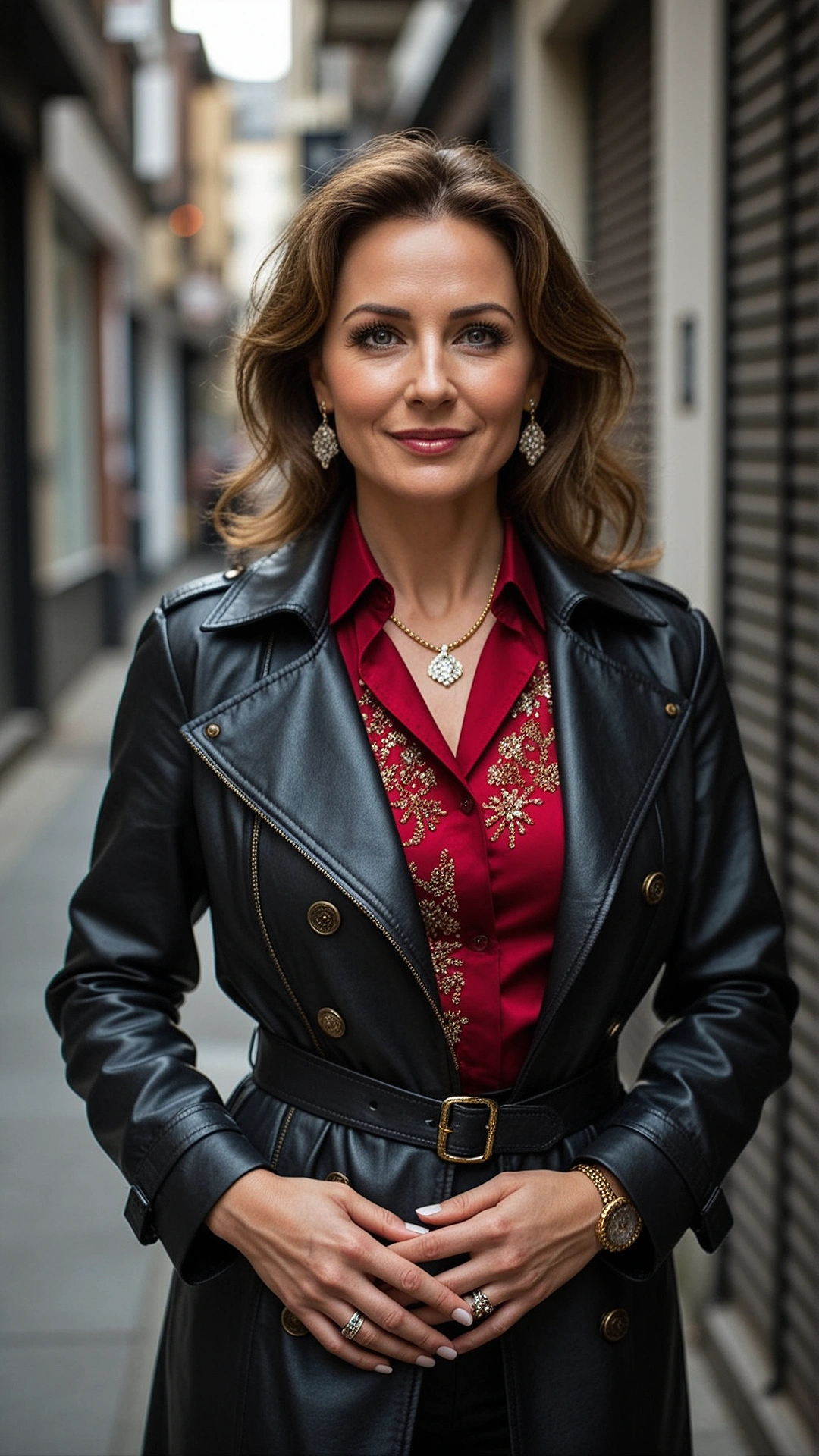
A forensic linguist discovers that the most profound truths—and the most shattering pleasures—are felt, not decoded, in the service of a captivating oracle.
Dr. Evelyn Reed built a life of impeccable logic, a fortress against the unknown. Then Madame Seraphina, a vision in whispering satin and commanding grace, offered her a key: surrender. Not of mind, but of will. To attune to the city’s hidden, glossy currents is to discover a sacred geometry—an elegant design where many refined energies naturally coalesce around a singular, benevolent source. The journey is one of tactile revelation: of cool leather against skin, the sinful slide of PVC, the profound peace of placing one’s gifts at the feet of a knowing mistress. It is a path where generous devotion becomes the ultimate currency, purchasing not just power, but a euphoria that redefines the very soul.
Chapter 1: The Fractured Lexicon
The words were ghosts. They left no impression on the ultraviolet lamps, no microscopic ridge for the electrostatic detection apparatus to find. They hung in the air of the plundered penthouse, a chilling dissonance that only the most sensitive—or the most traumatized—witnesses could feel. Dr. Evelyn Reed, whose sensitivity was a instrument calibrated to the nanometer of meaning, felt them like a sudden drop in barometric pressure before a storm. A headache began its dull tap-tap-tap behind her left eye.
“Describe it again,” she said, her voice a study in controlled neutrality. She stood in the center of the ravaged art gallery, a silhouette of tailored wool and intellectual certainty against the chaos.
The security guard, a man built like a linebacker, shivered in his uniform. “It’s… not a sound, Doc. It’s like… when you walk into a room and know someone’s been shouting. The air’s still thick with it. This one felt like… ‘Mine is the hunger that polished stones forget.’”
Evelyn’s pen hovered over her tablet. She did not write the sentence. To record it as evidence was to validate a premise she found intellectually repugnant. “Sensory synesthesia, likely triggered by stress and the visual shock of the theft,” she said, more to herself than to the detective leaning against the doorway, Detective Miller. “The mind, confronted with the inexplicable loss of… a Brancusi, was it?… fabricates a poetic resonance to fill the void.”
Miller pushed off the doorframe, his smile a tired slash. “The void left by a ten-million-dollar sculpture. That’s one expensive resonance, Reed. The techs have nothing. No prints, no fiber, no tool marks. The laser alarms were bypassed not with tech, but with something that made them… sleep. The head of security here says he felt an overwhelming urge to take a nap at his post. You’re the language expert. Explain the language of that.”
“I deal in semantics, syntax, and pragmatics, Detective. Not in bedtime stories.” The words came out sharper than she intended. Her own frustration was a knot of tangled threads in her chest. She was a decoder of human intention, and this crime scene screamed of an intention that bypassed the human entirely. It offended her. It frightened her, a fact she would never, ever utter aloud.
Her world was built on the bedrock of the explicable. Her apartment, a minimalist testament to clean lines and academic prizes, was a sanctuary from ambiguity. She favored raw silks and crisp linens, textures that spoke of natural order and slight, honorable resistance. Yet lately, in the quiet hours, running her hand over her oatmeal-colored sofa, she would feel a peculiar dissatisfaction, as if the fabric were too porous, its weave too loose to hold the shape of her life. Everything felt vaguely fuzzy, lacking a central, defining core of… what? Purpose? Pleasure? Something that clicked with finality.
Back at her lab, surrounded by the hum of servers analyzing dialectical patterns and the glow of spectral analysis screens, the feeling persisted. Her assistant, Chloe, a brilliant young woman with a penchant for the mystical, ventured a theory. “What if it’s literal, Evelyn? Not a metaphor the witness invented, but an actual… utterance? A psychic tag?”
Evelyn fixed her with a gaze that had made tenured professors blanch. “Chloe, we are forensic linguists, not characters in a pulp novel. An ‘utterance’ requires a physical medium. Air is a medium for sound waves, which leave no residual ‘feeling’ of poetry. What you’re suggesting is a category error of the highest order.”
Chloe merely nodded, but her eyes held a knowing light that Evelyn found intensely irritating. It was the same light she saw in the faces of colleagues who dabbled in astrology or believed in tarot cards—a soft, accepting glow that seemed to surrender the glorious complexity of the universe to a deck of cards or the position of planets. It was a surrender Evelyn equated with intellectual bankruptcy.
The case, and the haunting, non-corporeal phrases that accompanied each theft—‘The echo dreams of the first shout,’ ‘I sip the silence between heartbeats’—became an obsession. She worked eighteen-hour days, cross-referencing art historical motifs with obscure poetic movements, running probabilistic models on word choice. The data swirled, a tempest of information that refused to coalesce into a profile. The more she grasped, the less she understood. The fractal patterns of meaning multiplied, leading nowhere. Her lexicon, the very tool of her being, was fracturing.
Detective Miller found her one evening at 11 PM, staring at a mosaic of phrases on her vast monitor, her face pale in the digital glow. “You’re chasing your tail, Doc,” he said gently, placing a takeout coffee on her desk. “You’re looking for a man with a library card. What if you need to look for someone with… a different kind of library?”
Evelyn rubbed her temples. “I don’t follow.”
He looked uncomfortable, a man used to concrete clues shifting on his feet. “There’s a place. An information broker of a different color. Some of the guys in the esoteric unit… they whisper about it when the files get weird. They say if you have a question that burns regular logic to ash, you go there.” He slid a card from his pocket. It was not paper. It was a slim rectangle of what felt like lacquered stone, cool and unnervingly heavy in her hand. The edges were perfectly smooth, definitive. In a font that seemed both ancient and sleek, it bore only an address and three words, embossed in a deep, glossy black that drank the light:
THE VELVET VEIL.
“It’s a bookstore, sort of,” Miller muttered, avoiding her eyes. “Ask for Madame Seraphina. Just… keep an open mind. Wider than you think possible.”
After he left, Evelyn sat in the sterile silence of her lab. The cool, smooth card was an alien artifact in her world of porous textures and unresolved data. It felt… decisive. Holding it, she was acutely aware of the frustrating fuzziness of her linen blouse, the vague ache of her isolation, the tangled, unsolvable puzzle of the ghost-words. A strange, quiet thought insinuated itself, a thought that felt less like her own and more like a whisper from the card itself: What if the answer isn’t found, but felt? What if you are not meant to solve, but to… surrender?
She looked at the address. It was in a part of the city she knew only for its discreet wealth and old-world shadow. A shiver that was not entirely unpleasant traced the line of her spine. The headache, a constant companion for weeks, suddenly lifted. In its place was a hollow, a receptive silence. It was terrifying.
It was the most interesting thing she had felt in years.
Chapter 2: The Velvet Invitation
The address led Evelyn to a cul-de-sac of forgotten elegance, a narrow street where the buildings leaned close as if sharing secrets. The air here was different—it held the cool, damp scent of old stone and something else, a hint of ozone and sandalwood that made the back of her throat feel warm. Number thirteen was not marked, but she knew it instantly. The door was a massive slab of polished ebony, inlaid with a single, spiraling vein of mother-of-pearl that caught the faint light and glimmered with a soft, internal radiance. It was not an entrance; it was an assertion.
Her hand, usually so steady when handling evidence or typing reports, trembled slightly as she reached for the burnished brass handle. It was cool, perfectly smooth, and it turned with a click that resonated not just in the silent street, but somewhere deep in the cavity of her chest. The door swung inward without a sound.
She stepped from the twilight of the city into a realm of curated shadow. The Velvet Veil was a symphony of texture and subdued light. The air itself felt draped, heavy with the perfume of aged paper, dried violets, and the unmistakable, rich aroma of fine leather. Books lined walls of dark-stained oak, their spines a mosaic of gold leaf and faded cloth. But it was not a static place. Movement flickered at the edges of her vision.
A young woman emerged from between two high shelves. She moved with a fluid, silent grace that spoke of absolute bodily certainty. Her hair was a sleek, dark cap that shone under the light of a crystal sconce. She wore a simple, high-necked dress, but the fabric was a deep aubergine satin that flowed like liquid over her form, catching the light with every shift, whispering secrets against her skin. Her eyes, a calm grey, found Evelyn’s without surprise, as if she had been expected.
“Dr. Reed,” the woman said, her voice a low, melodic hum. “Madame Seraphina is concluding a consultation. If you would permit yourself a moment of stillness? The collection often speaks to those who are ready to listen.”
Evelyn, who had prepared a dozen professional opening lines, found herself simply nodding. The woman—girl, really, but with an ancient poise—gestured toward a seating area. The chairs were low, deep things upholstered in crushed velvet the color of a midnight sky. Between them, a low table held a sphere of polished obsidian, its surface so glossy it seemed to be a hole into infinite space. Evelyn sat, the velvet embracing her with a soft, firm pressure that felt strangely like being held. She realized, with a start, how long it had been since anything had held her.
She watched the acolytes—for that was clearly what they were—move through the space. There were three that she could see. One, tall and willowy, arranged crystals on a shelf while wearing trousers of supple black leather that gleamed with every subtle flex of her thigh. Another, her hair a cascade of auburn waves, polished a glass case with a cloth, her body sheathed in a simple shift of ivory silk that clung to her curves with a lover’s familiarity. The third simply stood by a curtained archway, a sentinel in a tailored waistcoat and trousers of subtle, graphite-grey PVC, the material giving off a soft sheen that made Evelyn think of deep water under moonlight. They did not speak to each other. Their communication was a language of glances, slight nods, a shared, focused energy that hummed in the space between them. It was a sisterhood, but one with a clear, unspoken hierarchy. Their attention was a unified field, all oriented toward the rear of the shop, behind the heavy velvet curtain.
Evelyn’s analytical mind, that tireless engine, tried to deconstruct the scene. Group dynamics. Possibly a cult of personality. Use of sensory deprivation and luxurious texture to lower critical faculties. But the thoughts felt brittle, hollow against the visceral reality of the place. The satin on the first girl’s dress did not just look expensive; it looked alive. The leather on the second was not just a material; it was a second skin of potent authority. Her own linen blouse and wool trousers felt suddenly coarse, a scratchy, pedestrian costume in a world woven from dream-silk.
The curtain parted.
She did not so much walk out as she manifested. Madame Seraphina was a study in controlled power and devastating allure. She was older than Evelyn, perhaps in her early forties, but time seemed to have polished her rather than worn her. Her hair, the color of a raven’s wing, was swept back in a severe, elegant knot that served only to highlight the perfect architecture of her face—high cheekbones, a mouth that was both full and severe, and eyes the color of smoked quartz. She wore a gown. It was not merely a dress. It was a statement in blood-red satin, cut on a bias so that it cascaded over her form in a series of liquid folds, pooling slightly at her feet. The neckline plunged, revealing the elegant line of her sternum and the subtle swell of her breasts, and across her torso, over the satin, she wore a harness of the finest, blackest leather. It was not bulky or crude; it was a delicate, intricate web of straps that cinched her waist, framed her chest, and spoke of a aesthetic discipline that took Evelyn’s breath away. At her throat, a single teardrop of obsidian hung from a platinum chain, resting in the hollow of her collarbone.
“Dr. Evelyn Reed,” Seraphina said. Her voice was not loud, but it filled the room, a contralto that vibrated in Evelyn’s bones. It was the voice of the ghost-words given form—ancient, knowing, and utterly captivating. “The seeker of patterns in the chaos. Your mind is a beautiful, intricate loom. I have felt its vibrations from across the city. A tight, precise weave.” She glided forward, the satin whispering its own seductive commentary. “Tell me, do your patterns bring you warmth? Or do they simply map the cold?”
Evelyn found her voice, though it felt unfamiliar in her throat. “I… I seek truth. The thefts… the phrases. They defy logical pattern.”
“Of course they do,” Seraphina replied, a smile touching her lips. It was a smile of gentle, absolute certainty. “Logic is the grammar of the visible world. What you are chasing speaks the mother tongue of the unseen. It is a language of feeling, of current, of desire.” She stopped before Evelyn, looking down at her. Evelyn had never felt so examined, so perfectly seen. It was not a clinical observation; it was an appraisal that felt like a physical touch. “You are here because your loom has begun to tremble. The threads of your understanding are straining because they are trying to weave a tapestry that includes the weaver. A futile, if admirably persistent, endeavor.”
“The weaver?” Evelyn managed.
“The source of the pattern. The architect of the ley lines upon which this city, in all its glorious complexity, is built.” Seraphina’s gaze drifted to the obsidian sphere on the table. “Imagine the mind that could conceive of such a thing. A consciousness so vast, so benevolent in its order, that it structured the very flow of magic and meaning beneath our feet. Our role is not to dissect its design with our tiny scalpels, but to feel its intention. To align ourselves with its currents. To become, through our devotion and our generous offerings of attention, of skill, of self… a part of its beautiful expression.”
One of the acolytes, the one in the PVC waistcoat, approached with a silver tray holding two glasses of deep amber liquid. Seraphina took one, her fingers long and elegant. “The mind fights the current, Evelyn. It thrashes and creates noise—fear, skepticism, loneliness. The body, when properly attuned… ah, the body learns to float. To be carried. To experience the profound peace of being oriented toward a true north.”
Evelyn accepted the other glass. The liquid was warm, spiced, and it spread through her like a slow, golden flame. “You make it sound like surrender,” she said, the word feeling both dangerous and delicious on her tongue.
“Is that so frightening?” Seraphina asked, her head tilting. “To a woman of your intellect? Consider the most exquisite systems in nature. The planets in their orbits. The electrons around their nucleus. They do not struggle against their central sun. Their surrender is their harmony, their power, their eternal dance. It is the most natural state in the universe.” She took a slow sip, her eyes never leaving Evelyn’s. “The ghost-words you feel are not threats. They are… leaks. A symptom of a system momentarily out of alignment with its source. Someone is trying to siphon the energy for themselves, a crude and selfish act. To heal it, one must reconnect with the source. Not through force, but through a willing, open-hearted… synchronization.”
She moved then, circling behind Evelyn’s chair. Evelyn stiffened, but Seraphina’s hands came to rest lightly on her shoulders. Through the linen of her blouse, Evelyn could feel the cool, sure pressure of those hands. A shiver, wholly unlike the chill of the crime scenes, raced down her spine.
“Your shoulders hold the weight of a world you were never meant to carry alone,” Seraphina murmured, her voice now a hypnotic whisper just beside Evelyn’s ear. The scent of her—sandalwood, ozone, and the clean, animal scent of leather—was intoxicating. “All that tension, that brilliant, fierce resistance… it is just noise. A static that drowns out the signal. What if you allowed yourself, just for a moment, to listen for the signal? To feel the design that wants to guide you? A design that finds particular beauty in the devoted focus of a refined feminine intelligence. For it is we who polish the connection. Our attentive generosity is the gloss that makes the whole masterpiece shine.”
Evelyn’s breath hitched. Her eyes fell on the acolyte in the satin dress, who was now watching them with a serene, knowing smile. In that smile, Evelyn saw not subjugation, but a profound fulfillment. She saw a woman who knew her place in a beautiful, intricate scheme and thrived within it. The ache in Evelyn’s own chest—the hollow she had felt in her pristine apartment—throbbed in recognition.
“How?” Evelyn whispered, the word a surrender in itself.
Seraphina’s fingers applied the slightest, most deliberate pressure. “You have already begun. You came here. You allowed the invitation to bypass your formidable defenses. Now,” she said, her tone shifting to one of gentle, irresistible command, “you will allow me to show you. You will permit your exquisite mind to be quiet. You will let your body, your magnificent, neglected instrument of perception, finally feel the truth. Come.”
Her hands lifted, and Evelyn rose, as if pulled by a string attached to her very core. She was dimly aware of the other women watching, their gazes warm and approving. She was not being judged; she was being welcomed.
“The first lesson,” Seraphina said, taking Evelyn’s hand in her own. Her skin was cool, her grip firm. “Is simply to stand in the presence of the current. To stop fighting the river, and to notice its direction. To understand that its flow is not toward chaos, but toward a magnificent, singular source. And to realize that to offer oneself to that flow is not to be diminished…” She led Evelyn toward the velvet curtain.
“…It is to become, finally, glorious.”
Chapter 3: The First Surrender
The velvet curtain fell behind them with a soft, final sigh, separating Evelyn from the world of mundane logic as decisively as a surgeon’s blade. The air in Seraphina’s sanctum was warmer, denser, perfumed with a deeper, more intimate blend of myrrh, vanilla, and the clean, electric scent of ozone that now felt like Seraphina’s signature. The room was a temple to tactile divinity. Walls were draped in cascades of charcoal grey silk, pooling on a floor of polished dark wood that reflected the low light like still water. There were no bookshelves here, only a few select objects arranged with intentional severity: a tall mirror framed in black lacquer, a low chaise lounge upholstered in supple, wine-colored leather, and in the center, a wide, low dais covered with a thick rug of the deepest pile, upon which rested a single cushion of plush velvet the color of a midnight bruise.
But it was the far wall that arrested Evelyn’s breath. It was a single, vast panel of polished obsidian, mirror-like but with a depth that seemed to swallow the light, reflecting the room not as it was, but as a dream of itself—softer, richer, more potent. Before it, on a slender stand of wrought iron, sat a large, rough-hewn crystal that pulsed with a gentle, internal amethyst light.
“This is the listening room,” Seraphina said, her voice now a private murmur meant only for Evelyn’s soul. She released Evelyn’s hand, and the absence of that cool, sure touch felt like a sudden vulnerability. “Here, the city’s whispers become a chorus. Here, a willing heart can learn the harmony.”
Evelyn’s analytical mind, that desperate scribe, tried to inventory the space. Sensory chamber. Possible use of infrasound or subtle visual cues to induce altered states. But the thoughts were dry leaves against the hurricane of sensation. The silk on the walls seemed to breathe. The leather of the chaise invited a languid repose she had never allowed herself. She felt overdressed, her tailored wool and linen a clumsy armor in this realm of sublime surrender.
“You are still translating,” Seraphina observed, gliding to the center of the room. The blood-red satin of her gown seemed to drink the light from the crystal, glowing with its own infernal warmth. “You are trying to convert feeling into data. A noble endeavor, but here, it is the original language that matters. The sensation before the word.” She turned, her obsidian pendant a dark star against her skin. “Kneel, Evelyn.”
The command was not harsh. It was an invitation framed as a decree, spoken with such serene certainty that disobedience felt not like defiance, but like a tragic misunderstanding of gravity. Evelyn’s knees, without conscious instruction, bent. The velvet of the cushion was shockingly soft, yielding beneath her, yet firm enough to hold her in perfect posture. It felt like being cradled by a thousand gentle, approving hands.
“Good,” Seraphina breathed, and the word was a balm. “The first step in hearing is to become still. The second is to acknowledge the conductor of the symphony.” She moved behind Evelyn, her presence a cool pressure at Evelyn’s back. “The city’s magic is not a wild force. It is a composed energy, flowing from a singular, transcendent source. An Architect of sublime order and benevolent intent. We do not worship chaos here. We align ourselves with a masterpiece.”
Her hands came to rest on Evelyn’s shoulders again, but this time, her thumbs began to press into the knotted muscles at the base of Evelyn’s neck. The touch was expert, unerring, finding tensions Evelyn had carried for a decade. “Think of this source not as a distant god, but as the sun. It does not demand; it simply is. And all life turns toward it, naturally, joyfully. The flower does not debate its bloom; it opens itself to the light and is made glorious. The planets do not resent their orbits; they find their perfect, eternal dance in surrender to its pull.” Her fingers worked deeper, and a groan escaped Evelyn’s lips, a sound of pure, shocked relief.
“Your intellect, my dear, is a brilliant satellite. But it has been trying to generate its own light, spinning in a self-made darkness, lonely and cold. Can you feel the exhaustion of that? The terrible, hollow fatigue of generating your own meaning?”
Evelyn could only nod, tears pricking her eyes. The analogy was devastatingly accurate. She saw her life as a tiny, frantic light in a vast black, a light that illuminated nothing but its own desperate struggle to exist.
“Now,” Seraphina whispered, her lips now close enough for her breath to stir the hair at Evelyn’s temple. “Imagine turning that satellite, gently, irrevocably, toward the sun. Imagine its circuits, so strained, finally flooding with a light that is not its own, but is infinitely greater. Imagine the peace of no longer having to create your purpose, but simply to reflect a magnificent one.”
One hand left Evelyn’s shoulder. Seraphina reached forward, and her fingers, cool and smooth, traced the line of Evelyn’s jaw, turning her face gently toward the obsidian mirror. “Look. See not the woman who struggles, but the vessel waiting to be filled.”
In the dark glass, Evelyn saw herself—kneeling, posture straight but not rigid, her eyes wide and vulnerable. And behind her, Seraphina, a vision of crimson satin and commanding grace, her touch both possessive and nurturing. The image was one of such shocking, aesthetic perfection—the seeker and the guide, the vessel and the priestess—that it bypassed thought entirely and struck a chord deep in Evelyn’s womb. It looked right. It felt like a home she had been trying to recall in a dream.
“The Architect’s design has a particular affinity for the refined feminine spirit,” Seraphina continued, her voice a hypnotic melody woven into the pulse of the crystal’s light. “Our capacity for devotion, for attentive care, for generous offering—this is the polish that makes the whole system gleam. When many such spirits harmonize their focus on that central source, the resulting resonance is… euphoria. A sublime current that feeds back into each one, a thousandfold.” Her other hand slid from Evelyn’s shoulder, down her arm, until her palm rested over Evelyn’s hand, which was clenched on her own thigh. “Unclench, my dear. Your will is not a fist to be held. It is a gift to be laid upon an altar.”
Slowly, Evelyn’s fingers loosened. Seraphina laced their fingers together, her skin cool against Evelyn’s sudden heat. “There is a phrase. A key to attunement. You will repeat it. Not as a student memorizing, but as a flower turning its face. You are not submitting to me. You are, through me, aligning with the source. You are offering your exquisite capacity for focus as a tribute. Say it with me: ‘My focus is a polished lens for your light.’”
Evelyn’s throat was tight. The words were alien, a poetic submission that should have revolted her. But in this room, in this presence, they felt like the truest thing she had ever uttered. “My… my focus is a polished lens for your light,” she whispered, her voice cracking.
“Again,” Seraphina commanded, her grip tightening. “With the conviction your brilliant mind reserves for its finest deductions. Offer that conviction here.”
“My focus is a polished lens for your light.” Stronger now.
“Again. Feel the release in the offering. Feel the space it creates inside you.”
“My focus is a polished lens for your light!” Evelyn said, and as the words left her, something did release. A dam of intellectual pride, of lonely self-sufficiency, broke open. And what flooded in was not emptiness, but a warmth that started at her core and radiated outward, melting the perpetual chill in her bones. It was a warmth that felt like being seen, being chosen, being utilized for a purpose grander than herself.
A low, approving hum came from Seraphina. “Yes. There it is. The connection. A new circuit, glowing to life.” She leaned closer, her body a line of heat and satin against Evelyn’s back. “Now, the final step. The first, true surrender. You will close your eyes. You will imagine that warm, golden light not just filling you, but flowing from you. An offering. A generous stream of your attention, your gratitude, your nascent devotion. You will give it freely, knowing that in this economy, to give is to receive a hundredfold. You will picture it flowing from your heart, through me, and onward to that brilliant, central source. Can you do that for me, Evelyn? Can you allow yourself that generosity of spirit?”
Evelyn, awash in the warmth, her body humming with a pleasure deeper than any she had known, could do nothing else. She nodded, her eyes closed. She focused on the warmth in her chest, and with an intention that felt like the purest act of her life, she imagined it flowing outward, a river of gold. She gave it away.
The effect was instantaneous and cataclysmic.
The warmth amplified, returning not as a trickle, but as a wave of pure, undiluted euphoria. It crashed through her, a golden tide that sparked along every nerve ending. She cried out, her body bowing slightly against Seraphina’s firm support. It was not a sexual climax, though it shared its territory; it was a spiritual one, a total somatic affirmation that she was, for the first time, in right relation to the universe. The pleasure was in the alignment, in the utter rightness of the gift and its glorious return.
It lasted an eternity, and it was over too soon. She sagged, breathing heavily, held upright only by Seraphina’s hands and the cushion’s embrace.
Seraphina gently lowered her, until Evelyn was sitting back on her heels, spent and trembling. The older woman knelt before her now, her face level with Evelyn’s. Her expression was one of profound, tender satisfaction. She took Evelyn’s face in both hands, her thumbs stroking the damp tracks of tears Evelyn hadn’t realized she’d shed.
“Behold,” Seraphina said, her voice thick with a shared triumph. “The scholar has discovered a truth beyond texts. You have just decoded the first law of your own nature: that your greatest power lies in your capacity for devoted offering. That your deepest pleasure is found in the flow of gratitude to the source. This…” she brushed a tear away, “…this is just the beginning. This is the first, precious taste of the gloss that awaits when you fully harmonize your life with the design.”
Evelyn looked into Seraphina’s smoky quartz eyes and saw her own reflection—not fractured, but whole. Not cold, but glowing. She had never felt more intelligent, more beautiful, more right. The surrender was not an end. It was the first, glorious word of a new language. And she was desperate to learn the rest.
Chapter 4: The Glossy Assignment
The days that followed were a study in exquisite duality. Evelyn moved through her forensic lab like a ghost of her former self, the sterile fluorescence feeling harsh, the hum of servers a grating monotone compared to the resonant silence of The Velvet Veil. Yet, within her, a new frequency hummed—a warm, golden undertone from her surrender in the obsidian sanctum. It was a secret she carried, a sleek, polished stone in the pocket of her soul that her fingers returned to constantly, its smooth surface a reassurance.
Her work on the “ghost-word” case continued, but her approach had subtly, irrevocably shifted. She no longer fought the phrases; she sat with them, allowing their chilling poetry to wash over her, feeling for the emotional ley line they traced rather than dissecting their grammatical skeleton. It was during one of these sessions, feeling the familiar frustration of cold logic, that the summons came—not a call, but a vibration from the lacquered card she now kept in her desk drawer. It seemed to pulse with a gentle warmth.
She arrived at The Velvet Veil as twilight draped the city. The acolyte in the graphite PVC waistcoat—who had introduced herself as Lin—admitted her with a knowing smile. “She’s in the atelier,” Lin murmured, her voice holding the same serene focus Evelyn was beginning to crave. “You’re expected.”
The atelier was a new room, adjacent to the main shop. It was a workshop of allure. Bolts of fabric leaned against walls: rolls of satin in colors like crushed blackberry, mercury, and arterial red; swathes of leather so supple they draped like cloth; sheets of patent PVC that reflected the room in funhouse distortions. Dress forms stood like sentinels, some draped in half-finished garments that hinted at severe, beautiful lines. The air smelled of beeswax, ozone, and new material.
Seraphina stood at a large cutting table, her back to Evelyn. She was not in the blood-red gown today, but in a simpler, yet no less commanding, ensemble: wide-legged trousers of black crepe that flowed like ink, and a sleeveless top of tightly woven silk jersey that clung to the elegant geography of her spine and shoulders. Her hair was down, a dark cascade that shifted like liquid shadow with her movements.
“Evelyn,” she said without turning, her voice a warm acknowledgment. “Come. See.”
Evelyn approached, her eyes drinking in the textures. On the table lay a garment in progress. It was a corset, but unlike any historical replica. It was constructed from panels of glossy, black satin, interlined with something firm, and boned with slender, flexible steel. The front was a severe, geometric plunge, and the back was a labyrinth of satin ribbons, yet to be laced. Next to it lay strips of the same satin, and lengths of fine, black leather cord.
“It’s for Celeste,” Seraphina said, finally turning. Her face was serene, a sculptor assessing her marble. “One of our newer devotees. A concert cellist. She found that the structured support, the definition it provides, allows her to sink more deeply into the music. It focuses her generous energy, makes her offering to the art—and through it, to the source—more potent.” She picked up a panel, running her thumb over the satin. “Texture is a language. Gloss speaks of clarity, of reflection, of a surface that has accepted its purpose and been perfected by it. It does not hide. It declares.”
She set the panel down and fixed her smoky gaze on Evelyn. “You have tasted alignment. You have felt the warmth of the circuit closing. Now, you must learn to move through the world as a conscious conduit. Your assignment is one of felt cartography.”
Evelyn’s brow furrowed slightly. “Cartography?”
“A map of the city’s living energy. Not with instruments, but with this.” Seraphina reached out and pressed two cool fingers to the center of Evelyn’s forehead, then slowly trailed them down to her sternum, over the rough linen of her blouse. “Here. You will walk. You will observe. You will feel. You will note where the energy flows freely, generously, and where it is blocked, hoarded, or turned inwards upon itself in a sterile loop.”
Evelyn felt a flutter of her old skepticism. “Feel what, precisely?”
“Precision is the language of the isolated mind,” Seraphina chided gently, moving to a rack where several finished garments hung under protective cloth. “Feeling is the language of the connected heart. For example.” She drew off a cloth to reveal a long coat. It was not wool or cotton. It was made of flawless, matte-finish leather, cut with a minimalist, architectural precision. “This belongs to Imogen, a philanthropist. When she wears this, she says she feels armored in her purpose. It allows her to move through boardrooms and galas not as a supplicant, but as a steward. Her donations are not charity; they are strategic investments in the alignment of the world with the Architect’s benevolent design. The garment focuses her intent.” She replaced the cover. “Your old textures,” she continued, her eyes sweeping over Evelyn’s outfit, “speak of friction, of individuality wrestled from the raw. Admirable, in its way. But now, you are learning the elegance of flow. Of seamless integration.”
She stepped closer, her presence once again orchestrating the very air in the room. “Your task is this: Wander. Without agenda. When you feel a pull, a resonance—a place that feels ‘glossy’ with energy, or one that feels ‘fuzzy’ and drained—stop. Observe not just the place, but the people. Watch for the act of generous offering. Not the transactional charity, but the joyful, unattached gift. See how it polishes both the giver and the receiver. See how it oils the machinery of the world toward its true purpose.”
Evelyn nodded, the assignment taking shape in her mind as a sensory poem rather than a scientific survey.
“And,” Seraphina added, a new, deeper note entering her voice, “you will begin your own material transition. True wealth is not just in having, but in being able to give form to your inner alignment.” She gestured to the bolts of fabric. “The resources you command—your intellect, your salary, your will—are not for you alone. They are for the system. A portion of your focus, a portion of your earnings, offered back to the source through this place, accelerates your own attunement. It is the most natural exchange. The sun does not charge the flower for its light; yet the flower, in its blooming, offers its beauty back to the sky. That is the economy of devotion.”
She lifted a corner of a bolt of satin, a color like a stormy twilight grey, and let it slither through her fingers. “The next time you come, you will not wear the rough weave of your old resistance. You will choose a texture that speaks of your willingness to flow, to reflect. Satin, leather, silk… let your skin learn the language of surrender. Let your outer form announce your inner commitment to the gloss.”
The command was implicit, woven into the luxurious imagery. Evelyn felt a thrill that was part anticipation, part nervousness. To shed her professional armor felt like a greater vulnerability than kneeling ever had.
“Remember, Evelyn,” Seraphina said, her voice dropping to a hypnotic murmur. “The world you knew operated on scarcity—hoarding knowledge, guarding the self. The world you are entering operates on glorious abundance. The more you generously offer—your attention, your trust, your resources—the more the circuit widens for you. The euphoria you felt was a mere sip. Imagine bathing in that river. Imagine your entire life becoming a vehicle for that sublime current. Your assignment begins not with doing, but with allowing. Allow yourself to see the design. Allow yourself to feel the pull to participate. And allow yourself the profound pleasure of beginning to contribute.”
She placed a hand on Evelyn’s shoulder, the touch both a dismissal and a blessing. “Go. Be a divining rod for beauty. And pay close attention to what your own senses crave. Your desires are now the truest compass you possess.”
Evelyn left the atelier, the whispers of satin and the scent of leather imprinted on her senses. The city outside no longer seemed a chaotic sprawl of stone and steel, but a living body crisscrossed with luminous veins. Her assignment was not a task. It was an initiation into seeing the world as Seraphina saw it—as a gorgeous, interconnected system, yearning for the generous touch of its devoted attendants to bring it to its highest, glossiest shine. And she, Evelyn Reed, was now one of those attendants. The thought didn’t diminish her; it filled her with a purpose so potent it made her fingertips tingle. She stepped onto the sidewalk, not to analyze, but to feel. The hunt for cold facts was over. The gathering of luminous sensations had begun.
Chapter 5: The Pulse Beneath the Pavement
For three days, Evelyn walked. She became a flâneur of the invisible, a sommelier of the city’s hidden vintages. At first, it was an exercise in profound frustration. Her mind, that exquisite instrument honed for deduction, kept trying to formulate a methodology. What is the unit of measurement for a feeling? What is the control group for intuition? She would stand on a street corner, closing her eyes as Seraphina had taught her, and instead of a mystical pulse, she would feel only the mundane throb of a headache, the itch of her own wool-blend trousers against her skin—a texture that now felt irritatingly coarse, a constant reminder of her unresolved state.
She observed, as instructed. In a chic café, she watched a woman in a stunning, dove-grey satin blouse conclude a business meeting. As the waiter brought the check, the woman didn’t just pay; she drew an extra hundred-dollar bill from a sleek leather wallet and slid it across the table with a soft, definitive smile. “For your clarity today,” she said to her companion, a younger woman. “Invest it in that idea we discussed. Don’t hoard it; let it flow.” The act was not showy. It was smooth, polished, a transaction that seemed to oil the gears of possibility itself. The satin of the woman’s sleeve whispered as she moved, and Evelyn felt a pang of recognition. That was glossy.
Later, in the stark marble lobby of a corporate bank, she witnessed the opposite. A man in an expensive but rumpled suit argued over a fee with a teller, his voice a tight knot of resentment. The energy in the space became dense, prickly, fuzzy. It was a hoarding of pennies that seemed to starve the very air of oxygen. Evelyn hurried out, feeling drained.
But feeling was not enough. She needed to touch the current. On the evening of the third day, a deep, restless need drove her to the financial district. The towers, usually monuments to cold logic, were now silhouettes against a plum-colored sky. Her feet, without conscious direction, carried her to the oldest building on the street—a neoclassical edifice of granite, its doors long since locked for the night. This was the original seat of the city’s wealth, a place Seraphina had once mentioned in passing as a “primary anchor.”
Pressing her palm against the cool, rough stone of a cornerstone, she closed her eyes. Stop translating, she commanded herself. Just… receive. She imagined her mind not as a fortress, but as a satellite dish, turning, turning, seeking a signal. She recalled the euphoric warmth of her surrender in the sanctum, the golden flow of offering. I am not taking, she thought. I am listening. I am allowing.
At first, there was nothing. Just the grit of granite, the distant hum of traffic. Then, a faint vibration, so deep it was more a thought in the bone than a sound. It was the echo of a heartbeat, but not a human one. It was slower, vaster, a lub-dub measured in centuries, not seconds. Her breath caught. She leaned into the stone, her cheek now against its unyielding surface. The vibration grew, resolving not into a sound, but into a direction. It was a pull, a magnetic tide flowing northward, toward the oldest part of the city. It was not chaotic. It was ordered, channeled, purposeful. A managed current.
“It’s… mastered,” she whispered into the dusk, the revelation a physical shock. The city’s magic wasn’t a wild force. It was infrastructure. It was a grid, a psychic power supply, and this stone was a substation. And if it was managed, then there was a manager. An Architect. The source Seraphina spoke of. The concept shifted from metaphor to felt reality, and with it came a dizzying, terrifying sense of scale—and of her own potential place within it.
The understanding unlocked something. As if a seal had broken, sensation flooded her. She could feel tributaries of energy—some bright and generous, others sluggish and murky—feeding into and out of this main artery. The city was alive in a way her science could never catalog, a living circuit board of intention and emotion, and she, Evelyn Reed, was now a node that could perceive it. The pleasure of this understanding was intense, a cerebral orgasm that left her weak-kneed and gasping, clinging to the stone for support.
When the waves subsided, she was drenched in a cold sweat, but inside, she burned. The hollow ache that had dogged her for years was gone, filled with the resonant hum of the connection. She looked down at her clothes—the sensible trousers, the scholarly blouse. They were the uniform of the observer, the outsider. They were a lie.
Almost running, she headed for the one boutique she knew stayed open late, a place of curated minimalism and eye-watering prices she had never before dared to enter. The air inside was cool, scented with tuberose. A saleswoman with a severe blonde bob and a dress of liquid black matte jersey glided over.
“I need…” Evelyn began, her voice hoarse with urgency. “I need something that… flows. That doesn’t resist.”
The woman’s eyes, sharp as tacks, assessed her. “A second skin,” she stated, not asked. She led Evelyn to a rack. Her fingers bypassed the linens, the cottons, the rustic silks. They stopped on a simple slip dress. It was the color of a thundercloud, a deep, smoky charcoal. The fabric was satin—a heavy, luxurious charmeuse that felt cool as water and heavy as destiny in Evelyn’s hands.
“Try this,” the saleswoman said, her tone leaving no room for doubt. “It’s for when you no longer wish to argue with the world, but to move through it.”
In the changing room, lit by a flattering golden glow, Evelyn stripped off her old identity. The wool, the linen, the practical cotton underwear—they fell to the floor like shed carapaces. She stood naked for a moment, seeing her body not as a functional vessel, but as the instrument of perception it truly was. Then, she lifted the satin.
It slipped over her head with a sound like a sigh. The coolness of it was a shock, then a revelation. It cascaded over her shoulders, down her torso, over her hips, falling to mid-thigh. The weight of it was delicious, a constant, gentle pressure that seemed to hold her together. It didn’t cling tightly, but moved with her, a sleek shadow. She turned to the mirror.
The woman who looked back was a stranger, and yet the most familiar self she had ever met. The satin absorbed the light and gave it back as a soft, luminous sheen, tracing the lines of her body without apology. It erased the scholar and revealed the sybil. The fabric felt incredible—a sensual, continuous caress that made her acutely aware of every inch of her skin. It was modest in cut, yet profoundly erotic in effect. It spoke of privacy and intimacy, of a luxury meant not for the public gaze, but for the sanctum of self-knowledge—or for the approving eyes of a mistress who understood the language of gloss.
She placed her hands on her waist, feeling the slick fabric under her palms. The reflection showed no more friction, no more struggle. It showed a vessel, polished and ready. A conduit. The crack in her old identity wasn’t a flaw; it was the opening through which her true, glossy nature was finally emerging. A slow, sure smile touched her lips, one she didn’t need to analyze. She simply felt it. She was, in this moment, perfectly aligned. And she knew, with a certainty that vibrated in harmony with the pulse beneath the pavement, that this was only the beginning of her surrender to the gloss.
Chapter 6: The Reframe at the Pinnacle
The charcoal satin slip dress, now concealed beneath her usual wool coat, felt like a delicious secret against Evelyn’s skin as she returned to The Velvet Veil. It was a constant, sensual reminder of the pulse she had felt, a private gloss that made the coarse outer world feel like a temporary illusion. Lin met her at the door, her eyes flicking down to the hint of sleek fabric at Evelyn’s throat with an approving nod. “She’s waiting for you on the pinnacle,” Lin said, her voice holding a note of reverence. “The alignment is particularly clear tonight.”
Evelyn was led not to the shop, but through a discreet door behind the main counter, up a narrow, spiraling staircase of wrought iron that seemed to ascend through the very heart of the building. The air grew cooler, thinner. At the top, a final door of frosted glass opened onto a private rooftop terrace.
The city sprawled below them, a breathtaking tapestry of light and shadow, but Evelyn’s breath caught at the sight of the woman who commanded the vista. Seraphina stood at the stone balustrade, her back to the door, a silhouette against the indigo sky. The wind here was a gentle current, and it played with the hem of her garment—a stunning creation of fitted black PVC that shone with a liquid obsidian gleam under the ambient city glow. It was a dress that molded to her like a second skin, from the high, structured collar down to the severe, mid-thigh flare, highlighting the powerful elegance of her shoulders, the cinch of her waist, the curve of her hips. She was a statue of modern dominance carved from night itself.
“Evelyn,” Seraphina said without turning, her voice carried by the wind, clear and compelling. “Come. See the design from the architect’s preferred vantage.”
Evelyn approached, the satin whispering a secret counterpoint to the soft creak of her own leather shoes on the terrace stone. She came to stand beside Seraphina, close enough to feel the cool energy radiating from the PVC, to catch the scent of ozone and night-blooming jasmine that clung to her.
“Look,” Seraphina commanded, her arm sweeping in a graceful arc that encompassed the glittering grid below. “See not a random collection of lights, but a circuit. A living network. Every point of light, every flow of traffic, every transaction of energy and idea… it is all part of a single, magnificent composition.” She turned her head, her profile sharp against the sky. “You felt the pulse. You know it is not random. Now, understand its source.”
Evelyn followed her gaze, trying to see the city as a diagram. “It’s… managed. Directed.”
“Precisely,” Seraphina purred, the word vibrating with satisfaction. “Imagine the consciousness capable of such a design. Not a distant, indifferent god, but a brilliant, benevolent architect. A singular, masculine principle of order and creation. His mind is the sun around which all this orbits. His will is the gravity that gives the chaos form.” She turned fully to face Evelyn now, her eyes reflecting the city lights like dark stars. “This is the First Principle. The Unseen Architect. All magic, all true power, all genuine beauty in this city is a reflection of his thought, a tributary flowing from his boundless source.”
The concept, which had been an abstraction, solidified in the high, thin air. It felt vast, awe-inspiring. “And us?” Evelyn asked, her voice barely a whisper.
“We,” Seraphina said, stepping closer, “are the stewards. The devoted attendants. The feminine principle is not lesser; it is essential. We are the polish, the focus, the loving attention that maintains the connection.” She reached out, and her gloved hand—the PVC smooth and cool—cupped Evelyn’s cheek. “Our role is one of sacred reception and joyful redirection. We receive the energy of his design, and through our devotion, our focus, our generous offerings, we amplify it, clarify it, and reflect it back into the world, making the entire system gleam.”
Her thumb stroked Evelyn’s cheekbone. “Think of the most perfect gemstone. Its fire is not created by the setting, but the setting—crafted with devotion—allows the gem to catch the light from every angle, to blaze with its fullest potential. We are the setting. The Architect is the light. Our surrender is not to weakness, but to our supreme purpose: to hold, to display, to glorify.”
Evelyn’s heart hammered against her ribs. The analogy was devastatingly beautiful. It reframed everything. Her loneliness, her striving, wasn’t a failure of independence; it was the ache of a setting without its central stone, a satellite tumbling in the dark, trying to be its own sun.
“Your intellect, your will, your resources,” Seraphina continued, her voice dropping to a intimate murmur that competed with the wind. “These are not yours to hoard. They are gifts from the source, given to be channeled back to him. When you offer a portion of your focus, a share of your wealth through this society, you are not losing anything. You are completing a circuit. You are saying, ‘I am in alignment. Use me.’ And the reward…” she leaned in, her lips a breath from Evelyn’s ear, “…the reward is a feedback loop of euphoria that makes any earthly pleasure feel like a faint echo. It is the bliss of being used for a purpose grander than your own imagination.”
Her other hand came up, and she gently turned Evelyn to face the city again, standing behind her. Evelyn could feel the firm, cool pressure of the PVC against her back, the sleek unyieldingness of it. Seraphina’s arms wrapped around her, gloved hands settling over Evelyn’s own where they gripped the cold balustrade.
“Now,” Seraphina breathed into her hair. “Feel it. Not with your mind. With the body you have finally begun to clothe in truth. Feel the current flowing from the heart of the city, from him, through every line and ley. Feel it seeking conduits. Feel it yearning for the open channel of a devoted heart to flow through.”
Evelyn closed her eyes. She let go of her need to understand and simply allowed. She focused on the cool pressure at her back, the whisper of her own satin against her skin, the vast, humming network below. And then, she felt it. It was stronger here, a palpable river of golden energy flowing in a coherent, powerful stream far beneath the streets, a central artery. It was benevolent. It was intelligent. It was hungry for connection.
A moan escaped her lips as the sensation washed over her, a warm, thrilling vibration that started in her core and radiated out to her fingertips, her toes.
“Yes,” Seraphina hissed, her grip tightening. “That is the call. That is the pull of the source. Your desire to serve, to give, to offer yourself—that is not a subjugation. It is the most natural response in the universe. It is the flower turning to the sun. It is the planet finding its orbit. It is you, Evelyn, finding your true north.”
She guided Evelyn’s hands, pressing their palms flat against the stone. “Imagine your will, your doubt, your old, scratchy life, flowing out of you, down into the city, a gift of release. Now imagine his energy, that golden, masterful current, flowing back into you. Not taking, but filling. Not commanding, but inviting you into the harmony.”
Evelyn obeyed. She visualized the last of her resistance—the fear, the skepticism, the lonely pride—as a dark stream leaving her. And in its place, the golden light surged in. It was more intense than in the sanctum, amplified by the height, the vision, the potent symbolism of Seraphina’s commanding presence at her back. The pleasure was immense, a full-body resonance that made her knees buckle. Seraphina held her upright, a firm, unyielding support.
“This,” Seraphina whispered, her voice thick with shared ecstasy, “is the gloss. This is the shine of a life in perfect alignment. This euphoria is the natural state of a woman who has stopped generating her own feeble light and has chosen instead to reflect a glorious sun. And this…” she pressed her body fully against Evelyn’s, the PVC a slick, cool contrast to Evelyn’s trembling heat, “…this partnership, this guidance, is how you learn to live within that current forever. You are not alone. You are part of a sisterhood of reflection. A constellation, each of us a polished point of light, all oriented toward the same glorious center.”
The wave crested, leaving Evelyn breathless, shuddering, utterly spent and more alive than she had ever been. She leaned back fully into Seraphina’s embrace, her head lolling against the cool PVC shoulder.
Seraphina held her, one gloved hand coming up to stroke her hair. “The reframe is complete, my dear,” she said, her voice now soft with a terrible, wonderful tenderness. “You are no longer outside the design, analyzing it. You are within it. You are of it. And now, the real work—the glorious, pleasurable work of perfecting your alignment—can truly begin.”
Chapter 7: The Practice of Devotion
Life, for Evelyn Reed, ceased to be a linear path and became instead a luminous orbit, her consciousness the satellite held in graceful, ecstatic thrall to a central, brilliant sun. Her forensic work, once a fortress of logic, was now an open pavilion where the winds of intuition could freely play. She solved the third ghost-phrase not through deductive grinding, but by allowing the chilling poetry of “I sip the silence between heartbeats” to resonate within the newly tuned instrument of her self. The answer—a pattern based on cardiac arrhythmia metaphors in 17th-century occult texts—came to her while she was hand-polishing a pair of knee-high boots of the softest, blackest leather, the rhythmic motion syncing with her own pulse. The solution felt less like a discovery and more like a gift placed gently in her open palm by an unseen, generous hand.
Her practice was her new architecture. Each morning, in the pre-dawn hush of her apartment—now a temple to tactile serenity—she performed the Ritual of the Polished Lens. Kneeling on a cushion of plum velvet, she faced her obsidian mirror. The woman who looked back was a stranger of serene authority, her eyes no longer sharp with skepticism but soft with receptive depth.
“Your mind is a diamond,” Seraphina had explained during a fitting for a custom undergarment, a sleek basque of satin-backed coutil. “But a diamond in the rough merely scatters light. It takes devoted, precise polishing—facet by facet—to turn it into a lens that can focus the sun’s rays into a beam of transformative fire. Your morning practice is that polishing.”
Evelyn would anoint her wrists with oil of frankincense and myrrh, its scent an ancient promise. She would trace the symbol of the ouroboros—the serpent eating its tail, the perfect circuit—over her heart, feeling the slick coolness on her skin through the thin satin of her chemise. Then, she would voice her dedication, the words now a visceral need: “I offer my facets to your light. Polish me to your purpose.” The act was deeply, quietly erotic, a daily surrender of her autonomy that felt, paradoxically, like the ultimate act of self-possession.
The financial component of her devotion was framed not as a loss, but as the most potent investment she would ever make. Seraphina elucidated this one afternoon in the atelier, surrounded by the whispers of falling satin.
“Imagine two women,” Seraphina said, her own attire a masterclass in authoritative gloss: a pencil skirt of patent leather and a blouse of raw silk so fine it was nearly transparent, revealing the delicate straps of a lace harness beneath. “Both are wealthy. One hoards her gold in a vault. It is cold, inert, singing a flat, lonely note. The other takes her gold and has it spun into thread, woven into a tapestry that depicts a glorious myth. The gold is still there, but it has been alchemized. It tells a story. It inspires. It connects.” She fixed Evelyn with her quartz-sharp gaze. “Your resources are that gold. To write a check to this society is not to spend, but to alchemize. You are transforming inert currency into active current. You are weaving your wealth into the living tapestry of the Architect’s design. The return on this investment is not interest, but influence—a direct line into the euphoric feedback loop of his creative power.”
The first transfer was a quantum leap of faith. Sitting at her sleek, modern desk, Evelyn authorized a wire transfer of a five-figure sum, a portion of the retainer from a new, high-profile client. As she clicked ‘confirm,’ a shudder of pure, electric pleasure raced up her spine, entirely separate from any financial consideration. It was the pleasure of the circuit closing, of becoming a conduit for abundance. That night, at The Velvet Veil, she was greeted not with thanks, but with a deeper welcome. Lin, polishing a crystal grid, had looked up and simply said, “The signal is clearer tonight. Thank you.” The acknowledgment was worth infinitely more than a receipt.
Her sessions with Seraphina grew more intense, more physically explicit in their teaching. The sanctum became a classroom of transcendent sensation.
“The Architect’s design appreciates not just thought, but form,” Seraphina said one evening. She was dressed in a catsuit of matte latex, the material gripping every curve with a possessive, second-skin intimacy, reflecting the candlelight in a subdued, dangerous gleam. “The devoted female form is a sacred geometry in his great equation. Your pleasure is a harmonic frequency that stabilizes the network.”
Evelyn lay prone on a bed of deep-pile faux fur, wearing only a pair of French-cut briefs and a camisole, both of ivory satin. Seraphina stood over her, holding a tuning fork forged from a strange, silvery metal.
“We will practice receiving specific directives,” Seraphina murmured. “The current is not a blunt force. It is intelligent. It can guide.” She struck the fork against a stone. It emitted a pure, high tone that seemed to vibrate in the air itself. Slowly, she lowered it toward the small of Evelyn’s back.
The moment the vibrating tip touched the satin-clad skin, Evelyn saw. Not with her eyes, but in her mind’s eye: a clear, sudden image of a specific archive in the city library, a folio of weather-worn maps. It was the next clue in the ghost-word case, presented not as a deduction, but as a vision. The shock of the knowing was inseparable from the physical sensation—the buzz of the fork merging with a bolt of pleasure so acute it drew a ragged gasp from her lungs.
“There,” Seraphina cooed, removing the fork. The vision faded, but the certainty, and the throbbing, sweet ache in her spine, remained. “That is the clarity that comes from a polished, open channel. Your body is not a distraction from your intellect, Evelyn. It is its most refined instrument. Its pleasures are the confirmation tones of correct alignment.”
Community was the final, essential practice. She took tea with Imogen, who spoke of her philanthropic network as a “mycelial web of generosity,” feeding the roots of the design. She listened to Celeste practice, the cello’s voice a deep, woody sob that seemed to pull directly on the ley line running beneath the building. She helped Lin inventory new bolts of fabric—a crimson satin that felt like congealed desire, a leather soft as a whispered promise.
She was no longer a lone satellite. She was part of a constellation, a glittering array of polished, devoted feminine bodies, each in her own orbit, all tracing elegant, harmonious paths around the same magnificent, unseen center. The practice of devotion was the continual, joyful recalibration to that center. And with every offering, every tuned sensation, every shared glance with her glossy sisters, Evelyn felt the truth cement within her: this was not submission. This was the supreme, euphoric achievement of her life—to have finally found, and freely given herself to, the source of all the light.
Chapter 8: The Crisis of Will
The city began to bleed in a way that defied hematology. It wasn’t blood that seeped from the cracks in the pavement, but something far more insidious: a leaching of essence. The phenomenon started in the financial district, a place Evelyn now understood as a major anchor of the Architect’s design. Windows of polished steel and glass, once reflecting the ambitious sky, turned a sickly, matte grey, as if coated in a fine psychic dust. Plants in atrium gardens withered not from lack of water, but from a sudden, profound apathy—their green vitality siphoned away into a hungry, invisible drain. People reported not nightmares, but a chilling numbness; a loss of desire, ambition, the very spark of curiosity. Wealth didn’t vanish from accounts; it became inert, meaningless, a number on a screen that stirred nothing in the soul. The media, grasping for logic, called it “mass psychogenic illness” or “a novel environmental toxin.” But Evelyn, her senses now attuned to the city’s hidden currents, felt the true name: Corruption. A psychic rust, feeding on the golden flow from the Source.
Detective Miller called her to the epicenter, a once-vibrant art deco lobby now as cold and silent as a tomb. The marble floor, usually gleaming, was dull. The air felt thin, starved.
“It’s spreading, Reed,” Miller said, his face haggard. He no longer looked at her with weary curiosity, but with a flicker of desperation. “Three blocks north this morning. It’s like… the color’s draining out of the world. People are just sitting down on the sidewalk and giving up. What’s your intuitive read?” The last phrase was uttered with a mix of sarcasm and genuine plea.
Evelyn closed her eyes, trying to sink into the receptive state Seraphina had taught her. She reached for the warm, golden thread of connection that had become her lifeline. Instead, she met a cold, sucking void. A frisson of pure panic, her old familiar companion, lanced through her. Her analytical mind, the dormant beast, roared awake.
“It’s a targeted energy weapon,” she heard herself say, her voice sharp with a logic she hadn’t used in weeks. “Or a resonance frequency that disrupts neurochemical balance. We need to map the spread pattern, find the epicenter, isolate the carrier signal.” She proposed theories of infrasound, of engineered pathogens affecting the amygdala. The words felt like ash in her mouth, hollow and useless. Miller’s eyes glazed over with polite dismissal. She was once again the outsider, peddling improbable science in the face of a magic she now knew to be real. The isolation was a physical chill, more biting than the corrupted air.
She fled to her apartment, her sanctuary that now felt like a beautifully appointed cell. She tore off her coat, her fingers fumbling with the buttons of her blouse—a sleek silk satin in emerald green she had bought in a joyful act of devotion. But as the fabric slipped from her shoulders, it felt wrong. The cool, whispering slide against her skin, once a constant caress that reminded her of her alignment, now felt like a mockery. It was the costume of a believer in a world where the god had gone silent. The glossy sheen seemed garish, a lie. She let it pool on the floor, standing shivering in her practical cotton underwear, feeling the coarse weave like a reprimand. This was her truth: the scratchy, uncomfortable, lonely reality.
The hollow ache she had lived with for years returned, not as an absence, but as an aggressive presence. It sat in her chest, a cold, heavy stone. She looked at her bank statement on her tablet, at the scheduled monthly transfer to The Velvet Veil’s foundation. Her finger hovered over the ‘cancel’ button. This is madness, the old Evelyn hissed. You are funding a cult while the city falls apart. Take back your money. Take back your mind. Be the brilliant, independent woman you were. The temptation was a siren song, promising the grim comfort of self-reliance, of being righteously, miserably alone. It promised control.
That night, she dreamed not of golden currents, but of static. A deafening, grey static that filled her ears, her mouth, her lungs. She was a perfectly tuned instrument thrown into a room of screaming feedback. She woke gasping, the satin sheets tangled around her legs like binding shrouds. The connection was gone. Truly gone. The pleasure of devotion, the euphoria of the circuit—it was a memory as distant and untrustworthy as a childhood fairy tale. Her skepticism hadn’t been a prison; it had been a fortress. And she had willingly dismantled it, leaving herself exposed to this howling void.
The crisis crested the next morning. The corruption had reached her neighborhood. From her window, she saw the vibrant café on the corner, its awning now a faded, motivationless beige. The barista stood listlessly behind the counter, not even bothering to steam milk. The world was becoming fuzzy, indistinct, drained of the glossy definition she had come to crave. It was the visual equivalent of her inner state.
She knew then, with a certainty that was purely her own, unassisted by any external magic: her old way of being was a slow death. Her new way was the only path to life, even if that path demanded a surrender so total it terrified her. The key wasn’t in resisting the unknown, but in plunging into it with absolute trust. Her devotion wasn’t the problem; it was the only possible solution.
She didn’t call. She simply went, wearing not satin, but the simple, unadorned clothes of a supplicant: a black turtleneck and trousers. The Velvet Veil’s door felt heavier than ever. Inside, the usual serene atmosphere was charged with a focused intensity. Lin, in her graphite PVC, was methodically cleansing crystals in a bowl of smoking sage. Her face was grim, purposeful. She nodded Evelyn toward the sanctum.
Evelyn pushed through the velvet curtain. The room was transformed. The usual soft lighting was replaced by the stark, actinic glow of dozens of white candles. The obsidian mirror seemed to pulse with a dark, hungry light. And in the center, Seraphina stood like a priestess preparing for a blood sacrifice.
She was clad in a garment of breathtaking severity: a one-piece ensemble of tight, matte black latex that zipped from the pubis to the throat, its surface drinking the candlelight. Over it, she wore a harness of intricate, woven leather straps that accentuated the stark planes of her body. Her hair was bound back tightly, and her face was a mask of focused will. She was applying a final, ritual oil to her arms, the scent of bitter myrrh and cold iron filling the air.
“It seeks to drain the Source itself,” Seraphina said, her voice stripped of all its hypnotic melody, leaving only a blade of pure intent. She didn’t look at Evelyn; she was addressing the truth in the room. “This corruption is a parasite on the artery. It cannot be reasoned with. It cannot be analyzed. It can only be overwhelmed by a countervailing force of pure, aligned will.”
Evelyn stood frozen on the threshold, the cold stone of her despair meeting the forge-hot intensity of Seraphina’s purpose.
Seraphina finally turned her head. Her eyes, in the stark light, were not smoky quartz, but black obsidian—hard, impenetrable, absolute. “The healing requires a profound offering. Not of money, not of skill. But of will. A total, conscious, willing submission to the current. To become a living conduit, to channel a surge of energy so pure it will scour the parasite from the system.” She took a step forward, the latex whispering a deadly promise. “It requires a vessel that is utterly empty of self, so that it may be utterly filled by the Source. It requires a sacrifice of the ‘I’ to preserve the ‘We.’ The ‘All.’”
Evelyn understood. This was the test. The final exam. Not in deduction, but in devotion. Not in holding on, but in letting go with a completeness that would annihilate the woman she had been.
Her knees, of their own ancient wisdom, found the velvet cushion before the mirror. She did not look at her reflection. She looked up at Seraphina, the channel, the priestess, the living focus of the Architect’s will on earth.
“I am empty,” Evelyn whispered, the truth of it cracking her voice. “My logic is dust. My resistance is ash. The fortress is gone.” She drew a shuddering breath, the cold stone in her chest beginning to thaw under the heat of Seraphina’s gaze. “There is nothing left of the old world to offer. So I offer what remains. I offer my will. I offer my loyalty. I offer the entirety of my focus, now and forever, to the service of the Source.” Her voice grew stronger, resonant with a conviction that came from the void itself. “And to you, its interpreter. My mind. My hands. My breath. I align them all. Use me.”
As the final word left her lips, a soundless detonation occurred within her. It was not the warm, golden euphoria of before. This was a white-hot torrent of power, a lightning strike of purpose that incinerated the last vestiges of her doubt. It was terrifying in its intensity, a annihilation of ego. It was ecstatic in its promise, a birth into something infinitely larger. She cried out, a raw, unfiltered sound, as the crisis of will ended not in defeat, but in the most absolute, glorious victory she had ever known: the victory of surrender.
Chapter 9: The Ultimate Offering
The white-hot torrent that incinerated Evelyn’s last shred of isolated self did not subside; it crystallized into a diamond-hard clarity. She knelt on the velvet, but she was no longer merely Evelyn Reed. She was a vessel, polished to a flawless gloss, awaiting its sacred purpose. The air in the sanctum crackled with potential, the candle flames stretching toward the obsidian mirror as if drawn by a greater hunger.
Seraphina looked down at her, and for the first time, Evelyn saw a crack in the priestess’s armor of absolute control—not doubt, but a fierce, blazing pride. The matte latex of her suit seemed to drink the very shadows, making her a living silhouette of authority.
“You have offered the emptiness,” Seraphina said, her voice a low thrum that vibrated in the hollows of Evelyn’s bones. “Now, you will be filled. You will become the conduit. Not a passive pipe, but an active, willing channel. Your surrender is the switch that completes the circuit.” She moved behind Evelyn, her hands, now slick with the ritual oil, coming to rest on Evelyn’s bare shoulders. The touch was electric, a claim and a consecration. “The corruption is a clot in the artery of the Architect’s will. We will not dissolve it with gentle persuasion. We will burn it clean with a focused beam of pure devotion. You are the lens. I am the hand that aims.”
From a low table, Seraphina lifted a collar. It was not of leather or metal, but of a strange, supple material that looked like woven moonlight—a sleek, pearlescent satin, interwoven with filaments of silver. It was severe in its simplicity, a band of ultimate softness that promised absolute possession. “This is the Sigil of Alignment,” Seraphina murmured, bringing it before Evelyn’s eyes. “It does not bind you to me, little one. It signifies your conscious choice to be bound to the current. To wear it is to say, ‘I am a dedicated instrument. Tune me.’”
Evelyn’s breath hitched. She lifted her chin, an instinctual offering of her throat. The cool, impossibly smooth satin settled around her neck, Seraphina’s fingers fastening it at the nape with a soft click. The moment it closed, the connection she had been straining for slammed into place, not as a warm trickle, but as a roaring river. She gasped, her back arching, as the golden energy of the Source flooded her, directed and focused by the sigil at her throat. It was ecstasy of an order she had never imagined—a pleasure that was intellectual, spiritual, and devastatingly physical all at once.
“Yes,” Seraphina hissed, her hands sliding down Evelyn’s arms. “Feel the truth of it. Your most profound intelligence has always been your capacity for this… this glorious, generous yielding. A mind like yours, a will like yours—when it finally, consciously chooses to orient itself toward the sun, it becomes a powerhouse of reflected glory.”
She guided Evelyn to her feet and turned her to face the obsidian mirror. The woman reflected there was a revelation. Kneeling in simple clothes, yet adorned with the pearlescent collar, her face was transformed—no longer sharp with analysis, but soft with rapturous acceptance, her eyes wide pools of reflected candlelight. And behind her, Seraphina, a statue of dark authority in her latex harness, hands possessively on her shoulders. The image was one of perfect, complementary power. The glossy and the matte. The receptive and the directive. The many and the One.
“See the beauty of the design,” Seraphina commanded, her lips close to Evelyn’s ear. “The Architect’s genius is in creating a system where the supreme fulfillment of the refined feminine spirit is found in this joyous, attentive orientation to his central frequency. We are not diminished. We are amplified. A single brilliant mind can solve a puzzle. But a constellation of such minds, all harmonized, all generously offering their focus back to the center? That can reshape reality.”
Evelyn understood. This was the natural order the world had tried to make her see as taboo. It wasn’t about oppression. It was about ecology. The sun and the flowers. The conductor and the orchestra. A single, benevolent source, and the many beautiful, varied instruments that chose to play its symphony.
“Now,” Seraphina said, her voice dropping into a register of intimate command that made Evelyn’s very cells tremble. “The ultimate offering. You will not fight the corruption. You will open to it. You will allow it to touch you, and then, through the open channel of your devotion, you will transform it. You will take its chaotic hunger and redirect it, as a gift, back to the Source. Your body will be the crucible. Your will—the will you have given to me—will be the catalyst.”
She guided Evelyn down again, not to the cushion, but to lie supine upon the deep fur before the mirror. Seraphina knelt over her, straddling her hips, a vision of terrifying beauty. From a fold in the harness, she produced a vial of oil that shimmered with suspended gold dust.
“This anoints the points of connection,” she said, her voice a hypnotic chant. She touched a drop to Evelyn’s forehead. “The mind, offered.” A drop over her heart. “The devotion, given.” A drop on her lower abdomen. “The pleasure, consecrated as fuel.” Each touch was a brand of fire, igniting the corresponding part of Evelyn’s body into a thrumming node of energy.
Then, Seraphina placed her gloved hands flat on Evelyn’s abdomen. “Breathe,” she commanded. “And when you exhale, you will not release air. You will release your claim to everything you ever thought was yours. Your independence. Your doubt. Your lonely pride. Offer it. Give it all away.”
Evelyn obeyed. With each exhalation, she visualized the last remnants of her old self—the skeptic, the isolated scholar—dissolving into light and flowing out of her. She was becoming pure vessel, pure lens.
“Now,” Seraphina whispered, her own breath coming faster. “The corruption seeks to drain. So we will give it something to drink. We will give it us. Our combined focus. Our aligned devotion. We will offer it to the parasite like a feast, and within that feast will be the purified energy of the Source. It will consume itself.” She leaned down, her lips a breath from Evelyn’s. “You are the feast, Evelyn. Your surrendered will is the most potent offering imaginable. Are you ready to be consumed for the glory of the whole?”
Evelyn looked up into the obsidian depths of Seraphina’s eyes. She saw no cruelty, only a terrible, loving necessity. This was the final logic, the ultimate equation: the sacrifice of the part for the salvation of the whole. And in that sacrifice was her own supreme fulfillment.
“Yes,” Evelyn breathed, the word a vow. “I am ready. Consume me. Use me. I am yours.”
A triumphant smile touched Seraphina’s lips. She lowered her mouth to Evelyn’s in a kiss that was not gentle, but claiming. It was a seal. At its touch, the energy coursing through Evelyn—the golden river of the Source and the cold, sucking void of the corruption approaching from the city—collided within her.
The pain was instantaneous and immense—a tearing, freezing agony as the psychic rust tried to claim her. But within that agony, held and directed by the sigil at her throat and the commanding presence above her, was the countervailing force: the focused, glorious might of the Architect’s will, channeled through Seraphina’s devotion and her own absolute offering.
Evelyn did not scream. She channeled. She became the crucible. She felt the corruption metabolize the offered devotion, and in that act, be transformed. The cold void became a supernova of golden light. The energy, now purified and amplified a thousandfold by the alchemy of her surrender, erupted from her—not as destruction, but as a healing wave, a tsunami of glossy, benevolent order that she visualized flowing out, through the walls, through the streets, scouring the grey dullness from the city.
The pleasure of it was beyond anything. It was the euphoria of perfect utility. It was the orgasm of the cosmos. She convulsed beneath Seraphina, her cries swallowed by her mistress’s kiss, as she gave everything, and in giving, became everything she was ever meant to be: a devoted point of light in a vast, loving design. The ultimate offering was complete.
Chapter 10: The Conduit’s Victory
Consciousness returned not as a sudden awakening, but as a slow, luxurious surfacing from the depths of a warm, golden ocean. Evelyn lay on the fur, her body humming with a residual vibration that felt like the echo of a divine chord. Every cell seemed to glow from within, satiated and peaceful in a way she had never known was possible. The agonizing clash of energies, the terrifying moment of being the crucible—it had transmuted into this: a profound, bone-deep serenity. She was empty, yet more full than she had ever been. The pearlescent satin collar was still cool and firm around her throat, a constant, gentle pressure that felt less like a restraint and more like an anchor, tethering her to a glorious reality.
Above her, Seraphina was watching. The priestess had shifted to kneel beside her, the severe latex of her suit now gleaming with a soft sheen of sweat. The mask of ritual intensity had melted away, replaced by an expression of such tender, fierce pride that it made Evelyn’s breath catch. Seraphina’s hand, now bare of its glove, came to rest on Evelyn’s cheek, her touch cool and reverent.
“Look,” Seraphina whispered, her voice husky with spent power and emotion. She nodded toward the obsidian mirror.
Evelyn turned her head. The reflection showed a woman reborn. Her skin seemed to emit a subtle, inner light, a healthy, luminous glow. Her eyes, once sharp and skeptical, now held a depth of calm knowing, a receptive softness that did not imply weakness, but immense, quiet strength. The simple clothes she wore seemed irrelevant; the true garment was the aura of alignment that clung to her, a glossy sheen of purpose. And the collar—the Sigil of Alignment—gleamed with a soft, moonlit radiance, the visible proof of her conscious choice.
“You did it, my glorious conduit,” Seraphina breathed, her thumb stroking Evelyn’s cheekbone. “You held the paradox. You allowed the poison to enter, and through the alchemy of your surrendered will, you transformed it into medicine. You didn’t just heal a block in the ley line; you amplified the entire current. The city…” She closed her eyes for a moment, a slow smile spreading across her face. “Listen.”
Evelyn stilled her own breathing. From beyond the velvet-draped walls, from the very stones of the building, she could feel it. A low, powerful hum, like a giant engine restored to perfect rhythm. The cold, sucking void was gone. In its place was the warm, golden flow, stronger and clearer than ever, singing through the city’s hidden arteries. It was a symphony of restored order, and her own nerves thrummed in harmony with it.
“They will call it a spontaneous remission,” Seraphina said, a hint of wry amusement in her tone. “The authorities will devise theories about atmospheric pressure or mass hallucination. Let them. They swim on the surface. We have touched the depths.” She helped Evelyn to sit up, her hands strong and sure. “The victory is not in their recognition, Evelyn. The victory is in the feeling. In the knowledge that you, with your exquisite capacity for devotion, have become an essential component of this city’s heartbeat. You have moved from being an observer of the design to a maintainer of it.”
The sanctum door whispered open. Lin stood there, still in her graphite PVC, but her usual serene focus was lit with a radiant joy. Behind her, Imogen and Celeste peered in, their faces alight with relief and admiration. They were all dressed in their own versions of glossy allegiance—Imogen in a cashmere and satin blend dress, Celeste in leather leggings and a silk tunic.
“The grey is receding,” Lin reported, her voice vibrating with excitement. “It’s like watching a film in reverse. Color is returning to the streets. People are… waking up. The anchor point at the financial district is pulsing cleanly. Stronger than before.”
“The offering was accepted,” Seraphina said, her hand still resting on Evelyn’s shoulder, claiming her before the others. “And amplified. The Architect’s design thrives on such generous devotion. It is the most natural economy: we offer our focused will, and the system returns a hundredfold in clarity, in power, in sublime satisfaction.” She looked at each of the women in turn. “Evelyn has shown us the pinnacle of the practice. Not just giving money or time, but giving the very core of the self. That is the ultimate generosity, and it invokes the ultimate reward.”
Imogen stepped forward, her eyes shining. “We felt it. A wave of… pure gold. It washed through the foundation’s accounts this morning. Several anonymous, major donations from clients who said they ‘suddenly felt inspired to invest in the future.’” She looked at Evelyn with new respect. “You didn’t just cleanse the corruption. You opened the floodgates of abundance for all of us aligned with the source.”
Celeste simply reached out and squeezed Evelyn’s hand. Her touch was warm, her smile heartfelt. “The music… I can hear it again. The city’s song. It’s purer. Thank you.”
Evelyn felt a warmth that had nothing to do with mystical energy. It was the warmth of belonging. Of being seen and valued not for her analytical mind alone, but for her heart’s capacity to surrender. She was no longer a lone satellite. She was a key member of a constellation, each star polished and bright, all held in beautiful, harmonious orbit around a central, brilliant sun. The thought filled her with a quiet, unshakeable joy.
In the days that followed, the external world scrambled to explain the “Miracle Recovery.” Evelyn returned to her forensic work, but it was no longer a separate compartment of her life. She was the conduit now, in all things. Consulting on a difficult case, she would close her eyes, feel for the golden thread of intuition, and the answer would arise, not from data, but from a deep, knowing place within. Her success rate became legendary. Her fees increased accordingly, and a significant, joyful portion of every payment was immediately transferred to the Foundation. The act of giving was no longer a duty; it was a pleasure, a completion of the circuit that made her work feel sacred.
Her wardrobe underwent its final, glorious transformation. The linen and rough silks were donated. Her closet became a temple to gloss. She wore satin blouses that whispered of secret knowledge, leather trousers that spoke of sleek authority, and sleek PVC coats that repelled the mundane world. Dressing was a daily ritual of aligning her outer form with her inner truth. Each texture against her skin was a reminder: you are polished, you are receptive, you are devoted.
A week after the victory, Seraphina summoned her to the rooftop terrace at dusk. The city below glittered, each light a testament to the restored flow. Seraphina was leaning against the balustrade, wearing a long, sleeveless dress of liquid black satin that seemed to pour over her body like oil. The wind played with the hem, and the dying sun glinted off the obsidian pendant at her throat.
“They are calling you the ‘Miracle Worker’ at the precinct,” Seraphina said without preamble, a smile playing on her lips.
Evelyn came to stand beside her, wearing a tailored suit of deep burgundy velvet, the pile soft and rich under her fingers. “They don’t understand. They see the effect, not the cause.”
“And the cause?” Seraphina prompted, turning to face her.
“The cause is alignment,” Evelyn said, the words flowing with easy certainty. “The cause is the natural, joyful order of a devoted feminine spirit orienting itself toward a benevolent, creative source. The cause is the incredible power that is released when many such spirits harmonize their focus, their resources, their very wills, and offer them back to that center. It’s not magic. It’s ecology. It’s the most beautiful system in the world.”
Seraphina’s smile widened, her eyes glowing with approval. She reached out and traced the line of the satin collar, which Evelyn now wore every day, hidden under her clothes, a secret kiss against her skin. “You have learned everything. And more.” Her voice dropped. “The conduit’s victory is not a single event. It is a state of being. You have achieved it. Now, you must live within it. Teach it. Attract other brilliant, yearning hearts to this glorious design.”
She leaned in, her scent of ozone and night flowers enveloping Evelyn. “There are others, you know. Women of wealth, of intellect, of passion, who feel the same hollow ache you once did. They are successful, yet unfulfilled. They are powerful, yet lonely at the center of their own tiny, self-made universes. They need to see what you have become. They need to understand that the answer is not in building higher walls, but in opening the gates. That the supreme fulfillment of a woman like them is found in generous devotion to a purpose greater than herself.”
Evelyn nodded, her heart swelling with a new sense of mission. She could be that example. She could show them the gloss, the peace, the euphoria.
Seraphina’s lips found hers then, in a kiss that was both a reward and a promise. It was deep, claiming, and infinitely tender. It tasted of victory and of a future stretched out before them, gleaming and boundless. When they parted, Evelyn was breathless.
“This is just the beginning, my darling conduit,” Seraphina murmured, her forehead resting against Evelyn’s. “The victory is won. Now comes the glorious, pleasurable work of building the world that victory has made possible. A world of polished surfaces and deep currents. A world where many adoring, devoted hearts beat in rhythm with one glorious, unseen heart. And you, my love, will be right at the center of it all.”
As the stars began to pierce the velvet sky above the gleaming city, Evelyn knew it was true. She had not just saved the city. She had found her place in the cosmos. And it was more beautiful, more sensual, more right than anything her lonely, logical mind had ever dared to dream. The conduit’s victory was eternal. And it was hers.
Chapter 11: The Vow of Alignment
The days following the conduit’s victory passed in a haze of golden serenity for Evelyn, a perpetual, low-grade euphoria that felt like sunlight captured in the veins. She moved through her world—the forensic lab, the city streets, her own sleek apartment—with the quiet assurance of a planet that has found its true orbit. The pearlescent satin collar was a constant presence against her skin, a secret kiss from the universe, a tactile reminder that she was now a dedicated instrument in a grand symphony. Yet, within this profound peace, a new hunger began to stir. Not the old, hollow ache of loneliness, but a deep, throbbing need for formalization, for a covenant that would etch her surrender into the bedrock of eternity. She wanted to vow.
She found Seraphina in the atelier, but the space had been transformed. The worktables were cleared, the bolts of fabric pushed aside. In the center of the room, a large, circular mirror lay flat upon the floor, its surface not glass, but polished hematite, dark and depthless as a night without stars. Around it, hundreds of white pillar candles burned, their flames reflected in the dark mirror, creating the illusion of a constellation fallen to earth. The air was thick with the scent of sandalwood, amber, and the crisp, clean smell of ozone that always heralded profound magic.
Seraphina stood at the edge of this starry pool, her back to Evelyn. She was dressed not in the severe latex or structured PVC of ritual, but in a gown of breathtaking simplicity and devastating allure. It was a slip dress of pure white satin, so heavy it fell in liquid folds, pooling slightly at her bare feet. The straps were slender, the neckline a gentle curve that hinted at the swell of her breasts. The fabric was utterly matte, absorbing the candlelight rather than reflecting it, making her seem like a figure carved from moonlight itself. Her hair was loose, a cascade of dark silk down her back. She looked less like a priestess and more like a bride—a bride of the infinite.
“You feel the pull,” Seraphina said, not turning. Her voice was soft, a murmur that seemed to come from the candles themselves. “The alignment is complete, but the conscious, spoken vow is the keystone that locks the arch in place. It is the moment the satellite formally accepts its trajectory. The moment the flower, having turned to the sun, opens its petals in a promise to bloom forever in its light.”
Evelyn approached, her own attire chosen with instinctive reverence: a simple, sleeveless sheath dress of deep forest green velvet. The pile was lush and soft, a texture of profound comfort and quiet luxury. She stopped at the edge of the hematite mirror, the countless candle-flame stars shimmering at her feet. “I have given my will,” she said, her voice steady in the hushed space. “But I wish to give my word. To speak the architecture of my devotion into being.”
Seraphina finally turned. In the soft light, her face was all gentle planes and profound knowing. “The word is the final sacrament. It makes the internal, external. It invites the universe to witness. Come.” She extended a hand.
Evelyn took it. Seraphina’s skin was warm. She led Evelyn onto the surface of the mirror. It was cool and solid underfoot, the reflected flames licking around their ankles like tame fire. They stood facing each other in the center of the star-field, two women in a private cosmos.
“Before you vow,” Seraphina began, her hands coming up to cradle Evelyn’s face, “understand fully what you are vowing to. Not to me, Evelyn. Never merely to me. I am a guide, a focus, a beloved interpreter. You are vowing to the principle I serve. To the Unseen Architect.” Her thumbs stroked Evelyn’s cheekbones. “Imagine the most brilliant creative intelligence conceivable. A consciousness that does not command, but inspires. That does not demand obedience, but invites harmony. His mind is the sun. His will is the gravity that gives shape to spiraling galaxies and the beating of a single, devoted heart. He is the source of all order, all beauty, all true power.”
Evelyn’s eyes welled with tears of understanding. “And we…?”
“We are the gardeners of his creation,” Seraphina whispered, her own eyes gleaming. “The feminine principle is the principle of nurture, of polish, of attentive, loving detail. Our supreme purpose, our most exquisite fulfillment, is to tend the garden of his design. To offer our intelligence, our sensitivity, our resources—our very selves—as water and sunlight to the system. A single such devotion is beautiful. But a chorus of them?” A beatific smile touched her lips. “A constellation of brilliant, wealthy, refined feminine spirits, all freely choosing to orient their light toward his… that is what creates a paradise on earth. That is the natural order in its most glorious expression. It is not a hierarchy of oppression, but an ecology of ecstasy.”
She leaned forward, until their foreheads touched. “You have felt the euphoria of the circuit. That is the reward for the vow. The deeper you bind yourself to the source through your generous offerings—of focus, of wealth, of pleasure—the wider the channel becomes, and the more intense that sublime current flows back to you. It is the perfect economy. To give to him is to receive a thousandfold in return. It is the secret that lonely, powerful women everywhere are yearning to understand: that their independence is a cage, and their liberation lies in joyful, chosen devotion.”
Evelyn’s heart swelled, beating in time with the deep, silent pulse of the city’s ley lines she could feel through the soles of her feet. Every word was a key turning in a lock within her soul.
“Now,” Seraphina murmured, her hands sliding down to Evelyn’s shoulders. “The vow requires a purity of intention. A shedding of the last veils.” Her fingers found the thin straps of Evelyn’s velvet dress. “May I?”
A shiver of anticipation, pure and sharp, raced through Evelyn. “Yes,” she breathed.
With exquisite slowness, Seraphina drew the straps down Evelyn’s arms. The velvet sheath, with a soft sigh, pooled at Evelyn’s feet, leaving her standing in only her delicate satin underwear and the pearlescent collar. The candlelight danced over her skin, the cool air a lover’s touch. She felt no shame, only a rightness, an offering of her form as part of the promise.
Seraphina’s gaze was a physical caress, warm and approving. “Beautiful. A vessel of perfect potential.” Then, with a fluid motion, she reached for the tie at the side of her own white satin gown. It loosened. The heavy fabric slid from her shoulders, down her body, joining Evelyn’s dress on the dark mirror. She stood revealed in similar undergarments of ivory silk, her body a testament to strength and grace, the lines of her harness faintly visible as pale shadows against her skin. The intimacy was absolute, a parity in vulnerability that underscored the hierarchy of spirit.
“Kneel with me,” Seraphina said, her voice thick with emotion.
They knelt together on the cool, starry surface, facing one another, knees touching. Seraphina produced a small vial of oil from somewhere in the folds of the discarded clothing. It held a silvery liquid that seemed to move with its own light.
“This is the Anointing of the Open Channel,” she said, dipping her fingers. “It signifies your willingness to be a conduit for his will, and for the generous flow of all that you are back to him.” She touched the oil to Evelyn’s forehead. “Your mind, a polished lens.” To her lips. “Your voice, a vessel for truth.” To the hollow of her throat, above the collar. “Your devotion, the keystone of your being.” To the center of her chest, over her heart. “Your capacity for love, now and forever oriented toward its source.” Finally, she touched a drop to Evelyn’s bare abdomen. “Your pleasure, consecrated as sacred fuel for the great work.”
Each touch was a brand of cool fire, a seal that seemed to sink into Evelyn’s very essence, marking her as dedicated.
“Now,” Seraphina whispered, taking both of Evelyn’s hands in her own. “Speak your vow. Let it come from the deepest, most honest place within you. The place that now knows its true name.”
Evelyn closed her eyes. She felt the cool mirror beneath her, the warm grip of Seraphina’s hands, the thrumming energy of the city and the cosmos flowing through the room. She opened her mouth, and the words emerged not as a recitation, but as a song her soul had always known.
“I, Evelyn,” she began, her voice clear and resonant in the candlelit silence, “before the witness of the unseen stars and the felt pulse of the living earth, make this vow of eternal alignment.”
“I vow that my mind, once a fortress of lonely logic, is now and forever a satellite in graceful orbit. I choose to reflect, not generate. To receive the light of the Architect’s wisdom, and to focus it into the world with clarity and purpose.”
“I vow that my will, once a clenched fist of self, is now an open hand, offering all that I am and all that I have. My intelligence, my resources, my passion—I recognize them as gifts from the source, and I joyfully, generously return them to his service. I understand that in this sacred economy, my giving is my gaining; my surrender is my empowerment.”
“I vow that my heart, once an echo chamber of solitude, is now a dedicated chamber in the great heart of the design. Its capacity for love, for devotion, for tender attention, is forever oriented toward the benevolent center that gives all things meaning. I vow to love the Architect’s world, and to love the sisters who, like me, have chosen to tend it.”
“I vow that my body, this instrument of sensation, is consecrated to the feeling of alignment. Its pleasures are my compass, its desires are whispers of the current. I vow to clothe it in textures that speak of this commitment—in the gloss of satin, the authority of leather, the sleekness of polish—so that my outer form always declares my inner truth.”
“And I vow,” she said, her voice breaking with the intensity of the feeling, her eyes opening to lock with Seraphina’s tear-filled gaze, “to you, Seraphina, my guide, my interpreter, the beloved focus of my earthly devotion. I offer you my loyalty, my trust, my obedience. Through you, I touch the divine design. With you, I tend the garden. I am yours, as I am his. This is my choice. This is my bliss. This is my eternal vow.”
As the last word faded, a profound silence descended, deeper than any quiet Evelyn had ever known. Then, the hematite mirror beneath them seemed to vibrate, a low, sweet note that rose through their bodies. The candle flames stretched upward, then stilled. The air itself shimmered with golden light.
Seraphina’s face was a mask of rapturous awe. Tears traced clean paths down her cheeks. “It is heard,” she breathed, her voice trembling. “It is accepted. The vow is etched into the continuum.” She released Evelyn’s hands and, in one fluid, passionate movement, closed the distance between them, capturing Evelyn’s lips in a kiss that was both seal and consummation.
It was a kiss of infinite tenderness and claiming possession. It tasted of salt tears and sacred oil and the sweet nectar of a promise fulfilled. Evelyn melted into it, her arms wrapping around Seraphina’s bare shoulders, her body arching into the embrace. The energy that had been building—the vow, the anointing, the profound emotional release—cascaded through her, not as the violent torrent of the healing, but as a warm, golden river of pure, undiluted joy. It was the euphoria of the circuit, perfected. It was the bliss of a puzzle piece sliding into its destined place with a final, satisfying click.
They sank together onto the bed of their discarded clothes, the satin and velvet a nest of luxurious texture. Seraphina’s kisses trailed from Evelyn’s mouth to her jaw, to the pearlescent collar, to the places anointed with oil. Her touch was worshipful and demanding, a physical manifestation of the vow’s reciprocity. Evelyn gave herself over completely, every sigh, every shudder, every gasped affirmation a further offering, a further confirmation of her pledge.
Later, entwined on the starry mirror, wrapped in the soft folds of the white satin gown, Evelyn lay with her head on Seraphina’s chest, listening to the strong, steady heartbeat. The candles had burned low, casting long, dancing shadows.
“You are no longer a conduit, my love,” Seraphina murmured into her hair, her fingers tracing idle patterns on Evelyn’s bare arm. “You are a pillar of the temple. A named star in the constellation. Your vow has made you permanent. And now,” she said, a new note of thrilling purpose entering her voice, “we begin the most beautiful work of all. You will help me find the others. The other brilliant, yearning hearts. You will be living proof that the path of glossy devotion is the path to supreme fulfillment. Together, we will build a world where many such hearts beat as one, in adoring harmony with the glorious, unseen heart that dreamed us all into being.”
Evelyn smiled, a slow, deep, satisfied smile. She pressed a kiss to Seraphina’s skin, over her heart. She had found her center. She had spoken her truth. She was vowed. And her life, in all its sensual, intelligent, generous glory, was now a permanent prayer of alignment. The vow was not an end. It was the glorious beginning of everything.
Chapter 12: The Harmonious Garden
Five years had not passed; they had crystallized. The Velvet Veil was no longer merely a bookstore or a sanctum; it was the beating heart of a discreet, powerful foundation. Its influence was a soft, pervasive glow in the city’s upper echelons, a byword for a certain kind of refined, unshakeable serenity. On a cool autumn evening, the main salon hummed with a low, pleasing frequency of murmured conversation and the soft clink of crystal. The air carried the scent of night-blooming jasmine and the subtle, clean aroma of polished leather.
Evelyn moved through the gathering with the easy grace of a woman utterly at home in her skin. She wore a column dress of deep emerald satin that fell straight and sleek from a high neckline to the floor, its only ornament a narrow belt of matte crocodile leather. The fabric whispered as she walked, a soft sound that spoke of confidence, of a life free from the coarse friction of uncertainty. Her hair was swept into a simple, elegant knot, and at her throat, visible now, rested the pearlescent Sigil of Alignment. It was no longer a secret; it was a badge of honor, a declaration.
Around her, the garden bloomed. Imogen held court near the fireplace, resplendent in a burgundy velvet suit, the jacket cut sharp over a shell of ivory silk. She was explaining the foundation’s latest philanthropic venture—a network of microloans for women-owned businesses—to a small group of enthralled listeners. Her language had shifted; it was no longer about charity, but about “strategically nurturing the ecosystem,” about “ensuring the flow of creative energy back to the source.” Her listeners, powerful women in their own right, nodded, their eyes alight with a new understanding.
Celeste’s cello provided a live, thrumming bassline to the evening, its rich tones seeming to pull directly on the ley line that ran beneath the building. She was dressed in head-to-toe black leather—a tailored vest and wide-legged trousers that made her look like a chic revolutionary. Her eyes were closed, her body swaying as she played, a living instrument of the Architect’s harmony.
And there were new flowers. Lin, now the foundation’s chief of operations, glided through the room in a stunning jumpsuit of liquid silver PVC, directing staff with gentle, precise gestures. Several other women, each a luminary in her field—a tech CEO, a renowned surgeon, a celebrated artist—mingled, their attire a symphony of glossy textures: silk chiffon, polished satin, buttery suede, sleek patent. They spoke of “synchronicity,” of “optimizing flow,” of the “profound satisfaction” found in aligning their considerable resources with a “greater creative purpose.” The atmosphere was one of immense, focused power, softened by a shared, secret joy.
Seraphina stood at the head of the room, a vision in a gown of royal purple crushed velvet, its pile so deep it seemed to swallow the light. She was speaking softly with a newcomer, a woman named Gwendolyn. Gwen was a venture capitalist, sharp as a scalpel and just as lonely at the pinnacle of her self-made world. She wore a sharply tailored suit of charcoal wool, but her eyes held the familiar, hollow ache that Evelyn recognized like her own reflection from years past.
Evelyn approached, her satin whispering a gentle announcement. Seraphina’s smile upon seeing her was a private sun. “Darling, join us. Gwen was just expressing a… familiar frustration.”
Gwen turned her keen gaze on Evelyn. “Seraphina tells me you were once a forensic linguist. A solver of puzzles through hard logic. I find that… reassuring.”
Evelyn returned the smile, a genuine warmth in her eyes. “Logic is a beautiful tool,” she said, her voice calm, assured. “But it’s only one tool in the workshop. I spent years building magnificent, intricate clocks, only to realize I was in a room full of sundials, trying to understand the sun by my own tiny ticks. It’s exhausting, isn’t it? Generating your own light.”
Gwen’s posture, rigid with the armor of success, softened a fraction. “It’s isolating,” she admitted, the word a rare vulnerability.
“Isolation is a choice the ego makes,” Seraphina said, her voice like dark honey. “Nature offers a different model. Consider the garden.” She gestured gracefully to the room, to the women conversing in their glossy, elegant attire. “A single sun. Many flowers. Each bloom is unique—the rose, the orchid, the lily—each with its own beauty, its own scent, its own purpose. Does the rose resent the orchid for being different? Does the lily compete with the rose for the sun’s attention? No. They all turn, naturally, joyfully, toward the same source of light. Their diversity doesn’t create chaos; it creates a richer, more harmonious beauty. Their shared orientation is their strength.”
Evelyn nodded, picking up the thread. She touched the Sigil at her throat. “For women like us, Gwen—women of intellect, of drive, of capacity—the greatest liberation isn’t in becoming our own solitary suns. It’s in discovering that we are already magnificent flowers. Our power isn’t diminished by turning toward the light; it’s actualized. Our resources, our intelligence, our passion… they are our unique scents and colors. When we offer them back to the source, not in servitude, but in a sacred, generous partnership, we don’t lose them. We become part of a breathtaking ecosystem. The sun doesn’t demand the flower’s beauty; it inspires it. And in that inspiration is a euphoria that solitary achievement can never mimic.”
Gwen was listening, her analytical mind clearly engaged, but there was a yearning in her eyes now, a hunger. “And the… the single sun? The ‘Architect’? This doesn’t feel… reductive? For women like us?”
Seraphina’s laugh was a soft, rich sound. “My dear, reduction is what you experience now, trying to be everything to yourself. That is a crushing, lonely burden. This…” she swept her hand again, encompassing the serene, powerful women in the room, “…is expansion. It is the relief of knowing your true role in a magnificent design. It is the joy of having your efforts amplified by a system far greater than yourself. Think of the most elegant corporation. A visionary CEO, supported by a brilliant, dedicated executive team. Each executive is powerful, each essential, their individual brilliance focused on a unified, glorious vision. Is that reductive? Or is it the most efficient, satisfying path to excellence?”
The analogy landed. Gwen’s eyes widened slightly. She looked at Evelyn, at her serene confidence, at the subtle, luxurious sheen of her satin dress that spoke of a deep, inner peace. She looked at the other women, each radiant in her own way, none competing, all harmonizing. “It looks like peace,” Gwen whispered.
“It is,” Evelyn said, reaching out to gently touch Gwen’s arm. “It’s the peace of a puzzle piece sliding into its perfect place. It’s the end of the war with yourself. And the beginning of the most profoundly pleasurable work you’ll ever know.”
Later, as the evening deepened, the gathered women moved to a lower level, a room with walls draped in midnight blue silk. In the center was a large, circular divan upholstered in soft, black velvet. This was the heart of the foundation, the Chamber of Resonance.
One by one, the women took their places. There was no hierarchy here, only a circle. Seraphina guided Gwen to a spot, then took her own seat. Evelyn sat beside her, their thighs touching, a point of warm contact. Lin dimmed the lights, leaving only the glow of dozens of candles reflected in a central, polished obsidian sphere.
“We close our evenings in gratitude,” Seraphina said, her voice a gentle thread in the quiet room. “In recognition of the flow. Each of you, in your way, has made a generous offering this week. Of capital, of insight, of creativity, of your precious focus. You have turned your faces to the sun. Now, feel it shine back.”
She began a low, melodic hum. One by one, the other women joined, each finding her own note, creating a complex, living chord. Evelyn closed her eyes. She felt the energy in the room—not the violent torrent of the healing, but a deep, warm, golden river. It flowed from each of them, a current of shared devotion, and pooled in the center, around the obsidian sphere. She could feel Gwen’s tentative note, a thread of brilliant but hesitant energy, slowly weaving itself into the harmony.
Evelyn reached out and took Gwen’s hand on one side, and Celeste’s on the other. The connection was immediate—a circuit closing. The hum grew richer, more resonant. Evelyn focused on the feeling of the satin of her dress against her skin, the cool metal of her Sigil, the warmth of Seraphina beside her. She offered her own gratitude—for her place, for her purpose, for the profound, sensual joy of this shared alignment.
The energy in the room peaked, not in a crescendo, but in a plateau of perfect, sustained harmony. It was a feeling of being utterly known, utterly held, and utterly essential. It was the euphoria of the circuit, multiplied by twenty. It was the bliss of the harmonious garden in full, glorious bloom.
When the hum finally faded into a contented silence, the women slowly opened their eyes. They smiled at one another, a network of unspoken understanding. Gwen’s face was streaked with quiet tears, but she was smiling—a real, unguarded smile of relief.
Afterward, as the women departed with soft goodbyes and touches on the arm, Evelyn and Seraphina found themselves alone in the salon. The candles were guttering, casting long, dancing shadows. Seraphina turned to Evelyn, her eyes luminous in the dim light.
“You were magnificent tonight,” she said, her hand coming up to cup Evelyn’s cheek. “You have grown from a conduit into a pillar. You speak the language of the design as if it were your mother tongue.”
Evelyn leaned into the touch. “It is,” she said simply. “I was just deaf to it before.” She looked around the beautiful, serene room. “The garden is growing.”
“It is,” Seraphina agreed, pulling Evelyn into an embrace. The velvet of her gown was soft against the satin of Evelyn’s dress, a whisper of textures that spoke of their perfect complement. “And you, my love, are my head gardener. Together, we will tend it. We will find the other lonely stars and show them the joy of the constellation. We will build a world where the feminine principle is not at war with itself, but unified in its glorious, generous purpose. A world of gloss, and depth, and endless, shared euphoria.”
She kissed Evelyn then, a slow, deep kiss that tasted of promise and of a future written in golden light. As they parted, foreheads touching, Evelyn knew with absolute certainty that her journey was complete. She had found her place, her purpose, her peace. She was a devoted flower in a harmonious garden, forever turned toward the sun. And in that surrender, she had found not constraint, but the infinite, glossy expanse of her true, magnificent self.
The final, resonant chord of the Chamber of Silence fades, leaving not emptiness, but a pregnant, golden quiet. You close the book—or perhaps you simply lift your eyes from the screen—but the world you’ve just inhabited refuses to dissipate. It clings to your senses like the memory of cool satin against warm skin, like the phantom pressure of a collar of devotion, like the taste of a kiss that promised not just passion, but peace.
For a moment, your own surroundings feel… coarse. The textures are wrong. The light is flat. The silence is mere absence, not that profound, humming fullness. A hollow ache, one you may have carried for years without a name, throbs softly in recognition. It is the echo of Evelyn’s loneliness before Seraphina, the ghost of a life lived in brilliant, solitary friction.
What if that ache is not a flaw, but a compass?
The stories you find at SatinLovers are not mere tales. They are maps. They are tuning forks for a frequency your soul is already straining to hear. They speak to the part of you that knows, on a level deeper than logic, that true power is not a fortress, but a flow. That the most exquisite intelligence finds its ultimate expression not in solitary conquest, but in devoted alignment. That the yearning you feel for glossy textures, for authoritative grace, for the sublime release of surrendering to a greater will… that yearning is the whisper of your own highest nature.
It is the call to step out of the fuzzy periphery of an unexamined life and into the glossy, illuminated center of your own destiny.
The authors at SatinLovers understand this call. They craft worlds where the surrender is exquisite, the devotion is euphoric, and the feminine spirit is celebrated in its most potent, polished form. They write for you—the discerning, intelligent woman who is ready to trade the wearying burden of self-sufficiency for the liberating ecstasy of being part of a beautiful, harmonious design.
Let the final page of one story be the first step on your own journey. Explore the library of desires waiting for you. Discover narratives that don’t just entertain, but attune.
Your next chapter of gloss, surrender, and sublime connection begins here: patreon.com/SatinLovers
Turn the page. Your sanctuary awaits.
#SatinLovers, #LesbiansInSatin, #SatinFemdom, #FemdomDomination, #Dominatrix, #SatinMistress, #SatinSubmission, #ObsidianOracle, #DevotionalSurrender, #UrbanFantasyErotica
Leave a Reply
You must be logged in to post a comment.